Fundamentals of
Cryptography
Workshop
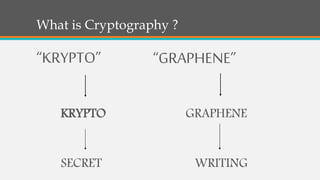
What is Cryptography ?
“KRYPTO” “GRAPHENE”
KRYPTO GRAPHENE
SECRET WRITING
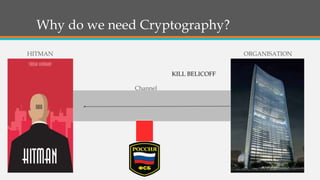
Why do we need Cryptography?
ORGANISATIONHITMAN
KILL BELICOFF
Channel
UTTER FAILURE
HISTORY
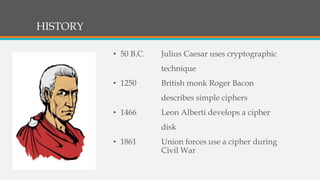
• 50 B.C. Julius Caesar uses cryptographic
technique
• 1250 British monk Roger Bacon
describes simple ciphers
• 1466 Leon Alberti develops a cipher
disk
• 1861 Union forces use a cipher during
Civil War
HISTORY
• 1914 World War I – British, French, and
German forces use encryption
technology
• 1917 William Friedman, Father of U.S.
encryption efforts starts a school
for teaching cryptanalysis in
Illinois
• 1917 AT&T employee Gilbert Vernam
invents polyalphabetic cipher
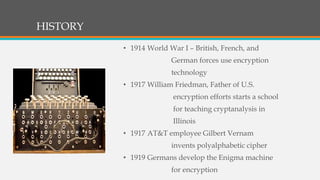
• 1919 Germans develop the Enigma machine
for encryption
HISTORY
• 1937 Japanese design the Purple
machine for encryption
• 1942 Navajo windtalkers help with secure
communication during World War II
• 1948 Claude Shannon develops statistical
methods for encryption/decryption
• 1976 IBM develops DES
• 1976 Diffie – Hellman develop public key /
private key cryptography
• 1977 Rivest – Shamir – Adleman develop the
RSA algorithm for public key / private key
Where do we use Cryptography ?
Secure communication:
• web traffic: HTTPS
• wireless traffic: 802.11i WPA2 (and WEP), GSM, Bluetooth
Encrypting files on disk: EFS, TrueCrypt
Content protection (e.g. DVD, Blu-ray): CSS, AACS
User authentication
… and much much more
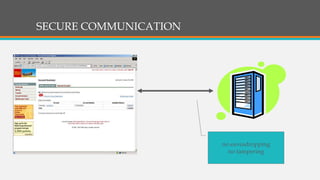
SECURE COMMUNICATION
no eavesdropping
no tampering
PLAIN TEXT
 Plaintext is a text , in natural readable form. It is the message or data
before it gets encrypted. In simple words it is the original message.
 It is sometimes called clear text . Plaintext is denoted by M (message)
or P (plaintext).
 It can be a stream of bits , a text file , a bitmap image, a stream of
digitized voice etc.
E.g.: ”Mission is a Go !!!”
CIPHER TEXT
 An encrypted message is called cipher text . It is denoted by C (cipher
text).
 Sometime it has the same size as the plaintext, sometimes larger than
the plaintext.
 It is the results obtained from the plaintext by applying the encryption
algorithm on the plaintext.
 Cipher text is unreadable by anyone except the intended recipients.
E.g. :“jhbaiudcbew564kjb”
ENCRYPTION
 The process of disguising a message in such a way to hide its
substance is called encryption.
 It is the process of scrambling a message using a specialized
cryptographic algorithm to make it unreadable by anyone except the
intended recipients.
 The encryption function E, operates on M to produce C. In
mathematical notation E(M)=C
Types of Encryption
• SYMMETRIC KEY ENCRYPTION
• PUBLIC KEY ENCRYPTION
SYMMETRIC KEY ENCRYPTION
• Symmetric encryption is the oldest and best-
known technique. A secret key, which can be a
number, a word, or just a string of random letters,
is applied to the text of a message to change the
content in a particular way. This might be as
simple as shifting each letter by a number of
places in the alphabet
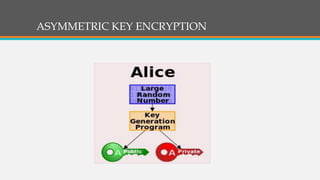
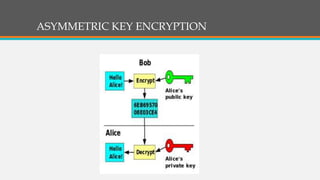
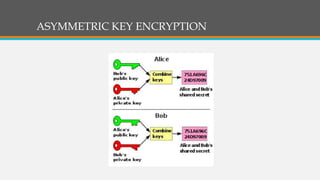
ASYMMETRIC KEY ENCRYPTION
• Public-key encryption, in which a message is
encrypted with a recipient's public key. The
message cannot be decrypted by anyone who does
not possess the matching private key, who is thus
presumed to be the owner of that key and the
person associated with the public key. This is used
in an attempt to ensure confidentiality.
ASYMMETRIC KEY ENCRYPTION
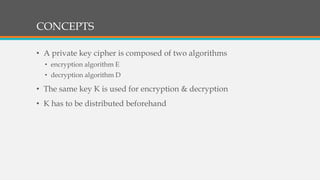
CONCEPTS
• A private key cipher is composed of two algorithms
• encryption algorithm E
• decryption algorithm D
• The same key K is used for encryption & decryption
• K has to be distributed beforehand
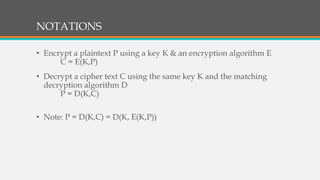
NOTATIONS
• Encrypt a plaintext P using a key K & an encryption algorithm E
C = E(K,P)
• Decrypt a cipher text C using the same key K and the matching
decryption algorithm D
P = D(K,C)
• Note: P = D(K,C) = D(K, E(K,P))
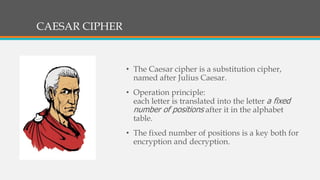
CAESAR CIPHER
• The Caesar cipher is a substitution cipher,
named after Julius Caesar.
• Operation principle:
each letter is translated into the letter a fixed
number of positions after it in the alphabet
table.
• The fixed number of positions is a key both for
encryption and decryption.
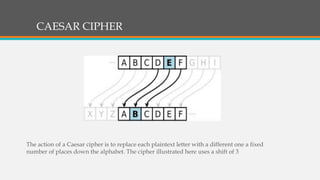
CAESAR CIPHER
The action of a Caesar cipher is to replace each plaintext letter with a different one a fixed
number of places down the alphabet. The cipher illustrated here uses a shift of 3
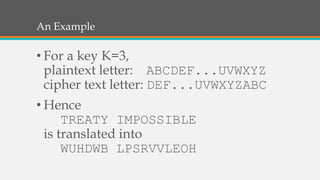
An Example
• For a key K=3,
plaintext letter: ABCDEF...UVWXYZ
cipher text letter: DEF...UVWXYZABC
• Hence
TREATY IMPOSSIBLE
is translated into
WUHDWB LPSRVVLEOH
ATTACKS
• With the help of fast computers, 99.99%
ciphers used before 1976 are breakable
by using one of the 4 types of attacks
(described later).
• Modern cluster computers and future
quantum computers can break several
existing ciphers due to the power of
such computers.
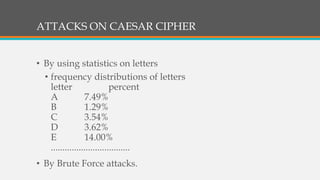
ATTACKS ON CAESAR CIPHER
• By using statistics on letters
• frequency distributions of letters
letter percent
A 7.49%
B 1.29%
C 3.54%
D 3.62%
E 14.00%
..................................
• By Brute Force attacks.
SUMMARY
• What is cryptography ?
• Why do we need Cryptography ?
• Types of Encryption ?
• Notations
• Fundamental Terms
• Caesar Cipher
• Attack on Caesar Cipher
THE END
ANY QUERIES ?
Manojit Ballav
Email: manojitballav@outlook.com
Phone: 9352957266

Fundamentals of cryptography workshop

  • 1.
  • 2.
    What is Cryptography? “KRYPTO” “GRAPHENE” KRYPTO GRAPHENE SECRET WRITING
  • 3.
    Why do weneed Cryptography? ORGANISATIONHITMAN KILL BELICOFF Channel
  • 4.
  • 5.
    HISTORY • 50 B.C.Julius Caesar uses cryptographic technique • 1250 British monk Roger Bacon describes simple ciphers • 1466 Leon Alberti develops a cipher disk • 1861 Union forces use a cipher during Civil War
  • 6.
    HISTORY • 1914 WorldWar I – British, French, and German forces use encryption technology • 1917 William Friedman, Father of U.S. encryption efforts starts a school for teaching cryptanalysis in Illinois • 1917 AT&T employee Gilbert Vernam invents polyalphabetic cipher • 1919 Germans develop the Enigma machine for encryption
  • 7.
    HISTORY • 1937 Japanesedesign the Purple machine for encryption • 1942 Navajo windtalkers help with secure communication during World War II • 1948 Claude Shannon develops statistical methods for encryption/decryption • 1976 IBM develops DES • 1976 Diffie – Hellman develop public key / private key cryptography • 1977 Rivest – Shamir – Adleman develop the RSA algorithm for public key / private key
  • 8.
    Where do weuse Cryptography ? Secure communication: • web traffic: HTTPS • wireless traffic: 802.11i WPA2 (and WEP), GSM, Bluetooth Encrypting files on disk: EFS, TrueCrypt Content protection (e.g. DVD, Blu-ray): CSS, AACS User authentication … and much much more
  • 9.
  • 10.
    PLAIN TEXT  Plaintextis a text , in natural readable form. It is the message or data before it gets encrypted. In simple words it is the original message.  It is sometimes called clear text . Plaintext is denoted by M (message) or P (plaintext).  It can be a stream of bits , a text file , a bitmap image, a stream of digitized voice etc. E.g.: ”Mission is a Go !!!”
  • 11.
    CIPHER TEXT  Anencrypted message is called cipher text . It is denoted by C (cipher text).  Sometime it has the same size as the plaintext, sometimes larger than the plaintext.  It is the results obtained from the plaintext by applying the encryption algorithm on the plaintext.  Cipher text is unreadable by anyone except the intended recipients. E.g. :“jhbaiudcbew564kjb”
  • 12.
    ENCRYPTION  The processof disguising a message in such a way to hide its substance is called encryption.  It is the process of scrambling a message using a specialized cryptographic algorithm to make it unreadable by anyone except the intended recipients.  The encryption function E, operates on M to produce C. In mathematical notation E(M)=C
  • 13.
    Types of Encryption •SYMMETRIC KEY ENCRYPTION • PUBLIC KEY ENCRYPTION
  • 14.
    SYMMETRIC KEY ENCRYPTION •Symmetric encryption is the oldest and best- known technique. A secret key, which can be a number, a word, or just a string of random letters, is applied to the text of a message to change the content in a particular way. This might be as simple as shifting each letter by a number of places in the alphabet
  • 15.
    ASYMMETRIC KEY ENCRYPTION •Public-key encryption, in which a message is encrypted with a recipient's public key. The message cannot be decrypted by anyone who does not possess the matching private key, who is thus presumed to be the owner of that key and the person associated with the public key. This is used in an attempt to ensure confidentiality.
  • 16.
  • 17.
  • 18.
  • 19.
    CONCEPTS • A privatekey cipher is composed of two algorithms • encryption algorithm E • decryption algorithm D • The same key K is used for encryption & decryption • K has to be distributed beforehand
  • 20.
    NOTATIONS • Encrypt aplaintext P using a key K & an encryption algorithm E C = E(K,P) • Decrypt a cipher text C using the same key K and the matching decryption algorithm D P = D(K,C) • Note: P = D(K,C) = D(K, E(K,P))
  • 21.
    CAESAR CIPHER • TheCaesar cipher is a substitution cipher, named after Julius Caesar. • Operation principle: each letter is translated into the letter a fixed number of positions after it in the alphabet table. • The fixed number of positions is a key both for encryption and decryption.
  • 22.
    CAESAR CIPHER The actionof a Caesar cipher is to replace each plaintext letter with a different one a fixed number of places down the alphabet. The cipher illustrated here uses a shift of 3
  • 23.
    An Example • Fora key K=3, plaintext letter: ABCDEF...UVWXYZ cipher text letter: DEF...UVWXYZABC • Hence TREATY IMPOSSIBLE is translated into WUHDWB LPSRVVLEOH
  • 24.
    ATTACKS • With thehelp of fast computers, 99.99% ciphers used before 1976 are breakable by using one of the 4 types of attacks (described later). • Modern cluster computers and future quantum computers can break several existing ciphers due to the power of such computers.
  • 25.
    ATTACKS ON CAESARCIPHER • By using statistics on letters • frequency distributions of letters letter percent A 7.49% B 1.29% C 3.54% D 3.62% E 14.00% .................................. • By Brute Force attacks.
  • 26.
    SUMMARY • What iscryptography ? • Why do we need Cryptography ? • Types of Encryption ? • Notations • Fundamental Terms • Caesar Cipher • Attack on Caesar Cipher
  • 27.
    THE END ANY QUERIES? Manojit Ballav Email: manojitballav@outlook.com Phone: 9352957266