Presented By:
Vidula Shukla
M.Tech., Computer Science & Engineering

Dept. of Computer Science & Engineering
Sagar Inst. of Research & Technology
Bhopal
Overview
 Introduction
 Motivation
 Requirement
 Kerberos Version 4

 Kerberos Realms
 Kerberos V4 V/s V5
 Kerberos Version 5

 Strength
 Conclusion
7/10/2013

KERBEROS

2
Introduction
 Authentication: can be defined as determining an

identity to the required level of assurance.
 Authentication Application : Deals with the

authentication function that have been developed to
support application-level authentication

7/10/2013

KERBEROS

3
Introduction to Kerberos
 An authentication service developed for Project Athena at

MIT
 Provides
 strong security on physically insecure network
 a centralized authentication server which authenticates



Users to servers
Servers to users

 Relies on conventional encryption rather than public-key

encryption

7/10/2013

KERBEROS

4
Why Kerberos is needed ?
Problem: Not trusted workstation to identify
their users correctly in an open distributed environment

3 Threats:




7/10/2013

Pretending to be another user from the workstation
Sending request from the impersonated workstation
Replay attack to gain service or disrupt operations

KERBEROS

5
Why Kerberos is needed ? Cont.
Solution:
 Building elaborate authentication protocols at

each server
 A centralized authentication server (Kerberos)

7/10/2013

KERBEROS

6
Requirements for KERBEROS
 Secure:
 An opponent does not find it to be the weak link
 Reliable:
 The system should be able to back up another
 Transparent:
 An user should not be aware of authentication
 Scalable:
 The system supports large number of clients and
severs
7/10/2013

KERBEROS

7
KERBEROS VERSION 4
 Version 4 is most widely used version
 Version 4 uses of DES
 Version 4 build up to the full protocol by

looking at several hypothetical dialogues
 Version 5 corrects some of the security
deficiencies of Version 4

7/10/2013

KERBEROS

8
 Problem:

An opponent can pretend to be another client and
obtain unauthorized privileges on server machine.
 Solution :
Server must be able to confirm the identities of client
who request service.

7/10/2013

KERBEROS

9
Kerberos Version 4: Dialog 1- Simple

Ticket=E(kv[IDc,ADc,IDv])
10

7/10/2013

KERBEROS
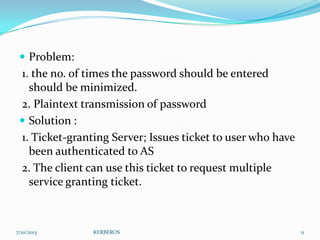
 Problem:

1. the no. of times the password should be entered
should be minimized.
2. Plaintext transmission of password
 Solution :
1. Ticket-granting Server; Issues ticket to user who have
been authenticated to AS
2. The client can use this ticket to request multiple
service granting ticket.

7/10/2013

KERBEROS

11
Kerberos Version 4 : Dialog 2-More Secure
ticketTGS=EKtgs[IDc,ADc,IDtgs,TS1,LifeTime1
]
Once per user logon session

Once per type of service

4-TicketV
7/10/2013

KERBEROS

12
Kerberos Version 4 : Dialog 2
- More Secure Cont.
Once per service session

5- TicketV+ IDc

TicketV=EKv[IDc,ADc,IDv,Ts2,Lifetime2]

7/10/2013

KERBEROS

13
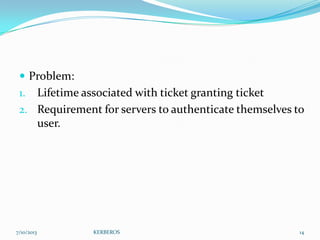
 Problem:

Lifetime associated with ticket granting ticket
2. Requirement for servers to authenticate themselves to
user.
1.

7/10/2013

KERBEROS

14
Kerberos: The Version 4 Authentication Dialog
Once per user logon session

ticketTGS=EKtgs
[Kc.tgs, IDc,ADc,IDtgs,TS2, LifeTi
me2 ]

7/10/2013

KERBEROS

KERBEROS

15
Kerberos: The Version 4 Authentication Dialog
Cont.
Once per type of service

ticketTGS=EKtgs
[Kc.tgs,IDc,ADc,IDtgs, TS2, LifeTime2 ]

KERBEROS

AuthenticatorC=EKc.tgs[IDc,ADc,TS3]
ticketV=EKV[Kc.v,IDc,ADc,IDv, TS4, LifeTime4 ]

3- TicketTGS + AuthenticatorC +
IDv
4-EKc.tgs[ Kc.v,IDv,Ts4,Ticketv]
7/10/2013

KERBEROS

16
Kerberos: The Version 4 Authentication Dialog
Cont.
Once per service session

5- TicketV+ AuthenticatorC
6- EKc.v[TS5+1]
TicketV=EKv [Kv.c, IDc, ADc, IDv, TS4, Lifetime4]
AuthenticatorC=EKc.v [IDc,ADc,TS5]
7/10/2013

KERBEROS

17
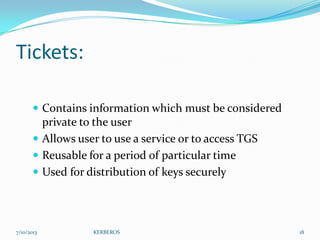
Tickets:
 Contains information which must be considered

private to the user
 Allows user to use a service or to access TGS
 Reusable for a period of particular time
 Used for distribution of keys securely

7/10/2013

KERBEROS

18
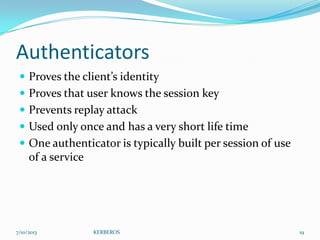
Authenticators
 Proves the client’s identity
 Proves that user knows the session key
 Prevents replay attack
 Used only once and has a very short life time

 One authenticator is typically built per session of use

of a service

7/10/2013

KERBEROS

19
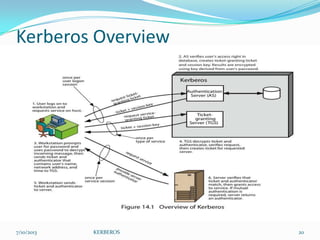
Kerberos Overview

7/10/2013

KERBEROS

20
Kerberos Realms
 A single administrative domain includes:
 a Kerberos server
 a number of clients, all registered with server
 application servers, sharing keys with server
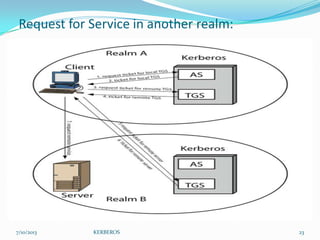
 What will happen when users in one realm need access

to service from other realms?:
 Kerberos provide inter-realm authentication

7/10/2013

KERBEROS

21
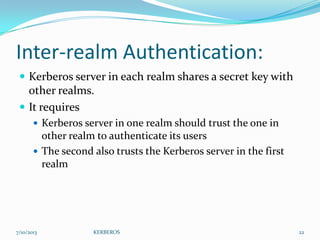
Inter-realm Authentication:
 Kerberos server in each realm shares a secret key with

other realms.
 It requires
 Kerberos server in one realm should trust the one in

other realm to authenticate its users
 The second also trusts the Kerberos server in the first
realm

7/10/2013

KERBEROS

22
Request for Service in another realm:

7/10/2013

KERBEROS

23
KERBEROS Version 5 versus Version4
 Environmental shortcomings of Version 4:
 Encryption system dependence: DES
 Message byte ordering
 Internet protocol dependence
 Ticket lifetime
 Authentication forwarding
 Inter-realm authentication

7/10/2013

KERBEROS

24
KERBEROS Version 5 versus Version4
 Technical deficiencies of Version 4:
 Double encryption

 Session Keys
 Password attack
 Mode of Encryption

7/10/2013

KERBEROS

25
New Elements in Kerberos Version 5
 Realm
 Indicates realm of the user
 Options
 Times
 From: the desired start time for the ticket
 Till: the requested expiration time
 Rtime: requested renew-till time
 Nonce
 A random value to assure the response is fresh

7/10/2013

KERBEROS

26
Kerberos Version 5 Message Exchange:1


To obtain ticket-granting ticket:

(1)C  AS : Options || IDc || Realmc || IDtgs ||Times ||
Nonce1

(2) AS  C : Realmc || IDc || Ticket tgs ||
EKc [ Kc,tgs || IDtgs || Times || Nonce1 ||| Realm tgs ]

Ticket tgs= EKtgs [ Flags || Kc,tgs || Realm c ||
IDc || ADc || Times]

7/10/2013

KERBEROS

27
Kerberos Version 5 Message Exchange:2
 To obtain service-granting ticket :
(3)C  TGS : Options || IDv || Times || Nonce2 || Ticket tgs ║
Authenticator c
(4)TGS  C : Realmc || IDc || Ticket v || EK c,tgs [ Kc,v ║Times||
Nonce2 || IDv ║ Realm v]
Ticket tgs= EKtgs [ Flags || Kc,tgs || Realm c || IDc || ADc ||
Times]
Ticket v : EK v [Kc,,v ║ Realmc || IDc ║ ADc ║ Times ]
Authenticator c : EK c,tgs [IDc ║ Realmc ║ TS1]

7/10/2013

KERBEROS

28
Kerberos Version 5 Message Exchange:3
 To obtain service

(5) C  S : Options || Ticket v|| Authenticator c
(6) S  C : EK c,v [TS2|| Subkey || Seq# ]
 Ticket v : EK v [Flags || Kc,v || Realmc ||

IDc || ADc || Times ]
 Authenticator c : EK c,v [IDc || Realmc ||
TS2 || Subkey|| Seq# ]

7/10/2013

KERBEROS

29
Kerberos : Strengths
 User's passwords are never sent across the

network, encrypted or in plain text

 Secret keys are only passed across the network in encrypted

form

 Client and server systems mutually authenticate
 It limits the duration of their users' authentication.
 Authentications are reusable and durable

7/10/2013

KERBEROS

30
Conclusion
 Kerberos is an authentication service using convention

encryption
 Kerberos the solution to network security is a protocol
designed to provide centralized authentication whose
function is to authenticate user to server and server to
user.

7/10/2013

KERBEROS

31
THANK YOU

7/10/2013

KERBEROS

32

Kerberos : An Authentication Application

  • 1.
    Presented By: Vidula Shukla M.Tech.,Computer Science & Engineering Dept. of Computer Science & Engineering Sagar Inst. of Research & Technology Bhopal
  • 2.
    Overview  Introduction  Motivation Requirement  Kerberos Version 4  Kerberos Realms  Kerberos V4 V/s V5  Kerberos Version 5  Strength  Conclusion 7/10/2013 KERBEROS 2
  • 3.
    Introduction  Authentication: canbe defined as determining an identity to the required level of assurance.  Authentication Application : Deals with the authentication function that have been developed to support application-level authentication 7/10/2013 KERBEROS 3
  • 4.
    Introduction to Kerberos An authentication service developed for Project Athena at MIT  Provides  strong security on physically insecure network  a centralized authentication server which authenticates   Users to servers Servers to users  Relies on conventional encryption rather than public-key encryption 7/10/2013 KERBEROS 4
  • 5.
    Why Kerberos isneeded ? Problem: Not trusted workstation to identify their users correctly in an open distributed environment 3 Threats:    7/10/2013 Pretending to be another user from the workstation Sending request from the impersonated workstation Replay attack to gain service or disrupt operations KERBEROS 5
  • 6.
    Why Kerberos isneeded ? Cont. Solution:  Building elaborate authentication protocols at each server  A centralized authentication server (Kerberos) 7/10/2013 KERBEROS 6
  • 7.
    Requirements for KERBEROS Secure:  An opponent does not find it to be the weak link  Reliable:  The system should be able to back up another  Transparent:  An user should not be aware of authentication  Scalable:  The system supports large number of clients and severs 7/10/2013 KERBEROS 7
  • 8.
    KERBEROS VERSION 4 Version 4 is most widely used version  Version 4 uses of DES  Version 4 build up to the full protocol by looking at several hypothetical dialogues  Version 5 corrects some of the security deficiencies of Version 4 7/10/2013 KERBEROS 8
  • 9.
     Problem: An opponentcan pretend to be another client and obtain unauthorized privileges on server machine.  Solution : Server must be able to confirm the identities of client who request service. 7/10/2013 KERBEROS 9
  • 10.
    Kerberos Version 4:Dialog 1- Simple Ticket=E(kv[IDc,ADc,IDv]) 10 7/10/2013 KERBEROS
  • 11.
     Problem: 1. theno. of times the password should be entered should be minimized. 2. Plaintext transmission of password  Solution : 1. Ticket-granting Server; Issues ticket to user who have been authenticated to AS 2. The client can use this ticket to request multiple service granting ticket. 7/10/2013 KERBEROS 11
  • 12.
    Kerberos Version 4: Dialog 2-More Secure ticketTGS=EKtgs[IDc,ADc,IDtgs,TS1,LifeTime1 ] Once per user logon session Once per type of service 4-TicketV 7/10/2013 KERBEROS 12
  • 13.
    Kerberos Version 4: Dialog 2 - More Secure Cont. Once per service session 5- TicketV+ IDc TicketV=EKv[IDc,ADc,IDv,Ts2,Lifetime2] 7/10/2013 KERBEROS 13
  • 14.
     Problem: Lifetime associatedwith ticket granting ticket 2. Requirement for servers to authenticate themselves to user. 1. 7/10/2013 KERBEROS 14
  • 15.
    Kerberos: The Version4 Authentication Dialog Once per user logon session ticketTGS=EKtgs [Kc.tgs, IDc,ADc,IDtgs,TS2, LifeTi me2 ] 7/10/2013 KERBEROS KERBEROS 15
  • 16.
    Kerberos: The Version4 Authentication Dialog Cont. Once per type of service ticketTGS=EKtgs [Kc.tgs,IDc,ADc,IDtgs, TS2, LifeTime2 ] KERBEROS AuthenticatorC=EKc.tgs[IDc,ADc,TS3] ticketV=EKV[Kc.v,IDc,ADc,IDv, TS4, LifeTime4 ] 3- TicketTGS + AuthenticatorC + IDv 4-EKc.tgs[ Kc.v,IDv,Ts4,Ticketv] 7/10/2013 KERBEROS 16
  • 17.
    Kerberos: The Version4 Authentication Dialog Cont. Once per service session 5- TicketV+ AuthenticatorC 6- EKc.v[TS5+1] TicketV=EKv [Kv.c, IDc, ADc, IDv, TS4, Lifetime4] AuthenticatorC=EKc.v [IDc,ADc,TS5] 7/10/2013 KERBEROS 17
  • 18.
    Tickets:  Contains informationwhich must be considered private to the user  Allows user to use a service or to access TGS  Reusable for a period of particular time  Used for distribution of keys securely 7/10/2013 KERBEROS 18
  • 19.
    Authenticators  Proves theclient’s identity  Proves that user knows the session key  Prevents replay attack  Used only once and has a very short life time  One authenticator is typically built per session of use of a service 7/10/2013 KERBEROS 19
  • 20.
  • 21.
    Kerberos Realms  Asingle administrative domain includes:  a Kerberos server  a number of clients, all registered with server  application servers, sharing keys with server  What will happen when users in one realm need access to service from other realms?:  Kerberos provide inter-realm authentication 7/10/2013 KERBEROS 21
  • 22.
    Inter-realm Authentication:  Kerberosserver in each realm shares a secret key with other realms.  It requires  Kerberos server in one realm should trust the one in other realm to authenticate its users  The second also trusts the Kerberos server in the first realm 7/10/2013 KERBEROS 22
  • 23.
    Request for Servicein another realm: 7/10/2013 KERBEROS 23
  • 24.
    KERBEROS Version 5versus Version4  Environmental shortcomings of Version 4:  Encryption system dependence: DES  Message byte ordering  Internet protocol dependence  Ticket lifetime  Authentication forwarding  Inter-realm authentication 7/10/2013 KERBEROS 24
  • 25.
    KERBEROS Version 5versus Version4  Technical deficiencies of Version 4:  Double encryption  Session Keys  Password attack  Mode of Encryption 7/10/2013 KERBEROS 25
  • 26.
    New Elements inKerberos Version 5  Realm  Indicates realm of the user  Options  Times  From: the desired start time for the ticket  Till: the requested expiration time  Rtime: requested renew-till time  Nonce  A random value to assure the response is fresh 7/10/2013 KERBEROS 26
  • 27.
    Kerberos Version 5Message Exchange:1  To obtain ticket-granting ticket: (1)C  AS : Options || IDc || Realmc || IDtgs ||Times || Nonce1 (2) AS  C : Realmc || IDc || Ticket tgs || EKc [ Kc,tgs || IDtgs || Times || Nonce1 ||| Realm tgs ] Ticket tgs= EKtgs [ Flags || Kc,tgs || Realm c || IDc || ADc || Times] 7/10/2013 KERBEROS 27
  • 28.
    Kerberos Version 5Message Exchange:2  To obtain service-granting ticket : (3)C  TGS : Options || IDv || Times || Nonce2 || Ticket tgs ║ Authenticator c (4)TGS  C : Realmc || IDc || Ticket v || EK c,tgs [ Kc,v ║Times|| Nonce2 || IDv ║ Realm v] Ticket tgs= EKtgs [ Flags || Kc,tgs || Realm c || IDc || ADc || Times] Ticket v : EK v [Kc,,v ║ Realmc || IDc ║ ADc ║ Times ] Authenticator c : EK c,tgs [IDc ║ Realmc ║ TS1] 7/10/2013 KERBEROS 28
  • 29.
    Kerberos Version 5Message Exchange:3  To obtain service (5) C  S : Options || Ticket v|| Authenticator c (6) S  C : EK c,v [TS2|| Subkey || Seq# ]  Ticket v : EK v [Flags || Kc,v || Realmc || IDc || ADc || Times ]  Authenticator c : EK c,v [IDc || Realmc || TS2 || Subkey|| Seq# ] 7/10/2013 KERBEROS 29
  • 30.
    Kerberos : Strengths User's passwords are never sent across the network, encrypted or in plain text  Secret keys are only passed across the network in encrypted form  Client and server systems mutually authenticate  It limits the duration of their users' authentication.  Authentications are reusable and durable 7/10/2013 KERBEROS 30
  • 31.
    Conclusion  Kerberos isan authentication service using convention encryption  Kerberos the solution to network security is a protocol designed to provide centralized authentication whose function is to authenticate user to server and server to user. 7/10/2013 KERBEROS 31
  • 32.

Editor's Notes

  • #11 C = clientAS = Authentication serverV = ServerIDc = Identifier of user on CIdv = Identifier of VPc = Password of user on CAdc = Network address of Ckv=Secret Key between AS and V (Server)
  • #14 The ticket is encrypted with a secret key (Kv) known only to TGS and the server , preventing alteration.
  • #24 C -> AS : IDc + IDtgs + TS1AS -> C : E(Kc, [Kc,tgs + IDtgs + TS1 + Lifetime2 + Ticket tgs ])C -> TGS :