Stream Ciphers
Prof. Neeraj Bhargava
Mrs. Shubha Chaturvedi
Department of Computer Science, School of
Engineering & System Sciences
MDS University Ajmer, Rajasthan
• In stream cipher, one byte is encrypted at a
time while in block cipher ~128 bits are
encrypted at a time.
• Initially, a key(k) will be supplied as input to
pseudorandom bit generator and then it
produces a random 8-bit output which is
treated as keystream.
• The resulted keystream will be of size 1 byte, i.e., 8 bits.
• Stream Cipher follows the sequence of pseudorandom
number stream.
• One of the benefits of following stream cipher is to make
cryptanalysis more difficult, so the number of bits chosen in
the Keystream must be long in order to make cryptanalysis
more difficult.
• By making the key more longer it is also safe against brute
force attacks.
• The longer the key the stronger security is achieved,
preventing any attack.
• Keystream can be designed more efficiently by including
more number of 1s and 0s, for making cryptanalysis more
difficult.
• Considerable benefit of a stream cipher is, it requires few
lines of code compared to block cipher.
Daigram of Stream Cipher
Encryption :
For Encryption:
• Plain Text and Keystream produces Cipher Text
(Same keystream will be used for decryption.).
• The Plaintext will undergo XOR operation with
keystream bit-by-bit and produces the Cipher
Text.
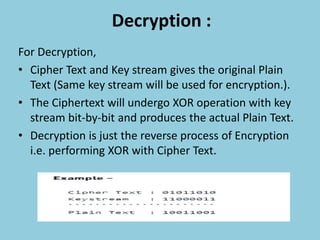
Decryption :
For Decryption,
• Cipher Text and Key stream gives the original Plain
Text (Same key stream will be used for encryption.).
• The Ciphertext will undergo XOR operation with key
stream bit-by-bit and produces the actual Plain Text.
• Decryption is just the reverse process of Encryption
i.e. performing XOR with Cipher Text.
Assignment
Q1. Calculate the Stream Cipher for
Plaintext: 110010101
Q2. Calculate the Stream Cipher for
Plaintext: 100000101

Stream Ciphers

  • 1.
    Stream Ciphers Prof. NeerajBhargava Mrs. Shubha Chaturvedi Department of Computer Science, School of Engineering & System Sciences MDS University Ajmer, Rajasthan
  • 2.
    • In streamcipher, one byte is encrypted at a time while in block cipher ~128 bits are encrypted at a time. • Initially, a key(k) will be supplied as input to pseudorandom bit generator and then it produces a random 8-bit output which is treated as keystream.
  • 3.
    • The resultedkeystream will be of size 1 byte, i.e., 8 bits. • Stream Cipher follows the sequence of pseudorandom number stream. • One of the benefits of following stream cipher is to make cryptanalysis more difficult, so the number of bits chosen in the Keystream must be long in order to make cryptanalysis more difficult. • By making the key more longer it is also safe against brute force attacks. • The longer the key the stronger security is achieved, preventing any attack. • Keystream can be designed more efficiently by including more number of 1s and 0s, for making cryptanalysis more difficult. • Considerable benefit of a stream cipher is, it requires few lines of code compared to block cipher.
  • 4.
  • 5.
    Encryption : For Encryption: •Plain Text and Keystream produces Cipher Text (Same keystream will be used for decryption.). • The Plaintext will undergo XOR operation with keystream bit-by-bit and produces the Cipher Text.
  • 6.
    Decryption : For Decryption, •Cipher Text and Key stream gives the original Plain Text (Same key stream will be used for encryption.). • The Ciphertext will undergo XOR operation with key stream bit-by-bit and produces the actual Plain Text. • Decryption is just the reverse process of Encryption i.e. performing XOR with Cipher Text.
  • 7.
    Assignment Q1. Calculate theStream Cipher for Plaintext: 110010101 Q2. Calculate the Stream Cipher for Plaintext: 100000101