Fundamentals of Cryptography
Cryptography is the art and science of securing information to ensure its confidentiality, integrity, and
authenticity.
cryptography is the process of protecting information so that it remains private, untampered, and
authentic. It achieves this by converting readable data (plaintext) into an unreadable form (ciphertext)
using specific algorithms and keys. Only those with the right decryption key can reverse this process and
access the original data.
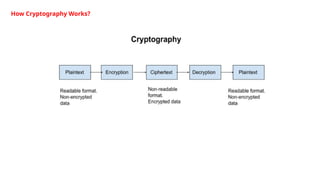
How Cryptography Works?
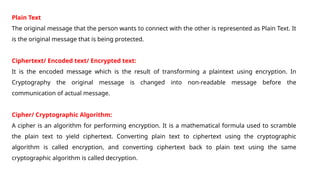
Plain Text
The original message that the person wants to connect with the other is represented as Plain Text. It
is the original message that is being protected.
Ciphertext/ Encoded text/ Encrypted text:
It is the encoded message which is the result of transforming a plaintext using encryption. In
Cryptography the original message is changed into non-readable message before the
communication of actual message.
Cipher/ Cryptographic Algorithm:
A cipher is an algorithm for performing encryption. It is a mathematical formula used to scramble
the plain text to yield ciphertext. Converting plain text to ciphertext using the cryptographic
algorithm is called encryption, and converting ciphertext back to plain text using the same
cryptographic algorithm is called decryption.
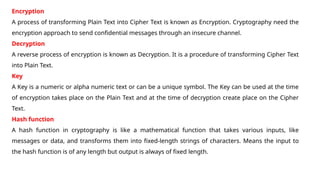
Encryption
A process of transforming Plain Text into Cipher Text is known as Encryption. Cryptography need the
encryption approach to send confidential messages through an insecure channel.
Decryption
A reverse process of encryption is known as Decryption. It is a procedure of transforming Cipher Text
into Plain Text.
Key
A Key is a numeric or alpha numeric text or can be a unique symbol. The Key can be used at the time
of encryption takes place on the Plain Text and at the time of decryption create place on the Cipher
Text.
Hash function
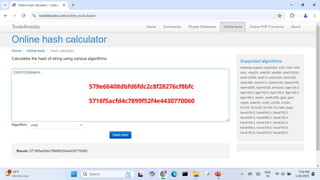
A hash function in cryptography is like a mathematical function that takes various inputs, like
messages or data, and transforms them into fixed-length strings of characters. Means the input to
the hash function is of any length but output is always of fixed length.
Tools4noobs.com
579e66408dbfd6fdc2c8f28276cf8bfc
5716f5acfd4c7899f52f4e4430770060
Types of Cryptography:
There are three major types of cryptography.
• Symmetric cryptography
• Asymmetric cryptography
• Hash functions
• Hybrid encryption
Symmetric Key cryptography
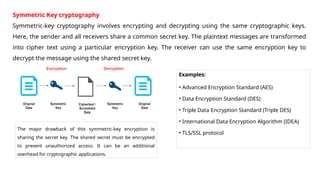
Symmetric-key cryptography involves encrypting and decrypting using the same cryptographic keys.
Here, the sender and all receivers share a common secret key. The plaintext messages are transformed
into cipher text using a particular encryption key. The receiver can use the same encryption key to
decrypt the message using the shared secret key.
Examples:
• Advanced Encryption Standard (AES)
• Data Encryption Standard (DES)
• Triple Data Encryption Standard (Triple DES)
• International Data Encryption Algorithm (IDEA)
• TLS/SSL protocol
The major drawback of this symmetric-key encryption is
sharing the secret key. The shared secret must be encrypted
to prevent unauthorized access. It can be an additional
overhead for cryptographic applications.
XOR operator in cryptography (Example for Symmetric Key cryptography)
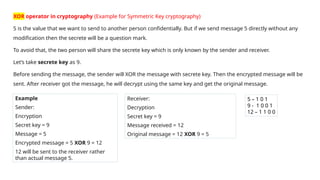
5 is the value that we want to send to another person confidentially. But if we send message 5 directly without any
modification then the secrete will be a question mark.
To avoid that, the two person will share the secrete key which is only known by the sender and receiver.
Let’s take secrete key as 9.
Before sending the message, the sender will XOR the message with secrete key. Then the encrypted message will be
sent. After receiver got the message, he will decrypt using the same key and get the original message.
Example
Sender:
Encryption
Secret key = 9
Message = 5
Encrypted message = 5 XOR 9 = 12
12 will be sent to the receiver rather
than actual message 5.
Receiver:
Decryption
Secret key = 9
Message received = 12
Original message = 12 XOR 9 = 5
5 – 1 0 1
9 - 1 0 0 1
12 – 1 1 0 0
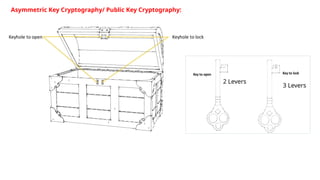
Asymmetric Key Cryptography/ Public Key Cryptography:
2 Levers
3 Levers
Private Key
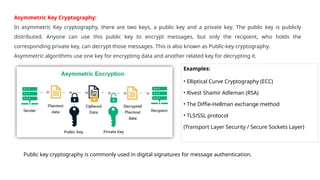
Asymmetric Key Cryptography:
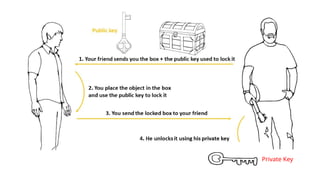
In asymmetric Key cryptography, there are two keys, a public key and a private key. The public key is publicly
distributed. Anyone can use this public key to encrypt messages, but only the recipient, who holds the
corresponding private key, can decrypt those messages. This is also known as Public-key cryptography.
Asymmetric algorithms use one key for encrypting data and another related key for decrypting it.
Examples:
• Elliptical Curve Cryptography (ECC)
• Rivest Shamir Adleman (RSA)
• The Diffie-Hellman exchange method
• TLS/SSL protocol
(Transport Layer Security / Secure Sockets Layer)
Public key cryptography is commonly used in digital signatures for message authentication.
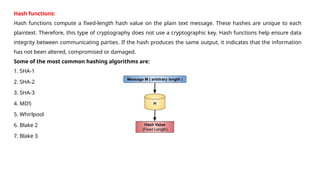
Hash functions:
Hash functions compute a fixed-length hash value on the plain text message. These hashes are unique to each
plaintext. Therefore, this type of cryptography does not use a cryptographic key. Hash functions help ensure data
integrity between communicating parties. If the hash produces the same output, it indicates that the information
has not been altered, compromised or damaged.
Some of the most common hashing algorithms are:
1. SHA-1
2. SHA-2
3. SHA-3
4. MD5
5. Whirlpool
6. Blake 2
7. Blake 3
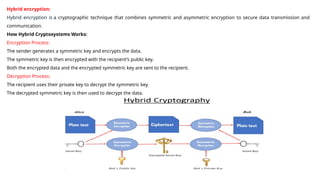
Hybrid encryption:
Hybrid encryption is a cryptographic technique that combines symmetric and asymmetric encryption to secure data transmission and
communication.
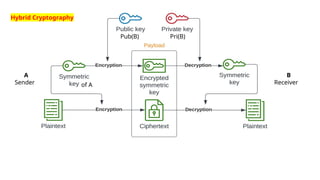
How Hybrid Cryptosystems Works:
Encryption Process:
The sender generates a symmetric key and encrypts the data.
The symmetric key is then encrypted with the recipient’s public key.
Both the encrypted data and the encrypted symmetric key are sent to the recipient.
Decryption Process:
The recipient uses their private key to decrypt the symmetric key.
The decrypted symmetric key is then used to decrypt the data.
Hybrid Cryptography
A
Sender
B
Receiver
Pub(B) Pri(B)
of A
Basics of Cryptography presentation.pptx

Basics of Cryptography presentation.pptx

  • 1.
    Fundamentals of Cryptography Cryptographyis the art and science of securing information to ensure its confidentiality, integrity, and authenticity. cryptography is the process of protecting information so that it remains private, untampered, and authentic. It achieves this by converting readable data (plaintext) into an unreadable form (ciphertext) using specific algorithms and keys. Only those with the right decryption key can reverse this process and access the original data.
  • 2.
  • 3.
    Plain Text The originalmessage that the person wants to connect with the other is represented as Plain Text. It is the original message that is being protected. Ciphertext/ Encoded text/ Encrypted text: It is the encoded message which is the result of transforming a plaintext using encryption. In Cryptography the original message is changed into non-readable message before the communication of actual message. Cipher/ Cryptographic Algorithm: A cipher is an algorithm for performing encryption. It is a mathematical formula used to scramble the plain text to yield ciphertext. Converting plain text to ciphertext using the cryptographic algorithm is called encryption, and converting ciphertext back to plain text using the same cryptographic algorithm is called decryption.
  • 4.
    Encryption A process oftransforming Plain Text into Cipher Text is known as Encryption. Cryptography need the encryption approach to send confidential messages through an insecure channel. Decryption A reverse process of encryption is known as Decryption. It is a procedure of transforming Cipher Text into Plain Text. Key A Key is a numeric or alpha numeric text or can be a unique symbol. The Key can be used at the time of encryption takes place on the Plain Text and at the time of decryption create place on the Cipher Text. Hash function A hash function in cryptography is like a mathematical function that takes various inputs, like messages or data, and transforms them into fixed-length strings of characters. Means the input to the hash function is of any length but output is always of fixed length.
  • 5.
  • 9.
  • 10.
    Types of Cryptography: Thereare three major types of cryptography. • Symmetric cryptography • Asymmetric cryptography • Hash functions • Hybrid encryption
  • 11.
    Symmetric Key cryptography Symmetric-keycryptography involves encrypting and decrypting using the same cryptographic keys. Here, the sender and all receivers share a common secret key. The plaintext messages are transformed into cipher text using a particular encryption key. The receiver can use the same encryption key to decrypt the message using the shared secret key. Examples: • Advanced Encryption Standard (AES) • Data Encryption Standard (DES) • Triple Data Encryption Standard (Triple DES) • International Data Encryption Algorithm (IDEA) • TLS/SSL protocol The major drawback of this symmetric-key encryption is sharing the secret key. The shared secret must be encrypted to prevent unauthorized access. It can be an additional overhead for cryptographic applications.
  • 12.
    XOR operator incryptography (Example for Symmetric Key cryptography) 5 is the value that we want to send to another person confidentially. But if we send message 5 directly without any modification then the secrete will be a question mark. To avoid that, the two person will share the secrete key which is only known by the sender and receiver. Let’s take secrete key as 9. Before sending the message, the sender will XOR the message with secrete key. Then the encrypted message will be sent. After receiver got the message, he will decrypt using the same key and get the original message. Example Sender: Encryption Secret key = 9 Message = 5 Encrypted message = 5 XOR 9 = 12 12 will be sent to the receiver rather than actual message 5. Receiver: Decryption Secret key = 9 Message received = 12 Original message = 12 XOR 9 = 5 5 – 1 0 1 9 - 1 0 0 1 12 – 1 1 0 0
  • 13.
    Asymmetric Key Cryptography/Public Key Cryptography: 2 Levers 3 Levers
  • 14.
  • 15.
    Asymmetric Key Cryptography: Inasymmetric Key cryptography, there are two keys, a public key and a private key. The public key is publicly distributed. Anyone can use this public key to encrypt messages, but only the recipient, who holds the corresponding private key, can decrypt those messages. This is also known as Public-key cryptography. Asymmetric algorithms use one key for encrypting data and another related key for decrypting it. Examples: • Elliptical Curve Cryptography (ECC) • Rivest Shamir Adleman (RSA) • The Diffie-Hellman exchange method • TLS/SSL protocol (Transport Layer Security / Secure Sockets Layer) Public key cryptography is commonly used in digital signatures for message authentication.
  • 16.
    Hash functions: Hash functionscompute a fixed-length hash value on the plain text message. These hashes are unique to each plaintext. Therefore, this type of cryptography does not use a cryptographic key. Hash functions help ensure data integrity between communicating parties. If the hash produces the same output, it indicates that the information has not been altered, compromised or damaged. Some of the most common hashing algorithms are: 1. SHA-1 2. SHA-2 3. SHA-3 4. MD5 5. Whirlpool 6. Blake 2 7. Blake 3
  • 17.
    Hybrid encryption: Hybrid encryptionis a cryptographic technique that combines symmetric and asymmetric encryption to secure data transmission and communication. How Hybrid Cryptosystems Works: Encryption Process: The sender generates a symmetric key and encrypts the data. The symmetric key is then encrypted with the recipient’s public key. Both the encrypted data and the encrypted symmetric key are sent to the recipient. Decryption Process: The recipient uses their private key to decrypt the symmetric key. The decrypted symmetric key is then used to decrypt the data.
  • 18.