OverView
   What is Steganography?
   History Of Steganography
   Physical And Digital techniques
   Comparison Of Secret Communication Techniques
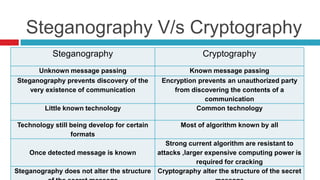
   Steganography v/s Cryptography
   Evolution
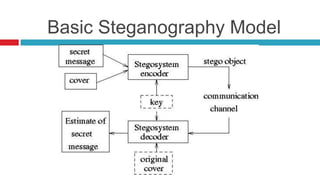
   Basic Steganography Model
   Steganography Terms
   Types of StegoSystems
OverView
   Types Of Steganography
       Text Steganography
       Image Steganography
       Audio Steganography
   Applications
   Advantages v/s Disadvantages
   Future Scope
   Conclusion
   References
What is Steganography?
   Steganography is the art and science of writing hidden
    messages in such a way that no one, apart from the sender and
    intended recipient, suspects the existence of the message, a
    form of security through obscurity.
   The word steganography is of Greek origin and means
    "concealed writing" from the Greek words steganos meaning
    "covered or protected", and graphein meaning "writing".
   “Steganography means hiding one piece of data within
    another”.
Example
  Since everyone can read, encoding text
in neutral sentences is doubtfully effective

  Since Everyone Can Read, Encoding Text
 In Neutral Sentences Is Doubtfully Effective

                „Secret inside’
History Of Steganography
   The first recorded uses of steganography can be traced back to 440 BC
    when Herodotus mentions two examples of steganography in his Histories.
   Demaratus sent a warning about a forthcoming attack to Greece by writing it
    directly on the wooden backing of a wax tablet before applying its beeswax
    surface.
   Wax tablets were in common use then as reusable writing surfaces, sometimes
    used for shorthand.
   Ancient Chinese wrote messages on fine silk, which was then crunched into a
    tiny ball and covered in wax. The messenger then swallowed the ball of wax.
   Special “inks” were important steganographic tools even during Second World
    War.
   During Second World War a technique was developed to shrink photographically
    a page of text into a dot less than one millimeter in diameter, and then hide this
    microdot in an apparently innocuous letter. (The first microdot has been spotted
Physical Techniques
   Physical Techniques
     Hidden   messages within wax tablets
     Hidden messages on messenger's body
     Hidden messages on paper written in secret inks
     Messages written in Morse code on
      knitting yarn and then knitted into a piece of
      clothing worn by a courier
     Messages written on envelopes in the area
      covered by postage stamps.
Digital Techniques
   Digital Techniques
     Concealing   messages within the lowest bits
      of noisy images or sound files.
     Chaffing and winnowing.

     Modifying the echo of a sound file (Echo
      Steganography)
     Including data in ignored sections of a file, such as
      after the logical end of the carrier file.
Comparison Of Secret
Communication Techniques
Steganography V/s Cryptography
           Steganography                                  Cryptography
       Unknown message passing                       Known message passing
Steganography prevents discovery of the      Encryption prevents an unauthorized party
    very existence of communication             from discovering the contents of a
                                                          communication
         Little known technology                       Common technology

Technology still being develop for certain         Most of algorithm known by all
                 formats
                                              Strong current algorithm are resistant to
    Once detected message is known         attacks ,larger expensive computing power is
                                                        required for cracking
Steganography does not alter the structure Cryptography alter the structure of the secret
Combined Crypto-
                       Steganography

       Invisible


        Merge


Steganograph    Encryption
y
Evolution


Cryptography
                      Steganography


   Watermarkin
   g
Basic Steganography Model
Steganography Terms
   Carrier or Cover File - A Original message or a file in which
    hidden information will be stored inside of it .

   Stego-Medium - The medium in which the information is hidden.

   Embedded or Payload - The information which is to be hidden
    or concealed.

   Steganalysis - The process of detecting hidden information
    inside a file.
Types Of Stegosystems
There are three basic types of stegosystems



    Pure stegosystems - no key is used.
     Secret-key stegosystems - secret key is
    used.
    Public-key stegosystems - public key is
    used
Text Steganography
   Text steganography can be applied in the digital makeup format such as
    PDF, digital watermark or information hiding
   It is more difficult to realize the information hiding based on text. The
    simplest method of information hiding is to select the cover first, adopt given
    rules to add the phraseological or spelling mistakes, or replace with
    synonymy words.
   E.g 1] Textto setups some sentence structure in advance, fills in the empty
    location by arranged words,
     and then the text doesn‟t have phraseological mistakes, but have some word
    changes or morphology mistakes.
    2] TextHide hides the information in the manner of text overwriting and words‟
    selection.
Text Steganography Methods
   Text Steganography in Markup Languages[HTML]
   Text Steganography in Specific characters in words
   Line shifting Method
   Word shifting
   Open spaces
   Semantic methods
   Character Encoding
Examples of Text Steganography
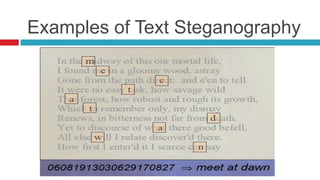
    An example of a message containing cipher text by
     German Spy in World War II:
    “Apparently neutral's protest is thoroughly discounted
     And ignored. Isman hard hit. Blockade issue affects
     Pretext for embargo on by products, ejecting suets and
     Vegetable oils. ”
    Taking the second letter in each word the following
     message emerges:
                    Pershing sails from NY June 1.
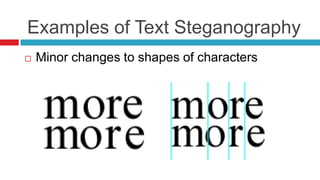
Examples of Text Steganography
   Minor changes to shapes of characters
Examples of Text Steganography
Image Steganography
   Using image files as hosts for steganographic messages takes advantage of the limited capabilities of the
    human visual system
   Some of the more common method for embedding messages in image files can be categorized into two
    main groups, image domain methods and transform domain methods
Image And Transform Domain
   Image – also known as spatial – domain techniques
    embed messages in the intensity of the pixels
    directly, while for transform – also known as frequency –
    domain, images are first transformed and then the
    message is embedded in the image
   Image domain techniques encompass bit-wise methods
    that apply bit insertion and noise manipulation and are
    sometimes characterised as “simple systems”
   Steganography in the transform domain involves the
    manipulation of algorithms and image transforms
LSB [Least Significant bit]
                     Method
   Least significant bit (LSB) insertion is a common, simple approach
    to embedding information in a cover image
   The least significant bit (in other words, the 8th bit) of some or all of
    the bytes inside an image is changed to a bit of the secret
    message
   When using a 24-bit image, a bit of each of the red, green and blue
    colour components can be used, since they are each represented
    by a byte. In other words, one can store 3 bits in each pixel. An 800
    × 600 pixel image, can thus store a total amount of 1,440,000 bits
    or 180,000 bytes of embedded data
   In its simplest form, LSB makes use of BMP images, since they
    use lossless compression
Example Of LSB Method
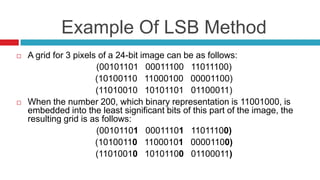
   A grid for 3 pixels of a 24-bit image can be as follows:
                       (00101101 00011100 11011100)
                       (10100110 11000100 00001100)
                       (11010010 10101101 01100011)
   When the number 200, which binary representation is 11001000, is
    embedded into the least significant bits of this part of the image, the
    resulting grid is as follows:
                       (00101101 00011101 11011100)
                       (10100110 11000101 00001100)
                       (11010010 10101100 01100011)
Example Of Image
            Steganography
Original   Stego     Original    Stego
Image      Image     Image      Image
Audio Steganography
   Embedding secret messages into digital sound is
    known as
    audio Steganography.
   Audio Steganography methods can embed
    messages in WAV, AU, and even MP3 sound files.
   The properties of the human auditory system (HAS)
    are exploited in the process of audio Steganography
Audio Steganography
   To embed data secretly onto digital audio file there
    are few techniques introduced :
     LSB  Coding
     Phase Coding

     Parity Coding

     Spread Spectrum
Flowchart Of Audio
  Steganography
Example of LSB Method
   The message 'HEY' is encoded in
    a 16-bit CD quality sample using
    the LSB method.
   Here the secret information is
    „HEY‟ and the cover file is audio
    file. HEY is to be embedded inside
    the audio file. First the secret
    information „HEY‟ and the audio
    file are converted into bit stream.
   The least significant column of the
    audio file is replaced by the bit
    stream of sectet information „HEY‟.
    The resulting file after embedding
    secret information „HEY‟ is called
    Stego-file.
Applications
   Confidential communication and secret data
    storing
 Steganography provides us with:
       Potential capability to hide the existence of confidential data
       Hardness of detecting the hidden (i.e., embedded) data
       Strengthening of the secrecy of the encrypted data

   Protection of data alteration
   Access control system for digital content
    distribution
Applications
   Usage in modern printers
   Alleged use by terrorists
   Alleged use by intelligence services
Steganography Tools
   Steganos
   S-Tools (GIF, JPEG)
   StegHide (WAV, BMP)
   Invisible Secrets (JPEG)
   JPHide
   Camouflage
   Hiderman
Future Scope
   Steganography, though is still a fairly new idea. There are constant
    advancements in the computer field, suggesting advancements in the
    field of steganography as well. It is likely that there will soon be more
    efficient and more advanced techniques for Steganalysis. A hopeful
    advancement is the improved sensitivity to small messages. Knowing
    how difficult it is to detect the presence of a fairly large text file within an
    image, imagine how difficult it is to detect even one or two sentences
    embedded in an image! It is like finding a microscopic needle in the
    ultimate haystack.
    What is scary is that such a small file of only one or two sentences may
    be all that is needed to commence a terrorist attack. In the future, it is
    hoped that the technique of Steganalysis will advance such that it will
    become much easier to detect even small messages within an image.
Conclusion
   Interest in the use of steganography in our current digital age can be attributed to
    both the desire of individuals to hide communication through a medium rife with
    potential listeners, or in the case of digital watermarking, the absolute necessity of
    maintaining control over one‟s ownership and the integrity of data as it passes
    through this medium. This increased interest is evidenced in the sheer number of
    available tools to provide easy steganographic techniques to the end user, as well as
    the proliferation of research and press on the topic.
   The intent of this presentation was to cover some of the more common methods of
    data hiding using widespread file formats and easily available tools as an introduction
    ,to the primary concepts of steganography. These discussions should serve as a
    starting point to the exploration of more complex steganographic techniques
    involving, for example, the use of network packets and unused hard disk space as
    cover medium, or the more complex methodologies used on our standard image and
    audio files.
References
   http://en.wikipedia.org/wiki/Steganography
   S. William, Cryptography and Network Security: Principles and Practice, 2nd
    edition, Prentice-Hall, Inc., 1999 pp 23-50
   Bandyopadhyay, S.K., 2010. An Alternative Approach of Steganography Using
    Reference Image.
   Bloom,J. A. et al., 2008. Digital watermarking and Steganography. 2nd edition
   A. Westfield. "F5 - A Steganographic Algorithm: High Capacity Despite Better
    Steganalysis", Lecture Notes in Computer Science, vol. 2137, pp. 289-
    302, 2001.
   Hide & Seek: An Introduction to Steganography: Niles Provos and Peter
    Honey man
Steganography

Steganography

  • 2.
    OverView  What is Steganography?  History Of Steganography  Physical And Digital techniques  Comparison Of Secret Communication Techniques  Steganography v/s Cryptography  Evolution  Basic Steganography Model  Steganography Terms  Types of StegoSystems
  • 3.
    OverView  Types Of Steganography  Text Steganography  Image Steganography  Audio Steganography  Applications  Advantages v/s Disadvantages  Future Scope  Conclusion  References
  • 4.
    What is Steganography?  Steganography is the art and science of writing hidden messages in such a way that no one, apart from the sender and intended recipient, suspects the existence of the message, a form of security through obscurity.  The word steganography is of Greek origin and means "concealed writing" from the Greek words steganos meaning "covered or protected", and graphein meaning "writing".  “Steganography means hiding one piece of data within another”.
  • 5.
    Example Sinceeveryone can read, encoding text in neutral sentences is doubtfully effective Since Everyone Can Read, Encoding Text In Neutral Sentences Is Doubtfully Effective „Secret inside’
  • 6.
    History Of Steganography  The first recorded uses of steganography can be traced back to 440 BC when Herodotus mentions two examples of steganography in his Histories.  Demaratus sent a warning about a forthcoming attack to Greece by writing it directly on the wooden backing of a wax tablet before applying its beeswax surface.  Wax tablets were in common use then as reusable writing surfaces, sometimes used for shorthand.  Ancient Chinese wrote messages on fine silk, which was then crunched into a tiny ball and covered in wax. The messenger then swallowed the ball of wax.  Special “inks” were important steganographic tools even during Second World War.  During Second World War a technique was developed to shrink photographically a page of text into a dot less than one millimeter in diameter, and then hide this microdot in an apparently innocuous letter. (The first microdot has been spotted
  • 7.
    Physical Techniques  Physical Techniques  Hidden messages within wax tablets  Hidden messages on messenger's body  Hidden messages on paper written in secret inks  Messages written in Morse code on knitting yarn and then knitted into a piece of clothing worn by a courier  Messages written on envelopes in the area covered by postage stamps.
  • 8.
    Digital Techniques  Digital Techniques  Concealing messages within the lowest bits of noisy images or sound files.  Chaffing and winnowing.  Modifying the echo of a sound file (Echo Steganography)  Including data in ignored sections of a file, such as after the logical end of the carrier file.
  • 9.
  • 10.
    Steganography V/s Cryptography Steganography Cryptography Unknown message passing Known message passing Steganography prevents discovery of the Encryption prevents an unauthorized party very existence of communication from discovering the contents of a communication Little known technology Common technology Technology still being develop for certain Most of algorithm known by all formats Strong current algorithm are resistant to Once detected message is known attacks ,larger expensive computing power is required for cracking Steganography does not alter the structure Cryptography alter the structure of the secret
  • 11.
    Combined Crypto- Steganography Invisible Merge Steganograph Encryption y
  • 12.
    Evolution Cryptography Steganography Watermarkin g
  • 13.
  • 14.
    Steganography Terms  Carrier or Cover File - A Original message or a file in which hidden information will be stored inside of it .  Stego-Medium - The medium in which the information is hidden.  Embedded or Payload - The information which is to be hidden or concealed.  Steganalysis - The process of detecting hidden information inside a file.
  • 15.
    Types Of Stegosystems Thereare three basic types of stegosystems  Pure stegosystems - no key is used.  Secret-key stegosystems - secret key is used. Public-key stegosystems - public key is used
  • 16.
    Text Steganography  Text steganography can be applied in the digital makeup format such as PDF, digital watermark or information hiding  It is more difficult to realize the information hiding based on text. The simplest method of information hiding is to select the cover first, adopt given rules to add the phraseological or spelling mistakes, or replace with synonymy words.  E.g 1] Textto setups some sentence structure in advance, fills in the empty location by arranged words, and then the text doesn‟t have phraseological mistakes, but have some word changes or morphology mistakes. 2] TextHide hides the information in the manner of text overwriting and words‟ selection.
  • 17.
    Text Steganography Methods  Text Steganography in Markup Languages[HTML]  Text Steganography in Specific characters in words  Line shifting Method  Word shifting  Open spaces  Semantic methods  Character Encoding
  • 18.
    Examples of TextSteganography  An example of a message containing cipher text by German Spy in World War II: “Apparently neutral's protest is thoroughly discounted And ignored. Isman hard hit. Blockade issue affects Pretext for embargo on by products, ejecting suets and Vegetable oils. ”  Taking the second letter in each word the following message emerges: Pershing sails from NY June 1.
  • 19.
    Examples of TextSteganography  Minor changes to shapes of characters
  • 20.
    Examples of TextSteganography
  • 21.
    Image Steganography  Using image files as hosts for steganographic messages takes advantage of the limited capabilities of the human visual system  Some of the more common method for embedding messages in image files can be categorized into two main groups, image domain methods and transform domain methods
  • 22.
    Image And TransformDomain  Image – also known as spatial – domain techniques embed messages in the intensity of the pixels directly, while for transform – also known as frequency – domain, images are first transformed and then the message is embedded in the image  Image domain techniques encompass bit-wise methods that apply bit insertion and noise manipulation and are sometimes characterised as “simple systems”  Steganography in the transform domain involves the manipulation of algorithms and image transforms
  • 23.
    LSB [Least Significantbit] Method  Least significant bit (LSB) insertion is a common, simple approach to embedding information in a cover image  The least significant bit (in other words, the 8th bit) of some or all of the bytes inside an image is changed to a bit of the secret message  When using a 24-bit image, a bit of each of the red, green and blue colour components can be used, since they are each represented by a byte. In other words, one can store 3 bits in each pixel. An 800 × 600 pixel image, can thus store a total amount of 1,440,000 bits or 180,000 bytes of embedded data  In its simplest form, LSB makes use of BMP images, since they use lossless compression
  • 24.
    Example Of LSBMethod  A grid for 3 pixels of a 24-bit image can be as follows: (00101101 00011100 11011100) (10100110 11000100 00001100) (11010010 10101101 01100011)  When the number 200, which binary representation is 11001000, is embedded into the least significant bits of this part of the image, the resulting grid is as follows: (00101101 00011101 11011100) (10100110 11000101 00001100) (11010010 10101100 01100011)
  • 25.
    Example Of Image Steganography Original Stego Original Stego Image Image Image Image
  • 26.
    Audio Steganography  Embedding secret messages into digital sound is known as audio Steganography.  Audio Steganography methods can embed messages in WAV, AU, and even MP3 sound files.  The properties of the human auditory system (HAS) are exploited in the process of audio Steganography
  • 27.
    Audio Steganography  To embed data secretly onto digital audio file there are few techniques introduced :  LSB Coding  Phase Coding  Parity Coding  Spread Spectrum
  • 28.
    Flowchart Of Audio Steganography
  • 29.
    Example of LSBMethod  The message 'HEY' is encoded in a 16-bit CD quality sample using the LSB method.  Here the secret information is „HEY‟ and the cover file is audio file. HEY is to be embedded inside the audio file. First the secret information „HEY‟ and the audio file are converted into bit stream.  The least significant column of the audio file is replaced by the bit stream of sectet information „HEY‟. The resulting file after embedding secret information „HEY‟ is called Stego-file.
  • 30.
    Applications  Confidential communication and secret data storing  Steganography provides us with:  Potential capability to hide the existence of confidential data  Hardness of detecting the hidden (i.e., embedded) data  Strengthening of the secrecy of the encrypted data  Protection of data alteration  Access control system for digital content distribution
  • 31.
    Applications  Usage in modern printers  Alleged use by terrorists  Alleged use by intelligence services
  • 32.
    Steganography Tools  Steganos  S-Tools (GIF, JPEG)  StegHide (WAV, BMP)  Invisible Secrets (JPEG)  JPHide  Camouflage  Hiderman
  • 33.
    Future Scope  Steganography, though is still a fairly new idea. There are constant advancements in the computer field, suggesting advancements in the field of steganography as well. It is likely that there will soon be more efficient and more advanced techniques for Steganalysis. A hopeful advancement is the improved sensitivity to small messages. Knowing how difficult it is to detect the presence of a fairly large text file within an image, imagine how difficult it is to detect even one or two sentences embedded in an image! It is like finding a microscopic needle in the ultimate haystack.  What is scary is that such a small file of only one or two sentences may be all that is needed to commence a terrorist attack. In the future, it is hoped that the technique of Steganalysis will advance such that it will become much easier to detect even small messages within an image.
  • 34.
    Conclusion  Interest in the use of steganography in our current digital age can be attributed to both the desire of individuals to hide communication through a medium rife with potential listeners, or in the case of digital watermarking, the absolute necessity of maintaining control over one‟s ownership and the integrity of data as it passes through this medium. This increased interest is evidenced in the sheer number of available tools to provide easy steganographic techniques to the end user, as well as the proliferation of research and press on the topic.  The intent of this presentation was to cover some of the more common methods of data hiding using widespread file formats and easily available tools as an introduction ,to the primary concepts of steganography. These discussions should serve as a starting point to the exploration of more complex steganographic techniques involving, for example, the use of network packets and unused hard disk space as cover medium, or the more complex methodologies used on our standard image and audio files.
  • 35.
    References  http://en.wikipedia.org/wiki/Steganography  S. William, Cryptography and Network Security: Principles and Practice, 2nd edition, Prentice-Hall, Inc., 1999 pp 23-50  Bandyopadhyay, S.K., 2010. An Alternative Approach of Steganography Using Reference Image.  Bloom,J. A. et al., 2008. Digital watermarking and Steganography. 2nd edition  A. Westfield. "F5 - A Steganographic Algorithm: High Capacity Despite Better Steganalysis", Lecture Notes in Computer Science, vol. 2137, pp. 289- 302, 2001.  Hide & Seek: An Introduction to Steganography: Niles Provos and Peter Honey man