UNIT-II
DATA ENCRYPTION TECHNIQUES AND STANDARDS
Prepared By:
Mrs. Sonali B.Gavali
Assistant Professor
AI&DS Department
DIT,Pimpri.
CRYPTOGRAPHY
• Cryptography is technique of securing information and
communications through use of codes so that only those
person for whom the information is intended can
understand it and process it.
• Thus preventing unauthorized access to information.
• The prefix “crypt” means “hidden” and suffix “graphy” means
“writing”.
TECHNIQUES USED FOR CRYPTOGRAPHY:
• In today’s age of computers cryptography is often associated
with the process
• Where plain text is converted to cipher text which decode by
receiver only , this process is known as encryption.
• The process of conversion of cipher text to plain text this is
known as decryption.
What are Plaintext and Ciphertext? How do they interact?
• Plaintext can refer to anything which humans can understand and/or relate to.
• This may be as simple as English sentences, a script, or Java code.
• If you can make sense of what is written, then it is in plaintext.
• Cipher text, or encrypted text, is a series of randomized letters and numbers
which humans cannot make any sense of.
• An encryption algorithm takes in a plaintext message, runs the algorithm on the
plaintext, and produces a cipher text.
• The cipher text can be reversed through the process of decryption, to produce
the original plaintext.
FEATURES OF CRYPTOGRAPHY ARE AS FOLLOWS:
• Confidentiality:
information can only be accessed by the person for whom it is intended
and no other person except him can access it.
• Integrity:
information cannot be modified in storage or transition between sender
and intended receiver without any addition to information being
detected.
• Non-repudiation:
the creator/sender of information cannot deny his or her intention to
send information at later stage.
• Authentication:
the identities of sender and receiver are confirmed. As well as
destination/origin of information is confirmed.
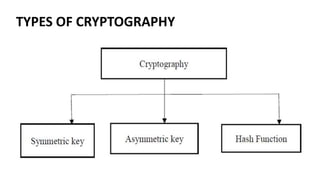
TYPES OF CRYPTOGRAPHY
TYPES OF CRYPTOGRAPHY:
1.Symmetric key cryptography(Secret key cryptography)(Single/Private key
encryption)
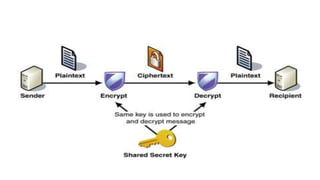
• It is system where the sender and receiver uses a single common key to encrypt and
decrypt messages.
• Symmetric key systems are faster and simpler
• But the problem is that sender and receiver have to somehow exchange key in a secure
manner.
• Example: data encryption system(des).
Why to use symmetric key encryption?
• It is relatively inexpensive to produce a strong key for these
ciphers.
• The keys tend to be much smaller for the level of protection
they afford.
• The algorithms are relatively inexpensive to process.
• The drawback :
• to secret-key ciphers is in exchanging the secret key because any
exchange must retain the privacy of the key.
2. ASYMMETRIC KEY CRYPTOGRAPHY (public-key encryption)
(asymmetric encryption)
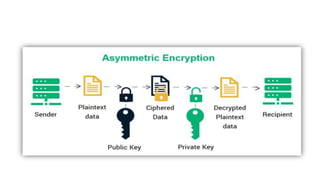
• Under this system a pair of keys is used to encrypt and decrypt information.
• A public key is used for encryption and a private key is used for decryption.
• Public key and private key are different.
• Even if the public key is known by everyone the intended receiver can only
decode it because he alone knows the private key.
Why to use Asymmetric key encryption?
• the encrypted data is not understood by an intruder.
• Non repudiation, which prevents:
• The sender of the data from claiming, at a later date, that the data was never sent
• The data from being altered.
• RSA (Rivest-Shamir-Adelman) public key pairs can be any size. Typical sizes today are
1024 and 2048 bits.
rejection of a proposal or idea
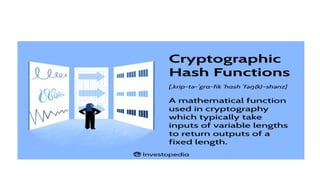
3.HASH FUNCTIONS:
• There is no usage of any key in this algorithm.
• A hash value with fixed length is calculated as per the plain text which
makes it impossible for contents of plain text to be recovered.
• Many operating systems use hash functions to encrypt passwords.
CLASSICAL ENCRYPTION TECHNIQUES:
• In the classical cryptography the original data i.e., The plain text
is transformed into the encoded format i.e. Cipher text so that we
can transmit this data through insecure communication
channels.
• A data string which known as key is used to control the
transformation of the data from plain text to cipher text.
• This arrangement helps to keep data safe as it required the key
for extracting the original information from the cipher text.
• Without the key no one can read the data.
• In this technique it is assumed that the only authorized receiver
has the key.
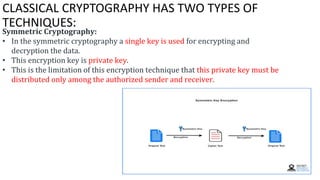
CLASSICAL CRYPTOGRAPHY HAS TWO TYPES OF
TECHNIQUES:
Symmetric Cryptography:
• In the symmetric cryptography a single key is used for encrypting and
decryption the data.
• This encryption key is private key.
• This is the limitation of this encryption technique that this private key must be
distributed only among the authorized sender and receiver.
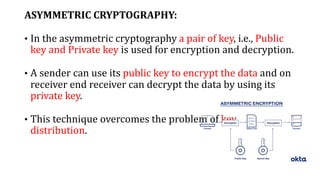
ASYMMETRIC CRYPTOGRAPHY:
• In the asymmetric cryptography a pair of key, i.e., Public
key and Private key is used for encryption and decryption.
• A sender can use its public key to encrypt the data and on
receiver end receiver can decrypt the data by using its
private key.
• This technique overcomes the problem of key
distribution.
ADVANTAGES AND DISADVANTAGES OF CLASSICAL CRYPTOGRAPHY:
Advantages
• While employing the one-time pad(information-theoretically secure), it is
unbreakable.
• It is easy to do manually, no computer required.
• It protects the plain text from casual snooping(keep watch on what person is
typing.).
Disadvantages
• While employing the one-time pad, it is cumbersome and requires a personal
meet up to exchange the pads.
• If not employing the OTP, anyone who is even remotely interested in knowing
what you wrote and knows about cryptography will be able to break the
encryption.
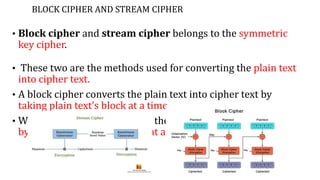
BLOCK CIPHER AND STREAM CIPHER
• Block cipher and stream cipher belongs to the symmetric
key cipher.
• These two are the methods used for converting the plain text
into cipher text.
• A block cipher converts the plain text into cipher text by
taking plain text’s block at a time.
• While stream cipher converts the plain text into cipher text
by taking 1 byte of plain text at a time.
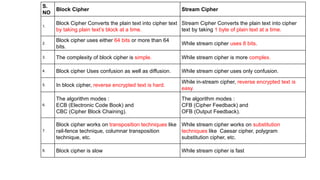
S.
NO
Block Cipher Stream Cipher
1.
Block Cipher Converts the plain text into cipher text
by taking plain text’s block at a time.
Stream Cipher Converts the plain text into cipher
text by taking 1 byte of plain text at a time.
2.
Block cipher uses either 64 bits or more than 64
bits.
While stream cipher uses 8 bits.
3. The complexity of block cipher is simple. While stream cipher is more complex.
4. Block cipher Uses confusion as well as diffusion. While stream cipher uses only confusion.
5. In block cipher, reverse encrypted text is hard.
While in-stream cipher, reverse encrypted text is
easy.
6.
The algorithm modes :
ECB (Electronic Code Book) and
CBC (Cipher Block Chaining).
The algorithm modes :
CFB (Cipher Feedback) and
OFB (Output Feedback).
7.
Block cipher works on transposition techniques like
rail-fence technique, columnar transposition
technique, etc.
While stream cipher works on substitution
techniques like Caesar cipher, polygram
substitution cipher, etc.
8. Block cipher is slow While stream cipher is fast
ATTACKS ON SYMMETRIC KEY CRYPTOGRAPHY:
• Typically, the objective of attacking an encryption system is to recover the key in
use rather than simply to recover the plaintext of a single cipher text.
• There are two general approaches to attacking a conventional encryption
scheme.
• Cryptanalysis:
• Brute-force attack
• Cryptanalysis: cryptanalytic attacks rely on the nature of the algorithm plus
knowledge of the general characteristics of the plaintext or even some
sample plaintext–cipher text pairs.
• This type of attack exploits the characteristics of the algorithm to attempt to
deduce a specific plaintext or to deduce the key being used.
• Brute-force attack: the attacker tries every possible key on a piece of
cipher text until an intelligible translation into plaintext is obtained.
• On average, half of all possible keys must be tried to achieve success.
• A brute force attack is a hacking method that uses trial and error to crack
passwords, login credentials, and encryption keys.
• It is a simple yet reliable tactic for gaining unauthorized access to individual
accounts and organizations’ systems and networks.
Substitution (cipher)techniques
• The two basic building blocks of all encryption Techniques are
substitution and transposition.
• A substitution technique
• Definition:
• Letters of plaintext are replaced by other letters or by numbers or
symbols .
• if the plaintext is viewed as a sequence of bits,
• then substitution involves replacing plaintext bit patterns with
cipher text bit patterns.
Substitution Techniques
1. Caesar Cipher
2. Monoalphabetic Cipher
3. Polyalphabetic Cipher
4. Playfair
5. Hill
6. One time Pad
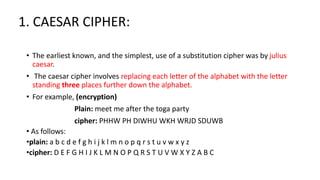
1. CAESAR CIPHER:
• The earliest known, and the simplest, use of a substitution cipher was by julius
caesar.
• The caesar cipher involves replacing each letter of the alphabet with the letter
standing three places further down the alphabet.
• For example, (encryption)
Plain: meet me after the toga party
cipher: PHHW PH DIWHU WKH WRJD SDUWB
• As follows:
•plain: a b c d e f g h i j k l m n o p q r s t u v w x y z
•cipher: D E F G H I J K L M N O P Q R S T U V W X Y Z A B C
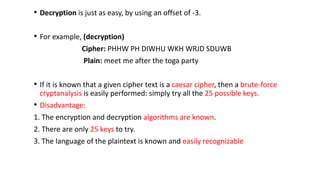
• Decryption is just as easy, by using an offset of -3.
• For example, (decryption)
Cipher: PHHW PH DIWHU WKH WRJD SDUWB
Plain: meet me after the toga party
• If it is known that a given cipher text is a caesar cipher, then a brute-force
cryptanalysis is easily performed: simply try all the 25 possible keys.
• Disadvantage:
1. The encryption and decryption algorithms are known.
2. There are only 25 keys to try.
3. The language of the plaintext is known and easily recognizable
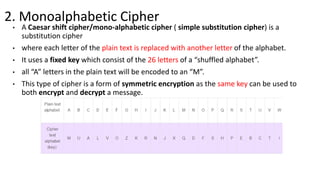
2. Monoalphabetic Cipher
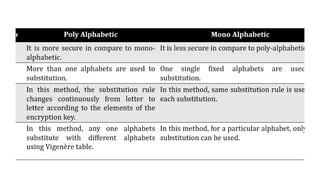
• A Caesar shift cipher/mono-alphabetic cipher ( simple substitution cipher) is a
substitution cipher
• where each letter of the plain text is replaced with another letter of the alphabet.
• It uses a fixed key which consist of the 26 letters of a “shuffled alphabet”.
• all “A” letters in the plain text will be encoded to an “M”.
• This type of cipher is a form of symmetric encryption as the same key can be used to
both encrypt and decrypt a message.
3. Polyalphabetic cipher
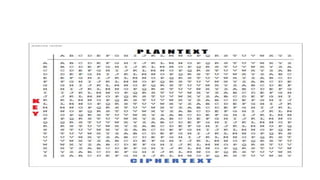
• Poly alphabetic cipher is far more secure than a mono alphabetic cipher.
• As mono-alphabetic cipher maps a plain text symbol or alphabet to a cipher text
symbol and uses the same cipher text symbol wherever that plain text occurs in the
message.
•
But poly alphabetic cipher, each time replaces the plain text with the different cipher
text.
• with only 25 possible keys, the caesar cipher is far from secure.
• a dramatic increase in the key space can be achieved by allowing an arbitrary
substitution. before proceeding, we define the term permutation. a permutation
of a finite set of elements s is an ordered sequence of all the elements of s, with
each element appearing exactly once.
• for example, if s = {a, b, c},
• there are six permutations of s: abc, acb, bac, bca, cab, cba
• in general, there are n! permutations of a set of n elements, because the first
element can be chosen in one of n ways, the second in n - 1 ways, the third in n -
2 ways, and so on.
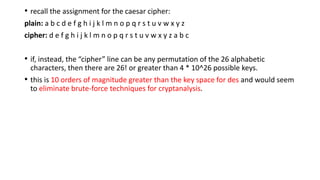
• recall the assignment for the caesar cipher:
plain: a b c d e f g h i j k l m n o p q r s t u v w x y z
cipher: d e f g h i j k l m n o p q r s t u v w x y z a b c
• if, instead, the “cipher” line can be any permutation of the 26 alphabetic
characters, then there are 26! or greater than 4 * 10^26 possible keys.
• this is 10 orders of magnitude greater than the key space for des and would seem
to eliminate brute-force techniques for cryptanalysis.
4. PLAY FAIR CIPHER:
•The Playfair cipher was the first practical digraph substitution cipher. The scheme was invented
in 1854 by Charles Wheatstone but was named after Lord Playfair who promoted the use of the
cipher.
•In playfair cipher unlike traditional cipher we encrypt a pair of alphabets(digraphs) instead of a single
alphabet.
It was used for tactical purposes by British forces in the Second Boer War and in World War I and for
the same purpose by the Australians during World War II.
Advantages:
•fast to use and
•requires no special equipment.
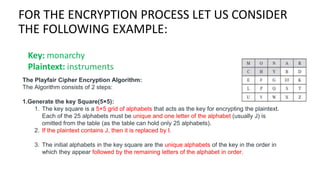
FOR THE ENCRYPTION PROCESS LET US CONSIDER
THE FOLLOWING EXAMPLE:
The Playfair Cipher Encryption Algorithm:
The Algorithm consists of 2 steps:
1.Generate the key Square(5×5):
1. The key square is a 5×5 grid of alphabets that acts as the key for encrypting the plaintext.
Each of the 25 alphabets must be unique and one letter of the alphabet (usually J) is
omitted from the table (as the table can hold only 25 alphabets).
2. If the plaintext contains J, then it is replaced by I.
3. The initial alphabets in the key square are the unique alphabets of the key in the order in
which they appear followed by the remaining letters of the alphabet in order.
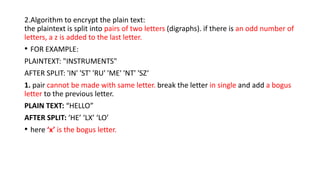
2.Algorithm to encrypt the plain text:
the plaintext is split into pairs of two letters (digraphs). if there is an odd number of
letters, a z is added to the last letter.
• FOR EXAMPLE:
PLAINTEXT: "INSTRUMENTS"
AFTER SPLIT: 'IN' 'ST' 'RU' 'ME' 'NT' 'SZ‘
1. pair cannot be made with same letter. break the letter in single and add a bogus
letter to the previous letter.
PLAIN TEXT: “HELLO”
AFTER SPLIT: ‘HE’ ‘LX’ ‘LO’
• here ‘x’ is the bogus letter.
• 2. if the letter is standing alone in the process of pairing, then add an extra bogus
letter with the alone letter
PLAIN TEXT: “HELLOE”
AFTERSPLIT: ‘HE’ ‘LX’ ‘LO’ ‘EZ’
• here ‘z’ is the bogus letter.
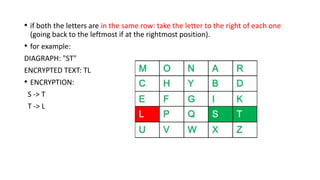
RULES FOR ENCRYPTION:
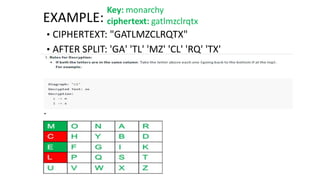
• if both the letters are in the same column: take the letter below each one (going back
to the top if at the bottom).
• for example:
DIAGRAPH: "ME“
ENCRYPTED TEXT: CL
ENCRYPTION:
M -> C
E -> L
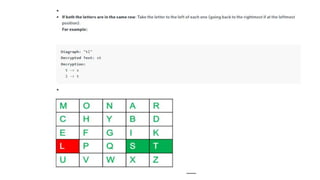
• if both the letters are in the same row: take the letter to the right of each one
(going back to the leftmost if at the rightmost position).
• for example:
DIAGRAPH: "ST"
ENCRYPTED TEXT: TL
• ENCRYPTION:
S -> T
T -> L
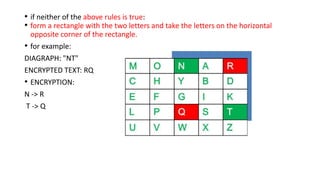
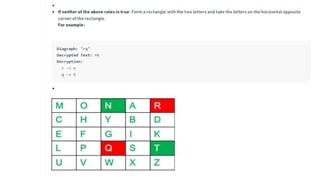
• if neither of the above rules is true:
• form a rectangle with the two letters and take the letters on the horizontal
opposite corner of the rectangle.
• for example:
DIAGRAPH: "NT"
ENCRYPTED TEXT: RQ
• ENCRYPTION:
N -> R
T -> Q
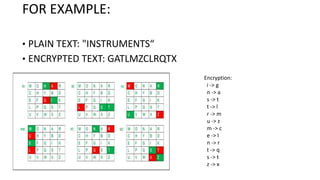
FOR EXAMPLE:
• PLAIN TEXT: "INSTRUMENTS“
• ENCRYPTED TEXT: GATLMZCLRQTX
Encryption:
i -> g
n -> a
s -> t
t -> l
r -> m
u -> z
m -> c
e -> l
n -> r
t -> q
s -> t
z -> x
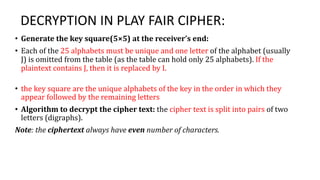
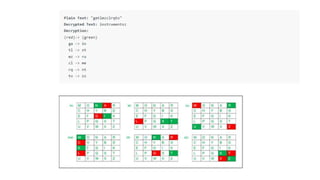
DECRYPTION IN PLAY FAIR CIPHER:
• Generate the key square(5×5) at the receiver’s end:
• Each of the 25 alphabets must be unique and one letter of the alphabet (usually
J) is omitted from the table (as the table can hold only 25 alphabets). If the
plaintext contains J, then it is replaced by I.
• the key square are the unique alphabets of the key in the order in which they
appear followed by the remaining letters
• Algorithm to decrypt the cipher text: the cipher text is split into pairs of two
letters (digraphs).
Note: the ciphertext always have even number of characters.
EXAMPLE:
• CIPHERTEXT: "GATLMZCLRQTX"
• AFTER SPLIT: 'GA' 'TL' 'MZ' 'CL' 'RQ' 'TX'
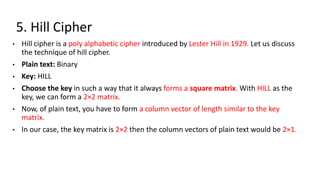
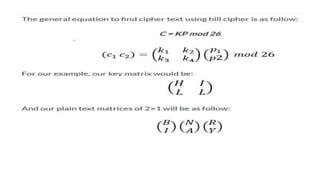
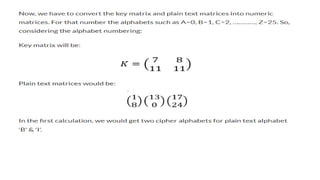
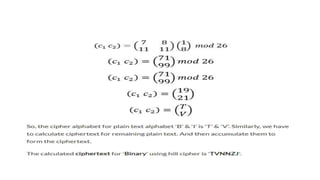
5. Hill Cipher
• Hill cipher is a poly alphabetic cipher introduced by Lester Hill in 1929. Let us discuss
the technique of hill cipher.
• Plain text: Binary
• Key: HILL
• Choose the key in such a way that it always forms a square matrix. With HILL as the
key, we can form a 2×2 matrix.
• Now, of plain text, you have to form a column vector of length similar to the key
matrix.
• In our case, the key matrix is 2×2 then the column vectors of plain text would be 2×1.
OR…..
Hill Cipher
• Encryption:
1Key Matrix Generation:
2Matrix Representation of Plaintext:
• Convert the plaintext into a numerical equivalent, mapping each letter to its position in the alphabet (e.g.,
A=0, B=1, ..., Z=25).
• Arrange the numerical values into a column matrix of size n x 1.
• Matrix Multiplication:
• Multiply the key matrix with the plaintext matrix.
• ��C=K×P
• Where:
• �C is the resulting matrix (cipher text),
• �K is the key matrix,
• �P is the plaintext matrix.
• The multiplication is performed modulo 26.
• Conversion to Cipher text:
Decryption:
• Key Matrix Inversion: kX k^-1=I
• Matrix Representation of Cipher text:
• Matrix Multiplication:
• Multiply the inverted key matrix with the ciphertext matrix.
• �P=K^-1×C
• Where:
• �P is the resulting matrix (plaintext),
• �K^−1 is the inverted key matrix,
• �C is the cipher text matrix.
• The multiplication is performed modulo 26.
• Conversion to Plaintext:
6. One-Time Pad
• Condition:
• key length should be as long as the plain text to prevent the repetition of key.
• Along with that, the key should be used only once.
• new key for each new message and
• of the same length as a new message.
TRANSPOSITION TECHNIQUES
• performing permutations on the plain text, i.e, Changing each character of plain text for
each round.
• rearranging the order of characters in a message to change its meaning.
• Rail fence transposition
• Columnar transposition
• Improved columnar transposition
• Book cipher/running key cipher
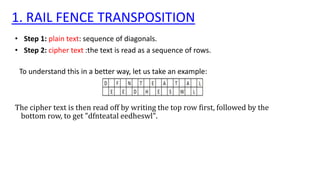
1. RAIL FENCE TRANSPOSITION
• Step 1: plain text: sequence of diagonals.
• Step 2: cipher text :the text is read as a sequence of rows.
To understand this in a better way, let us take an example:
The cipher text is then read off by writing the top row first, followed by the
bottom row, to get "dfnteatal eedheswl".
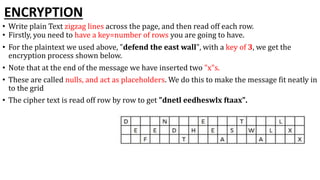
ENCRYPTION
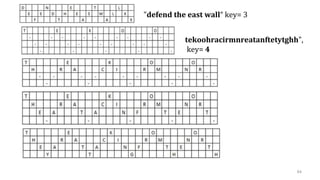
• Write plain Text zigzag lines across the page, and then read off each row.
• Firstly, you need to have a key=number of rows you are going to have.
• For the plaintext we used above, "defend the east wall", with a key of 3, we get the
encryption process shown below.
• Note that at the end of the message we have inserted two "x"s.
• These are called nulls, and act as placeholders. We do this to make the message fit neatly in
to the grid
• The cipher text is read off row by row to get "dnetl eedheswlx ftaax".
DECRYPTION
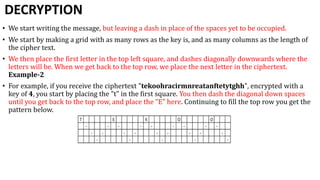
• We start writing the message, but leaving a dash in place of the spaces yet to be occupied.
• We start by making a grid with as many rows as the key is, and as many columns as the length of
the cipher text.
• We then place the first letter in the top left square, and dashes diagonally downwards where the
letters will be. When we get back to the top row, we place the next letter in the ciphertext.
Example-2
• For example, if you receive the ciphertext "tekoohracirmnreatanftetytghh", encrypted with a
key of 4, you start by placing the "t" in the first square. You then dash the diagonal down spaces
until you get back to the top row, and place the "E" here. Continuing to fill the top row you get the
pattern below.
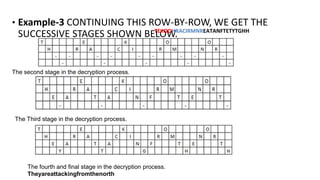
• Example-3 CONTINUING THIS ROW-BY-ROW, WE GET THE
SUCCESSIVE STAGES SHOWN BELOW.
The second stage in the decryption process.
The Third stage in the decryption process.
The fourth and final stage in the decryption process.
Theyareattackingfromthenorth
TEKOOHRACIRMNREATANFTETYTGHH
Encryption steps
• Key Selection:
– Choose the number of rails (rows) for the transposition. This
determines how many rows you will use to write the message.
• Message Arrangement:
– Write the message diagonally across the chosen number of rails.
• Read Off Rows:
– Read the characters row by row to obtain the cipher text.
62
Decryption Steps:
• Key Selection:
– Choose the same number of rails used for encryption.
• Message Reconstruction:
– Write the ciphertext diagonally across the chosen number of rails.
• Read Off Columns:
– Read the characters column by column to obtain the original
message.
63
64
"defend the east wall“ key= 3
tekoohracirmnreatanftetytghh",
key= 4
2. COLUMNAR TRANSPOSITION CIPHER
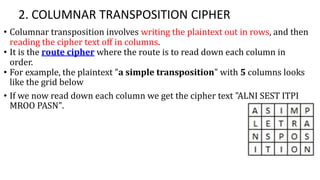
• Columnar transposition involves writing the plaintext out in rows, and then
reading the cipher text off in columns.
• It is the route cipher where the route is to read down each column in
order.
• For example, the plaintext "a simple transposition" with 5 columns looks
like the grid below
• If we now read down each column we get the cipher text "ALNI SEST ITPI
MROO PASN".
ENCRYPTION:
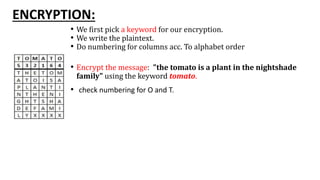
• We first pick a keyword for our encryption.
• We write the plaintext.
• Do numbering for columns acc. To alphabet order
• Encrypt the message: "the tomato is a plant in the nightshade
family" using the keyword tomato.
• check numbering for O and T.
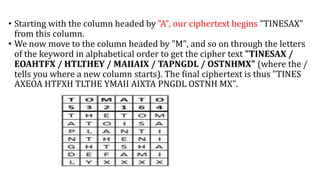
• Starting with the column headed by "A", our ciphertext begins "TINESAX"
from this column.
• We now move to the column headed by "M", and so on through the letters
of the keyword in alphabetical order to get the cipher text "TINESAX /
EOAHTFX / HTLTHEY / MAIIAIX / TAPNGDL / OSTNHMX" (where the /
tells you where a new column starts). The final ciphertext is thus "TINES
AXEOA HTFXH TLTHE YMAII AIXTA PNGDL OSTNH MX".
DECRYPTION
• Firstly, if nulls have been used, then you start by writing out the keyword and the
alphabetical order of the letters of the keyword.
• You must then divide the length of the ciphertext by the length of the keyword.
• The answer to this is the number of rows you need to add to the grid. You then write the
ciphertext down the first column until you reach the last row. The next letter becomes
the first letter in the second column (by the alphabetical order of the keyword), and so
on.
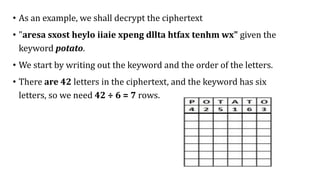
• As an example, we shall decrypt the ciphertext
• "aresa sxost heylo iiaie xpeng dllta htfax tenhm wx" given the
keyword potato.
• We start by writing out the keyword and the order of the letters.
• There are 42 letters in the ciphertext, and the keyword has six
letters, so we need 42 ÷ 6 = 7 rows.
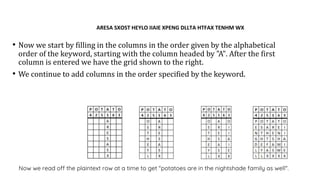
• Now we start by filling in the columns in the order given by the alphabetical
order of the keyword, starting with the column headed by "A". After the first
column is entered we have the grid shown to the right.
• We continue to add columns in the order specified by the keyword.
Now we read off the plaintext row at a time to get "potatoes are in the nightshade family as well".
ARESA SXOST HEYLO IIAIE XPENG DLLTA HTFAX TENHM WX
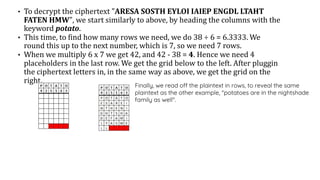
• To decrypt the ciphertext "ARESA SOSTH EYLOI IAIEP ENGDL LTAHT
FATEN HMW", we start similarly to above, by heading the columns with the
keyword potato.
• This time, to find how many rows we need, we do 38 ÷ 6 = 6.3333. We
round this up to the next number, which is 7, so we need 7 rows.
• When we multiply 6 x 7 we get 42, and 42 - 38 = 4. Hence we need 4
placeholders in the last row. We get the grid below to the left. After pluggin
the ciphertext letters in, in the same way as above, we get the grid on the
right.
Finally, we read off the plaintext in rows, to reveal the same
plaintext as the other example, "potatoes are in the nightshade
family as well".
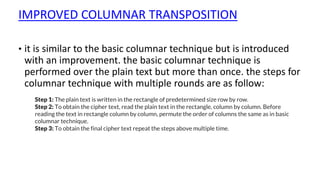
IMPROVED COLUMNAR TRANSPOSITION
• it is similar to the basic columnar technique but is introduced
with an improvement. the basic columnar technique is
performed over the plain text but more than once. the steps for
columnar technique with multiple rounds are as follow:
Step 1: The plain text is written in the rectangle of predetermined size row by row.
Step 2: To obtain the cipher text, read the plain text in the rectangle, column by column. Before
reading the text in rectangle column by column, permute the order of columns the same as in basic
columnar technique.
Step 3: To obtain the final cipher text repeat the steps above multiple time.
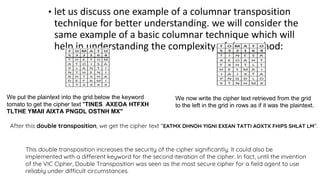
• let us discuss one example of a columnar transposition
technique for better understanding. we will consider the
same example of a basic columnar technique which will
help in understanding the complexity of the method:
We put the plaintext into the grid below the keyword
tomato to get the cipher text "TINES AXEOA HTFXH
TLTHE YMAII AIXTA PNGDL OSTNH MX"
We now write the cipher text retrieved from the grid
to the left in the grid in rows as if it was the plaintext.
After this double transposition, we get the cipher text "EATMX DHNOH YIGNI EXEAN TATTI AOXTX FHIPS SHLAT LM".
This double transposition increases the security of the cipher significantly. It could also be
implemented with a different keyword for the second iteration of the cipher. In fact, until the invention
of the VIC Cipher, Double Transposition was seen as the most secure cipher for a field agent to use
reliably under difficult circumstances.
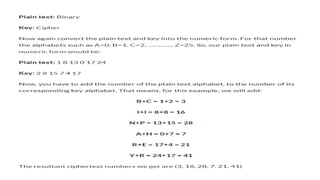
Book Cipher or Running Key Cipher
• The book cipher or the running key cipher works on the basic principle of one-time pad cipher. In onetime pad
cipher the key is taken as long as the plain text and is discarded after the use. Every time a new key is taken for a
new message.
• The improvement to the onetime pad in Book cipher is that the key or the onetime pad is taken from the book.
Let us discuss the steps:
• Step 1: Convert the plain text in numeric form consider A=0, B=1, C=3 …, Z=25.
• Step 2: Take an onetime pad or key from any of the books and convert it in the numeric form also. But the key
must be as long as the length of plain text.
• Step 3: Now add the numeric form of both plain text and key, each plain text letter with corresponding key text
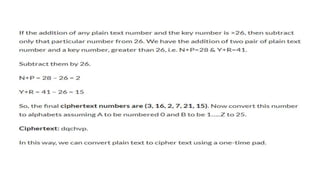
letter. If the addition of any plain text letter with corresponding key text letter is >26, then subtract it with 26.
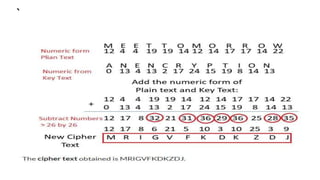
• Let us understand with the example:
• Plain text: Meet Tomorrow
• Key taken from the book: ANENCRYPTION.
• Now we have to convert this plain text and key text in numeric form and add them to get cipher text as shown in
the image below:
`
Stenography application and its limitation
• It is the act of recording spoken words through shorthand using a stenotype machine.
• Stenography is the process of writing in shorthand or a system of shorthand writing.
• a shorthand system:
• symbols->specific sounds, concepts, or letters
• Letters->meanings.
• goal is to record the spoken word by copying it.
• Applications:
• court reporters to record proceedings and events much quicker than they would be able to do using
a standard keyboard.
• less laborious and more accurate manner.
• Explore Other Education Options Related to Criminal Justice and Legal Studies
• Working as a Stenographer.
76
Limitations:
• capacity
• It is challenging to develop an efficient shorthand system.
• that can handle large amounts of data
• while maintaining security and hiding information effectively
• Stenography: the action or process of writing in shorthand or
taking dictation.
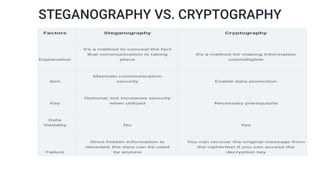
• Steganography: the practice of concealing messages or information
within other non-secret text or data.
77
WHAT IS STEGANOGRAPHY?
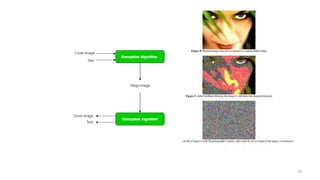
• A steganography technique involves hiding sensitive information within an ordinary, non-secret
file or message, so that it will not be detected.
• the sensitive information will then be extracted from the ordinary file or message at its
destination, thus avoiding detection.
• steganography is an additional step that can be used in conjunction with encryption in order to
conceal or protect data.
• use: to hide text, video, images, or even audio data.
79
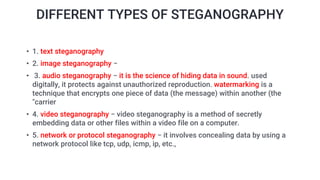
DIFFERENT TYPES OF STEGANOGRAPHY
• 1. text steganography
• 2. image steganography −
• 3. audio steganography − it is the science of hiding data in sound. used
digitally, it protects against unauthorized reproduction. watermarking is a
technique that encrypts one piece of data (the message) within another (the
"carrier
• 4. video steganography − video steganography is a method of secretly
embedding data or other files within a video file on a computer.
• 5. network or protocol steganography − it involves concealing data by using a
network protocol like tcp, udp, icmp, ip, etc.,
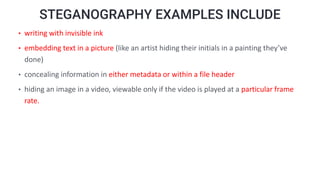
STEGANOGRAPHY EXAMPLES INCLUDE
• writing with invisible ink
• embedding text in a picture (like an artist hiding their initials in a painting they’ve
done)
• concealing information in either metadata or within a file header
• hiding an image in a video, viewable only if the video is played at a particular frame
rate.
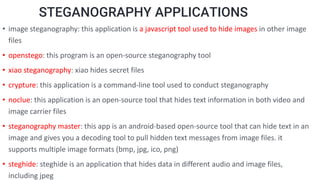
STEGANOGRAPHY APPLICATIONS
• image steganography: this application is a javascript tool used to hide images in other image
files
• openstego: this program is an open-source steganography tool
• xiao steganography: xiao hides secret files
• crypture: this application is a command-line tool used to conduct steganography
• noclue: this application is an open-source tool that hides text information in both video and
image carrier files
• steganography master: this app is an android-based open-source tool that can hide text in an
image and gives you a decoding tool to pull hidden text messages from image files. it
supports multiple image formats (bmp, jpg, ico, png)
• steghide: steghide is an application that hides data in different audio and image files,
including jpeg
STEGANOGRAPHY VS. CRYPTOGRAPHY
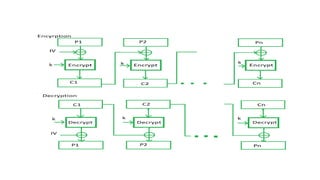
BLOCK CIPHERS AND MODES/METHODS OF OPERATIONS
• block cipher is an encryption algorithm that takes a fixed size of input say b bits and produces a
ciphertext of b bits again.
• Input> b bits it can be divided further.
• ELECTRONIC CODE BOOK (ECB)
• CIPHER BLOCK CHAINING (CBC)
• CIPHER FEEDBACK MODE (CFB)
• OUTPUT FEEDBACK MODE (OFM)
• COUNTER MODE (CM)
ELECTRONIC CODE BOOK (ECB) –
•
Electronic Code Book is simple mode.
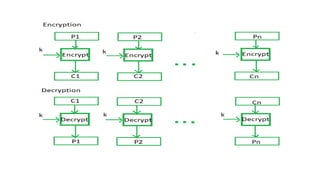
• direct encryption of each block of input plaintext and output is in form of blocks of
encrypted cipher text.
• Generally, if a message is larger than b bits in size, it can be broken down into a bunch of
blocks and the procedure is repeated.
Advantages of using ECB –
•Parallel encryption of blocks of bits is possible, so it is faster.
•Simple way of the block cipher.
Disadvantages of using ECB –
•Prone to cryptanalysis since there is a direct relationship between plaintext and
ciphertext.
CIPHER BLOCK CHAINING –
•
previous cipher block is given as input to the next encryption algorithm after xor with the original
plaintext block. in a nutshell here, a cipher block is produced by encrypting an xor output of the
previous cipher block and present plaintext block.
• advantages of cbc –
∙ cbc works well for input greater than b bits.
∙ cbc is a good authentication mechanism.
∙ Protect against cryptanalysis.
• disadvantages of cbc –
∙ parallel encryption is not possible since every encryption requires a previous cipher.
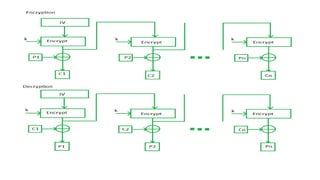
CIPHER FEEDBACK MODE (CFB) –
• cipher is given as feedback to the next block of encryption with some new
specifications:
• first, an initial vector iv is used for first encryption and output bits are divided as a set
of s and b-s bits.The left-hand side s + plaintext bits to which an xor operation is
applied.
• the result is given as input to a shift register having b-s bits to lhs, s bits to rhs and the
process continues.
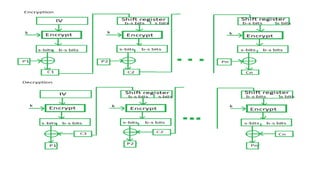
• the encryption and decryption process for the same is shown below, both of them
use encryption algorithms.
• advantages of cfb – difficult for applying cryptanalysis.
• disadvantages of using cfb – Parallelism not possible
OUTPUT FEEDBACK MODE –
• the output feedback mode follows nearly the same process as the cipher feedback mode except that
it sends the encrypted output as feedback instead of the actual cipher which is xor output.
• in this output feedback mode, all bits of the block are sent instead of sending selected s bits
advantages of ofb –
∙ a single bit error in a block is propagated to all subsequent blocks. this problem is solved by ofb as
it is free from bit errors in the plaintext block.
• disadvantages of ofb-
∙ the drawback of ofb is that, because to its operational modes, it is more susceptible to a message
stream modification attack than cfb.
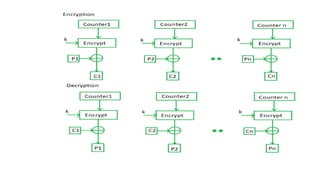
COUNTER MODE –
•
Every time a counter-initiated value is encrypted and given as input to xor with plaintext which
results in ciphertext block. the ctr mode is independent of feedback use and thus can be implemented
in parallel
• advantages
∙ since there is a different counter value for each block, the direct plaintext and ciphertext
relationship is avoided.
∙ parallel execution of encryption is possible.
• disadvantages of counter-
∙ the fact that ctr mode requires a synchronous counter at both the transmitter and the receiver is a
severe drawback.
APPLICATIONS OF BLOCK CIPHERS
• data encryption:
• file and disk encryption: block ciphers are used for encryption of entire files and disks in order
to protect their contents and restrict from unauthorized users. the disk encryption softwares
such as bitlocker, truecrypt aslo uses block cipher to encrypt data and make it secure.
• virtual private networks (vpn):
• secure sockets layer (ssl) and transport layer security (tls): ssl and tls protocols use block
ciphers for encryption of data that is transmitted between web browsers and servers over the
internet..
• digital signatures: block ciphers are used in the digital signature algorithms, to provide
authenticity and integrity to the digital documents.
• this encryption process generates the unique signature for each document that is used for
verifying the authenticity and detecting if any malicious activity is detected.
•
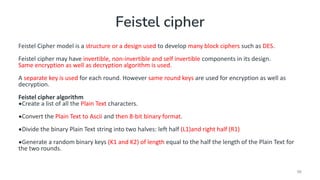
Feistel cipher
Feistel Cipher model is a structure or a design used to develop many block ciphers such as DES.
Feistel cipher may have invertible, non-invertible and self invertible components in its design.
Same encryption as well as decryption algorithm is used.
A separate key is used for each round. However same round keys are used for encryption as well as
decryption.
Feistel cipher algorithm
•Create a list of all the Plain Text characters.
•Convert the Plain Text to Ascii and then 8-bit binary format.
•Divide the binary Plain Text string into two halves: left half (L1)and right half (R1)
•Generate a random binary keys (K1 and K2) of length equal to the half the length of the Plain Text for
the two rounds.
96
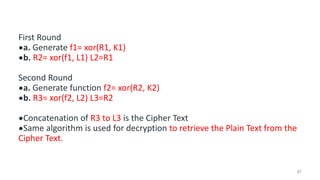
First Round
•a. Generate f1= xor(R1, K1)
•b. R2= xor(f1, L1) L2=R1
Second Round
•a. Generate function f2= xor(R2, K2)
•b. R3= xor(f2, L2) L3=R2
•Concatenation of R3 to L3 is the Cipher Text
•Same algorithm is used for decryption to retrieve the Plain Text from the
Cipher Text.
97
98
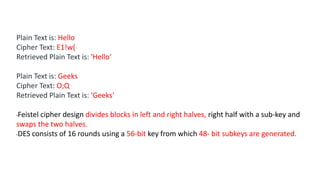
Plain Text is: Hello
Cipher Text: E1!w(
Retrieved Plain Text is: 'Hello’
Plain Text is: Geeks
Cipher Text: O;Q
Retrieved Plain Text is: 'Geeks'
•Feistel cipher design divides blocks in left and right halves, right half with a sub-key and
swaps the two halves.
•DES consists of 16 rounds using a 56-bit key from which 48- bit subkeys are generated.
Data Encryption Standard
(DES)
• DES is a symmetric block cipher.
• DES encrypts 64-bit plain text to 64-bit cipher text.
• DES uses a 56-bit key for encryption.
• Encryption and decryption algorithm is the same in DES. But, the procedure of
encryption is reversed while decryption.
• 16 rounds in DES strengthens the algorithm.
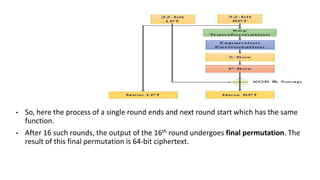
• Each round has the same function which involves key transformation, expansion
permutation, s-box substitution, p-box permutation and XOR and swapping.
• So, this is all about the DES block cipher. In 2001 the NIST has published Advanced
Encryption Standard (AES) to replace DES. Because DES was meant for the hardware
and its relatively slow performance on software leads to its replacement.
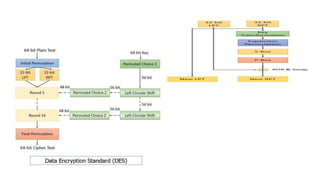
• Encryption
• Step 1: In the first step the 64-bit plain text undergoes initial permutation which
rearranges the bits to produce two 32-bit permuted block which is called left plain
text (LPT 32-bit) and right plain text (RPT 32-bit).
• Step 2: Now, 16 rounds of DES encryption will be performed on this LPT and RPT with
a 56-bit key.
• Step 3: After the 16th round the 32-bit LPT and 32-bit RPT are integrated which forms
a 64-bit block again and then the final permutation is applied to this 64-bit block, to
obtain the 64-bit ciphertext.
• Decryption
• The same Data Encryption Standard algorithm used for encrypting the plain text is
also used to decrypting the ciphertext.
• But the algorithm is reversed, such as the initial and final permutation events are
reversed. Even the sequence of the subkeys applied in 16 rounds of DES are also
reversed.
• Rounds in DES
• Each round of DES performs the same function. So, below are the steps of the
function performed in each round of DES algorithm:
• Key Transformation
• Expansion Permutation
• S-box Substitution
• P-box Permutation
• XOR and Swap
• 1. Key Transformation
• Initial key size is 64-bit which is reduced to the 56-bit key. This is done by discarding
every 8th bit from the 64-bit key. So, for each round of DES, this 56-bit key is used.
• In the key transformation step, this 56-bit is transformed to the 48-bit key.
• Let’s see how?
• The 56-bit key is split into two halves. Each half is of 28-bit. Now, a left circular
shift is implemented on both the halves which shift the bits in two halves by one or
two positions depending on the order of the round.
• If the round number is 1, 2, 9, 16 then the left circular shift is done by one position
else, if any other order number is encountered the circular shift is done by two
positions.
• After the left circular shift both the 28-bit halves are integrated
and permutation is performed on a 56-bit key.
• And from this permuted 56-bit key 48-bit subkey is selected.
• As the key transformation step involves permutation along with
compression of the 56-bit key to 48-bit subkey it is also
called compression permutation.
• Thus, the key transformation step provides a different 48-bit subkey for
each round of DES.
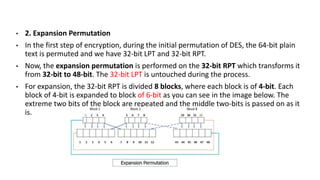
• 2. Expansion Permutation
• In the first step of encryption, during the initial permutation of DES, the 64-bit plain
text is permuted and we have 32-bit LPT and 32-bit RPT.
• Now, the expansion permutation is performed on the 32-bit RPT which transforms it
from 32-bit to 48-bit. The 32-bit LPT is untouched during the process.
• For expansion, the 32-bit RPT is divided 8 blocks, where each block is of 4-bit. Each
block of 4-bit is expanded to block of 6-bit as you can see in the image below. The
extreme two bits of the block are repeated and the middle two-bits is passed on as it
is.
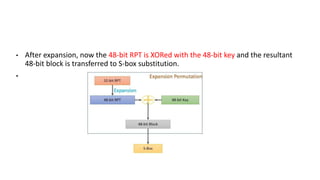
• After expansion, now the 48-bit RPT is XORed with the 48-bit key and the resultant
48-bit block is transferred to S-box substitution.
•
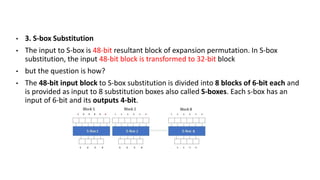
• 3. S-box Substitution
• The input to S-box is 48-bit resultant block of expansion permutation. In S-box
substitution, the input 48-bit block is transformed to 32-bit block
• but the question is how?
• The 48-bit input block to S-box substitution is divided into 8 blocks of 6-bit each and
is provided as input to 8 substitution boxes also called S-boxes. Each s-box has an
input of 6-bit and its outputs 4-bit.
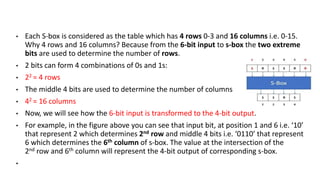
• Each S-box is considered as the table which has 4 rows 0-3 and 16 columns i.e. 0-15.
Why 4 rows and 16 columns? Because from the 6-bit input to s-box the two extreme
bits are used to determine the number of rows.
• 2 bits can form 4 combinations of 0s and 1s:
• 22 = 4 rows
• The middle 4 bits are used to determine the number of columns
• 42 = 16 columns
• Now, we will see how the 6-bit input is transformed to the 4-bit output.
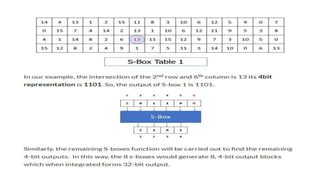
• For example, in the figure above you can see that input bit, at position 1 and 6 i.e. ‘10’
that represent 2 which determines 2nd row and middle 4 bits i.e. ‘0110’ that represent
6 which determines the 6th column of s-box. The value at the intersection of the
2nd row and 6th column will represent the 4-bit output of corresponding s-box.
•
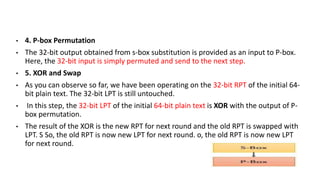
• 4. P-box Permutation
• The 32-bit output obtained from s-box substitution is provided as an input to P-box.
Here, the 32-bit input is simply permuted and send to the next step.
• 5. XOR and Swap
• As you can observe so far, we have been operating on the 32-bit RPT of the initial 64-
bit plain text. The 32-bit LPT is still untouched.
• In this step, the 32-bit LPT of the initial 64-bit plain text is XOR with the output of P-
box permutation.
• The result of the XOR is the new RPT for next round and the old RPT is swapped with
LPT. S So, the old RPT is now new LPT for next round. o, the old RPT is now new LPT
for next round.
• So, here the process of a single round ends and next round start which has the same
function.
• After 16 such rounds, the output of the 16th round undergoes final permutation. The
result of this final permutation is 64-bit ciphertext.
• Advantages
• DES has a 56-bit key which raises the possibility of 256 possible keys which make brute
force impossible.
• it impossible for any to discover the design of the s-boxes which makes the attack
more impossible.
• The number of rounds in DES increases the complexity of the algorithm.
• Disadvantages of DES
• The DES algorithm is less efficient when implemented in software, resulting in slower
performance.
• However, the cryptanalysis attack is easier than the brute force attack on DES.
DOUBLE DES AND TRIPLE DES
DOUBLE DES
🠶 In this approach, we use two instances of DES ciphers for encryption and two instances of
reverse ciphers for decryption.
🠶 Each instances use a different key.
• The size of the key is doubled.
🠶 There are issues of reduction to single stage.
🠶 However, double DES is vulnerable to meet-in-the-middle attack.
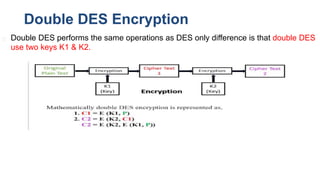
Double DES Encryption
◻ Double DES performs the same operations as DES only difference is that double DES
use two keys K1 & K2.
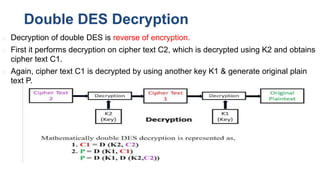
Double DES Decryption
◻ Decryption of double DES is reverse of encryption.
◻ First it performs decryption on cipher text C2, which is decrypted using K2 and obtains
cipher text C1.
◻ Again, cipher text C1 is decrypted by using another key K1 & generate original plain
text P.
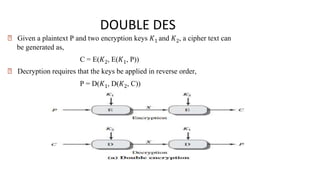
DOUBLE DES
🠶 Given a plaintext P and two encryption keys 𝐾1 and 𝐾2, a cipher text can
be generated as,
C = E(𝐾2, E(𝐾1, P))
🠶 Decryption requires that the keys be applied in reverse order,
P = D(𝐾1, D(𝐾2, C))
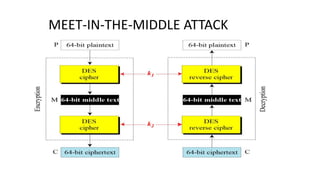
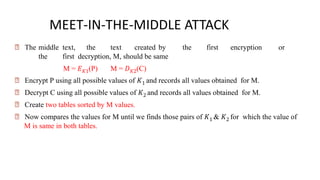
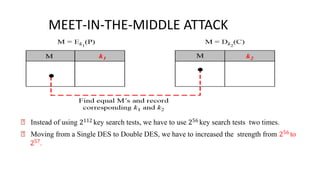
MEET-IN-THE-MIDDLE ATTACK
🠶 The middle text, the text created by the first encryption or
the first decryption, M, should be same
M = 𝐸𝐾1(P) M = 𝐷𝐾2(C)
🠶 Encrypt P using all possible values of 𝐾1 and records all values obtained for M.
🠶 Decrypt C using all possible values of 𝐾2 and records all values obtained for M.
🠶 Create two tables sorted by M values.
🠶 Now compares the values for M until we finds those pairs of 𝐾1 & 𝐾2 for which the value of
M is same in both tables.
MEET-IN-THE-MIDDLE ATTACK
🠶 Instead of using 2112 key search tests, we have to use 256 key search tests two times.
🠶 Moving from a Single DES to Double DES, we have to increased the strength from 256 to
257.
MEET-IN-THE-MIDDLE ATTACK
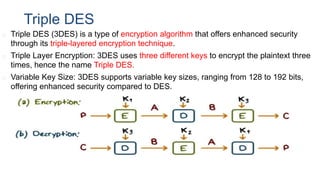
Triple DES
◻ Triple DES (3DES) is a type of encryption algorithm that offers enhanced security
through its triple-layered encryption technique.
◻ Triple Layer Encryption: 3DES uses three different keys to encrypt the plaintext three
times, hence the name Triple DES.
◻ Variable Key Size: 3DES supports variable key sizes, ranging from 128 to 192 bits,
offering enhanced security compared to DES.
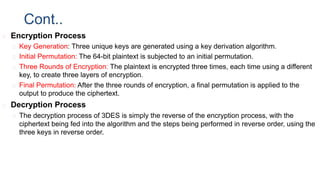
Cont..
◻ Encryption Process
◻ Key Generation: Three unique keys are generated using a key derivation algorithm.
◻ Initial Permutation: The 64-bit plaintext is subjected to an initial permutation.
◻ Three Rounds of Encryption: The plaintext is encrypted three times, each time using a different
key, to create three layers of encryption.
◻ Final Permutation: After the three rounds of encryption, a final permutation is applied to the
output to produce the ciphertext.
◻ Decryption Process
◻ The decryption process of 3DES is simply the reverse of the encryption process, with the
ciphertext being fed into the algorithm and the steps being performed in reverse order, using the
three keys in reverse order.
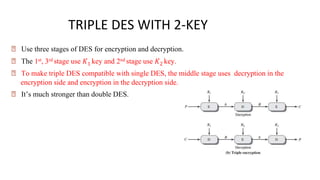
TRIPLE DES WITH 2-KEY
🠶 Use three stages of DES for encryption and decryption.
🠶 The 1st, 3rd stage use 𝐾1 key and 2nd stage use 𝐾2 key.
🠶 To make triple DES compatible with single DES, the middle stage uses decryption in the
encryption side and encryption in the decryption side.
🠶 It’s much stronger than double DES.
🠶 The function follows an encrypt-decrypt-encrypt (EDE) sequence.
C = E(𝐾1, D(𝐾2, E(𝐾1, P)))
P = D(𝐾1, E(𝐾2, D(𝐾1, C)))
🠶 By the use of triple DES with 2-key encryption, it raises the cost of meet-in-the-middle attack
to 2112.
🠶 It has the drawback of requiring a key length of 56 × 3 = 168bits which
may be somewhat unwieldy.
TRIPLE DES WITH 2-KEY
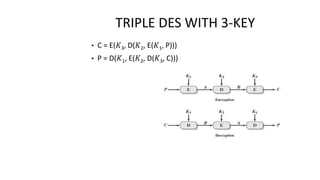
TRIPLE DES WITH 3-KEY
• C = E(𝐾3, D(𝐾2, E(𝐾1, P)))
• P = D(𝐾1, E(𝐾2, D(𝐾3, C)))
Applications of 3DES
◻ Financial Transactions: online banking, credit card processing, and electronic fund
transfers.
◻ VPNs: to provide secure communication between remote locations.
◻ Healthcare Systems: electronic health records and medical imaging systems.
◻ Government Communications: military communications and secure data transfers.
WEAK KEYS IN DES ALGORITHMS
• weak key
• in cryptography, a weak key is a key used with a specific cipher, makes the cipher
behave in some undesirable way.
• To encrypt a message with weak keys are very unlikely to give rise to a security
problem.
• It is considered desirable for a cipher to have no weak keys.
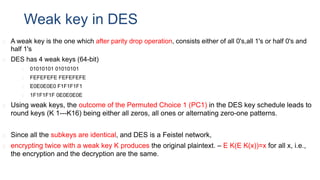
Weak key in DES
◻ A weak key is the one which after parity drop operation, consists either of all 0's,all 1's or half 0's and
half 1's
◻ DES has 4 weak keys (64-bit)
◻ 01010101 01010101
◻ FEFEFEFE FEFEFEFE
◻ E0E0E0E0 F1F1F1F1
◻ 1F1F1F1F 0E0E0E0E
◻ Using weak keys, the outcome of the Permuted Choice 1 (PC1) in the DES key schedule leads to
round keys (K 1---K16) being either all zeros, all ones or alternating zero-one patterns.
◻ Since all the subkeys are identical, and DES is a Feistel network,
◻ encrypting twice with a weak key K produces the original plaintext. – E K(E K(x))=x for all x, i.e.,
the encryption and the decryption are the same.
Advanced Encryption Standard (AES)
• A symmetric block cipher which overcomes the key size weakness of DES.
• AES comes with the variable key sizes i.e. 128-bit key, 192-bit key and a 256-bit key.
• AES does not follow the Feistel structure in fact it operates on entire plaintext.
• AES can be applied in both hardware and software.
• AES operates on an entire block of plain text in the form of a single matrix at each
round which includes substitution and permutation. AES has
10 rounds -> 128-bit key
12 rounds -> 192-bit key
14 rounds -> 256-bit key
•
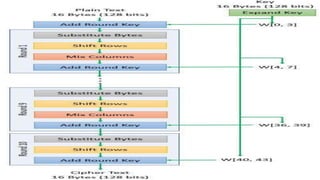
• AES operates on a 128-bit plain text block as a single 4X4 matrix which would have a total size of 16 bytes.
• Every 4 bytes would represent a word.
• The 128-bit key is expanded to form an array containing 44, 32-bit words. And at each round of AES 4 distinct words are served to the
round key process from the expanded key.
• A round has four functions among which one is of permutation and three are of substitution:
Substitute Byte, Mix Column and Add Round Key functions are substitution functions whereas Shift Rows is a permutation function.
• Both the encryption and decryption process starts with the Add Round Key function which is then followed by the nine-round which has
all four substitutions and permutation function but the last tenth round has only three functions.
• Only the Add Round key function makes use of the key.
• During decryption, the inverse functions of Substitute Bytes, Mix Columns and Shift Rows are used and the inverse of Add Round key is
carried out by XORing the same round key as in encryption with the cipher block.
• While decryption the sequence of keys used during encryption is reversed.
• In both the encryption and decryption, the last round always has only three functions, Mix Column is ignored at the last round of AES.
• Every intermediate result is stored in the 4X4 state matrix.
Advanced Encryption Standard (AES) Encryption
• Step 1: Initially the 16-byte key or a 4-word key is expanded to an array of 44 words where
each word is of 4 bytes.
• Step 2: At the very first of encryption process the 16-byte plain text block or 4-word plain
text block is XORed with the 4-word key i.e. W0, W1, W2, W3. The resultant of this XOR is
provided to the 1st round.
• Step 3: In the first round, the result of XOR is processed by the Substitute Bytes, Shift Rows,
Mix Column and Add Round Key functions in the respective sequence.
• To the Add Round Key function, the next 4 words from the expanded key are provided that
are W4, W5, W6, W7. The corresponding result of first-round is provided to the second round.
• Step 4: All round till round nine, performs the same functions and in each round, a distinct
key is provided from the expanded key. In round ten only three functions are performed on
the input provided by round 9 that are Substitute Bytes, Shift Rows and Add Round Key
function.
The result of round 10 is the cipher text block of the corresponding pain text block.
• Round Functions
• Each round function has four functions those are as follows:
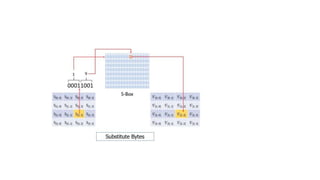
• Substitute Bytes
• The input to Substitute Byte is a 4X4 state matrix of 16 bytes
where each element of the matrix is of 1 byte. Now AES has
defined a 16X16 matrix namely S-box which contains a
permutation of 256 8-bit values.
• The Substitute Bytes function maps each byte element of state
matrix to the new value using the following procedure.
• tep 1: A byte element in the state matrix would have 8-bits.
The leftmost 4-bit is used to retrieve the row value of S-box and
the rightmost 4-bit are used to retrieve the column value of S-
box.
• Step 2: This row value and column value act as an index to get
the new value from the S Box.
• The Substitute Byte function maps each element of 4X4 state
matrix to the new value and forwards this newly formed 4X4
State matrix to Shift Rows function.
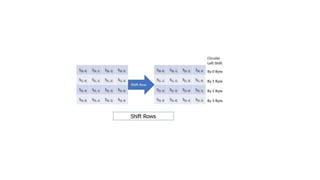
• Shift Rows
• On the first row, the circular left shift is performed by 0 bytes.
• On the second row, a circular left shift is performed by 1 byte.
On the third row, the circular left shift is performed by 2 bytes.
On the fourth row of the input state matrix, the circular let shift
is performed by 3 bytes.
• The resultant 4X4 state matrix of Shift Rows function is
forwarded to the Mix Column function.
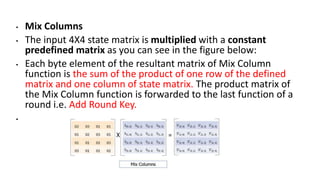
• Mix Columns
• The input 4X4 state matrix is multiplied with a constant
predefined matrix as you can see in the figure below:
• Each byte element of the resultant matrix of Mix Column
function is the sum of the product of one row of the defined
matrix and one column of state matrix. The product matrix of
the Mix Column function is forwarded to the last function of a
round i.e. Add Round Key.
•
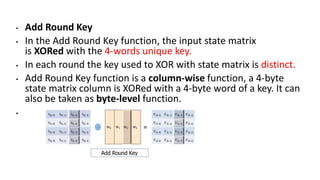
• Add Round Key
• In the Add Round Key function, the input state matrix
is XORed with the 4-words unique key.
• In each round the key used to XOR with state matrix is distinct.
• Add Round Key function is a column-wise function, a 4-byte
state matrix column is XORed with a 4-byte word of a key. It can
also be taken as byte-level function.
•
• Advanced Encryption Standard (AES) Decryption
• Encryption and Decryption process are the same and starts with the Add Round Key
Function.
• The 16-byte cipher text in the form of 4X4 state matrix is XORed with the unique 4-word key.
• The key sequence in encryption is reversed during the decryption.
• Advantage and Disadvantage
• Advantages
• AES can be implemented on both hardware and software.
• AES has three key length 128-bits,192-bits and 256-bits.
• AES is implemented in a wide range of application as it is defined as the standard by NIST.
• Disadvantage
• The key used in AES if not employed properly it can cause a cryptanalytic attack. Therefore,
key scheduling should be done carefully.
THANK YOU?.......
E-links
• https://www.101computing.net/symmetric-vs-asymmetric-
encryption/
• https://www.101computing.net/caesar-cipher/
• https://www.101computing.net/mono-alphabetic-substitution-cipher/
145
146

Data Science Unit 02 SPPU Sem 6 PPT-2.pdf

  • 1.
    UNIT-II DATA ENCRYPTION TECHNIQUESAND STANDARDS Prepared By: Mrs. Sonali B.Gavali Assistant Professor AI&DS Department DIT,Pimpri.
  • 3.
    CRYPTOGRAPHY • Cryptography istechnique of securing information and communications through use of codes so that only those person for whom the information is intended can understand it and process it. • Thus preventing unauthorized access to information. • The prefix “crypt” means “hidden” and suffix “graphy” means “writing”.
  • 4.
    TECHNIQUES USED FORCRYPTOGRAPHY: • In today’s age of computers cryptography is often associated with the process • Where plain text is converted to cipher text which decode by receiver only , this process is known as encryption. • The process of conversion of cipher text to plain text this is known as decryption.
  • 5.
    What are Plaintextand Ciphertext? How do they interact? • Plaintext can refer to anything which humans can understand and/or relate to. • This may be as simple as English sentences, a script, or Java code. • If you can make sense of what is written, then it is in plaintext. • Cipher text, or encrypted text, is a series of randomized letters and numbers which humans cannot make any sense of. • An encryption algorithm takes in a plaintext message, runs the algorithm on the plaintext, and produces a cipher text. • The cipher text can be reversed through the process of decryption, to produce the original plaintext.
  • 6.
    FEATURES OF CRYPTOGRAPHYARE AS FOLLOWS: • Confidentiality: information can only be accessed by the person for whom it is intended and no other person except him can access it. • Integrity: information cannot be modified in storage or transition between sender and intended receiver without any addition to information being detected. • Non-repudiation: the creator/sender of information cannot deny his or her intention to send information at later stage. • Authentication: the identities of sender and receiver are confirmed. As well as destination/origin of information is confirmed.
  • 7.
  • 8.
    TYPES OF CRYPTOGRAPHY: 1.Symmetrickey cryptography(Secret key cryptography)(Single/Private key encryption) • It is system where the sender and receiver uses a single common key to encrypt and decrypt messages. • Symmetric key systems are faster and simpler • But the problem is that sender and receiver have to somehow exchange key in a secure manner. • Example: data encryption system(des).
  • 10.
    Why to usesymmetric key encryption? • It is relatively inexpensive to produce a strong key for these ciphers. • The keys tend to be much smaller for the level of protection they afford. • The algorithms are relatively inexpensive to process. • The drawback : • to secret-key ciphers is in exchanging the secret key because any exchange must retain the privacy of the key.
  • 11.
    2. ASYMMETRIC KEYCRYPTOGRAPHY (public-key encryption) (asymmetric encryption) • Under this system a pair of keys is used to encrypt and decrypt information. • A public key is used for encryption and a private key is used for decryption. • Public key and private key are different. • Even if the public key is known by everyone the intended receiver can only decode it because he alone knows the private key.
  • 13.
    Why to useAsymmetric key encryption? • the encrypted data is not understood by an intruder. • Non repudiation, which prevents: • The sender of the data from claiming, at a later date, that the data was never sent • The data from being altered. • RSA (Rivest-Shamir-Adelman) public key pairs can be any size. Typical sizes today are 1024 and 2048 bits. rejection of a proposal or idea
  • 14.
    3.HASH FUNCTIONS: • Thereis no usage of any key in this algorithm. • A hash value with fixed length is calculated as per the plain text which makes it impossible for contents of plain text to be recovered. • Many operating systems use hash functions to encrypt passwords.
  • 16.
    CLASSICAL ENCRYPTION TECHNIQUES: •In the classical cryptography the original data i.e., The plain text is transformed into the encoded format i.e. Cipher text so that we can transmit this data through insecure communication channels. • A data string which known as key is used to control the transformation of the data from plain text to cipher text. • This arrangement helps to keep data safe as it required the key for extracting the original information from the cipher text. • Without the key no one can read the data. • In this technique it is assumed that the only authorized receiver has the key.
  • 17.
    CLASSICAL CRYPTOGRAPHY HASTWO TYPES OF TECHNIQUES: Symmetric Cryptography: • In the symmetric cryptography a single key is used for encrypting and decryption the data. • This encryption key is private key. • This is the limitation of this encryption technique that this private key must be distributed only among the authorized sender and receiver.
  • 18.
    ASYMMETRIC CRYPTOGRAPHY: • Inthe asymmetric cryptography a pair of key, i.e., Public key and Private key is used for encryption and decryption. • A sender can use its public key to encrypt the data and on receiver end receiver can decrypt the data by using its private key. • This technique overcomes the problem of key distribution.
  • 19.
    ADVANTAGES AND DISADVANTAGESOF CLASSICAL CRYPTOGRAPHY: Advantages • While employing the one-time pad(information-theoretically secure), it is unbreakable. • It is easy to do manually, no computer required. • It protects the plain text from casual snooping(keep watch on what person is typing.). Disadvantages • While employing the one-time pad, it is cumbersome and requires a personal meet up to exchange the pads. • If not employing the OTP, anyone who is even remotely interested in knowing what you wrote and knows about cryptography will be able to break the encryption.
  • 20.
    BLOCK CIPHER ANDSTREAM CIPHER • Block cipher and stream cipher belongs to the symmetric key cipher. • These two are the methods used for converting the plain text into cipher text. • A block cipher converts the plain text into cipher text by taking plain text’s block at a time. • While stream cipher converts the plain text into cipher text by taking 1 byte of plain text at a time.
  • 21.
    S. NO Block Cipher StreamCipher 1. Block Cipher Converts the plain text into cipher text by taking plain text’s block at a time. Stream Cipher Converts the plain text into cipher text by taking 1 byte of plain text at a time. 2. Block cipher uses either 64 bits or more than 64 bits. While stream cipher uses 8 bits. 3. The complexity of block cipher is simple. While stream cipher is more complex. 4. Block cipher Uses confusion as well as diffusion. While stream cipher uses only confusion. 5. In block cipher, reverse encrypted text is hard. While in-stream cipher, reverse encrypted text is easy. 6. The algorithm modes : ECB (Electronic Code Book) and CBC (Cipher Block Chaining). The algorithm modes : CFB (Cipher Feedback) and OFB (Output Feedback). 7. Block cipher works on transposition techniques like rail-fence technique, columnar transposition technique, etc. While stream cipher works on substitution techniques like Caesar cipher, polygram substitution cipher, etc. 8. Block cipher is slow While stream cipher is fast
  • 22.
    ATTACKS ON SYMMETRICKEY CRYPTOGRAPHY: • Typically, the objective of attacking an encryption system is to recover the key in use rather than simply to recover the plaintext of a single cipher text. • There are two general approaches to attacking a conventional encryption scheme. • Cryptanalysis: • Brute-force attack
  • 23.
    • Cryptanalysis: cryptanalyticattacks rely on the nature of the algorithm plus knowledge of the general characteristics of the plaintext or even some sample plaintext–cipher text pairs. • This type of attack exploits the characteristics of the algorithm to attempt to deduce a specific plaintext or to deduce the key being used. • Brute-force attack: the attacker tries every possible key on a piece of cipher text until an intelligible translation into plaintext is obtained. • On average, half of all possible keys must be tried to achieve success. • A brute force attack is a hacking method that uses trial and error to crack passwords, login credentials, and encryption keys. • It is a simple yet reliable tactic for gaining unauthorized access to individual accounts and organizations’ systems and networks.
  • 24.
    Substitution (cipher)techniques • Thetwo basic building blocks of all encryption Techniques are substitution and transposition. • A substitution technique • Definition: • Letters of plaintext are replaced by other letters or by numbers or symbols . • if the plaintext is viewed as a sequence of bits, • then substitution involves replacing plaintext bit patterns with cipher text bit patterns.
  • 25.
    Substitution Techniques 1. CaesarCipher 2. Monoalphabetic Cipher 3. Polyalphabetic Cipher 4. Playfair 5. Hill 6. One time Pad
  • 26.
    1. CAESAR CIPHER: •The earliest known, and the simplest, use of a substitution cipher was by julius caesar. • The caesar cipher involves replacing each letter of the alphabet with the letter standing three places further down the alphabet. • For example, (encryption) Plain: meet me after the toga party cipher: PHHW PH DIWHU WKH WRJD SDUWB • As follows: •plain: a b c d e f g h i j k l m n o p q r s t u v w x y z •cipher: D E F G H I J K L M N O P Q R S T U V W X Y Z A B C
  • 27.
    • Decryption isjust as easy, by using an offset of -3. • For example, (decryption) Cipher: PHHW PH DIWHU WKH WRJD SDUWB Plain: meet me after the toga party • If it is known that a given cipher text is a caesar cipher, then a brute-force cryptanalysis is easily performed: simply try all the 25 possible keys. • Disadvantage: 1. The encryption and decryption algorithms are known. 2. There are only 25 keys to try. 3. The language of the plaintext is known and easily recognizable
  • 28.
    2. Monoalphabetic Cipher •A Caesar shift cipher/mono-alphabetic cipher ( simple substitution cipher) is a substitution cipher • where each letter of the plain text is replaced with another letter of the alphabet. • It uses a fixed key which consist of the 26 letters of a “shuffled alphabet”. • all “A” letters in the plain text will be encoded to an “M”. • This type of cipher is a form of symmetric encryption as the same key can be used to both encrypt and decrypt a message.
  • 29.
    3. Polyalphabetic cipher •Poly alphabetic cipher is far more secure than a mono alphabetic cipher. • As mono-alphabetic cipher maps a plain text symbol or alphabet to a cipher text symbol and uses the same cipher text symbol wherever that plain text occurs in the message. • But poly alphabetic cipher, each time replaces the plain text with the different cipher text.
  • 30.
    • with only25 possible keys, the caesar cipher is far from secure. • a dramatic increase in the key space can be achieved by allowing an arbitrary substitution. before proceeding, we define the term permutation. a permutation of a finite set of elements s is an ordered sequence of all the elements of s, with each element appearing exactly once. • for example, if s = {a, b, c}, • there are six permutations of s: abc, acb, bac, bca, cab, cba • in general, there are n! permutations of a set of n elements, because the first element can be chosen in one of n ways, the second in n - 1 ways, the third in n - 2 ways, and so on.
  • 31.
    • recall theassignment for the caesar cipher: plain: a b c d e f g h i j k l m n o p q r s t u v w x y z cipher: d e f g h i j k l m n o p q r s t u v w x y z a b c • if, instead, the “cipher” line can be any permutation of the 26 alphabetic characters, then there are 26! or greater than 4 * 10^26 possible keys. • this is 10 orders of magnitude greater than the key space for des and would seem to eliminate brute-force techniques for cryptanalysis.
  • 34.
    4. PLAY FAIRCIPHER: •The Playfair cipher was the first practical digraph substitution cipher. The scheme was invented in 1854 by Charles Wheatstone but was named after Lord Playfair who promoted the use of the cipher. •In playfair cipher unlike traditional cipher we encrypt a pair of alphabets(digraphs) instead of a single alphabet. It was used for tactical purposes by British forces in the Second Boer War and in World War I and for the same purpose by the Australians during World War II. Advantages: •fast to use and •requires no special equipment.
  • 35.
    FOR THE ENCRYPTIONPROCESS LET US CONSIDER THE FOLLOWING EXAMPLE: The Playfair Cipher Encryption Algorithm: The Algorithm consists of 2 steps: 1.Generate the key Square(5×5): 1. The key square is a 5×5 grid of alphabets that acts as the key for encrypting the plaintext. Each of the 25 alphabets must be unique and one letter of the alphabet (usually J) is omitted from the table (as the table can hold only 25 alphabets). 2. If the plaintext contains J, then it is replaced by I. 3. The initial alphabets in the key square are the unique alphabets of the key in the order in which they appear followed by the remaining letters of the alphabet in order.
  • 36.
    2.Algorithm to encryptthe plain text: the plaintext is split into pairs of two letters (digraphs). if there is an odd number of letters, a z is added to the last letter. • FOR EXAMPLE: PLAINTEXT: "INSTRUMENTS" AFTER SPLIT: 'IN' 'ST' 'RU' 'ME' 'NT' 'SZ‘ 1. pair cannot be made with same letter. break the letter in single and add a bogus letter to the previous letter. PLAIN TEXT: “HELLO” AFTER SPLIT: ‘HE’ ‘LX’ ‘LO’ • here ‘x’ is the bogus letter.
  • 37.
    • 2. ifthe letter is standing alone in the process of pairing, then add an extra bogus letter with the alone letter PLAIN TEXT: “HELLOE” AFTERSPLIT: ‘HE’ ‘LX’ ‘LO’ ‘EZ’ • here ‘z’ is the bogus letter.
  • 38.
    RULES FOR ENCRYPTION: •if both the letters are in the same column: take the letter below each one (going back to the top if at the bottom). • for example: DIAGRAPH: "ME“ ENCRYPTED TEXT: CL ENCRYPTION: M -> C E -> L
  • 39.
    • if boththe letters are in the same row: take the letter to the right of each one (going back to the leftmost if at the rightmost position). • for example: DIAGRAPH: "ST" ENCRYPTED TEXT: TL • ENCRYPTION: S -> T T -> L
  • 40.
    • if neitherof the above rules is true: • form a rectangle with the two letters and take the letters on the horizontal opposite corner of the rectangle. • for example: DIAGRAPH: "NT" ENCRYPTED TEXT: RQ • ENCRYPTION: N -> R T -> Q
  • 41.
    FOR EXAMPLE: • PLAINTEXT: "INSTRUMENTS“ • ENCRYPTED TEXT: GATLMZCLRQTX Encryption: i -> g n -> a s -> t t -> l r -> m u -> z m -> c e -> l n -> r t -> q s -> t z -> x
  • 42.
    DECRYPTION IN PLAYFAIR CIPHER: • Generate the key square(5×5) at the receiver’s end: • Each of the 25 alphabets must be unique and one letter of the alphabet (usually J) is omitted from the table (as the table can hold only 25 alphabets). If the plaintext contains J, then it is replaced by I. • the key square are the unique alphabets of the key in the order in which they appear followed by the remaining letters • Algorithm to decrypt the cipher text: the cipher text is split into pairs of two letters (digraphs). Note: the ciphertext always have even number of characters.
  • 43.
    EXAMPLE: • CIPHERTEXT: "GATLMZCLRQTX" •AFTER SPLIT: 'GA' 'TL' 'MZ' 'CL' 'RQ' 'TX'
  • 47.
    5. Hill Cipher •Hill cipher is a poly alphabetic cipher introduced by Lester Hill in 1929. Let us discuss the technique of hill cipher. • Plain text: Binary • Key: HILL • Choose the key in such a way that it always forms a square matrix. With HILL as the key, we can form a 2×2 matrix. • Now, of plain text, you have to form a column vector of length similar to the key matrix. • In our case, the key matrix is 2×2 then the column vectors of plain text would be 2×1.
  • 51.
  • 52.
    Hill Cipher • Encryption: 1KeyMatrix Generation: 2Matrix Representation of Plaintext: • Convert the plaintext into a numerical equivalent, mapping each letter to its position in the alphabet (e.g., A=0, B=1, ..., Z=25). • Arrange the numerical values into a column matrix of size n x 1. • Matrix Multiplication: • Multiply the key matrix with the plaintext matrix. • ��C=K×P • Where: • �C is the resulting matrix (cipher text), • �K is the key matrix, • �P is the plaintext matrix. • The multiplication is performed modulo 26. • Conversion to Cipher text:
  • 53.
    Decryption: • Key MatrixInversion: kX k^-1=I • Matrix Representation of Cipher text: • Matrix Multiplication: • Multiply the inverted key matrix with the ciphertext matrix. • �P=K^-1×C • Where: • �P is the resulting matrix (plaintext), • �K^−1 is the inverted key matrix, • �C is the cipher text matrix. • The multiplication is performed modulo 26. • Conversion to Plaintext:
  • 54.
    6. One-Time Pad •Condition: • key length should be as long as the plain text to prevent the repetition of key. • Along with that, the key should be used only once. • new key for each new message and • of the same length as a new message.
  • 57.
    TRANSPOSITION TECHNIQUES • performingpermutations on the plain text, i.e, Changing each character of plain text for each round. • rearranging the order of characters in a message to change its meaning. • Rail fence transposition • Columnar transposition • Improved columnar transposition • Book cipher/running key cipher
  • 58.
    1. RAIL FENCETRANSPOSITION • Step 1: plain text: sequence of diagonals. • Step 2: cipher text :the text is read as a sequence of rows. To understand this in a better way, let us take an example: The cipher text is then read off by writing the top row first, followed by the bottom row, to get "dfnteatal eedheswl".
  • 59.
    ENCRYPTION • Write plainText zigzag lines across the page, and then read off each row. • Firstly, you need to have a key=number of rows you are going to have. • For the plaintext we used above, "defend the east wall", with a key of 3, we get the encryption process shown below. • Note that at the end of the message we have inserted two "x"s. • These are called nulls, and act as placeholders. We do this to make the message fit neatly in to the grid • The cipher text is read off row by row to get "dnetl eedheswlx ftaax".
  • 60.
    DECRYPTION • We startwriting the message, but leaving a dash in place of the spaces yet to be occupied. • We start by making a grid with as many rows as the key is, and as many columns as the length of the cipher text. • We then place the first letter in the top left square, and dashes diagonally downwards where the letters will be. When we get back to the top row, we place the next letter in the ciphertext. Example-2 • For example, if you receive the ciphertext "tekoohracirmnreatanftetytghh", encrypted with a key of 4, you start by placing the "t" in the first square. You then dash the diagonal down spaces until you get back to the top row, and place the "E" here. Continuing to fill the top row you get the pattern below.
  • 61.
    • Example-3 CONTINUINGTHIS ROW-BY-ROW, WE GET THE SUCCESSIVE STAGES SHOWN BELOW. The second stage in the decryption process. The Third stage in the decryption process. The fourth and final stage in the decryption process. Theyareattackingfromthenorth TEKOOHRACIRMNREATANFTETYTGHH
  • 62.
    Encryption steps • KeySelection: – Choose the number of rails (rows) for the transposition. This determines how many rows you will use to write the message. • Message Arrangement: – Write the message diagonally across the chosen number of rails. • Read Off Rows: – Read the characters row by row to obtain the cipher text. 62
  • 63.
    Decryption Steps: • KeySelection: – Choose the same number of rails used for encryption. • Message Reconstruction: – Write the ciphertext diagonally across the chosen number of rails. • Read Off Columns: – Read the characters column by column to obtain the original message. 63
  • 64.
    64 "defend the eastwall“ key= 3 tekoohracirmnreatanftetytghh", key= 4
  • 65.
    2. COLUMNAR TRANSPOSITIONCIPHER • Columnar transposition involves writing the plaintext out in rows, and then reading the cipher text off in columns. • It is the route cipher where the route is to read down each column in order. • For example, the plaintext "a simple transposition" with 5 columns looks like the grid below • If we now read down each column we get the cipher text "ALNI SEST ITPI MROO PASN".
  • 66.
    ENCRYPTION: • We firstpick a keyword for our encryption. • We write the plaintext. • Do numbering for columns acc. To alphabet order • Encrypt the message: "the tomato is a plant in the nightshade family" using the keyword tomato. • check numbering for O and T.
  • 67.
    • Starting withthe column headed by "A", our ciphertext begins "TINESAX" from this column. • We now move to the column headed by "M", and so on through the letters of the keyword in alphabetical order to get the cipher text "TINESAX / EOAHTFX / HTLTHEY / MAIIAIX / TAPNGDL / OSTNHMX" (where the / tells you where a new column starts). The final ciphertext is thus "TINES AXEOA HTFXH TLTHE YMAII AIXTA PNGDL OSTNH MX".
  • 68.
    DECRYPTION • Firstly, ifnulls have been used, then you start by writing out the keyword and the alphabetical order of the letters of the keyword. • You must then divide the length of the ciphertext by the length of the keyword. • The answer to this is the number of rows you need to add to the grid. You then write the ciphertext down the first column until you reach the last row. The next letter becomes the first letter in the second column (by the alphabetical order of the keyword), and so on.
  • 69.
    • As anexample, we shall decrypt the ciphertext • "aresa sxost heylo iiaie xpeng dllta htfax tenhm wx" given the keyword potato. • We start by writing out the keyword and the order of the letters. • There are 42 letters in the ciphertext, and the keyword has six letters, so we need 42 ÷ 6 = 7 rows.
  • 70.
    • Now westart by filling in the columns in the order given by the alphabetical order of the keyword, starting with the column headed by "A". After the first column is entered we have the grid shown to the right. • We continue to add columns in the order specified by the keyword. Now we read off the plaintext row at a time to get "potatoes are in the nightshade family as well". ARESA SXOST HEYLO IIAIE XPENG DLLTA HTFAX TENHM WX
  • 71.
    • To decryptthe ciphertext "ARESA SOSTH EYLOI IAIEP ENGDL LTAHT FATEN HMW", we start similarly to above, by heading the columns with the keyword potato. • This time, to find how many rows we need, we do 38 ÷ 6 = 6.3333. We round this up to the next number, which is 7, so we need 7 rows. • When we multiply 6 x 7 we get 42, and 42 - 38 = 4. Hence we need 4 placeholders in the last row. We get the grid below to the left. After pluggin the ciphertext letters in, in the same way as above, we get the grid on the right. Finally, we read off the plaintext in rows, to reveal the same plaintext as the other example, "potatoes are in the nightshade family as well".
  • 72.
    IMPROVED COLUMNAR TRANSPOSITION •it is similar to the basic columnar technique but is introduced with an improvement. the basic columnar technique is performed over the plain text but more than once. the steps for columnar technique with multiple rounds are as follow: Step 1: The plain text is written in the rectangle of predetermined size row by row. Step 2: To obtain the cipher text, read the plain text in the rectangle, column by column. Before reading the text in rectangle column by column, permute the order of columns the same as in basic columnar technique. Step 3: To obtain the final cipher text repeat the steps above multiple time.
  • 73.
    • let usdiscuss one example of a columnar transposition technique for better understanding. we will consider the same example of a basic columnar technique which will help in understanding the complexity of the method: We put the plaintext into the grid below the keyword tomato to get the cipher text "TINES AXEOA HTFXH TLTHE YMAII AIXTA PNGDL OSTNH MX" We now write the cipher text retrieved from the grid to the left in the grid in rows as if it was the plaintext. After this double transposition, we get the cipher text "EATMX DHNOH YIGNI EXEAN TATTI AOXTX FHIPS SHLAT LM". This double transposition increases the security of the cipher significantly. It could also be implemented with a different keyword for the second iteration of the cipher. In fact, until the invention of the VIC Cipher, Double Transposition was seen as the most secure cipher for a field agent to use reliably under difficult circumstances.
  • 74.
    Book Cipher orRunning Key Cipher • The book cipher or the running key cipher works on the basic principle of one-time pad cipher. In onetime pad cipher the key is taken as long as the plain text and is discarded after the use. Every time a new key is taken for a new message. • The improvement to the onetime pad in Book cipher is that the key or the onetime pad is taken from the book. Let us discuss the steps: • Step 1: Convert the plain text in numeric form consider A=0, B=1, C=3 …, Z=25. • Step 2: Take an onetime pad or key from any of the books and convert it in the numeric form also. But the key must be as long as the length of plain text. • Step 3: Now add the numeric form of both plain text and key, each plain text letter with corresponding key text letter. If the addition of any plain text letter with corresponding key text letter is >26, then subtract it with 26. • Let us understand with the example: • Plain text: Meet Tomorrow • Key taken from the book: ANENCRYPTION. • Now we have to convert this plain text and key text in numeric form and add them to get cipher text as shown in the image below:
  • 75.
  • 76.
    Stenography application andits limitation • It is the act of recording spoken words through shorthand using a stenotype machine. • Stenography is the process of writing in shorthand or a system of shorthand writing. • a shorthand system: • symbols->specific sounds, concepts, or letters • Letters->meanings. • goal is to record the spoken word by copying it. • Applications: • court reporters to record proceedings and events much quicker than they would be able to do using a standard keyboard. • less laborious and more accurate manner. • Explore Other Education Options Related to Criminal Justice and Legal Studies • Working as a Stenographer. 76
  • 77.
    Limitations: • capacity • Itis challenging to develop an efficient shorthand system. • that can handle large amounts of data • while maintaining security and hiding information effectively • Stenography: the action or process of writing in shorthand or taking dictation. • Steganography: the practice of concealing messages or information within other non-secret text or data. 77
  • 78.
    WHAT IS STEGANOGRAPHY? •A steganography technique involves hiding sensitive information within an ordinary, non-secret file or message, so that it will not be detected. • the sensitive information will then be extracted from the ordinary file or message at its destination, thus avoiding detection. • steganography is an additional step that can be used in conjunction with encryption in order to conceal or protect data. • use: to hide text, video, images, or even audio data.
  • 79.
  • 80.
    DIFFERENT TYPES OFSTEGANOGRAPHY • 1. text steganography • 2. image steganography − • 3. audio steganography − it is the science of hiding data in sound. used digitally, it protects against unauthorized reproduction. watermarking is a technique that encrypts one piece of data (the message) within another (the "carrier • 4. video steganography − video steganography is a method of secretly embedding data or other files within a video file on a computer. • 5. network or protocol steganography − it involves concealing data by using a network protocol like tcp, udp, icmp, ip, etc.,
  • 81.
    STEGANOGRAPHY EXAMPLES INCLUDE •writing with invisible ink • embedding text in a picture (like an artist hiding their initials in a painting they’ve done) • concealing information in either metadata or within a file header • hiding an image in a video, viewable only if the video is played at a particular frame rate.
  • 82.
    STEGANOGRAPHY APPLICATIONS • imagesteganography: this application is a javascript tool used to hide images in other image files • openstego: this program is an open-source steganography tool • xiao steganography: xiao hides secret files • crypture: this application is a command-line tool used to conduct steganography • noclue: this application is an open-source tool that hides text information in both video and image carrier files • steganography master: this app is an android-based open-source tool that can hide text in an image and gives you a decoding tool to pull hidden text messages from image files. it supports multiple image formats (bmp, jpg, ico, png) • steghide: steghide is an application that hides data in different audio and image files, including jpeg
  • 83.
  • 84.
    BLOCK CIPHERS ANDMODES/METHODS OF OPERATIONS • block cipher is an encryption algorithm that takes a fixed size of input say b bits and produces a ciphertext of b bits again. • Input> b bits it can be divided further. • ELECTRONIC CODE BOOK (ECB) • CIPHER BLOCK CHAINING (CBC) • CIPHER FEEDBACK MODE (CFB) • OUTPUT FEEDBACK MODE (OFM) • COUNTER MODE (CM)
  • 85.
    ELECTRONIC CODE BOOK(ECB) – • Electronic Code Book is simple mode. • direct encryption of each block of input plaintext and output is in form of blocks of encrypted cipher text. • Generally, if a message is larger than b bits in size, it can be broken down into a bunch of blocks and the procedure is repeated. Advantages of using ECB – •Parallel encryption of blocks of bits is possible, so it is faster. •Simple way of the block cipher. Disadvantages of using ECB – •Prone to cryptanalysis since there is a direct relationship between plaintext and ciphertext.
  • 87.
    CIPHER BLOCK CHAINING– • previous cipher block is given as input to the next encryption algorithm after xor with the original plaintext block. in a nutshell here, a cipher block is produced by encrypting an xor output of the previous cipher block and present plaintext block. • advantages of cbc – ∙ cbc works well for input greater than b bits. ∙ cbc is a good authentication mechanism. ∙ Protect against cryptanalysis. • disadvantages of cbc – ∙ parallel encryption is not possible since every encryption requires a previous cipher.
  • 89.
    CIPHER FEEDBACK MODE(CFB) – • cipher is given as feedback to the next block of encryption with some new specifications: • first, an initial vector iv is used for first encryption and output bits are divided as a set of s and b-s bits.The left-hand side s + plaintext bits to which an xor operation is applied. • the result is given as input to a shift register having b-s bits to lhs, s bits to rhs and the process continues. • the encryption and decryption process for the same is shown below, both of them use encryption algorithms. • advantages of cfb – difficult for applying cryptanalysis. • disadvantages of using cfb – Parallelism not possible
  • 91.
    OUTPUT FEEDBACK MODE– • the output feedback mode follows nearly the same process as the cipher feedback mode except that it sends the encrypted output as feedback instead of the actual cipher which is xor output. • in this output feedback mode, all bits of the block are sent instead of sending selected s bits advantages of ofb – ∙ a single bit error in a block is propagated to all subsequent blocks. this problem is solved by ofb as it is free from bit errors in the plaintext block. • disadvantages of ofb- ∙ the drawback of ofb is that, because to its operational modes, it is more susceptible to a message stream modification attack than cfb.
  • 93.
    COUNTER MODE – • Everytime a counter-initiated value is encrypted and given as input to xor with plaintext which results in ciphertext block. the ctr mode is independent of feedback use and thus can be implemented in parallel • advantages ∙ since there is a different counter value for each block, the direct plaintext and ciphertext relationship is avoided. ∙ parallel execution of encryption is possible. • disadvantages of counter- ∙ the fact that ctr mode requires a synchronous counter at both the transmitter and the receiver is a severe drawback.
  • 95.
    APPLICATIONS OF BLOCKCIPHERS • data encryption: • file and disk encryption: block ciphers are used for encryption of entire files and disks in order to protect their contents and restrict from unauthorized users. the disk encryption softwares such as bitlocker, truecrypt aslo uses block cipher to encrypt data and make it secure. • virtual private networks (vpn): • secure sockets layer (ssl) and transport layer security (tls): ssl and tls protocols use block ciphers for encryption of data that is transmitted between web browsers and servers over the internet.. • digital signatures: block ciphers are used in the digital signature algorithms, to provide authenticity and integrity to the digital documents. • this encryption process generates the unique signature for each document that is used for verifying the authenticity and detecting if any malicious activity is detected. •
  • 96.
    Feistel cipher Feistel Ciphermodel is a structure or a design used to develop many block ciphers such as DES. Feistel cipher may have invertible, non-invertible and self invertible components in its design. Same encryption as well as decryption algorithm is used. A separate key is used for each round. However same round keys are used for encryption as well as decryption. Feistel cipher algorithm •Create a list of all the Plain Text characters. •Convert the Plain Text to Ascii and then 8-bit binary format. •Divide the binary Plain Text string into two halves: left half (L1)and right half (R1) •Generate a random binary keys (K1 and K2) of length equal to the half the length of the Plain Text for the two rounds. 96
  • 97.
    First Round •a. Generatef1= xor(R1, K1) •b. R2= xor(f1, L1) L2=R1 Second Round •a. Generate function f2= xor(R2, K2) •b. R3= xor(f2, L2) L3=R2 •Concatenation of R3 to L3 is the Cipher Text •Same algorithm is used for decryption to retrieve the Plain Text from the Cipher Text. 97
  • 98.
  • 99.
    Plain Text is:Hello Cipher Text: E1!w( Retrieved Plain Text is: 'Hello’ Plain Text is: Geeks Cipher Text: O;Q Retrieved Plain Text is: 'Geeks' •Feistel cipher design divides blocks in left and right halves, right half with a sub-key and swaps the two halves. •DES consists of 16 rounds using a 56-bit key from which 48- bit subkeys are generated.
  • 100.
  • 101.
    • DES isa symmetric block cipher. • DES encrypts 64-bit plain text to 64-bit cipher text. • DES uses a 56-bit key for encryption. • Encryption and decryption algorithm is the same in DES. But, the procedure of encryption is reversed while decryption. • 16 rounds in DES strengthens the algorithm. • Each round has the same function which involves key transformation, expansion permutation, s-box substitution, p-box permutation and XOR and swapping. • So, this is all about the DES block cipher. In 2001 the NIST has published Advanced Encryption Standard (AES) to replace DES. Because DES was meant for the hardware and its relatively slow performance on software leads to its replacement.
  • 103.
    • Encryption • Step1: In the first step the 64-bit plain text undergoes initial permutation which rearranges the bits to produce two 32-bit permuted block which is called left plain text (LPT 32-bit) and right plain text (RPT 32-bit). • Step 2: Now, 16 rounds of DES encryption will be performed on this LPT and RPT with a 56-bit key. • Step 3: After the 16th round the 32-bit LPT and 32-bit RPT are integrated which forms a 64-bit block again and then the final permutation is applied to this 64-bit block, to obtain the 64-bit ciphertext.
  • 104.
    • Decryption • Thesame Data Encryption Standard algorithm used for encrypting the plain text is also used to decrypting the ciphertext. • But the algorithm is reversed, such as the initial and final permutation events are reversed. Even the sequence of the subkeys applied in 16 rounds of DES are also reversed. • Rounds in DES • Each round of DES performs the same function. So, below are the steps of the function performed in each round of DES algorithm: • Key Transformation • Expansion Permutation • S-box Substitution • P-box Permutation • XOR and Swap
  • 105.
    • 1. KeyTransformation • Initial key size is 64-bit which is reduced to the 56-bit key. This is done by discarding every 8th bit from the 64-bit key. So, for each round of DES, this 56-bit key is used. • In the key transformation step, this 56-bit is transformed to the 48-bit key. • Let’s see how? • The 56-bit key is split into two halves. Each half is of 28-bit. Now, a left circular shift is implemented on both the halves which shift the bits in two halves by one or two positions depending on the order of the round. • If the round number is 1, 2, 9, 16 then the left circular shift is done by one position else, if any other order number is encountered the circular shift is done by two positions.
  • 106.
    • After theleft circular shift both the 28-bit halves are integrated and permutation is performed on a 56-bit key. • And from this permuted 56-bit key 48-bit subkey is selected. • As the key transformation step involves permutation along with compression of the 56-bit key to 48-bit subkey it is also called compression permutation. • Thus, the key transformation step provides a different 48-bit subkey for each round of DES.
  • 107.
    • 2. ExpansionPermutation • In the first step of encryption, during the initial permutation of DES, the 64-bit plain text is permuted and we have 32-bit LPT and 32-bit RPT. • Now, the expansion permutation is performed on the 32-bit RPT which transforms it from 32-bit to 48-bit. The 32-bit LPT is untouched during the process. • For expansion, the 32-bit RPT is divided 8 blocks, where each block is of 4-bit. Each block of 4-bit is expanded to block of 6-bit as you can see in the image below. The extreme two bits of the block are repeated and the middle two-bits is passed on as it is.
  • 108.
    • After expansion,now the 48-bit RPT is XORed with the 48-bit key and the resultant 48-bit block is transferred to S-box substitution. •
  • 109.
    • 3. S-boxSubstitution • The input to S-box is 48-bit resultant block of expansion permutation. In S-box substitution, the input 48-bit block is transformed to 32-bit block • but the question is how? • The 48-bit input block to S-box substitution is divided into 8 blocks of 6-bit each and is provided as input to 8 substitution boxes also called S-boxes. Each s-box has an input of 6-bit and its outputs 4-bit.
  • 110.
    • Each S-boxis considered as the table which has 4 rows 0-3 and 16 columns i.e. 0-15. Why 4 rows and 16 columns? Because from the 6-bit input to s-box the two extreme bits are used to determine the number of rows. • 2 bits can form 4 combinations of 0s and 1s: • 22 = 4 rows • The middle 4 bits are used to determine the number of columns • 42 = 16 columns • Now, we will see how the 6-bit input is transformed to the 4-bit output. • For example, in the figure above you can see that input bit, at position 1 and 6 i.e. ‘10’ that represent 2 which determines 2nd row and middle 4 bits i.e. ‘0110’ that represent 6 which determines the 6th column of s-box. The value at the intersection of the 2nd row and 6th column will represent the 4-bit output of corresponding s-box. •
  • 112.
    • 4. P-boxPermutation • The 32-bit output obtained from s-box substitution is provided as an input to P-box. Here, the 32-bit input is simply permuted and send to the next step. • 5. XOR and Swap • As you can observe so far, we have been operating on the 32-bit RPT of the initial 64- bit plain text. The 32-bit LPT is still untouched. • In this step, the 32-bit LPT of the initial 64-bit plain text is XOR with the output of P- box permutation. • The result of the XOR is the new RPT for next round and the old RPT is swapped with LPT. S So, the old RPT is now new LPT for next round. o, the old RPT is now new LPT for next round.
  • 113.
    • So, herethe process of a single round ends and next round start which has the same function. • After 16 such rounds, the output of the 16th round undergoes final permutation. The result of this final permutation is 64-bit ciphertext.
  • 114.
    • Advantages • DEShas a 56-bit key which raises the possibility of 256 possible keys which make brute force impossible. • it impossible for any to discover the design of the s-boxes which makes the attack more impossible. • The number of rounds in DES increases the complexity of the algorithm. • Disadvantages of DES • The DES algorithm is less efficient when implemented in software, resulting in slower performance. • However, the cryptanalysis attack is easier than the brute force attack on DES.
  • 115.
    DOUBLE DES ANDTRIPLE DES
  • 116.
    DOUBLE DES 🠶 Inthis approach, we use two instances of DES ciphers for encryption and two instances of reverse ciphers for decryption. 🠶 Each instances use a different key. • The size of the key is doubled. 🠶 There are issues of reduction to single stage. 🠶 However, double DES is vulnerable to meet-in-the-middle attack.
  • 117.
    Double DES Encryption ◻Double DES performs the same operations as DES only difference is that double DES use two keys K1 & K2.
  • 118.
    Double DES Decryption ◻Decryption of double DES is reverse of encryption. ◻ First it performs decryption on cipher text C2, which is decrypted using K2 and obtains cipher text C1. ◻ Again, cipher text C1 is decrypted by using another key K1 & generate original plain text P.
  • 119.
    DOUBLE DES 🠶 Givena plaintext P and two encryption keys 𝐾1 and 𝐾2, a cipher text can be generated as, C = E(𝐾2, E(𝐾1, P)) 🠶 Decryption requires that the keys be applied in reverse order, P = D(𝐾1, D(𝐾2, C))
  • 120.
  • 121.
    🠶 The middletext, the text created by the first encryption or the first decryption, M, should be same M = 𝐸𝐾1(P) M = 𝐷𝐾2(C) 🠶 Encrypt P using all possible values of 𝐾1 and records all values obtained for M. 🠶 Decrypt C using all possible values of 𝐾2 and records all values obtained for M. 🠶 Create two tables sorted by M values. 🠶 Now compares the values for M until we finds those pairs of 𝐾1 & 𝐾2 for which the value of M is same in both tables. MEET-IN-THE-MIDDLE ATTACK
  • 122.
    🠶 Instead ofusing 2112 key search tests, we have to use 256 key search tests two times. 🠶 Moving from a Single DES to Double DES, we have to increased the strength from 256 to 257. MEET-IN-THE-MIDDLE ATTACK
  • 123.
    Triple DES ◻ TripleDES (3DES) is a type of encryption algorithm that offers enhanced security through its triple-layered encryption technique. ◻ Triple Layer Encryption: 3DES uses three different keys to encrypt the plaintext three times, hence the name Triple DES. ◻ Variable Key Size: 3DES supports variable key sizes, ranging from 128 to 192 bits, offering enhanced security compared to DES.
  • 124.
    Cont.. ◻ Encryption Process ◻Key Generation: Three unique keys are generated using a key derivation algorithm. ◻ Initial Permutation: The 64-bit plaintext is subjected to an initial permutation. ◻ Three Rounds of Encryption: The plaintext is encrypted three times, each time using a different key, to create three layers of encryption. ◻ Final Permutation: After the three rounds of encryption, a final permutation is applied to the output to produce the ciphertext. ◻ Decryption Process ◻ The decryption process of 3DES is simply the reverse of the encryption process, with the ciphertext being fed into the algorithm and the steps being performed in reverse order, using the three keys in reverse order.
  • 125.
    TRIPLE DES WITH2-KEY 🠶 Use three stages of DES for encryption and decryption. 🠶 The 1st, 3rd stage use 𝐾1 key and 2nd stage use 𝐾2 key. 🠶 To make triple DES compatible with single DES, the middle stage uses decryption in the encryption side and encryption in the decryption side. 🠶 It’s much stronger than double DES.
  • 126.
    🠶 The functionfollows an encrypt-decrypt-encrypt (EDE) sequence. C = E(𝐾1, D(𝐾2, E(𝐾1, P))) P = D(𝐾1, E(𝐾2, D(𝐾1, C))) 🠶 By the use of triple DES with 2-key encryption, it raises the cost of meet-in-the-middle attack to 2112. 🠶 It has the drawback of requiring a key length of 56 × 3 = 168bits which may be somewhat unwieldy. TRIPLE DES WITH 2-KEY
  • 127.
    TRIPLE DES WITH3-KEY • C = E(𝐾3, D(𝐾2, E(𝐾1, P))) • P = D(𝐾1, E(𝐾2, D(𝐾3, C)))
  • 128.
    Applications of 3DES ◻Financial Transactions: online banking, credit card processing, and electronic fund transfers. ◻ VPNs: to provide secure communication between remote locations. ◻ Healthcare Systems: electronic health records and medical imaging systems. ◻ Government Communications: military communications and secure data transfers.
  • 129.
    WEAK KEYS INDES ALGORITHMS • weak key • in cryptography, a weak key is a key used with a specific cipher, makes the cipher behave in some undesirable way. • To encrypt a message with weak keys are very unlikely to give rise to a security problem. • It is considered desirable for a cipher to have no weak keys.
  • 130.
    Weak key inDES ◻ A weak key is the one which after parity drop operation, consists either of all 0's,all 1's or half 0's and half 1's ◻ DES has 4 weak keys (64-bit) ◻ 01010101 01010101 ◻ FEFEFEFE FEFEFEFE ◻ E0E0E0E0 F1F1F1F1 ◻ 1F1F1F1F 0E0E0E0E ◻ Using weak keys, the outcome of the Permuted Choice 1 (PC1) in the DES key schedule leads to round keys (K 1---K16) being either all zeros, all ones or alternating zero-one patterns. ◻ Since all the subkeys are identical, and DES is a Feistel network, ◻ encrypting twice with a weak key K produces the original plaintext. – E K(E K(x))=x for all x, i.e., the encryption and the decryption are the same.
  • 131.
  • 132.
    Advanced Encryption Standard(AES) • A symmetric block cipher which overcomes the key size weakness of DES. • AES comes with the variable key sizes i.e. 128-bit key, 192-bit key and a 256-bit key. • AES does not follow the Feistel structure in fact it operates on entire plaintext. • AES can be applied in both hardware and software. • AES operates on an entire block of plain text in the form of a single matrix at each round which includes substitution and permutation. AES has 10 rounds -> 128-bit key 12 rounds -> 192-bit key 14 rounds -> 256-bit key •
  • 133.
    • AES operateson a 128-bit plain text block as a single 4X4 matrix which would have a total size of 16 bytes. • Every 4 bytes would represent a word. • The 128-bit key is expanded to form an array containing 44, 32-bit words. And at each round of AES 4 distinct words are served to the round key process from the expanded key. • A round has four functions among which one is of permutation and three are of substitution: Substitute Byte, Mix Column and Add Round Key functions are substitution functions whereas Shift Rows is a permutation function. • Both the encryption and decryption process starts with the Add Round Key function which is then followed by the nine-round which has all four substitutions and permutation function but the last tenth round has only three functions. • Only the Add Round key function makes use of the key. • During decryption, the inverse functions of Substitute Bytes, Mix Columns and Shift Rows are used and the inverse of Add Round key is carried out by XORing the same round key as in encryption with the cipher block. • While decryption the sequence of keys used during encryption is reversed. • In both the encryption and decryption, the last round always has only three functions, Mix Column is ignored at the last round of AES. • Every intermediate result is stored in the 4X4 state matrix.
  • 135.
    Advanced Encryption Standard(AES) Encryption • Step 1: Initially the 16-byte key or a 4-word key is expanded to an array of 44 words where each word is of 4 bytes. • Step 2: At the very first of encryption process the 16-byte plain text block or 4-word plain text block is XORed with the 4-word key i.e. W0, W1, W2, W3. The resultant of this XOR is provided to the 1st round. • Step 3: In the first round, the result of XOR is processed by the Substitute Bytes, Shift Rows, Mix Column and Add Round Key functions in the respective sequence. • To the Add Round Key function, the next 4 words from the expanded key are provided that are W4, W5, W6, W7. The corresponding result of first-round is provided to the second round. • Step 4: All round till round nine, performs the same functions and in each round, a distinct key is provided from the expanded key. In round ten only three functions are performed on the input provided by round 9 that are Substitute Bytes, Shift Rows and Add Round Key function. The result of round 10 is the cipher text block of the corresponding pain text block.
  • 136.
    • Round Functions •Each round function has four functions those are as follows: • Substitute Bytes • The input to Substitute Byte is a 4X4 state matrix of 16 bytes where each element of the matrix is of 1 byte. Now AES has defined a 16X16 matrix namely S-box which contains a permutation of 256 8-bit values. • The Substitute Bytes function maps each byte element of state matrix to the new value using the following procedure.
  • 138.
    • tep 1:A byte element in the state matrix would have 8-bits. The leftmost 4-bit is used to retrieve the row value of S-box and the rightmost 4-bit are used to retrieve the column value of S- box. • Step 2: This row value and column value act as an index to get the new value from the S Box. • The Substitute Byte function maps each element of 4X4 state matrix to the new value and forwards this newly formed 4X4 State matrix to Shift Rows function.
  • 139.
    • Shift Rows •On the first row, the circular left shift is performed by 0 bytes. • On the second row, a circular left shift is performed by 1 byte. On the third row, the circular left shift is performed by 2 bytes. On the fourth row of the input state matrix, the circular let shift is performed by 3 bytes. • The resultant 4X4 state matrix of Shift Rows function is forwarded to the Mix Column function.
  • 141.
    • Mix Columns •The input 4X4 state matrix is multiplied with a constant predefined matrix as you can see in the figure below: • Each byte element of the resultant matrix of Mix Column function is the sum of the product of one row of the defined matrix and one column of state matrix. The product matrix of the Mix Column function is forwarded to the last function of a round i.e. Add Round Key. •
  • 142.
    • Add RoundKey • In the Add Round Key function, the input state matrix is XORed with the 4-words unique key. • In each round the key used to XOR with state matrix is distinct. • Add Round Key function is a column-wise function, a 4-byte state matrix column is XORed with a 4-byte word of a key. It can also be taken as byte-level function. •
  • 143.
    • Advanced EncryptionStandard (AES) Decryption • Encryption and Decryption process are the same and starts with the Add Round Key Function. • The 16-byte cipher text in the form of 4X4 state matrix is XORed with the unique 4-word key. • The key sequence in encryption is reversed during the decryption. • Advantage and Disadvantage • Advantages • AES can be implemented on both hardware and software. • AES has three key length 128-bits,192-bits and 256-bits. • AES is implemented in a wide range of application as it is defined as the standard by NIST. • Disadvantage • The key used in AES if not employed properly it can cause a cryptanalytic attack. Therefore, key scheduling should be done carefully.
  • 144.
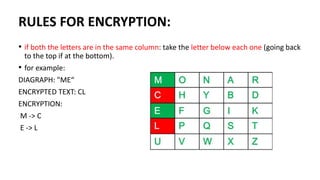
  • 145.
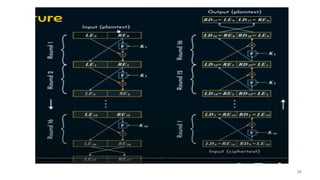
  • 146.