SOLUTION
MANUAL

Apago PDF Enhancer
1-17 Solutions to Problems

Student companion website
Founded in 1807, John Wiley & Sons, Inc. has been a valued source of knowledge and understanding
for more than 200 years, helping people around the world meet their needs and fulfill their
aspirations. Our company is built on a foundation of principles that include responsibility to the
communities we serve and where we live and work. In 2008, we launched a Corporate Citizenship
Initiative, a global effort to address the environmental, social, economic, and ethical challenges we
face in our business. Among the issues we are addressing are carbon impact, paper specifications and
procurement, ethical conduct within our business and among our vendors, and community and
charitable support. For more information, please visit our website: www.wiley.com/go/citizenship.
Copyright © 2011 by John Wiley & Sons, Inc.
No part of this publication may be reproduced, stored in a retrieval system or transmitted in any form
or by any means, electronic, mechanical, photocopying recording, scanning or otherwise, except as
permitted under Sections 107 or 108 of the 1976 United States Copyright Act, without either the
prior written permission of the Publisher or authorization through payment of the appropriate percopy fee to the Copyright Clearance Center, 222 Rosewood Drive, Danvers, MA 01923, (978) 7508400, fax (978) 646-8600. Requests to the Publisher for permission should be addressed to the
Permissions Department, John Wiley & Sons, Inc., 111 River Street, Hoboken, NJ 07030-5774, (201)
748-6011, fax (201) 748-6008 or online at http://www.wiley.com/go/permissions.
Evaluation copies are provided to qualified academics and professionals for review purposes only, for
use in their courses during the next academic year. These copies are licensed and may not be sold or
transferred to a third party. Upon completion of the review period, please return the evaluation copy
to Wiley. Return instructions and a free of charge return shipping label are available at
www.wiley.com/go/returnlabel. Outside of the United States, please contact your local
representative
ISBN 13

978-0470-54756-4

Copyright © 2011 by John Wiley & Sons, Inc.
O N E

Introduction
ANSWERS TO REVIEW QUESTIONS
1. Guided missiles, automatic gain control in radio receivers, satellite tracking antenna
2. Yes - power gain, remote control, parameter conversion; No - Expense, complexity
3. Motor, low pass filter, inertia supported between two bearings
4. Closed-loop systems compensate for disturbances by measuring the response, comparing it to
the input response (the desired output), and then correcting the output response.
5. Under the condition that the feedback element is other than unity
6. Actuating signal
7. Multiple subsystems can time share the controller. Any adjustments to the controller can be
implemented with simply software changes.
8. Stability, transient response, and steady-state error
9. Steady-state, transient
10. It follows a growing transient response until the steady-state response is no longer visible. The
system will either destroy itself, reach an equilibrium state because of saturation in driving
amplifiers, or hit limit stops.
11. Natural response
12. Determine the transient response performance of the system.
13. Determine system parameters to meet the transient response specifications for the system.
14. True
15. Transfer function, state-space, differential equations
16. Transfer function - the Laplace transform of the differential equation
State-space - representation of an nth order differential equation as n simultaneous first-order
differential equations
Differential equation - Modeling a system with its differential equation

SOLUTIONS TO PROBLEMS
1. Five turns yields 50 v. Therefore K =

50 volts
= 1.59
5 x 2π rad

Copyright © 2011 by John Wiley & Sons, Inc.
1-2 Chapter 1: Introduction

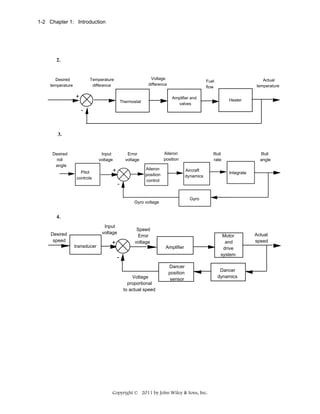
2.

Desired
temperature

Voltage
difference

Temperature
difference

+

Actual
temperature

Fuel
flow
Amplifier and
valves

Thermostat

Heater

-

3.

Desired
roll
angle

Input
voltage
Pilot
controls

Aileron
position

Error
voltage

+
-

Aileron
position
control

Roll
rate
Aircraft
dynamics

Roll
angle
Integrate

Gyro

Gyro voltage

4.
Input
voltage

Desired
speed
transducer

Speed
Error
voltage

+

Amplifier

Voltage
proportional
to actual speed

Dancer
position
sensor

Copyright © 2011 by John Wiley & Sons, Inc.

Motor
and
drive
system
Dancer
dynamics

Actual
speed
1-3 Solutions to Problems

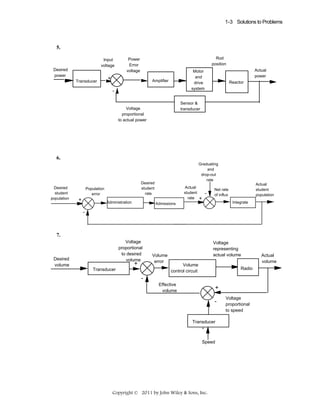
5.
Input
voltage
Desired
power
Transducer

Rod
position

Power
Error
voltage

+

Actual
power

Motor
and
drive
system

Amplifier

-

Reactor

Sensor &
transducer

Voltage
proportional
to actual power

6.

Desired
student
population

Desired
student
rate

Population
error

+

Graduating
and
drop-out
rate

Administration

Actual
student
rate

+

Actual
student
population

Net rate
of influx
Integrate

Admissions

-

7.
Voltage
proportional
to desired
volume

Desired
volume

+

Transducer

Volume
error

Voltage
representing
actual volume
Volume
control circuit

Radio

Effective
volume

+
-

Transducer

Speed

Copyright © 2011 by John Wiley & Sons, Inc.

Voltage
proportional
to speed

Actual
volume
1-4 Chapter 1: Introduction

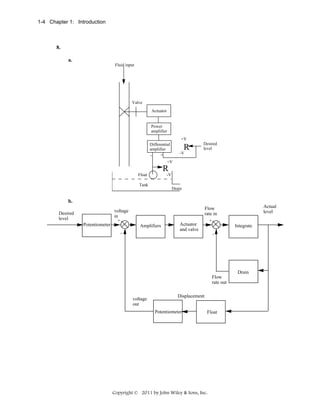
8.
a.
Fluid input

Valve
Actuator

Power
amplifier
+V
Differential
amplifier
+
-

R

Desired
level

-V

+V

R
Float

-V

Tank

Drain

b.
Desired
level
Potentiometer

voltage
in
+
Amplifiers
-

Actuator
and valve

Actual
level

Flow
rate in
+
Integrate
-

Drain
Flow
rate out

voltage
out

Displacement
Potentiometer

Float

Copyright © 2011 by John Wiley & Sons, Inc.
1-5 Solutions to Problems

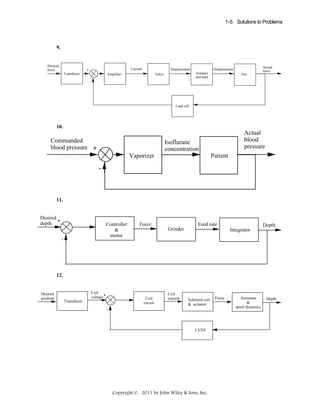
9.

Desired
force

Current

+
Transducer

Displacement

Amplifier

Valve

Actual
force

Displacement
Actuator
and load

Tire

-

Load cell

10.

Commanded
blood pressure +

Actual
blood
pressure

Isoflurane
concentration
Vaporizer

Patient

-

11.

Desired
depth +

Controller
&
motor

-

Force

Feed rate
Grinder

Depth
Integrator

12.

Desired
position

Coil
voltage +

Coil
circuit

Transducer

Coil
current

Solenoid coil
& actuator

-

LVDT

Copyright © 2011 by John Wiley & Sons, Inc.

Force

Armature
&
spool dynamics

Depth
1-6 Chapter 1: Introduction

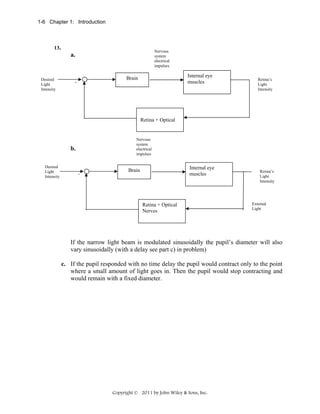
13.

Nervous
system
electrical
impulses

a.

Desired
Light
Intensity

Internal eye
muscles

Brain
+

Retina’s
Light
Intensity

Retina + Optical

Nervous
system
electrical
impulses

b.
Desired
Light
Intensity

Internal eye
muscles

Brain
+

Retina + Optical
Nerves

Retina’s
Light
Intensity

External
Light

If the narrow light beam is modulated sinusoidally the pupil’s diameter will also
vary sinusoidally (with a delay see part c) in problem)
c. If the pupil responded with no time delay the pupil would contract only to the point
where a small amount of light goes in. Then the pupil would stop contracting and
would remain with a fixed diameter.

Copyright © 2011 by John Wiley & Sons, Inc.
1-7 Solutions to Problems

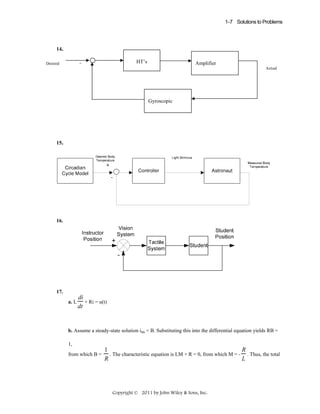
14.
Desired

HT’s

+

Amplifier
Actual

Gyroscopic

15.

16.

17.
a. L

di
+ Ri = u(t)
dt

b. Assume a steady-state solution iss = B. Substituting this into the differential equation yields RB =
1,
from which B =

1
R
. The characteristic equation is LM + R = 0, from which M = - . Thus, the total
R
L

Copyright © 2011 by John Wiley & Sons, Inc.
1-8 Chapter 1: Introduction

1
1
. Solving for the arbitrary constants, i(0) = A +
= 0. Thus, A =
R
R
1
1
1 -(R/L)t 1
−( R/ L) t
).
= (1 − e
. The final solution is i(t) =
-e
R
R R
R

solution is i(t) = Ae-(R/L)t +

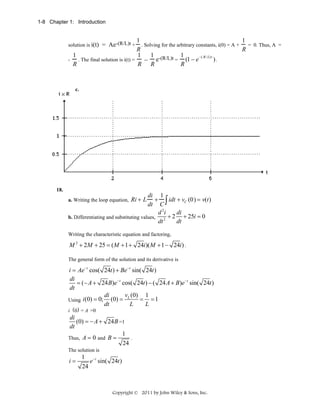
c.

18.

di 1
+
idt + vC (0) = v(t)
dt C ∫
d 2i
di
+ 2 + 25i = 0
b. Differentiating and substituting values,
2
dt
dt

a. Writing the loop equation,

Ri + L

Writing the characteristic equation and factoring,

M 2 + 2M + 25 = ( M + 1 + 24i)( M + 1 − 24i) .
The general form of the solution and its derivative is

i = Ae−t cos( 24t ) + Be− t sin( 24t )
di
= (− A + 24 B)e −t cos( 24t ) − ( 24 A + B)e− t sin( 24t )
dt
di
vL (0) 1
= =1
Using i (0) = 0; (0) =
dt
L
L
i 0 = A =0

di
(0) = − A + 24 B =1
dt
1
.
Thus, A = 0 and B =
24
The solution is

i=

1 −t
e sin( 24t )
24

Copyright © 2011 by John Wiley & Sons, Inc.
1-9 Solutions to Problems

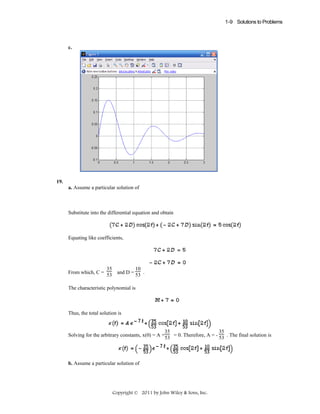
c.

19.
a. Assume a particular solution of

Substitute into the differential equation and obtain

Equating like coefficients,

10
35
From which, C = 53 and D = 53 .
The characteristic polynomial is

Thus, the total solution is

35
35
Solving for the arbitrary constants, x(0) = A +53 = 0. Therefore, A = - 53 . The final solution is

b. Assume a particular solution of

Copyright © 2011 by John Wiley & Sons, Inc.
1-10 Chapter 1: Introduction

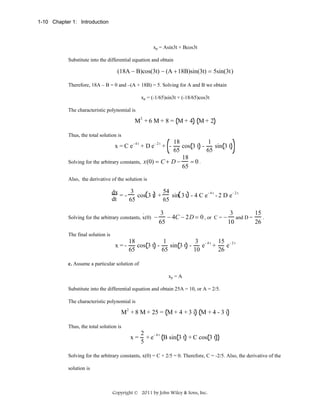
xp = Asin3t + Bcos3t
Substitute into the differential equation and obtain

(18A − B)cos(3t) − (A + 18B)sin(3t) = 5sin(3t)
Therefore, 18A – B = 0 and –(A + 18B) = 5. Solving for A and B we obtain
xp = (-1/65)sin3t + (-18/65)cos3t
The characteristic polynomial is

M2 + 6 M + 8 = M + 4 M + 2
Thus, the total solution is

18
1
cos 3 t sin 3 t
65
65
18
=0.
Solving for the arbitrary constants, x(0) = C + D −
65
x =C e

-4t

+ De

-2t

+ -

Also, the derivative of the solution is

dx = - 3 cos 3 t + 54 sin 3 t - 4 C e - 4 t - 2 D e - 2 t
dt
65
65
.
Solving for the arbitrary constants, x(0)

−

3
3
15
− 4C − 2D = 0 , or C = − and D =
.
65
10
26

The final solution is

x =-

18
1
3 - 4 t 15 - 2 t
cos 3 t sin 3 t e +
e
65
65
10
26

c. Assume a particular solution of
xp = A
Substitute into the differential equation and obtain 25A = 10, or A = 2/5.
The characteristic polynomial is

M2 + 8 M + 25 = M + 4 + 3 i M + 4 - 3 i
Thus, the total solution is

x=

2
-4t
+e
B sin 3 t + C cos 3 t
5

Solving for the arbitrary constants, x(0) = C + 2/5 = 0. Therefore, C = -2/5. Also, the derivative of the
solution is

Copyright © 2011 by John Wiley & Sons, Inc.
1-11 Solutions to Problems

dx
-4t
dt = 3 B -4 C cos 3 t - 4 B + 3 C sin 3 t e
.
Solving for the arbitrary constants, x(0) = 3B – 4C = 0. Therefore, B = -8/15. The final solution is

x(t) =

2
2
⎛8
− e −4t ⎝ sin(3t) + cos(3t )⎞
⎠
5
5
15

20.
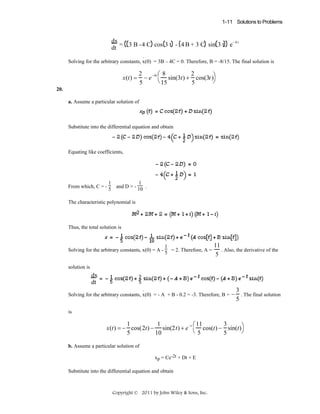
a. Assume a particular solution of

Substitute into the differential equation and obtain

Equating like coefficients,

1
1
From which, C = - 5 and D = - 10 .
The characteristic polynomial is

Thus, the total solution is

1
Solving for the arbitrary constants, x(0) = A - 5 = 2. Therefore, A =

11
. Also, the derivative of the
5

solution is

dx
dt
.
Solving for the arbitrary constants, x(0) = - A + B - 0.2 = -3. Therefore, B =

3
− . The final solution
5

is

1
1
3
⎛ 11
x(t) = − cos(2t) − sin(2t) + e −t ⎝ cos(t) − sin(t)⎞
⎠
5
10
5
5
b. Assume a particular solution of
xp = Ce-2t + Dt + E
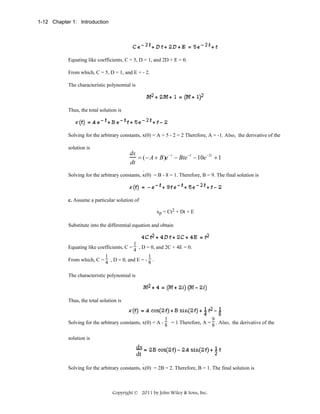
Substitute into the differential equation and obtain

Copyright © 2011 by John Wiley & Sons, Inc.
1-12 Chapter 1: Introduction

Equating like coefficients, C = 5, D = 1, and 2D + E = 0.
From which, C = 5, D = 1, and E = - 2.
The characteristic polynomial is

Thus, the total solution is

Solving for the arbitrary constants, x(0) = A + 5 - 2 = 2 Therefore, A = -1. Also, the derivative of the
solution is

dx
= (− A + B)e − t − Bte −t − 10e −2 t + 1
dt
.
Solving for the arbitrary constants, x(0) = B - 8 = 1. Therefore, B = 9. The final solution is

c. Assume a particular solution of
xp = Ct2 + Dt + E
Substitute into the differential equation and obtain

1
Equating like coefficients, C = 4 , D = 0, and 2C + 4E = 0.
1
1
From which, C = 4 , D = 0, and E = - 8 .
The characteristic polynomial is

Thus, the total solution is

9
1
Solving for the arbitrary constants, x(0) = A - 8 = 1 Therefore, A = 8 . Also, the derivative of the
solution is

dx
dt
.
Solving for the arbitrary constants, x(0) = 2B = 2. Therefore, B = 1. The final solution is

Copyright © 2011 by John Wiley & Sons, Inc.
1-13 Solutions to Problems

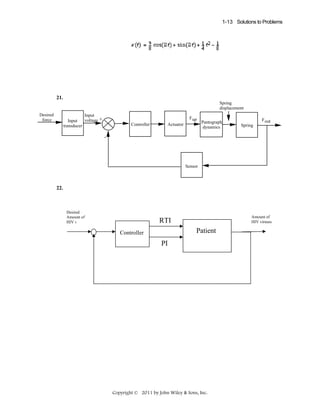
21.
Spring
displacement
Desired
force

Input
voltage +
Input
transducer

F up
Controller

Actuator

Pantograph
dynamics

Spring

F out

-

Sensor

22.

Desired
Amount of
HIV viruses

Amount of
HIV viruses

RTI
Patient

Controller

PI

Copyright © 2011 by John Wiley & Sons, Inc.
1-14 Chapter 1: Introduction

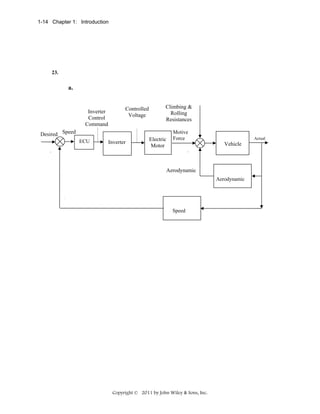
23.

a.

Inverter
Control
Command

Controlled
Voltage

Climbing &
Rolling
Resistances

Desired Speed
ECU

Inverter

Electric
Motor

Motive
Force

Actual

Vehicle
+

+

Aerodynamic
Aerodynamic

Speed

Copyright © 2011 by John Wiley & Sons, Inc.
1-15 Solutions to Problems

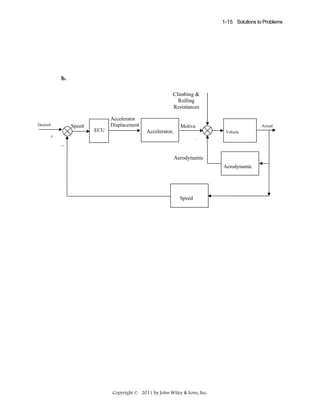
b.
Climbing &
Rolling
Resistances
Desired

Speed

Accelerator
Displacement
ECU

Motive

Accelerator,

Actual
Vehicle

+

+

_

Aerodynamic
Aerodynamic

Speed

Copyright © 2011 by John Wiley & Sons, Inc.
1-16 Chapter 1: Introduction

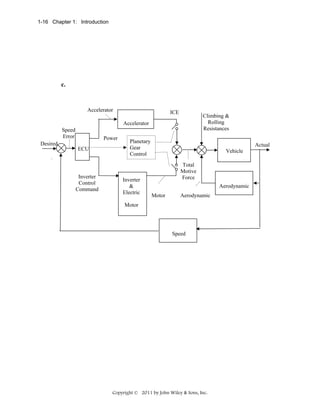
c.

Accelerator

ICE

Climbing &
Rolling
Resistances

Accelerator
Speed
Error

Power

Desired
ECU

Planetary
Gear
Control

Actual
+

Vehicle

+

Inverter
Control
Command

Inverter
&
Electric

Total
Motive
Force
Aerodynamic
Motor

Aerodynamic

Motor

Speed

Copyright © 2011 by John Wiley & Sons, Inc.
T W O

Modeling in the
Frequency Domain
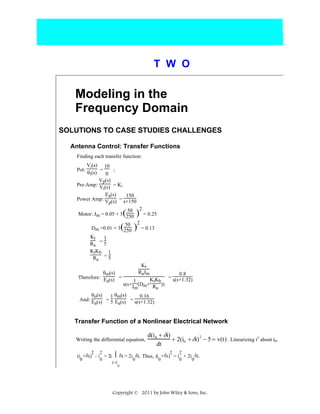
SOLUTIONS TO CASE STUDIES CHALLENGES
Antenna Control: Transfer Functions
Finding each transfer function:
Vi(s) 10
=
;
θi(s)
π
Vp(s)
Pre-Amp: V (s) = K;
i
Ea(s)
150
Power Amp: V (s) = s+150
p
Pot:

50
Motor: Jm = 0.05 + 5 250

2

( ) = 0.25
50 2
Dm =0.01 + 3(250 ) = 0.13

Kt
1
Ra = 5
KtK b 1
Ra = 5
θm(s)
Therefore: E (s) =
a

Kt
RaJm

0.8
KtKb = s(s+1.32)
1
s(s+J (Dm+ R ))
m
a

θo(s)
1 θm(s)
0.16
And: E (s) = 5 E (s) = s(s+1.32)
a
a

Transfer Function of a Nonlinear Electrical Network
Writing the differential equation,
2

2
0

d(i 0 + δi)
2
+ 2(i0 + δi) − 5 = v(t) . Linearizing i2 about i0,
dt
2

2
0

.
(i + δi) - i = 2i ⎮ δi = 2i δi. Thus, (i + δi) = i + 2i δi.
0

i=i

0

0

0

0

Copyright © 2011 by John Wiley & Sons, Inc.
Chapter 2: Modeling in the Frequency Domain

2-2

dδi
Substituting into the differential equation yields, dt + 2i02 + 4i0δi - 5 = v(t). But, the
resistor voltage equals the battery voltage at equilibrium when the supply voltage is zero since
the voltage across the inductor is zero at dc. Hence, 2i02 = 5, or i0 = 1.58. Substituting into the linearized
δi(s)
1
dδi
differential equation, dt + 6.32δi = v(t). Converting to a transfer function, V(s) = s+6.32 . Using the
linearized i about i0, and the fact that vr(t) is 5 volts at equilibrium, the linearized vr(t) is vr(t) = 2i2 =
2(i0+δi)2 = 2(i02+2i0δi) = 5+6.32δi. For excursions away from equilibrium, vr(t) - 5 = 6.32δi = δvr(t).
δVr(s)
6.32
Therefore, multiplying the transfer function by 6.32, yields, V(s) = s+6.32 as the transfer function
about v(t) = 0.

ANSWERS TO REVIEW QUESTIONS
1. Transfer function
2. Linear time-invariant
3. Laplace
4. G(s) = C(s)/R(s), where c(t) is the output and r(t) is the input.
5. Initial conditions are zero
6. Equations of motion
7. Free body diagram
8. There are direct analogies between the electrical variables and components and the mechanical variables
and components.
9. Mechanical advantage for rotating systems
10. Armature inertia, armature damping, load inertia, load damping
11. Multiply the transfer function by the gear ratio relating armature position to load position.
12. (1) Recognize the nonlinear component, (2) Write the nonlinear differential equation, (3) Select the
equilibrium solution, (4) Linearize the nonlinear differential equation, (5) Take the Laplace transform of
the linearized differential equation, (6) Find the transfer function.

SOLUTIONS TO PROBLEMS
1.

∞

a. F(s) =

∞

1 −st
1
− st
∫ e dt = − s e 0 = s
0
∞

∞

e −st
− (st + 1)
∞
b. F(s) = ∫ te dt = 2 ( − st − 1) 0 =
2 st
se
s
0
0
− st

Copyright © 2011 by John Wiley & Sons, Inc.
Solutions to Problems 2-3
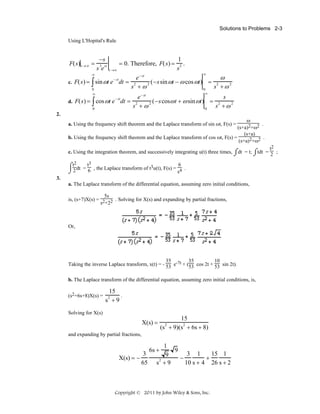
Using L'Hopital's Rule

F(s) t → ∞ =

−s
s 3e st

= 0. Therefore, F(s) =
t →∞

1
.
s2
∞

∞

e − st
ω
= 2
c. F(s) = ∫ sin ωt e dt = 2
2 (−s sin ωt − ω cos ωt)
s +ω
s +ω2
0
0
− st

∞

∞

e − st
s
= 2
d. F(s) = ∫ cos ωt e dt = 2
2 (−s cosω t + ω sin ωt)
s +ω2
s +ω
0
0
− st

2.

ω
.
(s+a)2+ω2
(s+a)
.
b. Using the frequency shift theorem and the Laplace transform of cos ωt, F(s) =
(s+a)2+ω2

a. Using the frequency shift theorem and the Laplace transform of sin ωt, F(s) =

t2
c. Using the integration theorem, and successively integrating u(t) three times, ⌠dt = t; ⌠tdt = 2 ;
⌡
⌡

⌠t2dt = t3 , the Laplace transform of t3u(t), F(s) = 6 .
6
⌡2
s4
3.
a. The Laplace transform of the differential equation, assuming zero initial conditions,
5s
is, (s+7)X(s) = 2 2 . Solving for X(s) and expanding by partial fractions,
s +2

Or,

35
10
35
Taking the inverse Laplace transform, x(t) = - 53 e-7t + (53 cos 2t + 53 sin 2t).
b. The Laplace transform of the differential equation, assuming zero initial conditions, is,
(s2+6s+8)X(s) =

15
.
s +9
2

Solving for X(s)

X(s) =

15
(s + 9)(s 2 + 6s + 8)
2

and expanding by partial fractions,

X(s) = −

3
65

1
9
3 1
15 1
9
−
+
2
10 s + 4 26 s + 2
s +9

6s +

Copyright © 2011 by John Wiley & Sons, Inc.
Chapter 2: Modeling in the Frequency Domain

2-4

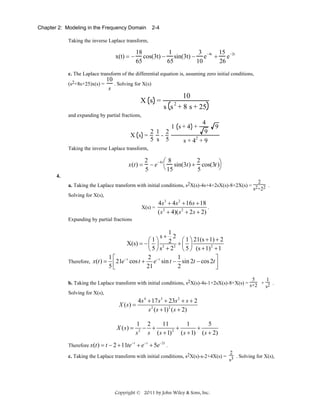
Taking the inverse Laplace transform,

x(t) = −

18
1
3
15
cos(3t) − sin(3t) − e −4t + e −2t
65
65
10
26

c. The Laplace transform of the differential equation is, assuming zero initial conditions,
(s2+8s+25)x(s) =

10
. Solving for X(s)
s

X s =

10
2
s s + 8 s + 25

and expanding by partial fractions,

2 1 2
X s =
5 s 5

4
9
2
s+4 +9

1 s+4 +

9

Taking the inverse Laplace transform,

x (t ) =

2
2
⎛8
− e −4 t ⎝ sin(3t ) + cos(3t )⎞
⎠
15
5
5

4.
2
a. Taking the Laplace transform with initial conditions, s2X(s)-4s+4+2sX(s)-8+2X(s) = 2 2 .
s +2
Solving for X(s),
X(s) =

4 s 3 + 4 s 2 + 16 s + 18
.
( s 2 + 4)( s 2 + 2s + 2)

Expanding by partial fractions

1
s+ 2
⎛1⎞
⎛ 1 ⎞ 21(s + 1) + 2
X(s) = − ⎜ ⎟ 2 2 2 + ⎜ ⎟
2
⎝ 5 ⎠ s + 2 ⎝ 5 ⎠ (s + 1) + 1
1 ⎡ −t
2 −t
1
⎤
Therefore, x(t ) = ⎢ 21e cos t +
e sin t − sin 2t − cos 2t ⎥
5⎣
21
2
⎦
5
1
b. Taking the Laplace transform with initial conditions, s2X(s)-4s-1+2sX(s)-8+X(s) = s+2 + 2 .
s
Solving for X(s),

X ( s) =

X (s) =
Therefore x(t ) = t − 2 + 11te

−t

4 s 4 + 17 s 3 + 23s 2 + s + 2
s 2 ( s + 1) 2 ( s + 2)

1 2
11
1
5
− +
+
+
2
2
s
s ( s + 1) ( s + 1) ( s + 2)
+ e− t + 5e−2t .

2
c. Taking the Laplace transform with initial conditions, s2X(s)-s-2+4X(s) = 3 . Solving for X(s),
s

Copyright © 2011 by John Wiley & Sons, Inc.
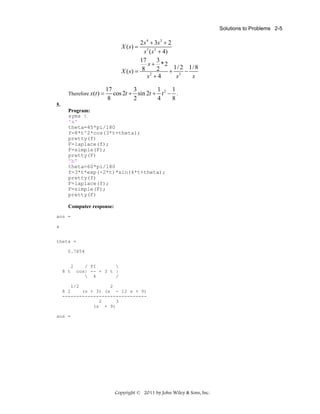
Solutions to Problems 2-5

2 s 4 + 3s 3 + 2
s 3 ( s 2 + 4)
17
3
s + *2
1/ 2 1/ 8
+ 3 −
X ( s) = 8 2 2
s +4
s
s

X ( s) =

Therefore x(t ) =

17
3
1
1
cos 2t + sin 2t + t 2 − .
8
2
4
8

5.
Program:
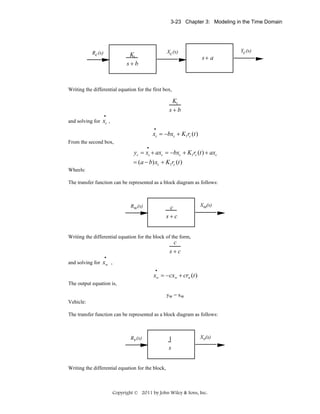
syms t
'a'
theta=45*pi/180
f=8*t^2*cos(3*t+theta);
pretty(f)
F=laplace(f);
F=simple(F);
pretty(F)
'b'
theta=60*pi/180
f=3*t*exp(-2*t)*sin(4*t+theta);
pretty(f)
F=laplace(f);
F=simple(F);
pretty(F)
Computer response:
ans =
a
theta =
0.7854
2
/ PI

8 t cos| -- + 3 t |
 4
/
1/2
2
8 2
(s + 3) (s - 12 s + 9)
-----------------------------2
3
(s + 9)
ans =

Copyright © 2011 by John Wiley & Sons, Inc.
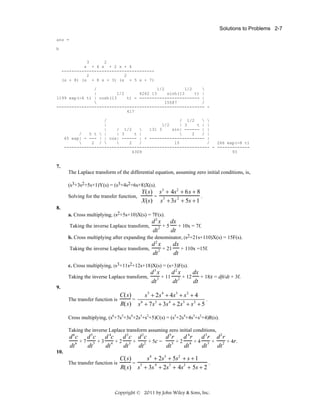
Chapter 2: Modeling in the Frequency Domain

2-6

b
theta =
1.0472
/ PI


3 t sin| -- + 4 t | exp(-2 t)
 3
/
1/2 2
1/2
1/2
3 3
s
12 s + 6 3
s - 18 3
+ --------- + 24
2
-----------------------------------------2
2
(s + 4 s + 20)

6.
Program:
syms s
'a'
G=(s^2+3*s+10)*(s+5)/[(s+3)*(s+4)*(s^2+2*s+100)];
pretty(G)
g=ilaplace(G);
pretty(g)
'b'
G=(s^3+4*s^2+2*s+6)/[(s+8)*(s^2+8*s+3)*(s^2+5*s+7)];
pretty(G)
g=ilaplace(G);
pretty(g)

Computer response:
ans =
a
2
(s + 5) (s + 3 s + 10)
-------------------------------2
(s + 3) (s + 4) (s + 2 s + 100)
/
1/2
1/2

|
1/2
11
sin(3 11
t) |
5203 exp(-t) | cos(3 11
t) - -------------------- |
20 exp(-3 t)
7 exp(-4 t)

57233
/
------------ - ----------- + -----------------------------------------------------103
54
5562

Copyright © 2011 by John Wiley & Sons, Inc.
Solutions to Problems 2-7
ans =
b
3
2
s + 4 s + 2 s + 6
------------------------------------2
2
(s + 8) (s + 8 s + 3) (s + 5 s + 7)
/
1/2
1/2

|
1/2
4262 13
sinh(13
t) |
1199 exp(-4 t) | cosh(13
t) - ------------------------ |

15587
/
----------------------------------------------------------- 417
/
/ 1/2
 
|
1/2
| 3
t | |
|
/ 1/2

131 3
sin| ------ | |
/
5 t  |
| 3
t |

2
/ |
65 exp| - --- | | cos| ------ | + ---------------------- |

2 / 

2
/
15
/
266 exp(-8 t)
---------------------------------------------------------- - ------------4309
93

7.
The Laplace transform of the differential equation, assuming zero initial conditions, is,
(s3+3s2+5s+1)Y(s) = (s3+4s2+6s+8)X(s).
Solving for the transfer function,

Y(s) s3 + 4s2 + 6s + 8
=
.
X(s) s3 + 3s 2 + 5s + 1

8.
a. Cross multiplying, (s2+5s+10)X(s) = 7F(s).
Taking the inverse Laplace transform,

d 2 x dx
+5
+ 10x = 7f.
dt 2
dt

b. Cross multiplying after expanding the denominator, (s2+21s+110)X(s) = 15F(s).
Taking the inverse Laplace transform,

d2 x
dx
+ 110x =15f.
2 + 21
dt
dt

c. Cross multiplying, (s3+11s2+12s+18)X(s) = (s+3)F(s).

d3 x
d2 x
dx
+ 18x = dft/dt + 3f.
Taking the inverse Laplace transform,
3 + 11
2 + 12
dt
dt
dt
9.
The transfer function is

C( s)
s 5 + 2s 4 + 4s 3 + s 2 + 4
= 6
.
R( s) s + 7 s 5 + 3s 4 + 2s 3 + s 2 + 5

Cross multiplying, (s6+7s5+3s4+2s3+s2+5)C(s) = (s5+2s4+4s3+s2+4)R(s).
Taking the inverse Laplace transform assuming zero initial conditions,

d 6 c d 5 c d 4c d 3 c d 2 c
d 5r
d 4r d 3r d 2r
+7 5 +3 4 +2 3 +
+ 5c =
+2 4 +4 3 +
+ 4r.
dt 6
dt
dt
dt
dt 2
dt 5
dt
dt
dt 2
10.
The transfer function is

s4 + 2s3 + 5s2 + s + 1
C( s)
= 5
.
R( s) s + 3s 4 + 2s3 + 4s2 + 5s + 2

Copyright © 2011 by John Wiley & Sons, Inc.
Chapter 2: Modeling in the Frequency Domain

2-8

Cross multiplying, (s5+3s4+2s3+4s2+5s+2)C(s) = (s4+2s3+5s2+s+1)R(s).
Taking the inverse Laplace transform assuming zero initial conditions,

d 5 c d 4c d 3 c d 2 c dc
d 4r d 3r
d 2 r dr
+3 4 +2 3 +4 2 +5
+ 2c =
+2 3 +5 2 +
+ r.
dt
dc 5
dt
dt
dt
dt
dt 4
dt
dt
Substituting r(t) = t3,

d 5 c d 4c d 3 c d 2 c dc
+3 4 +2 3 +4 2 +5
+ 2c
dc 5
dt
dt
dt
dt

= 18δ(t) + (36 + 90t + 9t2 + 3t3) u(t).
11.
Taking the Laplace transform of the differential equation, s2X(s)-s+1+2sX(s)-2+3x(s)=R(s).
Collecting terms, (s2+2s+3)X(s) = R(s)+s+1.
Solving for X(s), X(s) =

R( s)
s +1
+ 2
.
s + 2s + 3 s + 2s + 3
2

The block diagram is shown below, where R(s) = 1/s.

12.
Program:
'Factored'
Gzpk=zpk([-15 -26 -72],[0 -55 roots([1 5 30])' roots([1 27 52])'],5)
'Polynomial'
Gp=tf(Gzpk)

Computer response:
ans =
Factored
Zero/pole/gain:
5 (s+15) (s+26) (s+72)
-------------------------------------------s (s+55) (s+24.91) (s+2.087) (s^2 + 5s + 30)
ans =
Polynomial
Transfer function:
5 s^3 + 565 s^2 + 16710 s + 140400
-------------------------------------------------------------------s^6 + 87 s^5 + 1977 s^4 + 1.301e004 s^3 + 6.041e004 s^2 + 8.58e004 s

13.
Program:
'Polynomial'
Gtf=tf([1 25 20 15 42],[1 13 9 37 35 50])

Copyright © 2011 by John Wiley & Sons, Inc.
Solutions to Problems 2-9
'Factored'
Gzpk=zpk(Gtf)

Computer response:
ans =
Polynomial
Transfer function:
s^4 + 25 s^3 + 20 s^2 + 15 s + 42
----------------------------------------s^5 + 13 s^4 + 9 s^3 + 37 s^2 + 35 s + 50
ans =
Factored
Zero/pole/gain:
(s+24.2) (s+1.35) (s^2 - 0.5462s + 1.286)
-----------------------------------------------------(s+12.5) (s^2 + 1.463s + 1.493) (s^2 - 0.964s + 2.679)

14.
Program:
numg=[-5 -70];
deng=[0 -45 -55 (roots([1 7 110]))' (roots([1 6 95]))'];
[numg,deng]=zp2tf(numg',deng',1e4);
Gtf=tf(numg,deng)
G=zpk(Gtf)
[r,p,k]=residue(numg,deng)

Computer response:
Transfer function:
10000 s^2 + 750000 s + 3.5e006
------------------------------------------------------------------------------s^7 + 113 s^6 + 4022 s^5 + 58200 s^4 + 754275 s^3 + 4.324e006 s^2 + 2.586e007 s
Zero/pole/gain:
10000 (s+70) (s+5)
-----------------------------------------------s (s+55) (s+45) (s^2 + 6s + 95) (s^2 + 7s + 110)
r =
-0.0018
0.0066
0.9513
0.9513
-1.0213
-1.0213
0.1353
p =

+
+

0.0896i
0.0896i
0.1349i
0.1349i

-55.0000
-45.0000
-3.5000
-3.5000
-3.0000
-3.0000
0
k =

+
+
-

9.8869i
9.8869i
9.2736i
9.2736i

[]

Copyright © 2011 by John Wiley & Sons, Inc.
Chapter 2: Modeling in the Frequency Domain

2-10

15.
Program:
syms s
'(a)'
Ga=45*[(s^2+37*s+74)*(s^3+28*s^2+32*s+16)]...
/[(s+39)*(s+47)*(s^2+2*s+100)*(s^3+27*s^2+18*s+15)];
'Ga symbolic'
pretty(Ga)
[numga,denga]=numden(Ga);
numga=sym2poly(numga);
denga=sym2poly(denga);
'Ga polynimial'
Ga=tf(numga,denga)
'Ga factored'
Ga=zpk(Ga)
'(b)'
Ga=56*[(s+14)*(s^3+49*s^2+62*s+53)]...
/[(s^2+88*s+33)*(s^2+56*s+77)*(s^3+81*s^2+76*s+65)];
'Ga symbolic'
pretty(Ga)
[numga,denga]=numden(Ga);
numga=sym2poly(numga);
denga=sym2poly(denga);
'Ga polynimial'
Ga=tf(numga,denga)
'Ga factored'
Ga=zpk(Ga)

Computer response:
ans =
(a)
ans =
Ga symbolic
2
3
2
(s + 37 s + 74) (s + 28 s + 32 s + 16)
45 ----------------------------------------------------------2
3
2
(s + 39) (s + 47) (s + 2 s + 100) (s + 27 s + 18 s + 15)
ans =
Ga polynimial
Transfer function:
45 s^5 + 2925 s^4 + 51390 s^3 + 147240 s^2 + 133200 s + 53280
-------------------------------------------------------------------------------s^7 + 115 s^6 + 4499 s^5 + 70700 s^4 + 553692 s^3 + 5.201e006 s^2 + 3.483e006 s
+ 2.75e006
ans =
Ga factored
Zero/pole/gain:
45 (s+34.88) (s+26.83) (s+2.122) (s^2 + 1.17s + 0.5964)
----------------------------------------------------------------(s+47) (s+39) (s+26.34) (s^2 + 0.6618s + 0.5695) (s^2 + 2s + 100)

Copyright © 2011 by John Wiley & Sons, Inc.
Solutions to Problems 2-11
ans =
(b)
ans =
Ga symbolic
3
2
(s + 14) (s + 49 s + 62 s + 53)
56 ---------------------------------------------------------2
2
3
2
(s + 88 s + 33) (s + 56 s + 77) (s + 81 s + 76 s + 65)
ans =
Ga polynimial
Transfer function:
56 s^4 + 3528 s^3 + 41888 s^2 + 51576 s + 41552
-------------------------------------------------------------------------------s^7 + 225 s^6 + 16778 s^5 + 427711 s^4 + 1.093e006 s^3 + 1.189e006 s^2
+ 753676 s + 165165
ans =
Ga factored
Zero/pole/gain:
56 (s+47.72) (s+14) (s^2 + 1.276s + 1.111)
--------------------------------------------------------------------------(s+87.62) (s+80.06) (s+54.59) (s+1.411) (s+0.3766) (s^2 + 0.9391s + 0.8119)

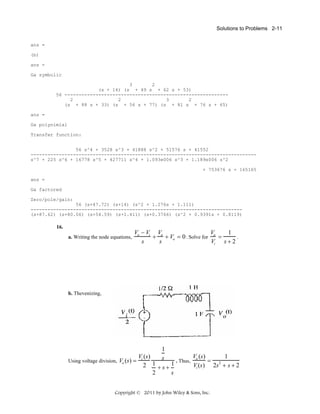
16.
a. Writing the node equations,

Vo − Vi Vo
V
1
+ + Vo = 0 . Solve for o =
.
s
s
Vi s + 2

b. Thevenizing,

Using voltage division, Vo (s) =

1
s

Vo (s)
1
Vi (s)
. Thus,
= 2
1
1
2
Vi (s) 2s + s + 2
+s+
2
s

Copyright © 2011 by John Wiley & Sons, Inc.
Chapter 2: Modeling in the Frequency Domain

2-12

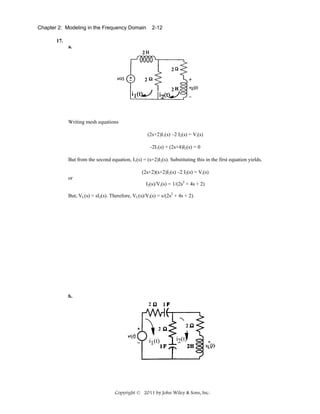
17.
a.
2
2
2
2

Writing mesh equations
(2s+2)I1(s) –2 I2(s) = Vi(s)
-2I1(s) + (2s+4)I2(s) = 0
But from the second equation, I1(s) = (s+2)I2(s). Substituting this in the first equation yields,
(2s+2)(s+2)I2(s) –2 I2(s) = Vi(s)
or
I2(s)/Vi(s) = 1/(2s2 + 4s + 2)
But, VL(s) = sI2(s). Therefore, VL(s)/Vi(s) = s/(2s2 + 4s + 2).

b.
2

2

i1(t)

2

i2(t)

Copyright © 2011 by John Wiley & Sons, Inc.
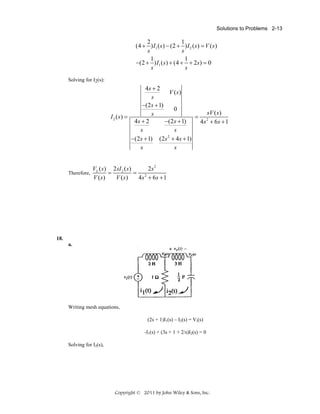
Solutions to Problems 2-13

2
1
(4 + ) I1 ( s ) − (2 + ) I 2 ( s ) = V ( s )
s
s
1
1
−(2 + ) I1 ( s ) + (4 + + 2s ) = 0
s
s
Solving for I2(s):

4s + 2
V (s)
s
−(2 s + 1)
0
sV ( s )
s
I 2 ( s) =
= 2
4s + 2
−(2 s + 1)
4s + 6s + 1
s
s
2
−(2 s + 1) (2s + 4s + 1)
s
s

Therefore,

VL ( s ) 2 sI 2 ( s )
2s 2
=
= 2
V (s)
V (s)
4s + 6s + 1

18.
a.

Writing mesh equations,
(2s + 1)I1(s) – I2(s) = Vi(s)
-I1(s) + (3s + 1 + 2/s)I2(s) = 0
Solving for I2(s),

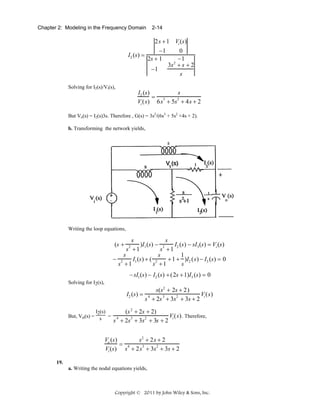
Copyright © 2011 by John Wiley & Sons, Inc.
Chapter 2: Modeling in the Frequency Domain

2-14

2s + 1 Vi (s)
−1
0
I2 (s) =
2s + 1
−1
3s 2 + s + 2
−1
s
Solving for I2(s)/Vi(s),

s
I2 (s)
= 3
2
Vi (s) 6s + 5s + 4s + 2
But Vo(s) = I2(s)3s. Therefore , G(s) = 3s2/(6s3 + 5s2 +4s + 2).
b. Transforming the network yields,

Writing the loop equations,

s
s
)I1 (s) − 2
I2 (s) − sI3 (s) = Vi (s)
s +1
s +1
s
s
1
− 2
I1 (s) + ( 2
+ 1 + )I2 (s) − I3 (s) = 0
s +1
s +1
s
(s +

2

− sI1 (s) − I2 (s) + (2s + 1)I3 (s) = 0
Solving for I2(s),

I2 (s) =

s(s2 + 2s + 2)
Vi (s)
4
3
2
s + 2s + 3s + 3s + 2

I2(s)
(s 2 + 2s + 2)
Vi (s) . Therefore,
But, Vo(s) = s = 4
3
2
s + 2s + 3s + 3s + 2

s2 + 2s + 2
Vo (s)
= 4
3
2
Vi (s) s + 2s + 3s + 3s + 2
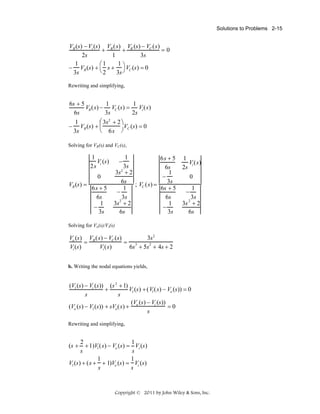
19.
a. Writing the nodal equations yields,

Copyright © 2011 by John Wiley & Sons, Inc.
Solutions to Problems 2-15

VR (s) − Vi (s) VR (s) VR (s) − VC (s)
+
+
=0
2s
1
3s
1
1
⎛1
− VR (s) + ⎝ s + ⎞ VC (s) = 0
2
3s ⎠
3s
Rewriting and simplifying,

1
1
6s + 5
VR (s) − VC (s) = Vi (s)
3s
2s
6s
⎛ 3s2 + 2 ⎞
1
− VR (s) + ⎜
V (s) = 0
⎝ 6s ⎠ C
3s
Solving for VR(s) and VC(s),

1
Vi (s)
2s
0
VR (s ) =

6s + 5
6s
1
−
3s

1
3s
3s 2 + 2
6s ; V ( s ) =
C
1
−
3s
3s2 + 2
6s
−

6s + 5 1
Vi ( s )
6s
2s
1
−
0
3s
6s + 5
1
−
6s
3s
1
3s 2 + 2
−
3s
6s

Solving for Vo(s)/Vi(s)

Vo (s ) VR ( s) − VC (s)
3s 2
=
= 3
Vi (s)
Vi ( s )
6s + 5s2 + 4s + 2
b. Writing the nodal equations yields,

(V1 (s) − Vi (s)) (s 2 + 1)
+
V1 (s) + (V1 (s) − Vo (s)) = 0
s
s
(V (s) − Vi (s))
=0
(Vo (s) − V1 (s)) + sVo (s) + o
s
Rewriting and simplifying,

2
1
+ 1)V1 ( s) − Vo (s) = Vi (s )
s
s
1
1
V1 (s) + ( s + + 1)Vo (s) = Vi (s)
s
s
(s +

Copyright © 2011 by John Wiley & Sons, Inc.
Chapter 2: Modeling in the Frequency Domain

2-16

Solving for Vo(s)
Vo(s) =

(s 2 + 2s + 2)
V ( s) .
s 4 + 2s 3 + 3s2 + 3s + 2 i

Hence,

Vo (s )
( s2 + 2 s + 2)
= 4
Vi (s) s + 2 s 3 + 3s 2 + 3s + 2
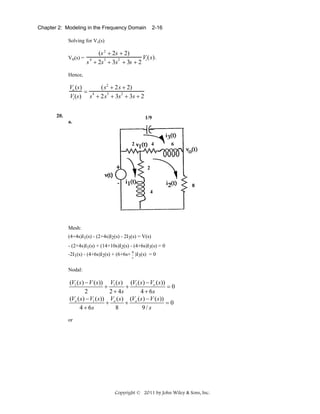
20.

1/9

a.

2

4

6

2
8
4

Mesh:
(4+4s)I1(s) - (2+4s)I2(s) - 2I3(s) = V(s)
- (2+4s)I1(s) + (14+10s)I2(s) - (4+6s)I3(s) = 0
-2I1(s) - (4+6s)I2(s) + (6+6s+ 9 )I3(s) = 0
s

Nodal:

(V1 ( s ) − V ( s )) V1 ( s ) (V1 ( s ) − Vo ( s ))
+
+
=0
2
2 + 4s
4 + 6s
(Vo ( s ) − V1 ( s)) Vo ( s ) (Vo ( s ) − V ( s ))
+
+
=0
4 + 6s
8
9/ s
or

Copyright © 2011 by John Wiley & Sons, Inc.
Solutions to Problems 2-17

⎡ 6s 2 + 12s + 5 ⎤
1
⎡ 1 ⎤
⎢12s 2 + 14 s + 4 ⎥ V1 ( s ) − ⎢ 6 s + 4 ⎥ Vo ( s ) = 2 V ( s )
⎣
⎦
⎣
⎦
2
⎡ 24s + 43s + 54 ⎤
s
⎡ 1 ⎤
−⎢
V1 ( s ) + ⎢
⎥ Vo ( s ) = V ( s )
9
⎣ 6s + 4 ⎥
⎦
⎣ 216s + 144 ⎦
b.
Program:
syms s V

%Construct symbolic object for frequency
%variable 's' and V.

'Mesh Equations'
A2=[(4+4*s) V -2
-(2+4*s) 0 -(4+6*s)
-2 0 (6+6*s+(9/s))]
A=[(4+4*s) -(2+4*s) -2
-(2+4*s) (14+10*s) -(4+6*s)
-2 -(4+6*s) (6+6*s+(9/s))]
I2=det(A2)/det(A);
Gi=I2/V;
G=8*Gi;
G=collect(G);
'G(s) via Mesh Equations'
pretty(G)

%Form Ak = A2.
%Form A.
%Use Cramer's Rule to solve for I2.
%Form transfer function, Gi(s) = I2(s)/V(s).
%Form transfer function, G(s) = 8*I2(s)/V(s).
%Simplify G(s).
%Display label.
%Pretty print G(s)

'Nodal Equations'
A2=[(6*s^2+12*s+5)/(12*s^2+14*s+4) V/2
-1/(6*s+4) s*(V/9)]
%Form Ak = A2.
A=[(6*s^2+12*s+5)/(12*s^2+14*s+4) -1/(6*s+4)
-1/(6*s+4) (24*s^2+43*s+54)/(216*s+144)]
%Form A.
Vo=simple(det(A2))/simple(det(A));
%Use Cramer's Rule to solve for Vo.
G1=Vo/V;
%Form transfer function, G1(s) = Vo(s)/V(s).
G1=collect(G1);
%Simplify G1(s).
'G(s) via Nodal Equations'
%Display label.
pretty(G1)
%Pretty print G1(s)

Computer response:

Copyright © 2011 by John Wiley & Sons, Inc.
Chapter 2: Modeling in the Frequency Domain

2-18

ans =
Mesh Equations
A2 =
[
4*s + 4, V,
-2]
[ - 4*s - 2, 0,
- 6*s - 4]
[
-2, 0, 6*s + 9/s + 6]
A =
[
4*s + 4, - 4*s - 2,
-2]
[ - 4*s - 2, 10*s + 14,
- 6*s - 4]
[
-2, - 6*s - 4, 6*s + 9/s + 6]
ans =
G(s) via Mesh Equations
3
2
48 s + 96 s + 112 s + 36
---------------------------3
2
48 s + 150 s + 220 s + 117
ans =
Nodal Equations
A2 =
[ (6*s^2 + 12*s + 5)/(12*s^2 + 14*s + 4),
V/2]
[
-1/(6*s + 4), (V*s)/9]
A =
[ (6*s^2 + 12*s + 5)/(12*s^2 + 14*s + 4),
-1/(6*s + 4)]
[
-1/(6*s + 4), (24*s^2 + 43*s + 54)/(216*s + 144)]
ans =
G(s) via Nodal Equations
3
2
48 s + 96 s + 112 s + 36
---------------------------3
2
48 s + 150 s + 220 s + 117

Copyright © 2011 by John Wiley & Sons, Inc.
Solutions to Problems 2-19
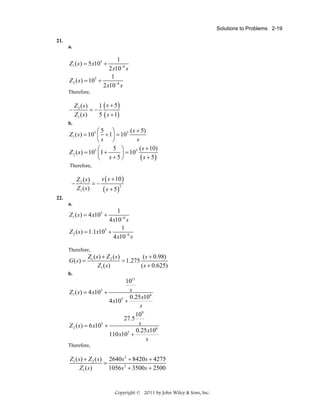
21.
a.

1
2 x10⁻⁶ s
1
Z 2 ( s ) = 105 +
2 x10⁻⁶ s

Z1 ( s ) = 5 x10⁵ +

Therefore,

−

Z 2 (s)
1 ( s + 5)
=−
Z1 ( s )
5 ( s + 1)

b.

( s + 5)
⎛5 ⎞
Z1 ( s) = 105 ⎜ + 1⎟ = 105
s
⎝s ⎠
5 ⎞
⎛
5 ( s + 10)
Z 2 ( s ) = 105 ⎜1 +
⎟ = 10
( s + 5)
⎝ s+5⎠
Therefore,

−

s ( s + 10 )
Z 2 ( s)
=−
2
Z1 ( s )
( s + 5)

22.
a.

1
4 x10⁻⁶ s
1
Z 2 ( s ) = 1.1x10⁵ +
4 x10⁻⁶ s

Z1 ( s ) = 4 x10⁵ +

Therefore,

G(s) =

Z1 ( s ) + Z 2 ( s )
( s + 0.98)
= 1.275
Z1 ( s )
( s + 0.625)

b.

1011
s
Z1 ( s) = 4 x10⁵ +
0.25 x10⁶
4 x10⁵ +
s
109
27.5
s
Z 2 ( s ) = 6 x10⁵ +
0.25 x10⁶
110 x103 +
s
Therefore,

Z1 ( s) + Z 2 ( s ) 2640s 2 + 8420s + 4275
=
Z1 ( s )
1056s 2 + 3500s + 2500

Copyright © 2011 by John Wiley & Sons, Inc.
Chapter 2: Modeling in the Frequency Domain

2-20

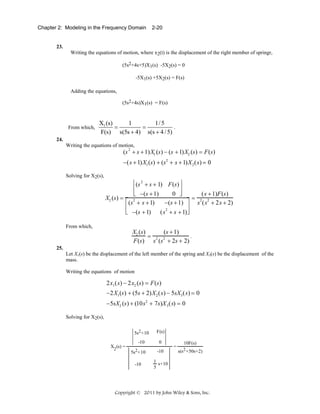
23.
Writing the equations of motion, where x2(t) is the displacement of the right member of springr,
(5s2+4s+5)X1(s) -5X2(s) = 0
-5X1(s) +5X2(s) = F(s)
Adding the equations,
(5s2+4s)X1(s) = F(s)

From which,

X1 (s)
1
1/ 5
.
=
=
F(s) s(5s + 4) s(s + 4 / 5)

24.
Writing the equations of motion,

(s 2 + s + 1)X1 (s) − (s + 1)X2 (s) = F(s)

−(s + 1)X1 (s) + (s 2 + s + 1)X 2 (s) = 0
Solving for X2(s),

⎡(s 2 + s + 1) F(s) ⎤
⎢
⎥
⎢
⎥
(s + 1)F(s)
⎣ −(s + 1)
0 ⎦
X2 (s) =
= 2 2
2
⎡ (s + s + 1)
−(s + 1) ⎤ s (s + 2s + 2)
⎢
⎥
2
⎢
⎥
⎣ −(s + 1) (s + s + 1)⎦

From which,

X2 (s)
(s + 1)
= 2 2
.
F(s) s (s + 2s + 2)

25.
Let X1(s) be the displacement of the left member of the spring and X3(s) be the displacement of the
mass.
Writing the equations of motion

2x1 (s) − 2x2 (s) = F(s)
−2X1 (s) + (5s + 2)X 2 (s) − 5sX3 (s) = 0
−5sX2 (s) + (10s 2 + 7s)X 3 (s) = 0
Solving for X2(s),

X2 (s) =

⎪5s2 +10
⎪
⎪ -10

⎪5s2 +10
⎪
⎪ -10

F(s)⎪

⎪

0 ⎪

⎪
⎪
1
s+10
5
⎪
-10

=

10F(s)
s(s2 +50s+2)

Copyright © 2011 by John Wiley & Sons, Inc.
Solutions to Problems 2-21
Thus,

X2 (s) 1 (10s + 7)
=
F(s) 10 s(5s + 1)

26.

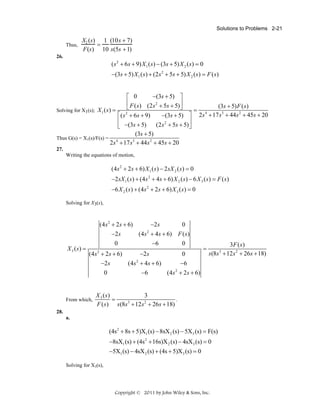
( s 2 + 6 s + 9) X 1 ( s ) − (3s + 5) X 2 ( s ) = 0
−(3s + 5) X 1 ( s ) + (2 s 2 + 5s + 5) X 2 ( s ) = F ( s )

−(3s + 5) ⎤
⎡ 0
⎢ F ( s ) (2s 2 + 5s + 5) ⎥
(3s + 5) F ( s)
⎣
⎦
= 4
Solving for X1(s); X 1 ( s ) =
3
2
2
⎡ ( s + 6s + 9)
−(3s + 5) ⎤ 2s + 17 s + 44s + 45s + 20
⎢
⎥
(2 s 2 + 5s + 5) ⎦
⎣ −(3s + 5)
(3s + 5)
Thus G(s) = X1(s)/F(s) = 4
3
2s + 17 s + 44s 2 + 45s + 20
27.
Writing the equations of motion,

(4s 2 + 2s + 6) X 1 ( s ) − 2 sX 2 ( s) = 0
−2 sX 1 ( s) + (4 s 2 + 4 s + 6) X 2 ( s ) − 6 X 3 ( s) = F ( s)
−6 X 2 ( s ) + (4 s 2 + 2s + 6) X 3 ( s) = 0
Solving for X3(s),

X 3 (s) =

(4 s 2 + 2 s + 6)
0
−2 s
2
(4s + 4s + 6) F ( s )
−2 s
0
0
−6
(4 s 2 + 2s + 6)
0
−2 s
2
(4s + 4s + 6)
−2s
−6
0
(4s 2 + 2 s + 6)
−6

From which,

=

3F ( s )
s (8s + 12 s 2 + 26s + 18)

X 3 (s)
3
=
.
3
2
F ( s ) s (8s + 12s + 26s + 18)

28.
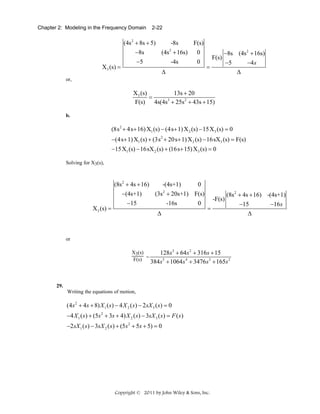
a.

(4s 2 + 8s + 5)X1 (s) − 8sX 2 (s) − 5X3 (s) = F(s)
−8sX1 (s) + (4s 2 + 16s)X 2 (s) − 4sX 3 (s) = 0
−5X1 (s) − 4sX 2 (s) + (4s + 5)X 3 (s) = 0
Solving for X3(s),

Copyright © 2011 by John Wiley & Sons, Inc.

3
Chapter 2: Modeling in the Frequency Domain

X 3 (s) =

2-22

(4s 2 + 8s + 5)
-8s
F(s)
2
−8s
(4s + 16s) 0
-4s
0
−5
Δ

F(s)
=

−8s (4s 2 + 16s)
−5
−4s
Δ

or,

X 3 (s)
13s + 20
=
3
F(s) 4s(4s + 25s 2 + 43s + 15)
b.

(8s 2 + 4s + 16) X1 (s) − (4s+ 1) X 2 (s) − 15 X 3 (s) = 0
−(4s + 1) X1 (s) + (3s 2 + 20s+ 1) X 2 (s) − 16sX3 (s) = F(s)
−15 X1 (s) − 16sX 2 (s) + (16s+ 15) X3 (s) = 0
Solving for X3(s),

X 3 (s) =

(8s 2 + 4s + 16)
-(4s+1)
0
2
(3s + 20s+1) F(s)
−(4s+1)
−15
-16s
0
Δ

(8s 2 + 4s + 16) -(4s+1)
-F(s)
−15
−16s
=
Δ

or
X3(s)
128s 3 + 64s 2 + 316s + 15
=
F(s)
384s 5 + 1064s 4 + 3476s 3 + 165s 2

29.
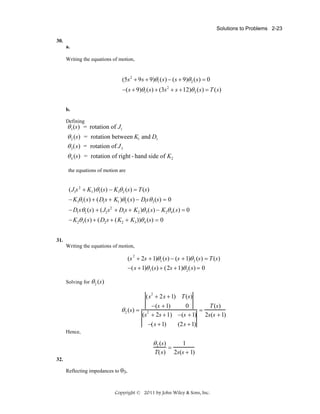
Writing the equations of motion,

(4s 2 + 4s + 8) X 1 ( s) − 4 X 2 ( s) − 2 sX 3 ( s) = 0
−4 X 1 ( s ) + (5s 2 + 3s + 4) X 2 ( s) − 3sX 3 ( s ) = F ( s )
−2sX 1 ( s) − 3sX 2 ( s ) + (5s 2 + 5s + 5) = 0

Copyright © 2011 by John Wiley & Sons, Inc.
Solutions to Problems 2-23
30.
a.
Writing the equations of motion,

(5s 2 + 9 s + 9)θ1 ( s ) − ( s + 9)θ 2 ( s ) = 0
−( s + 9)θ1 ( s ) + (3s 2 + s + 12)θ 2 ( s ) = T ( s )
b.
Defining

θ 1 (s)
θ 2 (s)
θ 3 (s)
θ 4 (s)

= rotation of J1
= rotation between K1 and D1
= rotation of J 3
= rotation of right - hand side of K2

the equations of motion are

(J1s 2 + K1 )θ1 (s) − K1θ 2 (s) = T (s)
− K1θ1 (s) + (D1 s + K1 )θ2 (s) − D1s θ 3 (s) = 0
− D1 s θ2 (s) + (J2 s2 + D1s + K2 )θ 3 (s) − K2θ 4 (s) = 0
− K2θ 3 (s) + (D2 s + (K2 + K3 ))θ 4 (s) = 0
31.
Writing the equations of motion,

(s 2 + 2s + 1)θ1 (s) − (s + 1)θ 2 (s) = T (s)

− (s + 1)θ 1 (s) + (2s + 1)θ 2 (s) = 0
Solving for θ 2 (s)

(s2 + 2s + 1) T (s)

θ 2 (s) =

−(s + 1)
0
T (s)
=
(s + 2s + 1) −(s + 1) 2s(s + 1)
2

−(s + 1)

(2s + 1)

Hence,

θ 2 (s)
T(s)

=

1
2s(s + 1)

32.
Reflecting impedances to θ3,

Copyright © 2011 by John Wiley & Sons, Inc.
Chapter 2: Modeling in the Frequency Domain

2-24

(Jeqs2+Deqs)θ3(s) = T(s) (

N4 N2
)
N3 N1

Thus,

N 4N 2
θ 3 (s)
N3 N1
=
2
T (s) Jeq s + Deqs
where

⎛N ⎞2
⎛N N ⎞2
4⎟
4 2⎟
⎟ + J1 ⎜
⎜
⎟ , and
⎝ N3 ⎠
⎝ N3 N1 ⎠

Jeq = J4+J5+(J2+J3) ⎜
⎜

Deq = (D4 + D5 ) + (D2 + D3 )(

33.

N4 2
NN
) + D1 ( 4 2 ) 2
N3
N 3 N1

Reflecting all impedances to θ2(s),
2

2

2

2

2

N
{[J2+J1(N2 ) +J3 (N3 ) ]s2 + [f2+f1(N2 ) +f3(N43 ) ]s + [K(N3 ) ]}θ2(s) = T(s)N2
N1
N1
N4
N1
N4
Substituting values,
2

2

2

{[1+2(3)2+16(1 ) ]s2 + [2+1(3)2+32(1 ) ]s + 64(1 ) }θ2(s) = T(s)(3)
4
4
4
Thus,

θ2(s)

3
T(s) = 20s2+13s+4

34.

Reflecting impedances to θ2,

⎡
⎡
⎛ ⎞2
⎛
⎞2⎤
⎛
⎞2⎤ ⎡
⎛ ⎞2⎤ ⎛ ⎞
⎢200 + 3⎜ 50 ⎟ + 200⎜ 5 x 50 ⎟ ⎥ s 2 + ⎢1000⎜ 5 x 50 ⎟ ⎥ s + ⎢250 + 3⎜ 50 ⎟ ⎥ = ⎜ 50 ⎟ T (s)
⎝ 5⎠
⎝ 25 5 ⎠ ⎦
⎝ 25 5 ⎠ ⎦ ⎣
⎝ 5 ⎠ ⎦ ⎝ 5⎠
⎢
⎥
⎢
⎥ ⎢
⎥
⎣
⎣
Thus,

θ 2 (s)
T( s)

=

10
1300s + 4000s + 550
2

35.
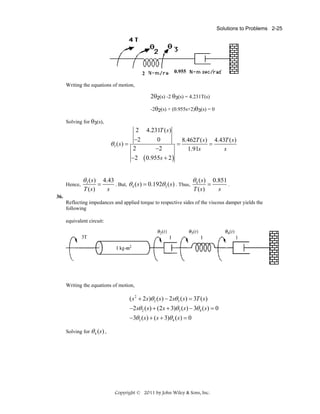
Reflecting impedances and applied torque to respective sides of the spring yields the following
equivalent circuit:

Copyright © 2011 by John Wiley & Sons, Inc.
Solutions to Problems 2-25

2

0.955

Writing the equations of motion,

2θ2(s) -2 θ3(s) = 4.231T(s)
-2θ2(s) + (0.955s+2)θ3(s) = 0
Solving for θ3(s),

2 4.231T ( s )
−2
0
8.462T ( s ) 4.43T ( s )
θ3 ( s) =
=
=
−2
2
s
1.91s
−2 ( 0.955s + 2 )

Hence,

θ3 ( s)
T (s)

=

θ ( s) 0.851
4.43
. But, θ 4 ( s ) = 0.192θ3 ( s ) . Thus, 4
=
.
T ( s)
s
s

36.
Reflecting impedances and applied torque to respective sides of the viscous damper yields the
following
equivalent circuit:

Writing the equations of motion,

( s 2 + 2 s )θ 2 ( s ) − 2sθ 3 ( s ) = 3T ( s )
−2sθ 2 ( s ) + (2s + 3)θ3 ( s ) − 3θ 4 ( s ) = 0
−3θ3 ( s ) + ( s + 3)θ 4 ( s ) = 0
Solving for θ 4 (s) ,

Copyright © 2011 by John Wiley & Sons, Inc.
Chapter 2: Modeling in the Frequency Domain

2-26

−2s
3T ( s )
s ( s + 2)
−2s
(2s + 3)
0
0
−3
0
18T ( s )
θ 4 ( s) =
=
−2 s
0
s ( s + 2)
s (2s 2 + 9s + 6)
−2s
−3
(2s + 3)
−3
0
( s + 3)
But, θ L (s) = 5θ 4 (s) . Hence,

θ 4 ( s)
T ( s)

=

90
s (2s + 9 s + 6)
2

37.
Reflect all impedances on the right to the viscous damper and reflect all impedances and torques on the
left to the spring and obtain the following equivalent circuit:

Writing the equations of motion,
(J1eqs2+K)θ2(s) -Kθ3(s) = Teq(s)
-Kθ2(s)+(Ds+K)θ3(s) -Dsθ4(s) = 0
-Dsθ3(s) +[J2eqs2 +(D+Deq)s]θ4(s) = 0
N2
where: J1eq = J2+(Ja+J1) N
1

( )

2

N3
; J2eq = J3+(JL+J4) N
4

( )

2

N3
; Deq = DL N
4

N1
N2 .

Copyright © 2011 by John Wiley & Sons, Inc.

( )

2

; θ2(s) = θ1(s)
Solutions to Problems 2-27
38.
Reflect impedances to the left of J5 to J5 and obtain the following equivalent circuit:

Writing the equations of motion,
[Jeqs2+(Deq+D)s+(K2+Keq)]θ5(s)

-[Ds+K2]θ6(s) = 0

-[K2+Ds]θ5(s) + [J6s2+2Ds+K2]θ6(s) = T(s)

From the first equation,

θ6(s) Jeqs2+(Deq+D)s+ (K2+Keq)
θ5(s) N1N3
=
. But,
=
. Therefore,
Ds+K2
θ5(s)
θ1(s) N2N4
θ6(s) N1N3 ⎛ Jeqs2+(Deq+D)s+ (K2+Keq) ⎞
=
⎜
⎟ ,
Ds+K2
⎠
θ1(s) N2N4 ⎝

N4N2
where Jeq = J1 N N
3 1

[ (

Deq = D

[(N4N2 )
N3N1

2

)

2

N4
+ (J2+J3) N
3

N4
+ N
3

( )

( )

2

2

N4
+ (J4+J5) , Keq = K1 N
3

]

]

+1 .

39.
Draw the freebody diagrams,

Copyright © 2011 by John Wiley & Sons, Inc.

( )

2
, and
Chapter 2: Modeling in the Frequency Domain

2-28

Write the equations of motion from the translational and rotational freebody diagrams,
-fvrsθ(s) = F(s)

(Ms2+2fv s+K2)X(s)

-fvrsX(s) +(Js2+fvr2s)θ(s) = 0
Solve for θ(s),

Ms 2+2fvs+K
θ(s) =

2

F(s)

-fvrs
Ms 2+2fvs+K
-fvrs

θ(s)
From which, F(s) =

0
=
2

-fvrs

fvrF(s)
2

3

JMs +(2Jfv+Mfvr2)s 2+(JK +fvr2)s+K fvr2
2
2

2

Js +fvr2s
fvr

JMs3+(2Jfv+Mfvr2)s2+(JK2+fv2r2)s+K2fvr2

.

40.
Draw a freebody diagram of the translational system and the rotating member connected to the
translational system.

2

3

2

From the freebody diagram of the mass, F(s) = (2s2+2s+3)X(s). Summing torques on the rotating
member,
(Jeqs2 +Deqs)θ(s) + F(s)2 = Teq(s). Substituting F(s) above, (Jeqs2 +Deqs)θ(s) + (4s2+4s+6)X(s) =
X(s)
Teq(s). However, θ(s) = 2 . Substituting and simplifying,
Jeq
Deq
+4 s2 + 2 +4 s+6 X(s)
Teq =
2

[(

) (

) ]

But, Jeq = 3+3(4)2 = 51, Deq = 1(2)2 +1 = 5, and Teq(s) = 4T(s). Therefore,

Copyright © 2011 by John Wiley & Sons, Inc.
Solutions to Problems 2-29

[ 59 s2 + 13 s+6]X(s) = 4T(s). Finally, X(s)
T(s)
2

2

=

8
.
59 s + 13s + 12
2

41.
Writing the equations of motion,
(J1s2+K1)θ1(s)

- K1θ2(s)
= T(s)
2+D s+K )θ (s) +F(s)r -D sθ (s) = 0
-K1θ1(s) + (J2s
3
1 2
3 3
2+D s)θ (s) = 0
-D3sθ2(s) + (J2s
3 3

where F(s) is the opposing force on J2 due to the translational member and r is the radius of J2. But,
for the translational member,
F(s) = (Ms2+fvs+K2)X(s) = (Ms2+fvs+K2)rθ(s)
Substituting F(s) back into the second equation of motion,
(J1s2+K1)θ1(s)

- K1θ2(s)

= T(s)

-K1θ1(s) + [(J2 + Mr2)s2+(D3 + fvr2)s+(K1 + K2r2)]θ2(s)

-D3sθ3(s) = 0

-D3sθ2(s) + (J2s2+D3s)θ3(s) = 0
Notice that the translational components were reflected as equivalent rotational components by the
square of the radius. Solving for θ2(s), θ 2 (s ) =

K1 ( J3 s 2 + D3 s)T( s)
, where Δ is the
Δ

determinant formed from the coefficients of the three equations of motion. Hence,

θ 2 (s)

K1 (J3 s2 + D3 s)
=
T(s)
Δ

Since

X(s) = rθ 2 (s),

X(s) rK1 (J 3 s2 + D3 s)
=
T (s)
Δ

42.

Kt Tstall 100
Ea
50 1
=
=
= 2 ; Kb =
=
=
Ra Ea
ω no− load 150 3
50
Also,
Jm = 5+18
Thus,

θ m (s )
Ea (s)

Since θL(s) =

=

(1)
3

2

2

= 7; Dm = 8+36

( 1 ) = 12.
3

2/7
2/7
=
1
2
38
s ( s + (12 + )) s ( s + )
7
3
21

1
θm(s),
3

Copyright © 2011 by John Wiley & Sons, Inc.
Chapter 2: Modeling in the Frequency Domain

2-30

2
θ L (s)
21
=
.
38
Ea (s)
s( s + )
21
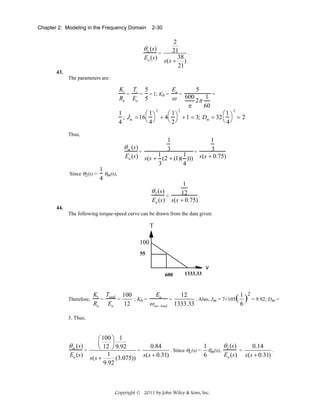
43.
The parameters are:

Kt Ts 5
Ea
5
=
= = 1; Kb =
=
=
Ra Ea 5
ω 600 2π 1
60
π
2
2
2
1⎞
1⎞
1
⎛
⎛
⎛1
; Jm = 16
+4
+ 1 = 3; Dm = 32 ⎞ = 2
⎝ 4⎠
⎝ 2⎠
⎝ 4⎠
4
Thus,

1
θ m (s)
3
=
=
Ea (s) s(s + 1 (2 + (1)( 1 ))) s(s + 0.75)
3
4
1
3

Since θ2(s) =

1
θm(s),
4
1
θ 2 (s)
12
=
.
Ea (s) s(s + 0.75)

44.
The following torque-speed curve can be drawn from the data given:

T
100
55
50

v
500
600

Therefore,

1333.33
1000

Kt Tstall 100
Ea
12
1 2
=
=
; Kb =
=
. Also, Jm = 7+105( ) = 9.92; Dm =
Ra Ea
ω no− load 1333.33
12
6

3. Thus,

⎛ 100 ⎞ 1
⎜
⎟
θ m (s)
θ L (s)
0.84
1
0.14
⎝ 12 ⎠ 9.92
=
=
. Since θL(s) = θm(s),
=
.
1
Ea (s)
Ea (s) s ( s + 0.31)
s ( s + 0.31)
6
s( s +
(3.075))
9.92

Copyright © 2011 by John Wiley & Sons, Inc.
Solutions to Problems 2-31

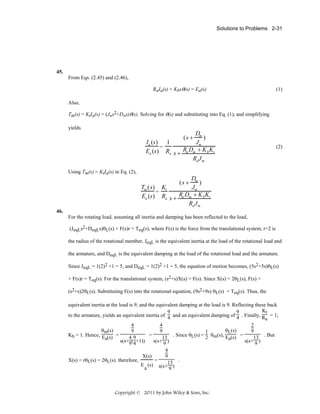
45.
From Eqs. (2.45) and (2.46),
RaIa(s) + Kbsθ(s) = Ea(s)

(1)

Also,
Tm(s) = KtIa(s) = (Jms2+Dms)θ(s). Solving for θ(s) and substituting into Eq. (1), and simplifying
yields

Dm
)
Ia (s) 1
Jm
=
Ea (s) Ra s + Ra Dm + K b Kt
Ra J m
(s +

(2)

Using Tm(s) = KtIa(s) in Eq. (2),

Dm
)
Tm (s) Kt
Jm
=
Ea (s) Ra s + Ra Dm + K b Kt
Ra J m
(s +

46.
For the rotating load, assuming all inertia and damping has been reflected to the load,
(JeqLs2+DeqLs)θL(s) + F(s)r = Teq(s), where F(s) is the force from the translational system, r=2 is
the radius of the rotational member, JeqL is the equivalent inertia at the load of the rotational load and
the armature, and DeqL is the equivalent damping at the load of the rotational load and the armature.
Since JeqL = 1(2)2 +1 = 5, and DeqL = 1(2)2 +1 = 5, the equation of motion becomes, (5s2+5s)θL(s)
+ F(s)r = Teq(s). For the translational system, (s2+s)X(s) = F(s). Since X(s) = 2θL(s), F(s) =
(s2+s)2θL(s). Substituting F(s) into the rotational equation, (9s2+9s) θL(s) = Teq(s). Thus, the
equivalent inertia at the load is 9, and the equivalent damping at the load is 9. Reflecting these back
Kt
9
9
to the armature, yields an equivalent inertia of 4 and an equivalent damping of 4 . Finally, R = 1;
a
4
4
2
θm(s)
θL(s)
9
9
9
1
=
. Since θL(s) = 2 θm(s), E (s) =
Kb = 1. Hence, E (s) =
49
13
13 . But
a
a
s(s+9(4+1))
s(s+ 9 )
s(s+ 9 )
4
X(s)
9
X(s) = rθL(s) = 2θL(s). therefore,
=
.
E (s) s(s+13)
a
9

Copyright © 2011 by John Wiley & Sons, Inc.
Chapter 2: Modeling in the Frequency Domain

2-32

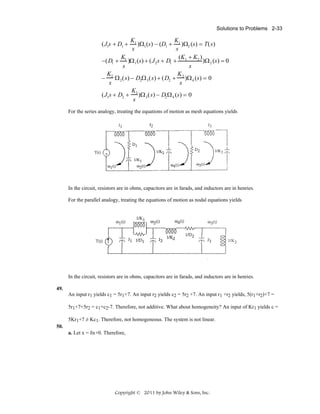
47.
The equations of motion in terms of velocity are:

K1 K2
K
+ ]V1 (s) − 2 V2 (s) − fv 3V3 (s) = 0
s
s
s
K
K
− 2 V1 (s) + [M2 s + ( fv 2 + f v 4 ) + 2 ]V2 (s) − f v4 V3 (s) = F(s)
s
s
− f v3 V1 (s) − f v4 V2 (s) + [M3 s + fV 3 + fv 4 ]V3 (S) = 0

[M1s + ( fv1 + fv 3 ) +

For the series analogy, treating the equations of motion as mesh equations yields

In the circuit, resistors are in ohms, capacitors are in farads, and inductors are in henries.
For the parallel analogy, treating the equations of motion as nodal equations yields

In the circuit, resistors are in ohms, capacitors are in farads, and inductors are in henries.
48.
Writing the equations of motion in terms of angular velocity, Ω(s) yields

Copyright © 2011 by John Wiley & Sons, Inc.
Solutions to Problems 2-33

K1
K
)Ω1 (s) − (D1 + 1 )Ω2 (s) = T(s)
s
s
K
(K + K2 )
)Ω 2 (s) = 0
−(D1 + 1 )Ω 1 (s) + (J 2 s + D1 + 1
s
s
K
K
− 2 Ω 2 (s) − D2Ω 3 (s) + (D2 + 2 )Ω 4 (s) = 0
s
s
K
(J3 s + D2 + 3 )Ω 3 (s) − D2 Ω 4 (s) = 0
s

(J1s + D1 +

For the series analogy, treating the equations of motion as mesh equations yields

In the circuit, resistors are in ohms, capacitors are in farads, and inductors are in henries.
For the parallel analogy, treating the equations of motion as nodal equations yields

In the circuit, resistors are in ohms, capacitors are in farads, and inductors are in henries.
49.
An input r1 yields c1 = 5r1+7. An input r2 yields c2 = 5r2 +7. An input r1 +r2 yields, 5(r1+r2)+7 =
5r1+7+5r2 = c1+c2-7. Therefore, not additive. What about homogeneity? An input of Kr1 yields c =
5Kr1+7 ≠ Kc1. Therefore, not homogeneous. The system is not linear.
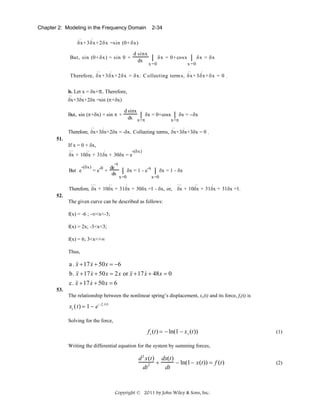
50.
a. Let x = δx+0. Therefore,

Copyright © 2011 by John Wiley & Sons, Inc.
Chapter 2: Modeling in the Frequency Domain
..

2-34

.

δx + 3δx + 2δx =sin (0+ δx)
d sinx
δx = 0+ cosx ⎮ δx = δx
dx ⎮

But, sin (0+ δx) = sin 0 +

x =0

..

x =0
..

.

.

Therefore, δx + 3δx + 2δx = δx. C ollecting term s, δx + 3δx + δx = 0 .

b. Let x = δx+π. Therefore,
..

.

δx+3δx+2δx =sin (π+δx)
But, sin (π+δx) = sin π +
..

d sinx
⎮ δx = 0+cosx ⎮ δx = −δx
dx x=π
x=π

.

..

.

Therefore, δx+3δx+2δx = -δx. Collecting terms, δx+3δx+3δx = 0 .
51.

If x = 0 + δx,
...

..

.

-(δx)

δx + 10δx + 31δx + 30δx = e
-(δx)

But e

= e-0 +

...

-x

de
dx
..

-x
⎮ δx = 1 - e ⎮ δx = 1 - δx
x=0
.

x=0
...

..

.

Therefore, δx + 10δx + 31δx + 30δx =1 - δx, or, δx + 10δx + 31δx + 31δx =1.

52.

The given curve can be described as follows:
f(x) = -6 ; -∞<x<-3;
f(x) = 2x; -3<x<3;
f(x) = 6; 3<x<+∞
Thus,

&
a . && + 17 x + 50 x = −6
x
&
&
b. && + 17 x + 50 x = 2 x or && + 17 x + 48 x = 0
x
x
53.

&
c. && + 17 x + 50 x = 6
x
The relationship between the nonlinear spring’s displacement, xs(t) and its force, fs(t) is

xs (t) = 1 − e− fs (t)
Solving for the force,

f s (t) = − ln(1 − x s (t))

(1)

Writing the differential equation for the system by summing forces,

d 2 x(t) dx(t)
+
− ln(1 − x(t)) = f (t)
dt 2
dt

Copyright © 2011 by John Wiley & Sons, Inc.

(2)
Solutions to Problems 2-35

Letting x(t) = x0 + δx and f(t) = 1 + δf, linearize ln(1 – x(t)).

ln(1− x) − ln(1 − x0 ) =

d ln(1 − x)
δx
dx
x =x 0

Solving for ln(1 – x),

ln(1− x) = ln(1 − x0 ) −

1
1− x

x = x0

δx = ln(1− x 0 ) −

1
δx
1− x 0

(3)

When f = 1, δx = 0. Thus from Eq. (1), 1 = -ln(1 – x0 ). Solving for x0,
1 – x0 = e-1 , or x0 = 0.6321.
Substituting x0 = 0.6321 into Eq. (3),

ln(1- x) = ln(1 – 0.6321) -

1
δx = -1 - 2.718δx
1- 0.6321

Placing this value into Eq. (2) along with x(t) = x0 + δx and f(t) = 1 + δf, yields the linearized
differential equation,

d 2 δx dδx
+
+ 1 + 2.718δx = 1 + δf
dt 2
dt
or

d 2 δx dδx
+
+ 2.718δx = δf
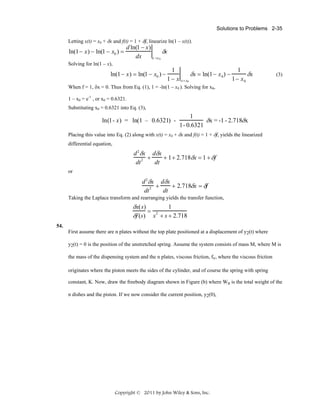
dt 2
dt
Taking the Laplace transform and rearranging yields the transfer function,

δx(s)
1
= 2
δf (s) s + s + 2.718
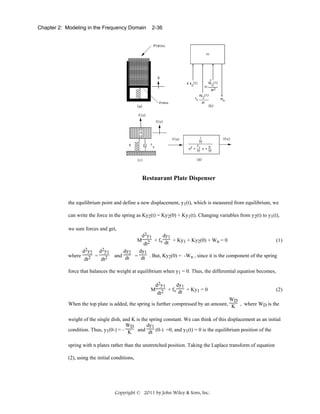
54.

First assume there are n plates without the top plate positioned at a displacement of y2(t) where
y2(t) = 0 is the position of the unstretched spring. Assume the system consists of mass M, where M is
the mass of the dispensing system and the n plates, viscous friction, fv, where the viscous friction
originates where the piston meets the sides of the cylinder, and of course the spring with spring
constant, K. Now, draw the freebody diagram shown in Figure (b) where Wn is the total weight of the
n dishes and the piston. If we now consider the current position, y2(0),

Copyright © 2011 by John Wiley & Sons, Inc.
Chapter 2: Modeling in the Frequency Domain

2-36

Restaurant Plate Dispenser

the equilibrium point and define a new displacement, y1(t), which is measured from equilibrium, we
can write the force in the spring as Ky2(t) = Ky2(0) + Ky1(t). Changing variables from y2(t) to y1(t),
we sum forces and get,

where

d2y2

d2y1
2 = dt2
dt

d2y1
dy1
M 2 + fv dt + Ky1 + Ky2(0) + Wn = 0
(1)
dt
dy2
dy1
and dt = dt . But, Ky2(0) = -Wn , since it is the component of the spring

force that balances the weight at equilibrium when y1 = 0. Thus, the differential equation becomes,
dy1
d2y1
M 2 + fv dt + Ky1 = 0
dt

(2)

WD
When the top plate is added, the spring is further compressed by an amount, K , where WD is the
weight of the single dish, and K is the spring constant. We can think of this displacement as an initial
WD
dy1
condition. Thus, y1(0-) = - K and dt (0-) =0, and y1(t) = 0 is the equilibrium position of the
spring with n plates rather than the unstretched position. Taking the Laplace transform of equation
(2), using the initial conditions,

Copyright © 2011 by John Wiley & Sons, Inc.
Solutions to Problems 2-37

WD
WD
M(s2Y1(s) + s K ) + fv(sY1(s) + K ) + KY1(s) = 0

(3)

or
(Ms2 + fvs + K)Y1(s) = -

WD
(Ms + fv )
K

(4)

Now define a new position reference, Y(s), which is zero when the spring is compressed with the
initial condition,
WD
Y(s) = Y1(s) + Ks

(5)

WD
Y1(s) = Y(s) - Ks

(6)

or

Substituting Y1(s) in Equation (4), we obtain,
WD
(Ms2 + fvs + K)Y(s) = s = F(s)

(7)

a differential equation that has an input and zero initial conditions. The schematic is shown in Figure
Y(s)
(c). Forming the transfer function, F(s) , we show the final result in Figure (d), where for the
WD
removal of the top plate, F(s) is always a step, F(s) = s .
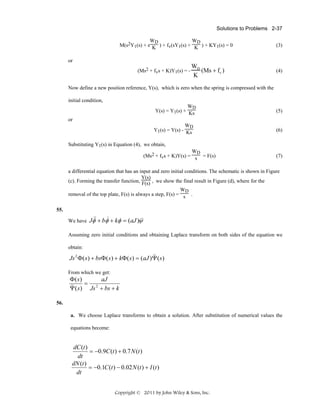
55.

&
&
&
We have Jφ& + bφ + kφ = (aJ )ψ&
Assuming zero initial conditions and obtaining Laplace transform on both sides of the equation we
obtain:

&&
Js 2 Φ ( s ) + bsΦ ( s ) + kΦ ( s ) = (aJ )Ψ ( s )
From which we get:

Φ( s)
aJ
=
&& ( s ) Js 2 + bs + k
Ψ

56.
a. We choose Laplace transforms to obtain a solution. After substitution of numerical values the

equations become:

dC (t )
= −0.9C (t ) + 0.7 N (t )
dt
dN (t )
= −0.1C (t ) − 0.02 N (t ) + I (t )
dt
Copyright © 2011 by John Wiley & Sons, Inc.
Chapter 2: Modeling in the Frequency Domain

2-38

Obtaining Laplace transforms and substituting initial values we obtain:

sC ( s ) − 47000500 = −0.9C ( s ) + 0.7 N ( s)
sN ( s) − 61100500 = −0.1C ( s) − 0.02 N ( s ) + I ( s)
Both equations are manipulated as follows:

0.7 N ( s ) 47000500
+
s + 0.9
s + 0.9
− 0.1C ( s ) 61100500
I (s)
+
+
N ( s) =
s + 0.02
s + 0.02
s + 0.02

C ( s) =

Substituting the first equation into the second one gets:

−
N ( s) =

=

4700050
61100500
4700050
61100500
I ( s)
I (s)
+
+
−
+
+
( s + 0.02)( s + 0.9)
s + 0.02
s + 0.02
s + 0.02
s + 0.02
=
2
0.07
s + 0.92 s + 0.088
1+
( s + 0.02)( s + 0.9)

61100500( s + 0.9)
4700050
s + 0.9
− 2
I ( s) + 2
s + 0.92 s + 0.088 s + 0.92s + 0.088
s + 0.92 s + 0.088
2

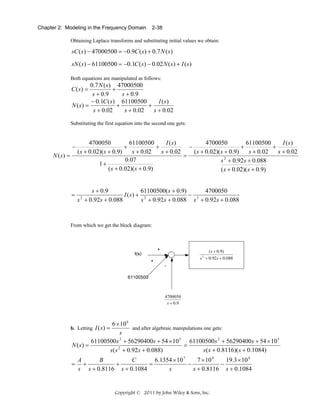
From which we get the block diagram:

( s + 0.9)
s + 0.92 s + 0.088
2

4700050
s + 0.9

6 × 10 6
and after algebraic manipulations one gets:
s
61100500s 2 + 56290400s + 54 × 10 5 61100500 s 2 + 56290400s + 54 × 10 5
=
N ( s) =
s ( s + 0.8116)( s + 0.1084)
s ( s 2 + 0.92s + 0.088)

b. Letting I ( s ) =

=

A
B
C
6.1354 × 10 7
7 × 10 4
19.3 × 10 4
+
+
=
−
−
s s + 0.8116 s + 0.1084
s
s + 0.8116 s + 0.1084

Copyright © 2011 by John Wiley & Sons, Inc.
Solutions to Problems 2-39

Obtaining the inverse Laplace transform:

N (t ) = 6.1364 × 10 7 − 7 × 10 4 e −0.8116t − 19.3 × 10 4 e −0.1084t
57.
a.

‘Exact’:
From Figure (a)

1
1
3
−0.005 s
)
3 (1 − e −0.005 s ) 8 (1 − e
8 V ( s) = 8
=
Vo ( s ) =
1 in
1
s
⎛ 1⎞
s+
s+
s⎜s + ⎟
8
8
⎝ 8⎠
1
1
1
= −
. Thus, applying partial fraction
Using Partial fraction expansions note that
s ( s + 1) s s + 1
expansion to Vo(s) and taking the inverse Laplace transform yields,

So vo (t ) = 3(1 − e

1
− t
8

)u (t ) − 3(1 − e

1
− ( t − 0.005)
8

)u (t − 0.005)

‘Impulse’:

1
1
0.001875
Vo ( s ) = 8 Vin ( s ) = 8 0.015 =
1
1
s + 0.125
s+
s+
8
8
In this case vo (t ) = 0.001875e

−0.125t

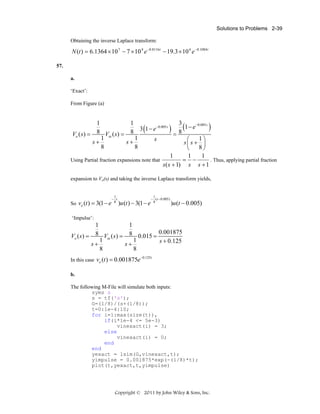
b.

The following M-File will simulate both inputs:
syms s
s = tf('s');
G=(1/8)/(s+(1/8));
t=0:1e-4:10;
for i=1:max(size(t)),
if(i*1e-4 <= 5e-3)
vinexact(i) = 3;
else
vinexact(i) = 0;
end
end
yexact = lsim(G,vinexact,t);
yimpulse = 0.001875*exp(-(1/8)*t);
plot(t,yexact,t,yimpulse)

Copyright © 2011 by John Wiley & Sons, Inc.
Chapter 2: Modeling in the Frequency Domain

2-40

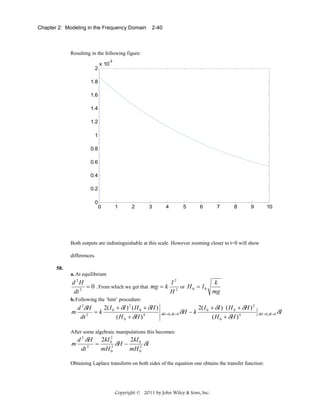
Resulting in the following figure:
-3

2

x 10

1.8
1.6
1.4
1.2
1
0.8
0.6
0.4
0.2
0

0

1

2

3

4

5

6

7

8

9

10

Both outputs are indistinguishable at this scale. However zooming closer to t=0 will show
differences.
58.
a. At equilibrium

I2
k
d 2H
= 0 . From which we get that mg = k 2 or H 0 = I 0
2
mg
H
dt
b. Following the ‘hint’ procedure:

2( I 0 + δI ) 2 ( H 0 + δH )
d 2δH
m
=k
dt 2
( H 0 + δH ) 4

2( I 0 + δI ) ( H 0 + δH ) 2
δH = 0 ,δI = 0 δH − k
( H 0 + δH ) 4

δH = 0 ,δI = 0

After some algebraic manipulations this becomes:

2kI 0
d 2 δH 2kI 02
=
m
δH −
δI
2
3
dt
mH 0
mH 02
Obtaining Laplace transform on both sides of the equation one obtains the transfer function:

Copyright © 2011 by John Wiley & Sons, Inc.

δI
Solutions to Problems 2-41

2kI 0
mH 02
δH ( s)
=−
δI ( s )
2kI 02
s2 −
3
mH 0
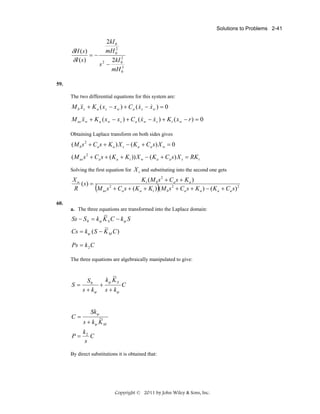
59.

The two differential equations for this system are:

&
&
M b &&s + K a ( x s − x w ) + C a ( x s − x w ) = 0
x
&
&
M us &&w + K a ( x w − x s ) + C a ( x w − x s ) + K t ( x w − r ) = 0
x
Obtaining Laplace transform on both sides gives

( M b s 2 + Ca s + K a ) X s − ( K a + Ca s ) X w = 0
( M us s 2 + Ca s + ( K a + K t )) X w − ( K a + Ca s ) X s = RK t
Solving the first equation for X s and substituting into the second one gets

Xw
K t ( M b s 2 + Ca s + K a )
( s) =
R
(M us s 2 + Ca s + ( K a + Kt ))(M b s 2 + Ca s + K a ) − ( K a + Ca s)2
60.
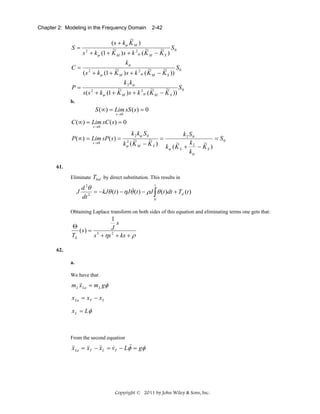
a. The three equations are transformed into the Laplace domain:

~
Ss − S 0 = kψ K S C − kψ S
~
Cs = kψ ( S − K M C )
Ps = k 2 C
The three equations are algebraically manipulated to give:

~
kψ K S
S0
S=
C
+
s + kψ s + kψ

C=
P=

Skψ

~
s + kψ K M
k2
C
s

By direct substitutions it is obtained that:

Copyright © 2011 by John Wiley & Sons, Inc.
Chapter 2: Modeling in the Frequency Domain

2-42

~
( s + kψ K M )
S= 2
~
~
~ S0
s + kψ (1 + K M ) s + k 2ψ ( K M − K S )
C=

kψ
~
~
~ S0
( s 2 + kψ (1 + K M ) s + k 2ψ ( K M − K S ))

P=

k 2 kψ
~
~
~ S0
s ( s + kψ (1 + K M ) s + k 2ψ ( K M − K S ))
2

b.

S (∞) = Lim sS ( s) = 0
s →0

C (∞) = Lim sC ( s) = 0
s →0

P (∞) = Lim sP ( s ) =
s →0

k 2 kψ S 0
k2 S0
= S0
~ =
2 ~
~
~
kψ ( K M − K S ) k ( K + k 2 − K )
S
S
ψ
kψ

61.

Eliminate Tbal by direct substitution. This results in

d 2θ
&
= − kJθ (t ) − ηJθ (t ) − ρJ ∫ θ (t )dt + Td (t )
dt 2
0
t

J

Obtaining Laplace transform on both sides of this equation and eliminating terms one gets that:

1
s
Θ
J
(s) = 3
Td
s + ηs 2 + ks + ρ
62.
a.

We have that

m L &&La = m L gφ
x
x La = xT − x L
x L = Lφ

From the second equation

&
&&La = &&T − &&L = vT − Lφ& = gφ
&
x
x
x

Copyright © 2011 by John Wiley & Sons, Inc.
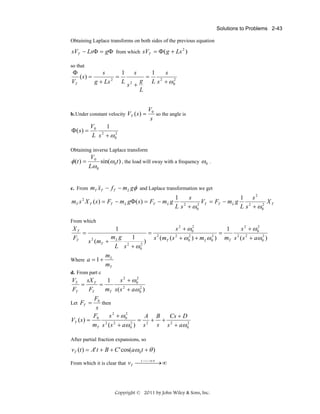
Solutions to Problems 2-43

Obtaining Laplace transforms on both sides of the previous equation

sVT − LsΦ = gΦ from which sVT = Φ ( g + Ls 2 )
so that

Φ
s
s
1 s
1
=
=
(s) =
2
2
2
VT
L 2 g L s + ω0
g + Ls
s +
L

b. Under constant velocity VT ( s ) =

Φ(s) =

V0
so the angle is
s

V0
1
2
2
L s + ω0

Obtaining inverse Laplace transform

φ (t ) =

V0
sin(ω 0 t ) , the load will sway with a frequency ω 0 .
Lω 0

x
c. From mT &&T − f T − m L gφ and Laplace transformation we get

mT s 2 X T ( s ) = FT − m L gΦ( s ) = FT − m L g

s
1
1 s2
VT = FT − m L g
XT
2
2
L s 2 + ω0
L s 2 + ω0

From which
2
2
s 2 + ω0
s 2 + ω0
1
1
= 2
=
2
2
2
mL g
1
s (mT ( s 2 + ω 0 ) + m Lω 0 ) mT s 2 ( s 2 + aω 0 )
2
s (mT +
)
2
L s 2 + ω0
m
Where a = 1 + L
mT

XT
=
FT

d. From part c
2
s 2 + ω0
VT sX T
1
=
=
2
FT
FT
mT s ( s 2 + aω 0 )
F
Let FT = 0 then
s
2
F0
s 2 + ω0
A B
Cs + D
VT ( s ) =
= 2 + + 2
2
2
2
2
mT s ( s + aω 0 ) s
s s + aω 0

After partial fraction expansions, so

vT (t ) = A' t + B + C ' cos(aω 0 t + θ )
t⎯
⎯→ ∞

⎯
From which it is clear that vT ⎯⎯ ⎯ → ∞

Copyright © 2011 by John Wiley & Sons, Inc.
Chapter 2: Modeling in the Frequency Domain

2-44

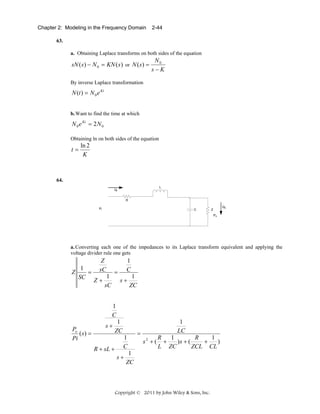
63.
a. Obtaining Laplace transforms on both sides of the equation

sN ( s ) − N 0 = KN ( s ) or N ( s ) =

N0
s−K

By inverse Laplace transformation

N (t ) = N 0 e Kt
b. Want to find the time at which

N 0 e Kt = 2N 0
Obtaining ln on both sides of the equation

t=

ln 2
K

64.

a. Converting each one of the impedances to its Laplace transform equivalent and applying the
voltage divider rule one gets

Z

1
=
SC

Z
sC
Z+

1
C

=

1
sC

s+

1
ZC

1
C
Po
( s) =
Pi

s+
R + sL +

1
ZC
1
C
s+

1
LC

=
s2 + (

1
1
R
R
+
)s + (
+
)
L ZC
ZCL CL

1
ZC

Copyright © 2011 by John Wiley & Sons, Inc.
Solutions to Problems 2-45

Since Q0 =

Qo
(s) =
Pi

Po
,
Z

1
LCZ
R 1
R
1
s 2 + ( + )s + (
+ )
L ZC
ZCL CL

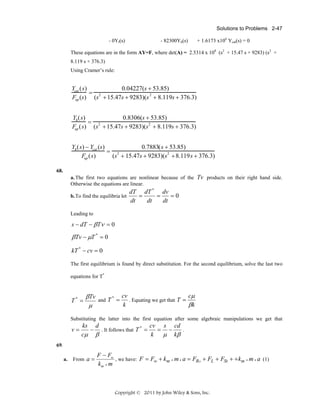
=

0.0236
s + 33.0125s + 73559
.
2

b. The steady state circuit becomes

So that Q0 =

Pi
1
=
= 3.2 X 10 −6
R + Z 4176 + 308163

c. Applying the final value theorem

qo (∞) = Lim s
⎯
s ⎯ →0

65.

0.0236
1
= 3.2X10⁻⁶
s + 33.0125s + 73559 s
.
2

The laplace transform of the systems output is

£{T (t )} = T ( s ) =

Tref
s

−

Tref
s+λ

+

Tref λ
2aπ f
2aπ f
=
+ 2
2 2
s + 4π f
s ( s + λ ) s + 4π 2 f 2
2

Dividing by the input one gets

T
λ
2aπ f
s
(s) =
+
2
U
s+λ
Tref s + 4π 2 f 2

66.
λ

(1− e − at )
λ
dV (t )
a. By direct differentiation
= V0 (αe −αt )e α
= λe −αtV (t )
α
dt

λ

b. V (∞) = Lim V (t ) = Lim V0 e α
t⎯
⎯→ ∞

t⎯
⎯→ ∞

(1− e − αt )

λ

= V0 e α

c.

Copyright © 2011 by John Wiley & Sons, Inc.
Chapter 2: Modeling in the Frequency Domain

2-46

Lambda = 2.5;
alpha = 0.1;
V0=50;
t=linspace(0,100);
V=V0.*exp(Lambda.*(1-exp(-alpha.*t))/alpha);
plot(t,V)
grid
xlabel('t (days)')
ylabel('mm^3 X 10^-3')

12

4

x 10

3.5
3

mm3 X 10-3

2.5
2
1.5
1
0.5
0

0

10

20

30

40

d. From the figure V (∞) ≈ 3.5 X 10

From part c V (∞) = V0 e

λ
α

= 50e

50
t (days)

12

2.5
0.1

60

70

80

90

100

mm3 X 10-3

= 3.6 X 1012 mm3 X 10-3

67.

Writing the equations of motion,
(17.2s2 + 160s + 7000)Yf(s)

– (130s + 7000)Yh(s)

- (130s+7000)Yf(s) + (9.1ss + 130s + 89300)Yh(s)

Copyright © 2011 by John Wiley & Sons, Inc.

– 0Ycat(s) = Fup(s)
- 82300Ycat(s) = 0
Solutions to Problems 2-47

- 0Yf(s)

- 82300Yh(s)

+ 1.6173 x10⁶ Ycat(s) = 0

These equations are in the form AY=F, where det(A) = 2.5314 x 10⁸ (s2 + 15.47 s + 9283) (s2 +
8.119 s + 376.3)
Using Cramer’s rule:

Ycat (s)
0.04227(s + 53.85)
= 2
Fup (s) (s + 15.47s + 9283)(s 2 + 8.119s + 376.3)
Yh (s)
0.8306(s + 53.85)
= 2
Fup (s) (s + 15.47s + 9283)(s2 + 8.119s + 376.3)
Yh (s) − Ycat (s)
0.7883(s + 53.85)
= 2
Fup (s)
(s + 15.47s + 9283)(s2 + 8.119s + 376.3)
68.
a. The first two equations are nonlinear because of the Tv products on their right hand side.
Otherwise the equations are linear.
b. To find the equilibria let

dT dT * dv
=
=
=0
dt
dt
dt

Leading to

s − dT − β Tν = 0

βTv − μT * = 0
kT * − cv = 0
The first equilibrium is found by direct substitution. For the second equilibrium, solve the last two
equations for T*

T* =

βTv
μ

and T =
*

cv
cμ
. Equating we get that T =
k
βk

Substituting the latter into the first equation after some algebraic manipulations we get that

v=

cv s cd
ks d
= −
− . It follows that T * =
.
k
μ kβ
cμ β

69.
a.

From a =

F − Fw
, we have: F = Fw + k m • m • a = FRO + FL + FSt + + km • m • a (1)
km • m

Copyright © 2011 by John Wiley & Sons, Inc.
Chapter 2: Modeling in the Frequency Domain

2-48

Substituting for the motive force, F, and the resistances FRo, FL, and Fst using the equations given
in the problem, yields the equation:

F=

P • η tot
2
⎜
⎟
= f • m • g • cos α + m • g • sin α + 0.5 • ρ • Cw • A • ⎛ v + vhw ⎞ + k m • m • a (2)
⎝
⎠
v

b. Noting that constant acceleration is assumed, the average values for speed and acceleration are:

aav = 20 (km/h)/ 4 s = 5 km/h.s = 5x1000/3600 m/s2 = 1.389 m/s2 

vav = 50 km/h = 50,000/3,600 m/s = 13.89 m/s

The motive force, F (in N), and power, P (in kW) can be found from eq. 2:
Fav = 0.011 x 1590 x 9.8 + 0.5 x 1.2 x 0.3 x 2 x 13.892 + 1.2 x 1590 x 1.389 = 2891 N
Pav = Fav. v / η tot = 2891 x 13.89 / 0.9 = 44, 617 N.m/s = 44.62 kW
o

To maintain a speed of 60 km/h while climbing a hill with a gradient α = 5 , the car engine or
motor needs to overcome the climbing resistance:

FSt

= m • g • sin α

= 1590 • 9.8 • sin 5o = 1358 N

Thus, the additional power, Padd, the car needs after reaching 60 km/h to maintain its speed while
o

climbing a hill with a gradient α = 5 is:

Padd = FSt

c.

• v /η

= 1358 x 60 x 1000/(3,600 x 0.9) = 25, 149 W = 25.15 kW

Substituting for the car parameters into equation 2 yields:

F = 0.011 x 1590 x 9.8 + 0.5 x 1.2 x 0.3 x 2 v 2 + 1.2 x 1590 dv / dt

or

F (t ) = 171.4 + 0.36 v 2 + 1908 dv / dt (3)

To linearize this equation about vo = 50 km/h = 13.89 m/s, we use the truncated taylor series:

Copyright © 2011 by John Wiley & Sons, Inc.
Solutions to Problems 2-49

v 2 − vo 2 ≈

d (v 2 )
dv

v2

(v − vo ) = 2vo • (v − vo ) (4), from which we obtain:
v = vo

= 2vo • v − vo

2

= 27.78 • v − 13.89 2 (5)

Substituting from equation (5) into (3) yields:

F (t ) = 171.4 + 10 v − 69.46 + 1908 dv / dt or

Fe (t ) = F (t ) − FRo + Fo = F (t ) − 171.4 + 69.46 = 10 v + 1908 dv / dt (6)
Equation (6) may be represented by the following block-diagram:
Fo = 69.46 N

Motive
Force,
F (t)

+
+

Excess
Motive
Force,
Fe(t)

Car Speed,

v(t)
Gv

FRo = 171.4 N
d. Taking the Laplace transform of the left and right-hand sides of equation (6) gives,

Fe( s ) = 10 V (s) + 1908 sV (s) (7)
Thus the transfer function, Gv(s), relating car speed, V(s) to the excess motive force, Fe(s), when the
car travels on a level road at speeds around vo = 50 km/h = 13.89 m/s under windless conditions is:

Gv ( s ) =

V (s)
1
(8)
=
Fe (s) 10 + 1908 s

Copyright © 2011 by John Wiley & Sons, Inc.
T H R E E

Modeling
in the Time Domain
SOLUTIONS TO CASE STUDIES CHALLENGES
Antenna Control: State-Space Representation
.
Ea(s)
150
For the power amplifier, V (s) = s+150 . Taking the inverse Laplace transform, ea +150ea =
p
150vp.

Thus, the state equation is
•

e a = −150e a + 150vp
.
For the motor and load, define the state variables as x1 = θm and x2 = θ m. Therefore,
.
x 1 = x2

(1)

Using the transfer function of the motor, cross multiplying, taking the inverse Laplace transform,
and using the definitions for the state variables,
.
K tK a
Kt
1
x 2 = - J (Dm+ R ) x2 + R J ea
m
a
a m

(2)

Using the gear ratio, the output equation is
y = 0.2x1

(3)

Kt
1
1
1
Also, Jm = Ja+5(5 )2 = 0.05+0.2 = 0.25, Dm = Da+3(5 )2 = 0.01+0.12 = 0.13, R J = (5)(0.25)
a m
K tK a
1
= 0.8, and J (Dm+ R ) = 1.32. Using Eqs. (1), (2), and (3) along with the previous values, the
m
a
state and output equations are,
.

x=

0
0

1
0
x+
e ; y = 0.2
-1.32
0.8 a

Copyright © 2011 by John Wiley & Sons, Inc.

0 x
3-2 Chapter 3: Modeling in the Time Domain

Aquifer: State-Space Representation
dh1
C1 dt = qi1-qo1+q2-q1+q21 = qi1-0+G2(h2-h1)-G1h1+G21(H1-h1) =
-(G2+G1+G21)h1+G2h2+qi1+G21H1
dh2
C2 dt = qi2-q02+q3-q2+q32 = qi2-qo2+G3(h3-h2)-G2(h2-h1)+0 = G2h1-[G2+G3]h2+G3h3+qi2-qo2
dh3
C3 dt = qi3-qo3+q4-q3+q43 = qi3-qo3+0-G3(h3-h2)+0 = G3h2-G3h3+qi3-qo3
Dividing each equation by Ci and defining the state vector as x = [h1 h2 h3]T

⎡ −(G1 + G2 + G3 )
⎢
C1
.
G2
⎢
x=
C2
⎢
⎢
0
⎣
⎡1 0
y = ⎢0 1
⎢0 0
⎣

G2
C1
−(G2 + G3 )
C2
G3
C3

⎤
⎡ qi1 + G21 H1 ⎤
⎥
⎢
⎥
C1
G3 ⎥
⎢ qi 2 − qo2 ⎥
x+
u(t)
C2 ⎥
C2
⎢
⎥
−G3 ⎥
⎢ qi3 − qo3 ⎥
C3 ⎦
C3
⎣
⎦
0

0⎤
0⎥ x
1⎥
⎦

where u(t) = unit step function.

ANSWERS TO REVIEW QUESTIONS
1. (1) Can model systems other than linear, constant coefficients; (2) Used for digital simulation
2. Yields qualitative insight
3. That smallest set of variables that completely describe the system
4. The value of the state variables
5. The vector whose components are the state variables
6. The n-dimensional space whose bases are the state variables
7. State equations, an output equation, and an initial state vector (initial conditions)
8. Eight
9. Forms linear combinations of the state variables and the input to form the desired output
10. No variable in the set can be written as a linear sum of the other variables in the set.
11. (1) They must be linearly independent; (2) The number of state variables must agree with the order of
the differential equation describing the system; (3) The degree of difficulty in obtaining the state equations
for a given set of state variables.
12. The variables that are being differentiated in each of the linearly independent energy storage elements

Copyright © 2011 by John Wiley & Sons, Inc.
3-3 Chapter 3: Modeling in the Time Domain

13. Yes, depending upon the choice of circuit variables and technique used to write the system equations.
For example, a three -loop problem with three energy storage elements could yield three simultaneous
second-order differential equations which would then be described by six, first-order differential equations.
This exact situation arose when we wrote the differential equations for mechanical systems and then
proceeded to find the state equations.
14. The state variables are successive derivatives.

SOLUTIONS TO PROBLEMS
1.
Add the branch currents and node voltages to the network.

Write the differential equation for each energy storage element.

di2
= v1
dt
di4
= v2
dt
dv o
= i5
dt
⎡i ⎤
⎢ 2⎥
Therefore, the state vector is x = ⎢ i4 ⎥
⎢ ⎥
⎣vo ⎦
Now obtain v1, v2, and i5 in terms of the state variables. First find i1 in terms of the state variables.

−v i + i1 + i3 + i5 + vo = 0
But i3 = i1 − i2 and i5 = i3 − i4 . Thus,
−v i + i1 + (i1 − i2 ) + (i3 − i4 ) + vo = 0
Making the substitution for i 3 yields
−v i + i1 + (i1 − i2 ) + ((i1 − i2 ) − i4 ) + vo = 0

Copyright © 2011 by John Wiley & Sons, Inc.
3-4 Chapter 3: Modeling in the Time Domain

Solving for i1

i1 =

2
1
1
1
i2 + i4 − vo + vi
3
3
3
3

Thus,

2
1
1
2
v1 = vi − i1 = − i2 − i4 + vo + vi
3
3
3
3
Also,

1
1
1
1
i3 = i1 − i2 = − i2 + i4 − vo + vi
3
3
3
3
and
1
2
1
1
i 5 = i3 − i4 = − i2 − i4 − vo + vi
3
3
3
3
Finally,
1
2
2
1
v 2 = i5 + vo = − i2 − i 4 + vo + vi
3
3
3
3
Using v1, v2, and i5, the state equation is

⎡ 2
⎢−
⎢ 3
•
1
x = ⎢−
⎢ 3
⎢ 1
⎢−
⎣ 3
y = [0

⎡2 ⎤
1 ⎤
⎥
⎢ ⎥
3 ⎥
⎢ 3⎥
2 ⎥
⎢1 ⎥
⎥ x + ⎢ 3 ⎥ vi
3 ⎥
⎢1 ⎥
1
⎢ ⎥
− ⎥
⎣ 3⎦
3⎦

1
3
2
−
3
2
−
3
−

0 1]x

2.
Add branch currents and node voltages to the schematic and obtain,

3

3

2

3

Write the differential equation for each energy storage element.

Copyright © 2011 by John Wiley & Sons, Inc.
3-5 Chapter 3: Modeling in the Time Domain

dv1 1
= i2
dt 3
di3 1
= vL
dt 2
Therefore the state vector is

⎡v1 ⎤
x=⎢ ⎥
⎢ i3 ⎦
⎣ ⎥

Now obtain v L and i2 , in terms of the state variables,

vL = v1 − v2 = v1 − 3iR = v1 − 3(i3 + 4v1 ) = −11v1 − 3i3
1
1
1
i2 = i1 − i3 = (vi − v1 ) − i3 = − v1 − i3 + vi
3
3
3
Also, the output is

y = iR = 4v1 + i3
Hence,

1⎤
⎡ 1
⎡1⎤
⎢ − 9 − 3⎥
x=⎢
⎥ x + ⎢ 9 ⎥ vi
⎢ ⎥
⎢ − 11 − 3 ⎥
⎢0⎥
⎣ ⎦
⎢ 2
2⎥
⎣
⎦
y = [ 4 1] x
•

3.
Let C1 be the grounded capacitor and C 2 be the other. Now, writing the equations for the energy
storage components yields,

di L
= v i − vC 1
dt
dv C1
= i1 − i2
(1)
dt
dv C2
= i2 − i3
dt
⎡i ⎤
⎢ L⎥
Thus the state vector is x = ⎢ vC1 ⎥ . Now, find the three loop currents in terms of the state variables
⎢ ⎥
⎢vC2 ⎦
⎣ ⎥
and the input.
Writing KVL around Loop 2 yields vC 1 = vC 2 + i2 .Or,

i2 = vC 1 − vC 2

Copyright © 2011 by John Wiley & Sons, Inc.
3-6 Chapter 3: Modeling in the Time Domain
Writing KVL around the outer loop yields i3 + i2 = vi Or,

i3 = vi − i2 = vi − vC1 + vC2
Also, i1 − i3 = iL . Hence,

i1 = iL + i3 = i L + vi − v C1 + vC 2
Substituting the loop currents in equations (1) yields the results in vector-matrix form,

⎡ di ⎤
⎢ L ⎥
⎢ dt ⎥ ⎡ 0 −1 0 ⎤ ⎡ i L ⎤ ⎡ 1 ⎤
⎥⎢ ⎥ ⎢ ⎥
⎢ dvC1 ⎥ ⎢
= ⎢ 1 − 2 2 ⎥ ⎢ vC1 ⎥ + ⎢ 1 ⎥ vi
⎢
⎥
⎢ dt ⎥ ⎢ 0 2 − 2⎥ ⎢v ⎥ ⎢ − 1⎥
⎦ ⎢ C2 ⎥ ⎣ ⎦
⎣ ⎦
⎢ dv C2 ⎥ ⎣
⎢ dt ⎥
⎣
⎦
Since vo = i2 = vC1 − vC 2 , the output equation is

⎡ ⎤
⎢ iL ⎥
y = [0 1 1]⎢ v C1 ⎥
⎢ ⎥
⎢ vC 2 ⎦
⎣ ⎥

4.
Equations of motion in Laplace:

(2 s 2 + 3s + 2) X 1 ( s ) − ( s + 2) X 2 ( s ) − sX 3 ( s ) = 0
−( s + 2) X 1 ( s ) + ( s 2 + 2 s + 2) X 2 ( s) − sX 3 ( s) = F ( s)
− sX 1 ( s ) − sX 2 ( s ) + ( s 2 + 3s ) X 3 ( s ) = 0
Equations of motion in the time domain:

dx
d 2 x1
dx
dx
2 2 + 3 1 + 2 x1 − 2 − 2 x2 − 3 = 0
dt
dt
dt
dt
2
dx
d x
dx
dx
− 1 − 2 x1 + 22 + 2 2 + 2 x2 − 3 = f (t )
dt
dt
dt
dt
2
dx
dx dx d x
− 1 − 2 + 23 + 3 3 = 0
dt
dt
dt
dt
Define state variables:

Copyright © 2011 by John Wiley & Sons, Inc.
3-7 Chapter 3: Modeling in the Time Domain

z1 = x1

or

dx1
dt
z3 = x2
z2 =

dx2
dt
z5 = x3
z4 =

z6 =

dx3
dt

or
or
or
or
or

x1 = z1
dx1
= z2
dt
x2 = z3
dx2
= z4
dt
x3 = z5
dx3
= z6
dt

(1)
(2)
(3)
(4)
(5)
(6)

Substituting Eq. (1) in (2), (3) in (4), and (5) in (6), we obtain, respectively:

dz1
= z2
dt
dz 3
= z4
dt
dz 5
= z6
dt

(7)
(8)
(9)

Substituting Eqs. (1) through (6) into the equations of motion in the time domain and solving for the
derivatives of the state variables and using Eqs. (7) through (9) yields the state equations:

dz1
= z2
dt
3
1
1
dz2
= − z1 − z2 + z3 + z4 + z6
2
2
2
dt
dz3
= z4
dt
dz4
= 2 z1 + z2 − 2 z3 − 2 z4 + z6 + f (t )
dt
dz5
= z6
dt
dz6
= z 2 + z 4 − 3 z6
dt
The output is x3 = z5.
In vector-matrix form:

Copyright © 2011 by John Wiley & Sons, Inc.
3-8 Chapter 3: Modeling in the Time Domain

1
0
0 0 0 ⎤
⎡0
⎡0⎤
⎢ −1 −1.5 1 0.5 0 0.5⎥
⎢0⎥
⎢
⎥
⎢ ⎥
•
⎢0
⎢0 ⎥
0
0
1 0 0 ⎥
Z=⎢
⎥ Z + ⎢ ⎥ f (t )
−2 − 2 0 1 ⎥
1
⎢2
⎢1 ⎥
⎢0
⎢0 ⎥
0
0
0 0 1 ⎥
⎢
⎥
⎢ ⎥
1
0
1 0 −3 ⎥
⎢
⎢ ⎦
⎣0
⎦
⎣0 ⎥
y = [ 0 0 0 0 1 0] Z
5.
Writing the equations of motion,

(2s 2 + 2s + 1) X 1 ( s) − sX 2 ( s ) − ( s + 1) X 3 ( s ) = 0
− sX 1 ( s ) + ( s 2 + 2s + 1) X 2 ( s) − ( s + 1) X 3 ( s) = 0
−( s + 1) X 1 ( s ) − ( s + 1) X 2 ( s ) + ( s 2 + 2s + 2) X 3 ( s ) = F ( s )
Taking the inverse Laplace transform,
••

•

•

•

2 x1 + 2 x1 + x1 − x2 − x3 − x3 = 0
•

••

•

•

− x1 + x2 + 2 x2 + x2 − x3 − x3 = 0
•

•

••

•

− x1 − x1 − x2 − x2 + x3 + 2 x3 + 2 x3 = f (t )
Simplifying,
••

•

x1 = − x1 −
••

•

••

•

1
1 • 1 • 1
x1 + x2 + x3 + x3
2
2
2
2
•

•

x2 = x1 − 2 x2 − x2 + x3 + x3
•

•

x3 = x1 + x1 + x2 + x2 − 2 x3 − 2 x3 + f (t )
Defining the state variables,
•

•

•

z1 = x1 ; z2 = x1 ; z3 = x2 ; z4 = x2 ; z 5 = x 3 ; z 6 = x3
Writing the state equations using the simplified equations above yields,

Copyright © 2011 by John Wiley & Sons, Inc.
3-9 Chapter 3: Modeling in the Time Domain

•

•

z1 = x1 = z2
•
••
1
1
1
1
z2 = x1 = − z2 − z1 + z4 + z6 + z5
2
2
2
2
•

•

•

••

•

•

z3 = x2 = z4
z4 = x2 = z2 − 2 z4 − z3 + z6 + z5
z5 = x3 = z6
•

••

z6 = x3 = z2 + z1 + z4 + z3 − 2 z6 − 2 z5 + f (t )
Converting to vector-matrix form,

⎡ 0
⎢ 1
⎢−
⎢ 2
•
z=⎢ 0
⎢
⎢ 0
⎢ 0
⎢
⎢ 1
⎣

0 0 0⎤
⎡0⎤
1 1 1⎥
⎢0⎥
⎥
−1 0
⎢ ⎥
2 2 2⎥
⎢0⎥
0 0 1 0 0 ⎥ z + ⎢ ⎥ f (t )
⎥
⎢0⎥
1 −1 − 2 1 1 ⎥
⎢0⎥
0 0 0 0 1⎥
⎢ ⎥
⎥
⎢1 ⎥
⎣ ⎦
1 1 1 −2 − 2 ⎥
⎦
1

0

y = [1 0 0 0 0 0] z

6.
Drawing the equivalent network,

3.33 T
555.56

Writing the equations of motion,

(555.56s 2 + 100)θ 2 − 100θ3 = 3.33T
−100θ 2 + (100s 2 + 100s + 100)θ3 = 0
Taking the inverse Laplace transform and simplifying,

Copyright © 2011 by John Wiley & Sons, Inc.
3-10 Chapter 3: Modeling in the Time Domain

••

θ 2 + 0.18θ 2 − 0.18θ 3 = 0.006T
••

•

−θ 2 + θ3 + θ3 + θ 3 = 0
Defining the state variables as
•

•

x1 = θ2 , x 2 = θ 2 , x3 = θ3 , x 4 = θ 3
Writing the state equations using the equations of motion and the definitions of the state variables
•

x1 = x2
•

••

x2 = θ 2 = −0.18θ 2 + 0.18θ 3 + 0.006T = −0.18 x1 + 0.18 x3 + 0.006T
•

x3 = x4
•

,

••

•

x4 = θ3 = θ 2 − θ3 − θ3 = x1 − x3 − x4
y = 3.33θ 2 = 3.33x1
In vector-matrix form,

⎡ 0
⎢ −0.18
•
x=⎢
⎢ 0
⎢
⎣ 1

1
0
0⎤
⎡ 0 ⎤
⎥
⎢0.006 ⎥
0 0.18 0 ⎥
⎥T
x+⎢
⎢ 0 ⎥
0
0
1⎥
⎥
⎢
⎥
0 −1 −1⎦
⎣ 0 ⎦
y = [3.33 0 0 0] x

7.
Drawing the equivalent circuit,
10T

(1/10)(102 ) = 10 N-m/rad

Writing the equations of motion,

Copyright © 2011 by John Wiley & Sons, Inc.

200(1/10)2 =2 N-m/rad
3-11 Chapter 3: Modeling in the Time Domain

12θ 2 ( s ) − 2θ3 ( s ) = 10T ( s )
−2θ 2 ( s ) + (3s + 2)θ3 ( s ) − 3sθ 4 ( s ) = 0
−3sθ3 ( s ) + 5sθ 4 ( s ) = 0
Taking the inverse Laplace transform,

12θ 2 (t ) − 2θ3 (t ) = 10T (t )
•

(1)

•

−2θ 2 (t) + 3 θ 3 (t) + 2θ 3 − 3 θ 4 (t) = 0
•

(2)

•

−3 θ3 (t) + 5 θ 4 (t) = 0

(3)

From (3),

5
3

•

•

θ 3 (t ) = θ4 (t )

and

5
3

θ 3 (t ) = θ4 (t )

(4)

assuming zero initial conditions.
From (1)

1
6

5
6

θ 2 (t ) = θ3 (t ) + T (t ) =

5
5
θ 4 (t ) + T (t )
18
6

(5)

Substituting (4) and (5) into (2) yields the state equation (notice there is only one equation),
•

θ 4 (t ) = −

25
5
θ 4 (t ) + T (t )
18
6

The output equation is given by,

θL ( t) =

1
θ 4 (t )
10

8.
Solving Eqs. (3.44) and (3.45) in the text for the transfer functions

X

1

s

−K
M 2 s2 + K

0
F

=

M 1 s2 + D s + K
−K

−K
M 2 s2 + K

and X

2

X1 (s)
X (s )
and 2
:
F( s )
F (s )

=

0
F

M 1 s2 + D s + K
−K

s

M 1 s2 + D s + K
−K

−K
M 2 s2 + K

Thus,
X1 s
F s

=

X2 s
F s

=

K
4

3

2

2

M 2 M 1 s +D M 2 s +K M 2 s +K M 1 s +D K s

and
2

M 1 s +D s +K
4

3

2

2

M 2 M 1 s +D M 2 s +K M 2 s +K M 1 s +D K s

Multiplying each of the above transfer functions by s to find velocity yields pole/zero cancellation at
the origin and a resulting transfer function that is third order.

Copyright © 2011 by John Wiley & Sons, Inc.
3-12 Chapter 3: Modeling in the Time Domain

9.
a. . Using the standard form derived in the textbook,

1
0
0 ⎤
⎡ 0
⎡ 0⎤
•
⎢ 0
⎢ 0⎥
0
1
0 ⎥
r( t )
x=
x+
⎢ 0
⎢ 0⎥
0
0
1 ⎥
⎢− 100 −7 − 10 −20 ⎥
⎢ 1⎥
⎣
⎦
⎣ ⎦
c = [100 0 0 0]x
b. Using the standard form derived in the textbook,

1 0 0 0⎤
⎡ 0
⎡0 ⎤
⎢ 0
⎢0 ⎥
0 1 0 0⎥
•
x=⎢ 0
0 0 1 0 ⎥ x + ⎢0 ⎥ r(t )
⎢ 0
⎢0 ⎥
0 0 0 1⎥
⎢
⎥
⎢ ⎥
⎣− 30 −1 −6 −9 −8⎦
⎣1 ⎦
c = [30 0 0 0 0]x
10.
Program:
'a'
num=100;
den=[1 20 10 7 100];
G=tf(num,den)
[Acc,Bcc,Ccc,Dcc]=tf2ss(num,den);
Af=flipud(Acc);
A=fliplr(Af)
B=flipud(Bcc)
C=fliplr(Ccc)
'b'
num=30;
den=[1 8 9 6 1 30];
G=tf(num,den)
[Acc,Bcc,Ccc,Dcc]=tf2ss(num,den);
Af=flipud(Acc);
A=fliplr(Af)
B=flipud(Bcc)
C=fliplr(Ccc)

Computer response:
ans =
a
Transfer function:
100
--------------------------------s^4 + 20 s^3 + 10 s^2 + 7 s + 100

A =
0
0
0
-100

1
0
0
-7

0
1
0
-10

0
0
1
-20

Copyright © 2011 by John Wiley & Sons, Inc.
3-13 Chapter 3: Modeling in the Time Domain

B =
0
0
0
1
C =
100

0

0

0

ans =
b
Transfer function:
30
-----------------------------------s^5 + 8 s^4 + 9 s^3 + 6 s^2 + s + 30
A =
0
0
0
0
-30

1
0
0
0
-1

0
1
0
0
-6

0
0
1
0
-9

0
0
0
1
-8

0

0

0

0

B =
0
0
0
0
1
C =
30

11.
a. Using the standard form derived in the textbook,

⎡ 0
⎢ 0
x=⎢
⎢ 0
⎢
⎣ −13
c = [10 8
•

0⎤
⎡0⎤
⎥
⎢0⎥
0⎥
x + ⎢ ⎥ r (t )
⎢0⎥
0 0 1⎥
⎥
⎢ ⎥
−5 − 1 −5 ⎦
⎣1 ⎦
0 0 0] x
1
0

0
1

Copyright © 2011 by John Wiley & Sons, Inc.
3-14 Chapter 3: Modeling in the Time Domain

b. Using the standard form derived in the textbook,

⎡0
⎢0
⎢
•
x = ⎢0
⎢
⎢0
⎢0
⎣

1
0
0
0
0

0⎤
⎡0⎤
⎥
⎢0⎥
1
0
0⎥
⎢ ⎥
0
1
0 ⎥ x + ⎢0⎥ r (t )
⎥
⎢ ⎥
0
0
1⎥
⎢0⎥
⎢1 ⎥
−8 −13 −9 ⎥
⎦
⎣ ⎦
0

0

c = [ 6 7 12 2 1] x
12.
Program:
'a'
num=[8 10];
den=[1 5 1 5 13]
G=tf(num,den)
[Acc,Bcc,Ccc,Dcc]=tf2ss(num,den);
Af=flipud(Acc);
A=fliplr(Af)
B=flipud(Bcc)
C=fliplr(Ccc)
'b'
num=[1 2 12 7 6];
den=[1 9 13 8 0 0]
G=tf(num,den)
[Acc,Bcc,Ccc,Dcc]=tf2ss(num,den);
Af=flipud(Acc);
A=fliplr(Af)
B=flipud(Bcc)
C=fliplr(Ccc)

Computer response:
ans =
ans =
a
den =
1

5

1

5

13

Transfer function:
8 s + 10
---------------------------s^4 + 5 s^3 + s^2 + 5 s + 13
A =
0
0
0
-13

1
0
0
-5

0
1
0
-1

0
0
1
-5

Copyright © 2011 by John Wiley & Sons, Inc.
3-15 Chapter 3: Modeling in the Time Domain

B =
0
0
0
1
C =
10

8

0

0

9

13

8

ans =
b
den =
1

0

0

Transfer function:
s^4 + 2 s^3 + 12 s^2 + 7 s + 6
-----------------------------s^5 + 9 s^4 + 13 s^3 + 8 s^2
A =
0
0
0
0

1
0
0
0

1
s 3 + 6 s 2 + 10 s + 5

0
1
0
0

0
0
1
0

0

0

0
0
0
1
-8

-13

-9

B =
0
0
0
0
1
C =
6

7

12

2

1

13.
The transfer function can be represented as a block diagram as follows:

R(s)

1
1
3
6 2 + 10 + 5
s s ++6ss + 9ss+ 4
3

2

X(s)

Y(s)

s + 3s + 7
2

Copyright © 2011 by John Wiley & Sons, Inc.
3-16 Chapter 3: Modeling in the Time Domain

Writing the differential equation for the first box:
•••

••

•

x + 6 x + 10 x + 5 x = r (t )

Defining the state variables:

x1 = x
•

x2 = x
••

x3 = x
Thus,
•

x1 = x2
•

x2 = x3
•

•

••

x3 = −5 x − 10 x − 6 x + r (t ) = −5 x1 − 10 x2 − 6 x3 + r (t )
From the second box,
••

•

y = x + 3 x + 8 x = 8 x1 + 3 x2 + x3
In vector-matrix form:

1
0⎤
⎡0
⎡0⎤
⎢0
⎥ x + ⎢0 ⎥ r (t )
0
1⎥
x=⎢
⎢ ⎥
⎢ −5 −10 −6 ⎥
⎢1 ⎥
⎣
⎦
⎣ ⎦
y = [8 3 1] x
•

14.
a. G(s)=C(sI-A)-1B

0

0

0

0

1

-3

A=

1

0

-2

-5

;B=

;C= 1

0

0

0

10
s2+5s+2

(sI - A) =

1
2

s3 + 5s + 2s +3

s+5

1

-3

s(s+5)

s

-3s

-1

-2s-3

s2

10
Therefore, G(s) = 3 2
.
s +5s +2s+3
b. G(s)=C(sI-A)-1B

A=

2 3 −8
0 5 3
−3 −5 −4

1

; B = 4 ; C = 1, 3, 6
6

Copyright © 2011 by John Wiley & Sons, Inc.
3-17 Chapter 3: Modeling in the Time Domain

s I− A −1 =

s2 − s − 5

1
3 − 3 s 2 − 27 s + 157
s

3 s + 52

−9

s2 + 2 s − 32

3 s− 6

− 5 s+1

s2 − 7 s + 10

− 3 s + 15

− 8 s + 49

2

Therefore, G s = 49 s − 349 s + 452 .
3
2
s − 3 s − 27 s + 157
c. G(s)=C(sI-A)-1B

⎡5⎤
⎡ 3 −5 2 ⎤
A = ⎢ 1 −8 7 ⎥; B = ⎢ −3⎥ ; C = [1 −4 3]
⎢2⎥
⎢ −3 −6 2 ⎥
⎣ ⎦
⎣
⎦

(sI − A) −1

⎡ (s2 + 6s + 26)
−(5s + 2)
(2s − 19) ⎤
1
⎢ (s − 23)
= 3
(7s − 19) ⎥
(s2 − 5s + 12)
s + 3s2 + 19s − 133 ⎢
⎥
−(6s − 33) (s2 + 5s − 19) ⎦
⎣ −(3s + 30)

Therefore, G(s) =

23s2 − 48s − 7
.
s 3 + 3s2 + 19s − 133

15.
Program:
'a'
A=[0 1 5 0;0 0 1 0;0 0 0 1;-7 -9 -2 -3];
B=[0;5;8;2];
C=[1 3 6 6];
D=0;
statespace=ss(A,B,C,D)
[num,den]=ss2tf(A,B,C,D);
G=tf(num,den)
'b'
A=[3 1 0 4 -2;-3 5 -5 2 -1;0 1 -1 2 8;-7 6 -3 -4 0;-6 0 4 -3 1];
B=[2;7;8;5;4];
C=[1 -2 -9 7 6];
D=0;
statespace=ss(A,B,C,D)
[num,den]=ss2tf(A,B,C,D);
G=tf(num,den)

Computer response:
ans =
a
a =
x1
x2
x3
x4

x1
0
0
0
-7

x2
1
0
0
-9

x3
5
1
0
-2

x4
0
0
1
-3

Copyright © 2011 by John Wiley & Sons, Inc.
3-18 Chapter 3: Modeling in the Time Domain

b =
x1
x2
x3
x4

u1
0
5
8
2

c =
y1

x1
1

x2
3

x3
6

x4
6

d =
y1

u1
0

Continuous-time model.
Transfer function:
75 s^3 - 96 s^2 - 2331 s - 210
-----------------------------s^4 + 3 s^3 + 2 s^2 + 44 s + 7
ans =
b
a =
x1
x2
x3
x4
x5

x1
3
-3
0
-7
-6

x2
1
5
1
6
0

x3
0
-5
-1
-3
4

x4
4
2
2
-4
-3

x5
-2
-1
8
0
1

x2
-2

x3
-9

x4
7

x5
6

b =
x1
x2
x3
x4
x5

u1
2
7
8
5
4

c =
y1

x1
1

d =
y1

u1
0

Continuous-time model.
Transfer function:
-25 s^4 - 292 s^3 + 1680 s^2 + 1.628e004 s + 3.188e004
-----------------------------------------------------s^5 - 4 s^4 - 32 s^3 + 148 s^2 - 1153 s - 4480

16.
Program:
syms s
'a'
A=[0 1 3 0
0 0 1 0

Copyright © 2011 by John Wiley & Sons, Inc.
3-19 Chapter 3: Modeling in the Time Domain

0 0 0 1
-7 -9 -2 -3];
B=[0;5;8;2];
C=[1 3 4 6];
D=0;
I=[1 0 0 0
0 1 0 0
0 0 1 0
0 0 0 1];
'T(s)'
T=C*((s*I-A)^-1)*B+D;
T=simple(T);
pretty(T)
'b'
A=[3 1 0 4 -2
-3 5 -5 2 -1
0 1 -1 2 8
-7 6 -3 -4 0
-6 0 4 -3 1];
B=[2;7;6;5;4];
C=[1 -2 -9 7 6];
D=0;
I=[1 0 0 0 0
0 1 0 0 0
0 0 1 0 0
0 0 0 1 0
0 0 0 0 1];
'T(s)'
T=C*((s*I-A)^-1)*B+D;
T=simple(T);
pretty(T)

Computer response:
ans =
a
ans =
T(s)
2
3
-164 s - 1621 s - 260 + 59 s
-----------------------------4
3
2
s + 3 s + 2 s + 30 s + 7
ans =
b
ans =
T(s)
2
3
4
14582 s + 1708 s - 408 s - 7 s + 27665
-----------------------------------------5
4
3
2
s - 4 s - 32 s + 148 s - 1153 s - 4480

17.
.
dθz
Let the input be dt =ωz, x1=θx , x2=θ x . Therefore,
.
x 1 = x2

Copyright © 2011 by John Wiley & Sons, Inc.
3-20 Chapter 3: Modeling in the Time Domain

.
Kx
Dx
x 2 = - J x1 - J x2 + Jωωz
x
x
The output is θx.
In vector-matrix form, θx = x1 . Therefore, y = x1.
.

x =

-

y =

0
Kx

-

Jx

1

1
Dx

0

0

x +

Jω

Jx

ωz

x

18.
The equivalent cascade transfer function is as shown below.

Ka
K

d (s)
3

s +

...

K

For the first box, x +

2 ..

K

3

x+

K
K

s +

K

3

1 .

K

K

2 2

K

3

x+

X(s)

3
1

K
s+

K

0

K

3

K

3

x=

Ka
K

K
s+

0

b

Ka

3

δ(t).

3
.

..

Selecting the phase variables as the state variables: x =x, x =x, x =x.
1

2

3

Writing the state and output equations:
.
x 1 = x2
.
x 2 = x3
.
K1
K0
K2
Ka
x 3 = - K x1- K x2- K x3+ K δ(t)
3
3
3
3
. Kb
Kb
y = φ(t) = x + K x = K x1+x2
a
a
In vector-matrix form,
0
1
0
0
K
0
0
1
0
.
b
x =
x + K δ(t) ; y =
K
K
K
Ka
a
0
1
2
K
K
K
K
3

3

3

3

Copyright © 2011 by John Wiley & Sons, Inc.

1

0 x

F (s)
3-21 Chapter 3: Modeling in the Time Domain

19.
dωm
Since Tm = Jeq dt + Deqωm, and Tm = Kt ia,
dωm
Jeq dt + Deqωm = Kt ia

(1)

Or,
dωm
Kt
Deq
dt = - Jeq ωm + Jeq ia
N2
But, ωm = N ωL.
1
Substituting in (1) and simplifying yields the first state equation,

dωL
Kt N1
Deq
dt = - Jeq ωL + Jeq N2 ia
The second state equation is:
dθL
dt = ωL
Since
N2
dia
dia
ea = Raia+La dt +Kbωm = Raia+La dt +KbN ωL,
1
dia
the third state equation is found by solving for dt . Hence,
Kb N2
Ra
dia
1
dt = - La N1 ωL - La ia+ La ea
Thus the state variables are: x1 = ωL, x2 = θL , and x3 = ia.
N2
Finally, the output is y = θm = N θL .
1

In vector-matrix form,

.

x =

Deq

0

J eq

K

b

0
N

La N

0

2

1
-

Kt N1
J eq N

2
1

0

-

0

x+

0

1
La

Ra

N
ea ; y =

La

where,

ω
x =

θ

L
L

ia

Copyright © 2011 by John Wiley & Sons, Inc.

0

N

2
1

0 x
3-22 Chapter 3: Modeling in the Time Domain

20.
Writing the differential equations,
d2x1

dx1
dx2
2
2 + dt + 2x1 - dt = 0
dt
d2x2 dx2 dx1
+ dt - dt = f(t)
dt2
Defining the state variables to be x1, v1, x2, v2, where v's are velocity,
.
x 1 = v1
.
x 2 = v2
.
v 1 = -v1-2x12+v2
.
v 2 = v1-v2+f(t)
.
.
Around x1 = 1, x1 = 1+δx1, and x 1 = δ x 1 . Also,
dx
1
x2 = x2 ⎮ +
δx = 1+ 2x ⎮ δx = 1+ 2δx
1
1
dt ⎮
1
1
1
1
x =1

x =1

x =1

Therefore, the state and output equations are,
.
δx 1 = v1
.
x 2 = v2
.
v 1 = -v1-2(1+2δx1)+v2
.
v 2 = v1-v2+f(t)
y = x2
In vector-matrix form,
.

δx

1

v

0
0
=
-4

0
0
0

1
0
-1

0
1
1

.

0

0

1

-1

.

x
.

2
1

v

2

δx

1

v

0
0
+
-2

0
0
0

v

0

δx

1

1

x

2
1

1
;y= 0
f(t)

2

x
1

0

0

2

v

1

v

2

where f(t) = 2 + δf(t), since force in nonlinear spring is 2 N and must be balanced by 2 N force on
damper.
21.
Controller:
The transfer function can be represented as a block diagram as follows:

Copyright © 2011 by John Wiley & Sons, Inc.
3-23 Chapter 3: Modeling in the Time Domain

Rc (s)

Xc (s)

K1
s+b

s+ a

Writing the differential equation for the first box,

K1
s+b
•

and solving for xc ,
•

xc = −bxc + K1rc (t )
From the second box,
•

yc = xc + axc = −bxc + K1rc (t ) + axc
= (a − b) xc + K1rc (t )
Wheels:
The transfer function can be represented as a block diagram as follows:

Rw(s)

c
s+c

Xw(s)

Writing the differential equation for the block of the form,

c
s+c
•

and solving for xw ,
•

xw = −cxw + crw (t )
The output equation is,
yw = xw
Vehicle:
The transfer function can be represented as a block diagram as follows:

Rv (s)

1
s

Xv(s)

Writing the differential equation for the block,

Copyright © 2011 by John Wiley & Sons, Inc.

Yc (s)
3-24 Chapter 3: Modeling in the Time Domain

1
s
•

and solving for xv ,
•

xv = rv (t )
The output equation is
yv = xv
22.
A =

− 1.702 50.72 263.38
0.22
− 1.418 − 31.99
0
0
− 14

;B =

− 272.06
0
14

For G1(s), C 1 = 1, 0, 0 , and
G1(s) = C1(sI-A)-1B
Thus,
s 2 + 15.418 s + 19.852

G1

s

=C1

1
s 3 + 17.12 s 2 + 34.935 s − 122.43

0.22 s + 3.08

50.72 s + 710.08
s 2 + 15.702 s + 23.828

0

0

263.38 s − 1249.1
− 31.99 s + 3.4966
s 2 + 3.12 s − 8.745

B

Or
G1 s

=

− 272.06 s 2 − 507.3 s − 22888
s 3 + 17.12 s 2 + 34.935 s − 122.43

=

− 272.06 s 2 + 1.8647 s + 84.128
s + 14 s − 1.7834 s + 4.9034

For G2(s), C2 = (0,1,0), and
G2(s) = C2(sI-A)-1B
Thus,
s 2 + 15.418 s + 19.852

G2 s

1
=C 2
s 3 + 17.12 s 2 + 34.935 s − 122.43

Or
G2 s

=

0.22 s + 3.08

50.72 s + 710.08
2 + 15.702 s + 23.828
s

0

0

− 507.71 s − 788.99
s 3 + 17.12 s 2 + 34.935 s − 122.43

=

263.38 s − 1249.1
− 31.99 s + 3.4966
s 2 + 3.12 s − 8.745

− 507.71 s + 1.554
s + 14 s − 1.7834 s + 4.9034

Copyright © 2011 by John Wiley & Sons, Inc.

B
3-25 Chapter 3: Modeling in the Time Domain

23.
Adding displacements to the figure,

xs

xr

xe

z

Writing the differential equations for noncontact,

dxr
dx
d 2 xr
+ 2x r − x s − s = u(t)
2 +2
dt
dt
dt
2
dx
d x dx
− r − xr + 2 s + s + xs = 0
dt
dt
dt
Define the state variables as,
•

•

x1 = x r ; x 2 = xr ; x 3 = x s ; x 4 = xs
Writing the state equations, using the differential equations and the definition of the state variables,
we get,
•

•

•

••

•

•

•

••

x1 = x r = x 2
x2 = x r = −2x1 − 2x2 + x 3 + x 4 + u(t)
x3 = x s = x4
x4 = x s = x1 + x2 − x3 − x 4
Assuming the output to be xs, the output equation is,

y = x3
In vector-matrix form,

Copyright © 2011 by John Wiley & Sons, Inc.
3-26 Chapter 3: Modeling in the Time Domain

⎡0
•
⎢−2
x=
⎢0
⎢1
⎣

1
−2
0
1

⎡ 0⎤
⎢ 1⎥
1 1⎥
x+
u(t)
⎢ 0⎥
0 1⎥
⎢ 0⎥
−1 −1⎥
⎣ ⎦
⎦
0

0⎤

y = [0 0 1 0]x
Writing the differential equations for contact,

dx
dx
d 2 xr
+ 2 r + 2x r − x s − s = u(t)
2
dt
dt
dt
2
dx
d x dx
− r − xr + 2 s + s + xs − z − x e = 0
dt
dt
dt
dz
dx
− xs +
+z − e =0
dt
dt
2
dz d xe
dx
− xs −
+ 2 + 2 e + 2xe = 0
dt
dt dt
Defining the state variables,
•

•

•

•

x1 = x r ; x 2 = xr ; x 3 = x s ; x 4 = xs ; x 5 = z; x 6 = z; x7 = xe ; x8 = xe
Using the differential equations and the definitions of the state variables, we write the state equations.
•

x1 = x 2
•

x2 = − x1 − 2x 2 + x3 + x4 + u(t)
•

x3 = x 4
•

x4 = x1 + x2 − x 3 − x 4 + x5 + x 7
•

x5 = x 6
Differentiating the third differential equation and solving for d2z/dt2 we obtain,
•

x6 =

d 2 z dxs dz d 2 xe
−
+
2 =
dt dt dt 2
dt

But, from the fourth differential equation,

dz
dx
d 2 xe
− 2 e − 2xe = x3 + x6 − 2x 8 − 2x7
2 = xs +
dt
dt
dt
•

Substituting this expression back into x6 along with the other definitions and then simplifying yields,
•

x6 = x 4 + x3 − 2x8 − 2x 7
Continuing,

Copyright © 2011 by John Wiley & Sons, Inc.
3-27 Chapter 3: Modeling in the Time Domain

•

x7 = x 8
•

x8 = x3 + x 6 − 2x7 − 2x 8
Assuming the output is xs,

y = xs
Hence, the solution in vector-matrix form is

⎡0 1 0 0 0 0 0 0 ⎤
⎡ 0⎤
⎢−1 −2 1 1 0 0 0 0 ⎥
⎢ 1⎥
⎢0 0 0 1 0 0 0 0 ⎥
⎢ 0⎥
⎢ 1 1 −1 −1 1 0 1 0 ⎥
⎢ 0⎥
•
x=⎢
x + ⎢ ⎥ u(t)
⎥
0 0 0 0 0 1 0 0
0
⎥
⎢
⎢ ⎥
0 0 1 1 0 0 −2 −2
0
⎥
⎢
⎢ ⎥
0
⎢0 0 0 0 0 0 0 1 ⎥
⎢ ⎥
⎣ 0 0 1 0 0 1 −2 −2⎦
⎣ 0⎦
y = [0 0 1 0 0 0 0 0]x
24.
a. We begin by calculating

− 0.02 ⎞
⎛ s + 0.435 − 0.209
⎟
⎜
sI − A = ⎜ − 0.268 s + 0.394
0 ⎟
⎜ − 0.227
0
s + 0.02 ⎟
⎠
⎝
and

det(sI − A) = ( s + 0.435)

0
0
− 0.268 s + 0.394
− 0.268
s + 0.394
− 0.02
+ 0.209
0
0
− 0.227
− 0.227 s + 0.02
s + 0.02

= ( s + 0.435)( s + 0.394)( s + 0.02) + 0.209(−0.268)( s + 0.02) − 0.02(0.227)( s + 0.394)

= s 3 + 0.849s 2 + 0.188s + 0.0034 − 0.056s − 0.00112 − 0.00454s − 0.00179
= s 3 + 0.849 s 2 + 0.1278s + 0.00049 = ( s + 0.66)( s + 0.19)( s + 0.004)

Copyright © 2011 by John Wiley & Sons, Inc.
3-28 Chapter 3: Modeling in the Time Domain

⎛ c11
⎜
Adj (sI − A) = ⎜ c12
⎜c
⎝ 13

c 21
c 22
c 23

c31 ⎞
⎟
c32 ⎟
c33 ⎟
⎠

where

c11 =
c12 =
c13 =
c 21 =
c 22 =
c 23 =
c31 =
c32 =
c33 =

(sI − A) −1

0
s + 0.394
= ( s + 0.394)( s + 0.02)
0
s + 0.02
0
− 0.268
= −0.268( s + 0.02)
− 0.227 s + 0.02
− 0.268 s + 0.394
= −0.227( s + 0.394)
0
− 0.227
− 0.209 − 0.02
= −0.209( s + 0.02)
0
s + 0.02
s + 0.435 − 0.02
= ( s + 0.435)( s + 0.02) − 0.00454 = s 2 + 0.455s + 0.00416
− 0.227 s + 0.02
s + 0.435 − 0.209
= −0.047443
0
− 0.227
− 0.209 − 0.02
= 0.02( s + 0.394)
0
s + 0.394
s + 0.435 − 0.02
= −0.00536
0
− 0.268
s + 0.435 − 0.209
= ( s + 0.435)( s + 0.394) − 0.268(0.209) = s 2 + 0.829s + 0.1154
− 0.268 s + 0.394

− 0.209( s + 0.02)
0.02( s + 0.394) ⎤
⎡( s + 0.394)( s + 0.02)
⎢ − 0.268( s + 0.02)
⎥
2
− 0.0054
s + 0.455s + 0.0042
⎢
⎥
− 0.0474
s 2 + 0.829s + 0.1154⎥
Adj (sI − A) ⎢ − 0.227( s + 0.394)
⎦
=⎣
=
det(sI − A)
( s + 0.004)( s + 0.19)( s + 0.66)

C(sI − A) −1 =

[( s + 0.394)(s + 0.02)

− 0.209( s + 0.02) 0.02( s + 0.394)]
3333.33( s + 0.004)( s + 0.19)( s + 0.66)

( s + 0.02)( s + 0.394)
Y ( s)
= C(sI − A) −1 B =
U ( s)
3333.33( s + 0.004)( s + 0.19)( s + 0.66)

Copyright © 2011 by John Wiley & Sons, Inc.
3-29 Chapter 3: Modeling in the Time Domain

b.
>> A=[-0.435 0.209 0.02; 0.268 -0.394 0; 0.227 0 -0.02]

A=

-0.4350

0.2090

0.0200

0.2680 -0.3940
0.2270

0

0 -0.0200

>> B = [1;0;0]

B=

1
0
0

>> C = [0.0003 0 0]

C=

1.0e-003 *

0.3000

0

0

>> [n,d]=ss2tf(A,B,C,0)

Copyright © 2011 by John Wiley & Sons, Inc.
3-30 Chapter 3: Modeling in the Time Domain

n=

1.0e-003 *

0

0.3000

0.1242

0.0024

d=

1.0000

0.8490

0.1274

0.0005

>> roots(n)

ans =

-0.3940
-0.0200

>> roots(d)

ans =

-0.6560
-0.1889
-0.0042

Copyright © 2011 by John Wiley & Sons, Inc.
3-31 Chapter 3: Modeling in the Time Domain

25.

By direct observation

&
⎡ x0 ⎤ ⎡ a 00
⎢ x ⎥ ⎢a
&
⎢ 1 ⎥ ⎢ 10
&
⎢ x 2 ⎥ = ⎢a 20
⎢ ⎥ ⎢
&
⎢ x3 ⎥ ⎢ 0
⎢ x4 ⎥ ⎢ 0
⎣& ⎦ ⎣

0

a 02

0

a11

a12

0

a 21

a 22

a 23

0

a32

a33

0

a 42

0

0 ⎤ ⎡ x0 ⎤ ⎡1⎤
0 ⎥ ⎢ x1 ⎥ ⎢0⎥
⎥⎢ ⎥ ⎢ ⎥
a 24 ⎥ ⎢ x 2 ⎥ + ⎢0⎥ d 0
⎥⎢ ⎥ ⎢ ⎥
0 ⎥ ⎢ x 3 ⎥ ⎢0 ⎥
a 44 ⎥ ⎢ x 4 ⎥ ⎢0⎥
⎦⎣ ⎦ ⎣ ⎦

26.
a.
>> A=[-0.038 0.896 0 0.0015; 0.0017 -0.092 0 -0.0056; 1 0 0 -3.086; 0 1 0 0]
A=

-0.0380

0.8960

0

0.0017 -0.0920
1.0000
0

0
1.0000

0.0015

0 -0.0056
0 -3.0860
0

0

>> B = [-0.0075 -0.023; 0.0017 -0.0022; 0 0; 0 0]
B=

-0.0075 -0.0230
0.0017 -0.0022
0

0

0

0

>> C = [0 0 1 0; 0 0 0 1]

Copyright © 2011 by John Wiley & Sons, Inc.
3-32 Chapter 3: Modeling in the Time Domain

C=

0

0

1

0

0

0

0

1

>> [num,den] = ss2tf(A,B,C,zeros(2),1)

num =

0
0

0.0000 -0.0075 -0.0044 -0.0002
0

0.0017

0.0001

0

den =

1.0000

0.1300

0.0076

0.0002

0

>> [num,den] = ss2tf(A,B,C,zeros(2),2)

num =

0 -0.0000 -0.0230

0.0027

0 -0.0000 -0.0022 -0.0001

0.0002
0

den =

1.0000

0.1300

0.0076

0.0002

0

Copyright © 2011 by John Wiley & Sons, Inc.
3-33 Chapter 3: Modeling in the Time Domain

b.
From the MATLAB results

− (0.0075s 2 + 0.0044s + 0.0002)
( s) =
δB
s ( s 3 + 0.13s 2 + 0.0076 s + 0.0002)
θ
0.0017 s + 0.0001
(s) = 3
δB
s + 0.13s 2 + 0.0076 s + 0.0002
z

− 0.023s 2 + 0.0027 s + 0.0002
δS
s ( s 3 + 0.13s 2 + 0.0076 s + 0.0002)
θ
− (0.0022 s + 0.0001)
( s) = 3
δS
s + 0.13s 2 + 0.0076s + 0.0002
z

( s) =

27.
The transfer function is divided into two parts:

1
s 3 + (a + d ) s 2 + (b + ad ) s + bd

So we have

Y (s)
1
W ( s)
and
= s+c
= 3
2
W ( s)
R( s ) s + (a + d ) s + (b + ad ) s + bd

In time domain

&&& + (a + d ) w + (b + ad ) w + bdw = r and w + cw = y
&&
&
&
w

Copyright © 2011 by John Wiley & Sons, Inc.

s+c
3-34 Chapter 3: Modeling in the Time Domain

Define the state variables as

x1 = w
& &
x 2 = w = x1
&& &
x3 = w = x 2

So we can write

&&& = x3 = r − bdx1 − (b + ad ) x 2 − (a + d ) x3 and y = cx1 + x 2
w &

In matrix form these equations are:

&
⎡ x1 ⎤ ⎡ 0
⎢x ⎥ = ⎢ 0
&
⎢ 2⎥ ⎢
⎢ x3 ⎥ ⎢− bd
⎣& ⎦ ⎣

⎤ ⎡ x1 ⎤ ⎡0⎤
⎥ ⎢ x ⎥ + ⎢0 ⎥ r
0
1
⎥⎢ 2 ⎥ ⎢ ⎥
− (b + ad ) − (a + d )⎥ ⎢ x3 ⎥ ⎢1⎥
⎦⎣ ⎦ ⎣ ⎦

1

0

⎡ x1 ⎤
y = [c 1 0]⎢ x 2 ⎥
⎢ ⎥
⎢ x3 ⎥
⎣ ⎦
28.
a.

G ( s ) = C(sI − A) −1 B = 7( s + 5) −1 3 =

21
( s + 5)

b.

⎡ 1
−1
0 ⎤ ⎡3⎤
⎢s + 5
⎡s + 5
G ( s ) = C(sI − A) −1 B = [7 0]⎢
⎥ ⎢1⎥ = [7 0]⎢
s + 1⎦ ⎣ ⎦
⎣ 0
⎢ 0
⎣
21
⎡ 7
⎤ ⎡3⎤
0⎥ ⎢ ⎥ =
=⎢
⎣s + 5
⎦ ⎣1⎦ s + 5

Copyright © 2011 by John Wiley & Sons, Inc.

⎤
0 ⎥
1 ⎥
⎥
s + 1⎦

⎡3⎤
⎢1⎥
⎣ ⎦
3-35 Chapter 3: Modeling in the Time Domain

⎡ 1
−1
s+5
0 ⎤ ⎡3⎤
⎢s + 5
⎡
−1
c) G ( s ) = C(sI − A) B = [7 3]⎢
⎥ ⎢0⎥ = [7 3]⎢
s + 1⎦ ⎣ ⎦
⎣ 0
⎢ 0
⎣
⎡ 3 ⎤
21
= [7 0]⎢ s + 5 ⎥ =
⎢ 0 ⎥ s+5
⎣
⎦

⎤
0 ⎥ ⎡ 3⎤
1 ⎥ ⎢0 ⎥
⎥ ⎣ ⎦
s + 1⎦

29.

a. 
 

dmSO
= kO1mA (t ) − (kO 2 + kO 3 )mSO (t ) + kO 4 mIDO (t )  
dt
dmIDO
= kO 3 mSO (t ) − kO 4 mIDO (t )  
dt
dmV
= k L1mA (t ) − (k L 2 + k L 3 )mV (t )  
dt
dmS
= k L 3 mV (t ) − k L 4 mS (t )  
dt


b. 
 

⎡ • ⎤
⎢ m A ⎥ −( k + k )
0
k 02
⎢ • ⎥ ⎡ 01 L1
⎢ mSO ⎥ ⎢
k02
−(k02 + k03 ) k04
⎢ • ⎥ ⎢
0
k02
− k04
⎢ mIDO ⎥ = ⎢
⎢
⎢ • ⎥
0
0
k L1
⎢ mV ⎥ ⎢
0
0
0
⎣
⎢ • ⎥ ⎢
⎢ mS ⎥
⎣
⎦

k L 4 ⎤ ⎡ mA ⎤ ⎡1 ⎤
⎥
0 ⎥ ⎢ mSO ⎥ ⎢0 ⎥
⎢
⎥ ⎢ ⎥
0 ⎥ ⎢ mIDO ⎥ + ⎢0 ⎥ u E (t )  
⎥ ⎢ ⎥
⎥⎢
0 ⎥ ⎢ mV ⎥ ⎢0 ⎥
−( k L 2 + k L 3 )
kL2
−k L 4 ⎥ ⎢ mS ⎥ ⎢0 ⎥
⎦⎣
⎦ ⎣ ⎦
kL2
0
0

Copyright © 2011 by John Wiley & Sons, Inc.
3-36 Chapter 3: Modeling in the Time Domain

⎡ mA ⎤
⎢m ⎥
⎢ SO ⎥
y = [1 0 0 0 0] ⎢ mIDO ⎥
⎢
⎥
⎢ mV ⎥
⎢ mS ⎥
⎣
⎦

30.
Writing the equations of motion,

d 2y f
dy
dy
+ ( fvf + fvh ) f + Kh y f − f vh h − Kh yh = fup (t )
2
dt
dt
dt
dy
d 2y
dy
− f vh f − Kh y f + Mh 2h + fvh h + ( Kh + Ks )yh − Ks ycat = 0
dt
dt
dt
− Ks yh + ( Ks + K ave )ycat = 0
Mf

The last equation says that

ycat =

Ks
y
( Ks + K ave ) h

Defining state variables for the first two equations of motion,
•

•

x1 = yh ; x 2 = yh ; x3 = y f ; x4 = y f
Solving for the highest derivative terms in the first two equations of motion yields,

d 2 yf
( f vf + f vh ) dy f Kh
f dy
K
1
−
y f + vh h + h yh +
f (t)
2 =−
M f up
dt
dt M f
M f dt M f
Mf
f dy
K
f dy (K + Ks )
K
d 2 yh
= vh f + h y f − vh h − h
yh + s ycat
2
Mh
dt
Mh dt Mh
Mh dt
Mh
Writing the state equations,
•

x1 = x 2
•

x2 =

f vh
K
f
(K + Ks )
K
Ks
x 4 + h x3 − vh x2 − h
x1 + s
x1
Mh
Mh
Mh
Mh
Mh (Ks + K ave )

•

x3 = x 4
•

x4 = −

( f vf + f vh )
K
f
K
1
x4 − h x 3 + vh x2 + h x1 +
f (t)
M f up
Mf
Mf
Mf
Mf

The output is yh - ycat. Therefore,

Copyright © 2011 by John Wiley & Sons, Inc.
3-37 Chapter 3: Modeling in the Time Domain

y = y h − ycat = yh −

Ks
K ave
yh =
x
(Ks + Kave )
(Ks + K ave ) 1

Simplifying, rearranging, and putting the state equations in vector-matrix form yields,

0
⎡
2
⎛
Ks
⎞
⎢ 1 ⎜
− (Kh + Ks )⎟
•
M ⎝ (Ks + K ave )
⎠
x=⎢ h
0
⎢
Kh
⎢
Mf
⎣

1
f
− vh
Mh
0
f vh
Mf

0
Kh
Mh
0
K
− h
Mf

0
⎤
⎡ 0
f vh
⎥
⎢ 0
Mh
⎥x + ⎢
0
1
⎥
( f + f vh )
⎢ 1
− vf
⎥
⎢ Mf
⎣
Mf
⎦

⎡
⎤
Kave
y=⎢
0 0 0⎥ x
⎣ (K s + Kave )
⎦
Substituting numerical values,

1
0
0 ⎤
⎡ 0
⎡ 0 ⎤
•
⎢−9353 −14.29 769.2 14.29 ⎥
⎢ 0 ⎥
x=
x+
f (t)
⎢ 0
⎢ 0 ⎥ up
0
0
1 ⎥
⎢ 406
⎢0.0581⎥
7.558 −406 −9.302⎥
⎣
⎦
⎣
⎦
y = [0.9491 0 0 0]x

31.
a.

f1 = s − dT − (1 − u1 ) β Tv

f 2 = (1 − u1 ) β Tv − μT *
f 3 = (1 − u 2 )kT * − cv
∂f1
∂T

= − d − (1 − u1 ) β v |0 = −d − (1 − u10 ) β v0
0

Copyright © 2011 by John Wiley & Sons, Inc.

⎤
⎥
⎥ f up (t)
⎥
⎥
⎦
3-38 Chapter 3: Modeling in the Time Domain

∂f1
∂T *

=0
0

∂f1
∂v

0

∂f 2
∂T

0

= (1 − u1 ) β v | 0 = (1 − u10 ) β v0
= (1 − u1 ) β v | 0 = (1 − u10 ) βv0

∂f 2
∂T *
∂f 2
∂v
∂f 3
∂T

= −μ
0

= (1 − u1 ) β T | 0 = (1 − u10 ) βT0
0

=0
0

∂f 3
∂T *
∂f 3
∂v

= (1 − u 20 )k
0

= −c
0

∂f 1
∂u1

0

∂f 1
∂u 2

0

∂f 2
∂u1

0

∂f 2
∂u 2
∂f 3
∂u1
∂f 3
∂u 2

= β T0 v0
=0
= − βT0 v0
=0
0

=0
0

= −kT0*
0

Then just by direct substitution.

Copyright © 2011 by John Wiley & Sons, Inc.
3-39 Chapter 3: Modeling in the Time Domain

b.
Substituting values one gets:

&
⎡ T ⎤ ⎡− (d + βv0 ) 0
⎢ &*⎥ ⎢
βv0
−μ
⎢T ⎥ = ⎢
⎢v⎥ ⎢
0
k
⎣ &⎦ ⎣

− β T0 ⎤ ⎡ T ⎤ ⎡ β T0 v 0
βT0 ⎥ ⎢T * ⎥ + ⎢− βT0 v0
⎥⎢ ⎥ ⎢
− c ⎥⎢ v ⎥ ⎢ 0
⎦⎣ ⎦ ⎣

0 ⎤
⎡u ⎤
0 ⎥⎢ 1 ⎥
⎥ u
− kT0* ⎥ ⎣ 2 ⎦
⎦

⎡T ⎤
y = [0 0 1]⎢T * ⎥
⎢ ⎥
⎢v⎥
⎣ ⎦
32.
a.

The following basic equations characterize the relationships between the state, input, and output
variables for the HEV common forward path of the figure:

u a (t ) = K A ⋅ u c (t )
&
L A ⋅ I a + Ra ⋅ I a (t ) = u a (t ) − eb (t ) = K A u c (t ) − k b ⋅ ω (t )

(1)

&
J tot ⋅ ω = T (t ) − T f (t ) − Tc (t ) , where J tot = J m + J veh + J w ,

T (t ) = k t ⋅ I a (t ) , T f (t ) = k f ⋅ ω (t )
b.

Given that the state variables are the motor armature current, Ia(t), and angular speed, ω (t), we rewrite the above equations as:

R
k
K
&
I a = − a ⋅ I a (t ) − b ⋅ ω (t ) + A u c (t )
La
La
La

&
ω=

kf
kt
1
I a (t ) −
ω (t ) −
Tc (t )
J tot
J tot
J tot

In matrix form, the resulting state-space equations are:

Copyright © 2011 by John Wiley & Sons, Inc.

(2)

(3)
3-40 Chapter 3: Modeling in the Time Domain

⎡ Ra
−
&
⎡ I a ⎤ ⎢ La
⎢ ⎥=⎢ k
&
⎣ω ⎦ ⎢ t
⎢ J tot
⎣

⎤
⎡KA
⎥⎡I ⎤ ⎢ L
⎥⎢ a ⎥ + ⎢ a
⎥⎣ω ⎦ ⎢ 0
−
⎢
J tot ⎥
⎣
⎦
−

kb
La
kf

⎤
0 ⎥
⎡u ⎤
⎥⎢ c ⎥
1 ⎥ ⎣Tc ⎦
−
J tot ⎥
⎦

⎡ I a ⎤ ⎡1 0 ⎤ ⎡ I a ⎤
⎢ ω ⎥ = ⎢0 1 ⎥ ⎢ ω ⎥
⎣ ⎦ ⎣
⎦⎣ ⎦

Copyright © 2011 by John Wiley & Sons, Inc.

(4)

(5)
F O U R

Time Response
SOLUTIONS TO CASE STUDIES CHALLENGES
Antenna Control: Open-Loop Response
The forward transfer function for angular velocity is,
ω0(s)
24
G(s) = V (s) = (s+150)(s+1.32)
P
a. ω0(t) = A + Be-150t + Ce-1.32t
24
b. G(s) = 2
. Therefore, 2ζωn =151.32, ωn = 14.07, and ζ = 5.38.
s +151.32s+198
24
c. ω0(s) =
2+151.32s+198) =
s(s

Therefore, ω0(t) = 0.12121 + .0010761 e-150t - 0.12229e-1.32t.
d. Using G(s),
••

•

ω 0 + 151.32 ω 0 + 198ω 0 = 24v p (t)
Defining,

x1 = ω 0
•

x2 = ω 0
Thus, the state equations are,
•

x1 = x 2
•

x2 = −198x1 − 151.32x2 + 24v p (t)
y = x1
In vector-matrix form,
•
1 ⎤
⎡0⎤
⎡ 0
x=⎢
x + ⎢ ⎥ v p (t); y = [1 0 ]x
⎣ 24⎦
⎣−198 −151.32⎥
⎦

Copyright © 2011 by John Wiley & Sons, Inc.
4-2

Chapter 4: Time Response

e.
Program:
'Case Study 1 Challenge (e)'
num=24;
den=poly([-150 -1.32]);
G=tf(num,den)
step(G)

Computer response:
ans =
Case Study 1 Challenge (e)
Transfer function:
24
------------------s^2 + 151.3 s + 198

Ship at Sea: Open-Loop Response
a. Assuming a second-order approximation: ωn2 = 2.25, 2ζωn = 0.5. Therefore ζ = 0.167, ωn = 1.5.
Ts =

π
4
= 16; TP =
= 2.12 ;
ζωn
ωn 1-ζ2

%OS = e-ζπ /

1-ζ

2

x 100 = 58.8%; ωnTr = 1.169 therefore, Tr = 0.77.
s + 0.5
2.25
b. θ s =
= 1−
2 + 0.5 s + 2.25
2 + 0.5 s + 2.25
s s
s s
0.25
s + 0.25 +
2.1875
1−
2.1875
=
s
s + 0.25 2 + 2.1875

Copyright © 2011 by John Wiley & Sons, Inc.
Answers to Review Questions 4-3

s + 0.25 + 0.16903 1.479
= 1−
s
s + 0.25 2 + 2.1875

Taking the inverse Laplace transform,
θ(t) = 1 - e-0.25t ( cos1.479t +0.16903 sin1.479t)
c.
Program:
'Case Study 2 Challenge (C)'
'(a)'
numg=2.25;
deng=[1 0.5 2.25];
G=tf(numg,deng)
omegan=sqrt(deng(3))
zeta=deng(2)/(2*omegan)
Ts=4/(zeta*omegan)
Tp=pi/(omegan*sqrt(1-zeta^2))
pos=exp(-zeta*pi/sqrt(1-zeta^2))*100
t=0:.1:2;
[y,t]=step(G,t);
Tlow=interp1(y,t,.1);
Thi=interp1(y,t,.9);
Tr=Thi-Tlow
'(b)'
numc=2.25*[1 2];
denc=conv(poly([0 -3.57]),[1 2 2.25]);
[K,p,k]=residue(numc,denc)
'(c)'
[y,t]=step(G);
plot(t,y)
title('Roll Angle Response')
xlabel('Time(seconds)')
ylabel('Roll Angle(radians)')

Computer response:
ans =
Case Study 2 Challenge (C)
ans =
(a)
Transfer function:
2.25
-----------------s^2 + 0.5 s + 2.25
omegan =
1.5000
zeta =
0.1667
Ts =
16

Copyright © 2011 by John Wiley & Sons, Inc.
4-4

Chapter 4: Time Response

Tp =
2.1241
pos =
58.8001
Tr =
0.7801
ans =
(b)
K =
0.1260
-0.3431 + 0.1058i
-0.3431 - 0.1058i
0.5602
p =
-3.5700
-1.0000 + 1.1180i
-1.0000 - 1.1180i
0
k =
[]
ans =
(c)

Copyright © 2011 by John Wiley & Sons, Inc.
Answers to Review Questions 4-5

ANSWERS TO REVIEW QUESTIONS
1.Time constant
2. The time for the step response to reach 63% of its final value
3. The input pole
4. The system poles
5. The radian frequency of a sinusoidal response
6. The time constant of an exponential response
7. Natural frequency is the frequency of the system with all damping removed; the damped frequency of
oscillation is the frequency of oscillation with damping in the system.
8. Their damped frequency of oscillation will be the same.
9. They will all exist under the same exponential decay envelop.
10. They will all have the same percent overshoot and the same shape although differently scaled in time.
11. ζ, ωn, TP, %OS, Ts
12. Only two since a second-order system is completely defined by two component parameters
13. (1) Complex, (2) Real, (3) Multiple real
14. Pole's real part is large compared to the dominant poles, (2) Pole is near a zero
15. If the residue at that pole is much smaller than the residues at other poles
16. No; one must then use the output equation
17. The Laplace transform of the state transition matrix is (sI -A)-1
18. Computer simulation
19. Pole-zero concepts give one an intuitive feel for the problem.
20. State equations, output equations, and initial value for the state-vector
21. Det(sI-A) = 0

SOLUTIONS TO PROBLEMS
1.
a. Overdamped Case:
C(s) =

9
s(s2 + 9s + 9)

Expanding into partial fractions,

C (s) =

9
1
0.171
1.171
= +
s(s + 7.854)(s + 1.146) s (s + 7.854) (s + 1.146)

Taking the inverse Laplace transform,
c(t) = 1 + 0.171 e-7.854t - 1.171 e-1.146t

Copyright © 2011 by John Wiley & Sons, Inc.
4-6

Chapter 4: Time Response

b. Underdamped Case:

K2 and K3 can be found by clearing fractions with K1 replaced by its value. Thus,
9 = (s2 + 3s + 9) + (K2s + K3)s
or
9 = s2 + 3s +9 + K2s2 + K3s
Hence K2 = -1 and K3 = -3. Thus,

c(t) = 1 -

2 -3t/2
e
cos(
3

27
4 t - φ)

= 1 - 1.155 e -1.5t cos (2.598t - φ)
where
φ = arctan (

3
) = 30o
27

Copyright © 2011 by John Wiley & Sons, Inc.
Solutions to Problems 4-7

c. Oscillatory Case:

The evaluation of the constants in the numerator are found the same way as they were for the
underdamped case. The results are K2 = -1 and K3 = 0. Hence,

Therefore,
c(t) = 1 - cos 3t
d. Critically Damped

The constants are then evaluated as

Now, the transform of the response is

c(t) = 1 - 3t e-3t - e-3t
2.
5
1
1
a. C(s) = s(s+5) = s - s+5 . Therefore, c(t) = 1 - e-5t.
1
2.2 2.2
4
4
Also, T = 5 , Tr = a = 5 = 0.44, Ts = a = 5 = 0.8.
20
1
1
1
b. C(s) = s(s+20) = s - s+20 . Therefore, c(t) = 1 - e-20t. Also, T = 20 ,
2.2 2.2
4
4
Tr = a = 20 = 0.11, Ts = a = 20 = 0.2.

Copyright © 2011 by John Wiley & Sons, Inc.
4-8

Chapter 4: Time Response

3.
Program:
'(a)'
num=5;
den=[1 5];
Ga=tf(num,den)
subplot(1,2,1)
step(Ga)
title('(a)')
'(b)'
num=20;
den=[1 20];
Gb=tf(num,den)
subplot(1,2,2)
step(Gb)
title('(b)')

Computer response:
ans =
(a)
Transfer function:
5
----s + 5
ans =
(b)
Transfer function:
20
-----s + 20

Copyright © 2011 by John Wiley & Sons, Inc.
Solutions to Problems 4-9

4.
VC(s)
1/ RC
0.703
5
. Since Vi(s) = s
Using voltage division, V (s) =
=
i
1
s + 0.703

S+

RC
5 ⎛ 0.703 ⎞ 5
5
Vc ( s ) = ⎜
.
⎟= −
s ⎝ s + 0.703 ⎠ s s + 0.703
Therefore vc (t ) = 5 − 5e

T=

−0.703t

. Also,

1
2.2
4
= 1.422; Tr =
= 3.129; Ts =
= 5.69 .
0.703
0.703
0.703

5.

Program:
clf
num=0.703;
den=[1 0.703];
G=tf(num,den)
step(5*G)

Computer response:
Transfer function:
0.703
--------s + 0.703

Copyright © 2011 by John Wiley & Sons, Inc.
4-10

Chapter 4: Time Response

Tc = 1.4

6.
Writing the equation of motion,

( Ms 2 + 6s ) X ( s ) = F ( s )
Thus, the transfer function is,

X ( s)
1
=
2
F ( s ) Ms + 6 s
Differentiating to yield the transfer function in terms of velocity,

sX ( s )
1
1/ M
=
=
F ( s ) Ms + 6 s + 6
M
Thus, the settling time, Ts, and the rise time, Tr, are given by

Ts =

4
2
2.2 1.1
= M = 0.667 M ; Tr =
=
M = 0.367 M
6/ M 3
6/ M
3

Copyright © 2011 by John Wiley & Sons, Inc.
Solutions to Problems 4-11

7.
Program:
Clf
M=1
num=1/M;
den=[1 6/M];
G=tf(num,den)
step(G)
pause
M=2
num=1/M;
den=[1 6/M];
G=tf(num,den)
step(G)

Computer response:
M =
1
Transfer function:
1
----s + 6
M =
2
Transfer function:
0.5
----s + 3

Copyright © 2011 by John Wiley & Sons, Inc.
4-12

Chapter 4: Time Response

Tc

From plot, time constant =.0.16 s.

Copyright © 2011 by John Wiley & Sons, Inc.
Solutions to Problems 4-13

Tc

From plot, time constant = 0.33 s.
8.
a. Pole: -2; c(t) = A + Be-2t ; first-order response.
b. Poles: -3, -6; c(t) = A + Be-3t + Ce-6t; overdamped response.
c. Poles: -10, -20; Zero: -7; c(t) = A + Be-10t + Ce-20t; overdamped response.
d. Poles: (-3+j3 15 ), (-3-j3 15 ) ; c(t) = A + Be-3t cos (3 15 t + φ); underdamped.
e. Poles: j3, -j3; Zero: -2; c(t) = A + B cos (3t + φ); undamped.
f. Poles: -10, -10; Zero: -5; c(t) = A + Be-10t + Cte-10t; critically damped.
9.
Program:
p=roots([1 6 4 7 2])

Computer response:
p =

Copyright © 2011 by John Wiley & Sons, Inc.
4-14

Chapter 4: Time Response

-5.4917
-0.0955 + 1.0671i
-0.0955 - 1.0671i
-0.3173

10.
G(s) = C (sI-A)-1 B

⎡ 8 −4 1 ⎤
⎡ −4 ⎤
⎢ −3 2 0 ⎥ ; B = ⎢ −3⎥ ; C = 2 8 −3
A=⎢
[
]
⎥
⎢ ⎥
⎢ 5 7 −9 ⎥
⎢4⎥
⎣
⎦
⎣ ⎦
( s − 2) ⎤
⎡ ( s − 2)( s + 9) −(4s + 29)
1
⎢ −(3s + 27) ( s 2 + s − 77)
⎥
( sI − A) −1 = 3 2
−3
⎢
⎥
s − s − 91s + 67
⎢ 5s − 31
7 s − 76
( s 2 − 10 s + 4) ⎥
⎣
⎦

Therefore, G(s ) =

−44 s 2 + 291s + 1814
.
s 3 − s 2 − 91s + 67

Factoring the denominator, or using det(sI-A), we find the poles to be 9.683, 0.7347, -9.4179.
11.
Program:
A=[8 -4 1;-3 2 0;5 7 -9]
B=[-4;-3;4]
C=[2 8 -3]
D=0
[numg,deng]=ss2tf(A,B,C,D,1);
G=tf(numg,deng)
poles=roots(deng)

Computer response:
A =
8

-4

1

-3

2

0

5

7

-9

B =
-4
-3
4

Copyright © 2011 by John Wiley & Sons, Inc.
Solutions to Problems 4-15

C =
2

8

-3

D =
0
Transfer function:
-44 s^2 + 291 s + 1814
---------------------s^3 - s^2 - 91 s + 67
poles =
-9.4179
9.6832
0.7347

12.
VC(s) - V(s)
1
1
Writing the node equation at the capacitor, VC(s) (R + Ls + Cs) +
= 0.
R1
2
1
R1
VC(s)
10s
10
Hence, V(s) = 1
= 2
. The step response is 2
.The poles
1
1
s +20s+500
s +20s+500
+ R + Ls + Cs
R1
2
are at
-10 ± j20. Therefore, vC(t) = Ae-10t cos (20t + φ).
13.
Program:
num=[10 0];
den=[1 20 500];
G=tf(num,den)
step(G)

Computer response:
Transfer function:
10 s
---------------s^2 + 20 s + 500

Copyright © 2011 by John Wiley & Sons, Inc.
4-16

Chapter 4: Time Response

14.
X(s)
1
1
The equation of motion is: (Ms2+fvs+Ks)X(s) = F(s). Hence, F(s) =
= 2
.
Ms2+fvs+Ks
s +s+5
1
1
5s+5
1
1/5
The step response is now evaluated: X(s) =
= s 1 19 =
s(s2+s+5)
(s+2)2+ 4
1
19
1 1
5(s+2) + 5 19 2
.
1
19
(s+2)2 + 4
1 1
1
19
Taking the inverse Laplace transform, x(t) = 5 - 5 e-0.5t ( cos 2 t +
sin
19
1⎡
5
19
⎤
= 5 1 - 2 19 e-0.5t cos ( 2 t - 12.92o) .
⎣
⎦

19
2 t)

15.
C(s) =

ωn2

s + 2ζωn
1
2+2ζω s+ω 2) = s - s2+2ζω s+ω 2
s(s
n
n
n
n
(s + ζωn) + ζωn

(s+ζωn) +

1
1
= s = s 2 + (ω 1 - ζ2)2
(s+ζωn)
n
Hence, c(t) = 1 - e

-ζω n t

s + 2ζωn
1
= s (s+ζωn)2 + ωn2 - ζ2ωn2
ζωn
ωn 1 - ζ2

ωn 1 - ζ2

(s+ζωn)2 + (ωn 1 - ζ2)2

⎛
⎜ cos ω n 1 - ζ 2 t +
⎝

⎞
sin ω n 1 - ζ 2 t⎟
1 - ζ2
⎠

ζ

Copyright © 2011 by John Wiley & Sons, Inc.
Solutions to Problems 4-17

= 1 - e-ζωnt
where φ = tan-1

1+

ζ2
cos (ωn 1 - ζ2 t - φ) = 1 - e-ζωnt
1-ζ2

1
1-ζ2

cos (ωn 1 - ζ2 t - φ),

ζ
1 - ζ2

16.
%OS = e-ζπ /

1-ζ

2

x 100. Dividing by 100 and taking the natural log of both sides,
%OS
ln2 ( 100 )
ζπ
%OS
. Squaring both sides and solving for ζ2, ζ2 =
ln ( 100 ) = %OS . Taking the
1 - ζ2
π2 + ln2 ( 100 )
%OS
- ln ( 100 )
negative square root, ζ =
.
%OS
π2 + ln2 ( 100 )
17.
a.

b.

c.

d.

Copyright © 2011 by John Wiley & Sons, Inc.
4-18

Chapter 4: Time Response

e.

f.

18.
a. N/A
b. s2+9s+18, ωn2 = 18, 2ζωn = 9, Therefore ζ = 1.06, ωn = 4.24, overdamped.
c. s2+30s+200, ωn2 = 200, 2ζωn = 30, Therefore ζ = 1.06, ωn = 14.14, overdamped.
d. s2+6s+144, ωn2 = 144, 2ζωn = 6, Therefore ζ = 0.25, ωn = 12, underdamped.
e. s2+9, ωn2 = 9, 2ζωn = 0, Therefore ζ = 0, ωn = 3, undamped.
f. s2+20s+100, ωn2 = 100, 2ζωn = 20, Therefore ζ = 1, ωn = 10, critically damped.
19.
1002

1
s+100
1
(s+50) + 50
1
=s =s = s (s+50)2+7500
(s+50)2+7500
50
sin 7500 t)
Therefore, x(t) = 1 - e-50t (cos 7500 t +
7500
2 -50t
1
e
cos (50 3 t - tan-1
)
=13
3
X(s) =

s(s2 +100s+1002)

50
7500
7500
(s+50)2+7500

(s+50) +

20.
a. ωn2 = 16 r/s, 2ζωn = 3. Therefore ζ = 0.375, ωn = 4. Ts =
0.8472 s; %OS = e-ζπ /

1-ζ

2

4
= 2.667 s; TP =
ζωn
ω

π

2
n 1-ζ

=

x 100 = 28.06 %; ωnTr = (1.76ζ3 - 0.417ζ2 + 1.039ζ + 1) = 1.4238;

therefore, Tr = 0.356 s.

Copyright © 2011 by John Wiley & Sons, Inc.
Solutions to Problems 4-19

b. ωn2 = 0.04 r/s, 2ζωn = 0.02. Therefore ζ = 0.05, ωn = 0.2. Ts =
15.73 s; %OS = e-ζπ /

1-ζ

2

4
= 400 s; TP =
ζωn
ω

π

2
n 1-ζ

=

x 100 = 85.45 %; ωnTr = (1.76ζ3 - 0.417ζ2 + 1.039ζ + 1); therefore,

Tr = 5.26 s.
c. ωn2 = 1.05 x 10⁷ r/s, 2ζωn = 1.6 x 10³. Therefore ζ = 0.247, ωn = 3240. Ts =

π
ωn

1-ζ2

= 0.001 s; %OS = e-ζπ /

1-ζ

2

4
= 0.005 s; TP =
ζωn

x 100 = 44.92 %; ωnTr = (1.76ζ3 - 0.417ζ2 + 1.039ζ +

1); therefore, Tr = 3.88x10⁻⁴ s.

21.
Program:
'(a)'
clf
numa=16;
dena=[1 3 16];
Ta=tf(numa,dena)
omegana=sqrt(dena(3))
zetaa=dena(2)/(2*omegana)
Tsa=4/(zetaa*omegana)
Tpa=pi/(omegana*sqrt(1-zetaa^2))
Tra=(1.76*zetaa^3 - 0.417*zetaa^2 + 1.039*zetaa + 1)/omegana
percenta=exp(-zetaa*pi/sqrt(1-zetaa^2))*100
subplot(221)
step(Ta)
title('(a)')
'(b)'
numb=0.04;
denb=[1 0.02 0.04];
Tb=tf(numb,denb)
omeganb=sqrt(denb(3))
zetab=denb(2)/(2*omeganb)
Tsb=4/(zetab*omeganb)
Tpb=pi/(omeganb*sqrt(1-zetab^2))
Trb=(1.76*zetab^3 - 0.417*zetab^2 + 1.039*zetab + 1)/omeganb
percentb=exp(-zetab*pi/sqrt(1-zetab^2))*100
subplot(222)
step(Tb)
title('(b)')
'(c)'
numc=1.05E7;
denc=[1 1.6E3 1.05E7];
Tc=tf(numc,denc)
omeganc=sqrt(denc(3))
zetac=denc(2)/(2*omeganc)
Tsc=4/(zetac*omeganc)
Tpc=pi/(omeganc*sqrt(1-zetac^2))
Trc=(1.76*zetac^3 - 0.417*zetac^2 + 1.039*zetac + 1)/omeganc
percentc=exp(-zetac*pi/sqrt(1-zetac^2))*100
subplot(223)
step(Tc)
title('(c)')

Copyright © 2011 by John Wiley & Sons, Inc.
4-20

Chapter 4: Time Response

Computer response:
ans =
(a)
Transfer function:
16
-------------s^2 + 3 s + 16

omegana =
4

zetaa =
0.3750

Tsa =
2.6667

Tpa =
0.8472

Tra =
0.3559

percenta =
28.0597

ans =
(b)

Transfer function:
0.04
------------------s^2 + 0.02 s + 0.04

omeganb =
0.2000
zetab =
0.0500
Tsb =
400

Copyright © 2011 by John Wiley & Sons, Inc.
Solutions to Problems 4-21

Tpb =
15.7276

Trb =
5.2556

percentb =
85.4468

ans =
(c)

Transfer function:
1.05e007
----------------------s^2 + 1600 s + 1.05e007

omeganc =
3.2404e+003

zetac =
0.2469

Tsc =
0.0050

Tpc =
0.0010

Trc =
3.8810e-004

percentc =
44.9154

Copyright © 2011 by John Wiley & Sons, Inc.
4-22

Chapter 4: Time Response

22.
Program:
T1=tf(16,[1 3 16])
T2=tf(0.04,[1 0.02 0.04])
T3=tf(1.05e7,[1 1.6e3 1.05e7])
ltiview

Computer response:
Transfer function:
16
-------------s^2 + 3 s + 16
Transfer function:
0.04
------------------s^2 + 0.02 s + 0.04
Transfer function:
1.05e007
----------------------s^2 + 1600 s + 1.05e007

Copyright © 2011 by John Wiley & Sons, Inc.
Solutions to Problems 4-23

Copyright © 2011 by John Wiley & Sons, Inc.
4-24

Chapter 4: Time Response

23.
a. ζ =

%OS
- ln ( 100 )
4
= 0.56, ωn =
= 11.92. Therefore, poles = -ζωn ± jωn
ζTs
%OS
π2 + ln2 ( 100 )

= -6.67 ± j9.88.
b. ζ =

%OS
- ln ( 100 )
π
= 0.591, ωn =
= 0.779.
%OS
TP 1-ζ2
π2 + ln2 ( 100 )

Therefore, poles = -ζωn ± jωn

1-ζ2 = -0.4605 ± j0.6283.

π
4
c. ζωn = T = 0.571, ωn 1-ζ2 = T = 1.047. Therefore, poles = -0.571 ± j1.047.
s
p
24.

Re =

4
-ln(12.3/100)
= 4; ζ =
= 0.5549
2
Ts
π + ln 2 (12.3/100)

Re = ζω n = 0.5549ω n = 4; ∴ ω n = 7.21
Im = ω n 1 − ζ 2 = 6

2
51.96
ωn
∴G(s) = 2
2 = 2
s + 2ζω n s + ω n s + 8s + 51.96

Copyright © 2011 by John Wiley & Sons, Inc.

1-ζ2
Solutions to Problems 4-25

25.
a. Writing the equation of motion yields, (5s + 5s + 28) X ( s ) = F ( s )
2

Solving for the transfer function,

X ( s)
1/ 5
=
F ( s ) s 2 + s + 28
5
b. ωn2 = 28/5 r/s, 2ζωn = 1. Therefore ζ = 0.211, ωn = 2.37. Ts =
1.36 s; %OS = e-ζπ /
= 0.514 s.

1-ζ

2

4
= 8.01 s; TP =
ζωn
ω

π

2
n 1-ζ

=

x 100 = 50.7 %; ωnTr = (1.76ζ3 - 0.417ζ2 + 1.039ζ + 1); therefore, Tr

26.
Writing the loop equations,

(1.07 s 2 + 1.53s )θ1 ( s ) − 1.53θ 2 ( s ) = T ( s )
−1.53sθ1 ( s ) + (1.53s + 1.92)θ 2 ( s ) = 0
Solving for θ2(s),

(1.07 s 2 + 1.53s ) T ( s )

θ 2 ( s) =

−1.53s

0

(1.07 s + 1.53s )
−1.53s
−1.53s
(1.53s + 1.92)

Forming the transfer function,

2

θ2 (s)
T (s)

=

=

0.935T ( s )
s + 1.25s + 1.79
2

0.935
s + 1.25s + 1.79
2

Thus ωn = 1.34, 2ζωn = 1.25. Thus, ζ = 0.467. From Eq. (4.38), %OS = 19.0%. From Eq. (4.42), Ts
= 6.4 seconds. From Eq. (4.34), Tp = 2.66 seconds.
27.

2
(s + 2) +
4.532
1
1
24.542
s+4
4.532
a.
= = .
2
2
2
(s + 2) + 20.542
s(s + 4s + 24.542) s (s + 2) + 20.542 s
Thus c(t) = 1 - e-2t (cos4.532t+0.441 sin 4.532t) = 1-1.09e-2t cos(4.532t -23.80).
b.

Copyright © 2011 by John Wiley & Sons, Inc.
4-26

Chapter 4: Time Response

Therefore, c(t) = 1 - 0.29e-10t - e-2t(0.71 cos 4.532t + 0.954 sin 4.532t)
= 1 - 0.29e-10t - 1.189 cos(4.532t - 53.34o).
c.

Therefore, c(t) = 1 - 1.14e-3t + e-2t (0.14 cos 4.532t - 0.69 sin 4.532t)
= 1 - 1.14e-3t + 0.704 cos(4.532t +78.53o).
28.
Since the third pole is more than five times the real part of the dominant pole, s2+0.842s+2.829
determines the transient response. Since 2ζωn = 0.842, and ωn = 2.829 = ωn = 1.682, ζ = 0.25,

%OS = e −ζπ /

1−ζ 2

π

4

x100 = 44.4% , Ts = ζω = 9.50 sec, Tp =
n

ωn 1-ζ2

(1.76ζ3 - 0.417ζ2 + 1.039ζ + 1) = 1.26, therefore, Tr = 0.75.

Copyright © 2011 by John Wiley & Sons, Inc.

= 1.93 sec; ωnTr =
Solutions to Problems 4-27

29.
a. Measuring the time constant from the graph, T = 0.0244 seconds.

Response

3

2

1

0

0

0.05

0.1

0.15

0.2

0.25

Time(seconds)

T = 0.0244 seconds

K
K
Estimating a first-order system, G(s) = s+a . But, a = 1/T = 40.984, and a = 2. Hence, K = 81.967.
Thus,
81.967
G(s) = s+40.984
b. Measuring the percent overshoot and settling time from the graph: %OS = (13.82-11.03)/11.03 =
25.3%,

25

Response

20
15

cmax = 13.82
cfinal = 11.03

10
5
0
0

1

2

3
Time(seconds)

Ts = 2.62 seconds

Copyright © 2011 by John Wiley & Sons, Inc.

4

5
4-28

Chapter 4: Time Response
and Ts = 2.62 seconds. Estimating a second-order system, we use Eq. (4.39) to find ζ = 0.4 , and Eq.
K
K
(4.42) to find ωn = 3.82. Thus, G(s) = 2
2 . Since Cfinal = 11.03, ω 2 = 11.03. Hence,
s +2ζωns +ωn
n
K = 160.95. Substituting all values,
160.95
G(s) = 2
s +3.056s+14.59
c. From the graph, %OS = 40%. Using Eq. (4.39), ζ = 0.28. Also from the graph,

Tp =

π

ωn 1 − ζ 2

= 4. Substituting ζ = 0.28, we find ωn = 0.818.

Thus,
K
=
G(s) = 2
s +2ζωns +ωn2 s 2

0.669
.
+ 0.458s + 0.669

30.
a.

Since the amplitude of the sinusoids are of the same order of magnitude as the residue of the pole at 2, pole-zero cancellation cannot be assumed.
b.

Since the amplitude of the sinusoids are of the same order of magnitude as the residue of the pole at 2, pole-zero cancellation cannot be assumed.
c.

Copyright © 2011 by John Wiley & Sons, Inc.
Solutions to Problems 4-29

Since the amplitude of the sinusoids are of two orders of magnitude larger than the residue of the pole
at -2, pole-zero cancellation can be assumed. Since 2ζωn = 1, and ωn = 5 = 2.236, ζ = 0.224,

%OS = e

−ζπ / 1−ζ

2

π

4

x100 = 48.64% , Ts = ζω = 8 sec, Tp =
n

ωn 1-ζ2

= 1.44 sec; ωnTr = 1.23,

therefore, Tr = 0.55.
d.

Since the amplitude of the sinusoids are of two orders of magnitude larger than the residue of the pole
at -2, pole-zero cancellation can be assumed. Since 2ζωn = 5, and ωn = 20 = 4.472, ζ = 0.559,

%OS = e

−ζπ / 1−ζ

2

4

x100 = 12.03% , Ts = ζω = 1.6 sec, Tp =
n

1.852, therefore, Tr = 0.414.
31.
Program:
%Form sC(s) to get transfer function
clf
num=[1 3];
den=conv([1 3 10],[1 2]);
T=tf(num,den)
step(T)

Computer response:
Transfer function:
s + 3
----------------------s^3 + 5 s^2 + 16 s + 20

Copyright © 2011 by John Wiley & Sons, Inc.

π
ωn 1-ζ2

= 0.847 sec; ωnTr =
4-30

Chapter 4: Time Response

%OS =

(0.163 - 0.15)
= 8.67%
0.15

32.
Part c can be approximated as a second-order system. From the exponentially decaying cosine, the
poles are located at s1,2 = −2 ± j 9.796 . Thus,

Ts =
Also, ω n =
overshoot.

π
π
4
4
= = 2 s; Tp =
=
= 0.3207 s
Im 9.796
Re 2

2 2 + 9.7962 = 10 and ζω n = Re = 2 . Hence, ζ = 0.2 , yielding 52.66 percent

Part d can be approximated as a second-order system. From the exponentially decaying cosine, the
poles are located at S1,2 = −2 ± j9.951. Thus,

Ts =

4
4
π
π
= = 2 s; Tp =
=
= 0.3157 s
Re 2
Im 9.951

Also,

ωn = 22 + 9.9512 = 10.15

and

ζωn = Re = 2 . Hence, ζ = 0.197 , yielding 53.19

percent overshoot.
33.
a.
1

(1)

C a1 s =

1
s 2 + 3 s + 36

=

33.75

33.75

s + 1.5 2 + 33.75

0.17213 5.8095
= 0.17213 33.75 =
2 + 33.75
s + 1.5
s + 1.5 2 + 33.75

Copyright © 2011 by John Wiley & Sons, Inc.
Solutions to Problems 4-31

Taking the inverse Laplace transform
Ca1(t) = 0.17213 e-1.5t sin 5.8095t
(2)

C a2 s s =
s

1 s +1
6 =
1 1 − 18
2
=
18 s s 2 + 3 s + 36
2 + 3 s + 36
s

1 s + 3 + 0.083333 33.75
2
33.75
1 1 − 18
18 s
2
s + 3 + 33.75
2

= 0.055556 1 −
s

0.055556 s + 3 + 0.014344 33.75
2

s +3
2

2

+ 33.75

Taking the inverse Laplace transform
Ca2(t) = 0.055556 - e-1.5t (0.055556 cos 5.809t + 0.014344 sin 5.809t)
The total response is found as follows:
Cat(t) = Ca1(t) + Ca2(t) = 0.055556 - e-1.5t (0.055556 cos 5.809t - 0.157786 sin 5.809t)
Plotting the total response:

b.

(1) Same as (1) from part (a), or Cb1(t) = Ca1(t)
(2) Same as the negative of (2) of part (a), or Cb2 (t) = - Ca2(t)
The total response is
Cbt(t) = Cb1(t) + Cb2(t) = Ca1(t)- Ca2(t) = -0.055556 + e-1.5t (0.055556 cos 5.809t + 0.186474 sin
5.809t)

Copyright © 2011 by John Wiley & Sons, Inc.
4-32

Chapter 4: Time Response

Notice the nonminimum phase behavior for Cbt(t).

Copyright © 2011 by John Wiley & Sons, Inc.
Solutions to Problems 4-33

34.
1

10

s 2 +3s+10

Gain

Unit Step

Transfer Fcn

1

10

s 2 +3s+10

Gain1

Unit Step1

Saturation 1
0.25 volts

Gain2

Transfer Fcn1

Scope1

1
2 +3s+10
s

10
Unit Step2

Scope

Saturation 2
0.25 volts

Transfer Fcn2

Backlash
Deadzone 0.02

Copyright © 2011 by John Wiley & Sons, Inc.

Scope2
4-34

Chapter 4: Time Response

35.

1 ⎤
⎡ 1 0 ⎤ ⎡ −2 −1⎤ ⎡ (s + 2)
sI − A = s⎢
−⎢
=⎢
(s + 5)⎥
⎣ 0 1 ⎥ ⎣ −3 −5⎥ ⎣ 3
⎦
⎦
⎦
sI − A = s 2 + 7s + 7
Factoring yields poles at –5.7913 and –1.2087.

Copyright © 2011 by John Wiley & Sons, Inc.
Solutions to Problems 4-35

36.
a.

−2
−3 ⎤
⎡ 1 0 0⎤ ⎡0 2 3 ⎤ ⎡ s
−5 ⎥
sI − A = s ⎢ 0 1 0⎥ − ⎢0 6 5 ⎥ = ⎢ 0 (s − 6)
⎢ 0 0 1⎥ ⎢1 4 2 ⎥ ⎢ −1
−4
(s − 2)⎥
⎦ ⎣
⎦
⎦ ⎣
⎣
sI − A = s 3 − 8s 2 − 11s + 8

b. Factoring yields poles at 9.111, 0.5338, and –1.6448.
37.
x = (sI - A ) -1 (x0 + B u )
−1

⎛ ⎡1 0 ⎤ ⎡1
2 ⎤ ⎞ ⎛ ⎡3⎤ ⎡1⎤
1 ⎞
X = ⎜s⎢
⎥ − ⎢ −3 −1⎥ ⎟ ⎜ ⎢1⎥ + ⎢1⎥ ⋅ 3 s 2 + 9 ⎟
⎦⎠ ⎝⎣ ⎦ ⎣ ⎦
⎝ ⎣0 1 ⎦ ⎣
⎠
⎛ 3s 3 + 5s 2 + 30 s + 54 ⎞
⎜
⎟
[ s 2 + 5][ s 2 + 9] ⎟
X =⎜ 3
⎜ s − 10s 2 + 12 s − 102 ⎟
⎜
⎜ [ s 2 + 5][ s 2 + 9] ⎟
⎟
⎝
⎠
Y ( s ) = [1 2] X
⎛ 5s 3 − 15s 2 + 54 s − 150 ⎞
Y (s) = ⎜
⎟
[ s 2 + 9][ s 2 + 5]
⎝
⎠
38.
x = (sI - A ) -1 (x0 + B u )

Y ( s ) = [0 0 1]X
Y (s) =

s 2 + 4s + 2
[ s + 6][ s + 1][ s + 0.58579][ s + 3.4142]

Copyright © 2011 by John Wiley & Sons, Inc.
4-36

Chapter 4: Time Response

39.
x = (sI - A ) -1 (x0 + B u )
−1

⎛ ⎡1 0 ⎤ ⎡ −2 0 ⎤ ⎞ ⎛ ⎡ 3⎤ ⎡1⎤ 1 ⎞
X = ⎜s⎢
⎥−⎢
⎥⎟ ⎜⎢ ⎥ + ⎢ ⎥ ⎟
⎝ ⎣0 1 ⎦ ⎣ −1 −1⎦ ⎠ ⎝ ⎣0 ⎦ ⎣1⎦ s ⎠
3s + 1
⎛
⎞
⎜ s[ s + 2] ⎟
⎟
X =⎜
1 − 2s
⎜
⎟
⎜ s[ s + 1][ s + 2] ⎟
⎝
⎠
Y ( s ) = [0 1]X

⎛
⎞
1 − 2s
Y (s) = ⎜
⎟
⎝ s[ s + 1][ s + 2] ⎠
Applying partial fraction decomposition,

3
5 1 ⎞
⎛11
Y (s) = ⎜
−
+
⎟
⎝ 2 s s +1 2 s + 2 ⎠
1
5
y (t ) = u (t ) − 3e− t + e−2t
2
2
40.

−1

x = (sI − A) (x 0 + Bu)
⎛ ⎡1 0
x = ⎜ s⎢0 1
⎜
⎝ ⎢0 0
⎣

0⎤ ⎡ −3 1
0 ⎤⎞
0⎥ − ⎢ 0 −6 1 ⎥ ⎟
⎟
1⎥ ⎢ 0
0 −5⎥ ⎠
⎦ ⎣
⎦

−1

⎛ ⎡ 0⎤ ⎡ 0⎤ ⎞
⎜ ⎢ 0⎥ + ⎢ 1⎥ 1 ⎟
⎜
s⎟
⎝ ⎢ 0⎥ ⎢ 1⎥ ⎠
⎣ ⎦ ⎣ ⎦

⎤
1
⎡
⎢ s(s + 3)(s + 5) ⎥
1
⎥
x=⎢
⎢ s(s + 5) ⎥
1
⎢
⎥
⎣ s(s + 5) ⎦

⎡ 1 − 1 e −3 t + 1 e −5 t ⎤
10
⎥
⎢ 15 6
1 1 −5 t
⎥
x (t) = ⎢
− e
5 5
⎢
⎥
1 1 −5 t
− e
⎢
⎥
⎣
⎦
5 5

Copyright © 2011 by John Wiley & Sons, Inc.
Solutions to Problems 4-37

y(t ) = [0 1 1]x =

2 2 −5t
− e
5 5

41.
Program:
A=[-3 1 0;0 -6 1;0 0 -5];
B=[0;1;1];
C=[0 1 1];
D=0;
S=ss(A,B,C,D)
step(S)

Computer response:
a =
x1
x2
x3

x1
-3
0
0

x2
1
-6
0

x3
0
1
-5

x2
1

x3
1

b =
x1
x2
x3

u1
0
1
1

c =
y1

x1
0

d =
y1

u1
0

Continuous-time model.

Copyright © 2011 by John Wiley & Sons, Inc.
4-38

Chapter 4: Time Response

42.
Program:
syms s
'a'
A=[-3 1 0;0 -6 1;0 0 -5]
B=[0;1;1];
C=[0 1 1];
X0=[1;1;0]
U=1/s;
I=[1 0 0;0 1 0;0 0 1];
X=((s*I-A)^-1)*(X0+B*U);
x1=ilaplace(X(1))
x2=ilaplace(X(2))
x3=ilaplace(X(3))
y=C*[x1;x2;x3]
y=simplify(y)
'y(t)'
pretty(y)

%Construct symbolic object for
%frequency variable 's'.
%Display label
%Create matrix A.
%Create vector B.
%Create C vector
%Create initial condition vector,X(0).
%Create U(s).
%Create identity matrix.
%Find Laplace transform of state vector.
%Solve for X1(t).
%Solve for X2(t).
%Solve for X3(t).
%Solve for output, y(t).
%Simplify y(t).
%Display label.
%Pretty print y(t).

Computer response:
ans =
a
A =
-3
0
0

1
-6
0

0
1
-5

X0 =
1
1
0
x1 =
7/6*exp(-3*t)-1/3*exp(-6*t)+1/15+1/10*exp(-5*t)
x2 =
exp(-6*t)+1/5-1/5*exp(-5*t)
x3 =
1/5-1/5*exp(-5*t)
y =
2/5+exp(-6*t)-2/5*exp(-5*t)
y =
2/5+exp(-6*t)-2/5*exp(-5*t)
ans =
y(t)
2/5 + exp(-6 t) - 2/5 exp(-5 t)

43.

|λI - A | = λ2 + 5λ +1
|λI - A | = (λ + 0.20871) (λ + 4.7913)

Copyright © 2011 by John Wiley & Sons, Inc.
Solutions to Problems 4-39

Therefore,

Solving for Ai's two at a time, and substituting into the state-transition matrix

To find x(t),

To find the output,

44.

|λI - A | = λ2 + 1

Copyright © 2011 by John Wiley & Sons, Inc.
4-40

Chapter 4: Time Response

Solving for the Ai's and substituting into the state-transition matrix,

To find the state vector,

y = (3, 4) x
⎛ 1 − cos[t ] ⎞
Δy = (3, 4) ⎜
⎟
⎝ sin[t ] ⎠
y = (−3cos[t ] + 4sin[t ] + 3)
45.

|λI - A | = (λ + 2) (λ + 0.5 - 2.3979i) (λ + 0.5 + 2.3979i)
Let the state-transition matrix be

Copyright © 2011 by John Wiley & Sons, Inc.
Solutions to Problems 4-41

.
..
Since φ(0) = I, Φ(0) = A, and φ(0) = A2, we can evaluate the coefficients, Ai's. Thus,

Solving for the Ai's taking three equations at a time,

t

U s i n g x (t ) = φ (t )x (0 ) + ∫ φ (t -τ )B u (τ )dτ , a n d y =

1

0

0

0

1 1
= 2 - 2 e-2t
46.
Program:
syms s t tau
'a'
A=[-2 1 0;0 0 1;0 -6 -1]
B=[1;0;0]
C=[1 0 0]
X0=[1;1;0]
I=[1 0 0;0 1 0;0 0 1];
'E=(s*I-A)^-1'
E=((s*I-A)^-1)
Fi11=ilaplace(E(1,1));
Fi12=ilaplace(E(1,2));
Fi13=ilaplace(E(1,3));
Fi21=ilaplace(E(2,1));
Fi22=ilaplace(E(2,2));
Fi23=ilaplace(E(2,3));

%Construct symbolic object for
%frequency variable 's', 't', and 'tau.
%Display label.
%Create matrix A.
%Create vector B.
%Create vector C.
%Create initial condition vector,X(0).
%Create identity matrix.
%Display label.
%Find Laplace transform of state
%transition matrix, (sI-A)^-1.
%Take inverse Laplace transform
%of each element

Copyright © 2011 by John Wiley & Sons, Inc.

x (t ),
4-42

Chapter 4: Time Response

Fi31=ilaplace(E(3,1));
Fi32=ilaplace(E(3,2));
%to find state transition matrix.
Fi33=ilaplace(E(3,3));
%of (sI-A)^-1.
'Fi(t)'
%Display label.
Fi=[Fi11 Fi12 Fi13
%Form Fi(t).
Fi21 Fi22 Fi23
Fi31 Fi32 Fi33];
pretty(Fi)
%Pretty print state transition matrix, Fi.
Fitmtau=subs(Fi,t,t-tau);
%Form Fi(t-tau).
'Fi(t-tau)'
%Display label.
pretty(Fitmtau)
%Pretty print Fi(t-tau).
x=Fi*X0+int(Fitmtau*B*1,tau,0,t);
%Solve for x(t).
x=simple(x);
%Collect terms.
x=simplify(x);
%Simplify x(t).
x=vpa(x,3);
'x(t)'
%Display label.
pretty(x)
%Pretty print x(t).
y=C*x;
%Find y(t)
y=simplify(y);
y=vpa(simple(y),3);
y=collect(y);
'y(t)'
pretty(y)
%Pretty print y(t).

Computer response:
ans =
a

A =
-2
0
0

1
0
-6

0
1
-1

0

0

B =
1
0
0
C =
1
X0 =
1
1
0
ans =
E=(s*I-A)^-1
E =
[
[
[

1/(s+2), (s+1)/(s+2)/(s^2+s+6),
0,
(s+1)/(s^2+s+6),
0,
-6/(s^2+s+6),

1/(s+2)/(s^2+s+6)]
1/(s^2+s+6)]
s/(s^2+s+6)]

Copyright © 2011 by John Wiley & Sons, Inc.
Solutions to Problems 4-43

ans =
Fi(t)
[
13
[exp(-2 t) , - 1/8 exp(-2 t) + 1/8 %1 + --- %2 ,
[
184
]
1/8 exp(-2 t) - 1/8 %1 + 3/184 %2]
]
[
[0 , 1/23 %2 + %1 , - 1/23
1/2
1/2
1/2
(-23)
(exp((-1/2 + 1/2 (-23)
) t) - exp((-1/2 - 1/2 (-23)
) t))
]
]
[
[0 , 6/23
1/2
1/2
1/2
(-23)
(exp((-1/2 + 1/2 (-23)
) t) - exp((-1/2 - 1/2 (-23)
) t))
]
, - 1/23 %2 + %1]
1/2
%1 := exp(- 1/2 t) cos(1/2 23
t)
1/2
1/2
%2 := exp(- 1/2 t) 23
sin(1/2 23
t)
ans =
Fi(t-tau)
[
[exp(-2 t + 2 tau) ,
[
13
1/2
- 1/8 exp(-2 t + 2 tau) + 1/8 %2 cos(%1) + --- %2 23
sin(%1) ,
184
1/2
]
1/8 exp(-2 t + 2 tau) - 1/8 %2 cos(%1) + 3/184 %2 23
sin(%1)]
]
[
1/2
1/2
[0 , 1/23 %2 23
sin(%1) + %2 cos(%1) , - 1/23 (-23)
(
1/2
exp((-1/2 + 1/2 (-23)
) (t - tau))
1/2
]
- exp((-1/2 - 1/2 (-23)
) (t - tau)))]
[
1/2
1/2
[0 , 6/23 (-23)
(exp((-1/2 + 1/2 (-23)
) (t - tau))
1/2
- exp((-1/2 - 1/2 (-23)
) (t - tau))) ,

Copyright © 2011 by John Wiley & Sons, Inc.
4-44

Chapter 4: Time Response

1/2
]
- 1/23 %2 23
sin(%1) + %2 cos(%1)]
1/2
%1 := 1/2 23
(t - tau)
%2 := exp(- 1/2 t + 1/2 tau)
ans =
x(t)
[.375 exp(-2. t) + .125 exp(-.500 t) cos(2.40 t)
+ .339 exp(-.500 t) sin(2.40 t) + .500]
[.209 exp(-.500 t) sin(2.40 t) + exp(-.500 t) cos(2.40 t)]
[1.25 i (exp((-.500 + 2.40 i) t) - 1. exp((-.500 - 2.40 i) t))]
ans =
y(t)
.375 exp(-2. t) + .125 exp(-.500 t) cos(2.40 t)
+ .339 exp(-.500 t) sin(2.40 t) + .500

47.

The state-space representation used to obtain the plot is,

.

x =

0
-1

1
-0.8

x +

0
1

u(t); y(t) =

1

Using the Step Response software,

Copyright © 2011 by John Wiley & Sons, Inc.

0

x
Solutions to Problems 4-45

Calculating % overshoot, settling time, and peak time,
2ζωn = 0.8, ωn = 1, ζ = 0.4. Therefore, %OS = e
Tp =

π
ωn 1-ζ2

−ζπ / 1−ζ

2

4

x100 = 25.38% , Ts = ζω = 10 sec,

= 3.43 sec.

48.

Copyright © 2011 by John Wiley & Sons, Inc.

n
4-46

Chapter 4: Time Response

49.

s+0.5
1/20
1/4 3/10
1
1
3
a. P(s) = s(s+2)(s+5) = s + s+2 - s+5 . Therefore, p(t) = 20 + 4 e-2t - 10 e-5t.
b. To represent the system in state space, draw the following block diagram.

V(s)

Y(s)

1
s +7s+10

For the first block,

..

P(s)

s+0.5

2

.

y + 7y + 10y = v(t)

.
Let x1 = y, and x2 = y . Therefore,

.
x 1 = x2
.
x 2 = -10x1 - 7x2 + v(t)
Also,
.
p(t) = 0.5y + y = 0.5x1 + x2

Thus,
.

x =

0
-1 0

1
-7

x +

0
1

1 ; p (t ) =

0.5

c.
Program:
A=[0 1;-10 -7];
B=[0;1];
C=[.5 1];
D=0;
S=ss(A,B,C,D)
step(S)

Copyright © 2011 by John Wiley & Sons, Inc.

1

x
Solutions to Problems 4-47

Computer response:
a =
x1
x2

x1
0
-10

x2
1
-7

b =
x1
x2

u1
0
1

c =
y1

x1
0.5

x2
1

d =
y1

u1
0

Continuous-time model.

50.
a. ωn = 10 = 3.16; 2ζωn = 4. Therefore ζ = 0.632. %OS = e

Ts =

4

ξω n

= 2 seconds. T p =

π

ω n 1− ξ 2

− ξπ / 1−ξ 2

*100 = 7.69%.

= 1.28 seconds. From Figure 4.16, Trωn = 1.93.

Thus, Tr = 0.611 second. To justify second-order assumption, we see that the dominant poles are at –
2 ± j2.449. The third pole is at -10, or 5 times further. The second-order approximation is valid.

Copyright © 2011 by John Wiley & Sons, Inc.
4-48

Chapter 4: Time Response

b. Ge(s) =

K
K
=
. Representing the system in phase-variable form:
(s+10)(s2+4s+10) s3+14s2+50s+100

1
0 ⎤
⎡ 0
⎡0⎤
A=⎢ 0
0
1 ⎥; B = ⎢ 0 ⎥; C = [1 0 0 ]
⎢ −100 −50 −14⎥
⎢K ⎥
⎣
⎦
⎣ ⎦
c.
Program:
numg=100;
deng=conv([1 10],[1 4 10]);
G=tf(numg,deng)
step(G)

Computer response:
Transfer function:
100
------------------------s^3 + 14 s^2 + 50 s + 100

%OS =

(1.08-1)
* 100 = 8%
1

Copyright © 2011 by John Wiley & Sons, Inc.
Solutions to Problems 4-49

51.
a. ωn = 0.28 = 0.529; 2ζωn = 1.15. Therefore ζ = 1.087.
7.63x10⁻²
2
0.545
b. P(s) = U(s) s2+1.15s+0.28 , where U(s) = s . Expanding by partial fractions, P(s) = s +

natural response terms. Thus percent paralysis = 54.5%.
7.63x10⁻²
0.2725 0.48444
0.21194
c. P(s) =
- s+0.35 + s+0.8 .
2+1.15s+0.28) =
s
s(s

for 1% isoflurane

Fractional paralysis

Hence, p(t) = 0.2725 - 0.48444e-0.35t + 0.21194e-0.8t. Plotting,

7.63x10⁻²
K
1
7.63x10⁻² K
d. P(s) = s * 2
= s + natural response terms. Therefore,
= 1. Solving
0.28
s +1.15s+0.28
for K, K = 3.67%.
52.
a. Writing the differential equation,

i(t)
dc(t)
dt = -k10c(t) + Vd
Taking the Laplace transform and rearranging,
I(s)
(s+k10)C(s) = V
d
from which the transfer function is found to be
1
Vd
C(s)
I(s) = s+k10
I0
For a step input, I(s) = s . Thus the response is
I0
Vd
I0 1
1
C(s) = s(s+k ) = k V ( s - s+k )
10
10 d
10
Taking the inverse Laplace transform,

Copyright © 2011 by John Wiley & Sons, Inc.
4-50

Chapter 4: Time Response

c(t) =

I0
−k t
(1− e 10 )
k 10Vd

where the steady-state value, CD, is
I0
CD = k V
10 d
Solving for IR = I0,
IR = CDk10Vd
2.2
4
b. Tr = k
; Ts = k
10
10
μg
mg
c. IR = CDk10Vd = 12 ml x 0.07 hr-1 x 0.6 liters = 0.504 h
d. Using the equations of part b, where k10 = 0.07, Tr = 31.43 hrs, and Ts = 57.14 hrs.
53. Consider the un-shifted Laplace transform of the output

2.5(1 + 0.172s)(1 + 0.008s) 280.82( s + 5.814)( s + 125)
=
s (1 + 0.07 s ) 2 (1 + 0.05s) 2
s( s + 14.286) 2 ( s + 20) 2
A
B
C
D
E
= +
+
+
+
2
2
s ( s + 14.286)
( s + 14.286) ( s + 20)
( s + 20)
280.82( s + 5.814)( s + 125)
A=
s = 0 = 2.5
( s + 14.286) 2 ( s + 20) 2
280.82( s + 5.814)( s + 125)
B=
s = −14.286 = 564.7
s( s + 20) 2

Y (s) =

C=

=

d 280.82( s + 5.814)( s + 125)
ds
s ( s + 20) 2

s = −14.286 =

d 280.82 s 2 + 36735.2 s + 204085.94
ds
s 3 + 40 s 2 + 400 s

s = −14.286

( s 3 + 40s 2 + 400 s )(561.64s + 36735.2) − (280.82s 2 + 36735.2 s + 204085.94)(3s 2 + 80s + 400)
( s 3 + 40s 2 + 400 s ) 2

= −219.7

D=

280.82( s + 5.814)( s + 125)
s( s + 14.286) 2

E=

d 280.82( s + 5.814)( s + 125)
ds
s ( s + 14.286) 2

s = −20

= 640.57

s = −20 =

d 280.82 s 2 + 36735.2 s + 204085.94
ds
s 3 + 28.572 s 2 + 204.09 s

Copyright © 2011 by John Wiley & Sons, Inc.

s = −20

s =−
Solutions to Problems 4-51

=

( s 3 + 28.572s 2 + 204.09 s)(561.64 s + 36735.2) − (280.82s 2 + 36735.2 s + 204085.94)(3s 2 + 57.144s + 204.09)
( s 3 + 28.572 s 2 + 204.09 s ) 2

= 217.18

thus

Y (s) =

2.5
564.7
219.7
640.57
217.18
+
−
+
+
2
2
s
( s + 14.286) ( s + 20)
( s + 20)
( s + 14.286)

Obtaining the inverse Laplace transform of the latter and delaying the equation in time domain we
get

y (t ) = [2.5 + 564.7(t − 0.008)e −14.286 (t −0.008) − 219.7e −14.286 ( t −0.008) + 640.57(t − 0.008)e −20 ( t −0.008)
+ 217.18e − 20 (t −0.008) ]u (t − 0.008)
54.
a. The transfer function can be written as

θ
I

(s) =

2.5056( s + 3.33)e −0.1s
( s + 1)( s 2 + 0.72s + 1.44)

It has poles at s=-0.36±j1.145 and s=-1. A zero at s=-3.33
The ‘far away’ pole at -1 is relatively close to the complex conjugate poles as 0.36*5>1 so a
dominant pole approximation can’t be applied.

b) In time domain the input can be expressed as:

i (t ) = 250μA(u (t ) − u (t − 0.15))

Obtaining Laplace transforms this can be expressed as

Copyright © 2011 by John Wiley & Sons, Inc.

s = −20
4-52

Chapter 4: Time Response

1 − e −0.15 s
I ( s) = 250μ
s

We first obtain the response to an unshifted unit step:

θ ( s) =

A
B
Cs + D
2.5056( s + 3.33)
= +
+ 2
2
s( s + 1)( s + 0.72 s + 1.44) s s + 1 s + 0.72s + 1.44

A=

2.5056( s + 3.33)
( s + 1)( s 2 + 0.72s + 1.44)

B=

2.5056( s + 3.33)
s ( s 2 + 0.72s + 1.44)

s = −1

=

s =0

= 5.8

2.5056(2.33)
= −3.4
(−1)(1.72)

We will get C and D by equating coefficients. Substituting these two values and multiplying both
sides by the denominator we get.

2.5056( s + 3.33) = 5.8( s + 1)( s 2 + 0.72s + 1.44) − 3.4s ( s 2 + 0.72 s + 1.44) + (Cs + D) s ( s + 1)
2.5056( s + 3.33) = 5.8( s 3 + 1.72 s 2 + 2.16 s + 1.44) − 3.4( s 3 + 0.72 s 2 + 1.44 s)
+ (Cs 3 + (C + D) s 2 + Ds )

2.5056( s + 3.33) = (2.4 + C ) s 3 + (7.528 + C + D) s 2 + (10.632 + D ) s + 8.352

We immediately get C=-2.4 and D=-5.128

So

θ (s) =

5.8 3.4
2.4s + 5.128
5.8 3.4
2.4 s + 5.128
=
−
−
−
− 2
s
s + 1 s + 0.72s + 1.44
s
s + 1 ( s + 0.36) 2 + 1.3104

Copyright © 2011 by John Wiley & Sons, Inc.
Solutions to Problems 4-53

5.8 3.4 2.4( s + 0.15) + 4.768 5.8 3.4
2.4( s + 0.15)
−
−
=
−
−
2
s s + 1 ( s + 0.36) + 1.3104
s s + 1 ( s + 0.36) 2 + 1.3104
1.145
−4.164
( s + 0.36) 2 + 1.3104
=

Obtaining inverse Laplace transform we get

θ (t ) = 5.8 − 3.4e −t − 2.4e −0.36t cos(1.145t ) − 4.164e −0.36t sin(1.145t )
= 5.8 − 3.4e − t − 2.4e −0.36t sin(1.145t + 30 o )

So the actual (shifted) unit step response is given by

θ (t ) = [5.8 − 3.4e − (t −0.1) − 2.4e −0.36 (t −0.1) sin(1.145(t − 0.1) + 30 o )]u (t − 0.1)

The response to the pulse is given by:

θ (t ) = [1.45m − 0.85me − (t −0.1) − 0.6me −0.36 (t −0.1) sin(1.145(t − 0.1) + 30 o )]u (t − 0.1) −
[1.45m − 0.85me − ( t −0.25) − 0.6me −0.36 (t −0.25) sin(1.145(t − 0.25) + 30 o )]u (t − 0.25)

55.

At steady state the input is ≈ 9V and the output is ≈ 6V Thus G(0)=6/9=0.667
The maximum peak is achieved at ≈ 285μ with a %OS = (7.5/6-1)*100 = 25%
This corresponds to a damping factor of

ζ =

− ln(%OS / 100)

=

1.3863

≈ 0.4

π 2 + ln 2 (%OS / 100)
π 2 + 1.9218
π
π
ωn =
=
= 12027.2
2
(285μ )(0.9165)
Tp 1 − ζ

So the approximated transfer function is

Copyright © 2011 by John Wiley & Sons, Inc.
4-54

Chapter 4: Time Response

2
Kω n
0.667 * 12027.2 2
96.5 * 10 6
= 2
= 2
G(s) = 2
2
s + 2ζω n s + ω n s + 2 * 0.4 *12027.2 s + 12027.2 2 s + 9622 s + 14.5 *10 7

56.

The oscillation period is

2π
T
= ω n 1 − ζ 2 and from the figure = 0.0675s − 0.0506s = 0.0169s
T
2

Thus T=0.0338sec from which we get

ω n 1 − ζ 2 = 185.8931

The peaks of the response occur when the ‘cos’ term of the step response is ±1 thus from the figure
we have:

1+

e −ζω n ( 0.0506 )
1− ζ 2

= 1.1492 and 1 −

e −ζω n ( 0.0675)
1− ζ 2

= 0.9215

From which we get

e −ζω n ( 0.0506) 0.1492
=
= 1.9006 or e −ζω n ( 0.0169) = 1.9006 or ζω n = 38
−ζω n ( 0.0675 )
0.0785
e
38
2
Substituting this result we get ω n 1 − ζ =
1 − ζ 2 = 185.8931

ζ

or

1444

ζ

2

Finally

(1 − ζ 2 ) = 34556.2284 or ζ 2 = 0.0436 or ζ = 0.21

ωn =

38

ζ

= 180.9

57.

The step input amplitude is the same for both responses so it will just be assumed to be unitary.
For the ‘control’ response we have:

c final = 0.018 , M pt = 0.024 from which we get
%OS =

ζ =
ωn =

c max − c final

× 100% =

c final
− ln(%OS / 100)

π 2 + ln 2 (%OS / 100)
π
π
Tp 1 − ζ 2

=

=

0.024 − 0.018
× 100% = 33.33%
0.018

− ln(0.333)

π 2 + ln 2 (0.333)

0.1 1 − 0.333 2

= 0.33

= 33.3

Copyright © 2011 by John Wiley & Sons, Inc.
Solutions to Problems 4-55

Leading a transfer function

Gc ( s ) =

1108.9
s + 22s + 1108.9
2

Similarly for the ‘hot tail’:

c final = 0.023 , M pt = 0.029
0.029 − 0.023
× 100% = 26.1%
0.023
− ln(0.261)
ζ =
= 0.393
π 2 + ln 2 (0.261)
%OS =

ωn =

π
Tp 1 − ζ 2

Gh ( s) =

=

π
0.1 1 − 0.2612

= 34.17

1167.6
s + 26.9s + 1167.6
2

Using MATLAB:
>> syms s
>> s=tf('s')

Transfer function:
s
>> Gc = 1108.89/(s^2+22*s+1108.89);
>> Gh = 1167.6/(s^2+26.9*s+1167.6);
>> step(Gc,Gh)

Copyright © 2011 by John Wiley & Sons, Inc.
Chapter 4: Time Response

Step Response
1.4

1.2

1

Amplitude

4-56

0.8

0.6

0.4

0.2

0

0

0.1

0.2

0.3

0.4

0.5

Time (sec)

Both responses are equivalent if error tolerances are considered.
58.

The original transfer function has zeros at s = −7200 ± j 7400
And poles at s = −1900 ± j 4500 ; s = −120 ± j1520
With G (0) = 0.1864
The dominant poles are those with real parts at -120, so a real pole is added at
-1200 giving the following approximation:

(1200)(2324.8 × 10 3 )
( s 2 − 14400s + 106.6 × 10 6 )
G ( s) ≈ 0.1864
106.6 × 10 6
( s 2 + 240s + 2324.8 × 10 3 )( s + 1200)
4.8782( s 2 − 14400s + 106.6 × 10 6 )
= 2
( s + 240s + 2324.8 × 10 3 )( s + 1200)
Using MATLAB:
>> syms s
>> s=tf('s');

Copyright © 2011 by John Wiley & Sons, Inc.

0.6
Solutions to Problems 4-57

>>G=9.7e4*(s^2-14400*s+106.6e6)…
/(s^2+3800*s+23.86e6)/(s^2+240*s+2324.8e3);
>> Gdp=4.8782*(s^2-14400*s+106.6e6)/(s^2+240*s+2324.8e3)/(s+1200);
>> step(G,Gdp)

Step Response
0.35

0.3

Amplitude

0.25

0.2

0.15

0.1

0.05

0

0

0.005

0.01

0.015

0.02

0.025

0.03

0.035

0.04

0.045

0.05

Time (sec)

Both responses differ because the original non-dominant poles are very close to the complex pair of
zeros.

59.

M(s) requires at least 4 ‘far away’ poles that are added a decade beyond all original poles and zeros.
This gives

M (s) =

( s + 0.009) 2 ( s 2 + 0.018s + 0.0001) 1028.81( s + 0.009) 2 ( s 2 + 0.018s + 0.0001)
=
9.72 × 10 −8 ( s + 0.0001)(1 + s / 0.1) 4
( s + 0.0001)( s + 0.1) 4

Copyright © 2011 by John Wiley & Sons, Inc.
4-58

Chapter 4: Time Response

60.

ζ =
ωn =

− ln(%OS / 100)

π 2 + ln 2 (%OS / 100)
π
π
=

Tp 1 − ζ 2

=

− ln(0.30)

π 2 + ln 2 (0.30)

127 1 − 0.30 2

= 0.36

= 0.026

2
ωn
0.00067
= 2
2
2
s + 2ζω n s + ω n s + 0.0187 s + 0.00067

G ( s) =
61.

a. Let the impulse response of T(s) be h(t). We have that

450
A
B
=
+
( s + 5)( s + 20) s + 5 s + 20
450
450
A=
s = −5 = 30 ; B =
s = −20 = −30
s + 20
s+5
30
30
. Obtaining the inverse Laplace transform we get
H (s) =
−
s + 5 s + 20

H (s) =

h(t ) = 30e −5t − 30e −20t
b. Let the step response of the system be g(t). We have that
t

t

t

g (t ) = ∫ h(t )dt = ∫ 30e −5t dt − ∫ 30e − 20t dt = −
0

0

0

30 −5t t 30 − 20t
e 0−
e
5
− 20

t
0

= −6(e −5t − 1) + 1.5(e −20t − 1) = 4.5 − 6e −5t + 1.5e −20t
450
A
B
C
= +
+
s ( s + 5)( s + 20) s s + 5 s + 20
450
450
450
A=
s = 0 = 4.5 ; B =
s = −5 = −6 ; C =
( s + 5)( s + 20)
s( s + 20)
s ( s + 5)
4.5
6
1.5
. After the inverse Laplace we get
Leading G ( s ) =
−
+
s
s + 5 s + 20

c.

G (s) =

s = −20

= 1.5

g (t ) = 4.5 − 6e −5t + 1.5e −20t

62.
a. The poles given by

ζ = 0.0714

s 2 + 8.99 × 10 −3 s + 3.97 × 10 −3 = 0 have an ω n = 0.063rad / sec and

Copyright © 2011 by John Wiley & Sons, Inc.
Solutions to Problems 4-59

The poles given by s + 4.21s + 18.23 = 0 have an
2

ω n = 4.27rad / sec and ζ = 0.493

the former represent the Phugoid and the latter the Short Period modes.

b. In the original we have

θ
(0) = −4.85
δe

so the Phugoid approximation is given by:

1.965( s + 0.0098)
θ
≈− 2
δe
( s + 8.99 × 10 −3 s + 3.97 × 10 −3 )
c.

>> syms s
>> s=tf('s');
>>G=-26.12*(s+0.0098)*(s+1.371)/(s^2+8.99e-3*s+3.97e-3)/(s^2+4.21*s+18.23);
>> Gphug=-1.965*(s+0.0098)/(s^2+8.99e-3*s+3.97e-3);
>> step(G,Gphug)
Step Response
20

10

Amplitude

0

-10

-20

-30

-40

0

500

1000
Time (sec)

Both responses are indistinguishable.

Copyright © 2011 by John Wiley & Sons, Inc.

1500

Thus
4-60

Chapter 4: Time Response

63.

a.
Program
numg=[33 202 10061 24332 170704];
deng=[1 8 464 2411 52899 167829 913599 1076555];
G=tf(numg,deng)
[K,p,k]=residue(numg,deng)

Computer Response

K =
0.0018
0.0018
-0.1155
-0.1155
0.0077
0.0077
0.2119

+
+
+

0.0020i
0.0020i
0.0062i
0.0062i
0.0108i
0.0108i

p =
-1.6971
-1.6971
-0.5992
-0.5992
-1.0117
-1.0117
-1.3839

+16.4799i
-16.4799i
+12.1443i
-12.1443i
+ 4.2600i
- 4.2600i

k =
[]

b.

Therefore, an approximation to G(s)/ is:

G ( s) =

0.2119
s + 1.3839

c.
Program
numg=[33 202 10061 24332 170704];
deng=[1 8 464 2411 52899 167829 913599 1076555];
G=tf(numg,deng);
numga=0.2119;
denga=[1 1.3839];

Copyright © 2011 by John Wiley & Sons, Inc.
Solutions to Problems 4-61

Ga=tf(numga,denga);
step(G)
hold on
step(Ga)
Computer Response

Approximation does not show oscillations and is slightly off of final value.
64.
Computer Response
Transfer function:
s^15 + 1775 s^14 + 1.104e006 s^13 + 2.756e008 s^12 + 2.272e010 s^11
+ 7.933e011 s^10 + 1.182e013 s^9 + 6.046e013 s^8 + 1.322e014 s^7
+ 1.238e014 s^6 + 3.977e013 s^5 + 5.448e012 s^4 + 3.165e011 s^3
+ 6.069e009 s^2 + 4.666e007 s + 1.259e005
---------------------------------------------------------------------------31.62 s^17 + 4.397e004 s^16 + 1.929e007 s^15 + 2.941e009 s^14
+ 1.768e011 s^13 + 4.642e012 s^12 + 5.318e013 s^11 + 2.784e014 s^10
+ 7.557e014 s^9 + 1.238e015 s^8 + 1.356e015 s^7 + 8.985e014 s^6
+ 2.523e014 s^5 + 3.179e013 s^4 + 1.732e012 s^3 + 3.225e010 s^2
+ 2.425e008 s + 6.414e005

Copyright © 2011 by John Wiley & Sons, Inc.
4-62

Chapter 4: Time Response

65.

a. To find the step responses for these two processes, ya(t) and yp(t), we consider first the un-shifted
Laplace transform of their outputs for Xa(s) = Xp(s) = 1/s:

Ya* ( s) =

14.49
9.8 × 10 −3
A
B
(1),
=
= +
−4
s (1478.26 s + 1) s( s + 6.77 × 10 ) s ( s + 6.77 × 10 − 4 )

9.8 × 10 −3
= 14.49 and
s + 6.77 × 10 − 4 s = 0
9.8 × 10 −3
B=
= − 14.49 (2)
s
−4
s = −6.77 × 10

where A =

Substituting the values of A and B into equation (1) gives:

Ya* ( s ) =

⎛1
⎞
A
B
1
+
= 14.49 ⎜ −
−4
⎜ s ( s + 6.76 × 10 − 4 ) ⎟ (3)
⎟
s ( s + 6.76 × 10 )
⎝
⎠
*

Taking the inverse Laplace transform of Ya ( s ) and delaying the resulting response in the time
domain by 4 seconds, we get:

y a (t ) = 14.49[1 − e

− 6.76 × 10 −4 (t − 4)

Copyright © 2011 by John Wiley & Sons, Inc.

] u (t − 4) (4)
Solutions to Problems 4-63

Noting that the denominator of G p (s ) can be factored into

( s + 0.174 × 10 −3 )(s + 6.814 × 10 −3 ) , we have:
*
Y p (s) =

1.716 ×10 −5
s ( s + 0.174 ×10 − 3 )( s + 6.814 ×10 − 3 )
where:

C=

=

C
D
E
(5),
+
+
s ( s + 0.174 ×10 − 3 ) ( s + 6.814 ×10 − 3 )

1.716 × 10 −5
( s + 0.174 × 10 − 3 )( s + 6.814 × 10 − 3 ) s = 0

D=

E=

1.716 × 10 −5
s ( s + 6.814 × 10 − 3 ) s = − 0.174 × 10 − 3
1.716 × 10 −5
s ( s + 0.174 × 10 − 3 ) s = −6.814 × 10 − 3

= 14.48 ;

= −14.85 ;

= 0.37 . (6)

Substituting the values of C, D and E into equation (5) and simplifying gives:
*
Y p ( s) =

⎛1
⎞
14.48
14.85
0.37
1.0256
0.0256
⎟ (7)
−
+
= 14.48 ⎜ −
+
⎜ s ( s + 0.174 × 10 − 3 ) ( s + 6.814 × 10 − 3 ) ⎟
s
( s + 0.174 × 10 − 3 ) ( s + 6.814 × 10 − 3 )
⎝
⎠
*

Taking the inverse Laplace transform of Y p ( s ) and delaying the resulting response in the time
domain by 30 seconds, we get:

y p (t ) = 14.48[1 − 1.0256 e

− 0.174 ×10 −3 (t − 30)

+ 0.0256 e

− 6.814 × 10 −3 (t − 30)

] u (t − 30) (8)

b. Using Simulink to model the two processes described above, ya(t) and yp(t) were output to the
“workspace.” Matlab plot commands were then utilized to plot ya(t) and yp(t) on a single graph,
which is shown below.

Copyright © 2011 by John Wiley & Sons, Inc.
4-64

Chapter 4: Time Response

time
Clock

To Workspace 1

14 .49
1478 .26 s+1
Step
Transfer Fcn

Transport
Delay

XY Graph

pH
To Workspace2

time
Clock

To Workspace 1

1.716 E -5
s2 +6.989 E-3s+1.185 E -6
Step
Transfer Fcn

Transport
Delay

XY Graph

pH2
To Workspace2

Copyright © 2011 by John Wiley & Sons, Inc.
Solutions to Problems 4-65

Copyright © 2011 by John Wiley & Sons, Inc.
4-66

Chapter 4: Time Response

66.
a.

>> A=[-8.792e-3 0.56e-3 -1e-3 -13.79e-3; -0.347e-3 -11.7e-3 -0.347e-3 0; 0.261 -20.8e-3 -96.6e-3
0; 0 0 1 0]
A=
-0.0088

0.0006 -0.0010 -0.0138

-0.0003 -0.0117 -0.0003

0

0.2610 -0.0208 -0.0966

0

0

0

1.0000

0

>> eig(A)
ans =
-0.1947
0.0447 + 0.1284i
0.0447 - 0.1284i
-0.0117
b.

Given the eigenvalues, the state-transition matrix will be of the form

⎡ K 11
⎢K
Φ(t ) = ⎢ 21
⎢ K 31
⎢
⎣ K 41

K 12
K 22

K 13
K 23

K 32
K 42

K 33
K 43

K 14 ⎤
K 24 ⎥
⎥
K 34 ⎥
⎥
K 44 ⎦

with

K ij = K ij 1 e − 0 .1947 t + K ij 2 e − 0 .0117 t + K ij 3 e + 0 .0447 t sin( 0 . 1284 t ) + K ij 4 e + 0 .0447 t cos( 0 . 1284 t ))

Thus 64 constants have to be found.

Copyright © 2011 by John Wiley & Sons, Inc.
Solutions to Problems 4-67

67.
a. The equations are rewritten as

di L
1− d
1
=−
uC + E s
dt
L
L
du C 1 − d
1
=
iL −
uC
dt
C
RC
from which we obtain

⎡ di L ⎤ ⎡
⎢ dt ⎥ ⎢ 0
⎢ du ⎥ = ⎢1 − d
⎢ C⎥ ⎢
⎣ dt ⎦ ⎣ C
⎡i ⎤
y = [0 1]⎢ L ⎥
⎣iC ⎦

1− d ⎤
⎡1⎤
L ⎥ ⎡ iL ⎤ + ⎢ ⎥ E
1 ⎥ ⎢u C ⎥ ⎢ L ⎥ s
⎥⎣ ⎦ ⎣ 0 ⎦
−
RC ⎦

−

b. To obtain the transfer function we first calculate

( sI − A) −1

⎡
⎢ s
=⎢
1− d
⎢−
⎣ C

1− d ⎤
L ⎥
1 ⎥
⎥
s+
RC ⎦

−1

1
1− d ⎤
⎡
⎢ s + RC − L ⎥
⎢ 1− d
⎥
⎢
s ⎥
C
⎦
= ⎣
1
(1 − d ) 2
s(s +
)+
RC
LC

So

1
1− d ⎤
⎡
⎢ s + RC − L ⎥
⎢ 1− d
⎥
⎢
s ⎥ ⎡1⎤
C
⎦ ⎢ ⎥
G ( s ) = C( sI − A) −1 B = [0 1] ⎣
L
1
(1 − d ) 2 ⎢ 0 ⎥
⎣ ⎦
s( s +
)+
RC
LC
⎡1 − d
⎤
1− d
s⎥
⎡1⎤
⎢ C
⎣
⎦
LC
⎢L⎥ =
=
1
(1 − d ) 2
1
(1 − d ) 2 ⎢ 0 ⎥
⎣ ⎦ s2 +
s2 +
s+
s+
RC
RC
LC
LC

Copyright © 2011 by John Wiley & Sons, Inc.
4-68

Chapter 4: Time Response

68.

⎡ s + 8.34 2.26⎤
( sI − A ) = ⎢
and
s ⎥
⎣ −1
⎦
⎡ s − 2.26 ⎤
⎡ s − 2.26 ⎤
⎢1 s + 8.34⎥
⎢
⎥
⎦ = ⎣1 s + 8.34⎦
( sI − A) −1 = 2⎣
s + 8.34 s + 2.26 ( s + 0.28)( s + 8.06)
⎫
1
-1⎧
We first find L ⎨
⎬
⎩ ( s + 0.28)( s + 8.06) ⎭
a. We have

K1
K2
1
=
+
( s + 0.28)( s + 8.06) s + 0.28 s + 8.06
1
1
K1 =
s = −0.28 = 0.129 ; K 2 =
s = −8.06 = −0.129 so
s + 8.06
s + 0.28
⎧
⎫
1
− 0.28t
L- 1 ⎨
− 0.129e −8.06t
⎬ = 0.129e
(s + 0.28 )(s + 8.06 ) ⎭
⎩
Follows that

⎫
⎧
⎫
1
− 2.26
-1⎧
− 0.28 t
L- 1 ⎨
+ 0.292e −8.06t
⎬ = −0.292e
⎬ = - 2.26 L ⎨
( s + 0.28)( s + 8.06) ⎭
⎩
⎩
⎫
⎧
⎫ d -1⎧
s
1
− 0.28t
L- 1 ⎨
+ 1.04e −8.06t
⎬ = −0.036e
⎬= L ⎨
( s + 0.28)( s + 8.06) ⎭ dt
( s + 0.28)( s + 8.06) ⎭
⎩
⎩

And

⎫
⎫
⎧
⎫
s + 8.34
s
1
-1⎧
-1⎧
L- 1 ⎨
⎬
⎬ + 8.34 L ⎨
⎬= L ⎨
⎩ ( s + 0.28)( s + 8.06) ⎭
= −0.036e −0.28t + 1.04e −8.06t + 1.076e −0.28t − 1.076e −8.06t = 1.04e −0.28t − 0.036e −8.06t
Finally the state transition matrix is given by:

⎡− 0.036e −0.28t + 1.04e −8.06t
Φ(t ) = ⎢
− 0.28t
− 0.129e −8.06t
⎣ 0.129e

− 0.292e −0.28t + 0.292e −8.06t ⎤
⎥
1.04e −0.28t − 0.036e −8.06t ⎦

Copyright © 2011 by John Wiley & Sons, Inc.
Solutions to Problems 4-69

b.

⎡− 0.036e −0.28t + 1.04e −8.06t ⎤
Φ(t )B = ⎢
⎥
− 0.28t
− 0.129e −8.06t ⎦
⎣ 0.129e

CΦ(t )B = −0.451e −0.28t + 13.04e −8.06t + 0.292e −0.28t − 0.292e −8.06t = −0.159e −0.28t + 12.748e −8.06t

Since u (t ) = 1
t

t

y (t ) = ∫ CΦ(t − τ )Bdτ = ∫ [−0.159e −0.28( t −τ ) + 12.748e −8.06 ( t −τ ) ]dτ
0

0

t

t

0

0

= −0.159e −0.28t ∫ e 0.28τ dτ + 12.748e −8.06t ∫ e 8.06τ dτ

=

− 0.159 −0.28t 0.28τ 12.748 −8.06t 8.06τ
e
e
+
e
e
0.28
8.06

t
0

= −0.568[1 − e −0.28t ] + 1.582[1 − e −8.06t ] = 1.014 + 0.568e −0.28t − 1.582e −8.06t
c.

>> A=[-8.34 -2.26; 1 0];
>> B = [1; 0];
>> C = [12.54 2.26];
>> D = 0;
>> t = linspace(0,15,1000);
>> y1 = step(A,B,C,D,1,t);
>> y2 = 1.014+0.568*exp(-0.28.*t)-1.582*exp(-8.06.*t);
>> plot(t,y1,t,y2)

Copyright © 2011 by John Wiley & Sons, Inc.
4-70

Chapter 4: Time Response

1.6
1.4
1.2
1
0.8
0.6
0.4
0.2
0
-0.2

0

5

10

15

SOLUTIONS TO DESIGN PROBLEMS
69.

Writing the equation of motion, ( f vs + 2)X(s) = F(s) . Thus, the transfer function is

T
4 4
X(s) 1/ fv
=
. Hence, Ts = =
= 2 fv , or f v = s .
a 2
2
F(s) s + 2
fv
fv
70.

The transfer function is, F(s) =

M=

1/ M
4
4
. Now, Ts = 4 =
=
= 8M . Thus,
1
K
1
Re
s2 + s +
M
M
2M

1
. Substituting the value of M in the denominator of the transfer function yields,
2

s 2 + 2s + 2 K . Identify the roots s1,2 = −1 ± j 2 K − 1 . Using the imaginary part and substituting
into the peak time equation yields Tp = 1 =

π
Im

=

π
2K −1

, from which K = 5.43 .

Copyright © 2011 by John Wiley & Sons, Inc.
Solutions to Design Problems 4-71

71.

Writing the equation of motion, ( Ms + f vs + 1) X (s ) = F (s ) . Thus, the transfer function is
2

4
f
1/ M
X(s)
T = 10 =
, ζω n = 0.4 . But, v = 2ζω n = 0.8. Also,
=
fv
1 . Since s
ζω n
M
F(s) s2 + s +
M
M

from Eq. (4.39) 17% overshoot implies ζ = 0.491. Hence, ωn = 0.815. Now, 1/M = ωn2 = 0.664.
Therefore, M 1.51. Since

fv
= 2ζωn = 0.8, f v = 1.21 .
M

72.

Writing the equation of motion: (Js2+s+K)θ(s) = T(s). Therefore the transfer function is
1
J
θ(s)
T(s) = 2 1 K .
s + J s+ J
ζ=

%OS
- ln ( 100 )
%OS

π2 + ln2 ( 100 )
Ts =

Therefore J =

= 0.358.

4
4
= 1 = 8J = 3.
ζωn
2J

3
4
4
K
. Also, Ts = 3 =
=
. Hence, ωn = 3.724. Now, J = ωn2 = 13.868.
ζωn (0.358)ωn
8

Finally, K = 5.2.
73.

Writing the equation of motion
1
[s2+D(5)2s+4 (10) 2]θ(s) = T(s)
The transfer function is
θ (s)
1
T(s) = s2+25Ds+25

Also,
ζ=

%OS
- ln ( 100 )
%OS

π2 + ln2 ( 100 )

= 0.358

and
2ζωn = 2(0.358)(5) = 25D
Therefore D = 0.14.

Copyright © 2011 by John Wiley & Sons, Inc.
4-72

Chapter 4: Time Response

74.

The equivalent circuit is:

N1
N1
N1
where Jeq = 1+(N )2 ; Deq = (N )2; Keq = (N )2. Thus,
2

2

2

N1
θ1(s)
1
T(s) = Jeqs2+Deqs+Keq . Letting N2 = n and substituting the above values into the transfer
function,
θ1(s)
T(s) =

1
1+n2
s2 +

n2
1+n2

s+

. Therefore, ζωn =

n2

n2
4
8(1+n2)
= 16. Thus
2) . Finally, Ts = ζωn =
n2
2(1+n

1+n2

n = 1.
75.

Let the rotation of the shaft with gear N2 be θL(s). Assuming that all rotating load has been reflected

(

to the N2 shaft, JeqL s + DeqL s + K
2

)θ

L

(s) + F (s)r = Teq (s) , where F(s) is the force from the

translational system, r = 2 is the radius of the rotational member, JeqL is the equivalent inertia at the
N2 shaft, and DeqL is the equivalent damping at the N2 shaft. Since JeqL = 1(2)2 + 1 = 5 and DeqL =

(

1(2)2 = 4, the equation of motion becomes, 5s + 4s + K
2

)θ

L

( s) + 2 F (s) = Teq (s) . For the

translational system ( Ms + s) X ( s) = F ( s) . Substituting F(s) into the rotational equation of
2

(

motion, 5s + 4s + K
2

)θ

L

( s) + (Ms2 + s)2 X ( s) = Teq ( s) .

X ( s ) X (s )
=
and Teq ( s) = 2T (s). Substituting these quantities in the equation
r
2
X ( s)
2
above yields ( + 4M )s + 8s + K )
(5
= T (s) . Thus, the transfer function is
4
But,θ L (s ) =

X (s )
=
T( s) s2 +

4 /(5 + 4 M )
4
4
. Now, Ts = 15 =
=
= (5 + 4M ) .
8
K
8
Re
s+
(5 + 4 M)
(5 + 4M )
2(5 + 4M )

Hence, M = 5/2. For 10% overshoot, ζ = 0.5912 from Eq. (4.39). Hence,

Copyright © 2011 by John Wiley & Sons, Inc.
Solutions to Design Problems 4-73

2ζωn =

ωn =

8
= 0.5333 . Solving for ωn yields ωn = 0.4510. But,
(5 + 4M )

K
K
=
= 0.4510. Thus, K = 3.051.
(5 + 4M )
15

76.

VC(s)
The transfer function for the capacitor voltage is V(s) =

For 20% overshoot, ζ =

%OS
- ln ( 100 )
%OS
π2 + ln2 (
)

1
Cs

106
= 2
6 .
1
R+Ls+Cs s +Rs+10

= 0.456. Therefore, 2ζωn = R = 2(0.456)(103) =

100

912Ω.
77.

Solving for the capacitor voltage using voltage division, VC (s) = Vi (s )

1/(CS )

1 . Thus, the
CS
4
R
1/( LC)
VC (s)
= 10 −3 , Re =
= 4000 . Thus
transfer function is
=
. Since Ts =
Re
2L
Vi (s) s2 + R s + 1
LC
L
R = 8 KΩ . Also, since 20% overshoot implies a damping ratio of 0.46 and
1
. Hence, C = 0.013 μF .
2ζω n = 8000, ω n = 8695.65 =
LC

R + LS +

78.

Using voltage division the transfer function is,

1
1
VC (s)
Cs
LC
=
=
R
1
2
Vi (s) R + Ls + 1
s + s+
Cs
L
LC
4
4 8L
R
−3
Also, Ts = 7 x10 =
=
=
. Thus,
= 1143 . Using Eq. (4.39) with 15% overshoot, ζ
R
L
Re R
2L
1
1
=
= 0.5169. But, 2ζωn = R/L. Thus, ωn = 1105.63 =
. Therefore, L = 81.8 mH
LC
L(10−5 )
and R = 98.5 Ω.

Copyright © 2011 by John Wiley & Sons, Inc.
4-74

Chapter 4: Time Response

79.

For the circuit shown below

L=

R1 =
o

i2(t)

i1(t)
write the loop equations as

R 1+L s I 1 s −R 1 I 2 s
−R 1 I 1 s + R 1+R 2+ 1
C s

=V i s
I2 s =0

Solving for I2(s)

I2 s

R 1 +L s
−R 1

=

V i (s )
0
−R 1

R 1 +L s
−R 1

But, V o s

=

R 1 +R 2 + 1
C s

1 I 2 s . Thus,
C s
Vo s
R1
=
2+ C R R +L s +R
Vi s
R 2+R 1 C L s
2 1
1

Substituting component values,

1
Vo (s)
(R2 + 1000000)C
= 1000000
(1000000CR2 + 1)
1
Vi (s)
s2 +
s + 1000000
(R2 + 1000000)C
(R2 + 1000000)C
4
For 8% overshoot, ζ = 0.6266. For Ts = 0.001, ζωn = 0.001 = 4000. Hence, ωn = 6383.66. Thus,

1000000

1
= 6383.662
( R2 + 1000000)C

or,

C = 0.0245

1
R2 + 1000000

Also,

Copyright © 2011 by John Wiley & Sons, Inc.

(1)
Solutions to Design Problems 4-75

1000000 C R 2 + 1
= 8000
R 2 + 1000000 C

(2)

Solving (1) and (2) simultaneously, R2 = 8023 Ω, and C = 2.4305 x 10⁻² μF.

80.

−0.255x10⁻⁹ ⎤
−3.68 ⎥
⎦

⎡ s 0 ⎤ ⎡ (3.45 − 14000Kc )
sI − A = ⎢
−
11
⎣ 0 s ⎥ ⎢ 0.499x10
⎦ ⎣

⎡ s − (3.45 − 14000Kc ) 0.255x10 −9 ⎤
⎢
−0.499x10¹¹
s + 3.68 ⎥
⎣
⎦
2
5
sI − A = s + (0.23 + 0.14x10 Kc )s + (51520Kc + 0.0285)
=

(2ζω n )2 = [2* 0.9]2 *(51520K c + 0.0285) = (0.23 + 0.14x10⁵ Kc )2
or

−4

Kc − 8.187x10 Kc − 2.0122x10
2

−10

=0

Solving for Kc,

Kc = 8.189x10

−4

81.
a. The transfer function from Chapter 2 is,

0.7883(s + 53.85)
Yh (s) − Ycat (s)
= 2
2
Fup (s)
(s + 15.47s + 9283)(s + 8.119s + 376.3)
The dominant poles come from s + 8.119s + 376.3 . Using this polynomial,
2

2ζω n = 8.119, and ω n = 376.3 . Thus, ω n = 19.4 and ζ = 0.209 . Using Eq. (4.38), %OS =
2

51.05%. Also, Ts =

4

ζω n

= 0.985 s, and Tp =

π
ω n 1− ζ 2

= 0.166 s . To find rise time, use

Figure 4.16. Thus, ω n Tr = 1.2136 or Tr = 0.0626 s.
b. The other poles have a real part of 15.47/2 = 7.735. Dominant poles have a real part of 8.119/2 =

4.06. Thus, 7.735/4.06 = 1.91. This is not at least 5 times.
c.
Program:
syms s
numg=0.7883*(s+53.85);
deng=(s^2+15.47*s+9283)*(s^2+8.119*s+376.3);
'G(s) transfer function'
G=vpa(numg/deng,3);
pretty(G)
numg=sym2poly(numg);
deng=sym2poly(deng);
G=tf(numg,deng)
step(G)

Copyright © 2011 by John Wiley & Sons, Inc.
4-76

Chapter 4: Time Response

Computer response:
ans =
G(s) transfer function
.788 s + 42.4
-----------------------------------------2
2
(s + 15.5 s + 9280.) (s + 8.12 s + 376.)
Transfer function:
0.7883 s + 42.45
---------------------------------------------------s^4 + 23.59 s^3 + 9785 s^2 + 8.119e004 s + 3.493e006

The time response shows 58 percent overshoot, Ts = 0.86 s, Tp = 0.13 s, Tr = 0.05 s.
82.

a. In Problem 3.30 we had

&
⎡ T ⎤ ⎡− (d + β v0 ) 0
⎢ &*⎥ ⎢
−μ
βv0
⎢T ⎥ = ⎢
⎢v⎥ ⎢
k
0
⎣ &⎦ ⎣
⎡T ⎤
y = [0 0 1]⎢T * ⎥
⎢ ⎥
⎢v⎥
⎣ ⎦

− β T0 ⎤ ⎡ T ⎤ ⎡ β T0 v 0
β T0 ⎥ ⎢T * ⎥ + ⎢− β T0 v0
⎥⎢ ⎥ ⎢
− c ⎥⎢ v ⎥ ⎢ 0
⎦⎣ ⎦ ⎣

0 ⎤
⎡u ⎤
0 ⎥⎢ 1 ⎥
⎥ u
− kT0* ⎥ ⎣ 2 ⎦
⎦

When u 2 = 0 the equations are equivalent to

Copyright © 2011 by John Wiley & Sons, Inc.
Solutions to Design Problems 4-77

&
⎡ T ⎤ ⎡− (d + βv 0 ) 0
⎢ &*⎥ ⎢
−μ
βv0
⎢T ⎥ = ⎢
⎢v⎥ ⎢
0
k
⎣ &⎦ ⎣
⎡T ⎤
y = [0 0 1]⎢T * ⎥
⎢ ⎥
⎢v⎥
⎣ ⎦

− βT0 ⎤ ⎡ T ⎤ ⎡ βT0 v0 ⎤
βT0 ⎥ ⎢T * ⎥ + ⎢− βT0 v0 ⎥u1
⎥⎢ ⎥ ⎢
⎥
− c ⎥⎢ v ⎥ ⎢ 0 ⎥
⎦⎣ ⎦ ⎣
⎦

Substituting parameter values one gets

&
⎡ T ⎤ ⎡− 0.04167
− 0.0058⎤ ⎡ T ⎤ ⎡ 5.2 ⎤
0
⎢ &*⎥ ⎢
− 0.24 0.0058 ⎥ ⎢T * ⎥ + ⎢− 5.2⎥u1
⎢T ⎥ = ⎢ 0.0217
⎥⎢ ⎥ ⎢
⎥
⎢v⎥ ⎢
&⎦ ⎣
− 2.4 ⎥ ⎢ v ⎥ ⎢ 0 ⎥
0
100
⎦⎣ ⎦ ⎣
⎦
⎣
⎡T ⎤
y = [0 0 1]⎢T * ⎥
⎢ ⎥
⎢v⎥
⎣ ⎦
b.
−1

0
0.0058 ⎤
⎡ s + 0.04167
Adj ( sI − A)
⎢ − 0.0217
−1
( sI − A ) = ⎢
s + 0.24 − 0.0058⎥ =
⎥
det( sI − A)
⎢
− 100
0
s + 2.4 ⎥
⎣
⎦
s + 0.24 − 0.0058
− 0.0217 s + 0.24
det( sI − A) = ( s + 0.04167)
+ 0.0058
s + 2.4
− 100
0
− 100

= ( s + 0.04167)[( s + 0.24)( s + 2.4) − 0.58] + (0.0058)(2.17)
= s 3 + 2.6817 s 2 + 0.11s + 0.0126
= ( s + 2.6419)( s 2 + 0.0398s + 0.0048)

To obtain the adjoint matrix we calculate the cofactors:

s + 0.24 − 0.0058
= s( s + 2.64)
s + 2.4
− 100
− 0.0217 − 0.0058
C12 =
= −0.0217( s + 2.4)
s + 2.4
0
− 0.0217 s + 0.24
C13 =
= 2.17
0
− 100
0
0.0058
C 21 =
= 0.58
− 100 s + 2.4
C11 =

Copyright © 2011 by John Wiley & Sons, Inc.
4-78

Chapter 4: Time Response

C 22 =
C 23 =
C 31 =
C 32 =
C 33 =

s + 0.04167 0.0058
= ( s + 0.04167)( s + 2.4)
s + 2.4
0
s + 0.04167
0
= −100( s + 0.04167)
0
− 100
0
0.0058
= −0.0058( s + 0.24)
s + 0.24 − 0.0058
s + 0.04167 0.0058
= s 2 + 2.4117 s + 0.1001
s + 2.4
− 0.0217
s + 0.04167
0
= s 2 + 0.2817 s + 0.01
s + 0.24
− 0.0217

Then we have

− 0.58
− 0.0058( s + 0.24) ⎤
⎡ s ( s + 2.64)
⎢0.0217( s + 2.4) ( s + 0.04167)( s + 2.4) − ( s 2 + 2.4417 s + 0.1101)⎥
Adj ( sI − A) = ⎢
⎥
⎢
2.17
100( s + 0.04167)
s 2 + 0.2817 s + 0.01 ⎥
⎣
⎦
Finally

⎡ 5.2 ⎤
2.17 100( s + 0.04167) s 2 + 0.28171s + 0.01 ⎢
Y
⎥
−1
( s ) = C( sI − A) B =
2
⎢− 5.2⎥
U1
( s + 2.6419)( s + 0.0398s + 0.0048)
⎢ 0 ⎥
⎦
⎣

[

=

]

− 520s − 10.3844
s + 0.02
= −520
2
( s + 2.6419)( s + 0.0398s + 0.0048)
( s + 2.6419)( s 2 + 0.0398s + 0.0048)

1
, so by the final value theorem
s
520( s + 0.02)
1
y (∞) = Lim sY ( s ) = − Lim s
= −820.1168
2
s →0
s →0
( s + 2.6419)( s + 0.0398s + 0.0048) s

c. 100% effectiveness means that u1 = 1 or U 1 ( s ) =

(virus copies per mL of plasma)
The closest poles to the imaginary axis are − 0.0199 ± j 0.0661 so the approximate settling time
will be Ts ≈

4
= 210 days.
0.0199

83.
a.

Substituting

Δ F(s) =

2650
into the transfer function and solving for ΔV(s) gives:
s

Copyright © 2011 by John Wiley & Sons, Inc.
Solutions to Design Problems 4-79

ΔV(s) =

ΔF(s)
2650
A
B
=
= +
1908 ⋅ s s (1908 ⋅ s + 10) s (1908 ⋅ s + 10)

Here: A =

2650
2650
= 265 and B =
= −505, 620
(1908 ⋅ s + 10) s = 0
s s=−1
190.8

Substituting we have:

ΔV(s) =

⎛1
⎞
265
505620
1
⎟
−
= 265 ⎜ −
−3 ⎟
⎜ s ( s + 5.24 × 10 )
s
(1908 ⋅ s + 10)
⎝
⎠

Taking the inverse Laplace transform, we have:
−3
Δv(t ) = 265 (1 − e − 5.24 ×10 t ) ⋅ u (t ), in m/s

b.

>> s=tf('s');
>> G=1/(1908*s+10);
>> t=0:0.1:1000;
>> y1=2650*step(G,t);
>> y2=265*(1-exp(-5.24e-3.*t));
>> plot(t,y1,t,y2)
>> xlabel('sec')
>> ylabel('m/s')

Copyright © 2011 by John Wiley & Sons, Inc.
Chapter 4: Time Response

300

250

200

m/s

4-80

150

100

50

0

0

100

200

300

400

500
sec

600

Both plots are identical.

Copyright © 2011 by John Wiley & Sons, Inc.

700

800

900

1000
F I V E

Reduction of Multiple
Subsystems
SOLUTIONS TO CASE STUDIES CHALLENGES
Antenna Control: Designing a Closed-Loop Response
a. Drawing the block diagram of the system:

Pots

ui +

Pre amp

10
Π

150
s+150

K

-

Thus, T(s) =

Motor,
load and
gears

Power
amp

0.16
s (s+1.32)

uo

76.39K
s3+151.32s2+198s+76.39K

b. Drawing the signal flow-diagram for each subsystem and then interconnecting them yields:

ui

10
Π

K

pot

pre
amp

1
s x3

150

1
s x2

0.8

1
s

x1

0.2

gears
-1.32

-150
power
amp
-

10
Π

motor
and
load

pot

Copyright © 2011 by John Wiley & Sons, Inc.

uo
5-2 Chapter 5: Reduction of Multiple Subsystems

.
x 1 = x2
.
x 2 = - 1.32x2 + 0.8x3
.
10
x 3 = -150x3 +150K( (q i − 0.2x1 )) = -95.49Kx1 - 150x3 + 477.46Kθi

π

θo = 0.2x1
In vector-matrix notation,
.

x =

θo =

c.

T1 =

GL1 =

0
0
-95.49K

0.2

0

1
-1.32
0

0

0
0.8
-150

x +

0
0
477.46K

θ

i

x

76.39
⎛ 10 ⎞
⎛1
⎛1 ⎛ 1
(K)(150) ⎞ (0.8) ⎞ ⎞ (0.2) =
3
⎝π⎠
⎝ s⎠
⎝ s⎠ ⎝ s ⎠
s
−150
−1.32
⎛1
⎛1 ⎛1
⎛ −10 ⎞ −76.39K
=
; GL 2 =
; GL 3 = (K)(150) ⎞ (0.8) ⎞ ⎞ (0.2)
3
⎝ s⎠
⎝ s ⎠ ⎝ s⎠
⎝ π ⎠
s
s
s

Nontouching loops:
198
GL1GL2 = 2
s
Δ = 1 - [GL1 + GL2 + GL3] + [GL1GL2] = 1 +

150
1.32
76.39K
198
+ 2
s + s +
s3
s

Δ1 = 1
T(s) =

T1Δ1
76.39K
= 3
Δ
s +151.32s2 +198s+76.39K
10

π

0.16K

d. The equivalent forward path transfer function is G(s) = s(s+1.32) .
Therefore,
2.55
T(s) = 2
s +1.32s+2.55
The poles are located at -0.66 ± j1.454. ωn = 2.55 = 1.597 rad/s; 2ζωn = 1.32, therefore, ζ = 0.413.

Copyright © 2011 by John Wiley & Sons, Inc.
Solutions to Case Studies Challenges 5-3

%OS = e −ζπ /

1−ζ

2

4

x100 = 24% ; Ts = ζω

n

4
= 0.66 = 6.06 seconds; Tp =

π

π

= 1.454 =

ωn 1-ζ2

2.16 seconds; Using Figure 4.16, the normalized rise time is 1.486. Dividing by the natural frequency,
1.486
Tr =
= 0.93 seconds.
2.55
e.

%OS
- ln ( 100 )
= 0.517 for 15%
2 + ln2 (%OS)
π
100
1.32
1.32
overshoot; ωn = 0.51K ; and 2ζωn = 1.32. Therefore, ωn =
= 2(0.5147) = 1.277 = 0.51K .
2ζ

0.51K
0.51K
f. Since G(s) = s(s+1.32) , T(s) = 2
. Also, ζ =
s +1.32s+0.51K

Solving for K, K=3.2.

UFSS Vehicle: Pitch-Angle Control Representation
a. Use the observer canonical form for the vehicle dynamics so that the output yaw rate is a state
variable.
1

1
u

-1

2

1
s

-0.125

1
s

0.437

1

1
s

1
s

1
y

x4

x3

x2
-1.483

-2
-0.24897

1

-1

Copyright © 2011 by John Wiley & Sons, Inc.

x1
5-4 Chapter 5: Reduction of Multiple Subsystems

b. Using the signal flow graph to write the state equations:

&
x1
&
x2
&
x3
&
x4

= x2
= −1.483 x2 + x3 − 0.125 x4
= −0.24897 x2 − (0.125*0.437) x4
= 2 x1 + 2 x2 − 2 x4 − 2u

In vector-matrix form:

1
⎡0
⎢ 0 −1.483
&
x = ⎢
⎢ 0 −0.24897
⎢
2
⎣2
y = [1 0 0 0]x

0
0
⎤
⎡0⎤
⎢ ⎥
0
−0.125 ⎥
⎥x+⎢ 0 ⎥
⎢0⎥
0 −0.054625⎥
⎥
⎢ ⎥
0
−2
⎦
⎣ −2 ⎦

c.
Program:
numg1=-0.25*[1 0.437];
deng1=poly([-2 -1.29 -0.193 0]);
'G(s)'
G=tf(numg1,deng1)
numh1=[-1 0];
denh1=[0 1];
'H(s)'
H=tf(numh1,denh1)
'Ge(s)'
Ge=feedback(G,H)
'T(s)'
T=feedback(-1*Ge,1)
[numt,dent]=tfdata(T,'V');
[Acc,Bcc,Ccc,Dcc]=tf2ss(numt,dent)

Computer response:
ans =
G(s)
Transfer function:
-0.25 s - 0.1093
-------------------------------------s^4 + 3.483 s^3 + 3.215 s^2 + 0.4979 s
ans =
H(s)
Transfer function:
-s
ans =
Ge(s)

Copyright © 2011 by John Wiley & Sons, Inc.
Answers to Review Questions

5-5

Transfer function:
-0.25 s - 0.1093
-------------------------------------s^4 + 3.483 s^3 + 3.465 s^2 + 0.6072 s
ans =
T(s)
Transfer function:
0.25 s + 0.1093
----------------------------------------------s^4 + 3.483 s^3 + 3.465 s^2 + 0.8572 s + 0.1093
Acc =
-3.4830
1.0000
0
0

-3.4650
0
1.0000
0

-0.8572
0
0
1.0000

-0.1093
0
0
0

0

0.2500

0.1093

Bcc =
1
0
0
0
Ccc =
0
Dcc =
0

ANSWERS TO REVIEW QUESTIONS
1. Signals, systems, summing junctions, pickoff points
2. Cascade, parallel, feedback
3. Product of individual transfer functions, sum of individual transfer functions, forward gain divided by
one plus the product of the forward gain times the feedback gain
4. Equivalent forms for moving blocks across summing junctions and pickoff points
5. As K is varied from 0 to ∞, the system goes from overdamped to critically damped to underdamped.
When the system is underdamped, the settling time remains constant.
6. Since the real part remains constant and the imaginary part increases, the radial distance from the origin
is increasing. Thus the angle θ is increasing. Since ζ= cos θ the damping ratio is decreasing.
7. Nodes (signals), branches (systems)
8. Signals flowing into a node are added together. Signals flowing out of a node are the sum of signals
flowing into a node.
9. One
10. Phase-variable form, cascaded form, parallel form, Jordan canonical form, observer canonical form

Copyright © 2011 by John Wiley & Sons, Inc.
5-6 Chapter 5: Reduction of Multiple Subsystems

11. The Jordan canonical form and the parallel form result from a partial fraction expansion.
12. Parallel form
13. The system poles, or eigenvalues
14. The system poles including all repetitions of the repeated roots
15. Solution of the state variables are achieved through decoupled equations. i.e. the equations are solvable
individually and not simultaneously.
16. State variables can be identified with physical parameters; ease of solution of some representations
17. Systems with zeros
18. State-vector transformations are the transformation of the state vector from one basis system to another.
i.e. the same vector represented in another basis.
19. A vector which under a matrix transformation is collinear with the original. In other words, the length
of the vector has changed, but not its angle.
20. An eigenvalue is that multiple of the original vector that is the transformed vector.
21. Resulting system matrix is diagonal.

SOLUTIONS TO PROBLEMS
1.
a. Combine the inner feedback and the parallel pair.

Multiply the blocks in the forward path and apply the feedback formula to get,
50(s-2)
.
T(s) = 3 2
s +s +150s-100
b.
Program:
'G1(s)'
G1=tf(1,[1 0 0])
'G2(s)'
G2=tf(50,[1 1])
'G3(s)'
G3=tf(2,[1 0])
'G4(s)'
G4=tf([1 0],1)
'G5(s)'
G5=2
'Ge1(s)=G2(s)/(1+G2(s)G3(s))'
Ge1=G2/(1+G2*G3)
'Ge2(s)=G4(s)-G5(s)'

Copyright © 2011 by John Wiley & Sons, Inc.
Solutions to Problems

Ge2=G4-G5
'Ge3(s)=G1(s)Ge1(s)Ge2(s)'
Ge3=G1*Ge1*Ge2
'T(s)=Ge3(s)/(1+Ge3(s))'
T=feedback(Ge3,1);
T=minreal(T)

Computer response:
ans =
G1(s)
Transfer function:
1
--s^2
ans =
G2(s)
Transfer function:
50
----s + 1
ans =
G3(s)
Transfer function:
2
s
ans =
G4(s)
Transfer function:
s
ans =
G5(s)
G5 =
2
ans =
Ge1(s)=G2(s)/(1+G2(s)G3(s))

Transfer function:
50 s^2 + 50 s
------------------------s^3 + 2 s^2 + 101 s + 100
ans =
Ge2(s)=G4(s)-G5(s)

Copyright © 2011 by John Wiley & Sons, Inc.

5-7
5-8 Chapter 5: Reduction of Multiple Subsystems

Transfer function:
s - 2
ans =
Ge3(s)=G1(s)Ge1(s)Ge2(s)
Transfer function:
50 s^3 - 50 s^2 - 100 s
------------------------------s^5 + 2 s^4 + 101 s^3 + 100 s^2
ans =
T(s)=Ge3(s)/(1+Ge3(s))
Transfer function:
50 s - 100
----------------------s^3 + s^2 + 150 s - 100

2.
Push G1(s) to the left past the pickoff point.

H1
+

G1

+

G2

G3
+

1

G1
⎛

G1 ⎞ ⎛
1⎞
(G G + 1)G3
⎟ ⎜ G2 + ⎟ G3 = 1 2
⎟⎜
⎟
G1 ⎠
(1+ G1 H1 )
⎝ 1 + G1 H1 ⎠ ⎝

Thus, T (s) = ⎜
⎜

Copyright © 2011 by John Wiley & Sons, Inc.
Solutions to Problems

3.
a. Split G3 and combine with G2 and G4. Also use feedback formula on G6 loop.

Push G2 +G3 to the left past the pickoff point.

Using the feedback formula and combining parallel blocks,

Multiplying the blocks of the forward path and applying the feedback formula,

Copyright © 2011 by John Wiley & Sons, Inc.

5-9
5-10 Chapter 5: Reduction of Multiple Subsystems

4.
Push G2(s) to the left past the summing junction.

Collapse the summing junctions and add the parallel transfer functions.

Push G1(s)G2(s) + G5(s) to the right past the summing junction.

Copyright © 2011 by John Wiley & Sons, Inc.
Solutions to Problems

Collapse summing junctions and add feedback paths.

Applying the feedback formula,

T (s) =

=

G3 ( s) + G1 ( s)G2 ( s)
⎡
⎤
G2 ( s )G4 ( s)
1 + [G3 ( s ) + G1 ( s )G2 ( s)] ⎢ H +
G3 ( s ) + G1 ( s )G2 ( s ) ⎥
⎣
⎦
G3 ( s ) + G1 ( s )G2 ( s )
1 + H [G3 ( s ) + G1 ( s )G2 ( s )] + G2 ( s )G4 ( s )

Copyright © 2011 by John Wiley & Sons, Inc.

5-11
5-12 Chapter 5: Reduction of Multiple Subsystems

5.
a. Push G7 to the left past the pickoff point. Add the parallel blocks, G3+G4.

Push G3+G4 to the right past the summing junction.

Collapse the minor loop feedback.

Copyright © 2011 by John Wiley & Sons, Inc.
Solutions to Problems

G7(G3+G4)
to the left past the pickoff point.
Push 1+G G
6 7

Push G1 to the right past the summing junction.

Copyright © 2011 by John Wiley & Sons, Inc.

5-13
5-14 Chapter 5: Reduction of Multiple Subsystems

Add the parallel feedback paths to get the single negative feedback,
G2(1+G6G7) G8
G5
H(s) = G + G (G +G ) - G . Thus,
7
7 3 4
1
T(s) =

b.
Program:
G1=tf([0 1],[1 7]);
%G1=1/s+7 input transducer
G2=tf([0 0 1],[1 2 3]);
%G2=1/s^2+2s+3
G3=tf([0 1],[1 4]);
%G3=1/s+4
G4=tf([0 1],[1 0]);
%G4=1/s
G5=tf([0 5],[1 7]);
%G5=5/s+7
G6=tf([0 0 1],[1 5 10]);
%G6=1/s^2+5s+10
G7=tf([0 3],[1 2]);
%G7=3/s+2
G8=tf([0 1],[1 6]);
%G8=1/s+6
G9=tf([1],[1]);
%Add G9=1 transducer at the input
T1=append(G1,G2,G3,G4,G5,G6,G7,G8,G9);
Q=[1 -2 -5 9
2 1 8 0
3 1 8 0
4 1 8 0
5 3 4 -6
6 7 0 0
7 3 4 -6
8 7 0 0];
inputs=9;
outputs=7;
Ts=connect(T1,Q,inputs,outputs);
T=tf(Ts)

Copyright © 2011 by John Wiley & Sons, Inc.
Solutions to Problems

Computer response:
Transfer function:
6 s^7 + 132 s^6 + 1176 s^5 + 5640 s^4 + 1.624e004 s^3
+ 2.857e004 s^2 + 2.988e004 s + 1.512e004
----------------------------------------------------------s^10 + 33 s^9 + 466 s^8 + 3720 s^7 + 1.867e004 s^6
+ 6.182e004 s^5 + 1.369e005 s^4 + 1.981e005 s^3
+ 1.729e005 s^2 + 6.737e004 s - 1.044e004

6.
Combine G6 and G7 yielding G6G7. Add G4 and obtain the following diagram:

Next combine G3 and G4+G6G7.

Push G5 to the left past the pickoff point.

Copyright © 2011 by John Wiley & Sons, Inc.

5-15
5-16 Chapter 5: Reduction of Multiple Subsystems

G2
Notice that the feedback is in parallel form. Thus the equivalent feedback, Heq(s) = G +
5

G3(G4+G6G7) + G8. Since the forward path transfer function is G(s) = Geq(s) = G1G5, the closedloop transfer function is
Geq(s)
T(s) = 1+G (s)H (s) .
eq
eq
Hence,

7.
Push 2s to the right past the pickoff point.

Copyright © 2011 by John Wiley & Sons, Inc.
Solutions to Problems

Combine summing junctions.

Combine parallel 2s and s. Apply feedback formula to unity feedback with G(s) = s.

Combine cascade pair and add feedback around 1/(s+1).

Copyright © 2011 by John Wiley & Sons, Inc.

5-17
5-18 Chapter 5: Reduction of Multiple Subsystems

Combine parallel pair and feedback in forward path.

5s2 + 2s
Combine cascade pair and apply final feedback formula yielding T (s) =
.
6s2 + 9s + 6
8.
Push G3 to the left past the pickoff point. Push G6 to the left past the pickoff point.

Copyright © 2011 by John Wiley & Sons, Inc.
Solutions to Problems

Hence,

Thus the transfer function is the product of the functions, or
G1G2G4G5G6G7
θ22(s)
=1-G G +G G G +G G G -G G G G G +G G G G G G
θ11(s)
4 5
4 5 6
1 2 3
1 2 3 4 5
1 2 3 4 5 6
9.
Combine the feedback with G6 and combine the parallel G2 and G3.

Move G2+G3 to the left past the pickoff point.

Copyright © 2011 by John Wiley & Sons, Inc.

5-19
5-20 Chapter 5: Reduction of Multiple Subsystems

Combine feedback and parallel pair in the forward path yielding an equivalent forward-path transfer
function of
G2+G3
G6
G4
Ge(s) =⎛1+G (G +G )⎞ ⎛G5+G +G ⎞ ⎛1+G ⎞
2 3⎠ ⎝
6⎠
⎝ 1 2 3 ⎠⎝
Ge(s)
But, T(s) = 1+G (s)G (s) . Thus,
e
7

10.
Push G3(s) to the left past the pickoff point.

Copyright © 2011 by John Wiley & Sons, Inc.
Solutions to Problems

Push G2(s)G3(s) to the left past the pickoff point.

Push G1(s) to the right past the summing junction.

Copyright © 2011 by John Wiley & Sons, Inc.

5-21
5-22 Chapter 5: Reduction of Multiple Subsystems

Collapsing the summing junctions and adding the feedback transfer functions,

T (s) =

G1 (s)G2 (s)G3 (s)
1 + G1 (s)G2 (s)G3 (s)Heq (s)

where

Heq (s) =

H3 (s)
H1 (s)
H2 (s)
H (s)
+
+
+ 4
+1
G3 (s) G2 (s)G3 (s) G1 (s)G3 (s) G1 (s)

11.

T (s) =

225
. Therefore, 2ζωn = 15, and ωn = 15. Hence, ζ = 0.5.
s + 15s + 225
2

%OS = e −ζπ /

1−ζ

2

π

4

x100 = 16.3% ; Ts = ζω =0.533; Tp =
n

12.

C ( s) =

ωn 1-ζ2

5
A
Bs + C
= + 2
s ( s + 2s + 5) s s + 2 s + 5
2

A =1
5 = s 2 + 2s + 5 + Bs 2 + Cs
∴ B = −1, C = −2
s+2
s+2
1
1
C (s) = − 2
= −
s s + 2 s + 5 s ( s + 1) 2 + 4
1
( s + 1) + 2
1 ( s + 1) + 1 1
2
= −
= −
2
2
s ( s + 1) + 4 s ( s + 1) + 4
1
c(t ) = 1 − e− t (cos 2t + sin 2t )
2

Copyright © 2011 by John Wiley & Sons, Inc.

=0.242.
Solutions to Problems

5-23

13.
Push 2s to the left past the pickoff point and combine the parallel combination of 2 and 1/s.

Push (2s+1)/s to the right past the summing junction and combine summing junctions.

Hence, T (s) =

2(2s + 1)
s
5
, where Heq (s) = 1 +
+ .
1 + 2(2s + 1)Heq (s)
2s + 1 2s

14.
Since G(s) =

G(s)
K
K
= 2
, T (s) =
. Therefore, 2ζωn = 30. Thus, ζ =
1 + G(s) s + 30s + K
s(s + 30)

15/ωn = 0.5912 (i.e. 10% overshoot). Hence, ωn = 25.37 = K . Therefore K = 643.6.
15.

%OS
)
K
4
100
= 0.15 . Therefore, ωn =
;ζ =
T (s) = 2
= 0.358 ; Ts =
s + αs + K
ζωn
2
2 %OS
π + ln (
)
100
− ln(

74.49. K = ωn2 = 5549. α = 2ζωn = 53.33.

Copyright © 2011 by John Wiley & Sons, Inc.
5-24 Chapter 5: Reduction of Multiple Subsystems

16.
The equivalent forward-path transfer function is

G(s) =

10K1
. Hence,
s[s + (10K2 + 2)]

G(s)
10K1
= 2
. Since
1 + G(s) s + (10K2 + 2)s + 10K1
4
π
Ts =
= 3.2, ∴ Re = 1.25; and Tp =
= 1.5, ∴ Im=2.09 . The poles are thus at
Re
Im

T (s) =

–1.25+j2.09. Hence,

ωn = 1.252 + 2.092 = 10 K1

. Thus, K1 = 0.593. Also, (10K2 + 2)/2 = Re

= 1.25. Hence, K2 = 0.05.
17.
a. For the inner loop, Ge(s) =

Ge(s)
20
, and He(s) = 0.2s. Therefore, Te(s) = 1 + G (s)H (s) =
e
e
s(s + 12)

20
s(s+16) . Combining with the equivalent transfer function of the parallel pair, Gp(s) = 20, the system
400
is reduced to an equivalent unity feedback system with G(s) = Gp(s) Te(s) = s(s+16) . Hence, T(s) =
400
G(s)
1+G(s) = s2+16s+400 .
b. ωn2 = 400; 2ζωn = 16. Therefore, ωn = 20, and ζ = 0.4.
Ts =

4
=0.5; Tp =
ζωn
ω

π

2
n 1-ζ

%OS = e −ζπ /

1−ζ

2

x100 = 25.38 ;

=0.171. From Figure 4.16, ωnTr = 1.463. Hence, Tr = 0.0732.

ωd = Im = ωn 1 - ζ2 = 18.33.
18.

38343
; from which, 2ζωn = 200 and ωn = 38343 = 195.81. Hence,
s + 200s + 38343
2
π
ζ = 0.511. %OS=e-ζπ / 1-ζ x100 = 15.44% ; Tp =
= 0.0187 s.
ωn 1 − ζ 2
4
= 0.04 s.
Also, Ts =
T ( s) =

2

ζω n

19.
Ei(s)
Eg(s)
2
For the generator, Eg(s) = KfIf(s). But, If(s) = R +L s . Therefore, E (s) = s+1 . For the motor,
f f
i
1
1
1
consider Ra = 2 Ω, the sum of both resistors. Also, Je = Ja+JL(2 )2 = 0.75+4x4 = 1.75; De = DL(2 )2
= 1. Therefore,

Copyright © 2011 by John Wiley & Sons, Inc.
Solutions to Problems

θm(s)
Eg(s) =

But,

Kt
Ra J e
KK
1
s ( s + ( De + t b ))
Je
Ra

θo (s)
θo(s)
1
= 2 . Thus, E (s) =
θm(s)
g

=

5-25

0.286
.
s( s + 0.857)

0.143
. Finally,
s( s + 0.857)

θo(s)
Eg(s) θo (s)
Ei(s) = Ei(s) Eg(s) =

0.286
.
s( s + 1)( s + 0.857)

20.
2(s)
( ) s2θ2(s) = T(N2 ) . For the potentiometer, Ei (s)= 10 θ2π , or
N1

N2
For the mechanical system, J N
1

π

2

θ2(s) = 5 Ei(s). For the network, Eo(s) = Ei(s)

Therefore, θ 2 (s) =

π
5

s+
E o (s)

R

s

1 = Ei(s)
1
R+Cs
s+RC

1
s+RC
, or Ei(s) = Eo(s) s .

1
RC . Substitute into mechanical equation and obtain,
s

5N1
E o (s)
JπN2
=
.
T(s) s⎛ s + 1 ⎞
⎝
RC ⎠
21.
The equivalent mechanical system is found by reflecting mechanical impedances to the spring.

Writing the equations of motion:

(4s

2

+ 2s + 5) 1 (s) − 5θ 2 (s) = 4T(s)
θ

θ
−5θ1 (s) + (2s 2 + 5) 2 (s) = 0
Solving for θ2(s),

Copyright © 2011 by John Wiley & Sons, Inc.
5-26 Chapter 5: Reduction of Multiple Subsystems

(4s

+ 2s + 5) 4T (s)
−5
0
θ 2 (s) =
2
(4s + 2s + 5) −5
2

(2s

−5

=

+ 5)

2

20T (s)
3
2
8s + 4s + 30s + 10s
4

The angular rotation of the pot is 0.2 that of θ2, or

θ p (s)
T (s)

=

2

s(4s + 2s + 15s + 5)
3

2

For the pot:

Ep (s)

θ p (s)

=

50
5
=
5(2π ) π

For the electrical network: Using voltage division,

Eo (s)
=
Ep (s)

200,000
s
=
1
1
+ 200,000 s +
−5
10 s
2

Substituting the previously obtained values,

10
s
⎛ θ p (s) ⎞ ⎛ E p (s) ⎞ ⎛ Eo (s) ⎞
Eo (s)
π
⎟⎜
⎟=
⎜
⎟⎜
=
T (s) ⎝ T(s) ⎠ ⎜ θ p (s) ⎟ ⎜ E p (s)⎟ s⎛ s + 1 ⎞ 4s3 + 2s 2 + 15s + 5
⎝
⎠⎝
⎠
⎜
⎟(
)
⎝
2⎠

22.
a.

Copyright © 2011 by John Wiley & Sons, Inc.
Solutions to Problems

r

1

1
s2

x4

x3

50
s +1

x2

s

x1

2

2
−
s
−1

b.

x
3
3

x
x5

5

x

4

Copyright © 2011 by John Wiley & Sons, Inc.

xx

22

x
x1

1

5-27
5-28 Chapter 5: Reduction of Multiple Subsystems

- G1
r

1

x

- 1
G
x 3 5 x2

G2

5

G3

1

x

G6

x

1

1

4

G4
- G

7

c.

x

5

x4
x3

G8
r

1

x5 G x
1 4

G3

- G2

x3

x2

- G6
x
G
2

G4

1

- G

5

Copyright © 2011 by John Wiley & Sons, Inc.

x1

7

x

1
Solutions to Problems

23.
a.
•

x1 = x 2
•

x2 = x 3
•

x3 = −2x1 − 4x2 − 6x 3 + r
y = x1 + x2

r

1
s

1

x

1
s

3

x

2

1
s

1
x
1

-6
-4
-2

b.
•

x1 = x 2
•

x2 = −3x2 + x 3 + r
•

x3 = −3x1 − 4x 2 − 5x 3 + r
y = x1 + 2x 2
1

Copyright © 2011 by John Wiley & Sons, Inc.

1

y

5-29
5-30 Chapter 5: Reduction of Multiple Subsystems

c.
•

x1 = 7x1 + x2 + r
•

x2 = −3x1 + 2x2 − x3 + 2r
•

x3 = − x1 + 2x3 + r
y = x1 + 3x 2 + 2x 3

2

-3

24.
a. Since G(s) =

10
C(s)
=
,
s + 24s + 191s + 504 R(s)
3

2

• ••

••

•

c + 24 c + 191c + 504c = 10r

Let,

c = x1
•

c = x2
••

c = x3

Therefore,

•

x1 = x 2
•

x2 = x 3
•

x3 = −504x1 − 191x2 − 24x 3 + 10r
y = x1

Copyright © 2011 by John Wiley & Sons, Inc.
Solutions to Problems

r

1
s

10

1
s

x3

1
s

x

2

x

1

1

y

-24
-191

-504
b. G(s) = (
r

10
1
1
)(
)(
)
s + 7 s +8 s + 9
1
s

10

x

3

1
s

1

x

2

1

-8

-7
Therefore,

-9

•

x1 = −9x1 + x 2
•

x2 = −8x2 + x 3
•

x3 = −7x3 + 10r
y = x1
25.
a. Since G(s) =

20
C(s)
= R(s) ,
2
s + 15s + 66s + 80s
4

3

• •• •

• ••

••

•

c + 15 c + 66 c + 80 c = 20r

Let,

1
s

c = x1
•

c = x2
••

c = x3

• ••

c = x4

Therefore,

Copyright © 2011 by John Wiley & Sons, Inc.

x

1

1

y

5-31
5-32 Chapter 5: Reduction of Multiple Subsystems
•

x1 = x 2
•

x2 = x 3
•

x3 = x 4
•

x4 = −80x 2 − 66x3 − 15x 4 + 20r
y = x1

r

1
s

20

1
s

x4

x

3

1
s

1
s

x

2

x

1 1

y

-15
-66

-80

b. G(s) = (

r

20

20
1
1
1
)(
)(
)(
). Hence,
s s + 2 s + 5 s +8

1
s

x

4

1

1
s

x

3

1

-2
From which,

1
s

x

2

-5

1

1
s

x

1

-8

•

x1 = −8x1 + x 2
•

x2 = −5x2 + x 3
•

x3 = −2x3 + x 4
•

x4 = 20r
y = x1
26.
Δ = 1 + [G2G3G4 + G3G4 + G4 + 1] + [G3G4 + G4]; T1 = G1G2G3G4; Δ1 = 1. Therefore,

T(s) =

T1Δ1
G1G2G3G4
= 2 + G G G + 2G G + 2G
Δ
2 3 4
3 4
4

Copyright © 2011 by John Wiley & Sons, Inc.

1

y
Solutions to Problems

5-33

27.

Closed-loop gains: G2G4G6G7H3; G2G5G6G7H3; G3G4G6G7H3; G3G5G6G7H3; G6H1; G7H2
Forward-path gains: T1 = G1G2G4G6G7; T2 = G1G2G5G6G7; T3 = G1G3G4G6G7; T4 =
G1G3G5G6G7
Nontouching loops 2 at a time: G6H1G7H2
Δ = 1 - [H3G6G7(G2G4 + G2G5 + G3G4 + G3G5) + G6H1 + G7H2] + [G6H1G7H2]
Δ1 = Δ2 = Δ3 = Δ4 = 1

T(s) =

T1Δ1 + T2Δ2 + T3Δ3 + T4Δ4
Δ

G1G2G4G6G7 + G1G2G5G6G7 + G1G3G4G6G7 + G1G3G5G6G7
= 1 - H G G (G G + G G + G G + G G ) - G H - G H + G H G H
3 6 7 2 4
2 5
3 4
3 5
6 1
7 2
6 1 7 2
28.

1
1
Closed-loop gains: -s2; - s ; - s ; -s2
1
Forward-path gains: T1 = s; T2 = 2
s
Nontouching loops: None
1 1
Δ = 1 - (-s2 - s - s - s2)
Δ1 = Δ2 = 1

T1Δ1 + T2Δ2
=
G(s) =
Δ

1
s+ 2
s
s3+1
= 4 2
1 1
2s +s +2s
1 + (s2 + s + s + s2)

29.

G2G3G4G5
G1⎛(1-G H )(1-G H )⎞
2 1
4 2⎠
⎝
T(s) =
=
G2G3G4G5G6G7G8
1 - (1-G H )(1-G H )(1-G H )
2 1
4 2
7 4
G1G2G3G4G5(1-G7H4)
1-G2H1-G4H2+G2G4H1H2-G7H4+G2G7H1H4+G4G7H2H4-G2G4G7H1H2H4-G2G3G4G5G6G7G8
30.
a.

G(s) =

(s + 1)(s + 2)
2
5
6
=
+
2
2 −
(s + 3) (s + 4) (s + 3)
s+3 s+4

Copyright © 2011 by John Wiley & Sons, Inc.
5-34 Chapter 5: Reduction of Multiple Subsystems

Writing the state and output equations,
.
x 1 = -3x1 + x2
.
x 2 = -3x2 + r
.
x 3 = -4x3 + r

y = 2x1 - 5x2 + 6x3
In vector-matrix form,

0⎤
⎡−3 1
⎡ 0⎤
x = ⎢ 0 −3 0 ⎥ x + ⎢ 1⎥ r
⎢0
⎢ 1⎥
0 −4 ⎥
⎣
⎦
⎣ ⎦
•

y = [2 −5 6]
b. G(s) =

G(s) =

(s + 2)
3/ 4
1
5/4
1
−
2
2 =−
2 +
2 −
(s + 5) (s + 7)
(s + 5)
s + 5 (s + 7) s + 7
1
s

r

1

x

1
s

1

2

x

1

- 3
4

-5

-5

y

1
1

1
s

x

4

1
s

1

-7

-7

-1

Writing the state and output equations,
.
x 1 = -5x1 + x2

Copyright © 2011 by John Wiley & Sons, Inc.

x

3

- 5
4
Solutions to Problems

.
x 2 = -5x2 + r
.
x 3 = -7x3 + x4
.
x 4 = -7x4 + r
3
5
y = - 4 x1 + x2 - 4 x3 - x4

In vector matrix form,
.

x =

-5
0
0
0

y = -3
4

1
-5
0
0
1

0
0
-7
0
-5
4

0
0
1
-7
-1

0
1
x +
0
1
x

c.

Writing the state and output equations,
.
x 1 = - 2x1 + x2
.
x 2 = - 2x2 + r
.
x 3 = - 4x3 + r
.
x 4 = - 5x4 + r
1
1
1
2
y = 6 x1 + 36 x2 - 4 x3 + 9 x4
In vector-matrix form,

Copyright © 2011 by John Wiley & Sons, Inc.

r

5-35
5-36 Chapter 5: Reduction of Multiple Subsystems

31.
a.

Writing the state equations,
.
x 1 = x2
.
x 2 = - 7x1 - 2x2 + r

y = 3x1 + x2
In vector matrix form,

Copyright © 2011 by John Wiley & Sons, Inc.
Solutions to Problems

b.

Writing the state equations,
•

x1 = x 2
•

x2 = x 3
•

x3 = − x1 − 2x2 − 5x3 + r
y = 6x1 + 2x 2 + x3
In vector matrix form,

1
⎡0
x = ⎢0
0
⎢−1 −2
⎣
•

0⎤
⎡ 0⎤
1 ⎥ X + ⎢ 0⎥ r
⎢ 1⎥
−5⎥
⎦
⎣ ⎦

y = [6 2 1]x

Copyright © 2011 by John Wiley & Sons, Inc.

5-37
5-38 Chapter 5: Reduction of Multiple Subsystems

c.

.
x 1 = x2
.
x 2 = x3
.
x 3 = x4
.
x 4 = - 4x1 - 6x2 - 5x3 - 3x4 + r

y = x1 + 7x2 + 2x3 + x4
In vector matrix form,

32.
a. Controller canonical form:

From the phase-variable form in Problem 5.31(a), reverse the order of the state variables and obtain,

Copyright © 2011 by John Wiley & Sons, Inc.
Solutions to Problems

.
x 2 = x1
.
x 1 = - 7x2 - 2x1 + r

y = 3x2 + x1
Putting the equations in order,
.
x 1 = - 2x1 - 7x2 + r
.
x 2 = x1

y = x1 + 3x2
In vector-matrix form,

•
⎡−2 −7⎤
⎡1 ⎤
x=⎢
x + ⎢ ⎥r
⎣1 0⎥
⎦
⎣0 ⎦

y = [1 3]x
Observer canonical form:

s+3
1
G(s) = 2
. Divide each term by 2
s
s +2s+7
G( s) =

and get

3
1
+
s
2
s
1 +

2
7
+
s
2
s

=

C( s)
R( s)

Cross multiplying,
1 3
2
7
( s + 2 ) R(s) = (1 + s + 2 ) C(s)
s
s
Thus,
1
1
s (R(s) - 2C(s)) + s2 (3R(s) - 7C(s)) = C(s)
Drawing the signal-flow graph,

Copyright © 2011 by John Wiley & Sons, Inc.

5-39
5-40 Chapter 5: Reduction of Multiple Subsystems

R(s)

1
3

-2
-7
Writing the state and output equations,
.
x 1 = - 2x1 + x2 + r
.
x 2 = - 7x1 + 3r
y = x1
In vector matrix form,
•
⎡−2 1 ⎤
⎡1⎤
x=⎢
⎥ x + ⎢ 3⎥ r
⎣ −7 0 ⎦
⎣ ⎦

y = [1 0]x
b. Controller canonical form:

From the phase-variable form in Problem 5.31(b), reverse the order of the state variables and obtain,
•

x3 = x2
•

x2 = x1
•

x1 = −x 3 − 2x2 − 5x1
y = 6x3 + 2x 2 + x1
Putting the equations in order,
•

x1 = −5x1 − 2x 2 − x3
•

x2 = x1
•

x3 = x2
y = x1 + 2x 2 + 6x3
In vector-matrix form,

Copyright © 2011 by John Wiley & Sons, Inc.
Solutions to Problems

5-41

⎡−5 −2 −1⎤
⎡1 ⎤
x = ⎢1
0
0 ⎥ x + ⎢0 ⎥ r
⎢0
⎢0 ⎥
1
0⎥
⎣
⎦
⎣ ⎦
•

y = [1 2 6]x
Observer canonical form:

G(s) =

s2 + 2s + 6
1
. Divide each term by 3 and get
3
2
s + 5s + 2s + 1
s
1 2 6
+ +
s s 2 s3 = C(s)
G(s) =
5 2 1
1 + + 2 + 3 R(s)
s s
s

Cross-multiplying,

⎛1 2 6 ⎞
⎛ 5 2 1
+ 2 + 3 R(s) = 1 + + 2 + 3 ⎞ C(s)
⎝s s
⎝
s s
s ⎠
s ⎠

Thus,

1
1
1
(R(s) − 5c(s)) + 2 (2R(s) − 2C(s)) + 3 (6R(s) − C(s)) = C(s)
s
s
s
Drawing the signal-flow graph,
1
2

6
R(s)

1
s

X3(s)

1
s

1

X2(s)

1
s

1

X1(s)

1
C(s)

-5

-2

-1

Writing the state and output equations,
•

x1 = −5x1 + x 2 + r
•

x2 = −2x1 + x3 + 2r
•

x3 = − x1 + 6r
y = [1 0 0]x

Copyright © 2011 by John Wiley & Sons, Inc.
5-42 Chapter 5: Reduction of Multiple Subsystems

In vector-matrix form,

⎡ −5 1 0⎤
⎡1 ⎤
x = ⎢−2 0 1⎥ x + ⎢2 ⎥ r
⎢ −1 0 0⎥
⎢6 ⎥
⎣
⎣ ⎦
⎦
•

y = [1 0 0]x

c. Controller canonical form:
From the phase-variable form in Problem 5.31(c), reverse the order of the state variables and obtain,
.
x 4 = x3
.
x 3 = x2
.
x 2 = x1
.
x 1 = - 4x4 - 6x3 - 5x2 - 3x1 + r
y = x4 + 7x3 + 2x2 + x1
Putting the equations in order,
.
x 1 = - 3x1 - 5x2 - 6x3 - 4x4 + r
.
x 2 = x1
.
x 3 = x2
.
x 4 = x3

y = x1 + 2x2 +7x3 + x4
In vector-matrix form,

⎡−3 −5 −6 −4 ⎤
⎡ 1⎤
•
⎢1 0 0 0 ⎥
⎢ 0⎥
x=
X+
r
⎢0 1 0 0 ⎥
⎢ 0⎥
⎢0 0 1 0 ⎥
⎢ 0⎥
⎣
⎣ ⎦
⎦
y = [1 2 7 1]x

Observer canonical form:

s3+2s2+7s+1
1
G(s) = 4 3 2
. Divide each term by 2
s
s +3s +5s +6s+4
1
+
s
G( s ) =

2
s

3
1 +
+
s

7

+

2

s
5
s

2

+

and get

+

3

1
s

6
s

3

+

4

=

4
s

4

Copyright © 2011 by John Wiley & Sons, Inc.

C( s )
R( s )
Solutions to Problems

Cross multiplying,
1 2
7
1
3
5
6
4
( s + 2 + 3 + 4 ) R(s) = (1 + s + 2 + 3 + 4 ) C(s)
s
s
s
s
s
s
Thus,
1
1
1
1
s (R(s) - 3C(s)) + s2 (2R(s) - 5C(s)) + s3 (7R(s) - 6C(s)) + s4 (R(s) - 4C(s)) = C(s)
Drawing the signal-flow graph,

1
R(s)

2
1

7

-3

-5

-6

-4

Writing the state and output equations,
.
x 1 = - 3x1 + x2 + r
.
x 2 = - 5x1 + x3 + 2r
.
x 3 = - 6x1 + x4 +7r
.
x 4 = - 4x1 + r
y = x1
In vector matrix form,

Copyright © 2011 by John Wiley & Sons, Inc.

5-43
5-44 Chapter 5: Reduction of Multiple Subsystems

33.
a.
1

1
s x3 1

50

r

1
s

-9
-2

x

2

1
s

1

c= y

-5
-8

-7
-2

-1

Writing the state equations,
•

x1 = −2 x1 + x2
•

x2 = −8 x2 + x3
•

x3 = −50 x1 − 9 x3 + 50r
y = x1
In vector-matrix form,

⎡ −2 1 0 ⎤
⎡0⎤
⎢ 0 −8 1 ⎥ x + ⎢ 0 ⎥ r
x=⎢
⎥
⎢ ⎥
⎢ −50 0 −9 ⎥
⎢50 ⎥
⎣
⎦
⎣ ⎦
y = [1 0 0] x
•

b.

1
r

1
s

x3

10

1 x
2
s
-6
-8
-24
-25

-1

Copyright © 2011 by John Wiley & Sons, Inc.

1
s

x1

x1

c= y
Solutions to Problems

Writing the state equations,
•

x1 = x2
•

x2 = −24 x1 − 6 x2 + 10 x3
•

x3 = − x1 + r
y = x1

In vector-matrix form,

1 0⎤
⎡ 0
⎡0 ⎤
⎢ −24 −6 10 ⎥ x + ⎢0 ⎥ r
x=⎢
⎥
⎢ ⎥
⎢ −1 0 0 ⎥
⎢1 ⎥
⎣
⎦
⎣ ⎦
y = [1 0 0] x
•

c.
1

1

160
100

1
s

x

2

1
s

1

x1

r
-1
-1

Tach feedback
before integrator

-1

.
x 1 = x2
.
x 2 = -x2 - x2 + 160(r-x1) = -160x1 -2x2 +160r

y = x1
In vector-matrix form,

1⎤
⎡ 0
⎡ 0 ⎤
⎥ x + ⎢ −160 ⎥ r
⎣ −160 −2 ⎦
⎣
⎦

&
x=⎢
y =

1 0 x

Copyright © 2011 by John Wiley & Sons, Inc.

c= y

5-45
5-46 Chapter 5: Reduction of Multiple Subsystems

d. Since

1
1
= 2
, we draw the signal-flow as follows:
(s+1)2
s +2s+1
1
1

1
s

10
16

x

r

1
s
2

x1

2
c= y

-2
-1
-1

Writing the state equations,
.
x 1 = x2
.
x 2 = -x1 - 2x2 + 16(r-c) = -x1 - 2x2 + 16(r - (2x1+x2) = -33x1 - 18x2 + 16r

y = 2x1 + x2
In vector-matrix form,

1 ⎤
⎡ 0
⎡0⎤
⎥ x + ⎢16 ⎥ r
⎣ -33 -18⎦
⎣ ⎦

&
x=⎢

&
y = [2 1] x
34.
a. Phase-variable form:

10
T(s) = 3 2
s +3s +2s+10

10

1
s

x3

r= u

1
s

x2

1
s

-3
-2
-10

Writing the state equations,
.
x 1 = x2
.
x 2 = x3
.
x 3 = -10x1 -2x2 -3x3 + 10u

y = x1
In vector-matrix form,

Copyright © 2011 by John Wiley & Sons, Inc.

x1
c= y
Solutions to Problems

x =

0
0
-10

1
0
-2

0
1
-3

0
0
10

x +

u

1 0 0 x

y=
b. Parallel form:

5
-10
5
G(s) = s + s+1 + s+2

1
s

x1
1

5

r=u

-10

1
r=u

1
s

x2

1
c=y

-1

1
s

5

x3

1

-2

-1

Writing the state equations,
.
x 1 = 5(u - x1 - x2 - x3) = -5x1 -5x2 -5x3 +5u
.
x 2 = -10(u - x1 - x2 - x3) - x2 = 10x1 + 9x2 + 10x3 - 10u
.
x 3 = 5(u - x1 - x2 - x3) - 2x3 = -5x1 -5x2 -7x3 +5u

y = x 1 + x 2 + x3
In vector-matrix form,

⎡−5 −5 −5⎤
⎡ 5 ⎤
x = ⎢10 9 10 ⎥ x + ⎢ −10 ⎥u
⎢−5 −5 −7⎥
⎢ 5 ⎥
⎣
⎦
⎣
⎦
•

y = [1 1 1]x
35.
a.

T (s) =

10(s2 + 5s + 6)
s4 + 16s3 + 99s2 + 244s + 180

Copyright © 2011 by John Wiley & Sons, Inc.

5-47
5-48 Chapter 5: Reduction of Multiple Subsystems

Drawing the signal-flow diagram,
1

5

1
s

10

r
16

1
s

1
s

1
s
x4

x3

x2

6

y
x1

99
244
180

Writing the state and output equations,
•

x1 = x 2
•

x2 = x 3
•

x3 = x 4
•

x1 = −180x1 − 244x2 − 99x 3 − 16x4 + 10r
y = 6x1 + 5x2 + x 3
In vector-matrix form,

⎡ 0
•
⎢ 0
x=
⎢ 0
⎢− 180
⎣

1
0
0
1
0
0
−244 −99

0 ⎤
⎡0⎤
0 ⎥
⎢0⎥
x+
r
⎢0⎥
1 ⎥
⎢10 ⎥
−16⎥
⎣ ⎦
⎦

y = [6 5 1 0]x

b.

G(s) =

10(s + 2)(s + 3)
1/ 3 10 / 3 15
12
=
−
+
−
(s + 1)(s + 4)(s + 5)(s + 6) s + 1 s + 4 s + 5 s + 6

Drawing the signal-flow diagram and including the unity-feedback path,

Copyright © 2011 by John Wiley & Sons, Inc.
Solutions to Problems

1
s

1
3
1

r=u

-1

− 10
3

x1

1
s
-4

15

1

1

y
x2

1

1
s
-5
-12

1

x3
1

1
s
-6

x4

-1

Writing the state and output equations,
•
1
x1 = (u − x1 − x2 − x3 − x 4 ) − x1
3
•
−10
x2 =
(u − x1 − x 2 − x3 − x4 ) − 4x2
3
•

x3 = 15(u − x1 − x2 − x3 − x 4 ) − 5x 3
•

x4 = −12(u − x1 − x 2 − x3 − x4 ) − 12x4
y = x1 + x2 + x 3 + x 4
In vector-matrix form,

⎡− 4 − 1 − 1 − 1 ⎤
⎡ 1 ⎤
3
3
3⎥
⎢ 3
⎢ 3 ⎥
•
2 10
10
10
10
⎥ x + ⎢− ⎥u
−
x=⎢
3
3
3
3
3
⎢−15 −15 −20 −15⎥
⎢ 15 ⎥
⎥
⎥
⎢
⎢
12 12
0 ⎦
⎣ 12
⎣ −12 ⎦
y = [1 1 1 1]x
36.
Program:
'(a)'
'G(s)'
G=zpk([-2 -3],[-1 -4 -5 -6],10)

Copyright © 2011 by John Wiley & Sons, Inc.

5-49
5-50 Chapter 5: Reduction of Multiple Subsystems

'T(s)'
T=feedback(G,1,-1)
[numt,dent]=tfdata(T,'v');
'Find controller canonical form'
[Acc,Bcc,Ccc,Dcc]=tf2ss(numt,dent)
A1=flipud(Acc);
'Transform to phase-variable form'
Apv=fliplr(A1)
Bpv=flipud(Bcc)
Cpv=fliplr(Ccc)
'(b)'
'G(s)'
G=zpk([-2 -3],[-1 -4 -5 -6],10)
'T(s)'
T=feedback(G,1,-1)
[numt,dent]=tfdata(T,'v');
'Find controller canonical form'
[Acc,Bcc,Ccc,Dcc]=tf2ss(numt,dent)
'Transform to modal form'
[A,B,C,D]=canon(Acc,Bcc,Ccc,Dcc,'modal')

Computer response:
ans =
(a)
ans =
G(s)
Zero/pole/gain:
10 (s+2) (s+3)
----------------------(s+1) (s+4) (s+5) (s+6)
ans =
T(s)
Zero/pole/gain:
10 (s+2) (s+3)
-----------------------------------------(s+1.264) (s+3.412) (s^2 + 11.32s + 41.73)
ans =
Find controller canonical form
Acc =
-16.0000
1.0000
0
0
Bcc =

-99.0000 -244.0000 -180.0000
0
0
0
1.0000
0
0
0
1.0000
0

1
0
0
0

Copyright © 2011 by John Wiley & Sons, Inc.
Solutions to Problems

Ccc =
0

10.0000

50.0000

60.0000

Dcc =
0
ans =
Transform to phase-variable form
Apv =
0
1.0000
0
0
0
0
-180.0000 -244.0000

0
1.0000
0
-99.0000

0
0
1.0000
-16.0000

10.0000

0

Bpv =
0
0
0
1
Cpv =
60.0000

50.0000

ans =
(b)
ans =
G(s)
Zero/pole/gain:
10 (s+2) (s+3)
----------------------(s+1) (s+4) (s+5) (s+6)
ans =
T(s)
Zero/pole/gain:
10 (s+2) (s+3)
-----------------------------------------(s+1.264) (s+3.412) (s^2 + 11.32s + 41.73)
ans =
Find controller canonical form
Acc =
-16.0000
1.0000
0
0

-99.0000 -244.0000 -180.0000
0
0
0
1.0000
0
0
0
1.0000
0

Copyright © 2011 by John Wiley & Sons, Inc.

5-51
5-52 Chapter 5: Reduction of Multiple Subsystems

Bcc =
1
0
0
0
Ccc =
0

10.0000

50.0000

60.0000

Dcc =
0
ans =
Transform to modal form
A =
-5.6618
-3.1109
0
0

3.1109
-5.6618
0
0

0
0
-3.4124
0

0
0
0
-1.2639

0.6973

-0.1401

4.2067

B =
-4.1108
1.0468
1.3125
0.0487
C =
0.1827
D =
0

37.
1
1

1
x4
s

1
s x3

1

r

1
s

x2 1
s

-1
-1

Writing the state equations,

Copyright © 2011 by John Wiley & Sons, Inc.

x1

-1
c= y
Solutions to Problems

.
x 1 = x2
.
x 2 = - x1 + x 3
.
x 3 = x4
.
x 4 = x1 - x 2 + r

y = - x 1 + x2
In vector-matrix form,

0
-1
x = 0
1

1
0
0
-1

0
1
0
0

0
0
0 x + 0 r
0
1
1
0

y = c = [-1 1 0 0] x
38.
a.
..
.
.
θ 1 + 5θ 1 + 6θ1 - 3θ 2 - 4θ2 = 0
.
..
.
-3θ 1 - 4θ1 + θ 2 + 5θ 2 + 5θ2 = T

or
..
.
.
θ 1 = - 5θ 1 - 6θ1 + 3θ 2 + 4θ2
..
.
.
θ 2 = 3θ 1 + 4θ1 - 5θ 2 - 5θ2 + T
.
.
Letting, θ1 = x1 ; θ 1 = x2 ; θ2 = x3 ; θ 2 = x4 ,

1
s
4

3

1
x2 s

x1

-5
-6
4

3

1
s
T

1
x4 s

1
-5
-5

Copyright © 2011 by John Wiley & Sons, Inc.

x3

5-53
5-54 Chapter 5: Reduction of Multiple Subsystems

where x = θ.
b. Using the signal-flow diagram,
.
x 1 = x2
.
x 2 = -6x1 - 5x2 + 4x3 + 3x4
.
x 3 = x4
.
x 4 = 4x1 + 3x2 - 5x3 - 5x4 + T

y = x3
In vector-matrix form,

0 1 0 0
0
-6 -5 4 3
0
.
x=
x+
T
0 0 0 1
0
4 3 -5 -5
1
y= 0 0 1 0 x
39.
Program:
numg=7;
deng=poly([0 -9 -12]);
G=tf(numg,deng);
T=feedback(G,1)
[numt,dent]=tfdata(T,'v')
[A,B,C,D]=tf2ss(numt,dent);
'(a)'
A=flipud(A);
A=fliplr(A)
B=flipud(B)
C=fliplr(C)
'(b)'
[a,b,c,d]=canon(A,B,C,D)

%Obtain controller canonical form
%Display label
%Convert to phase-variable form
%Display label
%Convert to parallel form

Computer response:
Transfer function:
7
-----------------------s^3 + 21 s^2 + 108 s + 7
numt =
0

0

0

7

21

108

7

dent =
1

Copyright © 2011 by John Wiley & Sons, Inc.
Solutions to Problems

5-55

ans =
(a)
A =
0
0
-7

1
0
-108

0
1
-21

0

0

B =
0
0
1
C =
7
ans =
(b)

a =
-0.0657
0
0

0
-12.1807
0

0
0
-8.7537

-0.0470

-0.0908

b =
-0.0095
-3.5857
2.5906

c =
-6.9849

d =
0

40.
.
x 1 = A1x1 + B1r

y1 = C1x1
.
x 2 = A2x2 + B2y1
y2 = C2x2
Substituting Eq. (2) into Eq. (3),
.
x 1 = A1x1 + B1r

Copyright © 2011 by John Wiley & Sons, Inc.

(1)
(2)
(3)
(4)
5-56 Chapter 5: Reduction of Multiple Subsystems

.
x 2 = B2C1x1 + A2x2

y2 = C2x2
In vector-matrix notation,

x1
A 1 O x1
=
+ B1 r
x2
B2 C1 A2 x 2
O

y 2 = O C2

x1
x2

41.
.
x 1 = A1x1 + B1r

y1 = C1x1
.
x 2 = A2x2 + B2r
y2 = C2x2

(1)
(2)
(3)
(4)

In vector-matrix form,

x1
=
x2

A1 O x 1
+ B1 r
B2
O A2 x 2
x1
y = y1 + y 2 = C 1 C 2
x2
42.
.
x 1 = A1x1 + B1e

y = C1x1
.
x 2 = A2x2 + B2y
p = C2x2
Substituting e = r - p into Eq. (1) and substituting Eq. (2) into (3), we obtain,
.
x 1 = A1x1 + B1(r - p)
y = C1x1
.
x 2 = A2x2 + B2C1x1
p = C2x2

Substituting Eq. (8) into Eq. (5),
.
x 1 = A1x1 - B1C2x2 + B1r

Copyright © 2011 by John Wiley & Sons, Inc.

(1)
(2)
(3)
(4)

(5)
(6)
(7)
(8)
Solutions to Problems

5-57

.
x 2 = B2C1x1 + A2x2
y = C1x1

In vector-matrix form,

x1 = A 1 - B1 C2
B 2 C1
A2
x2
x1
y = C1 0
x2

x1 + B 1 r
x2
0

43.
•

z = P −1 APz + P −1 Bu
y = CPz
⎡ −4 9 − 3 ⎤
⎡ -0.2085 -0.3029 -0.1661⎤
⎢ 0 −4 7 ⎥ ; ∴ P = ⎢ 0.0228 -0.1075 -0.0912 ⎥
P =⎢
⎥
⎢
⎥
⎢ − 1 −4 − 9 ⎥
⎢ 0.0130 0.0814 -0.0521⎥
⎣
⎦
⎣
⎦
−1

⎡ 18.5961 25.4756
P AP = ⎢ -12.9023 -28.8893
⎢
⎢ -0.5733 11.4169
⎣
−1

5.6156 ⎤
⎡ −58⎤
⎥ ; P -1B = ⎢ 63 ⎥ ; CP = 1.5668 3.0423 2.7329
-8.3909 ⎥
[
]
⎢
⎥
⎢ −12 ⎥
5.2932 ⎥
⎦
⎣
⎦

44.
•

z = P -1 APz + P -1Bu
y = CPz
⎡5 −4 9 ⎤
P = ⎢6 −7 6 ⎥ ;
⎢
⎥
⎢6 −5 −3⎥
⎣
⎦
⎡ -28.2857
-1
P AP = ⎢ -18.3061
⎢
⎢ 5.3878
⎣
-1

⎡0.3469 -0.3878 0.2653 ⎤
P= ⎢ 0.3673 -0.4694 0.1633 ⎥
⎢
⎥
⎢0.0816 0.0068 -0.0748= ⎥
⎣
⎦
40.8095 -40.9048 ⎤
⎡ 61⎤
⎥ ; P -1B = ⎢82 ⎥ ; CP = -2.0816 2.6599 -1.2585
28.2245 -37.4694 ⎥
[
]
⎢ ⎥
⎢74 ⎥
-6.5510 -5.9388 ⎥
⎦
⎣ ⎦

45.

Eigenvalues are -1, -2, and -3 since,
|λΙ - A | = (λ + 3) (λ + 2) (λ + 1)
Solving for the eigenvectors, Ax = λx
or,

Copyright © 2011 by John Wiley & Sons, Inc.
5-58 Chapter 5: Reduction of Multiple Subsystems

x3
x2
For λ = -1, x2 = 0, x1 = x3 . For λ = -2, x1 = x2 = 2 . For λ = -3, x1 = - 2 , x2 = x3 . Thus,
.
z = P-1APz + P-1Bu ; y = CPz, where

46.

Eigenvalues are 1, -2, and 3 since,
|λI - A | = (λ - 3) (λ + 2) (λ - 1)
Solving for the eigenvectors, Ax = λx
or,

x3
For λ = 1, x1 = x2 = 2 . For λ = -2, x1 = 2x3, x2 = -3x3. For λ = 3, x1 = x3 , x2 = -2x3 . Thus,
.
z = P-1APz + P-1Bu ; y = CPz, where

47.
Program:
A=[-10 -3 7;18.25 6.25 -11.75;-7.25 -2.25 5.75];
B=[1;3;2];
C=[1 -2 4];
[P,d]=eig(A);
Ad=inv(P)*A*P
Bd=inv(P)*B
Cd=C*P

Copyright © 2011 by John Wiley & Sons, Inc.
Solutions to Problems

Computer response:
Ad =
-2.0000
-0.0000
0.0000

0.0000
3.0000
0.0000

0.0000
-0.0000
1.0000

3.6742

2.8577

Bd =
1.8708
-3.6742
3.6742

Cd =
3.2071

48.
a. Combine G1(s) and G2(s). Then push K1 to the right past the summing junction:

R(s)

+

+

K

K
1

-

-

C(s)

+
2
-

G (s)
1

G (s)
2

s

2

s
K
1

1

Push K1K2 to the right past the summing junction:

Copyright © 2011 by John Wiley & Sons, Inc.

5-59
5-60 Chapter 5: Reduction of Multiple Subsystems

R(s)

+

+

C(s)

+
K

-

-

K
1

-

G (s) G (s)
2 1
2

s
K

2
K

1

2

s
K
1

1

Hence, T(s) =

K1K2G1(s)G2(s)
s
s2
1 + K1K2G1(s)G2(s) ⎛1 + K + K K ⎞
⎜
⎟
1
1 2⎠
⎝

b. Rearranging the block diagram to show commanded pitch rate as the input and actual pitch rate as

the output:

K
1

Commanded
pitch
rate
+
-

K

Actual
pitch
rate

+
2
-

G (s) G (s)
2
1

s

s

2

1

Pushing K2 to the right past the summing junction; and pushing s to the left past the pick-off point
yields,

Copyright © 2011 by John Wiley & Sons, Inc.
Solutions to Problems

5-61

K
1
Commanded
pitch
+
rate

Actual
pitch
rate

s
+
K
-

-

2

s G (s) G (s)
1

2

s
K

2

1

Finding the closed-loop transfer function:

T(s) =

K2sG1(s)G2(s)

K2sG1(s)G2(s)
K1⎞ = 1 + G1(s)G2(s)(s2 + K2s + K1K2)
s
1 + K2sG1(s)G2(s)⎛1 + K + s
2
⎝
⎠

c. Rearranging the block diagram to show commanded pitch acceleration as the input and actual pitch

acceleration as the output:

K K
1 2

Commanded
pitch
acceleration

K

+
-

2

Actual
pitch
acceleration

s

+

G (s)
1

G (s)
2

1

Pushing s2 to the left past the pick-off point yields,

Copyright © 2011 by John Wiley & Sons, Inc.

s

2
5-62 Chapter 5: Reduction of Multiple Subsystems

K K
1 2
s

2

K
Commanded
pitch
acceleration

2

Actual
pitch
acceleration

s

-

+

+

2
s G (s) G (s)
2
1

-

1

Finding the closed-loop transfer function:

T(s) =

s2G1(s)G2(s)
s2G1(s)G2(s)
=
K1K2 K2
1 + G1(s)G2(s)(s2 + K2s + K1K2)
1 + s2G1(s)G2(s)⎛1 + 2 + s ⎞
⎜
⎟
s
⎝
⎠

49.

K1
Establish a sinusoidal model for the carrier: T(s) = 2 2
s +a

r1

K

1

1
s

1
x2 s

x1

-a
K2
Establish a sinusoidal model for the message: T(s) = 2 2
s +b

r2

K2

1
1
x4 s
s

x3

-b
Writing the state equations,

Copyright © 2011 by John Wiley & Sons, Inc.
Solutions to Problems

5-63

.
x 1 = x2
.
x 2 = - a2x1 + K1r
.
x 3 = x4
.
x 4 = - b2x3 + K2r

y = x1x3
50.

K1K2
The equivalent forward transfer function is G(s) = s(s+a ) . The equivalent feedback transfer function
1

is
K4s
H(s) = K3 + s+a . Hence, the closed-loop transfer function is
2

K1K2(s+a2)
G(s)
T(s) = 1 + G(s)H(s) = 3
s + (a1+a2)s2 + (a1a2+K1K2K3+K1K2K4)s + K1K2K3a2
51.
a. The equivalent forward transfer function is
5
s s +2
5K
1
Ge s =K
=
s s +3
5
1+
s s +3 s 2+2 s +5
s s +2
Ge
5K
T s =
=
1+ G e
s 4 + 5 s 3 + 11 s 2 + 15 s + 5 K

b. Draw the signal-flow diagram:
1
u

K

5

1
s

1
s
x4

1

1
s

1
s

1
y

x3

x2
-3

-2
-1

-1

Writing the state and output equations from the signal-flow diagram:

Copyright © 2011 by John Wiley & Sons, Inc.

x1
5-64 Chapter 5: Reduction of Multiple Subsystems

.

x1 = x2
.

x2 = −3x 2 + x 3
.

x3 = x 4
.

x4 = −5Kx1 − 5x 3 − 2x 4 + 5Ku
y = x1
In vector-matrix form:

⎡ 0
.
⎢ 0
x=
⎢ 0
⎢ −5K
⎣

1 0
−3 1
0 0
0 −5

0⎤ ⎡ 0 ⎤
0⎥ ⎢ 0 ⎥
u
x+
1⎥ ⎢ 0 ⎥
−2 ⎥ ⎢ 5K⎥
⎦ ⎣ ⎦

y = [1 0 0 0]x
c.
Program:
for K=1:1:5
numt=5*K;
dent=[1 5 11 15 5*K];
T=tf(numt,dent);
hold on;
subplot(2,3,K);
step(T,0:0.01:20)
title(['K=',int2str(K)])
end

Computer response:

Copyright © 2011 by John Wiley & Sons, Inc.
Solutions to Problems

5-65

52.
a. Draw the signal-flow diagram:
1

1666.67

0.06

1
s

u

15x10 6

1
s

1
s

1
s

x4

x2

x3
-82

-720

-4x10 6
-2x10 7

-1

Write state and output equations from the signal-flow diagram:
.

x1 = x2
.

x2 = x3
.

x3 = −2*10 x1 − 4 *10 x2 − 82x3 + 15*10 x4
7

6

.

x4 = −100x1 − 720x 4 + 100u
y = x1

Copyright © 2011 by John Wiley & Sons, Inc.

6

1
x1

y
5-66 Chapter 5: Reduction of Multiple Subsystems

In vector-matrix form:

⎡ 0
.
⎢ 0
x=
⎢ −2*107
⎢ −100
⎣

1
0
−4 *10 6
0

0
0 ⎤
⎡ 0 ⎤
1
0 ⎥
⎢ 0 ⎥
u
x+
6⎥
⎢ 0 ⎥
−82 15*10
⎢100⎥
0
−720 ⎥
⎦
⎣ ⎦

y = [1 0 0 0]x
b.
Program:
numg=1666.67*0.06*15e6;
deng=conv([1 720],[1 82 4e6 2e7]);
'G(s)'
G=tf(numg,deng)
'T(s)'
T=feedback(G,1)
step(T)

Computer response:
ans =
G(s)
Transfer function:
1.5e009
---------------------------------------------------s^4 + 802 s^3 + 4.059e006 s^2 + 2.9e009 s + 1.44e010
ans =
T(s)
Transfer function:
1.5e009
---------------------------------------------------s^4 + 802 s^3 + 4.059e006 s^2 + 2.9e009 s + 1.59e010

Copyright © 2011 by John Wiley & Sons, Inc.
Solutions to Problems

53.

-272(s2+1.9s+84)
a. Phase-variable from: G(s) = 3
s +17.1s2+34.58s-123.48
Drawing the signal-flow diagram:

1
1.9
1
s

-272

u
-17.1

1
s

1
s
x3

x2

84

x1

-34.58
123.48

Writing the state and output equations:
.

x1 = x2
.

x2 = x3
.

x3 = 123.48x1 − 34.58x 2 − 17.1x3 − 272u
y = 84x1 + 1.9x2 + x3

In vector-matrix form:

1
0 ⎤
⎡ 0
⎡ 0 ⎤
x=⎢ 0
0
1 ⎥x + ⎢ 0 ⎥u
⎢123.48 −34.58 −17.1⎥
⎢ −272⎥
⎦
⎦
⎣
⎣
.

y = [84 1.9 1]x
-272(s2+1.9s+84)
b. Controller canonical form: G(s) = 3
s +17.1s2+34.58s-123.48
Drawing the signal-flow diagram:

Copyright © 2011 by John Wiley & Sons, Inc.

y

5-67
5-68 Chapter 5: Reduction of Multiple Subsystems

1
1.9
1
s

-272

1
s

1
s

84

y

u
-17.1

x1

x2

x3

-34.58
123.48

Writing the state and output equations:
.

.
x1 = −17.1x1 − 34.58x2 + 123.48x3 − 272u
.

x2 = x1
.

x3 = x 2
y = x1 + 1.9x2 + 84x3
In vector-matrix form:

⎡ −17.1 −34.58 123.48⎤
⎡ −272⎤
x=⎢ 1
0
0 ⎥x + ⎢ 0 ⎥u
⎢ 0
⎢ 0 ⎥
1
0 ⎥
⎦
⎦
⎣
⎣
.

y = [1 1.9 84]x
c. Observer canonical form: Divide by highest power of s and obtain

-272 516.8 22848
s - s2 - s3
G(s) =
17.1 34.58 123.48
1+ s + 2 s
s3

Cross multiplying,
-272 516.8 22848
17.1 34.58 123.48
[ s - 2 - 3 ]R(s) = [ 1 + s + 2 ]C(s)
s
s
s
s3
Rearranging,
1
1
1
C(s) = s [ -272R(s) - 17.1C(s)] + 2 [ -516.8R(s) - 34.58C(s)] + 3 [ -22848R(s) + 123.48C(s)]
s
s
Drawing the signal-flow diagram, where r = u and y = c:

Copyright © 2011 by John Wiley & Sons, Inc.
Solutions to Problems

5-69

-272

-516.8

u

1
s

22848

1
s

1

1
s

1

1

y
x3

x2

x1
-17.1

-34.58

123.48

d. Draw signal-flow ignoring the polynomial in the numerator:

u

1
s

-272

1
s

1

x

1

x

3

x1

2

1.8

-14

1
s

-4.9

Write the state equations:
.

.
x1 = − 4.9 x1 + x 2
.

x2 = 1.8x 2 + x 3
.

x3 = − 14 x3 − 272 u
The output equation is
..

.

y = x1 +1.9 x1 + 84 x1

(1)

But,
.

x1 = −4.9x1 + x 2

(2)

and
..

.

.

x1 = −4.9 x1 + x 2 = −4.9(−4.9x1 + x2 ) + 1.8x 2 + x 3

Copyright © 2011 by John Wiley & Sons, Inc.

(3)
5-70 Chapter 5: Reduction of Multiple Subsystems

Substituting Eqs. (2) and (3) into (1) yields,

y = 98.7x1 − 1.2x 2 + x 3
In vector-matrix form:

0 ⎤
⎡ −4.9 1
⎡ 0 ⎤
x=⎢ 0
1.8 1 ⎥ x + ⎢ 0 ⎥ u
⎢ 0
⎢ −272 ⎥
0 −14⎥
⎦
⎦
⎣
⎣
.

y = [98.7

−1.2 1]x

e. Expand as partial fractions:

G s

= − 479.38

1 − 232.94 1 + 440.32 1
s + 14
s − 1.8
s + 4.9

Draw signal-flow diagram:

1
s
-14
-479.38

u

-232.94

1

x1

1.8
440.32

1

1
s

1

y
x

2

1
s
-4.9

x

1

3

Write state and output equations:
.

x1 = −14x1 + −479.38u
.
.

x2 = 1.8x 2 − 232.94u
.

x3 = −4.9x3 + 440.32u
y = x1 + x2 + x3
In vector-matrix form:

0 ⎤
⎡ −14 0
⎡ −479.38 ⎤
x = ⎢ 0 1.8
0 ⎥ x + ⎢ −232.94 ⎥u
⎢ 0
⎢ 440.32 ⎥
0 −4.9⎥
⎦
⎦
⎣
⎣
.

y = [1 1 1]x

Copyright © 2011 by John Wiley & Sons, Inc.
Solutions to Problems

54.

Push Pitch Gain to the right past the pickoff point.

Collapse the summing junctions and add the feedback transfer functions.

Apply the feedback formula and obtain,

T (s) =

G(s)
0.25(s + 0.435)
= 4
3
1 + G(s) H( s) s + 3.4586s + 3.4569s2 + 0.9693s + 0.15032

55.
Program:
numg1=-0.125*[1 0.435]
deng1=conv([1 1.23],[1 0.226 0.0169])
'G1'
G1=tf(numg1,deng1)
'G2'
G2=tf(2,[1 2])
G3=-1
'H1'
H1=tf([-1 0],1)
'Inner Loop'
Ge=feedback(G1*G2,H1)
'Closed-Loop'
T=feedback(G3*Ge,1)

Computer response:
numg1 =
-0.1250

-0.0544

Copyright © 2011 by John Wiley & Sons, Inc.

5-71
5-72 Chapter 5: Reduction of Multiple Subsystems

deng1 =
1.0000

1.4560

0.2949

0.0208

ans =
G1

Transfer function:
-0.125 s - 0.05438
-----------------------------------s^3 + 1.456 s^2 + 0.2949 s + 0.02079

ans =
G2

Transfer function:
2
----s + 2

G3 =
-1

ans =
H1

Transfer function:
-s

ans =
Inner Loop

Transfer function:
-0.25 s - 0.1088
-----------------------------------------------s^4 + 3.456 s^3 + 3.457 s^2 + 0.7193 s + 0.04157

ans =
Closed-Loop

Transfer function:
0.25 s + 0.1088
----------------------------------------------s^4 + 3.456 s^3 + 3.457 s^2 + 0.9693 s + 0.1503

Copyright © 2011 by John Wiley & Sons, Inc.
Solutions to Problems

56.

Copyright © 2011 by John Wiley & Sons, Inc.

5-73
5-74 Chapter 5: Reduction of Multiple Subsystems

Linear

Deadzone

Backlash
Linear

57.
a. Since VL(s) = Vg(s) – VR(s), the summing junction has Vg(s) as the positive input and VR(s) as the negative

input, and VL(s) as the error. Since I(s) = VL(s) (1/(Ls)), G(s) = 1/(Ls). Also, since VR(s) = I(s)R, the feedback is
H(s) = R. Summarizing, the circuit can be modeled as a negative feedback system, where G(s) = 1/(Ls), H(s) =
R, input = Vg(s), output = I(s), and error = VL(s), where the negative input to the summing junction is VR(s).

1
I( s)
G( s)
Ls = 1 . Hence, I( s ) = V (s) 1 .
b. T (s ) =
=
=
g
Ls + R
Vg ( s) 1 + G (s )H (s ) 1 + 1 R Ls + R
Ls
Vg (s)
c. Using circuit analysis, I(s) =
.
Ls + R

58.
a.

T1 =

αβ
s

2

Δ = 1+

, L1 = −

α
s

+

β
s

,

α
s

, L2 = −

β
s

, No non-touching loops.

Δ1 = 1

Copyright © 2011 by John Wiley & Sons, Inc.
Solutions to Problems

αβ

Hm
TΔ
(s) = 1 1 =
Hr
Δ
b.

T1 =

α
s

Δ = 1+
Hf
Hr

L1 = −

,

α
s

(s) =

+

β
s

,

1+

α

T1 = α , L1 = −

β

α

+

s

=

β

αβ
s[s + (α + β )]

s

L2 = −

,

s

β

, No non-touching loops.

s

Δ1 = 1

α

T1 Δ 1
=
Δ

c.

α

s2

s

1+

α
s

,

α
s

+

=

β

α
s + (α + β )

s

L2 = −

β
s

, No non-touching loops.

, Δ1 = 1
s
Qi
TΔ
α
αs
(s) = 1 1 =
=
α β s + (α + β )
Hr
Δ
1+ +
s s

Δ = 1+

d.

T1 =

s

αβ
s

Δ = 1+

,

α
s

+

L1 = −
+

β
s

,

Let H r ( s ) =

s

,

L2 = −

β
s

, No non-touching loops.

Δ1 = 1

Qo
TΔ
(s) = 1 1 =
Hr
Δ
e.

α

αβ
s

1+

α
s

+

β

=

αβ
s + (α + β )

s

αβ
αβ
K
H r ( s) =
K=
. From part d) q o (∞) = Lim sQo ( s) = Lim s
s →0
s →0
α +β
s + (α + β )
s

constant

From (a)

⎧
⎫
⎧
⎫
αβ
αβ K
hm (t ) = L- 1 {H m ( s )} = L- 1 ⎨
H r ( s )⎬ = L- 1 ⎨ 2
⎬
⎩ s[s + (α + β )]
⎭
⎩ s [s + (α + β )]⎭
K3
⎧K
⎫
K
− (α + β ) t
= L- 1 ⎨ 21 + 2 +
⎬ = K 1t + K 2 + K 3 e
s
s + (α + β ) ⎭
⎩s
Copyright © 2011 by John Wiley & Sons, Inc.

5-75
5-76 Chapter 5: Reduction of Multiple Subsystems

So Lim hm (t ) = K 1t + K 2 . It is clear that hm (t ) increases at constant speed.
t →∞

59.

a.

We start by finding

U
U
and
using Mason’s Rule
U1
U2

U
U1
T1 = G c G p ; Loops: L1 = L2 = A 2 Gl Gv , no non-touching loops. Δ = 1 − 2 A 2 Gl Gv , Δ 1 = 1 Follows

GC G p
U
=
U 1 1 − 2 A 2 Gl G v
U
U2
T1 = −Gc G p ; Loops: L1 = L2 = A 2 Gl Gv , no non-touching loops. Δ = 1 − 2 A 2 Gl Gv , Δ 1 = 1 Follows

− GC G p
U
=
U 2 1 − 2 A 2 Gl G v
By superposition U =

GC G p
1 − 2 A 2 Gl G v

(U 1 − U 2 )

b.

Now we find

U
Fext

Two forward paths: T1 = T2 = A Gl Gv Loops: L1 = L2 = A Gl G v , no non-touching loops.
2

2

Δ = 1 − 2 A 2 Gl Gv . Δ 1 = Δ 2 = 1

2 A 2 Gl G v
U
=
Fext 1 − 2 A 2 Gl Gv
c. From (a) to get u = 0 it is required that

u1 = u 2 .

60.
a. The first equation follows from the schematic. The second equation is obtained by applying the voltage
divider rule at the op-amp’s inverting terminal, noting that since the op-amp considered is ideal, there is no
current demand there.
b. T1

= A; L = −A

Ri
Ri
; Δ = 1+ A
; Δ1 = 1
Ri + R f
Ri + R f
Copyright © 2011 by John Wiley & Sons, Inc.
Solutions to Problems

vo T1 Δ1
=
=
vi
Δ

c.

vo
= Lim
v i A→ ∞

A
1+ A

Ri
Ri + R f
A

1+ A

Ri
Ri + R f

=

Rf
1
= 1+
Ri
Ri
Ri + R f

61.
a. Adding currents at the op-amp’s inverting terminal, under ideal condition we get

Rf
vi − v1 v1 − vo
Ri
=
which after some algebraic manipulations gives v1 =
vi +
vo
R f + Ri
R f + Ri
Ri
Rf
Also from the circuits diagram vo = − Av1
b. These equations can be represented by the following block diagram

Rf

vi

R f + Ri

+
Vo

-A
+

Ri
R f + Ri
Rf
Ri
Ri
; L = −A
; Δ = 1+ A
; Δ1 = 1
We have that T1 = − A
R f + Ri
Ri + R f
Ri + R f
vo T1 Δ 1
=
=
vi
Δ

c.

vo
= Lim
v i A→ ∞

−A

Rf

−A

Rf

Ri + R f
Ri
1+ A
Ri + R f
−

Rf

Ri + R f
Rf
Ri + R f
=
=
Ri
Ri
Ri
1+ A
Ri + R f
Ri + R f

62.
a. The three equations follow by direct observation from the small signal circuit.
b. The block diagram is given by

Vi

Ri
Ri + Rs

Vo

+

g m ( Rs || ro )
-

Copyright © 2011 by John Wiley & Sons, Inc.

5-77
5-78 Chapter 5: Reduction of Multiple Subsystems

c. From the block diagram we get

vo
g m ( Rs || ro )
Ri
=
vi 1 + g m ( Rs || ro ) Ri + Rs

63.
a. Using Mason’s rule

T1 =

Kt
ω2
ω2
εm r
1
ε
= 2 0 2 ; Loops L1 = + 2 0 2
mr and L2 = −
, no non2
2
s +ε
s + ω 0 M US s + ω 0
s + ω0 s + ε

touching loops.

Δ1 = 1

ω 02
ω 02
X 3 T1 Δ 1
s 2 + ω 02
s 2 + ω 02
=
=
=
R
Δ
ω 02
ε mr s 2
ε
ε
1 + mr
− 2
mr 1 +
s + ε s + ω 02 s + ε
( s + ε )( s 2 + ω 02 )
a. From part (a)

ω 02
ε
2
2
s + ω0 s + ε
X1 X 3 ε
=
=
R
R s+ε
ε mr s 2
1+
( s + ε )( s 2 + ω 02 )

64.
a.

>> A=[-100.2 -20.7 -30.7 200.3; 40 -20.22 49.95 526.1;...
0 10.22 -59.95 -526.1; 0 0 0 0];
>> B=[208; -208; -108.8; -1];
>> C = [0 1570 1570 59400];
>> D = -6240;
>> [n,d]=ss2tf(A,B,C,D)
Copyright © 2011 by John Wiley & Sons, Inc.
Solutions to Problems

n=

1.0e+009 *

Columns 1 through 3

-0.00000624000000 -0.00168228480000 -0.14206098728000

Columns 4 through 5

-3.91955218234127 -9.08349454230472

d=

1.0e+005 *

Columns 1 through 3

0.00001000000000 0.00180370000000 0.09562734000000

Columns 4 through 5

1.32499100000000

0

Copyright © 2011 by John Wiley & Sons, Inc.

5-79
5-80 Chapter 5: Reduction of Multiple Subsystems

>> roots(n)
ans =

1.0e+002 *

-1.34317654991673
-0.78476212102923
-0.54257777928519
-0.02545278053809

>> roots(d)

ans =

0
-92.38329312886714
-66.38046756013043
-21.60623931100260

Note that s

Y
(0) = 68555.14 , follows that
U

6348.17( s + 2.5)(s + 54.3)(s + 78.5)(s + 134.3)
Y
( s) = −
U
s( s + 21.6)(s + 66.4)(s + 92.4)

b.

>> [r,p,k]=residue(n,d)

Copyright © 2011 by John Wiley & Sons, Inc.
Solutions to Problems

r=

1.0e+005 *

-0.73309459854184
-0.51344619392820
-3.63566779304453
-0.68555141448543

p=

-92.38329312886714
-66.38046756013043
-21.60623931100260
0

k=

-6240

or

73309.46 51344.6 363566.8 68555.14
Y
( s ) = −6240 −
−
−
−
U
s
s + 21.6 s + 66.4
s + 92.4

Copyright © 2011 by John Wiley & Sons, Inc.

5-81
5-82 Chapter 5: Reduction of Multiple Subsystems

c.

d. The corresponding state space representation is:

&
0
0
0 ⎤ ⎡ x1 ⎤ ⎡ − 73309.5 ⎤
⎡ x1 ⎤ ⎡0
⎢ x ⎥ ⎢0 − 21.6
&
0
0 ⎥ ⎢ x 2 ⎥ ⎢ − 51344.6 ⎥
⎢ 2⎥ = ⎢
⎥u (t )
⎥⎢ ⎥ + ⎢
⎢ x3 ⎥ ⎢0
&
0
0 ⎥ ⎢ x3 ⎥ ⎢ − 363566.8⎥
− 66.4
⎢ ⎥ ⎢
⎥
⎥⎢ ⎥ ⎢
&
0
0
− 9.4⎦ ⎣ x 4 ⎦ ⎣− 68555.14⎦
⎣ x 4 ⎦ ⎣0
⎡ x1 ⎤
⎢x ⎥
y = [1 1 1 1]⎢ 2 ⎥ − 6240 u (t )
⎢ x3 ⎥
⎢ ⎥
⎣ x4 ⎦

65.
a.

>> A = [0 1 0; 0 -68.3 -7.2; 0 3.2 -0.7]

Copyright © 2011 by John Wiley & Sons, Inc.
Solutions to Problems

A=

0 1.0000

0

0 -68.3000 -7.2000
0 3.2000 -0.7000

>> [V,D]=eig(A)

V=

1.0000 0.0147 -0.1016
0 -0.9988 0.1059
0 0.0475 -0.9892

D=

0

0

0 -67.9574
0

0
0

0 -1.0426

Matrix V is the sought similarity transformation.

Copyright © 2011 by John Wiley & Sons, Inc.

5-83
5-84 Chapter 5: Reduction of Multiple Subsystems

b.

>> Ad = inv(V)*A*V

Ad =

0 -0.0000 -0.0000
0 -67.9574 0.0000
0 -0.0000 -1.0426

>> B = [0;425.4;0]

B=

0
425.4000
0

>> Bd = inv(V)*B

Bd =

4.2030
-428.1077
-20.5661
The diagonalized system is:

Copyright © 2011 by John Wiley & Sons, Inc.
Solutions to Problems

&
0
0 ⎤ ⎡ z 1 ⎤ ⎡ 4 .2 ⎤
⎡ z1 ⎤ ⎡ 0
⎢ z ⎥ = ⎢0 − 67.96
&
0 ⎥ ⎢ z 2 ⎥ + ⎢− 428.11⎥ em
⎢ 2⎥ ⎢
⎥⎢ ⎥ ⎢
⎥
⎢ z 3 ⎥ ⎢0
0
− 1.0426 ⎥ ⎢ z 3 ⎥ ⎢ − 20.57 ⎥
⎣& ⎦ ⎣
⎦⎣ ⎦ ⎣
⎦

66.
a.

b. There is only one forward path

T1 = H

e

H

h

There are three loops: L1 = − H e H h ; L2 = − H i H h and L3 = − H i H r H act

L1 and L3 are non-touching loops so
Δ = 1 − L1 − L2 − L3 + L1 L3 = 1 + H e H h + H i H h + H i H r H act + H e H h H i H r H act

T1 is eliminated only L3 is left so Δ 1 = 1 − L 3 = 1 + H r H i H act
Fh
H e H h (1 + H r H i H act )
TΔ
( s) = 1 1 =
Finally
Δ
1 + H e H h + H i H h + H i H r H act + H e H h H i H r H act
D

When

Copyright © 2011 by John Wiley & Sons, Inc.

5-85
5-86 Chapter 5: Reduction of Multiple Subsystems

67.

Block Diagram:

Copyright © 2011 by John Wiley & Sons, Inc.
Solutions to Problems

Case
Structure Details:

Copyright © 2011 by John Wiley & Sons, Inc.

5-87
5-88 Chapter 5: Reduction of Multiple Subsystems

68.

a.

There are two forwards paths: 

M 1 = K h K hs Cs

1
1
and M 2 = − K hTes K es Cs
2
s
s

The loops are:

L1 = − K h K hs Cs

1
Ths
s2

L2 = + K hTes K es CsThs

1
s

L3 = −C jTej K ej
L4 = − K hC jThj
There are no non-touching loops. Therefore

Δ = 1 + K h K hs Cs

1
1
T − K hTes K es CsThs + C jTej K ej + K hC jThj
2 hs
s
s

Also Δ1 = Δ 2 = 1

1
1
K h K hs Cs 2 − K hTes K es Cs
Ys M 1Δ1 + M 2 Δ 2
s
s
=
=
1
1
Uh
Δ
1 + K h K hs Cs 2 Ths − K hTes K es CsThs + C jTej K ej + K h C jThj
s
s
b.

There is only one forward path M 1 = K h C j
The loops and

Yj
Uh

=

are the same as in part a. Also Δ1 = 1 . It follows that

M 1Δ1
=
Δ
1 + K h K hs Cs

K hC j
1
s2

Ths − K hTes K es CsThs 1 + C jTej K ej + K hC jThj
s

69.

a.

−
−
Assuming  Z h = 0  there are two forward paths,  M 1 = Z m1  and  M 2 = C6 Z m1  

The loops are 

L1 = −Gs Cs  
−
L2 = − Z m1Cm  
−
L3 = − Z m1C1Gs C4  
−
L4 = − Z m1Cs Gs Z eC2  


Copyright © 2011 by John Wiley & Sons, Inc.
Solutions to Problems

There are two non‐touching loops   and 

5-89

. 

 
−
−
−
−
Δ = 1 + Gs Cs + Z m1Cm + Z m1C1Gs C4 + Z m1Cs Gs Z eC2 − Gs Cs Z m1Cm  
−
−
−
= 1 + Gs Cs + Z m1Cm + Z m1Cs Gs Z eC2 = 1 + Gs Cs + Z m1 (Cm + Cs Gs Z eC2 )  

We also have that by eliminating  M 1  or  M 2  

Δ1 = Δ 2 = 1 + Gs Cs  
Y (s) =

−
−
−
X h M 1Δ1 + M 2 Δ 2
( Z m1 + Z m1C6 )(1 + Gs Cs )
Z m1C2 (1 + Gs Cs )
=
=
=
−
−
Fh
Δ
1 + Gs Cs + Z m1 (Cm + C2 Z eGs Cs ) 1 + Gs Cs + Z m1 (Cm + C2 Z eGs Cs )

b.

The system can be described by means of the following diagram: 

+
Fh

Y(s)
-

Zh(s)
It follows that

Xh
Y ( s)
=
Fh 1 + Y ( s) Z h
70.

a.
 

There are three forward paths: 

K ⎞
1
⎛
M 1 = K p 2 ⎜ K p1 + i1 ⎟
 
ˆ
s ⎠ L f C f C f s3
⎝
K ⎞ 1
⎛
 
M 2 = ⎜ K p1 + i1 ⎟
s ⎠ Lf C f s2
⎝

(

ˆ
ˆ
M3 = Lf s + Rf

1
)L C s
f

2


f

The loops are: 

K ⎞ 1
⎛
 
L1 = − K p 2 ⎜ K p1 + i1 ⎟
s ⎠ Lf C f s2
⎝
K ⎞ 1
⎛
 
L2 = − ⎜ K p1 + i1 ⎟
s ⎠ Lf s
⎝
Copyright © 2011 by John Wiley & Sons, Inc.

Xh
5-90 Chapter 5: Reduction of Multiple Subsystems

Rf

L3 = −

Lf s


There are no non‐touching loops. 
 

R
K ⎞ 1
K ⎞ 1
⎛
⎛
Δ = 1 + K p 2 ⎜ K p1 + i1 ⎟
+ ⎜ K p1 + i1 ⎟
+ f  
2
s ⎠ Lf C f s ⎝
s ⎠ Lf s Lf s
⎝
and  Δ1 = Δ 2 = Δ 3 = 1  

VLoad
lCf

M1Δ1 + M 2 Δ 2 + M 3 Δ3
Δ

=

=

(

K p 2 K p1 + Ksi1

)
(K

1
ˆ
L f C f C f s3

1 + K p2

p1

(
)

+ K p1 + Ksi1

+ Ksi1

1
L f C f s2

)

1
L f C f s2

(

ˆ
ˆ
+ Lf s + Rf

)

+ ( K p1 + Ksi1 ) L1f s + L ffs
R

b. There are three forward paths: 

K ⎞
1
⎛
 
M 1 = K p 2 ⎜ K p1 + i1 ⎟
ˆ
s ⎠ L f C f C f s3
⎝
K ⎞ 1
⎛
 
M 2 = ⎜ K p1 + i1 ⎟
s ⎠ Lf C f s2
⎝

(

ˆ
ˆ
M3 = Lf s + Rf

1
)L C s
f

2


f

The loops are: 

K ⎞ 1
⎛
 
L1 = − K p 2 ⎜ K p1 + i1 ⎟
s ⎠ Lf C f s2
⎝
K ⎞ 1
⎛
 
L2 = − ⎜ K p1 + i1 ⎟
s ⎠ Lf s
⎝
L3 = −

Rf
Lf s


There are no non‐touching loops. 

Rf
K ⎞ 1
K ⎞ 1
⎛
⎛
 
Δ = 1 + K p 2 ⎜ K p1 + i1 ⎟
+ ⎜ K p1 + i1 ⎟
+
2
s ⎠ Lf C f s ⎝
s ⎠ Lf s Lf s
⎝
and  Δ1 = Δ 2 = Δ 3 = 1  
VLoad
lCf

=

M1Δ1 + M 2 Δ 2 + M 3 Δ3
Δ

=

(

K p 2 K p1 + Ksi1

)
(K

1 + K p2

1
ˆ
L f C f C f s3

(
)

+ K p1 + Ksi1

Ki 1
p1 + s

1
L f C f s2

)

1
L f C f s2

(

ˆ
ˆ
+ Lf s + Rf

+ ( K p1 + Ksi1 ) L1f s + L ffs

Copyright © 2011 by John Wiley & Sons, Inc.

R

)

1
L f C f s2


1
L f C f s2
Solutions to Problems

71.

5-91

a. Substituting the values given above into the block diagram, when Δvp = 0, we have:

R(s)

E(s)

(

GC(s)

GX(s)

GV(s)

)

1.6 s 2 + 1.25 s + 0.25
Y (s)
s

100
X(s)

s + 10 s + 100
2

Gm(s)

0.63
s + 0.926

1
0 .5 s

ΔHm(s)

β

0.5

The Mould Level Block Diagram for Δvp = 0

Thus, the closed-loop transfer function is:

T (s) =

ΔH m(s)
GC ( s ) ⋅ GV ( s ) ⋅ G X ( s ) ⋅ Gm ( s)
=
=
R(s)
1 + β ⋅ GC ( s ) ⋅ GV ( s ) ⋅ G X ( s ) ⋅ Gm ( s)

(

)

1.6 s 2 + 1.25 s + 0.25 ⎛
100
⎞⎛ 0.63 ⎞ 1
⎟⎜
⎜ 2
⎟
s
⎝ s + 10 s + 100 ⎠⎝ s + 0.926 ⎠ 0.5s
=
=
1.6 s 2 + 1.25 s + 0.25 ⎛
100
⎞ ⎛ 0.63 ⎞ 1
1 + 0.5 ×
⎟⎜
⎜ 2
⎟
s
⎝ s + 10 s + 100 ⎠ ⎝ s + 0.926 ⎠ 0.5s

(

)

(

)
(s + 10s + 100)(s + 0.926) + 0.5 × 201.6 (s
201.6 (s + 1.25 s + 0.25)
=
201.6 s 2 + 1.25 s + 0.25

=

s

2

2

2

+ 1.25 s + 0.25

)=

2

s 5 + 10.93 s 4 + 109.26 s 3 + 193.4 s 2 + 126 s + 25.2

b.

Simulink was used to simulate the system. The model of that system is shown in Figure P5.x-4*. The
parameters of the PID controller were set to: Kp = 2, Kd = 1.6, and KI = 0.4. The reference step, r(t) = 5 u(t),
and the casting speed step, vp (t) = 0.97 u(t) were set to start at t = 0. An adder was used to add the initial
value,
—
Hm (0 ) = – 75 mm, at the output, to the change in mould level, ΔHm.

Copyright © 2011 by John Wiley & Sons, Inc.
5-92 Chapter 5: Reduction of Multiple Subsystems

The time and mould level (in array format) were output to “workspace ” sinks, each of which was given the
respective variable name. After the simulation ended, Matlab plot commands were used to obtain and edit
the graph of hm(t) from 0 to t = 80 seconds.

Casting Speed

Casting
Speed
Coefficient

75
Initial M ould
Level

6

Reference
Step

0.63

s2+10s+100

PID Controller

s+0.926
Linearized
Flow-in

Valve

Time

1

100

PID(s)

time
Clock

0.5s
M ould

Flow-in
minus
Flow-out

Level
Adder

XY Graph

Hm

Level Sensor
Sensitivity

M ould Level

0.5

Simulink Model of the Mould Level Control System

-64

-66

Mould Level, hm, in Response to a Reference Signal r(t) = 5 u(t)
and a Casting Speed vp (t) = 0.97 u(t).
At t = 0, hm (0) = - 75.0 mm
Steady state (final) value (at t = 80 sec), hm = - 65.0 mm

Mould Level, hm, mm

-68

-70

-72

-74

-76

-78
0

10

20

30

40

50

Time, sec

Copyright © 2011 by John Wiley & Sons, Inc.

60

70

80
Solutions to Problems

5-93

Response of the Mould Level to Simultaneous Step Changes in Reference Input, r(t) = 5 u(t), and Casting
—

Speed, vp (t) = 0.97 u(t) at an Initial Level, Hm (0 ) = – 75
72.
a. Following the procedure described in Chapter 3 we define

V
A

ϕ = ( s + ) X 1 ( s ) . In time domain &&1 −
x
&
x1 = x2 . These equations give
&
⎡ x1 ⎤ ⎡ 0 1⎤ ⎡ x1 ⎤ ⎡ 0 ⎤
⎢ x ⎥ = ⎢ g 0⎥ ⎢ x ⎥ + ⎢ aV ⎥δ
⎥ ⎣ 2 ⎦ ⎢ bh ⎥
⎣ &2 ⎦ ⎢ h
⎣
⎦
⎣ ⎦
⎡V
⎤⎡ x ⎤
ϕ=⎢
1⎥ ⎢ 1 ⎥
⎣ a ⎦ ⎣ x2 ⎦

X1

δ

=

aV
bh

1
s2 −

g
h

aV
V
g
&
δ . ϕ = x1 + x1 and we also define
x1 =
bh
a
h

b. The eigenvalues can be obtained directly from the transfer function poles. Thus

Consider

⎡0
⎢g
⎢h
⎣

λ1 =

1⎤ ⎡ x ⎤
⎥⎢ 1 ⎥ =
0⎥ ⎣ x 2 ⎦
⎦

and

λ12 = ±

g
, the first eigenvector is found from the solution of Ax 1 = λ1 x 1 or
h
g ⎡ x1 ⎤
. This results in x 2 =
h ⎢ x2 ⎥
⎣ ⎦

g
x1 . Arbitrarily let x1 = 1 so the first
h

⎡ 1 ⎤
eigenvector is v 1 = ⎢ g ⎥ .
⎢
⎥
⎣ h⎦
⎡0
g
; Ax 2 = λ1 x 2 or ⎢ g
h
⎢h
⎣

1⎤ ⎡ x ⎤
g ⎡ x1 ⎤
⎥⎢ 1 ⎥ = −
resulting in
0⎥ ⎣ x 2 ⎦
h ⎢ x2 ⎥
⎣ ⎦
⎦
⎡ 1 ⎤
g
x2 = −
x1 . Letting arbitrarily x1 = 1 the second eigenvector is v 2 = ⎢ g ⎥ .
h
⎢
⎥
⎣ h⎦
1 ⎤
⎡ 1
⎢ g
g⎥
c. The similarity transformation matrix is P = [v 1 v 2 ] =
−
⎢
⎥
h⎦
⎣ h

Similarly for

g
h

λ2 = −

Copyright © 2011 by John Wiley & Sons, Inc.
5-94 Chapter 5: Reduction of Multiple Subsystems

P −1

⎡
⎢−
⎢
⎢
⎢−
=⎣

⎤
− 1⎥
⎥
⎥ ⎡1
1⎥ ⎢
⎦ = ⎢2
⎢1
g
−2
⎢
h
⎣2
g
h
g
h

1 h ⎤
⎥
2 g ⎥
1 h⎥
−
⎥
2 g⎦

The matrices for the diagonalized are calculated as follows:

⎡1
⎢
2
−1
A d = P AP = ⎢
⎢1
⎢
⎣2
⎡1
⎢
2
−1
Bd = P B = ⎢
⎢1
⎢
⎣2
⎡V
C d = CP = ⎢
⎣a

1 h ⎤
⎡ g
⎥ ⎡ 0 1⎤ ⎡ 1
1 ⎤ ⎢
2 g ⎥
g⎥=⎢ h
⎢g
⎥⎢ g
−
1 h ⎥ ⎢ h 0⎥ ⎢
⎥
⎦⎣ h
h⎦ ⎢ 0
−
⎥⎣
⎢
2 g⎦
⎣
⎡ 1 aV ⎤
1 h ⎤
⎥⎡ 0 ⎤ ⎢ 2
2 g ⎥
b gh ⎥
⎥
⎢ aV ⎥ = ⎢
1 h ⎥ ⎢ bh ⎥ ⎢− 1 aV ⎥
−
⎥ ⎣ ⎦ ⎢ 2 b gh ⎥
2 g⎦
⎣
⎦
1 ⎤ ⎡
⎡ 1
V
g V
g⎤
⎤⎢
g⎥=⎢ +
1⎥ g
−
⎥
h a
h⎦
⎦⎢ h − h ⎥ ⎣ a
⎣
⎦

⎤
0 ⎥
⎥
g⎥
−
h⎥
⎦

The diagonalized representation is:

⎡ 1 aV ⎤
⎤
0 ⎥ z
⎡ ⎤ ⎢ 2 b gh ⎥
⎥δ
⎥⎢ 1 ⎥ + ⎢
g ⎥ ⎣ z 2 ⎦ ⎢− 1 aV ⎥
−
⎢ 2 b gh ⎥
h⎥
⎦
⎣
⎦

⎡ g
&
z1 ⎤ ⎢ h
⎡
⎢z ⎥ = ⎢
⎣ &2 ⎦ ⎢ 0
⎢
⎣

⎡V

ϕ=⎢ +
⎣a

g
h

V
g ⎤ ⎡ z1 ⎤
−
⎥
a
h ⎦⎢z2 ⎥
⎣ ⎦

73.

R(s)

1
H (s)

C(s)
++

H (s)

G (s)

-

It can be easily verified that the closed loop transfer function for this system is identical to the original.

Copyright © 2011 by John Wiley & Sons, Inc.
Solutions to Problems

5-95

SOLUTIONS TO DESIGN PROBLEMS
74.

1
1
1
Je = Ja+JL(20 )2 = 2+2 = 4; De = Da+DL(20 )2 = 2+DL(20 )2. Therefore, the forward-path transfer
function is,

⎛ 4 ⎞⎛1⎞
G
G(s) = (1000) ⎜
⎟ ⎝20⎠ . Thus, T(s) = 1+G
1
⎝s(s+4(De+2))⎠
1

Hence, ζ =

%OS
- ln ( 100 )
= 0.456; ωn =
%OS
π2 + ln2 ( 100 )

=

25
2

1
25 .
s2+4(De+2)s+ 2

De+2
25
. Therefore De = 10.9; from
2 ; 2ζωn = 4

which DL = 3560.
75.

25
a. T(s) = 2
; from which, 2ζωn = 1 and ωn = 5. Hence, ζ = 0.1. Therefore,
s +s+25

%OS = e −ζπ /

1−ζ

2

4

x100 = 72.92% ; Ts = ζω = 8.
n

25K1

b. T(s) = 2
; from which, 2ζωn = 1+25K2 and ωn = 5 K1 . Hence,
s +(1+25K2)s+25K1
%OS
- ln ( 100 )
4
39
= 0.504. Also, Ts =
= 0.2, Thus, ζωn = 20; from which K2 = 25 and
ζ=
ζωn
%OS
π2 + ln2 ( 100 )

ωn = 39.68. Hence, K1 = 62.98.
76.

Ge(s)
K
The equivalent forward path transfer function is Ge(s) = s(1+(1+K )) . Thus, T(s) = 1+G (s) =
2
e
K
K
. Prior to tachometer compensation (K2 = 0), T(s) = 2
. Therefore K = ωn2 =
s +s+K
s2+(1+K2)s+K

Copyright © 2011 by John Wiley & Sons, Inc.
5-96 Chapter 5: Reduction of Multiple Subsystems

100
100. Thus, after tachometer compensation, T(s) = 2
. Hence, ωn = 10; 2ζωn = 1+K2.
s +(1+K2)s+100
Therefore, K2 = 2ζωn - 1 = 2(0.69)(10) - 1 = 12.8.
77.

At the N2 shaft, with rotation,θ L (s)

(Jeq s 2 + Deq s)θ L (s) + F(s)r = Teq (s)
F(s) = (Ms 2 + f vs)X(s)
Thus,

( Jeq s2 + Deq s)θ L ( s) + ( Ms2 + f vs) X (s)r = Teq ( s)
But, X(s) = rθ L (s) . Hence,

[(J

eq

]

+ Mr 2 )s 2 + (Deq + fv r 2 )s θ L (s) = Teq (s)

where

Jeq = Ja (2) 2 + J = 5
Deq = Da (2)2 + D = 4 + D
r=2
Thus, the total load inertia and load damping is

J L = J eq + Mr2 = 5 + 4M
DL = Deq + fv r2 = 4 + D + (1)(2)2 = 8 + D
Reflecting JL and DL to the motor yields,

Jm =

(5 + 4M)
(8 + D)
; Dm =
4
4

Thus, the motor transfer function is

θ m (s)

Kt
Ra J m

1
Jm

=
Ea (s) s(s + 1 (D + K t Ka )) s(s + 1 (D + 1))
m
m
Jm
Jm
Ra

The gears are (10/20)(1) = 1/2. Thus, the forward-path transfer function is

1
⎛
⎞
⎜
Jm
⎟1
Ge (s) = (500)
⎜ s(s + 1 (D + 1))⎟ 2
m
⎝
⎠
Jm
Finding the closed-loop transfer function yields,

Copyright © 2011 by John Wiley & Sons, Inc.
Solutions to Problems

T (s) =

For Ts = 2,

250/ J m
Ge (s)
=
Dm + 1
250
1 + Ge (s) s 2 +
s+
Jm
Jm

Dm + 1
= 4 . For 20% overshoot, ζ = 0.456. Thus,
Jm
2ζω n = 2(0.456)ω n =

Or,

Dm + 1
=4
Jm

250
; from which J m = 13 and hence, Dm = 51. But,
Jm

ω n = 4.386 =

Jm =

5-97

(5 + 4M)
(8 + D)
. Thus, M = 11.75 and D = 196.
; Dm =
4
4

78.
a. The leftmost op-amp equation can be obtained by superposition. Let

an inverting amplifier thus v1 = −

vo = 0 , then the circuit is

10k
vin = −vin . Now let vin = 0 , the circuit is a non-inverting
10k

amplifier with an equal resistor voltage divider at its input, thus

v1 =

10k
10k
(1 +
)vo = vo . Adding both input components v1 = vo − vin
10k + 10k
10k

b. The two equations representing the system are:

v1 = vo − vin and

vo
v in

1
1
0 . 1μ R
0 . 1μ s
=−
=−
1
1
R+
s+
0 . 1μ R
0 . 1μ s

The block diagram is:

Vi

+
-

-1

1
0.1μR
−
1
s+
0.1μR

Copyright © 2011 by John Wiley & Sons, Inc.

Vo
5-98 Chapter 5: Reduction of Multiple Subsystems

c.

From the figure

1
0.1μR
1
1
s+
vo
0.1μR
0.1μR
=
=
2
1
vin
s+
0.1μR
0.1μR
1+
1
s+
0.1μR
4
= 0.2 μR = 1m sec from which
d. The system is first order so Ts =
2
0.1μR
1m
R=
= 5kΩ
0.2μ
vo
2000
=
e.
For a unit step input the output will look as follows
vi s + 4000
Step Response
0.5
0.45
0.4
0.35

Amplitude

0.3
0.25
0.2
0.15
0.1
0.05
0

0

0.5

1
Time (sec)

Copyright © 2011 by John Wiley & Sons, Inc.

1.5
-3

x 10
Solutions to Problems

5-99

79.
a.
Yh-Y cat
Spring
displacement
Desired
force

Input
voltage+

1
100

K

1
1000

Controller

F up

0.7883( s + 53 .85 )
(s 2 + 15.47s + 9283 )(s 2 + 8.119 s + 376.3)

Actuator

82300

Input
transducer

Pantograph
dynamics

1
100
Sensor

b. G(s) =

Yh ( s) − Ycat (s)
0.7883( s + 53.85)
= 2
(s + 15.47s + 9283)(s2 + 8.119 s + 376.3)
Fup ( s)

648.7709 (s+53.85)
Ge(s) = (K/100)*(1/1000)*G(s)*82.3e3 =
(s2 + 8.119s + 376.3) (s^2 + 15.47s + 9283)

648.7709 (s+53.85)
T(s) = Ge/(1+Ge) =
(s^2 + 8.189s + 380.2) (s2 + 15.4s + 9279)
648.8 s + 3.494e04
=
s4 + 23.59 s3 + 9785 s2 + 8.184e04 s + 3.528e06
c.
For G(s) = (yh-ycat)/Fup

Phase-variable form
Ap =
0
0
0
-3.493e6
Bp =
0
0
0
1
Cp =
42.45

1
0
0
-81190

0.7883

0
1
0
- 9785

0

0
0
1
-23.59

0

Using this result to draw the signal-flow diagram,

Copyright © 2011 by John Wiley & Sons, Inc.

Spring

Fout
5-100 Chapter 5: Reduction of Multiple Subsystems

0.7883

fdesired

K
=1
v
0.01 up 1000

1
s

1
s
x4

1
s
x

3

1
s
x2

42.45

82300

fout

x1

-23.59
-9785
-81190
-3.493x10⁶

-0.01

Writing the state and output equations
•

x1 = x 2
•

x2 = x 3
•

x3 = x 4
•

x4 = −23.59x 4 − 9785x3 − 81190x2 − 3493000x1 + 0.01f desired − 0.01 fout
But,

fout = 42.45 * 82300 x1 + 0.7883 *82300 x 2

Substituting fout into the state equations yields
•

x4 = −3527936.35x1 − 81838.7709x 2 − 9785x 3 − 23.59x4 + 0.01fdesired
Putting the state and output equations into vector-matrix form.

0
⎡
•
⎢
0
x=
⎢
0
⎢−3.528x10⁶
⎣

1
0
0 ⎤ ⎡ 0 ⎤
0
1
0 ⎥ ⎢ 0 ⎥
+
fdesired
0
0
1 ⎥ ⎢ 0 ⎥
−81840 −9785 −23.59⎥ ⎢ 0.01⎥
⎦ ⎣
⎦

y = fout = [3494000 64880 0 0]x

Copyright © 2011 by John Wiley & Sons, Inc.
Solutions to Problems

80.
a. The transfer function obtained in Problem 3.30 is

Y
− 520s − 10.3844
= 3
by inspection we write the phase-variable form
U 1 s + 2.6817s 2 + 0.11s + 0.0126
&
0
1
0
⎡ x1 ⎤ ⎡
⎤ ⎡ x1 ⎤ ⎡0⎤
⎢x ⎥ = ⎢
⎥ ⎢ x ⎥ + ⎢0 ⎥ u
&
0
0
1
⎢ 2⎥ ⎢
⎥⎢ 2 ⎥ ⎢ ⎥ 1
⎢ x3 ⎥ ⎢ − 0.0126 − 0.11 − 2.6817 ⎥ ⎢ x3 ⎥ ⎢1 ⎥
⎣& ⎦ ⎣
⎦⎣ ⎦ ⎣ ⎦
⎡ x1 ⎤
y = [− 10.3844 − 520 0]⎢ x 2 ⎥
⎢ ⎥
⎢ x3 ⎥
⎣ ⎦
b. We renumber the phase-variable form state variables in reverse order

&
0
1
0
⎡ x3 ⎤ ⎡
⎤ ⎡ x 3 ⎤ ⎡0⎤
⎢x ⎥ = ⎢
⎥ ⎢ x ⎥ + ⎢0⎥ u
&
0
0
1
⎢ 2⎥ ⎢
⎥⎢ 2 ⎥ ⎢ ⎥ 1
⎢ x1 ⎥ ⎢ − 0.0126 − 0.11 − 2.6817 ⎥ ⎢ x1 ⎥ ⎢1⎥
& ⎦ ⎣
⎣
⎦⎣ ⎦ ⎣ ⎦
⎡ x3 ⎤
y = [− 10.3844 − 520 0]⎢ x 2 ⎥
⎢ ⎥
⎢ x1 ⎥
⎣ ⎦
And we rearrange in ascending numerical order to obtain the controller canonical form:

&
⎡ x1 ⎤ ⎡ − 2.6817 − 0.11 − 0.0126 ⎤ ⎡ x1 ⎤ ⎡1 ⎤
⎢x ⎥ = ⎢
⎥ ⎢ x ⎥ + ⎢0 ⎥ u
&
1
0
0
⎢ 2⎥ ⎢
⎥⎢ 2 ⎥ ⎢ ⎥ 1
⎢ x3 ⎥ ⎢
⎥ ⎢ x 3 ⎥ ⎢0 ⎥
0
0
1
⎣& ⎦ ⎣
⎦⎣ ⎦ ⎣ ⎦
⎡ x1 ⎤
y = [0 − 520 − 10.3844]⎢ x 2 ⎥
⎢ ⎥
⎢ x3 ⎥
⎣ ⎦
c. To obtain the observer canonical form we rewrite the system’s transfer function as:

Y
=
U1

520 10.3844
−
s2
s3
2.6817 0.11 0.0126
1+
+ 2 +
s
s
s3
−

We cross-multiply to obtain

Copyright © 2011 by John Wiley & Sons, Inc.

5-101
5-102 Chapter 5: Reduction of Multiple Subsystems

⎡ 520 10.3844 ⎤
⎡ 2.6817 0.11 0.0126 ⎤
⎢− s 2 − s 3 ⎥U 1 = Y ⎢1 + s + s 2 + s 3 ⎥
⎣
⎦
⎣
⎦
Combining terms with like powers of integration:

1
[− 2.6817 Y ] + 12 [− 520R − 0.11Y ] + 13 [− 10.3844R − 0.0126Y ]
s
s
s
1⎡
1⎛
1
⎞⎤
= ⎢− 2.6817Y + ⎜ [− 520 R − 0.11Y ] + [− 10.3844 R − 0.0126Y ]⎟⎥
s⎣
s⎝
s
⎠⎦

Y=

We draw the signal flow graph:

The following equations follow:

&
x1 = −2.6817 x1 + x 2

&
x2 = −0.11x1 + x3 − 520r
&
x3 = −0.0126 x1 − 10.38r

y = x1
Which lead to observer canonical form:

Copyright © 2011 by John Wiley & Sons, Inc.
Solutions to Problems

&
⎡ x1 ⎤ ⎡ − 2.6817 1 0⎤ ⎡ x1 ⎤ ⎡ 1 ⎤
⎡ x1 ⎤
⎢ x ⎥ = ⎢ − 0.11 0 1 ⎥ ⎢ x ⎥ + ⎢ − 520 ⎥u ; y = [1 0 0]⎢ x ⎥
&
⎢ 2⎥ ⎢
⎥⎢ 2 ⎥ ⎢
⎥ 1
⎢ 2⎥
⎢ x3 ⎥ ⎢ − 0.0126 0 0⎥ ⎢ x3 ⎥ ⎢− 10.38⎥
⎢ x3 ⎥
⎣& ⎦ ⎣
⎦⎣ ⎦ ⎣
⎦
⎣ ⎦

d.

>> A=[-0.04167 0 -0.0058; 0.0217 -0.24 0.0058; 0 100 -2.4];
>> B=[5.2;-5.2;0];
>> C=[0 0 1];
>> [V,D]=eig(A);
>> Bd=inv(V)*B

Bd =

1.0e+002 *

-0.9936 + 0.0371i
-0.9936 - 0.0371i
1.9797

>> Cd = C*V

Cd =

0.9963 0.9963 1.0000

Copyright © 2011 by John Wiley & Sons, Inc.

5-103
5-104 Chapter 5: Reduction of Multiple Subsystems

>> D

D=

-0.0192 + 0.0658i
0
0

0

0

-0.0192 - 0.0658i
0

0

-2.6433

So a diagonalized version of the system is

&
0
0
⎡ x1 ⎤ ⎡ − 0.0192 + j 0.0658
⎤ ⎡ x1 ⎤ ⎡− 99.36 + j 3.71⎤
⎢x ⎥ = ⎢
⎥ ⎢ x ⎥ + ⎢ − 99.36 − j 3.71⎥u
&
− 0.0192 − j 0.0658
0
0
⎢ 2⎥ ⎢
⎥⎢ 2 ⎥ ⎢
⎥ 1
⎢ x3 ⎥ ⎢
⎥
− 2.6433⎥ ⎢ x3 ⎥ ⎢
0
0
197.97
⎣& ⎦ ⎣
⎦⎣ ⎦ ⎣
⎦
⎡ x1 ⎤
y = [0.9963 0.9963 1]⎢ x 2 ⎥
⎢ ⎥
⎢ x3 ⎥
⎣ ⎦
81.

a. Substituting all values and transfer functions into the respective blocks of the system 
(Figure 4), we get: 

Copyright © 2011 by John Wiley & Sons, Inc.
Solutions to Problems

5-105

0.6154
Torque
Speed

Ref.
Signal

Speed

Armature
Res.

Controller

Error 100 s + 40 UC(s)

Ra(s)
Ua(s)
10 s + 6

s

s

Motive
Armature Torque
Current
TL (s)

T(s)

Ia(s)
1

Motor
Angular
Speed

_

+
1.8

Ω (s) 0.3
1
4.875 Vehicle
_ 7.226⋅ s

Friction
Feedback
Speed Signal

Eb (s)

KCS Ia(s)

Torque

V(s)

Back emf

Feedback
Current Signal

Speed

Tf (s)

0.1

2
Current Sensor
Sensitivity

0.5

Speed Sensor
Sensitivity

0.0443

Moving the last pick-off point to the left past the

r
itot

=

0 .3
= 0.06154 block and changing the position of the
4.875

back-emf feedback pick-off point, so that it becomes an outer loop, we obtain the block-diagram shown below. In
that diagram the

1
block (representing the total inertia) has two parallel feedback blocks. Reducing these two
7.226⋅ s

blocks into one, we have the following equivalent feedback transfer function:

1
Ω (s)
7.226 s
0.1384
Geq ( s ) =
=
=
0.13787 s + 0.01908
T ( s)
1+
7.226 s

Copyright © 2011 by John Wiley & Sons, Inc.
5-106 Chapter 5: Reduction of Multiple Subsystems

2
0.03787 
Eb(s)

Rv(s)  Ev(s)

+ 

UC(s) 

100 s + 40
s

s

_ 

_ 
KSSΩ (s)

Ia(s)

10 s + 6 UA

1

1.8

+

KCS Ia(s)

Ω (s)

TL (s)

_

T(s)
+

_

V(s)

1
7.226 s
⋅

0.06154

Tf (s)
0.1

0.5

0.0443

Replacing that feedback loop with its equivalent transfer function, Geq(s), we have:

2
Eb(s)

Rv(s)  Ev(s)

+ 

UC(s) 

100 s + 40
s

_ 
KSSΩ (s)

10 s + 6 +
s
UA (s) 
_ 

T(s)

Ia(s)
1

1.8

Geq(s)

0.1384
s +0.01908

Ω (s)

V(s)

0.06154

KCS Ia(s)
0.5
0.0443

Moving the armature current pick-off point to the right past the

T (s)
and Geq(s) blocks, the above block-diagram
I a (s)

becomes as shown below.

Copyright © 2011 by John Wiley & Sons, Inc.
Solutions to Problems

5-107

2
Eb(s)

Rv(s)  Ev(s)

+ 

UC(s) 

100 s + 40
s

_
KSSΩ (s)

1.8

1

Ω (s)

T(s)

Ia(s)

+

10 s + 6
s
UA (s)
_ 
KCS Ia(s)

0.1384
s +0.01908

V(s)

0.06154

s + 0.01908
0.2491

0.5

0.0443

The latter, in turn, can be reduced to that shown next as the cascaded blocks in the feedback to the torque controller
are replaced by the single block:

K CS I a ( s ) s + 0.01908
and the inner feedback loop is replaced by its
=
0.4982
Ω( s )

equivalent transfer function:

0.2491
Ω(s)
0.2491
= s + 0.01908 =
0.2491
s + 0.5173
UA(s)
×2
1+
s + 0.01908

Rv(s) 

+ 

Ev(s)

_ 

100 s + 40 UC(s) 
s
+ 

KSSΩ (s)

_ 

10 s + 6
s

KCS Ia(s)

UA (s)

0.2491
s + 0.5173

Ω (s)

V(s)
0.06154

s + 0.01908
0.4982
0.0443
 

Copyright © 2011 by John Wiley & Sons, Inc.
5-108 Chapter 5: Reduction of Multiple Subsystems

Thus:

Finally

⎛10s + 6⎞ ⎛ 0.2491 ⎞
⎜
⎟⎜
⎟
Ω(s)
0.2491 (10 s + 6)
⎝ s ⎠ ⎝ s + 0.5173
⎠
=
=
UC(s)
⎛10s + 6⎞ ⎛ 0.2491 ⎞ ⎛ s + 0.01908 s (s + 0.5173) + 0.5 (10s + 6) (s+ 0.01908)
⎞
1+⎜
⎟⎜
⎟⎜
⎟
⎝ s ⎠ ⎝ s + 0.5173 ⎝ 0.4982 ⎠
⎠

⎞
0.2491(10 s + 6)
⎛ 100 s + 40 ⎞ ⎛
⎜
⎟⎜
⎜ s ( s + 0.5173) + 0.5 (10 s + 6) (s + 0.01908) ⎟
⎟
s
Ω ( s)
⎝
⎠⎝
⎠
=
Rv ( s )
0.2491 (10 s + 6)
⎛ 100 s + 40 ⎞ ⎛
1 + 0.0443 ⎜
⎟⎜
⎜
s
⎝
⎠ ⎝ s ( s + 0.5173) + 0.5(10 s + 6) (s + 0.01908)

⎞
⎟
⎟
⎠

or

Ω(s)
2491 ( s + 0.4 ) (s + 0.6)
.
=
R (s) s⎛6s2 +3.613s+ 0.0572 +11035⎛ s2 + s + 0.24⎞
⎞ . ⎜
⎟
⎜
⎟
v
⎝
⎠
⎝
⎠
2491 ( s + 0.4 ) ( s + 0.6)
.
=
s
6s3 +14.6442 +11.09 + 2.65
s

Hence:

Ω (s)
15.33 ( s + 0.4 ) ( s + 0.6 )
V ( s)
= 0.06154
=
3
Rv ( s)
Rv ( s)
6 s + 14.644 s 2 + 11.09 s + 2.65

 
b. Simulink was used to model the HEV cascade control system. That model is shown below. The reference

signal, rv (t), was set as a step input with a zero initial value, a step time = 0 seconds, and a final value
equal to 4 volts [corresponding to the desired final car speed, v (∞ ) = 60 km/h, e.g. a desired final value of
the change in car speed, Δv (∞ ) = 5.55 m/s]. The variables of interest [time, change in car speed,
acceleration, and motor armature current] were output (in array format) to four “workspace” sinks, each of
which was assigned the respective variable name. After the simulation ended, Matlab plot commands were
utilized to obtain and edit the required three graphs. These graphs are shown below.
The simulations show that in response to such a speed reference command, car acceleration would go
initially to a maximum value of 10.22 m/s2 and the motor armature current would reach a maximum value
of 666.7 A. That would require an electric motor drive rated around 80 kW or using both the electric motor
and gas or diesel engine, when fast acceleration is required. Most practical HEV control systems, however,
use current-limiting and acceleration-limiting devices or software programs.

Copyright © 2011 by John Wiley & Sons, Inc.
Solutions to Problems

5-109

time
Clock

To Workspace1

0.61543
Speed vs Time
Aerodynamic Drag

Armature
Res., Ra
PI(s)

PI(s)

1

1

1.8

0.06154

du/dt

7.226s
Referece
Signal

Speed
Controller

Torque
Controller
and Power
Amplifier

Torque Const.
x Efficiency

Motive
minus
Resistive
Torques

HEV Inertia
Referred to
Motor Shaft

Derivative
Linear
Speed /
Angular
Speed

Acceleration
vs Time

0.1
Back EMF
Const, Kb1

Friction
Coeff., D

2

Armature
Current vs Time
acceleration
To Workspace2

0.5
Speed
Current Sensor
Sensitivity, Kcs

To Workspace
0.0443
Speed Sensor
Sensitivity, Kss

Model of the HEV Cascade Control

System
Change in car speed in response to a speed reference signal step of 4 volts

Copyright © 2011 by John Wiley & Sons, Inc.

Current
To Workspace3
5-110 Chapter 5: Reduction of Multiple Subsystems

Car acceleration reponse to a speed reference signal step of 4 volts

Motor armature current reponse to a speed reference signal step of 4 volts

Copyright © 2011 by John Wiley & Sons, Inc.
S I X

Stability
SOLUTIONS TO CASE STUDIES CHALLENGES
Antenna Control: Stability Design via Gain
From the antenna control challenge of Chapter 5,

76.39K
T(s) = 3
s +151.32s2+198s+76.39K
Make a Routh table:
s3

1

198

s2

76.39K

s1

151.32
29961.36-76.39K
151.32

s0

76.39K

0

0

From the s1 row, K<392.2. From the s0 row, 0<K. Therefore, 0<K<392.2.

UFSS Vehicle: Stability Design via Gain

G3 = −K1 G2

G3 =
T (s) =

(0.25s + 0.10925)K1
s + 3.483s3 + 3.465s2 + 0.60719s
4

G3 (s)
(0.25s + 0.10925)K1
= 4
3
1 + G3 (s) s + 3.483s + 3.465s2 + 0.25(K1 + 2.4288)s + 0.10925K1
Copyright © 2011 by John Wiley & Sons, Inc.
6-2 Chapter 6: Stability

s4

1

3.465

0.10925K1

s3

3.483
1
- 4 (K1 - 45.84)
3.483

0.25(K1+2.4288)

0

0.10925K1

0

0

0

0

0

s2

s1
(K1 + 4.2141)(K1 - 26.42)
0.25
K1 - 45.84

s0

0.10925K1

For stability : 0 < K1 < 26.42

ANSWERS TO REVIEW QUESTIONS
1. Natural response
2. It grows without bound
3. It would destroy itself or hit limit stops
4. Sinusoidal inputs of the same frequency as the natural response yield unbounded responses even though
the sinusoidal input is bounded.
5. Poles must be in the left-half-plane or on the jω axis, but not multiple.
6. The number of poles of the closed-loop transfer function that are in the left-half-plane, the right-halfplane, and on the jω axis.
7. If there is an even polynomial of second order and the original polynomial is of fourth order, the original
polynomial can be easily factored.
8. Just the way the arithmetic works out
9. The presence of an even polynomial that is a factor of the original polynomial
10. For the ease of finding coefficients below that row
11. It would affect the number of sign changes
12. Seven
13. No; it could have quadrantal poles.
14. None; the even polynomial has 2 right-half-plane poles and two left-half-plane poles.
15. Yes
16. Det (sI-A) = 0

Copyright © 2011 by John Wiley & Sons, Inc.
Solutions to Problems 6-3

SOLUTIONS TO PROBLEMS
1.
s5

1

5

1

s4

3

4

3

s3

3.667

0

0

s2

4

3

0

s1

-2.75

0

0

s0

3

0

0

2 rhp; 3 lhp

2.
The Routh array for P ( s ) = s + 6 s + 5s + 8s + 20 is:
5

3

2

s5

1

6

8

s4

0ε

5

20

s3

−

s2

5

s

0 10

1

20

5

ε

−

20

ε

20

The auxiliary polynomial for row 4 is Q ( s ) = 5s + 20 , with
2

the

Q′( s) = 10 , so there are two roots on

jω -axis. The first column shows two sign changes so there are two roors on the right half-plane.

The balance, one root must be in the left half-plane.

Copyright © 2011 by John Wiley & Sons, Inc.
6-4 Chapter 6: Stability

3.
s5

1

4

3

s4

-1

-4

-2

ε

1

0

ε

-2

0

s3

1 − 4ε

s2
s1

2 ε + 1 − 4ε
1− 4ε

0

0

s0

-2

0

0

2

3 rhp, 2 lhp
4.

s5
s4
s3
s2
s1
s0

1
-1
-2
-3
-1/3
-4

3
-3
-3
-4

Even (4): 4 jω; Rest(1): 1 rhp; Total (5): 1 rhp; 4 jω

Copyright © 2011 by John Wiley & Sons, Inc.

2
-2
ROZ
Solutions to Problems 6-5

5.
s4

1

8

15

s3

4

20

0

s2

3

15

0

s1

6

0

0

s0

15

0

0

ROZ

Even (2): 2 jω; Rest (2): 2 lhp; Total: 2 jω; 2 lhp

6.
s6

1

-6

1

s5

1

0

1

s4

-6

0

-6

s3

-24

0

0

s2

ε

-6

s1

-144/ε

0

s0

-6

-6

ROZ

Even (4): 2 rhp; 2 lhp; Rest (2): 1 rhp; 1 lhp; Total: 3 rhp; 3 lhp
7.
Program:
den=[1 1 -6 0 1 1 -6]
A=roots(den)

Computer response:
den =
1

1

-6

0

1

1

-6

A =
-3.0000
2.0000
-0.7071 + 0.7071i

Copyright © 2011 by John Wiley & Sons, Inc.
6-6 Chapter 6: Stability

-0.7071 - 0.7071i
0.7071 + 0.7071i
0.7071 - 0.7071i

8.
Program:
%-det([si() si();sj() sj()])/sj()
%Template for use in each cell.
syms e
%Construct a symbolic object for
%epsilon.
%%%%%%%%%%%%%%%%%%%%%%%%%%$$$$$$$$$%%%%%%%%%%%%%%%%%%%%%%%%%%%%%%%%%
s5=[1 4
3
0
0]
%Create s^5 row of Routh table.
%%%%%%%%%%%%%%%%%%%%%%%%%%%$$$$$$$$$%%%%%%%%%%%%%%%%%%%%%%%%%%%%%%%%
s4=[-1
-4
-2
0
0]
%Create s^4 row of Routh table.
%%%%%%%%%%%%%%%%%%%%%%%%%%%%%%%%%%%%%%%%%%%%%%%%%%%%%%%%%%%%%%%%%%%%
if -det([s5(1) s5(2);s4(1) s4(2)])/s4(1)==0
s3=[e...
-det([s5(1) s5(3);s4(1) s4(3)])/s4(1)
0
0];
%Create s^3 row of Routh table
%if 1st element is 0.
else
s3=[-det([s5(1) s5(2);s4(1) s4(2)])/s4(1) ...
-det([s5(1) s5(3);s4(1) s4(3)])/s4(1)
0
0];
%Create s^3 row of Routh table
%if 1st element is not zero.
end
%%%%%%%%%%%%%%%%%%%%%%%%%%%%%%%%%%%%%%%%%%%%%%%%%%%%%%%%%%%%%%%%%%%%
if -det([s4(1) s4(2);s3(1) s3(2)])/s3(1)==0
s2=[e ...
-det([s4(1) s4(3);s3(1) s3(3)])/s3(1)
0
0];
%Create s^2 row of Routh table
%if 1st element is 0.
else
s2=[-det([s4(1) s4(2);s3(1) s3(2)])/s3(1) ...
-det([s4(1) s4(3);s3(1) s3(3)])/s3(1)
0
0];
%Create s^2 row of Routh table
%if 1st element is not zero.
end
%%%%%%%%%%%%%%%%%%%%%%%%%%%%%%%%%%%%%%%%%%%%%%%%%%%%%%%%%%%%%%%%%%%%
if -det([s3(1) s3(2);s2(1) s2(2)])/s2(1)==0
s1=[e ...
-det([s3(1) s3(3);s2(1) s2(3)])/s2(1)
0
0];
%Create s^1 row of Routh table
%if 1st element is 0.
else
s1=[-det([s3(1) s3(2);s2(1) s2(2)])/s2(1) ...
-det([s3(1) s3(3);s2(1) s2(3)])/s2(1)
0
0];
%Create s^1 row of Routh table
%if 1st element is not zero
end
%%%%%%%%%%%%%%%%%%%%%%%%%%%%%%%%%%%%%%%%%%%%%%%%%%%%%%%%%%%%%%%%%%%%
s0=[-det([s2(1) s2(2);s1(1) s1(2)])/s1(1) ...
-det([s2(1) s2(3);s1(1) s1(3)])/s1(1)
0
0];
%Create s^0 row of Routh table.
%%%%%%%%%%%%%%%%%%%%%%%%%%%%%%%%%%%%%%%%%%%%%%%%%%%%%%%%%%%%%%%%%%%%
's3'
s3=simplify(s3);
pretty(s3)
's2'

%Display label.
%Simplify terms in s^3 row.
%Pretty print s^3 row.
%Display label.

Copyright © 2011 by John Wiley & Sons, Inc.
Solutions to Problems 6-7

s2=simplify(s2);
pretty(s2)
's1'
s1=simplify(s1);
pretty(s1)
's0'
s0=simplify(s0);
pretty(s0)

%Simplify terms in s^2 row.
%Pretty print s^2 row.
%Display label.
%Simplify terms in s^1 row.
%Pretty print s^1 row.
%Display label.
%Simplify terms in s^0 row.
%Pretty print s^0 row.

Computer response:
s5 =
1

4

3

0

0

-1

-4

-2

0

0

s4 =

ans =
s3

[e

1

0

0]

-2

0

ans =
s2

[ -1 + 4 e
[- -------[
e

]
0]
]

ans =
s1

[
2
[ 2 e + 1 - 4 e
[- -------------[
-1 + 4 e

0

0

ans =
s0

[-2

0

0

0]

9.
240
T(s) = 4
3 + 35s2 + 50s + 264
s + 10s

Copyright © 2011 by John Wiley & Sons, Inc.

]
]
0]
]
6-8 Chapter 6: Stability

2 rhp, 2 lhp
10.
Program:
numg=240;
deng=poly([-1 -2 -3 -4]);
'G(s)'
G=tf(numg,deng)
'Poles of G(s)'
pole(G)
'T(s)'
T=feedback(G,1)
'Poles of T(s)'
pole(T)

Computer response:
ans =
G(s)
Transfer function:
240
--------------------------------s^4 + 10 s^3 + 35 s^2 + 50 s + 24
ans =
Poles of G(s)
ans =
-4.0000
-3.0000
-2.0000
-1.0000
ans =
T(s)
Transfer function:
240
---------------------------------s^4 + 10 s^3 + 35 s^2 + 50 s + 264
ans =
Poles of T(s)
ans =
-5.3948 + 2.6702i
-5.3948 - 2.6702i
0.3948 + 2.6702i

Copyright © 2011 by John Wiley & Sons, Inc.
Solutions to Problems 6-9

0.3948 - 2.6702i

System is unstable, since two closed-loop poles are in the right half-plane.
11.
T(s) =

1
4s4 + 4s2 + 1

Even (4): 4 jω

12.
The characteristic equation is:

1+ K

( s + 2)
= 0 or
s ( s − 1)( s + 3)

s( s − 1)(s + 3) + K ( s + 2) = 0 or
s 3 − 2 s 2 + ( K − 3) s + 2 K = 0

The Routh array is:

s3

1

K −3

s2

2

2K

s

−3

1

2K

The first column will always have a sign change regardless of the value of

K that will stabilize this system.

Copyright © 2011 by John Wiley & Sons, Inc.

K . There is no value of
6-10 Chapter 6: Stability

13.

T (s) =

84
s + 5s + 12s + 25s + 45s 4 + 50s3 + 82s2 + 60s + 84
8

7

6

5

s8

1

12

45

82

s7

1

5

10

12

s6

1

5

10

12

s5

3

10

10

s4

5

20

36

s3

-5

-29

s2

-1

4

s1

-49

s0

4

84

ROZ

Even (6): 2 rhp, 2 lhp, 2 jω; Rest (2): 0 rhp, 2 lhp, 0 jω ; Total: 2 rhp, 4 lhp, 2 jω
14.

T (s) =

1
2s + 5s + s2 + 2s + 1
4

3

s4

2

1

1

s3

5

2

0

s2

1

5

s1

-23

0

s0

5

Copyright © 2011 by John Wiley & Sons, Inc.
Solutions to Problems 6-11

Total: 2 lhp, 2 rhp
System is unstable
15.

T (s) =

8
s − 2 s − s + 2s + 4s3 − 8s2 − 4s + 8
7

6

5

4

s7

1

-1

4

-4

s6

-2

2

-8

8

s5

-12

8

-16

0

s4

0.6667

-5.333

8

0

s3

-88

128

0

0

s2

-4.364

8

0

0

s1

-33.33

0

0

0

s0

8

0

0

0

ROZ

Even (6): 3 rhp, 3 lhp; Rest (1): 1 rhp; Total: 4 rhp, 3 lhp
16.
Program:
numg=8;
deng=[1 -2 -1 2 4 -8 -4 0];
'G(s)'
G=tf(numg,deng)
'T(s)'
T=feedback(G,1)
'Poles of T(s)'
pole(T)

Computer response:
ans =
G(s)

Transfer function:
8
----------------------------------------------s^7 - 2 s^6 - s^5 + 2 s^4 + 4 s^3 - 8 s^2 - 4 s

ans =
T(s)

Copyright © 2011 by John Wiley & Sons, Inc.
6-12 Chapter 6: Stability

Transfer function:
8
--------------------------------------------------s^7 - 2 s^6 - s^5 + 2 s^4 + 4 s^3 - 8 s^2 - 4 s + 8

ans =
Poles of T(s)

ans =
-1.0000
-1.0000
-1.0000
2.0000
1.0000
1.0000
1.0000

+ 1.0000i
- 1.0000i

+ 1.0000i
- 1.0000i

Thus, there are 4 rhp poles and 3 lhp poles.
17.
Even (6): 1 rhp, 1 lhp, 4 jω; Rest (1): 1 lhp; Total: 1 rhp, 2 lhp, 4 jω
18.

T (s) =

18
s + s − 7s − 7s2 − 18s − 18
5

4

3

s5

1

-7

-18

s4

1

-7

-18

s3

4

-14

0

s2

-3.5

-18

0

s1

-34.57

0

0

s0

-18

0

0

ROZ

Even (4): 1 rhp, 1 lhp, 2 jω; Rest (1): 1 lhp; Total: 1 rhp, 2 lhp, 2 jω
19.
G s

=

T s

=

507
s 4 + 3 s 3 + 10 s 2 + 30 s + 169

;H s

= 1 . Therefore,
s

507 s
G
=
1+ G H
s 5 + 3 s 4 + 10 s 3 + 30 s 2 + 169 s + 507

Copyright © 2011 by John Wiley & Sons, Inc.
Solutions to Problems 6-13

s5

1

10

169

s4

3

30

507

s3

12

60

0

s2

15

507

0

s1

-345.6

0

0

s0

507

0

0

ROZ

Even (4): 2 rhp, 2 lhp, 0 jω; Rest (1): 0 rhp, 1 lhp, 0 jω; Total (5): 2 rhp, 3 lhp, 0 jω
20.

T(s) =

K(s2+1)
. For a second-order system, if all coefficients are positive, the roots
(1+K)s2 + 3s + (2+K)

will be in the lhp. Thus, K > -1.
21.

K (s + 6)
T(s) = s3 + 5s 2 + ( K + 4)s + 6 K

s3

1

4+K

s2

5

6K

s1

20 -K

0

s0

6K

0

Stable for 0 < K < 20

22.

The characteristic equation for all cases is 1 +

K ( s − a)
= 0 or s 2 + ( K − b) s − Ka = 0 . The
s ( s − b)

Routh array is

s2

1

s

K −b

1

− Ka

Copyright © 2011 by John Wiley & Sons, Inc.

−K
6-14 Chapter 6: Stability

a)

a < 0, b < 0 ⇒ K > b, K > 0 ⇒ K > 0

b)

a < 0, b > 0 ⇒ K > b, K > 0 ⇒ K > b

c)

a > 0, b < 0 ⇒ K > b, K < 0 ⇒ b < K < 0

d)

a > 0, b > 0 ⇒ K > b, K < 0 ⇒ No solution

23.

T (s ) =

K( s + 3)(s + 5)
(1 + K )s + (8K − 6)s + (8 + 15 K )
2

For 1st column negative

For 1st column positive

s2

1+K

8+15K

K < -1

K > -1

s1

8K-6

0

K < 6/8

K > 6/8

s0

8+15K

0

K < -8/15

K > -8/15

Stable for K > 6/8
24.
Program:
K=[-6:0.00005:0];
for i=1:length(K);
dent=[(1+K(i)) (8*K(i)-6) (8+15*K(i))];
R=roots(dent);
A=real(R);
B=max(A);
if B>0
R
K=K(i)
break
end
end
K=[6:-0.00005:0];
for i=1:length(K);
dent=[(1+K(i)) (8*K(i)-6) (8+15*K(i))];
R=roots(dent);
A=real(R);
B=max(A);
if B>0
R
K=K(i)
break
end
end

Copyright © 2011 by John Wiley & Sons, Inc.
Solutions to Problems 6-15

Computer response:
R =
1.0e+005 *
2.7999
-0.0000

K =
-1.0000

R =
0.0001 + 3.3166i
0.0001 - 3.3166i

K =
0.7500

25.
Program:
%-det([si() si();sj() sj()])/sj()
%Template for use in each cell.
syms K
%Construct a symbolic object for
%gain, K.
s2=[(1+K)
(8+15*K) 0];
%Create s^2 row of Routh table.
s1=[(8*K-6) 0 0];
%Create s^1 row of Routh table.
s0=[-det([s2(1) s2(2);s1(1) s1(2)])/s1(1) ...
-det([s2(1) s2(3);s1(1) s1(3)])/s1(1)
0
0];
%Create s^0 row of Routh table.
's2'
%Display label.
s2=simplify(s2);
%Simplify terms in s^2 row.
pretty(s2)
%Pretty print s^2 row.
's1'
%Display label.
s1=simplify(s1);
%Simplify terms in s^1 row.
pretty(s1)
%Pretty print s^1 row.
's0'
%Display label.
s0=simplify(s0);
%Simplify terms in s^0 row.
pretty(s0)
%Pretty print s^0 row.

Computer response:
ans =
s2

[1 + K

8 + 15 K

0]

ans =
s1

[8 K - 6

0

0]

ans =
s0

Copyright © 2011 by John Wiley & Sons, Inc.
6-16 Chapter 6: Stability

[8 + 15 K

0

0

0]

26.

T (s) =

3
Ks 2 − 16 K
. For positive coefficients in the denominator, −1 < K <
.
2
( K + 1) s + (3 − 16 K )
16

Hence marginal stability only for this range of K.
27.

K(s+1)
. Always unstable since s3 and s2 terms are missing.
T(s) = 5
s + 2s4 + Ks + K
28.

T ( s) =

Ks 3 + 7 Ks 2 + 2 Ks − 40 K
Ks 3 + (7 K + 1) s 2 + 2 Ks + (12 − 40 K )
s3

K

2K

S2

7K +1

12 − 40 K

s1

54 K 2 − 10 K
7K +1

0

S0

12-40K

For stability,

10
12
<K<
54
40

29.

K(s+2)
T(s) = 4
s + 3s3 - 3s2 + (K+3)s + (2K-4)

s4

1

-3

2K - 4

s3

K+ 3

0

2K - 4

0

s1

3
- (K+12)
3
K(K+33)
K+12

0

0

s0

2K - 4

0

0

s2

Conditions state that K < -12, K > 2, and K > -33. These conditions cannot be met simultaneously.
System is not stable for any value of K.

Copyright © 2011 by John Wiley & Sons, Inc.
Solutions to Problems 6-17

30.

T ( s) =

K
s + 142s + 6031s + ( K + 79002)
3

2

s3

1

6031

s2

142

K+79002

s1

(777400-K)/142

0

s0

K+79002

0

There will be a row of zeros at s1 row if K = 777400. The previous row, s2, yields the auxiliary
equation, 142 s + (777400+ 79002) = 0 . Thus, s = ±j77.6595. Hence, K = 777400 yields an
2

oscillation of 77.6595 rad/s.
31.

T(s) =

Ks 4 + 2 Ks 2 − 4 Ks + 8K
( K + 1) s 2 + 2(1 − K ) s + (2 K + 4)

Since all coefficients must be positive for stability in a second-order polynomial, -1 < K < 1;
1
- ∞< K < 1; -1 < 2K < ∞. Hence, - 2 < K < 1.
32.

T (s ) =

(s + 2)(s + 7)
s + 11s + (K + 31)s2 + (8 K + 21)s + 12 K
4

3

Making a Routh table,

s4

1

K + 31

s3

11

8K + 21 0

s2
s1

s0

3K + 320
12 K
11
2
24 K + 1171K + 6720
0
3K + 320

12 K

0

12 K

0
0

0

Copyright © 2011 by John Wiley & Sons, Inc.
6-18 Chapter 6: Stability

s2 row says –106.7 < K. s1 row says K < -42.15 and –6.64 < K. s0 row says 0 < K.

33.

T ( s) =

5K ( s + 4)
5s + 16 s + (12 + 5 K ) s + 20 K
3

2

Making a Routh table,
s3

5

12+5K

s2

16

20K

s1

192 - 20K

0

s0

20K

0

a. For stability, 0 < K < 9.6.
b. Oscillation for K = 9.6.
c. From previous row with K =9. 6, 16s2 + 192 = 0. Thus
34.
a. G s

=

K s −1 s −2
s +2

. Therefore, T s

s 2+2 s +2

=

s = ± j 12 , or ω = 12 rad/s.
s −2 s −1 K
s 3 + K + 4 s 2 + 6− 3 K

s +2 K +2

Making a Routh table,
s3

1

6-3K

s2

4+2K

s1

4+K
- (3K2+8K-20)
K+4

0

s0

4+2K

0

From s1 row: K = 1.57, -4.24; From s2 row: - 4 < K; From s0 row: - 2 < K. Therefore,
- 2 < K < 1.57.
b. If K = 1.57, the previous row is 5.57s2 + 7.14. Thus, s = ± j1.13.
c. From part b, ω = 1.13 rad/s.
35.

Applying the feedback formula on the inner loop and multiplying by K yields

Copyright © 2011 by John Wiley & Sons, Inc.

.
Solutions to Problems 6-19

Ge =

K
s( s + 10s + 22)
2

Thus,

T=

K
s + 10s + 22 s + K
3

2

Making a Routh table:

s3

1

22

s2

10

K

s1

220 − K

0

s0

K

0

For oscillation, the s1 row must be a row of zeros. Thus, K = 220 will make the system oscillate. The
previous row now becomes, 10s2 + 220. Thus, s2 + 22 = 0, or s = ± j 22
frequency of oscillation is

22 . Hence, the

22 rad/s.

36.

Ks2 + 2Ks
T(s) = 3
s + (K-1)s2 + (2K-4)s + 24

s3
s2

1

2K-4

K-1

24

s1

2K 2 − 6K − 20
K −1

s0

24

0
0

For stability, K > 5; Row of zeros if K = 5. Therefore, 4s2 + 24 = 0. Hence, ω = 6 for
oscillation.
37.
Program:
K=[0:0.001:200];
for i=1:length(K);
deng=conv([1 -4 8],[1 3]);
numg=[0 K(i) 2*K(i) 0];
dent=numg+deng;
R=roots(dent);
A=real(R);

Copyright © 2011 by John Wiley & Sons, Inc.
6-20 Chapter 6: Stability

B=max(A);
if B<0
R
K=K(i)
break
end
end

Computer response:
R =
-4.0000
-0.0000 + 2.4495i
-0.0000 - 2.4495i

K =
5

a. From the computer response, (a) the range of K for stability is 0 < K < 5.
b. The system oscillates at K = 5 at a frequency of 2.4494 rad/s as seen from R, the poles of the

closed-loop system.
38.

K(s+2)
T(s) = 4
3 - 3s2 + (K+3)s + (2K-4)
s + 3s

s4

1

-3

2K-4

s3

K+3

0

2K-4

0

s1

3
K+12
- 3
K(K+33)
K+12

0

0

s0

2K-4

0

0

s2

For K < -33: 1 sign change; For –33 < K < -12: 1 sign change; For –12 < K < 0: 1 sign change; For
0 < K < 2: 3 sign changes; For K > 2: 2 sign changes. Therefore, K > 2 yields two right-half-plane
poles.
39.

K
T(s) = 4
s + 7s3 + 15s2 + 13s + (4+K)

Copyright © 2011 by John Wiley & Sons, Inc.
Solutions to Problems 6-21

s4

1

15

K+4

s3

13

0

K+4

0

s1

7
92
7
1000-49K
92

0

0

s0

K+4

0

0

s2

a. System is stable for - 4 < K < 20.41.

92
b. Row of zeros when K = 20.41. Therefore, 7 s2 + 24.41. Thus, s = ± j1.3628, or ω = 1.3628 rad/s.
40.

T ( s) =

K
s + 53s + 201s + ( K + 245)
3

2

s3

1

201

s2

53

K+245

s1

10408-K

0

s0

K+245

0

a. System is stable for -245 < K < 10408.
b. Row of zeros when K = 10408. Therefore, 53s2 + 10653. Thus, s = ± j

201 , or ω = 14.18 rad/s.

41.

K
T(s) = 4
s + 8s3 + 17s2 + 10s + K

s4

1

17

K

s3

10

0

K

0

s1

8
126
8
32
- 63 K + 10

0

0

s0

K

0

0

s2

a. For stability 0 < K < 19.69.

126
b. Row of zeros when K = 19.69. Therefore, 8 s2 + 19.69. Thus, s = ± j 1.25 , or
ω = 1.118 rad/s.

Copyright © 2011 by John Wiley & Sons, Inc.
6-22 Chapter 6: Stability

c. Denominator of closed-loop transfer function is s4 + 8s3 + 17s2 + 10s + K. Substituting K = 19.69

and solving for the roots yield s = ± j1.118, -4.5, and -3.5.
42.

K(s2 + 2s + 1)
T(s) = 3
s + 2s2 + (K+1)s - K

s3

1

K+1

s2

-K

s1

2
3K+2
2

s0

-K

0

s3

1

2

s2

1

K

s1

2-K

0

s0

K

0

0

2
Stability if - 3 < K < 0.

43.

T(s) =

2s4 + (K+2)s3 + Ks2
s3 + s2 + 2s + K

Row of zeros when K = 2. Therefore s2 + 2 and s = ± j 2 , or ω = 1.414 rad/s. Thus K = 2 will yield
the even polynomial with 2 jω roots and no sign changes.
44.

1
s3
s2
s1
s0

K2

1

K1

5

0

1

0

0

0

0

0

K1 K2 − 5
K1
2
K1 − 5K1K2 + 25
5 − K1K2
1

Copyright © 2011 by John Wiley & Sons, Inc.
Solutions to Problems 6-23

For stability, K1K2 > 5; K12 + 25 < 5K1K2 ; and K1 > 0 . Thus 0 < K12 < 5K1K2 - 25,
or 0 < K1 <

5K 1 K 2 − 25 .

45.

s4

1

1

1

s3

K2

0

s2

K1
K1-K2
K1

1

0

s1

K12 - K1K2 + K22
K2 - K1

0

0

s0

1

0

0

For two jω poles, K12 - K1K2 + K22 = 0. However, there are no real roots. Therefore, there is no
relationship between K1 and K2 that will yield just two jω poles.

46.

s8

1

1.18E+03

2.15E+03

-1.06E+04

-415

s7

103

4.04E+03

-8.96E+03

-1.55E+03

0

s6

1140.7767

2236.99029

-10584.951

-415

0

s5

3838.02357

-8004.2915

-1512.5299

0

0

s4

4616.10784

-10135.382

-415

0

0

s3

422.685462

-1167.4817

0

0

0

s2

2614.57505

-415

0

0

0

s1

-1100.3907

0

0

0

0

s0

-415

0

0

0

0

a. From the first column, 1 rhp, 7 lhp, 0 jω.
b. G(s) is not stable because of 1 rhp.

47.

K1 ( s) = 2 + s + 6s 2 + s 3

Copyright © 2011 by John Wiley & Sons, Inc.
6-24 Chapter 6: Stability

s3

1

1

s2

6

2

s

2
3
2

1
No RHP roots

K 2 (s) = 2 + 2s + 6s 2 + s 3
s3

1

2

s2

6

2

s

5
3

1

2

s3

1

1

s2

4

4

s

8

1

4

No RHP roots

K 3 ( s) = 4 + s + 4s 2 + s 3

Auxiliary equation Q ( s ) = 4 s + 4 , no roots in RHP, but two roots in
2

Copyright © 2011 by John Wiley & Sons, Inc.

jω axis.
Solutions to Problems 6-25

K 4 (s) = 4 + 2s + 4s 2 + s 3
s3

1

2

s2

4

4

s

1

1

4

No RHP roots
The interval polynomial has no roots in the RHP.

48.

The characteristic equation for this system is:

1+

2
2
s 2 + ω0
K
K 2 Kω 0
2
= 0 or s 4 + (aω 0 +
)s +
=0
2
mT s 2 ( s 2 + aω 0 )
mT
mT

The Routh array is:

s4

1

2
(aω0 +

s3

0 4

0

s2

-2 (aω0

s

1

2

+

K
)
mT

2
Kω 0
mT

K
)
mT

2 (aω0

2

+

K
)
mT

2
Kω 0
mT

2
Kω 0
K 2
2
4
)
+ 4(aω 0 +
mT
mT
K 2
2
(aω 0 +
)
mT

2
Kω 0
mT

Copyright © 2011 by John Wiley & Sons, Inc.
6-26 Chapter 6: Stability

The second row of zeros was substituted with the coefficients resulting from differentiating the
2
K 2 Kω 0
)s +
characteristic equation: Qa ( s ) = s + (aω +
and
mT
mT
K
2
Q' a ( s) = 4s 3 + 2(aω 0 +
).
mT
4

2
0

Since all the plant parameters are positive, there are two sign changes in the first column of the
Routh array. So there are two poles in the RHP, two must be in the LHP.

49.

The characteristic equation for the system is 1 +
complex conjugate poles at s = ± j

K
K
= 0 or s 2 +
= 0 . The system has two
2
Ib
Ibs

K
. The arm will oscillate at a frequency
Ib

K
rad/sec.
Ib

50.

Eigenvalues are the roots of the following equation:

⎡ s 0 0⎤ ⎡ 0 1
−1
−3 ⎤
3⎤ ⎡s
⎢
⎥ ⎢
⎥ ⎢
⎥
3
2
4 ⎥ = s − 5s − 15s + 40
sI − A = ⎢ 0 s 0⎥ − ⎢ 2 2 −4⎥ = ⎢ −2 s − 2
⎢
⎥ ⎢
⎥ ⎢
⎥
4
s − 3⎦
⎣ 0 0 s⎦ ⎣ 1 −4 3 ⎦ ⎣ −1
Hence, eigenvalues are -3.2824, 1.9133, 6.3691. Therefore, 1 rhp, 2 lhp, 0 jω.
51.
Program:
A=[0 1 0;0 1 -4;-1 1 8];
eig(A)

Computer response:
ans =
7.4641
0.5359
1.0000

52.

Writing the open-loop state and output equations we get,

Copyright © 2011 by John Wiley & Sons, Inc.
Solutions to Problems 6-27

•

x1 = x 2
•

x2 = x 2 + 3x 3
•

x3 = −3x1 − 4x 2 − 5x 3 + u
y = x2 + x3
Drawing the signal-flow diagram and including the unity feedback path yields,
1
1
1
1

3

s

1

r

x

1

1
s

1
x

3

s

2

1

-5

-4
-3
-1

Writing the closed-loop state and output equations from the signal-flow diagram,
•

x1 = x 2
•

x2 = x 2 + 3x 3
•

x3 = −3x1 − 4x 2 − 5x 3 + r − c
= −3x1 − 4x 2 − 5x3 + r − (x2 + x3 )
= −3x1 − 5x2 − 6x 3 + r
y = x2 + x3
In vector-matrix form,

⎡0 1 0 ⎤
⎡ 0⎤
x = ⎢ 0 1 3 ⎥ X + ⎢ 0⎥ r
⎢−3 −5 −6 ⎥
⎢ 1⎥
⎣
⎣ ⎦
⎦
•

y = [0 1 1]x
Now, find the characteristic equation.

Copyright © 2011 by John Wiley & Sons, Inc.

x

c=y
1
6-28 Chapter 6: Stability

−1
0 ⎤
⎡ s 0 0⎤ ⎡ 0 1 0 ⎤ ⎡ s
−3 ⎥
sI − A = ⎢0 s 0⎥ − ⎢ 0 1 3 ⎥ = ⎢ 0 (s − 1)
⎢0 0 s⎥ ⎢ −3 −5 −6⎥ ⎢ 3
5`
(s + 6)⎥
⎦ ⎣
⎦
⎣
⎦ ⎣
= s3 + 5s2 + 9s + 9
Forming a Routh table to determine stability

s3
s2
s1
s0

1
5

36
5
9

9
9
0
0

Since there are no sign changes, the closed-loop system is stable.
53.
Program:
A=[0,1,0;0,1,3;-3,-4,-5];
B=[0;0;1];
C=[0,1,1];
D=0;
'G'
G=ss(A,B,C,D)
'T'
T=feedback(G,1)
'Eigenvalues of T'
ssdata(T);
eig(T)

Computer response:
ans =
G

a =
x1
x2
x3

x1
0
0
-3

x2
1
1
-4

x3
0
3
-5

x2
1

x3
1

b =
x1
x2
x3

u1
0
0
1

c =
y1

x1
0

Copyright © 2011 by John Wiley & Sons, Inc.
Solutions to Problems 6-29

d =
y1

u1
0

Continuous-time model.
ans =
T

a =
x1
x2
x3

x1
0
0
-3

x2
1
1
-5

x3
0
3
-6

x2
1

x3
1

b =
x1
x2
x3

u1
0
0
1

c =
y1

x1
0

d =
y1

u1
0

Continuous-time model.
ans =
Eigenvalues of T

ans =
-1.0000 + 1.4142i
-1.0000 - 1.4142i
-3.0000

54.
a. For n = 1 ,

B1 ( s ) = 1 −

s2

= 0 or − s 2 + ω c2 = 0 . The Routh array is

ω c2

s2

-1

s

0 -2

1

ωc2

ωc2

Copyright © 2011 by John Wiley & Sons, Inc.
6-30 Chapter 6: Stability

The auxiliary polynomial used in the second row is

Qa ( s ) = − s 2 + ω c2 , that row is replaced

with the coefficients of Q ' a ( s ) = −2 s .
The first column has one sign change, so there is one root I the RHP, one in the LHP.

b. For n = 2 ,

B2 ( s ) = 1 −

s4

ω

4
c

= 0 or s 4 + ω c4 = 0 . The Routh array is

s4

0

1

ωc4
0

s3

0 4

0

s2

0 ε

ωc4

− 4ω c4

s

ε
ωc4

1

The second row was originally a row of zeros, the auxiliary equation used was
so its coefficients were substituted with the coefficients of

Qa ( s) = s 4 + ω c2 ,

Q' a ( s ) = 4 s 3 .

The first column in the array has two sign changes, so the polynomial has two roots in the RHP and
two must be in the LHP.

SOLUTIONS TO DESIGN PROBLEMS
55.

K(s+1)(s+10)
T(s) = 3
2 + (11.91+11K)s + (43.65+10K)
s + (5.45+K)s

s3

1

11.91+11K

s2

5.45+K

43.65+10K

s1
s0

0
43.65+10K

For stability, - 0.36772 < K <

0

∞. Stable for all positive K.

56.

0.7K(s+0.1)
T(s) = 4
3 + 1.14s2 + 0.193s + (0.07K+0.01)
s + 2.2s

Copyright © 2011 by John Wiley & Sons, Inc.
Solutions to Design Problems 6-31

s4

1

1.14

0.07K+0.01

s3

2.2

0.193

0

s2

1.0523

0.07K+0.01

0

s1

0.17209 - 0.14635K

0

0

s0

0.07K+0.01

0

0

For stability, - 0.1429 < K < 1.1759
57.

T s

=

0.6 K + 10 K s 2 + 60.1 K s
s 5 + 130 s 4 + 3229 s 3 + 10 K + 2348 s 2 + 60.1 K + 58000 s + 0.6 K

s5

1

3229

60.1K+58000

s4

130

10K+23480

0.6K

-10K+396290

7812.4K+7540000

0

s3

-100K2+2712488K+8.3247E9
s2

-10K+396290

0.6K

0

s1

7813E3K4-5.1401E11K3+7.2469E15K2+3.3213E19K+2.4874E22
1000K3-66753880K2+9.9168E11K+3.299E15

0

0

s0

0.6K

0

0

Note: s3 row was multiplied by 130
From s1 row after canceling common roots:

7813000 K − 39629 K + 967.31586571671 K + 2776.9294183336 K − 29908.070615165
1000 K − 39629 K + 2783.405672635 K − 29908.285672635

From s0 row:

K>0

From s3 row:

K < 39629

From s2 row:

K < 29908.29; 39629 < K

From s1 row:

29908.29 < K, or K < 29908.07;

Therefore, for stability, 0 < K < 29908.07

Copyright © 2011 by John Wiley & Sons, Inc.
6-32 Chapter 6: Stability

58.

s5

1

1311.2

1000(100K+1)

s4

112.1

10130

60000K

s3

1220.8

99465K+1000

0

s2

10038-9133.4K

60000K

0

s1

99465
(K+0.010841)(K-1.0192)
(K-1.0991)

0

0

s0

60000K

0

0

From s2 row: K < 1.099
From s1 row: -0.010841 < K < 1.0192; K > 1.0991
From s0 row: 0 < K
Therefore, 0 < K < 1.0192
59.

Find the closed-loop transfer function.

G(s) =

63x106 K
(s + 30)(s + 140)(s + 2.5)

T (s) =

G(s)
63x10 6 K
= 3
1 + G(s)H(s) s + 172.5s2 + 4625s + (10500 + 63x10 6 K)

Make a Routh table.

s3

1

4625

s2

172.5

10500+63x106K

s1

4564.13-365217.39K

0

s0

10500+63x106K

0

The s1 line says K < 1.25x10⁻² for stability. The s0 line says K > -1.67x10⁻⁴ for stability.

Copyright © 2011 by John Wiley & Sons, Inc.
Solutions to Design Problems 6-33

Hence, -1.67x10⁻⁴ < K < 1.25x10⁻² for stability.
60.

Find the closed-loop transfer function.

7570Kp(s + 103)(s + 0.8)
s(s + 62.61)(s − 62.61)
G(s)
7570Kp(s + 103)(s + 0.8)
T (s) =
= 3
2
1+ G(s)H(s) s + 7570K p s + (785766Kp − 3918.76)s + 623768K p

G(s) =

Make a Routh table.
s3

1

785766Kp – 3918.76

s2

7570

623768Kp

s1

785766Kp – 4001.16

0

s0

623768Kp

0

The s1 line says Kp > 5.09x10⁻³ for stability. The s0 line says Kp > 0 for stability.
Hence, Kp > 5.09x10⁻³ for stability.
61.

The characteristic equation is given by:

1 × 10 −6 s 2 + 1.314 × 10 −9 s + 2.66 × 10 −13
1+ K 3
=0
s + 0.00163s 2 + 5.272 × 10 −7 s + 3.538 × 10 −11
Or

s 3 + (0.00163 + 1 × 10 −6 K ) s 2 + (5.272 × 10 −7 + 1.314 × 10 −9 K ) s + (3.538 × 10 −11 + 2.66 × 10 −13 K ) = 0

The corresponding Routh array is:

5.272 ×10⁻⁷ + 1.314 ×10⁻⁹ K

s3

1

s2

0.00163 + 1×10⁻⁶ K
1.314 × 10 −15 ( K + 1371.6)( K + 457.8)
0.00163 + 1 × 10 −6 K

s
1

3.538 ×10⁻¹¹ + 2.66 ×10⁻¹³ K

3.538 ×10⁻¹¹ + 2.66 ×10⁻¹³ K

Copyright © 2011 by John Wiley & Sons, Inc.
6-34 Chapter 6: Stability

For stability row 2 requires K > −1630 and row 4 requires K > −133.008 . The dominant
requirement being the latter. It is clear also that when K > −133.008 , the first element on row 3 is
positive. So the overall requirement for stability is K > −133.008 .

62.

The characteristic equation of the system is given by:

1+

KC
K
1
− C
= 0 or
ms + bs + k K f Ts + 1
2

K f (ms 2 + bs + k )(Ts + 1) + K f K C (Ts + 1) − K C (ms 2 + bs + k ) = 0 or
K f (mTs 3 + (bT + m) s 2 + (kT + b) s + k ) + K f K C (Ts + 1) − K C (ms 2 + bs + k ) = 0 or
K f mTs 3 + [ K f (bT + m) − K C m]s 2 + [ K f (kT + b) + K f K C T − K C b]s + [k + K f K C − K C k ] = 0
Substituting numerical values the equation becomes:

5.28 × 10 −6 K f s 3 + [0.03444 K f − 1.8]s 2 + [1584.78 K f − 11700]s + [22500 K f − 31.5 × 10 6 ] = 0

The Routh array is given by

s3

5.28 × 10 −6 K f

s2

0 . 03444

s

5.28 × 10 −6 22500 K f − 31.5 × 10 6 − 1584.78 K f − 11700 0.03444 K f − 1.8

1

[

K

1584.78K f − 11700
f

− 1 .8

[

] [

]

][

− 0.03444 K f − 1.8
22500 K f − 31.5 × 10 6

To obtain positive quantities on the first column it is required:

5.28 × 10 −6 K f > 0 ⇒ K f > 0

0.03444 K f − 1.8 > 0 ⇒ K f > 52.26
22500 K f − 31.5 × 10 6 > 0 ⇒ K f > 1400

Copyright © 2011 by John Wiley & Sons, Inc.

]

22500 K f − 31.5 × 10 6
Solutions to Design Problems 6-35

[1584.78K

f

][

]

[

]

− 11700 0.03444 K f − 1.8 − 5.28 × 10 −6 22500 K f − 31.5 × 10 6 > 0

or

54.52 K 2 − 402.48 K f − 2852.6 K f + 21060 > 0.1188 K 2 − 166.32 K f
f
f
or

54.4 K 2 − 3088.76 K f + 21060 > 0
f
or

K 2 − 56.8 K f + 387.1 > 0
f
or

( K f − 7.92)( K f − 48.88) > 0
So either
or

K f < 7.92 and K f < 48.88 ⇒ K f < 7.92

K f > 7.92 and K f > 48.88 ⇒ K f > 7.92

The most dominant requirement is given by the fourth row. We conclude requiring

K f > 1400 .

63.
a. The Mesh equations obtained by defining clockwise mesh currents are given by

I1 :
I2 :

I3 :

1
+ R) I 1 − RI 2 = V1
sC
1
− RI 1 + (2 R +
) I 2 − RI 3 = 0
sC
1
− RI 2 + (2 R +
)I 3 = 0
sC

(

Solving for I 3 ,

Copyright © 2011 by John Wiley & Sons, Inc.
6-36 Chapter 6: Stability

1
+R
sC
−R

−R
1
sC
−R

2R +

0
I3 =

1
+R
sC
−R
0

V1

−R
2R +

1
sC

−R

0
0
− R 2V1
=
1
1 2
2R 2
(
+ R)(2 R +
) − 3R 3 −
sC
sC
sC

0
−R
2R +

1
sC

− R 3V1
V2 = RI 3 =
1
1 2
2R 2
(
+ R )(2 R +
) − 3R 3 −
sC
sC
sC

V2
=
V1

−1
1
1 2
2
(1 +
)(2 +
) −3−
sRC
sRC
sRC

b. The gain of the inverting amplifier is given by:

V1
R
V
R
1
= − 2 or 2 = − 1 = − . Equating to
V2
R1
V1
R2
K

the transfer function obtained in Part a

−1
. Equivalently
1
1 2
2
(1 +
)(2 +
) −3−
sRC
sRC
sRC
K
1−
=0
1
1 2
2
(1 +
)(2 +
) −3−
sRC
sRC
sRC
−

1
=
K

c. The characteristic equation can be written as:

1
1 2
2
)(2 +
) −3−
− K = 0 or
sRC
sRC
sRC
1
5
6
+ 2 2 2 +
+ 1 − K = 0 or
3 3 3
sRC
s R C
s R C

(1 +

(1 − K ) s 3 R 3 C 3 + 6 s 2 R 2 C 2 + 5sRC + 1 = 0

Copyright © 2011 by John Wiley & Sons, Inc.
Solutions to Design Problems 6-37

The Routh array is given by

s3
s2
s
1

(1 − K ) R 3 C 3

6R 2C 2
(29 − K ) RC
8

5 RC
1

1

So for oscillation it is required to have K=29. The resulting auxiliary equation is

Q ( s ) = 6 R 2 C 2 s 2 + 1 . Solving the latter for the jω -axis poles we obtain s = ± j
oscillation frequency is

f =

1
2π 6 RC

1

. The

6 RC

.

64.

For simplification we substitute parameter values into the open loop transfer function. It becomes:
 

K p s + K I 80784 s 2 + 4322.8s+ 1
G(s) =
545760
s2
The characteristic equation 1 + G(s) = 0 becomes:

1+

Kp3 + K I 90794s 2 + 4322.8s +1
545760
s2

=0 or 545760 s + ( K p s + K I )(80784s + 4322.8s + 1) = 0
2

2

Or

80784 K p s3 + (4322.8 K p + 80784 K I + 545760) s 2 + ( Kp + 4322.8 K I ) s + K I = 0
The Routh array becomes:

s3

80784 Kp

s2

4322.8 Kp + 80784 K I + 545760

s

1

2
4322.8K p + 545760 K p + 18686599.84 K p K I + 349213075.2 K I1 + 2359211328K I

4322.8 K p + 80784 K I + 545760
KI

It is clear from the array that the entries in the first column will be positive for all

Copyright © 2011 by John Wiley & Sons, Inc.
6-38 Chapter 6: Stability

65.

First, find the transfer function of the internal (flow-control) loop, GWF ( s ) =
overall transfer function T ( s ) =

Qw ( s )
, then the
X (s)

G LC ( s ) ⋅ GWF ( s ) ⋅ G fw ( s )
C ( s)
=
R( s ) 1 + G LC ( s ) ⋅ GWF ( s ) ⋅ G fw ( s )

The transfer function of the internal (flow-control) feedback loop in figure 2 is:

0.5 + 2 s
Q (s)
G FC ( s ) × GV ( s)
0.5 + 2s
3s +1
=
=
=
GWF ( s ) = w
0.5 + 2s 1.5 + 5s
X ( s) 1 + G FC ( s ) × GV ( s )
1+
3s +1
Thus, the overall system transfer function is:

⎤
⎥
GLC ( s ) ⋅ GWF ( s ) ⋅ G fw ( s )
⎝ 1.5 + 5s ⎠ ⎢ s (25 s + 1) 2s 2 + 2s + 1 ⎥
C (s)
⎦
⎣
T (s) =
=
=
R( s ) 1 + GLC ( s ) ⋅ GWF ( s ) ⋅ G fw ( s )
⎤
2
⎛ 0.5 + 2s ⎞ ⎡
1 + (0.5 + K s )⎜
⎟⎢
⎥
2
⎝ 1.5 + 5s ⎠ ⎢ s(25 s + 1) 2s + 2s + 1 ⎥
⎦
⎣
⎡

(0.5 + K s )⎛ 0.5 + 2s ⎞⎢
⎜
⎟

2

(

(

(K s + 0.5 )× (4s + 1)
s × (5s + 1.5)× (25 s + 1) × (2s 2 + 2s + 1)+ (K s + 0.5 )× (4s + 1)
(K s + 0.5 )× (4s + 1)
=
(125s3 + 42.5s 2 + 1.5s)(2s 2 + 2s + 1)+ (K s + 0.5 )× (4s + 1)

=

The characteristic polynomial is, therefore:

(

)(

)

P ( s ) = 125 s 3 + 42 . 5 s 2 + 1 .5 s 2 s 2 + 2 s + 1 + (K s + 0 . 5 ) × (4 s + 1) =
=

250 s 5 + 335 s 4 + 213 s 3 + (45.5 + 4 K ) s 2 + (3.5 + K ) s + 0.5

Hence, the Routh-Hurwitz array for the system is given by:

Copyright © 2011 by John Wiley & Sons, Inc.

)

)
Solutions to Design Problems 6-39

s5

250

213

s4

335

45.5 + 4 K

0

0.5

0

335(3.5 + K ) − 125

0

C

0.5

0

C [335 (3.5 + K ) − 125] − 0.5 × [335 × 213 − 250 × (45.5 + 4 K )]
C

0

335 × 213 − 250 × (45.5 + 4Κ ) #

s3

s2

s1

3.5 + K

s0

0.5

From the s3 row:

335 × 213 − 250 × (45.5 + 4Κ ) > 0 , therefore K < 59.98

(4)

From the s2 row: C =

[335 × 213 − 250(45.5 + 4 K )]× (45.5 + 4 K ) − 335 × [335(3.5 + K ) − 125] > 0.
335 × 213 − 250(45.5 + 4 K )

Therefore:

[335 × 213 − 250(45.5 + 4 K )]× (45.5 + 4 K ) − 335 × [335(3.5 + K ) − 125] > 0.

This inequality may be expanded to:

[59980 − 1000K ]× (45.5 + 4 K ) − 112225K − 392787.5 + 41875 =
− 4000 K 2 + 82195 K + 2378177.5 > 0 , or ( K − 36.7339) × ( K + 16.1852) < 0 which
shows that for stability:

K < 36.73
For C > 0, the s1 row

C [335 (3.5 + K ) − 125] − 0.5 × [335 × 213 − 250 × (45.5 + 4 K )]
is
C

greater than 0 if:

#

3

1

The S row was multiplied by 335 and the S row was multiplied by C.

Copyright © 2011 by John Wiley & Sons, Inc.
6-40 Chapter 6: Stability

[335 (3.5 + K ) − 125] − 0.5 × [335 × 213 − 250 × (45.5 + 4 K )] > 0
C

This inequality may be re-written as:

[335 (3.5 + K ) − 125] −

0.5 × [335 × 213 − 250 × (45.5 + 4 K )]2
[335 × 213 − 250(45.5 + 4 K )]× (45.5 + 4 K ) − 335 × [335(3.5 + K ) − 125]

>0

After algebraic manipulations this can be rewritten as:

−1340000 K 3 + 22845325K 2 + 942768725 K + 6.9234 ×10⁸ > 0
or

( K + 0.7485)( K + 18.84)( K − 36.7) < 0
From the previous, and for positive K, we conclude that the system will be stable only if level
controller’s derivative gain, KDLC is within the range: 0 < KDLC< 36.7.

66.

⎡ s + 11.7 − 6.8 − 61.6 K
⎢ 3.5
s + 24 66.9 K
sI − A = ⎢
⎢ 0
−1
s
⎢
0
10
⎣ −1

− 7.7 K ⎤
− 8.4 K ⎥
⎥
0 ⎥
⎥
s ⎦
s + 24 66.9 K − 8.4 K

det( sI − A ) = ( s + 11.7) − 1
0
3.5 66.9 K
− 61.6 K 0
−1
−1
0

− 8.4 K
0
s

s

0

10

s

3.5 66.9 K
+ 6.8 0
−1

3.5 s + 24 66.9 K
+ 7.7 K 0
−1
s
−1
0
10

Copyright © 2011 by John Wiley & Sons, Inc.

s
10

− 8.4 K
0
s
Solutions to Design Problems 6-41

⎧
−1 0
−1 s ⎫
s 0
= ( s + 11.7)⎨( s + 24)
− 66.9 K
− 8 .4 K
⎬
10 s
0 s
0 10 ⎭
⎩
⎧
−1 s ⎫
0 0
s 0
+ 6.8⎨3.5
− 66.9 K
− 8 .4 K
⎬
−1 s
0 10 ⎭
⎩ 10 s
⎧ −1 0
0 0
0 −1⎫
− 61.6 K ⎨3.5
− 66.9 K
− 8 .4 K
⎬
−1 s
−1 0 ⎭
0 s
⎩
⎧ −1 s
0 s
0 −1⎫
+ 7.7 K ⎨3.5
− ( s + 24)
+ 66.9 K
⎬
− 1 10
−1 0 ⎭
0 10
⎩
= s 4 + 35.7 s 3 + (304.6 + 59.2 K ) s 2 + 840.41Ks + 713.3K − 1032.57 K 2 = 0

The Routh array is:

s4

1

304.6 + 59.2 K

713.3K

s3

35.7

840.41K

− 1032.57K 2

s2

35.66 K + 304.6
28936.58 K 2 + 230524.08 K
35.66 K + 304.6

28.92K 2 + 713.3K

s
1

28.92K 2 + 713.3K

Row 3 is positive if K > −8.54
Rows 4 and 5 are positive if K > 0
So the system is closed loop stable if K > 0 .
67.
Yh-Ycat
Spring
displacement
Desired
force

1
100
Input
transducer

Input
voltage+

K

1
1000

Controller

F up

0.7883( s + 53.85)
( s2 + 15.47 s + 9283 )( s 2 + 8.119 s + 376 .3)

Actuator

82300

Pantograph
dynamics

1
100
Sensor

Copyright © 2011 by John Wiley & Sons, Inc.

Spring

F out
6-42 Chapter 6: Stability

Y h-Ycat
Spring
displacement
Desired
force

+

K
100

1
1000

Controller

Fup

0.7883( s + 53.85)
(s 2 + 15.47s + 9283 )(s 2 + 8.119 s + 376 .3)

Actuator

82300

Fout

-

G(s) =

Pantograph
dynamics

Spring

Yh (s) − Ycat (s)
0.7883(s + 53.85)
= 2
Fup (s)
(s + 15.47s + 9283)(s2 + 8.119s + 376.3)
Ge(s)=(K/100)*(1/1000)*G(s)*82.3e3
0.6488K (s+53.85)
Ge(s) =

(s2 + 8.119s + 376.3) (s2 + 15.47s + 9283)

0.6488K (s+53.85)
T(s) = ___________________________________________________________________________________________________________________________
4
3
2
7
s + 23.589 s + 9784.90093 s + (0.6488 K + 81190.038 )s + (34.94 K + 0.34931929 10 )

s4

1

9785

(0.3493e7+34.94K)

+

s3

23.59

(0.6488K+81190)

0

+

(-0.0275K+6343)

(0.3493e7+34.94K)

0

K<230654

0

-128966<K<188444

0

-99971<K

s2
s1

−0.0178 2 +1058 + 432.59e6
K
.7K
−.0275 + 6343
K

s0

(0.3493e7+34.94K)

The last column evaluates the range of K for stability for each row. Therefore –99971 < K < 188444.

Copyright © 2011 by John Wiley & Sons, Inc.
Solutions to Design Problems 6-43

68.

The Characteristic Equation is given by

1+ K

− 520 s − 10.3844
=0
s + 2.6817 s 2 + 0.11s + 0.0126
3

or

s 3 + 2.6817 s 2 + 0.11s + 0.0126 − K (520 s + 10.3844 ) = 0
or

s 3 + 2.6817 s 2 + (0.11 − 520 K ) s + (0.0126 − 10.3844 K ) = 0
The Routh Array is:

s3

1

0.11 − 520 K

s2

2.6817
0.2824 − 1384.1K
2.6817

0.0126 − 10.3844 K

s
1

0.0126 − 10.3844 K

Thus for stability

0.2824 − 1384.1K
> 0 or K < 2.04 × 10 −4
2.6817
and

0.0126 − 10.3844 K > 0 or K < 1.21× 10 −3
The intersection of both requirements gives

K < 2.04 × 10 −4 .

69.

From the block diagram it is readily obtained:

⎞
0.2491 × (10 s + 6)
⎛ K P s + 40 ⎞ ⎛
⎟
⎜
⎟⎜
⎟
⎜
s
Ω (s)
⎝
⎠ ⎝ s ( s + 0.5173) + 0.5 × (10 s + 6) × (s + 0.01908) ⎠
=
Rv ( s )
0.2491 × (10 s + 6)
⎛ K s + 40 ⎞ ⎛
1 + 0.0443 ⎜ P
⎟⎜
⎜ s ( s + 0.5173) + 0.5 × (10 s + 6) × (s + 0.01908)
s
⎝
⎠⎝

Copyright © 2011 by John Wiley & Sons, Inc.

⎞
⎟
⎟
⎠

or
6-44 Chapter 6: Stability

2.491 ( K P s + 40 ) ( s + 0.6 )
Ω ( s)
=
2
Rv ( s) s 6 s + 3.613 s + 0.0572 + 0.11035 K P s 2 + (40 + 0.6 K P ) s + 24

(

[

)

=

]

2.491( KPs + 40 ) (s + 0.6 )
6s + ( 3.613 + 0.11035KP ) s2 +( 4.4712 + 0.06621KP ) s + 2.65
3

Noting that the change in car speed, v =

r
itot

ω = 0.06154 ω , we get the system transfer function, T(s) =

V(s)/Rv(s):

0.1533 ( s + 40 ) ( s + 0.6 )
V ( s)
Ω (s)
= 0.06154
=
3
Rv ( s )
Rv ( s )
6 s + ( 3.613 + 0.11035 K P ) s 2 + ( 4.4712 + 0.06621 K P ) s + 2.65

The characteristic polynomial for that system is, therefore:

P(s) = 6 s 3 + (3.613 + 0.11035 K P ) s 2 + (4.4712 + 0.06621 K P ) s + 2.65
Hence, the Routh-Hurwitz for the system is given by:

s3

6

4.4712 + 0.06621 K P

0

s2

3.613 + 0.11035 K P

2.65

0

s1

(3.613 + 0.11035 K P )(4.4712 + 0.06621 K P ) − 15.9

0

0

0

0

3.613 + 0.11035 K P
s0

2.65

 
For stability,

3.613 + 0.11035 K P ≥ 0 ⇒ K P ≥ −32.74 and

Copyright © 2011 by John Wiley & Sons, Inc.
Solutions to Design Problems 6-45

(3.613 + 0.11035 K P )(4.4712 + 0.06621 K P ) − 15.9 ≥ 0 . That is:
2
2
0.00731 K P + 0.73261 K P + 0.2544456 = 0.00731( K P + 100.22 K P + 34.81) ⇒
2
( K P + 100.22 K P + 34.81) = ( K P + 99.872)( K P + 0.348) ≥ 0

The latter condition indicates that for stability

K P ≥ − 99.872 and K P ≥ − 0.348

The intersection of these two requirements shows that for stability:

K P ≥ − 0.348 or, alternatively K P > 0 .

Copyright © 2011 by John Wiley & Sons, Inc.

sc
S E V E N

Steady-State Errors
SOLUTIONS TO CASE STUDIES CHALLENGES
Antenna Control: Steady-State Error Design via Gain
76.39K
a. G(s) = s(s+150)(s+1.32) . System is Type 1. Step input: e(∞) = 0; Ramp input:
1

1

e(∞) = K = 76.39K
v

2.59
= K ; Parabolic input: e(∞) = ∞.

150 x 1.32
2.59
1
b. K = K = 0.2. Therefore, K = 12.95. Now test the closed-loop transfer function,
v
989.25
, for stability. Using Routh-Hurwitz, the system is stable.
T(s) = 3
s +151.32s2+198s+989.25

s3

1

198

s2

151.32

989.25

s1

191.46253

0

s0

989.25

0

Video Laser Disc Recorder: Steady-State Error Design via Gain
a. The input, 15t2 , transforms into 30/s3. e(∞) = 30/Ka = 0.005.
0.2*600
Ka = 20000 * K1K2K3 = 6x10⁻³ K1K2K3. Therefore: e(∞) = 30/Ka =
= 5x10⁻³. Therefore K1K2K3 = 106.
b. Using K1K2K3 = 106, G(s) =

2x10 5 (s + 600)
. Therefore, T(s) =
2
4
s (s + 2x10 )

2x10 5 (s + 600)
3
4 2
5
8 .
s + 2x10 s + 2x10 s + 1.2x10
Making a Routh table,

Copyright © 2011 by John Wiley & Sons, Inc.

30
6x10 K1 K2 K3
−3
7-2 Chapter 7: Steady-State Errors

s3

1

2x10⁵

s2

2x10⁴

1.2x10⁸

s1

194000

0

s0

120000000

0

we see that the system is stable.
c.
Program:
numg=200000*[1 600];
deng=poly([0 0 -20000]);
G=tf(numg,deng);
'T(s)'
T=feedback(G,1)
poles=pole(T)

Computer response:
ans =
T(s)
Transfer function:
200000 s + 1.2e008
-----------------------------------s^3 + 20000 s^2 + 200000 s + 1.2e008
poles =
1.0e+004 *
-1.9990
-0.0005 + 0.0077i
-0.0005 - 0.0077I

ANSWERS TO REVIEW QUESTIONS
1. Nonlinear, system configuration
2. Infinite
3. Step(position), ramp(velocity), parabola(acceleration)
4. Step(position)-1, ramp(velocity)-2, parabola(acceleration)-3
5. Decreases the steady-state error
6. Static error coefficient is much greater than unity.
7. They are exact reciprocals.
8. A test input of a step is used; the system has no integrations in the forward path; the error for a step input
is 1/10001.
9. The number of pure integrations in the forward path

Copyright © 2011 by John Wiley & Sons, Inc.
Solutions to Problems 7-3

10. Type 0 since there are no poles at the origin
11. Minimizes their effect
12. If each transfer function has no pure integrations, then the disturbance is minimized by decreasing the
plant gain and increasing the controller gain. If any function has an integration then there is no control over
its effect through gain adjustment.
13. No
14. A unity feedback is created by subtracting one from H(s). G(s) with H(s)-1 as feedback form an
equivalent forward path transfer function with unity feedback.
15. The fractional change in a function caused by a fractional change in a parameter
16. Final value theorem and input substitution methods

SOLUTIONS TO PROBLEMS
1.

e (∞) =

s R(s )
lim s E(s ) = lim
s →0
s →0 1+G(s )

where

450(s + 12)(s + 8)(s + 15)
.
2
s(s + 38)(s + 2s + 28)
37
For step, e (∞) = 0. For 37tu(t) , R(s) = 2 . Thus, e (∞) = 6.075x10⁻². For parabolic input,
s
G(s) =

e(∞) = ∞.

2.
a. From the figure

ess = rss − c ss = 5 − 3 = 2

b. Since the system is linear, and because the original input was r (t ) = 2.5tu (t ) , the new steady
state error is

ess =

2
= 0.8 .
2.5

3.

e (∞) =

s R(s )
lim s E(s ) = lim
s →0
s →0 1+G(s )

s(160/s3 )
= 2.83
s →0
60(s + 3)(s + 4)(s + 8)
1+
s 2 (s + 6)(s + 17)

= lim

Copyright © 2011 by John Wiley & Sons, Inc.
7-4 Chapter 7: Steady-State Errors

4.
Reduce the system to an equivalent unity feedback system by first moving 1/s to the left past the
summing junction. This move creates a forward path consisting of a parallel pair,
with a feedback loop consisting of G(s) =

⎛1 ⎞
⎜ + 1⎟ in cascade
⎝s ⎠

2
and H(s) = 7 . Thus,
s+3

⎛ (s + 1⎞ ⎛ 2/(s + 3) ⎞ 2(s + 1)
⎟=
⎟⎜
Ge (s) = ⎜
⎝ s ⎠ ⎝ 1 + 14 /(s + 3) ⎠ s(s + 17)
Hence, the system is Type 1 and the steady-state errors are as follows:
Steady-state error for 15u(t) = 0 .
Steady-state error for 15tu(t) =

Steady-state error for 15t

2

15
15
=
= 127.5 .
K v 2 / 17

u(t) = ∞

5.
System is type 0. Kp = 1.488.

30
= 12.1
1+ Kp
For 70tu(t), e(∞) = ∞
For

30u(t), e(∞) =

For 81t2u(t), e(∞) = ∞
6.

R( s)
150 / S 4
=
E ( s) =
1 + G ( s) 1 + 210( S + 4)( S + 6)( S + 11)( S + 13)
S 3 ( S + 7)( S + 14)( S + 19)
Thus,

e(∞) = lim sE ( s ) =
s →0

150
= 0.3875
(210)(4)(6)(11)(13)
(7)(14)(19)

7.

de = s E (s )
dt
.
Therefore, e(∞)

6
R(s)
9
s4
= lim s2E(s) = lim s2 1+G(s) = lim
=
.
s→ 0
s→ 0
s →0
100( s + 1)( s + 2) 10
1+ 2
s ( s + 10)( s + 3)
s2

Copyright © 2011 by John Wiley & Sons, Inc.
Solutions to Problems 7-5

8.

e( ∞ ) =

15
1020(13)(26)(33)
; Kp =
= 25.65 . Therefore, e(∞) = 0.563.
1+ K p
(65)(75)(91)

9.
For 70u(t), ess =

70
70
=
= 14 ; For 70tu(t), ess = ∞, since the system is Type 0.
1+ K p
5

10.
a. The closed-loop transfer function is,

T (s ) =

5000
s + 75s + 5000
2

from which, ωn =

%OS = e −ζπ /
4

1− ζ

5000 and 2ζωn = 75. Thus, ζ = 0.53 and
2

x100 = 14.01%.
4
=
= 0.107 second.
b. Ts =
ζω n 75 / 2
c. Since system is Type 1, ess for 5u(t) is zero.
d. Since Kv is
e.

5
5000
= 66.67, ess =
= 0.075.
Kv
75

ess = ∞, since system is Type 1.

11.

K v = lim sG ( s ) =
s →0

100500(5)(14)(23)
= 25000
(27)(α )(33)

Thus, α = 7.26.

12.

K a = lim s 2 G ( s) =
s →0

Kx 2 x 4 x6
= 10,000 . Therefore, K = 7291.667.
5 x7

13.

5
5
s(s + 1)(s + 2)
= 3
a. Ge(s) =
2+
5(s + 3)
s + 3s + 7s + 15
1+
s(s + 1)(s + 2)
Therefore, Kp = 1/3; Kv = 0; and Ka = 0.

Copyright © 2011 by John Wiley & Sons, Inc.
7-6 Chapter 7: Steady-State Errors

50
b. For 50u(t), e(∞) = 1 + K

p

= 37.5; For 50tu(t), e(∞) = ∞; For 50t2u(t), e(∞) = ∞

c. Type 0

14.

60
R( s)
s4
E( s) =
. Thus, e(∞) = lim sE(s) = lim
s →0
s→ 0
1 + G(s)
1030(s 2 + 8s + 23)(s 2 + 21s + 18)
1+
s 3 (s + 6)(s + 13)
s

= 0.0110.
15.
Collapsing the inner loop and multiplying by 1000/s yields the equivalent forward-path transfer
function as,

Ge (s) =

10 5 (s + 2)
2
s( s + 1005s + 2000)

Hence, the system is Type 1.
16.
The transfer function from command input to error signal can be found using Mason’s rule or any
other method:

20
G2
s ( s + 3) − 20G2
E (s)
s ( s + 3)
=
=
20
R( s)
s ( s + 3) + 20G1
1+
G1
s ( s + 3)
1
Letting R ( s ) = and by the final value theorem:
s
G ( s)
ess = Lim sE ( s ) = − Lim 2
s →0
s →0 G ( s )
1
a. If G1 is type 0, it is required that G 2 ( s ) = 0
b. If G1 is type 1, it is required that G 2 ( s ) must be type 0
c. If G1 is type 2, it is required that G 2 ( s ) must be type 1
1−

17.
•

e(∞)= lim s 2 E(s) = lim s 2
s →0

s →0

R( s)
.
1 + G ( s)

•
1
For Type 0, step input: R(s) = s , and e(∞ )= lim
s →0

s
=0
1 + G(s)

Copyright © 2011 by John Wiley & Sons, Inc.
Solutions to Problems 7-7

1
For Type 0, ramp input: R(s) = 2 , and
s
•

e(∞)= lim
s →0

1
=
1 + G(s)

1
1
=
1 + lim G ( s ) 1 + K p
s →0

•
1
1
For Type 0, parabolic input: R(s) = 3 , and e(∞ )= lim
= ∞
s
s → 0 s + sG ( s )
•
1
For Type 1, step input: R(s) = s , and e(∞)= lim

s
=0
s →0 1 + G ( s )
•
1
1
For Type 1, ramp input: R(s) = 2 , and e(∞ )= lim
= 0
s
s →0 1 + G ( s )
•
1
1
1
For Type 1, parabolic input: R(s) = 3 , and e(∞ )= lim
= K
s
v
s → 0 s + sG ( s )
•
s
1
For Type 2, step input: R(s) = s , and e(∞)= lim
=0
s →0 1 + G ( s )
•
1
1
For Type 2, ramp input: R(s) = 2 , and e(∞ )= lim
= 0
s
s →0 1 + G ( s )
•
1
1
For Type 2, parabolic input: R(s) = 3 , and e(∞ )= lim
= 0
s
s → 0 s + sG ( s )

18.
a.

e(∞)=

1/10
7K
= 0.01; where K v =
= 10. Thus, K = 685.71 .
5 x8 x12
Kv

b. Kv = 10.
c. The minimum error will occur for the maximum gain before instability. Using the Routh-Hurwitz
Criterion along with T ( s ) =

K ( s + 7)
:
s + 25s + 196 s 2 + ( 480 + K ) s + 7 K
4

3

Copyright © 2011 by John Wiley & Sons, Inc.
7-8 Chapter 7: Steady-State Errors

s4

1

196

s3

25

480+K

s2

4420-K

175K

s1

− K 2 − 435 K + 2121600

7K

For Stability

K < 4420
-1690.2 < K <
1255.2

s0

175K

K>0

Thus, for stability and minimum error K = 1255.2. Thus,

e(∞)=

Kv =

7K
= 18.3 and
5 x8 x12

1/10 1/10
=
= 0.0055 .
18.3
Kv

19.

e(∞) =

40
40
1040
=
=
= 0.006 . Hence, Ka = 173333.33.
K v Ka / 26
Ka

20.
K
s(s+1)
Find the equivalent G(s) for a unity feedback system. G(s) =
10
1 + s+1
100
100
Kv = K/11 = 0.01; from which K = 110,000.

K
= s(s+11) . Thus, e(∞) =

21.

Ka =

3K
20
= 0.061. Hence, K = 765.03.
; e( ∞ ) =
7
Ka

22.
10
1
30K
a. e(∞) = K = 6000 . But, Kv = 5 = 60,000. Hence, K = 10,000. For finite error for a ramp
v
input, n = 1.

10000( s 2 + 3s + 30)
=∞
b. K p = lim G ( s ) = lim
s →0
s →0
s ( s + 5)

K v = lim sG ( s ) = lim s
s →0

s →0

10000( s 2 + 3s + 30)
= 60000
s ( s + 5)

K a = lim s 2G ( s ) = lim s 2
s →0

s →0

10000( s 2 + 3s + 30)
=0
s ( s + 5)

Copyright © 2011 by John Wiley & Sons, Inc.
Solutions to Problems 7-9

23.
a. Type 0
R(s)
b. E(s) = 1 + G(s) . Thus, e(∞) = lim sE ( s ) = lim s
s →0

s →0

12 / s
12
=
.
2
K ( s + 6s + 6) 1 + 0.08 K
1+
( s + 5) 2 ( s + 3)

c. e(∞) = ∞, since the system is Type 0.
24.

e(∞) =

27
27
=
= 0.4. Thus, K = 325 .
K v 247 K /1188

25.

e(∞) =

1
1
=
= 0.08. Thus, K = 111.
1 + K p 1 + 6K
58

26.
The system is stable for 0 < K < 2000. Since the maximum Kv is Kv =
1
minimum steady-state error is K

v

=

K 2000
=
= 6.25, the
320 320

1
= 0.16.
6.25

27.
To meet steady-state error characteristics:

Therefore, Kα = 9β2.
K(s+α)
To meet the transient requirement: Since T(s) = 2
,
s + (K+2β)s + (β2 + Kα)
ωn2 = 10 = β2 + Kα ; 2ζωn = 10 = K+2β. Solving for β, β = ±1. For β = +1, K = 1.16 and α = 7.76.
An alternate solution is β = -1, K = 5.16, and α = 1.74.
28.
a. System Type = 1
1
K
K
1
. Therefore, e(∞) = K =
= 0.01, or
= 100.
K/α
α
s(s+α)
v
K
G(s)
.
But, T(s) = 1 + G(s) = 2
s +αs+K
100
Since ωn = 10, K = 100, and α = 1. Hence, G(s) = s(s+1) .
b. Assume G(s) =

Copyright © 2011 by John Wiley & Sons, Inc.
7-10 Chapter 7: Steady-State Errors

1
c. 2ζωn = α = 1. Thus, ζ = 20 .
29.
G(s)
K(s+α)
T(s) = 1 + G(s) = 2
. Hence, K+β = 2, Kα = ωn2 = (12+12) = 2.
s +(K+β) s+αK
1
β
= 0.1. Therefore, β = 0.1Kα = 0.2, K = 1.8, and α = 1.111.
Also, e(∞) = K =
Kα
v

30.
K
K
G(s)
. From G(s), Kv = a = 110. For 12% overshoot, ζ =
System Type = 1. T(s) = 1 + G(s) = 2
s +as+K
0.56. Therefore, 2ζωn = a , and ωn2 = K. Hence, a = 1.12 K .
Also, a =

K
. Solving simultaneously,
110

K = 1.52 x 10⁴, and a = 1.38 x 10².

31.
K
K
, 2ζωn = a, and
a. For 20% overshoot, ζ = 0.456. Also, Kv = 1000 = a . Since T(s) = 2
s +as+K
ωn = K . Hence, a = 0.912 K . Solving for a and K, K = 831,744, and a = 831.744.
1
K
K
b. For 10% overshoot, ζ = 0.591. Also, K = 0.01. Thus, Kv = 100 = a . Since T(s) = 2
,
s +as+K
v
2ζωn = a, and ωn = K . Hence, a = 1.182 K . Solving for a and K, K = 13971 and a = 139.71.
32.
a. For the inner loop:
1
s2(s+1)
s
= 4 3
G1(s) =
1
s +s +1
1+ 3
s (s+1)
1
1
Ge(s) = 2
G1(s) = 5 4 3
s (s+3)
s(s +4s +3s +s+3)
Ge(s)
1
T(s) = 1+G (s) = 6 5 4 2
s +4s +3s +s +3s+1
e
b. From Ge(s), system is Type 1.
c. Since system is Type 1, ess = 0
1
5
d. ; From Ge(s), Kv = lim sGe (s) = 3 . Therefore, ess = K = 15.
v
s→ 0

Copyright © 2011 by John Wiley & Sons, Inc.
Solutions to Problems 7-11

e. Poles of T(s) = -3.0190, -1.3166, 0.3426 ± j0.7762, -0.3495. Therefore, system is unstable and
results of (c) and (d) are meaningless
33.
a. For the inner loop:
10
s(s+1)(s+3)(s+4)
10
= 3 2
G1(s) =
20
s(s +8s +19s+32)
1 + (s+1)(s+3)(s+4)
Ge(s) =

20
s(s3+8s2+19s+32)

Ge(s)
20
T(s) = 1+G (s) = 4 3
s +8s +19s2+32s+20
e
b. From Ge(s), system is Type 1.
c. Since system is Type 1, ess = 0
20 5
5
d. From Ge(s), Kv = lim sGe (s) = 32 = 8 . Therefore, ess = K = 8.
v
s→ 0
e. Poles of T(s) = -5.4755, -0.7622 ± j1.7526, -1. Therefore, system is stable and results of parts c and
d are valid.
34.
Program:
numg1=[1 9];deng1=poly([0 -6 -12 -14]);
'G1(s)='
G1=tf(numg1,deng1)
numg2=6*poly([-9 -17]);deng2=poly([-12 -32 -68]);
'G2(s)='
G2=tf(numg2,deng2)
numh1=13;denh1=1;
'H1(s)='
H1=tf(numh1,denh1)
numh2=1;denh2=[1 7];
'H2(s)='
H2=tf(numh2,denh2)
%Close loop with H1 and form G3
'G3(s)=G2(s)/(1+G2(s)H1(s)'
G3=feedback(G2,H1)
%Form G4=G1G3
'G4(s)=G1(s)G3(s)'
G4=series(G1,G3)
%Form Ge=G4/1+G4H2
'Ge(s)=G4(s)/(1+G4(s)H2(s))'
Ge=feedback(G4,H2)
%Form T(s)=Ge(s)/(1+Ge(s)) to test stability
'T(s)=Ge(s)/(1+Ge(s))'
T=feedback(Ge,1)
'Poles of T(s)'
pole(T)
%Computer response shows that system is stable. Now find error specs.
Kp=dcgain(Ge)
'sGe(s)='
sGe=tf([1 0],1)*Ge;
'sGe(s)'

Copyright © 2011 by John Wiley & Sons, Inc.
7-12 Chapter 7: Steady-State Errors

sGe=minreal(sGe)
Kv=dcgain(sGe)
's^2Ge(s)='
s2Ge=tf([1 0],1)*sGe;
's^2Ge(s)'
s2Ge=minreal(s2Ge)
Ka=dcgain(s2Ge)
essstep=100/(1+Kp)
essramp=100/Kv
essparabola=200/Ka

Computer response:
ans =
G1(s)=
Transfer function:
s + 9
------------------------------s^4 + 32 s^3 + 324 s^2 + 1008 s
ans =
G2(s)=
Transfer function:
6 s^2 + 156 s + 918
-----------------------------s^3 + 112 s^2 + 3376 s + 26112
ans =
H1(s)=
Transfer function:
13
ans =
H2(s)=
Transfer function:
1
----s + 7
ans =
G3(s)=G2(s)/(1+G2(s)H1(s)
Transfer function:
6 s^2 + 156 s + 918
-----------------------------s^3 + 190 s^2 + 5404 s + 38046

Solutions to Problems 7-13
ans =
G4(s)=G1(s)G3(s)
Transfer function:
6 s^3 + 210 s^2 + 2322 s + 8262
-----------------------------------------------------s^7 + 222 s^6 + 11808 s^5 + 273542 s^4 + 3.16e006 s^3
+ 1.777e007 s^2 + 3.835e007 s
ans =
Ge(s)=G4(s)/(1+G4(s)H2(s))
Transfer function:
6 s^4 + 252 s^3 + 3792 s^2 + 24516 s + 57834
------------------------------------------------------s^8 + 229 s^7 + 13362 s^6 + 356198 s^5 + 5.075e006 s^4
+ 3.989e007 s^3 + 1.628e008 s^2 + 2.685e008 s
+ 8262
ans =
T(s)=Ge(s)/(1+Ge(s))
Transfer function:
6 s^4 + 252 s^3 + 3792 s^2 + 24516 s + 57834
------------------------------------------------------s^8 + 229 s^7 + 13362 s^6 + 356198 s^5 + 5.075e006 s^4
+ 3.989e007 s^3 + 1.628e008 s^2 + 2.685e008 s
+ 66096
ans =
Poles of T(s)
ans =
-157.1538
-21.6791

Copyright © 2011 by John Wiley & Sons, Inc.
Solutions to Problems 7-13

-14.0006
-11.9987
-11.1678
-7.0001
-5.9997
-0.0002
Kp =
7
ans =
sGe(s)=
ans =
sGe(s)
Transfer function:
6 s^5 + 252 s^4 + 3792 s^3 + 2.452e004 s^2
+ 5.783e004 s
-------------------------------------------------------s^8 + 229 s^7 + 1.336e004 s^6 + 3.562e005 s^5
+ 5.075e006 s^4 + 3.989e007 s^3 + 1.628e008 s^2
+ 2.685e008 s + 8262
Kv =
0
ans =
s^2Ge(s)=
ans =
s^2Ge(s)
Transfer function:
6 s^6 + 252 s^5 + 3792 s^4 + 2.452e004 s^3
+ 5.783e004 s^2
-------------------------------------------------------s^8 + 229 s^7 + 1.336e004 s^6 + 3.562e005 s^5
+ 5.075e006 s^4 + 3.989e007 s^3 + 1.628e008 s^2
+ 2.685e008 s + 8262

Solutions to Problems 7-15
Ka =
0
essstep =
12.5000
essramp =
Inf
essparabola =
Inf

35.
10K1
The equivalent forward transfer function is, G(s) = s(s+1+10K ) .
f

10K1
10K1
G(s)
Also, T(s) = 1 + G(s) = s2+(10K +1)s+10K . From the problem statement, Kv = 1+10K = 10.
f
1
f
Also, 2ζωn = 10Kf+1 = 2(0.5) 10K1 =

10K1 . Solving for K1 and Kf simultaneously, K1 = 10 and

Kf = 0.9.

36.
We calculate the Velocity Error Constant,

Copyright © 2011 by John Wiley & Sons, Inc.
7-14 Chapter 7: Steady-State Errors

3
2
s ( −34.16 s − 144.4 s + 7047 s + 557.2)

K v = Lim sG ( s ) P ( s ) = Lim 5
4
3
2
s →0
s →0
s + 13.18 s + 95.93s + 14.61s + 31.94 s

=

0.00842( s + 7.895)( s

2

+ 0.108 s + 0.3393)
2
( s + 0.07895)( s + 4 s + 8)

557.2
0.0357 = 0.623
31.94

For a unit ramp input the steady state error is

e ss =

25
1
= 15.6
= 1.605 . The input slope is
1.605
Kv

37.
a.

From the point of view of e(t) the above block diagram is equivalent to the original. In this unity
feedback block diagram the open loop transmission is G ( s ) = α

1
s
1+

type 0.
b. The position error constant is K P = G (0) =

ess =

1
=
1+ KP

1

α
1+
β

=

β
α+β

α
β

β

=

α
s+β

s

. The steady state error is

.

Copyright © 2011 by John Wiley & Sons, Inc.

, the system is
Solutions to Problems 7-15

38.

sR(s) − sD(s)G 2 (s)
1
100
, where G1(s) = s+5 and G2 = s+2 . From the problem statement,
s→ 0
1 + G1 (s)G 2 (s)
100
1−
1
s + 2 = − 49 .
R(s) = D(s) = s . Hence, e(∞) = lim
s→ 0
1 100
11
1+
s+5 s+2
e(∞) = lim

39.
Error due only to disturbance: Rearranging the block diagram to show D(s) as the input,

Therefore,
K2
K2(s+3)
s(s+4)
-E(s) = D(s)
K1K2(s+2) = D(s) s(s+3)(s+4) + K1K2(s+2)
1 + s(s+3)(s+4)

1
3
For D(s) = s , eD(∞) = lim sE(s) = - 2K .
s→0
1
1
1
6
Error due only to input: eR(∞) = K = K K = K K .
v
1 2
1 2
6
Design:
3

eD(∞) = - 0.000012 = - 2K , or K1 = 125,000.
1
6

eR(∞) = 0.003 = K K , or K2 = 0.016
1 2

Copyright © 2011 by John Wiley & Sons, Inc.
7-16 Chapter 7: Steady-State Errors

40.
a. The open loop transmission is

35
35
, so K P = Lim G ( s ) P ( s ) =
. For a unit
s →0
s+2
2

1
= 0.0541 . Since the input is threefold that we have that
1+ KP
= 3(0.0541) = 0.1622

step input

essr

G ( s ) P( s ) =

essr =

b.

Copyright © 2011 by John Wiley & Sons, Inc.
Solutions to Problems 7-17

7
s+2 =− 7
7
s + 37
1+ 5
s+2
7 ⎞⎛ 1 ⎞ 7
⎛
= Lim sE ( s ) = Lim s⎜ −
= 0.1892
⎟⎜ − ⎟ =
s →0
s →0
⎝ s + 37 ⎠⎝ s ⎠ 37

E ( s)
c. The transfer function from disturbance to error signal is
=−
D( s)
Using the final value theorem

e ssd

d.

Copyright © 2011 by John Wiley & Sons, Inc.
7-18 Chapter 7: Steady-State Errors

e.

etot = essr + essd = 0.1622 + 0.1892 = 0.351

f.

Copyright © 2011 by John Wiley & Sons, Inc.
Solutions to Problems 7-19

41.

C(s)
G1 (s)G2 (s)
E (s)
G1 (s)
=
; ∴ a1
=
R(s) 1 + G2 (s)H1 (s)
sR(s)G1 (s)
ea1 (∞) = lim
s →0 1 + G (s)H (s)
2
1
42.
System 1:
Forming a unity-feedback path, the equivalent unity feedback system has a forward transfer function of

10(s + 10)
10(s + 10)
s(s + 2)
Ge (s) =
=
2
10(s + 10)(s + 3) 11s + 132s + 300
1+
s(s + 2)
a. Type 0 System; b. Kp = K p = lim Ge (s) = 1/ 3 ; c. step input; d. e(∞) =
s→ 0

1
= 3/4;
1 + Kp

⎛1
s ⎞
⎝ s⎠
sR( s)
e. ea −step (∞) = lim
.
= lim
10( s + 10)(s + 4) = 0
s→ 0 1+ G (s ) H ( s )
s→ 0
1+
s( s + 2)
System 2:
Forming a unity-feedback path, the equivalent unity feedback system has a forward transfer function of

Copyright © 2011 by John Wiley & Sons, Inc.
7-20 Chapter 7: Steady-State Errors

10(s + 10)
10(s + 10)
s ( s + 2)
Ge (s ) =
10(s + 10)s = s(11s + 102)
1+
s(s + 2)

a. Type 1 System; b. Kv = lim sGe (s) = 0.98 ; c. ramp input; d. e( ∞ ) =
s→ 0

⎛1
s 2⎞
⎝s ⎠
1
sR(s)
.
e. ea −ramp (∞) = lim
= lim
=
10(s + 10)(s + 1) 50
s →0 1 + G (s ) H (s )
s→0
1+
s(s + 2)

1
= 1.02 ;
Kv

43.
System 1. Push 5 to the right past the summing junction:

5( s + 4)
5(s+4)
( s + 3)( s + 7)

+

R(s)

C(s)

(s+ 5)(s+ 8)
-

2

Produce a unity-feedback system:
5(s+4)
5( s + 4)
( s + 3)( s + 7)

R(s) +
-

C(s)

(s + 5)(s + 8)

-

1

5( s + 4)
5( s + 4)
20
( s + 3)( s + 7)
1
= 2
. Kp =
. estep = 1+K = 0.67, eramp = ∞,
Thus, Ge ( s ) =
p
5( s + 4)
s + 15s + 41
41
1+
( s + 3)( s + 7)
eparabola = ∞.
5( s + 4)
. The system is stable.
Checking for stability, from first block diagram above, T(s) = 2
s + 20 s + 61
System 2. Push 20 to the right past the summing junction and push 10 to the left past the pickoff point:

Copyright © 2011 by John Wiley & Sons, Inc.
Solutions to Problems 7-21

200( s + 4)
200(s+4)
( s + 3)( s + 7)
(s+5)(s+8)

+

R(s)

C(s)

-

1
40
Produce a unity-feedback system:

200( s + 4)
200(s+4)
( s + 3)( s + 7)
(s+5)(s+8)

+

R(s)
-

C(s)

-

-39
40

200( s + 4)
200( s + 4)
200(4)
( s + 3)( s + 7)
= 2
. Kp =
Thus, Ge ( s ) =
= −1.05 .
200( s + 4) ⎛ 39 ⎞ s − 185s − 759
−759
1−
⎜ ⎟
( s + 3)( s + 7) ⎝ 40 ⎠
1
estep = 1+K = -20, eramp = ∞, eparabola = ∞.
p

Checking for stability, from first block diagram above,

T ( s) =

Ge ( s )
200( s + 4)
= 2
.
1 + Ge ( s) s + 15s + 41

Therefore, system is stable and steady-state error calculations are valid.
44.
a. Produce a unity-feedback system:

Copyright © 2011 by John Wiley & Sons, Inc.
7-22 Chapter 7: Steady-State Errors

+

R(s)
-

(s+1)

C(s)

s2(s+2)
-

K-1

(s+1)
Thus, Ge(s) =

s2(s+2)

s+1
(s+1)(K-1) = s3+2s2+(K-1)s+(K-1) . System is Type 0.
1+ 2
s (s+2)

b. Since the system is Type 0, the appropriate static error constant is Kp. Thus,

estep (∞) = 0.001 =

1
1+ K p

1
Therefore, Kp = 999 = K-1 . Hence, K = 1.001001.
(s+1)
Check stability: Using original block diagram, T(s) =

s2(s+2)

s+1
K(s+1) = s3+2s2+Ks+K .
1+ 2
s (s+2)

Making a Routh table:
s3

1

K

s2

K

s1

2
K
2

s0

K

0

0

Therefore, system is stable and steady-state error calculations are valid.
45.
a. Produce a unity-feedback system:
H1(s) =

s+4
2
-1=
s+2
s+2

Copyright © 2011 by John Wiley & Sons, Inc.
Solutions to Problems 7-23

K(s+1)
K ( s + 1)
s 2 (s +
s2(s+2) 3)

+

R(s)
-

-

C(s)

1
2

+
s s+3 2

K ( s + 1)
K ( s + 1)( s + 2)
s 2 ( s + 3)
. System is Type 0.
Thus, Ge ( s ) =
= 4
2 K ( s + 1)
s + 5s 3 + 6 s 2 + 2 Ks + 2 K
1+ 2
s ( s + 3)( s + 2)
b. Since Type 0, appropriate static error constant is Kp.
c.

Kp =

2K
=1
2K

1
d. estep = 1+K =
p

1
2

Check stability: Using original block diagram,

K ( s + 1)
K ( s + 1)( s + 2)
s 2 ( s + 3)
.
T ( s) =
=
K ( s + 1)( s + 4) s 4 + 5s 3 + ( K + 6) s 2 + 5Ks + 4 K
1+ 2
s ( s + 3)( s + 2)
Making a Routh table:
s4

1

K+6

4K

s3

5

5K

0

s2

6
5
3 K

4K

0

0

0

s1

Copyright © 2011 by John Wiley & Sons, Inc.
7-24 Chapter 7: Steady-State Errors

s0

4K

0

0

Therefore, system is stable for 0 < K and steady-state error calculations are valid.
46.
Program:
K=10
numg1=K*poly([-1 -2]);deng1=poly([0 0 -4 -5 -6]);
'G1(s)='
G1=tf(numg1,deng1)
numh1=[1 6];denh1=poly([-8 -9]);
'H1(s)='
H1=tf(numh1,denh1)
'H2(s)=H1-1'
H2=H1-1
%Form Ge(s)=G1(s)/(1+G1(s)H2(s)
'Ge(s)=G1(s)/(1+G1(s)H2(s))'
Ge=feedback(G1,H2)
%Test system stability
'T(s)=Ge(s)/(1+Ge(s))'
T=feedback(Ge,1)
pole(T)
Kp=dcgain(Ge)
'sGe(s)'
sGe=tf([1 0],1)*Ge;
sGe=minreal(sGe)
Kv=dcgain(sGe)
's^2Ge(s)'
s2Ge=tf([1 0],1)*sGe;
s2Ge=minreal(s2Ge)
Ka=dcgain(s2Ge)
essstep=30/(1+Kp)
essramp=30/Kv
essparabola=60/Ka
K=1E6
numg1=K*poly([-1 -2]);deng1=poly([0 0 -4 -5 -6]);
'G1(s)='
G1=tf(numg1,deng1)
numh1=[1 6];denh1=poly([-8 -9]);
'H1(s)='
H1=tf(numh1,denh1)
'H2(s)=H1-1'
H2=H1-1
%Form Ge(s)=G1(s)/(1+G1(s)H2(s)
'Ge(s)=G1(s)/(1+G1(s)H2(s))'
Ge=feedback(G1,H2)
%Test system stability
'T(s)=Ge(s)/(1+Ge(s))'
T=feedback(Ge,1)
pole(T)
Kp=dcgain(Ge)
'sGe(s)'
sGe=tf([1 0],1)*Ge;
sGe=minreal(sGe)

Copyright © 2011 by John Wiley & Sons, Inc.
Solutions to Problems 7-25

Kv=dcgain(sGe)
's^2Ge(s)'
s2Ge=tf([1 0],1)*sGe;
s2Ge=minreal(s2Ge)
Ka=dcgain(s2Ge)
essstep=30/(1+Kp)
essramp=30/Kv
essparabola=60/Ka

Computer response:
K =
10

ans =
G1(s)=

Transfer function:
10 s^2 + 30 s + 20
------------------------------s^5 + 15 s^4 + 74 s^3 + 120 s^2

ans =
H1(s)=

Transfer function:
s + 6
--------------s^2 + 17 s + 72

ans =
H2(s)=H1-1

Transfer function:
-s^2 - 16 s - 66
---------------s^2 + 17 s + 72

ans =
Ge(s)=G1(s)/(1+G1(s)H2(s))

Transfer function:
10 s^4 + 200 s^3 + 1250 s^2 + 2500 s + 1440
----------------------------------------------------------------------s^7 + 32 s^6 + 401 s^5 + 2448 s^4 + 7178 s^3 + 7480 s^2 - 2300 s - 1320

Copyright © 2011 by John Wiley & Sons, Inc.
7-26 Chapter 7: Steady-State Errors

ans =
T(s)=Ge(s)/(1+Ge(s))

Transfer function:
10 s^4 + 200 s^3 + 1250 s^2 + 2500 s + 1440
--------------------------------------------------------------------s^7 + 32 s^6 + 401 s^5 + 2458 s^4 + 7378 s^3 + 8730 s^2 + 200 s + 120

ans =
-8.5901
-8.5901
-6.0000
-4.4042
-4.4042
-0.0057
-0.0057

+ 0.3993i
- 0.3993i
+
+
-

0.1165i
0.1165i
0.1179i
0.1179i

Kp =
-1.0909

ans =
sGe(s)

Transfer function:
10 s^5 + 200 s^4 + 1250 s^3 + 2500 s^2 + 1440 s
----------------------------------------------------------------------s^7 + 32 s^6 + 401 s^5 + 2448 s^4 + 7178 s^3 + 7480 s^2 - 2300 s - 1320

Kv =
0

ans =
s^2Ge(s)

Transfer function:
10 s^6 + 200 s^5 + 1250 s^4 + 2500 s^3 + 1440 s^2
----------------------------------------------------------------------s^7 + 32 s^6 + 401 s^5 + 2448 s^4 + 7178 s^3 + 7480 s^2 - 2300 s - 1320

Ka =
0

essstep =
-330.0000

Copyright © 2011 by John Wiley & Sons, Inc.
Solutions to Problems 7-27

essramp =
Inf

essparabola =
Inf

K =
1000000

ans =
G1(s)=

Transfer function:
1e006 s^2 + 3e006 s + 2e006
------------------------------s^5 + 15 s^4 + 74 s^3 + 120 s^2

ans =
H1(s)=

Transfer function:
s + 6
--------------s^2 + 17 s + 72

ans =
H2(s)=H1-1

Transfer function:
-s^2 - 16 s - 66
---------------s^2 + 17 s + 72

ans =
Ge(s)=G1(s)/(1+G1(s)H2(s))

Transfer function:
1e006 s^4 + 2e007 s^3 + 1.25e008 s^2 + 2.5e008 s + 1.44e008
-------------------------------------------------------------------------------s^7 + 32 s^6 + 401 s^5 - 997542 s^4 - 1.899e007 s^3 - 1.16e008 s^2 - 2.3e008 s
- 1.32e008

Copyright © 2011 by John Wiley & Sons, Inc.
7-28 Chapter 7: Steady-State Errors

ans =
T(s)=Ge(s)/(1+Ge(s))

Transfer function:
1e006 s^4 + 2e007 s^3 + 1.25e008 s^2 + 2.5e008 s + 1.44e008
-------------------------------------------------------------------------------s^7 + 32 s^6 + 401 s^5 + 2458 s^4 + 1.007e006 s^3 + 9.009e006 s^2 + 2e007 s
+ 1.2e007

ans =
-28.2460
-28.2460
16.7458
16.7458
-6.0000
-1.9990
-1.0007

+22.2384i
-22.2384i
+22.2084i
-22.2084i

Kp =
-1.0909
ans =
sGe(s)

Transfer function:
1e006 s^5 + 2e007 s^4 + 1.25e008 s^3 + 2.5e008 s^2 + 1.44e008 s
-------------------------------------------------------------------------------s^7 + 32 s^6 + 401 s^5 - 9.975e005 s^4 - 1.899e007 s^3 - 1.16e008 s^2
- 2.3e008 s - 1.32e008

Kv =
0
ans =
s^2Ge(s)

Transfer function:
1e006 s^6 + 2e007 s^5 + 1.25e008 s^4 + 2.5e008 s^3 + 1.44e008 s^2
-------------------------------------------------------------------------------s^7 + 32 s^6 + 401 s^5 - 9.975e005 s^4 - 1.899e007 s^3 - 1.16e008 s^2

Copyright © 2011 by John Wiley & Sons, Inc.
Solutions to Problems 7-29

- 2.3e008 s - 1.32e008

Ka =
0
essstep =
-330.0000

essramp =
Inf

essparabola =
Inf

47.
a. Mason’s rule can be used to find the open loop transfer from input to output:
Only one forward path,

T1 = K T ( K v +

1
1
)K m
τs
LCs 2

K mα
Three touching loops,
Ls
K α
1
1
Δ = 1+ m +
+
Ls
LCs 2 Z L Cs
L1 = −

,

L2 = −

1
1
, L3 = −
2
Z L Cs
LCs

; Δ1 = 1

KT K m
1
(K v + )
2
TΔ
1
τs
LCs
. Letting Z L =
G ( s) = 1 1 =
K α
1
1
sC L
Δ
1+ m +
+
2
Ls
LCs
Z L Cs
KT K m
1
(K v + )
2
K K ( K τs + 1)
τs
LCs
= 2 T m v
G(s) =
K α
C
1
τs [L(C + C L ) s + K mαC ]
1+ m +
+ L
2
Ls
C
LCs
Since the system is not unity feedback, we calculate

K T K m ( K vτs + 1)
τs [L(C + C L ) s + K mαC ]
G ( s)
=
K K ( K τs + 1)
K K ( K τs + 1)
1 + GH ( s ) − G ( s )
1+ β 2 T m v
− 2 T m v
τs [L(C + C L ) s + K mαC ] τs [L(C + C L ) s + K mαC ]
( K vτs + 1)
K K
= T m
K K
τ
s 2 [L(C + C L ) s + K mαC ] + ( β − 1) T m ( K vτs + 1)
2

τ

Copyright © 2011 by John Wiley & Sons, Inc.
7-30 Chapter 7: Steady-State Errors

The system is type 0.

b. For a step input we calculate K P = Lim
s →0

Then

ess =

1
G(s)
=
1 + GH ( s ) − G ( s ) β − 1

1
1
= 1−
1+ KP
β

48.
G1(s)G2(s)
D(s)G2(s)
Y(s) = R(s) 1 + G (s)G (s)H(s) + 1 + G (s)G (s)H(s)
1
2
1
2
G1(s)G2(s)
D(s)G2(s)
E(s) = R(s) - Y(s) = R(s) - 1 + G (s)G (s)H(s) R(s) - 1 + G (s)G (s)H(s)
1
2
1
2

G1(s)G2(s)
G2(s)
= ⎡1 - 1 + G (s)G (s)H(s)⎤ R(s) - 1 + G (s)G (s)H(s) D(s)
1
2
1
2
⎣
⎦
Thus,

⎧⎡
⎫
⎤
G1 (s)G 2 (s)
G 2 (s)
⎪
⎪
e(∞) = lim sE(s) = lim ⎨ ⎢1 −
⎥ R(s) − 1 + G (s)G (s)H(s) D(s) ⎬
s→0
s→0
⎪ ⎣ 1 + G1 (s)G 2 (s)H(s) ⎦
⎪
1
2
⎩
⎭
49.
a. E(s) = R(s) - C(s). But, C(s) = [R(s) - C(s)H(s)]G1(s)G2(s) + D(s). Solving for C(s),
R(s)G1(s)G2(s)
D(s)
C(s) = 1 + G (s)G (s)H(s) + 1 + G (s)G (s)H(s)
1
2
1
2
Substituting into E(s),
G1(s)G2(s)
1
E(s) = ⎡1 - 1 + G (s)G (s)H(s)⎤ R(s) - 1 + G (s)G (s)H(s) D(s)
1
2
1
2
⎣
⎦
1
b. For R(s) = D(s) = s ,

e(∞) = lim sE(s) = 1 −
s→0

lim G1 (s)G 2 (s)

1
1 + lim G1 (s)G 2 (s)H(s) 1 + lim G1 (s)G 2 (s)H(s)
s→0

s→0

−

s→0

c. Zero error if G1(s) and/or G2(s) is Type 1. Also, H(s) is Type 0 with unity dc gain.
50.
First find the forward transfer function of an equivalent unity feedback system.

Copyright © 2011 by John Wiley & Sons, Inc.
Solutions to Problems 7-31

K
K
s(s + 1)(s + 4)
Ge (s) =
K (s + a − 1) = s 3 + 5s 2 + ( K + 4)s + K( a − 1)
1+
s(s + 1)(s + 4)
Thus, e(∞) =

e(∞) =

1
=
1 + Kp 1 +

=
K
K(a − 1)

Finding the sensitivity of e(∞), Se:a =

51.
a. S T :P =

P δT
=
T δP

1

a δe
=
e δa

a −1
a

a ⎛ a − (a − 1) ⎞ a − 1
=
2
2 .
⎠
a ⎝
a
a
a −1

P( s)
(1 + L( s ))( F ( s )G ( s ) H ( s )) − F ( s ) L( s )(G ( s ) H ( s ))
L( s )
(1 + L( s )) 2
F (s)
1 + L( s )

1
P ( s ) F ( s )G ( s ) H ( s )
=
F ( s ) L( s ) (1 + L( s ))
1 + L( s )
1
T ( s)
L( s)
b. S T :P +
=
+
=1
F ( s ) 1 + L( s ) 1 + L( s )
=

Copyright © 2011 by John Wiley & Sons, Inc.
7-32 Chapter 7: Steady-State Errors

52.

P δT
s 2 + 5s
1
14
so GP ( s ) =
and
=
= 2
T δP s + 5s + 14 1 + GP( s )
s ( s + 5)
14
14
14
14
GP ( s )
s ( s + 5)
7
s ( s + 5) s ( s + 5)
=
= 2
. Also
, so
G ( s) =
=
=
14
2
1 + GP( s )
s+5
P( s)
s + 5s + 14
1+
s ( s + 5)
s
14 K
T (s)
14 K
( s + 1)( s + 2)( s 2 + 5s + 14)
F (s) =
=
=
GP( s )
14
( s + 1)( s + 2)
2
1 + GP( s )
s + 5s + 14
1
b. The system is type 1, so for ess = 0 it is required that Lim F ( s ) = 7 K = 1 . So K = .
s →0
7

a. S T :P =

53.
From Eq. (7.70),

K1 K 2
K2
⎛
⎞
⎛
⎞
⎜
⎟
⎜
⎟
2-K 2
(s + 2)
(s + 2)
e(∞) = 1 − lim ⎜
⎟ − lim = ⎜
⎟=
s→0
s→0
K K (s + 1)
K K (s + 1)
⎜ 1+ 1 2
⎟
⎜ 1+ 1 2
⎟ 2 + K 1K 2
⎝
⎝
(s + 2) ⎠
(s + 2) ⎠
Sensitivity to K1:
K1 δe

K1K2

(100)(0.1)

Se:K1 = e δK = - 2+K K = - 2+(100)(0.1) = - 0.833
1 2
1
Sensitivity to K2:
K2 δe

2K2(1+K1)

2(0.1)(1+100)

Se:K2 = e δK = (K -2)(2+K K ) = (0.1-2)(2+(100)(0.1)) = - 0.89
2
1 2
2

54.
a. Using Mason’s rule:

ω2
Kt
εmr
ε
ε
1
mr and L2 = −
mr = + 2 0 2
, no
2
2
s+ε
s + ω0 s + ε
s + ω 0 M US s + ε
εmr
non-touching loops. Δ 1 = 1 +
s+ε
εmr
1+
E T1 Δ1
s+ε
=
=
R
Δ
ω2
ε
ε
1 + mr
mr
− 2 0 2
s + ε s + ω0 s + ε
T1 = 1 ; Loops L1 =

b. For a unit step input,

Copyright © 2011 by John Wiley & Sons, Inc.
Solutions to Problems 7-33

εmr
1 + mr
1
s +ε
ess = Lim s
=
= 1 + mr
2
s →0
s 1 + mr − m r
ω0
ε
ε
−
mr
1 + mr
2
s + ε s 2 + ω0 s + ε
1+

c. For a unit ramp input,

εmr
1
s +ε
=∞
ess = Lim s
2
s →0
ω0
s2
ε
ε
−
1 + mr
mr
2
s + ε s 2 + ω0 s + ε
1+

d. The system is type 0.

55.
a. Using Eq. (7.89) with
s 2 + 1 5 s+ 5 0

- (4s+ 22 )

- (2 s+ 2 0)

- (3s+ 15 )

s 2 + 10 s+ 2 3

6

- (s+ 13 )

(sI - A )

-1

s+ 9

s 2 + 15 s+ 3 8

1
= 3
2
s + 20 s + 1 11 s+ 1 6 4

yields e(∞) = 1.09756 for a step input and e(∞) = ∞ for a ramp input. The same results are obtained
using

and Eq. (7.96) for a step input and Eq. (7.103) for a ramp input.
b. Using Eq. (7.89) with
s2 + 9s
=

1
3

2

s

7

- (5 s + 7 )

s2

7s

- (s + 9 )

(s I - A )

-1

-1

s + 9s+ 5

s + 9s + 5s+ 7

2

5
yields e(∞) = 0 for a step input and e(∞) = 7 for a ramp input. The same results are obtained using

and Eq. (12.123) for a step input and Eq. (12.130) for a ramp input.
c. Using Eq. (7.89) with

Copyright © 2011 by John Wiley & Sons, Inc.
7-34 Chapter 7: Steady-State Errors

yields e(∞) = 6 for a step input and e(∞) = ∞ for a ramp input. The same results are obtained using

and Eq. (7.96) for a step input and Eq. (7.103) for a ramp input.
56.
Find G4(s): Since 100 mi/hr = 146.67 ft/sec, the velocity response of G4(s) to a step displacement of
the accelerator is v(t) = 146.67(1 - e-αt). Since 60 mi/hr = 88 ft/sec, the velocity equation at 10 seconds
K1
56becomes 88 = 146.67 (1 - e-α10). Solving for α yields α = 0.092. Thus, G4(s) = s+0.092 . But, from
K1
13.49
the velocity equation, the dc value of G4(s) is 0.092 = 146.67. Solving for K1, G4(s) = s+0.092 .
Find error: The forward transfer function of the velocity control loop is

G3 (s)G4 (s) =

13.49K
13.49K
1
. Therefore, Kv = 0.092 . e(∞) = K = 6.82 x 10⁻³K.
v
s(s + 1)(s + 0.092)

57.
First, reduce the system to an equivalent unity feedback system. Push K1 to the right past the summing
junction.

K1
Convert to a unity feedback system by adding a unity feedback path and subtracting unity from K .
3

The equivalent forward transfer function is,
K1K2
Ge(s) =

K1K2
Js2+Ds
K1K2 ⎛K3 ⎞ = Js2 +Ds+K2(K3-K1)
1+ 2
-1
Js +Ds ⎝K1 ⎠

Copyright © 2011 by John Wiley & Sons, Inc.
Solutions to Problems 7-35

The system is Type 0 with
Ro

e(∞) = 1+K

=

p

Kp =

K1
. Assuming the input concentration is Ro,
K3 − K1

R o (K3 − K1 )
. The error can be reduced if K3 = K1.
K3

58.
(s+0.01)
Kc
s2
K (s+0.01)
= 2
, where K = J .
a. For the inner loop, G1e(s) =
(s+0.01) s +Ks+0.01K
1+K
s2
K

(s+0.01)
(s+0.01)2
=K 2 2
.
s2
s (s +Ks+0.01K)
System is Type 2. Therefore, estep = 0,
b. eramp = 0,
1
1
c. eparabola = K = 0.01 = 100
a
Ge(s)
K(s+0.01)2
d. T(s) = 1+G (s) = 4
e
s +Ks3+1.01Ks2+0.02Ks+10-4K
Form Ge(s) = G1e(s)

s4

1

1.01K

10-4K

s3

K

0.02K

0

0<K

s2

10-4K

0

0.0198 < K

s1

1.01K-0.02
0.0201 K2 − 0.0004 K
1.01 K − 0.02

0

0

0.0199 < K

s0

10-4K

0<K

Kc
Thus, for stability K = J > 0.0199
59.

a. Following Figure P7.29, the transfer function from δ f to e is given by:

e

δf
For

δf =

=

r* − G f
1 + KGr


1
we have that in steady state
s

Copyright © 2011 by John Wiley & Sons, Inc.
7-36 Chapter 7: Steady-State Errors

b2
a2
e(∞ ) =
b
1 + K (0) 4
a2
0.8 −

It can be seen from this expression that if K ( s ) is type 1 or larger e(∞) = 0 .

b.From Figure P7.29:

r

δf

=

G f + r * KGr
1 + KGr


The error is now defined as

1−

r

δf

= 1−

G f + r * KGr
1 + KGr

=

1 + KGr − G f + r * KGr
1 + KGr

In steady state this expression becomes:

1−

r

δf

1 + K (0)
(0) =

b4 b2
b
b b
− − 0.8 K (0) 4 1 + 0.2 K (0) 4 − 2
a2 a2
a2
a2 a2
=
 
b4
b4
1 + K (0)
1 + K (0)
a2
a2

It can be seen in this equation that the steady state error cannot be made zero.

SOLUTIONS TO DESIGN PROBLEMS
60.
Pot gains: K1 =

= 2. Also,

3π

π

= 3; Amplifier gain: K2 ; Motor transfer function: Since time constant = 0.5, α

K
100
C(s)
= 10 = 10. Hence, K = 20. The motor transfer function is now computed as E (s) =
α
a

20
s(s+2) . The following block diagram results after pushing the potentiometers to the right past the
summing junction:

Copyright © 2011 by John Wiley & Sons, Inc.
Solutions to Problems 7-37

Finally, since Kv = 10 =
61.

60K2
1
2 , from which K2 = 3 .

First find Kv: Circumference = 2π nautical miles. Therefore, boat makes 1 revolution
2π
in 20 = 0.314 hr.

2π
rad
rad
1 rev
Angular velocity is thus, 0.314 hr = 3600 x 0.314 sec = 5.56 x 10⁻³ sec .
1/10o
5.56 x 10-3
K
x 2π rad =
. Thus Kv = 3.19 = 4 ; from which,
For 0.1o error, e(∞) =
o
Kv
360
K = 12.76.

62.
a. Performing block diagram reduction:

R(s)

+

+
K1

-

-

−

s −13
s + 13

+

100
2
s + 14 s +100

-

3s
s+ 0.2

-s

Copyright © 2011 by John Wiley & Sons, Inc.

2
2
(s + 0.5)(s + 9.5s + 78)

C(s)
7-38 Chapter 7: Steady-State Errors

R(s)

+

+
K1

-

-

100 (s + 0. 2)

2

s + 14. 2 s + 402. 8 s + 20

− s − 13
s + 13

(s + 0.5)(s + 9. 5 s + 78)

3

2

C(s)

2

−s

R(s)

+

+
K1

Ge(s)

C(s)

-

-

− s

G e(s) = − 200

s 2 − 12.8 s − 2.6
s 7 + 37.2 s 6 + 942.15 s 5 + 13420 s 4 + 1.0249 ×10 5 s 3 + 4.6048 ×10 5 s 2 + 2.2651 ×10 5 s + 10140

System is unity feedback with a forward transfer function, Gt(s), where
Gt(s) = − 200 K 1

s 2 − 12.8 s − 2.6
s 7 + 37.2 s 6 + 942.15 s 5 + 13420 s 4 + 1.0269×10 5 s 3 + 4.5792×10 5 s 2 + 2.2599×10 5 s + 10140

Thus, system is Type 0.
520K1
b. From Gt(s), Kp = 10140 = 700. Thus, K1 = 13650.
Gt
c. T s =
1+ G t
For K1 = 13650,
T s

= − 2730000

s 2 − 12.8 s − 2.6
s 7 + 37.2 s 6 + 942.15 s 5 + 13420 s 4 + 1.0269×10 5 s 3 − 2.2721×10 6 s 2 + 3.517×10 7 s + 7108140

Because of the negative coefficient in the denominator the system is unstable and the pilot would not
be hired.

Copyright © 2011 by John Wiley & Sons, Inc.
Solutions to Problems 7-39

63.

The force error is the actuating signal. The equivalent forward-path transfer function is

Ge (s) =

K1
. The feedback is H(s) = De s + Ke . Using Eq. (7.72)
s(s + K1 K2 )

Ea (s) =

R(s)
. Applying the final value theorem,
1 + Ge (s)H (s)

⎛1
s 2⎞
⎝s ⎠
K2
. Thus, K2 < 0.1Ke. Since the closed-loop system
ea _ ramp (∞) = lim
K1 ( Des + Ke ) = K < 0.1
s →0
e
1+
s ( s + K1 K2 )
is second-order with positive coefficients, the system is always stable.
64.
a. The minimum steady-state error occurs for a maximum setting of gain, K. The maximum K possible

is determined by the maximum gain for stability. The block diagram for the system is shown below.

ωi _desired ( s)

V i (s)

+

3

-

K
2
(s + 10)(s + 4s + 10)

ωo (s)

3

Pushing the input transducer to the right past the summing junction and finding the closed-loop
transfer function, we get

3K
3K
(s + 10)( s2 + 4 s + 10)
T (s ) =
= 3
2
3K
s + 14s + 50s + (3 K + 100)
1+
2
(s + 10)(s + 4 s + 10)
Forming a Routh table,
s3

1

50

s2

14

3K+100

s

1

s0

− 3K + 600
14
3K+100

0
0

Copyright © 2011 by John Wiley & Sons, Inc.
7-40 Chapter 7: Steady-State Errors

The s1 row says -∞ < K < 200. The s0 row says −

100
< K. Thus for stability,
3

100
< K < 200. Hence, the maximum value of K is 200.
3
1
1
3K
b. K p =
= .
= 6 . Hence, estep (∞) =
1 + Kp 7
100

−

c. Step input.

65.

Substituting values we have P ( s ) =

0.005L
140625e −0.1s
, G( s) =
( s + 2.67)( s + 10)
s + 0.005

The proportional error constant

K P = Lim G ( s ) P( s ) = Lim
s →0

e ss =

s →0

0.005 L
140625e −0.1s
= 5273.44 L
s + 0.005 ( s + 2.67)( s + 10)

1
1
=
= 0.1 which gives L = 1.71 × 10 −3 .
1 + K P 1 + 5273.44 L

66.
a. The open loop transmission is GP ( s )

=

K P s + K I 48500
. The system is type 2.
s2
s + 2.89

b. The Transfer function from disturbance to error signal is

48500
48500 s
E (s)
s + 2.89 s
=− 3
=−
2
48500 K P s + K I
D(s)
s + 2.89 s + 48500( K P s + K I )
1+ 2
s
s + 2.89 s
2

Using the Final value theorem

⎞1
⎛
48500 s
e ss = Lim sE ( s ) = Lim s⎜ − 3
⎟
⎜ s + 2.89 s 2 + 48500( K s + K ) ⎟ s = 0
s →0
s →0
P
I ⎠
⎝
48500 K I
1
2.89
2
=
= 0.05 . So
c. We calculate K a = Lim s G ( s ) P ( s ) =
so eSS =
s →0
2.89
K a 48500K I
we get K I = 0.0120
48500 K P s + 0.012
d. The system’s characteristic equation is 1 + 2
= 0 or
s
s + 2.89s

s 3 + 2.89s 2 + 48500K P s + 584.021 = 0 . The Routh array is:

Copyright © 2011 by John Wiley & Sons, Inc.
Solutions to Problems 7-41

s3

1

48500 K P

s2

2.89
140165 K P − 584.21
2.89

584.021

s

48500 K P

1

The dominant requirement is given by the third row K P > 0.00417

67.
a.
Yh-Ycat
Spring
displacement
Desired
force

Input
voltage+

1
100
Input
transducer

K

1
1000

Controller

F up

0.7883( s + 53.85)
( s2 + 15.47 s + 9283 )( s 2 + 8.119 s + 376 .3)

Actuator

82300

F out

Pantograph
dynamics

Spring

1
100
Sensor

Y h-Ycat
Spring
displacement
Desired
force

+

K
100

1
1000

Controller

Actuator

Fup

0.7883( s + 53.85)
(s 2 + 15.47s + 9283 )(s 2 + 8.119 s + 376 .3)

82300

-

b.

G(s) =

Pantograph
dynamics

Spring

0.7883(s + 53.85)
Yh (s) − Ycat (s)
= 2
2
Fup (s)
(s + 15.47s + 9283)(s + 8.119s + 376.3)
Ge(s) = (K/100)*(1/1000)*G(s)*82.3e3
0.6488K (s+53.85)
Ge(s) =

(s2 + 8.119s + 376.3) (s2 + 15.47s + 9283)

Kp = 0.6488K*53.85/[(376.3)(9283)] = K*1.0002E-5

Copyright © 2011 by John Wiley & Sons, Inc.

Fout
7-42 Chapter 7: Steady-State Errors

Maximum K minimizes the steady-state error. Maximum K possible is that which yields stability.
From Chapter 6 maximum K for stability is K = 1.88444 x 10⁵. Therefore, Kp = 1.8848.
ess = 1/(1+Kp) = 0.348.

c.

68.
a. The system is Type 0 since there are no open-loop poles at the origin.
b. The open loop transfer function is:

−520s − 10.3844
s + 2.6817 s 2 + 0.11s + 0.012b
So that K p = Lim KG ( s ) P ( s ) = −824.16 K
KG ( s ) P ( s ) = K

3

s→0

ess =

1
1
=
= 0.1 which results in K = −0.1092 .
1+ K p
1 − 824.16 K

s 4 + 2.6817 s 3 + 0.11s 2 + (0.0126 − 520 K ) s + 10.3844 K = 0
The Routh array is

69.
a. When the speed controller is configured as a proportional controller, the forward-path transfer
function of this system is:

G(s) =

0.11 ( s + 0.6) × K P

SC

s ( s + 0.5173) + 5 (s + 0.6) × (s + 0.01908)

(1)

For the steady-state error for a unit-step input, r(t) = u(t), to be equal to 1%:

estep (∞) =

1
=
1 + lim G ( s )
s →0

1
0.11 ( s + 0.6) × K P

⎛
SC
1 + lim ⎜
⎜ s ( s + 0.5173) + 5 (s + 0.6) × (s + 0.01908)
s →0
⎝

From equation (2), we get:

1+

1
0.11× 0.6 × K P

⎞
⎟
⎟
⎠

= 0.01 (2)

= 0.01 , which yields: KPSC = 85.9.
SC

0 + 5 × 0.6 × 0.01908

b. When the speed controller is configured as a proportional plus integral controller, the forward-path
transfer function of the system becomes:

Copyright © 2011 by John Wiley & Sons, Inc.
Solutions to Problems 7-43

G ( s) =

0.11 ( s + 0.6) × (100s + K I

SC

)

s [s ( s + 0.5173) + 5 (s + 0.6) × (s + 0.01908) ]

(3)

For the steady-state error for a unit-ramp input, r(t) = t u(t), to be equal to 2.5%:

eramp (∞) =

1
=
lim s G ( s)

s →0

1
0.11 ( s + 0.6) × (100s + K I

)
⎛
SC
lim s ⎜
s → 0 ⎜ s[s ( s + 0.5173) + 5 (s + 0.6) × (s + 0.01908)]
⎝

From equation (4), we get:

1
0.11× 0.6 × K I

⎞
⎟
⎟
⎠

= 0.025 (4)

= 0.025 , which yields: KISC = 34.7.
SC

0 + 5 × 0.6 × 0.01908
c. We’ll start by finding G1(s), the equivalent transfer function of the parallel combination,
representing the torque and speed controllers, shown in Figure P7.35:

G1 ( s ) =

13.53 s 3 ( s + 0.6) ⎛ 100 s + 40 ⎞ 313.53 s 2 + 300 s + 72
(5)
+
⎜
⎟=
( s + 0.5) ( s + 0.5) ⎝
s
s ( s + 0.5)
⎠

Given that the equivalent transfer function of the car is: G2 ( s ) =

6.13 × 10 −3
, we apply equation
s + 0.01908

7.62* of the text taking into consideration that the disturbance here is a step with a magnitude equal to
83.7:

83.7

e( ∞ ) = −
lim
s →0

1
+ lim G1 ( s )
G2 ( s ) s→0

=−

83.7
=0
3.11 + ∞

Copyright © 2011 by John Wiley & Sons, Inc.
E I G H T

Root Locus Techniques
SOLUTIONS TO CASE STUDIES CHALLENGES
Antenna Control: Transient Design via Gain
a. From the Chapter 5 Case Study Challenge:
76.39K
s(s+150)(s+1.32)
1
Since Ts = 8 seconds, we search along - , the real part of poles with this settling time, for 180o.
2
G(s) =

We find the point to be - 0.5+j6.9 with 76.39K = 7194.23, or K = 94.18. Second-order
approximation is OK since third pole is much more than 5 times further from the imaginary axis
than the dominant second-order pair.
b.
Program:
numg= 1;
deng=poly([0 -150 -1.32]);
'G(s)'
G=tf(numg,deng)
rlocus(G)
axis([-2,0,-10,10]);
title(['Root Locus'])
grid on
[K1,p]=rlocfind(G)
K=K1/76.39

Computer response:
ans =
G(s)

Transfer function:
1
----------------------s^3 + 151.3 s^2 + 198 s
Select a point in the graphics window
selected_point =
-0.5034 + 6.3325i

Copyright © 2011 by John Wiley & Sons, Inc.
8-2 Chapter 8: Root Locus Techniques

K1 =
6.0690e+003

p =
1.0e+002 *
-1.5027
-0.0052 + 0.0633i
-0.0052 - 0.0633i

K =
79.4469
>>
ans =
G(s)

Transfer function:
1
----------------------s^3 + 151.3 s^2 + 198 s
Select a point in the graphics window
selected_point =
-0.5000 + 6.2269i

K1 =
5.8707e+003

p =
1.0e+002 *
-1.5026
-0.0053 + 0.0623i
-0.0053 - 0.0623i

K =
76.8521

Copyright © 2011 by John Wiley & Sons, Inc.
Solutions to Case Studies Challenges 8-3

UFSS Vehicle: Transient Design via Gain
a. Push -K1 to the right past the summing junction yielding G(s) =

K(s+0.437)
, where
s(s+2)(s+1.29)(s+0.193)

K = 0.25K1. Combine the parallel feedback paths and obtain H(s) = (s+1). Hence, G(s)H(s) =
K(s+0.437)(s+1)
. The root locus is shown below in (b). Searching the 10% overshoot line (ζ
s(s+2)(s+1.29)(s+0.193)
= 0.591; θ = 126.24ο), we find the operating point to be -1.07 ± j1.46 where K = 3.389, or K1 =
13.556.
b.
Program:
numg= [1 0.437];
deng=poly([0 -2 -1.29 -0.193]);
G=tf(numg,deng);
numh=[1 1];
denh=1;
H=tf(numh,denh);
GH=G*H;
rlocus(GH)
pos=(10);
z=-log(pos/100)/sqrt(pi^2+[log(pos/100)]^2);
sgrid(z,0)
title(['Root Locus with ' , num2str(pos), ' Percent Overshoot Line'])
[K,p]=rlocfind(GH);
pause
K1=K/0.25
T=feedback(K*G,H)

Copyright © 2011 by John Wiley & Sons, Inc.
8-4 Chapter 8: Root Locus Techniques

T=minreal(T)
step(T)
title(['Step Response for Design of ' , num2str(pos), ' Percent'])

Computer response:
Select a point in the graphics window
selected_point =
-1.0704 + 1.4565i

K1 =
13.5093

Transfer function:
3.377 s + 1.476
--------------------------------------------s^4 + 3.483 s^3 + 6.592 s^2 + 5.351 s + 1.476

Transfer function:
3.377 s + 1.476
--------------------------------------------s^4 + 3.483 s^3 + 6.592 s^2 + 5.351 s + 1.476

Copyright © 2011 by John Wiley & Sons, Inc.
Solutions to Problems 8-5

ANSWERS TO REVIEW QUESTIONS
1. The plot of a system's closed-loop poles as a function of gain
2. (1) Finding the closed-loop transfer function, substituting a range of gains into the denominator, and
factoring the denominator for each value of gain. (2) Search on the s-plane for points that yield 180 degrees
when using the open-loop poles and zeros.
3. K = 1/5
4. No
5. At the zeros of G(s) and the poles of H(s)
6. (1) Apply Routh-Hurwitz to the closed-loop transfer function's denominator. (2) Search along the
imaginary axis for 180 degrees.
7. If any branch of the root locus is in the rhp, the system is unstable.
8.If the branch of the root locus is vertical, the settling time remains constant for that range of gain on the
vertical section.
9. If the root locus is circular with origin at the center
10. Determine if there are any break-in or breakaway points
11. (1) Poles must be at least five times further from the imaginary axis than the dominant second order
pair, (2) Zeros must be nearly canceled by higher order poles.
12. Number of branches, symmetry, starting and ending points
13. The zeros of the open loop system help determine the root locus. The root locus ends at the zeros. Thus,
the zeros are the closed-loop poles for high gain.

SOLUTIONS TO PROBLEMS
1.
a. No: Not symmetric; On real axis to left of an even number of poles and zeros

Copyright © 2011 by John Wiley & Sons, Inc.
8-6 Chapter 8: Root Locus Techniques

b. No: On real axis to left of an even number of poles and zeros
c. No: On real axis to left of an even number of poles and zeros
d. Yes
e. No: Not symmetric; Not on real axis to left of odd number of poles and/or zeros
f. Yes
g. No: Not symmetric; real axis segment is not to the left of an odd number of poles
h. Yes
2.

j

j

X

s-plane

s-plane
X

O

X

X

X

(a)

(b)

j

X s-plane

O

j

X s-plane

X

X

(c)

(d)

O

Copyright © 2011 by John Wiley & Sons, Inc.
Solutions to Problems 8-7

j

X s-plane

X s-plane

X

X

(c)

O

j

(d)

O

j

j

s-plane
s-plane
X

X

O

X X

O

(e)

X

X

(f)

3.

a.

b.

Copyright © 2011 by John Wiley & Sons, Inc.

c.
8-8 Chapter 8: Root Locus Techniques

-4

-1

d.

4.
a. There are two asymptotes with

θa =

π 3π

,
and real axis intersection
2 2

2
0 + 0 − 6 − (− )
3 = −2.67 . The break-in and breakaway points are obtained by finding
σa =
3 −1
2
σ (σ + 6)
σ 3 + 6σ 2
=−
K =−
. Obtaining
2
2
σ+
σ+
3
3
2⎞ 2
⎛
3
2
⎜ σ + ⎟(3σ + 12σ ) − (σ + 6σ )
2
dK
2σ (σ + 2)
3⎠
= −⎝
=−
and solving for the roots of the
2
2
dσ
2⎞
2⎞
⎛
⎛
⎜σ + ⎟
⎜σ + ⎟
3⎠
3⎠
⎝
⎝
numerator we get:

σ = 0, − 2, − 2 . So the root locus looks as follows:

Copyright © 2011 by John Wiley & Sons, Inc.
Solutions to Problems 8-9

2⎞
⎛
K⎜ s + ⎟
3⎠
⎝
b. We can obtain K from 1 + 2
s ( s + 6)

s = −2

= 0 , resulting in K = 12 . Note that the open loop

2⎞
⎛
12⎜ s + ⎟
3⎠
⎝
zero will appear as a closed loop zero, so the closed loop transfer function is T ( s ) =
( s + 2) 3
5.
a. The characteristic equation is given by 1 −

K ( s + 1) 2
= 0 or
s 2 + 2s + 2

(1 − K ) s 2 + (2 − 2 K ) s + (2 − K ) = 0 . The Routh array is

s2

1− K

s

2 − 2K

1

2−K

2−K

For K > 0 , the first column of the Routh array will have no sign changes when either
when

K > 2 . The system is closed loop unstable in the range 1 < K < 2 .

Copyright © 2011 by John Wiley & Sons, Inc.

K < 1 or
8-10 Chapter 8: Root Locus Techniques

b. There are no asymptotes in this root locus. To calculate the break-in and breakaway points, let

σ 2 + 2σ + 2
K= 2
. Then
σ + 2σ + 1
− 2(σ + 1)
dK (σ 2 + 2σ + 1)(2σ + 2 ) − (σ 2 + 2σ + 2 )(2σ + 2 )
=
=
2
2
dσ
(σ + 2σ + 1)
(σ 2 + 2σ + 1)2
break-in point occurs when σ = −1 .

So the only

It is helpful to calculate directly the root positions from the characteristic equation. The closed loop
poles are located at s1, 2 =
It can be seen that when

− 2 + 2 K ± 4(1 − K ) 2 − 4(1 − K )(2 − K ) − 1 + K ± K − 1
=
2(1 − K )
1− K

K < 1 , both poles are complex conjugate with a real part =-1; when

K > 2 the two poles are real.
The root locus is:

c. When K = 1 the poles are at
gives s = 0,−2

∞ . When K = 2 , the solution of the quadratic equation above

Copyright © 2011 by John Wiley & Sons, Inc.
Solutions to Problems 8-11

6.

Break-in: σ = -2.43 for K = 52.1
7.

Break-in: σ = -3.78 for K = 31.5; Breakaway: σ = -0.661 for K = 0.508.

Copyright © 2011 by John Wiley & Sons, Inc.
8-12 Chapter 8: Root Locus Techniques

8.
Convert the denominator to the following form:

G ( s) =

20 K ( s + 5)
20 K ( s + 5)
.
=
3
2
s + 2s + 7 s s ( s 2 + 2 s + 7)

D( s) = 1 +

20 K ( s + 5)
and thus identify
s3 + 2s 2 + 7 s

Plotting the root locus yields

9.
Im

Im

s-plane

Re

Copyright © 2011 by John Wiley & Sons, Inc.

s-plane

Re
Solutions to Problems 8-13

10.

Closed-loop poles will be in the left-half-plane when rhp pole reaches the origin,
or K >

15
(3)(5)
15
= . Thus, poles will be in the right half-plane for K <
8
( 2 )( 2 ) (2) 8

Copyright © 2011 by John Wiley & Sons, Inc.
8-14 Chapter 8: Root Locus Techniques

11.

Closed-loop poles will be in the right-half-plane for K >

(2)(2) 4
= (gain at the origin).
(3)(3) 9

Therefore, stable for K < 4/9; unstable for K > 4/9 .
12.

2.5

2

1.5

1

Imag Axis

0.5

0

-0.5

-1

-1.5

-2

-2.5
-5

-4

-3

-2
Real Axis

-1

0

1

Breakaway: σ = -3.436 for K = 1.781. System is never unstable. System is marginally stable for K =

•.
Copyright © 2011 by John Wiley & Sons, Inc.
Solutions to Problems 8-15

13.
System 1:

(a)

a. Breakaway: σ = 1.41 for K = 0.03; Break-in: σ = -1.41 for K = 33.97.
b. Imaginary axis crossing at j1.41 for K = 1. Thus stable for K > 1.
c. At break-in point, poles are multiple. Thus, K = 33.97.
d. Searching along 1350 line for 1800, K = 5 at 1.414 ∠ 1350.
System 2:

(b)

a. Break-in: σ = -1.41 for K = 28.14.

Copyright © 2011 by John Wiley & Sons, Inc.
8-16 Chapter 8: Root Locus Techniques

b. Imaginary axis crossing at j1.41 for K = 0.67. Thus stable for K > 0.67.
c. At break-in point, poles are multiple. Thus, K = 28.14.
d. Searching along 1350 line for 1800, K = 4 at 1.414 ∠ 1350.
14.
a.

Root locus crosses the imaginary axis at the origin for K = 6. Thus the system is stable for K > 6.

b.

Root locus crosses the imaginary axis at j0.65 for K = 0.79. Thus, the system is stable for K < 0.79.

Copyright © 2011 by John Wiley & Sons, Inc.
Solutions to Problems 8-17

15.
6

4

Imag Axis

2

0

-2

-4

-6
-7

-6

-5

-4

-3

-2
-1
Real Axis

0

1

2

3

4

There will be only two right-half-plane poles when pole at +2 moves into the left-half-plane at the
origin. Thus

K

(5)( 2)( 2)(2)
3

6.67 .

16.
15

10

Imag Axis

5

0

-5

-10

-15
-12

-10

-8

-6

-4
Real Axis

-2

0

Copyright © 2011 by John Wiley & Sons, Inc.

2
8-18 Chapter 8: Root Locus Techniques

Root locus crosses the imaginary axis at j7.348 with a gain of 810. Real axis breakaway is at –2.333
at a gain of 57.04. Real axis intercept for the asymptotes is
is =

π
3

, π,

15
3

5 . The angle of the asymptotes

5π
. Some other points on the root locus are:
3
ζ = 0.4: -1.606 + j3.68, K = 190.1
ζ = 0.6: -1.956 + j2.6075, K = 117.8
ζ = 0.8: -2.189 + j1.642, K = 79.55

17.
a.

Imaginary axis crossing: j1.41 at K = 1.5. Stability: K < 1.5. Breakaway: -1.41 at K = 0.04. Points on
root locus: -1.5 ± j0, K = 0.0345; -0.75 ± j1.199, K = 0.429; 0 ± j1.4142, K = 1.5;
0.75 ± j1.1989, K = 9. Finding angle of arrival: 90 - θ1 - θ2 + θ3 = 90o - tan-1(1/3) - tan-1(1/2) +
θ3 = 180o. Thus, θ3 = 135o.
b.

Copyright © 2011 by John Wiley & Sons, Inc.
Solutions to Problems 8-19

Imaginary axis crossing: j1.41 at K = 1. Stability: K < 1. Breakaway: -1.41 at K = 0.03. Break-in:
1.41 at K = 33.97. Points on root locus: -1.5 ± j0, K = 0.02857; -0.75 ± j1.199, K = 0.33;
0 ± j1.4142, K = 1; 0.75 ± j1.1989, K = 3.
18.
a. Root locus crosses the imaginary axis at

± j3.162 at K = 52.

b. Since the gain is the product of pole lengths to -5,

K = (1)

(

42 + 12

)(

)

42 + 12 = 17 .

19.
a.

b. σa =

(0 - 2 - 3 - 4) - (-1)
8
(2k+1)π
π
5π
= - ; Angle =
= , π,
3
3
3
3
3

c. Root locus crosses imaginary axis at j4.28 with K = 140.8.
d. K = 13.125
20.
Assume that root locus is epsilon away from the asymptotes. Thus, σa =
Angle =

(0 - 3 - 6) - (-α)
. -1;
2

(2k+1)π
π 3π
= ,
. Hence α = 7. Checking assumption at –1 ± j100 yields -180o with K =
2
2 2

9997.02.

Copyright © 2011 by John Wiley & Sons, Inc.
8-20 Chapter 8: Root Locus Techniques

21.

a. Breakaway: -0.37 for K = 0.07. Break-in: 1.37 for K = 13.93
b. Imaginary axis crossing: ±j0.71 for K = 0.33
c. System stable for K < 0.33
d. Searching 120o find point on root locus at 0.5∠120ο = - 0.25 ± j0.433 for K = 0.1429
22.
a.
20

15

10

Imag Axis

5

0

-5

-10

-15

-20
-40

-30

-20

-10
Real Axis

0

10

20

b. 23.93 < K < ∞
c. K = 81.83 @ -13.04 ± j13.04
d. At the break-in point, s = -14.965, K = 434.98.

Copyright © 2011 by John Wiley & Sons, Inc.
Solutions to Problems 8-21

23.

a. Asymptotes: σint =

(2k+1)π
π 3π 5π 7π
(-1 -2 -3 -4) - (0)
5
= - ; Angle =
= ,
,
,
4
4
4 4
4
4
2

b. Breakaway: -1.38 for K = 1 and -3.62 for K = 1
c. Root locus crosses the imaginary axis at ±j2.24 for K = 126. Thus, stability for K < 126.
d. Search 0.7 damping ratio line (134.427 degrees) for 1800. Point is 1.4171∠134.427ο =
- 0.992 ± j1.012 for K = 10.32.
e. Without the zero, the angles to the point ±j5.5 add up to -265.074o. Therefore the contribution of
the zero must be 265.074 - 180 = 85.074o. Hence, tan 85.074o =

5.5
, where - zc is the location of the
zc

zero. Thus, zc = 0.474.

Copyright © 2011 by John Wiley & Sons, Inc.
8-22 Chapter 8: Root Locus Techniques

f. After adding the zero, the root locus crosses the imaginary axis at ±j5.5 for K = 252.5. Thus, the
system is stable for K < 252.5.
g. The new root locus crosses the 0.7 damping ratio line at 2.7318∠134.427o for K = 11.075
compared to 1.4171∠134.427o for K = 10.32 for the old root locus. Thus, the new system's settling
time is shorter, but with the same percent overshoot.

Copyright © 2011 by John Wiley & Sons, Inc.
Solutions to Problems 8-23

24.

25.

1
1
=
T(s) = 2
s + αs + 1

s2 + 1
1+

αs

1

. Thus an equivalent system has G(s) = 2
and H(s) = αs.
s +1

s2 + 1

αs

Plotting a root locus for G(s)H(s) = 2
, we obtain,
s +1

Copyright © 2011 by John Wiley & Sons, Inc.
8-24 Chapter 8: Root Locus Techniques

26.
a.

b. Root locus crosses 20% overshoot line at 1.8994 ∠ 117.126o = - 0.866 ± j1.69 for K = 9.398.
π
4
= 4.62 seconds; Tp =
= 1.859 seconds
c. Ts =
1.69
0.866
d. Other poles with same gain as dominant poles: σ = -4.27
e. Root locus crosses imaginary axis at ±j3.32 for K = 60. Therefore stability for K < 60.
27.
a.
20

15

10

Imag Axis

5

0

-5

-10

-15

-20
-8

-7

-6

-5

-4

-3
-2
Real Axis

-1

0

1

Copyright © 2011 by John Wiley & Sons, Inc.

2

3
Solutions to Problems 8-25

b.
a

a

( 6 5 4 2) (2)
4 2
3
(2k 1)
,
4 2
2 2

9.5

c. At the jω axis crossing, K = 115.6. Thus for stability, 0 < K < 115.6.
d. Breakaway points at σ = -2.524 @ K = 0.496 and σ = -5.576 @ K = 0.031.
e. For 25% overshoot, Eq. (4.39) yields ζ = 0.404. Searching along this damping ratio line, we find
the 1800 point at –0.6608 + j1.496 where K = 35.98.
f. –7.839 ± j7.425
g. Second-order approximation not valid because of the existence of closed-loop zeros in the rhp.
h.
Program:
numg=35.98*[1 -2 2];
deng=poly([-2 -4 -5 -6]);
G=tf(numg,deng);
T=feedback(G,1)
step(T)

Computer response:
Transfer function:
35.98 s^2 - 71.96 s + 71.96
-----------------------------------s^4 + 17 s^3 + 140 s^2 + 196 s + 312

Simulation shows over 30% overshoot and nonminimum-phase behavior. Second-order
approximation not valid.

Copyright © 2011 by John Wiley & Sons, Inc.
8-26 Chapter 8: Root Locus Techniques

28.
a. Draw root locus and minimum damping ratio line.

Minimum damping ratio

145.55

o

Minimum damping ratio is ζ = cos (180 - 145.55) = cos 34.45o = 0.825. Coordinates at tangent point
of ζ = 0.825 line with the root locus is approximately –1 + j0.686. The gain at this point is 0.32.
b. Percent overshoot for ζ = 0.825 is 1.019%.
π
4
c. Ts = = 4 seconds; Tp =
= 4.57 seconds
0.6875
1
d. Second-order approximation is not valid because of the two zeros and no pole-zero cancellation.
e. K v =

0.32* 2*3
1
= 1.92 ; Therefore, eramp (∞) =
= 0.52.
Kv
1

29.
The root locus intersects the 0.55 damping ratio line at –7.217 + j10.959 with K = 134.8. A
justification of a second-order approximation is not required. The problem stated the requirements in
terms of damping ratio and not percent overshoot, settling time, or peak time. A second-order
approximation is required to draw the equivalency between percent overshoot, settling time, and peak
time and damping ratio and natural frequency.
30.
Since the problem stated the settling time at large values of K, assume that the root locus is
4
-11 + α
=. Since Ts is given
approximately close to the vertical asymptotes. Hence, σint =
Ts
2
as 4 seconds, σint = -1 and α = 9. The root locus is shown below.

Copyright © 2011 by John Wiley & Sons, Inc.
Solutions to Problems 8-27

31.
The design point is - 0.506 ± j1.0047. Excluding the pole at -α , the sum of angles to the design point
is -141.37o. Thus, the contribution of the pole at -α is 141.37 - 180 = - 38.63o. The following
geometry applies:

Hence, tan θ =

1.0047
= tan 38.63 = 0.799. Thus α = 1.763. Adding this pole at -1.763 yields
α - 0.506

180o at - 0.506 ± j1.0047 with K = 7.987.

Copyright © 2011 by John Wiley & Sons, Inc.
8-28 Chapter 8: Root Locus Techniques

32.
a.
15

10

Imag Axis

5

0

-5

-10

-15

-10

-8

-6

-4
Real Axis

-2

0

2

b. Searching along the 10% overshoot line (angle = 126.239o), the point - 0.7989 + j1.0898 yields
180o for K = 81.74.
c. Higher-order poles are located at approximately –6.318 and –7.084. Since these poles are more than
5 times further from the imaginary axis than the dominant pole found in (b), the second-order
approximation is valid.
d. Searching along the imaginary axis yields 180o at j2.53, with K = 394.2.
Hence, for stability, 0 < K < 394.2.
33.
Program:
pos=10;
z=-log(pos/100)/sqrt(pi^2+[log(pos/100)]^2)
numg=1;
deng=poly([0 -3 -4 -8]);
G=tf(numg,deng)
Gzpk=zpk(G)
rlocus(G,0:1:100)
pause
axis([-2,0,-2,2])
sgrid(z,0)
pause
[K,P]=rlocfind(G)
T=feedback(K*G,1)
pause
step(T)

Computer response:
z =
0.5912

Copyright © 2011 by John Wiley & Sons, Inc.
Solutions to Problems 8-29

Transfer function:
1
---------------------------s^4 + 15 s^3 + 68 s^2 + 96 s

Zero/pole/gain:
1
------------------s (s+8) (s+4) (s+3)
Select a point in the graphics window
selected_point =
-0.7994 + 1.0802i

K =
81.0240

P =
-7.1058
-6.2895
-0.8023 + 1.0813i
-0.8023 - 1.0813i

Transfer function:
81.02
-----------------------------------s^4 + 15 s^3 + 68 s^2 + 96 s + 81.02

Copyright © 2011 by John Wiley & Sons, Inc.
8-30 Chapter 8: Root Locus Techniques

34.

a. For a peak time of 1s, search along the horizontal line, Im = π/ Tp= π, to find the point of
intersection with the root locus. The intersection occurs at –2 ± jπ at a gain of 11.

Copyright © 2011 by John Wiley & Sons, Inc.
Solutions to Problems 8-31

10

8

6

4

Imag Axis

2

0

-2

-4

-6

-8

-10
-5

-4

-3

-2

-1

0

1

2

Real Axis

b.
Program:
numg=11*[1 4 5];
deng=conv([1 2 5],poly([-3 -4]));
G=tf(numg,deng);
T=feedback(G,1);
step(T)

Peak time approximately 0.8 second instead of 1 second.

Copyright © 2011 by John Wiley & Sons, Inc.
8-32 Chapter 8: Root Locus Techniques

35.
a.

b. Searching the jω axis for 180o, we locate the point j6.29 at a gain of 447.83.
c. Searching for maximum gain between -4 and -5 yields the breakaway point, -4.36. Searching for
minimum gain between -2 and -3 yields the break-in point, -2.56.
d.

j

j2

x

x
-6

x
-5

x
-4

O

O

-3

-2

-1

x

Copyright © 2011 by John Wiley & Sons, Inc.

j1

90o

-j1
Solutions to Problems 8-33

To find the angle of departure from the poles at -1±j1: -θ1 - θ2 - θ3 + θ4 + θ5 - θ6 - 900
= - tan-1(1/5) - tan-1(1/4) - tan-1(1/3) + tan-1(1/2) + tan-1(1/1) - θ6 - 90o = 1800 . Thus, θ6 = - 242.22o
e. Searching along the ζ = 0.3 line (θ = 180 - cos-1(ζ) = 107.458o) for 180o we locate the point
3.96 ∠ 107.458o = -1.188±j3.777. The gain is 127.133.
36.
a.

b. Searching the jω axis for 180o, we locate the point j2.56 at a gain of 30.686.
c. Searching for maximum gain between 0 and -2 yields the breakaway point, -0.823. Searching for
maximum gain between -4 and -6 yields the breakaway point, -5.37. Searching for minimum gain
beyond -8 yields the break-in point, -9.39.
e. Searching along the ζ = 0.3 line (θ = 180 - cos-1(ζ) = 107.458o) for 180o we locate the point
1.6 ∠ 107.458o = -0.48 ± j1.53. The gain is 9.866.

Copyright © 2011 by John Wiley & Sons, Inc.
8-34 Chapter 8: Root Locus Techniques

37.

a. Searching the 15% overshoot line (ζ = 0.517; θ = 121.131ο) for 180o, we find the point 2.404
∠ 121.131ο = -1.243 + j2.058.
b. K = 11.09.
c. Another pole is located left of -3. Searching for a gain of 11.09 in that region, we find the third pole
at -4.514.
d. The third pole is not 5 times farther than the dominant pair from the jω axis. the second-order
approximation is estimated to be invalid.

Copyright © 2011 by John Wiley & Sons, Inc.
Solutions to Problems 8-35

38.
a.
15

10

Imag Axis

5

0

-5

-10

-15
-5

-4

-3

-2

-1
0
Real Axis

1

2

3

4

b. Searching the jω axis for 180o, we locate the point j1.69 at a gain of 4.249.
c. Searching between -2 and -3 for maximum gain, the breakaway is found at -2.512.
d.

j
s-plane

X

X
-3

X
-2

j2

2

-1

X

-j2

To find the angle of arrival to the zero at 2 + j2:

Copyright © 2011 by John Wiley & Sons, Inc.
8-36 Chapter 8: Root Locus Techniques

1

2

3

4

5

6

1

90

0

tan

Solving for θ1, the angle of arrival is θ1 = –191.50.

1

4
3

tan

1

2
4

tan

1

2
5

180

e. The closed-loop zeros are the poles of H(s), or –1 ± j2.
f. Searching the ζ = 0.358; (θ = 110.97ο) for 180o, we find the point
= -0.6537+j1.705. The gain, K = 0.8764.
g. Higher-order poles are at –2.846 ± j1.731. These are not 5 times further than the dominant poles.
Further, there are closed-loop zeros at –1 ± j2 that are not cancelled any higher-order poles. Thus, the
second-order approximation is not valid.
39.

50
40
30
20

Imag Axis

10
0
-10
-20
-30
-40
-50

-40

-35

-30

-25

-20
-15
Real Axis

-10

-5

0

5

a. The root locus crosses the imaginary axis at j2.621 with K = 4365. Therefore, the system is stable
for 0 < K < 4365.
b. Search the 0.707 damping ratio line for 180o and find –0.949 + j0.949 with K = 827.2.
c. Assume critical damping where root locus breaks away from the real axis. Locus breaks away at –
1.104 with K = 527.6.
40.
Program:
numg=1;
deng=poly([0 -3 -7 -8]);

Copyright © 2011 by John Wiley & Sons, Inc.
Solutions to Problems 8-37

numh=[1 30];
denh=[1 20 200];
G=tf(numg,deng)
Gzpk=zpk(G)
H=tf(numh,denh)
rlocus(G*H)
pause
K=0:10:1e4;
rlocus(G*H,K)
sgrid(0.707,0)
axis([-2,2,-5,5]);
pause
for i=1:1:3;
[K,P]=rlocfind(G*H)
end
T=feedback(K*G,H)
step(T)

Computer response:
Transfer function:
1
-----------------------------s^4 + 18 s^3 + 101 s^2 + 168 s

Zero/pole/gain:
1
------------------s (s+8) (s+7) (s+3)

Transfer function:
s + 30
---------------s^2 + 20 s + 200
Select a point in the graphics window
selected_point =
-0.9450 + 0.9499i

K =
828.1474

P =
-9.9500
-9.9500
-8.1007
-8.1007
-0.9492
-0.9492

+10.0085i
-10.0085i
+ 1.8579i
- 1.8579i
+ 0.9512i
- 0.9512i

Select a point in the graphics window
selected_point =
0.0103 + 2.6385i

Copyright © 2011 by John Wiley & Sons, Inc.
8-38 Chapter 8: Root Locus Techniques

K =
4.4369e+003

P =
-9.7320
-9.7320
-9.2805
-9.2805
0.0126
0.0126

+10.0691i
-10.0691i
+ 3.3915i
- 3.3915i
+ 2.6367i
- 2.6367i

Select a point in the graphics window
selected_point =
-1.0962 - 0.0000i

K =
527.5969

P =
-9.9682
-9.9682
-7.9286
-7.9286
-1.1101
-1.0962

+10.0052i
-10.0052i
+ 1.5303i
- 1.5303i

Transfer function:
527.6 s^2 + 1.055e004 s + 1.055e005
------------------------------------------------s^6 + 38 s^5 + 661 s^4 + 5788 s^3 + 23560 s^2
+ 3.413e004 s + 1.583e004

Copyright © 2011 by John Wiley & Sons, Inc.
Solutions to Problems 8-39

Copyright © 2011 by John Wiley & Sons, Inc.
8-40 Chapter 8: Root Locus Techniques

41.
a. Search jω = j10 line for 180o and find -4.533 + j10 with K = 219.676.
b. Ka =

219.676 x 6
20

c. A settling time of 0.4 seconds yields a real part of -10. Thus if the zero is at the origin, G(s)
K
, which yields complex poles with -10 as the real part. At the design point, -10 + j10, K =
s(s+20)
200.
42.
a. Searching along ζωn = -1 for 180o, find –1 + j2.04 with K = 170.13.
b. Assume critical damping when root locus breaks away form the real axis. Searching for maximum
gain, the breakaway point is at -1.78 with K = 16.946.

43.
a. The characteristic equation is 1 +

K ( s − 1)
= 0 or s 2 + (5 + K ) s + (6 − K ) = 0
( s + 2)( s + 3)

The Routh array is

s2

1

s

5+ K

1

6−K

Copyright © 2011 by John Wiley & Sons, Inc.

6−K
Solutions to Problems 8-41

It follows that − 5 < K < 6
b. The locus for K > 0 is

(σ + 1)(σ + 2) σ 2 + 5σ + 6
. Then
=
σ −1
σ −1
dK (σ − 1)(2σ + 5) − σ 2 + 5σ + 6 σ 2 − 2σ − 11
calculate
=
=
dσ
(σ − 1)2
(σ − 1)2

c. To find the break-in, breakaway points let K =

(

The roots of the numerator are

)

σ = −2.4641, 4.4641

The locus for K < 0 is

Copyright © 2011 by John Wiley & Sons, Inc.
8-42 Chapter 8: Root Locus Techniques

d. The smallest settling time for the system will occur when both roots are as far away as possible
to the left of the jω axis. This will happen when the system has identical roots at -2.4641. To find
the value of K we use the characteristic equation

1−

K ( s − 1)
( s + 2)( s + 3)

s = −2.4641

= 0 . Solving for K we get K = −0.0718

e. The proportional error constant K p = Lim
s →0

Then e ss =

K ( s − 1)
K
=−
( s + 1)( s + 2)
6

1
6
=
= 0.9882
1+ K p 6 − K

f. The system in this case is critically damped, the settling time

Ts ≈

response will approximately be:

Copyright © 2011 by John Wiley & Sons, Inc.

4
= 1.6 sec .The step
2.4641
Solutions to Problems 8-43

44.
K
3
2
T(s) = 3
2 + 5s + K . Differentiating the characteristic equation, s + 6s + 5s + K = 0, yields,
s + 6s
δs
δs
δs
+ 12s
+5
+ 1 = 0.
3s2
δK
δK
δK
δs
,
Solving for
δK
-1
δs
=
δK 3s2 + 12s + 5
The sensitivity of s to K is
Ss:K =

K δs
K
-1
=
s δK
s 3s2 + 12s + 5

a. Search along the ζ = 0.591 line and find the root locus intersects at s = 0.7353∠126.228ο =
- 0.435 + j0.593 with K = 2.7741. Substituting s and K into Ss:K yields
Ss:K = 0.487 - j0.463 = 0.672∠-43.553o
b. Search along the ζ = 0.456 line and find the root locus intersects at s = 0.8894∠117.129ο =
- 0.406 + j0.792 with K = 4.105. Substituting s and K into Ss:K yields
Ss:K = 0.482-j0.358 = 0.6∠-36.603o
c. Least sensitive: ζ = 0.456.

Copyright © 2011 by John Wiley & Sons, Inc.
8-44 Chapter 8: Root Locus Techniques

45.
The sum of the feedback paths is He(s) = 1 + 0.02s +

0.00076s3
. Thus,
s+0.06

and

Plotting the root locus,

Searching vertical lines to calibrate the root locus, we find that 0.00076K is approximately 49.03 at
-10 ± j41.085. Searching the real axis for 0.00076K = 49.03, we find the third pole at -36.09.
41.085
a. ζ = cos (tan-1 (
)) = 0.236
10
2

/ 1

b. %OS = e

x100 = 46.63%

c. ωn =

102 + 41.0852 = 42.28 rad/s
4
4
d. Ts =
=
= 0.4 seconds
10
ζωn
e. Tp =

π
ωn

1-ζ2

=

π
41.085

= 0.076 seconds

Copyright © 2011 by John Wiley & Sons, Inc.
Solutions to Problems 8-45

46.
Push K2 to the right past the summing junction and find, T(s) = (1 +

K1 (s +

K1s
K2
)( 2
)
K2
s + K3s + K2

K2
K1(s+ )
K1

K2
)
K1

= 2
. Changing form, T(s) =
s + K3s + K2

s2 + K 2
K3s
. Thus, G(s)H(s) = 2
. Sketching the
K3s
s + K2
1+ 2
s + K2

root locus,

a.

-

K2
K1(s+ )
K1
s2 + K
b. T(s) =

2

K3s
1+ 2
s + K2

K2
K1(s+ )
K1

K2
= 2
. Therefore closed-loop zero at . Notice that the zero
K1
s + K3s + K2

at the origin of the root locus is not a closed-loop zero.

Copyright © 2011 by John Wiley & Sons, Inc.
8-46 Chapter 8: Root Locus Techniques

c. Push K2 to the right past the summing junction and find, T(s) = (1 +

K1 (s +

K1s
K2
)( 2
)
K2
s + K3s + K2

K2
K1(s+ )
K1

K2
)
K1

= 2
. Changing form, T(s) =
s + K3s + K2

s2 + K3s
K2
. Thus, G(s)H(s) = 2
. Sketching the
K2
s + K3s
1+ 2
s + K3s

root locus,

The closed-loop zero is at -

K2
.
K1

47.

a

b

Copyright © 2011 by John Wiley & Sons, Inc.
Solutions to Problems 8-47

c

d

48.
a. Using Figure P8.15(a),
[Ms2+(D+Dc)s+(K+Kc)]X(s) - [Dcs+Kc]Xa(s) = 0
Rearranging,
[Ms2+Ds+K]X(s) = -[Dcs+Kc](X(s)-Xa(s))

(1)

where [Dcs+Kc](X(s)-Xa(s)) can be thought of as the input to the plant.
For the active absorber,
(Mcs2+Dcs+Kc)Xa(s) - (Dcs+Kc)X(s) = 0
or
Mcs2Xa(s)+Dcs(Xa(s)-X(s))+Kc(Xa(s)-X(s)) = 0
Adding -Mcs2X(s) to both sides,
Mcs2(Xa(s)-X(s))+Dcs(Xa(s)-X(s))+Kc(Xa(s)-X(s)) = -Mcs2X(s)
Let Xa(s)-X(s) = Xc(s) and s2X(s) = C(s) = plant output acceleration. Therefore,
Mcs2Xc(s)+DcsXc(s)+KcXc(s) = -McC(s)
or
(Mcs2+Dcs+Kc)Xc(s) = -McC(s)
Using Eqs. (1) and (2), and Xa(s)-X(s) = Xc(s),
Xc(s)
-Mc
Dcs+Kc
X(s)
=
2+D s+K ; Xc(s) = Ms2+Ds+K
C(s)
Mcs
c
c
which suggests the following block diagram:

Copyright © 2011 by John Wiley & Sons, Inc.

(2)
8-48 Chapter 8: Root Locus Techniques

Structure

Input force
F(s) +

Ms

2

1
Ds K

Output structure
acceleration
X(s)

C(s)

s2

force feedback from absorber
-F c(s)

-X c(s)
Dc s Kc

Mc
M cs Dcs K c
2

Active vibration absorber

b. Substituting M = D = K = Dc = Kc =1 and redrawing the block diagram above to show X(s) as the
output yields a block diagram with G s =

M s2 s + 1
1
and H s = c
. To study the steadys2 + s + 1
M c s2 + s + 1

state error, we create a unity-feedback system by subtracting unity from H(s). Thus He(s) = H(s)-1 =
G
1
Mc s3 s 1
. The equivalent G(s) for this unity-feedback system is Ge s =
=
2 +s+1
1 + G He
Mc s
Mc s2 + s + 1
M c s4 + 2 M c s3 + s 3 + M c s 2 + 2 s 2 + s

. Hence the equivalent unity-feedback system is Type 1 and will

respond with zero steady-state error for a step force input.
Ge
Mc s2 + s + 1
c. Using Ge(s) in part b, we find T s =
=
. Dividing
1 + Ge
s 2 + 2 s + 2 M c s2 + s 3 + 2 s 2 + 2 s + 1
M c s2 + s + 1

numerator and denominator by s3 + 2 s2 + 2 s + 1, T s =

s3 + 2 s2 + 2 s + 1
s2 + 2 s + 2 M c s 2

. Thus, the system

+1
s3 + 2 s2 + 2 s + 1
s 2 + 2 s + 2 Mc s 2
=
.
has the same root locus as a system with G(s)H(s) =
s3 + 2 s 2 + 2 s + 1
s + 1 s2 + s + 1

Sketching the root locus,

Copyright © 2011 by John Wiley & Sons, Inc.
Solutions to Problems 8-49

j
o
x

x

oo

x
o

49.

1300 K
.
s − 739600
− 860 + 860
π 3π
= 0 and angles θ a = ,
There are two asymptotes with σ a =
2 2
2−0
2
2
2σ
dK
σ − 860
=−
= 0 , so the
To find the breakaway points let K = −
. Then
1300
1300
dσ
a. The open loop transmission is

breakaway points occur when

1300 K
1+ 2
s − 860 2

s =0

L( s ) =

2

σ = 0 . The gain at this point is given by the solution of

= 0 or K = 568.9

It is obvious from the figure that the system is unstable for all values of K > 0 .

b. The open loop transmission is

L( s ) =

1300 K ( s + 200)
.
( s + 1000)(s 2 − 739600)

Copyright © 2011 by John Wiley & Sons, Inc.
8-50 Chapter 8: Root Locus Techniques

There are two asymptotes with

θa =

σa =

π 3π

− 1000 − 860 + 860 − (−200)
= −400 and angles
3 −1

,
2 2

To find the breakaway points let

K =−

Then

(σ + 1000)(σ 2 − 860 2 )
σ 3 + 1000σ 2 − 739.6 × 10 3 σ − 739.6 × 10 6
.
=−
1300(σ + 200)
1300(σ + 200)

2σ 3 + 1600σ 2 + 400 × 10 3 σ + 591.68 × 10 6
dK
=−
= 0 The numerator has two
1300(σ + 200)
dσ

complex conjugate solutions, and a real

1300 K ( s + 200)
of 1 +
( s + 1000)( s 2 − 860 2 )

s = −928

σ = −928 . The gain at this point is given by the solution
= 0 or K = 9.25

We use Routh-Hurwitz to find the range of K for which the system is closed loop stable. Let

1+

1300 K ( s + 200)
= 0 or
( s + 1000)( s 2 − 860 2 )

s 3 + 1000s 2 + (1300 K − 739600) s + (260000 K − 739.6 × 10 6 ) = 0
The Routh array is:

s3

1

1300 K − 739600

s2

1000

260000K − 739.6 ×10⁶

s

1040 K

1

260000K − 739.6 ×10⁶

The dominant requirement given by the fourth row: K > 2844.6

Copyright © 2011 by John Wiley & Sons, Inc.
Solutions to Problems 8-51

50.

V
ϕ
a. After substituting numerical values G ( s ) = ( s ) = 0.5V 2 0.6
δ
s − 12.25
s+

The system’s characteristic equation is:

V
1 + 0.5V 2 0.6 = 0 or s 2 + 0.5Vs + (0.833V 2 − 12.25) = 0
s − 12.25
s+

The Routh array is

s2
s

0.833V 2 − 12.25

1

0.5V

0.833V 2 − 12.25
m
From which we get V > 3.83
s
1

b. The characteristic equation cannot be written in the form
c. Solving for the two roots we get s1, 2 =

1 + VGeq ( s) = 0

− 0.5 ± − 3.08V 2 + 49
2

A simple script that will plot the root locus is

Copyright © 2011 by John Wiley & Sons, Inc.
8-52 Chapter 8: Root Locus Techniques

>> v=linspace(0,4,100000);
>> s1 = (-0.5+sqrt(-3.08*v.^2+49))/2;
>> s2 = (-0.5-sqrt(-3.08*v.^2+49))/2;
>> plot(real(s1),imag(s1),real(s2),imag(s2))

0.3

0.2

0.1

0

-0.1

-0.2

-0.3

-0.4
-4

51.

-3

-2

-1

0

1

2

3

4

det(sI − A) = 0 . This results in
s − 12.3415s + (54.5414 K − 256.9538) s + 1250.2 Ks − 1995.2 K = 0

a. The system’s characteristic equation is found by calculating
4

3

2

Which can be manipulated into

1+ K

54.5414( s − 1.498)(s + 24.42)
54.5414 s 2 + 1250.2 s − 1995.2
=0
= 0 or 1 + K
4
3
2
s 2 ( s + 11)( s − 23.3472)
s − 12.3415s − 256.9538s

Copyright © 2011 by John Wiley & Sons, Inc.
Solutions to Problems 8-53

θa =

π 3π

,
and real axis intersection
2 2
0 + 0 − 11 + 23.3472 − 1.498 + 24.42
= 17.63 .
σa =
4−2

b. There are two asymptotes with

To find the break in-breakaway points let

K =−

σ 4 − 12.3415σ 3 − 256.9538σ 2
, then
54.5414σ 2 + 1250.2σ − 1995.2
(54.5414σ 2 + 1250.2σ − 1995.2)(4σ 3 − 37.0245σ 2 − 513.91σ )

dK
=−
dσ
−

(σ

=−

4

(54.5414σ

2

)

+ 1250.2σ − 1995.2

)

2

− 12.3415σ 3 − 256.9538σ 2 (109.0828σ + 1250.2 )

(54.5414σ

2

+ 1250.2σ − 1995.2

)

2

109.0828σ 5 + 3077.5σ 4 − 38840σ 3 − 247380σ 2 + 1025400σ

(54.5414σ

2

+ 1250.2σ − 1995.2

The numerator of this expression has roots at

)

2

σ = 0,− 36.13,11.95, − 7.1, 3.0664

The root locus is:

c. For any value of K > 0 there are always closed loop poles in the RHP.

Copyright © 2011 by John Wiley & Sons, Inc.
8-54 Chapter 8: Root Locus Techniques

52.
a. The open loop transmission is G ( s ) = ( K P +

KI 1
K s+K
) = P 2 I . The characteristic
s Vs
Vs

KPs + KI
= 0 or Vs 2 + K P s + K I = 0 . If K P is considered variable, then this
2
Vs
K
s
= 0 . In this case there is one asymptote. The break-in
equation can be written as 1 + P
V 2 KI
s +
V
2
Vσ + K I
point is found by writing K P = −
and computing
equation is 1 +

σ

dK P
σ (2Vσ ) − (Vσ + K I )
Vσ 2 − K I
KI
=−
=−
. The numerator has roots at σ = ±
.
2
2
dσ
V
σ
σ
2

The root locus is:

b. The characteristic equation can now be written as 1 +

KI
V

1
K
s( s + P )
V

= 0 . There are now two

KP
π 3π
V = − K P . The
and real axis intersection σ a =
asymptotes with angles θ a = ,
2 2
2−0
2V
K
break-in breakaway point can be found by calculating K = −σ (σ + P ) . Differentiating we get
V
K
K
dK
= −2σ − P = 0 so σ = − P . The root locus is:
2V
dσ
V
0−

Copyright © 2011 by John Wiley & Sons, Inc.
Solutions to Problems 8-55

53.
After applying the Padé approximation

G ( s) =

7031250 L(1 − 0.2 s)
1406250 L( s − 0.2)
=−
so this is a positive
( s + 0.667)( s + 5)( s + 50)

feedback system.

L for closed loop stability. The characteristic equation is
1406250 L( s − 0.2)
1−
= 0 or
( s + 0.667)( s + 5)( s + 50)
We start by finding out the range of

s 3 + 55.67 s 2 + (286.7 − 1406250 L) s + (166.8 + 281250 L) = 0 . The Routh array is

s3

1

286.7 − 1406250 L

s2

55.67

166.8 + 281250 L

s

283.7076 − 1411300 L

1

166.8 + 281250 L

The resulting stability range is

− 5.93 × 10 −4 < L < 2.01 × 10 −4

The root locus will have two asymptotes with angles

θ = 0, π

Copyright © 2011 by John Wiley & Sons, Inc.
8-56 Chapter 8: Root Locus Techniques

For the breakaway break-in points, write

K=

(σ + 0.667)(σ + 5)(σ + 50) σ 3 + 55.67σ 2 + 286.7σ + 166.8
. The derivative of
=
406251(σ − 0.2)
406251(σ − 0.2)

this expression is

dK (σ − 0.2)(3σ 2 + 111.34σ + 286.7) − (σ 3 + 55.67σ 2 + 286.7σ + 166.8) 2σ 3 + 55.07σ 2 − 22.7σ − 224.1
=
=
dσ
406251(σ − 0.2) 2
406251(σ − 0.2) 2

The roots of the numerator are:

σ = −27.8, 2.14, − 1.88 of which the latter two are in the root

locus.

L at 2.14 and -1.88 as follows
1406250 L( s − 0.2)
−5
1−
and
s = −1.88 = 0 giving L = 6.2661 × 10
( s + 0.667)( s + 5)( s + 50)
1406250 L( s − 0.2)
−4
1−
s = 2.14 = 0 giving L = 3.83 × 10
( s + 0.667)( s + 5)( s + 50)

We find the values of

The root locus is:

Copyright © 2011 by John Wiley & Sons, Inc.
Solutions to Problems 8-57

54.
a. Using Mason’s rule it can readily be found that (with d=0) the open loop transmission from u r to

u o is
u0
=
ur

(Kν τs + 1)

1 1
K T K m ( Kν τs + 1)
τs
Ls Cs =
C
1
1
τs L(C + C L ) s 2 + K mαCs + 1
1+ Km
α+
+ L
Ls
LCs 2 C
KT

Km

[

So the system’s characteristic equation is:

1+ β

K T K m ( Kν τs + 1)
=0
τs L(C + C L ) s 2 + K mαCs + 1

[

]

or

τL(C + C L ) s 3 + K mαCτs 2 + [τ + βK T K m Kν τ ]s + βK T K m = 0
b. Substituting numerical values the characteristic equation becomes

Copyright © 2011 by John Wiley & Sons, Inc.

]
8-58 Chapter 8: Root Locus Techniques

15.2 μ (11μ + C L ) s 3 + 14.52μs 2 + 73.7375m s + 2.39125 = 0
The Routh array is

s3

15.2 μ (11μ + C L )

s2

14.52μ
36.347 μ (11μ + C L ) − 1.07067 μ
− 14.52μ

s
1

73.7375m
2.39125

2.39125

To have all the first column positive it is required that

C L > −11μF and C L < 29.45mF . It follows that
0 < C L < 29.45mF due to physical restrictions in the capacitance.

The characteristic equation can also be expressed as

90909s 3
= 0 or
s 3 + 86842s 2 + 4.4101 × 10 8 s + 1.5212 × 10¹⁰
90909 s 3
1 + CL
= 0.
(s + 35)( s + 5379)(s + 81428)

1 + CL

There are no asymptotes. The break-in and breakaway points are calculated by first obtaining

σ 3 + 86842σ 2 + 4.4101 × 10⁸ σ + 1.5212 × 10¹⁰
. Then differentiating,
90909σ 3
dC L
σ 3 (3σ 2 + 173684σ + 4.4101 × 10 8 ) − (σ 3 + 86842σ 2 + 4.4101 × 10 8 σ + 1.5212 × 10¹⁰ )3σ 2
=−
dσ
90909σ 6

CL = −

=

86842σ 4 + 7.893 × 10 8 σ 3 + 4.564 × 10¹⁰ σ 2
The roots of the numerator are
90909σ 6

σ = 0, 0, − 9030.7, − 58.2

Copyright © 2011 by John Wiley & Sons, Inc.
Solutions to Problems 8-59

The value of C L at -9030.7 is obtained
from 1 + C L

90909s 3
s 3 + 86842s 2 + 4.4101 × 10 8 s + 1.5212 × 10¹⁰

C L = 3.5523 × 10 −5
The root locus is:

Copyright © 2011 by John Wiley & Sons, Inc.

s = −9030.7

= 0 giving
8-60 Chapter 8: Root Locus Techniques

55.

a. Substituting values we have 

0.1538
⎛ K ⎞ s − 0.5
Gd ( s ) = 0.003 ⎜1 + ⎟
, and Gt ( s ) =
 
s ⎠ s + 0.5
s ( s + 0.833)
⎝
              The systems characteristic equation is 

s − 0.5
⎛ K⎞
1 + Gd Gt =1 + 4.614 ×10⁻⁴ ⎜1 + ⎟
=0
s ⎠ s ( s + 0833)( s + 0.5)
⎝
Which can be rewritten as:

1+ K

4.614 ×10⁻⁴ ( s − 0.5)
=0
s 4 + 1.333s 3 + 0.417 s 2 − 2.308 ×10⁻⁴ s

or

1+ K

4.614 ×10⁻⁴ ( s − 0.5)
=0
s ( s − 0.0006)( s + 0.5029)( s + 8306)

There are 3 asymptotes with a real axis intersection at

σa =

0 + 0.0006 − 0.5029 − 0.8306 − 0.5
= −0.61
4 −1

The breakaway points are found by defining

N ( s ) = s − 0.5 and D( s ) = s 4 + 1.333s 3 + 0.417 s 2 − 2.308 ×10⁻⁴ s . Then N ′( s ) = 1 ;
D′( s ) = 4 s 3 + 4s 2 + 0.834 s − 2.308 ×10⁻⁴
Then N ( s ) D′( s ) − N ′( s ) D ( s ) = 0 becomes

3s 4 + 0.667 s 3 −1.583s 2 − 0.417 s + 1.154 ×10−4 = 0
That has roots at s = 0.7417, − 0.694, − 0.2703, 0, 0003 . The only solution in the locus is 0.2703.
The roots locus is:

Copyright © 2011 by John Wiley & Sons, Inc.
Solutions to Problems 8-61

b. The system is unstable for all values of K, although with relatively large time constants 
for small K. It is very unlikely that the driver‐train system is unstable. 
56.

1
Rr
Cr s
5
&
=
=
=
1
Rr × Cr s + 1 0.04 s + 1
Rr +
Cr s
= Rcable + Lcable s = 0.06 + 0.00005 s
Rr ×

a. Z r

eq

Z cable
Hence:

1
1
=
Z cable + Z req 0.06 + 0.00005 s +

G ( s) =

0.04 s + 1
(0.06 + 0.00005 s )(0.04 s + 1) + 5

0.04 s + 1

=

Thus:

5
0.04 s + 1

=

2 E − 6 × s + 0.00245 s + 5.06
2

=

20000 s + 500000
s + 1225 s + 2530000
2

Vs ( s )
s 2 + 1225 s + 2530000
= 2
=
I s ( s) s + 1225 s + 2530000 0.008 s + (20000 s + 500000)

(

)

Copyright © 2011 by John Wiley & Sons, Inc.
8-62 Chapter 8: Root Locus Techniques

=

s 2 + 1225s + 2530000
0.008 s 3 + 9.8 s 2 + 40240 s + 500000

b. The transfer function of the forward loop, KG(s):

(

)

Vs ( s )
K s 2 + 1225s + 2530000
KG ( s ) =
=
Ev ( s) 0.008 s 3 + 9.8 s 2 + 40240 s + 500000
The transfer function of the feedback loop is given by: H ( s ) =

200 .
s + 200

The system’s characteristic equation is:

(

)

⎛
⎞⎛ 200 ⎞
K s 2 + 1225s + 2530000
1+ ⎜
3
2
⎜ 0.008 s + 9.8 s + 40240 s + 500000 ⎟⎜ s + 200 ⎟ = 0
⎟
⎠
⎝
⎠⎝
Or equivalently

s 4 + 1425 s 3 + (5275000 + 25000 K )s 2 + (1.0685 × 10⁹ + 3.0625 × 10⁷ K )s + (1.25 ×10¹⁰ + 6.325 ×10¹⁰ K )
=0
The following MATLAB M-file was written to plot the root locus for the system and to find the
required-above operational parameters and functions:
numg = [1 1225 2.53E6];
deng = [0.008 9.8 40240 500000];
G = tf(numg, deng);
numh = 200;
denh = [1 200];
H = tf(numh, denh);
rlocus(G*H);
title('Full Root Locus for DC Bus Voltage Control System')
pause
axis ([-150, 0, -150, 150]);
z=0.707;
sgrid(z,0)

Copyright © 2011 by John Wiley & Sons, Inc.
Solutions to Problems 8-63

title('Root Locus Zoomed-in around Dominant Poles with a 0.707
Damping Line')
[K1,p]=rlocfind(G*H);
pause
K = K1;
T=feedback(K*G,H);

%T is the closed-loop TF of the system

T=minreal(T);
step(750*T);
grid
title('Step Response of DC Bus Voltage')

The first figure shown below is the full root locus for that system.
 
4

1

Full Root Locus for DC Bus Voltage Control System

x 10

T(s)
0.8

0.6

Imaginary Axis

0.4

0.2

0

-0.2

-0.4

-0.6

-0.8

-1
-1200

-1000

-800

-600

-400

-200

0

Real Axis

Copyright © 2011 by John Wiley & Sons, Inc.

200

400

600
8-64 Chapter 8: Root Locus Techniques

Zooming into the locus by setting the x-axis (real-axis) limits to -150 to 0 and the y-axis (imaginaryaxis) limits to -150 to 150, we get the following Root locus with the line corresponding to a damping
ratio, = 0.707. That plot was used to find the gain, K, at which the system has complex-conjugate
closed-loop dominant poles with a damping ratio = 0.707.

Root Locus Zoomed-in around Dominant Poles with a 0.707 Damping Line
150
0.707

T
Dominant Poles

100

Imaginary Axis

50

0

-50

-100

0.707
-150
-150

-100

-50

0

Real Axis

From the locus we found that:
i.
ii.

The gain, K, at which the system would have complex-conjugate closed-loop dominant poles with a
damping ratio = 0.707 is: K = 1.6832;
The coordinates of the corresponding point selected on the root-locus are:
-1.085 E+002 +1.090 E+002i

iii.

The corresponding values of all closed-loop poles are:
p=

1.0 E+003 *

-0.6040 + 2.1602i

Copyright © 2011 by John Wiley & Sons, Inc.
Solutions to Problems 8-65

-0.6040 - 2.1602i
-0.1085 + 0.1090i
-0.1085 - 0.1090i
iv.

The output voltage vs(t) for a step input voltage vdc-ref (t) = 750 u(t) was plotted in (c) below.
c. The output response is shown below with the required characteristics noted on the graph and listed
below.

Step Response of DC Bus Voltage
800

T
System: T
Settling Time (sec): 0.0338

700

System: T
Peak amplitude: 721
Overshoot (%): 7.41
At time (sec): 0.0206

600

System: T
Final Value: 671

DC Bus Voltage, Volts

System: T
Rise Time (sec): 0.00996
500

400

300

200

100

0

0

0.01

0.02

0.03

0.04

0.05

Time (sec)

i. The actual percent overshoot = 7.41% and the corresponding peak time, Tp = 0.0206 sec;
ii. The rise time, Tr = 0.00996 sec, and the settling time, Ts = 0.0338 sec;
iii. The final steady-state value is 671 volts.

Copyright © 2011 by John Wiley & Sons, Inc.

0.06
8-66 Chapter 8: Root Locus Techniques

SOLUTIONS TO DESIGN PROBLEMS
57.
a. For a settling time of 0.1 seconds, the real part of the dominant pole is -

4
= - 40. Searching
0.1

along the σ = - 40 line for 180o, we find the point –40 + j57.25 with 20,000K = 2.046 x 10⁹, or K =
102,300.
b. Since, for the dominant pole, tan-1 (
%OS = e

/ 1

57.25
) = 55.058o, ζ = cos (55.058o) = 0.573. Thus,
40

2

x100 = 11.14%.

c. Searching the imaginary axis for 180o, we find ω = 169.03 rad/s for 20,000K = 1.43 x 10¹⁰.
Hence, K = 715,000. Therefore, for stability, K < 715,000.

58.
G(s) =

61.73K
(s+10)3 (s2 + 11.11s + 61.73)

a. Root locus crosses the imaginary axis at ±j6.755 with 61.73K equal to 134892.8. Thus for
oscillations, K = 2185.21.
b. From (a) the frequency of the oscillations is 6.755 rad/s.
c. The root locus crosses the 20% overshoot line at 6∠117.126o = - 2.736 + j5.34 with 61.73K =
23323.61. Thus, K = 377.83 and Ts =

4
4
=
= 1.462 seconds.
2.736
ζωn

59.
a. Finding the transfer function with Ca as a parameter,

Copyright © 2011 by John Wiley & Sons, Inc.
8-67 Chapter 8: Root Locus Techniques

2

2 s (s + 1 )
Y m (s )
Y (s )
G

2

=

s (2 s + 2 )
(C a + 1 )s 2 + 4 s + 2

=

s2 + 4s+ 2
1+

C as2
s2 + 4s+ 2

Plotting the root locus,

b. Since 2ζωn =

4
2
2
; ωn2 =
, ζ2 =
= 0.692. Hence, Ca = 3.2.
Ca+1
Ca+1
Ca+1

60.
a.

b. The pole at 1.8 moves left and crosses the origin at a gain of 77.18. Hence, the system is stable for
K > 77.18, where K = -508K2. Hence, K2 < -0.152.
c. Search the ζ = 0.5 (θ = 120o ) damping ratio line for 180o and find the point, -8.044 + j13.932
= 16.087 ∠ 120ο with a K = -508K2 = 240.497. Thus, K2 = -0.473.
d. Search the real axis between 1.8 and -1.6 for K = 240.497 and find the point -1.01.

Copyright © 2011 by John Wiley & Sons, Inc.
8-68 Chapter 8: Root Locus Techniques

Thus Ge(s) =

240.497K1(s+1.6)
240.497K1(s+1.6)
=
.
s(s+1.01)(s+8.044+j13.932)(s+8.044-j13.932)
s(s+1.01)(s2+16.088s+258.8066)

Plotting the root locus and searching the jω axis for 180o we find j15.792 with 240.497K1 = 4002.6, or K1
= 16.643.
e.
Root Locus with 0.45 Damping Ratio Line
30

20

Imag Axis

10
0

-10
-20

-30
-30

-20

-10

0
Real Axis

10

20

30

Search the ζ = 0.45 (θ = 116.744o ) damping ratio line for 180o and find the point, -6.685 + j13.267
= 14.856 ∠ 116.744o with a K = 240.497K1 = 621.546. Thus, K1 = 2.584.
61.
a. Update the block diagram to show the signals that form Hsys(s).

Perform block diagram reduction of the parallel paths from TW(s).

Copyright © 2011 by John Wiley & Sons, Inc.
8-69 Chapter 8: Root Locus Techniques

Reduce the momentum wheel assembly to a single block.

Substitute values and find Ge(s) =

4.514x10 6 K(s 0.01)
. Plotting the root locus yields
2
s (s 0.043)

Copyright © 2011 by John Wiley & Sons, Inc.
8-70 Chapter 8: Root Locus Techniques

Root Locus with 0.404 Damping ratio Line

0.06

0.04

Imag Axis

0.02

0

-0.02

-0.04

-0.06
-0.05

-0.04

-0.03

-0.02

-0.01

0
Real Axis

0.01

0.02

0.03

0.04

0.05

b. Searching the 25% overshoot line (ζ = 0.404; θ = 113.8o) for 180o yields
-0.0153 + j0.0355 with a gain = 4.514E-6K = 0.0019. Thus, K = 420.9.
c. Searching the real axis between –0.025 and –0.043 for a gain of 0.0019. we find the third pole at 0.0125. Simulate the system. There is no pole-zero cancellation. A simulation shows approximately
95% overshoot. Thus, even though the compensator yields zero steady-state error, a system redesign
for transient response is necessary using methods discussed in Chapter 9.

Copyright © 2011 by John Wiley & Sons, Inc.
8-71 Chapter 8: Root Locus Techniques

62.
a.
1

x 10

4

Configuration A

0.8

0.6

0.4

Imag Axis

0.2

0

-0.2

-0.4

-0.6

-0.8

-1

1

x 10

-2000

-1500

4

-1000

-500
Real Axis

0

500

1000

Configuration B

0.8

0.6

0.4

Imag Axis

0.2

0

-0.2

-0.4

-0.6

-0.8

-1

-2000

-1500

-1000
Real Axis

-500

Copyright © 2011 by John Wiley & Sons, Inc.

0

500
8-72 Chapter 8: Root Locus Techniques

1

x 104

Configuration C

0.8

0.6

0.4

Imag Axis

0.2

0

-0.2

-0.4

-0.6

-0.8

-1

-2000

-1500

-1000

-500

0
500
Real Axis

1000

1500

2000

2500

b.
Configuration A: System is always unstable.
Configuration B: root locus crosses jω axis at j2897 with a gain of 3.22 x 10⁶. Thus, for stability, K
< 3.22 x 10⁶.
Configuration C: root locus crosses jω axis at j1531 with a gain of 9.56 x 10⁵. System is unstable at
high gains. Thus, for stability, 9.56 x 10⁵ > K.
63.
a. Using MATLAB and the Symbolic Math Toolbox, the open-loop expression that yields a root
locus as a function of N2 is
0.2284x10⁷N2 (s2 + 3.772e-05s + 66.27) (s2 + 49.99s + 8789)
________________
Gdt(s) =
s(s+45.12) (s2 + 4.893s + 8.777e04)

Copyright © 2011 by John Wiley & Sons, Inc.
8-73 Chapter 8: Root Locus Techniques

Program:
syms s N KLSS KHSS KG JR JG tel s
numGdt=3.92*N^2*KLSS*KHSS*KG*s;
denGdt=(N^2*KHSS*(JR*s^2+KLSS)*(JG*s^2*[tel*s+1]+KG*s)+JR*s^2*KLSS*[(JG*s^2
+KHSS)*(tel*s+1)+KG*s]);
Gdt=numGdt/denGdt;
'Gdt in General Terms'
pretty(Gdt)
'Values to Substitute'
KLSS=12.6e6
KHSS=301e3
KG=668
JR=190120
JG=3.8
tel=20e-3

Copyright © 2011 by John Wiley & Sons, Inc.
8-74 Chapter 8: Root Locus Techniques

numGdt=3.92*N^2*KLSS*KHSS*KG*s;
numGdt=vpa(numGdt,4);
denGdt=(N^2*KHSS*(JR*s^2+KLSS)*(JG*s^2*[tel*s+1]+KG*s)+JR*s^2*KLSS*[(JG*s^2
+KHSS)*(tel*s+1)+KG*s]);
denGdt=vpa(denGdt,4);
'Gdt with Values Substituted'
Gdt=numGdt/denGdt;
pretty(Gdt)
Gdt=expand(Gdt);
Gdt=vpa(Gdt,4);
'Gdt Different Form 1'
pretty(Gdt);
denGdt=collect(denGdt,N^2);
'Gdt Different Form 2'
Gdt=collect(Gdt,N^2);
pretty(Gdt)
[numGdt,denGdt]=numden(Gdt);
numGdt=numGdt/0.4349e10;
denGdt=denGdt/0.4349e10;
denGdt=expand(denGdt);
denGdt=collect(denGdt,N^2);
Gdt=vpa(numGdt/denGdt,4);
'Gdt Different Form 3'
pretty(Gdt)
'Putting into Form for RL as a Function of N^2 using previous results'
numGH=[1 49.99 8855 3313 582400];
denGH=[41.87 2094 0.3684e7 0.1658e9 0];
denGH=denGH/denGH(1)
GH=tf(numGH,denGH)
GHzpk=zpk(GH)
'Zeros of GH'
rootsnumGH=roots(numGH)
'Poles of GH'
rootsdenGH=roots(denGH)
K=0:1:10000;
rlocus(GH,K)
sgrid(0.5,0)
pause
axis([-10,0,-20,20])
[K,P]=rlocfind(GH)

Computer response:
ans =
Gdt in General Terms

98 2
/
2
2
2
-- N KLSS KHSS KG s / (N KHSS (JR s + KLSS) (JG s (tel s + 1) + KG s)
25
/
2
2
+ JR s KLSS ((JG s + KHSS) (tel s + 1) + KG s))
ans =
Values to Substitute

KLSS =
12600000

Copyright © 2011 by John Wiley & Sons, Inc.
8-75 Chapter 8: Root Locus Techniques

KHSS =
301000

KG =
668

JR =
190120

JG =
3.8000

tel =
0.0200

ans =
Gdt with Values Substituted

16 2
.9931 10
N s

/
/ (301000.
/

2
2
8
2
N (190100. s + .1260 10 ) (3.800 s (.02000 s + 1.) + 668. s)
13 2
2
+ .2396 10
s ((3.800 s + 301000.) (.02000 s + 1.) + 668. s))
ans =
Gdt Different Form 1

16 2
.9931 10
N s

/
10 2 5
12 2 4
14 2 3
/ (.4349 10
N s + .2174 10
N s + .3851 10
N s
/

14 2 2
16 2
12 5
13 4
+ .1441 10
N s + .2533 10
N s + .1821 10
s + .9105 10
s
17 3
18 2
+ .1602 10
s + .7212 10
s )
ans =
Gdt Different Form 2

16 2
.9931 10
N s

/
10 5
12 4
14 3
/ ((.4349 10
s + .2174 10
s + .3851 10
s

Copyright © 2011 by John Wiley & Sons, Inc.
8-76 Chapter 8: Root Locus Techniques

/
14 2
16
2
18 2
12 5
+ .1441 10
s + .2533 10
s) N + .7212 10
s + .1821 10
s
13 4
17 3
+ .9105 10
s + .1602 10
s )
ans =
Gdt Different Form 3

7 2
.2284 10 N s

/
/ (
/

5
4
3
2
2
(1.000 s + 49.99 s + 8855. s + 3313. s + 582400. s) N
9 2
5
4
7 3
+ .1658 10 s + 41.87 s + 2094. s + .3684 10 s )
ans =
Putting into Form for RL as a Function of N^2 using previous results

denGH =
1.0e+006 *
Columns 1 through 4
0.0000

0.0001

0.0880

3.9599

Column 5
0

Transfer function:
s^4 + 49.99 s^3 + 8855 s^2 + 3313 s + 582400
-------------------------------------------s^4 + 50.01 s^3 + 8.799e004 s^2 + 3.96e006 s

Zero/pole/gain:
(s^2 + 66.27) (s^2 + 49.99s + 8789)
--------------------------------------s (s+45.12) (s^2 + 4.893s + 8.777e004)

ans =
Zeros of GH

rootsnumGH =
-24.9950 +90.3548i
-24.9950 -90.3548i
-0.0000 + 8.1404i

Copyright © 2011 by John Wiley & Sons, Inc.
8-77 Chapter 8: Root Locus Techniques

-0.0000 - 8.1404i

ans =
Poles of GH

rootsdenGH =
1.0e+002 *
0
-0.0245 + 2.9624i
-0.0245 - 2.9624i
-0.4512
Select a point in the graphics window
selected_point =
-3.8230 + 6.5435i

K =
51.5672

P =
-21.1798
-21.1798
-3.8154
-3.8154

+97.6282i
-97.6282i
+ 6.5338i
- 6.5338i

b. From the computer response, K = 0.2284x10⁷N2 = 49.6. Therefore, N is approximately 5/1000.

64.
a. There are two asymptotes with

θa =

π 3π

,
and real axis intersection
2 2

0 + 0 − 10 − (−1)
= −4.5 . To find the breakaway and break-in points, write
3 −1
σ 2 (σ + 10)
K=
. The derivative of this expression is
3.333 × 10 4 (σ + 1)

σa =

σ (2σ 2 + 13σ + 20)
(σ + 1)(3σ 2 + 20σ ) − (σ 3 + 10σ 2 )
dK
. The denominators
=−
=−
dσ
3.3333 × 10 4 (σ + 1) 2
roots for this expression are

σ = 0, − 2.5,− 4

K at -2.5 and -4 are calculated from
3.333 × 10 4 ( s + 1)
−4
and
1+ K
s = −2.5 = 0 giving K = 9.375 × 10
2
s ( s + 10)

The values of

Copyright © 2011 by John Wiley & Sons, Inc.
8-78 Chapter 8: Root Locus Techniques

1+ K

3.333 × 10 4 ( s + 1)
s 2 ( s + 10)

s = −4

= 0 giving K = 9.6 × 10 −4

The root locus is:

b. The line corresponding to
must lie along the points

ξ = 0.7 must be at an angle θ = cos −1 0.7 = 45.57

so the line

s = a + jb = a − ja tan θ = a(1 − j1.0202) . The angle condition for

the root locus must be satisfied. Namely

⎞
⎛
⎞
⎛ 3.333 × 10 4 ( s + 1)
3.333 × 10 4 (1 + a − j1.0202)
⎟ = arg⎜ 2
arg⎜
s = a (1− j1.0202 ) ⎟
2
⎟
⎜ a (1 − j1.0202) 2 (10 + a − j1.0202) ⎟
⎜
s ( s + 10)
⎠
⎝
⎠
⎝
1.0202
1.0202
= − tan −1
+ tan −1
− 2(−45.57 ) = 180
1+ a
10 + a
A numerical search gives a = −1.136 . So the root locus and the line intersect when

s = −1.136(1 − j1.0202) = −1.136 + j1.1589 . Then the value of K can be found
from 1 + K

3.333 × 10 4 ( s + 1)
s 2 ( s + 10)

s = −1.136 + j1.1589

= 0 giving K = 6.05 × 10 −4

65.

⎛ K P s + K I ⎞ 48500
. The
⎟
s2
⎝
⎠ s + 2.89

a. The open loop transfer function can be expressed as G ( s ) = ⎜

Acceleration Error Constant is given by

Copyright © 2011 by John Wiley & Sons, Inc.
8-79 Chapter 8: Root Locus Techniques

K a = Lim s 2 G ( s ) = Lim
s →0

ess =

s →0

48500( K P s + K I )
= 16872 K I . For a parabolic input
s + 2.89

1
1
=
= 0.02 . This gives K I = 0.003
K a 16782 K I
⎛ K P s + 0.003 ⎞ 48500
= 0 or
⎟
s2
⎝
⎠ s + 2.89

b. The characteristic equation is 1 + ⎜

s 3 + 2.89s 2 + K P s + 0.003 = 0 We start by finding the range of K P for closed loop stability.
The Routh array is

s3

1

KP

s2

2.89

0.003

s

2.89 K P − 0.003
2.89

1

0.003

So for closed loop stability K P > 0.001
To draw the root locus we write the characteristic equation

s
s
= 0 or 1 + K P
=0
2
2
( s + 2.89)( s − 0.0004s + 0.001037)
s + 2.89s + 0.003
π 3π
There are two asymptotes with θ a = ,
and real axis intersection
2 2
− 2.89 − 2(0.0002) − 0
= −1.4452 . To find the break-in and breakaway points we write
σa =
3 −1
σ 3 + 2.89σ 2 + 0.003
KP = −
. We obtain
as 1 + K P

3

σ

dK P
σ (3σ + 5.78σ ) − (σ 3 + 2.89σ 2 + 0.003)
2σ 3 + 2.89σ 2 − 0.003
=−
=−
The
dσ
σ2
σ2
2

roots of the numerator are

σ = 0.0319, − 0.0326, − 1.4443 . We obtain the values of K P

0.0326 and -1,443 from

s
s + 2.89s 2 + 0.003
s
1+ KP 3
s + 2.89s 2 + 0.003

1+ KP

3

s = −0.0326

= 0 giving K P = 0.1852 and

s = −1.4443

= 0 giving K P = 2.0901

Copyright © 2011 by John Wiley & Sons, Inc.

at -
8-80 Chapter 8: Root Locus Techniques

The root locus is:

c. The value of K P when the system has a closed loop pole at -1 is obtained from

1+ KP

s
s + 2.89s 2 + 0.003
3

characteristic equation becomes

s = −1

= 0 resulting in K P = 1.893 . With this value of gain the

s 3 + 2.89s 2 + 1.893s + 0.003 = 0 . This equation has roots at

s = −0.0016,− 1,− 1.884 .
66.
a.
>> s=tf('s');
>> Ga=10.26/(s^2+11.31*s+127.9);
>> F=6.667e-5*s^2/(s^2+0.2287*s+817.3);
>> Gm=s/(s^2+5.181*s+22.18);
>> G=Ga*F*Gm;

Copyright © 2011 by John Wiley & Sons, Inc.
8-81 Chapter 8: Root Locus Techniques

>> sisotool

b. The system will be closed loop stable for 0 < K < 3*10 ^ 5
c. The system cannot be overdamped because there will always be two undamped poles very close to
the jω axis.
67.

a. The characteristic equation is given by: 

1+ K

s4
= 0 
( s 2 + s + 1) 2

or 

(1 + K ) s 4 + 2s 3 + 3s 2 + 2 s + 1 = 0  

Copyright © 2011 by John Wiley & Sons, Inc.
8-82 Chapter 8: Root Locus Techniques

The Routh table is

1+ K

3

2

2
1

s

2− K
2(1 − K )
2−K

1

1

s4
s3
s2

1

Clearly for closed loop stability K < 1 . 

b. There is no locus on the real axis, and no asymptotes. The root locus starts at the loci of the
complex poles and ends at the zeros in the origin:

Root Locus
1.5

1

Imaginary Axis

0.5

0

-0.5

-1

-1.5
-0.6

-0.5

-0.4

-0.3

-0.2

-0.1

0

0.1

Real Axis

Copyright © 2011 by John Wiley & Sons, Inc.

0.2

0.3
8-83 Chapter 8: Root Locus Techniques

68.
a.

Close-up View

b. It can readily found that for closed loop stability 0<K<0.0059
c. The fastest response will be obtained when the closest poles to the jω axis are both real and
identical. This will occur when K=0.00136

Copyright © 2011 by John Wiley & Sons, Inc.
8-84 Chapter 8: Root Locus Techniques

d. When K=0.00136 the dominant poles are situated at -0.57. The settling time

Ts ≈

4
= 7.02 sec
0.57

e. The actual settling time is 9.7 sec as shown in the figure below.
Step Response
1
0.9
0.8
0.7

Amplitude

0.6
0.5
0.4
0.3
0.2
0.1
0

0

2

4

6

8

10

12

14

16

18

Time (sec)

69.

% Parameters
Jl=10;Bl=1;k=100;Jm=2;Bm=0.5;a=0.25;%a is the location of the zero
%numerator and denominator of the open loop transfer function
numo=k*[1 a];
deno=[Jl*Jm (Jl*Bm+Jm*Bl) (k*(Jl+Jm)+Bl*Bm) k*(Bl+Bm) 0];
syso=tf(numo,deno);
%Pole-Zero map for the open loop transfer function
pzmap(syso);
%Root Locus
rlocus(syso);axis([-1 0 -0.3 0.3]);
zgrid(0.707,[]); %grid for zeta=0.707 for approx. 5% overshoot
[KD,poles]=rlocfind(syso);
%Choose the appropriate location of the poles in the window and multiply the factor by the open
loop
%transfer function
syso=KD*syso;
%Close the loop
sysc=feedback(syso,1);

Copyright © 2011 by John Wiley & Sons, Inc.
8-85 Chapter 8: Root Locus Techniques

figure;
%Obtain the response
step(sysc)

Root Locus
0.707
0.25
0.2
0.15

Imaginary Axis

0.1
0.05
0
-0.05
-0.1
-0.15
-0.2
-0.25
0.707
-1

-0.9

-0.8

-0.7

-0.6

-0.5

-0.4

Real Axis

Select a point in the graphics window

selected_point =

-0.1031 + 0.0978i

Copyright © 2011 by John Wiley & Sons, Inc.

-0.3

-0.2

-0.1

0
8-86 Chapter 8: Root Locus Techniques

Step Response
1.4
System: sysc
Peak amplitude: 1.05
Overshoot (%): 5
At time (sec): 25.8

1.2

Amplitude

1

0.8

0.6

0.4

0.2

0

0

10

20

30
Time (sec)

Note the 5 % overshoot specified.

Copyright © 2011 by John Wiley & Sons, Inc.

40

50

60
8-87 Chapter 8: Root Locus Techniques

70.
Front Panel

Block Diagram

Details of the Case Structure

Copyright © 2011 by John Wiley & Sons, Inc.
8-88 Chapter 8: Root Locus Techniques

71.
The following MATLAB M-file was written to plot the root locus for the system and to find the
required-above operational parameters and functions:

numg = poly ([-0.071-6.25i -0.071+6.25i]);
deng = poly ([-0.047 -2 -0.262+5.1i -0.262-5.1i]);
G = tf(numg, deng);
rlocus(G);
pos=(16);
z=-log(pos/100)/sqrt(pi^2+(log(pos/100))^2);
sgrid(z,0)
title(['Root Locus with ', num2str(pos), ' Percent Overshoot Line
for Synchronous Machine with Te = 0.5 sec'])
[K1,p]=rlocfind(G);
pause
K=0.936*K1;
T=feedback(K*G,1);

%T is the closed-loop TF of the system

T=minreal(T);
step(T);
grid

Copyright © 2011 by John Wiley & Sons, Inc.
8-89 Chapter 8: Root Locus Techniques

Root Locus w ith 16 Percent Overshoot Line for Synchronous Machine w ith Te = 0.5 sec

20

15

10

Imaginary Axis

5

0.504

0

-5

0.504

-10

-15

-20
-3

-2.5

-2

-1.5

-1

-0.5

0

0.5

1

1.5

Real Axis

Root Locus with 16% Overshoot Line for Synchronous Machine

a. The gain at which the system becomes marginally stable is: 
K = 7.1045

b.The closed‐loop poles, p, and transfer function, T(s), corresponding to a 16% overshoot 
are: 
p=

-0.2300 + 4.9446i

-0.2300 - 4.9446i
-1.0555 + 1.8634i
-1.0555 - 1.8634i

T (s) =

2.633 s^2 + 0.3739 s + 102.9
-------------------------------------------------------s^4 + 2.571 s^3 + 29.88 s^2 + 53.81 s + 105.3

Copyright © 2011 by John Wiley & Sons, Inc.

2

 
8-90 Chapter 8: Root Locus Techniques

c. The coordinates of the point selected on the root‐locus were: ‐1.0557 + 1.8634i and the 
corresponding unit‐step response, with δ (t) in p.u, was found. 
d.MATLAB was used to plot that unit‐step response and to note on that curve the 
required characteristics: 

Step Response
1.4

System: T
Peak amplitude: 1.13
Overshoot (%): 15.3
At time (sec): 1.46

1.2

System: T
Settling Time (sec): 5.17

Amplitude

1
System: T
Final Value: 0.977

System: T
Rise Time (sec): 0.703

0.8

0.6

0.4

0.2

0

0

2

4

6

8

Time (sec)

Copyright © 2011 by John Wiley & Sons, Inc.

10

12
8-91 Chapter 8: Root Locus Techniques

72.
a.
Yh-Ycat
Spring
displacement
Desired
force

1
100

Input
voltage+

F up

K

1
1000

Controller

Actuator

0.7883( s 53.85)
15.47 s 9283 )( s 2 8.119 s 376 .3)

82300

Pantograph
dynamics

( s2

F out

Spring

-

Input
transducer

1
100
Sensor

Y h-Ycat
Spring
displacement

+

K

Fup

100

1
1000

Controller

Actuator

(s 2

0.7883( s 53.85)
15.47s 9283 )(s 2 8.119 s

376 .3)

82300

-

G(s) =

Yh (s) Ycat (s)
Fup (s)

Pantograph
dynamics

(s

2

Spring

0.7883(s 53.85)
2
15.47s 9283)(s 8.119s 376.3)

Ge(s)=(K/100)*(1/1000)*G(s)*82.3e3
0.6488K (s+53.85)
__________________________

Ge(s) =

2

(s + 8.119s + 376.3) (s^2 + 15.47s + 9283)
100

80

60

40

20
Imag Axis

Desired
force

0

-20

-40

-60

-80

-100

-100

-80

-60

-40
Real Axis

-20

Copyright © 2011 by John Wiley & Sons, Inc.

0

Fout
8-92 Chapter 8: Root Locus Techniques
b. 38% overshoot yields ζ = 0.294. The ζ = 0.294 line intersects the root locus at –9 + j27.16. Here,
Ke = 7.179 x 10⁴. Thus K = Ke/0.6488, or K = 1.107 x 10⁵.
c. Ts = 4/Re = 4/9 = 0.44 s; Tp = π/Im = π/27.16 = 0.116 s
d. Nondominant closed-loop poles are located at –3.4 ± j93.94. Thus poles are closer to the imaginary
axis than the dominant poles. Second order approximation not valid.
e.
Program:
syms s
numg=(s+53.85);
deng=(s^2+15.47*s+9283)*(s^2+8.119*s+376.3);
numg=sym2poly(numg);
deng=sym2poly(deng);
G=tf(numg,deng)
K=7.179e4
Ke=0.6488*K
T=feedback(Ke*G,1)
step(T)

Computer response:
Transfer function:
s + 53.85
------------------------------------------------s^4 + 23.59 s^3 + 9785 s^2 + 8.119e004 s
+ 3.493e006

K =
71790

Ke =
4.6577e+004

Transfer function:
4.658e004 s + 2.508e006
------------------------------------------------s^4 + 23.59 s^3 + 9785 s^2 + 1.278e005 s
+ 6.001e006

Copyright © 2011 by John Wiley & Sons, Inc.
8-93 Chapter 8: Root Locus Techniques

Tp = 0.12 s, Ts = 0.6 s, %OS =

0.66 0.42
0.42

57.1% .

73.
a. The open loop transfer function is

K (520s + 10.3844)
s + 2.6817 s 2 + 0.11s + 0.0126
− 520 K ( s + 0.02)
=
( s + 0.02 + j 0.0661)( s + 0.02 − j 0.0661)( s + 2.6419)
KG ( s ) P ( s ) = −

3

There are two asymptotes with a real axis intersection given by

σa =

2πk
− 2.6419 − 2(−0.02) − (−0.02)
− 1.33 and angles θ a =
. For k = 0 , θ a = 0 and
3 −1
2

for k = 1 ,

θa = π

.

To obtain the breakaway points let

K =−

σ 3 + 2.6817σ 2 + 0.11σ + 0.0126
1
=
G (σ ) H (σ )
520σ + 10.3844

And calculate and solve

Copyright © 2011 by John Wiley & Sons, Inc.
8-94 Chapter 8: Root Locus Techniques

dK (520σ + 10.3844)(3σ 2 + 5.3634σ + 0.11) − 520(σ 3 + 2.6817σ 2 + 0.11σ + 0.0126)
=
dσ
(520σ + 10.3844) 2
=

1040σ 3 + 1426σ 2 + 55.7σ − 5.41
=0
(520σ + 10.3844) 2

Giving

σ = −1.33, − 0.0879, 0.0446

with only the latter in the root locus. The value of K at

σ = 0.0446 is given by:
σ 3 + 2.6817σ 2 + 0.11σ + 0.0126
K=
= 6.82 × 10 − 4
520σ + 10.3844
σ = 0.0446
It was already found in Problem 6.? That the system is closed loop stable for

K < 2.04 × 10 −4 .

The root locus is:

b. Now the open loop transfer function is:

K (520 s + 10.3844)
s + 2.6817 s 2 + 0.11s + 0.0126
520 K ( s + 0.02)
=
( s + 0.02 + j 0.0661)( s + 0.02 − j 0.0661)( s + 2.6419)
KG ( s) P ( s) =

3

There are two asymptotes with a real axis intersection as in part a. but with angles

θa =

(2k + 1)π
3π
π
π
=− .
. For k = 0 , θ a = and for k = 1 , θ a =
2
2
2
2

The breakaway point calculation is similar to the one in part a. giving

σ = −1.33, − 0.0879, 0.0446

with the first two points in the root locus.

Copyright © 2011 by John Wiley & Sons, Inc.
8-95 Chapter 8: Root Locus Techniques

σ = −1.33 is given by:
σ + 2.6817σ + 0.11σ + 0.0126
K =−
= 0.0033
520σ + 10.3844
σ = −1.33
The value of K at

3

2

σ = −0.0879 is given by:
σ + 2.6817σ 2 + 0.11σ + 0.0126
K =−
= 6.5 × 10 − 4
520σ + 10.3844
σ = −0.0879

The value of K at
3

We use Routh-Hurwitz to show that the system is closed loop stable for all K > 0 . The
characteristic equation is:

1+ K

520s + 10.3844
=0
s + 2.6817 s 2 + 0.11s + 0.0126
3

or

s 3 + 2.6817 s 2 + 0.11s + 0.0126 + K (520 s + 10.3844 ) = 0
or

s 3 + 2.6817 s 2 + (0.11 + 520 K ) s + (0.0126 + 10.3844 K ) = 0
The Routh Array is:

s3

1

0.11 + 520 K

s2

2.6817
0.2824 + 1384.1K
2.6817

0.0126 + 10.3844 K

s
1

0.0126 + 10.3844 K

It can easily be verified that all the entries in the first column are positive for all K > 0 .
The root locus is:

Copyright © 2011 by John Wiley & Sons, Inc.
8-96 Chapter 8: Root Locus Techniques

74.

a.

With the speed controller configured as a proportional controller [KISC= 0 and GSC(s) =

KPSC], the open-loop transfer function is: Gsc (s)Gv ( s) =

0.11 K Psc ( s + 0.6)

s ( s + 0.5173) + 5(s + 0.6)(s + 0.01908)

.

Expanding the denominator of this transfer function, gives:

DG ( s ) = 6 s 2 + 3.613 s + 0.05724 .
Solving for the roots shows that there are two open-loop poles: – 0.5858 and – 0.0163. Thus, the
open-loop transfer function may be re-written as:
Gsc ( s )Gv ( s) =

0.11 K Psc ( s + 0.6)
K1 ( s + 0.6)
=
6s 2 + 3.613 s + 0.05724 ( s + 0.5858)( s + 0.0163)

In this equation: K1 =

K P sc × 0.11
6

(1)

(2)

The following MATLAB M-file was written to plot the root locus for the system and to find the
value of the proportional gain, K1, at the breakaway or break-in points.

Copyright © 2011 by John Wiley & Sons, Inc.
8-97 Chapter 8: Root Locus Techniques

numg = [1 0.6];
deng = poly ([-0.0163 -0.5858]);
G = tf(numg, deng);
rlocus(G);
pos=(0);
z=-log(pos/100)/sqrt(pi^2+(log(pos/100))^2);
sgrid(z,0)
title(['Root Locus with ', num2str(pos) , ' Percent Overshoot
Line'])
[K1,p]=rlocfind(G);
pause
T=feedback(K1*G,1);

%T is the closed-loop TF of the system

T=minreal(T);
step(T);
axis ([0, 8, 0, 1]);
grid

The root locus shown below was obtained. Using MATLAB tools, the gain at the break-in point was
found to be larger and, hence, would yield a faster closed-loop unit-step response. The following
repeated real poles were found, which indicated that the step response is critically damped: p = 0.6910, - 0.6910. These poles corresponded to: K1 = 0.78 (which corresponds to KPSC = 42.54). The
closed-loop transfer function, T(s), was found to be:
0.78 s + 0.468
T(s) =

----------------------s2 + 1.382 s + 0.4775

Copyright © 2011 by John Wiley & Sons, Inc.
8-98 Chapter 8: Root Locus Techniques

Therefore, it was used to find the closed-loop transfer function of the system, to plot its unit-step
response, c(t), shown below, and to find the rise-time, Tr, and settling time, Ts.

Root Locus with 0 Percent Overshoot Line
0.1
0.992

0.982

0.966

0.93

0.86

0.6

0.08
0.997
0.06
0.04
Imaginary Axis

0.999
0.02
0.7

0

System: G
Gain: 0.78
Pole: -0.691
Damping: 1
Overshoot (%): 0
Frequency (rad/sec): 0.691

0.6

0.5

0.4

0.3

0.2

0.1

-0.02
0.999
-0.04
-0.06
0.997
-0.08
0.992
-0.1
-0.8

0.982
-0.7

-0.6

-0.5

0.966
-0.4
-0.3
Real Axis

0.93

0.86
-0.2

Copyright © 2011 by John Wiley & Sons, Inc.

0.6
-0.1

0

0.1
8-99 Chapter 8: Root Locus Techniques

System: T
Final Value: 0.98

Step Response
1
System: T
Settling Time (sec): 4.69

0.9
System: T
Rise Time (sec): 2.69

0.8
0.7

Amplitude

0.6
0.5
0.4
0.3
0.2
0.1
0

0

1

2

3

4
Time (sec)

5

6

7

8

As could be seen from the graph, these times are:

Tr = 2.69 sec and Ts = 4.69 sec

b.

When integral action was added (with KISC/KPSC = 0.4), the transfer function of the speed

controller became: GSC ( s ) = K P sc +

K I sc
s

=

K P sc (s + 0.4 )
s

and the open-loop transfer

function obtained is:
GSC ( s)Gv ( s) =

Where K1 =

0.11 K Psc ( s + 0.6)( s + 0.4)
K1 ( s + 0.6) ( s + 0.4)
=
s(6s 2 + 3.613s + 0.05724) s( s + 0.5858)( s + 0.0163)

0.11 K P sc
6K
or K P sc = 1 = 54.5455 K1
0.11
6

The following MATLAB M-file was written to plot the root locus for the system and to find the
gain, K1, which could result in a closed-loop unit-step response with 10% overshoot.

Copyright © 2011 by John Wiley & Sons, Inc.
8-100 Chapter 8: Root Locus Techniques

numg = poly ([-0.4 -0.6]);
deng = poly ([0 -0.0163 -0.5858]);
G = tf(numg, deng);
rlocus(G);
pos=(10);
z=-log(pos/100)/sqrt(pi^2+(log(pos/100))^2);
axis ([-1, 0, -0.5, 0.5]);
sgrid(z,0)
title(['Root Locus with ', num2str(pos) , ' Percent Overshoot
Line'])
[K1,p]=rlocfind(G);
pause
T=feedback(K1*G,1);

%T is the closed-loop TF of the system

T=minreal(T);
step(T);
axis ([0, 20, 0, 1.5]);
grid

The root locus shown below was obtained. Using MATLAB tools, the gain at the point selected on
the locus (- 0.275 + j 0.376) was found to be K1 = 0.526 (which corresponds to KPSC = 28.7). The
corresponding closed-loop transfer function, T(s), is:

T ( s) =

0.526 s 2 + 0.526 s + 0.1262
s 3 + 1.128 s 2 + 0.5355 s + 0.1262

T(s) has the closed-loop poles: p = – 0.580, – 0.275 ± j 0.376 and zeros at – 0.4 & – 0.6. Thus, the
complex conjugate poles are not dominant, and hence, the output response, c(t), obtained using

Copyright © 2011 by John Wiley & Sons, Inc.
8-101 Chapter 8: Root Locus Techniques

MATLAB, does not match that of a second-order underdamped system. Note also that the settling
time, Ts = 15 sec, , the rise time, Tr = 2 sec, the peak time, Tp = 5.03 sec, and the overshoot is 24.5%
(higher than the 10% corresponding to the dominant poles).

Root Locus with 10 Percent Overshoot Line
0.5

0.591

0.4
System: G
Gain: 0.527
Pole: -0.275 + 0.376i
Damping: 0.591
Overshoot (%): 9.98
Frequency (rad/sec): 0.466

0.3

Imaginary Axis

0.2
0.1
0
-0.1
-0.2
-0.3
-0.4

0.591

-0.5
-1

-0.9

-0.8

-0.7

-0.6

-0.5
Real Axis

-0.4

-0.3

Copyright © 2011 by John Wiley & Sons, Inc.

-0.2

-0.1

0
8-102 Chapter 8: Root Locus Techniques

Step Response
1.5

System: T
Peak amplitude: 1.24
Overshoot (%): 24.5
At time (sec): 5.03

System: T
Final Value: 1
Output, c(t), volts

1

System: T
Settling Time (sec): 15

System: T
Rise Time (sec): 2

0.5

0

0

2

4

6

8

10

12

14

16

18

20

Time (sec)

It should be mentioned that since we applied 1 volt-unit-step inputs (as compared to 4 volts in the
Hybrid vehicle progressive problem in Chapter 5) in both parts (a) and (b) above, we should not be
surprised that the final (steady-state) value of output voltage of the speed transducer was 1 volt,
which corresponds to a change in car speed of only 5 km/hr.

Copyright © 2011 by John Wiley & Sons, Inc.
N I N E

Design via Root Locus
SOLUTIONS TO CASE STUDIES CHALLENGES
Antenna Control: Lag-Lead Compensation
76.39K
a. Uncompensated: From the Chapter 8 Case Study Challenge, G(s) = s(s+150)(s+1.32) =
7194.23
-1 6.9
s(s+150)(s+1.32) with the dominant poles at - 0.5 ± j6.9. Hence, ζ = cos (tan 0.5 ) = 0.0723, or
%OS = 79.63% and Ts =

4
4
7194.23
= 0.5 = 8 seconds. Also, Kv = 150 x 1.32 = 36.33.
ζωn

b. Lead-Compensated: Reducing the percent overshoot by a factor of 4 yields, %OS =

79.63
=
4

8
19.91%, or ζ = 0.457. Reducing the settling time by a factor of 2 yields, Ts = 2 = 4. Improving Kv
by 2 yields Kv = 72.66. Using Ts =

4
= 4, ζωn = 1, from which ωn = 2.188 rad/s. Thus, the
ζωn

design point equals -ζωn + j ωn 1-ζ2 = -1 + j1.946. Using the system's original poles and
assuming a lead compensator zero at -1.5, the summation of the system's poles and the lead
compensator zero to the design point is -123.017o . Thus, the compensator pole must contribute
1.946
123.017o-180o = -56.98o. Using the geometry below, p - 1 = tan 56.98o, or pc = 2.26.
c

Adding this pole to the system poles and the compensator zero yields 76.39K = 741.88 at -1+j1.946.
Hence the lead-compensated open-loop transfer function is GLead-comp(s) =

Copyright © 2011 by John Wiley & Sons, Inc.
9-2 Chapter 9: Design via Root Locus

741.88(s + 1.5)
. Searching the real axis segments of the root locus yields higher-order
s(s + 150)(s + 1.32)(s + 2.26)
poles at greater than -150 and at -1.55. The response should be simulated since there may not be
pole/zero cancellation. The lead-compensated step response is shown below.

Since the settling time and percent overshoot meet the transient requirements, proceed with the lag
741.88 x 1.5
compensator. The lead-compensated system has Kv = 150 x 1.32 x 2.26 = 2.487. Since we want Kv
72.66
s+0.002922
= 72.66, an improvement of 2.487 = 29.22 is required. Select G(s)Lag = s+0.0001 to improve the
steady-state error by 29.22. A simulation of the lag-lead compensated system,

741.88(s+1.5)(s+0.002922)
GLag-lead-comp(s) = s(s+150)(s+1.32)(s+2.26)(s+0.0001) is shown below.

Copyright © 2011 by John Wiley & Sons, Inc.
Answers to Review Questions 9-3

UFSS Vehicle: Lead and Feedback Compensation
0.25K2(s+0.437)
Minor loop: Open-loop transfer function G(s)H(s) = (s+2)(s+1.29)(s+0.193) ; Closed-loop transfer

function:

TML (s) =

0.25K2 (s + 0.437)
. Searching along the 126.87o line (ζ = 0.6), find the
3
s(s + ...)

dominant second-order poles at -1.554 ± j2.072 with 0.25K2 = 4.7. Thus K2 = 18.8. Searching the
real axis segment of the root locus for a gain of 4.7 yields a 3rd pole at -0.379.
Major loop: The unity feedback, open-loop transfer function found by using the minor-loop closed-0.25K1(s+0.437)
loop poles is GML(s) = s(s+0.379)(s+1.554+j2.072)(s+1.554-j2.072) . Searching along the 120o line
(ζ = 0.5), find the dominant second-order poles at -1.069±j1.85 with 0.25K1 = 4.55. Thus K1 = 18.2.
Searching the real axis segment of the root locus for a gain of 4.55 yields a 3rd pole at -0.53 and a 4th
pole at -0.815.

ANSWERS TO REVIEW QUESTIONS
1. Chapter 8: Design via gain adjustment. Chapter 9: Design via cascaded or feedback filters
2. A. Permits design for transient responses not on original root locus and unattainable through simple gain
adjustments. B. Transient response and steady-state error specifications can be met separately and
independently without the need for tradeoffs
3. PI or lag compensation
4. PD or lead compensation
5. PID or lag-lead compensation
6. A pole is placed on or near the origin to increase or nearly increase the system type, and the zero is
placed near the pole in order not to change the transient response.
7. The zero is placed closer to the imaginary axis than the pole. The total contribution of the pole and zero
along with the previous poles and zeros must yield 1800 at the design point. Placing the zero closer to the
imaginary axis tends to speed up a slow response.
8. A PD controller yields a single zero, while a lead network yields a zero and a pole. The zero is closer to
the imaginary axis.
9. Further out along the same radial line drawn from the origin to the uncompensated poles
10. The PI controller places a pole right at the origin, thus increasing the system type and driving the error
to zero. A lag network places the pole only close to the origin yielding improvement but no zero error.
11. The transient response is approximately the same as the uncompensated system, except after the
original settling time has passed. A slow movement toward the new final value is noticed.

Copyright © 2011 by John Wiley & Sons, Inc.
9-4 Chapter 9: Design via Root Locus

12. 25 times; the improvement equals the ratio of the zero location to the pole location.
13. No; the feedback compensator's zero is not a zero of the closed-loop system.
14. A. Response of inner loops can be separately designed; B. Faster responses possible; C. Amplification
may not be necessary since signal goes from high amplitude to low.

SOLUTIONS TO PROBLEMS
1.

Uncompensated system: Search along the ζ = 0.5 line and find the operating point is at -1.5356 ±
j2.6598 with K = 73.09. Hence, %OS = e

=

− ζπ / 1− ζ

2

x100 = 16.3%; Ts =

4
= 2.6 seconds; Kp
1.5356

73.09
=2.44. A higher-order pole is located at -10.9285.
30

Compensated: Add a pole at the origin and a zero at -0.1 to form a PI controller. Search along the ζ =
0.5 line and find the operating point is at -1.5072 ± j2.6106 with K = 72.23. Hence, the estimated
performance specifications for the compensated system are: %OS = e

− ζπ / 1− ζ

2

x100 = 16.3%; Ts =

4
= 2.65 seconds; Kp = ∞. Higher-order poles are located at -0.0728 and -10.9125. The
1.5072
compensated system should be simulated to ensure effective pole/zero cancellation.
2.
a. Insert a cascade compensator, such as
b.
Program:
K=1
G1=zpk([],[0,-3,-6],K)
Gc=zpk([-0.01],[0],1)
G=G1*Gc
rlocus(G)
T=feedback(G,1)
T1=tf(1,[1,0])
T2=T*T1
t=0:0.1:200;
step(T1,T2,t)

Gc (s) =

s + 0.01
.
s

%G1=1/s(s+3)(s+6)
%Gc=(s+0.01)/s

%Form 1/s to integrate step input

%Show input ramp and ramp response

Computer response:
K =
1

Copyright © 2011 by John Wiley & Sons, Inc.
Solutions to Problems 9-5

Zero/pole/gain:
1
------------s (s+3) (s+6)

Zero/pole/gain:
(s+0.01)
-------s

Zero/pole/gain:
(s+0.01)
--------------s^2 (s+3) (s+6)

Zero/pole/gain:
(s+0.01)
------------------------------------------(s+6.054) (s+2.889) (s+0.04384) (s+0.01304)

Transfer function:
1
s

Zero/pole/gain:
(s+0.01)
--------------------------------------------s (s+6.054) (s+2.889) (s+0.04384) (s+0.01304)

Step Response
200
180
160

Amplitude

140
120
100
80
60
40
20
0

0

20

40

60

80

100

120

140

Time (sec)

Copyright © 2011 by John Wiley & Sons, Inc.

160

180

200
9-6 Chapter 9: Design via Root Locus

3.
a. Searching along the 126.16o line (10% overshoot, ζ = 0.59), find the operating point at
-1.8731 + j2.5633 with K = 41.1905. Hence, K p =

41.1905
= 0.9807
2 * 3* 7

b. A 4.0787 x improvement will yield Kp = 4. Use a lag compensator, Gc ( s ) =
c.
Uncompensated
0.7

0.6

Amplitude

0.5

0.4

0.3

0.2

0.1

0

0

0.5

1

1.5

2

2.5

Time (sec)

Compensated
0.8

0.7

0.6

Amplitude

0.5

0.4

0.3

0.2

0.1

0
0

5

10

15

20

Time (sec)

Copyright © 2011 by John Wiley & Sons, Inc.

25

s + 0.40787
.
s + 0.1
Solutions to Problems 9-7

4.
a. Searching along the 126.16o line (10% overshoot, ζ = 0.59), find the operating point at
-1.1207 + j1.5336 with K = 27.9948. Hence, Kv =

27.9948
= 1.3331 .
3x7

b. A 3.0006 x improvement will yield Kv = 4. Use a lag compensator, Gc(s) =
c.
Program:
K=17.5
G=zpk([],[0,-3,-5],K)
Gc=zpk([-0.3429],[-0.1],1)
Ge=G*Gc;
T1=feedback(G,1);
T2=feedback(Ge,1);
T3=tf(1,[1,0]);
%Form 1/s to integrate step input
T4=T1*T3;
T5=T2*T3;
t=0:0.1:20;
step(T3,T4,T5,t)
%Show input ramp and ramp responses

Computer response:
K =
27.9948

Zero/pole/gain:
27.9948
------------s (s+3) (s+7)

Zero/pole/gain:
(s+0.3001)
---------(s+0.1)

Copyright © 2011 by John Wiley & Sons, Inc.

s + 0.3.0006
.
s + 0.1
9-8 Chapter 9: Design via Root Locus

Step Response
25

20

Amplitude

15

10

5

0

0

2

4

6

8

10

12

14

16

18

20

Time (sec)

5.
a. Uncompensated: Searching along the 126.16o line (10% overshoot, ζ = 0.59), find the operating
point at -2.6255 + j3.5929 with K = 88.069. Hence, K p =

88.069
= 0.8388 . An improvement of
3*5* 7

20
s + 0.238449
. Compensated: Searching along the
= 23.8449 is required. Let Gc ( s ) =
0.8388
s + 0.01
126.16o line (10% overshoot, ζ = 0.59), find the operating point at - 2.5859+j3.5388 with
K = 88.7909. Hence, K p =

88.7909 * 0.238449
= 20.1639 .
3* 5* 7 * 0.01

Copyright © 2011 by John Wiley & Sons, Inc.
Solutions to Problems 9-9

b.
Uncompensated
0.5
0.45
0.4
0.35

Amplitude

0.3
0.25
0.2
0.15
0.1
0.05
0

0

0.5

1

1.5

2

2.5

Time (sec)

Compensated
1
0.9
0.8
0.7

Amplitude

0.6
0.5
0.4
0.3
0.2
0.1
0

0

10

20

30

40

50

60

Time (sec)

c. From (b), about 28 seconds

6.
Uncompensated: Searching along the 135o line (ζ = 0.707), find the operating point at
-2.32 + j2.32 with K = 4.6045. Hence, Kp =

π
2.32
ωn =

= 1.354 seconds; %OS = e

− ζπ / 1− ζ

4.6045
4
= 0.153; Ts =
= 1.724 seconds; Tp =
30
2.32

2

x100 = 4.33%;

2.322 + 2.322 = 3.28 rad/s; higher-order pole at -5.366.

Copyright © 2011 by John Wiley & Sons, Inc.
9-10 Chapter 9: Design via Root Locus

Compensated: To reduce the settling time by a factor of 2, the closed-loop poles should be – 4.64 ±
j4.64. The summation of angles to this point is 119o . Hence, the contribution of the compensating
zero should be 180o -119o =61o . Using the geometry shown below,

4.64
= tan (61o). Or, zc = 7.21.
zc − 4.64

After adding the compensator zero, the gain at -4.64+j4.64 is K = 4.77. Hence,

Kp =

4.77 x 6 x 7.21
4
π
= 6.88 . Ts =
= 0.86 second; Tp =
= 0.677 second;
2 x3 x5
4.64
4.64

%OS = e −ζπ /

1− ζ

2

x100 = 4.33%; ωn =

4.642 + 4.64 2 = 6.56 rad/s; higher-order pole at

-5.49. The problem with the design is that there is steady-state error, and no effective pole/zero
cancellation. The design should be simulated to be sure the transient requirements are met.
7.
Program:
clf
'Uncompensated System'
numg=[1 6];
deng=poly([-2 -3 -5]);
'G(s)'
G=tf(numg,deng);
Gzpk=zpk(G)
rlocus(G,0:1:100)
z=0.707;
pos=exp(-pi*z/sqrt(1-z^2))*100;
sgrid(z,0)
title(['Uncompensated Root Locus with ' , num2str(z), ' Damping Ratio
Line'])
[K,p]=rlocfind(G); %Allows input by selecting point on graphic
'Closed-loop poles = '
p
i=input('Give pole number that is operating point
');
'Summary of estimated specifications'
operatingpoint=p(i)
gain=K
estimated_settling_time=4/abs(real(p(i)))
estimated_peak_time=pi/abs(imag(p(i)))
estimated_percent_overshoot=pos

Copyright © 2011 by John Wiley & Sons, Inc.
Solutions to Problems 9-11

estimated_damping_ratio=z
estimated_natural_frequency=sqrt(real(p(i))^2+imag(p(i))^2)
Kp=dcgain(K*G)
'T(s)'
T=feedback(K*G,1)
'Press any key to continue and obtain the step response'
pause
step(T)
title(['Step Response for Uncompensated System with ' , num2str(z),...
' Damping Ratio'])
'Press any key to go to PD compensation'
pause
'Compensated system'
done=1;
while done>0
a=input('Enter a Test PD Compensator, (s+a). a =
')
numc=[1 a];
'Gc(s)'
GGc=tf(conv(numg,numc),deng);
GGczpk=zpk(GGc)
wn=4/[(estimated_settling_time/2)*z];
rlocus(GGc)
sgrid(z,wn)
title(['PD Compensated Root Locus with ' , num2str(z),...
' Damping Ratio Line', 'PD Zero at ', num2str(a), ', and Required Wn'])
done=input('Are you done? (y=0,n=1) ');
end
[K,p]=rlocfind(GGc); %Allows input by selecting point on graphic
'Closed-loop poles = '
p
i=input('Give pole number that is operating point
');
'Summary of estimated specifications'
operatingpoint=p(i)
gain=K
estimated_settling_time=4/abs(real(p(i)))
estimated_peak_time=pi/abs(imag(p(i)))
estimated_percent_overshoot=pos
estimated_damping_ratio=z
estimated_natural_frequency=sqrt(real(p(i))^2+imag(p(i))^2)
Kp=dcgain(K*GGc)
'T(s)'
T=feedback(K*GGc,1)
'Press any key to continue and obtain the step response'
pause
step(T)
title(['Step Response for Compensated System with ' , num2str(z),...
' Damping Ratio'])

Computer response:
ans =
Uncompensated System

ans =
G(s)

Zero/pole/gain:
(s+6)
----------------(s+5) (s+3) (s+2)

Copyright © 2011 by John Wiley & Sons, Inc.
9-12 Chapter 9: Design via Root Locus

Select a point in the graphics window
selected_point =
-2.3104 + 2.2826i

ans =
Closed-loop poles =

p =
-5.3603
-2.3199 + 2.2835i
-2.3199 - 2.2835i
Give pole number that is operating point

2

ans =
Summary of estimated specifications

operatingpoint =
-2.3199 + 2.2835i

gain =
4.4662

estimated_settling_time =
1.7242

estimated_peak_time =
1.3758

estimated_percent_overshoot =
4.3255

estimated_damping_ratio =
0.7070

estimated_natural_frequency =
3.2552

Kp =

Copyright © 2011 by John Wiley & Sons, Inc.
Solutions to Problems 9-13

0.8932

ans =
T(s)

Transfer function:
4.466 s + 26.8
----------------------------s^3 + 10 s^2 + 35.47 s + 56.8

ans =
Press any key to continue and obtain the step response

ans =
Press any key to go to PD compensation

ans =
Compensated system
Enter a Test PD Compensator, (s+a). a =

6

a =
6

ans =
Gc(s)

Zero/pole/gain:
(s+6)^2
----------------(s+5) (s+3) (s+2)
Are you done? (y=0,n=1) 1
Enter a Test PD Compensator, (s+a). a =

7.1

a =
7.1000

ans =
Gc(s)

Zero/pole/gain:
(s+7.1) (s+6)
----------------(s+5) (s+3) (s+2)

Copyright © 2011 by John Wiley & Sons, Inc.
9-14 Chapter 9: Design via Root Locus

Are you done? (y=0,n=1) 0
Select a point in the graphics window
selected_point =
-4.6607 + 4.5423i

ans =
Closed-loop poles =

p =
-4.6381 + 4.5755i
-4.6381 - 4.5755i
-5.4735
Give pole number that is operating point

1

ans =
Summary of estimated specifications

operatingpoint =
-4.6381 + 4.5755i

gain =
4.7496

estimated_settling_time =
0.8624

estimated_peak_time =
0.6866

estimated_percent_overshoot =
4.3255

estimated_damping_ratio =
0.7070

estimated_natural_frequency =
6.5151

Kp =

Copyright © 2011 by John Wiley & Sons, Inc.
Solutions to Problems 9-15

6.7444

ans =
T(s)

Transfer function:
4.75 s^2 + 62.22 s + 202.3
--------------------------------s^3 + 14.75 s^2 + 93.22 s + 232.3

ans =
Press any key to continue and obtain the step response

Copyright © 2011 by John Wiley & Sons, Inc.
9-16 Chapter 9: Design via Root Locus

Copyright © 2011 by John Wiley & Sons, Inc.
Solutions to Problems 9-17

8.
The uncompensated system performance is summarized in Table P9.8 below. To improve settling
time by 4, the dominant poles need to be at -12.7808 ± j24.9444. Summing the angles from the openloop poles to the design point yields 72.6507o. Thus, the zero must contribute 180o - 72.6507 =
107.3493o. Using the geometry below,

Copyright © 2011 by John Wiley & Sons, Inc.
9-18 Chapter 9: Design via Root Locus

24.9444
= tan(180 − 107.3493) . Thus, zc = 4.9879. Adding the zero and evaluating the
12.7808 − zc
gain at the design point yields K = 256.819. Summarizing results:

Copyright © 2011 by John Wiley & Sons, Inc.
Solutions to Problems 9-19

Table P9.8

9.
4
a. ζωn = T = 2.5; ζ =
s

%OS
- ln ( 100 )
= 0.404. Thus, ωn = 6.188 rad/s and the operating point
%OS
π2 + ln2 ( 100 )

is - 2.5 ± j5.67.
b. Summation of angles including the compensating zero is -120.7274o. Therefore, the compensator
pole must contribute 120.7274o - 180o = -59.2726o.

Copyright © 2011 by John Wiley & Sons, Inc.
9-20 Chapter 9: Design via Root Locus

c. Using the geometry shown below,

5.67
= tan 59.2726o . Thus, pc = 5.87.
Pc − 2.5

d. Adding the compensator pole and using -2.5 + j5.67 as the test point, K = 225.7929.
e. Searching the real axis segments for K = 225.7929, we find higher-order poles at -11.5886, and
--1.3624.
f. Pole at -11.5886 is 4.64 times further from the imaginary axis than the dominant poles. Pole at
--1.3624 may not cancel the zero at -1. Questionable second-order approximation. System should be
simulated.
g.
0.7
System: Closed Loop r to y
I/O: r to y
Peak amplitude: 0.563
Overshoot (%): 49.9
At time (sec): 0.609

Amplitude

0.6

0.5

System: Closed Loop r to y
I/O: r to y
Settling Time (sec): 2.21

0.4

0.3

0.2

0.1

0
0

0.5

1

1.5

2
Time (sec)

Copyright © 2011 by John Wiley & Sons, Inc.

2.5

3
Solutions to Problems 9-21

A simulation of the system shows a percent overshoot of 49.9% and a settling time of 2.21 seconds.
Thus, the specifications were not met because pole-zero cancellation was not achieved. A redesign is
required.
10.
4
a. ζωn = T = 2.4; ζ =
s

%OS
- ln ( 100 )
= 0.5. Thus, ωn = 4.799 rad/s and the operating point is
%OS
π2 + ln2 ( 100 )

-2.4 ± j4.16.
b. Summation of angles including the compensating zero is -131.36o. Therefore, the compensator
4.16
pole must contribute 180o - 131.36o = -48.64o. Using the geometry shown below, p - 2.4 =
c
tan 48.64o. Thus, pc = 6.06.

c. Adding the compensator pole and using -2.4 + j4.16 as the test point, K = 29.117.
d. Searching the real axis segments for K = 29.117, we find a higher-order pole at -1.263.
e. Pole at -1.263 is near the zero at -1. Simulate to ensure accuracy of results.
29.117
f. Ka = 6.06 = 4.8
g.

From the plot, Ts = 1.4 seconds; Tp = 0.68 seconds; %OS = 35%.

Copyright © 2011 by John Wiley & Sons, Inc.
9-22 Chapter 9: Design via Root Locus

11.
a.

b. and c. Searching along the ζ = 0.8 line (143.13o), find the operating point at
–3.2 + j2.38 with K =45.9.
4
d. Since ζωn = T , the real part of the compensated dominant pole is -4. The imaginary part is
s

4 tan (180o-143.13o) = 3. Using the uncompensated system's poles and zeros along with the
compensator zero at - 4.5, the summation of angles to the design point, -4 + j3 is –137.55o. Thus, the
contribution of the compensator pole must be 137.55 - 180o = -42.450. Using the following geometry,

3
= tan 42.450, or pc = 7.28.
pc − 4

Copyright © 2011 by John Wiley & Sons, Inc.
Solutions to Problems 9-23

Adding the compensator pole and using – 4 + j3 as the test point, K = 105.46.
e. Compensated: Searching the real axis segments for K = 105.46, we find higher-order poles at
12.32, and approximately at –4.71 ± 1.38. Since there is no pole/zero cancellation with the zeros at -6
and –4.5, the system should be simulated to check the settling time.
f.

The graph shows about 2% overshoot and a 1.1 second settling time compared to a desired 1.52%
overshoot and a settling time of 1 second.
12.
Program:
clf
numg=[1 6];
deng=poly([-3 -4 -7 -9]);
'G(s)'
G=tf(numg,deng);

Copyright © 2011 by John Wiley & Sons, Inc.
9-24 Chapter 9: Design via Root Locus

Gzpk=zpk(G)
rlocus(G)
z=0.8;
pos=exp(-pi*z/sqrt(1-z^2))*100;
sgrid(z,0)
title(['Uncompensated Root Locus with ' , num2str(z), ' Damping
Ratio Line'])
[K,p]=rlocfind(G);
'Closed-loop poles = '
p
i=input('Give pole number that is operating point
');
'Summary of estimated specifications'
operatingpoint=p(i)
gain=K
estimated_settling_time=4/abs(real(p(i)))
estimated_peak_time=pi/abs(imag(p(i)))
estimated_percent_overshoot=pos
estimated_damping_ratio=z
estimated_natural_frequency=sqrt(real(p(i))^2+imag(p(i))^2)
Kp=K*numg(max(size(numg)))/deng(max(size(deng)))
'T(s)'
T=feedback(K*G,1)
'Press any key to continue and obtain the step response'
pause
step(T)
title(['Step Response for Uncompensated System with ' ,
num2str(z),...
' Damping Ratio'])
'Press any key to go to Lead compensation'
pause
'Compensated system'
b=4.5;
'Lead Zero at -4.5 '
done=1;
while done>0
a=input('Enter a Test Lead Compensator Pole, (s+a). a =
');
'Gc(s)'
Gc=tf([1 b],[1 a])
GGc=G*Gc;
[numggc,denggc]=tfdata(GGc,'v');
'G(s)Gc(s)'
GGczpk=zpk(GGc)
wn=4/((1)*z);
rlocus(GGc);
sgrid(z,wn)
title(['Lead Compensated Root Locus with ' , num2str(z),...
' Damping Ratio Line, Lead Pole at ', num2str(-a), ', and Required
Wn'])
done=input('Are you done? (y=0,n=1) ');
end
[K,p]=rlocfind(GGc); %Allows input by selecting point on graphic
'Closed-loop poles = '
p
i=input('Give pole number that is operating point
');
'Summary of estimated specifications'
operatingpoint=p(i)
gain=K

Copyright © 2011 by John Wiley & Sons, Inc.
Solutions to Problems 9-25

estimated_settling_time=4/abs(real(p(i)))
estimated_peak_time=pi/abs(imag(p(i)))
estimated_percent_overshoot=pos
estimated_damping_ratio=z
estimated_natural_frequency=sqrt(real(p(i))^2+imag(p(i))^2)
Kp=dcgain(K*GGc)
'T(s)'
T=feedback(K*GGc,1)
'Press any key to continue and obtain the step response'
pause
step(T)
title(['Step Response for Compensated System with ' ,
num2str(z),...
' Damping Ratio'])

Computer response:
ans =
G(s)

Zero/pole/gain:
(s+6)
----------------------(s+9) (s+7) (s+4) (s+3)
Select a point in the graphics window
selected_point =
-3.1453 + 2.4074i

ans =
Closed-loop poles =

p =
-10.3301
-6.3017
-3.1841 + 2.4187i
-3.1841 - 2.4187i
Give pole number that is operating point

3

ans =
Summary of estimated specifications

operatingpoint =
-3.1841 + 2.4187i

gain =

Copyright © 2011 by John Wiley & Sons, Inc.
9-26 Chapter 9: Design via Root Locus

47.4666

estimated_settling_time =
1.2562

estimated_peak_time =
1.2989

estimated_percent_overshoot =
1.5165

estimated_damping_ratio =
0.8000

estimated_natural_frequency =
3.9985

Kp =
0.3767

ans =
T(s)

Transfer function:
47.47 s + 284.8
--------------------------------------s^4 + 23 s^3 + 187 s^2 + 680.5 s + 1041

ans =
Press any key to continue and obtain the step response

ans =
Press any key to go to Lead compensation

ans =
Compensated system

ans =
Lead Zero at -4.5

Copyright © 2011 by John Wiley & Sons, Inc.
Solutions to Problems 9-27

Enter a Test Lead Compensator Pole, (s+a). a =

12

ans =
Gc(s)

Transfer function:
s + 4.5
------s + 12

ans =
G(s)Gc(s)

Zero/pole/gain:
(s+6) (s+4.5)
-----------------------------(s+12) (s+9) (s+7) (s+4) (s+3)
Are you done? (y=0,n=1) 1
Enter a Test Lead Compensator Pole, (s+a). a =

11

ans =
Gc(s)

Transfer function:
s + 4.5
------s + 11

ans =
G(s)Gc(s)

Zero/pole/gain:
(s+6) (s+4.5)
-----------------------------(s+11) (s+9) (s+7) (s+4) (s+3)
Are you done? (y=0,n=1) 1
Enter a Test Lead Compensator Pole, (s+a). a =
ans =
Gc(s)

Transfer function:
s + 4.5
------s + 20

ans =

Copyright © 2011 by John Wiley & Sons, Inc.

20
9-28 Chapter 9: Design via Root Locus

G(s)Gc(s)

Zero/pole/gain:
(s+6) (s+4.5)
-----------------------------(s+20) (s+9) (s+7) (s+4) (s+3)
Are you done? (y=0,n=1) 1
Enter a Test Lead Compensator Pole, (s+a). a =

5

ans =
Gc(s)

Transfer function:
s + 4.5
------s + 5

ans =
G(s)Gc(s)

Zero/pole/gain:
(s+6) (s+4.5)
----------------------------(s+9) (s+7) (s+5) (s+4) (s+3)
Are you done? (y=0,n=1) 1
Enter a Test Lead Compensator Pole, (s+a). a =

7

ans =
Gc(s)

Transfer function:
s + 4.5
------s + 7

ans =
G(s)Gc(s)

Zero/pole/gain:
(s+6) (s+4.5)
------------------------(s+9) (s+7)^2 (s+4) (s+3)
Are you done? (y=0,n=1) 1
Enter a Test Lead Compensator Pole, (s+a). a =
ans =
Gc(s)

Copyright © 2011 by John Wiley & Sons, Inc.

7.2
Solutions to Problems 9-29

Transfer function:
s + 4.5
------s + 7.2

ans =
G(s)Gc(s)

Zero/pole/gain:
(s+6) (s+4.5)
------------------------------(s+9) (s+7.2) (s+7) (s+4) (s+3)
Are you done? (y=0,n=1) 1
Enter a Test Lead Compensator Pole, (s+a). a =
ans =
Gc(s)

Transfer function:
s + 4.5
------s + 7.3

ans =
G(s)Gc(s)

Zero/pole/gain:
(s+6) (s+4.5)
------------------------------(s+9) (s+7.3) (s+7) (s+4) (s+3)
Are you done? (y=0,n=1) 0
Select a point in the graphics window
selected_point =
-3.9990 + 2.9365i

ans =
Closed-loop poles =

p =
-11.7210
-4.0254 + 2.9457i
-4.0254 - 2.9457i
-5.7292
-4.7990
Give pole number that is operating point

2

Copyright © 2011 by John Wiley & Sons, Inc.

7.3
9-30 Chapter 9: Design via Root Locus

ans =
Summary of estimated specifications

operatingpoint =
-4.0254 + 2.9457i

gain =
92.5690

estimated_settling_time =
0.9937

estimated_peak_time =
1.0665

estimated_percent_overshoot =
1.5165

estimated_damping_ratio =
0.8000

estimated_natural_frequency =
4.9881

Kp =
0.4529

ans =
T(s)

Transfer function:
92.57 s^2 + 972 s + 2499
----------------------------------------------------s^5 + 30.3 s^4 + 354.9 s^3 + 2091 s^2 + 6349 s + 8018

ans =
Press any key to continue and obtain the step response
>>

Copyright © 2011 by John Wiley & Sons, Inc.
Solutions to Problems 9-31

Uncompensated Root Locus with 0.8 Damping Ratio Line
20
0.8
15

Imaginary Axis

10

5

0

-5

-10

-15
0.8
-20
-30

-25

-20

-15

-10

-5

0

5

Real Axis

Step Response for Uncompensated System with 0.8 Damping Ratio
0.35

0.3

Amplitude

0.25

0.2

0.15

0.1

0.05

0

0

0.5

1

1.5
Time (sec)

Copyright © 2011 by John Wiley & Sons, Inc.

2

2.5
9-32 Chapter 9: Design via Root Locus

Lead Compensated Root Locus with 0.8 Damping Ratio Line, Lead Pole at -7.3, and Required Wn
20

15

Imaginary Axis

10

5

0.8
5

0

0.8

-5

-10

-15

-20
-30

-25

-20

-15

-10

-5

0

5

Real Axis

Step Response for Compensated System with 0.8 Damping Ratio
0.35

0.3

Amplitude

0.25

0.2

0.15

0.1

0.05

0

0

0.5

1

1.5
Time (sec)

Copyright © 2011 by John Wiley & Sons, Inc.

2

2.5
Solutions to Problems 9-33

13.
a. Searching along the 117.13o line (%OS = 20%; ζ = 0.456), find the operating point at
-6.39 + j12.47 with K = 9273. Searching along the real axis for K = 9273, we find a higher-order pole
at –47.22. Thus, Ts =

4

ζω n

=

4
= 0.626 second.
6.39

b. For the settling time to decrease by a factor of 2, Re = -ζωn = -6.39 x 2 = -12.78. The imaginary
part is Im = -12.78 tan 117.13o = 24.94. Hence, the compensated closed-loop poles are
-12.78 ± j24.94. A settling time of 0.313 second would result.
c. Assume a compensator zero at -20. Using the uncompensated system's poles along with the
compensator zero, the summation of angles to the design point, -12.78 ± j24.94 is –159.63o. Thus, the
contribution of the compensator pole must be 159.63o-180o = -20.37o. Using the following geometry,

24.94
= tan 20.37o, or pc = 79.95.
pc − 12.78
24.94

20.37
12.78

Adding the compensator pole and using --12.78 ± j24.94 as the test point, K = 74130.

Copyright © 2011 by John Wiley & Sons, Inc.
9-34 Chapter 9: Design via Root Locus

d.
Step Response
Uncompensated & Lead-Compensated System

1

Amplitude

0.8

0.6

0.4

0.2

0

0

0.15

0.3

0.45

0.6

0.75

Time (sec.)

14.
a. Searching along the 110.97o line (%OS = 30%; ζ= 0.358), find the operating point at
-2.065 + j5.388 with K = 366.8. Searching along the real axis for K = 366.8, we find a higher-order
pole at –16.87. Thus, Ts =

4

ζω n

=

4
= 1.937 seconds. For the settling time to decrease by a
2.065

factor of 2, Re = -ζωn = -2.065 x 2 = - 4.13. The imaginary part is – 4.13 tan 110.970 = 10.77. Hence,
the compensated dominant poles are – 4.13 ± j10.77. The compensator zero is at -7. Using the
uncompensated system's poles along with the compensator zero, the summation of angles to the
design point, – 4.13 ± j10.77 is –162.06o. Thus, the contribution of the compensator pole must be –
162.06o - 180o = -17.94o. Using the following geometry,

10.77
= tan 17.94o, or pc = 37.4.
pc − 4.13

10.77

17.94
-4.13
Adding the compensator pole and using – 4.13 ± j10.77 as the test point, K = 5443.

Copyright © 2011 by John Wiley & Sons, Inc.
Solutions to Problems 9-35

b. Searching the real axis segments for K = 5443 yields higher-order poles at approximately –8.12 and
–42.02. The pole at –42.02 can be neglected since it is more than five times further from the
imaginary axis than the dominant pair. The pole at –8.12 may not be canceling the zero at -7. Hence,
simulate to be sure the requirements are met.
c.
Program:
'Uncompensated System G1(s)'
numg1=1;
deng1=poly([-15 (-3+2*j) (-3-2*j)]);
G1=tf(numg1,deng1)
G1zpk=zpk(G1)
K1=366.8
'T1(s)'
T1=feedback(K1*G1,1);
T1zpk=zpk(T1)
'Compensator Gc(s)'
numc=[1 7];
denc=[1 37.4];
Gc=tf(numc,denc)
'Compensated System G2(s) = G1(s)Gc(s)'
K2=5443
G2=G1*Gc;
G2zpk=zpk(G2)
'T2(s)'
T2=feedback(K2*G2,1);
T2zpk=zpk(T2)
step(T1,T2)
title(['Uncompensated and Lead Compensated Systems'])

Computer response:
ans =
Uncompensated System G1(s)

Transfer function:
1
-------------------------s^3 + 21 s^2 + 103 s + 195

Zero/pole/gain:
1
----------------------(s+15) (s^2 + 6s + 13)

K1 =
366.8000

ans =
T1(s)

Zero/pole/gain:
366.8
--------------------------------(s+16.87) (s^2 + 4.132s + 33.31)

Copyright © 2011 by John Wiley & Sons, Inc.
9-36 Chapter 9: Design via Root Locus

ans =
Compensator Gc(s)

Transfer function:
s + 7
-------s + 37.4

ans =
Compensated System G2(s) = G1(s)Gc(s)

K2 =
5443

Zero/pole/gain:
(s+7)
-------------------------------(s+37.4) (s+15) (s^2 + 6s + 13)

ans =
T2(s)

Zero/pole/gain:
5443 (s+7)
------------------------------------------(s+42.02) (s+8.118) (s^2 + 8.261s + 133.1)

Copyright © 2011 by John Wiley & Sons, Inc.
Solutions to Problems 9-37

15.
a. Searching the 15% overshoot line (121.127o) for 180o yields -0.372 + j0.615. Hence, Ts =

4
=
σd

4
0.372 = 10.75 seconds.
4
4
b. For 7 seconds settling time, σd = T = 7 = 0.571. ωd = 0.571 tan (180o - 121.127o) = 0.946.
s
Therefore, the design point is -0.571 + j0.946. Summing the angles of the uncompensated system's
poles as well as the compensator pole at -15 yields -213.493o. Therefore, the compensator zero must
contribute (213.493o - 180o) = 33.493o. Using the geometry below,

jω
s-plane
j0.946
33.493o
-zc

σ

-0.571

0.946
o
zc - 0.571 = tan (33.493 ) . Hence, zc = 2. The compensated open-loop transfer function is
K(s+2)
. Evaluating the gain for this function at the point, -0.571 + j0.946 yields K
s(s+1)(s2+10s+26)(s+15)
= 207.512.
c.
Program:
numg= 207.512*[1 2];
r=roots([1,10,26]);
deng=poly([0 ,-1, r(1),r(2),-15]);
'G(s)'
G=tf(numg,deng);
Gzpk=zpk(G)
T=feedback(G,1);
step(T)
title(['Step Response for Design of Ts = 7, %OS = 15'])

Computer response:
ans =
G(s)
Zero/pole/gain:
207.512 (s+2)
------------------------------s (s+15) (s+1) (s^2 + 10s + 26)

Copyright © 2011 by John Wiley & Sons, Inc.
9-38 Chapter 9: Design via Root Locus

16.
a. From 20.5% overshoot evaluate

ζ = 0.45 . Also, since ζωn =

4 4
= , ωn = 2.963 . The
Ts 3

compensated dominant poles are located at -ζωn ± jωn 1-ζ2 = - 1.3333 ± j2.6432. Assuming
the compensator zero at -0.02, the contribution of open-loop poles and the compensator zero to the
design point, - 1.3333 ± j2.6432 is -175.78o. Hence, the compensator pole must contribute
175.78o - 180o = -4.22o. Using the following geometry,

2.6432
= tan 4.22o , or pc = 37.16
pc − 1.3333

Adding the pole to the system, K = 4401.52 at the design point..

b. Searching along the real axis segments of the root locus for K = 4401.52, we find higher-order
poles at -0.0202, -13.46, and -37.02. There is pole/zero cancellation at -0.02. Also, the poles at ,

Copyright © 2011 by John Wiley & Sons, Inc.
Solutions to Problems 9-39

-13.46, and -37.02 are at least 5 times the design point’s real part. Thus, the second-order
approximation is valid.
c.

From the plot, Ts = 2.81 seconds, and %OS = 20.8%. Thus, the requirements are met.
17.
4
4
a. ζωn = T = 0.5 = 8. Since ζ = 0.4, ωn = 20. Therefore the compensated closed-loop poles are
s
located at - ζωn ± jωn 1-ζ2 = -8 ± j18.33.
b. Using the system's poles along with the compensator's pole at -15, the sum of angles to the test
point –8 ± j18.33 is -293.4o . Therefore, the compensator's zero must contribute 293.4o - 180o =
18.33
113.4o . Using the following geometry, 8 - z = tan 66.6o, or zc = 0.0679.
c

Copyright © 2011 by John Wiley & Sons, Inc.
9-40 Chapter 9: Design via Root Locus

c. Adding the compensator zero and using –8 ± j18.33 as the test point, K = 7297.
d. Making a second-order assumption, the predicted performance is as follows:
Uncompensated: Searching along the 133.58o line (ζ = 0.4), find the uncompensated closed-loop
pole at -5.43 + j12.45 with K = 3353. Hence, Ts =
25.38%; Kp =

4
− ζπ /
= 0.74 seconds; %OS = e
ζωn

1− ζ

2

x100 =

3353
= 1.66. Checking the second-order assumption by searching the real axis
101x20

segments of the root locus for K = 3353, we find a higher-order pole at -29.13. Since this pole is more
than five times further from the imaginary axis than the dominant pair, the second order assumption is
reasonable.
Compensated: Using the compensated dominant pole location, - 8 ± j18.33, Ts =
seconds; %OS = e

− ζπ / 1− ζ

2

x100 = 25.38%; Kp =

4
= 0.5
ζωn

7297x0.0679
= 0.016. Checking the second101x20x15

order assumption by searching the real axis segments of the root locus for K = 7297, we find higherorder poles at -2.086 and -36.91. The poles are not five times further from the imaginary axis nor do
they yield pole/zero cancellation. The second-order assumption is not valid.

Copyright © 2011 by John Wiley & Sons, Inc.
Solutions to Problems 9-41

e.

The uncompensated system exhibits a steady-state error of 0.38, a percent overshoot of 22.5%, and a
settling time of 0.78 seconds.

Since there is no pole/zero cancellation the closed-loop zero near the origin produces a large steadystate error. The student should be asked to find a viable design solution to this problem by choosing
the compensator zero further from the origin. For example, placing the compensator zero at -20 yields
a compensator pole at -90.75 and a gain of 28730. This design yields a valid second-order
approximation.
18.
a. Since %OS = 1.5%, ζ =

%OS
- ln ( 100 )
4
2
= 0.8. Since Ts =
= 3 second,
ζωn
%OS
π2 + ln2 ( 100 )

Copyright © 2011 by John Wiley & Sons, Inc.
9-42 Chapter 9: Design via Root Locus
ωn = 7.49 rad/s. Hence, the location of the closed-loop poles must be -6±j4.49. The summation of
angles from open-loop poles to -6±j4.49 is -226.3o. Therefore, the design point is not on the root
locus.
b. A compensator whose angular contribution is 226.3o-180o = 46.3o is required. Assume a
compensator zero at -5 canceling the pole. Thus, the breakaway from the real axis will be at the
required -6 if the compensator pole is at -9 as shown below.

Adding the compensator pole and zero to the system poles, the gain at the design point is found to be
s+5
29.16. Summarizing the results: Gc(s) = s+9 with K = 29.16.
19.
Lead compensator design: Searching along the 120o line (ζ = 0.5), find the operating point at
-1.531 + j2.652 with K = 354.5. Thus, Ts =

4
4
= 1.531 = 2.61 seconds. For the settling time to
ζωn

4
decrease by 0.5 second, Ts = 2.11 seconds, or Re = -ζωn = - 2.11 = -1.9. The imaginary part is
-1.9 tan 60o = 3.29. Hence, the compensated dominant poles are -1.9 ± j3.29. The compensator zero
is at -5. Using the uncompensated system's poles along with the compensator zero, the summation of
angles to the design point, -1.9 ± j3.29 is -166.09o. Thus, the contribution of the compensator pole
3.29
must be 166.09o - 180o = -13.91o. Using the following geometry, p - 1.9 = tan 13.91o, or pc =
c
15.18.

Copyright © 2011 by John Wiley & Sons, Inc.
Solutions to Problems 9-43

Adding the compensator pole and using -1.9 ± j3.29 as the test point, K = 1417.
Computer simulations yield the following: Uncompensated: Ts = 3 seconds, %OS = 14.6%.
Compensated: Ts = 2.3 seconds, %OS = 15.3%.
Lag compensator design: The lead compensated open-loop transfer function is
GLC(s) =

1417(s + 5)
. The uncompensated
(s + 2)(s + 4)(s + 6)(s + 8)(s + 15.18)

1
Kp = 354.5/(2 x 4 x 6 x 8) = 0.923. Hence, the uncompensated steady-state error is 1+K

p

= 0.52.

Since we want 30 times improvement, the lag-lead compensated system must have a steady-state
error of 0.52/30 = 0.017. The lead compensated Kp = 1417*5/(2*4*6*8*15.18) = 1.215. Hence, the
1
lead-compensated error is 1+K = 0.451. Thus, the lag compensator must improve the leadp
1
compensated error by 0.451/0.017 = 26.529 times. Thus 0.451/ ( 1+K

pllc

) = 26.529, where Kpllc =

57.823 is the lead-lag compensated system's position constant. Thus, the improvement in Kp from the
lead to the lag-lead compensated system is 57.823/1.215 = 47.59. Use a lag compensator, whose zero
is 47.59 times farther than its pole, or Glag =

loop transfer function is GLLC(s) =

(s + 0.04759)
. Thus, the lead-lag compensated open(s + 0.001)

1417(s + 5)(s + 0.04759)
.
(s + 2)(s + 4)(s + 6)(s + 8)(s + 15.18)(s + 0.001)

20.
Program:
numg=1;
deng=poly([-2 -4 -6 -8]);
'G(s)'
G=tf(numg,deng);
Gzpk=zpk(G)
rlocus(G,0:5:500)
z=0.5;
pos=exp(-pi*z/sqrt(1-z^2))*100;
sgrid(z,0)
title(['Uncompensated Root Locus with ' , num2str(z), ' Damping Ratio
Line'])
[K,p]=rlocfind(G); %Allows input by selecting point on graphic
'Closed-loop poles = '
p
i=input('Give pole number that is operating point
');
'Summary of estimated specifications for uncompensated system'
operatingpoint=p(i)
gain=K
estimated_settling_time=4/abs(real(p(i)))
estimated_peak_time=pi/abs(imag(p(i)))
estimated_percent_overshoot=pos
estimated_damping_ratio=z
estimated_natural_frequency=sqrt(real(p(i))^2+imag(p(i))^2)
Kpo=dcgain(K*G)
T=feedback(K*G,1);

Copyright © 2011 by John Wiley & Sons, Inc.
9-44 Chapter 9: Design via Root Locus

'Press any key to continue and obtain the step response'
pause
step(T)
whitebg('w')
title(['Step Response for Uncompensated System with ' , num2str(z),...
' Damping Ratio'],'color','black')
'Press any key to go to Lead compensation'
pause
'Compensated system'
b=5;
'Lead Zero at -b '
done=1;
while done>0
a=input('Enter a Test Lead Compensator Pole, (s+a). a =
');
numgglead=[1 b];
dengglead=conv([1 a],poly([-2 -4 -6 -8]));
'G(s)Glead(s)'
GGlead=tf(numgglead,dengglead);
GGleadzpk=zpk(GGlead)
wn=4/((estimated_settling_time-0.5)*z);
clf
rlocus(GGlead,0:10:2000)
sgrid(z,wn)
axis([-10 0 -5 5])
title(['Lead Compensated Root Locus with ' , num2str(z),...
' Damping Ratio Line, Lead Pole at ', num2str(-a), ', and Required Wn'])
done=input('Are you done? (y=0,n=1) ');
end
[K,p]=rlocfind(GGlead); %Allows input by selecting point on graphic
'Closed-loop poles = '
p
i=input('Give pole number that is operating point
');
'Summary of estimated specifications for lead-compensated system'
operatingpoint=p(i)
gain=K
estimated_settling_time=4/abs(real(p(i)))
estimated_peak_time=pi/abs(imag(p(i)))
estimated_percent_overshoot=pos
estimated_damping_ratio=z
estimated_natural_frequency=sqrt(real(p(i))^2+imag(p(i))^2)
Kplead=dcgain(K*GGlead)
T=feedback(K*GGlead,1);
'Press any key to continue and obtain the step response'
pause
step(T)
whitebg('w')
title(['Step Response for Lead Compensated System with ' , num2str(z),...
' Damping Ratio'],'color','black')
'Press any key to continue and design lag compensation'
pause
'Improvement in steady-state error with lead compensator is'
error_improvement=(1+Kplead)/(1+Kpo)
additional_error_improvement=30/error_improvement
Kpnn=additional_error_improvement*(1+Kplead)-1
pc=0.001
zc=pc*(Kpnn/Kplead)
numggleadlag=conv(numgglead,[1 zc]);
denggleadlag=conv(dengglead,[1 pc]);
'G(s)Glead(s)Glag(s)'
GGleadGlag=tf(numggleadlag,denggleadlag);
GGleadGlagzpk=zpk(GGleadGlag)

Copyright © 2011 by John Wiley & Sons, Inc.
Solutions to Problems 9-45

rlocus(GGleadGlag,0:10:2000)
z=0.5;
pos=exp(-pi*z/sqrt(1-z^2))*100;
sgrid(z,0)
title(['Lag-Lead Compensated Root Locus with ' , num2str(z), ...
' Damping Ratio Line and Lag Pole at ',num2str(-pc)])
[K,p]=rlocfind(GGleadGlag); %Allows input by selecting point on graphic
'Closed-loop poles = '
p
i=input('Give pole number that is operating point
');
'Summary of estimated specifications for lag-lead compensated system'
operatingpoint=p(i)
gain=K
estimated_settling_time=4/abs(real(p(i)))
estimated_peak_time=pi/abs(imag(p(i)))
estimated_percent_overshoot=pos
estimated_damping_ratio=z
estimated_natural_frequency=sqrt(real(p(i))^2+imag(p(i))^2)
Kpleadlag=dcgain(K*GGleadGlag)
T=feedback(K*GGleadGlag,1);
'Press any key to continue and obtain the step response'
pause
step(T)
whitebg('w')
title(['Step Response for Lag-Lead Compensated System with ',
num2str(z),...
' Damping Ratio and Lag Pole at ',num2str(-pc)],'color','black')

Computer response:
ans =

G(s)

Zero/pole/gain:
1
----------------------(s+8) (s+6) (s+4) (s+2)

Select a point in the graphics window

selected_point =

-1.5036 + 2.6553i

ans =

Closed-loop poles =

Copyright © 2011 by John Wiley & Sons, Inc.
9-46 Chapter 9: Design via Root Locus

p =

-8.4807 + 2.6674i
-8.4807 - 2.6674i
-1.5193 + 2.6674i
-1.5193 - 2.6674i

Give pole number that is operating point

3

ans =

Summary of estimated specifications for uncompensated system

operatingpoint =

-1.5193 + 2.6674i

gain =

360.8014

estimated_settling_time =

2.6328

estimated_peak_time =

1.1778

estimated_percent_overshoot =

16.3034

estimated_damping_ratio =

0.5000

Copyright © 2011 by John Wiley & Sons, Inc.
Solutions to Problems 9-47

estimated_natural_frequency =

3.0698

Kpo =

0.9396

ans =

Press any key to continue and obtain the step response

ans =

Press any key to go to Lead compensation

ans =

Compensated system

ans =

Lead Zero at -b

Enter a Test Lead Compensator Pole, (s+a). a =

ans =

G(s)Glead(s)

Zero/pole/gain:
(s+5)
-----------------------------(s+10) (s+8) (s+6) (s+4) (s+2)

Copyright © 2011 by John Wiley & Sons, Inc.

10
9-48 Chapter 9: Design via Root Locus

Are you done? (y=0,n=1)

1

Enter a Test Lead Compensator Pole, (s+a). a =

15

ans =

G(s)Glead(s)

Zero/pole/gain:
(s+5)
-----------------------------(s+15) (s+8) (s+6) (s+4) (s+2)

Are you done? (y=0,n=1)

0

Select a point in the graphics window

selected_point =

-1.9076 + 3.2453i

ans =

Closed-loop poles =

p =

-13.0497 + 1.9313i
-13.0497 - 1.9313i
-5.0654
-1.9176 + 3.2514i
-1.9176 - 3.2514i

Give pole number that is operating point

4

ans =

Summary of estimated specifications for lead-compensated system

Copyright © 2011 by John Wiley & Sons, Inc.
Solutions to Problems 9-49

operatingpoint =

-1.9176 + 3.2514i

gain =

1.3601e+003

estimated_settling_time =

2.0860

estimated_peak_time =

0.9662

estimated_percent_overshoot =

16.3034

estimated_damping_ratio =

0.5000

estimated_natural_frequency =

3.7747

Kplead =

1.1806

ans =

Copyright © 2011 by John Wiley & Sons, Inc.
9-50 Chapter 9: Design via Root Locus

Press any key to continue and obtain the step response

ans =

Press any key to continue and design lag compensation

ans =

Improvement in steady-state error with lead compensator is

error_improvement =

1.1243

additional_error_improvement =

26.6842

Kpnn =

57.1876

pc =

0.0010

zc =

0.0484

ans =

G(s)Glead(s)Glag(s)

Copyright © 2011 by John Wiley & Sons, Inc.
Solutions to Problems 9-51

Zero/pole/gain:
(s+5) (s+0.04844)
---------------------------------------(s+15) (s+8) (s+6) (s+4) (s+2) (s+0.001)

Select a point in the graphics window

selected_point =

-1.8306 + 3.2919i

ans =

Closed-loop poles =

p =

-13.0938 + 2.0650i
-13.0938 - 2.0650i
-5.0623
-1.8617 + 3.3112i
-1.8617 - 3.3112i
-0.0277

Give pole number that is operating point

4

ans =

Summary of estimated specifications for lag-lead compensated system

operatingpoint =

-1.8617 + 3.3112i

gain =

1.4428e+003

Copyright © 2011 by John Wiley & Sons, Inc.
9-52 Chapter 9: Design via Root Locus

estimated_settling_time =

2.1486

estimated_peak_time =

0.9488

estimated_percent_overshoot =

16.3034

estimated_damping_ratio =

0.5000

estimated_natural_frequency =

3.7987

Kpleadlag =

60.6673

ans =

Press any key to continue and obtain the step response

Copyright © 2011 by John Wiley & Sons, Inc.
Solutions to Problems 9-53

Copyright © 2011 by John Wiley & Sons, Inc.
9-54 Chapter 9: Design via Root Locus

Copyright © 2011 by John Wiley & Sons, Inc.
Solutions to Problems 9-55

Copyright © 2011 by John Wiley & Sons, Inc.
9-56 Chapter 9: Design via Root Locus

21.
a. For the settling time to be 2.86 seconds with 4.32% overshoot, the real part of the compensated
4
4
dominant poles must be T = 2.86 = 1.4. Hence the compensated dominant poles are -1.4 ± j1.4.
s
Assume the compensator zero to be at -1 canceling the system pole at -1. The summation of angles to
the design point at -1.4 ± j1.4 is -176.19o. Thus the contribution of the compensator pole is
1.4
176.19o - 180o = 3.81o. Using the geometry below, p - 1.4 = tan 3.81o, or pc = 22.42.
c

Adding the compensator pole and using -1.4 ± j1.4 as the test point, K = 88.68.
b. Uncompensated: Search the 135o line (4.32% overshoot) and find the uncompensated dominant
1.11
4
4
pole at - 0.419 + j0.419 with K = 1.11. Thus Kv = 3 = 0.37. Hence, Ts =
= 0.419 = 9.55
ζωn
88.68
seconds and %OS = 4.32%. Compensated: Kv = 22.42 x 3 = 1.32 (Note: steady-state error
improvement is greater than 2). Ts =

4
4
= 1.4 = 2.86 seconds and %OS = 4.32%.
ζωn

c. Uncompensated: K = 1.11; Compensated: K = 88.68.
d. Uncompensated: Searching the real axis segments for K = 1.11 yields a higher-order pole at -3.16
which is more than five times the real part of the uncompensated dominant poles. Thus the secondorder approximation for the uncompensated system is valid.
Compensated: Searching the real axis segments for K = 88.68 yields a higher-order pole at -22.62
which is more than five times the real part of the compensated dominant poles' real part. Thus the
second order approximation is valid.

Copyright © 2011 by John Wiley & Sons, Inc.
Solutions to Problems 9-57

e.
Step Response
Uncompensated
1
0.9
0.8

Amplitude

0.7
0.6
0.5
0.4
0.3
0.2
0.1
0

0

5

10
Time (sec.)

Ramp Response
Uncompensated

80

70

60

Amplitude

50

40

30

20

10

0
0

10

20

30

40

50

60

Time (sec.)

Copyright © 2011 by John Wiley & Sons, Inc.

70

80
9-58 Chapter 9: Design via Root Locus

Step Response
Compensated
1
0.9
0.8
0.7

Amplitude

0.6
0.5
0.4
0.3
0.2
0.1
0

0

0.5

1

1.5

2

2.5

3

3.5

Time (sec.)
Ramp Response
Compensated
80

70

60

Amplitude

50

40

30

20

10

0
0

10

20

30

40

50

60

70

80

Time (sec.)

22.
a. Searching the 30% overshoot line (ζ = 0.358; 110.97o) for 180o yields -1.464 + j3.818 with a gain,
K = 218.6.
b. Tp =

π
=
ωd

π
3.818

= 0.823 second. Kv =

218.6
= 3.975.
(5)(11)

c. Lead design: From the requirements, the percent overshoot is 15% and the peak time is 0.4115

Copyright © 2011 by John Wiley & Sons, Inc.
Solutions to Problems 9-59

-ln(%/100)

second. Thus, ζ =

π2+ln2(%/100)

π
= 0.517; ωd = T = 7.634 = ωn 1-ζ2 . Hence, ωn = 8.919. The
p

design point is located at -ζωn + jωn 1-ζ2 = -4.61 + j7.634. Assume a lead compensator zero at -5.
Summing the angles of the uncompensated system's poles as well as the compensator zero at -5 yields
–171.2o. Therefore, the compensator pole must contribute (171.2o - 180o) = -8.8o. Using the
geometry below,

jω
s-plane
j7.634
8.8o

X
-pc

σ
-4.61

7.634
= tan (8.8o) . Hence, pc = 53.92. The compensated open-loop transfer function is
pc − 4.61
K
. Evaluating the gain for this function at the point, -4.61 + j7.634 yields
s(s + 11)(s + 53.92)
K = 4430.
Lag design: The uncompensated
The lead compensated Kv =

Kv =

218.6
= 3.975 . The required Kv is 30*3.975 = 119.25.
(5)(11)

4430
= 7.469. Thus, we need an improvement over the lead
(11)(53.92)

compensated system of 119.25/7.469 = 15.97. Thus, use a lag compensator
Glag(s) =
23.

4430(s + 0.01597)
s + 0.01597
. The final open-loop function is
.
s + 0.001
s(s + 11)( s + 53.92)(s + 0.001)

a. Searching along the 10% overshoot line (ζ = 0.591) the operating point is found to be
–1.85 + j2.53 with K = 21.27. A third pole is at –10.29. Thus, the estimated performance before
compensation is: 10% overshoot,

Ts =

21.27
4
= 0.266 .
= 2.16 seconds, and K p =
(8)(10)
1.85

b. Lead design: Place compensator zero at –3. The desired operating point is found from the desired
specifications. ζω n =

4
4
4 4
= 6.768 . Thus,
= = 4 and ω n = =
ζ 0.591
Ts 1

Im = ω n 1 − ζ = 6.768 1− 0.591 = 5.46 . Hence the design point is –4 +j5.46. The angular
2

2

Copyright © 2011 by John Wiley & Sons, Inc.
9-60 Chapter 9: Design via Root Locus
contribution of the system poles and compensator zero at the design point is –166.960. Thus, the
compensator pole must contribute –1800 + 166.960 = -13.040. Using the geometry below,

jω
s-plane
j5.46

13.04o

X
-pc

σ
-4

5.46
= tan (13.04o) . Hence, pc = 27.57. The compensated open-loop transfer function is
pc − 4
K (s + 3)
. Evaluating the gain for this function at the point
2
(s + 4s + 8)( s + 10)( s + 27.57)
-4 + j5.46 yields K = 1092 with higher-order poles at –4.055 and –29.52.
Lag design: For the lead-compensated system, Kp = 1.485. Thus, we need an improvement of

(s + 0.06734)
10
= 6.734 times. Hence, Glag ( s) =
. Finally, the equivalent forward-path
( s + 0.01)
1.485
1092( s + 3)(s + 0.06734)
.
transfer function is Ge (s) = 2
(s + 4 s + 8)(s + 10)(s + 27.57)( s + 0.01)
c.
Step Response
Lag-Lead Compensated
0.9

0.8
0.7

Amplitude

0.6
0.5

0.4
0.3

0.2
0.1

0
0

20

40

60

80

Time (sec.)

Copyright © 2011 by John Wiley & Sons, Inc.

100

120
Solutions to Problems 9-61

Step Response
Lag-Lead Compensated
0.7

0.6

Amplitude

0.5

0.4

0.3

0.2

0.1

0
0

0.2

0.4

0.6

0.8

1

1.2

1.4

1.6

1.8

2

Time (sec.)

24.
a. Uncompensated: Search the 135o line (4.32% overshoot) for 180o and find the dominant pole at
–3 + j3 with K = 10.
Lag Compensated: Search the 135o line (4.32% overshoot) for 180o and find the dominant pole at 2.88 + j2.88 with K = 9.95.
10
b. Uncompensated: Kp = 2 x 4 = 1.25
9.95 x 0.5
Lag compensated: Kp = 2 x 4 x 0.1 = 6.22
c. %OS = 4.32% both cases;
Uncompensated Ts =

4
4
4
= 3 1.33 seconds; Compensated Ts = 2.88 = 1.39 seconds
ζωn

d. Uncompensated: Exact second-order system; approximation OK
Compensated: Search real axis segments of the root locus and find a higher-order pole at -0.3. System
should be simulated to see if there is effective pole/zero cancellation with zero at - 0.5.

Copyright © 2011 by John Wiley & Sons, Inc.
9-62 Chapter 9: Design via Root Locus

e.

The compensated system's response takes a while to approach the final value.
f. We will design a lead compensator to speed up the system by a factor of 5. The lead-compensated
dominant poles will thus be placed at –15 ± j15. Assume a compensator zero at - 4 that cancels the
open-loop pole at - 4. Using the system's poles and the compensator's zero, the sum of angles to the
design point, -15±j15 is 131.69o. Thus, the angular contribution of the compensator pole must be
131.69o - 180o = - 48.31o. Using the geometry below, pc = 28.36.

Copyright © 2011 by John Wiley & Sons, Inc.
Solutions to Problems 9-63

K(s+0.5)(s+4)
Using the compensated open-loop transfer function, Ge(s) = (s+2)(s+4)(s+0.1)(s+28.36) and using
the design point –15 ± j15, K = 404.1.The time response of the lag-lead compensated system is shown
below.

25.

π

Since Tp = 1.047, the imaginary part of the compensated closed-loop poles will be 1.047 = 3.
Im
Since Re = tan (cos-1ζ), the magnitude of the real part will be
point is – 4 + j3. Assume an PI controller, Gc(s) =

Im
= 4. Hence, the design
tan(cos-1ζ)

s+0.1
s , to reduce the steady-state error to zero.

Using the system's poles and the pole and zero of the ideal integral compensator, the summation of
angles to the design point is -225.7o. Hence, the ideal derivative compensator must contribute 225.7o180o = 45.7o . Using the geometry below, zc = 6.93.

The PID controller is thus

(s+6.93)(s+0.1)
. Using all poles and zeros of the system and PID
s

controller, the gain at the design point is K = 3.08. Searching the real axis segment, a higher-order
pole is found at - 0.085. A simulation of the system shows the requirements are met.

Copyright © 2011 by John Wiley & Sons, Inc.
9-64 Chapter 9: Design via Root Locus

26.
a. The desired operating point is found from the desired specifications. ζω n =

ωn =

2

ζ

=

4 4
= = 2 and
Ts 2

2
= 4.954 . Thus, Im = ωn 1 − ζ 2 = 4.954 1 − 0.40372 = 4.5324 . Hence
0.4037

the design point is –2 +j4.5324. Now, add a pole at the origin to increase system type and drive error
to zero for step inputs.
Now design a PD controller. The angular contribution to the design point of the system poles and pole
at the origin is 101.90. Thus, the compensator zero must contribute 1800 – 101.90 =78.10. Using the
geometry below,

4.5324
= tan(78.10 ) . Hence, zc = 2.955. The compensated open-loop transfer function with PD
zc − 2
compensation is

K ( s + 2.955)
. Adding the compensator zero to the system and
s( s + 4)(s + 6)(s + 10)

evaluating the gain for this at the point –2 + j4.5324 yields K = 294.51 with a higher-order pole at
-2.66 and -13.34.
PI design: Use

Ge ( s) =

GPI (s) =

(s + 0.01)
. Hence, the equivalent open-loop transfer function is
s

K ( s + 2.955)( s + 0.01)
with K = 294.75.
s 2 ( s + 4)( s + 6)( s + 10)

b.
Program (Step Response):
numg=[-2.995 -0.01];
deng=[0 0 -4 -6 -10];
K=294.75;
G=zpk(numg,deng,K)
T=feedback(G,1);
step(T)

Computer response:
Zero/pole/gain:

Copyright © 2011 by John Wiley & Sons, Inc.
Solutions to Problems 9-65

294.75 (s+2.995) (s+0.01)
------------------------s^2 (s+4) (s+6) (s+10)

Program (Ramp Response):
numg=[-2.995 -0.01];
deng=[0 0 -4 -6 -10];
K=294.75;
G=zpk(numg,deng,K)
T=feedback(G,1);
Ta=tf([1],[1 0]);
step(T*Ta)

Computer response:
Zero/pole/gain:
294.75 (s+2.995) (s+0.01)
------------------------s^2 (s+4) (s+6) (s+10)

Copyright © 2011 by John Wiley & Sons, Inc.
9-66 Chapter 9: Design via Root Locus

27.
Program:
numg=[]
deng=[-4 -6 -10]
'G(s)'
G=zpk(numg,deng,1)
pos=input('Type desired percent overshoot ');
z=-log(pos/100)/sqrt(pi^2+[log(pos/100)]^2);
Ts=input('Type desired settling time ');
zci=input(...
'Type desired position of integral controller zero (absolute value) ');
wn=4/(Ts*z);
desired_pole=(-z*wn)+(wn*sqrt(1-z^2)*i)
angle_at_desired_pole=(180/pi)*angle(evalfr(G,desired_pole))
PD_angle=180-angle_at_desired_pole;
zcpd=((imag(desired_pole)/tan(PD_angle*pi/180))-real(desired_pole));
'PD Compensator'
numcpd=[1 zcpd];
dencpd=[0 1];
'Gcpd(s)'
Gcpd=tf(numcpd,dencpd)
Gcpi=zpk([-zci],[0],1)
Ge=G*Gcpd*Gcpi
rlocus(Ge)
sgrid(z,0)
title(['PID Compensated Root Locus with ' ,...
num2str(pos), '% Damping Ratio Line'])
[K,p]=rlocfind(Ge);
'Closed-loop poles = '
p
f=input('Give pole number that is operating point
');
'Summary of estimated specifications for selected point'
'on PID compensated root locus'
operatingpoint=p(f)
gain=K

Copyright © 2011 by John Wiley & Sons, Inc.
Solutions to Problems 9-67

estimated_settling_time=4/abs(real(p(f)))
estimated_peak_time=pi/abs(imag(p(f)))
estimated_percent_overshoot=pos
estimated_damping_ratio=z
estimated_natural_frequency=sqrt(real(p(f))^2+imag(p(f))^2)
T=feedback(K*Ge,1);
step(T)
title(['Step Response for PID Compensated System with ' ,...
num2str(pos),'% Damping Ratio Line'])
pause
one_over_s=tf(1,[1 0]);
Tr=T*one_over_s;
t=0:0.01:10;
step(one_over_s,Tr)
title('Ramp Response for PID Compensated System')

Computer response:
numg =
[]

deng =
0

-4

-6

-10

ans =
G(s)

Zero/pole/gain:
1
-------------------s (s+4) (s+6) (s+10)
Type desired percent overshoot 25
Type desired settling time 2
Type desired position of integral controller zero (absolute value) 0.01
desired_pole =
-2.0000 + 4.5324i

angle_at_desired_pole =
101.8963

ans =
PD Compensator

ans =

Copyright © 2011 by John Wiley & Sons, Inc.
9-68 Chapter 9: Design via Root Locus

Gcpd(s)

Transfer function:
s + 2.955

Zero/pole/gain:
(s+0.01)
-------s

Zero/pole/gain:
(s+2.955) (s+0.01)
---------------------s^2 (s+4) (s+6) (s+10)
Select a point in the graphics window
selected_point =
-1.9931 + 4.5383i

ans =
Closed-loop poles =

p =
-13.3485
-1.9920 + 4.5377i
-1.9920 - 4.5377i
-2.6575
-0.0100
Give pole number that is operating point

2

ans =
Summary of estimated specifications for selected point

ans =
on PID compensated root locus

operatingpoint =
-1.9920 + 4.5377i

gain =
295.6542

estimated_settling_time =

Copyright © 2011 by John Wiley & Sons, Inc.
Solutions to Problems 9-69

2.0081

estimated_peak_time =
0.6923

estimated_percent_overshoot =
25

estimated_damping_ratio =
0.4037

estimated_natural_frequency =
4.9557

Copyright © 2011 by John Wiley & Sons, Inc.
9-70 Chapter 9: Design via Root Locus

28.
Open-loop poles are at -2, - 0.134, and -1.87. An open-loop zero is at -3. Searching the 121.13o line
(ζ = 0.517), find the closed-loop dominant poles at -0.747 + j1.237 with K = 1.58. Searching the real
axis segments locates a higher-order pole at -2.51. Since the open-loop zero is a zero of H(s), it is not
a closed-loop zero. Thus, there are no closed-loop zeros.
29.
a. The damping ratio for 15% overshoot is 0.517. The desired operating point is found from the
desired specifications. ζω n =

1.333 1.333
4 4
=
= 2.578 . Thus,
= = 1.333 and ω n =
ζ
0.517
Ts 3

Copyright © 2011 by John Wiley & Sons, Inc.
Solutions to Problems 9-71

Im = ω n 1 − ζ = 2.578 1− 0.517 = 2.207 . Hence the design point is –1.333 + j2.207. The
2

2

angular contribution of the system poles and compensator zero at the design point is 100.80. Thus, the
compensator zero must contribute 1800 – 100.80 = 79.20. Using the geometry below,

jω
s-plane
j2.207
X
-zc

79.2o
-1.333

σ

2.207
= tan (79.2o) . Hence, zc = 1.754. The compensated open-loop transfer function with PD
zc − 1.333
compensation is

K ( s + 1.754)
. Evaluating the gain for this function at the point
s(s + 2)(s + 4)( s + 6)

–1.333 + j2.207 yields K = 47.28 with higher-order poles at –1.617 and –7.718. Following
Figure 9.49(c) in the text,

1
= 1.754 . Therefore, K f = 0.5701 . Also, using the notation of
Kf

Figure 9.49(c), K1 K f = 47.28 , from which K1 = 82.93 .
b.
Program:
K1=82.93;
numg=K1;
deng=poly([0 -2 -4 -6]);
'G(s)'
G=tf(numg,deng);
Gzpk=zpk(G)
Kf=0.5701
numh=Kf*[1 1.754];
denh=1
'H(s)'
H=tf(numh,denh);
Hzpk=zpk(H)
'T(s)'
T=feedback(G,H);
T=minreal(T)
step(T)
title('Step Response for Feedback Compensated System')

Computer response:
ans =
G(s)

Copyright © 2011 by John Wiley & Sons, Inc.
9-72 Chapter 9: Design via Root Locus

Zero/pole/gain:
82.93
------------------s (s+6) (s+4) (s+2)
Kf =
0.5701
denh =
1
ans =
H(s)
Zero/pole/gain:
0.5701 (s+1.754)
ans =
T(s)
Transfer function:
82.93
--------------------------------------s^4 + 12 s^3 + 44 s^2 + 95.28 s + 82.93

Copyright © 2011 by John Wiley & Sons, Inc.
Solutions to Problems 9-73

a. σd = ζωn = 4/Ts = 4/1 = 4. 5% overshoot -> ζ = 0.69. Since ζωn = 4, ωn = 5.8.
ωd = ωn 1-ζ2 = 4.195. Thus, the design point is –1 + j4.195. The sum of angles from the minorloop's open-loop poles to the design point is -263.634o. Thus, the minor-loop's open-loop zero must
4.195
contribute 83.634o to yield 180o at the design point. Hence, z - 4 = tan 83.634o, or zc = a = 4.468
c
from the geometry below.

jω
j4.195
83.634o o
83.634
-zc

s-plane
σ

-4

Adding the zero and calculating the gain at the design point yields K1 = 38.33. Therefore, the minor38.33(s+4.468)
loop open-loop transfer function is K1G(s)H(s) = s(s+4)(s+9) . The equivalent minor-loop closedK1G(s)
38.33
. A simulation of the
loop transfer function is Gml(s) = 1+K G(s)H(s) = 3
s +13s2+74.33s+171.258
1
step response of the minor loop is shown below.
Computer response:

Minor-loop Closed-Loop Response
0.25
0.2
Amplitude

30.

0.15
0.1
0.05
0

0

0.5

Time (secs)

1

Copyright © 2011 by John Wiley & Sons, Inc.

1.5
9-74 Chapter 9: Design via Root Locus

b. The major-loop open-loop transfer function is

G e (s) =

38.33K
.
s + 13s + 74.33s + 171.258
3

2

Drawing the root locus using Ge(s) and searching along the 10% overshoot line (ζ = 0.591) for 180o
yields the point -3.349 + j4.572 with a gain 38.33K = 31.131, or K = 0.812.
c.
Program:
numg=31.131;
deng=[1 13 74.33 171.258];
'G(s)'
G=tf(numg,deng)
T=feedback(G,1);
step(T)
title('Major-loop Closed-Loop Response')

Computer response:
G(s)

Transfer function:
31.13
-----------------------------s^3 + 13 s^2 + 74.33 s + 171.3

d. Adding the PI compensator, Ge(s) =

31.131(s+0.1)

.
s(s3+13s2+74.33s+171.258)

Copyright © 2011 by John Wiley & Sons, Inc.
Solutions to Problems 9-75

Program:
numge=31.131*[1 0.1];
denge=[1 13 74.33 171.258 0];
'Ge(s)'
Ge=tf(numge,denge)
T=feedback(Ge,1);
t=0:0.1:10;
step(T,t)
title('Major-loop Closed-Loop Response with PI Compensator')
pause
step(T)
title('Major-loop Closed-Loop Response with PI Compensator')

Computer response:
ans =
Ge(s)
Transfer function:
31.13 s + 3.113
---------------------------------s^4 + 13 s^3 + 74.33 s^2 + 171.3 s

Copyright © 2011 by John Wiley & Sons, Inc.
9-76 Chapter 9: Design via Root Locus

31.
R2
a. PI controller: Using Table 9.10, R
1

1
s+R C
2
s+0.01
= s
, R2C = 100. Let C = 25 μF. Therefore, R2
s

= 4 MΩ. For unity gain, R1 = 4 MΩ. Compensate elsewhere in the loop for the compensator negative
sign.

Copyright © 2011 by John Wiley & Sons, Inc.
Solutions to Problems 9-77

1
b. PD controller: Using Table 9.10, R2C(s+R C ) = s+2. Hence, R1C = 0.5. Let C = 1 μF.
1
Therefore, R1 = 500 KΩ. For unity gain, R2C = 1, or R2 = 1 MΩ. Compensate elsewhere in the loop
for the compensator negative sign.
32.

1
s + 0.1
R2 C
a. Lag compensator: See Table 9.11.
=
. Thus, R2C = 10, and
1
s + 0.01
s+
(R1 + R 2 )C
s+

(R1 + R2)C = 100. Letting C = 10 μ F, we find R2 = 1 MΩ. Also R1C = 100 - R2C = 90, which
yields R1 = 9 MΩ. The loop gain also must be multiplied by

R1 + R 2
.
R2

1
s+R C
1
s+2
b. Lead compensator: See Table 9.11.
1
1 = s+5 . Thus, R1C = 0.5, and
s+R C+R C
1
2
1
1
R1C + R2C = 5. Letting C = 1 μF, R2 = 333 KΩ, and R1 = 500 KΩ.
c. Lag-lead compensation: See Table 9.11.
1
1
(s + R C )(s + R C )
1 1
2 2
(s+0.1)(s+1)
= 2
. Thus, R1C1 = 1, and
1
1
1
1
s + 10.01s + 0.1
s2 + (R C + R C + R C )s + R R C C
1 1
2 2
2 1
1 2 1 2
1
1
1
1
R2C2 = 10. Also, R C + R C + R C = 1 + 0.1 + R C = 10.01, or R2C1 = 0.112. Letting C1 =
1 1
2 2
2 1
2 1
10 μF, we find R1 = 10 MΩ , R2 = 1.12 MΩ, and C2 = 8.9 μF.
33.
C1
s+0.1
a. Lag compensator: See Table 9.10 and Figure 9.58. s+0.01 = C
2

1
(s+R C )
1 1
. Therefore,
1
(s+R C )
2 2

R1C1 = 10; R2C2 = 100. Letting C1 = C2 = 20 μF, we find R1 = 500 KΩ and R2 = 5 MΩ.
Compensate elsewhere in the loop for the compensator negative sign.
C1
s+2
b. Lead compensator: See Table 9.10 and Figure 9.58. s+5 = C
2

1
(s+R C )
1 1
. Therefore,
1
(s+R C )
2 2

R1C1 = 0.5 and R2C2 = 0.2. Letting C1 = C2 = 20 μF, we find R1 = 25 KΩ and R2 = 10 MΩ.
Compensate elsewhere in the loop for the compensator negative sign.

Copyright © 2011 by John Wiley & Sons, Inc.
9-78 Chapter 9: Design via Root Locus

c. Lag-lead compensator: See Table 9.10 and Figure 9.58. For lag portion, use (a). For lead:
C1
s+1
s+10 = C2

1
(s+R C )
1 1
. Therefore, R1C1 = 1 and R2C2 = 0.1. Letting C1 = C2 = 10 μF, we find
1
(s+R C )
2 2

R1 = 100 KΩ and R2 = 10 KΩ. The following circuit can be used to implement the design.

SOLUTIONS TO DESIGN PROBLEMS

34.
a. K p = Lim G ( s ) = 7.5184 × 10
s →0

e ss =

−3

The steady state error for a unit step input is

1
= 0.9925
1+ K p

b. The conventional PI design cannot be carried on because all the closed loop roots are on the real
axis. Adding a pole-zero pair close to the origin will add a dominant closed loop pole very close to
the imaginary axis increasing significantly the system’s settling time.

Copyright © 2011 by John Wiley & Sons, Inc.
Solutions to Problems 9-79

c.

One possibility is to add the pole at the origin to increase the system’s type, and add the

compensator zero immediatly to the left of the rightmost open loop pole. For the plant the open loop
zeros are: -0.00025, -0.00164. The open loop poles are: -0.000092, -0.0032 and -0.00122. Thus the
compensator will be of the form GC ( s ) =

K ( s + 0.0001)
. This will modify the root locus as
s

shown. However the gain can be adjusted to preserve the original pole locations without increasing
much the overall system’s settling time. Using Sisotool K = 0 .04 was found as suitable.

Copyright © 2011 by John Wiley & Sons, Inc.
9-80 Chapter 9: Design via Root Locus

d. The Simulink model is

Copyright © 2011 by John Wiley & Sons, Inc.
Solutions to Problems 9-81

0.04*[1/0.0001 1]

1

s
Constant

Simulation with GC ( s ) =

Gc(s)

n(s)
d(s)
G(s)

0.04(1 + s / 0.0001)
s

Copyright © 2011 by John Wiley & Sons, Inc.

Scope
9-82 Chapter 9: Design via Root Locus

Simulation with

GC ( s) = 1

35.
With

GC ( s) = 1 , K po = Lim G(s) = 2.06 giving ess =
s →0

Note that the damping factor

1
= 0.32 . The root locus is:
1 + K po

ξ = 0.8

Copyright © 2011 by John Wiley & Sons, Inc.
Solutions to Problems 9-83

We start by calculating the required K ps from the steady state error requirement

ess =

K ps
z
9
1
=
= 4.369 . Arbitrarily let
= 0.1 or K ps = 9 . So c =
pc K po 2.06
1 + K ps

z c = 0.035 which gives pc = 0.008 . Then the loop gain is adjusted to obtain ξ = 0.8 , but did
(s + 0.035)
. The root locus is:
not change much in this design. We have GC ( s) =
(s + 0.008)

The time domain simulation can be done as follows:

>> syms s
>> s=tf('s');
>> G=0.0187/(s^2+0.267*s+0.00908);
>> Gc=(s+0.035)/(s+0.008);
>> T1=G/(1+G);
>> T2=G*C/(1+G*C);
>> step(T1,T2)

Copyright © 2011 by John Wiley & Sons, Inc.
9-84 Chapter 9: Design via Root Locus

Step Response
0.9

0.8

0.7

Amplitude

0.6

0.5

0.4

0.3

0.2

0.1

0

0

10

20

30

40

50

60

70

80

Time (sec)

36.
a. The system’s root locus shows that

TS =

4

ξω n

ξ = 0.7 is achieved when K = 1 .11 , with a corresponding

= 90.1sec . At this value of gain the system has dominant poles at

− 0.0444 ± j 0.0453 and a third pole at -0.265 justifying the dominant pole approximation.

Copyright © 2011 by John Wiley & Sons, Inc.
Solutions to Problems 9-85

b. We calculate the desired closed loop positions. The desired
poles is

σ=

TS = 72.1sec so the real part of the

4
= 0.55 . Since we want to maintain ξ = 0.7 , the imaginary part is found from
72.1

ωd

resulting in ω d = 0.056 . So the desired closed loop poles are
0.055
− 0.055 ± j 0.0562 . The compensator has the form GC ( s) = K (s + z c ) . A search using

tan 45.6 o =

MATLAB’s sisotool gives

z c = −0.178 with K = 11 .424 . The resulting root locus is

Copyright © 2011 by John Wiley & Sons, Inc.
9-86 Chapter 9: Design via Root Locus

c.
>> syms s
>> s=tf('s');
>> Gv = 0.02/(4*s+1);
>> G1 = 70/(50*s+1);
>> H = 1/(12*s+1);
>> G = Gv*G1’
>> T=1.11*G/(1+1.11*G*H);

Copyright © 2011 by John Wiley & Sons, Inc.
Solutions to Problems 9-87

>> C=11.424*(s+0.178);
>> T2=C*G/(1+C*G*H);
>> step(T,T2)

Step Response
0.9

0.8

System: T2
Settling Time (sec): 60.2

0.7

0.6

Amplitude

System: T
Settling Time (sec): 86.6
0.5

0.4

0.3

0.2

0.1

0

0

50

100

150

Time (sec)

Note that the steady state error is also varied through ideal PD design because this is a type 0 system.

37.
a. This part is identical to the one in Problem 36.
b. As is problem III.b the desired closed loop pole positions are: − 0 .055 ± j 0 .0562 . The lead
compensator has the form Gc ( s ) =

K (s + zc )
. We arbitrarily choose z c = −0.15 , and perform
( s + pc )

a numerical search until the 180o angle condition is satisfied on the open loop transmission giving
pc = −0.3955 . Then the gain is adjusted in sisotool until the poles are placed at their desired
positions. The resulting compensator is:

Gc ( s ) =

6.6196( s + 0.15)
. The resulting root locus is:
( s + 0.3955)

Copyright © 2011 by John Wiley & Sons, Inc.
9-88 Chapter 9: Design via Root Locus

c.
>> syms s
>> s=tf('s');
>> Gv=0.02/(4*s+1);
>> G1=70/(50*s+1);
>> H=1/(12*s+1);
>> G=Gv*G1;
>> T=1.11*G/(1+1.11*G*H);
>> C=6.62*(s+0.15)/(s+0.396);

Copyright © 2011 by John Wiley & Sons, Inc.
Solutions to Problems 9-89

>> T2=C*G/(1+C*G*H);
>> step(T,T2)

Step Response
1

0.9
System: T2
Settling Time (sec): 74.8

0.8

0.7

System: T
Settling Time (sec): 86.6

Amplitude

0.6

0.5

0.4

0.3

0.2

0.1

0

0

50

100
Time (sec)

Copyright © 2011 by John Wiley & Sons, Inc.

150
9-90 Chapter 9: Design via Root Locus

38.
θm(s)
a. E (s) =
a

Kb =

Kt
RaJ
KtKb
1
s(s+ J (D + R ))
a

Ea
5
4
1
1
= 60000 1
= 0.005; Jeq = 5 (10 x 4 )2 = 0.05; Deq = 1 (10 )2 = 0.01;
ω
x 60 x 2π
2π

Kt
Ts
θm(s)
0.5
2
= E = 5 = 0.1. Therefore, E (s) = s(s+0.21) .
Ra
a
a
b. The block diagram of the system is shown below.

Forming an equivalent unity feedback system,

1000
Now, T(s) = 2
. Thus, ωn = 1000 ; 2ζωn = 0.21 + 0.2Kt. Since ζ = 0.5, Kt =
s + (0.21 + 0.2Kt)s + 1000
157.06.
1000
; ωn = 31.62 rad/s; ζ = 3.32 x 10⁻³;
c. Uncompensated: Kt = 0; T(s) = 2
s + 0.21s + 1000

%OS = e −ζπ /

1− ζ

2

4

x100 = 98.96%; Ts = ζω

n

= 38.09 seconds;

Copyright © 2011 by John Wiley & Sons, Inc.
Solutions to Problems 9-91

Tp =

π
ωn

1-ζ2

1000
= 9.93 x 10⁻² second; Kv = 0.21 = 4761.9.

1000
; ωn = 31.62 rad/s; ζ = 0.5;
Compensated: Kt = 157.06; T(s) = 2
s + 31.62s + 1000

%OS = e −ζπ /

1− ζ

4

2

x100 = 16.3%; Ts = ζω

n

= 0.253 second; Tp =

π

= 0.115 second;

ωn 1-ζ2

1000
Kv = 31.62 = 31.63.
39.
25
a. T(s) = 2
; Therefore, ωn = 5; 2ζωn = 1; ζ = 0.1;
s + s + 25

%OS = e −ζπ /

1− ζ

4

2

x100 = 73%; Ts = ζω

n

b. From Figure P9.6(b), T(s) =
ωn =

= 8 seconds.

25K 1
. Thus,
s + (1 + 25K f )s + 25K 1
2

25K1 ; 2ζωn = 1 + 25Kf. For 25% overshoot, ζ = 0.404. For Ts = 0.2 =

Therefore 1 + 25Kf = 2ζωn = 40, or Kf = 1.56. Also, ωn =

4
, ζωn = 20.
ζωn

20
= 49.5.
ζ

ωn2
49.52
Hence K1 = 25 = 25 = 98.01.
25
1
c. Uncompensated: G(s) = s(s+1) ; Therefore, Kv = 25, and e(∞) = K

v

Compensated: G(s) =
1
e(∞) = K

v

= 0.04.

25K 1
25 x 98.01
; Therefore, Kv = 1+25 x 1.56 = 61.26, and
s(s + 1 + 25K f )

= 0.0163.

40.
a. The transfer functions of the subsystems are as follows:
Pot: Gp(s) =

K1
5π
1
= 2 ; Amplifier: Ga(s) = s+20 ; Motor and load: Since the time to rise to 63% of the
10π

final value is 0.5 second, the pole is at -2. Thus, the motor transfer function is of the form, Gm(s) =
K
100
K
s(s+2) . But, from the problem statement, 2 = 10 , or K = 20. The block diagram of the system is
shown below.

Copyright © 2011 by John Wiley & Sons, Inc.
9-92 Chapter 9: Design via Root Locus

Using the equivalent system, search along the 117.126o line (20% overshoot) and find the dominant
second-order pole at - 0.89 + j1.74 with K = 10K1 = 77.4. Hence, K1 = 7.74.
77.4
1
b. Kv = 2 x 20 = 1.935. Therefore, e(∞) = K

v

c. %OS = 20%; ζ =

Ts =

= 0.517.

%OS
- ln ( 100 )
= 0.456; ωn =
2 + ln2 (%OS)
π
100

4
= 4.49 seconds; Tp =
ζωn
ω

π

2
n 1-ζ

0.892 + 1.742 = 1.95 rad/s;

= 1.81 seconds.

d. The block diagram of the minor loop is shown below.

Copyright © 2011 by John Wiley & Sons, Inc.
Solutions to Problems 9-93
20
The transfer function of the minor loop is GML(s) = s(s+2+20K ) . Hence, the block diagram of the
f

equivalent system is

where a = 2 + 20Kf. The design point is now found. Since %OS = 20%, ζ =

0.456. Also, since Ts =

%OS
- ln ( 100 )
=
%OS
π2 + ln2 ( 100 )

4
= 2 seconds, ωn = 4.386 rad/s. Hence, the design point is –2 + j3.9. Using
ζωn

just the open-loop poles at the origin and at -20, the summation of angles to the design point is -129.37o.
The pole at -a must then be contributing 129.37o - 180o = -50.63o. Using the geometry below, a = 5.2, or
Kf = 0.16.

Adding the pole at -5.2 and using the design point, we find 10K1 = 407.23, or K1 = 40.723.
Summarizing the compensated transient characteristics: ζ = 0.456; ωn = 4.386; %OS = 20%; Ts =
2 seconds; Tp =

π
ωn 1-ζ2

407.23
= 0.81 seconds; Kv = 20 x 5.2 = 3.92.

41.
Block diagram
K1
20π volts
= 2.
Preamplifier/Power amplifier: (s+40) ; Pots:
5(2π) rad.
Torque-speed curve:

Copyright © 2011 by John Wiley & Sons, Inc.

4
=
ζωn
9-94 Chapter 9: Design via Root Locus
T (N-m)

50 v

75
25

ω (rad/sec)
50

150

rev
1 min
rad
rev
1 min
rad
where 1432.35 min x 60 sec x 2π rev = 150 rad/sec; 477.45 min x 60 sec x 2π rev = 50 rad/sec. The
50
slope of the line is - 100 = - 0.5. Thus, its equation is y = -0.5x + b. Substituting one of the points, find b
Kt Tstall 100
ea
50
= 50 = 2; Kb =
= 200 = 0.25.
= 100. Thus Tstall = 100, and ωno load = 200. R = e
ωno load
a
a
θm(s)
Motor: E (s) =
a

Kt/(RaJ)
0.02
KtKb = s(s+0.505) , where J = 100, D = 50.
1
s(s+ J (D+ R ))
a

Gears: 0.1
Drawing block diagram:

θc (s)

+

K
(s + 40)

2

θL (s)

0.02

40
s +140

s(s + 0.505)

0.1

-

2

θc(s)

+
K1

0.004
s(s + 0.505)(s + 40)

-

b. Compensator design - Lead

Copyright © 2011 by John Wiley & Sons, Inc.

θL(s)
Solutions to Problems 9-95
10% overshoot and Ts = 1 sec yield a design point of - 4 + j5.458. Sum of angles of uncompensated
system poles to this point is -257.491o. If we place the lead compensator zero over the uncompensated
system pole at -0.505, the angle at the design point is -134.858o. Thus, the lead compensator pole must
contribute 134.858o - 180o = -45.142o. Using the geometry below
5.458
o
pc - 4 = tan(45.142 ), or pc = 9.431.
X

j5.458

45.142o
-p
c

-4

Using the uncompensated poles and the lead compensator, the gain at the design point is
0.004K1 = 1897.125.
Compensator design - Lag
zlag 1000
1897.125
With lead compensation, Kv = (40)(9.431) = 5.0295.029. Since we want Kv = 1000, p
=
=
lag 5.029
198.85. Use plag = 0.001. Hence zlag = 0.1988. The lag compensated

1897.125(s+0.1988)
Ge(s) = s(s+40)(s+9.431)(s+0.001) .
c. Compensator schematic
1
1
lag: R C = 0.1988. Let C = 100 μF. Then R2 = 50.3 kΩ. Now, (R +R )C = 0.001.
2
1 2
R2
Thus, R1 = 9.95 MΩ. Buffer gain = reciprocal of lag compensator's R + R . Hence buffer
1
2
gain =

R1 + R2
= 198.8.
R2

1
1
1
lead: R C = 0.505. Let C = 10 μF. Then R1 = 198 kΩ. Now, R C + R C = 9.431.
1
1
2
Thus, R2 = 11.2 kΩ.

Copyright © 2011 by John Wiley & Sons, Inc.
9-96 Chapter 9: Design via Root Locus

d.
Program:
numg= 1897.125*[1 0.1988];
deng=poly([0 -40 -9.431 -.001]);
'G(s)'
G=tf(numg,deng);
Gzpk=zpk(G)
rlocus(G)
pos=10
z=-log(pos/100)/sqrt(pi^2+[log(pos/100)]^2)
sgrid(z,0)
title(['Root Locus with ' , num2str(pos), ' Percent Overshoot Line'])
[K,p]=rlocfind(G) %Allows input by selecting point on graphic
pause
T=feedback(K*G,1);
step(T)
title(['Step Response for Design of ' , num2str(pos), ' Percent'])

Computer response:
ans =
G(s)

Zero/pole/gain:
1897.125 (s+0.1988)
---------------------------s (s+40) (s+9.431) (s+0.001)
pos =
10

z =
0.5912
Select a point in the graphics window
selected_point =
-3.3649 + 4.8447i

K =
0.9090

Copyright © 2011 by John Wiley & Sons, Inc.
Solutions to Problems 9-97

p =
-41.3037
-3.9602 + 4.9225i
-3.9602 - 4.9225i
-0.2080

Copyright © 2011 by John Wiley & Sons, Inc.
9-98 Chapter 9: Design via Root Locus

42.
Consider only the minor loop. Searching along the 143.13o line (ζ = 0.8), locate the minor-loop dominant
poles at -3.36 ± j2.52 with Kf = 8.53. Searching the real axis segments for Kf = 8.53 locates a higherorder pole at - 0.28. Using the minor-loop poles as the open-loop poles for the entire system, search along
the 120o line (ζ = 0.5) and find the dominant second-order poles at -1.39 + j2.41 with K = 27.79.
Searching the real axis segment locates a higher-order pole at - 4.2.
43.
Consider only the minor loop. Searching along the 143.13o line (ζ = 0.8), locate the minor-loop dominant
poles at -7.74 ± j5.8 with Kf = 36.71. Searching the real axis segments for Kf = 36.71 locates a higherorder pole at - 0.535. Using the minor-loop poles at -7.74 ± j5.8 and - 0.535 as the open-loop poles (the
open-loop zero at the origin is not a closed-loop zero) for the entire system, search along the 135o line (ζ
= 0.707; 4.32% overshoot) and find the dominant second-order poles at
- 4.38 + j4 .38 with K = 227.91. Searching the real axis segment locates a higher-order pole at -7.26.
Uncompensated system performance: Setting Kf = 0 and searching along the 135o line (4.32% overshoot)
yields -2.39 + j2.39 as the point on the root locus with K = 78.05. Searching the real axis segments of the
root locus for K = 78.05 locates a higher-order pole at -11.2. The following table compares the predicted
uncompensated characteristics with the predicted compensated characteristics.

Copyright © 2011 by John Wiley & Sons, Inc.
Solutions to Problems 9-99
Uncompensated
78.05
G(s) = (s+1)(s+5)(s+10)
Dominant poles: -2.39 + j2.39

Compensated
227.91
G(s) = 3
s +16s2+101.71s+50
Dominant poles: - 4.38 + j4 .38

ζ = 0.707

ζ = 0.707

%OS = e −ζπ /
ωn =
Ts =
Tp =

1− ζ

2

x100 = 4.32%

2.392+2.392 = 3.38 rad/s
4
= 1.67 seconds
ζωn

π
ωn

1-ζ2

= 1.31 seconds

%OS = e −ζπ /
ωn =
Ts =
Tp =

1− ζ

2

x100 = 4.32%

4.382+4.382 = 6.19 rad/s
4
= 0.91 second
ζωn

π
ωn 1-ζ2

= 0.72 second

78.05
Kp = 1 x 5 x 10 = 1.56

Kp =

227.91
= 4.56
50

Higher-order pole: -11.22

Higher-order pole: -7.26

Second-order approximation OK

Higher-order pole not 5x further from imaginary

axis than dominant poles.
Simulate to be sure of the performance.
44.
In Problem 46, Chapter 8 , the dominant poles, - 40 ± j57.25, yielded Ts = 0.1 second and 11.14%
overshoot. The unity feedback system consisted of a gain adjusted forward transfer function of
20000K
G(s) = s(s+100)(s+500)(s+800) , where K = 102,300. To reduce the settling time by a factor of 2 to 0.05
seconds and keep the percent overshoot the same, we double the coordinates of the dominant poles to –80
± j114.5. Assume a lead compensator with a zero at -100 that cancels the plant's pole at
-100. The summation of angles of the remaining plant poles to the design point is 149.23o. Thus, the
angular contribution of the compensator pole must be 149.23o - 180o = 30.77o. Using the
114.5
geometry below, p - 80 = tan 30.77o, or pc = 272.3.
c

Adding this pole to the poles at the origin, -500, and -800 yields K = 9.92 x 10⁹ at the design point,
-80 ± j114.5. Any higher-order poles will have a real part greater than 5 times that of the dominant pair.
Thus, the second-order approximation is OK.
Copyright © 2011 by John Wiley & Sons, Inc.
9-100 Chapter 9: Design via Root Locus
45.
0.35K
Uncompensated: G(s)H(s) = (s+0.4)(s+0.5)(s+0.163)(s+1.537) . Searching the 133.639o line
(%OS = 5%), find the dominant poles at - 0.187 ± j0.196 with gain, 0.35K = 2.88 x 10⁻². Hence, the
estimated values are: %OS = 5%; Ts =

4
4
= 0.187 = 21.39 seconds; Tp =
ζωn
ω

n

π
1-ζ2

π

= 0.196 =

16.03 seconds; Kp = 0.575.
PD compensated: Design for 8 seconds peak time and 5% overshoot.
ζ=

%OS
- ln ( 100 )
π
= 0.69. Since Tp =
= 8 seconds and ωn 1-ζ2 = 0.393,
%OS
ωn 1-ζ2
π2 + ln2 ( 100 )

ωn = 0.5426. Hence, ζωn = 0.374. Thus, the design point is - 0.374 + j0.393. The summation of angles
from the system's poles to the design point is -295.34o. Thus, the angular contribution of the controller
zero must be 295.34o-180o = 115.34o. Using the geometry below,

0.393
o
o
0.374 - zc = tan (180 - 115.34 ), from which zc = 0.19. Adding this zero to the system's poles and using
the design point, - 0.374 + j0.393, the gain, 0.35K = 0.205.
PID compensated: Assume the integral controller, Gc(s) =

s+0.01
. The total open-loop transfer
s

0.35K(s+0.19)(s+0.01)
function is GPID(s)H(s) = s(s+0.4)(s+0.5)(s+0.163)(s+1.537) .
Check: The PID compensated system yields a very slow rise time due to the lag zero at 0.01. The rise
time can be sped up by moving the zero further from the imaginary axis with resultant changes in the
transient response. The plots below show the step response with the PI zero at - 0.24.

Copyright © 2011 by John Wiley & Sons, Inc.
Solutions to Problems 9-101

The response compares favorably with a two-pole system step response that yields 5% overshoot and a
peak time of 8 seconds as shown below.

46.

1
. The root locus for the
( s + 0.08)(s + 2)(s + 5)
system is shown below. With Gc ( s) = 7.02 the system has a ξ = 0 .7 damping factor for the

a. The open loop transfer function is

G( s) =

dominant poles which are located at − 0.847 ± j 0.849 . The third pole is located at -5.4 so the 2nd
order approximation applies. The resulting

TS = 5.16s with a %OS=4.2%

Copyright © 2011 by John Wiley & Sons, Inc.
9-102 Chapter 9: Design via Root Locus

b. The desired TS =

4

ξω n

= 2 sec, so the real part of the desired closed loop poles is ξωn = 2 . The

imaginary part is obtained from

ω d = 2 tan cos −1 0.7 = 2.04 . So the desired dominant closed loop

positions are − 2 ± j 2 .04 . We start by doing PD design with a compensator of the form

GC ( s) = K ( s + z C ) . A numerical search results in z C = 2.456 , and K = 9 .963 gives the desired
pole positions. So GC ( s ) = 9.963( s + 2.456) . The root locus is shown next where it can be seen
that the third pole is at approximately -3.06, so the dominant pole approximation is not as accurate as in
part a)

Copyright © 2011 by John Wiley & Sons, Inc.
Solutions to Problems 9-103

For the PI part we arbitrarily choose a zero close to the origin. After adjusting the gain to obtain the
desired damping factor, the resulting PID compensator is Gc ( s ) =

9.717( s + 0.1)( s + 2.456)
, the
s

third pole moving to -3.16.
c.
>>syms s
>>s=tf('s');
>>Gc=9.717*(s+0.1)*(s+2.456)/s;
>>G=1/(s+0.08)/(s+2)/(s+5);
>>T=6.95*G/(1+6.95*G); % No compensation
>>T2=Gc*G/(1+Gc*G); % PID Compensation

Copyright © 2011 by John Wiley & Sons, Inc.
9-104 Chapter 9: Design via Root Locus

>> step(T,T2,6) % Simulate up to 6 sec

Step Response
1.4

1.2

1

Amplitude

0.8

0.6

0.4

0.2

0

0

1

2

3

4

5

6

Time (sec)

Note that the compensated response results in the desired Settling time, however the resulting %OS≈8%
is larger than expected due to the third pole being close to the dominant poles.
47.
a. This part is identical to 46a)
b. We start by designing the lead compensator. The desired closed loop pole positions are

− 2 ± j 2 .04 as in problem IV. We arbitrarily choose the position of the compensator zero at -2
(cancelling a plant pole), and do a numerical search to get the pole position as -11.8, then adjust the gain
until the desired pole positions are obtained. At this stage we have

GC (s) =

resulting roots locus is:

Copyright © 2011 by John Wiley & Sons, Inc.

95.7( s + 2)
. The
( s + 11.2)
Solutions to Problems 9-105

Now we do the lag compensator design by first choosing arbitrarily the lag compensators pole position
as -0.01 so the systems open loop transmission is:

G (s) =

95.7( s + z lag )

( s + 0.01)( s + 0.08)( s + 5)( s + 11.2)

. The steady state requirements demand

G (0) = 99 , so z lag = 0.0463 . The lead lag compensator is: Gc ( s) =
The roots locus is:

Copyright © 2011 by John Wiley & Sons, Inc.

95.7( s + 0.0463)(s + 2)
.
( s + 0.01)(s + 11.2)
9-106 Chapter 9: Design via Root Locus

c.
>> syms s
>> s=tf('s');
>> G=1/(s+0.08)/(s+2)/(s+5);
>> Gc = 95.7*(s+0.0463)*(s+2)/(s+0.01)/(s+11.2);
>> T=6.95*G/(1+6.95*G); %Uncompensated System
>> T2=Gc*G/(1+Gc*G); %Compensated System
>> step(T,T2,6) %Simulate for up to 6 sec

Copyright © 2011 by John Wiley & Sons, Inc.
Solutions to Problems 9-107

48.
a.
The root locus for the uncompensated system is shown next. The range for closed loop stability is

0 < K < 0.04 . The fastest system will occur for vary small values of K with Ts ≈ 0.8 sec . The
dominant poles have a damping factor 0 < ξ < 0.02

b. The notch filter is designed by arbitrarily placing two complex conjugate zeros close to the dominant
complex pole plant pair, and then arbitrarily adding two ‘far away’ real poles in between the two pairs
of plant poles. The gain is adjusted to obtain

Gc ( s ) =

ξ = 0 .7 . The resulting

0.0679( s + 12 s + 6.25e4)
The resulting root locus is:
( s + 20)( s + 70)
2

Copyright © 2011 by John Wiley & Sons, Inc.
9-108 Chapter 9: Design via Root Locus

The time domain simulation results in: %OS=5.22%,

Ts = 0.093sec

>> syms s
>> s=tf('s');
>> P=0.63/(1+2*0.18*s/305.4+s^2/305.4^2)/(1+2*0.02*s/248.2+s^2/248.2^2);
>> G=0.0679*(s^2+12*s+6.25e4)/(s+20)/(s+70);
>> T=G*P/(1+G*P);
>> step(T)

Copyright © 2011 by John Wiley & Sons, Inc.
Solutions to Problems 9-109

Step Response
0.7

0.6

0.5

Amplitude

0.4

0.3

0.2

0.1

0

0

0.05

0.1

0.15

Time (sec)

c. The PI compensator is designed by adding a pole at the origin and arbitrarily placing a zero at the
same point as that of the rightmost compensator pole. The resulting

0.0586( s 2 + 12 s + 6.25e4)
Gc ( s ) =
where the gain was adjusted to maintain the damping factor.
s ( s + 70)
The resulting simulation gives %OS=4.3% and Ts = 0.124 sec
>> syms s
>> s=tf('s');
>> P=0.63/(1+2*0.18*s/305.4+s^2/305.4^2)/(1+2*0.02*s/248.2+s^2/248.2^2);
>> G=0.0586*(s^2+12*s+6.25e4)/s/(s+70);
>> T=G*P/(1+G*P);
>> step(T,0.15)

Copyright © 2011 by John Wiley & Sons, Inc.
9-110 Chapter 9: Design via Root Locus

Copyright © 2011 by John Wiley & Sons, Inc.
Solutions to Problems 9-111

Step Response
1.4

1.2

1

Amplitude

0.8

0.6

0.4

0.2

0

0

0.05

0.1

0.15

Time (sec)

49.
a. The open loop transmission for the minor loop is LML
locus is shown next where K=132results in the desired

=

26.45( s 2 + 1.15s + 0.33)
. The root
s 2 + 1.4.24s + 3447.91)

ξ = 0,5

Copyright © 2011 by John Wiley & Sons, Inc.
9-112 Chapter 9: Design via Root Locus

Copyright © 2011 by John Wiley & Sons, Inc.
Solutions to Problems 9-113

b.
With the value of K calculated in part a, the overall open loop transfer function from the main loop point
view is

G=

7.59e004 s 3 + 1.081e006 s 2 + 2.617e008s
3492 s 6 + 5.376e004 s 5 + 1.21e007 s 4 + 1.396e007 s 3 + 1.586e007 s 2

which results in an origin pole zero cancellation and an integrator at the origin. The uncompensated root
locus is shown next:

Copyright © 2011 by John Wiley & Sons, Inc.
9-114 Chapter 9: Design via Root Locus

With the two complex conjugate poles it is necessary to use a notch filter to obtain the required

ξ = 0.7 . For Gc (s) design the compensator zeros are chosen close to the open loop poles and the

Copyright © 2011 by John Wiley & Sons, Inc.
Solutions to Problems 9-115

poles are placed arbitrarily on the real axis, then the gain is adjusted to get the required damping factor.
To satisfy the settling time requirement, the real poles are adjusted interactively in sisotool until their
real part is ≈ 1. The resulting compensator is: Gc ( s ) =

0.738( s 2 + 1.15s + 1.34)
. The resulting
( s + 3)( s + 5)

root locus is:

Copyright © 2011 by John Wiley & Sons, Inc.
9-116 Chapter 9: Design via Root Locus

Copyright © 2011 by John Wiley & Sons, Inc.
Solutions to Problems 9-117

c.
>> syms s
>> s=tf('s');
>> G1=574.98/s/(s^2+14.24*s+3447.91);
>> H=0.046*s*(s^2+1.15*s+0.33);
>> Gml=132*G1/(1+132*G1*H);
>> Gc=0.738*(s^2+1.15*s+1.34)/(s+3)/(s+5);
>> T=Gc*Gml/(1+Gc*Gml);
>> step(T)

Step Response
1.4

1.2

Amplitude

1

0.8

0.6

0.4

0.2

0

0

2

4

6

8

10

12

14

16

18

20

Time (sec)

50.
a. PD compensator design: Pushing the gain, 10, to the right past the summing junction, the system can
be represented as an equivalent unity feedback system with G e (s) =

Copyright © 2011 by John Wiley & Sons, Inc.

10 6
. This
(s − 4551)(s + 286)
2
9-118 Chapter 9: Design via Root Locus
system is unstable at any gain. For 1% overshoot and Ts = 0.1, the design point is –40 + j27.29. The
summation of angles from the poles of Ge(s) to this point is -216.903o. Therefore, the compensator zero
must contribute 216.903o - 180o = 36.903o. Using the following geometry:

X

j27.29

36.903 o
-zc

-40

27.29
zc - 40 = tan (36.903). Thus, zc = 76.34. Adding this zero to the poles of Ge(s), the gain at the design
point is 106K = 23377. The PD compensated response is shown below.
Step Response for zero at -76.34 and 1% overshoot
4

3.5

3

Amplitude

2.5

2

1.5

1

0.5

0

0

0.02

0.04

0.06
0.08
Time (secs)

0.1

0.12

0.14

b. PI compensator design: To reduce the steady-state error to zero, we add a PI controller of the form
s+1
s . The PID compensated step response is shown below.

Copyright © 2011 by John Wiley & Sons, Inc.
Solutions to Problems 9-119
PID Compensated Step Response for zero at -76.34 and 1% overshoot
4

3.5

3

Amplitude

2.5

2

1.5

1

0.5

0
0

0.2

0.4

0.6

0.8

1
1.2
Time (secs)

1.4

1.6

1.8

2

We can see the 1% overshoot at about 0.1 second as in the PD compensated system above. But the
system now corrects to zero error.
51.
a. Root locus sketch yields;
25

20

15

10

Imag Axis

5

0

-5

-10

-15

-20

-25

-50

-40

-30

-20

-10

Real Axis

Root locus sketch near imaginary axis yields;

Copyright © 2011 by John Wiley & Sons, Inc.

0
9-120 Chapter 9: Design via Root Locus

Close-Up Root Locus to Determine Stability

0.25

0.2

0.15

0.1

Imag Axis

0.05

0

-0.05

-0.1

-0.15

-0.2

-0.25
-0.25

-0.2

-0.15

-0.1

-0.05

0
Real Axis

0.05

0.1

0.15

0.2

0.25

Searching imaginary axis for 180o yields: j0.083 at a gain of 0.072K = 0.0528 and j0.188 at a gain of
0.072K = 0.081. Also, the gain at the origin is 0.0517. Thus, the system is stable for 0.0517 < 0.072K <
0.0528; 0.072K > 0.081. Equivalently, for 0.7181 < K < 0.7333; 0.072K > 1.125.
b. See (a)
c. Uncompensated system: Searching the 20% overshoot line, we find the operating point at
-8.987 + j17.4542 = 19.71∠117.126o at 0.072K = 16.94 for the uncompensated system. Simulating the
response at this gain yields,
Step Response for Uncompensated System
1.4

1.2

Amplitude

1

0.8

0.6

0.4

0.2

0
0

0.05

0.1

0.15

0.2

0.25
0.3
Time (secs)

0.35

0.4

Copyright © 2011 by John Wiley & Sons, Inc.

0.45

0.5
Solutions to Problems 9-121
For 20% overshoot and Ts = 0.05 s, a design point of –80 + j156.159 is required. The sum of angles to
the design point is -123.897o. To meet the requirements at the design point, a zero would have to
contribute +303.897o, which is too high for a single zero. Let us first add the pole at the origin to drive
the steady-state error to zero to reduce the angle required from the zero. Summing angles with this pole at
the origin yields -241.023. Thus a zero contributing 61.023o is required. Using the geometry below with
156.159
zc - 80 = tan (61.023), zc = 166.478.
X

61.023

j156.159

o

-zc

-80

The gain at the design point is 0.072K = 181.55.

d.
Step Response for Ccompensated System
1.4

1.2

1

0.8

0.6

0.4

0.2

0
0

0.01

0.02

0.03

0.04

0.05

0.06

0.07

Time (secs)

The settling time requirement has been met, but the percent overshoot has not. Repeating the design for
1% overshoot and a Ts = 0.05 s yields a design point of –80 + j54.575. The compensator zero is found to
be at -47.855 at a gain 0.072K = 180.107.

Copyright © 2011 by John Wiley & Sons, Inc.
9-122 Chapter 9: Design via Root Locus
Step Response for Redesigned System
1.4

1.2

1

Amplitude

0.8

0.6

0.4

0.2

0

0

0.01

0.02

0.03

0.04

0.05

0.06

0.07

0.08

0.09

0.1

Time (secs)

52.
4
ζωn = T = 2.667; ζ =
s

%OS
- ln ( 100 )
= 0.591. Thus, ωn = 4.512 rad/s.
%OS
π2 + ln2 ( 100 )

Im = ω n 1 − ζ 2 = 4.512 1 − 0.591 2 = 3.64 . Thus, and the operating point is -2.667 ± j3.64.
Summation of angles, assuming the compensating zero is at –5 (to cancel the open-loop pole at –5, is –
170.88o. Therefore, the compensator pole must contribute 180o – 170.88o = -9.12o. Using the geometry
shown below,

3.64

9.12o
-2.667

3.64
= tan 9.12o. Thus, pc = 25.34. Adding the compensator pole and using -2.667 ± j3.64 as the
pc − 2.667
test point, 50K = 2504, or K = 50.08. Thus the compensated open-loop transfer function is

Copyright © 2011 by John Wiley & Sons, Inc.
Solutions to Problems 9-123

G e (s) =

2504(s + 5)
. Higher-order pole are at –25.12, -5, and-4.898. The
s(s + 5)(s + 10s + 50)(s + 25.34)
2

pole at –5 is cancelled by the closed-loop zero at -5. The pole at –4.898 is not far enough away from the
dominant second-order pair. Thus, the system should be simulated to determine if the response meets the
requirements.
Program:
syms s
numg=2504;
deng=expand(s*(s^2+10*s+50)*(s+25.34));
deng=sym2poly(deng);
G=tf(numg,deng);
Gzpk=zpk(G)
T=feedback(G,1);
step(T)

Computer response:
Zero/pole/gain:
2504
---------------------------s (s+25.34) (s^2 + 10s + 50)

53.

a. We have that  K p = G (0) = 3(1.9078) = 5.7234 . The steady state error for a unit step 
input is  ess =

1
= 0.15  
1+ K p

Copyright © 2011 by John Wiley & Sons, Inc.
9-124 Chapter 9: Design via Root Locus

b. The required  ess = 0.075 , which corresponds to a  K p =
procedure of Section 9.2, let 

1 − ess
= 12.33 . Following the 
ess

zc K pN
12.33
=
=
= 2.2 . Arbitrarily let  pc = 0.01 , so 
pc K po 5.7234

zc = 0.022 . The resulting compensator is  Gc ( s ) =

3( s + 0.022)
 
( s + 0.01)

c. We decided to use SIMULINK for this simulation. The block diagram is given by: 
9078 *[1/0.43
1

3
/9.6 1 ],[1/0.5

Constant

Gain

Transfer Fcn

Scope
1

3

s+0.022

9078 *[1/0.43

s+0.01
Constant 1

Gain 1

/9.6 1 ],[1/0.5

Transfer Fcn 2

Transfer Fcn 1

The resulting simulation shows the improvement in steady state error without affecting much the
transient response.

54.
1. As can be seen from the entries in the first column of Table P9.54 below, we need to improve the
steady-state error of this system as well as its transient response.

Copyright © 2011 by John Wiley & Sons, Inc.
Solutions to Problems 9-125
2.

We design first the PD controller to meet transient response specifications. This includes the
⎛

⎞
⎟
⎟=
K3 ⎟
⎠

controller’s zero location and gain: GPD (s) = K1 + K 3 s = K 3 ⎜ s + K1
⎜
⎜
⎝

K 3 (s + Z c ) .

We start by finding the desired operating point (dominant pole), corresponding to transient response
specifications:

ς=

− ln(%O.S. / 100)

π 2 + ln 2 (%O.S. / 100)

=

− ln 0.04321

π 2 + ln 2 (0.04321)

= 0.707 corresponds to an overshoot of 4.321%,

which ≤4.4%.

The peak time of the PID-controlled system, Tp, should be less than that of the uncompensated system by ~20%;
e.g.; Tp ≈ 0.8 x 0.0207 = 0.01656

ωd =

π
Tp

=

π
0.8 × 0.0207

= 189.7 rad/sec

The natural frequency should be:

ωn =

Hence, the desired operating point is:

ωd
1−ς

2

=

189.7
1 − 0.707

2

= 268.2 rad/sec .

− ςωn ± jωd = −189.7 ± j 189.7 .

Copyright © 2011 by John Wiley & Sons, Inc.
9-126 Chapter 9: Design via Root Locus
Pole-Zero Map
2200
0.22

0.16

0.1

0.045

2000

1800

0.32

G*H
2e+003
C
D
1.75e+003

1600
1.5e+003

Imaginary Axis

1400

1200

1.25e+003

0.44

1e+003

1000

800

0.6

750

600
500
400

Design point:

0.82

250
200

0
-600

-500

-400

-300

-200

-100

0

Real Axis

Next we design the PD controller. Using the geometry of the triangle shown in red in Figure above we calculate the
compensating zero’s location.

To use the root locus utility, we find the open-loop poles and zeros of the plant, e.g., the roots of the numerator and
denominator of Gp(s), which are: – 12.5, – 606.3 ± j 2155.8, and – 612.5 ± j 1467.9, respectively. As the
coordinates of the desired dominant poles were entered, the sum of angles from the uncompensated system’s poles
o

and zeros to the desired compensated dominant pole was found to be – 217.84 . Thus, the contribution required
from the PD compensator zero is – 180 + 217.84 = 37.84 . Hence: Z c = 189.7 +
o

o

o

poles of the systems are determined by the equation 1 + GC(s) Gp(s)H(s) = 0, where

25 000 K 3 (s 2 + 1225 s + 2.53 × 10 6 )(s + 433.9)
Gc(s)G p(s)H(s) = 3
(s + 1225 s 2 + 503 × 10 4 s + 625 × 10 5 )(s + 200)
is the open-loop function.

Copyright © 2011 by John Wiley & Sons, Inc.

189.7
tan 37.84 o

= 433.9 and the
Solutions to Problems 9-127
3.

The following MATLAB M-file was written to simulate the system and plot its step response (shown below) to
check whether all requirements may be met using a PD controller.

numg = 125*[1 1225 2.53E6];
deng = [1 1225 503E4 625E5];
Gp = tf(numg, deng);

%Gp is the transfer function (TF) of the plant

numh = 200;
denh = [1 200];
H = tf(numh, denh);

%H is the TF of the feedback low-pass filter

Zc = 433.9;
numgc = [1 Zc];
dengc = 1;
Gc = tf(numgc, dengc);

%Gc is the TF of the PD Controller

rlocus(Gp*Gc*H);
axis ([-250, 0, -250, 250]);
z=0.707;
sgrid(z,0)
title('Root Locus Zoomed-in around Dominant Poles with a 0.707 Damping Line')
[K1,p]=rlocfind(Gp*Gc*H);
pause
K = K1;
T=feedback((K*Gc*Gp),H);

%T is the closed-loop TF of the system

step(750*T);
axis ([0, 0.04, 0, 1300]);
grid
title(['Step Response of PD-cont. Bus Voltage for Zc = - ', num2str(Zc)]);

Copyright © 2011 by John Wiley & Sons, Inc.
9-128 Chapter 9: Design via Root Locus

System: PD-Cont.
Peak amplitude: 1.23e+003
Overshoot (%): 69.6
At time (sec): 0

Step Response of PD-cont. Bus Voltage for Zc = - 433.9
PD-Cont.

1200

DC Bus Voltage (volts)

1000

System: PD-Cont.
Settling Time (sec): 0.0159

800

System: PD-Cont.
Final Value: 725

600

400

200

0

0

0.005

0.01

0.015

0.02

0.025

0.03

0.035

0.04

Time (sec)

4.

As could be seen from the above graph, the settling time, Ts, has been reduced significantly, but the overshoot is
extremely high. Therefore, other values of the PD controller’s zero were tested to get a satisfactory transient
response or, at least, the best possible one, with the idea that the transient may be improved further by adjusting the
zero that will be added later in the following step (associated with the PI controller), since reducing the steady-state
error to zero, requires the addition of an integral mode.

The two graphs obtained for the PD controller’s zero at Zc = - 800 and at – 2000 are shown below. It could be seen
from these graphs that the response of the PD-controlled system with Zc = - 800 is faster and its peak time, Tp =
0.0142 sec, satisfies that requirement.

Therefore, the results obtained for Zc = - 800 were added to Table P9.54 below as entries, which characterize the
PD-compensated system.

Copyright © 2011 by John Wiley & Sons, Inc.
Solutions to Problems 9-129
Step Response of PD-cont. DC Bus Voltage for Zc = - 800
900

System: PD-cont
Peak amplitude: 766
Overshoot (%): 10.2
At time (sec): 0.0142

800

PD-cont

System: PD-cont
Settling Time (sec): 0.0279
700

DC Bus Voltage (volts)

System: PD-cont
Final Value: 695
600

500

400

300

200

100

0

0

0.005

0.01

0.015

0.02

0.025

0.03

0.035

0.04

Time (sec)

Step Response of PD-cont. Bus Voltage for Zc = -2000
900

System: PD-Cont.
Peak amplitude: 735
Overshoot (%): 8.15
At time (sec): 0.0183

800

System: PD-Cont.
Settling Time (sec): 0.0318

DC Bus Voltage (volts)

700

System: PD-Cont.
Final Value: 680

600

500

400

300

200

100

0

0

0.005

0.01

0.015

0.02

0.025

0.03

0.035

0.04

0.045

Time (sec)

5.

Adding the PI controller will introduce a pole at the origin, which will have a negative effect on the transient
response. To minimize that effect we place a zero( G PI (s) = K1 +

K 2 K1s + K 2 K1 ( s + Z PI )
), ZPI = K2/K1,
=
=
s
s
s

close to that pole. The poles of the system are determined by the equation 1 + Gc ( s )G p ( s ) H ( s ) = 0 , where

Copyright © 2011 by John Wiley & Sons, Inc.
9-130 Chapter 9: Design via Root Locus

Gc(s)G p(s)H(s) =

25000 K (s 2 + 1225 s + 2.53 ×10 6 )(s + 800)(s + Z PI )
.
s(s 3 + 1225 s 2 + 503 × 10 4 s + 625 ×10 5 )(s + 200)

The following MATLAB M-file was written to add the integral mode. It was run a few times with various values of
the PI controller’s zero, ZPI, (between zero and the closest open-loop pole at -12.5) to check whether all
requirements are met using a PID controller.

numg = 125*[1 1225 2.53E6];
deng = [1 1225 503E4 625E5];
Gp = tf(numg, deng);

%Gp is the transfer function (TF) of the plant

numh = 200;
denh = [1 200];
H = tf(numh, denh);

%H is the TF of the feedback low-pass filter

Zc = 800;
Zi = 4;
numgc = poly ([-Zi, -Zc]);
dengc = [1 0];
Gc = tf(numgc, dengc);

%Gc is the TF of the PID Controller

rlocus(Gp*Gc*H);
axis ([-200, 0, -200, 200]);
z=0.707;
sgrid (z,0)
title('Root Locus Zoomed-in around Dominant Poles with a 0.707 Damping Line')
[K1,p]=rlocfind(Gp*Gc*H);
pause
K = K1;
T=feedback((K*Gc*Gp),H);

%T is the closed-loop TF of the system

step(750*T);

Copyright © 2011 by John Wiley & Sons, Inc.
Solutions to Problems 9-131

axis ([0, 0.4, 0, 850]);
grid
title(['Step Response of PID-cont. of DC Bus for Zc = -',num2str(Zc),' and Zi
= - ',num2str(Zi),]);

PID Root Locus Zoomed-in around Dominant Poles with a 0.707 Damping Line
200
0.707

150

System: PID-Cont
Gain: 0.00298
Pole: -125 + 125i
Damping: 0.707
Overshoot (%): 4.33
Frequency (rad/sec): 177

100

Imaginary Axis

50

0

-50

-100

-150

0.707

-200
-200

-180

-160

-140

-120

-100

-80

-60

-40

-20

0

Real Axis

6.

As a result, the following transfer function of the PID controller was found:
⎛

⎛ s 2 + 804 s + 3200 ⎞
⎟=
Gc( s ) = 0.003 × ⎜
⎜
⎟
s
⎝
⎠

K3 ⎜ s 2 +
⎜
⎜
⎝

K1
K ⎞
s+ 2 ⎟
⎟
K3
K3 ⎟
⎠
.
s

Thus, the gains, K1, K2, and K3 are: K3 = 0.003; K1 = 2.41; and K2 = 9.6.
7.

The system simulation showed that all steady-state and transient response requirements have been met (see the
figure below and Table P9.54).

Copyright © 2011 by John Wiley & Sons, Inc.
9-132 Chapter 9: Design via Root Locus

System: PID-Contr Sys
Peak amplitude: 774
Overshoot (%): 3.25
At time (sec): 0.0139

800

Step Response of PID-cont. of DC Bus for Zc = - 800 and Zi = - 4
System: PID-Contr Sys
Settling Time (sec): 0.387
System: PID-Contr Sys
Final Value: 750

700

DC Bus Voltage (volts)

600

500

400

300

200

100

0

0

0.05

0.1

0.15

0.2

0.25

0.3

Time (sec)

8.

All requirements have been met. No need for any redesign.

Copyright © 2011 by John Wiley & Sons, Inc.

0.35

0.4

0.45
Solutions to Problems 9-133

Table P9.54
Uncompensated
Plant & Compensator TF,

PD-compensated

PID-compensated

25000 K (s 2 + 1225 s + 2.53 × 10 6 )(s + 800)(s + 4)
25 000 K (s 2 + 1225 s + 2.53 × 10 6 )(s + 800) s(s 3 + 1225 s 2 + 503 × 10 4 s + 625 × 10 5 )(s + 200)
(s 3 + 1225 s 2 + 503×10 4 s + 625×10 5 )(s + 200) (s 3 + 1225 s 2 + 503 × 10 4 s + 625 × 10 5 )(s + 200)
25 000 K (s 2 + 1225 s + 2.53×10⁶ )

Gc(s)Gp(s)H(s)
Dominant Poles

- 108.5 ± j 108.5

- 130.6 ± j 130.6

- 125 ± j 125

Proportional Gain, K = K1

1.675

1.498

2.41

Damping Coefficient, ζ

0.707

0.707

0.707

Natural Frequency, ωn;

153.47 rad/sec

184 rad/sec

177 rad/sec

7.31%

10.2%

3.25%

Peak Time, Tp

0.0207 sec

0.0142 sec

0.0139 sec

Settling Time, Ts

0.0338 sec

0.0279 sec

0.387 sec

8.494

12.549

∞

10.53%

7.38%

0%

Other Poles

- 604.0 ± j 2160.2

- 623.6 ± j 2166.0

- 622.7 ± j 2165.5, – 3.8

Zeros

- 612.5 ± j 1467.9

- 200, - 612.5 ± j 1467.9, - 800

Percent Overshoot, %OS

Static Error Constant, Kp
Steady-state Error, eVstep(∞)

- 4, - 200, - 612.5 ± j 1467.9, - 800

Copyright © 2011 by John Wiley & Sons, Inc.
9-134 Chapter 9: Design via Root Locus

Zeros at - 4, – 200, and - 800 not
Comments

Second-order Approximation OK

Zeros at – 200 & - 800 not cancelled
cancelled

Copyright © 2011 by John Wiley & Sons, Inc.
Solutions to Problems 9-135

55.
a. From Chapter 8,
0.6488K (s+53.85)
Ge(s) =

______
2

2

(s + 8.119s + 376.3) (s + 15.47s + 9283)

Cascading the notch filter,
0.6488K (s+53.85)(s2 + 16s + 9200)
Get(s) =

(s2 + 8.119s + 376.3) (s2 + 15.47s + 9283)(s+60)2

Arbitrarily design for %OS = 30% (ζ = 0.358) and Ts = 0.3 s. This places desired poles at
–13.33 ± j34.79. At the design point, the sum of the angles without the PD controller is 107.190. Thus,

34.79
= tan 72.81
zc − 13.33

j34.79

72.810
-zc

-13.33

Copyright © 2011 by John Wiley & Sons, Inc.
9-136 Chapter 9: Design via Root Locus

From which, zc = 24.09. Putting this into the forward path,
0.6488K (s+53.85)(s2 + 16s + 9200)(s+24.09)
Get(s) =

(s2 + 8.119s + 376.3) (s^2 + 15.47s + 9283)(s+60)2

Using root locus, the gain 0.6488K = 1637, or K = 2523.
b. Add a PI controller

GPI (s) =

(s + 0.1)
s

Thus,
0.6488K (s+53.85)(s2 + 16s + 9200)(s+24.09)(s+0.1)
Get(s) =
s (s2 + 8.119s + 376.3) (s^2 + 15.47s + 9283)(s+60)2

_____

Using root locus, the gain 0.6488K = 1740, or K = 2682.
c.
Program:
syms s
numg=1637*(s+53.85)*(s^2+16*s+9200)*(s+24.09)*(s+0.1);
deng=s*(s^2+15.47*s+9283)*(s^2+8.119*s+376.3)*(s+60)^2;
numg=sym2poly(numg);
deng=sym2poly(deng);
G=tf(numg,deng);
Gzpk=zpk(G)
T=feedback(G,1);
step(T,0:0.01:1)
title(['With PD, Notch, and PI'])
pause
step(T)
title(['With PD, Notch, and PI'])

Computer response:
Zero/pole/gain:

Copyright © 2011 by John Wiley & Sons, Inc.
Solutions to Problems 9-137

1637 (s+53.85) (s+24.09) (s+0.1) (s^2 + 16s + 9200)
------------------------------------------------------s (s+60)^2 (s^2 + 8.119s + 376.3) (s^2 + 15.47s + 9283)

Copyright © 2011 by John Wiley & Sons, Inc.
9-138 Chapter 9: Design via Root Locus

56.
a. The root locus for the uncompensated system was obtained in Chapter 8 . It was shown there that the system is closed loop stable for all K>0 .
All the poles are real when K = −0 .00331 .

Copyright © 2011 by John Wiley & Sons, Inc.
Solutions to Problems 9-139

Copyright © 2011 by John Wiley & Sons, Inc.
9-140 Chapter 9: Design via Root Locus

The step response simulation:
>> syms s
>> s=tf('s');
>> P=(520*s+10.3844)/(s^3+2.6817*s^2+0.11*s+0.0126);
>> Gc = 0.00331;
>> T=Gc*P/(1+Gc*P);
>> step(T)

Copyright © 2011 by John Wiley & Sons, Inc.
Solutions to Problems 9-141

Step Response
1
0.9
0.8
0.7

Amplitude

0.6
0.5
0.4
0.3
0.2
0.1
0

0

10

20

30

40

50

60

70

80

90

100

Time (sec)

The measured %OS=31% and

Ts ≈ 100 sec

b. A pole is placed at the origin and a zero is arbitrarily placed at -0.1, since the system has a pole very close to the origin (z=-0.02) , it may
serve as the compensator’s zero. The resulting compensator is G c ( s ) =

0.00189 ( s + 0.1)
. The root locus is shown next:
s

Copyright © 2011 by John Wiley & Sons, Inc.
9-142 Chapter 9: Design via Root Locus

The step response simulation:

Copyright © 2011 by John Wiley & Sons, Inc.
Solutions to Problems 9-143

>> syms s
>> s=tf('s');
>> P=(520*s+10.3844)/(s^3+2.6817*s^2+0.11*s+0.0126);
>> Gc=0.00189*(s+0.1)/s;
>> T=Gc*P/(1+Gc*P);
>> step(T,100)

Copyright © 2011 by John Wiley & Sons, Inc.
9-144 Chapter 9: Design via Root Locus

Step Response
1.4

1.2

Amplitude

1

0.8

0.6

0.4

0.2

0

0

10

20

30

40

50

60

70

80

90

100

Time (sec)

%Os=7% and

Ts ≈ 100 sec

57.

a.

To determine the improvements required in the transient and steady-state responses of the uncompensated system, its performance characteristics, obtained
in part (a) of problem 8.71 are entered into Table P9.57 which is given at the end of part (b) below. To plot c(t) for r(t) = 4 u(t), volts, the MATLAB M-file
developed for part (a) of problem 8.71 was modified as shown below:

Copyright © 2011 by John Wiley & Sons, Inc.
Solutions to Problems 9-145

numg = [1 0.6];
deng = poly ([-0.0163 -0.5858]);
G = tf(numg, deng);
rlocus(G);
axis ([-0.8, 0.1, -0.1, 0.1]);
pos=(0);
z=-log(pos/100)/sqrt(pi^2+(log(pos/100))^2);
sgrid(z,0)
title(['Root Locus with ', num2str(pos) , ' Percent Overshoot Line'])
[K1,p]=rlocfind(G);
pause
T=feedback(K1*G,1);

%Tu is the closed-loop TF of the uncompensated system

T=minreal(T);
step(4*T);
xlabel ('Time')
ylabel ('Speed Sensor Output, c(t) in volts')
title (['Step Response of Uncompensated System at K = ', num2str(K1), ' to a 4 volt Input Step'])
grid

Copyright © 2011 by John Wiley & Sons, Inc.
9-146 Chapter 9: Design via Root Locus

The step response, c (t), of the uncompensated system to r(t) = 4 u(t) is shown below. As could be seen from the plot and the entries made into Table P9.57,
the uncompensated system does not meet any of the steady-state requirements – the need to reduce estep1 (∞) from 2% to the required 0% and to have a finite
value for the steady-state error due a ramp input, eramp (∞) = 2%, indicate that the system should become type-1, e.g. an integral mode should be added to the
controller. The speed of response also is not adequate – the rise time is 2.69 seconds and the settling time is 4.69 seconds whereas the compensated system is
required to have a settling time equal to or less than four seconds.

1

e step (∞) =

r (∞ ) − c ( ∞ )
4 − 3.92
× 100 =
× 100 = 2%
r (∞ )
4

Copyright © 2011 by John Wiley & Sons, Inc.
Solutions to Problems 9-147

Step Response of Uncompensated System at K = 0.78 to a 4 volt Input Step
4
System: Tu
Settling Time (sec): 4.69

3.5

System: Tu
Final Value: 3.92

Speed Sensor Output, c(t) in volts

System: Tu
Rise Time (sec): 2.69
3

2.5

2

1.5

1

0.5

0

b.

0

1

2

3

4
Time (sec)

5

6

7

8

We now design the PI-controller to obtain a steady-state error, estep (∞) = 0, for a step input, r(t) = 4 u(t) and a steady-state error for a unit-ramp input,
eramp(∞) ≤ 2%.

To achieve that and at the same time either improve or have a minor negative effect on the transient response of the system, we need to place the PIcontroller’s zero on-top or close to the dominant pole of the uncompensated system, located at – 0.0163. Hence, we’ll start by assuming that the transfer

K
function of the PI-controller is: GSC ( s ) = K1 + 2 =
s

⎤
⎡
K
K1 ⎢ s + ⎛ 2 ⎞⎥
⎜
K1 ⎟⎦ K1 × (s + 0.0163)
⎝
⎠
⎣
=
.
s
s

Copyright © 2011 by John Wiley & Sons, Inc.
9-148 Chapter 9: Design via Root Locus

Thus, we obtain a type-1 system with a transfer function1 of the “Plant & Compensator” given by: G ( s ) =
constant

K1 ( s + 0.6)
, which has a “position” error
s ( s + 0.5858)

K P = lim G ( s) = ∞ and a “velocity” error constant, K v = lim sG ( s) = 1.024 K1 .
s →0

s →0

Hence, the requirement to have a zero steady-state error for a step input, r(t) = A u(t) = 4 u(t) is satisfied, since: estep (∞ ) =

A
4
=
=0.
1+ K P 1+ ∞

1
1
=
≤ 0.02 , e.g., if K1 ≥ 48.83 . At this value of
K v 1.024 K1
48.83 s + 29.3
K1, the open-loop transfer function of the PI-compensated system is: G ( s ) =
.
s ( s + 0.5858)
The requirement that eramp(∞) ≤ 2%, for a unit-ramp input will be satisfied if eramp (∞ ) =

The following MATLAB file was written to check whether all requirements have been met:

numg = [48.83 29.3];
deng = poly ([0 -0.5858]);
G = tf(numg, deng);
T = feedback(G,1);

%T is the closed-loop TF of the PI_compensated system

T = minreal(T);
step(4*T);

1

Enter this transfer function and the results obtained for the PI-compensated system into Table P9.57.

Copyright © 2011 by John Wiley & Sons, Inc.
Solutions to Problems 9-149

axis ([0, 0.2, 0, 5]);
grid
xlabel ('Time')
ylabel ('Speed Sensor Output, c(t) in volts')
title ('PI-compensated Systems Response to a 4 volt Input Step')
pause
numr = 1;
denr = poly (0);
R = tf(numr, denr);
T2 = R*T;
E= R-T2;

%E = Ramp error of PI_compensated system

step(T2,'b', R,'g', E,'r');
axis ([0, 5, 0, 5]);
grid
xlabel ('Time')
ylabel ('Output Rate, dc(t)/dt, V/s (Blue); Unit Ramp (Green); Error (Red)');
title ('Response of PI-compensated System to a Unit-ramp Input')

Copyright © 2011 by John Wiley & Sons, Inc.
9-150 Chapter 9: Design via Root Locus

The step response, c(t), and the unit-ramp response, dc(t)/dt, of the PI-compensated system are shown below. As could be seen from the plots and the entries
made into Table P.9.57, the PI-compensated system satisfies all performance requirements. Its steady-state error for a step input, r(t) = 4 u(t), is zero and the
value of its steady-state error due a unit-ramp input, eramp (∞ ) = 0.02 = 2% .

It has also an extremely fast speed of response – the rise time is 0.045 seconds and the settling time is 0.08 seconds. Since the PI-compensated system
satisfies all performance requirements, there is no need to add a derivative mode. Therefore, Table P.9.57, shown below has been limited to entries for the
uncompensated and PI-compensated systems only.

It should be noted, however, that the rise and settling times obtained seem to be unrealistic for the reasons noted above. Therefore, the Simulink model
(which was developed originally for problem 5.81) was modified as shown above and will be run in step (c).

Copyright © 2011 by John Wiley & Sons, Inc.
Solutions to Problems 9-151

PI-compensated Systems Response to a 4 volt Input Step
5
PI-comp Sys
4.5

Speed Sensor Output, c(t) in volts

4

System: PI-comp Sys
Rise Time (sec): 0.045

System: PI-comp Sys
Final Value: 4

System: PI-comp Sys
Settling Time (sec): 0.0799

3.5

3

2.5

2

1.5

1

0.5

0

0

0.02

0.04

0.06

0.08

0.1

0.12

0.14

Time (sec)

Copyright © 2011 by John Wiley & Sons, Inc.

0.16

0.18

0.2
9-152 Chapter 9: Design via Root Locus

Response of PI-compensated System to a Unit-ramp Input
5
T2

Output Rate, dc(t)/dt, V/s (Blue); Unit Ramp (Green); Error (Red)

4.5

System: R
Time (sec): 4
Amplitude: 4

R
E
4

System: T2
Time (sec): 4
Amplitude: 3.98

3.5

3

2.5

2

1.5

1

System: E
Time (sec): 4
Amplitude: 0.02

0.5

0

0

0.5

1

1.5

2

2.5

3

3.5

4

Time (sec)

Table P9.57 Characteristics of Uncompensated and PI-compensated Systems

Copyright © 2011 by John Wiley & Sons, Inc.

4.5

5
Solutions to Problems 9-153

Table P9.57

Uncompensated

PI-compensated

K 1 ( s + 0 .6 )
( s + 0.5858)( s + 0.016 3)

K1 ( s + 0.6)
s ( s + 0.5858)

0.78 s + 0.468

48.83 s + 29.3

s 2 + 1.382 s + 0.4775

s 2 + 49.42 s + 29.3

– 0.691, – 0.691

– 48.82

K = K1 = 0.78

K1 = 48.83

1

1

Rise Time, Tr

2.69 sec

0.045 sec

Settling Time, Ts

4.69 sec

0.08 sec

estep (∞)

2%

0

eramp (∞)

∞

2%

none

– 0.6002

Plant & Compensator, G(s)
Closed-loop Transfer Function,
T (s)
Dominant Pole(s)
Proportional Gain, K
Damping Coefficient, ζ

Other Poles

Copyright © 2011 by John Wiley & Sons, Inc.
9-154 Chapter 9: Design via Root Locus

Zeros

– 0.6

– 0.6

Second-order Critically-damped

Second-order1 Over-damped

System

System

Comments

c. We now run the following Simulink model, which includes a saturation element placed at the output of the motor armature, which
was set to an upper limit of 250 A.

1

With the second closed-loop pole very small (compared to the dominant pole) and almost equal to the system’s zero, this system acts almost as a first-order
lag.

Copyright © 2011 by John Wiley & Sons, Inc.
Solutions to Problems 9-155

time
Clock

To Workspace1

0.61543
Speed vs Time
Aerodynamic Drag

PID

20

PID

1

1.8

s+20
Referece
Signal

PI Speed
Controller
P = 61, I = 0.795

PI Torque
Controller
P = 10, I = 6

0.06154

du/dt

7.226s

Armature

Saturation
UL = 250 A

Torque Const.
x Efficiency

Motive
minus
Resistive
Torques

HEV Inertia
Referred to
Motor Shaft

Derivative
Linear
Speed /
Angular
Speed

Acceleration
vs Time

0.1
Back EMF
Const, Kb1

Friction
Coeff., D

2

Armature
Current vs Time
acceleration
To Workspace2

0.5
Speed

Current Sensor
Sensitivity, Kcs
0.0443

To Workspace
Current

Speed Sensor
Sensitivity, Kss

Copyright © 2011 by John Wiley & Sons, Inc.

To Workspace3
9-156 Chapter 9: Design via Root Locus

As a result of that simulation, the following figures were obtained:
1.

Change in Motor Armature Current in Response to a Speed Change Command;

2.

Change in Car Acceleration in Response to a Speed Change Command;

3.

Change in Car Speed in Response to a 4-V Reference Input Step.

Based on these graphs, the following observations may be made:
a.

The armature current rises very fast to 250 amps; sustains at that level for 0.7 seconds,
C
hange in M
otor A ature C
rm
urrent in Response to a Speed C
hange C m
om and
300

Armature C
urrent (Amps)

250

200

150

100

50

0

0

1

2

3

4
Tim (seconds)
e

5

Copyright © 2011 by John Wiley & Sons, Inc.

6

7

8
Solutions to Problems 9-157

C
hange in C Acceleration in Response to a S
ar
peed C
hange C m
om and
4

3.5

3

2

Acceleration (m/ sec )

2.5

2

1.5

1

0.5

0

-0.5

0

1

2

3

4

5

6

7

8

Tim (seconds)
e

then drops down exponentially (in about 4 seconds) to 7.0 amps ± 5%.
b.

Car acceleration also rises very fast to 3.833 m/s2, drops down slightly (to 3.75 m/s2) in the first 0.7
seconds, then drops down exponentially (in about 4.3 seconds) to 0.

c.

With a saturation element (set to a limit of 250 A) placed at the output of the motor armature, the step
response obtained for the change in car speed exhibits realistic values of the rise and settling times (1.75
and 2.8 seconds, respectively), whereas the steady-state error in car speed remains equal to zero (the final
car speed = 5.556 m/sec) and the steady-state error in car acceleration remains below 2%
( P = K1 = 61 ≥ 48.83 ).

Copyright © 2011 by John Wiley & Sons, Inc.
9-158 Chapter 9: Design via Root Locus

Change in Car Speed in Response to a 4-V Reference Input Step
6
Settling Time = 2.8 sec
Rise Time = 1.75 sec

5

Change in Car Speed (m/sec)

Final Value =
5.556 m/sec

4

3

2

1

0

0

1

2

3

4
Time (secs)

5

Copyright © 2011 by John Wiley & Sons, Inc.

6

7

8
T E N

Frequency Response
Techniques
SOLUTION TO CASE STUDY CHALLENGE
Antenna Control: Stability Design and Transient Performance
First find the forward transfer function, G(s).
Pot:
K1 =

10

π

= 3.18

Preamp:
K
Power amp:
100
G1(s) = s(s+100)
Motor and load:
Kt
1
1
1
J = 0.05 + 5 (5 )2 = 0.25 ; D = 0.01 + 3 (5 )2 = 0.13; Ra = 5 ; Kb = 1.
Therefore,
θm(s)
Gm(s) = E (s) =
a

Kt
RaJ
0.8
KtKb = s(s+1.32) .
1
s(s+ J (D + R ))
a

Gears:
50
1
K2 = 250 = 5
Therefore,

50.88K
G(s) = K1KG1(s)Gm(s)K2 = s(s+1.32)(s+100)
Plotting the Bode plots for K = 1,

Copyright © 2011 by John Wiley & Sons, Inc.
10-2 Chapter 10: Frequency Response Methods

a. Phase is 180o at ω = 11.5 rad/s. At this frequency the gain is - 48.41 dB, or K = 263.36. Therefore,
for stability, 0 < K < 263.36.
b. If K = 3, the magnitude curve will be 9.54 dB higher and go through zero dB at ω = 0.94 rad/s. At
this frequency, the phase response is -125.99o. Thus, the phase margin is 180o - 125.99o = 54.01o.
Using Eq. (10.73), ζ = 0.528. Eq. (4.38) yields %OS = 14.18%.
c.
Program:
numga=50.88;
denga=poly([0 -1.32 -100]);
'Ga(s)'
Ga=tf(numga,denga);
Gazpk=zpk(Ga)
'(a)'
bode(Ga)
title('Bode Plot at Gain of 50.88')
pause
[Gm,Pm,Wcp,Wcg]=margin(Ga);
'Gain for Stability'
Gm
pause
'(b)'
numgb=50.88*3;
dengb=denga;
'Gb(s)'
Gb=tf(numgb,dengb);
Gbzpk=zpk(Gb)
bode(Gb)
title('Bode Plot at Gain of 3*50.88')
[Gm,Pm,Wcp,Wcg]=margin(Gb);
'Phase Margin'
Pm
for z=0:.01:1
Pme=atan(2*z/(sqrt(-2*z^2+sqrt(1+4*z^4))))*(180/pi);
if Pm-Pme<=0;
break
end
end
z
percent=exp(-z*pi/sqrt(1-z^2))*100

Computer response:
ans =

Copyright © 2011 by John Wiley & Sons, Inc.
Solution to Case Study Challenge 10-3

Ga(s)
Zero/pole/gain:
50.88
-----------------s (s+100) (s+1.32)
ans =
(a)
ans =
Gain for Stability
Gm =
262.8585
ans =
(b)
ans =
Gb(s)
Zero/pole/gain:
152.64
-----------------s (s+100) (s+1.32)
ans =
Phase Margin
Pm =
53.9644
z =
0.5300
percent =
14.0366

Copyright © 2011 by John Wiley & Sons, Inc.
10-4 Chapter 10: Frequency Response Methods

ANSWERS TO REVIEW QUESTIONS
1. a. Transfer functions can be modeled easily from physical data; b. Steady-state error requirements can be
considered easily along with the design for transient response; c. Settles ambiguities when sketching root
locus; (d) Valuable tool for analysis and design of nonlinear systems.
2. A sinusoidal input is applied to a system. The sinusoidal output's magnitude and phase angle is measured
in the steady-state. The ratio of the output magnitude divided by the input magnitude is the magnitude
response at the applied frequency. The difference between the output phase angle and the input phase angle
is the phase response at the applied frequency. If the magnitude and phase response are plotted over a range
of different frequencies, the result would be the frequency response for the system.

Copyright © 2011 by John Wiley & Sons, Inc.
Answers to Review Questions 10-5

3. Separate magnitude and phase curves; polar plot
4. If the transfer function of the system is G(s), let s=jω. The resulting complex number's magnitude is the
magnitude response, while the resulting complex number's angle is the phase response.
5. Bode plots are asymptotic approximations to the frequency response displayed as separate magnitude and
phase plots, where the magnitude and frequency are plotted in dB.
6. Negative 6 dB/octave which is the same as 20 dB/decade
7. Negative 24 dB/octave or 80 dB/decade
8. Negative 12 dB/octave or 40 dB/decade
9. Zero degrees until 0.2; a negative slope of 45o/decade from a frequency of 0.2 until 20; a constant -90o
phase from a frequency of 20 until ∞
10. Second-order systems require a correction near the natural frequency due to the peaking of the curve for
different values of damping ratio. Without the correction the accuracy is in question.
11. Each pole yields a maximum difference of 3.01 dB at the break frequency. Thus for a pole of
multiplicity three, the difference would be 3x3.01 or 9.03 dB at the break frequency, - 4.
12. Z = P - N, where Z = # of closed-loop poles in the right-half plane, P = # of open-loop poles in the righthalf plane, and N = # of counter-clockwise encirclements of -1 made by the mapping.
13. Whether a system is stable or not since the Nyquist criterion tells us how many rhp the system has
14. A Nyquist diagram, typically, is a mapping, through a function, of a semicircle that encloses the right
half plane.
15. Part of the Nyquist diagram is a polar frequency response plot since the mapping includes the positive jω
axis.
16. The contour must bypass them with a small semicircle.
17. We need only map the positive imaginary axis and then determine that the gain is less than unity when
the phase angle is 180o.
18. We need only map the positive imaginary axis and then determine that the gain is greater than unity
when the phase angle is 180o.
19. The amount of additional open-loop gain, expressed in dB and measured at 180o of phase shift, required
to make a closed-loop system unstable.
20. The phase margin is the amount of additional open-loop phase shift, ΦM, required at unity gain to make
the closed-loop system unstable.
21. Transient response can be obtained from (1) the closed-loop frequency response peak, (2) phase margin
22. a. Find T(jω)=G(jω)/[1+G(jω)H(jω)] and plot in polar form or separate magnitude and phase plots. b.
Superimpose G(jω)H(jω) over the M and N circles and plot. c. Superimpose G(jω)H(jω) over the Nichols
chart and plot.

Copyright © 2011 by John Wiley & Sons, Inc.
10-6 Chapter 10: Frequency Response Methods

23. For Type zero: Kp = low frequency gain; For Type 1: Kv = frequency value at the intersection of the
initial slope with the frequency axis; For Type 2: Ka = square root of the frequency value at the intersection
of the initial slope with the frequency axis.
24. No change at all
25. A straight line of negative slope, ωT, where T is the time delay
26. When the magnitude response is flat and the phase response is flat at 0o.

SOLUTIONS TO PROBLEMS
1.
a.
;
;
b.
;

;
c.
;

;
2.
a.

Copyright © 2011 by John Wiley & Sons, Inc.
Solutions to Problems 10-7

b.

c.

3.
a.
90°
120°

60°

30°

150°

X
X
X0
X
X
X

180°

0°
0.5

1

210°

1.5

330°

X
240°

300°
270°

Copyright © 2011 by John Wiley & Sons, Inc.
10-8 Chapter 10: Frequency Response Methods

b.
90°
120°

60°

150°

30°

X
X
0
X 0.2
X
X
X
XX
X

180°

0.4

0°

X
X
X
X
X
X
X
X
0.6
X
X

210°

330°

240°

300°
270°

c.
90°
120°

60°

150°

30°

X
X
X
X
0
X
X
X
X

180°

0°
5

10

15

210°

20

330°

240°

X

300°

270°

Copyright © 2011 by John Wiley & Sons, Inc.
Solutions to Problems 10-9

4.
a.

b.

c.
30

-90

20

-20 dB/dec

-100

0

-40 dB/dec
-20 dB/dec
-40 dB/dec

-10

Phase

dB

10

1

v

-120

-140

-20 dB/dec
.1

+45 deg/dec

-130

-20
-30

-45 deg/dec

-110

10

100

-150

.1

1

Copyright © 2011 by John Wiley & Sons, Inc.

v

10

100
10-10 Chapter 10: Frequency Response Methods

5.
a. System 1

b. System 2

c. System 3

Copyright © 2011 by John Wiley & Sons, Inc.
Solutions to Problems 10-11

d.

6.
0.5
0.4
0.3
0.2

Imag Axis

0.1
0
-0.1
-0.2
-0.3
-0.4
-0.5
-0.1

0

0.1

0.2

0.3
Real Axis

Copyright © 2011 by John Wiley & Sons, Inc.

0.4

0.5

0.6
10-12 Chapter 10: Frequency Response Methods

7.

Gain dB

0

-50

-100

-150 -1
10

10 0

101

102

101

102

Frequency (rad/sec)

Phase deg

0

-90

-180

-270
10-1

10 0
Frequency (rad/sec)

8.
Program:
numg=[1 5];
deng=conv([1 6 100],[1 4 25]);
G=tf(numg,deng);
'G(s)'
Gzpk=zpk(G)
nyquist(G)
axis([-3e-3,4e-3,-5e-3,5e-3])
w=0:0.1:100;
[re,im]=nyquist(G,w);
for i=1:1:length(w)
M(i)=abs(re(i)+j*im(i));
A(i)=atan2(im(i),re(i))*(180/pi);
if 180-abs(A(i))<=1;
re(i);
im(i);
K=1/abs(re(i));
fprintf('nw = %g',w(i))
fprintf(', Re = %g',re(i))
fprintf(', Im = %g',im(i))
fprintf(', M = %g',M(i))
fprintf(', Angle = %g',A(i))
fprintf(', K = %g',K)
Gm=20*log10(1/M(i));
fprintf(', Gm = %g',Gm)
break
end
end

Computer response:
ans =
G(s)

Zero/pole/gain:
(s+5)

Copyright © 2011 by John Wiley & Sons, Inc.
Solutions to Problems 10-13

---------------------------------(s^2 + 4s + 25) (s^2 + 6s + 100)

w = 10.1, Re = -0.00213722, Im = 2.07242e-005, M = 0.00213732, Angle =
179.444, K = 467.898, Gm = 53.4026
ans =
G(s)

Zero/pole/gain:
(s+5)
---------------------------------(s^2 + 4s + 25) (s^2 + 6s + 100)

w = 10.1, Re = -0.00213722, Im = 2.07242e-005, M = 0.00213732, Angle =
179.444, K = 467.898, Gm = 53.4026

9.
a. Since the real-axis crossing is at -0.3086, P = 0, N = 0. Therefore Z = P - N = 0. System is stable.
Derivation of real-axis crossing:

(

)

50 ⎡ −9ω 2 − jω 18 − ω 2 ⎤
50
⎦.
G ( jω ) =
= ⎣
4
3
s ( s + 3)( s + 6) s = jω
81ω + 18ω − ω

(

)

Copyright © 2011 by John Wiley & Sons, Inc.
10-14 Chapter 10: Frequency Response Methods

Thus, the imaginary part = 0 at

ω = 18 .

Substituting this frequency into

G ( jω ) , the real part is

evaluated to be -0.3086.
b. P = 0, N = -2. Therefore Z = P - N = 2. System is unstable.
c. P = 0, N = 0. Therefore Z = P - N = 0. System is stable
d. P = 0, N = -2. Therefore Z = P - N = 2. System is unstable.
10.
System 1: For K = 1,

The Nyquist diagram intersects the real axis at -0.0021. Thus K can be increased to 478.63 before
there are encirclements of -1. There are no poles encircles by the contour. Thus P = 0. Hence, Z = P N, Z = 0 + 0 if K <478.63; Z = 0 –(-2) if K > 478.63. Therefore stability if 0 < K < 478.63.
System 2: For K = 1,

Copyright © 2011 by John Wiley & Sons, Inc.
Solutions to Problems 10-15

The Nyquist diagram intersects the real axis at -0.720. Thus K can be increased to 1.39 before there
are encirclements of -1. There are no poles encircles by the contour. Thus P = 0. Hence, Z = P - N, Z
= 0 + 0 if K <1.39; Z = 0 – (-2) if K > 1.39. Therefore stability if 0 < K < 1.39.
System 3: For K = 1,

Stable if 0<K<1.
11.
Note: All results for this problem are based upon a non-asymptotic frequency response.
System 1: Plotting Bode plots for K = 1 yields the following Bode plot,

Copyright © 2011 by John Wiley & Sons, Inc.
10-16 Chapter 10: Frequency Response Methods

K = 1000:
For K = 1, phase response is 180o at ω = 6.63 rad/s. Magnitude response is -53.6 dB at this frequency.
For K = 1000, magnitude curve is raised by 60 dB yielding + 6.4 dB at 6.63 rad/s. Thus, the gain
margin is
- 6.4 dB.
Phase margin: Raising the magnitude curve by 60 dB yields 0 dB at 9.07 rad/s, where the phase curve
is 200.3o. Hence, the phase margin is 180o-200.3o = - 20.3o.
K = 100:
For K = 1, phase response is 180o at ω = 6.63 rad/s. Magnitude response is -53.6 dB at this frequency.
For K = 100, magnitude curve is raised by 40 dB yielding – 13.6 dB at 6.63 rad/s. Thus, the gain
margin is 13.6 dB.
Phase margin: Raising the magnitude curve by 40 dB yields 0 dB at 2.54 rad/s, where the phase curve
is 107.3o. Hence, the phase margin is 180o-107.3o = 72.7o.
K = 0.1:
For K = 1, phase response is 180o at ω = 6.63 rad/s. Magnitude response is -53.6 dB at this frequency.
For K = 0.1, magnitude curve is lowered by 20 dB yielding – 73.6 dB at 6.63 rad/s. Thus, the gain
margin is 73.6 dB..
System 2: Plotting Bode plots for K = 1 yields

Copyright © 2011 by John Wiley & Sons, Inc.
Solutions to Problems 10-17

K = 1000:
For K = 1, phase response is 180o at ω = 1.56 rad/s. Magnitude response is -2.85 dB at this frequency.
For K = 1000, magnitude curve is raised by 60 dB yielding + 57.15 dB at 1.56 rad/s. Thus, the gain
margin is
– 57.15 dB.
Phase margin: Raising the magnitude curve by 54 dB yields 0 dB at 500 rad/s, where the phase curve
is -91.03o. Hence, the phase margin is 180o-91.03o = 88.97o.
K = 100:
For K = 1, phase response is 180o at ω = 1.56 rad/s. Magnitude response is -2.85 dB at this frequency.
For K = 100, magnitude curve is raised by 40 dB yielding + 37.15 dB at 1.56 rad/s. Thus, the gain
margin is
– 37.15 dB.
Phase margin: Raising the magnitude curve by 40 dB yields 0 dB at 99.8 rad/s, where the phase curve
is -84.3o. Hence, the phase margin is 180o-84.3o = 95.7o.
K = 0.1:
For K = 1, phase response is 180o at ω = 1.56 rad/s. Magnitude response is -2.85 dB at this frequency.
For K = 0.1, magnitude curve is lowered by 20 dB yielding – 22.85 dB at 1.56 rad/s. Thus, the gain

Copyright © 2011 by John Wiley & Sons, Inc.
10-18 Chapter 10: Frequency Response Methods

margin is
– 22.85 dB.
Phase margin: Lowering the magnitude curve by 20 dB yields 0 dB at 0.162 rad/s, where the phase
curve is -99.8o. Hence, the phase margin is 180o-99.86o = 80.2o.
System 3: Plotting Bode plots for K = 1 yields

K = 1000:
For K = 1, phase response is 180o at ω = 1.41 rad/s. Magnitude response is 0 dB at this frequency.
For K = 1000, magnitude curve is raised by 60 dB yielding 60 dB at 1.41 rad/s. Thus, the gain margin
is - 60 dB.
Phase margin: Raising the magnitude curve by 60 dB yields no frequency where the magnitude curve
is 0 dB. Hence, the phase margin is infinite.
K = 100:
For K = 1, phase response is 180o at ω = 1.41 rad/s. Magnitude response is 0 dB at this frequency.
For K = 100, magnitude curve is raised by 40 dB yielding 40 dB at 1.41 rad/s. Thus, the gain margin
is - 40 dB.
Phase margin: Raising the magnitude curve by 40 dB yields no frequency where the magnitude curve
is 0 dB. Hence, the phase margin is infinite.

Copyright © 2011 by John Wiley & Sons, Inc.
Solutions to Problems 10-19

K = 0.1:
For K = 1, phase response is 180o at ω = 1.41 rad/s. Magnitude response is 0 dB at this frequency.
For K = 0.1, magnitude curve is lowered by 20 dB yielding -20 dB at 1.41 rad/s. Thus, the gain
margin is 20 dB.
Phase margin: Lowering the magnitude curve by 20 dB yields no frequency where the magnitude
curve is 0 dB. Hence, the phase margin is infinite.
12.
Program:
%Enter G(s)************************
numg=1;
deng=poly([0 -3 -12]);
'G(s)'
G=tf(numg,deng)
w=0.01:0.1:100;
%Enter K **************************
K=input('Type gain, K ');
bode(K*G,w)
pause
[M,P]=bode(K*G,w);
%Calculate Gain Margin**************
for i=1:1:length(P);
if P(i)<=-180;
fprintf('nGain K = %g',K)
fprintf(', Frequency(180 deg) = %g',w(i))
fprintf(', Magnitude = %g',M(i))
fprintf(', Magnitude (dB) = %g',20*log10(M(i)))
fprintf(', Phase = %g',P(i))
Gm=20*log10(1/M(i));
fprintf(', Gain Margin (dB) = %g',Gm)
break
end
end
%Calculate Phase Margin**************
for i=1:1:length(M);
if M(i)<=1;
fprintf('nGain K = %g',K)
fprintf(', Frequency (0 dB) = %g',w(i))
fprintf(', Magnitude = %g',M(i))
fprintf(', Magnitude (dB) = %g',20*log10(M(i)))
fprintf(', Phase = %g',P(i))
Pm=180+P(i);;
fprintf(', Phase Margin = %g',Pm)
break
end
end
'Alternate program using MATLAB margin function:'
clear
clf
%Bode Plot and Find Points
%Enter G(s)************************
numg=1;
deng=poly([0 -3 -12]);
'G(s)'
G=tf(numg,deng)
w=0.01:0.1:100;

Copyright © 2011 by John Wiley & Sons, Inc.
10-20 Chapter 10: Frequency Response Methods

%Enter K **************************
K=input('Type gain, K ');
bode(K*G,w)
[Gm,Pm,Wcp,Wcg]=margin(K*G)
'Gm(dB)'
20*log10(Gm)

Computer response:
ans =
G(s)

Transfer function:
1
------------------s^3 + 15 s^2 + 36 s
Type gain, K 40
Gain K = 40, Frequency(180 deg) = 6.01, Magnitude = 0.0738277, Magnitude
(dB) = -22.6356, Phase = -180.076, Gain Margin (dB) = 22.6356
Gain K = 40, Frequency (0 dB) = 1.11, Magnitude = 0.93481, Magnitude (dB) =
-0.585534, Phase = -115.589, Phase Margin = 64.4107

Copyright © 2011 by John Wiley & Sons, Inc.
Solutions to Problems 10-21

Alternate program using MATLAB margin function:

ans =
G(s)

Transfer function:
1
------------------s^3 + 15 s^2 + 36 s
Type gain, K 40
Gm =
13.5000

Pm =
65.8119

Wcp =
6

Wcg =
1.0453

ans =
Gm(dB)

ans =
22.6067

Copyright © 2011 by John Wiley & Sons, Inc.
10-22 Chapter 10: Frequency Response Methods

13.
Program:
numg=8000;
deng=poly([-6 -20 -35]);
G=tf(numg,deng)
ltiview

Computer response:
Transfer function:
8000
---------------------------s^3 + 61 s^2 + 1030 s + 4200

Copyright © 2011 by John Wiley & Sons, Inc.
Solutions to Problems 10-23

Copyright © 2011 by John Wiley & Sons, Inc.
10-24 Chapter 10: Frequency Response Methods

14.

⎛ 1 ⎞
yields
Squaring Eq. (10.51) and setting it equal to
⎝ 2⎠
2

ωn4
(ωn2 - ω2)2 + 4ζ2ωn2ω2

1
=2

Simplifying,
ω 4 + 2ωn2(2ζ2 - 1)ω2 - ωn4 = 0
Solving for ω2 using the quadratic formula and simplifying yields,
ω2 = ωn2 [ - (2ζ2 - 1) ±

4ζ4 - 4ζ2 + 2 ]

Taking the square root and selecting the positive term,
ω = ωn
15.

(1 - 2ζ2) +

4ζ4 - 4ζ2 + 2

a. Using Eq. (10.55), ωBW = 10.06 rad/s.

Copyright © 2011 by John Wiley & Sons, Inc.
Solutions to Problems 10-25
b. Using Eq. (10.56), ωBW = 1.613 rad/s.
c. First find ζ. Since Ts =

Tp
Tp
ζπ
π
4
and Tp =
,T =
. Solving for ζ with T = 0.5
ζωn
s
s
ωn 1-ζ2
4 1 - ζ2

yields ζ = 0.537. Using either Eq. (10.55) or (10.56) yields ωBW = 2.29 rad/s.
d. Using ζ = 0.3, ω n Tr
ωn =

= 1.76ζ 3 − 0.417ζ 2 + 1.039ζ + 1 = 1.3217 . Hence,

1.3217 1.3217
=
= 0.3304 rad/s. Using Eq. (10.54) yields ωBW = 0.4803 rad/s.
4
Tr

16.
Im
3
G-plane

v=1
o
F = 20
2

M = 1.3
M = 1.0
1.4
1.5

1

1.6
1.8

70

40
50 o
o

9.0

v=7

-70
v=3

v=5

0.4

Re
v=0.07

v=0.4

o
-40

v=2

v=4

-2

(b)

v=4

o

-50

v=0.9

0.5

v=5
v=4

v=6

-3

M = 0.7
0.6

v=3

v=2
v=10

(a)

o

2.0
3.0
5.0

-1

30
o

25
o

o

o
-30
o
-25

v=0.9
-20 o

v=3
-4

(c)

-3

-2

-1

1

Copyright © 2011 by John Wiley & Sons, Inc.

2
10-26 Chapter 10: Frequency Response Methods

a.

b.

c.

Copyright © 2011 by John Wiley & Sons, Inc.
Solutions to Problems 10-27

17.

(c)

(a)

v=1

v=0.3
o

-355

2

0.8
1.0

o

-340

o

-10

o
-20

4
o

v=2 -40

o

-320

o

3

1.4

7
4

o
-300

3

6

o

o

10

5
o
o
o
o
o
-200
-270 -260
-240
-220

(b)

3

2

-280

-5

0.5

-180 o-160

o

-60

o
-140

o
-120

-100

o

o
-90

o
-80

18.
a. The polar plot is approximately tangent to M = 5. Using Figure 10.40, the student would estimate
72% overshoot. However, notice that the polar plot intersects the negative real axis at a magnitude
greater than unity. Hence, the system is actually unstable and the estimated percent overshoot is not
correct.
b. The polar plot is approximately tangent to M = 3. Using Figure 10.40, we estimate 58% overshoot.
c. The polar plot is approximately tangent to M = 2.5. Using Figure 10.40, we estimate 52% overshoot.
19.
Raise each curve in Problem 17 by (a) 9.54 dB, (b) 7.96 dB, and (c) 3.52 dB, respectively.

Copyright © 2011 by John Wiley & Sons, Inc.
10-28 Chapter 10: Frequency Response Methods

(a)
v=0.3

(c)

0.5

v=1

0.8
-355

o

1.0

-5

o

2

(b)

v=2

o

-340

o

-10

3

1.4

o
-20

5
-320

4

o

7

5
3

6

10

o

o

-60

-300

-280

o

-40

o
o
o
o
o
-200
-270 -260
-240
-220

o

-180 o-160

o

o
-140

o
-120

-100

o

o
-90

o
-80

Systems (a) and (b) are both unstable since the open-loop magnitude is greater than unity when the
open-loop phase is 180o. System (c) is tangent to approximately M = 3. Using Figure 10.40, we
estimate 58% overshoot.
20.
Program:
%Enter G(s)***********************
numg=[1 5];
deng=[1 4 25 0];
'G(s)'
G=tf(numg,deng)
%Enter K *************************
K=input('Type gain, K ');
'T(s)'
T=feedback(K*G,1)
bode(T)
title('Closed-loop Frequency Response')
[M,P,w]=bode(T);
[Mp i]=max(M);
Mp
MpdB=20*log10(Mp)
wp=w(i)
for i=1:1:length(M);
if M(i)<=0.707;
fprintf('Bandwidth = %g',w(i))
break
end
end

Copyright © 2011 by John Wiley & Sons, Inc.
Solutions to Problems 10-29

Computer response:
ans =
G(s)
Transfer function:
s + 5
-----------------s^3 + 4 s^2 + 25 s

Type gain, K 40
ans =
T(s)
Transfer function:
40 s + 200
-----------------------s^3 + 4 s^2 + 65 s + 200

Mp =
6.9745
MpdB =
16.8702
wp =
7.8822
Bandwidth = 11.4655

Copyright © 2011 by John Wiley & Sons, Inc.
10-30 Chapter 10: Frequency Response Methods

21.
Program:
numg=[5 30];
deng=[1 4 15 0];
G=tf(numg,deng)
bode(G)
%Make a Bode plot.
title('Open-Loop Frequency Response')
%Add a title to the Bode plot.
[Gm,Pm,Wcp,Wcg]=margin(G);
%Find margins and margin
%frequencies.
'Gain margin(dB); Phase margin(deg.); 0 dB freq. (r/s);'
'180 deg. freq. (r/s)'
%Display label.
margins=[20*log10(Gm),Pm,Wcg,Wcp]
%Display margin data.
ltiview
Computer response:
Transfer function:
5 s + 30
-----------------s^3 + 4 s^2 + 15 s

ans =
Gain margin(dB); Phase margin(deg.); 0 dB freq. (r/s);

Copyright © 2011 by John Wiley & Sons, Inc.
Solutions to Problems 10-31

ans =
180 deg. freq. (r/s)

margins =
15.5649

65.1103

2.4319

6.7088

22.
Program:
%Enter G(s)************************************
numg=5*[1 6];
deng=[1 4 15 0];
'Open-Loop System'
'G(s)'
G=tf(numg,deng)
clf
w=.10:1:10;
nichols(G,w)
ngrid
title('Nichols Plot')

Copyright © 2011 by John Wiley & Sons, Inc.
10-32 Chapter 10: Frequency Response Methods

[M,P]=nichols(G,w);
for i=1:1:length(M);
if M(i)<=0.45;
BW=w(i);
break
end
end
pause
MpdB=input('Enter Mp in dB from Nichols Plot ');
Mp=10^(MpdB/20);
z2=roots([4,-4,(1/Mp^2)]);%Since Mp=1/sqrt(4z^2(1-z^2))
z1=sqrt(z2);
z=min(z1);
Pos=exp(-z*pi/(sqrt(1-z^2)));
Ts=(4/(BW*z))*sqrt((1-z^2)+sqrt(4*z^4-4*z^2+2));
Tp=(pi/(BW*sqrt(1-z^2)))*sqrt((1-z^2)+sqrt(4*z^4-4*z^2+2));
'Closed-Loop System'
'T(s)'
T=feedback(G,1)
bode(T)
title('Closed-Loop Frequency Response Plots')
fprintf('nDamping Ratio = %g',z)
fprintf(', Percent Overshoot = %g',Pos*100)
fprintf(', Bandwidth = %g',BW)
fprintf(', Mp (dB) = %g',MpdB)
fprintf(', Mp = %g',Mp)
fprintf(', Settling Time = %g',Ts)
fprintf(', Peak Time = %g',Tp)
pause
step(T)
title('Closed-Loop Step Response')

Computer response:
ans =
Open-Loop System

ans =
G(s)

Transfer function:
5 s + 30
-----------------s^3 + 4 s^2 + 15 s
Enter Mp in dB from Nichols Plot

0

ans =
Closed-Loop System

ans =
T(s)

Transfer function:

Copyright © 2011 by John Wiley & Sons, Inc.
Solutions to Problems 10-33

5 s + 30
----------------------s^3 + 4 s^2 + 20 s + 30

Damping Ratio = 0.707107, Percent Overshoot = 4.32139, Bandwidth = 5.1, Mp
(dB) = 0, Mp = 1, Settling Time = 1.35847, Peak Time = 1.06694>>

Copyright © 2011 by John Wiley & Sons, Inc.
10-34 Chapter 10: Frequency Response Methods

Copyright © 2011 by John Wiley & Sons, Inc.
Solutions to Problems 10-35

23.
System 1: Using non-asymptotic frequency response plots, the zero dB crossing is at 9.7 rad/s at a
phase of –163.2o. Therefore the phase margin is 180o – 163.2o = 16.8o. |G(jω)| is down 7 dB at 14.75
rad/s. Therefore the bandwidth is 14.75 rad/s. Using Eq. (10.73), ζ = 0.15. Using Eq. (4.38), %OS =
62.09%. Eq. (10.55) yields Ts = 2.76 s, and Eq. (10.56) yields Tp = 0.329 s.
System 2: Using non-asymptotic frequency response plots, the zero dB crossing is at 6.44 rad/s at a
phase of -150.73o. Therefore the phase margin is 180o - 150.73o = 29.27o. |G(jω)| is down 7 dB at
10.1 rad/s. Therefore the bandwidth is 10.1 rad/s. Using Eq. (10.73), ζ = 0.262. Using Eq. (4.38),
%OS = 42.62%. Eq. (10.55) yields Ts = 2.23 s, and Eq. (10.56) yields Tp = 0.476 s.

Copyright © 2011 by John Wiley & Sons, Inc.
10-36 Chapter 10: Frequency Response Methods

24.
a.

Gain dB

50

0

-50 -1
10

10

1

10 2

10

10 0

1

10

Frequency (rad/sec)

Phase deg

-60
-90

-120
-150
-180
10

-1

10

0

2

Frequency (rad/sec)

b. Zero dB frequency = 7.8023; Looking at the phase diagram at this frequency, the phase margin is
8.777 degrees. Using Eq. (10.73) or Figure 10.48, ζ = 0.08. Thus, %OS = 77.7.
c.
Step Response for K = 40
1.6

1.4

1.2

Amplitude

1

0.8

0.6

0.4

0.2

0

0

1

2

3

4

5
6
Time (secs)

7

8

9

10

25.
From the Bode plots: Gain margin = 14.96 dB; phase margin = 49.570; 0 dB frequency = 2.152 rad/s;
1800 frequency = 6.325 rad/s; bandwidth(@-7 dB point) = 3.8 rad/s. From Eq. (10.73) ζ = 0.48; from
Eq. (4.38) %OS = 17.93; from Eq. (10.55) Ts = 2.84 s; from Eq. (10.56) Tp = 1.22 s.
26.
Program:
G=zpk([-2],[0 -1 -4],100)
%G=zpk([-3 -5],[0 -2 -4 -6],50)
G=tf(G)

Copyright © 2011 by John Wiley & Sons, Inc.
Solutions to Problems 10-37

bode(G)
title('System 1')
%title('System 2')
pause
%Find Phase Margin
[Gm,Pm,Wcg,Wcp]=margin(G);
w=1:.01:20;
[M,P,w]=bode(G,w);
%Find Bandwidth
for k=1:1:length(M);
if 20*log10(M(k))+7<=0;
'Mag'
20*log10(M(k))
'BW'
wBW=w(k)
break
end
end
%Find Damping Ratio,Percent Overshoot, Settling Time, and Peak Time
for z= 0:.01:10
Pt=atan(2*z/(sqrt(-2*z^2+sqrt(1+4*z^4))))*(180/pi);
if (Pm-Pt)<=0
z;
Po=exp(-z*pi/sqrt(1-z^2));
Ts=(4/(wBW*z))*sqrt((1-2*z^2)+sqrt(4*z^4-4*z^2+2));
Tp=(pi/(wBW*sqrt(1-z^2)))*sqrt((1-2*z^2)+sqrt(4*z^4-4*z^2+2));
fprintf('Bandwidth = %g ',wBW)
fprintf('Phase Margin = %g',Pm)
fprintf(', Damping Ratio = %g',z)
fprintf(', Percent Overshoot = %g',Po*100)
fprintf(',Settling Time = %g',Ts)
fprintf(', Peak Time = %g',Tp)
break
end
end
T=feedback(G,1);
step(T)
title('Step Response System 1')
%title('Step Response System 2')

Computer response:
Zero/pole/gain:
100 (s+2)
------------s (s+1) (s+4)

Transfer function:
100 s + 200
----------------s^3 + 5 s^2 + 4 s

ans =
Mag

ans =
-7.0007

Copyright © 2011 by John Wiley & Sons, Inc.
10-38 Chapter 10: Frequency Response Methods

ans =
BW

wBW =
14.7500
Bandwidth = 14.75 Phase Margin = 16.6617, Damping Ratio = 0.15, Percent
Overshoot = 62.0871,Settling Time = 2.76425, Peak Time = 0.329382

Copyright © 2011 by John Wiley & Sons, Inc.
Solutions to Problems 10-39

Zero/pole/gain:
50 (s+3) (s+5)
------------------s (s+2) (s+4) (s+6)
Transfer function:
50 s^2 + 400 s + 750
---------------------------s^4 + 12 s^3 + 44 s^2 + 48 s
ans =
Mag
ans =
-7.0026
ans =

Copyright © 2011 by John Wiley & Sons, Inc.
10-40 Chapter 10: Frequency Response Methods

BW
wBW =
10.1100
Bandwidth = 10.11 Phase Margin = 29.2756, Damping Ratio = 0.27, Percent Overshoot
= 41.439,Settling Time = 2.1583, Peak Time =
0.475337

Copyright © 2011 by John Wiley & Sons, Inc.
Solutions to Problems 10-41

27.
The phase margin of the given system is 20o. Using Eq. (10.73), ζ = 0.176. Eq. (4.38) yields 57%
overshoot. The system is Type 1 since the initial slope is - 20 dB/dec. Continuing the initial slope
down to the 0 dB line yields Kv = 4. Thus, steady-state error for a unit step input is zero; steady state
error for a unit ramp input is

1
= 0.25; steady-state error for a parabolic input is infinite.
Kv

28.
The magnitude response is the same for all time delays and crosses zero dB at 0.5 rad/s. The following
is a plot of the magnitude and phase responses for the given time delays:

Copyright © 2011 by John Wiley & Sons, Inc.
10-42 Chapter 10: Frequency Response Methods

a.

For T = 0, ΦM = 93.3o; System is stable.

For T = 0.1, ΦM = 55.1o; System is stable.

Copyright © 2011 by John Wiley & Sons, Inc.
Solutions to Problems 10-43

For T = 0.2, ΦM = 17o; System is stable.

For T = 0.5, ΦM = -97o; System is unstable.

Copyright © 2011 by John Wiley & Sons, Inc.
10-44 Chapter 10: Frequency Response Methods

For T = 1, ΦM = 72.2o; System is unstable because the gain margin is -4.84 dB.
b.
For T = 0, the phase response reaches 180o at infinite frequency. Therefore the gain margin is infinite.
The system is stable.
For T = 0.1, the phase response is -180o at 11.4 rad/s. The magnitude response is -5.48 dB at 11.4
rad/s. Therefore, the gain margin is 5.48 dB. The system is stable.
For T = 0.2, the phase response is -180o at 7.55 rad/s. The magnitude response is -1.09 dB at 7.55
rad/s. Therefore, the gain margin is 1.09 dB and the system is stable.
For T = .5, the phase response is -180o at 4.12 rad/s. The magnitude response is +3.09 dB at 4.12
rad/s. Therefore, the gain margin is – 3.09 dB and the system is unstable.
For T = 1, the phase response is -180o at 2.45 rad/s. The magnitude response is +4.84 dB at 2.45 rad/s.
Therefore, the gain margin is -4.84 dB and the system is unstable.
c.
T = 0; T = 0.1; T = 0.2
d.
T = 0.5, -3.09 dB; T = 1, - 4.84 dB;
29.
The Bode plots for K = 1 and 0.5 second delay is:

Copyright © 2011 by John Wiley & Sons, Inc.
Solutions to Problems 10-45

Gain dB

0

-50

-100

-150 -1
10

10 0

10 1

10 2

Frequency (rad/sec)

Phase deg

0
-360
-720

-1080
-1440
-1
10

10

0

10

1

10

2

Frequency (rad/sec)

The phase is -180o at 2.12 rad/s. At this frequency, the gain is -34.76 dB. Thus the gain can be raised
by 34.76 dB = 54.71. Hence for stability, 0<K<54.71.
30.
The Bode plots for K = 40 and a delay of 0.5 second is shown below.

Gain dB

50

0

-50

-100 -1
10

10 0

10 1

10 2

Frequency (rad/sec)
0

Phase deg

-360
-720

-1080
-1440
-1
10

10

0

10

1

10

2

Frequency (rad/sec)

The magnitude curve crosses zero dB at a frequency of 1.0447 rad/s. At this frequency, the phase plot
shows a phase margin of 35.74 degrees. Using Eq. (10.73) or Figure 10.48, ζ = 0.33. Thus, %OS =
33.3.
31.
Program:
%Enter G(s)************************
numg1=1;
deng1=poly([0 -3 -12]);
'G1(s)'
G1=tf(numg1,deng1)
[numg2,deng2]=pade(0.5,5);

Copyright © 2011 by John Wiley & Sons, Inc.
10-46 Chapter 10: Frequency Response Methods

'G2(s) (delay)'
G2=tf(numg2,deng2)
'G(s)=G1(s)G2(s)'
G=G1*G2
%Enter K **************************
K=input('Type gain, K ');
T=feedback(K*G,1);
step(T)
title(['Step Response for K = ',num2str(K)])

Computer response:
ans =
G1(s)
Transfer function:
1
------------------s^3 + 15 s^2 + 36 s
ans =
G2(s) (delay)
Transfer function:
-s^5 + 60 s^4 - 1680 s^3 + 2.688e004 s^2 - 2.419e005 s + 9.677e005
-----------------------------------------------------------------s^5 + 60 s^4 + 1680 s^3 + 2.688e004 s^2 + 2.419e005 s + 9.677e005
ans =
G(s)=G1(s)G2(s)
Transfer function:
-s^5 + 60 s^4 - 1680 s^3 + 2.688e004 s^2 - 2.419e005 s + 9.677e005
-------------------------------------------------------------------------s^8 + 75 s^7 + 2616 s^6 + 5.424e004 s^5 + 7.056e005 s^4 + 5.564e006 s^3
+ 2.322e007 s^2 + 3.484e007 s

Copyright © 2011 by John Wiley & Sons, Inc.
Solutions to Problems 10-47

Type gain, K 40

32.
Bode Diagrams

Original Problem showing 1/s estimate
80
60
40

Phase (deg); Magnitude (dB)

20
0
-20
-40
-60
-80
-100
-120
-140
-160
-180
10 -2

10 -1

10 0

10 1

Frequency (rad/sec)

Copyright © 2011 by John Wiley & Sons, Inc.

10 2
10-48 Chapter 10: Frequency Response Methods

Original-1/s Magnitude

30

Magnitude (dB)

25
20
15
10
5
0
-5
10 -1

10 0

10 1

10 2

10 1

10 2

Frequency (rad/s)
Original-1/s

0

Phase (deg)

-20
-40
-60
-80
-100
10 -1

10 0
Frequency (rad/s)

Original-1/s(s+5.3) Magnitude
60

40

20

0

-20
10 -1

10 0

10 1

10 2

10 1

10 2

Frequency (rad/s)
Original-1/s(s+5.3)

8
6
4
2
0
-2
-4
10 -1

10 0
Frequency (rad/s)

Estimated K = 41 dB = 112. Therefore, final estimate is

G(s) =

112
.
s(s + 5.3)

33.
Program:
%Generate total system Bode plots - numg0,deng0 - M0,P0
clf
numg0=12*poly([-1 -20]);
deng0=conv([1 7],[1 4 100]);
G0=tf(numg0,deng0);
w=0.1:0.1:100;

Copyright © 2011 by John Wiley & Sons, Inc.
Solutions to Problems 10-49

[M0,P0]=bode(G0,w);
M0=M0(:,:);
P0=P0(:,:);
[20*log10(M0),P0,w];
bode(G0,w)
pause
%Subtract (s+1) [numg1,deng1] and generate Bode plot-M2,P2
numg1=[1 1];
deng1=1;
G1=tf(numg1,deng1);
[M1,P1]=bode(G1,w);
M1=M1(:,:);
P1=P1(:,:);
M2=20*log10(M0)-20*log10(M1);
P2=P0-P1;
clf
subplot(2,1,1)
semilogx(w,M2)
grid
subplot(2,1,2)
semilogx(w,P2)
grid
pause
%Subtract10^2/(s^2+2*0.3*10s+10^2) [numg2,deng2] and generate Bode plotM4,P4
numg2=100;
deng2=[1 2*0.3*10 10^2];
G2=tf(numg2,deng2);
[M3,P3]=bode(G2,w);
M3=M3(:,:);
P3=P3(:,:);
M4=M2-20*log10(M3);
P4=P2-P3;
clf
subplot(2,1,1)
semilogx(w,M4)
grid
subplot(2,1,2)
semilogx(w,P4)
grid
pause
%Subtract(8.5/23)(s+23)/(s+8.5) [numg3,deng3] and generate Bode plot-M6,P6
numg3=(8.5/23)*[1 23];
deng3=[1 8.5];
G3=tf(numg3,deng3);
[M5,P5]=bode(G3,w);
M5=M5(:,:);
P5=P5(:,:);
M6=M4-20*log10(M5);
P6=P4-P5;
clf
subplot(211)
semilogx(w,M6)
grid
subplot(212)
semilogx(w,P6)
grid

Copyright © 2011 by John Wiley & Sons, Inc.
10-50 Chapter 10: Frequency Response Methods

Computer responses and analysis:
15
10

Gain dB

5
0
-5
-10
-15
-20
10-1

100

101

102

101

102

Frequency (rad/sec)
50

Phase deg

0
-50
-100
-150
-200
10-1

100
Frequency (rad/sec)

Original data showing estimate of a component, (s+1)

Copyright © 2011 by John Wiley & Sons, Inc.
Solutions to Problems 10-51

0
-10
-20
-30
-40
-50
-60
10-1

100

101

102

100

101

102

0

-50

-100

-150

-200
10-1

Original data minus (s+1) showing estimate of (102/(s2+2*0.3*10s+102))
-8
-10
-12
-14
-16
-18
-20
10-1

100

101

102

100

101

102

0
-10
-20
-30
-40
-50
10-1

Original data minus (s+1)(102/(s2+2*0.3*10s+102)) showing estimate of (8.5/23)(s+23)/(s+8.5)

Copyright © 2011 by John Wiley & Sons, Inc.
10-52 Chapter 10: Frequency Response Methods

-6.5
-7
-7.5
-8
-8.5
-9
-9.5
-10
10-1

100

101

102

100

101

102

10
5
0
-5
-10
-15
10-1

Original data minus final estimate of

Thus the final estimate is

G(s) = (s + 1) *

G(s) = (s + 1) *

100
8.5 s + 23
*
s + 6s + 100 23 s + 8.5
2

100
8.5 s + 23
*
* K. Since the original plot starts
s + 6s + 100 23 s + 8.5
2

from -10 dB, 20 log K = -10, or K = 0.32.

34.
The Bode plot is:

Copyright © 2011 by John Wiley & Sons, Inc.
Solutions to Problems 10-53

ω 0 aω 0

The frequency response is
be either -180o or 0o. As
Then for

P( jω ) =

ω 02 − ω 2
, there is no imaginary part so the phase will
2
− ω 2 (aω 0 − ω 2 )

ω → 0 , P( jω ) < 0 so its phase is -180o. When ω = ω 0 , P( jω ) = 0 .

ω 0 < ω < aω 0 the phase is 0o. When ω = aω 0 , P( jω ) = ∞ . And for

ω > aω 0 P( jω ) < 0 . P( jω ) decreases in the intervals in which ω < ω 0 and ω > aω 0 , and will
increase when

ω 0 < ω < aω 0 .

35.
a.

The Nyquist plot is:

Copyright © 2011 by John Wiley & Sons, Inc.
10-54 Chapter 10: Frequency Response Methods

-3

Nyquist Diagram

x 10

3

2

Imaginary Axis

1

0

-1

-2

-3

0

1

2

3

4

5

6

7

8
-3

Real Axis

x 10

b. The gain margin is infinite as the plot never crosses the 180° line. The phase margin is undefined
since

G ( jω ) < 1 at all frequencies.

c. The system is closed loop stable for all

0 < K < ∞.

36.
The exact Bode plot and the asymptotic approximations are shown on the following figure. The
magnitude asymptotes are obtained by noting that when

ω → 0 , P( s) ≈

16782
. So when
s

ω = 0.1 , P( j 0.1) = 167820 = 104.5db and the slope of the line is -6db/oct. This means that
P( j 0.2) = 104.5db − 6db = 98.5db . So a line is drawn between these two points until
ω = 2.89 is reached. For higher frequencies the slope is -12db/oct, so the line is continued.
To plot the phase asymptote at very low frequencies the phase is -180° due to the integrator until
2.89/10=0.289rad/sec. At very high frequencies from 2.89*10=28.9 rad/sec and up the phase will be
-270° due to the plant’s pole contribution. A line is drawn between 0.289 and 28.9 rad/sec with 135° at 2.89 rad/sec.

Copyright © 2011 by John Wiley & Sons, Inc.
Solutions to Problems 10-55

Bode Diagram
120

100

Magnitude (dB)

80

60

40

20

Phase (deg)

0
-90

-135

-180
-1

10

0

1

10

10

2

10

Frequency (rad/sec)

37.
a. The frequency response P ( jω ) =

1300
is a real quantity. The Nyquist diagram is shown
ω + 860 2
2

next. Since the open loop transfer function has one RHP pole, P=1 and Z=P-N=1 so the system will
be closed loop unstable.

Copyright © 2011 by John Wiley & Sons, Inc.
10-56 Chapter 10: Frequency Response Methods

Nyquist Diagram
0.02
0.015
0.01

Imaginary Axis

0.005
0
-0.005
-0.01
-0.015
-0.02

-2.5

-2

-1.5

-1

-0.5

0
-3

Real Axis

x 10

b. In this case for K = 1 there are no encirclements of the -1 point so the system is closed loop
unstable. However for large values of K there will be a negative encirclement of the -1 point so
Z=P-N=0 and the system is closed loop stable. The real axis crossover occurs at -3.5X10⁻⁴ so the
range of stability is K >

1
= 2851
3.5 × 10 − 4

-4

Nyquist Diagram

x 10
5
4
3

Imaginary Axis

2
1
0
-1
-2
-3
-4

-5

-4

-3

-2
Real Axis

Copyright © 2011 by John Wiley & Sons, Inc.

-1

0
-4

x 10
Solutions to Problems 10-57

38.

The Nyquist diagram with K = 1 is shown next.
Nyquist Diagram
1
0.8
0.6

Imaginary Axis

0.4
0.2
0
-0.2
-0.4
-0.6
-0.8
-1
-10

-9

-8

-7

-6

-5

-4

-3

-2

-1

0

Real Axis

As shown the system is closed loop stable, since the system has one open loop RHP pole so P=1,
N=1 and Z=P-N=1-1=0. Increasing the gain will not affect stability. However smaller K will
eventually make the system unstable. As seen from the figure the system becomes marginally stable
when

K = 0.1 . Ths syetem then is closed loop stable for 0.1 < K < ∞ .

39.
a. The Nichols Chart is shown below.
b. It can be seen there that M p = 3db = 1.41 . From figure 10.40 the %OS≈35%. From the
Nichols chart, the phase margin is
this corresponds to a
bandwidth is

Φ M = 180 o − 136 o = 44 o , and from figure 10.48 in the text

ξ ≈ 0.4 damping ratio. It follows from figure 10.41a that since the open loop

ω BW = 0.93

15
rad
= 16.1sec . The system is type 1
, the settling time is Ts ≈
ω BW
sec

so c final = 1 .

Copyright © 2011 by John Wiley & Sons, Inc.
10-58 Chapter 10: Frequency Response Methods

40
0 dB
30

0.25 dB
0.5 dB

20

1 dB

-1 dB

3 dB

10

-3 dB

Open-Loop Gain (dB)

6 dB

0

-6 dB

x

w=0.93rad/sec
-12 dB

-10

-20 dB

-20

-30

-40 dB

-40

-50
-360

-315

-270

-225

-180
Open-Loop Phase (deg)

-135

-90

-45

0

c.
>> syms s
>> s=tf('s');
>> P=0.63/(1+0.36*s/305.4+s^2/305.4^2)/(1+0.04*s/248.2+s^2/248.2^2);
>> G=0.5*(s+1.63)/s/(s+0.27);
>> L=G*P;
>> T=L/(1+L)
>> step(T)

It can be seen in the following figure that we slightly overestimated the %OS, but the settling time is
close to the predicted.

Copyright © 2011 by John Wiley & Sons, Inc.
Solutions to Problems 10-59

Step Response
1.4

1.2

Amplitude

1

0.8

0.6

0.4

0.2

0

0

5

10

15

20

25

30

Time (sec)

Copyright © 2011 by John Wiley & Sons, Inc.

35

40
10-60 Chapter 10: Frequency Response Methods

40.
a.
Open-Loop Frequency Response

40
20
0

Phase (deg); Magnitude (dB)

-20
-40
-60
-80
-100
0
-50
-100
-150
-200
-250
10 -4

10 -2

10 0

10 2

10 3

Frequency (rad/sec)

From the Bode plot: Gain margin = 29 52 dB; phase margin = 157.50; 0 dB frequency = 1.63 rad/s;
1800 frequency = 49.8 rad/s.
b. System is stable since it has 1800 of phase with a magnitude less than 0 dB.

Copyright © 2011 by John Wiley & Sons, Inc.
Solutions to Problems 10-61

41.
a.
Open-Loop Frequency Response

20
0
-20

Phase (deg); Magnitude (dB)

-40
-60
-80
-100
-120

-100
-150
-200
-250
-300
-350
0
10

10

1

10

2

10

3

10

4

Frequency (rad/sec)

From the Bode plot: Gain margin = 17.1 dB; phase margin = 57.220; 0 dB frequency = 45.29 rad/s;
1800 frequency = 169.03 rad/s; bandwidth(@-7 dB open-loop) = 85.32 rad/s.
b. From Eq. (10.73) ζ = 0.58; from Eq. (4.38) %OS = 10.68; from Eq. (10.55) Ts = 0.0949 s; from Eq.
(10.56) Tp = 0.0531 s.
c.
Step Response

1

Amplitude

0.8

0.6

0.4

0.2

0

0

0.05

0.1
Time (sec.)

Copyright © 2011 by John Wiley & Sons, Inc.
10-62 Chapter 10: Frequency Response Methods

42.

Resonance at 70 rad/s.
43.
10
G(s) = s(s+2)(s+10) . Plotting the Bode plots,

The gain is zero dB at 0.486 rad/s and the phase angle is -106.44. Thus, the phase margin is 180o 106.44o = 73.56o . Using Eq. (10.73), ζ = 0.9. Using Eq. (4.38), %OS = 0.15%.
44.
G(s) =

22.5
. Plotting the Bode plots,
(s+4)(s2+0.9s+9)

Copyright © 2011 by John Wiley & Sons, Inc.
Solutions to Problems 10-63

The phase response is 180o at ω = 3.55 rad/s, where the gain is -1.17 dB. Thus, the gain margin is
1.17 dB. Unity gain is at ω = 2.094 rad/s, where the phase is - 49.85o and at ω = 3.452 rad/s, where
the phase is -173.99o. Hence the phase margin is measured at ω = 3.452 rad/s and is 180o- 173.99o =
6.01o. Using Eq. (10.73), ζ = 0.0525. Eq. (4.38) yields %OS = 84.78%.
a. The Nichols Chart, shown below, shows that for L = 1 the system is closed loop unstable since
the number of open loop RHP poles P=0 and the chart crosses the -180° line above the 0db line.

60
50
40
Open-Loop Gain (dB)

45.

0 dB
30

0.25 dB
0.5 dB

20

1 dB

-1 dB

3 dB

10

-3 dB

6 dB
0

-6 dB

-10

-12 dB

-20
-360

-315

-270

-225
-180
-135
Open-Loop Phase (deg)

-90

-45

-20 dB
0

b. It can be observed from the diagram that the -180° crossover occurs when

L( jω ) = 13.25db = 4.5 so the closed loop stability range is 0 < L <
c. The Nichols Chart below shows that

1
= 0.221 .
4.5

L(0) = G (0) P(0) ≈ 58db , so for a unit step input

794.33
= 0.998 . Also M p ≈ 6db = 2 which from figure 10.40 in the text
1 + 794.33
o
o
o
corresponds to a %OS=47%. The phase margin is Φ M = 180 − 148.5 = 31.5 so from figure
c final ≈

Copyright © 2011 by John Wiley & Sons, Inc.
10-64 Chapter 10: Frequency Response Methods

10.48 the corresponding damping factor is

ω BW = 2.5

ξ = 0.3 . The open loop bandwidth is

rad
so from figure 10.41a ω BW Ts ≈ 20 and Ts ≈ 8 sec
sec

60
50
40
0 dB
Open-Loop Gain (dB)

30

0.25 dB
0.5 dB
1 dB

20

-1 dB

3 dB
6 dB

10

-3 dB

0

-6 dB

-10

-12 dB

-20

-20 dB

-30
-40
-360

-40 dB
-315

-270

-225
-180
-135
Open-Loop Phase (deg)

d.
The block diagram and simulation are:

Copyright © 2011 by John Wiley & Sons, Inc.

-90

-45

0
Solutions to Problems 10-65

Constant

0.095
Gain

0.005

140625

s+0.005

1

s2 +12.67s+26.7
P

Transfer Fcn

Transport
Delay

The simulation verifies the predictions.

Copyright © 2011 by John Wiley & Sons, Inc.

Scope
10-66 Chapter 10: Frequency Response Methods

46.
b. The Nyquist diagram is:
Nyquist Diagram
250
200
150

Imaginary Axis

100
50
0
-50
-100
-150
-200
-250
-50

0

50

100

150

200

250

300

350

400

450

Real Axis

A closed view of the -1 point shows below that
the phase margin without delay is

L( j1.74) = 1 and arg( L( j1.74)) = −132.8 o so

Φ M = 180 o − 132.8 o = 47.2 o = 0.824rad

Copyright © 2011 by John Wiley & Sons, Inc.
Solutions to Problems 10-67

Nyquist Diagram
4

3

2

Imaginary Axis

1

0

-1

-2

-3

-4
-1

-0.9

-0.8

-0.7

-0.6

-0.5

-0.4

-0.3

-0.2

-0.1

Real Axis

c. The maximum allowable time delay is obtained by noting solving 1.74 T

T < 0.47 sec

47.
a.
40

20

0

-20 -2
10

10 -1

10 0

10 1

10 0

10 1

Frequency (rad/sec)

180

90
0

-90
10 -2

10 -1
Frequency (rad/sec)

Copyright © 2011 by John Wiley & Sons, Inc.

< 0.824 or

0
10-68 Chapter 10: Frequency Response Methods

The frequencies that will be reduced occur at the peaks of the magnitude plot. The frequencies at the
peaks are 4.14 rad/s and 0.754 rad/s.
b. Consider a system with a disturbance, Rd at the output of a system:
R (s)
d

R(s)

+

+

+

C(s)

G(s)
-

The transfer function relating C(s) to Rd(s) is

C(s) =

1
C(s)
=
. Therefore,
R d (s 1 + G(s)

1
N
DG
N
* Rd =
* Rd
N
1 + G D Rd DG + N G D Rd
DG

Thus, if the poles of G(s) match the poles of Rd (DG = DRd) there will be cancellation and the
dynamics of the disturbance will be reduced. Thus, if the dynamics of Rd is oscillation, add poles in
cascade with G(s) that have the same dynamics. Since the poles yield large gain at these bending
frequencies a zero is placed near the poles so that the filter will have minimal effect on the transient
response (similar to placing a zero near a pole for a lag compensator). This arrangement of poles and
zeros is called a dipole. Also note that a high gain at the bending frequency yields negative feedback
for the output to subtract from Rd. Care should be exercised through analysis and simulation to be
sure that the system's response to an input, other than the disturbance, is not adversely affected by the
additional poles.

48.

a. The following code will generate the Nyquist diagram: 
>> s=tf('s');
>> P=1.163e8/(s^3+962.5*s^2+5.958e5*s+1.16e8);
>> G=78.575*(s+436)^2/(s+132)/(s+8030);
>> L=G*P;
>> nyquist(L)

Copyright © 2011 by John Wiley & Sons, Inc.
Solutions to Problems 10-69

Nyquist Diagram
8

6

4
System: L
Phase Margin (deg): 10.5
Delay Margin (sec): 0.000157
At frequency (rad/sec): 1.17e+003
Closed Loop Stable? Yes

Imaginary Axis

2

0

-2

-4

-6

-8
-4

-2

0

2

4

6

8

10

12

14

Real Axis

As seen in the figure the system is closed loop stable.

b. It can be seen in the figure that the phase margin is 10.5 degrees. 
c.
From Figure 10.48 in the text, a 10.5 degree phase margin corresponds 
approximately to a damping factor of 0.16. This in turn means that 

%OS = 100e

ξπ
= 60%  
1− ξ 2

d. To simulate the response of the system to a unit step, we can use: 
>> step(L/(1+L)) 

Copyright © 2011 by John Wiley & Sons, Inc.

16
10-70 Chapter 10: Frequency Response Methods

Step Response
1.6
System: untitled1
Peak amplitude: 1.53
Overshoot (%): 64.2
At time (sec): 0.00285

1.4

1.2

Amplitude

1

0.8

0.6

0.4

0.2

0

0

0.01

0.02

0.03

0.04

0.05

0.06

0.07

Time (sec)

 
         It can be seen that the actual overshoot is 64.2%. 

49.

a. The Nyquist plot will approximately loop as follows (for positive ω(: 

  
b. For K=1, it can be seen that there are no encirclements of the ‐1 point. 

Copyright © 2011 by John Wiley & Sons, Inc.
Solutions to Problems 10-71

c. The system will be stable for 0<K<∞, because the phase never exceeds ‐90 degrees, so 
there can be no encirclements of the ‐1 point. 
50.
Front Panel and Block Diagram for “CDEx Nyquist Analysis.vi” (modified)

Front Panel and Block Diagram for Nyquist plot and frequency response data
Front Panel

Copyright © 2011 by John Wiley & Sons, Inc.
10-72 Chapter 10: Frequency Response Methods

Copyright © 2011 by John Wiley & Sons, Inc.
Solutions to Problems 10-73

Block Diagram

51.
Front Panel

Copyright © 2011 by John Wiley & Sons, Inc.
10-74 Chapter 10: Frequency Response Methods

Note: Notice minor differences in estimating the transient domain specifications from the open loop
frequency response with respect to the close loop parametric data. That is: PO% is 44.43% (44.35%
from close loop data), settling time is 1.6 sec (1.7 secs from close loop data), and finally, peak time is
0.32 secs (0.33 secs from close loop data).
Block Diagram

Copyright © 2011 by John Wiley & Sons, Inc.
Solutions to Problems 10-75

The details of the MathScript node code follow:
for zeta=0:0.01:1
newphasemargin=atan(2*zeta/(sqrt(-2*zeta^2+sqrt(1+4*zeta^4))))*(180/pi);
tol=phasemargin-newphasemargin;
if tol<=0
PO=100*exp(-zeta*pi/sqrt(1-zeta^2));
ts=(4/(Bw*zeta))*sqrt((1-2*zeta^2)+sqrt(4*zeta^4-4*zeta^2+2));
tp=(pi/(Bw*sqrt(1-zeta^2)))*sqrt((1-2*zeta^2)+sqrt(4*zeta^4-4*zeta^2+2));
break
end;
end;

52.
The following MATLAB file was used to plot the Bode magnitude and phase plots for that system and
to obtain the response of the system, c(t), at a pure delay of 1 second.
numg1 = conv([4 1], [10 1]);
%numerator of G1 without pure delay
deng0 = conv([25 1],[3.333 1]); %the denominator without pure
integrator
deng1 = conv(deng0, [1 0]);
%add pure integrator to denominator
G1 = tf(numg1, deng1);
%G1 is the open-loop TF without pure
delay
[numd,dend]= pade(1,5);
%5th-order Pade approximation of
pure delay
D = (tf (numd, dend));
G = G1*D;
Bode(G);
grid
pause
T = feedback(G,1);
%C.L. TF of the PD_compensated system
T = minreal(T);
step(T);
grid
xlabel ('Time')
ylabel ('Controlled Level, c(t) in p. u.')
title ('Unit Step Response of Water Level in the Steam generator ')

a. The Bode magnitude and phase plots for this system, obtained using fifth-order Pade approximation
for τ = 1 sec, are shown below with minimum stability margins displayed.

Copyright © 2011 by John Wiley & Sons, Inc.
10-76 Chapter 10: Frequency Response Methods

Bode Diagram

Magnitude (dB)

100

50

System: G
Gain Margin (dB): 10.3
At frequency (rad/sec): 1.56
Closed Loop Stable? Yes

0

-50
1080
Phase (deg)

900
720
540
360

System: G
Phase Margin (deg): 60.6
Delay Margin (sec): 2.27
At frequency (rad/sec): 0.467
Closed Loop Stable? Yes

180
0
-3
10

-2

10

-1

10

0

10

1

10

2

10

Frequency (rad/sec)

b. The response of the system, c(t), to a unit step input, r(t) = u(t), is shown below for τ = 1 sec. The rise
time, Tr, the settling time, Ts, the final value of the output, percent overshoot, %OS, and peak time, Tp,
are displayed.

Copyright © 2011 by John Wiley & Sons, Inc.
Solutions to Problems 10-77

System: T
Unit Step Response of Water Level in the Steam generator
Peak amplitude: 1.07
Overshoot (%): 7.5
1.2
System: T
At time (sec): 5.48
Settling Time (sec): 23.6
Controlled Level, c(t) in p. u.

1
System: T
Final Value: 1

System: T
Rise Time (sec): 1.96

0.8
0.6
0.4
0.2
0
-0.2

0

5

10

15

20

25

30

35

40

Time (sec)

c. The Bode magnitude and phase plots for this system for a pure delay τ = 1.5 seconds, are shown below
with minimum stability margins displayed.
Also shown below is the response of the system, c(t), to a unit step input, r(t) = u(t), for a pure delay τ
= 1.5 seconds. The rise time, Tr, the settling time, Ts, the final value of the output, percent overshoot,
%OS, and peak time, Tp, are displayed on the graph.
Note that the percent overshoot increased from 7.5% to 27.6% as the delay time increased from 1 to
1.5 seconds.

Copyright © 2011 by John Wiley & Sons, Inc.

45
10-78 Chapter 10: Frequency Response Methods

Bode Diagram

Magnitude (dB)

100

System: G
Gain Margin (dB): 6.77
At frequency (rad/sec): 1.04
Closed Loop Stable? Yes

50

0

-50
1080
Phase (deg)

900

System: G
Phase Margin (deg): 47.2
Delay Margin (sec): 1.77
At frequency (rad/sec): 0.467
Closed Loop Stable? Yes

720
540
360
180
0
-3
10

-2

-1

10

0

10

1

10

2

10

10

Frequency (rad/sec)

System: T
Peak amplitude: 1.28
Overshoot (%): 27.6 Unit Step Response of Water Level in the Steam generator
1.4
At time (sec): 5.33

Controlled Level, c(t) in p. u.

1.2

System: T
Settling Time (sec): 23

1
System: T
Final Value: 1

System: T
Rise Time (sec): 1.68

0.8
0.6
0.4
0.2
0
-0.2

0

5

10

15

20

25

Time (sec)

Copyright © 2011 by John Wiley & Sons, Inc.

30

35

40

45
Solutions to Problems 10-79

53.
a. From Chapter 8,
0.6488K (s+53.85)
Ge(s) =

_________________________
2

(s + 8.119s + 376.3) (s^2 + 15.47s + 9283)
Cascading the notch filter,
0.6488K (s+53.85)(s2 + 16s + 9200)
Get(s) =

_________________
2

(s + 8.119s + 376.3) (s^2 + 15.47s + 9283)(s+60)2

Plotting the Bode plot,

From the Bode plot: Gain margin = 96.74 dB; phase margin = ∞; 0 dB frequency = N/A; 1800
frequency = 30.44 rad/s.
b. K = 96.74 dB = 68732
c. In Chapter 6 K = 188444. The difference is due to the notch filter.

Copyright © 2011 by John Wiley & Sons, Inc.
10-80 Chapter 10: Frequency Response Methods

54.

Gc ( s) P( s) shows that the open loop transfer
rad
function has a crossover frequency of ω c = 0.04
. A convenient range for sampling periods is
day
0.15
0.5
3.75day =
<T <
= 12.5day . T=8 days fall within range.
a. A bode plot of the open loop transmission

ωc

b.

ωc

We substitute s =

Gc ( z ) =

1 z −1
into Gc ( s ) we get
4 z +1

− 2 × 10 −4 (1.145 z 2 − 1.71z + 0.8489)
z 2 − 1.852 z + 0.8519

c.

Copyright © 2011 by John Wiley & Sons, Inc.
Solutions to Problems 10-81

55.

a.
The following MATLAB file was used to plot the Bode magnitude and phase plots for that system and
to obtain the response of the system, c(t), to a step input, r(t) = 4 u(t).

K = 0.78;
numg = K*[1 0.6];
deng = poly ([-0.0163 -0.5858]);
G = tf(numg, deng);
bode (G);
grid
pause
T = feedback(G,1);
%T is the closed-loop TF of the P_controlled
system
T = minreal(T);
step(4*T);
grid

Copyright © 2011 by John Wiley & Sons, Inc.
10-82 Chapter 10: Frequency Response Methods

xlabel ('Time')
ylabel ('Speed Sensor Output, c(t) in volts')
title ('P-controlled Systems Response to a 4 volt Input Step')
The Bode magnitude and phase plots obtained are shown below with the minimum stability margins
displayed on the phase plot.

Bode Diagram for the P-controlled Case
40

Magnitude (dB)

30

20

10

0

Phase (deg)

-10
0

-45

System: G
Phase Margin (deg): 90.5
Delay Margin (sec): 2.01
At frequency (rad/sec): 0.787
Closed Loop Stable? Yes
-90
-4
10

-3

10

-2

10

-1

10

0

10

Frequency (rad/sec)

The response of the system, c(t), to a step input, r(t) = 4 u(t) is shown below. The rise time, Tr, settling
time, Ts, and the final value of the output are noted.

Copyright © 2011 by John Wiley & Sons, Inc.
Solutions to Problems 10-83

P-controlled System's Response to a 4 volt Input Step
4

System: T
Final Value: 3.92

System: T
Settling Time (sec): 4.69

3.5

Speed Sensor Output, c(t) in volts

System: T
Rise Time (sec): 2.69
3

2.5

2

1.5

1

0.5

0

0

1

2

3

4

5

6

7

Time (sec)

b.
After adding the integral gain to the controller, we substituted the values of K1 = 0.78 and

Zc =

K2
= 0.4 into the transfer function of the plant and compensator. Thus we obtained:
K1
G ( s) =

0.78 × ( s + 0.4) ( s + 0.6)
0.78 s 2 + 0.78 s + 0.1872
.
=
s ( s + 0.5858) ( s + 0.016 3) s ( s + 0.5858) ( s + 0.016 3)

The following MATLAB file was written to plot the Bode magnitude and phase plots for that system
and to obtain the response of the system, c(t), to a step input, r(t) = 4 u(t).
numg = [0.78 0.78 0.1872];
deng = poly ([0 -0.0163 -0.5858]);
G = tf(numg, deng);
bode (G);
grid
pause
T = feedback(G,1);
%T is the closed-loop TF of the PI-controlled
system
T = minreal(T);
step(4*T);
grid
xlabel ('Time')
ylabel ('Speed Sensor Output, c(t) in volts')
title ('PI-controlled Systems Response to a 4 volt Input Step')
The Bode magnitude and phase plots obtained are shown below with the minimum stability margins
displayed on the phase plot.

Copyright © 2011 by John Wiley & Sons, Inc.
10-84 Chapter 10: Frequency Response Methods

Bode Diagram for PI-Controlled HEV
120
100
Magnitude (dB)

80
60
40
20
0
-20

Phase (deg)

-40
-90

-120

System: G
Phase Margin (deg): 65.6
Delay Margin (sec): 1.32
At frequency (rad/sec): 0.866
Closed Loop Stable? Yes

-150

-180
-4
10

10

-3

-2

10
10
Frequency (rad/sec)

-1

10

0

10

1

The response of the system, c(t), to a step input, r(t) = 4 u(t) is shown below. The rise time, Tr, settling
time, Ts, percent overshoot, %OS, peak time, Tp, settling time, Ts. and the final value of the output are
noted.

PI-controlled Systems Response to a 4 volt Input Step
5
System: T
Peak amplitude: 4.8
Overshoot (%): 20
At time (sec): 3.94

4.5

Speed Sensor Output, c(t) in volts

4

System: T
Settling Time (sec): 8.65
System: T
Final Value: 4

3.5

System: T
Rise Time (sec): 1.53

3
2.5
2
1.5
1
0.5
0

0

2

4

6

8
Time (sec)

Copyright © 2011 by John Wiley & Sons, Inc.

10

12

14
Solutions to Problems 10-85

c.
The response obtained in (a), e.g. in the case of proportionally-controlled HEV, is closer to that of a
first-order system rather than a critically-damped second order system. Note also that the Bode
o
magnitude plot has a final slope of – 20 dB/dec and the phase plot has a final value of 90 .
The response obtained in (b), e.g. in the case of PI-controlled HEV, does not resemble well that of a
second-order underdamped response. It should be noted, that one of the closed-loop poles (located at –
0.5753) is quite close to one of the closed-loop zeros (located at – 0.6) whereas the second closed-loop
zero (located at – 0.4) is almost equal to the real part of the complex-conjugate dominant poles (located
at – 0.4034 ± j 0.4034).

Copyright © 2011 by John Wiley & Sons, Inc.
E L E V E N

Design via
Frequency Response
SOLUTIONS TO CASE STUDIES CHALLENGES
Antenna Control: Gain Design
a. The required phase margin for 25% overshoot (ζ = 0.404), found from Eq. (10.73), is 43.49o.
50.88K
From the solution to the Case Study Challenge problem of Chapter 10, G(s) = s(s+1.32)(s+100) .
Using the Bode plots for K = 1 from the solution to the Case Study Challenge problem of
Chapter 10, we find the required phase margin at ω = 1.35 rad/s, where the magnitude response
is -14 dB. Hence, K = 5.01 (14 dB).
b.
Program:
%Input system
numg=50.88;
deng=poly([0 -1.32 -100]);
G=tf(numg,deng);
%Percent Overshoot to Damping Ratio to Phase Margin
Po=input('Type %OS ');
z=(-log(Po/100))/(sqrt(pi^2+log(Po/100)^2));
Pm=atan(2*z/(sqrt(-2*z^2+sqrt(1+4*z^4))))*(180/pi);
fprintf('nPercent Overshoot = %g',Po)
fprintf(', Damping Ratio = %g',z)
fprintf(', Phase Margin = %g',Pm)
%Get Bode data
bode(G)
pause
w=0.01:0.05:1000;%Step size can be increased if memory low.
[M,P]=bode(G,w);
M=M(:,:);
P=P(:,:);
Ph=-180+Pm;
for i=1:1:length(P);
if P(i)-Ph<=0;
M=M(i);
K=1/M;
fprintf(', Frequency = %g',w(i))
fprintf(', Phase = %g',P(i))
fprintf(', Magnitude = %g',M)
fprintf(', Magnitude (dB) = %g',20*log10(M))
fprintf(', K = %g',K)
break
end
end
T=feedback(K*G,1);
step(T)

Copyright © 2011 by John Wiley & Sons, Inc.
11-2 Chapter 11: Design via Frequency Response

Computer response:
Type %OS

25

Percent Overshoot = 25, Damping Ratio = 0.403713, Phase Margin = 43.463,
Frequency = 1.36, Phase = -136.634, Magnitude = 0.197379, Magnitude (dB)
= -14.094, K = 5.06641

Copyright © 2011 by John Wiley & Sons, Inc.
Solutions to Case Studies Challenges 11-3

Antenna Control: Cascade Compensation Design
50.88K

a. From the solution to the previous Case Study Challenge in this chapter, G(s) = s(s+1.32)(s+100) .
For Kv = 20, K = 51.89. Hence, the gain compensated system is
2640.16
G(s) = s(s+1.32)(s+100)
Using Eq. (10.73), 15% overshoot (i.e. ζ = 0.517) requires a phase margin of 53.18o. Using the Bode
plots for K = 1 from the solution to the Case Study Challenge problem of Chapter 10, we find the
required phase margin at ω = 0.97 rad/s where the phase is -126.82o.
To speed up the system, we choose the compensated phase margin frequency to be 4.6 * 0.97 = 4.46
rad/s. Choose the lag compensator break a decade below this frequency, or ω = 0.446 rad/s.
At the phase margin frequency, the phase angle is -166.067o, or a phase margin of 13.93o. Using 5o
leeway, we need to add 53.18o - 13.93o + 5o = 44.25o. From Figure 11.8, β = 0.15, or γ =

1
=
β

6.667. Using Eq. (11.15), the lag portion of the compensator is

GLag (s) =

Using Eqs. (11.9) and (11.15), T2 =

(s+0.446)
s+0.446
0.446 = s+0.0669 .
(s+6.667)

1
ωmax

β

= 0.579. From Eq. (11.15), the lead portion of the

compensator is
s+1.727
GLead (s) = s+11.51
The final forward path transfer function is
2640.16(s+0.446)(s+1.727)
G(s)GLag (s)GLead(s) = s(s+1.32)(s+100)(s+0.0669)(s+11.51)
b.
Program:
%Input system *****************************
K=51.89;
numg=50.88*K;
deng=poly([0 -1.32 -100]);
G=tf(numg,deng);
Po=15;
z=(-log(Po/100))/(sqrt(pi^2+log(Po/100)^2));
%Determine required phase margin**************
Pmreq=atan(2*z/(sqrt(-2*z^2+sqrt(1+4*z^4))))*(180/pi)
phreq=Pmreq-(180)%required phase
w=0.1:0.01:10;
[M,P]=bode(G,w);
for i=1:1:length(P);%search for phase angle
if P(i)-phreq<=0;
ph=P(i)
w(i)
break
end
end
wpm=4.6*w(i)

Copyright © 2011 by John Wiley & Sons, Inc.
11-4 Chapter 11: Design via Frequency Response

[M,P]=bode(G,wpm);%Find phase at wpm
Pmreqc=Pmreq-(180+P)+5%Find contribution required from compensator+5
beta=(1-sin(Pmreqc*pi/180))/(1+sin(Pmreqc*pi/180))
%Design lag compensator***************
zclag=wpm/10;
pclag=zclag*beta;
Kclag=beta;
%Design lead compensator**********
zclead=wpm*sqrt(beta);
pclead=zclead/beta;
Kclead=1/beta;
%Create compensated forward path*********
numgclag=Kclag*[1 zclag];
dengclag=[1 pclag];
'Gclag(s)'
Gclag=tf(numgclag,dengclag);
Gclagzpk=zpk(Gclag)
numgclead=Kclead*[1 zclead];
dengclead=[1 pclead];
'Gclead(s)'
Gclead=tf(numgclead,dengclead);
Gcleadzpk=zpk(Gclead)
Gc=Gclag*Gclead;
'Ge(s)=G(s)*Gclag(s)*Gclead(s)'
Ge=Gc*G;
Gezpk=zpk(Ge)
%Test lag-lead compensator****************
T=feedback(Ge,1);
bode(Ge)
title('Lag-lead Compensated')
[Gm,Pm,wcp,wcg]=margin(Ge);
'Compensated System Results'
fprintf('nResulting Phase Margin = %g',Pm)
fprintf(', Resulting Phase Margin Frequency = %g',wcg)
pause
step(T)
title('Lag-lead Compensated')

Computer response:
Pmreq =
53.1718
phreq =
-126.8282
ph =
-126.8660
ans =
0.9700
wpm =
4.4620
Pmreqc =
44.2468
beta =
0.1780
ans =

Copyright © 2011 by John Wiley & Sons, Inc.
Solutions to Case Studies Challenges 11-5

Gclag(s)
Zero/pole/gain:
0.17803 (s+0.4462)
-----------------(s+0.07944)
ans =
Gclead(s)
Zero/pole/gain:
5.617 (s+1.883)
--------------(s+10.58)
ans =
Ge(s)=G(s)*Gclag(s)*Gclead(s)
Zero/pole/gain:
2640.1632 (s+1.883) (s+0.4462)
---------------------------------------s (s+100) (s+10.58) (s+1.32) (s+0.07944)
ans =
Compensated System Results
Resulting Phase Margin = 57.6157, Resulting Phase Margin Frequency =
2.68618»

Copyright © 2011 by John Wiley & Sons, Inc.
11-6 Chapter 11: Design via Frequency Response

Answers to Review Questions
1. Steady-state error requirements can be designed simultaneously with transient response requirements.
2. Via the phase margin
3. The lag compensator is a low pass filter. Thus, while the low frequency gain is increased, the highfrequency gain at 180 o is decreased to make the system stable.
4. The lag network affects the phase angle at low frequencies, but not at high frequencies. For the
compensated system, the phase plot is about the same as that of the uncompensated system around and
above the phase margin frequency yielding the same transient response.
5. To compensate for the slight negative angle that the lag compensator has near the phase margin
frequency
6. Compensated system has higher low-frequency gain than the uncompensated system designed to yield
the same transient response; compensated and uncompensated system have the same phase margin
frequency; the compensated system has lower gain around the phase margin frequency; the compensated
and uncompensated system's have approximately the same phase values around the phase margin
frequency.
7. The lead network is a high pass filter. It raises the gain at high frequencies. The phase margin frequency
is increased.

Copyright © 2011 by John Wiley & Sons, Inc.
Solutions to Problems 11-7

8. Not only is the magnitude curve increased at higher frequencies, but so is the phase curve. Thus the
180o point moves up in frequency with the increase in gain.
9. To correct for the negative phase angle of the uncompensated system
10. When designing the lag portion of a lag-lead compensator, we do not worry about the transient design.
The transient response will be considered when designing the lead portion of a lag-lead compensator.

SOLUTIONS TO PROBLEMS
1.
a. Plot Bode plots for K = 1; angle is 180o at ω = 15.8 rad/s where the magnitude is –76.5 dB.
Therefore a 66.5 dB ( or K = 2113) increase will yield a 10 dB gain margin.

b. Plot Bode plots for K = 1; angle is 180o at ω = 6.32 rad/s where the magnitude is –55 dB.
Therefore a 45 dB ( or K = 177.8) increase will yield a 10 dB gain margin.

Copyright © 2011 by John Wiley & Sons, Inc.
11-8 Chapter 11: Design via Frequency Response

c. Plot Bode plots for K = 1; angle is 180o at ω = 9.45 rad/s where the magnitude is –63.8 dB.
Therefore a 53.8 dB ( or K = 489.8) increase will yield a 10 dB gain margin.

Copyright © 2011 by John Wiley & Sons, Inc.
Solutions to Problems 11-9

2.
a. For a 40o phase margin, the phase must be -140o when the magnitude plot is zero dB. The phase is
-140o at ω = 9.12 rad/s. At this frequency, the magnitude curve is –67.48 dB. Thus a 67.48 dB
increase (K = 2365) will yield a 40o phase margin.
b. For a 40o phase margin, the phase must be -140o when the magnitude plot is zero dB. The phase is
-140o at ω = 2.76 rad/s. At this frequency, the magnitude curve is – 42.86 dB. Thus a 42.86 dB
increase (K = 139) will yield a 40o phase margin.
c. For a 40o phase margin, the phase must be -140o when the magnitude plot is zero dB. The phase is
-140o at ω = 5.04 rad/s. At this frequency, the magnitude curve is – 54.4 dB. Thus a 54.4 dB increase
(K = 525) will yield a 40o phase margin.
3.
20% overshoot => ζ = 0.456 => φM = 48.15o.
a. Looking at the phase diagram, where φM = 48.15o (i.e. φ = -131.85o), the phase margin frequency =
4.11 rad/s. At this frequency, the magnitude curve is -55.2 dB. Thus the magnitude curve has to be
raised by 55.2 dB (K = 575).
b. Looking at the phase diagram, where φM = 48.15o (i.e. φ = -131.85o), the phase margin frequency =
7.14 rad/s. At this frequency, the magnitude curve is – 65.6 dB. Thus the magnitude curve has to be
raised by 65.6 dB (K = 1905).
c. Looking at the phase diagram, where φM = 48.15o (i.e. φ = -131.85o), the phase margin frequency =
8.2 rad/s. At this frequency, the magnitude curve is – 67.3 dB. Thus the magnitude curve has to be
raised by 67.3 dB (K = 2317).

Copyright © 2011 by John Wiley & Sons, Inc.
11-10 Chapter 11: Design via Frequency Response

4.
a. Bode plots for K = 1:

Using Eqs. (4.39) and (10.73) a percent overshoot = 15 is equivalent to a ζ = 0.517 and φM = 53.170.
The phase-margin frequency = 2.61 rad/s where the phase is 53.170 – 1800 = -126.830. The
magnitude = -13 dB, or 0.0.2239. Hence K = 1/ 0.2239 = 4.466.
b.
Program:
G=zpk([-20 -25],[0 -6 -9 -14],1)
K=4.466
T=feedback(K*G,1);
step(T)
Computer response:
Zero/pole/gain:
(s+20) (s+25)
-------------------s (s+6) (s+9) (s+14)
K =
4.466

Copyright © 2011 by John Wiley & Sons, Inc.
Solutions to Problems 11-11

5.
For Kv = 50, K = 350. Plot the Bode plots for this gain.

Also, since %OS = 15%, ζ = 0.517. Using Eq. (10.73), φM = 53.17o. Increasing φM by 10o we will
design for a phase margin of 63.17o. The phase margin frequency is where the phase angle is
63.17 - 180o = -116.83o, or ωφM = 3.54 rad/s. At this frequency, the magnitude is 22 dB. Start the
magnitude of the compensator at - 22 dB and draw it to 1 decade below ωφM.

Copyright © 2011 by John Wiley & Sons, Inc.
11-12 Chapter 11: Design via Frequency Response

30
20

dB

10
0

-10
-20
-30
.001

.01

v

.1

1

Then begin +20 dB/dec until zero dB is reached. Read the break frequencies as 0.028 rad/s and 0.354
rad/s from the Bode plot and form a lag transfer function that has unity dc gain:
Gc(s) =0.0791

s + 0.354
s + 0.028

The compensated forward path is
G(s) =

27.69(s + 0.354)
350 * 0.0791(s + 0.354)
=
s(s + 7)(s + 0.028)
s(s + 7)(s + 0.028)

6.
a. For Kv = 1000, K = 1473. Plotting the Bode for this value of K:

Using Eqs. (4.39) and (10.73) a percent overshoot = 15 is equivalent to a ζ = 0.517 and φM = 53.17.
Using an extra 10o, the phase margin is 63.17o. The phase-margin frequency = 1.21 rad/s. At this

Copyright © 2011 by John Wiley & Sons, Inc.
Solutions to Problems 11-13

frequency, the magnitude = 57.55 dB = 754.2. Hence the lag compensator K = 1/754.2 = 0.001326.
Following Steps 3 and 4 of the lag compensator design procedure in Section 11.3,
s + 0.121
Glag(s) = 0.001326 s + 0.0001604
b.
Program:
%Input system
numg=1473*poly([-10 -11]);
deng=poly([0 -3 -6 -9]);
G=tf(numg,deng);
numc=0.001326*[1 0.121];
denc=[1 0.0001604];
Gc=tf(numc,denc);
Ge=G*Gc;
T=feedback(Ge,1);
step(T)

Computer response:

7.
Uncompensated system:
Searching along the 121.1o line (15% overshoot), find the dominant pole at -2.15 ± j3.56 with K =
97.7. Therefore, the uncompensated static error constant is Kvo =

Copyright © 2011 by John Wiley & Sons, Inc.

97.7
70

= 1.396. On the frequency
11-14 Chapter 11: Design via Frequency Response

response curves, plotted for K = 97.7, unity gain occurs at ω = 1.64 rad/s with a phase angle of -71o.
Therefore the uncompensated phase margin is 180o - 71o = 109o.
Compensated system:

1
1
=
= 0.4174 . For a 5 times improvement
1 + K po 1 + 97.7
70
K
1
. Thus
in steady-state error, estep (∞) =
= 0.0835 , yielding , K pn = 10.98 =
1 + K pn
70
K = 768.6 . Plotting the Bode plots at this gain,
The old steady-state error, estep (∞) =

Adding 5o, the desired phase margin for 15% overshoot is 58.17o, or a phase angle of -121.83o. This
phase angle occurs at ω = 3.505 rad/s. At this frequency the magnitude plot is +12 dB. Start the
magnitude of the compensator at - 12 dB and draw it to 1 decade below ωΦM.

Copyright © 2011 by John Wiley & Sons, Inc.
Solutions to Problems 11-15

Then, begin +20 dB/dec until zero dB is reached. Read the break frequencies as 0.08797 rad/s and
0.3505 rad/s from the Bode plot and form a lag transfer function that has unity dc gain,

Gc ( s ) = 0.251

s + 0.3505
s + 0.08797

The compensated forward path is

G ( s ) = 0.251*768.6

( s + 0.3505)
192.91( s + 0.3505)
=
.
( s + 2)( s + 5)( s + 7)( s + 0.08797) ( s + 2)( s + 5)( s + 7)( s + 0.08797)

8.
For K p

= 100 =

K (4)
, K = 2400. Plotting the Bode plot for this gain,
(2)(6)(8)

Copyright © 2011 by John Wiley & Sons, Inc.
11-16 Chapter 11: Design via Frequency Response

Uncompensated system

40

20 log M

30
20
10
0
-10
-20
0.1

1

10

100

10

100

Frequency (rad/s)

Phase (degrees)

0
-50
-100
-150
-200
0.1

1
Frequency (rad/s)

We will design the system for a phase margin 100 larger than the specification. Thus φm = 550. The
phase margin frequency is where the phase angle is –1800 + 550 = -1250. From the Bode plot this
frequency is

ωφ = 11 rad/s. At this frequency the magnitude is 23.37 dB. Start the magnitude of the
m

lag compensator at –23.37 dB and draw it to 1 decade below

ωφ = 11 , or 1.1 rad/s. Then begin a
m

+20 dB/dec climb until 0 dB is reached. Read the break frequencies as 0.0746 rad/s and 1.1 rad/s
from the Bode plot as shown below.

Copyright © 2011 by John Wiley & Sons, Inc.
Solutions to Problems 11-17

Lag compensator

0

20 log M

-5
-10
-15
-20
-25
0.01

0.1

1

10

1

10

Frequency (rad/s)
0
Phase (degrees)

-10
-20
-30
-40
-50
-60
-70
0.01

0.1
Frequency (rad/s)

Ensuring unity dc gain, the transfer function of the lag is Glag ( s ) =

0.06782

( s + 1.1)
. The
( s + 0.0746)

compensated forward-path transfer function is thus the product of the plant and the compensator, or

Ge (s ) =

162.8( s + 4)(s + 1.1)
(s + 2)(s + 6)(s + 8)( s + 0.0746)

9.
From Example 11.1, K = 58251 yields 9.48% overshoot or a phase margin of 59.19o. Also,
58251
G(s) = s(s+36)(s+100)
Allowing for a 10o contribution from the PI controller, we want a phase margin of 69.19o, or a phase
angle of -180o + 69.19o = -110.81o. This phase angle occurs at ω = 9.8 rad/s where the magnitude is
4 dB. Thus, the PI controller should contribute - 4 dB at ω = 9.8 rad/s. Selecting a break frequency a
decade below the phase margin frequency,
Gc(s) =

s+0.98
s

This function has a high-frequency gain of zero dB. Since we want a high-frequency gain of
-4 dB (a gain of 0.631),

Copyright © 2011 by John Wiley & Sons, Inc.
11-18 Chapter 11: Design via Frequency Response

Gc(s) = 0.631

s+0.98
s

The compensated forward path is
G(s) =

58251*0.631(s+0.98)
s(s+36)(s+100)

=

36756.38(s+0.98)
s(s+36)(s+100)

10.
Bode plots for K = 1:

Using Eqs. (4.39) and (10.73) a percent overshoot = 15 is equivalent to a ζ = 0.517 and φM =
53.17o. The phase-margin frequency = 1.66 rad/s. The magnitude = -9.174 dB = 0.3478. Hence K =
1/ 0.3478 = 2.876.
b.
Bode plots for K = 2.876.

Copyright © 2011 by John Wiley & Sons, Inc.
Solutions to Problems 11-19

Adding 10o to the phase margin yields 63.17. Thus, the required phase is –1800 + 63.170 = -116.830,
which occurs at a frequency of 1.21 rad/s. The magnitude = 3.366 dB = 1.473. Hence, the lag
compensator K = 1/ 1.473 = =0.6787. Selecting the break a decade below the phase-margin
frequency,
Gc(s) = 0.6787

s+0.121
s

c.
Program:
%Input system
numg=2.876*poly([-10 -11]);
deng=poly([0 -3 -6 -9]);
G=tf(numg,deng);
numc=0.6787*[1 0.121];
denc=[1 0];
Gc=tf(numc,denc);
Ge=G*Gc;
T=feedback(Ge,1);
step(T)

Copyright © 2011 by John Wiley & Sons, Inc.
11-20 Chapter 11: Design via Frequency Response

Computer response:

11.
Program:
%PI Compensator Design via Frequency Response
%Input system
G=zpk([],[-5 -10],1);
G=tf(G);
%Percent Overshoot to Damping Ratio to Phase Margin
Po=input('Type %OS ');
z=(-log(Po/100))/(sqrt(pi^2+log(Po/100)^2));
Pm=atan(2*z/(sqrt(-2*z^2+sqrt(1+4*z^4))))*(180/pi)+10;
fprintf('nPercent Overshoot = %g',Po)
fprintf(', Damping Ratio = %g',z)
fprintf(', Phase Margin = %g',Pm)
%Get Bode data
bode(G)
title('Uncompensated')
pause
%Find frequency at desired phase margin and the gain at this frequency
w=logspace(-1,2,10000);
%w=.1:0.1:100;
[M,P,w]=bode(G,w);
Ph=-180+Pm
for i=1:1:length(P);
if P(i)-Ph<=0
Mag=M(i)
wf=w(i);
fprintf(', Frequency = %g',wf)
fprintf(', Phase = %g',P(i))
fprintf(', Magnitude = %g',Mag)
fprintf(', Magnitude (dB) = %g',20*log10(Mag))
break
end
end

Copyright © 2011 by John Wiley & Sons, Inc.
Solutions to Problems 11-21

%Design PI compensator
%Break frequency is a decade below phase margin frequency
wh=wf/10;
%Magnitude is reciprocal of magnitude of G at the phase margin frequency
%so net magnitude is 0 dB at the phase margin frequency
Kc=1/Mag
'PI Compensator'
Gpi=tf(Kc*[1 wh],[1 0])
bode(Gpi)
title(['PI compensator'])
pause
'G(s)Gpi(s)'
Ge=series(G,Gpi);
Ge=zpk(Ge)
bode(Ge)
title('PI Compensated')
[Gm,Pm,Wcp,Wcg]=margin(Ge);
'Gain margin(dB); Phase margin(deg.); 0 dB freq. (r/s);'
'180 deg. freq. (r/s)'
margins=[20*log10(Gm),Pm,Wcg,Wcp]
pause
T=feedback(Ge,1);
step(T)
title('PI Compensated')

Computer response:
Type %OS

25

Percent Overshoot = 25, Damping Ratio = 0.403713, Phase Margin = 53.463
Ph =
-126.5370
Mag =
0.0037
, Frequency = 14.5518, Phase
(dB) = -48.6811
Kc =

= -126.54, Magnitude = 0.00368082, Magnitude

271.6786
ans =
PI Compensator
Transfer function:
271.7 s + 395.3
--------------s
ans =
G(s)Gpi(s)
Zero/pole/gain:
271.6786 (s+1.455)
-----------------s (s+10) (s+5)

Copyright © 2011 by John Wiley & Sons, Inc.
11-22 Chapter 11: Design via Frequency Response

ans =
Gain margin(dB); Phase margin(deg.); 0 dB freq. (r/s);
ans =
180 deg. freq. (r/s)
margins =
Inf

47.6277

14.5975

Inf

Copyright © 2011 by John Wiley & Sons, Inc.
Solutions to Problems 11-23

Copyright © 2011 by John Wiley & Sons, Inc.
11-24 Chapter 11: Design via Frequency Response

12.
For Kv = 4,

K
= 4 , or K = 3600. Plot the Bode diagrams.
900

The magnitude curve crosses zero dB at ω = 2.83 rad/s. with a phase angle of 152.1o, which yields an

Copyright © 2011 by John Wiley & Sons, Inc.
Solutions to Problems 11-25

uncompensated phase margin of 27.9o. Thus, we need an additional 12.1o plus an additional amount
to compensate for the fact that the phase margin frequency will increase. Assume a lead network with
a phase contribution of 22.1o. Using Eqs. (11.11), and (11.12),
The value of beta is:
The |G(jwmax)| for the compensator is:
or in db:

0.453
1.485
3.44

The magnitude curve has a gain of -3.44 dB at ω = 3.625 rad/s. Therefore, choose this frequency as
the new phase margin frequency. Using Eqs. (11.9) and (11.6), the compensator transfer function has
the following specifications:

T
zero
pole
gain

0.41
-2.44
-5.38
2.21

The compensated forward path is

G(s) =

3600* 2.21( s + 2.44)
7956( s + 2.44)
=
s ( s + 3)( s + 15)( s + 20)( s + 5.38) s ( s + 3)( s + 15)( s + 20)( s + 5.38)

A Bode plot of G(s) shows a phase margin of 37.8o. Thus, a redesign is necessary to meet the exact
requirement. This redesign can be done by adding a larger correction factor to the phase required
from the lead compensator, See Control Solutions for the redesign.
13.
a. Gain-compensated time response:

Copyright © 2011 by John Wiley & Sons, Inc.
11-26 Chapter 11: Design via Frequency Response

Bode plots for K = 1000 (Kv = 10):

The specifications for the gain compensated system are: K = 1000, percent overshoot = 10, ζ =
0.591155, peak time = 0.5 s, current phase margin = 22.5362o.
To meet the requirements: required phase margin (Eq. 10.73) = 58.5931o, required phase margin with
correction factor of 20o = 78.5931, required bandwidth (Eq. 10.56) = 9.03591, required phase
contribution from compensator = 78.5931o - 22.5362o = 56.0569o, compensator beta (Eq. 11.11) =
0.0931398, new phase margin frequency (Eq. 11.12) = 11.51.
Now design the compensator: Compensator gain Kc = 1/β = 10.7366, compensator zero (Eq. 11.12)
= -3.51272, compensator pole = zc/β = -37.7144.
Lead-compensated Bode plots:

Copyright © 2011 by John Wiley & Sons, Inc.
Solutions to Problems 11-27

Gain dB

50

0

-50

-100 -1
10

100

10 1
Frequency (rad/sec)

10 2

10 3

10 2

10 3

Lead-Compensated System

Phase deg

0

-90

-180

-270
10 -1

100

10 1
Frequency (rad/sec)

Lead-compensated phase margin = 50.2352.
b.
Program:
numg=1000;
deng=poly([0 -5 -20]);
G=tf(numg,deng);
numc=[1 3.51272];
denc=[1 37.7144];
Gc=tf(numc,denc);
Ge=G*10.7366*Gc;
T=feedback(Ge,1);
step(T)

Computer response:

Copyright © 2011 by John Wiley & Sons, Inc.
11-28 Chapter 11: Design via Frequency Response

14.
Uncompensated system: Searching the

ζ = 0.456

line (20% overshoot), find the dominant poles

Q = -6.544 ± j12.771 with a gain of 178.21. Hence, Ts =

Kp =

4
= 0.611 second,
ζωn

178.21*5
= 7.425 . The Bode plot for the uncompensated system is:
2*6*10

The uncompensated system has a phase margin of 55.8o and a phase margin frequency of 11.3 rad/s.
Compensated system: For a threefold improvement in Kp, Kpn = 22.28. Therefore, K = 3*178.21 =
534.63. For a twofold reduction in settling time, the new dominant poles are Qn = 2Q = - 13.09 ±
j25.54. The gain adjusted system is

Gc ( s ) =

534.63( s + 5)
( s + 2)( s + 6)( s + 10)

Plotting the Bode diagrams for the gain compensated system,

Copyright © 2011 by John Wiley & Sons, Inc.
Solutions to Problems 11-29

At unity gain the phase is -147.8o at ω = 21.9 rad/s. Thus, the gain compensated phase margin is
180o – 147.8o = 32.2o. Using Eq. (10.73) with ζ = 0.456 (i.e. 20% overshoot), the required
ΦM = 48.15o. We add 15.95o plus a correction factor of 5o to the phase margin of the gain
compensated system for a total additional phase of 20.95o. Using Eqs. (11.11), and (11.12),

The value of beta is:
The |G(jwmax)| for the compensator is:
or in db:

0.473
1.45
3.25

The magnitude curve has a gain of -3.25 dB at ω = 26.9 rad/s. Therefore, choose this frequency as
the new phase margin frequency. Using Eqs. (11.9) and (11.6), the compensator transfer function has
the following specifications:

Copyright © 2011 by John Wiley & Sons, Inc.
11-30 Chapter 11: Design via Frequency Response

T
zero
pole
gain

0.054
-18.51
-39.1
2.11

The compensated forward path is

G (s) =

534.63* 2.11( s + 5)( s + 18.51)
1128.1( s + 5)( s + 18.51)
=
( s + 2)( s + 6)( s + 10)( s + 39.1) ( s + 2)( s + 6)( s + 10)( s + 39.1)

A simulation of the system shows percent overshoot = 23.2%, settling time = 0.263, phase margin =
48.4o, phase margin frequency = 26.7 r/s.
15.
If G(s) =

144000
, Kv = 40. Also, for a 0.1 second peak time, and ζ = 0.456 (20%
s(s + 36)(s + 100)

overshoot), Eq. (10.56) yields a required bandwidth of 46.59 rad/s. Using Eq. (10.73), the required
phase margin is 48.15o. Let us assume that we raise the phase margin frequency to 39 rad/s. The
phase angle of the uncompensated system at this frequency is -158.6o. To obtain the required phase
margin, the compensator must contribute 26.75o more at 39 rad/s. Assume the following form for the
1
compensator: Gc(s) = K'KD(s+K ). The angle contributed by the compensator is
D

φc = tan-1

ω
1/ K D

= 26.75o. Letting ω = 39 rad/s, KD = 0.0129. Hence, the compensator is

Gc(s) = 0.0129 (s+77.37). The compensated forward path is

G(s) =

144000 * 0.0129(s + 77.37) 1857.6(s + 77.37)
=
s(s + 36)(s + 100)
s(s + 36)(s + 100)

The closed-loop bandwidth is approximately 50 rad/s, which meets the requirements.
The lag compensated forward path is
G(s) = 7.759

(s+0.058)
s(s2+2s+5)(s+3)(s+0.0015)

16.
a. Bode plots and specifications for gain compensated system are the same as Problem 13. Required
phase margin and required bandwidth is the same as Problem 13. Select a phase margin frequency 7
rad/s higher than the bandwidth = 9 + 7 = 16 rad/s. The phase angle at the new phase-margin
frequency is -201.60. The phase contribution required from the compensator is –1800 + 201.60 +
58.590 = 80.20 at the phase-margin frequency. Using the geometry below:

Copyright © 2011 by John Wiley & Sons, Inc.
Solutions to Problems 11-31

phase-margin
frequency=j16

80.2

o

-z c

16
1
tan (80.2) = z . Therefore, zc = 2.76. Thus, Gc (s) = 2.76 (s + 2.76) .
c
The PD compensated Bode plots:

Gain dB

50

0

-50 -1
10

10 0

10 1

10 2

10 1

10 2

Frequency (rad/sec)
PD Compensated

Phase deg

-60
-90
-120
-150
-180
10-1

10 0
Frequency (rad/sec)

Compensated phase margin is 62.942o.
b.
Program:
numg=1000;
deng=poly([0 -5 -20]);
G=tf(numg,deng);
numc=(1/2.76)*[1 2.76];
denc=1;
Gc=tf(numc,denc);
Ge=G*Gc;
T=feedback(Ge,1);
step(T)
title('PD Compensated')

Copyright © 2011 by John Wiley & Sons, Inc.
11-32 Chapter 11: Design via Frequency Response

Computer response:

17.
Program:
%Lead Compensator Design via Frequency Response
%Input system
K=input('Type K to meet steady-state error ');
numg=K*[1 1];
deng=poly([0 -2 -6]);
'Open-loop system'
'G(s)'
G=tf(numg,deng)
%Generate uncompensated step response
T=feedback(G,1);
step(T)
title('Gain Compensated')
%Input transient response specifications
Po=input('Type %OS ');
%Ts=input('Type settling time
');
Tp=input('Type peak time
');
%Determine required bandwidth
z=(-log(Po/100))/(sqrt(pi^2+log(Po/100)^2));
%wn=4/(z*Ts);
wn=pi/(Tp*sqrt(1-z^2));
wBW=wn*sqrt((1-2*z^2)+sqrt(4*z^4-4*z^2+2));
%Make a Bode plot and get Bode data
%Get Bode data
bode(G)
title('Gain Compensated')
w=0.01:0.1:100;
[M,P]=bode(numg,deng,w);
%Find current phase margin
[Gm,Pm,wcp,wcg]=margin(M,P,w);
%Calculate required phase margin
z=(-log(Po/100))/(sqrt(pi^2+log(Po/100)^2));
Pmreq=atan(2*z/(sqrt(-2*z^2+sqrt(1+4*z^4))))*(180/pi);

Copyright © 2011 by John Wiley & Sons, Inc.
Solutions to Problems 11-33

%Add a correction factor of 10 degrees
Pmreqc=Pmreq+10;
%Calculate phase required from compensator
Pc=Pmreqc-Pm;
%Design lead compensator
%Find compensator beta and peak compensator magnitude
beta=(1-sin(Pc*pi/180))/(1+sin(Pc*pi/180));
magpc=1/sqrt(beta);
%Find frequency at which uncompensated system has a magnitude of 1/magpc
%This frequency will be the new phase margin frequency
for i=1:1:length(M);
if M(i)-(1/magpc)<=0;
wmax=w(i);
break
end
end
%Calculate the lead compensator's break frequencies
zc=wmax*sqrt(beta);
pc=zc/beta;
Kc=1/beta;
numc=[1 zc];
denc=[1 pc];
'Gc(s)'
Gc=tf(numc,denc)
%Display data
fprintf('nK = %g',K)
fprintf(' Percent Overshoot = %g',Po)
fprintf(', Damping Ratio = %g',z)
%fprintf(', Settling Time = %g',Ts)
fprintf(', Peak Time = %g',Tp)
fprintf(', Current Phase Margin = %g',Pm)
fprintf(', Required Phase Margin = %g',Pmreq)
fprintf(', Required Phase Margin with Correction Factor = %g',Pmreqc)
fprintf(', Required Bandwidth = %g',wBW)
fprintf(', Required Phase Contribution from Compensator = %g',Pc)
fprintf(', Compensator Beta = %g',beta)
fprintf(', New phase margin frequency = %g',wmax)
fprintf(' Compensator gain, Kc = %g',Kc)
fprintf(' Compensator zero,= %g',-zc)
fprintf(' Compensator pole,= %g',-pc)
'G(s)Gc(s)'
Ge=G*Kc*Gc
pause
%Generate compensated Bode plots
%Make a Bode plot and get Bode data
%Get Bode data
bode(Ge)
title('Lead Compensated')
w=0.01:0.1:1000;
[M,P]=bode(Ge,w);
%Find compensated phase margin
[Gm,Pm,wcp,wcg]=margin(M,P,w);
fprintf('nCompensated Phase Margin,= %g',Pm)
pause
%Generate step response
T=feedback(Ge,1);
step(T)
title('Lead Compensated')

Computer response:
Type K to meet steady-state error

360

ans =

Copyright © 2011 by John Wiley & Sons, Inc.
11-34 Chapter 11: Design via Frequency Response

Open-loop system
ans =
G(s)
Transfer function:
360 s + 360
-----------------s^3 + 8 s^2 + 12 s
Type %OS 10
Type peak time

0.1

ans =
Gc(s)
Transfer function:
s + 11.71
--------s + 77.44
K = 360 Percent Overshoot = 10, Damping Ratio = 0.591155, Peak Time = 0.1,
Current Phase Margin = 21.0851, Required Phase Margin = 58.5931, Required
Phase Margin with Correction Factor = 68.5931, Required Bandwidth =
45.1795, Required Phase Contribution from Compensator = 47.508, Compensator
Beta = 0.151164, New phase margin frequency = 30.11 Compensator gain, Kc =
6.61532 Compensator zero,= -11.7067 Compensator pole,= -77.4437
ans =
G(s)Gc(s)
Transfer function:
2382 s^2 + 3.026e004 s + 2.788e004
------------------------------------s^4 + 85.44 s^3 + 631.5 s^2 + 929.3 s
Compensated Phase Margin,= 60.676»

Copyright © 2011 by John Wiley & Sons, Inc.
Solutions to Problems 11-35

Copyright © 2011 by John Wiley & Sons, Inc.
11-36 Chapter 11: Design via Frequency Response

Copyright © 2011 by John Wiley & Sons, Inc.
Solutions to Problems 11-37

18.
Program:
%PD Compensator Design via Frequency Response
%Input system
%Uncompensated system
K=input('Type K to meet steady-state error ');
numg=K*[1 1];
deng=poly([0 -2 -6]);
G=tf(numg,deng);
T=feedback(G,1);
step(T)
title('Gain Compensated')
'Open-loop system'
'G(s)'
Gzpk=zpk(G)
%Input transient response specifications
Po=input('Type %OS ');
%Ts=input('Type settling time
');
Tp=input('Type peak time
');
%Determine required bandwidth
z=(-log(Po/100))/(sqrt(pi^2+log(Po/100)^2));
%wn=4/(z*Ts);
wn=pi/(Tp*sqrt(1-z^2));
wBW=wn*sqrt((1-2*z^2)+sqrt(4*z^4-4*z^2+2));
%Make a Bode plot and get Bode data
%Get Bode data
bode(G)
title('Gain Compensated')
w=0.01:0.1:100;
[M,P]=bode(G,w);
%Find current phase margin
[Gm,Pm,wcp,wcg]=margin(M,P,w);
%Calculate required phase margin
z=(-log(Po/100))/(sqrt(pi^2+log(Po/100)^2));
Pmreq=atan(2*z/(sqrt(-2*z^2+sqrt(1+4*z^4))))*(180/pi)+20;
%Determine a phase margin frequency
wpm=wBW+7;
%Find phase angle at new phase margin frequency and
%calculate phase required from the compensator
for i=1:1:length(w);
if w(i)-wpm>=0;
wpm=w(i);
Pwpm=P(i);
break
end
end
%Design PD compensator
Pc=Pmreq-(180+Pwpm);
zc=wpm/tan(Pc*pi/180);
Kc=1/zc;
numc=Kc*[1 zc];
denc=1;
'Gc(s)'
Gc=tf(numc,denc);
Gczpk=zpk(Gc)
%Display data
fprintf('nK = %g',K)
fprintf(' Percent Overshoot = %g',Po)
fprintf(', Damping Ratio = %g',z)
%fprintf(', Settling Time = %g',Ts)

Copyright © 2011 by John Wiley & Sons, Inc.
11-38 Chapter 11: Design via Frequency Response

fprintf(',
fprintf(',
fprintf(',
fprintf(',
fprintf(',
fprintf(',
fprintf(',
fprintf('
fprintf('

Peak Time = %g',Tp)
Current Phase Margin = %g',Pm)
Required Phase Margin = %g',Pmreq)
Required Bandwidth = %g',wBW)
New phase margin frequency = %g',wpm)
Phase angle at new phase margin frequency = %g',Pwpm)
Required Phase Contribution from Compensator = %g',Pc)
Compensator gain, Kc = %g',Kc)
Compensator zero,= %g',-zc)

pause
%Generate compensated Bode plots
%Make a Bode plot and get Bode data
%Get Bode data
'G(s)Gc(s)'
Ge=G*Gc;
Gezpk=zpk(Ge)
bode(Ge)
title('PD Compensated')
w=0.01:0.1:100;
[M,P]=bode(Ge,w);
%Find compensated phase margin
[Gm,Pm,wcp,wcg]=margin(M,P,w);
fprintf('nCompensated Phase Margin,= %g',Pm)
pause
%Generate step response
T=feedback(Ge,1);
step(T)
title('PD Compensated')

Computer response:
Type K to meet steady-state error

360

ans =
Open-loop system
ans =
G(s)
Zero/pole/gain:
360 (s+1)
------------s (s+6) (s+2)
Type %OS 10
Type peak time

0.1

ans =
Gc(s)
Zero/pole/gain:
0.05544 (s+18.04)
K = 360 Percent Overshoot = 10, Damping Ratio = 0.591155, Peak Time = 0.1,
Current Phase Margin = 21.0851, Required Phase Margin = 78.5931, Required
Bandwidth = 45.1795, New phase margin frequency = 52.21, Phase angle at new
phase margin frequency = -172.348, Required Phase Contribution from
Compensator = 70.9409 Compensator gain, Kc = 0.0554397 Compensator zero,=
-18.0376
ans =

Copyright © 2011 by John Wiley & Sons, Inc.
Solutions to Problems 11-39

G(s)Gc(s)
Zero/pole/gain:
19.9583 (s+18.04) (s+1)
----------------------s (s+6) (s+2)
Compensated Phase Margin,= 69.546

Copyright © 2011 by John Wiley & Sons, Inc.
11-40 Chapter 11: Design via Frequency Response

19.

K = 10714 for Kv = 1000. ζ = 0.517 for 15% overshoot using Eq. (4.39). Using Eq. (4.42),
ωn = 77.37. Using Eq. (10.54) the required bandwidth, ωBW = 96.91. Using Eq. (10.73) with 5o
additional, Φm = 58.17o. Choose the new phase-margin frequency ωPm= 0.8 wBW= 77.53. Plotting
the Bode plots for K = 10714,

Copyright © 2011 by John Wiley & Sons, Inc.
Solutions to Problems 11-41

80

Gain dB

60
40
20
0 -1
10

10 0

10 1

10 2

10 1

10 2

Frequency (rad/sec)
Gain compensated

Phase deg

-60
-90
-120
-150
-180
10 -1

10 0
Frequency (rad/sec)

At the new phase-margin frequency, the phase angle is -170.52. Thus, the contribution required from
the lead is 58.17 - (180 -170.52) = 48.69o. Using Eq. (11.11), β = 0.142.
Lag compensator design: zclag= ωPm/10 = 77.53/10 = 7.753. pclag = zclag*β = 1.102. Kclag =
s+7.753

pclag/ zclag = 0.1421. Thus, Glag(s) = 0.1421 s+1.102 .
Lead compensator design: Using Eqs. (11.6), (11.9), and (11.12) zlead = 1/T = ωPm* β = 29.22.
s+29.22
plead = zlead /β = 205.74. Klead = plead /zlead = 7.04. Thus, Glead(s) = 7.04 s+205.74 .
20.
Program:
%Lag-Lead Compensator Design via Frequency Response
%Input system
K=input('Type K to meet steady-state error ');
numg=K*[1 7];
deng=poly([0 -5 -15]);
G=tf(numg,deng);
'G(s)'
Gzpk=zpk(G)
%Input transient response specifications
Po=input('Type %OS ');
Ts=input('Type settling time
');
%Tp=input('Type peak time
');
T=feedback(G,1);
step(T)
title('Gain Compensated')
pause
%Determine required bandwidth
z=(-log(Po/100))/(sqrt(pi^2+log(Po/100)^2));
wn=4/(z*Ts);
%wn=pi/(Tp*sqrt(1-z^2));

Copyright © 2011 by John Wiley & Sons, Inc.
11-42 Chapter 11: Design via Frequency Response

wBW=wn*sqrt((1-2*z^2)+sqrt(4*z^4-4*z^2+2));
%wBW=(4/(Ts*z))*sqrt((1-2*z^2)+sqrt(4*z^4-4*z^2+2));
%wBW=(pi/(Tp*sqrt(1-z^2)))*sqrt((1-2*z^2)+sqrt(4*z^4-4*z^2+2));
%Determine required phase margin
Pmreq=atan(2*z/(sqrt(-2*z^2+sqrt(1+4*z^4))))*(180/pi)+5;
%Choose new phase margin frequency
wpm=0.8*wBW;
%Determine additional phase lead required at the
%new phase margin frequency from the lead compensator
[M,P]=bode(G,wpm);
Pmreqc=Pmreq-(180+P);
beta=(1-sin(Pmreqc*pi/180))/(1+sin(Pmreqc*pi/180));
%Display data
fprintf('nPercent Overshoot = %g',Po)
fprintf(', Settling Time = %g',Ts)
%fprintf(', Peak Time = %g',Tp)
fprintf(', Damping Ratio = %g',z)
fprintf(', Required Phase Margin = %g',Pmreq)
fprintf(', Required Bandwidth = %g',wBW)
fprintf(', New Phase Margin Frequency = %g',wpm)
fprintf(', Required Phase from Lead Compensator = %g',Pmreqc)
fprintf(', Beta = %g',beta)
bode(numg,deng)
title('Gain compensated')
pause
%Design lag compensator
zclag=wpm/10;
pclag=zclag*beta;
Kclag=beta;
'Lag compensator'
'Gclag'
Gclag=tf(Kclag*[1 zclag],[1 pclag]);
Gclagzpk=zpk(Gclag)
%Design lead compensator
zclead=wpm*sqrt(beta);
pclead=zclead/beta;
Kclead=1/beta;
'Lead compensator'
'Gclead'
Gclead=tf(Kclead*[1 zclead],[1 pclead]);
Gcleadzpk=zpk(Gclead)
%Create compensated forward path
'Gclag(s)Gclead(s)G(s)'
Ge=G*Gclag*Gclead;
Gezpk=zpk(Ge)
%Test lag-lead compensator
T=feedback(Ge,1);
bode(Ge)
title('Lag-lead Compensated')
[M,P,w]=bode(Ge);
[Gm,Pm,wcp,wcg]=margin(M,P,w);
'Compensated System Results'
fprintf('nResulting Phase Margin = %g',Pm)
fprintf(', Resulting Phase Margin Frequency = %g',wcg)
pause
step(T)
title('Lag-lead Compensated')

Computer response:
Type K to meet steady-state error

10714.29

ans =
G(s)

Copyright © 2011 by John Wiley & Sons, Inc.
Solutions to Problems 11-43

Zero/pole/gain:
10714.29 (s+7)
-------------s (s+15) (s+5)
Type %OS 15
Type settling time

0.1

Percent Overshoot = 15, Settling Time = 0.1, Damping Ratio = 0.516931,
Required Phase Margin = 58.1718, Required Bandwidth = 96.9143, New Phase
Margin Frequency = 77.5314, Required Phase from Lead Compensator = 48.6912,
Beta = 0.142098
ans =
Lag compensator
ans =
Gclag
Zero/pole/gain:
0.1421 (s+7.753)
---------------(s+1.102)
ans =
Lead compensator
ans =
Gclead
Zero/pole/gain:
7.0374 (s+29.23)
---------------(s+205.7)
ans =
Gclag(s)Gclead(s)G(s)
Zero/pole/gain:
10714.29 (s+29.23) (s+7.753) (s+7)
---------------------------------s (s+205.7) (s+15) (s+5) (s+1.102)
ans =
Compensated System Results
Resulting Phase Margin = 53.3994, Resulting Phase Margin Frequency =
55.5874

Copyright © 2011 by John Wiley & Sons, Inc.
11-44 Chapter 11: Design via Frequency Response

Copyright © 2011 by John Wiley & Sons, Inc.
Solutions to Problems 11-45

Percent overshoot exceeds requirements. Redesign if required.
21.

The required bandwidth for a peak time of 2 seconds and ζ = 0.456 (i.e. 20% overshoot) is 2.3297
rad/s. Plotting the Bode diagrams for K = 1,

Copyright © 2011 by John Wiley & Sons, Inc.
11-46 Chapter 11: Design via Frequency Response

For 20% overshoot, ΦM = 48.15o, or a phase angle of -180o + 48.15o = -131.85o. This angle occurs
at 1.12 rad/s. If K = 13.1, the magnitude curve will intersect zero dB at 1.12 rad/s. Thus, the following
function yields 20% overshoot: G(s) =

13.1
.
s ( s + 2)( s + 5)

PI controller design: Allowing for a 5o margin, we want ΦM = 48.15o + 5o = 53.15o, or a phase
angle of -180o + 53.15o = -126.85o. This angle occurs at ω = 0.97 rad/s where the magnitude curve is
1.5321 dB. The controller should contribute - 1.5321 dB so that the magnitude curve passes through 0
dB at ω = 0.97 rad/s. Choosing the break frequency one decade below the phase margin frequency of
0.97 rad/s, and adjusting the controller's gain to yield -1.5321 dB at high frequencies, the ideal
integral controller is

G cPI (s) =

1.198( s + 0.097)
s

and the PI compensated forward path is

G PI (s) = G(s)G cPI (s) =

15.694(s+0.097)
s 2 ( s + 2)( s + 5)

Plotting the Bode diagram for the PI compensated system yields,

Copyright © 2011 by John Wiley & Sons, Inc.
Solutions to Problems 11-47

This function is zero dB at ω = 1.28 rad/s. The phase at this frequency is – 141.4o. Thus, we have a
phase margin of 38.6o.
PID controller design: Let us increase the phase margin frequency to 4 rad/s. At this frequency the
phase is -193.48o. To obtain the required phase margin of 48.15o the phase curve must be raised an
1
additional 61.63o. Assume the following form for the compensator : GcPD(s) = K'KD(s+K ). The
D

ω
angle contributed by the compensator is φc = tan-1 1/K

D

= 61.63o. Letting ω = 4 rad/s, KD = 0.463.

Hence, the compensator is GcPD (s) = 0.463K' (s+2.16). The final PID compensated forward path is

G PID (s)=G PI ( s )GcPD ( s ) =

15.694( s + 0.097)
2.266 K ' ( s + 0.097)( s + 2.16)
*0.463K ' ( s + 2.16) =
s 2 ( s + 2)( s + 5)

Letting K' = 1 the magnitude of this function at 4 rad/s is -20.92 dB. Thus, K' must be adjusted to
bring the magnitude to zero dB. Hence, K' = 11.12 (20.92 dB).

Copyright © 2011 by John Wiley & Sons, Inc.
11-48 Chapter 11: Design via Frequency Response

Thus,

G PID (s)=

25.2( s + 0.097)( s + 2.16)
s 2 ( s + 2)( s + 5)

The PID compensated Bode plot follows:

The PID compensated time response is shown below:

Copyright © 2011 by John Wiley & Sons, Inc.
Solutions to Problems 11-49

22.
Program:
%Input system
numg1=1;
deng1=poly([0 -3 -6]);
G1=tf(numg1,deng1);
[numg2,deng2]=pade(0.5,5);
G2=tf(numg2,deng2);
'G(s)=G1(s)G2(s)'
G=G1*G2;
Gzpk=zpk(G)
Tu=feedback(G,1);
step(Tu)
title('K = 1')
%Percent Overshoot to Damping Ratio to Phase Margin
Po=input('Type %OS ');
z=(-log(Po/100))/(sqrt(pi^2+log(Po/100)^2));
Pm=atan(2*z/(sqrt(-2*z^2+sqrt(1+4*z^4))))*(180/pi);
fprintf('nPercent Overshoot = %g',Po)
fprintf(', Damping Ratio = %g',z)
fprintf(', Phase Margin = %g',Pm)
%Get Bode data
bode(G)
title('K = 1')
pause
w=0.1:0.01:100;
[M,P]=bode(G,w);
Ph=-180+Pm;
for i=1:1:length(P);
if P(i)-Ph<=0;
M=M(i);
K=1/M;

Copyright © 2011 by John Wiley & Sons, Inc.
11-50 Chapter 11: Design via Frequency Response

fprintf(', Frequency = %g',w(i))
fprintf(', Phase = %g',P(i))
fprintf(', Magnitude = %g',M)
fprintf(', Magnitude (dB) = %g',20*log10(M))
fprintf(', K = %g',K)
break
end
end
T=feedback(K*G,1);
step(T)
title('Gain Compensated')

Computer response:
ans =
G(s)=G1(s)G2(s)
Zero/pole/gain:
- (s-14.59) (s^2 - 26.82s + 228.4) (s^2 - 18.6s + 290.5)
-------------------------------------------------------------------s (s+14.59) (s+6) (s+3) (s^2 + 26.82s + 228.4) (s^2 + 18.6s + 290.5)
Type %OS

20

Percent Overshoot = 20, Damping Ratio = 0.45595, Phase Margin = 48.1477,
Frequency = 0.74, Phase = -132.087, Magnitude = 0.0723422, Magnitude (dB)
= -22.8122, K = 13.8232»

Copyright © 2011 by John Wiley & Sons, Inc.
Solutions to Problems 11-51

Second-order approximation not valid.

Copyright © 2011 by John Wiley & Sons, Inc.
11-52 Chapter 11: Design via Frequency Response

SOLUTIONS TO DESIGN PROBLEMS
23.
a. Plot the Bode plot for K = 1.

Using Eqs. (4.39) and (10.73) a percent overshoot = 10 is equivalent to a ζ = 0.591 and φM = 58.590.
The phase-margin frequency = 1.933 rad/s where the phase is 58.590 – 1800 = -121.410. The
magnitude = 38.37 dB, or 82.85. Hence K = 1/ 82.85 = 0.01207.
b. Plot the gain-compensated Bode plot (K = 0.01207).

Copyright © 2011 by John Wiley & Sons, Inc.
Solutions to Design Problems 11-53
The bandwidth, ωBW, is the frequency at which the magnitude is –7dB. From the compensated plots,
this frequency is 3.9 rad/s. Eq. (10.55), Ts = 2.01 s. Using Eq. (10.57), Tp = 1.16 s.
c.
Step Response

1
0.9
0.8

Amplitude

0.7
0.6
0.5
0.4
0.3
0.2
0.1
0

0

0.5

1

1.5

2

2.5

Time (sec.)

24.
a. The bode plot for the open loop transmission is obtained and shown next:
>> syms s
>> s=tf('s');
>> M=0.005/(s+0.005);
>> P=140625/(s+2.67)/(s+10);
>> set(P,'inputdelay',0.1)
>> L=M*P
Transfer function:
703.1
exp(-0.1*s) * ---------------------------------s^3 + 12.68 s^2 + 26.76 s + 0.1335

>> bode(L)

Copyright © 2011 by John Wiley & Sons, Inc.
11-54 Chapter 11: Design via Frequency Response

Bode Diagram
80
60

System: L
Frequency (rad/sec): 1.17
Magnitude (dB): 26.2

40

System: L
Gain Margin (dB): -13.1
At frequency (rad/sec): 3.4
Closed Loop Stable? No

20
0
-20
-40
-60
-80

Magnitude (dB)
Phase (deg)

-100
-120
0
-45
-90

-135

System: L
Frequency (rad/sec): 1.17
Phase (deg): -127

-180
-225

System: L
Phase Margin (deg): -57.9
Delay Margin (sec): 0.722
At frequency (rad/sec): 7.3
Closed Loop Stable? No

-270
-315
-360
-4
10

-3

-2

10

10

-1

0

10
10
Frequency (rad/sec)

1

10

2

10

3

10

L = 1 , the system is closed loop unstable. The desired %OS=15%
− ln(%OS / 100)
= 0.517 . In turn this
corresponds to a damping factor of ξ =
π 2 + ln 2 (%OS / 100)
2ξ
−1
corresponds to a phase margin of Φ M = tan
= 53.2 o . For this to occur
− 2ξ 2 + 1 + 4ξ 4

It can be seen that with

the open loop transmission must have a phase of

− 180 o + 53.2 o = −126.8 o at the point where

the open loop transmission has a magnitude of 0db. The open loop transmission attains this phase
when

ω = 1.17 rad/sec, and at that frequency the open loop transmission has a magnitude of

26.2db. So the open loop transmission must be decreased by this amount resulting in L = 0.049 .

Copyright © 2011 by John Wiley & Sons, Inc.
Solutions to Design Problems 11-55

b.

1

-K-

0.005

140625

s+0.005
Constant

Gain

Transfer Fcn

v([1 2.67],[1 10
Transport
Delay

The figure shows a %OS slightly smaller than 15%.

Copyright © 2011 by John Wiley & Sons, Inc.

Transfer Fcn1

Scope
11-56 Chapter 11: Design via Frequency Response

a. We calculate e ss for step inputs in the uncompensated system. K p = Lim G ( s ) = 19.21 , so
s⎯
⎯→ 0

e ss =

1
= 0.05 . The uncompensated phase margin can also be obtained through a bode plot
1+ K p

and is of 77.3°.
A tenfold improvement in steady state error requires multiplying the open loop gain by 10. The
resulting open loop transfer function frequency response is shown in the following ode plot. The
desired phase margin for the design will be 77.3°+10°=87.3°. It can be seen there that this phase

rad
. At this point the magnitude of the open loop transmission
sec
rad
.
is 25.8db. So the lag compensator must provide -25.8db at ω = 10.1
sec

value is achieved when

ω = 10.1

Bode Diagram
60
System: P
Frequency (rad/sec): 10.2
Magnitude (dB): 25.7

40

Magnitude (dB)

20
0
-20
-40
-60
-80
0

-45
Phase (deg)

25.

-90
System: P
Frequency (rad/sec): 10.2
Phase (deg): -92.8

-135

-180
-2

10

-1

10

0

10

1

10

2

10

3

10

4

10

Frequency (rad/sec)

The compensator is designed by postulating -25.8db at high frequencies with a higher break
frequency of 10.1/10=1.01 rad/sec. The phase lag asymptote predicts -5.8 db one decade earlier at

Copyright © 2011 by John Wiley & Sons, Inc.
Solutions to Design Problems 11-57

0.101 rad/sec, and approximately 0db one octave before that at 0.101/2=0.0505 rad/sec. Maintaining
unity dc gain for the compensator we get: Gc( s ) = 10 *

0.05( s + 1.01)
( s + 0.0505)

b.
>> syms s
>> s=tf('s');
>> P=1361/(s^2+69*s+70.85);
>> Gc=10*0.05*(s+1.01)/(s+0.0505);
>> T=P/(1+P);
>> Tc=Gc*P/(1+Gc*P);
>> step(T,Tc,0.7)

Step Response
1

0.9

0.8

0.7

Amplitude

0.6

0.5

0.4

0.3

0.2

0.1

0

0

0.1

0.2

0.3

0.4

0.5

Time (sec)

Copyright © 2011 by John Wiley & Sons, Inc.

0.6

0.7
11-58 Chapter 11: Design via Frequency Response

26.
a. For a phase margin of 30° the gain is K = 0.00135 as shown in the following bode plot

b. The gain margin is 12.1db

Copyright © 2011 by John Wiley & Sons, Inc.
Solutions to Design Problems 11-59

c.

From figure 10.48 a phase margin of 30° corresponds to a ξ = 0.3 damping factor. This in turn
corresponds to a %OS=37%. The bode plot above shows three crossovers of -7db. We use the
largest one as the estimate for

ω max = 0.328

rad
; from equation 10.55 we get Ts ≈ 59 sec
sec

d.
>>syms s
>>s=tf(‘s’);
>>P=(-34.16*s^3-144.4*s^2+7047*s+557.2)/(s^5+13.18*s^4+95.93*s^3+14.61*s^2+31.94*s);
>> L=0.00135*P;
>> T=L/(1+L);
>> t=linspace(0,350,5000);
>> step(T,t)

Step Response

1

0.9

0.8

0.7

Amplitude

0.6

0.5

0.4

0.3

0.2

0.1

0

0

50

100

150

200

250

300

Time (sec)

The estimate for the %OS is very inaccurate, the settling time estimate is reasonable.

Copyright © 2011 by John Wiley & Sons, Inc.

350
11-60 Chapter 11: Design via Frequency Response

e. The reason the estimate of %OS is very inaccurate is due to the multiple crossovers of the
magnitude response. The hypothesis of a second order approximation is invalid.

27.
G(s) =

10

2

. Therefore, Kvo = 3 . We want Kvn = 30Kvo = 20. Increasing K by 30
s(s2+2s+5)(s+3)

times yields G(s) =

300
s(s2+2s+5)(s+3)

Plotting the Bode diagrams,

Copyright © 2011 by John Wiley & Sons, Inc.
Solutions to Design Problems 11-61

For 11% overshoot, the phase margin should be 57.48o. Adding a correction, we will use a 65o phase
margin, or a phase angle of 115o, which occurs at ω = 0.58 rad/s. The magnitude curve is 30.93 dB.
Thus the high-frequency asymptote of the lag compensator is - 30.93 dB. Drawing the lagcompensator curve as shown on the magnitude curve, the break frequencies are found and the
compensator's transfer function is evaluated as
s+0.058
Gc(s) = 25.86 x 10⁻³ s+0.0015
28.
10K
G(s) = s(s+1)(s+5) . For Kv = 5, K = 2.5. Plot the Bode diagrams for this value of gain.

Copyright © 2011 by John Wiley & Sons, Inc.
11-62 Chapter 11: Design via Frequency Response

The uncompensated system has unity gain at ω = 2.04 rad/s. The phase is - 176.08o at this frequency
yielding a phase margin of 3.92o. We want a 60o phase margin plus, after trial and error, a correction
factor of 20o, or a total of 80o. Thus, the lead compensator must contribute 80o - 3.92o = 76.08o.
Using Eqs. (11.11), and (11.12),
The value of beta is:
The |G(jwmax)| for the compensator is:
or in db:

0.01490254
8.1916207
18.2673967

The magnitude curve has a gain of - 18.27 dB at ω = 5.27 rad/s. Therefore, choose this frequency as
the new phase margin frequency. Using Eqs. (11.9) and (11.6), the compensator transfer function has
the following specifications:
T
zero
pole
gain

1.55438723
-0.6433403
-43.169841
67.1026497

The compensated forward path is
25*67.1(s+0.64)
1677.5(s+0.64)
G(s) = s(s+1)(s+5)(s+43.17) = s(s+1)(s+5)(s+43.17)

29.
a. The %OS spec required a damping factor of
turn requires a phase margin of Φ M = tan

requirement is obtained from

ω BW =

ξ=

−1

− ln(%OS / 100)

π 2 + ln 2 (%OS / 100)
2ξ
o

− 2ξ + 1 + 4ξ
2

= 0.5 , which in

= 52 . The bandwidth

4

rad
4
. To
1 − 2ξ 2 + 4ξ 4 − 4ξ 2 + 2 = 5088.1
Ts ξ
sec

obtained the compensator gain requirement to achieve this bandwidth obtain

Copyright © 2011 by John Wiley & Sons, Inc.
Solutions to Design Problems 11-63

G ( j 5088.1) = −
1

0.0013K =

2

3.3333 × 10 4
= −0.0013 . The compensator’s gain can be obtained from
5088.12
or K = 549.1891 .

The required open loop crossover frequency is obtained by solving 549.2
giving

ω c = 4280

3.3333 × 10 4

ω c2

rad
. This is the frequency at which the lead compensator should provide
sec

β = 0.1

with

compensator

is

maximum lead phase. So for the design of the compensator from Figure 11.8 let

ωT ≈ 3.5 giving

= 1,

T=

3.5

ωc

= 8.1776 × 10 − 4 .

So

the

designed

1
K
T = 549.2 10( s + 1222.9) . The gain of the compensator is now adjusted so
Gc ( s ) =
β s+ 1
( s + 12229.9)
βT
s+

that

the

giving Gc ( s )

maximum

= 173.7

phase

lead

is

provided

at

the

crossover

frequency

10( s + 1222.9)
. However a time domain simulation shows that although
( s + 12229.9)

the settling time spec is satisfied the resulting %OS=22%. The parameters of the phase lead
compensator

are

slightly

15( s + 1000)
Gc ( s ) = 173.7
( s + 15000)

adjusted

to

provide

b.
>> syms s
>> s=tf('s');
>> P=3.3333e4/s^2;
>> G=173.67*15*(s+1000)/(s+15000);
>> L=G*P;
>> T=L/(1+L);
>> step(T,4e-3)

Copyright © 2011 by John Wiley & Sons, Inc.

more

phase

lead

giving
11-64 Chapter 11: Design via Frequency Response

Step Response
1.4

1.2

Amplitude

1

0.8

0.6

0.4

0.2

0

0

0.5

1

1.5

2

2.5

3

Time (sec)

3.5

4
-3

x 10

30.
4.514e-06K
a. The equivalent forward transfer function is Ge(s) = s(s+0.04348) .
Kv = 200 =

4.514e-06K
0.04348 or K = 1926500. Using Eq. (4.39), ζ = 0.456. Using Eq. (10.55), ωBW =

1.16. Using Eq. (10.73) with 15o additional, the required phase margin, φreq = 63.15o. Select a new
phase-margin frequency, ωPm = 0.8 ωBW = 0.93. Plot the Bode plots for K = 1926500.

Copyright © 2011 by John Wiley & Sons, Inc.
Solutions to Design Problems 11-65

150

Gain dB

100
50
0
-50 -3
10

10

-2

-1

10
Frequency (rad/sec)

10

0

10

1

Gain compensated

Phase deg

-60
-90
-120
-150
-180
10-3

10 -2

10-1
Frequency (rad/sec)

10 0

10 1

At ωPm = 0.93, the phase, φ = -177.3o. Hence, the phase required from the compensator, φC = φreq (180+φ) = 63.15 - (180 - 177.3) = 60.45o. Using Eq. (11.11), β = 0.07.
Design lag: zclag = ωpm/10 = 0.093; pclag = zclag* β = 0.0065; Kclag = β = 0.07. Thus,
s+0.093
Gclag(s) = 0.07 s+0.0065 .
Design lead compensator: zclead=ωPm* β = 0.25; pclead=zclead/β = 3.57; Kclead=1/β = 14.29. Thus,
s+0.25
Gclead(s) = 14.29 s+3.57 .

Copyright © 2011 by John Wiley & Sons, Inc.
11-66 Chapter 11: Design via Frequency Response

The lag-lead compensated Bode plot:

Gain dB

200

100

0

-100
10-4

10 -3

10 -2

10 -1
Frequency (rad/sec)

10 0

10 1

102

10 0

10 1

102

Lag-lead Compensated

Phase deg

-60
-90
-120
-150
-180
10-4

10 -3

10 -2

10 -1
Frequency (rad/sec)

b.
Program:
K=1926500;
numg=4.514e-6;
deng=[1 0.04348 0];
G=tf(numg,deng);
numgclag=0.07*[1 0.093];
dengclag=[1 0.0065];
Gclag=tf(numgclag,dengclag);
numgclead=14.29*[1 0.25];
dengclead=[1 3.57];
Gclead=tf(numgclead,dengclead);
Ge=K*G*Gclag*Gclead;
T=feedback(Ge,1);
step(T)
title('Lag-lead Compensated')

Copyright © 2011 by John Wiley & Sons, Inc.
Solutions to Design Problems 11-67

Computer response:

31.
We follow the step outlined in the chapter.
a.
1.

We calculate the required

ω BW =
2.

3.

ξ=

− ln(%OS / 100)

π 2 + ln 2 (%OS / 100)

≈ 0.6 . The required bandwidth is

rad
4
1 − 2ξ 2 + 4ξ 4 − 4ξ 2 + 2 = 0.128
sec
Ts ξ

5.8333 × 10 −4 K
G(s) =
so
The
uncompensated
system
is
( s + 0.02)( s + 0.0833)( s + 0.25)
1
K p = G (0) = 1.4 K . The steady state requirement requires
= 0.05 or K = 13.6
1 + 1.4 K
The bode plot for the uncompensated system is

Copyright © 2011 by John Wiley & Sons, Inc.
11-68 Chapter 11: Design via Frequency Response

Bode Diagram
30

20

Magnitude (dB)

10

Uncompensated

0

-10

-20

-30

-40
0

-45

Phase (deg)

-90

Uncompensated
-135

-180

-225

-270
-4

-3

10

-2

10

-1

10

0

10

10

1

10

Frequency (rad/sec)

The required phase margin for the design is Φ M = tan

5.

We arbitrarily select

6.

It can be seen from the uncompensated bode plot that at

7.

ω = 0.1

2ξ

−1

4.

− 2ξ 2 + 1 + 4ξ 4

= 59.2 o

rad
sec

ω = 0.1

rad
the phase margin is 29°.
sec

The requirement in the phase lead network is going to be 59.2°-29°+5° (for the lag compensator
contribution)=35.2°
The lag compensator design is done by schooseng the higher break frequency as

0.1
rad
. From the lead compensator graphs, figure 11.8 in the text let β = 0.25 or
= 0.01
10
sec
1
(s + )
T2
1
1
1 ( s + 0.01)
γ = = 4 . So the lag compensator is given by GC _ lag =
=
γ ( s + 1 ) 4 ( s + 0.0025)
β
γT2
1
= ω max β = 0.05 and
8.
For the lead compensator design ω max = 0.1 and β = 0.25 .
T1
1
(s + )
T1
1
( s + 0.05)
= 0.2 Resulting in Gc _ lead = γ
=4
γ
βT1
( s + 0.2)
(s + )
T1

Copyright © 2011 by John Wiley & Sons, Inc.
Solutions to Design Problems 11-69

9.

The resulting lag-lead compensator is Gc ( s ) = 13.6

( s + 0.01)( s + 0.05)
. The resulting
( s + 0.0025)( s + 0.2)

compensated bode plot is shown above.
b. The step response simulation is
>> syms s
>> s=tf('s');
>> G=13.6*5.8333e-4/(s+0.02)/(s+0.25)/(s+0.0833);
>> Gc = (s+0.01)*(s+0.05)/(s+0.0025)/(s+0.2);
>> L=G*Gc;
>> T=L/(1+L);
>> step(T)
Step Response
1.4

1.2

1

Amplitude

0.8

0.6

0.4

0.2

0

0

50

100

150

200

250

300

350

Time (sec)

The system exhibits a “long tail” response because compensation adds a pole-zero pair very close to
the origin. However it can be seen that after 60sec the response is very close to steady state.

Copyright © 2011 by John Wiley & Sons, Inc.
11-70 Chapter 11: Design via Frequency Response

32.

a.
Using equation (4.39), x=0.7. Then from equation (10.52) Mp=1=0db. For zero 
steady state error we add an integrator, and then we raise the system’s gain.  

Then we design an appropriate lead compensator. So far,  Glead =

3.038( s + 4.6)
 as 
s ( s + 13.7)

shown in the figure with a slight violation of the 1db requirement.  
The resulting Kv=8.306 so a factor of 2.4 is needed to reach the required 20. The lag 
compensator is designed by arbitrarily adding a pole zero pair at 0.1 and 0.24 

s + 0.24
. The total compensation is 
s + 0.1
3.038( s + 0.24)( s + 4.6)
Gc =
 
s( s + 0.1)( s + 13.7)

respectively, giving  Glag =

b. For this design, we start by adding an integrator to the compensator. The resulting 
Kv=8.14 so a K=2.46 is needed to obtain Kv=20. Then enough lead is provided to satisfy 

Copyright © 2011 by John Wiley & Sons, Inc.

 
Solutions to Design Problems 11-71

the Mp<1db requirement. The resulting  G =

35( s + 2.18)
. The resulting 
s ( s + 31)

ωB = 32 rad/sec as shown in the next figure. 

 
c.
The following figure shows the step response of both designs. The faster design 
corresponds to part b with the larger bandwidth. 

Copyright © 2011 by John Wiley & Sons, Inc.
11-72 Chapter 11: Design via Frequency Response

Step Response
1.4

1.2

Amplitude

1

0.8

0.6

0.4

0.2

0

0

0.2

0.4

0.6

0.8

1

1.2

1.4

1.6

1.8

2

Time (sec)


33.
From Chapter 8,
0.6488K (s+53.85)
_____
Ge(s) =
2
(s + 8.119s + 376.3) (s^2 + 15.47s + 9283)
Cascading the notch filter,
0.6488K (s+53.85)(s2 + 16s + 9200)
Get(s) =

Since estep (∞) =

(s2 + 8.119s + 376.3) (s^2 + 15.47s + 9283)(s+60)2

Ke * 53.85 * 9200
1
, Kp = 9 yields 10% error. Thus, K p =
= 9 . Thus,
1 + Kp
376.3* 9283* 60 2

Ke = 0.6488K = 228452. Let us use Ke = 30,000 in designing the lead portion and we’ll make up the
rest with the lag. Plotting the Bode plot for Ke = 30,000,

Copyright © 2011 by John Wiley & Sons, Inc.
Solutions to Design Problems 11-73

Design lead: The uncompensated phase margin = 10.290. Assume a required phase margin of 450.
The required phase margin, assuming a 300 correction is 750. The phase contribution required from
the compensator is 750 – 10.290 = 64.710. Using the inverse of Eq. (11.11), the compensator’s β =
0.05033. Using Eq. (11.12), Gc ( jω max ) =

1

β

= 4.457 = 12.98 dB . The new phase margin

frequency is where the uncompensated system has a magnitude of –12.98 dB, or ωmax = 44.65 rad/s.
Using Eqs. (11.6) and (11.9), the compensator is Glead (s ) =

G(s) =

19.87( s + 10.02)
. The plant is
(s + 199)

228452(s + 53.85)(s2 + 16s + 9200)
. Draw the lead-compensated
2
2
2
(s + 60) (s + 8.119s + 376.3)(s + 15.47s + 9283)

Bode plot.

Copyright © 2011 by John Wiley & Sons, Inc.
11-74 Chapter 11: Design via Frequency Response

Design lag: The phase-margin frequency occurs where the phase is –1350, or at the required 450
phase margin. From the lead-compensated Bode plots, this phase margin occurs at 43.64 rad/s. Let
the upper break of the lag compensator be one decade lower, or 4.364. Since the magnitude is 17.97
dB at the new phase-margin frequency, set the high-frequency asymptote of the lag compensator at –
17.97 dB. Draw a -20 dB/dec slope starting at 0.4364 rad/s and –17.96 dB and moving toward 0 dB.
At 0 dB locate the lag compensator’s low-frequency break, or 0.551. Thus,

Glag ( s) =

0.551 ( s + 4.364)
(s + 4.364)
= 0.126
(s + 0.551)
4.364 (s + 0.551)

Check bandwidth: Draw the lag-lead compensated Bode diagram for G(s)Glag(s)Glead(s).

Copyright © 2011 by John Wiley & Sons, Inc.
Solutions to Design Problems 11-75

From the open-loop plot, the magnitude is at –7 dB at 70 rad/s. Hence, the bandwidth is sufficient. Also,
the lag-lead compensated Bode plot shows a phase margin of 400 . The transfer function,
G(s) = G(s)Glag(s)Glead(s) shows Kp = 9, or an error of 0.1. Thus all requirements have been met.
34.
a. For an overdamped system Ts =

4

ω BW

. So for this system

ω BW = 0.04

b. The bode plot is:

Copyright © 2011 by John Wiley & Sons, Inc.

rad
sec
11-76 Chapter 11: Design via Frequency Response

Bode Diagram
100
System: L
Frequency (rad/sec): 0.04
Magnitude (dB): 73.8

80

Magnitude (dB)

60

40

20

0

-20

-40
90

Phase (deg)

60

30

0
-2

10

-1

10

0

10

1

10

2

10

Frequency (rad/sec)

At -90° of open loop phase lag the crossover frequency of the open loop transmission equals the
bandwidth of the closed loop system, so it can be seen that we have to drop the magnitude 73.8db.
So K = 2e − 4 . Note that in the low range of frequencies the phase of the loop transmission is
approximately -90°, lowering the gain will maintain closed loop stability.
c.
>> syms s
>> s=tf(‘s’);
>> G=-2e-4*(s^2+0.04*s+0.0048)/(s+0.02)/s;
>> L=G*P;
>> T=L/(1+L);
>> step(T)

Copyright © 2011 by John Wiley & Sons, Inc.
Solutions to Design Problems 11-77

Step Response
1

0.9

0.8

0.7

Amplitude

0.6

0.5

0.4

0.3

0.2

0.1

0

0

20

40

60

80

100

120

140

160

180

Time (sec)

No further gain adjustments are necessary.
35.

a.
For a zero steady‐state error for step inputs and a steady‐state error for ramp 
inputs ≤2 %, the required value of K may be found from: 

eramp (∞) =

1
K ( s + 0 .6 )
≤ 0.02 , where K v = lim sG ( s ) = lim
≥ 50 .
Kv
s →0
s → 0 ( s + 0.5858)

Hence: 0.6× K ≥ 50 ⇒ K ≥ 48.82
0.5858

The following MATLAB file was used to plot the Bode magnitude and phase plots for that system
and to obtain the response of the system, c(t), to a step input, r(t) = 4 u(t).

numg = [1 0.6];
deng = poly ([0 -0.5858]);
G = 48.82*tf(numg, deng);

Copyright © 2011 by John Wiley & Sons, Inc.
11-78 Chapter 11: Design via Frequency Response

bode (G);
grid
pause
T = feedback(G,1); %T is the closed-loop TF of the PI-controlled system
T = minreal(T);
step(4*T);
axis
grid
xlabel ('Time')
ylabel ('Speed Sensor Output, c(t) in volts')
title ('PI-controlled Systems Response to a 4 volt Input Step')

The Bode magnitude and phase plots obtained are shown below with the minimum stability
margins displayed on the phase plot.

For a %OS ≤ 4.32 %, the damping ratio is

ζ =

− ln(%OS / 100)

π 2 + ln 2 (%OS / 100)

=

− ln(4.32 / 100)

π 2 + ln 2 (4.32 / 100)

= 0.707 . Using Eq. (10.73) we

find the phase margin needed to meet the damping ratio requirement:

Φ M = tan −1

2ζ
−2ζ 2 + 1 + 4ζ 4

= 65.52o

Copyright © 2011 by John Wiley & Sons, Inc.
Solutions to Design Problems 11-79

Bode Diagram
60

20 Log Magnitude (dB)

50
40
30
20
10
0

System: G
Phase Margin (deg): 90
Delay Margin (sec): 0.0322
At frequency (rad/sec): 48.8
Closed Loop Stable? Yes

-10
-20
-90

Phase (deg)

-90.2

-90.4

-90.6

-90.8

-91
-1
10

0

1

10

10

2

10

Frequency (rad/sec)

The phase margin found from the Bode plot obtained in step (1) is greater than the required value.
Therefore, the response of the system, c(t), to a step input, r(t) = 4 u(t), has been plotted and is
shown below. The settling time, Ts, and the final value of the output are noted.

Copyright © 2011 by John Wiley & Sons, Inc.
11-80 Chapter 11: Design via Frequency Response

PI-controlled Systems Response to a 4 volt Input Step
4.5

System: PI_Cont
Final Value: 4
4

System: PI_Cont
Settling Time (sec): 0.0799

Speed Sensor Output, c(t) in volts

3.5

System: PI_Cont
Rise Time (sec): 0.045

3

2.5

2

1.5

1

0.5

0

0

0.02

0.04

0.06

0.08

0.1

0.12

0.14

Time (sec)

As could be seen from the graph and the analysis presented above all requirements are met.
Therefore, the design has been completed.

b. 1) 

When the PI‐controller zero, ZI, moves to – 0.01304:  

K v = lim sG ( s ) = lim
s →0

s →0


K ( s + 0.6) ( s + 0.01304 )
≥ 50 ⇒ K ≥ 61.02 .
( s + 0.0163) ( s + 0.5858)

The phase margin found from the Bode plot obtained is still greater than the required value.
Therefore, c(t) was plotted and is shown below with the settling time, Ts, and the final value of the
output noted on the graph. As could be seen from the graph, the settling and rise times are less by
~ 20% than the respective values obtained for ZI at – 0.0163.

Copyright © 2011 by John Wiley & Sons, Inc.
Solutions to Design Problems 11-81

PI-controlled System's Response to a 4 volt Input Step for Zi at – 0.01304
4.5

4

3.5

Speed Sensor Output, c(t) in volts

System: PI with Zi at - 0.013
Final Value: 4

System: PI with Zi at - 0.013
Settling Time (sec): 0.064

System: PI with Zi at - 0.013
Rise Time (sec): 0.036

3

2.5

2

1.5

1

0.5

0

0

0.02

0.04

0.06

0.08

0.1

0.12

0.14

Time (sec)

2)

When the PI-controller zero, ZI, moves to – 0.01956:

K v = lim sG ( s ) = lim
s →0

s →0

K ( s + 0.6) ( s + 0.01956 )
≥ 50 ⇒ K ≥ 40.68 .
( s + 0.0163) ( s + 0.5858)

The phase margin found from the Bode plot obtained is still greater than the required value.
Therefore, c(t) was plotted and is shown below with the settling time, Ts, and the final value of the
output noted on the graph. In this case, however, the settling and rise times are higher by ~ 20%
than the respective values obtained for ZI at – 0.0163. Nevertheless, all requirements are still met.

Copyright © 2011 by John Wiley & Sons, Inc.
11-82 Chapter 11: Design via Frequency Response

PI-controlled Systems Response to a 4 volt Input Step at Zi = – 0.01956
4.5

System: PI with Zi at – 0.01956
Final Value: 4
4

System: PI with Zi at – 0.01956
Rise Time (sec): 0.054

System: PI with Zi at – 0.01956
Settling Time (sec): 0.0957

Speed Sensor Output, c(t) in volts

3.5

3

2.5

2

1.5

1

0.5

0

0

0.02

0.04

0.06

0.08

0.1

0.12

0.14

0.16

0.18

0.2

Time (sec)

The responses obtained in all cases here are closer to the response of a first-order system rather
than a second order system. Note that when ZI is at – 0.01956, for example, two of the closed-loop
poles (at – 0.6002 and – 0.01956) are very close, respectively, to the closed-loop zeros located at
– 0.5999 and – 0.0196. Therefore, the system behaves as if it has only one closed-loop pole,
which is at – 40.66.

Since the PI‐controller designed meets all requirements (even when pole‐zero 
cancellation is not achieved and the controller’s zero changes by ± 20%), there no need 
to add a derivative mode. 

Copyright © 2011 by John Wiley & Sons, Inc.
T W E L V E

Design via State Space
SOLUTION TO CASE STUDY CHALLENGE
Antenna Control: Design of Controller and Observer
a. We first draw the signal-flow diagram of the plant using the physical variables of the system
as state variables.

Writing the state equations for the physical variables shown in the signal-flow diagram, we
obtain

.

z =

0
0
0

1
-1 . 3 2
0

0
0.8
-1 0 0

z +

0
0
2000

u ; y =

0.2

0

0

z

The characteristic polynomial for this system is s3 + 101.32s2 + 132s + 0. Hence, the A and B
matrices of the phase-variable form are

Ax
0
0
0

1
0
-132

0
1
-101.32

Bx
0
0
1

Writing the controllability matrices and their determinants for both systems yields

Copyright © 2011 by John Wiley & Sons, Inc.
12-2 Chapter 12: Design via State Space

CMz
0
0
2000

Controllability Matrix of z
0
1600
1600
-162112
-200000
20000000

Det(CMz)

-5.12E+09

CMx
0
0
1

Controllability Matrix of x
0
1
1
-101.32
-101.32
10133.7424

Det(CMx)

-1

where the system is controllable. Using Eq. (12.39), we find the transformation matrix and its
inverse to be
P
1600
0
0

Transformation Matrix z=Px
0
0
1600
0
2640
2000

PINV
0.000625
0
0

0
0.000625
-0.000825

0
0
0.0005

The characteristic polynomial of the phase-variable system with state feedback is
s3 + (k3 + 101.32)s2 + (k2 + 132)s + (k1 + 0)
For 15% overshoot, Ts = 2 seconds, and a third pole 10 times further from the imaginary axis than
the dominant poles, the characteristic polynomial is
(s + 20)(s2 + 4s + 14.969) = s3 + 24s2 + 94.969s + 299.38
Equating coefficients, the controller for the phase-variable system is
Kx
299.38

Controller for x
-37.031

-77.32

Using Eq. (12.42), the controller for the original system is
Kz
0.1871125

Controller for z
0.04064463

-0.03866

b. Using Kz, gain from θm = - 0.1871125 (including gear train, pot, and operational amplifier); gain
from tachometer = - 0.04064463; and gain from power amplifier output = 0.03866.

Copyright © 2011 by John Wiley & Sons, Inc.
Solution to Case Study Challenge 12-3

c. Using the original system from part (a) and its characteristic polynomial, we find the observer
canonical form which has the following A and C matrices:
Ax
-101.32
-132
0
Cx
1

1
0
0

0
1
0

0

0

Writing the observability matrices and their determinants for both systems yields
OMz
0.2
0
0
Det(OMz)

Observability Matrix of z
0
0
0.2
0
-0.264
0.16
0.0064

OMx
1
-101.32
10133.7424

Observability Matrix of x
0
0
1
0
-101.32
1

Det(OMx)

1

where the system is observable. Using Eq. (12.89), we find the transformation matrix and its inverse to be
P
5
-506.6
62500

Transformation Matrix z=Px
0
0
5
0
-625
6.25

PINV
0.20
20.26
26.40

Copyright © 2011 by John Wiley & Sons, Inc.

0.00
0.20
20.00

0.00
0.00
0.16
12-4 Chapter 12: Design via State Space

The characteristic polynomial of the dual phase-variable system with state feedback is
s3 + (l1 + 101.32)s2 + (l2 + 132)s + (l3 + 0)
For 10% overshoot, ωn = 10 14.969 = 38.69 rad/s, and a third pole 10 times further from the
imaginary axis than the dominant observer poles, the characteristic polynomial is
(s + 228.72)(s2 + 45.743s + 1496.916) = s3 + 274.46s2 + 11959s + 3.4237x10⁵
Equating coefficients, the observer for the observer canonical system is
Lx
173.14
11827
342370

Observer for x

Using Eq. (12.92), the observer for the original system is
Lz
865.7
-28577.724
5569187.5

Observer for z

d.

Copyright © 2011 by John Wiley & Sons, Inc.
Solution to Case Study Challenge 12-5

e.
Program:
'Controller'
A=[0 1 0;0 -1.32 0.8;0 0 -100];
B=[0;0;2000];
C=[0.2 0 0];
D=0;
pos=input('Type desired %OS ');
Ts=input('Type desired settling time
');
z=(-log(pos/100))/(sqrt(pi^2+log(pos/100)^2));
wn=4/(z*Ts);
%Calculate required natural
%frequency.
[num,den]=ord2(wn,z);
%Produce a second-order system that
%meets the transient response
%requirements.
r=roots(den);
%Use denominator to specify dominant
%poles.
poles=[r(1) r(2) 10*real(r(1))];
%Specify pole placement for all
%poles.
K=acker(A,B,poles)
'Observer'
pos=input('Type desired %OS ');
z=(-log(pos/100))/(sqrt(pi^2+log(pos/100)^2));
wn=10*wn
%Calculate required natural
%frequency.
[num,den]=ord2(wn,z);
%Produce a second-order system that
%meets the transient response
%requirements.
r=roots(den);
%Use denominator to specify dominant
%poles.
poles=[r(1) r(2) 10*real(r(1))];%Specify pole placement for all
%poles.
l=acker(A',C',poles)'

Computer response:
ans =
Controller
Type desired %OS 15
Type desired settling time

2

K =
0.1871

0.0406

-0.0387

ans =
Observer
Type desired %OS

10

wn =
38.6899
l =
1.0e+006 *
0.0009
-0.0286
5.5691

Copyright © 2011 by John Wiley & Sons, Inc.
12-6 Chapter 12: Design via State Space

ANSWERS TO REVIEW QUESTIONS
1. Both dominant and non-dominant poles can be specified with state-space design techniques.
2. Feedback all state variables to the plant's input through a variable gain for each. Decide upon a closedloop characteristic equation that has a pole configuration to yield a desired response. Write the
characteristic equation of the actual system. Match coefficients and solve for the values of the variable
gains.
3. Phase-variable form
4. The control signal developed by the controller must be able to affect every state variable.
5. If the signal-flow diagram is in the parallel form, which leads to a diagonal system matrix, controllability
can be determined by inspection by seeing that all state variables are fed by the control signal.
6. The system is controllable if the determinant of the controllability matrix is non-zero.
7. An observer is a system that estimates the state variables using information from the output of the actual
plant.
8. If the plant's state-variables are not accessible, or too expensive to monitor
9. An observer is a copy of the plant. The difference between the plant's output and the observer's output is
fed back to each of the derivatives of the observer's state variables through separate variable gains.
10. Dual phase-variable
11. The characteristic equation of the observer is derived and compared to a desired characteristic equation
whose roots are poles that represent the desired transient response. The variable gains of each feedback
path are evaluated to make the coefficients of the observer's characteristic equation equal the coefficients of
the desired characteristic equation.
12. Typically, the transient response of the observer is designed to be much faster than that of the
controller. Since the observer emulates the plant, we want the observer to estimate the plant's states rapidly.
13. Det[A-BK], where A is the system matrix, B is the input coupling matrix, and K is the controller.
14. Det[A-LC], where A is the system matrix, C is the output coupling matrix, and L is the observer.
15. The output signal of the system must be controlled by every state variable.
16. If the signal-flow diagram is in the parallel form, which leads to a diagonal system matrix, observability
can be determined by inspection by seeing that all state variables feed the output.
17. The system is observable if the determinant of the observability matrix is non-zero.

Copyright © 2011 by John Wiley & Sons, Inc.
Solution to Problems 12-7

SOLUTIONS TO PROBLEMS
1.
i. G ( s ) =

( s + 3)
1
*( s + 3)
= 2
2
( s + 4)
s + 8s + 16

a.

b.

c.
•
0
1
⎡
⎤
⎡0⎤
x=⎢
⎥ x + ⎢1 ⎥ r ; y = [3 1] x
⎣ ⎦
⎣ −(k1 + 16) −(k2 + 8) ⎦

Copyright © 2011 by John Wiley & Sons, Inc.
12-8 Chapter 12: Design via State Space

d.

T (s) =

s+3
s + (k2 + 8) s + (k1 + 16)
2

•

x1 = (−20 − 71.25k1 ) x1 − 71.25k2 x2 − 71.25k3 x3 + 71.25r
•

x 2 = 27.5k1 x1 + (−10 x2 + 27.5k2 ) x2 + 27.5k3 x3 − 27.5r
•

x3 = −6.25k1 x1 − 6.25k2 x2 − 6.25k3 x3 + 6.25r
−71.25k2
−71.25k3 ⎤
⎡(−20 − 71.25k1 )
⎡ 71.25 ⎤
⎢
⎥ ; B = ⎢ −27.5⎥ ; C = 1 1 1
27.5k1
(−10 x2 + 27.5k2 ) 27.5k3 ⎥
A=⎢
[
]
⎢
⎥
⎢
⎢ 6.25 ⎥
−6.25k1
−6.25k2
−6.25k3 ⎥
⎣
⎦
⎣
⎦
200( s 2 + 7 s + 25)
T (s) = 3
4 s + (120 + 285k1 − 110k2 + 25k3 ) s 2 + (800 + 2850k1 − 2200k2 + 750k3 ) s + 5000k3

e.
Part d. yields same result as i(d).
ii. G ( s ) =

s
1
= 2
*s
( s + 5)( s + 7) s + 12s + 35

a.

Copyright © 2011 by John Wiley & Sons, Inc.
Solution to Problems 12-9

b.

c.
•
0
1
⎡
⎤
⎡0⎤
x=⎢
⎥ x + ⎢1 ⎥ r ; y = [ 0 1] x
⎣ ⎦
⎣ −(k1 + 35) −(k2 + 12) ⎦

d.

T (s) =

s
s + (k2 + 12) s + (k1 + 35)
2

e.

0
1
⎡
⎤
⎡0⎤
T ( s ) = C(sI − A) −1 B; A = ⎢
⎥ ; B = ⎢1 ⎥ ; C = [ 0 1]
⎣ ⎦
⎣ −(k1 + 35) −(k2 + 12) ⎦
which yields the same result as ii(d).
iii.

G(s) =

20s ( s + 7)
1
= 3
* (20s 2 +140s)
2
( s + 3)( s + 7)( s + 9) s + 19 s + 111s + 189

a.

Copyright © 2011 by John Wiley & Sons, Inc.
12-10 Chapter 12: Design via State Space

b.

c.

0
1
0
⎡
⎤
⎡0 ⎤
⎢
⎥ x + ⎢0 ⎥ r ; y = 0 140 20 x
x=⎢
0
0
1
[
]
⎥
⎢ ⎥
⎢ −(k1 + 189) −(k2 + 111) −(k3 + 19) ⎥
⎢1 ⎥
⎣
⎦
⎣ ⎦
•

d.

T (s) =

20 s( s + 7)
s + (k3 + 19) s + (k2 + 111) s + (k1 + 189)
3

2

e.

0
1
0
⎡
⎤
⎡0⎤
⎢
⎥ ; B = ⎢0 ⎥ ; C = 0 140 20
T ( s ) = C(sI − A) B; A = ⎢
0
0
1
[
]
⎥
⎢ ⎥
⎢ −(k1 + 189) −(k2 + 111) −(k3 + 19) ⎥
⎢1 ⎥
⎣
⎦
⎣ ⎦
−1

which yields the same result as iii(d).

iv.

G ( s) =

30( s + 2)( s + 3)
1
= 3
* (30s 2 + 150 s + 180)
2
( s + 4)( s + 5)( s + 6) s + 15s + 74s + 120

Copyright © 2011 by John Wiley & Sons, Inc.
Solution to Problems 12-11

a.

b.

c.

0
1
0
⎡
⎤
⎡0⎤
⎢
⎥ x + ⎢0 ⎥ r ; y = 180 150 30 x
x=⎢
0
0
1
[
]
⎥
⎢ ⎥
⎢ −(k1 + 120) −(k2 + 74) −( k3 + 15) ⎥
⎢1 ⎥
⎣
⎦
⎣ ⎦
•

Copyright © 2011 by John Wiley & Sons, Inc.
12-12 Chapter 12: Design via State Space

d.

T (s) =

30 s 2 + 150s + 180
s 3 + (k3 + 15) s 2 + (k2 + 74) s + (k1 + 120)

e.

0
1
0
⎡
⎤
⎡0⎤
⎢
⎥ ; B = ⎢ 0 ⎥ ; C = 180 150 30
T ( s ) = C(sI − A) B; A = ⎢
0
0
1
[
]
⎥
⎢ ⎥
⎢ −(k1 + 120) −(k2 + 74) −(k3 + 15) ⎥
⎢1 ⎥
⎣
⎦
⎣ ⎦
−1

which yields the same result as iv(d).

v. G ( s ) =

s 2 + 8s + 15
1
= 4
* (s 2 + 8s + 15)
2
2
3
2
(s + 4 s + 10)(s + 3s + 12) s + 7 s + 34 s + 78s + 120

a.

b.

Copyright © 2011 by John Wiley & Sons, Inc.
Solution to Problems 12-13

c.

0
1
0
0
⎡
⎤
⎡0 ⎤
⎢
⎥
⎢ ⎥
•
0
0
1
0
⎢
⎥ x + ⎢0 ⎥ r ; y = [15 8 1 0] x
x=
⎢
⎥
⎢0 ⎥
0
0
0
1
⎢
⎥
⎢ ⎥
⎢ −(k1 + 120) −(k2 + 78) −(k3 + 34) −(k4 + 7) ⎥
⎣1 ⎦
⎣
⎦
d.

T (s) =

s 2 + 8s + 15
s 4 + (k4 + 7) s 3 + (k3 + 34) s 2 + (k2 + 78) s + (k1 + 120)

e.

0
1
0
0
⎡
⎤
⎡0 ⎤
⎢
⎥
⎢ ⎥
0
0
1
0
⎥ ; B = ⎢0 ⎥ ; C = [15 8 1 0]
T ( s ) = C(sI − A) −1 B; A = ⎢
⎢
⎥
⎢0 ⎥
0
0
0
1
⎢
⎥
⎢ ⎥
⎢ −(k1 + 120) −(k2 + 78) −(k3 + 34) −(k4 + 7) ⎥
⎣1 ⎦
⎣
⎦
which yields the same result as v(d).
2.
i
a. The output is

Since,

Copyright © 2011 by John Wiley & Sons, Inc.
12-14 Chapter 12: Design via State Space

&
&
y = (30 s 2 + 270s + 420) x1 = 30 &&1 + 270 x1 + 420 x1 = 30 x2 + 270 x2 + 420 x1
x

= 30(−5 x2 + x3 ) + 270 x2 + 420 x1 = 420 x1 + 120 x2 + 30 x3
b.

⎡ 0
T ( s ) = C(sI − A) B; A = ⎢ 0
⎢
⎢ − k1
⎣
−1

T (s) =

1

⎤
⎡0⎤
⎥ ; B = ⎢0 ⎥ ; C = 420 120 30
1
[
]
⎥
⎢ ⎥
⎢1 ⎥
−(k3 + 3) ⎥
⎦
⎣ ⎦
0

−5
− k2

30( s + 2)( s + 7)
s (k3 + 8) s 2 + (5k3 + k2 + 15) s + k1
3

ii
a.

1

u

1

5

r

1
s

x3

1
s

1

-2

1
s

3

x

1

7

-10
-k

2
-k

1

⎡ 0
T(s) = C(sI − A) B; A = ⎢ 0
⎢ −k
⎣
−1

1

=

1

-2

-k 3

b.

x2

1
0
−k 2

⎤
0
⎡0 ⎤
⎥; B = ⎢ 0 ⎥; C = [-3 1 1]
1
⎢5 ⎥
−(5k 3 + 2)⎥
⎣ ⎦
⎦

5(s2 + 3s + 7)
s3 + (5k 3 + 4)s2 + (10k 3 + k 2 + 14)s + (50k 3 + k 1 + 20)

3.

Copyright © 2011 by John Wiley & Sons, Inc.

y
Solution to Problems 12-15

i
a.

G ( s) =

50( s 2 + 7 s + 25) 6.25 27.5 71.25
=
−
+
s ( s + 10)( s + 20)
s
s + 10 s + 20

b. Writing the state equations:
•

x1 = −20 x1 + 71.25u
•

x 2 = −10 x2 − 27.5u
•

x3 = 6.25u
But, u = -k1x1 - k2x2 - k3x3 + r . Substituting into the state equations,
•

x1 = (−20 − 71.25k1 ) x1 − 71.25k2 x2 − 71.25k3 x3 + 71.25r
•

x 2 = 27.5k1 x1 + (−10 x2 + 27.5k2 ) x2 + 27.5k3 x3 − 27.5r
•

x3 = −6.25k1 x1 − 6.25k2 x2 − 6.25k3 x3 + 6.25r
Therefore, T(s) = C(sI - A)-1B, where

−71.25k2
−71.25k3 ⎤
⎡(−20 − 71.25k1 )
⎡ 71.25 ⎤
⎢
⎥ ; B = ⎢ −27.5⎥ ; C = 1 1 1
A=⎢
27.5k1
(−10 x2 + 27.5k2 ) 27.5k3 ⎥
[
]
⎢
⎥
⎢
⎢ 6.25 ⎥
−6.25k1
−6.25k2
−6.25k3 ⎥
⎣
⎦
⎣
⎦
Hence,

Copyright © 2011 by John Wiley & Sons, Inc.
12-16 Chapter 12: Design via State Space

T (s) =

200( s 2 + 7 s + 25)
4s 3 + (120 + 285k1 − 110k2 + 25k3 ) s 2 + (800 + 2850k1 − 2200k2 + 750k3 ) s + 5000k3

ii
a.

G(s) =

50(s + 3)(s + 4)
50
300 300
=
−
+
(s + 5)(s + 6)(s + 7) s + 5 s + 6 s + 7
x1
400
950

-30
-5

1

-k 1
x2

1

100
-300

1

-15
-6

9

-k 2

400
300

1

x3

-k 3

9

-7
b. Writing the state equations:
•

x1 = −5x1 + 50u
•

x2 = −6x 2 − 300u
•

x3 = −7x3 + 300u
But,

u = −k1 x1 − k2 x 2 − k 3 x3 + r
Substituting into the state equations, collecting terms, and converting to vector-matrix form yields

−50k2
−50k 3 ⎤
⎡ −(5 + k1 )
⎡ 50 ⎤
x = ⎢ 300k1
(300k2 − 6) 300k3 ⎥ x + ⎢ −300 ⎥r
⎢−(300k1 + 7)
⎢ 300 ⎥
−300k2
300k3 ⎥
⎣
⎦
⎣
⎦
•

y = [1 1 1]x
Therefore, T(s) = C(sI - A)-1B, or

Copyright © 2011 by John Wiley & Sons, Inc.
Solution to Problems 12-17

T (s) =

50s2 + 1750s + (6900 − 88200k1 )
3
2
s + (300k3 − 300k 2 + k1 + 11)s + 2(1475k3 − 750k 2 + 3k1 − 7350k3 k1 + 7350k2 k1 + 15)s
+ 300k3 (23 − 294k1 )

4.
The plant is given by

G( s) =

20
20
= 3
2
( s + 2)( s + 4)( s + 8) s + 14 s + 56s + 64

The characteristic polynomial for the plant with phase-variable state feedback is

s 3 + ( k3 + 14) s 2 + ( k2 + 56) s + ( k1 + 64) = 0
The desired characteristic equation is

( s + 53.33)( s 2 + 10.67 s + 106.45) = s 3 + 64s 2 + 675.48s + 5676.98
based upon 15% overshoot, Ts = 0.75 second, and a third pole ten times further from the imaginary
axis than the dominant poles. Comparing the two characteristic equations,

k1 = 5612.98, k2 = 619.48, and k3 = 50 .
5.
a. The system in controller canonical form is:
⎡− a n − 1
⎢ 1
A=⎢
⎢ M
⎢ 0
⎣

−a n− 2 L − a1
0
L
0
M

M

M

0

L

1

− a0 ⎤
⎡1 ⎤
⎢0 ⎥
0 ⎥
⎥;B = ⎢ ⎥;C = c
1
M ⎥
⎢0 ⎥
⎢0 ⎥
0 ⎥
⎦
⎣ ⎦

[

c2

c3

c4

]

The characteristic equation of the plant is:
sn + an-1sn-1 + . . . + a1s + a0 = 0
Forming the closed-loop system by feeding back each state variable and the input to u forming
u = -Kx + r
where
K = [k1 k2 . . . kn]
and substituting u into the state equation, we obtain
.

x = Ax + B u = ( A − BK )x + B r

Forming A - BK:

Copyright © 2011 by John Wiley & Sons, Inc.
12-18 Chapter 12: Design via State Space

⎡ −(a n− 1+ k1 ) −(a n− 2 + k 2 ) L −(a1 + k n −1 ) −(a 0 + k n )⎤
⎥
⎢
L
0
0
1
0
A − BK = ⎢
⎥
M
M
M
M
M
⎥
⎢
0
0
L
1
0
⎦
⎣
The characteristic equation is:
sn + (an-1 + k1)sn-1 + (an-2 + k2). . . + (a1 + kn-1)s + (a0 + kn) = 0
Assuming a desired characteristic equation,
sn + dn-1sn-1 + dn-2sn-2+ . . . + d2s2 + d1s + d0 = 0
Equating coefficients,
di = ai + kn-i ; i = 0, 1, 2, ... n-1
from which
kn-i = di – ai

(1)

b. The desired characteristic equation is

s + 15.9s + 136.08s + 413.1 = 0
3

2

the characteristic equation of the plant is

s + 5s + 4s + 0 = 0
3

2

Using Eq. (1) above, k3-i = di – ai. Therefore, k3 = d0 – a0 = 413.1 – 0 = 413.1; k2 = d1 – a1 = 136.08 –
4 = 132.08; k1 = d2 – a2 = 15.9 – 5 = 10.9. Hence,

K = [10.9 132.08 413.1]
6.
Using Eqs. (4.39) and (4.34) to find ζ = 0.5169 and ωn = 7.3399, respectively. Factoring the
denominator of Eq. (4.22), the required poles are -3.7942 ± j6.2832. We place the third pole at -2 to
cancel the open loop zero. Multiplying the three closed-loop pole terms yields the desired
characteristic equation:
100s2 + 2200s + 4000
, the controller
s3 + 9.5885s2 + 69.0516s + 107.7493 = 0. Since G(s) = 3
s + 8 s2 + 19 s + 12
⎡− 8 − 19 − 12⎤
⎡1 ⎤
⎢
⎢ ⎥
⎥
0
0 ⎥ ; B = ⎢0 ⎥ ; C = [100 2200 4000]. The first row of A
canonical form is A = ⎢ 1
⎢0
⎢0 ⎦
⎥
1
0 ⎦
⎣
⎣ ⎥

contains the coefficients of the characteristic equation. Thus comparing the first row of A to the
desired characteristic equation and using the results of Problem 5, k1 = -(9.5885 - 8) = 1.5885;
k2 = -(69.0516 - 19) = 50.0516; and k3 = -(107.7493 - 12) = 95.7493.
7.
The plant is given by

Copyright © 2011 by John Wiley & Sons, Inc.
Solution to Problems 12-19

G( s) =

20( s + 2)
20s + 40
= 3
s( s + 5)( s + 7) s + 12 s 2 + 35s + 0

The characteristic polynomial for the plant with phase-variable state feedback is

s 3 + ( k3 + 12) s 2 + ( k2 + 35) s + ( k3 + 0)
The desired characteristic equation is

( s + 20)( s 2 + 4s + 11.45) = s 3 + 24 s 2 + 91.45s + 229
based upon 10% overshoot, Ts =2 seconds, and a third pole ten times further from the imaginary axis
than the dominant poles. Comparing the two characteristic equations,

k1 = 229, k2 = 56.45, and k 3 = 12 .

8.
Drawing the signal-flow diagram,

1
r

u

1

1
s

x3

1

-2

1
s

x2

1

1
s

x

1

10

y

-4

-k 3
-k

2
-k

1

Writing the state equations yields the following A matrix:

from which,

The desired characteristic equation is (s + 80)(s2 + 16s + 183.137) = s3 + 96s2 + 1463.1s + 14651
based upon 10% overshoot, Ts = 0.5 second, and a third pole ten times further from the imaginary
axis than the dominant poles. Comparing the two characteristic equations, , k1 = 14651, k2 = 1095.1,
and k3 = 90.
9.
Expand G(s) by partial fractions and obtain

G ( s) =

20
1.67
5
6.67
=
+
−
s ( s + 4)( s + 6)
s
s+4 s+6

Copyright © 2011 by John Wiley & Sons, Inc.
12-20 Chapter 12: Design via State Space

Drawing the signal-flow diagram with state feedback

Writing the state equations yields the following system matrix:

⎡ −1.67 k1
A = ⎢ −5k1
⎢
⎢ 6.67 k1
⎣

−1.67 k2

−1.67 k3 ⎤
⎥
−(5k2 + 4)
− 5 k3
⎥
6.67 k2
(6.67 k3 − 6) ⎥
⎦

Evaluating the characteristic polynomial yields,

sI − A = (−6.67 k3 + 5k2 + 1.67 k1 + 10) s 2 + (−26.68k3 + 30k2 + 16.7k1 + 24) s + 40.08k1
From Problem 7, the desired characteristic polynomial is

s 3 + 24s 2 + 91.45s + 229 .
Equating coefficients and solving simultaneously yields

k1 = 5.71, k2 = −4.58, and k 3 = −4.10 .
10.
Writing the state equation and the controllability matrix for the system yields
.

x =

-5
-1

1
-3

b

x +

b

1
2

b
u;C

M

=

B

AB

=

b

1
2

-5b +b
1

-b -3b
1

2

2

The controllability matrix has a zero determinant if b2 = b1.
11.
The controllability matrix is given by Eq. (12.26) for each of the following solutions:

Copyright © 2011 by John Wiley & Sons, Inc.
Solution to Problems 12-21

a.
-2

A =

0

1

0
;B =

0

-2

0

0

0

-3

0

1

M

1

-5

1

=

1
-2

4

1

;C

-3

9

; det C

= 0 ; system is uncontrollable

M

b.
-2

1

0

0

-2

0

0

0

-3

-4

1

0

0

0

1

0

0

-3

-4

1

0

A =

0
;B =

1

0
=

M

1

1

-4

1

-2

4

1

;C

-3

9

; det C

M

= -1 ; system is controllable

c.

A =

0
;B =

2

0

-7

1

-3

-3

9

-4

17

0

1

-8

1

1

2

1

M

=

2
1

;C

-8

44

; det C

= 7 ; system is controllable

M

d.

A =

1
;B =

0

0

1

-5

0

0

-3

;C

=

M

1

; det C

M

= -5 ; system is controllable

e.
0

A =

-6

1
-5

1

; B =

; C

-2

M

=

1

-2

-2

4

1
0

-4
0

16
0

1

-6

36

; det C

M

=0 ; sy stem is u n co n tro llab le

f.
0
-5

0
0

0

A =

-4
0

0

-6

;B =

1
0

; C

1

M

=

; det C

M

This system can also be determined uncontrollable by inspection.
12.
Program:
'(d)'
A=[-4 1 0;0 0 1;-5 0 -3]
B=[1;0;1]
Cm=ctrb(A,B)
Rank=rank(Cm)
pause
'(f)'
A=[-4 0 0;0 -5 0;0 0 -6]
B=[1;0;1]
Cm=ctrb(A,B)
Rank=rank(Cm)

Copyright © 2011 by John Wiley & Sons, Inc.

=0 ; system is uncontrollable
12-22 Chapter 12: Design via State Space

Computer response:
ans =
(d)
A =
-4
0
-5

1
0
0

0
1
-3

-4
1
-8

17
-8
44

0
-5
0

0
0
-6

-4
0
-6

16
0
36

B =
1
0
1
Cm =
1
0
1
Rank =
3
ans =
(f)
A =
-4
0
0
B =
1
0
1
Cm =
1
0
1
Rank =
2

13.
From Eq. (12.46) we write the controller canonical form: A cc

⎡− 8 −17 −10 ⎤
⎡1 ⎤
⎢
⎥
⎢ ⎥
0
0 ⎥ ; Bcc = ⎢0 ⎥ .
=⎢1
⎢
⎥
⎢0 ⎦
1
0 ⎦
⎣0
⎣ ⎥

The controllability matrices are found using Eq. (12.35). For the original system of Eq. (12.44),

Copyright © 2011 by John Wiley & Sons, Inc.
Solution to Problems 12-23

C Mz

⎡0
⎢
= ⎢0
⎢1
⎣

1 ⎤
⎡1
⎥
⎢
1 − 3⎥ . For the controller canonical form, C Mcc = ⎢0
⎢0
−1 1 ⎥
⎦
⎣

−8
1

0

0

47⎤
⎥
−8⎥ . The transformation
1⎥
⎦

⎡0 0 1 ⎤
⎢
⎥
matrix is, P = CMzCMcc-1 = ⎢0 1 5 ⎥ . Comparing the first row of Acc with the desired
⎢
⎥
⎣1 7 10⎦

characteristic equation, Eq. (12.50), Kcc = [ -2
Kz = KccP-1 = [-20

10

-4

10]. Transforming back to the original system,

-2].

14.
Drawing the signal-flow diagram for the plant in cascade form yields

u

1
s

1

z3

1
s

1

-10

z2

1

1
s

1

z1 6

y

-3

-8

Writing the A and B matrices for the z system,
Az
-3
0
0

1
-8
0

Bz
0
0
1

0
1
-10

Writing the A and B matrices for the x (phase-variable) system,

Ax
0
0
-240

1
0
-134

Bx
0
0
1

0
1
-21

Phase-Variable Form

From the phase variable from, the characteristic polynomial is s3 + 21s2 + 134s + 240.
Finding the controllability matrices and their determinants for the z and x systems shows that there is
controllability,
CMz

Controllability Matrix of z

CMx

Controllability Matrix of x

0

0

1

0

0

1

0

1

-18

0

1

-21

1

-10

100

1

-21

307

Det(CMz)

-1

Det(CMx)

-1

Copyright © 2011 by John Wiley & Sons, Inc.
12-24 Chapter 12: Design via State Space

Using Eq. (12.39), the transformation matrix P and its inverse are found to be
Transformation Matrix z=Px

P

PINV

1

0

0

1.00

0.00

0.00

3

1

0

-3.00

1.00

0.00

24

11

1

9.00

-11.00

1.00

Using the given transient requirements, and placing the third closed-loop pole over the zero at -6
yields the following desired closed-loop characteristic polynomial:
(s2 + 8s + 45.78)(s + 6) = s3 + 14s2 + 93.78s + 274.68
Using the phase-variable system with state feedback the characteristic polynomial is
s3 + (k3 + 21)s2 + (k2 + 134)s + (k1 + 240)
Equating the two characteristic polynomials yields the state feedback vector for the x system as
Kx
34.68

Controller for x
-40.22

-7

Using Eq. (12.42),
Kz
92.34

Controller for z
36.78

-7

15.
Program:
A=[-3 1 0;0 -8 1;0 0 -10];
%Generate system matrix A
B=[0;0;1];
%Generate input coupling matrix B
C=[3 1 0];
%Generate output coupling matrix C
D=0;
%Generate matrix D
Po=10;
%Input desired percent overshoot
Ts=1;
%Input desired settling time
z=(-log(Po/100))/(sqrt(pi^2+log(Po/100)^2));
%Calculate required damping ratio
wn=4/(z*Ts);
%Calculate required natural
%frequency
[num,den]=ord2(wn,z);
%Produce a second-order system that
%meets transient requirements
r=roots(den);
%Use denominator to specify
%dominant poles
poles=[r(1) r(2) -6];
%Specify pole placement for all
%poles.
%A few tries at the the third-pole
%value shows T(s) with a closed%loop zero at -7.
%Thus, choose the third pole to
%cancel this zero.
K=acker(A,B,poles)
%Calculate controller gains in z%system
Anew=A-B*K;
%Form compensated A matrix
Bnew=B;
%Form compensated B matrix
Cnew=C;
%Form compensated C matrix
Dnew=D;
%Form compensated D matrix
[numt,dent]=ss2tf(Anew,Bnew,Cnew,Dnew);
%Form T(s)
'T(s)'
%Display label
T=tf(numt,dent)
%Display T(s)
poles=pole(T)
%Display poles of T(s)

Copyright © 2011 by John Wiley & Sons, Inc.
Solution to Problems 12-25

Computer response:
K =
92.3531

36.7844

-7.0000

ans =
T(s)
Transfer function:
-3.553e-015 s^2 + s + 6
-----------------------------s^3 + 14 s^2 + 93.78 s + 274.7
poles =
-4.0000 + 5.4575i
-4.0000 - 5.4575i
-6.0000

16.
Expanding by partial fractions,

G(s) =

( s + 6)
0.085714
0.2
0.28571
=
−
−
( s + 3)(s + 8)(s + 10)
(s + 3)
(s + 8) (s + 10)

Writing the A and B matrices for the z system with ki's set to zero,
Az
-3
0
0

0
-8
0

Bz
0.085714
0.2
-0.28571

0
0
-10

Writing the A and B matrices for the x (phase-variable) system,
Ax
0
0
-240

1
0
-134

Bx
0
0
1

0
1
-21

Phase-Variable Form

From the phase variable from, the characteristic polynomial is s3 + 21s2 + 134s + 240.
Finding the controllability matrices and their determinants for the z and x systems shows that there is
controllability,
CMz

Controllability Matrix of z

CMx

Controllability Matrix of x

0.085714

-0.257142

0.771426

0

0

1

0.2

-1.6

12.8

0

1

-21

-0.28571

2.8571

-28.571

1

-21

307

Det(CMz)

0.342850857

Det(CMx)

Copyright © 2011 by John Wiley & Sons, Inc.

-1
12-26 Chapter 12: Design via State Space

Using Eq. (12.39), the transformation matrix P and its inverse are found to be
P
6.85712
6
-6.85704

Transformation Matrix z=Px
1.542852
0.085714
2.6
0.2
-3.14281
-0.28571

PINV
0.33
-1.00
3.00

-0.50
4.00
-32.00

-0.25
2.50
-25.00

Using the given transient requirements, and placing the third closed-loop pole over the zero at -6
yields the following desired closed-loop characteristic polynomial:
(s2 + 8s + 45.78)(s + 6) = s3 + 14s2 + 93.78s + 274.68
Using the phase-variable system with state feedback the characteristic polynomial is
s3 + (k3 + 21)s2 + (k2 + 134)s + (k1 + 240)
Equating the two characteristic polynomials yields the state feedback vector for the x system as
Kx
34.7062

Controller for x
-40.2156

-7

Using Eq. (12.42),
Controller for z
45.7845

Kz
30.78443595

65.78543678

17.
Draw signal-flow diagram showing state variables, z, at the output of each subsystem and the state
variables, w, at the output of the integrators.

u

1

1
s
-3

Recognizing that

z3

1
s

1

1

z1 6

z2 1

1
s

w2

w3

-8

-10

z1

1

y

w1

z2 = 6 w2 − 8w2 + w3 = −2w2 + w3 , we can write the state equations for w as
⎡ −10 −2 1 ⎤
⎡ 0⎤
w = ⎢ 0 −8 1 ⎥ w + ⎢ 0⎥ u
⎢ 0
⎢1 ⎥
0 −3⎥
⎦
⎣
⎣ ⎦
•

y = [1 0 0]w
Writing the relationship between z and w yileds

Copyright © 2011 by John Wiley & Sons, Inc.
Solution to Problems 12-27

⎡ 1 0 0⎤
z = ⎢ 0 −2 1⎥ w = P −1w
⎢ 0 0 1⎥
⎣
⎦
Thus

0
0⎤
⎡1
P = ⎢0 −0.5 0.5⎥
⎢0
⎥
0
1⎦
⎣
Converting the state equations in w to state equations in z, we use Eqs. (5.87) and obtain the A matrix
and B vector as
Az
-10
0
0

1
-8
0

Bz
0
1
1

0
3
-3

Writing the A and B matrices for the x (phase-variable) system,
Ax
0
0
-240

1
0
-134

Bx
0
0
1

0
1
-21

Phase-Variable Form

From the phase variable from, the characteristic polynomial is s3 + 21s2 + 134s + 240
Finding the controllability matrices and their determinants for the z and x systems shows that there is
controllability,
CMz
0
1
1
Det(CMz)

Controllability Matrix of z
1
-5
-3

-15
31
9

-8

CMx
0
0
1

Controllability Matrix of x
0
1
-21

Det(CMx)

1
-21
307

-1

Using Eq. (12.39), the transformation matrix P and its inverse are found to be
P
6
60
80

Transformation Matrix z=Px
1
0
16
1
18
1

PINV
-0.25
2.50
-25.00

-0.13
0.75
-3.50

0.13
-0.75
4.50

Using the given transient requirements, and placing the third closed-loop pole over the zero at -6
yields the following desired closed-loop characteristic polynomial:
(s2 + 8s + 45.78)(s + 6) = s3 + 14s2 + 93.78s + 274.68
Using the phase-variable system with state feedback the characteristic polynomial is
s3 + (k3 + 21)s2 + (k2 + 134)s + (k1 + 240)

Copyright © 2011 by John Wiley & Sons, Inc.
12-28 Chapter 12: Design via State Space

Equating the two characteristic polynomials yields the state feedback vector for the x system as
Kx
34.68

Controller for x
-40.22

-7

Using Eq. (12.42),
Kz
65.78

Controller for z
-10

3

18.
Using Eqs. (4.39) and (4.34) to find ζ = 0.5169 and ωn = 18.3498 respectively. Factoring the
denominator of Eq. (4.22), the required poles are -9.4856 ± j15.708. We place the third pole 10 times
further at -94.856. Multiplying the three closed-loop pole terms yields the desired characteristic
equation: s3 + 114s2 + 2136s + 31940 = 0. Representing the plant in parallel form:

A par

⎡0 0 0 ⎤
⎡ 2.222 ⎤
⎢0 −5 0 ⎥ B = ⎢ −5 ⎥
=
⎥ ; Cpar = [1 1 1]. Using Eq. (12.26),
⎢
⎥ ; par ⎢
⎢ 2.778⎥
⎢ 0 0 −9 ⎥
⎣
⎦
⎣
⎦

CMpar

0 ⎤
⎡ 2.222 0
= ⎢ −5
−125 ⎥ , which is controllable since the determinant is 5555.4. Since
25
⎢
⎥
⎢ 2.778 −25 225.018⎥
⎣
⎦

⎡ −14 −45 0⎤
⎢
100
0 0⎥ ; B
, the controller canonical form is A cc = ⎢ 1
G( s) = 3
⎥ cc
s + 14 s 2 + 45s
1 0⎥
⎢ 0
⎣
⎦

⎡1 ⎤
⎢ ⎥
= ⎢0 ⎥ ;
⎢0 ⎦
⎣ ⎥

⎡1 −14 151 ⎤
⎢
1 −14 ⎥ , which is controllable since the
C = [0 0 100 ]. Using Eq. (12.26), CMcc = ⎢ 0
⎥
1 ⎥
⎢0 0
⎣
⎦
determinant is 1. The first row of Acc contains the coefficients of the characteristic equation.
Comparing the first row of Acc to the desired characteristic equation and using the results of Problem
5, (14 + k1) = 114; (45 + k2)= 2136; and (0 + k3)= 31940. Hence Kcc =[31940 2091 110]. The

⎡ 2.222 31.108 99.99 ⎤
⎢
0 ⎥ . Transforming back to
−45
transformation matrix is, P = CMparCMcc-1 = ⎢ −5
⎥
0 ⎥
⎢ 2.778 13.89
⎣
⎦
the original system, Kpar = KccP-1 = [1.1 7882 25682].

Copyright © 2011 by John Wiley & Sons, Inc.
Solution to Problems 12-29

19.
a.
>> A=[-0.014 0 -1.4 0 0; 0.023 -0.023 -0.023 0 0; 0.134 0.67 -0.67 0.38 0.003264; 0 0 0.06 -0.06 0;
0 0 0.0017 0 -0.001];
>> B = [1;0;0;0;0];
>> rank(ctrb(A,B))
ans =
5
The controllability matrix has full rank so the system is controllable.

b.
>> [P,Ad]=jordan(A) % P is the similarity transformation matrix used for diagonalization, Ad the
diagonalized A matrix

P=

-0.0000 + 0.0000i 1.3181 + 0.1838i 0.0446

-1.6808

1.3181 - 0.1838i

-0.0000 + 0.0000i -0.0336 - 0.0948i -0.0286

0.0958

-0.0336 + 0.0948i

0.0000 - 0.0000i 0.1916 - 0.1798i 0.0014

-0.3845

0.1916 + 0.1798i

0.0000 - 0.0000i -0.0605 - 0.0176i 0.0370

0.0841

-0.0605 + 0.0176i

0.0012 - 0.0000i -0.0016 - 0.0002i -0.0000

0.0020

-0.0016 + 0.0002i

Copyright © 2011 by John Wiley & Sons, Inc.
12-30 Chapter 12: Design via State Space

Ad =

-0.0010
0

0

0

-0.1875 + 0.2151i

0

0
0

0

0

0

0

0

-0.0577

0

0

0

0

0

0

-0.3343

0

0

0

-0.1875 - 0.2151i

>> Bd=inv(P)*B

Bd =

1.0000 + 0.0000i
1.0000
1.0000 + 0.0000i
1.0000 + 0.0000i
1.0000 + 0.0000i
20.
G(s) =

1
1
= 3
2
s(s + 3)(s + 7) s + 10s + 21s + 0

Writing the A and C matrices for the observer canonical system,
Az
-10
-21
0
Cz
1

1
0
0

0
1
0

0

0

The characteristic polynomial is s3 + 10s2 + 21s + 0.
Now check observability by calculating the observability matrix and its determinant.

Copyright © 2011 by John Wiley & Sons, Inc.
Solution to Problems 12-31

OMz
1
-10
79

Observability Matrix of z
0
1
-10

0
0
1

1

Det(OMz)

Using the given transient requirements, and placing the third closed-loop pole 10 times further from
the imaginary axis than the dominant poles yields the following desired characteristic polynomial:

(s + 300)(s2 + 60s + 5625) = s3 + 360s2 + 23625s + 1687500
Equating this polynomial to Eq. (12.67), yields the observer gains as:
Lz
350
23604
1687500
21.

Observer for z

Using Eqs. (4.39) and (4.34) to find ζ = 0.5912 and ωn = 19.4753 respectively. Factoring the
denominator of Eq. (4.22), the required poles are -11.513 ± j15.708. We place the third pole 20 times
further at –230.26. Multiplying the three closed-loop pole terms yields the desired characteristic
equation: s3 + 253.28s2 + 5681.19s + 87334.19 = 0.

⎡ −25 1 0 ⎤
⎡0⎤
A oc = ⎢ −171 0 1 ⎥ ; B = ⎢ 0 ⎥ ;
Representing the plant in observer canonical form:
⎢
⎥ oc
⎢ −315 0 0 ⎥
⎢10 ⎥
⎣
⎦
⎣ ⎦
Coc = [1 0 0]. The first column of Aoc contains the coefficients of the characteristic equation.
Comparing the first column of Aoc to the desired characteristic equation and using Eq. (12.67), l1 =
253.28 - 25 = 228.28; l2 = 5681.19 - 171 = 5510.19; and l3 = 87334.19 - 315 = 87019.19. Hence,
Loc = [228.28 5510.19 87019.19]T.
22.
The A, L, and C matrices for the phase-variable system are:

0 ⎤
⎡0 1
A = ⎢0 0
1 ⎥
⎢ 0 −21 −10⎦
⎥
⎣
C = [1 0 0 ]

Copyright © 2011 by John Wiley & Sons, Inc.
12-32 Chapter 12: Design via State Space

⎡ l1 ⎤
L = ⎢ l2 ⎥
⎢l ⎦
⎣ ⎥
3

Hence,

⎡ λ + l1
λ − ( A − LC) = ⎢ l2
⎢ l
⎣
3

or

−1

⎤
λ
−1 ⎥
21 λ + 10⎥
⎦
0

λ − (A − LC) = λ3 + (10 + l1 )λ2 + (21+ 10l1 + l2 )λ + (21l1 + 10l2 + l3 )

From Problem 19, the desired characteristic polynomial is λ3 + 360λ2 + 23625λ + 1687500.
Equating coefficients yields:

10 + l1 = 360; (21+ 10 l1 + l2 ) = 23625; (21l1 + 10l2 + l3 ) = 1687500
Solving successively,

l1 = 350; l2 = 20104; l3 = 1479110
23.
The A, L, and C matrices for the phase-variable system are:

1 ⎤
⎡ 0
⎡ l1 ⎤
A=⎢
; C = [2 1]; L = ⎢ ⎥
⎣ −45 −14⎥
⎣l2 ⎦
⎦
Hence,

l1 − 1 ⎤
⎡ λ + 2l1
λ − (A − LC) = ⎢
⎣ 2l2 + 45 l2 + λ + 14⎥
⎦

or

λ2 + (2l1 + l2 + 14)λ + (2l2 − 17l1 + 45)

From the problem statement, the desired characteristic polynomial is λ2 + 144λ + 14400.
Equating coefficients yields,

(2l1 + l2 + 14) = 144; (2l2 − 17l1 + 45) = 14400
Solving simultaneously,

l1 = −671.2; l2 = 1472.4
24.
The A matrix for each part is given in the solution to Problem 11. Each observability matrix is
calculated from Eq. (12.79).
a.

Copyright © 2011 by John Wiley & Sons, Inc.
Solution to Problems 12-33

b.

c.

d.

e.

f.

25.
Program:
'(a)'
A=[-2 0 1;0 -2 0;0 0 -3]
C=[5 5 5]
Om=obsv(A,C)
Rank=rank(Om)
'(f)'
A=[-4 0 0;0 -5 0;0 0 -6]
C=[1 1 1]
Om=obsv(A,C)
Rank=rank(Om)

%Form compensated A matrix
%Form compensated C matrix
%Form observability matrix
%Find rank of observability
%matrix
%Form
%Form
%Form
%Find

compensated A matrix
compensated C matrix
observability matrix
rank of observability

Computer response:
ans =
(a)
A =
-2
0
0

0
-2
0

1
0
-3

5

5

5

5
-10
20

5
-10
20

5
-10
20

C =

Om =

Rank =
1
ans =
(f)

Copyright © 2011 by John Wiley & Sons, Inc.
12-34 Chapter 12: Design via State Space

A =
-4
0
0

0
-5
0

0
0
-6

1

1

1

1
-4
16

1
-5
25

1
-6
36

C =

Om =

Rank =
3

26.
Representing the system in state space yields
.

x

0

1

-1

=

-2

x +

0

u ;

1

y =

c

c

1

2

x

Using Eq. (12.79),

c
O

M

=

1

-c

2

c

2

(c -2c )
1

and det O

2

M

2
2
= c - 2c c +c
1
1 2
2

Thus, the system is unobservable if c1 = c2.
27.
The A and C matrices for the system represented in cascade form is
Az
-20
0
0
Cz
1

1
-13
0

0
1
-5

0

0

The characteristic polynomial found from the transfer function of the plant is
s3 + 38s2 + 425s + 1300
From this characteristic polynomial, we can write observer canonical form of the state equations. The
A and C matrices of the observer canonical form are given below as
Ax
-38
-425
-1300
Cx
1

1
0
0

0
1
0

0

Copyright © 2011 by John Wiley & Sons, Inc.

0
Solution to Problems 12-35

To test observability, we write the observability matrices for both systems and show that both
observability matrices have non zero determinants. Using Eq. (12.79),
OMz
1
-20
400

Observability Matrix of z
0
1
-33

OMx
1
-38
1019

0
0
1

1

Det(OMz)

Observability Matrix of x
0
1
-38

0
0
1

1

Det(OMx)

Using Eq. (12.89), we obtain the transformation matrix, P, and its inverse as
Transformation Matrix z=Px
0
0
1
0
-5
1

P
1
-18
25

PINV
1.00
18.00
65.00

0.00
1.00
5.00

Using the characteristic polynomial given in the problem statement, the plant’s characteristic
equation, and Eq. (12.67), the observer for the observer canonical system is
Lx
562
39575
1498700

Observer for x

Using Eq. (12.92), the observer for the cascade system is found to be

Lz
562
29459
1314875

Observer for z

28.
Program:
A=[-20 1 0;0 -13 1;0 0 -5]
B=[0;0;1]
C=[1 0 0]
D=0
poles=roots([1 600 40000 1500000])
L=acker(A',C',poles);
'L'
L'

Computer response:
A =
-20
0
0

1
-13
0

0
1
-5

B =
0
0

Copyright © 2011 by John Wiley & Sons, Inc.

0.00
0.00
1.00
12-36 Chapter 12: Design via State Space

1
C =
1

0

0

D =
0
poles =
1.0e+002 *
-5.2985
-0.3508 + 0.4001i
-0.3508 - 0.4001i
ans =
L
ans =
1.0e+006 *
0.0006
0.0295
1.3149

29.
Expanding the plant by partial fractions, we obtain

G(s) =

1
0.008333 0.017857 0.0095238
=
−
+
(s + 5)(s + 13)(s + 20)
(s + 5)
(s + 13)
(s + 20)

The A and C matrices for the system represented in parallel form is
Az
-5
0
0
Cz
1

0
-13
0

0
0
-20

1

1

The characteristic polynomial found from the transfer function of the plant is
s3 + 38s2 + 425s + 1300
From this characteristic polynomial, we can write the observer canonical form of the state equations.
The A and C matrices of the observer canonical form are given below as

Copyright © 2011 by John Wiley & Sons, Inc.
Solution to Problems 12-37

Ax
-38
-425
-1300

1
0
0

0
1
0

Cx
1

0

0

To test observability, we write the observability matrices for both systems and show that both
observability matrices have non zero determinants. Using Eq. (12.79),
OMz
1
-5
25

Observability Matrix of z
1
-13
169

OMx
1
-38
1019

1
-20
400

-840

Det(OMz)

Observability Matrix of x
0
1
-38

Det(OMx)

0
0
1

1

Using Eq. (12.89), we obtain the transformation matrix, P, and its inverse as
P
0.2083333
-3.017857
3.8095238

Transformation Matrix z=Px
PINV
-0.04166667
0.008333333
1.00
1.00
1.00
0.232142857
-0.01785714
33.00
25.00
18.00
-0.19047619
0.00952381
260.00
100.00
65.00
Using the characteristic polynomial given in the problem statement, the plant’s characteristic
equation, and Eq. (12.67), the observer for the observer canonical system is
Lx
562
39575
1498700

Observer for x

Using Eq. (12.92), the observer for the parallel system is found to be
Lz
10957.29167
-19271.4821
8876.190476
30.

Observer for z

Use Eqs. (4.39) and (4.42) to find ζ = 0.5912 and ωn = 135.328 respectively. Factoring the
denominator of Eq. (4.22), the required poles are -80 ± j109.15. We place the third pole 10 times
further at -800. Multiplying the three closed-loop pole terms yields the desired characteristic
equation:
s3 + 960s2 + 146313.746s + 14650996.915 = 0.

Copyright © 2011 by John Wiley & Sons, Inc.
12-38 Chapter 12: Design via State Space
⎡ − 18 1 0 ⎤
50
⎢
⎥
Since G(s) = 3
, the plant in observer canonical form is: A oc = ⎢ − 99 0 1 ⎥ ;
s + 18s2 + 99s + 162
⎢ −162 0 0 ⎦
⎥
⎣
⎡0⎤
⎡ 1
0
0⎤
⎢ ⎥
⎢
⎥
Boc = ⎢ 0 ⎥ ; Coc = [1 0 0]. Using Eq. (12.79), OMoc = ⎢− 18 1
0⎥ , which is observable since
⎢ ⎥
⎢
⎥
⎣50 ⎦
⎣ 225 − 18 1⎦

50
, the phase-variable form is
the determinant is 1. Since G(s) = 3
s + 18s2 + 99s + 162
A pv

⎡ 0
1
0 ⎤
⎡0 ⎤
⎢
⎥
⎢ ⎥
0
1 ⎥ ; Bpv = ⎢0 ⎥ ; C = [50 0 0 ]. Using Eq. (12.79),
=⎢ 0
⎢− 162 − 99 − 18⎥
⎢1 ⎦
⎣
⎦
⎣ ⎥

⎡50 0 0 ⎤
⎢
⎥
OMpv = ⎢ 0 50 0 ⎥ , which is observable since the determinant is 125000. The first column of
⎢0
0 50 ⎥
⎣
⎦

Aoc contains the negatives values of the coefficients of the characteristic equation. Comparing the
first column of Aoc to the desired characteristic equation and using Eq. (12.67), l1 = 960-18 = 942; l2
= 146313.746-99 = 146214.746; and l3 = 14650996.915-162= 14650834.915. Hence,
Loc = [942 146214.746 14650834.915]. The transformation matrix is,
⎡ 0. 02
0
0 ⎤
⎢
⎥
P = OMpv-1OMoc = ⎢−0. 36 0.02
0 ⎥
⎢
⎥
⎣ 4.5 − 0.36 0. 02⎦

Transforming back to the original system, Lpv = PLoc = [18.84 2585.175 244618.39]T.

31.
a.
Since both systems are in phase variable form it readily follows that:

det( sI − A 1 ) = s 2 + 3s + 2
and

det( sI − A 2 ) = s 3 + 6s 2 + 11s + 6

Copyright © 2011 by John Wiley & Sons, Inc.
Solution to Problems 12-39

⎡ s + 3 1⎤
⎢ − 2 s⎥ 0
2
⎦⎡ ⎤=
G1 ( s ) = C 1 ( sI − A 1 ) −1 B 1 = [2 0] ⎣2
⎢1 ⎥
2
s + 3s + 2 ⎣ ⎦ s + 3s + 2
⎡ s 2 + 6 s + 11
s+6
1⎤
⎢
⎥
−6
s( s + 6)
s⎥
⎢
⎡0 ⎤
⎢ − 6s
− (11s + 6) s 2 ⎥ ⎢ ⎥
⎣
⎦ 0
−1
G2 ( s) = C 2 ( sI − A 2 ) B 2 = [6 2 0]
⎢ ⎥
s 3 + 6 s 2 + 11s + 6
⎢1⎥
⎣ ⎦
2( s + 3)
2
= 3
= 2
2
s + 6s + 11s + 6 s + 3s + 2
b.

⎡ C ⎤ ⎡2 0⎤
O M1 = ⎢ 1 ⎥ = ⎢
⎥ ; rank (O M1 ) = 2 System 1 is observable
⎣C 1 A 1 ⎦ ⎣0 2⎦
2
0⎤
⎡ C2 ⎤ ⎡ 6
⎢C A ⎥ = ⎢ 0
6
2 ⎥ ; rank (O M 2 ) = 2 System 2 is not observable
OM2 = ⎢ 2 2 ⎥ ⎢
⎥
⎢C 2 A 2 ⎥ ⎢− 12 − 22 − 6⎥
2⎦
⎣
⎦
⎣

32.
s+2
.
The open-loop transfer function of the plant is T(s) = C(sI-A)-1B = 2
s -s-2
Using Eqs. (12.115), the closed-loop state equations with integral control is

The characteristic polynomial is
s3 + (k2-1)s2 + (k2 + k1 + ke - 2)s + 2ke
The desired characteristic polynomial is calculated from the desired transient response stated in the
problem. Also, the third pole will be placed to cancel the zero at -2. Hence, the desired characteristic
polynomial is
(s + 2)(s2 + 16s + 183.137) = s3 + 18s2 + 215.14s + 366.27
Equating coefficients of the characteristic polynomials yields,
ke = 183.135, k2 = 19, k1 = 15.005

Copyright © 2011 by John Wiley & Sons, Inc.
12-40 Chapter 12: Design via State Space

33.
s+3
The open-loop transfer function of the plant is T(s) = C(sI-A)-1B = 2
.
s +7s+10
Using Eqs. (12.115), the closed-loop state equations with integral control is

The characteristic polynomial is
s3 + (k2 + 7)s2 + (2k2 + k1 + ke + 10)s + 3ke
The desired characteristic polynomial is calculated from the desired transient response stated in the
problem. Also, the third pole will be placed to cancel the zero at -3. Hence, the desired characteristic
polynomial is

Equating coefficients of the characteristic polynomials yields,
ke = 183.137, k2 = 12, k1 = 14.003

SOLUTIONS TO DESIGN PROBLEMS
34.
Writing the A and B matrices for (G(s) represented in phase-variables form,
A
0
0
1.30E+06

1
0
4551

B
0
0
10

0
1
-286

From the phase-variable from, the characteristic polynomial is s3 + 286s2 - 4551s - 1301586.
Finding the controllability matrix and it’s determinant shows that there is controllability,
CM
0
0
10

0
10
-2860

Det(CM)

-1000

10
-2860
863470

Using the given transient requirements, and arbitrarily placing the third closed-loop pole more than 5
times further than the dominant pair at -50 yields the following desired closed-loop characteristic
polynomial:

Copyright © 2011 by John Wiley & Sons, Inc.
Solution to Problems 12-41

(s2 + 16s + 134.384)(s + 50) = s3 + 66s2 + 934.4s + 6719.2Using the phase-variable system with state
feedback the characteristic polynomial is
s3 + (k3 + 286)s2 + (k2 - 4551)s + (k1 - 1301586)
Equating the two characteristic polynomials yields the state feedback vector for the phase-variable
system as
K
1308305.2

5485.4

-220

35.
a. The open loop characteristic polynomial is

( s + 0.004)( s + 0.19)( s + 0.66) = s 3 + 0.854 s 2 + 0.1288s + 0.0005016 = s 3 + a 2 s 2 + a1 s + a 0
The desired characteristic polynomial is

(s +

1 2
) ( s + 0.5) = s 3 + 0.854s 2 + 0.1288s + 0.0005016 = s 3 + d 2 s 2 + d1 s + d 0
15

So we have

k1 = d 0 − a 0 = 0.0017204
k 2 = d1 − a1 = −0.05769

k 3 = d 2 − a 2 = −0.2207

b.
>> A = [0 1 0; 0 0 1; -0.0005016 -0.1288 -0.854];
>> B=[0;0;1];
>> C = [0.000078 0.00414 0.01];
>> K=[0.0017204 -0.05769 -0.2207];
>> eig(A-B*K)

ans =
-0.49995739538301
-0.06584435043216
-0.06749825418482

Copyright © 2011 by John Wiley & Sons, Inc.
12-42 Chapter 12: Design via State Space

36.
a. By inspection the phase variable form of this system results in

0
1
0
⎡
⎤
⎡0 ⎤
⎥ ; B = ⎢0 ⎥ ;
0
0
1
A=⎢
⎢
⎥
⎢ ⎥
⎢− 0.000078 − 0.01265 − 0.5250⎥
⎢1 ⎥
⎣
⎦
⎣ ⎦

C = [− 0.01197 × 10 −4

− 0.958 × 10 −4

0] ; D = 0

b. The characteristic equation of the closed loop system will have 3 poles. Two of them will be
placed at

−

4
1
= sec −1 to satisfy the settling time spec. The third pole will be placed
300 sec 75

farther to the left of the latter, say at -0.05. The desired characteristic polynomial is

( s + 0.0133) 2 ( s + 0.05) = s 3 + 0.0766s 2 + 0.00150689s + 0.0000088445 = 0
The closed loop matrix is

0
1
0
⎡
⎤
⎢
⎥
0
0
1
A − BK = ⎢
⎥
⎢− (0.000078 + k1 ) − (0.01265 + k 2 ) − (0.525 + k 3 )⎥
⎣
⎦
Which will result in a characteristic polynomial

s 3 + (0.525 + k 3 ) s 2 + (0.01265 + k 2 ) s + (0.000078 + k 3 ) = 0
Equating coefficients for both polynomials we get

k 3 = −0.4484 , k 2 = −0.01114311 and

k1 = −6.91555 × 10 −5
c.
>> A=[0 1 0; 0 0 1; -0.000078 -0.01265 -0.525];
>> B=[0;0;1];
>> C=[-0.01197e-4 -0.9580e-4 0];
>> D=0;
>> K=[-6.91555e-5 -0.01114311 -0.4484];
>> eig(A-B*K) %check

ans =

Copyright © 2011 by John Wiley & Sons, Inc.
Solution to Problems 12-43

-0.0133
-0.0133
-0.0500

>> step(A-B*K,B,C,D)

Step Response
0

-0.02

Amplitude

-0.04

-0.06

-0.08

-0.1

-0.12

-0.14

0

100

200

300

400

500

600

Time (sec)

37.
a. The system’s transfer function

G ( s ) = C( sI − A) −1 B =

83335
s + 10s + 41665
2

b. From the transfer function by inspection

1 ⎤
⎡ 0
⎡0 ⎤
Ap = ⎢
⎥ ; B p = ⎢1⎥ ; C p = [83335 0]
⎣− 41665 − 10⎦
⎣ ⎦
4
c. A 20% overshoot gives ζ = 0.7 , and ω n =
= 11.43 so the desired characteristic
ζTs
equation is

2
s 2 + 2ζω n s + ω n = s 2 + 16s + 130.65

Equating gains we have

Copyright © 2011 by John Wiley & Sons, Inc.
12-44 Chapter 12: Design via State Space

41665 + k1 = 130.65 and 10 + k 2 = 16 giving K x = [k1
d. The Controllability matrix for the original system is

0 ⎤
⎡167
C Mz = [B AB] = ⎢
⎥
⎣ 0 83335⎦
The Controllability matrix for the phase variable system is

[

C Mx = B p

⎡0 1 ⎤
A PBP = ⎢
⎥
⎣1 − 10⎦

]

The transformation matrix is

⎡ 1667 167⎤
−1
P = C Mz C Mx = ⎢
⎥
⎣83335 0 ⎦
The set of gains for the original system is:

K Z = K x P −1 = [0.0360 − 0.4991]
e.

det( sI − ( A − BK z )) = s 2 + 16s + 130.65

f.
>> A=[0 -83.33; 500 -10];
>> B = [166.67;0];
>> C=[0 1];
>> K=[0.0360 -0.499];
>> step(A-B*K,B,C,0)

Copyright © 2011 by John Wiley & Sons, Inc.

k 2 ] = [− 41534.35 6]
Solution to Problems 12-45

Step Response
700

600

Amplitude

500

400

300

200

100

0

0

0.1

0.2

0.3

0.4

0.5

0.6

0.7

Time (sec)

38.
a. We start by expressing the system in Observable Canonical form. From problem IV, the transfer

83335
C (s)
83335
s2
, so we can write
function is G ( s ) =
= 2
=
10 41665
R( s ) s + 10 s + 41665
1+ +
s
s2
1⎛
1
⎞
C ( s) = ⎜ − 10C ( s) + (83335R( s ) − 41665C ( s ) )⎟ from which we get the following
s⎝
s
⎠
diagram:

Copyright © 2011 by John Wiley & Sons, Inc.
12-46 Chapter 12: Design via State Space

By direct inspection we can write

&
1⎤ ⎡ x0 ⎤ ⎡ 0 ⎤
⎡ x0 ⎤ ⎡ − 10
⎡ x0 ⎤
⎢ x ⎥ = ⎢− 41665 0⎥ ⎢ x ⎥ + ⎢83335⎥ E s and y = [1 0]⎢ x ⎥
⎦⎣ 1 ⎦ ⎣
⎦
⎣ &1 ⎦ ⎣
⎣ 1⎦

The characteristic equation for this system is

s 2 + 10s + 41665 = 0 with roots at

-5±j204.06. To make the observer 10 times faster its poles will be placed at -50±j2040.6
The desired characteristic equation is

s 2 + 100s + 4.167 × 10 6 = 0

The error equation is given by

1⎤
⎡ − (10 + l1 )
&
e X = ( A − LC)e x = ⎢
⎥e x which has a characteristic equation
⎣− (41665 + l 2 ) 0⎦

s 2 + (10 + l1 ) s + (41665 + l 2 ) = 0
By equation coefficients with the desired characteristic equation we obtain

l1 = 100 − 10 = 90 and l 2 = 4.167 × 10 6 − 41665 = 4125335

Copyright © 2011 by John Wiley & Sons, Inc.
Solution to Problems 12-47

b.

-KGain3

1
s

1
s

Integrator2

Integrator3

x0

Gain5
Gain4

-10

-K-

x1

1
Constant

l2

l1

-K-

-KGain

90

1
s

1
s

Integrator

Integrator1

Gain2
Gain1

-10

-K-

Copyright © 2011 by John Wiley & Sons, Inc.
12-48 Chapter 12: Design via State Space

39.
a. From the solution of Problem III the system can be written in phase variable form as:

0
1
0
⎡
⎤
⎡0 ⎤
⎥ ; B = ⎢0 ⎥ ;
Az = ⎢
0
0
1
z
⎢
⎥
⎢ ⎥
⎢− 0.000078 − 0.01265 − 0.5250⎥
⎢1⎥
⎣
⎦
⎣ ⎦

C z = [− 0.01197 × 10 −4

− 0.958 × 10 −4

0] ; D z = 0

The corresponding observability matrix is:

O Mz

⎡ Cz
⎢
= ⎢ Cz A z
⎢C z A 2
z
⎣

⎤ ⎡− 0.012 × 10 − 4
⎥ ⎢
0
⎥=⎢
⎥ ⎢ 0.0001 × 10 − 4
⎦ ⎣

− 0.958 × 10 − 4
− 0.019 × 10 − 4
0.0121 × 10 − 4

⎤
0
−4 ⎥
− 0.958 × 10 ⎥
0.491 × 10 − 4 ⎥
⎦

It is readily verified that the rank of O Mz is 3 and the system is observable.
Next we write the system in observable canonical form, for this let

− 0.958 × 10 −4 0.01197 × 10 −4
−
C ( s)
− 0.958 × 10 − 4 s − 0.01197 × 10 − 4
s2
s3
G ( s) =
= 3
=
0.525 0.01265 0.000078
R( s ) s + 0.525s 2 + 0.01265s + 0.000078
1+
+
+
s
s2
s3

From which we can write:

Copyright © 2011 by John Wiley & Sons, Inc.
Solution to Problems 12-49

1⎛
1⎛
1
C ( s) = ⎜ − 0.525C ( s) + ⎜ − 0.958 × 10 − 4 R( s) − 0.01265C ( s ) + (− 0.01197 × 10 − 4 R( s ) − 0.000078C
⎜
s⎝
s⎝
s

Giving the following state flow diagram.

The system in observer canonical form is

0
⎡ − 0.5250 1 0⎤
⎡
⎤
⎢ − 0.01265 0 1⎥ ; B = ⎢ − 0.958 × 10 − 4 ⎥ ;
Ax = ⎢
x
⎥
⎢
⎥
⎢− 0.000078 0 0⎥
⎢− 0.01197 × 10 − 4 ⎥
⎣
⎦
⎣
⎦

C x = [1 0 0] ; D x = 0
And

⎡ − (0.5250 + l1 ) 1 0⎤
A x − L x C x = ⎢ − (0.01265 + l 2 ) 0 1⎥
⎢
⎥
⎢− (0.000078 + l 3 ) 0 0⎥
⎣
⎦
With a characteristic polynomial

s 3 + (0.525 + l1 ) s 2 + (0.01265 + l 2 ) + (0.000078 + l 3 ) = 0

Copyright © 2011 by John Wiley & Sons, Inc.
12-50 Chapter 12: Design via State Space

The plant has poles at -0.5, -0.0128 and -0.0122. To obtain the tenfold speed increase in the
observer arbitrarily we will place the observer poles 10 times to the left of the plant poles, namely 5, -0.128 and -0.122. The resulting desired polynomial is

s 3 + 0.75s 2 + 0.1406s + 0.007808 = 0 Comparing the observer and the desired polynomials
we obtain:

l1 = 0.75 − 0.525 = 0.225
l 2 = 0.1406 − 0.01265 = 0.128

l3 = 0.007808 − 0.000078 = 0.0077
⎡ 0.225 ⎤
⎢
⎥
Or L x = 0.128
⎢
⎥
⎢0.0077 ⎥
⎣
⎦
The observability matrix for the observable canonical system is:

O Mx

⎡ Cx
⎢
= ⎢ CxA x
⎢C x A 2
x
⎣

⎤ ⎡ 1
0
0⎤
⎥ ⎢
1
0⎥
⎥ = ⎢− 0.525
⎥
⎥ ⎢ 0.263 − 0.525 1⎥
⎦
⎦ ⎣

The transformation matrix is
−1
P = O Mz O mx

⎡14 × 10 4
⎢
= ⎢− 1 × 10 4
⎢ 1 × 10 4
⎣

− 688 × 10 4
14 × 10 − 4
− 1 × 10 4

33480 × 10 4 ⎤
⎥
− 688 × 10 4 ⎥
14 × 10 4 ⎥
⎦

Finally

⎡1.7286 × 10 6 ⎤
⎢
⎥
L z = OL x = ⎢ − 379 × 10 2 ⎥
⎢
⎥
700
⎣
⎦

Copyright © 2011 by John Wiley & Sons, Inc.
Solution to Problems 12-51

b.

x
Gain

1
s

1
s

Integrator

1
s

Integrator

-

Integrator

Gain

x

Gain
Gain

x

Gain
1
Constant
Gain

1
s

1
s

Integrator

Integrator

1
s

-

l1
-

Integrato

Gain

l2

Gain

-

Gain

l3

Gai

-

-

Copyright © 2011 by John Wiley & Sons, Inc.
12-52 Chapter 12: Design via State Space

Copyright © 2011 by John Wiley & Sons, Inc.
Solution to Problems 12-53

40.
Controller design:
The transfer function for the plant is
5
5
G(s) = (s+0.4)(s+0.8)(s+5) = 3
2+6.32s+1.6
s +6.2s
The characteristic polynomial for the plant with phase-variable state feedback is
s3 + (6.2 + k3)s2 + (6.32 + k2)s + (1.6 + k1)
Using the given transient response of 5% overshoot and Ts = 10 minutes, and placing the third pole
ten times further from the imaginary axis than the dominant pair, the desired characteristic equation is
(s + 4)(s2 + 0.8s + 0.336) = s3 + 4.8s2 + 3.536s + 1.344.
Comparing the two characteristic equations, k1 = - 0.256, k2 = -2.784, and k3 = -1.4.
Observer design:
The A and C matrices for the system represented in phase-variable form is
Az
0
0
-1.6

1
0
-6.32

0
1
-6.2

Copyright © 2011 by John Wiley & Sons, Inc.
12-54 Chapter 12: Design via State Space

Cz
5

0

0

The characteristic polynomial found from the transfer function of the plant is
s3 + 6.2s2 + 6.32s + 1.6
From this characteristic polynomial, we can write the dual phase-variable form of the state equations.
The A and C matrices of the dual phase-variable form are given below as
Ax
-6.2
1
0
-6.32
0
1
-1.6
0
0
Cx
1
0
0
To test observability, we write the observability matrices for both systems and show that both

observability matrices have nonzero determinants. Using Eq. (12.79),
OMz
5
0
0

Observability Matrix of z
0
0
5
0
0
5
125

Det(OMz)

OMx
1
-6.2
32.12

Observability Matrix of x
0
0
1
0
-6.2
1
1

Det(OMx)

Using Eq. (12.89), we obtain the transformation matrix, P, and its inverse as
P
0.2
-1.24
6.424

Transformation Matrix z=Px
0
0
0.2
0
-1.24
0.2

PINV
5.00
31.00
31.60

0.00
5.00
31.00

0.00
0.00
5.00

Using the characteristic polynomial given in the problem statement, the observer for the dual phasevariable system is
Lx
41.8
347.28
1342.4

Using Eq. (12.92), the observer for the cascade system is found to be
Lz
8.36
17.624
106.376

41.
a. As per equation (12.115) in the text the augmented system is:

Copyright © 2011 by John Wiley & Sons, Inc.
Solution to Problems 12-55

&
⎡ x1 ⎤
⎡ x1 ⎤ ⎡0⎤
⎢ x ⎥ = ⎡ A − BK Bk e ⎤ ⎢ x ⎥ + ⎢0⎥ r
&
⎢ 2 ⎥ ⎢ −C
0 ⎥⎢ 2 ⎥ ⎢ ⎥
⎦ ⎢ ⎥ ⎢1 ⎥
⎢xN ⎥ ⎣
⎣& ⎦
⎣ xN ⎦ ⎣ ⎦

⎡ ⎡ 0 − 83.33⎤ ⎡166.67 ⎤
−
[k1
= ⎢ ⎢500
− 10 ⎥ ⎢ 0 ⎥
⎣
⎦ ⎣
⎦
⎢
[0 − 1]
⎢
⎣

⎡166.67 ⎤ ⎤ ⎡ x1 ⎤ ⎡0⎤
k2 ] ⎢
⎥ke ⎥⎢ ⎥ ⎢ ⎥
⎣ 0 ⎦ ⎥ ⎢ x 2 ⎥ + ⎢0 ⎥ r
0
⎥ ⎢ x N ⎥ ⎢1⎥
⎦⎣ ⎦ ⎣ ⎦

⎡− 166.67 k1 − (83.33 + 166.67 k 2 ) 166.67 k e ⎤ ⎡ x1 ⎤ ⎡0⎤
⎥ ⎢ x ⎥ + ⎢0 ⎥ r
0
= ⎢ 500
− 10
⎢
⎥⎢ 2 ⎥ ⎢ ⎥
⎢
⎥ ⎢ x N ⎥ ⎢1⎥
0
0
−1
⎣
⎦⎣ ⎦ ⎣ ⎦
⎡ x1 ⎤
y = [C 0]⎢ x 2 ⎥
⎢ ⎥
⎢xN ⎥
⎣ ⎦
The characteristic equation for the system above is:

s + 166.67 k1 83.33 + 166.67k 2
det( sI − A aug ) =
s + 10
− 500
0
1

− 166.67k e
0
s

= s 3 + (10 + 166.67 k1 ) s 2 + (1666.7 k1 + 41665 + 83335k 2 ) s + 83335k e

The desired polynomial for Ts = 0.5 sec and %OS=20% with an extra far away pole is:

( s 2 + 16 s + 130.65)( s + 50) = s 3 + 66 s 2 + 930.6 s + 6532.5
Equating coefficients in both polynomials we have:

10 + 166.67 k1 = 66 ⇒ k1 = 0.336
1666.7 k1 + 41665 + 83335k 2 = 930.6 ⇒ k 2 = −0.4955

83335k e = 6532.5 ⇒ k e = 0.0783884

Copyright © 2011 by John Wiley & Sons, Inc.
12-56 Chapter 12: Design via State Space

b.

1
r

-Kke

1
s
Integrator2

-KGain1

1
s

-K-

Integrator1

Gain2

1
s
Integrator

k1
-K-

10
-83.33
-K-

k2
-K-

Copyright © 2011 by John Wiley & Sons, Inc.

c
Solution to Problems 12-57

42.
a. Using the following signal-flow graph,
1

1

x3 20000

s

800

1

x2 1

s

s

x1

1

u

y
-800

-100

the plant is represented in state space with
⎡0
⎢
A = ⎢0
⎢0
⎣

⎤
⎡ 0 ⎤
⎢
⎥
⎥
−100 20000⎥ ; B = ⎢ 0 ⎥ ; and C = [1 0 0].
⎢800 ⎦
⎥
⎥
0
− 800 ⎦
⎣
1

0

Using Eq. (12.26),
CM

⎡ 0
0
1.6 E07 ⎤
⎢
⎥
= ⎢ 0 1.6 E07 −1.44 E10 ⎥
⎢800 − 6.4 E05 5.12E08 ⎦
⎥
⎣

The system is controllable since the determinant of CM = -2.04e17. Use Eqs. (4.39) and (4.42) to find
ζ = 0.5912 and ωn = 135.3283 respectively. Factoring the denominator of Eq. (4.22), the required
poles are -80 ± j109.15. Place the third pole 10 times farther at = 800. Multiplying the three closedloop pole terms yields the desired characteristic equation
s3 + 960s2 + 1.463E05s + 1.4651E07 = 0.
Since the plant's characteristic equation is s3 + 900s2 + 80000s, we write the plant in controller
canonical form as
A cc

⎡− 900 − 80000 0 ⎤
⎡1 ⎤
⎢
⎢ ⎥
⎥
0
0 ⎥ ; Bcc = ⎢0 ⎥ ; and Ccc = [0 0 1.6E07]
=⎢ 1
⎢ 0
⎢0 ⎦
⎥
1
0⎦
⎣
⎣ ⎥

The controllability matrix for controllable canonical form is
C Mcc

⎡1
⎢
= ⎢0
⎢0
⎣

−900
1
0

730000⎤
⎥
−900 ⎥
⎥
1 ⎦

Comparing the first row of Acc to the desired characteristic equation and using the results of Problem
5, k1 = -(900 - 960) = 60; k2 = -(80000 - 1.463E05) = 66300; and k3 = -(0 - 1.465E07) = 1.465E07.
Hence.
Kcc = [60 66300

1.465E07]

The transformation matrix is,
⎡ 0

1.6E07⎤
⎥
1. 6E07
0 ⎥
⎢
⎢800 8E04
⎥
0 ⎦
⎣

⎢
P = CMCMcc-1 = 0

150

Copyright © 2011 by John Wiley & Sons, Inc.
12-58 Chapter 12: Design via State Space

Transforming back to the original system,
K = KccP-1 = [9.1569E-01 3.7696E-03 7.5E-02]
The controller compensated system is
⎡ 0
1
⎢
A - BK = ⎢ 0
− 100
⎢
⎣−732. 55 −3.0157

0 ⎤
⎡ 0 ⎤
⎢
⎥
⎥
20000⎥ ; B = ⎢ 0 ⎥ ; C = [1 0 0]
⎢
⎥
⎥
−860 ⎦
⎣800 ⎦

b. To evaluate the steady-state error, use Eq. (7.89) where
⎡ 0
1
⎢
A - BK = ⎢ 0
− 100
⎢
⎣−732. 55 −3.0157

0 ⎤
⎥
20000⎥
⎥
−860 ⎦

is the system matrix. Thus,
s I − A −B K

−1 =

s 2 + 960 s + 1.4631 ×10 5
− 14651040

s + 860
2 + 860 s
s

− 732.55 s − 73255

− 3.0157 s − 732.55

1
s 3 + 960 s 2 + 1.4631 ×10 5 s + 14651040

20000
20000 s
s 2 + 100 s

The steady-state error is given by
sR(s)[1 − C s I − A − B K

− 1 B ] as s->0

For a step input, R(s) = 1/s. Since
−1 B = 1−

1− C s I − A − B K

1
16000000
s 3 + 960 s 2 + 1.4631×10 5 s + 14651040

for a step input e(∞) = -0.092073. Using Eqs. 12.115, the system with integral control is:
0

AI =

1

0

0

0

− 100

20000

0

− 800 K 1
−1

− 800 K 2
0

− 800 K 3 − 800
0

800 K e
0

0

;BI = 0 ;
0
1

C I = 1, 0, 0, 0

Assume the following desired characteristic equation:
(s3 + 960s2 + 1.463E05s + 1.4651E07)(s + 1000) =
s 4 + 1960 s 3 + 1.1063×10 6 s 2 + 1.6096×10 8 s + 1.4651×10 10 = 0,

which is the desired characteristic equation from part (a) plus an additional pole at -1000. But the
integral controlled system characteristic equation is
|sI - AI| = s 4 + 100 8 K 3 + 9 s 3 + 80000 K 3 + 200 K 2 + 1 s 2 + 16000000 K 1 s + 16000000 K e
Equating coefficients to the desired characteristic equation
100 8 K 3 + 9 = 1960; 80000 K 3 + 200 K 2 + 1 = 1.1063 ×10 6 ; 16000000 K 1 = 1.6096 ×10 8 ;

16000000 K e = 1.4651×10 10

Solving for the controller gains: K e = 915.69; K 1 = 10.06 ; K 2 = 0.05752 ; and K 3 = 1.325 .

Copyright © 2011 by John Wiley & Sons, Inc.
Solution to Problems 12-59

Substituting into AI yields the integral controlled system.
0

0

0

0

− 100

20000

0

− 8048.2

− 46.016

− 1860

7.3255 ×10 5

−1

AI =

1

0

0

0

0

; B I = 0 ; C I = 1, 0, 0, 0
0
1

Finding the characteristic equation as a check yields
s 4 + 1960 s 3 + 1.1063 ×10 6 s 2 + 1.6096 ×10 8 s + 1.4651 ×10 10

which checks with the desired characteristic equation. Now check the steady-state error using
Eq. (7.89) using the integral controlled system. We find the error is zero.
c.
Program:
'Controller Compensated'
A=[0 1 0;0 -100 20000;-732.55 -3.0157 -860];
B=[0;0;800];
C=[1 0 0];
D=0;
S=ss(A,B,C,D)
step(S)
title('Controller Compensated')
pause
'Integral Controller'
A=[0 1 0 0;0 -100 20000 0;-8048.2 -46.016 -1860 7.3255e05;-1 0 0 0];
B=[0;0;0;1];
C=[1 0 0 0];
D=0;
S=ss(A,B,C,D)
step(S)
title('Integral Controller')

Computer response:
ans =

Controller Compensated
a=
x1
x2
x3
x1
0
1
0
x2
0 -100 2e+004
x3 -732.5 -3.016 -860

b=
u1
x1 0
x2 0
x3 800
c=
x1 x2 x3
y1 1 0 0

Copyright © 2011 by John Wiley & Sons, Inc.
12-60 Chapter 12: Design via State Space

d=
u1
y1 0
Continuous-time model.
ans =
Integral Controller
a=
x1
0
0
-8048
-1

x1
x2
x3
x4

x2
x3
x4
1
0
0
-100
2e+004
0
-46.02
-1860 7.326e+005
0
0
0

b=
x1
x2
x3
x4

u1
0
0
0
1

c=
x1 x2 x3 x4
y1 1 0 0 0
d=
u1
y1 0
Continuous-time model.

Copyright © 2011 by John Wiley & Sons, Inc.
Solution to Problems 12-61

Copyright © 2011 by John Wiley & Sons, Inc.
12-62 Chapter 12: Design via State Space

43.
Program:
%Enter G(s)
numg=0.072*conv([1 23],[1 0.05 0.04]);
deng=conv([1 0.08 0.04],poly([0.7 -1.7]));
'G(s)'
G=tf(numg,deng)
'Plant Zeros'
plantzeros=roots(numg)
%Input transient response specifications
Po=input('Type %OS ');
Ts=input('Type settling time
');
%Determine pole location
z=(-log(Po/100))/(sqrt(pi^2+log(Po/100)^2));
wn=4/(z*Ts);
%wn=pi/(Tp*sqrt(1-z^2));
[num,den]=ord2(wn,z);
r=roots(den);
poles=[r(1) r(2) plantzeros(2) plantzeros(3)]
characteristiceqdesired=poly(poles)
%Find controller canonical form of state-space representation of G(s)
'Controller Canonical Form'
[Ac Bc Cc Dc]=tf2ss(numg,deng)
%Design controller gains
Kc=acker(Ac,Bc,poles)
Acnew=Ac-Bc*Kc
Bcnew=Bc
Ccnew=Cc
Dcnew=Dc
characteristiceqcontroller=poly(eig(Acnew))
%Transform to phase-variable form
P=[0 0 0 1;0 0 1 0;0 1 0 0;1 0 0 0];
'Phase-variable form'
Ap=inv(P)*Ac*P
Bp=inv(P)*Bc
Cp=Cc*P
Dp=Dc
Kp=acker(Ap,Bp,poles)
Apnew=Ap-Bp*Kp
Bpnew=Bp
Cpnew=Cp
Dpnew=Dp
characteristiceqphase=poly(eig(Apnew))
[numt,dent]=ss2tf(Apnew,Bpnew,Cpnew,Dpnew);
T=tf(numt,dent);
'T(s)'
T=minreal(T)
step(T)
'T(s)'
Tzpk=zpk(T)
'Poles of T(s)'
p=pole(T)

Computer response:
ans =

Copyright © 2011 by John Wiley & Sons, Inc.
Solution to Problems 12-63

G(s)
Transfer function:
0.072 s^3 + 1.66 s^2 + 0.08568 s + 0.06624
--------------------------------------------s^4 + 1.08 s^3 - 1.07 s^2 - 0.0552 s - 0.0476
ans =
Plant Zeros
plantzeros =
-23.0000
-0.0250 + 0.1984i
-0.0250 - 0.1984i
Type %OS 10
Type settling time

0.5

poles =
-8.0000 +10.9150i
0.1984i

-8.0000 -10.9150i

-0.0250 + 0.1984i

characteristiceqdesired =
1.0000

16.0500

183.9775

9.7969

7.3255

ans =
Controller Canonical Form
Ac =
-1.0800
1.0000
0
0

1.0700
0
1.0000
0

0.0552
0
0
1.0000

0.0476
0
0
0

1.6596

0.0857

0.0662

Bc =
1
0
0
0
Cc =
0.0720
Dc =
0
Kc =

Copyright © 2011 by John Wiley & Sons, Inc.

-0.0250 -
12-64 Chapter 12: Design via State Space

14.9700

185.0475

9.8521

7.3731

-16.0500 -183.9775
1.0000
0
0
1.0000
0
0

-9.7969
0
0
1.0000

-7.3255
0
0
0

0.0857

0.0662

Acnew =

Bcnew =
1
0
0
0
Ccnew =
0.0720

1.6596

Dcnew =
0
characteristiceqcontroller =
1.0000

16.0500

183.9775

9.7969

1.0000
0
0
0.0552

0
1.0000
0
1.0700

0
0
1.0000
-1.0800

0.0857

1.6596

7.3255

0.0720

ans =
Phase-variable form
Ap =
0
0
0
0.0476
Bp =
0
0
0
1
Cp =
0.0662
Dp =
0
Kp =

Copyright © 2011 by John Wiley & Sons, Inc.
Solution to Problems 12-65

7.3731

9.8521

185.0475

14.9700

1.0000
0
0
1.0000
0
0
-9.7969 -183.9775

0
0
1.0000
-16.0500

Apnew =
0
0
0
-7.3255
Bpnew =
0
0
0
1
Cpnew =
0.0662

0.0857

1.6596

0.0720

183.9775

9.7969

Dpnew =
0
characteristiceqphase =
1.0000

16.0500

7.3255

ans =
T(s)
Transfer function:
0.072 s + 1.656
-----------------s^2 + 16 s + 183.1
ans =
T(s)
Zero/pole/gain:
0.072 (s+23)
-------------------(s^2 + 16s + 183.1)
ans =
Poles of T(s)
p =
-8.0000 +10.9150i
-8.0000 -10.9150i

Copyright © 2011 by John Wiley & Sons, Inc.
12-66 Chapter 12: Design via State Space

44.
Program:
%Enter G(s)
numg=0.072*conv([1 23],[1 0.05 0.04]);
deng=conv([1 0.08 0.04],poly([0.7 -1.7]));
'Uncompensated Plant Transfer Function'
'G(s)'
G=tf(numg,deng)
'Uncompensated Plant Zeros'
plantzeros=roots(numg)
%Input transient response specifications
Po=input('Type %OS ');
Ts=input('Type settling time
');
%Determine pole location
z=(-log(Po/100))/(sqrt(pi^2+log(Po/100)^2));
wn=4/(z*Ts);
%wn=pi/(Tp*sqrt(1-z^2));
[num,den]=ord2(wn,z);
r=roots(den);
'Desired Observer Poles'
poles=[r(1) r(2) plantzeros(2) plantzeros(3)]'
'Desired Characteristic Equation of Observer'
poly(poles)
%Find phase variable form of state-space representation of Estimated Plant
%Find controller canonical form
[Ac Bc Cc Dc]=tf2ss(numg,deng);
%Transform to phase-variable form of Uncompensated Plant
P=[0 0 0 1;0 0 1 0;0 1 0 0;1 0 0 0];
'Phase-variable form of Estimated Plant'
Ap=inv(P)*Ac*P

Copyright © 2011 by John Wiley & Sons, Inc.
Solution to Problems 12-67

Bp=inv(P)*Bc
Cp=Cc*P
Dp=Dc
%Design observer gains for phase variables
'Observer gains'
Lp=acker(Ap',Cp',poles)'
'Error System Matrix'
Aep=Ap-Lp*Cp
'Error System Eigenvalues'
eig(Aep)
'Error Characteristic Polynomial'
poly(eig(Aep))

Computer response:
ans =
Uncompensated Plant Transfer Function
ans =
G(s)
Transfer function:
0.072 s^3 + 1.66 s^2 + 0.08568 s + 0.06624
--------------------------------------------s^4 + 1.08 s^3 - 1.07 s^2 - 0.0552 s - 0.0476
ans =
Uncompensated Plant Zeros
plantzeros =
-23.0000
-0.0250 + 0.1984i
-0.0250 - 0.1984i
Type %OS 10
Type settling time

0.5/15

ans =
Desired Observer Poles
poles =
1.0e+002 *
-1.2000
-1.2000
-0.0003
-0.0003

+
+

1.6373i
1.6373i
0.0020i
0.0020i

ans =
Desired Characteristic Equation of Observer

Copyright © 2011 by John Wiley & Sons, Inc.
12-68 Chapter 12: Design via State Space

ans =
1.0e+004 *
0.0001

0.0240

4.1218

0.2070

0.1648

ans =
Phase-variable form of Estimated Plant
Ap =
0
0
0
0.0476

1.0000
0
0
0.0552

0
1.0000
0
1.0700

0
0
1.0000
-1.0800

0.0857

1.6596

0.0720

0.0003
-0.0071
0.1636
-4.3139

0.0000
-0.0003
0.0072
-0.1873

Bp =
0
0
0
1
Cp =
0.0662
Dp =
0
ans =
Observer gains
Lp =
1.0e+004 *
-0.0002
0.0043
-0.0986
2.5994
ans =
Error System Matrix
Aep =
1.0e+004 *
0.0000
-0.0003
0.0065
-0.1722

0.0001
-0.0004
0.0084
-0.2227

Copyright © 2011 by John Wiley & Sons, Inc.
Solution to Problems 12-69

ans =
Error System Eigenvalues
ans =
1.0e+002 *
-1.2000
-1.2000
-0.0003
-0.0003

+
+
-

1.6373i
1.6373i
0.0020i
0.0020i

ans =
Error Characteristic Polynomial
ans =
1.0e+004 *
0.0001

0.0240

4.1218

0.2070

0.1648

45.
a. Using Eqs. (12.115), the system with integral control is:
0

0

0

0

0

0

1

0

0

0

0

0

1

0

− K 1 + 0.0476
− 0.06624

AI =

1

− K 2 + 0.0552
− 0.08568

− K 3 + 1.07
− 1.6596

− K 4 − 1.08
− 0.072

Ke
0

0
0
;BI = 0 ;
0
1

C I = 1, 0, 0, 0, 0

Assume the following desired characteristic equation,
s + 8 + 10.915 i

s + 8 − 10.915 i

s + 0.025 + 0.1984 i

s + 0.025 − 0.1984 i

s + 23 =

s 5 + 39.05 s 4 + 553.13 s 3 + 4241.3 s 2 + 232.65 s + 168.43

which is the desired characteristic equation from Problem 35 plus an additional pole at -23, the
closed-loop zero. But the integral controlled system characteristic equation is |sI - AI| =
s 5 + K 4 + 1.08 s 4 + K 3 + 0.072 K e − 1.07 s 3 + K 2 + 1.6596 K e − 0.0552 s 2 + K 1 + 0.08568 K e − 0.0476 s
+ 0.06624 K e
Equating coefficients to the desired characteristic equation
K 4 + 1.08 = 39.05 ; K 3 + 0.072 K e − 1.07 = 553.13 ; K 2 + 1.6596 K e − 0.0552 = 4241.3 ;

K 1 + 0.08568 K e − 0.0476 = 232.65 ; and 0.06624 K e = 168.43
Solving for the controller gains
K 1 = 14.829 ; K 2 = 21.328 ; K 3 = 371.12 ; K 4 = 37.97 and K e = 2542.8

Substituting into AI yields the integral controlled system,

Copyright © 2011 by John Wiley & Sons, Inc.
12-70 Chapter 12: Design via State Space

0
0
0
− 14.781
− 0.06624

AI =

1
0
0
− 21.272
− 0.08568

0
1
0
− 370.05
− 1.6596

0
0
1
− 39.05
− 0.072

0
0
0
2542.8
0

0
0
;BI = 0 ;
0
1

C I = 0.06624 , 0.08568 , 1.6596 , 0.072 , 0

Finding the characteristic equation as a check yields
s 5 + 39.05 s 4 + 553.13 s 3 + 4241.3 s 2 + 232.65 s + 168.43

which checks with the desired. Now check the steady-state error using Eq. (7.89) using the integral
controlled system. We find the error is zero.
b.
Program:
%Design with Integral Control
'State-Space Representation of System with Integral Control'
AI=[0 1 0 0 0;0 0 1 0 0;0 0 0 1 0;...
-14.781 -21.272 -370.05 -39.05 2542.8;...
-0.06624 -0.08568 -1.6596 -0.072 0]
BI=[0;0;0;0;1]
CI=[0.06624 0.08568 1.6596 0.072 0]
DI=0
%Convert to transfer function
[numt,dent]=ss2tf(AI,BI,CI,DI);
'Integral Control Transfer Function'
'T(s)'
T=tf(numt,dent)
'Integral Control Transfer Function Zeros'
roots(numt)
'Integral Control Transfer Function Poles'
roots(dent)
step(T)
title('Step Response with Integral Controller')

Computer response:
ans =
State-Space Representation of System with Integral Control
AI =
1.0e+003 *
0
0
0
-0.0148
-0.0001

0.0010
0
0
-0.0213
-0.0001

0
0.0010
0
-0.3700
-0.0017

0
0
0.0010
-0.0390
-0.0001

0
0
0
2.5428
0

BI =
0
0
0
0
1

Copyright © 2011 by John Wiley & Sons, Inc.
Solution to Problems 12-71

CI =
0.0662

0.0857

1.6596

0.0720

0

DI =
0
ans =
Integral Control Transfer Function
ans =
T(s)
Transfer function:
-1.421e-014 s^4 + 183.1 s^3 + 4220 s^2 + 217.9 s + 168.4
-------------------------------------------------------s^5 + 39.05 s^4 + 553.1 s^3 + 4241 s^2 + 232.6 s + 168.4
ans =
Integral Control Transfer Function Zeros
ans =
1.0e+016 *
1.2883
-0.0000
-0.0000 + 0.0000i
-0.0000 - 0.0000i
ans =
Integral Control Transfer Function Poles
ans =
-22.9998
-8.0001
-8.0001
-0.0250
-0.0250

+10.9151i
-10.9151i
+ 0.1984i
- 0.1984i

Copyright © 2011 by John Wiley & Sons, Inc.
12-72 Chapter 12: Design via State Space

46.

a. We start by verifying that the system is controllable. For a system of this order it is best 
to use MATLAB or other computing tools: 
>>A=[-5 0 0 0 0; 0 0 1 0 0; -10.5229 -1066.67 -3.38028 23.5107 0; 0 993.804 3.125 -23.5107 0; 0 0
0 10 -10];
>>B = [5;0;0;0;0];
>>C = [0 0 0 1.2331e5 0];
>>D=0;
>> rank(ctrb(A,B))
ans =
5
So the system is controllable.
We also use MATLAB to find the corresponding transfer function:
>> [n,d]=ss2tf(A,B,C,D)
n=
1.0e+010 *
0 0.000000000000000 0.000000000000000 -0.002027466873438 0.665044169115073 -6.447695003806981

Copyright © 2011 by John Wiley & Sons, Inc.
Solution to Problems 12-73

d=
1.0e+004 *
0.000100000000000 0.004189098000000 0.152603651149600 1.914775683863999
7.933055056779999 8.565653331000014
We use this information to express the system in state variable form:

1
0
0
0 ⎤
⎡ 0
⎡0⎤
⎢ 0
⎥
⎢0⎥
0
1
0
0 ⎥
⎢
⎢ ⎥
x 'x = ⎢ 0
0
0
1
0 ⎥ x + ⎢0⎥ u
⎢
⎥
⎢ ⎥
0
0
0
1 ⎥
⎢ 0
⎢0⎥
⎢ −85650 −79330 −19150 −1526 −41.89 ⎥
⎢1 ⎥
⎣
⎦
⎣ ⎦
y = [ −64476950038.1 −6650441691.2 −20274668.73 0 0] xx

Now we find the desired characteristic polynomial using a dominant pole approximation.
Assuming a pair of complex conjugate dominant poles Ts =

4

ξωn

= 2s , or ξωn = 2 . The

ξ = 0.6 damping factor. Therefore the dominant
2
s + 2ξωn s + ωn = s 2 + 4 s + 11.11 . The must be a total of 5

10% OS requirement corresponds to a
2

poles can be included in a
poles so arbitrarily we will add three poles 10 times to the left of the dominant poles, namely

( s + 20)3 . Thus the desired polynomial is given by:
D( s ) = ( s 2 + 4 s + 11.11)( s + 20)3
= s 5 + 64s 4 + 1451.11s 3 + 13466.77 s 2 + 45335.47 s + 88903.11
Under state feedback, the phase variable system will become
=

0
1
0
0
0
⎡
⎤
⎡0⎤
⎢
⎥
⎢0⎥
0
0
1
0
0
⎢
⎥
⎢ ⎥
⎢
⎥ x + ⎢0⎥ u
0
0
0
1
0
⎢
⎥
⎢ ⎥
0
0
0
0
1
⎢
⎥
⎢0⎥
⎢ −(85650 + k1x ) −(79330 + k2 x ) −(19150 + k3 x ) −(1526 + k4 x ) −(41.89 + k5 x ) ⎥
⎢1 ⎥
⎣ ⎦
⎣
⎦

With a characteristic equation given by:

Copyright © 2011 by John Wiley & Sons, Inc.
12-74 Chapter 12: Design via State Space

det( sI − ( Ax − Bx K x ))
= s 5 + (41.89 + k5 x ) s 4 + (1526 + k4 x ) s 3 + (19150 + k3 x ) s 2
+ (79330 + k2 x ) s + (85650 + k1x )
We now equate the coefficients of this equation with those of the desired polynomial to get:

K x = [k1x

k2 x

k3 x

k4 x

k5 x ] = [3253.11 −33994.53 −5683.28 −74.89 22.11]

This vector is now transformed to the original coordinate system using MATLAB:
>> Ax=[0 1 0 0 0; 0 0 1 0 0; 0 0 0 1 0; 0 0 0 0 1;-8.565653331000014e4 7.933055056779999E4 -1.914775683863999e4 -0.152603651149600E4 0.004189098000000E4];
>> Bx = [0;0;0;0;1];
>> P=ctrb(A,B)*inv(ctrb(Ax,Bx));
>>Kz=Kx*inv(P);

K = [4.422 110.04 16.93 −1.75 −0.14]
b. The simulation is performed with the following commands: 
 
>>Af=(A‐B*Kz) 
>>step(Af,B,C,D) 
 

Copyright © 2011 by John Wiley & Sons, Inc.
Solution to Problems 12-75

5

0

Step Response

x 10

-1

-2

Amplitude

-3

-4

-5

-6
System: sys
Settling Time (sec): 1.83

-7

-8

0

0.5
1
System: sys
Peak amplitude: -7.96e+005
Overshoot (%): 9.7

1.5

2

2.5

3

Time (sec)


47.
a.

The open-loop block diagram is
Y h-Y cat
Spring
displacement

Desired
force

1

Input
voltage

1

100

1000

Input
transducer

Actuator

Fup

0 . 7883 ( s + 53 . 85 )

Fout

82300
2
(s + 15 . 47 s + 9283 )( s + 8 . 119 s + 376 .3 )
2

Pantograph
dynamics

From Chapter 3, the state-space representation for [Yh(s) – Ycat(s)]/Fup(s) is

Copyright © 2011 by John Wiley & Sons, Inc.

Spring
12-76 Chapter 12: Design via State Space

1
0
0 ⎤
⎡ 0
⎡ 0 ⎤
⎢ -9353 -14.286 769.23 14.286 ⎥
⎢ 0 ⎥
⎥x+⎢
⎥f
&
x=⎢
⎢ 0
⎢ 0 ⎥ up
0
0
1 ⎥
⎢
⎥
⎢
⎥
⎣ 406.98 7.5581 -406.98 -9.3023⎦
⎣ 0.0581⎦
y = [0.94911 0 0

0]x

⎡y h ⎤
.
⎢y h ⎥
where y = yh - ycat and x = ⎢ ⎥
yf
⎢. ⎥
⎣y f ⎦
Let vi represent the input voltage shown on the diagram. Thus, fup = vi/1000.
Also, fout = 82300(yh - ycat).
Thus, fout = 82300y
Substituting fup and fout into the state-equations above yields

1
0
0 ⎤
0
⎡ 0
⎡
⎤
⎢ -9353 -14.286 769.23 14.286 ⎥
⎢
⎥
0
⎥x+⎢
⎥ vi
&
x=⎢
⎢ 0
⎢
⎥
0
0
1 ⎥
0
⎢
⎥
⎢
-3 ⎥
⎣ 406.98 7.5581 -406.98 -9.3023⎦
⎣ 0.0581x10 ⎦
fout = [78,112 0 0 0]x
Thus,

1
0
0 ⎤
⎡ 0
⎢ -9353 -14.286 769.23 14.286 ⎥
A=⎢
0
0
0
1 ⎥
⎢ 406.98 7.5581 -406.98 -9.3023⎦
⎥
⎣
0
⎡
⎤
⎥
0
⎢
B=⎢
⎥
0
⎢ 0.0581x10⁻³ ⎦
⎥
⎣
K = [k1

k2

k3

k4 ]

Hence,

A-BK =
[0 , 1 , 0 , 0

Copyright © 2011 by John Wiley & Sons, Inc.
Solution to Problems 12-77

[-9350 , -14.3 , 769 , 14.3
[0 , 0 , 0 , 1
[407 - 0.0000581 k1 , 7.56 - .0000581 k2 , -407 - 0.0000581 k3 , -9.30 - 0.0000581 k4]

and
| A-BK| = s4 + (0.0000581 k4 + 23.60) s3
+ (0.00083083 k4 + 0.00083083 k2 + 9781.882 + 0.0000581 k3) s2
+ (0.00083083 k1 + 81141.36 + 0.543235 k4 + 0.00083083 k3 + 0.0446789 k2) s
+(0 .0446789 k1 +0.3492467 107 + 0.543235 k3)
Input transient response specifications,
Po = 20
Ts = 1
yields poles at
-4.0000 + 7.8079i, -4.0000 - 7.8079i, -53.8500, -50.0000
Thus, the desired characteristic equation is
s4 + 112s3 + 3600s2 + 29500s + 207000 = 0
We now equate the coefficients of |A-BK| to the coefficients of the desired characteristic equation.
For compactness we solve for the coefficients, K, using the form FK = G, where
F=

0
0
0.00083083
0 .0446789

0
0.00083083
0.0446789
0

0
0.0000581
0.0000581
0.00083083
0.00083083
0.543235
0.543235
0

and
G=
88.4
–6181.882
-51641.36
-3285467

Solving for K using K = F-1G
K=
-4.8225e8
-0.1131e8
0.3361e8
0.0152e8
b.
Integral Control Design
A=
1.0e+03 *
0
-9.3530
0
0.4070
B=

0.0010
-0.0143
0
0.0076

0
0.7692
0
-0.4070

0
0.0143
0.0010
-0.0093

Copyright © 2011 by John Wiley & Sons, Inc.
12-78 Chapter 12: Design via State Space

1.0e-04 *
0
0
0
0.5810
C=

78112

0

0

0

Aaug = A-BK =

[0 , 1. , 0 , 0 , 0
[-9350. , -14.3 , 769. , 14.3 , 0
[0 , 0 , 0 , 1. , 0
[407. - 0.0000581 k1 , 7.56 - 0.0000581 k2 , -407. - 0.0000581 k3 ,
-9.30 - 0.0000581 k4 , 0.0000581 Ke
[-78100. , 0 , 0 , 0 , 0]
Desired poles
Po = 20
Ts = 1
Determine pole location
poles = -4.0000 + 7.8079i, -4.0000 - 7.8079i, -53.85, -50 , -50
Desired characteristic equation
s5 + 162s4 + 0.919e4s3 + 0.210e6s2 + 0.168e7s + 0.104e8
System characteristic equation
|sI-Aaug| =

s5 + (23.60 + 0.0000581 k4) s4
+ (0.00083083 k4 + 0.00083083 k2 + 0.0000581 k3 + 9781.882) s3
+ (0.00083083 k1 + 81141.36 + 0.0446789 k2 + 0.543235 k4 + 0.00083083 k3) s2
+ (0.0446789 k1 + 64.887823 Ke + 0.543235 k3 + 0.3492467 107 ) s
+ 3489.42209 Ke
Solving for Coefficients, K, using FK = G as in (a), where
F

0
0
0
8.3083e-04
8.3083e-04 4.4679e-02
4.4679e-02
0
0
0
G=
1.3840e+02
-5.9188e+02
1.2886e+05
-1.8125e+06
1.0800e+07

0
5.8100e-05
8.3083e-04
5.4324e-01
0

5.8100e-05
0
8.3083e-04
0
5.4324e-01
0
0
6.4888e+01
0
3.4894e+03

Copyright © 2011 by John Wiley & Sons, Inc.
Solution to Problems 12-79

Thus,
K=
-1.0157e+09
-8.6768e+06
7.9827e+07
2.3821e+06
3.0951e+03

Step Response
1.2

1

Amplitude

0.8

0.6

0.4

0.2

0

0

0.4

0.8

1.2

Time (sec.)

48.
a.

In chapter 4 we found that the open loop transfer function of this system is type 0. Thus for zero
steady state error, integral control is required. Also as the open loop transfer function has a zero at 0.02, and this zero will appear as a zero of the closed loop transfer function if not eliminated, it will
be cancelled with a closed loop pole. The 10% overshoot requirement corresponds to a

ζ = 0.6 damping
ζω n =

factor. The settling time requirement correspond to a second order term with

4
= 0.04 or
Ts

ω n = 0.0667 .

The

desired

closed

Copyright © 2011 by John Wiley & Sons, Inc.

loop

polynomial

is:
12-80 Chapter 12: Design via State Space

( s 2 + 0.08s + 0.0044)( s + 0.02)( s + 0.5) = s 4 + 0.6s 3 + 0.056s 2 + 0.003088s + 0.000044
where a far away pole was arbitrarily added at -0.5.
Following equation (12.115a) in the text, the closed loop system matrix A is given by

⎡ A − BK Bk e ⎤
A CL = ⎢
0 ⎥
⎣ −C
⎦
⎡ ⎡− 0.04167
− 0.0058⎤ ⎡ 5.2 ⎤
0
⎡ 5.2 ⎤ ⎤
⎢⎢
⎥ − ⎢− 5.2⎥[k k k ] ⎢− 5.2⎥ k ⎥
− 0.24 0.0058 ⎥ ⎢
0.0217
2
3
⎥ 1
⎢
⎥ e⎥
= ⎢⎢
⎢⎢
⎢ 0 ⎥ ⎥
− 2.4 ⎥ ⎢ 0 ⎥
0
100
⎣
⎦ ⎣
⎦
⎣
⎦
⎢
⎥
0
[0 0 − 1]
⎣
⎦
− 5.2k 2
− (0.0058 + 5.2k 3 ) 5.2k e ⎤
⎡− (0.04167 + 5.2k1 )
⎢ 0.0217 + 5.2k
− 0.24 + 5.2k 2
0.0058 + 5.2k 3
− 5.2k e ⎥
1
⎢
⎥
=
⎢
0
100
− 2.4
0 ⎥
⎢
⎥
0
0
−1
0 ⎦
⎣
The corresponding characteristic polynomial is:

s 4 + (2.68167 + 5.2k1 − 5.2k 2 ) s 3 + (0.1060088 + 13.728k1 − 12.583844k 2 − 520k 3 ) s 2 +
(0.01241932 + 2.9952k1 − 0.2492256k 2 − 10.3844k 3 − 520k e ) s − 10.3844k e
Equating the coefficients of this polynomial with those of the desired polynomial and solving
simultaneous equations one gets

K = [k1

k2

k 3 ] = [− 0.004174 0.39615 − 0.0096] and k e = −4.237125 × 10 −6

Copyright © 2011 by John Wiley & Sons, Inc.
Solution to Problems 12-81

b.

-K-5.2

1

1
s

Constant

Integrator3

-Kke

5.2
Gain

1
s

-K-

Integrator

-0.04167

0.0217

1
s

1
s

-K100

Integrator1

Integrator2

-2.4

-0.24

-K-

-K-

-K-

k1
0.0058

-K-

-Kk2
-K-0.0058
k3

-K-

-K-

Copyright © 2011 by John Wiley & Sons, Inc.

Scope
12-82 Chapter 12: Design via State Space

49.

We’ll start by finding the key parameters needed to meet specifications:
•

The damping ratio, ζ, for a 4.32% overshoot is:

− ln(%OS / 100)

ζ =
•

π 2 + ln 2 (%OS / 100)

=

− ln(4.32 / 100)

π 2 + ln 2 (4.32 / 100)

= 0.707

The natural frequency, ωn, for a settling time = 4 sec at the above ζ is:

Ts =

4

ζω n

⇒4=

4
⇒ ω n = 1.414 rad/sec
0.707ω n

•

The coordinates of the required dominant poles, – ζωn ± jωd = – 1 ± j 1.

•

The open-loop transfer-function of the “plant” is given by equation (3.73):

G ( s) =

Y (s)
= C(sI − A) -1 B + D
U (s)

Here:

− 40 ⎤ ⎡ s + 20
40
⎤
⎡ s 0⎤ ⎡ − 20
(sI − A ) = ⎢
⎥ − ⎢0.2491 − 0.0191⎥ = ⎢− 0.2491 s + 0.0191⎥
⎦
⎦ ⎣
⎣0 s ⎦ ⎣

40
⎡ s + 0.0191 0.2491⎤
⎡ s + 20
⎤
adj ⎢
⎢
⎥
s + 20 ⎥
adj(sI − A )
⎦
⎣− 0.2491 s + 0.0191⎦ = ⎣ − 40
(sI − A ) -1 =
=
det (sI − A )
s 2 + 20.0191s + 10.346

Hence:

G (s) =

Y (s)
=
U (s)

[0

⎡ s + 0.0191 0.2491⎤ ⎡ 0 ⎤
0.06154] ⎢
s + 20 ⎥ ⎢1000⎥
61.54 (s + 20)
⎣ − 40
⎦⎣
⎦=
2
2
s + 20.0191s + 10.346

Now, we write the closed-loop state equations for the system with integral control in a form similar
to that given in the text by equations 12.115a and 12.115b (Figure 12.21):

Copyright © 2011 by John Wiley & Sons, Inc.
Solution to Problems 12-83

&
⎡ Ia ⎤ ⎡
0 ⎤ ⎡ I a ⎤ ⎡0 ⎤
− 20
− 40
⎢ ⎥ ⎢
⎥⎢ ⎥ ⎢ ⎥
&
⎢ ω ⎥ = ⎢0.2491 − 1000k1 − 0.0191 − 1000k 2 1000 K e ⎥ ⎢ ω ⎥ + ⎢0⎥ r
⎢xN ⎥ ⎢
0
0 ⎥ ⎢ x N ⎥ ⎢1⎥
− 0.06154
⎦⎣ ⎦ ⎣ ⎦
⎣& ⎦ ⎣
⎡ Ia ⎤
And the output equation is given by: y (t ) = v (t ) = [0 0.06154 0] ⎢ ω ⎥
⎢ ⎥
⎢xN ⎥
⎣ ⎦

− 20
⎡ s 0 0⎤ ⎡
⎢0 s 0⎥ − ⎢0.2491 − 1000 K
(sI − A ) = ⎢
1
⎥ ⎢
⎢0 0 s ⎥ ⎢
0
⎦ ⎣
⎣

s + 20
⎡
⎢− 0.2491 + 1000 K
1
⎢
⎢
0
⎣

− 40
0 ⎤
− 0.0191 − 1000 K 2 1000 K e ⎥ =
⎥
⎥
− 0.06154
0 ⎦

40
s + 0.0191 + 1000 K 2
0.06154

⎤
− 1000 K e ⎥
⎥
⎥
s
⎦
0

The characteristic polynomial for that system is:

s 3 + ( 20.0191 + 1000 K 2 ) s 2 + (−40000 K1 + 20000 K 2 + 61.54 K e + 10.346) s + 1230.8 K e

The desired characteristic polynomial (with the third pole placed to cancel the zero at -20) is:

s 3 + 22 s 2 + 42 s + 40

Equating coefficients of the characteristic polynomials yields:

K1 = 0.000249, K2 = 0.001981, Ke = 0.0325.

Substituting these values into the state equations for the system yields:

&
⎡ I a ⎤ ⎡ − 20
− 40
0 ⎤ ⎡ I a ⎤ ⎡0 ⎤
⎢ ⎥ ⎢
&
−2
32.5⎥ ⎢ ω ⎥ + ⎢0⎥ r
⎢ ω ⎥ = ⎢0.0001
⎥⎢ ⎥ ⎢ ⎥
⎢ xN ⎥ ⎢ 0
& ⎦ ⎣
− 0.06154
0 ⎥ ⎢ x N ⎥ ⎢1⎥
⎦⎣ ⎦ ⎣ ⎦
⎣

Copyright © 2011 by John Wiley & Sons, Inc.
12-84 Chapter 12: Design via State Space

⎡ Ia ⎤
y (t ) = v (t ) = [0 0.06154 0] ⎢ ω ⎥
⎢ ⎥
⎢xN ⎥
⎣ ⎦

To check our assumptions, we use Eq. (3.73) and MATLAB to find the closed-loop transfer function
of the system to be:

T ( s) =

2s + 40
2( s + 20)
2
Y (s)
= 2
= 3
= 2
2
R( s) s + 22 s + 42s + 40 ( s + 2 s + 2)( s + 20) s + 2s + 2

The following MATLAB file was written to plot the step response.

A=[-20 -40 0; 0.0001 -2.000 32.5; 0

-0.06154 0];

B= [0; 0; 1];
C = [ 0

0.06154 0];

D = 0;
[num, den]= ss2tf(A,B,C,D,1);
T = tf(num, den);

%T is the closed-loop TF

step (T);

The characteristics displayed on the step response shown below indicate that the desired transient and
steady-state response requirements are met.

To find, analytically, the steady-state error for a unit step input, we apply Equation (7.96) to the state
equations to obtain:

− 40
0 ⎤
⎡ − 20
⎢0.0001
−2
e(∞) = 1 + [0 0.06154 0] ⎢
32.5⎥
⎥
⎢ 0
− 0.06154
0 ⎥
⎣
⎦

Copyright © 2011 by John Wiley & Sons, Inc.

−1

⎡0 ⎤
⎢0 ⎥ = 0
⎢ ⎥
⎢1⎥
⎣ ⎦
Solution to Problems 12-85

Thus, the system behaves like a Type 1 system.
Step Response
1.4

System: T
Peak amplitude: 1.04
Overshoot (%): 4.32
At time (sec): 3.18

1.2

System: T
Final Value: 1

P. U. Output Speed

1

System: T
Settling Time (sec): 4.22

0.8

0.6

0.4

0.2

0

0

1

2

3

4

Time (sec)

Copyright © 2011 by John Wiley & Sons, Inc.

5

6
T H I R T E E N

Digital Control
Systems
SOLUTIONS TO CASE STUDIES CHALLENGES
Antenna Control: Transient Design via Gain
a. From the answer to the antenna control challenge in Chapter 5, the equivalent forward transfer
function found by neglecting the dynamics of the power amplifier, replacing the pots with unity
gain, and including the integration in the sample-and-hold is

Ge(s) =

0.16K
s (s + 1.32)
2

But,

z-1
Thus, Ge(z) = 0.16K z Gz , or,
(z+0.95696)
Ge(z) = 7.659x10⁻⁴K (z-1) (z-0.87634)
b. Draw the root locus and overlay it over the ζ = 0.5 (i.e. 16.3% overshoot) curve.
.

Copyright © 2011 by John Wiley & Sons, Inc.
13-2 Chapter 13: Digital Control Systems

We find that the root locus crosses at approximately 0.93 ± j0.11 with 7.659x10⁻⁴K = 8.63x10⁻³.
Hence, K = 11.268.
c.

1
(7.659x10⁻⁴ K)(1.95696)
lim(z − 1)Ge (z) =
= 0.1366;
0.12366
T z →1
1
= 7.321
e(∞) =
Kv
Kv =

d.
Program:
T=0.1;
numf=0.16;
denf=[1 1.32 0 0];
'F(s)'
F=tf(numf,denf)
numc=conv([1 0],numf);
denc=denf;

%Input sampling time
%Numerator of F(s)
%Denominator of F(s)
%Display label
%Display F(s)
%Differentiate F(s) to compensate
%for c2dm which assumes series zoh
%Denominator of continuous system
%same as denominator of F(s)
%Form continuous system, C(s)
%Cancel common poles and zeros
%Convert to z assuming zoh

C=tf(numc,denc);
C=minreal(C,1e-10);
D=c2d(C,T,'zoh');
'F(z)'
D=minreal(D,1e-10)
%Cancel common poles and zeros and display
rlocus(D)
pos=(16.3);
z=-log(pos/100)/sqrt(pi^2+[log(pos/100)]^2);
zgrid(z,0)
title(['Root Locus with ' , num2str(pos), ' Percent Overshoot Line'])
[K,p]=rlocfind(D)
%Allows input by selecting point on
%graphic

Computer response:
ans =
F(s)
Transfer function:
0.16
-------------s^3 + 1.32 s^2
ans =
F(z)
Transfer function:
0.0007659 z + 0.000733
---------------------z^2 - 1.876 z + 0.8763
Sampling time: 0.1
Select a point in the graphics window
selected_point =
9.2969e-001 +1.0219e-001i
K =
9.8808e+000

Copyright © 2011 by John Wiley & Sons, Inc.
Solutions to Case Studies Challenges 13-3

p =
9.3439e-001 +1.0250e-001i
9.3439e-001 -1.0250e-001i

Antenna Control: Digital Cascade Compensator Design
a. Let the compensator be KGc(s) and the plant be G p (s) =

0.16
. For 10% overshoot and a
s(s + 1.32)

peak time of 1 second, ζ = 0.591 and ωn = 3.895, which places the dominant poles at
–2.303 ± j3.142. If we place the compensator zero at –1.32 to cancel the plant’s pole, then the
following geometry results.

j3.142
s-plane

X
-pc

Hence, pc = 4.606. Thus, Gc (s) =

-2.303

X

K(s + 1.32)
0.16K
and Gc (s)G p (s) =
. Using the
(s + 4.606)
s(s + 4.606)

product of pole lengths to find the gain, 0.16K = (3.896)2, or K = 94.87. Hence,

Copyright © 2011 by John Wiley & Sons, Inc.
13-4 Chapter 13: Digital Control Systems

Gc (s) =

94.87(s + 1.32)
. Using a sampling interval of 0.01 s, the Tustin transformation of Gc(s)
(s + 4.606)

is Gc (z) =

93.35(z − 0.9869) 93.35z − 92.12
=
.
(z − 0.955)
z − 0.955

b. Cross multiplying,
(z - 0.955)X(z) = (93.35z – 92.12)E(z)
Solving for the highest power of z operating on X(z),
zX(z) = (93.35z – 92.12)E(z) + 0.955X(z)
Solving for X(z),
X(z) = (93.35 – 92.12z-1)E(z) + 0.955z-1X(z)
Implementing this equation as a flowchart yields the following diagram

c.
Program:
's-plane lead design for Challenge - Lead Comp'
clf
%Clear graph on screen.
'Uncompensated System'
%Display label.
numg=0.16;
%Generate numerator of G(s).
deng=poly([0 -1.32]);
%Generate denominator of G(s).
'G(s)'
%Display label.
G=tf(numg,deng);
%Create G(s).
Gzpk=zpk(G)
%Display G(s).
pos=input('Type desired percent overshoot ');
%Input desired percent overshoot.
z=-log(pos/100)/sqrt(pi^2+[log(pos/100)]^2);
%Calculate damping ratio.
Tp=input('Type Desired Peak Time ');
%Input desired peak time.
wn=pi/(Tp*sqrt(1-z^2));
%Evaluate desired natural frequency.
b=input('Type Lead Compensator Zero, (s+b). b= ');
%Input lead compensator zero.
done=1;
%Set loop flag.
while done==1

%Start loop for trying lead
%compensator pole.
a=input('Enter a Test Lead Compensator Pole, (s+a). a =
');
%Enter test lead compensator pole.
numge=conv(numg,[1 b]);
%Generate numerator of Gc(s)G(s).
denge=conv([1 a],deng);
%Generate denominator of Gc(s)G(s).
Ge=tf(numge,denge);
%Create Ge(s)=Gc(s)G(s).
clf
%Clear graph on screen.

Copyright © 2011 by John Wiley & Sons, Inc.
Solutions to Case Studies Challenges 13-5

rlocus(Ge)

%Plot compensated root locus with
%test lead compensator pole.
axis([-5 2 -8 8]);
%Change axes ranges.
sgrid(z,wn)
%Overlay grid on lead-compensated
%root locus.
title(['Lead-Compensated Root Locus with ' , num2str(pos),...
'% Overshoot Line, Lead Pole at ', num2str(-a),...
' and Required Wn'])
%Add title to lead-compensated root
%locus.
done=input('Are you done? (y=0,n=1) ');
%Set loop flag.
end
%End loop for trying compensator
%pole.
[K,p]=rlocfind(Ge);
%Generate gain, K, and closed-loop
%poles, p, for point selected
%interactively on the root locus.
'Gc(s)'
%Display label.
Gc=K*tf([1 b],[1 a])
%Display lead compensator.
'Gc(s)G(s)'
%Display label.
Ge
%Display Gc(s)G(s).
'Closed-loop poles = '
%Display label.
p
%Display lead-compensated system's
%closed-loop poles.
f=input('Give pole number that is operating point
');
%Choose lead-compensated system
%dominant pole.
'Summary of estimated specifications for selected point on lead'
'compensated root locus'
%Display label.
operatingpoint=p(f)
%Display lead-compensated dominant
%pole.
gain=K
%Display lead-compensated gain.
estimated_settling_time=4/abs(real(p(f)))
%Display lead-compensated settling
%time.
estimated_peak_time=pi/abs(imag(p(f)))
%Display lead-compensated peak time.
estimated_percent_overshoot=pos %Display lead-compensated percent
%overshoot.
estimated_damping_ratio=z
%Display lead-compensated damping
%ratio.
estimated_natural_frequency=sqrt(real(p(f))^2+imag(p(f))^2)
%Display lead-compensated natural
%frequency.
s=tf([1 0],1);
%Create transfer function, "s".
sGe=s*Ge;
%Create sGe(s) to evaluate Kv.
sGe=minreal(sGe);
%Cancel common poles and zeros.
Kv=dcgain(K*sGe)
%Display lead-compensated Kv.
ess=1/Kv
%Display lead-compensated steady%state error for unit ramp input.
'T(s)'
%Display label.
T=feedback(K*Ge,1)
%Create and display lead-compensated
%T(s).
'Press any key to continue and obtain the lead-compensated step'
'response'
%Display label
pause
step(T)
%Plot step response for lead
%compensated system.
title(['Lead-Compensated System with ' ,num2str(pos),'% Overshoot'])
%Add title to step response of PD
%compensated system.
pause
'z-plane conversion for Challenge - Lead Comp'
clf
%Clear graph.
'Gc(s) in polynomial form'
%Print label.
Gcs=Gc
%Create Gc(s) in polynomial form.
'Gc(s) in polynomial form'
%Print label.

Copyright © 2011 by John Wiley & Sons, Inc.
13-6 Chapter 13: Digital Control Systems

Gcszpk=zpk(Gcs)
%Create Gc(s) in factored form.
'Gc(z) in polynomial form via Tustin Transformation'
%Print label.
Gcz=c2d(Gcs,1/100,'tustin')
%Form Gc(z) via Tustin
%transformation.
'Gc(z) in factored form via Tustin Transformation'
%Print label.
Gczzpk=zpk(Gcz)
%Show Gc(z) in factored form.
'Gp(s) in polynomial form'
%Print label.
Gps=G
%Create Gp(s) in polynomial form.
'Gp(s) in factored form'
%Print label.
Gpszpk=zpk(Gps)
%Create Gp(s) in factored form.
'Gp(z) in polynomial form'
%Print label.
Gpz=c2d(Gps,1/100,'zoh')
%Form Gp(z) via zoh transformation.
'Gp(z) in factored form'
%Print label.
Gpzzpk=zpk(Gpz)
%Form Gp(z) in factored form.
pole(Gpz)
%Find poles.
Gez=Gcz*Gpz;
%Form Ge(z) = Gc(z)Gp(z).
'Ge(z) = Gc(z)Gp(z) in factored form'
%Print label.
Gezzpk=zpk(Gez)
%Form Ge(z) in factored form.
'z-1'
%Print label.
zm1=tf([1 -1],1,1/100)
%Form z-1.
zm1Gez=minreal(zm1*Gez,.00001);
'(z-1)Ge(z)'
%Print label.
zm1Gezzpk=zpk(zm1Gez)
pole(zm1Gez)
Kv=300*dcgain(zm1Gez)
Tz=feedback(Gez,1)
step(Tz)
title('Closed-Loop Digital Step Response')
%Add title to step response.

Computer response:
ans =
s-plane lead design for Challenge - Lead Comp
ans =
Uncompensated System
ans =
G(s)
Zero/pole/gain:
0.16
---------s (s+1.32)
Type desired percent overshoot 10
Type Desired Peak Time 1
Type Lead Compensator Zero, (s+b). b= 1.32
Enter a Test Lead Compensator Pole, (s+a). a =
Are you done? (y=0,n=1) 0
Select a point in the graphics window
selected_point =
-2.3045 + 3.1056i
ans =

Copyright © 2011 by John Wiley & Sons, Inc.

4.606
Solutions to Case Studies Challenges 13-7

Gc(s)
Transfer function:
93.43 s + 123.3
--------------s + 4.606
ans =
Gc(s)G(s)
Transfer function:
0.16 s + 0.2112
-----------------------s^3 + 5.926 s^2 + 6.08 s
ans =
Closed-loop poles =
p =
-2.3030 + 3.1056i
-2.3030 - 3.1056i
-1.3200
Give pole number that is operating point

1

ans =
Summary of estimated specifications for selected point on lead
ans =
compensated root locus
operatingpoint =
-2.3030 + 3.1056i
gain =
93.4281
estimated_settling_time =
1.7369
estimated_peak_time =
1.0116
estimated_percent_overshoot =
10

Copyright © 2011 by John Wiley & Sons, Inc.
13-8 Chapter 13: Digital Control Systems

estimated_damping_ratio =
0.5912
estimated_natural_frequency =
3.8663
Kv =
3.2454
ess =
0.3081
ans =
T(s)
Transfer function:
14.95 s + 19.73
--------------------------------s^3 + 5.926 s^2 + 21.03 s + 19.73
ans =
Press any key to continue and obtain the lead-compensated step
ans =
response
ans =
z-plane conversion for Challenge - Lead Comp
ans =
Gc(s) in polynomial form
Transfer function:
93.43 s + 123.3
--------------s + 4.606
ans =
Gc(s) in polynomial form
Zero/pole/gain:
93.4281 (s+1.32)
----------------

Copyright © 2011 by John Wiley & Sons, Inc.
Solutions to Case Studies Challenges 13-9

(s+4.606)
ans =
Gc(z) in polynomial form via Tustin Transformation
Transfer function:
91.93 z - 90.72
--------------z - 0.955
Sampling time: 0.01
ans =
Gc(z) in factored form via Tustin Transformation
Zero/pole/gain:
91.9277 (z-0.9869)
-----------------(z-0.955)
Sampling time: 0.01
ans =
Gp(s) in polynomial form
Transfer function:
0.16
-----------s^2 + 1.32 s
ans =
Gp(s) in factored form
Zero/pole/gain:
0.16
---------s (s+1.32)
ans =
Gp(z) in polynomial form
Transfer function:
7.965e-006 z + 7.93e-006
-----------------------z^2 - 1.987 z + 0.9869
Sampling time: 0.01
ans =
Gp(z) in factored form
Zero/pole/gain:

Copyright © 2011 by John Wiley & Sons, Inc.
13-10 Chapter 13: Digital Control Systems

7.9649e-006 (z+0.9956)
---------------------(z-1) (z-0.9869)
Sampling time: 0.01
ans =
1.0000
0.9869
ans =
Ge(z) = Gc(z)Gp(z) in factored form
Zero/pole/gain:
0.0007322 (z+0.9956) (z-0.9869)
------------------------------(z-1) (z-0.9869) (z-0.955)
Sampling time: 0.01
ans =
z-1
Transfer function:
z - 1
Sampling time: 0.01
ans =
(z-1)Ge(z)
Zero/pole/gain:
0.0007322 (z+0.9956)
-------------------(z-0.955)
Sampling time: 0.01
ans =
0.9550
Kv =
9.7362
Transfer function:
0.0007322 z^2 + 6.387e-006 z - 0.0007194
---------------------------------------z^3 - 2.941 z^2 + 2.884 z - 0.9432
Sampling time: 0.01

Copyright © 2011 by John Wiley & Sons, Inc.
Solutions to Case Studies Challenges 13-11

Copyright © 2011 by John Wiley & Sons, Inc.
13-12 Chapter 13: Digital Control Systems

Copyright © 2011 by John Wiley & Sons, Inc.
Answers to Review Questions 13-13

ANSWERS TO REVIEW QUESTIONS
1. (1) Supervisory functions external to the loop; (2) controller functions in the loop
2. (1) Control of multiple loops by the same hardware; (2) modifications made with software, not
hardware; (3) more noise immunity (4) large gains usually not required
3. Quantization error; conversion time
4. An ideal sampler followed by a sample-and-hold
5. z = esT
6. The value of the time waveform only at the sampling instants
7. Partial fraction expansion; division to yield power series
8. Partial fraction
9. Division to yield power series
10. The input must be sampled; the output must be either sampled or thought of as sampled.
11. c(t) is c*(t) = c(kT), i.e. the output only at the sampling instants.
12. No; the waveform is only valid at the sampling instants. Instability may be apparent if one could only
see between the sampling instants. The roots of the denominator of G(z) must be checked to see that they
are within the unit circle.
13. A sample-and-hold must be present between the cascaded systems.
14. Inside the unit circle
15. Raible table; Jury's stability test
16. z=+1
17. There is no difference.
18. Map the point back to the s-plane. Since z = esT, s = (1/T) ln z. Thus, σ = (1/T) ln (Re z), and
ω = (1/T) ln (Im z).
19. Determine the point on the s-plane and use z = esT. Thus, Re z = eσT cos ω, and Im z = eσT sin ω.
20. Use the techniques described in Chapters 9 and 11 and then convert the design to a digital compensator
using the Tustin transformation.
21. Both compensators yield the same output at the sampling instants.

Copyright © 2011 by John Wiley & Sons, Inc.
13-14 Chapter 13: Digital Control Systems

SOLUTIONS TO PROBLEMS
1.
∞

a. f(t) = e-at; f*(t) =

∞

∑e-akTδ(t-kT) ; F*(s) = ∑e-akT e-kTs
k=0

= 1 + e-aT e-Ts + e-a2T e-2Ts + . . . Thus,

k=0

F(z) = 1 + e-aT z-1 + e-a2T z-2 + . . . = 1 + x-1 + x-2 + . . . where x = e-aT z-1.

1
1
z
=
=
.
1 - x-1
1 - e-aT z-1
z - e-aT
∞
∞
b. f(t) = u(t); f*(t) = ∑δ(t-kT) ; F*(s) = ∑ e-kT s = 1 + e-Ts + e-2Ts + . . .
k=0
k=0

But, F(z) =

Thus, F(z) = 1 + z-1 + z-2 + . .

1
Since
= 1 + z-1 + z-2 + z-3, F(z) =
1 - z-1

∞

∑z-k

=

k=0

1
=
1 - z-1

z
z-1 .
∞

c. f(t) = t2 e-at; f*(t) =

∞

∑(kT)2e-akTδ(t-kT) ; F*(s) = T2
k=0

∑ k2 e-akT e-kTs
k=0

∞

∞
k2 (e-(s+a)T)k = T2 ∑ k2 xk = T2(x + 4x2 + 9x3 + 16x4 + . . . ) , where x = e- (s+a)T.
∑
k=0
k=0

= T2

Let s1 = x + 4x2 + 9x3 + 16x4 + . . . Thus, xs1 = x2 + 4x3 + 9x4 + 16x5 + . . .
Let s2 = s1 - xs1 = x + 3x2 + 5x3 + 7x4 + . . .Thus, xs2 = x2 + 4x3 + 9x4 + 16x3 + . . .
Let s3 = s2 - xs2 = x + 2x2 + 2x3 + 2x4 + . . . Thus xs3 = x2 + 2x3 + 2x4 + 2x3 + . . .
Let s4 = s3 - xs3 = x + x2.
Solving for s3,
x + x2
s3 = 1 - x
and
s3
x + x2
s2 = 1 - x =
(1 - x)2
and
s2
x + x2
s1 = 1 - x =
(1 - x)3
Thus
F*(s) = T2 s1 = T2

x + x2
(e-(s+a)T+ e-2(s+a)T)
= T2
=
(1 - e-(s+a)T)3
(1 - x)3

Copyright © 2011 by John Wiley & Sons, Inc.
Solutions to Problems 13-15

T 2 [z −1 e −aT + z −2 e −2aT ] T 2 ze −aT [z + e − aT ]
=
−3
−aT 3
− aT 3
z (z − e )
(z − e )
∞

d. f(t) = cos(ωkT); f*(t) =

∑ cos(ωkT)δ (t

− kT) ; F*(s) =

∞

∑ cos(ωkT)e

− kTs

k =0

k =0

(e jωkT + e − jωkT )e −kTs 1 ∞ T (s − jω ) − k
T (s + jω ) − k
= ∑ (e
) +(e
)
∑
2
2 k=0
k =0
∞

=

But,
∞

∑ x-k
k=0

=

1
.
1 - x-1

Thus,
F*(s) =

=

2 − e −Ts ( e jωT + e− jωT )
⎤
1⎡
1
1
⎤ 1⎡
+
=
−T (s − jω )
−T (s + jω )
⎢ 1− e −T (s − jω ) − e −T (s + jω ) ) + e −T (s− jω )e − T (s + jω ) ⎥
⎦ 2⎣
1−e
2 ⎣ 1− e
⎦

1 − z −1 cos(ωT )
1⎡
2 − e − Ts (2cos(ωT )
⎤
=
2 ⎢ 1− e −Ts (e jωT + e − jωT ) + e −2Ts ⎥ 1 − 2z−1 cos(ωT ) + z −2
⎣
⎦

Therefore,

F(z) =

z(z − cos(ω T))
z − 2z cos(ωT ) + 1
2

2.
Program:
syms T a w n
'(a)'
'f(kT)'
f=exp(-a*n*T);
pretty(f)
'F(z)'
F=ztrans(f);
pretty(F)

%Construct symbolic objects for
%'T', 'a','w', and 'n'.
%Display label.
%Display label.
%Define f(kT).
%Pretty print f(kT)
%Display label.
%Find z-transform, F(z).
%Pretty print F(z).

'(b)'
'f(kT)'
f=exp(-0*n*T);
pretty(f)
'F(z)'
F=ztrans(f);
pretty(F)

%Display label.
%Display label.
%Define f(kT)
%Pretty print f(kT)
%Display label.
%Find z-transform, F(z).
%Pretty print F(z).

'(c)'
'f(kT)'
f=(n*T)^2*exp(-a*n*T);
pretty(f)
'F(z)'
F=ztrans(f);
pretty(F)

%Display label.
%Display label.
%Define f(kT)
%Pretty print f(kT)
%Display label.
%Find z-transform, F(z).
%Pretty print F(z).

'(d)'
'f(kT)'
f=cos(w*n*T);
pretty(f)
'F(z)'

%Display label.
%Display label.
%Define f(kT)
%Pretty print f(kT)
%Display label.

Copyright © 2011 by John Wiley & Sons, Inc.
13-16 Chapter 13: Digital Control Systems

F=ztrans(f);
pretty(F)

%Find z-transform, F(z).
%Pretty print F(z).

Computer response:
ans =
(a)
ans =
f(kT)
exp(-a n T)
ans =
F(z)
z
------------------------/
z

exp(-a T) |--------- - 1|
exp(-a T)
/
ans =
(b)
ans =
f(kT)
1
ans =

F(z)
z
----z - 1
ans =
(c)
ans =
f(kT)
2 2
n T exp(-a n T)
ans =
F(z)
2
T z exp(-a T) (z + exp(-a T))
-----------------------------3
(z - exp(-a T))
ans =
(d)
ans =

Copyright © 2011 by John Wiley & Sons, Inc.
Solutions to Problems 13-17

f(kT)
cos(w n T)
ans =
F(z)
(z - cos(w T)) z
--------------------2
z - 2 z cos(w T) + 1

3.
a.

F(z) =

z(z + 3)(z + 5)
(z − 0.4)(z − 0.6)(z − 0.8)

F(z) 229.5
504
275.5
=
−
+
z
z − 0.4 z − 0.6 z − 0.8
F(z) =

229.5z 504z
275.5z
−
+
z − 0.4 z − 0.6 z − 0.8

f (kT) = 229.5(0.4)k − 504(0.6)k + 275.5(0.8)k , k = 0, 1, 2, 3,. . .
b.

F(z) =

(z + 0.2)(z + 0.4)
(z − 0.1)(z − 0.5)(z − 0.9)

F(z)
1.778 4.6875 7.875 4.9653
=−
+
−
+
z
z
z − 0.1 z − 0.5 z − 0.9
F(z) = −1.778 +

4.6875z 7.875z 4.9653z
−
+
z − 0.1 z − 0.5 z − 0.9

f (kT) = 4.6875(0.1)k − 7.875(0.5) k + 4.9653(0.9)k , k = 1 ,2, 3,. . .

Copyright © 2011 by John Wiley & Sons, Inc.
13-18 Chapter 13: Digital Control Systems

c.

( z + 1)( z + 0.3)( z + 0.4)
z ( z − 0.2)( z − 0.5)( z − 0.7)
F ( z)
( z + 1)( z + 0.3)( z + 0.4)
= 2
z
z ( z − 0.2)( z − 0.5)( z − 0.7)
38.1633
72
60
26.1633 1.7143
=
−
+
−
−
z − 0.7 z − 0.5 z − 0.2
z
z2
38.1633z
72 z
60 z
1.7143
F ( z) =
−
+
− 26.1633 −
z − 0.7
z − 0.5 z − 0.2
z
k
k
k
F = 38.1633(0.7) − 72(0.5) + 60(0.2) for k = 2,3, 4,K
=1 for k = 1
=0 for k = 0
F ( z) =

4.
Program:
'(a)'
syms z k
F=vpa(z*(z+3)*(z+5)/((z-0.4)*(z-0.6)*(z-0.8)),4);
pretty(F)
f=vpa(iztrans(F),4);
pretty(f)
'(b)'
syms z k
F=vpa((z+0.2)*(z+0.4)/((z-0.1)*(z-0.5)*(z-0.9)),4);
pretty(F)
f=vpa(iztrans(F),4);
pretty(f)
'(c)'
syms z k
F=vpa((z+1)*(z+0.3)*(z+0.4)/(z*(z-0.2)*(z-0.5)*(z-0.7)),4);
pretty(F)
f=vpa(iztrans(F),4);
pretty(f)

Computer response:
ans =
(a)
z (z + 3.) (z + 5.)
----------------------------------(z - .4000) (z - .6000) (z - .8000)
n
n
n
275.5 .8000 - 504.0 .6000 + 229.5 .4000
ans =
(b)
(z + .2000) (z + .4000)
----------------------------------(z - .1000) (z - .5000) (z - .9000)
n

Copyright © 2011 by John Wiley & Sons, Inc.

n

n
Solutions to Problems 13-19

-1.778 charfcn[0](n) + 4.965 .9000

- 7.875 .5000

+ 4.688 .1000

ans =
(c)
(z + 1.) (z + .3000) (z + .4000)
------------------------------------z (z - .2000) (z - .5000) (z - .7000)
n
n
-1.714 charfcn[1](n) - 26.16 charfcn[0](n) + 38.16 .7000 - 72.00 .5000
n
+ 60.00 .2000

5.
a.
By division
Instant
0
1
2
3
4
5
6
7
8
9
10
11
12
13
14
15
16
17
18
19
20
21
22
23
24
25
26
27
28
29
30

By Formula
Value

k
1
9.8
31.6
46.88
53.4016
53.43488
49.64608
44.043776
37.90637056
31.95798733
26.5581568
21.84639857
17.83896791
14.48905384
11.72227881
9.456567702
7.612550239
6.118437551
4.911796342
3.939668009
3.15787423
2.529983782
2.026197867
1.622284879
1.298623886
1.039376712
0.831787937
0.665602292
0.532584999
0.4261299
0.34094106

Copyright © 2011 by John Wiley & Sons, Inc.

Value
0
1
2
3
4
5
6
7
8
9
10
11
12
13
14
15
16
17
18
19
20
21
22
23
24
25
26
27
28
29
30

1
9.8
31.6
46.88
53.4016
53.43488
49.64608
44.043776
37.90637056
31.95798733
26.5581568
21.84639857
17.83896791
14.48905384
11.72227881
9.456567702
7.612550239
6.118437551
4.911796342
3.939668009
3.15787423
2.529983782
2.026197867
1.622284879
1.298623886
1.039376712
0.831787937
0.665602292
0.532584999
0.4261299
0.34094106
13-20 Chapter 13: Digital Control Systems

b.
By division
Instant
1
2
3
4
5
6
7
8
9
10
11
12
13
14
15
16
17
18
19
20
21
22
23
24
25
26
27
28
29
30
31

By Formula
Value

k
1
2.1
2.64
2.766
2.6859
2.51571
2.313354
2.1066276
1.90826949
1.723594881
1.554311564
1.400418494
1.261145687
1.13541564
1.022066337
0.919955834
0.828008315
0.745231516
0.670720381
0.603654351
0.54329192
0.48896423
0.440068558
0.396062078
0.356456058
0.320810546
0.288729538
0.259856608
0.233870959
0.210483869
0.189435485

1
2
3
4
5
6
7
8
9
10
11
12
13
14
15
16
17
18
19
20
21
22
23
24
25
26
27
28
29
30
31

Copyright © 2011 by John Wiley & Sons, Inc.

Value
1.00002
2.100018
2.6400162
2.76601458
2.685913122
2.51572181
2.313364629
2.106637166
1.908278099
1.723602629
1.554318538
1.40042477
1.261151336
1.135420724
1.022070912
0.919959951
0.828012021
0.745234852
0.670723383
0.603657053
0.543294352
0.488966419
0.440070528
0.39606385
0.356457653
0.320811982
0.28873083
0.259857771
0.233872006
0.210484811
0.189436333
Solutions to Problems 13-21

c.

6.
a.

G(s) =

(s + 4)
0.6667 0.3333
=
+
(s + 2)(s + 5)
s+2
s +5
G(z) =

0.6667z 0.3333z
+
z − e −2T z − e −5T

For T = 0.5 s,

G(z) =

0.6667z
0.3333z
z(z − 0.1774)
+
=
z − 0.3679 z − 0.082085 (z − 0.3679)(z − 0.082085)

b.

G(s) =

(s + 1)(s + 2) 0.1667 0.6667 1.5
=
−
+
s(s + 3)(s + 4)
s
s +3 s +4

G(z) =

0.1667z 0.6667z
1.5z
−
−3T +
z−1
z −e
z − e−4T

For T = 0.5 s,

G(z) =

0.1667z
0.6667z
1.5z
z(z − 0.29675)(z − 0.8408)
−
+
=
z−1
z − 0.22313 z − 0.13534 (z − 1)(z − 0.22313)(z − 0.13534)

Copyright © 2011 by John Wiley & Sons, Inc.
13-22 Chapter 13: Digital Control Systems

c.

G (s) =

20
1.25 1.25s + 3.57 1.25 1.25( s + 3)
=
−
=
−
( s + 3)( s + 6s + 25) s + 3 s 2 + 6s + 25 s + 3 ( s + 3) 2 + 42
2

z
z 2 − zae − aT cos ωT
G ( z ) = −1.25
− 1.25 2
z − e − aT
z − 2 ze − aT cos ωT + e −2 aT
For

a = 3; ω = 4; T = 0.5 ,
z
z 2 + 0.0929 z
− 1.25 2
z − 0.2231
z + 0.1857 z + 0.0498
z ( z + 0.2232)
= 0.395
( z − 0.2231)( z 2 + 0.1857 z + 0.0498)

G ( z ) = −1.25

d.

G ( s) =

15
0.1852 0.2083
s + 0.9978
=
−
+ 0.02314 2
s( s + 1)( s + 10s + 81)
s
s +1
s + 10s + 81
2

0.1852 0.2083
( s + 5) − 0.5348 56
−
+ 0.02314
s
s +1
( s + 5) 2 + 56
z
z
z 2 − zae − aT cos ωT
ze − aT sin ωT
G ( z ) = 0.1852
− 0.2083
+ 0.02314 2
− 0.0124 2
z −1
z − eβT
z − 2 ze − aT cos ωT + e −2 aT
=

For

G ( z ) = 0.1852

=

a = 5; β =1; ω = 56; T = 0.5 ,

z
z
z 2 + 0.0678 z
z
− 0.2083
+ 0.02314 2
+ 0.0005748 2
z −1
z − 0.6065
z + 0.1355 z + 0.006738

0.00004 z 4 + 0.05781z 3 + 0.02344 z 2 + 0.001946 z
0.05781z 3 + 0.02344 z 2 + 0.001946 z
≈
( z − 1)( z − 0.6065) z 2 + 0.1355 z + 0.006738

(

= 0.05781

)

(

)

z 3 + 0.4055 z 2 + 0.0337 z
z ( z + 0.2888)( z + 0.1167)
= 0.05781
2
( z − 1)( z − 0.6065) z + 0.1355 z + 0.006738
( z − 1)( z − 0.6065) z 2 + 0.1355 z + 0.006738

(

)

(

7.
Program:
'(a)'
syms s z n T
Gs=(s+4)/((s+2)*(s+5));
'G(s)'
pretty(Gs)
%'g(t)'
gt=ilaplace(Gs);
%pretty(gt)
gnT=compose(gt,n*T);
%'g(kT)'
%pretty(gnT)

%Construct symbolic objects for
%'s', 'z', 'n',and 'T'.
%Form G(s).
%Display label.
%Pretty print G(s).
%Display label.
%Find g(t).
%Pretty print g(t).
%Find g(nT).
%Display label.
%Pretty print g(nT).

Copyright © 2011 by John Wiley & Sons, Inc.

)
Solutions to Problems 13-23

Gz=ztrans(gnT);
Gz=simplify(Gz);
%'G(z)’
%pretty(Gz)
Gz=subs(Gz,T,0.5);
Gz=vpa(simplify(Gz),6);
Gz=vpa(factor(Gz),6);
'G(z) evaluated for T=0.5'
pretty(Gz)

%Find G(z).
%Simplify G(z).
%Display label.
%Pretty print G(z).
%Let T = 0.5 in G(z).
%Simplify G(z) and evaluate numerical
%values to 6 places.
%Factor G(z).
%Display label.
%Pretty print G(z) with numerical
%values.

'(b)'
Gs=(s+1)*(s+2)/(s*(s+3)*(s+4));
%Form G(s) = G(s).
'G(s)'
%Display label.
pretty(Gs)
%Pretty print G(s).
%'g(t)'
%Display label.
gt=ilaplace(Gs);
%Find g(t).
%pretty(gt)
%Pretty print g(t).
gnT=compose(gt,n*T);
%Find g(nT).
%'g(kT)'
%Display label.
%pretty(gnT)
%Pretty print g(nT).
Gz=ztrans(gnT);
%Find G(z).
Gz=simplify(Gz);
%Simplify G(z).
%'G(z)’
%Display label.
%pretty(Gz)
%Pretty print G(z).
Gz=subs(Gz,T,0.5);
%Let T = 0.5 in G(z).
Gz=vpa(simplify(Gz),6);
%Simplify G(z) and evaluate numerical
%values to 6 places.
Gz=vpa(factor(Gz),6);
%Factor G(z).
'G(z) evaluated for T=0.5'
%Display label.
pretty(Gz)
%Pretty print G(z) with numerical
%values.
'(c)'
Gs=20/((s+3)*(s^2+6*s+25)); %Form G(s) = G(s).
'G(s)'
%Display label.
pretty(Gs)
%Pretty print G(s).
%'g(t)'
%Display label.
gt=ilaplace(Gs);
%Find g(t).
%pretty(gt)
%Pretty print g(t).
gnT=compose(gt,n*T);
%Find g(nT).
%'g(kT)'
%Display label.
%pretty(gnT)
%Pretty print g(nT).
Gz=ztrans(gnT);
%Find G(z).
Gz=simplify(Gz);
%Simplify G(z).
%'G(z)’
%Display label.
%pretty(Gz)
%Pretty print G(z).
Gz=subs(Gz,T,0.5);
%Let T = 0.5 in G(z).
Gz=vpa(simplify(Gz),6);
%Simplify G(z) and evaluate numerical
%values to 6 places.
Gz=vpa(factor(Gz),6);
%Factor G(z).
'G(z) evaluated for T=0.5'
%Display label.
pretty(Gz)
%Pretty print G(z) with numerical
%values.
'(d)'
Gs=15/(s*(s+1)*(s^2+10*s+81));
%Form G(s) = G(s).
'G(s)'
%Display label.
pretty(Gs)
%Pretty print G(s).
%'g(t)'
%Display label.
gt=ilaplace(Gs);
%Find g(t).
%pretty(gt)
%Pretty print g(t).
gnT=compose(gt,n*T);
%Find g(nT).
%'g(kT)'
%Display label.
%pretty(gnT)
%Pretty print g(nT).
Gz=ztrans(gnT);
%Find G(z).

Copyright © 2011 by John Wiley & Sons, Inc.
13-24 Chapter 13: Digital Control Systems

Gz=simplify(Gz);
%'G(z)'
%pretty(Gz)
Gz=subs(Gz,T,0.5);
Gz=vpa(simplify(Gz),6);
Gz=vpa(factor(Gz),6);
'G(z) evaluated for T=0.5'
pretty(Gz)

%Simplify G(z).
%Display label.
%Pretty print G(z).
%Let T = 0.5 in G(z).
%Simplify G(z) and evaluate numerical
%values to 6 places.
%Factor G(z).
%Display label.
%Pretty print G(z) with numerical
%values.

Computer response:
ans =
(a)
ans =
G(s)
s + 4
--------------(s + 2) (s + 5)
ans =
G(z) evaluated for T=0.5
z (z - .177350)
1.00000 ---------------------------(z - .0820850) (z - .367880)
ans =
(b)
ans =
G(s)
(s + 1) (s + 2)
----------------s (s + 3) (s + 4)
ans =
G(z) evaluated for T=0.5
z (z - .296742) (z - .840812)
1.00000 -----------------------------------(z - .135335) (z - .223130) (z - 1.)
ans =
ans =
(c)
ans =
G(s)
20
----------------------2
(s + 3) (s + 6 s + 25)
ans =

Copyright © 2011 by John Wiley & Sons, Inc.
Solutions to Problems 13-25

G(z) evaluated for T=0.5
(z + .223130) z
.394980 ----------------------------------------2
(z - .223135) (z + .185705 z + .0497861)
ans =
(d)
ans =
G(s)
15
-------------------------2
s (s + 1) (s + 10 s + 81)
ans =
G(z) evaluated for T=0.5
(z + .289175) (z + .116364) z
.0578297 -------------------------------------------------------2
(z - .606535) (z - .999995) (z + .135489 z + .00673794)

8.
a.

Thus,
Hence,

Letting T = 0.3,

Copyright © 2011 by John Wiley & Sons, Inc.
13-26 Chapter 13: Digital Control Systems

b.

Thus,

Hence,

Letting T = 0.3,

c.

Ge ( z ) = Ga ( z )G ( z )
where

Ga ( z ) is the answer to part (a) and G ( z ) , the pulse transfer function for

with a zero-order-hold will now be found:

Thus,

Hence,

Copyright © 2011 by John Wiley & Sons, Inc.

1
in cascade
s+3
Solutions to Problems 13-27

Letting T = 0.3,

Thus,

Ge ( z ) = Ga ( z )G ( z ) = 0.19464

6.482 z + 3.964
( z − 1)(4.482 z − 1)(2.46 z − 1)

9.
a. Add phantom samplers at the input, output, and feedback path after H(s). Push G2 (s) and its input
sampler to the right past the pickoff point. Add a phantom sampler after G1(s). Hence,

R(s)

C(s)

+
G (s)

-

G (s)

1

2

H (s) G (s)
2

G1(z)G2(z)
From this block diagram, T(z) = 1 + G (z)HG (z) .
1

2

b. Add phantom samplers to the input, output, and the output of H(s). Push G1(s)G2(s) and its input
sampler to the right past the pickoff point. Add a phantom sampler at the output.

R(s)

C(s)

+

G (s) G (s)
1

-

H(s)

G (s) G (s)
1
2

Copyright © 2011 by John Wiley & Sons, Inc.

2
13-28 Chapter 13: Digital Control Systems

G1G2(z)
From this block diagram, T(z) = 1 + G G (z)H(z) .
1 2

10.
Add phantom samplers after G1(s), G3(s), G4(s), H1(s), and H2(s).

Push G1(s) and its sampler to the left past the summing junction. Also, push G4(s) and its input
sampler to the right past the pickoff point. The resulting block diagram is,

Converting to z transforms,

Copyright © 2011 by John Wiley & Sons, Inc.
Solutions to Problems 13-29

G2G3 ( z )
1
⎡
⎤
*
⎢
⎥
(1 + G2G3 ( z ) H1 ( z )) (1 + H 2G4 ( z ))
⎥
C ( s ) = RG1 ( z )G4 ( z ) ⎢
G2G3 ( z )
1
⎢1 +
H G G ( z) ⎥
*
⎢ (1 + G2G3 ( z ) H1 ( z )) (1 + H 2G4 ( z )) 3 1 4 ⎥
⎣
⎦

=

RG1 ( z )G4 ( z )G2G3 ( z )
(1 + G2G3 ( z ) H1 ( z ))(1 + H 2G4 ( z )) + G2G3 ( z ) H 3G1G4 ( z )

11.
Push gain of 2 to the left past the summing junction and add phantom samplers as shown.

Push the z.o.h. and

1
to the right past the pickoff point. Also, add a phantom sampler at the
s(s+1)

output.

Add phantom samplers after the gain of 2 at the input and in the feedback. Also, represent the z.o.h.
as Laplace transforms.

Copyright © 2011 by John Wiley & Sons, Inc.
13-30 Chapter 13: Digital Control Systems

Push the last block to the right past the pickoff point and get,

Find the z transform for each transfer function.

G1 ( s ) = 2
transforms into

G1 ( z ) = 2 .

H1 ( s ) = (1 − e − sT )

2
2 ⎤
⎡2 2
= (1 − e− sT ) ⎢ 2 − +
s ( s + 1)
s s + 1⎥
⎣s
⎦
2

transforms into

H1 ( z ) =

z −1 ⎡
Tz
z
z
⎢ 2 ( z − 1) 2 − 2 z − 1 + 2 z − e−T
z ⎣

H 2 ( s ) = (1 − e− sT )

⎤
Tz − Te −T + ze −T − z − e −T + 1
=2
⎥
( z − 1)( z − e −T )
⎦

2
2
2 2⎤
⎡2
= (1 − e− sT ) ⎢ −
− 2 + 3⎥
s ( s + 1)
s ⎦
⎣ s s +1 s
3

transforms into

H 2 ( z) =

z −1 ⎡ 2z
2z
2Tz
T 2 z ( z + 1) ⎤
−
−
+
⎢
⎥
z ⎣ z − 1 z − e −T ( z − 1) 2
( z − 1)3 ⎦

Copyright © 2011 by John Wiley & Sons, Inc.
Solutions to Problems 13-31

=

(T 2 − 2e −T + 2 − 2T ) z 2 + (4e −T − 4 + 2Te −T + 2T + T 2 − T 2 e −T ) z + (2 − 2e−T − 2Te −T − T 2 e −T )
( z − 1) 2 ( z − e −T )

G2 ( s ) = (1 − e − sT )

1
s ( s + 1)
3

transforms into

1
H 2 ( z)
2
Thus, the closed-loop transfer function is

⎡
⎤
1
T ( z ) = G1 ( z )G2 ( z ) ⎢
⎥
⎣ 1 + H1 ( z ) + H 2 ( z ) ⎦
12.
z-1
G(z) = z

z ⎧s2(s1+ 1)⎫ .
⎨
⎬
⎩

⎭

Using Eq. (13.49)
(1 - e-T)
(T-1+e-T)z + (1-e-T-Te-T)
T
G(z) = z - 1 -T =
z-e
(z-1)(z-e-T)
But,
G(z)
(T-1+e-T) z + (1-e-T-Te-T)
T(z) = 1 + G(z) = 2
z + (T-2) z + (1-Te-T)
The roots of the denominator are inside the unit circle for 0<T<3.923.
13.
Program:
numg1=10*[1 7];
deng1=poly([-1 -3 -4 -5]);
G1=tf(numg1,deng1);
for T=5:-.01:0;
Gz=c2d(G1,T,'zoh');
Tz=feedback(Gz,1);
r=pole(Tz);
rm=max(abs(r));
if rm<=1;
break;
end;
end;
T
r
rm

Computer response:
T =
3.3600
r =
-0.9990
-0.0461
-0.0001

Copyright © 2011 by John Wiley & Sons, Inc.
13-32 Chapter 13: Digital Control Systems

-0.0000
rm =
0.9990
>>
T =
3.3600
r =
-0.9990
-0.0461
-0.0001
-0.0000
rm =
0.9990

14.

G ( s ) = K (1 − e − sT )

3
s ( s + 4)
2

⎡ 0.1875 0.1875 0.75 ⎤
G ( s ) = K (1 − e − sT ) ⎢
−
+ 2 ⎥
s
s ⎦
⎣ s+4
⎡ z −1 ⎧
z
z
0.2 z ⎫⎤
G( z) = K ⎢
− 0.1875
+ 0.75
⎨0.1875
⎬⎥
−4(0.2)
z −e
z −1
( z − 1) 2 ⎭⎦
⎣ z ⎩
0.0467( z + 0.767)
G( z) = K
( z − 0.4493)( z − 1)

K = 0.736/0.0467 = 15.76

Copyright © 2011 by John Wiley & Sons, Inc.
Solutions to Problems 13-33

15.
a.

First, check to see that the system is stable.

Copyright © 2011 by John Wiley & Sons, Inc.
13-34 Chapter 13: Digital Control Systems

Since the closed-loop poles are inside the unit circle, the system is stable. Next, evaluate the static
error constants and the steady-state error.

K p = lim G(z) = 0.5
z →1

e * (∞) =

1
2
=
1+ K p 3

1
1
lim(z − 1)G(z) = 0
e* (∞) =
=∞
z →1
T
Kv
1
1
2
*
=∞
Ka = 2 lim(z − 1) G(z) = 0 e (∞) =
T z→1
Ka

Kv =

b.

K p = lim G(z) = ∞
z →1

1
lim(z − 1)G(z) = 10
T z →1
1
2
Ka = 2 lim(z − 1) G(z) = 0
T z→1

Kv =

e* (∞) =

1
=0
1 + Kp

1
= 0.1
Kv
1
*
e (∞) =
=∞
Ka

e* (∞) =

Copyright © 2011 by John Wiley & Sons, Inc.
Solutions to Problems 13-35

c.

K p = lim G(z) = 2.03
z →1

e * (∞) =

1
= 0.33
1+ K p

1
1
lim(z − 1)G(z) = 0
e* (∞) =
=∞
T z →1
Kv
1
1
2
*
=∞
Ka = 2 lim(z − 1) G(z) = 0 e (∞) =
z→1
T
Ka

Kv =

d.

K p = lim G(z) = ∞
z →1

e* (∞) =

1
=0
1 + Kp

1
1
lim(z − 1)G(z) = 10 e* (∞) =
= 0.1
T z →1
Kv
1
1
2
*
=∞
Ka = 2 lim(z − 1) G(z) = 0 e (∞) =
z→1
T
Ka

Kv =

16.

Copyright © 2011 by John Wiley & Sons, Inc.
13-36 Chapter 13: Digital Control Systems

Program:
T=0.1;
numgz=[0.04406 -0.03624 -0.03284 0.02857];
dengz=[1 -3.394 +4.29 -2.393 +0.4966];
'G(z)'
Gz=tf(numgz,dengz,0.1)
'Zeros of G(z)'
zeros=roots(numgz)
'Poles of G(z)'
poles=roots(dengz)
%Check stability
Tz=feedback(Gz,1);
'Closed-Loop Poles'
r=pole(Tz)
M=abs(r)
pause
'Find Kp'
Gz=minreal(Gz,.00001);
Kp=dcgain(Gz)
'Find Kv'
factorkv=tf([1 -1],[1 0],0.1);
%Makes transfer function
%proper and yields same Kv
Gzkv=factorkv*Gz;
Gzkv=minreal(Gzkv,.00001);

%Cancel common poles and
%zeros

Kv=(1/T)*dcgain(Gzkv)
'Find Ka'
factorka=tf([1 -2 1],[1 0 0],0.1);%Makes transfer function
%proper and yields same Ka
Gzka=factorka*Gz;
Gzka=minreal(Gzka,.00001);

%Cancel common poles and
%zeros

Ka=(1/T)^2*dcgain(Gzka)

Computer response:
ans =
G(z)
Transfer function:
0.04406 z^3 - 0.03624 z^2 - 0.03284 z + 0.02857
----------------------------------------------z^4 - 3.394 z^3 + 4.29 z^2 - 2.393 z + 0.4966
Sampling time: 0.1
ans =
Zeros of G(z)
zeros =
-0.8753
0.8489 + 0.1419i
0.8489 - 0.1419i
ans =
Poles of G(z)
poles =

Copyright © 2011 by John Wiley & Sons, Inc.
Solutions to Problems 13-37

1.0392
0.8496 + 0.0839i
0.8496 - 0.0839i
0.6557
ans =
Closed-Loop Poles
r =
0.9176
0.9176
0.7573
0.7573

+
+
-

0.1699i
0.1699i
0.1716i
0.1716i

M =
0.9332
0.9332
0.7765
0.7765
ans =
Find Kp
Kp =
-8.8750
ans =
Find Kv
Kv =
0
ans =
Find Ka
Ka =
0

17.
First find G(z)

Copyright © 2011 by John Wiley & Sons, Inc.
13-38 Chapter 13: Digital Control Systems

G ( s ) = K (1 − e − sT )

1
s ( s + 1)( s + 4)

⎡1/ 4 1/ 3 0.0833 ⎤
G ( s ) = K (1 − e − sT ) ⎢
−
+
s +1 s + 4 ⎥
⎣ s
⎦
⎡ z −1 ⎧ 1 z
z
z
1
⎫⎤
−
− +0.0833
G( z) = K ⎢
⎨
− (0.1)
−4(0.1) ⎬ ⎥
z −e
⎭⎦
⎣ z ⎩ 4 z −1 3 z − e
G( z) = K

0.00431( z + 0.8283)
( z − 0.90484)( z − 0.6703)

Next, plot the root locus.

Root locus intersects 0.5 damping ratio for 0.00431K = 0.0611. Thus, K = 14.18 for 16.3% overshoot.
Root locus intersects the unit circle for 0.00431K = 0.47. Thus 0 < K < 109.28 for stability.

Copyright © 2011 by John Wiley & Sons, Inc.
Solutions to Problems 13-39

18.

Copyright © 2011 by John Wiley & Sons, Inc.
13-40 Chapter 13: Digital Control Systems

19.
Program:
numgz=0.13*[1 1];
dengz=poly([1 0.74]);
Gz=tf(numgz,dengz,0.1)
Gzpkz=zpk(Gz)
Tz=feedback(Gz,1)
Ltiview

Computer response:
Transfer function:
0.13 z + 0.13
------------------z^2 - 1.74 z + 0.74
Sampling time: 0.1

Zero/pole/gain:
0.13 (z+1)
-------------(z-1) (z-0.74)
Sampling time: 0.1
Transfer function:
0.13 z + 0.13
------------------z^2 - 1.61 z + 0.87
Sampling time: 0.1

Copyright © 2011 by John Wiley & Sons, Inc.
Solutions to Problems 13-41

20.
Program:
%Digitize G1(s) preceded by a sample and hold
numg1=1;
deng1=poly([-1 -3]);
'G1(s)'
G1s=tf(numg1,deng1)
'G(z)'
Gz=c2d(G1s,0.1,'zoh')
%Input transient response specifications
Po=input('Type %OS ');
%Determine damping ratio
z=(-log(Po/100))/(sqrt(pi^2+log(Po/100)^2));
%Plot root locus
rlocus(Gz)
zgrid(z,0)
title(['Root Locus'])
[K,p]=rlocfind(Gz) %Allows input by selecting point on graphic
pause
'T(z)'
Tz=feedback(K*Gz,1)
step(Tz)

Computer response:
ans =
G1(s)
Transfer function:
1
------------s^2 + 4 s + 3
ans =
G(z)
Transfer function:
0.004384 z + 0.003837
---------------------z^2 - 1.646 z + 0.6703
Sampling time: 0.1
Type %OS 16.3
Select a point in the graphics window
selected_point =
0.8016 + 0.2553i
K =
9.7200
p =
0.8015 + 0.2553i
0.8015 - 0.2553i
ans =

Copyright © 2011 by John Wiley & Sons, Inc.
13-42 Chapter 13: Digital Control Systems

T(z)
Transfer function:
0.04262 z + 0.0373
---------------------z^2 - 1.603 z + 0.7076
Sampling time: 0.1

Copyright © 2011 by John Wiley & Sons, Inc.
Solutions to Problems 13-43

21.

13.12

Copyright © 2011 by John Wiley & Sons, Inc.
13-44 Chapter 13: Digital Control Systems

25.46 deg
9 deg

22.
z-1
1
z-1
First find G(z). G(z) = K z z{ 2
}=K z
s (s+1)(s+3)
z{ − 1

18

1 +1 1 −4 1 +1 1 }
s +3 2 s +1 9 s 3 s 2

1z
4z
1 z
− 1 z
z −1
18
2
+
− 9
+ 30
z
z − 0.74082 z − 0.90484 z − 1 z − 1 2
z + 0.24204 z + 3.3828
. Plotting the root locus and overlaying
= 0.00015103 K
z − 1 z − 0.74082 z − 0.90484

For T=0.1, G(z) = K

the 20% overshoot curve, we select the point of intersection and calculate the gain: 0.00015103K =
1.789. Thus, K = 11845.33. Finding the intersection with the unit circle yields 0.00015103K = 9.85.
Thus, 0 < K < 65218.83 for stability.

Copyright © 2011 by John Wiley & Sons, Inc.
Solutions to Problems 13-45

23.
z-1
(s+2)
z-1
First find G(z). G(z) = K z z{ 2
} = K z z{ 1 1 + 1 1 − 5 1 + 2 1 } =
18
s (s+1)(s+3)
s +3 2 s +1 9 s 3 s 2
1 z
1 z
5 z
2 z
18
2
+
− 9
+ 3
For T=1, G(z) = K z − 1
z − 0.049787 z − 0.36788 z − 1 z − 1
z

= 0.29782K

2

z − 0.13774 z + 0.55935
. Plotting the root locus and overlaying the Ts = 15
z − 1 z − 0.049787 z − 0.36788

second circle, we select the point of intersection (0.4 + j0.63) and calculate the gain: 0.29782K =
1.6881. Thus, K = 5.668. Finding the intersection with the unit circle yields 0.29782K = 4.4. Thus, 0
< K < 14.77 for stability.
Root Locus
1

0.5

0

-0.5

-1

-1

-0.5

0
Real Axis

0.5

24.
Substituting Eq. (13.88) into Gc(s) and letting T = 0.01 yields

Copyright © 2011 by John Wiley & Sons, Inc.

1
13-46 Chapter 13: Digital Control Systems

Gc (z) =

1180z 2 − 1839z + 661.1
(z − 0.9959)(z − 0.5625)
= 1180
2
z −1
(z + 1)(z − 1)

25.
Since %OS = 10%, ζ =

%OS
- ln ( 100 )
4
= 0.591. Since Ts =
= 2 seconds,
ζωn
2 + ln2 (%OS)
π
100

ωn = 3.383 rad/s. Hence, the location of the closed-loop poles must be –2 ± j2.729. The summation of
angles from open-loop poles to –2 ± j2.729 is –192.99o. Therefore, the design point is not on the root
locus. A compensator whose angular contribution is 192.99o - 180o = 12.99o is required. Assume a
compensator zero at -5 canceling the pole at -5. Adding the compensator zero at –5 to the plant’s
poles yields –150.690 at to –2 ± j2.729. Thus, the compensator’s pole must contribute 1800 – 150.69
= 29.310. The following geometry results.

j2.729

29.31
-2

Thus,

2.729
= tan(29.310 )
pc − 2
Hence, pc = 6.86.Adding the compensator pole and zero to the system poles, the gain at the design
point is found to be 124.3. Summarizing the results:

Gc (s) =

124.3(s + 5)
. Substituting
(s + 6.86)

Eq. (13.88) into Gc(s) and letting T = 0.01 yields

Gc (z) =

123.2z − 117.2 123.2(z − 0.9512)
=
z − 0.9337
(z − 0.9337)

26.
Program:
'Design of digital lead compensation'
clf
%Clear graph on screen.
'Uncompensated System'
%Display label.
numg=1;
%Generate numerator of G(s).
deng=poly([0 -5 -8]);
%Generate denominator of G(s).
'G(s)'
%Display label.
G=tf(numg,deng)
%Create and display G(s).
pos=input('Type desired percent overshoot ');
%Input desired percent overshoot.
z=-log(pos/100)/sqrt(pi^2+[log(pos/100)]^2);
%Calculate damping ratio.
rlocus(G)
%Plot uncompensated root locus.
sgrid(z,0)
%Overlay desired percent overshoot
%line.
title(['Uncompensated Root Locus with ' , num2str(pos),...

Copyright © 2011 by John Wiley & Sons, Inc.
Solutions to Problems 13-47

'% Overshoot Line'])
[K,p]=rlocfind(G);

%Title uncompensated root locus.
%Generate gain, K, and closed-loop
%poles, p, for point selected
%interactively on the root locus.
'Closed-loop poles = '
%Display label.
p
%Display closed-loop poles.
f=input('Give pole number that is operating point
');
%Choose uncompensated system
%dominant pole.
'Summary of estimated specifications for selected point on'
'uncompensated root locus'
%Display label.
operatingpoint=p(f)
%Display uncompensated dominant
%pole.
gain=K
%Display uncompensated gain.
estimated_settling_time=4/abs(real(p(f)))
%Display uncompensated settling
%time.
estimated_peak_time=pi/abs(imag(p(f)))
%Display uncompensated peak time.
estimated_percent_overshoot=pos
%Display uncompensated percent
%overshoot.
estimated_damping_ratio=z
%Display uncompensated damping
%ratio.
estimated_natural_frequency=sqrt(real(p(f))^2+imag(p(f))^2)
%Display uncompensated natural
%frequency.
numkv=conv([1 0],numg);
%Set up numerator to evaluate Kv.
denkv=deng;
%Set up denominator to evaluate Kv.
sG=tf(numkv,denkv);
%Create sG(s).
sG=minreal(sG);
%Cancel common poles and zeros.
Kv=dcgain(K*sG)
%Display uncompensated Kv.
ess=1/Kv
%Display uncompensated steady-state
%error for unit ramp input.
'T(s)'
%Display label.
T=feedback(K*G,1)
%Create and display T(s).
step(T)
%Plot step response of uncompensated
%system.
title(['Uncompensated System with ' ,num2str(pos),'% Overshoot'])
%Add title to uncompensated step
%response.
‘Press any key to go to lead compensation'
%Display label.
pause
Ts=input('Type Desired Settling Time ');
%Input desired settling time.
b=input('Type Lead Compensator Zero, (s+b). b= ');
%Input lead compensator zero.
done=1;
%Set loop flag.
while done==1
%Start loop for trying lead
%compensator pole.
a=input('Enter a Test Lead Compensator Pole, (s+a). a =
');
%Enter test lead compensator pole.
numge=conv(numg,[1 b]);
%Generate numerator of Gc(s)G(s).
denge=conv([1 a],deng);
%Generate denominator of Gc(s)G(s).
Ge=tf(numge,denge);
%Create Ge(s)=Gc(s)G(s).
wn=4/(Ts*z);
%Evaluate desired natural frequency.
clf
%Clear graph on screen.
rlocus(Ge)
%Plot compensated root locus with
%test lead compensator pole.
axis([-10,10,-10,10])
%Change lead-compensated root locus
%axes.
sgrid(z,wn)
%Overlay grid on lead-compensated
%root locus.
title(['Lead-Compensated Root Locus with ' , num2str(pos),...
'% Overshoot Line, Lead Pole at ', num2str(-a),...
' and Required Wn'])
%Add title to lead-compensated root
%locus.

Copyright © 2011 by John Wiley & Sons, Inc.
13-48 Chapter 13: Digital Control Systems

done=input('Are you done? (y=0,n=1)

');
%Set loop flag.
end
%End loop for trying compensator
%pole.
[K,p]=rlocfind(Ge);
%Generate gain, K, and closed-loop
%poles, p, for point selected
%interactively on the root locus.
'Gc(s)'
%Display label.
Gc=tf([1 b],[1 a])
%Display lead compensator.
'Gc(s)G(s)'
%Display label.
Ge
%Display Gc(s)G(s).
'Closed-loop poles = '
%Display label.
p
%Display lead-compensated system's
%closed-loop poles.
f=input('Give pole number that is operating point
');
%Choose lead-compensated system
%dominant pole.
'Summary of estimated specifications for selected point on lead'
'compensated root locus'
%Display label.
operatingpoint=p(f)
%Display lead-compensated dominant
%pole.
gain=K
%Display lead-compensated gain.
estimated_settling_time=4/abs(real(p(f)))
%Display lead-compensated settling
%time.
estimated_peak_time=pi/abs(imag(p(f)))
%Display lead-compensated peak time.
estimated_percent_overshoot=pos
%Display lead-compensated percent
%overshoot.
estimated_damping_ratio=z
%Display lead-compensated damping
%ratio.
estimated_natural_frequency=sqrt(real(p(f))^2+imag(p(f))^2)
%Display lead-compensated natural
%frequency.
s=tf([1 0],1);
%Create transfer function, "s".
sGe=s*Ge;
%Create sGe(s) to evaluate Kv.
sGe=minreal(sGe);
%Cancel common poles and zeros.
Kv=dcgain(K*sGe)
%Display lead-compensated Kv.
ess=1/Kv
%Display lead-compensated steady%state error for unit ramp input.
'T(s)'
%Display label.
T=feedback(K*Ge,1)
%Create and display lead-compensated
%T(s).
'Press any key to continue and obtain the lead-compensated step'
'response'
%Display label
pause
step(T)
%Plot step response for lead
%compensated system.
title(['Lead-Compensated System with ' ,num2str(pos),'% Overshoot'])
%Add title to step response of PD
%compensated system.
pause
'Digital design'
%Print label.
T=0.01
%Define sampling interval.
clf
%Clear graph.
'Gc(s) in polynomial form'
%Print label.
Gcs=K*Gc
%Create Gc(s) in polynomial form.
'Gc(s) in polynomial form'
%Print label.
Gcszpk=zpk(Gcs)
%Create Gc(s) in factored form.
'Gc(z) in polynomial form via Tustin Transformation'
%Print label.
Gcz=c2d(Gcs,T,'tustin')
%Form Gc(z) via Tustin transformation.
'Gc(z) in factored form via Tustin Transformation'
%Print label.
Gczzpk=zpk(Gcz)
%Show Gc(z) in factored form.
'Gp(s) in polynomial form'
%Print label.
Gps=G
%Create Gp(s) in polynomial form.

Copyright © 2011 by John Wiley & Sons, Inc.
Solutions to Problems 13-49

'Gp(s) in factored form'
%Print label.
Gpszpk=zpk(Gps)
%Create Gp(s) in factored form.
'Gp(z) in polynomial form'
%Print label.
Gpz=c2d(Gps,T,'zoh')
%Form Gp(z) via zoh transformation.
'Gp(z) in factored form'
%Print label.
Gpzzpk=zpk(Gpz)
%Form Gp(z) in faactored form.
pole(Gpz)
%Find poles of Gp(z).
Gez=Gcz*Gpz;
%Form Ge(z) = Gc(z)Gp(z).
'Ge(z) = Gc(z)Gp(z) in factored form'
%Print label.
Gezzpk=zpk(Gez)
%Form Ge(z) in factored form.
'z-1'
%Print label.
zm1=tf([1 -1],1,T)
%Form z-1.
zm1Gez=minreal(zm1*Gez,.00001);
%Cancel common factors.
'(z-1)Ge(z)'
%Print label.
zm1Gezzpk=zpk(zm1Gez)
%Form & display (z-1)Ge(z) in
%factored form.
pole(zm1Gez)
%Find poles of (z-1)Ge(z).
Kv=10*dcgain(zm1Gez)
%Find Kv.
Tz=feedback(Gez,1)
%Find closed-loop
%transfer function, T(z)
step(Tz)
%Find step reponse.
title('Closed-Loop Digital Step Response')
%Add title to step response.

Computer response:
ans =
Design of digital lead compensation
ans =
Uncompensated System
ans =
G(s)
Transfer function:
1
------------------s^3 + 13 s^2 + 40 s
Type desired percent overshoot 10
Select a point in the graphics window
selected_point =
-1.6435 + 2.2437i
ans =
Closed-loop poles =
p =
-9.6740
-1.6630 + 2.2492i
-1.6630 - 2.2492i
Give pole number that is operating point

2

ans =

Copyright © 2011 by John Wiley & Sons, Inc.
13-50 Chapter 13: Digital Control Systems

Summary of estimated specifications for selected point on
ans =
uncompensated root locus
operatingpoint =
-1.6630 + 2.2492i
gain =
75.6925
estimated_settling_time =
2.4053
estimated_peak_time =
1.3968
estimated_percent_overshoot =
10
estimated_damping_ratio =
0.5912
estimated_natural_frequency =
2.7972
Kv =
1.8923
ess =
0.5285
ans =
T(s)
Transfer function:
75.69
--------------------------s^3 + 13 s^2 + 40 s + 75.69
ans =

Copyright © 2011 by John Wiley & Sons, Inc.
Solutions to Problems 13-51

Press any key to go to lead compensation
Type Desired Settling Time 2
Type Lead Compensator Zero, (s+b). b= 5
Enter a Test Lead Compensator Pole, (s+a). a =
Are you done? (y=0,n=1) 0
Select a point in the graphics window

6.8

selected_point =
-1.9709 + 2.6692i
ans =
Gc(s)
Transfer function:
s + 5
------s + 6.8
ans =
Gc(s)G(s)
Transfer function:
s + 5
---------------------------------s^4 + 19.8 s^3 + 128.4 s^2 + 272 s
ans =
Closed-loop poles =
p =
-10.7971
-5.0000
-2.0015 + 2.6785i
-2.0015 - 2.6785i
Give pole number that is operating point

3

ans =
Summary of estimated specifications for selected point on lead
ans =
compensated root locus
operatingpoint =
-2.0015 + 2.6785i
gain =
120.7142

Copyright © 2011 by John Wiley & Sons, Inc.
13-52 Chapter 13: Digital Control Systems

estimated_settling_time =
1.9985
estimated_peak_time =
1.1729
estimated_percent_overshoot =
10
estimated_damping_ratio =
0.5912
estimated_natural_frequency =
3.3437
Kv =
2.2190
ess =
0.4507
ans =
T(s)
Transfer function:
120.7 s + 603.6
-------------------------------------------s^4 + 19.8 s^3 + 128.4 s^2 + 392.7 s + 603.6
ans =
Press any key to continue and obtain the lead-compensated step
ans =
response
ans =
Digital design
T =
0.0100

Copyright © 2011 by John Wiley & Sons, Inc.
Solutions to Problems 13-53

ans =
Gc(s) in polynomial form
Transfer function:
120.7 s + 603.6
--------------s + 6.8
ans =
Gc(s) in polynomial form
Zero/pole/gain:
120.7142 (s+5)
-------------(s+6.8)
ans =
Gc(z) in polynomial form via Tustin Transformation
Transfer function:
119.7 z - 113.8
--------------z - 0.9342
Sampling time: 0.01
ans =
Gc(z) in factored form via Tustin Transformation
Zero/pole/gain:
119.6635 (z-0.9512)
------------------(z-0.9342)
Sampling time: 0.01
ans =
Gp(s) in polynomial form
Transfer function:
1
------------------s^3 + 13 s^2 + 40 s
ans =
Gp(s) in factored form
Zero/pole/gain:
1
------------s (s+8) (s+5)

Copyright © 2011 by John Wiley & Sons, Inc.
13-54 Chapter 13: Digital Control Systems

ans =
Gp(z) in polynomial form
Transfer function:
1.614e-007 z^2 + 6.249e-007 z + 1.512e-007
-----------------------------------------z^3 - 2.874 z^2 + 2.752 z - 0.8781
Sampling time: 0.01
ans =
Gp(z) in factored form
Zero/pole/gain:
1.6136e-007 (z+3.613) (z+0.2593)
-------------------------------(z-1) (z-0.9512) (z-0.9231)
Sampling time: 0.01
ans =
1.0000
0.9512
0.9231
ans =
Ge(z) = Gc(z)Gp(z) in factored form
Zero/pole/gain:
1.9308e-005 (z+3.613) (z-0.9512) (z+0.2593)
------------------------------------------(z-1) (z-0.9512) (z-0.9342) (z-0.9231)
Sampling time: 0.01
ans =
z-1
Transfer function:
z - 1
Sampling time: 0.01
ans =
(z-1)Ge(z)
Zero/pole/gain:
1.9308e-005 (z+3.613) (z+0.2593)
-------------------------------(z-0.9342) (z-0.9231)
Sampling time: 0.01

Copyright © 2011 by John Wiley & Sons, Inc.
Solutions to Problems 13-55

ans =
0.9342
0.9231
Kv =
0.2219
Transfer function:
1.931e-005 z^3 + 5.641e-005 z^2 - 5.303e-005 z - 1.721e-005
----------------------------------------------------------z^4 - 3.809 z^3 + 5.438 z^2 - 3.45 z + 0.8203
Sampling time: 0.01

Copyright © 2011 by John Wiley & Sons, Inc.
13-56 Chapter 13: Digital Control Systems

+

Copyright © 2011 by John Wiley & Sons, Inc.
Solutions to Problems 13-57

Copyright © 2011 by John Wiley & Sons, Inc.
13-58 Chapter 13: Digital Control Systems

SOLUTIONS TO DESIGN PROBLEMS
27.
a. Push negative sign from vehicle dynamics to the left past the summing junction. The computer will be the area
inside the large box with the inputs and outputs shown sampled. G(s) is the combined rudder actuator and
vehicle dynamics. Also, the yaw rate sensor is shown equivalently before the integrator with unity feedback.

0.25(s+0.437)
where G(s) = (s+2)(s+1.29)(s+0.193) .
b. Add a phantom sampler at the output and push G(s) along with its sample and hold to the right past the
pickoff point.

G(s)
Move the outer-loop sampler to the output of s and write the z transforms of the transfer functions.

where

Copyright © 2011 by John Wiley & Sons, Inc.
Solutions to Problems 13-59
0.25(s+0.437)
G1(s) = (1 - e-Ts) s(s+2)(s+1.29)(s+0.193)
and
0.25(s+0.437)
.
G2(s) = (1 - e-Ts) 2
s (s+2)(s+1.29)(s+0.193)
Now find the z transforms of G1(s) and G2(s). For G1(z).

For G2(z):

Now find the closed-loop transfer function. First find the equivalent forward transfer function.

Thus,
Ge(z)
T(z) = 1 + G (z)
e
Substituting values,

Copyright © 2011 by John Wiley & Sons, Inc.
13-60 Chapter 13: Digital Control Systems
c. Using Ge(z), plot the root locus and see where it crosses the unit circle.

The root locus crosses the unit circle when 3.8642x10⁻⁵K = 5.797x10⁻⁴, or K = 15.
28.
a. First find G(z).
z-1
G(z) = K z z{

s

2

1
}
s + 7 s + 1220
2

7 s + 3.5 − 34.4 1207.8 − 7 1 + 1220 1 ) }
z-1
= K z z{6.7186x10⁻⁷(
2
2
s
s + 3.5 + 1207.8
s

For T = 0.1,
2

z + 0.66582 z
z
z
z
z-1
+ 7.8472 2
−7
+ 122
= K z {6.7186x10⁷(7 2
z −1
z + 1.3316 z + 0.49659
z −1
z + 1.3316 z + 0.49659

G(z) = K 7.9405×10

−5

z + 0.63582 + 0.49355 i z + 0.63582 − 0.49355 i
z − 1 z + 0.66582 + 0.2308 i z + 0.66582 − 0.2308 i

Copyright © 2011 by John Wiley & Sons, Inc.

2

)}
Solutions to Problems 13-61
b.

c. The root locus intersects the unit circle at -1 with a gain, 7.9405x10⁻⁵K = 10866, or
0 < K < 136.84x10⁶.
d.
Program:
%Digitize G1(s) preceded by a sample and hold
numg1=1;
deng1=[1 7 1220 0];
'G1(s)'
G1s=tf(numg1,deng1)
'G(z)'
Gz=c2d(G1s,0.1,'zoh')
[numgz,dengz]=tfdata(Gz,'v');
'Zeros of G(z)'
roots(numgz)
'Poles of G(z)'
roots(dengz)
%Plot root locus
rlocus(Gz)
title(['Root Locus'])
[K,p]=rlocfind(Gz)

Computer response:
ans =
G1(s)

Transfer function:
1
-------------------s^3 + 7 s^2 + 1220 s

Copyright © 2011 by John Wiley & Sons, Inc.
13-62 Chapter 13: Digital Control Systems

ans =
G(z)
Transfer function:
7.947e-005 z^2 + 0.0001008 z + 5.15e-005
---------------------------------------z^3 + 0.3316 z^2 - 0.8351 z - 0.4966
Sampling time: 0.1
ans =
Zeros of G(z)
ans =
-0.6345 + 0.4955i
-0.6345 - 0.4955i
ans =
Poles of G(z)
ans =
1.0000
-0.6658 + 0.2308i
-0.6658 - 0.2308i
Select a point in the graphics window
selected_point =
-0.9977
K =
1.0885e+004
p =
-0.9977
-0.0995 + 0.2330i
-0.0995 - 0.2330i

See part (b) for root locus plot.
29.
20000
z-1
z-1
} = K z z{2 1 − 2 1 + 200 1 }
a. First find G(z). G(z) = K z z{ 2
2
s (s+100)
s + 100
s
s
z
+2
For T = 0.01, G(z) = K z − 1 − 2 z + 2 z
2
z −1
z − 0.36788
z
z −1
z + 0.71828
.
= 0.73576 K
z − 1 z − 0.36788

Copyright © 2011 by John Wiley & Sons, Inc.
Solutions to Problems 13-63
b. Plotting the root locus. Finding the intersection with the unit circle yields 0.73576K = 1.178. Thus, 0 < K <

1.601 for stability.

c. Using the root locus, we find the intersection with the 15% overshoot curve (ζ = 0.517) at

0.5955 + j0.3747 with 0.73576K = 0.24. Thus K = 0.326.
d.
Program:
%Digitize G1(s) preceded by a sample and hold
numg1=20000;
deng1=[1 100 0];
'G1(s)'
G1s=tf(numg1,deng1)
'G(z)'
Gz=c2d(G1s,0.01,'zoh')
[numgz,dengz]=tfdata(Gz,'v');
'Zeros of G(z)'
roots(numgz)
'Poles of G(z)'
roots(dengz)
%Input transient response specifications
Po=input('Type %OS ');
%Determine damping ratio
z=(-log(Po/100))/(sqrt(pi^2+log(Po/100)^2))
%Plot root locus
rlocus(Gz)
zgrid(z,0)
title(['Root Locus'])
[K,p]=rlocfind(Gz) %Allows input by selecting point on graphic.

Computer response:
ans =
G1(s)
Transfer function:
20000
----------s^2 + 100 s

Copyright © 2011 by John Wiley & Sons, Inc.
13-64 Chapter 13: Digital Control Systems

ans =
G(z)
Transfer function:
0.7358 z + 0.5285
---------------------z^2 - 1.368 z + 0.3679
Sampling time: 0.01
ans =
Zeros of G(z)
ans =
-0.7183
ans =
Poles of G(z)
ans =
1.0000
0.3679
Type %OS

15

z =
0.5169
Select a point in the graphics window
selected_point =
0.5949 + 0.3888i
K =
0.2509
p =
0.5917 + 0.3878i
0.5917 - 0.3878

Copyright © 2011 by John Wiley & Sons, Inc.
Solutions to Problems 13-65

30.

The open loop transmission with the sample and hold is L( s ) =

L( z ) =

1 − e − sT 20000
, so
s
s

z − 1 ⎡ 20000Tz ⎤ 20000T
⎢
⎥=
z ⎣ ( z − 1) 2 ⎦
z −1

The system’s characteristic equation is 1 + L( z ) = 1 +

20000T
= 0 or
z −1

z − 1 + 20000T = 0 . So the system has one closed loop pole at z = 1 − 20000T . For stability it is required
to have 1 − 20000T < 1 , or − 1 < 1 − 20000T < 1 or − 2 < −20000T < 0 or 0 < T < 1m sec .

31.

With the zero order hold the open loop transfer function is

G1 ( s ) =

(1 − e − s )0.0187 K
=
s( s 2 + 0.237 s + 0.00908) s( s + 0.0481)( s + 0.1889)

2.76
0.7031 ⎤
⎡ 2.06
= (1 − e − s ) K ⎢
−
+
s + 0.0481 s + 0.1889 ⎥
⎣ s
⎦
z − 1 ⎡ 2.06 z
2.76 z
0.7031z ⎤ (0.0031z 2 + 0.0031z + 0.0104) K
G( z) = K
−
+
=
z ⎢ z − 1 z − e −0.0481 z − e −0.1889 ⎥
( z − 0.953)( z − 0.8279)
⎣
⎦
Copyright © 2011 by John Wiley & Sons, Inc.
13-66 Chapter 13: Digital Control Systems

The characteristic equation for this system is:

1 + G( z) = 1 +

(0.0031z 2 + 0.0031z + 0.0104) K
= 0 or
( z − 0.953)( z − 0.8279)

(1 + 0.0031K ) z 2 + (0.0031K − 1.7809) z + (0.789 + 0.0104 K ) = 0
s '+1
We use now the bilinear transformation by substituting z =
s '−1
2
( s '+1)
s '+1
(1 + 0.0031K )
+ (0.0031K − 1.7809)
+ (0.789 + 0.0104 K ) = 0
2
s '−1
( s '−1)
giving

(0.0081 + 0.0166 K ) s ' 2 +(0.422 − 0.0146 K ) s '+(3.5699 + 0.0104 K ) = 0
The Routh array is

s'2

0.0081 + 0.0166 K

s'

0.422 − 0.0146 K

1

3.5699 + 0.0104 K

3.5699 + 0.0104 K

The first column of the array will be >0 when K>0 and from the second row

K<

0.422
= 28.9041
0.0146

So the system is closed loop stable when 0 < K < 28.9041 .

32.
a. In Problem 31 we found that for this system with T=1sec, G ( z ) =

K (0.0031z 2 + 0.0031z + 0.0104)
( z − 0.953)( z − 0.8279)

In MATLAB this system is defined as G=tf(0.0031*[1 1 3.3548],conv([1 -0.953],[1 -0.8279]),1). Invoking
SISOTOOL one gets

Copyright © 2011 by John Wiley & Sons, Inc.
Solutions to Problems 13-67

Root Locus Editor for Open Loop 1 (OL1)
2

1.5

1
1.88

1.57

1.26
0.1

2.2

2.51

0.5

2.83
Imag Axis

0.942

0.2
0.3
0.4
0.5
0.6
0.7
0.8
0.9

0.628

0.314

3.14
3.14

0

2.83

-0.5

0.314

2.51

0.628

2.2

0.942
1.88

-1

1.57

1.26

-1.5

-2
-2

b.

-1.5

ζ = 0.7

-1

-0.5

0
Real Axis

0.5

1

1.5

2

is achieved when K=0.928

c. The closed loop poles are located at 0.866±j0.103. The radial distance from the origin is

− 4T
= 29.2 sec . The radial angle from the origin is
ln(r )
Tp π
π
0.103
θ1 = tan −1
= 6.8 o = 0.12rad , so
=
=
= 26.54 or T p = 26.54 sec
0.866
T θ1 0.12
r = 0.866 2 + 0.103 2 = 0.872 , so Ts =

d. We have that K p = Lim G ( z ) = Lim
z →1

error is e ss =

z →1

(0.928)(0.0031)(z 2 + z + 3.3548) = 1.905 . The steady state
( z − 0.953)( z − 0.8279)

1
= 0.344 . Then c(∞) = 1 − 0.344 = 0.655
1+ K p

e.

1

0.928

0.0031*[1 1 3.3548]
conv([1 -0.953],[1 -0.8279])(z)

Constant
Gain

Discrete
Transfer Fcn

Zero-Order
Hold

Copyright © 2011 by John Wiley & Sons, Inc.

Scope
13-68 Chapter 13: Digital Control Systems

33.
a. A bode plot of the open loop transmission

L( s ) = M ( s) P ( s) shows that the crossover frequency for this

rad
. The recommended range for the sampling frequency is:
sec
0.15
0.5
0.2066 sec =
<T <
= 0.6887 sec . Arbitrarilly we choose T = 0.25 sec .

system is

ω c = 0.726
ωc

ωc

z −1
into M (s ) , after algebraic manipulations we get
z +1
0.07278( z 2 + 0.3386 z − 0.6614)
M ( z) =
z 2 − 1.935 z + 0.9347

b. Substituting s = 8

Copyright © 2011 by John Wiley & Sons, Inc.
Solutions to Problems 13-69

c.

0.5*[1 1.63]

conv([1/305.4^2 0.36/305.4 1],[1/248.2^2 0.04/248.2 1])(s)

M(s)

1

0.63

s2 +0.27s

P(s)2

Constant

Scope

0.07278*[1 0.3386 -0.6614]

0.63

z2 -1.935z+0.9347

conv([1/305.4^2 0.36/305.4 1],[1/248.2^2 0.04/248.2 1])(s)

M(z)

Zero-Order
Hold

P(s)1

Copyright © 2011 by John Wiley & Sons, Inc.
13-70 Chapter 13: Digital Control Systems

The output of the system exhibits oscillations caused by a plant high frequency resonance. This problem can be
improved by using other discretization techniques.
34.

a. A bode plot of the open loop transmission L( s ) = Gc ( s )G ( s ) shows that the crossover frequency for this

rad
. The recommended range for the sampling frequency is:
sec
0.15
0.5
0.015 sec =
<T <
= 0.051sec . Arbitrarilly we choose T = 0.02 sec .

system is

ω c = 9.9
ωc

ωc

z −1
into GC (s ) , after algebraic manipulations we get
z +1
0.5047 z − 0.4948
Gc ( z ) =
z − 0.999

b. Substituting s = 8

c.

Copyright © 2011 by John Wiley & Sons, Inc.
Solutions to Problems 13-71

35.
a. With the zero order hold the open loop transfer function is

G1 ( s ) =

(1 − e −0.5 s ) K
s ( s + 0.08)( s + 2)( s + 5)

⎡1.25 1.3233 0.0868 0.0136 ⎤
= (1 − e −0.5 s ) K ⎢
−
+
−
s + 0.08
s+2
s+5 ⎥
⎣ s
⎦
z − 1 ⎡1.25 z 1.3233 z
0.0868 z
0.0136 z ⎤
G( z) = K
⎢ z − 1 − z − 0.961 + z − 0.368 − z − 0.0821⎥
z ⎣
⎦
=

− 1 × 10 − 4 K ( z 3 − 94 z 2 − 174 z − 16)
== 3
( z − 0.0821)( z − 0.368)( z − 0.961)
z − 1.411z 2 + 0.4628 z − 0.02903

In MATLAB this system is defined as G=tf(-1e-4*[1 -94 -174 -16],[1 -1.411 0.4628 -0.02903]),0.5). Invoking
SISOTOOL one gets

Copyright © 2011 by John Wiley & Sons, Inc.
13-72 Chapter 13: Digital Control Systems

Root Locus Editor for Open Loop 1 (OL1)
1

3.14
3.77

0.8

2.51

4.4

1.88

0.6
5.03

1.26

0.4

5.65

0.628

Imag Axis

0.2

6.28
6.28

0

0.9
-0.2
0.8
0.628

5.65
0.7
0.6

-0.4

0.5
0.4

5.03
-0.6

1.26

0.3
0.2
4.4

-0.8

1.88

0.1

3.77

2.51
3.14

-1
-1

b.

ζ = 0.7

-0.5

0
Real Axis

0.5

1

is achieved when K=5.15

c. The closed loop poles are located at 0.661±j0.247. The radial distance from the origin is

− 4T
= 5.75 sec . The radial angle from the origin is
ln(r )
Tp π
0.247
π
θ1 = tan −1
= 20.49 o = 0.36rad , so
=
=
= 8.8 or T p = 4.4 sec
T θ1 0.36
0.661
r = 0.6612 + 0.247 2 = 0.706 , so Ts =

d. We have that K p = Lim G ( z ) =
z →1

e ss =

(5.15)(− 1 × 10 −4 )(1 − 94 − 174 − 16) = 6.4 . The steady state error is
(1 − 1.411 + 0.4628 − 0.02903)

1
= 0.135 . Then c(∞) = 1 − 0.135 = 0.865
1+ K p

e.

Copyright © 2011 by John Wiley & Sons, Inc.
Solutions to Problems 13-73
36.

GPID(s) =

0.5857(s + 0.19)(s + 0.01)
.
s

Substituting Eq. (13.88) with T = 1/3 second,

3.632z 2 − 7.028z + 3.397 3.632(z − 0.9967)(z − 0.9386)
Gc (z) =
=
2
z −1
(z + 1)(z − 1)

Drawing the flow diagram yields

3.632

-7.028

0

3.397

-1

T = 1/3 second
37.

z −1 ⎧ 1 ⎫
T
. The desired 
Z⎨ 2⎬=
z
⎩ s ⎭ z −1
1
T ( z)
1
T ( z ) = z −1 , so the compensator is  Gc ( z ) =
=  
Gp ( z) 1 − T ( z) T

a.

The pulse transfer function for the plant is  G p ( z ) =

b.

The steady state error constant is given by  K v =

state error for a ramp input is  e(∞) =
c.

1
1
1
= . So the steady 
lim z −1 ( z − 1)
T
z −1 T

1
=T  
Kp

The simulations diagram is shown next 

Copyright © 2011 by John Wiley & Sons, Inc.
13-74 Chapter 13: Digital Control Systems

Scope 1

1

1

20

s
Constant

Gain

Zero -Order
Hold

Transfer Fcn

Scope


For a step input, the system reaches steady state within one sample. 
For a ramp input the error signal is displayed: 


Copyright © 2011 by John Wiley & Sons, Inc.
Solutions to Problems 13-75

38.

Block Diagram

Front Panel

Copyright © 2011 by John Wiley & Sons, Inc.
13-76 Chapter 13: Digital Control Systems

39.

Front panel

Note: K=0.3082 coincides with the answer for Skill-Assessment Exercise 13.8.

Copyright © 2011 by John Wiley & Sons, Inc.
Solutions to Problems 13-77

Root Locus
3

2

Imaginary Axis

1
0.5
0

-1

-2

-3
-3

-2

-1

0

1

2

3

Real Axis

Root Locus Interactive. A trace of z=0.5 was made to guide the user’s selection of poles.

Step Response
0.9
0.8
0.7

Amplitude

0.6
0.5
0.4
0.3
0.2
0.1
0

0

2

4

6

8

10

12

14

Time (sec)

Copyright © 2011 by John Wiley & Sons, Inc.

16

18

20
13-78 Chapter 13: Digital Control Systems

Step response of the close loop discrete system
Block Diagram

40.
a. From Chapter 9, the plant without the pots and unity gain power amplifier is

64.88 (s+53.85)
Gp(s) =

(s2 + 8.119s + 376.3) (s^2 + 15.47s + 9283)

The PID controller and notch filter with gain adjusted for replacement of pots (i.e. divided by 100)
was

Gc(s) =

26.82 (s+24.1) (s+0.1) (s^2 + 16.s + 9200)
--------------------------------------------------------------s (s+60)^2

Thus, Ge(s) = Gp(s)Gc(s) is
1740.0816 (s+53.85)(s2 + 16s + 9200)(s+24.09)(s+0.1)
Get(s) =

s (s2 + 8.119s + 376.3) (s^2 + 15.47s + 9283)(s+60)2

A Bode magnitude plot of Ge(s) shows ωc = 36.375 rad/s. Thus, the maximum T should be in the
range 0.15/ωc to 0.5/ωc or 4.1237e-03 to 1.3746e-02. Let us select T = 0.001.
Performing a Tustin transformation on Gc(s) yields

Copyright © 2011 by John Wiley & Sons, Inc.
Solutions to Problems 13-79

5.166e04 z4 - 2.041e05 z3 + 3.029e05 z2 - 2.001e05 z + 4.963e04
Gc(z) = -----------------------------------------------------------------------------------------Z4 - 1.883 z3 - 0.1131 z2 + 1.883 z - 0.8869
b. Drawing the flowchart

5.166e4

-2.041e5

-1.883
+ ++

- --

3.029e5

-0.1131

1.883

-2.001e5

-0.8869

4.963e4

T = 0.001
c.
Program:
syms s
'Compensator from Chapter 9'
T=.001
Gc=26.82*(s^2+16*s+9200)*(s+24.09)*(s+.1)/(s*((s+60)^2));
Gc=vpa(Gc,4);
[numgc,dengc]=numden(Gc);
numgc=sym2poly(numgc);
dengc=sym2poly(dengc);

Copyright © 2011 by John Wiley & Sons, Inc.
13-80 Chapter 13: Digital Control Systems

Gc=tf(numgc,dengc);
'Gc(s)'
Gczpk=zpk(Gc)
'Gc(z)'
Gcz=c2d(Gc,T,'tustin')
'Gc(z)'
Gczzpk=zpk(Gcz)
'Plant from Chapter 9'
Gp=64.88*(s+53.85)/[(s^2+15.47*s+9283)*(s^2+8.119*s+376.3)];
Gp=vpa(Gp,4);
[numgp,dengp]=numden(Gp);
numgp=sym2poly(numgp);
dengp=sym2poly(dengp);
'Gp(s)'
Gp=tf(numgp,dengp)
'Gp(s)'
Gpzpk=zpk(Gp)
'Gp(z)'
Gpz=c2d(Gp,T,'zoh')
'Gez=Gcz*Gpz'
Gez=Gcz*Gpz
Tz=feedback(Gez,1);
t=0:T:1;
step(Tz,t)
pause
t=0:T:50;
step(Tz,t)

Computer response:
ans =
Compensator from Chapter 9
T =
0.0010
ans =
Gc(s)
Zero/pole/gain:
26.82 (s+24.09) (s+0.1) (s^2 + 16s + 9198)
------------------------------------------s (s+60)^2
ans =
Gc(z)
Transfer function:
5.17e004 z^4 - 2.043e005 z^3 + 3.031e005 z^2 - 2.002e005 z + 4.966e004
---------------------------------------------------------------------z^4 - 1.883 z^3 - 0.1131 z^2 + 1.883 z - 0.8869
Sampling time: 0.001
ans =
Gc(z)

Copyright © 2011 by John Wiley & Sons, Inc.
Solutions to Problems 13-81

Zero/pole/gain:
51699.4442 (z-1) (z-0.9762) (z^2 - 1.975z + 0.9842)
---------------------------------------------------(z+1) (z-1) (z-0.9417)^2
Sampling time: 0.001
ans =
Plant from Chapter 9
ans =
Gp(s)
Transfer function:
64.88 s + 3494
---------------------------------------------------s^4 + 23.59 s^3 + 9785 s^2 + 8.119e004 s + 3.493e006
ans =
Gp(s)
Zero/pole/gain:
64.88 (s+53.85)
---------------------------------------------(s^2 + 8.119s + 376.3) (s^2 + 15.47s + 9283)
ans =
Gp(z)
Transfer function:
1.089e-008 z^3 + 3.355e-008 z^2 - 3.051e-008 z - 1.048e-008
----------------------------------------------------------z^4 - 3.967 z^3 + 5.911 z^2 - 3.92 z + 0.9767
Sampling time: 0.001
ans =
Gez=Gcz*Gpz
Transfer function:
0.000563 z^7 - 0.0004901 z^6 - 0.005129 z^5 + 0.01368 z^4 - 0.01328 z^3
+ 0.004599 z^2 + 0.0005822 z - 0.0005203
-------------------------------------------------------------------------z^8 - 5.85 z^7 + 13.27 z^6 - 12.72 z^5 - 0.6664 z^4 + 13.25 z^3
- 12.74 z^2 + 5.317 z - 0.8662
Sampling time: 0.001

Copyright © 2011 by John Wiley & Sons, Inc.
13-82 Chapter 13: Digital Control Systems

Copyright © 2011 by John Wiley & Sons, Inc.
Solutions to Problems 13-83

41.
a. A bode plot of the open loop transmission Gc ( s ) P ( s ) shows that the open loop transfer

function has a crossover frequency of
is 3.75day =

0.15

ωc

<T <

b. We substitute s =

Gc ( z ) =

0.5

ωc

ω c = 0.04

rad
. A convenient range for sampling periods
day

= 12.5day . T=8 days fall within range.

1 z −1
into Gc (s ) we get
4 z +1

− 2 × 10 −4 (1.145 z 2 − 1.71z + 0.8489)
z 2 − 1.852 z + 0.8519

c.

Copyright © 2011 by John Wiley & Sons, Inc.
13-84 Chapter 13: Digital Control Systems

42.

a. The following MATLAB M-file was developed

%Digitize G1(s) preceded by a sample and hold
%Input transient response specifications
Po=input('Type %OS ');
K = input('Type Proportional Gain of PI controller

numg1 = K*poly([-0.01304 -0.6]);
deng1 = poly([0 -0.01631 -0.5858]);
G1 = tf(numg1,deng1);
for T=5:-.01:0;
Gz=c2d(G1,T,'zoh');

Copyright © 2011 by John Wiley & Sons, Inc.

');
Solutions to Problems 13-85

Tz=feedback(Gz,1);
r=pole(Tz);
rm=max(abs(r));
if rm<=1;
break;
end;
end;
'G1(s)';
G1s=tf(numg1,deng1);
'G(z)';
Gz=c2d(G1s,0.75*T,'zoh');
%Determine damping ratio
z=(-log(Po/100))/(sqrt(pi^2+log(Po/100)^2));
%Plot root locus
rlocus(Gz)
zgrid(z,0)
title('Root Locus')
[K,p]=rlocfind(Gz); %Allows input by selecting point on graphic
pause
'T(z)';
Tz=feedback(K*Gz,1);
step(Tz)

b. As the M-file developed in (a) was run and the values of the desired percent overshoot, %O.S. = 0, and PI
speed controller’s proportional gain, K = 61 were entered, the root locus, shown below, was obtained.

c. A point was selected on the root locus such that is inside the unit circle. That point is: 0.9837 + 0.0000i
d. The sampled data transfer functions, Gz and Tz, obtained at a Sampling time, T = 0.0225 = 0.75*0.03 are:

Copyright © 2011 by John Wiley & Sons, Inc.
13-86 Chapter 13: Digital Control Systems

1.373 z 2 − 2.727 z + 1.354

Gz =

z 3 − 2.987 z 2 + 2.973 z − 0.9865
Root Locus

1
0.6π/T

0.8

0.5π/T

0.4π/T
0.1

0.7π/T

0.3π/T

0.2
0.3

0.6

0.8π/T

0.2π/T

0.4
0.5

0.4

0.6
0.7

Imaginary Axis

0.9π/T

0

0.1π/T

0.8

0.2

0.9
π/T
π/T

-0.2
0.9π/T

0.1π/T

-0.4

-0.6

-0.8

0.8π/T

0.2π/T

0.7π/T

0.3π/T
0.6π/T

-1
-1

-0.5

0.5π/T

0.4π/T

0

0.5

1

Real Axis

and

Tz =

0.018 z 2 − 0.03575 z + 0.01775
z 3 − 2.969 z 2 + 2.973 z − 0.9688

The poles, r, of the closed-loop transfer function, Tz, are:

– 0.8300, 0.9996, 0.9822

e. The step response of this digital system, Tz, is shown below with the main transient response characteristics
(the final value, rise time, and settling time) displayed on the graph. These are:
Final Value = c(∞) = 1 p. u.;

Rise Time = Tr = 2.68 seconds;

Settling Time = Ts = 4.82 seconds.

Copyright © 2011 by John Wiley & Sons, Inc.

1.5
Solutions to Problems 13-87

Step Response

1

System: Tz
Rise Time (sec): 2.68

System: Tz
Final Value: 1

System: Tz
Settling Time (sec): 4.82

Output, c(t), in p. u.

0.8

0.6

0.4

0.2

0

0

1

2

3

4

5

6

Time (sec)

Copyright © 2011 by John Wiley & Sons, Inc.

7

8

9

10

Solutions control system sengineering by normannice 6ed 130502172814-phpapp02

  • 1.
  • 2.
    1-17 Solutions toProblems Student companion website Founded in 1807, John Wiley & Sons, Inc. has been a valued source of knowledge and understanding for more than 200 years, helping people around the world meet their needs and fulfill their aspirations. Our company is built on a foundation of principles that include responsibility to the communities we serve and where we live and work. In 2008, we launched a Corporate Citizenship Initiative, a global effort to address the environmental, social, economic, and ethical challenges we face in our business. Among the issues we are addressing are carbon impact, paper specifications and procurement, ethical conduct within our business and among our vendors, and community and charitable support. For more information, please visit our website: www.wiley.com/go/citizenship. Copyright © 2011 by John Wiley & Sons, Inc. No part of this publication may be reproduced, stored in a retrieval system or transmitted in any form or by any means, electronic, mechanical, photocopying recording, scanning or otherwise, except as permitted under Sections 107 or 108 of the 1976 United States Copyright Act, without either the prior written permission of the Publisher or authorization through payment of the appropriate percopy fee to the Copyright Clearance Center, 222 Rosewood Drive, Danvers, MA 01923, (978) 7508400, fax (978) 646-8600. Requests to the Publisher for permission should be addressed to the Permissions Department, John Wiley & Sons, Inc., 111 River Street, Hoboken, NJ 07030-5774, (201) 748-6011, fax (201) 748-6008 or online at http://www.wiley.com/go/permissions. Evaluation copies are provided to qualified academics and professionals for review purposes only, for use in their courses during the next academic year. These copies are licensed and may not be sold or transferred to a third party. Upon completion of the review period, please return the evaluation copy to Wiley. Return instructions and a free of charge return shipping label are available at www.wiley.com/go/returnlabel. Outside of the United States, please contact your local representative ISBN 13 978-0470-54756-4 Copyright © 2011 by John Wiley & Sons, Inc.
  • 3.
    O N E Introduction ANSWERSTO REVIEW QUESTIONS 1. Guided missiles, automatic gain control in radio receivers, satellite tracking antenna 2. Yes - power gain, remote control, parameter conversion; No - Expense, complexity 3. Motor, low pass filter, inertia supported between two bearings 4. Closed-loop systems compensate for disturbances by measuring the response, comparing it to the input response (the desired output), and then correcting the output response. 5. Under the condition that the feedback element is other than unity 6. Actuating signal 7. Multiple subsystems can time share the controller. Any adjustments to the controller can be implemented with simply software changes. 8. Stability, transient response, and steady-state error 9. Steady-state, transient 10. It follows a growing transient response until the steady-state response is no longer visible. The system will either destroy itself, reach an equilibrium state because of saturation in driving amplifiers, or hit limit stops. 11. Natural response 12. Determine the transient response performance of the system. 13. Determine system parameters to meet the transient response specifications for the system. 14. True 15. Transfer function, state-space, differential equations 16. Transfer function - the Laplace transform of the differential equation State-space - representation of an nth order differential equation as n simultaneous first-order differential equations Differential equation - Modeling a system with its differential equation SOLUTIONS TO PROBLEMS 1. Five turns yields 50 v. Therefore K = 50 volts = 1.59 5 x 2π rad Copyright © 2011 by John Wiley & Sons, Inc.
  • 4.
    1-2 Chapter 1:Introduction 2. Desired temperature Voltage difference Temperature difference + Actual temperature Fuel flow Amplifier and valves Thermostat Heater - 3. Desired roll angle Input voltage Pilot controls Aileron position Error voltage + - Aileron position control Roll rate Aircraft dynamics Roll angle Integrate Gyro Gyro voltage 4. Input voltage Desired speed transducer Speed Error voltage + Amplifier Voltage proportional to actual speed Dancer position sensor Copyright © 2011 by John Wiley & Sons, Inc. Motor and drive system Dancer dynamics Actual speed
  • 5.
    1-3 Solutions toProblems 5. Input voltage Desired power Transducer Rod position Power Error voltage + Actual power Motor and drive system Amplifier - Reactor Sensor & transducer Voltage proportional to actual power 6. Desired student population Desired student rate Population error + Graduating and drop-out rate Administration Actual student rate + Actual student population Net rate of influx Integrate Admissions - 7. Voltage proportional to desired volume Desired volume + Transducer Volume error Voltage representing actual volume Volume control circuit Radio Effective volume + - Transducer Speed Copyright © 2011 by John Wiley & Sons, Inc. Voltage proportional to speed Actual volume
  • 6.
    1-4 Chapter 1:Introduction 8. a. Fluid input Valve Actuator Power amplifier +V Differential amplifier + - R Desired level -V +V R Float -V Tank Drain b. Desired level Potentiometer voltage in + Amplifiers - Actuator and valve Actual level Flow rate in + Integrate - Drain Flow rate out voltage out Displacement Potentiometer Float Copyright © 2011 by John Wiley & Sons, Inc.
  • 7.
    1-5 Solutions toProblems 9. Desired force Current + Transducer Displacement Amplifier Valve Actual force Displacement Actuator and load Tire - Load cell 10. Commanded blood pressure + Actual blood pressure Isoflurane concentration Vaporizer Patient - 11. Desired depth + Controller & motor - Force Feed rate Grinder Depth Integrator 12. Desired position Coil voltage + Coil circuit Transducer Coil current Solenoid coil & actuator - LVDT Copyright © 2011 by John Wiley & Sons, Inc. Force Armature & spool dynamics Depth
  • 8.
    1-6 Chapter 1:Introduction 13. Nervous system electrical impulses a. Desired Light Intensity Internal eye muscles Brain + Retina’s Light Intensity Retina + Optical Nervous system electrical impulses b. Desired Light Intensity Internal eye muscles Brain + Retina + Optical Nerves Retina’s Light Intensity External Light If the narrow light beam is modulated sinusoidally the pupil’s diameter will also vary sinusoidally (with a delay see part c) in problem) c. If the pupil responded with no time delay the pupil would contract only to the point where a small amount of light goes in. Then the pupil would stop contracting and would remain with a fixed diameter. Copyright © 2011 by John Wiley & Sons, Inc.
  • 9.
    1-7 Solutions toProblems 14. Desired HT’s + Amplifier Actual Gyroscopic 15. 16. 17. a. L di + Ri = u(t) dt b. Assume a steady-state solution iss = B. Substituting this into the differential equation yields RB = 1, from which B = 1 R . The characteristic equation is LM + R = 0, from which M = - . Thus, the total R L Copyright © 2011 by John Wiley & Sons, Inc.
  • 10.
    1-8 Chapter 1:Introduction 1 1 . Solving for the arbitrary constants, i(0) = A + = 0. Thus, A = R R 1 1 1 -(R/L)t 1 −( R/ L) t ). = (1 − e . The final solution is i(t) = -e R R R R solution is i(t) = Ae-(R/L)t + c. 18. di 1 + idt + vC (0) = v(t) dt C ∫ d 2i di + 2 + 25i = 0 b. Differentiating and substituting values, 2 dt dt a. Writing the loop equation, Ri + L Writing the characteristic equation and factoring, M 2 + 2M + 25 = ( M + 1 + 24i)( M + 1 − 24i) . The general form of the solution and its derivative is i = Ae−t cos( 24t ) + Be− t sin( 24t ) di = (− A + 24 B)e −t cos( 24t ) − ( 24 A + B)e− t sin( 24t ) dt di vL (0) 1 = =1 Using i (0) = 0; (0) = dt L L i 0 = A =0 di (0) = − A + 24 B =1 dt 1 . Thus, A = 0 and B = 24 The solution is i= 1 −t e sin( 24t ) 24 Copyright © 2011 by John Wiley & Sons, Inc.
  • 11.
    1-9 Solutions toProblems c. 19. a. Assume a particular solution of Substitute into the differential equation and obtain Equating like coefficients, 10 35 From which, C = 53 and D = 53 . The characteristic polynomial is Thus, the total solution is 35 35 Solving for the arbitrary constants, x(0) = A +53 = 0. Therefore, A = - 53 . The final solution is b. Assume a particular solution of Copyright © 2011 by John Wiley & Sons, Inc.
  • 12.
    1-10 Chapter 1:Introduction xp = Asin3t + Bcos3t Substitute into the differential equation and obtain (18A − B)cos(3t) − (A + 18B)sin(3t) = 5sin(3t) Therefore, 18A – B = 0 and –(A + 18B) = 5. Solving for A and B we obtain xp = (-1/65)sin3t + (-18/65)cos3t The characteristic polynomial is M2 + 6 M + 8 = M + 4 M + 2 Thus, the total solution is 18 1 cos 3 t sin 3 t 65 65 18 =0. Solving for the arbitrary constants, x(0) = C + D − 65 x =C e -4t + De -2t + - Also, the derivative of the solution is dx = - 3 cos 3 t + 54 sin 3 t - 4 C e - 4 t - 2 D e - 2 t dt 65 65 . Solving for the arbitrary constants, x(0) − 3 3 15 − 4C − 2D = 0 , or C = − and D = . 65 10 26 The final solution is x =- 18 1 3 - 4 t 15 - 2 t cos 3 t sin 3 t e + e 65 65 10 26 c. Assume a particular solution of xp = A Substitute into the differential equation and obtain 25A = 10, or A = 2/5. The characteristic polynomial is M2 + 8 M + 25 = M + 4 + 3 i M + 4 - 3 i Thus, the total solution is x= 2 -4t +e B sin 3 t + C cos 3 t 5 Solving for the arbitrary constants, x(0) = C + 2/5 = 0. Therefore, C = -2/5. Also, the derivative of the solution is Copyright © 2011 by John Wiley & Sons, Inc.
  • 13.
    1-11 Solutions toProblems dx -4t dt = 3 B -4 C cos 3 t - 4 B + 3 C sin 3 t e . Solving for the arbitrary constants, x(0) = 3B – 4C = 0. Therefore, B = -8/15. The final solution is x(t) = 2 2 ⎛8 − e −4t ⎝ sin(3t) + cos(3t )⎞ ⎠ 5 5 15 20. a. Assume a particular solution of Substitute into the differential equation and obtain Equating like coefficients, 1 1 From which, C = - 5 and D = - 10 . The characteristic polynomial is Thus, the total solution is 1 Solving for the arbitrary constants, x(0) = A - 5 = 2. Therefore, A = 11 . Also, the derivative of the 5 solution is dx dt . Solving for the arbitrary constants, x(0) = - A + B - 0.2 = -3. Therefore, B = 3 − . The final solution 5 is 1 1 3 ⎛ 11 x(t) = − cos(2t) − sin(2t) + e −t ⎝ cos(t) − sin(t)⎞ ⎠ 5 10 5 5 b. Assume a particular solution of xp = Ce-2t + Dt + E Substitute into the differential equation and obtain Copyright © 2011 by John Wiley & Sons, Inc.
  • 14.
    1-12 Chapter 1:Introduction Equating like coefficients, C = 5, D = 1, and 2D + E = 0. From which, C = 5, D = 1, and E = - 2. The characteristic polynomial is Thus, the total solution is Solving for the arbitrary constants, x(0) = A + 5 - 2 = 2 Therefore, A = -1. Also, the derivative of the solution is dx = (− A + B)e − t − Bte −t − 10e −2 t + 1 dt . Solving for the arbitrary constants, x(0) = B - 8 = 1. Therefore, B = 9. The final solution is c. Assume a particular solution of xp = Ct2 + Dt + E Substitute into the differential equation and obtain 1 Equating like coefficients, C = 4 , D = 0, and 2C + 4E = 0. 1 1 From which, C = 4 , D = 0, and E = - 8 . The characteristic polynomial is Thus, the total solution is 9 1 Solving for the arbitrary constants, x(0) = A - 8 = 1 Therefore, A = 8 . Also, the derivative of the solution is dx dt . Solving for the arbitrary constants, x(0) = 2B = 2. Therefore, B = 1. The final solution is Copyright © 2011 by John Wiley & Sons, Inc.
  • 15.
    1-13 Solutions toProblems 21. Spring displacement Desired force Input voltage + Input transducer F up Controller Actuator Pantograph dynamics Spring F out - Sensor 22. Desired Amount of HIV viruses Amount of HIV viruses RTI Patient Controller PI Copyright © 2011 by John Wiley & Sons, Inc.
  • 16.
    1-14 Chapter 1:Introduction 23. a. Inverter Control Command Controlled Voltage Climbing & Rolling Resistances Desired Speed ECU Inverter Electric Motor Motive Force Actual Vehicle + + Aerodynamic Aerodynamic Speed Copyright © 2011 by John Wiley & Sons, Inc.
  • 17.
    1-15 Solutions toProblems b. Climbing & Rolling Resistances Desired Speed Accelerator Displacement ECU Motive Accelerator, Actual Vehicle + + _ Aerodynamic Aerodynamic Speed Copyright © 2011 by John Wiley & Sons, Inc.
  • 18.
    1-16 Chapter 1:Introduction c. Accelerator ICE Climbing & Rolling Resistances Accelerator Speed Error Power Desired ECU Planetary Gear Control Actual + Vehicle + Inverter Control Command Inverter & Electric Total Motive Force Aerodynamic Motor Aerodynamic Motor Speed Copyright © 2011 by John Wiley & Sons, Inc.
  • 19.
    T W O Modelingin the Frequency Domain SOLUTIONS TO CASE STUDIES CHALLENGES Antenna Control: Transfer Functions Finding each transfer function: Vi(s) 10 = ; θi(s) π Vp(s) Pre-Amp: V (s) = K; i Ea(s) 150 Power Amp: V (s) = s+150 p Pot: 50 Motor: Jm = 0.05 + 5 250 2 ( ) = 0.25 50 2 Dm =0.01 + 3(250 ) = 0.13 Kt 1 Ra = 5 KtK b 1 Ra = 5 θm(s) Therefore: E (s) = a Kt RaJm 0.8 KtKb = s(s+1.32) 1 s(s+J (Dm+ R )) m a θo(s) 1 θm(s) 0.16 And: E (s) = 5 E (s) = s(s+1.32) a a Transfer Function of a Nonlinear Electrical Network Writing the differential equation, 2 2 0 d(i 0 + δi) 2 + 2(i0 + δi) − 5 = v(t) . Linearizing i2 about i0, dt 2 2 0 . (i + δi) - i = 2i ⎮ δi = 2i δi. Thus, (i + δi) = i + 2i δi. 0 i=i 0 0 0 0 Copyright © 2011 by John Wiley & Sons, Inc.
  • 20.
    Chapter 2: Modelingin the Frequency Domain 2-2 dδi Substituting into the differential equation yields, dt + 2i02 + 4i0δi - 5 = v(t). But, the resistor voltage equals the battery voltage at equilibrium when the supply voltage is zero since the voltage across the inductor is zero at dc. Hence, 2i02 = 5, or i0 = 1.58. Substituting into the linearized δi(s) 1 dδi differential equation, dt + 6.32δi = v(t). Converting to a transfer function, V(s) = s+6.32 . Using the linearized i about i0, and the fact that vr(t) is 5 volts at equilibrium, the linearized vr(t) is vr(t) = 2i2 = 2(i0+δi)2 = 2(i02+2i0δi) = 5+6.32δi. For excursions away from equilibrium, vr(t) - 5 = 6.32δi = δvr(t). δVr(s) 6.32 Therefore, multiplying the transfer function by 6.32, yields, V(s) = s+6.32 as the transfer function about v(t) = 0. ANSWERS TO REVIEW QUESTIONS 1. Transfer function 2. Linear time-invariant 3. Laplace 4. G(s) = C(s)/R(s), where c(t) is the output and r(t) is the input. 5. Initial conditions are zero 6. Equations of motion 7. Free body diagram 8. There are direct analogies between the electrical variables and components and the mechanical variables and components. 9. Mechanical advantage for rotating systems 10. Armature inertia, armature damping, load inertia, load damping 11. Multiply the transfer function by the gear ratio relating armature position to load position. 12. (1) Recognize the nonlinear component, (2) Write the nonlinear differential equation, (3) Select the equilibrium solution, (4) Linearize the nonlinear differential equation, (5) Take the Laplace transform of the linearized differential equation, (6) Find the transfer function. SOLUTIONS TO PROBLEMS 1. ∞ a. F(s) = ∞ 1 −st 1 − st ∫ e dt = − s e 0 = s 0 ∞ ∞ e −st − (st + 1) ∞ b. F(s) = ∫ te dt = 2 ( − st − 1) 0 = 2 st se s 0 0 − st Copyright © 2011 by John Wiley & Sons, Inc.
  • 21.
    Solutions to Problems2-3 Using L'Hopital's Rule F(s) t → ∞ = −s s 3e st = 0. Therefore, F(s) = t →∞ 1 . s2 ∞ ∞ e − st ω = 2 c. F(s) = ∫ sin ωt e dt = 2 2 (−s sin ωt − ω cos ωt) s +ω s +ω2 0 0 − st ∞ ∞ e − st s = 2 d. F(s) = ∫ cos ωt e dt = 2 2 (−s cosω t + ω sin ωt) s +ω2 s +ω 0 0 − st 2. ω . (s+a)2+ω2 (s+a) . b. Using the frequency shift theorem and the Laplace transform of cos ωt, F(s) = (s+a)2+ω2 a. Using the frequency shift theorem and the Laplace transform of sin ωt, F(s) = t2 c. Using the integration theorem, and successively integrating u(t) three times, ⌠dt = t; ⌠tdt = 2 ; ⌡ ⌡ ⌠t2dt = t3 , the Laplace transform of t3u(t), F(s) = 6 . 6 ⌡2 s4 3. a. The Laplace transform of the differential equation, assuming zero initial conditions, 5s is, (s+7)X(s) = 2 2 . Solving for X(s) and expanding by partial fractions, s +2 Or, 35 10 35 Taking the inverse Laplace transform, x(t) = - 53 e-7t + (53 cos 2t + 53 sin 2t). b. The Laplace transform of the differential equation, assuming zero initial conditions, is, (s2+6s+8)X(s) = 15 . s +9 2 Solving for X(s) X(s) = 15 (s + 9)(s 2 + 6s + 8) 2 and expanding by partial fractions, X(s) = − 3 65 1 9 3 1 15 1 9 − + 2 10 s + 4 26 s + 2 s +9 6s + Copyright © 2011 by John Wiley & Sons, Inc.
  • 22.
    Chapter 2: Modelingin the Frequency Domain 2-4 Taking the inverse Laplace transform, x(t) = − 18 1 3 15 cos(3t) − sin(3t) − e −4t + e −2t 65 65 10 26 c. The Laplace transform of the differential equation is, assuming zero initial conditions, (s2+8s+25)x(s) = 10 . Solving for X(s) s X s = 10 2 s s + 8 s + 25 and expanding by partial fractions, 2 1 2 X s = 5 s 5 4 9 2 s+4 +9 1 s+4 + 9 Taking the inverse Laplace transform, x (t ) = 2 2 ⎛8 − e −4 t ⎝ sin(3t ) + cos(3t )⎞ ⎠ 15 5 5 4. 2 a. Taking the Laplace transform with initial conditions, s2X(s)-4s+4+2sX(s)-8+2X(s) = 2 2 . s +2 Solving for X(s), X(s) = 4 s 3 + 4 s 2 + 16 s + 18 . ( s 2 + 4)( s 2 + 2s + 2) Expanding by partial fractions 1 s+ 2 ⎛1⎞ ⎛ 1 ⎞ 21(s + 1) + 2 X(s) = − ⎜ ⎟ 2 2 2 + ⎜ ⎟ 2 ⎝ 5 ⎠ s + 2 ⎝ 5 ⎠ (s + 1) + 1 1 ⎡ −t 2 −t 1 ⎤ Therefore, x(t ) = ⎢ 21e cos t + e sin t − sin 2t − cos 2t ⎥ 5⎣ 21 2 ⎦ 5 1 b. Taking the Laplace transform with initial conditions, s2X(s)-4s-1+2sX(s)-8+X(s) = s+2 + 2 . s Solving for X(s), X ( s) = X (s) = Therefore x(t ) = t − 2 + 11te −t 4 s 4 + 17 s 3 + 23s 2 + s + 2 s 2 ( s + 1) 2 ( s + 2) 1 2 11 1 5 − + + + 2 2 s s ( s + 1) ( s + 1) ( s + 2) + e− t + 5e−2t . 2 c. Taking the Laplace transform with initial conditions, s2X(s)-s-2+4X(s) = 3 . Solving for X(s), s Copyright © 2011 by John Wiley & Sons, Inc.
  • 23.
    Solutions to Problems2-5 2 s 4 + 3s 3 + 2 s 3 ( s 2 + 4) 17 3 s + *2 1/ 2 1/ 8 + 3 − X ( s) = 8 2 2 s +4 s s X ( s) = Therefore x(t ) = 17 3 1 1 cos 2t + sin 2t + t 2 − . 8 2 4 8 5. Program: syms t 'a' theta=45*pi/180 f=8*t^2*cos(3*t+theta); pretty(f) F=laplace(f); F=simple(F); pretty(F) 'b' theta=60*pi/180 f=3*t*exp(-2*t)*sin(4*t+theta); pretty(f) F=laplace(f); F=simple(F); pretty(F) Computer response: ans = a theta = 0.7854 2 / PI 8 t cos| -- + 3 t | 4 / 1/2 2 8 2 (s + 3) (s - 12 s + 9) -----------------------------2 3 (s + 9) ans = Copyright © 2011 by John Wiley & Sons, Inc.
  • 24.
    Chapter 2: Modelingin the Frequency Domain 2-6 b theta = 1.0472 / PI 3 t sin| -- + 4 t | exp(-2 t) 3 / 1/2 2 1/2 1/2 3 3 s 12 s + 6 3 s - 18 3 + --------- + 24 2 -----------------------------------------2 2 (s + 4 s + 20) 6. Program: syms s 'a' G=(s^2+3*s+10)*(s+5)/[(s+3)*(s+4)*(s^2+2*s+100)]; pretty(G) g=ilaplace(G); pretty(g) 'b' G=(s^3+4*s^2+2*s+6)/[(s+8)*(s^2+8*s+3)*(s^2+5*s+7)]; pretty(G) g=ilaplace(G); pretty(g) Computer response: ans = a 2 (s + 5) (s + 3 s + 10) -------------------------------2 (s + 3) (s + 4) (s + 2 s + 100) / 1/2 1/2 | 1/2 11 sin(3 11 t) | 5203 exp(-t) | cos(3 11 t) - -------------------- | 20 exp(-3 t) 7 exp(-4 t) 57233 / ------------ - ----------- + -----------------------------------------------------103 54 5562 Copyright © 2011 by John Wiley & Sons, Inc.
  • 25.
    Solutions to Problems2-7 ans = b 3 2 s + 4 s + 2 s + 6 ------------------------------------2 2 (s + 8) (s + 8 s + 3) (s + 5 s + 7) / 1/2 1/2 | 1/2 4262 13 sinh(13 t) | 1199 exp(-4 t) | cosh(13 t) - ------------------------ | 15587 / ----------------------------------------------------------- 417 / / 1/2 | 1/2 | 3 t | | | / 1/2 131 3 sin| ------ | | / 5 t | | 3 t | 2 / | 65 exp| - --- | | cos| ------ | + ---------------------- | 2 / 2 / 15 / 266 exp(-8 t) ---------------------------------------------------------- - ------------4309 93 7. The Laplace transform of the differential equation, assuming zero initial conditions, is, (s3+3s2+5s+1)Y(s) = (s3+4s2+6s+8)X(s). Solving for the transfer function, Y(s) s3 + 4s2 + 6s + 8 = . X(s) s3 + 3s 2 + 5s + 1 8. a. Cross multiplying, (s2+5s+10)X(s) = 7F(s). Taking the inverse Laplace transform, d 2 x dx +5 + 10x = 7f. dt 2 dt b. Cross multiplying after expanding the denominator, (s2+21s+110)X(s) = 15F(s). Taking the inverse Laplace transform, d2 x dx + 110x =15f. 2 + 21 dt dt c. Cross multiplying, (s3+11s2+12s+18)X(s) = (s+3)F(s). d3 x d2 x dx + 18x = dft/dt + 3f. Taking the inverse Laplace transform, 3 + 11 2 + 12 dt dt dt 9. The transfer function is C( s) s 5 + 2s 4 + 4s 3 + s 2 + 4 = 6 . R( s) s + 7 s 5 + 3s 4 + 2s 3 + s 2 + 5 Cross multiplying, (s6+7s5+3s4+2s3+s2+5)C(s) = (s5+2s4+4s3+s2+4)R(s). Taking the inverse Laplace transform assuming zero initial conditions, d 6 c d 5 c d 4c d 3 c d 2 c d 5r d 4r d 3r d 2r +7 5 +3 4 +2 3 + + 5c = +2 4 +4 3 + + 4r. dt 6 dt dt dt dt 2 dt 5 dt dt dt 2 10. The transfer function is s4 + 2s3 + 5s2 + s + 1 C( s) = 5 . R( s) s + 3s 4 + 2s3 + 4s2 + 5s + 2 Copyright © 2011 by John Wiley & Sons, Inc.
  • 26.
    Chapter 2: Modelingin the Frequency Domain 2-8 Cross multiplying, (s5+3s4+2s3+4s2+5s+2)C(s) = (s4+2s3+5s2+s+1)R(s). Taking the inverse Laplace transform assuming zero initial conditions, d 5 c d 4c d 3 c d 2 c dc d 4r d 3r d 2 r dr +3 4 +2 3 +4 2 +5 + 2c = +2 3 +5 2 + + r. dt dc 5 dt dt dt dt dt 4 dt dt Substituting r(t) = t3, d 5 c d 4c d 3 c d 2 c dc +3 4 +2 3 +4 2 +5 + 2c dc 5 dt dt dt dt = 18δ(t) + (36 + 90t + 9t2 + 3t3) u(t). 11. Taking the Laplace transform of the differential equation, s2X(s)-s+1+2sX(s)-2+3x(s)=R(s). Collecting terms, (s2+2s+3)X(s) = R(s)+s+1. Solving for X(s), X(s) = R( s) s +1 + 2 . s + 2s + 3 s + 2s + 3 2 The block diagram is shown below, where R(s) = 1/s. 12. Program: 'Factored' Gzpk=zpk([-15 -26 -72],[0 -55 roots([1 5 30])' roots([1 27 52])'],5) 'Polynomial' Gp=tf(Gzpk) Computer response: ans = Factored Zero/pole/gain: 5 (s+15) (s+26) (s+72) -------------------------------------------s (s+55) (s+24.91) (s+2.087) (s^2 + 5s + 30) ans = Polynomial Transfer function: 5 s^3 + 565 s^2 + 16710 s + 140400 -------------------------------------------------------------------s^6 + 87 s^5 + 1977 s^4 + 1.301e004 s^3 + 6.041e004 s^2 + 8.58e004 s 13. Program: 'Polynomial' Gtf=tf([1 25 20 15 42],[1 13 9 37 35 50]) Copyright © 2011 by John Wiley & Sons, Inc.
  • 27.
    Solutions to Problems2-9 'Factored' Gzpk=zpk(Gtf) Computer response: ans = Polynomial Transfer function: s^4 + 25 s^3 + 20 s^2 + 15 s + 42 ----------------------------------------s^5 + 13 s^4 + 9 s^3 + 37 s^2 + 35 s + 50 ans = Factored Zero/pole/gain: (s+24.2) (s+1.35) (s^2 - 0.5462s + 1.286) -----------------------------------------------------(s+12.5) (s^2 + 1.463s + 1.493) (s^2 - 0.964s + 2.679) 14. Program: numg=[-5 -70]; deng=[0 -45 -55 (roots([1 7 110]))' (roots([1 6 95]))']; [numg,deng]=zp2tf(numg',deng',1e4); Gtf=tf(numg,deng) G=zpk(Gtf) [r,p,k]=residue(numg,deng) Computer response: Transfer function: 10000 s^2 + 750000 s + 3.5e006 ------------------------------------------------------------------------------s^7 + 113 s^6 + 4022 s^5 + 58200 s^4 + 754275 s^3 + 4.324e006 s^2 + 2.586e007 s Zero/pole/gain: 10000 (s+70) (s+5) -----------------------------------------------s (s+55) (s+45) (s^2 + 6s + 95) (s^2 + 7s + 110) r = -0.0018 0.0066 0.9513 0.9513 -1.0213 -1.0213 0.1353 p = + + 0.0896i 0.0896i 0.1349i 0.1349i -55.0000 -45.0000 -3.5000 -3.5000 -3.0000 -3.0000 0 k = + + - 9.8869i 9.8869i 9.2736i 9.2736i [] Copyright © 2011 by John Wiley & Sons, Inc.
  • 28.
    Chapter 2: Modelingin the Frequency Domain 2-10 15. Program: syms s '(a)' Ga=45*[(s^2+37*s+74)*(s^3+28*s^2+32*s+16)]... /[(s+39)*(s+47)*(s^2+2*s+100)*(s^3+27*s^2+18*s+15)]; 'Ga symbolic' pretty(Ga) [numga,denga]=numden(Ga); numga=sym2poly(numga); denga=sym2poly(denga); 'Ga polynimial' Ga=tf(numga,denga) 'Ga factored' Ga=zpk(Ga) '(b)' Ga=56*[(s+14)*(s^3+49*s^2+62*s+53)]... /[(s^2+88*s+33)*(s^2+56*s+77)*(s^3+81*s^2+76*s+65)]; 'Ga symbolic' pretty(Ga) [numga,denga]=numden(Ga); numga=sym2poly(numga); denga=sym2poly(denga); 'Ga polynimial' Ga=tf(numga,denga) 'Ga factored' Ga=zpk(Ga) Computer response: ans = (a) ans = Ga symbolic 2 3 2 (s + 37 s + 74) (s + 28 s + 32 s + 16) 45 ----------------------------------------------------------2 3 2 (s + 39) (s + 47) (s + 2 s + 100) (s + 27 s + 18 s + 15) ans = Ga polynimial Transfer function: 45 s^5 + 2925 s^4 + 51390 s^3 + 147240 s^2 + 133200 s + 53280 -------------------------------------------------------------------------------s^7 + 115 s^6 + 4499 s^5 + 70700 s^4 + 553692 s^3 + 5.201e006 s^2 + 3.483e006 s + 2.75e006 ans = Ga factored Zero/pole/gain: 45 (s+34.88) (s+26.83) (s+2.122) (s^2 + 1.17s + 0.5964) ----------------------------------------------------------------(s+47) (s+39) (s+26.34) (s^2 + 0.6618s + 0.5695) (s^2 + 2s + 100) Copyright © 2011 by John Wiley & Sons, Inc.
  • 29.
    Solutions to Problems2-11 ans = (b) ans = Ga symbolic 3 2 (s + 14) (s + 49 s + 62 s + 53) 56 ---------------------------------------------------------2 2 3 2 (s + 88 s + 33) (s + 56 s + 77) (s + 81 s + 76 s + 65) ans = Ga polynimial Transfer function: 56 s^4 + 3528 s^3 + 41888 s^2 + 51576 s + 41552 -------------------------------------------------------------------------------s^7 + 225 s^6 + 16778 s^5 + 427711 s^4 + 1.093e006 s^3 + 1.189e006 s^2 + 753676 s + 165165 ans = Ga factored Zero/pole/gain: 56 (s+47.72) (s+14) (s^2 + 1.276s + 1.111) --------------------------------------------------------------------------(s+87.62) (s+80.06) (s+54.59) (s+1.411) (s+0.3766) (s^2 + 0.9391s + 0.8119) 16. a. Writing the node equations, Vo − Vi Vo V 1 + + Vo = 0 . Solve for o = . s s Vi s + 2 b. Thevenizing, Using voltage division, Vo (s) = 1 s Vo (s) 1 Vi (s) . Thus, = 2 1 1 2 Vi (s) 2s + s + 2 +s+ 2 s Copyright © 2011 by John Wiley & Sons, Inc.
  • 30.
    Chapter 2: Modelingin the Frequency Domain 2-12 17. a. 2 2 2 2 Writing mesh equations (2s+2)I1(s) –2 I2(s) = Vi(s) -2I1(s) + (2s+4)I2(s) = 0 But from the second equation, I1(s) = (s+2)I2(s). Substituting this in the first equation yields, (2s+2)(s+2)I2(s) –2 I2(s) = Vi(s) or I2(s)/Vi(s) = 1/(2s2 + 4s + 2) But, VL(s) = sI2(s). Therefore, VL(s)/Vi(s) = s/(2s2 + 4s + 2). b. 2 2 i1(t) 2 i2(t) Copyright © 2011 by John Wiley & Sons, Inc.
  • 31.
    Solutions to Problems2-13 2 1 (4 + ) I1 ( s ) − (2 + ) I 2 ( s ) = V ( s ) s s 1 1 −(2 + ) I1 ( s ) + (4 + + 2s ) = 0 s s Solving for I2(s): 4s + 2 V (s) s −(2 s + 1) 0 sV ( s ) s I 2 ( s) = = 2 4s + 2 −(2 s + 1) 4s + 6s + 1 s s 2 −(2 s + 1) (2s + 4s + 1) s s Therefore, VL ( s ) 2 sI 2 ( s ) 2s 2 = = 2 V (s) V (s) 4s + 6s + 1 18. a. Writing mesh equations, (2s + 1)I1(s) – I2(s) = Vi(s) -I1(s) + (3s + 1 + 2/s)I2(s) = 0 Solving for I2(s), Copyright © 2011 by John Wiley & Sons, Inc.
  • 32.
    Chapter 2: Modelingin the Frequency Domain 2-14 2s + 1 Vi (s) −1 0 I2 (s) = 2s + 1 −1 3s 2 + s + 2 −1 s Solving for I2(s)/Vi(s), s I2 (s) = 3 2 Vi (s) 6s + 5s + 4s + 2 But Vo(s) = I2(s)3s. Therefore , G(s) = 3s2/(6s3 + 5s2 +4s + 2). b. Transforming the network yields, Writing the loop equations, s s )I1 (s) − 2 I2 (s) − sI3 (s) = Vi (s) s +1 s +1 s s 1 − 2 I1 (s) + ( 2 + 1 + )I2 (s) − I3 (s) = 0 s +1 s +1 s (s + 2 − sI1 (s) − I2 (s) + (2s + 1)I3 (s) = 0 Solving for I2(s), I2 (s) = s(s2 + 2s + 2) Vi (s) 4 3 2 s + 2s + 3s + 3s + 2 I2(s) (s 2 + 2s + 2) Vi (s) . Therefore, But, Vo(s) = s = 4 3 2 s + 2s + 3s + 3s + 2 s2 + 2s + 2 Vo (s) = 4 3 2 Vi (s) s + 2s + 3s + 3s + 2 19. a. Writing the nodal equations yields, Copyright © 2011 by John Wiley & Sons, Inc.
  • 33.
    Solutions to Problems2-15 VR (s) − Vi (s) VR (s) VR (s) − VC (s) + + =0 2s 1 3s 1 1 ⎛1 − VR (s) + ⎝ s + ⎞ VC (s) = 0 2 3s ⎠ 3s Rewriting and simplifying, 1 1 6s + 5 VR (s) − VC (s) = Vi (s) 3s 2s 6s ⎛ 3s2 + 2 ⎞ 1 − VR (s) + ⎜ V (s) = 0 ⎝ 6s ⎠ C 3s Solving for VR(s) and VC(s), 1 Vi (s) 2s 0 VR (s ) = 6s + 5 6s 1 − 3s 1 3s 3s 2 + 2 6s ; V ( s ) = C 1 − 3s 3s2 + 2 6s − 6s + 5 1 Vi ( s ) 6s 2s 1 − 0 3s 6s + 5 1 − 6s 3s 1 3s 2 + 2 − 3s 6s Solving for Vo(s)/Vi(s) Vo (s ) VR ( s) − VC (s) 3s 2 = = 3 Vi (s) Vi ( s ) 6s + 5s2 + 4s + 2 b. Writing the nodal equations yields, (V1 (s) − Vi (s)) (s 2 + 1) + V1 (s) + (V1 (s) − Vo (s)) = 0 s s (V (s) − Vi (s)) =0 (Vo (s) − V1 (s)) + sVo (s) + o s Rewriting and simplifying, 2 1 + 1)V1 ( s) − Vo (s) = Vi (s ) s s 1 1 V1 (s) + ( s + + 1)Vo (s) = Vi (s) s s (s + Copyright © 2011 by John Wiley & Sons, Inc.
  • 34.
    Chapter 2: Modelingin the Frequency Domain 2-16 Solving for Vo(s) Vo(s) = (s 2 + 2s + 2) V ( s) . s 4 + 2s 3 + 3s2 + 3s + 2 i Hence, Vo (s ) ( s2 + 2 s + 2) = 4 Vi (s) s + 2 s 3 + 3s 2 + 3s + 2 20. 1/9 a. 2 4 6 2 8 4 Mesh: (4+4s)I1(s) - (2+4s)I2(s) - 2I3(s) = V(s) - (2+4s)I1(s) + (14+10s)I2(s) - (4+6s)I3(s) = 0 -2I1(s) - (4+6s)I2(s) + (6+6s+ 9 )I3(s) = 0 s Nodal: (V1 ( s ) − V ( s )) V1 ( s ) (V1 ( s ) − Vo ( s )) + + =0 2 2 + 4s 4 + 6s (Vo ( s ) − V1 ( s)) Vo ( s ) (Vo ( s ) − V ( s )) + + =0 4 + 6s 8 9/ s or Copyright © 2011 by John Wiley & Sons, Inc.
  • 35.
    Solutions to Problems2-17 ⎡ 6s 2 + 12s + 5 ⎤ 1 ⎡ 1 ⎤ ⎢12s 2 + 14 s + 4 ⎥ V1 ( s ) − ⎢ 6 s + 4 ⎥ Vo ( s ) = 2 V ( s ) ⎣ ⎦ ⎣ ⎦ 2 ⎡ 24s + 43s + 54 ⎤ s ⎡ 1 ⎤ −⎢ V1 ( s ) + ⎢ ⎥ Vo ( s ) = V ( s ) 9 ⎣ 6s + 4 ⎥ ⎦ ⎣ 216s + 144 ⎦ b. Program: syms s V %Construct symbolic object for frequency %variable 's' and V. 'Mesh Equations' A2=[(4+4*s) V -2 -(2+4*s) 0 -(4+6*s) -2 0 (6+6*s+(9/s))] A=[(4+4*s) -(2+4*s) -2 -(2+4*s) (14+10*s) -(4+6*s) -2 -(4+6*s) (6+6*s+(9/s))] I2=det(A2)/det(A); Gi=I2/V; G=8*Gi; G=collect(G); 'G(s) via Mesh Equations' pretty(G) %Form Ak = A2. %Form A. %Use Cramer's Rule to solve for I2. %Form transfer function, Gi(s) = I2(s)/V(s). %Form transfer function, G(s) = 8*I2(s)/V(s). %Simplify G(s). %Display label. %Pretty print G(s) 'Nodal Equations' A2=[(6*s^2+12*s+5)/(12*s^2+14*s+4) V/2 -1/(6*s+4) s*(V/9)] %Form Ak = A2. A=[(6*s^2+12*s+5)/(12*s^2+14*s+4) -1/(6*s+4) -1/(6*s+4) (24*s^2+43*s+54)/(216*s+144)] %Form A. Vo=simple(det(A2))/simple(det(A)); %Use Cramer's Rule to solve for Vo. G1=Vo/V; %Form transfer function, G1(s) = Vo(s)/V(s). G1=collect(G1); %Simplify G1(s). 'G(s) via Nodal Equations' %Display label. pretty(G1) %Pretty print G1(s) Computer response: Copyright © 2011 by John Wiley & Sons, Inc.
  • 36.
    Chapter 2: Modelingin the Frequency Domain 2-18 ans = Mesh Equations A2 = [ 4*s + 4, V, -2] [ - 4*s - 2, 0, - 6*s - 4] [ -2, 0, 6*s + 9/s + 6] A = [ 4*s + 4, - 4*s - 2, -2] [ - 4*s - 2, 10*s + 14, - 6*s - 4] [ -2, - 6*s - 4, 6*s + 9/s + 6] ans = G(s) via Mesh Equations 3 2 48 s + 96 s + 112 s + 36 ---------------------------3 2 48 s + 150 s + 220 s + 117 ans = Nodal Equations A2 = [ (6*s^2 + 12*s + 5)/(12*s^2 + 14*s + 4), V/2] [ -1/(6*s + 4), (V*s)/9] A = [ (6*s^2 + 12*s + 5)/(12*s^2 + 14*s + 4), -1/(6*s + 4)] [ -1/(6*s + 4), (24*s^2 + 43*s + 54)/(216*s + 144)] ans = G(s) via Nodal Equations 3 2 48 s + 96 s + 112 s + 36 ---------------------------3 2 48 s + 150 s + 220 s + 117 Copyright © 2011 by John Wiley & Sons, Inc.
  • 37.
    Solutions to Problems2-19 21. a. 1 2 x10⁻⁶ s 1 Z 2 ( s ) = 105 + 2 x10⁻⁶ s Z1 ( s ) = 5 x10⁵ + Therefore, − Z 2 (s) 1 ( s + 5) =− Z1 ( s ) 5 ( s + 1) b. ( s + 5) ⎛5 ⎞ Z1 ( s) = 105 ⎜ + 1⎟ = 105 s ⎝s ⎠ 5 ⎞ ⎛ 5 ( s + 10) Z 2 ( s ) = 105 ⎜1 + ⎟ = 10 ( s + 5) ⎝ s+5⎠ Therefore, − s ( s + 10 ) Z 2 ( s) =− 2 Z1 ( s ) ( s + 5) 22. a. 1 4 x10⁻⁶ s 1 Z 2 ( s ) = 1.1x10⁵ + 4 x10⁻⁶ s Z1 ( s ) = 4 x10⁵ + Therefore, G(s) = Z1 ( s ) + Z 2 ( s ) ( s + 0.98) = 1.275 Z1 ( s ) ( s + 0.625) b. 1011 s Z1 ( s) = 4 x10⁵ + 0.25 x10⁶ 4 x10⁵ + s 109 27.5 s Z 2 ( s ) = 6 x10⁵ + 0.25 x10⁶ 110 x103 + s Therefore, Z1 ( s) + Z 2 ( s ) 2640s 2 + 8420s + 4275 = Z1 ( s ) 1056s 2 + 3500s + 2500 Copyright © 2011 by John Wiley & Sons, Inc.
  • 38.
    Chapter 2: Modelingin the Frequency Domain 2-20 23. Writing the equations of motion, where x2(t) is the displacement of the right member of springr, (5s2+4s+5)X1(s) -5X2(s) = 0 -5X1(s) +5X2(s) = F(s) Adding the equations, (5s2+4s)X1(s) = F(s) From which, X1 (s) 1 1/ 5 . = = F(s) s(5s + 4) s(s + 4 / 5) 24. Writing the equations of motion, (s 2 + s + 1)X1 (s) − (s + 1)X2 (s) = F(s) −(s + 1)X1 (s) + (s 2 + s + 1)X 2 (s) = 0 Solving for X2(s), ⎡(s 2 + s + 1) F(s) ⎤ ⎢ ⎥ ⎢ ⎥ (s + 1)F(s) ⎣ −(s + 1) 0 ⎦ X2 (s) = = 2 2 2 ⎡ (s + s + 1) −(s + 1) ⎤ s (s + 2s + 2) ⎢ ⎥ 2 ⎢ ⎥ ⎣ −(s + 1) (s + s + 1)⎦ From which, X2 (s) (s + 1) = 2 2 . F(s) s (s + 2s + 2) 25. Let X1(s) be the displacement of the left member of the spring and X3(s) be the displacement of the mass. Writing the equations of motion 2x1 (s) − 2x2 (s) = F(s) −2X1 (s) + (5s + 2)X 2 (s) − 5sX3 (s) = 0 −5sX2 (s) + (10s 2 + 7s)X 3 (s) = 0 Solving for X2(s), X2 (s) = ⎪5s2 +10 ⎪ ⎪ -10 ⎪5s2 +10 ⎪ ⎪ -10 F(s)⎪ ⎪ 0 ⎪ ⎪ ⎪ 1 s+10 5 ⎪ -10 = 10F(s) s(s2 +50s+2) Copyright © 2011 by John Wiley & Sons, Inc.
  • 39.
    Solutions to Problems2-21 Thus, X2 (s) 1 (10s + 7) = F(s) 10 s(5s + 1) 26. ( s 2 + 6 s + 9) X 1 ( s ) − (3s + 5) X 2 ( s ) = 0 −(3s + 5) X 1 ( s ) + (2 s 2 + 5s + 5) X 2 ( s ) = F ( s ) −(3s + 5) ⎤ ⎡ 0 ⎢ F ( s ) (2s 2 + 5s + 5) ⎥ (3s + 5) F ( s) ⎣ ⎦ = 4 Solving for X1(s); X 1 ( s ) = 3 2 2 ⎡ ( s + 6s + 9) −(3s + 5) ⎤ 2s + 17 s + 44s + 45s + 20 ⎢ ⎥ (2 s 2 + 5s + 5) ⎦ ⎣ −(3s + 5) (3s + 5) Thus G(s) = X1(s)/F(s) = 4 3 2s + 17 s + 44s 2 + 45s + 20 27. Writing the equations of motion, (4s 2 + 2s + 6) X 1 ( s ) − 2 sX 2 ( s) = 0 −2 sX 1 ( s) + (4 s 2 + 4 s + 6) X 2 ( s ) − 6 X 3 ( s) = F ( s) −6 X 2 ( s ) + (4 s 2 + 2s + 6) X 3 ( s) = 0 Solving for X3(s), X 3 (s) = (4 s 2 + 2 s + 6) 0 −2 s 2 (4s + 4s + 6) F ( s ) −2 s 0 0 −6 (4 s 2 + 2s + 6) 0 −2 s 2 (4s + 4s + 6) −2s −6 0 (4s 2 + 2 s + 6) −6 From which, = 3F ( s ) s (8s + 12 s 2 + 26s + 18) X 3 (s) 3 = . 3 2 F ( s ) s (8s + 12s + 26s + 18) 28. a. (4s 2 + 8s + 5)X1 (s) − 8sX 2 (s) − 5X3 (s) = F(s) −8sX1 (s) + (4s 2 + 16s)X 2 (s) − 4sX 3 (s) = 0 −5X1 (s) − 4sX 2 (s) + (4s + 5)X 3 (s) = 0 Solving for X3(s), Copyright © 2011 by John Wiley & Sons, Inc. 3
  • 40.
    Chapter 2: Modelingin the Frequency Domain X 3 (s) = 2-22 (4s 2 + 8s + 5) -8s F(s) 2 −8s (4s + 16s) 0 -4s 0 −5 Δ F(s) = −8s (4s 2 + 16s) −5 −4s Δ or, X 3 (s) 13s + 20 = 3 F(s) 4s(4s + 25s 2 + 43s + 15) b. (8s 2 + 4s + 16) X1 (s) − (4s+ 1) X 2 (s) − 15 X 3 (s) = 0 −(4s + 1) X1 (s) + (3s 2 + 20s+ 1) X 2 (s) − 16sX3 (s) = F(s) −15 X1 (s) − 16sX 2 (s) + (16s+ 15) X3 (s) = 0 Solving for X3(s), X 3 (s) = (8s 2 + 4s + 16) -(4s+1) 0 2 (3s + 20s+1) F(s) −(4s+1) −15 -16s 0 Δ (8s 2 + 4s + 16) -(4s+1) -F(s) −15 −16s = Δ or X3(s) 128s 3 + 64s 2 + 316s + 15 = F(s) 384s 5 + 1064s 4 + 3476s 3 + 165s 2 29. Writing the equations of motion, (4s 2 + 4s + 8) X 1 ( s) − 4 X 2 ( s) − 2 sX 3 ( s) = 0 −4 X 1 ( s ) + (5s 2 + 3s + 4) X 2 ( s) − 3sX 3 ( s ) = F ( s ) −2sX 1 ( s) − 3sX 2 ( s ) + (5s 2 + 5s + 5) = 0 Copyright © 2011 by John Wiley & Sons, Inc.
  • 41.
    Solutions to Problems2-23 30. a. Writing the equations of motion, (5s 2 + 9 s + 9)θ1 ( s ) − ( s + 9)θ 2 ( s ) = 0 −( s + 9)θ1 ( s ) + (3s 2 + s + 12)θ 2 ( s ) = T ( s ) b. Defining θ 1 (s) θ 2 (s) θ 3 (s) θ 4 (s) = rotation of J1 = rotation between K1 and D1 = rotation of J 3 = rotation of right - hand side of K2 the equations of motion are (J1s 2 + K1 )θ1 (s) − K1θ 2 (s) = T (s) − K1θ1 (s) + (D1 s + K1 )θ2 (s) − D1s θ 3 (s) = 0 − D1 s θ2 (s) + (J2 s2 + D1s + K2 )θ 3 (s) − K2θ 4 (s) = 0 − K2θ 3 (s) + (D2 s + (K2 + K3 ))θ 4 (s) = 0 31. Writing the equations of motion, (s 2 + 2s + 1)θ1 (s) − (s + 1)θ 2 (s) = T (s) − (s + 1)θ 1 (s) + (2s + 1)θ 2 (s) = 0 Solving for θ 2 (s) (s2 + 2s + 1) T (s) θ 2 (s) = −(s + 1) 0 T (s) = (s + 2s + 1) −(s + 1) 2s(s + 1) 2 −(s + 1) (2s + 1) Hence, θ 2 (s) T(s) = 1 2s(s + 1) 32. Reflecting impedances to θ3, Copyright © 2011 by John Wiley & Sons, Inc.
  • 42.
    Chapter 2: Modelingin the Frequency Domain 2-24 (Jeqs2+Deqs)θ3(s) = T(s) ( N4 N2 ) N3 N1 Thus, N 4N 2 θ 3 (s) N3 N1 = 2 T (s) Jeq s + Deqs where ⎛N ⎞2 ⎛N N ⎞2 4⎟ 4 2⎟ ⎟ + J1 ⎜ ⎜ ⎟ , and ⎝ N3 ⎠ ⎝ N3 N1 ⎠ Jeq = J4+J5+(J2+J3) ⎜ ⎜ Deq = (D4 + D5 ) + (D2 + D3 )( 33. N4 2 NN ) + D1 ( 4 2 ) 2 N3 N 3 N1 Reflecting all impedances to θ2(s), 2 2 2 2 2 N {[J2+J1(N2 ) +J3 (N3 ) ]s2 + [f2+f1(N2 ) +f3(N43 ) ]s + [K(N3 ) ]}θ2(s) = T(s)N2 N1 N1 N4 N1 N4 Substituting values, 2 2 2 {[1+2(3)2+16(1 ) ]s2 + [2+1(3)2+32(1 ) ]s + 64(1 ) }θ2(s) = T(s)(3) 4 4 4 Thus, θ2(s) 3 T(s) = 20s2+13s+4 34. Reflecting impedances to θ2, ⎡ ⎡ ⎛ ⎞2 ⎛ ⎞2⎤ ⎛ ⎞2⎤ ⎡ ⎛ ⎞2⎤ ⎛ ⎞ ⎢200 + 3⎜ 50 ⎟ + 200⎜ 5 x 50 ⎟ ⎥ s 2 + ⎢1000⎜ 5 x 50 ⎟ ⎥ s + ⎢250 + 3⎜ 50 ⎟ ⎥ = ⎜ 50 ⎟ T (s) ⎝ 5⎠ ⎝ 25 5 ⎠ ⎦ ⎝ 25 5 ⎠ ⎦ ⎣ ⎝ 5 ⎠ ⎦ ⎝ 5⎠ ⎢ ⎥ ⎢ ⎥ ⎢ ⎥ ⎣ ⎣ Thus, θ 2 (s) T( s) = 10 1300s + 4000s + 550 2 35. Reflecting impedances and applied torque to respective sides of the spring yields the following equivalent circuit: Copyright © 2011 by John Wiley & Sons, Inc.
  • 43.
    Solutions to Problems2-25 2 0.955 Writing the equations of motion, 2θ2(s) -2 θ3(s) = 4.231T(s) -2θ2(s) + (0.955s+2)θ3(s) = 0 Solving for θ3(s), 2 4.231T ( s ) −2 0 8.462T ( s ) 4.43T ( s ) θ3 ( s) = = = −2 2 s 1.91s −2 ( 0.955s + 2 ) Hence, θ3 ( s) T (s) = θ ( s) 0.851 4.43 . But, θ 4 ( s ) = 0.192θ3 ( s ) . Thus, 4 = . T ( s) s s 36. Reflecting impedances and applied torque to respective sides of the viscous damper yields the following equivalent circuit: Writing the equations of motion, ( s 2 + 2 s )θ 2 ( s ) − 2sθ 3 ( s ) = 3T ( s ) −2sθ 2 ( s ) + (2s + 3)θ3 ( s ) − 3θ 4 ( s ) = 0 −3θ3 ( s ) + ( s + 3)θ 4 ( s ) = 0 Solving for θ 4 (s) , Copyright © 2011 by John Wiley & Sons, Inc.
  • 44.
    Chapter 2: Modelingin the Frequency Domain 2-26 −2s 3T ( s ) s ( s + 2) −2s (2s + 3) 0 0 −3 0 18T ( s ) θ 4 ( s) = = −2 s 0 s ( s + 2) s (2s 2 + 9s + 6) −2s −3 (2s + 3) −3 0 ( s + 3) But, θ L (s) = 5θ 4 (s) . Hence, θ 4 ( s) T ( s) = 90 s (2s + 9 s + 6) 2 37. Reflect all impedances on the right to the viscous damper and reflect all impedances and torques on the left to the spring and obtain the following equivalent circuit: Writing the equations of motion, (J1eqs2+K)θ2(s) -Kθ3(s) = Teq(s) -Kθ2(s)+(Ds+K)θ3(s) -Dsθ4(s) = 0 -Dsθ3(s) +[J2eqs2 +(D+Deq)s]θ4(s) = 0 N2 where: J1eq = J2+(Ja+J1) N 1 ( ) 2 N3 ; J2eq = J3+(JL+J4) N 4 ( ) 2 N3 ; Deq = DL N 4 N1 N2 . Copyright © 2011 by John Wiley & Sons, Inc. ( ) 2 ; θ2(s) = θ1(s)
  • 45.
    Solutions to Problems2-27 38. Reflect impedances to the left of J5 to J5 and obtain the following equivalent circuit: Writing the equations of motion, [Jeqs2+(Deq+D)s+(K2+Keq)]θ5(s) -[Ds+K2]θ6(s) = 0 -[K2+Ds]θ5(s) + [J6s2+2Ds+K2]θ6(s) = T(s) From the first equation, θ6(s) Jeqs2+(Deq+D)s+ (K2+Keq) θ5(s) N1N3 = . But, = . Therefore, Ds+K2 θ5(s) θ1(s) N2N4 θ6(s) N1N3 ⎛ Jeqs2+(Deq+D)s+ (K2+Keq) ⎞ = ⎜ ⎟ , Ds+K2 ⎠ θ1(s) N2N4 ⎝ N4N2 where Jeq = J1 N N 3 1 [ ( Deq = D [(N4N2 ) N3N1 2 ) 2 N4 + (J2+J3) N 3 N4 + N 3 ( ) ( ) 2 2 N4 + (J4+J5) , Keq = K1 N 3 ] ] +1 . 39. Draw the freebody diagrams, Copyright © 2011 by John Wiley & Sons, Inc. ( ) 2 , and
  • 46.
    Chapter 2: Modelingin the Frequency Domain 2-28 Write the equations of motion from the translational and rotational freebody diagrams, -fvrsθ(s) = F(s) (Ms2+2fv s+K2)X(s) -fvrsX(s) +(Js2+fvr2s)θ(s) = 0 Solve for θ(s), Ms 2+2fvs+K θ(s) = 2 F(s) -fvrs Ms 2+2fvs+K -fvrs θ(s) From which, F(s) = 0 = 2 -fvrs fvrF(s) 2 3 JMs +(2Jfv+Mfvr2)s 2+(JK +fvr2)s+K fvr2 2 2 2 Js +fvr2s fvr JMs3+(2Jfv+Mfvr2)s2+(JK2+fv2r2)s+K2fvr2 . 40. Draw a freebody diagram of the translational system and the rotating member connected to the translational system. 2 3 2 From the freebody diagram of the mass, F(s) = (2s2+2s+3)X(s). Summing torques on the rotating member, (Jeqs2 +Deqs)θ(s) + F(s)2 = Teq(s). Substituting F(s) above, (Jeqs2 +Deqs)θ(s) + (4s2+4s+6)X(s) = X(s) Teq(s). However, θ(s) = 2 . Substituting and simplifying, Jeq Deq +4 s2 + 2 +4 s+6 X(s) Teq = 2 [( ) ( ) ] But, Jeq = 3+3(4)2 = 51, Deq = 1(2)2 +1 = 5, and Teq(s) = 4T(s). Therefore, Copyright © 2011 by John Wiley & Sons, Inc.
  • 47.
    Solutions to Problems2-29 [ 59 s2 + 13 s+6]X(s) = 4T(s). Finally, X(s) T(s) 2 2 = 8 . 59 s + 13s + 12 2 41. Writing the equations of motion, (J1s2+K1)θ1(s) - K1θ2(s) = T(s) 2+D s+K )θ (s) +F(s)r -D sθ (s) = 0 -K1θ1(s) + (J2s 3 1 2 3 3 2+D s)θ (s) = 0 -D3sθ2(s) + (J2s 3 3 where F(s) is the opposing force on J2 due to the translational member and r is the radius of J2. But, for the translational member, F(s) = (Ms2+fvs+K2)X(s) = (Ms2+fvs+K2)rθ(s) Substituting F(s) back into the second equation of motion, (J1s2+K1)θ1(s) - K1θ2(s) = T(s) -K1θ1(s) + [(J2 + Mr2)s2+(D3 + fvr2)s+(K1 + K2r2)]θ2(s) -D3sθ3(s) = 0 -D3sθ2(s) + (J2s2+D3s)θ3(s) = 0 Notice that the translational components were reflected as equivalent rotational components by the square of the radius. Solving for θ2(s), θ 2 (s ) = K1 ( J3 s 2 + D3 s)T( s) , where Δ is the Δ determinant formed from the coefficients of the three equations of motion. Hence, θ 2 (s) K1 (J3 s2 + D3 s) = T(s) Δ Since X(s) = rθ 2 (s), X(s) rK1 (J 3 s2 + D3 s) = T (s) Δ 42. Kt Tstall 100 Ea 50 1 = = = 2 ; Kb = = = Ra Ea ω no− load 150 3 50 Also, Jm = 5+18 Thus, θ m (s ) Ea (s) Since θL(s) = = (1) 3 2 2 = 7; Dm = 8+36 ( 1 ) = 12. 3 2/7 2/7 = 1 2 38 s ( s + (12 + )) s ( s + ) 7 3 21 1 θm(s), 3 Copyright © 2011 by John Wiley & Sons, Inc.
  • 48.
    Chapter 2: Modelingin the Frequency Domain 2-30 2 θ L (s) 21 = . 38 Ea (s) s( s + ) 21 43. The parameters are: Kt Ts 5 Ea 5 = = = 1; Kb = = = Ra Ea 5 ω 600 2π 1 60 π 2 2 2 1⎞ 1⎞ 1 ⎛ ⎛ ⎛1 ; Jm = 16 +4 + 1 = 3; Dm = 32 ⎞ = 2 ⎝ 4⎠ ⎝ 2⎠ ⎝ 4⎠ 4 Thus, 1 θ m (s) 3 = = Ea (s) s(s + 1 (2 + (1)( 1 ))) s(s + 0.75) 3 4 1 3 Since θ2(s) = 1 θm(s), 4 1 θ 2 (s) 12 = . Ea (s) s(s + 0.75) 44. The following torque-speed curve can be drawn from the data given: T 100 55 50 v 500 600 Therefore, 1333.33 1000 Kt Tstall 100 Ea 12 1 2 = = ; Kb = = . Also, Jm = 7+105( ) = 9.92; Dm = Ra Ea ω no− load 1333.33 12 6 3. Thus, ⎛ 100 ⎞ 1 ⎜ ⎟ θ m (s) θ L (s) 0.84 1 0.14 ⎝ 12 ⎠ 9.92 = = . Since θL(s) = θm(s), = . 1 Ea (s) Ea (s) s ( s + 0.31) s ( s + 0.31) 6 s( s + (3.075)) 9.92 Copyright © 2011 by John Wiley & Sons, Inc.
  • 49.
    Solutions to Problems2-31 45. From Eqs. (2.45) and (2.46), RaIa(s) + Kbsθ(s) = Ea(s) (1) Also, Tm(s) = KtIa(s) = (Jms2+Dms)θ(s). Solving for θ(s) and substituting into Eq. (1), and simplifying yields Dm ) Ia (s) 1 Jm = Ea (s) Ra s + Ra Dm + K b Kt Ra J m (s + (2) Using Tm(s) = KtIa(s) in Eq. (2), Dm ) Tm (s) Kt Jm = Ea (s) Ra s + Ra Dm + K b Kt Ra J m (s + 46. For the rotating load, assuming all inertia and damping has been reflected to the load, (JeqLs2+DeqLs)θL(s) + F(s)r = Teq(s), where F(s) is the force from the translational system, r=2 is the radius of the rotational member, JeqL is the equivalent inertia at the load of the rotational load and the armature, and DeqL is the equivalent damping at the load of the rotational load and the armature. Since JeqL = 1(2)2 +1 = 5, and DeqL = 1(2)2 +1 = 5, the equation of motion becomes, (5s2+5s)θL(s) + F(s)r = Teq(s). For the translational system, (s2+s)X(s) = F(s). Since X(s) = 2θL(s), F(s) = (s2+s)2θL(s). Substituting F(s) into the rotational equation, (9s2+9s) θL(s) = Teq(s). Thus, the equivalent inertia at the load is 9, and the equivalent damping at the load is 9. Reflecting these back Kt 9 9 to the armature, yields an equivalent inertia of 4 and an equivalent damping of 4 . Finally, R = 1; a 4 4 2 θm(s) θL(s) 9 9 9 1 = . Since θL(s) = 2 θm(s), E (s) = Kb = 1. Hence, E (s) = 49 13 13 . But a a s(s+9(4+1)) s(s+ 9 ) s(s+ 9 ) 4 X(s) 9 X(s) = rθL(s) = 2θL(s). therefore, = . E (s) s(s+13) a 9 Copyright © 2011 by John Wiley & Sons, Inc.
  • 50.
    Chapter 2: Modelingin the Frequency Domain 2-32 47. The equations of motion in terms of velocity are: K1 K2 K + ]V1 (s) − 2 V2 (s) − fv 3V3 (s) = 0 s s s K K − 2 V1 (s) + [M2 s + ( fv 2 + f v 4 ) + 2 ]V2 (s) − f v4 V3 (s) = F(s) s s − f v3 V1 (s) − f v4 V2 (s) + [M3 s + fV 3 + fv 4 ]V3 (S) = 0 [M1s + ( fv1 + fv 3 ) + For the series analogy, treating the equations of motion as mesh equations yields In the circuit, resistors are in ohms, capacitors are in farads, and inductors are in henries. For the parallel analogy, treating the equations of motion as nodal equations yields In the circuit, resistors are in ohms, capacitors are in farads, and inductors are in henries. 48. Writing the equations of motion in terms of angular velocity, Ω(s) yields Copyright © 2011 by John Wiley & Sons, Inc.
  • 51.
    Solutions to Problems2-33 K1 K )Ω1 (s) − (D1 + 1 )Ω2 (s) = T(s) s s K (K + K2 ) )Ω 2 (s) = 0 −(D1 + 1 )Ω 1 (s) + (J 2 s + D1 + 1 s s K K − 2 Ω 2 (s) − D2Ω 3 (s) + (D2 + 2 )Ω 4 (s) = 0 s s K (J3 s + D2 + 3 )Ω 3 (s) − D2 Ω 4 (s) = 0 s (J1s + D1 + For the series analogy, treating the equations of motion as mesh equations yields In the circuit, resistors are in ohms, capacitors are in farads, and inductors are in henries. For the parallel analogy, treating the equations of motion as nodal equations yields In the circuit, resistors are in ohms, capacitors are in farads, and inductors are in henries. 49. An input r1 yields c1 = 5r1+7. An input r2 yields c2 = 5r2 +7. An input r1 +r2 yields, 5(r1+r2)+7 = 5r1+7+5r2 = c1+c2-7. Therefore, not additive. What about homogeneity? An input of Kr1 yields c = 5Kr1+7 ≠ Kc1. Therefore, not homogeneous. The system is not linear. 50. a. Let x = δx+0. Therefore, Copyright © 2011 by John Wiley & Sons, Inc.
  • 52.
    Chapter 2: Modelingin the Frequency Domain .. 2-34 . δx + 3δx + 2δx =sin (0+ δx) d sinx δx = 0+ cosx ⎮ δx = δx dx ⎮ But, sin (0+ δx) = sin 0 + x =0 .. x =0 .. . . Therefore, δx + 3δx + 2δx = δx. C ollecting term s, δx + 3δx + δx = 0 . b. Let x = δx+π. Therefore, .. . δx+3δx+2δx =sin (π+δx) But, sin (π+δx) = sin π + .. d sinx ⎮ δx = 0+cosx ⎮ δx = −δx dx x=π x=π . .. . Therefore, δx+3δx+2δx = -δx. Collecting terms, δx+3δx+3δx = 0 . 51. If x = 0 + δx, ... .. . -(δx) δx + 10δx + 31δx + 30δx = e -(δx) But e = e-0 + ... -x de dx .. -x ⎮ δx = 1 - e ⎮ δx = 1 - δx x=0 . x=0 ... .. . Therefore, δx + 10δx + 31δx + 30δx =1 - δx, or, δx + 10δx + 31δx + 31δx =1. 52. The given curve can be described as follows: f(x) = -6 ; -∞<x<-3; f(x) = 2x; -3<x<3; f(x) = 6; 3<x<+∞ Thus, & a . && + 17 x + 50 x = −6 x & & b. && + 17 x + 50 x = 2 x or && + 17 x + 48 x = 0 x x 53. & c. && + 17 x + 50 x = 6 x The relationship between the nonlinear spring’s displacement, xs(t) and its force, fs(t) is xs (t) = 1 − e− fs (t) Solving for the force, f s (t) = − ln(1 − x s (t)) (1) Writing the differential equation for the system by summing forces, d 2 x(t) dx(t) + − ln(1 − x(t)) = f (t) dt 2 dt Copyright © 2011 by John Wiley & Sons, Inc. (2)
  • 53.
    Solutions to Problems2-35 Letting x(t) = x0 + δx and f(t) = 1 + δf, linearize ln(1 – x(t)). ln(1− x) − ln(1 − x0 ) = d ln(1 − x) δx dx x =x 0 Solving for ln(1 – x), ln(1− x) = ln(1 − x0 ) − 1 1− x x = x0 δx = ln(1− x 0 ) − 1 δx 1− x 0 (3) When f = 1, δx = 0. Thus from Eq. (1), 1 = -ln(1 – x0 ). Solving for x0, 1 – x0 = e-1 , or x0 = 0.6321. Substituting x0 = 0.6321 into Eq. (3), ln(1- x) = ln(1 – 0.6321) - 1 δx = -1 - 2.718δx 1- 0.6321 Placing this value into Eq. (2) along with x(t) = x0 + δx and f(t) = 1 + δf, yields the linearized differential equation, d 2 δx dδx + + 1 + 2.718δx = 1 + δf dt 2 dt or d 2 δx dδx + + 2.718δx = δf dt 2 dt Taking the Laplace transform and rearranging yields the transfer function, δx(s) 1 = 2 δf (s) s + s + 2.718 54. First assume there are n plates without the top plate positioned at a displacement of y2(t) where y2(t) = 0 is the position of the unstretched spring. Assume the system consists of mass M, where M is the mass of the dispensing system and the n plates, viscous friction, fv, where the viscous friction originates where the piston meets the sides of the cylinder, and of course the spring with spring constant, K. Now, draw the freebody diagram shown in Figure (b) where Wn is the total weight of the n dishes and the piston. If we now consider the current position, y2(0), Copyright © 2011 by John Wiley & Sons, Inc.
  • 54.
    Chapter 2: Modelingin the Frequency Domain 2-36 Restaurant Plate Dispenser the equilibrium point and define a new displacement, y1(t), which is measured from equilibrium, we can write the force in the spring as Ky2(t) = Ky2(0) + Ky1(t). Changing variables from y2(t) to y1(t), we sum forces and get, where d2y2 d2y1 2 = dt2 dt d2y1 dy1 M 2 + fv dt + Ky1 + Ky2(0) + Wn = 0 (1) dt dy2 dy1 and dt = dt . But, Ky2(0) = -Wn , since it is the component of the spring force that balances the weight at equilibrium when y1 = 0. Thus, the differential equation becomes, dy1 d2y1 M 2 + fv dt + Ky1 = 0 dt (2) WD When the top plate is added, the spring is further compressed by an amount, K , where WD is the weight of the single dish, and K is the spring constant. We can think of this displacement as an initial WD dy1 condition. Thus, y1(0-) = - K and dt (0-) =0, and y1(t) = 0 is the equilibrium position of the spring with n plates rather than the unstretched position. Taking the Laplace transform of equation (2), using the initial conditions, Copyright © 2011 by John Wiley & Sons, Inc.
  • 55.
    Solutions to Problems2-37 WD WD M(s2Y1(s) + s K ) + fv(sY1(s) + K ) + KY1(s) = 0 (3) or (Ms2 + fvs + K)Y1(s) = - WD (Ms + fv ) K (4) Now define a new position reference, Y(s), which is zero when the spring is compressed with the initial condition, WD Y(s) = Y1(s) + Ks (5) WD Y1(s) = Y(s) - Ks (6) or Substituting Y1(s) in Equation (4), we obtain, WD (Ms2 + fvs + K)Y(s) = s = F(s) (7) a differential equation that has an input and zero initial conditions. The schematic is shown in Figure Y(s) (c). Forming the transfer function, F(s) , we show the final result in Figure (d), where for the WD removal of the top plate, F(s) is always a step, F(s) = s . 55. & & & We have Jφ& + bφ + kφ = (aJ )ψ& Assuming zero initial conditions and obtaining Laplace transform on both sides of the equation we obtain: && Js 2 Φ ( s ) + bsΦ ( s ) + kΦ ( s ) = (aJ )Ψ ( s ) From which we get: Φ( s) aJ = && ( s ) Js 2 + bs + k Ψ 56. a. We choose Laplace transforms to obtain a solution. After substitution of numerical values the equations become: dC (t ) = −0.9C (t ) + 0.7 N (t ) dt dN (t ) = −0.1C (t ) − 0.02 N (t ) + I (t ) dt Copyright © 2011 by John Wiley & Sons, Inc.
  • 56.
    Chapter 2: Modelingin the Frequency Domain 2-38 Obtaining Laplace transforms and substituting initial values we obtain: sC ( s ) − 47000500 = −0.9C ( s ) + 0.7 N ( s) sN ( s) − 61100500 = −0.1C ( s) − 0.02 N ( s ) + I ( s) Both equations are manipulated as follows: 0.7 N ( s ) 47000500 + s + 0.9 s + 0.9 − 0.1C ( s ) 61100500 I (s) + + N ( s) = s + 0.02 s + 0.02 s + 0.02 C ( s) = Substituting the first equation into the second one gets: − N ( s) = = 4700050 61100500 4700050 61100500 I ( s) I (s) + + − + + ( s + 0.02)( s + 0.9) ( s + 0.02)( s + 0.9) s + 0.02 s + 0.02 s + 0.02 s + 0.02 = 2 0.07 s + 0.92 s + 0.088 1+ ( s + 0.02)( s + 0.9) ( s + 0.02)( s + 0.9) 61100500( s + 0.9) 4700050 s + 0.9 − 2 I ( s) + 2 s + 0.92 s + 0.088 s + 0.92s + 0.088 s + 0.92 s + 0.088 2 From which we get the block diagram: ( s + 0.9) s + 0.92 s + 0.088 2 4700050 s + 0.9 6 × 10 6 and after algebraic manipulations one gets: s 61100500s 2 + 56290400s + 54 × 10 5 61100500 s 2 + 56290400s + 54 × 10 5 = N ( s) = s ( s + 0.8116)( s + 0.1084) s ( s 2 + 0.92s + 0.088) b. Letting I ( s ) = = A B C 6.1354 × 10 7 7 × 10 4 19.3 × 10 4 + + = − − s s + 0.8116 s + 0.1084 s s + 0.8116 s + 0.1084 Copyright © 2011 by John Wiley & Sons, Inc.
  • 57.
    Solutions to Problems2-39 Obtaining the inverse Laplace transform: N (t ) = 6.1364 × 10 7 − 7 × 10 4 e −0.8116t − 19.3 × 10 4 e −0.1084t 57. a. ‘Exact’: From Figure (a) 1 1 3 −0.005 s ) 3 (1 − e −0.005 s ) 8 (1 − e 8 V ( s) = 8 = Vo ( s ) = 1 in 1 s ⎛ 1⎞ s+ s+ s⎜s + ⎟ 8 8 ⎝ 8⎠ 1 1 1 = − . Thus, applying partial fraction Using Partial fraction expansions note that s ( s + 1) s s + 1 expansion to Vo(s) and taking the inverse Laplace transform yields, So vo (t ) = 3(1 − e 1 − t 8 )u (t ) − 3(1 − e 1 − ( t − 0.005) 8 )u (t − 0.005) ‘Impulse’: 1 1 0.001875 Vo ( s ) = 8 Vin ( s ) = 8 0.015 = 1 1 s + 0.125 s+ s+ 8 8 In this case vo (t ) = 0.001875e −0.125t b. The following M-File will simulate both inputs: syms s s = tf('s'); G=(1/8)/(s+(1/8)); t=0:1e-4:10; for i=1:max(size(t)), if(i*1e-4 <= 5e-3) vinexact(i) = 3; else vinexact(i) = 0; end end yexact = lsim(G,vinexact,t); yimpulse = 0.001875*exp(-(1/8)*t); plot(t,yexact,t,yimpulse) Copyright © 2011 by John Wiley & Sons, Inc.
  • 58.
    Chapter 2: Modelingin the Frequency Domain 2-40 Resulting in the following figure: -3 2 x 10 1.8 1.6 1.4 1.2 1 0.8 0.6 0.4 0.2 0 0 1 2 3 4 5 6 7 8 9 10 Both outputs are indistinguishable at this scale. However zooming closer to t=0 will show differences. 58. a. At equilibrium I2 k d 2H = 0 . From which we get that mg = k 2 or H 0 = I 0 2 mg H dt b. Following the ‘hint’ procedure: 2( I 0 + δI ) 2 ( H 0 + δH ) d 2δH m =k dt 2 ( H 0 + δH ) 4 2( I 0 + δI ) ( H 0 + δH ) 2 δH = 0 ,δI = 0 δH − k ( H 0 + δH ) 4 δH = 0 ,δI = 0 After some algebraic manipulations this becomes: 2kI 0 d 2 δH 2kI 02 = m δH − δI 2 3 dt mH 0 mH 02 Obtaining Laplace transform on both sides of the equation one obtains the transfer function: Copyright © 2011 by John Wiley & Sons, Inc. δI
  • 59.
    Solutions to Problems2-41 2kI 0 mH 02 δH ( s) =− δI ( s ) 2kI 02 s2 − 3 mH 0 59. The two differential equations for this system are: & & M b &&s + K a ( x s − x w ) + C a ( x s − x w ) = 0 x & & M us &&w + K a ( x w − x s ) + C a ( x w − x s ) + K t ( x w − r ) = 0 x Obtaining Laplace transform on both sides gives ( M b s 2 + Ca s + K a ) X s − ( K a + Ca s ) X w = 0 ( M us s 2 + Ca s + ( K a + K t )) X w − ( K a + Ca s ) X s = RK t Solving the first equation for X s and substituting into the second one gets Xw K t ( M b s 2 + Ca s + K a ) ( s) = R (M us s 2 + Ca s + ( K a + Kt ))(M b s 2 + Ca s + K a ) − ( K a + Ca s)2 60. a. The three equations are transformed into the Laplace domain: ~ Ss − S 0 = kψ K S C − kψ S ~ Cs = kψ ( S − K M C ) Ps = k 2 C The three equations are algebraically manipulated to give: ~ kψ K S S0 S= C + s + kψ s + kψ C= P= Skψ ~ s + kψ K M k2 C s By direct substitutions it is obtained that: Copyright © 2011 by John Wiley & Sons, Inc.
  • 60.
    Chapter 2: Modelingin the Frequency Domain 2-42 ~ ( s + kψ K M ) S= 2 ~ ~ ~ S0 s + kψ (1 + K M ) s + k 2ψ ( K M − K S ) C= kψ ~ ~ ~ S0 ( s 2 + kψ (1 + K M ) s + k 2ψ ( K M − K S )) P= k 2 kψ ~ ~ ~ S0 s ( s + kψ (1 + K M ) s + k 2ψ ( K M − K S )) 2 b. S (∞) = Lim sS ( s) = 0 s →0 C (∞) = Lim sC ( s) = 0 s →0 P (∞) = Lim sP ( s ) = s →0 k 2 kψ S 0 k2 S0 = S0 ~ = 2 ~ ~ ~ kψ ( K M − K S ) k ( K + k 2 − K ) S S ψ kψ 61. Eliminate Tbal by direct substitution. This results in d 2θ & = − kJθ (t ) − ηJθ (t ) − ρJ ∫ θ (t )dt + Td (t ) dt 2 0 t J Obtaining Laplace transform on both sides of this equation and eliminating terms one gets that: 1 s Θ J (s) = 3 Td s + ηs 2 + ks + ρ 62. a. We have that m L &&La = m L gφ x x La = xT − x L x L = Lφ From the second equation & &&La = &&T − &&L = vT − Lφ& = gφ & x x x Copyright © 2011 by John Wiley & Sons, Inc.
  • 61.
    Solutions to Problems2-43 Obtaining Laplace transforms on both sides of the previous equation sVT − LsΦ = gΦ from which sVT = Φ ( g + Ls 2 ) so that Φ s s 1 s 1 = = (s) = 2 2 2 VT L 2 g L s + ω0 g + Ls s + L b. Under constant velocity VT ( s ) = Φ(s) = V0 so the angle is s V0 1 2 2 L s + ω0 Obtaining inverse Laplace transform φ (t ) = V0 sin(ω 0 t ) , the load will sway with a frequency ω 0 . Lω 0 x c. From mT &&T − f T − m L gφ and Laplace transformation we get mT s 2 X T ( s ) = FT − m L gΦ( s ) = FT − m L g s 1 1 s2 VT = FT − m L g XT 2 2 L s 2 + ω0 L s 2 + ω0 From which 2 2 s 2 + ω0 s 2 + ω0 1 1 = 2 = 2 2 2 mL g 1 s (mT ( s 2 + ω 0 ) + m Lω 0 ) mT s 2 ( s 2 + aω 0 ) 2 s (mT + ) 2 L s 2 + ω0 m Where a = 1 + L mT XT = FT d. From part c 2 s 2 + ω0 VT sX T 1 = = 2 FT FT mT s ( s 2 + aω 0 ) F Let FT = 0 then s 2 F0 s 2 + ω0 A B Cs + D VT ( s ) = = 2 + + 2 2 2 2 2 mT s ( s + aω 0 ) s s s + aω 0 After partial fraction expansions, so vT (t ) = A' t + B + C ' cos(aω 0 t + θ ) t⎯ ⎯→ ∞ ⎯ From which it is clear that vT ⎯⎯ ⎯ → ∞ Copyright © 2011 by John Wiley & Sons, Inc.
  • 62.
    Chapter 2: Modelingin the Frequency Domain 2-44 63. a. Obtaining Laplace transforms on both sides of the equation sN ( s ) − N 0 = KN ( s ) or N ( s ) = N0 s−K By inverse Laplace transformation N (t ) = N 0 e Kt b. Want to find the time at which N 0 e Kt = 2N 0 Obtaining ln on both sides of the equation t= ln 2 K 64. a. Converting each one of the impedances to its Laplace transform equivalent and applying the voltage divider rule one gets Z 1 = SC Z sC Z+ 1 C = 1 sC s+ 1 ZC 1 C Po ( s) = Pi s+ R + sL + 1 ZC 1 C s+ 1 LC = s2 + ( 1 1 R R + )s + ( + ) L ZC ZCL CL 1 ZC Copyright © 2011 by John Wiley & Sons, Inc.
  • 63.
    Solutions to Problems2-45 Since Q0 = Qo (s) = Pi Po , Z 1 LCZ R 1 R 1 s 2 + ( + )s + ( + ) L ZC ZCL CL = 0.0236 s + 33.0125s + 73559 . 2 b. The steady state circuit becomes So that Q0 = Pi 1 = = 3.2 X 10 −6 R + Z 4176 + 308163 c. Applying the final value theorem qo (∞) = Lim s ⎯ s ⎯ →0 65. 0.0236 1 = 3.2X10⁻⁶ s + 33.0125s + 73559 s . 2 The laplace transform of the systems output is £{T (t )} = T ( s ) = Tref s − Tref s+λ + Tref λ 2aπ f 2aπ f = + 2 2 2 s + 4π f s ( s + λ ) s + 4π 2 f 2 2 Dividing by the input one gets T λ 2aπ f s (s) = + 2 U s+λ Tref s + 4π 2 f 2 66. λ (1− e − at ) λ dV (t ) a. By direct differentiation = V0 (αe −αt )e α = λe −αtV (t ) α dt λ b. V (∞) = Lim V (t ) = Lim V0 e α t⎯ ⎯→ ∞ t⎯ ⎯→ ∞ (1− e − αt ) λ = V0 e α c. Copyright © 2011 by John Wiley & Sons, Inc.
  • 64.
    Chapter 2: Modelingin the Frequency Domain 2-46 Lambda = 2.5; alpha = 0.1; V0=50; t=linspace(0,100); V=V0.*exp(Lambda.*(1-exp(-alpha.*t))/alpha); plot(t,V) grid xlabel('t (days)') ylabel('mm^3 X 10^-3') 12 4 x 10 3.5 3 mm3 X 10-3 2.5 2 1.5 1 0.5 0 0 10 20 30 40 d. From the figure V (∞) ≈ 3.5 X 10 From part c V (∞) = V0 e λ α = 50e 50 t (days) 12 2.5 0.1 60 70 80 90 100 mm3 X 10-3 = 3.6 X 1012 mm3 X 10-3 67. Writing the equations of motion, (17.2s2 + 160s + 7000)Yf(s) – (130s + 7000)Yh(s) - (130s+7000)Yf(s) + (9.1ss + 130s + 89300)Yh(s) Copyright © 2011 by John Wiley & Sons, Inc. – 0Ycat(s) = Fup(s) - 82300Ycat(s) = 0
  • 65.
    Solutions to Problems2-47 - 0Yf(s) - 82300Yh(s) + 1.6173 x10⁶ Ycat(s) = 0 These equations are in the form AY=F, where det(A) = 2.5314 x 10⁸ (s2 + 15.47 s + 9283) (s2 + 8.119 s + 376.3) Using Cramer’s rule: Ycat (s) 0.04227(s + 53.85) = 2 Fup (s) (s + 15.47s + 9283)(s 2 + 8.119s + 376.3) Yh (s) 0.8306(s + 53.85) = 2 Fup (s) (s + 15.47s + 9283)(s2 + 8.119s + 376.3) Yh (s) − Ycat (s) 0.7883(s + 53.85) = 2 Fup (s) (s + 15.47s + 9283)(s2 + 8.119s + 376.3) 68. a. The first two equations are nonlinear because of the Tv products on their right hand side. Otherwise the equations are linear. b. To find the equilibria let dT dT * dv = = =0 dt dt dt Leading to s − dT − β Tν = 0 βTv − μT * = 0 kT * − cv = 0 The first equilibrium is found by direct substitution. For the second equilibrium, solve the last two equations for T* T* = βTv μ and T = * cv cμ . Equating we get that T = k βk Substituting the latter into the first equation after some algebraic manipulations we get that v= cv s cd ks d = − − . It follows that T * = . k μ kβ cμ β 69. a. From a = F − Fw , we have: F = Fw + k m • m • a = FRO + FL + FSt + + km • m • a (1) km • m Copyright © 2011 by John Wiley & Sons, Inc.
  • 66.
    Chapter 2: Modelingin the Frequency Domain 2-48 Substituting for the motive force, F, and the resistances FRo, FL, and Fst using the equations given in the problem, yields the equation: F= P • η tot 2 ⎜ ⎟ = f • m • g • cos α + m • g • sin α + 0.5 • ρ • Cw • A • ⎛ v + vhw ⎞ + k m • m • a (2) ⎝ ⎠ v b. Noting that constant acceleration is assumed, the average values for speed and acceleration are: aav = 20 (km/h)/ 4 s = 5 km/h.s = 5x1000/3600 m/s2 = 1.389 m/s2  vav = 50 km/h = 50,000/3,600 m/s = 13.89 m/s The motive force, F (in N), and power, P (in kW) can be found from eq. 2: Fav = 0.011 x 1590 x 9.8 + 0.5 x 1.2 x 0.3 x 2 x 13.892 + 1.2 x 1590 x 1.389 = 2891 N Pav = Fav. v / η tot = 2891 x 13.89 / 0.9 = 44, 617 N.m/s = 44.62 kW o To maintain a speed of 60 km/h while climbing a hill with a gradient α = 5 , the car engine or motor needs to overcome the climbing resistance: FSt = m • g • sin α = 1590 • 9.8 • sin 5o = 1358 N Thus, the additional power, Padd, the car needs after reaching 60 km/h to maintain its speed while o climbing a hill with a gradient α = 5 is: Padd = FSt c. • v /η = 1358 x 60 x 1000/(3,600 x 0.9) = 25, 149 W = 25.15 kW Substituting for the car parameters into equation 2 yields: F = 0.011 x 1590 x 9.8 + 0.5 x 1.2 x 0.3 x 2 v 2 + 1.2 x 1590 dv / dt or F (t ) = 171.4 + 0.36 v 2 + 1908 dv / dt (3) To linearize this equation about vo = 50 km/h = 13.89 m/s, we use the truncated taylor series: Copyright © 2011 by John Wiley & Sons, Inc.
  • 67.
    Solutions to Problems2-49 v 2 − vo 2 ≈ d (v 2 ) dv v2 (v − vo ) = 2vo • (v − vo ) (4), from which we obtain: v = vo = 2vo • v − vo 2 = 27.78 • v − 13.89 2 (5) Substituting from equation (5) into (3) yields: F (t ) = 171.4 + 10 v − 69.46 + 1908 dv / dt or Fe (t ) = F (t ) − FRo + Fo = F (t ) − 171.4 + 69.46 = 10 v + 1908 dv / dt (6) Equation (6) may be represented by the following block-diagram: Fo = 69.46 N Motive Force, F (t) + + Excess Motive Force, Fe(t) Car Speed, v(t) Gv FRo = 171.4 N d. Taking the Laplace transform of the left and right-hand sides of equation (6) gives, Fe( s ) = 10 V (s) + 1908 sV (s) (7) Thus the transfer function, Gv(s), relating car speed, V(s) to the excess motive force, Fe(s), when the car travels on a level road at speeds around vo = 50 km/h = 13.89 m/s under windless conditions is: Gv ( s ) = V (s) 1 (8) = Fe (s) 10 + 1908 s Copyright © 2011 by John Wiley & Sons, Inc.
  • 68.
    T H RE E Modeling in the Time Domain SOLUTIONS TO CASE STUDIES CHALLENGES Antenna Control: State-Space Representation . Ea(s) 150 For the power amplifier, V (s) = s+150 . Taking the inverse Laplace transform, ea +150ea = p 150vp. Thus, the state equation is • e a = −150e a + 150vp . For the motor and load, define the state variables as x1 = θm and x2 = θ m. Therefore, . x 1 = x2 (1) Using the transfer function of the motor, cross multiplying, taking the inverse Laplace transform, and using the definitions for the state variables, . K tK a Kt 1 x 2 = - J (Dm+ R ) x2 + R J ea m a a m (2) Using the gear ratio, the output equation is y = 0.2x1 (3) Kt 1 1 1 Also, Jm = Ja+5(5 )2 = 0.05+0.2 = 0.25, Dm = Da+3(5 )2 = 0.01+0.12 = 0.13, R J = (5)(0.25) a m K tK a 1 = 0.8, and J (Dm+ R ) = 1.32. Using Eqs. (1), (2), and (3) along with the previous values, the m a state and output equations are, . x= 0 0 1 0 x+ e ; y = 0.2 -1.32 0.8 a Copyright © 2011 by John Wiley & Sons, Inc. 0 x
  • 69.
    3-2 Chapter 3:Modeling in the Time Domain Aquifer: State-Space Representation dh1 C1 dt = qi1-qo1+q2-q1+q21 = qi1-0+G2(h2-h1)-G1h1+G21(H1-h1) = -(G2+G1+G21)h1+G2h2+qi1+G21H1 dh2 C2 dt = qi2-q02+q3-q2+q32 = qi2-qo2+G3(h3-h2)-G2(h2-h1)+0 = G2h1-[G2+G3]h2+G3h3+qi2-qo2 dh3 C3 dt = qi3-qo3+q4-q3+q43 = qi3-qo3+0-G3(h3-h2)+0 = G3h2-G3h3+qi3-qo3 Dividing each equation by Ci and defining the state vector as x = [h1 h2 h3]T ⎡ −(G1 + G2 + G3 ) ⎢ C1 . G2 ⎢ x= C2 ⎢ ⎢ 0 ⎣ ⎡1 0 y = ⎢0 1 ⎢0 0 ⎣ G2 C1 −(G2 + G3 ) C2 G3 C3 ⎤ ⎡ qi1 + G21 H1 ⎤ ⎥ ⎢ ⎥ C1 G3 ⎥ ⎢ qi 2 − qo2 ⎥ x+ u(t) C2 ⎥ C2 ⎢ ⎥ −G3 ⎥ ⎢ qi3 − qo3 ⎥ C3 ⎦ C3 ⎣ ⎦ 0 0⎤ 0⎥ x 1⎥ ⎦ where u(t) = unit step function. ANSWERS TO REVIEW QUESTIONS 1. (1) Can model systems other than linear, constant coefficients; (2) Used for digital simulation 2. Yields qualitative insight 3. That smallest set of variables that completely describe the system 4. The value of the state variables 5. The vector whose components are the state variables 6. The n-dimensional space whose bases are the state variables 7. State equations, an output equation, and an initial state vector (initial conditions) 8. Eight 9. Forms linear combinations of the state variables and the input to form the desired output 10. No variable in the set can be written as a linear sum of the other variables in the set. 11. (1) They must be linearly independent; (2) The number of state variables must agree with the order of the differential equation describing the system; (3) The degree of difficulty in obtaining the state equations for a given set of state variables. 12. The variables that are being differentiated in each of the linearly independent energy storage elements Copyright © 2011 by John Wiley & Sons, Inc.
  • 70.
    3-3 Chapter 3:Modeling in the Time Domain 13. Yes, depending upon the choice of circuit variables and technique used to write the system equations. For example, a three -loop problem with three energy storage elements could yield three simultaneous second-order differential equations which would then be described by six, first-order differential equations. This exact situation arose when we wrote the differential equations for mechanical systems and then proceeded to find the state equations. 14. The state variables are successive derivatives. SOLUTIONS TO PROBLEMS 1. Add the branch currents and node voltages to the network. Write the differential equation for each energy storage element. di2 = v1 dt di4 = v2 dt dv o = i5 dt ⎡i ⎤ ⎢ 2⎥ Therefore, the state vector is x = ⎢ i4 ⎥ ⎢ ⎥ ⎣vo ⎦ Now obtain v1, v2, and i5 in terms of the state variables. First find i1 in terms of the state variables. −v i + i1 + i3 + i5 + vo = 0 But i3 = i1 − i2 and i5 = i3 − i4 . Thus, −v i + i1 + (i1 − i2 ) + (i3 − i4 ) + vo = 0 Making the substitution for i 3 yields −v i + i1 + (i1 − i2 ) + ((i1 − i2 ) − i4 ) + vo = 0 Copyright © 2011 by John Wiley & Sons, Inc.
  • 71.
    3-4 Chapter 3:Modeling in the Time Domain Solving for i1 i1 = 2 1 1 1 i2 + i4 − vo + vi 3 3 3 3 Thus, 2 1 1 2 v1 = vi − i1 = − i2 − i4 + vo + vi 3 3 3 3 Also, 1 1 1 1 i3 = i1 − i2 = − i2 + i4 − vo + vi 3 3 3 3 and 1 2 1 1 i 5 = i3 − i4 = − i2 − i4 − vo + vi 3 3 3 3 Finally, 1 2 2 1 v 2 = i5 + vo = − i2 − i 4 + vo + vi 3 3 3 3 Using v1, v2, and i5, the state equation is ⎡ 2 ⎢− ⎢ 3 • 1 x = ⎢− ⎢ 3 ⎢ 1 ⎢− ⎣ 3 y = [0 ⎡2 ⎤ 1 ⎤ ⎥ ⎢ ⎥ 3 ⎥ ⎢ 3⎥ 2 ⎥ ⎢1 ⎥ ⎥ x + ⎢ 3 ⎥ vi 3 ⎥ ⎢1 ⎥ 1 ⎢ ⎥ − ⎥ ⎣ 3⎦ 3⎦ 1 3 2 − 3 2 − 3 − 0 1]x 2. Add branch currents and node voltages to the schematic and obtain, 3 3 2 3 Write the differential equation for each energy storage element. Copyright © 2011 by John Wiley & Sons, Inc.
  • 72.
    3-5 Chapter 3:Modeling in the Time Domain dv1 1 = i2 dt 3 di3 1 = vL dt 2 Therefore the state vector is ⎡v1 ⎤ x=⎢ ⎥ ⎢ i3 ⎦ ⎣ ⎥ Now obtain v L and i2 , in terms of the state variables, vL = v1 − v2 = v1 − 3iR = v1 − 3(i3 + 4v1 ) = −11v1 − 3i3 1 1 1 i2 = i1 − i3 = (vi − v1 ) − i3 = − v1 − i3 + vi 3 3 3 Also, the output is y = iR = 4v1 + i3 Hence, 1⎤ ⎡ 1 ⎡1⎤ ⎢ − 9 − 3⎥ x=⎢ ⎥ x + ⎢ 9 ⎥ vi ⎢ ⎥ ⎢ − 11 − 3 ⎥ ⎢0⎥ ⎣ ⎦ ⎢ 2 2⎥ ⎣ ⎦ y = [ 4 1] x • 3. Let C1 be the grounded capacitor and C 2 be the other. Now, writing the equations for the energy storage components yields, di L = v i − vC 1 dt dv C1 = i1 − i2 (1) dt dv C2 = i2 − i3 dt ⎡i ⎤ ⎢ L⎥ Thus the state vector is x = ⎢ vC1 ⎥ . Now, find the three loop currents in terms of the state variables ⎢ ⎥ ⎢vC2 ⎦ ⎣ ⎥ and the input. Writing KVL around Loop 2 yields vC 1 = vC 2 + i2 .Or, i2 = vC 1 − vC 2 Copyright © 2011 by John Wiley & Sons, Inc.
  • 73.
    3-6 Chapter 3:Modeling in the Time Domain Writing KVL around the outer loop yields i3 + i2 = vi Or, i3 = vi − i2 = vi − vC1 + vC2 Also, i1 − i3 = iL . Hence, i1 = iL + i3 = i L + vi − v C1 + vC 2 Substituting the loop currents in equations (1) yields the results in vector-matrix form, ⎡ di ⎤ ⎢ L ⎥ ⎢ dt ⎥ ⎡ 0 −1 0 ⎤ ⎡ i L ⎤ ⎡ 1 ⎤ ⎥⎢ ⎥ ⎢ ⎥ ⎢ dvC1 ⎥ ⎢ = ⎢ 1 − 2 2 ⎥ ⎢ vC1 ⎥ + ⎢ 1 ⎥ vi ⎢ ⎥ ⎢ dt ⎥ ⎢ 0 2 − 2⎥ ⎢v ⎥ ⎢ − 1⎥ ⎦ ⎢ C2 ⎥ ⎣ ⎦ ⎣ ⎦ ⎢ dv C2 ⎥ ⎣ ⎢ dt ⎥ ⎣ ⎦ Since vo = i2 = vC1 − vC 2 , the output equation is ⎡ ⎤ ⎢ iL ⎥ y = [0 1 1]⎢ v C1 ⎥ ⎢ ⎥ ⎢ vC 2 ⎦ ⎣ ⎥ 4. Equations of motion in Laplace: (2 s 2 + 3s + 2) X 1 ( s ) − ( s + 2) X 2 ( s ) − sX 3 ( s ) = 0 −( s + 2) X 1 ( s ) + ( s 2 + 2 s + 2) X 2 ( s) − sX 3 ( s) = F ( s) − sX 1 ( s ) − sX 2 ( s ) + ( s 2 + 3s ) X 3 ( s ) = 0 Equations of motion in the time domain: dx d 2 x1 dx dx 2 2 + 3 1 + 2 x1 − 2 − 2 x2 − 3 = 0 dt dt dt dt 2 dx d x dx dx − 1 − 2 x1 + 22 + 2 2 + 2 x2 − 3 = f (t ) dt dt dt dt 2 dx dx dx d x − 1 − 2 + 23 + 3 3 = 0 dt dt dt dt Define state variables: Copyright © 2011 by John Wiley & Sons, Inc.
  • 74.
    3-7 Chapter 3:Modeling in the Time Domain z1 = x1 or dx1 dt z3 = x2 z2 = dx2 dt z5 = x3 z4 = z6 = dx3 dt or or or or or x1 = z1 dx1 = z2 dt x2 = z3 dx2 = z4 dt x3 = z5 dx3 = z6 dt (1) (2) (3) (4) (5) (6) Substituting Eq. (1) in (2), (3) in (4), and (5) in (6), we obtain, respectively: dz1 = z2 dt dz 3 = z4 dt dz 5 = z6 dt (7) (8) (9) Substituting Eqs. (1) through (6) into the equations of motion in the time domain and solving for the derivatives of the state variables and using Eqs. (7) through (9) yields the state equations: dz1 = z2 dt 3 1 1 dz2 = − z1 − z2 + z3 + z4 + z6 2 2 2 dt dz3 = z4 dt dz4 = 2 z1 + z2 − 2 z3 − 2 z4 + z6 + f (t ) dt dz5 = z6 dt dz6 = z 2 + z 4 − 3 z6 dt The output is x3 = z5. In vector-matrix form: Copyright © 2011 by John Wiley & Sons, Inc.
  • 75.
    3-8 Chapter 3:Modeling in the Time Domain 1 0 0 0 0 ⎤ ⎡0 ⎡0⎤ ⎢ −1 −1.5 1 0.5 0 0.5⎥ ⎢0⎥ ⎢ ⎥ ⎢ ⎥ • ⎢0 ⎢0 ⎥ 0 0 1 0 0 ⎥ Z=⎢ ⎥ Z + ⎢ ⎥ f (t ) −2 − 2 0 1 ⎥ 1 ⎢2 ⎢1 ⎥ ⎢0 ⎢0 ⎥ 0 0 0 0 1 ⎥ ⎢ ⎥ ⎢ ⎥ 1 0 1 0 −3 ⎥ ⎢ ⎢ ⎦ ⎣0 ⎦ ⎣0 ⎥ y = [ 0 0 0 0 1 0] Z 5. Writing the equations of motion, (2s 2 + 2s + 1) X 1 ( s) − sX 2 ( s ) − ( s + 1) X 3 ( s ) = 0 − sX 1 ( s ) + ( s 2 + 2s + 1) X 2 ( s) − ( s + 1) X 3 ( s) = 0 −( s + 1) X 1 ( s ) − ( s + 1) X 2 ( s ) + ( s 2 + 2s + 2) X 3 ( s ) = F ( s ) Taking the inverse Laplace transform, •• • • • 2 x1 + 2 x1 + x1 − x2 − x3 − x3 = 0 • •• • • − x1 + x2 + 2 x2 + x2 − x3 − x3 = 0 • • •• • − x1 − x1 − x2 − x2 + x3 + 2 x3 + 2 x3 = f (t ) Simplifying, •• • x1 = − x1 − •• • •• • 1 1 • 1 • 1 x1 + x2 + x3 + x3 2 2 2 2 • • x2 = x1 − 2 x2 − x2 + x3 + x3 • • x3 = x1 + x1 + x2 + x2 − 2 x3 − 2 x3 + f (t ) Defining the state variables, • • • z1 = x1 ; z2 = x1 ; z3 = x2 ; z4 = x2 ; z 5 = x 3 ; z 6 = x3 Writing the state equations using the simplified equations above yields, Copyright © 2011 by John Wiley & Sons, Inc.
  • 76.
    3-9 Chapter 3:Modeling in the Time Domain • • z1 = x1 = z2 • •• 1 1 1 1 z2 = x1 = − z2 − z1 + z4 + z6 + z5 2 2 2 2 • • • •• • • z3 = x2 = z4 z4 = x2 = z2 − 2 z4 − z3 + z6 + z5 z5 = x3 = z6 • •• z6 = x3 = z2 + z1 + z4 + z3 − 2 z6 − 2 z5 + f (t ) Converting to vector-matrix form, ⎡ 0 ⎢ 1 ⎢− ⎢ 2 • z=⎢ 0 ⎢ ⎢ 0 ⎢ 0 ⎢ ⎢ 1 ⎣ 0 0 0⎤ ⎡0⎤ 1 1 1⎥ ⎢0⎥ ⎥ −1 0 ⎢ ⎥ 2 2 2⎥ ⎢0⎥ 0 0 1 0 0 ⎥ z + ⎢ ⎥ f (t ) ⎥ ⎢0⎥ 1 −1 − 2 1 1 ⎥ ⎢0⎥ 0 0 0 0 1⎥ ⎢ ⎥ ⎥ ⎢1 ⎥ ⎣ ⎦ 1 1 1 −2 − 2 ⎥ ⎦ 1 0 y = [1 0 0 0 0 0] z 6. Drawing the equivalent network, 3.33 T 555.56 Writing the equations of motion, (555.56s 2 + 100)θ 2 − 100θ3 = 3.33T −100θ 2 + (100s 2 + 100s + 100)θ3 = 0 Taking the inverse Laplace transform and simplifying, Copyright © 2011 by John Wiley & Sons, Inc.
  • 77.
    3-10 Chapter 3:Modeling in the Time Domain •• θ 2 + 0.18θ 2 − 0.18θ 3 = 0.006T •• • −θ 2 + θ3 + θ3 + θ 3 = 0 Defining the state variables as • • x1 = θ2 , x 2 = θ 2 , x3 = θ3 , x 4 = θ 3 Writing the state equations using the equations of motion and the definitions of the state variables • x1 = x2 • •• x2 = θ 2 = −0.18θ 2 + 0.18θ 3 + 0.006T = −0.18 x1 + 0.18 x3 + 0.006T • x3 = x4 • , •• • x4 = θ3 = θ 2 − θ3 − θ3 = x1 − x3 − x4 y = 3.33θ 2 = 3.33x1 In vector-matrix form, ⎡ 0 ⎢ −0.18 • x=⎢ ⎢ 0 ⎢ ⎣ 1 1 0 0⎤ ⎡ 0 ⎤ ⎥ ⎢0.006 ⎥ 0 0.18 0 ⎥ ⎥T x+⎢ ⎢ 0 ⎥ 0 0 1⎥ ⎥ ⎢ ⎥ 0 −1 −1⎦ ⎣ 0 ⎦ y = [3.33 0 0 0] x 7. Drawing the equivalent circuit, 10T (1/10)(102 ) = 10 N-m/rad Writing the equations of motion, Copyright © 2011 by John Wiley & Sons, Inc. 200(1/10)2 =2 N-m/rad
  • 78.
    3-11 Chapter 3:Modeling in the Time Domain 12θ 2 ( s ) − 2θ3 ( s ) = 10T ( s ) −2θ 2 ( s ) + (3s + 2)θ3 ( s ) − 3sθ 4 ( s ) = 0 −3sθ3 ( s ) + 5sθ 4 ( s ) = 0 Taking the inverse Laplace transform, 12θ 2 (t ) − 2θ3 (t ) = 10T (t ) • (1) • −2θ 2 (t) + 3 θ 3 (t) + 2θ 3 − 3 θ 4 (t) = 0 • (2) • −3 θ3 (t) + 5 θ 4 (t) = 0 (3) From (3), 5 3 • • θ 3 (t ) = θ4 (t ) and 5 3 θ 3 (t ) = θ4 (t ) (4) assuming zero initial conditions. From (1) 1 6 5 6 θ 2 (t ) = θ3 (t ) + T (t ) = 5 5 θ 4 (t ) + T (t ) 18 6 (5) Substituting (4) and (5) into (2) yields the state equation (notice there is only one equation), • θ 4 (t ) = − 25 5 θ 4 (t ) + T (t ) 18 6 The output equation is given by, θL ( t) = 1 θ 4 (t ) 10 8. Solving Eqs. (3.44) and (3.45) in the text for the transfer functions X 1 s −K M 2 s2 + K 0 F = M 1 s2 + D s + K −K −K M 2 s2 + K and X 2 X1 (s) X (s ) and 2 : F( s ) F (s ) = 0 F M 1 s2 + D s + K −K s M 1 s2 + D s + K −K −K M 2 s2 + K Thus, X1 s F s = X2 s F s = K 4 3 2 2 M 2 M 1 s +D M 2 s +K M 2 s +K M 1 s +D K s and 2 M 1 s +D s +K 4 3 2 2 M 2 M 1 s +D M 2 s +K M 2 s +K M 1 s +D K s Multiplying each of the above transfer functions by s to find velocity yields pole/zero cancellation at the origin and a resulting transfer function that is third order. Copyright © 2011 by John Wiley & Sons, Inc.
  • 79.
    3-12 Chapter 3:Modeling in the Time Domain 9. a. . Using the standard form derived in the textbook, 1 0 0 ⎤ ⎡ 0 ⎡ 0⎤ • ⎢ 0 ⎢ 0⎥ 0 1 0 ⎥ r( t ) x= x+ ⎢ 0 ⎢ 0⎥ 0 0 1 ⎥ ⎢− 100 −7 − 10 −20 ⎥ ⎢ 1⎥ ⎣ ⎦ ⎣ ⎦ c = [100 0 0 0]x b. Using the standard form derived in the textbook, 1 0 0 0⎤ ⎡ 0 ⎡0 ⎤ ⎢ 0 ⎢0 ⎥ 0 1 0 0⎥ • x=⎢ 0 0 0 1 0 ⎥ x + ⎢0 ⎥ r(t ) ⎢ 0 ⎢0 ⎥ 0 0 0 1⎥ ⎢ ⎥ ⎢ ⎥ ⎣− 30 −1 −6 −9 −8⎦ ⎣1 ⎦ c = [30 0 0 0 0]x 10. Program: 'a' num=100; den=[1 20 10 7 100]; G=tf(num,den) [Acc,Bcc,Ccc,Dcc]=tf2ss(num,den); Af=flipud(Acc); A=fliplr(Af) B=flipud(Bcc) C=fliplr(Ccc) 'b' num=30; den=[1 8 9 6 1 30]; G=tf(num,den) [Acc,Bcc,Ccc,Dcc]=tf2ss(num,den); Af=flipud(Acc); A=fliplr(Af) B=flipud(Bcc) C=fliplr(Ccc) Computer response: ans = a Transfer function: 100 --------------------------------s^4 + 20 s^3 + 10 s^2 + 7 s + 100 A = 0 0 0 -100 1 0 0 -7 0 1 0 -10 0 0 1 -20 Copyright © 2011 by John Wiley & Sons, Inc.
  • 80.
    3-13 Chapter 3:Modeling in the Time Domain B = 0 0 0 1 C = 100 0 0 0 ans = b Transfer function: 30 -----------------------------------s^5 + 8 s^4 + 9 s^3 + 6 s^2 + s + 30 A = 0 0 0 0 -30 1 0 0 0 -1 0 1 0 0 -6 0 0 1 0 -9 0 0 0 1 -8 0 0 0 0 B = 0 0 0 0 1 C = 30 11. a. Using the standard form derived in the textbook, ⎡ 0 ⎢ 0 x=⎢ ⎢ 0 ⎢ ⎣ −13 c = [10 8 • 0⎤ ⎡0⎤ ⎥ ⎢0⎥ 0⎥ x + ⎢ ⎥ r (t ) ⎢0⎥ 0 0 1⎥ ⎥ ⎢ ⎥ −5 − 1 −5 ⎦ ⎣1 ⎦ 0 0 0] x 1 0 0 1 Copyright © 2011 by John Wiley & Sons, Inc.
  • 81.
    3-14 Chapter 3:Modeling in the Time Domain b. Using the standard form derived in the textbook, ⎡0 ⎢0 ⎢ • x = ⎢0 ⎢ ⎢0 ⎢0 ⎣ 1 0 0 0 0 0⎤ ⎡0⎤ ⎥ ⎢0⎥ 1 0 0⎥ ⎢ ⎥ 0 1 0 ⎥ x + ⎢0⎥ r (t ) ⎥ ⎢ ⎥ 0 0 1⎥ ⎢0⎥ ⎢1 ⎥ −8 −13 −9 ⎥ ⎦ ⎣ ⎦ 0 0 c = [ 6 7 12 2 1] x 12. Program: 'a' num=[8 10]; den=[1 5 1 5 13] G=tf(num,den) [Acc,Bcc,Ccc,Dcc]=tf2ss(num,den); Af=flipud(Acc); A=fliplr(Af) B=flipud(Bcc) C=fliplr(Ccc) 'b' num=[1 2 12 7 6]; den=[1 9 13 8 0 0] G=tf(num,den) [Acc,Bcc,Ccc,Dcc]=tf2ss(num,den); Af=flipud(Acc); A=fliplr(Af) B=flipud(Bcc) C=fliplr(Ccc) Computer response: ans = ans = a den = 1 5 1 5 13 Transfer function: 8 s + 10 ---------------------------s^4 + 5 s^3 + s^2 + 5 s + 13 A = 0 0 0 -13 1 0 0 -5 0 1 0 -1 0 0 1 -5 Copyright © 2011 by John Wiley & Sons, Inc.
  • 82.
    3-15 Chapter 3:Modeling in the Time Domain B = 0 0 0 1 C = 10 8 0 0 9 13 8 ans = b den = 1 0 0 Transfer function: s^4 + 2 s^3 + 12 s^2 + 7 s + 6 -----------------------------s^5 + 9 s^4 + 13 s^3 + 8 s^2 A = 0 0 0 0 1 0 0 0 1 s 3 + 6 s 2 + 10 s + 5 0 1 0 0 0 0 1 0 0 0 0 0 0 1 -8 -13 -9 B = 0 0 0 0 1 C = 6 7 12 2 1 13. The transfer function can be represented as a block diagram as follows: R(s) 1 1 3 6 2 + 10 + 5 s s ++6ss + 9ss+ 4 3 2 X(s) Y(s) s + 3s + 7 2 Copyright © 2011 by John Wiley & Sons, Inc.
  • 83.
    3-16 Chapter 3:Modeling in the Time Domain Writing the differential equation for the first box: ••• •• • x + 6 x + 10 x + 5 x = r (t ) Defining the state variables: x1 = x • x2 = x •• x3 = x Thus, • x1 = x2 • x2 = x3 • • •• x3 = −5 x − 10 x − 6 x + r (t ) = −5 x1 − 10 x2 − 6 x3 + r (t ) From the second box, •• • y = x + 3 x + 8 x = 8 x1 + 3 x2 + x3 In vector-matrix form: 1 0⎤ ⎡0 ⎡0⎤ ⎢0 ⎥ x + ⎢0 ⎥ r (t ) 0 1⎥ x=⎢ ⎢ ⎥ ⎢ −5 −10 −6 ⎥ ⎢1 ⎥ ⎣ ⎦ ⎣ ⎦ y = [8 3 1] x • 14. a. G(s)=C(sI-A)-1B 0 0 0 0 1 -3 A= 1 0 -2 -5 ;B= ;C= 1 0 0 0 10 s2+5s+2 (sI - A) = 1 2 s3 + 5s + 2s +3 s+5 1 -3 s(s+5) s -3s -1 -2s-3 s2 10 Therefore, G(s) = 3 2 . s +5s +2s+3 b. G(s)=C(sI-A)-1B A= 2 3 −8 0 5 3 −3 −5 −4 1 ; B = 4 ; C = 1, 3, 6 6 Copyright © 2011 by John Wiley & Sons, Inc.
  • 84.
    3-17 Chapter 3:Modeling in the Time Domain s I− A −1 = s2 − s − 5 1 3 − 3 s 2 − 27 s + 157 s 3 s + 52 −9 s2 + 2 s − 32 3 s− 6 − 5 s+1 s2 − 7 s + 10 − 3 s + 15 − 8 s + 49 2 Therefore, G s = 49 s − 349 s + 452 . 3 2 s − 3 s − 27 s + 157 c. G(s)=C(sI-A)-1B ⎡5⎤ ⎡ 3 −5 2 ⎤ A = ⎢ 1 −8 7 ⎥; B = ⎢ −3⎥ ; C = [1 −4 3] ⎢2⎥ ⎢ −3 −6 2 ⎥ ⎣ ⎦ ⎣ ⎦ (sI − A) −1 ⎡ (s2 + 6s + 26) −(5s + 2) (2s − 19) ⎤ 1 ⎢ (s − 23) = 3 (7s − 19) ⎥ (s2 − 5s + 12) s + 3s2 + 19s − 133 ⎢ ⎥ −(6s − 33) (s2 + 5s − 19) ⎦ ⎣ −(3s + 30) Therefore, G(s) = 23s2 − 48s − 7 . s 3 + 3s2 + 19s − 133 15. Program: 'a' A=[0 1 5 0;0 0 1 0;0 0 0 1;-7 -9 -2 -3]; B=[0;5;8;2]; C=[1 3 6 6]; D=0; statespace=ss(A,B,C,D) [num,den]=ss2tf(A,B,C,D); G=tf(num,den) 'b' A=[3 1 0 4 -2;-3 5 -5 2 -1;0 1 -1 2 8;-7 6 -3 -4 0;-6 0 4 -3 1]; B=[2;7;8;5;4]; C=[1 -2 -9 7 6]; D=0; statespace=ss(A,B,C,D) [num,den]=ss2tf(A,B,C,D); G=tf(num,den) Computer response: ans = a a = x1 x2 x3 x4 x1 0 0 0 -7 x2 1 0 0 -9 x3 5 1 0 -2 x4 0 0 1 -3 Copyright © 2011 by John Wiley & Sons, Inc.
  • 85.
    3-18 Chapter 3:Modeling in the Time Domain b = x1 x2 x3 x4 u1 0 5 8 2 c = y1 x1 1 x2 3 x3 6 x4 6 d = y1 u1 0 Continuous-time model. Transfer function: 75 s^3 - 96 s^2 - 2331 s - 210 -----------------------------s^4 + 3 s^3 + 2 s^2 + 44 s + 7 ans = b a = x1 x2 x3 x4 x5 x1 3 -3 0 -7 -6 x2 1 5 1 6 0 x3 0 -5 -1 -3 4 x4 4 2 2 -4 -3 x5 -2 -1 8 0 1 x2 -2 x3 -9 x4 7 x5 6 b = x1 x2 x3 x4 x5 u1 2 7 8 5 4 c = y1 x1 1 d = y1 u1 0 Continuous-time model. Transfer function: -25 s^4 - 292 s^3 + 1680 s^2 + 1.628e004 s + 3.188e004 -----------------------------------------------------s^5 - 4 s^4 - 32 s^3 + 148 s^2 - 1153 s - 4480 16. Program: syms s 'a' A=[0 1 3 0 0 0 1 0 Copyright © 2011 by John Wiley & Sons, Inc.
  • 86.
    3-19 Chapter 3:Modeling in the Time Domain 0 0 0 1 -7 -9 -2 -3]; B=[0;5;8;2]; C=[1 3 4 6]; D=0; I=[1 0 0 0 0 1 0 0 0 0 1 0 0 0 0 1]; 'T(s)' T=C*((s*I-A)^-1)*B+D; T=simple(T); pretty(T) 'b' A=[3 1 0 4 -2 -3 5 -5 2 -1 0 1 -1 2 8 -7 6 -3 -4 0 -6 0 4 -3 1]; B=[2;7;6;5;4]; C=[1 -2 -9 7 6]; D=0; I=[1 0 0 0 0 0 1 0 0 0 0 0 1 0 0 0 0 0 1 0 0 0 0 0 1]; 'T(s)' T=C*((s*I-A)^-1)*B+D; T=simple(T); pretty(T) Computer response: ans = a ans = T(s) 2 3 -164 s - 1621 s - 260 + 59 s -----------------------------4 3 2 s + 3 s + 2 s + 30 s + 7 ans = b ans = T(s) 2 3 4 14582 s + 1708 s - 408 s - 7 s + 27665 -----------------------------------------5 4 3 2 s - 4 s - 32 s + 148 s - 1153 s - 4480 17. . dθz Let the input be dt =ωz, x1=θx , x2=θ x . Therefore, . x 1 = x2 Copyright © 2011 by John Wiley & Sons, Inc.
  • 87.
    3-20 Chapter 3:Modeling in the Time Domain . Kx Dx x 2 = - J x1 - J x2 + Jωωz x x The output is θx. In vector-matrix form, θx = x1 . Therefore, y = x1. . x = - y = 0 Kx - Jx 1 1 Dx 0 0 x + Jω Jx ωz x 18. The equivalent cascade transfer function is as shown below. Ka K d (s) 3 s + ... K For the first box, x + 2 .. K 3 x+ K K s + K 3 1 . K K 2 2 K 3 x+ X(s) 3 1 K s+ K 0 K 3 K 3 x= Ka K K s+ 0 b Ka 3 δ(t). 3 . .. Selecting the phase variables as the state variables: x =x, x =x, x =x. 1 2 3 Writing the state and output equations: . x 1 = x2 . x 2 = x3 . K1 K0 K2 Ka x 3 = - K x1- K x2- K x3+ K δ(t) 3 3 3 3 . Kb Kb y = φ(t) = x + K x = K x1+x2 a a In vector-matrix form, 0 1 0 0 K 0 0 1 0 . b x = x + K δ(t) ; y = K K K Ka a 0 1 2 K K K K 3 3 3 3 Copyright © 2011 by John Wiley & Sons, Inc. 1 0 x F (s)
  • 88.
    3-21 Chapter 3:Modeling in the Time Domain 19. dωm Since Tm = Jeq dt + Deqωm, and Tm = Kt ia, dωm Jeq dt + Deqωm = Kt ia (1) Or, dωm Kt Deq dt = - Jeq ωm + Jeq ia N2 But, ωm = N ωL. 1 Substituting in (1) and simplifying yields the first state equation, dωL Kt N1 Deq dt = - Jeq ωL + Jeq N2 ia The second state equation is: dθL dt = ωL Since N2 dia dia ea = Raia+La dt +Kbωm = Raia+La dt +KbN ωL, 1 dia the third state equation is found by solving for dt . Hence, Kb N2 Ra dia 1 dt = - La N1 ωL - La ia+ La ea Thus the state variables are: x1 = ωL, x2 = θL , and x3 = ia. N2 Finally, the output is y = θm = N θL . 1 In vector-matrix form, . x = Deq 0 J eq K b 0 N La N 0 2 1 - Kt N1 J eq N 2 1 0 - 0 x+ 0 1 La Ra N ea ; y = La where, ω x = θ L L ia Copyright © 2011 by John Wiley & Sons, Inc. 0 N 2 1 0 x
  • 89.
    3-22 Chapter 3:Modeling in the Time Domain 20. Writing the differential equations, d2x1 dx1 dx2 2 2 + dt + 2x1 - dt = 0 dt d2x2 dx2 dx1 + dt - dt = f(t) dt2 Defining the state variables to be x1, v1, x2, v2, where v's are velocity, . x 1 = v1 . x 2 = v2 . v 1 = -v1-2x12+v2 . v 2 = v1-v2+f(t) . . Around x1 = 1, x1 = 1+δx1, and x 1 = δ x 1 . Also, dx 1 x2 = x2 ⎮ + δx = 1+ 2x ⎮ δx = 1+ 2δx 1 1 dt ⎮ 1 1 1 1 x =1 x =1 x =1 Therefore, the state and output equations are, . δx 1 = v1 . x 2 = v2 . v 1 = -v1-2(1+2δx1)+v2 . v 2 = v1-v2+f(t) y = x2 In vector-matrix form, . δx 1 v 0 0 = -4 0 0 0 1 0 -1 0 1 1 . 0 0 1 -1 . x . 2 1 v 2 δx 1 v 0 0 + -2 0 0 0 v 0 δx 1 1 x 2 1 1 ;y= 0 f(t) 2 x 1 0 0 2 v 1 v 2 where f(t) = 2 + δf(t), since force in nonlinear spring is 2 N and must be balanced by 2 N force on damper. 21. Controller: The transfer function can be represented as a block diagram as follows: Copyright © 2011 by John Wiley & Sons, Inc.
  • 90.
    3-23 Chapter 3:Modeling in the Time Domain Rc (s) Xc (s) K1 s+b s+ a Writing the differential equation for the first box, K1 s+b • and solving for xc , • xc = −bxc + K1rc (t ) From the second box, • yc = xc + axc = −bxc + K1rc (t ) + axc = (a − b) xc + K1rc (t ) Wheels: The transfer function can be represented as a block diagram as follows: Rw(s) c s+c Xw(s) Writing the differential equation for the block of the form, c s+c • and solving for xw , • xw = −cxw + crw (t ) The output equation is, yw = xw Vehicle: The transfer function can be represented as a block diagram as follows: Rv (s) 1 s Xv(s) Writing the differential equation for the block, Copyright © 2011 by John Wiley & Sons, Inc. Yc (s)
  • 91.
    3-24 Chapter 3:Modeling in the Time Domain 1 s • and solving for xv , • xv = rv (t ) The output equation is yv = xv 22. A = − 1.702 50.72 263.38 0.22 − 1.418 − 31.99 0 0 − 14 ;B = − 272.06 0 14 For G1(s), C 1 = 1, 0, 0 , and G1(s) = C1(sI-A)-1B Thus, s 2 + 15.418 s + 19.852 G1 s =C1 1 s 3 + 17.12 s 2 + 34.935 s − 122.43 0.22 s + 3.08 50.72 s + 710.08 s 2 + 15.702 s + 23.828 0 0 263.38 s − 1249.1 − 31.99 s + 3.4966 s 2 + 3.12 s − 8.745 B Or G1 s = − 272.06 s 2 − 507.3 s − 22888 s 3 + 17.12 s 2 + 34.935 s − 122.43 = − 272.06 s 2 + 1.8647 s + 84.128 s + 14 s − 1.7834 s + 4.9034 For G2(s), C2 = (0,1,0), and G2(s) = C2(sI-A)-1B Thus, s 2 + 15.418 s + 19.852 G2 s 1 =C 2 s 3 + 17.12 s 2 + 34.935 s − 122.43 Or G2 s = 0.22 s + 3.08 50.72 s + 710.08 2 + 15.702 s + 23.828 s 0 0 − 507.71 s − 788.99 s 3 + 17.12 s 2 + 34.935 s − 122.43 = 263.38 s − 1249.1 − 31.99 s + 3.4966 s 2 + 3.12 s − 8.745 − 507.71 s + 1.554 s + 14 s − 1.7834 s + 4.9034 Copyright © 2011 by John Wiley & Sons, Inc. B
  • 92.
    3-25 Chapter 3:Modeling in the Time Domain 23. Adding displacements to the figure, xs xr xe z Writing the differential equations for noncontact, dxr dx d 2 xr + 2x r − x s − s = u(t) 2 +2 dt dt dt 2 dx d x dx − r − xr + 2 s + s + xs = 0 dt dt dt Define the state variables as, • • x1 = x r ; x 2 = xr ; x 3 = x s ; x 4 = xs Writing the state equations, using the differential equations and the definition of the state variables, we get, • • • •• • • • •• x1 = x r = x 2 x2 = x r = −2x1 − 2x2 + x 3 + x 4 + u(t) x3 = x s = x4 x4 = x s = x1 + x2 − x3 − x 4 Assuming the output to be xs, the output equation is, y = x3 In vector-matrix form, Copyright © 2011 by John Wiley & Sons, Inc.
  • 93.
    3-26 Chapter 3:Modeling in the Time Domain ⎡0 • ⎢−2 x= ⎢0 ⎢1 ⎣ 1 −2 0 1 ⎡ 0⎤ ⎢ 1⎥ 1 1⎥ x+ u(t) ⎢ 0⎥ 0 1⎥ ⎢ 0⎥ −1 −1⎥ ⎣ ⎦ ⎦ 0 0⎤ y = [0 0 1 0]x Writing the differential equations for contact, dx dx d 2 xr + 2 r + 2x r − x s − s = u(t) 2 dt dt dt 2 dx d x dx − r − xr + 2 s + s + xs − z − x e = 0 dt dt dt dz dx − xs + +z − e =0 dt dt 2 dz d xe dx − xs − + 2 + 2 e + 2xe = 0 dt dt dt Defining the state variables, • • • • x1 = x r ; x 2 = xr ; x 3 = x s ; x 4 = xs ; x 5 = z; x 6 = z; x7 = xe ; x8 = xe Using the differential equations and the definitions of the state variables, we write the state equations. • x1 = x 2 • x2 = − x1 − 2x 2 + x3 + x4 + u(t) • x3 = x 4 • x4 = x1 + x2 − x 3 − x 4 + x5 + x 7 • x5 = x 6 Differentiating the third differential equation and solving for d2z/dt2 we obtain, • x6 = d 2 z dxs dz d 2 xe − + 2 = dt dt dt 2 dt But, from the fourth differential equation, dz dx d 2 xe − 2 e − 2xe = x3 + x6 − 2x 8 − 2x7 2 = xs + dt dt dt • Substituting this expression back into x6 along with the other definitions and then simplifying yields, • x6 = x 4 + x3 − 2x8 − 2x 7 Continuing, Copyright © 2011 by John Wiley & Sons, Inc.
  • 94.
    3-27 Chapter 3:Modeling in the Time Domain • x7 = x 8 • x8 = x3 + x 6 − 2x7 − 2x 8 Assuming the output is xs, y = xs Hence, the solution in vector-matrix form is ⎡0 1 0 0 0 0 0 0 ⎤ ⎡ 0⎤ ⎢−1 −2 1 1 0 0 0 0 ⎥ ⎢ 1⎥ ⎢0 0 0 1 0 0 0 0 ⎥ ⎢ 0⎥ ⎢ 1 1 −1 −1 1 0 1 0 ⎥ ⎢ 0⎥ • x=⎢ x + ⎢ ⎥ u(t) ⎥ 0 0 0 0 0 1 0 0 0 ⎥ ⎢ ⎢ ⎥ 0 0 1 1 0 0 −2 −2 0 ⎥ ⎢ ⎢ ⎥ 0 ⎢0 0 0 0 0 0 0 1 ⎥ ⎢ ⎥ ⎣ 0 0 1 0 0 1 −2 −2⎦ ⎣ 0⎦ y = [0 0 1 0 0 0 0 0]x 24. a. We begin by calculating − 0.02 ⎞ ⎛ s + 0.435 − 0.209 ⎟ ⎜ sI − A = ⎜ − 0.268 s + 0.394 0 ⎟ ⎜ − 0.227 0 s + 0.02 ⎟ ⎠ ⎝ and det(sI − A) = ( s + 0.435) 0 0 − 0.268 s + 0.394 − 0.268 s + 0.394 − 0.02 + 0.209 0 0 − 0.227 − 0.227 s + 0.02 s + 0.02 = ( s + 0.435)( s + 0.394)( s + 0.02) + 0.209(−0.268)( s + 0.02) − 0.02(0.227)( s + 0.394) = s 3 + 0.849s 2 + 0.188s + 0.0034 − 0.056s − 0.00112 − 0.00454s − 0.00179 = s 3 + 0.849 s 2 + 0.1278s + 0.00049 = ( s + 0.66)( s + 0.19)( s + 0.004) Copyright © 2011 by John Wiley & Sons, Inc.
  • 95.
    3-28 Chapter 3:Modeling in the Time Domain ⎛ c11 ⎜ Adj (sI − A) = ⎜ c12 ⎜c ⎝ 13 c 21 c 22 c 23 c31 ⎞ ⎟ c32 ⎟ c33 ⎟ ⎠ where c11 = c12 = c13 = c 21 = c 22 = c 23 = c31 = c32 = c33 = (sI − A) −1 0 s + 0.394 = ( s + 0.394)( s + 0.02) 0 s + 0.02 0 − 0.268 = −0.268( s + 0.02) − 0.227 s + 0.02 − 0.268 s + 0.394 = −0.227( s + 0.394) 0 − 0.227 − 0.209 − 0.02 = −0.209( s + 0.02) 0 s + 0.02 s + 0.435 − 0.02 = ( s + 0.435)( s + 0.02) − 0.00454 = s 2 + 0.455s + 0.00416 − 0.227 s + 0.02 s + 0.435 − 0.209 = −0.047443 0 − 0.227 − 0.209 − 0.02 = 0.02( s + 0.394) 0 s + 0.394 s + 0.435 − 0.02 = −0.00536 0 − 0.268 s + 0.435 − 0.209 = ( s + 0.435)( s + 0.394) − 0.268(0.209) = s 2 + 0.829s + 0.1154 − 0.268 s + 0.394 − 0.209( s + 0.02) 0.02( s + 0.394) ⎤ ⎡( s + 0.394)( s + 0.02) ⎢ − 0.268( s + 0.02) ⎥ 2 − 0.0054 s + 0.455s + 0.0042 ⎢ ⎥ − 0.0474 s 2 + 0.829s + 0.1154⎥ Adj (sI − A) ⎢ − 0.227( s + 0.394) ⎦ =⎣ = det(sI − A) ( s + 0.004)( s + 0.19)( s + 0.66) C(sI − A) −1 = [( s + 0.394)(s + 0.02) − 0.209( s + 0.02) 0.02( s + 0.394)] 3333.33( s + 0.004)( s + 0.19)( s + 0.66) ( s + 0.02)( s + 0.394) Y ( s) = C(sI − A) −1 B = U ( s) 3333.33( s + 0.004)( s + 0.19)( s + 0.66) Copyright © 2011 by John Wiley & Sons, Inc.
  • 96.
    3-29 Chapter 3:Modeling in the Time Domain b. >> A=[-0.435 0.209 0.02; 0.268 -0.394 0; 0.227 0 -0.02] A= -0.4350 0.2090 0.0200 0.2680 -0.3940 0.2270 0 0 -0.0200 >> B = [1;0;0] B= 1 0 0 >> C = [0.0003 0 0] C= 1.0e-003 * 0.3000 0 0 >> [n,d]=ss2tf(A,B,C,0) Copyright © 2011 by John Wiley & Sons, Inc.
  • 97.
    3-30 Chapter 3:Modeling in the Time Domain n= 1.0e-003 * 0 0.3000 0.1242 0.0024 d= 1.0000 0.8490 0.1274 0.0005 >> roots(n) ans = -0.3940 -0.0200 >> roots(d) ans = -0.6560 -0.1889 -0.0042 Copyright © 2011 by John Wiley & Sons, Inc.
  • 98.
    3-31 Chapter 3:Modeling in the Time Domain 25. By direct observation & ⎡ x0 ⎤ ⎡ a 00 ⎢ x ⎥ ⎢a & ⎢ 1 ⎥ ⎢ 10 & ⎢ x 2 ⎥ = ⎢a 20 ⎢ ⎥ ⎢ & ⎢ x3 ⎥ ⎢ 0 ⎢ x4 ⎥ ⎢ 0 ⎣& ⎦ ⎣ 0 a 02 0 a11 a12 0 a 21 a 22 a 23 0 a32 a33 0 a 42 0 0 ⎤ ⎡ x0 ⎤ ⎡1⎤ 0 ⎥ ⎢ x1 ⎥ ⎢0⎥ ⎥⎢ ⎥ ⎢ ⎥ a 24 ⎥ ⎢ x 2 ⎥ + ⎢0⎥ d 0 ⎥⎢ ⎥ ⎢ ⎥ 0 ⎥ ⎢ x 3 ⎥ ⎢0 ⎥ a 44 ⎥ ⎢ x 4 ⎥ ⎢0⎥ ⎦⎣ ⎦ ⎣ ⎦ 26. a. >> A=[-0.038 0.896 0 0.0015; 0.0017 -0.092 0 -0.0056; 1 0 0 -3.086; 0 1 0 0] A= -0.0380 0.8960 0 0.0017 -0.0920 1.0000 0 0 1.0000 0.0015 0 -0.0056 0 -3.0860 0 0 >> B = [-0.0075 -0.023; 0.0017 -0.0022; 0 0; 0 0] B= -0.0075 -0.0230 0.0017 -0.0022 0 0 0 0 >> C = [0 0 1 0; 0 0 0 1] Copyright © 2011 by John Wiley & Sons, Inc.
  • 99.
    3-32 Chapter 3:Modeling in the Time Domain C= 0 0 1 0 0 0 0 1 >> [num,den] = ss2tf(A,B,C,zeros(2),1) num = 0 0 0.0000 -0.0075 -0.0044 -0.0002 0 0.0017 0.0001 0 den = 1.0000 0.1300 0.0076 0.0002 0 >> [num,den] = ss2tf(A,B,C,zeros(2),2) num = 0 -0.0000 -0.0230 0.0027 0 -0.0000 -0.0022 -0.0001 0.0002 0 den = 1.0000 0.1300 0.0076 0.0002 0 Copyright © 2011 by John Wiley & Sons, Inc.
  • 100.
    3-33 Chapter 3:Modeling in the Time Domain b. From the MATLAB results − (0.0075s 2 + 0.0044s + 0.0002) ( s) = δB s ( s 3 + 0.13s 2 + 0.0076 s + 0.0002) θ 0.0017 s + 0.0001 (s) = 3 δB s + 0.13s 2 + 0.0076 s + 0.0002 z − 0.023s 2 + 0.0027 s + 0.0002 δS s ( s 3 + 0.13s 2 + 0.0076 s + 0.0002) θ − (0.0022 s + 0.0001) ( s) = 3 δS s + 0.13s 2 + 0.0076s + 0.0002 z ( s) = 27. The transfer function is divided into two parts: 1 s 3 + (a + d ) s 2 + (b + ad ) s + bd So we have Y (s) 1 W ( s) and = s+c = 3 2 W ( s) R( s ) s + (a + d ) s + (b + ad ) s + bd In time domain &&& + (a + d ) w + (b + ad ) w + bdw = r and w + cw = y && & & w Copyright © 2011 by John Wiley & Sons, Inc. s+c
  • 101.
    3-34 Chapter 3:Modeling in the Time Domain Define the state variables as x1 = w & & x 2 = w = x1 && & x3 = w = x 2 So we can write &&& = x3 = r − bdx1 − (b + ad ) x 2 − (a + d ) x3 and y = cx1 + x 2 w & In matrix form these equations are: & ⎡ x1 ⎤ ⎡ 0 ⎢x ⎥ = ⎢ 0 & ⎢ 2⎥ ⎢ ⎢ x3 ⎥ ⎢− bd ⎣& ⎦ ⎣ ⎤ ⎡ x1 ⎤ ⎡0⎤ ⎥ ⎢ x ⎥ + ⎢0 ⎥ r 0 1 ⎥⎢ 2 ⎥ ⎢ ⎥ − (b + ad ) − (a + d )⎥ ⎢ x3 ⎥ ⎢1⎥ ⎦⎣ ⎦ ⎣ ⎦ 1 0 ⎡ x1 ⎤ y = [c 1 0]⎢ x 2 ⎥ ⎢ ⎥ ⎢ x3 ⎥ ⎣ ⎦ 28. a. G ( s ) = C(sI − A) −1 B = 7( s + 5) −1 3 = 21 ( s + 5) b. ⎡ 1 −1 0 ⎤ ⎡3⎤ ⎢s + 5 ⎡s + 5 G ( s ) = C(sI − A) −1 B = [7 0]⎢ ⎥ ⎢1⎥ = [7 0]⎢ s + 1⎦ ⎣ ⎦ ⎣ 0 ⎢ 0 ⎣ 21 ⎡ 7 ⎤ ⎡3⎤ 0⎥ ⎢ ⎥ = =⎢ ⎣s + 5 ⎦ ⎣1⎦ s + 5 Copyright © 2011 by John Wiley & Sons, Inc. ⎤ 0 ⎥ 1 ⎥ ⎥ s + 1⎦ ⎡3⎤ ⎢1⎥ ⎣ ⎦
  • 102.
    3-35 Chapter 3:Modeling in the Time Domain ⎡ 1 −1 s+5 0 ⎤ ⎡3⎤ ⎢s + 5 ⎡ −1 c) G ( s ) = C(sI − A) B = [7 3]⎢ ⎥ ⎢0⎥ = [7 3]⎢ s + 1⎦ ⎣ ⎦ ⎣ 0 ⎢ 0 ⎣ ⎡ 3 ⎤ 21 = [7 0]⎢ s + 5 ⎥ = ⎢ 0 ⎥ s+5 ⎣ ⎦ ⎤ 0 ⎥ ⎡ 3⎤ 1 ⎥ ⎢0 ⎥ ⎥ ⎣ ⎦ s + 1⎦ 29. a.    dmSO = kO1mA (t ) − (kO 2 + kO 3 )mSO (t ) + kO 4 mIDO (t )   dt dmIDO = kO 3 mSO (t ) − kO 4 mIDO (t )   dt dmV = k L1mA (t ) − (k L 2 + k L 3 )mV (t )   dt dmS = k L 3 mV (t ) − k L 4 mS (t )   dt                         b.    ⎡ • ⎤ ⎢ m A ⎥ −( k + k ) 0 k 02 ⎢ • ⎥ ⎡ 01 L1 ⎢ mSO ⎥ ⎢ k02 −(k02 + k03 ) k04 ⎢ • ⎥ ⎢ 0 k02 − k04 ⎢ mIDO ⎥ = ⎢ ⎢ ⎢ • ⎥ 0 0 k L1 ⎢ mV ⎥ ⎢ 0 0 0 ⎣ ⎢ • ⎥ ⎢ ⎢ mS ⎥ ⎣ ⎦ k L 4 ⎤ ⎡ mA ⎤ ⎡1 ⎤ ⎥ 0 ⎥ ⎢ mSO ⎥ ⎢0 ⎥ ⎢ ⎥ ⎢ ⎥ 0 ⎥ ⎢ mIDO ⎥ + ⎢0 ⎥ u E (t )   ⎥ ⎢ ⎥ ⎥⎢ 0 ⎥ ⎢ mV ⎥ ⎢0 ⎥ −( k L 2 + k L 3 ) kL2 −k L 4 ⎥ ⎢ mS ⎥ ⎢0 ⎥ ⎦⎣ ⎦ ⎣ ⎦ kL2 0 0 Copyright © 2011 by John Wiley & Sons, Inc.
  • 103.
    3-36 Chapter 3:Modeling in the Time Domain ⎡ mA ⎤ ⎢m ⎥ ⎢ SO ⎥ y = [1 0 0 0 0] ⎢ mIDO ⎥ ⎢ ⎥ ⎢ mV ⎥ ⎢ mS ⎥ ⎣ ⎦ 30. Writing the equations of motion, d 2y f dy dy + ( fvf + fvh ) f + Kh y f − f vh h − Kh yh = fup (t ) 2 dt dt dt dy d 2y dy − f vh f − Kh y f + Mh 2h + fvh h + ( Kh + Ks )yh − Ks ycat = 0 dt dt dt − Ks yh + ( Ks + K ave )ycat = 0 Mf The last equation says that ycat = Ks y ( Ks + K ave ) h Defining state variables for the first two equations of motion, • • x1 = yh ; x 2 = yh ; x3 = y f ; x4 = y f Solving for the highest derivative terms in the first two equations of motion yields, d 2 yf ( f vf + f vh ) dy f Kh f dy K 1 − y f + vh h + h yh + f (t) 2 =− M f up dt dt M f M f dt M f Mf f dy K f dy (K + Ks ) K d 2 yh = vh f + h y f − vh h − h yh + s ycat 2 Mh dt Mh dt Mh Mh dt Mh Writing the state equations, • x1 = x 2 • x2 = f vh K f (K + Ks ) K Ks x 4 + h x3 − vh x2 − h x1 + s x1 Mh Mh Mh Mh Mh (Ks + K ave ) • x3 = x 4 • x4 = − ( f vf + f vh ) K f K 1 x4 − h x 3 + vh x2 + h x1 + f (t) M f up Mf Mf Mf Mf The output is yh - ycat. Therefore, Copyright © 2011 by John Wiley & Sons, Inc.
  • 104.
    3-37 Chapter 3:Modeling in the Time Domain y = y h − ycat = yh − Ks K ave yh = x (Ks + Kave ) (Ks + K ave ) 1 Simplifying, rearranging, and putting the state equations in vector-matrix form yields, 0 ⎡ 2 ⎛ Ks ⎞ ⎢ 1 ⎜ − (Kh + Ks )⎟ • M ⎝ (Ks + K ave ) ⎠ x=⎢ h 0 ⎢ Kh ⎢ Mf ⎣ 1 f − vh Mh 0 f vh Mf 0 Kh Mh 0 K − h Mf 0 ⎤ ⎡ 0 f vh ⎥ ⎢ 0 Mh ⎥x + ⎢ 0 1 ⎥ ( f + f vh ) ⎢ 1 − vf ⎥ ⎢ Mf ⎣ Mf ⎦ ⎡ ⎤ Kave y=⎢ 0 0 0⎥ x ⎣ (K s + Kave ) ⎦ Substituting numerical values, 1 0 0 ⎤ ⎡ 0 ⎡ 0 ⎤ • ⎢−9353 −14.29 769.2 14.29 ⎥ ⎢ 0 ⎥ x= x+ f (t) ⎢ 0 ⎢ 0 ⎥ up 0 0 1 ⎥ ⎢ 406 ⎢0.0581⎥ 7.558 −406 −9.302⎥ ⎣ ⎦ ⎣ ⎦ y = [0.9491 0 0 0]x 31. a. f1 = s − dT − (1 − u1 ) β Tv f 2 = (1 − u1 ) β Tv − μT * f 3 = (1 − u 2 )kT * − cv ∂f1 ∂T = − d − (1 − u1 ) β v |0 = −d − (1 − u10 ) β v0 0 Copyright © 2011 by John Wiley & Sons, Inc. ⎤ ⎥ ⎥ f up (t) ⎥ ⎥ ⎦
  • 105.
    3-38 Chapter 3:Modeling in the Time Domain ∂f1 ∂T * =0 0 ∂f1 ∂v 0 ∂f 2 ∂T 0 = (1 − u1 ) β v | 0 = (1 − u10 ) β v0 = (1 − u1 ) β v | 0 = (1 − u10 ) βv0 ∂f 2 ∂T * ∂f 2 ∂v ∂f 3 ∂T = −μ 0 = (1 − u1 ) β T | 0 = (1 − u10 ) βT0 0 =0 0 ∂f 3 ∂T * ∂f 3 ∂v = (1 − u 20 )k 0 = −c 0 ∂f 1 ∂u1 0 ∂f 1 ∂u 2 0 ∂f 2 ∂u1 0 ∂f 2 ∂u 2 ∂f 3 ∂u1 ∂f 3 ∂u 2 = β T0 v0 =0 = − βT0 v0 =0 0 =0 0 = −kT0* 0 Then just by direct substitution. Copyright © 2011 by John Wiley & Sons, Inc.
  • 106.
    3-39 Chapter 3:Modeling in the Time Domain b. Substituting values one gets: & ⎡ T ⎤ ⎡− (d + βv0 ) 0 ⎢ &*⎥ ⎢ βv0 −μ ⎢T ⎥ = ⎢ ⎢v⎥ ⎢ 0 k ⎣ &⎦ ⎣ − β T0 ⎤ ⎡ T ⎤ ⎡ β T0 v 0 βT0 ⎥ ⎢T * ⎥ + ⎢− βT0 v0 ⎥⎢ ⎥ ⎢ − c ⎥⎢ v ⎥ ⎢ 0 ⎦⎣ ⎦ ⎣ 0 ⎤ ⎡u ⎤ 0 ⎥⎢ 1 ⎥ ⎥ u − kT0* ⎥ ⎣ 2 ⎦ ⎦ ⎡T ⎤ y = [0 0 1]⎢T * ⎥ ⎢ ⎥ ⎢v⎥ ⎣ ⎦ 32. a. The following basic equations characterize the relationships between the state, input, and output variables for the HEV common forward path of the figure: u a (t ) = K A ⋅ u c (t ) & L A ⋅ I a + Ra ⋅ I a (t ) = u a (t ) − eb (t ) = K A u c (t ) − k b ⋅ ω (t ) (1) & J tot ⋅ ω = T (t ) − T f (t ) − Tc (t ) , where J tot = J m + J veh + J w , T (t ) = k t ⋅ I a (t ) , T f (t ) = k f ⋅ ω (t ) b. Given that the state variables are the motor armature current, Ia(t), and angular speed, ω (t), we rewrite the above equations as: R k K & I a = − a ⋅ I a (t ) − b ⋅ ω (t ) + A u c (t ) La La La & ω= kf kt 1 I a (t ) − ω (t ) − Tc (t ) J tot J tot J tot In matrix form, the resulting state-space equations are: Copyright © 2011 by John Wiley & Sons, Inc. (2) (3)
  • 107.
    3-40 Chapter 3:Modeling in the Time Domain ⎡ Ra − & ⎡ I a ⎤ ⎢ La ⎢ ⎥=⎢ k & ⎣ω ⎦ ⎢ t ⎢ J tot ⎣ ⎤ ⎡KA ⎥⎡I ⎤ ⎢ L ⎥⎢ a ⎥ + ⎢ a ⎥⎣ω ⎦ ⎢ 0 − ⎢ J tot ⎥ ⎣ ⎦ − kb La kf ⎤ 0 ⎥ ⎡u ⎤ ⎥⎢ c ⎥ 1 ⎥ ⎣Tc ⎦ − J tot ⎥ ⎦ ⎡ I a ⎤ ⎡1 0 ⎤ ⎡ I a ⎤ ⎢ ω ⎥ = ⎢0 1 ⎥ ⎢ ω ⎥ ⎣ ⎦ ⎣ ⎦⎣ ⎦ Copyright © 2011 by John Wiley & Sons, Inc. (4) (5)
  • 108.
    F O UR Time Response SOLUTIONS TO CASE STUDIES CHALLENGES Antenna Control: Open-Loop Response The forward transfer function for angular velocity is, ω0(s) 24 G(s) = V (s) = (s+150)(s+1.32) P a. ω0(t) = A + Be-150t + Ce-1.32t 24 b. G(s) = 2 . Therefore, 2ζωn =151.32, ωn = 14.07, and ζ = 5.38. s +151.32s+198 24 c. ω0(s) = 2+151.32s+198) = s(s Therefore, ω0(t) = 0.12121 + .0010761 e-150t - 0.12229e-1.32t. d. Using G(s), •• • ω 0 + 151.32 ω 0 + 198ω 0 = 24v p (t) Defining, x1 = ω 0 • x2 = ω 0 Thus, the state equations are, • x1 = x 2 • x2 = −198x1 − 151.32x2 + 24v p (t) y = x1 In vector-matrix form, • 1 ⎤ ⎡0⎤ ⎡ 0 x=⎢ x + ⎢ ⎥ v p (t); y = [1 0 ]x ⎣ 24⎦ ⎣−198 −151.32⎥ ⎦ Copyright © 2011 by John Wiley & Sons, Inc.
  • 109.
    4-2 Chapter 4: TimeResponse e. Program: 'Case Study 1 Challenge (e)' num=24; den=poly([-150 -1.32]); G=tf(num,den) step(G) Computer response: ans = Case Study 1 Challenge (e) Transfer function: 24 ------------------s^2 + 151.3 s + 198 Ship at Sea: Open-Loop Response a. Assuming a second-order approximation: ωn2 = 2.25, 2ζωn = 0.5. Therefore ζ = 0.167, ωn = 1.5. Ts = π 4 = 16; TP = = 2.12 ; ζωn ωn 1-ζ2 %OS = e-ζπ / 1-ζ 2 x 100 = 58.8%; ωnTr = 1.169 therefore, Tr = 0.77. s + 0.5 2.25 b. θ s = = 1− 2 + 0.5 s + 2.25 2 + 0.5 s + 2.25 s s s s 0.25 s + 0.25 + 2.1875 1− 2.1875 = s s + 0.25 2 + 2.1875 Copyright © 2011 by John Wiley & Sons, Inc.
  • 110.
    Answers to ReviewQuestions 4-3 s + 0.25 + 0.16903 1.479 = 1− s s + 0.25 2 + 2.1875 Taking the inverse Laplace transform, θ(t) = 1 - e-0.25t ( cos1.479t +0.16903 sin1.479t) c. Program: 'Case Study 2 Challenge (C)' '(a)' numg=2.25; deng=[1 0.5 2.25]; G=tf(numg,deng) omegan=sqrt(deng(3)) zeta=deng(2)/(2*omegan) Ts=4/(zeta*omegan) Tp=pi/(omegan*sqrt(1-zeta^2)) pos=exp(-zeta*pi/sqrt(1-zeta^2))*100 t=0:.1:2; [y,t]=step(G,t); Tlow=interp1(y,t,.1); Thi=interp1(y,t,.9); Tr=Thi-Tlow '(b)' numc=2.25*[1 2]; denc=conv(poly([0 -3.57]),[1 2 2.25]); [K,p,k]=residue(numc,denc) '(c)' [y,t]=step(G); plot(t,y) title('Roll Angle Response') xlabel('Time(seconds)') ylabel('Roll Angle(radians)') Computer response: ans = Case Study 2 Challenge (C) ans = (a) Transfer function: 2.25 -----------------s^2 + 0.5 s + 2.25 omegan = 1.5000 zeta = 0.1667 Ts = 16 Copyright © 2011 by John Wiley & Sons, Inc.
  • 111.
    4-4 Chapter 4: TimeResponse Tp = 2.1241 pos = 58.8001 Tr = 0.7801 ans = (b) K = 0.1260 -0.3431 + 0.1058i -0.3431 - 0.1058i 0.5602 p = -3.5700 -1.0000 + 1.1180i -1.0000 - 1.1180i 0 k = [] ans = (c) Copyright © 2011 by John Wiley & Sons, Inc.
  • 112.
    Answers to ReviewQuestions 4-5 ANSWERS TO REVIEW QUESTIONS 1.Time constant 2. The time for the step response to reach 63% of its final value 3. The input pole 4. The system poles 5. The radian frequency of a sinusoidal response 6. The time constant of an exponential response 7. Natural frequency is the frequency of the system with all damping removed; the damped frequency of oscillation is the frequency of oscillation with damping in the system. 8. Their damped frequency of oscillation will be the same. 9. They will all exist under the same exponential decay envelop. 10. They will all have the same percent overshoot and the same shape although differently scaled in time. 11. ζ, ωn, TP, %OS, Ts 12. Only two since a second-order system is completely defined by two component parameters 13. (1) Complex, (2) Real, (3) Multiple real 14. Pole's real part is large compared to the dominant poles, (2) Pole is near a zero 15. If the residue at that pole is much smaller than the residues at other poles 16. No; one must then use the output equation 17. The Laplace transform of the state transition matrix is (sI -A)-1 18. Computer simulation 19. Pole-zero concepts give one an intuitive feel for the problem. 20. State equations, output equations, and initial value for the state-vector 21. Det(sI-A) = 0 SOLUTIONS TO PROBLEMS 1. a. Overdamped Case: C(s) = 9 s(s2 + 9s + 9) Expanding into partial fractions, C (s) = 9 1 0.171 1.171 = + s(s + 7.854)(s + 1.146) s (s + 7.854) (s + 1.146) Taking the inverse Laplace transform, c(t) = 1 + 0.171 e-7.854t - 1.171 e-1.146t Copyright © 2011 by John Wiley & Sons, Inc.
  • 113.
    4-6 Chapter 4: TimeResponse b. Underdamped Case: K2 and K3 can be found by clearing fractions with K1 replaced by its value. Thus, 9 = (s2 + 3s + 9) + (K2s + K3)s or 9 = s2 + 3s +9 + K2s2 + K3s Hence K2 = -1 and K3 = -3. Thus, c(t) = 1 - 2 -3t/2 e cos( 3 27 4 t - φ) = 1 - 1.155 e -1.5t cos (2.598t - φ) where φ = arctan ( 3 ) = 30o 27 Copyright © 2011 by John Wiley & Sons, Inc.
  • 114.
    Solutions to Problems4-7 c. Oscillatory Case: The evaluation of the constants in the numerator are found the same way as they were for the underdamped case. The results are K2 = -1 and K3 = 0. Hence, Therefore, c(t) = 1 - cos 3t d. Critically Damped The constants are then evaluated as Now, the transform of the response is c(t) = 1 - 3t e-3t - e-3t 2. 5 1 1 a. C(s) = s(s+5) = s - s+5 . Therefore, c(t) = 1 - e-5t. 1 2.2 2.2 4 4 Also, T = 5 , Tr = a = 5 = 0.44, Ts = a = 5 = 0.8. 20 1 1 1 b. C(s) = s(s+20) = s - s+20 . Therefore, c(t) = 1 - e-20t. Also, T = 20 , 2.2 2.2 4 4 Tr = a = 20 = 0.11, Ts = a = 20 = 0.2. Copyright © 2011 by John Wiley & Sons, Inc.
  • 115.
    4-8 Chapter 4: TimeResponse 3. Program: '(a)' num=5; den=[1 5]; Ga=tf(num,den) subplot(1,2,1) step(Ga) title('(a)') '(b)' num=20; den=[1 20]; Gb=tf(num,den) subplot(1,2,2) step(Gb) title('(b)') Computer response: ans = (a) Transfer function: 5 ----s + 5 ans = (b) Transfer function: 20 -----s + 20 Copyright © 2011 by John Wiley & Sons, Inc.
  • 116.
    Solutions to Problems4-9 4. VC(s) 1/ RC 0.703 5 . Since Vi(s) = s Using voltage division, V (s) = = i 1 s + 0.703 S+ RC 5 ⎛ 0.703 ⎞ 5 5 Vc ( s ) = ⎜ . ⎟= − s ⎝ s + 0.703 ⎠ s s + 0.703 Therefore vc (t ) = 5 − 5e T= −0.703t . Also, 1 2.2 4 = 1.422; Tr = = 3.129; Ts = = 5.69 . 0.703 0.703 0.703 5. Program: clf num=0.703; den=[1 0.703]; G=tf(num,den) step(5*G) Computer response: Transfer function: 0.703 --------s + 0.703 Copyright © 2011 by John Wiley & Sons, Inc.
  • 117.
    4-10 Chapter 4: TimeResponse Tc = 1.4 6. Writing the equation of motion, ( Ms 2 + 6s ) X ( s ) = F ( s ) Thus, the transfer function is, X ( s) 1 = 2 F ( s ) Ms + 6 s Differentiating to yield the transfer function in terms of velocity, sX ( s ) 1 1/ M = = F ( s ) Ms + 6 s + 6 M Thus, the settling time, Ts, and the rise time, Tr, are given by Ts = 4 2 2.2 1.1 = M = 0.667 M ; Tr = = M = 0.367 M 6/ M 3 6/ M 3 Copyright © 2011 by John Wiley & Sons, Inc.
  • 118.
    Solutions to Problems4-11 7. Program: Clf M=1 num=1/M; den=[1 6/M]; G=tf(num,den) step(G) pause M=2 num=1/M; den=[1 6/M]; G=tf(num,den) step(G) Computer response: M = 1 Transfer function: 1 ----s + 6 M = 2 Transfer function: 0.5 ----s + 3 Copyright © 2011 by John Wiley & Sons, Inc.
  • 119.
    4-12 Chapter 4: TimeResponse Tc From plot, time constant =.0.16 s. Copyright © 2011 by John Wiley & Sons, Inc.
  • 120.
    Solutions to Problems4-13 Tc From plot, time constant = 0.33 s. 8. a. Pole: -2; c(t) = A + Be-2t ; first-order response. b. Poles: -3, -6; c(t) = A + Be-3t + Ce-6t; overdamped response. c. Poles: -10, -20; Zero: -7; c(t) = A + Be-10t + Ce-20t; overdamped response. d. Poles: (-3+j3 15 ), (-3-j3 15 ) ; c(t) = A + Be-3t cos (3 15 t + φ); underdamped. e. Poles: j3, -j3; Zero: -2; c(t) = A + B cos (3t + φ); undamped. f. Poles: -10, -10; Zero: -5; c(t) = A + Be-10t + Cte-10t; critically damped. 9. Program: p=roots([1 6 4 7 2]) Computer response: p = Copyright © 2011 by John Wiley & Sons, Inc.
  • 121.
    4-14 Chapter 4: TimeResponse -5.4917 -0.0955 + 1.0671i -0.0955 - 1.0671i -0.3173 10. G(s) = C (sI-A)-1 B ⎡ 8 −4 1 ⎤ ⎡ −4 ⎤ ⎢ −3 2 0 ⎥ ; B = ⎢ −3⎥ ; C = 2 8 −3 A=⎢ [ ] ⎥ ⎢ ⎥ ⎢ 5 7 −9 ⎥ ⎢4⎥ ⎣ ⎦ ⎣ ⎦ ( s − 2) ⎤ ⎡ ( s − 2)( s + 9) −(4s + 29) 1 ⎢ −(3s + 27) ( s 2 + s − 77) ⎥ ( sI − A) −1 = 3 2 −3 ⎢ ⎥ s − s − 91s + 67 ⎢ 5s − 31 7 s − 76 ( s 2 − 10 s + 4) ⎥ ⎣ ⎦ Therefore, G(s ) = −44 s 2 + 291s + 1814 . s 3 − s 2 − 91s + 67 Factoring the denominator, or using det(sI-A), we find the poles to be 9.683, 0.7347, -9.4179. 11. Program: A=[8 -4 1;-3 2 0;5 7 -9] B=[-4;-3;4] C=[2 8 -3] D=0 [numg,deng]=ss2tf(A,B,C,D,1); G=tf(numg,deng) poles=roots(deng) Computer response: A = 8 -4 1 -3 2 0 5 7 -9 B = -4 -3 4 Copyright © 2011 by John Wiley & Sons, Inc.
  • 122.
    Solutions to Problems4-15 C = 2 8 -3 D = 0 Transfer function: -44 s^2 + 291 s + 1814 ---------------------s^3 - s^2 - 91 s + 67 poles = -9.4179 9.6832 0.7347 12. VC(s) - V(s) 1 1 Writing the node equation at the capacitor, VC(s) (R + Ls + Cs) + = 0. R1 2 1 R1 VC(s) 10s 10 Hence, V(s) = 1 = 2 . The step response is 2 .The poles 1 1 s +20s+500 s +20s+500 + R + Ls + Cs R1 2 are at -10 ± j20. Therefore, vC(t) = Ae-10t cos (20t + φ). 13. Program: num=[10 0]; den=[1 20 500]; G=tf(num,den) step(G) Computer response: Transfer function: 10 s ---------------s^2 + 20 s + 500 Copyright © 2011 by John Wiley & Sons, Inc.
  • 123.
    4-16 Chapter 4: TimeResponse 14. X(s) 1 1 The equation of motion is: (Ms2+fvs+Ks)X(s) = F(s). Hence, F(s) = = 2 . Ms2+fvs+Ks s +s+5 1 1 5s+5 1 1/5 The step response is now evaluated: X(s) = = s 1 19 = s(s2+s+5) (s+2)2+ 4 1 19 1 1 5(s+2) + 5 19 2 . 1 19 (s+2)2 + 4 1 1 1 19 Taking the inverse Laplace transform, x(t) = 5 - 5 e-0.5t ( cos 2 t + sin 19 1⎡ 5 19 ⎤ = 5 1 - 2 19 e-0.5t cos ( 2 t - 12.92o) . ⎣ ⎦ 19 2 t) 15. C(s) = ωn2 s + 2ζωn 1 2+2ζω s+ω 2) = s - s2+2ζω s+ω 2 s(s n n n n (s + ζωn) + ζωn (s+ζωn) + 1 1 = s = s 2 + (ω 1 - ζ2)2 (s+ζωn) n Hence, c(t) = 1 - e -ζω n t s + 2ζωn 1 = s (s+ζωn)2 + ωn2 - ζ2ωn2 ζωn ωn 1 - ζ2 ωn 1 - ζ2 (s+ζωn)2 + (ωn 1 - ζ2)2 ⎛ ⎜ cos ω n 1 - ζ 2 t + ⎝ ⎞ sin ω n 1 - ζ 2 t⎟ 1 - ζ2 ⎠ ζ Copyright © 2011 by John Wiley & Sons, Inc.
  • 124.
    Solutions to Problems4-17 = 1 - e-ζωnt where φ = tan-1 1+ ζ2 cos (ωn 1 - ζ2 t - φ) = 1 - e-ζωnt 1-ζ2 1 1-ζ2 cos (ωn 1 - ζ2 t - φ), ζ 1 - ζ2 16. %OS = e-ζπ / 1-ζ 2 x 100. Dividing by 100 and taking the natural log of both sides, %OS ln2 ( 100 ) ζπ %OS . Squaring both sides and solving for ζ2, ζ2 = ln ( 100 ) = %OS . Taking the 1 - ζ2 π2 + ln2 ( 100 ) %OS - ln ( 100 ) negative square root, ζ = . %OS π2 + ln2 ( 100 ) 17. a. b. c. d. Copyright © 2011 by John Wiley & Sons, Inc.
  • 125.
    4-18 Chapter 4: TimeResponse e. f. 18. a. N/A b. s2+9s+18, ωn2 = 18, 2ζωn = 9, Therefore ζ = 1.06, ωn = 4.24, overdamped. c. s2+30s+200, ωn2 = 200, 2ζωn = 30, Therefore ζ = 1.06, ωn = 14.14, overdamped. d. s2+6s+144, ωn2 = 144, 2ζωn = 6, Therefore ζ = 0.25, ωn = 12, underdamped. e. s2+9, ωn2 = 9, 2ζωn = 0, Therefore ζ = 0, ωn = 3, undamped. f. s2+20s+100, ωn2 = 100, 2ζωn = 20, Therefore ζ = 1, ωn = 10, critically damped. 19. 1002 1 s+100 1 (s+50) + 50 1 =s =s = s (s+50)2+7500 (s+50)2+7500 50 sin 7500 t) Therefore, x(t) = 1 - e-50t (cos 7500 t + 7500 2 -50t 1 e cos (50 3 t - tan-1 ) =13 3 X(s) = s(s2 +100s+1002) 50 7500 7500 (s+50)2+7500 (s+50) + 20. a. ωn2 = 16 r/s, 2ζωn = 3. Therefore ζ = 0.375, ωn = 4. Ts = 0.8472 s; %OS = e-ζπ / 1-ζ 2 4 = 2.667 s; TP = ζωn ω π 2 n 1-ζ = x 100 = 28.06 %; ωnTr = (1.76ζ3 - 0.417ζ2 + 1.039ζ + 1) = 1.4238; therefore, Tr = 0.356 s. Copyright © 2011 by John Wiley & Sons, Inc.
  • 126.
    Solutions to Problems4-19 b. ωn2 = 0.04 r/s, 2ζωn = 0.02. Therefore ζ = 0.05, ωn = 0.2. Ts = 15.73 s; %OS = e-ζπ / 1-ζ 2 4 = 400 s; TP = ζωn ω π 2 n 1-ζ = x 100 = 85.45 %; ωnTr = (1.76ζ3 - 0.417ζ2 + 1.039ζ + 1); therefore, Tr = 5.26 s. c. ωn2 = 1.05 x 10⁷ r/s, 2ζωn = 1.6 x 10³. Therefore ζ = 0.247, ωn = 3240. Ts = π ωn 1-ζ2 = 0.001 s; %OS = e-ζπ / 1-ζ 2 4 = 0.005 s; TP = ζωn x 100 = 44.92 %; ωnTr = (1.76ζ3 - 0.417ζ2 + 1.039ζ + 1); therefore, Tr = 3.88x10⁻⁴ s. 21. Program: '(a)' clf numa=16; dena=[1 3 16]; Ta=tf(numa,dena) omegana=sqrt(dena(3)) zetaa=dena(2)/(2*omegana) Tsa=4/(zetaa*omegana) Tpa=pi/(omegana*sqrt(1-zetaa^2)) Tra=(1.76*zetaa^3 - 0.417*zetaa^2 + 1.039*zetaa + 1)/omegana percenta=exp(-zetaa*pi/sqrt(1-zetaa^2))*100 subplot(221) step(Ta) title('(a)') '(b)' numb=0.04; denb=[1 0.02 0.04]; Tb=tf(numb,denb) omeganb=sqrt(denb(3)) zetab=denb(2)/(2*omeganb) Tsb=4/(zetab*omeganb) Tpb=pi/(omeganb*sqrt(1-zetab^2)) Trb=(1.76*zetab^3 - 0.417*zetab^2 + 1.039*zetab + 1)/omeganb percentb=exp(-zetab*pi/sqrt(1-zetab^2))*100 subplot(222) step(Tb) title('(b)') '(c)' numc=1.05E7; denc=[1 1.6E3 1.05E7]; Tc=tf(numc,denc) omeganc=sqrt(denc(3)) zetac=denc(2)/(2*omeganc) Tsc=4/(zetac*omeganc) Tpc=pi/(omeganc*sqrt(1-zetac^2)) Trc=(1.76*zetac^3 - 0.417*zetac^2 + 1.039*zetac + 1)/omeganc percentc=exp(-zetac*pi/sqrt(1-zetac^2))*100 subplot(223) step(Tc) title('(c)') Copyright © 2011 by John Wiley & Sons, Inc.
  • 127.
    4-20 Chapter 4: TimeResponse Computer response: ans = (a) Transfer function: 16 -------------s^2 + 3 s + 16 omegana = 4 zetaa = 0.3750 Tsa = 2.6667 Tpa = 0.8472 Tra = 0.3559 percenta = 28.0597 ans = (b) Transfer function: 0.04 ------------------s^2 + 0.02 s + 0.04 omeganb = 0.2000 zetab = 0.0500 Tsb = 400 Copyright © 2011 by John Wiley & Sons, Inc.
  • 128.
    Solutions to Problems4-21 Tpb = 15.7276 Trb = 5.2556 percentb = 85.4468 ans = (c) Transfer function: 1.05e007 ----------------------s^2 + 1600 s + 1.05e007 omeganc = 3.2404e+003 zetac = 0.2469 Tsc = 0.0050 Tpc = 0.0010 Trc = 3.8810e-004 percentc = 44.9154 Copyright © 2011 by John Wiley & Sons, Inc.
  • 129.
    4-22 Chapter 4: TimeResponse 22. Program: T1=tf(16,[1 3 16]) T2=tf(0.04,[1 0.02 0.04]) T3=tf(1.05e7,[1 1.6e3 1.05e7]) ltiview Computer response: Transfer function: 16 -------------s^2 + 3 s + 16 Transfer function: 0.04 ------------------s^2 + 0.02 s + 0.04 Transfer function: 1.05e007 ----------------------s^2 + 1600 s + 1.05e007 Copyright © 2011 by John Wiley & Sons, Inc.
  • 130.
    Solutions to Problems4-23 Copyright © 2011 by John Wiley & Sons, Inc.
  • 131.
    4-24 Chapter 4: TimeResponse 23. a. ζ = %OS - ln ( 100 ) 4 = 0.56, ωn = = 11.92. Therefore, poles = -ζωn ± jωn ζTs %OS π2 + ln2 ( 100 ) = -6.67 ± j9.88. b. ζ = %OS - ln ( 100 ) π = 0.591, ωn = = 0.779. %OS TP 1-ζ2 π2 + ln2 ( 100 ) Therefore, poles = -ζωn ± jωn 1-ζ2 = -0.4605 ± j0.6283. π 4 c. ζωn = T = 0.571, ωn 1-ζ2 = T = 1.047. Therefore, poles = -0.571 ± j1.047. s p 24. Re = 4 -ln(12.3/100) = 4; ζ = = 0.5549 2 Ts π + ln 2 (12.3/100) Re = ζω n = 0.5549ω n = 4; ∴ ω n = 7.21 Im = ω n 1 − ζ 2 = 6 2 51.96 ωn ∴G(s) = 2 2 = 2 s + 2ζω n s + ω n s + 8s + 51.96 Copyright © 2011 by John Wiley & Sons, Inc. 1-ζ2
  • 132.
    Solutions to Problems4-25 25. a. Writing the equation of motion yields, (5s + 5s + 28) X ( s ) = F ( s ) 2 Solving for the transfer function, X ( s) 1/ 5 = F ( s ) s 2 + s + 28 5 b. ωn2 = 28/5 r/s, 2ζωn = 1. Therefore ζ = 0.211, ωn = 2.37. Ts = 1.36 s; %OS = e-ζπ / = 0.514 s. 1-ζ 2 4 = 8.01 s; TP = ζωn ω π 2 n 1-ζ = x 100 = 50.7 %; ωnTr = (1.76ζ3 - 0.417ζ2 + 1.039ζ + 1); therefore, Tr 26. Writing the loop equations, (1.07 s 2 + 1.53s )θ1 ( s ) − 1.53θ 2 ( s ) = T ( s ) −1.53sθ1 ( s ) + (1.53s + 1.92)θ 2 ( s ) = 0 Solving for θ2(s), (1.07 s 2 + 1.53s ) T ( s ) θ 2 ( s) = −1.53s 0 (1.07 s + 1.53s ) −1.53s −1.53s (1.53s + 1.92) Forming the transfer function, 2 θ2 (s) T (s) = = 0.935T ( s ) s + 1.25s + 1.79 2 0.935 s + 1.25s + 1.79 2 Thus ωn = 1.34, 2ζωn = 1.25. Thus, ζ = 0.467. From Eq. (4.38), %OS = 19.0%. From Eq. (4.42), Ts = 6.4 seconds. From Eq. (4.34), Tp = 2.66 seconds. 27. 2 (s + 2) + 4.532 1 1 24.542 s+4 4.532 a. = = . 2 2 2 (s + 2) + 20.542 s(s + 4s + 24.542) s (s + 2) + 20.542 s Thus c(t) = 1 - e-2t (cos4.532t+0.441 sin 4.532t) = 1-1.09e-2t cos(4.532t -23.80). b. Copyright © 2011 by John Wiley & Sons, Inc.
  • 133.
    4-26 Chapter 4: TimeResponse Therefore, c(t) = 1 - 0.29e-10t - e-2t(0.71 cos 4.532t + 0.954 sin 4.532t) = 1 - 0.29e-10t - 1.189 cos(4.532t - 53.34o). c. Therefore, c(t) = 1 - 1.14e-3t + e-2t (0.14 cos 4.532t - 0.69 sin 4.532t) = 1 - 1.14e-3t + 0.704 cos(4.532t +78.53o). 28. Since the third pole is more than five times the real part of the dominant pole, s2+0.842s+2.829 determines the transient response. Since 2ζωn = 0.842, and ωn = 2.829 = ωn = 1.682, ζ = 0.25, %OS = e −ζπ / 1−ζ 2 π 4 x100 = 44.4% , Ts = ζω = 9.50 sec, Tp = n ωn 1-ζ2 (1.76ζ3 - 0.417ζ2 + 1.039ζ + 1) = 1.26, therefore, Tr = 0.75. Copyright © 2011 by John Wiley & Sons, Inc. = 1.93 sec; ωnTr =
  • 134.
    Solutions to Problems4-27 29. a. Measuring the time constant from the graph, T = 0.0244 seconds. Response 3 2 1 0 0 0.05 0.1 0.15 0.2 0.25 Time(seconds) T = 0.0244 seconds K K Estimating a first-order system, G(s) = s+a . But, a = 1/T = 40.984, and a = 2. Hence, K = 81.967. Thus, 81.967 G(s) = s+40.984 b. Measuring the percent overshoot and settling time from the graph: %OS = (13.82-11.03)/11.03 = 25.3%, 25 Response 20 15 cmax = 13.82 cfinal = 11.03 10 5 0 0 1 2 3 Time(seconds) Ts = 2.62 seconds Copyright © 2011 by John Wiley & Sons, Inc. 4 5
  • 135.
    4-28 Chapter 4: TimeResponse and Ts = 2.62 seconds. Estimating a second-order system, we use Eq. (4.39) to find ζ = 0.4 , and Eq. K K (4.42) to find ωn = 3.82. Thus, G(s) = 2 2 . Since Cfinal = 11.03, ω 2 = 11.03. Hence, s +2ζωns +ωn n K = 160.95. Substituting all values, 160.95 G(s) = 2 s +3.056s+14.59 c. From the graph, %OS = 40%. Using Eq. (4.39), ζ = 0.28. Also from the graph, Tp = π ωn 1 − ζ 2 = 4. Substituting ζ = 0.28, we find ωn = 0.818. Thus, K = G(s) = 2 s +2ζωns +ωn2 s 2 0.669 . + 0.458s + 0.669 30. a. Since the amplitude of the sinusoids are of the same order of magnitude as the residue of the pole at 2, pole-zero cancellation cannot be assumed. b. Since the amplitude of the sinusoids are of the same order of magnitude as the residue of the pole at 2, pole-zero cancellation cannot be assumed. c. Copyright © 2011 by John Wiley & Sons, Inc.
  • 136.
    Solutions to Problems4-29 Since the amplitude of the sinusoids are of two orders of magnitude larger than the residue of the pole at -2, pole-zero cancellation can be assumed. Since 2ζωn = 1, and ωn = 5 = 2.236, ζ = 0.224, %OS = e −ζπ / 1−ζ 2 π 4 x100 = 48.64% , Ts = ζω = 8 sec, Tp = n ωn 1-ζ2 = 1.44 sec; ωnTr = 1.23, therefore, Tr = 0.55. d. Since the amplitude of the sinusoids are of two orders of magnitude larger than the residue of the pole at -2, pole-zero cancellation can be assumed. Since 2ζωn = 5, and ωn = 20 = 4.472, ζ = 0.559, %OS = e −ζπ / 1−ζ 2 4 x100 = 12.03% , Ts = ζω = 1.6 sec, Tp = n 1.852, therefore, Tr = 0.414. 31. Program: %Form sC(s) to get transfer function clf num=[1 3]; den=conv([1 3 10],[1 2]); T=tf(num,den) step(T) Computer response: Transfer function: s + 3 ----------------------s^3 + 5 s^2 + 16 s + 20 Copyright © 2011 by John Wiley & Sons, Inc. π ωn 1-ζ2 = 0.847 sec; ωnTr =
  • 137.
    4-30 Chapter 4: TimeResponse %OS = (0.163 - 0.15) = 8.67% 0.15 32. Part c can be approximated as a second-order system. From the exponentially decaying cosine, the poles are located at s1,2 = −2 ± j 9.796 . Thus, Ts = Also, ω n = overshoot. π π 4 4 = = 2 s; Tp = = = 0.3207 s Im 9.796 Re 2 2 2 + 9.7962 = 10 and ζω n = Re = 2 . Hence, ζ = 0.2 , yielding 52.66 percent Part d can be approximated as a second-order system. From the exponentially decaying cosine, the poles are located at S1,2 = −2 ± j9.951. Thus, Ts = 4 4 π π = = 2 s; Tp = = = 0.3157 s Re 2 Im 9.951 Also, ωn = 22 + 9.9512 = 10.15 and ζωn = Re = 2 . Hence, ζ = 0.197 , yielding 53.19 percent overshoot. 33. a. 1 (1) C a1 s = 1 s 2 + 3 s + 36 = 33.75 33.75 s + 1.5 2 + 33.75 0.17213 5.8095 = 0.17213 33.75 = 2 + 33.75 s + 1.5 s + 1.5 2 + 33.75 Copyright © 2011 by John Wiley & Sons, Inc.
  • 138.
    Solutions to Problems4-31 Taking the inverse Laplace transform Ca1(t) = 0.17213 e-1.5t sin 5.8095t (2) C a2 s s = s 1 s +1 6 = 1 1 − 18 2 = 18 s s 2 + 3 s + 36 2 + 3 s + 36 s 1 s + 3 + 0.083333 33.75 2 33.75 1 1 − 18 18 s 2 s + 3 + 33.75 2 = 0.055556 1 − s 0.055556 s + 3 + 0.014344 33.75 2 s +3 2 2 + 33.75 Taking the inverse Laplace transform Ca2(t) = 0.055556 - e-1.5t (0.055556 cos 5.809t + 0.014344 sin 5.809t) The total response is found as follows: Cat(t) = Ca1(t) + Ca2(t) = 0.055556 - e-1.5t (0.055556 cos 5.809t - 0.157786 sin 5.809t) Plotting the total response: b. (1) Same as (1) from part (a), or Cb1(t) = Ca1(t) (2) Same as the negative of (2) of part (a), or Cb2 (t) = - Ca2(t) The total response is Cbt(t) = Cb1(t) + Cb2(t) = Ca1(t)- Ca2(t) = -0.055556 + e-1.5t (0.055556 cos 5.809t + 0.186474 sin 5.809t) Copyright © 2011 by John Wiley & Sons, Inc.
  • 139.
    4-32 Chapter 4: TimeResponse Notice the nonminimum phase behavior for Cbt(t). Copyright © 2011 by John Wiley & Sons, Inc.
  • 140.
    Solutions to Problems4-33 34. 1 10 s 2 +3s+10 Gain Unit Step Transfer Fcn 1 10 s 2 +3s+10 Gain1 Unit Step1 Saturation 1 0.25 volts Gain2 Transfer Fcn1 Scope1 1 2 +3s+10 s 10 Unit Step2 Scope Saturation 2 0.25 volts Transfer Fcn2 Backlash Deadzone 0.02 Copyright © 2011 by John Wiley & Sons, Inc. Scope2
  • 141.
    4-34 Chapter 4: TimeResponse 35. 1 ⎤ ⎡ 1 0 ⎤ ⎡ −2 −1⎤ ⎡ (s + 2) sI − A = s⎢ −⎢ =⎢ (s + 5)⎥ ⎣ 0 1 ⎥ ⎣ −3 −5⎥ ⎣ 3 ⎦ ⎦ ⎦ sI − A = s 2 + 7s + 7 Factoring yields poles at –5.7913 and –1.2087. Copyright © 2011 by John Wiley & Sons, Inc.
  • 142.
    Solutions to Problems4-35 36. a. −2 −3 ⎤ ⎡ 1 0 0⎤ ⎡0 2 3 ⎤ ⎡ s −5 ⎥ sI − A = s ⎢ 0 1 0⎥ − ⎢0 6 5 ⎥ = ⎢ 0 (s − 6) ⎢ 0 0 1⎥ ⎢1 4 2 ⎥ ⎢ −1 −4 (s − 2)⎥ ⎦ ⎣ ⎦ ⎦ ⎣ ⎣ sI − A = s 3 − 8s 2 − 11s + 8 b. Factoring yields poles at 9.111, 0.5338, and –1.6448. 37. x = (sI - A ) -1 (x0 + B u ) −1 ⎛ ⎡1 0 ⎤ ⎡1 2 ⎤ ⎞ ⎛ ⎡3⎤ ⎡1⎤ 1 ⎞ X = ⎜s⎢ ⎥ − ⎢ −3 −1⎥ ⎟ ⎜ ⎢1⎥ + ⎢1⎥ ⋅ 3 s 2 + 9 ⎟ ⎦⎠ ⎝⎣ ⎦ ⎣ ⎦ ⎝ ⎣0 1 ⎦ ⎣ ⎠ ⎛ 3s 3 + 5s 2 + 30 s + 54 ⎞ ⎜ ⎟ [ s 2 + 5][ s 2 + 9] ⎟ X =⎜ 3 ⎜ s − 10s 2 + 12 s − 102 ⎟ ⎜ ⎜ [ s 2 + 5][ s 2 + 9] ⎟ ⎟ ⎝ ⎠ Y ( s ) = [1 2] X ⎛ 5s 3 − 15s 2 + 54 s − 150 ⎞ Y (s) = ⎜ ⎟ [ s 2 + 9][ s 2 + 5] ⎝ ⎠ 38. x = (sI - A ) -1 (x0 + B u ) Y ( s ) = [0 0 1]X Y (s) = s 2 + 4s + 2 [ s + 6][ s + 1][ s + 0.58579][ s + 3.4142] Copyright © 2011 by John Wiley & Sons, Inc.
  • 143.
    4-36 Chapter 4: TimeResponse 39. x = (sI - A ) -1 (x0 + B u ) −1 ⎛ ⎡1 0 ⎤ ⎡ −2 0 ⎤ ⎞ ⎛ ⎡ 3⎤ ⎡1⎤ 1 ⎞ X = ⎜s⎢ ⎥−⎢ ⎥⎟ ⎜⎢ ⎥ + ⎢ ⎥ ⎟ ⎝ ⎣0 1 ⎦ ⎣ −1 −1⎦ ⎠ ⎝ ⎣0 ⎦ ⎣1⎦ s ⎠ 3s + 1 ⎛ ⎞ ⎜ s[ s + 2] ⎟ ⎟ X =⎜ 1 − 2s ⎜ ⎟ ⎜ s[ s + 1][ s + 2] ⎟ ⎝ ⎠ Y ( s ) = [0 1]X ⎛ ⎞ 1 − 2s Y (s) = ⎜ ⎟ ⎝ s[ s + 1][ s + 2] ⎠ Applying partial fraction decomposition, 3 5 1 ⎞ ⎛11 Y (s) = ⎜ − + ⎟ ⎝ 2 s s +1 2 s + 2 ⎠ 1 5 y (t ) = u (t ) − 3e− t + e−2t 2 2 40. −1 x = (sI − A) (x 0 + Bu) ⎛ ⎡1 0 x = ⎜ s⎢0 1 ⎜ ⎝ ⎢0 0 ⎣ 0⎤ ⎡ −3 1 0 ⎤⎞ 0⎥ − ⎢ 0 −6 1 ⎥ ⎟ ⎟ 1⎥ ⎢ 0 0 −5⎥ ⎠ ⎦ ⎣ ⎦ −1 ⎛ ⎡ 0⎤ ⎡ 0⎤ ⎞ ⎜ ⎢ 0⎥ + ⎢ 1⎥ 1 ⎟ ⎜ s⎟ ⎝ ⎢ 0⎥ ⎢ 1⎥ ⎠ ⎣ ⎦ ⎣ ⎦ ⎤ 1 ⎡ ⎢ s(s + 3)(s + 5) ⎥ 1 ⎥ x=⎢ ⎢ s(s + 5) ⎥ 1 ⎢ ⎥ ⎣ s(s + 5) ⎦ ⎡ 1 − 1 e −3 t + 1 e −5 t ⎤ 10 ⎥ ⎢ 15 6 1 1 −5 t ⎥ x (t) = ⎢ − e 5 5 ⎢ ⎥ 1 1 −5 t − e ⎢ ⎥ ⎣ ⎦ 5 5 Copyright © 2011 by John Wiley & Sons, Inc.
  • 144.
    Solutions to Problems4-37 y(t ) = [0 1 1]x = 2 2 −5t − e 5 5 41. Program: A=[-3 1 0;0 -6 1;0 0 -5]; B=[0;1;1]; C=[0 1 1]; D=0; S=ss(A,B,C,D) step(S) Computer response: a = x1 x2 x3 x1 -3 0 0 x2 1 -6 0 x3 0 1 -5 x2 1 x3 1 b = x1 x2 x3 u1 0 1 1 c = y1 x1 0 d = y1 u1 0 Continuous-time model. Copyright © 2011 by John Wiley & Sons, Inc.
  • 145.
    4-38 Chapter 4: TimeResponse 42. Program: syms s 'a' A=[-3 1 0;0 -6 1;0 0 -5] B=[0;1;1]; C=[0 1 1]; X0=[1;1;0] U=1/s; I=[1 0 0;0 1 0;0 0 1]; X=((s*I-A)^-1)*(X0+B*U); x1=ilaplace(X(1)) x2=ilaplace(X(2)) x3=ilaplace(X(3)) y=C*[x1;x2;x3] y=simplify(y) 'y(t)' pretty(y) %Construct symbolic object for %frequency variable 's'. %Display label %Create matrix A. %Create vector B. %Create C vector %Create initial condition vector,X(0). %Create U(s). %Create identity matrix. %Find Laplace transform of state vector. %Solve for X1(t). %Solve for X2(t). %Solve for X3(t). %Solve for output, y(t). %Simplify y(t). %Display label. %Pretty print y(t). Computer response: ans = a A = -3 0 0 1 -6 0 0 1 -5 X0 = 1 1 0 x1 = 7/6*exp(-3*t)-1/3*exp(-6*t)+1/15+1/10*exp(-5*t) x2 = exp(-6*t)+1/5-1/5*exp(-5*t) x3 = 1/5-1/5*exp(-5*t) y = 2/5+exp(-6*t)-2/5*exp(-5*t) y = 2/5+exp(-6*t)-2/5*exp(-5*t) ans = y(t) 2/5 + exp(-6 t) - 2/5 exp(-5 t) 43. |λI - A | = λ2 + 5λ +1 |λI - A | = (λ + 0.20871) (λ + 4.7913) Copyright © 2011 by John Wiley & Sons, Inc.
  • 146.
    Solutions to Problems4-39 Therefore, Solving for Ai's two at a time, and substituting into the state-transition matrix To find x(t), To find the output, 44. |λI - A | = λ2 + 1 Copyright © 2011 by John Wiley & Sons, Inc.
  • 147.
    4-40 Chapter 4: TimeResponse Solving for the Ai's and substituting into the state-transition matrix, To find the state vector, y = (3, 4) x ⎛ 1 − cos[t ] ⎞ Δy = (3, 4) ⎜ ⎟ ⎝ sin[t ] ⎠ y = (−3cos[t ] + 4sin[t ] + 3) 45. |λI - A | = (λ + 2) (λ + 0.5 - 2.3979i) (λ + 0.5 + 2.3979i) Let the state-transition matrix be Copyright © 2011 by John Wiley & Sons, Inc.
  • 148.
    Solutions to Problems4-41 . .. Since φ(0) = I, Φ(0) = A, and φ(0) = A2, we can evaluate the coefficients, Ai's. Thus, Solving for the Ai's taking three equations at a time, t U s i n g x (t ) = φ (t )x (0 ) + ∫ φ (t -τ )B u (τ )dτ , a n d y = 1 0 0 0 1 1 = 2 - 2 e-2t 46. Program: syms s t tau 'a' A=[-2 1 0;0 0 1;0 -6 -1] B=[1;0;0] C=[1 0 0] X0=[1;1;0] I=[1 0 0;0 1 0;0 0 1]; 'E=(s*I-A)^-1' E=((s*I-A)^-1) Fi11=ilaplace(E(1,1)); Fi12=ilaplace(E(1,2)); Fi13=ilaplace(E(1,3)); Fi21=ilaplace(E(2,1)); Fi22=ilaplace(E(2,2)); Fi23=ilaplace(E(2,3)); %Construct symbolic object for %frequency variable 's', 't', and 'tau. %Display label. %Create matrix A. %Create vector B. %Create vector C. %Create initial condition vector,X(0). %Create identity matrix. %Display label. %Find Laplace transform of state %transition matrix, (sI-A)^-1. %Take inverse Laplace transform %of each element Copyright © 2011 by John Wiley & Sons, Inc. x (t ),
  • 149.
    4-42 Chapter 4: TimeResponse Fi31=ilaplace(E(3,1)); Fi32=ilaplace(E(3,2)); %to find state transition matrix. Fi33=ilaplace(E(3,3)); %of (sI-A)^-1. 'Fi(t)' %Display label. Fi=[Fi11 Fi12 Fi13 %Form Fi(t). Fi21 Fi22 Fi23 Fi31 Fi32 Fi33]; pretty(Fi) %Pretty print state transition matrix, Fi. Fitmtau=subs(Fi,t,t-tau); %Form Fi(t-tau). 'Fi(t-tau)' %Display label. pretty(Fitmtau) %Pretty print Fi(t-tau). x=Fi*X0+int(Fitmtau*B*1,tau,0,t); %Solve for x(t). x=simple(x); %Collect terms. x=simplify(x); %Simplify x(t). x=vpa(x,3); 'x(t)' %Display label. pretty(x) %Pretty print x(t). y=C*x; %Find y(t) y=simplify(y); y=vpa(simple(y),3); y=collect(y); 'y(t)' pretty(y) %Pretty print y(t). Computer response: ans = a A = -2 0 0 1 0 -6 0 1 -1 0 0 B = 1 0 0 C = 1 X0 = 1 1 0 ans = E=(s*I-A)^-1 E = [ [ [ 1/(s+2), (s+1)/(s+2)/(s^2+s+6), 0, (s+1)/(s^2+s+6), 0, -6/(s^2+s+6), 1/(s+2)/(s^2+s+6)] 1/(s^2+s+6)] s/(s^2+s+6)] Copyright © 2011 by John Wiley & Sons, Inc.
  • 150.
    Solutions to Problems4-43 ans = Fi(t) [ 13 [exp(-2 t) , - 1/8 exp(-2 t) + 1/8 %1 + --- %2 , [ 184 ] 1/8 exp(-2 t) - 1/8 %1 + 3/184 %2] ] [ [0 , 1/23 %2 + %1 , - 1/23 1/2 1/2 1/2 (-23) (exp((-1/2 + 1/2 (-23) ) t) - exp((-1/2 - 1/2 (-23) ) t)) ] ] [ [0 , 6/23 1/2 1/2 1/2 (-23) (exp((-1/2 + 1/2 (-23) ) t) - exp((-1/2 - 1/2 (-23) ) t)) ] , - 1/23 %2 + %1] 1/2 %1 := exp(- 1/2 t) cos(1/2 23 t) 1/2 1/2 %2 := exp(- 1/2 t) 23 sin(1/2 23 t) ans = Fi(t-tau) [ [exp(-2 t + 2 tau) , [ 13 1/2 - 1/8 exp(-2 t + 2 tau) + 1/8 %2 cos(%1) + --- %2 23 sin(%1) , 184 1/2 ] 1/8 exp(-2 t + 2 tau) - 1/8 %2 cos(%1) + 3/184 %2 23 sin(%1)] ] [ 1/2 1/2 [0 , 1/23 %2 23 sin(%1) + %2 cos(%1) , - 1/23 (-23) ( 1/2 exp((-1/2 + 1/2 (-23) ) (t - tau)) 1/2 ] - exp((-1/2 - 1/2 (-23) ) (t - tau)))] [ 1/2 1/2 [0 , 6/23 (-23) (exp((-1/2 + 1/2 (-23) ) (t - tau)) 1/2 - exp((-1/2 - 1/2 (-23) ) (t - tau))) , Copyright © 2011 by John Wiley & Sons, Inc.
  • 151.
    4-44 Chapter 4: TimeResponse 1/2 ] - 1/23 %2 23 sin(%1) + %2 cos(%1)] 1/2 %1 := 1/2 23 (t - tau) %2 := exp(- 1/2 t + 1/2 tau) ans = x(t) [.375 exp(-2. t) + .125 exp(-.500 t) cos(2.40 t) + .339 exp(-.500 t) sin(2.40 t) + .500] [.209 exp(-.500 t) sin(2.40 t) + exp(-.500 t) cos(2.40 t)] [1.25 i (exp((-.500 + 2.40 i) t) - 1. exp((-.500 - 2.40 i) t))] ans = y(t) .375 exp(-2. t) + .125 exp(-.500 t) cos(2.40 t) + .339 exp(-.500 t) sin(2.40 t) + .500 47. The state-space representation used to obtain the plot is, . x = 0 -1 1 -0.8 x + 0 1 u(t); y(t) = 1 Using the Step Response software, Copyright © 2011 by John Wiley & Sons, Inc. 0 x
  • 152.
    Solutions to Problems4-45 Calculating % overshoot, settling time, and peak time, 2ζωn = 0.8, ωn = 1, ζ = 0.4. Therefore, %OS = e Tp = π ωn 1-ζ2 −ζπ / 1−ζ 2 4 x100 = 25.38% , Ts = ζω = 10 sec, = 3.43 sec. 48. Copyright © 2011 by John Wiley & Sons, Inc. n
  • 153.
    4-46 Chapter 4: TimeResponse 49. s+0.5 1/20 1/4 3/10 1 1 3 a. P(s) = s(s+2)(s+5) = s + s+2 - s+5 . Therefore, p(t) = 20 + 4 e-2t - 10 e-5t. b. To represent the system in state space, draw the following block diagram. V(s) Y(s) 1 s +7s+10 For the first block, .. P(s) s+0.5 2 . y + 7y + 10y = v(t) . Let x1 = y, and x2 = y . Therefore, . x 1 = x2 . x 2 = -10x1 - 7x2 + v(t) Also, . p(t) = 0.5y + y = 0.5x1 + x2 Thus, . x = 0 -1 0 1 -7 x + 0 1 1 ; p (t ) = 0.5 c. Program: A=[0 1;-10 -7]; B=[0;1]; C=[.5 1]; D=0; S=ss(A,B,C,D) step(S) Copyright © 2011 by John Wiley & Sons, Inc. 1 x
  • 154.
    Solutions to Problems4-47 Computer response: a = x1 x2 x1 0 -10 x2 1 -7 b = x1 x2 u1 0 1 c = y1 x1 0.5 x2 1 d = y1 u1 0 Continuous-time model. 50. a. ωn = 10 = 3.16; 2ζωn = 4. Therefore ζ = 0.632. %OS = e Ts = 4 ξω n = 2 seconds. T p = π ω n 1− ξ 2 − ξπ / 1−ξ 2 *100 = 7.69%. = 1.28 seconds. From Figure 4.16, Trωn = 1.93. Thus, Tr = 0.611 second. To justify second-order assumption, we see that the dominant poles are at – 2 ± j2.449. The third pole is at -10, or 5 times further. The second-order approximation is valid. Copyright © 2011 by John Wiley & Sons, Inc.
  • 155.
    4-48 Chapter 4: TimeResponse b. Ge(s) = K K = . Representing the system in phase-variable form: (s+10)(s2+4s+10) s3+14s2+50s+100 1 0 ⎤ ⎡ 0 ⎡0⎤ A=⎢ 0 0 1 ⎥; B = ⎢ 0 ⎥; C = [1 0 0 ] ⎢ −100 −50 −14⎥ ⎢K ⎥ ⎣ ⎦ ⎣ ⎦ c. Program: numg=100; deng=conv([1 10],[1 4 10]); G=tf(numg,deng) step(G) Computer response: Transfer function: 100 ------------------------s^3 + 14 s^2 + 50 s + 100 %OS = (1.08-1) * 100 = 8% 1 Copyright © 2011 by John Wiley & Sons, Inc.
  • 156.
    Solutions to Problems4-49 51. a. ωn = 0.28 = 0.529; 2ζωn = 1.15. Therefore ζ = 1.087. 7.63x10⁻² 2 0.545 b. P(s) = U(s) s2+1.15s+0.28 , where U(s) = s . Expanding by partial fractions, P(s) = s + natural response terms. Thus percent paralysis = 54.5%. 7.63x10⁻² 0.2725 0.48444 0.21194 c. P(s) = - s+0.35 + s+0.8 . 2+1.15s+0.28) = s s(s for 1% isoflurane Fractional paralysis Hence, p(t) = 0.2725 - 0.48444e-0.35t + 0.21194e-0.8t. Plotting, 7.63x10⁻² K 1 7.63x10⁻² K d. P(s) = s * 2 = s + natural response terms. Therefore, = 1. Solving 0.28 s +1.15s+0.28 for K, K = 3.67%. 52. a. Writing the differential equation, i(t) dc(t) dt = -k10c(t) + Vd Taking the Laplace transform and rearranging, I(s) (s+k10)C(s) = V d from which the transfer function is found to be 1 Vd C(s) I(s) = s+k10 I0 For a step input, I(s) = s . Thus the response is I0 Vd I0 1 1 C(s) = s(s+k ) = k V ( s - s+k ) 10 10 d 10 Taking the inverse Laplace transform, Copyright © 2011 by John Wiley & Sons, Inc.
  • 157.
    4-50 Chapter 4: TimeResponse c(t) = I0 −k t (1− e 10 ) k 10Vd where the steady-state value, CD, is I0 CD = k V 10 d Solving for IR = I0, IR = CDk10Vd 2.2 4 b. Tr = k ; Ts = k 10 10 μg mg c. IR = CDk10Vd = 12 ml x 0.07 hr-1 x 0.6 liters = 0.504 h d. Using the equations of part b, where k10 = 0.07, Tr = 31.43 hrs, and Ts = 57.14 hrs. 53. Consider the un-shifted Laplace transform of the output 2.5(1 + 0.172s)(1 + 0.008s) 280.82( s + 5.814)( s + 125) = s (1 + 0.07 s ) 2 (1 + 0.05s) 2 s( s + 14.286) 2 ( s + 20) 2 A B C D E = + + + + 2 2 s ( s + 14.286) ( s + 14.286) ( s + 20) ( s + 20) 280.82( s + 5.814)( s + 125) A= s = 0 = 2.5 ( s + 14.286) 2 ( s + 20) 2 280.82( s + 5.814)( s + 125) B= s = −14.286 = 564.7 s( s + 20) 2 Y (s) = C= = d 280.82( s + 5.814)( s + 125) ds s ( s + 20) 2 s = −14.286 = d 280.82 s 2 + 36735.2 s + 204085.94 ds s 3 + 40 s 2 + 400 s s = −14.286 ( s 3 + 40s 2 + 400 s )(561.64s + 36735.2) − (280.82s 2 + 36735.2 s + 204085.94)(3s 2 + 80s + 400) ( s 3 + 40s 2 + 400 s ) 2 = −219.7 D= 280.82( s + 5.814)( s + 125) s( s + 14.286) 2 E= d 280.82( s + 5.814)( s + 125) ds s ( s + 14.286) 2 s = −20 = 640.57 s = −20 = d 280.82 s 2 + 36735.2 s + 204085.94 ds s 3 + 28.572 s 2 + 204.09 s Copyright © 2011 by John Wiley & Sons, Inc. s = −20 s =−
  • 158.
    Solutions to Problems4-51 = ( s 3 + 28.572s 2 + 204.09 s)(561.64 s + 36735.2) − (280.82s 2 + 36735.2 s + 204085.94)(3s 2 + 57.144s + 204.09) ( s 3 + 28.572 s 2 + 204.09 s ) 2 = 217.18 thus Y (s) = 2.5 564.7 219.7 640.57 217.18 + − + + 2 2 s ( s + 14.286) ( s + 20) ( s + 20) ( s + 14.286) Obtaining the inverse Laplace transform of the latter and delaying the equation in time domain we get y (t ) = [2.5 + 564.7(t − 0.008)e −14.286 (t −0.008) − 219.7e −14.286 ( t −0.008) + 640.57(t − 0.008)e −20 ( t −0.008) + 217.18e − 20 (t −0.008) ]u (t − 0.008) 54. a. The transfer function can be written as θ I (s) = 2.5056( s + 3.33)e −0.1s ( s + 1)( s 2 + 0.72s + 1.44) It has poles at s=-0.36±j1.145 and s=-1. A zero at s=-3.33 The ‘far away’ pole at -1 is relatively close to the complex conjugate poles as 0.36*5>1 so a dominant pole approximation can’t be applied. b) In time domain the input can be expressed as: i (t ) = 250μA(u (t ) − u (t − 0.15)) Obtaining Laplace transforms this can be expressed as Copyright © 2011 by John Wiley & Sons, Inc. s = −20
  • 159.
    4-52 Chapter 4: TimeResponse 1 − e −0.15 s I ( s) = 250μ s We first obtain the response to an unshifted unit step: θ ( s) = A B Cs + D 2.5056( s + 3.33) = + + 2 2 s( s + 1)( s + 0.72 s + 1.44) s s + 1 s + 0.72s + 1.44 A= 2.5056( s + 3.33) ( s + 1)( s 2 + 0.72s + 1.44) B= 2.5056( s + 3.33) s ( s 2 + 0.72s + 1.44) s = −1 = s =0 = 5.8 2.5056(2.33) = −3.4 (−1)(1.72) We will get C and D by equating coefficients. Substituting these two values and multiplying both sides by the denominator we get. 2.5056( s + 3.33) = 5.8( s + 1)( s 2 + 0.72s + 1.44) − 3.4s ( s 2 + 0.72 s + 1.44) + (Cs + D) s ( s + 1) 2.5056( s + 3.33) = 5.8( s 3 + 1.72 s 2 + 2.16 s + 1.44) − 3.4( s 3 + 0.72 s 2 + 1.44 s) + (Cs 3 + (C + D) s 2 + Ds ) 2.5056( s + 3.33) = (2.4 + C ) s 3 + (7.528 + C + D) s 2 + (10.632 + D ) s + 8.352 We immediately get C=-2.4 and D=-5.128 So θ (s) = 5.8 3.4 2.4s + 5.128 5.8 3.4 2.4 s + 5.128 = − − − − 2 s s + 1 s + 0.72s + 1.44 s s + 1 ( s + 0.36) 2 + 1.3104 Copyright © 2011 by John Wiley & Sons, Inc.
  • 160.
    Solutions to Problems4-53 5.8 3.4 2.4( s + 0.15) + 4.768 5.8 3.4 2.4( s + 0.15) − − = − − 2 s s + 1 ( s + 0.36) + 1.3104 s s + 1 ( s + 0.36) 2 + 1.3104 1.145 −4.164 ( s + 0.36) 2 + 1.3104 = Obtaining inverse Laplace transform we get θ (t ) = 5.8 − 3.4e −t − 2.4e −0.36t cos(1.145t ) − 4.164e −0.36t sin(1.145t ) = 5.8 − 3.4e − t − 2.4e −0.36t sin(1.145t + 30 o ) So the actual (shifted) unit step response is given by θ (t ) = [5.8 − 3.4e − (t −0.1) − 2.4e −0.36 (t −0.1) sin(1.145(t − 0.1) + 30 o )]u (t − 0.1) The response to the pulse is given by: θ (t ) = [1.45m − 0.85me − (t −0.1) − 0.6me −0.36 (t −0.1) sin(1.145(t − 0.1) + 30 o )]u (t − 0.1) − [1.45m − 0.85me − ( t −0.25) − 0.6me −0.36 (t −0.25) sin(1.145(t − 0.25) + 30 o )]u (t − 0.25) 55. At steady state the input is ≈ 9V and the output is ≈ 6V Thus G(0)=6/9=0.667 The maximum peak is achieved at ≈ 285μ with a %OS = (7.5/6-1)*100 = 25% This corresponds to a damping factor of ζ = − ln(%OS / 100) = 1.3863 ≈ 0.4 π 2 + ln 2 (%OS / 100) π 2 + 1.9218 π π ωn = = = 12027.2 2 (285μ )(0.9165) Tp 1 − ζ So the approximated transfer function is Copyright © 2011 by John Wiley & Sons, Inc.
  • 161.
    4-54 Chapter 4: TimeResponse 2 Kω n 0.667 * 12027.2 2 96.5 * 10 6 = 2 = 2 G(s) = 2 2 s + 2ζω n s + ω n s + 2 * 0.4 *12027.2 s + 12027.2 2 s + 9622 s + 14.5 *10 7 56. The oscillation period is 2π T = ω n 1 − ζ 2 and from the figure = 0.0675s − 0.0506s = 0.0169s T 2 Thus T=0.0338sec from which we get ω n 1 − ζ 2 = 185.8931 The peaks of the response occur when the ‘cos’ term of the step response is ±1 thus from the figure we have: 1+ e −ζω n ( 0.0506 ) 1− ζ 2 = 1.1492 and 1 − e −ζω n ( 0.0675) 1− ζ 2 = 0.9215 From which we get e −ζω n ( 0.0506) 0.1492 = = 1.9006 or e −ζω n ( 0.0169) = 1.9006 or ζω n = 38 −ζω n ( 0.0675 ) 0.0785 e 38 2 Substituting this result we get ω n 1 − ζ = 1 − ζ 2 = 185.8931 ζ or 1444 ζ 2 Finally (1 − ζ 2 ) = 34556.2284 or ζ 2 = 0.0436 or ζ = 0.21 ωn = 38 ζ = 180.9 57. The step input amplitude is the same for both responses so it will just be assumed to be unitary. For the ‘control’ response we have: c final = 0.018 , M pt = 0.024 from which we get %OS = ζ = ωn = c max − c final × 100% = c final − ln(%OS / 100) π 2 + ln 2 (%OS / 100) π π Tp 1 − ζ 2 = = 0.024 − 0.018 × 100% = 33.33% 0.018 − ln(0.333) π 2 + ln 2 (0.333) 0.1 1 − 0.333 2 = 0.33 = 33.3 Copyright © 2011 by John Wiley & Sons, Inc.
  • 162.
    Solutions to Problems4-55 Leading a transfer function Gc ( s ) = 1108.9 s + 22s + 1108.9 2 Similarly for the ‘hot tail’: c final = 0.023 , M pt = 0.029 0.029 − 0.023 × 100% = 26.1% 0.023 − ln(0.261) ζ = = 0.393 π 2 + ln 2 (0.261) %OS = ωn = π Tp 1 − ζ 2 Gh ( s) = = π 0.1 1 − 0.2612 = 34.17 1167.6 s + 26.9s + 1167.6 2 Using MATLAB: >> syms s >> s=tf('s') Transfer function: s >> Gc = 1108.89/(s^2+22*s+1108.89); >> Gh = 1167.6/(s^2+26.9*s+1167.6); >> step(Gc,Gh) Copyright © 2011 by John Wiley & Sons, Inc.
  • 163.
    Chapter 4: TimeResponse Step Response 1.4 1.2 1 Amplitude 4-56 0.8 0.6 0.4 0.2 0 0 0.1 0.2 0.3 0.4 0.5 Time (sec) Both responses are equivalent if error tolerances are considered. 58. The original transfer function has zeros at s = −7200 ± j 7400 And poles at s = −1900 ± j 4500 ; s = −120 ± j1520 With G (0) = 0.1864 The dominant poles are those with real parts at -120, so a real pole is added at -1200 giving the following approximation: (1200)(2324.8 × 10 3 ) ( s 2 − 14400s + 106.6 × 10 6 ) G ( s) ≈ 0.1864 106.6 × 10 6 ( s 2 + 240s + 2324.8 × 10 3 )( s + 1200) 4.8782( s 2 − 14400s + 106.6 × 10 6 ) = 2 ( s + 240s + 2324.8 × 10 3 )( s + 1200) Using MATLAB: >> syms s >> s=tf('s'); Copyright © 2011 by John Wiley & Sons, Inc. 0.6
  • 164.
    Solutions to Problems4-57 >>G=9.7e4*(s^2-14400*s+106.6e6)… /(s^2+3800*s+23.86e6)/(s^2+240*s+2324.8e3); >> Gdp=4.8782*(s^2-14400*s+106.6e6)/(s^2+240*s+2324.8e3)/(s+1200); >> step(G,Gdp) Step Response 0.35 0.3 Amplitude 0.25 0.2 0.15 0.1 0.05 0 0 0.005 0.01 0.015 0.02 0.025 0.03 0.035 0.04 0.045 0.05 Time (sec) Both responses differ because the original non-dominant poles are very close to the complex pair of zeros. 59. M(s) requires at least 4 ‘far away’ poles that are added a decade beyond all original poles and zeros. This gives M (s) = ( s + 0.009) 2 ( s 2 + 0.018s + 0.0001) 1028.81( s + 0.009) 2 ( s 2 + 0.018s + 0.0001) = 9.72 × 10 −8 ( s + 0.0001)(1 + s / 0.1) 4 ( s + 0.0001)( s + 0.1) 4 Copyright © 2011 by John Wiley & Sons, Inc.
  • 165.
    4-58 Chapter 4: TimeResponse 60. ζ = ωn = − ln(%OS / 100) π 2 + ln 2 (%OS / 100) π π = Tp 1 − ζ 2 = − ln(0.30) π 2 + ln 2 (0.30) 127 1 − 0.30 2 = 0.36 = 0.026 2 ωn 0.00067 = 2 2 2 s + 2ζω n s + ω n s + 0.0187 s + 0.00067 G ( s) = 61. a. Let the impulse response of T(s) be h(t). We have that 450 A B = + ( s + 5)( s + 20) s + 5 s + 20 450 450 A= s = −5 = 30 ; B = s = −20 = −30 s + 20 s+5 30 30 . Obtaining the inverse Laplace transform we get H (s) = − s + 5 s + 20 H (s) = h(t ) = 30e −5t − 30e −20t b. Let the step response of the system be g(t). We have that t t t g (t ) = ∫ h(t )dt = ∫ 30e −5t dt − ∫ 30e − 20t dt = − 0 0 0 30 −5t t 30 − 20t e 0− e 5 − 20 t 0 = −6(e −5t − 1) + 1.5(e −20t − 1) = 4.5 − 6e −5t + 1.5e −20t 450 A B C = + + s ( s + 5)( s + 20) s s + 5 s + 20 450 450 450 A= s = 0 = 4.5 ; B = s = −5 = −6 ; C = ( s + 5)( s + 20) s( s + 20) s ( s + 5) 4.5 6 1.5 . After the inverse Laplace we get Leading G ( s ) = − + s s + 5 s + 20 c. G (s) = s = −20 = 1.5 g (t ) = 4.5 − 6e −5t + 1.5e −20t 62. a. The poles given by ζ = 0.0714 s 2 + 8.99 × 10 −3 s + 3.97 × 10 −3 = 0 have an ω n = 0.063rad / sec and Copyright © 2011 by John Wiley & Sons, Inc.
  • 166.
    Solutions to Problems4-59 The poles given by s + 4.21s + 18.23 = 0 have an 2 ω n = 4.27rad / sec and ζ = 0.493 the former represent the Phugoid and the latter the Short Period modes. b. In the original we have θ (0) = −4.85 δe so the Phugoid approximation is given by: 1.965( s + 0.0098) θ ≈− 2 δe ( s + 8.99 × 10 −3 s + 3.97 × 10 −3 ) c. >> syms s >> s=tf('s'); >>G=-26.12*(s+0.0098)*(s+1.371)/(s^2+8.99e-3*s+3.97e-3)/(s^2+4.21*s+18.23); >> Gphug=-1.965*(s+0.0098)/(s^2+8.99e-3*s+3.97e-3); >> step(G,Gphug) Step Response 20 10 Amplitude 0 -10 -20 -30 -40 0 500 1000 Time (sec) Both responses are indistinguishable. Copyright © 2011 by John Wiley & Sons, Inc. 1500 Thus
  • 167.
    4-60 Chapter 4: TimeResponse 63. a. Program numg=[33 202 10061 24332 170704]; deng=[1 8 464 2411 52899 167829 913599 1076555]; G=tf(numg,deng) [K,p,k]=residue(numg,deng) Computer Response K = 0.0018 0.0018 -0.1155 -0.1155 0.0077 0.0077 0.2119 + + + 0.0020i 0.0020i 0.0062i 0.0062i 0.0108i 0.0108i p = -1.6971 -1.6971 -0.5992 -0.5992 -1.0117 -1.0117 -1.3839 +16.4799i -16.4799i +12.1443i -12.1443i + 4.2600i - 4.2600i k = [] b. Therefore, an approximation to G(s)/ is: G ( s) = 0.2119 s + 1.3839 c. Program numg=[33 202 10061 24332 170704]; deng=[1 8 464 2411 52899 167829 913599 1076555]; G=tf(numg,deng); numga=0.2119; denga=[1 1.3839]; Copyright © 2011 by John Wiley & Sons, Inc.
  • 168.
    Solutions to Problems4-61 Ga=tf(numga,denga); step(G) hold on step(Ga) Computer Response Approximation does not show oscillations and is slightly off of final value. 64. Computer Response Transfer function: s^15 + 1775 s^14 + 1.104e006 s^13 + 2.756e008 s^12 + 2.272e010 s^11 + 7.933e011 s^10 + 1.182e013 s^9 + 6.046e013 s^8 + 1.322e014 s^7 + 1.238e014 s^6 + 3.977e013 s^5 + 5.448e012 s^4 + 3.165e011 s^3 + 6.069e009 s^2 + 4.666e007 s + 1.259e005 ---------------------------------------------------------------------------31.62 s^17 + 4.397e004 s^16 + 1.929e007 s^15 + 2.941e009 s^14 + 1.768e011 s^13 + 4.642e012 s^12 + 5.318e013 s^11 + 2.784e014 s^10 + 7.557e014 s^9 + 1.238e015 s^8 + 1.356e015 s^7 + 8.985e014 s^6 + 2.523e014 s^5 + 3.179e013 s^4 + 1.732e012 s^3 + 3.225e010 s^2 + 2.425e008 s + 6.414e005 Copyright © 2011 by John Wiley & Sons, Inc.
  • 169.
    4-62 Chapter 4: TimeResponse 65. a. To find the step responses for these two processes, ya(t) and yp(t), we consider first the un-shifted Laplace transform of their outputs for Xa(s) = Xp(s) = 1/s: Ya* ( s) = 14.49 9.8 × 10 −3 A B (1), = = + −4 s (1478.26 s + 1) s( s + 6.77 × 10 ) s ( s + 6.77 × 10 − 4 ) 9.8 × 10 −3 = 14.49 and s + 6.77 × 10 − 4 s = 0 9.8 × 10 −3 B= = − 14.49 (2) s −4 s = −6.77 × 10 where A = Substituting the values of A and B into equation (1) gives: Ya* ( s ) = ⎛1 ⎞ A B 1 + = 14.49 ⎜ − −4 ⎜ s ( s + 6.76 × 10 − 4 ) ⎟ (3) ⎟ s ( s + 6.76 × 10 ) ⎝ ⎠ * Taking the inverse Laplace transform of Ya ( s ) and delaying the resulting response in the time domain by 4 seconds, we get: y a (t ) = 14.49[1 − e − 6.76 × 10 −4 (t − 4) Copyright © 2011 by John Wiley & Sons, Inc. ] u (t − 4) (4)
  • 170.
    Solutions to Problems4-63 Noting that the denominator of G p (s ) can be factored into ( s + 0.174 × 10 −3 )(s + 6.814 × 10 −3 ) , we have: * Y p (s) = 1.716 ×10 −5 s ( s + 0.174 ×10 − 3 )( s + 6.814 ×10 − 3 ) where: C= = C D E (5), + + s ( s + 0.174 ×10 − 3 ) ( s + 6.814 ×10 − 3 ) 1.716 × 10 −5 ( s + 0.174 × 10 − 3 )( s + 6.814 × 10 − 3 ) s = 0 D= E= 1.716 × 10 −5 s ( s + 6.814 × 10 − 3 ) s = − 0.174 × 10 − 3 1.716 × 10 −5 s ( s + 0.174 × 10 − 3 ) s = −6.814 × 10 − 3 = 14.48 ; = −14.85 ; = 0.37 . (6) Substituting the values of C, D and E into equation (5) and simplifying gives: * Y p ( s) = ⎛1 ⎞ 14.48 14.85 0.37 1.0256 0.0256 ⎟ (7) − + = 14.48 ⎜ − + ⎜ s ( s + 0.174 × 10 − 3 ) ( s + 6.814 × 10 − 3 ) ⎟ s ( s + 0.174 × 10 − 3 ) ( s + 6.814 × 10 − 3 ) ⎝ ⎠ * Taking the inverse Laplace transform of Y p ( s ) and delaying the resulting response in the time domain by 30 seconds, we get: y p (t ) = 14.48[1 − 1.0256 e − 0.174 ×10 −3 (t − 30) + 0.0256 e − 6.814 × 10 −3 (t − 30) ] u (t − 30) (8) b. Using Simulink to model the two processes described above, ya(t) and yp(t) were output to the “workspace.” Matlab plot commands were then utilized to plot ya(t) and yp(t) on a single graph, which is shown below. Copyright © 2011 by John Wiley & Sons, Inc.
  • 171.
    4-64 Chapter 4: TimeResponse time Clock To Workspace 1 14 .49 1478 .26 s+1 Step Transfer Fcn Transport Delay XY Graph pH To Workspace2 time Clock To Workspace 1 1.716 E -5 s2 +6.989 E-3s+1.185 E -6 Step Transfer Fcn Transport Delay XY Graph pH2 To Workspace2 Copyright © 2011 by John Wiley & Sons, Inc.
  • 172.
    Solutions to Problems4-65 Copyright © 2011 by John Wiley & Sons, Inc.
  • 173.
    4-66 Chapter 4: TimeResponse 66. a. >> A=[-8.792e-3 0.56e-3 -1e-3 -13.79e-3; -0.347e-3 -11.7e-3 -0.347e-3 0; 0.261 -20.8e-3 -96.6e-3 0; 0 0 1 0] A= -0.0088 0.0006 -0.0010 -0.0138 -0.0003 -0.0117 -0.0003 0 0.2610 -0.0208 -0.0966 0 0 0 1.0000 0 >> eig(A) ans = -0.1947 0.0447 + 0.1284i 0.0447 - 0.1284i -0.0117 b. Given the eigenvalues, the state-transition matrix will be of the form ⎡ K 11 ⎢K Φ(t ) = ⎢ 21 ⎢ K 31 ⎢ ⎣ K 41 K 12 K 22 K 13 K 23 K 32 K 42 K 33 K 43 K 14 ⎤ K 24 ⎥ ⎥ K 34 ⎥ ⎥ K 44 ⎦ with K ij = K ij 1 e − 0 .1947 t + K ij 2 e − 0 .0117 t + K ij 3 e + 0 .0447 t sin( 0 . 1284 t ) + K ij 4 e + 0 .0447 t cos( 0 . 1284 t )) Thus 64 constants have to be found. Copyright © 2011 by John Wiley & Sons, Inc.
  • 174.
    Solutions to Problems4-67 67. a. The equations are rewritten as di L 1− d 1 =− uC + E s dt L L du C 1 − d 1 = iL − uC dt C RC from which we obtain ⎡ di L ⎤ ⎡ ⎢ dt ⎥ ⎢ 0 ⎢ du ⎥ = ⎢1 − d ⎢ C⎥ ⎢ ⎣ dt ⎦ ⎣ C ⎡i ⎤ y = [0 1]⎢ L ⎥ ⎣iC ⎦ 1− d ⎤ ⎡1⎤ L ⎥ ⎡ iL ⎤ + ⎢ ⎥ E 1 ⎥ ⎢u C ⎥ ⎢ L ⎥ s ⎥⎣ ⎦ ⎣ 0 ⎦ − RC ⎦ − b. To obtain the transfer function we first calculate ( sI − A) −1 ⎡ ⎢ s =⎢ 1− d ⎢− ⎣ C 1− d ⎤ L ⎥ 1 ⎥ ⎥ s+ RC ⎦ −1 1 1− d ⎤ ⎡ ⎢ s + RC − L ⎥ ⎢ 1− d ⎥ ⎢ s ⎥ C ⎦ = ⎣ 1 (1 − d ) 2 s(s + )+ RC LC So 1 1− d ⎤ ⎡ ⎢ s + RC − L ⎥ ⎢ 1− d ⎥ ⎢ s ⎥ ⎡1⎤ C ⎦ ⎢ ⎥ G ( s ) = C( sI − A) −1 B = [0 1] ⎣ L 1 (1 − d ) 2 ⎢ 0 ⎥ ⎣ ⎦ s( s + )+ RC LC ⎡1 − d ⎤ 1− d s⎥ ⎡1⎤ ⎢ C ⎣ ⎦ LC ⎢L⎥ = = 1 (1 − d ) 2 1 (1 − d ) 2 ⎢ 0 ⎥ ⎣ ⎦ s2 + s2 + s+ s+ RC RC LC LC Copyright © 2011 by John Wiley & Sons, Inc.
  • 175.
    4-68 Chapter 4: TimeResponse 68. ⎡ s + 8.34 2.26⎤ ( sI − A ) = ⎢ and s ⎥ ⎣ −1 ⎦ ⎡ s − 2.26 ⎤ ⎡ s − 2.26 ⎤ ⎢1 s + 8.34⎥ ⎢ ⎥ ⎦ = ⎣1 s + 8.34⎦ ( sI − A) −1 = 2⎣ s + 8.34 s + 2.26 ( s + 0.28)( s + 8.06) ⎫ 1 -1⎧ We first find L ⎨ ⎬ ⎩ ( s + 0.28)( s + 8.06) ⎭ a. We have K1 K2 1 = + ( s + 0.28)( s + 8.06) s + 0.28 s + 8.06 1 1 K1 = s = −0.28 = 0.129 ; K 2 = s = −8.06 = −0.129 so s + 8.06 s + 0.28 ⎧ ⎫ 1 − 0.28t L- 1 ⎨ − 0.129e −8.06t ⎬ = 0.129e (s + 0.28 )(s + 8.06 ) ⎭ ⎩ Follows that ⎫ ⎧ ⎫ 1 − 2.26 -1⎧ − 0.28 t L- 1 ⎨ + 0.292e −8.06t ⎬ = −0.292e ⎬ = - 2.26 L ⎨ ( s + 0.28)( s + 8.06) ⎭ ( s + 0.28)( s + 8.06) ⎭ ⎩ ⎩ ⎫ ⎧ ⎫ d -1⎧ s 1 − 0.28t L- 1 ⎨ + 1.04e −8.06t ⎬ = −0.036e ⎬= L ⎨ ( s + 0.28)( s + 8.06) ⎭ dt ( s + 0.28)( s + 8.06) ⎭ ⎩ ⎩ And ⎫ ⎫ ⎧ ⎫ s + 8.34 s 1 -1⎧ -1⎧ L- 1 ⎨ ⎬ ⎬ + 8.34 L ⎨ ⎬= L ⎨ ⎩ ( s + 0.28)( s + 8.06) ⎭ ⎩ ( s + 0.28)( s + 8.06) ⎭ ⎩ ( s + 0.28)( s + 8.06) ⎭ = −0.036e −0.28t + 1.04e −8.06t + 1.076e −0.28t − 1.076e −8.06t = 1.04e −0.28t − 0.036e −8.06t Finally the state transition matrix is given by: ⎡− 0.036e −0.28t + 1.04e −8.06t Φ(t ) = ⎢ − 0.28t − 0.129e −8.06t ⎣ 0.129e − 0.292e −0.28t + 0.292e −8.06t ⎤ ⎥ 1.04e −0.28t − 0.036e −8.06t ⎦ Copyright © 2011 by John Wiley & Sons, Inc.
  • 176.
    Solutions to Problems4-69 b. ⎡− 0.036e −0.28t + 1.04e −8.06t ⎤ Φ(t )B = ⎢ ⎥ − 0.28t − 0.129e −8.06t ⎦ ⎣ 0.129e CΦ(t )B = −0.451e −0.28t + 13.04e −8.06t + 0.292e −0.28t − 0.292e −8.06t = −0.159e −0.28t + 12.748e −8.06t Since u (t ) = 1 t t y (t ) = ∫ CΦ(t − τ )Bdτ = ∫ [−0.159e −0.28( t −τ ) + 12.748e −8.06 ( t −τ ) ]dτ 0 0 t t 0 0 = −0.159e −0.28t ∫ e 0.28τ dτ + 12.748e −8.06t ∫ e 8.06τ dτ = − 0.159 −0.28t 0.28τ 12.748 −8.06t 8.06τ e e + e e 0.28 8.06 t 0 = −0.568[1 − e −0.28t ] + 1.582[1 − e −8.06t ] = 1.014 + 0.568e −0.28t − 1.582e −8.06t c. >> A=[-8.34 -2.26; 1 0]; >> B = [1; 0]; >> C = [12.54 2.26]; >> D = 0; >> t = linspace(0,15,1000); >> y1 = step(A,B,C,D,1,t); >> y2 = 1.014+0.568*exp(-0.28.*t)-1.582*exp(-8.06.*t); >> plot(t,y1,t,y2) Copyright © 2011 by John Wiley & Sons, Inc.
  • 177.
    4-70 Chapter 4: TimeResponse 1.6 1.4 1.2 1 0.8 0.6 0.4 0.2 0 -0.2 0 5 10 15 SOLUTIONS TO DESIGN PROBLEMS 69. Writing the equation of motion, ( f vs + 2)X(s) = F(s) . Thus, the transfer function is T 4 4 X(s) 1/ fv = . Hence, Ts = = = 2 fv , or f v = s . a 2 2 F(s) s + 2 fv fv 70. The transfer function is, F(s) = M= 1/ M 4 4 . Now, Ts = 4 = = = 8M . Thus, 1 K 1 Re s2 + s + M M 2M 1 . Substituting the value of M in the denominator of the transfer function yields, 2 s 2 + 2s + 2 K . Identify the roots s1,2 = −1 ± j 2 K − 1 . Using the imaginary part and substituting into the peak time equation yields Tp = 1 = π Im = π 2K −1 , from which K = 5.43 . Copyright © 2011 by John Wiley & Sons, Inc.
  • 178.
    Solutions to DesignProblems 4-71 71. Writing the equation of motion, ( Ms + f vs + 1) X (s ) = F (s ) . Thus, the transfer function is 2 4 f 1/ M X(s) T = 10 = , ζω n = 0.4 . But, v = 2ζω n = 0.8. Also, = fv 1 . Since s ζω n M F(s) s2 + s + M M from Eq. (4.39) 17% overshoot implies ζ = 0.491. Hence, ωn = 0.815. Now, 1/M = ωn2 = 0.664. Therefore, M 1.51. Since fv = 2ζωn = 0.8, f v = 1.21 . M 72. Writing the equation of motion: (Js2+s+K)θ(s) = T(s). Therefore the transfer function is 1 J θ(s) T(s) = 2 1 K . s + J s+ J ζ= %OS - ln ( 100 ) %OS π2 + ln2 ( 100 ) Ts = Therefore J = = 0.358. 4 4 = 1 = 8J = 3. ζωn 2J 3 4 4 K . Also, Ts = 3 = = . Hence, ωn = 3.724. Now, J = ωn2 = 13.868. ζωn (0.358)ωn 8 Finally, K = 5.2. 73. Writing the equation of motion 1 [s2+D(5)2s+4 (10) 2]θ(s) = T(s) The transfer function is θ (s) 1 T(s) = s2+25Ds+25 Also, ζ= %OS - ln ( 100 ) %OS π2 + ln2 ( 100 ) = 0.358 and 2ζωn = 2(0.358)(5) = 25D Therefore D = 0.14. Copyright © 2011 by John Wiley & Sons, Inc.
  • 179.
    4-72 Chapter 4: TimeResponse 74. The equivalent circuit is: N1 N1 N1 where Jeq = 1+(N )2 ; Deq = (N )2; Keq = (N )2. Thus, 2 2 2 N1 θ1(s) 1 T(s) = Jeqs2+Deqs+Keq . Letting N2 = n and substituting the above values into the transfer function, θ1(s) T(s) = 1 1+n2 s2 + n2 1+n2 s+ . Therefore, ζωn = n2 n2 4 8(1+n2) = 16. Thus 2) . Finally, Ts = ζωn = n2 2(1+n 1+n2 n = 1. 75. Let the rotation of the shaft with gear N2 be θL(s). Assuming that all rotating load has been reflected ( to the N2 shaft, JeqL s + DeqL s + K 2 )θ L (s) + F (s)r = Teq (s) , where F(s) is the force from the translational system, r = 2 is the radius of the rotational member, JeqL is the equivalent inertia at the N2 shaft, and DeqL is the equivalent damping at the N2 shaft. Since JeqL = 1(2)2 + 1 = 5 and DeqL = ( 1(2)2 = 4, the equation of motion becomes, 5s + 4s + K 2 )θ L ( s) + 2 F (s) = Teq (s) . For the translational system ( Ms + s) X ( s) = F ( s) . Substituting F(s) into the rotational equation of 2 ( motion, 5s + 4s + K 2 )θ L ( s) + (Ms2 + s)2 X ( s) = Teq ( s) . X ( s ) X (s ) = and Teq ( s) = 2T (s). Substituting these quantities in the equation r 2 X ( s) 2 above yields ( + 4M )s + 8s + K ) (5 = T (s) . Thus, the transfer function is 4 But,θ L (s ) = X (s ) = T( s) s2 + 4 /(5 + 4 M ) 4 4 . Now, Ts = 15 = = = (5 + 4M ) . 8 K 8 Re s+ (5 + 4 M) (5 + 4M ) 2(5 + 4M ) Hence, M = 5/2. For 10% overshoot, ζ = 0.5912 from Eq. (4.39). Hence, Copyright © 2011 by John Wiley & Sons, Inc.
  • 180.
    Solutions to DesignProblems 4-73 2ζωn = ωn = 8 = 0.5333 . Solving for ωn yields ωn = 0.4510. But, (5 + 4M ) K K = = 0.4510. Thus, K = 3.051. (5 + 4M ) 15 76. VC(s) The transfer function for the capacitor voltage is V(s) = For 20% overshoot, ζ = %OS - ln ( 100 ) %OS π2 + ln2 ( ) 1 Cs 106 = 2 6 . 1 R+Ls+Cs s +Rs+10 = 0.456. Therefore, 2ζωn = R = 2(0.456)(103) = 100 912Ω. 77. Solving for the capacitor voltage using voltage division, VC (s) = Vi (s ) 1/(CS ) 1 . Thus, the CS 4 R 1/( LC) VC (s) = 10 −3 , Re = = 4000 . Thus transfer function is = . Since Ts = Re 2L Vi (s) s2 + R s + 1 LC L R = 8 KΩ . Also, since 20% overshoot implies a damping ratio of 0.46 and 1 . Hence, C = 0.013 μF . 2ζω n = 8000, ω n = 8695.65 = LC R + LS + 78. Using voltage division the transfer function is, 1 1 VC (s) Cs LC = = R 1 2 Vi (s) R + Ls + 1 s + s+ Cs L LC 4 4 8L R −3 Also, Ts = 7 x10 = = = . Thus, = 1143 . Using Eq. (4.39) with 15% overshoot, ζ R L Re R 2L 1 1 = = 0.5169. But, 2ζωn = R/L. Thus, ωn = 1105.63 = . Therefore, L = 81.8 mH LC L(10−5 ) and R = 98.5 Ω. Copyright © 2011 by John Wiley & Sons, Inc.
  • 181.
    4-74 Chapter 4: TimeResponse 79. For the circuit shown below L= R1 = o i2(t) i1(t) write the loop equations as R 1+L s I 1 s −R 1 I 2 s −R 1 I 1 s + R 1+R 2+ 1 C s =V i s I2 s =0 Solving for I2(s) I2 s R 1 +L s −R 1 = V i (s ) 0 −R 1 R 1 +L s −R 1 But, V o s = R 1 +R 2 + 1 C s 1 I 2 s . Thus, C s Vo s R1 = 2+ C R R +L s +R Vi s R 2+R 1 C L s 2 1 1 Substituting component values, 1 Vo (s) (R2 + 1000000)C = 1000000 (1000000CR2 + 1) 1 Vi (s) s2 + s + 1000000 (R2 + 1000000)C (R2 + 1000000)C 4 For 8% overshoot, ζ = 0.6266. For Ts = 0.001, ζωn = 0.001 = 4000. Hence, ωn = 6383.66. Thus, 1000000 1 = 6383.662 ( R2 + 1000000)C or, C = 0.0245 1 R2 + 1000000 Also, Copyright © 2011 by John Wiley & Sons, Inc. (1)
  • 182.
    Solutions to DesignProblems 4-75 1000000 C R 2 + 1 = 8000 R 2 + 1000000 C (2) Solving (1) and (2) simultaneously, R2 = 8023 Ω, and C = 2.4305 x 10⁻² μF. 80. −0.255x10⁻⁹ ⎤ −3.68 ⎥ ⎦ ⎡ s 0 ⎤ ⎡ (3.45 − 14000Kc ) sI − A = ⎢ − 11 ⎣ 0 s ⎥ ⎢ 0.499x10 ⎦ ⎣ ⎡ s − (3.45 − 14000Kc ) 0.255x10 −9 ⎤ ⎢ −0.499x10¹¹ s + 3.68 ⎥ ⎣ ⎦ 2 5 sI − A = s + (0.23 + 0.14x10 Kc )s + (51520Kc + 0.0285) = (2ζω n )2 = [2* 0.9]2 *(51520K c + 0.0285) = (0.23 + 0.14x10⁵ Kc )2 or −4 Kc − 8.187x10 Kc − 2.0122x10 2 −10 =0 Solving for Kc, Kc = 8.189x10 −4 81. a. The transfer function from Chapter 2 is, 0.7883(s + 53.85) Yh (s) − Ycat (s) = 2 2 Fup (s) (s + 15.47s + 9283)(s + 8.119s + 376.3) The dominant poles come from s + 8.119s + 376.3 . Using this polynomial, 2 2ζω n = 8.119, and ω n = 376.3 . Thus, ω n = 19.4 and ζ = 0.209 . Using Eq. (4.38), %OS = 2 51.05%. Also, Ts = 4 ζω n = 0.985 s, and Tp = π ω n 1− ζ 2 = 0.166 s . To find rise time, use Figure 4.16. Thus, ω n Tr = 1.2136 or Tr = 0.0626 s. b. The other poles have a real part of 15.47/2 = 7.735. Dominant poles have a real part of 8.119/2 = 4.06. Thus, 7.735/4.06 = 1.91. This is not at least 5 times. c. Program: syms s numg=0.7883*(s+53.85); deng=(s^2+15.47*s+9283)*(s^2+8.119*s+376.3); 'G(s) transfer function' G=vpa(numg/deng,3); pretty(G) numg=sym2poly(numg); deng=sym2poly(deng); G=tf(numg,deng) step(G) Copyright © 2011 by John Wiley & Sons, Inc.
  • 183.
    4-76 Chapter 4: TimeResponse Computer response: ans = G(s) transfer function .788 s + 42.4 -----------------------------------------2 2 (s + 15.5 s + 9280.) (s + 8.12 s + 376.) Transfer function: 0.7883 s + 42.45 ---------------------------------------------------s^4 + 23.59 s^3 + 9785 s^2 + 8.119e004 s + 3.493e006 The time response shows 58 percent overshoot, Ts = 0.86 s, Tp = 0.13 s, Tr = 0.05 s. 82. a. In Problem 3.30 we had & ⎡ T ⎤ ⎡− (d + β v0 ) 0 ⎢ &*⎥ ⎢ −μ βv0 ⎢T ⎥ = ⎢ ⎢v⎥ ⎢ k 0 ⎣ &⎦ ⎣ ⎡T ⎤ y = [0 0 1]⎢T * ⎥ ⎢ ⎥ ⎢v⎥ ⎣ ⎦ − β T0 ⎤ ⎡ T ⎤ ⎡ β T0 v 0 β T0 ⎥ ⎢T * ⎥ + ⎢− β T0 v0 ⎥⎢ ⎥ ⎢ − c ⎥⎢ v ⎥ ⎢ 0 ⎦⎣ ⎦ ⎣ 0 ⎤ ⎡u ⎤ 0 ⎥⎢ 1 ⎥ ⎥ u − kT0* ⎥ ⎣ 2 ⎦ ⎦ When u 2 = 0 the equations are equivalent to Copyright © 2011 by John Wiley & Sons, Inc.
  • 184.
    Solutions to DesignProblems 4-77 & ⎡ T ⎤ ⎡− (d + βv 0 ) 0 ⎢ &*⎥ ⎢ −μ βv0 ⎢T ⎥ = ⎢ ⎢v⎥ ⎢ 0 k ⎣ &⎦ ⎣ ⎡T ⎤ y = [0 0 1]⎢T * ⎥ ⎢ ⎥ ⎢v⎥ ⎣ ⎦ − βT0 ⎤ ⎡ T ⎤ ⎡ βT0 v0 ⎤ βT0 ⎥ ⎢T * ⎥ + ⎢− βT0 v0 ⎥u1 ⎥⎢ ⎥ ⎢ ⎥ − c ⎥⎢ v ⎥ ⎢ 0 ⎥ ⎦⎣ ⎦ ⎣ ⎦ Substituting parameter values one gets & ⎡ T ⎤ ⎡− 0.04167 − 0.0058⎤ ⎡ T ⎤ ⎡ 5.2 ⎤ 0 ⎢ &*⎥ ⎢ − 0.24 0.0058 ⎥ ⎢T * ⎥ + ⎢− 5.2⎥u1 ⎢T ⎥ = ⎢ 0.0217 ⎥⎢ ⎥ ⎢ ⎥ ⎢v⎥ ⎢ &⎦ ⎣ − 2.4 ⎥ ⎢ v ⎥ ⎢ 0 ⎥ 0 100 ⎦⎣ ⎦ ⎣ ⎦ ⎣ ⎡T ⎤ y = [0 0 1]⎢T * ⎥ ⎢ ⎥ ⎢v⎥ ⎣ ⎦ b. −1 0 0.0058 ⎤ ⎡ s + 0.04167 Adj ( sI − A) ⎢ − 0.0217 −1 ( sI − A ) = ⎢ s + 0.24 − 0.0058⎥ = ⎥ det( sI − A) ⎢ − 100 0 s + 2.4 ⎥ ⎣ ⎦ s + 0.24 − 0.0058 − 0.0217 s + 0.24 det( sI − A) = ( s + 0.04167) + 0.0058 s + 2.4 − 100 0 − 100 = ( s + 0.04167)[( s + 0.24)( s + 2.4) − 0.58] + (0.0058)(2.17) = s 3 + 2.6817 s 2 + 0.11s + 0.0126 = ( s + 2.6419)( s 2 + 0.0398s + 0.0048) To obtain the adjoint matrix we calculate the cofactors: s + 0.24 − 0.0058 = s( s + 2.64) s + 2.4 − 100 − 0.0217 − 0.0058 C12 = = −0.0217( s + 2.4) s + 2.4 0 − 0.0217 s + 0.24 C13 = = 2.17 0 − 100 0 0.0058 C 21 = = 0.58 − 100 s + 2.4 C11 = Copyright © 2011 by John Wiley & Sons, Inc.
  • 185.
    4-78 Chapter 4: TimeResponse C 22 = C 23 = C 31 = C 32 = C 33 = s + 0.04167 0.0058 = ( s + 0.04167)( s + 2.4) s + 2.4 0 s + 0.04167 0 = −100( s + 0.04167) 0 − 100 0 0.0058 = −0.0058( s + 0.24) s + 0.24 − 0.0058 s + 0.04167 0.0058 = s 2 + 2.4117 s + 0.1001 s + 2.4 − 0.0217 s + 0.04167 0 = s 2 + 0.2817 s + 0.01 s + 0.24 − 0.0217 Then we have − 0.58 − 0.0058( s + 0.24) ⎤ ⎡ s ( s + 2.64) ⎢0.0217( s + 2.4) ( s + 0.04167)( s + 2.4) − ( s 2 + 2.4417 s + 0.1101)⎥ Adj ( sI − A) = ⎢ ⎥ ⎢ 2.17 100( s + 0.04167) s 2 + 0.2817 s + 0.01 ⎥ ⎣ ⎦ Finally ⎡ 5.2 ⎤ 2.17 100( s + 0.04167) s 2 + 0.28171s + 0.01 ⎢ Y ⎥ −1 ( s ) = C( sI − A) B = 2 ⎢− 5.2⎥ U1 ( s + 2.6419)( s + 0.0398s + 0.0048) ⎢ 0 ⎥ ⎦ ⎣ [ = ] − 520s − 10.3844 s + 0.02 = −520 2 ( s + 2.6419)( s + 0.0398s + 0.0048) ( s + 2.6419)( s 2 + 0.0398s + 0.0048) 1 , so by the final value theorem s 520( s + 0.02) 1 y (∞) = Lim sY ( s ) = − Lim s = −820.1168 2 s →0 s →0 ( s + 2.6419)( s + 0.0398s + 0.0048) s c. 100% effectiveness means that u1 = 1 or U 1 ( s ) = (virus copies per mL of plasma) The closest poles to the imaginary axis are − 0.0199 ± j 0.0661 so the approximate settling time will be Ts ≈ 4 = 210 days. 0.0199 83. a. Substituting Δ F(s) = 2650 into the transfer function and solving for ΔV(s) gives: s Copyright © 2011 by John Wiley & Sons, Inc.
  • 186.
    Solutions to DesignProblems 4-79 ΔV(s) = ΔF(s) 2650 A B = = + 1908 ⋅ s s (1908 ⋅ s + 10) s (1908 ⋅ s + 10) Here: A = 2650 2650 = 265 and B = = −505, 620 (1908 ⋅ s + 10) s = 0 s s=−1 190.8 Substituting we have: ΔV(s) = ⎛1 ⎞ 265 505620 1 ⎟ − = 265 ⎜ − −3 ⎟ ⎜ s ( s + 5.24 × 10 ) s (1908 ⋅ s + 10) ⎝ ⎠ Taking the inverse Laplace transform, we have: −3 Δv(t ) = 265 (1 − e − 5.24 ×10 t ) ⋅ u (t ), in m/s b. >> s=tf('s'); >> G=1/(1908*s+10); >> t=0:0.1:1000; >> y1=2650*step(G,t); >> y2=265*(1-exp(-5.24e-3.*t)); >> plot(t,y1,t,y2) >> xlabel('sec') >> ylabel('m/s') Copyright © 2011 by John Wiley & Sons, Inc.
  • 187.
    Chapter 4: TimeResponse 300 250 200 m/s 4-80 150 100 50 0 0 100 200 300 400 500 sec 600 Both plots are identical. Copyright © 2011 by John Wiley & Sons, Inc. 700 800 900 1000
  • 188.
    F I VE Reduction of Multiple Subsystems SOLUTIONS TO CASE STUDIES CHALLENGES Antenna Control: Designing a Closed-Loop Response a. Drawing the block diagram of the system: Pots ui + Pre amp 10 Π 150 s+150 K - Thus, T(s) = Motor, load and gears Power amp 0.16 s (s+1.32) uo 76.39K s3+151.32s2+198s+76.39K b. Drawing the signal flow-diagram for each subsystem and then interconnecting them yields: ui 10 Π K pot pre amp 1 s x3 150 1 s x2 0.8 1 s x1 0.2 gears -1.32 -150 power amp - 10 Π motor and load pot Copyright © 2011 by John Wiley & Sons, Inc. uo
  • 189.
    5-2 Chapter 5:Reduction of Multiple Subsystems . x 1 = x2 . x 2 = - 1.32x2 + 0.8x3 . 10 x 3 = -150x3 +150K( (q i − 0.2x1 )) = -95.49Kx1 - 150x3 + 477.46Kθi π θo = 0.2x1 In vector-matrix notation, . x = θo = c. T1 = GL1 = 0 0 -95.49K 0.2 0 1 -1.32 0 0 0 0.8 -150 x + 0 0 477.46K θ i x 76.39 ⎛ 10 ⎞ ⎛1 ⎛1 ⎛ 1 (K)(150) ⎞ (0.8) ⎞ ⎞ (0.2) = 3 ⎝π⎠ ⎝ s⎠ ⎝ s⎠ ⎝ s ⎠ s −150 −1.32 ⎛1 ⎛1 ⎛1 ⎛ −10 ⎞ −76.39K = ; GL 2 = ; GL 3 = (K)(150) ⎞ (0.8) ⎞ ⎞ (0.2) 3 ⎝ s⎠ ⎝ s ⎠ ⎝ s⎠ ⎝ π ⎠ s s s Nontouching loops: 198 GL1GL2 = 2 s Δ = 1 - [GL1 + GL2 + GL3] + [GL1GL2] = 1 + 150 1.32 76.39K 198 + 2 s + s + s3 s Δ1 = 1 T(s) = T1Δ1 76.39K = 3 Δ s +151.32s2 +198s+76.39K 10 π 0.16K d. The equivalent forward path transfer function is G(s) = s(s+1.32) . Therefore, 2.55 T(s) = 2 s +1.32s+2.55 The poles are located at -0.66 ± j1.454. ωn = 2.55 = 1.597 rad/s; 2ζωn = 1.32, therefore, ζ = 0.413. Copyright © 2011 by John Wiley & Sons, Inc.
  • 190.
    Solutions to CaseStudies Challenges 5-3 %OS = e −ζπ / 1−ζ 2 4 x100 = 24% ; Ts = ζω n 4 = 0.66 = 6.06 seconds; Tp = π π = 1.454 = ωn 1-ζ2 2.16 seconds; Using Figure 4.16, the normalized rise time is 1.486. Dividing by the natural frequency, 1.486 Tr = = 0.93 seconds. 2.55 e. %OS - ln ( 100 ) = 0.517 for 15% 2 + ln2 (%OS) π 100 1.32 1.32 overshoot; ωn = 0.51K ; and 2ζωn = 1.32. Therefore, ωn = = 2(0.5147) = 1.277 = 0.51K . 2ζ 0.51K 0.51K f. Since G(s) = s(s+1.32) , T(s) = 2 . Also, ζ = s +1.32s+0.51K Solving for K, K=3.2. UFSS Vehicle: Pitch-Angle Control Representation a. Use the observer canonical form for the vehicle dynamics so that the output yaw rate is a state variable. 1 1 u -1 2 1 s -0.125 1 s 0.437 1 1 s 1 s 1 y x4 x3 x2 -1.483 -2 -0.24897 1 -1 Copyright © 2011 by John Wiley & Sons, Inc. x1
  • 191.
    5-4 Chapter 5:Reduction of Multiple Subsystems b. Using the signal flow graph to write the state equations: & x1 & x2 & x3 & x4 = x2 = −1.483 x2 + x3 − 0.125 x4 = −0.24897 x2 − (0.125*0.437) x4 = 2 x1 + 2 x2 − 2 x4 − 2u In vector-matrix form: 1 ⎡0 ⎢ 0 −1.483 & x = ⎢ ⎢ 0 −0.24897 ⎢ 2 ⎣2 y = [1 0 0 0]x 0 0 ⎤ ⎡0⎤ ⎢ ⎥ 0 −0.125 ⎥ ⎥x+⎢ 0 ⎥ ⎢0⎥ 0 −0.054625⎥ ⎥ ⎢ ⎥ 0 −2 ⎦ ⎣ −2 ⎦ c. Program: numg1=-0.25*[1 0.437]; deng1=poly([-2 -1.29 -0.193 0]); 'G(s)' G=tf(numg1,deng1) numh1=[-1 0]; denh1=[0 1]; 'H(s)' H=tf(numh1,denh1) 'Ge(s)' Ge=feedback(G,H) 'T(s)' T=feedback(-1*Ge,1) [numt,dent]=tfdata(T,'V'); [Acc,Bcc,Ccc,Dcc]=tf2ss(numt,dent) Computer response: ans = G(s) Transfer function: -0.25 s - 0.1093 -------------------------------------s^4 + 3.483 s^3 + 3.215 s^2 + 0.4979 s ans = H(s) Transfer function: -s ans = Ge(s) Copyright © 2011 by John Wiley & Sons, Inc.
  • 192.
    Answers to ReviewQuestions 5-5 Transfer function: -0.25 s - 0.1093 -------------------------------------s^4 + 3.483 s^3 + 3.465 s^2 + 0.6072 s ans = T(s) Transfer function: 0.25 s + 0.1093 ----------------------------------------------s^4 + 3.483 s^3 + 3.465 s^2 + 0.8572 s + 0.1093 Acc = -3.4830 1.0000 0 0 -3.4650 0 1.0000 0 -0.8572 0 0 1.0000 -0.1093 0 0 0 0 0.2500 0.1093 Bcc = 1 0 0 0 Ccc = 0 Dcc = 0 ANSWERS TO REVIEW QUESTIONS 1. Signals, systems, summing junctions, pickoff points 2. Cascade, parallel, feedback 3. Product of individual transfer functions, sum of individual transfer functions, forward gain divided by one plus the product of the forward gain times the feedback gain 4. Equivalent forms for moving blocks across summing junctions and pickoff points 5. As K is varied from 0 to ∞, the system goes from overdamped to critically damped to underdamped. When the system is underdamped, the settling time remains constant. 6. Since the real part remains constant and the imaginary part increases, the radial distance from the origin is increasing. Thus the angle θ is increasing. Since ζ= cos θ the damping ratio is decreasing. 7. Nodes (signals), branches (systems) 8. Signals flowing into a node are added together. Signals flowing out of a node are the sum of signals flowing into a node. 9. One 10. Phase-variable form, cascaded form, parallel form, Jordan canonical form, observer canonical form Copyright © 2011 by John Wiley & Sons, Inc.
  • 193.
    5-6 Chapter 5:Reduction of Multiple Subsystems 11. The Jordan canonical form and the parallel form result from a partial fraction expansion. 12. Parallel form 13. The system poles, or eigenvalues 14. The system poles including all repetitions of the repeated roots 15. Solution of the state variables are achieved through decoupled equations. i.e. the equations are solvable individually and not simultaneously. 16. State variables can be identified with physical parameters; ease of solution of some representations 17. Systems with zeros 18. State-vector transformations are the transformation of the state vector from one basis system to another. i.e. the same vector represented in another basis. 19. A vector which under a matrix transformation is collinear with the original. In other words, the length of the vector has changed, but not its angle. 20. An eigenvalue is that multiple of the original vector that is the transformed vector. 21. Resulting system matrix is diagonal. SOLUTIONS TO PROBLEMS 1. a. Combine the inner feedback and the parallel pair. Multiply the blocks in the forward path and apply the feedback formula to get, 50(s-2) . T(s) = 3 2 s +s +150s-100 b. Program: 'G1(s)' G1=tf(1,[1 0 0]) 'G2(s)' G2=tf(50,[1 1]) 'G3(s)' G3=tf(2,[1 0]) 'G4(s)' G4=tf([1 0],1) 'G5(s)' G5=2 'Ge1(s)=G2(s)/(1+G2(s)G3(s))' Ge1=G2/(1+G2*G3) 'Ge2(s)=G4(s)-G5(s)' Copyright © 2011 by John Wiley & Sons, Inc.
  • 194.
    Solutions to Problems Ge2=G4-G5 'Ge3(s)=G1(s)Ge1(s)Ge2(s)' Ge3=G1*Ge1*Ge2 'T(s)=Ge3(s)/(1+Ge3(s))' T=feedback(Ge3,1); T=minreal(T) Computerresponse: ans = G1(s) Transfer function: 1 --s^2 ans = G2(s) Transfer function: 50 ----s + 1 ans = G3(s) Transfer function: 2 s ans = G4(s) Transfer function: s ans = G5(s) G5 = 2 ans = Ge1(s)=G2(s)/(1+G2(s)G3(s)) Transfer function: 50 s^2 + 50 s ------------------------s^3 + 2 s^2 + 101 s + 100 ans = Ge2(s)=G4(s)-G5(s) Copyright © 2011 by John Wiley & Sons, Inc. 5-7
  • 195.
    5-8 Chapter 5:Reduction of Multiple Subsystems Transfer function: s - 2 ans = Ge3(s)=G1(s)Ge1(s)Ge2(s) Transfer function: 50 s^3 - 50 s^2 - 100 s ------------------------------s^5 + 2 s^4 + 101 s^3 + 100 s^2 ans = T(s)=Ge3(s)/(1+Ge3(s)) Transfer function: 50 s - 100 ----------------------s^3 + s^2 + 150 s - 100 2. Push G1(s) to the left past the pickoff point. H1 + G1 + G2 G3 + 1 G1 ⎛ G1 ⎞ ⎛ 1⎞ (G G + 1)G3 ⎟ ⎜ G2 + ⎟ G3 = 1 2 ⎟⎜ ⎟ G1 ⎠ (1+ G1 H1 ) ⎝ 1 + G1 H1 ⎠ ⎝ Thus, T (s) = ⎜ ⎜ Copyright © 2011 by John Wiley & Sons, Inc.
  • 196.
    Solutions to Problems 3. a.Split G3 and combine with G2 and G4. Also use feedback formula on G6 loop. Push G2 +G3 to the left past the pickoff point. Using the feedback formula and combining parallel blocks, Multiplying the blocks of the forward path and applying the feedback formula, Copyright © 2011 by John Wiley & Sons, Inc. 5-9
  • 197.
    5-10 Chapter 5:Reduction of Multiple Subsystems 4. Push G2(s) to the left past the summing junction. Collapse the summing junctions and add the parallel transfer functions. Push G1(s)G2(s) + G5(s) to the right past the summing junction. Copyright © 2011 by John Wiley & Sons, Inc.
  • 198.
    Solutions to Problems Collapsesumming junctions and add feedback paths. Applying the feedback formula, T (s) = = G3 ( s) + G1 ( s)G2 ( s) ⎡ ⎤ G2 ( s )G4 ( s) 1 + [G3 ( s ) + G1 ( s )G2 ( s)] ⎢ H + G3 ( s ) + G1 ( s )G2 ( s ) ⎥ ⎣ ⎦ G3 ( s ) + G1 ( s )G2 ( s ) 1 + H [G3 ( s ) + G1 ( s )G2 ( s )] + G2 ( s )G4 ( s ) Copyright © 2011 by John Wiley & Sons, Inc. 5-11
  • 199.
    5-12 Chapter 5:Reduction of Multiple Subsystems 5. a. Push G7 to the left past the pickoff point. Add the parallel blocks, G3+G4. Push G3+G4 to the right past the summing junction. Collapse the minor loop feedback. Copyright © 2011 by John Wiley & Sons, Inc.
  • 200.
    Solutions to Problems G7(G3+G4) tothe left past the pickoff point. Push 1+G G 6 7 Push G1 to the right past the summing junction. Copyright © 2011 by John Wiley & Sons, Inc. 5-13
  • 201.
    5-14 Chapter 5:Reduction of Multiple Subsystems Add the parallel feedback paths to get the single negative feedback, G2(1+G6G7) G8 G5 H(s) = G + G (G +G ) - G . Thus, 7 7 3 4 1 T(s) = b. Program: G1=tf([0 1],[1 7]); %G1=1/s+7 input transducer G2=tf([0 0 1],[1 2 3]); %G2=1/s^2+2s+3 G3=tf([0 1],[1 4]); %G3=1/s+4 G4=tf([0 1],[1 0]); %G4=1/s G5=tf([0 5],[1 7]); %G5=5/s+7 G6=tf([0 0 1],[1 5 10]); %G6=1/s^2+5s+10 G7=tf([0 3],[1 2]); %G7=3/s+2 G8=tf([0 1],[1 6]); %G8=1/s+6 G9=tf([1],[1]); %Add G9=1 transducer at the input T1=append(G1,G2,G3,G4,G5,G6,G7,G8,G9); Q=[1 -2 -5 9 2 1 8 0 3 1 8 0 4 1 8 0 5 3 4 -6 6 7 0 0 7 3 4 -6 8 7 0 0]; inputs=9; outputs=7; Ts=connect(T1,Q,inputs,outputs); T=tf(Ts) Copyright © 2011 by John Wiley & Sons, Inc.
  • 202.
    Solutions to Problems Computerresponse: Transfer function: 6 s^7 + 132 s^6 + 1176 s^5 + 5640 s^4 + 1.624e004 s^3 + 2.857e004 s^2 + 2.988e004 s + 1.512e004 ----------------------------------------------------------s^10 + 33 s^9 + 466 s^8 + 3720 s^7 + 1.867e004 s^6 + 6.182e004 s^5 + 1.369e005 s^4 + 1.981e005 s^3 + 1.729e005 s^2 + 6.737e004 s - 1.044e004 6. Combine G6 and G7 yielding G6G7. Add G4 and obtain the following diagram: Next combine G3 and G4+G6G7. Push G5 to the left past the pickoff point. Copyright © 2011 by John Wiley & Sons, Inc. 5-15
  • 203.
    5-16 Chapter 5:Reduction of Multiple Subsystems G2 Notice that the feedback is in parallel form. Thus the equivalent feedback, Heq(s) = G + 5 G3(G4+G6G7) + G8. Since the forward path transfer function is G(s) = Geq(s) = G1G5, the closedloop transfer function is Geq(s) T(s) = 1+G (s)H (s) . eq eq Hence, 7. Push 2s to the right past the pickoff point. Copyright © 2011 by John Wiley & Sons, Inc.
  • 204.
    Solutions to Problems Combinesumming junctions. Combine parallel 2s and s. Apply feedback formula to unity feedback with G(s) = s. Combine cascade pair and add feedback around 1/(s+1). Copyright © 2011 by John Wiley & Sons, Inc. 5-17
  • 205.
    5-18 Chapter 5:Reduction of Multiple Subsystems Combine parallel pair and feedback in forward path. 5s2 + 2s Combine cascade pair and apply final feedback formula yielding T (s) = . 6s2 + 9s + 6 8. Push G3 to the left past the pickoff point. Push G6 to the left past the pickoff point. Copyright © 2011 by John Wiley & Sons, Inc.
  • 206.
    Solutions to Problems Hence, Thusthe transfer function is the product of the functions, or G1G2G4G5G6G7 θ22(s) =1-G G +G G G +G G G -G G G G G +G G G G G G θ11(s) 4 5 4 5 6 1 2 3 1 2 3 4 5 1 2 3 4 5 6 9. Combine the feedback with G6 and combine the parallel G2 and G3. Move G2+G3 to the left past the pickoff point. Copyright © 2011 by John Wiley & Sons, Inc. 5-19
  • 207.
    5-20 Chapter 5:Reduction of Multiple Subsystems Combine feedback and parallel pair in the forward path yielding an equivalent forward-path transfer function of G2+G3 G6 G4 Ge(s) =⎛1+G (G +G )⎞ ⎛G5+G +G ⎞ ⎛1+G ⎞ 2 3⎠ ⎝ 6⎠ ⎝ 1 2 3 ⎠⎝ Ge(s) But, T(s) = 1+G (s)G (s) . Thus, e 7 10. Push G3(s) to the left past the pickoff point. Copyright © 2011 by John Wiley & Sons, Inc.
  • 208.
    Solutions to Problems PushG2(s)G3(s) to the left past the pickoff point. Push G1(s) to the right past the summing junction. Copyright © 2011 by John Wiley & Sons, Inc. 5-21
  • 209.
    5-22 Chapter 5:Reduction of Multiple Subsystems Collapsing the summing junctions and adding the feedback transfer functions, T (s) = G1 (s)G2 (s)G3 (s) 1 + G1 (s)G2 (s)G3 (s)Heq (s) where Heq (s) = H3 (s) H1 (s) H2 (s) H (s) + + + 4 +1 G3 (s) G2 (s)G3 (s) G1 (s)G3 (s) G1 (s) 11. T (s) = 225 . Therefore, 2ζωn = 15, and ωn = 15. Hence, ζ = 0.5. s + 15s + 225 2 %OS = e −ζπ / 1−ζ 2 π 4 x100 = 16.3% ; Ts = ζω =0.533; Tp = n 12. C ( s) = ωn 1-ζ2 5 A Bs + C = + 2 s ( s + 2s + 5) s s + 2 s + 5 2 A =1 5 = s 2 + 2s + 5 + Bs 2 + Cs ∴ B = −1, C = −2 s+2 s+2 1 1 C (s) = − 2 = − s s + 2 s + 5 s ( s + 1) 2 + 4 1 ( s + 1) + 2 1 ( s + 1) + 1 1 2 = − = − 2 2 s ( s + 1) + 4 s ( s + 1) + 4 1 c(t ) = 1 − e− t (cos 2t + sin 2t ) 2 Copyright © 2011 by John Wiley & Sons, Inc. =0.242.
  • 210.
    Solutions to Problems 5-23 13. Push2s to the left past the pickoff point and combine the parallel combination of 2 and 1/s. Push (2s+1)/s to the right past the summing junction and combine summing junctions. Hence, T (s) = 2(2s + 1) s 5 , where Heq (s) = 1 + + . 1 + 2(2s + 1)Heq (s) 2s + 1 2s 14. Since G(s) = G(s) K K = 2 , T (s) = . Therefore, 2ζωn = 30. Thus, ζ = 1 + G(s) s + 30s + K s(s + 30) 15/ωn = 0.5912 (i.e. 10% overshoot). Hence, ωn = 25.37 = K . Therefore K = 643.6. 15. %OS ) K 4 100 = 0.15 . Therefore, ωn = ;ζ = T (s) = 2 = 0.358 ; Ts = s + αs + K ζωn 2 2 %OS π + ln ( ) 100 − ln( 74.49. K = ωn2 = 5549. α = 2ζωn = 53.33. Copyright © 2011 by John Wiley & Sons, Inc.
  • 211.
    5-24 Chapter 5:Reduction of Multiple Subsystems 16. The equivalent forward-path transfer function is G(s) = 10K1 . Hence, s[s + (10K2 + 2)] G(s) 10K1 = 2 . Since 1 + G(s) s + (10K2 + 2)s + 10K1 4 π Ts = = 3.2, ∴ Re = 1.25; and Tp = = 1.5, ∴ Im=2.09 . The poles are thus at Re Im T (s) = –1.25+j2.09. Hence, ωn = 1.252 + 2.092 = 10 K1 . Thus, K1 = 0.593. Also, (10K2 + 2)/2 = Re = 1.25. Hence, K2 = 0.05. 17. a. For the inner loop, Ge(s) = Ge(s) 20 , and He(s) = 0.2s. Therefore, Te(s) = 1 + G (s)H (s) = e e s(s + 12) 20 s(s+16) . Combining with the equivalent transfer function of the parallel pair, Gp(s) = 20, the system 400 is reduced to an equivalent unity feedback system with G(s) = Gp(s) Te(s) = s(s+16) . Hence, T(s) = 400 G(s) 1+G(s) = s2+16s+400 . b. ωn2 = 400; 2ζωn = 16. Therefore, ωn = 20, and ζ = 0.4. Ts = 4 =0.5; Tp = ζωn ω π 2 n 1-ζ %OS = e −ζπ / 1−ζ 2 x100 = 25.38 ; =0.171. From Figure 4.16, ωnTr = 1.463. Hence, Tr = 0.0732. ωd = Im = ωn 1 - ζ2 = 18.33. 18. 38343 ; from which, 2ζωn = 200 and ωn = 38343 = 195.81. Hence, s + 200s + 38343 2 π ζ = 0.511. %OS=e-ζπ / 1-ζ x100 = 15.44% ; Tp = = 0.0187 s. ωn 1 − ζ 2 4 = 0.04 s. Also, Ts = T ( s) = 2 ζω n 19. Ei(s) Eg(s) 2 For the generator, Eg(s) = KfIf(s). But, If(s) = R +L s . Therefore, E (s) = s+1 . For the motor, f f i 1 1 1 consider Ra = 2 Ω, the sum of both resistors. Also, Je = Ja+JL(2 )2 = 0.75+4x4 = 1.75; De = DL(2 )2 = 1. Therefore, Copyright © 2011 by John Wiley & Sons, Inc.
  • 212.
    Solutions to Problems θm(s) Eg(s)= But, Kt Ra J e KK 1 s ( s + ( De + t b )) Je Ra θo (s) θo(s) 1 = 2 . Thus, E (s) = θm(s) g = 5-25 0.286 . s( s + 0.857) 0.143 . Finally, s( s + 0.857) θo(s) Eg(s) θo (s) Ei(s) = Ei(s) Eg(s) = 0.286 . s( s + 1)( s + 0.857) 20. 2(s) ( ) s2θ2(s) = T(N2 ) . For the potentiometer, Ei (s)= 10 θ2π , or N1 N2 For the mechanical system, J N 1 π 2 θ2(s) = 5 Ei(s). For the network, Eo(s) = Ei(s) Therefore, θ 2 (s) = π 5 s+ E o (s) R s 1 = Ei(s) 1 R+Cs s+RC 1 s+RC , or Ei(s) = Eo(s) s . 1 RC . Substitute into mechanical equation and obtain, s 5N1 E o (s) JπN2 = . T(s) s⎛ s + 1 ⎞ ⎝ RC ⎠ 21. The equivalent mechanical system is found by reflecting mechanical impedances to the spring. Writing the equations of motion: (4s 2 + 2s + 5) 1 (s) − 5θ 2 (s) = 4T(s) θ θ −5θ1 (s) + (2s 2 + 5) 2 (s) = 0 Solving for θ2(s), Copyright © 2011 by John Wiley & Sons, Inc.
  • 213.
    5-26 Chapter 5:Reduction of Multiple Subsystems (4s + 2s + 5) 4T (s) −5 0 θ 2 (s) = 2 (4s + 2s + 5) −5 2 (2s −5 = + 5) 2 20T (s) 3 2 8s + 4s + 30s + 10s 4 The angular rotation of the pot is 0.2 that of θ2, or θ p (s) T (s) = 2 s(4s + 2s + 15s + 5) 3 2 For the pot: Ep (s) θ p (s) = 50 5 = 5(2π ) π For the electrical network: Using voltage division, Eo (s) = Ep (s) 200,000 s = 1 1 + 200,000 s + −5 10 s 2 Substituting the previously obtained values, 10 s ⎛ θ p (s) ⎞ ⎛ E p (s) ⎞ ⎛ Eo (s) ⎞ Eo (s) π ⎟⎜ ⎟= ⎜ ⎟⎜ = T (s) ⎝ T(s) ⎠ ⎜ θ p (s) ⎟ ⎜ E p (s)⎟ s⎛ s + 1 ⎞ 4s3 + 2s 2 + 15s + 5 ⎝ ⎠⎝ ⎠ ⎜ ⎟( ) ⎝ 2⎠ 22. a. Copyright © 2011 by John Wiley & Sons, Inc.
  • 214.
    Solutions to Problems r 1 1 s2 x4 x3 50 s+1 x2 s x1 2 2 − s −1 b. x 3 3 x x5 5 x 4 Copyright © 2011 by John Wiley & Sons, Inc. xx 22 x x1 1 5-27
  • 215.
    5-28 Chapter 5:Reduction of Multiple Subsystems - G1 r 1 x - 1 G x 3 5 x2 G2 5 G3 1 x G6 x 1 1 4 G4 - G 7 c. x 5 x4 x3 G8 r 1 x5 G x 1 4 G3 - G2 x3 x2 - G6 x G 2 G4 1 - G 5 Copyright © 2011 by John Wiley & Sons, Inc. x1 7 x 1
  • 216.
    Solutions to Problems 23. a. • x1= x 2 • x2 = x 3 • x3 = −2x1 − 4x2 − 6x 3 + r y = x1 + x2 r 1 s 1 x 1 s 3 x 2 1 s 1 x 1 -6 -4 -2 b. • x1 = x 2 • x2 = −3x2 + x 3 + r • x3 = −3x1 − 4x 2 − 5x 3 + r y = x1 + 2x 2 1 Copyright © 2011 by John Wiley & Sons, Inc. 1 y 5-29
  • 217.
    5-30 Chapter 5:Reduction of Multiple Subsystems c. • x1 = 7x1 + x2 + r • x2 = −3x1 + 2x2 − x3 + 2r • x3 = − x1 + 2x3 + r y = x1 + 3x 2 + 2x 3 2 -3 24. a. Since G(s) = 10 C(s) = , s + 24s + 191s + 504 R(s) 3 2 • •• •• • c + 24 c + 191c + 504c = 10r Let, c = x1 • c = x2 •• c = x3 Therefore, • x1 = x 2 • x2 = x 3 • x3 = −504x1 − 191x2 − 24x 3 + 10r y = x1 Copyright © 2011 by John Wiley & Sons, Inc.
  • 218.
    Solutions to Problems r 1 s 10 1 s x3 1 s x 2 x 1 1 y -24 -191 -504 b.G(s) = ( r 10 1 1 )( )( ) s + 7 s +8 s + 9 1 s 10 x 3 1 s 1 x 2 1 -8 -7 Therefore, -9 • x1 = −9x1 + x 2 • x2 = −8x2 + x 3 • x3 = −7x3 + 10r y = x1 25. a. Since G(s) = 20 C(s) = R(s) , 2 s + 15s + 66s + 80s 4 3 • •• • • •• •• • c + 15 c + 66 c + 80 c = 20r Let, 1 s c = x1 • c = x2 •• c = x3 • •• c = x4 Therefore, Copyright © 2011 by John Wiley & Sons, Inc. x 1 1 y 5-31
  • 219.
    5-32 Chapter 5:Reduction of Multiple Subsystems • x1 = x 2 • x2 = x 3 • x3 = x 4 • x4 = −80x 2 − 66x3 − 15x 4 + 20r y = x1 r 1 s 20 1 s x4 x 3 1 s 1 s x 2 x 1 1 y -15 -66 -80 b. G(s) = ( r 20 20 1 1 1 )( )( )( ). Hence, s s + 2 s + 5 s +8 1 s x 4 1 1 s x 3 1 -2 From which, 1 s x 2 -5 1 1 s x 1 -8 • x1 = −8x1 + x 2 • x2 = −5x2 + x 3 • x3 = −2x3 + x 4 • x4 = 20r y = x1 26. Δ = 1 + [G2G3G4 + G3G4 + G4 + 1] + [G3G4 + G4]; T1 = G1G2G3G4; Δ1 = 1. Therefore, T(s) = T1Δ1 G1G2G3G4 = 2 + G G G + 2G G + 2G Δ 2 3 4 3 4 4 Copyright © 2011 by John Wiley & Sons, Inc. 1 y
  • 220.
    Solutions to Problems 5-33 27. Closed-loopgains: G2G4G6G7H3; G2G5G6G7H3; G3G4G6G7H3; G3G5G6G7H3; G6H1; G7H2 Forward-path gains: T1 = G1G2G4G6G7; T2 = G1G2G5G6G7; T3 = G1G3G4G6G7; T4 = G1G3G5G6G7 Nontouching loops 2 at a time: G6H1G7H2 Δ = 1 - [H3G6G7(G2G4 + G2G5 + G3G4 + G3G5) + G6H1 + G7H2] + [G6H1G7H2] Δ1 = Δ2 = Δ3 = Δ4 = 1 T(s) = T1Δ1 + T2Δ2 + T3Δ3 + T4Δ4 Δ G1G2G4G6G7 + G1G2G5G6G7 + G1G3G4G6G7 + G1G3G5G6G7 = 1 - H G G (G G + G G + G G + G G ) - G H - G H + G H G H 3 6 7 2 4 2 5 3 4 3 5 6 1 7 2 6 1 7 2 28. 1 1 Closed-loop gains: -s2; - s ; - s ; -s2 1 Forward-path gains: T1 = s; T2 = 2 s Nontouching loops: None 1 1 Δ = 1 - (-s2 - s - s - s2) Δ1 = Δ2 = 1 T1Δ1 + T2Δ2 = G(s) = Δ 1 s+ 2 s s3+1 = 4 2 1 1 2s +s +2s 1 + (s2 + s + s + s2) 29. G2G3G4G5 G1⎛(1-G H )(1-G H )⎞ 2 1 4 2⎠ ⎝ T(s) = = G2G3G4G5G6G7G8 1 - (1-G H )(1-G H )(1-G H ) 2 1 4 2 7 4 G1G2G3G4G5(1-G7H4) 1-G2H1-G4H2+G2G4H1H2-G7H4+G2G7H1H4+G4G7H2H4-G2G4G7H1H2H4-G2G3G4G5G6G7G8 30. a. G(s) = (s + 1)(s + 2) 2 5 6 = + 2 2 − (s + 3) (s + 4) (s + 3) s+3 s+4 Copyright © 2011 by John Wiley & Sons, Inc.
  • 221.
    5-34 Chapter 5:Reduction of Multiple Subsystems Writing the state and output equations, . x 1 = -3x1 + x2 . x 2 = -3x2 + r . x 3 = -4x3 + r y = 2x1 - 5x2 + 6x3 In vector-matrix form, 0⎤ ⎡−3 1 ⎡ 0⎤ x = ⎢ 0 −3 0 ⎥ x + ⎢ 1⎥ r ⎢0 ⎢ 1⎥ 0 −4 ⎥ ⎣ ⎦ ⎣ ⎦ • y = [2 −5 6] b. G(s) = G(s) = (s + 2) 3/ 4 1 5/4 1 − 2 2 =− 2 + 2 − (s + 5) (s + 7) (s + 5) s + 5 (s + 7) s + 7 1 s r 1 x 1 s 1 2 x 1 - 3 4 -5 -5 y 1 1 1 s x 4 1 s 1 -7 -7 -1 Writing the state and output equations, . x 1 = -5x1 + x2 Copyright © 2011 by John Wiley & Sons, Inc. x 3 - 5 4
  • 222.
    Solutions to Problems . x2 = -5x2 + r . x 3 = -7x3 + x4 . x 4 = -7x4 + r 3 5 y = - 4 x1 + x2 - 4 x3 - x4 In vector matrix form, . x = -5 0 0 0 y = -3 4 1 -5 0 0 1 0 0 -7 0 -5 4 0 0 1 -7 -1 0 1 x + 0 1 x c. Writing the state and output equations, . x 1 = - 2x1 + x2 . x 2 = - 2x2 + r . x 3 = - 4x3 + r . x 4 = - 5x4 + r 1 1 1 2 y = 6 x1 + 36 x2 - 4 x3 + 9 x4 In vector-matrix form, Copyright © 2011 by John Wiley & Sons, Inc. r 5-35
  • 223.
    5-36 Chapter 5:Reduction of Multiple Subsystems 31. a. Writing the state equations, . x 1 = x2 . x 2 = - 7x1 - 2x2 + r y = 3x1 + x2 In vector matrix form, Copyright © 2011 by John Wiley & Sons, Inc.
  • 224.
    Solutions to Problems b. Writingthe state equations, • x1 = x 2 • x2 = x 3 • x3 = − x1 − 2x2 − 5x3 + r y = 6x1 + 2x 2 + x3 In vector matrix form, 1 ⎡0 x = ⎢0 0 ⎢−1 −2 ⎣ • 0⎤ ⎡ 0⎤ 1 ⎥ X + ⎢ 0⎥ r ⎢ 1⎥ −5⎥ ⎦ ⎣ ⎦ y = [6 2 1]x Copyright © 2011 by John Wiley & Sons, Inc. 5-37
  • 225.
    5-38 Chapter 5:Reduction of Multiple Subsystems c. . x 1 = x2 . x 2 = x3 . x 3 = x4 . x 4 = - 4x1 - 6x2 - 5x3 - 3x4 + r y = x1 + 7x2 + 2x3 + x4 In vector matrix form, 32. a. Controller canonical form: From the phase-variable form in Problem 5.31(a), reverse the order of the state variables and obtain, Copyright © 2011 by John Wiley & Sons, Inc.
  • 226.
    Solutions to Problems . x2 = x1 . x 1 = - 7x2 - 2x1 + r y = 3x2 + x1 Putting the equations in order, . x 1 = - 2x1 - 7x2 + r . x 2 = x1 y = x1 + 3x2 In vector-matrix form, • ⎡−2 −7⎤ ⎡1 ⎤ x=⎢ x + ⎢ ⎥r ⎣1 0⎥ ⎦ ⎣0 ⎦ y = [1 3]x Observer canonical form: s+3 1 G(s) = 2 . Divide each term by 2 s s +2s+7 G( s) = and get 3 1 + s 2 s 1 + 2 7 + s 2 s = C( s) R( s) Cross multiplying, 1 3 2 7 ( s + 2 ) R(s) = (1 + s + 2 ) C(s) s s Thus, 1 1 s (R(s) - 2C(s)) + s2 (3R(s) - 7C(s)) = C(s) Drawing the signal-flow graph, Copyright © 2011 by John Wiley & Sons, Inc. 5-39
  • 227.
    5-40 Chapter 5:Reduction of Multiple Subsystems R(s) 1 3 -2 -7 Writing the state and output equations, . x 1 = - 2x1 + x2 + r . x 2 = - 7x1 + 3r y = x1 In vector matrix form, • ⎡−2 1 ⎤ ⎡1⎤ x=⎢ ⎥ x + ⎢ 3⎥ r ⎣ −7 0 ⎦ ⎣ ⎦ y = [1 0]x b. Controller canonical form: From the phase-variable form in Problem 5.31(b), reverse the order of the state variables and obtain, • x3 = x2 • x2 = x1 • x1 = −x 3 − 2x2 − 5x1 y = 6x3 + 2x 2 + x1 Putting the equations in order, • x1 = −5x1 − 2x 2 − x3 • x2 = x1 • x3 = x2 y = x1 + 2x 2 + 6x3 In vector-matrix form, Copyright © 2011 by John Wiley & Sons, Inc.
  • 228.
    Solutions to Problems 5-41 ⎡−5−2 −1⎤ ⎡1 ⎤ x = ⎢1 0 0 ⎥ x + ⎢0 ⎥ r ⎢0 ⎢0 ⎥ 1 0⎥ ⎣ ⎦ ⎣ ⎦ • y = [1 2 6]x Observer canonical form: G(s) = s2 + 2s + 6 1 . Divide each term by 3 and get 3 2 s + 5s + 2s + 1 s 1 2 6 + + s s 2 s3 = C(s) G(s) = 5 2 1 1 + + 2 + 3 R(s) s s s Cross-multiplying, ⎛1 2 6 ⎞ ⎛ 5 2 1 + 2 + 3 R(s) = 1 + + 2 + 3 ⎞ C(s) ⎝s s ⎝ s s s ⎠ s ⎠ Thus, 1 1 1 (R(s) − 5c(s)) + 2 (2R(s) − 2C(s)) + 3 (6R(s) − C(s)) = C(s) s s s Drawing the signal-flow graph, 1 2 6 R(s) 1 s X3(s) 1 s 1 X2(s) 1 s 1 X1(s) 1 C(s) -5 -2 -1 Writing the state and output equations, • x1 = −5x1 + x 2 + r • x2 = −2x1 + x3 + 2r • x3 = − x1 + 6r y = [1 0 0]x Copyright © 2011 by John Wiley & Sons, Inc.
  • 229.
    5-42 Chapter 5:Reduction of Multiple Subsystems In vector-matrix form, ⎡ −5 1 0⎤ ⎡1 ⎤ x = ⎢−2 0 1⎥ x + ⎢2 ⎥ r ⎢ −1 0 0⎥ ⎢6 ⎥ ⎣ ⎣ ⎦ ⎦ • y = [1 0 0]x c. Controller canonical form: From the phase-variable form in Problem 5.31(c), reverse the order of the state variables and obtain, . x 4 = x3 . x 3 = x2 . x 2 = x1 . x 1 = - 4x4 - 6x3 - 5x2 - 3x1 + r y = x4 + 7x3 + 2x2 + x1 Putting the equations in order, . x 1 = - 3x1 - 5x2 - 6x3 - 4x4 + r . x 2 = x1 . x 3 = x2 . x 4 = x3 y = x1 + 2x2 +7x3 + x4 In vector-matrix form, ⎡−3 −5 −6 −4 ⎤ ⎡ 1⎤ • ⎢1 0 0 0 ⎥ ⎢ 0⎥ x= X+ r ⎢0 1 0 0 ⎥ ⎢ 0⎥ ⎢0 0 1 0 ⎥ ⎢ 0⎥ ⎣ ⎣ ⎦ ⎦ y = [1 2 7 1]x Observer canonical form: s3+2s2+7s+1 1 G(s) = 4 3 2 . Divide each term by 2 s s +3s +5s +6s+4 1 + s G( s ) = 2 s 3 1 + + s 7 + 2 s 5 s 2 + and get + 3 1 s 6 s 3 + 4 = 4 s 4 Copyright © 2011 by John Wiley & Sons, Inc. C( s ) R( s )
  • 230.
    Solutions to Problems Crossmultiplying, 1 2 7 1 3 5 6 4 ( s + 2 + 3 + 4 ) R(s) = (1 + s + 2 + 3 + 4 ) C(s) s s s s s s Thus, 1 1 1 1 s (R(s) - 3C(s)) + s2 (2R(s) - 5C(s)) + s3 (7R(s) - 6C(s)) + s4 (R(s) - 4C(s)) = C(s) Drawing the signal-flow graph, 1 R(s) 2 1 7 -3 -5 -6 -4 Writing the state and output equations, . x 1 = - 3x1 + x2 + r . x 2 = - 5x1 + x3 + 2r . x 3 = - 6x1 + x4 +7r . x 4 = - 4x1 + r y = x1 In vector matrix form, Copyright © 2011 by John Wiley & Sons, Inc. 5-43
  • 231.
    5-44 Chapter 5:Reduction of Multiple Subsystems 33. a. 1 1 s x3 1 50 r 1 s -9 -2 x 2 1 s 1 c= y -5 -8 -7 -2 -1 Writing the state equations, • x1 = −2 x1 + x2 • x2 = −8 x2 + x3 • x3 = −50 x1 − 9 x3 + 50r y = x1 In vector-matrix form, ⎡ −2 1 0 ⎤ ⎡0⎤ ⎢ 0 −8 1 ⎥ x + ⎢ 0 ⎥ r x=⎢ ⎥ ⎢ ⎥ ⎢ −50 0 −9 ⎥ ⎢50 ⎥ ⎣ ⎦ ⎣ ⎦ y = [1 0 0] x • b. 1 r 1 s x3 10 1 x 2 s -6 -8 -24 -25 -1 Copyright © 2011 by John Wiley & Sons, Inc. 1 s x1 x1 c= y
  • 232.
    Solutions to Problems Writingthe state equations, • x1 = x2 • x2 = −24 x1 − 6 x2 + 10 x3 • x3 = − x1 + r y = x1 In vector-matrix form, 1 0⎤ ⎡ 0 ⎡0 ⎤ ⎢ −24 −6 10 ⎥ x + ⎢0 ⎥ r x=⎢ ⎥ ⎢ ⎥ ⎢ −1 0 0 ⎥ ⎢1 ⎥ ⎣ ⎦ ⎣ ⎦ y = [1 0 0] x • c. 1 1 160 100 1 s x 2 1 s 1 x1 r -1 -1 Tach feedback before integrator -1 . x 1 = x2 . x 2 = -x2 - x2 + 160(r-x1) = -160x1 -2x2 +160r y = x1 In vector-matrix form, 1⎤ ⎡ 0 ⎡ 0 ⎤ ⎥ x + ⎢ −160 ⎥ r ⎣ −160 −2 ⎦ ⎣ ⎦ & x=⎢ y = 1 0 x Copyright © 2011 by John Wiley & Sons, Inc. c= y 5-45
  • 233.
    5-46 Chapter 5:Reduction of Multiple Subsystems d. Since 1 1 = 2 , we draw the signal-flow as follows: (s+1)2 s +2s+1 1 1 1 s 10 16 x r 1 s 2 x1 2 c= y -2 -1 -1 Writing the state equations, . x 1 = x2 . x 2 = -x1 - 2x2 + 16(r-c) = -x1 - 2x2 + 16(r - (2x1+x2) = -33x1 - 18x2 + 16r y = 2x1 + x2 In vector-matrix form, 1 ⎤ ⎡ 0 ⎡0⎤ ⎥ x + ⎢16 ⎥ r ⎣ -33 -18⎦ ⎣ ⎦ & x=⎢ & y = [2 1] x 34. a. Phase-variable form: 10 T(s) = 3 2 s +3s +2s+10 10 1 s x3 r= u 1 s x2 1 s -3 -2 -10 Writing the state equations, . x 1 = x2 . x 2 = x3 . x 3 = -10x1 -2x2 -3x3 + 10u y = x1 In vector-matrix form, Copyright © 2011 by John Wiley & Sons, Inc. x1 c= y
  • 234.
    Solutions to Problems x= 0 0 -10 1 0 -2 0 1 -3 0 0 10 x + u 1 0 0 x y= b. Parallel form: 5 -10 5 G(s) = s + s+1 + s+2 1 s x1 1 5 r=u -10 1 r=u 1 s x2 1 c=y -1 1 s 5 x3 1 -2 -1 Writing the state equations, . x 1 = 5(u - x1 - x2 - x3) = -5x1 -5x2 -5x3 +5u . x 2 = -10(u - x1 - x2 - x3) - x2 = 10x1 + 9x2 + 10x3 - 10u . x 3 = 5(u - x1 - x2 - x3) - 2x3 = -5x1 -5x2 -7x3 +5u y = x 1 + x 2 + x3 In vector-matrix form, ⎡−5 −5 −5⎤ ⎡ 5 ⎤ x = ⎢10 9 10 ⎥ x + ⎢ −10 ⎥u ⎢−5 −5 −7⎥ ⎢ 5 ⎥ ⎣ ⎦ ⎣ ⎦ • y = [1 1 1]x 35. a. T (s) = 10(s2 + 5s + 6) s4 + 16s3 + 99s2 + 244s + 180 Copyright © 2011 by John Wiley & Sons, Inc. 5-47
  • 235.
    5-48 Chapter 5:Reduction of Multiple Subsystems Drawing the signal-flow diagram, 1 5 1 s 10 r 16 1 s 1 s 1 s x4 x3 x2 6 y x1 99 244 180 Writing the state and output equations, • x1 = x 2 • x2 = x 3 • x3 = x 4 • x1 = −180x1 − 244x2 − 99x 3 − 16x4 + 10r y = 6x1 + 5x2 + x 3 In vector-matrix form, ⎡ 0 • ⎢ 0 x= ⎢ 0 ⎢− 180 ⎣ 1 0 0 1 0 0 −244 −99 0 ⎤ ⎡0⎤ 0 ⎥ ⎢0⎥ x+ r ⎢0⎥ 1 ⎥ ⎢10 ⎥ −16⎥ ⎣ ⎦ ⎦ y = [6 5 1 0]x b. G(s) = 10(s + 2)(s + 3) 1/ 3 10 / 3 15 12 = − + − (s + 1)(s + 4)(s + 5)(s + 6) s + 1 s + 4 s + 5 s + 6 Drawing the signal-flow diagram and including the unity-feedback path, Copyright © 2011 by John Wiley & Sons, Inc.
  • 236.
    Solutions to Problems 1 s 1 3 1 r=u -1 −10 3 x1 1 s -4 15 1 1 y x2 1 1 s -5 -12 1 x3 1 1 s -6 x4 -1 Writing the state and output equations, • 1 x1 = (u − x1 − x2 − x3 − x 4 ) − x1 3 • −10 x2 = (u − x1 − x 2 − x3 − x4 ) − 4x2 3 • x3 = 15(u − x1 − x2 − x3 − x 4 ) − 5x 3 • x4 = −12(u − x1 − x 2 − x3 − x4 ) − 12x4 y = x1 + x2 + x 3 + x 4 In vector-matrix form, ⎡− 4 − 1 − 1 − 1 ⎤ ⎡ 1 ⎤ 3 3 3⎥ ⎢ 3 ⎢ 3 ⎥ • 2 10 10 10 10 ⎥ x + ⎢− ⎥u − x=⎢ 3 3 3 3 3 ⎢−15 −15 −20 −15⎥ ⎢ 15 ⎥ ⎥ ⎥ ⎢ ⎢ 12 12 0 ⎦ ⎣ 12 ⎣ −12 ⎦ y = [1 1 1 1]x 36. Program: '(a)' 'G(s)' G=zpk([-2 -3],[-1 -4 -5 -6],10) Copyright © 2011 by John Wiley & Sons, Inc. 5-49
  • 237.
    5-50 Chapter 5:Reduction of Multiple Subsystems 'T(s)' T=feedback(G,1,-1) [numt,dent]=tfdata(T,'v'); 'Find controller canonical form' [Acc,Bcc,Ccc,Dcc]=tf2ss(numt,dent) A1=flipud(Acc); 'Transform to phase-variable form' Apv=fliplr(A1) Bpv=flipud(Bcc) Cpv=fliplr(Ccc) '(b)' 'G(s)' G=zpk([-2 -3],[-1 -4 -5 -6],10) 'T(s)' T=feedback(G,1,-1) [numt,dent]=tfdata(T,'v'); 'Find controller canonical form' [Acc,Bcc,Ccc,Dcc]=tf2ss(numt,dent) 'Transform to modal form' [A,B,C,D]=canon(Acc,Bcc,Ccc,Dcc,'modal') Computer response: ans = (a) ans = G(s) Zero/pole/gain: 10 (s+2) (s+3) ----------------------(s+1) (s+4) (s+5) (s+6) ans = T(s) Zero/pole/gain: 10 (s+2) (s+3) -----------------------------------------(s+1.264) (s+3.412) (s^2 + 11.32s + 41.73) ans = Find controller canonical form Acc = -16.0000 1.0000 0 0 Bcc = -99.0000 -244.0000 -180.0000 0 0 0 1.0000 0 0 0 1.0000 0 1 0 0 0 Copyright © 2011 by John Wiley & Sons, Inc.
  • 238.
    Solutions to Problems Ccc= 0 10.0000 50.0000 60.0000 Dcc = 0 ans = Transform to phase-variable form Apv = 0 1.0000 0 0 0 0 -180.0000 -244.0000 0 1.0000 0 -99.0000 0 0 1.0000 -16.0000 10.0000 0 Bpv = 0 0 0 1 Cpv = 60.0000 50.0000 ans = (b) ans = G(s) Zero/pole/gain: 10 (s+2) (s+3) ----------------------(s+1) (s+4) (s+5) (s+6) ans = T(s) Zero/pole/gain: 10 (s+2) (s+3) -----------------------------------------(s+1.264) (s+3.412) (s^2 + 11.32s + 41.73) ans = Find controller canonical form Acc = -16.0000 1.0000 0 0 -99.0000 -244.0000 -180.0000 0 0 0 1.0000 0 0 0 1.0000 0 Copyright © 2011 by John Wiley & Sons, Inc. 5-51
  • 239.
    5-52 Chapter 5:Reduction of Multiple Subsystems Bcc = 1 0 0 0 Ccc = 0 10.0000 50.0000 60.0000 Dcc = 0 ans = Transform to modal form A = -5.6618 -3.1109 0 0 3.1109 -5.6618 0 0 0 0 -3.4124 0 0 0 0 -1.2639 0.6973 -0.1401 4.2067 B = -4.1108 1.0468 1.3125 0.0487 C = 0.1827 D = 0 37. 1 1 1 x4 s 1 s x3 1 r 1 s x2 1 s -1 -1 Writing the state equations, Copyright © 2011 by John Wiley & Sons, Inc. x1 -1 c= y
  • 240.
    Solutions to Problems . x1 = x2 . x 2 = - x1 + x 3 . x 3 = x4 . x 4 = x1 - x 2 + r y = - x 1 + x2 In vector-matrix form, 0 -1 x = 0 1 1 0 0 -1 0 1 0 0 0 0 0 x + 0 r 0 1 1 0 y = c = [-1 1 0 0] x 38. a. .. . . θ 1 + 5θ 1 + 6θ1 - 3θ 2 - 4θ2 = 0 . .. . -3θ 1 - 4θ1 + θ 2 + 5θ 2 + 5θ2 = T or .. . . θ 1 = - 5θ 1 - 6θ1 + 3θ 2 + 4θ2 .. . . θ 2 = 3θ 1 + 4θ1 - 5θ 2 - 5θ2 + T . . Letting, θ1 = x1 ; θ 1 = x2 ; θ2 = x3 ; θ 2 = x4 , 1 s 4 3 1 x2 s x1 -5 -6 4 3 1 s T 1 x4 s 1 -5 -5 Copyright © 2011 by John Wiley & Sons, Inc. x3 5-53
  • 241.
    5-54 Chapter 5:Reduction of Multiple Subsystems where x = θ. b. Using the signal-flow diagram, . x 1 = x2 . x 2 = -6x1 - 5x2 + 4x3 + 3x4 . x 3 = x4 . x 4 = 4x1 + 3x2 - 5x3 - 5x4 + T y = x3 In vector-matrix form, 0 1 0 0 0 -6 -5 4 3 0 . x= x+ T 0 0 0 1 0 4 3 -5 -5 1 y= 0 0 1 0 x 39. Program: numg=7; deng=poly([0 -9 -12]); G=tf(numg,deng); T=feedback(G,1) [numt,dent]=tfdata(T,'v') [A,B,C,D]=tf2ss(numt,dent); '(a)' A=flipud(A); A=fliplr(A) B=flipud(B) C=fliplr(C) '(b)' [a,b,c,d]=canon(A,B,C,D) %Obtain controller canonical form %Display label %Convert to phase-variable form %Convert to phase-variable form %Convert to phase-variable form %Convert to phase-variable form %Display label %Convert to parallel form Computer response: Transfer function: 7 -----------------------s^3 + 21 s^2 + 108 s + 7 numt = 0 0 0 7 21 108 7 dent = 1 Copyright © 2011 by John Wiley & Sons, Inc.
  • 242.
    Solutions to Problems 5-55 ans= (a) A = 0 0 -7 1 0 -108 0 1 -21 0 0 B = 0 0 1 C = 7 ans = (b) a = -0.0657 0 0 0 -12.1807 0 0 0 -8.7537 -0.0470 -0.0908 b = -0.0095 -3.5857 2.5906 c = -6.9849 d = 0 40. . x 1 = A1x1 + B1r y1 = C1x1 . x 2 = A2x2 + B2y1 y2 = C2x2 Substituting Eq. (2) into Eq. (3), . x 1 = A1x1 + B1r Copyright © 2011 by John Wiley & Sons, Inc. (1) (2) (3) (4)
  • 243.
    5-56 Chapter 5:Reduction of Multiple Subsystems . x 2 = B2C1x1 + A2x2 y2 = C2x2 In vector-matrix notation, x1 A 1 O x1 = + B1 r x2 B2 C1 A2 x 2 O y 2 = O C2 x1 x2 41. . x 1 = A1x1 + B1r y1 = C1x1 . x 2 = A2x2 + B2r y2 = C2x2 (1) (2) (3) (4) In vector-matrix form, x1 = x2 A1 O x 1 + B1 r B2 O A2 x 2 x1 y = y1 + y 2 = C 1 C 2 x2 42. . x 1 = A1x1 + B1e y = C1x1 . x 2 = A2x2 + B2y p = C2x2 Substituting e = r - p into Eq. (1) and substituting Eq. (2) into (3), we obtain, . x 1 = A1x1 + B1(r - p) y = C1x1 . x 2 = A2x2 + B2C1x1 p = C2x2 Substituting Eq. (8) into Eq. (5), . x 1 = A1x1 - B1C2x2 + B1r Copyright © 2011 by John Wiley & Sons, Inc. (1) (2) (3) (4) (5) (6) (7) (8)
  • 244.
    Solutions to Problems 5-57 . x2 = B2C1x1 + A2x2 y = C1x1 In vector-matrix form, x1 = A 1 - B1 C2 B 2 C1 A2 x2 x1 y = C1 0 x2 x1 + B 1 r x2 0 43. • z = P −1 APz + P −1 Bu y = CPz ⎡ −4 9 − 3 ⎤ ⎡ -0.2085 -0.3029 -0.1661⎤ ⎢ 0 −4 7 ⎥ ; ∴ P = ⎢ 0.0228 -0.1075 -0.0912 ⎥ P =⎢ ⎥ ⎢ ⎥ ⎢ − 1 −4 − 9 ⎥ ⎢ 0.0130 0.0814 -0.0521⎥ ⎣ ⎦ ⎣ ⎦ −1 ⎡ 18.5961 25.4756 P AP = ⎢ -12.9023 -28.8893 ⎢ ⎢ -0.5733 11.4169 ⎣ −1 5.6156 ⎤ ⎡ −58⎤ ⎥ ; P -1B = ⎢ 63 ⎥ ; CP = 1.5668 3.0423 2.7329 -8.3909 ⎥ [ ] ⎢ ⎥ ⎢ −12 ⎥ 5.2932 ⎥ ⎦ ⎣ ⎦ 44. • z = P -1 APz + P -1Bu y = CPz ⎡5 −4 9 ⎤ P = ⎢6 −7 6 ⎥ ; ⎢ ⎥ ⎢6 −5 −3⎥ ⎣ ⎦ ⎡ -28.2857 -1 P AP = ⎢ -18.3061 ⎢ ⎢ 5.3878 ⎣ -1 ⎡0.3469 -0.3878 0.2653 ⎤ P= ⎢ 0.3673 -0.4694 0.1633 ⎥ ⎢ ⎥ ⎢0.0816 0.0068 -0.0748= ⎥ ⎣ ⎦ 40.8095 -40.9048 ⎤ ⎡ 61⎤ ⎥ ; P -1B = ⎢82 ⎥ ; CP = -2.0816 2.6599 -1.2585 28.2245 -37.4694 ⎥ [ ] ⎢ ⎥ ⎢74 ⎥ -6.5510 -5.9388 ⎥ ⎦ ⎣ ⎦ 45. Eigenvalues are -1, -2, and -3 since, |λΙ - A | = (λ + 3) (λ + 2) (λ + 1) Solving for the eigenvectors, Ax = λx or, Copyright © 2011 by John Wiley & Sons, Inc.
  • 245.
    5-58 Chapter 5:Reduction of Multiple Subsystems x3 x2 For λ = -1, x2 = 0, x1 = x3 . For λ = -2, x1 = x2 = 2 . For λ = -3, x1 = - 2 , x2 = x3 . Thus, . z = P-1APz + P-1Bu ; y = CPz, where 46. Eigenvalues are 1, -2, and 3 since, |λI - A | = (λ - 3) (λ + 2) (λ - 1) Solving for the eigenvectors, Ax = λx or, x3 For λ = 1, x1 = x2 = 2 . For λ = -2, x1 = 2x3, x2 = -3x3. For λ = 3, x1 = x3 , x2 = -2x3 . Thus, . z = P-1APz + P-1Bu ; y = CPz, where 47. Program: A=[-10 -3 7;18.25 6.25 -11.75;-7.25 -2.25 5.75]; B=[1;3;2]; C=[1 -2 4]; [P,d]=eig(A); Ad=inv(P)*A*P Bd=inv(P)*B Cd=C*P Copyright © 2011 by John Wiley & Sons, Inc.
  • 246.
    Solutions to Problems Computerresponse: Ad = -2.0000 -0.0000 0.0000 0.0000 3.0000 0.0000 0.0000 -0.0000 1.0000 3.6742 2.8577 Bd = 1.8708 -3.6742 3.6742 Cd = 3.2071 48. a. Combine G1(s) and G2(s). Then push K1 to the right past the summing junction: R(s) + + K K 1 - - C(s) + 2 - G (s) 1 G (s) 2 s 2 s K 1 1 Push K1K2 to the right past the summing junction: Copyright © 2011 by John Wiley & Sons, Inc. 5-59
  • 247.
    5-60 Chapter 5:Reduction of Multiple Subsystems R(s) + + C(s) + K - - K 1 - G (s) G (s) 2 1 2 s K 2 K 1 2 s K 1 1 Hence, T(s) = K1K2G1(s)G2(s) s s2 1 + K1K2G1(s)G2(s) ⎛1 + K + K K ⎞ ⎜ ⎟ 1 1 2⎠ ⎝ b. Rearranging the block diagram to show commanded pitch rate as the input and actual pitch rate as the output: K 1 Commanded pitch rate + - K Actual pitch rate + 2 - G (s) G (s) 2 1 s s 2 1 Pushing K2 to the right past the summing junction; and pushing s to the left past the pick-off point yields, Copyright © 2011 by John Wiley & Sons, Inc.
  • 248.
    Solutions to Problems 5-61 K 1 Commanded pitch + rate Actual pitch rate s + K - - 2 sG (s) G (s) 1 2 s K 2 1 Finding the closed-loop transfer function: T(s) = K2sG1(s)G2(s) K2sG1(s)G2(s) K1⎞ = 1 + G1(s)G2(s)(s2 + K2s + K1K2) s 1 + K2sG1(s)G2(s)⎛1 + K + s 2 ⎝ ⎠ c. Rearranging the block diagram to show commanded pitch acceleration as the input and actual pitch acceleration as the output: K K 1 2 Commanded pitch acceleration K + - 2 Actual pitch acceleration s + G (s) 1 G (s) 2 1 Pushing s2 to the left past the pick-off point yields, Copyright © 2011 by John Wiley & Sons, Inc. s 2
  • 249.
    5-62 Chapter 5:Reduction of Multiple Subsystems K K 1 2 s 2 K Commanded pitch acceleration 2 Actual pitch acceleration s - + + 2 s G (s) G (s) 2 1 - 1 Finding the closed-loop transfer function: T(s) = s2G1(s)G2(s) s2G1(s)G2(s) = K1K2 K2 1 + G1(s)G2(s)(s2 + K2s + K1K2) 1 + s2G1(s)G2(s)⎛1 + 2 + s ⎞ ⎜ ⎟ s ⎝ ⎠ 49. K1 Establish a sinusoidal model for the carrier: T(s) = 2 2 s +a r1 K 1 1 s 1 x2 s x1 -a K2 Establish a sinusoidal model for the message: T(s) = 2 2 s +b r2 K2 1 1 x4 s s x3 -b Writing the state equations, Copyright © 2011 by John Wiley & Sons, Inc.
  • 250.
    Solutions to Problems 5-63 . x1 = x2 . x 2 = - a2x1 + K1r . x 3 = x4 . x 4 = - b2x3 + K2r y = x1x3 50. K1K2 The equivalent forward transfer function is G(s) = s(s+a ) . The equivalent feedback transfer function 1 is K4s H(s) = K3 + s+a . Hence, the closed-loop transfer function is 2 K1K2(s+a2) G(s) T(s) = 1 + G(s)H(s) = 3 s + (a1+a2)s2 + (a1a2+K1K2K3+K1K2K4)s + K1K2K3a2 51. a. The equivalent forward transfer function is 5 s s +2 5K 1 Ge s =K = s s +3 5 1+ s s +3 s 2+2 s +5 s s +2 Ge 5K T s = = 1+ G e s 4 + 5 s 3 + 11 s 2 + 15 s + 5 K b. Draw the signal-flow diagram: 1 u K 5 1 s 1 s x4 1 1 s 1 s 1 y x3 x2 -3 -2 -1 -1 Writing the state and output equations from the signal-flow diagram: Copyright © 2011 by John Wiley & Sons, Inc. x1
  • 251.
    5-64 Chapter 5:Reduction of Multiple Subsystems . x1 = x2 . x2 = −3x 2 + x 3 . x3 = x 4 . x4 = −5Kx1 − 5x 3 − 2x 4 + 5Ku y = x1 In vector-matrix form: ⎡ 0 . ⎢ 0 x= ⎢ 0 ⎢ −5K ⎣ 1 0 −3 1 0 0 0 −5 0⎤ ⎡ 0 ⎤ 0⎥ ⎢ 0 ⎥ u x+ 1⎥ ⎢ 0 ⎥ −2 ⎥ ⎢ 5K⎥ ⎦ ⎣ ⎦ y = [1 0 0 0]x c. Program: for K=1:1:5 numt=5*K; dent=[1 5 11 15 5*K]; T=tf(numt,dent); hold on; subplot(2,3,K); step(T,0:0.01:20) title(['K=',int2str(K)]) end Computer response: Copyright © 2011 by John Wiley & Sons, Inc.
  • 252.
    Solutions to Problems 5-65 52. a.Draw the signal-flow diagram: 1 1666.67 0.06 1 s u 15x10 6 1 s 1 s 1 s x4 x2 x3 -82 -720 -4x10 6 -2x10 7 -1 Write state and output equations from the signal-flow diagram: . x1 = x2 . x2 = x3 . x3 = −2*10 x1 − 4 *10 x2 − 82x3 + 15*10 x4 7 6 . x4 = −100x1 − 720x 4 + 100u y = x1 Copyright © 2011 by John Wiley & Sons, Inc. 6 1 x1 y
  • 253.
    5-66 Chapter 5:Reduction of Multiple Subsystems In vector-matrix form: ⎡ 0 . ⎢ 0 x= ⎢ −2*107 ⎢ −100 ⎣ 1 0 −4 *10 6 0 0 0 ⎤ ⎡ 0 ⎤ 1 0 ⎥ ⎢ 0 ⎥ u x+ 6⎥ ⎢ 0 ⎥ −82 15*10 ⎢100⎥ 0 −720 ⎥ ⎦ ⎣ ⎦ y = [1 0 0 0]x b. Program: numg=1666.67*0.06*15e6; deng=conv([1 720],[1 82 4e6 2e7]); 'G(s)' G=tf(numg,deng) 'T(s)' T=feedback(G,1) step(T) Computer response: ans = G(s) Transfer function: 1.5e009 ---------------------------------------------------s^4 + 802 s^3 + 4.059e006 s^2 + 2.9e009 s + 1.44e010 ans = T(s) Transfer function: 1.5e009 ---------------------------------------------------s^4 + 802 s^3 + 4.059e006 s^2 + 2.9e009 s + 1.59e010 Copyright © 2011 by John Wiley & Sons, Inc.
  • 254.
    Solutions to Problems 53. -272(s2+1.9s+84) a.Phase-variable from: G(s) = 3 s +17.1s2+34.58s-123.48 Drawing the signal-flow diagram: 1 1.9 1 s -272 u -17.1 1 s 1 s x3 x2 84 x1 -34.58 123.48 Writing the state and output equations: . x1 = x2 . x2 = x3 . x3 = 123.48x1 − 34.58x 2 − 17.1x3 − 272u y = 84x1 + 1.9x2 + x3 In vector-matrix form: 1 0 ⎤ ⎡ 0 ⎡ 0 ⎤ x=⎢ 0 0 1 ⎥x + ⎢ 0 ⎥u ⎢123.48 −34.58 −17.1⎥ ⎢ −272⎥ ⎦ ⎦ ⎣ ⎣ . y = [84 1.9 1]x -272(s2+1.9s+84) b. Controller canonical form: G(s) = 3 s +17.1s2+34.58s-123.48 Drawing the signal-flow diagram: Copyright © 2011 by John Wiley & Sons, Inc. y 5-67
  • 255.
    5-68 Chapter 5:Reduction of Multiple Subsystems 1 1.9 1 s -272 1 s 1 s 84 y u -17.1 x1 x2 x3 -34.58 123.48 Writing the state and output equations: . . x1 = −17.1x1 − 34.58x2 + 123.48x3 − 272u . x2 = x1 . x3 = x 2 y = x1 + 1.9x2 + 84x3 In vector-matrix form: ⎡ −17.1 −34.58 123.48⎤ ⎡ −272⎤ x=⎢ 1 0 0 ⎥x + ⎢ 0 ⎥u ⎢ 0 ⎢ 0 ⎥ 1 0 ⎥ ⎦ ⎦ ⎣ ⎣ . y = [1 1.9 84]x c. Observer canonical form: Divide by highest power of s and obtain -272 516.8 22848 s - s2 - s3 G(s) = 17.1 34.58 123.48 1+ s + 2 s s3 Cross multiplying, -272 516.8 22848 17.1 34.58 123.48 [ s - 2 - 3 ]R(s) = [ 1 + s + 2 ]C(s) s s s s3 Rearranging, 1 1 1 C(s) = s [ -272R(s) - 17.1C(s)] + 2 [ -516.8R(s) - 34.58C(s)] + 3 [ -22848R(s) + 123.48C(s)] s s Drawing the signal-flow diagram, where r = u and y = c: Copyright © 2011 by John Wiley & Sons, Inc.
  • 256.
    Solutions to Problems 5-69 -272 -516.8 u 1 s 22848 1 s 1 1 s 1 1 y x3 x2 x1 -17.1 -34.58 123.48 d.Draw signal-flow ignoring the polynomial in the numerator: u 1 s -272 1 s 1 x 1 x 3 x1 2 1.8 -14 1 s -4.9 Write the state equations: . . x1 = − 4.9 x1 + x 2 . x2 = 1.8x 2 + x 3 . x3 = − 14 x3 − 272 u The output equation is .. . y = x1 +1.9 x1 + 84 x1 (1) But, . x1 = −4.9x1 + x 2 (2) and .. . . x1 = −4.9 x1 + x 2 = −4.9(−4.9x1 + x2 ) + 1.8x 2 + x 3 Copyright © 2011 by John Wiley & Sons, Inc. (3)
  • 257.
    5-70 Chapter 5:Reduction of Multiple Subsystems Substituting Eqs. (2) and (3) into (1) yields, y = 98.7x1 − 1.2x 2 + x 3 In vector-matrix form: 0 ⎤ ⎡ −4.9 1 ⎡ 0 ⎤ x=⎢ 0 1.8 1 ⎥ x + ⎢ 0 ⎥ u ⎢ 0 ⎢ −272 ⎥ 0 −14⎥ ⎦ ⎦ ⎣ ⎣ . y = [98.7 −1.2 1]x e. Expand as partial fractions: G s = − 479.38 1 − 232.94 1 + 440.32 1 s + 14 s − 1.8 s + 4.9 Draw signal-flow diagram: 1 s -14 -479.38 u -232.94 1 x1 1.8 440.32 1 1 s 1 y x 2 1 s -4.9 x 1 3 Write state and output equations: . x1 = −14x1 + −479.38u . . x2 = 1.8x 2 − 232.94u . x3 = −4.9x3 + 440.32u y = x1 + x2 + x3 In vector-matrix form: 0 ⎤ ⎡ −14 0 ⎡ −479.38 ⎤ x = ⎢ 0 1.8 0 ⎥ x + ⎢ −232.94 ⎥u ⎢ 0 ⎢ 440.32 ⎥ 0 −4.9⎥ ⎦ ⎦ ⎣ ⎣ . y = [1 1 1]x Copyright © 2011 by John Wiley & Sons, Inc.
  • 258.
    Solutions to Problems 54. PushPitch Gain to the right past the pickoff point. Collapse the summing junctions and add the feedback transfer functions. Apply the feedback formula and obtain, T (s) = G(s) 0.25(s + 0.435) = 4 3 1 + G(s) H( s) s + 3.4586s + 3.4569s2 + 0.9693s + 0.15032 55. Program: numg1=-0.125*[1 0.435] deng1=conv([1 1.23],[1 0.226 0.0169]) 'G1' G1=tf(numg1,deng1) 'G2' G2=tf(2,[1 2]) G3=-1 'H1' H1=tf([-1 0],1) 'Inner Loop' Ge=feedback(G1*G2,H1) 'Closed-Loop' T=feedback(G3*Ge,1) Computer response: numg1 = -0.1250 -0.0544 Copyright © 2011 by John Wiley & Sons, Inc. 5-71
  • 259.
    5-72 Chapter 5:Reduction of Multiple Subsystems deng1 = 1.0000 1.4560 0.2949 0.0208 ans = G1 Transfer function: -0.125 s - 0.05438 -----------------------------------s^3 + 1.456 s^2 + 0.2949 s + 0.02079 ans = G2 Transfer function: 2 ----s + 2 G3 = -1 ans = H1 Transfer function: -s ans = Inner Loop Transfer function: -0.25 s - 0.1088 -----------------------------------------------s^4 + 3.456 s^3 + 3.457 s^2 + 0.7193 s + 0.04157 ans = Closed-Loop Transfer function: 0.25 s + 0.1088 ----------------------------------------------s^4 + 3.456 s^3 + 3.457 s^2 + 0.9693 s + 0.1503 Copyright © 2011 by John Wiley & Sons, Inc.
  • 260.
    Solutions to Problems 56. Copyright© 2011 by John Wiley & Sons, Inc. 5-73
  • 261.
    5-74 Chapter 5:Reduction of Multiple Subsystems Linear Deadzone Backlash Linear 57. a. Since VL(s) = Vg(s) – VR(s), the summing junction has Vg(s) as the positive input and VR(s) as the negative input, and VL(s) as the error. Since I(s) = VL(s) (1/(Ls)), G(s) = 1/(Ls). Also, since VR(s) = I(s)R, the feedback is H(s) = R. Summarizing, the circuit can be modeled as a negative feedback system, where G(s) = 1/(Ls), H(s) = R, input = Vg(s), output = I(s), and error = VL(s), where the negative input to the summing junction is VR(s). 1 I( s) G( s) Ls = 1 . Hence, I( s ) = V (s) 1 . b. T (s ) = = = g Ls + R Vg ( s) 1 + G (s )H (s ) 1 + 1 R Ls + R Ls Vg (s) c. Using circuit analysis, I(s) = . Ls + R 58. a. T1 = αβ s 2 Δ = 1+ , L1 = − α s + β s , α s , L2 = − β s , No non-touching loops. Δ1 = 1 Copyright © 2011 by John Wiley & Sons, Inc.
  • 262.
    Solutions to Problems αβ Hm TΔ (s)= 1 1 = Hr Δ b. T1 = α s Δ = 1+ Hf Hr L1 = − , α s (s) = + β s , 1+ α T1 = α , L1 = − β α + s = β αβ s[s + (α + β )] s L2 = − , s β , No non-touching loops. s Δ1 = 1 α T1 Δ 1 = Δ c. α s2 s 1+ α s , α s + = β α s + (α + β ) s L2 = − β s , No non-touching loops. , Δ1 = 1 s Qi TΔ α αs (s) = 1 1 = = α β s + (α + β ) Hr Δ 1+ + s s Δ = 1+ d. T1 = s αβ s Δ = 1+ , α s + L1 = − + β s , Let H r ( s ) = s , L2 = − β s , No non-touching loops. Δ1 = 1 Qo TΔ (s) = 1 1 = Hr Δ e. α αβ s 1+ α s + β = αβ s + (α + β ) s αβ αβ K H r ( s) = K= . From part d) q o (∞) = Lim sQo ( s) = Lim s s →0 s →0 α +β s + (α + β ) s constant From (a) ⎧ ⎫ ⎧ ⎫ αβ αβ K hm (t ) = L- 1 {H m ( s )} = L- 1 ⎨ H r ( s )⎬ = L- 1 ⎨ 2 ⎬ ⎩ s[s + (α + β )] ⎭ ⎩ s [s + (α + β )]⎭ K3 ⎧K ⎫ K − (α + β ) t = L- 1 ⎨ 21 + 2 + ⎬ = K 1t + K 2 + K 3 e s s + (α + β ) ⎭ ⎩s Copyright © 2011 by John Wiley & Sons, Inc. 5-75
  • 263.
    5-76 Chapter 5:Reduction of Multiple Subsystems So Lim hm (t ) = K 1t + K 2 . It is clear that hm (t ) increases at constant speed. t →∞ 59. a. We start by finding U U and using Mason’s Rule U1 U2 U U1 T1 = G c G p ; Loops: L1 = L2 = A 2 Gl Gv , no non-touching loops. Δ = 1 − 2 A 2 Gl Gv , Δ 1 = 1 Follows GC G p U = U 1 1 − 2 A 2 Gl G v U U2 T1 = −Gc G p ; Loops: L1 = L2 = A 2 Gl Gv , no non-touching loops. Δ = 1 − 2 A 2 Gl Gv , Δ 1 = 1 Follows − GC G p U = U 2 1 − 2 A 2 Gl G v By superposition U = GC G p 1 − 2 A 2 Gl G v (U 1 − U 2 ) b. Now we find U Fext Two forward paths: T1 = T2 = A Gl Gv Loops: L1 = L2 = A Gl G v , no non-touching loops. 2 2 Δ = 1 − 2 A 2 Gl Gv . Δ 1 = Δ 2 = 1 2 A 2 Gl G v U = Fext 1 − 2 A 2 Gl Gv c. From (a) to get u = 0 it is required that u1 = u 2 . 60. a. The first equation follows from the schematic. The second equation is obtained by applying the voltage divider rule at the op-amp’s inverting terminal, noting that since the op-amp considered is ideal, there is no current demand there. b. T1 = A; L = −A Ri Ri ; Δ = 1+ A ; Δ1 = 1 Ri + R f Ri + R f Copyright © 2011 by John Wiley & Sons, Inc.
  • 264.
    Solutions to Problems voT1 Δ1 = = vi Δ c. vo = Lim v i A→ ∞ A 1+ A Ri Ri + R f A 1+ A Ri Ri + R f = Rf 1 = 1+ Ri Ri Ri + R f 61. a. Adding currents at the op-amp’s inverting terminal, under ideal condition we get Rf vi − v1 v1 − vo Ri = which after some algebraic manipulations gives v1 = vi + vo R f + Ri R f + Ri Ri Rf Also from the circuits diagram vo = − Av1 b. These equations can be represented by the following block diagram Rf vi R f + Ri + Vo -A + Ri R f + Ri Rf Ri Ri ; L = −A ; Δ = 1+ A ; Δ1 = 1 We have that T1 = − A R f + Ri Ri + R f Ri + R f vo T1 Δ 1 = = vi Δ c. vo = Lim v i A→ ∞ −A Rf −A Rf Ri + R f Ri 1+ A Ri + R f − Rf Ri + R f Rf Ri + R f = = Ri Ri Ri 1+ A Ri + R f Ri + R f 62. a. The three equations follow by direct observation from the small signal circuit. b. The block diagram is given by Vi Ri Ri + Rs Vo + g m ( Rs || ro ) - Copyright © 2011 by John Wiley & Sons, Inc. 5-77
  • 265.
    5-78 Chapter 5:Reduction of Multiple Subsystems c. From the block diagram we get vo g m ( Rs || ro ) Ri = vi 1 + g m ( Rs || ro ) Ri + Rs 63. a. Using Mason’s rule T1 = Kt ω2 ω2 εm r 1 ε = 2 0 2 ; Loops L1 = + 2 0 2 mr and L2 = − , no non2 2 s +ε s + ω 0 M US s + ω 0 s + ω0 s + ε touching loops. Δ1 = 1 ω 02 ω 02 X 3 T1 Δ 1 s 2 + ω 02 s 2 + ω 02 = = = R Δ ω 02 ε mr s 2 ε ε 1 + mr − 2 mr 1 + s + ε s + ω 02 s + ε ( s + ε )( s 2 + ω 02 ) a. From part (a) ω 02 ε 2 2 s + ω0 s + ε X1 X 3 ε = = R R s+ε ε mr s 2 1+ ( s + ε )( s 2 + ω 02 ) 64. a. >> A=[-100.2 -20.7 -30.7 200.3; 40 -20.22 49.95 526.1;... 0 10.22 -59.95 -526.1; 0 0 0 0]; >> B=[208; -208; -108.8; -1]; >> C = [0 1570 1570 59400]; >> D = -6240; >> [n,d]=ss2tf(A,B,C,D) Copyright © 2011 by John Wiley & Sons, Inc.
  • 266.
    Solutions to Problems n= 1.0e+009* Columns 1 through 3 -0.00000624000000 -0.00168228480000 -0.14206098728000 Columns 4 through 5 -3.91955218234127 -9.08349454230472 d= 1.0e+005 * Columns 1 through 3 0.00001000000000 0.00180370000000 0.09562734000000 Columns 4 through 5 1.32499100000000 0 Copyright © 2011 by John Wiley & Sons, Inc. 5-79
  • 267.
    5-80 Chapter 5:Reduction of Multiple Subsystems >> roots(n) ans = 1.0e+002 * -1.34317654991673 -0.78476212102923 -0.54257777928519 -0.02545278053809 >> roots(d) ans = 0 -92.38329312886714 -66.38046756013043 -21.60623931100260 Note that s Y (0) = 68555.14 , follows that U 6348.17( s + 2.5)(s + 54.3)(s + 78.5)(s + 134.3) Y ( s) = − U s( s + 21.6)(s + 66.4)(s + 92.4) b. >> [r,p,k]=residue(n,d) Copyright © 2011 by John Wiley & Sons, Inc.
  • 268.
    Solutions to Problems r= 1.0e+005* -0.73309459854184 -0.51344619392820 -3.63566779304453 -0.68555141448543 p= -92.38329312886714 -66.38046756013043 -21.60623931100260 0 k= -6240 or 73309.46 51344.6 363566.8 68555.14 Y ( s ) = −6240 − − − − U s s + 21.6 s + 66.4 s + 92.4 Copyright © 2011 by John Wiley & Sons, Inc. 5-81
  • 269.
    5-82 Chapter 5:Reduction of Multiple Subsystems c. d. The corresponding state space representation is: & 0 0 0 ⎤ ⎡ x1 ⎤ ⎡ − 73309.5 ⎤ ⎡ x1 ⎤ ⎡0 ⎢ x ⎥ ⎢0 − 21.6 & 0 0 ⎥ ⎢ x 2 ⎥ ⎢ − 51344.6 ⎥ ⎢ 2⎥ = ⎢ ⎥u (t ) ⎥⎢ ⎥ + ⎢ ⎢ x3 ⎥ ⎢0 & 0 0 ⎥ ⎢ x3 ⎥ ⎢ − 363566.8⎥ − 66.4 ⎢ ⎥ ⎢ ⎥ ⎥⎢ ⎥ ⎢ & 0 0 − 9.4⎦ ⎣ x 4 ⎦ ⎣− 68555.14⎦ ⎣ x 4 ⎦ ⎣0 ⎡ x1 ⎤ ⎢x ⎥ y = [1 1 1 1]⎢ 2 ⎥ − 6240 u (t ) ⎢ x3 ⎥ ⎢ ⎥ ⎣ x4 ⎦ 65. a. >> A = [0 1 0; 0 -68.3 -7.2; 0 3.2 -0.7] Copyright © 2011 by John Wiley & Sons, Inc.
  • 270.
    Solutions to Problems A= 01.0000 0 0 -68.3000 -7.2000 0 3.2000 -0.7000 >> [V,D]=eig(A) V= 1.0000 0.0147 -0.1016 0 -0.9988 0.1059 0 0.0475 -0.9892 D= 0 0 0 -67.9574 0 0 0 0 -1.0426 Matrix V is the sought similarity transformation. Copyright © 2011 by John Wiley & Sons, Inc. 5-83
  • 271.
    5-84 Chapter 5:Reduction of Multiple Subsystems b. >> Ad = inv(V)*A*V Ad = 0 -0.0000 -0.0000 0 -67.9574 0.0000 0 -0.0000 -1.0426 >> B = [0;425.4;0] B= 0 425.4000 0 >> Bd = inv(V)*B Bd = 4.2030 -428.1077 -20.5661 The diagonalized system is: Copyright © 2011 by John Wiley & Sons, Inc.
  • 272.
    Solutions to Problems & 0 0⎤ ⎡ z 1 ⎤ ⎡ 4 .2 ⎤ ⎡ z1 ⎤ ⎡ 0 ⎢ z ⎥ = ⎢0 − 67.96 & 0 ⎥ ⎢ z 2 ⎥ + ⎢− 428.11⎥ em ⎢ 2⎥ ⎢ ⎥⎢ ⎥ ⎢ ⎥ ⎢ z 3 ⎥ ⎢0 0 − 1.0426 ⎥ ⎢ z 3 ⎥ ⎢ − 20.57 ⎥ ⎣& ⎦ ⎣ ⎦⎣ ⎦ ⎣ ⎦ 66. a. b. There is only one forward path T1 = H e H h There are three loops: L1 = − H e H h ; L2 = − H i H h and L3 = − H i H r H act L1 and L3 are non-touching loops so Δ = 1 − L1 − L2 − L3 + L1 L3 = 1 + H e H h + H i H h + H i H r H act + H e H h H i H r H act T1 is eliminated only L3 is left so Δ 1 = 1 − L 3 = 1 + H r H i H act Fh H e H h (1 + H r H i H act ) TΔ ( s) = 1 1 = Finally Δ 1 + H e H h + H i H h + H i H r H act + H e H h H i H r H act D When Copyright © 2011 by John Wiley & Sons, Inc. 5-85
  • 273.
    5-86 Chapter 5:Reduction of Multiple Subsystems 67. Block Diagram: Copyright © 2011 by John Wiley & Sons, Inc.
  • 274.
    Solutions to Problems Case StructureDetails: Copyright © 2011 by John Wiley & Sons, Inc. 5-87
  • 275.
    5-88 Chapter 5:Reduction of Multiple Subsystems 68. a. There are two forwards paths:  M 1 = K h K hs Cs 1 1 and M 2 = − K hTes K es Cs 2 s s The loops are: L1 = − K h K hs Cs 1 Ths s2 L2 = + K hTes K es CsThs 1 s L3 = −C jTej K ej L4 = − K hC jThj There are no non-touching loops. Therefore Δ = 1 + K h K hs Cs 1 1 T − K hTes K es CsThs + C jTej K ej + K hC jThj 2 hs s s Also Δ1 = Δ 2 = 1 1 1 K h K hs Cs 2 − K hTes K es Cs Ys M 1Δ1 + M 2 Δ 2 s s = = 1 1 Uh Δ 1 + K h K hs Cs 2 Ths − K hTes K es CsThs + C jTej K ej + K h C jThj s s b. There is only one forward path M 1 = K h C j The loops and Yj Uh = are the same as in part a. Also Δ1 = 1 . It follows that M 1Δ1 = Δ 1 + K h K hs Cs K hC j 1 s2 Ths − K hTes K es CsThs 1 + C jTej K ej + K hC jThj s 69. a. − − Assuming  Z h = 0  there are two forward paths,  M 1 = Z m1  and  M 2 = C6 Z m1   The loops are  L1 = −Gs Cs   − L2 = − Z m1Cm   − L3 = − Z m1C1Gs C4   − L4 = − Z m1Cs Gs Z eC2     Copyright © 2011 by John Wiley & Sons, Inc.
  • 276.
    Solutions to Problems There are two non‐touching loops  and  5-89 .    − − − − Δ = 1 + Gs Cs + Z m1Cm + Z m1C1Gs C4 + Z m1Cs Gs Z eC2 − Gs Cs Z m1Cm   − − − = 1 + Gs Cs + Z m1Cm + Z m1Cs Gs Z eC2 = 1 + Gs Cs + Z m1 (Cm + Cs Gs Z eC2 )   We also have that by eliminating  M 1  or  M 2   Δ1 = Δ 2 = 1 + Gs Cs   Y (s) = − − − X h M 1Δ1 + M 2 Δ 2 ( Z m1 + Z m1C6 )(1 + Gs Cs ) Z m1C2 (1 + Gs Cs ) = = = − − Fh Δ 1 + Gs Cs + Z m1 (Cm + C2 Z eGs Cs ) 1 + Gs Cs + Z m1 (Cm + C2 Z eGs Cs ) b. The system can be described by means of the following diagram:  + Fh Y(s) - Zh(s) It follows that Xh Y ( s) = Fh 1 + Y ( s) Z h 70. a.   There are three forward paths:  K ⎞ 1 ⎛ M 1 = K p 2 ⎜ K p1 + i1 ⎟   ˆ s ⎠ L f C f C f s3 ⎝ K ⎞ 1 ⎛   M 2 = ⎜ K p1 + i1 ⎟ s ⎠ Lf C f s2 ⎝ ( ˆ ˆ M3 = Lf s + Rf 1 )L C s f 2   f The loops are:  K ⎞ 1 ⎛   L1 = − K p 2 ⎜ K p1 + i1 ⎟ s ⎠ Lf C f s2 ⎝ K ⎞ 1 ⎛   L2 = − ⎜ K p1 + i1 ⎟ s ⎠ Lf s ⎝ Copyright © 2011 by John Wiley & Sons, Inc. Xh
  • 277.
    5-90 Chapter 5:Reduction of Multiple Subsystems Rf L3 = − Lf s   There are no non‐touching loops.    R K ⎞ 1 K ⎞ 1 ⎛ ⎛ Δ = 1 + K p 2 ⎜ K p1 + i1 ⎟ + ⎜ K p1 + i1 ⎟ + f   2 s ⎠ Lf C f s ⎝ s ⎠ Lf s Lf s ⎝ and  Δ1 = Δ 2 = Δ 3 = 1   VLoad lCf M1Δ1 + M 2 Δ 2 + M 3 Δ3 Δ = = ( K p 2 K p1 + Ksi1 ) (K 1 ˆ L f C f C f s3 1 + K p2 p1 ( ) + K p1 + Ksi1 + Ksi1 1 L f C f s2 ) 1 L f C f s2 ( ˆ ˆ + Lf s + Rf ) + ( K p1 + Ksi1 ) L1f s + L ffs R b. There are three forward paths:  K ⎞ 1 ⎛   M 1 = K p 2 ⎜ K p1 + i1 ⎟ ˆ s ⎠ L f C f C f s3 ⎝ K ⎞ 1 ⎛   M 2 = ⎜ K p1 + i1 ⎟ s ⎠ Lf C f s2 ⎝ ( ˆ ˆ M3 = Lf s + Rf 1 )L C s f 2   f The loops are:  K ⎞ 1 ⎛   L1 = − K p 2 ⎜ K p1 + i1 ⎟ s ⎠ Lf C f s2 ⎝ K ⎞ 1 ⎛   L2 = − ⎜ K p1 + i1 ⎟ s ⎠ Lf s ⎝ L3 = − Rf Lf s   There are no non‐touching loops.  Rf K ⎞ 1 K ⎞ 1 ⎛ ⎛   Δ = 1 + K p 2 ⎜ K p1 + i1 ⎟ + ⎜ K p1 + i1 ⎟ + 2 s ⎠ Lf C f s ⎝ s ⎠ Lf s Lf s ⎝ and  Δ1 = Δ 2 = Δ 3 = 1   VLoad lCf = M1Δ1 + M 2 Δ 2 + M 3 Δ3 Δ = ( K p 2 K p1 + Ksi1 ) (K 1 + K p2 1 ˆ L f C f C f s3 ( ) + K p1 + Ksi1 Ki 1 p1 + s 1 L f C f s2 ) 1 L f C f s2 ( ˆ ˆ + Lf s + Rf + ( K p1 + Ksi1 ) L1f s + L ffs Copyright © 2011 by John Wiley & Sons, Inc. R ) 1 L f C f s2   1 L f C f s2
  • 278.
    Solutions to Problems 71. 5-91 a.Substituting the values given above into the block diagram, when Δvp = 0, we have: R(s) E(s) ( GC(s) GX(s) GV(s) ) 1.6 s 2 + 1.25 s + 0.25 Y (s) s 100 X(s) s + 10 s + 100 2 Gm(s) 0.63 s + 0.926 1 0 .5 s ΔHm(s) β 0.5 The Mould Level Block Diagram for Δvp = 0 Thus, the closed-loop transfer function is: T (s) = ΔH m(s) GC ( s ) ⋅ GV ( s ) ⋅ G X ( s ) ⋅ Gm ( s) = = R(s) 1 + β ⋅ GC ( s ) ⋅ GV ( s ) ⋅ G X ( s ) ⋅ Gm ( s) ( ) 1.6 s 2 + 1.25 s + 0.25 ⎛ 100 ⎞⎛ 0.63 ⎞ 1 ⎟⎜ ⎜ 2 ⎟ s ⎝ s + 10 s + 100 ⎠⎝ s + 0.926 ⎠ 0.5s = = 1.6 s 2 + 1.25 s + 0.25 ⎛ 100 ⎞ ⎛ 0.63 ⎞ 1 1 + 0.5 × ⎟⎜ ⎜ 2 ⎟ s ⎝ s + 10 s + 100 ⎠ ⎝ s + 0.926 ⎠ 0.5s ( ) ( ) (s + 10s + 100)(s + 0.926) + 0.5 × 201.6 (s 201.6 (s + 1.25 s + 0.25) = 201.6 s 2 + 1.25 s + 0.25 = s 2 2 2 + 1.25 s + 0.25 )= 2 s 5 + 10.93 s 4 + 109.26 s 3 + 193.4 s 2 + 126 s + 25.2 b. Simulink was used to simulate the system. The model of that system is shown in Figure P5.x-4*. The parameters of the PID controller were set to: Kp = 2, Kd = 1.6, and KI = 0.4. The reference step, r(t) = 5 u(t), and the casting speed step, vp (t) = 0.97 u(t) were set to start at t = 0. An adder was used to add the initial value, — Hm (0 ) = – 75 mm, at the output, to the change in mould level, ΔHm. Copyright © 2011 by John Wiley & Sons, Inc.
  • 279.
    5-92 Chapter 5:Reduction of Multiple Subsystems The time and mould level (in array format) were output to “workspace ” sinks, each of which was given the respective variable name. After the simulation ended, Matlab plot commands were used to obtain and edit the graph of hm(t) from 0 to t = 80 seconds. Casting Speed Casting Speed Coefficient 75 Initial M ould Level 6 Reference Step 0.63 s2+10s+100 PID Controller s+0.926 Linearized Flow-in Valve Time 1 100 PID(s) time Clock 0.5s M ould Flow-in minus Flow-out Level Adder XY Graph Hm Level Sensor Sensitivity M ould Level 0.5 Simulink Model of the Mould Level Control System -64 -66 Mould Level, hm, in Response to a Reference Signal r(t) = 5 u(t) and a Casting Speed vp (t) = 0.97 u(t). At t = 0, hm (0) = - 75.0 mm Steady state (final) value (at t = 80 sec), hm = - 65.0 mm Mould Level, hm, mm -68 -70 -72 -74 -76 -78 0 10 20 30 40 50 Time, sec Copyright © 2011 by John Wiley & Sons, Inc. 60 70 80
  • 280.
    Solutions to Problems 5-93 Responseof the Mould Level to Simultaneous Step Changes in Reference Input, r(t) = 5 u(t), and Casting — Speed, vp (t) = 0.97 u(t) at an Initial Level, Hm (0 ) = – 75 72. a. Following the procedure described in Chapter 3 we define V A ϕ = ( s + ) X 1 ( s ) . In time domain &&1 − x & x1 = x2 . These equations give & ⎡ x1 ⎤ ⎡ 0 1⎤ ⎡ x1 ⎤ ⎡ 0 ⎤ ⎢ x ⎥ = ⎢ g 0⎥ ⎢ x ⎥ + ⎢ aV ⎥δ ⎥ ⎣ 2 ⎦ ⎢ bh ⎥ ⎣ &2 ⎦ ⎢ h ⎣ ⎦ ⎣ ⎦ ⎡V ⎤⎡ x ⎤ ϕ=⎢ 1⎥ ⎢ 1 ⎥ ⎣ a ⎦ ⎣ x2 ⎦ X1 δ = aV bh 1 s2 − g h aV V g & δ . ϕ = x1 + x1 and we also define x1 = bh a h b. The eigenvalues can be obtained directly from the transfer function poles. Thus Consider ⎡0 ⎢g ⎢h ⎣ λ1 = 1⎤ ⎡ x ⎤ ⎥⎢ 1 ⎥ = 0⎥ ⎣ x 2 ⎦ ⎦ and λ12 = ± g , the first eigenvector is found from the solution of Ax 1 = λ1 x 1 or h g ⎡ x1 ⎤ . This results in x 2 = h ⎢ x2 ⎥ ⎣ ⎦ g x1 . Arbitrarily let x1 = 1 so the first h ⎡ 1 ⎤ eigenvector is v 1 = ⎢ g ⎥ . ⎢ ⎥ ⎣ h⎦ ⎡0 g ; Ax 2 = λ1 x 2 or ⎢ g h ⎢h ⎣ 1⎤ ⎡ x ⎤ g ⎡ x1 ⎤ ⎥⎢ 1 ⎥ = − resulting in 0⎥ ⎣ x 2 ⎦ h ⎢ x2 ⎥ ⎣ ⎦ ⎦ ⎡ 1 ⎤ g x2 = − x1 . Letting arbitrarily x1 = 1 the second eigenvector is v 2 = ⎢ g ⎥ . h ⎢ ⎥ ⎣ h⎦ 1 ⎤ ⎡ 1 ⎢ g g⎥ c. The similarity transformation matrix is P = [v 1 v 2 ] = − ⎢ ⎥ h⎦ ⎣ h Similarly for g h λ2 = − Copyright © 2011 by John Wiley & Sons, Inc.
  • 281.
    5-94 Chapter 5:Reduction of Multiple Subsystems P −1 ⎡ ⎢− ⎢ ⎢ ⎢− =⎣ ⎤ − 1⎥ ⎥ ⎥ ⎡1 1⎥ ⎢ ⎦ = ⎢2 ⎢1 g −2 ⎢ h ⎣2 g h g h 1 h ⎤ ⎥ 2 g ⎥ 1 h⎥ − ⎥ 2 g⎦ The matrices for the diagonalized are calculated as follows: ⎡1 ⎢ 2 −1 A d = P AP = ⎢ ⎢1 ⎢ ⎣2 ⎡1 ⎢ 2 −1 Bd = P B = ⎢ ⎢1 ⎢ ⎣2 ⎡V C d = CP = ⎢ ⎣a 1 h ⎤ ⎡ g ⎥ ⎡ 0 1⎤ ⎡ 1 1 ⎤ ⎢ 2 g ⎥ g⎥=⎢ h ⎢g ⎥⎢ g − 1 h ⎥ ⎢ h 0⎥ ⎢ ⎥ ⎦⎣ h h⎦ ⎢ 0 − ⎥⎣ ⎢ 2 g⎦ ⎣ ⎡ 1 aV ⎤ 1 h ⎤ ⎥⎡ 0 ⎤ ⎢ 2 2 g ⎥ b gh ⎥ ⎥ ⎢ aV ⎥ = ⎢ 1 h ⎥ ⎢ bh ⎥ ⎢− 1 aV ⎥ − ⎥ ⎣ ⎦ ⎢ 2 b gh ⎥ 2 g⎦ ⎣ ⎦ 1 ⎤ ⎡ ⎡ 1 V g V g⎤ ⎤⎢ g⎥=⎢ + 1⎥ g − ⎥ h a h⎦ ⎦⎢ h − h ⎥ ⎣ a ⎣ ⎦ ⎤ 0 ⎥ ⎥ g⎥ − h⎥ ⎦ The diagonalized representation is: ⎡ 1 aV ⎤ ⎤ 0 ⎥ z ⎡ ⎤ ⎢ 2 b gh ⎥ ⎥δ ⎥⎢ 1 ⎥ + ⎢ g ⎥ ⎣ z 2 ⎦ ⎢− 1 aV ⎥ − ⎢ 2 b gh ⎥ h⎥ ⎦ ⎣ ⎦ ⎡ g & z1 ⎤ ⎢ h ⎡ ⎢z ⎥ = ⎢ ⎣ &2 ⎦ ⎢ 0 ⎢ ⎣ ⎡V ϕ=⎢ + ⎣a g h V g ⎤ ⎡ z1 ⎤ − ⎥ a h ⎦⎢z2 ⎥ ⎣ ⎦ 73. R(s) 1 H (s) C(s) ++ H (s) G (s) - It can be easily verified that the closed loop transfer function for this system is identical to the original. Copyright © 2011 by John Wiley & Sons, Inc.
  • 282.
    Solutions to Problems 5-95 SOLUTIONSTO DESIGN PROBLEMS 74. 1 1 1 Je = Ja+JL(20 )2 = 2+2 = 4; De = Da+DL(20 )2 = 2+DL(20 )2. Therefore, the forward-path transfer function is, ⎛ 4 ⎞⎛1⎞ G G(s) = (1000) ⎜ ⎟ ⎝20⎠ . Thus, T(s) = 1+G 1 ⎝s(s+4(De+2))⎠ 1 Hence, ζ = %OS - ln ( 100 ) = 0.456; ωn = %OS π2 + ln2 ( 100 ) = 25 2 1 25 . s2+4(De+2)s+ 2 De+2 25 . Therefore De = 10.9; from 2 ; 2ζωn = 4 which DL = 3560. 75. 25 a. T(s) = 2 ; from which, 2ζωn = 1 and ωn = 5. Hence, ζ = 0.1. Therefore, s +s+25 %OS = e −ζπ / 1−ζ 2 4 x100 = 72.92% ; Ts = ζω = 8. n 25K1 b. T(s) = 2 ; from which, 2ζωn = 1+25K2 and ωn = 5 K1 . Hence, s +(1+25K2)s+25K1 %OS - ln ( 100 ) 4 39 = 0.504. Also, Ts = = 0.2, Thus, ζωn = 20; from which K2 = 25 and ζ= ζωn %OS π2 + ln2 ( 100 ) ωn = 39.68. Hence, K1 = 62.98. 76. Ge(s) K The equivalent forward path transfer function is Ge(s) = s(1+(1+K )) . Thus, T(s) = 1+G (s) = 2 e K K . Prior to tachometer compensation (K2 = 0), T(s) = 2 . Therefore K = ωn2 = s +s+K s2+(1+K2)s+K Copyright © 2011 by John Wiley & Sons, Inc.
  • 283.
    5-96 Chapter 5:Reduction of Multiple Subsystems 100 100. Thus, after tachometer compensation, T(s) = 2 . Hence, ωn = 10; 2ζωn = 1+K2. s +(1+K2)s+100 Therefore, K2 = 2ζωn - 1 = 2(0.69)(10) - 1 = 12.8. 77. At the N2 shaft, with rotation,θ L (s) (Jeq s 2 + Deq s)θ L (s) + F(s)r = Teq (s) F(s) = (Ms 2 + f vs)X(s) Thus, ( Jeq s2 + Deq s)θ L ( s) + ( Ms2 + f vs) X (s)r = Teq ( s) But, X(s) = rθ L (s) . Hence, [(J eq ] + Mr 2 )s 2 + (Deq + fv r 2 )s θ L (s) = Teq (s) where Jeq = Ja (2) 2 + J = 5 Deq = Da (2)2 + D = 4 + D r=2 Thus, the total load inertia and load damping is J L = J eq + Mr2 = 5 + 4M DL = Deq + fv r2 = 4 + D + (1)(2)2 = 8 + D Reflecting JL and DL to the motor yields, Jm = (5 + 4M) (8 + D) ; Dm = 4 4 Thus, the motor transfer function is θ m (s) Kt Ra J m 1 Jm = Ea (s) s(s + 1 (D + K t Ka )) s(s + 1 (D + 1)) m m Jm Jm Ra The gears are (10/20)(1) = 1/2. Thus, the forward-path transfer function is 1 ⎛ ⎞ ⎜ Jm ⎟1 Ge (s) = (500) ⎜ s(s + 1 (D + 1))⎟ 2 m ⎝ ⎠ Jm Finding the closed-loop transfer function yields, Copyright © 2011 by John Wiley & Sons, Inc.
  • 284.
    Solutions to Problems T(s) = For Ts = 2, 250/ J m Ge (s) = Dm + 1 250 1 + Ge (s) s 2 + s+ Jm Jm Dm + 1 = 4 . For 20% overshoot, ζ = 0.456. Thus, Jm 2ζω n = 2(0.456)ω n = Or, Dm + 1 =4 Jm 250 ; from which J m = 13 and hence, Dm = 51. But, Jm ω n = 4.386 = Jm = 5-97 (5 + 4M) (8 + D) . Thus, M = 11.75 and D = 196. ; Dm = 4 4 78. a. The leftmost op-amp equation can be obtained by superposition. Let an inverting amplifier thus v1 = − vo = 0 , then the circuit is 10k vin = −vin . Now let vin = 0 , the circuit is a non-inverting 10k amplifier with an equal resistor voltage divider at its input, thus v1 = 10k 10k (1 + )vo = vo . Adding both input components v1 = vo − vin 10k + 10k 10k b. The two equations representing the system are: v1 = vo − vin and vo v in 1 1 0 . 1μ R 0 . 1μ s =− =− 1 1 R+ s+ 0 . 1μ R 0 . 1μ s The block diagram is: Vi + - -1 1 0.1μR − 1 s+ 0.1μR Copyright © 2011 by John Wiley & Sons, Inc. Vo
  • 285.
    5-98 Chapter 5:Reduction of Multiple Subsystems c. From the figure 1 0.1μR 1 1 s+ vo 0.1μR 0.1μR = = 2 1 vin s+ 0.1μR 0.1μR 1+ 1 s+ 0.1μR 4 = 0.2 μR = 1m sec from which d. The system is first order so Ts = 2 0.1μR 1m R= = 5kΩ 0.2μ vo 2000 = e. For a unit step input the output will look as follows vi s + 4000 Step Response 0.5 0.45 0.4 0.35 Amplitude 0.3 0.25 0.2 0.15 0.1 0.05 0 0 0.5 1 Time (sec) Copyright © 2011 by John Wiley & Sons, Inc. 1.5 -3 x 10
  • 286.
    Solutions to Problems 5-99 79. a. Yh-Ycat Spring displacement Desired force Input voltage+ 1 100 K 1 1000 Controller F up 0.7883( s + 53 .85 ) (s 2 + 15.47s + 9283 )(s 2 + 8.119 s + 376.3) Actuator 82300 Input transducer Pantograph dynamics 1 100 Sensor b. G(s) = Yh ( s) − Ycat (s) 0.7883( s + 53.85) = 2 (s + 15.47s + 9283)(s2 + 8.119 s + 376.3) Fup ( s) 648.7709 (s+53.85) Ge(s) = (K/100)*(1/1000)*G(s)*82.3e3 = (s2 + 8.119s + 376.3) (s^2 + 15.47s + 9283) 648.7709 (s+53.85) T(s) = Ge/(1+Ge) = (s^2 + 8.189s + 380.2) (s2 + 15.4s + 9279) 648.8 s + 3.494e04 = s4 + 23.59 s3 + 9785 s2 + 8.184e04 s + 3.528e06 c. For G(s) = (yh-ycat)/Fup Phase-variable form Ap = 0 0 0 -3.493e6 Bp = 0 0 0 1 Cp = 42.45 1 0 0 -81190 0.7883 0 1 0 - 9785 0 0 0 1 -23.59 0 Using this result to draw the signal-flow diagram, Copyright © 2011 by John Wiley & Sons, Inc. Spring Fout
  • 287.
    5-100 Chapter 5:Reduction of Multiple Subsystems 0.7883 fdesired K =1 v 0.01 up 1000 1 s 1 s x4 1 s x 3 1 s x2 42.45 82300 fout x1 -23.59 -9785 -81190 -3.493x10⁶ -0.01 Writing the state and output equations • x1 = x 2 • x2 = x 3 • x3 = x 4 • x4 = −23.59x 4 − 9785x3 − 81190x2 − 3493000x1 + 0.01f desired − 0.01 fout But, fout = 42.45 * 82300 x1 + 0.7883 *82300 x 2 Substituting fout into the state equations yields • x4 = −3527936.35x1 − 81838.7709x 2 − 9785x 3 − 23.59x4 + 0.01fdesired Putting the state and output equations into vector-matrix form. 0 ⎡ • ⎢ 0 x= ⎢ 0 ⎢−3.528x10⁶ ⎣ 1 0 0 ⎤ ⎡ 0 ⎤ 0 1 0 ⎥ ⎢ 0 ⎥ + fdesired 0 0 1 ⎥ ⎢ 0 ⎥ −81840 −9785 −23.59⎥ ⎢ 0.01⎥ ⎦ ⎣ ⎦ y = fout = [3494000 64880 0 0]x Copyright © 2011 by John Wiley & Sons, Inc.
  • 288.
    Solutions to Problems 80. a.The transfer function obtained in Problem 3.30 is Y − 520s − 10.3844 = 3 by inspection we write the phase-variable form U 1 s + 2.6817s 2 + 0.11s + 0.0126 & 0 1 0 ⎡ x1 ⎤ ⎡ ⎤ ⎡ x1 ⎤ ⎡0⎤ ⎢x ⎥ = ⎢ ⎥ ⎢ x ⎥ + ⎢0 ⎥ u & 0 0 1 ⎢ 2⎥ ⎢ ⎥⎢ 2 ⎥ ⎢ ⎥ 1 ⎢ x3 ⎥ ⎢ − 0.0126 − 0.11 − 2.6817 ⎥ ⎢ x3 ⎥ ⎢1 ⎥ ⎣& ⎦ ⎣ ⎦⎣ ⎦ ⎣ ⎦ ⎡ x1 ⎤ y = [− 10.3844 − 520 0]⎢ x 2 ⎥ ⎢ ⎥ ⎢ x3 ⎥ ⎣ ⎦ b. We renumber the phase-variable form state variables in reverse order & 0 1 0 ⎡ x3 ⎤ ⎡ ⎤ ⎡ x 3 ⎤ ⎡0⎤ ⎢x ⎥ = ⎢ ⎥ ⎢ x ⎥ + ⎢0⎥ u & 0 0 1 ⎢ 2⎥ ⎢ ⎥⎢ 2 ⎥ ⎢ ⎥ 1 ⎢ x1 ⎥ ⎢ − 0.0126 − 0.11 − 2.6817 ⎥ ⎢ x1 ⎥ ⎢1⎥ & ⎦ ⎣ ⎣ ⎦⎣ ⎦ ⎣ ⎦ ⎡ x3 ⎤ y = [− 10.3844 − 520 0]⎢ x 2 ⎥ ⎢ ⎥ ⎢ x1 ⎥ ⎣ ⎦ And we rearrange in ascending numerical order to obtain the controller canonical form: & ⎡ x1 ⎤ ⎡ − 2.6817 − 0.11 − 0.0126 ⎤ ⎡ x1 ⎤ ⎡1 ⎤ ⎢x ⎥ = ⎢ ⎥ ⎢ x ⎥ + ⎢0 ⎥ u & 1 0 0 ⎢ 2⎥ ⎢ ⎥⎢ 2 ⎥ ⎢ ⎥ 1 ⎢ x3 ⎥ ⎢ ⎥ ⎢ x 3 ⎥ ⎢0 ⎥ 0 0 1 ⎣& ⎦ ⎣ ⎦⎣ ⎦ ⎣ ⎦ ⎡ x1 ⎤ y = [0 − 520 − 10.3844]⎢ x 2 ⎥ ⎢ ⎥ ⎢ x3 ⎥ ⎣ ⎦ c. To obtain the observer canonical form we rewrite the system’s transfer function as: Y = U1 520 10.3844 − s2 s3 2.6817 0.11 0.0126 1+ + 2 + s s s3 − We cross-multiply to obtain Copyright © 2011 by John Wiley & Sons, Inc. 5-101
  • 289.
    5-102 Chapter 5:Reduction of Multiple Subsystems ⎡ 520 10.3844 ⎤ ⎡ 2.6817 0.11 0.0126 ⎤ ⎢− s 2 − s 3 ⎥U 1 = Y ⎢1 + s + s 2 + s 3 ⎥ ⎣ ⎦ ⎣ ⎦ Combining terms with like powers of integration: 1 [− 2.6817 Y ] + 12 [− 520R − 0.11Y ] + 13 [− 10.3844R − 0.0126Y ] s s s 1⎡ 1⎛ 1 ⎞⎤ = ⎢− 2.6817Y + ⎜ [− 520 R − 0.11Y ] + [− 10.3844 R − 0.0126Y ]⎟⎥ s⎣ s⎝ s ⎠⎦ Y= We draw the signal flow graph: The following equations follow: & x1 = −2.6817 x1 + x 2 & x2 = −0.11x1 + x3 − 520r & x3 = −0.0126 x1 − 10.38r y = x1 Which lead to observer canonical form: Copyright © 2011 by John Wiley & Sons, Inc.
  • 290.
    Solutions to Problems & ⎡x1 ⎤ ⎡ − 2.6817 1 0⎤ ⎡ x1 ⎤ ⎡ 1 ⎤ ⎡ x1 ⎤ ⎢ x ⎥ = ⎢ − 0.11 0 1 ⎥ ⎢ x ⎥ + ⎢ − 520 ⎥u ; y = [1 0 0]⎢ x ⎥ & ⎢ 2⎥ ⎢ ⎥⎢ 2 ⎥ ⎢ ⎥ 1 ⎢ 2⎥ ⎢ x3 ⎥ ⎢ − 0.0126 0 0⎥ ⎢ x3 ⎥ ⎢− 10.38⎥ ⎢ x3 ⎥ ⎣& ⎦ ⎣ ⎦⎣ ⎦ ⎣ ⎦ ⎣ ⎦ d. >> A=[-0.04167 0 -0.0058; 0.0217 -0.24 0.0058; 0 100 -2.4]; >> B=[5.2;-5.2;0]; >> C=[0 0 1]; >> [V,D]=eig(A); >> Bd=inv(V)*B Bd = 1.0e+002 * -0.9936 + 0.0371i -0.9936 - 0.0371i 1.9797 >> Cd = C*V Cd = 0.9963 0.9963 1.0000 Copyright © 2011 by John Wiley & Sons, Inc. 5-103
  • 291.
    5-104 Chapter 5:Reduction of Multiple Subsystems >> D D= -0.0192 + 0.0658i 0 0 0 0 -0.0192 - 0.0658i 0 0 -2.6433 So a diagonalized version of the system is & 0 0 ⎡ x1 ⎤ ⎡ − 0.0192 + j 0.0658 ⎤ ⎡ x1 ⎤ ⎡− 99.36 + j 3.71⎤ ⎢x ⎥ = ⎢ ⎥ ⎢ x ⎥ + ⎢ − 99.36 − j 3.71⎥u & − 0.0192 − j 0.0658 0 0 ⎢ 2⎥ ⎢ ⎥⎢ 2 ⎥ ⎢ ⎥ 1 ⎢ x3 ⎥ ⎢ ⎥ − 2.6433⎥ ⎢ x3 ⎥ ⎢ 0 0 197.97 ⎣& ⎦ ⎣ ⎦⎣ ⎦ ⎣ ⎦ ⎡ x1 ⎤ y = [0.9963 0.9963 1]⎢ x 2 ⎥ ⎢ ⎥ ⎢ x3 ⎥ ⎣ ⎦ 81. a. Substituting all values and transfer functions into the respective blocks of the system  (Figure 4), we get:  Copyright © 2011 by John Wiley & Sons, Inc.
  • 292.
    Solutions to Problems 5-105 0.6154 Torque Speed Ref. Signal Speed Armature Res. Controller Error100 s + 40 UC(s) Ra(s) Ua(s) 10 s + 6 s s Motive Armature Torque Current TL (s) T(s) Ia(s) 1 Motor Angular Speed _ + 1.8 Ω (s) 0.3 1 4.875 Vehicle _ 7.226⋅ s Friction Feedback Speed Signal Eb (s) KCS Ia(s) Torque V(s) Back emf Feedback Current Signal Speed Tf (s) 0.1 2 Current Sensor Sensitivity 0.5 Speed Sensor Sensitivity 0.0443 Moving the last pick-off point to the left past the r itot = 0 .3 = 0.06154 block and changing the position of the 4.875 back-emf feedback pick-off point, so that it becomes an outer loop, we obtain the block-diagram shown below. In that diagram the 1 block (representing the total inertia) has two parallel feedback blocks. Reducing these two 7.226⋅ s blocks into one, we have the following equivalent feedback transfer function: 1 Ω (s) 7.226 s 0.1384 Geq ( s ) = = = 0.13787 s + 0.01908 T ( s) 1+ 7.226 s Copyright © 2011 by John Wiley & Sons, Inc.
  • 293.
    5-106 Chapter 5:Reduction of Multiple Subsystems 2 0.03787  Eb(s) Rv(s)  Ev(s) +  UC(s)  100 s + 40 s s _  _  KSSΩ (s) Ia(s) 10 s + 6 UA 1 1.8 + KCS Ia(s) Ω (s) TL (s) _ T(s) + _ V(s) 1 7.226 s ⋅ 0.06154 Tf (s) 0.1 0.5 0.0443 Replacing that feedback loop with its equivalent transfer function, Geq(s), we have: 2 Eb(s) Rv(s)  Ev(s) +  UC(s)  100 s + 40 s _  KSSΩ (s) 10 s + 6 + s UA (s)  _  T(s) Ia(s) 1 1.8 Geq(s) 0.1384 s +0.01908 Ω (s) V(s) 0.06154 KCS Ia(s) 0.5 0.0443 Moving the armature current pick-off point to the right past the T (s) and Geq(s) blocks, the above block-diagram I a (s) becomes as shown below. Copyright © 2011 by John Wiley & Sons, Inc.
  • 294.
    Solutions to Problems 5-107 2 Eb(s) Rv(s) Ev(s) +  UC(s)  100 s + 40 s _ KSSΩ (s) 1.8 1 Ω (s) T(s) Ia(s) + 10 s + 6 s UA (s) _  KCS Ia(s) 0.1384 s +0.01908 V(s) 0.06154 s + 0.01908 0.2491 0.5 0.0443 The latter, in turn, can be reduced to that shown next as the cascaded blocks in the feedback to the torque controller are replaced by the single block: K CS I a ( s ) s + 0.01908 and the inner feedback loop is replaced by its = 0.4982 Ω( s ) equivalent transfer function: 0.2491 Ω(s) 0.2491 = s + 0.01908 = 0.2491 s + 0.5173 UA(s) ×2 1+ s + 0.01908 Rv(s)  +  Ev(s) _  100 s + 40 UC(s)  s +  KSSΩ (s) _  10 s + 6 s KCS Ia(s) UA (s) 0.2491 s + 0.5173 Ω (s) V(s) 0.06154 s + 0.01908 0.4982 0.0443   Copyright © 2011 by John Wiley & Sons, Inc.
  • 295.
    5-108 Chapter 5:Reduction of Multiple Subsystems Thus: Finally ⎛10s + 6⎞ ⎛ 0.2491 ⎞ ⎜ ⎟⎜ ⎟ Ω(s) 0.2491 (10 s + 6) ⎝ s ⎠ ⎝ s + 0.5173 ⎠ = = UC(s) ⎛10s + 6⎞ ⎛ 0.2491 ⎞ ⎛ s + 0.01908 s (s + 0.5173) + 0.5 (10s + 6) (s+ 0.01908) ⎞ 1+⎜ ⎟⎜ ⎟⎜ ⎟ ⎝ s ⎠ ⎝ s + 0.5173 ⎝ 0.4982 ⎠ ⎠ ⎞ 0.2491(10 s + 6) ⎛ 100 s + 40 ⎞ ⎛ ⎜ ⎟⎜ ⎜ s ( s + 0.5173) + 0.5 (10 s + 6) (s + 0.01908) ⎟ ⎟ s Ω ( s) ⎝ ⎠⎝ ⎠ = Rv ( s ) 0.2491 (10 s + 6) ⎛ 100 s + 40 ⎞ ⎛ 1 + 0.0443 ⎜ ⎟⎜ ⎜ s ⎝ ⎠ ⎝ s ( s + 0.5173) + 0.5(10 s + 6) (s + 0.01908) ⎞ ⎟ ⎟ ⎠ or Ω(s) 2491 ( s + 0.4 ) (s + 0.6) . = R (s) s⎛6s2 +3.613s+ 0.0572 +11035⎛ s2 + s + 0.24⎞ ⎞ . ⎜ ⎟ ⎜ ⎟ v ⎝ ⎠ ⎝ ⎠ 2491 ( s + 0.4 ) ( s + 0.6) . = s 6s3 +14.6442 +11.09 + 2.65 s Hence: Ω (s) 15.33 ( s + 0.4 ) ( s + 0.6 ) V ( s) = 0.06154 = 3 Rv ( s) Rv ( s) 6 s + 14.644 s 2 + 11.09 s + 2.65   b. Simulink was used to model the HEV cascade control system. That model is shown below. The reference signal, rv (t), was set as a step input with a zero initial value, a step time = 0 seconds, and a final value equal to 4 volts [corresponding to the desired final car speed, v (∞ ) = 60 km/h, e.g. a desired final value of the change in car speed, Δv (∞ ) = 5.55 m/s]. The variables of interest [time, change in car speed, acceleration, and motor armature current] were output (in array format) to four “workspace” sinks, each of which was assigned the respective variable name. After the simulation ended, Matlab plot commands were utilized to obtain and edit the required three graphs. These graphs are shown below. The simulations show that in response to such a speed reference command, car acceleration would go initially to a maximum value of 10.22 m/s2 and the motor armature current would reach a maximum value of 666.7 A. That would require an electric motor drive rated around 80 kW or using both the electric motor and gas or diesel engine, when fast acceleration is required. Most practical HEV control systems, however, use current-limiting and acceleration-limiting devices or software programs. Copyright © 2011 by John Wiley & Sons, Inc.
  • 296.
    Solutions to Problems 5-109 time Clock ToWorkspace1 0.61543 Speed vs Time Aerodynamic Drag Armature Res., Ra PI(s) PI(s) 1 1 1.8 0.06154 du/dt 7.226s Referece Signal Speed Controller Torque Controller and Power Amplifier Torque Const. x Efficiency Motive minus Resistive Torques HEV Inertia Referred to Motor Shaft Derivative Linear Speed / Angular Speed Acceleration vs Time 0.1 Back EMF Const, Kb1 Friction Coeff., D 2 Armature Current vs Time acceleration To Workspace2 0.5 Speed Current Sensor Sensitivity, Kcs To Workspace 0.0443 Speed Sensor Sensitivity, Kss Model of the HEV Cascade Control System Change in car speed in response to a speed reference signal step of 4 volts Copyright © 2011 by John Wiley & Sons, Inc. Current To Workspace3
  • 297.
    5-110 Chapter 5:Reduction of Multiple Subsystems Car acceleration reponse to a speed reference signal step of 4 volts Motor armature current reponse to a speed reference signal step of 4 volts Copyright © 2011 by John Wiley & Sons, Inc.
  • 298.
    S I X Stability SOLUTIONSTO CASE STUDIES CHALLENGES Antenna Control: Stability Design via Gain From the antenna control challenge of Chapter 5, 76.39K T(s) = 3 s +151.32s2+198s+76.39K Make a Routh table: s3 1 198 s2 76.39K s1 151.32 29961.36-76.39K 151.32 s0 76.39K 0 0 From the s1 row, K<392.2. From the s0 row, 0<K. Therefore, 0<K<392.2. UFSS Vehicle: Stability Design via Gain G3 = −K1 G2 G3 = T (s) = (0.25s + 0.10925)K1 s + 3.483s3 + 3.465s2 + 0.60719s 4 G3 (s) (0.25s + 0.10925)K1 = 4 3 1 + G3 (s) s + 3.483s + 3.465s2 + 0.25(K1 + 2.4288)s + 0.10925K1 Copyright © 2011 by John Wiley & Sons, Inc.
  • 299.
    6-2 Chapter 6:Stability s4 1 3.465 0.10925K1 s3 3.483 1 - 4 (K1 - 45.84) 3.483 0.25(K1+2.4288) 0 0.10925K1 0 0 0 0 0 s2 s1 (K1 + 4.2141)(K1 - 26.42) 0.25 K1 - 45.84 s0 0.10925K1 For stability : 0 < K1 < 26.42 ANSWERS TO REVIEW QUESTIONS 1. Natural response 2. It grows without bound 3. It would destroy itself or hit limit stops 4. Sinusoidal inputs of the same frequency as the natural response yield unbounded responses even though the sinusoidal input is bounded. 5. Poles must be in the left-half-plane or on the jω axis, but not multiple. 6. The number of poles of the closed-loop transfer function that are in the left-half-plane, the right-halfplane, and on the jω axis. 7. If there is an even polynomial of second order and the original polynomial is of fourth order, the original polynomial can be easily factored. 8. Just the way the arithmetic works out 9. The presence of an even polynomial that is a factor of the original polynomial 10. For the ease of finding coefficients below that row 11. It would affect the number of sign changes 12. Seven 13. No; it could have quadrantal poles. 14. None; the even polynomial has 2 right-half-plane poles and two left-half-plane poles. 15. Yes 16. Det (sI-A) = 0 Copyright © 2011 by John Wiley & Sons, Inc.
  • 300.
    Solutions to Problems6-3 SOLUTIONS TO PROBLEMS 1. s5 1 5 1 s4 3 4 3 s3 3.667 0 0 s2 4 3 0 s1 -2.75 0 0 s0 3 0 0 2 rhp; 3 lhp 2. The Routh array for P ( s ) = s + 6 s + 5s + 8s + 20 is: 5 3 2 s5 1 6 8 s4 0ε 5 20 s3 − s2 5 s 0 10 1 20 5 ε − 20 ε 20 The auxiliary polynomial for row 4 is Q ( s ) = 5s + 20 , with 2 the Q′( s) = 10 , so there are two roots on jω -axis. The first column shows two sign changes so there are two roors on the right half-plane. The balance, one root must be in the left half-plane. Copyright © 2011 by John Wiley & Sons, Inc.
  • 301.
    6-4 Chapter 6:Stability 3. s5 1 4 3 s4 -1 -4 -2 ε 1 0 ε -2 0 s3 1 − 4ε s2 s1 2 ε + 1 − 4ε 1− 4ε 0 0 s0 -2 0 0 2 3 rhp, 2 lhp 4. s5 s4 s3 s2 s1 s0 1 -1 -2 -3 -1/3 -4 3 -3 -3 -4 Even (4): 4 jω; Rest(1): 1 rhp; Total (5): 1 rhp; 4 jω Copyright © 2011 by John Wiley & Sons, Inc. 2 -2 ROZ
  • 302.
    Solutions to Problems6-5 5. s4 1 8 15 s3 4 20 0 s2 3 15 0 s1 6 0 0 s0 15 0 0 ROZ Even (2): 2 jω; Rest (2): 2 lhp; Total: 2 jω; 2 lhp 6. s6 1 -6 1 s5 1 0 1 s4 -6 0 -6 s3 -24 0 0 s2 ε -6 s1 -144/ε 0 s0 -6 -6 ROZ Even (4): 2 rhp; 2 lhp; Rest (2): 1 rhp; 1 lhp; Total: 3 rhp; 3 lhp 7. Program: den=[1 1 -6 0 1 1 -6] A=roots(den) Computer response: den = 1 1 -6 0 1 1 -6 A = -3.0000 2.0000 -0.7071 + 0.7071i Copyright © 2011 by John Wiley & Sons, Inc.
  • 303.
    6-6 Chapter 6:Stability -0.7071 - 0.7071i 0.7071 + 0.7071i 0.7071 - 0.7071i 8. Program: %-det([si() si();sj() sj()])/sj() %Template for use in each cell. syms e %Construct a symbolic object for %epsilon. %%%%%%%%%%%%%%%%%%%%%%%%%%$$$$$$$$$%%%%%%%%%%%%%%%%%%%%%%%%%%%%%%%%% s5=[1 4 3 0 0] %Create s^5 row of Routh table. %%%%%%%%%%%%%%%%%%%%%%%%%%%$$$$$$$$$%%%%%%%%%%%%%%%%%%%%%%%%%%%%%%%% s4=[-1 -4 -2 0 0] %Create s^4 row of Routh table. %%%%%%%%%%%%%%%%%%%%%%%%%%%%%%%%%%%%%%%%%%%%%%%%%%%%%%%%%%%%%%%%%%%% if -det([s5(1) s5(2);s4(1) s4(2)])/s4(1)==0 s3=[e... -det([s5(1) s5(3);s4(1) s4(3)])/s4(1) 0 0]; %Create s^3 row of Routh table %if 1st element is 0. else s3=[-det([s5(1) s5(2);s4(1) s4(2)])/s4(1) ... -det([s5(1) s5(3);s4(1) s4(3)])/s4(1) 0 0]; %Create s^3 row of Routh table %if 1st element is not zero. end %%%%%%%%%%%%%%%%%%%%%%%%%%%%%%%%%%%%%%%%%%%%%%%%%%%%%%%%%%%%%%%%%%%% if -det([s4(1) s4(2);s3(1) s3(2)])/s3(1)==0 s2=[e ... -det([s4(1) s4(3);s3(1) s3(3)])/s3(1) 0 0]; %Create s^2 row of Routh table %if 1st element is 0. else s2=[-det([s4(1) s4(2);s3(1) s3(2)])/s3(1) ... -det([s4(1) s4(3);s3(1) s3(3)])/s3(1) 0 0]; %Create s^2 row of Routh table %if 1st element is not zero. end %%%%%%%%%%%%%%%%%%%%%%%%%%%%%%%%%%%%%%%%%%%%%%%%%%%%%%%%%%%%%%%%%%%% if -det([s3(1) s3(2);s2(1) s2(2)])/s2(1)==0 s1=[e ... -det([s3(1) s3(3);s2(1) s2(3)])/s2(1) 0 0]; %Create s^1 row of Routh table %if 1st element is 0. else s1=[-det([s3(1) s3(2);s2(1) s2(2)])/s2(1) ... -det([s3(1) s3(3);s2(1) s2(3)])/s2(1) 0 0]; %Create s^1 row of Routh table %if 1st element is not zero end %%%%%%%%%%%%%%%%%%%%%%%%%%%%%%%%%%%%%%%%%%%%%%%%%%%%%%%%%%%%%%%%%%%% s0=[-det([s2(1) s2(2);s1(1) s1(2)])/s1(1) ... -det([s2(1) s2(3);s1(1) s1(3)])/s1(1) 0 0]; %Create s^0 row of Routh table. %%%%%%%%%%%%%%%%%%%%%%%%%%%%%%%%%%%%%%%%%%%%%%%%%%%%%%%%%%%%%%%%%%%% 's3' s3=simplify(s3); pretty(s3) 's2' %Display label. %Simplify terms in s^3 row. %Pretty print s^3 row. %Display label. Copyright © 2011 by John Wiley & Sons, Inc.
  • 304.
    Solutions to Problems6-7 s2=simplify(s2); pretty(s2) 's1' s1=simplify(s1); pretty(s1) 's0' s0=simplify(s0); pretty(s0) %Simplify terms in s^2 row. %Pretty print s^2 row. %Display label. %Simplify terms in s^1 row. %Pretty print s^1 row. %Display label. %Simplify terms in s^0 row. %Pretty print s^0 row. Computer response: s5 = 1 4 3 0 0 -1 -4 -2 0 0 s4 = ans = s3 [e 1 0 0] -2 0 ans = s2 [ -1 + 4 e [- -------[ e ] 0] ] ans = s1 [ 2 [ 2 e + 1 - 4 e [- -------------[ -1 + 4 e 0 0 ans = s0 [-2 0 0 0] 9. 240 T(s) = 4 3 + 35s2 + 50s + 264 s + 10s Copyright © 2011 by John Wiley & Sons, Inc. ] ] 0] ]
  • 305.
    6-8 Chapter 6:Stability 2 rhp, 2 lhp 10. Program: numg=240; deng=poly([-1 -2 -3 -4]); 'G(s)' G=tf(numg,deng) 'Poles of G(s)' pole(G) 'T(s)' T=feedback(G,1) 'Poles of T(s)' pole(T) Computer response: ans = G(s) Transfer function: 240 --------------------------------s^4 + 10 s^3 + 35 s^2 + 50 s + 24 ans = Poles of G(s) ans = -4.0000 -3.0000 -2.0000 -1.0000 ans = T(s) Transfer function: 240 ---------------------------------s^4 + 10 s^3 + 35 s^2 + 50 s + 264 ans = Poles of T(s) ans = -5.3948 + 2.6702i -5.3948 - 2.6702i 0.3948 + 2.6702i Copyright © 2011 by John Wiley & Sons, Inc.
  • 306.
    Solutions to Problems6-9 0.3948 - 2.6702i System is unstable, since two closed-loop poles are in the right half-plane. 11. T(s) = 1 4s4 + 4s2 + 1 Even (4): 4 jω 12. The characteristic equation is: 1+ K ( s + 2) = 0 or s ( s − 1)( s + 3) s( s − 1)(s + 3) + K ( s + 2) = 0 or s 3 − 2 s 2 + ( K − 3) s + 2 K = 0 The Routh array is: s3 1 K −3 s2 2 2K s −3 1 2K The first column will always have a sign change regardless of the value of K that will stabilize this system. Copyright © 2011 by John Wiley & Sons, Inc. K . There is no value of
  • 307.
    6-10 Chapter 6:Stability 13. T (s) = 84 s + 5s + 12s + 25s + 45s 4 + 50s3 + 82s2 + 60s + 84 8 7 6 5 s8 1 12 45 82 s7 1 5 10 12 s6 1 5 10 12 s5 3 10 10 s4 5 20 36 s3 -5 -29 s2 -1 4 s1 -49 s0 4 84 ROZ Even (6): 2 rhp, 2 lhp, 2 jω; Rest (2): 0 rhp, 2 lhp, 0 jω ; Total: 2 rhp, 4 lhp, 2 jω 14. T (s) = 1 2s + 5s + s2 + 2s + 1 4 3 s4 2 1 1 s3 5 2 0 s2 1 5 s1 -23 0 s0 5 Copyright © 2011 by John Wiley & Sons, Inc.
  • 308.
    Solutions to Problems6-11 Total: 2 lhp, 2 rhp System is unstable 15. T (s) = 8 s − 2 s − s + 2s + 4s3 − 8s2 − 4s + 8 7 6 5 4 s7 1 -1 4 -4 s6 -2 2 -8 8 s5 -12 8 -16 0 s4 0.6667 -5.333 8 0 s3 -88 128 0 0 s2 -4.364 8 0 0 s1 -33.33 0 0 0 s0 8 0 0 0 ROZ Even (6): 3 rhp, 3 lhp; Rest (1): 1 rhp; Total: 4 rhp, 3 lhp 16. Program: numg=8; deng=[1 -2 -1 2 4 -8 -4 0]; 'G(s)' G=tf(numg,deng) 'T(s)' T=feedback(G,1) 'Poles of T(s)' pole(T) Computer response: ans = G(s) Transfer function: 8 ----------------------------------------------s^7 - 2 s^6 - s^5 + 2 s^4 + 4 s^3 - 8 s^2 - 4 s ans = T(s) Copyright © 2011 by John Wiley & Sons, Inc.
  • 309.
    6-12 Chapter 6:Stability Transfer function: 8 --------------------------------------------------s^7 - 2 s^6 - s^5 + 2 s^4 + 4 s^3 - 8 s^2 - 4 s + 8 ans = Poles of T(s) ans = -1.0000 -1.0000 -1.0000 2.0000 1.0000 1.0000 1.0000 + 1.0000i - 1.0000i + 1.0000i - 1.0000i Thus, there are 4 rhp poles and 3 lhp poles. 17. Even (6): 1 rhp, 1 lhp, 4 jω; Rest (1): 1 lhp; Total: 1 rhp, 2 lhp, 4 jω 18. T (s) = 18 s + s − 7s − 7s2 − 18s − 18 5 4 3 s5 1 -7 -18 s4 1 -7 -18 s3 4 -14 0 s2 -3.5 -18 0 s1 -34.57 0 0 s0 -18 0 0 ROZ Even (4): 1 rhp, 1 lhp, 2 jω; Rest (1): 1 lhp; Total: 1 rhp, 2 lhp, 2 jω 19. G s = T s = 507 s 4 + 3 s 3 + 10 s 2 + 30 s + 169 ;H s = 1 . Therefore, s 507 s G = 1+ G H s 5 + 3 s 4 + 10 s 3 + 30 s 2 + 169 s + 507 Copyright © 2011 by John Wiley & Sons, Inc.
  • 310.
    Solutions to Problems6-13 s5 1 10 169 s4 3 30 507 s3 12 60 0 s2 15 507 0 s1 -345.6 0 0 s0 507 0 0 ROZ Even (4): 2 rhp, 2 lhp, 0 jω; Rest (1): 0 rhp, 1 lhp, 0 jω; Total (5): 2 rhp, 3 lhp, 0 jω 20. T(s) = K(s2+1) . For a second-order system, if all coefficients are positive, the roots (1+K)s2 + 3s + (2+K) will be in the lhp. Thus, K > -1. 21. K (s + 6) T(s) = s3 + 5s 2 + ( K + 4)s + 6 K s3 1 4+K s2 5 6K s1 20 -K 0 s0 6K 0 Stable for 0 < K < 20 22. The characteristic equation for all cases is 1 + K ( s − a) = 0 or s 2 + ( K − b) s − Ka = 0 . The s ( s − b) Routh array is s2 1 s K −b 1 − Ka Copyright © 2011 by John Wiley & Sons, Inc. −K
  • 311.
    6-14 Chapter 6:Stability a) a < 0, b < 0 ⇒ K > b, K > 0 ⇒ K > 0 b) a < 0, b > 0 ⇒ K > b, K > 0 ⇒ K > b c) a > 0, b < 0 ⇒ K > b, K < 0 ⇒ b < K < 0 d) a > 0, b > 0 ⇒ K > b, K < 0 ⇒ No solution 23. T (s ) = K( s + 3)(s + 5) (1 + K )s + (8K − 6)s + (8 + 15 K ) 2 For 1st column negative For 1st column positive s2 1+K 8+15K K < -1 K > -1 s1 8K-6 0 K < 6/8 K > 6/8 s0 8+15K 0 K < -8/15 K > -8/15 Stable for K > 6/8 24. Program: K=[-6:0.00005:0]; for i=1:length(K); dent=[(1+K(i)) (8*K(i)-6) (8+15*K(i))]; R=roots(dent); A=real(R); B=max(A); if B>0 R K=K(i) break end end K=[6:-0.00005:0]; for i=1:length(K); dent=[(1+K(i)) (8*K(i)-6) (8+15*K(i))]; R=roots(dent); A=real(R); B=max(A); if B>0 R K=K(i) break end end Copyright © 2011 by John Wiley & Sons, Inc.
  • 312.
    Solutions to Problems6-15 Computer response: R = 1.0e+005 * 2.7999 -0.0000 K = -1.0000 R = 0.0001 + 3.3166i 0.0001 - 3.3166i K = 0.7500 25. Program: %-det([si() si();sj() sj()])/sj() %Template for use in each cell. syms K %Construct a symbolic object for %gain, K. s2=[(1+K) (8+15*K) 0]; %Create s^2 row of Routh table. s1=[(8*K-6) 0 0]; %Create s^1 row of Routh table. s0=[-det([s2(1) s2(2);s1(1) s1(2)])/s1(1) ... -det([s2(1) s2(3);s1(1) s1(3)])/s1(1) 0 0]; %Create s^0 row of Routh table. 's2' %Display label. s2=simplify(s2); %Simplify terms in s^2 row. pretty(s2) %Pretty print s^2 row. 's1' %Display label. s1=simplify(s1); %Simplify terms in s^1 row. pretty(s1) %Pretty print s^1 row. 's0' %Display label. s0=simplify(s0); %Simplify terms in s^0 row. pretty(s0) %Pretty print s^0 row. Computer response: ans = s2 [1 + K 8 + 15 K 0] ans = s1 [8 K - 6 0 0] ans = s0 Copyright © 2011 by John Wiley & Sons, Inc.
  • 313.
    6-16 Chapter 6:Stability [8 + 15 K 0 0 0] 26. T (s) = 3 Ks 2 − 16 K . For positive coefficients in the denominator, −1 < K < . 2 ( K + 1) s + (3 − 16 K ) 16 Hence marginal stability only for this range of K. 27. K(s+1) . Always unstable since s3 and s2 terms are missing. T(s) = 5 s + 2s4 + Ks + K 28. T ( s) = Ks 3 + 7 Ks 2 + 2 Ks − 40 K Ks 3 + (7 K + 1) s 2 + 2 Ks + (12 − 40 K ) s3 K 2K S2 7K +1 12 − 40 K s1 54 K 2 − 10 K 7K +1 0 S0 12-40K For stability, 10 12 <K< 54 40 29. K(s+2) T(s) = 4 s + 3s3 - 3s2 + (K+3)s + (2K-4) s4 1 -3 2K - 4 s3 K+ 3 0 2K - 4 0 s1 3 - (K+12) 3 K(K+33) K+12 0 0 s0 2K - 4 0 0 s2 Conditions state that K < -12, K > 2, and K > -33. These conditions cannot be met simultaneously. System is not stable for any value of K. Copyright © 2011 by John Wiley & Sons, Inc.
  • 314.
    Solutions to Problems6-17 30. T ( s) = K s + 142s + 6031s + ( K + 79002) 3 2 s3 1 6031 s2 142 K+79002 s1 (777400-K)/142 0 s0 K+79002 0 There will be a row of zeros at s1 row if K = 777400. The previous row, s2, yields the auxiliary equation, 142 s + (777400+ 79002) = 0 . Thus, s = ±j77.6595. Hence, K = 777400 yields an 2 oscillation of 77.6595 rad/s. 31. T(s) = Ks 4 + 2 Ks 2 − 4 Ks + 8K ( K + 1) s 2 + 2(1 − K ) s + (2 K + 4) Since all coefficients must be positive for stability in a second-order polynomial, -1 < K < 1; 1 - ∞< K < 1; -1 < 2K < ∞. Hence, - 2 < K < 1. 32. T (s ) = (s + 2)(s + 7) s + 11s + (K + 31)s2 + (8 K + 21)s + 12 K 4 3 Making a Routh table, s4 1 K + 31 s3 11 8K + 21 0 s2 s1 s0 3K + 320 12 K 11 2 24 K + 1171K + 6720 0 3K + 320 12 K 0 12 K 0 0 0 Copyright © 2011 by John Wiley & Sons, Inc.
  • 315.
    6-18 Chapter 6:Stability s2 row says –106.7 < K. s1 row says K < -42.15 and –6.64 < K. s0 row says 0 < K. 33. T ( s) = 5K ( s + 4) 5s + 16 s + (12 + 5 K ) s + 20 K 3 2 Making a Routh table, s3 5 12+5K s2 16 20K s1 192 - 20K 0 s0 20K 0 a. For stability, 0 < K < 9.6. b. Oscillation for K = 9.6. c. From previous row with K =9. 6, 16s2 + 192 = 0. Thus 34. a. G s = K s −1 s −2 s +2 . Therefore, T s s 2+2 s +2 = s = ± j 12 , or ω = 12 rad/s. s −2 s −1 K s 3 + K + 4 s 2 + 6− 3 K s +2 K +2 Making a Routh table, s3 1 6-3K s2 4+2K s1 4+K - (3K2+8K-20) K+4 0 s0 4+2K 0 From s1 row: K = 1.57, -4.24; From s2 row: - 4 < K; From s0 row: - 2 < K. Therefore, - 2 < K < 1.57. b. If K = 1.57, the previous row is 5.57s2 + 7.14. Thus, s = ± j1.13. c. From part b, ω = 1.13 rad/s. 35. Applying the feedback formula on the inner loop and multiplying by K yields Copyright © 2011 by John Wiley & Sons, Inc. .
  • 316.
    Solutions to Problems6-19 Ge = K s( s + 10s + 22) 2 Thus, T= K s + 10s + 22 s + K 3 2 Making a Routh table: s3 1 22 s2 10 K s1 220 − K 0 s0 K 0 For oscillation, the s1 row must be a row of zeros. Thus, K = 220 will make the system oscillate. The previous row now becomes, 10s2 + 220. Thus, s2 + 22 = 0, or s = ± j 22 frequency of oscillation is 22 . Hence, the 22 rad/s. 36. Ks2 + 2Ks T(s) = 3 s + (K-1)s2 + (2K-4)s + 24 s3 s2 1 2K-4 K-1 24 s1 2K 2 − 6K − 20 K −1 s0 24 0 0 For stability, K > 5; Row of zeros if K = 5. Therefore, 4s2 + 24 = 0. Hence, ω = 6 for oscillation. 37. Program: K=[0:0.001:200]; for i=1:length(K); deng=conv([1 -4 8],[1 3]); numg=[0 K(i) 2*K(i) 0]; dent=numg+deng; R=roots(dent); A=real(R); Copyright © 2011 by John Wiley & Sons, Inc.
  • 317.
    6-20 Chapter 6:Stability B=max(A); if B<0 R K=K(i) break end end Computer response: R = -4.0000 -0.0000 + 2.4495i -0.0000 - 2.4495i K = 5 a. From the computer response, (a) the range of K for stability is 0 < K < 5. b. The system oscillates at K = 5 at a frequency of 2.4494 rad/s as seen from R, the poles of the closed-loop system. 38. K(s+2) T(s) = 4 3 - 3s2 + (K+3)s + (2K-4) s + 3s s4 1 -3 2K-4 s3 K+3 0 2K-4 0 s1 3 K+12 - 3 K(K+33) K+12 0 0 s0 2K-4 0 0 s2 For K < -33: 1 sign change; For –33 < K < -12: 1 sign change; For –12 < K < 0: 1 sign change; For 0 < K < 2: 3 sign changes; For K > 2: 2 sign changes. Therefore, K > 2 yields two right-half-plane poles. 39. K T(s) = 4 s + 7s3 + 15s2 + 13s + (4+K) Copyright © 2011 by John Wiley & Sons, Inc.
  • 318.
    Solutions to Problems6-21 s4 1 15 K+4 s3 13 0 K+4 0 s1 7 92 7 1000-49K 92 0 0 s0 K+4 0 0 s2 a. System is stable for - 4 < K < 20.41. 92 b. Row of zeros when K = 20.41. Therefore, 7 s2 + 24.41. Thus, s = ± j1.3628, or ω = 1.3628 rad/s. 40. T ( s) = K s + 53s + 201s + ( K + 245) 3 2 s3 1 201 s2 53 K+245 s1 10408-K 0 s0 K+245 0 a. System is stable for -245 < K < 10408. b. Row of zeros when K = 10408. Therefore, 53s2 + 10653. Thus, s = ± j 201 , or ω = 14.18 rad/s. 41. K T(s) = 4 s + 8s3 + 17s2 + 10s + K s4 1 17 K s3 10 0 K 0 s1 8 126 8 32 - 63 K + 10 0 0 s0 K 0 0 s2 a. For stability 0 < K < 19.69. 126 b. Row of zeros when K = 19.69. Therefore, 8 s2 + 19.69. Thus, s = ± j 1.25 , or ω = 1.118 rad/s. Copyright © 2011 by John Wiley & Sons, Inc.
  • 319.
    6-22 Chapter 6:Stability c. Denominator of closed-loop transfer function is s4 + 8s3 + 17s2 + 10s + K. Substituting K = 19.69 and solving for the roots yield s = ± j1.118, -4.5, and -3.5. 42. K(s2 + 2s + 1) T(s) = 3 s + 2s2 + (K+1)s - K s3 1 K+1 s2 -K s1 2 3K+2 2 s0 -K 0 s3 1 2 s2 1 K s1 2-K 0 s0 K 0 0 2 Stability if - 3 < K < 0. 43. T(s) = 2s4 + (K+2)s3 + Ks2 s3 + s2 + 2s + K Row of zeros when K = 2. Therefore s2 + 2 and s = ± j 2 , or ω = 1.414 rad/s. Thus K = 2 will yield the even polynomial with 2 jω roots and no sign changes. 44. 1 s3 s2 s1 s0 K2 1 K1 5 0 1 0 0 0 0 0 K1 K2 − 5 K1 2 K1 − 5K1K2 + 25 5 − K1K2 1 Copyright © 2011 by John Wiley & Sons, Inc.
  • 320.
    Solutions to Problems6-23 For stability, K1K2 > 5; K12 + 25 < 5K1K2 ; and K1 > 0 . Thus 0 < K12 < 5K1K2 - 25, or 0 < K1 < 5K 1 K 2 − 25 . 45. s4 1 1 1 s3 K2 0 s2 K1 K1-K2 K1 1 0 s1 K12 - K1K2 + K22 K2 - K1 0 0 s0 1 0 0 For two jω poles, K12 - K1K2 + K22 = 0. However, there are no real roots. Therefore, there is no relationship between K1 and K2 that will yield just two jω poles. 46. s8 1 1.18E+03 2.15E+03 -1.06E+04 -415 s7 103 4.04E+03 -8.96E+03 -1.55E+03 0 s6 1140.7767 2236.99029 -10584.951 -415 0 s5 3838.02357 -8004.2915 -1512.5299 0 0 s4 4616.10784 -10135.382 -415 0 0 s3 422.685462 -1167.4817 0 0 0 s2 2614.57505 -415 0 0 0 s1 -1100.3907 0 0 0 0 s0 -415 0 0 0 0 a. From the first column, 1 rhp, 7 lhp, 0 jω. b. G(s) is not stable because of 1 rhp. 47. K1 ( s) = 2 + s + 6s 2 + s 3 Copyright © 2011 by John Wiley & Sons, Inc.
  • 321.
    6-24 Chapter 6:Stability s3 1 1 s2 6 2 s 2 3 2 1 No RHP roots K 2 (s) = 2 + 2s + 6s 2 + s 3 s3 1 2 s2 6 2 s 5 3 1 2 s3 1 1 s2 4 4 s 8 1 4 No RHP roots K 3 ( s) = 4 + s + 4s 2 + s 3 Auxiliary equation Q ( s ) = 4 s + 4 , no roots in RHP, but two roots in 2 Copyright © 2011 by John Wiley & Sons, Inc. jω axis.
  • 322.
    Solutions to Problems6-25 K 4 (s) = 4 + 2s + 4s 2 + s 3 s3 1 2 s2 4 4 s 1 1 4 No RHP roots The interval polynomial has no roots in the RHP. 48. The characteristic equation for this system is: 1+ 2 2 s 2 + ω0 K K 2 Kω 0 2 = 0 or s 4 + (aω 0 + )s + =0 2 mT s 2 ( s 2 + aω 0 ) mT mT The Routh array is: s4 1 2 (aω0 + s3 0 4 0 s2 -2 (aω0 s 1 2 + K ) mT 2 Kω 0 mT K ) mT 2 (aω0 2 + K ) mT 2 Kω 0 mT 2 Kω 0 K 2 2 4 ) + 4(aω 0 + mT mT K 2 2 (aω 0 + ) mT 2 Kω 0 mT Copyright © 2011 by John Wiley & Sons, Inc.
  • 323.
    6-26 Chapter 6:Stability The second row of zeros was substituted with the coefficients resulting from differentiating the 2 K 2 Kω 0 )s + characteristic equation: Qa ( s ) = s + (aω + and mT mT K 2 Q' a ( s) = 4s 3 + 2(aω 0 + ). mT 4 2 0 Since all the plant parameters are positive, there are two sign changes in the first column of the Routh array. So there are two poles in the RHP, two must be in the LHP. 49. The characteristic equation for the system is 1 + complex conjugate poles at s = ± j K K = 0 or s 2 + = 0 . The system has two 2 Ib Ibs K . The arm will oscillate at a frequency Ib K rad/sec. Ib 50. Eigenvalues are the roots of the following equation: ⎡ s 0 0⎤ ⎡ 0 1 −1 −3 ⎤ 3⎤ ⎡s ⎢ ⎥ ⎢ ⎥ ⎢ ⎥ 3 2 4 ⎥ = s − 5s − 15s + 40 sI − A = ⎢ 0 s 0⎥ − ⎢ 2 2 −4⎥ = ⎢ −2 s − 2 ⎢ ⎥ ⎢ ⎥ ⎢ ⎥ 4 s − 3⎦ ⎣ 0 0 s⎦ ⎣ 1 −4 3 ⎦ ⎣ −1 Hence, eigenvalues are -3.2824, 1.9133, 6.3691. Therefore, 1 rhp, 2 lhp, 0 jω. 51. Program: A=[0 1 0;0 1 -4;-1 1 8]; eig(A) Computer response: ans = 7.4641 0.5359 1.0000 52. Writing the open-loop state and output equations we get, Copyright © 2011 by John Wiley & Sons, Inc.
  • 324.
    Solutions to Problems6-27 • x1 = x 2 • x2 = x 2 + 3x 3 • x3 = −3x1 − 4x 2 − 5x 3 + u y = x2 + x3 Drawing the signal-flow diagram and including the unity feedback path yields, 1 1 1 1 3 s 1 r x 1 1 s 1 x 3 s 2 1 -5 -4 -3 -1 Writing the closed-loop state and output equations from the signal-flow diagram, • x1 = x 2 • x2 = x 2 + 3x 3 • x3 = −3x1 − 4x 2 − 5x 3 + r − c = −3x1 − 4x 2 − 5x3 + r − (x2 + x3 ) = −3x1 − 5x2 − 6x 3 + r y = x2 + x3 In vector-matrix form, ⎡0 1 0 ⎤ ⎡ 0⎤ x = ⎢ 0 1 3 ⎥ X + ⎢ 0⎥ r ⎢−3 −5 −6 ⎥ ⎢ 1⎥ ⎣ ⎣ ⎦ ⎦ • y = [0 1 1]x Now, find the characteristic equation. Copyright © 2011 by John Wiley & Sons, Inc. x c=y 1
  • 325.
    6-28 Chapter 6:Stability −1 0 ⎤ ⎡ s 0 0⎤ ⎡ 0 1 0 ⎤ ⎡ s −3 ⎥ sI − A = ⎢0 s 0⎥ − ⎢ 0 1 3 ⎥ = ⎢ 0 (s − 1) ⎢0 0 s⎥ ⎢ −3 −5 −6⎥ ⎢ 3 5` (s + 6)⎥ ⎦ ⎣ ⎦ ⎣ ⎦ ⎣ = s3 + 5s2 + 9s + 9 Forming a Routh table to determine stability s3 s2 s1 s0 1 5 36 5 9 9 9 0 0 Since there are no sign changes, the closed-loop system is stable. 53. Program: A=[0,1,0;0,1,3;-3,-4,-5]; B=[0;0;1]; C=[0,1,1]; D=0; 'G' G=ss(A,B,C,D) 'T' T=feedback(G,1) 'Eigenvalues of T' ssdata(T); eig(T) Computer response: ans = G a = x1 x2 x3 x1 0 0 -3 x2 1 1 -4 x3 0 3 -5 x2 1 x3 1 b = x1 x2 x3 u1 0 0 1 c = y1 x1 0 Copyright © 2011 by John Wiley & Sons, Inc.
  • 326.
    Solutions to Problems6-29 d = y1 u1 0 Continuous-time model. ans = T a = x1 x2 x3 x1 0 0 -3 x2 1 1 -5 x3 0 3 -6 x2 1 x3 1 b = x1 x2 x3 u1 0 0 1 c = y1 x1 0 d = y1 u1 0 Continuous-time model. ans = Eigenvalues of T ans = -1.0000 + 1.4142i -1.0000 - 1.4142i -3.0000 54. a. For n = 1 , B1 ( s ) = 1 − s2 = 0 or − s 2 + ω c2 = 0 . The Routh array is ω c2 s2 -1 s 0 -2 1 ωc2 ωc2 Copyright © 2011 by John Wiley & Sons, Inc.
  • 327.
    6-30 Chapter 6:Stability The auxiliary polynomial used in the second row is Qa ( s ) = − s 2 + ω c2 , that row is replaced with the coefficients of Q ' a ( s ) = −2 s . The first column has one sign change, so there is one root I the RHP, one in the LHP. b. For n = 2 , B2 ( s ) = 1 − s4 ω 4 c = 0 or s 4 + ω c4 = 0 . The Routh array is s4 0 1 ωc4 0 s3 0 4 0 s2 0 ε ωc4 − 4ω c4 s ε ωc4 1 The second row was originally a row of zeros, the auxiliary equation used was so its coefficients were substituted with the coefficients of Qa ( s) = s 4 + ω c2 , Q' a ( s ) = 4 s 3 . The first column in the array has two sign changes, so the polynomial has two roots in the RHP and two must be in the LHP. SOLUTIONS TO DESIGN PROBLEMS 55. K(s+1)(s+10) T(s) = 3 2 + (11.91+11K)s + (43.65+10K) s + (5.45+K)s s3 1 11.91+11K s2 5.45+K 43.65+10K s1 s0 0 43.65+10K For stability, - 0.36772 < K < 0 ∞. Stable for all positive K. 56. 0.7K(s+0.1) T(s) = 4 3 + 1.14s2 + 0.193s + (0.07K+0.01) s + 2.2s Copyright © 2011 by John Wiley & Sons, Inc.
  • 328.
    Solutions to DesignProblems 6-31 s4 1 1.14 0.07K+0.01 s3 2.2 0.193 0 s2 1.0523 0.07K+0.01 0 s1 0.17209 - 0.14635K 0 0 s0 0.07K+0.01 0 0 For stability, - 0.1429 < K < 1.1759 57. T s = 0.6 K + 10 K s 2 + 60.1 K s s 5 + 130 s 4 + 3229 s 3 + 10 K + 2348 s 2 + 60.1 K + 58000 s + 0.6 K s5 1 3229 60.1K+58000 s4 130 10K+23480 0.6K -10K+396290 7812.4K+7540000 0 s3 -100K2+2712488K+8.3247E9 s2 -10K+396290 0.6K 0 s1 7813E3K4-5.1401E11K3+7.2469E15K2+3.3213E19K+2.4874E22 1000K3-66753880K2+9.9168E11K+3.299E15 0 0 s0 0.6K 0 0 Note: s3 row was multiplied by 130 From s1 row after canceling common roots: 7813000 K − 39629 K + 967.31586571671 K + 2776.9294183336 K − 29908.070615165 1000 K − 39629 K + 2783.405672635 K − 29908.285672635 From s0 row: K>0 From s3 row: K < 39629 From s2 row: K < 29908.29; 39629 < K From s1 row: 29908.29 < K, or K < 29908.07; Therefore, for stability, 0 < K < 29908.07 Copyright © 2011 by John Wiley & Sons, Inc.
  • 329.
    6-32 Chapter 6:Stability 58. s5 1 1311.2 1000(100K+1) s4 112.1 10130 60000K s3 1220.8 99465K+1000 0 s2 10038-9133.4K 60000K 0 s1 99465 (K+0.010841)(K-1.0192) (K-1.0991) 0 0 s0 60000K 0 0 From s2 row: K < 1.099 From s1 row: -0.010841 < K < 1.0192; K > 1.0991 From s0 row: 0 < K Therefore, 0 < K < 1.0192 59. Find the closed-loop transfer function. G(s) = 63x106 K (s + 30)(s + 140)(s + 2.5) T (s) = G(s) 63x10 6 K = 3 1 + G(s)H(s) s + 172.5s2 + 4625s + (10500 + 63x10 6 K) Make a Routh table. s3 1 4625 s2 172.5 10500+63x106K s1 4564.13-365217.39K 0 s0 10500+63x106K 0 The s1 line says K < 1.25x10⁻² for stability. The s0 line says K > -1.67x10⁻⁴ for stability. Copyright © 2011 by John Wiley & Sons, Inc.
  • 330.
    Solutions to DesignProblems 6-33 Hence, -1.67x10⁻⁴ < K < 1.25x10⁻² for stability. 60. Find the closed-loop transfer function. 7570Kp(s + 103)(s + 0.8) s(s + 62.61)(s − 62.61) G(s) 7570Kp(s + 103)(s + 0.8) T (s) = = 3 2 1+ G(s)H(s) s + 7570K p s + (785766Kp − 3918.76)s + 623768K p G(s) = Make a Routh table. s3 1 785766Kp – 3918.76 s2 7570 623768Kp s1 785766Kp – 4001.16 0 s0 623768Kp 0 The s1 line says Kp > 5.09x10⁻³ for stability. The s0 line says Kp > 0 for stability. Hence, Kp > 5.09x10⁻³ for stability. 61. The characteristic equation is given by: 1 × 10 −6 s 2 + 1.314 × 10 −9 s + 2.66 × 10 −13 1+ K 3 =0 s + 0.00163s 2 + 5.272 × 10 −7 s + 3.538 × 10 −11 Or s 3 + (0.00163 + 1 × 10 −6 K ) s 2 + (5.272 × 10 −7 + 1.314 × 10 −9 K ) s + (3.538 × 10 −11 + 2.66 × 10 −13 K ) = 0 The corresponding Routh array is: 5.272 ×10⁻⁷ + 1.314 ×10⁻⁹ K s3 1 s2 0.00163 + 1×10⁻⁶ K 1.314 × 10 −15 ( K + 1371.6)( K + 457.8) 0.00163 + 1 × 10 −6 K s 1 3.538 ×10⁻¹¹ + 2.66 ×10⁻¹³ K 3.538 ×10⁻¹¹ + 2.66 ×10⁻¹³ K Copyright © 2011 by John Wiley & Sons, Inc.
  • 331.
    6-34 Chapter 6:Stability For stability row 2 requires K > −1630 and row 4 requires K > −133.008 . The dominant requirement being the latter. It is clear also that when K > −133.008 , the first element on row 3 is positive. So the overall requirement for stability is K > −133.008 . 62. The characteristic equation of the system is given by: 1+ KC K 1 − C = 0 or ms + bs + k K f Ts + 1 2 K f (ms 2 + bs + k )(Ts + 1) + K f K C (Ts + 1) − K C (ms 2 + bs + k ) = 0 or K f (ms 2 + bs + k )(Ts + 1) + K f K C (Ts + 1) − K C (ms 2 + bs + k ) = 0 or K f (mTs 3 + (bT + m) s 2 + (kT + b) s + k ) + K f K C (Ts + 1) − K C (ms 2 + bs + k ) = 0 or K f mTs 3 + [ K f (bT + m) − K C m]s 2 + [ K f (kT + b) + K f K C T − K C b]s + [k + K f K C − K C k ] = 0 Substituting numerical values the equation becomes: 5.28 × 10 −6 K f s 3 + [0.03444 K f − 1.8]s 2 + [1584.78 K f − 11700]s + [22500 K f − 31.5 × 10 6 ] = 0 The Routh array is given by s3 5.28 × 10 −6 K f s2 0 . 03444 s 5.28 × 10 −6 22500 K f − 31.5 × 10 6 − 1584.78 K f − 11700 0.03444 K f − 1.8 1 [ K 1584.78K f − 11700 f − 1 .8 [ ] [ ] ][ − 0.03444 K f − 1.8 22500 K f − 31.5 × 10 6 To obtain positive quantities on the first column it is required: 5.28 × 10 −6 K f > 0 ⇒ K f > 0 0.03444 K f − 1.8 > 0 ⇒ K f > 52.26 22500 K f − 31.5 × 10 6 > 0 ⇒ K f > 1400 Copyright © 2011 by John Wiley & Sons, Inc. ] 22500 K f − 31.5 × 10 6
  • 332.
    Solutions to DesignProblems 6-35 [1584.78K f ][ ] [ ] − 11700 0.03444 K f − 1.8 − 5.28 × 10 −6 22500 K f − 31.5 × 10 6 > 0 or 54.52 K 2 − 402.48 K f − 2852.6 K f + 21060 > 0.1188 K 2 − 166.32 K f f f or 54.4 K 2 − 3088.76 K f + 21060 > 0 f or K 2 − 56.8 K f + 387.1 > 0 f or ( K f − 7.92)( K f − 48.88) > 0 So either or K f < 7.92 and K f < 48.88 ⇒ K f < 7.92 K f > 7.92 and K f > 48.88 ⇒ K f > 7.92 The most dominant requirement is given by the fourth row. We conclude requiring K f > 1400 . 63. a. The Mesh equations obtained by defining clockwise mesh currents are given by I1 : I2 : I3 : 1 + R) I 1 − RI 2 = V1 sC 1 − RI 1 + (2 R + ) I 2 − RI 3 = 0 sC 1 − RI 2 + (2 R + )I 3 = 0 sC ( Solving for I 3 , Copyright © 2011 by John Wiley & Sons, Inc.
  • 333.
    6-36 Chapter 6:Stability 1 +R sC −R −R 1 sC −R 2R + 0 I3 = 1 +R sC −R 0 V1 −R 2R + 1 sC −R 0 0 − R 2V1 = 1 1 2 2R 2 ( + R)(2 R + ) − 3R 3 − sC sC sC 0 −R 2R + 1 sC − R 3V1 V2 = RI 3 = 1 1 2 2R 2 ( + R )(2 R + ) − 3R 3 − sC sC sC V2 = V1 −1 1 1 2 2 (1 + )(2 + ) −3− sRC sRC sRC b. The gain of the inverting amplifier is given by: V1 R V R 1 = − 2 or 2 = − 1 = − . Equating to V2 R1 V1 R2 K the transfer function obtained in Part a −1 . Equivalently 1 1 2 2 (1 + )(2 + ) −3− sRC sRC sRC K 1− =0 1 1 2 2 (1 + )(2 + ) −3− sRC sRC sRC − 1 = K c. The characteristic equation can be written as: 1 1 2 2 )(2 + ) −3− − K = 0 or sRC sRC sRC 1 5 6 + 2 2 2 + + 1 − K = 0 or 3 3 3 sRC s R C s R C (1 + (1 − K ) s 3 R 3 C 3 + 6 s 2 R 2 C 2 + 5sRC + 1 = 0 Copyright © 2011 by John Wiley & Sons, Inc.
  • 334.
    Solutions to DesignProblems 6-37 The Routh array is given by s3 s2 s 1 (1 − K ) R 3 C 3 6R 2C 2 (29 − K ) RC 8 5 RC 1 1 So for oscillation it is required to have K=29. The resulting auxiliary equation is Q ( s ) = 6 R 2 C 2 s 2 + 1 . Solving the latter for the jω -axis poles we obtain s = ± j oscillation frequency is f = 1 2π 6 RC 1 . The 6 RC . 64. For simplification we substitute parameter values into the open loop transfer function. It becomes:   K p s + K I 80784 s 2 + 4322.8s+ 1 G(s) = 545760 s2 The characteristic equation 1 + G(s) = 0 becomes: 1+ Kp3 + K I 90794s 2 + 4322.8s +1 545760 s2 =0 or 545760 s + ( K p s + K I )(80784s + 4322.8s + 1) = 0 2 2 Or 80784 K p s3 + (4322.8 K p + 80784 K I + 545760) s 2 + ( Kp + 4322.8 K I ) s + K I = 0 The Routh array becomes: s3 80784 Kp s2 4322.8 Kp + 80784 K I + 545760 s 1 2 4322.8K p + 545760 K p + 18686599.84 K p K I + 349213075.2 K I1 + 2359211328K I 4322.8 K p + 80784 K I + 545760 KI It is clear from the array that the entries in the first column will be positive for all Copyright © 2011 by John Wiley & Sons, Inc.
  • 335.
    6-38 Chapter 6:Stability 65. First, find the transfer function of the internal (flow-control) loop, GWF ( s ) = overall transfer function T ( s ) = Qw ( s ) , then the X (s) G LC ( s ) ⋅ GWF ( s ) ⋅ G fw ( s ) C ( s) = R( s ) 1 + G LC ( s ) ⋅ GWF ( s ) ⋅ G fw ( s ) The transfer function of the internal (flow-control) feedback loop in figure 2 is: 0.5 + 2 s Q (s) G FC ( s ) × GV ( s) 0.5 + 2s 3s +1 = = = GWF ( s ) = w 0.5 + 2s 1.5 + 5s X ( s) 1 + G FC ( s ) × GV ( s ) 1+ 3s +1 Thus, the overall system transfer function is: ⎤ ⎥ GLC ( s ) ⋅ GWF ( s ) ⋅ G fw ( s ) ⎝ 1.5 + 5s ⎠ ⎢ s (25 s + 1) 2s 2 + 2s + 1 ⎥ C (s) ⎦ ⎣ T (s) = = = R( s ) 1 + GLC ( s ) ⋅ GWF ( s ) ⋅ G fw ( s ) ⎤ 2 ⎛ 0.5 + 2s ⎞ ⎡ 1 + (0.5 + K s )⎜ ⎟⎢ ⎥ 2 ⎝ 1.5 + 5s ⎠ ⎢ s(25 s + 1) 2s + 2s + 1 ⎥ ⎦ ⎣ ⎡ (0.5 + K s )⎛ 0.5 + 2s ⎞⎢ ⎜ ⎟ 2 ( ( (K s + 0.5 )× (4s + 1) s × (5s + 1.5)× (25 s + 1) × (2s 2 + 2s + 1)+ (K s + 0.5 )× (4s + 1) (K s + 0.5 )× (4s + 1) = (125s3 + 42.5s 2 + 1.5s)(2s 2 + 2s + 1)+ (K s + 0.5 )× (4s + 1) = The characteristic polynomial is, therefore: ( )( ) P ( s ) = 125 s 3 + 42 . 5 s 2 + 1 .5 s 2 s 2 + 2 s + 1 + (K s + 0 . 5 ) × (4 s + 1) = = 250 s 5 + 335 s 4 + 213 s 3 + (45.5 + 4 K ) s 2 + (3.5 + K ) s + 0.5 Hence, the Routh-Hurwitz array for the system is given by: Copyright © 2011 by John Wiley & Sons, Inc. ) )
  • 336.
    Solutions to DesignProblems 6-39 s5 250 213 s4 335 45.5 + 4 K 0 0.5 0 335(3.5 + K ) − 125 0 C 0.5 0 C [335 (3.5 + K ) − 125] − 0.5 × [335 × 213 − 250 × (45.5 + 4 K )] C 0 335 × 213 − 250 × (45.5 + 4Κ ) # s3 s2 s1 3.5 + K s0 0.5 From the s3 row: 335 × 213 − 250 × (45.5 + 4Κ ) > 0 , therefore K < 59.98 (4) From the s2 row: C = [335 × 213 − 250(45.5 + 4 K )]× (45.5 + 4 K ) − 335 × [335(3.5 + K ) − 125] > 0. 335 × 213 − 250(45.5 + 4 K ) Therefore: [335 × 213 − 250(45.5 + 4 K )]× (45.5 + 4 K ) − 335 × [335(3.5 + K ) − 125] > 0. This inequality may be expanded to: [59980 − 1000K ]× (45.5 + 4 K ) − 112225K − 392787.5 + 41875 = − 4000 K 2 + 82195 K + 2378177.5 > 0 , or ( K − 36.7339) × ( K + 16.1852) < 0 which shows that for stability: K < 36.73 For C > 0, the s1 row C [335 (3.5 + K ) − 125] − 0.5 × [335 × 213 − 250 × (45.5 + 4 K )] is C greater than 0 if: # 3 1 The S row was multiplied by 335 and the S row was multiplied by C. Copyright © 2011 by John Wiley & Sons, Inc.
  • 337.
    6-40 Chapter 6:Stability [335 (3.5 + K ) − 125] − 0.5 × [335 × 213 − 250 × (45.5 + 4 K )] > 0 C This inequality may be re-written as: [335 (3.5 + K ) − 125] − 0.5 × [335 × 213 − 250 × (45.5 + 4 K )]2 [335 × 213 − 250(45.5 + 4 K )]× (45.5 + 4 K ) − 335 × [335(3.5 + K ) − 125] >0 After algebraic manipulations this can be rewritten as: −1340000 K 3 + 22845325K 2 + 942768725 K + 6.9234 ×10⁸ > 0 or ( K + 0.7485)( K + 18.84)( K − 36.7) < 0 From the previous, and for positive K, we conclude that the system will be stable only if level controller’s derivative gain, KDLC is within the range: 0 < KDLC< 36.7. 66. ⎡ s + 11.7 − 6.8 − 61.6 K ⎢ 3.5 s + 24 66.9 K sI − A = ⎢ ⎢ 0 −1 s ⎢ 0 10 ⎣ −1 − 7.7 K ⎤ − 8.4 K ⎥ ⎥ 0 ⎥ ⎥ s ⎦ s + 24 66.9 K − 8.4 K det( sI − A ) = ( s + 11.7) − 1 0 3.5 66.9 K − 61.6 K 0 −1 −1 0 − 8.4 K 0 s s 0 10 s 3.5 66.9 K + 6.8 0 −1 3.5 s + 24 66.9 K + 7.7 K 0 −1 s −1 0 10 Copyright © 2011 by John Wiley & Sons, Inc. s 10 − 8.4 K 0 s
  • 338.
    Solutions to DesignProblems 6-41 ⎧ −1 0 −1 s ⎫ s 0 = ( s + 11.7)⎨( s + 24) − 66.9 K − 8 .4 K ⎬ 10 s 0 s 0 10 ⎭ ⎩ ⎧ −1 s ⎫ 0 0 s 0 + 6.8⎨3.5 − 66.9 K − 8 .4 K ⎬ −1 s 0 10 ⎭ ⎩ 10 s ⎧ −1 0 0 0 0 −1⎫ − 61.6 K ⎨3.5 − 66.9 K − 8 .4 K ⎬ −1 s −1 0 ⎭ 0 s ⎩ ⎧ −1 s 0 s 0 −1⎫ + 7.7 K ⎨3.5 − ( s + 24) + 66.9 K ⎬ − 1 10 −1 0 ⎭ 0 10 ⎩ = s 4 + 35.7 s 3 + (304.6 + 59.2 K ) s 2 + 840.41Ks + 713.3K − 1032.57 K 2 = 0 The Routh array is: s4 1 304.6 + 59.2 K 713.3K s3 35.7 840.41K − 1032.57K 2 s2 35.66 K + 304.6 28936.58 K 2 + 230524.08 K 35.66 K + 304.6 28.92K 2 + 713.3K s 1 28.92K 2 + 713.3K Row 3 is positive if K > −8.54 Rows 4 and 5 are positive if K > 0 So the system is closed loop stable if K > 0 . 67. Yh-Ycat Spring displacement Desired force 1 100 Input transducer Input voltage+ K 1 1000 Controller F up 0.7883( s + 53.85) ( s2 + 15.47 s + 9283 )( s 2 + 8.119 s + 376 .3) Actuator 82300 Pantograph dynamics 1 100 Sensor Copyright © 2011 by John Wiley & Sons, Inc. Spring F out
  • 339.
    6-42 Chapter 6:Stability Y h-Ycat Spring displacement Desired force + K 100 1 1000 Controller Fup 0.7883( s + 53.85) (s 2 + 15.47s + 9283 )(s 2 + 8.119 s + 376 .3) Actuator 82300 Fout - G(s) = Pantograph dynamics Spring Yh (s) − Ycat (s) 0.7883(s + 53.85) = 2 Fup (s) (s + 15.47s + 9283)(s2 + 8.119s + 376.3) Ge(s)=(K/100)*(1/1000)*G(s)*82.3e3 0.6488K (s+53.85) Ge(s) = (s2 + 8.119s + 376.3) (s2 + 15.47s + 9283) 0.6488K (s+53.85) T(s) = ___________________________________________________________________________________________________________________________ 4 3 2 7 s + 23.589 s + 9784.90093 s + (0.6488 K + 81190.038 )s + (34.94 K + 0.34931929 10 ) s4 1 9785 (0.3493e7+34.94K) + s3 23.59 (0.6488K+81190) 0 + (-0.0275K+6343) (0.3493e7+34.94K) 0 K<230654 0 -128966<K<188444 0 -99971<K s2 s1 −0.0178 2 +1058 + 432.59e6 K .7K −.0275 + 6343 K s0 (0.3493e7+34.94K) The last column evaluates the range of K for stability for each row. Therefore –99971 < K < 188444. Copyright © 2011 by John Wiley & Sons, Inc.
  • 340.
    Solutions to DesignProblems 6-43 68. The Characteristic Equation is given by 1+ K − 520 s − 10.3844 =0 s + 2.6817 s 2 + 0.11s + 0.0126 3 or s 3 + 2.6817 s 2 + 0.11s + 0.0126 − K (520 s + 10.3844 ) = 0 or s 3 + 2.6817 s 2 + (0.11 − 520 K ) s + (0.0126 − 10.3844 K ) = 0 The Routh Array is: s3 1 0.11 − 520 K s2 2.6817 0.2824 − 1384.1K 2.6817 0.0126 − 10.3844 K s 1 0.0126 − 10.3844 K Thus for stability 0.2824 − 1384.1K > 0 or K < 2.04 × 10 −4 2.6817 and 0.0126 − 10.3844 K > 0 or K < 1.21× 10 −3 The intersection of both requirements gives K < 2.04 × 10 −4 . 69. From the block diagram it is readily obtained: ⎞ 0.2491 × (10 s + 6) ⎛ K P s + 40 ⎞ ⎛ ⎟ ⎜ ⎟⎜ ⎟ ⎜ s Ω (s) ⎝ ⎠ ⎝ s ( s + 0.5173) + 0.5 × (10 s + 6) × (s + 0.01908) ⎠ = Rv ( s ) 0.2491 × (10 s + 6) ⎛ K s + 40 ⎞ ⎛ 1 + 0.0443 ⎜ P ⎟⎜ ⎜ s ( s + 0.5173) + 0.5 × (10 s + 6) × (s + 0.01908) s ⎝ ⎠⎝ Copyright © 2011 by John Wiley & Sons, Inc. ⎞ ⎟ ⎟ ⎠ or
  • 341.
    6-44 Chapter 6:Stability 2.491 ( K P s + 40 ) ( s + 0.6 ) Ω ( s) = 2 Rv ( s) s 6 s + 3.613 s + 0.0572 + 0.11035 K P s 2 + (40 + 0.6 K P ) s + 24 ( [ ) = ] 2.491( KPs + 40 ) (s + 0.6 ) 6s + ( 3.613 + 0.11035KP ) s2 +( 4.4712 + 0.06621KP ) s + 2.65 3 Noting that the change in car speed, v = r itot ω = 0.06154 ω , we get the system transfer function, T(s) = V(s)/Rv(s): 0.1533 ( s + 40 ) ( s + 0.6 ) V ( s) Ω (s) = 0.06154 = 3 Rv ( s ) Rv ( s ) 6 s + ( 3.613 + 0.11035 K P ) s 2 + ( 4.4712 + 0.06621 K P ) s + 2.65 The characteristic polynomial for that system is, therefore: P(s) = 6 s 3 + (3.613 + 0.11035 K P ) s 2 + (4.4712 + 0.06621 K P ) s + 2.65 Hence, the Routh-Hurwitz for the system is given by: s3 6 4.4712 + 0.06621 K P 0 s2 3.613 + 0.11035 K P 2.65 0 s1 (3.613 + 0.11035 K P )(4.4712 + 0.06621 K P ) − 15.9 0 0 0 0 3.613 + 0.11035 K P s0 2.65   For stability, 3.613 + 0.11035 K P ≥ 0 ⇒ K P ≥ −32.74 and Copyright © 2011 by John Wiley & Sons, Inc.
  • 342.
    Solutions to DesignProblems 6-45 (3.613 + 0.11035 K P )(4.4712 + 0.06621 K P ) − 15.9 ≥ 0 . That is: 2 2 0.00731 K P + 0.73261 K P + 0.2544456 = 0.00731( K P + 100.22 K P + 34.81) ⇒ 2 ( K P + 100.22 K P + 34.81) = ( K P + 99.872)( K P + 0.348) ≥ 0 The latter condition indicates that for stability K P ≥ − 99.872 and K P ≥ − 0.348 The intersection of these two requirements shows that for stability: K P ≥ − 0.348 or, alternatively K P > 0 . Copyright © 2011 by John Wiley & Sons, Inc. sc
  • 343.
    S E VE N Steady-State Errors SOLUTIONS TO CASE STUDIES CHALLENGES Antenna Control: Steady-State Error Design via Gain 76.39K a. G(s) = s(s+150)(s+1.32) . System is Type 1. Step input: e(∞) = 0; Ramp input: 1 1 e(∞) = K = 76.39K v 2.59 = K ; Parabolic input: e(∞) = ∞. 150 x 1.32 2.59 1 b. K = K = 0.2. Therefore, K = 12.95. Now test the closed-loop transfer function, v 989.25 , for stability. Using Routh-Hurwitz, the system is stable. T(s) = 3 s +151.32s2+198s+989.25 s3 1 198 s2 151.32 989.25 s1 191.46253 0 s0 989.25 0 Video Laser Disc Recorder: Steady-State Error Design via Gain a. The input, 15t2 , transforms into 30/s3. e(∞) = 30/Ka = 0.005. 0.2*600 Ka = 20000 * K1K2K3 = 6x10⁻³ K1K2K3. Therefore: e(∞) = 30/Ka = = 5x10⁻³. Therefore K1K2K3 = 106. b. Using K1K2K3 = 106, G(s) = 2x10 5 (s + 600) . Therefore, T(s) = 2 4 s (s + 2x10 ) 2x10 5 (s + 600) 3 4 2 5 8 . s + 2x10 s + 2x10 s + 1.2x10 Making a Routh table, Copyright © 2011 by John Wiley & Sons, Inc. 30 6x10 K1 K2 K3 −3
  • 344.
    7-2 Chapter 7:Steady-State Errors s3 1 2x10⁵ s2 2x10⁴ 1.2x10⁸ s1 194000 0 s0 120000000 0 we see that the system is stable. c. Program: numg=200000*[1 600]; deng=poly([0 0 -20000]); G=tf(numg,deng); 'T(s)' T=feedback(G,1) poles=pole(T) Computer response: ans = T(s) Transfer function: 200000 s + 1.2e008 -----------------------------------s^3 + 20000 s^2 + 200000 s + 1.2e008 poles = 1.0e+004 * -1.9990 -0.0005 + 0.0077i -0.0005 - 0.0077I ANSWERS TO REVIEW QUESTIONS 1. Nonlinear, system configuration 2. Infinite 3. Step(position), ramp(velocity), parabola(acceleration) 4. Step(position)-1, ramp(velocity)-2, parabola(acceleration)-3 5. Decreases the steady-state error 6. Static error coefficient is much greater than unity. 7. They are exact reciprocals. 8. A test input of a step is used; the system has no integrations in the forward path; the error for a step input is 1/10001. 9. The number of pure integrations in the forward path Copyright © 2011 by John Wiley & Sons, Inc.
  • 345.
    Solutions to Problems7-3 10. Type 0 since there are no poles at the origin 11. Minimizes their effect 12. If each transfer function has no pure integrations, then the disturbance is minimized by decreasing the plant gain and increasing the controller gain. If any function has an integration then there is no control over its effect through gain adjustment. 13. No 14. A unity feedback is created by subtracting one from H(s). G(s) with H(s)-1 as feedback form an equivalent forward path transfer function with unity feedback. 15. The fractional change in a function caused by a fractional change in a parameter 16. Final value theorem and input substitution methods SOLUTIONS TO PROBLEMS 1. e (∞) = s R(s ) lim s E(s ) = lim s →0 s →0 1+G(s ) where 450(s + 12)(s + 8)(s + 15) . 2 s(s + 38)(s + 2s + 28) 37 For step, e (∞) = 0. For 37tu(t) , R(s) = 2 . Thus, e (∞) = 6.075x10⁻². For parabolic input, s G(s) = e(∞) = ∞. 2. a. From the figure ess = rss − c ss = 5 − 3 = 2 b. Since the system is linear, and because the original input was r (t ) = 2.5tu (t ) , the new steady state error is ess = 2 = 0.8 . 2.5 3. e (∞) = s R(s ) lim s E(s ) = lim s →0 s →0 1+G(s ) s(160/s3 ) = 2.83 s →0 60(s + 3)(s + 4)(s + 8) 1+ s 2 (s + 6)(s + 17) = lim Copyright © 2011 by John Wiley & Sons, Inc.
  • 346.
    7-4 Chapter 7:Steady-State Errors 4. Reduce the system to an equivalent unity feedback system by first moving 1/s to the left past the summing junction. This move creates a forward path consisting of a parallel pair, with a feedback loop consisting of G(s) = ⎛1 ⎞ ⎜ + 1⎟ in cascade ⎝s ⎠ 2 and H(s) = 7 . Thus, s+3 ⎛ (s + 1⎞ ⎛ 2/(s + 3) ⎞ 2(s + 1) ⎟= ⎟⎜ Ge (s) = ⎜ ⎝ s ⎠ ⎝ 1 + 14 /(s + 3) ⎠ s(s + 17) Hence, the system is Type 1 and the steady-state errors are as follows: Steady-state error for 15u(t) = 0 . Steady-state error for 15tu(t) = Steady-state error for 15t 2 15 15 = = 127.5 . K v 2 / 17 u(t) = ∞ 5. System is type 0. Kp = 1.488. 30 = 12.1 1+ Kp For 70tu(t), e(∞) = ∞ For 30u(t), e(∞) = For 81t2u(t), e(∞) = ∞ 6. R( s) 150 / S 4 = E ( s) = 1 + G ( s) 1 + 210( S + 4)( S + 6)( S + 11)( S + 13) S 3 ( S + 7)( S + 14)( S + 19) Thus, e(∞) = lim sE ( s ) = s →0 150 = 0.3875 (210)(4)(6)(11)(13) (7)(14)(19) 7. de = s E (s ) dt . Therefore, e(∞) 6 R(s) 9 s4 = lim s2E(s) = lim s2 1+G(s) = lim = . s→ 0 s→ 0 s →0 100( s + 1)( s + 2) 10 1+ 2 s ( s + 10)( s + 3) s2 Copyright © 2011 by John Wiley & Sons, Inc.
  • 347.
    Solutions to Problems7-5 8. e( ∞ ) = 15 1020(13)(26)(33) ; Kp = = 25.65 . Therefore, e(∞) = 0.563. 1+ K p (65)(75)(91) 9. For 70u(t), ess = 70 70 = = 14 ; For 70tu(t), ess = ∞, since the system is Type 0. 1+ K p 5 10. a. The closed-loop transfer function is, T (s ) = 5000 s + 75s + 5000 2 from which, ωn = %OS = e −ζπ / 4 1− ζ 5000 and 2ζωn = 75. Thus, ζ = 0.53 and 2 x100 = 14.01%. 4 = = 0.107 second. b. Ts = ζω n 75 / 2 c. Since system is Type 1, ess for 5u(t) is zero. d. Since Kv is e. 5 5000 = 66.67, ess = = 0.075. Kv 75 ess = ∞, since system is Type 1. 11. K v = lim sG ( s ) = s →0 100500(5)(14)(23) = 25000 (27)(α )(33) Thus, α = 7.26. 12. K a = lim s 2 G ( s) = s →0 Kx 2 x 4 x6 = 10,000 . Therefore, K = 7291.667. 5 x7 13. 5 5 s(s + 1)(s + 2) = 3 a. Ge(s) = 2+ 5(s + 3) s + 3s + 7s + 15 1+ s(s + 1)(s + 2) Therefore, Kp = 1/3; Kv = 0; and Ka = 0. Copyright © 2011 by John Wiley & Sons, Inc.
  • 348.
    7-6 Chapter 7:Steady-State Errors 50 b. For 50u(t), e(∞) = 1 + K p = 37.5; For 50tu(t), e(∞) = ∞; For 50t2u(t), e(∞) = ∞ c. Type 0 14. 60 R( s) s4 E( s) = . Thus, e(∞) = lim sE(s) = lim s →0 s→ 0 1 + G(s) 1030(s 2 + 8s + 23)(s 2 + 21s + 18) 1+ s 3 (s + 6)(s + 13) s = 0.0110. 15. Collapsing the inner loop and multiplying by 1000/s yields the equivalent forward-path transfer function as, Ge (s) = 10 5 (s + 2) 2 s( s + 1005s + 2000) Hence, the system is Type 1. 16. The transfer function from command input to error signal can be found using Mason’s rule or any other method: 20 G2 s ( s + 3) − 20G2 E (s) s ( s + 3) = = 20 R( s) s ( s + 3) + 20G1 1+ G1 s ( s + 3) 1 Letting R ( s ) = and by the final value theorem: s G ( s) ess = Lim sE ( s ) = − Lim 2 s →0 s →0 G ( s ) 1 a. If G1 is type 0, it is required that G 2 ( s ) = 0 b. If G1 is type 1, it is required that G 2 ( s ) must be type 0 c. If G1 is type 2, it is required that G 2 ( s ) must be type 1 1− 17. • e(∞)= lim s 2 E(s) = lim s 2 s →0 s →0 R( s) . 1 + G ( s) • 1 For Type 0, step input: R(s) = s , and e(∞ )= lim s →0 s =0 1 + G(s) Copyright © 2011 by John Wiley & Sons, Inc.
  • 349.
    Solutions to Problems7-7 1 For Type 0, ramp input: R(s) = 2 , and s • e(∞)= lim s →0 1 = 1 + G(s) 1 1 = 1 + lim G ( s ) 1 + K p s →0 • 1 1 For Type 0, parabolic input: R(s) = 3 , and e(∞ )= lim = ∞ s s → 0 s + sG ( s ) • 1 For Type 1, step input: R(s) = s , and e(∞)= lim s =0 s →0 1 + G ( s ) • 1 1 For Type 1, ramp input: R(s) = 2 , and e(∞ )= lim = 0 s s →0 1 + G ( s ) • 1 1 1 For Type 1, parabolic input: R(s) = 3 , and e(∞ )= lim = K s v s → 0 s + sG ( s ) • s 1 For Type 2, step input: R(s) = s , and e(∞)= lim =0 s →0 1 + G ( s ) • 1 1 For Type 2, ramp input: R(s) = 2 , and e(∞ )= lim = 0 s s →0 1 + G ( s ) • 1 1 For Type 2, parabolic input: R(s) = 3 , and e(∞ )= lim = 0 s s → 0 s + sG ( s ) 18. a. e(∞)= 1/10 7K = 0.01; where K v = = 10. Thus, K = 685.71 . 5 x8 x12 Kv b. Kv = 10. c. The minimum error will occur for the maximum gain before instability. Using the Routh-Hurwitz Criterion along with T ( s ) = K ( s + 7) : s + 25s + 196 s 2 + ( 480 + K ) s + 7 K 4 3 Copyright © 2011 by John Wiley & Sons, Inc.
  • 350.
    7-8 Chapter 7:Steady-State Errors s4 1 196 s3 25 480+K s2 4420-K 175K s1 − K 2 − 435 K + 2121600 7K For Stability K < 4420 -1690.2 < K < 1255.2 s0 175K K>0 Thus, for stability and minimum error K = 1255.2. Thus, e(∞)= Kv = 7K = 18.3 and 5 x8 x12 1/10 1/10 = = 0.0055 . 18.3 Kv 19. e(∞) = 40 40 1040 = = = 0.006 . Hence, Ka = 173333.33. K v Ka / 26 Ka 20. K s(s+1) Find the equivalent G(s) for a unity feedback system. G(s) = 10 1 + s+1 100 100 Kv = K/11 = 0.01; from which K = 110,000. K = s(s+11) . Thus, e(∞) = 21. Ka = 3K 20 = 0.061. Hence, K = 765.03. ; e( ∞ ) = 7 Ka 22. 10 1 30K a. e(∞) = K = 6000 . But, Kv = 5 = 60,000. Hence, K = 10,000. For finite error for a ramp v input, n = 1. 10000( s 2 + 3s + 30) =∞ b. K p = lim G ( s ) = lim s →0 s →0 s ( s + 5) K v = lim sG ( s ) = lim s s →0 s →0 10000( s 2 + 3s + 30) = 60000 s ( s + 5) K a = lim s 2G ( s ) = lim s 2 s →0 s →0 10000( s 2 + 3s + 30) =0 s ( s + 5) Copyright © 2011 by John Wiley & Sons, Inc.
  • 351.
    Solutions to Problems7-9 23. a. Type 0 R(s) b. E(s) = 1 + G(s) . Thus, e(∞) = lim sE ( s ) = lim s s →0 s →0 12 / s 12 = . 2 K ( s + 6s + 6) 1 + 0.08 K 1+ ( s + 5) 2 ( s + 3) c. e(∞) = ∞, since the system is Type 0. 24. e(∞) = 27 27 = = 0.4. Thus, K = 325 . K v 247 K /1188 25. e(∞) = 1 1 = = 0.08. Thus, K = 111. 1 + K p 1 + 6K 58 26. The system is stable for 0 < K < 2000. Since the maximum Kv is Kv = 1 minimum steady-state error is K v = K 2000 = = 6.25, the 320 320 1 = 0.16. 6.25 27. To meet steady-state error characteristics: Therefore, Kα = 9β2. K(s+α) To meet the transient requirement: Since T(s) = 2 , s + (K+2β)s + (β2 + Kα) ωn2 = 10 = β2 + Kα ; 2ζωn = 10 = K+2β. Solving for β, β = ±1. For β = +1, K = 1.16 and α = 7.76. An alternate solution is β = -1, K = 5.16, and α = 1.74. 28. a. System Type = 1 1 K K 1 . Therefore, e(∞) = K = = 0.01, or = 100. K/α α s(s+α) v K G(s) . But, T(s) = 1 + G(s) = 2 s +αs+K 100 Since ωn = 10, K = 100, and α = 1. Hence, G(s) = s(s+1) . b. Assume G(s) = Copyright © 2011 by John Wiley & Sons, Inc.
  • 352.
    7-10 Chapter 7:Steady-State Errors 1 c. 2ζωn = α = 1. Thus, ζ = 20 . 29. G(s) K(s+α) T(s) = 1 + G(s) = 2 . Hence, K+β = 2, Kα = ωn2 = (12+12) = 2. s +(K+β) s+αK 1 β = 0.1. Therefore, β = 0.1Kα = 0.2, K = 1.8, and α = 1.111. Also, e(∞) = K = Kα v 30. K K G(s) . From G(s), Kv = a = 110. For 12% overshoot, ζ = System Type = 1. T(s) = 1 + G(s) = 2 s +as+K 0.56. Therefore, 2ζωn = a , and ωn2 = K. Hence, a = 1.12 K . Also, a = K . Solving simultaneously, 110 K = 1.52 x 10⁴, and a = 1.38 x 10². 31. K K , 2ζωn = a, and a. For 20% overshoot, ζ = 0.456. Also, Kv = 1000 = a . Since T(s) = 2 s +as+K ωn = K . Hence, a = 0.912 K . Solving for a and K, K = 831,744, and a = 831.744. 1 K K b. For 10% overshoot, ζ = 0.591. Also, K = 0.01. Thus, Kv = 100 = a . Since T(s) = 2 , s +as+K v 2ζωn = a, and ωn = K . Hence, a = 1.182 K . Solving for a and K, K = 13971 and a = 139.71. 32. a. For the inner loop: 1 s2(s+1) s = 4 3 G1(s) = 1 s +s +1 1+ 3 s (s+1) 1 1 Ge(s) = 2 G1(s) = 5 4 3 s (s+3) s(s +4s +3s +s+3) Ge(s) 1 T(s) = 1+G (s) = 6 5 4 2 s +4s +3s +s +3s+1 e b. From Ge(s), system is Type 1. c. Since system is Type 1, ess = 0 1 5 d. ; From Ge(s), Kv = lim sGe (s) = 3 . Therefore, ess = K = 15. v s→ 0 Copyright © 2011 by John Wiley & Sons, Inc.
  • 353.
    Solutions to Problems7-11 e. Poles of T(s) = -3.0190, -1.3166, 0.3426 ± j0.7762, -0.3495. Therefore, system is unstable and results of (c) and (d) are meaningless 33. a. For the inner loop: 10 s(s+1)(s+3)(s+4) 10 = 3 2 G1(s) = 20 s(s +8s +19s+32) 1 + (s+1)(s+3)(s+4) Ge(s) = 20 s(s3+8s2+19s+32) Ge(s) 20 T(s) = 1+G (s) = 4 3 s +8s +19s2+32s+20 e b. From Ge(s), system is Type 1. c. Since system is Type 1, ess = 0 20 5 5 d. From Ge(s), Kv = lim sGe (s) = 32 = 8 . Therefore, ess = K = 8. v s→ 0 e. Poles of T(s) = -5.4755, -0.7622 ± j1.7526, -1. Therefore, system is stable and results of parts c and d are valid. 34. Program: numg1=[1 9];deng1=poly([0 -6 -12 -14]); 'G1(s)=' G1=tf(numg1,deng1) numg2=6*poly([-9 -17]);deng2=poly([-12 -32 -68]); 'G2(s)=' G2=tf(numg2,deng2) numh1=13;denh1=1; 'H1(s)=' H1=tf(numh1,denh1) numh2=1;denh2=[1 7]; 'H2(s)=' H2=tf(numh2,denh2) %Close loop with H1 and form G3 'G3(s)=G2(s)/(1+G2(s)H1(s)' G3=feedback(G2,H1) %Form G4=G1G3 'G4(s)=G1(s)G3(s)' G4=series(G1,G3) %Form Ge=G4/1+G4H2 'Ge(s)=G4(s)/(1+G4(s)H2(s))' Ge=feedback(G4,H2) %Form T(s)=Ge(s)/(1+Ge(s)) to test stability 'T(s)=Ge(s)/(1+Ge(s))' T=feedback(Ge,1) 'Poles of T(s)' pole(T) %Computer response shows that system is stable. Now find error specs. Kp=dcgain(Ge) 'sGe(s)=' sGe=tf([1 0],1)*Ge; 'sGe(s)' Copyright © 2011 by John Wiley & Sons, Inc.
  • 354.
    7-12 Chapter 7:Steady-State Errors sGe=minreal(sGe) Kv=dcgain(sGe) 's^2Ge(s)=' s2Ge=tf([1 0],1)*sGe; 's^2Ge(s)' s2Ge=minreal(s2Ge) Ka=dcgain(s2Ge) essstep=100/(1+Kp) essramp=100/Kv essparabola=200/Ka Computer response: ans = G1(s)= Transfer function: s + 9 ------------------------------s^4 + 32 s^3 + 324 s^2 + 1008 s ans = G2(s)= Transfer function: 6 s^2 + 156 s + 918 -----------------------------s^3 + 112 s^2 + 3376 s + 26112 ans = H1(s)= Transfer function: 13 ans = H2(s)= Transfer function: 1 ----s + 7 ans = G3(s)=G2(s)/(1+G2(s)H1(s) Transfer function: 6 s^2 + 156 s + 918 -----------------------------s^3 + 190 s^2 + 5404 s + 38046 Solutions to Problems 7-13 ans = G4(s)=G1(s)G3(s) Transfer function: 6 s^3 + 210 s^2 + 2322 s + 8262 -----------------------------------------------------s^7 + 222 s^6 + 11808 s^5 + 273542 s^4 + 3.16e006 s^3 + 1.777e007 s^2 + 3.835e007 s ans = Ge(s)=G4(s)/(1+G4(s)H2(s)) Transfer function: 6 s^4 + 252 s^3 + 3792 s^2 + 24516 s + 57834 ------------------------------------------------------s^8 + 229 s^7 + 13362 s^6 + 356198 s^5 + 5.075e006 s^4 + 3.989e007 s^3 + 1.628e008 s^2 + 2.685e008 s + 8262 ans = T(s)=Ge(s)/(1+Ge(s)) Transfer function: 6 s^4 + 252 s^3 + 3792 s^2 + 24516 s + 57834 ------------------------------------------------------s^8 + 229 s^7 + 13362 s^6 + 356198 s^5 + 5.075e006 s^4 + 3.989e007 s^3 + 1.628e008 s^2 + 2.685e008 s + 66096 ans = Poles of T(s) ans = -157.1538 -21.6791 Copyright © 2011 by John Wiley & Sons, Inc.
  • 355.
    Solutions to Problems7-13 -14.0006 -11.9987 -11.1678 -7.0001 -5.9997 -0.0002 Kp = 7 ans = sGe(s)= ans = sGe(s) Transfer function: 6 s^5 + 252 s^4 + 3792 s^3 + 2.452e004 s^2 + 5.783e004 s -------------------------------------------------------s^8 + 229 s^7 + 1.336e004 s^6 + 3.562e005 s^5 + 5.075e006 s^4 + 3.989e007 s^3 + 1.628e008 s^2 + 2.685e008 s + 8262 Kv = 0 ans = s^2Ge(s)= ans = s^2Ge(s) Transfer function: 6 s^6 + 252 s^5 + 3792 s^4 + 2.452e004 s^3 + 5.783e004 s^2 -------------------------------------------------------s^8 + 229 s^7 + 1.336e004 s^6 + 3.562e005 s^5 + 5.075e006 s^4 + 3.989e007 s^3 + 1.628e008 s^2 + 2.685e008 s + 8262 Solutions to Problems 7-15 Ka = 0 essstep = 12.5000 essramp = Inf essparabola = Inf 35. 10K1 The equivalent forward transfer function is, G(s) = s(s+1+10K ) . f 10K1 10K1 G(s) Also, T(s) = 1 + G(s) = s2+(10K +1)s+10K . From the problem statement, Kv = 1+10K = 10. f 1 f Also, 2ζωn = 10Kf+1 = 2(0.5) 10K1 = 10K1 . Solving for K1 and Kf simultaneously, K1 = 10 and Kf = 0.9. 36. We calculate the Velocity Error Constant, Copyright © 2011 by John Wiley & Sons, Inc.
  • 356.
    7-14 Chapter 7:Steady-State Errors 3 2 s ( −34.16 s − 144.4 s + 7047 s + 557.2) K v = Lim sG ( s ) P ( s ) = Lim 5 4 3 2 s →0 s →0 s + 13.18 s + 95.93s + 14.61s + 31.94 s = 0.00842( s + 7.895)( s 2 + 0.108 s + 0.3393) 2 ( s + 0.07895)( s + 4 s + 8) 557.2 0.0357 = 0.623 31.94 For a unit ramp input the steady state error is e ss = 25 1 = 15.6 = 1.605 . The input slope is 1.605 Kv 37. a. From the point of view of e(t) the above block diagram is equivalent to the original. In this unity feedback block diagram the open loop transmission is G ( s ) = α 1 s 1+ type 0. b. The position error constant is K P = G (0) = ess = 1 = 1+ KP 1 α 1+ β = β α+β α β β = α s+β s . The steady state error is . Copyright © 2011 by John Wiley & Sons, Inc. , the system is
  • 357.
    Solutions to Problems7-15 38. sR(s) − sD(s)G 2 (s) 1 100 , where G1(s) = s+5 and G2 = s+2 . From the problem statement, s→ 0 1 + G1 (s)G 2 (s) 100 1− 1 s + 2 = − 49 . R(s) = D(s) = s . Hence, e(∞) = lim s→ 0 1 100 11 1+ s+5 s+2 e(∞) = lim 39. Error due only to disturbance: Rearranging the block diagram to show D(s) as the input, Therefore, K2 K2(s+3) s(s+4) -E(s) = D(s) K1K2(s+2) = D(s) s(s+3)(s+4) + K1K2(s+2) 1 + s(s+3)(s+4) 1 3 For D(s) = s , eD(∞) = lim sE(s) = - 2K . s→0 1 1 1 6 Error due only to input: eR(∞) = K = K K = K K . v 1 2 1 2 6 Design: 3 eD(∞) = - 0.000012 = - 2K , or K1 = 125,000. 1 6 eR(∞) = 0.003 = K K , or K2 = 0.016 1 2 Copyright © 2011 by John Wiley & Sons, Inc.
  • 358.
    7-16 Chapter 7:Steady-State Errors 40. a. The open loop transmission is 35 35 , so K P = Lim G ( s ) P ( s ) = . For a unit s →0 s+2 2 1 = 0.0541 . Since the input is threefold that we have that 1+ KP = 3(0.0541) = 0.1622 step input essr G ( s ) P( s ) = essr = b. Copyright © 2011 by John Wiley & Sons, Inc.
  • 359.
    Solutions to Problems7-17 7 s+2 =− 7 7 s + 37 1+ 5 s+2 7 ⎞⎛ 1 ⎞ 7 ⎛ = Lim sE ( s ) = Lim s⎜ − = 0.1892 ⎟⎜ − ⎟ = s →0 s →0 ⎝ s + 37 ⎠⎝ s ⎠ 37 E ( s) c. The transfer function from disturbance to error signal is =− D( s) Using the final value theorem e ssd d. Copyright © 2011 by John Wiley & Sons, Inc.
  • 360.
    7-18 Chapter 7:Steady-State Errors e. etot = essr + essd = 0.1622 + 0.1892 = 0.351 f. Copyright © 2011 by John Wiley & Sons, Inc.
  • 361.
    Solutions to Problems7-19 41. C(s) G1 (s)G2 (s) E (s) G1 (s) = ; ∴ a1 = R(s) 1 + G2 (s)H1 (s) R(s) 1 + G2 (s)H1 (s) sR(s)G1 (s) ea1 (∞) = lim s →0 1 + G (s)H (s) 2 1 42. System 1: Forming a unity-feedback path, the equivalent unity feedback system has a forward transfer function of 10(s + 10) 10(s + 10) s(s + 2) Ge (s) = = 2 10(s + 10)(s + 3) 11s + 132s + 300 1+ s(s + 2) a. Type 0 System; b. Kp = K p = lim Ge (s) = 1/ 3 ; c. step input; d. e(∞) = s→ 0 1 = 3/4; 1 + Kp ⎛1 s ⎞ ⎝ s⎠ sR( s) e. ea −step (∞) = lim . = lim 10( s + 10)(s + 4) = 0 s→ 0 1+ G (s ) H ( s ) s→ 0 1+ s( s + 2) System 2: Forming a unity-feedback path, the equivalent unity feedback system has a forward transfer function of Copyright © 2011 by John Wiley & Sons, Inc.
  • 362.
    7-20 Chapter 7:Steady-State Errors 10(s + 10) 10(s + 10) s ( s + 2) Ge (s ) = 10(s + 10)s = s(11s + 102) 1+ s(s + 2) a. Type 1 System; b. Kv = lim sGe (s) = 0.98 ; c. ramp input; d. e( ∞ ) = s→ 0 ⎛1 s 2⎞ ⎝s ⎠ 1 sR(s) . e. ea −ramp (∞) = lim = lim = 10(s + 10)(s + 1) 50 s →0 1 + G (s ) H (s ) s→0 1+ s(s + 2) 1 = 1.02 ; Kv 43. System 1. Push 5 to the right past the summing junction: 5( s + 4) 5(s+4) ( s + 3)( s + 7) + R(s) C(s) (s+ 5)(s+ 8) - 2 Produce a unity-feedback system: 5(s+4) 5( s + 4) ( s + 3)( s + 7) R(s) + - C(s) (s + 5)(s + 8) - 1 5( s + 4) 5( s + 4) 20 ( s + 3)( s + 7) 1 = 2 . Kp = . estep = 1+K = 0.67, eramp = ∞, Thus, Ge ( s ) = p 5( s + 4) s + 15s + 41 41 1+ ( s + 3)( s + 7) eparabola = ∞. 5( s + 4) . The system is stable. Checking for stability, from first block diagram above, T(s) = 2 s + 20 s + 61 System 2. Push 20 to the right past the summing junction and push 10 to the left past the pickoff point: Copyright © 2011 by John Wiley & Sons, Inc.
  • 363.
    Solutions to Problems7-21 200( s + 4) 200(s+4) ( s + 3)( s + 7) (s+5)(s+8) + R(s) C(s) - 1 40 Produce a unity-feedback system: 200( s + 4) 200(s+4) ( s + 3)( s + 7) (s+5)(s+8) + R(s) - C(s) - -39 40 200( s + 4) 200( s + 4) 200(4) ( s + 3)( s + 7) = 2 . Kp = Thus, Ge ( s ) = = −1.05 . 200( s + 4) ⎛ 39 ⎞ s − 185s − 759 −759 1− ⎜ ⎟ ( s + 3)( s + 7) ⎝ 40 ⎠ 1 estep = 1+K = -20, eramp = ∞, eparabola = ∞. p Checking for stability, from first block diagram above, T ( s) = Ge ( s ) 200( s + 4) = 2 . 1 + Ge ( s) s + 15s + 41 Therefore, system is stable and steady-state error calculations are valid. 44. a. Produce a unity-feedback system: Copyright © 2011 by John Wiley & Sons, Inc.
  • 364.
    7-22 Chapter 7:Steady-State Errors + R(s) - (s+1) C(s) s2(s+2) - K-1 (s+1) Thus, Ge(s) = s2(s+2) s+1 (s+1)(K-1) = s3+2s2+(K-1)s+(K-1) . System is Type 0. 1+ 2 s (s+2) b. Since the system is Type 0, the appropriate static error constant is Kp. Thus, estep (∞) = 0.001 = 1 1+ K p 1 Therefore, Kp = 999 = K-1 . Hence, K = 1.001001. (s+1) Check stability: Using original block diagram, T(s) = s2(s+2) s+1 K(s+1) = s3+2s2+Ks+K . 1+ 2 s (s+2) Making a Routh table: s3 1 K s2 K s1 2 K 2 s0 K 0 0 Therefore, system is stable and steady-state error calculations are valid. 45. a. Produce a unity-feedback system: H1(s) = s+4 2 -1= s+2 s+2 Copyright © 2011 by John Wiley & Sons, Inc.
  • 365.
    Solutions to Problems7-23 K(s+1) K ( s + 1) s 2 (s + s2(s+2) 3) + R(s) - - C(s) 1 2 + s s+3 2 K ( s + 1) K ( s + 1)( s + 2) s 2 ( s + 3) . System is Type 0. Thus, Ge ( s ) = = 4 2 K ( s + 1) s + 5s 3 + 6 s 2 + 2 Ks + 2 K 1+ 2 s ( s + 3)( s + 2) b. Since Type 0, appropriate static error constant is Kp. c. Kp = 2K =1 2K 1 d. estep = 1+K = p 1 2 Check stability: Using original block diagram, K ( s + 1) K ( s + 1)( s + 2) s 2 ( s + 3) . T ( s) = = K ( s + 1)( s + 4) s 4 + 5s 3 + ( K + 6) s 2 + 5Ks + 4 K 1+ 2 s ( s + 3)( s + 2) Making a Routh table: s4 1 K+6 4K s3 5 5K 0 s2 6 5 3 K 4K 0 0 0 s1 Copyright © 2011 by John Wiley & Sons, Inc.
  • 366.
    7-24 Chapter 7:Steady-State Errors s0 4K 0 0 Therefore, system is stable for 0 < K and steady-state error calculations are valid. 46. Program: K=10 numg1=K*poly([-1 -2]);deng1=poly([0 0 -4 -5 -6]); 'G1(s)=' G1=tf(numg1,deng1) numh1=[1 6];denh1=poly([-8 -9]); 'H1(s)=' H1=tf(numh1,denh1) 'H2(s)=H1-1' H2=H1-1 %Form Ge(s)=G1(s)/(1+G1(s)H2(s) 'Ge(s)=G1(s)/(1+G1(s)H2(s))' Ge=feedback(G1,H2) %Test system stability 'T(s)=Ge(s)/(1+Ge(s))' T=feedback(Ge,1) pole(T) Kp=dcgain(Ge) 'sGe(s)' sGe=tf([1 0],1)*Ge; sGe=minreal(sGe) Kv=dcgain(sGe) 's^2Ge(s)' s2Ge=tf([1 0],1)*sGe; s2Ge=minreal(s2Ge) Ka=dcgain(s2Ge) essstep=30/(1+Kp) essramp=30/Kv essparabola=60/Ka K=1E6 numg1=K*poly([-1 -2]);deng1=poly([0 0 -4 -5 -6]); 'G1(s)=' G1=tf(numg1,deng1) numh1=[1 6];denh1=poly([-8 -9]); 'H1(s)=' H1=tf(numh1,denh1) 'H2(s)=H1-1' H2=H1-1 %Form Ge(s)=G1(s)/(1+G1(s)H2(s) 'Ge(s)=G1(s)/(1+G1(s)H2(s))' Ge=feedback(G1,H2) %Test system stability 'T(s)=Ge(s)/(1+Ge(s))' T=feedback(Ge,1) pole(T) Kp=dcgain(Ge) 'sGe(s)' sGe=tf([1 0],1)*Ge; sGe=minreal(sGe) Copyright © 2011 by John Wiley & Sons, Inc.
  • 367.
    Solutions to Problems7-25 Kv=dcgain(sGe) 's^2Ge(s)' s2Ge=tf([1 0],1)*sGe; s2Ge=minreal(s2Ge) Ka=dcgain(s2Ge) essstep=30/(1+Kp) essramp=30/Kv essparabola=60/Ka Computer response: K = 10 ans = G1(s)= Transfer function: 10 s^2 + 30 s + 20 ------------------------------s^5 + 15 s^4 + 74 s^3 + 120 s^2 ans = H1(s)= Transfer function: s + 6 --------------s^2 + 17 s + 72 ans = H2(s)=H1-1 Transfer function: -s^2 - 16 s - 66 ---------------s^2 + 17 s + 72 ans = Ge(s)=G1(s)/(1+G1(s)H2(s)) Transfer function: 10 s^4 + 200 s^3 + 1250 s^2 + 2500 s + 1440 ----------------------------------------------------------------------s^7 + 32 s^6 + 401 s^5 + 2448 s^4 + 7178 s^3 + 7480 s^2 - 2300 s - 1320 Copyright © 2011 by John Wiley & Sons, Inc.
  • 368.
    7-26 Chapter 7:Steady-State Errors ans = T(s)=Ge(s)/(1+Ge(s)) Transfer function: 10 s^4 + 200 s^3 + 1250 s^2 + 2500 s + 1440 --------------------------------------------------------------------s^7 + 32 s^6 + 401 s^5 + 2458 s^4 + 7378 s^3 + 8730 s^2 + 200 s + 120 ans = -8.5901 -8.5901 -6.0000 -4.4042 -4.4042 -0.0057 -0.0057 + 0.3993i - 0.3993i + + - 0.1165i 0.1165i 0.1179i 0.1179i Kp = -1.0909 ans = sGe(s) Transfer function: 10 s^5 + 200 s^4 + 1250 s^3 + 2500 s^2 + 1440 s ----------------------------------------------------------------------s^7 + 32 s^6 + 401 s^5 + 2448 s^4 + 7178 s^3 + 7480 s^2 - 2300 s - 1320 Kv = 0 ans = s^2Ge(s) Transfer function: 10 s^6 + 200 s^5 + 1250 s^4 + 2500 s^3 + 1440 s^2 ----------------------------------------------------------------------s^7 + 32 s^6 + 401 s^5 + 2448 s^4 + 7178 s^3 + 7480 s^2 - 2300 s - 1320 Ka = 0 essstep = -330.0000 Copyright © 2011 by John Wiley & Sons, Inc.
  • 369.
    Solutions to Problems7-27 essramp = Inf essparabola = Inf K = 1000000 ans = G1(s)= Transfer function: 1e006 s^2 + 3e006 s + 2e006 ------------------------------s^5 + 15 s^4 + 74 s^3 + 120 s^2 ans = H1(s)= Transfer function: s + 6 --------------s^2 + 17 s + 72 ans = H2(s)=H1-1 Transfer function: -s^2 - 16 s - 66 ---------------s^2 + 17 s + 72 ans = Ge(s)=G1(s)/(1+G1(s)H2(s)) Transfer function: 1e006 s^4 + 2e007 s^3 + 1.25e008 s^2 + 2.5e008 s + 1.44e008 -------------------------------------------------------------------------------s^7 + 32 s^6 + 401 s^5 - 997542 s^4 - 1.899e007 s^3 - 1.16e008 s^2 - 2.3e008 s - 1.32e008 Copyright © 2011 by John Wiley & Sons, Inc.
  • 370.
    7-28 Chapter 7:Steady-State Errors ans = T(s)=Ge(s)/(1+Ge(s)) Transfer function: 1e006 s^4 + 2e007 s^3 + 1.25e008 s^2 + 2.5e008 s + 1.44e008 -------------------------------------------------------------------------------s^7 + 32 s^6 + 401 s^5 + 2458 s^4 + 1.007e006 s^3 + 9.009e006 s^2 + 2e007 s + 1.2e007 ans = -28.2460 -28.2460 16.7458 16.7458 -6.0000 -1.9990 -1.0007 +22.2384i -22.2384i +22.2084i -22.2084i Kp = -1.0909 ans = sGe(s) Transfer function: 1e006 s^5 + 2e007 s^4 + 1.25e008 s^3 + 2.5e008 s^2 + 1.44e008 s -------------------------------------------------------------------------------s^7 + 32 s^6 + 401 s^5 - 9.975e005 s^4 - 1.899e007 s^3 - 1.16e008 s^2 - 2.3e008 s - 1.32e008 Kv = 0 ans = s^2Ge(s) Transfer function: 1e006 s^6 + 2e007 s^5 + 1.25e008 s^4 + 2.5e008 s^3 + 1.44e008 s^2 -------------------------------------------------------------------------------s^7 + 32 s^6 + 401 s^5 - 9.975e005 s^4 - 1.899e007 s^3 - 1.16e008 s^2 Copyright © 2011 by John Wiley & Sons, Inc.
  • 371.
    Solutions to Problems7-29 - 2.3e008 s - 1.32e008 Ka = 0 essstep = -330.0000 essramp = Inf essparabola = Inf 47. a. Mason’s rule can be used to find the open loop transfer from input to output: Only one forward path, T1 = K T ( K v + 1 1 )K m τs LCs 2 K mα Three touching loops, Ls K α 1 1 Δ = 1+ m + + Ls LCs 2 Z L Cs L1 = − , L2 = − 1 1 , L3 = − 2 Z L Cs LCs ; Δ1 = 1 KT K m 1 (K v + ) 2 TΔ 1 τs LCs . Letting Z L = G ( s) = 1 1 = K α 1 1 sC L Δ 1+ m + + 2 Ls LCs Z L Cs KT K m 1 (K v + ) 2 K K ( K τs + 1) τs LCs = 2 T m v G(s) = K α C 1 τs [L(C + C L ) s + K mαC ] 1+ m + + L 2 Ls C LCs Since the system is not unity feedback, we calculate K T K m ( K vτs + 1) τs [L(C + C L ) s + K mαC ] G ( s) = K K ( K τs + 1) K K ( K τs + 1) 1 + GH ( s ) − G ( s ) 1+ β 2 T m v − 2 T m v τs [L(C + C L ) s + K mαC ] τs [L(C + C L ) s + K mαC ] ( K vτs + 1) K K = T m K K τ s 2 [L(C + C L ) s + K mαC ] + ( β − 1) T m ( K vτs + 1) 2 τ Copyright © 2011 by John Wiley & Sons, Inc.
  • 372.
    7-30 Chapter 7:Steady-State Errors The system is type 0. b. For a step input we calculate K P = Lim s →0 Then ess = 1 G(s) = 1 + GH ( s ) − G ( s ) β − 1 1 1 = 1− 1+ KP β 48. G1(s)G2(s) D(s)G2(s) Y(s) = R(s) 1 + G (s)G (s)H(s) + 1 + G (s)G (s)H(s) 1 2 1 2 G1(s)G2(s) D(s)G2(s) E(s) = R(s) - Y(s) = R(s) - 1 + G (s)G (s)H(s) R(s) - 1 + G (s)G (s)H(s) 1 2 1 2 G1(s)G2(s) G2(s) = ⎡1 - 1 + G (s)G (s)H(s)⎤ R(s) - 1 + G (s)G (s)H(s) D(s) 1 2 1 2 ⎣ ⎦ Thus, ⎧⎡ ⎫ ⎤ G1 (s)G 2 (s) G 2 (s) ⎪ ⎪ e(∞) = lim sE(s) = lim ⎨ ⎢1 − ⎥ R(s) − 1 + G (s)G (s)H(s) D(s) ⎬ s→0 s→0 ⎪ ⎣ 1 + G1 (s)G 2 (s)H(s) ⎦ ⎪ 1 2 ⎩ ⎭ 49. a. E(s) = R(s) - C(s). But, C(s) = [R(s) - C(s)H(s)]G1(s)G2(s) + D(s). Solving for C(s), R(s)G1(s)G2(s) D(s) C(s) = 1 + G (s)G (s)H(s) + 1 + G (s)G (s)H(s) 1 2 1 2 Substituting into E(s), G1(s)G2(s) 1 E(s) = ⎡1 - 1 + G (s)G (s)H(s)⎤ R(s) - 1 + G (s)G (s)H(s) D(s) 1 2 1 2 ⎣ ⎦ 1 b. For R(s) = D(s) = s , e(∞) = lim sE(s) = 1 − s→0 lim G1 (s)G 2 (s) 1 1 + lim G1 (s)G 2 (s)H(s) 1 + lim G1 (s)G 2 (s)H(s) s→0 s→0 − s→0 c. Zero error if G1(s) and/or G2(s) is Type 1. Also, H(s) is Type 0 with unity dc gain. 50. First find the forward transfer function of an equivalent unity feedback system. Copyright © 2011 by John Wiley & Sons, Inc.
  • 373.
    Solutions to Problems7-31 K K s(s + 1)(s + 4) Ge (s) = K (s + a − 1) = s 3 + 5s 2 + ( K + 4)s + K( a − 1) 1+ s(s + 1)(s + 4) Thus, e(∞) = e(∞) = 1 = 1 + Kp 1 + = K K(a − 1) Finding the sensitivity of e(∞), Se:a = 51. a. S T :P = P δT = T δP 1 a δe = e δa a −1 a a ⎛ a − (a − 1) ⎞ a − 1 = 2 2 . ⎠ a ⎝ a a a −1 P( s) (1 + L( s ))( F ( s )G ( s ) H ( s )) − F ( s ) L( s )(G ( s ) H ( s )) L( s ) (1 + L( s )) 2 F (s) 1 + L( s ) 1 P ( s ) F ( s )G ( s ) H ( s ) = F ( s ) L( s ) (1 + L( s )) 1 + L( s ) 1 T ( s) L( s) b. S T :P + = + =1 F ( s ) 1 + L( s ) 1 + L( s ) = Copyright © 2011 by John Wiley & Sons, Inc.
  • 374.
    7-32 Chapter 7:Steady-State Errors 52. P δT s 2 + 5s 1 14 so GP ( s ) = and = = 2 T δP s + 5s + 14 1 + GP( s ) s ( s + 5) 14 14 14 14 GP ( s ) s ( s + 5) 7 s ( s + 5) s ( s + 5) = = 2 . Also , so G ( s) = = = 14 2 1 + GP( s ) s+5 P( s) s + 5s + 14 1+ s ( s + 5) s 14 K T (s) 14 K ( s + 1)( s + 2)( s 2 + 5s + 14) F (s) = = = GP( s ) 14 ( s + 1)( s + 2) 2 1 + GP( s ) s + 5s + 14 1 b. The system is type 1, so for ess = 0 it is required that Lim F ( s ) = 7 K = 1 . So K = . s →0 7 a. S T :P = 53. From Eq. (7.70), K1 K 2 K2 ⎛ ⎞ ⎛ ⎞ ⎜ ⎟ ⎜ ⎟ 2-K 2 (s + 2) (s + 2) e(∞) = 1 − lim ⎜ ⎟ − lim = ⎜ ⎟= s→0 s→0 K K (s + 1) K K (s + 1) ⎜ 1+ 1 2 ⎟ ⎜ 1+ 1 2 ⎟ 2 + K 1K 2 ⎝ ⎝ (s + 2) ⎠ (s + 2) ⎠ Sensitivity to K1: K1 δe K1K2 (100)(0.1) Se:K1 = e δK = - 2+K K = - 2+(100)(0.1) = - 0.833 1 2 1 Sensitivity to K2: K2 δe 2K2(1+K1) 2(0.1)(1+100) Se:K2 = e δK = (K -2)(2+K K ) = (0.1-2)(2+(100)(0.1)) = - 0.89 2 1 2 2 54. a. Using Mason’s rule: ω2 Kt εmr ε ε 1 mr and L2 = − mr = + 2 0 2 , no 2 2 s+ε s + ω0 s + ε s + ω 0 M US s + ε εmr non-touching loops. Δ 1 = 1 + s+ε εmr 1+ E T1 Δ1 s+ε = = R Δ ω2 ε ε 1 + mr mr − 2 0 2 s + ε s + ω0 s + ε T1 = 1 ; Loops L1 = b. For a unit step input, Copyright © 2011 by John Wiley & Sons, Inc.
  • 375.
    Solutions to Problems7-33 εmr 1 + mr 1 s +ε ess = Lim s = = 1 + mr 2 s →0 s 1 + mr − m r ω0 ε ε − mr 1 + mr 2 s + ε s 2 + ω0 s + ε 1+ c. For a unit ramp input, εmr 1 s +ε =∞ ess = Lim s 2 s →0 ω0 s2 ε ε − 1 + mr mr 2 s + ε s 2 + ω0 s + ε 1+ d. The system is type 0. 55. a. Using Eq. (7.89) with s 2 + 1 5 s+ 5 0 - (4s+ 22 ) - (2 s+ 2 0) - (3s+ 15 ) s 2 + 10 s+ 2 3 6 - (s+ 13 ) (sI - A ) -1 s+ 9 s 2 + 15 s+ 3 8 1 = 3 2 s + 20 s + 1 11 s+ 1 6 4 yields e(∞) = 1.09756 for a step input and e(∞) = ∞ for a ramp input. The same results are obtained using and Eq. (7.96) for a step input and Eq. (7.103) for a ramp input. b. Using Eq. (7.89) with s2 + 9s = 1 3 2 s 7 - (5 s + 7 ) s2 7s - (s + 9 ) (s I - A ) -1 -1 s + 9s+ 5 s + 9s + 5s+ 7 2 5 yields e(∞) = 0 for a step input and e(∞) = 7 for a ramp input. The same results are obtained using and Eq. (12.123) for a step input and Eq. (12.130) for a ramp input. c. Using Eq. (7.89) with Copyright © 2011 by John Wiley & Sons, Inc.
  • 376.
    7-34 Chapter 7:Steady-State Errors yields e(∞) = 6 for a step input and e(∞) = ∞ for a ramp input. The same results are obtained using and Eq. (7.96) for a step input and Eq. (7.103) for a ramp input. 56. Find G4(s): Since 100 mi/hr = 146.67 ft/sec, the velocity response of G4(s) to a step displacement of the accelerator is v(t) = 146.67(1 - e-αt). Since 60 mi/hr = 88 ft/sec, the velocity equation at 10 seconds K1 56becomes 88 = 146.67 (1 - e-α10). Solving for α yields α = 0.092. Thus, G4(s) = s+0.092 . But, from K1 13.49 the velocity equation, the dc value of G4(s) is 0.092 = 146.67. Solving for K1, G4(s) = s+0.092 . Find error: The forward transfer function of the velocity control loop is G3 (s)G4 (s) = 13.49K 13.49K 1 . Therefore, Kv = 0.092 . e(∞) = K = 6.82 x 10⁻³K. v s(s + 1)(s + 0.092) 57. First, reduce the system to an equivalent unity feedback system. Push K1 to the right past the summing junction. K1 Convert to a unity feedback system by adding a unity feedback path and subtracting unity from K . 3 The equivalent forward transfer function is, K1K2 Ge(s) = K1K2 Js2+Ds K1K2 ⎛K3 ⎞ = Js2 +Ds+K2(K3-K1) 1+ 2 -1 Js +Ds ⎝K1 ⎠ Copyright © 2011 by John Wiley & Sons, Inc.
  • 377.
    Solutions to Problems7-35 The system is Type 0 with Ro e(∞) = 1+K = p Kp = K1 . Assuming the input concentration is Ro, K3 − K1 R o (K3 − K1 ) . The error can be reduced if K3 = K1. K3 58. (s+0.01) Kc s2 K (s+0.01) = 2 , where K = J . a. For the inner loop, G1e(s) = (s+0.01) s +Ks+0.01K 1+K s2 K (s+0.01) (s+0.01)2 =K 2 2 . s2 s (s +Ks+0.01K) System is Type 2. Therefore, estep = 0, b. eramp = 0, 1 1 c. eparabola = K = 0.01 = 100 a Ge(s) K(s+0.01)2 d. T(s) = 1+G (s) = 4 e s +Ks3+1.01Ks2+0.02Ks+10-4K Form Ge(s) = G1e(s) s4 1 1.01K 10-4K s3 K 0.02K 0 0<K s2 10-4K 0 0.0198 < K s1 1.01K-0.02 0.0201 K2 − 0.0004 K 1.01 K − 0.02 0 0 0.0199 < K s0 10-4K 0<K Kc Thus, for stability K = J > 0.0199 59. a. Following Figure P7.29, the transfer function from δ f to e is given by: e δf For δf = = r* − G f 1 + KGr   1 we have that in steady state s Copyright © 2011 by John Wiley & Sons, Inc.
  • 378.
    7-36 Chapter 7:Steady-State Errors b2 a2 e(∞ ) = b 1 + K (0) 4 a2 0.8 − It can be seen from this expression that if K ( s ) is type 1 or larger e(∞) = 0 . b.From Figure P7.29: r δf = G f + r * KGr 1 + KGr   The error is now defined as 1− r δf = 1− G f + r * KGr 1 + KGr = 1 + KGr − G f + r * KGr 1 + KGr In steady state this expression becomes: 1− r δf 1 + K (0) (0) = b4 b2 b b b − − 0.8 K (0) 4 1 + 0.2 K (0) 4 − 2 a2 a2 a2 a2 a2 =   b4 b4 1 + K (0) 1 + K (0) a2 a2 It can be seen in this equation that the steady state error cannot be made zero. SOLUTIONS TO DESIGN PROBLEMS 60. Pot gains: K1 = = 2. Also, 3π π = 3; Amplifier gain: K2 ; Motor transfer function: Since time constant = 0.5, α K 100 C(s) = 10 = 10. Hence, K = 20. The motor transfer function is now computed as E (s) = α a 20 s(s+2) . The following block diagram results after pushing the potentiometers to the right past the summing junction: Copyright © 2011 by John Wiley & Sons, Inc.
  • 379.
    Solutions to Problems7-37 Finally, since Kv = 10 = 61. 60K2 1 2 , from which K2 = 3 . First find Kv: Circumference = 2π nautical miles. Therefore, boat makes 1 revolution 2π in 20 = 0.314 hr. 2π rad rad 1 rev Angular velocity is thus, 0.314 hr = 3600 x 0.314 sec = 5.56 x 10⁻³ sec . 1/10o 5.56 x 10-3 K x 2π rad = . Thus Kv = 3.19 = 4 ; from which, For 0.1o error, e(∞) = o Kv 360 K = 12.76. 62. a. Performing block diagram reduction: R(s) + + K1 - - − s −13 s + 13 + 100 2 s + 14 s +100 - 3s s+ 0.2 -s Copyright © 2011 by John Wiley & Sons, Inc. 2 2 (s + 0.5)(s + 9.5s + 78) C(s)
  • 380.
    7-38 Chapter 7:Steady-State Errors R(s) + + K1 - - 100 (s + 0. 2) 2 s + 14. 2 s + 402. 8 s + 20 − s − 13 s + 13 (s + 0.5)(s + 9. 5 s + 78) 3 2 C(s) 2 −s R(s) + + K1 Ge(s) C(s) - - − s G e(s) = − 200 s 2 − 12.8 s − 2.6 s 7 + 37.2 s 6 + 942.15 s 5 + 13420 s 4 + 1.0249 ×10 5 s 3 + 4.6048 ×10 5 s 2 + 2.2651 ×10 5 s + 10140 System is unity feedback with a forward transfer function, Gt(s), where Gt(s) = − 200 K 1 s 2 − 12.8 s − 2.6 s 7 + 37.2 s 6 + 942.15 s 5 + 13420 s 4 + 1.0269×10 5 s 3 + 4.5792×10 5 s 2 + 2.2599×10 5 s + 10140 Thus, system is Type 0. 520K1 b. From Gt(s), Kp = 10140 = 700. Thus, K1 = 13650. Gt c. T s = 1+ G t For K1 = 13650, T s = − 2730000 s 2 − 12.8 s − 2.6 s 7 + 37.2 s 6 + 942.15 s 5 + 13420 s 4 + 1.0269×10 5 s 3 − 2.2721×10 6 s 2 + 3.517×10 7 s + 7108140 Because of the negative coefficient in the denominator the system is unstable and the pilot would not be hired. Copyright © 2011 by John Wiley & Sons, Inc.
  • 381.
    Solutions to Problems7-39 63. The force error is the actuating signal. The equivalent forward-path transfer function is Ge (s) = K1 . The feedback is H(s) = De s + Ke . Using Eq. (7.72) s(s + K1 K2 ) Ea (s) = R(s) . Applying the final value theorem, 1 + Ge (s)H (s) ⎛1 s 2⎞ ⎝s ⎠ K2 . Thus, K2 < 0.1Ke. Since the closed-loop system ea _ ramp (∞) = lim K1 ( Des + Ke ) = K < 0.1 s →0 e 1+ s ( s + K1 K2 ) is second-order with positive coefficients, the system is always stable. 64. a. The minimum steady-state error occurs for a maximum setting of gain, K. The maximum K possible is determined by the maximum gain for stability. The block diagram for the system is shown below. ωi _desired ( s) V i (s) + 3 - K 2 (s + 10)(s + 4s + 10) ωo (s) 3 Pushing the input transducer to the right past the summing junction and finding the closed-loop transfer function, we get 3K 3K (s + 10)( s2 + 4 s + 10) T (s ) = = 3 2 3K s + 14s + 50s + (3 K + 100) 1+ 2 (s + 10)(s + 4 s + 10) Forming a Routh table, s3 1 50 s2 14 3K+100 s 1 s0 − 3K + 600 14 3K+100 0 0 Copyright © 2011 by John Wiley & Sons, Inc.
  • 382.
    7-40 Chapter 7:Steady-State Errors The s1 row says -∞ < K < 200. The s0 row says − 100 < K. Thus for stability, 3 100 < K < 200. Hence, the maximum value of K is 200. 3 1 1 3K b. K p = = . = 6 . Hence, estep (∞) = 1 + Kp 7 100 − c. Step input. 65. Substituting values we have P ( s ) = 0.005L 140625e −0.1s , G( s) = ( s + 2.67)( s + 10) s + 0.005 The proportional error constant K P = Lim G ( s ) P( s ) = Lim s →0 e ss = s →0 0.005 L 140625e −0.1s = 5273.44 L s + 0.005 ( s + 2.67)( s + 10) 1 1 = = 0.1 which gives L = 1.71 × 10 −3 . 1 + K P 1 + 5273.44 L 66. a. The open loop transmission is GP ( s ) = K P s + K I 48500 . The system is type 2. s2 s + 2.89 b. The Transfer function from disturbance to error signal is 48500 48500 s E (s) s + 2.89 s =− 3 =− 2 48500 K P s + K I D(s) s + 2.89 s + 48500( K P s + K I ) 1+ 2 s s + 2.89 s 2 Using the Final value theorem ⎞1 ⎛ 48500 s e ss = Lim sE ( s ) = Lim s⎜ − 3 ⎟ ⎜ s + 2.89 s 2 + 48500( K s + K ) ⎟ s = 0 s →0 s →0 P I ⎠ ⎝ 48500 K I 1 2.89 2 = = 0.05 . So c. We calculate K a = Lim s G ( s ) P ( s ) = so eSS = s →0 2.89 K a 48500K I we get K I = 0.0120 48500 K P s + 0.012 d. The system’s characteristic equation is 1 + 2 = 0 or s s + 2.89s s 3 + 2.89s 2 + 48500K P s + 584.021 = 0 . The Routh array is: Copyright © 2011 by John Wiley & Sons, Inc.
  • 383.
    Solutions to Problems7-41 s3 1 48500 K P s2 2.89 140165 K P − 584.21 2.89 584.021 s 48500 K P 1 The dominant requirement is given by the third row K P > 0.00417 67. a. Yh-Ycat Spring displacement Desired force Input voltage+ 1 100 Input transducer K 1 1000 Controller F up 0.7883( s + 53.85) ( s2 + 15.47 s + 9283 )( s 2 + 8.119 s + 376 .3) Actuator 82300 F out Pantograph dynamics Spring 1 100 Sensor Y h-Ycat Spring displacement Desired force + K 100 1 1000 Controller Actuator Fup 0.7883( s + 53.85) (s 2 + 15.47s + 9283 )(s 2 + 8.119 s + 376 .3) 82300 - b. G(s) = Pantograph dynamics Spring 0.7883(s + 53.85) Yh (s) − Ycat (s) = 2 2 Fup (s) (s + 15.47s + 9283)(s + 8.119s + 376.3) Ge(s) = (K/100)*(1/1000)*G(s)*82.3e3 0.6488K (s+53.85) Ge(s) = (s2 + 8.119s + 376.3) (s2 + 15.47s + 9283) Kp = 0.6488K*53.85/[(376.3)(9283)] = K*1.0002E-5 Copyright © 2011 by John Wiley & Sons, Inc. Fout
  • 384.
    7-42 Chapter 7:Steady-State Errors Maximum K minimizes the steady-state error. Maximum K possible is that which yields stability. From Chapter 6 maximum K for stability is K = 1.88444 x 10⁵. Therefore, Kp = 1.8848. ess = 1/(1+Kp) = 0.348. c. 68. a. The system is Type 0 since there are no open-loop poles at the origin. b. The open loop transfer function is: −520s − 10.3844 s + 2.6817 s 2 + 0.11s + 0.012b So that K p = Lim KG ( s ) P ( s ) = −824.16 K KG ( s ) P ( s ) = K 3 s→0 ess = 1 1 = = 0.1 which results in K = −0.1092 . 1+ K p 1 − 824.16 K s 4 + 2.6817 s 3 + 0.11s 2 + (0.0126 − 520 K ) s + 10.3844 K = 0 The Routh array is 69. a. When the speed controller is configured as a proportional controller, the forward-path transfer function of this system is: G(s) = 0.11 ( s + 0.6) × K P SC s ( s + 0.5173) + 5 (s + 0.6) × (s + 0.01908) (1) For the steady-state error for a unit-step input, r(t) = u(t), to be equal to 1%: estep (∞) = 1 = 1 + lim G ( s ) s →0 1 0.11 ( s + 0.6) × K P ⎛ SC 1 + lim ⎜ ⎜ s ( s + 0.5173) + 5 (s + 0.6) × (s + 0.01908) s →0 ⎝ From equation (2), we get: 1+ 1 0.11× 0.6 × K P ⎞ ⎟ ⎟ ⎠ = 0.01 (2) = 0.01 , which yields: KPSC = 85.9. SC 0 + 5 × 0.6 × 0.01908 b. When the speed controller is configured as a proportional plus integral controller, the forward-path transfer function of the system becomes: Copyright © 2011 by John Wiley & Sons, Inc.
  • 385.
    Solutions to Problems7-43 G ( s) = 0.11 ( s + 0.6) × (100s + K I SC ) s [s ( s + 0.5173) + 5 (s + 0.6) × (s + 0.01908) ] (3) For the steady-state error for a unit-ramp input, r(t) = t u(t), to be equal to 2.5%: eramp (∞) = 1 = lim s G ( s) s →0 1 0.11 ( s + 0.6) × (100s + K I ) ⎛ SC lim s ⎜ s → 0 ⎜ s[s ( s + 0.5173) + 5 (s + 0.6) × (s + 0.01908)] ⎝ From equation (4), we get: 1 0.11× 0.6 × K I ⎞ ⎟ ⎟ ⎠ = 0.025 (4) = 0.025 , which yields: KISC = 34.7. SC 0 + 5 × 0.6 × 0.01908 c. We’ll start by finding G1(s), the equivalent transfer function of the parallel combination, representing the torque and speed controllers, shown in Figure P7.35: G1 ( s ) = 13.53 s 3 ( s + 0.6) ⎛ 100 s + 40 ⎞ 313.53 s 2 + 300 s + 72 (5) + ⎜ ⎟= ( s + 0.5) ( s + 0.5) ⎝ s s ( s + 0.5) ⎠ Given that the equivalent transfer function of the car is: G2 ( s ) = 6.13 × 10 −3 , we apply equation s + 0.01908 7.62* of the text taking into consideration that the disturbance here is a step with a magnitude equal to 83.7: 83.7 e( ∞ ) = − lim s →0 1 + lim G1 ( s ) G2 ( s ) s→0 =− 83.7 =0 3.11 + ∞ Copyright © 2011 by John Wiley & Sons, Inc.
  • 386.
    E I GH T Root Locus Techniques SOLUTIONS TO CASE STUDIES CHALLENGES Antenna Control: Transient Design via Gain a. From the Chapter 5 Case Study Challenge: 76.39K s(s+150)(s+1.32) 1 Since Ts = 8 seconds, we search along - , the real part of poles with this settling time, for 180o. 2 G(s) = We find the point to be - 0.5+j6.9 with 76.39K = 7194.23, or K = 94.18. Second-order approximation is OK since third pole is much more than 5 times further from the imaginary axis than the dominant second-order pair. b. Program: numg= 1; deng=poly([0 -150 -1.32]); 'G(s)' G=tf(numg,deng) rlocus(G) axis([-2,0,-10,10]); title(['Root Locus']) grid on [K1,p]=rlocfind(G) K=K1/76.39 Computer response: ans = G(s) Transfer function: 1 ----------------------s^3 + 151.3 s^2 + 198 s Select a point in the graphics window selected_point = -0.5034 + 6.3325i Copyright © 2011 by John Wiley & Sons, Inc.
  • 387.
    8-2 Chapter 8:Root Locus Techniques K1 = 6.0690e+003 p = 1.0e+002 * -1.5027 -0.0052 + 0.0633i -0.0052 - 0.0633i K = 79.4469 >> ans = G(s) Transfer function: 1 ----------------------s^3 + 151.3 s^2 + 198 s Select a point in the graphics window selected_point = -0.5000 + 6.2269i K1 = 5.8707e+003 p = 1.0e+002 * -1.5026 -0.0053 + 0.0623i -0.0053 - 0.0623i K = 76.8521 Copyright © 2011 by John Wiley & Sons, Inc.
  • 388.
    Solutions to CaseStudies Challenges 8-3 UFSS Vehicle: Transient Design via Gain a. Push -K1 to the right past the summing junction yielding G(s) = K(s+0.437) , where s(s+2)(s+1.29)(s+0.193) K = 0.25K1. Combine the parallel feedback paths and obtain H(s) = (s+1). Hence, G(s)H(s) = K(s+0.437)(s+1) . The root locus is shown below in (b). Searching the 10% overshoot line (ζ s(s+2)(s+1.29)(s+0.193) = 0.591; θ = 126.24ο), we find the operating point to be -1.07 ± j1.46 where K = 3.389, or K1 = 13.556. b. Program: numg= [1 0.437]; deng=poly([0 -2 -1.29 -0.193]); G=tf(numg,deng); numh=[1 1]; denh=1; H=tf(numh,denh); GH=G*H; rlocus(GH) pos=(10); z=-log(pos/100)/sqrt(pi^2+[log(pos/100)]^2); sgrid(z,0) title(['Root Locus with ' , num2str(pos), ' Percent Overshoot Line']) [K,p]=rlocfind(GH); pause K1=K/0.25 T=feedback(K*G,H) Copyright © 2011 by John Wiley & Sons, Inc.
  • 389.
    8-4 Chapter 8:Root Locus Techniques T=minreal(T) step(T) title(['Step Response for Design of ' , num2str(pos), ' Percent']) Computer response: Select a point in the graphics window selected_point = -1.0704 + 1.4565i K1 = 13.5093 Transfer function: 3.377 s + 1.476 --------------------------------------------s^4 + 3.483 s^3 + 6.592 s^2 + 5.351 s + 1.476 Transfer function: 3.377 s + 1.476 --------------------------------------------s^4 + 3.483 s^3 + 6.592 s^2 + 5.351 s + 1.476 Copyright © 2011 by John Wiley & Sons, Inc.
  • 390.
    Solutions to Problems8-5 ANSWERS TO REVIEW QUESTIONS 1. The plot of a system's closed-loop poles as a function of gain 2. (1) Finding the closed-loop transfer function, substituting a range of gains into the denominator, and factoring the denominator for each value of gain. (2) Search on the s-plane for points that yield 180 degrees when using the open-loop poles and zeros. 3. K = 1/5 4. No 5. At the zeros of G(s) and the poles of H(s) 6. (1) Apply Routh-Hurwitz to the closed-loop transfer function's denominator. (2) Search along the imaginary axis for 180 degrees. 7. If any branch of the root locus is in the rhp, the system is unstable. 8.If the branch of the root locus is vertical, the settling time remains constant for that range of gain on the vertical section. 9. If the root locus is circular with origin at the center 10. Determine if there are any break-in or breakaway points 11. (1) Poles must be at least five times further from the imaginary axis than the dominant second order pair, (2) Zeros must be nearly canceled by higher order poles. 12. Number of branches, symmetry, starting and ending points 13. The zeros of the open loop system help determine the root locus. The root locus ends at the zeros. Thus, the zeros are the closed-loop poles for high gain. SOLUTIONS TO PROBLEMS 1. a. No: Not symmetric; On real axis to left of an even number of poles and zeros Copyright © 2011 by John Wiley & Sons, Inc.
  • 391.
    8-6 Chapter 8:Root Locus Techniques b. No: On real axis to left of an even number of poles and zeros c. No: On real axis to left of an even number of poles and zeros d. Yes e. No: Not symmetric; Not on real axis to left of odd number of poles and/or zeros f. Yes g. No: Not symmetric; real axis segment is not to the left of an odd number of poles h. Yes 2. j j X s-plane s-plane X O X X X (a) (b) j X s-plane O j X s-plane X X (c) (d) O Copyright © 2011 by John Wiley & Sons, Inc.
  • 392.
    Solutions to Problems8-7 j X s-plane X s-plane X X (c) O j (d) O j j s-plane s-plane X X O X X O (e) X X (f) 3. a. b. Copyright © 2011 by John Wiley & Sons, Inc. c.
  • 393.
    8-8 Chapter 8:Root Locus Techniques -4 -1 d. 4. a. There are two asymptotes with θa = π 3π , and real axis intersection 2 2 2 0 + 0 − 6 − (− ) 3 = −2.67 . The break-in and breakaway points are obtained by finding σa = 3 −1 2 σ (σ + 6) σ 3 + 6σ 2 =− K =− . Obtaining 2 2 σ+ σ+ 3 3 2⎞ 2 ⎛ 3 2 ⎜ σ + ⎟(3σ + 12σ ) − (σ + 6σ ) 2 dK 2σ (σ + 2) 3⎠ = −⎝ =− and solving for the roots of the 2 2 dσ 2⎞ 2⎞ ⎛ ⎛ ⎜σ + ⎟ ⎜σ + ⎟ 3⎠ 3⎠ ⎝ ⎝ numerator we get: σ = 0, − 2, − 2 . So the root locus looks as follows: Copyright © 2011 by John Wiley & Sons, Inc.
  • 394.
    Solutions to Problems8-9 2⎞ ⎛ K⎜ s + ⎟ 3⎠ ⎝ b. We can obtain K from 1 + 2 s ( s + 6) s = −2 = 0 , resulting in K = 12 . Note that the open loop 2⎞ ⎛ 12⎜ s + ⎟ 3⎠ ⎝ zero will appear as a closed loop zero, so the closed loop transfer function is T ( s ) = ( s + 2) 3 5. a. The characteristic equation is given by 1 − K ( s + 1) 2 = 0 or s 2 + 2s + 2 (1 − K ) s 2 + (2 − 2 K ) s + (2 − K ) = 0 . The Routh array is s2 1− K s 2 − 2K 1 2−K 2−K For K > 0 , the first column of the Routh array will have no sign changes when either when K > 2 . The system is closed loop unstable in the range 1 < K < 2 . Copyright © 2011 by John Wiley & Sons, Inc. K < 1 or
  • 395.
    8-10 Chapter 8:Root Locus Techniques b. There are no asymptotes in this root locus. To calculate the break-in and breakaway points, let σ 2 + 2σ + 2 K= 2 . Then σ + 2σ + 1 − 2(σ + 1) dK (σ 2 + 2σ + 1)(2σ + 2 ) − (σ 2 + 2σ + 2 )(2σ + 2 ) = = 2 2 dσ (σ + 2σ + 1) (σ 2 + 2σ + 1)2 break-in point occurs when σ = −1 . So the only It is helpful to calculate directly the root positions from the characteristic equation. The closed loop poles are located at s1, 2 = It can be seen that when − 2 + 2 K ± 4(1 − K ) 2 − 4(1 − K )(2 − K ) − 1 + K ± K − 1 = 2(1 − K ) 1− K K < 1 , both poles are complex conjugate with a real part =-1; when K > 2 the two poles are real. The root locus is: c. When K = 1 the poles are at gives s = 0,−2 ∞ . When K = 2 , the solution of the quadratic equation above Copyright © 2011 by John Wiley & Sons, Inc.
  • 396.
    Solutions to Problems8-11 6. Break-in: σ = -2.43 for K = 52.1 7. Break-in: σ = -3.78 for K = 31.5; Breakaway: σ = -0.661 for K = 0.508. Copyright © 2011 by John Wiley & Sons, Inc.
  • 397.
    8-12 Chapter 8:Root Locus Techniques 8. Convert the denominator to the following form: G ( s) = 20 K ( s + 5) 20 K ( s + 5) . = 3 2 s + 2s + 7 s s ( s 2 + 2 s + 7) D( s) = 1 + 20 K ( s + 5) and thus identify s3 + 2s 2 + 7 s Plotting the root locus yields 9. Im Im s-plane Re Copyright © 2011 by John Wiley & Sons, Inc. s-plane Re
  • 398.
    Solutions to Problems8-13 10. Closed-loop poles will be in the left-half-plane when rhp pole reaches the origin, or K > 15 (3)(5) 15 = . Thus, poles will be in the right half-plane for K < 8 ( 2 )( 2 ) (2) 8 Copyright © 2011 by John Wiley & Sons, Inc.
  • 399.
    8-14 Chapter 8:Root Locus Techniques 11. Closed-loop poles will be in the right-half-plane for K > (2)(2) 4 = (gain at the origin). (3)(3) 9 Therefore, stable for K < 4/9; unstable for K > 4/9 . 12. 2.5 2 1.5 1 Imag Axis 0.5 0 -0.5 -1 -1.5 -2 -2.5 -5 -4 -3 -2 Real Axis -1 0 1 Breakaway: σ = -3.436 for K = 1.781. System is never unstable. System is marginally stable for K = •. Copyright © 2011 by John Wiley & Sons, Inc.
  • 400.
    Solutions to Problems8-15 13. System 1: (a) a. Breakaway: σ = 1.41 for K = 0.03; Break-in: σ = -1.41 for K = 33.97. b. Imaginary axis crossing at j1.41 for K = 1. Thus stable for K > 1. c. At break-in point, poles are multiple. Thus, K = 33.97. d. Searching along 1350 line for 1800, K = 5 at 1.414 ∠ 1350. System 2: (b) a. Break-in: σ = -1.41 for K = 28.14. Copyright © 2011 by John Wiley & Sons, Inc.
  • 401.
    8-16 Chapter 8:Root Locus Techniques b. Imaginary axis crossing at j1.41 for K = 0.67. Thus stable for K > 0.67. c. At break-in point, poles are multiple. Thus, K = 28.14. d. Searching along 1350 line for 1800, K = 4 at 1.414 ∠ 1350. 14. a. Root locus crosses the imaginary axis at the origin for K = 6. Thus the system is stable for K > 6. b. Root locus crosses the imaginary axis at j0.65 for K = 0.79. Thus, the system is stable for K < 0.79. Copyright © 2011 by John Wiley & Sons, Inc.
  • 402.
    Solutions to Problems8-17 15. 6 4 Imag Axis 2 0 -2 -4 -6 -7 -6 -5 -4 -3 -2 -1 Real Axis 0 1 2 3 4 There will be only two right-half-plane poles when pole at +2 moves into the left-half-plane at the origin. Thus K (5)( 2)( 2)(2) 3 6.67 . 16. 15 10 Imag Axis 5 0 -5 -10 -15 -12 -10 -8 -6 -4 Real Axis -2 0 Copyright © 2011 by John Wiley & Sons, Inc. 2
  • 403.
    8-18 Chapter 8:Root Locus Techniques Root locus crosses the imaginary axis at j7.348 with a gain of 810. Real axis breakaway is at –2.333 at a gain of 57.04. Real axis intercept for the asymptotes is is = π 3 , π, 15 3 5 . The angle of the asymptotes 5π . Some other points on the root locus are: 3 ζ = 0.4: -1.606 + j3.68, K = 190.1 ζ = 0.6: -1.956 + j2.6075, K = 117.8 ζ = 0.8: -2.189 + j1.642, K = 79.55 17. a. Imaginary axis crossing: j1.41 at K = 1.5. Stability: K < 1.5. Breakaway: -1.41 at K = 0.04. Points on root locus: -1.5 ± j0, K = 0.0345; -0.75 ± j1.199, K = 0.429; 0 ± j1.4142, K = 1.5; 0.75 ± j1.1989, K = 9. Finding angle of arrival: 90 - θ1 - θ2 + θ3 = 90o - tan-1(1/3) - tan-1(1/2) + θ3 = 180o. Thus, θ3 = 135o. b. Copyright © 2011 by John Wiley & Sons, Inc.
  • 404.
    Solutions to Problems8-19 Imaginary axis crossing: j1.41 at K = 1. Stability: K < 1. Breakaway: -1.41 at K = 0.03. Break-in: 1.41 at K = 33.97. Points on root locus: -1.5 ± j0, K = 0.02857; -0.75 ± j1.199, K = 0.33; 0 ± j1.4142, K = 1; 0.75 ± j1.1989, K = 3. 18. a. Root locus crosses the imaginary axis at ± j3.162 at K = 52. b. Since the gain is the product of pole lengths to -5, K = (1) ( 42 + 12 )( ) 42 + 12 = 17 . 19. a. b. σa = (0 - 2 - 3 - 4) - (-1) 8 (2k+1)π π 5π = - ; Angle = = , π, 3 3 3 3 3 c. Root locus crosses imaginary axis at j4.28 with K = 140.8. d. K = 13.125 20. Assume that root locus is epsilon away from the asymptotes. Thus, σa = Angle = (0 - 3 - 6) - (-α) . -1; 2 (2k+1)π π 3π = , . Hence α = 7. Checking assumption at –1 ± j100 yields -180o with K = 2 2 2 9997.02. Copyright © 2011 by John Wiley & Sons, Inc.
  • 405.
    8-20 Chapter 8:Root Locus Techniques 21. a. Breakaway: -0.37 for K = 0.07. Break-in: 1.37 for K = 13.93 b. Imaginary axis crossing: ±j0.71 for K = 0.33 c. System stable for K < 0.33 d. Searching 120o find point on root locus at 0.5∠120ο = - 0.25 ± j0.433 for K = 0.1429 22. a. 20 15 10 Imag Axis 5 0 -5 -10 -15 -20 -40 -30 -20 -10 Real Axis 0 10 20 b. 23.93 < K < ∞ c. K = 81.83 @ -13.04 ± j13.04 d. At the break-in point, s = -14.965, K = 434.98. Copyright © 2011 by John Wiley & Sons, Inc.
  • 406.
    Solutions to Problems8-21 23. a. Asymptotes: σint = (2k+1)π π 3π 5π 7π (-1 -2 -3 -4) - (0) 5 = - ; Angle = = , , , 4 4 4 4 4 4 2 b. Breakaway: -1.38 for K = 1 and -3.62 for K = 1 c. Root locus crosses the imaginary axis at ±j2.24 for K = 126. Thus, stability for K < 126. d. Search 0.7 damping ratio line (134.427 degrees) for 1800. Point is 1.4171∠134.427ο = - 0.992 ± j1.012 for K = 10.32. e. Without the zero, the angles to the point ±j5.5 add up to -265.074o. Therefore the contribution of the zero must be 265.074 - 180 = 85.074o. Hence, tan 85.074o = 5.5 , where - zc is the location of the zc zero. Thus, zc = 0.474. Copyright © 2011 by John Wiley & Sons, Inc.
  • 407.
    8-22 Chapter 8:Root Locus Techniques f. After adding the zero, the root locus crosses the imaginary axis at ±j5.5 for K = 252.5. Thus, the system is stable for K < 252.5. g. The new root locus crosses the 0.7 damping ratio line at 2.7318∠134.427o for K = 11.075 compared to 1.4171∠134.427o for K = 10.32 for the old root locus. Thus, the new system's settling time is shorter, but with the same percent overshoot. Copyright © 2011 by John Wiley & Sons, Inc.
  • 408.
    Solutions to Problems8-23 24. 25. 1 1 = T(s) = 2 s + αs + 1 s2 + 1 1+ αs 1 . Thus an equivalent system has G(s) = 2 and H(s) = αs. s +1 s2 + 1 αs Plotting a root locus for G(s)H(s) = 2 , we obtain, s +1 Copyright © 2011 by John Wiley & Sons, Inc.
  • 409.
    8-24 Chapter 8:Root Locus Techniques 26. a. b. Root locus crosses 20% overshoot line at 1.8994 ∠ 117.126o = - 0.866 ± j1.69 for K = 9.398. π 4 = 4.62 seconds; Tp = = 1.859 seconds c. Ts = 1.69 0.866 d. Other poles with same gain as dominant poles: σ = -4.27 e. Root locus crosses imaginary axis at ±j3.32 for K = 60. Therefore stability for K < 60. 27. a. 20 15 10 Imag Axis 5 0 -5 -10 -15 -20 -8 -7 -6 -5 -4 -3 -2 Real Axis -1 0 1 Copyright © 2011 by John Wiley & Sons, Inc. 2 3
  • 410.
    Solutions to Problems8-25 b. a a ( 6 5 4 2) (2) 4 2 3 (2k 1) , 4 2 2 2 9.5 c. At the jω axis crossing, K = 115.6. Thus for stability, 0 < K < 115.6. d. Breakaway points at σ = -2.524 @ K = 0.496 and σ = -5.576 @ K = 0.031. e. For 25% overshoot, Eq. (4.39) yields ζ = 0.404. Searching along this damping ratio line, we find the 1800 point at –0.6608 + j1.496 where K = 35.98. f. –7.839 ± j7.425 g. Second-order approximation not valid because of the existence of closed-loop zeros in the rhp. h. Program: numg=35.98*[1 -2 2]; deng=poly([-2 -4 -5 -6]); G=tf(numg,deng); T=feedback(G,1) step(T) Computer response: Transfer function: 35.98 s^2 - 71.96 s + 71.96 -----------------------------------s^4 + 17 s^3 + 140 s^2 + 196 s + 312 Simulation shows over 30% overshoot and nonminimum-phase behavior. Second-order approximation not valid. Copyright © 2011 by John Wiley & Sons, Inc.
  • 411.
    8-26 Chapter 8:Root Locus Techniques 28. a. Draw root locus and minimum damping ratio line. Minimum damping ratio 145.55 o Minimum damping ratio is ζ = cos (180 - 145.55) = cos 34.45o = 0.825. Coordinates at tangent point of ζ = 0.825 line with the root locus is approximately –1 + j0.686. The gain at this point is 0.32. b. Percent overshoot for ζ = 0.825 is 1.019%. π 4 c. Ts = = 4 seconds; Tp = = 4.57 seconds 0.6875 1 d. Second-order approximation is not valid because of the two zeros and no pole-zero cancellation. e. K v = 0.32* 2*3 1 = 1.92 ; Therefore, eramp (∞) = = 0.52. Kv 1 29. The root locus intersects the 0.55 damping ratio line at –7.217 + j10.959 with K = 134.8. A justification of a second-order approximation is not required. The problem stated the requirements in terms of damping ratio and not percent overshoot, settling time, or peak time. A second-order approximation is required to draw the equivalency between percent overshoot, settling time, and peak time and damping ratio and natural frequency. 30. Since the problem stated the settling time at large values of K, assume that the root locus is 4 -11 + α =. Since Ts is given approximately close to the vertical asymptotes. Hence, σint = Ts 2 as 4 seconds, σint = -1 and α = 9. The root locus is shown below. Copyright © 2011 by John Wiley & Sons, Inc.
  • 412.
    Solutions to Problems8-27 31. The design point is - 0.506 ± j1.0047. Excluding the pole at -α , the sum of angles to the design point is -141.37o. Thus, the contribution of the pole at -α is 141.37 - 180 = - 38.63o. The following geometry applies: Hence, tan θ = 1.0047 = tan 38.63 = 0.799. Thus α = 1.763. Adding this pole at -1.763 yields α - 0.506 180o at - 0.506 ± j1.0047 with K = 7.987. Copyright © 2011 by John Wiley & Sons, Inc.
  • 413.
    8-28 Chapter 8:Root Locus Techniques 32. a. 15 10 Imag Axis 5 0 -5 -10 -15 -10 -8 -6 -4 Real Axis -2 0 2 b. Searching along the 10% overshoot line (angle = 126.239o), the point - 0.7989 + j1.0898 yields 180o for K = 81.74. c. Higher-order poles are located at approximately –6.318 and –7.084. Since these poles are more than 5 times further from the imaginary axis than the dominant pole found in (b), the second-order approximation is valid. d. Searching along the imaginary axis yields 180o at j2.53, with K = 394.2. Hence, for stability, 0 < K < 394.2. 33. Program: pos=10; z=-log(pos/100)/sqrt(pi^2+[log(pos/100)]^2) numg=1; deng=poly([0 -3 -4 -8]); G=tf(numg,deng) Gzpk=zpk(G) rlocus(G,0:1:100) pause axis([-2,0,-2,2]) sgrid(z,0) pause [K,P]=rlocfind(G) T=feedback(K*G,1) pause step(T) Computer response: z = 0.5912 Copyright © 2011 by John Wiley & Sons, Inc.
  • 414.
    Solutions to Problems8-29 Transfer function: 1 ---------------------------s^4 + 15 s^3 + 68 s^2 + 96 s Zero/pole/gain: 1 ------------------s (s+8) (s+4) (s+3) Select a point in the graphics window selected_point = -0.7994 + 1.0802i K = 81.0240 P = -7.1058 -6.2895 -0.8023 + 1.0813i -0.8023 - 1.0813i Transfer function: 81.02 -----------------------------------s^4 + 15 s^3 + 68 s^2 + 96 s + 81.02 Copyright © 2011 by John Wiley & Sons, Inc.
  • 415.
    8-30 Chapter 8:Root Locus Techniques 34. a. For a peak time of 1s, search along the horizontal line, Im = π/ Tp= π, to find the point of intersection with the root locus. The intersection occurs at –2 ± jπ at a gain of 11. Copyright © 2011 by John Wiley & Sons, Inc.
  • 416.
    Solutions to Problems8-31 10 8 6 4 Imag Axis 2 0 -2 -4 -6 -8 -10 -5 -4 -3 -2 -1 0 1 2 Real Axis b. Program: numg=11*[1 4 5]; deng=conv([1 2 5],poly([-3 -4])); G=tf(numg,deng); T=feedback(G,1); step(T) Peak time approximately 0.8 second instead of 1 second. Copyright © 2011 by John Wiley & Sons, Inc.
  • 417.
    8-32 Chapter 8:Root Locus Techniques 35. a. b. Searching the jω axis for 180o, we locate the point j6.29 at a gain of 447.83. c. Searching for maximum gain between -4 and -5 yields the breakaway point, -4.36. Searching for minimum gain between -2 and -3 yields the break-in point, -2.56. d. j j2 x x -6 x -5 x -4 O O -3 -2 -1 x Copyright © 2011 by John Wiley & Sons, Inc. j1 90o -j1
  • 418.
    Solutions to Problems8-33 To find the angle of departure from the poles at -1±j1: -θ1 - θ2 - θ3 + θ4 + θ5 - θ6 - 900 = - tan-1(1/5) - tan-1(1/4) - tan-1(1/3) + tan-1(1/2) + tan-1(1/1) - θ6 - 90o = 1800 . Thus, θ6 = - 242.22o e. Searching along the ζ = 0.3 line (θ = 180 - cos-1(ζ) = 107.458o) for 180o we locate the point 3.96 ∠ 107.458o = -1.188±j3.777. The gain is 127.133. 36. a. b. Searching the jω axis for 180o, we locate the point j2.56 at a gain of 30.686. c. Searching for maximum gain between 0 and -2 yields the breakaway point, -0.823. Searching for maximum gain between -4 and -6 yields the breakaway point, -5.37. Searching for minimum gain beyond -8 yields the break-in point, -9.39. e. Searching along the ζ = 0.3 line (θ = 180 - cos-1(ζ) = 107.458o) for 180o we locate the point 1.6 ∠ 107.458o = -0.48 ± j1.53. The gain is 9.866. Copyright © 2011 by John Wiley & Sons, Inc.
  • 419.
    8-34 Chapter 8:Root Locus Techniques 37. a. Searching the 15% overshoot line (ζ = 0.517; θ = 121.131ο) for 180o, we find the point 2.404 ∠ 121.131ο = -1.243 + j2.058. b. K = 11.09. c. Another pole is located left of -3. Searching for a gain of 11.09 in that region, we find the third pole at -4.514. d. The third pole is not 5 times farther than the dominant pair from the jω axis. the second-order approximation is estimated to be invalid. Copyright © 2011 by John Wiley & Sons, Inc.
  • 420.
    Solutions to Problems8-35 38. a. 15 10 Imag Axis 5 0 -5 -10 -15 -5 -4 -3 -2 -1 0 Real Axis 1 2 3 4 b. Searching the jω axis for 180o, we locate the point j1.69 at a gain of 4.249. c. Searching between -2 and -3 for maximum gain, the breakaway is found at -2.512. d. j s-plane X X -3 X -2 j2 2 -1 X -j2 To find the angle of arrival to the zero at 2 + j2: Copyright © 2011 by John Wiley & Sons, Inc.
  • 421.
    8-36 Chapter 8:Root Locus Techniques 1 2 3 4 5 6 1 90 0 tan Solving for θ1, the angle of arrival is θ1 = –191.50. 1 4 3 tan 1 2 4 tan 1 2 5 180 e. The closed-loop zeros are the poles of H(s), or –1 ± j2. f. Searching the ζ = 0.358; (θ = 110.97ο) for 180o, we find the point = -0.6537+j1.705. The gain, K = 0.8764. g. Higher-order poles are at –2.846 ± j1.731. These are not 5 times further than the dominant poles. Further, there are closed-loop zeros at –1 ± j2 that are not cancelled any higher-order poles. Thus, the second-order approximation is not valid. 39. 50 40 30 20 Imag Axis 10 0 -10 -20 -30 -40 -50 -40 -35 -30 -25 -20 -15 Real Axis -10 -5 0 5 a. The root locus crosses the imaginary axis at j2.621 with K = 4365. Therefore, the system is stable for 0 < K < 4365. b. Search the 0.707 damping ratio line for 180o and find –0.949 + j0.949 with K = 827.2. c. Assume critical damping where root locus breaks away from the real axis. Locus breaks away at – 1.104 with K = 527.6. 40. Program: numg=1; deng=poly([0 -3 -7 -8]); Copyright © 2011 by John Wiley & Sons, Inc.
  • 422.
    Solutions to Problems8-37 numh=[1 30]; denh=[1 20 200]; G=tf(numg,deng) Gzpk=zpk(G) H=tf(numh,denh) rlocus(G*H) pause K=0:10:1e4; rlocus(G*H,K) sgrid(0.707,0) axis([-2,2,-5,5]); pause for i=1:1:3; [K,P]=rlocfind(G*H) end T=feedback(K*G,H) step(T) Computer response: Transfer function: 1 -----------------------------s^4 + 18 s^3 + 101 s^2 + 168 s Zero/pole/gain: 1 ------------------s (s+8) (s+7) (s+3) Transfer function: s + 30 ---------------s^2 + 20 s + 200 Select a point in the graphics window selected_point = -0.9450 + 0.9499i K = 828.1474 P = -9.9500 -9.9500 -8.1007 -8.1007 -0.9492 -0.9492 +10.0085i -10.0085i + 1.8579i - 1.8579i + 0.9512i - 0.9512i Select a point in the graphics window selected_point = 0.0103 + 2.6385i Copyright © 2011 by John Wiley & Sons, Inc.
  • 423.
    8-38 Chapter 8:Root Locus Techniques K = 4.4369e+003 P = -9.7320 -9.7320 -9.2805 -9.2805 0.0126 0.0126 +10.0691i -10.0691i + 3.3915i - 3.3915i + 2.6367i - 2.6367i Select a point in the graphics window selected_point = -1.0962 - 0.0000i K = 527.5969 P = -9.9682 -9.9682 -7.9286 -7.9286 -1.1101 -1.0962 +10.0052i -10.0052i + 1.5303i - 1.5303i Transfer function: 527.6 s^2 + 1.055e004 s + 1.055e005 ------------------------------------------------s^6 + 38 s^5 + 661 s^4 + 5788 s^3 + 23560 s^2 + 3.413e004 s + 1.583e004 Copyright © 2011 by John Wiley & Sons, Inc.
  • 424.
    Solutions to Problems8-39 Copyright © 2011 by John Wiley & Sons, Inc.
  • 425.
    8-40 Chapter 8:Root Locus Techniques 41. a. Search jω = j10 line for 180o and find -4.533 + j10 with K = 219.676. b. Ka = 219.676 x 6 20 c. A settling time of 0.4 seconds yields a real part of -10. Thus if the zero is at the origin, G(s) K , which yields complex poles with -10 as the real part. At the design point, -10 + j10, K = s(s+20) 200. 42. a. Searching along ζωn = -1 for 180o, find –1 + j2.04 with K = 170.13. b. Assume critical damping when root locus breaks away form the real axis. Searching for maximum gain, the breakaway point is at -1.78 with K = 16.946. 43. a. The characteristic equation is 1 + K ( s − 1) = 0 or s 2 + (5 + K ) s + (6 − K ) = 0 ( s + 2)( s + 3) The Routh array is s2 1 s 5+ K 1 6−K Copyright © 2011 by John Wiley & Sons, Inc. 6−K
  • 426.
    Solutions to Problems8-41 It follows that − 5 < K < 6 b. The locus for K > 0 is (σ + 1)(σ + 2) σ 2 + 5σ + 6 . Then = σ −1 σ −1 dK (σ − 1)(2σ + 5) − σ 2 + 5σ + 6 σ 2 − 2σ − 11 calculate = = dσ (σ − 1)2 (σ − 1)2 c. To find the break-in, breakaway points let K = ( The roots of the numerator are ) σ = −2.4641, 4.4641 The locus for K < 0 is Copyright © 2011 by John Wiley & Sons, Inc.
  • 427.
    8-42 Chapter 8:Root Locus Techniques d. The smallest settling time for the system will occur when both roots are as far away as possible to the left of the jω axis. This will happen when the system has identical roots at -2.4641. To find the value of K we use the characteristic equation 1− K ( s − 1) ( s + 2)( s + 3) s = −2.4641 = 0 . Solving for K we get K = −0.0718 e. The proportional error constant K p = Lim s →0 Then e ss = K ( s − 1) K =− ( s + 1)( s + 2) 6 1 6 = = 0.9882 1+ K p 6 − K f. The system in this case is critically damped, the settling time Ts ≈ response will approximately be: Copyright © 2011 by John Wiley & Sons, Inc. 4 = 1.6 sec .The step 2.4641
  • 428.
    Solutions to Problems8-43 44. K 3 2 T(s) = 3 2 + 5s + K . Differentiating the characteristic equation, s + 6s + 5s + K = 0, yields, s + 6s δs δs δs + 12s +5 + 1 = 0. 3s2 δK δK δK δs , Solving for δK -1 δs = δK 3s2 + 12s + 5 The sensitivity of s to K is Ss:K = K δs K -1 = s δK s 3s2 + 12s + 5 a. Search along the ζ = 0.591 line and find the root locus intersects at s = 0.7353∠126.228ο = - 0.435 + j0.593 with K = 2.7741. Substituting s and K into Ss:K yields Ss:K = 0.487 - j0.463 = 0.672∠-43.553o b. Search along the ζ = 0.456 line and find the root locus intersects at s = 0.8894∠117.129ο = - 0.406 + j0.792 with K = 4.105. Substituting s and K into Ss:K yields Ss:K = 0.482-j0.358 = 0.6∠-36.603o c. Least sensitive: ζ = 0.456. Copyright © 2011 by John Wiley & Sons, Inc.
  • 429.
    8-44 Chapter 8:Root Locus Techniques 45. The sum of the feedback paths is He(s) = 1 + 0.02s + 0.00076s3 . Thus, s+0.06 and Plotting the root locus, Searching vertical lines to calibrate the root locus, we find that 0.00076K is approximately 49.03 at -10 ± j41.085. Searching the real axis for 0.00076K = 49.03, we find the third pole at -36.09. 41.085 a. ζ = cos (tan-1 ( )) = 0.236 10 2 / 1 b. %OS = e x100 = 46.63% c. ωn = 102 + 41.0852 = 42.28 rad/s 4 4 d. Ts = = = 0.4 seconds 10 ζωn e. Tp = π ωn 1-ζ2 = π 41.085 = 0.076 seconds Copyright © 2011 by John Wiley & Sons, Inc.
  • 430.
    Solutions to Problems8-45 46. Push K2 to the right past the summing junction and find, T(s) = (1 + K1 (s + K1s K2 )( 2 ) K2 s + K3s + K2 K2 K1(s+ ) K1 K2 ) K1 = 2 . Changing form, T(s) = s + K3s + K2 s2 + K 2 K3s . Thus, G(s)H(s) = 2 . Sketching the K3s s + K2 1+ 2 s + K2 root locus, a. - K2 K1(s+ ) K1 s2 + K b. T(s) = 2 K3s 1+ 2 s + K2 K2 K1(s+ ) K1 K2 = 2 . Therefore closed-loop zero at . Notice that the zero K1 s + K3s + K2 at the origin of the root locus is not a closed-loop zero. Copyright © 2011 by John Wiley & Sons, Inc.
  • 431.
    8-46 Chapter 8:Root Locus Techniques c. Push K2 to the right past the summing junction and find, T(s) = (1 + K1 (s + K1s K2 )( 2 ) K2 s + K3s + K2 K2 K1(s+ ) K1 K2 ) K1 = 2 . Changing form, T(s) = s + K3s + K2 s2 + K3s K2 . Thus, G(s)H(s) = 2 . Sketching the K2 s + K3s 1+ 2 s + K3s root locus, The closed-loop zero is at - K2 . K1 47. a b Copyright © 2011 by John Wiley & Sons, Inc.
  • 432.
    Solutions to Problems8-47 c d 48. a. Using Figure P8.15(a), [Ms2+(D+Dc)s+(K+Kc)]X(s) - [Dcs+Kc]Xa(s) = 0 Rearranging, [Ms2+Ds+K]X(s) = -[Dcs+Kc](X(s)-Xa(s)) (1) where [Dcs+Kc](X(s)-Xa(s)) can be thought of as the input to the plant. For the active absorber, (Mcs2+Dcs+Kc)Xa(s) - (Dcs+Kc)X(s) = 0 or Mcs2Xa(s)+Dcs(Xa(s)-X(s))+Kc(Xa(s)-X(s)) = 0 Adding -Mcs2X(s) to both sides, Mcs2(Xa(s)-X(s))+Dcs(Xa(s)-X(s))+Kc(Xa(s)-X(s)) = -Mcs2X(s) Let Xa(s)-X(s) = Xc(s) and s2X(s) = C(s) = plant output acceleration. Therefore, Mcs2Xc(s)+DcsXc(s)+KcXc(s) = -McC(s) or (Mcs2+Dcs+Kc)Xc(s) = -McC(s) Using Eqs. (1) and (2), and Xa(s)-X(s) = Xc(s), Xc(s) -Mc Dcs+Kc X(s) = 2+D s+K ; Xc(s) = Ms2+Ds+K C(s) Mcs c c which suggests the following block diagram: Copyright © 2011 by John Wiley & Sons, Inc. (2)
  • 433.
    8-48 Chapter 8:Root Locus Techniques Structure Input force F(s) + Ms 2 1 Ds K Output structure acceleration X(s) C(s) s2 force feedback from absorber -F c(s) -X c(s) Dc s Kc Mc M cs Dcs K c 2 Active vibration absorber b. Substituting M = D = K = Dc = Kc =1 and redrawing the block diagram above to show X(s) as the output yields a block diagram with G s = M s2 s + 1 1 and H s = c . To study the steadys2 + s + 1 M c s2 + s + 1 state error, we create a unity-feedback system by subtracting unity from H(s). Thus He(s) = H(s)-1 = G 1 Mc s3 s 1 . The equivalent G(s) for this unity-feedback system is Ge s = = 2 +s+1 1 + G He Mc s Mc s2 + s + 1 M c s4 + 2 M c s3 + s 3 + M c s 2 + 2 s 2 + s . Hence the equivalent unity-feedback system is Type 1 and will respond with zero steady-state error for a step force input. Ge Mc s2 + s + 1 c. Using Ge(s) in part b, we find T s = = . Dividing 1 + Ge s 2 + 2 s + 2 M c s2 + s 3 + 2 s 2 + 2 s + 1 M c s2 + s + 1 numerator and denominator by s3 + 2 s2 + 2 s + 1, T s = s3 + 2 s2 + 2 s + 1 s2 + 2 s + 2 M c s 2 . Thus, the system +1 s3 + 2 s2 + 2 s + 1 s 2 + 2 s + 2 Mc s 2 s 2 + 2 s + 2 Mc s 2 = . has the same root locus as a system with G(s)H(s) = s3 + 2 s 2 + 2 s + 1 s + 1 s2 + s + 1 Sketching the root locus, Copyright © 2011 by John Wiley & Sons, Inc.
  • 434.
    Solutions to Problems8-49 j o x x oo x o 49. 1300 K . s − 739600 − 860 + 860 π 3π = 0 and angles θ a = , There are two asymptotes with σ a = 2 2 2−0 2 2 2σ dK σ − 860 =− = 0 , so the To find the breakaway points let K = − . Then 1300 1300 dσ a. The open loop transmission is breakaway points occur when 1300 K 1+ 2 s − 860 2 s =0 L( s ) = 2 σ = 0 . The gain at this point is given by the solution of = 0 or K = 568.9 It is obvious from the figure that the system is unstable for all values of K > 0 . b. The open loop transmission is L( s ) = 1300 K ( s + 200) . ( s + 1000)(s 2 − 739600) Copyright © 2011 by John Wiley & Sons, Inc.
  • 435.
    8-50 Chapter 8:Root Locus Techniques There are two asymptotes with θa = σa = π 3π − 1000 − 860 + 860 − (−200) = −400 and angles 3 −1 , 2 2 To find the breakaway points let K =− Then (σ + 1000)(σ 2 − 860 2 ) σ 3 + 1000σ 2 − 739.6 × 10 3 σ − 739.6 × 10 6 . =− 1300(σ + 200) 1300(σ + 200) 2σ 3 + 1600σ 2 + 400 × 10 3 σ + 591.68 × 10 6 dK =− = 0 The numerator has two 1300(σ + 200) dσ complex conjugate solutions, and a real 1300 K ( s + 200) of 1 + ( s + 1000)( s 2 − 860 2 ) s = −928 σ = −928 . The gain at this point is given by the solution = 0 or K = 9.25 We use Routh-Hurwitz to find the range of K for which the system is closed loop stable. Let 1+ 1300 K ( s + 200) = 0 or ( s + 1000)( s 2 − 860 2 ) s 3 + 1000s 2 + (1300 K − 739600) s + (260000 K − 739.6 × 10 6 ) = 0 The Routh array is: s3 1 1300 K − 739600 s2 1000 260000K − 739.6 ×10⁶ s 1040 K 1 260000K − 739.6 ×10⁶ The dominant requirement given by the fourth row: K > 2844.6 Copyright © 2011 by John Wiley & Sons, Inc.
  • 436.
    Solutions to Problems8-51 50. V ϕ a. After substituting numerical values G ( s ) = ( s ) = 0.5V 2 0.6 δ s − 12.25 s+ The system’s characteristic equation is: V 1 + 0.5V 2 0.6 = 0 or s 2 + 0.5Vs + (0.833V 2 − 12.25) = 0 s − 12.25 s+ The Routh array is s2 s 0.833V 2 − 12.25 1 0.5V 0.833V 2 − 12.25 m From which we get V > 3.83 s 1 b. The characteristic equation cannot be written in the form c. Solving for the two roots we get s1, 2 = 1 + VGeq ( s) = 0 − 0.5 ± − 3.08V 2 + 49 2 A simple script that will plot the root locus is Copyright © 2011 by John Wiley & Sons, Inc.
  • 437.
    8-52 Chapter 8:Root Locus Techniques >> v=linspace(0,4,100000); >> s1 = (-0.5+sqrt(-3.08*v.^2+49))/2; >> s2 = (-0.5-sqrt(-3.08*v.^2+49))/2; >> plot(real(s1),imag(s1),real(s2),imag(s2)) 0.3 0.2 0.1 0 -0.1 -0.2 -0.3 -0.4 -4 51. -3 -2 -1 0 1 2 3 4 det(sI − A) = 0 . This results in s − 12.3415s + (54.5414 K − 256.9538) s + 1250.2 Ks − 1995.2 K = 0 a. The system’s characteristic equation is found by calculating 4 3 2 Which can be manipulated into 1+ K 54.5414( s − 1.498)(s + 24.42) 54.5414 s 2 + 1250.2 s − 1995.2 =0 = 0 or 1 + K 4 3 2 s 2 ( s + 11)( s − 23.3472) s − 12.3415s − 256.9538s Copyright © 2011 by John Wiley & Sons, Inc.
  • 438.
    Solutions to Problems8-53 θa = π 3π , and real axis intersection 2 2 0 + 0 − 11 + 23.3472 − 1.498 + 24.42 = 17.63 . σa = 4−2 b. There are two asymptotes with To find the break in-breakaway points let K =− σ 4 − 12.3415σ 3 − 256.9538σ 2 , then 54.5414σ 2 + 1250.2σ − 1995.2 (54.5414σ 2 + 1250.2σ − 1995.2)(4σ 3 − 37.0245σ 2 − 513.91σ ) dK =− dσ − (σ =− 4 (54.5414σ 2 ) + 1250.2σ − 1995.2 ) 2 − 12.3415σ 3 − 256.9538σ 2 (109.0828σ + 1250.2 ) (54.5414σ 2 + 1250.2σ − 1995.2 ) 2 109.0828σ 5 + 3077.5σ 4 − 38840σ 3 − 247380σ 2 + 1025400σ (54.5414σ 2 + 1250.2σ − 1995.2 The numerator of this expression has roots at ) 2 σ = 0,− 36.13,11.95, − 7.1, 3.0664 The root locus is: c. For any value of K > 0 there are always closed loop poles in the RHP. Copyright © 2011 by John Wiley & Sons, Inc.
  • 439.
    8-54 Chapter 8:Root Locus Techniques 52. a. The open loop transmission is G ( s ) = ( K P + KI 1 K s+K ) = P 2 I . The characteristic s Vs Vs KPs + KI = 0 or Vs 2 + K P s + K I = 0 . If K P is considered variable, then this 2 Vs K s = 0 . In this case there is one asymptote. The break-in equation can be written as 1 + P V 2 KI s + V 2 Vσ + K I point is found by writing K P = − and computing equation is 1 + σ dK P σ (2Vσ ) − (Vσ + K I ) Vσ 2 − K I KI =− =− . The numerator has roots at σ = ± . 2 2 dσ V σ σ 2 The root locus is: b. The characteristic equation can now be written as 1 + KI V 1 K s( s + P ) V = 0 . There are now two KP π 3π V = − K P . The and real axis intersection σ a = asymptotes with angles θ a = , 2 2 2−0 2V K break-in breakaway point can be found by calculating K = −σ (σ + P ) . Differentiating we get V K K dK = −2σ − P = 0 so σ = − P . The root locus is: 2V dσ V 0− Copyright © 2011 by John Wiley & Sons, Inc.
  • 440.
    Solutions to Problems8-55 53. After applying the Padé approximation G ( s) = 7031250 L(1 − 0.2 s) 1406250 L( s − 0.2) =− so this is a positive ( s + 0.667)( s + 5)( s + 50) ( s + 0.667)( s + 5)( s + 50) feedback system. L for closed loop stability. The characteristic equation is 1406250 L( s − 0.2) 1− = 0 or ( s + 0.667)( s + 5)( s + 50) We start by finding out the range of s 3 + 55.67 s 2 + (286.7 − 1406250 L) s + (166.8 + 281250 L) = 0 . The Routh array is s3 1 286.7 − 1406250 L s2 55.67 166.8 + 281250 L s 283.7076 − 1411300 L 1 166.8 + 281250 L The resulting stability range is − 5.93 × 10 −4 < L < 2.01 × 10 −4 The root locus will have two asymptotes with angles θ = 0, π Copyright © 2011 by John Wiley & Sons, Inc.
  • 441.
    8-56 Chapter 8:Root Locus Techniques For the breakaway break-in points, write K= (σ + 0.667)(σ + 5)(σ + 50) σ 3 + 55.67σ 2 + 286.7σ + 166.8 . The derivative of = 406251(σ − 0.2) 406251(σ − 0.2) this expression is dK (σ − 0.2)(3σ 2 + 111.34σ + 286.7) − (σ 3 + 55.67σ 2 + 286.7σ + 166.8) 2σ 3 + 55.07σ 2 − 22.7σ − 224.1 = = dσ 406251(σ − 0.2) 2 406251(σ − 0.2) 2 The roots of the numerator are: σ = −27.8, 2.14, − 1.88 of which the latter two are in the root locus. L at 2.14 and -1.88 as follows 1406250 L( s − 0.2) −5 1− and s = −1.88 = 0 giving L = 6.2661 × 10 ( s + 0.667)( s + 5)( s + 50) 1406250 L( s − 0.2) −4 1− s = 2.14 = 0 giving L = 3.83 × 10 ( s + 0.667)( s + 5)( s + 50) We find the values of The root locus is: Copyright © 2011 by John Wiley & Sons, Inc.
  • 442.
    Solutions to Problems8-57 54. a. Using Mason’s rule it can readily be found that (with d=0) the open loop transmission from u r to u o is u0 = ur (Kν τs + 1) 1 1 K T K m ( Kν τs + 1) τs Ls Cs = C 1 1 τs L(C + C L ) s 2 + K mαCs + 1 1+ Km α+ + L Ls LCs 2 C KT Km [ So the system’s characteristic equation is: 1+ β K T K m ( Kν τs + 1) =0 τs L(C + C L ) s 2 + K mαCs + 1 [ ] or τL(C + C L ) s 3 + K mαCτs 2 + [τ + βK T K m Kν τ ]s + βK T K m = 0 b. Substituting numerical values the characteristic equation becomes Copyright © 2011 by John Wiley & Sons, Inc. ]
  • 443.
    8-58 Chapter 8:Root Locus Techniques 15.2 μ (11μ + C L ) s 3 + 14.52μs 2 + 73.7375m s + 2.39125 = 0 The Routh array is s3 15.2 μ (11μ + C L ) s2 14.52μ 36.347 μ (11μ + C L ) − 1.07067 μ − 14.52μ s 1 73.7375m 2.39125 2.39125 To have all the first column positive it is required that C L > −11μF and C L < 29.45mF . It follows that 0 < C L < 29.45mF due to physical restrictions in the capacitance. The characteristic equation can also be expressed as 90909s 3 = 0 or s 3 + 86842s 2 + 4.4101 × 10 8 s + 1.5212 × 10¹⁰ 90909 s 3 1 + CL = 0. (s + 35)( s + 5379)(s + 81428) 1 + CL There are no asymptotes. The break-in and breakaway points are calculated by first obtaining σ 3 + 86842σ 2 + 4.4101 × 10⁸ σ + 1.5212 × 10¹⁰ . Then differentiating, 90909σ 3 dC L σ 3 (3σ 2 + 173684σ + 4.4101 × 10 8 ) − (σ 3 + 86842σ 2 + 4.4101 × 10 8 σ + 1.5212 × 10¹⁰ )3σ 2 =− dσ 90909σ 6 CL = − = 86842σ 4 + 7.893 × 10 8 σ 3 + 4.564 × 10¹⁰ σ 2 The roots of the numerator are 90909σ 6 σ = 0, 0, − 9030.7, − 58.2 Copyright © 2011 by John Wiley & Sons, Inc.
  • 444.
    Solutions to Problems8-59 The value of C L at -9030.7 is obtained from 1 + C L 90909s 3 s 3 + 86842s 2 + 4.4101 × 10 8 s + 1.5212 × 10¹⁰ C L = 3.5523 × 10 −5 The root locus is: Copyright © 2011 by John Wiley & Sons, Inc. s = −9030.7 = 0 giving
  • 445.
    8-60 Chapter 8:Root Locus Techniques 55. a. Substituting values we have  0.1538 ⎛ K ⎞ s − 0.5 Gd ( s ) = 0.003 ⎜1 + ⎟ , and Gt ( s ) =   s ⎠ s + 0.5 s ( s + 0.833) ⎝               The systems characteristic equation is  s − 0.5 ⎛ K⎞ 1 + Gd Gt =1 + 4.614 ×10⁻⁴ ⎜1 + ⎟ =0 s ⎠ s ( s + 0833)( s + 0.5) ⎝ Which can be rewritten as: 1+ K 4.614 ×10⁻⁴ ( s − 0.5) =0 s 4 + 1.333s 3 + 0.417 s 2 − 2.308 ×10⁻⁴ s or 1+ K 4.614 ×10⁻⁴ ( s − 0.5) =0 s ( s − 0.0006)( s + 0.5029)( s + 8306) There are 3 asymptotes with a real axis intersection at σa = 0 + 0.0006 − 0.5029 − 0.8306 − 0.5 = −0.61 4 −1 The breakaway points are found by defining N ( s ) = s − 0.5 and D( s ) = s 4 + 1.333s 3 + 0.417 s 2 − 2.308 ×10⁻⁴ s . Then N ′( s ) = 1 ; D′( s ) = 4 s 3 + 4s 2 + 0.834 s − 2.308 ×10⁻⁴ Then N ( s ) D′( s ) − N ′( s ) D ( s ) = 0 becomes 3s 4 + 0.667 s 3 −1.583s 2 − 0.417 s + 1.154 ×10−4 = 0 That has roots at s = 0.7417, − 0.694, − 0.2703, 0, 0003 . The only solution in the locus is 0.2703. The roots locus is: Copyright © 2011 by John Wiley & Sons, Inc.
  • 446.
    Solutions to Problems8-61 b. The system is unstable for all values of K, although with relatively large time constants  for small K. It is very unlikely that the driver‐train system is unstable.  56. 1 Rr Cr s 5 & = = = 1 Rr × Cr s + 1 0.04 s + 1 Rr + Cr s = Rcable + Lcable s = 0.06 + 0.00005 s Rr × a. Z r eq Z cable Hence: 1 1 = Z cable + Z req 0.06 + 0.00005 s + G ( s) = 0.04 s + 1 (0.06 + 0.00005 s )(0.04 s + 1) + 5 0.04 s + 1 = Thus: 5 0.04 s + 1 = 2 E − 6 × s + 0.00245 s + 5.06 2 = 20000 s + 500000 s + 1225 s + 2530000 2 Vs ( s ) s 2 + 1225 s + 2530000 = 2 = I s ( s) s + 1225 s + 2530000 0.008 s + (20000 s + 500000) ( ) Copyright © 2011 by John Wiley & Sons, Inc.
  • 447.
    8-62 Chapter 8:Root Locus Techniques = s 2 + 1225s + 2530000 0.008 s 3 + 9.8 s 2 + 40240 s + 500000 b. The transfer function of the forward loop, KG(s): ( ) Vs ( s ) K s 2 + 1225s + 2530000 KG ( s ) = = Ev ( s) 0.008 s 3 + 9.8 s 2 + 40240 s + 500000 The transfer function of the feedback loop is given by: H ( s ) = 200 . s + 200 The system’s characteristic equation is: ( ) ⎛ ⎞⎛ 200 ⎞ K s 2 + 1225s + 2530000 1+ ⎜ 3 2 ⎜ 0.008 s + 9.8 s + 40240 s + 500000 ⎟⎜ s + 200 ⎟ = 0 ⎟ ⎠ ⎝ ⎠⎝ Or equivalently s 4 + 1425 s 3 + (5275000 + 25000 K )s 2 + (1.0685 × 10⁹ + 3.0625 × 10⁷ K )s + (1.25 ×10¹⁰ + 6.325 ×10¹⁰ K ) =0 The following MATLAB M-file was written to plot the root locus for the system and to find the required-above operational parameters and functions: numg = [1 1225 2.53E6]; deng = [0.008 9.8 40240 500000]; G = tf(numg, deng); numh = 200; denh = [1 200]; H = tf(numh, denh); rlocus(G*H); title('Full Root Locus for DC Bus Voltage Control System') pause axis ([-150, 0, -150, 150]); z=0.707; sgrid(z,0) Copyright © 2011 by John Wiley & Sons, Inc.
  • 448.
    Solutions to Problems8-63 title('Root Locus Zoomed-in around Dominant Poles with a 0.707 Damping Line') [K1,p]=rlocfind(G*H); pause K = K1; T=feedback(K*G,H); %T is the closed-loop TF of the system T=minreal(T); step(750*T); grid title('Step Response of DC Bus Voltage') The first figure shown below is the full root locus for that system.   4 1 Full Root Locus for DC Bus Voltage Control System x 10 T(s) 0.8 0.6 Imaginary Axis 0.4 0.2 0 -0.2 -0.4 -0.6 -0.8 -1 -1200 -1000 -800 -600 -400 -200 0 Real Axis Copyright © 2011 by John Wiley & Sons, Inc. 200 400 600
  • 449.
    8-64 Chapter 8:Root Locus Techniques Zooming into the locus by setting the x-axis (real-axis) limits to -150 to 0 and the y-axis (imaginaryaxis) limits to -150 to 150, we get the following Root locus with the line corresponding to a damping ratio, = 0.707. That plot was used to find the gain, K, at which the system has complex-conjugate closed-loop dominant poles with a damping ratio = 0.707. Root Locus Zoomed-in around Dominant Poles with a 0.707 Damping Line 150 0.707 T Dominant Poles 100 Imaginary Axis 50 0 -50 -100 0.707 -150 -150 -100 -50 0 Real Axis From the locus we found that: i. ii. The gain, K, at which the system would have complex-conjugate closed-loop dominant poles with a damping ratio = 0.707 is: K = 1.6832; The coordinates of the corresponding point selected on the root-locus are: -1.085 E+002 +1.090 E+002i iii. The corresponding values of all closed-loop poles are: p= 1.0 E+003 * -0.6040 + 2.1602i Copyright © 2011 by John Wiley & Sons, Inc.
  • 450.
    Solutions to Problems8-65 -0.6040 - 2.1602i -0.1085 + 0.1090i -0.1085 - 0.1090i iv. The output voltage vs(t) for a step input voltage vdc-ref (t) = 750 u(t) was plotted in (c) below. c. The output response is shown below with the required characteristics noted on the graph and listed below. Step Response of DC Bus Voltage 800 T System: T Settling Time (sec): 0.0338 700 System: T Peak amplitude: 721 Overshoot (%): 7.41 At time (sec): 0.0206 600 System: T Final Value: 671 DC Bus Voltage, Volts System: T Rise Time (sec): 0.00996 500 400 300 200 100 0 0 0.01 0.02 0.03 0.04 0.05 Time (sec) i. The actual percent overshoot = 7.41% and the corresponding peak time, Tp = 0.0206 sec; ii. The rise time, Tr = 0.00996 sec, and the settling time, Ts = 0.0338 sec; iii. The final steady-state value is 671 volts. Copyright © 2011 by John Wiley & Sons, Inc. 0.06
  • 451.
    8-66 Chapter 8:Root Locus Techniques SOLUTIONS TO DESIGN PROBLEMS 57. a. For a settling time of 0.1 seconds, the real part of the dominant pole is - 4 = - 40. Searching 0.1 along the σ = - 40 line for 180o, we find the point –40 + j57.25 with 20,000K = 2.046 x 10⁹, or K = 102,300. b. Since, for the dominant pole, tan-1 ( %OS = e / 1 57.25 ) = 55.058o, ζ = cos (55.058o) = 0.573. Thus, 40 2 x100 = 11.14%. c. Searching the imaginary axis for 180o, we find ω = 169.03 rad/s for 20,000K = 1.43 x 10¹⁰. Hence, K = 715,000. Therefore, for stability, K < 715,000. 58. G(s) = 61.73K (s+10)3 (s2 + 11.11s + 61.73) a. Root locus crosses the imaginary axis at ±j6.755 with 61.73K equal to 134892.8. Thus for oscillations, K = 2185.21. b. From (a) the frequency of the oscillations is 6.755 rad/s. c. The root locus crosses the 20% overshoot line at 6∠117.126o = - 2.736 + j5.34 with 61.73K = 23323.61. Thus, K = 377.83 and Ts = 4 4 = = 1.462 seconds. 2.736 ζωn 59. a. Finding the transfer function with Ca as a parameter, Copyright © 2011 by John Wiley & Sons, Inc.
  • 452.
    8-67 Chapter 8:Root Locus Techniques 2 2 s (s + 1 ) Y m (s ) Y (s ) G 2 = s (2 s + 2 ) (C a + 1 )s 2 + 4 s + 2 = s2 + 4s+ 2 1+ C as2 s2 + 4s+ 2 Plotting the root locus, b. Since 2ζωn = 4 2 2 ; ωn2 = , ζ2 = = 0.692. Hence, Ca = 3.2. Ca+1 Ca+1 Ca+1 60. a. b. The pole at 1.8 moves left and crosses the origin at a gain of 77.18. Hence, the system is stable for K > 77.18, where K = -508K2. Hence, K2 < -0.152. c. Search the ζ = 0.5 (θ = 120o ) damping ratio line for 180o and find the point, -8.044 + j13.932 = 16.087 ∠ 120ο with a K = -508K2 = 240.497. Thus, K2 = -0.473. d. Search the real axis between 1.8 and -1.6 for K = 240.497 and find the point -1.01. Copyright © 2011 by John Wiley & Sons, Inc.
  • 453.
    8-68 Chapter 8:Root Locus Techniques Thus Ge(s) = 240.497K1(s+1.6) 240.497K1(s+1.6) = . s(s+1.01)(s+8.044+j13.932)(s+8.044-j13.932) s(s+1.01)(s2+16.088s+258.8066) Plotting the root locus and searching the jω axis for 180o we find j15.792 with 240.497K1 = 4002.6, or K1 = 16.643. e. Root Locus with 0.45 Damping Ratio Line 30 20 Imag Axis 10 0 -10 -20 -30 -30 -20 -10 0 Real Axis 10 20 30 Search the ζ = 0.45 (θ = 116.744o ) damping ratio line for 180o and find the point, -6.685 + j13.267 = 14.856 ∠ 116.744o with a K = 240.497K1 = 621.546. Thus, K1 = 2.584. 61. a. Update the block diagram to show the signals that form Hsys(s). Perform block diagram reduction of the parallel paths from TW(s). Copyright © 2011 by John Wiley & Sons, Inc.
  • 454.
    8-69 Chapter 8:Root Locus Techniques Reduce the momentum wheel assembly to a single block. Substitute values and find Ge(s) = 4.514x10 6 K(s 0.01) . Plotting the root locus yields 2 s (s 0.043) Copyright © 2011 by John Wiley & Sons, Inc.
  • 455.
    8-70 Chapter 8:Root Locus Techniques Root Locus with 0.404 Damping ratio Line 0.06 0.04 Imag Axis 0.02 0 -0.02 -0.04 -0.06 -0.05 -0.04 -0.03 -0.02 -0.01 0 Real Axis 0.01 0.02 0.03 0.04 0.05 b. Searching the 25% overshoot line (ζ = 0.404; θ = 113.8o) for 180o yields -0.0153 + j0.0355 with a gain = 4.514E-6K = 0.0019. Thus, K = 420.9. c. Searching the real axis between –0.025 and –0.043 for a gain of 0.0019. we find the third pole at 0.0125. Simulate the system. There is no pole-zero cancellation. A simulation shows approximately 95% overshoot. Thus, even though the compensator yields zero steady-state error, a system redesign for transient response is necessary using methods discussed in Chapter 9. Copyright © 2011 by John Wiley & Sons, Inc.
  • 456.
    8-71 Chapter 8:Root Locus Techniques 62. a. 1 x 10 4 Configuration A 0.8 0.6 0.4 Imag Axis 0.2 0 -0.2 -0.4 -0.6 -0.8 -1 1 x 10 -2000 -1500 4 -1000 -500 Real Axis 0 500 1000 Configuration B 0.8 0.6 0.4 Imag Axis 0.2 0 -0.2 -0.4 -0.6 -0.8 -1 -2000 -1500 -1000 Real Axis -500 Copyright © 2011 by John Wiley & Sons, Inc. 0 500
  • 457.
    8-72 Chapter 8:Root Locus Techniques 1 x 10⁴ Configuration C 0.8 0.6 0.4 Imag Axis 0.2 0 -0.2 -0.4 -0.6 -0.8 -1 -2000 -1500 -1000 -500 0 500 Real Axis 1000 1500 2000 2500 b. Configuration A: System is always unstable. Configuration B: root locus crosses jω axis at j2897 with a gain of 3.22 x 10⁶. Thus, for stability, K < 3.22 x 10⁶. Configuration C: root locus crosses jω axis at j1531 with a gain of 9.56 x 10⁵. System is unstable at high gains. Thus, for stability, 9.56 x 10⁵ > K. 63. a. Using MATLAB and the Symbolic Math Toolbox, the open-loop expression that yields a root locus as a function of N2 is 0.2284x10⁷N2 (s2 + 3.772e-05s + 66.27) (s2 + 49.99s + 8789) ________________ Gdt(s) = s(s+45.12) (s2 + 4.893s + 8.777e04) Copyright © 2011 by John Wiley & Sons, Inc.
  • 458.
    8-73 Chapter 8:Root Locus Techniques Program: syms s N KLSS KHSS KG JR JG tel s numGdt=3.92*N^2*KLSS*KHSS*KG*s; denGdt=(N^2*KHSS*(JR*s^2+KLSS)*(JG*s^2*[tel*s+1]+KG*s)+JR*s^2*KLSS*[(JG*s^2 +KHSS)*(tel*s+1)+KG*s]); Gdt=numGdt/denGdt; 'Gdt in General Terms' pretty(Gdt) 'Values to Substitute' KLSS=12.6e6 KHSS=301e3 KG=668 JR=190120 JG=3.8 tel=20e-3 Copyright © 2011 by John Wiley & Sons, Inc.
  • 459.
    8-74 Chapter 8:Root Locus Techniques numGdt=3.92*N^2*KLSS*KHSS*KG*s; numGdt=vpa(numGdt,4); denGdt=(N^2*KHSS*(JR*s^2+KLSS)*(JG*s^2*[tel*s+1]+KG*s)+JR*s^2*KLSS*[(JG*s^2 +KHSS)*(tel*s+1)+KG*s]); denGdt=vpa(denGdt,4); 'Gdt with Values Substituted' Gdt=numGdt/denGdt; pretty(Gdt) Gdt=expand(Gdt); Gdt=vpa(Gdt,4); 'Gdt Different Form 1' pretty(Gdt); denGdt=collect(denGdt,N^2); 'Gdt Different Form 2' Gdt=collect(Gdt,N^2); pretty(Gdt) [numGdt,denGdt]=numden(Gdt); numGdt=numGdt/0.4349e10; denGdt=denGdt/0.4349e10; denGdt=expand(denGdt); denGdt=collect(denGdt,N^2); Gdt=vpa(numGdt/denGdt,4); 'Gdt Different Form 3' pretty(Gdt) 'Putting into Form for RL as a Function of N^2 using previous results' numGH=[1 49.99 8855 3313 582400]; denGH=[41.87 2094 0.3684e7 0.1658e9 0]; denGH=denGH/denGH(1) GH=tf(numGH,denGH) GHzpk=zpk(GH) 'Zeros of GH' rootsnumGH=roots(numGH) 'Poles of GH' rootsdenGH=roots(denGH) K=0:1:10000; rlocus(GH,K) sgrid(0.5,0) pause axis([-10,0,-20,20]) [K,P]=rlocfind(GH) Computer response: ans = Gdt in General Terms 98 2 / 2 2 2 -- N KLSS KHSS KG s / (N KHSS (JR s + KLSS) (JG s (tel s + 1) + KG s) 25 / 2 2 + JR s KLSS ((JG s + KHSS) (tel s + 1) + KG s)) ans = Values to Substitute KLSS = 12600000 Copyright © 2011 by John Wiley & Sons, Inc.
  • 460.
    8-75 Chapter 8:Root Locus Techniques KHSS = 301000 KG = 668 JR = 190120 JG = 3.8000 tel = 0.0200 ans = Gdt with Values Substituted 16 2 .9931 10 N s / / (301000. / 2 2 8 2 N (190100. s + .1260 10 ) (3.800 s (.02000 s + 1.) + 668. s) 13 2 2 + .2396 10 s ((3.800 s + 301000.) (.02000 s + 1.) + 668. s)) ans = Gdt Different Form 1 16 2 .9931 10 N s / 10 2 5 12 2 4 14 2 3 / (.4349 10 N s + .2174 10 N s + .3851 10 N s / 14 2 2 16 2 12 5 13 4 + .1441 10 N s + .2533 10 N s + .1821 10 s + .9105 10 s 17 3 18 2 + .1602 10 s + .7212 10 s ) ans = Gdt Different Form 2 16 2 .9931 10 N s / 10 5 12 4 14 3 / ((.4349 10 s + .2174 10 s + .3851 10 s Copyright © 2011 by John Wiley & Sons, Inc.
  • 461.
    8-76 Chapter 8:Root Locus Techniques / 14 2 16 2 18 2 12 5 + .1441 10 s + .2533 10 s) N + .7212 10 s + .1821 10 s 13 4 17 3 + .9105 10 s + .1602 10 s ) ans = Gdt Different Form 3 7 2 .2284 10 N s / / ( / 5 4 3 2 2 (1.000 s + 49.99 s + 8855. s + 3313. s + 582400. s) N 9 2 5 4 7 3 + .1658 10 s + 41.87 s + 2094. s + .3684 10 s ) ans = Putting into Form for RL as a Function of N^2 using previous results denGH = 1.0e+006 * Columns 1 through 4 0.0000 0.0001 0.0880 3.9599 Column 5 0 Transfer function: s^4 + 49.99 s^3 + 8855 s^2 + 3313 s + 582400 -------------------------------------------s^4 + 50.01 s^3 + 8.799e004 s^2 + 3.96e006 s Zero/pole/gain: (s^2 + 66.27) (s^2 + 49.99s + 8789) --------------------------------------s (s+45.12) (s^2 + 4.893s + 8.777e004) ans = Zeros of GH rootsnumGH = -24.9950 +90.3548i -24.9950 -90.3548i -0.0000 + 8.1404i Copyright © 2011 by John Wiley & Sons, Inc.
  • 462.
    8-77 Chapter 8:Root Locus Techniques -0.0000 - 8.1404i ans = Poles of GH rootsdenGH = 1.0e+002 * 0 -0.0245 + 2.9624i -0.0245 - 2.9624i -0.4512 Select a point in the graphics window selected_point = -3.8230 + 6.5435i K = 51.5672 P = -21.1798 -21.1798 -3.8154 -3.8154 +97.6282i -97.6282i + 6.5338i - 6.5338i b. From the computer response, K = 0.2284x10⁷N2 = 49.6. Therefore, N is approximately 5/1000. 64. a. There are two asymptotes with θa = π 3π , and real axis intersection 2 2 0 + 0 − 10 − (−1) = −4.5 . To find the breakaway and break-in points, write 3 −1 σ 2 (σ + 10) K= . The derivative of this expression is 3.333 × 10 4 (σ + 1) σa = σ (2σ 2 + 13σ + 20) (σ + 1)(3σ 2 + 20σ ) − (σ 3 + 10σ 2 ) dK . The denominators =− =− dσ 3.3333 × 10 4 (σ + 1) 2 3.3333 × 10 4 (σ + 1) 2 roots for this expression are σ = 0, − 2.5,− 4 K at -2.5 and -4 are calculated from 3.333 × 10 4 ( s + 1) −4 and 1+ K s = −2.5 = 0 giving K = 9.375 × 10 2 s ( s + 10) The values of Copyright © 2011 by John Wiley & Sons, Inc.
  • 463.
    8-78 Chapter 8:Root Locus Techniques 1+ K 3.333 × 10 4 ( s + 1) s 2 ( s + 10) s = −4 = 0 giving K = 9.6 × 10 −4 The root locus is: b. The line corresponding to must lie along the points ξ = 0.7 must be at an angle θ = cos −1 0.7 = 45.57 so the line s = a + jb = a − ja tan θ = a(1 − j1.0202) . The angle condition for the root locus must be satisfied. Namely ⎞ ⎛ ⎞ ⎛ 3.333 × 10 4 ( s + 1) 3.333 × 10 4 (1 + a − j1.0202) ⎟ = arg⎜ 2 arg⎜ s = a (1− j1.0202 ) ⎟ 2 ⎟ ⎜ a (1 − j1.0202) 2 (10 + a − j1.0202) ⎟ ⎜ s ( s + 10) ⎠ ⎝ ⎠ ⎝ 1.0202 1.0202 = − tan −1 + tan −1 − 2(−45.57 ) = 180 1+ a 10 + a A numerical search gives a = −1.136 . So the root locus and the line intersect when s = −1.136(1 − j1.0202) = −1.136 + j1.1589 . Then the value of K can be found from 1 + K 3.333 × 10 4 ( s + 1) s 2 ( s + 10) s = −1.136 + j1.1589 = 0 giving K = 6.05 × 10 −4 65. ⎛ K P s + K I ⎞ 48500 . The ⎟ s2 ⎝ ⎠ s + 2.89 a. The open loop transfer function can be expressed as G ( s ) = ⎜ Acceleration Error Constant is given by Copyright © 2011 by John Wiley & Sons, Inc.
  • 464.
    8-79 Chapter 8:Root Locus Techniques K a = Lim s 2 G ( s ) = Lim s →0 ess = s →0 48500( K P s + K I ) = 16872 K I . For a parabolic input s + 2.89 1 1 = = 0.02 . This gives K I = 0.003 K a 16782 K I ⎛ K P s + 0.003 ⎞ 48500 = 0 or ⎟ s2 ⎝ ⎠ s + 2.89 b. The characteristic equation is 1 + ⎜ s 3 + 2.89s 2 + K P s + 0.003 = 0 We start by finding the range of K P for closed loop stability. The Routh array is s3 1 KP s2 2.89 0.003 s 2.89 K P − 0.003 2.89 1 0.003 So for closed loop stability K P > 0.001 To draw the root locus we write the characteristic equation s s = 0 or 1 + K P =0 2 2 ( s + 2.89)( s − 0.0004s + 0.001037) s + 2.89s + 0.003 π 3π There are two asymptotes with θ a = , and real axis intersection 2 2 − 2.89 − 2(0.0002) − 0 = −1.4452 . To find the break-in and breakaway points we write σa = 3 −1 σ 3 + 2.89σ 2 + 0.003 KP = − . We obtain as 1 + K P 3 σ dK P σ (3σ + 5.78σ ) − (σ 3 + 2.89σ 2 + 0.003) 2σ 3 + 2.89σ 2 − 0.003 =− =− The dσ σ2 σ2 2 roots of the numerator are σ = 0.0319, − 0.0326, − 1.4443 . We obtain the values of K P 0.0326 and -1,443 from s s + 2.89s 2 + 0.003 s 1+ KP 3 s + 2.89s 2 + 0.003 1+ KP 3 s = −0.0326 = 0 giving K P = 0.1852 and s = −1.4443 = 0 giving K P = 2.0901 Copyright © 2011 by John Wiley & Sons, Inc. at -
  • 465.
    8-80 Chapter 8:Root Locus Techniques The root locus is: c. The value of K P when the system has a closed loop pole at -1 is obtained from 1+ KP s s + 2.89s 2 + 0.003 3 characteristic equation becomes s = −1 = 0 resulting in K P = 1.893 . With this value of gain the s 3 + 2.89s 2 + 1.893s + 0.003 = 0 . This equation has roots at s = −0.0016,− 1,− 1.884 . 66. a. >> s=tf('s'); >> Ga=10.26/(s^2+11.31*s+127.9); >> F=6.667e-5*s^2/(s^2+0.2287*s+817.3); >> Gm=s/(s^2+5.181*s+22.18); >> G=Ga*F*Gm; Copyright © 2011 by John Wiley & Sons, Inc.
  • 466.
    8-81 Chapter 8:Root Locus Techniques >> sisotool b. The system will be closed loop stable for 0 < K < 3*10 ^ 5 c. The system cannot be overdamped because there will always be two undamped poles very close to the jω axis. 67. a. The characteristic equation is given by:  1+ K s4 = 0  ( s 2 + s + 1) 2 or  (1 + K ) s 4 + 2s 3 + 3s 2 + 2 s + 1 = 0   Copyright © 2011 by John Wiley & Sons, Inc.
  • 467.
    8-82 Chapter 8:Root Locus Techniques The Routh table is 1+ K 3 2 2 1 s 2− K 2(1 − K ) 2−K 1 1 s4 s3 s2 1 Clearly for closed loop stability K < 1 .  b. There is no locus on the real axis, and no asymptotes. The root locus starts at the loci of the complex poles and ends at the zeros in the origin: Root Locus 1.5 1 Imaginary Axis 0.5 0 -0.5 -1 -1.5 -0.6 -0.5 -0.4 -0.3 -0.2 -0.1 0 0.1 Real Axis Copyright © 2011 by John Wiley & Sons, Inc. 0.2 0.3
  • 468.
    8-83 Chapter 8:Root Locus Techniques 68. a. Close-up View b. It can readily found that for closed loop stability 0<K<0.0059 c. The fastest response will be obtained when the closest poles to the jω axis are both real and identical. This will occur when K=0.00136 Copyright © 2011 by John Wiley & Sons, Inc.
  • 469.
    8-84 Chapter 8:Root Locus Techniques d. When K=0.00136 the dominant poles are situated at -0.57. The settling time Ts ≈ 4 = 7.02 sec 0.57 e. The actual settling time is 9.7 sec as shown in the figure below. Step Response 1 0.9 0.8 0.7 Amplitude 0.6 0.5 0.4 0.3 0.2 0.1 0 0 2 4 6 8 10 12 14 16 18 Time (sec) 69. % Parameters Jl=10;Bl=1;k=100;Jm=2;Bm=0.5;a=0.25;%a is the location of the zero %numerator and denominator of the open loop transfer function numo=k*[1 a]; deno=[Jl*Jm (Jl*Bm+Jm*Bl) (k*(Jl+Jm)+Bl*Bm) k*(Bl+Bm) 0]; syso=tf(numo,deno); %Pole-Zero map for the open loop transfer function pzmap(syso); %Root Locus rlocus(syso);axis([-1 0 -0.3 0.3]); zgrid(0.707,[]); %grid for zeta=0.707 for approx. 5% overshoot [KD,poles]=rlocfind(syso); %Choose the appropriate location of the poles in the window and multiply the factor by the open loop %transfer function syso=KD*syso; %Close the loop sysc=feedback(syso,1); Copyright © 2011 by John Wiley & Sons, Inc.
  • 470.
    8-85 Chapter 8:Root Locus Techniques figure; %Obtain the response step(sysc) Root Locus 0.707 0.25 0.2 0.15 Imaginary Axis 0.1 0.05 0 -0.05 -0.1 -0.15 -0.2 -0.25 0.707 -1 -0.9 -0.8 -0.7 -0.6 -0.5 -0.4 Real Axis Select a point in the graphics window selected_point = -0.1031 + 0.0978i Copyright © 2011 by John Wiley & Sons, Inc. -0.3 -0.2 -0.1 0
  • 471.
    8-86 Chapter 8:Root Locus Techniques Step Response 1.4 System: sysc Peak amplitude: 1.05 Overshoot (%): 5 At time (sec): 25.8 1.2 Amplitude 1 0.8 0.6 0.4 0.2 0 0 10 20 30 Time (sec) Note the 5 % overshoot specified. Copyright © 2011 by John Wiley & Sons, Inc. 40 50 60
  • 472.
    8-87 Chapter 8:Root Locus Techniques 70. Front Panel Block Diagram Details of the Case Structure Copyright © 2011 by John Wiley & Sons, Inc.
  • 473.
    8-88 Chapter 8:Root Locus Techniques 71. The following MATLAB M-file was written to plot the root locus for the system and to find the required-above operational parameters and functions: numg = poly ([-0.071-6.25i -0.071+6.25i]); deng = poly ([-0.047 -2 -0.262+5.1i -0.262-5.1i]); G = tf(numg, deng); rlocus(G); pos=(16); z=-log(pos/100)/sqrt(pi^2+(log(pos/100))^2); sgrid(z,0) title(['Root Locus with ', num2str(pos), ' Percent Overshoot Line for Synchronous Machine with Te = 0.5 sec']) [K1,p]=rlocfind(G); pause K=0.936*K1; T=feedback(K*G,1); %T is the closed-loop TF of the system T=minreal(T); step(T); grid Copyright © 2011 by John Wiley & Sons, Inc.
  • 474.
    8-89 Chapter 8:Root Locus Techniques Root Locus w ith 16 Percent Overshoot Line for Synchronous Machine w ith Te = 0.5 sec 20 15 10 Imaginary Axis 5 0.504 0 -5 0.504 -10 -15 -20 -3 -2.5 -2 -1.5 -1 -0.5 0 0.5 1 1.5 Real Axis Root Locus with 16% Overshoot Line for Synchronous Machine a. The gain at which the system becomes marginally stable is:  K = 7.1045 b.The closed‐loop poles, p, and transfer function, T(s), corresponding to a 16% overshoot  are:  p= -0.2300 + 4.9446i -0.2300 - 4.9446i -1.0555 + 1.8634i -1.0555 - 1.8634i T (s) = 2.633 s^2 + 0.3739 s + 102.9 -------------------------------------------------------s^4 + 2.571 s^3 + 29.88 s^2 + 53.81 s + 105.3 Copyright © 2011 by John Wiley & Sons, Inc. 2  
  • 475.
    8-90 Chapter 8:Root Locus Techniques c. The coordinates of the point selected on the root‐locus were: ‐1.0557 + 1.8634i and the  corresponding unit‐step response, with δ (t) in p.u, was found.  d.MATLAB was used to plot that unit‐step response and to note on that curve the  required characteristics:  Step Response 1.4 System: T Peak amplitude: 1.13 Overshoot (%): 15.3 At time (sec): 1.46 1.2 System: T Settling Time (sec): 5.17 Amplitude 1 System: T Final Value: 0.977 System: T Rise Time (sec): 0.703 0.8 0.6 0.4 0.2 0 0 2 4 6 8 Time (sec) Copyright © 2011 by John Wiley & Sons, Inc. 10 12
  • 476.
    8-91 Chapter 8:Root Locus Techniques 72. a. Yh-Ycat Spring displacement Desired force 1 100 Input voltage+ F up K 1 1000 Controller Actuator 0.7883( s 53.85) 15.47 s 9283 )( s 2 8.119 s 376 .3) 82300 Pantograph dynamics ( s2 F out Spring - Input transducer 1 100 Sensor Y h-Ycat Spring displacement + K Fup 100 1 1000 Controller Actuator (s 2 0.7883( s 53.85) 15.47s 9283 )(s 2 8.119 s 376 .3) 82300 - G(s) = Yh (s) Ycat (s) Fup (s) Pantograph dynamics (s 2 Spring 0.7883(s 53.85) 2 15.47s 9283)(s 8.119s 376.3) Ge(s)=(K/100)*(1/1000)*G(s)*82.3e3 0.6488K (s+53.85) __________________________ Ge(s) = 2 (s + 8.119s + 376.3) (s^2 + 15.47s + 9283) 100 80 60 40 20 Imag Axis Desired force 0 -20 -40 -60 -80 -100 -100 -80 -60 -40 Real Axis -20 Copyright © 2011 by John Wiley & Sons, Inc. 0 Fout
  • 477.
    8-92 Chapter 8:Root Locus Techniques b. 38% overshoot yields ζ = 0.294. The ζ = 0.294 line intersects the root locus at –9 + j27.16. Here, Ke = 7.179 x 10⁴. Thus K = Ke/0.6488, or K = 1.107 x 10⁵. c. Ts = 4/Re = 4/9 = 0.44 s; Tp = π/Im = π/27.16 = 0.116 s d. Nondominant closed-loop poles are located at –3.4 ± j93.94. Thus poles are closer to the imaginary axis than the dominant poles. Second order approximation not valid. e. Program: syms s numg=(s+53.85); deng=(s^2+15.47*s+9283)*(s^2+8.119*s+376.3); numg=sym2poly(numg); deng=sym2poly(deng); G=tf(numg,deng) K=7.179e4 Ke=0.6488*K T=feedback(Ke*G,1) step(T) Computer response: Transfer function: s + 53.85 ------------------------------------------------s^4 + 23.59 s^3 + 9785 s^2 + 8.119e004 s + 3.493e006 K = 71790 Ke = 4.6577e+004 Transfer function: 4.658e004 s + 2.508e006 ------------------------------------------------s^4 + 23.59 s^3 + 9785 s^2 + 1.278e005 s + 6.001e006 Copyright © 2011 by John Wiley & Sons, Inc.
  • 478.
    8-93 Chapter 8:Root Locus Techniques Tp = 0.12 s, Ts = 0.6 s, %OS = 0.66 0.42 0.42 57.1% . 73. a. The open loop transfer function is K (520s + 10.3844) s + 2.6817 s 2 + 0.11s + 0.0126 − 520 K ( s + 0.02) = ( s + 0.02 + j 0.0661)( s + 0.02 − j 0.0661)( s + 2.6419) KG ( s ) P ( s ) = − 3 There are two asymptotes with a real axis intersection given by σa = 2πk − 2.6419 − 2(−0.02) − (−0.02) − 1.33 and angles θ a = . For k = 0 , θ a = 0 and 3 −1 2 for k = 1 , θa = π . To obtain the breakaway points let K =− σ 3 + 2.6817σ 2 + 0.11σ + 0.0126 1 = G (σ ) H (σ ) 520σ + 10.3844 And calculate and solve Copyright © 2011 by John Wiley & Sons, Inc.
  • 479.
    8-94 Chapter 8:Root Locus Techniques dK (520σ + 10.3844)(3σ 2 + 5.3634σ + 0.11) − 520(σ 3 + 2.6817σ 2 + 0.11σ + 0.0126) = dσ (520σ + 10.3844) 2 = 1040σ 3 + 1426σ 2 + 55.7σ − 5.41 =0 (520σ + 10.3844) 2 Giving σ = −1.33, − 0.0879, 0.0446 with only the latter in the root locus. The value of K at σ = 0.0446 is given by: σ 3 + 2.6817σ 2 + 0.11σ + 0.0126 K= = 6.82 × 10 − 4 520σ + 10.3844 σ = 0.0446 It was already found in Problem 6.? That the system is closed loop stable for K < 2.04 × 10 −4 . The root locus is: b. Now the open loop transfer function is: K (520 s + 10.3844) s + 2.6817 s 2 + 0.11s + 0.0126 520 K ( s + 0.02) = ( s + 0.02 + j 0.0661)( s + 0.02 − j 0.0661)( s + 2.6419) KG ( s) P ( s) = 3 There are two asymptotes with a real axis intersection as in part a. but with angles θa = (2k + 1)π 3π π π =− . . For k = 0 , θ a = and for k = 1 , θ a = 2 2 2 2 The breakaway point calculation is similar to the one in part a. giving σ = −1.33, − 0.0879, 0.0446 with the first two points in the root locus. Copyright © 2011 by John Wiley & Sons, Inc.
  • 480.
    8-95 Chapter 8:Root Locus Techniques σ = −1.33 is given by: σ + 2.6817σ + 0.11σ + 0.0126 K =− = 0.0033 520σ + 10.3844 σ = −1.33 The value of K at 3 2 σ = −0.0879 is given by: σ + 2.6817σ 2 + 0.11σ + 0.0126 K =− = 6.5 × 10 − 4 520σ + 10.3844 σ = −0.0879 The value of K at 3 We use Routh-Hurwitz to show that the system is closed loop stable for all K > 0 . The characteristic equation is: 1+ K 520s + 10.3844 =0 s + 2.6817 s 2 + 0.11s + 0.0126 3 or s 3 + 2.6817 s 2 + 0.11s + 0.0126 + K (520 s + 10.3844 ) = 0 or s 3 + 2.6817 s 2 + (0.11 + 520 K ) s + (0.0126 + 10.3844 K ) = 0 The Routh Array is: s3 1 0.11 + 520 K s2 2.6817 0.2824 + 1384.1K 2.6817 0.0126 + 10.3844 K s 1 0.0126 + 10.3844 K It can easily be verified that all the entries in the first column are positive for all K > 0 . The root locus is: Copyright © 2011 by John Wiley & Sons, Inc.
  • 481.
    8-96 Chapter 8:Root Locus Techniques 74. a. With the speed controller configured as a proportional controller [KISC= 0 and GSC(s) = KPSC], the open-loop transfer function is: Gsc (s)Gv ( s) = 0.11 K Psc ( s + 0.6) s ( s + 0.5173) + 5(s + 0.6)(s + 0.01908) . Expanding the denominator of this transfer function, gives: DG ( s ) = 6 s 2 + 3.613 s + 0.05724 . Solving for the roots shows that there are two open-loop poles: – 0.5858 and – 0.0163. Thus, the open-loop transfer function may be re-written as: Gsc ( s )Gv ( s) = 0.11 K Psc ( s + 0.6) K1 ( s + 0.6) = 6s 2 + 3.613 s + 0.05724 ( s + 0.5858)( s + 0.0163) In this equation: K1 = K P sc × 0.11 6 (1) (2) The following MATLAB M-file was written to plot the root locus for the system and to find the value of the proportional gain, K1, at the breakaway or break-in points. Copyright © 2011 by John Wiley & Sons, Inc.
  • 482.
    8-97 Chapter 8:Root Locus Techniques numg = [1 0.6]; deng = poly ([-0.0163 -0.5858]); G = tf(numg, deng); rlocus(G); pos=(0); z=-log(pos/100)/sqrt(pi^2+(log(pos/100))^2); sgrid(z,0) title(['Root Locus with ', num2str(pos) , ' Percent Overshoot Line']) [K1,p]=rlocfind(G); pause T=feedback(K1*G,1); %T is the closed-loop TF of the system T=minreal(T); step(T); axis ([0, 8, 0, 1]); grid The root locus shown below was obtained. Using MATLAB tools, the gain at the break-in point was found to be larger and, hence, would yield a faster closed-loop unit-step response. The following repeated real poles were found, which indicated that the step response is critically damped: p = 0.6910, - 0.6910. These poles corresponded to: K1 = 0.78 (which corresponds to KPSC = 42.54). The closed-loop transfer function, T(s), was found to be: 0.78 s + 0.468 T(s) = ----------------------s2 + 1.382 s + 0.4775 Copyright © 2011 by John Wiley & Sons, Inc.
  • 483.
    8-98 Chapter 8:Root Locus Techniques Therefore, it was used to find the closed-loop transfer function of the system, to plot its unit-step response, c(t), shown below, and to find the rise-time, Tr, and settling time, Ts. Root Locus with 0 Percent Overshoot Line 0.1 0.992 0.982 0.966 0.93 0.86 0.6 0.08 0.997 0.06 0.04 Imaginary Axis 0.999 0.02 0.7 0 System: G Gain: 0.78 Pole: -0.691 Damping: 1 Overshoot (%): 0 Frequency (rad/sec): 0.691 0.6 0.5 0.4 0.3 0.2 0.1 -0.02 0.999 -0.04 -0.06 0.997 -0.08 0.992 -0.1 -0.8 0.982 -0.7 -0.6 -0.5 0.966 -0.4 -0.3 Real Axis 0.93 0.86 -0.2 Copyright © 2011 by John Wiley & Sons, Inc. 0.6 -0.1 0 0.1
  • 484.
    8-99 Chapter 8:Root Locus Techniques System: T Final Value: 0.98 Step Response 1 System: T Settling Time (sec): 4.69 0.9 System: T Rise Time (sec): 2.69 0.8 0.7 Amplitude 0.6 0.5 0.4 0.3 0.2 0.1 0 0 1 2 3 4 Time (sec) 5 6 7 8 As could be seen from the graph, these times are: Tr = 2.69 sec and Ts = 4.69 sec b. When integral action was added (with KISC/KPSC = 0.4), the transfer function of the speed controller became: GSC ( s ) = K P sc + K I sc s = K P sc (s + 0.4 ) s and the open-loop transfer function obtained is: GSC ( s)Gv ( s) = Where K1 = 0.11 K Psc ( s + 0.6)( s + 0.4) K1 ( s + 0.6) ( s + 0.4) = s(6s 2 + 3.613s + 0.05724) s( s + 0.5858)( s + 0.0163) 0.11 K P sc 6K or K P sc = 1 = 54.5455 K1 0.11 6 The following MATLAB M-file was written to plot the root locus for the system and to find the gain, K1, which could result in a closed-loop unit-step response with 10% overshoot. Copyright © 2011 by John Wiley & Sons, Inc.
  • 485.
    8-100 Chapter 8:Root Locus Techniques numg = poly ([-0.4 -0.6]); deng = poly ([0 -0.0163 -0.5858]); G = tf(numg, deng); rlocus(G); pos=(10); z=-log(pos/100)/sqrt(pi^2+(log(pos/100))^2); axis ([-1, 0, -0.5, 0.5]); sgrid(z,0) title(['Root Locus with ', num2str(pos) , ' Percent Overshoot Line']) [K1,p]=rlocfind(G); pause T=feedback(K1*G,1); %T is the closed-loop TF of the system T=minreal(T); step(T); axis ([0, 20, 0, 1.5]); grid The root locus shown below was obtained. Using MATLAB tools, the gain at the point selected on the locus (- 0.275 + j 0.376) was found to be K1 = 0.526 (which corresponds to KPSC = 28.7). The corresponding closed-loop transfer function, T(s), is: T ( s) = 0.526 s 2 + 0.526 s + 0.1262 s 3 + 1.128 s 2 + 0.5355 s + 0.1262 T(s) has the closed-loop poles: p = – 0.580, – 0.275 ± j 0.376 and zeros at – 0.4 & – 0.6. Thus, the complex conjugate poles are not dominant, and hence, the output response, c(t), obtained using Copyright © 2011 by John Wiley & Sons, Inc.
  • 486.
    8-101 Chapter 8:Root Locus Techniques MATLAB, does not match that of a second-order underdamped system. Note also that the settling time, Ts = 15 sec, , the rise time, Tr = 2 sec, the peak time, Tp = 5.03 sec, and the overshoot is 24.5% (higher than the 10% corresponding to the dominant poles). Root Locus with 10 Percent Overshoot Line 0.5 0.591 0.4 System: G Gain: 0.527 Pole: -0.275 + 0.376i Damping: 0.591 Overshoot (%): 9.98 Frequency (rad/sec): 0.466 0.3 Imaginary Axis 0.2 0.1 0 -0.1 -0.2 -0.3 -0.4 0.591 -0.5 -1 -0.9 -0.8 -0.7 -0.6 -0.5 Real Axis -0.4 -0.3 Copyright © 2011 by John Wiley & Sons, Inc. -0.2 -0.1 0
  • 487.
    8-102 Chapter 8:Root Locus Techniques Step Response 1.5 System: T Peak amplitude: 1.24 Overshoot (%): 24.5 At time (sec): 5.03 System: T Final Value: 1 Output, c(t), volts 1 System: T Settling Time (sec): 15 System: T Rise Time (sec): 2 0.5 0 0 2 4 6 8 10 12 14 16 18 20 Time (sec) It should be mentioned that since we applied 1 volt-unit-step inputs (as compared to 4 volts in the Hybrid vehicle progressive problem in Chapter 5) in both parts (a) and (b) above, we should not be surprised that the final (steady-state) value of output voltage of the speed transducer was 1 volt, which corresponds to a change in car speed of only 5 km/hr. Copyright © 2011 by John Wiley & Sons, Inc.
  • 488.
    N I NE Design via Root Locus SOLUTIONS TO CASE STUDIES CHALLENGES Antenna Control: Lag-Lead Compensation 76.39K a. Uncompensated: From the Chapter 8 Case Study Challenge, G(s) = s(s+150)(s+1.32) = 7194.23 -1 6.9 s(s+150)(s+1.32) with the dominant poles at - 0.5 ± j6.9. Hence, ζ = cos (tan 0.5 ) = 0.0723, or %OS = 79.63% and Ts = 4 4 7194.23 = 0.5 = 8 seconds. Also, Kv = 150 x 1.32 = 36.33. ζωn b. Lead-Compensated: Reducing the percent overshoot by a factor of 4 yields, %OS = 79.63 = 4 8 19.91%, or ζ = 0.457. Reducing the settling time by a factor of 2 yields, Ts = 2 = 4. Improving Kv by 2 yields Kv = 72.66. Using Ts = 4 = 4, ζωn = 1, from which ωn = 2.188 rad/s. Thus, the ζωn design point equals -ζωn + j ωn 1-ζ2 = -1 + j1.946. Using the system's original poles and assuming a lead compensator zero at -1.5, the summation of the system's poles and the lead compensator zero to the design point is -123.017o . Thus, the compensator pole must contribute 1.946 123.017o-180o = -56.98o. Using the geometry below, p - 1 = tan 56.98o, or pc = 2.26. c Adding this pole to the system poles and the compensator zero yields 76.39K = 741.88 at -1+j1.946. Hence the lead-compensated open-loop transfer function is GLead-comp(s) = Copyright © 2011 by John Wiley & Sons, Inc.
  • 489.
    9-2 Chapter 9:Design via Root Locus 741.88(s + 1.5) . Searching the real axis segments of the root locus yields higher-order s(s + 150)(s + 1.32)(s + 2.26) poles at greater than -150 and at -1.55. The response should be simulated since there may not be pole/zero cancellation. The lead-compensated step response is shown below. Since the settling time and percent overshoot meet the transient requirements, proceed with the lag 741.88 x 1.5 compensator. The lead-compensated system has Kv = 150 x 1.32 x 2.26 = 2.487. Since we want Kv 72.66 s+0.002922 = 72.66, an improvement of 2.487 = 29.22 is required. Select G(s)Lag = s+0.0001 to improve the steady-state error by 29.22. A simulation of the lag-lead compensated system, 741.88(s+1.5)(s+0.002922) GLag-lead-comp(s) = s(s+150)(s+1.32)(s+2.26)(s+0.0001) is shown below. Copyright © 2011 by John Wiley & Sons, Inc.
  • 490.
    Answers to ReviewQuestions 9-3 UFSS Vehicle: Lead and Feedback Compensation 0.25K2(s+0.437) Minor loop: Open-loop transfer function G(s)H(s) = (s+2)(s+1.29)(s+0.193) ; Closed-loop transfer function: TML (s) = 0.25K2 (s + 0.437) . Searching along the 126.87o line (ζ = 0.6), find the 3 s(s + ...) dominant second-order poles at -1.554 ± j2.072 with 0.25K2 = 4.7. Thus K2 = 18.8. Searching the real axis segment of the root locus for a gain of 4.7 yields a 3rd pole at -0.379. Major loop: The unity feedback, open-loop transfer function found by using the minor-loop closed-0.25K1(s+0.437) loop poles is GML(s) = s(s+0.379)(s+1.554+j2.072)(s+1.554-j2.072) . Searching along the 120o line (ζ = 0.5), find the dominant second-order poles at -1.069±j1.85 with 0.25K1 = 4.55. Thus K1 = 18.2. Searching the real axis segment of the root locus for a gain of 4.55 yields a 3rd pole at -0.53 and a 4th pole at -0.815. ANSWERS TO REVIEW QUESTIONS 1. Chapter 8: Design via gain adjustment. Chapter 9: Design via cascaded or feedback filters 2. A. Permits design for transient responses not on original root locus and unattainable through simple gain adjustments. B. Transient response and steady-state error specifications can be met separately and independently without the need for tradeoffs 3. PI or lag compensation 4. PD or lead compensation 5. PID or lag-lead compensation 6. A pole is placed on or near the origin to increase or nearly increase the system type, and the zero is placed near the pole in order not to change the transient response. 7. The zero is placed closer to the imaginary axis than the pole. The total contribution of the pole and zero along with the previous poles and zeros must yield 1800 at the design point. Placing the zero closer to the imaginary axis tends to speed up a slow response. 8. A PD controller yields a single zero, while a lead network yields a zero and a pole. The zero is closer to the imaginary axis. 9. Further out along the same radial line drawn from the origin to the uncompensated poles 10. The PI controller places a pole right at the origin, thus increasing the system type and driving the error to zero. A lag network places the pole only close to the origin yielding improvement but no zero error. 11. The transient response is approximately the same as the uncompensated system, except after the original settling time has passed. A slow movement toward the new final value is noticed. Copyright © 2011 by John Wiley & Sons, Inc.
  • 491.
    9-4 Chapter 9:Design via Root Locus 12. 25 times; the improvement equals the ratio of the zero location to the pole location. 13. No; the feedback compensator's zero is not a zero of the closed-loop system. 14. A. Response of inner loops can be separately designed; B. Faster responses possible; C. Amplification may not be necessary since signal goes from high amplitude to low. SOLUTIONS TO PROBLEMS 1. Uncompensated system: Search along the ζ = 0.5 line and find the operating point is at -1.5356 ± j2.6598 with K = 73.09. Hence, %OS = e = − ζπ / 1− ζ 2 x100 = 16.3%; Ts = 4 = 2.6 seconds; Kp 1.5356 73.09 =2.44. A higher-order pole is located at -10.9285. 30 Compensated: Add a pole at the origin and a zero at -0.1 to form a PI controller. Search along the ζ = 0.5 line and find the operating point is at -1.5072 ± j2.6106 with K = 72.23. Hence, the estimated performance specifications for the compensated system are: %OS = e − ζπ / 1− ζ 2 x100 = 16.3%; Ts = 4 = 2.65 seconds; Kp = ∞. Higher-order poles are located at -0.0728 and -10.9125. The 1.5072 compensated system should be simulated to ensure effective pole/zero cancellation. 2. a. Insert a cascade compensator, such as b. Program: K=1 G1=zpk([],[0,-3,-6],K) Gc=zpk([-0.01],[0],1) G=G1*Gc rlocus(G) T=feedback(G,1) T1=tf(1,[1,0]) T2=T*T1 t=0:0.1:200; step(T1,T2,t) Gc (s) = s + 0.01 . s %G1=1/s(s+3)(s+6) %Gc=(s+0.01)/s %Form 1/s to integrate step input %Show input ramp and ramp response Computer response: K = 1 Copyright © 2011 by John Wiley & Sons, Inc.
  • 492.
    Solutions to Problems9-5 Zero/pole/gain: 1 ------------s (s+3) (s+6) Zero/pole/gain: (s+0.01) -------s Zero/pole/gain: (s+0.01) --------------s^2 (s+3) (s+6) Zero/pole/gain: (s+0.01) ------------------------------------------(s+6.054) (s+2.889) (s+0.04384) (s+0.01304) Transfer function: 1 s Zero/pole/gain: (s+0.01) --------------------------------------------s (s+6.054) (s+2.889) (s+0.04384) (s+0.01304) Step Response 200 180 160 Amplitude 140 120 100 80 60 40 20 0 0 20 40 60 80 100 120 140 Time (sec) Copyright © 2011 by John Wiley & Sons, Inc. 160 180 200
  • 493.
    9-6 Chapter 9:Design via Root Locus 3. a. Searching along the 126.16o line (10% overshoot, ζ = 0.59), find the operating point at -1.8731 + j2.5633 with K = 41.1905. Hence, K p = 41.1905 = 0.9807 2 * 3* 7 b. A 4.0787 x improvement will yield Kp = 4. Use a lag compensator, Gc ( s ) = c. Uncompensated 0.7 0.6 Amplitude 0.5 0.4 0.3 0.2 0.1 0 0 0.5 1 1.5 2 2.5 Time (sec) Compensated 0.8 0.7 0.6 Amplitude 0.5 0.4 0.3 0.2 0.1 0 0 5 10 15 20 Time (sec) Copyright © 2011 by John Wiley & Sons, Inc. 25 s + 0.40787 . s + 0.1
  • 494.
    Solutions to Problems9-7 4. a. Searching along the 126.16o line (10% overshoot, ζ = 0.59), find the operating point at -1.1207 + j1.5336 with K = 27.9948. Hence, Kv = 27.9948 = 1.3331 . 3x7 b. A 3.0006 x improvement will yield Kv = 4. Use a lag compensator, Gc(s) = c. Program: K=17.5 G=zpk([],[0,-3,-5],K) Gc=zpk([-0.3429],[-0.1],1) Ge=G*Gc; T1=feedback(G,1); T2=feedback(Ge,1); T3=tf(1,[1,0]); %Form 1/s to integrate step input T4=T1*T3; T5=T2*T3; t=0:0.1:20; step(T3,T4,T5,t) %Show input ramp and ramp responses Computer response: K = 27.9948 Zero/pole/gain: 27.9948 ------------s (s+3) (s+7) Zero/pole/gain: (s+0.3001) ---------(s+0.1) Copyright © 2011 by John Wiley & Sons, Inc. s + 0.3.0006 . s + 0.1
  • 495.
    9-8 Chapter 9:Design via Root Locus Step Response 25 20 Amplitude 15 10 5 0 0 2 4 6 8 10 12 14 16 18 20 Time (sec) 5. a. Uncompensated: Searching along the 126.16o line (10% overshoot, ζ = 0.59), find the operating point at -2.6255 + j3.5929 with K = 88.069. Hence, K p = 88.069 = 0.8388 . An improvement of 3*5* 7 20 s + 0.238449 . Compensated: Searching along the = 23.8449 is required. Let Gc ( s ) = 0.8388 s + 0.01 126.16o line (10% overshoot, ζ = 0.59), find the operating point at - 2.5859+j3.5388 with K = 88.7909. Hence, K p = 88.7909 * 0.238449 = 20.1639 . 3* 5* 7 * 0.01 Copyright © 2011 by John Wiley & Sons, Inc.
  • 496.
    Solutions to Problems9-9 b. Uncompensated 0.5 0.45 0.4 0.35 Amplitude 0.3 0.25 0.2 0.15 0.1 0.05 0 0 0.5 1 1.5 2 2.5 Time (sec) Compensated 1 0.9 0.8 0.7 Amplitude 0.6 0.5 0.4 0.3 0.2 0.1 0 0 10 20 30 40 50 60 Time (sec) c. From (b), about 28 seconds 6. Uncompensated: Searching along the 135o line (ζ = 0.707), find the operating point at -2.32 + j2.32 with K = 4.6045. Hence, Kp = π 2.32 ωn = = 1.354 seconds; %OS = e − ζπ / 1− ζ 4.6045 4 = 0.153; Ts = = 1.724 seconds; Tp = 30 2.32 2 x100 = 4.33%; 2.322 + 2.322 = 3.28 rad/s; higher-order pole at -5.366. Copyright © 2011 by John Wiley & Sons, Inc.
  • 497.
    9-10 Chapter 9:Design via Root Locus Compensated: To reduce the settling time by a factor of 2, the closed-loop poles should be – 4.64 ± j4.64. The summation of angles to this point is 119o . Hence, the contribution of the compensating zero should be 180o -119o =61o . Using the geometry shown below, 4.64 = tan (61o). Or, zc = 7.21. zc − 4.64 After adding the compensator zero, the gain at -4.64+j4.64 is K = 4.77. Hence, Kp = 4.77 x 6 x 7.21 4 π = 6.88 . Ts = = 0.86 second; Tp = = 0.677 second; 2 x3 x5 4.64 4.64 %OS = e −ζπ / 1− ζ 2 x100 = 4.33%; ωn = 4.642 + 4.64 2 = 6.56 rad/s; higher-order pole at -5.49. The problem with the design is that there is steady-state error, and no effective pole/zero cancellation. The design should be simulated to be sure the transient requirements are met. 7. Program: clf 'Uncompensated System' numg=[1 6]; deng=poly([-2 -3 -5]); 'G(s)' G=tf(numg,deng); Gzpk=zpk(G) rlocus(G,0:1:100) z=0.707; pos=exp(-pi*z/sqrt(1-z^2))*100; sgrid(z,0) title(['Uncompensated Root Locus with ' , num2str(z), ' Damping Ratio Line']) [K,p]=rlocfind(G); %Allows input by selecting point on graphic 'Closed-loop poles = ' p i=input('Give pole number that is operating point '); 'Summary of estimated specifications' operatingpoint=p(i) gain=K estimated_settling_time=4/abs(real(p(i))) estimated_peak_time=pi/abs(imag(p(i))) estimated_percent_overshoot=pos Copyright © 2011 by John Wiley & Sons, Inc.
  • 498.
    Solutions to Problems9-11 estimated_damping_ratio=z estimated_natural_frequency=sqrt(real(p(i))^2+imag(p(i))^2) Kp=dcgain(K*G) 'T(s)' T=feedback(K*G,1) 'Press any key to continue and obtain the step response' pause step(T) title(['Step Response for Uncompensated System with ' , num2str(z),... ' Damping Ratio']) 'Press any key to go to PD compensation' pause 'Compensated system' done=1; while done>0 a=input('Enter a Test PD Compensator, (s+a). a = ') numc=[1 a]; 'Gc(s)' GGc=tf(conv(numg,numc),deng); GGczpk=zpk(GGc) wn=4/[(estimated_settling_time/2)*z]; rlocus(GGc) sgrid(z,wn) title(['PD Compensated Root Locus with ' , num2str(z),... ' Damping Ratio Line', 'PD Zero at ', num2str(a), ', and Required Wn']) done=input('Are you done? (y=0,n=1) '); end [K,p]=rlocfind(GGc); %Allows input by selecting point on graphic 'Closed-loop poles = ' p i=input('Give pole number that is operating point '); 'Summary of estimated specifications' operatingpoint=p(i) gain=K estimated_settling_time=4/abs(real(p(i))) estimated_peak_time=pi/abs(imag(p(i))) estimated_percent_overshoot=pos estimated_damping_ratio=z estimated_natural_frequency=sqrt(real(p(i))^2+imag(p(i))^2) Kp=dcgain(K*GGc) 'T(s)' T=feedback(K*GGc,1) 'Press any key to continue and obtain the step response' pause step(T) title(['Step Response for Compensated System with ' , num2str(z),... ' Damping Ratio']) Computer response: ans = Uncompensated System ans = G(s) Zero/pole/gain: (s+6) ----------------(s+5) (s+3) (s+2) Copyright © 2011 by John Wiley & Sons, Inc.
  • 499.
    9-12 Chapter 9:Design via Root Locus Select a point in the graphics window selected_point = -2.3104 + 2.2826i ans = Closed-loop poles = p = -5.3603 -2.3199 + 2.2835i -2.3199 - 2.2835i Give pole number that is operating point 2 ans = Summary of estimated specifications operatingpoint = -2.3199 + 2.2835i gain = 4.4662 estimated_settling_time = 1.7242 estimated_peak_time = 1.3758 estimated_percent_overshoot = 4.3255 estimated_damping_ratio = 0.7070 estimated_natural_frequency = 3.2552 Kp = Copyright © 2011 by John Wiley & Sons, Inc.
  • 500.
    Solutions to Problems9-13 0.8932 ans = T(s) Transfer function: 4.466 s + 26.8 ----------------------------s^3 + 10 s^2 + 35.47 s + 56.8 ans = Press any key to continue and obtain the step response ans = Press any key to go to PD compensation ans = Compensated system Enter a Test PD Compensator, (s+a). a = 6 a = 6 ans = Gc(s) Zero/pole/gain: (s+6)^2 ----------------(s+5) (s+3) (s+2) Are you done? (y=0,n=1) 1 Enter a Test PD Compensator, (s+a). a = 7.1 a = 7.1000 ans = Gc(s) Zero/pole/gain: (s+7.1) (s+6) ----------------(s+5) (s+3) (s+2) Copyright © 2011 by John Wiley & Sons, Inc.
  • 501.
    9-14 Chapter 9:Design via Root Locus Are you done? (y=0,n=1) 0 Select a point in the graphics window selected_point = -4.6607 + 4.5423i ans = Closed-loop poles = p = -4.6381 + 4.5755i -4.6381 - 4.5755i -5.4735 Give pole number that is operating point 1 ans = Summary of estimated specifications operatingpoint = -4.6381 + 4.5755i gain = 4.7496 estimated_settling_time = 0.8624 estimated_peak_time = 0.6866 estimated_percent_overshoot = 4.3255 estimated_damping_ratio = 0.7070 estimated_natural_frequency = 6.5151 Kp = Copyright © 2011 by John Wiley & Sons, Inc.
  • 502.
    Solutions to Problems9-15 6.7444 ans = T(s) Transfer function: 4.75 s^2 + 62.22 s + 202.3 --------------------------------s^3 + 14.75 s^2 + 93.22 s + 232.3 ans = Press any key to continue and obtain the step response Copyright © 2011 by John Wiley & Sons, Inc.
  • 503.
    9-16 Chapter 9:Design via Root Locus Copyright © 2011 by John Wiley & Sons, Inc.
  • 504.
    Solutions to Problems9-17 8. The uncompensated system performance is summarized in Table P9.8 below. To improve settling time by 4, the dominant poles need to be at -12.7808 ± j24.9444. Summing the angles from the openloop poles to the design point yields 72.6507o. Thus, the zero must contribute 180o - 72.6507 = 107.3493o. Using the geometry below, Copyright © 2011 by John Wiley & Sons, Inc.
  • 505.
    9-18 Chapter 9:Design via Root Locus 24.9444 = tan(180 − 107.3493) . Thus, zc = 4.9879. Adding the zero and evaluating the 12.7808 − zc gain at the design point yields K = 256.819. Summarizing results: Copyright © 2011 by John Wiley & Sons, Inc.
  • 506.
    Solutions to Problems9-19 Table P9.8 9. 4 a. ζωn = T = 2.5; ζ = s %OS - ln ( 100 ) = 0.404. Thus, ωn = 6.188 rad/s and the operating point %OS π2 + ln2 ( 100 ) is - 2.5 ± j5.67. b. Summation of angles including the compensating zero is -120.7274o. Therefore, the compensator pole must contribute 120.7274o - 180o = -59.2726o. Copyright © 2011 by John Wiley & Sons, Inc.
  • 507.
    9-20 Chapter 9:Design via Root Locus c. Using the geometry shown below, 5.67 = tan 59.2726o . Thus, pc = 5.87. Pc − 2.5 d. Adding the compensator pole and using -2.5 + j5.67 as the test point, K = 225.7929. e. Searching the real axis segments for K = 225.7929, we find higher-order poles at -11.5886, and --1.3624. f. Pole at -11.5886 is 4.64 times further from the imaginary axis than the dominant poles. Pole at --1.3624 may not cancel the zero at -1. Questionable second-order approximation. System should be simulated. g. 0.7 System: Closed Loop r to y I/O: r to y Peak amplitude: 0.563 Overshoot (%): 49.9 At time (sec): 0.609 Amplitude 0.6 0.5 System: Closed Loop r to y I/O: r to y Settling Time (sec): 2.21 0.4 0.3 0.2 0.1 0 0 0.5 1 1.5 2 Time (sec) Copyright © 2011 by John Wiley & Sons, Inc. 2.5 3
  • 508.
    Solutions to Problems9-21 A simulation of the system shows a percent overshoot of 49.9% and a settling time of 2.21 seconds. Thus, the specifications were not met because pole-zero cancellation was not achieved. A redesign is required. 10. 4 a. ζωn = T = 2.4; ζ = s %OS - ln ( 100 ) = 0.5. Thus, ωn = 4.799 rad/s and the operating point is %OS π2 + ln2 ( 100 ) -2.4 ± j4.16. b. Summation of angles including the compensating zero is -131.36o. Therefore, the compensator 4.16 pole must contribute 180o - 131.36o = -48.64o. Using the geometry shown below, p - 2.4 = c tan 48.64o. Thus, pc = 6.06. c. Adding the compensator pole and using -2.4 + j4.16 as the test point, K = 29.117. d. Searching the real axis segments for K = 29.117, we find a higher-order pole at -1.263. e. Pole at -1.263 is near the zero at -1. Simulate to ensure accuracy of results. 29.117 f. Ka = 6.06 = 4.8 g. From the plot, Ts = 1.4 seconds; Tp = 0.68 seconds; %OS = 35%. Copyright © 2011 by John Wiley & Sons, Inc.
  • 509.
    9-22 Chapter 9:Design via Root Locus 11. a. b. and c. Searching along the ζ = 0.8 line (143.13o), find the operating point at –3.2 + j2.38 with K =45.9. 4 d. Since ζωn = T , the real part of the compensated dominant pole is -4. The imaginary part is s 4 tan (180o-143.13o) = 3. Using the uncompensated system's poles and zeros along with the compensator zero at - 4.5, the summation of angles to the design point, -4 + j3 is –137.55o. Thus, the contribution of the compensator pole must be 137.55 - 180o = -42.450. Using the following geometry, 3 = tan 42.450, or pc = 7.28. pc − 4 Copyright © 2011 by John Wiley & Sons, Inc.
  • 510.
    Solutions to Problems9-23 Adding the compensator pole and using – 4 + j3 as the test point, K = 105.46. e. Compensated: Searching the real axis segments for K = 105.46, we find higher-order poles at 12.32, and approximately at –4.71 ± 1.38. Since there is no pole/zero cancellation with the zeros at -6 and –4.5, the system should be simulated to check the settling time. f. The graph shows about 2% overshoot and a 1.1 second settling time compared to a desired 1.52% overshoot and a settling time of 1 second. 12. Program: clf numg=[1 6]; deng=poly([-3 -4 -7 -9]); 'G(s)' G=tf(numg,deng); Copyright © 2011 by John Wiley & Sons, Inc.
  • 511.
    9-24 Chapter 9:Design via Root Locus Gzpk=zpk(G) rlocus(G) z=0.8; pos=exp(-pi*z/sqrt(1-z^2))*100; sgrid(z,0) title(['Uncompensated Root Locus with ' , num2str(z), ' Damping Ratio Line']) [K,p]=rlocfind(G); 'Closed-loop poles = ' p i=input('Give pole number that is operating point '); 'Summary of estimated specifications' operatingpoint=p(i) gain=K estimated_settling_time=4/abs(real(p(i))) estimated_peak_time=pi/abs(imag(p(i))) estimated_percent_overshoot=pos estimated_damping_ratio=z estimated_natural_frequency=sqrt(real(p(i))^2+imag(p(i))^2) Kp=K*numg(max(size(numg)))/deng(max(size(deng))) 'T(s)' T=feedback(K*G,1) 'Press any key to continue and obtain the step response' pause step(T) title(['Step Response for Uncompensated System with ' , num2str(z),... ' Damping Ratio']) 'Press any key to go to Lead compensation' pause 'Compensated system' b=4.5; 'Lead Zero at -4.5 ' done=1; while done>0 a=input('Enter a Test Lead Compensator Pole, (s+a). a = '); 'Gc(s)' Gc=tf([1 b],[1 a]) GGc=G*Gc; [numggc,denggc]=tfdata(GGc,'v'); 'G(s)Gc(s)' GGczpk=zpk(GGc) wn=4/((1)*z); rlocus(GGc); sgrid(z,wn) title(['Lead Compensated Root Locus with ' , num2str(z),... ' Damping Ratio Line, Lead Pole at ', num2str(-a), ', and Required Wn']) done=input('Are you done? (y=0,n=1) '); end [K,p]=rlocfind(GGc); %Allows input by selecting point on graphic 'Closed-loop poles = ' p i=input('Give pole number that is operating point '); 'Summary of estimated specifications' operatingpoint=p(i) gain=K Copyright © 2011 by John Wiley & Sons, Inc.
  • 512.
    Solutions to Problems9-25 estimated_settling_time=4/abs(real(p(i))) estimated_peak_time=pi/abs(imag(p(i))) estimated_percent_overshoot=pos estimated_damping_ratio=z estimated_natural_frequency=sqrt(real(p(i))^2+imag(p(i))^2) Kp=dcgain(K*GGc) 'T(s)' T=feedback(K*GGc,1) 'Press any key to continue and obtain the step response' pause step(T) title(['Step Response for Compensated System with ' , num2str(z),... ' Damping Ratio']) Computer response: ans = G(s) Zero/pole/gain: (s+6) ----------------------(s+9) (s+7) (s+4) (s+3) Select a point in the graphics window selected_point = -3.1453 + 2.4074i ans = Closed-loop poles = p = -10.3301 -6.3017 -3.1841 + 2.4187i -3.1841 - 2.4187i Give pole number that is operating point 3 ans = Summary of estimated specifications operatingpoint = -3.1841 + 2.4187i gain = Copyright © 2011 by John Wiley & Sons, Inc.
  • 513.
    9-26 Chapter 9:Design via Root Locus 47.4666 estimated_settling_time = 1.2562 estimated_peak_time = 1.2989 estimated_percent_overshoot = 1.5165 estimated_damping_ratio = 0.8000 estimated_natural_frequency = 3.9985 Kp = 0.3767 ans = T(s) Transfer function: 47.47 s + 284.8 --------------------------------------s^4 + 23 s^3 + 187 s^2 + 680.5 s + 1041 ans = Press any key to continue and obtain the step response ans = Press any key to go to Lead compensation ans = Compensated system ans = Lead Zero at -4.5 Copyright © 2011 by John Wiley & Sons, Inc.
  • 514.
    Solutions to Problems9-27 Enter a Test Lead Compensator Pole, (s+a). a = 12 ans = Gc(s) Transfer function: s + 4.5 ------s + 12 ans = G(s)Gc(s) Zero/pole/gain: (s+6) (s+4.5) -----------------------------(s+12) (s+9) (s+7) (s+4) (s+3) Are you done? (y=0,n=1) 1 Enter a Test Lead Compensator Pole, (s+a). a = 11 ans = Gc(s) Transfer function: s + 4.5 ------s + 11 ans = G(s)Gc(s) Zero/pole/gain: (s+6) (s+4.5) -----------------------------(s+11) (s+9) (s+7) (s+4) (s+3) Are you done? (y=0,n=1) 1 Enter a Test Lead Compensator Pole, (s+a). a = ans = Gc(s) Transfer function: s + 4.5 ------s + 20 ans = Copyright © 2011 by John Wiley & Sons, Inc. 20
  • 515.
    9-28 Chapter 9:Design via Root Locus G(s)Gc(s) Zero/pole/gain: (s+6) (s+4.5) -----------------------------(s+20) (s+9) (s+7) (s+4) (s+3) Are you done? (y=0,n=1) 1 Enter a Test Lead Compensator Pole, (s+a). a = 5 ans = Gc(s) Transfer function: s + 4.5 ------s + 5 ans = G(s)Gc(s) Zero/pole/gain: (s+6) (s+4.5) ----------------------------(s+9) (s+7) (s+5) (s+4) (s+3) Are you done? (y=0,n=1) 1 Enter a Test Lead Compensator Pole, (s+a). a = 7 ans = Gc(s) Transfer function: s + 4.5 ------s + 7 ans = G(s)Gc(s) Zero/pole/gain: (s+6) (s+4.5) ------------------------(s+9) (s+7)^2 (s+4) (s+3) Are you done? (y=0,n=1) 1 Enter a Test Lead Compensator Pole, (s+a). a = ans = Gc(s) Copyright © 2011 by John Wiley & Sons, Inc. 7.2
  • 516.
    Solutions to Problems9-29 Transfer function: s + 4.5 ------s + 7.2 ans = G(s)Gc(s) Zero/pole/gain: (s+6) (s+4.5) ------------------------------(s+9) (s+7.2) (s+7) (s+4) (s+3) Are you done? (y=0,n=1) 1 Enter a Test Lead Compensator Pole, (s+a). a = ans = Gc(s) Transfer function: s + 4.5 ------s + 7.3 ans = G(s)Gc(s) Zero/pole/gain: (s+6) (s+4.5) ------------------------------(s+9) (s+7.3) (s+7) (s+4) (s+3) Are you done? (y=0,n=1) 0 Select a point in the graphics window selected_point = -3.9990 + 2.9365i ans = Closed-loop poles = p = -11.7210 -4.0254 + 2.9457i -4.0254 - 2.9457i -5.7292 -4.7990 Give pole number that is operating point 2 Copyright © 2011 by John Wiley & Sons, Inc. 7.3
  • 517.
    9-30 Chapter 9:Design via Root Locus ans = Summary of estimated specifications operatingpoint = -4.0254 + 2.9457i gain = 92.5690 estimated_settling_time = 0.9937 estimated_peak_time = 1.0665 estimated_percent_overshoot = 1.5165 estimated_damping_ratio = 0.8000 estimated_natural_frequency = 4.9881 Kp = 0.4529 ans = T(s) Transfer function: 92.57 s^2 + 972 s + 2499 ----------------------------------------------------s^5 + 30.3 s^4 + 354.9 s^3 + 2091 s^2 + 6349 s + 8018 ans = Press any key to continue and obtain the step response >> Copyright © 2011 by John Wiley & Sons, Inc.
  • 518.
    Solutions to Problems9-31 Uncompensated Root Locus with 0.8 Damping Ratio Line 20 0.8 15 Imaginary Axis 10 5 0 -5 -10 -15 0.8 -20 -30 -25 -20 -15 -10 -5 0 5 Real Axis Step Response for Uncompensated System with 0.8 Damping Ratio 0.35 0.3 Amplitude 0.25 0.2 0.15 0.1 0.05 0 0 0.5 1 1.5 Time (sec) Copyright © 2011 by John Wiley & Sons, Inc. 2 2.5
  • 519.
    9-32 Chapter 9:Design via Root Locus Lead Compensated Root Locus with 0.8 Damping Ratio Line, Lead Pole at -7.3, and Required Wn 20 15 Imaginary Axis 10 5 0.8 5 0 0.8 -5 -10 -15 -20 -30 -25 -20 -15 -10 -5 0 5 Real Axis Step Response for Compensated System with 0.8 Damping Ratio 0.35 0.3 Amplitude 0.25 0.2 0.15 0.1 0.05 0 0 0.5 1 1.5 Time (sec) Copyright © 2011 by John Wiley & Sons, Inc. 2 2.5
  • 520.
    Solutions to Problems9-33 13. a. Searching along the 117.13o line (%OS = 20%; ζ = 0.456), find the operating point at -6.39 + j12.47 with K = 9273. Searching along the real axis for K = 9273, we find a higher-order pole at –47.22. Thus, Ts = 4 ζω n = 4 = 0.626 second. 6.39 b. For the settling time to decrease by a factor of 2, Re = -ζωn = -6.39 x 2 = -12.78. The imaginary part is Im = -12.78 tan 117.13o = 24.94. Hence, the compensated closed-loop poles are -12.78 ± j24.94. A settling time of 0.313 second would result. c. Assume a compensator zero at -20. Using the uncompensated system's poles along with the compensator zero, the summation of angles to the design point, -12.78 ± j24.94 is –159.63o. Thus, the contribution of the compensator pole must be 159.63o-180o = -20.37o. Using the following geometry, 24.94 = tan 20.37o, or pc = 79.95. pc − 12.78 24.94 20.37 12.78 Adding the compensator pole and using --12.78 ± j24.94 as the test point, K = 74130. Copyright © 2011 by John Wiley & Sons, Inc.
  • 521.
    9-34 Chapter 9:Design via Root Locus d. Step Response Uncompensated & Lead-Compensated System 1 Amplitude 0.8 0.6 0.4 0.2 0 0 0.15 0.3 0.45 0.6 0.75 Time (sec.) 14. a. Searching along the 110.97o line (%OS = 30%; ζ= 0.358), find the operating point at -2.065 + j5.388 with K = 366.8. Searching along the real axis for K = 366.8, we find a higher-order pole at –16.87. Thus, Ts = 4 ζω n = 4 = 1.937 seconds. For the settling time to decrease by a 2.065 factor of 2, Re = -ζωn = -2.065 x 2 = - 4.13. The imaginary part is – 4.13 tan 110.970 = 10.77. Hence, the compensated dominant poles are – 4.13 ± j10.77. The compensator zero is at -7. Using the uncompensated system's poles along with the compensator zero, the summation of angles to the design point, – 4.13 ± j10.77 is –162.06o. Thus, the contribution of the compensator pole must be – 162.06o - 180o = -17.94o. Using the following geometry, 10.77 = tan 17.94o, or pc = 37.4. pc − 4.13 10.77 17.94 -4.13 Adding the compensator pole and using – 4.13 ± j10.77 as the test point, K = 5443. Copyright © 2011 by John Wiley & Sons, Inc.
  • 522.
    Solutions to Problems9-35 b. Searching the real axis segments for K = 5443 yields higher-order poles at approximately –8.12 and –42.02. The pole at –42.02 can be neglected since it is more than five times further from the imaginary axis than the dominant pair. The pole at –8.12 may not be canceling the zero at -7. Hence, simulate to be sure the requirements are met. c. Program: 'Uncompensated System G1(s)' numg1=1; deng1=poly([-15 (-3+2*j) (-3-2*j)]); G1=tf(numg1,deng1) G1zpk=zpk(G1) K1=366.8 'T1(s)' T1=feedback(K1*G1,1); T1zpk=zpk(T1) 'Compensator Gc(s)' numc=[1 7]; denc=[1 37.4]; Gc=tf(numc,denc) 'Compensated System G2(s) = G1(s)Gc(s)' K2=5443 G2=G1*Gc; G2zpk=zpk(G2) 'T2(s)' T2=feedback(K2*G2,1); T2zpk=zpk(T2) step(T1,T2) title(['Uncompensated and Lead Compensated Systems']) Computer response: ans = Uncompensated System G1(s) Transfer function: 1 -------------------------s^3 + 21 s^2 + 103 s + 195 Zero/pole/gain: 1 ----------------------(s+15) (s^2 + 6s + 13) K1 = 366.8000 ans = T1(s) Zero/pole/gain: 366.8 --------------------------------(s+16.87) (s^2 + 4.132s + 33.31) Copyright © 2011 by John Wiley & Sons, Inc.
  • 523.
    9-36 Chapter 9:Design via Root Locus ans = Compensator Gc(s) Transfer function: s + 7 -------s + 37.4 ans = Compensated System G2(s) = G1(s)Gc(s) K2 = 5443 Zero/pole/gain: (s+7) -------------------------------(s+37.4) (s+15) (s^2 + 6s + 13) ans = T2(s) Zero/pole/gain: 5443 (s+7) ------------------------------------------(s+42.02) (s+8.118) (s^2 + 8.261s + 133.1) Copyright © 2011 by John Wiley & Sons, Inc.
  • 524.
    Solutions to Problems9-37 15. a. Searching the 15% overshoot line (121.127o) for 180o yields -0.372 + j0.615. Hence, Ts = 4 = σd 4 0.372 = 10.75 seconds. 4 4 b. For 7 seconds settling time, σd = T = 7 = 0.571. ωd = 0.571 tan (180o - 121.127o) = 0.946. s Therefore, the design point is -0.571 + j0.946. Summing the angles of the uncompensated system's poles as well as the compensator pole at -15 yields -213.493o. Therefore, the compensator zero must contribute (213.493o - 180o) = 33.493o. Using the geometry below, jω s-plane j0.946 33.493o -zc σ -0.571 0.946 o zc - 0.571 = tan (33.493 ) . Hence, zc = 2. The compensated open-loop transfer function is K(s+2) . Evaluating the gain for this function at the point, -0.571 + j0.946 yields K s(s+1)(s2+10s+26)(s+15) = 207.512. c. Program: numg= 207.512*[1 2]; r=roots([1,10,26]); deng=poly([0 ,-1, r(1),r(2),-15]); 'G(s)' G=tf(numg,deng); Gzpk=zpk(G) T=feedback(G,1); step(T) title(['Step Response for Design of Ts = 7, %OS = 15']) Computer response: ans = G(s) Zero/pole/gain: 207.512 (s+2) ------------------------------s (s+15) (s+1) (s^2 + 10s + 26) Copyright © 2011 by John Wiley & Sons, Inc.
  • 525.
    9-38 Chapter 9:Design via Root Locus 16. a. From 20.5% overshoot evaluate ζ = 0.45 . Also, since ζωn = 4 4 = , ωn = 2.963 . The Ts 3 compensated dominant poles are located at -ζωn ± jωn 1-ζ2 = - 1.3333 ± j2.6432. Assuming the compensator zero at -0.02, the contribution of open-loop poles and the compensator zero to the design point, - 1.3333 ± j2.6432 is -175.78o. Hence, the compensator pole must contribute 175.78o - 180o = -4.22o. Using the following geometry, 2.6432 = tan 4.22o , or pc = 37.16 pc − 1.3333 Adding the pole to the system, K = 4401.52 at the design point.. b. Searching along the real axis segments of the root locus for K = 4401.52, we find higher-order poles at -0.0202, -13.46, and -37.02. There is pole/zero cancellation at -0.02. Also, the poles at , Copyright © 2011 by John Wiley & Sons, Inc.
  • 526.
    Solutions to Problems9-39 -13.46, and -37.02 are at least 5 times the design point’s real part. Thus, the second-order approximation is valid. c. From the plot, Ts = 2.81 seconds, and %OS = 20.8%. Thus, the requirements are met. 17. 4 4 a. ζωn = T = 0.5 = 8. Since ζ = 0.4, ωn = 20. Therefore the compensated closed-loop poles are s located at - ζωn ± jωn 1-ζ2 = -8 ± j18.33. b. Using the system's poles along with the compensator's pole at -15, the sum of angles to the test point –8 ± j18.33 is -293.4o . Therefore, the compensator's zero must contribute 293.4o - 180o = 18.33 113.4o . Using the following geometry, 8 - z = tan 66.6o, or zc = 0.0679. c Copyright © 2011 by John Wiley & Sons, Inc.
  • 527.
    9-40 Chapter 9:Design via Root Locus c. Adding the compensator zero and using –8 ± j18.33 as the test point, K = 7297. d. Making a second-order assumption, the predicted performance is as follows: Uncompensated: Searching along the 133.58o line (ζ = 0.4), find the uncompensated closed-loop pole at -5.43 + j12.45 with K = 3353. Hence, Ts = 25.38%; Kp = 4 − ζπ / = 0.74 seconds; %OS = e ζωn 1− ζ 2 x100 = 3353 = 1.66. Checking the second-order assumption by searching the real axis 101x20 segments of the root locus for K = 3353, we find a higher-order pole at -29.13. Since this pole is more than five times further from the imaginary axis than the dominant pair, the second order assumption is reasonable. Compensated: Using the compensated dominant pole location, - 8 ± j18.33, Ts = seconds; %OS = e − ζπ / 1− ζ 2 x100 = 25.38%; Kp = 4 = 0.5 ζωn 7297x0.0679 = 0.016. Checking the second101x20x15 order assumption by searching the real axis segments of the root locus for K = 7297, we find higherorder poles at -2.086 and -36.91. The poles are not five times further from the imaginary axis nor do they yield pole/zero cancellation. The second-order assumption is not valid. Copyright © 2011 by John Wiley & Sons, Inc.
  • 528.
    Solutions to Problems9-41 e. The uncompensated system exhibits a steady-state error of 0.38, a percent overshoot of 22.5%, and a settling time of 0.78 seconds. Since there is no pole/zero cancellation the closed-loop zero near the origin produces a large steadystate error. The student should be asked to find a viable design solution to this problem by choosing the compensator zero further from the origin. For example, placing the compensator zero at -20 yields a compensator pole at -90.75 and a gain of 28730. This design yields a valid second-order approximation. 18. a. Since %OS = 1.5%, ζ = %OS - ln ( 100 ) 4 2 = 0.8. Since Ts = = 3 second, ζωn %OS π2 + ln2 ( 100 ) Copyright © 2011 by John Wiley & Sons, Inc.
  • 529.
    9-42 Chapter 9:Design via Root Locus ωn = 7.49 rad/s. Hence, the location of the closed-loop poles must be -6±j4.49. The summation of angles from open-loop poles to -6±j4.49 is -226.3o. Therefore, the design point is not on the root locus. b. A compensator whose angular contribution is 226.3o-180o = 46.3o is required. Assume a compensator zero at -5 canceling the pole. Thus, the breakaway from the real axis will be at the required -6 if the compensator pole is at -9 as shown below. Adding the compensator pole and zero to the system poles, the gain at the design point is found to be s+5 29.16. Summarizing the results: Gc(s) = s+9 with K = 29.16. 19. Lead compensator design: Searching along the 120o line (ζ = 0.5), find the operating point at -1.531 + j2.652 with K = 354.5. Thus, Ts = 4 4 = 1.531 = 2.61 seconds. For the settling time to ζωn 4 decrease by 0.5 second, Ts = 2.11 seconds, or Re = -ζωn = - 2.11 = -1.9. The imaginary part is -1.9 tan 60o = 3.29. Hence, the compensated dominant poles are -1.9 ± j3.29. The compensator zero is at -5. Using the uncompensated system's poles along with the compensator zero, the summation of angles to the design point, -1.9 ± j3.29 is -166.09o. Thus, the contribution of the compensator pole 3.29 must be 166.09o - 180o = -13.91o. Using the following geometry, p - 1.9 = tan 13.91o, or pc = c 15.18. Copyright © 2011 by John Wiley & Sons, Inc.
  • 530.
    Solutions to Problems9-43 Adding the compensator pole and using -1.9 ± j3.29 as the test point, K = 1417. Computer simulations yield the following: Uncompensated: Ts = 3 seconds, %OS = 14.6%. Compensated: Ts = 2.3 seconds, %OS = 15.3%. Lag compensator design: The lead compensated open-loop transfer function is GLC(s) = 1417(s + 5) . The uncompensated (s + 2)(s + 4)(s + 6)(s + 8)(s + 15.18) 1 Kp = 354.5/(2 x 4 x 6 x 8) = 0.923. Hence, the uncompensated steady-state error is 1+K p = 0.52. Since we want 30 times improvement, the lag-lead compensated system must have a steady-state error of 0.52/30 = 0.017. The lead compensated Kp = 1417*5/(2*4*6*8*15.18) = 1.215. Hence, the 1 lead-compensated error is 1+K = 0.451. Thus, the lag compensator must improve the leadp 1 compensated error by 0.451/0.017 = 26.529 times. Thus 0.451/ ( 1+K pllc ) = 26.529, where Kpllc = 57.823 is the lead-lag compensated system's position constant. Thus, the improvement in Kp from the lead to the lag-lead compensated system is 57.823/1.215 = 47.59. Use a lag compensator, whose zero is 47.59 times farther than its pole, or Glag = loop transfer function is GLLC(s) = (s + 0.04759) . Thus, the lead-lag compensated open(s + 0.001) 1417(s + 5)(s + 0.04759) . (s + 2)(s + 4)(s + 6)(s + 8)(s + 15.18)(s + 0.001) 20. Program: numg=1; deng=poly([-2 -4 -6 -8]); 'G(s)' G=tf(numg,deng); Gzpk=zpk(G) rlocus(G,0:5:500) z=0.5; pos=exp(-pi*z/sqrt(1-z^2))*100; sgrid(z,0) title(['Uncompensated Root Locus with ' , num2str(z), ' Damping Ratio Line']) [K,p]=rlocfind(G); %Allows input by selecting point on graphic 'Closed-loop poles = ' p i=input('Give pole number that is operating point '); 'Summary of estimated specifications for uncompensated system' operatingpoint=p(i) gain=K estimated_settling_time=4/abs(real(p(i))) estimated_peak_time=pi/abs(imag(p(i))) estimated_percent_overshoot=pos estimated_damping_ratio=z estimated_natural_frequency=sqrt(real(p(i))^2+imag(p(i))^2) Kpo=dcgain(K*G) T=feedback(K*G,1); Copyright © 2011 by John Wiley & Sons, Inc.
  • 531.
    9-44 Chapter 9:Design via Root Locus 'Press any key to continue and obtain the step response' pause step(T) whitebg('w') title(['Step Response for Uncompensated System with ' , num2str(z),... ' Damping Ratio'],'color','black') 'Press any key to go to Lead compensation' pause 'Compensated system' b=5; 'Lead Zero at -b ' done=1; while done>0 a=input('Enter a Test Lead Compensator Pole, (s+a). a = '); numgglead=[1 b]; dengglead=conv([1 a],poly([-2 -4 -6 -8])); 'G(s)Glead(s)' GGlead=tf(numgglead,dengglead); GGleadzpk=zpk(GGlead) wn=4/((estimated_settling_time-0.5)*z); clf rlocus(GGlead,0:10:2000) sgrid(z,wn) axis([-10 0 -5 5]) title(['Lead Compensated Root Locus with ' , num2str(z),... ' Damping Ratio Line, Lead Pole at ', num2str(-a), ', and Required Wn']) done=input('Are you done? (y=0,n=1) '); end [K,p]=rlocfind(GGlead); %Allows input by selecting point on graphic 'Closed-loop poles = ' p i=input('Give pole number that is operating point '); 'Summary of estimated specifications for lead-compensated system' operatingpoint=p(i) gain=K estimated_settling_time=4/abs(real(p(i))) estimated_peak_time=pi/abs(imag(p(i))) estimated_percent_overshoot=pos estimated_damping_ratio=z estimated_natural_frequency=sqrt(real(p(i))^2+imag(p(i))^2) Kplead=dcgain(K*GGlead) T=feedback(K*GGlead,1); 'Press any key to continue and obtain the step response' pause step(T) whitebg('w') title(['Step Response for Lead Compensated System with ' , num2str(z),... ' Damping Ratio'],'color','black') 'Press any key to continue and design lag compensation' pause 'Improvement in steady-state error with lead compensator is' error_improvement=(1+Kplead)/(1+Kpo) additional_error_improvement=30/error_improvement Kpnn=additional_error_improvement*(1+Kplead)-1 pc=0.001 zc=pc*(Kpnn/Kplead) numggleadlag=conv(numgglead,[1 zc]); denggleadlag=conv(dengglead,[1 pc]); 'G(s)Glead(s)Glag(s)' GGleadGlag=tf(numggleadlag,denggleadlag); GGleadGlagzpk=zpk(GGleadGlag) Copyright © 2011 by John Wiley & Sons, Inc.
  • 532.
    Solutions to Problems9-45 rlocus(GGleadGlag,0:10:2000) z=0.5; pos=exp(-pi*z/sqrt(1-z^2))*100; sgrid(z,0) title(['Lag-Lead Compensated Root Locus with ' , num2str(z), ... ' Damping Ratio Line and Lag Pole at ',num2str(-pc)]) [K,p]=rlocfind(GGleadGlag); %Allows input by selecting point on graphic 'Closed-loop poles = ' p i=input('Give pole number that is operating point '); 'Summary of estimated specifications for lag-lead compensated system' operatingpoint=p(i) gain=K estimated_settling_time=4/abs(real(p(i))) estimated_peak_time=pi/abs(imag(p(i))) estimated_percent_overshoot=pos estimated_damping_ratio=z estimated_natural_frequency=sqrt(real(p(i))^2+imag(p(i))^2) Kpleadlag=dcgain(K*GGleadGlag) T=feedback(K*GGleadGlag,1); 'Press any key to continue and obtain the step response' pause step(T) whitebg('w') title(['Step Response for Lag-Lead Compensated System with ', num2str(z),... ' Damping Ratio and Lag Pole at ',num2str(-pc)],'color','black') Computer response: ans = G(s) Zero/pole/gain: 1 ----------------------(s+8) (s+6) (s+4) (s+2) Select a point in the graphics window selected_point = -1.5036 + 2.6553i ans = Closed-loop poles = Copyright © 2011 by John Wiley & Sons, Inc.
  • 533.
    9-46 Chapter 9:Design via Root Locus p = -8.4807 + 2.6674i -8.4807 - 2.6674i -1.5193 + 2.6674i -1.5193 - 2.6674i Give pole number that is operating point 3 ans = Summary of estimated specifications for uncompensated system operatingpoint = -1.5193 + 2.6674i gain = 360.8014 estimated_settling_time = 2.6328 estimated_peak_time = 1.1778 estimated_percent_overshoot = 16.3034 estimated_damping_ratio = 0.5000 Copyright © 2011 by John Wiley & Sons, Inc.
  • 534.
    Solutions to Problems9-47 estimated_natural_frequency = 3.0698 Kpo = 0.9396 ans = Press any key to continue and obtain the step response ans = Press any key to go to Lead compensation ans = Compensated system ans = Lead Zero at -b Enter a Test Lead Compensator Pole, (s+a). a = ans = G(s)Glead(s) Zero/pole/gain: (s+5) -----------------------------(s+10) (s+8) (s+6) (s+4) (s+2) Copyright © 2011 by John Wiley & Sons, Inc. 10
  • 535.
    9-48 Chapter 9:Design via Root Locus Are you done? (y=0,n=1) 1 Enter a Test Lead Compensator Pole, (s+a). a = 15 ans = G(s)Glead(s) Zero/pole/gain: (s+5) -----------------------------(s+15) (s+8) (s+6) (s+4) (s+2) Are you done? (y=0,n=1) 0 Select a point in the graphics window selected_point = -1.9076 + 3.2453i ans = Closed-loop poles = p = -13.0497 + 1.9313i -13.0497 - 1.9313i -5.0654 -1.9176 + 3.2514i -1.9176 - 3.2514i Give pole number that is operating point 4 ans = Summary of estimated specifications for lead-compensated system Copyright © 2011 by John Wiley & Sons, Inc.
  • 536.
    Solutions to Problems9-49 operatingpoint = -1.9176 + 3.2514i gain = 1.3601e+003 estimated_settling_time = 2.0860 estimated_peak_time = 0.9662 estimated_percent_overshoot = 16.3034 estimated_damping_ratio = 0.5000 estimated_natural_frequency = 3.7747 Kplead = 1.1806 ans = Copyright © 2011 by John Wiley & Sons, Inc.
  • 537.
    9-50 Chapter 9:Design via Root Locus Press any key to continue and obtain the step response ans = Press any key to continue and design lag compensation ans = Improvement in steady-state error with lead compensator is error_improvement = 1.1243 additional_error_improvement = 26.6842 Kpnn = 57.1876 pc = 0.0010 zc = 0.0484 ans = G(s)Glead(s)Glag(s) Copyright © 2011 by John Wiley & Sons, Inc.
  • 538.
    Solutions to Problems9-51 Zero/pole/gain: (s+5) (s+0.04844) ---------------------------------------(s+15) (s+8) (s+6) (s+4) (s+2) (s+0.001) Select a point in the graphics window selected_point = -1.8306 + 3.2919i ans = Closed-loop poles = p = -13.0938 + 2.0650i -13.0938 - 2.0650i -5.0623 -1.8617 + 3.3112i -1.8617 - 3.3112i -0.0277 Give pole number that is operating point 4 ans = Summary of estimated specifications for lag-lead compensated system operatingpoint = -1.8617 + 3.3112i gain = 1.4428e+003 Copyright © 2011 by John Wiley & Sons, Inc.
  • 539.
    9-52 Chapter 9:Design via Root Locus estimated_settling_time = 2.1486 estimated_peak_time = 0.9488 estimated_percent_overshoot = 16.3034 estimated_damping_ratio = 0.5000 estimated_natural_frequency = 3.7987 Kpleadlag = 60.6673 ans = Press any key to continue and obtain the step response Copyright © 2011 by John Wiley & Sons, Inc.
  • 540.
    Solutions to Problems9-53 Copyright © 2011 by John Wiley & Sons, Inc.
  • 541.
    9-54 Chapter 9:Design via Root Locus Copyright © 2011 by John Wiley & Sons, Inc.
  • 542.
    Solutions to Problems9-55 Copyright © 2011 by John Wiley & Sons, Inc.
  • 543.
    9-56 Chapter 9:Design via Root Locus 21. a. For the settling time to be 2.86 seconds with 4.32% overshoot, the real part of the compensated 4 4 dominant poles must be T = 2.86 = 1.4. Hence the compensated dominant poles are -1.4 ± j1.4. s Assume the compensator zero to be at -1 canceling the system pole at -1. The summation of angles to the design point at -1.4 ± j1.4 is -176.19o. Thus the contribution of the compensator pole is 1.4 176.19o - 180o = 3.81o. Using the geometry below, p - 1.4 = tan 3.81o, or pc = 22.42. c Adding the compensator pole and using -1.4 ± j1.4 as the test point, K = 88.68. b. Uncompensated: Search the 135o line (4.32% overshoot) and find the uncompensated dominant 1.11 4 4 pole at - 0.419 + j0.419 with K = 1.11. Thus Kv = 3 = 0.37. Hence, Ts = = 0.419 = 9.55 ζωn 88.68 seconds and %OS = 4.32%. Compensated: Kv = 22.42 x 3 = 1.32 (Note: steady-state error improvement is greater than 2). Ts = 4 4 = 1.4 = 2.86 seconds and %OS = 4.32%. ζωn c. Uncompensated: K = 1.11; Compensated: K = 88.68. d. Uncompensated: Searching the real axis segments for K = 1.11 yields a higher-order pole at -3.16 which is more than five times the real part of the uncompensated dominant poles. Thus the secondorder approximation for the uncompensated system is valid. Compensated: Searching the real axis segments for K = 88.68 yields a higher-order pole at -22.62 which is more than five times the real part of the compensated dominant poles' real part. Thus the second order approximation is valid. Copyright © 2011 by John Wiley & Sons, Inc.
  • 544.
    Solutions to Problems9-57 e. Step Response Uncompensated 1 0.9 0.8 Amplitude 0.7 0.6 0.5 0.4 0.3 0.2 0.1 0 0 5 10 Time (sec.) Ramp Response Uncompensated 80 70 60 Amplitude 50 40 30 20 10 0 0 10 20 30 40 50 60 Time (sec.) Copyright © 2011 by John Wiley & Sons, Inc. 70 80
  • 545.
    9-58 Chapter 9:Design via Root Locus Step Response Compensated 1 0.9 0.8 0.7 Amplitude 0.6 0.5 0.4 0.3 0.2 0.1 0 0 0.5 1 1.5 2 2.5 3 3.5 Time (sec.) Ramp Response Compensated 80 70 60 Amplitude 50 40 30 20 10 0 0 10 20 30 40 50 60 70 80 Time (sec.) 22. a. Searching the 30% overshoot line (ζ = 0.358; 110.97o) for 180o yields -1.464 + j3.818 with a gain, K = 218.6. b. Tp = π = ωd π 3.818 = 0.823 second. Kv = 218.6 = 3.975. (5)(11) c. Lead design: From the requirements, the percent overshoot is 15% and the peak time is 0.4115 Copyright © 2011 by John Wiley & Sons, Inc.
  • 546.
    Solutions to Problems9-59 -ln(%/100) second. Thus, ζ = π2+ln2(%/100) π = 0.517; ωd = T = 7.634 = ωn 1-ζ2 . Hence, ωn = 8.919. The p design point is located at -ζωn + jωn 1-ζ2 = -4.61 + j7.634. Assume a lead compensator zero at -5. Summing the angles of the uncompensated system's poles as well as the compensator zero at -5 yields –171.2o. Therefore, the compensator pole must contribute (171.2o - 180o) = -8.8o. Using the geometry below, jω s-plane j7.634 8.8o X -pc σ -4.61 7.634 = tan (8.8o) . Hence, pc = 53.92. The compensated open-loop transfer function is pc − 4.61 K . Evaluating the gain for this function at the point, -4.61 + j7.634 yields s(s + 11)(s + 53.92) K = 4430. Lag design: The uncompensated The lead compensated Kv = Kv = 218.6 = 3.975 . The required Kv is 30*3.975 = 119.25. (5)(11) 4430 = 7.469. Thus, we need an improvement over the lead (11)(53.92) compensated system of 119.25/7.469 = 15.97. Thus, use a lag compensator Glag(s) = 23. 4430(s + 0.01597) s + 0.01597 . The final open-loop function is . s + 0.001 s(s + 11)( s + 53.92)(s + 0.001) a. Searching along the 10% overshoot line (ζ = 0.591) the operating point is found to be –1.85 + j2.53 with K = 21.27. A third pole is at –10.29. Thus, the estimated performance before compensation is: 10% overshoot, Ts = 21.27 4 = 0.266 . = 2.16 seconds, and K p = (8)(10) 1.85 b. Lead design: Place compensator zero at –3. The desired operating point is found from the desired specifications. ζω n = 4 4 4 4 = 6.768 . Thus, = = 4 and ω n = = ζ 0.591 Ts 1 Im = ω n 1 − ζ = 6.768 1− 0.591 = 5.46 . Hence the design point is –4 +j5.46. The angular 2 2 Copyright © 2011 by John Wiley & Sons, Inc.
  • 547.
    9-60 Chapter 9:Design via Root Locus contribution of the system poles and compensator zero at the design point is –166.960. Thus, the compensator pole must contribute –1800 + 166.960 = -13.040. Using the geometry below, jω s-plane j5.46 13.04o X -pc σ -4 5.46 = tan (13.04o) . Hence, pc = 27.57. The compensated open-loop transfer function is pc − 4 K (s + 3) . Evaluating the gain for this function at the point 2 (s + 4s + 8)( s + 10)( s + 27.57) -4 + j5.46 yields K = 1092 with higher-order poles at –4.055 and –29.52. Lag design: For the lead-compensated system, Kp = 1.485. Thus, we need an improvement of (s + 0.06734) 10 = 6.734 times. Hence, Glag ( s) = . Finally, the equivalent forward-path ( s + 0.01) 1.485 1092( s + 3)(s + 0.06734) . transfer function is Ge (s) = 2 (s + 4 s + 8)(s + 10)(s + 27.57)( s + 0.01) c. Step Response Lag-Lead Compensated 0.9 0.8 0.7 Amplitude 0.6 0.5 0.4 0.3 0.2 0.1 0 0 20 40 60 80 Time (sec.) Copyright © 2011 by John Wiley & Sons, Inc. 100 120
  • 548.
    Solutions to Problems9-61 Step Response Lag-Lead Compensated 0.7 0.6 Amplitude 0.5 0.4 0.3 0.2 0.1 0 0 0.2 0.4 0.6 0.8 1 1.2 1.4 1.6 1.8 2 Time (sec.) 24. a. Uncompensated: Search the 135o line (4.32% overshoot) for 180o and find the dominant pole at –3 + j3 with K = 10. Lag Compensated: Search the 135o line (4.32% overshoot) for 180o and find the dominant pole at 2.88 + j2.88 with K = 9.95. 10 b. Uncompensated: Kp = 2 x 4 = 1.25 9.95 x 0.5 Lag compensated: Kp = 2 x 4 x 0.1 = 6.22 c. %OS = 4.32% both cases; Uncompensated Ts = 4 4 4 = 3 1.33 seconds; Compensated Ts = 2.88 = 1.39 seconds ζωn d. Uncompensated: Exact second-order system; approximation OK Compensated: Search real axis segments of the root locus and find a higher-order pole at -0.3. System should be simulated to see if there is effective pole/zero cancellation with zero at - 0.5. Copyright © 2011 by John Wiley & Sons, Inc.
  • 549.
    9-62 Chapter 9:Design via Root Locus e. The compensated system's response takes a while to approach the final value. f. We will design a lead compensator to speed up the system by a factor of 5. The lead-compensated dominant poles will thus be placed at –15 ± j15. Assume a compensator zero at - 4 that cancels the open-loop pole at - 4. Using the system's poles and the compensator's zero, the sum of angles to the design point, -15±j15 is 131.69o. Thus, the angular contribution of the compensator pole must be 131.69o - 180o = - 48.31o. Using the geometry below, pc = 28.36. Copyright © 2011 by John Wiley & Sons, Inc.
  • 550.
    Solutions to Problems9-63 K(s+0.5)(s+4) Using the compensated open-loop transfer function, Ge(s) = (s+2)(s+4)(s+0.1)(s+28.36) and using the design point –15 ± j15, K = 404.1.The time response of the lag-lead compensated system is shown below. 25. π Since Tp = 1.047, the imaginary part of the compensated closed-loop poles will be 1.047 = 3. Im Since Re = tan (cos-1ζ), the magnitude of the real part will be point is – 4 + j3. Assume an PI controller, Gc(s) = Im = 4. Hence, the design tan(cos-1ζ) s+0.1 s , to reduce the steady-state error to zero. Using the system's poles and the pole and zero of the ideal integral compensator, the summation of angles to the design point is -225.7o. Hence, the ideal derivative compensator must contribute 225.7o180o = 45.7o . Using the geometry below, zc = 6.93. The PID controller is thus (s+6.93)(s+0.1) . Using all poles and zeros of the system and PID s controller, the gain at the design point is K = 3.08. Searching the real axis segment, a higher-order pole is found at - 0.085. A simulation of the system shows the requirements are met. Copyright © 2011 by John Wiley & Sons, Inc.
  • 551.
    9-64 Chapter 9:Design via Root Locus 26. a. The desired operating point is found from the desired specifications. ζω n = ωn = 2 ζ = 4 4 = = 2 and Ts 2 2 = 4.954 . Thus, Im = ωn 1 − ζ 2 = 4.954 1 − 0.40372 = 4.5324 . Hence 0.4037 the design point is –2 +j4.5324. Now, add a pole at the origin to increase system type and drive error to zero for step inputs. Now design a PD controller. The angular contribution to the design point of the system poles and pole at the origin is 101.90. Thus, the compensator zero must contribute 1800 – 101.90 =78.10. Using the geometry below, 4.5324 = tan(78.10 ) . Hence, zc = 2.955. The compensated open-loop transfer function with PD zc − 2 compensation is K ( s + 2.955) . Adding the compensator zero to the system and s( s + 4)(s + 6)(s + 10) evaluating the gain for this at the point –2 + j4.5324 yields K = 294.51 with a higher-order pole at -2.66 and -13.34. PI design: Use Ge ( s) = GPI (s) = (s + 0.01) . Hence, the equivalent open-loop transfer function is s K ( s + 2.955)( s + 0.01) with K = 294.75. s 2 ( s + 4)( s + 6)( s + 10) b. Program (Step Response): numg=[-2.995 -0.01]; deng=[0 0 -4 -6 -10]; K=294.75; G=zpk(numg,deng,K) T=feedback(G,1); step(T) Computer response: Zero/pole/gain: Copyright © 2011 by John Wiley & Sons, Inc.
  • 552.
    Solutions to Problems9-65 294.75 (s+2.995) (s+0.01) ------------------------s^2 (s+4) (s+6) (s+10) Program (Ramp Response): numg=[-2.995 -0.01]; deng=[0 0 -4 -6 -10]; K=294.75; G=zpk(numg,deng,K) T=feedback(G,1); Ta=tf([1],[1 0]); step(T*Ta) Computer response: Zero/pole/gain: 294.75 (s+2.995) (s+0.01) ------------------------s^2 (s+4) (s+6) (s+10) Copyright © 2011 by John Wiley & Sons, Inc.
  • 553.
    9-66 Chapter 9:Design via Root Locus 27. Program: numg=[] deng=[-4 -6 -10] 'G(s)' G=zpk(numg,deng,1) pos=input('Type desired percent overshoot '); z=-log(pos/100)/sqrt(pi^2+[log(pos/100)]^2); Ts=input('Type desired settling time '); zci=input(... 'Type desired position of integral controller zero (absolute value) '); wn=4/(Ts*z); desired_pole=(-z*wn)+(wn*sqrt(1-z^2)*i) angle_at_desired_pole=(180/pi)*angle(evalfr(G,desired_pole)) PD_angle=180-angle_at_desired_pole; zcpd=((imag(desired_pole)/tan(PD_angle*pi/180))-real(desired_pole)); 'PD Compensator' numcpd=[1 zcpd]; dencpd=[0 1]; 'Gcpd(s)' Gcpd=tf(numcpd,dencpd) Gcpi=zpk([-zci],[0],1) Ge=G*Gcpd*Gcpi rlocus(Ge) sgrid(z,0) title(['PID Compensated Root Locus with ' ,... num2str(pos), '% Damping Ratio Line']) [K,p]=rlocfind(Ge); 'Closed-loop poles = ' p f=input('Give pole number that is operating point '); 'Summary of estimated specifications for selected point' 'on PID compensated root locus' operatingpoint=p(f) gain=K Copyright © 2011 by John Wiley & Sons, Inc.
  • 554.
    Solutions to Problems9-67 estimated_settling_time=4/abs(real(p(f))) estimated_peak_time=pi/abs(imag(p(f))) estimated_percent_overshoot=pos estimated_damping_ratio=z estimated_natural_frequency=sqrt(real(p(f))^2+imag(p(f))^2) T=feedback(K*Ge,1); step(T) title(['Step Response for PID Compensated System with ' ,... num2str(pos),'% Damping Ratio Line']) pause one_over_s=tf(1,[1 0]); Tr=T*one_over_s; t=0:0.01:10; step(one_over_s,Tr) title('Ramp Response for PID Compensated System') Computer response: numg = [] deng = 0 -4 -6 -10 ans = G(s) Zero/pole/gain: 1 -------------------s (s+4) (s+6) (s+10) Type desired percent overshoot 25 Type desired settling time 2 Type desired position of integral controller zero (absolute value) 0.01 desired_pole = -2.0000 + 4.5324i angle_at_desired_pole = 101.8963 ans = PD Compensator ans = Copyright © 2011 by John Wiley & Sons, Inc.
  • 555.
    9-68 Chapter 9:Design via Root Locus Gcpd(s) Transfer function: s + 2.955 Zero/pole/gain: (s+0.01) -------s Zero/pole/gain: (s+2.955) (s+0.01) ---------------------s^2 (s+4) (s+6) (s+10) Select a point in the graphics window selected_point = -1.9931 + 4.5383i ans = Closed-loop poles = p = -13.3485 -1.9920 + 4.5377i -1.9920 - 4.5377i -2.6575 -0.0100 Give pole number that is operating point 2 ans = Summary of estimated specifications for selected point ans = on PID compensated root locus operatingpoint = -1.9920 + 4.5377i gain = 295.6542 estimated_settling_time = Copyright © 2011 by John Wiley & Sons, Inc.
  • 556.
    Solutions to Problems9-69 2.0081 estimated_peak_time = 0.6923 estimated_percent_overshoot = 25 estimated_damping_ratio = 0.4037 estimated_natural_frequency = 4.9557 Copyright © 2011 by John Wiley & Sons, Inc.
  • 557.
    9-70 Chapter 9:Design via Root Locus 28. Open-loop poles are at -2, - 0.134, and -1.87. An open-loop zero is at -3. Searching the 121.13o line (ζ = 0.517), find the closed-loop dominant poles at -0.747 + j1.237 with K = 1.58. Searching the real axis segments locates a higher-order pole at -2.51. Since the open-loop zero is a zero of H(s), it is not a closed-loop zero. Thus, there are no closed-loop zeros. 29. a. The damping ratio for 15% overshoot is 0.517. The desired operating point is found from the desired specifications. ζω n = 1.333 1.333 4 4 = = 2.578 . Thus, = = 1.333 and ω n = ζ 0.517 Ts 3 Copyright © 2011 by John Wiley & Sons, Inc.
  • 558.
    Solutions to Problems9-71 Im = ω n 1 − ζ = 2.578 1− 0.517 = 2.207 . Hence the design point is –1.333 + j2.207. The 2 2 angular contribution of the system poles and compensator zero at the design point is 100.80. Thus, the compensator zero must contribute 1800 – 100.80 = 79.20. Using the geometry below, jω s-plane j2.207 X -zc 79.2o -1.333 σ 2.207 = tan (79.2o) . Hence, zc = 1.754. The compensated open-loop transfer function with PD zc − 1.333 compensation is K ( s + 1.754) . Evaluating the gain for this function at the point s(s + 2)(s + 4)( s + 6) –1.333 + j2.207 yields K = 47.28 with higher-order poles at –1.617 and –7.718. Following Figure 9.49(c) in the text, 1 = 1.754 . Therefore, K f = 0.5701 . Also, using the notation of Kf Figure 9.49(c), K1 K f = 47.28 , from which K1 = 82.93 . b. Program: K1=82.93; numg=K1; deng=poly([0 -2 -4 -6]); 'G(s)' G=tf(numg,deng); Gzpk=zpk(G) Kf=0.5701 numh=Kf*[1 1.754]; denh=1 'H(s)' H=tf(numh,denh); Hzpk=zpk(H) 'T(s)' T=feedback(G,H); T=minreal(T) step(T) title('Step Response for Feedback Compensated System') Computer response: ans = G(s) Copyright © 2011 by John Wiley & Sons, Inc.
  • 559.
    9-72 Chapter 9:Design via Root Locus Zero/pole/gain: 82.93 ------------------s (s+6) (s+4) (s+2) Kf = 0.5701 denh = 1 ans = H(s) Zero/pole/gain: 0.5701 (s+1.754) ans = T(s) Transfer function: 82.93 --------------------------------------s^4 + 12 s^3 + 44 s^2 + 95.28 s + 82.93 Copyright © 2011 by John Wiley & Sons, Inc.
  • 560.
    Solutions to Problems9-73 a. σd = ζωn = 4/Ts = 4/1 = 4. 5% overshoot -> ζ = 0.69. Since ζωn = 4, ωn = 5.8. ωd = ωn 1-ζ2 = 4.195. Thus, the design point is –1 + j4.195. The sum of angles from the minorloop's open-loop poles to the design point is -263.634o. Thus, the minor-loop's open-loop zero must 4.195 contribute 83.634o to yield 180o at the design point. Hence, z - 4 = tan 83.634o, or zc = a = 4.468 c from the geometry below. jω j4.195 83.634o o 83.634 -zc s-plane σ -4 Adding the zero and calculating the gain at the design point yields K1 = 38.33. Therefore, the minor38.33(s+4.468) loop open-loop transfer function is K1G(s)H(s) = s(s+4)(s+9) . The equivalent minor-loop closedK1G(s) 38.33 . A simulation of the loop transfer function is Gml(s) = 1+K G(s)H(s) = 3 s +13s2+74.33s+171.258 1 step response of the minor loop is shown below. Computer response: Minor-loop Closed-Loop Response 0.25 0.2 Amplitude 30. 0.15 0.1 0.05 0 0 0.5 Time (secs) 1 Copyright © 2011 by John Wiley & Sons, Inc. 1.5
  • 561.
    9-74 Chapter 9:Design via Root Locus b. The major-loop open-loop transfer function is G e (s) = 38.33K . s + 13s + 74.33s + 171.258 3 2 Drawing the root locus using Ge(s) and searching along the 10% overshoot line (ζ = 0.591) for 180o yields the point -3.349 + j4.572 with a gain 38.33K = 31.131, or K = 0.812. c. Program: numg=31.131; deng=[1 13 74.33 171.258]; 'G(s)' G=tf(numg,deng) T=feedback(G,1); step(T) title('Major-loop Closed-Loop Response') Computer response: G(s) Transfer function: 31.13 -----------------------------s^3 + 13 s^2 + 74.33 s + 171.3 d. Adding the PI compensator, Ge(s) = 31.131(s+0.1) . s(s3+13s2+74.33s+171.258) Copyright © 2011 by John Wiley & Sons, Inc.
  • 562.
    Solutions to Problems9-75 Program: numge=31.131*[1 0.1]; denge=[1 13 74.33 171.258 0]; 'Ge(s)' Ge=tf(numge,denge) T=feedback(Ge,1); t=0:0.1:10; step(T,t) title('Major-loop Closed-Loop Response with PI Compensator') pause step(T) title('Major-loop Closed-Loop Response with PI Compensator') Computer response: ans = Ge(s) Transfer function: 31.13 s + 3.113 ---------------------------------s^4 + 13 s^3 + 74.33 s^2 + 171.3 s Copyright © 2011 by John Wiley & Sons, Inc.
  • 563.
    9-76 Chapter 9:Design via Root Locus 31. R2 a. PI controller: Using Table 9.10, R 1 1 s+R C 2 s+0.01 = s , R2C = 100. Let C = 25 μF. Therefore, R2 s = 4 MΩ. For unity gain, R1 = 4 MΩ. Compensate elsewhere in the loop for the compensator negative sign. Copyright © 2011 by John Wiley & Sons, Inc.
  • 564.
    Solutions to Problems9-77 1 b. PD controller: Using Table 9.10, R2C(s+R C ) = s+2. Hence, R1C = 0.5. Let C = 1 μF. 1 Therefore, R1 = 500 KΩ. For unity gain, R2C = 1, or R2 = 1 MΩ. Compensate elsewhere in the loop for the compensator negative sign. 32. 1 s + 0.1 R2 C a. Lag compensator: See Table 9.11. = . Thus, R2C = 10, and 1 s + 0.01 s+ (R1 + R 2 )C s+ (R1 + R2)C = 100. Letting C = 10 μ F, we find R2 = 1 MΩ. Also R1C = 100 - R2C = 90, which yields R1 = 9 MΩ. The loop gain also must be multiplied by R1 + R 2 . R2 1 s+R C 1 s+2 b. Lead compensator: See Table 9.11. 1 1 = s+5 . Thus, R1C = 0.5, and s+R C+R C 1 2 1 1 R1C + R2C = 5. Letting C = 1 μF, R2 = 333 KΩ, and R1 = 500 KΩ. c. Lag-lead compensation: See Table 9.11. 1 1 (s + R C )(s + R C ) 1 1 2 2 (s+0.1)(s+1) = 2 . Thus, R1C1 = 1, and 1 1 1 1 s + 10.01s + 0.1 s2 + (R C + R C + R C )s + R R C C 1 1 2 2 2 1 1 2 1 2 1 1 1 1 R2C2 = 10. Also, R C + R C + R C = 1 + 0.1 + R C = 10.01, or R2C1 = 0.112. Letting C1 = 1 1 2 2 2 1 2 1 10 μF, we find R1 = 10 MΩ , R2 = 1.12 MΩ, and C2 = 8.9 μF. 33. C1 s+0.1 a. Lag compensator: See Table 9.10 and Figure 9.58. s+0.01 = C 2 1 (s+R C ) 1 1 . Therefore, 1 (s+R C ) 2 2 R1C1 = 10; R2C2 = 100. Letting C1 = C2 = 20 μF, we find R1 = 500 KΩ and R2 = 5 MΩ. Compensate elsewhere in the loop for the compensator negative sign. C1 s+2 b. Lead compensator: See Table 9.10 and Figure 9.58. s+5 = C 2 1 (s+R C ) 1 1 . Therefore, 1 (s+R C ) 2 2 R1C1 = 0.5 and R2C2 = 0.2. Letting C1 = C2 = 20 μF, we find R1 = 25 KΩ and R2 = 10 MΩ. Compensate elsewhere in the loop for the compensator negative sign. Copyright © 2011 by John Wiley & Sons, Inc.
  • 565.
    9-78 Chapter 9:Design via Root Locus c. Lag-lead compensator: See Table 9.10 and Figure 9.58. For lag portion, use (a). For lead: C1 s+1 s+10 = C2 1 (s+R C ) 1 1 . Therefore, R1C1 = 1 and R2C2 = 0.1. Letting C1 = C2 = 10 μF, we find 1 (s+R C ) 2 2 R1 = 100 KΩ and R2 = 10 KΩ. The following circuit can be used to implement the design. SOLUTIONS TO DESIGN PROBLEMS 34. a. K p = Lim G ( s ) = 7.5184 × 10 s →0 e ss = −3 The steady state error for a unit step input is 1 = 0.9925 1+ K p b. The conventional PI design cannot be carried on because all the closed loop roots are on the real axis. Adding a pole-zero pair close to the origin will add a dominant closed loop pole very close to the imaginary axis increasing significantly the system’s settling time. Copyright © 2011 by John Wiley & Sons, Inc.
  • 566.
    Solutions to Problems9-79 c. One possibility is to add the pole at the origin to increase the system’s type, and add the compensator zero immediatly to the left of the rightmost open loop pole. For the plant the open loop zeros are: -0.00025, -0.00164. The open loop poles are: -0.000092, -0.0032 and -0.00122. Thus the compensator will be of the form GC ( s ) = K ( s + 0.0001) . This will modify the root locus as s shown. However the gain can be adjusted to preserve the original pole locations without increasing much the overall system’s settling time. Using Sisotool K = 0 .04 was found as suitable. Copyright © 2011 by John Wiley & Sons, Inc.
  • 567.
    9-80 Chapter 9:Design via Root Locus d. The Simulink model is Copyright © 2011 by John Wiley & Sons, Inc.
  • 568.
    Solutions to Problems9-81 0.04*[1/0.0001 1] 1 s Constant Simulation with GC ( s ) = Gc(s) n(s) d(s) G(s) 0.04(1 + s / 0.0001) s Copyright © 2011 by John Wiley & Sons, Inc. Scope
  • 569.
    9-82 Chapter 9:Design via Root Locus Simulation with GC ( s) = 1 35. With GC ( s) = 1 , K po = Lim G(s) = 2.06 giving ess = s →0 Note that the damping factor 1 = 0.32 . The root locus is: 1 + K po ξ = 0.8 Copyright © 2011 by John Wiley & Sons, Inc.
  • 570.
    Solutions to Problems9-83 We start by calculating the required K ps from the steady state error requirement ess = K ps z 9 1 = = 4.369 . Arbitrarily let = 0.1 or K ps = 9 . So c = pc K po 2.06 1 + K ps z c = 0.035 which gives pc = 0.008 . Then the loop gain is adjusted to obtain ξ = 0.8 , but did (s + 0.035) . The root locus is: not change much in this design. We have GC ( s) = (s + 0.008) The time domain simulation can be done as follows: >> syms s >> s=tf('s'); >> G=0.0187/(s^2+0.267*s+0.00908); >> Gc=(s+0.035)/(s+0.008); >> T1=G/(1+G); >> T2=G*C/(1+G*C); >> step(T1,T2) Copyright © 2011 by John Wiley & Sons, Inc.
  • 571.
    9-84 Chapter 9:Design via Root Locus Step Response 0.9 0.8 0.7 Amplitude 0.6 0.5 0.4 0.3 0.2 0.1 0 0 10 20 30 40 50 60 70 80 Time (sec) 36. a. The system’s root locus shows that TS = 4 ξω n ξ = 0.7 is achieved when K = 1 .11 , with a corresponding = 90.1sec . At this value of gain the system has dominant poles at − 0.0444 ± j 0.0453 and a third pole at -0.265 justifying the dominant pole approximation. Copyright © 2011 by John Wiley & Sons, Inc.
  • 572.
    Solutions to Problems9-85 b. We calculate the desired closed loop positions. The desired poles is σ= TS = 72.1sec so the real part of the 4 = 0.55 . Since we want to maintain ξ = 0.7 , the imaginary part is found from 72.1 ωd resulting in ω d = 0.056 . So the desired closed loop poles are 0.055 − 0.055 ± j 0.0562 . The compensator has the form GC ( s) = K (s + z c ) . A search using tan 45.6 o = MATLAB’s sisotool gives z c = −0.178 with K = 11 .424 . The resulting root locus is Copyright © 2011 by John Wiley & Sons, Inc.
  • 573.
    9-86 Chapter 9:Design via Root Locus c. >> syms s >> s=tf('s'); >> Gv = 0.02/(4*s+1); >> G1 = 70/(50*s+1); >> H = 1/(12*s+1); >> G = Gv*G1’ >> T=1.11*G/(1+1.11*G*H); Copyright © 2011 by John Wiley & Sons, Inc.
  • 574.
    Solutions to Problems9-87 >> C=11.424*(s+0.178); >> T2=C*G/(1+C*G*H); >> step(T,T2) Step Response 0.9 0.8 System: T2 Settling Time (sec): 60.2 0.7 0.6 Amplitude System: T Settling Time (sec): 86.6 0.5 0.4 0.3 0.2 0.1 0 0 50 100 150 Time (sec) Note that the steady state error is also varied through ideal PD design because this is a type 0 system. 37. a. This part is identical to the one in Problem 36. b. As is problem III.b the desired closed loop pole positions are: − 0 .055 ± j 0 .0562 . The lead compensator has the form Gc ( s ) = K (s + zc ) . We arbitrarily choose z c = −0.15 , and perform ( s + pc ) a numerical search until the 180o angle condition is satisfied on the open loop transmission giving pc = −0.3955 . Then the gain is adjusted in sisotool until the poles are placed at their desired positions. The resulting compensator is: Gc ( s ) = 6.6196( s + 0.15) . The resulting root locus is: ( s + 0.3955) Copyright © 2011 by John Wiley & Sons, Inc.
  • 575.
    9-88 Chapter 9:Design via Root Locus c. >> syms s >> s=tf('s'); >> Gv=0.02/(4*s+1); >> G1=70/(50*s+1); >> H=1/(12*s+1); >> G=Gv*G1; >> T=1.11*G/(1+1.11*G*H); >> C=6.62*(s+0.15)/(s+0.396); Copyright © 2011 by John Wiley & Sons, Inc.
  • 576.
    Solutions to Problems9-89 >> T2=C*G/(1+C*G*H); >> step(T,T2) Step Response 1 0.9 System: T2 Settling Time (sec): 74.8 0.8 0.7 System: T Settling Time (sec): 86.6 Amplitude 0.6 0.5 0.4 0.3 0.2 0.1 0 0 50 100 Time (sec) Copyright © 2011 by John Wiley & Sons, Inc. 150
  • 577.
    9-90 Chapter 9:Design via Root Locus 38. θm(s) a. E (s) = a Kb = Kt RaJ KtKb 1 s(s+ J (D + R )) a Ea 5 4 1 1 = 60000 1 = 0.005; Jeq = 5 (10 x 4 )2 = 0.05; Deq = 1 (10 )2 = 0.01; ω x 60 x 2π 2π Kt Ts θm(s) 0.5 2 = E = 5 = 0.1. Therefore, E (s) = s(s+0.21) . Ra a a b. The block diagram of the system is shown below. Forming an equivalent unity feedback system, 1000 Now, T(s) = 2 . Thus, ωn = 1000 ; 2ζωn = 0.21 + 0.2Kt. Since ζ = 0.5, Kt = s + (0.21 + 0.2Kt)s + 1000 157.06. 1000 ; ωn = 31.62 rad/s; ζ = 3.32 x 10⁻³; c. Uncompensated: Kt = 0; T(s) = 2 s + 0.21s + 1000 %OS = e −ζπ / 1− ζ 2 4 x100 = 98.96%; Ts = ζω n = 38.09 seconds; Copyright © 2011 by John Wiley & Sons, Inc.
  • 578.
    Solutions to Problems9-91 Tp = π ωn 1-ζ2 1000 = 9.93 x 10⁻² second; Kv = 0.21 = 4761.9. 1000 ; ωn = 31.62 rad/s; ζ = 0.5; Compensated: Kt = 157.06; T(s) = 2 s + 31.62s + 1000 %OS = e −ζπ / 1− ζ 4 2 x100 = 16.3%; Ts = ζω n = 0.253 second; Tp = π = 0.115 second; ωn 1-ζ2 1000 Kv = 31.62 = 31.63. 39. 25 a. T(s) = 2 ; Therefore, ωn = 5; 2ζωn = 1; ζ = 0.1; s + s + 25 %OS = e −ζπ / 1− ζ 4 2 x100 = 73%; Ts = ζω n b. From Figure P9.6(b), T(s) = ωn = = 8 seconds. 25K 1 . Thus, s + (1 + 25K f )s + 25K 1 2 25K1 ; 2ζωn = 1 + 25Kf. For 25% overshoot, ζ = 0.404. For Ts = 0.2 = Therefore 1 + 25Kf = 2ζωn = 40, or Kf = 1.56. Also, ωn = 4 , ζωn = 20. ζωn 20 = 49.5. ζ ωn2 49.52 Hence K1 = 25 = 25 = 98.01. 25 1 c. Uncompensated: G(s) = s(s+1) ; Therefore, Kv = 25, and e(∞) = K v Compensated: G(s) = 1 e(∞) = K v = 0.04. 25K 1 25 x 98.01 ; Therefore, Kv = 1+25 x 1.56 = 61.26, and s(s + 1 + 25K f ) = 0.0163. 40. a. The transfer functions of the subsystems are as follows: Pot: Gp(s) = K1 5π 1 = 2 ; Amplifier: Ga(s) = s+20 ; Motor and load: Since the time to rise to 63% of the 10π final value is 0.5 second, the pole is at -2. Thus, the motor transfer function is of the form, Gm(s) = K 100 K s(s+2) . But, from the problem statement, 2 = 10 , or K = 20. The block diagram of the system is shown below. Copyright © 2011 by John Wiley & Sons, Inc.
  • 579.
    9-92 Chapter 9:Design via Root Locus Using the equivalent system, search along the 117.126o line (20% overshoot) and find the dominant second-order pole at - 0.89 + j1.74 with K = 10K1 = 77.4. Hence, K1 = 7.74. 77.4 1 b. Kv = 2 x 20 = 1.935. Therefore, e(∞) = K v c. %OS = 20%; ζ = Ts = = 0.517. %OS - ln ( 100 ) = 0.456; ωn = 2 + ln2 (%OS) π 100 4 = 4.49 seconds; Tp = ζωn ω π 2 n 1-ζ 0.892 + 1.742 = 1.95 rad/s; = 1.81 seconds. d. The block diagram of the minor loop is shown below. Copyright © 2011 by John Wiley & Sons, Inc.
  • 580.
    Solutions to Problems9-93 20 The transfer function of the minor loop is GML(s) = s(s+2+20K ) . Hence, the block diagram of the f equivalent system is where a = 2 + 20Kf. The design point is now found. Since %OS = 20%, ζ = 0.456. Also, since Ts = %OS - ln ( 100 ) = %OS π2 + ln2 ( 100 ) 4 = 2 seconds, ωn = 4.386 rad/s. Hence, the design point is –2 + j3.9. Using ζωn just the open-loop poles at the origin and at -20, the summation of angles to the design point is -129.37o. The pole at -a must then be contributing 129.37o - 180o = -50.63o. Using the geometry below, a = 5.2, or Kf = 0.16. Adding the pole at -5.2 and using the design point, we find 10K1 = 407.23, or K1 = 40.723. Summarizing the compensated transient characteristics: ζ = 0.456; ωn = 4.386; %OS = 20%; Ts = 2 seconds; Tp = π ωn 1-ζ2 407.23 = 0.81 seconds; Kv = 20 x 5.2 = 3.92. 41. Block diagram K1 20π volts = 2. Preamplifier/Power amplifier: (s+40) ; Pots: 5(2π) rad. Torque-speed curve: Copyright © 2011 by John Wiley & Sons, Inc. 4 = ζωn
  • 581.
    9-94 Chapter 9:Design via Root Locus T (N-m) 50 v 75 25 ω (rad/sec) 50 150 rev 1 min rad rev 1 min rad where 1432.35 min x 60 sec x 2π rev = 150 rad/sec; 477.45 min x 60 sec x 2π rev = 50 rad/sec. The 50 slope of the line is - 100 = - 0.5. Thus, its equation is y = -0.5x + b. Substituting one of the points, find b Kt Tstall 100 ea 50 = 50 = 2; Kb = = 200 = 0.25. = 100. Thus Tstall = 100, and ωno load = 200. R = e ωno load a a θm(s) Motor: E (s) = a Kt/(RaJ) 0.02 KtKb = s(s+0.505) , where J = 100, D = 50. 1 s(s+ J (D+ R )) a Gears: 0.1 Drawing block diagram: θc (s) + K (s + 40) 2 θL (s) 0.02 40 s +140 s(s + 0.505) 0.1 - 2 θc(s) + K1 0.004 s(s + 0.505)(s + 40) - b. Compensator design - Lead Copyright © 2011 by John Wiley & Sons, Inc. θL(s)
  • 582.
    Solutions to Problems9-95 10% overshoot and Ts = 1 sec yield a design point of - 4 + j5.458. Sum of angles of uncompensated system poles to this point is -257.491o. If we place the lead compensator zero over the uncompensated system pole at -0.505, the angle at the design point is -134.858o. Thus, the lead compensator pole must contribute 134.858o - 180o = -45.142o. Using the geometry below 5.458 o pc - 4 = tan(45.142 ), or pc = 9.431. X j5.458 45.142o -p c -4 Using the uncompensated poles and the lead compensator, the gain at the design point is 0.004K1 = 1897.125. Compensator design - Lag zlag 1000 1897.125 With lead compensation, Kv = (40)(9.431) = 5.0295.029. Since we want Kv = 1000, p = = lag 5.029 198.85. Use plag = 0.001. Hence zlag = 0.1988. The lag compensated 1897.125(s+0.1988) Ge(s) = s(s+40)(s+9.431)(s+0.001) . c. Compensator schematic 1 1 lag: R C = 0.1988. Let C = 100 μF. Then R2 = 50.3 kΩ. Now, (R +R )C = 0.001. 2 1 2 R2 Thus, R1 = 9.95 MΩ. Buffer gain = reciprocal of lag compensator's R + R . Hence buffer 1 2 gain = R1 + R2 = 198.8. R2 1 1 1 lead: R C = 0.505. Let C = 10 μF. Then R1 = 198 kΩ. Now, R C + R C = 9.431. 1 1 2 Thus, R2 = 11.2 kΩ. Copyright © 2011 by John Wiley & Sons, Inc.
  • 583.
    9-96 Chapter 9:Design via Root Locus d. Program: numg= 1897.125*[1 0.1988]; deng=poly([0 -40 -9.431 -.001]); 'G(s)' G=tf(numg,deng); Gzpk=zpk(G) rlocus(G) pos=10 z=-log(pos/100)/sqrt(pi^2+[log(pos/100)]^2) sgrid(z,0) title(['Root Locus with ' , num2str(pos), ' Percent Overshoot Line']) [K,p]=rlocfind(G) %Allows input by selecting point on graphic pause T=feedback(K*G,1); step(T) title(['Step Response for Design of ' , num2str(pos), ' Percent']) Computer response: ans = G(s) Zero/pole/gain: 1897.125 (s+0.1988) ---------------------------s (s+40) (s+9.431) (s+0.001) pos = 10 z = 0.5912 Select a point in the graphics window selected_point = -3.3649 + 4.8447i K = 0.9090 Copyright © 2011 by John Wiley & Sons, Inc.
  • 584.
    Solutions to Problems9-97 p = -41.3037 -3.9602 + 4.9225i -3.9602 - 4.9225i -0.2080 Copyright © 2011 by John Wiley & Sons, Inc.
  • 585.
    9-98 Chapter 9:Design via Root Locus 42. Consider only the minor loop. Searching along the 143.13o line (ζ = 0.8), locate the minor-loop dominant poles at -3.36 ± j2.52 with Kf = 8.53. Searching the real axis segments for Kf = 8.53 locates a higherorder pole at - 0.28. Using the minor-loop poles as the open-loop poles for the entire system, search along the 120o line (ζ = 0.5) and find the dominant second-order poles at -1.39 + j2.41 with K = 27.79. Searching the real axis segment locates a higher-order pole at - 4.2. 43. Consider only the minor loop. Searching along the 143.13o line (ζ = 0.8), locate the minor-loop dominant poles at -7.74 ± j5.8 with Kf = 36.71. Searching the real axis segments for Kf = 36.71 locates a higherorder pole at - 0.535. Using the minor-loop poles at -7.74 ± j5.8 and - 0.535 as the open-loop poles (the open-loop zero at the origin is not a closed-loop zero) for the entire system, search along the 135o line (ζ = 0.707; 4.32% overshoot) and find the dominant second-order poles at - 4.38 + j4 .38 with K = 227.91. Searching the real axis segment locates a higher-order pole at -7.26. Uncompensated system performance: Setting Kf = 0 and searching along the 135o line (4.32% overshoot) yields -2.39 + j2.39 as the point on the root locus with K = 78.05. Searching the real axis segments of the root locus for K = 78.05 locates a higher-order pole at -11.2. The following table compares the predicted uncompensated characteristics with the predicted compensated characteristics. Copyright © 2011 by John Wiley & Sons, Inc.
  • 586.
    Solutions to Problems9-99 Uncompensated 78.05 G(s) = (s+1)(s+5)(s+10) Dominant poles: -2.39 + j2.39 Compensated 227.91 G(s) = 3 s +16s2+101.71s+50 Dominant poles: - 4.38 + j4 .38 ζ = 0.707 ζ = 0.707 %OS = e −ζπ / ωn = Ts = Tp = 1− ζ 2 x100 = 4.32% 2.392+2.392 = 3.38 rad/s 4 = 1.67 seconds ζωn π ωn 1-ζ2 = 1.31 seconds %OS = e −ζπ / ωn = Ts = Tp = 1− ζ 2 x100 = 4.32% 4.382+4.382 = 6.19 rad/s 4 = 0.91 second ζωn π ωn 1-ζ2 = 0.72 second 78.05 Kp = 1 x 5 x 10 = 1.56 Kp = 227.91 = 4.56 50 Higher-order pole: -11.22 Higher-order pole: -7.26 Second-order approximation OK Higher-order pole not 5x further from imaginary axis than dominant poles. Simulate to be sure of the performance. 44. In Problem 46, Chapter 8 , the dominant poles, - 40 ± j57.25, yielded Ts = 0.1 second and 11.14% overshoot. The unity feedback system consisted of a gain adjusted forward transfer function of 20000K G(s) = s(s+100)(s+500)(s+800) , where K = 102,300. To reduce the settling time by a factor of 2 to 0.05 seconds and keep the percent overshoot the same, we double the coordinates of the dominant poles to –80 ± j114.5. Assume a lead compensator with a zero at -100 that cancels the plant's pole at -100. The summation of angles of the remaining plant poles to the design point is 149.23o. Thus, the angular contribution of the compensator pole must be 149.23o - 180o = 30.77o. Using the 114.5 geometry below, p - 80 = tan 30.77o, or pc = 272.3. c Adding this pole to the poles at the origin, -500, and -800 yields K = 9.92 x 10⁹ at the design point, -80 ± j114.5. Any higher-order poles will have a real part greater than 5 times that of the dominant pair. Thus, the second-order approximation is OK. Copyright © 2011 by John Wiley & Sons, Inc.
  • 587.
    9-100 Chapter 9:Design via Root Locus 45. 0.35K Uncompensated: G(s)H(s) = (s+0.4)(s+0.5)(s+0.163)(s+1.537) . Searching the 133.639o line (%OS = 5%), find the dominant poles at - 0.187 ± j0.196 with gain, 0.35K = 2.88 x 10⁻². Hence, the estimated values are: %OS = 5%; Ts = 4 4 = 0.187 = 21.39 seconds; Tp = ζωn ω n π 1-ζ2 π = 0.196 = 16.03 seconds; Kp = 0.575. PD compensated: Design for 8 seconds peak time and 5% overshoot. ζ= %OS - ln ( 100 ) π = 0.69. Since Tp = = 8 seconds and ωn 1-ζ2 = 0.393, %OS ωn 1-ζ2 π2 + ln2 ( 100 ) ωn = 0.5426. Hence, ζωn = 0.374. Thus, the design point is - 0.374 + j0.393. The summation of angles from the system's poles to the design point is -295.34o. Thus, the angular contribution of the controller zero must be 295.34o-180o = 115.34o. Using the geometry below, 0.393 o o 0.374 - zc = tan (180 - 115.34 ), from which zc = 0.19. Adding this zero to the system's poles and using the design point, - 0.374 + j0.393, the gain, 0.35K = 0.205. PID compensated: Assume the integral controller, Gc(s) = s+0.01 . The total open-loop transfer s 0.35K(s+0.19)(s+0.01) function is GPID(s)H(s) = s(s+0.4)(s+0.5)(s+0.163)(s+1.537) . Check: The PID compensated system yields a very slow rise time due to the lag zero at 0.01. The rise time can be sped up by moving the zero further from the imaginary axis with resultant changes in the transient response. The plots below show the step response with the PI zero at - 0.24. Copyright © 2011 by John Wiley & Sons, Inc.
  • 588.
    Solutions to Problems9-101 The response compares favorably with a two-pole system step response that yields 5% overshoot and a peak time of 8 seconds as shown below. 46. 1 . The root locus for the ( s + 0.08)(s + 2)(s + 5) system is shown below. With Gc ( s) = 7.02 the system has a ξ = 0 .7 damping factor for the a. The open loop transfer function is G( s) = dominant poles which are located at − 0.847 ± j 0.849 . The third pole is located at -5.4 so the 2nd order approximation applies. The resulting TS = 5.16s with a %OS=4.2% Copyright © 2011 by John Wiley & Sons, Inc.
  • 589.
    9-102 Chapter 9:Design via Root Locus b. The desired TS = 4 ξω n = 2 sec, so the real part of the desired closed loop poles is ξωn = 2 . The imaginary part is obtained from ω d = 2 tan cos −1 0.7 = 2.04 . So the desired dominant closed loop positions are − 2 ± j 2 .04 . We start by doing PD design with a compensator of the form GC ( s) = K ( s + z C ) . A numerical search results in z C = 2.456 , and K = 9 .963 gives the desired pole positions. So GC ( s ) = 9.963( s + 2.456) . The root locus is shown next where it can be seen that the third pole is at approximately -3.06, so the dominant pole approximation is not as accurate as in part a) Copyright © 2011 by John Wiley & Sons, Inc.
  • 590.
    Solutions to Problems9-103 For the PI part we arbitrarily choose a zero close to the origin. After adjusting the gain to obtain the desired damping factor, the resulting PID compensator is Gc ( s ) = 9.717( s + 0.1)( s + 2.456) , the s third pole moving to -3.16. c. >>syms s >>s=tf('s'); >>Gc=9.717*(s+0.1)*(s+2.456)/s; >>G=1/(s+0.08)/(s+2)/(s+5); >>T=6.95*G/(1+6.95*G); % No compensation >>T2=Gc*G/(1+Gc*G); % PID Compensation Copyright © 2011 by John Wiley & Sons, Inc.
  • 591.
    9-104 Chapter 9:Design via Root Locus >> step(T,T2,6) % Simulate up to 6 sec Step Response 1.4 1.2 1 Amplitude 0.8 0.6 0.4 0.2 0 0 1 2 3 4 5 6 Time (sec) Note that the compensated response results in the desired Settling time, however the resulting %OS≈8% is larger than expected due to the third pole being close to the dominant poles. 47. a. This part is identical to 46a) b. We start by designing the lead compensator. The desired closed loop pole positions are − 2 ± j 2 .04 as in problem IV. We arbitrarily choose the position of the compensator zero at -2 (cancelling a plant pole), and do a numerical search to get the pole position as -11.8, then adjust the gain until the desired pole positions are obtained. At this stage we have GC (s) = resulting roots locus is: Copyright © 2011 by John Wiley & Sons, Inc. 95.7( s + 2) . The ( s + 11.2)
  • 592.
    Solutions to Problems9-105 Now we do the lag compensator design by first choosing arbitrarily the lag compensators pole position as -0.01 so the systems open loop transmission is: G (s) = 95.7( s + z lag ) ( s + 0.01)( s + 0.08)( s + 5)( s + 11.2) . The steady state requirements demand G (0) = 99 , so z lag = 0.0463 . The lead lag compensator is: Gc ( s) = The roots locus is: Copyright © 2011 by John Wiley & Sons, Inc. 95.7( s + 0.0463)(s + 2) . ( s + 0.01)(s + 11.2)
  • 593.
    9-106 Chapter 9:Design via Root Locus c. >> syms s >> s=tf('s'); >> G=1/(s+0.08)/(s+2)/(s+5); >> Gc = 95.7*(s+0.0463)*(s+2)/(s+0.01)/(s+11.2); >> T=6.95*G/(1+6.95*G); %Uncompensated System >> T2=Gc*G/(1+Gc*G); %Compensated System >> step(T,T2,6) %Simulate for up to 6 sec Copyright © 2011 by John Wiley & Sons, Inc.
  • 594.
    Solutions to Problems9-107 48. a. The root locus for the uncompensated system is shown next. The range for closed loop stability is 0 < K < 0.04 . The fastest system will occur for vary small values of K with Ts ≈ 0.8 sec . The dominant poles have a damping factor 0 < ξ < 0.02 b. The notch filter is designed by arbitrarily placing two complex conjugate zeros close to the dominant complex pole plant pair, and then arbitrarily adding two ‘far away’ real poles in between the two pairs of plant poles. The gain is adjusted to obtain Gc ( s ) = ξ = 0 .7 . The resulting 0.0679( s + 12 s + 6.25e4) The resulting root locus is: ( s + 20)( s + 70) 2 Copyright © 2011 by John Wiley & Sons, Inc.
  • 595.
    9-108 Chapter 9:Design via Root Locus The time domain simulation results in: %OS=5.22%, Ts = 0.093sec >> syms s >> s=tf('s'); >> P=0.63/(1+2*0.18*s/305.4+s^2/305.4^2)/(1+2*0.02*s/248.2+s^2/248.2^2); >> G=0.0679*(s^2+12*s+6.25e4)/(s+20)/(s+70); >> T=G*P/(1+G*P); >> step(T) Copyright © 2011 by John Wiley & Sons, Inc.
  • 596.
    Solutions to Problems9-109 Step Response 0.7 0.6 0.5 Amplitude 0.4 0.3 0.2 0.1 0 0 0.05 0.1 0.15 Time (sec) c. The PI compensator is designed by adding a pole at the origin and arbitrarily placing a zero at the same point as that of the rightmost compensator pole. The resulting 0.0586( s 2 + 12 s + 6.25e4) Gc ( s ) = where the gain was adjusted to maintain the damping factor. s ( s + 70) The resulting simulation gives %OS=4.3% and Ts = 0.124 sec >> syms s >> s=tf('s'); >> P=0.63/(1+2*0.18*s/305.4+s^2/305.4^2)/(1+2*0.02*s/248.2+s^2/248.2^2); >> G=0.0586*(s^2+12*s+6.25e4)/s/(s+70); >> T=G*P/(1+G*P); >> step(T,0.15) Copyright © 2011 by John Wiley & Sons, Inc.
  • 597.
    9-110 Chapter 9:Design via Root Locus Copyright © 2011 by John Wiley & Sons, Inc.
  • 598.
    Solutions to Problems9-111 Step Response 1.4 1.2 1 Amplitude 0.8 0.6 0.4 0.2 0 0 0.05 0.1 0.15 Time (sec) 49. a. The open loop transmission for the minor loop is LML locus is shown next where K=132results in the desired = 26.45( s 2 + 1.15s + 0.33) . The root s 2 + 1.4.24s + 3447.91) ξ = 0,5 Copyright © 2011 by John Wiley & Sons, Inc.
  • 599.
    9-112 Chapter 9:Design via Root Locus Copyright © 2011 by John Wiley & Sons, Inc.
  • 600.
    Solutions to Problems9-113 b. With the value of K calculated in part a, the overall open loop transfer function from the main loop point view is G= 7.59e004 s 3 + 1.081e006 s 2 + 2.617e008s 3492 s 6 + 5.376e004 s 5 + 1.21e007 s 4 + 1.396e007 s 3 + 1.586e007 s 2 which results in an origin pole zero cancellation and an integrator at the origin. The uncompensated root locus is shown next: Copyright © 2011 by John Wiley & Sons, Inc.
  • 601.
    9-114 Chapter 9:Design via Root Locus With the two complex conjugate poles it is necessary to use a notch filter to obtain the required ξ = 0.7 . For Gc (s) design the compensator zeros are chosen close to the open loop poles and the Copyright © 2011 by John Wiley & Sons, Inc.
  • 602.
    Solutions to Problems9-115 poles are placed arbitrarily on the real axis, then the gain is adjusted to get the required damping factor. To satisfy the settling time requirement, the real poles are adjusted interactively in sisotool until their real part is ≈ 1. The resulting compensator is: Gc ( s ) = 0.738( s 2 + 1.15s + 1.34) . The resulting ( s + 3)( s + 5) root locus is: Copyright © 2011 by John Wiley & Sons, Inc.
  • 603.
    9-116 Chapter 9:Design via Root Locus Copyright © 2011 by John Wiley & Sons, Inc.
  • 604.
    Solutions to Problems9-117 c. >> syms s >> s=tf('s'); >> G1=574.98/s/(s^2+14.24*s+3447.91); >> H=0.046*s*(s^2+1.15*s+0.33); >> Gml=132*G1/(1+132*G1*H); >> Gc=0.738*(s^2+1.15*s+1.34)/(s+3)/(s+5); >> T=Gc*Gml/(1+Gc*Gml); >> step(T) Step Response 1.4 1.2 Amplitude 1 0.8 0.6 0.4 0.2 0 0 2 4 6 8 10 12 14 16 18 20 Time (sec) 50. a. PD compensator design: Pushing the gain, 10, to the right past the summing junction, the system can be represented as an equivalent unity feedback system with G e (s) = Copyright © 2011 by John Wiley & Sons, Inc. 10 6 . This (s − 4551)(s + 286) 2
  • 605.
    9-118 Chapter 9:Design via Root Locus system is unstable at any gain. For 1% overshoot and Ts = 0.1, the design point is –40 + j27.29. The summation of angles from the poles of Ge(s) to this point is -216.903o. Therefore, the compensator zero must contribute 216.903o - 180o = 36.903o. Using the following geometry: X j27.29 36.903 o -zc -40 27.29 zc - 40 = tan (36.903). Thus, zc = 76.34. Adding this zero to the poles of Ge(s), the gain at the design point is 106K = 23377. The PD compensated response is shown below. Step Response for zero at -76.34 and 1% overshoot 4 3.5 3 Amplitude 2.5 2 1.5 1 0.5 0 0 0.02 0.04 0.06 0.08 Time (secs) 0.1 0.12 0.14 b. PI compensator design: To reduce the steady-state error to zero, we add a PI controller of the form s+1 s . The PID compensated step response is shown below. Copyright © 2011 by John Wiley & Sons, Inc.
  • 606.
    Solutions to Problems9-119 PID Compensated Step Response for zero at -76.34 and 1% overshoot 4 3.5 3 Amplitude 2.5 2 1.5 1 0.5 0 0 0.2 0.4 0.6 0.8 1 1.2 Time (secs) 1.4 1.6 1.8 2 We can see the 1% overshoot at about 0.1 second as in the PD compensated system above. But the system now corrects to zero error. 51. a. Root locus sketch yields; 25 20 15 10 Imag Axis 5 0 -5 -10 -15 -20 -25 -50 -40 -30 -20 -10 Real Axis Root locus sketch near imaginary axis yields; Copyright © 2011 by John Wiley & Sons, Inc. 0
  • 607.
    9-120 Chapter 9:Design via Root Locus Close-Up Root Locus to Determine Stability 0.25 0.2 0.15 0.1 Imag Axis 0.05 0 -0.05 -0.1 -0.15 -0.2 -0.25 -0.25 -0.2 -0.15 -0.1 -0.05 0 Real Axis 0.05 0.1 0.15 0.2 0.25 Searching imaginary axis for 180o yields: j0.083 at a gain of 0.072K = 0.0528 and j0.188 at a gain of 0.072K = 0.081. Also, the gain at the origin is 0.0517. Thus, the system is stable for 0.0517 < 0.072K < 0.0528; 0.072K > 0.081. Equivalently, for 0.7181 < K < 0.7333; 0.072K > 1.125. b. See (a) c. Uncompensated system: Searching the 20% overshoot line, we find the operating point at -8.987 + j17.4542 = 19.71∠117.126o at 0.072K = 16.94 for the uncompensated system. Simulating the response at this gain yields, Step Response for Uncompensated System 1.4 1.2 Amplitude 1 0.8 0.6 0.4 0.2 0 0 0.05 0.1 0.15 0.2 0.25 0.3 Time (secs) 0.35 0.4 Copyright © 2011 by John Wiley & Sons, Inc. 0.45 0.5
  • 608.
    Solutions to Problems9-121 For 20% overshoot and Ts = 0.05 s, a design point of –80 + j156.159 is required. The sum of angles to the design point is -123.897o. To meet the requirements at the design point, a zero would have to contribute +303.897o, which is too high for a single zero. Let us first add the pole at the origin to drive the steady-state error to zero to reduce the angle required from the zero. Summing angles with this pole at the origin yields -241.023. Thus a zero contributing 61.023o is required. Using the geometry below with 156.159 zc - 80 = tan (61.023), zc = 166.478. X 61.023 j156.159 o -zc -80 The gain at the design point is 0.072K = 181.55. d. Step Response for Ccompensated System 1.4 1.2 1 0.8 0.6 0.4 0.2 0 0 0.01 0.02 0.03 0.04 0.05 0.06 0.07 Time (secs) The settling time requirement has been met, but the percent overshoot has not. Repeating the design for 1% overshoot and a Ts = 0.05 s yields a design point of –80 + j54.575. The compensator zero is found to be at -47.855 at a gain 0.072K = 180.107. Copyright © 2011 by John Wiley & Sons, Inc.
  • 609.
    9-122 Chapter 9:Design via Root Locus Step Response for Redesigned System 1.4 1.2 1 Amplitude 0.8 0.6 0.4 0.2 0 0 0.01 0.02 0.03 0.04 0.05 0.06 0.07 0.08 0.09 0.1 Time (secs) 52. 4 ζωn = T = 2.667; ζ = s %OS - ln ( 100 ) = 0.591. Thus, ωn = 4.512 rad/s. %OS π2 + ln2 ( 100 ) Im = ω n 1 − ζ 2 = 4.512 1 − 0.591 2 = 3.64 . Thus, and the operating point is -2.667 ± j3.64. Summation of angles, assuming the compensating zero is at –5 (to cancel the open-loop pole at –5, is – 170.88o. Therefore, the compensator pole must contribute 180o – 170.88o = -9.12o. Using the geometry shown below, 3.64 9.12o -2.667 3.64 = tan 9.12o. Thus, pc = 25.34. Adding the compensator pole and using -2.667 ± j3.64 as the pc − 2.667 test point, 50K = 2504, or K = 50.08. Thus the compensated open-loop transfer function is Copyright © 2011 by John Wiley & Sons, Inc.
  • 610.
    Solutions to Problems9-123 G e (s) = 2504(s + 5) . Higher-order pole are at –25.12, -5, and-4.898. The s(s + 5)(s + 10s + 50)(s + 25.34) 2 pole at –5 is cancelled by the closed-loop zero at -5. The pole at –4.898 is not far enough away from the dominant second-order pair. Thus, the system should be simulated to determine if the response meets the requirements. Program: syms s numg=2504; deng=expand(s*(s^2+10*s+50)*(s+25.34)); deng=sym2poly(deng); G=tf(numg,deng); Gzpk=zpk(G) T=feedback(G,1); step(T) Computer response: Zero/pole/gain: 2504 ---------------------------s (s+25.34) (s^2 + 10s + 50) 53. a. We have that  K p = G (0) = 3(1.9078) = 5.7234 . The steady state error for a unit step  input is  ess = 1 = 0.15   1+ K p Copyright © 2011 by John Wiley & Sons, Inc.
  • 611.
    9-124 Chapter 9:Design via Root Locus b. The required  ess = 0.075 , which corresponds to a  K p = procedure of Section 9.2, let  1 − ess = 12.33 . Following the  ess zc K pN 12.33 = = = 2.2 . Arbitrarily let  pc = 0.01 , so  pc K po 5.7234 zc = 0.022 . The resulting compensator is  Gc ( s ) = 3( s + 0.022)   ( s + 0.01) c. We decided to use SIMULINK for this simulation. The block diagram is given by:  9078 *[1/0.43 1 3 /9.6 1 ],[1/0.5 Constant Gain Transfer Fcn Scope 1 3 s+0.022 9078 *[1/0.43 s+0.01 Constant 1 Gain 1 /9.6 1 ],[1/0.5 Transfer Fcn 2 Transfer Fcn 1 The resulting simulation shows the improvement in steady state error without affecting much the transient response. 54. 1. As can be seen from the entries in the first column of Table P9.54 below, we need to improve the steady-state error of this system as well as its transient response. Copyright © 2011 by John Wiley & Sons, Inc.
  • 612.
    Solutions to Problems9-125 2. We design first the PD controller to meet transient response specifications. This includes the ⎛ ⎞ ⎟ ⎟= K3 ⎟ ⎠ controller’s zero location and gain: GPD (s) = K1 + K 3 s = K 3 ⎜ s + K1 ⎜ ⎜ ⎝ K 3 (s + Z c ) . We start by finding the desired operating point (dominant pole), corresponding to transient response specifications: ς= − ln(%O.S. / 100) π 2 + ln 2 (%O.S. / 100) = − ln 0.04321 π 2 + ln 2 (0.04321) = 0.707 corresponds to an overshoot of 4.321%, which ≤4.4%. The peak time of the PID-controlled system, Tp, should be less than that of the uncompensated system by ~20%; e.g.; Tp ≈ 0.8 x 0.0207 = 0.01656 ωd = π Tp = π 0.8 × 0.0207 = 189.7 rad/sec The natural frequency should be: ωn = Hence, the desired operating point is: ωd 1−ς 2 = 189.7 1 − 0.707 2 = 268.2 rad/sec . − ςωn ± jωd = −189.7 ± j 189.7 . Copyright © 2011 by John Wiley & Sons, Inc.
  • 613.
    9-126 Chapter 9:Design via Root Locus Pole-Zero Map 2200 0.22 0.16 0.1 0.045 2000 1800 0.32 G*H 2e+003 C D 1.75e+003 1600 1.5e+003 Imaginary Axis 1400 1200 1.25e+003 0.44 1e+003 1000 800 0.6 750 600 500 400 Design point: 0.82 250 200 0 -600 -500 -400 -300 -200 -100 0 Real Axis Next we design the PD controller. Using the geometry of the triangle shown in red in Figure above we calculate the compensating zero’s location. To use the root locus utility, we find the open-loop poles and zeros of the plant, e.g., the roots of the numerator and denominator of Gp(s), which are: – 12.5, – 606.3 ± j 2155.8, and – 612.5 ± j 1467.9, respectively. As the coordinates of the desired dominant poles were entered, the sum of angles from the uncompensated system’s poles o and zeros to the desired compensated dominant pole was found to be – 217.84 . Thus, the contribution required from the PD compensator zero is – 180 + 217.84 = 37.84 . Hence: Z c = 189.7 + o o o poles of the systems are determined by the equation 1 + GC(s) Gp(s)H(s) = 0, where 25 000 K 3 (s 2 + 1225 s + 2.53 × 10 6 )(s + 433.9) Gc(s)G p(s)H(s) = 3 (s + 1225 s 2 + 503 × 10 4 s + 625 × 10 5 )(s + 200) is the open-loop function. Copyright © 2011 by John Wiley & Sons, Inc. 189.7 tan 37.84 o = 433.9 and the
  • 614.
    Solutions to Problems9-127 3. The following MATLAB M-file was written to simulate the system and plot its step response (shown below) to check whether all requirements may be met using a PD controller. numg = 125*[1 1225 2.53E6]; deng = [1 1225 503E4 625E5]; Gp = tf(numg, deng); %Gp is the transfer function (TF) of the plant numh = 200; denh = [1 200]; H = tf(numh, denh); %H is the TF of the feedback low-pass filter Zc = 433.9; numgc = [1 Zc]; dengc = 1; Gc = tf(numgc, dengc); %Gc is the TF of the PD Controller rlocus(Gp*Gc*H); axis ([-250, 0, -250, 250]); z=0.707; sgrid(z,0) title('Root Locus Zoomed-in around Dominant Poles with a 0.707 Damping Line') [K1,p]=rlocfind(Gp*Gc*H); pause K = K1; T=feedback((K*Gc*Gp),H); %T is the closed-loop TF of the system step(750*T); axis ([0, 0.04, 0, 1300]); grid title(['Step Response of PD-cont. Bus Voltage for Zc = - ', num2str(Zc)]); Copyright © 2011 by John Wiley & Sons, Inc.
  • 615.
    9-128 Chapter 9:Design via Root Locus System: PD-Cont. Peak amplitude: 1.23e+003 Overshoot (%): 69.6 At time (sec): 0 Step Response of PD-cont. Bus Voltage for Zc = - 433.9 PD-Cont. 1200 DC Bus Voltage (volts) 1000 System: PD-Cont. Settling Time (sec): 0.0159 800 System: PD-Cont. Final Value: 725 600 400 200 0 0 0.005 0.01 0.015 0.02 0.025 0.03 0.035 0.04 Time (sec) 4. As could be seen from the above graph, the settling time, Ts, has been reduced significantly, but the overshoot is extremely high. Therefore, other values of the PD controller’s zero were tested to get a satisfactory transient response or, at least, the best possible one, with the idea that the transient may be improved further by adjusting the zero that will be added later in the following step (associated with the PI controller), since reducing the steady-state error to zero, requires the addition of an integral mode. The two graphs obtained for the PD controller’s zero at Zc = - 800 and at – 2000 are shown below. It could be seen from these graphs that the response of the PD-controlled system with Zc = - 800 is faster and its peak time, Tp = 0.0142 sec, satisfies that requirement. Therefore, the results obtained for Zc = - 800 were added to Table P9.54 below as entries, which characterize the PD-compensated system. Copyright © 2011 by John Wiley & Sons, Inc.
  • 616.
    Solutions to Problems9-129 Step Response of PD-cont. DC Bus Voltage for Zc = - 800 900 System: PD-cont Peak amplitude: 766 Overshoot (%): 10.2 At time (sec): 0.0142 800 PD-cont System: PD-cont Settling Time (sec): 0.0279 700 DC Bus Voltage (volts) System: PD-cont Final Value: 695 600 500 400 300 200 100 0 0 0.005 0.01 0.015 0.02 0.025 0.03 0.035 0.04 Time (sec) Step Response of PD-cont. Bus Voltage for Zc = -2000 900 System: PD-Cont. Peak amplitude: 735 Overshoot (%): 8.15 At time (sec): 0.0183 800 System: PD-Cont. Settling Time (sec): 0.0318 DC Bus Voltage (volts) 700 System: PD-Cont. Final Value: 680 600 500 400 300 200 100 0 0 0.005 0.01 0.015 0.02 0.025 0.03 0.035 0.04 0.045 Time (sec) 5. Adding the PI controller will introduce a pole at the origin, which will have a negative effect on the transient response. To minimize that effect we place a zero( G PI (s) = K1 + K 2 K1s + K 2 K1 ( s + Z PI ) ), ZPI = K2/K1, = = s s s close to that pole. The poles of the system are determined by the equation 1 + Gc ( s )G p ( s ) H ( s ) = 0 , where Copyright © 2011 by John Wiley & Sons, Inc.
  • 617.
    9-130 Chapter 9:Design via Root Locus Gc(s)G p(s)H(s) = 25000 K (s 2 + 1225 s + 2.53 ×10 6 )(s + 800)(s + Z PI ) . s(s 3 + 1225 s 2 + 503 × 10 4 s + 625 ×10 5 )(s + 200) The following MATLAB M-file was written to add the integral mode. It was run a few times with various values of the PI controller’s zero, ZPI, (between zero and the closest open-loop pole at -12.5) to check whether all requirements are met using a PID controller. numg = 125*[1 1225 2.53E6]; deng = [1 1225 503E4 625E5]; Gp = tf(numg, deng); %Gp is the transfer function (TF) of the plant numh = 200; denh = [1 200]; H = tf(numh, denh); %H is the TF of the feedback low-pass filter Zc = 800; Zi = 4; numgc = poly ([-Zi, -Zc]); dengc = [1 0]; Gc = tf(numgc, dengc); %Gc is the TF of the PID Controller rlocus(Gp*Gc*H); axis ([-200, 0, -200, 200]); z=0.707; sgrid (z,0) title('Root Locus Zoomed-in around Dominant Poles with a 0.707 Damping Line') [K1,p]=rlocfind(Gp*Gc*H); pause K = K1; T=feedback((K*Gc*Gp),H); %T is the closed-loop TF of the system step(750*T); Copyright © 2011 by John Wiley & Sons, Inc.
  • 618.
    Solutions to Problems9-131 axis ([0, 0.4, 0, 850]); grid title(['Step Response of PID-cont. of DC Bus for Zc = -',num2str(Zc),' and Zi = - ',num2str(Zi),]); PID Root Locus Zoomed-in around Dominant Poles with a 0.707 Damping Line 200 0.707 150 System: PID-Cont Gain: 0.00298 Pole: -125 + 125i Damping: 0.707 Overshoot (%): 4.33 Frequency (rad/sec): 177 100 Imaginary Axis 50 0 -50 -100 -150 0.707 -200 -200 -180 -160 -140 -120 -100 -80 -60 -40 -20 0 Real Axis 6. As a result, the following transfer function of the PID controller was found: ⎛ ⎛ s 2 + 804 s + 3200 ⎞ ⎟= Gc( s ) = 0.003 × ⎜ ⎜ ⎟ s ⎝ ⎠ K3 ⎜ s 2 + ⎜ ⎜ ⎝ K1 K ⎞ s+ 2 ⎟ ⎟ K3 K3 ⎟ ⎠ . s Thus, the gains, K1, K2, and K3 are: K3 = 0.003; K1 = 2.41; and K2 = 9.6. 7. The system simulation showed that all steady-state and transient response requirements have been met (see the figure below and Table P9.54). Copyright © 2011 by John Wiley & Sons, Inc.
  • 619.
    9-132 Chapter 9:Design via Root Locus System: PID-Contr Sys Peak amplitude: 774 Overshoot (%): 3.25 At time (sec): 0.0139 800 Step Response of PID-cont. of DC Bus for Zc = - 800 and Zi = - 4 System: PID-Contr Sys Settling Time (sec): 0.387 System: PID-Contr Sys Final Value: 750 700 DC Bus Voltage (volts) 600 500 400 300 200 100 0 0 0.05 0.1 0.15 0.2 0.25 0.3 Time (sec) 8. All requirements have been met. No need for any redesign. Copyright © 2011 by John Wiley & Sons, Inc. 0.35 0.4 0.45
  • 620.
    Solutions to Problems9-133 Table P9.54 Uncompensated Plant & Compensator TF, PD-compensated PID-compensated 25000 K (s 2 + 1225 s + 2.53 × 10 6 )(s + 800)(s + 4) 25 000 K (s 2 + 1225 s + 2.53 × 10 6 )(s + 800) s(s 3 + 1225 s 2 + 503 × 10 4 s + 625 × 10 5 )(s + 200) (s 3 + 1225 s 2 + 503×10 4 s + 625×10 5 )(s + 200) (s 3 + 1225 s 2 + 503 × 10 4 s + 625 × 10 5 )(s + 200) 25 000 K (s 2 + 1225 s + 2.53×10⁶ ) Gc(s)Gp(s)H(s) Dominant Poles - 108.5 ± j 108.5 - 130.6 ± j 130.6 - 125 ± j 125 Proportional Gain, K = K1 1.675 1.498 2.41 Damping Coefficient, ζ 0.707 0.707 0.707 Natural Frequency, ωn; 153.47 rad/sec 184 rad/sec 177 rad/sec 7.31% 10.2% 3.25% Peak Time, Tp 0.0207 sec 0.0142 sec 0.0139 sec Settling Time, Ts 0.0338 sec 0.0279 sec 0.387 sec 8.494 12.549 ∞ 10.53% 7.38% 0% Other Poles - 604.0 ± j 2160.2 - 623.6 ± j 2166.0 - 622.7 ± j 2165.5, – 3.8 Zeros - 612.5 ± j 1467.9 - 200, - 612.5 ± j 1467.9, - 800 Percent Overshoot, %OS Static Error Constant, Kp Steady-state Error, eVstep(∞) - 4, - 200, - 612.5 ± j 1467.9, - 800 Copyright © 2011 by John Wiley & Sons, Inc.
  • 621.
    9-134 Chapter 9:Design via Root Locus Zeros at - 4, – 200, and - 800 not Comments Second-order Approximation OK Zeros at – 200 & - 800 not cancelled cancelled Copyright © 2011 by John Wiley & Sons, Inc.
  • 622.
    Solutions to Problems9-135 55. a. From Chapter 8, 0.6488K (s+53.85) Ge(s) = ______ 2 2 (s + 8.119s + 376.3) (s + 15.47s + 9283) Cascading the notch filter, 0.6488K (s+53.85)(s2 + 16s + 9200) Get(s) = (s2 + 8.119s + 376.3) (s2 + 15.47s + 9283)(s+60)2 Arbitrarily design for %OS = 30% (ζ = 0.358) and Ts = 0.3 s. This places desired poles at –13.33 ± j34.79. At the design point, the sum of the angles without the PD controller is 107.190. Thus, 34.79 = tan 72.81 zc − 13.33 j34.79 72.810 -zc -13.33 Copyright © 2011 by John Wiley & Sons, Inc.
  • 623.
    9-136 Chapter 9:Design via Root Locus From which, zc = 24.09. Putting this into the forward path, 0.6488K (s+53.85)(s2 + 16s + 9200)(s+24.09) Get(s) = (s2 + 8.119s + 376.3) (s^2 + 15.47s + 9283)(s+60)2 Using root locus, the gain 0.6488K = 1637, or K = 2523. b. Add a PI controller GPI (s) = (s + 0.1) s Thus, 0.6488K (s+53.85)(s2 + 16s + 9200)(s+24.09)(s+0.1) Get(s) = s (s2 + 8.119s + 376.3) (s^2 + 15.47s + 9283)(s+60)2 _____ Using root locus, the gain 0.6488K = 1740, or K = 2682. c. Program: syms s numg=1637*(s+53.85)*(s^2+16*s+9200)*(s+24.09)*(s+0.1); deng=s*(s^2+15.47*s+9283)*(s^2+8.119*s+376.3)*(s+60)^2; numg=sym2poly(numg); deng=sym2poly(deng); G=tf(numg,deng); Gzpk=zpk(G) T=feedback(G,1); step(T,0:0.01:1) title(['With PD, Notch, and PI']) pause step(T) title(['With PD, Notch, and PI']) Computer response: Zero/pole/gain: Copyright © 2011 by John Wiley & Sons, Inc.
  • 624.
    Solutions to Problems9-137 1637 (s+53.85) (s+24.09) (s+0.1) (s^2 + 16s + 9200) ------------------------------------------------------s (s+60)^2 (s^2 + 8.119s + 376.3) (s^2 + 15.47s + 9283) Copyright © 2011 by John Wiley & Sons, Inc.
  • 625.
    9-138 Chapter 9:Design via Root Locus 56. a. The root locus for the uncompensated system was obtained in Chapter 8 . It was shown there that the system is closed loop stable for all K>0 . All the poles are real when K = −0 .00331 . Copyright © 2011 by John Wiley & Sons, Inc.
  • 626.
    Solutions to Problems9-139 Copyright © 2011 by John Wiley & Sons, Inc.
  • 627.
    9-140 Chapter 9:Design via Root Locus The step response simulation: >> syms s >> s=tf('s'); >> P=(520*s+10.3844)/(s^3+2.6817*s^2+0.11*s+0.0126); >> Gc = 0.00331; >> T=Gc*P/(1+Gc*P); >> step(T) Copyright © 2011 by John Wiley & Sons, Inc.
  • 628.
    Solutions to Problems9-141 Step Response 1 0.9 0.8 0.7 Amplitude 0.6 0.5 0.4 0.3 0.2 0.1 0 0 10 20 30 40 50 60 70 80 90 100 Time (sec) The measured %OS=31% and Ts ≈ 100 sec b. A pole is placed at the origin and a zero is arbitrarily placed at -0.1, since the system has a pole very close to the origin (z=-0.02) , it may serve as the compensator’s zero. The resulting compensator is G c ( s ) = 0.00189 ( s + 0.1) . The root locus is shown next: s Copyright © 2011 by John Wiley & Sons, Inc.
  • 629.
    9-142 Chapter 9:Design via Root Locus The step response simulation: Copyright © 2011 by John Wiley & Sons, Inc.
  • 630.
    Solutions to Problems9-143 >> syms s >> s=tf('s'); >> P=(520*s+10.3844)/(s^3+2.6817*s^2+0.11*s+0.0126); >> Gc=0.00189*(s+0.1)/s; >> T=Gc*P/(1+Gc*P); >> step(T,100) Copyright © 2011 by John Wiley & Sons, Inc.
  • 631.
    9-144 Chapter 9:Design via Root Locus Step Response 1.4 1.2 Amplitude 1 0.8 0.6 0.4 0.2 0 0 10 20 30 40 50 60 70 80 90 100 Time (sec) %Os=7% and Ts ≈ 100 sec 57. a. To determine the improvements required in the transient and steady-state responses of the uncompensated system, its performance characteristics, obtained in part (a) of problem 8.71 are entered into Table P9.57 which is given at the end of part (b) below. To plot c(t) for r(t) = 4 u(t), volts, the MATLAB M-file developed for part (a) of problem 8.71 was modified as shown below: Copyright © 2011 by John Wiley & Sons, Inc.
  • 632.
    Solutions to Problems9-145 numg = [1 0.6]; deng = poly ([-0.0163 -0.5858]); G = tf(numg, deng); rlocus(G); axis ([-0.8, 0.1, -0.1, 0.1]); pos=(0); z=-log(pos/100)/sqrt(pi^2+(log(pos/100))^2); sgrid(z,0) title(['Root Locus with ', num2str(pos) , ' Percent Overshoot Line']) [K1,p]=rlocfind(G); pause T=feedback(K1*G,1); %Tu is the closed-loop TF of the uncompensated system T=minreal(T); step(4*T); xlabel ('Time') ylabel ('Speed Sensor Output, c(t) in volts') title (['Step Response of Uncompensated System at K = ', num2str(K1), ' to a 4 volt Input Step']) grid Copyright © 2011 by John Wiley & Sons, Inc.
  • 633.
    9-146 Chapter 9:Design via Root Locus The step response, c (t), of the uncompensated system to r(t) = 4 u(t) is shown below. As could be seen from the plot and the entries made into Table P9.57, the uncompensated system does not meet any of the steady-state requirements – the need to reduce estep1 (∞) from 2% to the required 0% and to have a finite value for the steady-state error due a ramp input, eramp (∞) = 2%, indicate that the system should become type-1, e.g. an integral mode should be added to the controller. The speed of response also is not adequate – the rise time is 2.69 seconds and the settling time is 4.69 seconds whereas the compensated system is required to have a settling time equal to or less than four seconds. 1 e step (∞) = r (∞ ) − c ( ∞ ) 4 − 3.92 × 100 = × 100 = 2% r (∞ ) 4 Copyright © 2011 by John Wiley & Sons, Inc.
  • 634.
    Solutions to Problems9-147 Step Response of Uncompensated System at K = 0.78 to a 4 volt Input Step 4 System: Tu Settling Time (sec): 4.69 3.5 System: Tu Final Value: 3.92 Speed Sensor Output, c(t) in volts System: Tu Rise Time (sec): 2.69 3 2.5 2 1.5 1 0.5 0 b. 0 1 2 3 4 Time (sec) 5 6 7 8 We now design the PI-controller to obtain a steady-state error, estep (∞) = 0, for a step input, r(t) = 4 u(t) and a steady-state error for a unit-ramp input, eramp(∞) ≤ 2%. To achieve that and at the same time either improve or have a minor negative effect on the transient response of the system, we need to place the PIcontroller’s zero on-top or close to the dominant pole of the uncompensated system, located at – 0.0163. Hence, we’ll start by assuming that the transfer K function of the PI-controller is: GSC ( s ) = K1 + 2 = s ⎤ ⎡ K K1 ⎢ s + ⎛ 2 ⎞⎥ ⎜ K1 ⎟⎦ K1 × (s + 0.0163) ⎝ ⎠ ⎣ = . s s Copyright © 2011 by John Wiley & Sons, Inc.
  • 635.
    9-148 Chapter 9:Design via Root Locus Thus, we obtain a type-1 system with a transfer function1 of the “Plant & Compensator” given by: G ( s ) = constant K1 ( s + 0.6) , which has a “position” error s ( s + 0.5858) K P = lim G ( s) = ∞ and a “velocity” error constant, K v = lim sG ( s) = 1.024 K1 . s →0 s →0 Hence, the requirement to have a zero steady-state error for a step input, r(t) = A u(t) = 4 u(t) is satisfied, since: estep (∞ ) = A 4 = =0. 1+ K P 1+ ∞ 1 1 = ≤ 0.02 , e.g., if K1 ≥ 48.83 . At this value of K v 1.024 K1 48.83 s + 29.3 K1, the open-loop transfer function of the PI-compensated system is: G ( s ) = . s ( s + 0.5858) The requirement that eramp(∞) ≤ 2%, for a unit-ramp input will be satisfied if eramp (∞ ) = The following MATLAB file was written to check whether all requirements have been met: numg = [48.83 29.3]; deng = poly ([0 -0.5858]); G = tf(numg, deng); T = feedback(G,1); %T is the closed-loop TF of the PI_compensated system T = minreal(T); step(4*T); 1 Enter this transfer function and the results obtained for the PI-compensated system into Table P9.57. Copyright © 2011 by John Wiley & Sons, Inc.
  • 636.
    Solutions to Problems9-149 axis ([0, 0.2, 0, 5]); grid xlabel ('Time') ylabel ('Speed Sensor Output, c(t) in volts') title ('PI-compensated Systems Response to a 4 volt Input Step') pause numr = 1; denr = poly (0); R = tf(numr, denr); T2 = R*T; E= R-T2; %E = Ramp error of PI_compensated system step(T2,'b', R,'g', E,'r'); axis ([0, 5, 0, 5]); grid xlabel ('Time') ylabel ('Output Rate, dc(t)/dt, V/s (Blue); Unit Ramp (Green); Error (Red)'); title ('Response of PI-compensated System to a Unit-ramp Input') Copyright © 2011 by John Wiley & Sons, Inc.
  • 637.
    9-150 Chapter 9:Design via Root Locus The step response, c(t), and the unit-ramp response, dc(t)/dt, of the PI-compensated system are shown below. As could be seen from the plots and the entries made into Table P.9.57, the PI-compensated system satisfies all performance requirements. Its steady-state error for a step input, r(t) = 4 u(t), is zero and the value of its steady-state error due a unit-ramp input, eramp (∞ ) = 0.02 = 2% . It has also an extremely fast speed of response – the rise time is 0.045 seconds and the settling time is 0.08 seconds. Since the PI-compensated system satisfies all performance requirements, there is no need to add a derivative mode. Therefore, Table P.9.57, shown below has been limited to entries for the uncompensated and PI-compensated systems only. It should be noted, however, that the rise and settling times obtained seem to be unrealistic for the reasons noted above. Therefore, the Simulink model (which was developed originally for problem 5.81) was modified as shown above and will be run in step (c). Copyright © 2011 by John Wiley & Sons, Inc.
  • 638.
    Solutions to Problems9-151 PI-compensated Systems Response to a 4 volt Input Step 5 PI-comp Sys 4.5 Speed Sensor Output, c(t) in volts 4 System: PI-comp Sys Rise Time (sec): 0.045 System: PI-comp Sys Final Value: 4 System: PI-comp Sys Settling Time (sec): 0.0799 3.5 3 2.5 2 1.5 1 0.5 0 0 0.02 0.04 0.06 0.08 0.1 0.12 0.14 Time (sec) Copyright © 2011 by John Wiley & Sons, Inc. 0.16 0.18 0.2
  • 639.
    9-152 Chapter 9:Design via Root Locus Response of PI-compensated System to a Unit-ramp Input 5 T2 Output Rate, dc(t)/dt, V/s (Blue); Unit Ramp (Green); Error (Red) 4.5 System: R Time (sec): 4 Amplitude: 4 R E 4 System: T2 Time (sec): 4 Amplitude: 3.98 3.5 3 2.5 2 1.5 1 System: E Time (sec): 4 Amplitude: 0.02 0.5 0 0 0.5 1 1.5 2 2.5 3 3.5 4 Time (sec) Table P9.57 Characteristics of Uncompensated and PI-compensated Systems Copyright © 2011 by John Wiley & Sons, Inc. 4.5 5
  • 640.
    Solutions to Problems9-153 Table P9.57 Uncompensated PI-compensated K 1 ( s + 0 .6 ) ( s + 0.5858)( s + 0.016 3) K1 ( s + 0.6) s ( s + 0.5858) 0.78 s + 0.468 48.83 s + 29.3 s 2 + 1.382 s + 0.4775 s 2 + 49.42 s + 29.3 – 0.691, – 0.691 – 48.82 K = K1 = 0.78 K1 = 48.83 1 1 Rise Time, Tr 2.69 sec 0.045 sec Settling Time, Ts 4.69 sec 0.08 sec estep (∞) 2% 0 eramp (∞) ∞ 2% none – 0.6002 Plant & Compensator, G(s) Closed-loop Transfer Function, T (s) Dominant Pole(s) Proportional Gain, K Damping Coefficient, ζ Other Poles Copyright © 2011 by John Wiley & Sons, Inc.
  • 641.
    9-154 Chapter 9:Design via Root Locus Zeros – 0.6 – 0.6 Second-order Critically-damped Second-order1 Over-damped System System Comments c. We now run the following Simulink model, which includes a saturation element placed at the output of the motor armature, which was set to an upper limit of 250 A. 1 With the second closed-loop pole very small (compared to the dominant pole) and almost equal to the system’s zero, this system acts almost as a first-order lag. Copyright © 2011 by John Wiley & Sons, Inc.
  • 642.
    Solutions to Problems9-155 time Clock To Workspace1 0.61543 Speed vs Time Aerodynamic Drag PID 20 PID 1 1.8 s+20 Referece Signal PI Speed Controller P = 61, I = 0.795 PI Torque Controller P = 10, I = 6 0.06154 du/dt 7.226s Armature Saturation UL = 250 A Torque Const. x Efficiency Motive minus Resistive Torques HEV Inertia Referred to Motor Shaft Derivative Linear Speed / Angular Speed Acceleration vs Time 0.1 Back EMF Const, Kb1 Friction Coeff., D 2 Armature Current vs Time acceleration To Workspace2 0.5 Speed Current Sensor Sensitivity, Kcs 0.0443 To Workspace Current Speed Sensor Sensitivity, Kss Copyright © 2011 by John Wiley & Sons, Inc. To Workspace3
  • 643.
    9-156 Chapter 9:Design via Root Locus As a result of that simulation, the following figures were obtained: 1. Change in Motor Armature Current in Response to a Speed Change Command; 2. Change in Car Acceleration in Response to a Speed Change Command; 3. Change in Car Speed in Response to a 4-V Reference Input Step. Based on these graphs, the following observations may be made: a. The armature current rises very fast to 250 amps; sustains at that level for 0.7 seconds, C hange in M otor A ature C rm urrent in Response to a Speed C hange C m om and 300 Armature C urrent (Amps) 250 200 150 100 50 0 0 1 2 3 4 Tim (seconds) e 5 Copyright © 2011 by John Wiley & Sons, Inc. 6 7 8
  • 644.
    Solutions to Problems9-157 C hange in C Acceleration in Response to a S ar peed C hange C m om and 4 3.5 3 2 Acceleration (m/ sec ) 2.5 2 1.5 1 0.5 0 -0.5 0 1 2 3 4 5 6 7 8 Tim (seconds) e then drops down exponentially (in about 4 seconds) to 7.0 amps ± 5%. b. Car acceleration also rises very fast to 3.833 m/s2, drops down slightly (to 3.75 m/s2) in the first 0.7 seconds, then drops down exponentially (in about 4.3 seconds) to 0. c. With a saturation element (set to a limit of 250 A) placed at the output of the motor armature, the step response obtained for the change in car speed exhibits realistic values of the rise and settling times (1.75 and 2.8 seconds, respectively), whereas the steady-state error in car speed remains equal to zero (the final car speed = 5.556 m/sec) and the steady-state error in car acceleration remains below 2% ( P = K1 = 61 ≥ 48.83 ). Copyright © 2011 by John Wiley & Sons, Inc.
  • 645.
    9-158 Chapter 9:Design via Root Locus Change in Car Speed in Response to a 4-V Reference Input Step 6 Settling Time = 2.8 sec Rise Time = 1.75 sec 5 Change in Car Speed (m/sec) Final Value = 5.556 m/sec 4 3 2 1 0 0 1 2 3 4 Time (secs) 5 Copyright © 2011 by John Wiley & Sons, Inc. 6 7 8
  • 646.
    T E N FrequencyResponse Techniques SOLUTION TO CASE STUDY CHALLENGE Antenna Control: Stability Design and Transient Performance First find the forward transfer function, G(s). Pot: K1 = 10 π = 3.18 Preamp: K Power amp: 100 G1(s) = s(s+100) Motor and load: Kt 1 1 1 J = 0.05 + 5 (5 )2 = 0.25 ; D = 0.01 + 3 (5 )2 = 0.13; Ra = 5 ; Kb = 1. Therefore, θm(s) Gm(s) = E (s) = a Kt RaJ 0.8 KtKb = s(s+1.32) . 1 s(s+ J (D + R )) a Gears: 50 1 K2 = 250 = 5 Therefore, 50.88K G(s) = K1KG1(s)Gm(s)K2 = s(s+1.32)(s+100) Plotting the Bode plots for K = 1, Copyright © 2011 by John Wiley & Sons, Inc.
  • 647.
    10-2 Chapter 10:Frequency Response Methods a. Phase is 180o at ω = 11.5 rad/s. At this frequency the gain is - 48.41 dB, or K = 263.36. Therefore, for stability, 0 < K < 263.36. b. If K = 3, the magnitude curve will be 9.54 dB higher and go through zero dB at ω = 0.94 rad/s. At this frequency, the phase response is -125.99o. Thus, the phase margin is 180o - 125.99o = 54.01o. Using Eq. (10.73), ζ = 0.528. Eq. (4.38) yields %OS = 14.18%. c. Program: numga=50.88; denga=poly([0 -1.32 -100]); 'Ga(s)' Ga=tf(numga,denga); Gazpk=zpk(Ga) '(a)' bode(Ga) title('Bode Plot at Gain of 50.88') pause [Gm,Pm,Wcp,Wcg]=margin(Ga); 'Gain for Stability' Gm pause '(b)' numgb=50.88*3; dengb=denga; 'Gb(s)' Gb=tf(numgb,dengb); Gbzpk=zpk(Gb) bode(Gb) title('Bode Plot at Gain of 3*50.88') [Gm,Pm,Wcp,Wcg]=margin(Gb); 'Phase Margin' Pm for z=0:.01:1 Pme=atan(2*z/(sqrt(-2*z^2+sqrt(1+4*z^4))))*(180/pi); if Pm-Pme<=0; break end end z percent=exp(-z*pi/sqrt(1-z^2))*100 Computer response: ans = Copyright © 2011 by John Wiley & Sons, Inc.
  • 648.
    Solution to CaseStudy Challenge 10-3 Ga(s) Zero/pole/gain: 50.88 -----------------s (s+100) (s+1.32) ans = (a) ans = Gain for Stability Gm = 262.8585 ans = (b) ans = Gb(s) Zero/pole/gain: 152.64 -----------------s (s+100) (s+1.32) ans = Phase Margin Pm = 53.9644 z = 0.5300 percent = 14.0366 Copyright © 2011 by John Wiley & Sons, Inc.
  • 649.
    10-4 Chapter 10:Frequency Response Methods ANSWERS TO REVIEW QUESTIONS 1. a. Transfer functions can be modeled easily from physical data; b. Steady-state error requirements can be considered easily along with the design for transient response; c. Settles ambiguities when sketching root locus; (d) Valuable tool for analysis and design of nonlinear systems. 2. A sinusoidal input is applied to a system. The sinusoidal output's magnitude and phase angle is measured in the steady-state. The ratio of the output magnitude divided by the input magnitude is the magnitude response at the applied frequency. The difference between the output phase angle and the input phase angle is the phase response at the applied frequency. If the magnitude and phase response are plotted over a range of different frequencies, the result would be the frequency response for the system. Copyright © 2011 by John Wiley & Sons, Inc.
  • 650.
    Answers to ReviewQuestions 10-5 3. Separate magnitude and phase curves; polar plot 4. If the transfer function of the system is G(s), let s=jω. The resulting complex number's magnitude is the magnitude response, while the resulting complex number's angle is the phase response. 5. Bode plots are asymptotic approximations to the frequency response displayed as separate magnitude and phase plots, where the magnitude and frequency are plotted in dB. 6. Negative 6 dB/octave which is the same as 20 dB/decade 7. Negative 24 dB/octave or 80 dB/decade 8. Negative 12 dB/octave or 40 dB/decade 9. Zero degrees until 0.2; a negative slope of 45o/decade from a frequency of 0.2 until 20; a constant -90o phase from a frequency of 20 until ∞ 10. Second-order systems require a correction near the natural frequency due to the peaking of the curve for different values of damping ratio. Without the correction the accuracy is in question. 11. Each pole yields a maximum difference of 3.01 dB at the break frequency. Thus for a pole of multiplicity three, the difference would be 3x3.01 or 9.03 dB at the break frequency, - 4. 12. Z = P - N, where Z = # of closed-loop poles in the right-half plane, P = # of open-loop poles in the righthalf plane, and N = # of counter-clockwise encirclements of -1 made by the mapping. 13. Whether a system is stable or not since the Nyquist criterion tells us how many rhp the system has 14. A Nyquist diagram, typically, is a mapping, through a function, of a semicircle that encloses the right half plane. 15. Part of the Nyquist diagram is a polar frequency response plot since the mapping includes the positive jω axis. 16. The contour must bypass them with a small semicircle. 17. We need only map the positive imaginary axis and then determine that the gain is less than unity when the phase angle is 180o. 18. We need only map the positive imaginary axis and then determine that the gain is greater than unity when the phase angle is 180o. 19. The amount of additional open-loop gain, expressed in dB and measured at 180o of phase shift, required to make a closed-loop system unstable. 20. The phase margin is the amount of additional open-loop phase shift, ΦM, required at unity gain to make the closed-loop system unstable. 21. Transient response can be obtained from (1) the closed-loop frequency response peak, (2) phase margin 22. a. Find T(jω)=G(jω)/[1+G(jω)H(jω)] and plot in polar form or separate magnitude and phase plots. b. Superimpose G(jω)H(jω) over the M and N circles and plot. c. Superimpose G(jω)H(jω) over the Nichols chart and plot. Copyright © 2011 by John Wiley & Sons, Inc.
  • 651.
    10-6 Chapter 10:Frequency Response Methods 23. For Type zero: Kp = low frequency gain; For Type 1: Kv = frequency value at the intersection of the initial slope with the frequency axis; For Type 2: Ka = square root of the frequency value at the intersection of the initial slope with the frequency axis. 24. No change at all 25. A straight line of negative slope, ωT, where T is the time delay 26. When the magnitude response is flat and the phase response is flat at 0o. SOLUTIONS TO PROBLEMS 1. a. ; ; b. ; ; c. ; ; 2. a. Copyright © 2011 by John Wiley & Sons, Inc.
  • 652.
    Solutions to Problems10-7 b. c. 3. a. 90° 120° 60° 30° 150° X X X0 X X X 180° 0° 0.5 1 210° 1.5 330° X 240° 300° 270° Copyright © 2011 by John Wiley & Sons, Inc.
  • 653.
    10-8 Chapter 10:Frequency Response Methods b. 90° 120° 60° 150° 30° X X 0 X 0.2 X X X XX X 180° 0.4 0° X X X X X X X X 0.6 X X 210° 330° 240° 300° 270° c. 90° 120° 60° 150° 30° X X X X 0 X X X X 180° 0° 5 10 15 210° 20 330° 240° X 300° 270° Copyright © 2011 by John Wiley & Sons, Inc.
  • 654.
    Solutions to Problems10-9 4. a. b. c. 30 -90 20 -20 dB/dec -100 0 -40 dB/dec -20 dB/dec -40 dB/dec -10 Phase dB 10 1 v -120 -140 -20 dB/dec .1 +45 deg/dec -130 -20 -30 -45 deg/dec -110 10 100 -150 .1 1 Copyright © 2011 by John Wiley & Sons, Inc. v 10 100
  • 655.
    10-10 Chapter 10:Frequency Response Methods 5. a. System 1 b. System 2 c. System 3 Copyright © 2011 by John Wiley & Sons, Inc.
  • 656.
    Solutions to Problems10-11 d. 6. 0.5 0.4 0.3 0.2 Imag Axis 0.1 0 -0.1 -0.2 -0.3 -0.4 -0.5 -0.1 0 0.1 0.2 0.3 Real Axis Copyright © 2011 by John Wiley & Sons, Inc. 0.4 0.5 0.6
  • 657.
    10-12 Chapter 10:Frequency Response Methods 7. Gain dB 0 -50 -100 -150 -1 10 10 0 101 102 101 102 Frequency (rad/sec) Phase deg 0 -90 -180 -270 10-1 10 0 Frequency (rad/sec) 8. Program: numg=[1 5]; deng=conv([1 6 100],[1 4 25]); G=tf(numg,deng); 'G(s)' Gzpk=zpk(G) nyquist(G) axis([-3e-3,4e-3,-5e-3,5e-3]) w=0:0.1:100; [re,im]=nyquist(G,w); for i=1:1:length(w) M(i)=abs(re(i)+j*im(i)); A(i)=atan2(im(i),re(i))*(180/pi); if 180-abs(A(i))<=1; re(i); im(i); K=1/abs(re(i)); fprintf('nw = %g',w(i)) fprintf(', Re = %g',re(i)) fprintf(', Im = %g',im(i)) fprintf(', M = %g',M(i)) fprintf(', Angle = %g',A(i)) fprintf(', K = %g',K) Gm=20*log10(1/M(i)); fprintf(', Gm = %g',Gm) break end end Computer response: ans = G(s) Zero/pole/gain: (s+5) Copyright © 2011 by John Wiley & Sons, Inc.
  • 658.
    Solutions to Problems10-13 ---------------------------------(s^2 + 4s + 25) (s^2 + 6s + 100) w = 10.1, Re = -0.00213722, Im = 2.07242e-005, M = 0.00213732, Angle = 179.444, K = 467.898, Gm = 53.4026 ans = G(s) Zero/pole/gain: (s+5) ---------------------------------(s^2 + 4s + 25) (s^2 + 6s + 100) w = 10.1, Re = -0.00213722, Im = 2.07242e-005, M = 0.00213732, Angle = 179.444, K = 467.898, Gm = 53.4026 9. a. Since the real-axis crossing is at -0.3086, P = 0, N = 0. Therefore Z = P - N = 0. System is stable. Derivation of real-axis crossing: ( ) 50 ⎡ −9ω 2 − jω 18 − ω 2 ⎤ 50 ⎦. G ( jω ) = = ⎣ 4 3 s ( s + 3)( s + 6) s = jω 81ω + 18ω − ω ( ) Copyright © 2011 by John Wiley & Sons, Inc.
  • 659.
    10-14 Chapter 10:Frequency Response Methods Thus, the imaginary part = 0 at ω = 18 . Substituting this frequency into G ( jω ) , the real part is evaluated to be -0.3086. b. P = 0, N = -2. Therefore Z = P - N = 2. System is unstable. c. P = 0, N = 0. Therefore Z = P - N = 0. System is stable d. P = 0, N = -2. Therefore Z = P - N = 2. System is unstable. 10. System 1: For K = 1, The Nyquist diagram intersects the real axis at -0.0021. Thus K can be increased to 478.63 before there are encirclements of -1. There are no poles encircles by the contour. Thus P = 0. Hence, Z = P N, Z = 0 + 0 if K <478.63; Z = 0 –(-2) if K > 478.63. Therefore stability if 0 < K < 478.63. System 2: For K = 1, Copyright © 2011 by John Wiley & Sons, Inc.
  • 660.
    Solutions to Problems10-15 The Nyquist diagram intersects the real axis at -0.720. Thus K can be increased to 1.39 before there are encirclements of -1. There are no poles encircles by the contour. Thus P = 0. Hence, Z = P - N, Z = 0 + 0 if K <1.39; Z = 0 – (-2) if K > 1.39. Therefore stability if 0 < K < 1.39. System 3: For K = 1, Stable if 0<K<1. 11. Note: All results for this problem are based upon a non-asymptotic frequency response. System 1: Plotting Bode plots for K = 1 yields the following Bode plot, Copyright © 2011 by John Wiley & Sons, Inc.
  • 661.
    10-16 Chapter 10:Frequency Response Methods K = 1000: For K = 1, phase response is 180o at ω = 6.63 rad/s. Magnitude response is -53.6 dB at this frequency. For K = 1000, magnitude curve is raised by 60 dB yielding + 6.4 dB at 6.63 rad/s. Thus, the gain margin is - 6.4 dB. Phase margin: Raising the magnitude curve by 60 dB yields 0 dB at 9.07 rad/s, where the phase curve is 200.3o. Hence, the phase margin is 180o-200.3o = - 20.3o. K = 100: For K = 1, phase response is 180o at ω = 6.63 rad/s. Magnitude response is -53.6 dB at this frequency. For K = 100, magnitude curve is raised by 40 dB yielding – 13.6 dB at 6.63 rad/s. Thus, the gain margin is 13.6 dB. Phase margin: Raising the magnitude curve by 40 dB yields 0 dB at 2.54 rad/s, where the phase curve is 107.3o. Hence, the phase margin is 180o-107.3o = 72.7o. K = 0.1: For K = 1, phase response is 180o at ω = 6.63 rad/s. Magnitude response is -53.6 dB at this frequency. For K = 0.1, magnitude curve is lowered by 20 dB yielding – 73.6 dB at 6.63 rad/s. Thus, the gain margin is 73.6 dB.. System 2: Plotting Bode plots for K = 1 yields Copyright © 2011 by John Wiley & Sons, Inc.
  • 662.
    Solutions to Problems10-17 K = 1000: For K = 1, phase response is 180o at ω = 1.56 rad/s. Magnitude response is -2.85 dB at this frequency. For K = 1000, magnitude curve is raised by 60 dB yielding + 57.15 dB at 1.56 rad/s. Thus, the gain margin is – 57.15 dB. Phase margin: Raising the magnitude curve by 54 dB yields 0 dB at 500 rad/s, where the phase curve is -91.03o. Hence, the phase margin is 180o-91.03o = 88.97o. K = 100: For K = 1, phase response is 180o at ω = 1.56 rad/s. Magnitude response is -2.85 dB at this frequency. For K = 100, magnitude curve is raised by 40 dB yielding + 37.15 dB at 1.56 rad/s. Thus, the gain margin is – 37.15 dB. Phase margin: Raising the magnitude curve by 40 dB yields 0 dB at 99.8 rad/s, where the phase curve is -84.3o. Hence, the phase margin is 180o-84.3o = 95.7o. K = 0.1: For K = 1, phase response is 180o at ω = 1.56 rad/s. Magnitude response is -2.85 dB at this frequency. For K = 0.1, magnitude curve is lowered by 20 dB yielding – 22.85 dB at 1.56 rad/s. Thus, the gain Copyright © 2011 by John Wiley & Sons, Inc.
  • 663.
    10-18 Chapter 10:Frequency Response Methods margin is – 22.85 dB. Phase margin: Lowering the magnitude curve by 20 dB yields 0 dB at 0.162 rad/s, where the phase curve is -99.8o. Hence, the phase margin is 180o-99.86o = 80.2o. System 3: Plotting Bode plots for K = 1 yields K = 1000: For K = 1, phase response is 180o at ω = 1.41 rad/s. Magnitude response is 0 dB at this frequency. For K = 1000, magnitude curve is raised by 60 dB yielding 60 dB at 1.41 rad/s. Thus, the gain margin is - 60 dB. Phase margin: Raising the magnitude curve by 60 dB yields no frequency where the magnitude curve is 0 dB. Hence, the phase margin is infinite. K = 100: For K = 1, phase response is 180o at ω = 1.41 rad/s. Magnitude response is 0 dB at this frequency. For K = 100, magnitude curve is raised by 40 dB yielding 40 dB at 1.41 rad/s. Thus, the gain margin is - 40 dB. Phase margin: Raising the magnitude curve by 40 dB yields no frequency where the magnitude curve is 0 dB. Hence, the phase margin is infinite. Copyright © 2011 by John Wiley & Sons, Inc.
  • 664.
    Solutions to Problems10-19 K = 0.1: For K = 1, phase response is 180o at ω = 1.41 rad/s. Magnitude response is 0 dB at this frequency. For K = 0.1, magnitude curve is lowered by 20 dB yielding -20 dB at 1.41 rad/s. Thus, the gain margin is 20 dB. Phase margin: Lowering the magnitude curve by 20 dB yields no frequency where the magnitude curve is 0 dB. Hence, the phase margin is infinite. 12. Program: %Enter G(s)************************ numg=1; deng=poly([0 -3 -12]); 'G(s)' G=tf(numg,deng) w=0.01:0.1:100; %Enter K ************************** K=input('Type gain, K '); bode(K*G,w) pause [M,P]=bode(K*G,w); %Calculate Gain Margin************** for i=1:1:length(P); if P(i)<=-180; fprintf('nGain K = %g',K) fprintf(', Frequency(180 deg) = %g',w(i)) fprintf(', Magnitude = %g',M(i)) fprintf(', Magnitude (dB) = %g',20*log10(M(i))) fprintf(', Phase = %g',P(i)) Gm=20*log10(1/M(i)); fprintf(', Gain Margin (dB) = %g',Gm) break end end %Calculate Phase Margin************** for i=1:1:length(M); if M(i)<=1; fprintf('nGain K = %g',K) fprintf(', Frequency (0 dB) = %g',w(i)) fprintf(', Magnitude = %g',M(i)) fprintf(', Magnitude (dB) = %g',20*log10(M(i))) fprintf(', Phase = %g',P(i)) Pm=180+P(i);; fprintf(', Phase Margin = %g',Pm) break end end 'Alternate program using MATLAB margin function:' clear clf %Bode Plot and Find Points %Enter G(s)************************ numg=1; deng=poly([0 -3 -12]); 'G(s)' G=tf(numg,deng) w=0.01:0.1:100; Copyright © 2011 by John Wiley & Sons, Inc.
  • 665.
    10-20 Chapter 10:Frequency Response Methods %Enter K ************************** K=input('Type gain, K '); bode(K*G,w) [Gm,Pm,Wcp,Wcg]=margin(K*G) 'Gm(dB)' 20*log10(Gm) Computer response: ans = G(s) Transfer function: 1 ------------------s^3 + 15 s^2 + 36 s Type gain, K 40 Gain K = 40, Frequency(180 deg) = 6.01, Magnitude = 0.0738277, Magnitude (dB) = -22.6356, Phase = -180.076, Gain Margin (dB) = 22.6356 Gain K = 40, Frequency (0 dB) = 1.11, Magnitude = 0.93481, Magnitude (dB) = -0.585534, Phase = -115.589, Phase Margin = 64.4107 Copyright © 2011 by John Wiley & Sons, Inc.
  • 666.
    Solutions to Problems10-21 Alternate program using MATLAB margin function: ans = G(s) Transfer function: 1 ------------------s^3 + 15 s^2 + 36 s Type gain, K 40 Gm = 13.5000 Pm = 65.8119 Wcp = 6 Wcg = 1.0453 ans = Gm(dB) ans = 22.6067 Copyright © 2011 by John Wiley & Sons, Inc.
  • 667.
    10-22 Chapter 10:Frequency Response Methods 13. Program: numg=8000; deng=poly([-6 -20 -35]); G=tf(numg,deng) ltiview Computer response: Transfer function: 8000 ---------------------------s^3 + 61 s^2 + 1030 s + 4200 Copyright © 2011 by John Wiley & Sons, Inc.
  • 668.
    Solutions to Problems10-23 Copyright © 2011 by John Wiley & Sons, Inc.
  • 669.
    10-24 Chapter 10:Frequency Response Methods 14. ⎛ 1 ⎞ yields Squaring Eq. (10.51) and setting it equal to ⎝ 2⎠ 2 ωn4 (ωn2 - ω2)2 + 4ζ2ωn2ω2 1 =2 Simplifying, ω 4 + 2ωn2(2ζ2 - 1)ω2 - ωn4 = 0 Solving for ω2 using the quadratic formula and simplifying yields, ω2 = ωn2 [ - (2ζ2 - 1) ± 4ζ4 - 4ζ2 + 2 ] Taking the square root and selecting the positive term, ω = ωn 15. (1 - 2ζ2) + 4ζ4 - 4ζ2 + 2 a. Using Eq. (10.55), ωBW = 10.06 rad/s. Copyright © 2011 by John Wiley & Sons, Inc.
  • 670.
    Solutions to Problems10-25 b. Using Eq. (10.56), ωBW = 1.613 rad/s. c. First find ζ. Since Ts = Tp Tp ζπ π 4 and Tp = ,T = . Solving for ζ with T = 0.5 ζωn s s ωn 1-ζ2 4 1 - ζ2 yields ζ = 0.537. Using either Eq. (10.55) or (10.56) yields ωBW = 2.29 rad/s. d. Using ζ = 0.3, ω n Tr ωn = = 1.76ζ 3 − 0.417ζ 2 + 1.039ζ + 1 = 1.3217 . Hence, 1.3217 1.3217 = = 0.3304 rad/s. Using Eq. (10.54) yields ωBW = 0.4803 rad/s. 4 Tr 16. Im 3 G-plane v=1 o F = 20 2 M = 1.3 M = 1.0 1.4 1.5 1 1.6 1.8 70 40 50 o o 9.0 v=7 -70 v=3 v=5 0.4 Re v=0.07 v=0.4 o -40 v=2 v=4 -2 (b) v=4 o -50 v=0.9 0.5 v=5 v=4 v=6 -3 M = 0.7 0.6 v=3 v=2 v=10 (a) o 2.0 3.0 5.0 -1 30 o 25 o o o -30 o -25 v=0.9 -20 o v=3 -4 (c) -3 -2 -1 1 Copyright © 2011 by John Wiley & Sons, Inc. 2
  • 671.
    10-26 Chapter 10:Frequency Response Methods a. b. c. Copyright © 2011 by John Wiley & Sons, Inc.
  • 672.
    Solutions to Problems10-27 17. (c) (a) v=1 v=0.3 o -355 2 0.8 1.0 o -340 o -10 o -20 4 o v=2 -40 o -320 o 3 1.4 7 4 o -300 3 6 o o 10 5 o o o o o -200 -270 -260 -240 -220 (b) 3 2 -280 -5 0.5 -180 o-160 o -60 o -140 o -120 -100 o o -90 o -80 18. a. The polar plot is approximately tangent to M = 5. Using Figure 10.40, the student would estimate 72% overshoot. However, notice that the polar plot intersects the negative real axis at a magnitude greater than unity. Hence, the system is actually unstable and the estimated percent overshoot is not correct. b. The polar plot is approximately tangent to M = 3. Using Figure 10.40, we estimate 58% overshoot. c. The polar plot is approximately tangent to M = 2.5. Using Figure 10.40, we estimate 52% overshoot. 19. Raise each curve in Problem 17 by (a) 9.54 dB, (b) 7.96 dB, and (c) 3.52 dB, respectively. Copyright © 2011 by John Wiley & Sons, Inc.
  • 673.
    10-28 Chapter 10:Frequency Response Methods (a) v=0.3 (c) 0.5 v=1 0.8 -355 o 1.0 -5 o 2 (b) v=2 o -340 o -10 3 1.4 o -20 5 -320 4 o 7 5 3 6 10 o o -60 -300 -280 o -40 o o o o o -200 -270 -260 -240 -220 o -180 o-160 o o -140 o -120 -100 o o -90 o -80 Systems (a) and (b) are both unstable since the open-loop magnitude is greater than unity when the open-loop phase is 180o. System (c) is tangent to approximately M = 3. Using Figure 10.40, we estimate 58% overshoot. 20. Program: %Enter G(s)*********************** numg=[1 5]; deng=[1 4 25 0]; 'G(s)' G=tf(numg,deng) %Enter K ************************* K=input('Type gain, K '); 'T(s)' T=feedback(K*G,1) bode(T) title('Closed-loop Frequency Response') [M,P,w]=bode(T); [Mp i]=max(M); Mp MpdB=20*log10(Mp) wp=w(i) for i=1:1:length(M); if M(i)<=0.707; fprintf('Bandwidth = %g',w(i)) break end end Copyright © 2011 by John Wiley & Sons, Inc.
  • 674.
    Solutions to Problems10-29 Computer response: ans = G(s) Transfer function: s + 5 -----------------s^3 + 4 s^2 + 25 s Type gain, K 40 ans = T(s) Transfer function: 40 s + 200 -----------------------s^3 + 4 s^2 + 65 s + 200 Mp = 6.9745 MpdB = 16.8702 wp = 7.8822 Bandwidth = 11.4655 Copyright © 2011 by John Wiley & Sons, Inc.
  • 675.
    10-30 Chapter 10:Frequency Response Methods 21. Program: numg=[5 30]; deng=[1 4 15 0]; G=tf(numg,deng) bode(G) %Make a Bode plot. title('Open-Loop Frequency Response') %Add a title to the Bode plot. [Gm,Pm,Wcp,Wcg]=margin(G); %Find margins and margin %frequencies. 'Gain margin(dB); Phase margin(deg.); 0 dB freq. (r/s);' '180 deg. freq. (r/s)' %Display label. margins=[20*log10(Gm),Pm,Wcg,Wcp] %Display margin data. ltiview Computer response: Transfer function: 5 s + 30 -----------------s^3 + 4 s^2 + 15 s ans = Gain margin(dB); Phase margin(deg.); 0 dB freq. (r/s); Copyright © 2011 by John Wiley & Sons, Inc.
  • 676.
    Solutions to Problems10-31 ans = 180 deg. freq. (r/s) margins = 15.5649 65.1103 2.4319 6.7088 22. Program: %Enter G(s)************************************ numg=5*[1 6]; deng=[1 4 15 0]; 'Open-Loop System' 'G(s)' G=tf(numg,deng) clf w=.10:1:10; nichols(G,w) ngrid title('Nichols Plot') Copyright © 2011 by John Wiley & Sons, Inc.
  • 677.
    10-32 Chapter 10:Frequency Response Methods [M,P]=nichols(G,w); for i=1:1:length(M); if M(i)<=0.45; BW=w(i); break end end pause MpdB=input('Enter Mp in dB from Nichols Plot '); Mp=10^(MpdB/20); z2=roots([4,-4,(1/Mp^2)]);%Since Mp=1/sqrt(4z^2(1-z^2)) z1=sqrt(z2); z=min(z1); Pos=exp(-z*pi/(sqrt(1-z^2))); Ts=(4/(BW*z))*sqrt((1-z^2)+sqrt(4*z^4-4*z^2+2)); Tp=(pi/(BW*sqrt(1-z^2)))*sqrt((1-z^2)+sqrt(4*z^4-4*z^2+2)); 'Closed-Loop System' 'T(s)' T=feedback(G,1) bode(T) title('Closed-Loop Frequency Response Plots') fprintf('nDamping Ratio = %g',z) fprintf(', Percent Overshoot = %g',Pos*100) fprintf(', Bandwidth = %g',BW) fprintf(', Mp (dB) = %g',MpdB) fprintf(', Mp = %g',Mp) fprintf(', Settling Time = %g',Ts) fprintf(', Peak Time = %g',Tp) pause step(T) title('Closed-Loop Step Response') Computer response: ans = Open-Loop System ans = G(s) Transfer function: 5 s + 30 -----------------s^3 + 4 s^2 + 15 s Enter Mp in dB from Nichols Plot 0 ans = Closed-Loop System ans = T(s) Transfer function: Copyright © 2011 by John Wiley & Sons, Inc.
  • 678.
    Solutions to Problems10-33 5 s + 30 ----------------------s^3 + 4 s^2 + 20 s + 30 Damping Ratio = 0.707107, Percent Overshoot = 4.32139, Bandwidth = 5.1, Mp (dB) = 0, Mp = 1, Settling Time = 1.35847, Peak Time = 1.06694>> Copyright © 2011 by John Wiley & Sons, Inc.
  • 679.
    10-34 Chapter 10:Frequency Response Methods Copyright © 2011 by John Wiley & Sons, Inc.
  • 680.
    Solutions to Problems10-35 23. System 1: Using non-asymptotic frequency response plots, the zero dB crossing is at 9.7 rad/s at a phase of –163.2o. Therefore the phase margin is 180o – 163.2o = 16.8o. |G(jω)| is down 7 dB at 14.75 rad/s. Therefore the bandwidth is 14.75 rad/s. Using Eq. (10.73), ζ = 0.15. Using Eq. (4.38), %OS = 62.09%. Eq. (10.55) yields Ts = 2.76 s, and Eq. (10.56) yields Tp = 0.329 s. System 2: Using non-asymptotic frequency response plots, the zero dB crossing is at 6.44 rad/s at a phase of -150.73o. Therefore the phase margin is 180o - 150.73o = 29.27o. |G(jω)| is down 7 dB at 10.1 rad/s. Therefore the bandwidth is 10.1 rad/s. Using Eq. (10.73), ζ = 0.262. Using Eq. (4.38), %OS = 42.62%. Eq. (10.55) yields Ts = 2.23 s, and Eq. (10.56) yields Tp = 0.476 s. Copyright © 2011 by John Wiley & Sons, Inc.
  • 681.
    10-36 Chapter 10:Frequency Response Methods 24. a. Gain dB 50 0 -50 -1 10 10 1 10 2 10 10 0 1 10 Frequency (rad/sec) Phase deg -60 -90 -120 -150 -180 10 -1 10 0 2 Frequency (rad/sec) b. Zero dB frequency = 7.8023; Looking at the phase diagram at this frequency, the phase margin is 8.777 degrees. Using Eq. (10.73) or Figure 10.48, ζ = 0.08. Thus, %OS = 77.7. c. Step Response for K = 40 1.6 1.4 1.2 Amplitude 1 0.8 0.6 0.4 0.2 0 0 1 2 3 4 5 6 Time (secs) 7 8 9 10 25. From the Bode plots: Gain margin = 14.96 dB; phase margin = 49.570; 0 dB frequency = 2.152 rad/s; 1800 frequency = 6.325 rad/s; bandwidth(@-7 dB point) = 3.8 rad/s. From Eq. (10.73) ζ = 0.48; from Eq. (4.38) %OS = 17.93; from Eq. (10.55) Ts = 2.84 s; from Eq. (10.56) Tp = 1.22 s. 26. Program: G=zpk([-2],[0 -1 -4],100) %G=zpk([-3 -5],[0 -2 -4 -6],50) G=tf(G) Copyright © 2011 by John Wiley & Sons, Inc.
  • 682.
    Solutions to Problems10-37 bode(G) title('System 1') %title('System 2') pause %Find Phase Margin [Gm,Pm,Wcg,Wcp]=margin(G); w=1:.01:20; [M,P,w]=bode(G,w); %Find Bandwidth for k=1:1:length(M); if 20*log10(M(k))+7<=0; 'Mag' 20*log10(M(k)) 'BW' wBW=w(k) break end end %Find Damping Ratio,Percent Overshoot, Settling Time, and Peak Time for z= 0:.01:10 Pt=atan(2*z/(sqrt(-2*z^2+sqrt(1+4*z^4))))*(180/pi); if (Pm-Pt)<=0 z; Po=exp(-z*pi/sqrt(1-z^2)); Ts=(4/(wBW*z))*sqrt((1-2*z^2)+sqrt(4*z^4-4*z^2+2)); Tp=(pi/(wBW*sqrt(1-z^2)))*sqrt((1-2*z^2)+sqrt(4*z^4-4*z^2+2)); fprintf('Bandwidth = %g ',wBW) fprintf('Phase Margin = %g',Pm) fprintf(', Damping Ratio = %g',z) fprintf(', Percent Overshoot = %g',Po*100) fprintf(',Settling Time = %g',Ts) fprintf(', Peak Time = %g',Tp) break end end T=feedback(G,1); step(T) title('Step Response System 1') %title('Step Response System 2') Computer response: Zero/pole/gain: 100 (s+2) ------------s (s+1) (s+4) Transfer function: 100 s + 200 ----------------s^3 + 5 s^2 + 4 s ans = Mag ans = -7.0007 Copyright © 2011 by John Wiley & Sons, Inc.
  • 683.
    10-38 Chapter 10:Frequency Response Methods ans = BW wBW = 14.7500 Bandwidth = 14.75 Phase Margin = 16.6617, Damping Ratio = 0.15, Percent Overshoot = 62.0871,Settling Time = 2.76425, Peak Time = 0.329382 Copyright © 2011 by John Wiley & Sons, Inc.
  • 684.
    Solutions to Problems10-39 Zero/pole/gain: 50 (s+3) (s+5) ------------------s (s+2) (s+4) (s+6) Transfer function: 50 s^2 + 400 s + 750 ---------------------------s^4 + 12 s^3 + 44 s^2 + 48 s ans = Mag ans = -7.0026 ans = Copyright © 2011 by John Wiley & Sons, Inc.
  • 685.
    10-40 Chapter 10:Frequency Response Methods BW wBW = 10.1100 Bandwidth = 10.11 Phase Margin = 29.2756, Damping Ratio = 0.27, Percent Overshoot = 41.439,Settling Time = 2.1583, Peak Time = 0.475337 Copyright © 2011 by John Wiley & Sons, Inc.
  • 686.
    Solutions to Problems10-41 27. The phase margin of the given system is 20o. Using Eq. (10.73), ζ = 0.176. Eq. (4.38) yields 57% overshoot. The system is Type 1 since the initial slope is - 20 dB/dec. Continuing the initial slope down to the 0 dB line yields Kv = 4. Thus, steady-state error for a unit step input is zero; steady state error for a unit ramp input is 1 = 0.25; steady-state error for a parabolic input is infinite. Kv 28. The magnitude response is the same for all time delays and crosses zero dB at 0.5 rad/s. The following is a plot of the magnitude and phase responses for the given time delays: Copyright © 2011 by John Wiley & Sons, Inc.
  • 687.
    10-42 Chapter 10:Frequency Response Methods a. For T = 0, ΦM = 93.3o; System is stable. For T = 0.1, ΦM = 55.1o; System is stable. Copyright © 2011 by John Wiley & Sons, Inc.
  • 688.
    Solutions to Problems10-43 For T = 0.2, ΦM = 17o; System is stable. For T = 0.5, ΦM = -97o; System is unstable. Copyright © 2011 by John Wiley & Sons, Inc.
  • 689.
    10-44 Chapter 10:Frequency Response Methods For T = 1, ΦM = 72.2o; System is unstable because the gain margin is -4.84 dB. b. For T = 0, the phase response reaches 180o at infinite frequency. Therefore the gain margin is infinite. The system is stable. For T = 0.1, the phase response is -180o at 11.4 rad/s. The magnitude response is -5.48 dB at 11.4 rad/s. Therefore, the gain margin is 5.48 dB. The system is stable. For T = 0.2, the phase response is -180o at 7.55 rad/s. The magnitude response is -1.09 dB at 7.55 rad/s. Therefore, the gain margin is 1.09 dB and the system is stable. For T = .5, the phase response is -180o at 4.12 rad/s. The magnitude response is +3.09 dB at 4.12 rad/s. Therefore, the gain margin is – 3.09 dB and the system is unstable. For T = 1, the phase response is -180o at 2.45 rad/s. The magnitude response is +4.84 dB at 2.45 rad/s. Therefore, the gain margin is -4.84 dB and the system is unstable. c. T = 0; T = 0.1; T = 0.2 d. T = 0.5, -3.09 dB; T = 1, - 4.84 dB; 29. The Bode plots for K = 1 and 0.5 second delay is: Copyright © 2011 by John Wiley & Sons, Inc.
  • 690.
    Solutions to Problems10-45 Gain dB 0 -50 -100 -150 -1 10 10 0 10 1 10 2 Frequency (rad/sec) Phase deg 0 -360 -720 -1080 -1440 -1 10 10 0 10 1 10 2 Frequency (rad/sec) The phase is -180o at 2.12 rad/s. At this frequency, the gain is -34.76 dB. Thus the gain can be raised by 34.76 dB = 54.71. Hence for stability, 0<K<54.71. 30. The Bode plots for K = 40 and a delay of 0.5 second is shown below. Gain dB 50 0 -50 -100 -1 10 10 0 10 1 10 2 Frequency (rad/sec) 0 Phase deg -360 -720 -1080 -1440 -1 10 10 0 10 1 10 2 Frequency (rad/sec) The magnitude curve crosses zero dB at a frequency of 1.0447 rad/s. At this frequency, the phase plot shows a phase margin of 35.74 degrees. Using Eq. (10.73) or Figure 10.48, ζ = 0.33. Thus, %OS = 33.3. 31. Program: %Enter G(s)************************ numg1=1; deng1=poly([0 -3 -12]); 'G1(s)' G1=tf(numg1,deng1) [numg2,deng2]=pade(0.5,5); Copyright © 2011 by John Wiley & Sons, Inc.
  • 691.
    10-46 Chapter 10:Frequency Response Methods 'G2(s) (delay)' G2=tf(numg2,deng2) 'G(s)=G1(s)G2(s)' G=G1*G2 %Enter K ************************** K=input('Type gain, K '); T=feedback(K*G,1); step(T) title(['Step Response for K = ',num2str(K)]) Computer response: ans = G1(s) Transfer function: 1 ------------------s^3 + 15 s^2 + 36 s ans = G2(s) (delay) Transfer function: -s^5 + 60 s^4 - 1680 s^3 + 2.688e004 s^2 - 2.419e005 s + 9.677e005 -----------------------------------------------------------------s^5 + 60 s^4 + 1680 s^3 + 2.688e004 s^2 + 2.419e005 s + 9.677e005 ans = G(s)=G1(s)G2(s) Transfer function: -s^5 + 60 s^4 - 1680 s^3 + 2.688e004 s^2 - 2.419e005 s + 9.677e005 -------------------------------------------------------------------------s^8 + 75 s^7 + 2616 s^6 + 5.424e004 s^5 + 7.056e005 s^4 + 5.564e006 s^3 + 2.322e007 s^2 + 3.484e007 s Copyright © 2011 by John Wiley & Sons, Inc.
  • 692.
    Solutions to Problems10-47 Type gain, K 40 32. Bode Diagrams Original Problem showing 1/s estimate 80 60 40 Phase (deg); Magnitude (dB) 20 0 -20 -40 -60 -80 -100 -120 -140 -160 -180 10 -2 10 -1 10 0 10 1 Frequency (rad/sec) Copyright © 2011 by John Wiley & Sons, Inc. 10 2
  • 693.
    10-48 Chapter 10:Frequency Response Methods Original-1/s Magnitude 30 Magnitude (dB) 25 20 15 10 5 0 -5 10 -1 10 0 10 1 10 2 10 1 10 2 Frequency (rad/s) Original-1/s 0 Phase (deg) -20 -40 -60 -80 -100 10 -1 10 0 Frequency (rad/s) Original-1/s(s+5.3) Magnitude 60 40 20 0 -20 10 -1 10 0 10 1 10 2 10 1 10 2 Frequency (rad/s) Original-1/s(s+5.3) 8 6 4 2 0 -2 -4 10 -1 10 0 Frequency (rad/s) Estimated K = 41 dB = 112. Therefore, final estimate is G(s) = 112 . s(s + 5.3) 33. Program: %Generate total system Bode plots - numg0,deng0 - M0,P0 clf numg0=12*poly([-1 -20]); deng0=conv([1 7],[1 4 100]); G0=tf(numg0,deng0); w=0.1:0.1:100; Copyright © 2011 by John Wiley & Sons, Inc.
  • 694.
    Solutions to Problems10-49 [M0,P0]=bode(G0,w); M0=M0(:,:); P0=P0(:,:); [20*log10(M0),P0,w]; bode(G0,w) pause %Subtract (s+1) [numg1,deng1] and generate Bode plot-M2,P2 numg1=[1 1]; deng1=1; G1=tf(numg1,deng1); [M1,P1]=bode(G1,w); M1=M1(:,:); P1=P1(:,:); M2=20*log10(M0)-20*log10(M1); P2=P0-P1; clf subplot(2,1,1) semilogx(w,M2) grid subplot(2,1,2) semilogx(w,P2) grid pause %Subtract10^2/(s^2+2*0.3*10s+10^2) [numg2,deng2] and generate Bode plotM4,P4 numg2=100; deng2=[1 2*0.3*10 10^2]; G2=tf(numg2,deng2); [M3,P3]=bode(G2,w); M3=M3(:,:); P3=P3(:,:); M4=M2-20*log10(M3); P4=P2-P3; clf subplot(2,1,1) semilogx(w,M4) grid subplot(2,1,2) semilogx(w,P4) grid pause %Subtract(8.5/23)(s+23)/(s+8.5) [numg3,deng3] and generate Bode plot-M6,P6 numg3=(8.5/23)*[1 23]; deng3=[1 8.5]; G3=tf(numg3,deng3); [M5,P5]=bode(G3,w); M5=M5(:,:); P5=P5(:,:); M6=M4-20*log10(M5); P6=P4-P5; clf subplot(211) semilogx(w,M6) grid subplot(212) semilogx(w,P6) grid Copyright © 2011 by John Wiley & Sons, Inc.
  • 695.
    10-50 Chapter 10:Frequency Response Methods Computer responses and analysis: 15 10 Gain dB 5 0 -5 -10 -15 -20 10-1 100 101 102 101 102 Frequency (rad/sec) 50 Phase deg 0 -50 -100 -150 -200 10-1 100 Frequency (rad/sec) Original data showing estimate of a component, (s+1) Copyright © 2011 by John Wiley & Sons, Inc.
  • 696.
    Solutions to Problems10-51 0 -10 -20 -30 -40 -50 -60 10-1 100 101 102 100 101 102 0 -50 -100 -150 -200 10-1 Original data minus (s+1) showing estimate of (102/(s2+2*0.3*10s+102)) -8 -10 -12 -14 -16 -18 -20 10-1 100 101 102 100 101 102 0 -10 -20 -30 -40 -50 10-1 Original data minus (s+1)(102/(s2+2*0.3*10s+102)) showing estimate of (8.5/23)(s+23)/(s+8.5) Copyright © 2011 by John Wiley & Sons, Inc.
  • 697.
    10-52 Chapter 10:Frequency Response Methods -6.5 -7 -7.5 -8 -8.5 -9 -9.5 -10 10-1 100 101 102 100 101 102 10 5 0 -5 -10 -15 10-1 Original data minus final estimate of Thus the final estimate is G(s) = (s + 1) * G(s) = (s + 1) * 100 8.5 s + 23 * s + 6s + 100 23 s + 8.5 2 100 8.5 s + 23 * * K. Since the original plot starts s + 6s + 100 23 s + 8.5 2 from -10 dB, 20 log K = -10, or K = 0.32. 34. The Bode plot is: Copyright © 2011 by John Wiley & Sons, Inc.
  • 698.
    Solutions to Problems10-53 ω 0 aω 0 The frequency response is be either -180o or 0o. As Then for P( jω ) = ω 02 − ω 2 , there is no imaginary part so the phase will 2 − ω 2 (aω 0 − ω 2 ) ω → 0 , P( jω ) < 0 so its phase is -180o. When ω = ω 0 , P( jω ) = 0 . ω 0 < ω < aω 0 the phase is 0o. When ω = aω 0 , P( jω ) = ∞ . And for ω > aω 0 P( jω ) < 0 . P( jω ) decreases in the intervals in which ω < ω 0 and ω > aω 0 , and will increase when ω 0 < ω < aω 0 . 35. a. The Nyquist plot is: Copyright © 2011 by John Wiley & Sons, Inc.
  • 699.
    10-54 Chapter 10:Frequency Response Methods -3 Nyquist Diagram x 10 3 2 Imaginary Axis 1 0 -1 -2 -3 0 1 2 3 4 5 6 7 8 -3 Real Axis x 10 b. The gain margin is infinite as the plot never crosses the 180° line. The phase margin is undefined since G ( jω ) < 1 at all frequencies. c. The system is closed loop stable for all 0 < K < ∞. 36. The exact Bode plot and the asymptotic approximations are shown on the following figure. The magnitude asymptotes are obtained by noting that when ω → 0 , P( s) ≈ 16782 . So when s ω = 0.1 , P( j 0.1) = 167820 = 104.5db and the slope of the line is -6db/oct. This means that P( j 0.2) = 104.5db − 6db = 98.5db . So a line is drawn between these two points until ω = 2.89 is reached. For higher frequencies the slope is -12db/oct, so the line is continued. To plot the phase asymptote at very low frequencies the phase is -180° due to the integrator until 2.89/10=0.289rad/sec. At very high frequencies from 2.89*10=28.9 rad/sec and up the phase will be -270° due to the plant’s pole contribution. A line is drawn between 0.289 and 28.9 rad/sec with 135° at 2.89 rad/sec. Copyright © 2011 by John Wiley & Sons, Inc.
  • 700.
    Solutions to Problems10-55 Bode Diagram 120 100 Magnitude (dB) 80 60 40 20 Phase (deg) 0 -90 -135 -180 -1 10 0 1 10 10 2 10 Frequency (rad/sec) 37. a. The frequency response P ( jω ) = 1300 is a real quantity. The Nyquist diagram is shown ω + 860 2 2 next. Since the open loop transfer function has one RHP pole, P=1 and Z=P-N=1 so the system will be closed loop unstable. Copyright © 2011 by John Wiley & Sons, Inc.
  • 701.
    10-56 Chapter 10:Frequency Response Methods Nyquist Diagram 0.02 0.015 0.01 Imaginary Axis 0.005 0 -0.005 -0.01 -0.015 -0.02 -2.5 -2 -1.5 -1 -0.5 0 -3 Real Axis x 10 b. In this case for K = 1 there are no encirclements of the -1 point so the system is closed loop unstable. However for large values of K there will be a negative encirclement of the -1 point so Z=P-N=0 and the system is closed loop stable. The real axis crossover occurs at -3.5X10⁻⁴ so the range of stability is K > 1 = 2851 3.5 × 10 − 4 -4 Nyquist Diagram x 10 5 4 3 Imaginary Axis 2 1 0 -1 -2 -3 -4 -5 -4 -3 -2 Real Axis Copyright © 2011 by John Wiley & Sons, Inc. -1 0 -4 x 10
  • 702.
    Solutions to Problems10-57 38. The Nyquist diagram with K = 1 is shown next. Nyquist Diagram 1 0.8 0.6 Imaginary Axis 0.4 0.2 0 -0.2 -0.4 -0.6 -0.8 -1 -10 -9 -8 -7 -6 -5 -4 -3 -2 -1 0 Real Axis As shown the system is closed loop stable, since the system has one open loop RHP pole so P=1, N=1 and Z=P-N=1-1=0. Increasing the gain will not affect stability. However smaller K will eventually make the system unstable. As seen from the figure the system becomes marginally stable when K = 0.1 . Ths syetem then is closed loop stable for 0.1 < K < ∞ . 39. a. The Nichols Chart is shown below. b. It can be seen there that M p = 3db = 1.41 . From figure 10.40 the %OS≈35%. From the Nichols chart, the phase margin is this corresponds to a bandwidth is Φ M = 180 o − 136 o = 44 o , and from figure 10.48 in the text ξ ≈ 0.4 damping ratio. It follows from figure 10.41a that since the open loop ω BW = 0.93 15 rad = 16.1sec . The system is type 1 , the settling time is Ts ≈ ω BW sec so c final = 1 . Copyright © 2011 by John Wiley & Sons, Inc.
  • 703.
    10-58 Chapter 10:Frequency Response Methods 40 0 dB 30 0.25 dB 0.5 dB 20 1 dB -1 dB 3 dB 10 -3 dB Open-Loop Gain (dB) 6 dB 0 -6 dB x w=0.93rad/sec -12 dB -10 -20 dB -20 -30 -40 dB -40 -50 -360 -315 -270 -225 -180 Open-Loop Phase (deg) -135 -90 -45 0 c. >> syms s >> s=tf('s'); >> P=0.63/(1+0.36*s/305.4+s^2/305.4^2)/(1+0.04*s/248.2+s^2/248.2^2); >> G=0.5*(s+1.63)/s/(s+0.27); >> L=G*P; >> T=L/(1+L) >> step(T) It can be seen in the following figure that we slightly overestimated the %OS, but the settling time is close to the predicted. Copyright © 2011 by John Wiley & Sons, Inc.
  • 704.
    Solutions to Problems10-59 Step Response 1.4 1.2 Amplitude 1 0.8 0.6 0.4 0.2 0 0 5 10 15 20 25 30 Time (sec) Copyright © 2011 by John Wiley & Sons, Inc. 35 40
  • 705.
    10-60 Chapter 10:Frequency Response Methods 40. a. Open-Loop Frequency Response 40 20 0 Phase (deg); Magnitude (dB) -20 -40 -60 -80 -100 0 -50 -100 -150 -200 -250 10 -4 10 -2 10 0 10 2 10 3 Frequency (rad/sec) From the Bode plot: Gain margin = 29 52 dB; phase margin = 157.50; 0 dB frequency = 1.63 rad/s; 1800 frequency = 49.8 rad/s. b. System is stable since it has 1800 of phase with a magnitude less than 0 dB. Copyright © 2011 by John Wiley & Sons, Inc.
  • 706.
    Solutions to Problems10-61 41. a. Open-Loop Frequency Response 20 0 -20 Phase (deg); Magnitude (dB) -40 -60 -80 -100 -120 -100 -150 -200 -250 -300 -350 0 10 10 1 10 2 10 3 10 4 Frequency (rad/sec) From the Bode plot: Gain margin = 17.1 dB; phase margin = 57.220; 0 dB frequency = 45.29 rad/s; 1800 frequency = 169.03 rad/s; bandwidth(@-7 dB open-loop) = 85.32 rad/s. b. From Eq. (10.73) ζ = 0.58; from Eq. (4.38) %OS = 10.68; from Eq. (10.55) Ts = 0.0949 s; from Eq. (10.56) Tp = 0.0531 s. c. Step Response 1 Amplitude 0.8 0.6 0.4 0.2 0 0 0.05 0.1 Time (sec.) Copyright © 2011 by John Wiley & Sons, Inc.
  • 707.
    10-62 Chapter 10:Frequency Response Methods 42. Resonance at 70 rad/s. 43. 10 G(s) = s(s+2)(s+10) . Plotting the Bode plots, The gain is zero dB at 0.486 rad/s and the phase angle is -106.44. Thus, the phase margin is 180o 106.44o = 73.56o . Using Eq. (10.73), ζ = 0.9. Using Eq. (4.38), %OS = 0.15%. 44. G(s) = 22.5 . Plotting the Bode plots, (s+4)(s2+0.9s+9) Copyright © 2011 by John Wiley & Sons, Inc.
  • 708.
    Solutions to Problems10-63 The phase response is 180o at ω = 3.55 rad/s, where the gain is -1.17 dB. Thus, the gain margin is 1.17 dB. Unity gain is at ω = 2.094 rad/s, where the phase is - 49.85o and at ω = 3.452 rad/s, where the phase is -173.99o. Hence the phase margin is measured at ω = 3.452 rad/s and is 180o- 173.99o = 6.01o. Using Eq. (10.73), ζ = 0.0525. Eq. (4.38) yields %OS = 84.78%. a. The Nichols Chart, shown below, shows that for L = 1 the system is closed loop unstable since the number of open loop RHP poles P=0 and the chart crosses the -180° line above the 0db line. 60 50 40 Open-Loop Gain (dB) 45. 0 dB 30 0.25 dB 0.5 dB 20 1 dB -1 dB 3 dB 10 -3 dB 6 dB 0 -6 dB -10 -12 dB -20 -360 -315 -270 -225 -180 -135 Open-Loop Phase (deg) -90 -45 -20 dB 0 b. It can be observed from the diagram that the -180° crossover occurs when L( jω ) = 13.25db = 4.5 so the closed loop stability range is 0 < L < c. The Nichols Chart below shows that 1 = 0.221 . 4.5 L(0) = G (0) P(0) ≈ 58db , so for a unit step input 794.33 = 0.998 . Also M p ≈ 6db = 2 which from figure 10.40 in the text 1 + 794.33 o o o corresponds to a %OS=47%. The phase margin is Φ M = 180 − 148.5 = 31.5 so from figure c final ≈ Copyright © 2011 by John Wiley & Sons, Inc.
  • 709.
    10-64 Chapter 10:Frequency Response Methods 10.48 the corresponding damping factor is ω BW = 2.5 ξ = 0.3 . The open loop bandwidth is rad so from figure 10.41a ω BW Ts ≈ 20 and Ts ≈ 8 sec sec 60 50 40 0 dB Open-Loop Gain (dB) 30 0.25 dB 0.5 dB 1 dB 20 -1 dB 3 dB 6 dB 10 -3 dB 0 -6 dB -10 -12 dB -20 -20 dB -30 -40 -360 -40 dB -315 -270 -225 -180 -135 Open-Loop Phase (deg) d. The block diagram and simulation are: Copyright © 2011 by John Wiley & Sons, Inc. -90 -45 0
  • 710.
    Solutions to Problems10-65 Constant 0.095 Gain 0.005 140625 s+0.005 1 s2 +12.67s+26.7 P Transfer Fcn Transport Delay The simulation verifies the predictions. Copyright © 2011 by John Wiley & Sons, Inc. Scope
  • 711.
    10-66 Chapter 10:Frequency Response Methods 46. b. The Nyquist diagram is: Nyquist Diagram 250 200 150 Imaginary Axis 100 50 0 -50 -100 -150 -200 -250 -50 0 50 100 150 200 250 300 350 400 450 Real Axis A closed view of the -1 point shows below that the phase margin without delay is L( j1.74) = 1 and arg( L( j1.74)) = −132.8 o so Φ M = 180 o − 132.8 o = 47.2 o = 0.824rad Copyright © 2011 by John Wiley & Sons, Inc.
  • 712.
    Solutions to Problems10-67 Nyquist Diagram 4 3 2 Imaginary Axis 1 0 -1 -2 -3 -4 -1 -0.9 -0.8 -0.7 -0.6 -0.5 -0.4 -0.3 -0.2 -0.1 Real Axis c. The maximum allowable time delay is obtained by noting solving 1.74 T T < 0.47 sec 47. a. 40 20 0 -20 -2 10 10 -1 10 0 10 1 10 0 10 1 Frequency (rad/sec) 180 90 0 -90 10 -2 10 -1 Frequency (rad/sec) Copyright © 2011 by John Wiley & Sons, Inc. < 0.824 or 0
  • 713.
    10-68 Chapter 10:Frequency Response Methods The frequencies that will be reduced occur at the peaks of the magnitude plot. The frequencies at the peaks are 4.14 rad/s and 0.754 rad/s. b. Consider a system with a disturbance, Rd at the output of a system: R (s) d R(s) + + + C(s) G(s) - The transfer function relating C(s) to Rd(s) is C(s) = 1 C(s) = . Therefore, R d (s 1 + G(s) 1 N DG N * Rd = * Rd N 1 + G D Rd DG + N G D Rd DG Thus, if the poles of G(s) match the poles of Rd (DG = DRd) there will be cancellation and the dynamics of the disturbance will be reduced. Thus, if the dynamics of Rd is oscillation, add poles in cascade with G(s) that have the same dynamics. Since the poles yield large gain at these bending frequencies a zero is placed near the poles so that the filter will have minimal effect on the transient response (similar to placing a zero near a pole for a lag compensator). This arrangement of poles and zeros is called a dipole. Also note that a high gain at the bending frequency yields negative feedback for the output to subtract from Rd. Care should be exercised through analysis and simulation to be sure that the system's response to an input, other than the disturbance, is not adversely affected by the additional poles. 48. a. The following code will generate the Nyquist diagram:  >> s=tf('s'); >> P=1.163e8/(s^3+962.5*s^2+5.958e5*s+1.16e8); >> G=78.575*(s+436)^2/(s+132)/(s+8030); >> L=G*P; >> nyquist(L) Copyright © 2011 by John Wiley & Sons, Inc.
  • 714.
    Solutions to Problems10-69 Nyquist Diagram 8 6 4 System: L Phase Margin (deg): 10.5 Delay Margin (sec): 0.000157 At frequency (rad/sec): 1.17e+003 Closed Loop Stable? Yes Imaginary Axis 2 0 -2 -4 -6 -8 -4 -2 0 2 4 6 8 10 12 14 Real Axis As seen in the figure the system is closed loop stable. b. It can be seen in the figure that the phase margin is 10.5 degrees.  c. From Figure 10.48 in the text, a 10.5 degree phase margin corresponds  approximately to a damping factor of 0.16. This in turn means that  %OS = 100e ξπ = 60%   1− ξ 2 d. To simulate the response of the system to a unit step, we can use:  >> step(L/(1+L))  Copyright © 2011 by John Wiley & Sons, Inc. 16
  • 715.
    10-70 Chapter 10:Frequency Response Methods Step Response 1.6 System: untitled1 Peak amplitude: 1.53 Overshoot (%): 64.2 At time (sec): 0.00285 1.4 1.2 Amplitude 1 0.8 0.6 0.4 0.2 0 0 0.01 0.02 0.03 0.04 0.05 0.06 0.07 Time (sec)            It can be seen that the actual overshoot is 64.2%.  49. a. The Nyquist plot will approximately loop as follows (for positive ω(:     b. For K=1, it can be seen that there are no encirclements of the ‐1 point.  Copyright © 2011 by John Wiley & Sons, Inc.
  • 716.
    Solutions to Problems10-71 c. The system will be stable for 0<K<∞, because the phase never exceeds ‐90 degrees, so  there can be no encirclements of the ‐1 point.  50. Front Panel and Block Diagram for “CDEx Nyquist Analysis.vi” (modified) Front Panel and Block Diagram for Nyquist plot and frequency response data Front Panel Copyright © 2011 by John Wiley & Sons, Inc.
  • 717.
    10-72 Chapter 10:Frequency Response Methods Copyright © 2011 by John Wiley & Sons, Inc.
  • 718.
    Solutions to Problems10-73 Block Diagram 51. Front Panel Copyright © 2011 by John Wiley & Sons, Inc.
  • 719.
    10-74 Chapter 10:Frequency Response Methods Note: Notice minor differences in estimating the transient domain specifications from the open loop frequency response with respect to the close loop parametric data. That is: PO% is 44.43% (44.35% from close loop data), settling time is 1.6 sec (1.7 secs from close loop data), and finally, peak time is 0.32 secs (0.33 secs from close loop data). Block Diagram Copyright © 2011 by John Wiley & Sons, Inc.
  • 720.
    Solutions to Problems10-75 The details of the MathScript node code follow: for zeta=0:0.01:1 newphasemargin=atan(2*zeta/(sqrt(-2*zeta^2+sqrt(1+4*zeta^4))))*(180/pi); tol=phasemargin-newphasemargin; if tol<=0 PO=100*exp(-zeta*pi/sqrt(1-zeta^2)); ts=(4/(Bw*zeta))*sqrt((1-2*zeta^2)+sqrt(4*zeta^4-4*zeta^2+2)); tp=(pi/(Bw*sqrt(1-zeta^2)))*sqrt((1-2*zeta^2)+sqrt(4*zeta^4-4*zeta^2+2)); break end; end; 52. The following MATLAB file was used to plot the Bode magnitude and phase plots for that system and to obtain the response of the system, c(t), at a pure delay of 1 second. numg1 = conv([4 1], [10 1]); %numerator of G1 without pure delay deng0 = conv([25 1],[3.333 1]); %the denominator without pure integrator deng1 = conv(deng0, [1 0]); %add pure integrator to denominator G1 = tf(numg1, deng1); %G1 is the open-loop TF without pure delay [numd,dend]= pade(1,5); %5th-order Pade approximation of pure delay D = (tf (numd, dend)); G = G1*D; Bode(G); grid pause T = feedback(G,1); %C.L. TF of the PD_compensated system T = minreal(T); step(T); grid xlabel ('Time') ylabel ('Controlled Level, c(t) in p. u.') title ('Unit Step Response of Water Level in the Steam generator ') a. The Bode magnitude and phase plots for this system, obtained using fifth-order Pade approximation for τ = 1 sec, are shown below with minimum stability margins displayed. Copyright © 2011 by John Wiley & Sons, Inc.
  • 721.
    10-76 Chapter 10:Frequency Response Methods Bode Diagram Magnitude (dB) 100 50 System: G Gain Margin (dB): 10.3 At frequency (rad/sec): 1.56 Closed Loop Stable? Yes 0 -50 1080 Phase (deg) 900 720 540 360 System: G Phase Margin (deg): 60.6 Delay Margin (sec): 2.27 At frequency (rad/sec): 0.467 Closed Loop Stable? Yes 180 0 -3 10 -2 10 -1 10 0 10 1 10 2 10 Frequency (rad/sec) b. The response of the system, c(t), to a unit step input, r(t) = u(t), is shown below for τ = 1 sec. The rise time, Tr, the settling time, Ts, the final value of the output, percent overshoot, %OS, and peak time, Tp, are displayed. Copyright © 2011 by John Wiley & Sons, Inc.
  • 722.
    Solutions to Problems10-77 System: T Unit Step Response of Water Level in the Steam generator Peak amplitude: 1.07 Overshoot (%): 7.5 1.2 System: T At time (sec): 5.48 Settling Time (sec): 23.6 Controlled Level, c(t) in p. u. 1 System: T Final Value: 1 System: T Rise Time (sec): 1.96 0.8 0.6 0.4 0.2 0 -0.2 0 5 10 15 20 25 30 35 40 Time (sec) c. The Bode magnitude and phase plots for this system for a pure delay τ = 1.5 seconds, are shown below with minimum stability margins displayed. Also shown below is the response of the system, c(t), to a unit step input, r(t) = u(t), for a pure delay τ = 1.5 seconds. The rise time, Tr, the settling time, Ts, the final value of the output, percent overshoot, %OS, and peak time, Tp, are displayed on the graph. Note that the percent overshoot increased from 7.5% to 27.6% as the delay time increased from 1 to 1.5 seconds. Copyright © 2011 by John Wiley & Sons, Inc. 45
  • 723.
    10-78 Chapter 10:Frequency Response Methods Bode Diagram Magnitude (dB) 100 System: G Gain Margin (dB): 6.77 At frequency (rad/sec): 1.04 Closed Loop Stable? Yes 50 0 -50 1080 Phase (deg) 900 System: G Phase Margin (deg): 47.2 Delay Margin (sec): 1.77 At frequency (rad/sec): 0.467 Closed Loop Stable? Yes 720 540 360 180 0 -3 10 -2 -1 10 0 10 1 10 2 10 10 Frequency (rad/sec) System: T Peak amplitude: 1.28 Overshoot (%): 27.6 Unit Step Response of Water Level in the Steam generator 1.4 At time (sec): 5.33 Controlled Level, c(t) in p. u. 1.2 System: T Settling Time (sec): 23 1 System: T Final Value: 1 System: T Rise Time (sec): 1.68 0.8 0.6 0.4 0.2 0 -0.2 0 5 10 15 20 25 Time (sec) Copyright © 2011 by John Wiley & Sons, Inc. 30 35 40 45
  • 724.
    Solutions to Problems10-79 53. a. From Chapter 8, 0.6488K (s+53.85) Ge(s) = _________________________ 2 (s + 8.119s + 376.3) (s^2 + 15.47s + 9283) Cascading the notch filter, 0.6488K (s+53.85)(s2 + 16s + 9200) Get(s) = _________________ 2 (s + 8.119s + 376.3) (s^2 + 15.47s + 9283)(s+60)2 Plotting the Bode plot, From the Bode plot: Gain margin = 96.74 dB; phase margin = ∞; 0 dB frequency = N/A; 1800 frequency = 30.44 rad/s. b. K = 96.74 dB = 68732 c. In Chapter 6 K = 188444. The difference is due to the notch filter. Copyright © 2011 by John Wiley & Sons, Inc.
  • 725.
    10-80 Chapter 10:Frequency Response Methods 54. Gc ( s) P( s) shows that the open loop transfer rad function has a crossover frequency of ω c = 0.04 . A convenient range for sampling periods is day 0.15 0.5 3.75day = <T < = 12.5day . T=8 days fall within range. a. A bode plot of the open loop transmission ωc b. ωc We substitute s = Gc ( z ) = 1 z −1 into Gc ( s ) we get 4 z +1 − 2 × 10 −4 (1.145 z 2 − 1.71z + 0.8489) z 2 − 1.852 z + 0.8519 c. Copyright © 2011 by John Wiley & Sons, Inc.
  • 726.
    Solutions to Problems10-81 55. a. The following MATLAB file was used to plot the Bode magnitude and phase plots for that system and to obtain the response of the system, c(t), to a step input, r(t) = 4 u(t). K = 0.78; numg = K*[1 0.6]; deng = poly ([-0.0163 -0.5858]); G = tf(numg, deng); bode (G); grid pause T = feedback(G,1); %T is the closed-loop TF of the P_controlled system T = minreal(T); step(4*T); grid Copyright © 2011 by John Wiley & Sons, Inc.
  • 727.
    10-82 Chapter 10:Frequency Response Methods xlabel ('Time') ylabel ('Speed Sensor Output, c(t) in volts') title ('P-controlled Systems Response to a 4 volt Input Step') The Bode magnitude and phase plots obtained are shown below with the minimum stability margins displayed on the phase plot. Bode Diagram for the P-controlled Case 40 Magnitude (dB) 30 20 10 0 Phase (deg) -10 0 -45 System: G Phase Margin (deg): 90.5 Delay Margin (sec): 2.01 At frequency (rad/sec): 0.787 Closed Loop Stable? Yes -90 -4 10 -3 10 -2 10 -1 10 0 10 Frequency (rad/sec) The response of the system, c(t), to a step input, r(t) = 4 u(t) is shown below. The rise time, Tr, settling time, Ts, and the final value of the output are noted. Copyright © 2011 by John Wiley & Sons, Inc.
  • 728.
    Solutions to Problems10-83 P-controlled System's Response to a 4 volt Input Step 4 System: T Final Value: 3.92 System: T Settling Time (sec): 4.69 3.5 Speed Sensor Output, c(t) in volts System: T Rise Time (sec): 2.69 3 2.5 2 1.5 1 0.5 0 0 1 2 3 4 5 6 7 Time (sec) b. After adding the integral gain to the controller, we substituted the values of K1 = 0.78 and Zc = K2 = 0.4 into the transfer function of the plant and compensator. Thus we obtained: K1 G ( s) = 0.78 × ( s + 0.4) ( s + 0.6) 0.78 s 2 + 0.78 s + 0.1872 . = s ( s + 0.5858) ( s + 0.016 3) s ( s + 0.5858) ( s + 0.016 3) The following MATLAB file was written to plot the Bode magnitude and phase plots for that system and to obtain the response of the system, c(t), to a step input, r(t) = 4 u(t). numg = [0.78 0.78 0.1872]; deng = poly ([0 -0.0163 -0.5858]); G = tf(numg, deng); bode (G); grid pause T = feedback(G,1); %T is the closed-loop TF of the PI-controlled system T = minreal(T); step(4*T); grid xlabel ('Time') ylabel ('Speed Sensor Output, c(t) in volts') title ('PI-controlled Systems Response to a 4 volt Input Step') The Bode magnitude and phase plots obtained are shown below with the minimum stability margins displayed on the phase plot. Copyright © 2011 by John Wiley & Sons, Inc.
  • 729.
    10-84 Chapter 10:Frequency Response Methods Bode Diagram for PI-Controlled HEV 120 100 Magnitude (dB) 80 60 40 20 0 -20 Phase (deg) -40 -90 -120 System: G Phase Margin (deg): 65.6 Delay Margin (sec): 1.32 At frequency (rad/sec): 0.866 Closed Loop Stable? Yes -150 -180 -4 10 10 -3 -2 10 10 Frequency (rad/sec) -1 10 0 10 1 The response of the system, c(t), to a step input, r(t) = 4 u(t) is shown below. The rise time, Tr, settling time, Ts, percent overshoot, %OS, peak time, Tp, settling time, Ts. and the final value of the output are noted. PI-controlled Systems Response to a 4 volt Input Step 5 System: T Peak amplitude: 4.8 Overshoot (%): 20 At time (sec): 3.94 4.5 Speed Sensor Output, c(t) in volts 4 System: T Settling Time (sec): 8.65 System: T Final Value: 4 3.5 System: T Rise Time (sec): 1.53 3 2.5 2 1.5 1 0.5 0 0 2 4 6 8 Time (sec) Copyright © 2011 by John Wiley & Sons, Inc. 10 12 14
  • 730.
    Solutions to Problems10-85 c. The response obtained in (a), e.g. in the case of proportionally-controlled HEV, is closer to that of a first-order system rather than a critically-damped second order system. Note also that the Bode o magnitude plot has a final slope of – 20 dB/dec and the phase plot has a final value of 90 . The response obtained in (b), e.g. in the case of PI-controlled HEV, does not resemble well that of a second-order underdamped response. It should be noted, that one of the closed-loop poles (located at – 0.5753) is quite close to one of the closed-loop zeros (located at – 0.6) whereas the second closed-loop zero (located at – 0.4) is almost equal to the real part of the complex-conjugate dominant poles (located at – 0.4034 ± j 0.4034). Copyright © 2011 by John Wiley & Sons, Inc.
  • 731.
    E L EV E N Design via Frequency Response SOLUTIONS TO CASE STUDIES CHALLENGES Antenna Control: Gain Design a. The required phase margin for 25% overshoot (ζ = 0.404), found from Eq. (10.73), is 43.49o. 50.88K From the solution to the Case Study Challenge problem of Chapter 10, G(s) = s(s+1.32)(s+100) . Using the Bode plots for K = 1 from the solution to the Case Study Challenge problem of Chapter 10, we find the required phase margin at ω = 1.35 rad/s, where the magnitude response is -14 dB. Hence, K = 5.01 (14 dB). b. Program: %Input system numg=50.88; deng=poly([0 -1.32 -100]); G=tf(numg,deng); %Percent Overshoot to Damping Ratio to Phase Margin Po=input('Type %OS '); z=(-log(Po/100))/(sqrt(pi^2+log(Po/100)^2)); Pm=atan(2*z/(sqrt(-2*z^2+sqrt(1+4*z^4))))*(180/pi); fprintf('nPercent Overshoot = %g',Po) fprintf(', Damping Ratio = %g',z) fprintf(', Phase Margin = %g',Pm) %Get Bode data bode(G) pause w=0.01:0.05:1000;%Step size can be increased if memory low. [M,P]=bode(G,w); M=M(:,:); P=P(:,:); Ph=-180+Pm; for i=1:1:length(P); if P(i)-Ph<=0; M=M(i); K=1/M; fprintf(', Frequency = %g',w(i)) fprintf(', Phase = %g',P(i)) fprintf(', Magnitude = %g',M) fprintf(', Magnitude (dB) = %g',20*log10(M)) fprintf(', K = %g',K) break end end T=feedback(K*G,1); step(T) Copyright © 2011 by John Wiley & Sons, Inc.
  • 732.
    11-2 Chapter 11:Design via Frequency Response Computer response: Type %OS 25 Percent Overshoot = 25, Damping Ratio = 0.403713, Phase Margin = 43.463, Frequency = 1.36, Phase = -136.634, Magnitude = 0.197379, Magnitude (dB) = -14.094, K = 5.06641 Copyright © 2011 by John Wiley & Sons, Inc.
  • 733.
    Solutions to CaseStudies Challenges 11-3 Antenna Control: Cascade Compensation Design 50.88K a. From the solution to the previous Case Study Challenge in this chapter, G(s) = s(s+1.32)(s+100) . For Kv = 20, K = 51.89. Hence, the gain compensated system is 2640.16 G(s) = s(s+1.32)(s+100) Using Eq. (10.73), 15% overshoot (i.e. ζ = 0.517) requires a phase margin of 53.18o. Using the Bode plots for K = 1 from the solution to the Case Study Challenge problem of Chapter 10, we find the required phase margin at ω = 0.97 rad/s where the phase is -126.82o. To speed up the system, we choose the compensated phase margin frequency to be 4.6 * 0.97 = 4.46 rad/s. Choose the lag compensator break a decade below this frequency, or ω = 0.446 rad/s. At the phase margin frequency, the phase angle is -166.067o, or a phase margin of 13.93o. Using 5o leeway, we need to add 53.18o - 13.93o + 5o = 44.25o. From Figure 11.8, β = 0.15, or γ = 1 = β 6.667. Using Eq. (11.15), the lag portion of the compensator is GLag (s) = Using Eqs. (11.9) and (11.15), T2 = (s+0.446) s+0.446 0.446 = s+0.0669 . (s+6.667) 1 ωmax β = 0.579. From Eq. (11.15), the lead portion of the compensator is s+1.727 GLead (s) = s+11.51 The final forward path transfer function is 2640.16(s+0.446)(s+1.727) G(s)GLag (s)GLead(s) = s(s+1.32)(s+100)(s+0.0669)(s+11.51) b. Program: %Input system ***************************** K=51.89; numg=50.88*K; deng=poly([0 -1.32 -100]); G=tf(numg,deng); Po=15; z=(-log(Po/100))/(sqrt(pi^2+log(Po/100)^2)); %Determine required phase margin************** Pmreq=atan(2*z/(sqrt(-2*z^2+sqrt(1+4*z^4))))*(180/pi) phreq=Pmreq-(180)%required phase w=0.1:0.01:10; [M,P]=bode(G,w); for i=1:1:length(P);%search for phase angle if P(i)-phreq<=0; ph=P(i) w(i) break end end wpm=4.6*w(i) Copyright © 2011 by John Wiley & Sons, Inc.
  • 734.
    11-4 Chapter 11:Design via Frequency Response [M,P]=bode(G,wpm);%Find phase at wpm Pmreqc=Pmreq-(180+P)+5%Find contribution required from compensator+5 beta=(1-sin(Pmreqc*pi/180))/(1+sin(Pmreqc*pi/180)) %Design lag compensator*************** zclag=wpm/10; pclag=zclag*beta; Kclag=beta; %Design lead compensator********** zclead=wpm*sqrt(beta); pclead=zclead/beta; Kclead=1/beta; %Create compensated forward path********* numgclag=Kclag*[1 zclag]; dengclag=[1 pclag]; 'Gclag(s)' Gclag=tf(numgclag,dengclag); Gclagzpk=zpk(Gclag) numgclead=Kclead*[1 zclead]; dengclead=[1 pclead]; 'Gclead(s)' Gclead=tf(numgclead,dengclead); Gcleadzpk=zpk(Gclead) Gc=Gclag*Gclead; 'Ge(s)=G(s)*Gclag(s)*Gclead(s)' Ge=Gc*G; Gezpk=zpk(Ge) %Test lag-lead compensator**************** T=feedback(Ge,1); bode(Ge) title('Lag-lead Compensated') [Gm,Pm,wcp,wcg]=margin(Ge); 'Compensated System Results' fprintf('nResulting Phase Margin = %g',Pm) fprintf(', Resulting Phase Margin Frequency = %g',wcg) pause step(T) title('Lag-lead Compensated') Computer response: Pmreq = 53.1718 phreq = -126.8282 ph = -126.8660 ans = 0.9700 wpm = 4.4620 Pmreqc = 44.2468 beta = 0.1780 ans = Copyright © 2011 by John Wiley & Sons, Inc.
  • 735.
    Solutions to CaseStudies Challenges 11-5 Gclag(s) Zero/pole/gain: 0.17803 (s+0.4462) -----------------(s+0.07944) ans = Gclead(s) Zero/pole/gain: 5.617 (s+1.883) --------------(s+10.58) ans = Ge(s)=G(s)*Gclag(s)*Gclead(s) Zero/pole/gain: 2640.1632 (s+1.883) (s+0.4462) ---------------------------------------s (s+100) (s+10.58) (s+1.32) (s+0.07944) ans = Compensated System Results Resulting Phase Margin = 57.6157, Resulting Phase Margin Frequency = 2.68618» Copyright © 2011 by John Wiley & Sons, Inc.
  • 736.
    11-6 Chapter 11:Design via Frequency Response Answers to Review Questions 1. Steady-state error requirements can be designed simultaneously with transient response requirements. 2. Via the phase margin 3. The lag compensator is a low pass filter. Thus, while the low frequency gain is increased, the highfrequency gain at 180 o is decreased to make the system stable. 4. The lag network affects the phase angle at low frequencies, but not at high frequencies. For the compensated system, the phase plot is about the same as that of the uncompensated system around and above the phase margin frequency yielding the same transient response. 5. To compensate for the slight negative angle that the lag compensator has near the phase margin frequency 6. Compensated system has higher low-frequency gain than the uncompensated system designed to yield the same transient response; compensated and uncompensated system have the same phase margin frequency; the compensated system has lower gain around the phase margin frequency; the compensated and uncompensated system's have approximately the same phase values around the phase margin frequency. 7. The lead network is a high pass filter. It raises the gain at high frequencies. The phase margin frequency is increased. Copyright © 2011 by John Wiley & Sons, Inc.
  • 737.
    Solutions to Problems11-7 8. Not only is the magnitude curve increased at higher frequencies, but so is the phase curve. Thus the 180o point moves up in frequency with the increase in gain. 9. To correct for the negative phase angle of the uncompensated system 10. When designing the lag portion of a lag-lead compensator, we do not worry about the transient design. The transient response will be considered when designing the lead portion of a lag-lead compensator. SOLUTIONS TO PROBLEMS 1. a. Plot Bode plots for K = 1; angle is 180o at ω = 15.8 rad/s where the magnitude is –76.5 dB. Therefore a 66.5 dB ( or K = 2113) increase will yield a 10 dB gain margin. b. Plot Bode plots for K = 1; angle is 180o at ω = 6.32 rad/s where the magnitude is –55 dB. Therefore a 45 dB ( or K = 177.8) increase will yield a 10 dB gain margin. Copyright © 2011 by John Wiley & Sons, Inc.
  • 738.
    11-8 Chapter 11:Design via Frequency Response c. Plot Bode plots for K = 1; angle is 180o at ω = 9.45 rad/s where the magnitude is –63.8 dB. Therefore a 53.8 dB ( or K = 489.8) increase will yield a 10 dB gain margin. Copyright © 2011 by John Wiley & Sons, Inc.
  • 739.
    Solutions to Problems11-9 2. a. For a 40o phase margin, the phase must be -140o when the magnitude plot is zero dB. The phase is -140o at ω = 9.12 rad/s. At this frequency, the magnitude curve is –67.48 dB. Thus a 67.48 dB increase (K = 2365) will yield a 40o phase margin. b. For a 40o phase margin, the phase must be -140o when the magnitude plot is zero dB. The phase is -140o at ω = 2.76 rad/s. At this frequency, the magnitude curve is – 42.86 dB. Thus a 42.86 dB increase (K = 139) will yield a 40o phase margin. c. For a 40o phase margin, the phase must be -140o when the magnitude plot is zero dB. The phase is -140o at ω = 5.04 rad/s. At this frequency, the magnitude curve is – 54.4 dB. Thus a 54.4 dB increase (K = 525) will yield a 40o phase margin. 3. 20% overshoot => ζ = 0.456 => φM = 48.15o. a. Looking at the phase diagram, where φM = 48.15o (i.e. φ = -131.85o), the phase margin frequency = 4.11 rad/s. At this frequency, the magnitude curve is -55.2 dB. Thus the magnitude curve has to be raised by 55.2 dB (K = 575). b. Looking at the phase diagram, where φM = 48.15o (i.e. φ = -131.85o), the phase margin frequency = 7.14 rad/s. At this frequency, the magnitude curve is – 65.6 dB. Thus the magnitude curve has to be raised by 65.6 dB (K = 1905). c. Looking at the phase diagram, where φM = 48.15o (i.e. φ = -131.85o), the phase margin frequency = 8.2 rad/s. At this frequency, the magnitude curve is – 67.3 dB. Thus the magnitude curve has to be raised by 67.3 dB (K = 2317). Copyright © 2011 by John Wiley & Sons, Inc.
  • 740.
    11-10 Chapter 11:Design via Frequency Response 4. a. Bode plots for K = 1: Using Eqs. (4.39) and (10.73) a percent overshoot = 15 is equivalent to a ζ = 0.517 and φM = 53.170. The phase-margin frequency = 2.61 rad/s where the phase is 53.170 – 1800 = -126.830. The magnitude = -13 dB, or 0.0.2239. Hence K = 1/ 0.2239 = 4.466. b. Program: G=zpk([-20 -25],[0 -6 -9 -14],1) K=4.466 T=feedback(K*G,1); step(T) Computer response: Zero/pole/gain: (s+20) (s+25) -------------------s (s+6) (s+9) (s+14) K = 4.466 Copyright © 2011 by John Wiley & Sons, Inc.
  • 741.
    Solutions to Problems11-11 5. For Kv = 50, K = 350. Plot the Bode plots for this gain. Also, since %OS = 15%, ζ = 0.517. Using Eq. (10.73), φM = 53.17o. Increasing φM by 10o we will design for a phase margin of 63.17o. The phase margin frequency is where the phase angle is 63.17 - 180o = -116.83o, or ωφM = 3.54 rad/s. At this frequency, the magnitude is 22 dB. Start the magnitude of the compensator at - 22 dB and draw it to 1 decade below ωφM. Copyright © 2011 by John Wiley & Sons, Inc.
  • 742.
    11-12 Chapter 11:Design via Frequency Response 30 20 dB 10 0 -10 -20 -30 .001 .01 v .1 1 Then begin +20 dB/dec until zero dB is reached. Read the break frequencies as 0.028 rad/s and 0.354 rad/s from the Bode plot and form a lag transfer function that has unity dc gain: Gc(s) =0.0791 s + 0.354 s + 0.028 The compensated forward path is G(s) = 27.69(s + 0.354) 350 * 0.0791(s + 0.354) = s(s + 7)(s + 0.028) s(s + 7)(s + 0.028) 6. a. For Kv = 1000, K = 1473. Plotting the Bode for this value of K: Using Eqs. (4.39) and (10.73) a percent overshoot = 15 is equivalent to a ζ = 0.517 and φM = 53.17. Using an extra 10o, the phase margin is 63.17o. The phase-margin frequency = 1.21 rad/s. At this Copyright © 2011 by John Wiley & Sons, Inc.
  • 743.
    Solutions to Problems11-13 frequency, the magnitude = 57.55 dB = 754.2. Hence the lag compensator K = 1/754.2 = 0.001326. Following Steps 3 and 4 of the lag compensator design procedure in Section 11.3, s + 0.121 Glag(s) = 0.001326 s + 0.0001604 b. Program: %Input system numg=1473*poly([-10 -11]); deng=poly([0 -3 -6 -9]); G=tf(numg,deng); numc=0.001326*[1 0.121]; denc=[1 0.0001604]; Gc=tf(numc,denc); Ge=G*Gc; T=feedback(Ge,1); step(T) Computer response: 7. Uncompensated system: Searching along the 121.1o line (15% overshoot), find the dominant pole at -2.15 ± j3.56 with K = 97.7. Therefore, the uncompensated static error constant is Kvo = Copyright © 2011 by John Wiley & Sons, Inc. 97.7 70 = 1.396. On the frequency
  • 744.
    11-14 Chapter 11:Design via Frequency Response response curves, plotted for K = 97.7, unity gain occurs at ω = 1.64 rad/s with a phase angle of -71o. Therefore the uncompensated phase margin is 180o - 71o = 109o. Compensated system: 1 1 = = 0.4174 . For a 5 times improvement 1 + K po 1 + 97.7 70 K 1 . Thus in steady-state error, estep (∞) = = 0.0835 , yielding , K pn = 10.98 = 1 + K pn 70 K = 768.6 . Plotting the Bode plots at this gain, The old steady-state error, estep (∞) = Adding 5o, the desired phase margin for 15% overshoot is 58.17o, or a phase angle of -121.83o. This phase angle occurs at ω = 3.505 rad/s. At this frequency the magnitude plot is +12 dB. Start the magnitude of the compensator at - 12 dB and draw it to 1 decade below ωΦM. Copyright © 2011 by John Wiley & Sons, Inc.
  • 745.
    Solutions to Problems11-15 Then, begin +20 dB/dec until zero dB is reached. Read the break frequencies as 0.08797 rad/s and 0.3505 rad/s from the Bode plot and form a lag transfer function that has unity dc gain, Gc ( s ) = 0.251 s + 0.3505 s + 0.08797 The compensated forward path is G ( s ) = 0.251*768.6 ( s + 0.3505) 192.91( s + 0.3505) = . ( s + 2)( s + 5)( s + 7)( s + 0.08797) ( s + 2)( s + 5)( s + 7)( s + 0.08797) 8. For K p = 100 = K (4) , K = 2400. Plotting the Bode plot for this gain, (2)(6)(8) Copyright © 2011 by John Wiley & Sons, Inc.
  • 746.
    11-16 Chapter 11:Design via Frequency Response Uncompensated system 40 20 log M 30 20 10 0 -10 -20 0.1 1 10 100 10 100 Frequency (rad/s) Phase (degrees) 0 -50 -100 -150 -200 0.1 1 Frequency (rad/s) We will design the system for a phase margin 100 larger than the specification. Thus φm = 550. The phase margin frequency is where the phase angle is –1800 + 550 = -1250. From the Bode plot this frequency is ωφ = 11 rad/s. At this frequency the magnitude is 23.37 dB. Start the magnitude of the m lag compensator at –23.37 dB and draw it to 1 decade below ωφ = 11 , or 1.1 rad/s. Then begin a m +20 dB/dec climb until 0 dB is reached. Read the break frequencies as 0.0746 rad/s and 1.1 rad/s from the Bode plot as shown below. Copyright © 2011 by John Wiley & Sons, Inc.
  • 747.
    Solutions to Problems11-17 Lag compensator 0 20 log M -5 -10 -15 -20 -25 0.01 0.1 1 10 1 10 Frequency (rad/s) 0 Phase (degrees) -10 -20 -30 -40 -50 -60 -70 0.01 0.1 Frequency (rad/s) Ensuring unity dc gain, the transfer function of the lag is Glag ( s ) = 0.06782 ( s + 1.1) . The ( s + 0.0746) compensated forward-path transfer function is thus the product of the plant and the compensator, or Ge (s ) = 162.8( s + 4)(s + 1.1) (s + 2)(s + 6)(s + 8)( s + 0.0746) 9. From Example 11.1, K = 58251 yields 9.48% overshoot or a phase margin of 59.19o. Also, 58251 G(s) = s(s+36)(s+100) Allowing for a 10o contribution from the PI controller, we want a phase margin of 69.19o, or a phase angle of -180o + 69.19o = -110.81o. This phase angle occurs at ω = 9.8 rad/s where the magnitude is 4 dB. Thus, the PI controller should contribute - 4 dB at ω = 9.8 rad/s. Selecting a break frequency a decade below the phase margin frequency, Gc(s) = s+0.98 s This function has a high-frequency gain of zero dB. Since we want a high-frequency gain of -4 dB (a gain of 0.631), Copyright © 2011 by John Wiley & Sons, Inc.
  • 748.
    11-18 Chapter 11:Design via Frequency Response Gc(s) = 0.631 s+0.98 s The compensated forward path is G(s) = 58251*0.631(s+0.98) s(s+36)(s+100) = 36756.38(s+0.98) s(s+36)(s+100) 10. Bode plots for K = 1: Using Eqs. (4.39) and (10.73) a percent overshoot = 15 is equivalent to a ζ = 0.517 and φM = 53.17o. The phase-margin frequency = 1.66 rad/s. The magnitude = -9.174 dB = 0.3478. Hence K = 1/ 0.3478 = 2.876. b. Bode plots for K = 2.876. Copyright © 2011 by John Wiley & Sons, Inc.
  • 749.
    Solutions to Problems11-19 Adding 10o to the phase margin yields 63.17. Thus, the required phase is –1800 + 63.170 = -116.830, which occurs at a frequency of 1.21 rad/s. The magnitude = 3.366 dB = 1.473. Hence, the lag compensator K = 1/ 1.473 = =0.6787. Selecting the break a decade below the phase-margin frequency, Gc(s) = 0.6787 s+0.121 s c. Program: %Input system numg=2.876*poly([-10 -11]); deng=poly([0 -3 -6 -9]); G=tf(numg,deng); numc=0.6787*[1 0.121]; denc=[1 0]; Gc=tf(numc,denc); Ge=G*Gc; T=feedback(Ge,1); step(T) Copyright © 2011 by John Wiley & Sons, Inc.
  • 750.
    11-20 Chapter 11:Design via Frequency Response Computer response: 11. Program: %PI Compensator Design via Frequency Response %Input system G=zpk([],[-5 -10],1); G=tf(G); %Percent Overshoot to Damping Ratio to Phase Margin Po=input('Type %OS '); z=(-log(Po/100))/(sqrt(pi^2+log(Po/100)^2)); Pm=atan(2*z/(sqrt(-2*z^2+sqrt(1+4*z^4))))*(180/pi)+10; fprintf('nPercent Overshoot = %g',Po) fprintf(', Damping Ratio = %g',z) fprintf(', Phase Margin = %g',Pm) %Get Bode data bode(G) title('Uncompensated') pause %Find frequency at desired phase margin and the gain at this frequency w=logspace(-1,2,10000); %w=.1:0.1:100; [M,P,w]=bode(G,w); Ph=-180+Pm for i=1:1:length(P); if P(i)-Ph<=0 Mag=M(i) wf=w(i); fprintf(', Frequency = %g',wf) fprintf(', Phase = %g',P(i)) fprintf(', Magnitude = %g',Mag) fprintf(', Magnitude (dB) = %g',20*log10(Mag)) break end end Copyright © 2011 by John Wiley & Sons, Inc.
  • 751.
    Solutions to Problems11-21 %Design PI compensator %Break frequency is a decade below phase margin frequency wh=wf/10; %Magnitude is reciprocal of magnitude of G at the phase margin frequency %so net magnitude is 0 dB at the phase margin frequency Kc=1/Mag 'PI Compensator' Gpi=tf(Kc*[1 wh],[1 0]) bode(Gpi) title(['PI compensator']) pause 'G(s)Gpi(s)' Ge=series(G,Gpi); Ge=zpk(Ge) bode(Ge) title('PI Compensated') [Gm,Pm,Wcp,Wcg]=margin(Ge); 'Gain margin(dB); Phase margin(deg.); 0 dB freq. (r/s);' '180 deg. freq. (r/s)' margins=[20*log10(Gm),Pm,Wcg,Wcp] pause T=feedback(Ge,1); step(T) title('PI Compensated') Computer response: Type %OS 25 Percent Overshoot = 25, Damping Ratio = 0.403713, Phase Margin = 53.463 Ph = -126.5370 Mag = 0.0037 , Frequency = 14.5518, Phase (dB) = -48.6811 Kc = = -126.54, Magnitude = 0.00368082, Magnitude 271.6786 ans = PI Compensator Transfer function: 271.7 s + 395.3 --------------s ans = G(s)Gpi(s) Zero/pole/gain: 271.6786 (s+1.455) -----------------s (s+10) (s+5) Copyright © 2011 by John Wiley & Sons, Inc.
  • 752.
    11-22 Chapter 11:Design via Frequency Response ans = Gain margin(dB); Phase margin(deg.); 0 dB freq. (r/s); ans = 180 deg. freq. (r/s) margins = Inf 47.6277 14.5975 Inf Copyright © 2011 by John Wiley & Sons, Inc.
  • 753.
    Solutions to Problems11-23 Copyright © 2011 by John Wiley & Sons, Inc.
  • 754.
    11-24 Chapter 11:Design via Frequency Response 12. For Kv = 4, K = 4 , or K = 3600. Plot the Bode diagrams. 900 The magnitude curve crosses zero dB at ω = 2.83 rad/s. with a phase angle of 152.1o, which yields an Copyright © 2011 by John Wiley & Sons, Inc.
  • 755.
    Solutions to Problems11-25 uncompensated phase margin of 27.9o. Thus, we need an additional 12.1o plus an additional amount to compensate for the fact that the phase margin frequency will increase. Assume a lead network with a phase contribution of 22.1o. Using Eqs. (11.11), and (11.12), The value of beta is: The |G(jwmax)| for the compensator is: or in db: 0.453 1.485 3.44 The magnitude curve has a gain of -3.44 dB at ω = 3.625 rad/s. Therefore, choose this frequency as the new phase margin frequency. Using Eqs. (11.9) and (11.6), the compensator transfer function has the following specifications: T zero pole gain 0.41 -2.44 -5.38 2.21 The compensated forward path is G(s) = 3600* 2.21( s + 2.44) 7956( s + 2.44) = s ( s + 3)( s + 15)( s + 20)( s + 5.38) s ( s + 3)( s + 15)( s + 20)( s + 5.38) A Bode plot of G(s) shows a phase margin of 37.8o. Thus, a redesign is necessary to meet the exact requirement. This redesign can be done by adding a larger correction factor to the phase required from the lead compensator, See Control Solutions for the redesign. 13. a. Gain-compensated time response: Copyright © 2011 by John Wiley & Sons, Inc.
  • 756.
    11-26 Chapter 11:Design via Frequency Response Bode plots for K = 1000 (Kv = 10): The specifications for the gain compensated system are: K = 1000, percent overshoot = 10, ζ = 0.591155, peak time = 0.5 s, current phase margin = 22.5362o. To meet the requirements: required phase margin (Eq. 10.73) = 58.5931o, required phase margin with correction factor of 20o = 78.5931, required bandwidth (Eq. 10.56) = 9.03591, required phase contribution from compensator = 78.5931o - 22.5362o = 56.0569o, compensator beta (Eq. 11.11) = 0.0931398, new phase margin frequency (Eq. 11.12) = 11.51. Now design the compensator: Compensator gain Kc = 1/β = 10.7366, compensator zero (Eq. 11.12) = -3.51272, compensator pole = zc/β = -37.7144. Lead-compensated Bode plots: Copyright © 2011 by John Wiley & Sons, Inc.
  • 757.
    Solutions to Problems11-27 Gain dB 50 0 -50 -100 -1 10 100 10 1 Frequency (rad/sec) 10 2 10 3 10 2 10 3 Lead-Compensated System Phase deg 0 -90 -180 -270 10 -1 100 10 1 Frequency (rad/sec) Lead-compensated phase margin = 50.2352. b. Program: numg=1000; deng=poly([0 -5 -20]); G=tf(numg,deng); numc=[1 3.51272]; denc=[1 37.7144]; Gc=tf(numc,denc); Ge=G*10.7366*Gc; T=feedback(Ge,1); step(T) Computer response: Copyright © 2011 by John Wiley & Sons, Inc.
  • 758.
    11-28 Chapter 11:Design via Frequency Response 14. Uncompensated system: Searching the ζ = 0.456 line (20% overshoot), find the dominant poles Q = -6.544 ± j12.771 with a gain of 178.21. Hence, Ts = Kp = 4 = 0.611 second, ζωn 178.21*5 = 7.425 . The Bode plot for the uncompensated system is: 2*6*10 The uncompensated system has a phase margin of 55.8o and a phase margin frequency of 11.3 rad/s. Compensated system: For a threefold improvement in Kp, Kpn = 22.28. Therefore, K = 3*178.21 = 534.63. For a twofold reduction in settling time, the new dominant poles are Qn = 2Q = - 13.09 ± j25.54. The gain adjusted system is Gc ( s ) = 534.63( s + 5) ( s + 2)( s + 6)( s + 10) Plotting the Bode diagrams for the gain compensated system, Copyright © 2011 by John Wiley & Sons, Inc.
  • 759.
    Solutions to Problems11-29 At unity gain the phase is -147.8o at ω = 21.9 rad/s. Thus, the gain compensated phase margin is 180o – 147.8o = 32.2o. Using Eq. (10.73) with ζ = 0.456 (i.e. 20% overshoot), the required ΦM = 48.15o. We add 15.95o plus a correction factor of 5o to the phase margin of the gain compensated system for a total additional phase of 20.95o. Using Eqs. (11.11), and (11.12), The value of beta is: The |G(jwmax)| for the compensator is: or in db: 0.473 1.45 3.25 The magnitude curve has a gain of -3.25 dB at ω = 26.9 rad/s. Therefore, choose this frequency as the new phase margin frequency. Using Eqs. (11.9) and (11.6), the compensator transfer function has the following specifications: Copyright © 2011 by John Wiley & Sons, Inc.
  • 760.
    11-30 Chapter 11:Design via Frequency Response T zero pole gain 0.054 -18.51 -39.1 2.11 The compensated forward path is G (s) = 534.63* 2.11( s + 5)( s + 18.51) 1128.1( s + 5)( s + 18.51) = ( s + 2)( s + 6)( s + 10)( s + 39.1) ( s + 2)( s + 6)( s + 10)( s + 39.1) A simulation of the system shows percent overshoot = 23.2%, settling time = 0.263, phase margin = 48.4o, phase margin frequency = 26.7 r/s. 15. If G(s) = 144000 , Kv = 40. Also, for a 0.1 second peak time, and ζ = 0.456 (20% s(s + 36)(s + 100) overshoot), Eq. (10.56) yields a required bandwidth of 46.59 rad/s. Using Eq. (10.73), the required phase margin is 48.15o. Let us assume that we raise the phase margin frequency to 39 rad/s. The phase angle of the uncompensated system at this frequency is -158.6o. To obtain the required phase margin, the compensator must contribute 26.75o more at 39 rad/s. Assume the following form for the 1 compensator: Gc(s) = K'KD(s+K ). The angle contributed by the compensator is D φc = tan-1 ω 1/ K D = 26.75o. Letting ω = 39 rad/s, KD = 0.0129. Hence, the compensator is Gc(s) = 0.0129 (s+77.37). The compensated forward path is G(s) = 144000 * 0.0129(s + 77.37) 1857.6(s + 77.37) = s(s + 36)(s + 100) s(s + 36)(s + 100) The closed-loop bandwidth is approximately 50 rad/s, which meets the requirements. The lag compensated forward path is G(s) = 7.759 (s+0.058) s(s2+2s+5)(s+3)(s+0.0015) 16. a. Bode plots and specifications for gain compensated system are the same as Problem 13. Required phase margin and required bandwidth is the same as Problem 13. Select a phase margin frequency 7 rad/s higher than the bandwidth = 9 + 7 = 16 rad/s. The phase angle at the new phase-margin frequency is -201.60. The phase contribution required from the compensator is –1800 + 201.60 + 58.590 = 80.20 at the phase-margin frequency. Using the geometry below: Copyright © 2011 by John Wiley & Sons, Inc.
  • 761.
    Solutions to Problems11-31 phase-margin frequency=j16 80.2 o -z c 16 1 tan (80.2) = z . Therefore, zc = 2.76. Thus, Gc (s) = 2.76 (s + 2.76) . c The PD compensated Bode plots: Gain dB 50 0 -50 -1 10 10 0 10 1 10 2 10 1 10 2 Frequency (rad/sec) PD Compensated Phase deg -60 -90 -120 -150 -180 10-1 10 0 Frequency (rad/sec) Compensated phase margin is 62.942o. b. Program: numg=1000; deng=poly([0 -5 -20]); G=tf(numg,deng); numc=(1/2.76)*[1 2.76]; denc=1; Gc=tf(numc,denc); Ge=G*Gc; T=feedback(Ge,1); step(T) title('PD Compensated') Copyright © 2011 by John Wiley & Sons, Inc.
  • 762.
    11-32 Chapter 11:Design via Frequency Response Computer response: 17. Program: %Lead Compensator Design via Frequency Response %Input system K=input('Type K to meet steady-state error '); numg=K*[1 1]; deng=poly([0 -2 -6]); 'Open-loop system' 'G(s)' G=tf(numg,deng) %Generate uncompensated step response T=feedback(G,1); step(T) title('Gain Compensated') %Input transient response specifications Po=input('Type %OS '); %Ts=input('Type settling time '); Tp=input('Type peak time '); %Determine required bandwidth z=(-log(Po/100))/(sqrt(pi^2+log(Po/100)^2)); %wn=4/(z*Ts); wn=pi/(Tp*sqrt(1-z^2)); wBW=wn*sqrt((1-2*z^2)+sqrt(4*z^4-4*z^2+2)); %Make a Bode plot and get Bode data %Get Bode data bode(G) title('Gain Compensated') w=0.01:0.1:100; [M,P]=bode(numg,deng,w); %Find current phase margin [Gm,Pm,wcp,wcg]=margin(M,P,w); %Calculate required phase margin z=(-log(Po/100))/(sqrt(pi^2+log(Po/100)^2)); Pmreq=atan(2*z/(sqrt(-2*z^2+sqrt(1+4*z^4))))*(180/pi); Copyright © 2011 by John Wiley & Sons, Inc.
  • 763.
    Solutions to Problems11-33 %Add a correction factor of 10 degrees Pmreqc=Pmreq+10; %Calculate phase required from compensator Pc=Pmreqc-Pm; %Design lead compensator %Find compensator beta and peak compensator magnitude beta=(1-sin(Pc*pi/180))/(1+sin(Pc*pi/180)); magpc=1/sqrt(beta); %Find frequency at which uncompensated system has a magnitude of 1/magpc %This frequency will be the new phase margin frequency for i=1:1:length(M); if M(i)-(1/magpc)<=0; wmax=w(i); break end end %Calculate the lead compensator's break frequencies zc=wmax*sqrt(beta); pc=zc/beta; Kc=1/beta; numc=[1 zc]; denc=[1 pc]; 'Gc(s)' Gc=tf(numc,denc) %Display data fprintf('nK = %g',K) fprintf(' Percent Overshoot = %g',Po) fprintf(', Damping Ratio = %g',z) %fprintf(', Settling Time = %g',Ts) fprintf(', Peak Time = %g',Tp) fprintf(', Current Phase Margin = %g',Pm) fprintf(', Required Phase Margin = %g',Pmreq) fprintf(', Required Phase Margin with Correction Factor = %g',Pmreqc) fprintf(', Required Bandwidth = %g',wBW) fprintf(', Required Phase Contribution from Compensator = %g',Pc) fprintf(', Compensator Beta = %g',beta) fprintf(', New phase margin frequency = %g',wmax) fprintf(' Compensator gain, Kc = %g',Kc) fprintf(' Compensator zero,= %g',-zc) fprintf(' Compensator pole,= %g',-pc) 'G(s)Gc(s)' Ge=G*Kc*Gc pause %Generate compensated Bode plots %Make a Bode plot and get Bode data %Get Bode data bode(Ge) title('Lead Compensated') w=0.01:0.1:1000; [M,P]=bode(Ge,w); %Find compensated phase margin [Gm,Pm,wcp,wcg]=margin(M,P,w); fprintf('nCompensated Phase Margin,= %g',Pm) pause %Generate step response T=feedback(Ge,1); step(T) title('Lead Compensated') Computer response: Type K to meet steady-state error 360 ans = Copyright © 2011 by John Wiley & Sons, Inc.
  • 764.
    11-34 Chapter 11:Design via Frequency Response Open-loop system ans = G(s) Transfer function: 360 s + 360 -----------------s^3 + 8 s^2 + 12 s Type %OS 10 Type peak time 0.1 ans = Gc(s) Transfer function: s + 11.71 --------s + 77.44 K = 360 Percent Overshoot = 10, Damping Ratio = 0.591155, Peak Time = 0.1, Current Phase Margin = 21.0851, Required Phase Margin = 58.5931, Required Phase Margin with Correction Factor = 68.5931, Required Bandwidth = 45.1795, Required Phase Contribution from Compensator = 47.508, Compensator Beta = 0.151164, New phase margin frequency = 30.11 Compensator gain, Kc = 6.61532 Compensator zero,= -11.7067 Compensator pole,= -77.4437 ans = G(s)Gc(s) Transfer function: 2382 s^2 + 3.026e004 s + 2.788e004 ------------------------------------s^4 + 85.44 s^3 + 631.5 s^2 + 929.3 s Compensated Phase Margin,= 60.676» Copyright © 2011 by John Wiley & Sons, Inc.
  • 765.
    Solutions to Problems11-35 Copyright © 2011 by John Wiley & Sons, Inc.
  • 766.
    11-36 Chapter 11:Design via Frequency Response Copyright © 2011 by John Wiley & Sons, Inc.
  • 767.
    Solutions to Problems11-37 18. Program: %PD Compensator Design via Frequency Response %Input system %Uncompensated system K=input('Type K to meet steady-state error '); numg=K*[1 1]; deng=poly([0 -2 -6]); G=tf(numg,deng); T=feedback(G,1); step(T) title('Gain Compensated') 'Open-loop system' 'G(s)' Gzpk=zpk(G) %Input transient response specifications Po=input('Type %OS '); %Ts=input('Type settling time '); Tp=input('Type peak time '); %Determine required bandwidth z=(-log(Po/100))/(sqrt(pi^2+log(Po/100)^2)); %wn=4/(z*Ts); wn=pi/(Tp*sqrt(1-z^2)); wBW=wn*sqrt((1-2*z^2)+sqrt(4*z^4-4*z^2+2)); %Make a Bode plot and get Bode data %Get Bode data bode(G) title('Gain Compensated') w=0.01:0.1:100; [M,P]=bode(G,w); %Find current phase margin [Gm,Pm,wcp,wcg]=margin(M,P,w); %Calculate required phase margin z=(-log(Po/100))/(sqrt(pi^2+log(Po/100)^2)); Pmreq=atan(2*z/(sqrt(-2*z^2+sqrt(1+4*z^4))))*(180/pi)+20; %Determine a phase margin frequency wpm=wBW+7; %Find phase angle at new phase margin frequency and %calculate phase required from the compensator for i=1:1:length(w); if w(i)-wpm>=0; wpm=w(i); Pwpm=P(i); break end end %Design PD compensator Pc=Pmreq-(180+Pwpm); zc=wpm/tan(Pc*pi/180); Kc=1/zc; numc=Kc*[1 zc]; denc=1; 'Gc(s)' Gc=tf(numc,denc); Gczpk=zpk(Gc) %Display data fprintf('nK = %g',K) fprintf(' Percent Overshoot = %g',Po) fprintf(', Damping Ratio = %g',z) %fprintf(', Settling Time = %g',Ts) Copyright © 2011 by John Wiley & Sons, Inc.
  • 768.
    11-38 Chapter 11:Design via Frequency Response fprintf(', fprintf(', fprintf(', fprintf(', fprintf(', fprintf(', fprintf(', fprintf(' fprintf(' Peak Time = %g',Tp) Current Phase Margin = %g',Pm) Required Phase Margin = %g',Pmreq) Required Bandwidth = %g',wBW) New phase margin frequency = %g',wpm) Phase angle at new phase margin frequency = %g',Pwpm) Required Phase Contribution from Compensator = %g',Pc) Compensator gain, Kc = %g',Kc) Compensator zero,= %g',-zc) pause %Generate compensated Bode plots %Make a Bode plot and get Bode data %Get Bode data 'G(s)Gc(s)' Ge=G*Gc; Gezpk=zpk(Ge) bode(Ge) title('PD Compensated') w=0.01:0.1:100; [M,P]=bode(Ge,w); %Find compensated phase margin [Gm,Pm,wcp,wcg]=margin(M,P,w); fprintf('nCompensated Phase Margin,= %g',Pm) pause %Generate step response T=feedback(Ge,1); step(T) title('PD Compensated') Computer response: Type K to meet steady-state error 360 ans = Open-loop system ans = G(s) Zero/pole/gain: 360 (s+1) ------------s (s+6) (s+2) Type %OS 10 Type peak time 0.1 ans = Gc(s) Zero/pole/gain: 0.05544 (s+18.04) K = 360 Percent Overshoot = 10, Damping Ratio = 0.591155, Peak Time = 0.1, Current Phase Margin = 21.0851, Required Phase Margin = 78.5931, Required Bandwidth = 45.1795, New phase margin frequency = 52.21, Phase angle at new phase margin frequency = -172.348, Required Phase Contribution from Compensator = 70.9409 Compensator gain, Kc = 0.0554397 Compensator zero,= -18.0376 ans = Copyright © 2011 by John Wiley & Sons, Inc.
  • 769.
    Solutions to Problems11-39 G(s)Gc(s) Zero/pole/gain: 19.9583 (s+18.04) (s+1) ----------------------s (s+6) (s+2) Compensated Phase Margin,= 69.546 Copyright © 2011 by John Wiley & Sons, Inc.
  • 770.
    11-40 Chapter 11:Design via Frequency Response 19. K = 10714 for Kv = 1000. ζ = 0.517 for 15% overshoot using Eq. (4.39). Using Eq. (4.42), ωn = 77.37. Using Eq. (10.54) the required bandwidth, ωBW = 96.91. Using Eq. (10.73) with 5o additional, Φm = 58.17o. Choose the new phase-margin frequency ωPm= 0.8 wBW= 77.53. Plotting the Bode plots for K = 10714, Copyright © 2011 by John Wiley & Sons, Inc.
  • 771.
    Solutions to Problems11-41 80 Gain dB 60 40 20 0 -1 10 10 0 10 1 10 2 10 1 10 2 Frequency (rad/sec) Gain compensated Phase deg -60 -90 -120 -150 -180 10 -1 10 0 Frequency (rad/sec) At the new phase-margin frequency, the phase angle is -170.52. Thus, the contribution required from the lead is 58.17 - (180 -170.52) = 48.69o. Using Eq. (11.11), β = 0.142. Lag compensator design: zclag= ωPm/10 = 77.53/10 = 7.753. pclag = zclag*β = 1.102. Kclag = s+7.753 pclag/ zclag = 0.1421. Thus, Glag(s) = 0.1421 s+1.102 . Lead compensator design: Using Eqs. (11.6), (11.9), and (11.12) zlead = 1/T = ωPm* β = 29.22. s+29.22 plead = zlead /β = 205.74. Klead = plead /zlead = 7.04. Thus, Glead(s) = 7.04 s+205.74 . 20. Program: %Lag-Lead Compensator Design via Frequency Response %Input system K=input('Type K to meet steady-state error '); numg=K*[1 7]; deng=poly([0 -5 -15]); G=tf(numg,deng); 'G(s)' Gzpk=zpk(G) %Input transient response specifications Po=input('Type %OS '); Ts=input('Type settling time '); %Tp=input('Type peak time '); T=feedback(G,1); step(T) title('Gain Compensated') pause %Determine required bandwidth z=(-log(Po/100))/(sqrt(pi^2+log(Po/100)^2)); wn=4/(z*Ts); %wn=pi/(Tp*sqrt(1-z^2)); Copyright © 2011 by John Wiley & Sons, Inc.
  • 772.
    11-42 Chapter 11:Design via Frequency Response wBW=wn*sqrt((1-2*z^2)+sqrt(4*z^4-4*z^2+2)); %wBW=(4/(Ts*z))*sqrt((1-2*z^2)+sqrt(4*z^4-4*z^2+2)); %wBW=(pi/(Tp*sqrt(1-z^2)))*sqrt((1-2*z^2)+sqrt(4*z^4-4*z^2+2)); %Determine required phase margin Pmreq=atan(2*z/(sqrt(-2*z^2+sqrt(1+4*z^4))))*(180/pi)+5; %Choose new phase margin frequency wpm=0.8*wBW; %Determine additional phase lead required at the %new phase margin frequency from the lead compensator [M,P]=bode(G,wpm); Pmreqc=Pmreq-(180+P); beta=(1-sin(Pmreqc*pi/180))/(1+sin(Pmreqc*pi/180)); %Display data fprintf('nPercent Overshoot = %g',Po) fprintf(', Settling Time = %g',Ts) %fprintf(', Peak Time = %g',Tp) fprintf(', Damping Ratio = %g',z) fprintf(', Required Phase Margin = %g',Pmreq) fprintf(', Required Bandwidth = %g',wBW) fprintf(', New Phase Margin Frequency = %g',wpm) fprintf(', Required Phase from Lead Compensator = %g',Pmreqc) fprintf(', Beta = %g',beta) bode(numg,deng) title('Gain compensated') pause %Design lag compensator zclag=wpm/10; pclag=zclag*beta; Kclag=beta; 'Lag compensator' 'Gclag' Gclag=tf(Kclag*[1 zclag],[1 pclag]); Gclagzpk=zpk(Gclag) %Design lead compensator zclead=wpm*sqrt(beta); pclead=zclead/beta; Kclead=1/beta; 'Lead compensator' 'Gclead' Gclead=tf(Kclead*[1 zclead],[1 pclead]); Gcleadzpk=zpk(Gclead) %Create compensated forward path 'Gclag(s)Gclead(s)G(s)' Ge=G*Gclag*Gclead; Gezpk=zpk(Ge) %Test lag-lead compensator T=feedback(Ge,1); bode(Ge) title('Lag-lead Compensated') [M,P,w]=bode(Ge); [Gm,Pm,wcp,wcg]=margin(M,P,w); 'Compensated System Results' fprintf('nResulting Phase Margin = %g',Pm) fprintf(', Resulting Phase Margin Frequency = %g',wcg) pause step(T) title('Lag-lead Compensated') Computer response: Type K to meet steady-state error 10714.29 ans = G(s) Copyright © 2011 by John Wiley & Sons, Inc.
  • 773.
    Solutions to Problems11-43 Zero/pole/gain: 10714.29 (s+7) -------------s (s+15) (s+5) Type %OS 15 Type settling time 0.1 Percent Overshoot = 15, Settling Time = 0.1, Damping Ratio = 0.516931, Required Phase Margin = 58.1718, Required Bandwidth = 96.9143, New Phase Margin Frequency = 77.5314, Required Phase from Lead Compensator = 48.6912, Beta = 0.142098 ans = Lag compensator ans = Gclag Zero/pole/gain: 0.1421 (s+7.753) ---------------(s+1.102) ans = Lead compensator ans = Gclead Zero/pole/gain: 7.0374 (s+29.23) ---------------(s+205.7) ans = Gclag(s)Gclead(s)G(s) Zero/pole/gain: 10714.29 (s+29.23) (s+7.753) (s+7) ---------------------------------s (s+205.7) (s+15) (s+5) (s+1.102) ans = Compensated System Results Resulting Phase Margin = 53.3994, Resulting Phase Margin Frequency = 55.5874 Copyright © 2011 by John Wiley & Sons, Inc.
  • 774.
    11-44 Chapter 11:Design via Frequency Response Copyright © 2011 by John Wiley & Sons, Inc.
  • 775.
    Solutions to Problems11-45 Percent overshoot exceeds requirements. Redesign if required. 21. The required bandwidth for a peak time of 2 seconds and ζ = 0.456 (i.e. 20% overshoot) is 2.3297 rad/s. Plotting the Bode diagrams for K = 1, Copyright © 2011 by John Wiley & Sons, Inc.
  • 776.
    11-46 Chapter 11:Design via Frequency Response For 20% overshoot, ΦM = 48.15o, or a phase angle of -180o + 48.15o = -131.85o. This angle occurs at 1.12 rad/s. If K = 13.1, the magnitude curve will intersect zero dB at 1.12 rad/s. Thus, the following function yields 20% overshoot: G(s) = 13.1 . s ( s + 2)( s + 5) PI controller design: Allowing for a 5o margin, we want ΦM = 48.15o + 5o = 53.15o, or a phase angle of -180o + 53.15o = -126.85o. This angle occurs at ω = 0.97 rad/s where the magnitude curve is 1.5321 dB. The controller should contribute - 1.5321 dB so that the magnitude curve passes through 0 dB at ω = 0.97 rad/s. Choosing the break frequency one decade below the phase margin frequency of 0.97 rad/s, and adjusting the controller's gain to yield -1.5321 dB at high frequencies, the ideal integral controller is G cPI (s) = 1.198( s + 0.097) s and the PI compensated forward path is G PI (s) = G(s)G cPI (s) = 15.694(s+0.097) s 2 ( s + 2)( s + 5) Plotting the Bode diagram for the PI compensated system yields, Copyright © 2011 by John Wiley & Sons, Inc.
  • 777.
    Solutions to Problems11-47 This function is zero dB at ω = 1.28 rad/s. The phase at this frequency is – 141.4o. Thus, we have a phase margin of 38.6o. PID controller design: Let us increase the phase margin frequency to 4 rad/s. At this frequency the phase is -193.48o. To obtain the required phase margin of 48.15o the phase curve must be raised an 1 additional 61.63o. Assume the following form for the compensator : GcPD(s) = K'KD(s+K ). The D ω angle contributed by the compensator is φc = tan-1 1/K D = 61.63o. Letting ω = 4 rad/s, KD = 0.463. Hence, the compensator is GcPD (s) = 0.463K' (s+2.16). The final PID compensated forward path is G PID (s)=G PI ( s )GcPD ( s ) = 15.694( s + 0.097) 2.266 K ' ( s + 0.097)( s + 2.16) *0.463K ' ( s + 2.16) = s 2 ( s + 2)( s + 5) s 2 ( s + 2)( s + 5) Letting K' = 1 the magnitude of this function at 4 rad/s is -20.92 dB. Thus, K' must be adjusted to bring the magnitude to zero dB. Hence, K' = 11.12 (20.92 dB). Copyright © 2011 by John Wiley & Sons, Inc.
  • 778.
    11-48 Chapter 11:Design via Frequency Response Thus, G PID (s)= 25.2( s + 0.097)( s + 2.16) s 2 ( s + 2)( s + 5) The PID compensated Bode plot follows: The PID compensated time response is shown below: Copyright © 2011 by John Wiley & Sons, Inc.
  • 779.
    Solutions to Problems11-49 22. Program: %Input system numg1=1; deng1=poly([0 -3 -6]); G1=tf(numg1,deng1); [numg2,deng2]=pade(0.5,5); G2=tf(numg2,deng2); 'G(s)=G1(s)G2(s)' G=G1*G2; Gzpk=zpk(G) Tu=feedback(G,1); step(Tu) title('K = 1') %Percent Overshoot to Damping Ratio to Phase Margin Po=input('Type %OS '); z=(-log(Po/100))/(sqrt(pi^2+log(Po/100)^2)); Pm=atan(2*z/(sqrt(-2*z^2+sqrt(1+4*z^4))))*(180/pi); fprintf('nPercent Overshoot = %g',Po) fprintf(', Damping Ratio = %g',z) fprintf(', Phase Margin = %g',Pm) %Get Bode data bode(G) title('K = 1') pause w=0.1:0.01:100; [M,P]=bode(G,w); Ph=-180+Pm; for i=1:1:length(P); if P(i)-Ph<=0; M=M(i); K=1/M; Copyright © 2011 by John Wiley & Sons, Inc.
  • 780.
    11-50 Chapter 11:Design via Frequency Response fprintf(', Frequency = %g',w(i)) fprintf(', Phase = %g',P(i)) fprintf(', Magnitude = %g',M) fprintf(', Magnitude (dB) = %g',20*log10(M)) fprintf(', K = %g',K) break end end T=feedback(K*G,1); step(T) title('Gain Compensated') Computer response: ans = G(s)=G1(s)G2(s) Zero/pole/gain: - (s-14.59) (s^2 - 26.82s + 228.4) (s^2 - 18.6s + 290.5) -------------------------------------------------------------------s (s+14.59) (s+6) (s+3) (s^2 + 26.82s + 228.4) (s^2 + 18.6s + 290.5) Type %OS 20 Percent Overshoot = 20, Damping Ratio = 0.45595, Phase Margin = 48.1477, Frequency = 0.74, Phase = -132.087, Magnitude = 0.0723422, Magnitude (dB) = -22.8122, K = 13.8232» Copyright © 2011 by John Wiley & Sons, Inc.
  • 781.
    Solutions to Problems11-51 Second-order approximation not valid. Copyright © 2011 by John Wiley & Sons, Inc.
  • 782.
    11-52 Chapter 11:Design via Frequency Response SOLUTIONS TO DESIGN PROBLEMS 23. a. Plot the Bode plot for K = 1. Using Eqs. (4.39) and (10.73) a percent overshoot = 10 is equivalent to a ζ = 0.591 and φM = 58.590. The phase-margin frequency = 1.933 rad/s where the phase is 58.590 – 1800 = -121.410. The magnitude = 38.37 dB, or 82.85. Hence K = 1/ 82.85 = 0.01207. b. Plot the gain-compensated Bode plot (K = 0.01207). Copyright © 2011 by John Wiley & Sons, Inc.
  • 783.
    Solutions to DesignProblems 11-53 The bandwidth, ωBW, is the frequency at which the magnitude is –7dB. From the compensated plots, this frequency is 3.9 rad/s. Eq. (10.55), Ts = 2.01 s. Using Eq. (10.57), Tp = 1.16 s. c. Step Response 1 0.9 0.8 Amplitude 0.7 0.6 0.5 0.4 0.3 0.2 0.1 0 0 0.5 1 1.5 2 2.5 Time (sec.) 24. a. The bode plot for the open loop transmission is obtained and shown next: >> syms s >> s=tf('s'); >> M=0.005/(s+0.005); >> P=140625/(s+2.67)/(s+10); >> set(P,'inputdelay',0.1) >> L=M*P Transfer function: 703.1 exp(-0.1*s) * ---------------------------------s^3 + 12.68 s^2 + 26.76 s + 0.1335 >> bode(L) Copyright © 2011 by John Wiley & Sons, Inc.
  • 784.
    11-54 Chapter 11:Design via Frequency Response Bode Diagram 80 60 System: L Frequency (rad/sec): 1.17 Magnitude (dB): 26.2 40 System: L Gain Margin (dB): -13.1 At frequency (rad/sec): 3.4 Closed Loop Stable? No 20 0 -20 -40 -60 -80 Magnitude (dB) Phase (deg) -100 -120 0 -45 -90 -135 System: L Frequency (rad/sec): 1.17 Phase (deg): -127 -180 -225 System: L Phase Margin (deg): -57.9 Delay Margin (sec): 0.722 At frequency (rad/sec): 7.3 Closed Loop Stable? No -270 -315 -360 -4 10 -3 -2 10 10 -1 0 10 10 Frequency (rad/sec) 1 10 2 10 3 10 L = 1 , the system is closed loop unstable. The desired %OS=15% − ln(%OS / 100) = 0.517 . In turn this corresponds to a damping factor of ξ = π 2 + ln 2 (%OS / 100) 2ξ −1 corresponds to a phase margin of Φ M = tan = 53.2 o . For this to occur − 2ξ 2 + 1 + 4ξ 4 It can be seen that with the open loop transmission must have a phase of − 180 o + 53.2 o = −126.8 o at the point where the open loop transmission has a magnitude of 0db. The open loop transmission attains this phase when ω = 1.17 rad/sec, and at that frequency the open loop transmission has a magnitude of 26.2db. So the open loop transmission must be decreased by this amount resulting in L = 0.049 . Copyright © 2011 by John Wiley & Sons, Inc.
  • 785.
    Solutions to DesignProblems 11-55 b. 1 -K- 0.005 140625 s+0.005 Constant Gain Transfer Fcn v([1 2.67],[1 10 Transport Delay The figure shows a %OS slightly smaller than 15%. Copyright © 2011 by John Wiley & Sons, Inc. Transfer Fcn1 Scope
  • 786.
    11-56 Chapter 11:Design via Frequency Response a. We calculate e ss for step inputs in the uncompensated system. K p = Lim G ( s ) = 19.21 , so s⎯ ⎯→ 0 e ss = 1 = 0.05 . The uncompensated phase margin can also be obtained through a bode plot 1+ K p and is of 77.3°. A tenfold improvement in steady state error requires multiplying the open loop gain by 10. The resulting open loop transfer function frequency response is shown in the following ode plot. The desired phase margin for the design will be 77.3°+10°=87.3°. It can be seen there that this phase rad . At this point the magnitude of the open loop transmission sec rad . is 25.8db. So the lag compensator must provide -25.8db at ω = 10.1 sec value is achieved when ω = 10.1 Bode Diagram 60 System: P Frequency (rad/sec): 10.2 Magnitude (dB): 25.7 40 Magnitude (dB) 20 0 -20 -40 -60 -80 0 -45 Phase (deg) 25. -90 System: P Frequency (rad/sec): 10.2 Phase (deg): -92.8 -135 -180 -2 10 -1 10 0 10 1 10 2 10 3 10 4 10 Frequency (rad/sec) The compensator is designed by postulating -25.8db at high frequencies with a higher break frequency of 10.1/10=1.01 rad/sec. The phase lag asymptote predicts -5.8 db one decade earlier at Copyright © 2011 by John Wiley & Sons, Inc.
  • 787.
    Solutions to DesignProblems 11-57 0.101 rad/sec, and approximately 0db one octave before that at 0.101/2=0.0505 rad/sec. Maintaining unity dc gain for the compensator we get: Gc( s ) = 10 * 0.05( s + 1.01) ( s + 0.0505) b. >> syms s >> s=tf('s'); >> P=1361/(s^2+69*s+70.85); >> Gc=10*0.05*(s+1.01)/(s+0.0505); >> T=P/(1+P); >> Tc=Gc*P/(1+Gc*P); >> step(T,Tc,0.7) Step Response 1 0.9 0.8 0.7 Amplitude 0.6 0.5 0.4 0.3 0.2 0.1 0 0 0.1 0.2 0.3 0.4 0.5 Time (sec) Copyright © 2011 by John Wiley & Sons, Inc. 0.6 0.7
  • 788.
    11-58 Chapter 11:Design via Frequency Response 26. a. For a phase margin of 30° the gain is K = 0.00135 as shown in the following bode plot b. The gain margin is 12.1db Copyright © 2011 by John Wiley & Sons, Inc.
  • 789.
    Solutions to DesignProblems 11-59 c. From figure 10.48 a phase margin of 30° corresponds to a ξ = 0.3 damping factor. This in turn corresponds to a %OS=37%. The bode plot above shows three crossovers of -7db. We use the largest one as the estimate for ω max = 0.328 rad ; from equation 10.55 we get Ts ≈ 59 sec sec d. >>syms s >>s=tf(‘s’); >>P=(-34.16*s^3-144.4*s^2+7047*s+557.2)/(s^5+13.18*s^4+95.93*s^3+14.61*s^2+31.94*s); >> L=0.00135*P; >> T=L/(1+L); >> t=linspace(0,350,5000); >> step(T,t) Step Response 1 0.9 0.8 0.7 Amplitude 0.6 0.5 0.4 0.3 0.2 0.1 0 0 50 100 150 200 250 300 Time (sec) The estimate for the %OS is very inaccurate, the settling time estimate is reasonable. Copyright © 2011 by John Wiley & Sons, Inc. 350
  • 790.
    11-60 Chapter 11:Design via Frequency Response e. The reason the estimate of %OS is very inaccurate is due to the multiple crossovers of the magnitude response. The hypothesis of a second order approximation is invalid. 27. G(s) = 10 2 . Therefore, Kvo = 3 . We want Kvn = 30Kvo = 20. Increasing K by 30 s(s2+2s+5)(s+3) times yields G(s) = 300 s(s2+2s+5)(s+3) Plotting the Bode diagrams, Copyright © 2011 by John Wiley & Sons, Inc.
  • 791.
    Solutions to DesignProblems 11-61 For 11% overshoot, the phase margin should be 57.48o. Adding a correction, we will use a 65o phase margin, or a phase angle of 115o, which occurs at ω = 0.58 rad/s. The magnitude curve is 30.93 dB. Thus the high-frequency asymptote of the lag compensator is - 30.93 dB. Drawing the lagcompensator curve as shown on the magnitude curve, the break frequencies are found and the compensator's transfer function is evaluated as s+0.058 Gc(s) = 25.86 x 10⁻³ s+0.0015 28. 10K G(s) = s(s+1)(s+5) . For Kv = 5, K = 2.5. Plot the Bode diagrams for this value of gain. Copyright © 2011 by John Wiley & Sons, Inc.
  • 792.
    11-62 Chapter 11:Design via Frequency Response The uncompensated system has unity gain at ω = 2.04 rad/s. The phase is - 176.08o at this frequency yielding a phase margin of 3.92o. We want a 60o phase margin plus, after trial and error, a correction factor of 20o, or a total of 80o. Thus, the lead compensator must contribute 80o - 3.92o = 76.08o. Using Eqs. (11.11), and (11.12), The value of beta is: The |G(jwmax)| for the compensator is: or in db: 0.01490254 8.1916207 18.2673967 The magnitude curve has a gain of - 18.27 dB at ω = 5.27 rad/s. Therefore, choose this frequency as the new phase margin frequency. Using Eqs. (11.9) and (11.6), the compensator transfer function has the following specifications: T zero pole gain 1.55438723 -0.6433403 -43.169841 67.1026497 The compensated forward path is 25*67.1(s+0.64) 1677.5(s+0.64) G(s) = s(s+1)(s+5)(s+43.17) = s(s+1)(s+5)(s+43.17) 29. a. The %OS spec required a damping factor of turn requires a phase margin of Φ M = tan requirement is obtained from ω BW = ξ= −1 − ln(%OS / 100) π 2 + ln 2 (%OS / 100) 2ξ o − 2ξ + 1 + 4ξ 2 = 0.5 , which in = 52 . The bandwidth 4 rad 4 . To 1 − 2ξ 2 + 4ξ 4 − 4ξ 2 + 2 = 5088.1 Ts ξ sec obtained the compensator gain requirement to achieve this bandwidth obtain Copyright © 2011 by John Wiley & Sons, Inc.
  • 793.
    Solutions to DesignProblems 11-63 G ( j 5088.1) = − 1 0.0013K = 2 3.3333 × 10 4 = −0.0013 . The compensator’s gain can be obtained from 5088.12 or K = 549.1891 . The required open loop crossover frequency is obtained by solving 549.2 giving ω c = 4280 3.3333 × 10 4 ω c2 rad . This is the frequency at which the lead compensator should provide sec β = 0.1 with compensator is maximum lead phase. So for the design of the compensator from Figure 11.8 let ωT ≈ 3.5 giving = 1, T= 3.5 ωc = 8.1776 × 10 − 4 . So the designed 1 K T = 549.2 10( s + 1222.9) . The gain of the compensator is now adjusted so Gc ( s ) = β s+ 1 ( s + 12229.9) βT s+ that the giving Gc ( s ) maximum = 173.7 phase lead is provided at the crossover frequency 10( s + 1222.9) . However a time domain simulation shows that although ( s + 12229.9) the settling time spec is satisfied the resulting %OS=22%. The parameters of the phase lead compensator are slightly 15( s + 1000) Gc ( s ) = 173.7 ( s + 15000) adjusted to provide b. >> syms s >> s=tf('s'); >> P=3.3333e4/s^2; >> G=173.67*15*(s+1000)/(s+15000); >> L=G*P; >> T=L/(1+L); >> step(T,4e-3) Copyright © 2011 by John Wiley & Sons, Inc. more phase lead giving
  • 794.
    11-64 Chapter 11:Design via Frequency Response Step Response 1.4 1.2 Amplitude 1 0.8 0.6 0.4 0.2 0 0 0.5 1 1.5 2 2.5 3 Time (sec) 3.5 4 -3 x 10 30. 4.514e-06K a. The equivalent forward transfer function is Ge(s) = s(s+0.04348) . Kv = 200 = 4.514e-06K 0.04348 or K = 1926500. Using Eq. (4.39), ζ = 0.456. Using Eq. (10.55), ωBW = 1.16. Using Eq. (10.73) with 15o additional, the required phase margin, φreq = 63.15o. Select a new phase-margin frequency, ωPm = 0.8 ωBW = 0.93. Plot the Bode plots for K = 1926500. Copyright © 2011 by John Wiley & Sons, Inc.
  • 795.
    Solutions to DesignProblems 11-65 150 Gain dB 100 50 0 -50 -3 10 10 -2 -1 10 Frequency (rad/sec) 10 0 10 1 Gain compensated Phase deg -60 -90 -120 -150 -180 10-3 10 -2 10-1 Frequency (rad/sec) 10 0 10 1 At ωPm = 0.93, the phase, φ = -177.3o. Hence, the phase required from the compensator, φC = φreq (180+φ) = 63.15 - (180 - 177.3) = 60.45o. Using Eq. (11.11), β = 0.07. Design lag: zclag = ωpm/10 = 0.093; pclag = zclag* β = 0.0065; Kclag = β = 0.07. Thus, s+0.093 Gclag(s) = 0.07 s+0.0065 . Design lead compensator: zclead=ωPm* β = 0.25; pclead=zclead/β = 3.57; Kclead=1/β = 14.29. Thus, s+0.25 Gclead(s) = 14.29 s+3.57 . Copyright © 2011 by John Wiley & Sons, Inc.
  • 796.
    11-66 Chapter 11:Design via Frequency Response The lag-lead compensated Bode plot: Gain dB 200 100 0 -100 10-4 10 -3 10 -2 10 -1 Frequency (rad/sec) 10 0 10 1 102 10 0 10 1 102 Lag-lead Compensated Phase deg -60 -90 -120 -150 -180 10-4 10 -3 10 -2 10 -1 Frequency (rad/sec) b. Program: K=1926500; numg=4.514e-6; deng=[1 0.04348 0]; G=tf(numg,deng); numgclag=0.07*[1 0.093]; dengclag=[1 0.0065]; Gclag=tf(numgclag,dengclag); numgclead=14.29*[1 0.25]; dengclead=[1 3.57]; Gclead=tf(numgclead,dengclead); Ge=K*G*Gclag*Gclead; T=feedback(Ge,1); step(T) title('Lag-lead Compensated') Copyright © 2011 by John Wiley & Sons, Inc.
  • 797.
    Solutions to DesignProblems 11-67 Computer response: 31. We follow the step outlined in the chapter. a. 1. We calculate the required ω BW = 2. 3. ξ= − ln(%OS / 100) π 2 + ln 2 (%OS / 100) ≈ 0.6 . The required bandwidth is rad 4 1 − 2ξ 2 + 4ξ 4 − 4ξ 2 + 2 = 0.128 sec Ts ξ 5.8333 × 10 −4 K G(s) = so The uncompensated system is ( s + 0.02)( s + 0.0833)( s + 0.25) 1 K p = G (0) = 1.4 K . The steady state requirement requires = 0.05 or K = 13.6 1 + 1.4 K The bode plot for the uncompensated system is Copyright © 2011 by John Wiley & Sons, Inc.
  • 798.
    11-68 Chapter 11:Design via Frequency Response Bode Diagram 30 20 Magnitude (dB) 10 Uncompensated 0 -10 -20 -30 -40 0 -45 Phase (deg) -90 Uncompensated -135 -180 -225 -270 -4 -3 10 -2 10 -1 10 0 10 10 1 10 Frequency (rad/sec) The required phase margin for the design is Φ M = tan 5. We arbitrarily select 6. It can be seen from the uncompensated bode plot that at 7. ω = 0.1 2ξ −1 4. − 2ξ 2 + 1 + 4ξ 4 = 59.2 o rad sec ω = 0.1 rad the phase margin is 29°. sec The requirement in the phase lead network is going to be 59.2°-29°+5° (for the lag compensator contribution)=35.2° The lag compensator design is done by schooseng the higher break frequency as 0.1 rad . From the lead compensator graphs, figure 11.8 in the text let β = 0.25 or = 0.01 10 sec 1 (s + ) T2 1 1 1 ( s + 0.01) γ = = 4 . So the lag compensator is given by GC _ lag = = γ ( s + 1 ) 4 ( s + 0.0025) β γT2 1 = ω max β = 0.05 and 8. For the lead compensator design ω max = 0.1 and β = 0.25 . T1 1 (s + ) T1 1 ( s + 0.05) = 0.2 Resulting in Gc _ lead = γ =4 γ βT1 ( s + 0.2) (s + ) T1 Copyright © 2011 by John Wiley & Sons, Inc.
  • 799.
    Solutions to DesignProblems 11-69 9. The resulting lag-lead compensator is Gc ( s ) = 13.6 ( s + 0.01)( s + 0.05) . The resulting ( s + 0.0025)( s + 0.2) compensated bode plot is shown above. b. The step response simulation is >> syms s >> s=tf('s'); >> G=13.6*5.8333e-4/(s+0.02)/(s+0.25)/(s+0.0833); >> Gc = (s+0.01)*(s+0.05)/(s+0.0025)/(s+0.2); >> L=G*Gc; >> T=L/(1+L); >> step(T) Step Response 1.4 1.2 1 Amplitude 0.8 0.6 0.4 0.2 0 0 50 100 150 200 250 300 350 Time (sec) The system exhibits a “long tail” response because compensation adds a pole-zero pair very close to the origin. However it can be seen that after 60sec the response is very close to steady state. Copyright © 2011 by John Wiley & Sons, Inc.
  • 800.
    11-70 Chapter 11:Design via Frequency Response 32. a. Using equation (4.39), x=0.7. Then from equation (10.52) Mp=1=0db. For zero  steady state error we add an integrator, and then we raise the system’s gain.   Then we design an appropriate lead compensator. So far,  Glead = 3.038( s + 4.6)  as  s ( s + 13.7) shown in the figure with a slight violation of the 1db requirement.   The resulting Kv=8.306 so a factor of 2.4 is needed to reach the required 20. The lag  compensator is designed by arbitrarily adding a pole zero pair at 0.1 and 0.24  s + 0.24 . The total compensation is  s + 0.1 3.038( s + 0.24)( s + 4.6) Gc =   s( s + 0.1)( s + 13.7) respectively, giving  Glag = b. For this design, we start by adding an integrator to the compensator. The resulting  Kv=8.14 so a K=2.46 is needed to obtain Kv=20. Then enough lead is provided to satisfy  Copyright © 2011 by John Wiley & Sons, Inc.  
  • 801.
    Solutions to DesignProblems 11-71 the Mp<1db requirement. The resulting  G = 35( s + 2.18) . The resulting  s ( s + 31) ωB = 32 rad/sec as shown in the next figure.    c. The following figure shows the step response of both designs. The faster design  corresponds to part b with the larger bandwidth.  Copyright © 2011 by John Wiley & Sons, Inc.
  • 802.
    11-72 Chapter 11:Design via Frequency Response Step Response 1.4 1.2 Amplitude 1 0.8 0.6 0.4 0.2 0 0 0.2 0.4 0.6 0.8 1 1.2 1.4 1.6 1.8 2 Time (sec)   33. From Chapter 8, 0.6488K (s+53.85) _____ Ge(s) = 2 (s + 8.119s + 376.3) (s^2 + 15.47s + 9283) Cascading the notch filter, 0.6488K (s+53.85)(s2 + 16s + 9200) Get(s) = Since estep (∞) = (s2 + 8.119s + 376.3) (s^2 + 15.47s + 9283)(s+60)2 Ke * 53.85 * 9200 1 , Kp = 9 yields 10% error. Thus, K p = = 9 . Thus, 1 + Kp 376.3* 9283* 60 2 Ke = 0.6488K = 228452. Let us use Ke = 30,000 in designing the lead portion and we’ll make up the rest with the lag. Plotting the Bode plot for Ke = 30,000, Copyright © 2011 by John Wiley & Sons, Inc.
  • 803.
    Solutions to DesignProblems 11-73 Design lead: The uncompensated phase margin = 10.290. Assume a required phase margin of 450. The required phase margin, assuming a 300 correction is 750. The phase contribution required from the compensator is 750 – 10.290 = 64.710. Using the inverse of Eq. (11.11), the compensator’s β = 0.05033. Using Eq. (11.12), Gc ( jω max ) = 1 β = 4.457 = 12.98 dB . The new phase margin frequency is where the uncompensated system has a magnitude of –12.98 dB, or ωmax = 44.65 rad/s. Using Eqs. (11.6) and (11.9), the compensator is Glead (s ) = G(s) = 19.87( s + 10.02) . The plant is (s + 199) 228452(s + 53.85)(s2 + 16s + 9200) . Draw the lead-compensated 2 2 2 (s + 60) (s + 8.119s + 376.3)(s + 15.47s + 9283) Bode plot. Copyright © 2011 by John Wiley & Sons, Inc.
  • 804.
    11-74 Chapter 11:Design via Frequency Response Design lag: The phase-margin frequency occurs where the phase is –1350, or at the required 450 phase margin. From the lead-compensated Bode plots, this phase margin occurs at 43.64 rad/s. Let the upper break of the lag compensator be one decade lower, or 4.364. Since the magnitude is 17.97 dB at the new phase-margin frequency, set the high-frequency asymptote of the lag compensator at – 17.97 dB. Draw a -20 dB/dec slope starting at 0.4364 rad/s and –17.96 dB and moving toward 0 dB. At 0 dB locate the lag compensator’s low-frequency break, or 0.551. Thus, Glag ( s) = 0.551 ( s + 4.364) (s + 4.364) = 0.126 (s + 0.551) 4.364 (s + 0.551) Check bandwidth: Draw the lag-lead compensated Bode diagram for G(s)Glag(s)Glead(s). Copyright © 2011 by John Wiley & Sons, Inc.
  • 805.
    Solutions to DesignProblems 11-75 From the open-loop plot, the magnitude is at –7 dB at 70 rad/s. Hence, the bandwidth is sufficient. Also, the lag-lead compensated Bode plot shows a phase margin of 400 . The transfer function, G(s) = G(s)Glag(s)Glead(s) shows Kp = 9, or an error of 0.1. Thus all requirements have been met. 34. a. For an overdamped system Ts = 4 ω BW . So for this system ω BW = 0.04 b. The bode plot is: Copyright © 2011 by John Wiley & Sons, Inc. rad sec
  • 806.
    11-76 Chapter 11:Design via Frequency Response Bode Diagram 100 System: L Frequency (rad/sec): 0.04 Magnitude (dB): 73.8 80 Magnitude (dB) 60 40 20 0 -20 -40 90 Phase (deg) 60 30 0 -2 10 -1 10 0 10 1 10 2 10 Frequency (rad/sec) At -90° of open loop phase lag the crossover frequency of the open loop transmission equals the bandwidth of the closed loop system, so it can be seen that we have to drop the magnitude 73.8db. So K = 2e − 4 . Note that in the low range of frequencies the phase of the loop transmission is approximately -90°, lowering the gain will maintain closed loop stability. c. >> syms s >> s=tf(‘s’); >> G=-2e-4*(s^2+0.04*s+0.0048)/(s+0.02)/s; >> L=G*P; >> T=L/(1+L); >> step(T) Copyright © 2011 by John Wiley & Sons, Inc.
  • 807.
    Solutions to DesignProblems 11-77 Step Response 1 0.9 0.8 0.7 Amplitude 0.6 0.5 0.4 0.3 0.2 0.1 0 0 20 40 60 80 100 120 140 160 180 Time (sec) No further gain adjustments are necessary. 35. a. For a zero steady‐state error for step inputs and a steady‐state error for ramp  inputs ≤2 %, the required value of K may be found from:  eramp (∞) = 1 K ( s + 0 .6 ) ≤ 0.02 , where K v = lim sG ( s ) = lim ≥ 50 . Kv s →0 s → 0 ( s + 0.5858) Hence: 0.6× K ≥ 50 ⇒ K ≥ 48.82 0.5858 The following MATLAB file was used to plot the Bode magnitude and phase plots for that system and to obtain the response of the system, c(t), to a step input, r(t) = 4 u(t). numg = [1 0.6]; deng = poly ([0 -0.5858]); G = 48.82*tf(numg, deng); Copyright © 2011 by John Wiley & Sons, Inc.
  • 808.
    11-78 Chapter 11:Design via Frequency Response bode (G); grid pause T = feedback(G,1); %T is the closed-loop TF of the PI-controlled system T = minreal(T); step(4*T); axis grid xlabel ('Time') ylabel ('Speed Sensor Output, c(t) in volts') title ('PI-controlled Systems Response to a 4 volt Input Step') The Bode magnitude and phase plots obtained are shown below with the minimum stability margins displayed on the phase plot. For a %OS ≤ 4.32 %, the damping ratio is ζ = − ln(%OS / 100) π 2 + ln 2 (%OS / 100) = − ln(4.32 / 100) π 2 + ln 2 (4.32 / 100) = 0.707 . Using Eq. (10.73) we find the phase margin needed to meet the damping ratio requirement: Φ M = tan −1 2ζ −2ζ 2 + 1 + 4ζ 4 = 65.52o Copyright © 2011 by John Wiley & Sons, Inc.
  • 809.
    Solutions to DesignProblems 11-79 Bode Diagram 60 20 Log Magnitude (dB) 50 40 30 20 10 0 System: G Phase Margin (deg): 90 Delay Margin (sec): 0.0322 At frequency (rad/sec): 48.8 Closed Loop Stable? Yes -10 -20 -90 Phase (deg) -90.2 -90.4 -90.6 -90.8 -91 -1 10 0 1 10 10 2 10 Frequency (rad/sec) The phase margin found from the Bode plot obtained in step (1) is greater than the required value. Therefore, the response of the system, c(t), to a step input, r(t) = 4 u(t), has been plotted and is shown below. The settling time, Ts, and the final value of the output are noted. Copyright © 2011 by John Wiley & Sons, Inc.
  • 810.
    11-80 Chapter 11:Design via Frequency Response PI-controlled Systems Response to a 4 volt Input Step 4.5 System: PI_Cont Final Value: 4 4 System: PI_Cont Settling Time (sec): 0.0799 Speed Sensor Output, c(t) in volts 3.5 System: PI_Cont Rise Time (sec): 0.045 3 2.5 2 1.5 1 0.5 0 0 0.02 0.04 0.06 0.08 0.1 0.12 0.14 Time (sec) As could be seen from the graph and the analysis presented above all requirements are met. Therefore, the design has been completed. b. 1)  When the PI‐controller zero, ZI, moves to – 0.01304:   K v = lim sG ( s ) = lim s →0 s →0   K ( s + 0.6) ( s + 0.01304 ) ≥ 50 ⇒ K ≥ 61.02 . ( s + 0.0163) ( s + 0.5858) The phase margin found from the Bode plot obtained is still greater than the required value. Therefore, c(t) was plotted and is shown below with the settling time, Ts, and the final value of the output noted on the graph. As could be seen from the graph, the settling and rise times are less by ~ 20% than the respective values obtained for ZI at – 0.0163. Copyright © 2011 by John Wiley & Sons, Inc.
  • 811.
    Solutions to DesignProblems 11-81 PI-controlled System's Response to a 4 volt Input Step for Zi at – 0.01304 4.5 4 3.5 Speed Sensor Output, c(t) in volts System: PI with Zi at - 0.013 Final Value: 4 System: PI with Zi at - 0.013 Settling Time (sec): 0.064 System: PI with Zi at - 0.013 Rise Time (sec): 0.036 3 2.5 2 1.5 1 0.5 0 0 0.02 0.04 0.06 0.08 0.1 0.12 0.14 Time (sec) 2) When the PI-controller zero, ZI, moves to – 0.01956: K v = lim sG ( s ) = lim s →0 s →0 K ( s + 0.6) ( s + 0.01956 ) ≥ 50 ⇒ K ≥ 40.68 . ( s + 0.0163) ( s + 0.5858) The phase margin found from the Bode plot obtained is still greater than the required value. Therefore, c(t) was plotted and is shown below with the settling time, Ts, and the final value of the output noted on the graph. In this case, however, the settling and rise times are higher by ~ 20% than the respective values obtained for ZI at – 0.0163. Nevertheless, all requirements are still met. Copyright © 2011 by John Wiley & Sons, Inc.
  • 812.
    11-82 Chapter 11:Design via Frequency Response PI-controlled Systems Response to a 4 volt Input Step at Zi = – 0.01956 4.5 System: PI with Zi at – 0.01956 Final Value: 4 4 System: PI with Zi at – 0.01956 Rise Time (sec): 0.054 System: PI with Zi at – 0.01956 Settling Time (sec): 0.0957 Speed Sensor Output, c(t) in volts 3.5 3 2.5 2 1.5 1 0.5 0 0 0.02 0.04 0.06 0.08 0.1 0.12 0.14 0.16 0.18 0.2 Time (sec) The responses obtained in all cases here are closer to the response of a first-order system rather than a second order system. Note that when ZI is at – 0.01956, for example, two of the closed-loop poles (at – 0.6002 and – 0.01956) are very close, respectively, to the closed-loop zeros located at – 0.5999 and – 0.0196. Therefore, the system behaves as if it has only one closed-loop pole, which is at – 40.66. Since the PI‐controller designed meets all requirements (even when pole‐zero  cancellation is not achieved and the controller’s zero changes by ± 20%), there no need  to add a derivative mode.  Copyright © 2011 by John Wiley & Sons, Inc.
  • 813.
    T W EL V E Design via State Space SOLUTION TO CASE STUDY CHALLENGE Antenna Control: Design of Controller and Observer a. We first draw the signal-flow diagram of the plant using the physical variables of the system as state variables. Writing the state equations for the physical variables shown in the signal-flow diagram, we obtain . z = 0 0 0 1 -1 . 3 2 0 0 0.8 -1 0 0 z + 0 0 2000 u ; y = 0.2 0 0 z The characteristic polynomial for this system is s3 + 101.32s2 + 132s + 0. Hence, the A and B matrices of the phase-variable form are Ax 0 0 0 1 0 -132 0 1 -101.32 Bx 0 0 1 Writing the controllability matrices and their determinants for both systems yields Copyright © 2011 by John Wiley & Sons, Inc.
  • 814.
    12-2 Chapter 12:Design via State Space CMz 0 0 2000 Controllability Matrix of z 0 1600 1600 -162112 -200000 20000000 Det(CMz) -5.12E+09 CMx 0 0 1 Controllability Matrix of x 0 1 1 -101.32 -101.32 10133.7424 Det(CMx) -1 where the system is controllable. Using Eq. (12.39), we find the transformation matrix and its inverse to be P 1600 0 0 Transformation Matrix z=Px 0 0 1600 0 2640 2000 PINV 0.000625 0 0 0 0.000625 -0.000825 0 0 0.0005 The characteristic polynomial of the phase-variable system with state feedback is s3 + (k3 + 101.32)s2 + (k2 + 132)s + (k1 + 0) For 15% overshoot, Ts = 2 seconds, and a third pole 10 times further from the imaginary axis than the dominant poles, the characteristic polynomial is (s + 20)(s2 + 4s + 14.969) = s3 + 24s2 + 94.969s + 299.38 Equating coefficients, the controller for the phase-variable system is Kx 299.38 Controller for x -37.031 -77.32 Using Eq. (12.42), the controller for the original system is Kz 0.1871125 Controller for z 0.04064463 -0.03866 b. Using Kz, gain from θm = - 0.1871125 (including gear train, pot, and operational amplifier); gain from tachometer = - 0.04064463; and gain from power amplifier output = 0.03866. Copyright © 2011 by John Wiley & Sons, Inc.
  • 815.
    Solution to CaseStudy Challenge 12-3 c. Using the original system from part (a) and its characteristic polynomial, we find the observer canonical form which has the following A and C matrices: Ax -101.32 -132 0 Cx 1 1 0 0 0 1 0 0 0 Writing the observability matrices and their determinants for both systems yields OMz 0.2 0 0 Det(OMz) Observability Matrix of z 0 0 0.2 0 -0.264 0.16 0.0064 OMx 1 -101.32 10133.7424 Observability Matrix of x 0 0 1 0 -101.32 1 Det(OMx) 1 where the system is observable. Using Eq. (12.89), we find the transformation matrix and its inverse to be P 5 -506.6 62500 Transformation Matrix z=Px 0 0 5 0 -625 6.25 PINV 0.20 20.26 26.40 Copyright © 2011 by John Wiley & Sons, Inc. 0.00 0.20 20.00 0.00 0.00 0.16
  • 816.
    12-4 Chapter 12:Design via State Space The characteristic polynomial of the dual phase-variable system with state feedback is s3 + (l1 + 101.32)s2 + (l2 + 132)s + (l3 + 0) For 10% overshoot, ωn = 10 14.969 = 38.69 rad/s, and a third pole 10 times further from the imaginary axis than the dominant observer poles, the characteristic polynomial is (s + 228.72)(s2 + 45.743s + 1496.916) = s3 + 274.46s2 + 11959s + 3.4237x10⁵ Equating coefficients, the observer for the observer canonical system is Lx 173.14 11827 342370 Observer for x Using Eq. (12.92), the observer for the original system is Lz 865.7 -28577.724 5569187.5 Observer for z d. Copyright © 2011 by John Wiley & Sons, Inc.
  • 817.
    Solution to CaseStudy Challenge 12-5 e. Program: 'Controller' A=[0 1 0;0 -1.32 0.8;0 0 -100]; B=[0;0;2000]; C=[0.2 0 0]; D=0; pos=input('Type desired %OS '); Ts=input('Type desired settling time '); z=(-log(pos/100))/(sqrt(pi^2+log(pos/100)^2)); wn=4/(z*Ts); %Calculate required natural %frequency. [num,den]=ord2(wn,z); %Produce a second-order system that %meets the transient response %requirements. r=roots(den); %Use denominator to specify dominant %poles. poles=[r(1) r(2) 10*real(r(1))]; %Specify pole placement for all %poles. K=acker(A,B,poles) 'Observer' pos=input('Type desired %OS '); z=(-log(pos/100))/(sqrt(pi^2+log(pos/100)^2)); wn=10*wn %Calculate required natural %frequency. [num,den]=ord2(wn,z); %Produce a second-order system that %meets the transient response %requirements. r=roots(den); %Use denominator to specify dominant %poles. poles=[r(1) r(2) 10*real(r(1))];%Specify pole placement for all %poles. l=acker(A',C',poles)' Computer response: ans = Controller Type desired %OS 15 Type desired settling time 2 K = 0.1871 0.0406 -0.0387 ans = Observer Type desired %OS 10 wn = 38.6899 l = 1.0e+006 * 0.0009 -0.0286 5.5691 Copyright © 2011 by John Wiley & Sons, Inc.
  • 818.
    12-6 Chapter 12:Design via State Space ANSWERS TO REVIEW QUESTIONS 1. Both dominant and non-dominant poles can be specified with state-space design techniques. 2. Feedback all state variables to the plant's input through a variable gain for each. Decide upon a closedloop characteristic equation that has a pole configuration to yield a desired response. Write the characteristic equation of the actual system. Match coefficients and solve for the values of the variable gains. 3. Phase-variable form 4. The control signal developed by the controller must be able to affect every state variable. 5. If the signal-flow diagram is in the parallel form, which leads to a diagonal system matrix, controllability can be determined by inspection by seeing that all state variables are fed by the control signal. 6. The system is controllable if the determinant of the controllability matrix is non-zero. 7. An observer is a system that estimates the state variables using information from the output of the actual plant. 8. If the plant's state-variables are not accessible, or too expensive to monitor 9. An observer is a copy of the plant. The difference between the plant's output and the observer's output is fed back to each of the derivatives of the observer's state variables through separate variable gains. 10. Dual phase-variable 11. The characteristic equation of the observer is derived and compared to a desired characteristic equation whose roots are poles that represent the desired transient response. The variable gains of each feedback path are evaluated to make the coefficients of the observer's characteristic equation equal the coefficients of the desired characteristic equation. 12. Typically, the transient response of the observer is designed to be much faster than that of the controller. Since the observer emulates the plant, we want the observer to estimate the plant's states rapidly. 13. Det[A-BK], where A is the system matrix, B is the input coupling matrix, and K is the controller. 14. Det[A-LC], where A is the system matrix, C is the output coupling matrix, and L is the observer. 15. The output signal of the system must be controlled by every state variable. 16. If the signal-flow diagram is in the parallel form, which leads to a diagonal system matrix, observability can be determined by inspection by seeing that all state variables feed the output. 17. The system is observable if the determinant of the observability matrix is non-zero. Copyright © 2011 by John Wiley & Sons, Inc.
  • 819.
    Solution to Problems12-7 SOLUTIONS TO PROBLEMS 1. i. G ( s ) = ( s + 3) 1 *( s + 3) = 2 2 ( s + 4) s + 8s + 16 a. b. c. • 0 1 ⎡ ⎤ ⎡0⎤ x=⎢ ⎥ x + ⎢1 ⎥ r ; y = [3 1] x ⎣ ⎦ ⎣ −(k1 + 16) −(k2 + 8) ⎦ Copyright © 2011 by John Wiley & Sons, Inc.
  • 820.
    12-8 Chapter 12:Design via State Space d. T (s) = s+3 s + (k2 + 8) s + (k1 + 16) 2 • x1 = (−20 − 71.25k1 ) x1 − 71.25k2 x2 − 71.25k3 x3 + 71.25r • x 2 = 27.5k1 x1 + (−10 x2 + 27.5k2 ) x2 + 27.5k3 x3 − 27.5r • x3 = −6.25k1 x1 − 6.25k2 x2 − 6.25k3 x3 + 6.25r −71.25k2 −71.25k3 ⎤ ⎡(−20 − 71.25k1 ) ⎡ 71.25 ⎤ ⎢ ⎥ ; B = ⎢ −27.5⎥ ; C = 1 1 1 27.5k1 (−10 x2 + 27.5k2 ) 27.5k3 ⎥ A=⎢ [ ] ⎢ ⎥ ⎢ ⎢ 6.25 ⎥ −6.25k1 −6.25k2 −6.25k3 ⎥ ⎣ ⎦ ⎣ ⎦ 200( s 2 + 7 s + 25) T (s) = 3 4 s + (120 + 285k1 − 110k2 + 25k3 ) s 2 + (800 + 2850k1 − 2200k2 + 750k3 ) s + 5000k3 e. Part d. yields same result as i(d). ii. G ( s ) = s 1 = 2 *s ( s + 5)( s + 7) s + 12s + 35 a. Copyright © 2011 by John Wiley & Sons, Inc.
  • 821.
    Solution to Problems12-9 b. c. • 0 1 ⎡ ⎤ ⎡0⎤ x=⎢ ⎥ x + ⎢1 ⎥ r ; y = [ 0 1] x ⎣ ⎦ ⎣ −(k1 + 35) −(k2 + 12) ⎦ d. T (s) = s s + (k2 + 12) s + (k1 + 35) 2 e. 0 1 ⎡ ⎤ ⎡0⎤ T ( s ) = C(sI − A) −1 B; A = ⎢ ⎥ ; B = ⎢1 ⎥ ; C = [ 0 1] ⎣ ⎦ ⎣ −(k1 + 35) −(k2 + 12) ⎦ which yields the same result as ii(d). iii. G(s) = 20s ( s + 7) 1 = 3 * (20s 2 +140s) 2 ( s + 3)( s + 7)( s + 9) s + 19 s + 111s + 189 a. Copyright © 2011 by John Wiley & Sons, Inc.
  • 822.
    12-10 Chapter 12:Design via State Space b. c. 0 1 0 ⎡ ⎤ ⎡0 ⎤ ⎢ ⎥ x + ⎢0 ⎥ r ; y = 0 140 20 x x=⎢ 0 0 1 [ ] ⎥ ⎢ ⎥ ⎢ −(k1 + 189) −(k2 + 111) −(k3 + 19) ⎥ ⎢1 ⎥ ⎣ ⎦ ⎣ ⎦ • d. T (s) = 20 s( s + 7) s + (k3 + 19) s + (k2 + 111) s + (k1 + 189) 3 2 e. 0 1 0 ⎡ ⎤ ⎡0⎤ ⎢ ⎥ ; B = ⎢0 ⎥ ; C = 0 140 20 T ( s ) = C(sI − A) B; A = ⎢ 0 0 1 [ ] ⎥ ⎢ ⎥ ⎢ −(k1 + 189) −(k2 + 111) −(k3 + 19) ⎥ ⎢1 ⎥ ⎣ ⎦ ⎣ ⎦ −1 which yields the same result as iii(d). iv. G ( s) = 30( s + 2)( s + 3) 1 = 3 * (30s 2 + 150 s + 180) 2 ( s + 4)( s + 5)( s + 6) s + 15s + 74s + 120 Copyright © 2011 by John Wiley & Sons, Inc.
  • 823.
    Solution to Problems12-11 a. b. c. 0 1 0 ⎡ ⎤ ⎡0⎤ ⎢ ⎥ x + ⎢0 ⎥ r ; y = 180 150 30 x x=⎢ 0 0 1 [ ] ⎥ ⎢ ⎥ ⎢ −(k1 + 120) −(k2 + 74) −( k3 + 15) ⎥ ⎢1 ⎥ ⎣ ⎦ ⎣ ⎦ • Copyright © 2011 by John Wiley & Sons, Inc.
  • 824.
    12-12 Chapter 12:Design via State Space d. T (s) = 30 s 2 + 150s + 180 s 3 + (k3 + 15) s 2 + (k2 + 74) s + (k1 + 120) e. 0 1 0 ⎡ ⎤ ⎡0⎤ ⎢ ⎥ ; B = ⎢ 0 ⎥ ; C = 180 150 30 T ( s ) = C(sI − A) B; A = ⎢ 0 0 1 [ ] ⎥ ⎢ ⎥ ⎢ −(k1 + 120) −(k2 + 74) −(k3 + 15) ⎥ ⎢1 ⎥ ⎣ ⎦ ⎣ ⎦ −1 which yields the same result as iv(d). v. G ( s ) = s 2 + 8s + 15 1 = 4 * (s 2 + 8s + 15) 2 2 3 2 (s + 4 s + 10)(s + 3s + 12) s + 7 s + 34 s + 78s + 120 a. b. Copyright © 2011 by John Wiley & Sons, Inc.
  • 825.
    Solution to Problems12-13 c. 0 1 0 0 ⎡ ⎤ ⎡0 ⎤ ⎢ ⎥ ⎢ ⎥ • 0 0 1 0 ⎢ ⎥ x + ⎢0 ⎥ r ; y = [15 8 1 0] x x= ⎢ ⎥ ⎢0 ⎥ 0 0 0 1 ⎢ ⎥ ⎢ ⎥ ⎢ −(k1 + 120) −(k2 + 78) −(k3 + 34) −(k4 + 7) ⎥ ⎣1 ⎦ ⎣ ⎦ d. T (s) = s 2 + 8s + 15 s 4 + (k4 + 7) s 3 + (k3 + 34) s 2 + (k2 + 78) s + (k1 + 120) e. 0 1 0 0 ⎡ ⎤ ⎡0 ⎤ ⎢ ⎥ ⎢ ⎥ 0 0 1 0 ⎥ ; B = ⎢0 ⎥ ; C = [15 8 1 0] T ( s ) = C(sI − A) −1 B; A = ⎢ ⎢ ⎥ ⎢0 ⎥ 0 0 0 1 ⎢ ⎥ ⎢ ⎥ ⎢ −(k1 + 120) −(k2 + 78) −(k3 + 34) −(k4 + 7) ⎥ ⎣1 ⎦ ⎣ ⎦ which yields the same result as v(d). 2. i a. The output is Since, Copyright © 2011 by John Wiley & Sons, Inc.
  • 826.
    12-14 Chapter 12:Design via State Space & & y = (30 s 2 + 270s + 420) x1 = 30 &&1 + 270 x1 + 420 x1 = 30 x2 + 270 x2 + 420 x1 x = 30(−5 x2 + x3 ) + 270 x2 + 420 x1 = 420 x1 + 120 x2 + 30 x3 b. ⎡ 0 T ( s ) = C(sI − A) B; A = ⎢ 0 ⎢ ⎢ − k1 ⎣ −1 T (s) = 1 ⎤ ⎡0⎤ ⎥ ; B = ⎢0 ⎥ ; C = 420 120 30 1 [ ] ⎥ ⎢ ⎥ ⎢1 ⎥ −(k3 + 3) ⎥ ⎦ ⎣ ⎦ 0 −5 − k2 30( s + 2)( s + 7) s (k3 + 8) s 2 + (5k3 + k2 + 15) s + k1 3 ii a. 1 u 1 5 r 1 s x3 1 s 1 -2 1 s 3 x 1 7 -10 -k 2 -k 1 ⎡ 0 T(s) = C(sI − A) B; A = ⎢ 0 ⎢ −k ⎣ −1 1 = 1 -2 -k 3 b. x2 1 0 −k 2 ⎤ 0 ⎡0 ⎤ ⎥; B = ⎢ 0 ⎥; C = [-3 1 1] 1 ⎢5 ⎥ −(5k 3 + 2)⎥ ⎣ ⎦ ⎦ 5(s2 + 3s + 7) s3 + (5k 3 + 4)s2 + (10k 3 + k 2 + 14)s + (50k 3 + k 1 + 20) 3. Copyright © 2011 by John Wiley & Sons, Inc. y
  • 827.
    Solution to Problems12-15 i a. G ( s) = 50( s 2 + 7 s + 25) 6.25 27.5 71.25 = − + s ( s + 10)( s + 20) s s + 10 s + 20 b. Writing the state equations: • x1 = −20 x1 + 71.25u • x 2 = −10 x2 − 27.5u • x3 = 6.25u But, u = -k1x1 - k2x2 - k3x3 + r . Substituting into the state equations, • x1 = (−20 − 71.25k1 ) x1 − 71.25k2 x2 − 71.25k3 x3 + 71.25r • x 2 = 27.5k1 x1 + (−10 x2 + 27.5k2 ) x2 + 27.5k3 x3 − 27.5r • x3 = −6.25k1 x1 − 6.25k2 x2 − 6.25k3 x3 + 6.25r Therefore, T(s) = C(sI - A)-1B, where −71.25k2 −71.25k3 ⎤ ⎡(−20 − 71.25k1 ) ⎡ 71.25 ⎤ ⎢ ⎥ ; B = ⎢ −27.5⎥ ; C = 1 1 1 A=⎢ 27.5k1 (−10 x2 + 27.5k2 ) 27.5k3 ⎥ [ ] ⎢ ⎥ ⎢ ⎢ 6.25 ⎥ −6.25k1 −6.25k2 −6.25k3 ⎥ ⎣ ⎦ ⎣ ⎦ Hence, Copyright © 2011 by John Wiley & Sons, Inc.
  • 828.
    12-16 Chapter 12:Design via State Space T (s) = 200( s 2 + 7 s + 25) 4s 3 + (120 + 285k1 − 110k2 + 25k3 ) s 2 + (800 + 2850k1 − 2200k2 + 750k3 ) s + 5000k3 ii a. G(s) = 50(s + 3)(s + 4) 50 300 300 = − + (s + 5)(s + 6)(s + 7) s + 5 s + 6 s + 7 x1 400 950 -30 -5 1 -k 1 x2 1 100 -300 1 -15 -6 9 -k 2 400 300 1 x3 -k 3 9 -7 b. Writing the state equations: • x1 = −5x1 + 50u • x2 = −6x 2 − 300u • x3 = −7x3 + 300u But, u = −k1 x1 − k2 x 2 − k 3 x3 + r Substituting into the state equations, collecting terms, and converting to vector-matrix form yields −50k2 −50k 3 ⎤ ⎡ −(5 + k1 ) ⎡ 50 ⎤ x = ⎢ 300k1 (300k2 − 6) 300k3 ⎥ x + ⎢ −300 ⎥r ⎢−(300k1 + 7) ⎢ 300 ⎥ −300k2 300k3 ⎥ ⎣ ⎦ ⎣ ⎦ • y = [1 1 1]x Therefore, T(s) = C(sI - A)-1B, or Copyright © 2011 by John Wiley & Sons, Inc.
  • 829.
    Solution to Problems12-17 T (s) = 50s2 + 1750s + (6900 − 88200k1 ) 3 2 s + (300k3 − 300k 2 + k1 + 11)s + 2(1475k3 − 750k 2 + 3k1 − 7350k3 k1 + 7350k2 k1 + 15)s + 300k3 (23 − 294k1 ) 4. The plant is given by G( s) = 20 20 = 3 2 ( s + 2)( s + 4)( s + 8) s + 14 s + 56s + 64 The characteristic polynomial for the plant with phase-variable state feedback is s 3 + ( k3 + 14) s 2 + ( k2 + 56) s + ( k1 + 64) = 0 The desired characteristic equation is ( s + 53.33)( s 2 + 10.67 s + 106.45) = s 3 + 64s 2 + 675.48s + 5676.98 based upon 15% overshoot, Ts = 0.75 second, and a third pole ten times further from the imaginary axis than the dominant poles. Comparing the two characteristic equations, k1 = 5612.98, k2 = 619.48, and k3 = 50 . 5. a. The system in controller canonical form is: ⎡− a n − 1 ⎢ 1 A=⎢ ⎢ M ⎢ 0 ⎣ −a n− 2 L − a1 0 L 0 M M M 0 L 1 − a0 ⎤ ⎡1 ⎤ ⎢0 ⎥ 0 ⎥ ⎥;B = ⎢ ⎥;C = c 1 M ⎥ ⎢0 ⎥ ⎢0 ⎥ 0 ⎥ ⎦ ⎣ ⎦ [ c2 c3 c4 ] The characteristic equation of the plant is: sn + an-1sn-1 + . . . + a1s + a0 = 0 Forming the closed-loop system by feeding back each state variable and the input to u forming u = -Kx + r where K = [k1 k2 . . . kn] and substituting u into the state equation, we obtain . x = Ax + B u = ( A − BK )x + B r Forming A - BK: Copyright © 2011 by John Wiley & Sons, Inc.
  • 830.
    12-18 Chapter 12:Design via State Space ⎡ −(a n− 1+ k1 ) −(a n− 2 + k 2 ) L −(a1 + k n −1 ) −(a 0 + k n )⎤ ⎥ ⎢ L 0 0 1 0 A − BK = ⎢ ⎥ M M M M M ⎥ ⎢ 0 0 L 1 0 ⎦ ⎣ The characteristic equation is: sn + (an-1 + k1)sn-1 + (an-2 + k2). . . + (a1 + kn-1)s + (a0 + kn) = 0 Assuming a desired characteristic equation, sn + dn-1sn-1 + dn-2sn-2+ . . . + d2s2 + d1s + d0 = 0 Equating coefficients, di = ai + kn-i ; i = 0, 1, 2, ... n-1 from which kn-i = di – ai (1) b. The desired characteristic equation is s + 15.9s + 136.08s + 413.1 = 0 3 2 the characteristic equation of the plant is s + 5s + 4s + 0 = 0 3 2 Using Eq. (1) above, k3-i = di – ai. Therefore, k3 = d0 – a0 = 413.1 – 0 = 413.1; k2 = d1 – a1 = 136.08 – 4 = 132.08; k1 = d2 – a2 = 15.9 – 5 = 10.9. Hence, K = [10.9 132.08 413.1] 6. Using Eqs. (4.39) and (4.34) to find ζ = 0.5169 and ωn = 7.3399, respectively. Factoring the denominator of Eq. (4.22), the required poles are -3.7942 ± j6.2832. We place the third pole at -2 to cancel the open loop zero. Multiplying the three closed-loop pole terms yields the desired characteristic equation: 100s2 + 2200s + 4000 , the controller s3 + 9.5885s2 + 69.0516s + 107.7493 = 0. Since G(s) = 3 s + 8 s2 + 19 s + 12 ⎡− 8 − 19 − 12⎤ ⎡1 ⎤ ⎢ ⎢ ⎥ ⎥ 0 0 ⎥ ; B = ⎢0 ⎥ ; C = [100 2200 4000]. The first row of A canonical form is A = ⎢ 1 ⎢0 ⎢0 ⎦ ⎥ 1 0 ⎦ ⎣ ⎣ ⎥ contains the coefficients of the characteristic equation. Thus comparing the first row of A to the desired characteristic equation and using the results of Problem 5, k1 = -(9.5885 - 8) = 1.5885; k2 = -(69.0516 - 19) = 50.0516; and k3 = -(107.7493 - 12) = 95.7493. 7. The plant is given by Copyright © 2011 by John Wiley & Sons, Inc.
  • 831.
    Solution to Problems12-19 G( s) = 20( s + 2) 20s + 40 = 3 s( s + 5)( s + 7) s + 12 s 2 + 35s + 0 The characteristic polynomial for the plant with phase-variable state feedback is s 3 + ( k3 + 12) s 2 + ( k2 + 35) s + ( k3 + 0) The desired characteristic equation is ( s + 20)( s 2 + 4s + 11.45) = s 3 + 24 s 2 + 91.45s + 229 based upon 10% overshoot, Ts =2 seconds, and a third pole ten times further from the imaginary axis than the dominant poles. Comparing the two characteristic equations, k1 = 229, k2 = 56.45, and k 3 = 12 . 8. Drawing the signal-flow diagram, 1 r u 1 1 s x3 1 -2 1 s x2 1 1 s x 1 10 y -4 -k 3 -k 2 -k 1 Writing the state equations yields the following A matrix: from which, The desired characteristic equation is (s + 80)(s2 + 16s + 183.137) = s3 + 96s2 + 1463.1s + 14651 based upon 10% overshoot, Ts = 0.5 second, and a third pole ten times further from the imaginary axis than the dominant poles. Comparing the two characteristic equations, , k1 = 14651, k2 = 1095.1, and k3 = 90. 9. Expand G(s) by partial fractions and obtain G ( s) = 20 1.67 5 6.67 = + − s ( s + 4)( s + 6) s s+4 s+6 Copyright © 2011 by John Wiley & Sons, Inc.
  • 832.
    12-20 Chapter 12:Design via State Space Drawing the signal-flow diagram with state feedback Writing the state equations yields the following system matrix: ⎡ −1.67 k1 A = ⎢ −5k1 ⎢ ⎢ 6.67 k1 ⎣ −1.67 k2 −1.67 k3 ⎤ ⎥ −(5k2 + 4) − 5 k3 ⎥ 6.67 k2 (6.67 k3 − 6) ⎥ ⎦ Evaluating the characteristic polynomial yields, sI − A = (−6.67 k3 + 5k2 + 1.67 k1 + 10) s 2 + (−26.68k3 + 30k2 + 16.7k1 + 24) s + 40.08k1 From Problem 7, the desired characteristic polynomial is s 3 + 24s 2 + 91.45s + 229 . Equating coefficients and solving simultaneously yields k1 = 5.71, k2 = −4.58, and k 3 = −4.10 . 10. Writing the state equation and the controllability matrix for the system yields . x = -5 -1 1 -3 b x + b 1 2 b u;C M = B AB = b 1 2 -5b +b 1 -b -3b 1 2 2 The controllability matrix has a zero determinant if b2 = b1. 11. The controllability matrix is given by Eq. (12.26) for each of the following solutions: Copyright © 2011 by John Wiley & Sons, Inc.
  • 833.
    Solution to Problems12-21 a. -2 A = 0 1 0 ;B = 0 -2 0 0 0 -3 0 1 M 1 -5 1 = 1 -2 4 1 ;C -3 9 ; det C = 0 ; system is uncontrollable M b. -2 1 0 0 -2 0 0 0 -3 -4 1 0 0 0 1 0 0 -3 -4 1 0 A = 0 ;B = 1 0 = M 1 1 -4 1 -2 4 1 ;C -3 9 ; det C M = -1 ; system is controllable c. A = 0 ;B = 2 0 -7 1 -3 -3 9 -4 17 0 1 -8 1 1 2 1 M = 2 1 ;C -8 44 ; det C = 7 ; system is controllable M d. A = 1 ;B = 0 0 1 -5 0 0 -3 ;C = M 1 ; det C M = -5 ; system is controllable e. 0 A = -6 1 -5 1 ; B = ; C -2 M = 1 -2 -2 4 1 0 -4 0 16 0 1 -6 36 ; det C M =0 ; sy stem is u n co n tro llab le f. 0 -5 0 0 0 A = -4 0 0 -6 ;B = 1 0 ; C 1 M = ; det C M This system can also be determined uncontrollable by inspection. 12. Program: '(d)' A=[-4 1 0;0 0 1;-5 0 -3] B=[1;0;1] Cm=ctrb(A,B) Rank=rank(Cm) pause '(f)' A=[-4 0 0;0 -5 0;0 0 -6] B=[1;0;1] Cm=ctrb(A,B) Rank=rank(Cm) Copyright © 2011 by John Wiley & Sons, Inc. =0 ; system is uncontrollable
  • 834.
    12-22 Chapter 12:Design via State Space Computer response: ans = (d) A = -4 0 -5 1 0 0 0 1 -3 -4 1 -8 17 -8 44 0 -5 0 0 0 -6 -4 0 -6 16 0 36 B = 1 0 1 Cm = 1 0 1 Rank = 3 ans = (f) A = -4 0 0 B = 1 0 1 Cm = 1 0 1 Rank = 2 13. From Eq. (12.46) we write the controller canonical form: A cc ⎡− 8 −17 −10 ⎤ ⎡1 ⎤ ⎢ ⎥ ⎢ ⎥ 0 0 ⎥ ; Bcc = ⎢0 ⎥ . =⎢1 ⎢ ⎥ ⎢0 ⎦ 1 0 ⎦ ⎣0 ⎣ ⎥ The controllability matrices are found using Eq. (12.35). For the original system of Eq. (12.44), Copyright © 2011 by John Wiley & Sons, Inc.
  • 835.
    Solution to Problems12-23 C Mz ⎡0 ⎢ = ⎢0 ⎢1 ⎣ 1 ⎤ ⎡1 ⎥ ⎢ 1 − 3⎥ . For the controller canonical form, C Mcc = ⎢0 ⎢0 −1 1 ⎥ ⎦ ⎣ −8 1 0 0 47⎤ ⎥ −8⎥ . The transformation 1⎥ ⎦ ⎡0 0 1 ⎤ ⎢ ⎥ matrix is, P = CMzCMcc-1 = ⎢0 1 5 ⎥ . Comparing the first row of Acc with the desired ⎢ ⎥ ⎣1 7 10⎦ characteristic equation, Eq. (12.50), Kcc = [ -2 Kz = KccP-1 = [-20 10 -4 10]. Transforming back to the original system, -2]. 14. Drawing the signal-flow diagram for the plant in cascade form yields u 1 s 1 z3 1 s 1 -10 z2 1 1 s 1 z1 6 y -3 -8 Writing the A and B matrices for the z system, Az -3 0 0 1 -8 0 Bz 0 0 1 0 1 -10 Writing the A and B matrices for the x (phase-variable) system, Ax 0 0 -240 1 0 -134 Bx 0 0 1 0 1 -21 Phase-Variable Form From the phase variable from, the characteristic polynomial is s3 + 21s2 + 134s + 240. Finding the controllability matrices and their determinants for the z and x systems shows that there is controllability, CMz Controllability Matrix of z CMx Controllability Matrix of x 0 0 1 0 0 1 0 1 -18 0 1 -21 1 -10 100 1 -21 307 Det(CMz) -1 Det(CMx) -1 Copyright © 2011 by John Wiley & Sons, Inc.
  • 836.
    12-24 Chapter 12:Design via State Space Using Eq. (12.39), the transformation matrix P and its inverse are found to be Transformation Matrix z=Px P PINV 1 0 0 1.00 0.00 0.00 3 1 0 -3.00 1.00 0.00 24 11 1 9.00 -11.00 1.00 Using the given transient requirements, and placing the third closed-loop pole over the zero at -6 yields the following desired closed-loop characteristic polynomial: (s2 + 8s + 45.78)(s + 6) = s3 + 14s2 + 93.78s + 274.68 Using the phase-variable system with state feedback the characteristic polynomial is s3 + (k3 + 21)s2 + (k2 + 134)s + (k1 + 240) Equating the two characteristic polynomials yields the state feedback vector for the x system as Kx 34.68 Controller for x -40.22 -7 Using Eq. (12.42), Kz 92.34 Controller for z 36.78 -7 15. Program: A=[-3 1 0;0 -8 1;0 0 -10]; %Generate system matrix A B=[0;0;1]; %Generate input coupling matrix B C=[3 1 0]; %Generate output coupling matrix C D=0; %Generate matrix D Po=10; %Input desired percent overshoot Ts=1; %Input desired settling time z=(-log(Po/100))/(sqrt(pi^2+log(Po/100)^2)); %Calculate required damping ratio wn=4/(z*Ts); %Calculate required natural %frequency [num,den]=ord2(wn,z); %Produce a second-order system that %meets transient requirements r=roots(den); %Use denominator to specify %dominant poles poles=[r(1) r(2) -6]; %Specify pole placement for all %poles. %A few tries at the the third-pole %value shows T(s) with a closed%loop zero at -7. %Thus, choose the third pole to %cancel this zero. K=acker(A,B,poles) %Calculate controller gains in z%system Anew=A-B*K; %Form compensated A matrix Bnew=B; %Form compensated B matrix Cnew=C; %Form compensated C matrix Dnew=D; %Form compensated D matrix [numt,dent]=ss2tf(Anew,Bnew,Cnew,Dnew); %Form T(s) 'T(s)' %Display label T=tf(numt,dent) %Display T(s) poles=pole(T) %Display poles of T(s) Copyright © 2011 by John Wiley & Sons, Inc.
  • 837.
    Solution to Problems12-25 Computer response: K = 92.3531 36.7844 -7.0000 ans = T(s) Transfer function: -3.553e-015 s^2 + s + 6 -----------------------------s^3 + 14 s^2 + 93.78 s + 274.7 poles = -4.0000 + 5.4575i -4.0000 - 5.4575i -6.0000 16. Expanding by partial fractions, G(s) = ( s + 6) 0.085714 0.2 0.28571 = − − ( s + 3)(s + 8)(s + 10) (s + 3) (s + 8) (s + 10) Writing the A and B matrices for the z system with ki's set to zero, Az -3 0 0 0 -8 0 Bz 0.085714 0.2 -0.28571 0 0 -10 Writing the A and B matrices for the x (phase-variable) system, Ax 0 0 -240 1 0 -134 Bx 0 0 1 0 1 -21 Phase-Variable Form From the phase variable from, the characteristic polynomial is s3 + 21s2 + 134s + 240. Finding the controllability matrices and their determinants for the z and x systems shows that there is controllability, CMz Controllability Matrix of z CMx Controllability Matrix of x 0.085714 -0.257142 0.771426 0 0 1 0.2 -1.6 12.8 0 1 -21 -0.28571 2.8571 -28.571 1 -21 307 Det(CMz) 0.342850857 Det(CMx) Copyright © 2011 by John Wiley & Sons, Inc. -1
  • 838.
    12-26 Chapter 12:Design via State Space Using Eq. (12.39), the transformation matrix P and its inverse are found to be P 6.85712 6 -6.85704 Transformation Matrix z=Px 1.542852 0.085714 2.6 0.2 -3.14281 -0.28571 PINV 0.33 -1.00 3.00 -0.50 4.00 -32.00 -0.25 2.50 -25.00 Using the given transient requirements, and placing the third closed-loop pole over the zero at -6 yields the following desired closed-loop characteristic polynomial: (s2 + 8s + 45.78)(s + 6) = s3 + 14s2 + 93.78s + 274.68 Using the phase-variable system with state feedback the characteristic polynomial is s3 + (k3 + 21)s2 + (k2 + 134)s + (k1 + 240) Equating the two characteristic polynomials yields the state feedback vector for the x system as Kx 34.7062 Controller for x -40.2156 -7 Using Eq. (12.42), Controller for z 45.7845 Kz 30.78443595 65.78543678 17. Draw signal-flow diagram showing state variables, z, at the output of each subsystem and the state variables, w, at the output of the integrators. u 1 1 s -3 Recognizing that z3 1 s 1 1 z1 6 z2 1 1 s w2 w3 -8 -10 z1 1 y w1 z2 = 6 w2 − 8w2 + w3 = −2w2 + w3 , we can write the state equations for w as ⎡ −10 −2 1 ⎤ ⎡ 0⎤ w = ⎢ 0 −8 1 ⎥ w + ⎢ 0⎥ u ⎢ 0 ⎢1 ⎥ 0 −3⎥ ⎦ ⎣ ⎣ ⎦ • y = [1 0 0]w Writing the relationship between z and w yileds Copyright © 2011 by John Wiley & Sons, Inc.
  • 839.
    Solution to Problems12-27 ⎡ 1 0 0⎤ z = ⎢ 0 −2 1⎥ w = P −1w ⎢ 0 0 1⎥ ⎣ ⎦ Thus 0 0⎤ ⎡1 P = ⎢0 −0.5 0.5⎥ ⎢0 ⎥ 0 1⎦ ⎣ Converting the state equations in w to state equations in z, we use Eqs. (5.87) and obtain the A matrix and B vector as Az -10 0 0 1 -8 0 Bz 0 1 1 0 3 -3 Writing the A and B matrices for the x (phase-variable) system, Ax 0 0 -240 1 0 -134 Bx 0 0 1 0 1 -21 Phase-Variable Form From the phase variable from, the characteristic polynomial is s3 + 21s2 + 134s + 240 Finding the controllability matrices and their determinants for the z and x systems shows that there is controllability, CMz 0 1 1 Det(CMz) Controllability Matrix of z 1 -5 -3 -15 31 9 -8 CMx 0 0 1 Controllability Matrix of x 0 1 -21 Det(CMx) 1 -21 307 -1 Using Eq. (12.39), the transformation matrix P and its inverse are found to be P 6 60 80 Transformation Matrix z=Px 1 0 16 1 18 1 PINV -0.25 2.50 -25.00 -0.13 0.75 -3.50 0.13 -0.75 4.50 Using the given transient requirements, and placing the third closed-loop pole over the zero at -6 yields the following desired closed-loop characteristic polynomial: (s2 + 8s + 45.78)(s + 6) = s3 + 14s2 + 93.78s + 274.68 Using the phase-variable system with state feedback the characteristic polynomial is s3 + (k3 + 21)s2 + (k2 + 134)s + (k1 + 240) Copyright © 2011 by John Wiley & Sons, Inc.
  • 840.
    12-28 Chapter 12:Design via State Space Equating the two characteristic polynomials yields the state feedback vector for the x system as Kx 34.68 Controller for x -40.22 -7 Using Eq. (12.42), Kz 65.78 Controller for z -10 3 18. Using Eqs. (4.39) and (4.34) to find ζ = 0.5169 and ωn = 18.3498 respectively. Factoring the denominator of Eq. (4.22), the required poles are -9.4856 ± j15.708. We place the third pole 10 times further at -94.856. Multiplying the three closed-loop pole terms yields the desired characteristic equation: s3 + 114s2 + 2136s + 31940 = 0. Representing the plant in parallel form: A par ⎡0 0 0 ⎤ ⎡ 2.222 ⎤ ⎢0 −5 0 ⎥ B = ⎢ −5 ⎥ = ⎥ ; Cpar = [1 1 1]. Using Eq. (12.26), ⎢ ⎥ ; par ⎢ ⎢ 2.778⎥ ⎢ 0 0 −9 ⎥ ⎣ ⎦ ⎣ ⎦ CMpar 0 ⎤ ⎡ 2.222 0 = ⎢ −5 −125 ⎥ , which is controllable since the determinant is 5555.4. Since 25 ⎢ ⎥ ⎢ 2.778 −25 225.018⎥ ⎣ ⎦ ⎡ −14 −45 0⎤ ⎢ 100 0 0⎥ ; B , the controller canonical form is A cc = ⎢ 1 G( s) = 3 ⎥ cc s + 14 s 2 + 45s 1 0⎥ ⎢ 0 ⎣ ⎦ ⎡1 ⎤ ⎢ ⎥ = ⎢0 ⎥ ; ⎢0 ⎦ ⎣ ⎥ ⎡1 −14 151 ⎤ ⎢ 1 −14 ⎥ , which is controllable since the C = [0 0 100 ]. Using Eq. (12.26), CMcc = ⎢ 0 ⎥ 1 ⎥ ⎢0 0 ⎣ ⎦ determinant is 1. The first row of Acc contains the coefficients of the characteristic equation. Comparing the first row of Acc to the desired characteristic equation and using the results of Problem 5, (14 + k1) = 114; (45 + k2)= 2136; and (0 + k3)= 31940. Hence Kcc =[31940 2091 110]. The ⎡ 2.222 31.108 99.99 ⎤ ⎢ 0 ⎥ . Transforming back to −45 transformation matrix is, P = CMparCMcc-1 = ⎢ −5 ⎥ 0 ⎥ ⎢ 2.778 13.89 ⎣ ⎦ the original system, Kpar = KccP-1 = [1.1 7882 25682]. Copyright © 2011 by John Wiley & Sons, Inc.
  • 841.
    Solution to Problems12-29 19. a. >> A=[-0.014 0 -1.4 0 0; 0.023 -0.023 -0.023 0 0; 0.134 0.67 -0.67 0.38 0.003264; 0 0 0.06 -0.06 0; 0 0 0.0017 0 -0.001]; >> B = [1;0;0;0;0]; >> rank(ctrb(A,B)) ans = 5 The controllability matrix has full rank so the system is controllable. b. >> [P,Ad]=jordan(A) % P is the similarity transformation matrix used for diagonalization, Ad the diagonalized A matrix P= -0.0000 + 0.0000i 1.3181 + 0.1838i 0.0446 -1.6808 1.3181 - 0.1838i -0.0000 + 0.0000i -0.0336 - 0.0948i -0.0286 0.0958 -0.0336 + 0.0948i 0.0000 - 0.0000i 0.1916 - 0.1798i 0.0014 -0.3845 0.1916 + 0.1798i 0.0000 - 0.0000i -0.0605 - 0.0176i 0.0370 0.0841 -0.0605 + 0.0176i 0.0012 - 0.0000i -0.0016 - 0.0002i -0.0000 0.0020 -0.0016 + 0.0002i Copyright © 2011 by John Wiley & Sons, Inc.
  • 842.
    12-30 Chapter 12:Design via State Space Ad = -0.0010 0 0 0 -0.1875 + 0.2151i 0 0 0 0 0 0 0 0 -0.0577 0 0 0 0 0 0 -0.3343 0 0 0 -0.1875 - 0.2151i >> Bd=inv(P)*B Bd = 1.0000 + 0.0000i 1.0000 1.0000 + 0.0000i 1.0000 + 0.0000i 1.0000 + 0.0000i 20. G(s) = 1 1 = 3 2 s(s + 3)(s + 7) s + 10s + 21s + 0 Writing the A and C matrices for the observer canonical system, Az -10 -21 0 Cz 1 1 0 0 0 1 0 0 0 The characteristic polynomial is s3 + 10s2 + 21s + 0. Now check observability by calculating the observability matrix and its determinant. Copyright © 2011 by John Wiley & Sons, Inc.
  • 843.
    Solution to Problems12-31 OMz 1 -10 79 Observability Matrix of z 0 1 -10 0 0 1 1 Det(OMz) Using the given transient requirements, and placing the third closed-loop pole 10 times further from the imaginary axis than the dominant poles yields the following desired characteristic polynomial: (s + 300)(s2 + 60s + 5625) = s3 + 360s2 + 23625s + 1687500 Equating this polynomial to Eq. (12.67), yields the observer gains as: Lz 350 23604 1687500 21. Observer for z Using Eqs. (4.39) and (4.34) to find ζ = 0.5912 and ωn = 19.4753 respectively. Factoring the denominator of Eq. (4.22), the required poles are -11.513 ± j15.708. We place the third pole 20 times further at –230.26. Multiplying the three closed-loop pole terms yields the desired characteristic equation: s3 + 253.28s2 + 5681.19s + 87334.19 = 0. ⎡ −25 1 0 ⎤ ⎡0⎤ A oc = ⎢ −171 0 1 ⎥ ; B = ⎢ 0 ⎥ ; Representing the plant in observer canonical form: ⎢ ⎥ oc ⎢ −315 0 0 ⎥ ⎢10 ⎥ ⎣ ⎦ ⎣ ⎦ Coc = [1 0 0]. The first column of Aoc contains the coefficients of the characteristic equation. Comparing the first column of Aoc to the desired characteristic equation and using Eq. (12.67), l1 = 253.28 - 25 = 228.28; l2 = 5681.19 - 171 = 5510.19; and l3 = 87334.19 - 315 = 87019.19. Hence, Loc = [228.28 5510.19 87019.19]T. 22. The A, L, and C matrices for the phase-variable system are: 0 ⎤ ⎡0 1 A = ⎢0 0 1 ⎥ ⎢ 0 −21 −10⎦ ⎥ ⎣ C = [1 0 0 ] Copyright © 2011 by John Wiley & Sons, Inc.
  • 844.
    12-32 Chapter 12:Design via State Space ⎡ l1 ⎤ L = ⎢ l2 ⎥ ⎢l ⎦ ⎣ ⎥ 3 Hence, ⎡ λ + l1 λ − ( A − LC) = ⎢ l2 ⎢ l ⎣ 3 or −1 ⎤ λ −1 ⎥ 21 λ + 10⎥ ⎦ 0 λ − (A − LC) = λ3 + (10 + l1 )λ2 + (21+ 10l1 + l2 )λ + (21l1 + 10l2 + l3 ) From Problem 19, the desired characteristic polynomial is λ3 + 360λ2 + 23625λ + 1687500. Equating coefficients yields: 10 + l1 = 360; (21+ 10 l1 + l2 ) = 23625; (21l1 + 10l2 + l3 ) = 1687500 Solving successively, l1 = 350; l2 = 20104; l3 = 1479110 23. The A, L, and C matrices for the phase-variable system are: 1 ⎤ ⎡ 0 ⎡ l1 ⎤ A=⎢ ; C = [2 1]; L = ⎢ ⎥ ⎣ −45 −14⎥ ⎣l2 ⎦ ⎦ Hence, l1 − 1 ⎤ ⎡ λ + 2l1 λ − (A − LC) = ⎢ ⎣ 2l2 + 45 l2 + λ + 14⎥ ⎦ or λ2 + (2l1 + l2 + 14)λ + (2l2 − 17l1 + 45) From the problem statement, the desired characteristic polynomial is λ2 + 144λ + 14400. Equating coefficients yields, (2l1 + l2 + 14) = 144; (2l2 − 17l1 + 45) = 14400 Solving simultaneously, l1 = −671.2; l2 = 1472.4 24. The A matrix for each part is given in the solution to Problem 11. Each observability matrix is calculated from Eq. (12.79). a. Copyright © 2011 by John Wiley & Sons, Inc.
  • 845.
    Solution to Problems12-33 b. c. d. e. f. 25. Program: '(a)' A=[-2 0 1;0 -2 0;0 0 -3] C=[5 5 5] Om=obsv(A,C) Rank=rank(Om) '(f)' A=[-4 0 0;0 -5 0;0 0 -6] C=[1 1 1] Om=obsv(A,C) Rank=rank(Om) %Form compensated A matrix %Form compensated C matrix %Form observability matrix %Find rank of observability %matrix %Form %Form %Form %Find compensated A matrix compensated C matrix observability matrix rank of observability Computer response: ans = (a) A = -2 0 0 0 -2 0 1 0 -3 5 5 5 5 -10 20 5 -10 20 5 -10 20 C = Om = Rank = 1 ans = (f) Copyright © 2011 by John Wiley & Sons, Inc.
  • 846.
    12-34 Chapter 12:Design via State Space A = -4 0 0 0 -5 0 0 0 -6 1 1 1 1 -4 16 1 -5 25 1 -6 36 C = Om = Rank = 3 26. Representing the system in state space yields . x 0 1 -1 = -2 x + 0 u ; 1 y = c c 1 2 x Using Eq. (12.79), c O M = 1 -c 2 c 2 (c -2c ) 1 and det O 2 M 2 2 = c - 2c c +c 1 1 2 2 Thus, the system is unobservable if c1 = c2. 27. The A and C matrices for the system represented in cascade form is Az -20 0 0 Cz 1 1 -13 0 0 1 -5 0 0 The characteristic polynomial found from the transfer function of the plant is s3 + 38s2 + 425s + 1300 From this characteristic polynomial, we can write observer canonical form of the state equations. The A and C matrices of the observer canonical form are given below as Ax -38 -425 -1300 Cx 1 1 0 0 0 1 0 0 Copyright © 2011 by John Wiley & Sons, Inc. 0
  • 847.
    Solution to Problems12-35 To test observability, we write the observability matrices for both systems and show that both observability matrices have non zero determinants. Using Eq. (12.79), OMz 1 -20 400 Observability Matrix of z 0 1 -33 OMx 1 -38 1019 0 0 1 1 Det(OMz) Observability Matrix of x 0 1 -38 0 0 1 1 Det(OMx) Using Eq. (12.89), we obtain the transformation matrix, P, and its inverse as Transformation Matrix z=Px 0 0 1 0 -5 1 P 1 -18 25 PINV 1.00 18.00 65.00 0.00 1.00 5.00 Using the characteristic polynomial given in the problem statement, the plant’s characteristic equation, and Eq. (12.67), the observer for the observer canonical system is Lx 562 39575 1498700 Observer for x Using Eq. (12.92), the observer for the cascade system is found to be Lz 562 29459 1314875 Observer for z 28. Program: A=[-20 1 0;0 -13 1;0 0 -5] B=[0;0;1] C=[1 0 0] D=0 poles=roots([1 600 40000 1500000]) L=acker(A',C',poles); 'L' L' Computer response: A = -20 0 0 1 -13 0 0 1 -5 B = 0 0 Copyright © 2011 by John Wiley & Sons, Inc. 0.00 0.00 1.00
  • 848.
    12-36 Chapter 12:Design via State Space 1 C = 1 0 0 D = 0 poles = 1.0e+002 * -5.2985 -0.3508 + 0.4001i -0.3508 - 0.4001i ans = L ans = 1.0e+006 * 0.0006 0.0295 1.3149 29. Expanding the plant by partial fractions, we obtain G(s) = 1 0.008333 0.017857 0.0095238 = − + (s + 5)(s + 13)(s + 20) (s + 5) (s + 13) (s + 20) The A and C matrices for the system represented in parallel form is Az -5 0 0 Cz 1 0 -13 0 0 0 -20 1 1 The characteristic polynomial found from the transfer function of the plant is s3 + 38s2 + 425s + 1300 From this characteristic polynomial, we can write the observer canonical form of the state equations. The A and C matrices of the observer canonical form are given below as Copyright © 2011 by John Wiley & Sons, Inc.
  • 849.
    Solution to Problems12-37 Ax -38 -425 -1300 1 0 0 0 1 0 Cx 1 0 0 To test observability, we write the observability matrices for both systems and show that both observability matrices have non zero determinants. Using Eq. (12.79), OMz 1 -5 25 Observability Matrix of z 1 -13 169 OMx 1 -38 1019 1 -20 400 -840 Det(OMz) Observability Matrix of x 0 1 -38 Det(OMx) 0 0 1 1 Using Eq. (12.89), we obtain the transformation matrix, P, and its inverse as P 0.2083333 -3.017857 3.8095238 Transformation Matrix z=Px PINV -0.04166667 0.008333333 1.00 1.00 1.00 0.232142857 -0.01785714 33.00 25.00 18.00 -0.19047619 0.00952381 260.00 100.00 65.00 Using the characteristic polynomial given in the problem statement, the plant’s characteristic equation, and Eq. (12.67), the observer for the observer canonical system is Lx 562 39575 1498700 Observer for x Using Eq. (12.92), the observer for the parallel system is found to be Lz 10957.29167 -19271.4821 8876.190476 30. Observer for z Use Eqs. (4.39) and (4.42) to find ζ = 0.5912 and ωn = 135.328 respectively. Factoring the denominator of Eq. (4.22), the required poles are -80 ± j109.15. We place the third pole 10 times further at -800. Multiplying the three closed-loop pole terms yields the desired characteristic equation: s3 + 960s2 + 146313.746s + 14650996.915 = 0. Copyright © 2011 by John Wiley & Sons, Inc.
  • 850.
    12-38 Chapter 12:Design via State Space ⎡ − 18 1 0 ⎤ 50 ⎢ ⎥ Since G(s) = 3 , the plant in observer canonical form is: A oc = ⎢ − 99 0 1 ⎥ ; s + 18s2 + 99s + 162 ⎢ −162 0 0 ⎦ ⎥ ⎣ ⎡0⎤ ⎡ 1 0 0⎤ ⎢ ⎥ ⎢ ⎥ Boc = ⎢ 0 ⎥ ; Coc = [1 0 0]. Using Eq. (12.79), OMoc = ⎢− 18 1 0⎥ , which is observable since ⎢ ⎥ ⎢ ⎥ ⎣50 ⎦ ⎣ 225 − 18 1⎦ 50 , the phase-variable form is the determinant is 1. Since G(s) = 3 s + 18s2 + 99s + 162 A pv ⎡ 0 1 0 ⎤ ⎡0 ⎤ ⎢ ⎥ ⎢ ⎥ 0 1 ⎥ ; Bpv = ⎢0 ⎥ ; C = [50 0 0 ]. Using Eq. (12.79), =⎢ 0 ⎢− 162 − 99 − 18⎥ ⎢1 ⎦ ⎣ ⎦ ⎣ ⎥ ⎡50 0 0 ⎤ ⎢ ⎥ OMpv = ⎢ 0 50 0 ⎥ , which is observable since the determinant is 125000. The first column of ⎢0 0 50 ⎥ ⎣ ⎦ Aoc contains the negatives values of the coefficients of the characteristic equation. Comparing the first column of Aoc to the desired characteristic equation and using Eq. (12.67), l1 = 960-18 = 942; l2 = 146313.746-99 = 146214.746; and l3 = 14650996.915-162= 14650834.915. Hence, Loc = [942 146214.746 14650834.915]. The transformation matrix is, ⎡ 0. 02 0 0 ⎤ ⎢ ⎥ P = OMpv-1OMoc = ⎢−0. 36 0.02 0 ⎥ ⎢ ⎥ ⎣ 4.5 − 0.36 0. 02⎦ Transforming back to the original system, Lpv = PLoc = [18.84 2585.175 244618.39]T. 31. a. Since both systems are in phase variable form it readily follows that: det( sI − A 1 ) = s 2 + 3s + 2 and det( sI − A 2 ) = s 3 + 6s 2 + 11s + 6 Copyright © 2011 by John Wiley & Sons, Inc.
  • 851.
    Solution to Problems12-39 ⎡ s + 3 1⎤ ⎢ − 2 s⎥ 0 2 ⎦⎡ ⎤= G1 ( s ) = C 1 ( sI − A 1 ) −1 B 1 = [2 0] ⎣2 ⎢1 ⎥ 2 s + 3s + 2 ⎣ ⎦ s + 3s + 2 ⎡ s 2 + 6 s + 11 s+6 1⎤ ⎢ ⎥ −6 s( s + 6) s⎥ ⎢ ⎡0 ⎤ ⎢ − 6s − (11s + 6) s 2 ⎥ ⎢ ⎥ ⎣ ⎦ 0 −1 G2 ( s) = C 2 ( sI − A 2 ) B 2 = [6 2 0] ⎢ ⎥ s 3 + 6 s 2 + 11s + 6 ⎢1⎥ ⎣ ⎦ 2( s + 3) 2 = 3 = 2 2 s + 6s + 11s + 6 s + 3s + 2 b. ⎡ C ⎤ ⎡2 0⎤ O M1 = ⎢ 1 ⎥ = ⎢ ⎥ ; rank (O M1 ) = 2 System 1 is observable ⎣C 1 A 1 ⎦ ⎣0 2⎦ 2 0⎤ ⎡ C2 ⎤ ⎡ 6 ⎢C A ⎥ = ⎢ 0 6 2 ⎥ ; rank (O M 2 ) = 2 System 2 is not observable OM2 = ⎢ 2 2 ⎥ ⎢ ⎥ ⎢C 2 A 2 ⎥ ⎢− 12 − 22 − 6⎥ 2⎦ ⎣ ⎦ ⎣ 32. s+2 . The open-loop transfer function of the plant is T(s) = C(sI-A)-1B = 2 s -s-2 Using Eqs. (12.115), the closed-loop state equations with integral control is The characteristic polynomial is s3 + (k2-1)s2 + (k2 + k1 + ke - 2)s + 2ke The desired characteristic polynomial is calculated from the desired transient response stated in the problem. Also, the third pole will be placed to cancel the zero at -2. Hence, the desired characteristic polynomial is (s + 2)(s2 + 16s + 183.137) = s3 + 18s2 + 215.14s + 366.27 Equating coefficients of the characteristic polynomials yields, ke = 183.135, k2 = 19, k1 = 15.005 Copyright © 2011 by John Wiley & Sons, Inc.
  • 852.
    12-40 Chapter 12:Design via State Space 33. s+3 The open-loop transfer function of the plant is T(s) = C(sI-A)-1B = 2 . s +7s+10 Using Eqs. (12.115), the closed-loop state equations with integral control is The characteristic polynomial is s3 + (k2 + 7)s2 + (2k2 + k1 + ke + 10)s + 3ke The desired characteristic polynomial is calculated from the desired transient response stated in the problem. Also, the third pole will be placed to cancel the zero at -3. Hence, the desired characteristic polynomial is Equating coefficients of the characteristic polynomials yields, ke = 183.137, k2 = 12, k1 = 14.003 SOLUTIONS TO DESIGN PROBLEMS 34. Writing the A and B matrices for (G(s) represented in phase-variables form, A 0 0 1.30E+06 1 0 4551 B 0 0 10 0 1 -286 From the phase-variable from, the characteristic polynomial is s3 + 286s2 - 4551s - 1301586. Finding the controllability matrix and it’s determinant shows that there is controllability, CM 0 0 10 0 10 -2860 Det(CM) -1000 10 -2860 863470 Using the given transient requirements, and arbitrarily placing the third closed-loop pole more than 5 times further than the dominant pair at -50 yields the following desired closed-loop characteristic polynomial: Copyright © 2011 by John Wiley & Sons, Inc.
  • 853.
    Solution to Problems12-41 (s2 + 16s + 134.384)(s + 50) = s3 + 66s2 + 934.4s + 6719.2Using the phase-variable system with state feedback the characteristic polynomial is s3 + (k3 + 286)s2 + (k2 - 4551)s + (k1 - 1301586) Equating the two characteristic polynomials yields the state feedback vector for the phase-variable system as K 1308305.2 5485.4 -220 35. a. The open loop characteristic polynomial is ( s + 0.004)( s + 0.19)( s + 0.66) = s 3 + 0.854 s 2 + 0.1288s + 0.0005016 = s 3 + a 2 s 2 + a1 s + a 0 The desired characteristic polynomial is (s + 1 2 ) ( s + 0.5) = s 3 + 0.854s 2 + 0.1288s + 0.0005016 = s 3 + d 2 s 2 + d1 s + d 0 15 So we have k1 = d 0 − a 0 = 0.0017204 k 2 = d1 − a1 = −0.05769 k 3 = d 2 − a 2 = −0.2207 b. >> A = [0 1 0; 0 0 1; -0.0005016 -0.1288 -0.854]; >> B=[0;0;1]; >> C = [0.000078 0.00414 0.01]; >> K=[0.0017204 -0.05769 -0.2207]; >> eig(A-B*K) ans = -0.49995739538301 -0.06584435043216 -0.06749825418482 Copyright © 2011 by John Wiley & Sons, Inc.
  • 854.
    12-42 Chapter 12:Design via State Space 36. a. By inspection the phase variable form of this system results in 0 1 0 ⎡ ⎤ ⎡0 ⎤ ⎥ ; B = ⎢0 ⎥ ; 0 0 1 A=⎢ ⎢ ⎥ ⎢ ⎥ ⎢− 0.000078 − 0.01265 − 0.5250⎥ ⎢1 ⎥ ⎣ ⎦ ⎣ ⎦ C = [− 0.01197 × 10 −4 − 0.958 × 10 −4 0] ; D = 0 b. The characteristic equation of the closed loop system will have 3 poles. Two of them will be placed at − 4 1 = sec −1 to satisfy the settling time spec. The third pole will be placed 300 sec 75 farther to the left of the latter, say at -0.05. The desired characteristic polynomial is ( s + 0.0133) 2 ( s + 0.05) = s 3 + 0.0766s 2 + 0.00150689s + 0.0000088445 = 0 The closed loop matrix is 0 1 0 ⎡ ⎤ ⎢ ⎥ 0 0 1 A − BK = ⎢ ⎥ ⎢− (0.000078 + k1 ) − (0.01265 + k 2 ) − (0.525 + k 3 )⎥ ⎣ ⎦ Which will result in a characteristic polynomial s 3 + (0.525 + k 3 ) s 2 + (0.01265 + k 2 ) s + (0.000078 + k 3 ) = 0 Equating coefficients for both polynomials we get k 3 = −0.4484 , k 2 = −0.01114311 and k1 = −6.91555 × 10 −5 c. >> A=[0 1 0; 0 0 1; -0.000078 -0.01265 -0.525]; >> B=[0;0;1]; >> C=[-0.01197e-4 -0.9580e-4 0]; >> D=0; >> K=[-6.91555e-5 -0.01114311 -0.4484]; >> eig(A-B*K) %check ans = Copyright © 2011 by John Wiley & Sons, Inc.
  • 855.
    Solution to Problems12-43 -0.0133 -0.0133 -0.0500 >> step(A-B*K,B,C,D) Step Response 0 -0.02 Amplitude -0.04 -0.06 -0.08 -0.1 -0.12 -0.14 0 100 200 300 400 500 600 Time (sec) 37. a. The system’s transfer function G ( s ) = C( sI − A) −1 B = 83335 s + 10s + 41665 2 b. From the transfer function by inspection 1 ⎤ ⎡ 0 ⎡0 ⎤ Ap = ⎢ ⎥ ; B p = ⎢1⎥ ; C p = [83335 0] ⎣− 41665 − 10⎦ ⎣ ⎦ 4 c. A 20% overshoot gives ζ = 0.7 , and ω n = = 11.43 so the desired characteristic ζTs equation is 2 s 2 + 2ζω n s + ω n = s 2 + 16s + 130.65 Equating gains we have Copyright © 2011 by John Wiley & Sons, Inc.
  • 856.
    12-44 Chapter 12:Design via State Space 41665 + k1 = 130.65 and 10 + k 2 = 16 giving K x = [k1 d. The Controllability matrix for the original system is 0 ⎤ ⎡167 C Mz = [B AB] = ⎢ ⎥ ⎣ 0 83335⎦ The Controllability matrix for the phase variable system is [ C Mx = B p ⎡0 1 ⎤ A PBP = ⎢ ⎥ ⎣1 − 10⎦ ] The transformation matrix is ⎡ 1667 167⎤ −1 P = C Mz C Mx = ⎢ ⎥ ⎣83335 0 ⎦ The set of gains for the original system is: K Z = K x P −1 = [0.0360 − 0.4991] e. det( sI − ( A − BK z )) = s 2 + 16s + 130.65 f. >> A=[0 -83.33; 500 -10]; >> B = [166.67;0]; >> C=[0 1]; >> K=[0.0360 -0.499]; >> step(A-B*K,B,C,0) Copyright © 2011 by John Wiley & Sons, Inc. k 2 ] = [− 41534.35 6]
  • 857.
    Solution to Problems12-45 Step Response 700 600 Amplitude 500 400 300 200 100 0 0 0.1 0.2 0.3 0.4 0.5 0.6 0.7 Time (sec) 38. a. We start by expressing the system in Observable Canonical form. From problem IV, the transfer 83335 C (s) 83335 s2 , so we can write function is G ( s ) = = 2 = 10 41665 R( s ) s + 10 s + 41665 1+ + s s2 1⎛ 1 ⎞ C ( s) = ⎜ − 10C ( s) + (83335R( s ) − 41665C ( s ) )⎟ from which we get the following s⎝ s ⎠ diagram: Copyright © 2011 by John Wiley & Sons, Inc.
  • 858.
    12-46 Chapter 12:Design via State Space By direct inspection we can write & 1⎤ ⎡ x0 ⎤ ⎡ 0 ⎤ ⎡ x0 ⎤ ⎡ − 10 ⎡ x0 ⎤ ⎢ x ⎥ = ⎢− 41665 0⎥ ⎢ x ⎥ + ⎢83335⎥ E s and y = [1 0]⎢ x ⎥ ⎦⎣ 1 ⎦ ⎣ ⎦ ⎣ &1 ⎦ ⎣ ⎣ 1⎦ The characteristic equation for this system is s 2 + 10s + 41665 = 0 with roots at -5±j204.06. To make the observer 10 times faster its poles will be placed at -50±j2040.6 The desired characteristic equation is s 2 + 100s + 4.167 × 10 6 = 0 The error equation is given by 1⎤ ⎡ − (10 + l1 ) & e X = ( A − LC)e x = ⎢ ⎥e x which has a characteristic equation ⎣− (41665 + l 2 ) 0⎦ s 2 + (10 + l1 ) s + (41665 + l 2 ) = 0 By equation coefficients with the desired characteristic equation we obtain l1 = 100 − 10 = 90 and l 2 = 4.167 × 10 6 − 41665 = 4125335 Copyright © 2011 by John Wiley & Sons, Inc.
  • 859.
    Solution to Problems12-47 b. -KGain3 1 s 1 s Integrator2 Integrator3 x0 Gain5 Gain4 -10 -K- x1 1 Constant l2 l1 -K- -KGain 90 1 s 1 s Integrator Integrator1 Gain2 Gain1 -10 -K- Copyright © 2011 by John Wiley & Sons, Inc.
  • 860.
    12-48 Chapter 12:Design via State Space 39. a. From the solution of Problem III the system can be written in phase variable form as: 0 1 0 ⎡ ⎤ ⎡0 ⎤ ⎥ ; B = ⎢0 ⎥ ; Az = ⎢ 0 0 1 z ⎢ ⎥ ⎢ ⎥ ⎢− 0.000078 − 0.01265 − 0.5250⎥ ⎢1⎥ ⎣ ⎦ ⎣ ⎦ C z = [− 0.01197 × 10 −4 − 0.958 × 10 −4 0] ; D z = 0 The corresponding observability matrix is: O Mz ⎡ Cz ⎢ = ⎢ Cz A z ⎢C z A 2 z ⎣ ⎤ ⎡− 0.012 × 10 − 4 ⎥ ⎢ 0 ⎥=⎢ ⎥ ⎢ 0.0001 × 10 − 4 ⎦ ⎣ − 0.958 × 10 − 4 − 0.019 × 10 − 4 0.0121 × 10 − 4 ⎤ 0 −4 ⎥ − 0.958 × 10 ⎥ 0.491 × 10 − 4 ⎥ ⎦ It is readily verified that the rank of O Mz is 3 and the system is observable. Next we write the system in observable canonical form, for this let − 0.958 × 10 −4 0.01197 × 10 −4 − C ( s) − 0.958 × 10 − 4 s − 0.01197 × 10 − 4 s2 s3 G ( s) = = 3 = 0.525 0.01265 0.000078 R( s ) s + 0.525s 2 + 0.01265s + 0.000078 1+ + + s s2 s3 From which we can write: Copyright © 2011 by John Wiley & Sons, Inc.
  • 861.
    Solution to Problems12-49 1⎛ 1⎛ 1 C ( s) = ⎜ − 0.525C ( s) + ⎜ − 0.958 × 10 − 4 R( s) − 0.01265C ( s ) + (− 0.01197 × 10 − 4 R( s ) − 0.000078C ⎜ s⎝ s⎝ s Giving the following state flow diagram. The system in observer canonical form is 0 ⎡ − 0.5250 1 0⎤ ⎡ ⎤ ⎢ − 0.01265 0 1⎥ ; B = ⎢ − 0.958 × 10 − 4 ⎥ ; Ax = ⎢ x ⎥ ⎢ ⎥ ⎢− 0.000078 0 0⎥ ⎢− 0.01197 × 10 − 4 ⎥ ⎣ ⎦ ⎣ ⎦ C x = [1 0 0] ; D x = 0 And ⎡ − (0.5250 + l1 ) 1 0⎤ A x − L x C x = ⎢ − (0.01265 + l 2 ) 0 1⎥ ⎢ ⎥ ⎢− (0.000078 + l 3 ) 0 0⎥ ⎣ ⎦ With a characteristic polynomial s 3 + (0.525 + l1 ) s 2 + (0.01265 + l 2 ) + (0.000078 + l 3 ) = 0 Copyright © 2011 by John Wiley & Sons, Inc.
  • 862.
    12-50 Chapter 12:Design via State Space The plant has poles at -0.5, -0.0128 and -0.0122. To obtain the tenfold speed increase in the observer arbitrarily we will place the observer poles 10 times to the left of the plant poles, namely 5, -0.128 and -0.122. The resulting desired polynomial is s 3 + 0.75s 2 + 0.1406s + 0.007808 = 0 Comparing the observer and the desired polynomials we obtain: l1 = 0.75 − 0.525 = 0.225 l 2 = 0.1406 − 0.01265 = 0.128 l3 = 0.007808 − 0.000078 = 0.0077 ⎡ 0.225 ⎤ ⎢ ⎥ Or L x = 0.128 ⎢ ⎥ ⎢0.0077 ⎥ ⎣ ⎦ The observability matrix for the observable canonical system is: O Mx ⎡ Cx ⎢ = ⎢ CxA x ⎢C x A 2 x ⎣ ⎤ ⎡ 1 0 0⎤ ⎥ ⎢ 1 0⎥ ⎥ = ⎢− 0.525 ⎥ ⎥ ⎢ 0.263 − 0.525 1⎥ ⎦ ⎦ ⎣ The transformation matrix is −1 P = O Mz O mx ⎡14 × 10 4 ⎢ = ⎢− 1 × 10 4 ⎢ 1 × 10 4 ⎣ − 688 × 10 4 14 × 10 − 4 − 1 × 10 4 33480 × 10 4 ⎤ ⎥ − 688 × 10 4 ⎥ 14 × 10 4 ⎥ ⎦ Finally ⎡1.7286 × 10 6 ⎤ ⎢ ⎥ L z = OL x = ⎢ − 379 × 10 2 ⎥ ⎢ ⎥ 700 ⎣ ⎦ Copyright © 2011 by John Wiley & Sons, Inc.
  • 863.
    Solution to Problems12-51 b. x Gain 1 s 1 s Integrator 1 s Integrator - Integrator Gain x Gain Gain x Gain 1 Constant Gain 1 s 1 s Integrator Integrator 1 s - l1 - Integrato Gain l2 Gain - Gain l3 Gai - - Copyright © 2011 by John Wiley & Sons, Inc.
  • 864.
    12-52 Chapter 12:Design via State Space Copyright © 2011 by John Wiley & Sons, Inc.
  • 865.
    Solution to Problems12-53 40. Controller design: The transfer function for the plant is 5 5 G(s) = (s+0.4)(s+0.8)(s+5) = 3 2+6.32s+1.6 s +6.2s The characteristic polynomial for the plant with phase-variable state feedback is s3 + (6.2 + k3)s2 + (6.32 + k2)s + (1.6 + k1) Using the given transient response of 5% overshoot and Ts = 10 minutes, and placing the third pole ten times further from the imaginary axis than the dominant pair, the desired characteristic equation is (s + 4)(s2 + 0.8s + 0.336) = s3 + 4.8s2 + 3.536s + 1.344. Comparing the two characteristic equations, k1 = - 0.256, k2 = -2.784, and k3 = -1.4. Observer design: The A and C matrices for the system represented in phase-variable form is Az 0 0 -1.6 1 0 -6.32 0 1 -6.2 Copyright © 2011 by John Wiley & Sons, Inc.
  • 866.
    12-54 Chapter 12:Design via State Space Cz 5 0 0 The characteristic polynomial found from the transfer function of the plant is s3 + 6.2s2 + 6.32s + 1.6 From this characteristic polynomial, we can write the dual phase-variable form of the state equations. The A and C matrices of the dual phase-variable form are given below as Ax -6.2 1 0 -6.32 0 1 -1.6 0 0 Cx 1 0 0 To test observability, we write the observability matrices for both systems and show that both observability matrices have nonzero determinants. Using Eq. (12.79), OMz 5 0 0 Observability Matrix of z 0 0 5 0 0 5 125 Det(OMz) OMx 1 -6.2 32.12 Observability Matrix of x 0 0 1 0 -6.2 1 1 Det(OMx) Using Eq. (12.89), we obtain the transformation matrix, P, and its inverse as P 0.2 -1.24 6.424 Transformation Matrix z=Px 0 0 0.2 0 -1.24 0.2 PINV 5.00 31.00 31.60 0.00 5.00 31.00 0.00 0.00 5.00 Using the characteristic polynomial given in the problem statement, the observer for the dual phasevariable system is Lx 41.8 347.28 1342.4 Using Eq. (12.92), the observer for the cascade system is found to be Lz 8.36 17.624 106.376 41. a. As per equation (12.115) in the text the augmented system is: Copyright © 2011 by John Wiley & Sons, Inc.
  • 867.
    Solution to Problems12-55 & ⎡ x1 ⎤ ⎡ x1 ⎤ ⎡0⎤ ⎢ x ⎥ = ⎡ A − BK Bk e ⎤ ⎢ x ⎥ + ⎢0⎥ r & ⎢ 2 ⎥ ⎢ −C 0 ⎥⎢ 2 ⎥ ⎢ ⎥ ⎦ ⎢ ⎥ ⎢1 ⎥ ⎢xN ⎥ ⎣ ⎣& ⎦ ⎣ xN ⎦ ⎣ ⎦ ⎡ ⎡ 0 − 83.33⎤ ⎡166.67 ⎤ − [k1 = ⎢ ⎢500 − 10 ⎥ ⎢ 0 ⎥ ⎣ ⎦ ⎣ ⎦ ⎢ [0 − 1] ⎢ ⎣ ⎡166.67 ⎤ ⎤ ⎡ x1 ⎤ ⎡0⎤ k2 ] ⎢ ⎥ke ⎥⎢ ⎥ ⎢ ⎥ ⎣ 0 ⎦ ⎥ ⎢ x 2 ⎥ + ⎢0 ⎥ r 0 ⎥ ⎢ x N ⎥ ⎢1⎥ ⎦⎣ ⎦ ⎣ ⎦ ⎡− 166.67 k1 − (83.33 + 166.67 k 2 ) 166.67 k e ⎤ ⎡ x1 ⎤ ⎡0⎤ ⎥ ⎢ x ⎥ + ⎢0 ⎥ r 0 = ⎢ 500 − 10 ⎢ ⎥⎢ 2 ⎥ ⎢ ⎥ ⎢ ⎥ ⎢ x N ⎥ ⎢1⎥ 0 0 −1 ⎣ ⎦⎣ ⎦ ⎣ ⎦ ⎡ x1 ⎤ y = [C 0]⎢ x 2 ⎥ ⎢ ⎥ ⎢xN ⎥ ⎣ ⎦ The characteristic equation for the system above is: s + 166.67 k1 83.33 + 166.67k 2 det( sI − A aug ) = s + 10 − 500 0 1 − 166.67k e 0 s = s 3 + (10 + 166.67 k1 ) s 2 + (1666.7 k1 + 41665 + 83335k 2 ) s + 83335k e The desired polynomial for Ts = 0.5 sec and %OS=20% with an extra far away pole is: ( s 2 + 16 s + 130.65)( s + 50) = s 3 + 66 s 2 + 930.6 s + 6532.5 Equating coefficients in both polynomials we have: 10 + 166.67 k1 = 66 ⇒ k1 = 0.336 1666.7 k1 + 41665 + 83335k 2 = 930.6 ⇒ k 2 = −0.4955 83335k e = 6532.5 ⇒ k e = 0.0783884 Copyright © 2011 by John Wiley & Sons, Inc.
  • 868.
    12-56 Chapter 12:Design via State Space b. 1 r -Kke 1 s Integrator2 -KGain1 1 s -K- Integrator1 Gain2 1 s Integrator k1 -K- 10 -83.33 -K- k2 -K- Copyright © 2011 by John Wiley & Sons, Inc. c
  • 869.
    Solution to Problems12-57 42. a. Using the following signal-flow graph, 1 1 x3 20000 s 800 1 x2 1 s s x1 1 u y -800 -100 the plant is represented in state space with ⎡0 ⎢ A = ⎢0 ⎢0 ⎣ ⎤ ⎡ 0 ⎤ ⎢ ⎥ ⎥ −100 20000⎥ ; B = ⎢ 0 ⎥ ; and C = [1 0 0]. ⎢800 ⎦ ⎥ ⎥ 0 − 800 ⎦ ⎣ 1 0 Using Eq. (12.26), CM ⎡ 0 0 1.6 E07 ⎤ ⎢ ⎥ = ⎢ 0 1.6 E07 −1.44 E10 ⎥ ⎢800 − 6.4 E05 5.12E08 ⎦ ⎥ ⎣ The system is controllable since the determinant of CM = -2.04e17. Use Eqs. (4.39) and (4.42) to find ζ = 0.5912 and ωn = 135.3283 respectively. Factoring the denominator of Eq. (4.22), the required poles are -80 ± j109.15. Place the third pole 10 times farther at = 800. Multiplying the three closedloop pole terms yields the desired characteristic equation s3 + 960s2 + 1.463E05s + 1.4651E07 = 0. Since the plant's characteristic equation is s3 + 900s2 + 80000s, we write the plant in controller canonical form as A cc ⎡− 900 − 80000 0 ⎤ ⎡1 ⎤ ⎢ ⎢ ⎥ ⎥ 0 0 ⎥ ; Bcc = ⎢0 ⎥ ; and Ccc = [0 0 1.6E07] =⎢ 1 ⎢ 0 ⎢0 ⎦ ⎥ 1 0⎦ ⎣ ⎣ ⎥ The controllability matrix for controllable canonical form is C Mcc ⎡1 ⎢ = ⎢0 ⎢0 ⎣ −900 1 0 730000⎤ ⎥ −900 ⎥ ⎥ 1 ⎦ Comparing the first row of Acc to the desired characteristic equation and using the results of Problem 5, k1 = -(900 - 960) = 60; k2 = -(80000 - 1.463E05) = 66300; and k3 = -(0 - 1.465E07) = 1.465E07. Hence. Kcc = [60 66300 1.465E07] The transformation matrix is, ⎡ 0 1.6E07⎤ ⎥ 1. 6E07 0 ⎥ ⎢ ⎢800 8E04 ⎥ 0 ⎦ ⎣ ⎢ P = CMCMcc-1 = 0 150 Copyright © 2011 by John Wiley & Sons, Inc.
  • 870.
    12-58 Chapter 12:Design via State Space Transforming back to the original system, K = KccP-1 = [9.1569E-01 3.7696E-03 7.5E-02] The controller compensated system is ⎡ 0 1 ⎢ A - BK = ⎢ 0 − 100 ⎢ ⎣−732. 55 −3.0157 0 ⎤ ⎡ 0 ⎤ ⎢ ⎥ ⎥ 20000⎥ ; B = ⎢ 0 ⎥ ; C = [1 0 0] ⎢ ⎥ ⎥ −860 ⎦ ⎣800 ⎦ b. To evaluate the steady-state error, use Eq. (7.89) where ⎡ 0 1 ⎢ A - BK = ⎢ 0 − 100 ⎢ ⎣−732. 55 −3.0157 0 ⎤ ⎥ 20000⎥ ⎥ −860 ⎦ is the system matrix. Thus, s I − A −B K −1 = s 2 + 960 s + 1.4631 ×10 5 − 14651040 s + 860 2 + 860 s s − 732.55 s − 73255 − 3.0157 s − 732.55 1 s 3 + 960 s 2 + 1.4631 ×10 5 s + 14651040 20000 20000 s s 2 + 100 s The steady-state error is given by sR(s)[1 − C s I − A − B K − 1 B ] as s->0 For a step input, R(s) = 1/s. Since −1 B = 1− 1− C s I − A − B K 1 16000000 s 3 + 960 s 2 + 1.4631×10 5 s + 14651040 for a step input e(∞) = -0.092073. Using Eqs. 12.115, the system with integral control is: 0 AI = 1 0 0 0 − 100 20000 0 − 800 K 1 −1 − 800 K 2 0 − 800 K 3 − 800 0 800 K e 0 0 ;BI = 0 ; 0 1 C I = 1, 0, 0, 0 Assume the following desired characteristic equation: (s3 + 960s2 + 1.463E05s + 1.4651E07)(s + 1000) = s 4 + 1960 s 3 + 1.1063×10 6 s 2 + 1.6096×10 8 s + 1.4651×10 10 = 0, which is the desired characteristic equation from part (a) plus an additional pole at -1000. But the integral controlled system characteristic equation is |sI - AI| = s 4 + 100 8 K 3 + 9 s 3 + 80000 K 3 + 200 K 2 + 1 s 2 + 16000000 K 1 s + 16000000 K e Equating coefficients to the desired characteristic equation 100 8 K 3 + 9 = 1960; 80000 K 3 + 200 K 2 + 1 = 1.1063 ×10 6 ; 16000000 K 1 = 1.6096 ×10 8 ; 16000000 K e = 1.4651×10 10 Solving for the controller gains: K e = 915.69; K 1 = 10.06 ; K 2 = 0.05752 ; and K 3 = 1.325 . Copyright © 2011 by John Wiley & Sons, Inc.
  • 871.
    Solution to Problems12-59 Substituting into AI yields the integral controlled system. 0 0 0 0 − 100 20000 0 − 8048.2 − 46.016 − 1860 7.3255 ×10 5 −1 AI = 1 0 0 0 0 ; B I = 0 ; C I = 1, 0, 0, 0 0 1 Finding the characteristic equation as a check yields s 4 + 1960 s 3 + 1.1063 ×10 6 s 2 + 1.6096 ×10 8 s + 1.4651 ×10 10 which checks with the desired characteristic equation. Now check the steady-state error using Eq. (7.89) using the integral controlled system. We find the error is zero. c. Program: 'Controller Compensated' A=[0 1 0;0 -100 20000;-732.55 -3.0157 -860]; B=[0;0;800]; C=[1 0 0]; D=0; S=ss(A,B,C,D) step(S) title('Controller Compensated') pause 'Integral Controller' A=[0 1 0 0;0 -100 20000 0;-8048.2 -46.016 -1860 7.3255e05;-1 0 0 0]; B=[0;0;0;1]; C=[1 0 0 0]; D=0; S=ss(A,B,C,D) step(S) title('Integral Controller') Computer response: ans = Controller Compensated a= x1 x2 x3 x1 0 1 0 x2 0 -100 2e+004 x3 -732.5 -3.016 -860 b= u1 x1 0 x2 0 x3 800 c= x1 x2 x3 y1 1 0 0 Copyright © 2011 by John Wiley & Sons, Inc.
  • 872.
    12-60 Chapter 12:Design via State Space d= u1 y1 0 Continuous-time model. ans = Integral Controller a= x1 0 0 -8048 -1 x1 x2 x3 x4 x2 x3 x4 1 0 0 -100 2e+004 0 -46.02 -1860 7.326e+005 0 0 0 b= x1 x2 x3 x4 u1 0 0 0 1 c= x1 x2 x3 x4 y1 1 0 0 0 d= u1 y1 0 Continuous-time model. Copyright © 2011 by John Wiley & Sons, Inc.
  • 873.
    Solution to Problems12-61 Copyright © 2011 by John Wiley & Sons, Inc.
  • 874.
    12-62 Chapter 12:Design via State Space 43. Program: %Enter G(s) numg=0.072*conv([1 23],[1 0.05 0.04]); deng=conv([1 0.08 0.04],poly([0.7 -1.7])); 'G(s)' G=tf(numg,deng) 'Plant Zeros' plantzeros=roots(numg) %Input transient response specifications Po=input('Type %OS '); Ts=input('Type settling time '); %Determine pole location z=(-log(Po/100))/(sqrt(pi^2+log(Po/100)^2)); wn=4/(z*Ts); %wn=pi/(Tp*sqrt(1-z^2)); [num,den]=ord2(wn,z); r=roots(den); poles=[r(1) r(2) plantzeros(2) plantzeros(3)] characteristiceqdesired=poly(poles) %Find controller canonical form of state-space representation of G(s) 'Controller Canonical Form' [Ac Bc Cc Dc]=tf2ss(numg,deng) %Design controller gains Kc=acker(Ac,Bc,poles) Acnew=Ac-Bc*Kc Bcnew=Bc Ccnew=Cc Dcnew=Dc characteristiceqcontroller=poly(eig(Acnew)) %Transform to phase-variable form P=[0 0 0 1;0 0 1 0;0 1 0 0;1 0 0 0]; 'Phase-variable form' Ap=inv(P)*Ac*P Bp=inv(P)*Bc Cp=Cc*P Dp=Dc Kp=acker(Ap,Bp,poles) Apnew=Ap-Bp*Kp Bpnew=Bp Cpnew=Cp Dpnew=Dp characteristiceqphase=poly(eig(Apnew)) [numt,dent]=ss2tf(Apnew,Bpnew,Cpnew,Dpnew); T=tf(numt,dent); 'T(s)' T=minreal(T) step(T) 'T(s)' Tzpk=zpk(T) 'Poles of T(s)' p=pole(T) Computer response: ans = Copyright © 2011 by John Wiley & Sons, Inc.
  • 875.
    Solution to Problems12-63 G(s) Transfer function: 0.072 s^3 + 1.66 s^2 + 0.08568 s + 0.06624 --------------------------------------------s^4 + 1.08 s^3 - 1.07 s^2 - 0.0552 s - 0.0476 ans = Plant Zeros plantzeros = -23.0000 -0.0250 + 0.1984i -0.0250 - 0.1984i Type %OS 10 Type settling time 0.5 poles = -8.0000 +10.9150i 0.1984i -8.0000 -10.9150i -0.0250 + 0.1984i characteristiceqdesired = 1.0000 16.0500 183.9775 9.7969 7.3255 ans = Controller Canonical Form Ac = -1.0800 1.0000 0 0 1.0700 0 1.0000 0 0.0552 0 0 1.0000 0.0476 0 0 0 1.6596 0.0857 0.0662 Bc = 1 0 0 0 Cc = 0.0720 Dc = 0 Kc = Copyright © 2011 by John Wiley & Sons, Inc. -0.0250 -
  • 876.
    12-64 Chapter 12:Design via State Space 14.9700 185.0475 9.8521 7.3731 -16.0500 -183.9775 1.0000 0 0 1.0000 0 0 -9.7969 0 0 1.0000 -7.3255 0 0 0 0.0857 0.0662 Acnew = Bcnew = 1 0 0 0 Ccnew = 0.0720 1.6596 Dcnew = 0 characteristiceqcontroller = 1.0000 16.0500 183.9775 9.7969 1.0000 0 0 0.0552 0 1.0000 0 1.0700 0 0 1.0000 -1.0800 0.0857 1.6596 7.3255 0.0720 ans = Phase-variable form Ap = 0 0 0 0.0476 Bp = 0 0 0 1 Cp = 0.0662 Dp = 0 Kp = Copyright © 2011 by John Wiley & Sons, Inc.
  • 877.
    Solution to Problems12-65 7.3731 9.8521 185.0475 14.9700 1.0000 0 0 1.0000 0 0 -9.7969 -183.9775 0 0 1.0000 -16.0500 Apnew = 0 0 0 -7.3255 Bpnew = 0 0 0 1 Cpnew = 0.0662 0.0857 1.6596 0.0720 183.9775 9.7969 Dpnew = 0 characteristiceqphase = 1.0000 16.0500 7.3255 ans = T(s) Transfer function: 0.072 s + 1.656 -----------------s^2 + 16 s + 183.1 ans = T(s) Zero/pole/gain: 0.072 (s+23) -------------------(s^2 + 16s + 183.1) ans = Poles of T(s) p = -8.0000 +10.9150i -8.0000 -10.9150i Copyright © 2011 by John Wiley & Sons, Inc.
  • 878.
    12-66 Chapter 12:Design via State Space 44. Program: %Enter G(s) numg=0.072*conv([1 23],[1 0.05 0.04]); deng=conv([1 0.08 0.04],poly([0.7 -1.7])); 'Uncompensated Plant Transfer Function' 'G(s)' G=tf(numg,deng) 'Uncompensated Plant Zeros' plantzeros=roots(numg) %Input transient response specifications Po=input('Type %OS '); Ts=input('Type settling time '); %Determine pole location z=(-log(Po/100))/(sqrt(pi^2+log(Po/100)^2)); wn=4/(z*Ts); %wn=pi/(Tp*sqrt(1-z^2)); [num,den]=ord2(wn,z); r=roots(den); 'Desired Observer Poles' poles=[r(1) r(2) plantzeros(2) plantzeros(3)]' 'Desired Characteristic Equation of Observer' poly(poles) %Find phase variable form of state-space representation of Estimated Plant %Find controller canonical form [Ac Bc Cc Dc]=tf2ss(numg,deng); %Transform to phase-variable form of Uncompensated Plant P=[0 0 0 1;0 0 1 0;0 1 0 0;1 0 0 0]; 'Phase-variable form of Estimated Plant' Ap=inv(P)*Ac*P Copyright © 2011 by John Wiley & Sons, Inc.
  • 879.
    Solution to Problems12-67 Bp=inv(P)*Bc Cp=Cc*P Dp=Dc %Design observer gains for phase variables 'Observer gains' Lp=acker(Ap',Cp',poles)' 'Error System Matrix' Aep=Ap-Lp*Cp 'Error System Eigenvalues' eig(Aep) 'Error Characteristic Polynomial' poly(eig(Aep)) Computer response: ans = Uncompensated Plant Transfer Function ans = G(s) Transfer function: 0.072 s^3 + 1.66 s^2 + 0.08568 s + 0.06624 --------------------------------------------s^4 + 1.08 s^3 - 1.07 s^2 - 0.0552 s - 0.0476 ans = Uncompensated Plant Zeros plantzeros = -23.0000 -0.0250 + 0.1984i -0.0250 - 0.1984i Type %OS 10 Type settling time 0.5/15 ans = Desired Observer Poles poles = 1.0e+002 * -1.2000 -1.2000 -0.0003 -0.0003 + + 1.6373i 1.6373i 0.0020i 0.0020i ans = Desired Characteristic Equation of Observer Copyright © 2011 by John Wiley & Sons, Inc.
  • 880.
    12-68 Chapter 12:Design via State Space ans = 1.0e+004 * 0.0001 0.0240 4.1218 0.2070 0.1648 ans = Phase-variable form of Estimated Plant Ap = 0 0 0 0.0476 1.0000 0 0 0.0552 0 1.0000 0 1.0700 0 0 1.0000 -1.0800 0.0857 1.6596 0.0720 0.0003 -0.0071 0.1636 -4.3139 0.0000 -0.0003 0.0072 -0.1873 Bp = 0 0 0 1 Cp = 0.0662 Dp = 0 ans = Observer gains Lp = 1.0e+004 * -0.0002 0.0043 -0.0986 2.5994 ans = Error System Matrix Aep = 1.0e+004 * 0.0000 -0.0003 0.0065 -0.1722 0.0001 -0.0004 0.0084 -0.2227 Copyright © 2011 by John Wiley & Sons, Inc.
  • 881.
    Solution to Problems12-69 ans = Error System Eigenvalues ans = 1.0e+002 * -1.2000 -1.2000 -0.0003 -0.0003 + + - 1.6373i 1.6373i 0.0020i 0.0020i ans = Error Characteristic Polynomial ans = 1.0e+004 * 0.0001 0.0240 4.1218 0.2070 0.1648 45. a. Using Eqs. (12.115), the system with integral control is: 0 0 0 0 0 0 1 0 0 0 0 0 1 0 − K 1 + 0.0476 − 0.06624 AI = 1 − K 2 + 0.0552 − 0.08568 − K 3 + 1.07 − 1.6596 − K 4 − 1.08 − 0.072 Ke 0 0 0 ;BI = 0 ; 0 1 C I = 1, 0, 0, 0, 0 Assume the following desired characteristic equation, s + 8 + 10.915 i s + 8 − 10.915 i s + 0.025 + 0.1984 i s + 0.025 − 0.1984 i s + 23 = s 5 + 39.05 s 4 + 553.13 s 3 + 4241.3 s 2 + 232.65 s + 168.43 which is the desired characteristic equation from Problem 35 plus an additional pole at -23, the closed-loop zero. But the integral controlled system characteristic equation is |sI - AI| = s 5 + K 4 + 1.08 s 4 + K 3 + 0.072 K e − 1.07 s 3 + K 2 + 1.6596 K e − 0.0552 s 2 + K 1 + 0.08568 K e − 0.0476 s + 0.06624 K e Equating coefficients to the desired characteristic equation K 4 + 1.08 = 39.05 ; K 3 + 0.072 K e − 1.07 = 553.13 ; K 2 + 1.6596 K e − 0.0552 = 4241.3 ; K 1 + 0.08568 K e − 0.0476 = 232.65 ; and 0.06624 K e = 168.43 Solving for the controller gains K 1 = 14.829 ; K 2 = 21.328 ; K 3 = 371.12 ; K 4 = 37.97 and K e = 2542.8 Substituting into AI yields the integral controlled system, Copyright © 2011 by John Wiley & Sons, Inc.
  • 882.
    12-70 Chapter 12:Design via State Space 0 0 0 − 14.781 − 0.06624 AI = 1 0 0 − 21.272 − 0.08568 0 1 0 − 370.05 − 1.6596 0 0 1 − 39.05 − 0.072 0 0 0 2542.8 0 0 0 ;BI = 0 ; 0 1 C I = 0.06624 , 0.08568 , 1.6596 , 0.072 , 0 Finding the characteristic equation as a check yields s 5 + 39.05 s 4 + 553.13 s 3 + 4241.3 s 2 + 232.65 s + 168.43 which checks with the desired. Now check the steady-state error using Eq. (7.89) using the integral controlled system. We find the error is zero. b. Program: %Design with Integral Control 'State-Space Representation of System with Integral Control' AI=[0 1 0 0 0;0 0 1 0 0;0 0 0 1 0;... -14.781 -21.272 -370.05 -39.05 2542.8;... -0.06624 -0.08568 -1.6596 -0.072 0] BI=[0;0;0;0;1] CI=[0.06624 0.08568 1.6596 0.072 0] DI=0 %Convert to transfer function [numt,dent]=ss2tf(AI,BI,CI,DI); 'Integral Control Transfer Function' 'T(s)' T=tf(numt,dent) 'Integral Control Transfer Function Zeros' roots(numt) 'Integral Control Transfer Function Poles' roots(dent) step(T) title('Step Response with Integral Controller') Computer response: ans = State-Space Representation of System with Integral Control AI = 1.0e+003 * 0 0 0 -0.0148 -0.0001 0.0010 0 0 -0.0213 -0.0001 0 0.0010 0 -0.3700 -0.0017 0 0 0.0010 -0.0390 -0.0001 0 0 0 2.5428 0 BI = 0 0 0 0 1 Copyright © 2011 by John Wiley & Sons, Inc.
  • 883.
    Solution to Problems12-71 CI = 0.0662 0.0857 1.6596 0.0720 0 DI = 0 ans = Integral Control Transfer Function ans = T(s) Transfer function: -1.421e-014 s^4 + 183.1 s^3 + 4220 s^2 + 217.9 s + 168.4 -------------------------------------------------------s^5 + 39.05 s^4 + 553.1 s^3 + 4241 s^2 + 232.6 s + 168.4 ans = Integral Control Transfer Function Zeros ans = 1.0e+016 * 1.2883 -0.0000 -0.0000 + 0.0000i -0.0000 - 0.0000i ans = Integral Control Transfer Function Poles ans = -22.9998 -8.0001 -8.0001 -0.0250 -0.0250 +10.9151i -10.9151i + 0.1984i - 0.1984i Copyright © 2011 by John Wiley & Sons, Inc.
  • 884.
    12-72 Chapter 12:Design via State Space 46. a. We start by verifying that the system is controllable. For a system of this order it is best  to use MATLAB or other computing tools:  >>A=[-5 0 0 0 0; 0 0 1 0 0; -10.5229 -1066.67 -3.38028 23.5107 0; 0 993.804 3.125 -23.5107 0; 0 0 0 10 -10]; >>B = [5;0;0;0;0]; >>C = [0 0 0 1.2331e5 0]; >>D=0; >> rank(ctrb(A,B)) ans = 5 So the system is controllable. We also use MATLAB to find the corresponding transfer function: >> [n,d]=ss2tf(A,B,C,D) n= 1.0e+010 * 0 0.000000000000000 0.000000000000000 -0.002027466873438 0.665044169115073 -6.447695003806981 Copyright © 2011 by John Wiley & Sons, Inc.
  • 885.
    Solution to Problems12-73 d= 1.0e+004 * 0.000100000000000 0.004189098000000 0.152603651149600 1.914775683863999 7.933055056779999 8.565653331000014 We use this information to express the system in state variable form: 1 0 0 0 ⎤ ⎡ 0 ⎡0⎤ ⎢ 0 ⎥ ⎢0⎥ 0 1 0 0 ⎥ ⎢ ⎢ ⎥ x 'x = ⎢ 0 0 0 1 0 ⎥ x + ⎢0⎥ u ⎢ ⎥ ⎢ ⎥ 0 0 0 1 ⎥ ⎢ 0 ⎢0⎥ ⎢ −85650 −79330 −19150 −1526 −41.89 ⎥ ⎢1 ⎥ ⎣ ⎦ ⎣ ⎦ y = [ −64476950038.1 −6650441691.2 −20274668.73 0 0] xx Now we find the desired characteristic polynomial using a dominant pole approximation. Assuming a pair of complex conjugate dominant poles Ts = 4 ξωn = 2s , or ξωn = 2 . The ξ = 0.6 damping factor. Therefore the dominant 2 s + 2ξωn s + ωn = s 2 + 4 s + 11.11 . The must be a total of 5 10% OS requirement corresponds to a 2 poles can be included in a poles so arbitrarily we will add three poles 10 times to the left of the dominant poles, namely ( s + 20)3 . Thus the desired polynomial is given by: D( s ) = ( s 2 + 4 s + 11.11)( s + 20)3 = s 5 + 64s 4 + 1451.11s 3 + 13466.77 s 2 + 45335.47 s + 88903.11 Under state feedback, the phase variable system will become = 0 1 0 0 0 ⎡ ⎤ ⎡0⎤ ⎢ ⎥ ⎢0⎥ 0 0 1 0 0 ⎢ ⎥ ⎢ ⎥ ⎢ ⎥ x + ⎢0⎥ u 0 0 0 1 0 ⎢ ⎥ ⎢ ⎥ 0 0 0 0 1 ⎢ ⎥ ⎢0⎥ ⎢ −(85650 + k1x ) −(79330 + k2 x ) −(19150 + k3 x ) −(1526 + k4 x ) −(41.89 + k5 x ) ⎥ ⎢1 ⎥ ⎣ ⎦ ⎣ ⎦ With a characteristic equation given by: Copyright © 2011 by John Wiley & Sons, Inc.
  • 886.
    12-74 Chapter 12:Design via State Space det( sI − ( Ax − Bx K x )) = s 5 + (41.89 + k5 x ) s 4 + (1526 + k4 x ) s 3 + (19150 + k3 x ) s 2 + (79330 + k2 x ) s + (85650 + k1x ) We now equate the coefficients of this equation with those of the desired polynomial to get: K x = [k1x k2 x k3 x k4 x k5 x ] = [3253.11 −33994.53 −5683.28 −74.89 22.11] This vector is now transformed to the original coordinate system using MATLAB: >> Ax=[0 1 0 0 0; 0 0 1 0 0; 0 0 0 1 0; 0 0 0 0 1;-8.565653331000014e4 7.933055056779999E4 -1.914775683863999e4 -0.152603651149600E4 0.004189098000000E4]; >> Bx = [0;0;0;0;1]; >> P=ctrb(A,B)*inv(ctrb(Ax,Bx)); >>Kz=Kx*inv(P); K = [4.422 110.04 16.93 −1.75 −0.14] b. The simulation is performed with the following commands:    >>Af=(A‐B*Kz)  >>step(Af,B,C,D)    Copyright © 2011 by John Wiley & Sons, Inc.
  • 887.
    Solution to Problems12-75 5 0 Step Response x 10 -1 -2 Amplitude -3 -4 -5 -6 System: sys Settling Time (sec): 1.83 -7 -8 0 0.5 1 System: sys Peak amplitude: -7.96e+005 Overshoot (%): 9.7 1.5 2 2.5 3 Time (sec)   47. a. The open-loop block diagram is Y h-Y cat Spring displacement Desired force 1 Input voltage 1 100 1000 Input transducer Actuator Fup 0 . 7883 ( s + 53 . 85 ) Fout 82300 2 (s + 15 . 47 s + 9283 )( s + 8 . 119 s + 376 .3 ) 2 Pantograph dynamics From Chapter 3, the state-space representation for [Yh(s) – Ycat(s)]/Fup(s) is Copyright © 2011 by John Wiley & Sons, Inc. Spring
  • 888.
    12-76 Chapter 12:Design via State Space 1 0 0 ⎤ ⎡ 0 ⎡ 0 ⎤ ⎢ -9353 -14.286 769.23 14.286 ⎥ ⎢ 0 ⎥ ⎥x+⎢ ⎥f & x=⎢ ⎢ 0 ⎢ 0 ⎥ up 0 0 1 ⎥ ⎢ ⎥ ⎢ ⎥ ⎣ 406.98 7.5581 -406.98 -9.3023⎦ ⎣ 0.0581⎦ y = [0.94911 0 0 0]x ⎡y h ⎤ . ⎢y h ⎥ where y = yh - ycat and x = ⎢ ⎥ yf ⎢. ⎥ ⎣y f ⎦ Let vi represent the input voltage shown on the diagram. Thus, fup = vi/1000. Also, fout = 82300(yh - ycat). Thus, fout = 82300y Substituting fup and fout into the state-equations above yields 1 0 0 ⎤ 0 ⎡ 0 ⎡ ⎤ ⎢ -9353 -14.286 769.23 14.286 ⎥ ⎢ ⎥ 0 ⎥x+⎢ ⎥ vi & x=⎢ ⎢ 0 ⎢ ⎥ 0 0 1 ⎥ 0 ⎢ ⎥ ⎢ -3 ⎥ ⎣ 406.98 7.5581 -406.98 -9.3023⎦ ⎣ 0.0581x10 ⎦ fout = [78,112 0 0 0]x Thus, 1 0 0 ⎤ ⎡ 0 ⎢ -9353 -14.286 769.23 14.286 ⎥ A=⎢ 0 0 0 1 ⎥ ⎢ 406.98 7.5581 -406.98 -9.3023⎦ ⎥ ⎣ 0 ⎡ ⎤ ⎥ 0 ⎢ B=⎢ ⎥ 0 ⎢ 0.0581x10⁻³ ⎦ ⎥ ⎣ K = [k1 k2 k3 k4 ] Hence, A-BK = [0 , 1 , 0 , 0 Copyright © 2011 by John Wiley & Sons, Inc.
  • 889.
    Solution to Problems12-77 [-9350 , -14.3 , 769 , 14.3 [0 , 0 , 0 , 1 [407 - 0.0000581 k1 , 7.56 - .0000581 k2 , -407 - 0.0000581 k3 , -9.30 - 0.0000581 k4] and | A-BK| = s4 + (0.0000581 k4 + 23.60) s3 + (0.00083083 k4 + 0.00083083 k2 + 9781.882 + 0.0000581 k3) s2 + (0.00083083 k1 + 81141.36 + 0.543235 k4 + 0.00083083 k3 + 0.0446789 k2) s +(0 .0446789 k1 +0.3492467 107 + 0.543235 k3) Input transient response specifications, Po = 20 Ts = 1 yields poles at -4.0000 + 7.8079i, -4.0000 - 7.8079i, -53.8500, -50.0000 Thus, the desired characteristic equation is s4 + 112s3 + 3600s2 + 29500s + 207000 = 0 We now equate the coefficients of |A-BK| to the coefficients of the desired characteristic equation. For compactness we solve for the coefficients, K, using the form FK = G, where F= 0 0 0.00083083 0 .0446789 0 0.00083083 0.0446789 0 0 0.0000581 0.0000581 0.00083083 0.00083083 0.543235 0.543235 0 and G= 88.4 –6181.882 -51641.36 -3285467 Solving for K using K = F-1G K= -4.8225e8 -0.1131e8 0.3361e8 0.0152e8 b. Integral Control Design A= 1.0e+03 * 0 -9.3530 0 0.4070 B= 0.0010 -0.0143 0 0.0076 0 0.7692 0 -0.4070 0 0.0143 0.0010 -0.0093 Copyright © 2011 by John Wiley & Sons, Inc.
  • 890.
    12-78 Chapter 12:Design via State Space 1.0e-04 * 0 0 0 0.5810 C= 78112 0 0 0 Aaug = A-BK = [0 , 1. , 0 , 0 , 0 [-9350. , -14.3 , 769. , 14.3 , 0 [0 , 0 , 0 , 1. , 0 [407. - 0.0000581 k1 , 7.56 - 0.0000581 k2 , -407. - 0.0000581 k3 , -9.30 - 0.0000581 k4 , 0.0000581 Ke [-78100. , 0 , 0 , 0 , 0] Desired poles Po = 20 Ts = 1 Determine pole location poles = -4.0000 + 7.8079i, -4.0000 - 7.8079i, -53.85, -50 , -50 Desired characteristic equation s5 + 162s4 + 0.919e4s3 + 0.210e6s2 + 0.168e7s + 0.104e8 System characteristic equation |sI-Aaug| = s5 + (23.60 + 0.0000581 k4) s4 + (0.00083083 k4 + 0.00083083 k2 + 0.0000581 k3 + 9781.882) s3 + (0.00083083 k1 + 81141.36 + 0.0446789 k2 + 0.543235 k4 + 0.00083083 k3) s2 + (0.0446789 k1 + 64.887823 Ke + 0.543235 k3 + 0.3492467 107 ) s + 3489.42209 Ke Solving for Coefficients, K, using FK = G as in (a), where F 0 0 0 8.3083e-04 8.3083e-04 4.4679e-02 4.4679e-02 0 0 0 G= 1.3840e+02 -5.9188e+02 1.2886e+05 -1.8125e+06 1.0800e+07 0 5.8100e-05 8.3083e-04 5.4324e-01 0 5.8100e-05 0 8.3083e-04 0 5.4324e-01 0 0 6.4888e+01 0 3.4894e+03 Copyright © 2011 by John Wiley & Sons, Inc.
  • 891.
    Solution to Problems12-79 Thus, K= -1.0157e+09 -8.6768e+06 7.9827e+07 2.3821e+06 3.0951e+03 Step Response 1.2 1 Amplitude 0.8 0.6 0.4 0.2 0 0 0.4 0.8 1.2 Time (sec.) 48. a. In chapter 4 we found that the open loop transfer function of this system is type 0. Thus for zero steady state error, integral control is required. Also as the open loop transfer function has a zero at 0.02, and this zero will appear as a zero of the closed loop transfer function if not eliminated, it will be cancelled with a closed loop pole. The 10% overshoot requirement corresponds to a ζ = 0.6 damping ζω n = factor. The settling time requirement correspond to a second order term with 4 = 0.04 or Ts ω n = 0.0667 . The desired closed Copyright © 2011 by John Wiley & Sons, Inc. loop polynomial is:
  • 892.
    12-80 Chapter 12:Design via State Space ( s 2 + 0.08s + 0.0044)( s + 0.02)( s + 0.5) = s 4 + 0.6s 3 + 0.056s 2 + 0.003088s + 0.000044 where a far away pole was arbitrarily added at -0.5. Following equation (12.115a) in the text, the closed loop system matrix A is given by ⎡ A − BK Bk e ⎤ A CL = ⎢ 0 ⎥ ⎣ −C ⎦ ⎡ ⎡− 0.04167 − 0.0058⎤ ⎡ 5.2 ⎤ 0 ⎡ 5.2 ⎤ ⎤ ⎢⎢ ⎥ − ⎢− 5.2⎥[k k k ] ⎢− 5.2⎥ k ⎥ − 0.24 0.0058 ⎥ ⎢ 0.0217 2 3 ⎥ 1 ⎢ ⎥ e⎥ = ⎢⎢ ⎢⎢ ⎢ 0 ⎥ ⎥ − 2.4 ⎥ ⎢ 0 ⎥ 0 100 ⎣ ⎦ ⎣ ⎦ ⎣ ⎦ ⎢ ⎥ 0 [0 0 − 1] ⎣ ⎦ − 5.2k 2 − (0.0058 + 5.2k 3 ) 5.2k e ⎤ ⎡− (0.04167 + 5.2k1 ) ⎢ 0.0217 + 5.2k − 0.24 + 5.2k 2 0.0058 + 5.2k 3 − 5.2k e ⎥ 1 ⎢ ⎥ = ⎢ 0 100 − 2.4 0 ⎥ ⎢ ⎥ 0 0 −1 0 ⎦ ⎣ The corresponding characteristic polynomial is: s 4 + (2.68167 + 5.2k1 − 5.2k 2 ) s 3 + (0.1060088 + 13.728k1 − 12.583844k 2 − 520k 3 ) s 2 + (0.01241932 + 2.9952k1 − 0.2492256k 2 − 10.3844k 3 − 520k e ) s − 10.3844k e Equating the coefficients of this polynomial with those of the desired polynomial and solving simultaneous equations one gets K = [k1 k2 k 3 ] = [− 0.004174 0.39615 − 0.0096] and k e = −4.237125 × 10 −6 Copyright © 2011 by John Wiley & Sons, Inc.
  • 893.
    Solution to Problems12-81 b. -K-5.2 1 1 s Constant Integrator3 -Kke 5.2 Gain 1 s -K- Integrator -0.04167 0.0217 1 s 1 s -K100 Integrator1 Integrator2 -2.4 -0.24 -K- -K- -K- k1 0.0058 -K- -Kk2 -K-0.0058 k3 -K- -K- Copyright © 2011 by John Wiley & Sons, Inc. Scope
  • 894.
    12-82 Chapter 12:Design via State Space 49. We’ll start by finding the key parameters needed to meet specifications: • The damping ratio, ζ, for a 4.32% overshoot is: − ln(%OS / 100) ζ = • π 2 + ln 2 (%OS / 100) = − ln(4.32 / 100) π 2 + ln 2 (4.32 / 100) = 0.707 The natural frequency, ωn, for a settling time = 4 sec at the above ζ is: Ts = 4 ζω n ⇒4= 4 ⇒ ω n = 1.414 rad/sec 0.707ω n • The coordinates of the required dominant poles, – ζωn ± jωd = – 1 ± j 1. • The open-loop transfer-function of the “plant” is given by equation (3.73): G ( s) = Y (s) = C(sI − A) -1 B + D U (s) Here: − 40 ⎤ ⎡ s + 20 40 ⎤ ⎡ s 0⎤ ⎡ − 20 (sI − A ) = ⎢ ⎥ − ⎢0.2491 − 0.0191⎥ = ⎢− 0.2491 s + 0.0191⎥ ⎦ ⎦ ⎣ ⎣0 s ⎦ ⎣ 40 ⎡ s + 0.0191 0.2491⎤ ⎡ s + 20 ⎤ adj ⎢ ⎢ ⎥ s + 20 ⎥ adj(sI − A ) ⎦ ⎣− 0.2491 s + 0.0191⎦ = ⎣ − 40 (sI − A ) -1 = = det (sI − A ) s 2 + 20.0191s + 10.346 s 2 + 20.0191s + 10.346 Hence: G (s) = Y (s) = U (s) [0 ⎡ s + 0.0191 0.2491⎤ ⎡ 0 ⎤ 0.06154] ⎢ s + 20 ⎥ ⎢1000⎥ 61.54 (s + 20) ⎣ − 40 ⎦⎣ ⎦= 2 2 s + 20.0191s + 10.346 s + 20.0191s + 10.346 Now, we write the closed-loop state equations for the system with integral control in a form similar to that given in the text by equations 12.115a and 12.115b (Figure 12.21): Copyright © 2011 by John Wiley & Sons, Inc.
  • 895.
    Solution to Problems12-83 & ⎡ Ia ⎤ ⎡ 0 ⎤ ⎡ I a ⎤ ⎡0 ⎤ − 20 − 40 ⎢ ⎥ ⎢ ⎥⎢ ⎥ ⎢ ⎥ & ⎢ ω ⎥ = ⎢0.2491 − 1000k1 − 0.0191 − 1000k 2 1000 K e ⎥ ⎢ ω ⎥ + ⎢0⎥ r ⎢xN ⎥ ⎢ 0 0 ⎥ ⎢ x N ⎥ ⎢1⎥ − 0.06154 ⎦⎣ ⎦ ⎣ ⎦ ⎣& ⎦ ⎣ ⎡ Ia ⎤ And the output equation is given by: y (t ) = v (t ) = [0 0.06154 0] ⎢ ω ⎥ ⎢ ⎥ ⎢xN ⎥ ⎣ ⎦ − 20 ⎡ s 0 0⎤ ⎡ ⎢0 s 0⎥ − ⎢0.2491 − 1000 K (sI − A ) = ⎢ 1 ⎥ ⎢ ⎢0 0 s ⎥ ⎢ 0 ⎦ ⎣ ⎣ s + 20 ⎡ ⎢− 0.2491 + 1000 K 1 ⎢ ⎢ 0 ⎣ − 40 0 ⎤ − 0.0191 − 1000 K 2 1000 K e ⎥ = ⎥ ⎥ − 0.06154 0 ⎦ 40 s + 0.0191 + 1000 K 2 0.06154 ⎤ − 1000 K e ⎥ ⎥ ⎥ s ⎦ 0 The characteristic polynomial for that system is: s 3 + ( 20.0191 + 1000 K 2 ) s 2 + (−40000 K1 + 20000 K 2 + 61.54 K e + 10.346) s + 1230.8 K e The desired characteristic polynomial (with the third pole placed to cancel the zero at -20) is: s 3 + 22 s 2 + 42 s + 40 Equating coefficients of the characteristic polynomials yields: K1 = 0.000249, K2 = 0.001981, Ke = 0.0325. Substituting these values into the state equations for the system yields: & ⎡ I a ⎤ ⎡ − 20 − 40 0 ⎤ ⎡ I a ⎤ ⎡0 ⎤ ⎢ ⎥ ⎢ & −2 32.5⎥ ⎢ ω ⎥ + ⎢0⎥ r ⎢ ω ⎥ = ⎢0.0001 ⎥⎢ ⎥ ⎢ ⎥ ⎢ xN ⎥ ⎢ 0 & ⎦ ⎣ − 0.06154 0 ⎥ ⎢ x N ⎥ ⎢1⎥ ⎦⎣ ⎦ ⎣ ⎦ ⎣ Copyright © 2011 by John Wiley & Sons, Inc.
  • 896.
    12-84 Chapter 12:Design via State Space ⎡ Ia ⎤ y (t ) = v (t ) = [0 0.06154 0] ⎢ ω ⎥ ⎢ ⎥ ⎢xN ⎥ ⎣ ⎦ To check our assumptions, we use Eq. (3.73) and MATLAB to find the closed-loop transfer function of the system to be: T ( s) = 2s + 40 2( s + 20) 2 Y (s) = 2 = 3 = 2 2 R( s) s + 22 s + 42s + 40 ( s + 2 s + 2)( s + 20) s + 2s + 2 The following MATLAB file was written to plot the step response. A=[-20 -40 0; 0.0001 -2.000 32.5; 0 -0.06154 0]; B= [0; 0; 1]; C = [ 0 0.06154 0]; D = 0; [num, den]= ss2tf(A,B,C,D,1); T = tf(num, den); %T is the closed-loop TF step (T); The characteristics displayed on the step response shown below indicate that the desired transient and steady-state response requirements are met. To find, analytically, the steady-state error for a unit step input, we apply Equation (7.96) to the state equations to obtain: − 40 0 ⎤ ⎡ − 20 ⎢0.0001 −2 e(∞) = 1 + [0 0.06154 0] ⎢ 32.5⎥ ⎥ ⎢ 0 − 0.06154 0 ⎥ ⎣ ⎦ Copyright © 2011 by John Wiley & Sons, Inc. −1 ⎡0 ⎤ ⎢0 ⎥ = 0 ⎢ ⎥ ⎢1⎥ ⎣ ⎦
  • 897.
    Solution to Problems12-85 Thus, the system behaves like a Type 1 system. Step Response 1.4 System: T Peak amplitude: 1.04 Overshoot (%): 4.32 At time (sec): 3.18 1.2 System: T Final Value: 1 P. U. Output Speed 1 System: T Settling Time (sec): 4.22 0.8 0.6 0.4 0.2 0 0 1 2 3 4 Time (sec) Copyright © 2011 by John Wiley & Sons, Inc. 5 6
  • 898.
    T H IR T E E N Digital Control Systems SOLUTIONS TO CASE STUDIES CHALLENGES Antenna Control: Transient Design via Gain a. From the answer to the antenna control challenge in Chapter 5, the equivalent forward transfer function found by neglecting the dynamics of the power amplifier, replacing the pots with unity gain, and including the integration in the sample-and-hold is Ge(s) = 0.16K s (s + 1.32) 2 But, z-1 Thus, Ge(z) = 0.16K z Gz , or, (z+0.95696) Ge(z) = 7.659x10⁻⁴K (z-1) (z-0.87634) b. Draw the root locus and overlay it over the ζ = 0.5 (i.e. 16.3% overshoot) curve. . Copyright © 2011 by John Wiley & Sons, Inc.
  • 899.
    13-2 Chapter 13:Digital Control Systems We find that the root locus crosses at approximately 0.93 ± j0.11 with 7.659x10⁻⁴K = 8.63x10⁻³. Hence, K = 11.268. c. 1 (7.659x10⁻⁴ K)(1.95696) lim(z − 1)Ge (z) = = 0.1366; 0.12366 T z →1 1 = 7.321 e(∞) = Kv Kv = d. Program: T=0.1; numf=0.16; denf=[1 1.32 0 0]; 'F(s)' F=tf(numf,denf) numc=conv([1 0],numf); denc=denf; %Input sampling time %Numerator of F(s) %Denominator of F(s) %Display label %Display F(s) %Differentiate F(s) to compensate %for c2dm which assumes series zoh %Denominator of continuous system %same as denominator of F(s) %Form continuous system, C(s) %Cancel common poles and zeros %Convert to z assuming zoh C=tf(numc,denc); C=minreal(C,1e-10); D=c2d(C,T,'zoh'); 'F(z)' D=minreal(D,1e-10) %Cancel common poles and zeros and display rlocus(D) pos=(16.3); z=-log(pos/100)/sqrt(pi^2+[log(pos/100)]^2); zgrid(z,0) title(['Root Locus with ' , num2str(pos), ' Percent Overshoot Line']) [K,p]=rlocfind(D) %Allows input by selecting point on %graphic Computer response: ans = F(s) Transfer function: 0.16 -------------s^3 + 1.32 s^2 ans = F(z) Transfer function: 0.0007659 z + 0.000733 ---------------------z^2 - 1.876 z + 0.8763 Sampling time: 0.1 Select a point in the graphics window selected_point = 9.2969e-001 +1.0219e-001i K = 9.8808e+000 Copyright © 2011 by John Wiley & Sons, Inc.
  • 900.
    Solutions to CaseStudies Challenges 13-3 p = 9.3439e-001 +1.0250e-001i 9.3439e-001 -1.0250e-001i Antenna Control: Digital Cascade Compensator Design a. Let the compensator be KGc(s) and the plant be G p (s) = 0.16 . For 10% overshoot and a s(s + 1.32) peak time of 1 second, ζ = 0.591 and ωn = 3.895, which places the dominant poles at –2.303 ± j3.142. If we place the compensator zero at –1.32 to cancel the plant’s pole, then the following geometry results. j3.142 s-plane X -pc Hence, pc = 4.606. Thus, Gc (s) = -2.303 X K(s + 1.32) 0.16K and Gc (s)G p (s) = . Using the (s + 4.606) s(s + 4.606) product of pole lengths to find the gain, 0.16K = (3.896)2, or K = 94.87. Hence, Copyright © 2011 by John Wiley & Sons, Inc.
  • 901.
    13-4 Chapter 13:Digital Control Systems Gc (s) = 94.87(s + 1.32) . Using a sampling interval of 0.01 s, the Tustin transformation of Gc(s) (s + 4.606) is Gc (z) = 93.35(z − 0.9869) 93.35z − 92.12 = . (z − 0.955) z − 0.955 b. Cross multiplying, (z - 0.955)X(z) = (93.35z – 92.12)E(z) Solving for the highest power of z operating on X(z), zX(z) = (93.35z – 92.12)E(z) + 0.955X(z) Solving for X(z), X(z) = (93.35 – 92.12z-1)E(z) + 0.955z-1X(z) Implementing this equation as a flowchart yields the following diagram c. Program: 's-plane lead design for Challenge - Lead Comp' clf %Clear graph on screen. 'Uncompensated System' %Display label. numg=0.16; %Generate numerator of G(s). deng=poly([0 -1.32]); %Generate denominator of G(s). 'G(s)' %Display label. G=tf(numg,deng); %Create G(s). Gzpk=zpk(G) %Display G(s). pos=input('Type desired percent overshoot '); %Input desired percent overshoot. z=-log(pos/100)/sqrt(pi^2+[log(pos/100)]^2); %Calculate damping ratio. Tp=input('Type Desired Peak Time '); %Input desired peak time. wn=pi/(Tp*sqrt(1-z^2)); %Evaluate desired natural frequency. b=input('Type Lead Compensator Zero, (s+b). b= '); %Input lead compensator zero. done=1; %Set loop flag. while done==1 %Start loop for trying lead %compensator pole. a=input('Enter a Test Lead Compensator Pole, (s+a). a = '); %Enter test lead compensator pole. numge=conv(numg,[1 b]); %Generate numerator of Gc(s)G(s). denge=conv([1 a],deng); %Generate denominator of Gc(s)G(s). Ge=tf(numge,denge); %Create Ge(s)=Gc(s)G(s). clf %Clear graph on screen. Copyright © 2011 by John Wiley & Sons, Inc.
  • 902.
    Solutions to CaseStudies Challenges 13-5 rlocus(Ge) %Plot compensated root locus with %test lead compensator pole. axis([-5 2 -8 8]); %Change axes ranges. sgrid(z,wn) %Overlay grid on lead-compensated %root locus. title(['Lead-Compensated Root Locus with ' , num2str(pos),... '% Overshoot Line, Lead Pole at ', num2str(-a),... ' and Required Wn']) %Add title to lead-compensated root %locus. done=input('Are you done? (y=0,n=1) '); %Set loop flag. end %End loop for trying compensator %pole. [K,p]=rlocfind(Ge); %Generate gain, K, and closed-loop %poles, p, for point selected %interactively on the root locus. 'Gc(s)' %Display label. Gc=K*tf([1 b],[1 a]) %Display lead compensator. 'Gc(s)G(s)' %Display label. Ge %Display Gc(s)G(s). 'Closed-loop poles = ' %Display label. p %Display lead-compensated system's %closed-loop poles. f=input('Give pole number that is operating point '); %Choose lead-compensated system %dominant pole. 'Summary of estimated specifications for selected point on lead' 'compensated root locus' %Display label. operatingpoint=p(f) %Display lead-compensated dominant %pole. gain=K %Display lead-compensated gain. estimated_settling_time=4/abs(real(p(f))) %Display lead-compensated settling %time. estimated_peak_time=pi/abs(imag(p(f))) %Display lead-compensated peak time. estimated_percent_overshoot=pos %Display lead-compensated percent %overshoot. estimated_damping_ratio=z %Display lead-compensated damping %ratio. estimated_natural_frequency=sqrt(real(p(f))^2+imag(p(f))^2) %Display lead-compensated natural %frequency. s=tf([1 0],1); %Create transfer function, "s". sGe=s*Ge; %Create sGe(s) to evaluate Kv. sGe=minreal(sGe); %Cancel common poles and zeros. Kv=dcgain(K*sGe) %Display lead-compensated Kv. ess=1/Kv %Display lead-compensated steady%state error for unit ramp input. 'T(s)' %Display label. T=feedback(K*Ge,1) %Create and display lead-compensated %T(s). 'Press any key to continue and obtain the lead-compensated step' 'response' %Display label pause step(T) %Plot step response for lead %compensated system. title(['Lead-Compensated System with ' ,num2str(pos),'% Overshoot']) %Add title to step response of PD %compensated system. pause 'z-plane conversion for Challenge - Lead Comp' clf %Clear graph. 'Gc(s) in polynomial form' %Print label. Gcs=Gc %Create Gc(s) in polynomial form. 'Gc(s) in polynomial form' %Print label. Copyright © 2011 by John Wiley & Sons, Inc.
  • 903.
    13-6 Chapter 13:Digital Control Systems Gcszpk=zpk(Gcs) %Create Gc(s) in factored form. 'Gc(z) in polynomial form via Tustin Transformation' %Print label. Gcz=c2d(Gcs,1/100,'tustin') %Form Gc(z) via Tustin %transformation. 'Gc(z) in factored form via Tustin Transformation' %Print label. Gczzpk=zpk(Gcz) %Show Gc(z) in factored form. 'Gp(s) in polynomial form' %Print label. Gps=G %Create Gp(s) in polynomial form. 'Gp(s) in factored form' %Print label. Gpszpk=zpk(Gps) %Create Gp(s) in factored form. 'Gp(z) in polynomial form' %Print label. Gpz=c2d(Gps,1/100,'zoh') %Form Gp(z) via zoh transformation. 'Gp(z) in factored form' %Print label. Gpzzpk=zpk(Gpz) %Form Gp(z) in factored form. pole(Gpz) %Find poles. Gez=Gcz*Gpz; %Form Ge(z) = Gc(z)Gp(z). 'Ge(z) = Gc(z)Gp(z) in factored form' %Print label. Gezzpk=zpk(Gez) %Form Ge(z) in factored form. 'z-1' %Print label. zm1=tf([1 -1],1,1/100) %Form z-1. zm1Gez=minreal(zm1*Gez,.00001); '(z-1)Ge(z)' %Print label. zm1Gezzpk=zpk(zm1Gez) pole(zm1Gez) Kv=300*dcgain(zm1Gez) Tz=feedback(Gez,1) step(Tz) title('Closed-Loop Digital Step Response') %Add title to step response. Computer response: ans = s-plane lead design for Challenge - Lead Comp ans = Uncompensated System ans = G(s) Zero/pole/gain: 0.16 ---------s (s+1.32) Type desired percent overshoot 10 Type Desired Peak Time 1 Type Lead Compensator Zero, (s+b). b= 1.32 Enter a Test Lead Compensator Pole, (s+a). a = Are you done? (y=0,n=1) 0 Select a point in the graphics window selected_point = -2.3045 + 3.1056i ans = Copyright © 2011 by John Wiley & Sons, Inc. 4.606
  • 904.
    Solutions to CaseStudies Challenges 13-7 Gc(s) Transfer function: 93.43 s + 123.3 --------------s + 4.606 ans = Gc(s)G(s) Transfer function: 0.16 s + 0.2112 -----------------------s^3 + 5.926 s^2 + 6.08 s ans = Closed-loop poles = p = -2.3030 + 3.1056i -2.3030 - 3.1056i -1.3200 Give pole number that is operating point 1 ans = Summary of estimated specifications for selected point on lead ans = compensated root locus operatingpoint = -2.3030 + 3.1056i gain = 93.4281 estimated_settling_time = 1.7369 estimated_peak_time = 1.0116 estimated_percent_overshoot = 10 Copyright © 2011 by John Wiley & Sons, Inc.
  • 905.
    13-8 Chapter 13:Digital Control Systems estimated_damping_ratio = 0.5912 estimated_natural_frequency = 3.8663 Kv = 3.2454 ess = 0.3081 ans = T(s) Transfer function: 14.95 s + 19.73 --------------------------------s^3 + 5.926 s^2 + 21.03 s + 19.73 ans = Press any key to continue and obtain the lead-compensated step ans = response ans = z-plane conversion for Challenge - Lead Comp ans = Gc(s) in polynomial form Transfer function: 93.43 s + 123.3 --------------s + 4.606 ans = Gc(s) in polynomial form Zero/pole/gain: 93.4281 (s+1.32) ---------------- Copyright © 2011 by John Wiley & Sons, Inc.
  • 906.
    Solutions to CaseStudies Challenges 13-9 (s+4.606) ans = Gc(z) in polynomial form via Tustin Transformation Transfer function: 91.93 z - 90.72 --------------z - 0.955 Sampling time: 0.01 ans = Gc(z) in factored form via Tustin Transformation Zero/pole/gain: 91.9277 (z-0.9869) -----------------(z-0.955) Sampling time: 0.01 ans = Gp(s) in polynomial form Transfer function: 0.16 -----------s^2 + 1.32 s ans = Gp(s) in factored form Zero/pole/gain: 0.16 ---------s (s+1.32) ans = Gp(z) in polynomial form Transfer function: 7.965e-006 z + 7.93e-006 -----------------------z^2 - 1.987 z + 0.9869 Sampling time: 0.01 ans = Gp(z) in factored form Zero/pole/gain: Copyright © 2011 by John Wiley & Sons, Inc.
  • 907.
    13-10 Chapter 13:Digital Control Systems 7.9649e-006 (z+0.9956) ---------------------(z-1) (z-0.9869) Sampling time: 0.01 ans = 1.0000 0.9869 ans = Ge(z) = Gc(z)Gp(z) in factored form Zero/pole/gain: 0.0007322 (z+0.9956) (z-0.9869) ------------------------------(z-1) (z-0.9869) (z-0.955) Sampling time: 0.01 ans = z-1 Transfer function: z - 1 Sampling time: 0.01 ans = (z-1)Ge(z) Zero/pole/gain: 0.0007322 (z+0.9956) -------------------(z-0.955) Sampling time: 0.01 ans = 0.9550 Kv = 9.7362 Transfer function: 0.0007322 z^2 + 6.387e-006 z - 0.0007194 ---------------------------------------z^3 - 2.941 z^2 + 2.884 z - 0.9432 Sampling time: 0.01 Copyright © 2011 by John Wiley & Sons, Inc.
  • 908.
    Solutions to CaseStudies Challenges 13-11 Copyright © 2011 by John Wiley & Sons, Inc.
  • 909.
    13-12 Chapter 13:Digital Control Systems Copyright © 2011 by John Wiley & Sons, Inc.
  • 910.
    Answers to ReviewQuestions 13-13 ANSWERS TO REVIEW QUESTIONS 1. (1) Supervisory functions external to the loop; (2) controller functions in the loop 2. (1) Control of multiple loops by the same hardware; (2) modifications made with software, not hardware; (3) more noise immunity (4) large gains usually not required 3. Quantization error; conversion time 4. An ideal sampler followed by a sample-and-hold 5. z = esT 6. The value of the time waveform only at the sampling instants 7. Partial fraction expansion; division to yield power series 8. Partial fraction 9. Division to yield power series 10. The input must be sampled; the output must be either sampled or thought of as sampled. 11. c(t) is c*(t) = c(kT), i.e. the output only at the sampling instants. 12. No; the waveform is only valid at the sampling instants. Instability may be apparent if one could only see between the sampling instants. The roots of the denominator of G(z) must be checked to see that they are within the unit circle. 13. A sample-and-hold must be present between the cascaded systems. 14. Inside the unit circle 15. Raible table; Jury's stability test 16. z=+1 17. There is no difference. 18. Map the point back to the s-plane. Since z = esT, s = (1/T) ln z. Thus, σ = (1/T) ln (Re z), and ω = (1/T) ln (Im z). 19. Determine the point on the s-plane and use z = esT. Thus, Re z = eσT cos ω, and Im z = eσT sin ω. 20. Use the techniques described in Chapters 9 and 11 and then convert the design to a digital compensator using the Tustin transformation. 21. Both compensators yield the same output at the sampling instants. Copyright © 2011 by John Wiley & Sons, Inc.
  • 911.
    13-14 Chapter 13:Digital Control Systems SOLUTIONS TO PROBLEMS 1. ∞ a. f(t) = e-at; f*(t) = ∞ ∑e-akTδ(t-kT) ; F*(s) = ∑e-akT e-kTs k=0 = 1 + e-aT e-Ts + e-a2T e-2Ts + . . . Thus, k=0 F(z) = 1 + e-aT z-1 + e-a2T z-2 + . . . = 1 + x-1 + x-2 + . . . where x = e-aT z-1. 1 1 z = = . 1 - x-1 1 - e-aT z-1 z - e-aT ∞ ∞ b. f(t) = u(t); f*(t) = ∑δ(t-kT) ; F*(s) = ∑ e-kT s = 1 + e-Ts + e-2Ts + . . . k=0 k=0 But, F(z) = Thus, F(z) = 1 + z-1 + z-2 + . . 1 Since = 1 + z-1 + z-2 + z-3, F(z) = 1 - z-1 ∞ ∑z-k = k=0 1 = 1 - z-1 z z-1 . ∞ c. f(t) = t2 e-at; f*(t) = ∞ ∑(kT)2e-akTδ(t-kT) ; F*(s) = T2 k=0 ∑ k2 e-akT e-kTs k=0 ∞ ∞ k2 (e-(s+a)T)k = T2 ∑ k2 xk = T2(x + 4x2 + 9x3 + 16x4 + . . . ) , where x = e- (s+a)T. ∑ k=0 k=0 = T2 Let s1 = x + 4x2 + 9x3 + 16x4 + . . . Thus, xs1 = x2 + 4x3 + 9x4 + 16x5 + . . . Let s2 = s1 - xs1 = x + 3x2 + 5x3 + 7x4 + . . .Thus, xs2 = x2 + 4x3 + 9x4 + 16x3 + . . . Let s3 = s2 - xs2 = x + 2x2 + 2x3 + 2x4 + . . . Thus xs3 = x2 + 2x3 + 2x4 + 2x3 + . . . Let s4 = s3 - xs3 = x + x2. Solving for s3, x + x2 s3 = 1 - x and s3 x + x2 s2 = 1 - x = (1 - x)2 and s2 x + x2 s1 = 1 - x = (1 - x)3 Thus F*(s) = T2 s1 = T2 x + x2 (e-(s+a)T+ e-2(s+a)T) = T2 = (1 - e-(s+a)T)3 (1 - x)3 Copyright © 2011 by John Wiley & Sons, Inc.
  • 912.
    Solutions to Problems13-15 T 2 [z −1 e −aT + z −2 e −2aT ] T 2 ze −aT [z + e − aT ] = −3 −aT 3 − aT 3 z (z − e ) (z − e ) ∞ d. f(t) = cos(ωkT); f*(t) = ∑ cos(ωkT)δ (t − kT) ; F*(s) = ∞ ∑ cos(ωkT)e − kTs k =0 k =0 (e jωkT + e − jωkT )e −kTs 1 ∞ T (s − jω ) − k T (s + jω ) − k = ∑ (e ) +(e ) ∑ 2 2 k=0 k =0 ∞ = But, ∞ ∑ x-k k=0 = 1 . 1 - x-1 Thus, F*(s) = = 2 − e −Ts ( e jωT + e− jωT ) ⎤ 1⎡ 1 1 ⎤ 1⎡ + = −T (s − jω ) −T (s + jω ) ⎢ 1− e −T (s − jω ) − e −T (s + jω ) ) + e −T (s− jω )e − T (s + jω ) ⎥ ⎦ 2⎣ 1−e 2 ⎣ 1− e ⎦ 1 − z −1 cos(ωT ) 1⎡ 2 − e − Ts (2cos(ωT ) ⎤ = 2 ⎢ 1− e −Ts (e jωT + e − jωT ) + e −2Ts ⎥ 1 − 2z−1 cos(ωT ) + z −2 ⎣ ⎦ Therefore, F(z) = z(z − cos(ω T)) z − 2z cos(ωT ) + 1 2 2. Program: syms T a w n '(a)' 'f(kT)' f=exp(-a*n*T); pretty(f) 'F(z)' F=ztrans(f); pretty(F) %Construct symbolic objects for %'T', 'a','w', and 'n'. %Display label. %Display label. %Define f(kT). %Pretty print f(kT) %Display label. %Find z-transform, F(z). %Pretty print F(z). '(b)' 'f(kT)' f=exp(-0*n*T); pretty(f) 'F(z)' F=ztrans(f); pretty(F) %Display label. %Display label. %Define f(kT) %Pretty print f(kT) %Display label. %Find z-transform, F(z). %Pretty print F(z). '(c)' 'f(kT)' f=(n*T)^2*exp(-a*n*T); pretty(f) 'F(z)' F=ztrans(f); pretty(F) %Display label. %Display label. %Define f(kT) %Pretty print f(kT) %Display label. %Find z-transform, F(z). %Pretty print F(z). '(d)' 'f(kT)' f=cos(w*n*T); pretty(f) 'F(z)' %Display label. %Display label. %Define f(kT) %Pretty print f(kT) %Display label. Copyright © 2011 by John Wiley & Sons, Inc.
  • 913.
    13-16 Chapter 13:Digital Control Systems F=ztrans(f); pretty(F) %Find z-transform, F(z). %Pretty print F(z). Computer response: ans = (a) ans = f(kT) exp(-a n T) ans = F(z) z ------------------------/ z exp(-a T) |--------- - 1| exp(-a T) / ans = (b) ans = f(kT) 1 ans = F(z) z ----z - 1 ans = (c) ans = f(kT) 2 2 n T exp(-a n T) ans = F(z) 2 T z exp(-a T) (z + exp(-a T)) -----------------------------3 (z - exp(-a T)) ans = (d) ans = Copyright © 2011 by John Wiley & Sons, Inc.
  • 914.
    Solutions to Problems13-17 f(kT) cos(w n T) ans = F(z) (z - cos(w T)) z --------------------2 z - 2 z cos(w T) + 1 3. a. F(z) = z(z + 3)(z + 5) (z − 0.4)(z − 0.6)(z − 0.8) F(z) 229.5 504 275.5 = − + z z − 0.4 z − 0.6 z − 0.8 F(z) = 229.5z 504z 275.5z − + z − 0.4 z − 0.6 z − 0.8 f (kT) = 229.5(0.4)k − 504(0.6)k + 275.5(0.8)k , k = 0, 1, 2, 3,. . . b. F(z) = (z + 0.2)(z + 0.4) (z − 0.1)(z − 0.5)(z − 0.9) F(z) 1.778 4.6875 7.875 4.9653 =− + − + z z z − 0.1 z − 0.5 z − 0.9 F(z) = −1.778 + 4.6875z 7.875z 4.9653z − + z − 0.1 z − 0.5 z − 0.9 f (kT) = 4.6875(0.1)k − 7.875(0.5) k + 4.9653(0.9)k , k = 1 ,2, 3,. . . Copyright © 2011 by John Wiley & Sons, Inc.
  • 915.
    13-18 Chapter 13:Digital Control Systems c. ( z + 1)( z + 0.3)( z + 0.4) z ( z − 0.2)( z − 0.5)( z − 0.7) F ( z) ( z + 1)( z + 0.3)( z + 0.4) = 2 z z ( z − 0.2)( z − 0.5)( z − 0.7) 38.1633 72 60 26.1633 1.7143 = − + − − z − 0.7 z − 0.5 z − 0.2 z z2 38.1633z 72 z 60 z 1.7143 F ( z) = − + − 26.1633 − z − 0.7 z − 0.5 z − 0.2 z k k k F = 38.1633(0.7) − 72(0.5) + 60(0.2) for k = 2,3, 4,K =1 for k = 1 =0 for k = 0 F ( z) = 4. Program: '(a)' syms z k F=vpa(z*(z+3)*(z+5)/((z-0.4)*(z-0.6)*(z-0.8)),4); pretty(F) f=vpa(iztrans(F),4); pretty(f) '(b)' syms z k F=vpa((z+0.2)*(z+0.4)/((z-0.1)*(z-0.5)*(z-0.9)),4); pretty(F) f=vpa(iztrans(F),4); pretty(f) '(c)' syms z k F=vpa((z+1)*(z+0.3)*(z+0.4)/(z*(z-0.2)*(z-0.5)*(z-0.7)),4); pretty(F) f=vpa(iztrans(F),4); pretty(f) Computer response: ans = (a) z (z + 3.) (z + 5.) ----------------------------------(z - .4000) (z - .6000) (z - .8000) n n n 275.5 .8000 - 504.0 .6000 + 229.5 .4000 ans = (b) (z + .2000) (z + .4000) ----------------------------------(z - .1000) (z - .5000) (z - .9000) n Copyright © 2011 by John Wiley & Sons, Inc. n n
  • 916.
    Solutions to Problems13-19 -1.778 charfcn[0](n) + 4.965 .9000 - 7.875 .5000 + 4.688 .1000 ans = (c) (z + 1.) (z + .3000) (z + .4000) ------------------------------------z (z - .2000) (z - .5000) (z - .7000) n n -1.714 charfcn[1](n) - 26.16 charfcn[0](n) + 38.16 .7000 - 72.00 .5000 n + 60.00 .2000 5. a. By division Instant 0 1 2 3 4 5 6 7 8 9 10 11 12 13 14 15 16 17 18 19 20 21 22 23 24 25 26 27 28 29 30 By Formula Value k 1 9.8 31.6 46.88 53.4016 53.43488 49.64608 44.043776 37.90637056 31.95798733 26.5581568 21.84639857 17.83896791 14.48905384 11.72227881 9.456567702 7.612550239 6.118437551 4.911796342 3.939668009 3.15787423 2.529983782 2.026197867 1.622284879 1.298623886 1.039376712 0.831787937 0.665602292 0.532584999 0.4261299 0.34094106 Copyright © 2011 by John Wiley & Sons, Inc. Value 0 1 2 3 4 5 6 7 8 9 10 11 12 13 14 15 16 17 18 19 20 21 22 23 24 25 26 27 28 29 30 1 9.8 31.6 46.88 53.4016 53.43488 49.64608 44.043776 37.90637056 31.95798733 26.5581568 21.84639857 17.83896791 14.48905384 11.72227881 9.456567702 7.612550239 6.118437551 4.911796342 3.939668009 3.15787423 2.529983782 2.026197867 1.622284879 1.298623886 1.039376712 0.831787937 0.665602292 0.532584999 0.4261299 0.34094106
  • 917.
    13-20 Chapter 13:Digital Control Systems b. By division Instant 1 2 3 4 5 6 7 8 9 10 11 12 13 14 15 16 17 18 19 20 21 22 23 24 25 26 27 28 29 30 31 By Formula Value k 1 2.1 2.64 2.766 2.6859 2.51571 2.313354 2.1066276 1.90826949 1.723594881 1.554311564 1.400418494 1.261145687 1.13541564 1.022066337 0.919955834 0.828008315 0.745231516 0.670720381 0.603654351 0.54329192 0.48896423 0.440068558 0.396062078 0.356456058 0.320810546 0.288729538 0.259856608 0.233870959 0.210483869 0.189435485 1 2 3 4 5 6 7 8 9 10 11 12 13 14 15 16 17 18 19 20 21 22 23 24 25 26 27 28 29 30 31 Copyright © 2011 by John Wiley & Sons, Inc. Value 1.00002 2.100018 2.6400162 2.76601458 2.685913122 2.51572181 2.313364629 2.106637166 1.908278099 1.723602629 1.554318538 1.40042477 1.261151336 1.135420724 1.022070912 0.919959951 0.828012021 0.745234852 0.670723383 0.603657053 0.543294352 0.488966419 0.440070528 0.39606385 0.356457653 0.320811982 0.28873083 0.259857771 0.233872006 0.210484811 0.189436333
  • 918.
    Solutions to Problems13-21 c. 6. a. G(s) = (s + 4) 0.6667 0.3333 = + (s + 2)(s + 5) s+2 s +5 G(z) = 0.6667z 0.3333z + z − e −2T z − e −5T For T = 0.5 s, G(z) = 0.6667z 0.3333z z(z − 0.1774) + = z − 0.3679 z − 0.082085 (z − 0.3679)(z − 0.082085) b. G(s) = (s + 1)(s + 2) 0.1667 0.6667 1.5 = − + s(s + 3)(s + 4) s s +3 s +4 G(z) = 0.1667z 0.6667z 1.5z − −3T + z−1 z −e z − e−4T For T = 0.5 s, G(z) = 0.1667z 0.6667z 1.5z z(z − 0.29675)(z − 0.8408) − + = z−1 z − 0.22313 z − 0.13534 (z − 1)(z − 0.22313)(z − 0.13534) Copyright © 2011 by John Wiley & Sons, Inc.
  • 919.
    13-22 Chapter 13:Digital Control Systems c. G (s) = 20 1.25 1.25s + 3.57 1.25 1.25( s + 3) = − = − ( s + 3)( s + 6s + 25) s + 3 s 2 + 6s + 25 s + 3 ( s + 3) 2 + 42 2 z z 2 − zae − aT cos ωT G ( z ) = −1.25 − 1.25 2 z − e − aT z − 2 ze − aT cos ωT + e −2 aT For a = 3; ω = 4; T = 0.5 , z z 2 + 0.0929 z − 1.25 2 z − 0.2231 z + 0.1857 z + 0.0498 z ( z + 0.2232) = 0.395 ( z − 0.2231)( z 2 + 0.1857 z + 0.0498) G ( z ) = −1.25 d. G ( s) = 15 0.1852 0.2083 s + 0.9978 = − + 0.02314 2 s( s + 1)( s + 10s + 81) s s +1 s + 10s + 81 2 0.1852 0.2083 ( s + 5) − 0.5348 56 − + 0.02314 s s +1 ( s + 5) 2 + 56 z z z 2 − zae − aT cos ωT ze − aT sin ωT G ( z ) = 0.1852 − 0.2083 + 0.02314 2 − 0.0124 2 z −1 z − eβT z − 2 ze − aT cos ωT + e −2 aT z − 2 ze − aT cos ωT + e −2 aT = For G ( z ) = 0.1852 = a = 5; β =1; ω = 56; T = 0.5 , z z z 2 + 0.0678 z z − 0.2083 + 0.02314 2 + 0.0005748 2 z −1 z − 0.6065 z + 0.1355 z + 0.006738 z + 0.1355 z + 0.006738 0.00004 z 4 + 0.05781z 3 + 0.02344 z 2 + 0.001946 z 0.05781z 3 + 0.02344 z 2 + 0.001946 z ≈ ( z − 1)( z − 0.6065) z 2 + 0.1355 z + 0.006738 ( z − 1)( z − 0.6065) z 2 + 0.1355 z + 0.006738 ( = 0.05781 ) ( ) z 3 + 0.4055 z 2 + 0.0337 z z ( z + 0.2888)( z + 0.1167) = 0.05781 2 ( z − 1)( z − 0.6065) z + 0.1355 z + 0.006738 ( z − 1)( z − 0.6065) z 2 + 0.1355 z + 0.006738 ( ) ( 7. Program: '(a)' syms s z n T Gs=(s+4)/((s+2)*(s+5)); 'G(s)' pretty(Gs) %'g(t)' gt=ilaplace(Gs); %pretty(gt) gnT=compose(gt,n*T); %'g(kT)' %pretty(gnT) %Construct symbolic objects for %'s', 'z', 'n',and 'T'. %Form G(s). %Display label. %Pretty print G(s). %Display label. %Find g(t). %Pretty print g(t). %Find g(nT). %Display label. %Pretty print g(nT). Copyright © 2011 by John Wiley & Sons, Inc. )
  • 920.
    Solutions to Problems13-23 Gz=ztrans(gnT); Gz=simplify(Gz); %'G(z)’ %pretty(Gz) Gz=subs(Gz,T,0.5); Gz=vpa(simplify(Gz),6); Gz=vpa(factor(Gz),6); 'G(z) evaluated for T=0.5' pretty(Gz) %Find G(z). %Simplify G(z). %Display label. %Pretty print G(z). %Let T = 0.5 in G(z). %Simplify G(z) and evaluate numerical %values to 6 places. %Factor G(z). %Display label. %Pretty print G(z) with numerical %values. '(b)' Gs=(s+1)*(s+2)/(s*(s+3)*(s+4)); %Form G(s) = G(s). 'G(s)' %Display label. pretty(Gs) %Pretty print G(s). %'g(t)' %Display label. gt=ilaplace(Gs); %Find g(t). %pretty(gt) %Pretty print g(t). gnT=compose(gt,n*T); %Find g(nT). %'g(kT)' %Display label. %pretty(gnT) %Pretty print g(nT). Gz=ztrans(gnT); %Find G(z). Gz=simplify(Gz); %Simplify G(z). %'G(z)’ %Display label. %pretty(Gz) %Pretty print G(z). Gz=subs(Gz,T,0.5); %Let T = 0.5 in G(z). Gz=vpa(simplify(Gz),6); %Simplify G(z) and evaluate numerical %values to 6 places. Gz=vpa(factor(Gz),6); %Factor G(z). 'G(z) evaluated for T=0.5' %Display label. pretty(Gz) %Pretty print G(z) with numerical %values. '(c)' Gs=20/((s+3)*(s^2+6*s+25)); %Form G(s) = G(s). 'G(s)' %Display label. pretty(Gs) %Pretty print G(s). %'g(t)' %Display label. gt=ilaplace(Gs); %Find g(t). %pretty(gt) %Pretty print g(t). gnT=compose(gt,n*T); %Find g(nT). %'g(kT)' %Display label. %pretty(gnT) %Pretty print g(nT). Gz=ztrans(gnT); %Find G(z). Gz=simplify(Gz); %Simplify G(z). %'G(z)’ %Display label. %pretty(Gz) %Pretty print G(z). Gz=subs(Gz,T,0.5); %Let T = 0.5 in G(z). Gz=vpa(simplify(Gz),6); %Simplify G(z) and evaluate numerical %values to 6 places. Gz=vpa(factor(Gz),6); %Factor G(z). 'G(z) evaluated for T=0.5' %Display label. pretty(Gz) %Pretty print G(z) with numerical %values. '(d)' Gs=15/(s*(s+1)*(s^2+10*s+81)); %Form G(s) = G(s). 'G(s)' %Display label. pretty(Gs) %Pretty print G(s). %'g(t)' %Display label. gt=ilaplace(Gs); %Find g(t). %pretty(gt) %Pretty print g(t). gnT=compose(gt,n*T); %Find g(nT). %'g(kT)' %Display label. %pretty(gnT) %Pretty print g(nT). Gz=ztrans(gnT); %Find G(z). Copyright © 2011 by John Wiley & Sons, Inc.
  • 921.
    13-24 Chapter 13:Digital Control Systems Gz=simplify(Gz); %'G(z)' %pretty(Gz) Gz=subs(Gz,T,0.5); Gz=vpa(simplify(Gz),6); Gz=vpa(factor(Gz),6); 'G(z) evaluated for T=0.5' pretty(Gz) %Simplify G(z). %Display label. %Pretty print G(z). %Let T = 0.5 in G(z). %Simplify G(z) and evaluate numerical %values to 6 places. %Factor G(z). %Display label. %Pretty print G(z) with numerical %values. Computer response: ans = (a) ans = G(s) s + 4 --------------(s + 2) (s + 5) ans = G(z) evaluated for T=0.5 z (z - .177350) 1.00000 ---------------------------(z - .0820850) (z - .367880) ans = (b) ans = G(s) (s + 1) (s + 2) ----------------s (s + 3) (s + 4) ans = G(z) evaluated for T=0.5 z (z - .296742) (z - .840812) 1.00000 -----------------------------------(z - .135335) (z - .223130) (z - 1.) ans = ans = (c) ans = G(s) 20 ----------------------2 (s + 3) (s + 6 s + 25) ans = Copyright © 2011 by John Wiley & Sons, Inc.
  • 922.
    Solutions to Problems13-25 G(z) evaluated for T=0.5 (z + .223130) z .394980 ----------------------------------------2 (z - .223135) (z + .185705 z + .0497861) ans = (d) ans = G(s) 15 -------------------------2 s (s + 1) (s + 10 s + 81) ans = G(z) evaluated for T=0.5 (z + .289175) (z + .116364) z .0578297 -------------------------------------------------------2 (z - .606535) (z - .999995) (z + .135489 z + .00673794) 8. a. Thus, Hence, Letting T = 0.3, Copyright © 2011 by John Wiley & Sons, Inc.
  • 923.
    13-26 Chapter 13:Digital Control Systems b. Thus, Hence, Letting T = 0.3, c. Ge ( z ) = Ga ( z )G ( z ) where Ga ( z ) is the answer to part (a) and G ( z ) , the pulse transfer function for with a zero-order-hold will now be found: Thus, Hence, Copyright © 2011 by John Wiley & Sons, Inc. 1 in cascade s+3
  • 924.
    Solutions to Problems13-27 Letting T = 0.3, Thus, Ge ( z ) = Ga ( z )G ( z ) = 0.19464 6.482 z + 3.964 ( z − 1)(4.482 z − 1)(2.46 z − 1) 9. a. Add phantom samplers at the input, output, and feedback path after H(s). Push G2 (s) and its input sampler to the right past the pickoff point. Add a phantom sampler after G1(s). Hence, R(s) C(s) + G (s) - G (s) 1 2 H (s) G (s) 2 G1(z)G2(z) From this block diagram, T(z) = 1 + G (z)HG (z) . 1 2 b. Add phantom samplers to the input, output, and the output of H(s). Push G1(s)G2(s) and its input sampler to the right past the pickoff point. Add a phantom sampler at the output. R(s) C(s) + G (s) G (s) 1 - H(s) G (s) G (s) 1 2 Copyright © 2011 by John Wiley & Sons, Inc. 2
  • 925.
    13-28 Chapter 13:Digital Control Systems G1G2(z) From this block diagram, T(z) = 1 + G G (z)H(z) . 1 2 10. Add phantom samplers after G1(s), G3(s), G4(s), H1(s), and H2(s). Push G1(s) and its sampler to the left past the summing junction. Also, push G4(s) and its input sampler to the right past the pickoff point. The resulting block diagram is, Converting to z transforms, Copyright © 2011 by John Wiley & Sons, Inc.
  • 926.
    Solutions to Problems13-29 G2G3 ( z ) 1 ⎡ ⎤ * ⎢ ⎥ (1 + G2G3 ( z ) H1 ( z )) (1 + H 2G4 ( z )) ⎥ C ( s ) = RG1 ( z )G4 ( z ) ⎢ G2G3 ( z ) 1 ⎢1 + H G G ( z) ⎥ * ⎢ (1 + G2G3 ( z ) H1 ( z )) (1 + H 2G4 ( z )) 3 1 4 ⎥ ⎣ ⎦ = RG1 ( z )G4 ( z )G2G3 ( z ) (1 + G2G3 ( z ) H1 ( z ))(1 + H 2G4 ( z )) + G2G3 ( z ) H 3G1G4 ( z ) 11. Push gain of 2 to the left past the summing junction and add phantom samplers as shown. Push the z.o.h. and 1 to the right past the pickoff point. Also, add a phantom sampler at the s(s+1) output. Add phantom samplers after the gain of 2 at the input and in the feedback. Also, represent the z.o.h. as Laplace transforms. Copyright © 2011 by John Wiley & Sons, Inc.
  • 927.
    13-30 Chapter 13:Digital Control Systems Push the last block to the right past the pickoff point and get, Find the z transform for each transfer function. G1 ( s ) = 2 transforms into G1 ( z ) = 2 . H1 ( s ) = (1 − e − sT ) 2 2 ⎤ ⎡2 2 = (1 − e− sT ) ⎢ 2 − + s ( s + 1) s s + 1⎥ ⎣s ⎦ 2 transforms into H1 ( z ) = z −1 ⎡ Tz z z ⎢ 2 ( z − 1) 2 − 2 z − 1 + 2 z − e−T z ⎣ H 2 ( s ) = (1 − e− sT ) ⎤ Tz − Te −T + ze −T − z − e −T + 1 =2 ⎥ ( z − 1)( z − e −T ) ⎦ 2 2 2 2⎤ ⎡2 = (1 − e− sT ) ⎢ − − 2 + 3⎥ s ( s + 1) s ⎦ ⎣ s s +1 s 3 transforms into H 2 ( z) = z −1 ⎡ 2z 2z 2Tz T 2 z ( z + 1) ⎤ − − + ⎢ ⎥ z ⎣ z − 1 z − e −T ( z − 1) 2 ( z − 1)3 ⎦ Copyright © 2011 by John Wiley & Sons, Inc.
  • 928.
    Solutions to Problems13-31 = (T 2 − 2e −T + 2 − 2T ) z 2 + (4e −T − 4 + 2Te −T + 2T + T 2 − T 2 e −T ) z + (2 − 2e−T − 2Te −T − T 2 e −T ) ( z − 1) 2 ( z − e −T ) G2 ( s ) = (1 − e − sT ) 1 s ( s + 1) 3 transforms into 1 H 2 ( z) 2 Thus, the closed-loop transfer function is ⎡ ⎤ 1 T ( z ) = G1 ( z )G2 ( z ) ⎢ ⎥ ⎣ 1 + H1 ( z ) + H 2 ( z ) ⎦ 12. z-1 G(z) = z z ⎧s2(s1+ 1)⎫ . ⎨ ⎬ ⎩ ⎭ Using Eq. (13.49) (1 - e-T) (T-1+e-T)z + (1-e-T-Te-T) T G(z) = z - 1 -T = z-e (z-1)(z-e-T) But, G(z) (T-1+e-T) z + (1-e-T-Te-T) T(z) = 1 + G(z) = 2 z + (T-2) z + (1-Te-T) The roots of the denominator are inside the unit circle for 0<T<3.923. 13. Program: numg1=10*[1 7]; deng1=poly([-1 -3 -4 -5]); G1=tf(numg1,deng1); for T=5:-.01:0; Gz=c2d(G1,T,'zoh'); Tz=feedback(Gz,1); r=pole(Tz); rm=max(abs(r)); if rm<=1; break; end; end; T r rm Computer response: T = 3.3600 r = -0.9990 -0.0461 -0.0001 Copyright © 2011 by John Wiley & Sons, Inc.
  • 929.
    13-32 Chapter 13:Digital Control Systems -0.0000 rm = 0.9990 >> T = 3.3600 r = -0.9990 -0.0461 -0.0001 -0.0000 rm = 0.9990 14. G ( s ) = K (1 − e − sT ) 3 s ( s + 4) 2 ⎡ 0.1875 0.1875 0.75 ⎤ G ( s ) = K (1 − e − sT ) ⎢ − + 2 ⎥ s s ⎦ ⎣ s+4 ⎡ z −1 ⎧ z z 0.2 z ⎫⎤ G( z) = K ⎢ − 0.1875 + 0.75 ⎨0.1875 ⎬⎥ −4(0.2) z −e z −1 ( z − 1) 2 ⎭⎦ ⎣ z ⎩ 0.0467( z + 0.767) G( z) = K ( z − 0.4493)( z − 1) K = 0.736/0.0467 = 15.76 Copyright © 2011 by John Wiley & Sons, Inc.
  • 930.
    Solutions to Problems13-33 15. a. First, check to see that the system is stable. Copyright © 2011 by John Wiley & Sons, Inc.
  • 931.
    13-34 Chapter 13:Digital Control Systems Since the closed-loop poles are inside the unit circle, the system is stable. Next, evaluate the static error constants and the steady-state error. K p = lim G(z) = 0.5 z →1 e * (∞) = 1 2 = 1+ K p 3 1 1 lim(z − 1)G(z) = 0 e* (∞) = =∞ z →1 T Kv 1 1 2 * =∞ Ka = 2 lim(z − 1) G(z) = 0 e (∞) = T z→1 Ka Kv = b. K p = lim G(z) = ∞ z →1 1 lim(z − 1)G(z) = 10 T z →1 1 2 Ka = 2 lim(z − 1) G(z) = 0 T z→1 Kv = e* (∞) = 1 =0 1 + Kp 1 = 0.1 Kv 1 * e (∞) = =∞ Ka e* (∞) = Copyright © 2011 by John Wiley & Sons, Inc.
  • 932.
    Solutions to Problems13-35 c. K p = lim G(z) = 2.03 z →1 e * (∞) = 1 = 0.33 1+ K p 1 1 lim(z − 1)G(z) = 0 e* (∞) = =∞ T z →1 Kv 1 1 2 * =∞ Ka = 2 lim(z − 1) G(z) = 0 e (∞) = z→1 T Ka Kv = d. K p = lim G(z) = ∞ z →1 e* (∞) = 1 =0 1 + Kp 1 1 lim(z − 1)G(z) = 10 e* (∞) = = 0.1 T z →1 Kv 1 1 2 * =∞ Ka = 2 lim(z − 1) G(z) = 0 e (∞) = z→1 T Ka Kv = 16. Copyright © 2011 by John Wiley & Sons, Inc.
  • 933.
    13-36 Chapter 13:Digital Control Systems Program: T=0.1; numgz=[0.04406 -0.03624 -0.03284 0.02857]; dengz=[1 -3.394 +4.29 -2.393 +0.4966]; 'G(z)' Gz=tf(numgz,dengz,0.1) 'Zeros of G(z)' zeros=roots(numgz) 'Poles of G(z)' poles=roots(dengz) %Check stability Tz=feedback(Gz,1); 'Closed-Loop Poles' r=pole(Tz) M=abs(r) pause 'Find Kp' Gz=minreal(Gz,.00001); Kp=dcgain(Gz) 'Find Kv' factorkv=tf([1 -1],[1 0],0.1); %Makes transfer function %proper and yields same Kv Gzkv=factorkv*Gz; Gzkv=minreal(Gzkv,.00001); %Cancel common poles and %zeros Kv=(1/T)*dcgain(Gzkv) 'Find Ka' factorka=tf([1 -2 1],[1 0 0],0.1);%Makes transfer function %proper and yields same Ka Gzka=factorka*Gz; Gzka=minreal(Gzka,.00001); %Cancel common poles and %zeros Ka=(1/T)^2*dcgain(Gzka) Computer response: ans = G(z) Transfer function: 0.04406 z^3 - 0.03624 z^2 - 0.03284 z + 0.02857 ----------------------------------------------z^4 - 3.394 z^3 + 4.29 z^2 - 2.393 z + 0.4966 Sampling time: 0.1 ans = Zeros of G(z) zeros = -0.8753 0.8489 + 0.1419i 0.8489 - 0.1419i ans = Poles of G(z) poles = Copyright © 2011 by John Wiley & Sons, Inc.
  • 934.
    Solutions to Problems13-37 1.0392 0.8496 + 0.0839i 0.8496 - 0.0839i 0.6557 ans = Closed-Loop Poles r = 0.9176 0.9176 0.7573 0.7573 + + - 0.1699i 0.1699i 0.1716i 0.1716i M = 0.9332 0.9332 0.7765 0.7765 ans = Find Kp Kp = -8.8750 ans = Find Kv Kv = 0 ans = Find Ka Ka = 0 17. First find G(z) Copyright © 2011 by John Wiley & Sons, Inc.
  • 935.
    13-38 Chapter 13:Digital Control Systems G ( s ) = K (1 − e − sT ) 1 s ( s + 1)( s + 4) ⎡1/ 4 1/ 3 0.0833 ⎤ G ( s ) = K (1 − e − sT ) ⎢ − + s +1 s + 4 ⎥ ⎣ s ⎦ ⎡ z −1 ⎧ 1 z z z 1 ⎫⎤ − − +0.0833 G( z) = K ⎢ ⎨ − (0.1) −4(0.1) ⎬ ⎥ z −e ⎭⎦ ⎣ z ⎩ 4 z −1 3 z − e G( z) = K 0.00431( z + 0.8283) ( z − 0.90484)( z − 0.6703) Next, plot the root locus. Root locus intersects 0.5 damping ratio for 0.00431K = 0.0611. Thus, K = 14.18 for 16.3% overshoot. Root locus intersects the unit circle for 0.00431K = 0.47. Thus 0 < K < 109.28 for stability. Copyright © 2011 by John Wiley & Sons, Inc.
  • 936.
    Solutions to Problems13-39 18. Copyright © 2011 by John Wiley & Sons, Inc.
  • 937.
    13-40 Chapter 13:Digital Control Systems 19. Program: numgz=0.13*[1 1]; dengz=poly([1 0.74]); Gz=tf(numgz,dengz,0.1) Gzpkz=zpk(Gz) Tz=feedback(Gz,1) Ltiview Computer response: Transfer function: 0.13 z + 0.13 ------------------z^2 - 1.74 z + 0.74 Sampling time: 0.1 Zero/pole/gain: 0.13 (z+1) -------------(z-1) (z-0.74) Sampling time: 0.1 Transfer function: 0.13 z + 0.13 ------------------z^2 - 1.61 z + 0.87 Sampling time: 0.1 Copyright © 2011 by John Wiley & Sons, Inc.
  • 938.
    Solutions to Problems13-41 20. Program: %Digitize G1(s) preceded by a sample and hold numg1=1; deng1=poly([-1 -3]); 'G1(s)' G1s=tf(numg1,deng1) 'G(z)' Gz=c2d(G1s,0.1,'zoh') %Input transient response specifications Po=input('Type %OS '); %Determine damping ratio z=(-log(Po/100))/(sqrt(pi^2+log(Po/100)^2)); %Plot root locus rlocus(Gz) zgrid(z,0) title(['Root Locus']) [K,p]=rlocfind(Gz) %Allows input by selecting point on graphic pause 'T(z)' Tz=feedback(K*Gz,1) step(Tz) Computer response: ans = G1(s) Transfer function: 1 ------------s^2 + 4 s + 3 ans = G(z) Transfer function: 0.004384 z + 0.003837 ---------------------z^2 - 1.646 z + 0.6703 Sampling time: 0.1 Type %OS 16.3 Select a point in the graphics window selected_point = 0.8016 + 0.2553i K = 9.7200 p = 0.8015 + 0.2553i 0.8015 - 0.2553i ans = Copyright © 2011 by John Wiley & Sons, Inc.
  • 939.
    13-42 Chapter 13:Digital Control Systems T(z) Transfer function: 0.04262 z + 0.0373 ---------------------z^2 - 1.603 z + 0.7076 Sampling time: 0.1 Copyright © 2011 by John Wiley & Sons, Inc.
  • 940.
    Solutions to Problems13-43 21. 13.12 Copyright © 2011 by John Wiley & Sons, Inc.
  • 941.
    13-44 Chapter 13:Digital Control Systems 25.46 deg 9 deg 22. z-1 1 z-1 First find G(z). G(z) = K z z{ 2 }=K z s (s+1)(s+3) z{ − 1 18 1 +1 1 −4 1 +1 1 } s +3 2 s +1 9 s 3 s 2 1z 4z 1 z − 1 z z −1 18 2 + − 9 + 30 z z − 0.74082 z − 0.90484 z − 1 z − 1 2 z + 0.24204 z + 3.3828 . Plotting the root locus and overlaying = 0.00015103 K z − 1 z − 0.74082 z − 0.90484 For T=0.1, G(z) = K the 20% overshoot curve, we select the point of intersection and calculate the gain: 0.00015103K = 1.789. Thus, K = 11845.33. Finding the intersection with the unit circle yields 0.00015103K = 9.85. Thus, 0 < K < 65218.83 for stability. Copyright © 2011 by John Wiley & Sons, Inc.
  • 942.
    Solutions to Problems13-45 23. z-1 (s+2) z-1 First find G(z). G(z) = K z z{ 2 } = K z z{ 1 1 + 1 1 − 5 1 + 2 1 } = 18 s (s+1)(s+3) s +3 2 s +1 9 s 3 s 2 1 z 1 z 5 z 2 z 18 2 + − 9 + 3 For T=1, G(z) = K z − 1 z − 0.049787 z − 0.36788 z − 1 z − 1 z = 0.29782K 2 z − 0.13774 z + 0.55935 . Plotting the root locus and overlaying the Ts = 15 z − 1 z − 0.049787 z − 0.36788 second circle, we select the point of intersection (0.4 + j0.63) and calculate the gain: 0.29782K = 1.6881. Thus, K = 5.668. Finding the intersection with the unit circle yields 0.29782K = 4.4. Thus, 0 < K < 14.77 for stability. Root Locus 1 0.5 0 -0.5 -1 -1 -0.5 0 Real Axis 0.5 24. Substituting Eq. (13.88) into Gc(s) and letting T = 0.01 yields Copyright © 2011 by John Wiley & Sons, Inc. 1
  • 943.
    13-46 Chapter 13:Digital Control Systems Gc (z) = 1180z 2 − 1839z + 661.1 (z − 0.9959)(z − 0.5625) = 1180 2 z −1 (z + 1)(z − 1) 25. Since %OS = 10%, ζ = %OS - ln ( 100 ) 4 = 0.591. Since Ts = = 2 seconds, ζωn 2 + ln2 (%OS) π 100 ωn = 3.383 rad/s. Hence, the location of the closed-loop poles must be –2 ± j2.729. The summation of angles from open-loop poles to –2 ± j2.729 is –192.99o. Therefore, the design point is not on the root locus. A compensator whose angular contribution is 192.99o - 180o = 12.99o is required. Assume a compensator zero at -5 canceling the pole at -5. Adding the compensator zero at –5 to the plant’s poles yields –150.690 at to –2 ± j2.729. Thus, the compensator’s pole must contribute 1800 – 150.69 = 29.310. The following geometry results. j2.729 29.31 -2 Thus, 2.729 = tan(29.310 ) pc − 2 Hence, pc = 6.86.Adding the compensator pole and zero to the system poles, the gain at the design point is found to be 124.3. Summarizing the results: Gc (s) = 124.3(s + 5) . Substituting (s + 6.86) Eq. (13.88) into Gc(s) and letting T = 0.01 yields Gc (z) = 123.2z − 117.2 123.2(z − 0.9512) = z − 0.9337 (z − 0.9337) 26. Program: 'Design of digital lead compensation' clf %Clear graph on screen. 'Uncompensated System' %Display label. numg=1; %Generate numerator of G(s). deng=poly([0 -5 -8]); %Generate denominator of G(s). 'G(s)' %Display label. G=tf(numg,deng) %Create and display G(s). pos=input('Type desired percent overshoot '); %Input desired percent overshoot. z=-log(pos/100)/sqrt(pi^2+[log(pos/100)]^2); %Calculate damping ratio. rlocus(G) %Plot uncompensated root locus. sgrid(z,0) %Overlay desired percent overshoot %line. title(['Uncompensated Root Locus with ' , num2str(pos),... Copyright © 2011 by John Wiley & Sons, Inc.
  • 944.
    Solutions to Problems13-47 '% Overshoot Line']) [K,p]=rlocfind(G); %Title uncompensated root locus. %Generate gain, K, and closed-loop %poles, p, for point selected %interactively on the root locus. 'Closed-loop poles = ' %Display label. p %Display closed-loop poles. f=input('Give pole number that is operating point '); %Choose uncompensated system %dominant pole. 'Summary of estimated specifications for selected point on' 'uncompensated root locus' %Display label. operatingpoint=p(f) %Display uncompensated dominant %pole. gain=K %Display uncompensated gain. estimated_settling_time=4/abs(real(p(f))) %Display uncompensated settling %time. estimated_peak_time=pi/abs(imag(p(f))) %Display uncompensated peak time. estimated_percent_overshoot=pos %Display uncompensated percent %overshoot. estimated_damping_ratio=z %Display uncompensated damping %ratio. estimated_natural_frequency=sqrt(real(p(f))^2+imag(p(f))^2) %Display uncompensated natural %frequency. numkv=conv([1 0],numg); %Set up numerator to evaluate Kv. denkv=deng; %Set up denominator to evaluate Kv. sG=tf(numkv,denkv); %Create sG(s). sG=minreal(sG); %Cancel common poles and zeros. Kv=dcgain(K*sG) %Display uncompensated Kv. ess=1/Kv %Display uncompensated steady-state %error for unit ramp input. 'T(s)' %Display label. T=feedback(K*G,1) %Create and display T(s). step(T) %Plot step response of uncompensated %system. title(['Uncompensated System with ' ,num2str(pos),'% Overshoot']) %Add title to uncompensated step %response. ‘Press any key to go to lead compensation' %Display label. pause Ts=input('Type Desired Settling Time '); %Input desired settling time. b=input('Type Lead Compensator Zero, (s+b). b= '); %Input lead compensator zero. done=1; %Set loop flag. while done==1 %Start loop for trying lead %compensator pole. a=input('Enter a Test Lead Compensator Pole, (s+a). a = '); %Enter test lead compensator pole. numge=conv(numg,[1 b]); %Generate numerator of Gc(s)G(s). denge=conv([1 a],deng); %Generate denominator of Gc(s)G(s). Ge=tf(numge,denge); %Create Ge(s)=Gc(s)G(s). wn=4/(Ts*z); %Evaluate desired natural frequency. clf %Clear graph on screen. rlocus(Ge) %Plot compensated root locus with %test lead compensator pole. axis([-10,10,-10,10]) %Change lead-compensated root locus %axes. sgrid(z,wn) %Overlay grid on lead-compensated %root locus. title(['Lead-Compensated Root Locus with ' , num2str(pos),... '% Overshoot Line, Lead Pole at ', num2str(-a),... ' and Required Wn']) %Add title to lead-compensated root %locus. Copyright © 2011 by John Wiley & Sons, Inc.
  • 945.
    13-48 Chapter 13:Digital Control Systems done=input('Are you done? (y=0,n=1) '); %Set loop flag. end %End loop for trying compensator %pole. [K,p]=rlocfind(Ge); %Generate gain, K, and closed-loop %poles, p, for point selected %interactively on the root locus. 'Gc(s)' %Display label. Gc=tf([1 b],[1 a]) %Display lead compensator. 'Gc(s)G(s)' %Display label. Ge %Display Gc(s)G(s). 'Closed-loop poles = ' %Display label. p %Display lead-compensated system's %closed-loop poles. f=input('Give pole number that is operating point '); %Choose lead-compensated system %dominant pole. 'Summary of estimated specifications for selected point on lead' 'compensated root locus' %Display label. operatingpoint=p(f) %Display lead-compensated dominant %pole. gain=K %Display lead-compensated gain. estimated_settling_time=4/abs(real(p(f))) %Display lead-compensated settling %time. estimated_peak_time=pi/abs(imag(p(f))) %Display lead-compensated peak time. estimated_percent_overshoot=pos %Display lead-compensated percent %overshoot. estimated_damping_ratio=z %Display lead-compensated damping %ratio. estimated_natural_frequency=sqrt(real(p(f))^2+imag(p(f))^2) %Display lead-compensated natural %frequency. s=tf([1 0],1); %Create transfer function, "s". sGe=s*Ge; %Create sGe(s) to evaluate Kv. sGe=minreal(sGe); %Cancel common poles and zeros. Kv=dcgain(K*sGe) %Display lead-compensated Kv. ess=1/Kv %Display lead-compensated steady%state error for unit ramp input. 'T(s)' %Display label. T=feedback(K*Ge,1) %Create and display lead-compensated %T(s). 'Press any key to continue and obtain the lead-compensated step' 'response' %Display label pause step(T) %Plot step response for lead %compensated system. title(['Lead-Compensated System with ' ,num2str(pos),'% Overshoot']) %Add title to step response of PD %compensated system. pause 'Digital design' %Print label. T=0.01 %Define sampling interval. clf %Clear graph. 'Gc(s) in polynomial form' %Print label. Gcs=K*Gc %Create Gc(s) in polynomial form. 'Gc(s) in polynomial form' %Print label. Gcszpk=zpk(Gcs) %Create Gc(s) in factored form. 'Gc(z) in polynomial form via Tustin Transformation' %Print label. Gcz=c2d(Gcs,T,'tustin') %Form Gc(z) via Tustin transformation. 'Gc(z) in factored form via Tustin Transformation' %Print label. Gczzpk=zpk(Gcz) %Show Gc(z) in factored form. 'Gp(s) in polynomial form' %Print label. Gps=G %Create Gp(s) in polynomial form. Copyright © 2011 by John Wiley & Sons, Inc.
  • 946.
    Solutions to Problems13-49 'Gp(s) in factored form' %Print label. Gpszpk=zpk(Gps) %Create Gp(s) in factored form. 'Gp(z) in polynomial form' %Print label. Gpz=c2d(Gps,T,'zoh') %Form Gp(z) via zoh transformation. 'Gp(z) in factored form' %Print label. Gpzzpk=zpk(Gpz) %Form Gp(z) in faactored form. pole(Gpz) %Find poles of Gp(z). Gez=Gcz*Gpz; %Form Ge(z) = Gc(z)Gp(z). 'Ge(z) = Gc(z)Gp(z) in factored form' %Print label. Gezzpk=zpk(Gez) %Form Ge(z) in factored form. 'z-1' %Print label. zm1=tf([1 -1],1,T) %Form z-1. zm1Gez=minreal(zm1*Gez,.00001); %Cancel common factors. '(z-1)Ge(z)' %Print label. zm1Gezzpk=zpk(zm1Gez) %Form & display (z-1)Ge(z) in %factored form. pole(zm1Gez) %Find poles of (z-1)Ge(z). Kv=10*dcgain(zm1Gez) %Find Kv. Tz=feedback(Gez,1) %Find closed-loop %transfer function, T(z) step(Tz) %Find step reponse. title('Closed-Loop Digital Step Response') %Add title to step response. Computer response: ans = Design of digital lead compensation ans = Uncompensated System ans = G(s) Transfer function: 1 ------------------s^3 + 13 s^2 + 40 s Type desired percent overshoot 10 Select a point in the graphics window selected_point = -1.6435 + 2.2437i ans = Closed-loop poles = p = -9.6740 -1.6630 + 2.2492i -1.6630 - 2.2492i Give pole number that is operating point 2 ans = Copyright © 2011 by John Wiley & Sons, Inc.
  • 947.
    13-50 Chapter 13:Digital Control Systems Summary of estimated specifications for selected point on ans = uncompensated root locus operatingpoint = -1.6630 + 2.2492i gain = 75.6925 estimated_settling_time = 2.4053 estimated_peak_time = 1.3968 estimated_percent_overshoot = 10 estimated_damping_ratio = 0.5912 estimated_natural_frequency = 2.7972 Kv = 1.8923 ess = 0.5285 ans = T(s) Transfer function: 75.69 --------------------------s^3 + 13 s^2 + 40 s + 75.69 ans = Copyright © 2011 by John Wiley & Sons, Inc.
  • 948.
    Solutions to Problems13-51 Press any key to go to lead compensation Type Desired Settling Time 2 Type Lead Compensator Zero, (s+b). b= 5 Enter a Test Lead Compensator Pole, (s+a). a = Are you done? (y=0,n=1) 0 Select a point in the graphics window 6.8 selected_point = -1.9709 + 2.6692i ans = Gc(s) Transfer function: s + 5 ------s + 6.8 ans = Gc(s)G(s) Transfer function: s + 5 ---------------------------------s^4 + 19.8 s^3 + 128.4 s^2 + 272 s ans = Closed-loop poles = p = -10.7971 -5.0000 -2.0015 + 2.6785i -2.0015 - 2.6785i Give pole number that is operating point 3 ans = Summary of estimated specifications for selected point on lead ans = compensated root locus operatingpoint = -2.0015 + 2.6785i gain = 120.7142 Copyright © 2011 by John Wiley & Sons, Inc.
  • 949.
    13-52 Chapter 13:Digital Control Systems estimated_settling_time = 1.9985 estimated_peak_time = 1.1729 estimated_percent_overshoot = 10 estimated_damping_ratio = 0.5912 estimated_natural_frequency = 3.3437 Kv = 2.2190 ess = 0.4507 ans = T(s) Transfer function: 120.7 s + 603.6 -------------------------------------------s^4 + 19.8 s^3 + 128.4 s^2 + 392.7 s + 603.6 ans = Press any key to continue and obtain the lead-compensated step ans = response ans = Digital design T = 0.0100 Copyright © 2011 by John Wiley & Sons, Inc.
  • 950.
    Solutions to Problems13-53 ans = Gc(s) in polynomial form Transfer function: 120.7 s + 603.6 --------------s + 6.8 ans = Gc(s) in polynomial form Zero/pole/gain: 120.7142 (s+5) -------------(s+6.8) ans = Gc(z) in polynomial form via Tustin Transformation Transfer function: 119.7 z - 113.8 --------------z - 0.9342 Sampling time: 0.01 ans = Gc(z) in factored form via Tustin Transformation Zero/pole/gain: 119.6635 (z-0.9512) ------------------(z-0.9342) Sampling time: 0.01 ans = Gp(s) in polynomial form Transfer function: 1 ------------------s^3 + 13 s^2 + 40 s ans = Gp(s) in factored form Zero/pole/gain: 1 ------------s (s+8) (s+5) Copyright © 2011 by John Wiley & Sons, Inc.
  • 951.
    13-54 Chapter 13:Digital Control Systems ans = Gp(z) in polynomial form Transfer function: 1.614e-007 z^2 + 6.249e-007 z + 1.512e-007 -----------------------------------------z^3 - 2.874 z^2 + 2.752 z - 0.8781 Sampling time: 0.01 ans = Gp(z) in factored form Zero/pole/gain: 1.6136e-007 (z+3.613) (z+0.2593) -------------------------------(z-1) (z-0.9512) (z-0.9231) Sampling time: 0.01 ans = 1.0000 0.9512 0.9231 ans = Ge(z) = Gc(z)Gp(z) in factored form Zero/pole/gain: 1.9308e-005 (z+3.613) (z-0.9512) (z+0.2593) ------------------------------------------(z-1) (z-0.9512) (z-0.9342) (z-0.9231) Sampling time: 0.01 ans = z-1 Transfer function: z - 1 Sampling time: 0.01 ans = (z-1)Ge(z) Zero/pole/gain: 1.9308e-005 (z+3.613) (z+0.2593) -------------------------------(z-0.9342) (z-0.9231) Sampling time: 0.01 Copyright © 2011 by John Wiley & Sons, Inc.
  • 952.
    Solutions to Problems13-55 ans = 0.9342 0.9231 Kv = 0.2219 Transfer function: 1.931e-005 z^3 + 5.641e-005 z^2 - 5.303e-005 z - 1.721e-005 ----------------------------------------------------------z^4 - 3.809 z^3 + 5.438 z^2 - 3.45 z + 0.8203 Sampling time: 0.01 Copyright © 2011 by John Wiley & Sons, Inc.
  • 953.
    13-56 Chapter 13:Digital Control Systems + Copyright © 2011 by John Wiley & Sons, Inc.
  • 954.
    Solutions to Problems13-57 Copyright © 2011 by John Wiley & Sons, Inc.
  • 955.
    13-58 Chapter 13:Digital Control Systems SOLUTIONS TO DESIGN PROBLEMS 27. a. Push negative sign from vehicle dynamics to the left past the summing junction. The computer will be the area inside the large box with the inputs and outputs shown sampled. G(s) is the combined rudder actuator and vehicle dynamics. Also, the yaw rate sensor is shown equivalently before the integrator with unity feedback. 0.25(s+0.437) where G(s) = (s+2)(s+1.29)(s+0.193) . b. Add a phantom sampler at the output and push G(s) along with its sample and hold to the right past the pickoff point. G(s) Move the outer-loop sampler to the output of s and write the z transforms of the transfer functions. where Copyright © 2011 by John Wiley & Sons, Inc.
  • 956.
    Solutions to Problems13-59 0.25(s+0.437) G1(s) = (1 - e-Ts) s(s+2)(s+1.29)(s+0.193) and 0.25(s+0.437) . G2(s) = (1 - e-Ts) 2 s (s+2)(s+1.29)(s+0.193) Now find the z transforms of G1(s) and G2(s). For G1(z). For G2(z): Now find the closed-loop transfer function. First find the equivalent forward transfer function. Thus, Ge(z) T(z) = 1 + G (z) e Substituting values, Copyright © 2011 by John Wiley & Sons, Inc.
  • 957.
    13-60 Chapter 13:Digital Control Systems c. Using Ge(z), plot the root locus and see where it crosses the unit circle. The root locus crosses the unit circle when 3.8642x10⁻⁵K = 5.797x10⁻⁴, or K = 15. 28. a. First find G(z). z-1 G(z) = K z z{ s 2 1 } s + 7 s + 1220 2 7 s + 3.5 − 34.4 1207.8 − 7 1 + 1220 1 ) } z-1 = K z z{6.7186x10⁻⁷( 2 2 s s + 3.5 + 1207.8 s For T = 0.1, 2 z + 0.66582 z z z z z-1 + 7.8472 2 −7 + 122 = K z {6.7186x10⁷(7 2 z −1 z + 1.3316 z + 0.49659 z −1 z + 1.3316 z + 0.49659 G(z) = K 7.9405×10 −5 z + 0.63582 + 0.49355 i z + 0.63582 − 0.49355 i z − 1 z + 0.66582 + 0.2308 i z + 0.66582 − 0.2308 i Copyright © 2011 by John Wiley & Sons, Inc. 2 )}
  • 958.
    Solutions to Problems13-61 b. c. The root locus intersects the unit circle at -1 with a gain, 7.9405x10⁻⁵K = 10866, or 0 < K < 136.84x10⁶. d. Program: %Digitize G1(s) preceded by a sample and hold numg1=1; deng1=[1 7 1220 0]; 'G1(s)' G1s=tf(numg1,deng1) 'G(z)' Gz=c2d(G1s,0.1,'zoh') [numgz,dengz]=tfdata(Gz,'v'); 'Zeros of G(z)' roots(numgz) 'Poles of G(z)' roots(dengz) %Plot root locus rlocus(Gz) title(['Root Locus']) [K,p]=rlocfind(Gz) Computer response: ans = G1(s) Transfer function: 1 -------------------s^3 + 7 s^2 + 1220 s Copyright © 2011 by John Wiley & Sons, Inc.
  • 959.
    13-62 Chapter 13:Digital Control Systems ans = G(z) Transfer function: 7.947e-005 z^2 + 0.0001008 z + 5.15e-005 ---------------------------------------z^3 + 0.3316 z^2 - 0.8351 z - 0.4966 Sampling time: 0.1 ans = Zeros of G(z) ans = -0.6345 + 0.4955i -0.6345 - 0.4955i ans = Poles of G(z) ans = 1.0000 -0.6658 + 0.2308i -0.6658 - 0.2308i Select a point in the graphics window selected_point = -0.9977 K = 1.0885e+004 p = -0.9977 -0.0995 + 0.2330i -0.0995 - 0.2330i See part (b) for root locus plot. 29. 20000 z-1 z-1 } = K z z{2 1 − 2 1 + 200 1 } a. First find G(z). G(z) = K z z{ 2 2 s (s+100) s + 100 s s z +2 For T = 0.01, G(z) = K z − 1 − 2 z + 2 z 2 z −1 z − 0.36788 z z −1 z + 0.71828 . = 0.73576 K z − 1 z − 0.36788 Copyright © 2011 by John Wiley & Sons, Inc.
  • 960.
    Solutions to Problems13-63 b. Plotting the root locus. Finding the intersection with the unit circle yields 0.73576K = 1.178. Thus, 0 < K < 1.601 for stability. c. Using the root locus, we find the intersection with the 15% overshoot curve (ζ = 0.517) at 0.5955 + j0.3747 with 0.73576K = 0.24. Thus K = 0.326. d. Program: %Digitize G1(s) preceded by a sample and hold numg1=20000; deng1=[1 100 0]; 'G1(s)' G1s=tf(numg1,deng1) 'G(z)' Gz=c2d(G1s,0.01,'zoh') [numgz,dengz]=tfdata(Gz,'v'); 'Zeros of G(z)' roots(numgz) 'Poles of G(z)' roots(dengz) %Input transient response specifications Po=input('Type %OS '); %Determine damping ratio z=(-log(Po/100))/(sqrt(pi^2+log(Po/100)^2)) %Plot root locus rlocus(Gz) zgrid(z,0) title(['Root Locus']) [K,p]=rlocfind(Gz) %Allows input by selecting point on graphic. Computer response: ans = G1(s) Transfer function: 20000 ----------s^2 + 100 s Copyright © 2011 by John Wiley & Sons, Inc.
  • 961.
    13-64 Chapter 13:Digital Control Systems ans = G(z) Transfer function: 0.7358 z + 0.5285 ---------------------z^2 - 1.368 z + 0.3679 Sampling time: 0.01 ans = Zeros of G(z) ans = -0.7183 ans = Poles of G(z) ans = 1.0000 0.3679 Type %OS 15 z = 0.5169 Select a point in the graphics window selected_point = 0.5949 + 0.3888i K = 0.2509 p = 0.5917 + 0.3878i 0.5917 - 0.3878 Copyright © 2011 by John Wiley & Sons, Inc.
  • 962.
    Solutions to Problems13-65 30. The open loop transmission with the sample and hold is L( s ) = L( z ) = 1 − e − sT 20000 , so s s z − 1 ⎡ 20000Tz ⎤ 20000T ⎢ ⎥= z ⎣ ( z − 1) 2 ⎦ z −1 The system’s characteristic equation is 1 + L( z ) = 1 + 20000T = 0 or z −1 z − 1 + 20000T = 0 . So the system has one closed loop pole at z = 1 − 20000T . For stability it is required to have 1 − 20000T < 1 , or − 1 < 1 − 20000T < 1 or − 2 < −20000T < 0 or 0 < T < 1m sec . 31. With the zero order hold the open loop transfer function is G1 ( s ) = (1 − e − s )0.0187 K (1 − e − s )0.0187 K = s( s 2 + 0.237 s + 0.00908) s( s + 0.0481)( s + 0.1889) 2.76 0.7031 ⎤ ⎡ 2.06 = (1 − e − s ) K ⎢ − + s + 0.0481 s + 0.1889 ⎥ ⎣ s ⎦ z − 1 ⎡ 2.06 z 2.76 z 0.7031z ⎤ (0.0031z 2 + 0.0031z + 0.0104) K G( z) = K − + = z ⎢ z − 1 z − e −0.0481 z − e −0.1889 ⎥ ( z − 0.953)( z − 0.8279) ⎣ ⎦ Copyright © 2011 by John Wiley & Sons, Inc.
  • 963.
    13-66 Chapter 13:Digital Control Systems The characteristic equation for this system is: 1 + G( z) = 1 + (0.0031z 2 + 0.0031z + 0.0104) K = 0 or ( z − 0.953)( z − 0.8279) (1 + 0.0031K ) z 2 + (0.0031K − 1.7809) z + (0.789 + 0.0104 K ) = 0 s '+1 We use now the bilinear transformation by substituting z = s '−1 2 ( s '+1) s '+1 (1 + 0.0031K ) + (0.0031K − 1.7809) + (0.789 + 0.0104 K ) = 0 2 s '−1 ( s '−1) giving (0.0081 + 0.0166 K ) s ' 2 +(0.422 − 0.0146 K ) s '+(3.5699 + 0.0104 K ) = 0 The Routh array is s'2 0.0081 + 0.0166 K s' 0.422 − 0.0146 K 1 3.5699 + 0.0104 K 3.5699 + 0.0104 K The first column of the array will be >0 when K>0 and from the second row K< 0.422 = 28.9041 0.0146 So the system is closed loop stable when 0 < K < 28.9041 . 32. a. In Problem 31 we found that for this system with T=1sec, G ( z ) = K (0.0031z 2 + 0.0031z + 0.0104) ( z − 0.953)( z − 0.8279) In MATLAB this system is defined as G=tf(0.0031*[1 1 3.3548],conv([1 -0.953],[1 -0.8279]),1). Invoking SISOTOOL one gets Copyright © 2011 by John Wiley & Sons, Inc.
  • 964.
    Solutions to Problems13-67 Root Locus Editor for Open Loop 1 (OL1) 2 1.5 1 1.88 1.57 1.26 0.1 2.2 2.51 0.5 2.83 Imag Axis 0.942 0.2 0.3 0.4 0.5 0.6 0.7 0.8 0.9 0.628 0.314 3.14 3.14 0 2.83 -0.5 0.314 2.51 0.628 2.2 0.942 1.88 -1 1.57 1.26 -1.5 -2 -2 b. -1.5 ζ = 0.7 -1 -0.5 0 Real Axis 0.5 1 1.5 2 is achieved when K=0.928 c. The closed loop poles are located at 0.866±j0.103. The radial distance from the origin is − 4T = 29.2 sec . The radial angle from the origin is ln(r ) Tp π π 0.103 θ1 = tan −1 = 6.8 o = 0.12rad , so = = = 26.54 or T p = 26.54 sec 0.866 T θ1 0.12 r = 0.866 2 + 0.103 2 = 0.872 , so Ts = d. We have that K p = Lim G ( z ) = Lim z →1 error is e ss = z →1 (0.928)(0.0031)(z 2 + z + 3.3548) = 1.905 . The steady state ( z − 0.953)( z − 0.8279) 1 = 0.344 . Then c(∞) = 1 − 0.344 = 0.655 1+ K p e. 1 0.928 0.0031*[1 1 3.3548] conv([1 -0.953],[1 -0.8279])(z) Constant Gain Discrete Transfer Fcn Zero-Order Hold Copyright © 2011 by John Wiley & Sons, Inc. Scope
  • 965.
    13-68 Chapter 13:Digital Control Systems 33. a. A bode plot of the open loop transmission L( s ) = M ( s) P ( s) shows that the crossover frequency for this rad . The recommended range for the sampling frequency is: sec 0.15 0.5 0.2066 sec = <T < = 0.6887 sec . Arbitrarilly we choose T = 0.25 sec . system is ω c = 0.726 ωc ωc z −1 into M (s ) , after algebraic manipulations we get z +1 0.07278( z 2 + 0.3386 z − 0.6614) M ( z) = z 2 − 1.935 z + 0.9347 b. Substituting s = 8 Copyright © 2011 by John Wiley & Sons, Inc.
  • 966.
    Solutions to Problems13-69 c. 0.5*[1 1.63] conv([1/305.4^2 0.36/305.4 1],[1/248.2^2 0.04/248.2 1])(s) M(s) 1 0.63 s2 +0.27s P(s)2 Constant Scope 0.07278*[1 0.3386 -0.6614] 0.63 z2 -1.935z+0.9347 conv([1/305.4^2 0.36/305.4 1],[1/248.2^2 0.04/248.2 1])(s) M(z) Zero-Order Hold P(s)1 Copyright © 2011 by John Wiley & Sons, Inc.
  • 967.
    13-70 Chapter 13:Digital Control Systems The output of the system exhibits oscillations caused by a plant high frequency resonance. This problem can be improved by using other discretization techniques. 34. a. A bode plot of the open loop transmission L( s ) = Gc ( s )G ( s ) shows that the crossover frequency for this rad . The recommended range for the sampling frequency is: sec 0.15 0.5 0.015 sec = <T < = 0.051sec . Arbitrarilly we choose T = 0.02 sec . system is ω c = 9.9 ωc ωc z −1 into GC (s ) , after algebraic manipulations we get z +1 0.5047 z − 0.4948 Gc ( z ) = z − 0.999 b. Substituting s = 8 c. Copyright © 2011 by John Wiley & Sons, Inc.
  • 968.
    Solutions to Problems13-71 35. a. With the zero order hold the open loop transfer function is G1 ( s ) = (1 − e −0.5 s ) K s ( s + 0.08)( s + 2)( s + 5) ⎡1.25 1.3233 0.0868 0.0136 ⎤ = (1 − e −0.5 s ) K ⎢ − + − s + 0.08 s+2 s+5 ⎥ ⎣ s ⎦ z − 1 ⎡1.25 z 1.3233 z 0.0868 z 0.0136 z ⎤ G( z) = K ⎢ z − 1 − z − 0.961 + z − 0.368 − z − 0.0821⎥ z ⎣ ⎦ = − 1 × 10 − 4 K ( z 3 − 94 z 2 − 174 z − 16) − 1 × 10 − 4 K ( z 3 − 94 z 2 − 174 z − 16) == 3 ( z − 0.0821)( z − 0.368)( z − 0.961) z − 1.411z 2 + 0.4628 z − 0.02903 In MATLAB this system is defined as G=tf(-1e-4*[1 -94 -174 -16],[1 -1.411 0.4628 -0.02903]),0.5). Invoking SISOTOOL one gets Copyright © 2011 by John Wiley & Sons, Inc.
  • 969.
    13-72 Chapter 13:Digital Control Systems Root Locus Editor for Open Loop 1 (OL1) 1 3.14 3.77 0.8 2.51 4.4 1.88 0.6 5.03 1.26 0.4 5.65 0.628 Imag Axis 0.2 6.28 6.28 0 0.9 -0.2 0.8 0.628 5.65 0.7 0.6 -0.4 0.5 0.4 5.03 -0.6 1.26 0.3 0.2 4.4 -0.8 1.88 0.1 3.77 2.51 3.14 -1 -1 b. ζ = 0.7 -0.5 0 Real Axis 0.5 1 is achieved when K=5.15 c. The closed loop poles are located at 0.661±j0.247. The radial distance from the origin is − 4T = 5.75 sec . The radial angle from the origin is ln(r ) Tp π 0.247 π θ1 = tan −1 = 20.49 o = 0.36rad , so = = = 8.8 or T p = 4.4 sec T θ1 0.36 0.661 r = 0.6612 + 0.247 2 = 0.706 , so Ts = d. We have that K p = Lim G ( z ) = z →1 e ss = (5.15)(− 1 × 10 −4 )(1 − 94 − 174 − 16) = 6.4 . The steady state error is (1 − 1.411 + 0.4628 − 0.02903) 1 = 0.135 . Then c(∞) = 1 − 0.135 = 0.865 1+ K p e. Copyright © 2011 by John Wiley & Sons, Inc.
  • 970.
    Solutions to Problems13-73 36. GPID(s) = 0.5857(s + 0.19)(s + 0.01) . s Substituting Eq. (13.88) with T = 1/3 second, 3.632z 2 − 7.028z + 3.397 3.632(z − 0.9967)(z − 0.9386) Gc (z) = = 2 z −1 (z + 1)(z − 1) Drawing the flow diagram yields 3.632 -7.028 0 3.397 -1 T = 1/3 second 37. z −1 ⎧ 1 ⎫ T . The desired  Z⎨ 2⎬= z ⎩ s ⎭ z −1 1 T ( z) 1 T ( z ) = z −1 , so the compensator is  Gc ( z ) = =   Gp ( z) 1 − T ( z) T a. The pulse transfer function for the plant is  G p ( z ) = b. The steady state error constant is given by  K v = state error for a ramp input is  e(∞) = c. 1 1 1 = . So the steady  lim z −1 ( z − 1) T z −1 T 1 =T   Kp The simulations diagram is shown next  Copyright © 2011 by John Wiley & Sons, Inc.
  • 971.
    13-74 Chapter 13:Digital Control Systems Scope 1 1 1 20 s Constant Gain Zero -Order Hold Transfer Fcn Scope     For a step input, the system reaches steady state within one sample.  For a ramp input the error signal is displayed:      Copyright © 2011 by John Wiley & Sons, Inc.
  • 972.
    Solutions to Problems13-75 38. Block Diagram Front Panel Copyright © 2011 by John Wiley & Sons, Inc.
  • 973.
    13-76 Chapter 13:Digital Control Systems 39. Front panel Note: K=0.3082 coincides with the answer for Skill-Assessment Exercise 13.8. Copyright © 2011 by John Wiley & Sons, Inc.
  • 974.
    Solutions to Problems13-77 Root Locus 3 2 Imaginary Axis 1 0.5 0 -1 -2 -3 -3 -2 -1 0 1 2 3 Real Axis Root Locus Interactive. A trace of z=0.5 was made to guide the user’s selection of poles. Step Response 0.9 0.8 0.7 Amplitude 0.6 0.5 0.4 0.3 0.2 0.1 0 0 2 4 6 8 10 12 14 Time (sec) Copyright © 2011 by John Wiley & Sons, Inc. 16 18 20
  • 975.
    13-78 Chapter 13:Digital Control Systems Step response of the close loop discrete system Block Diagram 40. a. From Chapter 9, the plant without the pots and unity gain power amplifier is 64.88 (s+53.85) Gp(s) = (s2 + 8.119s + 376.3) (s^2 + 15.47s + 9283) The PID controller and notch filter with gain adjusted for replacement of pots (i.e. divided by 100) was Gc(s) = 26.82 (s+24.1) (s+0.1) (s^2 + 16.s + 9200) --------------------------------------------------------------s (s+60)^2 Thus, Ge(s) = Gp(s)Gc(s) is 1740.0816 (s+53.85)(s2 + 16s + 9200)(s+24.09)(s+0.1) Get(s) = s (s2 + 8.119s + 376.3) (s^2 + 15.47s + 9283)(s+60)2 A Bode magnitude plot of Ge(s) shows ωc = 36.375 rad/s. Thus, the maximum T should be in the range 0.15/ωc to 0.5/ωc or 4.1237e-03 to 1.3746e-02. Let us select T = 0.001. Performing a Tustin transformation on Gc(s) yields Copyright © 2011 by John Wiley & Sons, Inc.
  • 976.
    Solutions to Problems13-79 5.166e04 z4 - 2.041e05 z3 + 3.029e05 z2 - 2.001e05 z + 4.963e04 Gc(z) = -----------------------------------------------------------------------------------------Z4 - 1.883 z3 - 0.1131 z2 + 1.883 z - 0.8869 b. Drawing the flowchart 5.166e4 -2.041e5 -1.883 + ++ - -- 3.029e5 -0.1131 1.883 -2.001e5 -0.8869 4.963e4 T = 0.001 c. Program: syms s 'Compensator from Chapter 9' T=.001 Gc=26.82*(s^2+16*s+9200)*(s+24.09)*(s+.1)/(s*((s+60)^2)); Gc=vpa(Gc,4); [numgc,dengc]=numden(Gc); numgc=sym2poly(numgc); dengc=sym2poly(dengc); Copyright © 2011 by John Wiley & Sons, Inc.
  • 977.
    13-80 Chapter 13:Digital Control Systems Gc=tf(numgc,dengc); 'Gc(s)' Gczpk=zpk(Gc) 'Gc(z)' Gcz=c2d(Gc,T,'tustin') 'Gc(z)' Gczzpk=zpk(Gcz) 'Plant from Chapter 9' Gp=64.88*(s+53.85)/[(s^2+15.47*s+9283)*(s^2+8.119*s+376.3)]; Gp=vpa(Gp,4); [numgp,dengp]=numden(Gp); numgp=sym2poly(numgp); dengp=sym2poly(dengp); 'Gp(s)' Gp=tf(numgp,dengp) 'Gp(s)' Gpzpk=zpk(Gp) 'Gp(z)' Gpz=c2d(Gp,T,'zoh') 'Gez=Gcz*Gpz' Gez=Gcz*Gpz Tz=feedback(Gez,1); t=0:T:1; step(Tz,t) pause t=0:T:50; step(Tz,t) Computer response: ans = Compensator from Chapter 9 T = 0.0010 ans = Gc(s) Zero/pole/gain: 26.82 (s+24.09) (s+0.1) (s^2 + 16s + 9198) ------------------------------------------s (s+60)^2 ans = Gc(z) Transfer function: 5.17e004 z^4 - 2.043e005 z^3 + 3.031e005 z^2 - 2.002e005 z + 4.966e004 ---------------------------------------------------------------------z^4 - 1.883 z^3 - 0.1131 z^2 + 1.883 z - 0.8869 Sampling time: 0.001 ans = Gc(z) Copyright © 2011 by John Wiley & Sons, Inc.
  • 978.
    Solutions to Problems13-81 Zero/pole/gain: 51699.4442 (z-1) (z-0.9762) (z^2 - 1.975z + 0.9842) ---------------------------------------------------(z+1) (z-1) (z-0.9417)^2 Sampling time: 0.001 ans = Plant from Chapter 9 ans = Gp(s) Transfer function: 64.88 s + 3494 ---------------------------------------------------s^4 + 23.59 s^3 + 9785 s^2 + 8.119e004 s + 3.493e006 ans = Gp(s) Zero/pole/gain: 64.88 (s+53.85) ---------------------------------------------(s^2 + 8.119s + 376.3) (s^2 + 15.47s + 9283) ans = Gp(z) Transfer function: 1.089e-008 z^3 + 3.355e-008 z^2 - 3.051e-008 z - 1.048e-008 ----------------------------------------------------------z^4 - 3.967 z^3 + 5.911 z^2 - 3.92 z + 0.9767 Sampling time: 0.001 ans = Gez=Gcz*Gpz Transfer function: 0.000563 z^7 - 0.0004901 z^6 - 0.005129 z^5 + 0.01368 z^4 - 0.01328 z^3 + 0.004599 z^2 + 0.0005822 z - 0.0005203 -------------------------------------------------------------------------z^8 - 5.85 z^7 + 13.27 z^6 - 12.72 z^5 - 0.6664 z^4 + 13.25 z^3 - 12.74 z^2 + 5.317 z - 0.8662 Sampling time: 0.001 Copyright © 2011 by John Wiley & Sons, Inc.
  • 979.
    13-82 Chapter 13:Digital Control Systems Copyright © 2011 by John Wiley & Sons, Inc.
  • 980.
    Solutions to Problems13-83 41. a. A bode plot of the open loop transmission Gc ( s ) P ( s ) shows that the open loop transfer function has a crossover frequency of is 3.75day = 0.15 ωc <T < b. We substitute s = Gc ( z ) = 0.5 ωc ω c = 0.04 rad . A convenient range for sampling periods day = 12.5day . T=8 days fall within range. 1 z −1 into Gc (s ) we get 4 z +1 − 2 × 10 −4 (1.145 z 2 − 1.71z + 0.8489) z 2 − 1.852 z + 0.8519 c. Copyright © 2011 by John Wiley & Sons, Inc.
  • 981.
    13-84 Chapter 13:Digital Control Systems 42. a. The following MATLAB M-file was developed %Digitize G1(s) preceded by a sample and hold %Input transient response specifications Po=input('Type %OS '); K = input('Type Proportional Gain of PI controller numg1 = K*poly([-0.01304 -0.6]); deng1 = poly([0 -0.01631 -0.5858]); G1 = tf(numg1,deng1); for T=5:-.01:0; Gz=c2d(G1,T,'zoh'); Copyright © 2011 by John Wiley & Sons, Inc. ');
  • 982.
    Solutions to Problems13-85 Tz=feedback(Gz,1); r=pole(Tz); rm=max(abs(r)); if rm<=1; break; end; end; 'G1(s)'; G1s=tf(numg1,deng1); 'G(z)'; Gz=c2d(G1s,0.75*T,'zoh'); %Determine damping ratio z=(-log(Po/100))/(sqrt(pi^2+log(Po/100)^2)); %Plot root locus rlocus(Gz) zgrid(z,0) title('Root Locus') [K,p]=rlocfind(Gz); %Allows input by selecting point on graphic pause 'T(z)'; Tz=feedback(K*Gz,1); step(Tz) b. As the M-file developed in (a) was run and the values of the desired percent overshoot, %O.S. = 0, and PI speed controller’s proportional gain, K = 61 were entered, the root locus, shown below, was obtained. c. A point was selected on the root locus such that is inside the unit circle. That point is: 0.9837 + 0.0000i d. The sampled data transfer functions, Gz and Tz, obtained at a Sampling time, T = 0.0225 = 0.75*0.03 are: Copyright © 2011 by John Wiley & Sons, Inc.
  • 983.
    13-86 Chapter 13:Digital Control Systems 1.373 z 2 − 2.727 z + 1.354 Gz = z 3 − 2.987 z 2 + 2.973 z − 0.9865 Root Locus 1 0.6π/T 0.8 0.5π/T 0.4π/T 0.1 0.7π/T 0.3π/T 0.2 0.3 0.6 0.8π/T 0.2π/T 0.4 0.5 0.4 0.6 0.7 Imaginary Axis 0.9π/T 0 0.1π/T 0.8 0.2 0.9 π/T π/T -0.2 0.9π/T 0.1π/T -0.4 -0.6 -0.8 0.8π/T 0.2π/T 0.7π/T 0.3π/T 0.6π/T -1 -1 -0.5 0.5π/T 0.4π/T 0 0.5 1 Real Axis and Tz = 0.018 z 2 − 0.03575 z + 0.01775 z 3 − 2.969 z 2 + 2.973 z − 0.9688 The poles, r, of the closed-loop transfer function, Tz, are: – 0.8300, 0.9996, 0.9822 e. The step response of this digital system, Tz, is shown below with the main transient response characteristics (the final value, rise time, and settling time) displayed on the graph. These are: Final Value = c(∞) = 1 p. u.; Rise Time = Tr = 2.68 seconds; Settling Time = Ts = 4.82 seconds. Copyright © 2011 by John Wiley & Sons, Inc. 1.5
  • 984.
    Solutions to Problems13-87 Step Response 1 System: Tz Rise Time (sec): 2.68 System: Tz Final Value: 1 System: Tz Settling Time (sec): 4.82 Output, c(t), in p. u. 0.8 0.6 0.4 0.2 0 0 1 2 3 4 5 6 Time (sec) Copyright © 2011 by John Wiley & Sons, Inc. 7 8 9 10