CONTROL SYSTEMS
THEORY
Design Using the Graphical Tool
CHAPTER 8
STB 35103
Objectives


To use the root locus to design cascade
compensators to improve the steady-state
error.



To use the root locus to design cascade
compensator to improve the transient
response.



To use the root locus to design cascade
compensator to improve the steady-state
error and the transient response.
Introduction


In our previous chapter we learnt how to
sketch the root locus. The root locus allows
us to choose the proper loop gain (value of
K) to meet a transient response
specification (e.g. %OS).



Setting the gain at a particular value will
produce the transient response dictated by
the poles at that point on the root locus.
Thus we are limited to those response
that exist along the root locus.
Introduction


When we design a control system the two
most important things that we will
consider are:


Transient response




Settling time, percent overshoot, peak time

Steady-state error


The difference between the input and the output
Introduction – improving transient response


Example


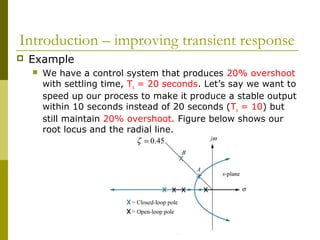
We have a control system that produces 20% overshoot
with settling time, Ts = 20 seconds. Let’s say we want to
speed up our process to make it produce a stable output
within 10 seconds instead of 20 seconds (Ts = 10) but
still maintain 20% overshoot. Figure below shows our
root locus and the radial line.
ζ = 0.45
Introduction – improving transient response


Based on the previous example, poles on the
same radial line will have the same
overshoot value. Pole at A has the same
overshoot as pole at B because both poles are
on the same radial line.



A point on the radial line that is further from
origin will have smaller settling time
compared to point on radial line that is close to
origin. Point at A has larger settling time
compared to point at B.
Introduction – improving transient response


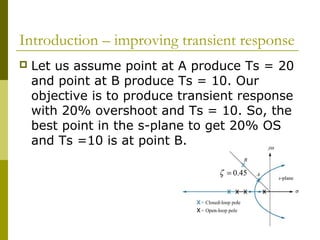
Let us assume point at A produce Ts = 20
and point at B produce Ts = 10. Our
objective is to produce transient response
with 20% overshoot and Ts = 10. So, the
best point in the s-plane to get 20% OS
and Ts =10 is at point B.
ζ = 0.45
Introduction – improving transient response


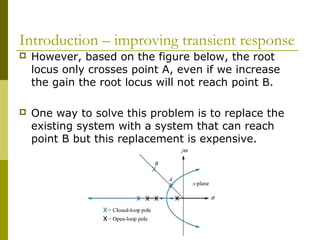
However, based on the figure below, the root
locus only crosses point A, even if we increase
the gain the root locus will not reach point B.



One way to solve this problem is to replace the
existing system with a system that can reach
point B but this replacement is expensive.
Introduction – improving transient response


A better method is compensate the
system with additional poles and zeros, so
that the compensated system has a root
locus that goes through the desired pole
location for some value of gain.


Disadvantage for this method is the system
order will increase and could effect our
transient response.
Introduction – improving steady-state error




Compensator can also be used to improve the
steady-state error.
In our previous chapter we varied the gain of
our system to meet the transient response
specification. When gain is varied our steadystate error will also change.




The higher the gain, the smaller the steady-state
error but the larger the percent overshoot.
Reducing the gain to reduce overshoot will increase
the steady-state error.
Introduction- Compensators


In summary, transient response is improved
with the addition of differentiation, and
steady state error is improved with the
addition of integration in the forward path.



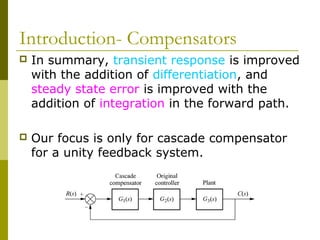
Our focus is only for cascade compensator
for a unity feedback system.
Introduction – modes of control


There are actually three “Modes of control”.






Proportional (P)
Integral (I)
Derivative (D)

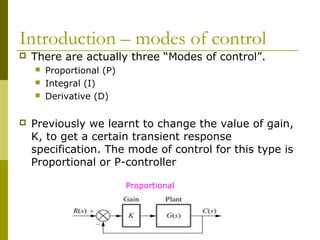
Previously we learnt to change the value of gain,
K, to get a certain transient response
specification. The mode of control for this type is
Proportional or P-controller
Proportional
Improving steady-state error via
cascade compensation


Proportional-plus-integral (PI) controller






Steady state error can be improved by placing
an open-loop pole at origin, because this will
increase the system type by one.
For example, a Type 0 system with step input
produces finite error. The error becomes zero
when we increase the type by one.
Preferably, we improve the steady-state-error
without affecting the transient response.
Improving steady-state error via
cascade compensation
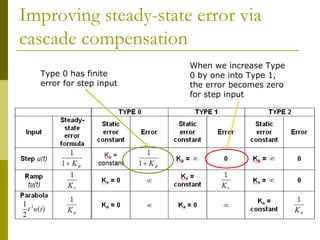
Type 0 has finite
error for step input

When we increase Type
0 by one into Type 1,
the error becomes zero
for step input
Improving steady-state error via
cascade compensation


Example for PI controller:


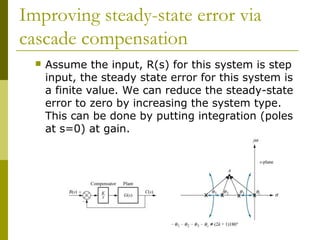
Figure below is an example of a unity feedback
system with gain, K. Point A is on the root
locus which means the [sum of zeros angle] –
[sum of poles angle] = odd multiples of 180̊.
Improving steady-state error via
cascade compensation


Assume the input, R(s) for this system is step
input, the steady state error for this system is
a finite value. We can reduce the steady-state
error to zero by increasing the system type.
This can be done by putting integration (poles
at s=0) at gain.
Improving steady-state error via
cascade compensation


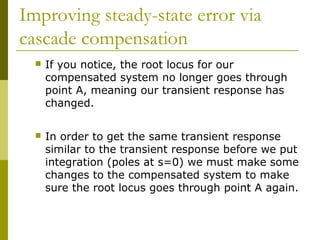
If you notice, the root locus for our
compensated system no longer goes through
point A, meaning our transient response has
changed.



In order to get the same transient response
similar to the transient response before we put
integration (poles at s=0) we must make some
changes to the compensated system to make
sure the root locus goes through point A again.
Improving steady-state error via
cascade compensation


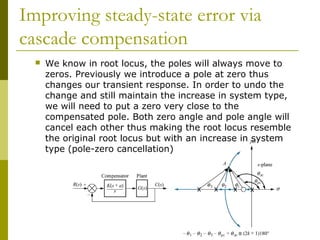
We know in root locus, the poles will always move to
zeros. Previously we introduce a pole at zero thus
changes our transient response. In order to undo the
change and still maintain the increase in system type,
we will need to put a zero very close to the
compensated pole. Both zero angle and pole angle will
cancel each other thus making the root locus resemble
the original root locus but with an increase in system
type (pole-zero cancellation)
Improving steady-state error via
cascade compensation


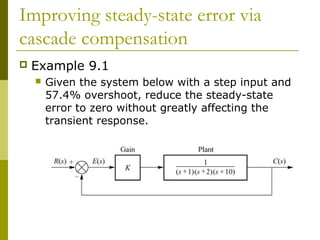
Example 9.1


Given the system below with a step input and
57.4% overshoot, reduce the steady-state
error to zero without greatly affecting the
transient response.
Improving steady-state error via
cascade compensation


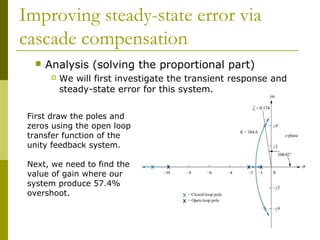
Analysis (solving the proportional part)


We will first investigate the transient response and
steady-state error for this system.

First draw the poles and
zeros using the open loop
transfer function of the
unity feedback system.
Next, we need to find the
value of gain where our
system produce 57.4%
overshoot.
Improving steady-state error via
cascade compensation


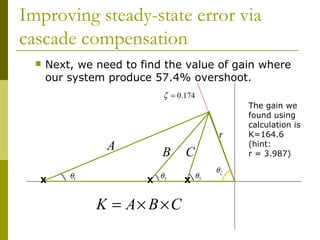
Next, we need to find the value of gain where
our system produce 57.4% overshoot.
ζ = 0.174

r

A
X

θ1

B
X

θ2

K = A× B × C

C
X

θ3

θζ

The gain we
found using
calculation is
K=164.6
(hint:
r = 3.987)
Improving steady-state error via
cascade compensation


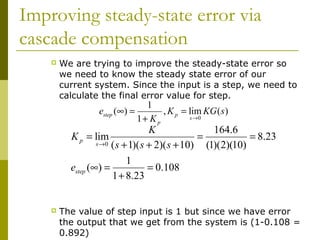
We are trying to improve the steady-state error so
we need to know the steady state error of our
current system. Since the input is a step, we need to
calculate the final error value for step.

1
estep (∞) =
, K p = lim KG ( s )
s →0
1+ K p

K
164.6
K p = lim
=
= 8.23
s →0 ( s + 1)( s + 2)( s + 10)
(1)(2)(10)
1
estep (∞) =
= 0.108
1 + 8.23


The value of step input is 1 but since we have error
the output that we get from the system is (1-0.108 =
0.892)
Improving steady-state error via
cascade compensation


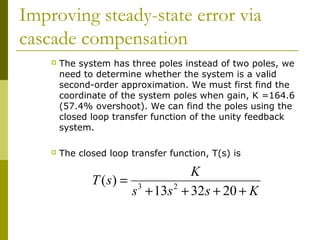
The system has three poles instead of two poles, we
need to determine whether the system is a valid
second-order approximation. We must first find the
coordinate of the system poles when gain, K =164.6
(57.4% overshoot). We can find the poles using the
closed loop transfer function of the unity feedback
system.



The closed loop transfer function, T(s) is

K
T ( s) = 3
s + 13s 2 + 32 s + 20 + K
Improving steady-state error via
cascade compensation


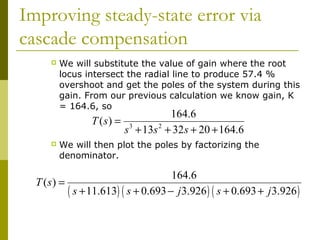
We will substitute the value of gain where the root
locus intersect the radial line to produce 57.4 %
overshoot and get the poles of the system during this
gain. From our previous calculation we know gain, K
= 164.6, so

T ( s) =


164.6
s 3 + 13s 2 + 32s + 20 + 164.6

We will then plot the poles by factorizing the
denominator.

164.6
T (s) =
( s + 11.613) ( s + 0.693 − j3.926 ) ( s + 0.693 + j3.926 )
Improving steady-state error via
cascade compensation


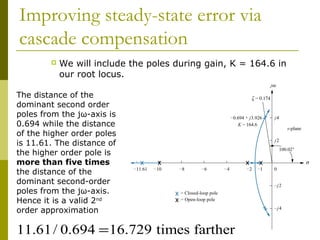
We will include the poles during gain, K = 164.6 in
our root locus.

The distance of the
dominant second order
poles from the jω-axis is
0.694 while the distance
of the higher order poles
is 11.61. The distance of
the higher order pole is
more than five times
the distance of the
dominant second-order
poles from the jω-axis.
Hence it is a valid 2nd
order approximation

11.61 / 0.694 = 16.729 times farther
Improving steady-state error via
cascade compensation


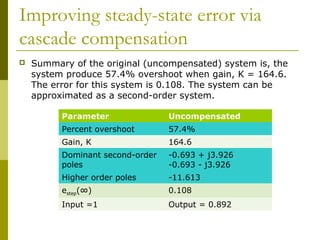
Summary of the original (uncompensated) system is, the
system produce 57.4% overshoot when gain, K = 164.6.
The error for this system is 0.108. The system can be
approximated as a second-order system.
Parameter

Uncompensated

Percent overshoot

57.4%

Gain, K

164.6

Dominant second-order
poles

-0.693 + j3.926
-0.693 - j3.926

Higher order poles

-11.613

estep(∞)

0.108

Input =1

Output = 0.892
Improving steady-state error via
cascade compensation


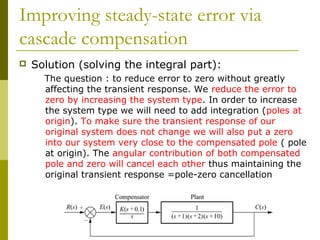
Solution (solving the integral part):
The question : to reduce error to zero without greatly
affecting the transient response. We reduce the error to
zero by increasing the system type. In order to increase
the system type we will need to add integration (poles at
origin). To make sure the transient response of our
original system does not change we will also put a zero
into our system very close to the compensated pole ( pole
at origin). The angular contribution of both compensated
pole and zero will cancel each other thus maintaining the
original transient response =pole-zero cancellation
Improving steady-state error via
cascade compensation


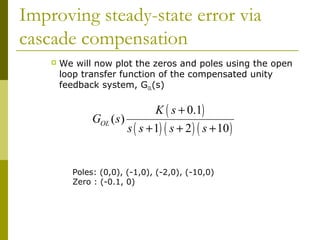
We will now plot the zeros and poles using the open
loop transfer function of the compensated unity
feedback system, GOL(s)

GOL ( s )

K ( s + 0.1)

s ( s + 1) ( s + 2 ) ( s + 10 )

Poles: (0,0), (-1,0), (-2,0), (-10,0)
Zero : (-0.1, 0)
Improving steady-state error via
cascade compensation


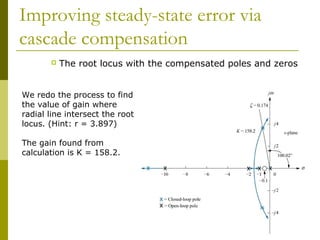
The root locus with the compensated poles and zeros

We redo the process to find
the value of gain where
radial line intersect the root
locus. (Hint: r = 3.897)
The gain found from
calculation is K = 158.2.
Improving steady-state error via
cascade compensation


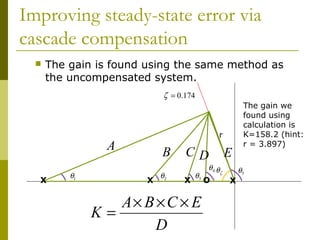
The gain is found using the same method as
the uncompensated system.
ζ = 0.174

r

A
X

θ1

B
X

θ2

CD
X

θ3

A× B × C × E
K=
D

θ4 θ

O

E
ζ

X

The gain we
found using
calculation is
K=158.2 (hint:
r = 3.897)
θ5
Improving steady-state error via
cascade compensation


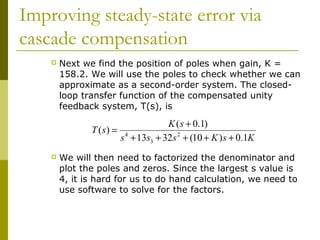
Next we find the position of poles when gain, K =
158.2. We will use the poles to check whether we can
approximate as a second-order system. The closedloop transfer function of the compensated unity
feedback system, T(s), is

T (s) =


K ( s + 0.1)
s 4 + 13s3 + 32s 2 + (10 + K ) s + 0.1K

We will then need to factorized the denominator and
plot the poles and zeros. Since the largest s value is
4, it is hard for us to do hand calculation, we need to
use software to solve for the factors.
Improving steady-state error via
cascade compensation


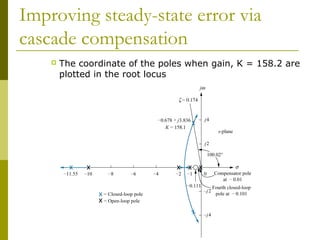
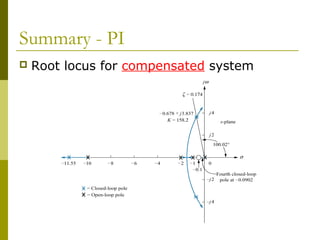
The coordinate of the poles when gain, K = 158.2 are
plotted in the root locus
Improving steady-state error via
cascade compensation


From the root locus, the higher order poles is far
from the jω-axis compared to the dominant secondorder poles. The zero is close to a close-loop pole
which means the angle contribution of both zero and
pole will cancel each other. In conclusion, the
compensated root locus can be approximated as a 2nd
order system.



The additional poles (integration) to the system has
increase the system type from Type 0 to Type 1.
Error for step input Type 1 is zero which means the
system produce no error but still maintain the same
overshoot value.
Improving steady-state error via
cascade compensation


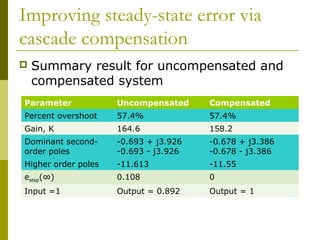
Summary result for uncompensated and
compensated system

Parameter

Uncompensated

Compensated

Percent overshoot

57.4%

57.4%

Gain, K

164.6

158.2

Dominant secondorder poles

-0.693 + j3.926
-0.693 - j3.926

-0.678 + j3.386
-0.678 - j3.386

Higher order poles

-11.613

-11.55

estep(∞)

0.108

0

Input =1

Output = 0.892

Output = 1
Improving steady-state error via
cascade compensation


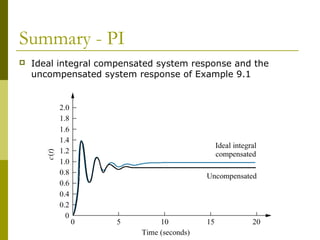
Based on the previous table, we can see
that our compensated system produces
zero error and at the same time the
coordinate of the dominant second order
poles and higher order poles for the
compensated an uncompensated system is
almost the same, which means the
transient response for both compensated
and uncompensated is almost the same.
The only difference is the compensated
system has zero error.
Summary - PI


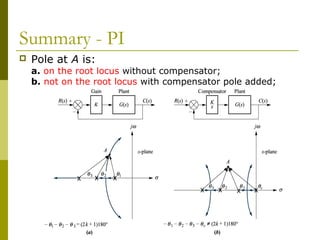
Pole at A is:

a. on the root locus without compensator;
b. not on the root locus with compensator pole added;
Summary - PI


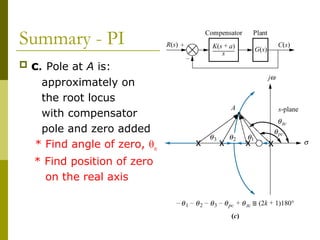
c. Pole at A is:
approximately on
the root locus
with compensator
pole and zero added
* Find angle of zero, θzc
* Find position of zero
on the real axis
Summary - PI


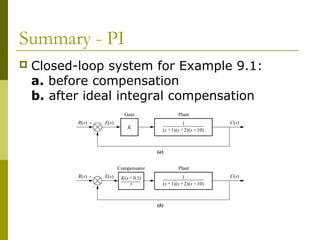
Closed-loop system for Example 9.1:
a. before compensation
b. after ideal integral compensation
Summary - PI


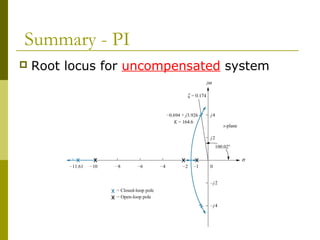
Root locus for uncompensated system
Summary - PI


Root locus for compensated system
Summary - PI


Ideal integral compensated system response and the
uncompensated system response of Example 9.1
Improving Transient Response via
cascade compensation


Since we have solved the problem of
improving the steady-state error without
affecting the transient response, let us
now improve the transient response itself.



The objective of improving the transient
response is to design a response that has
a desirable percent overshoot and a
shorter settling time than the
uncompensated system.
Improving Transient Response via
cascade compensation


Proportional-plus-derivative (PD)
controller




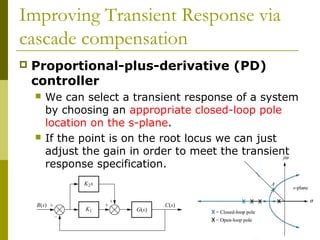
We can select a transient response of a system
by choosing an appropriate closed-loop pole
location on the s-plane.
If the point is on the root locus we can just
adjust the gain in order to meet the transient
response specification.
Improving Transient Response via
cascade compensation


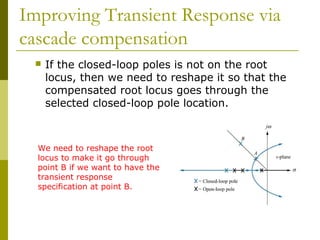
If the closed-loop poles is not on the root
locus, then we need to reshape it so that the
compensated root locus goes through the
selected closed-loop pole location.

We need to reshape the root
locus to make it go through
point B if we want to have the
transient response
specification at point B.
Improving Transient Response via
cascade compensation


We can reshape the root locus by adding
poles and zeros into the forward path. One
way to speed up the original system is to add
a single zero to the forward path.




Based on Laplace theorem, the Laplace form of
derivative is s, so adding an s is adding a derivative
to the system which is why this method is called
“proportional-plus-derivative controller”.

Adding derivative will speed up our system,
(reduce the settling time, Ts)
Improving Transient Response via
cascade compensation


Example for PD controller


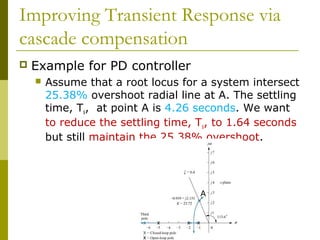
Assume that a root locus for a system intersect
25.38% overshoot radial line at A. The settling
time, Ts, at point A is 4.26 seconds. We want
to reduce the settling time, Ts, to 1.64 seconds
but still maintain the 25.38% overshoot.

A
Improving Transient Response via
cascade compensation


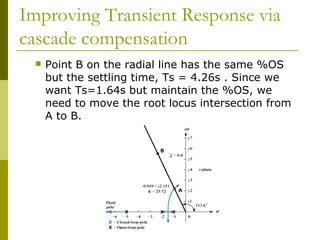
Point B on the radial line has the same %OS
but the settling time, Ts = 4.26s . Since we
want Ts=1.64s but maintain the %OS, we
need to move the root locus intersection from
A to B.
Improving Transient Response via
cascade compensation


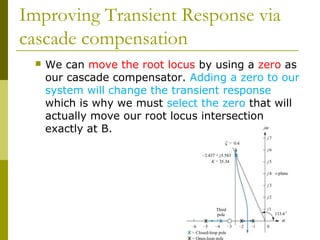
We can move the root locus by using a zero as
our cascade compensator. Adding a zero to our
system will change the transient response
which is why we must select the zero that will
actually move our root locus intersection
exactly at B.
Improving Transient Response via
cascade compensation


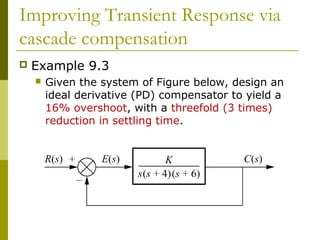
Example 9.3


Given the system of Figure below, design an
ideal derivative (PD) compensator to yield a
16% overshoot, with a threefold (3 times)
reduction in settling time.
Improving Transient Response via
cascade compensation


Analysis (solving the proportional part)





The question wants us to design the value of K to
yield 16% overshoot.
Additionally the question also wants us to reduce
the settling time threefold from the original
(proportional part) transient response.
First step is to draw the root locus of the
uncompensated (proportional part) system.





Use the open loop transfer function of the unity
feedback system. Plot the poles and zeros.
Find the asymptotes.
Sketch the root locus.
Improving Transient Response via
cascade compensation


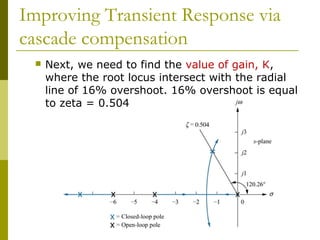
Next, we need to find the value of gain, K,
where the root locus intersect with the radial
line of 16% overshoot. 16% overshoot is equal
to zeta = 0.504
Improving Transient Response via
cascade compensation


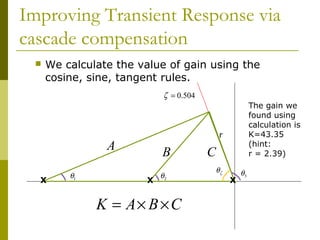
We calculate the value of gain using the
cosine, sine, tangent rules.
ζ = 0.504

r

A
X

θ1

The gain we
found using
calculation is
K=43.35
(hint:
r = 2.39)

B
X

θ2

K = A× B × C

C
θζ

X

θ3
Improving Transient Response via
cascade compensation


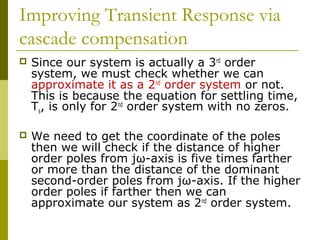
Since our system is actually a 3rd order
system, we must check whether we can
approximate it as a 2nd order system or not.
This is because the equation for settling time,
Ts, is only for 2nd order system with no zeros.



We need to get the coordinate of the poles
then we will check if the distance of higher
order poles from jω-axis is five times farther
or more than the distance of the dominant
second-order poles from jω-axis. If the higher
order poles if farther then we can
approximate our system as 2nd order system.
Improving Transient Response via
cascade compensation


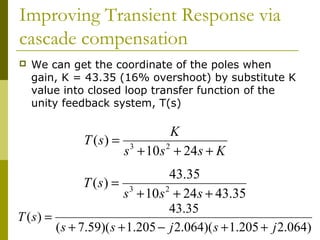
We can get the coordinate of the poles when
gain, K = 43.35 (16% overshoot) by substitute K
value into closed loop transfer function of the
unity feedback system, T(s)

K
T (s) = 3
2
s + 10s + 24s + K
43.35
T (s) = 3
2
s + 10 s + 24 s + 43.35
43.35
T (s) =
( s + 7.59)( s + 1.205 − j 2.064)( s + 1.205 + j 2.064)
Improving Transient Response via
cascade compensation


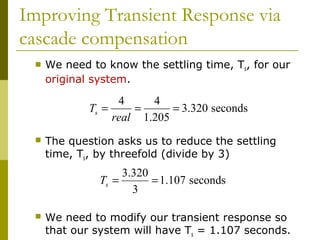
We need to know the settling time, Ts, for our
original system.

4
4
Ts =
=
= 3.320 seconds
real 1.205


The question asks us to reduce the settling
time, Ts, by threefold (divide by 3)

3.320
Ts =
= 1.107 seconds
3


We need to modify our transient response so
that our system will have Ts = 1.107 seconds.
Improving Transient Response via
cascade compensation


Solution ( solving the derivative part)
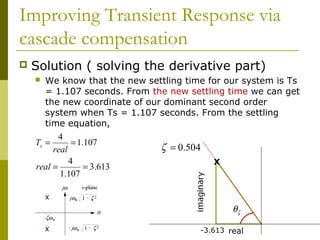
We know that the new settling time for our system is Ts
= 1.107 seconds. From the new settling time we can get
the new coordinate of our dominant second order
system when Ts = 1.107 seconds. From the settling
time equation,
4
Ts =
= 1.107
ζ = 0.504
real
4
X
real =
= 3.613
1.107



θζ
-3.613 real
Improving Transient Response via
cascade compensation


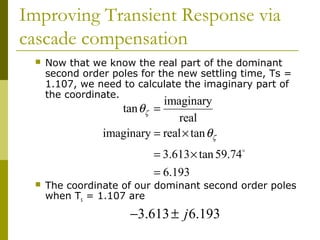
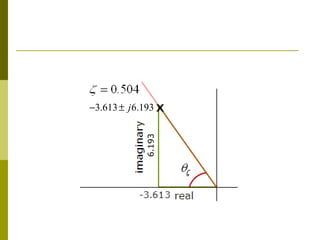
Now that we know the real part of the dominant
second order poles for the new settling time, Ts =
1.107, we need to calculate the imaginary part of
the coordinate.

imaginary
tan θζ =
real
imaginary = real × tan θζ

= 3.613 × tan 59.74o
= 6.193



The coordinate of our dominant second order poles
when Ts = 1.107 are

−3.613 ± j 6.193
6.193

−3.613 ± j 6.193
Improving Transient Response via
cascade compensation


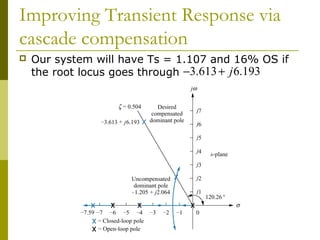
Our system will have Ts = 1.107 and 16% OS if
the root locus goes through −3.613 + j 6.193
Improving Transient Response via
cascade compensation


We need to move the root locus and make it
go through the desired compensated dominant
pole. In order to change the transient response
we must add derivative (or zero) to our
system.



We must make sure that the added zero to our
system will produce a transient response that
goes through our desired dominant second
order pole. To get the best coordinate of the
added zero we must first find the angle of our
zero in reference to the desired dominant pole
Improving Transient Response via
cascade compensation


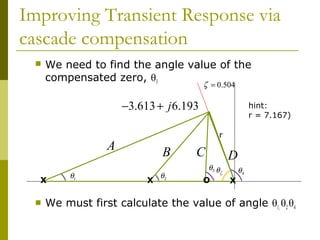
The value of the compensated zero angle can be calculated
using the fact that the [summation of zeros angle] minus
[summation of poles angle]=odd multiple of 180̊. We must use
the sine, cosine and tangent rules to calculate the angles.
ζ = 0.504

−3.613 + j 6.193

A
X

θ1

B
X

θ2

hint:
r = 7.167)

r

C
θ3 θ

ζ

O

D
θ4

X

∑ angle zeros − ∑ angle poles = 180o
Improving Transient Response via
cascade compensation


We need to find the angle value of the
compensated zero, θ3
ζ = 0.504

−3.613 + j 6.193
r

A
X


θ1

hint:
r = 7.167)

B
X

θ2

C
θ3 θ

O

D
ζ

X

θ4

We must first calculate the value of angle θ1, θ2 θ4
Improving Transient Response via
cascade compensation


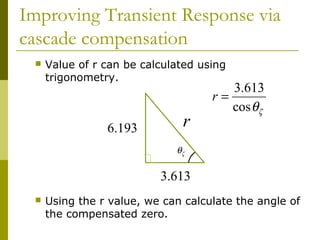
Value of r can be calculated using
trigonometry.

6.193

r

3.613
r=
cos θζ

θζ

3.613


Using the r value, we can calculate the angle of
the compensated zero.
Improving Transient Response via
cascade compensation


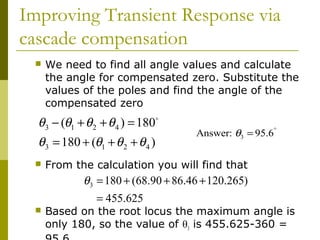
We need to find all angle values and calculate
the angle for compensated zero. Substitute the
values of the poles and find the angle of the
compensated zero

θ3 − (θ1 + θ 2 + θ 4 ) = 180
θ3 = 180 + (θ1 + θ 2 + θ 4 )


o

Answer: θ3 = 95.6°

From the calculation you will find that

θ3 = 180 + (68.90 + 86.46 + 120.265)
= 455.625



Based on the root locus the maximum angle is
only 180, so the value of θ3 is 455.625-360 =
Improving Transient Response via
cascade compensation


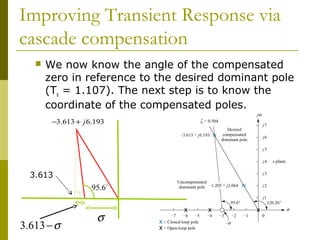
We now know the angle of the compensated
zero in reference to the desired dominant pole
(Ts = 1.107). The next step is to know the
coordinate of the compensated poles.
−3.613 + j 6.193

3.613

95.6o

3.613 − σ

σ
Improving Transient Response via
cascade compensation


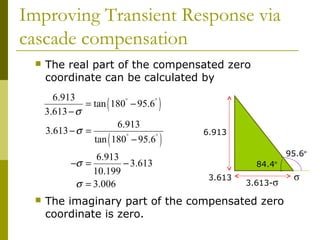
The real part of the compensated zero
coordinate can be calculated by
6.913
= tan 180° − 95.6°
3.613 − σ
6.913
3.613 − σ =
tan 180° − 95.6°

(

(

6.913
−σ =
− 3.613
10.199
σ = 3.006


)
)

6.913
95.6º
84.4º
3.613

3.613-σ

The imaginary part of the compensated zero
coordinate is zero.

σ
Improving Transient Response via
cascade compensation


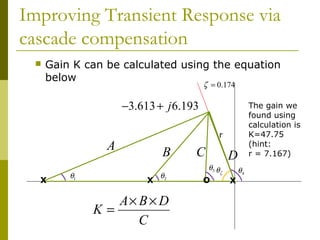
Gain K can be calculated using the equation
below
ζ = 0.174

−3.613 + j 6.193
r

A
X

θ1

The gain we
found using
calculation is
K=47.75
(hint:
r = 7.167)

B
X

θ2

A× B × D
K=
C

C
θ3 θ

O

D
ζ

X

θ4
Improving Transient Response via
cascade compensation


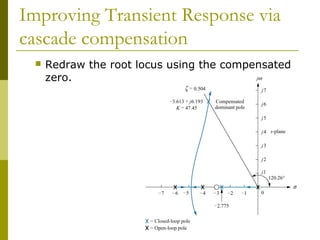
Redraw the root locus using the compensated
zero.
Improving Transient Response via
cascade compensation


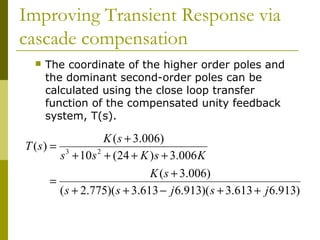
The coordinate of the higher order poles and
the dominant second-order poles can be
calculated using the close loop transfer
function of the compensated unity feedback
system, T(s).

K ( s + 3.006)
T (s) = 3
s + 10 s 2 + (24 + K ) s + 3.006 K
K ( s + 3.006)
=
( s + 2.775)( s + 3.613 − j 6.913)( s + 3.613 + j 6.913)
Improving Transient Response via
cascade compensation


The higher order closed loop pole is not very
close with the compensated zero. Maybe the
system cannot be approximate as a 2nd order
system. We must use simulation to determine
whether the %OS is the same between
uncompensated system and compensated
system.
Improving Transient Response via
cascade compensation


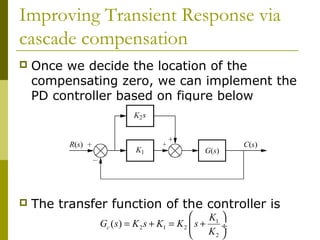
Once we decide the location of the
compensating zero, we can implement the
PD controller based on figure below



The transfer function of the controller is

K1 
Gc ( s ) = K 2 s + K1 = K 2  s +
÷
K2 

Improving Steady-State error and
Transient response


We can improve both steady-state error and
transient response for a system by combining the
PI controller and PD controller.



We can either improve the steady-state error first
then improve the transient response or improve
the transient response then improve the steady
state error.



PID controller that we are going to learn
improves the transient response then improves
the steady-state error.
Improving Steady-State error and
Transient response


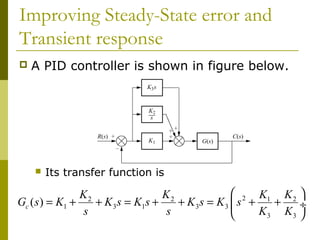
A PID controller is shown in figure below.



Its transfer function is

 2 K1 K 2 
K2
K2
Gc ( s ) = K1 +
+ K 3 s = K1s +
+ K3s = K3  s +
+
÷
s
s
K3 K3 

Improving Steady-State error and
Transient response


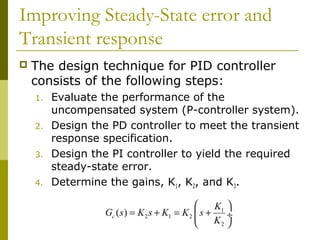
The design technique for PID controller
consists of the following steps:
1.
2.
3.
4.

Evaluate the performance of the
uncompensated system (P-controller system).
Design the PD controller to meet the transient
response specification.
Design the PI controller to yield the required
steady-state error.
Determine the gains, K1, K2, and K3.

K1 
Gc ( s ) = K 2 s + K1 = K 2  s +
÷
K2 

Improving Steady-State error and
Transient response


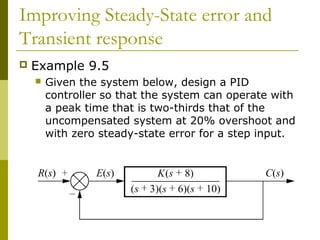
Example 9.5


Given the system below, design a PID
controller so that the system can operate with
a peak time that is two-thirds that of the
uncompensated system at 20% overshoot and
with zero steady-state error for a step input.
Improving Steady-State error and
Transient response


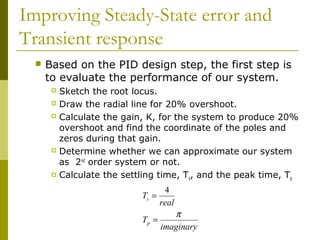
Based on the PID design step, the first step is
to evaluate the performance of our system.
Sketch the root locus.
 Draw the radial line for 20% overshoot.
 Calculate the gain, K, for the system to produce 20%
overshoot and find the coordinate of the poles and
zeros during that gain.
 Determine whether we can approximate our system
as 2nd order system or not.
 Calculate the settling time, T , and the peak time, T
s
p


Ts =

4
real

π
Tp =
imaginary
Improving Steady-State error and
Transient response


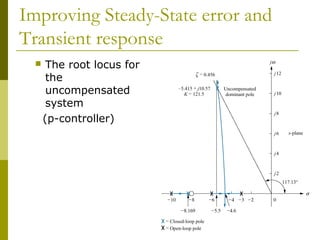
The root locus for
the
uncompensated
system
(p-controller)
Improving Steady-State error and
Transient response


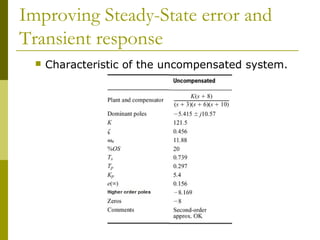
Characteristic of the uncompensated system.
Improving Steady-State error and
Transient response


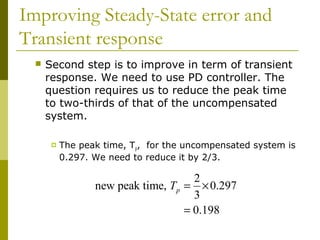
Second step is to improve in term of transient
response. We need to use PD controller. The
question requires us to reduce the peak time
to two-thirds of that of the uncompensated
system.


The peak time, Tp, for the uncompensated system is
0.297. We need to reduce it by 2/3.

2
new peak time, Tp = × 0.297
3
= 0.198
Improving Steady-State error and
Transient response


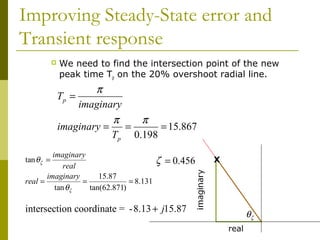
We need to find the intersection point of the new
peak time Tp on the 20% overshoot radial line.

π
imaginary
π
π
imaginary =
=
= 15.867
Tp 0.198

Tp =

imaginary
real
imaginary
15.87
real =
=
= 8.131
tan θζ
tan(62.871)
tan θζ =

ζ = 0.456

X

intersection coordinate = - 8.13 + j15.87

θζ
real
Improving Steady-State error and
Transient response


In order to change the transient response so that the
root locus will goes through the intersection point of
the new peak time, we must add a compensated zero
into our system.



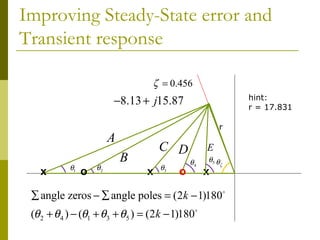
To get the coordinate of our compensated zero we
must first get the angle of the zero in reference to
the intersection point of the new peak time.
Improving Steady-State error and
Transient response
ζ = 0.456

−8.13 + j15.87
r

A
X

θ1

O

θ2

hint:
r = 17.831

C D

B
X

θ3

O

E
θ4

θ5 θ

X

ζ

∑ angle zeros − ∑ angle poles = (2k − 1)180o
(θ 2 + θ 4 ) − (θ1 + θ3 + θ5 ) = (2k − 1)180o
Improving Steady-State error and
Transient response



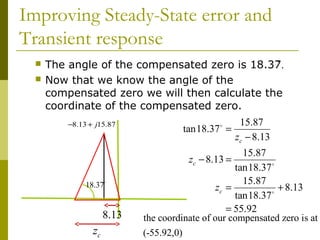
The angle of the compensated zero is 18.37.
̊
Now that we know the angle of the
compensated zero we will then calculate the
coordinate of the compensated zero.
−8.13 + j15.87

18.37o

8.13

zc

15.87
tan18.37 =
zc − 8.13
o

15.87
zc − 8.13 =
tan18.37o
15.87
zc =
+ 8.13
o
tan18.37
= 55.92
the coordinate of our compensated zero is at
(-55.92,0)
Improving Steady-State error and
Transient response


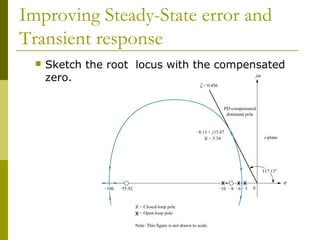
Sketch the root locus with the compensated
zero.
Improving Steady-State error and
Transient response


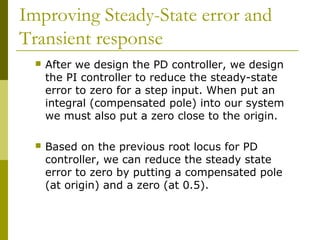
After we design the PD controller, we design
the PI controller to reduce the steady-state
error to zero for a step input. When put an
integral (compensated pole) into our system
we must also put a zero close to the origin.



Based on the previous root locus for PD
controller, we can reduce the steady state
error to zero by putting a compensated pole
(at origin) and a zero (at 0.5).
Improving Steady-State error and
Transient response


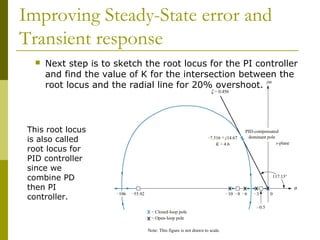
Next step is to sketch the root locus for the PI controller
and find the value of K for the intersection between the
root locus and the radial line for 20% overshoot.

This root locus
is also called
root locus for
PID controller
since we
combine PD
then PI
controller.
Improving Steady-State error and
Transient response


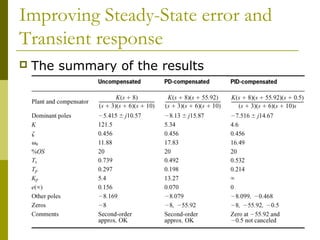
The summary of the results
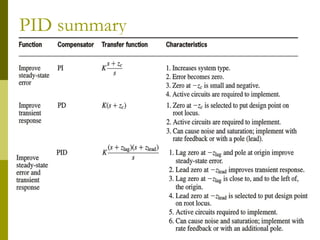
PID summary

Control chap8

  • 1.
    CONTROL SYSTEMS THEORY Design Usingthe Graphical Tool CHAPTER 8 STB 35103
  • 2.
    Objectives  To use theroot locus to design cascade compensators to improve the steady-state error.  To use the root locus to design cascade compensator to improve the transient response.  To use the root locus to design cascade compensator to improve the steady-state error and the transient response.
  • 3.
    Introduction  In our previouschapter we learnt how to sketch the root locus. The root locus allows us to choose the proper loop gain (value of K) to meet a transient response specification (e.g. %OS).  Setting the gain at a particular value will produce the transient response dictated by the poles at that point on the root locus. Thus we are limited to those response that exist along the root locus.
  • 4.
    Introduction  When we designa control system the two most important things that we will consider are:  Transient response   Settling time, percent overshoot, peak time Steady-state error  The difference between the input and the output
  • 5.
    Introduction – improvingtransient response  Example  We have a control system that produces 20% overshoot with settling time, Ts = 20 seconds. Let’s say we want to speed up our process to make it produce a stable output within 10 seconds instead of 20 seconds (Ts = 10) but still maintain 20% overshoot. Figure below shows our root locus and the radial line. ζ = 0.45
  • 6.
    Introduction – improvingtransient response  Based on the previous example, poles on the same radial line will have the same overshoot value. Pole at A has the same overshoot as pole at B because both poles are on the same radial line.  A point on the radial line that is further from origin will have smaller settling time compared to point on radial line that is close to origin. Point at A has larger settling time compared to point at B.
  • 8.
    Introduction – improvingtransient response  Let us assume point at A produce Ts = 20 and point at B produce Ts = 10. Our objective is to produce transient response with 20% overshoot and Ts = 10. So, the best point in the s-plane to get 20% OS and Ts =10 is at point B. ζ = 0.45
  • 9.
    Introduction – improvingtransient response  However, based on the figure below, the root locus only crosses point A, even if we increase the gain the root locus will not reach point B.  One way to solve this problem is to replace the existing system with a system that can reach point B but this replacement is expensive.
  • 10.
    Introduction – improvingtransient response  A better method is compensate the system with additional poles and zeros, so that the compensated system has a root locus that goes through the desired pole location for some value of gain.  Disadvantage for this method is the system order will increase and could effect our transient response.
  • 11.
    Introduction – improvingsteady-state error   Compensator can also be used to improve the steady-state error. In our previous chapter we varied the gain of our system to meet the transient response specification. When gain is varied our steadystate error will also change.   The higher the gain, the smaller the steady-state error but the larger the percent overshoot. Reducing the gain to reduce overshoot will increase the steady-state error.
  • 12.
    Introduction- Compensators  In summary,transient response is improved with the addition of differentiation, and steady state error is improved with the addition of integration in the forward path.  Our focus is only for cascade compensator for a unity feedback system.
  • 13.
    Introduction – modesof control  There are actually three “Modes of control”.     Proportional (P) Integral (I) Derivative (D) Previously we learnt to change the value of gain, K, to get a certain transient response specification. The mode of control for this type is Proportional or P-controller Proportional
  • 14.
    Improving steady-state errorvia cascade compensation  Proportional-plus-integral (PI) controller    Steady state error can be improved by placing an open-loop pole at origin, because this will increase the system type by one. For example, a Type 0 system with step input produces finite error. The error becomes zero when we increase the type by one. Preferably, we improve the steady-state-error without affecting the transient response.
  • 15.
    Improving steady-state errorvia cascade compensation Type 0 has finite error for step input When we increase Type 0 by one into Type 1, the error becomes zero for step input
  • 16.
    Improving steady-state errorvia cascade compensation  Example for PI controller:  Figure below is an example of a unity feedback system with gain, K. Point A is on the root locus which means the [sum of zeros angle] – [sum of poles angle] = odd multiples of 180̊.
  • 17.
    Improving steady-state errorvia cascade compensation  Assume the input, R(s) for this system is step input, the steady state error for this system is a finite value. We can reduce the steady-state error to zero by increasing the system type. This can be done by putting integration (poles at s=0) at gain.
  • 18.
    Improving steady-state errorvia cascade compensation  If you notice, the root locus for our compensated system no longer goes through point A, meaning our transient response has changed.  In order to get the same transient response similar to the transient response before we put integration (poles at s=0) we must make some changes to the compensated system to make sure the root locus goes through point A again.
  • 19.
    Improving steady-state errorvia cascade compensation  We know in root locus, the poles will always move to zeros. Previously we introduce a pole at zero thus changes our transient response. In order to undo the change and still maintain the increase in system type, we will need to put a zero very close to the compensated pole. Both zero angle and pole angle will cancel each other thus making the root locus resemble the original root locus but with an increase in system type (pole-zero cancellation)
  • 20.
    Improving steady-state errorvia cascade compensation  Example 9.1  Given the system below with a step input and 57.4% overshoot, reduce the steady-state error to zero without greatly affecting the transient response.
  • 21.
    Improving steady-state errorvia cascade compensation  Analysis (solving the proportional part)  We will first investigate the transient response and steady-state error for this system. First draw the poles and zeros using the open loop transfer function of the unity feedback system. Next, we need to find the value of gain where our system produce 57.4% overshoot.
  • 22.
    Improving steady-state errorvia cascade compensation  Next, we need to find the value of gain where our system produce 57.4% overshoot. ζ = 0.174 r A X θ1 B X θ2 K = A× B × C C X θ3 θζ The gain we found using calculation is K=164.6 (hint: r = 3.987)
  • 23.
    Improving steady-state errorvia cascade compensation  We are trying to improve the steady-state error so we need to know the steady state error of our current system. Since the input is a step, we need to calculate the final error value for step. 1 estep (∞) = , K p = lim KG ( s ) s →0 1+ K p K 164.6 K p = lim = = 8.23 s →0 ( s + 1)( s + 2)( s + 10) (1)(2)(10) 1 estep (∞) = = 0.108 1 + 8.23  The value of step input is 1 but since we have error the output that we get from the system is (1-0.108 = 0.892)
  • 24.
    Improving steady-state errorvia cascade compensation  The system has three poles instead of two poles, we need to determine whether the system is a valid second-order approximation. We must first find the coordinate of the system poles when gain, K =164.6 (57.4% overshoot). We can find the poles using the closed loop transfer function of the unity feedback system.  The closed loop transfer function, T(s) is K T ( s) = 3 s + 13s 2 + 32 s + 20 + K
  • 25.
    Improving steady-state errorvia cascade compensation  We will substitute the value of gain where the root locus intersect the radial line to produce 57.4 % overshoot and get the poles of the system during this gain. From our previous calculation we know gain, K = 164.6, so T ( s) =  164.6 s 3 + 13s 2 + 32s + 20 + 164.6 We will then plot the poles by factorizing the denominator. 164.6 T (s) = ( s + 11.613) ( s + 0.693 − j3.926 ) ( s + 0.693 + j3.926 )
  • 26.
    Improving steady-state errorvia cascade compensation  We will include the poles during gain, K = 164.6 in our root locus. The distance of the dominant second order poles from the jω-axis is 0.694 while the distance of the higher order poles is 11.61. The distance of the higher order pole is more than five times the distance of the dominant second-order poles from the jω-axis. Hence it is a valid 2nd order approximation 11.61 / 0.694 = 16.729 times farther
  • 27.
    Improving steady-state errorvia cascade compensation  Summary of the original (uncompensated) system is, the system produce 57.4% overshoot when gain, K = 164.6. The error for this system is 0.108. The system can be approximated as a second-order system. Parameter Uncompensated Percent overshoot 57.4% Gain, K 164.6 Dominant second-order poles -0.693 + j3.926 -0.693 - j3.926 Higher order poles -11.613 estep(∞) 0.108 Input =1 Output = 0.892
  • 28.
    Improving steady-state errorvia cascade compensation  Solution (solving the integral part): The question : to reduce error to zero without greatly affecting the transient response. We reduce the error to zero by increasing the system type. In order to increase the system type we will need to add integration (poles at origin). To make sure the transient response of our original system does not change we will also put a zero into our system very close to the compensated pole ( pole at origin). The angular contribution of both compensated pole and zero will cancel each other thus maintaining the original transient response =pole-zero cancellation
  • 29.
    Improving steady-state errorvia cascade compensation  We will now plot the zeros and poles using the open loop transfer function of the compensated unity feedback system, GOL(s) GOL ( s ) K ( s + 0.1) s ( s + 1) ( s + 2 ) ( s + 10 ) Poles: (0,0), (-1,0), (-2,0), (-10,0) Zero : (-0.1, 0)
  • 30.
    Improving steady-state errorvia cascade compensation  The root locus with the compensated poles and zeros We redo the process to find the value of gain where radial line intersect the root locus. (Hint: r = 3.897) The gain found from calculation is K = 158.2.
  • 31.
    Improving steady-state errorvia cascade compensation  The gain is found using the same method as the uncompensated system. ζ = 0.174 r A X θ1 B X θ2 CD X θ3 A× B × C × E K= D θ4 θ O E ζ X The gain we found using calculation is K=158.2 (hint: r = 3.897) θ5
  • 32.
    Improving steady-state errorvia cascade compensation  Next we find the position of poles when gain, K = 158.2. We will use the poles to check whether we can approximate as a second-order system. The closedloop transfer function of the compensated unity feedback system, T(s), is T (s) =  K ( s + 0.1) s 4 + 13s3 + 32s 2 + (10 + K ) s + 0.1K We will then need to factorized the denominator and plot the poles and zeros. Since the largest s value is 4, it is hard for us to do hand calculation, we need to use software to solve for the factors.
  • 33.
    Improving steady-state errorvia cascade compensation  The coordinate of the poles when gain, K = 158.2 are plotted in the root locus
  • 34.
    Improving steady-state errorvia cascade compensation  From the root locus, the higher order poles is far from the jω-axis compared to the dominant secondorder poles. The zero is close to a close-loop pole which means the angle contribution of both zero and pole will cancel each other. In conclusion, the compensated root locus can be approximated as a 2nd order system.  The additional poles (integration) to the system has increase the system type from Type 0 to Type 1. Error for step input Type 1 is zero which means the system produce no error but still maintain the same overshoot value.
  • 35.
    Improving steady-state errorvia cascade compensation  Summary result for uncompensated and compensated system Parameter Uncompensated Compensated Percent overshoot 57.4% 57.4% Gain, K 164.6 158.2 Dominant secondorder poles -0.693 + j3.926 -0.693 - j3.926 -0.678 + j3.386 -0.678 - j3.386 Higher order poles -11.613 -11.55 estep(∞) 0.108 0 Input =1 Output = 0.892 Output = 1
  • 36.
    Improving steady-state errorvia cascade compensation  Based on the previous table, we can see that our compensated system produces zero error and at the same time the coordinate of the dominant second order poles and higher order poles for the compensated an uncompensated system is almost the same, which means the transient response for both compensated and uncompensated is almost the same. The only difference is the compensated system has zero error.
  • 37.
    Summary - PI  Poleat A is: a. on the root locus without compensator; b. not on the root locus with compensator pole added;
  • 38.
    Summary - PI  c.Pole at A is: approximately on the root locus with compensator pole and zero added * Find angle of zero, θzc * Find position of zero on the real axis
  • 39.
    Summary - PI  Closed-loopsystem for Example 9.1: a. before compensation b. after ideal integral compensation
  • 40.
    Summary - PI  Rootlocus for uncompensated system
  • 41.
    Summary - PI  Rootlocus for compensated system
  • 42.
    Summary - PI  Idealintegral compensated system response and the uncompensated system response of Example 9.1
  • 43.
    Improving Transient Responsevia cascade compensation  Since we have solved the problem of improving the steady-state error without affecting the transient response, let us now improve the transient response itself.  The objective of improving the transient response is to design a response that has a desirable percent overshoot and a shorter settling time than the uncompensated system.
  • 44.
    Improving Transient Responsevia cascade compensation  Proportional-plus-derivative (PD) controller   We can select a transient response of a system by choosing an appropriate closed-loop pole location on the s-plane. If the point is on the root locus we can just adjust the gain in order to meet the transient response specification.
  • 45.
    Improving Transient Responsevia cascade compensation  If the closed-loop poles is not on the root locus, then we need to reshape it so that the compensated root locus goes through the selected closed-loop pole location. We need to reshape the root locus to make it go through point B if we want to have the transient response specification at point B.
  • 46.
    Improving Transient Responsevia cascade compensation  We can reshape the root locus by adding poles and zeros into the forward path. One way to speed up the original system is to add a single zero to the forward path.   Based on Laplace theorem, the Laplace form of derivative is s, so adding an s is adding a derivative to the system which is why this method is called “proportional-plus-derivative controller”. Adding derivative will speed up our system, (reduce the settling time, Ts)
  • 47.
    Improving Transient Responsevia cascade compensation  Example for PD controller  Assume that a root locus for a system intersect 25.38% overshoot radial line at A. The settling time, Ts, at point A is 4.26 seconds. We want to reduce the settling time, Ts, to 1.64 seconds but still maintain the 25.38% overshoot. A
  • 48.
    Improving Transient Responsevia cascade compensation  Point B on the radial line has the same %OS but the settling time, Ts = 4.26s . Since we want Ts=1.64s but maintain the %OS, we need to move the root locus intersection from A to B.
  • 49.
    Improving Transient Responsevia cascade compensation  We can move the root locus by using a zero as our cascade compensator. Adding a zero to our system will change the transient response which is why we must select the zero that will actually move our root locus intersection exactly at B.
  • 50.
    Improving Transient Responsevia cascade compensation  Example 9.3  Given the system of Figure below, design an ideal derivative (PD) compensator to yield a 16% overshoot, with a threefold (3 times) reduction in settling time.
  • 51.
    Improving Transient Responsevia cascade compensation  Analysis (solving the proportional part)    The question wants us to design the value of K to yield 16% overshoot. Additionally the question also wants us to reduce the settling time threefold from the original (proportional part) transient response. First step is to draw the root locus of the uncompensated (proportional part) system.    Use the open loop transfer function of the unity feedback system. Plot the poles and zeros. Find the asymptotes. Sketch the root locus.
  • 52.
    Improving Transient Responsevia cascade compensation  Next, we need to find the value of gain, K, where the root locus intersect with the radial line of 16% overshoot. 16% overshoot is equal to zeta = 0.504
  • 53.
    Improving Transient Responsevia cascade compensation  We calculate the value of gain using the cosine, sine, tangent rules. ζ = 0.504 r A X θ1 The gain we found using calculation is K=43.35 (hint: r = 2.39) B X θ2 K = A× B × C C θζ X θ3
  • 54.
    Improving Transient Responsevia cascade compensation  Since our system is actually a 3rd order system, we must check whether we can approximate it as a 2nd order system or not. This is because the equation for settling time, Ts, is only for 2nd order system with no zeros.  We need to get the coordinate of the poles then we will check if the distance of higher order poles from jω-axis is five times farther or more than the distance of the dominant second-order poles from jω-axis. If the higher order poles if farther then we can approximate our system as 2nd order system.
  • 55.
    Improving Transient Responsevia cascade compensation  We can get the coordinate of the poles when gain, K = 43.35 (16% overshoot) by substitute K value into closed loop transfer function of the unity feedback system, T(s) K T (s) = 3 2 s + 10s + 24s + K 43.35 T (s) = 3 2 s + 10 s + 24 s + 43.35 43.35 T (s) = ( s + 7.59)( s + 1.205 − j 2.064)( s + 1.205 + j 2.064)
  • 56.
    Improving Transient Responsevia cascade compensation  We need to know the settling time, Ts, for our original system. 4 4 Ts = = = 3.320 seconds real 1.205  The question asks us to reduce the settling time, Ts, by threefold (divide by 3) 3.320 Ts = = 1.107 seconds 3  We need to modify our transient response so that our system will have Ts = 1.107 seconds.
  • 57.
    Improving Transient Responsevia cascade compensation  Solution ( solving the derivative part) We know that the new settling time for our system is Ts = 1.107 seconds. From the new settling time we can get the new coordinate of our dominant second order system when Ts = 1.107 seconds. From the settling time equation, 4 Ts = = 1.107 ζ = 0.504 real 4 X real = = 3.613 1.107  θζ -3.613 real
  • 58.
    Improving Transient Responsevia cascade compensation  Now that we know the real part of the dominant second order poles for the new settling time, Ts = 1.107, we need to calculate the imaginary part of the coordinate. imaginary tan θζ = real imaginary = real × tan θζ = 3.613 × tan 59.74o = 6.193  The coordinate of our dominant second order poles when Ts = 1.107 are −3.613 ± j 6.193
  • 59.
  • 60.
    Improving Transient Responsevia cascade compensation  Our system will have Ts = 1.107 and 16% OS if the root locus goes through −3.613 + j 6.193
  • 61.
    Improving Transient Responsevia cascade compensation  We need to move the root locus and make it go through the desired compensated dominant pole. In order to change the transient response we must add derivative (or zero) to our system.  We must make sure that the added zero to our system will produce a transient response that goes through our desired dominant second order pole. To get the best coordinate of the added zero we must first find the angle of our zero in reference to the desired dominant pole
  • 62.
    Improving Transient Responsevia cascade compensation  The value of the compensated zero angle can be calculated using the fact that the [summation of zeros angle] minus [summation of poles angle]=odd multiple of 180̊. We must use the sine, cosine and tangent rules to calculate the angles. ζ = 0.504 −3.613 + j 6.193 A X θ1 B X θ2 hint: r = 7.167) r C θ3 θ ζ O D θ4 X ∑ angle zeros − ∑ angle poles = 180o
  • 63.
    Improving Transient Responsevia cascade compensation  We need to find the angle value of the compensated zero, θ3 ζ = 0.504 −3.613 + j 6.193 r A X  θ1 hint: r = 7.167) B X θ2 C θ3 θ O D ζ X θ4 We must first calculate the value of angle θ1, θ2 θ4
  • 64.
    Improving Transient Responsevia cascade compensation  Value of r can be calculated using trigonometry. 6.193 r 3.613 r= cos θζ θζ 3.613  Using the r value, we can calculate the angle of the compensated zero.
  • 65.
    Improving Transient Responsevia cascade compensation  We need to find all angle values and calculate the angle for compensated zero. Substitute the values of the poles and find the angle of the compensated zero θ3 − (θ1 + θ 2 + θ 4 ) = 180 θ3 = 180 + (θ1 + θ 2 + θ 4 )  o Answer: θ3 = 95.6° From the calculation you will find that θ3 = 180 + (68.90 + 86.46 + 120.265) = 455.625  Based on the root locus the maximum angle is only 180, so the value of θ3 is 455.625-360 =
  • 66.
    Improving Transient Responsevia cascade compensation  We now know the angle of the compensated zero in reference to the desired dominant pole (Ts = 1.107). The next step is to know the coordinate of the compensated poles. −3.613 + j 6.193 3.613 95.6o 3.613 − σ σ
  • 67.
    Improving Transient Responsevia cascade compensation  The real part of the compensated zero coordinate can be calculated by 6.913 = tan 180° − 95.6° 3.613 − σ 6.913 3.613 − σ = tan 180° − 95.6° ( ( 6.913 −σ = − 3.613 10.199 σ = 3.006  ) ) 6.913 95.6º 84.4º 3.613 3.613-σ The imaginary part of the compensated zero coordinate is zero. σ
  • 68.
    Improving Transient Responsevia cascade compensation  Gain K can be calculated using the equation below ζ = 0.174 −3.613 + j 6.193 r A X θ1 The gain we found using calculation is K=47.75 (hint: r = 7.167) B X θ2 A× B × D K= C C θ3 θ O D ζ X θ4
  • 69.
    Improving Transient Responsevia cascade compensation  Redraw the root locus using the compensated zero.
  • 70.
    Improving Transient Responsevia cascade compensation  The coordinate of the higher order poles and the dominant second-order poles can be calculated using the close loop transfer function of the compensated unity feedback system, T(s). K ( s + 3.006) T (s) = 3 s + 10 s 2 + (24 + K ) s + 3.006 K K ( s + 3.006) = ( s + 2.775)( s + 3.613 − j 6.913)( s + 3.613 + j 6.913)
  • 71.
    Improving Transient Responsevia cascade compensation  The higher order closed loop pole is not very close with the compensated zero. Maybe the system cannot be approximate as a 2nd order system. We must use simulation to determine whether the %OS is the same between uncompensated system and compensated system.
  • 72.
    Improving Transient Responsevia cascade compensation  Once we decide the location of the compensating zero, we can implement the PD controller based on figure below  The transfer function of the controller is  K1  Gc ( s ) = K 2 s + K1 = K 2  s + ÷ K2  
  • 73.
    Improving Steady-State errorand Transient response  We can improve both steady-state error and transient response for a system by combining the PI controller and PD controller.  We can either improve the steady-state error first then improve the transient response or improve the transient response then improve the steady state error.  PID controller that we are going to learn improves the transient response then improves the steady-state error.
  • 74.
    Improving Steady-State errorand Transient response  A PID controller is shown in figure below.  Its transfer function is  2 K1 K 2  K2 K2 Gc ( s ) = K1 + + K 3 s = K1s + + K3s = K3  s + + ÷ s s K3 K3  
  • 75.
    Improving Steady-State errorand Transient response  The design technique for PID controller consists of the following steps: 1. 2. 3. 4. Evaluate the performance of the uncompensated system (P-controller system). Design the PD controller to meet the transient response specification. Design the PI controller to yield the required steady-state error. Determine the gains, K1, K2, and K3.  K1  Gc ( s ) = K 2 s + K1 = K 2  s + ÷ K2  
  • 76.
    Improving Steady-State errorand Transient response  Example 9.5  Given the system below, design a PID controller so that the system can operate with a peak time that is two-thirds that of the uncompensated system at 20% overshoot and with zero steady-state error for a step input.
  • 77.
    Improving Steady-State errorand Transient response  Based on the PID design step, the first step is to evaluate the performance of our system. Sketch the root locus.  Draw the radial line for 20% overshoot.  Calculate the gain, K, for the system to produce 20% overshoot and find the coordinate of the poles and zeros during that gain.  Determine whether we can approximate our system as 2nd order system or not.  Calculate the settling time, T , and the peak time, T s p  Ts = 4 real π Tp = imaginary
  • 78.
    Improving Steady-State errorand Transient response  The root locus for the uncompensated system (p-controller)
  • 79.
    Improving Steady-State errorand Transient response  Characteristic of the uncompensated system.
  • 80.
    Improving Steady-State errorand Transient response  Second step is to improve in term of transient response. We need to use PD controller. The question requires us to reduce the peak time to two-thirds of that of the uncompensated system.  The peak time, Tp, for the uncompensated system is 0.297. We need to reduce it by 2/3. 2 new peak time, Tp = × 0.297 3 = 0.198
  • 81.
    Improving Steady-State errorand Transient response  We need to find the intersection point of the new peak time Tp on the 20% overshoot radial line. π imaginary π π imaginary = = = 15.867 Tp 0.198 Tp = imaginary real imaginary 15.87 real = = = 8.131 tan θζ tan(62.871) tan θζ = ζ = 0.456 X intersection coordinate = - 8.13 + j15.87 θζ real
  • 82.
    Improving Steady-State errorand Transient response  In order to change the transient response so that the root locus will goes through the intersection point of the new peak time, we must add a compensated zero into our system.  To get the coordinate of our compensated zero we must first get the angle of the zero in reference to the intersection point of the new peak time.
  • 83.
    Improving Steady-State errorand Transient response ζ = 0.456 −8.13 + j15.87 r A X θ1 O θ2 hint: r = 17.831 C D B X θ3 O E θ4 θ5 θ X ζ ∑ angle zeros − ∑ angle poles = (2k − 1)180o (θ 2 + θ 4 ) − (θ1 + θ3 + θ5 ) = (2k − 1)180o
  • 84.
    Improving Steady-State errorand Transient response   The angle of the compensated zero is 18.37. ̊ Now that we know the angle of the compensated zero we will then calculate the coordinate of the compensated zero. −8.13 + j15.87 18.37o 8.13 zc 15.87 tan18.37 = zc − 8.13 o 15.87 zc − 8.13 = tan18.37o 15.87 zc = + 8.13 o tan18.37 = 55.92 the coordinate of our compensated zero is at (-55.92,0)
  • 85.
    Improving Steady-State errorand Transient response  Sketch the root locus with the compensated zero.
  • 86.
    Improving Steady-State errorand Transient response  After we design the PD controller, we design the PI controller to reduce the steady-state error to zero for a step input. When put an integral (compensated pole) into our system we must also put a zero close to the origin.  Based on the previous root locus for PD controller, we can reduce the steady state error to zero by putting a compensated pole (at origin) and a zero (at 0.5).
  • 87.
    Improving Steady-State errorand Transient response  Next step is to sketch the root locus for the PI controller and find the value of K for the intersection between the root locus and the radial line for 20% overshoot. This root locus is also called root locus for PID controller since we combine PD then PI controller.
  • 88.
    Improving Steady-State errorand Transient response  The summary of the results
  • 89.