MODULE-II
SUSPENSION
DRIVE LINE
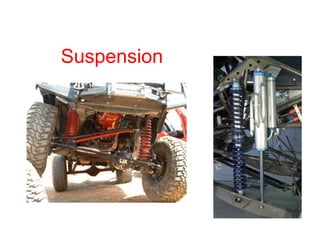
Suspension
Suspension System
Introduction:
• The automobile frame and body are mounted on the front and rear
axle not directly but through the springs and shock absorbers.
• The assembly of parts, which perform the isolation of parts from the
road shocks, may be in the forms of bounce, pitch and roll is called
suspension system.
Note:
 suspension system consists of a spring and damper.
 The energy of road shock causes the spring to oscillate.
 These oscillations are restricted to a reasonable level by the
damper, which is more commonly called as shock absorbers.
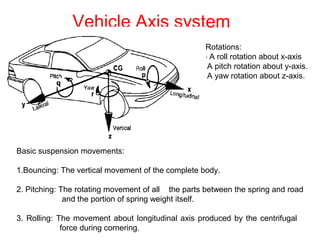
• Rotations:
– A roll rotation about x-axis
– A pitch rotation about y-axis.
– A yaw rotation about z-axis.
Vehicle Axis system
Basic suspension movements:
1.Bouncing: The vertical movement of the complete body.
2. Pitching: The rotating movement of all the parts between the spring and road
and the portion of spring weight itself.
3. Rolling: The movement about longitudinal axis produced by the centrifugal
force during cornering.
SUSPENSION SYSTEM – LAY OUT
Functions of suspension system
1. It prevents the vehicle body and frame from road shocks.
2. It gives stability of the vehicle.
3. It safeguards the passengers and goods from road shocks.
4. It gives the good road holding while driving, cornering and braking.
5. It gives cushioning effect.
6. It provides comfort.
Requirements of suspension system
1. There should be minimum deflection.
2. It should be of low initial cost.
3. It should be of minimum weight.
4. It should have low maintenance and low operating cost.
5. It should have minimum tyre wear.
VEHICLE MASS
SPRUNG MASS
UNSPRUNG MASS
SPRUNG MASS AND UNSPRUNG MASS
SPRUNG MASS
• In a vehicle with a suspension, such as an automobile, motorcycle
or a tank, sprung mass (or sprung weight) is the portion of the
vehicle's total mass that is supported above the suspension.
• The sprung weight typically includes the body, frame, the internal
components, passengers, and cargo.
• but does not include the mass of the components suspended below
the suspension components (including the wheels, wheel bearings,
brake rotors, callipers)
UNSPRUNG MASS
• In a ground vehicle with a suspension, the unsprung
weight (or the unsprung mass) is the mass of the
suspension, wheels or tracks (as applicable), and other
components directly connected to them, rather than
supported by the suspension.
• Unsprung weight includes the mass of components such
as the wheel axles, wheel bearings, wheel hubs, tires,
and a portion of the weight of driveshafts, springs, shock
absorbers, and suspension links.
TYPES OF SUSPENSION SYSTEM
SPRINGS
1.Steel springs
 Leaf spring
 Tapered leaf spring
 Coil spring
 Torsion bar
2.Rubber springs
 Compression spring
 Compression-shear spring
 Steel-reinfoced spring
 Progressive spring
 Face-shear spring
 Torsional shear spring
SHOCK ABSORBERS
 Telescopic
 Lever arm type
INDEPENDENT SUSPENSION
FRONT WHEEL(DEAD)
 Wishbone or parallel link type
 Mac-Pherson strut type
 Vertical guide type
 Trailing link type
 Swinging half-axle type
AIR OR PNEUMATIC
SUSPENSION
AIR SPRING
 Bellow type
 Piston type
HYDROLASTIC
SUSPENSION
STABILIZER OR
ANTI-ROLL BAR
LEAF SPRINGS
Coil spring is the most common type of spring found on modern vehicles.
Leaf springs are now limited to the rear of some cars.
LEAF SPRINGS
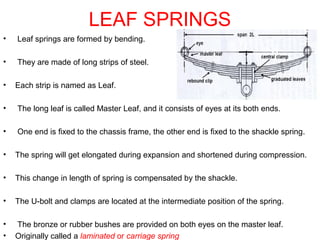
• Leaf springs are formed by bending.
• They are made of long strips of steel.
• Each strip is named as Leaf.
• The long leaf is called Master Leaf, and it consists of eyes at its both ends.
• One end is fixed to the chassis frame, the other end is fixed to the shackle spring.
• The spring will get elongated during expansion and shortened during compression.
• This change in length of spring is compensated by the shackle.
• The U-bolt and clamps are located at the intermediate position of the spring.
• The bronze or rubber bushes are provided on both eyes on the master leaf.
• Originally called a laminated or carriage spring
MATERIAL FOR LEAF SPRING
Types of Leaf Springs
• There are six types of leaf springs
1.Full – elliptic type
2.Semi – elliptic type
3.Quarter – elliptic type
4.Three Quarter – elliptic type
5.Transverse Spring type
6.Helper Spring type
1.FULL ELLIPTIC
• The advantage of this type is the elimination of
shackle and spring.
• The lubrication and wear frequently which are
on of the main draw back of this type of
springs.
2.SEMI – ELLIPTIC
• This type is more popular for rear
suspension are used in 75% of cars.
3.QUARTER – ELLIPTIC
• This type is rarely used in now-a-days.
• It gives very less resistance in road shocks.
4.THREE QUARTER – ELLIPTIC
• This type is rarely used in now-a-days.
• It gives resistance, but occupies more space
than other types.
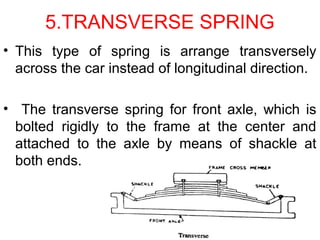
5.TRANSVERSE SPRING
• This type of spring is arrange transversely
across the car instead of longitudinal direction.
• The transverse spring for front axle, which is
bolted rigidly to the frame at the center and
attached to the axle by means of shackle at
both ends.
6.HELPER SPRING
Helper Springs
• The helper springs are used in heavy vehicles
for rear suspension.
• When vehicle fully loaded the main spring as
well as helper spring to come in action and
absorb the road shocks.
• When the load of the vehicle is less, the helper
spring will not act and the main spring only
absorb the road shocks.
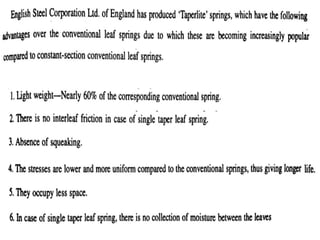
TAPERED LEAF SPRING
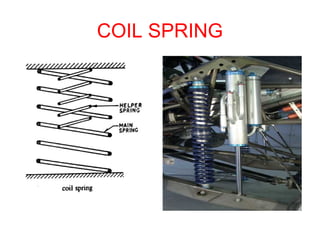
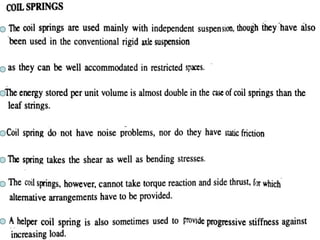
COIL SPRING
TORSION BAR
TORSION BAR
• Torsion bar suspension is used in independent suspension system.
• It is a rod acting in torsion and taking shear stresses only.
• It is made up of heat treated alloy spring steel.
• This bar stores amount of energy nearly as same as coil spring.
• The bar is fixed at one end to the frame, while the other end is fixed to the
end of the wheel arm and supported in the bearing.
• The other end of the wheel arm connected to the wheel hub.
• When the wheel strikes a bump, it starts vibrating up and down, thus
exerting torque on the torsion bar which acts as a spring.
RUBBER SPRINGS
Compression spring
Compression-shear spring
Steel-reinfoced spring
Progressive spring
Face-shear spring
Torsional shear spring
WORKING
RUBBER SPRINGS AND COIL SPRING
RUBBER SPRINGS
SHOCK ABSORBERS
• Shock absorbers - controls unwanted
spring motion through dampening
– compression cycle
– extension cycle
• Limits spring compression-extension
movements to smooth the vehicle’s ride.
• Without shock absorbers, the vehicle
would continue to bounce up and down
long after striking dip or hump in the road.
1 suspension

1 suspension

  • 1.
  • 2.
  • 3.
    Suspension System Introduction: • Theautomobile frame and body are mounted on the front and rear axle not directly but through the springs and shock absorbers. • The assembly of parts, which perform the isolation of parts from the road shocks, may be in the forms of bounce, pitch and roll is called suspension system. Note:  suspension system consists of a spring and damper.  The energy of road shock causes the spring to oscillate.  These oscillations are restricted to a reasonable level by the damper, which is more commonly called as shock absorbers.
  • 4.
    • Rotations: – Aroll rotation about x-axis – A pitch rotation about y-axis. – A yaw rotation about z-axis. Vehicle Axis system Basic suspension movements: 1.Bouncing: The vertical movement of the complete body. 2. Pitching: The rotating movement of all the parts between the spring and road and the portion of spring weight itself. 3. Rolling: The movement about longitudinal axis produced by the centrifugal force during cornering.
  • 5.
  • 6.
    Functions of suspensionsystem 1. It prevents the vehicle body and frame from road shocks. 2. It gives stability of the vehicle. 3. It safeguards the passengers and goods from road shocks. 4. It gives the good road holding while driving, cornering and braking. 5. It gives cushioning effect. 6. It provides comfort.
  • 7.
    Requirements of suspensionsystem 1. There should be minimum deflection. 2. It should be of low initial cost. 3. It should be of minimum weight. 4. It should have low maintenance and low operating cost. 5. It should have minimum tyre wear.
  • 8.
  • 9.
    SPRUNG MASS ANDUNSPRUNG MASS
  • 10.
    SPRUNG MASS • Ina vehicle with a suspension, such as an automobile, motorcycle or a tank, sprung mass (or sprung weight) is the portion of the vehicle's total mass that is supported above the suspension. • The sprung weight typically includes the body, frame, the internal components, passengers, and cargo. • but does not include the mass of the components suspended below the suspension components (including the wheels, wheel bearings, brake rotors, callipers)
  • 11.
    UNSPRUNG MASS • Ina ground vehicle with a suspension, the unsprung weight (or the unsprung mass) is the mass of the suspension, wheels or tracks (as applicable), and other components directly connected to them, rather than supported by the suspension. • Unsprung weight includes the mass of components such as the wheel axles, wheel bearings, wheel hubs, tires, and a portion of the weight of driveshafts, springs, shock absorbers, and suspension links.
  • 12.
    TYPES OF SUSPENSIONSYSTEM SPRINGS 1.Steel springs  Leaf spring  Tapered leaf spring  Coil spring  Torsion bar 2.Rubber springs  Compression spring  Compression-shear spring  Steel-reinfoced spring  Progressive spring  Face-shear spring  Torsional shear spring SHOCK ABSORBERS  Telescopic  Lever arm type INDEPENDENT SUSPENSION FRONT WHEEL(DEAD)  Wishbone or parallel link type  Mac-Pherson strut type  Vertical guide type  Trailing link type  Swinging half-axle type AIR OR PNEUMATIC SUSPENSION AIR SPRING  Bellow type  Piston type HYDROLASTIC SUSPENSION STABILIZER OR ANTI-ROLL BAR
  • 13.
  • 14.
    Coil spring isthe most common type of spring found on modern vehicles. Leaf springs are now limited to the rear of some cars.
  • 15.
    LEAF SPRINGS • Leafsprings are formed by bending. • They are made of long strips of steel. • Each strip is named as Leaf. • The long leaf is called Master Leaf, and it consists of eyes at its both ends. • One end is fixed to the chassis frame, the other end is fixed to the shackle spring. • The spring will get elongated during expansion and shortened during compression. • This change in length of spring is compensated by the shackle. • The U-bolt and clamps are located at the intermediate position of the spring. • The bronze or rubber bushes are provided on both eyes on the master leaf. • Originally called a laminated or carriage spring
  • 17.
  • 18.
    Types of LeafSprings • There are six types of leaf springs 1.Full – elliptic type 2.Semi – elliptic type 3.Quarter – elliptic type 4.Three Quarter – elliptic type 5.Transverse Spring type 6.Helper Spring type
  • 20.
    1.FULL ELLIPTIC • Theadvantage of this type is the elimination of shackle and spring. • The lubrication and wear frequently which are on of the main draw back of this type of springs.
  • 21.
    2.SEMI – ELLIPTIC •This type is more popular for rear suspension are used in 75% of cars.
  • 22.
    3.QUARTER – ELLIPTIC •This type is rarely used in now-a-days. • It gives very less resistance in road shocks.
  • 23.
    4.THREE QUARTER –ELLIPTIC • This type is rarely used in now-a-days. • It gives resistance, but occupies more space than other types.
  • 24.
    5.TRANSVERSE SPRING • Thistype of spring is arrange transversely across the car instead of longitudinal direction. • The transverse spring for front axle, which is bolted rigidly to the frame at the center and attached to the axle by means of shackle at both ends.
  • 25.
  • 26.
    Helper Springs • Thehelper springs are used in heavy vehicles for rear suspension. • When vehicle fully loaded the main spring as well as helper spring to come in action and absorb the road shocks. • When the load of the vehicle is less, the helper spring will not act and the main spring only absorb the road shocks.
  • 27.
  • 29.
  • 31.
  • 32.
    TORSION BAR • Torsionbar suspension is used in independent suspension system. • It is a rod acting in torsion and taking shear stresses only. • It is made up of heat treated alloy spring steel. • This bar stores amount of energy nearly as same as coil spring. • The bar is fixed at one end to the frame, while the other end is fixed to the end of the wheel arm and supported in the bearing. • The other end of the wheel arm connected to the wheel hub. • When the wheel strikes a bump, it starts vibrating up and down, thus exerting torque on the torsion bar which acts as a spring.
  • 33.
    RUBBER SPRINGS Compression spring Compression-shearspring Steel-reinfoced spring Progressive spring Face-shear spring Torsional shear spring
  • 34.
  • 35.
    RUBBER SPRINGS ANDCOIL SPRING
  • 36.
  • 44.
  • 46.
    • Shock absorbers- controls unwanted spring motion through dampening – compression cycle – extension cycle • Limits spring compression-extension movements to smooth the vehicle’s ride. • Without shock absorbers, the vehicle would continue to bounce up and down long after striking dip or hump in the road.