
Continuously Variable Transmission
(CVT)
Department of Mechanical Engineering
National Institute of Technology Durgapur
Durgapur, West Bengal 713209, India
Presented By:
Vinay Kumar Prajapati
Roll. No: 17ME4113
Email: vinayprajapati732@gmail.com
Presented To:
Dr. S. S. Roy
Contents
 Introduction
 Parts of CVT
 Working of CVT
 Advantage of CVT
 Applications
Introduction
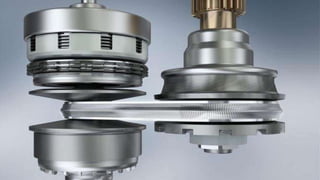
• A continuously variable transmission (CVT), also known as a single-
speed transmission, stepless transmission and pulley transmission is
an automatic transmission that can change seamlessly through a
continuous range of effective gear ratios.
• This is different from other mechanical transmissions that offer a
fixed number of gear ratios.
• The flexibility of a CVT with suitable control may allow the input shaft
to maintain a constant angular velocity even as the output shaft
speed varies.
• Rather than selecting one of four or five gears, a CVT constantly
changes its gear ratio to optimize engine efficiency with a perfectly
smooth torque-speed curve.
Parts of CVT
 Belt
 Fixed Sheaves
 Adjustable sheaves
 Centrifugal weight
 Reverse clutch
 Forward clutch
 Input shaft
 Output shaft
Working of CVT
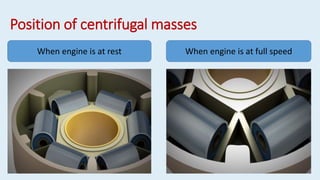
When we accelerates the engine, centrifugal forces on the weight
increases and radial distance between the masses increase.
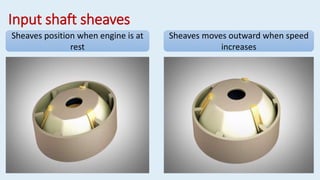
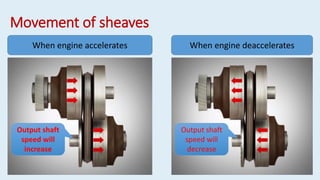
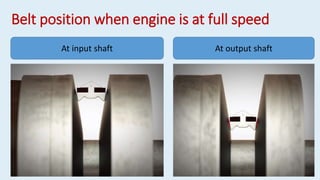
Adjustable sheaves of input shaft moves toward the fixed sheaves and gap
between adjustable sheaves and fixed sheaves decrease and diameter on
input shaft for belt will increase.
At the same time on output shaft diameter decreases for the belt.
 So gear ratio ( output dia./input dia. ) decreases and speed of output shaft
will increase.
 When we de-accelerates the engine, centrifugal forces on the weight
decreases and radial distance between the masses also decrease.
 Adjustable sheaves on input shaft moves away from the fixed
sheaves and gap between fixed sheaves and adjustable sheave
increases and diameter on input shaft for belt will decrease.
 At that time on output shaft diameter increases for the belt.
 So gear ratio ( output dia./input dia. ) increases and speed of output
shaft will decrease.
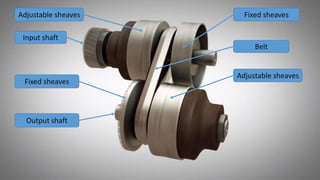
Fixed sheavesAdjustable sheaves
Fixed sheaves
Output shaft
Adjustable sheaves
Input shaft
Belt
Position of centrifugal masses
When engine is at rest When engine is at full speed
Sheaves position when engine is at
rest
Sheaves moves outward when speed
increases
Input shaft sheaves
When engine accelerates When engine deaccelerates
Movement of sheaves
Output shaft
speed will
increase
Output shaft
speed will
decrease
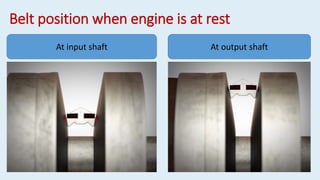
At input shaft At output shaft
Belt position when engine is at rest
At input shaft At output shaft
Belt position when engine is at full speed
Advantage of CVT
 Infinite number of speed ratio achieved.
 Smooth in speed changes.
 Light weight and compact design.
 Cost effective.
 Easy maintenance.
Vehicles in which CVT is used
 Toyota Corolla Altis CVT
 Honda City SV CVT
 Honda Amaze VX CVT
 Nissan Micra XL CVT
 Maruti Suzuki Baleno
 Honda Activa
Continuously Variable Transmission ( CVT )

Continuously Variable Transmission ( CVT )

  • 1.
    Continuously Variable Transmission (CVT) Departmentof Mechanical Engineering National Institute of Technology Durgapur Durgapur, West Bengal 713209, India Presented By: Vinay Kumar Prajapati Roll. No: 17ME4113 Email: vinayprajapati732@gmail.com Presented To: Dr. S. S. Roy
  • 2.
    Contents  Introduction  Partsof CVT  Working of CVT  Advantage of CVT  Applications
  • 3.
    Introduction • A continuouslyvariable transmission (CVT), also known as a single- speed transmission, stepless transmission and pulley transmission is an automatic transmission that can change seamlessly through a continuous range of effective gear ratios. • This is different from other mechanical transmissions that offer a fixed number of gear ratios. • The flexibility of a CVT with suitable control may allow the input shaft to maintain a constant angular velocity even as the output shaft speed varies. • Rather than selecting one of four or five gears, a CVT constantly changes its gear ratio to optimize engine efficiency with a perfectly smooth torque-speed curve.
  • 5.
    Parts of CVT Belt  Fixed Sheaves  Adjustable sheaves  Centrifugal weight  Reverse clutch  Forward clutch  Input shaft  Output shaft
  • 6.
    Working of CVT Whenwe accelerates the engine, centrifugal forces on the weight increases and radial distance between the masses increase. Adjustable sheaves of input shaft moves toward the fixed sheaves and gap between adjustable sheaves and fixed sheaves decrease and diameter on input shaft for belt will increase. At the same time on output shaft diameter decreases for the belt.  So gear ratio ( output dia./input dia. ) decreases and speed of output shaft will increase.
  • 7.
     When wede-accelerates the engine, centrifugal forces on the weight decreases and radial distance between the masses also decrease.  Adjustable sheaves on input shaft moves away from the fixed sheaves and gap between fixed sheaves and adjustable sheave increases and diameter on input shaft for belt will decrease.  At that time on output shaft diameter increases for the belt.  So gear ratio ( output dia./input dia. ) increases and speed of output shaft will decrease.
  • 8.
    Fixed sheavesAdjustable sheaves Fixedsheaves Output shaft Adjustable sheaves Input shaft Belt
  • 9.
    Position of centrifugalmasses When engine is at rest When engine is at full speed
  • 10.
    Sheaves position whenengine is at rest Sheaves moves outward when speed increases Input shaft sheaves
  • 11.
    When engine acceleratesWhen engine deaccelerates Movement of sheaves Output shaft speed will increase Output shaft speed will decrease
  • 12.
    At input shaftAt output shaft Belt position when engine is at rest
  • 13.
    At input shaftAt output shaft Belt position when engine is at full speed
  • 14.
    Advantage of CVT Infinite number of speed ratio achieved.  Smooth in speed changes.  Light weight and compact design.  Cost effective.  Easy maintenance.
  • 15.
    Vehicles in whichCVT is used  Toyota Corolla Altis CVT  Honda City SV CVT  Honda Amaze VX CVT  Nissan Micra XL CVT  Maruti Suzuki Baleno  Honda Activa