AUTOMOBILE PRESENTATION
AUTOMATIC
TRANSMISSION
Submitted By:
Ashu Airan (2011ume1495)
Avinash Misra (2011ume1496)
Chetram Meena (2011ume1497)
Deepa Ram Suthar (2011ume1498)
INTRODUCTION
• Device which changes gear ratios automatically
• Deliver maximum efficiency
• Difference between automatic and manual transmission
• Easier to drive because they do not have a clutch pedal or
gearshift lever
• There are two type of automatic transmissions
CLASSIFICATION
Automatic transmissions
using planetary gears
Continuously variable transmission(cvt)
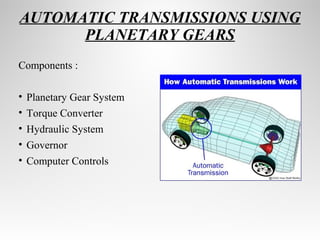
AUTOMATIC TRANSMISSIONS USING
PLANETARY GEARS
Components :
• Planetary Gear System
• Torque Converter
• Hydraulic System
• Governor
• Computer Controls
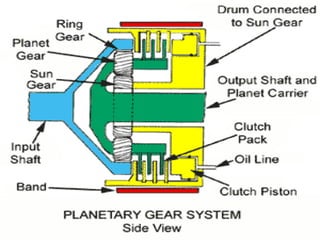
PLANETARY GEAR SYSTEM (SIDE VIEW)
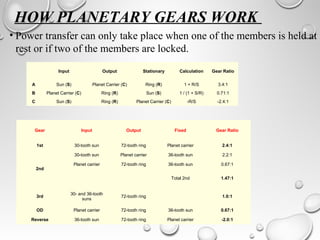
HOW PLANETARY GEARS WORK
Input Output Stationary Calculation Gear Ratio
A Sun (S) Planet Carrier (C) Ring (R) 1 + R/S 3.4:1
B Planet Carrier (C) Ring (R) Sun (S) 1 / (1 + S/R) 0.71:1
C Sun (S) Ring (R) Planet Carrier (C) -R/S -2.4:1
Gear Input Output Fixed Gear Ratio
1st 30-tooth sun 72-tooth ring Planet carrier 2.4:1
2nd
30-tooth sun Planet carrier 36-tooth sun 2.2:1
Planet carrier 72-tooth ring 36-tooth sun 0.67:1
Total 2nd 1.47:1
3rd
30- and 36-tooth
suns
72-tooth ring 1.0:1
OD Planet carrier 72-tooth ring 36-tooth sun 0.67:1
Reverse 36-tooth sun 72-tooth ring Planet carrier -2.0:1
• Power transfer can only take place when one of the members is held at
rest or if two of the members are locked.
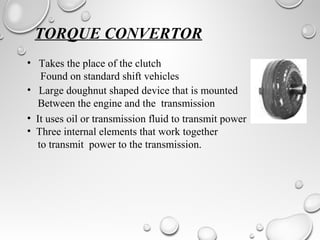
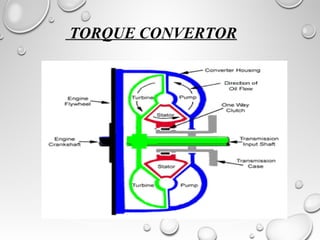
TORQUE CONVERTOR
• Takes the place of the clutch
Found on standard shift vehicles
• Large doughnut shaped device that is mounted
Between the engine and the transmission
• It uses oil or transmission fluid to transmit power
• Three internal elements that work together
to transmit power to the transmission.
TORQUE CONVERTOR
THE HYDRAULIC SYSTEM
• Complex maze of passages and tubes that sends transmission
fluid under under pressure to all parts of the transmission
and torque converter.
• Transmission fluid serves in shift control, general lubrication and
transmission cooling.
• Keeps the transmission at normal operating temperature
• Oil pump
• Valve body
• Shift valves
• Bands
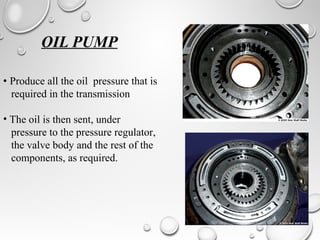
OIL PUMP
• Produce all the oil pressure that is
required in the transmission
• The oil is then sent, under
pressure to the pressure regulator,
the valve body and the rest of the
components, as required.
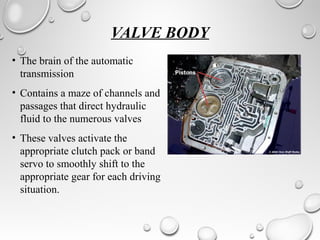
VALVE BODY
• The brain of the automatic
transmission
• Contains a maze of channels and
passages that direct hydraulic
fluid to the numerous valves
• These valves activate the
appropriate clutch pack or band
servo to smoothly shift to the
appropriate gear for each driving
situation.
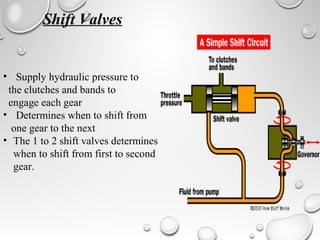
Shift Valves
• Supply hydraulic pressure to
the clutches and bands to
engage each gear
• Determines when to shift from
one gear to the next
• The 1 to 2 shift valves determines
when to shift from first to second
gear.
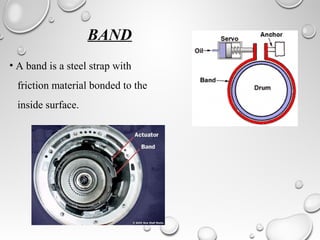
BAND
• A band is a steel strap with
friction material bonded to the
inside surface.
GOVERNER
• Provides the inputs that tell the
transmission when to shift.
• Connected to the output shaft and
regulates hydraulic pressure based on
vehicle speed.
COMPUTER CONTROLLS
• Detect such things as throttle position, vehicle speed,
engine speed, engine load etc. To control exact shift
points .
• Downshift automatically when going downhill, to
control speed and reduce wear on the brakes.
• Up shift when braking on a slippery surface to reduce
the braking torque applied by the engine.
• Inhibit the up shift when going into a turn on a winding
road.
CONCLUSION
Automatic transmissions contain mechanical systems, hydraulic
systems, electrical systems and computer controls, all working
together in perfect harmony
Automatic Transmission

Automatic Transmission

  • 1.
    AUTOMOBILE PRESENTATION AUTOMATIC TRANSMISSION Submitted By: AshuAiran (2011ume1495) Avinash Misra (2011ume1496) Chetram Meena (2011ume1497) Deepa Ram Suthar (2011ume1498)
  • 2.
    INTRODUCTION • Device whichchanges gear ratios automatically • Deliver maximum efficiency • Difference between automatic and manual transmission • Easier to drive because they do not have a clutch pedal or gearshift lever • There are two type of automatic transmissions
  • 3.
    CLASSIFICATION Automatic transmissions using planetarygears Continuously variable transmission(cvt)
  • 4.
    AUTOMATIC TRANSMISSIONS USING PLANETARYGEARS Components : • Planetary Gear System • Torque Converter • Hydraulic System • Governor • Computer Controls
  • 5.
  • 6.
    HOW PLANETARY GEARSWORK Input Output Stationary Calculation Gear Ratio A Sun (S) Planet Carrier (C) Ring (R) 1 + R/S 3.4:1 B Planet Carrier (C) Ring (R) Sun (S) 1 / (1 + S/R) 0.71:1 C Sun (S) Ring (R) Planet Carrier (C) -R/S -2.4:1 Gear Input Output Fixed Gear Ratio 1st 30-tooth sun 72-tooth ring Planet carrier 2.4:1 2nd 30-tooth sun Planet carrier 36-tooth sun 2.2:1 Planet carrier 72-tooth ring 36-tooth sun 0.67:1 Total 2nd 1.47:1 3rd 30- and 36-tooth suns 72-tooth ring 1.0:1 OD Planet carrier 72-tooth ring 36-tooth sun 0.67:1 Reverse 36-tooth sun 72-tooth ring Planet carrier -2.0:1 • Power transfer can only take place when one of the members is held at rest or if two of the members are locked.
  • 7.
    TORQUE CONVERTOR • Takesthe place of the clutch Found on standard shift vehicles • Large doughnut shaped device that is mounted Between the engine and the transmission • It uses oil or transmission fluid to transmit power • Three internal elements that work together to transmit power to the transmission.
  • 8.
  • 9.
    THE HYDRAULIC SYSTEM •Complex maze of passages and tubes that sends transmission fluid under under pressure to all parts of the transmission and torque converter. • Transmission fluid serves in shift control, general lubrication and transmission cooling. • Keeps the transmission at normal operating temperature • Oil pump • Valve body • Shift valves • Bands
  • 10.
    OIL PUMP • Produceall the oil pressure that is required in the transmission • The oil is then sent, under pressure to the pressure regulator, the valve body and the rest of the components, as required.
  • 11.
    VALVE BODY • Thebrain of the automatic transmission • Contains a maze of channels and passages that direct hydraulic fluid to the numerous valves • These valves activate the appropriate clutch pack or band servo to smoothly shift to the appropriate gear for each driving situation.
  • 12.
    Shift Valves • Supplyhydraulic pressure to the clutches and bands to engage each gear • Determines when to shift from one gear to the next • The 1 to 2 shift valves determines when to shift from first to second gear.
  • 13.
    BAND • A bandis a steel strap with friction material bonded to the inside surface.
  • 14.
    GOVERNER • Provides theinputs that tell the transmission when to shift. • Connected to the output shaft and regulates hydraulic pressure based on vehicle speed.
  • 15.
    COMPUTER CONTROLLS • Detectsuch things as throttle position, vehicle speed, engine speed, engine load etc. To control exact shift points . • Downshift automatically when going downhill, to control speed and reduce wear on the brakes. • Up shift when braking on a slippery surface to reduce the braking torque applied by the engine. • Inhibit the up shift when going into a turn on a winding road.
  • 16.
    CONCLUSION Automatic transmissions containmechanical systems, hydraulic systems, electrical systems and computer controls, all working together in perfect harmony