SUBMITTED BY
NASH DHAQUCIR
 INTRODUCTION
 STEERING SYSTEM & ITS TYPES
 WORKING PRINCIPLE
 BASIC GEOMETRY
 MODES IN 4WS SYSTEM
 FEATURES & APPLICATIONS OF 4WS MODEL
 CONCLUSIONS & SCOPE OF FUTURE WORK
 Rear wheel steering system is also called as “Four
wheel steering system” (or) “All wheel steering
system”.
 To improve stability, most cars nowadays are
designed to exhibit under steer characteristic when
driven at high speed.
 Although under-steer condition improves stability
of the vehicle, it increases the driver’s steering
effort.
 Also since a vehicle handling changes with the road
speed movement, both in time & direction, is
difficult to predict.
 These disadvantages can be overcome to greater
extent by using Four wheel steering.
 Steering is the term applied to the collection
of components,linkages, etc. Which will allow
a vehicle to follow the desired course.
 An exception is the case of rail transport by
which rail tracks combined together with
railroad swithches.
 Types of steering system:
 (i) Front wheel steering
 (ii) Rear wheel steering
 (iii) Four wheel steering
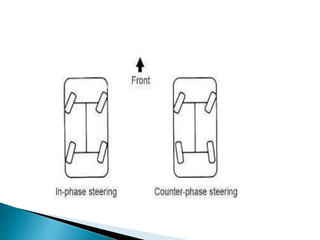
 Rear-wheel steering (or Four-wheel steering
or all-wheel steering) is a system employed
by some vehicles to improve steering
response, increase vehicle stability while
maneuvering at high speed, or to decrease
the ‘turning radius’ at low speed.
 The basic aim of steering is to ensure that
the wheels are pointing in the desired
directions. This is typically achieved by a
series of linkages, rods, pivots, & gears.
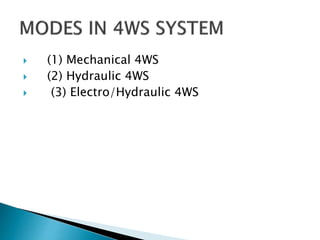
 (1) Mechanical 4WS
 (2) Hydraulic 4WS
 (3) Electro/Hydraulic 4WS
 The mechanical 4WS uses two separate
steering gears to control the front & rear
wheels.
 The hydraulic 4WS uses a two-way hydraulic
cylinder to turn both the wheels in the same
direction. It is not possible to turn them in
the opposite direction.
 The electro/hydraulic 4WS combine computer
electronic controls with hydraulics to make
the system sensitive to both steering angle
and road speeds.
 In conjugation with rear steer mode, four
wheel steering can significantly improve the
vehicle handling at both high & low speeds.
 Due to the better handling & easier steering
capability, driver fatigue can be reduced even
over long drives.
 Stability of the vehicle increases.
 Turning radius of the vehicle can be
decreased to a greater extent by ‘rear steer
mode’.
 An innovative feature of this steering linkage
design and its ability to drive all four (or two)
Wheels using a single steering actuator.
 Its successful implementation will allow for
the development of a four-wheel, steered
power base with maximum maneuveraility,
uncompromised static stability, front & rear
wheel tracking, & optimum obstacle climbing
capability.
THANK YOU
Rear wheel steering system ppt

Rear wheel steering system ppt

  • 1.
  • 3.
     INTRODUCTION  STEERINGSYSTEM & ITS TYPES  WORKING PRINCIPLE  BASIC GEOMETRY  MODES IN 4WS SYSTEM  FEATURES & APPLICATIONS OF 4WS MODEL  CONCLUSIONS & SCOPE OF FUTURE WORK
  • 4.
     Rear wheelsteering system is also called as “Four wheel steering system” (or) “All wheel steering system”.  To improve stability, most cars nowadays are designed to exhibit under steer characteristic when driven at high speed.  Although under-steer condition improves stability of the vehicle, it increases the driver’s steering effort.
  • 5.
     Also sincea vehicle handling changes with the road speed movement, both in time & direction, is difficult to predict.  These disadvantages can be overcome to greater extent by using Four wheel steering.
  • 7.
     Steering isthe term applied to the collection of components,linkages, etc. Which will allow a vehicle to follow the desired course.  An exception is the case of rail transport by which rail tracks combined together with railroad swithches.
  • 8.
     Types ofsteering system:  (i) Front wheel steering  (ii) Rear wheel steering  (iii) Four wheel steering
  • 10.
     Rear-wheel steering(or Four-wheel steering or all-wheel steering) is a system employed by some vehicles to improve steering response, increase vehicle stability while maneuvering at high speed, or to decrease the ‘turning radius’ at low speed.
  • 11.
     The basicaim of steering is to ensure that the wheels are pointing in the desired directions. This is typically achieved by a series of linkages, rods, pivots, & gears.
  • 13.
     (1) Mechanical4WS  (2) Hydraulic 4WS  (3) Electro/Hydraulic 4WS
  • 14.
     The mechanical4WS uses two separate steering gears to control the front & rear wheels.  The hydraulic 4WS uses a two-way hydraulic cylinder to turn both the wheels in the same direction. It is not possible to turn them in the opposite direction.  The electro/hydraulic 4WS combine computer electronic controls with hydraulics to make the system sensitive to both steering angle and road speeds.
  • 15.
     In conjugationwith rear steer mode, four wheel steering can significantly improve the vehicle handling at both high & low speeds.  Due to the better handling & easier steering capability, driver fatigue can be reduced even over long drives.  Stability of the vehicle increases.  Turning radius of the vehicle can be decreased to a greater extent by ‘rear steer mode’.
  • 17.
     An innovativefeature of this steering linkage design and its ability to drive all four (or two) Wheels using a single steering actuator.  Its successful implementation will allow for the development of a four-wheel, steered power base with maximum maneuveraility, uncompromised static stability, front & rear wheel tracking, & optimum obstacle climbing capability.
  • 19.