CONTEMPORARY INDIA
AND EDUCATION
As per the New Syllabus of Tamilnadu Teachers
Education University
(B.Ed. I Year Fist Semester)
Dr.C.Thanavathi
M.A., M.Phil., M.Ed., M.Phil., DGT, DCA, CTE, B.A., (Eng.) PGDHE, SET, Ph.D.,
Assistant Professor of History,
M.Ed. Coordinator,
V.O.C.College of Education,
Thoothukudi-628 008.
Tamil Nadu. India.
9629256771
thanavathic@thanavathi-edu.in
http://thanavathi-edu.in/index.html
Tamil Nadu Teachers Education University
21 TNTEU - B.Ed. (CBCS ) Syllabus - Semester -I
SEMESTER – I
Course Code: BD1CE Credits: 5
CONTEMPORARY INDIA AND EDUCATION
COURSE OBJECTIVES
CO1: Understanding of the nature of social diversity and the educational demands of the
diverse communities.
CO2: Develop understanding of the issue in contemporary India like industrialization,
urbanization, globalization, modernization, economic liberalization and digitalization
etc.
CO3: Develop an understanding of the educational policies and programs during the pre-
independent and post-independent periods.
CO4: Examine the issues of language policy in education.
CO5: To develop an understanding of the educational policies and programs during the pre-
independent and post-independent periods.
Unit- I: EDUCATION IN CONTEMPORARY INDIA, CONSTITUTIONAL
CONTEXT
Education – meaning, definitions, nature, functions and aims; nature of education as a
discipline - types of education; formal, informal and non-formal; levels of education - Pre-
primary, primary, secondary, senior secondary, higher, professional, distance and optional
education; Aims and purposes of education drawn from constitutional provision; Education
as a means of social justice in the Indian Constitution; Constitutional values and education
(Preamble, Fundamental rights and duties); the Right to Free and Compulsory Education
2010 (RTE) and inclusion; Education in the concurrent list and its implications.
Unit- II: UNDERSTANDING THE SOCIAL DIVERSITY
Social diversity: Meaning and definition - Education for understanding the social diversity in
India – Levels of social diversity: Individual, regional, linguistic, religious, castes and tribes -
Role of education in creating positive attitude towards diversity - inter disciplinary nature of
education philosophy, psychology, sociology, anthropology, politics, history;
Tamil Nadu Teachers Education University
22 TNTEU - B.Ed. (CBCS ) Syllabus - Semester -I
Unit- III: EDUCATIONAL DEMANDS OF INDIVIDUALS AND DIVERSE
COMMUNITIES
Universalization of primary education – programmes to achieve universalization of
education: SSA, RMSA, RUSA, integrated education and Inclusive education; Challenges in
achieving universalization of education; Education for collective living and peaceful living;
Four pillars of education as viewed by Delor’s Commission Report.
Unit- IV: LANGUAGE POLICY IN EDUCATION
Language policy during the pre-independent and post-independent India – Language policy
as specified in Indian Constitution – Views of great thinkers on medium of Instruction:
Tagore, Gandhi, Vivekananda.
Unit-V: IMPLICATIONS OF EQUALITY OF EDUCATIONAL OPPORTUNITIES
Equality of Educational Opportunity; equality in constitutional provisions; Inequality in
schooling, Causes for inequality, discrimination, and marginalization in education – Types of
inequity: caste, gender, class, regions – Elimination of social inequalities through education –
education for marginalized groups: Dalits, tribals and women.
SUGGESTED ACTIVITIES
1. Prepare a report based on the interaction/interview with legal expert(s) for the
effective implementation of constitutional provisions to eliminate inequality,
discrimination and marginalization in education.
2. Report presentation based on the brainstorming session on the effective use of
education for elimination of social inequities.
3. Report presentation based on the group discussion/ student seminar on the efforts
taken by the Government of India and Tamil Nadu to achieve universalization of
education.
TEXT BOOKS
1. Aggarwal, J.C. (2013) Landmarks in the History of Modern Indian Education, Vikas
Publishing House, New Delhi.
2. Arya, P. P. (2006) Higher Education and Global Challenges: System and
Opportunities. New Delhi: Deep and Deep Publications.
3. Chaube, S.P. (2014) History of Indian Education. Agra: ShriVinodPustakMandir.
Tamil Nadu Teachers Education University
23 TNTEU - B.Ed. (CBCS ) Syllabus - Semester -I
4. Chauhan, C.P.S. (2013) Modern Indian Education: Policies, Progress and
Problems.New Delhi: Kanishka Publishers and Distributors.
5. Dash, M. (2004) Education in India: Problems and Perspectives. Atlantic
Publishers,New Delhi
6. Ghosh, S.C. (2007). History of education in India. The University of Michigan: Rawat
Publications.
SUPPLEMENTARY READINGS
1. Kumar, K. (2014). Politics of education in colonial India. New Delhi: Routledge.
2. Naik, J.P., Andrew, Vereker.,&Nurullah, S. (2000). A student’s history of education
in India (1800-1973).UK: Macmillan.
3. Sedwal, M. &Kamat, S. (2008). Education and social equity: With a special focus on
scheduled castes and tribes in elementary education. New Delhi: NUEPA.
E-RESOURCES
1. http://mhrd.gov.in/sites/upload_files/mhrd/files/rte.pdf
2. http://shodhganga.inflibnet.ac.in/bitstream/10603/1918/8/08_chapter3.pdf
3. http://shodhganga.inflibnet.ac.in/bitstream/10603/4244/11/11_chapter%202.pdf
COURSE OUTCOMES
After completion of this course, the student-teachers will be able to :
CO1: identify aims of education and types of education.
CO2: explain the nature of social diversity in India and the role of education in creating
positive attitude towards diversity
CO3: interpret the issues in contemporary India like industrialization, Universalization of
education and integrated education and inclusive education.
CO4: iInfer about the Language policies during Pre-independent and Post-independent India.
CO5: summarize about equality in constitutional provisions and elimination of social in
equalities through education.
1 | Dr.C.Thanavathi
B.Ed. First Year – Semester I (2021 – 2022)
C2 - CONTEMPORARY INDIA AND EDUCATION
Unit – I
EDUCATION IN CONTEMPORARY INDIA, CONSTITUTIONAL
CONTEXT
Education – meaning, definitions, nature, functions and aims; nature of
education as a discipline - types of education; formal, informal and non-formal;
levels of education - Pre-primary, primary, secondary, senior secondary, higher,
professional, distance and optional education; Aims and purposes of education drawn
from constitutional provision; Education as a means of social justice in the Indian
Constitution; Constitutional values and education (Preamble, Fundamental rights
and duties); the Right to Free and Compulsory Education 2010 (RTE) and inclusion;
Education in the concurrent list and its implications.
1.1. EDUCATION - MEANING
Education is a systematic process through which a child or an adult acquires
knowledge, experience, skill, and sound attitude. It makes an individual civilized,
refined, cultured, and educated. For a civilized and socialized society, education is the
only means. Its goal is to make an individual perfect. Every society gives importance
to education because it is a panacea for all evils. It is the key to solving the various
problems of life.
Education has been described as a process of waking up to life:
⮚ Waking up to life and its mysteries, its solvable problems, and the ways to
solve the problems and celebrate the mysteries of life.
⮚ Waking up to the inter-dependencies of all things, to the threat to our global
village, to the power within the human race to create alternatives, to the
obstacles entrenched in economic, social, and political structures that prevent
our waking up.
2 | Dr.C.Thanavathi
⮚ Education in the broadest sense of the term is meant to aid the human being in
his/her pursuit of wholeness. Wholeness implies the harmonious development
of all the potentialities God has given to a human person.
⮚ True education is the harmonious development of the physical, mental, moral
(spiritual), and social faculties, the four dimensions of life, for a life of
dedicated service.
Etymological Meaning of Education
Etymologically, the word ‘Education’ has been derived from different Latin words.
a) ‘educare’ which means ‘to nourish’.
b) ‘educo’ which means to lead out (of ignorance)
c) ‘educere’ which means ‘to draw out’
d) ‘educatum’ which means ‘act of training’.
e) ‘educatus’ which means ‘to bring up, to rear’.
f) ‘educatio’ which means “a breeding, a bringing up, a rearing.”
The word ‘shiksha’ is derived from the Sanskrit which means ‘to discipline’,
‘to control’, ‘to instruct’, and ‘to teach’; and the word ‘vidya’ is also derived from
Sanskrit which means ‘to know’.
1.2. EDUCATION - DEFINITIONS
Since time immemorial, education has been estimated as the right road to
progress and prosperity. Different educationists’ thoughts from both Eastern and
Western sides have explained the term ‘education’ according to the need of the hour.
Various educationists have given their views on education. Some important
definitions are:
1. Aristotle – “Education is the creation of sound mind in a sound body.”
2. Rousseau – “Education is the child’s development from within.”
3. Plato – “Education is the capacity to feel pleasure and pain at the right moment.”
4. Pestalozzi – “Education is natural, harmonious and progressive development of
man’s innate powers.”
5. Froebel -“Education is enfoldment of what is already enfolded in the germ.”
6. John Dewey – “Education is the process of living through a continuous
reconstruction of experiences.”
3 | Dr.C.Thanavathi
7. Mahatma Gandhi – “By education, I mean an all-round drawing out of the best in
man-body, mind, and spirit.”
8. Rabindranath Tagore – “Education enables the mind to find out the ultimate
truth, which gives us the wealth of inner light and love and gives significance to life.”
9. Zakir Husain – “Education is the process of the individual mind, getting to its full
possible development.”
10. Swami Vivekananda – “Education is the manifestation of divine perfection
already existing in man.”
1.3. NATURE OF EDUCATION
Education is a triangular process. It involves the inter-play of the educator, the
educand and the social forces. The educator tries to modify the personality of the
child in the light of the needs of the individual and the society to which he belongs.
The nature of education is very complex. Let us now discuss the nature of education:
1. It is a life-long process- Education is a continuous and lifelong process. It starts
from the womb of the mother and continues till death. It is the process of development
from infancy to maturity. It includes the effect of everything which influences human
personality.
2. It is a dynamic process: Education is not a static but a dynamic process which
develops the child according to changing situations and times. It always induces the
individual towards progress. It reconstructs the society according to the changing
needs of the time and place of the society.
3. It is a systematic and purposive process- It refers to transact its activities through
a systematic institution and regulation. Every individual has some goal in his life.
Education contributes to the attainment of that goal. There is a definite purpose
underlined in all educational activities.
4. It is the development of individual and the society- Education helps in individual
adjustment a man is a social being. If he is not able to adjust himself in different
aspects of life his personality can’t remain balanced. Through the medium of
education, he learns to adjust himself with the friends, class fellows, parents,
relations, neighbours and teachers, etc. Education is also a force for social
development, which brings improvement in every aspect of society. It is the society
that will determine the aims, contents, and methods of teachings.
4 | Dr.C.Thanavathi
5. It is training and modification of behaviour- Education is training- Human
senses, mind, behaviour, activities; skills are trained in a constructive and socially
desirable way. Human behaviour is modified and improved through the educational
process. As per the definition of John Dewey education reconstructs and remodels our
experiences towards socially desirable ways.
6. Education is instruction and direction- It directs and instructs an individual to
fulfil his desires and needs for the exaltation of his whole personality. Life without
education is meaningless and like the life of a beast. Every aspect and incident needs
education for its sound development.
7. It is balanced development: Education is concerned with the development of all
faculties of the child. It performs the functions of the physical, mental, aesthetic,
moral, economic, spiritual development of the individual so that the individual may
get rid of his animal instincts by sublimating the same so that he becomes a civilized
person.
8. Education is growth: The end of growth is more growth and the end of education
is more education. According to John Dewey, “an individual is a changing and
growing personality.” The purpose of education is to facilitate the process of his/her
growth. Education is a continuous reconstruction of our experiences.
Therefore, the role of education is countless for a perfect society and man. It is
necessary for every society and nation to bring holistic happiness and prosperity to its
individuals.
1.4. FUNCTIONS OF EDUCATION
In the words of John Dewey, ‘the function of education is to help the growth
of a helpless young animal into a happy, moral and efficient human being’ (Taneja,
2005).
Education has three main functions. They are as follows:
i. General Functions of Education
ii. Functions of Education in Human Life
iii. Functions of Education in National Life
iv. Functions towards Individual
v. Functions towards Society
vi. Functions towards Nation
5 | Dr.C.Thanavathi
i. General Functions of Education
• Education helps the individual for the development of their innate power that
they already have.
• Education helps the individual in the all-around development of their
personality.
• Education helps to direct the individual in the proper way and control and
sublimate the instincts.
• Education helps the individual in developing character, moral and ethical
values.
• Education helps the individual to prepare for future life. It helps to achieve
good citizenship, fellow-feeling, cooperation, dutiful to all human endeavors.
• Education helps to preserve, control, and transmit the rich culture and
tradition.
• It helps to maintain national security, social feeling, and reforms.
ii. Functions of Education in Human Life
• It makes the individual skilful to adapt to different, new, and changing
situations and environments.
• It helps the individual to modify their behaviour and also the environment they
live in.
• It helps to bring satisfaction to the educational, social, physical, and spiritual
needs of the individual.
• It helps to bring educational and vocational efficiency among the individual
and fit them for achieving self-sufficiency.
• It helps develop the character of the individual and prepare for their life.
• It also helps the individual for the all-round development of their personality,
reorganization, and reconstruction of experiences.
• It helps the individual to work as an agent of social change.
iii. Functions of Education in National Life
• It helps the individual to train for leadership that may further help the
individual to take the leadership role in the areas of their interest for the
nation.
• It teaches the individual to achieve national and emotional integration, which
are the binding principles for maintaining a healthy national life.
6 | Dr.C.Thanavathi
• It empowers the people of the country to take social, economic, and scientific
responsibilities for the total national development of the country.
• It helps the individual to inculcate civic and social values and duties for
leading a healthy and disciplined life.
• It helps to supply skilled human power for national development.
• It also helps the individual in promoting social and cultural efficiency.
iv. Function Towards Individual
i) Education as Growth,
ii) Education as Direction,
iii) Preparation for the responsibility of adult life
i) Education as Growth
Every learner is immature at the beginning.
He is to be trained deliberately for adult life.
Education deliberately and systematically influences a mature influence of the
teacher through instruction, discipline, and harmonious development.
The harmonious development includes development in terms of physical,
intellectual, aesthetic, social, and spiritual powers of human beings, according
to the needs of the society.
ii) Education as Direction
Direction is the fixation of the activity into a right response by elimination of
unnecessary and confusing movements.
Every learner is gifted with innate capacities and powers.
His physical and social environment provides the learner with a stimulus for
activity.
In the beginning, as the learner acts in response to the stimulus in an immature
way, much of his constructive energy is wasted.
This wastage can be avoided if the learner is properly directed towards an
objective.
Education provides this sense of direction and the activities of the learner
become purposeful.
Types of Direction
There are two types of direction:
1) External and internal direction.
2) Personal and impersonal direction
7 | Dr.C.Thanavathi
1) External and Internal
The immediate environment which provides the learner with a stimulus for his
activity is external.
Responses to the stimuli which proceed from his internal tendencies are
internal.
2) Personal and Impersonal
Personal direction includes ridicule, disapproval, and punishment. It refers to
physical control which is not educational.
Impersonal direction is important as this direction is bound to appeal to the
learner’s mind and heart.
In this context, the teacher has to set a good example to follow.
This direction is corrective; it has the potential to have a corrective effect.
iii) Preparation for the responsibility of adult life
Reconstruction and re-organization of experience adds to meaningful
experiences and increases the ability to direct subsequent experiences.
v. Functions Towards Society
i) Socialization
ii) Reconstruction of Experiences
Education is a powerful tool to bring in a positive socialization process and
has the ability to reconstruct life experiences for the growth of the society on the
whole.
i) Socialization
Man is a social animal.
An individual is the sum total of his interactions with his social environment.
The elders of the society pass on their experiences, interests, findings,
conclusions, traditions, and attitudes to the younger generation.
All these have a profound influence on the growth and development of the
younger generations.
In this manner, the continuity of the societal function is successfully
maintained.
ii) Reconstruction of Experiences
As growth is a continuous process, education is also a continuous process
throughout an individual’s life.
8 | Dr.C.Thanavathi
Education provides the learner with rich resources to shape his life,
personality, character, outlook, and his experiences and interaction in the
society.
Thus education helps the learner in re-constructing and re-organizing of the
individual and societal life.
vi. Function Towards Nation
i) Civic and Social Responsibility
ii) Training for Leadership
iii) Emotional Integration
iv) National Integration
Education has potentials to indirectly influence and support the state’s/nation’s
functioning by means of inculcating civic sense among the learners and thereby paves
way for emotional and national integration.
i) Civic and Social Responsibility
Promoting civic responsibility is considered to be the most important function
of education.
True education promotes learners to understand their rights and duties as
individual citizens.
The very existence and progress of a nation depends on the educational system
of the state.
ii) Training for Leadership
Efficient functioning in all the spheres such as social, political, religious, and
educational activities depend on the quality of education.
Therefore, the function of a good educational system is to develop such
qualities among the learners so as to promote the comprehensive development
of the individual and the state.
iii) Emotional Integration
Educational system aims at promoting unity in diversity, in terms of unity in
the areas of religion, language, diet, dress, habits, and physical environment.
iv) National Integration
True education aims to raise individuals to break down narrow prejudices of
caste, community, region, and to look to a broad national outlook.
9 | Dr.C.Thanavathi
1.5. AIMS OF EDUCATION
Aims give direction to activities. Aims of education are formulated keeping in
view the needs of the situation. Human nature is multi-sided with multiple needs,
which are related to life. Educational aims are correlated to the ideals of life.
1. Knowledge Aim. Perhaps the oldest aims of education. Education emphasizes the
acquisition of knowledge for its own sake. Knowledge is essential for intellectual
development, a better adjustment in life, social efficiency, character formation, and
spiritual upliftment. The mere acquisition of knowledge might transform an individual
into an intellectual but it alone cannot make him a complete man. Practical wisdom
and skills, as well as the capacity to apply knowledge, are important.
2. Vocational Aim. Self-preservation is the individual’s first need. So education
should enable one to earn his bread and butter. Most of the parents send their children
to school mainly with this aim in mind.
3. Harmonious Development Aim. Pestalozzi defined education as the harmonious
development of the head, heart, and hand. Gandhiji too stressed the need for
developing the body, mind, and spirit. According to a UNESCO study, “the physical,
intellectual, emotional and ethical integration of the individual into a complete
man/woman is the fundamental aim of education.”
4. Complete Living Aim. Complete living aim was formulated by Herbert Spencer.
According to him complete living consists of five groups of activities. They are (i)
self –preservation (ii) securing a vocation (iii) being a worthy member of his home
(iv) contributing one’s best to the society, and (v) utilizing leisure time profitably.
5. Character Aim. Dewey stressed the formation of character as a comprehensive
aim of school instruction. The aim of living is the ever evolving process of perfecting,
maturing, and refining. Education should elevate man from the brutal level to the
human level. To Gandhiji, character building was an important aim of education.
6. Individual Aim. Sir Percy Nunn, Rousseau, and Herbert have all advocated the
individual aim in education. According to Percy Nunn, “Nothing goods enters into the
human world except in and through the free activities of individual men and women
and that educational practice must shape the individual. Education should give scope
to develop the inborn potentials through maximum freedom.” The progress of
mankind is due to great individuals. The school should therefore aim at the full and
10 | Dr.C.Thanavathi
unimpeded development of all the innate abilities of the individual. It should cater to
the physical, intellectual, social, emotional, and moral development of the child.
Whatever is acquired in human life is the result of education. When a child is born he
has no knowledge of his surroundings. Gradually he comes to recognise his
environment by using the sense organs and by coming in contact with other people.
Many ideas and habits he learns merely by observing others.
Individual aims of education include – development of natural abilities,
character-building, development of personality, preparation for adult life, sublimation
and control of basic instincts, and proper use of leisure time, etc.
7. Social Aim. Education is the process of socialization. Education is for the society
and of the society. It prepares the individuals to play different roles in society. The
function of education is for the welfare of the state. Society is the book which pupils
should study in schools. The school itself is a cross section of the society, and active
participation in school life should be the method of learning. According to Dewey and
Bagley, education should aim at making each individual socially efficient. A socially
efficient individual is able to earn his livelihood; he is not a drag on society; he is a
good citizen and has the intelligence to understand and appreciate the world; he is
ready to dedicate himself to the ideals of his society.
Social aims of education include – the creation of the sense of citizenship,
development of a sense of community involvement, protection and increase of culture
and civilization, increasing consciousness of other cultures, encouragement to social
welfare, national development, developing national integration, and international
understanding.
Individuals cannot develop in a vacuum. According to John Adams,
“Individuality requires a social medium to grow.” And T.P. Nunn says,” Individuality
develops in a social environment.”
Let us analyze the great words of Dr. S. Radhakrishnan, “The goal of
education is not merely to produce good individuals, but to turn our individuals who
understand their social responsibilities as integral elements of the society in which
they live.” As it means, education is an integral part of human life. It is the basic
condition for the development of a whole man and a vital instrument for accelerating
the wellbeing and prosperity by the light of education.
11 | Dr.C.Thanavathi
8. National Aim of Education: Many educationists are of the view that apart from
individual or social aims, the national aims of education are above all. It does not
pertain to any individual or society wherein it pertains to a nation, to its integrity and
sovereignty. These may be as follows:
λ To foster nationalism, patriotism and promote national unity.
λ To develop democratic values in the people.
λ To promote social, economic, technological, and industrial needs for
national development.
− Social needs: Prepare children for the changes in attitudes and relationships
which are necessary for the smooth process of a rapidly developing modern
economy.
− Economic needs: Produce citizens with skills, knowledge, expertise and
personal qualities that are required to support the growing economy.
− Technological and industrial needs: Provide the learners with the necessary
skills and attitudes for industrial development.
− To promote sound social, moral, and spiritual values.
λ To promote respect for and development of India’s rich and varied cultures.
λ To promote international consciousness and foster national integration.
λ To promote positive attitudes towards good health and environmental
protection.
λ To develop physical and human resources for the Country.
9. Ultimate and Immediate Aims of Education
Education helps us to achieve two types of aims in our life. First is to achieve
the immediate aim of education and the other is to achieve the ultimate aim of
education. Immediate aim of education is narrow in sense whereas the ultimate aim of
education is very broad in nature. The former is achieved within a short duration of
time whereas the latter is achieved in a long duration. It is sometimes very difficult to
achieve the ultimate aim of education.
1.6. NATURE OF EDUCATION AS A DISCIPLINE
1.6.1. Discipline
Academic discipline/field of study is a branch of knowledge that is taught and
researched at the College or University level.
12 | Dr.C.Thanavathi
Discipline is defined and recognized by the academic journal in which
research is published and by the learned society and academic departments or
facilities.
It describes types of knowledge, expertise, skill, people, projects, and
communities' problem challenged studies. Inquiry approaches and research areas that
are associated with academic areas of study.
For example, the branches of science are commonly referred to as the
scientific disciplines e.g.: physics and gravitation is strongly associated with that
disciplinary knowledge.
Academic discipline has several branches or sub disciplines that leads to co-
evolve with the system of professions that may be said to own knowledge in a
particular disciplinary area.
1.6.2. Why is Education a Discipline?
To become a discipline academia a subject must be professional enough. A
discipline has its own independent language system and its own professional
techniques. It means that the discipline should have its own theory & practice.
This particular language system divides the people into two. One is an expert
and the other is a layman. In medicine, the expert is a doctor and in education, the
expert is an educationalist.
1.6.3. Reason for considering education as a discipline
❖ It has a well-defined function.
Education as a discipline has clearly defined objectives & purpose. It is for the
development of individuals and the growth of society.
❖ Its scope and subject matter is well defined.
Education as a discipline has both theoretical and practical aspects.
Theoretical aspects include philosophical, curriculum, instructional, learning,
sociology, and anthropology practical aspects include policy making and edectism.
Practitioners of education require skills, knowledge, and attitude in the
discipline. Hence, the subject of education can be considered as a pure discipline as an
applied discipline.
Education is purposive- There is a definite purpose of all educational activity.
1.6.4. Development of Education as a Discipline
Education as an academic discipline was emerged in the second half of the
19th
century, with the inception of Teachers College, Columbia University.
13 | Dr.C.Thanavathi
Modern, teachers’ colleges and modern departments, schools or faculties of
education within universities emerged the curricula of these institutions lead to the
improvement of schools; school systems, and the improved learning of individuals
and groups.
Education as a discipline and subject of study made its first entry into a
university in India in 1971 in the University of Calcutta.
A second landmark was in 1936 when the Bombay University. Instituted an
M.Ed. Course in 1943. The first Ph.D. Degree in education was awarded by Bombay
University.
1.6.5. Major Focal Area of Education as a Discipline
Teacher education, education guidance, and counseling. Education planning
and management, Demographic education, comparative education. Special education.
Distance education inclusive and inter cultural education, curriculum development.
Educational measurement and evaluation physical education, computer education,
peace education, value education, sex education.
1.6.6. Nature of Education as a Discipline
Education is a comprehensive term and it reflects one’s day to day life and is
an essential aspect for perfect balanced personality development. On the other hand,
the meaning of education can be understood from a narrower broader point of view.
Education in the narrower sense means. Conscious and deliberate process, modifies
the behavior of the learner and brings about in the education. Specific knowledge and
skills. Such an education is confined to school and university instructions whatever
takes place in a school and whatever influences child behavior is considered
education.
In a broader point of view, education is a lifelong process. It starts with
conception and ends with death (womb to tomb process). It is preparation for life
through life experiences. Here education is not limited in classroom teaching or
training.
According to Charlotte Mason, “Education is an atmosphere, a discipline, and
a life”.
Following are the chief characteristics of education as a discipline.
1. Education is purposive
There is a definite purpose to all educational objectives.
14 | Dr.C.Thanavathi
2. Education is deliberate
Education involves special care and guidance. The process of education is not
any conscious but also deliberate. The educator is fully aware of the failure that his
aim is to develop the personality of the child alone. Definite line through the
modification of his behavior.
3. Education is drawing out and bringing up process
Different meanings of education highlight that education is the process of
bring out the innate potentialities of the child. Education is an active and dynamic
process by which modifications are brought about in the behavior of an individual.
4. Education is knowledge as well as experience
Education is not only simply acquiring different types of knowledge but it
involves real life experiences. Human progress through the ages has been made
possible through the increase and diffusion of knowledge.
5. Education is liberal and vocational
Education can be considered as the liberal process and later it will help the
child to train in a particular vocation. Education is meaningful only when it aims at
some employment. Modern democratic education has placed vocational aim in its
forefront.
6. For the Good of the individual and welfare of the society
The purpose of education 18 wellbeing of the individual and welfare of the
society and a synthesis of individual and society. Education is called a force for social
development which brings improvement in every aspect in the society.
7. Stabilizer, conservator, and reconstructionist
Education helps to conserve, stabilize and reform society and culture.
8. Education is planned
Education is not hap hazed. It is planned and systematic. If refers to
transacting its activities through a systematic institution and regulation.
9. Education is lifelong
Education starts from the time of conception and goes until death. Education
from cradle to grave as sometimes said. Education is lifelong. Process because of
every stage of life of an individual. Is important from an educational point of view.
10. Education is influence exerted
Education is for mature persons. (Teachers, Parents, Adults) influence
children.
15 | Dr.C.Thanavathi
11. Education is balanced development
Education is concerned with the development of all the facilities of the child.
12. Education is bipolar
Education is the process in which both teacher and pupil influence each other
and the personality of the educator modifies. The behavior of the educand and in turn
is affected by the personality of the educand.
13. Education is tripolar
Education involves the teacher of the subject matter.
14. Education is psychological as well as social
The endowments or the capacities of the child – his needs interest, etc must be
interpreted and developed in a social setting
15. Education is growth
Education modifies the behaviour of the child, Human behaviour is modified
and improved through the educational process.
16. Education is power
Education is power and treasure in human beings through which he is entitled,
as the supreme master on earth. Education is a lifelong process.
Therefore, the role of education is countless for a perfect society and man it is
necessary for every society and nation to bring histolic. Happiness and prosperity to
its individuals.
1.7. TYPES OF EDUCATION
The process of education can be classified into three categories. They are formal
education in formal education and non-formal education.
16 | Dr.C.Thanavathi
1.7.1. Formal Education
Formal education in which the teachers face each other in a classroom
situation on a regular and continuous basis and predetermined syllabus according to
time table, source of promotion to next class after passing the previous one. Take a
public examination at the end of the course and receive a certificate. It is legally
institutionalised and rigid; it has forced point of entry and cut. It is motivated by
employment opportunities. It corresponds to the education process normally adopted
by our schools and universities. Formal Education corresponds to a systematic,
organized education model, structured and administered according to a given set of
laws and norms, presenting a rather rigid curriculum as regards objectives, content,
and methodology. It is characterized by a continuous education process, which
necessarily involves the teacher, the students, and the institution.
Formal education has the following characteristics:
λ Education is imparted by formal institutes like Schools, Colleges, and
Universities.
Though the main centers of formal education are School or Colleges, library,
museum, zoo, picture galleries, lectures, symposia, etc. serve as agencies of
formal education.
λ Definite curriculum and courses of studies are framed to teach the students
and definite duration of years required to complete the courses.
λ Proper time schedule prepared for day to day personalised teaching and
semester or yearly planning of academic sessions are implemented.
λ Both teacher and the students meet in a venue like the classroom for
personalised teaching.
λ Attendance of teachers as well as the students is taken for formal record and
completing the Courses.
λ Formal evaluation system (both internal and external) is implemented to
assess the performance of the learners. Both continuous and Term End
Examination are used for evaluating the performance of the students. Proper
certification is done by the Board/University for awarding the degrees or
diplomas to the students.
λ On the basis of the result, the students are promoted to higher classes or
pursue higher degrees.
17 | Dr.C.Thanavathi
1.7.2. Informal Education
The education received in an indirect manner is called Informal education.
Some people call it individual or cultural education; it has no anticipated goal. Formal
planning and rigid organization is a lifelong process. The home, peer group,
playmates, mass media, etc. for example, the son of a farmer acquires knowledge
about farming from his father. In informal education, experiences are unstructured
and indefinite.
The characteristics of informal education are as follows:
λ Informal education is also called natural or incidental education.
λ No formal or non-formal institute is required to provide informal education.
λ For informal education, there is no need of any curriculum, methods of
teaching, teachers/mentors, and place of teaching.
λ Education and experiences acquired during travel, interaction with people,
family discourses, community, and social dealings, interaction within the
environment, neighbourhoods, playmates, cultural and religious activities are
necessarily informal education. Informal education supports formal as well as
non-formal education.
λ Informal education does not provide degrees or diplomas, it simply enriches
by filling the gaps of formal and non-formal education.
λ Informal education may comprise activities like storytelling, group
discussions, reading books on your interests, listening to radio broadcasting or
watching educational Television programmes, visits to zoos, museums,
educational fairs, and scientific exhibitions, attending lectures and
conferences, etc.
Informal education for instance comprises the following activities:
● Visit museums or to scientific and other fairs and exhibits, etc.
● Listening to radio broadcasting or watching TV programs on educational or
scientific themes.
● Reading texts on sciences, education, technology, etc. In journals and
magazines.
● Participating in scientific contests.
● Attending lectures and conferences.
18 | Dr.C.Thanavathi
1.7.3. Non Formal Education
This group includes the school dropout, the employed or working person, those
living away from the additional institutions, housewives, related persons. Non formal
education is not a substitute or parallel to the formal education. We need Formal and
Non formal education system supplementing each other Non-formal education to
deter from Formal and informal education.
The characteristics of Non-Formal Education are as follows:
λ Non-formal education endowed with flexible curricula, time schedule, choices
of subjects, and the place of education.
λ It does not necessarily require daily teacher-student interaction like formal
education.
λ Education is imparted in distance mode like the Open and Distance Learning
system, offered by the Open Schools and Open Universities, even the distance
education departments of the regular institutes also offer non-formal
courses/education.
λ Like formal education, non-formal education has a curriculum and uses a
variety of methods of teaching and mode of communication.
λ The gravity and quality of instruction both for formal and nonformal education
are the same.
λ The timing of regular classes in non-formal education is usually conducted on
weekends (Saturday/Sunday) or during the vacations.
λ Multimedia communication systems like Print (Self Learning Materials) and
non-print (Audio/Video) materials, radio, television, teleconferencing, interactive
radio counseling, online learning, etc. are popularly used as a medium of
instruction in non-formal education.
λ In India, institutes like Indira Gandhi National Open University, National Open
Schooling, and the State Level Open Education Institutes provide non-formal
education.
λ Like formal education, degrees awarded and Certification are also done in non-
formal education.
1.8. LEVELS OF EDUCATION
⮚ Pre-Primary Education
⮚ Primary Education
⮚ Secondary Education
19 | Dr.C.Thanavathi
⮚ Senior Secondary Education
⮚ Higher Education
⮚ Professional Education
⮚ Distance Education
⮚ Open/Optional Education
1.8.1. Pre-Primary Education
This is the initial stage of organized instruction; it is school or center-based
and is designed for children aged at least three years. Also referred to as Kindergarten
and currently, most kindergartens are private-run. Public kindergartens are usually
affiliated to primary schools. Pupils aged four to six are admitted for 1-2 years of
schooling.
Pre-primary education is known by various names such as nursery education,
kindergarten education Early Childhood Care and Education (ECCE). Nursery and
Kindergarten are in fact western system of Pre-primary education which we are trying
to. Adopt into the Indian system. Here children are taught how to do develop basic
skills.
The pre-primary education in India is also known as Kindergarten. Kindergarten, a
term created by Mr. Friedrich Frobel in 1837, which means "children's garden". Pre-
primary education helps children become more independent and confident as well as
promote the all-round development of the children. He establishes kindergarten
through songs and gifts. In India, Gandhiji planned Pre-basic education. Kindergarten
Montessori, Nursery, pre-basic school, Day Care Centers, Balawadis. etc. are
examples.
20 | Dr.C.Thanavathi
1.8.2. Primary Education
Elementary or primary education is the first type of formal education most
people encounter. Primary education begins between five and seven years of age, is
the start of compulsory education where it exists, and generally covers six years of
full-time schooling. This is actually the first level in the Education ladder. The
importance of primary education is recognized as it lays the foundation for lifelong
learning. It has been found that the child develops significantly in physical, cognitive,
social, and emotional aspects in the early years, and its experiences deeply influence
its disposition for learning. Primary schools develop basic skills and social behavior
by games, exercises, music, and simple handicrafts.
The seven foundation learning areas of primary education are thinking,
communicating, sense of self and others, health and physical understanding, social
living and learning, cultural understanding, and understanding the environments. They
teach basic literacy skills such as reading and writing, as well as mathematics, history,
science, and many other topics. To graduate, students are required to pass
standardized testing that meets applicable regulatory or funding requirements.
The elementary stage of formal educational set up covers primary education; it
is the stage when the child starts reading. Formal instruction in an institution for
children having 6-8 years of schooling that usually start from the age of 5 or 6. The
main aim of primary education is to establish functions in a variety of subjects such as
Science, Mathematics, Social science.
1.8.3. Secondary Education
Secondary education is the stage of education following primary education.
Secondary level education is like a bridge between elementary and higher education.
It prepares young students between the age group of 12 and 18 for entry into higher
education. The main focus of the curriculum at this level is to prepare students for
employment, give instruction in functional academics, and teach them adaptive skills.
The social and interpersonal skills are developed during this phase of education.
Lower Secondary Education – continues the basic programs of the primary level,
although teaching is typically more subject-focused. Usually, the end of this level
21 | Dr.C.Thanavathi
coincides with the end of compulsory education. It is the final stage of education in
school primary education ends with VII then after entering the Secondary and Higher
Secondary stage. It starts with VIII to end with XII.
1.8.4. Senior Secondary Education
Senior Secondary Education – generally begins at the end of compulsory
education. The entrance age is typically 15 or 16 years. Entrance qualifications (end
of compulsory education) and other minimum entry requirements are usually needed.
Instruction is often more subject-oriented and the typical duration varies from two to
five years.
1.8.5. Higher Education
Higher, post-secondary, tertiary, or third level education refers to the stage of
learning that occurs at universities, academies, colleges, seminaries, and institutes of
technology. Higher education also includes certain collegiate-level institutions, such
as vocational schools, trade schools, and career colleges that award academic degrees
or professional certifications. Higher education includes teaching, research, exacting
applied for work (e.g. in medical schools and dental schools), and social services
activities of universities.
Higher education follows secondary education. Students take academic
courses and are awarded undergraduate, masters, and doctorate degrees. Higher
education facilities may also offer professional degrees – for instance, law, medicine,
or dentistry degrees. Typical examples are programs designed to prepare pupils for
doctorate studies or programs designed to prepare pupils for direct labor market entry.
Higher education is a non-compulsory educational level which comprises
undergraduate and postgraduate studies. With vocational education training, usually, a
person needs to be admitted to a college or a university to receive higher education.
1.8.6. Professional Education
Professional education is a formal specialized training about a particular
profession in which learners are taught the central concepts, principles, and
22 | Dr.C.Thanavathi
techniques, and how these are applied in real practice, and the learners also acquire
the necessary competencies needed for proper practice and behaviour.
Professional education is a formalized approach to specialized training in a
professional school through which participants acquire content knowledge and learn
to apply techniques. Although content is what the participant is expected to learn by
attending professional school, such an education also helps the participant acquire the
competencies needed for proper practice and behavior. Some common goals of
professional education include incorporating the knowledge and values basic to a
professional discipline; understanding the central concepts, principles, and techniques
applied in practice; attaining a level of competence necessary for responsible entry
into professional practice; and accepting responsibility for the continued development
of competence. It is designed to produce responsible professionals and then to ensure
their continuing competence in the profession by helping them recognize and
understand the significance of advancing professional knowledge and improving
standards of practice. It involves the translation of learning to practice and is intended
to prevent occupations and professionals from becoming obsolete.
1.8.7. Distance Education
Distance education courses are basically correspondence courses that
individuals can obtain by not attending regular classes. Students pursuing distance
learning education need not worry concerning the course contents, mode of
examination, and duration of the course or the degree as it’s going to be very same as
awarded to regular students. Distance education is extremely advantageous for
students who wish to pursue their higher studies, but do not get enough time to do
this. These management programs may be taken up by people who stay at remote
places, workers, housewives, and even working professionals, who because for one or
another reason are not able to take up a regular program.
Distance education provided by institutes is controlled by the Distance
Education Council of India. Distance education is helpful to those who cannot join
regular schools or colleges.
1. At the school level, the National Institute of Open Schooling offers education
through distance learning.
2. While, at the college or university level, Open universities provide distance
education.
23 | Dr.C.Thanavathi
1.8.8. Open/Optional Education
Open education is an attitude, a practice, and a method of teaching that
inspires inquiry, equal access to course materials, and sharing lessons and materials
with the wider community. At the center of open education is the belief that education
is strengthened when shared openly. Open education relies on open educational
resources (OER) and open licensing. Open education is a philosophy about the way
people should produce, share, and build on knowledge. Proponents of open education
believe everyone in the world should have access to high-quality educational
experiences and resources, and they work to eliminate barriers to this goal. Such
barriers might include high monetary costs, outdated or obsolete materials, and legal
mechanisms that prevent collaboration among scholars and educators.
Promoting collaboration is central to open education. As the Open Education
Consortium says: "sharing is probably the most basic characteristic of education:
education is sharing knowledge, insights, and information with others, upon which
new knowledge, skills, ideas, and understanding can be built."
Open educational resources (OERs) are learning materials that can be
modified and enhanced because their creators have given others permission to do so.
The individuals or organizations that create OERs—which can include materials like
presentation slides, podcasts, syllabi, images, lesson plans, lecture videos, maps,
worksheets, and even entire textbooks—waive some (if not all) of the copyright
associated with their works, typically via legal tools like Creative Commons licenses,
so others can freely access, reuse, translate, and modify them.
Optional education programmes serve students with attendance problems
and/or dropouts up to and including those who are 21 years of age and provide
prevention and intervention services and/or optional education. Programs which
primarily provide prevention and intervention services integrate resources of the
school and community to meet the needs of the students and parents. Optional
education programs serve as part-time or full-time options to regular school
attendance and offer modified instructional programs or other services designed to
prevent students from dropping out of school.
24 | Dr.C.Thanavathi
The Optional Learning feature to offer users extra training, without requiring
that they complete the training. Offering optional learning helps your users be more
active in their security awareness training by giving them the option to choose what
training they would like to take. The training content we choose to make optional will
be added to the Library tab of the Learner Experience. These at-home learning
resources are not teacher or school-specific and support a range of subject areas,
interests, and abilities. Completion is not required and materials should be considered
supplemental. As such, they will not be graded or collected.
1.9. AIMS AND PURPOSES OF EDUCATION DRAWN FROM
CONSTITUTIONAL PROVISION
Indian Constitution is one of the largest Constitutions in the world which
comprises 412 Articles and 12 Schedules. The Preamble of the Constitution outlines
the social philosophy and cultural ethos which should oversee all our educational
institutions. Right to Education (RTE) is one of the fundamental rights enshrined in
the Constitution of India. The table below enumerates the educational aims derived
from the constitution articles pertaining to education.
The Indian constitution provides specifies provisions for education in the
following major areas of education:
Provisions Article Aims
1.
Right of free and
compulsory education
45
To make education a right and to
provide free and compulsory
education to all the children at
appropriate age.
2. Right to education 21A
To provide free and compulsory
education
3. Education for women 15(1) (3)
To provide education without any
discrimination
4. Promotion of education 46 To provide equal opportunity of
25 | Dr.C.Thanavathi
and economic interests
of SC, ST, and other
weaker sections
education to all the members of the
society.
5. Religious education
25,
28(1)(2)(3)
To provide religious education
6.
Education of
minorities, protection
of interests of
minorities
29
To bring equality among the
members of the society by
providing them the same platform
of learning, educating them, and
hence growing and contributing to
the productivity of the nation.
7.
Right of minorities to
establish and
administer educational
institutions
30
To provide stability and security to
the members of the society.
8.
Instruction in mother-
tongue at the primary
stage
350-A
To provide education to the
children in their mother tongue so
that they can construct
understanding in their own
language and learn easily
9. Promotion of Hindi 351
To offer opportunities to the
stakeholders to work in the
development and promotion of the
Hindi language.
10.
Education in union
territories
239
To provide the opportunity for
union territories
11.
Fundamental duty to
provide the opportunity
51(A)
To provide the opportunity for
education
26 | Dr.C.Thanavathi
for education
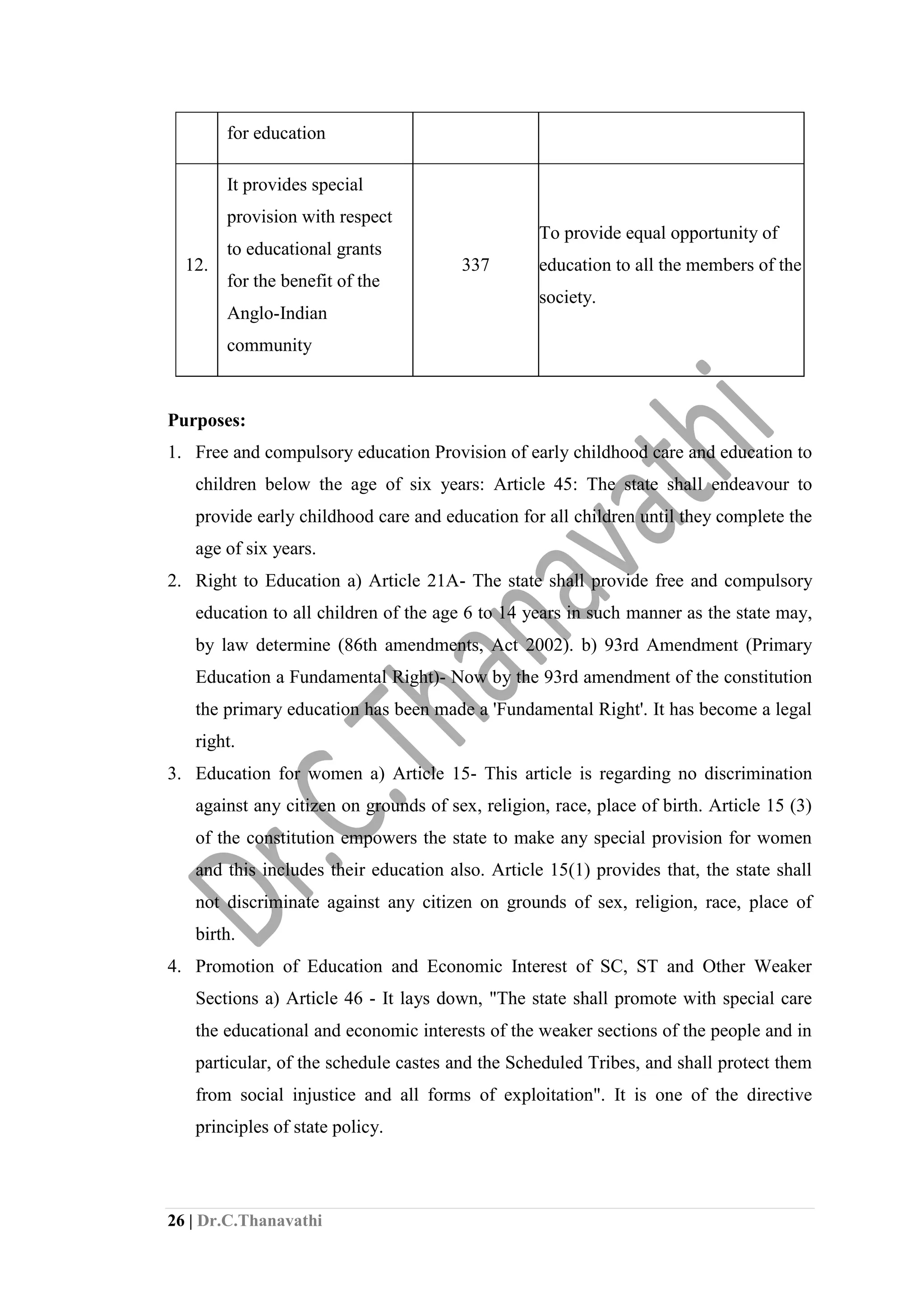
12.
It provides special
provision with respect
to educational grants
for the benefit of the
Anglo-Indian
community
337
To provide equal opportunity of
education to all the members of the
society.
Purposes:
1. Free and compulsory education Provision of early childhood care and education to
children below the age of six years: Article 45: The state shall endeavour to
provide early childhood care and education for all children until they complete the
age of six years.
2. Right to Education a) Article 21A- The state shall provide free and compulsory
education to all children of the age 6 to 14 years in such manner as the state may,
by law determine (86th amendments, Act 2002). b) 93rd Amendment (Primary
Education a Fundamental Right)- Now by the 93rd amendment of the constitution
the primary education has been made a 'Fundamental Right'. It has become a legal
right.
3. Education for women a) Article 15- This article is regarding no discrimination
against any citizen on grounds of sex, religion, race, place of birth. Article 15 (3)
of the constitution empowers the state to make any special provision for women
and this includes their education also. Article 15(1) provides that, the state shall
not discriminate against any citizen on grounds of sex, religion, race, place of
birth.
4. Promotion of Education and Economic Interest of SC, ST and Other Weaker
Sections a) Article 46 - It lays down, "The state shall promote with special care
the educational and economic interests of the weaker sections of the people and in
particular, of the schedule castes and the Scheduled Tribes, and shall protect them
from social injustice and all forms of exploitation". It is one of the directive
principles of state policy.
27 | Dr.C.Thanavathi
5. Provision for Religious Education a) Article 25- Right to Propagate Religion
Article 25(1) of the constitution guarantees all the citizens a right of freedom of
conscience and the right to profess, practice, and propagate religion. b) Article 28
Freedom as to attendance at religious instruction Article 28 relates to 'Freedom as
to attendance at religious instruction or religious worship in certain educational
institutions'. This article has three clauses. Article 28(1): states, no religious
instruction shall be provided in any educational institution wholly maintained out
of state funds." Article 28(2): states "Nothing in clause (1) shall apply to an
educational institution which is administered by the state but has been established
under any endowment or trust which requires that religious instruction shall be
imparted in such institution." Article 28(3): lays down "No person attending any
educational institution recognised by the state or receiving aid out of state funds
shall be required to take part in any religious instruction that may be imparted in
such institution or to attend any religious worship that may be conducted in such
institution or in any premises attached thereto unless such person or, if such
person is a minor, his guardian has given a consent there to".
6. Protection of interests of minorities Article 29- Article 29 relates the protection of
interest of minorities it lays down (a) "Any section of the citizen residing in the
territory of India or any part thereof having a distinct language, script or culture of
its own shall have the right to conserve the same. (b) "No citizen shall be denied
admission into any educational institution maintained by the state or receiving aid
out of state funds on grounds only of religion, race, caste, language or any of
them".
7. Right of minorities to establish and administer educational institutions Article 30
It relates to 'Right of minorities to establish and administer educational
institutions. (a) "All minorities whether based on religion or language shall have
right to establish and administer educational institutions of their choice". (b) "The
states shall not discriminate against any educational institution in respect of grant
in-aid, on the ground that it is under the management of a minority whether based
on religion or language".
8. Instruction in mother-tongue at the primary stage Article 350-A Article 350-A
relates to facilities for instruction in mother-tongue at the primary stage. It lay
down as, "It shall be the endeavor of every state and of every local authority with
the state to provide adequate facilities for instruction in the mother tongue at the
28 | Dr.C.Thanavathi
primary stage of education to children belonging to linguistic minority groups;
and the president may issue such directions to any state as he considers necessary
or proper for receiving the provision of such facilities. Article 350-B: provides for
the appointment of a special officer for linguistic minorities with the object of
investigating into the matter relating to safeguards provided for linguistic
minorities under the constitution.
9. Promotion of Hindi Article-351 Article 351 is related to the promotion of Hindi.
The constitution also provides for the development and propagation of the
national languages, Hindi. According to article 351, it is the special responsibility
of the centre to develop the national language i.e. Hindi so that it may serve as a
medium of expression for all the elements of the composite culture of India. For
this, there is a directorate of Hindi in the Central Ministry of Home Affairs.
10. Education in the Union Territories Article-239 Article 239 of the constitution
states," Save as otherwise provided by Parliament by how, every Union Territory
shall be administered by the President acting to such extent as he thinks fit,
through an administrator to be appointed by him with such designation as he may
specify." This means that every union territory has its own education department
and the responsibility of education in union territory has been under union or
centre government.
11. Fundamental duties to provide the opportunity for education Article 51A Clause
'K' It shall be the duty of every citizen of India who is parent or guardian to
provide opportunities for education to his child or as the case may be, wards
between the age of six and fourteen years.
12. It provides special provision with respect to educational grants for the benefit of
the Anglo-Indian community- Article 337. To provide equal opportunity of
education to all the members of the society.
1.10. EDUCATION AS A MEANS OF SOCIAL JUSTICE IN THE INDIAN
CONSTITUTION
1.10.1. Social Justice
Social justice means maintaining justice to the society. It simply means
equality in society, a socially just society, or enjoys equal benefits in the society.
Social justice means equality in society, however, many social and educational
disadvantages have not enjoyed their rights and not getting benefits under the ordinary
29 | Dr.C.Thanavathi
law. Justice has not been infringed by giving a special provision to the weaker section
of the community. It rather encourages a special provision to enjoy the social benefits.
In Indian society, some weaker sections like minorities and backward classes are
neither equally enjoying their rights, nor are they treated equally. They need to be
given a special status to uplift themselves so as to enjoy their rights in the society. So,
empowering the weaker section of the community is one of the most important
ingredients of social justice.
1.10.2. Defining Social Justice
However, social justice has many definitions.
Andrew Haywood defines that: “Social justice thus stands for a morally defensible
distribution of benefits or rewards in society, evaluated in terms of wages, profits,
housing, medical care, welfare benefits and so forth”.
John Rawls’ principles of social justice are “they provide a way of assigning rights
and duties in the basic institutions of society and they define the appropriate
distribution of the benefits and burdens of social cooperation”.
While formal definitions for social justice vary in wording, there are
commonalities among them.
1. Equal rights
2. Equal opportunity
3. Equal treatment
With these core values in mind, we can define the phrase as such: Social
justice means equal rights, opportunity, and treatment for all.
1.10.3. Constitutional Provisions Relevant to Social Justice and Empowerment
of Vulnerable Sections
The Indian constitution has mentioned the word ‘Social Justice’ only in three
places. In Part IX of the constitution, (The Panchayats) article 243 G (a)&(b) and Part
IXA (The Municipalities) article 243W (i), the Indian constitution has expected the
Panchayats and Municipalities to bring social justice to the people. To maintain social
justice does not encourage giving anything in free, but aimed at providing
opportunities so as to enjoy the social benefits equally.
30 | Dr.C.Thanavathi
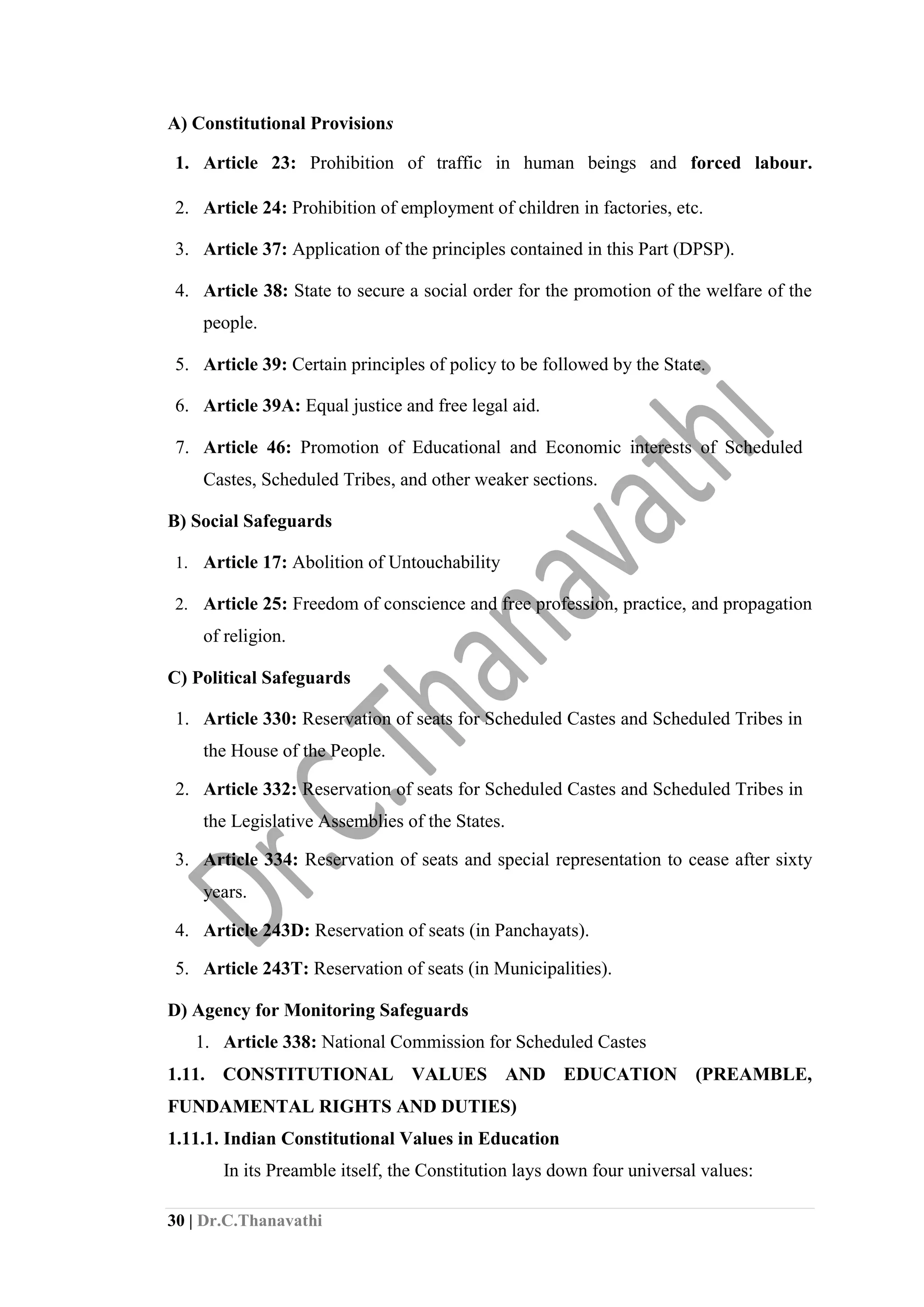
A) Constitutional Provisions
1. Article 23: Prohibition of traffic in human beings and forced labour.
2. Article 24: Prohibition of employment of children in factories, etc.
3. Article 37: Application of the principles contained in this Part (DPSP).
4. Article 38: State to secure a social order for the promotion of the welfare of the
people.
5. Article 39: Certain principles of policy to be followed by the State.
6. Article 39A: Equal justice and free legal aid.
7. Article 46: Promotion of Educational and Economic interests of Scheduled
Castes, Scheduled Tribes, and other weaker sections.
B) Social Safeguards
1. Article 17: Abolition of Untouchability
2. Article 25: Freedom of conscience and free profession, practice, and propagation
of religion.
C) Political Safeguards
1. Article 330: Reservation of seats for Scheduled Castes and Scheduled Tribes in
the House of the People.
2. Article 332: Reservation of seats for Scheduled Castes and Scheduled Tribes in
the Legislative Assemblies of the States.
3. Article 334: Reservation of seats and special representation to cease after sixty
years.
4. Article 243D: Reservation of seats (in Panchayats).
5. Article 243T: Reservation of seats (in Municipalities).
D) Agency for Monitoring Safeguards
1. Article 338: National Commission for Scheduled Castes
1.11. CONSTITUTIONAL VALUES AND EDUCATION (PREAMBLE,
FUNDAMENTAL RIGHTS AND DUTIES)
1.11.1. Indian Constitutional Values in Education
In its Preamble itself, the Constitution lays down four universal values:
31 | Dr.C.Thanavathi
JUSTICE, social, economic and political LIBERTY of thoughts, expression,
belief, faith and worship EQUALITY of status and of opportunity and to promote
among them all FRATERNITY, assuring the dignity of the individual and the unity
and integrity of the nation.
The fundamental objectives enshrined in the constitution are Liberty,
Equality, Fraternity, and Justice.
Justice ensures that the freedom of one does not become tyranny for another. Justice
to be truly meaningful needs sharing of power, compassion towards the under-
privileged, and empathy towards the disadvantaged. An education of rights and duties
becomes important to ensure to fight for justice.
Liberty of thought and action is a fundamental value embedded in our Constitution. It
is the basis for creativity and exploration of new ideas and experiments that can
advance social progress. Respecting the rights of others to liberty of thought and
action are the hallmarks of a civilized society. Ensuring that this liberty of thought
and action is not used to belittle or diminish the beliefs and status of others is what
constitutes a decent society. Democracy creates the opportunity to pursue one’s
chosen ends as well as respect others’ rights to do so. In a diverse country like India,
exercising freedom with responsibility is a must for ensuring peace in the nation.
Equality is another value enshrined in the Constitution. Freedom and justice remain
mere words if equality is not ensured. It implies freedom from exploitation and
ensuring to provide opportunities for an individual’s development, irrespective of the
background, gender, cultural or socio-economic identity, and status.
Fraternity is at the heart of school, society, and nation. Social solidarity is a vital part
of a society that has a place for the aspirations of all members of society.
Understanding the importance of fraternity or solidarity and the knowledge that we all
belong to a large community, a nation, and the globe is also to discover our innate
humanity. It is only if we recognize our interdependence then we are empowered to
help build a peaceful nation and a world. The citizens need to internalize the
principles of equality, justice, and liberty to promote fraternity among all, regardless
of religious beliefs, regional and local diversity. As the Constitution encompasses the
values for living in harmony with self and one’s natural and social environment. It
provides the baseline in working out the framework of values to be nurtured in
32 | Dr.C.Thanavathi
students. If values like truthfulness, sense of responsibility, trustworthiness, loyalty,
love, peace, respect for others, etc. are nurtured right from the beginning, the efforts
will go a long way to enable students to abide by the Constitution and contribute to
the larger health of society and nation at large. In fact, promoting values at the school
or societal level begins with the individual and the individual in relation to the
community, the larger society, nation, and the world.
India got Independence on15th August 1947. Constitution framed by the
Law Minister Dr. B.R. Ambedkar Constitution was adopted on November 26th,
1949. It came into force on June 26th,
1950.
1.11.2. Preamble of the Constitution
The introductory part of the constitution is called the preamble of the
constitution. It states “We, the people of India having solemnly resolved to
constitute India into a Sovereign, Socialist, Secular, Democratic, Republic to secure
to all its citizens:
JUSTICE, social, economic and political; LIBERTY of thought, expression,
belief, faith and worship; EQUALITY of status and of opportunity; and to promote
among them all FRATERNITY assuring the dignity of the individual and the unity and
integrity of the Nation”.
WE DO HEREBY ADOPT, ENACT AND GIVE TO OURSELVES THIS
CONSTITUTION.
1.11.3. Fundamental Rights of Citizens
1. Right to Equality (Art 14-18)
2. Right to freedom (Art 19-22)
3. Right against Exploitation (Art 23-24)
4. Right to freedom of Religion (Art25-28
5. Cultural and educational right (Art 29-30)
6. Right to constitutional remedies (Art 32)
33 | Dr.C.Thanavathi
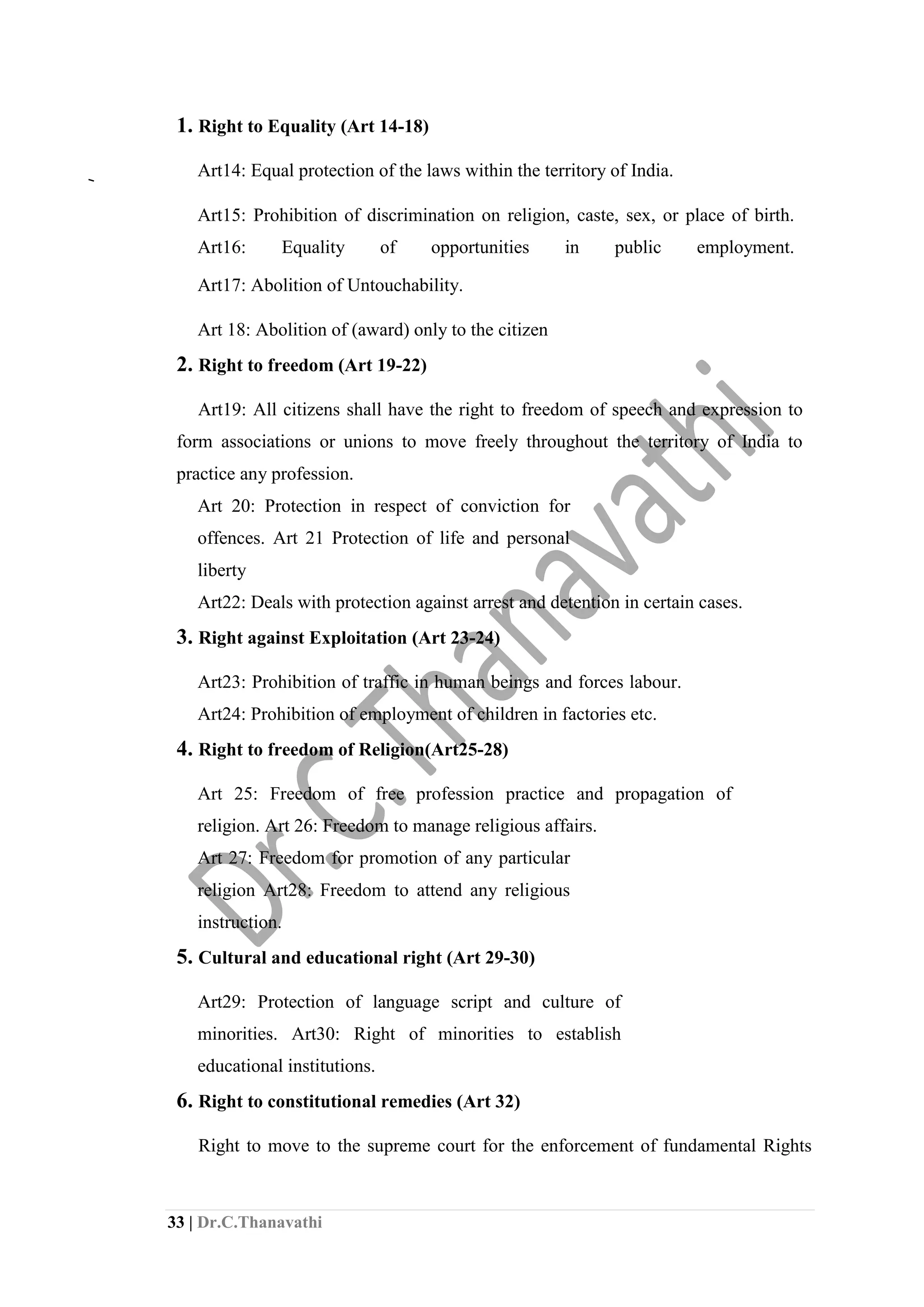
1. Right to Equality (Art 14-18)
Art14: Equal protection of the laws within the territory of India.
Art15: Prohibition of discrimination on religion, caste, sex, or place of birth.
Art16: Equality of opportunities in public employment.
Art17: Abolition of Untouchability.
Art 18: Abolition of (award) only to the citizen
2. Right to freedom (Art 19-22)
Art19: All citizens shall have the right to freedom of speech and expression to
form associations or unions to move freely throughout the territory of India to
practice any profession.
Art 20: Protection in respect of conviction for
offences. Art 21 Protection of life and personal
liberty
Art22: Deals with protection against arrest and detention in certain cases.
3. Right against Exploitation (Art 23-24)
Art23: Prohibition of traffic in human beings and forces labour.
Art24: Prohibition of employment of children in factories etc.
4. Right to freedom of Religion(Art25-28)
Art 25: Freedom of free profession practice and propagation of
religion. Art 26: Freedom to manage religious affairs.
Art 27: Freedom for promotion of any particular
religion Art28: Freedom to attend any religious
instruction.
5. Cultural and educational right (Art 29-30)
Art29: Protection of language script and culture of
minorities. Art30: Right of minorities to establish
educational institutions.
6. Right to constitutional remedies (Art 32)
Right to move to the supreme court for the enforcement of fundamental Rights
34 | Dr.C.Thanavathi
1.11.4. Fundamental Duties
1. To abide by the constitution and respect its ideals and instruction
2. To uphold and protect the sovereignty, unity, and integrity of India.
3. To cherish and follow the noble ideals which inspired our national struggle
4. To safeguard public property and to adjust violence.
5. To develop the Scientific temper, humanism, and the spirit of inquiry and reform.
6. To defend the country and render National service
7. To value and preserve the rich heritage of our composite culture.
8. To protect and improve the natural environment including forests, lakes, rivers,
and wildlife, and to have compassion for living creatures.
9. To promote harmony and the spirit of common brotherhood among all the
people of India.
10. To strive towards excellence in all spheres of individual and collective activity
so that the nation constantly rises to higher levels of endeavour and achievement.
1.11.5. Directive Principles of State Policy and Education
The Directive Principles of state policies in fact the directions given by the
constitution to respective governments to adopt a policy that is commensurate
(equivalent) and further the cause of social justice and create such situation and
circumstance in which every citizen has ample opportunities for self-fulfilment
development progress in socially economically politically and vocationally.
1.12. THE RIGHT TO FREE AND COMPULSORY EDUCATION 2010 (RTE)
AND INCLUSION
1.12.1. Right to Education Act (RTE, 2010)
The Right to Education Act 2009, also known as the RTE Act 2009, was
enacted by the Parliament of India on 4 August 2009. It describes modalities of the
importance of free and compulsory education for children aged between 6-14 years in
India under Article 21 (A) of the Constitution of India. This act came into effect on 1
April 2010 and made India one of the 135 countries to have made education a
35 | Dr.C.Thanavathi
fundamental right for every child. It prescribes minimum norms for elementary
schools, prohibits unrecognised schools from practice, and advocates against donation
fees and interviews of children at the time of admission. The Right to Education Act
keeps a check on all neighbourhoods through regular surveys and identifies children
who are eligible for receiving an education but do not have the means to.
1.12.2. Features of RTE Act
1. All children from age six to fourteen have a right to receive free and compulsory
education.
2. Children who could not continue their studies are eligible to join the standard
according to their age getting appropriate special training.
3. Children have the right to leave one school and join another school. This
provision is applicable only within government and aided schools.
4. Funding for implementing this Act is the responsibility of the Central and State
Government.
5.There should not be any discrimination against the disadvantaged groups and
weaker sections of the society.
6. Every child should be assured of quality education.
7. Teacher education, curriculum, and content should be implemented within a
time frame.
8. No screening test either for the child or the parent should be conducted.
9.No certificate of birth to prove age should be demanded at the time of admission.
10. No child should be held back or sent out before it completes its elementary
education.
11. No child should be given corporal punishment or mental agony by the school.
12. No private school should be started without the approval of the Government or
the authorised agency.
13. Government permission and recognition should not be granted to schools
which do not have the prescribed standards.
14. Duties of teachers: Regularity and punctuality in coming to school completing
portions of the syllabus within the allotted time assessing the learning ability of
36 | Dr.C.Thanavathi
every child and providing special instruction.
1.12.3. Inclusion in Education
Educational challenges have been prevalent at both the centre and states for
many years in India. The Right to Education Act 2009 maps out roles and
responsibilities for the centre, state, and all local bodies to rectify gaps in their
education system in order to enhance the quality of education in the country.
1. Compulsory and free education for all
It is obligatory for the Government to provide free and compulsory elementary
education to each and every child, in a neighbourhood school within 1 km, up to class
8 in India. No child is liable to pay fees or any other charges that may prevent him or
her from pursuing and completing elementary education. Free education also includes
the provisions of textbooks, uniforms, stationery items, and special educational
material for children with disabilities in order to reduce the burden of school
expenses.
2. The benchmark mandate
The Right to Education Act lays down norms and standards relating to Pupil-
Teacher-Ratios (number of children per teacher), classrooms, separate toilets for girls
and boys, drinking water facility, number of school-working days, working hours of
teachers, etc. Each and every elementary school (Primary school + Middle School) in
India has to comply with this set of norms to maintain a minimum standard set by the
Right to Education Act.
3. Special provisions for special cases
The Right to Education Act mandates that an out of school child should be
admitted to an age-appropriate class and provided with special training to enable the
child to come up to an age-appropriate learning level.
4. Quantity and quality of teachers
The Right to Education Act provides for rational deployment of teachers by
ensuring that the specified Pupil-Teacher-Ratio is maintained in every school with no
urban-rural imbalance whatsoever. It also mandates appointing appropriately trained
teachers i.e. teachers with the requisite entry and academic qualifications.
5. Zero tolerance against discrimination and harassment
The Right to Education Act 2009 prohibits all kinds of physical punishment
and mental harassment, discrimination based on gender, caste, class, and religion,
37 | Dr.C.Thanavathi
screening procedures for admission of children capitation fee, private tuition centres,
and functioning of unrecognised schools.
The Right to Education (RTE) Forum’s Stocktaking Report 2014 suggested
that across the country, less than 10 percent of schools comply with all of the Right to
Education Act norms and standards. While the enactment of the Right to Education
Act 2009 triggered significant improvements, concerns regarding the privatisation of
education remain. Educational inequalities have held a strong ground in India for
many years. While the Right to Education Act offers the first step towards an
inclusive education system in India, effective implementation of the same still
remains to be a challenge.
6. Ensuring all-round development of children
The Right to Education Act 2009 provides for the development of a
curriculum, which would ensure the all-around development of every child. Build a
child’s knowledge, human potential, and talent.
7. Improving learning outcomes to minimise detention
The Right to Education Act mandates that no child can be held back or
expelled from school till Class 8. To improve the performances of children in schools,
the Right to Education Act introduced the Continuous Comprehensive Evaluation
(CCE) system in 2009 to ensure grade-appropriate learning outcomes in schools.
Another reason why this system was initiated was to evaluate every aspect of the child
during their time in school so that gaps could be identified and worked on well in
time.
8. Monitoring compliance of RTE norms
School Management Committees (SMCs) play a crucial role in strengthening
participatory democracy and governance in elementary education. All schools covered
under the Right to Education Act 2009 are obligated to constitute a School
Management Committee consisting of a head teacher, local elected representative,
parents, community members, etc. The committees have been empowered to monitor
the functioning of schools and to prepare a school development plan.
9. Right to Education Act is justiciable
The Right to Education Act is justiciable and is backed by a Grievance
Redressal (GR) mechanism that allows people to take action against non-compliance
of provisions of the Right to Education Act 2009. To ensure all schools follow this
mandate, Oxfam India in collaboration with JOSH filed a complaint at the Central
38 | Dr.C.Thanavathi
Information Commission (CIC) in 2011 evoking Section 4 of the Right to Information
Act (RTI Act) 2005. Section 4 of the RTI Act is a proactive disclosure section
mandating all public authorities to share information with citizens about their
functioning. Since schools are public authorities, compliance to Section 4 was
demanded.
10. Creating inclusive spaces for all
The Right to Education Act 2009 mandates for all private schools to reserve
25 percent of their seats for children belonging to socially disadvantaged and
economically weaker sections. This provision of the Act is aimed at boosting social
inclusion to provide for a more just and equal nation.
1.12.4. Achievements of Right to Education Act, 2010
▪ The RTE Act has successfully managed to increase enrolment in the upper
primary level (Class 6-8).
▪ Stricter infrastructure norms resulted in improved school infrastructure,
especially in rural areas.
▪ More than 3.3 million students secured admission under the 25% quota norm
under RTE.
▪ It made education inclusive and accessible nationwide.
▪ Removal of “no detention policy” has brought accountability in the elementary
education system.
▪ The Government has also launched an integrated scheme, for school education
named as Samagra Shiksha Abhiyan, which subsumes the three schemes of
school education:
o Sarva Shiksha Abhiyan (SSA)
o Rashtriya Madhyamik Shiksha Abhiyan (RMSA)
o Centrally Sponsored Scheme on Teacher Education (CSSTE).
Making the right to education a fundamental right took more than 6 decades
after independence. Now, the government and all stakeholders should focus on the
quality of education, and gradually move towards having a single educational system
39 | Dr.C.Thanavathi
and platform across the country for all sections of society in order to foster equality,
inclusion, and unity.
1.13. EDUCATION IN THE CONCURRENT LIST AND ITS IMPLICATIONS
1.13.1. Concurrent List
Concurrent list is a list of 52 items, and it includes the power to be considered
by both the Central and State governments. "If any provision of a law made by the
Legislature of a State is repugnant to any provision of a law made by Parliament
which Parliament is competent to enact, or to any provision of an existing law with
respect to one of the matters enumerated in the Concurrent list, then the law made by
Parliament, whether passed before or after the law made by the Legislature of such
State, or as the case may be, the existing law shall prevail and the law made by the
Legislature of the State shall, to the extent of the repugnancy, be void."
1.13.2. Education on the Concurrent list
Concurrent list encompasses items of concerns of both the centre and the
states. Both will legislate for items in the concurrent List. Education is part of the
concurrent List. This means policies related to education are legislated by central and
state governments in the form of a meaningful partnership.
1.13.3. Education in Concurrent list and its Implications
1. A Uniformity in Education Policy: Education System and its pattern should
be the same across all of India. This could only be possible when education is
made a concurrent subject. This ensures that the structure of education does
not vary from state to state.
40 | Dr.C.Thanavathi
2. Improvement in Standards: As a result of education is a concurrent subject,
research will advance throughout the nation. Due to this research studies are
going to be utilized better at both state and national level.
3. Education for emotional Integration: Education is the key force for the
production of emotional integration between all of the country. Educational
curriculum, strategies, goals, and priorities, etc. can include guidelines to both
teachers and learners so that they can use them towards the purpose of
emotional integration of the nation as a whole.
4. For better Discipline: Central government has the power to overrule the
decisions of state governments in case of disagreements. This power is given
to the central government for maintaining better discipline when it comes to
maintaining standards of education and better emotional integration
throughout the country.
5. Proper and better utilization of funds: The state receives funding from the
center for education but sometimes they spend it elsewhere, as has been noted.
The center must have a say in its use when the funds are distributed by the
central government for the betterment of schools and the education
infrastructure of states.
6. Quality Leadership from Central Government: Sometimes central
government is able to provide quality leadership in the form of direction and
supervision when it comes to the matters of education.
7. Better implementation of education policies: Better implementation of
policies related to education means the better implementation of education
policies in a systematic way for better results. If education is on the
41 | Dr.C.Thanavathi
concurrent list, the center will ensure that state governments are correctly
implementing it.
8. For creating equalitarian policies: Our constitution provides equal rights to
each and every citizen in the society. For achieving equity and equality in
society education must be provided to all, as the constitution gives the right to
education to all.
Until 1976, education was a state subject with some provisions at the central
level. The 42nd amendment, 1976, was an about major and important changes to the
Indian constitution. It also affected the status of education by putting it on the
concurrent list. Making education a concurrent subject ensures that both the centre
and state can legislate on any aspect of education from primary to the university level.
In case of any dispute, legislation formed by the central government will have
overriding authority. By having education in the concurrent list, the centre can
directly implement any policy decisions in the states. So, the concurrent status of
education means that there is a partnership between the State government and central
government when it comes to Education policy making and implementation. This is a
meaningful and yet challenging task to accomplish.
42 | Dr.C.Thanavathi
UNIT- II
UNDERSTANING THE SOCIAL DIVERSITY
Social diversity: Meaning and definition - Education for understanding the
social diversity in India – Levels of social diversity: Individual, regional, linguistic,
religious, castes and tribes - Role of education in creating positive attitude towards
diversity - inter disciplinary nature of education philosophy, psychology, sociology,
anthropology, politics, history;
2.0. INTRODUCTION
India is a large country with different geo-political conditions in different
parts of the country. This has brought differences in social evolution of the groups
living in different parts of the country. India is a country of social diversity. To
maintain harmony among all sections of the society, the Constitution of India has
adopted federal political structure. The democracy of the country also helps in
maintaining social unity. Three kinds of social differences need special attention
namely: Gender, Religion and Castes. Some of the Fundamental Rights are enshrined
in the Constitution with this purpose only. The Directive Principles of State Policies
also help in maintaining the social fabric of India. Sometimes the political
manifestations of these identities do create problems, but the constitution meets these
challenges successfully.
2.1. MEANING OF SOCIAL DIVERSITY
Social diversity is the diverse factors surrounding our society such as race,
culture, religion, age and disabilities. Diversity is differences in racial and ethnic,
socio-economic, geographic, and academic/professional backgrounds. These can be
along the dimensions of race, ethnicity, gender, sexual orientation, socio-economic
status, age, physical abilities, religious beliefs, political beliefs, or other ideologies.
Social diversity centers on three universal human realities. Firstly, that each
individual is unique. Secondly, that individual and their societies are inter-related and
inter-dependent. Thirdly, that societies and cultures are dynamic: change may be rapid
or gradual, but will always affect different members of society in ways that reflect
differences in power and status.
2.2. DEFINITION OF SOCIAL DIVERSITY
Diversification is a principle that maintains how individual develop into quite
different people so that they can peacefully occupy different positions within the
43 | Dr.C.Thanavathi
environment. A broad definition of diversity ranges from personality and work style
to all of the visible dimensions of diversity such as race, age, ethnicity or gender, to
secondary influences such as religion, socio economics and education, to work
diversities such as management and union, functional level and classification or
proximity/distance to headquarters.
2.3. EDUCATION FOR UNDERSTANDING THE SOCIAL DIVERSITY IN
INDIA
Teachers today must not only be well prepared to impart a quality education
but also be sensitive to meeting the needs of their students regardless of their race,
color, creed, or national origin. It is important for the teacher to understand, believe,
and practice the ideas of teacher efficacy, intentionality, educational psychology and
pedagogy. An effective teacher should take into account the intellectual, social and
cultural characteristics of each student being taught.
Remaining cognizant of the fact that each child is different and has different
learning styles a teacher in a diverse world is enthusiastic about their responsibility to
teach all students in the most effective way. Whatever the learning style: visual,
kinesthetic, auditory, etc, the teachers who practice intentionality and believe in
teacher efficacy plan the outcomes they want to achieve while having the power or
belief in producing the desired result.
Because of different styles and beliefs there are many facets of diversity in our
world today. Each facet is worthy of our respect and understanding. In order to be
successful teachers we need to step back and look inside ourselves. Once teachers
understand the differences in students’ styles, beliefs, and abilities they must create
curriculum that is responsive to the needs of each student. By incorporating examples
of multicultural materials, visual aids, and topics that encourage students to explore
different racial and cultural perspectives teachers show sensitivity to the cultural value
of each student therefore connecting with the students. Educators must understand
that the cultural backgrounds and experiences of their students must be respected and
reflected in all aspects of the education process.
It is not only enough to understand and work toward the success of all diverse
students, an effective teacher must prevent harassment and racism in the classroom.
Inappropriate or offensive remarks must be dealt with quickly and decisively. Since
all students are diverse racist, sexist or other abusive comments are bound to occur.
Teachers need to create an environment which radiates warmth and friendliness. It is
44 | Dr.C.Thanavathi
important to help diverse students merge into the mainstream without jeopardizing the
quality of education to all students. Connecting with your students and letting them
share their cultural identity not only assists students to understand other cultures, it
helps embed the individuals’ culture into their daily life.
Though changes are taking place in the caste system, it still plays an important
role in shaping the Indian societal structure. The system underwent fast changes due
to industrialization, urbanization, modernization, education, secularization etc., yet it
could neither be weakened nor destroyed and caste practices are still found to be very
rigid in the rural areas. Various social reformers have made attempts to stop
discrimination based on caste and because of their movements against this
discrimination, there has been an improvement in the status of the so-called
untouchables or harijans or dalits.
Diversity, that is, a mix of human backgrounds, races or genders, is an
important means of promoting mutual understanding and tolerance. The nature of its
importance partly depends on the setting. Diversity as a wide component is a tricky
thing to use and understand because it has both negative and positive effects on
society such as education, violence and employment. People have to dig deep to
figure out what exactly the effect will be in the end and be patient to wait and see. In
an educational context, diversity within schools or universities can enrich the learning
process, enabling students to draw on their peers' much wider and more varied
experiences. It also necessary to prepare students for the diverse society they
participate in beyond the campus.
2.4. LEVELS OF SOCIAL DIVERSITY
The levels of social diversity are:
1) Individual diversity,
2) Regional diversity,
3) Linguistic diversity,
4) Religious diversity and,
5) Caste and tribes’ diversity.
1. Individual Diversity
Becoming culturally competent, diverse and inclusive involves knowledge,
attitudes, and skills that may seem overwhelming for any individual to achieve. It is
45 | Dr.C.Thanavathi
important to remain aware that cultural groups are not homogeneous in beliefs and
practices.
Meaning of Individual Differences:
Dissimilarity is principle of nature. No two persons are alike. All the
individuals differ from each other in many a respect. Children born of the same
parents and even the-twins are not alike. This differential psychology is linked with
the study of individual differences.
Wundt, Cattel, Kraepelin, Jastrow and Ebbing Haus are the exponents of
differential psychology.
This change is seen in physical forms like in height, weight, colour, and
complexion strength etc., difference in intelligence, achievement, interest, attitude,
aptitude, learning habits, motor abilities, and skill. Each man has an intellectual
capacity through which he gains experience and learning. Every person has the
emotions of love, anger, fear and feelings of pleasure and pain. Every man has the
need of independence, success and need for acceptance.
Definitions of individual diversity:
According to Carter B. Good, “Individual diversity stands for the variations
or deviations among the individuals in regarded to a single characteristics”. Individual
diversity stands for those differences, which in their totaling distinguish one
individual from another.
Classifications of individual diversity:
46 | Dr.C.Thanavathi
Causes of Individual Differences:
There are various causes which are responsible in bringing individual
differences.
i. Heredity:
Some heretical traits bring a change from one individual to other. An
individual’s height, size, shape and color of hair, shape of face, nose, hands and legs
so to say the entire structure of the body is determined by his heretical qualities.
Intellectual differences are also to a great extent influenced by hereditary factor.
ii. Environment:
Environment brings individual differences in behaviour, activities, attitude,
and style of life characteristics, personality etc. Environment does not refer only
physical surroundings but also it refers the different types of people, society, their
culture, customs, traditions, social heritage, ideas and ideals.
iii. Race and Nationality:
Race and Nationality is one cause of individual difference. Indians are very
peace loving, Chinese are cruel; Americans are very frank due to race and nationality.
iv. Sex:
Due to sex variation one individual differs from other. Men are strong in
mental power. On the other hand women on the average show small superiority over
men in memory, language and aesthetic sense. Women excel the men in shouldering
social responsibilities and have a better control over their emotions.
v. Age:
Age is another factor which is responsible in bringing individual differences.
Learning ability and adjustment capacity naturally grow with age. When one grows in
age can acquire better control over our emotions and better social responsibilities.
When a child grows then this maturity and development goes side by side.
vi. Education:
Education is one major factor which brings individual differences. There is a
wide gap in the behaviors of educated and uneducated persons. All traits of human
47 | Dr.C.Thanavathi
beings like social, emotional and intellectual are controlled and modifies through
proper education. This education brings a change in our attitude, behaviour,
appreciations, Personality. It is seen that uneducated persons are guided by their
instinct and emotions where as the educated persons are guided by their reasoning
power.
2. Regional Diversity
Region as a social system, reflects the relation between different human beings
and groups. Regions are an organised cooperation in cultural, economic, political or
military fields. Region acts as a subject with distinct identity, language, culture and
tradition. Regionalism is an ideology and political movement that seeks to advance
the causes of regions.
Meaning of Regional Diversity
The word ‘regional’ means any element belongs to a particular region, and the
feeling related to the people belonging to the particular region is known as
‘Regionalism’. The term regionalism has two connotations: In the positive sense, it is
a political attribute associated with people’s love for their region, culture, language,
etc. with a view to maintain their independent identity. In the negative sense, it
implies excessive attachment to one’s region in preference to the country, or the state.
While positive regionalism is a welcome thing in so far maintaining as it encourages
the people to develop a sense of brotherhood and commonness on the basis of
common language, religion or historical background. The negative sense regionalism
is a great threat to the unity and integrity of the country.
Regionalism in India
Roots of regionalism is in India’s manifold diversity of languages, cultures,
ethnic groups, communities, religions and so on, and encouraged by the regional
concentration of those identity markers, and fueled by a sense of regional deprivation.
For many centuries, India remained the land of many lands, regions, cultures and
traditions.
For instance, southern India (the home of Dravidian cultures), which is itself a
region of many regions, is evidently different from the north, the west, the central and
the north-east. Even the east of India is different from the North-East of India
comprising today seven constituent units of Indian federation with the largest
concentration of tribal people.
48 | Dr.C.Thanavathi
First, in the 1950s and 1960s, intense (ethnic) mass mobilisation, often taking
on a violent character, was the main force behind the state’s response with an
institutional package for statehood. Andhra Pradesh in India’s south showed the way.
The fast unto death in 1952 of the legendary (Telugu) leader Potti Sriramulu for a
state for the Telegu-speakers out of the composite Madras Presidency moved an
otherwise reluctant Jawaharlal Nehru, a top nationalist leader and it was followed by
State reorganisation commission under Fazal Ali paving way for State Reorganization
Act, 1956.
Second, in the 1970s and 1980s, the main focus of reorganization was India’s
North-east. The basis of reorganization was tribal insurgency for separation and
statehood. The main institutional response of the Union government was the North-
eastern States Reorganisation Act, 1971 which upgraded the Union Territories of
Manipur and Tripura, and the Sub-State of Meghalaya to full statehood, and Mizoram
and Arunachal Pradesh (then Tribal Districts) to Union Territories. The latter became
states in 1986. Goa (based on Konkani language (8th Schedule)), which became a
state in 1987, was the sole exception.
Third, the movements for the three new states (created in 2000)—Chhattisgarh
out of Madhya Pradesh, Jharkhand out of Bihar and Uttaranchal out of Uttar
Pradesh— were long-drawn but became vigorous in the 1990s. And the most recent
one, we can see with the division of Andhra Pradesh, giving a separate Telangana,
which started in 1950s.
The central government has categorized states on the basis of backwardness
and accordingly gives grants and loans. In September 2013, Raghuram Rajan,
recommended a new index of backwardness to determine- which state need special
help from central government. It is composed of 10 equally weighted indicators.
According to that, Orissa and Bihar are the most backward states.
Regular public investment by central government through centrally sponsored
schemes have focused on development of necessary infrastructure and poverty
eradication, integrated rural development, education, health, family planning, etc. For
example- Prdhan Mantri Gram sadka yojana, mid day meal, MGNREGA, etc.
Government at centre and states give incentives to private players to develop
in backward states through subsidies, taxation, etc. Nationalisation of banks, granting
new banking licences, making mandatory for banks to open rural branches are few
other steps for inclusive development and balanced regional development.
49 | Dr.C.Thanavathi
There are certain discrepancies at the implementation part of these schemes.
Few areas have been neglected like irrigation, which has created agricultural disparity.
Rain fed and dry land agriculture also have been neglected, which became cause for
suicide of farmers in various states (Coverage of P. Sainath, gives us more insights on
such issues.) In reality, the interstate industrial disparity, agricultural disparity,
number of BPL, etc. are decreasing. But, more actions are needed to completely
eradicate the disparities
Reasons for regional disparity
Low rate of economic growth: The economic growth of India has been fluctuating
since independence. But with respect to High population growth, the economic
growth has been not enough to catch the development with full speed. In the last
decade, the economic growth was progressive, but now they are reeling under the
influence of world economic crisis and other bottlenecks at domestic level.
Socio-economic and political organisation of states: The states have been unable to
do the adequate land reforms and the feudal mentality still persists. Bhoodan and
Gramdaan movements, after independence, were not enthusiastically carried and even
land under land banks was not efficiently distributed. The political activities in the
backward states were limited to vote bank politics and scams.
Lower level of infrastructural facilities in backward states: The level of
infrastructural development, such as- power distribution, irrigation facilities, roads,
modern markets for agricultural produce has been at back stage. All these are state list
subjects.
Low level of social expenditure by states on education, health and sanitation:
These subjects are core for human resource development. The sates which have
invested heavily on these subjects fall under the developed and advanced states, for
example Tamil Nadu, where health care services in Primary health centre are bench
mark for other states.
Political and administration failure: This is source of tension and gives birth to sub-
regional movements for separate states. Jarkhand, Chattisgarh, Uttrakhand and
recently Telangana are result of these failures only. Many such demands are in
pipeline such as- Vidarbha, Saurashtra, Darjeeling and Bodoland, etc. These failures
also weakens the confidence of private players and do not attract investors in the
states.
50 | Dr.C.Thanavathi
Regions in India:
North India
States: Haryana, Himachal Pradesh, Jammu and Kashmir, Punjab, Rajasthan
(southern part might be considered West), Uttar Pradesh (southern part might be
considered Central), Uttarakhand
Major Cities: Delhi, Chandigarh, Jaipur, Lucknow Kanpur
Major Languages: Hindi, Punjabi, Haryanvi, Urdu
Famous for:
 Pilgrimage sites like Varanasi, Ayodhya, or the Sikh Golden Temple
 Mughal historical sites like the Taj Mahal
 Punjabi Food
 Kashmir
 The Himalayas and many hill stations like Leh
 Historical places in Delhi like Red Fort
West India
States: Goa, Gujarat, Maharasthra, Southern Rajasthan, some parts of Madhya
Pradesh
Major Cities: Mumbai, Ahmedebad, Pune, Goa, Surat, Nagpur, Aurangabad
Major Languages: Marathi, Gujarati, Hindi, Konkani
Famous for:
 Bollywood
 Cricketers
51 | Dr.C.Thanavathi
 Chaat street food (originally north Indian, but extremely popular in this region)
Generating 24% of the GDP (with 10% of the population)
South India
States: Karnataka, Andhra Pradesh, Tamil Nadu, Kerala, Telangana
Major Cities: Chennai, Bangalore, Hyderabad, Trivandrum, Coimbatore, Kochi
Major Languages: Tamil, Kananda, Telugu, Malyalam
Famous for:
 South Indian Food: Dosais and idly, biriyani
 Spices like cardamom, cloves, cinnamon, tamarind
 Numerous Hindu Temples and pilgrimage sites
 Carnatic Music and Bharatanatyam Dance
 Mixing movie stars and politicians
East India
States: Bihar, West Bengal, Orissa, Jharkand
Major Cities: Kolkata, Patna, Jamshedpur, Dhanbad, Ranchi, Bhubaneswar
Major Languages: Bengali, Hindi, Bhojpuri, Oriya
Famous for:
 Nobel Laureates Rabindranath Tagore, Swami Vivekanada
 Strong Football and Cricket culture
 Fish dishes
 Historical places related to India’s Independence
 Bengali sweets made from milk, called rosgula and mishti doi
52 | Dr.C.Thanavathi
Central India
States: Madhya Pradesh, Chhattisgarh, Southern Uttar Pradesh
Major Cities: Bhopal, Indore, Jabalpur
Major Language: Hindi
Famous for:
 Tiger Reserves
 Khajuraho Temples
 Diamond mines and other mineral reserves
 Producing a large amount of electricity
 Forests
Northeast India
States: Arunachal Pradesh, Assam, Manipur, Meghalaya, Mizoram, Nagaland,
Sikkim, Tripura
Major Cities: Guwahati, Agartala, Dimapur, Shillong, Aizawl, Imphal
Major Languages: Assamese, Bengali, Bodo, Garo, Manipuri, Nagamese, Nepali,
Sikkimese
Famous for:
 Meat dishes (beef, fish, and pork)
 Martial Arts
 Bamboo Handicrafts
 Scenic Beauty
 Darjeeling (actually in West Bengal, but more associated with the Northeast)
 Football
53 | Dr.C.Thanavathi
Causes of Regional Diversity
(i) Geographical Causes: There is a vast difference between food habits, language,
culture, customs, dress, life style of people belonging to different states. This diversity
is reflected in the state-wise division and within the states.
(ii) Historical Causes: We - feeling was shattered due to some historical causes.
Many states in India had serious conflicts in the past with each other. These conflicts
had created bitterness among them, therefore they cannot meet with each other with
open heart and open mind.
(iii) Political Causes: In different regions some people have demanded for the
formation of regional government and this trend of thinking has been inspired by
regional interest and the aim of gaining power.
(iv) Psychological Causes: It is wish of the most of the people that the progress and
the achievement of their region should be the maximum. The idea in itself is neither
bad nor deniable, but when they disregard the nation’s interest and those of the region
for the attainment of this objective then these feelings can be classified under
regionalism.
(v) Social Causes: In a country like India, marriages are preferred with the person
of the same regional background. Due to this, people belonging to one region avoid
marriages in other regions.
(vi) Economic Causes: Due to economic problems such as lack of resources,
unemployment etc. of a particular region people from those regions often migrates to
comparatively stable economic region.
Impact or Effects of Regionalism
Positive (Advantage)
Scholars believe that regionalism plays important role in building of the
nation, if the demands of the regions are accommodated by the political system of the
country. Regional recognition in terms of state hood or state autonomy gives self-
determination to the people of that particular region and they feel empowered and
happy. Internal self-determination of community, whether linguistic, tribal, religious,
regional, or their combinations, has remained the predominant form in which
regionalism in India has sought to express itself, historically as well as at present time.
Regional identities in India have not always defined themselves in opposition
to and at the expense of, the national identity, noticed a democratic effect of such
process in that India’s representative democracy has moved closer to the people who
54 | Dr.C.Thanavathi
feel more involved and show greater concern for institutions of local and regional
governance.
For example- Tripura Tribal Autonomous District Council (TTADC), formed
in 1985, has served to protect an otherwise endangered tribal identity in the state by
providing a democratic platform for former separatists to become a party of
governance, and thereby reduced significantly the bases of political extremism in the
state.
In such political setup, there always remains a scope of balanced regional
development. The socio-cultural diversity is given due respect and it helps the
regional people to practise their own culture too.
Negative (Disadvantage)
Regionalism is often seen as a serious threat to the development, progress and
unity of the nation. It gives internal security challenges by the insurgent groups, who
propagate the feelings of regionalism against the mainstream politico-administrative
setup of the country.
Regionalism definitely impacts politics as days of collation government and
alliances are taking place. Regional demands become national demands, policies are
launched to satisfy regional demands and generally those are extended to all pockets
of country, hence national policies are now dominated by regional demands. E.g.
MSP given to sugarcane, it was helpful for farmers in Maharashtra but it was
implemented across all states resulting agitations of farmers belonging to UP, Punjab
and Haryana. Meanwhile it sowed seed of defection among ministers and targeting to
corresponding minister.
Some regional leaders play politics of vote bank based on language, culture,
this is certainly against healthy democratic procedures. This always leads to demand
for separate state and it has observed that after creating small states only few political
leaders could run efficient government else alliances run government which
ultimately makes administration machinery ineffective.
Developmental plans are implemented unevenly focusing on regions to which
heavy weight leaders belongs are benefitted, hence unrest is generated among rest
regions. Law and order is disturbed, agitations with massive violence take place
ultimately government is compelled to take harsh steps; hence wrong signals are
emitted about government authorities.
55 | Dr.C.Thanavathi
Regionalism, also becomes hurdle in the international diplomacy, as in 2013
we saw how Tamil Nadu regional parties were against the Prime Minister of India,
attending the Commonwealth heads meeting(CHOGM) in Sri Lanka. These actions
have their direct implication on the relation of India with Sri Lanka or other countries
of the forums or in case of Mamata Banerjee not agreeing to Land Boundary
agreement and Teesta River Water sharing, when the leaders at centre level were
ready to do it.
The regionalism induced violence disturbs the whole society, people are
killed, students cannot attend the schools and colleges, tourism cannot be promoted,
etc. This impacts the development of human resource, governments need to deploy
extra forces to control the situation and it has direct implication on the economy of the
nation. Impacted societies remain aloof from the mainstream development and then
the regional variations and backwardness is clearly reflected.
On the broader front, it harms India’s status in global arena and becomes
hurdle in becoming global power or world leader.
3. Linguistic Diversity
Linguism is a division among members of a society on the basis of when India
got the independence, it was decided that English should continue as official language
along with Hindi for a period of 15 years. But English has continued to remain till
today an associated official language mainly because of the revolt by the South Indian
states against the compulsory learning of Hindi as official and national language.
Causes of Linguism
There are many causes at the root of linguism in our country. The major
causes are the following.
(i) Psychological Causes: People of a particular region are attached to the regional
language which is their mother tongue. Hence they are not coming forward to learn
another Indian language
(ii) Historical Causes: India had been invaded by numerous foreign countries. For
example, French people invaded our country and established their supremacy in
Pondicherry, simultaneously the Portuguese in Goa. Mughals brought Persian
language to India. British spread English language all over India. As a result, Indian
languages became subordinated to these languages. This gave birth to linguism as
people from different regions promoted their own regional language in their states.
56 | Dr.C.Thanavathi
(iii) Geographical Causes: Every language has its own literature. This literature is
influenced everywhere by local geographical conditions such as plains, mountains,
local vegetation and local culture. It reflects the life of the people who speak the
language. Hence an individual does not willingly accept it if the language of another
region is forced on her him.
(iv) Economic Causes: There are some economic causes that also inspire linguism.
Some languages are financially assisted by the government for their progress but
people speaking other languages are deprived of this benefit.
(v) Political Causes: Linguism is also inspired by the political interest and aspiration
of different politicians and political groups. During elections in order to win votes
many communal political parties raise the language issue to instigate their people and
win their votes.
(vi) Social Causes: Linguism is encouraged by some social factors. The language that
is adopted by the society is respected. On the contrary the languages that caters to
contradictory presumptions are objected, this leads to linguism.
4. Religious Diversity
India is a land where almost all major religions of the world are found. Here
we find Hinduism, Islam, Christianity, Sikhism, Buddhism, Zorostrianism and
Animism. All of these main religions have a number of sects of their own. In India,
religious affiliations appear to be over-emphasised. As such, people in India some
times, seem to be more loyal to their respective religions than to their nation. This
religious diversity has been a factor and a source of disunity and disharmony in the
country.
A. Hinduism:
It is an amalgamation of Indo-Aryan, Dravidian and Pre-Dravidian religious
elements. It is the religion of the majority of the people of India. The followers of
Hinduism believe in the doctrine of ‘Karma’, ‘Dharma’, rebirth, immortality of soul,
renunciation and salvation. Hinduism allows a number of possible conceptions of
God. It also prescribes various alternative paths of attaining God. The Sakta, the
Shaiva, the Satnami, the Lingayat, the Kabirpanthi, the Bramho Samaj, the Arya
Samaj etc. are different sects of Hinduism. According to 1991 census, 697.4 million
people(82.6%) in India practice Hinduism and provide a solid base for national unity
through common beliefs, festivals, customs and traditions.
57 | Dr.C.Thanavathi
B. Islam:
Islam the religion of the Muslims, originated in Arebia. It came to India
towards the last quarter of the 12th century A.D, with the Muslim invasions. The
Muslim rulers in India patronized it. They established long dynasties over large
chunks of the country and encouraged conversions from Hinduism and Buddhism.
Islam does not believe in idol worship. It professes the fatalistic acceptance of Allah’s
will and considers Prophet Mohammed as the greatest prophet. The ‘Quran’, sacred
book of Islam, ordains five primary duties of a true and devout Muslim, such as belief
in God (Allah), prayers five times a day, the giving of alms, a month’s fast every year
and a pilgrimage to Mecca at least once in the life time of a Muslim.
C. Christianity:
Christians in India constitute more than 2% of its population. They are very
widely scattered all over the country, but they are mainly concentrated in the south
and especially in Kerala where they form nearly 25% of the state’s population. In the
North, Christianity has spread rather sporadically and its influence is mainly confined
to certain sections of the tribal population and the depressed castes. There are mainly
three sects in Christianity. They are (a) Roman-Syrians (b) Roman Catholics and (c)
Protestants.
D. Sikhism:
It was founded by Guru Nanak in the 16th century A.D. The Sikhs were
originally a part of the Vaishnava sect before they converted to it. Sikhism was later
developed by a line of Sikh Gurus, who succeeded Guru Nanak. According to Rose,
“The Sikh creed involves belief in one God, condemning the worship of other deity; it
prohibits idolatry, pilgrimage to the great shrines of Hinduism, faith in omens, charms
or witchcraft; and does not recognize ceremonial impurity at birth and death. As a
social system, it abolishes caste distinctions and as a necessary consequence, the
Brahminical supremacy and usages in all ceremonies, at birth, marriage, death and so
on.” The Sikhs are ideologically nearer to the Hindus than to the Muslims. They as a
group can easily be identified by anyone; because of the five “K”s they always wear.
The 5 “K” s are Kesh (uncut long hair), Kanga (wooden comb) Kaccha (shorts), Kara
(iron bangle in the hand) and Kirpan (short sword). Sikh population in India is around
2% which is mainly concentrated in the Punjab and at the adjoining states.
58 | Dr.C.Thanavathi
E. Buddhism:
It originated in India during the 6th century B.C. Its founder was Gautama the
Buddha. Buddhism enjoyed royal patronage for a long period beginning from the
Great emperor Ashoka in the 3rd
century B.C. As a result, Buddhism spread not only
in India but also in countries outside India. It has two sects, namely the Hinayana and
the 9 Mahayana. At present Buddhists are found in Sikkim and the adjoining hills,
they are also found in Maharashtra as a result of the recent conversions under the
leadership of Dr. Ambedkar. However, the number of the Buddhists in India is very
meager and it represents only less than 1% of the total population.
F. Jainism:
Lord Mahavir established Jainism in India in the 6th century B.C. It is very
close to Hinduism. Many of the Hindu doctrines are retained in it. Jains like the
Hindus, venerate and worship the cows, they often worship in the Hindu temples and
also employ the services of the Brahmin priest in their domestic rites. They are even
more scrupulous than the Hindus in maintaining caste distinctions. But it differs from
Hinduism in its heretical views regarding the sanctity of the Vedas and in its strict
insistence on the principle of Ahimsa. Jains represent only a small portion of the
Indian population. They comprise about 0.45% of our population. Jains are divided
into 3 sects: namely (a) The Digambaras, (b) The Sevetambaras and (c) The
Dhundias. Jains are mainly urban people and are found in the town and cities of
Punjab, U.P, Rajasthan, Gujarat and Maharashtra.
G. Zoroastrianism or Parsi:
The Parsis or the followers of Zoroaster of Zorathushtra came to India in the
7th century A.D. from Persia in order to escape the forcible conversions to Islam.
They worship fire. The expose their dead on the so-called “towers of Silence” to be
eaten up by vultures so that the elementsearth, fire and water-are not defiled by the
contact of the dead matter. Their number in India is negligible. They are about one
lakh in total half of which live in the city of Bombay alone. As such they are mainly
urban. They are the most literate and are on the top of the economic ladder of India.
H. Animism:
It is mainly a tribal faith. In India there are about 25 million people who
believe in Animism. It is a primitive religion, according to which man is believed to
be surrounded by a number of impersonal ghostly powers. These powers are said to
reside in rocks, rivers, trees, stones etc. The above discussion makes it amply clear
59 | Dr.C.Thanavathi
that India is a land of numerous religions. It is in view of this religious diversity that
independent India has declared secularism as one of the main principles of its State
Policy. Today India strives to integrate its people into a great nation on secular lines.
But in spite of the secular policy followed by the state, there have been occasional
communal riots in India causing much loss of life and property. It is to be seen how
far we will be able to cultivate the ideal of secularism in the minds of our people who
are mainly religious minded.
Challenges in Religious Diversity
Communalism is a social problem and it is said that communalism word
emerged in the 9th
century and intensified in 20th
century. The word communalism
comes from the word communalism comes from the word community which in
simple term means. Individual’s attachment or identification with the community
which she/he belongs. In this sense the word communalism is a positive term. In its
modern usage, term communalism refers to the tendency of socio-religious groups to
promote political, social and economic interests of one group even at the expense of
another group. In doing so, the religious group may consider other religious
communities as opponents and enemies.
It implies an extreme sense of pride in an identification with one own
community or religion. It arouses out of religious fundamentalism; the belief that
one’s religion is the only supreme faith. So, appeals to the danger to one’s religion or
mere mention of disrespect shown to places of worship are aroused and this leads to
communal disputes. This problem was provoked during British rule and they used this
for divide and rule in India. Thus communal dispute occurs among two communities
like Hindus and Muslims, Hindu’s and Sikhs, Sikhs and Buddhist and various other
communities.
Causes of Communalism
Communalism is a multidimensional, complex, social phenomenon. There are
social, political, economic, cultural and religious factors which account for the genesis
of communalism and communal violence.
1. Historical Causes: British imperialism used it as a divide and rule policy.
2. Political Causes: Vested political interest after independence used various
means to obtain power through communal forces.
60 | Dr.C.Thanavathi
3. Economic Causes: At the time of independence resources were limited and
expectations were very high. Soon there emerged a competition for limited
resources. In this competition the vested interests found an easy way to
mobilize people on caste, communal and regional basis to demand better
share.
4. Selfish Vested Interests: Political particle and government, having failed to
fulfill the expectations of people, use religion and tradition as diverting tactics.
Some parties tell the religious minorities that they are being discriminated
against by majority dominated governments.
5. Unemployed Youth: The frustrated, educated unemployed or under employed
youth, full of energies are particularly targeted to keep them busy in diversity
politics. Youth in India today has fallen prey to communal leadership.
5. Caste Diversity
The social structure of Indian society is characterised by a unique social
institution called caste. The Indian caste system is a system of social stratification and
social restriction in India in which communities are defined by thousands of
endogamous hereditary groups called Jatis. The Jatis were hypothetically and
formally grouped by the Brahminical texts under the four well known categories :
Brahmins, Vaishyas, Kshatriyas and Sudras.
The caste system which emerged out of the Varna system as a form of
social stratification is peculiar to India and is an inseparable aspect of the Indian
society. There is no comparable institution elsewhere in the world for the caste
system. Although evidences of caste are to be found in many parts of the world, the
most perfect instance is that which exists in India. Attempts are being made to
understand the system in its entirety both by the Indian and Western scholars; hence
caste system offers interesting issues for debates and discussions.
The meaning of caste
The word "caste" derived from the Latin word castus which means pure was
loosely used by the Portuguese to denote the Indian social classification as they
thought that the system was intended to preserve purity of blood. This term was first
applied to the Indian caste system by Garcia de Orta in 1563. The Sanskrit word for
caste is varna which means colour. The system is such a peculiar and complex one
61 | Dr.C.Thanavathi
that no satisfactory definition is possible, hence we find no unanimity among the
scholars on the subject. However, some definitions are quoted below for the benefit of
the students.
Definitions of Caste system
Andre Beteille- "Caste may be defined as a small and named group of persons
characterized by endogamy, hereditary membership, and a specific style of life which
sometimes includes the pursuit by tradition of a particular occupation and is usually
associated with a more or less distinct ritual status in a hierarchical system".
MacIver- "When status is wholly predetermined, so that men are born to their lot
without any hope of changing it, then class takes the extreme form of caste".
H. Cooley- "When a class is somewhat strictly hereditary, we may call it a
caste".
E. A. Gait- "caste is an endogamous group or collection of such groups bearing a
common name, having the same traditional occupation claiming descent from the
same source, and, commonly regarded as forming a single homogeneous community".
S. V. Ketkar- "A caste is a group having two characteristics- a. Membership is
confined to those who are born of members and include all persons so born, b. The
membership is forbidden by an inexorable social law to men outside the group".
A. Green- "Caste is a system of stratification in which mobility up and down the
status ladder, at least ideally may not occur".
Characteristics of caste system
 Segmental division of society: The caste system gives to the Hindu society a
segmentary character. The society is divided into various castes, the
membership of which is determined by the consideration of birth. The status of a
person does not depend on his wealth but on the traditional importance of the
caste in which he is born. The caste status is rigidly maintained throughout life
and nobody can escape from his caste identity, irrespective of his potentialities
or capabilities.
 Hierarchy: The caste system is hierarchical with a definite scheme of
precedence. The whole society is divided into distinct classes with a concept of
high and low. Thus Brahmans in India stand at the apex of the social ladder
while the Sudras occupied the lowest rank with manifold disabilities.
62 | Dr.C.Thanavathi
 Restrictions on food habits: Taboos are observed by the higher castes with
regard to cooking, vessels, food and commensality. They abstain from food
cooked by a member of a lower caste and also food cooked and served in vessels
which are considered impure. The Brahmans do not accept food or water from
any other castes or sub-castes or interline with them during ceremonies and
abstain from any kind of drinks and remain teetotalers.
 Occupational restrictions: Traditionally, specific occupations are assigned to
each of the four castes. Members of any caste are not allowed to take to any
occupation which are degrading or impure.
 Religious disabilities: There are many rituals which the lower castes are not
allowed to perform. They are also not allowed to study the sacred literature and
are not given prasadan (consecrated food) until and unless the high caste
members receive it.
 Endogamy: A caste is an endogamous unit in that members of a caste must
marry only persons belonging to their caste in order to maintain the purity and
identity of the caste. The rule of endogamy is observed not only at the caste
level but also at the sub-caste and sub-sub-caste level.
 Maintenance of social distance, untouchability and settlement pattern: A
social distance is maintained because of the fear among the higher castes of
pollution which results from proximity to or contact with the lower castes. The
untouchables are not allowed to use public roads or public wells,to enter Hindu
temples or to attend public school. Generally, the impure castes are made to live
in the outskirts of the city.
 Concept of purity: The concept of purity is closely linked to caste and is
inherently obvious in the caste system. Opposite to the concept of purity is the
concept of pollution. Caste groups in the topmost rungs of the caste hierarchy
are `pure' while those at the bottom rungs are `impure'.
Origin of caste system
There is no universally accepted theory about the origin of the Indian caste
system. However, some theories attempting to explain the origin of the caste system
are:
63 | Dr.C.Thanavathi
i. Racial Theory: This theory propounds that the caste system is based on the
original diversity of races. This theory has been propounded by Herbert
Risley, G.S.Ghurye and D.N.Majumdar. Risley feels that the Aryan element in
the Indian population is conspicuously responsible for the development of the
caste system. The Aryans who migrated to India already had a caste-like
structure corresponding to the four major castes in India. As the Aryans came
to India as invaders, they could not bring their women with them and therefore
married women from indigenous Indian society. But, at the same time, they
did not give their daughters in marriage to non-Aryans. Thus, hypergamy and
hypogamy practised by the Aryan invaders who developed a social structure
modelled on their native country gave rise to the caste system in India.
Ghurye based his arguments on the Brahmanical system which, he feels,
developed in the Gangetic plains. He states that the Aryans who invaded India
subdued the non-Aryans and considered them as Sudras. Majumdar is of the
opinion that the Indo-Aryans used for certain groups and orders of people the
favourite word varna meaning colour in order to maintain their separate
existence.
ii. Political Theory: According to this theory, caste system is a device invented
by the Brahmans to place themselves in the highest rung of social hierarchy.
Ghurye states "Caste is a Brahmanic child of Indo-Aryan culture cradled in the
land of the Ganges and thence transferred to other parts of India". In the
Brahman period, the position of the Brahmans increased manifold. The three
lower castes are ordered to live according to the teaching of the Brahmans
who declare their duties and even the king is exhorted to regulate his conduct
accordingly. The pre-eminence of the Brahman secured him many social
privileges sanctioned by the law-givers.
iii. Occupational or Functional Theory: According to this theory, the origin of
caste system can be found in the nature and quality of social work performed
by the various groups of people. In other words, occupational specialization or
economic functions of different groups have created the caste system. The
superiority or inferiority of the occupations is represented in the hierarchy of
castes.
64 | Dr.C.Thanavathi
iv. Guild Theory: According to Denzil Ibbetson, castes are a modified form of
guilds. In his opinion, caste system is the product of interaction of three
forces: i. Tribes ii. Guilds and iii. Religion. The tribes adopted certain fixed
professions and assumed the form of guilds. In ancient India, priests had
greater prestige. They were a hereditary and endogamous group. The other
guilds also adopted the same practices and in due course became castes.
v. Religious Theory: Hocart and Senart are the two main advocates of the
religious theory. According to Hocart, social stratification originated on
account of religious principles and customs. In ancient India, religion had a
prominent place. The king was considered to be the image of God. The priest
kings accorded different positions to different functional groups. Senart has
tried to explain the origin of caste system on the basis of prohibitions
regarding sacramental food. He holds that on account of different family
duties there grew up certain prohibitions regarding sacramental food. The
followers of one particular deity considered themselves the descendants of the
same ancestor and offered a particular kind of food as offering to their deity.
Those who believed in the same deity considered themselves as different from
those who believed in some other deity. Each group worshipping a particular
deity gradually assumed caste status.
vi. Evolutionary Theory: According to this theory, the caste system did not
originate all of a sudden or at a particular point of time. It is the result of a
long process of social evolution in which a number of factors played their part
in the development of the present caste system.
vii. Mana Theory: J.H.Hutton feels that occupational classes existed even before
the Aryan invasion. Further, the indigenous tribal people had belief in mana or
the impersonal force in an object, contact with which could emanate power.
This belief in mana, says Hutton, could have been the forerunner for the purity
and pollution concept. The caste system originated by the combination of the
pre-Aryan social divisions and the tribal attitude towards the force of mana.
Merits of caste system
i. Unity in diversity: The Indian caste system has preserved unity in diversity. It
has achieved a graded racial and cultural harmony in India.
65 | Dr.C.Thanavathi
ii. Co-operation: The caste system has fostered the spirit of co-operation and
fellow-feeling among members of the same caste. By helping the poor and
needy, it has avoided the necessity of the state supporting the poor.
iii. Economic security: By guaranteeing different types and fixed types of
occupations for every man and social group, the caste system has given
economic security and psychological security.
iv. Defines economic pursuits: By defining occupations and distributing
economic pursuits between different groups, the caste system has ensured for
the provision of all functions necessary for life from the social, economic,
political, religious and other points of view.
v. Racial and ethnic purity: Through the enforcement of endogamy, the caste
system has contributed to the preservation of racial and ethnic purity. It has
also fostered the habits of cleanliness by insisting on ritual purity.
vi. Cultural diffusion: The caste system has helped in cultural diffusion by which
the customs, beliefs, skills, behaviour and trade are passed on from one
generation to another and further, from the upper castes to the lower castes
who have also gradually adopted some ritually clean and hygienic practices as
well.
vii. Integration of the country: Because of the caste system, class consciousness
develops without breeding class struggle. It has created an efficient
organisation of Hindu society without giving any chance to class frictions and
factions.
Demerits of caste system
i. Mobility of labour: By restricting change of occupation, it denies mobility of
labour and consequently leads to stagnation. The higher castes cannot follow a
low occupation which may be lucrative, and the lower castes cannot follow a
higher and decent occupation.
ii. Wrong occupation: An individual may not be skilled or interested in his caste
trade but may be talented and capable of some other pursuit which by caste
conventions may be prohibited. It thus leads to frustration and acts as a barrier
to optimum productivity.
66 | Dr.C.Thanavathi
iii. Obstacle to national unity: Discontentment felt by the lower caste groups at
the behaviour meted out to them in society is an obstacle to national unity as it
prevents the development of national consciousness.
iv. Undemocratic: The caste system denies equal rights to all irrespective of their
caste, creed or colour. Deprivation of opportunities for mental and physical
development of the lower caste individuals erects social barriers.
v. Untouchability: The worst consequence of the caste system is the plight of the
`untouchables' who are shunned, despised and prevented from social
intercourse with higher caste groups.
vi. Promotes casteism: The members belonging to a caste carry caste feelings and
manifest blind and over-riding loyalty to their caste. This makes them ignore
the healthy social standards of justice, fairplay, equity and brotherhood. Under
the influence of casteism, members of one caste do not hesitate in harming the
interests of members of other castes. Casteism, therefore, spells autocracy
instead of a system based on fraternity.
Changes in the Caste System
The caste system has undergone many changes due to modern education,
industrialization, means of communication, new legal machinery provided by the
British government for punishing all castes in the same way for similar offences,
legalizing inter-caste marriages, political awakening, independence of India, abolition
of untouchability, democratic form of government, movements of social
emancipation, constitutional guarantees provided for the welfare of the backward
castes and ex-untouchable castes. During the initial days of British East India
Company's rules, caste privileges and customs were encouraged. However, the British
law courts disagreed with the discrimination against the lower castes. During the
British Raj, many Hindu reform movements such as Brahmo Samaj and Arya Samaj
renounced caste-based discrimination and preached a casteless society. The
restrictions on occupations have been relaxed and occupational mobility has become
very common. The inclusion of so-called untouchables into the mainstream was
argued for by many social reformers. Mahatma Gandhi called them "Harijans"
(people of God). However, the term Dalit ("downtrodden") is used now as the term
Harijan is largely felt patronising. Gandhi's contribution toward the emancipation of
the untouchables is considered controversial. This is usually highlighted by the
67 | Dr.C.Thanavathi
commentary of his contemporary Dr. B.R. Ambedkar, an untouchable himself, who
frequently saw his activities as detrimental to the cause of upliftment of his people.
6. Tribal Diversity
Indian tribal culture speaks volumes about the diversity of the country. 'Unity
in diversity' is one of the most spectacular features amongst the population of India.
Among the diversified population, a significant portion comprises the tribal people,
the aboriginal inhabitants of the primeval land. Tribal culture of India, their traditions
and practices interpenetrate almost all the aspects of Indian culture and civilization.
The different tribes in India if ever counted can move up to a mind boggling
number, with all their ethnicities and impressions. In India, almost a new dialect can
be witnessed each new day; culture and diversification amongst the tribal can also be
admired from any land direction. The tribal population is also pretty much varied and
diversified. Each of the tribes is a distinctive community, either migrated from a
different place or the original denizens of the land.
These various tribes still inhabit the different parts, especially the seven states of the
Northeastern region and almost each and every nook of the country.
2.5. ROLE OF EDUCATION IN CREATING POSITIVE ATTITUDE
TOWARDS DIVERSITY
i. Aims of education, curriculum, and method of teaching should be linked with
individual differences considering the different abilities and traits individual.
ii. Curriculum should be designed as per the interest, abilities and needs of
different students.
iii. The teacher has to adopt different types of methods of teaching considering
individual difference related to interest, need, etc.
iv. Some co-curricular activities such as Drama, music, literary activities (Essay
and Debate Competition) should be assigned to children according to their
interest.
v. Teacher uses certain specific teaching aids which will attract the children
towards teaching considering their interest and need.
vi. Various methods such as playing method, project method, Montessori method,
storytelling methods are to be used considering/discovering how different
children respond to a task or a problem.
68 | Dr.C.Thanavathi
vii. The division of pupils into classes should not be based only on the mental age
or chronological age of children but the physical, social and emotional
maturity should be given due consideration.
viii. In case of vocational guidance, the counselor is to plan the guidance technique
keeping in view the needs and requirements of the students.
ix. Encouragement of travel and communication
x. Propagating National History
xi. Prevention of influence of regional political parties in education
xii. Purposive teaching of History of Literature, not only English, Hindi and the
regional language must be included but other languages must also be made
familiar.
xiii. Education for national integration.
xiv. Inculcation of democratic principle for language options in education.
xv. Creating interest for language study.
xvi. Co-curricular activities: competitions, games, dramas promoting respect for
Indian languages. Appreciation of contributions of great poets and authors to
the development of Indian languages.
xvii. The three language formula is given by Kothari commission which is modified
and revised form of earlier policy, equalizes the language burden and also
develops the Indian identity in every in every citizen through the learning of a
common language and it has been adopted by all the states.
xviii. Mother tongue or regional language, official Indian language and western
language.
2.6. INTER DISCIPLINARY NATURE OF EDUCATION PHILOSOPHY,
PSYCHOLOGY, SOCIOLOGY, ANTHROPOLOGY, POLITICS AND
HISTORY
2.6.1. INTER DISCIPLINARY NATURE OF EDUCATION
Historically, scholars have made unfailing effort to position education as a
standard science but no solid successes have been achieved regardless of the
positivistic paradigm, quantitative approaches or value free neutral stances they
adopted. As interdisciplines permeate the field of education, education experiences a
crisis of being colonized. After serious rethinking interdisciplines were widely
69 | Dr.C.Thanavathi
believed to do more good than harm to education is being to transform a ‘colony’ to
empire.
Inter disciplinary involves the combining of two or more academic discipline
in to one activity. It is about creating something new by crossing boundaries and
thinking across them. The term inter disciplinary field which is an organisational unit
is applied with in education and training pedagogies to describe studies that use
method and insight of several established disciplines or traditional field of study.
2.6.2. INTERDISCIPLINARY NATURE OF EDUCATION: RELATIONSHIP
WITH PHILOSOPHY
As a field of study philosophy is one of the oldest discipline it is the root of all
knowledge Education has also drawn its material from different philosophical bases
like education philosophy also closely related to human life. There for being an
important life activity education is also greatly influenced by philosophy.
‘Philosophy and Education are two sides of the same coin!’
Education and philosophy are very closely related and in some areas they
overlap each other. There is a close interaction between the two; one without the other
is inconceivable’ (Walter and Heckmann, 2003).
It is quite often said that, ‘Philosophy and Education are two sides of the same
coin’ since Education is considered as the dynamic side of philosophy. The art of
education cannot be completed without philosophy and philosophy cannot convert
others to its aims and values without education. Education is practical in nature and
philosophy is theory. A person who goes deep into the reason and nature of things and
tries to arrive at certain general principles with a view to apply them in his daily life,
is a philosopher. Philosophy is therefore considered as a way of life. In a wider sense
philosophy is a way of looking at life, nature and truth. It sets up the ideals for an
individual to achieve them in his life time.
Education on the other hand is the dynamic side of philosophy. Andrew
(2005) believed that, it is the active aspect and the practical means of realizing the
ideals of life. Education is a sacred necessity of life, both from the biological and
sociological point of view. Deducing from the above discussion, it is therefore true
that education works like a catalyst for a better life, a social desirable life. As a pot is
70 | Dr.C.Thanavathi
made out of clay and a finished product comes out of raw material, so also from the
immature child comes out the civilized man through education.
Education as Timothy (2003) indicates renews and re-builds the social
structure in the pattern of philosophical ideals. This implies that, in each of the social
institutions, philosophy is needed for the explanation of certain realities of life. A
child is born and grows up with inherited tendencies and inclination that determine
the basic traits of man. Education paves the way for the achievement of success in
life. Education according to Indian tradition is not merely a means to earn living, nor
is it only a nursery of thought or a school for a citizenship. Rather, education in the
true and complete sense is the initiation into the life of spirit, a training of human
souls in pursuit of truth and the practice of virtue.
The basic relationship between philosophy and education can be analyzed as
follows. It is philosophy, that provides the purpose or the aim and it is education
which makes it practical.
Godfrey-Smith (2007) held the opinion that philosophy shows the way and
education moves on in that direction. When we define education as the modification
or behaviour, the direction in which modification ought to be carried out is
determined by philosophy. Thus philosophy deals with the end and education with the
means.
Most of the greatest philosophers have also been great educators. One has to
only think of Socrates and Plato, to realize that philosophers are also educators. A
teacher is not a teacher, in true sense of the term, if he or she is not able to discover
the relationship between philosophy and education. Philosophy is a search for
comprehensive view of nature, an attempt at a universal explanation of the nature of
things. A person who searches into the reason and nature of things, who tries to arrive
at a general principle, and who attempts to apply those principles to daily conduct of
life, acts like a true philosopher. Philosophy is an unceasing quest to discover the
general truth that lies behind particular facts, to discern the reality that lies behind
appearances.
71 | Dr.C.Thanavathi
According to Thomson, every teacher should realize the importance of
philosophy in education. Godfrey-Smith (2007) intimated that, a true teacher should
have knowledge of the subject he/she teaches the pupils and the society. He/she
should also have the moralistic sense which comes from philosophy. The choice of
students must cater to the principles and purposes of philosophy. Choice of
curriculum needs philosophers or leaders of thought. With the change of time and
circumstances, the curricula also change and this change can be brought out only by
educators who are philosophers at heart!
2.6.3. INTERDISCIPLINARY NATURE OF EDUCATION: RELATIONSHIP
WITH PSYCHOLOGY
The word ‘Psychology’ is derived from the Greek words ‘Psycho’ and ‘logos’.
‘Psycho’ means ‘Soul’ and ‘logos’ means ‘Science’. Psychology is called the ‘Science
of mind,’ ‘Science of Soul,’ ‘Science of Behaviour.’ Psychology acquired the status
of a separate field of study in recent times. Formerly Psychology was studied as a sub-
branch of philosophy. When physiologists of the late nineteenth century began to use
scientific methods to study the mind and its working, Psychology became an
independent scientific discipline.
Education and Psychology
Education is a process which enables the individual to distinguish between
true and false, good and bad, right and wrong. Education is concerned with human
ends and the means of promoting them. Psychology applied in education is the study
of how human learn in educational setting, the effectiveness educational interventions
the psychology of teaching and social psychology of school as organizations. It is
concerned with how students learn and develop often focusing of sub groups such as
gifted children and those subjected to specafic disabilities.
Psychology is concerned with understanding and gaining knowledge of human
experience and actions. Educational Psychology is the systematic study of the
educational growth and development of a child. We study Psychology in Education
because it is very essential for a teacher to teach his/ her students according to their
mental abilities. Educational psychology helps the teacher in doing so.
72 | Dr.C.Thanavathi
Relationship between Education and Psychology:
Education and psychology are interdependent. Psychology is the study of
human behavior while Education is the process of modifying human behavior. Both
deal with human behaviour, but in different ways. Educational psychology deals with
educational problems.
Psychology has changed the spirit of education and given new meaning to
learning in the classroom. Psychology changed the old concept of education where
only upper class had the ability and right to learn.
Psychology has given education the theory of individual differences which
postulates that every child has different mental ability and learns at a different pace.
Today, education psychology is considered the foundation of education.
Psychology helps education in the following ways:
o Psychology suggests use of different methods in teaching learning process to
achieve better results.
o Psychology gives emphasis to motivation and readiness in class room.
o Psychology has introduced new theories of learning in education.
o Psychology emphasises activity – based teaching learning process.
o Psychology encourages the use of audio-visual aids in teaching learning
process.
Psychology and the Teacher:
• Psychology enhances the vision of the teacher to understand the mental status
of his students.
• Psychology helps the teacher to evaluate his student, to measure his
achievements.
• With the help of psychology, the teacher understands the weakness of his
students and finds solutions for the problems.
• Psychology brings about change in the attitude of the teacher toward his
students.
73 | Dr.C.Thanavathi
• Psychology introduces new mental test through which the teacher evaluates
the students.
• Psychology produces new theories of learning for better education.
• With the help of psychology, the teacher learns to modify the behavior of the
students.
• Psychology teaches the teacher why a child behaves in a certain situation
differently than others.
• Psychology teaches the teacher what needs to be done to change negative
behavior into positive behaviour.
Untrained Teacher:
Without proper training, a teacher would find it difficult to understand the
psychology of the child and his problems, what the possibilities are and why the child
is not learning. A trained teacher could understand the problem and solve it.
Educational Psychology and Curriculum
A good curriculum is that which stimulates the constructive potentialities of
the students and which is prepared according to the mental level of the students.
Psychology helps in curriculum construction in the following ways:
o Prepare the curriculum according to the needs of the students and society.
o Preparing curriculum based on ‘easy to difficult’ approach.
o Psychology stresses individual differences; therefore, the curriculum should be
flexible for all the learners in the class room.
Education Psychology and Evaluation
o Educational psychology has introduced different types of tests and
examinations and derived scientific measurement for intelligence, personality,
etc. These tests disclose the weak points of aptitude of the students.
Psychology has introduced new methods of Evaluation in education, such as:
• Evaluation of child IQ (* Intelligence test)
• Evaluate the factors causing slow learning in the class room situation
•Personality test
74 | Dr.C.Thanavathi
• Attitude and Interest Test
• The Stanford-Binet scale of intelligence test
Educational Psychology and Method of Teaching:
If the teacher teaches his students according to the interest and mental
development of the students, they will like it and will learn easily. The teacher should
teach according to their mental level. Audio visual aids in the educational processes
are also the result of educational psychology.
Education Psychology and Guidance and Counselling:
• Many students have problems related to education, society and their own
emotions.
• Psychology provides guidance in such conditions.
• Psychology emphasises that every school should have a guidance counsellor:
• To evaluate problematic child and rectify his problem
• To prepare reports on the mental state of such students
• To provide help to the teacher to understand their behaviour
Educational Psychology and Different Stages of Growth:
According to his growth, the personality and mental ability of an individual
can be divided into different stages such as infancy, childhood, adulthood, etc. During
these stages the mental maturity is at different levels. Psychologists consider that if
the teaching process is calibrated according to these different stages, learning
becomes easy. Different methods of teaching are used at different stages. This is
impossible without proper knowledge of psychology.
Educational Psychology and Development of Personality:
To build up the personality of an individual is the aim of education. To study
the stimuli and responses of personality, demerits in personality and their causes and
reform of personality is impossible without proper knowledge of psychology.
Educational Psychology and Social Adjustment:
Educational psychology has shown factors affecting social adjustment and
endorsed principles which help a man in the process of adjustment with society.
75 | Dr.C.Thanavathi
Educational Psychology and Learning:
Learning is the basic topic of educational psychology. From the meaning of
learning to the laws of learning, different topics have been highlighted by psychology.
This has helped in making the process of education easy, interesting and pleasant.
Educational Psychology and Mental Health:
Educational psychology has pointed out the factors affecting mental health of
the students. If these principles are not regulated the students cannot adjust
themselves in the society. Mental retardation is created due to bad environment,
improper food, and emotional and social needs. To produce hygienic mental
conditions is the work of only a psychologist.
Educational Psychology and Children Needing Special Attention:
Differently-abled students have many educational, emotional and social
problems. Psychology helps them cope with their problems and become useful
members of society.
Educational Psychology and School Organization:
Psychologists believe that a school must have congenial and conducive
environment to help the students develop balanced personalities. The social
environment in school can be an effective tool to allow the students to develop a
number of qualities such as self-confidence, leadership, cooperation and healthy
competition, decision making, problem solving and good citizenship.
Thus education and psychology are intertwined. The contribution of
psychology can be inferred from the development of educational psychology as a
branch of study universally studied by teachers and teacher educators.
76 | Dr.C.Thanavathi
2.6.4. INTERDISCIPLINARY NATURE OF EDUCATION: RELATIONSHIP
WITH SOCIOLOGY
An individual can learn very little by himself. Others play a very important
role and contribute a lot to his learning process. The presence of other persons is
important because a person learns from the knowledge gained by others. Therefore,
the process of getting education is always a social process.
The word Sociology is derived from the combination of
the Latin word ‘socius’ – meaning ‘companion’ and the Greek word ‘logos –
meaning ‘the study of’. So the word literally means the study of companionship, or
social relations.
Sociology is the science or study of the origin, development, organization, and
functioning of human society. It is the science of fundamental laws of social
behaviour, relations, institutions, etc.
The word Education comes from the Latin ‘educere’ meaning ‘to lead out.’
Webster defines education as ‘the process of educating or teaching.’ Educate is further
defined as ‘to develop the knowledge, skill, or character of…’
Thus, from these definitions, one can assume that the purpose of education is
to develop the knowledge, skill, or character of students.
Relationship between Education and Sociology
Emile Durkheim was the first person who indicated the need for a sociological
approach to education. He considered education “to be essentially social in character
and in its functions and that as a result the theory of education relates more clearly to
sociology than any other science.” He emphasized that education is not a static
phenomenon, but a dynamic and ever-changing process.
Educational sociology is a discipline which studies education sociologically,
with the premise that it recognizes education as a social fact, a process and an
institution, having a social function and being determined socially. Educational
sociology could appear only when it accepted the social nature of education.
77 | Dr.C.Thanavathi
Meaning of Sociology of Education
Sociology of Education may be defined as the scientific analysis of the social
processes and social patterns involved in the educational system. Brookover and
Gottlieb consider that “this assumes education is a combination of social acts and that
sociology is an analysis of human interaction.” Educational process goes on in formal
as well as in informal situations.
Sociological analysis of the human interaction in education may include both
situations and might lead to the development of scientific generalizations of human
relations in the educational system.
The sociology of education is the study of how public institutions and
individual experiences affect education and its outcomes. It is most concerned with
the public schooling systems of modern industrial societies, including the expansion
of higher, further, adult, and continuing education. It is a philosophical as well as a
sociological concept, denoting ideologies, curricula, and pedagogical techniques of
the inculcation and management of knowledge and the social reproduction of
personalities and cultures.
It is concerned with the relationships, activities and reactions of the teachers
and students in the classroom. It emphasizes sociological problems in the realm of
education. Sociology is concerned with such general concepts such as society itself,
culture, community, class, environment, socialization, internalization,
accommodation, assimilation, cultural lag, subculture, status, role and so forth. It is
further involved in cases of education and social class, state, social force, cultural
change, various problems of role structure, role analysis in relation to the total social
system and the micro society of the school such as authority, selection, and the
organization of learning, streaming, curriculum and so forth.
It deals with analysis of educational situations in various geographical and
ethnological contexts. Eg. Educational situations in rural, urban and tribal areas, in
different parts of the country/world, with the background of different races, cultures
78 | Dr.C.Thanavathi
etc. Sociology helps us to understand the effectiveness of different educational
methods in teaching students with different kinds of intelligences. It studies the effect
of economy upon the type of education provided to the students. Eg. education
provided in IB, ICSE, SSC, Municipal schools. It helps us to understand the effect of
various social agencies like family, school on the students.
Sociology studies the relationship between social class, culture, language,
parental education, occupation and the achievement of the students. Sociology studies
the role and structure of school, peer group on the personality of the students. It
provides an understanding of the problems such as racism, communalism, gender
discrimination etc. It studies the role of schools in socialization of the students.
Sociology suggests ways to develop national integration, international
understanding, the spirit of scientific temper, globalization among the students. It
promotes research studies related to planning, organization and application of various
theories in education. All these are the concerns of education and sociology as
inseparable discipline focusing on the problems of the society. Educational sociology
is a branch of discipline of sociology which studies the problems of relationship
between society and education. It evolved as a discipline designed to prepare
educators for their future tasks. It uses the results of sociological researches in
planning educational activities and in developing effective methods of realizing these
plans. The main aim of educational sociology was to study social interaction.
Francis Brown considered that, “All education proceeds by the participation of
the individual in the social consciousness of the race”. He defined educational
sociology as that discipline which applied the general principles and findings of
sociology to the process of education. Educational sociology is by definition a
discipline which studies education sociologically, with the premise that it recognizes
education as a social fact, a process and an institution, having a social function and
being determined socially. It is the application of sociological principles and methods
to the solution of problems in an educational system. Educational Sociology threw
light on the importance of the interactions of different elements of the society with an
individual. It emphasized the progress of the society through the medium of
education.
79 | Dr.C.Thanavathi
It threw light on those institutions and organizations and on those social
interactions that were important in educational process. It used educational
interactions that helped in the development of the personality of the individual so that
he becomes a better social being. Educational sociology made everyone realize the
social nature of education, formulated ideals by which educational planning was
guided used the theoretical knowledge gathered by researches conducted by either
sociologists or educational sociologists.
Need to Study Sociology of Education
Every society has its own changing socio-cultural needs and requires an
education to meet these needs. Today’s needs are conservation of resources,
environmental protection, global citizenship etc. Therefore, education caters towards
meeting of these different needs. Since the needs of the society change education also
changes. Hence there is need for studying sociology of education.
It helps in understanding:
1. Work of School and Teachers and its relation to society, social progress and
development.
2. Effect of Social Elements on the working of school and society.
3. Effect of Social Elements on the life of individuals.
4. Construction of Curriculum in relation to the cultural and economic needs of
the society.
5. Democratic ideologies present in different countries.
6. Need for understanding and promoting international culture.
7. Development of Society through the formulation of various rules and
regulations and understanding of culture and traditions.
8. Need for Promotion of Social Adjustment.
9. The effect of social groups, their interrelation and dynamics on individuals.
80 | Dr.C.Thanavathi
Functions of Education in Society
Acquisition of knowledge and development of the personality of an individual
is no longer presumed to be the main function of education. Functions are assumed to
occur without directed effort.
From the sociological point of view, education has the following functions:
o Assimilation and transmission of culture/traditions: This needs to be done
consciously and selectively because traditions need to be selected for
transmission as well as omission depending on their value and desirability in
today’s democratic set-up. For example, one needs to propagate the idea of
‘Sarva Dharma Samabhav’ meaning ‘all Dharmas (truths) are equal to or
harmonious with each other’. In recent times this statement has been taken as
meaning “all religions are the same” – that all religions are merely different
paths to God or the same spiritual goal. It emphasizes moral responsibilities in
society that people should have towards each other. At the same time education
should encourage people to do away with the custom of child marriage,
untouchability etc.
Education should help in:
1. Acquisition/clarification of personal values.
2. Self-realization/self-reflection: awareness of one’s abilities and goals.
3. Self-esteem/self-efficacy.
4. Thinking creatively.
5. Cultural appreciation: art, music, humanities.
6. Developing a sense of well-being: mental and physical health.
7. Acquisition/clarification of values related to the physical environment.
8. Respect: giving and receiving recognition as human beings.
9. Capacity/ability to live a fulfilling life.
10.Global outlook is fostered.
11.Development of new social patterns.
81 | Dr.C.Thanavathi
Today the world is changing very fast due to development of technology and
communication. So along with preservation of traditional values, new values, social
patterns need to be developed where citizens rooted in their own cultures and yet open
to other cultures are produced. Knowledge is advanced in such a way that economic
development goes hand in hand with responsible management of the physical and
human environment.; Citizens who understand their social responsibilities
are produced; Citizens who can evaluate information and predict future outcomes are
developed – in short those who can take part in decision-making, who have the
capacity/ability to seek out alternative solutions and evaluate them are trained – those
who are trained in problem solving.
Activation of constructive and creative forces:
Education should help to build up a qualified and creative workforce that can
adapt to new technologies and take part in the ‘intelligence revolution’ that is the
driving force of our economies. It should:
o Ensure capacity/ability to earn a living: career education
o Develop mental and physical skills: motor, thinking, communication, social
skills and aesthetics
o Produce citizens who can adapt, adjust according to social environment
o Produce citizens who can contribute towards the progress of society,
o Produce citizens who will live democratically,
o Create individuals who will make proper use of leisure time,
o Train individuals to adapt to change or prepare for change, better still initiate
change in the society,
o Develop individuals who are open to others and mutual understanding and the
values of peace
o Promote knowledge of moral practices and ethical standards acceptable by
society/culture.
o Develop capacity/ability to recognize and evaluate different points of view.
o Develop understanding of human relations and motivations.
82 | Dr.C.Thanavathi
2.6.5. INTERDISCIPLINARY NATURE OF EDUCATION: RELATIONSHIP
WITH ANTHROPOLOGY
Anthropology is the study of humans, past and present. To understand the full
sweep and complexity of cultures across all of human history, anthropology draws
and builds upon knowledge from the social and biological sciences as well as the
humanities and physical sciences.
Etymology:
The word anthropology is derived from the Ancient Greek word ‘anthropos’
which means “man, mankind, human, humanity” and ‘logy’ is derived from ‘logos’
which means ‘study of.’ Thus anthropology is the study of man.
Anthropology emphasizes in-depth examination of context, cross-cultural
comparisons and long-term, experiential immersion in the area of research.
Anthropology shares certain interests and subjects of study with other fields of
social science, like sociology, psychology, history, economics and political science.
Like sociology, anthropology involves the study of human society and culture. But
anthropology began as the study of small-scale tribal societies, large-scale chiefdoms,
and ancient civilizations, and later moved to include global-scale societies.
Anthropology involves the comparison of different societies in order to understand
the scope of human cultural diversity.
Anthropology also examines certain aspects of human psychology.
Anthropology studies how people become enculturated i.e. shaped by their culture as
they grow up in a particular society. Through enculturation, people develop culturally
accepted ideas of what behavior is normal or abnormal and of how the world works.
Anthropology examines how people’s patterns of thought and behavior are shaped by
culture and how those patterns vary from society to society.
The study of history is also a part of anthropology. Anthropologists often
study historical documents to learn more about the past of living peoples. In addition,
anthropology examines some topics also studied in economics and political science.
83 | Dr.C.Thanavathi
But anthropologists focus on how aspects of economics and politics relate to other
aspects of culture, such as important rituals.
Anthropology and Education:
The focus of anthropology of education is cultural transmission Educational
system in society’s attempt to promote stability and ensure its own survival by
passing on its insight, Ideals, Skills, assumptions and goals to the next generation.
Anthropologists compare differences among human societies to get an
appreciation of cultural diversity. They also study the full breadth of human existence,
past and present. In addition, anthropologists try to appreciate all peoples and their
cultures and attempt to discourage judgments of cultural superiority or inferiority.
Education has the important aim of inculcating human values in learners so that
people learn to tolerate differences, develop compassion and live in peace and
harmony, based on understanding and acceptance of mutual differences.
The findings of anthropologists have helped us understand human beings and
human progress in a detached, holistic manner. This would go a long way in
furthering the aims of education as they relate to development of universal
brotherhood, a world that not just knows and respects cultural differences but a world
that celebrates differences.
2.6.6. INTERDISCIPLINARY NATURE OF EDUCATION: RELATIONSHIP
WITH POLITICS
As an academic discipline the study of politics in education has two main
roots. The first root is based on the Theories from political science. While the second
root is anchored in organizational theory. Political Science attempt to explain how
societies and social organization use power to established regulation and allocate
resources. Different persons will approach the relationship between politics and
education from different vectors. Folks interested in diving more deeply into specific
areas should follow the appropriate links in the info-box to the right. The interface
between politics and education is at once deeply intellectual and critically practical.
84 | Dr.C.Thanavathi
Perspectives of Politics of Education
I. Liberal
II. Conservative
III. Critical
Approaches to understanding Politics
I. Behaviouralism
II. System Analysis Theory
III. Rational Choice Theory
Politics
 Politics is often defined as the authoritative allocation of values.
 Emphasis is put on how resources are allocated by the system authorities in
society.
 Politics is also defined as all activities that are directly or indirectly associated
with the emergence, consolidation and use of state power.
 Politics involves the allocation of scarce social, economics and cultural
resources to individuals, groups, regions and classes.
Education
 Education as the training of the mind and character for effective performance.
 Education is said to be the method by which a society transmits from one
generation to the next its knowledge, culture and values.
85 | Dr.C.Thanavathi
 Education, in the eye of an individual, is the process by which a person learn
facts, acquires skills and develop abilities and attitudes necessary for the work
place and survival.
 Education for political development and political socialisation.
Direct and indirect effects that formal education has upon political
participation. Its direct effects include the acquisition of the knowledge and
communication skills useful for public debate, and direct training in political analysis
through courses with current events content.
Its indirect effects are many and include the benefits of voluntary engagement
in school government, clubs, sports and school newspapers, these arenas provide
young people with an early apprenticeship for politics, where they can exercise
leadership, develop civic skills of cooperation and negotiation, and acquire
bureaucratic and organizational skills useful for political activity. Education enhances
other factors supporting political engagement, such as access to high-income jobs that
provide the resources and contacts for political activity, and access to non-political
associations such as charitable organizations or religious establishments that can be a
recruitment ground for political activity.
One of the purposes of formal education is to inspire students to take a greater
interest in civic responsibility. This means teaching them about political issues and
encouraging them to take a position on those issues. In so doing, politics and
education become linked together, so it’s important to understand how one affects the
other. To understand this relationship, it’s necessary to look at how learning about
politics influences the political attitudes of students.
There are several factors that influence the relationship between political
involvement and education.
For instance, those with more developed cognitive functioning are more likely
to take an interest in politics. Those students gifted with more advanced verbal skills,
coupled with a talent for abstract reasoning, are often more interested in political
issues. Students with these abilities, who additionally have stronger memory recall,
typically perform better in school, as well.
86 | Dr.C.Thanavathi
The socio-economic status of the student’s family also plays a factor in their
political intelligence. Much like some private schools and more advanced educational
opportunities, politics is usually more accessible to students of wealthier families.
This is not a deliberate obstacle, but rather a result of unfortunate circumstances.
Students from poorer families just don’t have the extra time and resources to spend on
politics. Their concerns become more focused on maintaining employment and
providing for basic needs.
Finally, the curriculum to which students are exposed will directly affect their
interest in political issues. Traditionally, students were expected to memorize dates
and facts. This created a system in which dialogue was frowned upon, and students
were discouraged from sharing their opinions. Today, a more liberal approach to
education helps students explore their own beliefs, morals, and opinions. By offering
more opportunities for open discussion, schools help students become more politically
aware. This helps students develop more critical attitudes, which enables a more
objective view of issues facing society.
While it may not be possible to change the socio-economic background of
some students, schools can take a greater effort in helping to better develop cognitive
functioning. This will give students the tools they need to critically analyze political
issues in the classroom. They will develop these skills over time and take them out
into the world with them. By encouraging political involvement in the classroom,
schools can instill a more civic-minded attitude in all young people.
Relationship between Politics and Education
 There is no apolitical education system and no educational system can be
separated from political system that engenders and supports it.
 Societal responsibilities, education and politics are inextricably related.
 Every government or political party is conscious that to ensure its political,
social and economic success, the schools must be involved in the promotion of
the interests of the governing power.
 Hitler’s Germany, Mao-Tse Tong’s China could be added as example that how
political system used the education system to promote the political
programmes.
87 | Dr.C.Thanavathi
 No educational system can survive without the financial support and
protection of the government in power.
Notable reasons behind the relationship between politics and education
 Education is a basic human right and its function is to develop the talents of
individuals to the fullest possible extent.
 Every education system has political goals.
 Politics comes before education
 Politics determines the type of education to be adopted.
 The education for the youths is probably the most fundamental responsibility
of society.
 Education is the servant and product of politics.
Impacts of politics in Education system
Some problem people of India is facing in education system which is related with
politics –
 Political corruption in education system: government officials use power for
an illegitimate private gain. E.g. bribery, nepotism, patronage etc.
 Education has become a business. So that it is diverted from mainstream
education or the goal of education which also effects on economic
development.
Some who come to this page will be interested in the relationship between
teachers unions and innovative institutional arrangements in schools, others in
curriculum and pedagogy, others in race and culture, others in the relationship
between technology and education, others in the relationship custom shot glasses
between political philosophy and education, or even the politics of knowledge, others
in teacher education, others in high-stakes testing and still others in the dynamic
relationship between political ideology and education. Of course, this is only to a
88 | Dr.C.Thanavathi
name a few of the potential vectors of inquiry that permeate the relationship between
political and educational phenomena.
Formal education plays the role of political socialization, selection and
classification of citizens. The family, community, religious place, school, work
groups, voluntary organizations, media of communication, political parties and
government institutions are among the agents of socialization. Political leaders
determine, especially in the developing societies, the direction, type, location and
process of education.
2.6.7. INTERDISCIPLINARY NATURE OF EDUCATION: RELATIONSHIP
WITH HISTORY
To understand, schools we must view them in historical perspective it tried to
explain how the history of humanity and history has led to the development of schools
as we know them today. To have a clear understanding about historical aspect of
education. The history of indigenous education in India act as a basis of all
educational politics and reforms in India.
The total process by which human abilities and behaviour is developed; or the
organized and continuous instruction aimed at imparting knowledge, skills, attitudes
and understanding necessary for full participation in life. Education is also seen as a
social process through which a member of a society achieves individual growth and
development and social competence, carried out in selected and well-defined
institutional settings. History of Education could be defined as:
The study of the past development of educational systems, theories, practices
and institutions within the general historical framework of political, social, economic,
scientific, technological and cultural changes that different societies have gone
through over time.
History of Education is studied for the following reasons:
 Improving the quality of education
89 | Dr.C.Thanavathi
The study of the past educational experience has many lessons that can be
used to improve present educational theory and practice. The problems and challenges
we face in our education today are not unique; others have faced the same problems
and attempted solutions with varying degrees of success or failure. We can adopt their
successes and avoid their mistakes in attempting to improve our education. History of
education is rich in both failures and breakthroughs for us to run away from or copy,
respectively.
 Strengthening the professional competence of the teacher
A proper study of the history of education affects the way in which teachers or
student teachers conduct their personal and professional activities. The subject
contributes to strengthening both by encouraging the teacher to examine, evaluate,
accept or modify the cultural heritage; and to become an educational critic and agent
for intelligent cultural transmission and change, rather than blindly accept the
educational status quo, ideas, practices and unchallenged claims. In other words, an
examination of educational theories and practices in their historical context
encourages teachers to adopt a critical attitude towards present theories and practices.
 Understanding our own educational systems
The past illuminates the present. History not only teaches what education is,
but also where it came from, why it came to be, and what it is bound to become in the
future. History of education is a narrative of the origins, growth and development of
educational institutions, methods, concepts, aims, curricular, theory and practice
without which they would appear new, unexplored, and untried to us in the present
world. History of education thus helps us to appreciate the road travelled by
education to reach where it is today.
 Making comparisons within a historical perspective
History of education helps one to draw comparisons of the origins and
development of several different ideas, practices and theories of education in different
societies. In that way it can help one to formulate better ideas, patterns and principles
and provide a larger perspective. It may also enable one to draw from and act
90 | Dr.C.Thanavathi
imaginatively using a broader range of humanity than that represented by a single
cultural experience. Apart from drawing a comparison in the evolution of educational
ideas, one is also able to show the development of a particular theory and practice in
historical context, and demonstrate the particular conditions out of which such a
theory or practice arose and the specific purpose it was intended to serve.
Making comparisons within a historical perspective enables one to use the
power of contextual study to introduce innovation by formulating new and better
questions, generating fruitful hypotheses and initiating unexplored lines of inquiry.
 Satisfying intellectual curiosity
History of education is like other areas of knowledge, with its own body of
knowledge and conventional methods of acquiring this knowledge. Human beings,
and no less teachers and teachers-to-be are possessed with the inherent desire or
curiosity to explore and know what education is, where it came from, and where it is
going. Studying history of education satisfies this inmate desire. One need not go
beyond this reason to justify the study of history of education.
 Developing powers of
The fruitful study of history of education compels us to train and exercise all
our aspects of intellectual activity, excites curiosity and the spirit of inquiry,
disciplines the faculty of reason, and cultivates the arts of self-expression and
communication. Historical study is also basic to cultivating the attitudes of the mind
that characterize the educated person, the habits of scepticism and criticism; of
thinking with broad perspective and objectivity; of distinguishing between the good
and the bad in human experience. The historical study of education gives one the
discerning eye to give shape, form, organization, sequence and interrelationship and
relative importance of ideas.
 Exposing one to knowledge in other
Historians of education must always go beyond the confines of their discipline
to fully understand the nature of the phenomena they study. They particularly need to
91 | Dr.C.Thanavathi
be acquainted with the social sciences such as sociology, psychology, philosophy and
comparative education, which can be used in a mutually enriching way to analyse
important educational ideas. Though scholars in each discipline may operate from
their own particular perspective, they must of necessity all draw from the well of
history, which contains the raw record of human experience, and sets the context of
events in a time continuum within which other disciplines must operate. The study of
history of education thus exposes one to knowledge in other social sciences and
humanities, which are engaged in the study of human affairs.
The importance or non-importance of history of education to teacher training
is debatable depending on one’s experience and viewpoint. Here we take the broad
view of the subject, which has definite and important role to play in teacher education.
Sometimes people with a narrow view of history have seen the subject as irrelevant to
teacher preparation.
92 | Dr.C.Thanavathi
Unit-III
EDUCATIONAL DEMANDS OF INDIVIDUALS AND DIVERSE
COMMUNITIES
Universalization of primary education – programmes to achieve
universalization of education: SSA, RMSA, RUSA, integrated education and
Inclusive education; Challenges in achieving universalization of education; Education
for collective living and peaceful living; Four pillars of education as viewed by
Delor’s Commission Report.
3.1. INTRODUCTION
It is universally acknowledged fact that an educated and enlightened citizenry
is an essential condition for the successful functioning of a democracy. Education, at
least up to the elementary level, is considered essential for every individual in a
democratic country. Primary education provides the necessary foundation for
strengthening human resources because the quality and efficacy of human resources
assume special significance for our personal, social and national development. The
entire edifice of our national development is based on the availability and quality of
primary education. It was with this objective that the framers of our constitution
pledged to provide free and compulsory primary education to each and every child.
After becoming independent, India, as a democratic welfare state, announced
Universalisation of Elementary Education (UEE) and equal opportunity for all as its
basic principles.
Education is the basic requirement for success of democracy and progress of a
country. Universalization of primary education is a provision to provide free
educational opportunities to all children of the society irrespective of caste, creed and
sex. Since independence many steps have been taken and different commissions and
committees have given suggestions to achieve universalization of Primary Education.
But it is still far from the hope and the national target. Universalization of Elementary
Education (UEE) has been accepted as a national goal in India. Central and State
governments are taking much efforts to achieve this goal.
2.2. UNIVERSALIZATION OF PRIMARY EDUCATION IN INDIA
Universalisation of Elementary Education (UEE) in India means making
education up to class I-VIII available to all children in the age group 6-14. This
constitutional directive has been interpreted as making primary education of five-year
93 | Dr.C.Thanavathi
duration available to all children between the age group 6-11 years and three years of
upper primary education for children aged 11-14 years. Universalisation of
Elementary Education has always been a matter of great concern for policy planners
even in pre-independence era. The need for Universalisation of Elementary Education
(UEE) was recognised immediately after the independence of our country. The
constitution of India set out an unambiguous goal for the children of the nation’s
children in the directive Principles of State Policy --- ‘‘The state shall endeavour to
provide within a period of ten years from the commencement of this constitution for
free and compulsory education for all children until they complete the age of 14
years”. The nation was expected to achieve this target by 1959.
Primary education is essential to each individual as it provides skills to access
opportunities in life which are crucial for viability in a society being increasingly
influenced by the information revolution. Primary education (as Mahatma Gandhi
favoured Basic Education) is a fundamental need of all individuals and is essential for
their existence or survival with dignity. It is the right to such education that the
Universal Declaration of Human Rights refers to Primary education (classes I-V)
should be universal, that is, available free for all children within the age group of 6 -
11 years. Further, this concept assumes that education is the birth right of every child
and opportunities for this education are to be provided by the state through formal and
non-formal means of education. UEE signifies that education is free and available to
all irrespective of where one resides, one’s gender and caste. Primary education is
also a crucial indicator of human development. It is primarily through UEE that our
nation is seeking to realise the goals of Education For All. In order to redeem this
constitutional pledge, the country has traveled a long distance. Though India has made
considerable strides in the direction of achieving the target of UPE/UEE through
various schemes during the last five decades, the goal still remains only partially
achieved and to a considerable extent elusive. Successive committees and
commissions on education have emphasized the need for achieving Universalisation
of Primary Education (UPE). The National Policy of Education in 1968, 1986 and
also revised in 1992 reiterated the government’s commitment towards
Universalisation of Primary/Elementary Education. The policy envisages that free and
compulsory education of satisfactory quality should be provided to all children up to
the age of 14 years before the commencement of the 21st century.
94 | Dr.C.Thanavathi
There has been massive expansion of Elementary Education (EE) during the
post-independence period; however, the goal of Universalisation of Primary and
Elementary Education is yet to be fully achieved. Universal Primary Education (UPE)
which incorporates universal access, enrolment, participation and learning attainment
remains an abiding national concern with us.
Article 45 of the Indian Constitution directed that "The State shall endeavor to
provide within a period of ten years from the commencement of this constitution for
free and compulsory education for all children until they complete the age of fourteen
years."
Universalization of Elementary Education implies the following five aspects:
(i) Universalization of provision,
(ii) Universalization of enrolment,
(iii) Universalization of retention,
(iv) Universalization of participation, and
(v) Universalization of achievement,
(i) Universalization of Provision
This implies that adequate school facilities should be provided to all children
between age group 6 to 14 in the country. It means that primary schools should be set
up within 1 km from the habitation of the child. It needs to open a large number of
schools throughout the country.
It means that school facilities should be provided to all children between the
age group of 6-11 to achieve UPE and 6-14 for achieving UEE throughout the
country. The school should be easily accessible i.e. it should preferably be within a
walking distance of a child. We have fairly succeeded as far as this provision is
concerned in respect of children in the age group of 6-11. The primary education
system in India has expanded into one of the largest in the world. The number of
primary schools increased from 2.10 lakhs in 1950-51 to 6.10 lakhs in 1997-98. The
corresponding increase in upper primary schools is from 0.13 lakhs to 1.85 lakhs
during the same period. These schools together with 2.7 lakhs non-formal education
centres enrolled 150 million children. It should be remembered that during 1951, the
number of school going children was 22.3 million. Universal provision of education
has been substantially achieved at the primary stage. At the primary stage 94 per cent
of the country’s rural population now have schooling facilities within one kilometre of
95 | Dr.C.Thanavathi
their habitation. At the upper primary stage also, 83.93 percent of rural population
have a school within three kilometres of their habitation.
(ii) Universalization of Enrolment
After making provision for children, next thing is to see how to enroll all the
students in primary schools who attain educable age. The Government has decided to
enroll all children of the age group 6-14 in primary schools. All adequate and fruitful
steps are being launched to bring all children from every nook and corner of the
country to the arena of school. The New Education Policy (1986) assures to enroll all
children up to age level 14 and achievement of Universalisation of Elementary
Education (UEE) by 2015 through “Education for All”.
Provision of adequate schools of children in all areas is not the only input for
solution to the problem. Since independence, there has been a substantial increase in
enrolment at the elementary stage of education. In the year 1997-98, the estimated
number of children enrolled is the primary stage was 1087.82 lakhs while at the upper
primary stage it was 394.87 lakhs.
Gross enrolment ratio of children in the age group 6-11 increased from 42.6
percent in 1950-51 to 80.70 percent in 1997-98. Likewise, gross enrolment of 11-14
age group increased from 12.7 percent in 1950-51 to 58.50 percent in 1997-98. While
the gross enrolment ratio (GER) at the primary stage in the country as a whole and in
most of the states are near about 100 per cent, there are quite a few states where the
ratio is considerably lower. These include Uttar Pradesh, Bihar, Rajasthan, Haryana,
Jammu and Kashmir and Meghalaya. Most of these states have literacy rates lower
than the national average. There is thus a strong regional dimension to UEE so far as
its imbalances are concerned. Gender disparities are conspicuous in regard to
enrolment and retention. Girls’ enrolment has grown at the primary stage from 5.4
million in 1950-51 to 47.4 million in 1997-98 and that at the upper primary stage from
0.5 million to 15.87 million. The rate of growth of enrolment of girls has been higher
than that of boys. But disparities still persist as girls still account for only 43.2 percent
of total enrolment at the primary stage and 39.0 per cent at the upper primary stage.
The enrolment of SCs and STs has increased considerably at the primary stage.
(iii) Universalization of Retention
Simply enrolling of children in school is not enough for universalization. The
success of it lies in the retention. In the School organization, children must remain in
school stage till the completion of school study. But if the child leaves education
96 | Dr.C.Thanavathi
before completion, the idea of universalization of primary education cannot be
successful.
By universalisation of retention we mean that once a child joins a primary
school(s), s/he should remain there till the completion of primary schooling. If the
child leaves the school in between, the idea of universalisation stands defeated. Mere
enrolment of children is not enough. They should attend the school regularly and
complete their primary/ elementary schooling. You must have observed that many
children who enroll themselves in the schooling system, gradually drop out from the
system during the first two years.
(iv) Universalization of Participation
For Universalization of Elementary Education participation of community is
quite inevitable. The community is to be mobilized to take the responsibility for
identifying its own needs and to take decisive role in ensuring the implementation of
the UEE programme.
For better and effective participation of educational administrative personnel,
educational administration needs decentralization. As a result, the administrative
people related to primary education will be accountable to the local community and in
turn, community will extend its helping hand for UEE through both formal and non-
formal programmes.
(v) Universalization of Achievement
India has achieved a great deal so far as providing a primary school for most
settlements is concerned. In some states, the primary education system has higher
intake capacity than children enrolled at the primary level. The quality of education
system is best judged by the learning achievement of the students. With significant
gains in enrolment in primary classes, the challenges lie in improving the quality of
primary education for higher retention and better performance of students. The level
of academic achievement of primary students, as indicated by the baseline surveys
carried out under District-Primary Education Project (DPEP) even in educationally
advanced states like Kerala and Maharashtra is quite low. Further available evidence,
however shows that primary level learning achievement is low varies according to
background of the child and also varies across schools. These findings indicate that
children who reach the final year of primary school often have mastered less than half
the curriculum. Similar results were formed in two studies of learning achievement in
1,700 randomly sampled schools in 43 low literacy districts in 8 DPEP states.
97 | Dr.C.Thanavathi
Differences in learning achievement among states and districts are large and vary by
gender, caste and area. Many children do not obtain basic reading and numeracy
skills. This often causes them to dropout early.
For success of UEE, achievement of learners is to be ascertained. The strategy
is to lay down learning outcomes from learners at the elementary level. The outcome
of the education is to be based of minimum level of learning (MLL) common to both
formal and non-formal programme. For assessing achievement of MLL, continuous
comprehensive evaluation of students’ learning is to be emphasized. This will help to
achieve UEE through “Education for All” (EFA) by 2015.
Strategies for Achieving Universalisation of Primary Education
In order to achieve Universalisation of Elementary Education by the 2000 AD,
following key strategies had been worked out in consultation with states and union
territories:
1. Overcoming the problem of school dropouts and laying emphasis on
retention and achievement rather than on mere enrolment;
2. Strengthening the alternatives to schooling, particularly, non-formal
education system for working children, girls and children from other
disadvantaged or marginalised sections of society;
3. Shifting focuses from educationally backward states to educationally
backward districts;
4. Adopting disaggregated approach with a focus on preparation of district-
specific and population-specific educational plans;
5. Providing universal access to schooling facilities particularly to girls,
disaggregated groups, and out of school children;
6. Introducing Minimum Levels of Learning for enhancement of learner
achievement; Microplanning would provide the framework of universal
access and universal participation while MLLs would be the strategy for
universal achievement;
7. Improving school effectiveness, teacher competence, training and
motivation;
8. Decentralisation of planning and management through Panchayat Raj
institutions, Village Education Committees and laying stress on
participative process;
98 | Dr.C.Thanavathi
9. Convergence of different schemes of elementary education and related
services such as early childhood care and education and school health and
nutrition programmes.
2.3. PROGRAMMES TO ACHIEVE UNIVERSALISATION OF EDUCATION
-SARVA SHIKSHA ABHIYAN (SSA)
SSA has been operational launched with an aim of achieving the objective of
universal primary education during 2000-2001. The expenditure on the programme
was shared by the Central Government and State Governments. Sarva Shiksha Abiyan
means “Education for All”. SSA is an effort to universalise elementary education by
community-ownership of the school system.
It aims at changing the current school system in order to improve the quality
of the education provided in the country. The SSA programme is also an effort to
provide an equal opportunity for children to grow and develop knowledge and skills
through community-owned quality education system. It considers itself an opportunity
for promoting social justice through basic education. It aims at successfully involving
Panchayat Raj Institutions, School Management Committees, Village and Urban Slum
Level Education Committees, Parents' Teachers' Associations, Mother-Teacher
Associations, Tribal Autonomous Councils and other local level organisations in the
administration of elementary schools. It aims at achieving an efficient partnership
between central, state and local governments, while still proving the state with the
autonomy of developing its own mission in regard to elementary education.
The main mission of SSA is to provide "useful and relevant elementary
education for all children in the 6 to 14 age group by 2010". SSA means to remove all
social, regional and gender disparities in the education system through the active
participation of the community.
2.3.1. Main Features of SSA
1. Programme with a clear time frame for universal elementary education.
2. A response to the demand for quality basic education all over the country.
3. An opportunity for promoting social justice through basic education.
4. An expression of political will for universal elementary education across the
country.
5. A partnership between the central, state and the local governments.
6. An opportunity for states to develop their own vision of elementary education.
99 | Dr.C.Thanavathi
7. An effort at effective involving the Panchayat Raj Institutions, School
Management Committees, Village and Urban Slum Level Education
Committees, Parents Teachers’ Associations, Mother-Teacher Associations,
Tribal Autonomous Councils and other grass root level structures in the
management of elementary schools.
2.3.2. Aims of SSA
1. To provide useful and elementary education for all children in the 6-14 age
group.
2. To bridge social, regional and gender gaps with the active participation of
community in the management of schools.
3. To allow children to learn about and master their natural environment in order
to develop their potential both spiritually and materially.
4. To inculcate value-based learning, this allows children an opportunity to work
for each other’s well-being rather than to permit mere selfish pursuits.
5. To realize the importance of Early Childhood Care and Education and looks at
the 6-14 age as range.
2.3.3. Objectives of SSA
1. All Children in School, Education Guarantee Centre, Alternate School, ‘Back-
to- School’ Camp by 2003.
2. All children to complete five years of primary schooling by 2007.
3. All children to complete elementary schooling by 2010.
4. Focus on elementary education of satisfactory quality with emphasis on
education for life.
5. Bridge all gender and social category gaps at primary stage by 2007 and at
elementary education level by 2010.
6. Universal retention by 2010.
2.3.4. Achievements of SSA
 As per Unified District Information System for Education (UDISE) data for
2014-15, Gross enrolment ratio (GER) stands at 98.85% for boys and 101.43%
for girls which indicates universal enrolment at primary level. At upper
primary level the GER is 87.71% for boys and 95.29% for girls.
 Total enrolment in elementary schools has risen from 18.7 crore in 2009 to
19.76 crore in 2014-15.
100 | Dr.C.Thanavathi
 The pupil teacher ratio (PTR) has risen from 32 in 2009-10 to 25 in 2014-15.
Also, nearly 63% of government schools have PTR as per RTE norms i.e. 30:1
for primary level and 35:1 for upper primary.
 Number of out of school children has come down from 134 lakhs in 2005 to
61 lakhs in 2013.
 As per UDISE 2014-15, the average annual dropout rate has come down from
6.76% in 2009 to 4.34% in 2014 at primary level.
 As per UDISE 2014-15, the transition rate from primary to upper primary has
gone up from 85% in 2009 to 90% in 2014.
 The gender parity index has reached at 1.02 at primary level and 1.06 at upper
primary level.
 At elementary level the enrolment of SC children stands at 19.80% which is
more than their share in population (16.6% as per census, 2011).
 Similarly, at 10.47% the enrolment level for ST children is higher than their
share in population.
 As per UDISE 2014-15 around 23.18 lakh children with special needs have
been brought into the fold of education (in formal schools, or through home
based tutoring, or by school readiness programmes). The SSA focuses on
teacher training, aids and appliances for children with special needs.
 Under the Kasturba Gandhi Balika Vidyalaya (KGBV) component of SSA,
3600 schools have been opened specifically targeting drop out girls from
regions with low literacy levels and regions with high share of minority and
SC/ST population. These schools today enroll close to 3.5 lakh girls.
2.3.5. Challenges of SSA
 Despite these achievements of the SSA, keeping students in schools
throughout their schooling career is a challenge as dictated by high dropouts’
rates. Nationally 29% of students’ dropout before completing five years of
primary schooling and 43% dropout before finishing upper primary school.
The high school completion rate is only 42%. These figures sum up to reveal
that India has 1.4 million out of school children in the age group of 6-11.
 There is vast challenge of teachers across all the levels. The primary schools
need additional 689000 teachers to fulfill the RTE norms for pupil teacher
ratio. Even though under the Swacch Vidyalaya Mission (Sub mission under
101 | Dr.C.Thanavathi
Swacch Bharat Mission) all schools now have a designated girls’ and boys’
toilet, a closer scrutiny reveals that only 53% of such girls’ toilets are
functional.
 The provisions of SSA and the RTE have some under most severe criticism
for poor quality of learning across all levels of schooling. As per Pratham’s
ASER reports, close to 78% students in Class III and 50% students of class V
cannot read a class II text. Only 25% of class III students are able to solve a
two-digit subtraction problem. Alarmingly, about 20% of class II students
cannot recognize numbers up to 9. There is lack of accountability under SSA
which manifests itself in poor learning outcomes and poor attendance rates of
teachers.
2.4. RASHTRIYA MADHAYAMIK SHIKSHA ABIYAN (RMSA)
The Rashtriya Madhyamik Shiksha Abhiyan (RMSA) is a flagship scheme of
Government of India, launched in 2009 to enhance access to secondary education and
improve its quality.
The Ministry for Human Resource Development (MHRD) has brought out a
“Framework of Implementation of Rashtriya Madhyamik Shiksha Abhiyaan”. The
framework provides a detailed road map for the implementation of access and equity
related components of Universalisation of Secondary Education (USE) and also
deliberates upon quality components providing norms largely for infrastructure
requirements.
It is a shared scheme of the Centre and State Governments to achieve
Universalization of Secondary Education (USE). Free and Compulsory Elementary
Education has become a Constitutional Right of Children in India. It is absolutely
essential to push this vision forward to move towards Universalization of Secondary
Education, which has already been achieved in a large number of developed and
several developing countries.
The vision of RMSA is to make secondary education of good quality
accessible and affordable to all school age children in the age group of 14-18 years.
This vision statement points out towards three “As”, i.e. Availability, Accessibility
and Affordability of Secondary Education.
RMSA get support from a wide range of stakeholders including multilateral
organisations, NGOs, advisors and consultants, research agencies and institutions.
102 | Dr.C.Thanavathi
The scheme involves multidimensional research, technical consulting,
implementation, and funding support.
A society was set up in Tamil Nadu for operating the RMSA programme. The
society primarily focuses on upgradation of middle schools to high schools to provide
universal access and quality secondary education by providing infrastructure facilities,
appointment of teachers. Apart from this, two other major programmes namely,
providing of model schools and girls hostels in educationally backward blocks is also
being operated by this society.
2.4.1. Objectives of RMSA
1. The scheme envisages achieving a gross enrolment ratio of 75% from 52.26%
in 2005-06 for classes IX-X within 5 years of its implementation.
2. To improve the quality of education imparted at secondary level by making all
secondary schools conform to prescribed norms.
3. To increase the enrolment rate to 90% at secondary and 75% at higher
secondary stage.
4. To remove gender, socio-economic and disability barriers.
5. To provide universal access to secondary level education by 2017, i.e. by the
end of the 12th Five Year Plan.
6. To enhance and universalize retention by 2020.
7. To provide a secondary school within a reachable distance of any habitation,
which should be 5 km for secondary schools and 7-10 km for higher
secondary schools.
8. To provide access to secondary education with special reference to
economically weaker sections of the society, educationally backward, girls,
differently abled and other marginalized categories like SC, ST, OBC and
Minorities.
9. To upgrade Middle Schools into High Schools.
10. To strengthen existing secondary schools with necessary infrastructure
facilities.
2.4.2. Challenges in achieving Secondary Education
Though enrolment of girls is perceived to be complete and more so in urban
areas, stakeholders covered acknowledged that enrolment is lower in remote, rural
areas and in conservative households as well as among tribals.
The reasons quoted for non- enrolment are:
103 | Dr.C.Thanavathi
1. Lack of awareness among parents about the importance and benefits of girls’
education.
2. Lack of motivation and support from parents due to their illiterate status and
poverty.
3. Child marriage was quoted as a reason.
4. Parents do not find opportunity to work in the district and hence migrate to
other places for work, leaving their children behind. Therefore, child marriage
is seen as an option to relieve them of their burden of having to take care of
the child.
5. An emerging issue in girls’ discrimination is the issue of eve-teasing outside
the school.
6. Student absenteeism is expressed as an issue in the schools.
7. They develop home sickness and the families themselves are reluctant to let
them go.
8. Lack of money for bus fare in such cases, the tribal school has assisted in
paying the fare.
9. The constraints faced by teachers due to such absenteeism include completing
the syllabus on time and making the absentees learn the missed portions.
10. Parents who reside in villages and are traditional want to get their girl children
married before eighteen years of age.
11. Poor economic status of parents compels the children to take up employment
and contribute to family income rather than continue education.
12. Lack of motivation from teachers to children in continuing their education.
13. Select children from poor families whom do not receive adequate motivation
from parents to attend school, as parents are too busy in their daily labour
work than to devote attention to their children.
14. Lack of parental involvement in the child’s progress in terms of understanding
their activities at school, follow up on home works assigned, providing
guidance and support.
2.5. RASHTRIYA UCHATAR SHIKSHA ABHIYAAN (RUSA)
The project was launched on 8th June 2013, it was implemented by MHRD as
a centrally sponsored scheme with matching contribution from the State Government
and Union Territories.
104 | Dr.C.Thanavathi
It is proposed to set eligibility criteria for States to achieve a high and
sustained impact of the project through monitoring and evaluation. The primary
responsibility of the monitoring will lie with the institution themselves. The State
Government and the Center through “The Project Appraisal Board” will monitor the
project annually.
2.5.1. Components of RUSA
The main component of the programme is to set up new universities and
upgrade existing autonomous colleges to universities. The other attempt will be to
convert colleges to cluster universities and set up new model colleges. The strategy
will also include converting existing degree colleges to model colleges. In order to
enhance skill development, the existing central scheme of Polytechnics has been
subsumed within RUSA. A separate component to synergise vocational education
with higher education has also been included in RUSA. Besides these, RUSA also
supports reforming, restructuring and building capacity of institutions in participating
State.
2.5.2. Objectives of RUSA
1. To achieve the Gross Enrolment Ratio (GER) target of 25.2% by the end of
12th Plan and 32% by the end of 13th Plan.
2. To improve the overall quality of State institutions by ensuring conformity to
prescribed norms and standards and adopt accreditation as a mandatory quality
assurance framework.
3. To usher transformative reforms in the state higher education system by
creating a facilitating institutional structure for planning and monitoring at the
state level, promoting autonomy in State Universities and improving
governance in institutions.
4. To ensure reforms in the affiliation, academic and examination systems.
5. To ensure adequate availability of quality faculty in all higher educational
institutions and ensure capacity building at all levels of employment.
6. To create an enabling atmosphere in the higher educational institutions to
devote themselves to research and innovations.
7. To expand the institutional base by creating additional capacity in existing
institutions and establishing new institutions, in order to achieve enrolment
targets.
105 | Dr.C.Thanavathi
8. To correct regional imbalances in access to higher education by setting up
institutions in unserved and underserved areas creating opportunities for
students from rural areas to get better access to better quality institutions.
9. To improve equity in higher education by providing adequate opportunities of
higher education to SC/ST, socially and educationally backward classes;
promote inclusion of women, minorities, and differently abled persons.
10. To promote autonomy in State universities and include governance in the
institutions.
11. To identify and fill up the critical infrastructure gaps in higher education by
augmenting and supporting the efforts of the State Governments.
2.5.3. Salient Features of RUSA
1. It would create new universities through upgradation of existing autonomous
colleges and conversion of colleges in a cluster.
2. It would create new model degree colleges, new professional colleges and
provide infrastructural support to universities and colleges.
3. Faculty recruitment support, faculty improvement programmes and leadership
development of educational administrators are also an important part of the
scheme.
4. A separate component to synergize vocational education with higher education
has also been included in RUSA.
5. It also supports reforming, restructuring and building capacity of institutions
in participating States.
6. It integrates the skill development efforts of the government through optimum
interventions.
7. It promotes healthy competition amongst States and institutions to address
various concerns regarding quality, research and innovation.
8. It ensures governance, academic and examination reforms and establishes
backward and forward linkages between school education, higher education
and the job market.
2.5.4. Funding System of RUSA
1. The central funding would be norm based and outcome dependent.
2. Funds would flow from the Ministry of Human Resource Development
(MHRD) to universities and colleges, through the State Governments.
106 | Dr.C.Thanavathi
3. Funding to the States would be made on the basis of critical appraisal of State
Higher Education Plans (SHEP).
4. SHEP should address each State’s strategy to address issues of equity, access
and excellence.
5. Each institution will have to prepare an Institutional Development Plan (IDP)
for all the components listed under the Scheme.
6. IDP will be aggregated at the State level, after imposing a super layer of State
relevant components into the SHEP.
7. State Higher Education Councils (SHEC) will have to undertake planning and
evaluation, in addition to other monitoring and capacity building functions.
8. SHEC will also be responsible for advising the states in ensuring a balanced
development of the sector and prevent distortions in terms of overcrowding
and over commercialization.
2.5.5. Challenges in achieving RUSA
(a) Gender disparity: The National Sample Survey Organisation’s most recent
estimate show a Gross Enrollment Ratio of 15.8 percent for women against 22.8
percent for men. Except for education and medicine, enrollment of boys is higher than
girls in all other faculties.
(b) Inadequate infrastructure: With rapid expansion, most of the institutions are not
coping up with the required infrastructure. This deficiency has ultimately resulted in
paper degree education with very low level of employability of graduates which are
being produced.
(c) Low industrial training: There is a need to support necessary infrastructure
within institutions as well as to promote institution industry interface by involving
industry in curriculum development, developing database of available facilities across
institutions.
(d) Faculty crunch: The growth in teaching faculty has not been kept in pace with
the growth of teaching institutions and enrollment, thus causing great imbalance
between teacher student ratio.
(e) Decline in research: Out of total enrollment, there is less than one percent
enrollment in research, against 86 percent in graduate, 12 percent postgraduate and
one percent in diploma and certificate courses. India’s global share of scientific
publications of 3.5 percent is very low as compared to China’s share of more than 21
percent as estimated by Thomas and Reuters.
107 | Dr.C.Thanavathi
(f) Large affiliations: Affiliated colleges with 89 percent enrollment of total students
are main stay in the system of higher education as they contain bulk of enrollment.
Almost all the newly established colleges are affiliated to State Universities,
increasing their burden of affiliation system. Over affiliation dilutes the focus on
academic quality and research.
2.6. INTEGRATED EDUCATION
Integration traditionally refers to the education of children with special needs
in mainstream settings. Integrated education emphasizes methods which concentrate
on viewing the student as a whole person. The goal is not about how to find a good
job or make big money, but about how to develop a complete human being. Every
part of the individual - mind, body, emotion and spirit, should be developed at the
same time and be integrated into the whole person.
Disabled people of all ages and/or those learners with 'Special Educational
Needs' labels being placed in mainstream education settings with some adaptations
and resources, but on condition that the disabled person and/or the learner with
'Special Educational Needs' labels can fit in with pre-existing structures, attitudes and
an unaltered environment.
For example: the child is required to "fit in" to what already exists in the
school.
The concept of integrated education arises as an outcome of National Policy of
Education (1986), recommended to provide equal opportunity to all not only for
access but also for success. Integration signifies the process of interaction of disabled
children with normal children in the same educational setting. Integration also means
‘mainstreaming’ or ‘normalisation’.
Integrated Education is the educational programme in which exceptional
children attend classes with normal children on either a part or full time basis. It is
placement of the disabled children in ordinary schools with some specialised
educational help and services.
2.6.1. Salient Features of Integrated Education
1. It does not create a feeling of differentiation among disabled children.
2. It helps to remove inferiority complex among disabled children.
3. It provides peer group help in learning from normal children.
108 | Dr.C.Thanavathi
4. It provides disabled children a chance to enjoy school life with normal children.
5. It ensures social integration.
6. It inculcates affection, love and respect for disabled children among normal
children.
7. It is less expensive as special infrastructure is not required.
8. Special learning material and specially trained teachers are not appointed.
9. Disabled or challenged students may get help from peers for learning and get
motivated for learning.
2.6.2. Integrated Education for Disabled Children (IEDC)
The Government of India has brought about a scheme known as Integrated
Education for Disabled Children (IEDC). The overall aim of the programme is to
enable such people to face life courageously and develop a level of self-confidence
thus bringing them into mainstream of the society. IEDC is a centrally sponsored
scheme which aims to provide Educational Opportunities to the "not so abled"
children. It has been regarded as one of the major initiatives from the Government of
India to promote "integrated education". This programme was initiated in 1974 by the
Ministry of Welfare, Central Government. Under this program child were to be
provided with financial support for books, stationery, school uniforms, transportation,
special equipments and aids. The State Governments were provided with 50 percent
of the financial assistance to implement this programme in regular schools. But due to
certain limitations and shortcomings like non-availability of trained and experienced
teachers, lack of awareness of the problems of disabled children and their educational
needs, the integrated education programme could not be successfully implemented.
2.6.3. Challenges to Implement Integrated Education
The challenge of poverty associated with disability: Recently, the Ministry of Rural
Development, Government of India, has allocated 3 percent funds in poverty
alleviation programs targeting families of children with disabilities (B.L. Sharma,
2001). However, motivating poor families, with all the associated costs to send their
child to school, is proving to be a big challenge.
The challenge of modifying deeply held attitudes: Attitudes of the non-disabled are
proving to be a major barrier in the social integration of persons with disabilities.
109 | Dr.C.Thanavathi
Kannan, (2000), states that in order to harness the great potential of more than 30
million people with disabilities, it is essential that "prejudice, mental and irrational
myths concerning disability, is eradicated."
Dissemination and public education: People, including parents and school
personnel, are largely unaware of the full intent of the recent legislation passed by
Indian Parliament. A large number of school personnel are also not aware of funding
available to include students with disabilities in regular schools.
The challenge of providing adequate levels of training to key stakeholders: The
majority of school personnel in India are not trained to design and implement
educational programs for students with disabilities in regular schools.
They can also act as an itinerant teachers working in partnership with a number of
regular school educators to advise them on practical issues related to education of
students with disabilities.
Inadequate resources: The majority of schools in India are poorly designed and few
are equipped to meet the unique needs of students with disabilities. The lack of
disability friendly transportation services and accessible buildings are considered by
some to be far greater problems than social prejudice and negative attitudes. Both the
Central and State governments will have to provide increased resources to this aspect
of education to ensure successful implementation of integrated practices in schools.
2.6.4. Possible Strategies to Address Some of the Challenges
 Training of teachers: If integrated education is to become a reality in India,
then the training of teachers has to become a top priority. The educational
authorities in India may adopt a policy of training one teacher from each
school or a cluster of schools.
 Need to design innovative system of training:
 Need for collaboration between different ministries:
 School-university partnership:
 Establish an alternate system of examination:
110 | Dr.C.Thanavathi
2.6.5. Involve NGO's in implementing integrated education programs:
Inclusive education means that all students attend and are welcomed by their
neighbourhood schools in age-appropriate, regular classes and are supported to learn,
contribute and participate in all aspects of the life of the school. Inclusive education is
about how we develop and design our schools, classrooms, programs and activities so
that all students learn and participate together. Neighbourhood schools are the heart of
our communities, and Inclusion BC believes they are essential for a quality inclusive
education system. Therefore, we believe it is important to support a public education
system in B.C.
2.7. Inclusive Education
It is broader and wider concept than integrated education as it includes all the
students in mainstream education. For inclusive education, special planning can be
done in mainstream education like special infrastructure, specially designed classes,
and special curriculum. Children with some special need can be made to sit in
different classes or same classes with catering their needs. For example, hearing
impaired children can be provided with audio aids for hearing. Visually impaired
children can be provided with books in Braille. As disabled children are treated with
normal children, it includes all the students who are away from the education for any
reasons like physically or mentally challenged, economically, socially deprived or
belonging to any caste, creed, and gender.
Disabled people of all ages and/or those learners with 'Special Educational
Needs' labels being educated in mainstream education settings alongside their
nondisabled peers, where there is a commitment to removing all barriers to the full
participation of everyone as equally valued and unique individuals.
For example: education for ALL
2.7.1. Inclusive Practice
Inclusive practice can be defined as attitudes, approaches and strategies that
we take to ensure that no learners are excluded or isolated from the education on
offer.
111 | Dr.C.Thanavathi
In other words, we all work to create a culture where all learners feel
welcome, accepted, safe, valued and confident that they will get the right support to
assist them to develop their talent and achieve their goals.
These schools had to share resources such as specialized equipment,
instructional materials and special education teachers. One key aspect of the project
was the teacher training component. The teacher training program, available to
teachers in each selected block, followed a three-level training approach:
1. a five-day orientation courses for all the teachers in the regular schools,
2. a six-week intensive training course for 10 percent of the teachers, and
3. a one-year multi-category training program for eight to ten regular school
teachers.
4. The teachers who completed the one-year multi-category training program
were required to act as resource teachers.
2.7.2. The fundamental principles
The fundamental principles of 'inclusion' are far deeper. Inclusion in education
involves the following process:
(i) Increasing the participation of students with disabilities in, and reducing
their exclusion from, curricula and communities of local schools.
(ii) Restructuring the cultures, policies and practices in schools so that they
respond to the diversity of students' needs.
(iii) Accepting diversity as normal and as a rich source for all students.
(iv) Responding to the diverse needs of all students.
(v) Accommodating both different styles and rates of learning.
(vi) Ensuring the quality of education to all students through appropriate
curricula, support and teaching strategies.
(vii) Accepting that inclusion in education is one aspect of inclusion in
society.
2.7.3. Salient Features of Inclusive Education
1. It is a constantly evolving process of change and improvement within schools
and the wider education system to make education more welcoming, learner-
friendly, and beneficial for a wide range of people.
112 | Dr.C.Thanavathi
2. It is about restructuring education cultures, policies and practices so that they
can respond to a diverse range of learners - male and female; disabled and
non-disabled; from different ethnic, language, religious or financial
backgrounds; of different ages; and facing different health, migration, refugee
or other vulnerability challenges.
3. It is about changing the education system so that it is flexible enough to
accommodate any learner.
4. It is an ongoing effort to identify and remove barriers that exclude learners
within each unique situation.
5. It is about identifying and removing barriers to learners' presence in (access to)
education, participation in the learning process, and academic and social
achievement
6. It focuses on solving attitude, practice, policy, environmental and resource
barriers.
7. It is a process in which all stakeholders should participate (teachers, learners,
parents, community members, government policy-makers, local leaders,
NGOs, etc).
8. It is something that can happen outside the formal education system, as well as
informed school environments (inclusive education can happen in learning
spaces that are non-formal, alternative, community-based, etc., with learners
from young children through to elderly adults).
2.7.4. The basic elements of inclusive education
 Use of teaching assistants or specialists: These staff have the potential to be
inclusive or divisive. For instance, a specialist who helps teachers address the
needs of all students is working inclusively. A specialist who pulls students out
of class to work with them individually on a regular basis is not.
 Inclusive curriculum: An inclusive curriculum includes locally relevant themes
and contributions by marginalized and minority groups. It avoids binary
narratives of good and bad, and allows adapting the curriculum to the learning
styles of children with special education needs.
 Parental involvement: Most schools strive for some level of parental
involvement, but it is often limited to emails home and occasional parent–
113 | Dr.C.Thanavathi
teacher conferences. In a diverse school system, inclusion means thinking about
multiple ways to reach out to parents on their own terms.
2.7.5. Benefits of Inclusive Education
1. All the children away from education will be benefitted.
2. Disabled or challenged students may get a support and help from normal
students.
3. All the students excluded from school because of some reason may get chance
to enjoy school life with normal students.
4. Disabled or challenged students get motivated for learning.
5. They may get a confidence and can learn to face problems and challenges
because of peer help.
6. Develop individual strengths and gifts, with high and appropriate expectations
for each child.
7. Work on individual goals while participating in the life of the classroom with
other students their own age.
8. Involve their parents in their education and in the activities of their local
schools.
9. Foster a school culture of respect and belonging. Inclusive education provides
opportunities to learn about and accept individual differences, lessening the
impact of harassment and bullying.
10. Develop friendships with a wide variety of other children, each with their own
individual needs and abilities.
11. Positively affect both their school and community to appreciate diversity and
inclusion on a broader level.
2.7.6. Here are key findings about the benefits of inclusion for children and
families:
Families’ visions of a typical life for their children can come true.
All parents want their children to be accepted by their peers, have friends and lead
“regular” lives. Inclusive settings can make this vision a reality for many children
with disabilities.
Children develop a positive understanding of themselves and others.
114 | Dr.C.Thanavathi
When children attend classes that reflect the similarities and differences of people in
the real world, they learn to appreciate diversity. Respect and understanding grow
when children of differing abilities and cultures play and learn together.
Friendships develop.
Schools are important places for children to develop friendships and learn social
skills. Children with and without disabilities learn with and from each other in
inclusive classes.
Children learn important academic skills.
In inclusive classrooms, children with and without disabilities are expected to learn to
read, write and do math. With higher expectations and good instruction children with
disabilities learn academic skills.
All children learn by being together.
Because the philosophy of inclusive education is aimed at helping all children learn,
everyone in the class benefits. Children learn at their own pace and style within a
nurturing learning environment.
2.7.7. Difficulties in implementation of Inclusive Education
Characteristics of individual pupils should match to facilitate participation in
schooling and the curriculum limitations. No tested methods and techniques and
teaching aids available to cater their needs. Teachers or trained staff must be
enthusiastic to promote greater participation of challenged students.
Disabled or challenged students may not get proper help from teachers and
peers. They may face any other problems because of inadequate facilities and teaching
aids required to meet their needs. They may get inferiority complex because of their
disability.
2.7.8. Differences between Integrated and Inclusive Education
Integrated Education Inclusive Education
Can have their own criteria of integrating
students with some disability or ability.
Do not have their own criteria of
including students as main aim is to
include all the students who are excluded
from education.
Not very expensive as inclusive Can be more expensive as special
115 | Dr.C.Thanavathi
education. planning is done for infrastructure,
curriculum and trained staff is appointed.
Regular curriculum is also followed by
challenged students with same school
timing.
Special curriculum is designed and
followed for challenged students with
may be less school timing for according
to need.
Challenged or gifted students in any way
are occupied in same normal classrooms.
Special classrooms are designed
according to their needs.
Children with some disability are
integrated in normal school only.
Children with some disability are
included in normal schools but with some
special facilities for them.
No formal planning is required. Formal planning is required.
No special infrastructure, trained staff,
special curriculum is required.
Special infrastructure, trained staff,
special curriculum is required.
All the students away from education are
not necessarily included in main stream
schools.
All the students away from education are
necessarily included in main stream
schools.
2.8. CHALLENGES IN ACHIEVING UNIVERSALIZATION OF
EDUCATION
Even though there are various approaches of the Government in making
universalization of elementary education successful, let us also know the hurdles in
making the universalization of elementary education in India.
(a) Policy of Government
The constitutional directive is that States shall endeavor to provide free and
compulsory education to all children until they complete the age of 14 years. But it is
a matter of regret that the prescribed goal has not been reached as yet. The main cause
for this is that the policy of Government was based on idealism.
Basic education was accepted as the form of national education. Being
inspired with this aim, work started to convert the existing primary schools into basic
schools. India is a vast country with a very large population. Money was too much in
shortage for implementation of so expensive a scheme of conversion of a large
number of elementary schools.
116 | Dr.C.Thanavathi
Government has also admitted this and in such a situation, the best policy
would have been to make separate treatment for the basic schools along with the
general primary and middle schools.
(b) Administration of Education
In most of the States, the responsibility of universal primary education is on
the authorities of Blocks, Municipalities and Educational Districts. The progress of
expansion of primary education gets slow because of the indifference and incapability
of these institutions. It is the responsibility of the nation to educate its citizens. It is
necessary that the Government of India should take upon itself the sacred work of
universal enrolment and universal retention at the elementary stage.
(c) Inadequacy of Money
Money is a serious problem that confronts primary schools. Income of the
local institutions responsible for primary education is so much limited that they are
totally incapable of meeting the expenditure of compulsory education.
(d) Shortage of Trained Teachers
There is shortage of trained teachers to make ‘Elementary Education Universal
and Compulsory’. Nowadays, the young teachers do not wish to work in rural areas.
But the fact remains that majority of primary schools are in rural areas. The chief
reason of non-availability of suitable teachers is the low salary of primary teachers.
(e) School Buildings
Even the Third and Fourth All India Educational Surveys indicate that even
now there are lakhs of villages and habitations without schools. There are nearly 4
lakhs schools less villages in
India. It is not that easy to provide necessary funds for setting up such a large number
of schools with buildings and other equipments.
(f) Unsuitable Curriculum
The curriculum for primary schools is narrow and unsuitable to the local
needs. The curriculum should be interesting for the children for its continuance.
Learning by work should replace the emphasis on monotonous bookish knowledge.
Education of craft should be given in the primary schools in accordance with the local
needs and requirements. But the schemes of craft education in the primary schools
should not of highly expensive ones.
117 | Dr.C.Thanavathi
(g) Wastage and Stagnation
It is another major problem and great obstacle for Universalization of
Elementary Education, due to the lack of educational atmosphere, undesirable
environment, lack of devoted teachers, poor economic condition of parents, and
absence of proper equipments. In order to check such massive wastage and stagnation
at the primary stage, existing educational system and curriculum should be reformed,
teaching method should be interesting, school buildings should be adequate and neat
and clean, and the parents should be educated. These members may help to solve the
problem of wastage and stagnation at elementary level.
(h) Social Evils
Social evils like superstition, illiteracy faith in ancient conventions and
customs, child marriages, untouchability, purdah system, etc create obstacle in the
expansion of compulsory primary education. Some persons get their sons and
daughters married at a very minor age against the Child Marriage Prohibition Act and
deprive these school-going children of the fruits of education.
Because of illiteracy and ignorance these social evils grow. The educated
young men and women should volunteer themselves to remove these evils of society
in their neighbourhood. Against these social evils, the work of expansion of universal
enrolment should not be slackened, since social evils flourish because of illiteracy and
ignorance.
2.9. EDUCATION FOR COLLECTIVE LIVING AND PEACEFUL LIVING
Education is declared to be “the principle means available to foster a deeper
and more harmonious from the human development and thereby to reduce poverty,
exclusion, ignorance, oppression and war. Delors regards “education as an ongoing
process of improving knowledge and skills, it is also perhaps primarily an exceptional
means of bringing about personal development and building relationships among
individuals, groups and nations.”
The commission identifies a few tensions that it regards will be central to the
problems of the 21st century. They are:
1. The tension between the global and the local, i.e., local people need to become
world citizens without losing their roots;
2. While culture is steadily being globalised, this development being partial is
creating tension between the universal and the individual;
118 | Dr.C.Thanavathi
3. The third tension is pretty familiar to Indians the tension between tradition and
modernity. Whereas for some the process of change is slow, for others it is not
so, thereby creating problems of adaptation;
4. The need to balance between impatient cries for quick answers to peoples’
problems and a patient, concerted, negotiated strategy of reform results in the
problems/tension between long-term and short-term considerations;
5. Tension arising out of human desire to complete and excel and the concern for
quality of opportunity;
6. The tension between the extraordinary expansion of knowledge and the
capacity of human being to assimilate it;
7. Lastly, another perennial factor the tension between the spiritual and the
material.
8. It is the last tension which the commission thought was necessary to address.
In the language of Delors; “there is, therefore, every reason to place renewed
emphasis on the moral and cultural dimensions of education, enabling each person to
grasp the individually of other people and to understand the worlds erratic progression
towards a certain unity; but this process must begin with self-understanding through
an inner voyage where milestones are knowledge, meditation and the practice of self-
criticism”.
Education creates a civilization of peace by assisting individuals, families,
schools, communities and groups to prevent conflict, strengthen inter-group co-
operation and apply the principles of unity in diversity, equality and justice. Education
focus at the levels of policies that humanity ought to adopt in order to move closer to
peaceful global community.
 Students of today are the leaders of tomorrow, over the years’ education has
played a very important part in shaping up our society.
 Education is one of the most important aspect of a student’s life.
 It makes them aware of the rights and wrongs of the society.
 It helps grow as people, helps them to take decisions of the right and the
wrongdoings, there can never be any alternatives to education ever.
Six Learning Process for collective and peaceful living
1. education and culture;
2. education and citizenship;
119 | Dr.C.Thanavathi
3. education and social cohesion;
4. education, work and employment;
5. education and development; and
6. education, research and science.
2.10. DELOR’S COMMISSION REPORT: FOUR PILLARS OF EDUCATION
Life-long learning is a philosophy that involves the development of
knowledge, skills and values throughout all stages of a person’s life from early
childhood through adulthood. It also recognizes that learning is not just an intellectual
process, but one that permeates all aspects of an individual's life, including their role
in the community, performance in the workplace, personal development and physical
well-being.
The conceptual framework of life-long learning put forward by UNESCO’s
International Commission on Education for the Twenty-first Century under the
leadership of Jacques Delors, the former President of the European Commission. The
Commission's (1996) Report, “Learning: The Treasure Within” presented a model
that organized life-long learning into four pillars.
The report observes that education throughout life is based on the following
four pillars:
a) Learning to know,
b) Learning to do,
c) Learning to live together, and
d) Learning to be.
(a) Learning to know
It involves the development of knowledge and skills that are needed to
function in the world. These skills include literacy, numeracy and critical thinking.
Learning to know by combining a sufficiently broad general knowledge with the
opportunity to work in-depth on a small number of subjects. This also means learning
to learn, so as to benefit from the opportunities education provides throughout life.
Learning to know implies learning how to learn by developing one's
concentration, memory skills and ability to think.
Every individual has hidden talents such as
1. Memory
2. Reasoning
3. Imagination
120 | Dr.C.Thanavathi
4. Physical ability
5. Aesthetic sense
6. Aptitude to communicate
From infancy, young people must learn how to concentrate - on objects and
on other people. This process of improving concentration skills can take different
forms and can be aided by the many different learning opportunities that arise in the
course of people's lives (games, work experience programmes, travel, practical
science activities, etc.)
The development of memory skills is an excellent tool for countering the
overpowering stream of instant information put out by the media. It would be
dangerous to conclude that there is no point in people's improving their memory skills
because of the vast amount of information storage and distribution capacity available.
While some selectivity is undoubtedly required when choosing facts to be "learned by
heart", there are numerous examples of the human memory's ability to outperform
computers when it comes to establishing connections between memorized facts that
apparently have very little to do with each other. The specifically human ability of
associative memorization is not something that can be reduced to an automatic
process; it has to be carefully cultivated. Furthermore, specialists in this field agree
that memory skills have to be developed from infancy and that it is dangerous to
discontinue various traditional exercises in schools simply because they are
considered to be boring.
Thinking is something children learn first from their parents and then from
their teachers. The process should encompass both practical problem-solving and
abstract thought. Both education and research should therefore combine deductive and
inductive reasoning, which are often claimed to be opposing processes. While one
form of reasoning may be more appropriate than the other, depending on the subjects
being taught, it is generally impossible to pursue a logical train of thought without
combining the two.
Suggestions : -
Varied Curriculum: Subject matter , library activities , laboratory activities,
playground activities, co-curricular activities
Different methods of teaching
• Inductive-Deductive
• Problem Solving
121 | Dr.C.Thanavathi
• Laboratory Work
(b) Learning to do
It involves the acquisition of skills that are often linked to occupational
success, such as computer training, managerial training and apprenticeships. In order
to acquire not only an occupational skill but also more broadly, the competence to
deal with many situations and work in teams. It also means learning to do in the
context of young peoples’ various social and work experiences which may be
informal, as a result of the local or national context, or formal, involving courses,
alternating study and work.
This question is closely associated with the issue of occupational training: how do we
adapt education so that it can equip people to do the types of work needed in the
future?
Learning must transform certified skills into personal competence. It is
assessed by looking at a mix of skills and talents, social behaviour, personal initiative
and a willingness to work. These are often referred to as interpersonal skills or
peoples’ skills by employers. Knowledge along with other qualities like
communication, teambuilding and problem solving skills is most demanded by the
service sector these days. Personal Competence includes life skills like :
1. Social behavior
2. Personal initiatives
3. Willingness to take risk
4. Communication skills
5. Problem solving skills
5. Adaptability
6. Social responsibility
7. Leadership skills
(c) Learning to live together
It involves the development of social skills and values such as respect and
concern for others, social and inter-personal skills and an appreciation of the diversity.
Learning to live together by developing an understanding of other people and an
appreciation of interdependence - carrying out joint projects and learning to manage
conflicts - in a spirit of respect for the values of pluralism, mutual understanding and
peace.
122 | Dr.C.Thanavathi
Education should help in inculcating a spirit of empathy in students so that it
can have a positive effect on their social behaviour throughout their lives.
Understanding each other, resolving conflicts through dialogue and discussion should
be the essential tools of present day education.
People of the world should accept their differences but start working on the
basis of their commonalties for the survival of humankind.
Values to be developed amongst students
a) Non Violence
b) Cooperation
c) Selfless attitude
d) Developing values
e) Accepting human diversity
f) Instill an awareness of the similarities and interdependence of all people
(d) Learning to be
It involves activities that foster personal development (body, mind and spirit)
and contribute to creativity, personal discovery and an appreciation of the inherent
value provided by these pursuits. So as better to develop one’s personality and be able
to act with ever greater autonomy, judgement and personal responsibility. In that
connection, education must not disregard any aspect of a person’s potential: memory,
reasoning, aesthetic sense, physical capacities, and communication skills.
Formal education systems tend to emphasize the acquisition of knowledge to
the detriment of other types of learning; but it is vital now to conceive education in a
more encompassing fashion. Such a vision should inform and guide future educational
reforms and policy in relation both to contents and to methods. The concept of
learning throughout life is the key that gives access to the twenty-first century. It goes
beyond the traditional distinction between initial and continuing education. It links up
with another concept often put forward, that of the learning society, in which
everything affords an opportunity of learning and fulfilling one’s potential.
Continuing education is seen as going far beyond what is already practised,
particularly in the developed countries, i.e. upgrading, with refresher training,
retraining and conversion or promotion courses for adults. It should open up
opportunities for learning for all. For many different purposes offering them a second
or third chance, satisfying their desire for knowledge and beauty or their desire to
123 | Dr.C.Thanavathi
surpass themselves, or making it possible to broaden and deepen strictly vocational
forms of training, including practical training.
The aim of development is the complete fulfillment of man and his
development in a holistic way as an individual, member of a family and community
and as a responsible citizen.
According to Alvin Toffler;
“The illiterate of 21st century will not be those who cannot read or write but those
who cannot learn, unlearn and relearn”
Person's complete development - mind and body, intelligence, sensitivity, aesthetic
appreciation and spirituality. All people should receive in their childhood and youth
an education that equips them to develop their own independent, critical way of
thinking and judgement so that they can make up their own minds on the best courses
of action in the different circumstances in their lives.
Individual – Family member, Community member, Citizen, Professional, Innovator,
Creative dreamer
Educational Experiences: Aesthetic, Social , Moral, Spiritual, Logic and reasoning
2.11. CONCLUSION
Universalisation of primary education is intimately connected with the
development of living conditions of the people. When a significant number of citizens
are below the poverty line, the attempts made to provide free and compulsory
education to children in the age group 6-14 cannot be successful in the near future. By
overcoming the issues and providing suitable strategies lead to the success of
universalization of education.
124 | Dr.C.Thanavathi
Unit IV
LANGUAGE POLICY IN EDUCATION
Language policy during the pre-independent and post-independent India -
Language policy as specified in Indian Constitution - Views of great thinkers on
medium of instruction: Views of great thinkers-Tagore, Gandhi, and Vivekananda.
4.0. LANGUAGE
Language symbolizes human development. Language is the power of the
human race through which he is able to express himself and understand the
expressions of others. India is a big country in which people of different castes,
religions, standards of living, food habits, languages and customs are living. Apart
from physical diversities between one region and the other, there are several other
kinds of diversities in India.
4.1. LANGUAGE POLICY DURING THE PRE-INDEPENDENT AND POST-
INDEPENDENT INDIA
4.1.1. PRE-INDEPENDENT PERIOD
1. Vedic and Buddhist Period
During the Vedic Period and Epic Period, the major language of Instruction in the
Educational Process was Sanskrit, the language of the upper cast people. During the
Buddhist Period, they started using Pali, the language of the common folk at their
Viharas for educational transaction.
2. Under Muslim Rule
With the establishment of Muslim rule in the land a foreign language came
into existence for the first time in India. Urdu the original language of Muslim rulers
was used for government work. But it could not become the medium for inter-
provincial communication in spite of government protection. Sanskrit, other native
and Hindi continued to occupy that place.
125 | Dr.C.Thanavathi
3. Under British Rule
(i) Christian Missionaries: The Christian Missionaries established
educational institutions as a powerful means to spread Christian religion.
In all such institutions the medium of instruction was English. Lord
Macaulay and Lord William Bentinck stood for English as the medium of
instruction. The British Government also declared that preference would
be given to English knowing people for government posts. Thus English
education got more encouragement from the time of the British Rule.
(ii) Wood’s Dispatch (1854): An amendment was made in the Wood’s
Dispatch of 1854, that English would be the medium of instruction only
for brilliant students and all other students would be educated through
Indian languages.
(iii) Education Commission (1882): The first Education Commission decided
that the medium for Secondary Schools would be English but primary
education would be given through Indian languages.
(iv) Calcutta University Commission (1917): It recommended the adoption of
Indian languages as medium of instruction up to higher secondary stage.
(v) 1935 to 1947: By 1935, regional languages had become medium of
instruction in most of the educational institutions. But some institutions,
run by Christian Missionaries, kept English as the medium of instruction.
The leaders engaged in public movement demanded to make Indian
languages as medium of instruction in all types of educational institutions
and to adopt the Basic system of education for the primary level. After the
Movement of 1942, the British rulers accepted Indian languages as the first
compulsory language and English as second compulsory language for
secondary education but continued English as medium of instruction for
higher education.
4.1.2. POST INDEPENDENT PERIOD
(i) Dr.Radhakrishnan Commission (1948): The first commission known as
Dr.Radhakrishnan Commission was appointed in 1948 after Independence.
It recommended the study of the national language in the Devanagri Script
126 | Dr.C.Thanavathi
and that of English and regional language both at secondary and
University stages.
(ii) Secondary Education Commission (1953): It recommended two
language formula instead of three-language formula recommended by
Radhakrishnan Commission. It also recommended that at the State level
facilities should be provided for the study of every language spoken in a
State.
(iii) The Central Advisory Board of Education (1956): It recommended the
adoption of three-language formula.
(iv) Kothari Commission: Appointed in 1964-66, the Kothari Commission
proposed some suggestions regarding the language problem in its report,
after visiting a number of places and after interviewing students, teachers
and parents etc., of all regions and levels. According to it, the languages
taught at different stages should have the following form:
Classes I to IV: The study of one language should be compulsory. It will naturally be
the mother tongue.
Classes V to VII: The study of the two languages should be compulsory at this stage.
First language should be mother tongue and the second language may either be the
official language of the Nation i.e., Hindi or the associate official language of the
Union i.e., English so long as it exists.
Classes VIII to X: The study of three languages should be compulsory at this stage
and one of these three languages should be the official language of the Nation or the
associate official language which was not taken up in class V to VII.
Classes XI to XII: Two languages should be made compulsory at this stage. The
student should be given option to select any two of three languages studied earlier or
any two languages from the groups given ahead:
(i) Modern Indian Languages.
(ii) Modern Foreign Languages.
(iii) Classical Languages – Foreign and Indian.
127 | Dr.C.Thanavathi
(v) Ishwar Bhai Patel Committee (1977) : The Committee recommended that in
determining the pattern of languages to be taught, the recommendations of the Kothari
Commission should be given due consideration.
(vi) The National Policy on Education (1979): According to this, the three-language
formula will be implemented at the secondary stage. It includes the study of a modern
Indian language preferably a South Indian language, in addition to Hindi and English
in Hindi-speaking states.
4.2. LANGUAGE POLICY AS SPECIFIED IN INDIAN CONSTITUTION
Articles 343–351 of Part XVII and the 8th Schedule of the Constitution of India deal
with issues of the languages of the country
Article 343 - 1:“The official language of the Union shall be Hindi in Devanagari
script.”
Article 343 – 2: “English can be used for all official purposes as a language of vital
opportunities and international contact.”
Article 345 : “Official communication between States and Union should be in the
Official language of the Union i.e. Hindi.”
Article 348: “English can be used for all legal purposes eg. For bills, procedures of
court etc.”
Article 350 A : State should provide adequate facilities for instruction in the mother-
tongue at the primary stage of education to children belonging to linguistic minority
groups
Article 351: State should take necessary steps to promote and spread Hindi as a
national link language.
128 | Dr.C.Thanavathi
4.3. VIEWS OF GREAT THINKERS ON MEDIUM OF INSTRUCTION
4.3.1. RABINDRANATH TAGORE
Education according to Tagore is development of the individual. It is the
enrichment of personality and education should be Indian and not borrowed from the
West.
Curriculum
Tagore was a naturalist and also an idealist and he wants things of beauty and
nice virtues to be taught in the curriculum. He lays stress on those subjects that make a
child full and rich in knowledge. He also wants them to appreciate truth, beauty and
goodness.
Methods of Teaching
He wants teaching-learning to be a joyous adventure, full of thrills, wonders,
and surprises. School is not to be a factory and learning has to be enjoyable.
He believes that children learn their lessons with the aid of their whole body
and mind, with all the senses fully active and eager. Tagore does not want teachers to
be harsh to children. They should be treated with all sympathy and consideration.
 He is in favor of easy education that is education through music, art, literature
and nature
 Books must provide students with vivid pictures of their home and society.
 Education must not lead students to enchanting falsehood.
The Role of a Teacher
 The teacher’s role is to provide an environment, where students have the
confidence to express their own learning ability.
 There is no need for any form of corporal punishment to discipline students
because fear of making mistakes prevents an individual from being free to
venture a new thought, to innovate, to ask questions and to be creative.
129 | Dr.C.Thanavathi
 Discipline should be based on motivations like joy and pursuit of creative
tasks.
 A teacher must prepare students for the good fortune and character as well.
Medium of instruction
 Tagore emphasised on mother tongue as the medium of instruction. Language
is the true vehicle of expression.
 Tagore wanted to reform Indian education by combining the progressive views
of the west and the spirituality of the east.
 As he was an artist turned educationist, he gave a new dimension to education-
emotional fulfilment through self expression, creative work and communion
with nature.
4.3.2. MAHATMA GANDHI
Basic Educational Concepts
Education for Gandhi is holistic in nature. It leads to the development of all
aspects of human personality, an all-round drawing out of the best in child and man,
body, mind and spirit. The highest development of the mind and the soul is possible
under such a system of education.
Gandhi emphasized the need for educating the child through manual work as
the prime means of intellectual training.
He wanted education to be free from the narrow limitations of the formal
classroom. He envisages compulsory education for all boys and girls. Gandhi was of
the view that education should help children to be good citizens. Education for him
should cater to the needs of the whole personality: head, heart and hand.
At the primary education level according to Gandhi, children should be given
elementary knowledge of history, geography, mental arithmetic and the art of
spinning. Through these he proposes to develop their intelligence. He felt that the
commencement of training by teaching the alphabet and reading and writing hampers
130 | Dr.C.Thanavathi
their intellectual growth. The alphabet has to be taught only after they are acquainted
with the prevailing conditions and history of the society in which they live.
Gandhi on Medium of Instruction
Gandhi has totally opposed English education. His distaste towards English
education is evident in his writings. Gandhi attaches greatest importance to learning
in the language into which a child is born. He notes that ‘English is today admittedly
the world language. I would therefore accord it a place as a second, optional language,
not in the school, but in the university course. We and our children must build on our
own heritage’.
Gandhi noted that by borrowing from others we impoverish our own language.
His stress was on building knowledge in the languages spoken by people. English
medium education causes an undue stress on children. It will make them crammers
and imitators. Gandhiji believed that foreign medium will make our children
foreigners in our own land. English medium instruction will prevent the growth of
our vernaculars.
4.3.3. SWAMI VIVEKANANDA
Vivekananda believed in the unity of man and God. He tried to unite Indian
spirituality and western materialism. Education is the discovery of the inner-self i.e
self revelation. Education is development from within. Vivekananda doesn’t believe
in the system of education where the learners’ mind gets jam packed with information
without having any space for independent thinking.
Methods of Teaching
The task of the teacher is only to help the child to manifest knowledge by
removing the obstacles in its way. The learner is just like a plant, and we cannot do
anything more than supplying it water, air, manure while it grows from its own
nature.
The method of teaching must be problem-solving under the bias-free guidance
of the teacher. The teacher’s role is just a facilitator, similar to the modern
131 | Dr.C.Thanavathi
educationist Heuristic method. The teacher has to come down to the level of the
learner and give him a push upwards.
Role of the Teacher
Teachers must help children’s mind to grow by unfolding and unveiling the
natural power inherent in them. Children teach themselves and the duty of the teacher
is to offer them opportunity and remove obstacles. Teachers must provide conducive
environment and the rest will happen by itself.
Medium of Instruction
Vivekananda strongly advocates “mother tongue” as the medium of
instruction so that it will reach everyone. However, he also believes that it is
necessary to learn English and Sanskrit. While English is important for mastering
Science, Sanskrit leads one into the depths of our vast store of classics.
132 | Dr.C.Thanavathi
Unit- V
IMPLICATIONS OF EQUALITY OF EDUCATIONAL OPPORTUNITIES
Equality of Educational Opportunity; equality in constitutional provisions;
Inequality in schooling, Causes for inequality, discrimination, and marginalization in
education – Types of inequity: caste, gender, class, regions – Elimination of social
inequalities through education – education for marginalized groups: Dalits, tribals and
women.
5.0. INTRODUCTION
Human societies vary in the extent to which social groups as well as
individuals have unequal access to advantages. Rousseau had made a distinction
between natural and social inequality. The former emerge from the unequal division
of physical and mental abilities among the members of a society. The latter arise from
the social entitlement of people to wealth or economic resources, political power and
status regardless of potential abilities possessed by individuals. Not only economic
resources of societies vary according to the level of development and structural
features of society, but also different groups tend to have differential access to these
resources. Power enjoyed by the social groups also differ and offers another related
social advantage. Similarly, conventions, rules, customs and laws confer greater
prestige and status on certain groups and occupations in most human societies.
Hierarchy, stratification, class-divisions are notions used by anthropologists,
sociologists and political scientists to describe and denote social-inequality.
Anthropologists generally distinguish three types of societies in terms of social
inequality. These are classified as egalitarian, rank and class societies. Egalitarian
societies contain fair amount of equality and no social group enjoys greater access to
economic resources, power or prestige. Rank societies do not have unequal access to
wealth or power, but they do contain social groups that enjoy greater honour and
status. A pre-literate tribal society in which social ranking is based on rules of descent
and alliances belong to this category. The complex class societies have unequal access
and entitlement to economic resources, power, and status.
5.1. EQUALITY OF EDUCATIONAL OPPORTUNITY
India is a democratic and socialistic country. Our Constitution is also
committed to the principle of equality. We have also accepted democracy as an
integral part of our social and political life. Equality of opportunity is the trump card
of an egalitarian, democratic and socialistic pattern of society. According to Dr. S.
133 | Dr.C.Thanavathi
Radhakrishanan, democracy only provides that all men should have equal
opportunities for the development of their unequal talents.
A democracy must be based on the widest provision of educational facilities
for all its members and not only for a few. The term equality of educational
opportunity was often interpreted as opening of schools within walking distance for
children and admission of children of all communities to schools. According to
Kothari Commission (1964-66), “One of the important social objectives of education
is to equalize opportunity, enabling the backward or underprivileged class to use
education as a means to improve their condition.” Hence, equality of educational
opportunities in terms of caste, tribe, disability, gender and minorities is the only way
for building up of a democratic society in which the exploitation of the weak will be
minimized.
Equality of educational opportunities should be provided to the traditionally
underprivileged, disadvantaged and weaker sections of society in India.
5.1. Meaning
While the concept of ‘equality’ in general and ‘equality of opportunity’ in
education in particular owes its origin in the hoary past, the notion of equity in
education is a more recent one. The notion of ‘equality’ is usually dated from the
French Revolution of 1789 and popularised under the slogan liberty, equality and
fraternity. In the nineteen century, the ideals of democracy and socialism have added a
new thrust to the idea of equality. The socialism advocates supply and distribution of
adequate opportunity to all for growth and development according to their abilities,
aptitudes and desires. The very idea continued to flourish till recent times and has
been highlighted in the Universal Declaration of Human Rights, 1948, when the
principles of ‘non – discrimination’ and ‘right to education’ have been strongly
advocated. These two principles have given birth to the concept of “equality of
educational opportunity in education”. Although universally accepted as a social
ideal, there is no general agreement on the meaning of equality of educational
opportunity. University Education Commission (1948-49) stated that ‘equal
opportunity does not mean identical opportunity for all. It means the equal availability
of education for every qualified person. Our system must provide for every young
person education to the extent that he can profit from it and of a character best
designed to assure the maximum development of his nature. It must of course
recognise differences of gifts and interests’. However, in India inequality of
134 | Dr.C.Thanavathi
educational opportunities is a reality that has been continuing for generations. Let us
quote few definitions on equality of educational opportunity given by eminent
educationists in order to gain an insight into its meaning:
5.1.2. Definition
C. Seshadri (1976): Equality of educational opportunity implies provision of
differential treatment (in the form of incentives) in favour of the handicapped and
underprivileged classes.
J. P. Naik (1979): Equality of educational opportunity has several aspects. The
most important of these is the recognition of the right to education as a human right or
as the birthright of every individual irrespective of religion, caste, race, language,
colour, class or socioeconomic status.
S. K. Kochhar (1982): By the concept of equality of opportunity is meant
giving equal chance to every citizen for the development of his or her capacity or
ability; and nothing should be allowed to obstruct one’s path of development … in
education, it will mean that special attention is to be given to the underprivileged, the
disadvantaged, the scheduled castes, tribal areas, women and the students from
backward classes.
V. R. Taneja (2003): The absence of discrimination and the absence of
inequality constitute “equality of educational opportunity”. The concept of equality
however, does not assume that all individuals are basically equal. It therefore, desires
that each individual should get opportunities according to his innate capabilities. No
one should be stopped from “going up the ladder” except if he himself lacks the
ability to go up.
5.1.3. Need and Importance of Equality in Education
The following aspects underline the need of equality and equity in education:
Human Right: Education is considered as a universal and fundamental human right
since the adoption of the Universal Declaration of Human Rights, 1948. It has also
been found that right to education is not only a human right in itself, but also essential
for the exercise of other rights. The idea of equality of opportunity has also been
affirmed in Article I of the UDHR, 1948, stating “All human beings are born free and
equal in dignity and rights”. As a sequel to this, the principles of "non-discrimination"
and "right to education" have been strongly advocated. These two principles gave
birth to the concept of "equality of opportunity in education." Therefore, education is
considered as the birth right of every individual. It must be provided to all children
135 | Dr.C.Thanavathi
irrespective of caste, creed, religion, language, sex and other social stratifications.
Depriving any person of education on the ground of religion, race or class will be
denial of Human Right.
Essential for Socialism: The concept of equality has been the real force of socialist
idealism through the centuries. Under the ambit of socialism every individual should
have equal opportunities for social, economic, cultural and educational advancement
in line with his or her innate capacities or potentialities. Even the Preamble to the
Constitution of India guarantees “equality of status and of opportunity” to all the
citizens.
Success of Democracy: Equality is the backbone to the democratic society and it aims
to prevent discrimination and provides an equal opportunity to all. The central idea of
equality is that all the individuals are entitled to get equal treatment in the society and
are not discriminated on the basis of race, sex, caste, creed, nationality, disability, age,
religion and so forth. India is a democratic country. True democracy can only be
achieved through the practice of some universal values like liberty, equality, fraternity
and justice. Hence equality and equity in education are essential for the success of
democratic institutions.
Egalitarian Society: The Constitution of democratic India enshrines the concept of
egalitarian society in which equality and social justice are the cardinal norms. Modern
society views education as an important societal resource and means of achieving the
goal of egalitarianism. Equal and equitable opportunities for education can ensure the
citizens to have equal status in the society. That’s why, the Education Commission
(1964-66) stated that equalisation of educational opportunity is ‘the only guarantee for
the building up of an egalitarian and human society in which the exploitation of the
weak will be minimised’.
Economic and Social Development: Another view point is that the progress of
society and the development of the individual are complementary and they go hand in
hand. Hence, the aim of education in all respects would be developing the individual
up to his/her potential as a member of a society and, therefore, leading to development
of society. Equal and equitable education is considered as a means of raising the
societal and economic status of an individual. Education is the potent tool for
empowering people socially and economically. This means education should go down
to every citizen of India, every SC, every ST, every girl, and every rural child and to
every economically poor child.
136 | Dr.C.Thanavathi
Advancement of Nation: Equality and equity in education are essential for a rapid
development of a nation. Today the advancement of a nation is primarily measured in
terms of its human resource development. That’s why education is now considered an
investment. If the people have equal opportunities to get education they will have a
chance to develop their native talent and thus contribute to the progress of nation.
Search of Talent: The principles of equality and equity confirm the entitlement of
access to educational opportunities for all. Such principles provide a wider scope for
manifestation of inner potentials of human beings in tune with aptitude and capacity.
Equality and equity in education will thus facilitate the search of talent among all the
people of nation. There will thus be available people with specialized talents for
specialized jobs in a large number and the society will be benefitted.
Closer Link: Equality and equity in education will widen a closer link between the
requirements of a society and the availability of the skilled personnel. Expectations of
the society and its members can be fulfilled only when equality and equity in
education are treasured.
Modernization: Education is closely associated with the process of modernization.
Equal and equitable education minimise the exploitation of the socially and
economically disadvantaged sections of the society. Equality in education also
removes poverty, illiteracy, superstitions and ignorance. Equality and equity in
education thus bring the people into the process of modernization in social, economic,
political and education fields. Equalisation of opportunities in education is essentially
sought for acting as a catalyst in the process of modernization.
5.2. EQUALITY IN CONSTITUTIONAL PROVISIONS
The Constitution provides that all citizens are equal before the law. There can
be no discrimination based on a citizen’s caste, sex, religious belief or place of birth
etc.
The following Articles of Indian Constitution stress the equality of educational
provisions:
1. Article 26 (1): It states that education is a fundamental right. No person should
be denied admission to educational institutions on the grounds of caste, colour,
creed, religion or any one of them.
2. Article 21 (A): The 93rd Amendment of the Directive Principles of State
Policy declares, “the State shall endeavour to provide … free and compulsory
137 | Dr.C.Thanavathi
education for all children until they complete the age of 14 years.” Thus, it
provides equal opportunity to all primary education for all children.
3. Article 46: The State shall promote with special care the education and
economic interests of the Scheduled Castes and Scheduled Tribes and the
weaker sections of the society.
4. Equality before the law (Article 14)
Article 14 treats all people the same in the eyes of the law.
 This provision states that all citizens will be treated equally before the law.
 The law of the country protects everybody equally.
 Under the same circumstances, the law will treat people in the same manner.
5. Prohibition of discrimination (Article 15)
This article prohibits discrimination in any manner.
 No citizen shall, on grounds only of race, religion, caste, place of birth, sex or
any of them, be subject to any liability, disability, restriction or condition with
respect to:
 Access to public places
 Use of tanks, wells, ghats, etc. that are maintained by the State or that
are meant for the general public
 The article also mentions that special provision can be made for women,
children and the backward classes notwithstanding this article.
6. Equality of opportunity in matters of public employment (Article 16)
Article 16 provides equal employment opportunities in State service for all
citizens.
 No citizen shall be discriminated against in matters of public employment or
appointment on the grounds of race, religion, caste, sex, place of birth, descent
or residence.
 Exceptions to this can be made for providing special provisions for the
backward classes.
138 | Dr.C.Thanavathi
7. Abolition of untouchability (Article 17)
Article 17 prohibits the practice of untouchability.
 Untouchability is abolished in all forms.
 Any disability arising out of untouchability is made an offence.
8. Abolition of titles (Article 18)
Article 18 abolishes titles.
 The State shall not confer any titles except those which are academic or
military titles.
 The article also prohibits citizens of India from accepting any titles from a
foreign State.
 The article abolishes the titles that were awarded by the British Empire such as
Rai Bahadur, Khan Bahadur, etc.
 Awards like Padma Shri, Padma Bhushan, Padma Vibhushan, Bharat Ratna
and military honours like Ashok Chakra, Param Vir Chakra do not belong to
this category.
5.3. INEQUALITY IN SCHOOLING
India is on target to meet its Millennium Development Goal of gender parity
in education by 2015. UNICEF's measure of attendance rate and Gender Equality in
Education Index (GEEI) capture the quality of education. Despite some gains, India
needs to triple its rate of improvement to reach GEEI score of 95% by 2015 under
the Millennium Development Goals. In rural India girls continue to be less educated
than the boys. According to a 1998 report by U.S. Department of Commerce, the chief
barrier to female education in India are inadequate school facilities (such as sanitary
facilities), shortage of female teachers and gender bias in curriculum (majority of the
female characters being depicted as weak and helpless vs. strong, adventurous, and
intelligent men with high prestige jobs)
 Students in particular groups (gender, race, ethnicity, etc.) are either:
 Not given the same resources and opportunities as other groups
 Not given a good chance at achieving the same results as other groups.
139 | Dr.C.Thanavathi
Access to education is far more equal for children between 6 and 16 than for
older or younger children. Most states accepted an obligation to provide every child
with free elementary schooling during the nineteenth century. Most states had also
accepted a similar obligation with respect to secondary schooling by the beginning of
the twentieth century. Pre-schooling (kindergarten and nursery school) is still not
universally accepted as every child's "right," and neither is higher education.
The proportion of people finishing elementary and secondary school has
increased much faster than the proportion entering college or graduate school. The
educational "floor" has thus risen much faster than ' the "ceiling," making the distance
between the floor and ceiling smaller. The number of years people spend in school is
therefore increasingly equal. This inequality takes several forms. First, resources are
unequally distributed. Second, some people have more chance than others to attend
school with the kind of schoolmates they prefer. Third, some people are denied access
to the curriculums of their choice.
i. Economic inequality in schools
Poverty is said to be a curse. Low earnings lead to low intake of food, low
calories, poor health, poor purchasing power for all those benefits which are made
available by the economic system. Poor health is a social cost, hunger and poor
nutrition leads to poor performance in education. Consistent poor performance in
education makes people forsake education eventually, leading to further deprivation
and inequality. Poverty also leads to lack of access to medical facilities and ignorance.
This results in very poor general health of the deprived sections, making their
educational status dip further. Finally, this results in low productivity of labour for the
nation.
ii. Social inequality in schools
Economic deprivation beginning from lack of education or low educational
status causes social stratification and resultant oppression resulting in terms of caste,
religion, social groups, gender, urban and rural populations. This results in communal
riots and social crime rates to go up. Such unfortunate happenings cause a lot of
problems for the nation. Maintenance of law and order becomes a difficult situation,
and the progress of the nation is greatly hampered.
iii. Political inequality in schools
Democracy loses its sense when class conflict caused due to inequality in
educational opportunities and status becomes a social problem. It may also negate
140 | Dr.C.Thanavathi
democracy because poverty and economic deprivation, divide the society inequals
among inequals further. Low participation of the people in political process
degenerates the system further. Corruption and criminalisation of politics become
rampant.
iv. Cultural inequality in schools
Absence of political stability, economic stagnation, social stratification and
conflict arising from educational inequality results in further alienation of social
groups. The intelligentia too, lose hold on cultural ethos. Art and culture breed only
when there is harmony in the system.
v. Educational inequality in schools
At the macro-level educational development is also adversely affected by the
negation of equal opportunities. Ignorance, absence of motivation, absence of
enlightened and progressive outlook, weak-educational demand and, poor adaptation
of modern technology are negative correlates of 'inequalities' of the education system.
5.4. CAUSES OF INEQUALITY
The Indian society is highly stratified and hierarchical, based on caste, class,
religion, language and other social stratifications. Naturally, there are many barriers in
equalizing educational opportunities in India. The Report of the Education
Commission 1964 – 66 highlighted that inequalities of educational opportunities arise
in various ways, like uneven existence of primary, secondary, or collegiate
institutions, and glaring imbalances of educational development in different parts of
the country. However, following are the causes of inequality of educational
opportunities in India:
1. In places where no primary, secondary educational institutions exist.
2. The poverty of large sections of the population.
3. Differences in the standards of schools and colleges.
4. The wide disparity between the education of boys and girls at all stages of
education.
5. The wide gaps of educational development between the advanced classes and
the backward ones.
6. The educational backwardness among the SCs/STs due to social deprivation
and economic poverty. Economic poverty though a major reason other factors
such as social and psychological restraints, inadequate facilities at home and
141 | Dr.C.Thanavathi
passive attitudes of the teachers to the educational progress of learners from
backward communities too plays a major role.
7. Absence of a National System of Education: The absence of a national system
of education poses an obstacle in the way of equality of educational
opportunities in India. In the education sector both public and private agencies
are at work. To ensure equality of educational opportunity, State is essentially
required to perform as only one agency in the field of education.
Unfortunately, our education system has not yet been nationalised. Education
under State control is yet to be achieved. Although the 42th Amendment to the
Constitution of India placed education on the Concurrent List, yet education
remains dominated by individual policies of the States.
8. Differences in the Home Environment: Differences in the home environment
of children create inequality. A child belonging to a rural household or an
urban slum having nonliterate parents does not have the same opportunity in
respect of education which a child from an upper class home with highly
educated parents has. Children whose parents are illiterate are first generation
learners. These children are deprived of the academic support and supervision,
encouragement, and help form their parents. On the contrary, children
belonging to educated family enjoy all the support and guidance from their
parents for their education. Thus, such type of inequality among children
arises from the disparities in the home environment to which children belong.
9. Gender Disparity: In Indian context, educational inequity arises due to gender
inequality or discrimination with reference to the education of boys and girls
at all stages. In our society, due importance is not given to girl child as
compared to boy due to social taboos, which prevent girls from receiving
proper education. They are made passive members in the family. Even they
hold inferior position in their family. Parental expectation is generally
reflected in children’s performance. In many cases, degree of their expectation
also varies with gender. Parental dreams almost son-centric. Usually parents
value more and take care of education of their sons. Curriculum is also not
suited to the needs and problems of the girls. Consequently, education of girl
child is neglected due to gender biasness among the parents, guardians, elders
and the curriculum framers.
142 | Dr.C.Thanavathi
10. Poverty of Parents: Another cause of inequality of educational opportunity is
the poverty of a large section of the population and the relative affluence of a
small minority. Even in the neighbourhood of an educational institution,
children from poor families do not have the same chance as those who come
from richer ones. Children from poor families are generally to pursue all levels
of education due to the poverty of the families. In recent years, the cost of
education mainly at higher secondary and tertiary levels has increased
substantially. If poor parents are unable to meet such heavy expenditure for
education purpose, education of their children will be discontinued. On the
other hand, children belonging to affluent families do not face the problem of
meeting the cost of education. Economic status of parents is thus a crucial
matter for equalising educational opportunities among children.
11. Differential Standard of Educational Institutions: Differences in the standards
of schools, colleges and universities also create educational inequality. At
present there are glaring imbalances of educational development in terms of
number of institutions at all levels and educational facilities in different parts
of our country. The schools and even colleges in rural and backward areas are
grossly ill-equipped in terms of number of teachers, scope of multisubjects,
well – equipped library, teaching aids and apparatus, application of ICT.
Comparatively urban schools and colleges are of better standard than rural
schools and colleges. Consequently there happens larger incidence of failure
than in urban schools and colleges. Students from ill-equipped schools or
colleges can’t get scope for admission to an institution such as college or
university due to poor performances in terms of marks. The poor exposure of
rural children may lead to poor performance. Differences in the standards of
educational institutions ultimately cause inequality in the standard of students.
12. Disparity between the Advantaged and the Disadvantaged: The equally wide
or sometimes wider disparity of educational development between the
advantaged section and the disadvantaged sections of people (the Scheduled
Castes, Scheduled Tribes, rural people and womenfolk) causes inequality of
educational opportunities. Differences can be found in educational and
cognitive development of children belonging to upper class, most backward
classes and scheduled tribes. The disadvantaged groups are deprived of all
developmental programmes due to a good number of reasons such as
143 | Dr.C.Thanavathi
illiteracy, poverty, lack of awareness about their rights. Naturally the children
belonging to the disadvantaged groups don not have the educational
opportunities available within their reach.
13. Regional Imbalance: There are regional imbalances in educational
opportunities in different states, different districts and blocks within the
territory of India. Even the availability of educational opportunities is different
from place to place within the state and within the district. There are areas
where facilities for higher education are not available. Due to the uneven
development of educational institutes across India, children are being deprived
of equal opportunity for education. Inequality of educational opportunities
thus arises from the glaring imbalances of educational development in
different parts of the country.
5.5. CAUSES OF DISCRIMINATION
Exclusion and rejection are key ingredients in discrimination. They occur
when people do not appreciate diversity or differences. They occur when people are
prejudiced or have formed their own opinion about others because of their social,
political, religious, sexuality, interests, culture, traditions, and so on. In Schools,
children from minorities or protected characteristics have been denied admission, or
scholarships, or have been excluded from educational programme.
Discrimination against children from Dalit, Tribal, and Muslim communities
in government schools poorest and most vulnerable are getting left out. Lack of
effective monitoring mechanisms. Protecting the rights of children living with
disabilities, ensuring their ability to access education, remains a distant priority
among school authorities.
5.6. CAUSES FOR MARGINALIZATION IN EDUCATION
Marginalized Society:
Marginalised groups are generally used to analyse socio-economic, political,
and cultural spheres, where disadvantaged people struggle to gain access to resources
and full participation in social life. In other words, marginalized people might be
socially, economically, politically and legally ignored, excluded, or neglected, and,
therefore vulnerable. ‘Marginality’ is demeaning, for economic well-being, for human
dignity, as well as for physical security.
Marginalization/deprived is generally described as the overt actions or
tendencies of human societies, where people whom they perceive to be undesirable or
144 | Dr.C.Thanavathi
without useful function are excluded. The people who are marginalized are outside
the existing systems of protection and integration. This limits their opportunities and
means for survival.
Reasons responsible for Deprived/ Marginalized Groups:
Some of the important factors that are responsible for marginalization are
exclusion, globalization, displacement and disaster both natural and manmade.
i) Exclusion: Marginalization is a process that denies opportunities and outcomes to
‘those ‘living on the margins’, while enhancing the opportunities and outcomes for
those who are ‘at the centre’. Marginalized combines discrimination and social
exclusion. It offends human dignity, and it denies human rights. Caste and class
prejudice, in many societies across the globe, exclude many groups and communities,
and hinder their active participation in economic andsocial development.
ii) Globalization: Globalization has increased openness which has promoted
development at the cost of equity. It is viewed that globalization has enhanced the gap
between haves and have-nots and thus boosted marginalization.
iii) Displacement: The development programmes implemented by the government and
increasing construction of development projects consistently displace a massive
number of tribal, poor, and weaker sections. This results in marginalization of already
marginalized people.
iv) Disasters (Natural and Unnatural): Disasters are a global phenomena and a serious
challenge to development. Vulnerability is linked to broader social issues such as
poverty, social exclusion, conflict, education, health, gender issues and
marginalization.
5.7 TYPES OF SOCIAL INEQUALITY
(i) Gender inequality
Sex and gender based prejudice and discrimination, called sexism, are major
contributing factors to social inequality. Most societies, even agricultural ones, have
some sexual division of labour and gender-based division of labour tends to increase
during industrialization. The emphasis on gender inequality is born out of the
deepening division in the roles assigned to men and women, particularly in the
economic, political and educational spheres. Women are underrepresented in political
activities and decision making processes.
Gender discrimination, especially concerning the lower social status of
women, has been a topic of serious discussion not only within academic and activist
145 | Dr.C.Thanavathi
communities but also by governmental agencies and international bodies such as the
United Nations. These discussions seek to identify and remedy widespread,
institutionalized barriers to access for women in their societies. By making use of
gender analysis, researchers try to understand the social expectations, responsibilities,
resources and priorities of women and men within a specific context, examining the
social, economic and environmental factors which influence their roles and decision-
making capacity. By enforcing artificial separations between the social and economic
roles of men and women, the lives of women and girls are negatively impacted and
this can have the effect of limiting social and economic development.
(ii) Racial (class) and Ethnic inequality
Racial or ethnic inequality is the result of hierarchical social distinctions
between racial and ethnic categories within a society and often established based on
characteristics such as skin color and other physical characteristics or an individual's
place of origin or culture. Even though race has no biological connection, it has
become a socially constructed category capable of restricting or enabling social status.
Unequal treatment and opportunities between such categories is usually the result of
some categories being considered superior to others. This inequality can manifest
through discriminatory hiring and pay practices.
In some cases, employers have been shown to prefer hiring potential
employees based on the perceived ethnicity of a candidate's given name - even if all
they have to go by in their decision are resumes featuring identical qualifications.
These sorts of discriminatory practices stem from prejudice and stereotyping, which
occurs when people form assumptions about the tendencies and characteristics of
certain social categories, often rooted in assumptions about biology, cognitive
capabilities, or even inherent moral failings. These negative attributions are then
disseminated through a society through a number of different mediums, including
television, newspapers and the internet, all of which play a role in promoting
preconceived notions of race that disadvantage and marginalize groups of people.
Racial inequality can also result in diminished opportunities for members of
marginalized groups, which in turn can lead to cycles of poverty and political
marginalization. Racial and ethnic categories become a minority category in a society.
Minority members in such a society are often subjected to discriminatory actions
resulting from majority policies, including assimilation, exclusion, oppression,
expulsion, and extermination.
146 | Dr.C.Thanavathi
(iii) Caste inequality
Caste Inequality is a hereditary stratification system. In Hindu tradition, a
person is born into a caste with little to no mobility. This caste determines one's
lifestyle, prestige, and occupational choices. The five castes of Hindus are the elite
class, warrior class, merchant class, servant caste, and the 'untouchables'. This caste of
Hindu people was required to hide from or bow in the presence of anyone of a higher
caste.
Being a member of such a caste would be and is an unfortunate fate. To be
considered 'untouchable,' or a completely undesirable class of people based on birth is
an inequality that millions of people, children included, face worldwide. These people
suffer from exploitation, violence, and can never obtain the equality they deserve
from the castes above them.
(iv) Regions inequality
A difference in the standards of living and opportunities for work between
regions. It is often the case that some regions within a nation state are relatively
wealthy compared with other regions, having a greater share of well-paid employment
and provision of services.
Regional imbalances or disparities means wide differences in per capita income, litera
cy rates, health and education services, levels of industrialization, etc. between differe
nt regions. Regions may be either States or regions within a State. In India there are e
normous imbalances on various accounts.
As a contribution to overall interpersonal inequality—
standard approach in economics. Inequality standard approach in economics.
In and of itself—less standard in economics,
but common in other disciplines, and common among policy makers.
Which view one takes makes a difference,
“Jobs to people”, or “People to jobs”?If locational identity is not important, choice de
pends on “pure” utilitarian cost‐benefit.
If locational identity is important, there is a stronger imperative to move “jobs to peop
le,” over and above the extent suggested by “pure” cost‐benefit. For most countries,
locational identity.
For most countries, locational identity matters. Total de‐population of a region
is not an option, even if it “makes sense.”
147 | Dr.C.Thanavathi
Examples—Brazil, India, Canada, European
Union. Regions (countries in the case of EU) have identities, especially in federated
structures, and especially if ethnic, religion, language and other cleavages align with
regional divisions.
5.8. ELIMINATE SOCIAL INEQUALITIES THOUGH EDUCATION
In the global knowledge society, education play perhaps the most critical role
in helping a country improve its economic productivity, social equality and social
quality of life. Universities educate the skilled, internationally engaged and creative
individuals needed as entrepreneurs and leaders for businesses to compete effectively;
they create the research, scholarship and knowledge that underlie the development of
value-added products and processes and the innovative applications that bring these
into broader societal access. They provide a hub for high-level international networks
and partnerships. As such, it is vital that the higher education sector focuses on
performance and quality, as well as accessibility, to ensure that society reaps
maximum value from its investment.
1. Vocational training for trades and professions;
2. The development of knowledge and skilled workers focused on the needs of
individual regions;
3. Advanced education, including the development of ethical leadership,
entrepreneurship, high impact research and scholarship, and creative skills, to
create the highly skilled workers needed for countries to compete in the
national and global knowledge economies; and
4. The creation of strategic partnerships for the production of internationally
competitive research and scholarship, ideally with knowledge users, such as
business, the healthcare system, government and non-profit organizations.
Community colleges, regional universities and research-intensive universities
can all make profound contributions to society as long as they embrace and live a
meaningful institutional mission. A corollary of understanding mission also
understands who it is you serve. For some institutions, this may be primarily a local
community, and particularly governments and businesses with a need for workers
with specific vocational skills. For others, the key stakeholders may be local, national
and international. Simply put, the foundation of excellence knows who you are and
what you are trying to do. Only then can universities and colleges develop and
implement the strategies needed to thrive for maximum contribution and impact on
148 | Dr.C.Thanavathi
both social-equality and economic terms. Governments, too, require mechanisms that
recognize and fund institutions of higher education based on these differential
missions and contributions.
The right to education is universal and does not allow for any form of
exclusion or discrimination. However, both developing and developed countries face
challenges guaranteeing equal opportunities to all in accessing education and within
education systems.
5.9. EDUCATION FOR MARGINALISED GROUPS
5.9.1. EDUCATION FOR DALITS
Marginalised groups are often left behind by national educational policies,
denying many people their right to education. Although thinking about groups can be
helpful, the distinction is somewhat artificial. People who are marginalised are very
likely to be subject to multiple layers of discrimination, that is, they belong to more
than one marginalised group. India has attempted many different strategies to help
increase the incentive to receive education for Dalit children.
Earlier strategies focused on finding ways to give Dalit children an education
without exposing them to the harshness of upper castes. As time progressed and the
caste system began to weaken in India, there was a greater shift towards equalizing
society so as to provide safer and more positive learning environments. Since gaining
its independence, the Indian government has continued to make progress on
improving the quality of life for India’s lowest caste. Modern exposure to
international thought has increased access to ideas and methods on how to increase
education rates for the Dalits, providing for some of the best results in recent years.
The remainder of this section will examine some of the strategies used over the past
one hundred and fifty years, attempting to look at how effective they really were.
Following the creation of the Caste Disabilities Removal Act, the British
government attempted to increase Dalit school attendance through methods which
took into consideration the sensitivity of the caste society. Because the Dalit children
were often harassed when they attended schools, the British chose to propose
alternative teaching methods, rather than directly addressing the caste issue. One
proposed alternative was the use of night schooling for Dalit children. In this manner,
children would not need to worry about attending school with members of upper
castes, but would still face dangers of travelling without daylight to and from school.
Another proposed solution was the use of all-Dalit schools. This solution eliminated
149 | Dr.C.Thanavathi
the dangers associated with night-time schooling, but also did not help to decrease
hostility between the classes.
Often, governments try to bring in international assistance in dealing with a
national crisis like severely low primary enrolment rates. Prescribed to the Indian
government by the World Bank, the District Primary Education Programme was
designed to increase primary enrolment rates within India.
A smaller scale, and more capital based approach to development and
increasing primary enrolment rates is the allocation of additional textbooks to a
community. In developing countries, textbooks are often the only basis for a
curriculum in a subject. If a school is not able to purchase its own textbooks, then
knowledge resources will be limited. By increasing the amount of textbooks,
development projects are attempting to increase the ability of schools to take in more
students and they hope that additional resources so that performance in school will
increase. The biggest concern which arises out of providing textbooks is that it will
not increase enrolment rates. New textbooks provide little incentive for Dalit children
to attend classes as they do not alleviate any of the barriers currently blocking them
from access to education. Increasing access to text books has assisted in increasing the
quality of education despite having little or no impact on enrolment rates.
5.9.2. EDUCATION FOR TRIBALS
The importance of education as one of the most powerful means of bringing
about socioeconomic development of the Scheduled Tribes cannot be over
emphasised. As educational development is a stepping-stone to economic and social
development, and the most effective instrument for empowering the tribals, the
Education Division of the Ministry of Tribal Affairs makes all efforts to supplement
the efforts of the Ministry of Human Resources Development, which is the line
Ministry, and the State Governments/UTs Administrations by administering various
schemes with the objective of enhancing access to education through provision of
infrastructure by way of construction of hostels for ST students, Establishment of
Ashram Schools, Vocational Training Centre as well as to maximize retention of ST
students within the various stages of school education and promoting higher learning
by providing monetary incentives in the form of scholarships such as Pre-Matric
Scholarship, Post-Matric Scholarship (PMS), Scholarship for Top Class Education,
Rajiv Gandhi National Fellowship and National Overseas Scholarship for ST
students.
150 | Dr.C.Thanavathi
With a view to provide safeguards against the exploitation of Scheduled castes
and Scheduled Tribes and to promote and protect their social, educational, economic
and cultural interests, special provisions were made in the Constitution. Due to their
social disability and economic backwardness, they were grossly handicapped in
getting reasonable share in elected offices, Government jobs and educational
institutions and, therefore, it was considered necessary to follow a policy of
reservations in their favour to ensure their equitable participation in governance.
Consequently, the National Commission for Scheduled Castes and Scheduled Tribes
came into being on passing of the Constitution (Sixty fifth Amendment) Bill, 1990
which was notified on 8-6-1990. However, with the Constitution (Eighty-Ninth
Amendment) Act, 2003 coming into force on 19-2-2004 vide Notification of that date,
the National Commission for Scheduled Castes & Scheduled Tribes got bifurcated
and a separate National Commission for Scheduled Caste was constituted. Each
Commission has a Chairperson, a Vice-Chairperson and three other members
(including a lady member). The imbalance in educational development between
different sections of the society has led to many social, economic ills and non-
harmonious development of the individual learners’ personality.
The following are some important measures which should be taken by the schools
to facilitate the SC/ST education:
1. Norms for opening primary school has been relaxed.
2. Abolition of tuition fees, arrangement for hostel facilities, free text books,
uniforms, school bags etc should be provided to the SC/ST students.
3. Emphasis on special coaching for SC/ST students should be provided as
well as scholarships at the secondary stage for talented students from rural
areas.
The Role of the Teacher:
1. As a rule, the school staff should seek, provide and ensure nondiscrimination
between the children of SCs/STs and other communities.
2. Use of caste names/derogatory words when taking attendance of students
should be avoided.
3. Teacher should lead all the children equally to participate in the curricular and
co-curricular activities of the school.
4. Frequent meetings between the staff and parents of SCs/STs should be
arranged.
151 | Dr.C.Thanavathi
5. Teachers have a special responsibility to educate first generation learners of
SCs/STs.
National Monitoring Committee for Minorities Education (NMCME):
The Standing Committee of NMCME has five sub-Committees as specified under:
1. Implementation of schemes aimed at minorities
2. Mapping of educational requirements of minorities - region & district-wise
3. Vocational education and skill development of minorities
4. Girls' education
5. Promotion of Urdu Language and enhance capability amongst minorities
through knowledge of English.
The Government is also running the following Schemes for the improvement of
educational and economic lot of the minorities:
1. Central Sponsored Scheme for Providing Quality Education in Madrasa
(SPQEM)
2. Scheme for Infrastructure Development Private Aided/Unaided Minority
Institutes (IDMI) - such as Elementary Secondary/Senior Secondary Schools.
5.9.3. EDUCATION FOR WOMEN
The National Commission for Women was set up as statutory body in January
1992 under the National Commission for Women act, 1990 to:
 review the Constitutional and Legal safeguards for women ;
 recommend remedial legislative measures ;
 facilitate redressal of grievances and
 advise the Government on all policy matters affecting women.
The Commission consists of a Chairperson and five members. At least one
member each shall be from amongst persons belonging to Scheduled Caste and
Scheduled Tribe respectively. Education will be used as an agent of basic change in
the status of women. Women’s studies will be promoted as a part of various courses
and educational institutions encouraged taking up active programmes to further
women’s development. The removal of women’s illiteracy and obstacles inhibiting
their access to, and retention in, elementary education will receive overriding priority,
through provision of special support services, setting of time targets, and effective
monitoring. Major emphasis will be laid on women’s participation in vocational,
technical and professional education at different levels. The policy of non-
152 | Dr.C.Thanavathi
discrimination will be punished vigorously to eliminate sex stereo typing in
vocational and professional courses and to promote women’s participation in non-
traditional occupations and technologies.
Measures of Equalization of Educational Opportunities for Women:
1. Focus on girls especially belonging to SC/ST and minority groups.
2. In many states including Meghalaya, Mizoram and Manipur free education is
provided to girls up to Class XII.
3. Free textbooks for girls.
4. Special coaching, remedial classes for girls and congenial learning
environment.
Measures taken to Achieve Equality of Educational Opportunities:
After the independence the Government of India has undertaken a number of
steps to strengthen the educational bas of SCs and STs and other weaker sections of
the society under the following educational schemes:
1. Sarva Shiksha Abhiyan (SSA)
2. Kasturba Gandhi Balika Vidyalayas
3. Mid-Day Meal Scheme.
4. Kendriya Vidyalayas (KVS)
5. National Institute of Open Schooling (NIOS)
6. Community Polyt
5.10. CONCLUSION
A large number of children in India are still excluded from the educational
system and hence cannot participate meaningfully in the economic, social, political
and cultural life of their communities. It appears that current educational programmes
might have failed to address the needs of children who are vulnerable to
marginalisation and exclusion. Some of the educational programmes might have
provided inadequate services that have affected the interest of these children leading
to further social exclusion and injustice. Another matter of crucial importance to
overcome educational marginalization is political commitment backed by inclusive
and holistic policies that address the structure and underlying causes of inequality and
equalize opportunity by addressing unequal power relationships. There is no single
formula, but sustained political commitment to social justice, non-discrimination,
equal opportunity and basic rights leads to progress. Adoption of an integrated
inclusive policy approach that addresses interlocking causes of disadvantage, within
153 | Dr.C.Thanavathi
education and beyond is needed. Strengthening of political leadership to tackle
marginalization through clear policy objectives and education targets are necessary.
Improving coordination within government through active engagement of civil
society, the private sector and marginalized groups should be the top most priority of
the society.

Contemporary India and Education book

  • 1.
    CONTEMPORARY INDIA AND EDUCATION Asper the New Syllabus of Tamilnadu Teachers Education University (B.Ed. I Year Fist Semester) Dr.C.Thanavathi M.A., M.Phil., M.Ed., M.Phil., DGT, DCA, CTE, B.A., (Eng.) PGDHE, SET, Ph.D., Assistant Professor of History, M.Ed. Coordinator, V.O.C.College of Education, Thoothukudi-628 008. Tamil Nadu. India. 9629256771 thanavathic@thanavathi-edu.in http://thanavathi-edu.in/index.html
  • 2.
    Tamil Nadu TeachersEducation University 21 TNTEU - B.Ed. (CBCS ) Syllabus - Semester -I SEMESTER – I Course Code: BD1CE Credits: 5 CONTEMPORARY INDIA AND EDUCATION COURSE OBJECTIVES CO1: Understanding of the nature of social diversity and the educational demands of the diverse communities. CO2: Develop understanding of the issue in contemporary India like industrialization, urbanization, globalization, modernization, economic liberalization and digitalization etc. CO3: Develop an understanding of the educational policies and programs during the pre- independent and post-independent periods. CO4: Examine the issues of language policy in education. CO5: To develop an understanding of the educational policies and programs during the pre- independent and post-independent periods. Unit- I: EDUCATION IN CONTEMPORARY INDIA, CONSTITUTIONAL CONTEXT Education – meaning, definitions, nature, functions and aims; nature of education as a discipline - types of education; formal, informal and non-formal; levels of education - Pre- primary, primary, secondary, senior secondary, higher, professional, distance and optional education; Aims and purposes of education drawn from constitutional provision; Education as a means of social justice in the Indian Constitution; Constitutional values and education (Preamble, Fundamental rights and duties); the Right to Free and Compulsory Education 2010 (RTE) and inclusion; Education in the concurrent list and its implications. Unit- II: UNDERSTANDING THE SOCIAL DIVERSITY Social diversity: Meaning and definition - Education for understanding the social diversity in India – Levels of social diversity: Individual, regional, linguistic, religious, castes and tribes - Role of education in creating positive attitude towards diversity - inter disciplinary nature of education philosophy, psychology, sociology, anthropology, politics, history;
  • 3.
    Tamil Nadu TeachersEducation University 22 TNTEU - B.Ed. (CBCS ) Syllabus - Semester -I Unit- III: EDUCATIONAL DEMANDS OF INDIVIDUALS AND DIVERSE COMMUNITIES Universalization of primary education – programmes to achieve universalization of education: SSA, RMSA, RUSA, integrated education and Inclusive education; Challenges in achieving universalization of education; Education for collective living and peaceful living; Four pillars of education as viewed by Delor’s Commission Report. Unit- IV: LANGUAGE POLICY IN EDUCATION Language policy during the pre-independent and post-independent India – Language policy as specified in Indian Constitution – Views of great thinkers on medium of Instruction: Tagore, Gandhi, Vivekananda. Unit-V: IMPLICATIONS OF EQUALITY OF EDUCATIONAL OPPORTUNITIES Equality of Educational Opportunity; equality in constitutional provisions; Inequality in schooling, Causes for inequality, discrimination, and marginalization in education – Types of inequity: caste, gender, class, regions – Elimination of social inequalities through education – education for marginalized groups: Dalits, tribals and women. SUGGESTED ACTIVITIES 1. Prepare a report based on the interaction/interview with legal expert(s) for the effective implementation of constitutional provisions to eliminate inequality, discrimination and marginalization in education. 2. Report presentation based on the brainstorming session on the effective use of education for elimination of social inequities. 3. Report presentation based on the group discussion/ student seminar on the efforts taken by the Government of India and Tamil Nadu to achieve universalization of education. TEXT BOOKS 1. Aggarwal, J.C. (2013) Landmarks in the History of Modern Indian Education, Vikas Publishing House, New Delhi. 2. Arya, P. P. (2006) Higher Education and Global Challenges: System and Opportunities. New Delhi: Deep and Deep Publications. 3. Chaube, S.P. (2014) History of Indian Education. Agra: ShriVinodPustakMandir.
  • 4.
    Tamil Nadu TeachersEducation University 23 TNTEU - B.Ed. (CBCS ) Syllabus - Semester -I 4. Chauhan, C.P.S. (2013) Modern Indian Education: Policies, Progress and Problems.New Delhi: Kanishka Publishers and Distributors. 5. Dash, M. (2004) Education in India: Problems and Perspectives. Atlantic Publishers,New Delhi 6. Ghosh, S.C. (2007). History of education in India. The University of Michigan: Rawat Publications. SUPPLEMENTARY READINGS 1. Kumar, K. (2014). Politics of education in colonial India. New Delhi: Routledge. 2. Naik, J.P., Andrew, Vereker.,&Nurullah, S. (2000). A student’s history of education in India (1800-1973).UK: Macmillan. 3. Sedwal, M. &Kamat, S. (2008). Education and social equity: With a special focus on scheduled castes and tribes in elementary education. New Delhi: NUEPA. E-RESOURCES 1. http://mhrd.gov.in/sites/upload_files/mhrd/files/rte.pdf 2. http://shodhganga.inflibnet.ac.in/bitstream/10603/1918/8/08_chapter3.pdf 3. http://shodhganga.inflibnet.ac.in/bitstream/10603/4244/11/11_chapter%202.pdf COURSE OUTCOMES After completion of this course, the student-teachers will be able to : CO1: identify aims of education and types of education. CO2: explain the nature of social diversity in India and the role of education in creating positive attitude towards diversity CO3: interpret the issues in contemporary India like industrialization, Universalization of education and integrated education and inclusive education. CO4: iInfer about the Language policies during Pre-independent and Post-independent India. CO5: summarize about equality in constitutional provisions and elimination of social in equalities through education.
  • 5.
    1 | Dr.C.Thanavathi B.Ed.First Year – Semester I (2021 – 2022) C2 - CONTEMPORARY INDIA AND EDUCATION Unit – I EDUCATION IN CONTEMPORARY INDIA, CONSTITUTIONAL CONTEXT Education – meaning, definitions, nature, functions and aims; nature of education as a discipline - types of education; formal, informal and non-formal; levels of education - Pre-primary, primary, secondary, senior secondary, higher, professional, distance and optional education; Aims and purposes of education drawn from constitutional provision; Education as a means of social justice in the Indian Constitution; Constitutional values and education (Preamble, Fundamental rights and duties); the Right to Free and Compulsory Education 2010 (RTE) and inclusion; Education in the concurrent list and its implications. 1.1. EDUCATION - MEANING Education is a systematic process through which a child or an adult acquires knowledge, experience, skill, and sound attitude. It makes an individual civilized, refined, cultured, and educated. For a civilized and socialized society, education is the only means. Its goal is to make an individual perfect. Every society gives importance to education because it is a panacea for all evils. It is the key to solving the various problems of life. Education has been described as a process of waking up to life: ⮚ Waking up to life and its mysteries, its solvable problems, and the ways to solve the problems and celebrate the mysteries of life. ⮚ Waking up to the inter-dependencies of all things, to the threat to our global village, to the power within the human race to create alternatives, to the obstacles entrenched in economic, social, and political structures that prevent our waking up.
  • 6.
    2 | Dr.C.Thanavathi ⮚Education in the broadest sense of the term is meant to aid the human being in his/her pursuit of wholeness. Wholeness implies the harmonious development of all the potentialities God has given to a human person. ⮚ True education is the harmonious development of the physical, mental, moral (spiritual), and social faculties, the four dimensions of life, for a life of dedicated service. Etymological Meaning of Education Etymologically, the word ‘Education’ has been derived from different Latin words. a) ‘educare’ which means ‘to nourish’. b) ‘educo’ which means to lead out (of ignorance) c) ‘educere’ which means ‘to draw out’ d) ‘educatum’ which means ‘act of training’. e) ‘educatus’ which means ‘to bring up, to rear’. f) ‘educatio’ which means “a breeding, a bringing up, a rearing.” The word ‘shiksha’ is derived from the Sanskrit which means ‘to discipline’, ‘to control’, ‘to instruct’, and ‘to teach’; and the word ‘vidya’ is also derived from Sanskrit which means ‘to know’. 1.2. EDUCATION - DEFINITIONS Since time immemorial, education has been estimated as the right road to progress and prosperity. Different educationists’ thoughts from both Eastern and Western sides have explained the term ‘education’ according to the need of the hour. Various educationists have given their views on education. Some important definitions are: 1. Aristotle – “Education is the creation of sound mind in a sound body.” 2. Rousseau – “Education is the child’s development from within.” 3. Plato – “Education is the capacity to feel pleasure and pain at the right moment.” 4. Pestalozzi – “Education is natural, harmonious and progressive development of man’s innate powers.” 5. Froebel -“Education is enfoldment of what is already enfolded in the germ.” 6. John Dewey – “Education is the process of living through a continuous reconstruction of experiences.”
  • 7.
    3 | Dr.C.Thanavathi 7.Mahatma Gandhi – “By education, I mean an all-round drawing out of the best in man-body, mind, and spirit.” 8. Rabindranath Tagore – “Education enables the mind to find out the ultimate truth, which gives us the wealth of inner light and love and gives significance to life.” 9. Zakir Husain – “Education is the process of the individual mind, getting to its full possible development.” 10. Swami Vivekananda – “Education is the manifestation of divine perfection already existing in man.” 1.3. NATURE OF EDUCATION Education is a triangular process. It involves the inter-play of the educator, the educand and the social forces. The educator tries to modify the personality of the child in the light of the needs of the individual and the society to which he belongs. The nature of education is very complex. Let us now discuss the nature of education: 1. It is a life-long process- Education is a continuous and lifelong process. It starts from the womb of the mother and continues till death. It is the process of development from infancy to maturity. It includes the effect of everything which influences human personality. 2. It is a dynamic process: Education is not a static but a dynamic process which develops the child according to changing situations and times. It always induces the individual towards progress. It reconstructs the society according to the changing needs of the time and place of the society. 3. It is a systematic and purposive process- It refers to transact its activities through a systematic institution and regulation. Every individual has some goal in his life. Education contributes to the attainment of that goal. There is a definite purpose underlined in all educational activities. 4. It is the development of individual and the society- Education helps in individual adjustment a man is a social being. If he is not able to adjust himself in different aspects of life his personality can’t remain balanced. Through the medium of education, he learns to adjust himself with the friends, class fellows, parents, relations, neighbours and teachers, etc. Education is also a force for social development, which brings improvement in every aspect of society. It is the society that will determine the aims, contents, and methods of teachings.
  • 8.
    4 | Dr.C.Thanavathi 5.It is training and modification of behaviour- Education is training- Human senses, mind, behaviour, activities; skills are trained in a constructive and socially desirable way. Human behaviour is modified and improved through the educational process. As per the definition of John Dewey education reconstructs and remodels our experiences towards socially desirable ways. 6. Education is instruction and direction- It directs and instructs an individual to fulfil his desires and needs for the exaltation of his whole personality. Life without education is meaningless and like the life of a beast. Every aspect and incident needs education for its sound development. 7. It is balanced development: Education is concerned with the development of all faculties of the child. It performs the functions of the physical, mental, aesthetic, moral, economic, spiritual development of the individual so that the individual may get rid of his animal instincts by sublimating the same so that he becomes a civilized person. 8. Education is growth: The end of growth is more growth and the end of education is more education. According to John Dewey, “an individual is a changing and growing personality.” The purpose of education is to facilitate the process of his/her growth. Education is a continuous reconstruction of our experiences. Therefore, the role of education is countless for a perfect society and man. It is necessary for every society and nation to bring holistic happiness and prosperity to its individuals. 1.4. FUNCTIONS OF EDUCATION In the words of John Dewey, ‘the function of education is to help the growth of a helpless young animal into a happy, moral and efficient human being’ (Taneja, 2005). Education has three main functions. They are as follows: i. General Functions of Education ii. Functions of Education in Human Life iii. Functions of Education in National Life iv. Functions towards Individual v. Functions towards Society vi. Functions towards Nation
  • 9.
    5 | Dr.C.Thanavathi i.General Functions of Education • Education helps the individual for the development of their innate power that they already have. • Education helps the individual in the all-around development of their personality. • Education helps to direct the individual in the proper way and control and sublimate the instincts. • Education helps the individual in developing character, moral and ethical values. • Education helps the individual to prepare for future life. It helps to achieve good citizenship, fellow-feeling, cooperation, dutiful to all human endeavors. • Education helps to preserve, control, and transmit the rich culture and tradition. • It helps to maintain national security, social feeling, and reforms. ii. Functions of Education in Human Life • It makes the individual skilful to adapt to different, new, and changing situations and environments. • It helps the individual to modify their behaviour and also the environment they live in. • It helps to bring satisfaction to the educational, social, physical, and spiritual needs of the individual. • It helps to bring educational and vocational efficiency among the individual and fit them for achieving self-sufficiency. • It helps develop the character of the individual and prepare for their life. • It also helps the individual for the all-round development of their personality, reorganization, and reconstruction of experiences. • It helps the individual to work as an agent of social change. iii. Functions of Education in National Life • It helps the individual to train for leadership that may further help the individual to take the leadership role in the areas of their interest for the nation. • It teaches the individual to achieve national and emotional integration, which are the binding principles for maintaining a healthy national life.
  • 10.
    6 | Dr.C.Thanavathi •It empowers the people of the country to take social, economic, and scientific responsibilities for the total national development of the country. • It helps the individual to inculcate civic and social values and duties for leading a healthy and disciplined life. • It helps to supply skilled human power for national development. • It also helps the individual in promoting social and cultural efficiency. iv. Function Towards Individual i) Education as Growth, ii) Education as Direction, iii) Preparation for the responsibility of adult life i) Education as Growth Every learner is immature at the beginning. He is to be trained deliberately for adult life. Education deliberately and systematically influences a mature influence of the teacher through instruction, discipline, and harmonious development. The harmonious development includes development in terms of physical, intellectual, aesthetic, social, and spiritual powers of human beings, according to the needs of the society. ii) Education as Direction Direction is the fixation of the activity into a right response by elimination of unnecessary and confusing movements. Every learner is gifted with innate capacities and powers. His physical and social environment provides the learner with a stimulus for activity. In the beginning, as the learner acts in response to the stimulus in an immature way, much of his constructive energy is wasted. This wastage can be avoided if the learner is properly directed towards an objective. Education provides this sense of direction and the activities of the learner become purposeful. Types of Direction There are two types of direction: 1) External and internal direction. 2) Personal and impersonal direction
  • 11.
    7 | Dr.C.Thanavathi 1)External and Internal The immediate environment which provides the learner with a stimulus for his activity is external. Responses to the stimuli which proceed from his internal tendencies are internal. 2) Personal and Impersonal Personal direction includes ridicule, disapproval, and punishment. It refers to physical control which is not educational. Impersonal direction is important as this direction is bound to appeal to the learner’s mind and heart. In this context, the teacher has to set a good example to follow. This direction is corrective; it has the potential to have a corrective effect. iii) Preparation for the responsibility of adult life Reconstruction and re-organization of experience adds to meaningful experiences and increases the ability to direct subsequent experiences. v. Functions Towards Society i) Socialization ii) Reconstruction of Experiences Education is a powerful tool to bring in a positive socialization process and has the ability to reconstruct life experiences for the growth of the society on the whole. i) Socialization Man is a social animal. An individual is the sum total of his interactions with his social environment. The elders of the society pass on their experiences, interests, findings, conclusions, traditions, and attitudes to the younger generation. All these have a profound influence on the growth and development of the younger generations. In this manner, the continuity of the societal function is successfully maintained. ii) Reconstruction of Experiences As growth is a continuous process, education is also a continuous process throughout an individual’s life.
  • 12.
    8 | Dr.C.Thanavathi Educationprovides the learner with rich resources to shape his life, personality, character, outlook, and his experiences and interaction in the society. Thus education helps the learner in re-constructing and re-organizing of the individual and societal life. vi. Function Towards Nation i) Civic and Social Responsibility ii) Training for Leadership iii) Emotional Integration iv) National Integration Education has potentials to indirectly influence and support the state’s/nation’s functioning by means of inculcating civic sense among the learners and thereby paves way for emotional and national integration. i) Civic and Social Responsibility Promoting civic responsibility is considered to be the most important function of education. True education promotes learners to understand their rights and duties as individual citizens. The very existence and progress of a nation depends on the educational system of the state. ii) Training for Leadership Efficient functioning in all the spheres such as social, political, religious, and educational activities depend on the quality of education. Therefore, the function of a good educational system is to develop such qualities among the learners so as to promote the comprehensive development of the individual and the state. iii) Emotional Integration Educational system aims at promoting unity in diversity, in terms of unity in the areas of religion, language, diet, dress, habits, and physical environment. iv) National Integration True education aims to raise individuals to break down narrow prejudices of caste, community, region, and to look to a broad national outlook.
  • 13.
    9 | Dr.C.Thanavathi 1.5.AIMS OF EDUCATION Aims give direction to activities. Aims of education are formulated keeping in view the needs of the situation. Human nature is multi-sided with multiple needs, which are related to life. Educational aims are correlated to the ideals of life. 1. Knowledge Aim. Perhaps the oldest aims of education. Education emphasizes the acquisition of knowledge for its own sake. Knowledge is essential for intellectual development, a better adjustment in life, social efficiency, character formation, and spiritual upliftment. The mere acquisition of knowledge might transform an individual into an intellectual but it alone cannot make him a complete man. Practical wisdom and skills, as well as the capacity to apply knowledge, are important. 2. Vocational Aim. Self-preservation is the individual’s first need. So education should enable one to earn his bread and butter. Most of the parents send their children to school mainly with this aim in mind. 3. Harmonious Development Aim. Pestalozzi defined education as the harmonious development of the head, heart, and hand. Gandhiji too stressed the need for developing the body, mind, and spirit. According to a UNESCO study, “the physical, intellectual, emotional and ethical integration of the individual into a complete man/woman is the fundamental aim of education.” 4. Complete Living Aim. Complete living aim was formulated by Herbert Spencer. According to him complete living consists of five groups of activities. They are (i) self –preservation (ii) securing a vocation (iii) being a worthy member of his home (iv) contributing one’s best to the society, and (v) utilizing leisure time profitably. 5. Character Aim. Dewey stressed the formation of character as a comprehensive aim of school instruction. The aim of living is the ever evolving process of perfecting, maturing, and refining. Education should elevate man from the brutal level to the human level. To Gandhiji, character building was an important aim of education. 6. Individual Aim. Sir Percy Nunn, Rousseau, and Herbert have all advocated the individual aim in education. According to Percy Nunn, “Nothing goods enters into the human world except in and through the free activities of individual men and women and that educational practice must shape the individual. Education should give scope to develop the inborn potentials through maximum freedom.” The progress of mankind is due to great individuals. The school should therefore aim at the full and
  • 14.
    10 | Dr.C.Thanavathi unimpededdevelopment of all the innate abilities of the individual. It should cater to the physical, intellectual, social, emotional, and moral development of the child. Whatever is acquired in human life is the result of education. When a child is born he has no knowledge of his surroundings. Gradually he comes to recognise his environment by using the sense organs and by coming in contact with other people. Many ideas and habits he learns merely by observing others. Individual aims of education include – development of natural abilities, character-building, development of personality, preparation for adult life, sublimation and control of basic instincts, and proper use of leisure time, etc. 7. Social Aim. Education is the process of socialization. Education is for the society and of the society. It prepares the individuals to play different roles in society. The function of education is for the welfare of the state. Society is the book which pupils should study in schools. The school itself is a cross section of the society, and active participation in school life should be the method of learning. According to Dewey and Bagley, education should aim at making each individual socially efficient. A socially efficient individual is able to earn his livelihood; he is not a drag on society; he is a good citizen and has the intelligence to understand and appreciate the world; he is ready to dedicate himself to the ideals of his society. Social aims of education include – the creation of the sense of citizenship, development of a sense of community involvement, protection and increase of culture and civilization, increasing consciousness of other cultures, encouragement to social welfare, national development, developing national integration, and international understanding. Individuals cannot develop in a vacuum. According to John Adams, “Individuality requires a social medium to grow.” And T.P. Nunn says,” Individuality develops in a social environment.” Let us analyze the great words of Dr. S. Radhakrishnan, “The goal of education is not merely to produce good individuals, but to turn our individuals who understand their social responsibilities as integral elements of the society in which they live.” As it means, education is an integral part of human life. It is the basic condition for the development of a whole man and a vital instrument for accelerating the wellbeing and prosperity by the light of education.
  • 15.
    11 | Dr.C.Thanavathi 8.National Aim of Education: Many educationists are of the view that apart from individual or social aims, the national aims of education are above all. It does not pertain to any individual or society wherein it pertains to a nation, to its integrity and sovereignty. These may be as follows: λ To foster nationalism, patriotism and promote national unity. λ To develop democratic values in the people. λ To promote social, economic, technological, and industrial needs for national development. − Social needs: Prepare children for the changes in attitudes and relationships which are necessary for the smooth process of a rapidly developing modern economy. − Economic needs: Produce citizens with skills, knowledge, expertise and personal qualities that are required to support the growing economy. − Technological and industrial needs: Provide the learners with the necessary skills and attitudes for industrial development. − To promote sound social, moral, and spiritual values. λ To promote respect for and development of India’s rich and varied cultures. λ To promote international consciousness and foster national integration. λ To promote positive attitudes towards good health and environmental protection. λ To develop physical and human resources for the Country. 9. Ultimate and Immediate Aims of Education Education helps us to achieve two types of aims in our life. First is to achieve the immediate aim of education and the other is to achieve the ultimate aim of education. Immediate aim of education is narrow in sense whereas the ultimate aim of education is very broad in nature. The former is achieved within a short duration of time whereas the latter is achieved in a long duration. It is sometimes very difficult to achieve the ultimate aim of education. 1.6. NATURE OF EDUCATION AS A DISCIPLINE 1.6.1. Discipline Academic discipline/field of study is a branch of knowledge that is taught and researched at the College or University level.
  • 16.
    12 | Dr.C.Thanavathi Disciplineis defined and recognized by the academic journal in which research is published and by the learned society and academic departments or facilities. It describes types of knowledge, expertise, skill, people, projects, and communities' problem challenged studies. Inquiry approaches and research areas that are associated with academic areas of study. For example, the branches of science are commonly referred to as the scientific disciplines e.g.: physics and gravitation is strongly associated with that disciplinary knowledge. Academic discipline has several branches or sub disciplines that leads to co- evolve with the system of professions that may be said to own knowledge in a particular disciplinary area. 1.6.2. Why is Education a Discipline? To become a discipline academia a subject must be professional enough. A discipline has its own independent language system and its own professional techniques. It means that the discipline should have its own theory & practice. This particular language system divides the people into two. One is an expert and the other is a layman. In medicine, the expert is a doctor and in education, the expert is an educationalist. 1.6.3. Reason for considering education as a discipline ❖ It has a well-defined function. Education as a discipline has clearly defined objectives & purpose. It is for the development of individuals and the growth of society. ❖ Its scope and subject matter is well defined. Education as a discipline has both theoretical and practical aspects. Theoretical aspects include philosophical, curriculum, instructional, learning, sociology, and anthropology practical aspects include policy making and edectism. Practitioners of education require skills, knowledge, and attitude in the discipline. Hence, the subject of education can be considered as a pure discipline as an applied discipline. Education is purposive- There is a definite purpose of all educational activity. 1.6.4. Development of Education as a Discipline Education as an academic discipline was emerged in the second half of the 19th century, with the inception of Teachers College, Columbia University.
  • 17.
    13 | Dr.C.Thanavathi Modern,teachers’ colleges and modern departments, schools or faculties of education within universities emerged the curricula of these institutions lead to the improvement of schools; school systems, and the improved learning of individuals and groups. Education as a discipline and subject of study made its first entry into a university in India in 1971 in the University of Calcutta. A second landmark was in 1936 when the Bombay University. Instituted an M.Ed. Course in 1943. The first Ph.D. Degree in education was awarded by Bombay University. 1.6.5. Major Focal Area of Education as a Discipline Teacher education, education guidance, and counseling. Education planning and management, Demographic education, comparative education. Special education. Distance education inclusive and inter cultural education, curriculum development. Educational measurement and evaluation physical education, computer education, peace education, value education, sex education. 1.6.6. Nature of Education as a Discipline Education is a comprehensive term and it reflects one’s day to day life and is an essential aspect for perfect balanced personality development. On the other hand, the meaning of education can be understood from a narrower broader point of view. Education in the narrower sense means. Conscious and deliberate process, modifies the behavior of the learner and brings about in the education. Specific knowledge and skills. Such an education is confined to school and university instructions whatever takes place in a school and whatever influences child behavior is considered education. In a broader point of view, education is a lifelong process. It starts with conception and ends with death (womb to tomb process). It is preparation for life through life experiences. Here education is not limited in classroom teaching or training. According to Charlotte Mason, “Education is an atmosphere, a discipline, and a life”. Following are the chief characteristics of education as a discipline. 1. Education is purposive There is a definite purpose to all educational objectives.
  • 18.
    14 | Dr.C.Thanavathi 2.Education is deliberate Education involves special care and guidance. The process of education is not any conscious but also deliberate. The educator is fully aware of the failure that his aim is to develop the personality of the child alone. Definite line through the modification of his behavior. 3. Education is drawing out and bringing up process Different meanings of education highlight that education is the process of bring out the innate potentialities of the child. Education is an active and dynamic process by which modifications are brought about in the behavior of an individual. 4. Education is knowledge as well as experience Education is not only simply acquiring different types of knowledge but it involves real life experiences. Human progress through the ages has been made possible through the increase and diffusion of knowledge. 5. Education is liberal and vocational Education can be considered as the liberal process and later it will help the child to train in a particular vocation. Education is meaningful only when it aims at some employment. Modern democratic education has placed vocational aim in its forefront. 6. For the Good of the individual and welfare of the society The purpose of education 18 wellbeing of the individual and welfare of the society and a synthesis of individual and society. Education is called a force for social development which brings improvement in every aspect in the society. 7. Stabilizer, conservator, and reconstructionist Education helps to conserve, stabilize and reform society and culture. 8. Education is planned Education is not hap hazed. It is planned and systematic. If refers to transacting its activities through a systematic institution and regulation. 9. Education is lifelong Education starts from the time of conception and goes until death. Education from cradle to grave as sometimes said. Education is lifelong. Process because of every stage of life of an individual. Is important from an educational point of view. 10. Education is influence exerted Education is for mature persons. (Teachers, Parents, Adults) influence children.
  • 19.
    15 | Dr.C.Thanavathi 11.Education is balanced development Education is concerned with the development of all the facilities of the child. 12. Education is bipolar Education is the process in which both teacher and pupil influence each other and the personality of the educator modifies. The behavior of the educand and in turn is affected by the personality of the educand. 13. Education is tripolar Education involves the teacher of the subject matter. 14. Education is psychological as well as social The endowments or the capacities of the child – his needs interest, etc must be interpreted and developed in a social setting 15. Education is growth Education modifies the behaviour of the child, Human behaviour is modified and improved through the educational process. 16. Education is power Education is power and treasure in human beings through which he is entitled, as the supreme master on earth. Education is a lifelong process. Therefore, the role of education is countless for a perfect society and man it is necessary for every society and nation to bring histolic. Happiness and prosperity to its individuals. 1.7. TYPES OF EDUCATION The process of education can be classified into three categories. They are formal education in formal education and non-formal education.
  • 20.
    16 | Dr.C.Thanavathi 1.7.1.Formal Education Formal education in which the teachers face each other in a classroom situation on a regular and continuous basis and predetermined syllabus according to time table, source of promotion to next class after passing the previous one. Take a public examination at the end of the course and receive a certificate. It is legally institutionalised and rigid; it has forced point of entry and cut. It is motivated by employment opportunities. It corresponds to the education process normally adopted by our schools and universities. Formal Education corresponds to a systematic, organized education model, structured and administered according to a given set of laws and norms, presenting a rather rigid curriculum as regards objectives, content, and methodology. It is characterized by a continuous education process, which necessarily involves the teacher, the students, and the institution. Formal education has the following characteristics: λ Education is imparted by formal institutes like Schools, Colleges, and Universities. Though the main centers of formal education are School or Colleges, library, museum, zoo, picture galleries, lectures, symposia, etc. serve as agencies of formal education. λ Definite curriculum and courses of studies are framed to teach the students and definite duration of years required to complete the courses. λ Proper time schedule prepared for day to day personalised teaching and semester or yearly planning of academic sessions are implemented. λ Both teacher and the students meet in a venue like the classroom for personalised teaching. λ Attendance of teachers as well as the students is taken for formal record and completing the Courses. λ Formal evaluation system (both internal and external) is implemented to assess the performance of the learners. Both continuous and Term End Examination are used for evaluating the performance of the students. Proper certification is done by the Board/University for awarding the degrees or diplomas to the students. λ On the basis of the result, the students are promoted to higher classes or pursue higher degrees.
  • 21.
    17 | Dr.C.Thanavathi 1.7.2.Informal Education The education received in an indirect manner is called Informal education. Some people call it individual or cultural education; it has no anticipated goal. Formal planning and rigid organization is a lifelong process. The home, peer group, playmates, mass media, etc. for example, the son of a farmer acquires knowledge about farming from his father. In informal education, experiences are unstructured and indefinite. The characteristics of informal education are as follows: λ Informal education is also called natural or incidental education. λ No formal or non-formal institute is required to provide informal education. λ For informal education, there is no need of any curriculum, methods of teaching, teachers/mentors, and place of teaching. λ Education and experiences acquired during travel, interaction with people, family discourses, community, and social dealings, interaction within the environment, neighbourhoods, playmates, cultural and religious activities are necessarily informal education. Informal education supports formal as well as non-formal education. λ Informal education does not provide degrees or diplomas, it simply enriches by filling the gaps of formal and non-formal education. λ Informal education may comprise activities like storytelling, group discussions, reading books on your interests, listening to radio broadcasting or watching educational Television programmes, visits to zoos, museums, educational fairs, and scientific exhibitions, attending lectures and conferences, etc. Informal education for instance comprises the following activities: ● Visit museums or to scientific and other fairs and exhibits, etc. ● Listening to radio broadcasting or watching TV programs on educational or scientific themes. ● Reading texts on sciences, education, technology, etc. In journals and magazines. ● Participating in scientific contests. ● Attending lectures and conferences.
  • 22.
    18 | Dr.C.Thanavathi 1.7.3.Non Formal Education This group includes the school dropout, the employed or working person, those living away from the additional institutions, housewives, related persons. Non formal education is not a substitute or parallel to the formal education. We need Formal and Non formal education system supplementing each other Non-formal education to deter from Formal and informal education. The characteristics of Non-Formal Education are as follows: λ Non-formal education endowed with flexible curricula, time schedule, choices of subjects, and the place of education. λ It does not necessarily require daily teacher-student interaction like formal education. λ Education is imparted in distance mode like the Open and Distance Learning system, offered by the Open Schools and Open Universities, even the distance education departments of the regular institutes also offer non-formal courses/education. λ Like formal education, non-formal education has a curriculum and uses a variety of methods of teaching and mode of communication. λ The gravity and quality of instruction both for formal and nonformal education are the same. λ The timing of regular classes in non-formal education is usually conducted on weekends (Saturday/Sunday) or during the vacations. λ Multimedia communication systems like Print (Self Learning Materials) and non-print (Audio/Video) materials, radio, television, teleconferencing, interactive radio counseling, online learning, etc. are popularly used as a medium of instruction in non-formal education. λ In India, institutes like Indira Gandhi National Open University, National Open Schooling, and the State Level Open Education Institutes provide non-formal education. λ Like formal education, degrees awarded and Certification are also done in non- formal education. 1.8. LEVELS OF EDUCATION ⮚ Pre-Primary Education ⮚ Primary Education ⮚ Secondary Education
  • 23.
    19 | Dr.C.Thanavathi ⮚Senior Secondary Education ⮚ Higher Education ⮚ Professional Education ⮚ Distance Education ⮚ Open/Optional Education 1.8.1. Pre-Primary Education This is the initial stage of organized instruction; it is school or center-based and is designed for children aged at least three years. Also referred to as Kindergarten and currently, most kindergartens are private-run. Public kindergartens are usually affiliated to primary schools. Pupils aged four to six are admitted for 1-2 years of schooling. Pre-primary education is known by various names such as nursery education, kindergarten education Early Childhood Care and Education (ECCE). Nursery and Kindergarten are in fact western system of Pre-primary education which we are trying to. Adopt into the Indian system. Here children are taught how to do develop basic skills. The pre-primary education in India is also known as Kindergarten. Kindergarten, a term created by Mr. Friedrich Frobel in 1837, which means "children's garden". Pre- primary education helps children become more independent and confident as well as promote the all-round development of the children. He establishes kindergarten through songs and gifts. In India, Gandhiji planned Pre-basic education. Kindergarten Montessori, Nursery, pre-basic school, Day Care Centers, Balawadis. etc. are examples.
  • 24.
    20 | Dr.C.Thanavathi 1.8.2.Primary Education Elementary or primary education is the first type of formal education most people encounter. Primary education begins between five and seven years of age, is the start of compulsory education where it exists, and generally covers six years of full-time schooling. This is actually the first level in the Education ladder. The importance of primary education is recognized as it lays the foundation for lifelong learning. It has been found that the child develops significantly in physical, cognitive, social, and emotional aspects in the early years, and its experiences deeply influence its disposition for learning. Primary schools develop basic skills and social behavior by games, exercises, music, and simple handicrafts. The seven foundation learning areas of primary education are thinking, communicating, sense of self and others, health and physical understanding, social living and learning, cultural understanding, and understanding the environments. They teach basic literacy skills such as reading and writing, as well as mathematics, history, science, and many other topics. To graduate, students are required to pass standardized testing that meets applicable regulatory or funding requirements. The elementary stage of formal educational set up covers primary education; it is the stage when the child starts reading. Formal instruction in an institution for children having 6-8 years of schooling that usually start from the age of 5 or 6. The main aim of primary education is to establish functions in a variety of subjects such as Science, Mathematics, Social science. 1.8.3. Secondary Education Secondary education is the stage of education following primary education. Secondary level education is like a bridge between elementary and higher education. It prepares young students between the age group of 12 and 18 for entry into higher education. The main focus of the curriculum at this level is to prepare students for employment, give instruction in functional academics, and teach them adaptive skills. The social and interpersonal skills are developed during this phase of education. Lower Secondary Education – continues the basic programs of the primary level, although teaching is typically more subject-focused. Usually, the end of this level
  • 25.
    21 | Dr.C.Thanavathi coincideswith the end of compulsory education. It is the final stage of education in school primary education ends with VII then after entering the Secondary and Higher Secondary stage. It starts with VIII to end with XII. 1.8.4. Senior Secondary Education Senior Secondary Education – generally begins at the end of compulsory education. The entrance age is typically 15 or 16 years. Entrance qualifications (end of compulsory education) and other minimum entry requirements are usually needed. Instruction is often more subject-oriented and the typical duration varies from two to five years. 1.8.5. Higher Education Higher, post-secondary, tertiary, or third level education refers to the stage of learning that occurs at universities, academies, colleges, seminaries, and institutes of technology. Higher education also includes certain collegiate-level institutions, such as vocational schools, trade schools, and career colleges that award academic degrees or professional certifications. Higher education includes teaching, research, exacting applied for work (e.g. in medical schools and dental schools), and social services activities of universities. Higher education follows secondary education. Students take academic courses and are awarded undergraduate, masters, and doctorate degrees. Higher education facilities may also offer professional degrees – for instance, law, medicine, or dentistry degrees. Typical examples are programs designed to prepare pupils for doctorate studies or programs designed to prepare pupils for direct labor market entry. Higher education is a non-compulsory educational level which comprises undergraduate and postgraduate studies. With vocational education training, usually, a person needs to be admitted to a college or a university to receive higher education. 1.8.6. Professional Education Professional education is a formal specialized training about a particular profession in which learners are taught the central concepts, principles, and
  • 26.
    22 | Dr.C.Thanavathi techniques,and how these are applied in real practice, and the learners also acquire the necessary competencies needed for proper practice and behaviour. Professional education is a formalized approach to specialized training in a professional school through which participants acquire content knowledge and learn to apply techniques. Although content is what the participant is expected to learn by attending professional school, such an education also helps the participant acquire the competencies needed for proper practice and behavior. Some common goals of professional education include incorporating the knowledge and values basic to a professional discipline; understanding the central concepts, principles, and techniques applied in practice; attaining a level of competence necessary for responsible entry into professional practice; and accepting responsibility for the continued development of competence. It is designed to produce responsible professionals and then to ensure their continuing competence in the profession by helping them recognize and understand the significance of advancing professional knowledge and improving standards of practice. It involves the translation of learning to practice and is intended to prevent occupations and professionals from becoming obsolete. 1.8.7. Distance Education Distance education courses are basically correspondence courses that individuals can obtain by not attending regular classes. Students pursuing distance learning education need not worry concerning the course contents, mode of examination, and duration of the course or the degree as it’s going to be very same as awarded to regular students. Distance education is extremely advantageous for students who wish to pursue their higher studies, but do not get enough time to do this. These management programs may be taken up by people who stay at remote places, workers, housewives, and even working professionals, who because for one or another reason are not able to take up a regular program. Distance education provided by institutes is controlled by the Distance Education Council of India. Distance education is helpful to those who cannot join regular schools or colleges. 1. At the school level, the National Institute of Open Schooling offers education through distance learning. 2. While, at the college or university level, Open universities provide distance education.
  • 27.
    23 | Dr.C.Thanavathi 1.8.8.Open/Optional Education Open education is an attitude, a practice, and a method of teaching that inspires inquiry, equal access to course materials, and sharing lessons and materials with the wider community. At the center of open education is the belief that education is strengthened when shared openly. Open education relies on open educational resources (OER) and open licensing. Open education is a philosophy about the way people should produce, share, and build on knowledge. Proponents of open education believe everyone in the world should have access to high-quality educational experiences and resources, and they work to eliminate barriers to this goal. Such barriers might include high monetary costs, outdated or obsolete materials, and legal mechanisms that prevent collaboration among scholars and educators. Promoting collaboration is central to open education. As the Open Education Consortium says: "sharing is probably the most basic characteristic of education: education is sharing knowledge, insights, and information with others, upon which new knowledge, skills, ideas, and understanding can be built." Open educational resources (OERs) are learning materials that can be modified and enhanced because their creators have given others permission to do so. The individuals or organizations that create OERs—which can include materials like presentation slides, podcasts, syllabi, images, lesson plans, lecture videos, maps, worksheets, and even entire textbooks—waive some (if not all) of the copyright associated with their works, typically via legal tools like Creative Commons licenses, so others can freely access, reuse, translate, and modify them. Optional education programmes serve students with attendance problems and/or dropouts up to and including those who are 21 years of age and provide prevention and intervention services and/or optional education. Programs which primarily provide prevention and intervention services integrate resources of the school and community to meet the needs of the students and parents. Optional education programs serve as part-time or full-time options to regular school attendance and offer modified instructional programs or other services designed to prevent students from dropping out of school.
  • 28.
    24 | Dr.C.Thanavathi TheOptional Learning feature to offer users extra training, without requiring that they complete the training. Offering optional learning helps your users be more active in their security awareness training by giving them the option to choose what training they would like to take. The training content we choose to make optional will be added to the Library tab of the Learner Experience. These at-home learning resources are not teacher or school-specific and support a range of subject areas, interests, and abilities. Completion is not required and materials should be considered supplemental. As such, they will not be graded or collected. 1.9. AIMS AND PURPOSES OF EDUCATION DRAWN FROM CONSTITUTIONAL PROVISION Indian Constitution is one of the largest Constitutions in the world which comprises 412 Articles and 12 Schedules. The Preamble of the Constitution outlines the social philosophy and cultural ethos which should oversee all our educational institutions. Right to Education (RTE) is one of the fundamental rights enshrined in the Constitution of India. The table below enumerates the educational aims derived from the constitution articles pertaining to education. The Indian constitution provides specifies provisions for education in the following major areas of education: Provisions Article Aims 1. Right of free and compulsory education 45 To make education a right and to provide free and compulsory education to all the children at appropriate age. 2. Right to education 21A To provide free and compulsory education 3. Education for women 15(1) (3) To provide education without any discrimination 4. Promotion of education 46 To provide equal opportunity of
  • 29.
    25 | Dr.C.Thanavathi andeconomic interests of SC, ST, and other weaker sections education to all the members of the society. 5. Religious education 25, 28(1)(2)(3) To provide religious education 6. Education of minorities, protection of interests of minorities 29 To bring equality among the members of the society by providing them the same platform of learning, educating them, and hence growing and contributing to the productivity of the nation. 7. Right of minorities to establish and administer educational institutions 30 To provide stability and security to the members of the society. 8. Instruction in mother- tongue at the primary stage 350-A To provide education to the children in their mother tongue so that they can construct understanding in their own language and learn easily 9. Promotion of Hindi 351 To offer opportunities to the stakeholders to work in the development and promotion of the Hindi language. 10. Education in union territories 239 To provide the opportunity for union territories 11. Fundamental duty to provide the opportunity 51(A) To provide the opportunity for education
  • 30.
    26 | Dr.C.Thanavathi foreducation 12. It provides special provision with respect to educational grants for the benefit of the Anglo-Indian community 337 To provide equal opportunity of education to all the members of the society. Purposes: 1. Free and compulsory education Provision of early childhood care and education to children below the age of six years: Article 45: The state shall endeavour to provide early childhood care and education for all children until they complete the age of six years. 2. Right to Education a) Article 21A- The state shall provide free and compulsory education to all children of the age 6 to 14 years in such manner as the state may, by law determine (86th amendments, Act 2002). b) 93rd Amendment (Primary Education a Fundamental Right)- Now by the 93rd amendment of the constitution the primary education has been made a 'Fundamental Right'. It has become a legal right. 3. Education for women a) Article 15- This article is regarding no discrimination against any citizen on grounds of sex, religion, race, place of birth. Article 15 (3) of the constitution empowers the state to make any special provision for women and this includes their education also. Article 15(1) provides that, the state shall not discriminate against any citizen on grounds of sex, religion, race, place of birth. 4. Promotion of Education and Economic Interest of SC, ST and Other Weaker Sections a) Article 46 - It lays down, "The state shall promote with special care the educational and economic interests of the weaker sections of the people and in particular, of the schedule castes and the Scheduled Tribes, and shall protect them from social injustice and all forms of exploitation". It is one of the directive principles of state policy.
  • 31.
    27 | Dr.C.Thanavathi 5.Provision for Religious Education a) Article 25- Right to Propagate Religion Article 25(1) of the constitution guarantees all the citizens a right of freedom of conscience and the right to profess, practice, and propagate religion. b) Article 28 Freedom as to attendance at religious instruction Article 28 relates to 'Freedom as to attendance at religious instruction or religious worship in certain educational institutions'. This article has three clauses. Article 28(1): states, no religious instruction shall be provided in any educational institution wholly maintained out of state funds." Article 28(2): states "Nothing in clause (1) shall apply to an educational institution which is administered by the state but has been established under any endowment or trust which requires that religious instruction shall be imparted in such institution." Article 28(3): lays down "No person attending any educational institution recognised by the state or receiving aid out of state funds shall be required to take part in any religious instruction that may be imparted in such institution or to attend any religious worship that may be conducted in such institution or in any premises attached thereto unless such person or, if such person is a minor, his guardian has given a consent there to". 6. Protection of interests of minorities Article 29- Article 29 relates the protection of interest of minorities it lays down (a) "Any section of the citizen residing in the territory of India or any part thereof having a distinct language, script or culture of its own shall have the right to conserve the same. (b) "No citizen shall be denied admission into any educational institution maintained by the state or receiving aid out of state funds on grounds only of religion, race, caste, language or any of them". 7. Right of minorities to establish and administer educational institutions Article 30 It relates to 'Right of minorities to establish and administer educational institutions. (a) "All minorities whether based on religion or language shall have right to establish and administer educational institutions of their choice". (b) "The states shall not discriminate against any educational institution in respect of grant in-aid, on the ground that it is under the management of a minority whether based on religion or language". 8. Instruction in mother-tongue at the primary stage Article 350-A Article 350-A relates to facilities for instruction in mother-tongue at the primary stage. It lay down as, "It shall be the endeavor of every state and of every local authority with the state to provide adequate facilities for instruction in the mother tongue at the
  • 32.
    28 | Dr.C.Thanavathi primarystage of education to children belonging to linguistic minority groups; and the president may issue such directions to any state as he considers necessary or proper for receiving the provision of such facilities. Article 350-B: provides for the appointment of a special officer for linguistic minorities with the object of investigating into the matter relating to safeguards provided for linguistic minorities under the constitution. 9. Promotion of Hindi Article-351 Article 351 is related to the promotion of Hindi. The constitution also provides for the development and propagation of the national languages, Hindi. According to article 351, it is the special responsibility of the centre to develop the national language i.e. Hindi so that it may serve as a medium of expression for all the elements of the composite culture of India. For this, there is a directorate of Hindi in the Central Ministry of Home Affairs. 10. Education in the Union Territories Article-239 Article 239 of the constitution states," Save as otherwise provided by Parliament by how, every Union Territory shall be administered by the President acting to such extent as he thinks fit, through an administrator to be appointed by him with such designation as he may specify." This means that every union territory has its own education department and the responsibility of education in union territory has been under union or centre government. 11. Fundamental duties to provide the opportunity for education Article 51A Clause 'K' It shall be the duty of every citizen of India who is parent or guardian to provide opportunities for education to his child or as the case may be, wards between the age of six and fourteen years. 12. It provides special provision with respect to educational grants for the benefit of the Anglo-Indian community- Article 337. To provide equal opportunity of education to all the members of the society. 1.10. EDUCATION AS A MEANS OF SOCIAL JUSTICE IN THE INDIAN CONSTITUTION 1.10.1. Social Justice Social justice means maintaining justice to the society. It simply means equality in society, a socially just society, or enjoys equal benefits in the society. Social justice means equality in society, however, many social and educational disadvantages have not enjoyed their rights and not getting benefits under the ordinary
  • 33.
    29 | Dr.C.Thanavathi law.Justice has not been infringed by giving a special provision to the weaker section of the community. It rather encourages a special provision to enjoy the social benefits. In Indian society, some weaker sections like minorities and backward classes are neither equally enjoying their rights, nor are they treated equally. They need to be given a special status to uplift themselves so as to enjoy their rights in the society. So, empowering the weaker section of the community is one of the most important ingredients of social justice. 1.10.2. Defining Social Justice However, social justice has many definitions. Andrew Haywood defines that: “Social justice thus stands for a morally defensible distribution of benefits or rewards in society, evaluated in terms of wages, profits, housing, medical care, welfare benefits and so forth”. John Rawls’ principles of social justice are “they provide a way of assigning rights and duties in the basic institutions of society and they define the appropriate distribution of the benefits and burdens of social cooperation”. While formal definitions for social justice vary in wording, there are commonalities among them. 1. Equal rights 2. Equal opportunity 3. Equal treatment With these core values in mind, we can define the phrase as such: Social justice means equal rights, opportunity, and treatment for all. 1.10.3. Constitutional Provisions Relevant to Social Justice and Empowerment of Vulnerable Sections The Indian constitution has mentioned the word ‘Social Justice’ only in three places. In Part IX of the constitution, (The Panchayats) article 243 G (a)&(b) and Part IXA (The Municipalities) article 243W (i), the Indian constitution has expected the Panchayats and Municipalities to bring social justice to the people. To maintain social justice does not encourage giving anything in free, but aimed at providing opportunities so as to enjoy the social benefits equally.
  • 34.
    30 | Dr.C.Thanavathi A)Constitutional Provisions 1. Article 23: Prohibition of traffic in human beings and forced labour. 2. Article 24: Prohibition of employment of children in factories, etc. 3. Article 37: Application of the principles contained in this Part (DPSP). 4. Article 38: State to secure a social order for the promotion of the welfare of the people. 5. Article 39: Certain principles of policy to be followed by the State. 6. Article 39A: Equal justice and free legal aid. 7. Article 46: Promotion of Educational and Economic interests of Scheduled Castes, Scheduled Tribes, and other weaker sections. B) Social Safeguards 1. Article 17: Abolition of Untouchability 2. Article 25: Freedom of conscience and free profession, practice, and propagation of religion. C) Political Safeguards 1. Article 330: Reservation of seats for Scheduled Castes and Scheduled Tribes in the House of the People. 2. Article 332: Reservation of seats for Scheduled Castes and Scheduled Tribes in the Legislative Assemblies of the States. 3. Article 334: Reservation of seats and special representation to cease after sixty years. 4. Article 243D: Reservation of seats (in Panchayats). 5. Article 243T: Reservation of seats (in Municipalities). D) Agency for Monitoring Safeguards 1. Article 338: National Commission for Scheduled Castes 1.11. CONSTITUTIONAL VALUES AND EDUCATION (PREAMBLE, FUNDAMENTAL RIGHTS AND DUTIES) 1.11.1. Indian Constitutional Values in Education In its Preamble itself, the Constitution lays down four universal values:
  • 35.
    31 | Dr.C.Thanavathi JUSTICE,social, economic and political LIBERTY of thoughts, expression, belief, faith and worship EQUALITY of status and of opportunity and to promote among them all FRATERNITY, assuring the dignity of the individual and the unity and integrity of the nation. The fundamental objectives enshrined in the constitution are Liberty, Equality, Fraternity, and Justice. Justice ensures that the freedom of one does not become tyranny for another. Justice to be truly meaningful needs sharing of power, compassion towards the under- privileged, and empathy towards the disadvantaged. An education of rights and duties becomes important to ensure to fight for justice. Liberty of thought and action is a fundamental value embedded in our Constitution. It is the basis for creativity and exploration of new ideas and experiments that can advance social progress. Respecting the rights of others to liberty of thought and action are the hallmarks of a civilized society. Ensuring that this liberty of thought and action is not used to belittle or diminish the beliefs and status of others is what constitutes a decent society. Democracy creates the opportunity to pursue one’s chosen ends as well as respect others’ rights to do so. In a diverse country like India, exercising freedom with responsibility is a must for ensuring peace in the nation. Equality is another value enshrined in the Constitution. Freedom and justice remain mere words if equality is not ensured. It implies freedom from exploitation and ensuring to provide opportunities for an individual’s development, irrespective of the background, gender, cultural or socio-economic identity, and status. Fraternity is at the heart of school, society, and nation. Social solidarity is a vital part of a society that has a place for the aspirations of all members of society. Understanding the importance of fraternity or solidarity and the knowledge that we all belong to a large community, a nation, and the globe is also to discover our innate humanity. It is only if we recognize our interdependence then we are empowered to help build a peaceful nation and a world. The citizens need to internalize the principles of equality, justice, and liberty to promote fraternity among all, regardless of religious beliefs, regional and local diversity. As the Constitution encompasses the values for living in harmony with self and one’s natural and social environment. It provides the baseline in working out the framework of values to be nurtured in
  • 36.
    32 | Dr.C.Thanavathi students.If values like truthfulness, sense of responsibility, trustworthiness, loyalty, love, peace, respect for others, etc. are nurtured right from the beginning, the efforts will go a long way to enable students to abide by the Constitution and contribute to the larger health of society and nation at large. In fact, promoting values at the school or societal level begins with the individual and the individual in relation to the community, the larger society, nation, and the world. India got Independence on15th August 1947. Constitution framed by the Law Minister Dr. B.R. Ambedkar Constitution was adopted on November 26th, 1949. It came into force on June 26th, 1950. 1.11.2. Preamble of the Constitution The introductory part of the constitution is called the preamble of the constitution. It states “We, the people of India having solemnly resolved to constitute India into a Sovereign, Socialist, Secular, Democratic, Republic to secure to all its citizens: JUSTICE, social, economic and political; LIBERTY of thought, expression, belief, faith and worship; EQUALITY of status and of opportunity; and to promote among them all FRATERNITY assuring the dignity of the individual and the unity and integrity of the Nation”. WE DO HEREBY ADOPT, ENACT AND GIVE TO OURSELVES THIS CONSTITUTION. 1.11.3. Fundamental Rights of Citizens 1. Right to Equality (Art 14-18) 2. Right to freedom (Art 19-22) 3. Right against Exploitation (Art 23-24) 4. Right to freedom of Religion (Art25-28 5. Cultural and educational right (Art 29-30) 6. Right to constitutional remedies (Art 32)
  • 37.
    33 | Dr.C.Thanavathi 1.Right to Equality (Art 14-18) Art14: Equal protection of the laws within the territory of India. Art15: Prohibition of discrimination on religion, caste, sex, or place of birth. Art16: Equality of opportunities in public employment. Art17: Abolition of Untouchability. Art 18: Abolition of (award) only to the citizen 2. Right to freedom (Art 19-22) Art19: All citizens shall have the right to freedom of speech and expression to form associations or unions to move freely throughout the territory of India to practice any profession. Art 20: Protection in respect of conviction for offences. Art 21 Protection of life and personal liberty Art22: Deals with protection against arrest and detention in certain cases. 3. Right against Exploitation (Art 23-24) Art23: Prohibition of traffic in human beings and forces labour. Art24: Prohibition of employment of children in factories etc. 4. Right to freedom of Religion(Art25-28) Art 25: Freedom of free profession practice and propagation of religion. Art 26: Freedom to manage religious affairs. Art 27: Freedom for promotion of any particular religion Art28: Freedom to attend any religious instruction. 5. Cultural and educational right (Art 29-30) Art29: Protection of language script and culture of minorities. Art30: Right of minorities to establish educational institutions. 6. Right to constitutional remedies (Art 32) Right to move to the supreme court for the enforcement of fundamental Rights
  • 38.
    34 | Dr.C.Thanavathi 1.11.4.Fundamental Duties 1. To abide by the constitution and respect its ideals and instruction 2. To uphold and protect the sovereignty, unity, and integrity of India. 3. To cherish and follow the noble ideals which inspired our national struggle 4. To safeguard public property and to adjust violence. 5. To develop the Scientific temper, humanism, and the spirit of inquiry and reform. 6. To defend the country and render National service 7. To value and preserve the rich heritage of our composite culture. 8. To protect and improve the natural environment including forests, lakes, rivers, and wildlife, and to have compassion for living creatures. 9. To promote harmony and the spirit of common brotherhood among all the people of India. 10. To strive towards excellence in all spheres of individual and collective activity so that the nation constantly rises to higher levels of endeavour and achievement. 1.11.5. Directive Principles of State Policy and Education The Directive Principles of state policies in fact the directions given by the constitution to respective governments to adopt a policy that is commensurate (equivalent) and further the cause of social justice and create such situation and circumstance in which every citizen has ample opportunities for self-fulfilment development progress in socially economically politically and vocationally. 1.12. THE RIGHT TO FREE AND COMPULSORY EDUCATION 2010 (RTE) AND INCLUSION 1.12.1. Right to Education Act (RTE, 2010) The Right to Education Act 2009, also known as the RTE Act 2009, was enacted by the Parliament of India on 4 August 2009. It describes modalities of the importance of free and compulsory education for children aged between 6-14 years in India under Article 21 (A) of the Constitution of India. This act came into effect on 1 April 2010 and made India one of the 135 countries to have made education a
  • 39.
    35 | Dr.C.Thanavathi fundamentalright for every child. It prescribes minimum norms for elementary schools, prohibits unrecognised schools from practice, and advocates against donation fees and interviews of children at the time of admission. The Right to Education Act keeps a check on all neighbourhoods through regular surveys and identifies children who are eligible for receiving an education but do not have the means to. 1.12.2. Features of RTE Act 1. All children from age six to fourteen have a right to receive free and compulsory education. 2. Children who could not continue their studies are eligible to join the standard according to their age getting appropriate special training. 3. Children have the right to leave one school and join another school. This provision is applicable only within government and aided schools. 4. Funding for implementing this Act is the responsibility of the Central and State Government. 5.There should not be any discrimination against the disadvantaged groups and weaker sections of the society. 6. Every child should be assured of quality education. 7. Teacher education, curriculum, and content should be implemented within a time frame. 8. No screening test either for the child or the parent should be conducted. 9.No certificate of birth to prove age should be demanded at the time of admission. 10. No child should be held back or sent out before it completes its elementary education. 11. No child should be given corporal punishment or mental agony by the school. 12. No private school should be started without the approval of the Government or the authorised agency. 13. Government permission and recognition should not be granted to schools which do not have the prescribed standards. 14. Duties of teachers: Regularity and punctuality in coming to school completing portions of the syllabus within the allotted time assessing the learning ability of
  • 40.
    36 | Dr.C.Thanavathi everychild and providing special instruction. 1.12.3. Inclusion in Education Educational challenges have been prevalent at both the centre and states for many years in India. The Right to Education Act 2009 maps out roles and responsibilities for the centre, state, and all local bodies to rectify gaps in their education system in order to enhance the quality of education in the country. 1. Compulsory and free education for all It is obligatory for the Government to provide free and compulsory elementary education to each and every child, in a neighbourhood school within 1 km, up to class 8 in India. No child is liable to pay fees or any other charges that may prevent him or her from pursuing and completing elementary education. Free education also includes the provisions of textbooks, uniforms, stationery items, and special educational material for children with disabilities in order to reduce the burden of school expenses. 2. The benchmark mandate The Right to Education Act lays down norms and standards relating to Pupil- Teacher-Ratios (number of children per teacher), classrooms, separate toilets for girls and boys, drinking water facility, number of school-working days, working hours of teachers, etc. Each and every elementary school (Primary school + Middle School) in India has to comply with this set of norms to maintain a minimum standard set by the Right to Education Act. 3. Special provisions for special cases The Right to Education Act mandates that an out of school child should be admitted to an age-appropriate class and provided with special training to enable the child to come up to an age-appropriate learning level. 4. Quantity and quality of teachers The Right to Education Act provides for rational deployment of teachers by ensuring that the specified Pupil-Teacher-Ratio is maintained in every school with no urban-rural imbalance whatsoever. It also mandates appointing appropriately trained teachers i.e. teachers with the requisite entry and academic qualifications. 5. Zero tolerance against discrimination and harassment The Right to Education Act 2009 prohibits all kinds of physical punishment and mental harassment, discrimination based on gender, caste, class, and religion,
  • 41.
    37 | Dr.C.Thanavathi screeningprocedures for admission of children capitation fee, private tuition centres, and functioning of unrecognised schools. The Right to Education (RTE) Forum’s Stocktaking Report 2014 suggested that across the country, less than 10 percent of schools comply with all of the Right to Education Act norms and standards. While the enactment of the Right to Education Act 2009 triggered significant improvements, concerns regarding the privatisation of education remain. Educational inequalities have held a strong ground in India for many years. While the Right to Education Act offers the first step towards an inclusive education system in India, effective implementation of the same still remains to be a challenge. 6. Ensuring all-round development of children The Right to Education Act 2009 provides for the development of a curriculum, which would ensure the all-around development of every child. Build a child’s knowledge, human potential, and talent. 7. Improving learning outcomes to minimise detention The Right to Education Act mandates that no child can be held back or expelled from school till Class 8. To improve the performances of children in schools, the Right to Education Act introduced the Continuous Comprehensive Evaluation (CCE) system in 2009 to ensure grade-appropriate learning outcomes in schools. Another reason why this system was initiated was to evaluate every aspect of the child during their time in school so that gaps could be identified and worked on well in time. 8. Monitoring compliance of RTE norms School Management Committees (SMCs) play a crucial role in strengthening participatory democracy and governance in elementary education. All schools covered under the Right to Education Act 2009 are obligated to constitute a School Management Committee consisting of a head teacher, local elected representative, parents, community members, etc. The committees have been empowered to monitor the functioning of schools and to prepare a school development plan. 9. Right to Education Act is justiciable The Right to Education Act is justiciable and is backed by a Grievance Redressal (GR) mechanism that allows people to take action against non-compliance of provisions of the Right to Education Act 2009. To ensure all schools follow this mandate, Oxfam India in collaboration with JOSH filed a complaint at the Central
  • 42.
    38 | Dr.C.Thanavathi InformationCommission (CIC) in 2011 evoking Section 4 of the Right to Information Act (RTI Act) 2005. Section 4 of the RTI Act is a proactive disclosure section mandating all public authorities to share information with citizens about their functioning. Since schools are public authorities, compliance to Section 4 was demanded. 10. Creating inclusive spaces for all The Right to Education Act 2009 mandates for all private schools to reserve 25 percent of their seats for children belonging to socially disadvantaged and economically weaker sections. This provision of the Act is aimed at boosting social inclusion to provide for a more just and equal nation. 1.12.4. Achievements of Right to Education Act, 2010 ▪ The RTE Act has successfully managed to increase enrolment in the upper primary level (Class 6-8). ▪ Stricter infrastructure norms resulted in improved school infrastructure, especially in rural areas. ▪ More than 3.3 million students secured admission under the 25% quota norm under RTE. ▪ It made education inclusive and accessible nationwide. ▪ Removal of “no detention policy” has brought accountability in the elementary education system. ▪ The Government has also launched an integrated scheme, for school education named as Samagra Shiksha Abhiyan, which subsumes the three schemes of school education: o Sarva Shiksha Abhiyan (SSA) o Rashtriya Madhyamik Shiksha Abhiyan (RMSA) o Centrally Sponsored Scheme on Teacher Education (CSSTE). Making the right to education a fundamental right took more than 6 decades after independence. Now, the government and all stakeholders should focus on the quality of education, and gradually move towards having a single educational system
  • 43.
    39 | Dr.C.Thanavathi andplatform across the country for all sections of society in order to foster equality, inclusion, and unity. 1.13. EDUCATION IN THE CONCURRENT LIST AND ITS IMPLICATIONS 1.13.1. Concurrent List Concurrent list is a list of 52 items, and it includes the power to be considered by both the Central and State governments. "If any provision of a law made by the Legislature of a State is repugnant to any provision of a law made by Parliament which Parliament is competent to enact, or to any provision of an existing law with respect to one of the matters enumerated in the Concurrent list, then the law made by Parliament, whether passed before or after the law made by the Legislature of such State, or as the case may be, the existing law shall prevail and the law made by the Legislature of the State shall, to the extent of the repugnancy, be void." 1.13.2. Education on the Concurrent list Concurrent list encompasses items of concerns of both the centre and the states. Both will legislate for items in the concurrent List. Education is part of the concurrent List. This means policies related to education are legislated by central and state governments in the form of a meaningful partnership. 1.13.3. Education in Concurrent list and its Implications 1. A Uniformity in Education Policy: Education System and its pattern should be the same across all of India. This could only be possible when education is made a concurrent subject. This ensures that the structure of education does not vary from state to state.
  • 44.
    40 | Dr.C.Thanavathi 2.Improvement in Standards: As a result of education is a concurrent subject, research will advance throughout the nation. Due to this research studies are going to be utilized better at both state and national level. 3. Education for emotional Integration: Education is the key force for the production of emotional integration between all of the country. Educational curriculum, strategies, goals, and priorities, etc. can include guidelines to both teachers and learners so that they can use them towards the purpose of emotional integration of the nation as a whole. 4. For better Discipline: Central government has the power to overrule the decisions of state governments in case of disagreements. This power is given to the central government for maintaining better discipline when it comes to maintaining standards of education and better emotional integration throughout the country. 5. Proper and better utilization of funds: The state receives funding from the center for education but sometimes they spend it elsewhere, as has been noted. The center must have a say in its use when the funds are distributed by the central government for the betterment of schools and the education infrastructure of states. 6. Quality Leadership from Central Government: Sometimes central government is able to provide quality leadership in the form of direction and supervision when it comes to the matters of education. 7. Better implementation of education policies: Better implementation of policies related to education means the better implementation of education policies in a systematic way for better results. If education is on the
  • 45.
    41 | Dr.C.Thanavathi concurrentlist, the center will ensure that state governments are correctly implementing it. 8. For creating equalitarian policies: Our constitution provides equal rights to each and every citizen in the society. For achieving equity and equality in society education must be provided to all, as the constitution gives the right to education to all. Until 1976, education was a state subject with some provisions at the central level. The 42nd amendment, 1976, was an about major and important changes to the Indian constitution. It also affected the status of education by putting it on the concurrent list. Making education a concurrent subject ensures that both the centre and state can legislate on any aspect of education from primary to the university level. In case of any dispute, legislation formed by the central government will have overriding authority. By having education in the concurrent list, the centre can directly implement any policy decisions in the states. So, the concurrent status of education means that there is a partnership between the State government and central government when it comes to Education policy making and implementation. This is a meaningful and yet challenging task to accomplish.
  • 46.
    42 | Dr.C.Thanavathi UNIT-II UNDERSTANING THE SOCIAL DIVERSITY Social diversity: Meaning and definition - Education for understanding the social diversity in India – Levels of social diversity: Individual, regional, linguistic, religious, castes and tribes - Role of education in creating positive attitude towards diversity - inter disciplinary nature of education philosophy, psychology, sociology, anthropology, politics, history; 2.0. INTRODUCTION India is a large country with different geo-political conditions in different parts of the country. This has brought differences in social evolution of the groups living in different parts of the country. India is a country of social diversity. To maintain harmony among all sections of the society, the Constitution of India has adopted federal political structure. The democracy of the country also helps in maintaining social unity. Three kinds of social differences need special attention namely: Gender, Religion and Castes. Some of the Fundamental Rights are enshrined in the Constitution with this purpose only. The Directive Principles of State Policies also help in maintaining the social fabric of India. Sometimes the political manifestations of these identities do create problems, but the constitution meets these challenges successfully. 2.1. MEANING OF SOCIAL DIVERSITY Social diversity is the diverse factors surrounding our society such as race, culture, religion, age and disabilities. Diversity is differences in racial and ethnic, socio-economic, geographic, and academic/professional backgrounds. These can be along the dimensions of race, ethnicity, gender, sexual orientation, socio-economic status, age, physical abilities, religious beliefs, political beliefs, or other ideologies. Social diversity centers on three universal human realities. Firstly, that each individual is unique. Secondly, that individual and their societies are inter-related and inter-dependent. Thirdly, that societies and cultures are dynamic: change may be rapid or gradual, but will always affect different members of society in ways that reflect differences in power and status. 2.2. DEFINITION OF SOCIAL DIVERSITY Diversification is a principle that maintains how individual develop into quite different people so that they can peacefully occupy different positions within the
  • 47.
    43 | Dr.C.Thanavathi environment.A broad definition of diversity ranges from personality and work style to all of the visible dimensions of diversity such as race, age, ethnicity or gender, to secondary influences such as religion, socio economics and education, to work diversities such as management and union, functional level and classification or proximity/distance to headquarters. 2.3. EDUCATION FOR UNDERSTANDING THE SOCIAL DIVERSITY IN INDIA Teachers today must not only be well prepared to impart a quality education but also be sensitive to meeting the needs of their students regardless of their race, color, creed, or national origin. It is important for the teacher to understand, believe, and practice the ideas of teacher efficacy, intentionality, educational psychology and pedagogy. An effective teacher should take into account the intellectual, social and cultural characteristics of each student being taught. Remaining cognizant of the fact that each child is different and has different learning styles a teacher in a diverse world is enthusiastic about their responsibility to teach all students in the most effective way. Whatever the learning style: visual, kinesthetic, auditory, etc, the teachers who practice intentionality and believe in teacher efficacy plan the outcomes they want to achieve while having the power or belief in producing the desired result. Because of different styles and beliefs there are many facets of diversity in our world today. Each facet is worthy of our respect and understanding. In order to be successful teachers we need to step back and look inside ourselves. Once teachers understand the differences in students’ styles, beliefs, and abilities they must create curriculum that is responsive to the needs of each student. By incorporating examples of multicultural materials, visual aids, and topics that encourage students to explore different racial and cultural perspectives teachers show sensitivity to the cultural value of each student therefore connecting with the students. Educators must understand that the cultural backgrounds and experiences of their students must be respected and reflected in all aspects of the education process. It is not only enough to understand and work toward the success of all diverse students, an effective teacher must prevent harassment and racism in the classroom. Inappropriate or offensive remarks must be dealt with quickly and decisively. Since all students are diverse racist, sexist or other abusive comments are bound to occur. Teachers need to create an environment which radiates warmth and friendliness. It is
  • 48.
    44 | Dr.C.Thanavathi importantto help diverse students merge into the mainstream without jeopardizing the quality of education to all students. Connecting with your students and letting them share their cultural identity not only assists students to understand other cultures, it helps embed the individuals’ culture into their daily life. Though changes are taking place in the caste system, it still plays an important role in shaping the Indian societal structure. The system underwent fast changes due to industrialization, urbanization, modernization, education, secularization etc., yet it could neither be weakened nor destroyed and caste practices are still found to be very rigid in the rural areas. Various social reformers have made attempts to stop discrimination based on caste and because of their movements against this discrimination, there has been an improvement in the status of the so-called untouchables or harijans or dalits. Diversity, that is, a mix of human backgrounds, races or genders, is an important means of promoting mutual understanding and tolerance. The nature of its importance partly depends on the setting. Diversity as a wide component is a tricky thing to use and understand because it has both negative and positive effects on society such as education, violence and employment. People have to dig deep to figure out what exactly the effect will be in the end and be patient to wait and see. In an educational context, diversity within schools or universities can enrich the learning process, enabling students to draw on their peers' much wider and more varied experiences. It also necessary to prepare students for the diverse society they participate in beyond the campus. 2.4. LEVELS OF SOCIAL DIVERSITY The levels of social diversity are: 1) Individual diversity, 2) Regional diversity, 3) Linguistic diversity, 4) Religious diversity and, 5) Caste and tribes’ diversity. 1. Individual Diversity Becoming culturally competent, diverse and inclusive involves knowledge, attitudes, and skills that may seem overwhelming for any individual to achieve. It is
  • 49.
    45 | Dr.C.Thanavathi importantto remain aware that cultural groups are not homogeneous in beliefs and practices. Meaning of Individual Differences: Dissimilarity is principle of nature. No two persons are alike. All the individuals differ from each other in many a respect. Children born of the same parents and even the-twins are not alike. This differential psychology is linked with the study of individual differences. Wundt, Cattel, Kraepelin, Jastrow and Ebbing Haus are the exponents of differential psychology. This change is seen in physical forms like in height, weight, colour, and complexion strength etc., difference in intelligence, achievement, interest, attitude, aptitude, learning habits, motor abilities, and skill. Each man has an intellectual capacity through which he gains experience and learning. Every person has the emotions of love, anger, fear and feelings of pleasure and pain. Every man has the need of independence, success and need for acceptance. Definitions of individual diversity: According to Carter B. Good, “Individual diversity stands for the variations or deviations among the individuals in regarded to a single characteristics”. Individual diversity stands for those differences, which in their totaling distinguish one individual from another. Classifications of individual diversity:
  • 50.
    46 | Dr.C.Thanavathi Causesof Individual Differences: There are various causes which are responsible in bringing individual differences. i. Heredity: Some heretical traits bring a change from one individual to other. An individual’s height, size, shape and color of hair, shape of face, nose, hands and legs so to say the entire structure of the body is determined by his heretical qualities. Intellectual differences are also to a great extent influenced by hereditary factor. ii. Environment: Environment brings individual differences in behaviour, activities, attitude, and style of life characteristics, personality etc. Environment does not refer only physical surroundings but also it refers the different types of people, society, their culture, customs, traditions, social heritage, ideas and ideals. iii. Race and Nationality: Race and Nationality is one cause of individual difference. Indians are very peace loving, Chinese are cruel; Americans are very frank due to race and nationality. iv. Sex: Due to sex variation one individual differs from other. Men are strong in mental power. On the other hand women on the average show small superiority over men in memory, language and aesthetic sense. Women excel the men in shouldering social responsibilities and have a better control over their emotions. v. Age: Age is another factor which is responsible in bringing individual differences. Learning ability and adjustment capacity naturally grow with age. When one grows in age can acquire better control over our emotions and better social responsibilities. When a child grows then this maturity and development goes side by side. vi. Education: Education is one major factor which brings individual differences. There is a wide gap in the behaviors of educated and uneducated persons. All traits of human
  • 51.
    47 | Dr.C.Thanavathi beingslike social, emotional and intellectual are controlled and modifies through proper education. This education brings a change in our attitude, behaviour, appreciations, Personality. It is seen that uneducated persons are guided by their instinct and emotions where as the educated persons are guided by their reasoning power. 2. Regional Diversity Region as a social system, reflects the relation between different human beings and groups. Regions are an organised cooperation in cultural, economic, political or military fields. Region acts as a subject with distinct identity, language, culture and tradition. Regionalism is an ideology and political movement that seeks to advance the causes of regions. Meaning of Regional Diversity The word ‘regional’ means any element belongs to a particular region, and the feeling related to the people belonging to the particular region is known as ‘Regionalism’. The term regionalism has two connotations: In the positive sense, it is a political attribute associated with people’s love for their region, culture, language, etc. with a view to maintain their independent identity. In the negative sense, it implies excessive attachment to one’s region in preference to the country, or the state. While positive regionalism is a welcome thing in so far maintaining as it encourages the people to develop a sense of brotherhood and commonness on the basis of common language, religion or historical background. The negative sense regionalism is a great threat to the unity and integrity of the country. Regionalism in India Roots of regionalism is in India’s manifold diversity of languages, cultures, ethnic groups, communities, religions and so on, and encouraged by the regional concentration of those identity markers, and fueled by a sense of regional deprivation. For many centuries, India remained the land of many lands, regions, cultures and traditions. For instance, southern India (the home of Dravidian cultures), which is itself a region of many regions, is evidently different from the north, the west, the central and the north-east. Even the east of India is different from the North-East of India comprising today seven constituent units of Indian federation with the largest concentration of tribal people.
  • 52.
    48 | Dr.C.Thanavathi First,in the 1950s and 1960s, intense (ethnic) mass mobilisation, often taking on a violent character, was the main force behind the state’s response with an institutional package for statehood. Andhra Pradesh in India’s south showed the way. The fast unto death in 1952 of the legendary (Telugu) leader Potti Sriramulu for a state for the Telegu-speakers out of the composite Madras Presidency moved an otherwise reluctant Jawaharlal Nehru, a top nationalist leader and it was followed by State reorganisation commission under Fazal Ali paving way for State Reorganization Act, 1956. Second, in the 1970s and 1980s, the main focus of reorganization was India’s North-east. The basis of reorganization was tribal insurgency for separation and statehood. The main institutional response of the Union government was the North- eastern States Reorganisation Act, 1971 which upgraded the Union Territories of Manipur and Tripura, and the Sub-State of Meghalaya to full statehood, and Mizoram and Arunachal Pradesh (then Tribal Districts) to Union Territories. The latter became states in 1986. Goa (based on Konkani language (8th Schedule)), which became a state in 1987, was the sole exception. Third, the movements for the three new states (created in 2000)—Chhattisgarh out of Madhya Pradesh, Jharkhand out of Bihar and Uttaranchal out of Uttar Pradesh— were long-drawn but became vigorous in the 1990s. And the most recent one, we can see with the division of Andhra Pradesh, giving a separate Telangana, which started in 1950s. The central government has categorized states on the basis of backwardness and accordingly gives grants and loans. In September 2013, Raghuram Rajan, recommended a new index of backwardness to determine- which state need special help from central government. It is composed of 10 equally weighted indicators. According to that, Orissa and Bihar are the most backward states. Regular public investment by central government through centrally sponsored schemes have focused on development of necessary infrastructure and poverty eradication, integrated rural development, education, health, family planning, etc. For example- Prdhan Mantri Gram sadka yojana, mid day meal, MGNREGA, etc. Government at centre and states give incentives to private players to develop in backward states through subsidies, taxation, etc. Nationalisation of banks, granting new banking licences, making mandatory for banks to open rural branches are few other steps for inclusive development and balanced regional development.
  • 53.
    49 | Dr.C.Thanavathi Thereare certain discrepancies at the implementation part of these schemes. Few areas have been neglected like irrigation, which has created agricultural disparity. Rain fed and dry land agriculture also have been neglected, which became cause for suicide of farmers in various states (Coverage of P. Sainath, gives us more insights on such issues.) In reality, the interstate industrial disparity, agricultural disparity, number of BPL, etc. are decreasing. But, more actions are needed to completely eradicate the disparities Reasons for regional disparity Low rate of economic growth: The economic growth of India has been fluctuating since independence. But with respect to High population growth, the economic growth has been not enough to catch the development with full speed. In the last decade, the economic growth was progressive, but now they are reeling under the influence of world economic crisis and other bottlenecks at domestic level. Socio-economic and political organisation of states: The states have been unable to do the adequate land reforms and the feudal mentality still persists. Bhoodan and Gramdaan movements, after independence, were not enthusiastically carried and even land under land banks was not efficiently distributed. The political activities in the backward states were limited to vote bank politics and scams. Lower level of infrastructural facilities in backward states: The level of infrastructural development, such as- power distribution, irrigation facilities, roads, modern markets for agricultural produce has been at back stage. All these are state list subjects. Low level of social expenditure by states on education, health and sanitation: These subjects are core for human resource development. The sates which have invested heavily on these subjects fall under the developed and advanced states, for example Tamil Nadu, where health care services in Primary health centre are bench mark for other states. Political and administration failure: This is source of tension and gives birth to sub- regional movements for separate states. Jarkhand, Chattisgarh, Uttrakhand and recently Telangana are result of these failures only. Many such demands are in pipeline such as- Vidarbha, Saurashtra, Darjeeling and Bodoland, etc. These failures also weakens the confidence of private players and do not attract investors in the states.
  • 54.
    50 | Dr.C.Thanavathi Regionsin India: North India States: Haryana, Himachal Pradesh, Jammu and Kashmir, Punjab, Rajasthan (southern part might be considered West), Uttar Pradesh (southern part might be considered Central), Uttarakhand Major Cities: Delhi, Chandigarh, Jaipur, Lucknow Kanpur Major Languages: Hindi, Punjabi, Haryanvi, Urdu Famous for:  Pilgrimage sites like Varanasi, Ayodhya, or the Sikh Golden Temple  Mughal historical sites like the Taj Mahal  Punjabi Food  Kashmir  The Himalayas and many hill stations like Leh  Historical places in Delhi like Red Fort West India States: Goa, Gujarat, Maharasthra, Southern Rajasthan, some parts of Madhya Pradesh Major Cities: Mumbai, Ahmedebad, Pune, Goa, Surat, Nagpur, Aurangabad Major Languages: Marathi, Gujarati, Hindi, Konkani Famous for:  Bollywood  Cricketers
  • 55.
    51 | Dr.C.Thanavathi Chaat street food (originally north Indian, but extremely popular in this region) Generating 24% of the GDP (with 10% of the population) South India States: Karnataka, Andhra Pradesh, Tamil Nadu, Kerala, Telangana Major Cities: Chennai, Bangalore, Hyderabad, Trivandrum, Coimbatore, Kochi Major Languages: Tamil, Kananda, Telugu, Malyalam Famous for:  South Indian Food: Dosais and idly, biriyani  Spices like cardamom, cloves, cinnamon, tamarind  Numerous Hindu Temples and pilgrimage sites  Carnatic Music and Bharatanatyam Dance  Mixing movie stars and politicians East India States: Bihar, West Bengal, Orissa, Jharkand Major Cities: Kolkata, Patna, Jamshedpur, Dhanbad, Ranchi, Bhubaneswar Major Languages: Bengali, Hindi, Bhojpuri, Oriya Famous for:  Nobel Laureates Rabindranath Tagore, Swami Vivekanada  Strong Football and Cricket culture  Fish dishes  Historical places related to India’s Independence  Bengali sweets made from milk, called rosgula and mishti doi
  • 56.
    52 | Dr.C.Thanavathi CentralIndia States: Madhya Pradesh, Chhattisgarh, Southern Uttar Pradesh Major Cities: Bhopal, Indore, Jabalpur Major Language: Hindi Famous for:  Tiger Reserves  Khajuraho Temples  Diamond mines and other mineral reserves  Producing a large amount of electricity  Forests Northeast India States: Arunachal Pradesh, Assam, Manipur, Meghalaya, Mizoram, Nagaland, Sikkim, Tripura Major Cities: Guwahati, Agartala, Dimapur, Shillong, Aizawl, Imphal Major Languages: Assamese, Bengali, Bodo, Garo, Manipuri, Nagamese, Nepali, Sikkimese Famous for:  Meat dishes (beef, fish, and pork)  Martial Arts  Bamboo Handicrafts  Scenic Beauty  Darjeeling (actually in West Bengal, but more associated with the Northeast)  Football
  • 57.
    53 | Dr.C.Thanavathi Causesof Regional Diversity (i) Geographical Causes: There is a vast difference between food habits, language, culture, customs, dress, life style of people belonging to different states. This diversity is reflected in the state-wise division and within the states. (ii) Historical Causes: We - feeling was shattered due to some historical causes. Many states in India had serious conflicts in the past with each other. These conflicts had created bitterness among them, therefore they cannot meet with each other with open heart and open mind. (iii) Political Causes: In different regions some people have demanded for the formation of regional government and this trend of thinking has been inspired by regional interest and the aim of gaining power. (iv) Psychological Causes: It is wish of the most of the people that the progress and the achievement of their region should be the maximum. The idea in itself is neither bad nor deniable, but when they disregard the nation’s interest and those of the region for the attainment of this objective then these feelings can be classified under regionalism. (v) Social Causes: In a country like India, marriages are preferred with the person of the same regional background. Due to this, people belonging to one region avoid marriages in other regions. (vi) Economic Causes: Due to economic problems such as lack of resources, unemployment etc. of a particular region people from those regions often migrates to comparatively stable economic region. Impact or Effects of Regionalism Positive (Advantage) Scholars believe that regionalism plays important role in building of the nation, if the demands of the regions are accommodated by the political system of the country. Regional recognition in terms of state hood or state autonomy gives self- determination to the people of that particular region and they feel empowered and happy. Internal self-determination of community, whether linguistic, tribal, religious, regional, or their combinations, has remained the predominant form in which regionalism in India has sought to express itself, historically as well as at present time. Regional identities in India have not always defined themselves in opposition to and at the expense of, the national identity, noticed a democratic effect of such process in that India’s representative democracy has moved closer to the people who
  • 58.
    54 | Dr.C.Thanavathi feelmore involved and show greater concern for institutions of local and regional governance. For example- Tripura Tribal Autonomous District Council (TTADC), formed in 1985, has served to protect an otherwise endangered tribal identity in the state by providing a democratic platform for former separatists to become a party of governance, and thereby reduced significantly the bases of political extremism in the state. In such political setup, there always remains a scope of balanced regional development. The socio-cultural diversity is given due respect and it helps the regional people to practise their own culture too. Negative (Disadvantage) Regionalism is often seen as a serious threat to the development, progress and unity of the nation. It gives internal security challenges by the insurgent groups, who propagate the feelings of regionalism against the mainstream politico-administrative setup of the country. Regionalism definitely impacts politics as days of collation government and alliances are taking place. Regional demands become national demands, policies are launched to satisfy regional demands and generally those are extended to all pockets of country, hence national policies are now dominated by regional demands. E.g. MSP given to sugarcane, it was helpful for farmers in Maharashtra but it was implemented across all states resulting agitations of farmers belonging to UP, Punjab and Haryana. Meanwhile it sowed seed of defection among ministers and targeting to corresponding minister. Some regional leaders play politics of vote bank based on language, culture, this is certainly against healthy democratic procedures. This always leads to demand for separate state and it has observed that after creating small states only few political leaders could run efficient government else alliances run government which ultimately makes administration machinery ineffective. Developmental plans are implemented unevenly focusing on regions to which heavy weight leaders belongs are benefitted, hence unrest is generated among rest regions. Law and order is disturbed, agitations with massive violence take place ultimately government is compelled to take harsh steps; hence wrong signals are emitted about government authorities.
  • 59.
    55 | Dr.C.Thanavathi Regionalism,also becomes hurdle in the international diplomacy, as in 2013 we saw how Tamil Nadu regional parties were against the Prime Minister of India, attending the Commonwealth heads meeting(CHOGM) in Sri Lanka. These actions have their direct implication on the relation of India with Sri Lanka or other countries of the forums or in case of Mamata Banerjee not agreeing to Land Boundary agreement and Teesta River Water sharing, when the leaders at centre level were ready to do it. The regionalism induced violence disturbs the whole society, people are killed, students cannot attend the schools and colleges, tourism cannot be promoted, etc. This impacts the development of human resource, governments need to deploy extra forces to control the situation and it has direct implication on the economy of the nation. Impacted societies remain aloof from the mainstream development and then the regional variations and backwardness is clearly reflected. On the broader front, it harms India’s status in global arena and becomes hurdle in becoming global power or world leader. 3. Linguistic Diversity Linguism is a division among members of a society on the basis of when India got the independence, it was decided that English should continue as official language along with Hindi for a period of 15 years. But English has continued to remain till today an associated official language mainly because of the revolt by the South Indian states against the compulsory learning of Hindi as official and national language. Causes of Linguism There are many causes at the root of linguism in our country. The major causes are the following. (i) Psychological Causes: People of a particular region are attached to the regional language which is their mother tongue. Hence they are not coming forward to learn another Indian language (ii) Historical Causes: India had been invaded by numerous foreign countries. For example, French people invaded our country and established their supremacy in Pondicherry, simultaneously the Portuguese in Goa. Mughals brought Persian language to India. British spread English language all over India. As a result, Indian languages became subordinated to these languages. This gave birth to linguism as people from different regions promoted their own regional language in their states.
  • 60.
    56 | Dr.C.Thanavathi (iii)Geographical Causes: Every language has its own literature. This literature is influenced everywhere by local geographical conditions such as plains, mountains, local vegetation and local culture. It reflects the life of the people who speak the language. Hence an individual does not willingly accept it if the language of another region is forced on her him. (iv) Economic Causes: There are some economic causes that also inspire linguism. Some languages are financially assisted by the government for their progress but people speaking other languages are deprived of this benefit. (v) Political Causes: Linguism is also inspired by the political interest and aspiration of different politicians and political groups. During elections in order to win votes many communal political parties raise the language issue to instigate their people and win their votes. (vi) Social Causes: Linguism is encouraged by some social factors. The language that is adopted by the society is respected. On the contrary the languages that caters to contradictory presumptions are objected, this leads to linguism. 4. Religious Diversity India is a land where almost all major religions of the world are found. Here we find Hinduism, Islam, Christianity, Sikhism, Buddhism, Zorostrianism and Animism. All of these main religions have a number of sects of their own. In India, religious affiliations appear to be over-emphasised. As such, people in India some times, seem to be more loyal to their respective religions than to their nation. This religious diversity has been a factor and a source of disunity and disharmony in the country. A. Hinduism: It is an amalgamation of Indo-Aryan, Dravidian and Pre-Dravidian religious elements. It is the religion of the majority of the people of India. The followers of Hinduism believe in the doctrine of ‘Karma’, ‘Dharma’, rebirth, immortality of soul, renunciation and salvation. Hinduism allows a number of possible conceptions of God. It also prescribes various alternative paths of attaining God. The Sakta, the Shaiva, the Satnami, the Lingayat, the Kabirpanthi, the Bramho Samaj, the Arya Samaj etc. are different sects of Hinduism. According to 1991 census, 697.4 million people(82.6%) in India practice Hinduism and provide a solid base for national unity through common beliefs, festivals, customs and traditions.
  • 61.
    57 | Dr.C.Thanavathi B.Islam: Islam the religion of the Muslims, originated in Arebia. It came to India towards the last quarter of the 12th century A.D, with the Muslim invasions. The Muslim rulers in India patronized it. They established long dynasties over large chunks of the country and encouraged conversions from Hinduism and Buddhism. Islam does not believe in idol worship. It professes the fatalistic acceptance of Allah’s will and considers Prophet Mohammed as the greatest prophet. The ‘Quran’, sacred book of Islam, ordains five primary duties of a true and devout Muslim, such as belief in God (Allah), prayers five times a day, the giving of alms, a month’s fast every year and a pilgrimage to Mecca at least once in the life time of a Muslim. C. Christianity: Christians in India constitute more than 2% of its population. They are very widely scattered all over the country, but they are mainly concentrated in the south and especially in Kerala where they form nearly 25% of the state’s population. In the North, Christianity has spread rather sporadically and its influence is mainly confined to certain sections of the tribal population and the depressed castes. There are mainly three sects in Christianity. They are (a) Roman-Syrians (b) Roman Catholics and (c) Protestants. D. Sikhism: It was founded by Guru Nanak in the 16th century A.D. The Sikhs were originally a part of the Vaishnava sect before they converted to it. Sikhism was later developed by a line of Sikh Gurus, who succeeded Guru Nanak. According to Rose, “The Sikh creed involves belief in one God, condemning the worship of other deity; it prohibits idolatry, pilgrimage to the great shrines of Hinduism, faith in omens, charms or witchcraft; and does not recognize ceremonial impurity at birth and death. As a social system, it abolishes caste distinctions and as a necessary consequence, the Brahminical supremacy and usages in all ceremonies, at birth, marriage, death and so on.” The Sikhs are ideologically nearer to the Hindus than to the Muslims. They as a group can easily be identified by anyone; because of the five “K”s they always wear. The 5 “K” s are Kesh (uncut long hair), Kanga (wooden comb) Kaccha (shorts), Kara (iron bangle in the hand) and Kirpan (short sword). Sikh population in India is around 2% which is mainly concentrated in the Punjab and at the adjoining states.
  • 62.
    58 | Dr.C.Thanavathi E.Buddhism: It originated in India during the 6th century B.C. Its founder was Gautama the Buddha. Buddhism enjoyed royal patronage for a long period beginning from the Great emperor Ashoka in the 3rd century B.C. As a result, Buddhism spread not only in India but also in countries outside India. It has two sects, namely the Hinayana and the 9 Mahayana. At present Buddhists are found in Sikkim and the adjoining hills, they are also found in Maharashtra as a result of the recent conversions under the leadership of Dr. Ambedkar. However, the number of the Buddhists in India is very meager and it represents only less than 1% of the total population. F. Jainism: Lord Mahavir established Jainism in India in the 6th century B.C. It is very close to Hinduism. Many of the Hindu doctrines are retained in it. Jains like the Hindus, venerate and worship the cows, they often worship in the Hindu temples and also employ the services of the Brahmin priest in their domestic rites. They are even more scrupulous than the Hindus in maintaining caste distinctions. But it differs from Hinduism in its heretical views regarding the sanctity of the Vedas and in its strict insistence on the principle of Ahimsa. Jains represent only a small portion of the Indian population. They comprise about 0.45% of our population. Jains are divided into 3 sects: namely (a) The Digambaras, (b) The Sevetambaras and (c) The Dhundias. Jains are mainly urban people and are found in the town and cities of Punjab, U.P, Rajasthan, Gujarat and Maharashtra. G. Zoroastrianism or Parsi: The Parsis or the followers of Zoroaster of Zorathushtra came to India in the 7th century A.D. from Persia in order to escape the forcible conversions to Islam. They worship fire. The expose their dead on the so-called “towers of Silence” to be eaten up by vultures so that the elementsearth, fire and water-are not defiled by the contact of the dead matter. Their number in India is negligible. They are about one lakh in total half of which live in the city of Bombay alone. As such they are mainly urban. They are the most literate and are on the top of the economic ladder of India. H. Animism: It is mainly a tribal faith. In India there are about 25 million people who believe in Animism. It is a primitive religion, according to which man is believed to be surrounded by a number of impersonal ghostly powers. These powers are said to reside in rocks, rivers, trees, stones etc. The above discussion makes it amply clear
  • 63.
    59 | Dr.C.Thanavathi thatIndia is a land of numerous religions. It is in view of this religious diversity that independent India has declared secularism as one of the main principles of its State Policy. Today India strives to integrate its people into a great nation on secular lines. But in spite of the secular policy followed by the state, there have been occasional communal riots in India causing much loss of life and property. It is to be seen how far we will be able to cultivate the ideal of secularism in the minds of our people who are mainly religious minded. Challenges in Religious Diversity Communalism is a social problem and it is said that communalism word emerged in the 9th century and intensified in 20th century. The word communalism comes from the word communalism comes from the word community which in simple term means. Individual’s attachment or identification with the community which she/he belongs. In this sense the word communalism is a positive term. In its modern usage, term communalism refers to the tendency of socio-religious groups to promote political, social and economic interests of one group even at the expense of another group. In doing so, the religious group may consider other religious communities as opponents and enemies. It implies an extreme sense of pride in an identification with one own community or religion. It arouses out of religious fundamentalism; the belief that one’s religion is the only supreme faith. So, appeals to the danger to one’s religion or mere mention of disrespect shown to places of worship are aroused and this leads to communal disputes. This problem was provoked during British rule and they used this for divide and rule in India. Thus communal dispute occurs among two communities like Hindus and Muslims, Hindu’s and Sikhs, Sikhs and Buddhist and various other communities. Causes of Communalism Communalism is a multidimensional, complex, social phenomenon. There are social, political, economic, cultural and religious factors which account for the genesis of communalism and communal violence. 1. Historical Causes: British imperialism used it as a divide and rule policy. 2. Political Causes: Vested political interest after independence used various means to obtain power through communal forces.
  • 64.
    60 | Dr.C.Thanavathi 3.Economic Causes: At the time of independence resources were limited and expectations were very high. Soon there emerged a competition for limited resources. In this competition the vested interests found an easy way to mobilize people on caste, communal and regional basis to demand better share. 4. Selfish Vested Interests: Political particle and government, having failed to fulfill the expectations of people, use religion and tradition as diverting tactics. Some parties tell the religious minorities that they are being discriminated against by majority dominated governments. 5. Unemployed Youth: The frustrated, educated unemployed or under employed youth, full of energies are particularly targeted to keep them busy in diversity politics. Youth in India today has fallen prey to communal leadership. 5. Caste Diversity The social structure of Indian society is characterised by a unique social institution called caste. The Indian caste system is a system of social stratification and social restriction in India in which communities are defined by thousands of endogamous hereditary groups called Jatis. The Jatis were hypothetically and formally grouped by the Brahminical texts under the four well known categories : Brahmins, Vaishyas, Kshatriyas and Sudras. The caste system which emerged out of the Varna system as a form of social stratification is peculiar to India and is an inseparable aspect of the Indian society. There is no comparable institution elsewhere in the world for the caste system. Although evidences of caste are to be found in many parts of the world, the most perfect instance is that which exists in India. Attempts are being made to understand the system in its entirety both by the Indian and Western scholars; hence caste system offers interesting issues for debates and discussions. The meaning of caste The word "caste" derived from the Latin word castus which means pure was loosely used by the Portuguese to denote the Indian social classification as they thought that the system was intended to preserve purity of blood. This term was first applied to the Indian caste system by Garcia de Orta in 1563. The Sanskrit word for caste is varna which means colour. The system is such a peculiar and complex one
  • 65.
    61 | Dr.C.Thanavathi thatno satisfactory definition is possible, hence we find no unanimity among the scholars on the subject. However, some definitions are quoted below for the benefit of the students. Definitions of Caste system Andre Beteille- "Caste may be defined as a small and named group of persons characterized by endogamy, hereditary membership, and a specific style of life which sometimes includes the pursuit by tradition of a particular occupation and is usually associated with a more or less distinct ritual status in a hierarchical system". MacIver- "When status is wholly predetermined, so that men are born to their lot without any hope of changing it, then class takes the extreme form of caste". H. Cooley- "When a class is somewhat strictly hereditary, we may call it a caste". E. A. Gait- "caste is an endogamous group or collection of such groups bearing a common name, having the same traditional occupation claiming descent from the same source, and, commonly regarded as forming a single homogeneous community". S. V. Ketkar- "A caste is a group having two characteristics- a. Membership is confined to those who are born of members and include all persons so born, b. The membership is forbidden by an inexorable social law to men outside the group". A. Green- "Caste is a system of stratification in which mobility up and down the status ladder, at least ideally may not occur". Characteristics of caste system  Segmental division of society: The caste system gives to the Hindu society a segmentary character. The society is divided into various castes, the membership of which is determined by the consideration of birth. The status of a person does not depend on his wealth but on the traditional importance of the caste in which he is born. The caste status is rigidly maintained throughout life and nobody can escape from his caste identity, irrespective of his potentialities or capabilities.  Hierarchy: The caste system is hierarchical with a definite scheme of precedence. The whole society is divided into distinct classes with a concept of high and low. Thus Brahmans in India stand at the apex of the social ladder while the Sudras occupied the lowest rank with manifold disabilities.
  • 66.
    62 | Dr.C.Thanavathi Restrictions on food habits: Taboos are observed by the higher castes with regard to cooking, vessels, food and commensality. They abstain from food cooked by a member of a lower caste and also food cooked and served in vessels which are considered impure. The Brahmans do not accept food or water from any other castes or sub-castes or interline with them during ceremonies and abstain from any kind of drinks and remain teetotalers.  Occupational restrictions: Traditionally, specific occupations are assigned to each of the four castes. Members of any caste are not allowed to take to any occupation which are degrading or impure.  Religious disabilities: There are many rituals which the lower castes are not allowed to perform. They are also not allowed to study the sacred literature and are not given prasadan (consecrated food) until and unless the high caste members receive it.  Endogamy: A caste is an endogamous unit in that members of a caste must marry only persons belonging to their caste in order to maintain the purity and identity of the caste. The rule of endogamy is observed not only at the caste level but also at the sub-caste and sub-sub-caste level.  Maintenance of social distance, untouchability and settlement pattern: A social distance is maintained because of the fear among the higher castes of pollution which results from proximity to or contact with the lower castes. The untouchables are not allowed to use public roads or public wells,to enter Hindu temples or to attend public school. Generally, the impure castes are made to live in the outskirts of the city.  Concept of purity: The concept of purity is closely linked to caste and is inherently obvious in the caste system. Opposite to the concept of purity is the concept of pollution. Caste groups in the topmost rungs of the caste hierarchy are `pure' while those at the bottom rungs are `impure'. Origin of caste system There is no universally accepted theory about the origin of the Indian caste system. However, some theories attempting to explain the origin of the caste system are:
  • 67.
    63 | Dr.C.Thanavathi i.Racial Theory: This theory propounds that the caste system is based on the original diversity of races. This theory has been propounded by Herbert Risley, G.S.Ghurye and D.N.Majumdar. Risley feels that the Aryan element in the Indian population is conspicuously responsible for the development of the caste system. The Aryans who migrated to India already had a caste-like structure corresponding to the four major castes in India. As the Aryans came to India as invaders, they could not bring their women with them and therefore married women from indigenous Indian society. But, at the same time, they did not give their daughters in marriage to non-Aryans. Thus, hypergamy and hypogamy practised by the Aryan invaders who developed a social structure modelled on their native country gave rise to the caste system in India. Ghurye based his arguments on the Brahmanical system which, he feels, developed in the Gangetic plains. He states that the Aryans who invaded India subdued the non-Aryans and considered them as Sudras. Majumdar is of the opinion that the Indo-Aryans used for certain groups and orders of people the favourite word varna meaning colour in order to maintain their separate existence. ii. Political Theory: According to this theory, caste system is a device invented by the Brahmans to place themselves in the highest rung of social hierarchy. Ghurye states "Caste is a Brahmanic child of Indo-Aryan culture cradled in the land of the Ganges and thence transferred to other parts of India". In the Brahman period, the position of the Brahmans increased manifold. The three lower castes are ordered to live according to the teaching of the Brahmans who declare their duties and even the king is exhorted to regulate his conduct accordingly. The pre-eminence of the Brahman secured him many social privileges sanctioned by the law-givers. iii. Occupational or Functional Theory: According to this theory, the origin of caste system can be found in the nature and quality of social work performed by the various groups of people. In other words, occupational specialization or economic functions of different groups have created the caste system. The superiority or inferiority of the occupations is represented in the hierarchy of castes.
  • 68.
    64 | Dr.C.Thanavathi iv.Guild Theory: According to Denzil Ibbetson, castes are a modified form of guilds. In his opinion, caste system is the product of interaction of three forces: i. Tribes ii. Guilds and iii. Religion. The tribes adopted certain fixed professions and assumed the form of guilds. In ancient India, priests had greater prestige. They were a hereditary and endogamous group. The other guilds also adopted the same practices and in due course became castes. v. Religious Theory: Hocart and Senart are the two main advocates of the religious theory. According to Hocart, social stratification originated on account of religious principles and customs. In ancient India, religion had a prominent place. The king was considered to be the image of God. The priest kings accorded different positions to different functional groups. Senart has tried to explain the origin of caste system on the basis of prohibitions regarding sacramental food. He holds that on account of different family duties there grew up certain prohibitions regarding sacramental food. The followers of one particular deity considered themselves the descendants of the same ancestor and offered a particular kind of food as offering to their deity. Those who believed in the same deity considered themselves as different from those who believed in some other deity. Each group worshipping a particular deity gradually assumed caste status. vi. Evolutionary Theory: According to this theory, the caste system did not originate all of a sudden or at a particular point of time. It is the result of a long process of social evolution in which a number of factors played their part in the development of the present caste system. vii. Mana Theory: J.H.Hutton feels that occupational classes existed even before the Aryan invasion. Further, the indigenous tribal people had belief in mana or the impersonal force in an object, contact with which could emanate power. This belief in mana, says Hutton, could have been the forerunner for the purity and pollution concept. The caste system originated by the combination of the pre-Aryan social divisions and the tribal attitude towards the force of mana. Merits of caste system i. Unity in diversity: The Indian caste system has preserved unity in diversity. It has achieved a graded racial and cultural harmony in India.
  • 69.
    65 | Dr.C.Thanavathi ii.Co-operation: The caste system has fostered the spirit of co-operation and fellow-feeling among members of the same caste. By helping the poor and needy, it has avoided the necessity of the state supporting the poor. iii. Economic security: By guaranteeing different types and fixed types of occupations for every man and social group, the caste system has given economic security and psychological security. iv. Defines economic pursuits: By defining occupations and distributing economic pursuits between different groups, the caste system has ensured for the provision of all functions necessary for life from the social, economic, political, religious and other points of view. v. Racial and ethnic purity: Through the enforcement of endogamy, the caste system has contributed to the preservation of racial and ethnic purity. It has also fostered the habits of cleanliness by insisting on ritual purity. vi. Cultural diffusion: The caste system has helped in cultural diffusion by which the customs, beliefs, skills, behaviour and trade are passed on from one generation to another and further, from the upper castes to the lower castes who have also gradually adopted some ritually clean and hygienic practices as well. vii. Integration of the country: Because of the caste system, class consciousness develops without breeding class struggle. It has created an efficient organisation of Hindu society without giving any chance to class frictions and factions. Demerits of caste system i. Mobility of labour: By restricting change of occupation, it denies mobility of labour and consequently leads to stagnation. The higher castes cannot follow a low occupation which may be lucrative, and the lower castes cannot follow a higher and decent occupation. ii. Wrong occupation: An individual may not be skilled or interested in his caste trade but may be talented and capable of some other pursuit which by caste conventions may be prohibited. It thus leads to frustration and acts as a barrier to optimum productivity.
  • 70.
    66 | Dr.C.Thanavathi iii.Obstacle to national unity: Discontentment felt by the lower caste groups at the behaviour meted out to them in society is an obstacle to national unity as it prevents the development of national consciousness. iv. Undemocratic: The caste system denies equal rights to all irrespective of their caste, creed or colour. Deprivation of opportunities for mental and physical development of the lower caste individuals erects social barriers. v. Untouchability: The worst consequence of the caste system is the plight of the `untouchables' who are shunned, despised and prevented from social intercourse with higher caste groups. vi. Promotes casteism: The members belonging to a caste carry caste feelings and manifest blind and over-riding loyalty to their caste. This makes them ignore the healthy social standards of justice, fairplay, equity and brotherhood. Under the influence of casteism, members of one caste do not hesitate in harming the interests of members of other castes. Casteism, therefore, spells autocracy instead of a system based on fraternity. Changes in the Caste System The caste system has undergone many changes due to modern education, industrialization, means of communication, new legal machinery provided by the British government for punishing all castes in the same way for similar offences, legalizing inter-caste marriages, political awakening, independence of India, abolition of untouchability, democratic form of government, movements of social emancipation, constitutional guarantees provided for the welfare of the backward castes and ex-untouchable castes. During the initial days of British East India Company's rules, caste privileges and customs were encouraged. However, the British law courts disagreed with the discrimination against the lower castes. During the British Raj, many Hindu reform movements such as Brahmo Samaj and Arya Samaj renounced caste-based discrimination and preached a casteless society. The restrictions on occupations have been relaxed and occupational mobility has become very common. The inclusion of so-called untouchables into the mainstream was argued for by many social reformers. Mahatma Gandhi called them "Harijans" (people of God). However, the term Dalit ("downtrodden") is used now as the term Harijan is largely felt patronising. Gandhi's contribution toward the emancipation of the untouchables is considered controversial. This is usually highlighted by the
  • 71.
    67 | Dr.C.Thanavathi commentaryof his contemporary Dr. B.R. Ambedkar, an untouchable himself, who frequently saw his activities as detrimental to the cause of upliftment of his people. 6. Tribal Diversity Indian tribal culture speaks volumes about the diversity of the country. 'Unity in diversity' is one of the most spectacular features amongst the population of India. Among the diversified population, a significant portion comprises the tribal people, the aboriginal inhabitants of the primeval land. Tribal culture of India, their traditions and practices interpenetrate almost all the aspects of Indian culture and civilization. The different tribes in India if ever counted can move up to a mind boggling number, with all their ethnicities and impressions. In India, almost a new dialect can be witnessed each new day; culture and diversification amongst the tribal can also be admired from any land direction. The tribal population is also pretty much varied and diversified. Each of the tribes is a distinctive community, either migrated from a different place or the original denizens of the land. These various tribes still inhabit the different parts, especially the seven states of the Northeastern region and almost each and every nook of the country. 2.5. ROLE OF EDUCATION IN CREATING POSITIVE ATTITUDE TOWARDS DIVERSITY i. Aims of education, curriculum, and method of teaching should be linked with individual differences considering the different abilities and traits individual. ii. Curriculum should be designed as per the interest, abilities and needs of different students. iii. The teacher has to adopt different types of methods of teaching considering individual difference related to interest, need, etc. iv. Some co-curricular activities such as Drama, music, literary activities (Essay and Debate Competition) should be assigned to children according to their interest. v. Teacher uses certain specific teaching aids which will attract the children towards teaching considering their interest and need. vi. Various methods such as playing method, project method, Montessori method, storytelling methods are to be used considering/discovering how different children respond to a task or a problem.
  • 72.
    68 | Dr.C.Thanavathi vii.The division of pupils into classes should not be based only on the mental age or chronological age of children but the physical, social and emotional maturity should be given due consideration. viii. In case of vocational guidance, the counselor is to plan the guidance technique keeping in view the needs and requirements of the students. ix. Encouragement of travel and communication x. Propagating National History xi. Prevention of influence of regional political parties in education xii. Purposive teaching of History of Literature, not only English, Hindi and the regional language must be included but other languages must also be made familiar. xiii. Education for national integration. xiv. Inculcation of democratic principle for language options in education. xv. Creating interest for language study. xvi. Co-curricular activities: competitions, games, dramas promoting respect for Indian languages. Appreciation of contributions of great poets and authors to the development of Indian languages. xvii. The three language formula is given by Kothari commission which is modified and revised form of earlier policy, equalizes the language burden and also develops the Indian identity in every in every citizen through the learning of a common language and it has been adopted by all the states. xviii. Mother tongue or regional language, official Indian language and western language. 2.6. INTER DISCIPLINARY NATURE OF EDUCATION PHILOSOPHY, PSYCHOLOGY, SOCIOLOGY, ANTHROPOLOGY, POLITICS AND HISTORY 2.6.1. INTER DISCIPLINARY NATURE OF EDUCATION Historically, scholars have made unfailing effort to position education as a standard science but no solid successes have been achieved regardless of the positivistic paradigm, quantitative approaches or value free neutral stances they adopted. As interdisciplines permeate the field of education, education experiences a crisis of being colonized. After serious rethinking interdisciplines were widely
  • 73.
    69 | Dr.C.Thanavathi believedto do more good than harm to education is being to transform a ‘colony’ to empire. Inter disciplinary involves the combining of two or more academic discipline in to one activity. It is about creating something new by crossing boundaries and thinking across them. The term inter disciplinary field which is an organisational unit is applied with in education and training pedagogies to describe studies that use method and insight of several established disciplines or traditional field of study. 2.6.2. INTERDISCIPLINARY NATURE OF EDUCATION: RELATIONSHIP WITH PHILOSOPHY As a field of study philosophy is one of the oldest discipline it is the root of all knowledge Education has also drawn its material from different philosophical bases like education philosophy also closely related to human life. There for being an important life activity education is also greatly influenced by philosophy. ‘Philosophy and Education are two sides of the same coin!’ Education and philosophy are very closely related and in some areas they overlap each other. There is a close interaction between the two; one without the other is inconceivable’ (Walter and Heckmann, 2003). It is quite often said that, ‘Philosophy and Education are two sides of the same coin’ since Education is considered as the dynamic side of philosophy. The art of education cannot be completed without philosophy and philosophy cannot convert others to its aims and values without education. Education is practical in nature and philosophy is theory. A person who goes deep into the reason and nature of things and tries to arrive at certain general principles with a view to apply them in his daily life, is a philosopher. Philosophy is therefore considered as a way of life. In a wider sense philosophy is a way of looking at life, nature and truth. It sets up the ideals for an individual to achieve them in his life time. Education on the other hand is the dynamic side of philosophy. Andrew (2005) believed that, it is the active aspect and the practical means of realizing the ideals of life. Education is a sacred necessity of life, both from the biological and sociological point of view. Deducing from the above discussion, it is therefore true that education works like a catalyst for a better life, a social desirable life. As a pot is
  • 74.
    70 | Dr.C.Thanavathi madeout of clay and a finished product comes out of raw material, so also from the immature child comes out the civilized man through education. Education as Timothy (2003) indicates renews and re-builds the social structure in the pattern of philosophical ideals. This implies that, in each of the social institutions, philosophy is needed for the explanation of certain realities of life. A child is born and grows up with inherited tendencies and inclination that determine the basic traits of man. Education paves the way for the achievement of success in life. Education according to Indian tradition is not merely a means to earn living, nor is it only a nursery of thought or a school for a citizenship. Rather, education in the true and complete sense is the initiation into the life of spirit, a training of human souls in pursuit of truth and the practice of virtue. The basic relationship between philosophy and education can be analyzed as follows. It is philosophy, that provides the purpose or the aim and it is education which makes it practical. Godfrey-Smith (2007) held the opinion that philosophy shows the way and education moves on in that direction. When we define education as the modification or behaviour, the direction in which modification ought to be carried out is determined by philosophy. Thus philosophy deals with the end and education with the means. Most of the greatest philosophers have also been great educators. One has to only think of Socrates and Plato, to realize that philosophers are also educators. A teacher is not a teacher, in true sense of the term, if he or she is not able to discover the relationship between philosophy and education. Philosophy is a search for comprehensive view of nature, an attempt at a universal explanation of the nature of things. A person who searches into the reason and nature of things, who tries to arrive at a general principle, and who attempts to apply those principles to daily conduct of life, acts like a true philosopher. Philosophy is an unceasing quest to discover the general truth that lies behind particular facts, to discern the reality that lies behind appearances.
  • 75.
    71 | Dr.C.Thanavathi Accordingto Thomson, every teacher should realize the importance of philosophy in education. Godfrey-Smith (2007) intimated that, a true teacher should have knowledge of the subject he/she teaches the pupils and the society. He/she should also have the moralistic sense which comes from philosophy. The choice of students must cater to the principles and purposes of philosophy. Choice of curriculum needs philosophers or leaders of thought. With the change of time and circumstances, the curricula also change and this change can be brought out only by educators who are philosophers at heart! 2.6.3. INTERDISCIPLINARY NATURE OF EDUCATION: RELATIONSHIP WITH PSYCHOLOGY The word ‘Psychology’ is derived from the Greek words ‘Psycho’ and ‘logos’. ‘Psycho’ means ‘Soul’ and ‘logos’ means ‘Science’. Psychology is called the ‘Science of mind,’ ‘Science of Soul,’ ‘Science of Behaviour.’ Psychology acquired the status of a separate field of study in recent times. Formerly Psychology was studied as a sub- branch of philosophy. When physiologists of the late nineteenth century began to use scientific methods to study the mind and its working, Psychology became an independent scientific discipline. Education and Psychology Education is a process which enables the individual to distinguish between true and false, good and bad, right and wrong. Education is concerned with human ends and the means of promoting them. Psychology applied in education is the study of how human learn in educational setting, the effectiveness educational interventions the psychology of teaching and social psychology of school as organizations. It is concerned with how students learn and develop often focusing of sub groups such as gifted children and those subjected to specafic disabilities. Psychology is concerned with understanding and gaining knowledge of human experience and actions. Educational Psychology is the systematic study of the educational growth and development of a child. We study Psychology in Education because it is very essential for a teacher to teach his/ her students according to their mental abilities. Educational psychology helps the teacher in doing so.
  • 76.
    72 | Dr.C.Thanavathi Relationshipbetween Education and Psychology: Education and psychology are interdependent. Psychology is the study of human behavior while Education is the process of modifying human behavior. Both deal with human behaviour, but in different ways. Educational psychology deals with educational problems. Psychology has changed the spirit of education and given new meaning to learning in the classroom. Psychology changed the old concept of education where only upper class had the ability and right to learn. Psychology has given education the theory of individual differences which postulates that every child has different mental ability and learns at a different pace. Today, education psychology is considered the foundation of education. Psychology helps education in the following ways: o Psychology suggests use of different methods in teaching learning process to achieve better results. o Psychology gives emphasis to motivation and readiness in class room. o Psychology has introduced new theories of learning in education. o Psychology emphasises activity – based teaching learning process. o Psychology encourages the use of audio-visual aids in teaching learning process. Psychology and the Teacher: • Psychology enhances the vision of the teacher to understand the mental status of his students. • Psychology helps the teacher to evaluate his student, to measure his achievements. • With the help of psychology, the teacher understands the weakness of his students and finds solutions for the problems. • Psychology brings about change in the attitude of the teacher toward his students.
  • 77.
    73 | Dr.C.Thanavathi •Psychology introduces new mental test through which the teacher evaluates the students. • Psychology produces new theories of learning for better education. • With the help of psychology, the teacher learns to modify the behavior of the students. • Psychology teaches the teacher why a child behaves in a certain situation differently than others. • Psychology teaches the teacher what needs to be done to change negative behavior into positive behaviour. Untrained Teacher: Without proper training, a teacher would find it difficult to understand the psychology of the child and his problems, what the possibilities are and why the child is not learning. A trained teacher could understand the problem and solve it. Educational Psychology and Curriculum A good curriculum is that which stimulates the constructive potentialities of the students and which is prepared according to the mental level of the students. Psychology helps in curriculum construction in the following ways: o Prepare the curriculum according to the needs of the students and society. o Preparing curriculum based on ‘easy to difficult’ approach. o Psychology stresses individual differences; therefore, the curriculum should be flexible for all the learners in the class room. Education Psychology and Evaluation o Educational psychology has introduced different types of tests and examinations and derived scientific measurement for intelligence, personality, etc. These tests disclose the weak points of aptitude of the students. Psychology has introduced new methods of Evaluation in education, such as: • Evaluation of child IQ (* Intelligence test) • Evaluate the factors causing slow learning in the class room situation •Personality test
  • 78.
    74 | Dr.C.Thanavathi •Attitude and Interest Test • The Stanford-Binet scale of intelligence test Educational Psychology and Method of Teaching: If the teacher teaches his students according to the interest and mental development of the students, they will like it and will learn easily. The teacher should teach according to their mental level. Audio visual aids in the educational processes are also the result of educational psychology. Education Psychology and Guidance and Counselling: • Many students have problems related to education, society and their own emotions. • Psychology provides guidance in such conditions. • Psychology emphasises that every school should have a guidance counsellor: • To evaluate problematic child and rectify his problem • To prepare reports on the mental state of such students • To provide help to the teacher to understand their behaviour Educational Psychology and Different Stages of Growth: According to his growth, the personality and mental ability of an individual can be divided into different stages such as infancy, childhood, adulthood, etc. During these stages the mental maturity is at different levels. Psychologists consider that if the teaching process is calibrated according to these different stages, learning becomes easy. Different methods of teaching are used at different stages. This is impossible without proper knowledge of psychology. Educational Psychology and Development of Personality: To build up the personality of an individual is the aim of education. To study the stimuli and responses of personality, demerits in personality and their causes and reform of personality is impossible without proper knowledge of psychology. Educational Psychology and Social Adjustment: Educational psychology has shown factors affecting social adjustment and endorsed principles which help a man in the process of adjustment with society.
  • 79.
    75 | Dr.C.Thanavathi EducationalPsychology and Learning: Learning is the basic topic of educational psychology. From the meaning of learning to the laws of learning, different topics have been highlighted by psychology. This has helped in making the process of education easy, interesting and pleasant. Educational Psychology and Mental Health: Educational psychology has pointed out the factors affecting mental health of the students. If these principles are not regulated the students cannot adjust themselves in the society. Mental retardation is created due to bad environment, improper food, and emotional and social needs. To produce hygienic mental conditions is the work of only a psychologist. Educational Psychology and Children Needing Special Attention: Differently-abled students have many educational, emotional and social problems. Psychology helps them cope with their problems and become useful members of society. Educational Psychology and School Organization: Psychologists believe that a school must have congenial and conducive environment to help the students develop balanced personalities. The social environment in school can be an effective tool to allow the students to develop a number of qualities such as self-confidence, leadership, cooperation and healthy competition, decision making, problem solving and good citizenship. Thus education and psychology are intertwined. The contribution of psychology can be inferred from the development of educational psychology as a branch of study universally studied by teachers and teacher educators.
  • 80.
    76 | Dr.C.Thanavathi 2.6.4.INTERDISCIPLINARY NATURE OF EDUCATION: RELATIONSHIP WITH SOCIOLOGY An individual can learn very little by himself. Others play a very important role and contribute a lot to his learning process. The presence of other persons is important because a person learns from the knowledge gained by others. Therefore, the process of getting education is always a social process. The word Sociology is derived from the combination of the Latin word ‘socius’ – meaning ‘companion’ and the Greek word ‘logos – meaning ‘the study of’. So the word literally means the study of companionship, or social relations. Sociology is the science or study of the origin, development, organization, and functioning of human society. It is the science of fundamental laws of social behaviour, relations, institutions, etc. The word Education comes from the Latin ‘educere’ meaning ‘to lead out.’ Webster defines education as ‘the process of educating or teaching.’ Educate is further defined as ‘to develop the knowledge, skill, or character of…’ Thus, from these definitions, one can assume that the purpose of education is to develop the knowledge, skill, or character of students. Relationship between Education and Sociology Emile Durkheim was the first person who indicated the need for a sociological approach to education. He considered education “to be essentially social in character and in its functions and that as a result the theory of education relates more clearly to sociology than any other science.” He emphasized that education is not a static phenomenon, but a dynamic and ever-changing process. Educational sociology is a discipline which studies education sociologically, with the premise that it recognizes education as a social fact, a process and an institution, having a social function and being determined socially. Educational sociology could appear only when it accepted the social nature of education.
  • 81.
    77 | Dr.C.Thanavathi Meaningof Sociology of Education Sociology of Education may be defined as the scientific analysis of the social processes and social patterns involved in the educational system. Brookover and Gottlieb consider that “this assumes education is a combination of social acts and that sociology is an analysis of human interaction.” Educational process goes on in formal as well as in informal situations. Sociological analysis of the human interaction in education may include both situations and might lead to the development of scientific generalizations of human relations in the educational system. The sociology of education is the study of how public institutions and individual experiences affect education and its outcomes. It is most concerned with the public schooling systems of modern industrial societies, including the expansion of higher, further, adult, and continuing education. It is a philosophical as well as a sociological concept, denoting ideologies, curricula, and pedagogical techniques of the inculcation and management of knowledge and the social reproduction of personalities and cultures. It is concerned with the relationships, activities and reactions of the teachers and students in the classroom. It emphasizes sociological problems in the realm of education. Sociology is concerned with such general concepts such as society itself, culture, community, class, environment, socialization, internalization, accommodation, assimilation, cultural lag, subculture, status, role and so forth. It is further involved in cases of education and social class, state, social force, cultural change, various problems of role structure, role analysis in relation to the total social system and the micro society of the school such as authority, selection, and the organization of learning, streaming, curriculum and so forth. It deals with analysis of educational situations in various geographical and ethnological contexts. Eg. Educational situations in rural, urban and tribal areas, in different parts of the country/world, with the background of different races, cultures
  • 82.
    78 | Dr.C.Thanavathi etc.Sociology helps us to understand the effectiveness of different educational methods in teaching students with different kinds of intelligences. It studies the effect of economy upon the type of education provided to the students. Eg. education provided in IB, ICSE, SSC, Municipal schools. It helps us to understand the effect of various social agencies like family, school on the students. Sociology studies the relationship between social class, culture, language, parental education, occupation and the achievement of the students. Sociology studies the role and structure of school, peer group on the personality of the students. It provides an understanding of the problems such as racism, communalism, gender discrimination etc. It studies the role of schools in socialization of the students. Sociology suggests ways to develop national integration, international understanding, the spirit of scientific temper, globalization among the students. It promotes research studies related to planning, organization and application of various theories in education. All these are the concerns of education and sociology as inseparable discipline focusing on the problems of the society. Educational sociology is a branch of discipline of sociology which studies the problems of relationship between society and education. It evolved as a discipline designed to prepare educators for their future tasks. It uses the results of sociological researches in planning educational activities and in developing effective methods of realizing these plans. The main aim of educational sociology was to study social interaction. Francis Brown considered that, “All education proceeds by the participation of the individual in the social consciousness of the race”. He defined educational sociology as that discipline which applied the general principles and findings of sociology to the process of education. Educational sociology is by definition a discipline which studies education sociologically, with the premise that it recognizes education as a social fact, a process and an institution, having a social function and being determined socially. It is the application of sociological principles and methods to the solution of problems in an educational system. Educational Sociology threw light on the importance of the interactions of different elements of the society with an individual. It emphasized the progress of the society through the medium of education.
  • 83.
    79 | Dr.C.Thanavathi Itthrew light on those institutions and organizations and on those social interactions that were important in educational process. It used educational interactions that helped in the development of the personality of the individual so that he becomes a better social being. Educational sociology made everyone realize the social nature of education, formulated ideals by which educational planning was guided used the theoretical knowledge gathered by researches conducted by either sociologists or educational sociologists. Need to Study Sociology of Education Every society has its own changing socio-cultural needs and requires an education to meet these needs. Today’s needs are conservation of resources, environmental protection, global citizenship etc. Therefore, education caters towards meeting of these different needs. Since the needs of the society change education also changes. Hence there is need for studying sociology of education. It helps in understanding: 1. Work of School and Teachers and its relation to society, social progress and development. 2. Effect of Social Elements on the working of school and society. 3. Effect of Social Elements on the life of individuals. 4. Construction of Curriculum in relation to the cultural and economic needs of the society. 5. Democratic ideologies present in different countries. 6. Need for understanding and promoting international culture. 7. Development of Society through the formulation of various rules and regulations and understanding of culture and traditions. 8. Need for Promotion of Social Adjustment. 9. The effect of social groups, their interrelation and dynamics on individuals.
  • 84.
    80 | Dr.C.Thanavathi Functionsof Education in Society Acquisition of knowledge and development of the personality of an individual is no longer presumed to be the main function of education. Functions are assumed to occur without directed effort. From the sociological point of view, education has the following functions: o Assimilation and transmission of culture/traditions: This needs to be done consciously and selectively because traditions need to be selected for transmission as well as omission depending on their value and desirability in today’s democratic set-up. For example, one needs to propagate the idea of ‘Sarva Dharma Samabhav’ meaning ‘all Dharmas (truths) are equal to or harmonious with each other’. In recent times this statement has been taken as meaning “all religions are the same” – that all religions are merely different paths to God or the same spiritual goal. It emphasizes moral responsibilities in society that people should have towards each other. At the same time education should encourage people to do away with the custom of child marriage, untouchability etc. Education should help in: 1. Acquisition/clarification of personal values. 2. Self-realization/self-reflection: awareness of one’s abilities and goals. 3. Self-esteem/self-efficacy. 4. Thinking creatively. 5. Cultural appreciation: art, music, humanities. 6. Developing a sense of well-being: mental and physical health. 7. Acquisition/clarification of values related to the physical environment. 8. Respect: giving and receiving recognition as human beings. 9. Capacity/ability to live a fulfilling life. 10.Global outlook is fostered. 11.Development of new social patterns.
  • 85.
    81 | Dr.C.Thanavathi Todaythe world is changing very fast due to development of technology and communication. So along with preservation of traditional values, new values, social patterns need to be developed where citizens rooted in their own cultures and yet open to other cultures are produced. Knowledge is advanced in such a way that economic development goes hand in hand with responsible management of the physical and human environment.; Citizens who understand their social responsibilities are produced; Citizens who can evaluate information and predict future outcomes are developed – in short those who can take part in decision-making, who have the capacity/ability to seek out alternative solutions and evaluate them are trained – those who are trained in problem solving. Activation of constructive and creative forces: Education should help to build up a qualified and creative workforce that can adapt to new technologies and take part in the ‘intelligence revolution’ that is the driving force of our economies. It should: o Ensure capacity/ability to earn a living: career education o Develop mental and physical skills: motor, thinking, communication, social skills and aesthetics o Produce citizens who can adapt, adjust according to social environment o Produce citizens who can contribute towards the progress of society, o Produce citizens who will live democratically, o Create individuals who will make proper use of leisure time, o Train individuals to adapt to change or prepare for change, better still initiate change in the society, o Develop individuals who are open to others and mutual understanding and the values of peace o Promote knowledge of moral practices and ethical standards acceptable by society/culture. o Develop capacity/ability to recognize and evaluate different points of view. o Develop understanding of human relations and motivations.
  • 86.
    82 | Dr.C.Thanavathi 2.6.5.INTERDISCIPLINARY NATURE OF EDUCATION: RELATIONSHIP WITH ANTHROPOLOGY Anthropology is the study of humans, past and present. To understand the full sweep and complexity of cultures across all of human history, anthropology draws and builds upon knowledge from the social and biological sciences as well as the humanities and physical sciences. Etymology: The word anthropology is derived from the Ancient Greek word ‘anthropos’ which means “man, mankind, human, humanity” and ‘logy’ is derived from ‘logos’ which means ‘study of.’ Thus anthropology is the study of man. Anthropology emphasizes in-depth examination of context, cross-cultural comparisons and long-term, experiential immersion in the area of research. Anthropology shares certain interests and subjects of study with other fields of social science, like sociology, psychology, history, economics and political science. Like sociology, anthropology involves the study of human society and culture. But anthropology began as the study of small-scale tribal societies, large-scale chiefdoms, and ancient civilizations, and later moved to include global-scale societies. Anthropology involves the comparison of different societies in order to understand the scope of human cultural diversity. Anthropology also examines certain aspects of human psychology. Anthropology studies how people become enculturated i.e. shaped by their culture as they grow up in a particular society. Through enculturation, people develop culturally accepted ideas of what behavior is normal or abnormal and of how the world works. Anthropology examines how people’s patterns of thought and behavior are shaped by culture and how those patterns vary from society to society. The study of history is also a part of anthropology. Anthropologists often study historical documents to learn more about the past of living peoples. In addition, anthropology examines some topics also studied in economics and political science.
  • 87.
    83 | Dr.C.Thanavathi Butanthropologists focus on how aspects of economics and politics relate to other aspects of culture, such as important rituals. Anthropology and Education: The focus of anthropology of education is cultural transmission Educational system in society’s attempt to promote stability and ensure its own survival by passing on its insight, Ideals, Skills, assumptions and goals to the next generation. Anthropologists compare differences among human societies to get an appreciation of cultural diversity. They also study the full breadth of human existence, past and present. In addition, anthropologists try to appreciate all peoples and their cultures and attempt to discourage judgments of cultural superiority or inferiority. Education has the important aim of inculcating human values in learners so that people learn to tolerate differences, develop compassion and live in peace and harmony, based on understanding and acceptance of mutual differences. The findings of anthropologists have helped us understand human beings and human progress in a detached, holistic manner. This would go a long way in furthering the aims of education as they relate to development of universal brotherhood, a world that not just knows and respects cultural differences but a world that celebrates differences. 2.6.6. INTERDISCIPLINARY NATURE OF EDUCATION: RELATIONSHIP WITH POLITICS As an academic discipline the study of politics in education has two main roots. The first root is based on the Theories from political science. While the second root is anchored in organizational theory. Political Science attempt to explain how societies and social organization use power to established regulation and allocate resources. Different persons will approach the relationship between politics and education from different vectors. Folks interested in diving more deeply into specific areas should follow the appropriate links in the info-box to the right. The interface between politics and education is at once deeply intellectual and critically practical.
  • 88.
    84 | Dr.C.Thanavathi Perspectivesof Politics of Education I. Liberal II. Conservative III. Critical Approaches to understanding Politics I. Behaviouralism II. System Analysis Theory III. Rational Choice Theory Politics  Politics is often defined as the authoritative allocation of values.  Emphasis is put on how resources are allocated by the system authorities in society.  Politics is also defined as all activities that are directly or indirectly associated with the emergence, consolidation and use of state power.  Politics involves the allocation of scarce social, economics and cultural resources to individuals, groups, regions and classes. Education  Education as the training of the mind and character for effective performance.  Education is said to be the method by which a society transmits from one generation to the next its knowledge, culture and values.
  • 89.
    85 | Dr.C.Thanavathi Education, in the eye of an individual, is the process by which a person learn facts, acquires skills and develop abilities and attitudes necessary for the work place and survival.  Education for political development and political socialisation. Direct and indirect effects that formal education has upon political participation. Its direct effects include the acquisition of the knowledge and communication skills useful for public debate, and direct training in political analysis through courses with current events content. Its indirect effects are many and include the benefits of voluntary engagement in school government, clubs, sports and school newspapers, these arenas provide young people with an early apprenticeship for politics, where they can exercise leadership, develop civic skills of cooperation and negotiation, and acquire bureaucratic and organizational skills useful for political activity. Education enhances other factors supporting political engagement, such as access to high-income jobs that provide the resources and contacts for political activity, and access to non-political associations such as charitable organizations or religious establishments that can be a recruitment ground for political activity. One of the purposes of formal education is to inspire students to take a greater interest in civic responsibility. This means teaching them about political issues and encouraging them to take a position on those issues. In so doing, politics and education become linked together, so it’s important to understand how one affects the other. To understand this relationship, it’s necessary to look at how learning about politics influences the political attitudes of students. There are several factors that influence the relationship between political involvement and education. For instance, those with more developed cognitive functioning are more likely to take an interest in politics. Those students gifted with more advanced verbal skills, coupled with a talent for abstract reasoning, are often more interested in political issues. Students with these abilities, who additionally have stronger memory recall, typically perform better in school, as well.
  • 90.
    86 | Dr.C.Thanavathi Thesocio-economic status of the student’s family also plays a factor in their political intelligence. Much like some private schools and more advanced educational opportunities, politics is usually more accessible to students of wealthier families. This is not a deliberate obstacle, but rather a result of unfortunate circumstances. Students from poorer families just don’t have the extra time and resources to spend on politics. Their concerns become more focused on maintaining employment and providing for basic needs. Finally, the curriculum to which students are exposed will directly affect their interest in political issues. Traditionally, students were expected to memorize dates and facts. This created a system in which dialogue was frowned upon, and students were discouraged from sharing their opinions. Today, a more liberal approach to education helps students explore their own beliefs, morals, and opinions. By offering more opportunities for open discussion, schools help students become more politically aware. This helps students develop more critical attitudes, which enables a more objective view of issues facing society. While it may not be possible to change the socio-economic background of some students, schools can take a greater effort in helping to better develop cognitive functioning. This will give students the tools they need to critically analyze political issues in the classroom. They will develop these skills over time and take them out into the world with them. By encouraging political involvement in the classroom, schools can instill a more civic-minded attitude in all young people. Relationship between Politics and Education  There is no apolitical education system and no educational system can be separated from political system that engenders and supports it.  Societal responsibilities, education and politics are inextricably related.  Every government or political party is conscious that to ensure its political, social and economic success, the schools must be involved in the promotion of the interests of the governing power.  Hitler’s Germany, Mao-Tse Tong’s China could be added as example that how political system used the education system to promote the political programmes.
  • 91.
    87 | Dr.C.Thanavathi No educational system can survive without the financial support and protection of the government in power. Notable reasons behind the relationship between politics and education  Education is a basic human right and its function is to develop the talents of individuals to the fullest possible extent.  Every education system has political goals.  Politics comes before education  Politics determines the type of education to be adopted.  The education for the youths is probably the most fundamental responsibility of society.  Education is the servant and product of politics. Impacts of politics in Education system Some problem people of India is facing in education system which is related with politics –  Political corruption in education system: government officials use power for an illegitimate private gain. E.g. bribery, nepotism, patronage etc.  Education has become a business. So that it is diverted from mainstream education or the goal of education which also effects on economic development. Some who come to this page will be interested in the relationship between teachers unions and innovative institutional arrangements in schools, others in curriculum and pedagogy, others in race and culture, others in the relationship between technology and education, others in the relationship custom shot glasses between political philosophy and education, or even the politics of knowledge, others in teacher education, others in high-stakes testing and still others in the dynamic relationship between political ideology and education. Of course, this is only to a
  • 92.
    88 | Dr.C.Thanavathi namea few of the potential vectors of inquiry that permeate the relationship between political and educational phenomena. Formal education plays the role of political socialization, selection and classification of citizens. The family, community, religious place, school, work groups, voluntary organizations, media of communication, political parties and government institutions are among the agents of socialization. Political leaders determine, especially in the developing societies, the direction, type, location and process of education. 2.6.7. INTERDISCIPLINARY NATURE OF EDUCATION: RELATIONSHIP WITH HISTORY To understand, schools we must view them in historical perspective it tried to explain how the history of humanity and history has led to the development of schools as we know them today. To have a clear understanding about historical aspect of education. The history of indigenous education in India act as a basis of all educational politics and reforms in India. The total process by which human abilities and behaviour is developed; or the organized and continuous instruction aimed at imparting knowledge, skills, attitudes and understanding necessary for full participation in life. Education is also seen as a social process through which a member of a society achieves individual growth and development and social competence, carried out in selected and well-defined institutional settings. History of Education could be defined as: The study of the past development of educational systems, theories, practices and institutions within the general historical framework of political, social, economic, scientific, technological and cultural changes that different societies have gone through over time. History of Education is studied for the following reasons:  Improving the quality of education
  • 93.
    89 | Dr.C.Thanavathi Thestudy of the past educational experience has many lessons that can be used to improve present educational theory and practice. The problems and challenges we face in our education today are not unique; others have faced the same problems and attempted solutions with varying degrees of success or failure. We can adopt their successes and avoid their mistakes in attempting to improve our education. History of education is rich in both failures and breakthroughs for us to run away from or copy, respectively.  Strengthening the professional competence of the teacher A proper study of the history of education affects the way in which teachers or student teachers conduct their personal and professional activities. The subject contributes to strengthening both by encouraging the teacher to examine, evaluate, accept or modify the cultural heritage; and to become an educational critic and agent for intelligent cultural transmission and change, rather than blindly accept the educational status quo, ideas, practices and unchallenged claims. In other words, an examination of educational theories and practices in their historical context encourages teachers to adopt a critical attitude towards present theories and practices.  Understanding our own educational systems The past illuminates the present. History not only teaches what education is, but also where it came from, why it came to be, and what it is bound to become in the future. History of education is a narrative of the origins, growth and development of educational institutions, methods, concepts, aims, curricular, theory and practice without which they would appear new, unexplored, and untried to us in the present world. History of education thus helps us to appreciate the road travelled by education to reach where it is today.  Making comparisons within a historical perspective History of education helps one to draw comparisons of the origins and development of several different ideas, practices and theories of education in different societies. In that way it can help one to formulate better ideas, patterns and principles and provide a larger perspective. It may also enable one to draw from and act
  • 94.
    90 | Dr.C.Thanavathi imaginativelyusing a broader range of humanity than that represented by a single cultural experience. Apart from drawing a comparison in the evolution of educational ideas, one is also able to show the development of a particular theory and practice in historical context, and demonstrate the particular conditions out of which such a theory or practice arose and the specific purpose it was intended to serve. Making comparisons within a historical perspective enables one to use the power of contextual study to introduce innovation by formulating new and better questions, generating fruitful hypotheses and initiating unexplored lines of inquiry.  Satisfying intellectual curiosity History of education is like other areas of knowledge, with its own body of knowledge and conventional methods of acquiring this knowledge. Human beings, and no less teachers and teachers-to-be are possessed with the inherent desire or curiosity to explore and know what education is, where it came from, and where it is going. Studying history of education satisfies this inmate desire. One need not go beyond this reason to justify the study of history of education.  Developing powers of The fruitful study of history of education compels us to train and exercise all our aspects of intellectual activity, excites curiosity and the spirit of inquiry, disciplines the faculty of reason, and cultivates the arts of self-expression and communication. Historical study is also basic to cultivating the attitudes of the mind that characterize the educated person, the habits of scepticism and criticism; of thinking with broad perspective and objectivity; of distinguishing between the good and the bad in human experience. The historical study of education gives one the discerning eye to give shape, form, organization, sequence and interrelationship and relative importance of ideas.  Exposing one to knowledge in other Historians of education must always go beyond the confines of their discipline to fully understand the nature of the phenomena they study. They particularly need to
  • 95.
    91 | Dr.C.Thanavathi beacquainted with the social sciences such as sociology, psychology, philosophy and comparative education, which can be used in a mutually enriching way to analyse important educational ideas. Though scholars in each discipline may operate from their own particular perspective, they must of necessity all draw from the well of history, which contains the raw record of human experience, and sets the context of events in a time continuum within which other disciplines must operate. The study of history of education thus exposes one to knowledge in other social sciences and humanities, which are engaged in the study of human affairs. The importance or non-importance of history of education to teacher training is debatable depending on one’s experience and viewpoint. Here we take the broad view of the subject, which has definite and important role to play in teacher education. Sometimes people with a narrow view of history have seen the subject as irrelevant to teacher preparation.
  • 96.
    92 | Dr.C.Thanavathi Unit-III EDUCATIONALDEMANDS OF INDIVIDUALS AND DIVERSE COMMUNITIES Universalization of primary education – programmes to achieve universalization of education: SSA, RMSA, RUSA, integrated education and Inclusive education; Challenges in achieving universalization of education; Education for collective living and peaceful living; Four pillars of education as viewed by Delor’s Commission Report. 3.1. INTRODUCTION It is universally acknowledged fact that an educated and enlightened citizenry is an essential condition for the successful functioning of a democracy. Education, at least up to the elementary level, is considered essential for every individual in a democratic country. Primary education provides the necessary foundation for strengthening human resources because the quality and efficacy of human resources assume special significance for our personal, social and national development. The entire edifice of our national development is based on the availability and quality of primary education. It was with this objective that the framers of our constitution pledged to provide free and compulsory primary education to each and every child. After becoming independent, India, as a democratic welfare state, announced Universalisation of Elementary Education (UEE) and equal opportunity for all as its basic principles. Education is the basic requirement for success of democracy and progress of a country. Universalization of primary education is a provision to provide free educational opportunities to all children of the society irrespective of caste, creed and sex. Since independence many steps have been taken and different commissions and committees have given suggestions to achieve universalization of Primary Education. But it is still far from the hope and the national target. Universalization of Elementary Education (UEE) has been accepted as a national goal in India. Central and State governments are taking much efforts to achieve this goal. 2.2. UNIVERSALIZATION OF PRIMARY EDUCATION IN INDIA Universalisation of Elementary Education (UEE) in India means making education up to class I-VIII available to all children in the age group 6-14. This constitutional directive has been interpreted as making primary education of five-year
  • 97.
    93 | Dr.C.Thanavathi durationavailable to all children between the age group 6-11 years and three years of upper primary education for children aged 11-14 years. Universalisation of Elementary Education has always been a matter of great concern for policy planners even in pre-independence era. The need for Universalisation of Elementary Education (UEE) was recognised immediately after the independence of our country. The constitution of India set out an unambiguous goal for the children of the nation’s children in the directive Principles of State Policy --- ‘‘The state shall endeavour to provide within a period of ten years from the commencement of this constitution for free and compulsory education for all children until they complete the age of 14 years”. The nation was expected to achieve this target by 1959. Primary education is essential to each individual as it provides skills to access opportunities in life which are crucial for viability in a society being increasingly influenced by the information revolution. Primary education (as Mahatma Gandhi favoured Basic Education) is a fundamental need of all individuals and is essential for their existence or survival with dignity. It is the right to such education that the Universal Declaration of Human Rights refers to Primary education (classes I-V) should be universal, that is, available free for all children within the age group of 6 - 11 years. Further, this concept assumes that education is the birth right of every child and opportunities for this education are to be provided by the state through formal and non-formal means of education. UEE signifies that education is free and available to all irrespective of where one resides, one’s gender and caste. Primary education is also a crucial indicator of human development. It is primarily through UEE that our nation is seeking to realise the goals of Education For All. In order to redeem this constitutional pledge, the country has traveled a long distance. Though India has made considerable strides in the direction of achieving the target of UPE/UEE through various schemes during the last five decades, the goal still remains only partially achieved and to a considerable extent elusive. Successive committees and commissions on education have emphasized the need for achieving Universalisation of Primary Education (UPE). The National Policy of Education in 1968, 1986 and also revised in 1992 reiterated the government’s commitment towards Universalisation of Primary/Elementary Education. The policy envisages that free and compulsory education of satisfactory quality should be provided to all children up to the age of 14 years before the commencement of the 21st century.
  • 98.
    94 | Dr.C.Thanavathi Therehas been massive expansion of Elementary Education (EE) during the post-independence period; however, the goal of Universalisation of Primary and Elementary Education is yet to be fully achieved. Universal Primary Education (UPE) which incorporates universal access, enrolment, participation and learning attainment remains an abiding national concern with us. Article 45 of the Indian Constitution directed that "The State shall endeavor to provide within a period of ten years from the commencement of this constitution for free and compulsory education for all children until they complete the age of fourteen years." Universalization of Elementary Education implies the following five aspects: (i) Universalization of provision, (ii) Universalization of enrolment, (iii) Universalization of retention, (iv) Universalization of participation, and (v) Universalization of achievement, (i) Universalization of Provision This implies that adequate school facilities should be provided to all children between age group 6 to 14 in the country. It means that primary schools should be set up within 1 km from the habitation of the child. It needs to open a large number of schools throughout the country. It means that school facilities should be provided to all children between the age group of 6-11 to achieve UPE and 6-14 for achieving UEE throughout the country. The school should be easily accessible i.e. it should preferably be within a walking distance of a child. We have fairly succeeded as far as this provision is concerned in respect of children in the age group of 6-11. The primary education system in India has expanded into one of the largest in the world. The number of primary schools increased from 2.10 lakhs in 1950-51 to 6.10 lakhs in 1997-98. The corresponding increase in upper primary schools is from 0.13 lakhs to 1.85 lakhs during the same period. These schools together with 2.7 lakhs non-formal education centres enrolled 150 million children. It should be remembered that during 1951, the number of school going children was 22.3 million. Universal provision of education has been substantially achieved at the primary stage. At the primary stage 94 per cent of the country’s rural population now have schooling facilities within one kilometre of
  • 99.
    95 | Dr.C.Thanavathi theirhabitation. At the upper primary stage also, 83.93 percent of rural population have a school within three kilometres of their habitation. (ii) Universalization of Enrolment After making provision for children, next thing is to see how to enroll all the students in primary schools who attain educable age. The Government has decided to enroll all children of the age group 6-14 in primary schools. All adequate and fruitful steps are being launched to bring all children from every nook and corner of the country to the arena of school. The New Education Policy (1986) assures to enroll all children up to age level 14 and achievement of Universalisation of Elementary Education (UEE) by 2015 through “Education for All”. Provision of adequate schools of children in all areas is not the only input for solution to the problem. Since independence, there has been a substantial increase in enrolment at the elementary stage of education. In the year 1997-98, the estimated number of children enrolled is the primary stage was 1087.82 lakhs while at the upper primary stage it was 394.87 lakhs. Gross enrolment ratio of children in the age group 6-11 increased from 42.6 percent in 1950-51 to 80.70 percent in 1997-98. Likewise, gross enrolment of 11-14 age group increased from 12.7 percent in 1950-51 to 58.50 percent in 1997-98. While the gross enrolment ratio (GER) at the primary stage in the country as a whole and in most of the states are near about 100 per cent, there are quite a few states where the ratio is considerably lower. These include Uttar Pradesh, Bihar, Rajasthan, Haryana, Jammu and Kashmir and Meghalaya. Most of these states have literacy rates lower than the national average. There is thus a strong regional dimension to UEE so far as its imbalances are concerned. Gender disparities are conspicuous in regard to enrolment and retention. Girls’ enrolment has grown at the primary stage from 5.4 million in 1950-51 to 47.4 million in 1997-98 and that at the upper primary stage from 0.5 million to 15.87 million. The rate of growth of enrolment of girls has been higher than that of boys. But disparities still persist as girls still account for only 43.2 percent of total enrolment at the primary stage and 39.0 per cent at the upper primary stage. The enrolment of SCs and STs has increased considerably at the primary stage. (iii) Universalization of Retention Simply enrolling of children in school is not enough for universalization. The success of it lies in the retention. In the School organization, children must remain in school stage till the completion of school study. But if the child leaves education
  • 100.
    96 | Dr.C.Thanavathi beforecompletion, the idea of universalization of primary education cannot be successful. By universalisation of retention we mean that once a child joins a primary school(s), s/he should remain there till the completion of primary schooling. If the child leaves the school in between, the idea of universalisation stands defeated. Mere enrolment of children is not enough. They should attend the school regularly and complete their primary/ elementary schooling. You must have observed that many children who enroll themselves in the schooling system, gradually drop out from the system during the first two years. (iv) Universalization of Participation For Universalization of Elementary Education participation of community is quite inevitable. The community is to be mobilized to take the responsibility for identifying its own needs and to take decisive role in ensuring the implementation of the UEE programme. For better and effective participation of educational administrative personnel, educational administration needs decentralization. As a result, the administrative people related to primary education will be accountable to the local community and in turn, community will extend its helping hand for UEE through both formal and non- formal programmes. (v) Universalization of Achievement India has achieved a great deal so far as providing a primary school for most settlements is concerned. In some states, the primary education system has higher intake capacity than children enrolled at the primary level. The quality of education system is best judged by the learning achievement of the students. With significant gains in enrolment in primary classes, the challenges lie in improving the quality of primary education for higher retention and better performance of students. The level of academic achievement of primary students, as indicated by the baseline surveys carried out under District-Primary Education Project (DPEP) even in educationally advanced states like Kerala and Maharashtra is quite low. Further available evidence, however shows that primary level learning achievement is low varies according to background of the child and also varies across schools. These findings indicate that children who reach the final year of primary school often have mastered less than half the curriculum. Similar results were formed in two studies of learning achievement in 1,700 randomly sampled schools in 43 low literacy districts in 8 DPEP states.
  • 101.
    97 | Dr.C.Thanavathi Differencesin learning achievement among states and districts are large and vary by gender, caste and area. Many children do not obtain basic reading and numeracy skills. This often causes them to dropout early. For success of UEE, achievement of learners is to be ascertained. The strategy is to lay down learning outcomes from learners at the elementary level. The outcome of the education is to be based of minimum level of learning (MLL) common to both formal and non-formal programme. For assessing achievement of MLL, continuous comprehensive evaluation of students’ learning is to be emphasized. This will help to achieve UEE through “Education for All” (EFA) by 2015. Strategies for Achieving Universalisation of Primary Education In order to achieve Universalisation of Elementary Education by the 2000 AD, following key strategies had been worked out in consultation with states and union territories: 1. Overcoming the problem of school dropouts and laying emphasis on retention and achievement rather than on mere enrolment; 2. Strengthening the alternatives to schooling, particularly, non-formal education system for working children, girls and children from other disadvantaged or marginalised sections of society; 3. Shifting focuses from educationally backward states to educationally backward districts; 4. Adopting disaggregated approach with a focus on preparation of district- specific and population-specific educational plans; 5. Providing universal access to schooling facilities particularly to girls, disaggregated groups, and out of school children; 6. Introducing Minimum Levels of Learning for enhancement of learner achievement; Microplanning would provide the framework of universal access and universal participation while MLLs would be the strategy for universal achievement; 7. Improving school effectiveness, teacher competence, training and motivation; 8. Decentralisation of planning and management through Panchayat Raj institutions, Village Education Committees and laying stress on participative process;
  • 102.
    98 | Dr.C.Thanavathi 9.Convergence of different schemes of elementary education and related services such as early childhood care and education and school health and nutrition programmes. 2.3. PROGRAMMES TO ACHIEVE UNIVERSALISATION OF EDUCATION -SARVA SHIKSHA ABHIYAN (SSA) SSA has been operational launched with an aim of achieving the objective of universal primary education during 2000-2001. The expenditure on the programme was shared by the Central Government and State Governments. Sarva Shiksha Abiyan means “Education for All”. SSA is an effort to universalise elementary education by community-ownership of the school system. It aims at changing the current school system in order to improve the quality of the education provided in the country. The SSA programme is also an effort to provide an equal opportunity for children to grow and develop knowledge and skills through community-owned quality education system. It considers itself an opportunity for promoting social justice through basic education. It aims at successfully involving Panchayat Raj Institutions, School Management Committees, Village and Urban Slum Level Education Committees, Parents' Teachers' Associations, Mother-Teacher Associations, Tribal Autonomous Councils and other local level organisations in the administration of elementary schools. It aims at achieving an efficient partnership between central, state and local governments, while still proving the state with the autonomy of developing its own mission in regard to elementary education. The main mission of SSA is to provide "useful and relevant elementary education for all children in the 6 to 14 age group by 2010". SSA means to remove all social, regional and gender disparities in the education system through the active participation of the community. 2.3.1. Main Features of SSA 1. Programme with a clear time frame for universal elementary education. 2. A response to the demand for quality basic education all over the country. 3. An opportunity for promoting social justice through basic education. 4. An expression of political will for universal elementary education across the country. 5. A partnership between the central, state and the local governments. 6. An opportunity for states to develop their own vision of elementary education.
  • 103.
    99 | Dr.C.Thanavathi 7.An effort at effective involving the Panchayat Raj Institutions, School Management Committees, Village and Urban Slum Level Education Committees, Parents Teachers’ Associations, Mother-Teacher Associations, Tribal Autonomous Councils and other grass root level structures in the management of elementary schools. 2.3.2. Aims of SSA 1. To provide useful and elementary education for all children in the 6-14 age group. 2. To bridge social, regional and gender gaps with the active participation of community in the management of schools. 3. To allow children to learn about and master their natural environment in order to develop their potential both spiritually and materially. 4. To inculcate value-based learning, this allows children an opportunity to work for each other’s well-being rather than to permit mere selfish pursuits. 5. To realize the importance of Early Childhood Care and Education and looks at the 6-14 age as range. 2.3.3. Objectives of SSA 1. All Children in School, Education Guarantee Centre, Alternate School, ‘Back- to- School’ Camp by 2003. 2. All children to complete five years of primary schooling by 2007. 3. All children to complete elementary schooling by 2010. 4. Focus on elementary education of satisfactory quality with emphasis on education for life. 5. Bridge all gender and social category gaps at primary stage by 2007 and at elementary education level by 2010. 6. Universal retention by 2010. 2.3.4. Achievements of SSA  As per Unified District Information System for Education (UDISE) data for 2014-15, Gross enrolment ratio (GER) stands at 98.85% for boys and 101.43% for girls which indicates universal enrolment at primary level. At upper primary level the GER is 87.71% for boys and 95.29% for girls.  Total enrolment in elementary schools has risen from 18.7 crore in 2009 to 19.76 crore in 2014-15.
  • 104.
    100 | Dr.C.Thanavathi The pupil teacher ratio (PTR) has risen from 32 in 2009-10 to 25 in 2014-15. Also, nearly 63% of government schools have PTR as per RTE norms i.e. 30:1 for primary level and 35:1 for upper primary.  Number of out of school children has come down from 134 lakhs in 2005 to 61 lakhs in 2013.  As per UDISE 2014-15, the average annual dropout rate has come down from 6.76% in 2009 to 4.34% in 2014 at primary level.  As per UDISE 2014-15, the transition rate from primary to upper primary has gone up from 85% in 2009 to 90% in 2014.  The gender parity index has reached at 1.02 at primary level and 1.06 at upper primary level.  At elementary level the enrolment of SC children stands at 19.80% which is more than their share in population (16.6% as per census, 2011).  Similarly, at 10.47% the enrolment level for ST children is higher than their share in population.  As per UDISE 2014-15 around 23.18 lakh children with special needs have been brought into the fold of education (in formal schools, or through home based tutoring, or by school readiness programmes). The SSA focuses on teacher training, aids and appliances for children with special needs.  Under the Kasturba Gandhi Balika Vidyalaya (KGBV) component of SSA, 3600 schools have been opened specifically targeting drop out girls from regions with low literacy levels and regions with high share of minority and SC/ST population. These schools today enroll close to 3.5 lakh girls. 2.3.5. Challenges of SSA  Despite these achievements of the SSA, keeping students in schools throughout their schooling career is a challenge as dictated by high dropouts’ rates. Nationally 29% of students’ dropout before completing five years of primary schooling and 43% dropout before finishing upper primary school. The high school completion rate is only 42%. These figures sum up to reveal that India has 1.4 million out of school children in the age group of 6-11.  There is vast challenge of teachers across all the levels. The primary schools need additional 689000 teachers to fulfill the RTE norms for pupil teacher ratio. Even though under the Swacch Vidyalaya Mission (Sub mission under
  • 105.
    101 | Dr.C.Thanavathi SwacchBharat Mission) all schools now have a designated girls’ and boys’ toilet, a closer scrutiny reveals that only 53% of such girls’ toilets are functional.  The provisions of SSA and the RTE have some under most severe criticism for poor quality of learning across all levels of schooling. As per Pratham’s ASER reports, close to 78% students in Class III and 50% students of class V cannot read a class II text. Only 25% of class III students are able to solve a two-digit subtraction problem. Alarmingly, about 20% of class II students cannot recognize numbers up to 9. There is lack of accountability under SSA which manifests itself in poor learning outcomes and poor attendance rates of teachers. 2.4. RASHTRIYA MADHAYAMIK SHIKSHA ABIYAN (RMSA) The Rashtriya Madhyamik Shiksha Abhiyan (RMSA) is a flagship scheme of Government of India, launched in 2009 to enhance access to secondary education and improve its quality. The Ministry for Human Resource Development (MHRD) has brought out a “Framework of Implementation of Rashtriya Madhyamik Shiksha Abhiyaan”. The framework provides a detailed road map for the implementation of access and equity related components of Universalisation of Secondary Education (USE) and also deliberates upon quality components providing norms largely for infrastructure requirements. It is a shared scheme of the Centre and State Governments to achieve Universalization of Secondary Education (USE). Free and Compulsory Elementary Education has become a Constitutional Right of Children in India. It is absolutely essential to push this vision forward to move towards Universalization of Secondary Education, which has already been achieved in a large number of developed and several developing countries. The vision of RMSA is to make secondary education of good quality accessible and affordable to all school age children in the age group of 14-18 years. This vision statement points out towards three “As”, i.e. Availability, Accessibility and Affordability of Secondary Education. RMSA get support from a wide range of stakeholders including multilateral organisations, NGOs, advisors and consultants, research agencies and institutions.
  • 106.
    102 | Dr.C.Thanavathi Thescheme involves multidimensional research, technical consulting, implementation, and funding support. A society was set up in Tamil Nadu for operating the RMSA programme. The society primarily focuses on upgradation of middle schools to high schools to provide universal access and quality secondary education by providing infrastructure facilities, appointment of teachers. Apart from this, two other major programmes namely, providing of model schools and girls hostels in educationally backward blocks is also being operated by this society. 2.4.1. Objectives of RMSA 1. The scheme envisages achieving a gross enrolment ratio of 75% from 52.26% in 2005-06 for classes IX-X within 5 years of its implementation. 2. To improve the quality of education imparted at secondary level by making all secondary schools conform to prescribed norms. 3. To increase the enrolment rate to 90% at secondary and 75% at higher secondary stage. 4. To remove gender, socio-economic and disability barriers. 5. To provide universal access to secondary level education by 2017, i.e. by the end of the 12th Five Year Plan. 6. To enhance and universalize retention by 2020. 7. To provide a secondary school within a reachable distance of any habitation, which should be 5 km for secondary schools and 7-10 km for higher secondary schools. 8. To provide access to secondary education with special reference to economically weaker sections of the society, educationally backward, girls, differently abled and other marginalized categories like SC, ST, OBC and Minorities. 9. To upgrade Middle Schools into High Schools. 10. To strengthen existing secondary schools with necessary infrastructure facilities. 2.4.2. Challenges in achieving Secondary Education Though enrolment of girls is perceived to be complete and more so in urban areas, stakeholders covered acknowledged that enrolment is lower in remote, rural areas and in conservative households as well as among tribals. The reasons quoted for non- enrolment are:
  • 107.
    103 | Dr.C.Thanavathi 1.Lack of awareness among parents about the importance and benefits of girls’ education. 2. Lack of motivation and support from parents due to their illiterate status and poverty. 3. Child marriage was quoted as a reason. 4. Parents do not find opportunity to work in the district and hence migrate to other places for work, leaving their children behind. Therefore, child marriage is seen as an option to relieve them of their burden of having to take care of the child. 5. An emerging issue in girls’ discrimination is the issue of eve-teasing outside the school. 6. Student absenteeism is expressed as an issue in the schools. 7. They develop home sickness and the families themselves are reluctant to let them go. 8. Lack of money for bus fare in such cases, the tribal school has assisted in paying the fare. 9. The constraints faced by teachers due to such absenteeism include completing the syllabus on time and making the absentees learn the missed portions. 10. Parents who reside in villages and are traditional want to get their girl children married before eighteen years of age. 11. Poor economic status of parents compels the children to take up employment and contribute to family income rather than continue education. 12. Lack of motivation from teachers to children in continuing their education. 13. Select children from poor families whom do not receive adequate motivation from parents to attend school, as parents are too busy in their daily labour work than to devote attention to their children. 14. Lack of parental involvement in the child’s progress in terms of understanding their activities at school, follow up on home works assigned, providing guidance and support. 2.5. RASHTRIYA UCHATAR SHIKSHA ABHIYAAN (RUSA) The project was launched on 8th June 2013, it was implemented by MHRD as a centrally sponsored scheme with matching contribution from the State Government and Union Territories.
  • 108.
    104 | Dr.C.Thanavathi Itis proposed to set eligibility criteria for States to achieve a high and sustained impact of the project through monitoring and evaluation. The primary responsibility of the monitoring will lie with the institution themselves. The State Government and the Center through “The Project Appraisal Board” will monitor the project annually. 2.5.1. Components of RUSA The main component of the programme is to set up new universities and upgrade existing autonomous colleges to universities. The other attempt will be to convert colleges to cluster universities and set up new model colleges. The strategy will also include converting existing degree colleges to model colleges. In order to enhance skill development, the existing central scheme of Polytechnics has been subsumed within RUSA. A separate component to synergise vocational education with higher education has also been included in RUSA. Besides these, RUSA also supports reforming, restructuring and building capacity of institutions in participating State. 2.5.2. Objectives of RUSA 1. To achieve the Gross Enrolment Ratio (GER) target of 25.2% by the end of 12th Plan and 32% by the end of 13th Plan. 2. To improve the overall quality of State institutions by ensuring conformity to prescribed norms and standards and adopt accreditation as a mandatory quality assurance framework. 3. To usher transformative reforms in the state higher education system by creating a facilitating institutional structure for planning and monitoring at the state level, promoting autonomy in State Universities and improving governance in institutions. 4. To ensure reforms in the affiliation, academic and examination systems. 5. To ensure adequate availability of quality faculty in all higher educational institutions and ensure capacity building at all levels of employment. 6. To create an enabling atmosphere in the higher educational institutions to devote themselves to research and innovations. 7. To expand the institutional base by creating additional capacity in existing institutions and establishing new institutions, in order to achieve enrolment targets.
  • 109.
    105 | Dr.C.Thanavathi 8.To correct regional imbalances in access to higher education by setting up institutions in unserved and underserved areas creating opportunities for students from rural areas to get better access to better quality institutions. 9. To improve equity in higher education by providing adequate opportunities of higher education to SC/ST, socially and educationally backward classes; promote inclusion of women, minorities, and differently abled persons. 10. To promote autonomy in State universities and include governance in the institutions. 11. To identify and fill up the critical infrastructure gaps in higher education by augmenting and supporting the efforts of the State Governments. 2.5.3. Salient Features of RUSA 1. It would create new universities through upgradation of existing autonomous colleges and conversion of colleges in a cluster. 2. It would create new model degree colleges, new professional colleges and provide infrastructural support to universities and colleges. 3. Faculty recruitment support, faculty improvement programmes and leadership development of educational administrators are also an important part of the scheme. 4. A separate component to synergize vocational education with higher education has also been included in RUSA. 5. It also supports reforming, restructuring and building capacity of institutions in participating States. 6. It integrates the skill development efforts of the government through optimum interventions. 7. It promotes healthy competition amongst States and institutions to address various concerns regarding quality, research and innovation. 8. It ensures governance, academic and examination reforms and establishes backward and forward linkages between school education, higher education and the job market. 2.5.4. Funding System of RUSA 1. The central funding would be norm based and outcome dependent. 2. Funds would flow from the Ministry of Human Resource Development (MHRD) to universities and colleges, through the State Governments.
  • 110.
    106 | Dr.C.Thanavathi 3.Funding to the States would be made on the basis of critical appraisal of State Higher Education Plans (SHEP). 4. SHEP should address each State’s strategy to address issues of equity, access and excellence. 5. Each institution will have to prepare an Institutional Development Plan (IDP) for all the components listed under the Scheme. 6. IDP will be aggregated at the State level, after imposing a super layer of State relevant components into the SHEP. 7. State Higher Education Councils (SHEC) will have to undertake planning and evaluation, in addition to other monitoring and capacity building functions. 8. SHEC will also be responsible for advising the states in ensuring a balanced development of the sector and prevent distortions in terms of overcrowding and over commercialization. 2.5.5. Challenges in achieving RUSA (a) Gender disparity: The National Sample Survey Organisation’s most recent estimate show a Gross Enrollment Ratio of 15.8 percent for women against 22.8 percent for men. Except for education and medicine, enrollment of boys is higher than girls in all other faculties. (b) Inadequate infrastructure: With rapid expansion, most of the institutions are not coping up with the required infrastructure. This deficiency has ultimately resulted in paper degree education with very low level of employability of graduates which are being produced. (c) Low industrial training: There is a need to support necessary infrastructure within institutions as well as to promote institution industry interface by involving industry in curriculum development, developing database of available facilities across institutions. (d) Faculty crunch: The growth in teaching faculty has not been kept in pace with the growth of teaching institutions and enrollment, thus causing great imbalance between teacher student ratio. (e) Decline in research: Out of total enrollment, there is less than one percent enrollment in research, against 86 percent in graduate, 12 percent postgraduate and one percent in diploma and certificate courses. India’s global share of scientific publications of 3.5 percent is very low as compared to China’s share of more than 21 percent as estimated by Thomas and Reuters.
  • 111.
    107 | Dr.C.Thanavathi (f)Large affiliations: Affiliated colleges with 89 percent enrollment of total students are main stay in the system of higher education as they contain bulk of enrollment. Almost all the newly established colleges are affiliated to State Universities, increasing their burden of affiliation system. Over affiliation dilutes the focus on academic quality and research. 2.6. INTEGRATED EDUCATION Integration traditionally refers to the education of children with special needs in mainstream settings. Integrated education emphasizes methods which concentrate on viewing the student as a whole person. The goal is not about how to find a good job or make big money, but about how to develop a complete human being. Every part of the individual - mind, body, emotion and spirit, should be developed at the same time and be integrated into the whole person. Disabled people of all ages and/or those learners with 'Special Educational Needs' labels being placed in mainstream education settings with some adaptations and resources, but on condition that the disabled person and/or the learner with 'Special Educational Needs' labels can fit in with pre-existing structures, attitudes and an unaltered environment. For example: the child is required to "fit in" to what already exists in the school. The concept of integrated education arises as an outcome of National Policy of Education (1986), recommended to provide equal opportunity to all not only for access but also for success. Integration signifies the process of interaction of disabled children with normal children in the same educational setting. Integration also means ‘mainstreaming’ or ‘normalisation’. Integrated Education is the educational programme in which exceptional children attend classes with normal children on either a part or full time basis. It is placement of the disabled children in ordinary schools with some specialised educational help and services. 2.6.1. Salient Features of Integrated Education 1. It does not create a feeling of differentiation among disabled children. 2. It helps to remove inferiority complex among disabled children. 3. It provides peer group help in learning from normal children.
  • 112.
    108 | Dr.C.Thanavathi 4.It provides disabled children a chance to enjoy school life with normal children. 5. It ensures social integration. 6. It inculcates affection, love and respect for disabled children among normal children. 7. It is less expensive as special infrastructure is not required. 8. Special learning material and specially trained teachers are not appointed. 9. Disabled or challenged students may get help from peers for learning and get motivated for learning. 2.6.2. Integrated Education for Disabled Children (IEDC) The Government of India has brought about a scheme known as Integrated Education for Disabled Children (IEDC). The overall aim of the programme is to enable such people to face life courageously and develop a level of self-confidence thus bringing them into mainstream of the society. IEDC is a centrally sponsored scheme which aims to provide Educational Opportunities to the "not so abled" children. It has been regarded as one of the major initiatives from the Government of India to promote "integrated education". This programme was initiated in 1974 by the Ministry of Welfare, Central Government. Under this program child were to be provided with financial support for books, stationery, school uniforms, transportation, special equipments and aids. The State Governments were provided with 50 percent of the financial assistance to implement this programme in regular schools. But due to certain limitations and shortcomings like non-availability of trained and experienced teachers, lack of awareness of the problems of disabled children and their educational needs, the integrated education programme could not be successfully implemented. 2.6.3. Challenges to Implement Integrated Education The challenge of poverty associated with disability: Recently, the Ministry of Rural Development, Government of India, has allocated 3 percent funds in poverty alleviation programs targeting families of children with disabilities (B.L. Sharma, 2001). However, motivating poor families, with all the associated costs to send their child to school, is proving to be a big challenge. The challenge of modifying deeply held attitudes: Attitudes of the non-disabled are proving to be a major barrier in the social integration of persons with disabilities.
  • 113.
    109 | Dr.C.Thanavathi Kannan,(2000), states that in order to harness the great potential of more than 30 million people with disabilities, it is essential that "prejudice, mental and irrational myths concerning disability, is eradicated." Dissemination and public education: People, including parents and school personnel, are largely unaware of the full intent of the recent legislation passed by Indian Parliament. A large number of school personnel are also not aware of funding available to include students with disabilities in regular schools. The challenge of providing adequate levels of training to key stakeholders: The majority of school personnel in India are not trained to design and implement educational programs for students with disabilities in regular schools. They can also act as an itinerant teachers working in partnership with a number of regular school educators to advise them on practical issues related to education of students with disabilities. Inadequate resources: The majority of schools in India are poorly designed and few are equipped to meet the unique needs of students with disabilities. The lack of disability friendly transportation services and accessible buildings are considered by some to be far greater problems than social prejudice and negative attitudes. Both the Central and State governments will have to provide increased resources to this aspect of education to ensure successful implementation of integrated practices in schools. 2.6.4. Possible Strategies to Address Some of the Challenges  Training of teachers: If integrated education is to become a reality in India, then the training of teachers has to become a top priority. The educational authorities in India may adopt a policy of training one teacher from each school or a cluster of schools.  Need to design innovative system of training:  Need for collaboration between different ministries:  School-university partnership:  Establish an alternate system of examination:
  • 114.
    110 | Dr.C.Thanavathi 2.6.5.Involve NGO's in implementing integrated education programs: Inclusive education means that all students attend and are welcomed by their neighbourhood schools in age-appropriate, regular classes and are supported to learn, contribute and participate in all aspects of the life of the school. Inclusive education is about how we develop and design our schools, classrooms, programs and activities so that all students learn and participate together. Neighbourhood schools are the heart of our communities, and Inclusion BC believes they are essential for a quality inclusive education system. Therefore, we believe it is important to support a public education system in B.C. 2.7. Inclusive Education It is broader and wider concept than integrated education as it includes all the students in mainstream education. For inclusive education, special planning can be done in mainstream education like special infrastructure, specially designed classes, and special curriculum. Children with some special need can be made to sit in different classes or same classes with catering their needs. For example, hearing impaired children can be provided with audio aids for hearing. Visually impaired children can be provided with books in Braille. As disabled children are treated with normal children, it includes all the students who are away from the education for any reasons like physically or mentally challenged, economically, socially deprived or belonging to any caste, creed, and gender. Disabled people of all ages and/or those learners with 'Special Educational Needs' labels being educated in mainstream education settings alongside their nondisabled peers, where there is a commitment to removing all barriers to the full participation of everyone as equally valued and unique individuals. For example: education for ALL 2.7.1. Inclusive Practice Inclusive practice can be defined as attitudes, approaches and strategies that we take to ensure that no learners are excluded or isolated from the education on offer.
  • 115.
    111 | Dr.C.Thanavathi Inother words, we all work to create a culture where all learners feel welcome, accepted, safe, valued and confident that they will get the right support to assist them to develop their talent and achieve their goals. These schools had to share resources such as specialized equipment, instructional materials and special education teachers. One key aspect of the project was the teacher training component. The teacher training program, available to teachers in each selected block, followed a three-level training approach: 1. a five-day orientation courses for all the teachers in the regular schools, 2. a six-week intensive training course for 10 percent of the teachers, and 3. a one-year multi-category training program for eight to ten regular school teachers. 4. The teachers who completed the one-year multi-category training program were required to act as resource teachers. 2.7.2. The fundamental principles The fundamental principles of 'inclusion' are far deeper. Inclusion in education involves the following process: (i) Increasing the participation of students with disabilities in, and reducing their exclusion from, curricula and communities of local schools. (ii) Restructuring the cultures, policies and practices in schools so that they respond to the diversity of students' needs. (iii) Accepting diversity as normal and as a rich source for all students. (iv) Responding to the diverse needs of all students. (v) Accommodating both different styles and rates of learning. (vi) Ensuring the quality of education to all students through appropriate curricula, support and teaching strategies. (vii) Accepting that inclusion in education is one aspect of inclusion in society. 2.7.3. Salient Features of Inclusive Education 1. It is a constantly evolving process of change and improvement within schools and the wider education system to make education more welcoming, learner- friendly, and beneficial for a wide range of people.
  • 116.
    112 | Dr.C.Thanavathi 2.It is about restructuring education cultures, policies and practices so that they can respond to a diverse range of learners - male and female; disabled and non-disabled; from different ethnic, language, religious or financial backgrounds; of different ages; and facing different health, migration, refugee or other vulnerability challenges. 3. It is about changing the education system so that it is flexible enough to accommodate any learner. 4. It is an ongoing effort to identify and remove barriers that exclude learners within each unique situation. 5. It is about identifying and removing barriers to learners' presence in (access to) education, participation in the learning process, and academic and social achievement 6. It focuses on solving attitude, practice, policy, environmental and resource barriers. 7. It is a process in which all stakeholders should participate (teachers, learners, parents, community members, government policy-makers, local leaders, NGOs, etc). 8. It is something that can happen outside the formal education system, as well as informed school environments (inclusive education can happen in learning spaces that are non-formal, alternative, community-based, etc., with learners from young children through to elderly adults). 2.7.4. The basic elements of inclusive education  Use of teaching assistants or specialists: These staff have the potential to be inclusive or divisive. For instance, a specialist who helps teachers address the needs of all students is working inclusively. A specialist who pulls students out of class to work with them individually on a regular basis is not.  Inclusive curriculum: An inclusive curriculum includes locally relevant themes and contributions by marginalized and minority groups. It avoids binary narratives of good and bad, and allows adapting the curriculum to the learning styles of children with special education needs.  Parental involvement: Most schools strive for some level of parental involvement, but it is often limited to emails home and occasional parent–
  • 117.
    113 | Dr.C.Thanavathi teacherconferences. In a diverse school system, inclusion means thinking about multiple ways to reach out to parents on their own terms. 2.7.5. Benefits of Inclusive Education 1. All the children away from education will be benefitted. 2. Disabled or challenged students may get a support and help from normal students. 3. All the students excluded from school because of some reason may get chance to enjoy school life with normal students. 4. Disabled or challenged students get motivated for learning. 5. They may get a confidence and can learn to face problems and challenges because of peer help. 6. Develop individual strengths and gifts, with high and appropriate expectations for each child. 7. Work on individual goals while participating in the life of the classroom with other students their own age. 8. Involve their parents in their education and in the activities of their local schools. 9. Foster a school culture of respect and belonging. Inclusive education provides opportunities to learn about and accept individual differences, lessening the impact of harassment and bullying. 10. Develop friendships with a wide variety of other children, each with their own individual needs and abilities. 11. Positively affect both their school and community to appreciate diversity and inclusion on a broader level. 2.7.6. Here are key findings about the benefits of inclusion for children and families: Families’ visions of a typical life for their children can come true. All parents want their children to be accepted by their peers, have friends and lead “regular” lives. Inclusive settings can make this vision a reality for many children with disabilities. Children develop a positive understanding of themselves and others.
  • 118.
    114 | Dr.C.Thanavathi Whenchildren attend classes that reflect the similarities and differences of people in the real world, they learn to appreciate diversity. Respect and understanding grow when children of differing abilities and cultures play and learn together. Friendships develop. Schools are important places for children to develop friendships and learn social skills. Children with and without disabilities learn with and from each other in inclusive classes. Children learn important academic skills. In inclusive classrooms, children with and without disabilities are expected to learn to read, write and do math. With higher expectations and good instruction children with disabilities learn academic skills. All children learn by being together. Because the philosophy of inclusive education is aimed at helping all children learn, everyone in the class benefits. Children learn at their own pace and style within a nurturing learning environment. 2.7.7. Difficulties in implementation of Inclusive Education Characteristics of individual pupils should match to facilitate participation in schooling and the curriculum limitations. No tested methods and techniques and teaching aids available to cater their needs. Teachers or trained staff must be enthusiastic to promote greater participation of challenged students. Disabled or challenged students may not get proper help from teachers and peers. They may face any other problems because of inadequate facilities and teaching aids required to meet their needs. They may get inferiority complex because of their disability. 2.7.8. Differences between Integrated and Inclusive Education Integrated Education Inclusive Education Can have their own criteria of integrating students with some disability or ability. Do not have their own criteria of including students as main aim is to include all the students who are excluded from education. Not very expensive as inclusive Can be more expensive as special
  • 119.
    115 | Dr.C.Thanavathi education.planning is done for infrastructure, curriculum and trained staff is appointed. Regular curriculum is also followed by challenged students with same school timing. Special curriculum is designed and followed for challenged students with may be less school timing for according to need. Challenged or gifted students in any way are occupied in same normal classrooms. Special classrooms are designed according to their needs. Children with some disability are integrated in normal school only. Children with some disability are included in normal schools but with some special facilities for them. No formal planning is required. Formal planning is required. No special infrastructure, trained staff, special curriculum is required. Special infrastructure, trained staff, special curriculum is required. All the students away from education are not necessarily included in main stream schools. All the students away from education are necessarily included in main stream schools. 2.8. CHALLENGES IN ACHIEVING UNIVERSALIZATION OF EDUCATION Even though there are various approaches of the Government in making universalization of elementary education successful, let us also know the hurdles in making the universalization of elementary education in India. (a) Policy of Government The constitutional directive is that States shall endeavor to provide free and compulsory education to all children until they complete the age of 14 years. But it is a matter of regret that the prescribed goal has not been reached as yet. The main cause for this is that the policy of Government was based on idealism. Basic education was accepted as the form of national education. Being inspired with this aim, work started to convert the existing primary schools into basic schools. India is a vast country with a very large population. Money was too much in shortage for implementation of so expensive a scheme of conversion of a large number of elementary schools.
  • 120.
    116 | Dr.C.Thanavathi Governmenthas also admitted this and in such a situation, the best policy would have been to make separate treatment for the basic schools along with the general primary and middle schools. (b) Administration of Education In most of the States, the responsibility of universal primary education is on the authorities of Blocks, Municipalities and Educational Districts. The progress of expansion of primary education gets slow because of the indifference and incapability of these institutions. It is the responsibility of the nation to educate its citizens. It is necessary that the Government of India should take upon itself the sacred work of universal enrolment and universal retention at the elementary stage. (c) Inadequacy of Money Money is a serious problem that confronts primary schools. Income of the local institutions responsible for primary education is so much limited that they are totally incapable of meeting the expenditure of compulsory education. (d) Shortage of Trained Teachers There is shortage of trained teachers to make ‘Elementary Education Universal and Compulsory’. Nowadays, the young teachers do not wish to work in rural areas. But the fact remains that majority of primary schools are in rural areas. The chief reason of non-availability of suitable teachers is the low salary of primary teachers. (e) School Buildings Even the Third and Fourth All India Educational Surveys indicate that even now there are lakhs of villages and habitations without schools. There are nearly 4 lakhs schools less villages in India. It is not that easy to provide necessary funds for setting up such a large number of schools with buildings and other equipments. (f) Unsuitable Curriculum The curriculum for primary schools is narrow and unsuitable to the local needs. The curriculum should be interesting for the children for its continuance. Learning by work should replace the emphasis on monotonous bookish knowledge. Education of craft should be given in the primary schools in accordance with the local needs and requirements. But the schemes of craft education in the primary schools should not of highly expensive ones.
  • 121.
    117 | Dr.C.Thanavathi (g)Wastage and Stagnation It is another major problem and great obstacle for Universalization of Elementary Education, due to the lack of educational atmosphere, undesirable environment, lack of devoted teachers, poor economic condition of parents, and absence of proper equipments. In order to check such massive wastage and stagnation at the primary stage, existing educational system and curriculum should be reformed, teaching method should be interesting, school buildings should be adequate and neat and clean, and the parents should be educated. These members may help to solve the problem of wastage and stagnation at elementary level. (h) Social Evils Social evils like superstition, illiteracy faith in ancient conventions and customs, child marriages, untouchability, purdah system, etc create obstacle in the expansion of compulsory primary education. Some persons get their sons and daughters married at a very minor age against the Child Marriage Prohibition Act and deprive these school-going children of the fruits of education. Because of illiteracy and ignorance these social evils grow. The educated young men and women should volunteer themselves to remove these evils of society in their neighbourhood. Against these social evils, the work of expansion of universal enrolment should not be slackened, since social evils flourish because of illiteracy and ignorance. 2.9. EDUCATION FOR COLLECTIVE LIVING AND PEACEFUL LIVING Education is declared to be “the principle means available to foster a deeper and more harmonious from the human development and thereby to reduce poverty, exclusion, ignorance, oppression and war. Delors regards “education as an ongoing process of improving knowledge and skills, it is also perhaps primarily an exceptional means of bringing about personal development and building relationships among individuals, groups and nations.” The commission identifies a few tensions that it regards will be central to the problems of the 21st century. They are: 1. The tension between the global and the local, i.e., local people need to become world citizens without losing their roots; 2. While culture is steadily being globalised, this development being partial is creating tension between the universal and the individual;
  • 122.
    118 | Dr.C.Thanavathi 3.The third tension is pretty familiar to Indians the tension between tradition and modernity. Whereas for some the process of change is slow, for others it is not so, thereby creating problems of adaptation; 4. The need to balance between impatient cries for quick answers to peoples’ problems and a patient, concerted, negotiated strategy of reform results in the problems/tension between long-term and short-term considerations; 5. Tension arising out of human desire to complete and excel and the concern for quality of opportunity; 6. The tension between the extraordinary expansion of knowledge and the capacity of human being to assimilate it; 7. Lastly, another perennial factor the tension between the spiritual and the material. 8. It is the last tension which the commission thought was necessary to address. In the language of Delors; “there is, therefore, every reason to place renewed emphasis on the moral and cultural dimensions of education, enabling each person to grasp the individually of other people and to understand the worlds erratic progression towards a certain unity; but this process must begin with self-understanding through an inner voyage where milestones are knowledge, meditation and the practice of self- criticism”. Education creates a civilization of peace by assisting individuals, families, schools, communities and groups to prevent conflict, strengthen inter-group co- operation and apply the principles of unity in diversity, equality and justice. Education focus at the levels of policies that humanity ought to adopt in order to move closer to peaceful global community.  Students of today are the leaders of tomorrow, over the years’ education has played a very important part in shaping up our society.  Education is one of the most important aspect of a student’s life.  It makes them aware of the rights and wrongs of the society.  It helps grow as people, helps them to take decisions of the right and the wrongdoings, there can never be any alternatives to education ever. Six Learning Process for collective and peaceful living 1. education and culture; 2. education and citizenship;
  • 123.
    119 | Dr.C.Thanavathi 3.education and social cohesion; 4. education, work and employment; 5. education and development; and 6. education, research and science. 2.10. DELOR’S COMMISSION REPORT: FOUR PILLARS OF EDUCATION Life-long learning is a philosophy that involves the development of knowledge, skills and values throughout all stages of a person’s life from early childhood through adulthood. It also recognizes that learning is not just an intellectual process, but one that permeates all aspects of an individual's life, including their role in the community, performance in the workplace, personal development and physical well-being. The conceptual framework of life-long learning put forward by UNESCO’s International Commission on Education for the Twenty-first Century under the leadership of Jacques Delors, the former President of the European Commission. The Commission's (1996) Report, “Learning: The Treasure Within” presented a model that organized life-long learning into four pillars. The report observes that education throughout life is based on the following four pillars: a) Learning to know, b) Learning to do, c) Learning to live together, and d) Learning to be. (a) Learning to know It involves the development of knowledge and skills that are needed to function in the world. These skills include literacy, numeracy and critical thinking. Learning to know by combining a sufficiently broad general knowledge with the opportunity to work in-depth on a small number of subjects. This also means learning to learn, so as to benefit from the opportunities education provides throughout life. Learning to know implies learning how to learn by developing one's concentration, memory skills and ability to think. Every individual has hidden talents such as 1. Memory 2. Reasoning 3. Imagination
  • 124.
    120 | Dr.C.Thanavathi 4.Physical ability 5. Aesthetic sense 6. Aptitude to communicate From infancy, young people must learn how to concentrate - on objects and on other people. This process of improving concentration skills can take different forms and can be aided by the many different learning opportunities that arise in the course of people's lives (games, work experience programmes, travel, practical science activities, etc.) The development of memory skills is an excellent tool for countering the overpowering stream of instant information put out by the media. It would be dangerous to conclude that there is no point in people's improving their memory skills because of the vast amount of information storage and distribution capacity available. While some selectivity is undoubtedly required when choosing facts to be "learned by heart", there are numerous examples of the human memory's ability to outperform computers when it comes to establishing connections between memorized facts that apparently have very little to do with each other. The specifically human ability of associative memorization is not something that can be reduced to an automatic process; it has to be carefully cultivated. Furthermore, specialists in this field agree that memory skills have to be developed from infancy and that it is dangerous to discontinue various traditional exercises in schools simply because they are considered to be boring. Thinking is something children learn first from their parents and then from their teachers. The process should encompass both practical problem-solving and abstract thought. Both education and research should therefore combine deductive and inductive reasoning, which are often claimed to be opposing processes. While one form of reasoning may be more appropriate than the other, depending on the subjects being taught, it is generally impossible to pursue a logical train of thought without combining the two. Suggestions : - Varied Curriculum: Subject matter , library activities , laboratory activities, playground activities, co-curricular activities Different methods of teaching • Inductive-Deductive • Problem Solving
  • 125.
    121 | Dr.C.Thanavathi •Laboratory Work (b) Learning to do It involves the acquisition of skills that are often linked to occupational success, such as computer training, managerial training and apprenticeships. In order to acquire not only an occupational skill but also more broadly, the competence to deal with many situations and work in teams. It also means learning to do in the context of young peoples’ various social and work experiences which may be informal, as a result of the local or national context, or formal, involving courses, alternating study and work. This question is closely associated with the issue of occupational training: how do we adapt education so that it can equip people to do the types of work needed in the future? Learning must transform certified skills into personal competence. It is assessed by looking at a mix of skills and talents, social behaviour, personal initiative and a willingness to work. These are often referred to as interpersonal skills or peoples’ skills by employers. Knowledge along with other qualities like communication, teambuilding and problem solving skills is most demanded by the service sector these days. Personal Competence includes life skills like : 1. Social behavior 2. Personal initiatives 3. Willingness to take risk 4. Communication skills 5. Problem solving skills 5. Adaptability 6. Social responsibility 7. Leadership skills (c) Learning to live together It involves the development of social skills and values such as respect and concern for others, social and inter-personal skills and an appreciation of the diversity. Learning to live together by developing an understanding of other people and an appreciation of interdependence - carrying out joint projects and learning to manage conflicts - in a spirit of respect for the values of pluralism, mutual understanding and peace.
  • 126.
    122 | Dr.C.Thanavathi Educationshould help in inculcating a spirit of empathy in students so that it can have a positive effect on their social behaviour throughout their lives. Understanding each other, resolving conflicts through dialogue and discussion should be the essential tools of present day education. People of the world should accept their differences but start working on the basis of their commonalties for the survival of humankind. Values to be developed amongst students a) Non Violence b) Cooperation c) Selfless attitude d) Developing values e) Accepting human diversity f) Instill an awareness of the similarities and interdependence of all people (d) Learning to be It involves activities that foster personal development (body, mind and spirit) and contribute to creativity, personal discovery and an appreciation of the inherent value provided by these pursuits. So as better to develop one’s personality and be able to act with ever greater autonomy, judgement and personal responsibility. In that connection, education must not disregard any aspect of a person’s potential: memory, reasoning, aesthetic sense, physical capacities, and communication skills. Formal education systems tend to emphasize the acquisition of knowledge to the detriment of other types of learning; but it is vital now to conceive education in a more encompassing fashion. Such a vision should inform and guide future educational reforms and policy in relation both to contents and to methods. The concept of learning throughout life is the key that gives access to the twenty-first century. It goes beyond the traditional distinction between initial and continuing education. It links up with another concept often put forward, that of the learning society, in which everything affords an opportunity of learning and fulfilling one’s potential. Continuing education is seen as going far beyond what is already practised, particularly in the developed countries, i.e. upgrading, with refresher training, retraining and conversion or promotion courses for adults. It should open up opportunities for learning for all. For many different purposes offering them a second or third chance, satisfying their desire for knowledge and beauty or their desire to
  • 127.
    123 | Dr.C.Thanavathi surpassthemselves, or making it possible to broaden and deepen strictly vocational forms of training, including practical training. The aim of development is the complete fulfillment of man and his development in a holistic way as an individual, member of a family and community and as a responsible citizen. According to Alvin Toffler; “The illiterate of 21st century will not be those who cannot read or write but those who cannot learn, unlearn and relearn” Person's complete development - mind and body, intelligence, sensitivity, aesthetic appreciation and spirituality. All people should receive in their childhood and youth an education that equips them to develop their own independent, critical way of thinking and judgement so that they can make up their own minds on the best courses of action in the different circumstances in their lives. Individual – Family member, Community member, Citizen, Professional, Innovator, Creative dreamer Educational Experiences: Aesthetic, Social , Moral, Spiritual, Logic and reasoning 2.11. CONCLUSION Universalisation of primary education is intimately connected with the development of living conditions of the people. When a significant number of citizens are below the poverty line, the attempts made to provide free and compulsory education to children in the age group 6-14 cannot be successful in the near future. By overcoming the issues and providing suitable strategies lead to the success of universalization of education.
  • 128.
    124 | Dr.C.Thanavathi UnitIV LANGUAGE POLICY IN EDUCATION Language policy during the pre-independent and post-independent India - Language policy as specified in Indian Constitution - Views of great thinkers on medium of instruction: Views of great thinkers-Tagore, Gandhi, and Vivekananda. 4.0. LANGUAGE Language symbolizes human development. Language is the power of the human race through which he is able to express himself and understand the expressions of others. India is a big country in which people of different castes, religions, standards of living, food habits, languages and customs are living. Apart from physical diversities between one region and the other, there are several other kinds of diversities in India. 4.1. LANGUAGE POLICY DURING THE PRE-INDEPENDENT AND POST- INDEPENDENT INDIA 4.1.1. PRE-INDEPENDENT PERIOD 1. Vedic and Buddhist Period During the Vedic Period and Epic Period, the major language of Instruction in the Educational Process was Sanskrit, the language of the upper cast people. During the Buddhist Period, they started using Pali, the language of the common folk at their Viharas for educational transaction. 2. Under Muslim Rule With the establishment of Muslim rule in the land a foreign language came into existence for the first time in India. Urdu the original language of Muslim rulers was used for government work. But it could not become the medium for inter- provincial communication in spite of government protection. Sanskrit, other native and Hindi continued to occupy that place.
  • 129.
    125 | Dr.C.Thanavathi 3.Under British Rule (i) Christian Missionaries: The Christian Missionaries established educational institutions as a powerful means to spread Christian religion. In all such institutions the medium of instruction was English. Lord Macaulay and Lord William Bentinck stood for English as the medium of instruction. The British Government also declared that preference would be given to English knowing people for government posts. Thus English education got more encouragement from the time of the British Rule. (ii) Wood’s Dispatch (1854): An amendment was made in the Wood’s Dispatch of 1854, that English would be the medium of instruction only for brilliant students and all other students would be educated through Indian languages. (iii) Education Commission (1882): The first Education Commission decided that the medium for Secondary Schools would be English but primary education would be given through Indian languages. (iv) Calcutta University Commission (1917): It recommended the adoption of Indian languages as medium of instruction up to higher secondary stage. (v) 1935 to 1947: By 1935, regional languages had become medium of instruction in most of the educational institutions. But some institutions, run by Christian Missionaries, kept English as the medium of instruction. The leaders engaged in public movement demanded to make Indian languages as medium of instruction in all types of educational institutions and to adopt the Basic system of education for the primary level. After the Movement of 1942, the British rulers accepted Indian languages as the first compulsory language and English as second compulsory language for secondary education but continued English as medium of instruction for higher education. 4.1.2. POST INDEPENDENT PERIOD (i) Dr.Radhakrishnan Commission (1948): The first commission known as Dr.Radhakrishnan Commission was appointed in 1948 after Independence. It recommended the study of the national language in the Devanagri Script
  • 130.
    126 | Dr.C.Thanavathi andthat of English and regional language both at secondary and University stages. (ii) Secondary Education Commission (1953): It recommended two language formula instead of three-language formula recommended by Radhakrishnan Commission. It also recommended that at the State level facilities should be provided for the study of every language spoken in a State. (iii) The Central Advisory Board of Education (1956): It recommended the adoption of three-language formula. (iv) Kothari Commission: Appointed in 1964-66, the Kothari Commission proposed some suggestions regarding the language problem in its report, after visiting a number of places and after interviewing students, teachers and parents etc., of all regions and levels. According to it, the languages taught at different stages should have the following form: Classes I to IV: The study of one language should be compulsory. It will naturally be the mother tongue. Classes V to VII: The study of the two languages should be compulsory at this stage. First language should be mother tongue and the second language may either be the official language of the Nation i.e., Hindi or the associate official language of the Union i.e., English so long as it exists. Classes VIII to X: The study of three languages should be compulsory at this stage and one of these three languages should be the official language of the Nation or the associate official language which was not taken up in class V to VII. Classes XI to XII: Two languages should be made compulsory at this stage. The student should be given option to select any two of three languages studied earlier or any two languages from the groups given ahead: (i) Modern Indian Languages. (ii) Modern Foreign Languages. (iii) Classical Languages – Foreign and Indian.
  • 131.
    127 | Dr.C.Thanavathi (v)Ishwar Bhai Patel Committee (1977) : The Committee recommended that in determining the pattern of languages to be taught, the recommendations of the Kothari Commission should be given due consideration. (vi) The National Policy on Education (1979): According to this, the three-language formula will be implemented at the secondary stage. It includes the study of a modern Indian language preferably a South Indian language, in addition to Hindi and English in Hindi-speaking states. 4.2. LANGUAGE POLICY AS SPECIFIED IN INDIAN CONSTITUTION Articles 343–351 of Part XVII and the 8th Schedule of the Constitution of India deal with issues of the languages of the country Article 343 - 1:“The official language of the Union shall be Hindi in Devanagari script.” Article 343 – 2: “English can be used for all official purposes as a language of vital opportunities and international contact.” Article 345 : “Official communication between States and Union should be in the Official language of the Union i.e. Hindi.” Article 348: “English can be used for all legal purposes eg. For bills, procedures of court etc.” Article 350 A : State should provide adequate facilities for instruction in the mother- tongue at the primary stage of education to children belonging to linguistic minority groups Article 351: State should take necessary steps to promote and spread Hindi as a national link language.
  • 132.
    128 | Dr.C.Thanavathi 4.3.VIEWS OF GREAT THINKERS ON MEDIUM OF INSTRUCTION 4.3.1. RABINDRANATH TAGORE Education according to Tagore is development of the individual. It is the enrichment of personality and education should be Indian and not borrowed from the West. Curriculum Tagore was a naturalist and also an idealist and he wants things of beauty and nice virtues to be taught in the curriculum. He lays stress on those subjects that make a child full and rich in knowledge. He also wants them to appreciate truth, beauty and goodness. Methods of Teaching He wants teaching-learning to be a joyous adventure, full of thrills, wonders, and surprises. School is not to be a factory and learning has to be enjoyable. He believes that children learn their lessons with the aid of their whole body and mind, with all the senses fully active and eager. Tagore does not want teachers to be harsh to children. They should be treated with all sympathy and consideration.  He is in favor of easy education that is education through music, art, literature and nature  Books must provide students with vivid pictures of their home and society.  Education must not lead students to enchanting falsehood. The Role of a Teacher  The teacher’s role is to provide an environment, where students have the confidence to express their own learning ability.  There is no need for any form of corporal punishment to discipline students because fear of making mistakes prevents an individual from being free to venture a new thought, to innovate, to ask questions and to be creative.
  • 133.
    129 | Dr.C.Thanavathi Discipline should be based on motivations like joy and pursuit of creative tasks.  A teacher must prepare students for the good fortune and character as well. Medium of instruction  Tagore emphasised on mother tongue as the medium of instruction. Language is the true vehicle of expression.  Tagore wanted to reform Indian education by combining the progressive views of the west and the spirituality of the east.  As he was an artist turned educationist, he gave a new dimension to education- emotional fulfilment through self expression, creative work and communion with nature. 4.3.2. MAHATMA GANDHI Basic Educational Concepts Education for Gandhi is holistic in nature. It leads to the development of all aspects of human personality, an all-round drawing out of the best in child and man, body, mind and spirit. The highest development of the mind and the soul is possible under such a system of education. Gandhi emphasized the need for educating the child through manual work as the prime means of intellectual training. He wanted education to be free from the narrow limitations of the formal classroom. He envisages compulsory education for all boys and girls. Gandhi was of the view that education should help children to be good citizens. Education for him should cater to the needs of the whole personality: head, heart and hand. At the primary education level according to Gandhi, children should be given elementary knowledge of history, geography, mental arithmetic and the art of spinning. Through these he proposes to develop their intelligence. He felt that the commencement of training by teaching the alphabet and reading and writing hampers
  • 134.
    130 | Dr.C.Thanavathi theirintellectual growth. The alphabet has to be taught only after they are acquainted with the prevailing conditions and history of the society in which they live. Gandhi on Medium of Instruction Gandhi has totally opposed English education. His distaste towards English education is evident in his writings. Gandhi attaches greatest importance to learning in the language into which a child is born. He notes that ‘English is today admittedly the world language. I would therefore accord it a place as a second, optional language, not in the school, but in the university course. We and our children must build on our own heritage’. Gandhi noted that by borrowing from others we impoverish our own language. His stress was on building knowledge in the languages spoken by people. English medium education causes an undue stress on children. It will make them crammers and imitators. Gandhiji believed that foreign medium will make our children foreigners in our own land. English medium instruction will prevent the growth of our vernaculars. 4.3.3. SWAMI VIVEKANANDA Vivekananda believed in the unity of man and God. He tried to unite Indian spirituality and western materialism. Education is the discovery of the inner-self i.e self revelation. Education is development from within. Vivekananda doesn’t believe in the system of education where the learners’ mind gets jam packed with information without having any space for independent thinking. Methods of Teaching The task of the teacher is only to help the child to manifest knowledge by removing the obstacles in its way. The learner is just like a plant, and we cannot do anything more than supplying it water, air, manure while it grows from its own nature. The method of teaching must be problem-solving under the bias-free guidance of the teacher. The teacher’s role is just a facilitator, similar to the modern
  • 135.
    131 | Dr.C.Thanavathi educationistHeuristic method. The teacher has to come down to the level of the learner and give him a push upwards. Role of the Teacher Teachers must help children’s mind to grow by unfolding and unveiling the natural power inherent in them. Children teach themselves and the duty of the teacher is to offer them opportunity and remove obstacles. Teachers must provide conducive environment and the rest will happen by itself. Medium of Instruction Vivekananda strongly advocates “mother tongue” as the medium of instruction so that it will reach everyone. However, he also believes that it is necessary to learn English and Sanskrit. While English is important for mastering Science, Sanskrit leads one into the depths of our vast store of classics.
  • 136.
    132 | Dr.C.Thanavathi Unit-V IMPLICATIONS OF EQUALITY OF EDUCATIONAL OPPORTUNITIES Equality of Educational Opportunity; equality in constitutional provisions; Inequality in schooling, Causes for inequality, discrimination, and marginalization in education – Types of inequity: caste, gender, class, regions – Elimination of social inequalities through education – education for marginalized groups: Dalits, tribals and women. 5.0. INTRODUCTION Human societies vary in the extent to which social groups as well as individuals have unequal access to advantages. Rousseau had made a distinction between natural and social inequality. The former emerge from the unequal division of physical and mental abilities among the members of a society. The latter arise from the social entitlement of people to wealth or economic resources, political power and status regardless of potential abilities possessed by individuals. Not only economic resources of societies vary according to the level of development and structural features of society, but also different groups tend to have differential access to these resources. Power enjoyed by the social groups also differ and offers another related social advantage. Similarly, conventions, rules, customs and laws confer greater prestige and status on certain groups and occupations in most human societies. Hierarchy, stratification, class-divisions are notions used by anthropologists, sociologists and political scientists to describe and denote social-inequality. Anthropologists generally distinguish three types of societies in terms of social inequality. These are classified as egalitarian, rank and class societies. Egalitarian societies contain fair amount of equality and no social group enjoys greater access to economic resources, power or prestige. Rank societies do not have unequal access to wealth or power, but they do contain social groups that enjoy greater honour and status. A pre-literate tribal society in which social ranking is based on rules of descent and alliances belong to this category. The complex class societies have unequal access and entitlement to economic resources, power, and status. 5.1. EQUALITY OF EDUCATIONAL OPPORTUNITY India is a democratic and socialistic country. Our Constitution is also committed to the principle of equality. We have also accepted democracy as an integral part of our social and political life. Equality of opportunity is the trump card of an egalitarian, democratic and socialistic pattern of society. According to Dr. S.
  • 137.
    133 | Dr.C.Thanavathi Radhakrishanan,democracy only provides that all men should have equal opportunities for the development of their unequal talents. A democracy must be based on the widest provision of educational facilities for all its members and not only for a few. The term equality of educational opportunity was often interpreted as opening of schools within walking distance for children and admission of children of all communities to schools. According to Kothari Commission (1964-66), “One of the important social objectives of education is to equalize opportunity, enabling the backward or underprivileged class to use education as a means to improve their condition.” Hence, equality of educational opportunities in terms of caste, tribe, disability, gender and minorities is the only way for building up of a democratic society in which the exploitation of the weak will be minimized. Equality of educational opportunities should be provided to the traditionally underprivileged, disadvantaged and weaker sections of society in India. 5.1. Meaning While the concept of ‘equality’ in general and ‘equality of opportunity’ in education in particular owes its origin in the hoary past, the notion of equity in education is a more recent one. The notion of ‘equality’ is usually dated from the French Revolution of 1789 and popularised under the slogan liberty, equality and fraternity. In the nineteen century, the ideals of democracy and socialism have added a new thrust to the idea of equality. The socialism advocates supply and distribution of adequate opportunity to all for growth and development according to their abilities, aptitudes and desires. The very idea continued to flourish till recent times and has been highlighted in the Universal Declaration of Human Rights, 1948, when the principles of ‘non – discrimination’ and ‘right to education’ have been strongly advocated. These two principles have given birth to the concept of “equality of educational opportunity in education”. Although universally accepted as a social ideal, there is no general agreement on the meaning of equality of educational opportunity. University Education Commission (1948-49) stated that ‘equal opportunity does not mean identical opportunity for all. It means the equal availability of education for every qualified person. Our system must provide for every young person education to the extent that he can profit from it and of a character best designed to assure the maximum development of his nature. It must of course recognise differences of gifts and interests’. However, in India inequality of
  • 138.
    134 | Dr.C.Thanavathi educationalopportunities is a reality that has been continuing for generations. Let us quote few definitions on equality of educational opportunity given by eminent educationists in order to gain an insight into its meaning: 5.1.2. Definition C. Seshadri (1976): Equality of educational opportunity implies provision of differential treatment (in the form of incentives) in favour of the handicapped and underprivileged classes. J. P. Naik (1979): Equality of educational opportunity has several aspects. The most important of these is the recognition of the right to education as a human right or as the birthright of every individual irrespective of religion, caste, race, language, colour, class or socioeconomic status. S. K. Kochhar (1982): By the concept of equality of opportunity is meant giving equal chance to every citizen for the development of his or her capacity or ability; and nothing should be allowed to obstruct one’s path of development … in education, it will mean that special attention is to be given to the underprivileged, the disadvantaged, the scheduled castes, tribal areas, women and the students from backward classes. V. R. Taneja (2003): The absence of discrimination and the absence of inequality constitute “equality of educational opportunity”. The concept of equality however, does not assume that all individuals are basically equal. It therefore, desires that each individual should get opportunities according to his innate capabilities. No one should be stopped from “going up the ladder” except if he himself lacks the ability to go up. 5.1.3. Need and Importance of Equality in Education The following aspects underline the need of equality and equity in education: Human Right: Education is considered as a universal and fundamental human right since the adoption of the Universal Declaration of Human Rights, 1948. It has also been found that right to education is not only a human right in itself, but also essential for the exercise of other rights. The idea of equality of opportunity has also been affirmed in Article I of the UDHR, 1948, stating “All human beings are born free and equal in dignity and rights”. As a sequel to this, the principles of "non-discrimination" and "right to education" have been strongly advocated. These two principles gave birth to the concept of "equality of opportunity in education." Therefore, education is considered as the birth right of every individual. It must be provided to all children
  • 139.
    135 | Dr.C.Thanavathi irrespectiveof caste, creed, religion, language, sex and other social stratifications. Depriving any person of education on the ground of religion, race or class will be denial of Human Right. Essential for Socialism: The concept of equality has been the real force of socialist idealism through the centuries. Under the ambit of socialism every individual should have equal opportunities for social, economic, cultural and educational advancement in line with his or her innate capacities or potentialities. Even the Preamble to the Constitution of India guarantees “equality of status and of opportunity” to all the citizens. Success of Democracy: Equality is the backbone to the democratic society and it aims to prevent discrimination and provides an equal opportunity to all. The central idea of equality is that all the individuals are entitled to get equal treatment in the society and are not discriminated on the basis of race, sex, caste, creed, nationality, disability, age, religion and so forth. India is a democratic country. True democracy can only be achieved through the practice of some universal values like liberty, equality, fraternity and justice. Hence equality and equity in education are essential for the success of democratic institutions. Egalitarian Society: The Constitution of democratic India enshrines the concept of egalitarian society in which equality and social justice are the cardinal norms. Modern society views education as an important societal resource and means of achieving the goal of egalitarianism. Equal and equitable opportunities for education can ensure the citizens to have equal status in the society. That’s why, the Education Commission (1964-66) stated that equalisation of educational opportunity is ‘the only guarantee for the building up of an egalitarian and human society in which the exploitation of the weak will be minimised’. Economic and Social Development: Another view point is that the progress of society and the development of the individual are complementary and they go hand in hand. Hence, the aim of education in all respects would be developing the individual up to his/her potential as a member of a society and, therefore, leading to development of society. Equal and equitable education is considered as a means of raising the societal and economic status of an individual. Education is the potent tool for empowering people socially and economically. This means education should go down to every citizen of India, every SC, every ST, every girl, and every rural child and to every economically poor child.
  • 140.
    136 | Dr.C.Thanavathi Advancementof Nation: Equality and equity in education are essential for a rapid development of a nation. Today the advancement of a nation is primarily measured in terms of its human resource development. That’s why education is now considered an investment. If the people have equal opportunities to get education they will have a chance to develop their native talent and thus contribute to the progress of nation. Search of Talent: The principles of equality and equity confirm the entitlement of access to educational opportunities for all. Such principles provide a wider scope for manifestation of inner potentials of human beings in tune with aptitude and capacity. Equality and equity in education will thus facilitate the search of talent among all the people of nation. There will thus be available people with specialized talents for specialized jobs in a large number and the society will be benefitted. Closer Link: Equality and equity in education will widen a closer link between the requirements of a society and the availability of the skilled personnel. Expectations of the society and its members can be fulfilled only when equality and equity in education are treasured. Modernization: Education is closely associated with the process of modernization. Equal and equitable education minimise the exploitation of the socially and economically disadvantaged sections of the society. Equality in education also removes poverty, illiteracy, superstitions and ignorance. Equality and equity in education thus bring the people into the process of modernization in social, economic, political and education fields. Equalisation of opportunities in education is essentially sought for acting as a catalyst in the process of modernization. 5.2. EQUALITY IN CONSTITUTIONAL PROVISIONS The Constitution provides that all citizens are equal before the law. There can be no discrimination based on a citizen’s caste, sex, religious belief or place of birth etc. The following Articles of Indian Constitution stress the equality of educational provisions: 1. Article 26 (1): It states that education is a fundamental right. No person should be denied admission to educational institutions on the grounds of caste, colour, creed, religion or any one of them. 2. Article 21 (A): The 93rd Amendment of the Directive Principles of State Policy declares, “the State shall endeavour to provide … free and compulsory
  • 141.
    137 | Dr.C.Thanavathi educationfor all children until they complete the age of 14 years.” Thus, it provides equal opportunity to all primary education for all children. 3. Article 46: The State shall promote with special care the education and economic interests of the Scheduled Castes and Scheduled Tribes and the weaker sections of the society. 4. Equality before the law (Article 14) Article 14 treats all people the same in the eyes of the law.  This provision states that all citizens will be treated equally before the law.  The law of the country protects everybody equally.  Under the same circumstances, the law will treat people in the same manner. 5. Prohibition of discrimination (Article 15) This article prohibits discrimination in any manner.  No citizen shall, on grounds only of race, religion, caste, place of birth, sex or any of them, be subject to any liability, disability, restriction or condition with respect to:  Access to public places  Use of tanks, wells, ghats, etc. that are maintained by the State or that are meant for the general public  The article also mentions that special provision can be made for women, children and the backward classes notwithstanding this article. 6. Equality of opportunity in matters of public employment (Article 16) Article 16 provides equal employment opportunities in State service for all citizens.  No citizen shall be discriminated against in matters of public employment or appointment on the grounds of race, religion, caste, sex, place of birth, descent or residence.  Exceptions to this can be made for providing special provisions for the backward classes.
  • 142.
    138 | Dr.C.Thanavathi 7.Abolition of untouchability (Article 17) Article 17 prohibits the practice of untouchability.  Untouchability is abolished in all forms.  Any disability arising out of untouchability is made an offence. 8. Abolition of titles (Article 18) Article 18 abolishes titles.  The State shall not confer any titles except those which are academic or military titles.  The article also prohibits citizens of India from accepting any titles from a foreign State.  The article abolishes the titles that were awarded by the British Empire such as Rai Bahadur, Khan Bahadur, etc.  Awards like Padma Shri, Padma Bhushan, Padma Vibhushan, Bharat Ratna and military honours like Ashok Chakra, Param Vir Chakra do not belong to this category. 5.3. INEQUALITY IN SCHOOLING India is on target to meet its Millennium Development Goal of gender parity in education by 2015. UNICEF's measure of attendance rate and Gender Equality in Education Index (GEEI) capture the quality of education. Despite some gains, India needs to triple its rate of improvement to reach GEEI score of 95% by 2015 under the Millennium Development Goals. In rural India girls continue to be less educated than the boys. According to a 1998 report by U.S. Department of Commerce, the chief barrier to female education in India are inadequate school facilities (such as sanitary facilities), shortage of female teachers and gender bias in curriculum (majority of the female characters being depicted as weak and helpless vs. strong, adventurous, and intelligent men with high prestige jobs)  Students in particular groups (gender, race, ethnicity, etc.) are either:  Not given the same resources and opportunities as other groups  Not given a good chance at achieving the same results as other groups.
  • 143.
    139 | Dr.C.Thanavathi Accessto education is far more equal for children between 6 and 16 than for older or younger children. Most states accepted an obligation to provide every child with free elementary schooling during the nineteenth century. Most states had also accepted a similar obligation with respect to secondary schooling by the beginning of the twentieth century. Pre-schooling (kindergarten and nursery school) is still not universally accepted as every child's "right," and neither is higher education. The proportion of people finishing elementary and secondary school has increased much faster than the proportion entering college or graduate school. The educational "floor" has thus risen much faster than ' the "ceiling," making the distance between the floor and ceiling smaller. The number of years people spend in school is therefore increasingly equal. This inequality takes several forms. First, resources are unequally distributed. Second, some people have more chance than others to attend school with the kind of schoolmates they prefer. Third, some people are denied access to the curriculums of their choice. i. Economic inequality in schools Poverty is said to be a curse. Low earnings lead to low intake of food, low calories, poor health, poor purchasing power for all those benefits which are made available by the economic system. Poor health is a social cost, hunger and poor nutrition leads to poor performance in education. Consistent poor performance in education makes people forsake education eventually, leading to further deprivation and inequality. Poverty also leads to lack of access to medical facilities and ignorance. This results in very poor general health of the deprived sections, making their educational status dip further. Finally, this results in low productivity of labour for the nation. ii. Social inequality in schools Economic deprivation beginning from lack of education or low educational status causes social stratification and resultant oppression resulting in terms of caste, religion, social groups, gender, urban and rural populations. This results in communal riots and social crime rates to go up. Such unfortunate happenings cause a lot of problems for the nation. Maintenance of law and order becomes a difficult situation, and the progress of the nation is greatly hampered. iii. Political inequality in schools Democracy loses its sense when class conflict caused due to inequality in educational opportunities and status becomes a social problem. It may also negate
  • 144.
    140 | Dr.C.Thanavathi democracybecause poverty and economic deprivation, divide the society inequals among inequals further. Low participation of the people in political process degenerates the system further. Corruption and criminalisation of politics become rampant. iv. Cultural inequality in schools Absence of political stability, economic stagnation, social stratification and conflict arising from educational inequality results in further alienation of social groups. The intelligentia too, lose hold on cultural ethos. Art and culture breed only when there is harmony in the system. v. Educational inequality in schools At the macro-level educational development is also adversely affected by the negation of equal opportunities. Ignorance, absence of motivation, absence of enlightened and progressive outlook, weak-educational demand and, poor adaptation of modern technology are negative correlates of 'inequalities' of the education system. 5.4. CAUSES OF INEQUALITY The Indian society is highly stratified and hierarchical, based on caste, class, religion, language and other social stratifications. Naturally, there are many barriers in equalizing educational opportunities in India. The Report of the Education Commission 1964 – 66 highlighted that inequalities of educational opportunities arise in various ways, like uneven existence of primary, secondary, or collegiate institutions, and glaring imbalances of educational development in different parts of the country. However, following are the causes of inequality of educational opportunities in India: 1. In places where no primary, secondary educational institutions exist. 2. The poverty of large sections of the population. 3. Differences in the standards of schools and colleges. 4. The wide disparity between the education of boys and girls at all stages of education. 5. The wide gaps of educational development between the advanced classes and the backward ones. 6. The educational backwardness among the SCs/STs due to social deprivation and economic poverty. Economic poverty though a major reason other factors such as social and psychological restraints, inadequate facilities at home and
  • 145.
    141 | Dr.C.Thanavathi passiveattitudes of the teachers to the educational progress of learners from backward communities too plays a major role. 7. Absence of a National System of Education: The absence of a national system of education poses an obstacle in the way of equality of educational opportunities in India. In the education sector both public and private agencies are at work. To ensure equality of educational opportunity, State is essentially required to perform as only one agency in the field of education. Unfortunately, our education system has not yet been nationalised. Education under State control is yet to be achieved. Although the 42th Amendment to the Constitution of India placed education on the Concurrent List, yet education remains dominated by individual policies of the States. 8. Differences in the Home Environment: Differences in the home environment of children create inequality. A child belonging to a rural household or an urban slum having nonliterate parents does not have the same opportunity in respect of education which a child from an upper class home with highly educated parents has. Children whose parents are illiterate are first generation learners. These children are deprived of the academic support and supervision, encouragement, and help form their parents. On the contrary, children belonging to educated family enjoy all the support and guidance from their parents for their education. Thus, such type of inequality among children arises from the disparities in the home environment to which children belong. 9. Gender Disparity: In Indian context, educational inequity arises due to gender inequality or discrimination with reference to the education of boys and girls at all stages. In our society, due importance is not given to girl child as compared to boy due to social taboos, which prevent girls from receiving proper education. They are made passive members in the family. Even they hold inferior position in their family. Parental expectation is generally reflected in children’s performance. In many cases, degree of their expectation also varies with gender. Parental dreams almost son-centric. Usually parents value more and take care of education of their sons. Curriculum is also not suited to the needs and problems of the girls. Consequently, education of girl child is neglected due to gender biasness among the parents, guardians, elders and the curriculum framers.
  • 146.
    142 | Dr.C.Thanavathi 10.Poverty of Parents: Another cause of inequality of educational opportunity is the poverty of a large section of the population and the relative affluence of a small minority. Even in the neighbourhood of an educational institution, children from poor families do not have the same chance as those who come from richer ones. Children from poor families are generally to pursue all levels of education due to the poverty of the families. In recent years, the cost of education mainly at higher secondary and tertiary levels has increased substantially. If poor parents are unable to meet such heavy expenditure for education purpose, education of their children will be discontinued. On the other hand, children belonging to affluent families do not face the problem of meeting the cost of education. Economic status of parents is thus a crucial matter for equalising educational opportunities among children. 11. Differential Standard of Educational Institutions: Differences in the standards of schools, colleges and universities also create educational inequality. At present there are glaring imbalances of educational development in terms of number of institutions at all levels and educational facilities in different parts of our country. The schools and even colleges in rural and backward areas are grossly ill-equipped in terms of number of teachers, scope of multisubjects, well – equipped library, teaching aids and apparatus, application of ICT. Comparatively urban schools and colleges are of better standard than rural schools and colleges. Consequently there happens larger incidence of failure than in urban schools and colleges. Students from ill-equipped schools or colleges can’t get scope for admission to an institution such as college or university due to poor performances in terms of marks. The poor exposure of rural children may lead to poor performance. Differences in the standards of educational institutions ultimately cause inequality in the standard of students. 12. Disparity between the Advantaged and the Disadvantaged: The equally wide or sometimes wider disparity of educational development between the advantaged section and the disadvantaged sections of people (the Scheduled Castes, Scheduled Tribes, rural people and womenfolk) causes inequality of educational opportunities. Differences can be found in educational and cognitive development of children belonging to upper class, most backward classes and scheduled tribes. The disadvantaged groups are deprived of all developmental programmes due to a good number of reasons such as
  • 147.
    143 | Dr.C.Thanavathi illiteracy,poverty, lack of awareness about their rights. Naturally the children belonging to the disadvantaged groups don not have the educational opportunities available within their reach. 13. Regional Imbalance: There are regional imbalances in educational opportunities in different states, different districts and blocks within the territory of India. Even the availability of educational opportunities is different from place to place within the state and within the district. There are areas where facilities for higher education are not available. Due to the uneven development of educational institutes across India, children are being deprived of equal opportunity for education. Inequality of educational opportunities thus arises from the glaring imbalances of educational development in different parts of the country. 5.5. CAUSES OF DISCRIMINATION Exclusion and rejection are key ingredients in discrimination. They occur when people do not appreciate diversity or differences. They occur when people are prejudiced or have formed their own opinion about others because of their social, political, religious, sexuality, interests, culture, traditions, and so on. In Schools, children from minorities or protected characteristics have been denied admission, or scholarships, or have been excluded from educational programme. Discrimination against children from Dalit, Tribal, and Muslim communities in government schools poorest and most vulnerable are getting left out. Lack of effective monitoring mechanisms. Protecting the rights of children living with disabilities, ensuring their ability to access education, remains a distant priority among school authorities. 5.6. CAUSES FOR MARGINALIZATION IN EDUCATION Marginalized Society: Marginalised groups are generally used to analyse socio-economic, political, and cultural spheres, where disadvantaged people struggle to gain access to resources and full participation in social life. In other words, marginalized people might be socially, economically, politically and legally ignored, excluded, or neglected, and, therefore vulnerable. ‘Marginality’ is demeaning, for economic well-being, for human dignity, as well as for physical security. Marginalization/deprived is generally described as the overt actions or tendencies of human societies, where people whom they perceive to be undesirable or
  • 148.
    144 | Dr.C.Thanavathi withoutuseful function are excluded. The people who are marginalized are outside the existing systems of protection and integration. This limits their opportunities and means for survival. Reasons responsible for Deprived/ Marginalized Groups: Some of the important factors that are responsible for marginalization are exclusion, globalization, displacement and disaster both natural and manmade. i) Exclusion: Marginalization is a process that denies opportunities and outcomes to ‘those ‘living on the margins’, while enhancing the opportunities and outcomes for those who are ‘at the centre’. Marginalized combines discrimination and social exclusion. It offends human dignity, and it denies human rights. Caste and class prejudice, in many societies across the globe, exclude many groups and communities, and hinder their active participation in economic andsocial development. ii) Globalization: Globalization has increased openness which has promoted development at the cost of equity. It is viewed that globalization has enhanced the gap between haves and have-nots and thus boosted marginalization. iii) Displacement: The development programmes implemented by the government and increasing construction of development projects consistently displace a massive number of tribal, poor, and weaker sections. This results in marginalization of already marginalized people. iv) Disasters (Natural and Unnatural): Disasters are a global phenomena and a serious challenge to development. Vulnerability is linked to broader social issues such as poverty, social exclusion, conflict, education, health, gender issues and marginalization. 5.7 TYPES OF SOCIAL INEQUALITY (i) Gender inequality Sex and gender based prejudice and discrimination, called sexism, are major contributing factors to social inequality. Most societies, even agricultural ones, have some sexual division of labour and gender-based division of labour tends to increase during industrialization. The emphasis on gender inequality is born out of the deepening division in the roles assigned to men and women, particularly in the economic, political and educational spheres. Women are underrepresented in political activities and decision making processes. Gender discrimination, especially concerning the lower social status of women, has been a topic of serious discussion not only within academic and activist
  • 149.
    145 | Dr.C.Thanavathi communitiesbut also by governmental agencies and international bodies such as the United Nations. These discussions seek to identify and remedy widespread, institutionalized barriers to access for women in their societies. By making use of gender analysis, researchers try to understand the social expectations, responsibilities, resources and priorities of women and men within a specific context, examining the social, economic and environmental factors which influence their roles and decision- making capacity. By enforcing artificial separations between the social and economic roles of men and women, the lives of women and girls are negatively impacted and this can have the effect of limiting social and economic development. (ii) Racial (class) and Ethnic inequality Racial or ethnic inequality is the result of hierarchical social distinctions between racial and ethnic categories within a society and often established based on characteristics such as skin color and other physical characteristics or an individual's place of origin or culture. Even though race has no biological connection, it has become a socially constructed category capable of restricting or enabling social status. Unequal treatment and opportunities between such categories is usually the result of some categories being considered superior to others. This inequality can manifest through discriminatory hiring and pay practices. In some cases, employers have been shown to prefer hiring potential employees based on the perceived ethnicity of a candidate's given name - even if all they have to go by in their decision are resumes featuring identical qualifications. These sorts of discriminatory practices stem from prejudice and stereotyping, which occurs when people form assumptions about the tendencies and characteristics of certain social categories, often rooted in assumptions about biology, cognitive capabilities, or even inherent moral failings. These negative attributions are then disseminated through a society through a number of different mediums, including television, newspapers and the internet, all of which play a role in promoting preconceived notions of race that disadvantage and marginalize groups of people. Racial inequality can also result in diminished opportunities for members of marginalized groups, which in turn can lead to cycles of poverty and political marginalization. Racial and ethnic categories become a minority category in a society. Minority members in such a society are often subjected to discriminatory actions resulting from majority policies, including assimilation, exclusion, oppression, expulsion, and extermination.
  • 150.
    146 | Dr.C.Thanavathi (iii)Caste inequality Caste Inequality is a hereditary stratification system. In Hindu tradition, a person is born into a caste with little to no mobility. This caste determines one's lifestyle, prestige, and occupational choices. The five castes of Hindus are the elite class, warrior class, merchant class, servant caste, and the 'untouchables'. This caste of Hindu people was required to hide from or bow in the presence of anyone of a higher caste. Being a member of such a caste would be and is an unfortunate fate. To be considered 'untouchable,' or a completely undesirable class of people based on birth is an inequality that millions of people, children included, face worldwide. These people suffer from exploitation, violence, and can never obtain the equality they deserve from the castes above them. (iv) Regions inequality A difference in the standards of living and opportunities for work between regions. It is often the case that some regions within a nation state are relatively wealthy compared with other regions, having a greater share of well-paid employment and provision of services. Regional imbalances or disparities means wide differences in per capita income, litera cy rates, health and education services, levels of industrialization, etc. between differe nt regions. Regions may be either States or regions within a State. In India there are e normous imbalances on various accounts. As a contribution to overall interpersonal inequality— standard approach in economics. Inequality standard approach in economics. In and of itself—less standard in economics, but common in other disciplines, and common among policy makers. Which view one takes makes a difference, “Jobs to people”, or “People to jobs”?If locational identity is not important, choice de pends on “pure” utilitarian cost‐benefit. If locational identity is important, there is a stronger imperative to move “jobs to peop le,” over and above the extent suggested by “pure” cost‐benefit. For most countries, locational identity. For most countries, locational identity matters. Total de‐population of a region is not an option, even if it “makes sense.”
  • 151.
    147 | Dr.C.Thanavathi Examples—Brazil,India, Canada, European Union. Regions (countries in the case of EU) have identities, especially in federated structures, and especially if ethnic, religion, language and other cleavages align with regional divisions. 5.8. ELIMINATE SOCIAL INEQUALITIES THOUGH EDUCATION In the global knowledge society, education play perhaps the most critical role in helping a country improve its economic productivity, social equality and social quality of life. Universities educate the skilled, internationally engaged and creative individuals needed as entrepreneurs and leaders for businesses to compete effectively; they create the research, scholarship and knowledge that underlie the development of value-added products and processes and the innovative applications that bring these into broader societal access. They provide a hub for high-level international networks and partnerships. As such, it is vital that the higher education sector focuses on performance and quality, as well as accessibility, to ensure that society reaps maximum value from its investment. 1. Vocational training for trades and professions; 2. The development of knowledge and skilled workers focused on the needs of individual regions; 3. Advanced education, including the development of ethical leadership, entrepreneurship, high impact research and scholarship, and creative skills, to create the highly skilled workers needed for countries to compete in the national and global knowledge economies; and 4. The creation of strategic partnerships for the production of internationally competitive research and scholarship, ideally with knowledge users, such as business, the healthcare system, government and non-profit organizations. Community colleges, regional universities and research-intensive universities can all make profound contributions to society as long as they embrace and live a meaningful institutional mission. A corollary of understanding mission also understands who it is you serve. For some institutions, this may be primarily a local community, and particularly governments and businesses with a need for workers with specific vocational skills. For others, the key stakeholders may be local, national and international. Simply put, the foundation of excellence knows who you are and what you are trying to do. Only then can universities and colleges develop and implement the strategies needed to thrive for maximum contribution and impact on
  • 152.
    148 | Dr.C.Thanavathi bothsocial-equality and economic terms. Governments, too, require mechanisms that recognize and fund institutions of higher education based on these differential missions and contributions. The right to education is universal and does not allow for any form of exclusion or discrimination. However, both developing and developed countries face challenges guaranteeing equal opportunities to all in accessing education and within education systems. 5.9. EDUCATION FOR MARGINALISED GROUPS 5.9.1. EDUCATION FOR DALITS Marginalised groups are often left behind by national educational policies, denying many people their right to education. Although thinking about groups can be helpful, the distinction is somewhat artificial. People who are marginalised are very likely to be subject to multiple layers of discrimination, that is, they belong to more than one marginalised group. India has attempted many different strategies to help increase the incentive to receive education for Dalit children. Earlier strategies focused on finding ways to give Dalit children an education without exposing them to the harshness of upper castes. As time progressed and the caste system began to weaken in India, there was a greater shift towards equalizing society so as to provide safer and more positive learning environments. Since gaining its independence, the Indian government has continued to make progress on improving the quality of life for India’s lowest caste. Modern exposure to international thought has increased access to ideas and methods on how to increase education rates for the Dalits, providing for some of the best results in recent years. The remainder of this section will examine some of the strategies used over the past one hundred and fifty years, attempting to look at how effective they really were. Following the creation of the Caste Disabilities Removal Act, the British government attempted to increase Dalit school attendance through methods which took into consideration the sensitivity of the caste society. Because the Dalit children were often harassed when they attended schools, the British chose to propose alternative teaching methods, rather than directly addressing the caste issue. One proposed alternative was the use of night schooling for Dalit children. In this manner, children would not need to worry about attending school with members of upper castes, but would still face dangers of travelling without daylight to and from school. Another proposed solution was the use of all-Dalit schools. This solution eliminated
  • 153.
    149 | Dr.C.Thanavathi thedangers associated with night-time schooling, but also did not help to decrease hostility between the classes. Often, governments try to bring in international assistance in dealing with a national crisis like severely low primary enrolment rates. Prescribed to the Indian government by the World Bank, the District Primary Education Programme was designed to increase primary enrolment rates within India. A smaller scale, and more capital based approach to development and increasing primary enrolment rates is the allocation of additional textbooks to a community. In developing countries, textbooks are often the only basis for a curriculum in a subject. If a school is not able to purchase its own textbooks, then knowledge resources will be limited. By increasing the amount of textbooks, development projects are attempting to increase the ability of schools to take in more students and they hope that additional resources so that performance in school will increase. The biggest concern which arises out of providing textbooks is that it will not increase enrolment rates. New textbooks provide little incentive for Dalit children to attend classes as they do not alleviate any of the barriers currently blocking them from access to education. Increasing access to text books has assisted in increasing the quality of education despite having little or no impact on enrolment rates. 5.9.2. EDUCATION FOR TRIBALS The importance of education as one of the most powerful means of bringing about socioeconomic development of the Scheduled Tribes cannot be over emphasised. As educational development is a stepping-stone to economic and social development, and the most effective instrument for empowering the tribals, the Education Division of the Ministry of Tribal Affairs makes all efforts to supplement the efforts of the Ministry of Human Resources Development, which is the line Ministry, and the State Governments/UTs Administrations by administering various schemes with the objective of enhancing access to education through provision of infrastructure by way of construction of hostels for ST students, Establishment of Ashram Schools, Vocational Training Centre as well as to maximize retention of ST students within the various stages of school education and promoting higher learning by providing monetary incentives in the form of scholarships such as Pre-Matric Scholarship, Post-Matric Scholarship (PMS), Scholarship for Top Class Education, Rajiv Gandhi National Fellowship and National Overseas Scholarship for ST students.
  • 154.
    150 | Dr.C.Thanavathi Witha view to provide safeguards against the exploitation of Scheduled castes and Scheduled Tribes and to promote and protect their social, educational, economic and cultural interests, special provisions were made in the Constitution. Due to their social disability and economic backwardness, they were grossly handicapped in getting reasonable share in elected offices, Government jobs and educational institutions and, therefore, it was considered necessary to follow a policy of reservations in their favour to ensure their equitable participation in governance. Consequently, the National Commission for Scheduled Castes and Scheduled Tribes came into being on passing of the Constitution (Sixty fifth Amendment) Bill, 1990 which was notified on 8-6-1990. However, with the Constitution (Eighty-Ninth Amendment) Act, 2003 coming into force on 19-2-2004 vide Notification of that date, the National Commission for Scheduled Castes & Scheduled Tribes got bifurcated and a separate National Commission for Scheduled Caste was constituted. Each Commission has a Chairperson, a Vice-Chairperson and three other members (including a lady member). The imbalance in educational development between different sections of the society has led to many social, economic ills and non- harmonious development of the individual learners’ personality. The following are some important measures which should be taken by the schools to facilitate the SC/ST education: 1. Norms for opening primary school has been relaxed. 2. Abolition of tuition fees, arrangement for hostel facilities, free text books, uniforms, school bags etc should be provided to the SC/ST students. 3. Emphasis on special coaching for SC/ST students should be provided as well as scholarships at the secondary stage for talented students from rural areas. The Role of the Teacher: 1. As a rule, the school staff should seek, provide and ensure nondiscrimination between the children of SCs/STs and other communities. 2. Use of caste names/derogatory words when taking attendance of students should be avoided. 3. Teacher should lead all the children equally to participate in the curricular and co-curricular activities of the school. 4. Frequent meetings between the staff and parents of SCs/STs should be arranged.
  • 155.
    151 | Dr.C.Thanavathi 5.Teachers have a special responsibility to educate first generation learners of SCs/STs. National Monitoring Committee for Minorities Education (NMCME): The Standing Committee of NMCME has five sub-Committees as specified under: 1. Implementation of schemes aimed at minorities 2. Mapping of educational requirements of minorities - region & district-wise 3. Vocational education and skill development of minorities 4. Girls' education 5. Promotion of Urdu Language and enhance capability amongst minorities through knowledge of English. The Government is also running the following Schemes for the improvement of educational and economic lot of the minorities: 1. Central Sponsored Scheme for Providing Quality Education in Madrasa (SPQEM) 2. Scheme for Infrastructure Development Private Aided/Unaided Minority Institutes (IDMI) - such as Elementary Secondary/Senior Secondary Schools. 5.9.3. EDUCATION FOR WOMEN The National Commission for Women was set up as statutory body in January 1992 under the National Commission for Women act, 1990 to:  review the Constitutional and Legal safeguards for women ;  recommend remedial legislative measures ;  facilitate redressal of grievances and  advise the Government on all policy matters affecting women. The Commission consists of a Chairperson and five members. At least one member each shall be from amongst persons belonging to Scheduled Caste and Scheduled Tribe respectively. Education will be used as an agent of basic change in the status of women. Women’s studies will be promoted as a part of various courses and educational institutions encouraged taking up active programmes to further women’s development. The removal of women’s illiteracy and obstacles inhibiting their access to, and retention in, elementary education will receive overriding priority, through provision of special support services, setting of time targets, and effective monitoring. Major emphasis will be laid on women’s participation in vocational, technical and professional education at different levels. The policy of non-
  • 156.
    152 | Dr.C.Thanavathi discriminationwill be punished vigorously to eliminate sex stereo typing in vocational and professional courses and to promote women’s participation in non- traditional occupations and technologies. Measures of Equalization of Educational Opportunities for Women: 1. Focus on girls especially belonging to SC/ST and minority groups. 2. In many states including Meghalaya, Mizoram and Manipur free education is provided to girls up to Class XII. 3. Free textbooks for girls. 4. Special coaching, remedial classes for girls and congenial learning environment. Measures taken to Achieve Equality of Educational Opportunities: After the independence the Government of India has undertaken a number of steps to strengthen the educational bas of SCs and STs and other weaker sections of the society under the following educational schemes: 1. Sarva Shiksha Abhiyan (SSA) 2. Kasturba Gandhi Balika Vidyalayas 3. Mid-Day Meal Scheme. 4. Kendriya Vidyalayas (KVS) 5. National Institute of Open Schooling (NIOS) 6. Community Polyt 5.10. CONCLUSION A large number of children in India are still excluded from the educational system and hence cannot participate meaningfully in the economic, social, political and cultural life of their communities. It appears that current educational programmes might have failed to address the needs of children who are vulnerable to marginalisation and exclusion. Some of the educational programmes might have provided inadequate services that have affected the interest of these children leading to further social exclusion and injustice. Another matter of crucial importance to overcome educational marginalization is political commitment backed by inclusive and holistic policies that address the structure and underlying causes of inequality and equalize opportunity by addressing unequal power relationships. There is no single formula, but sustained political commitment to social justice, non-discrimination, equal opportunity and basic rights leads to progress. Adoption of an integrated inclusive policy approach that addresses interlocking causes of disadvantage, within
  • 157.
    153 | Dr.C.Thanavathi educationand beyond is needed. Strengthening of political leadership to tackle marginalization through clear policy objectives and education targets are necessary. Improving coordination within government through active engagement of civil society, the private sector and marginalized groups should be the top most priority of the society.