Modern School, Dungarpur Parents Seminar  Topic: Continuous & Comprehensive Evaluation By Santosh V. Varghese
CHANGE:  A  Global Phenomena
I Am a Battle Ship
I Am a Light House
Who Has to Change Ultimately???? The Battle Ship
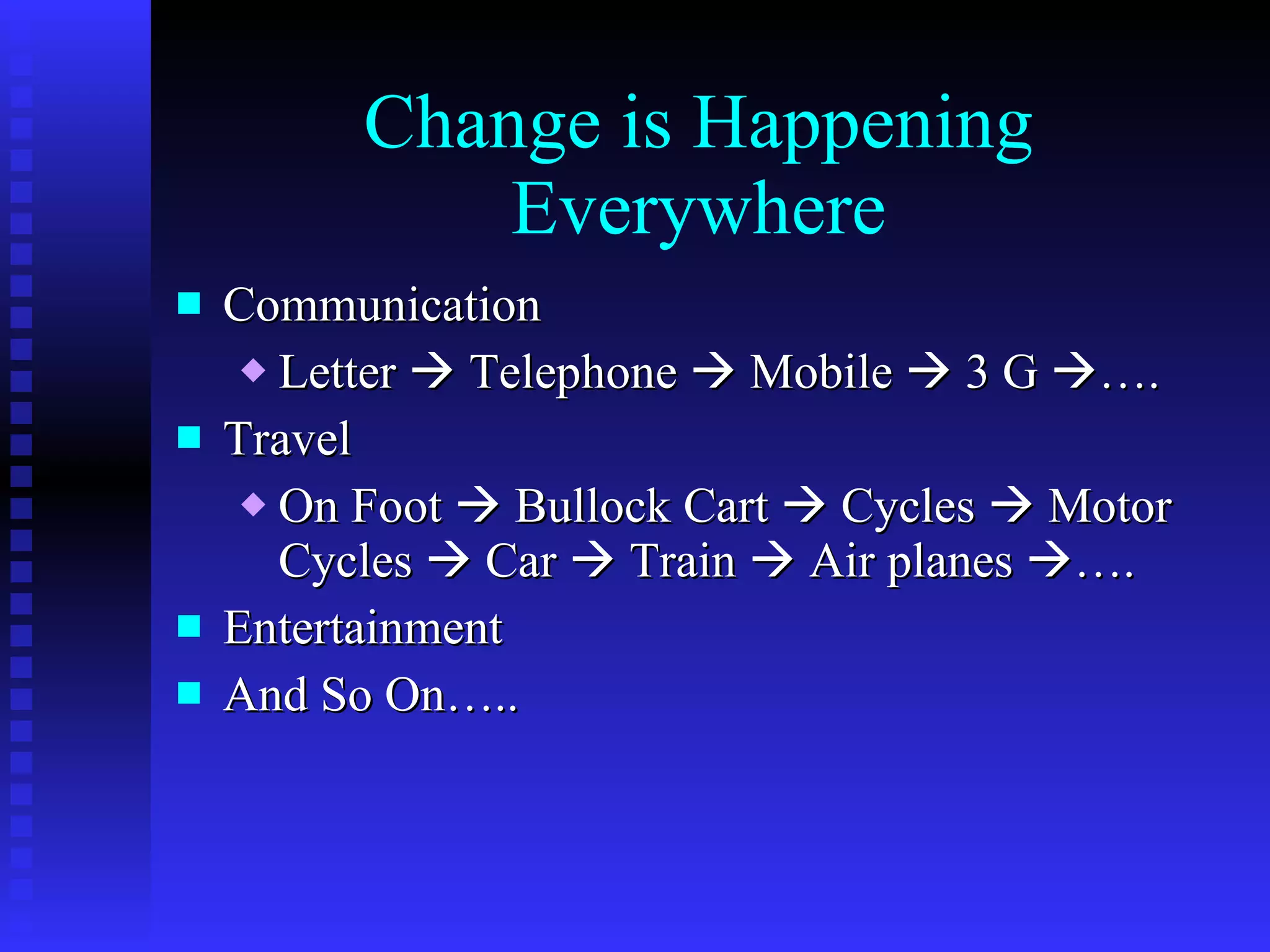
Change is Happening Everywhere Communication Letter    Telephone    Mobile    3 G   …. Travel On Foot    Bullock Cart    Cycles    Motor Cycles    Car    Train    Air planes   …. Entertainment And So On…..
We NEED TO CHANGE IN…. Our PERSPECTIVES  Our MINDSET Our LIFE STYLE … .
Why is this CHANGE HAPPENING ????
Shift in Society The Society of which we are a PART is CHANGING….
Agricultural Society Human Life Span : Thousands of Years
Industrial Society Machine  Life Span : Few Decades of Years
Information Society Computers & Internet Life Span: Few Years
Knowledge Society Mind Constant Change
What is at the End of a 15 year TUNNEL OF LEARNING?? A Question to be Posed
Major Perspectives We Need to Prepare a child FOR His/Her LIFE TIME. True Education is what REMAINS after what we have LEARNT is FORGOTTEN .
Traditional System Major Focus ON Content…Memory Testing
Now the Major Focus is on THINKING DATA GATHERING EXPERIMENTING ANALYSING IMAGINATION WHATS NEW & ORIGINAL
WHY    CONTINUOUS  COMPREHENSIVE  EVALUATION
External Examinations are largely inappropriate for the knowledge society of the 21st century and its need for innovative problem solvers‘
Evaluation of Scholastic learning only on marks. Ability of child not evaluated. Limited Techniques of Evaluation do not identify learner’s level of attainment. Resulting in Pass/Fail. Causing frustration and humiliation .
WHAT IS  CONTINUOUS  COMPREHENSIVE EVALUATION
Continuous and Comprehensive evaluation refers to a system of school based assessment that covers all aspects of student’s development .  It emphasizes two fold objectives.  Continuity in evaluation and assessment of  broad based learning. Behavioral out come.
FEATURES OF CCE Continuous  Continual—from the beginning and during the instructional process Periodicity—frequency /term
Comprehensive Scholastic  -  Subject specific areas.  Co-Scholastic -  Life skills, attitudes &  values and other co curricular activities Includes a variety of tools and techniques for assessment of the learners.
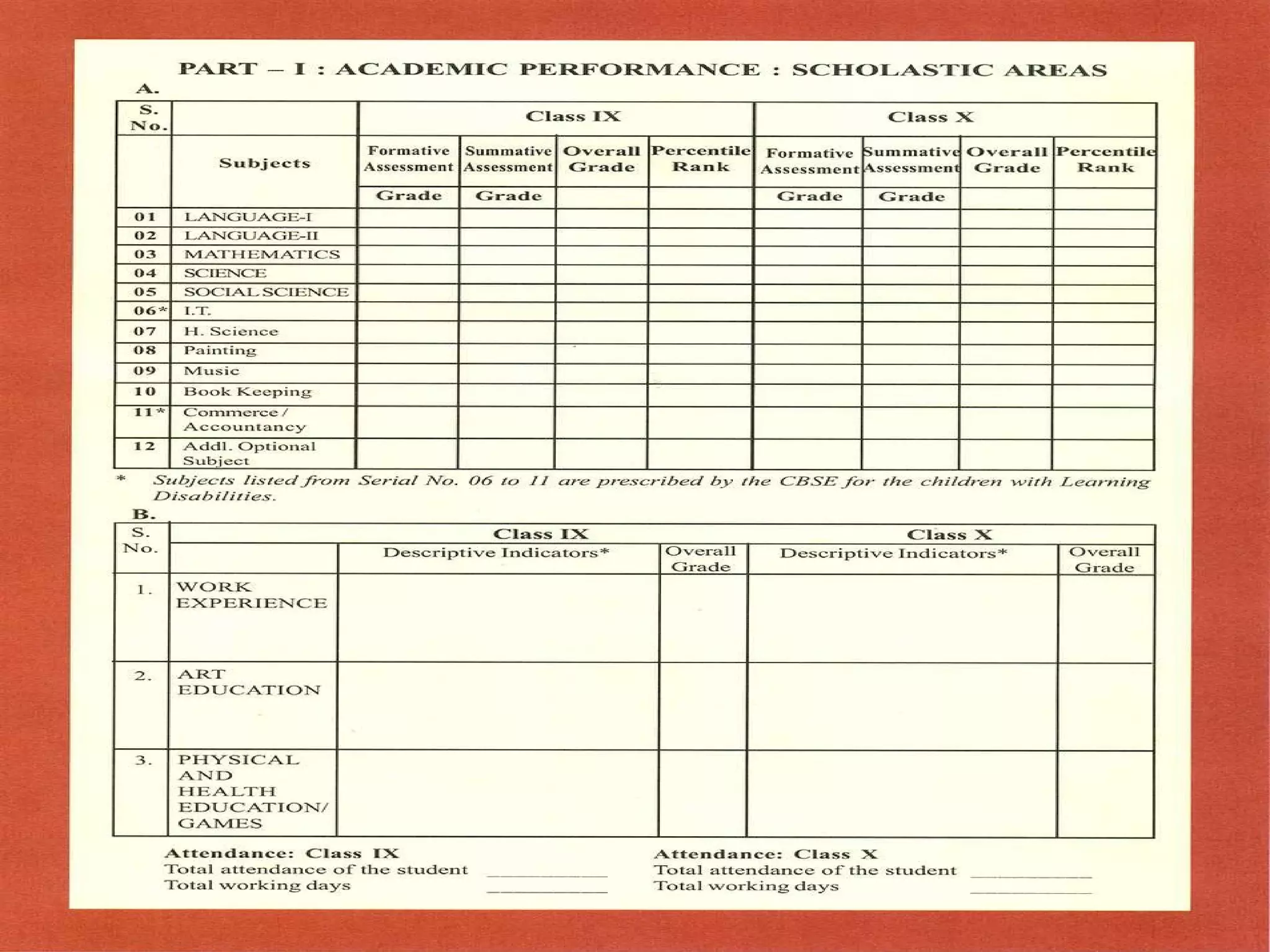
Scholastic Academic Work experience Physical and Health Education Art Education Co Scholastic Life Skills Attitudes and Values Outdoor Activities
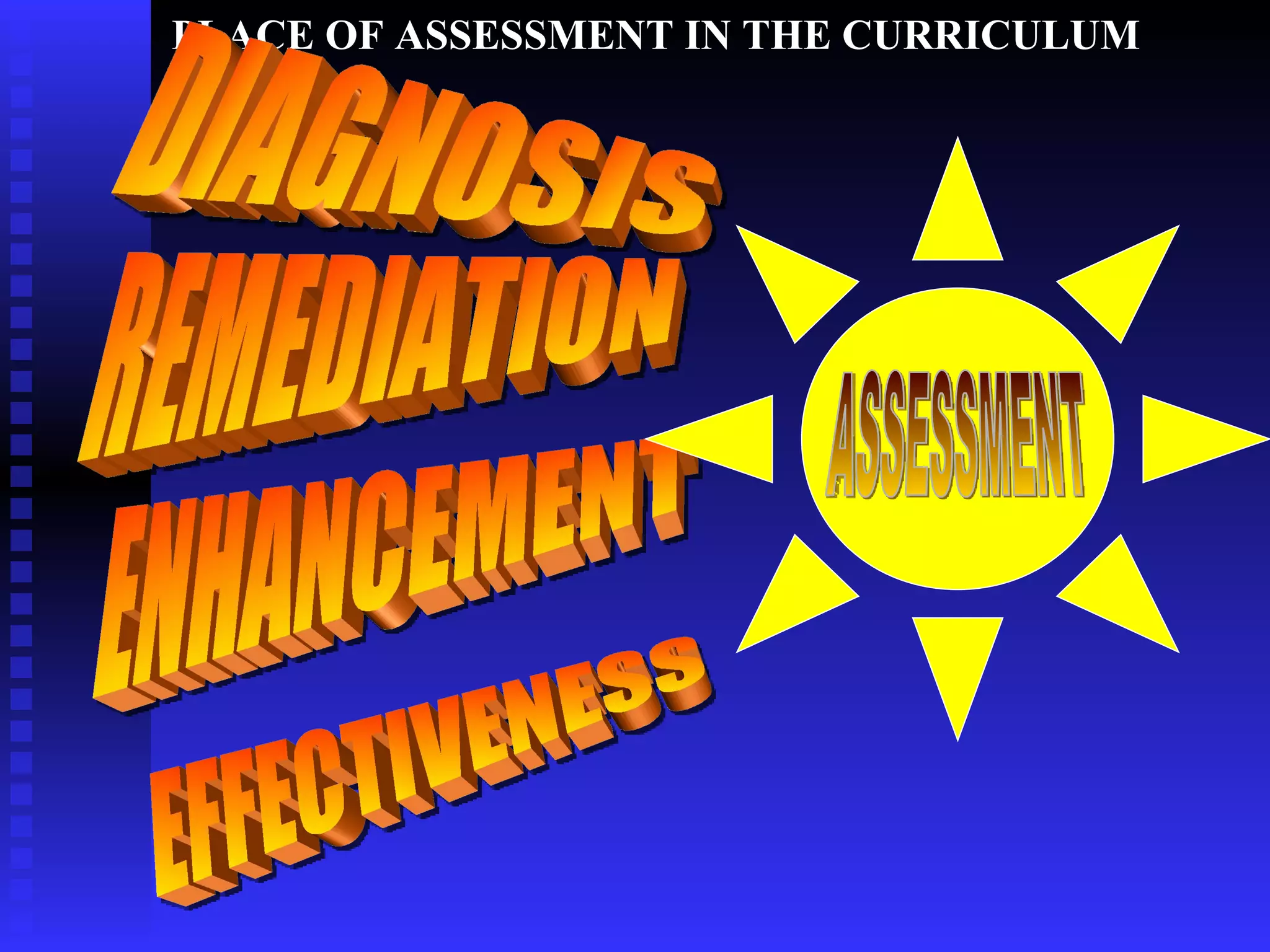
PLACE OF ASSESSMENT IN THE CURRICULUM EFFECTIVENESS REMEDIATION ENHANCEMENT DIAGNOSIS ASSESSMENT
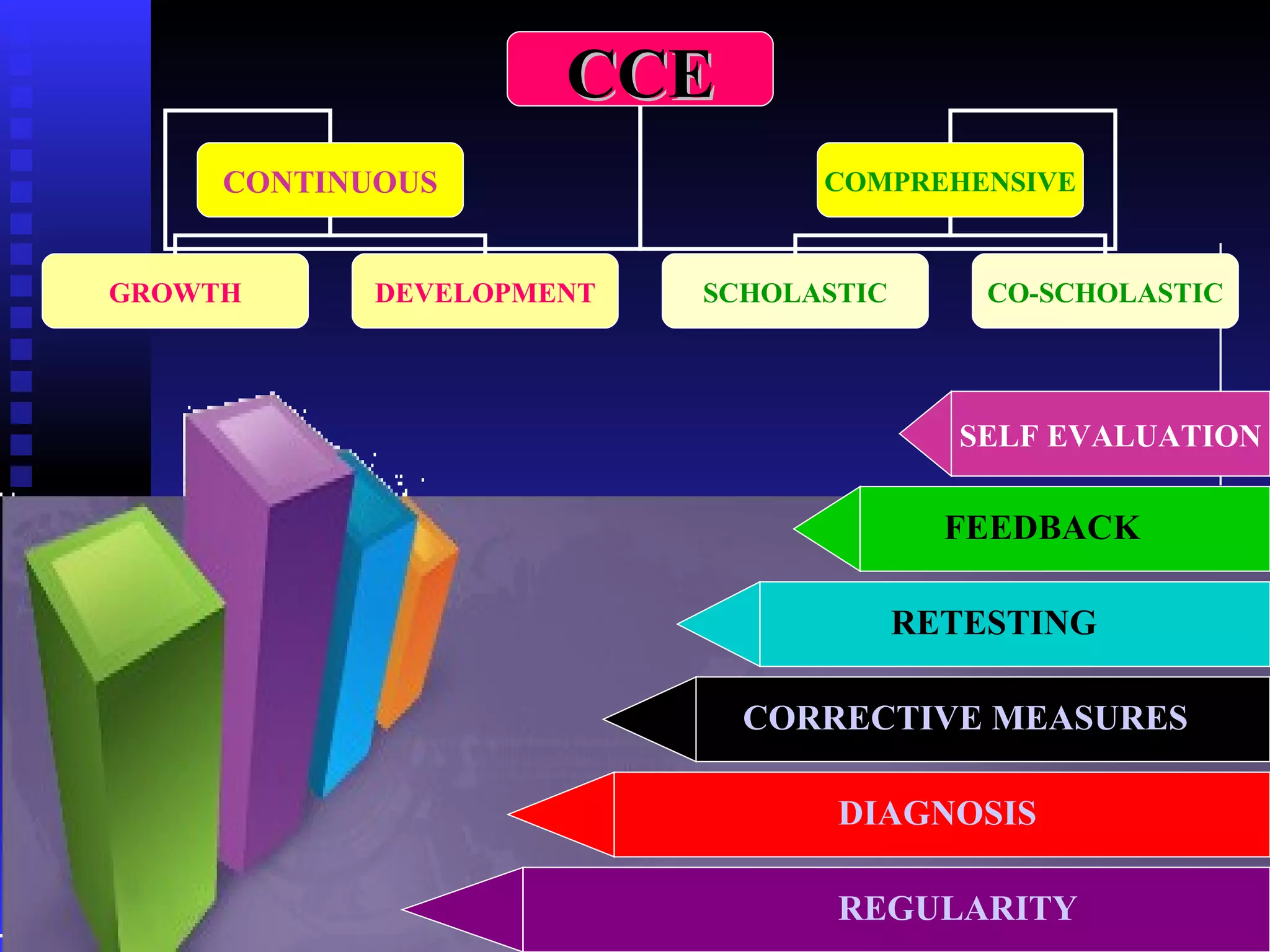
SELF EVALUATION FEEDBACK RETESTING CORRECTIVE MEASURES DIAGNOSIS REGULARITY CCE CONTINUOUS COMPREHENSIVE GROWTH DEVELOPMENT SCHOLASTIC CO-SCHOLASTIC
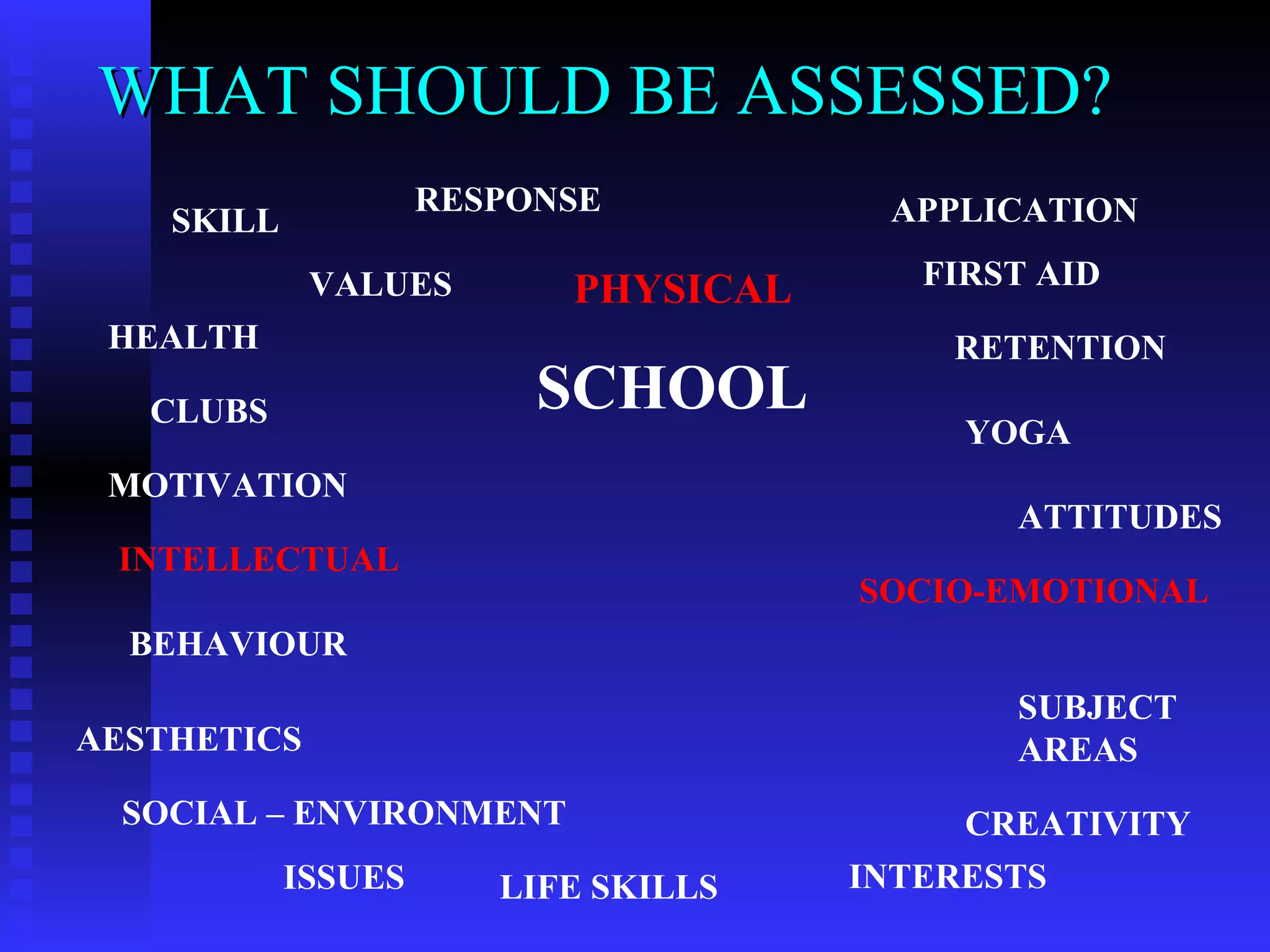
WHAT SHOULD BE ASSESSED? SKILL BEHAVIOUR MOTIVATION APPLICATION RETENTION SUBJECT AREAS SOCIAL – ENVIRONMENT ISSUES INTERESTS ATTITUDES RESPONSE SCHOOL INTELLECTUAL PHYSICAL SOCIO-EMOTIONAL HEALTH LIFE SKILLS VALUES CREATIVITY AESTHETICS CLUBS YOGA FIRST AID
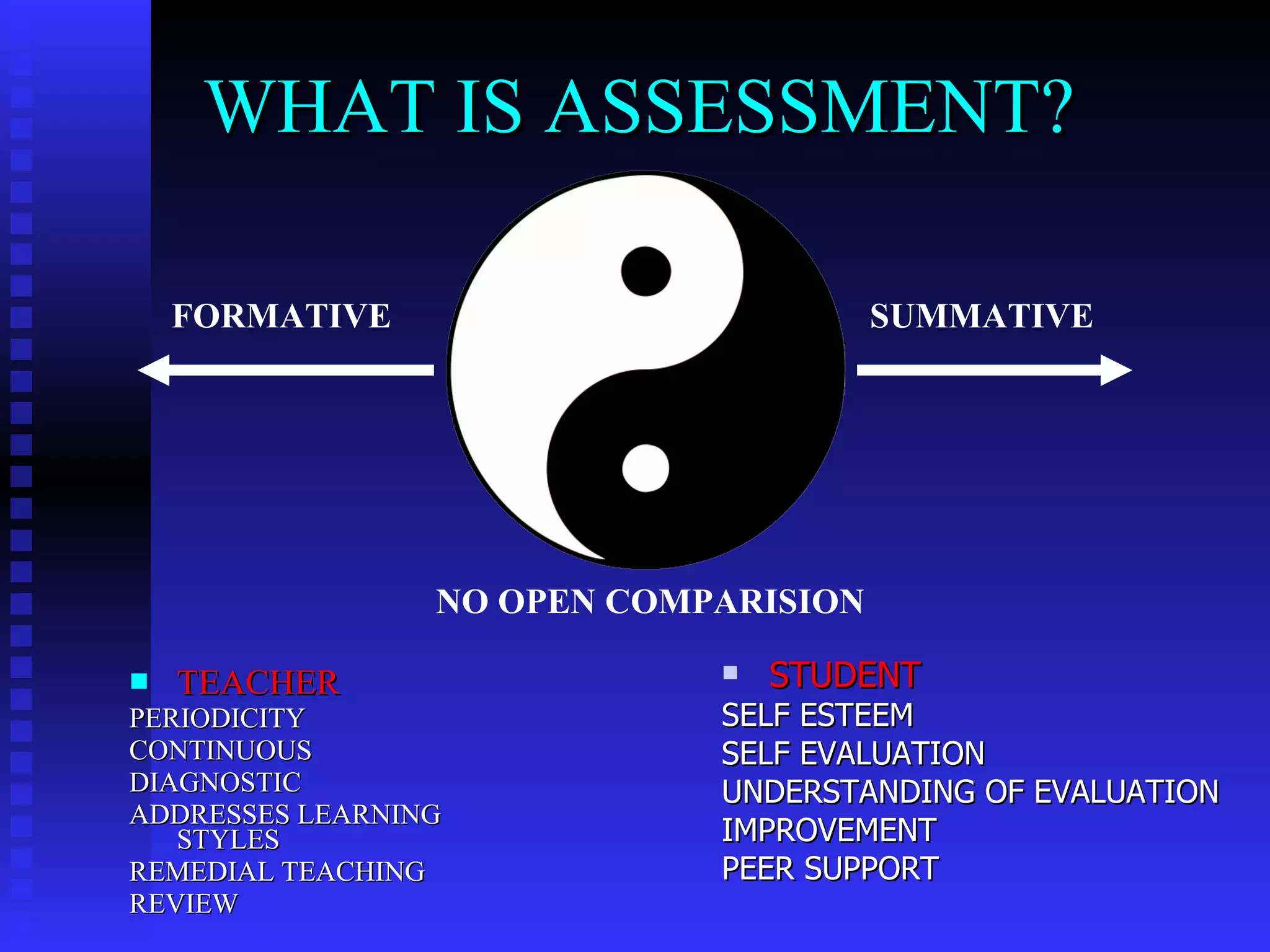
TEACHER PERIODICITY CONTINUOUS DIAGNOSTIC ADDRESSES LEARNING STYLES REMEDIAL TEACHING REVIEW WHAT IS ASSESSMENT? FORMATIVE SUMMATIVE NO OPEN COMPARISION STUDENT SELF ESTEEM SELF EVALUATION UNDERSTANDING OF EVALUATION IMPROVEMENT PEER SUPPORT
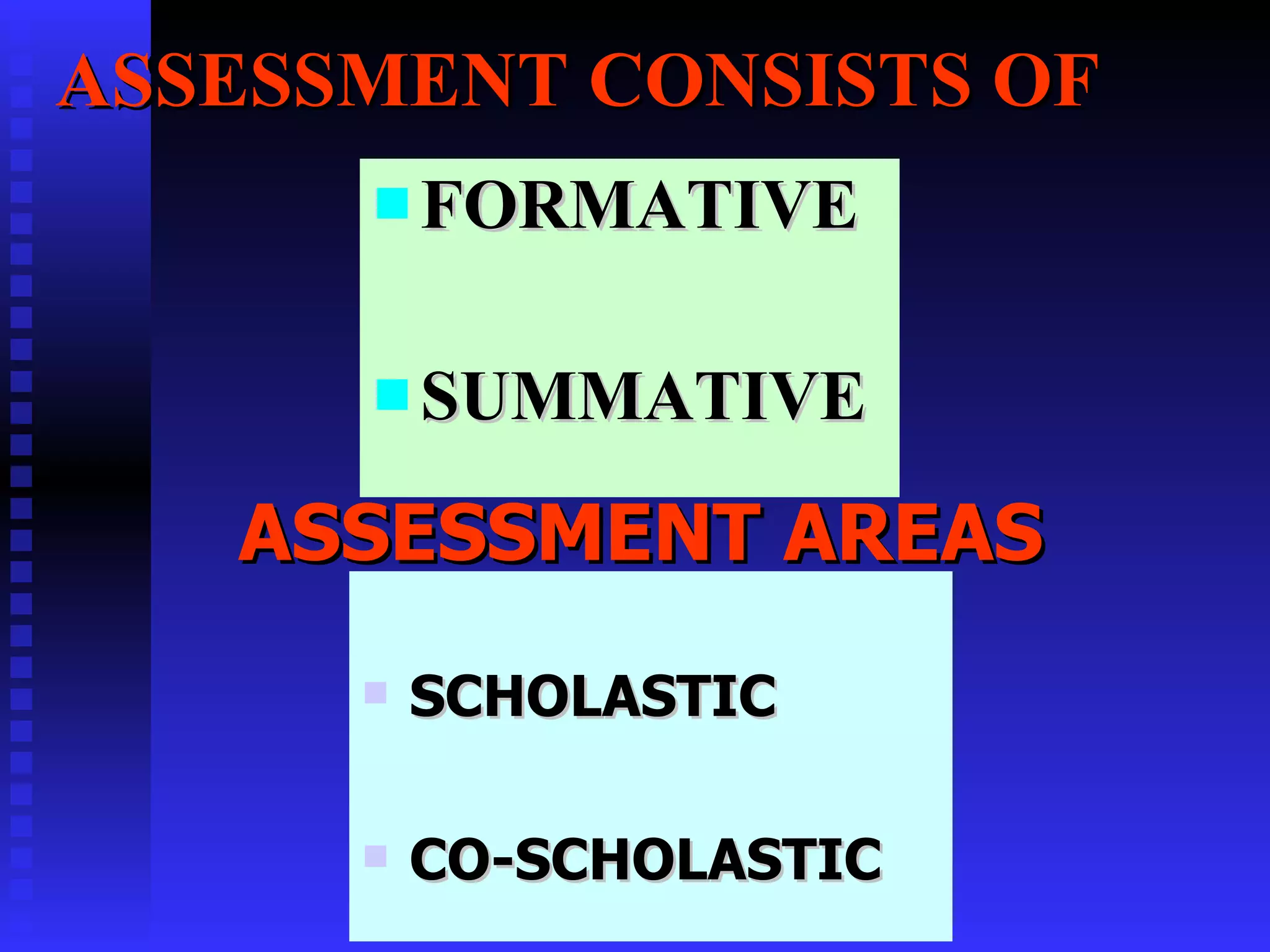
ASSESSMENT CONSISTS OF FORMATIVE SUMMATIVE ASSESSMENT AREAS SCHOLASTIC CO-SCHOLASTIC
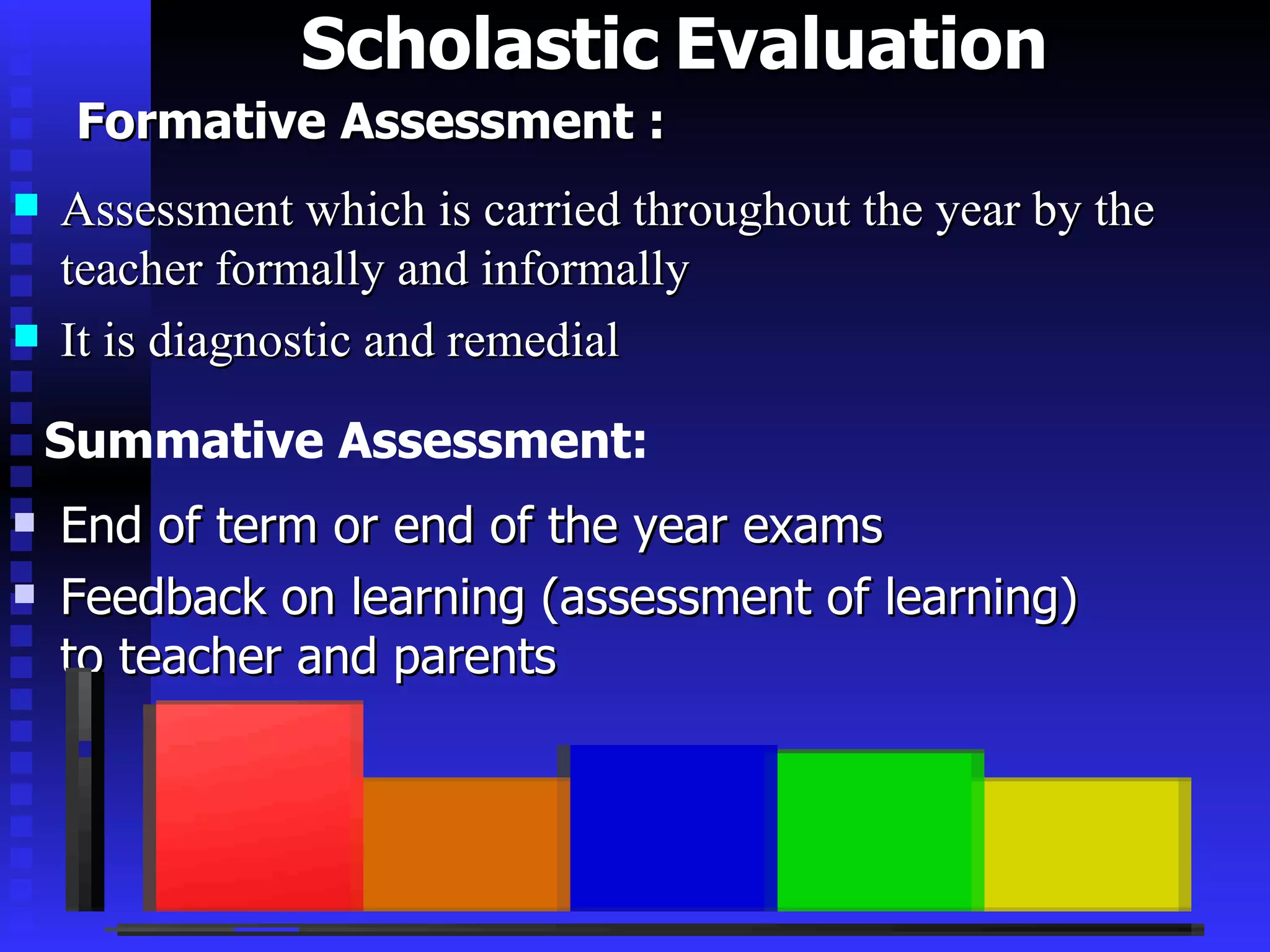
Assessment which is carried throughout the year by the teacher formally and informally  It is diagnostic and remedial Scholastic   Evaluation Formative Assessment :   End of term or end of the year exams Feedback on learning (assessment of learning) to teacher and parents Summative Assessment:
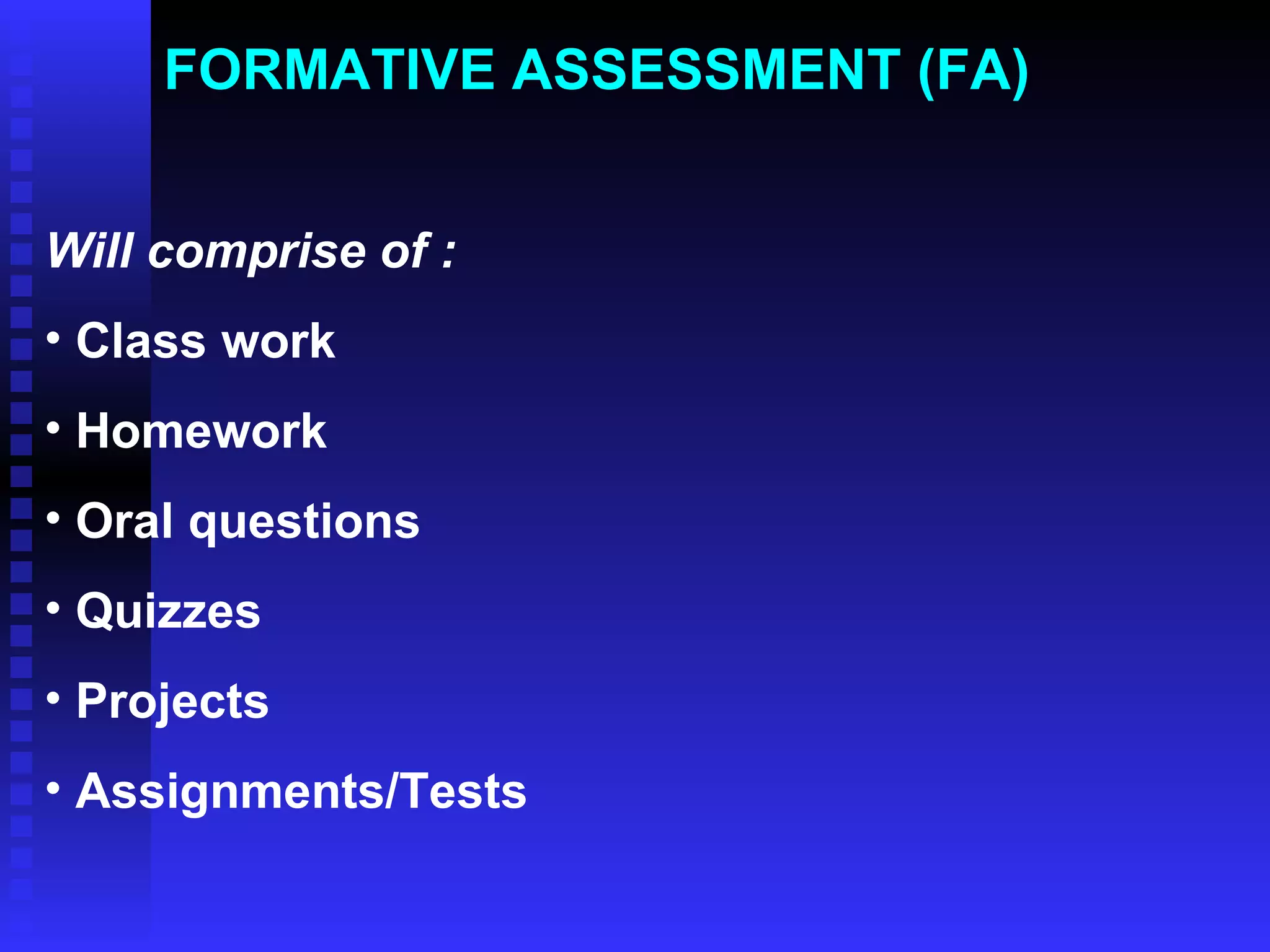
FORMATIVE ASSESSMENT (FA)  Will comprise of : Class work Homework Oral questions Quizzes Projects Assignments/Tests
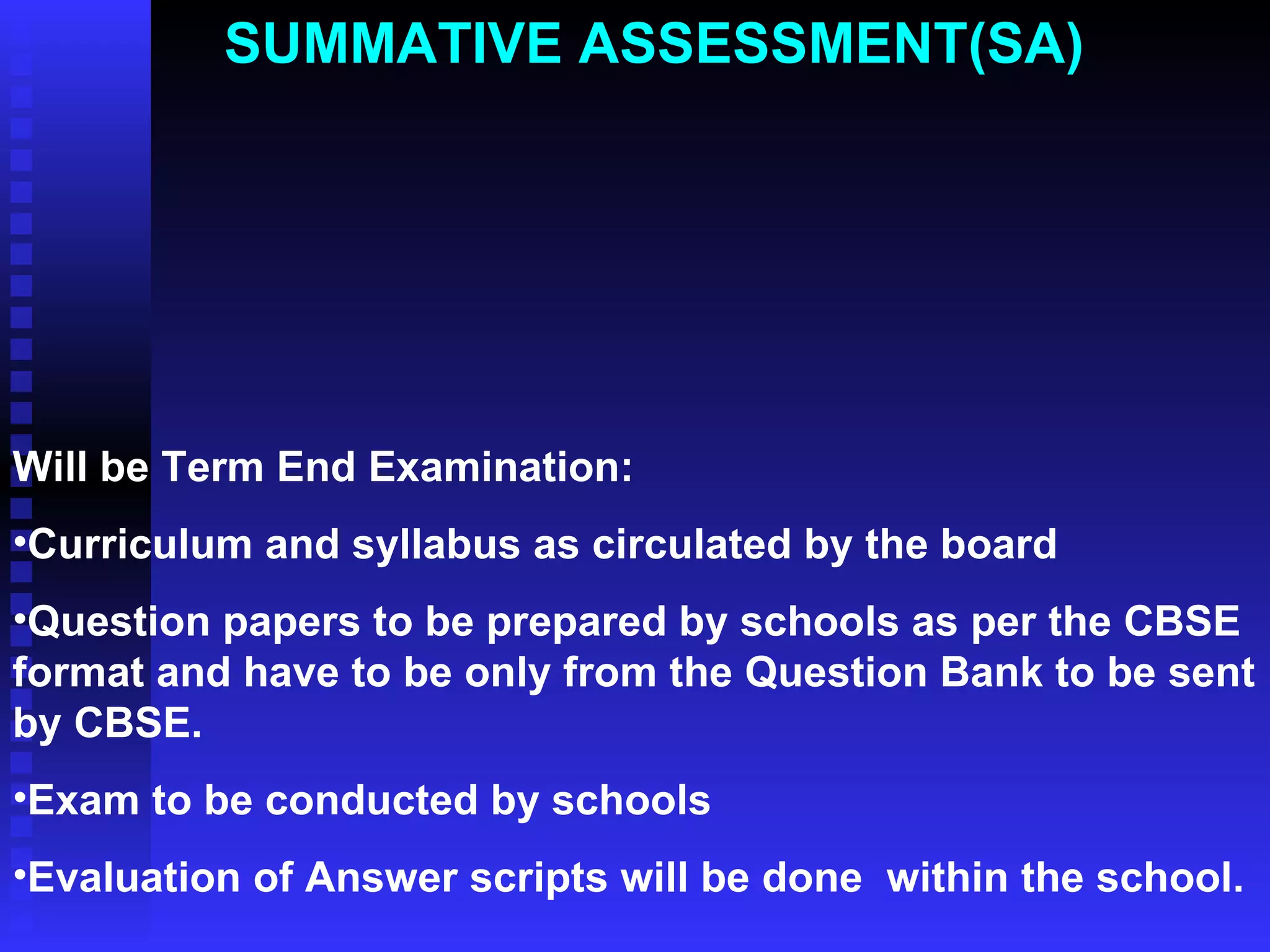
SUMMATIVE ASSESSMENT(SA)  Will be Term End Examination: Curriculum and syllabus as circulated by the board Question papers to be prepared by schools as per the CBSE format and have to be only from the Question Bank to be sent by CBSE. Exam to be conducted by schools Evaluation of Answer scripts will be done  within the school.
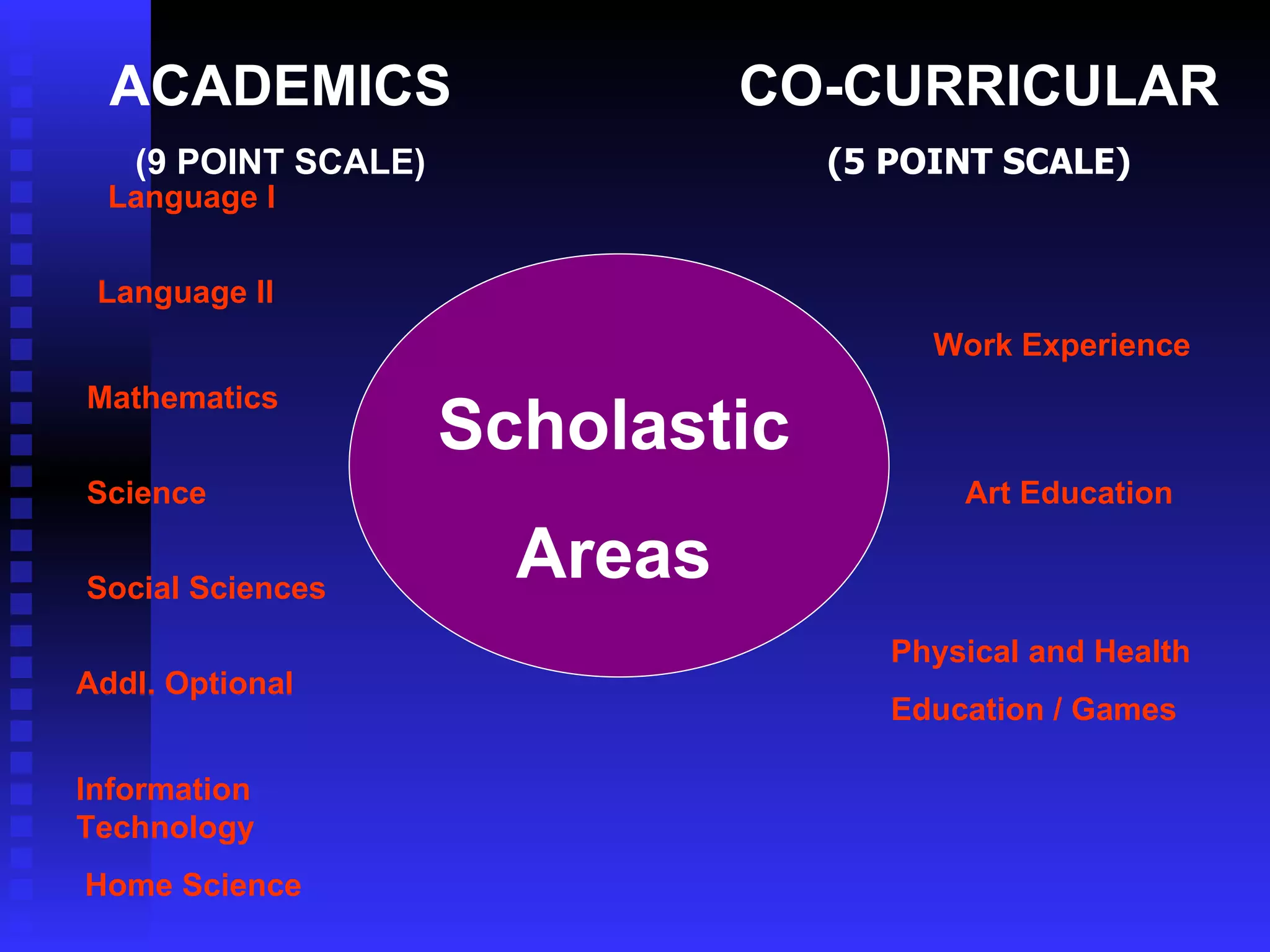
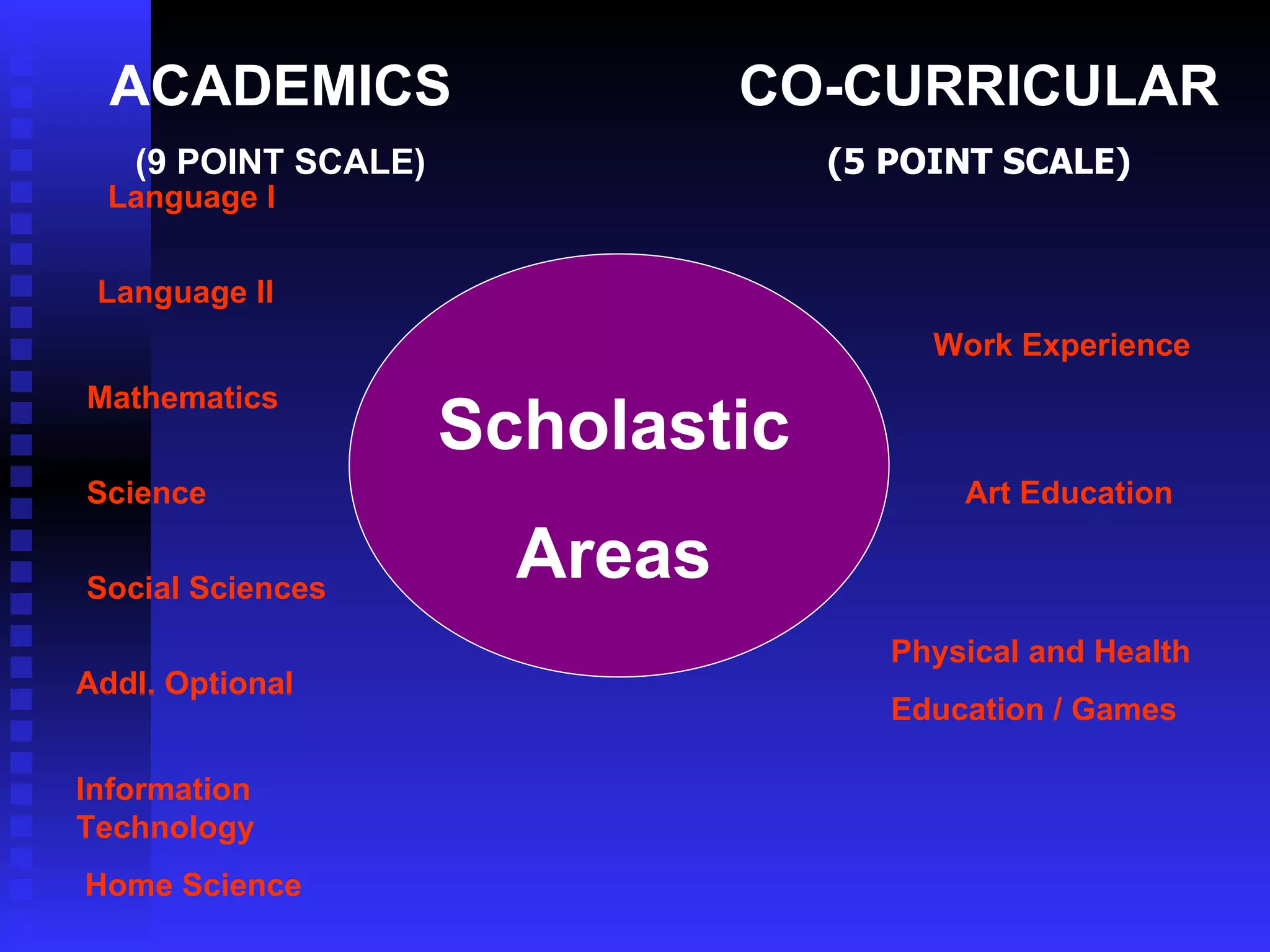
Science Mathematics Scholastic Areas Social Sciences Language II Language I ACADEMICS (9 POINT SCALE) CO-CURRICULAR (5 POINT SCALE) Work Experience Art Education Physical and Health Education / Games Addl. Optional Information Technology  Home Science
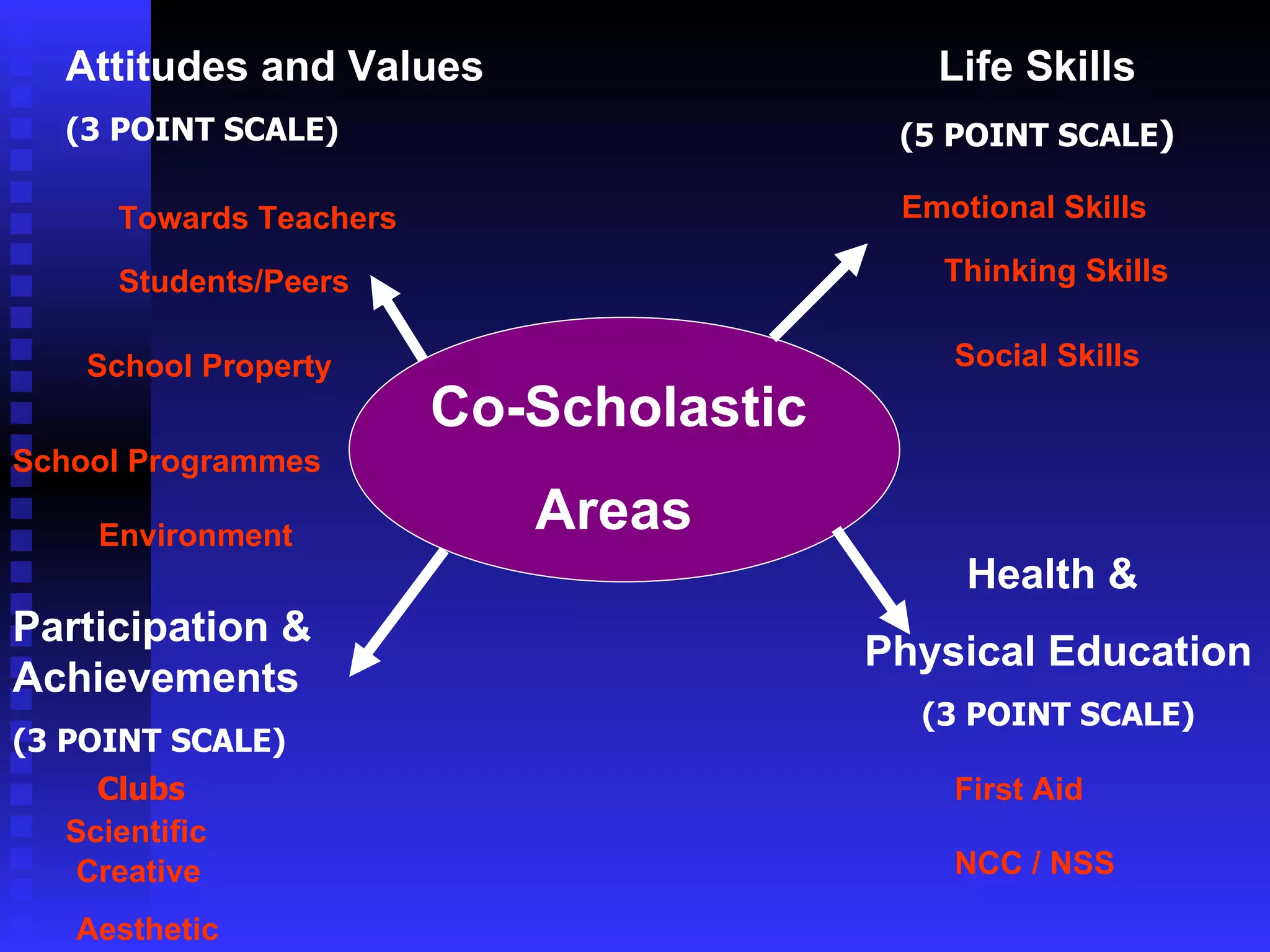
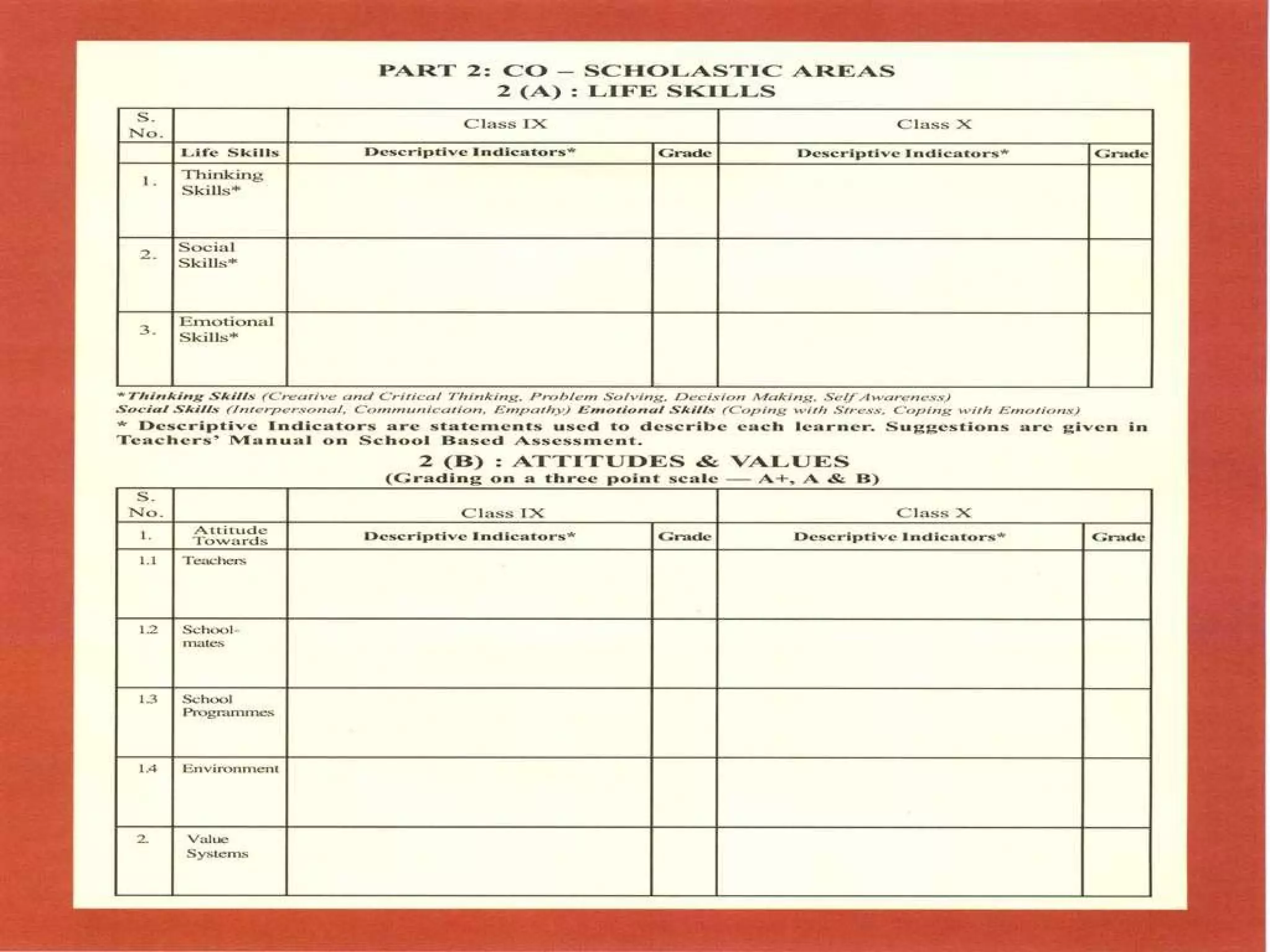
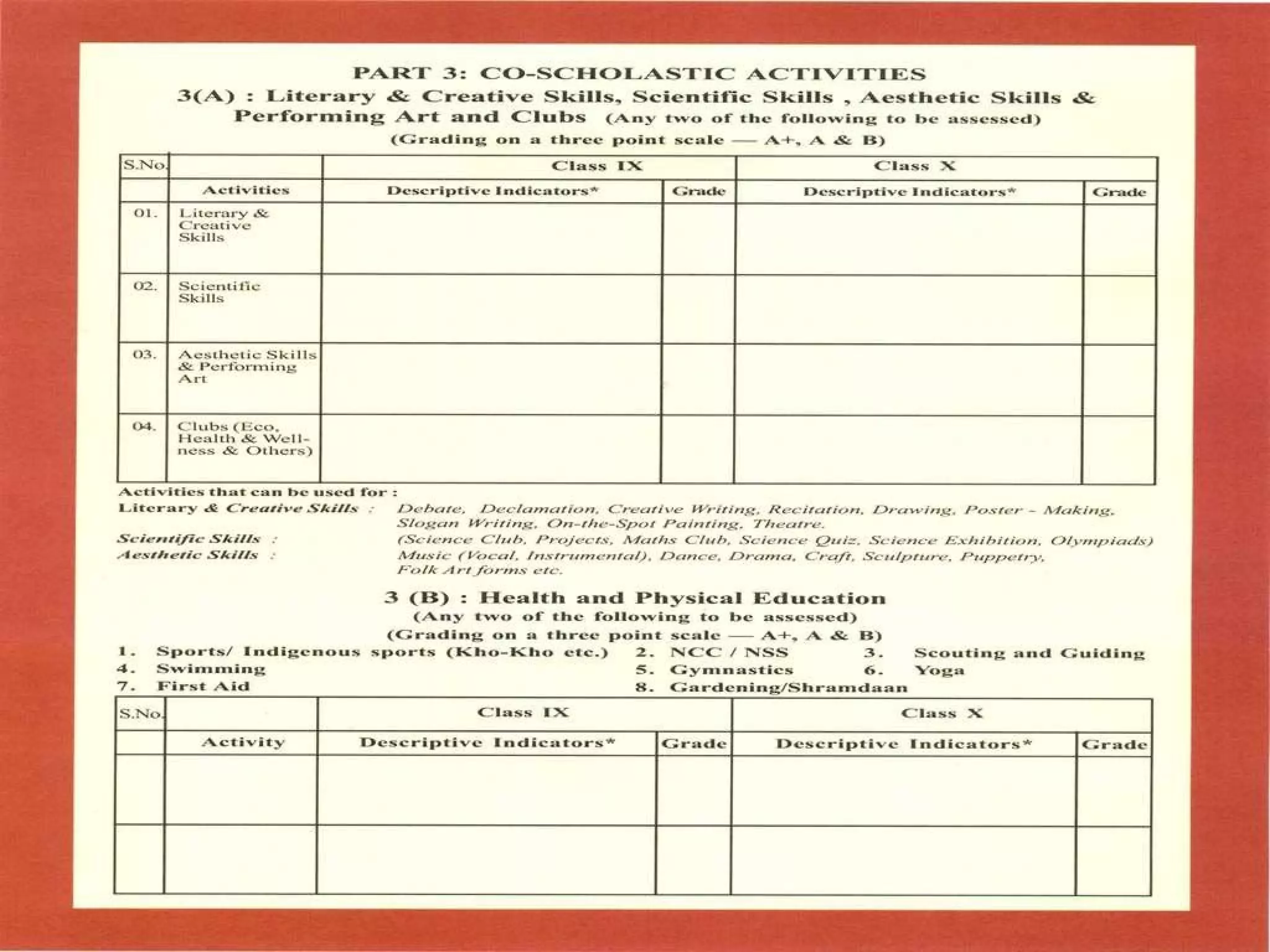
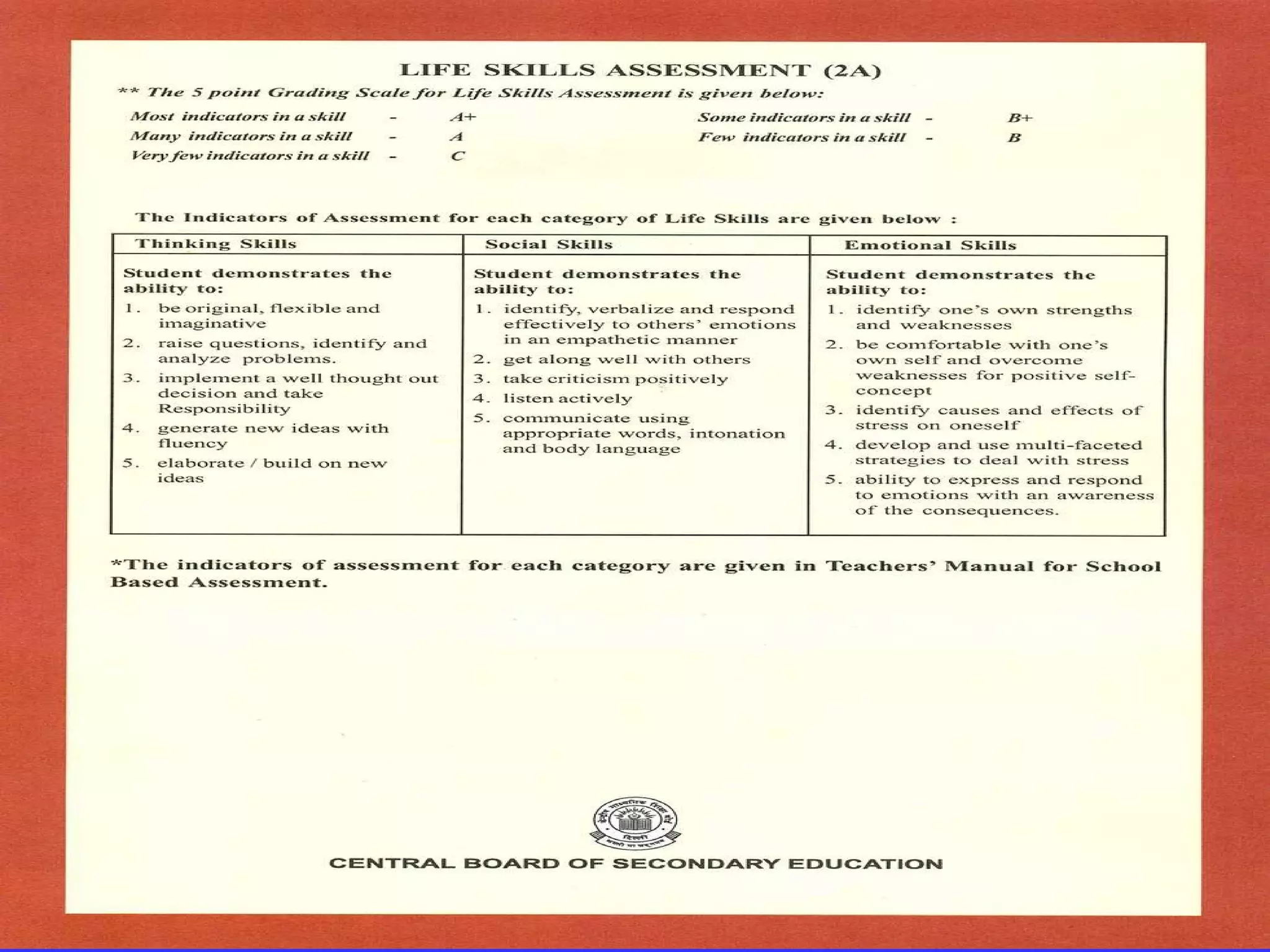
School Programmes School Property Co-Scholastic Areas Environment Students/Peers Towards Teachers Attitudes and Values (3 POINT SCALE) Emotional Skills Social Skills Participation & Achievements (3 POINT SCALE) Scientific Life Skills (5 POINT SCALE ) Thinking Skills Creative Aesthetic Health &  Physical Education (3 POINT SCALE) NCC / NSS First Aid Clubs
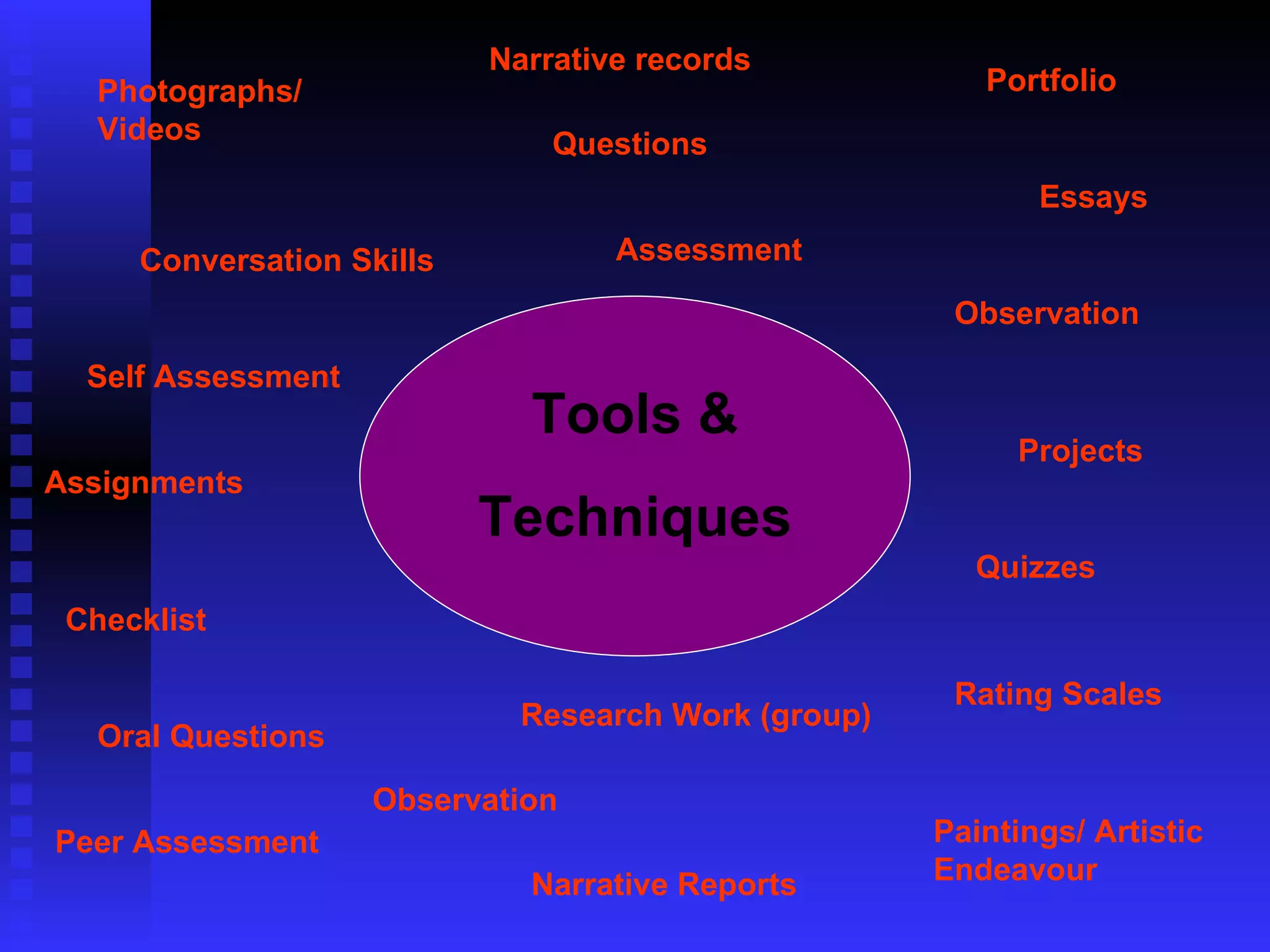
Tools & Techniques Oral Questions Assignments Research Work (group) Quizzes Conversation Skills Assessment Projects Questions Observation Checklist Portfolio Narrative records Photographs/ Videos Paintings/ Artistic Endeavour Observation Essays Self Assessment Peer Assessment Rating Scales Narrative Reports
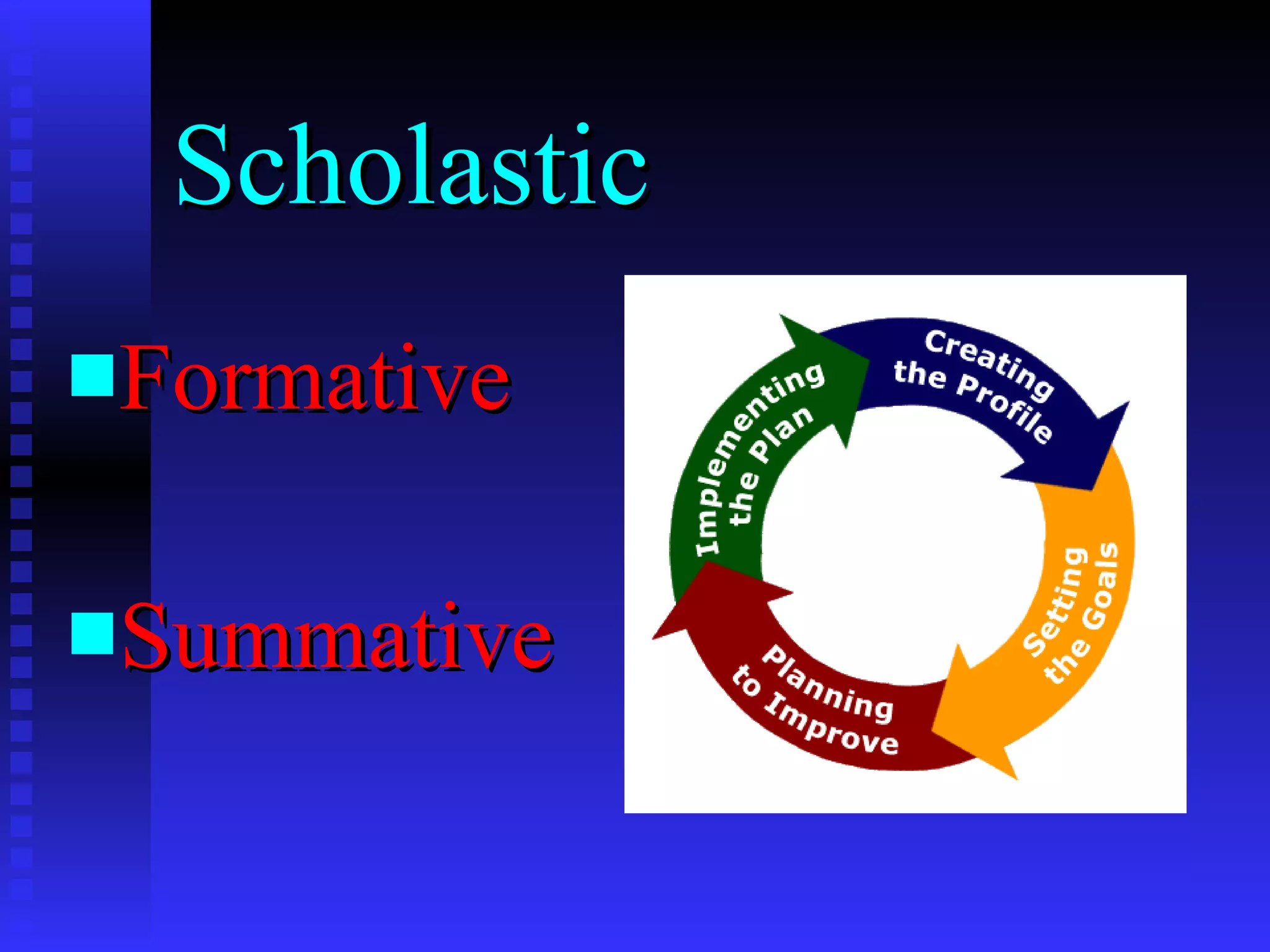
Scholastic Formative Summative
What is Formative Assessment What does it mean? How does it help the teacher and the student?
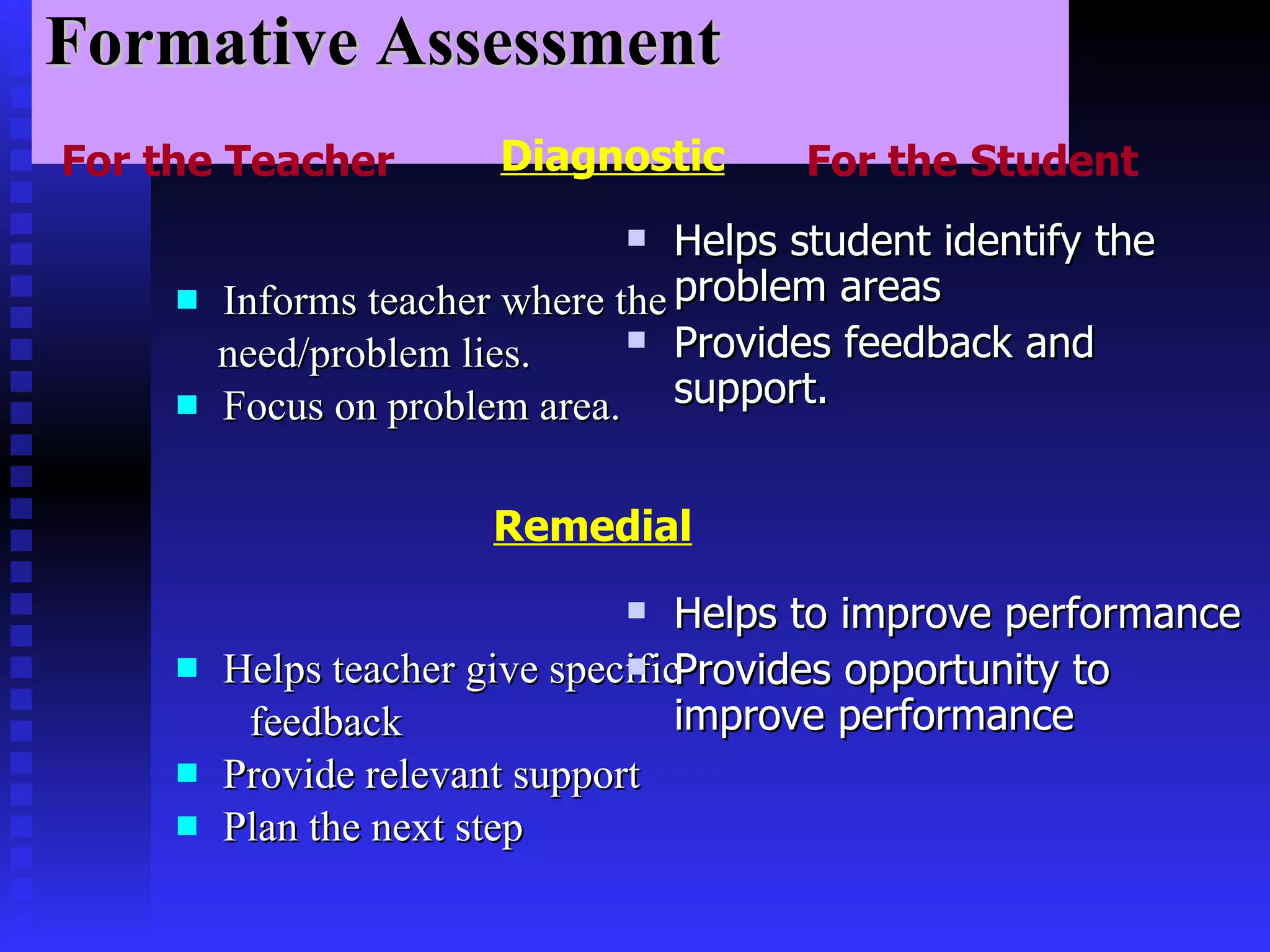
Formative Assessment Informs teacher where the  need/problem lies.  Focus on problem area. Helps teacher give specific feedback Provide relevant support  Plan the next step For the Teacher For the Student Helps student identify the problem areas  Provides feedback and support. Helps to improve performance  Provides opportunity to improve performance Remedial Diagnostic
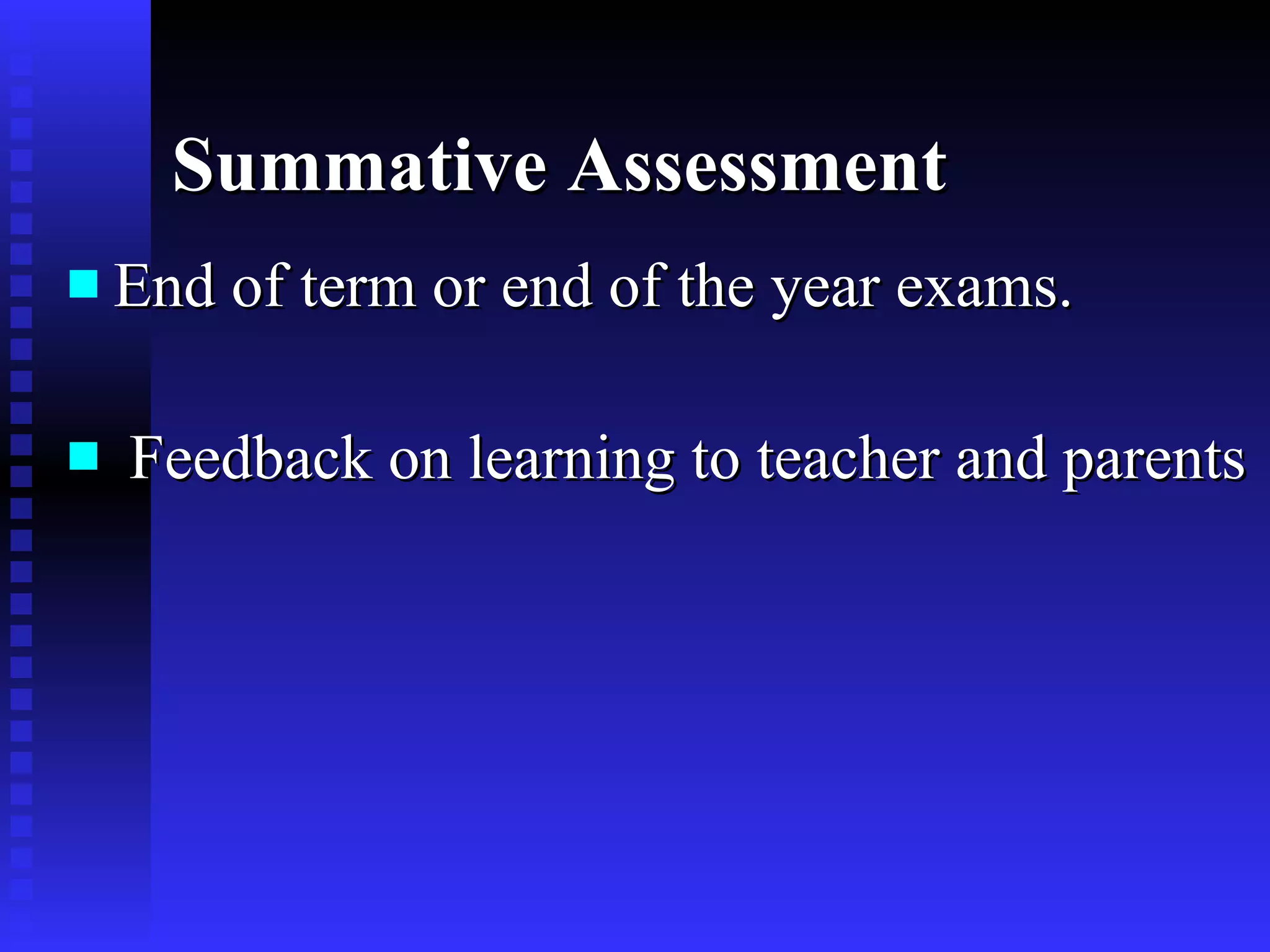
Summative Assessment End of term or end of the year exams. Feedback on learning to teacher and parents
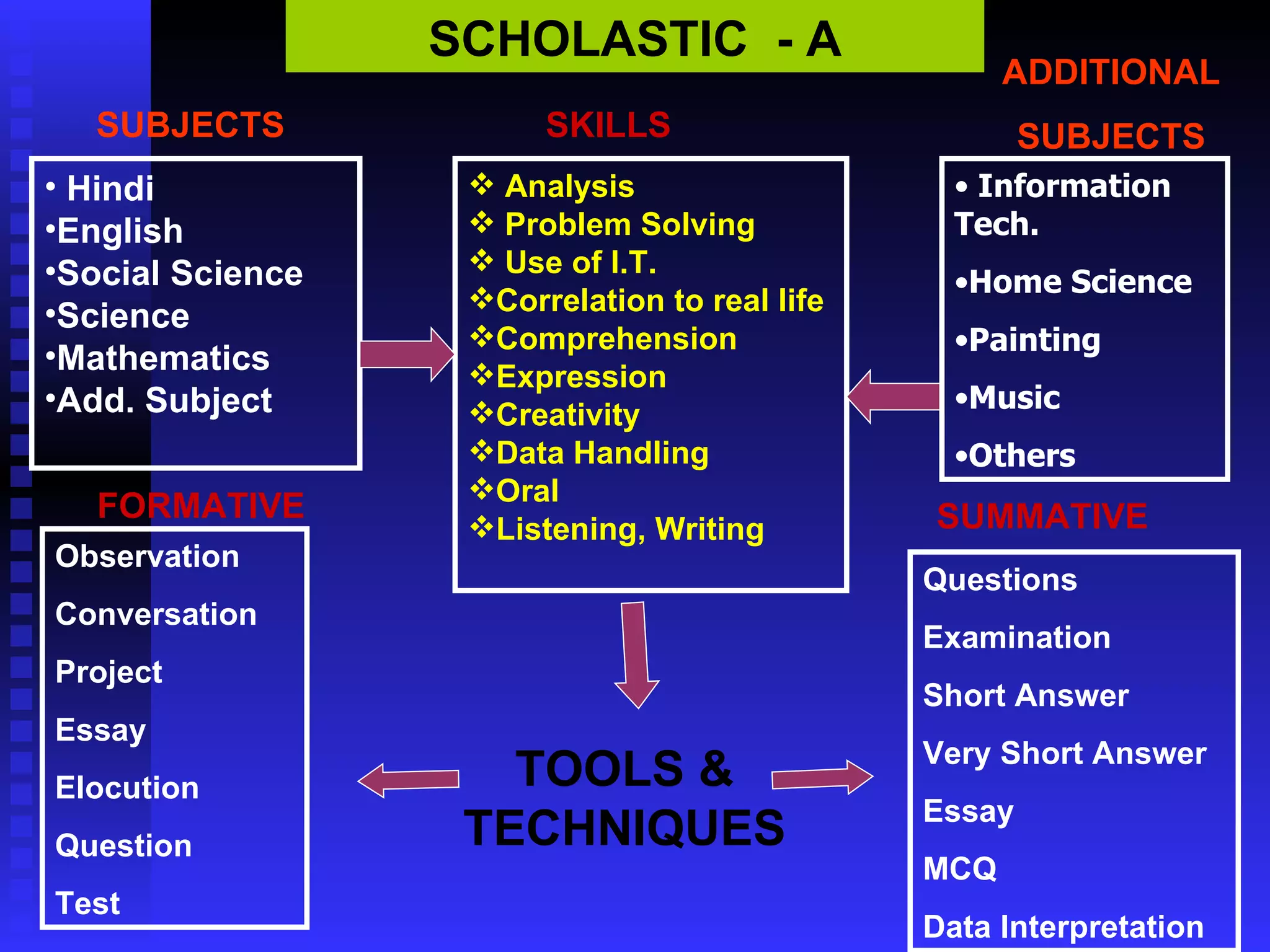
SCHOLASTIC  - A SUBJECTS SKILLS SUMMATIVE Hindi  English Social Science Science  Mathematics Add. Subject Analysis Problem Solving  Use of I.T. Correlation to real life Comprehension Expression Creativity Data Handling  Oral Listening, Writing  Questions Examination Short Answer Very Short Answer Essay MCQ Data Interpretation Observation Conversation Project Essay  Elocution Question  Test FORMATIVE TOOLS & TECHNIQUES ADDITIONAL SUBJECTS Information Tech. Home Science Painting Music Others
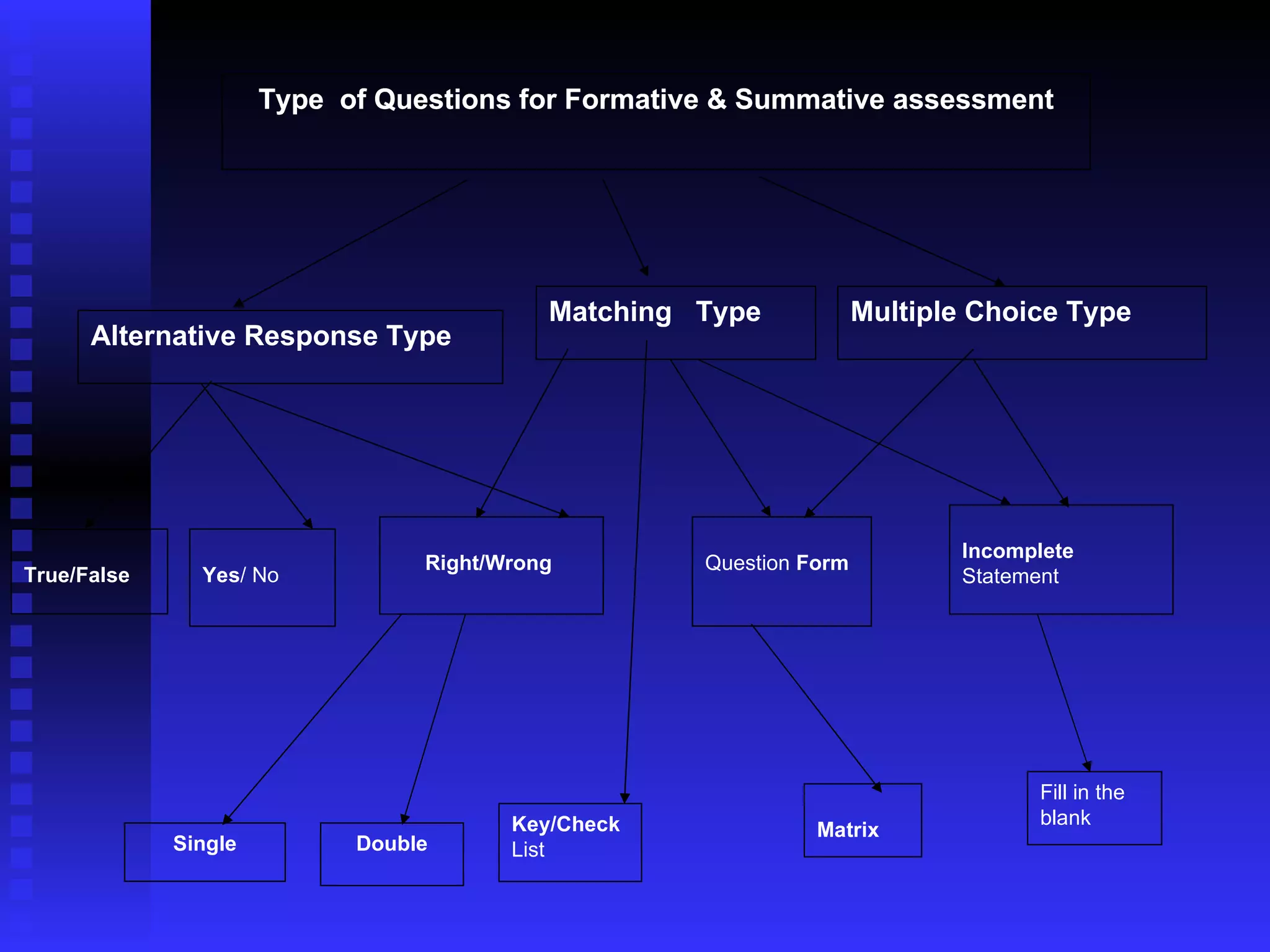
Type  of Questions for Formative & Summative assessment  Matching  Type   Multiple Choice Type Alternative Response Type True/False Yes / No Right/Wrong   Question  Form Incomplete  Statement  Fill in the blank Matrix Type  of Questions for Formative & Summative assessment  Single Double Key/Check  List
Scholastic Assessment Formative and Summative Assessment – [FA1+FA2+FA3+FA4] Subjec t LANGUAGE Skills Oral & Listening Writing Comprehension Mode of Assessment   Dialogue Conversations Speeches (Debating recitation) Quiz, Essays Research Projects Group work Assignments Research Projects Question papers Teacher’s Role Diagnostic / remediation Portfolio / Received maintained  month / term / academic year. Identify areas in which students need additional practice  Checklist maintained  Observation Schedules – Anecdotal records : Example of Formative Assessment-  Debating  on a topic which could be connected to the  Curriculum / Social Environment. –  SKILLLS  -Oral and listening
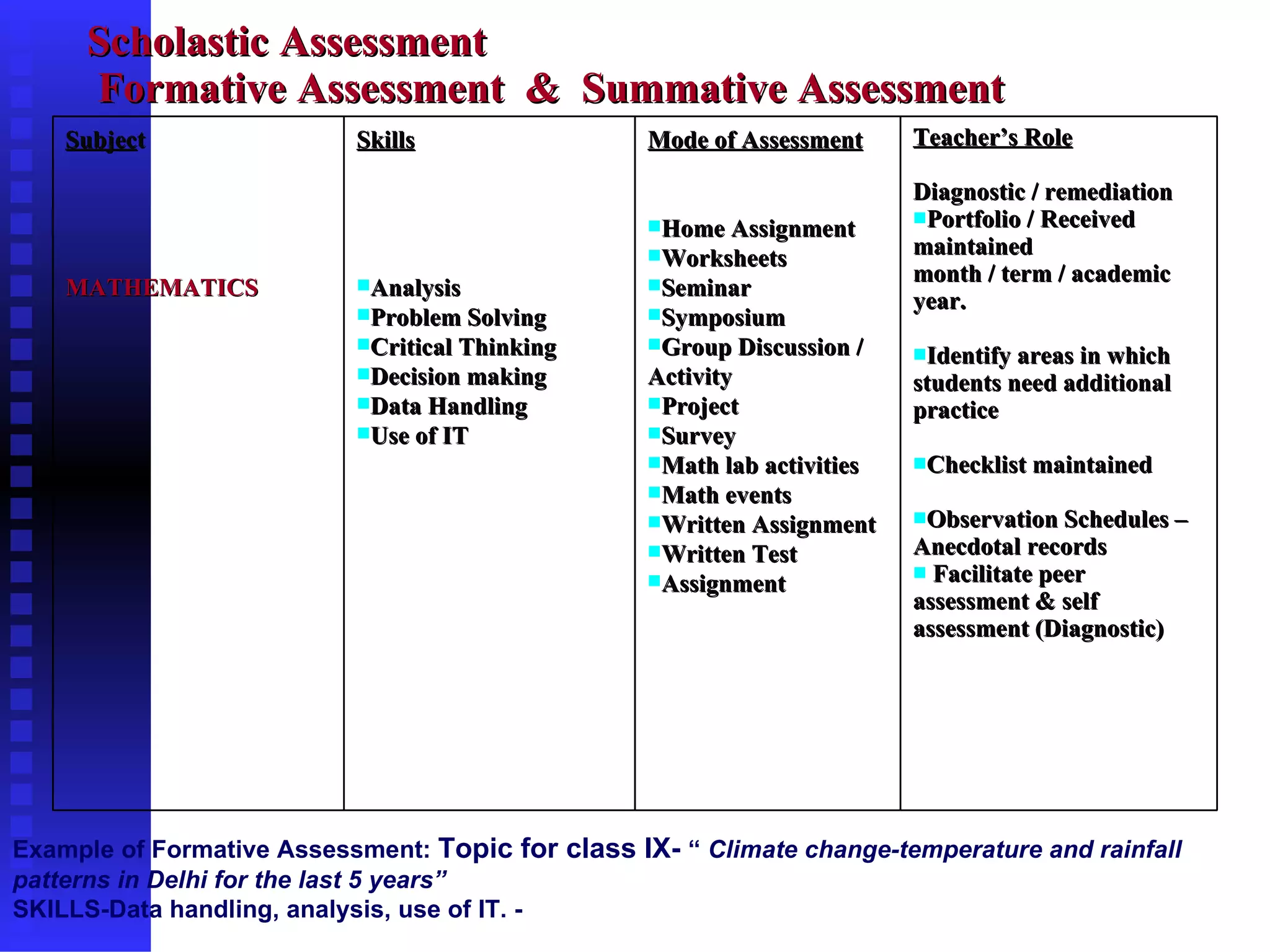
Scholastic Assessment  Formative Assessment  &  Summative Assessment  Subjec t MATHEMATICS Skills Analysis  Problem Solving Critical Thinking Decision making Data Handling Use of IT Mode of Assessment Home Assignment Worksheets Seminar Symposium Group Discussion / Activity Project Survey Math lab activities Math events Written Assignment Written Test Assignment Teacher’s Role Diagnostic / remediation Portfolio / Received maintained  month / term / academic year. Identify areas in which students need additional practice  Checklist maintained  Observation Schedules – Anecdotal records Facilitate peer assessment & self assessment (Diagnostic) Example of Formative Assessment:  Topic for class IX-  “  Climate change-temperature and rainfall patterns in Delhi for the last 5 years” SKILLS-Data handling, analysis, use of IT. -
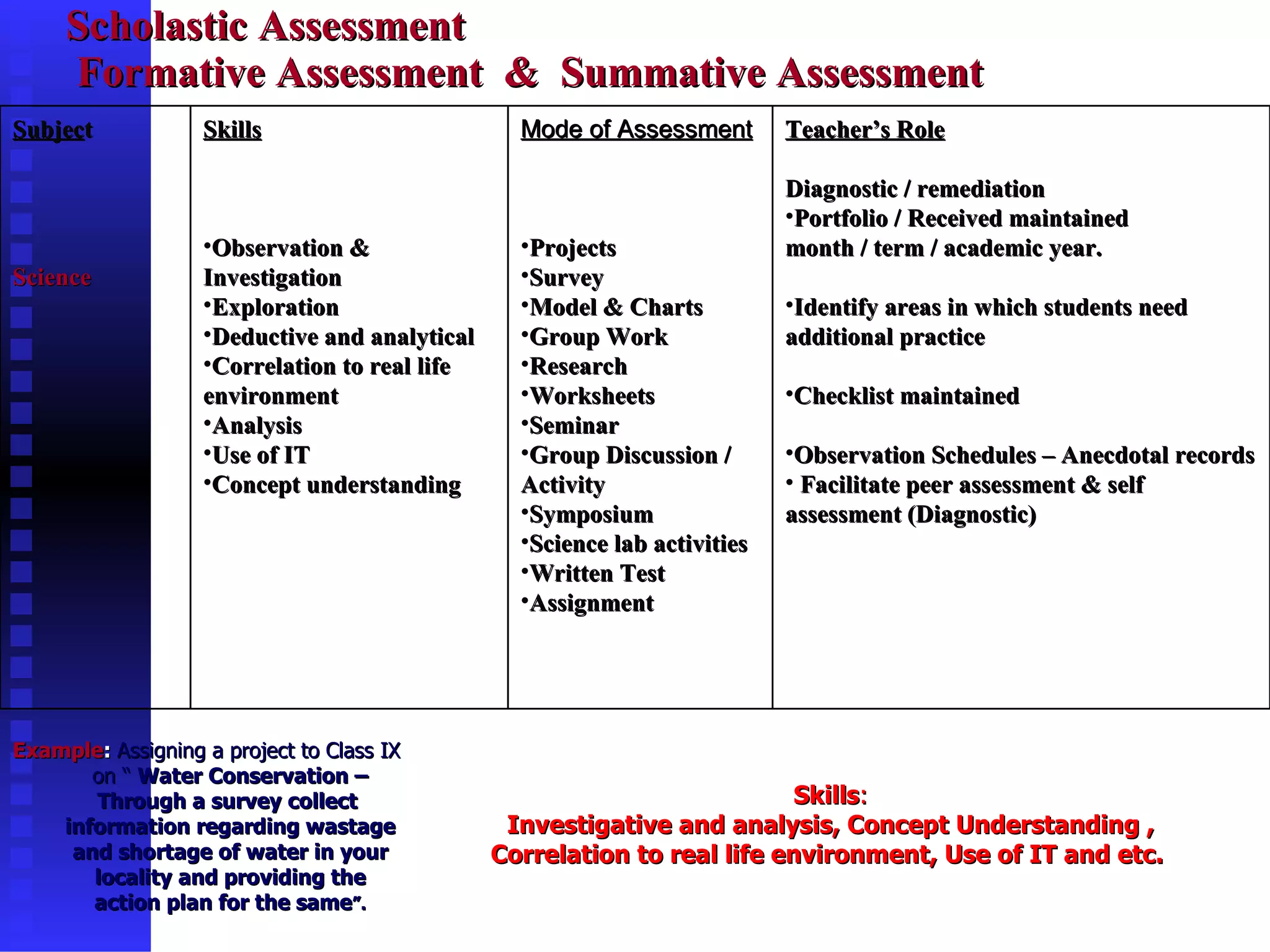
Scholastic Assessment  Formative Assessment  &  Summative Assessment  Subjec t Science Skills Observation & Investigation Exploration  Deductive and analytical Correlation to real life environment Analysis Use of IT Concept understanding Mode of Assessment   Projects  Survey Model & Charts Group Work Research Worksheets Seminar Group Discussion / Activity Symposium Science lab activities Written Test Assignment Teacher’s Role Diagnostic / remediation Portfolio / Received maintained  month / term / academic year. Identify areas in which students need additional practice  Checklist maintained  Observation Schedules – Anecdotal records Facilitate peer assessment & self assessment (Diagnostic) Example :  Assigning a project to Class IX on “  Water Conservation – Through a survey collect  information regarding wastage and shortage of water in your locality and providing the action plan for the same ”. Skills : Investigative and analysis, Concept Understanding , Correlation to real life environment, Use of IT and etc.
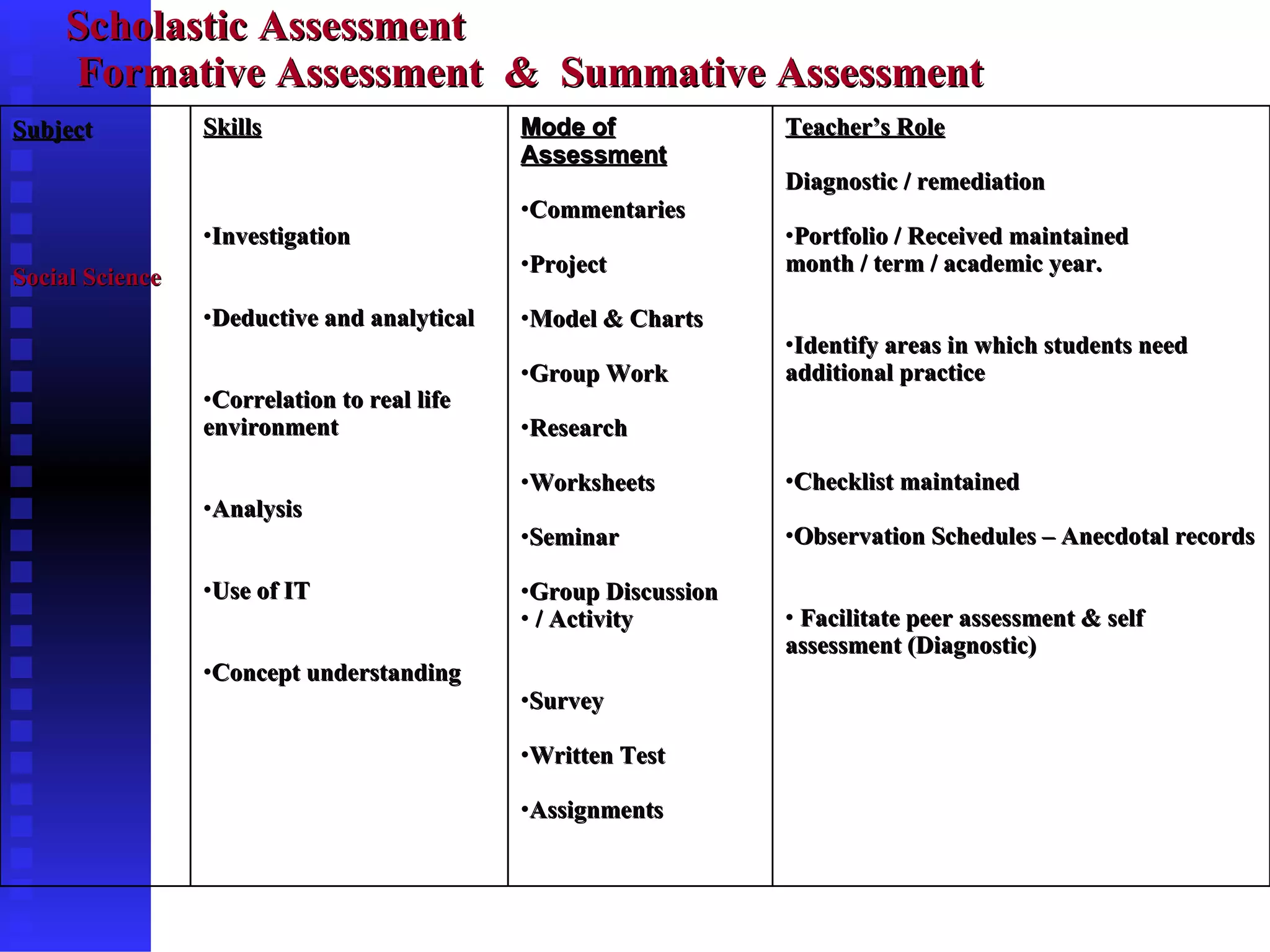
Scholastic Assessment  Formative Assessment  &  Summative Assessment  Subjec t Social Science Skills Investigation Deductive and analytical Correlation to real life environment Analysis Use of IT Concept understanding Mode of Assessment Commentaries Project Model & Charts Group Work Research Worksheets Seminar Group Discussion / Activity Survey Written Test Assignments Teacher’s Role Diagnostic / remediation Portfolio / Received maintained  month / term / academic year. Identify areas in which students need additional practice  Checklist maintained  Observation Schedules – Anecdotal records Facilitate peer assessment & self assessment (Diagnostic)
 
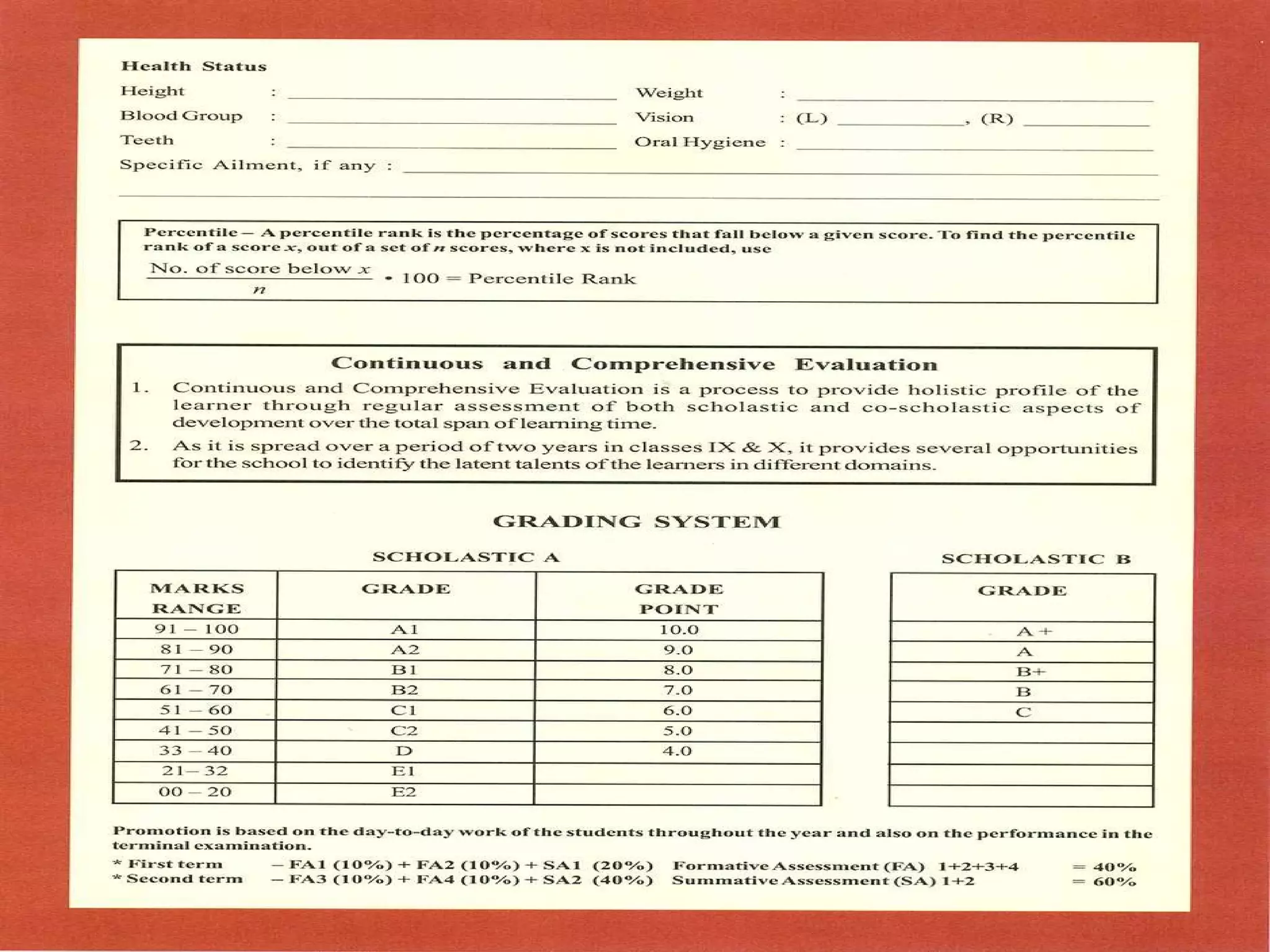
SCHEME OF GRADING  SCHOLASTIC & CO- SCHOLASTIC  The Board has already in A phased manner introduced the grading system based on absolute marks up to class VIII.  CBSE has decided to introduce the following  GRADING SYSTEM .
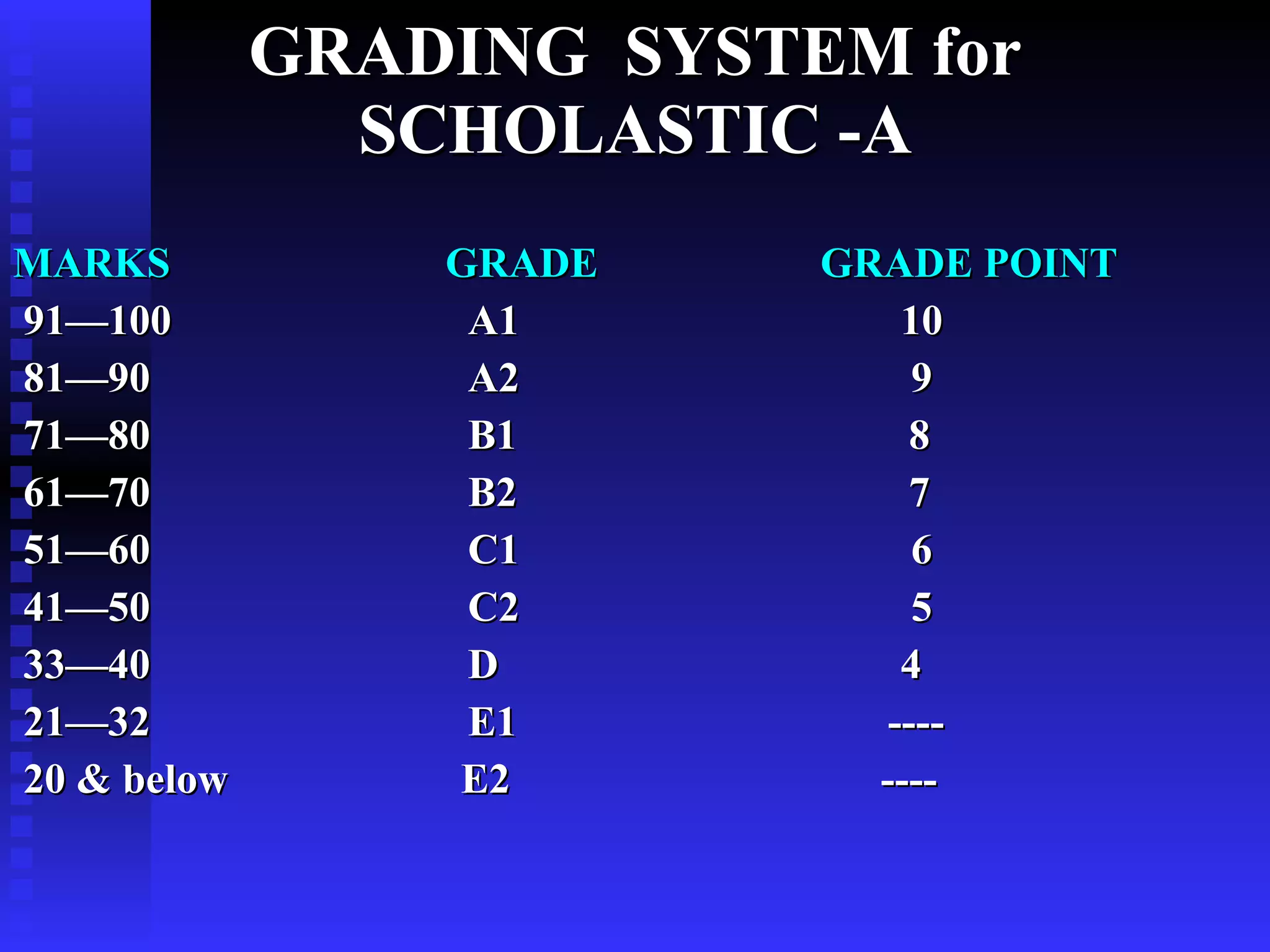
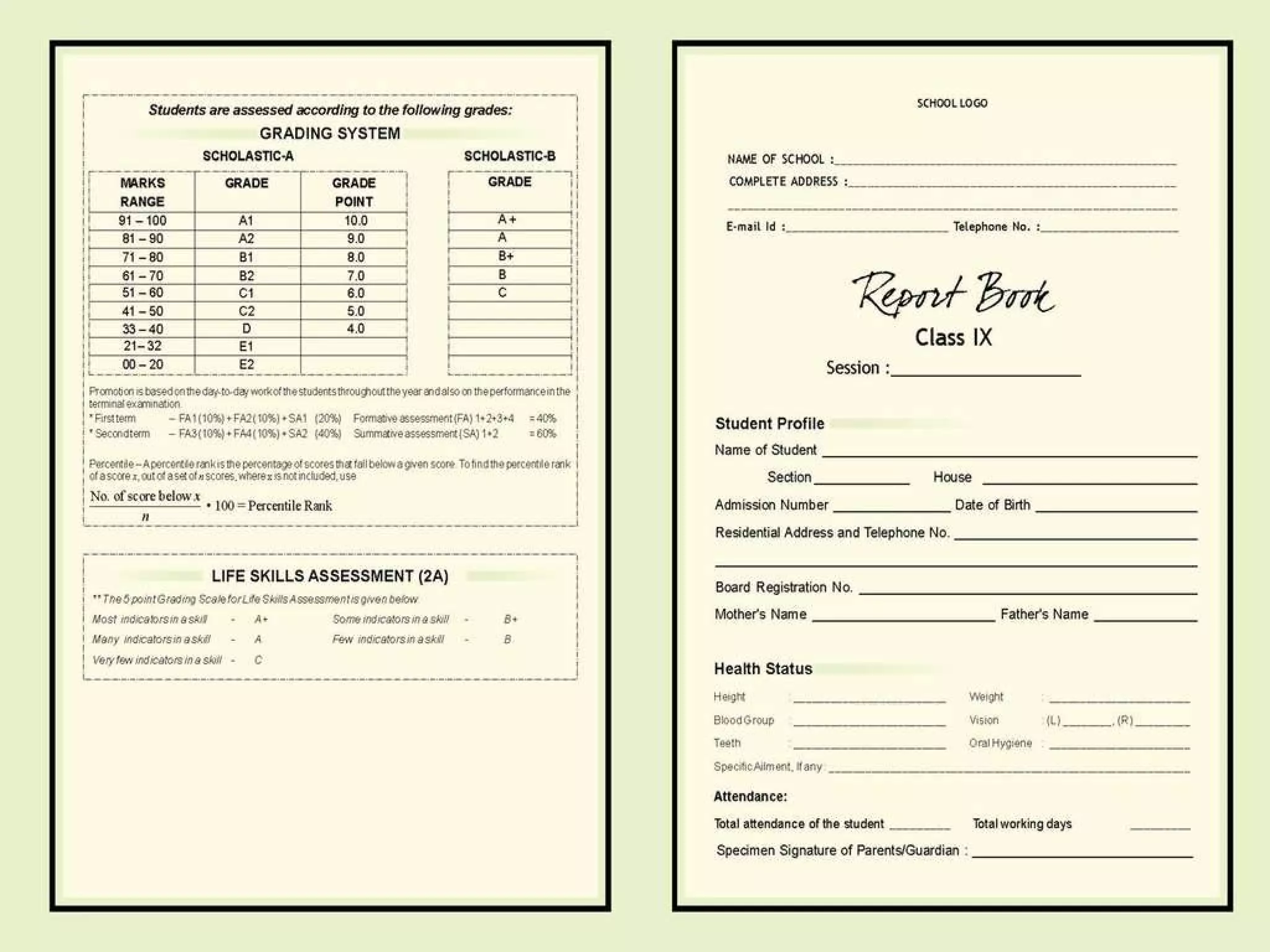
GRADING  SYSTEM for SCHOLASTIC -A MARKS  GRADE  GRADE POINT 91—100  A1  10 81—90  A2  9 71—80  B1  8 61—70  B2  7 51—60  C1  6 41—50  C2  5 33—40  D  4 21—32  E1  ---- 20 & below  E2  ----
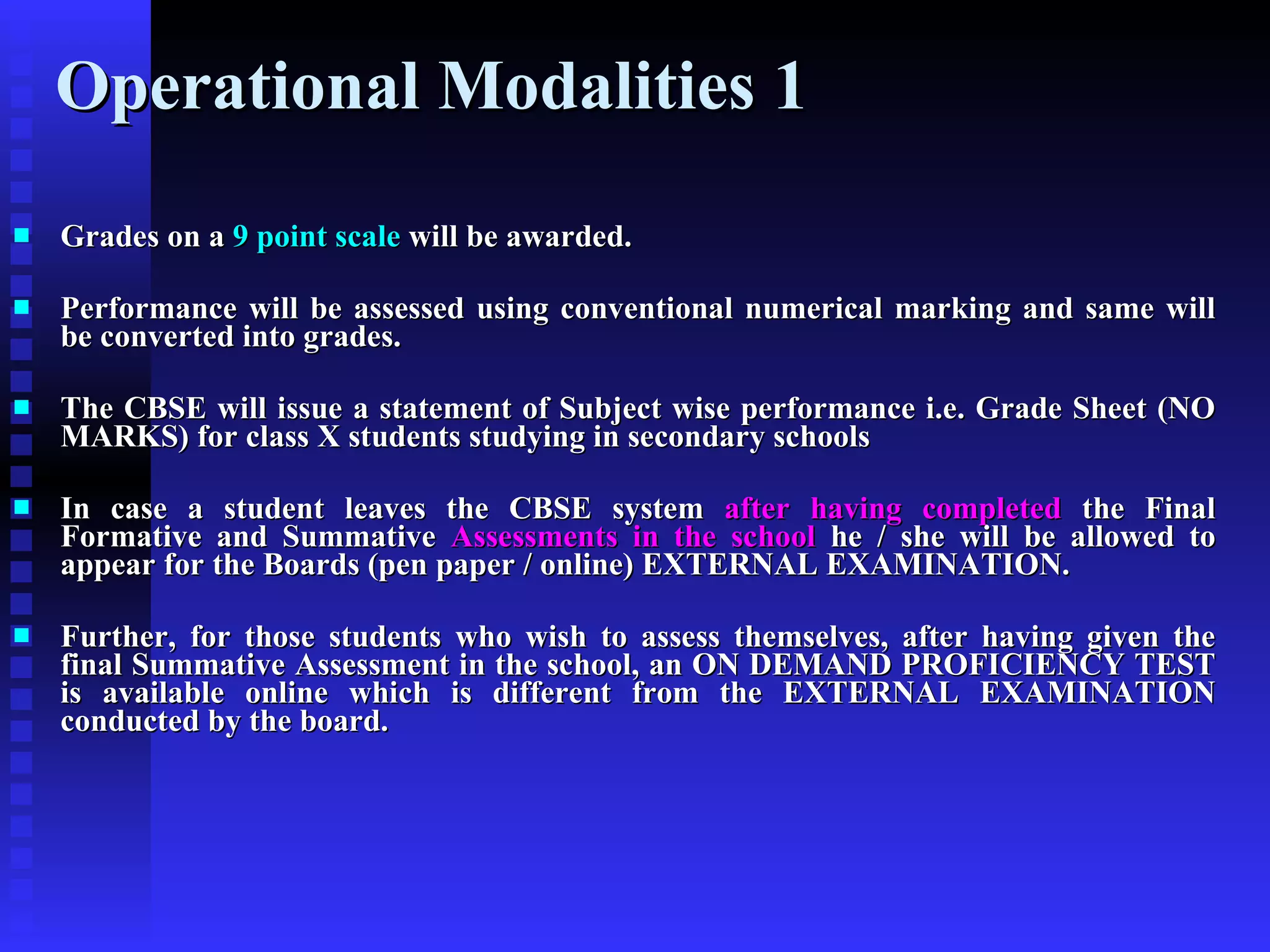
Operational Modalities 1  Grades on a  9 point scale  will be awarded. Performance will be assessed using conventional numerical marking and same will be converted into grades. The CBSE will issue a statement of Subject wise performance i.e. Grade Sheet (NO MARKS) for class X students studying in secondary schools In case a student leaves the CBSE system  after having completed  the Final Formative and Summative  Assessments in the school  he / she will be allowed to appear for the Boards (pen paper / online) EXTERNAL EXAMINATION. Further, for those students who wish to assess themselves, after having given the final Summative Assessment in the school, an ON DEMAND PROFICIENCY TEST is available online which is different from the EXTERNAL EXAMINATION conducted by the board.
The CCE card will apply throughout the CBSE schools in the country for admission to class XI. In addition, schools can have their own criteria. Students will only be promoted on the basis of both Formative and Summative Assessments both of which are mandatory. Percentile Rank will be given on demand by the CBSE for the students who appear in the external examination conducted by the Board  Operational Modalities 2
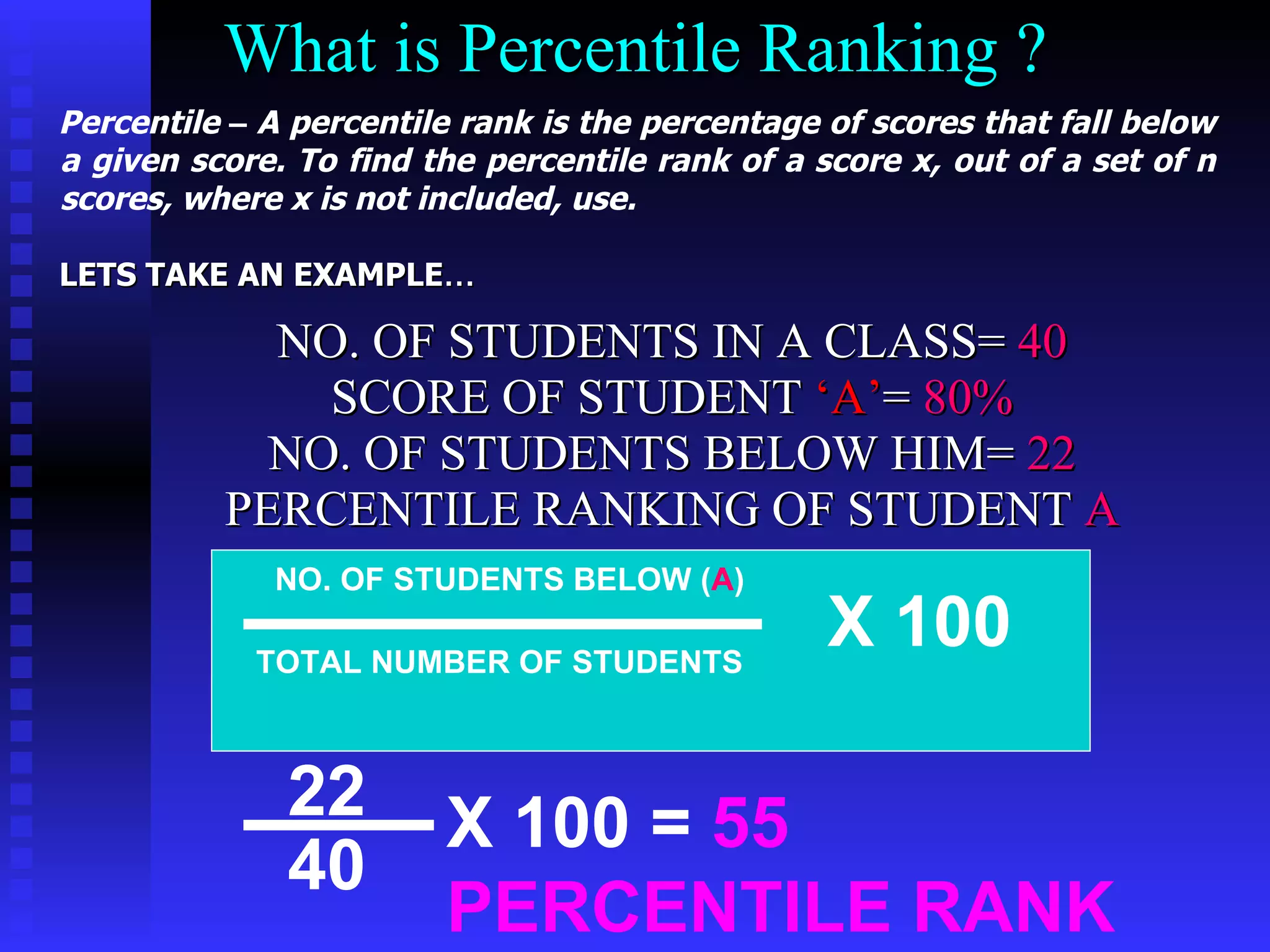
What is Percentile Ranking ? NO. OF STUDENTS IN A CLASS=  40 SCORE OF STUDENT  ‘A’ =  80% NO. OF STUDENTS BELOW HIM=  22 PERCENTILE RANKING OF STUDENT  A NO. OF STUDENTS BELOW ( A ) TOTAL NUMBER OF STUDENTS X 100 22 40 X 100 =  55 PERCENTILE RANK Percentile  –  A percentile rank is the percentage of scores that fall below a given score. To find the percentile rank of a score x, out of a set of n scores, where x is not included, use.   LETS TAKE AN EXAMPLE …
GRADING SYSTEM  Minimize misclassification of students on the basis of marks. Eliminate unhealthy cut throat competition among high achievers. Reduce societal pressure and provide the learner with more flexibility. Lead to a better learning environment. ADVANTAGES
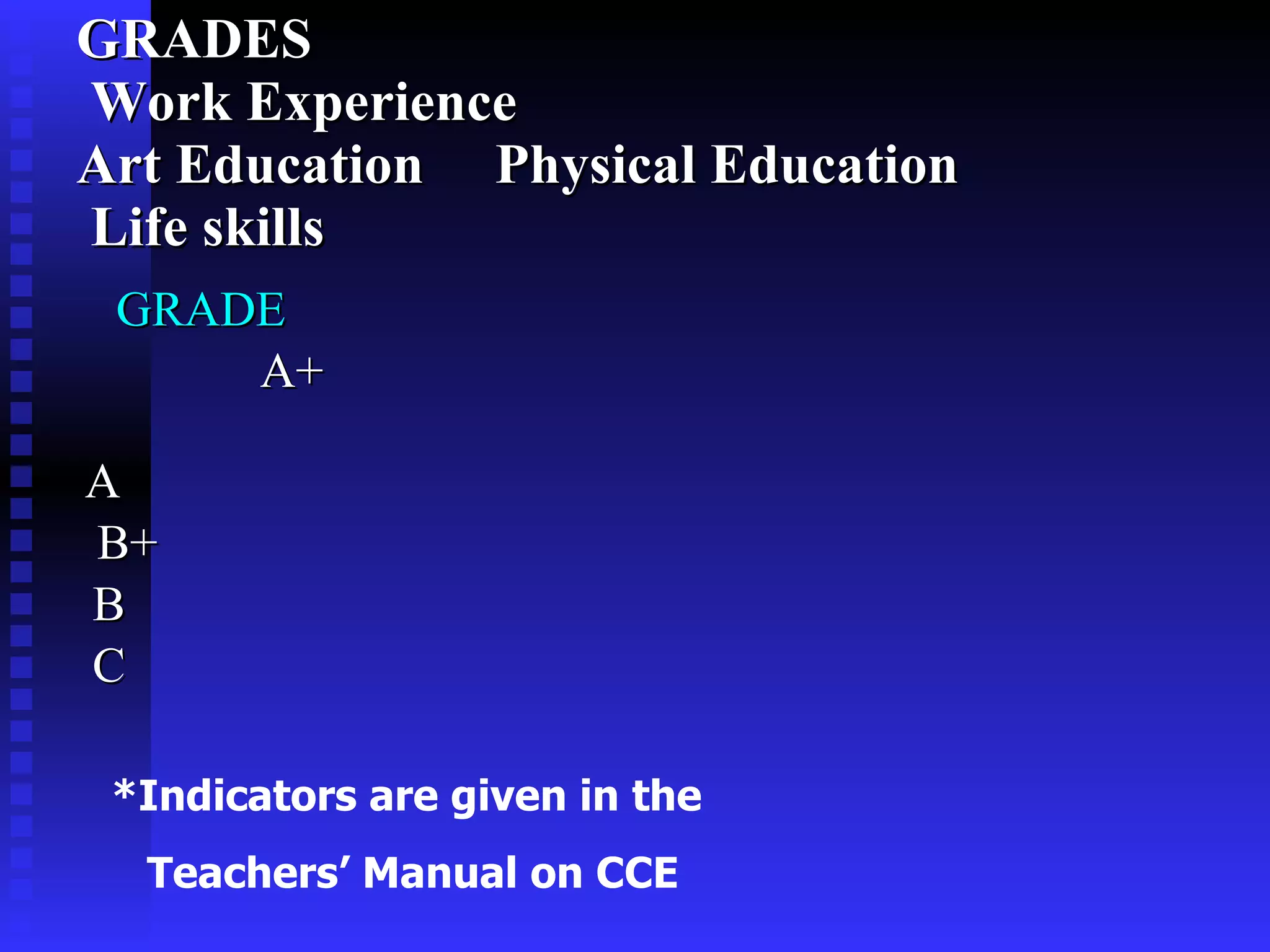
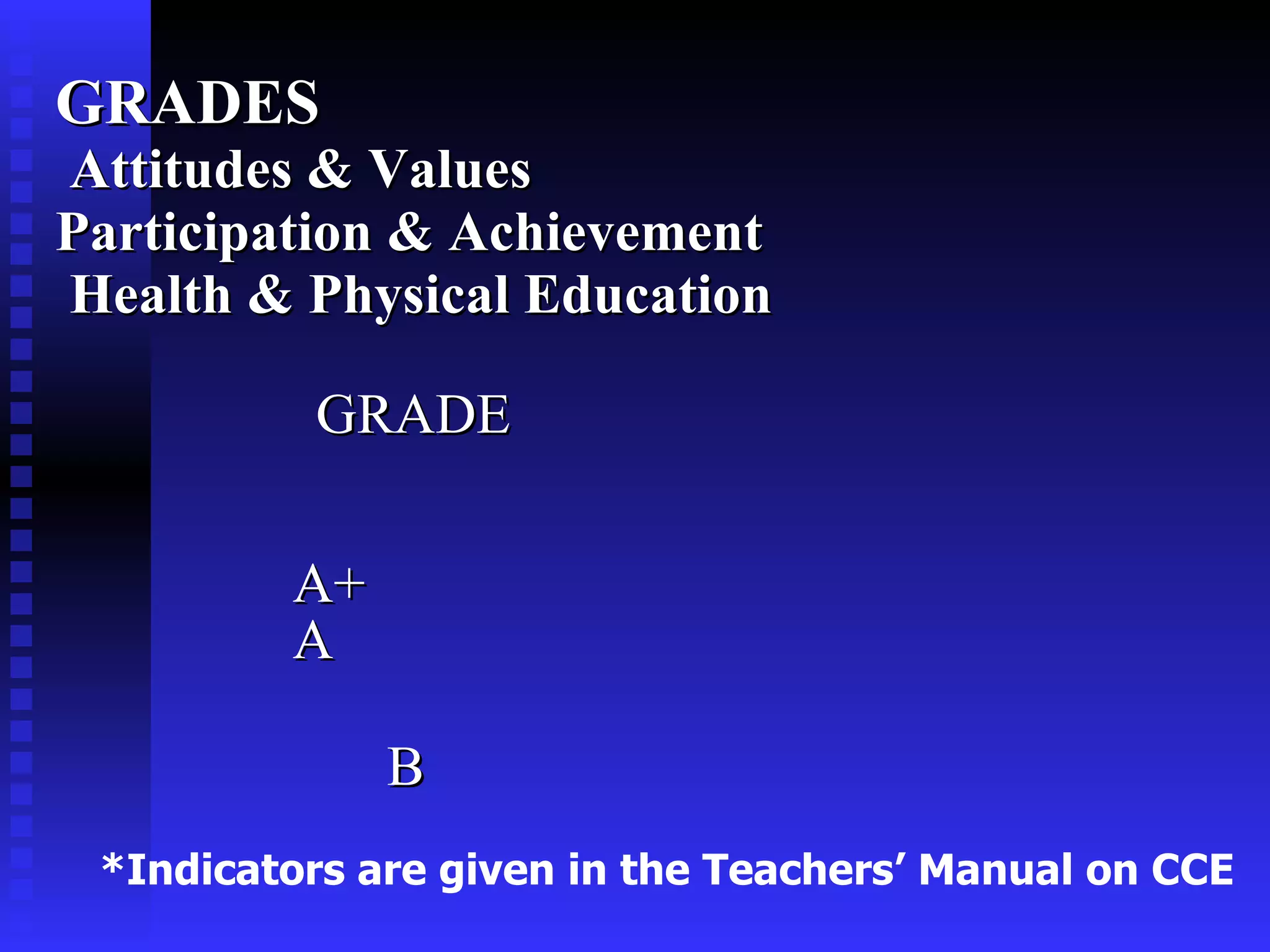
GRADES   Work Experience  Art Education  Physical Education   Life skills GRADE  A+    A  B+  B  C  *Indicators are given in the  Teachers’ Manual on CCE
GRADES   Attitudes & Values  Participation & Achievement  Health & Physical Education GRADE    A+   A  B  *Indicators are given in the Teachers’ Manual on CCE
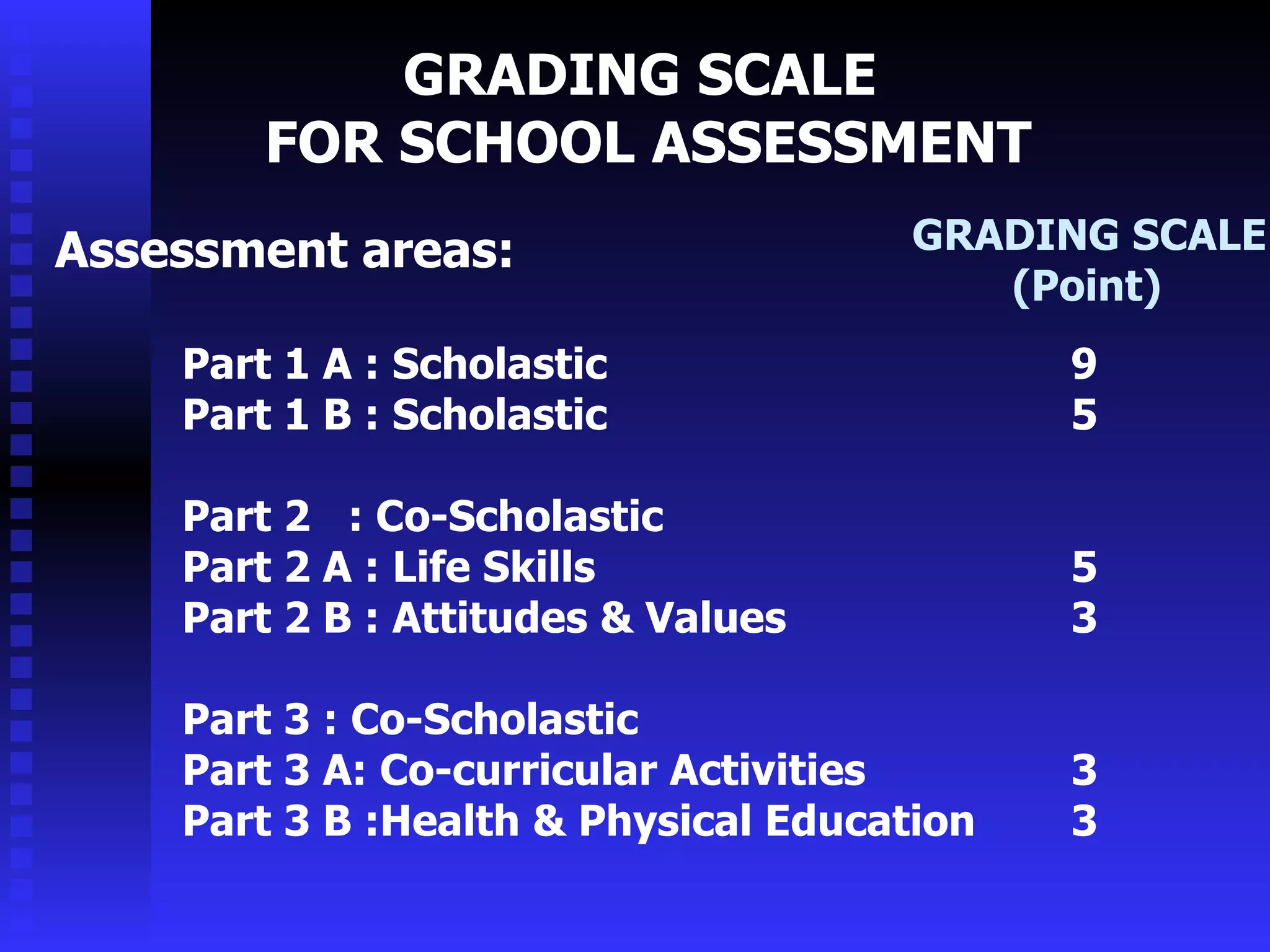
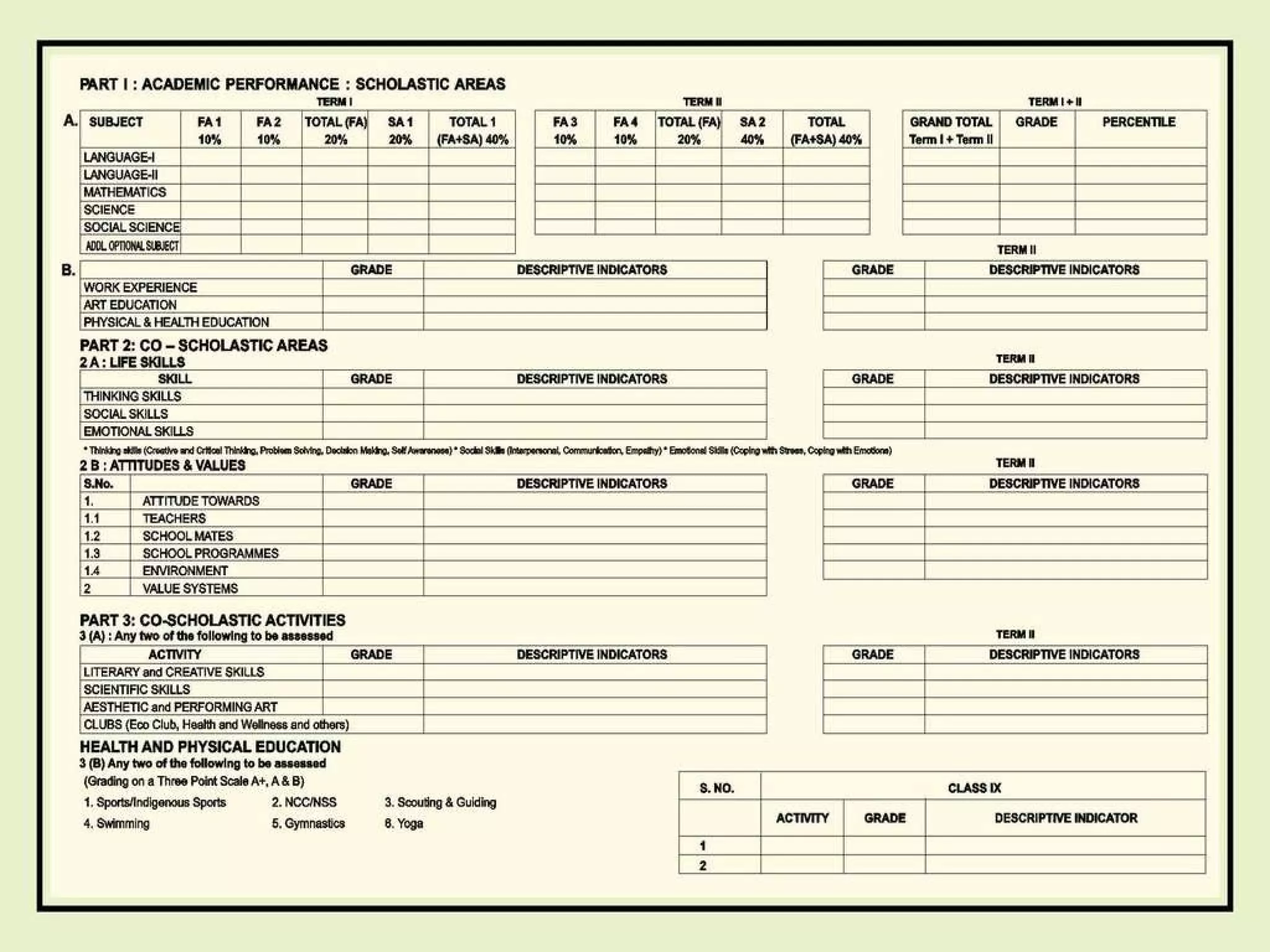
GRADING SCALE FOR SCHOOL ASSESSMENT Assessment areas: Part 1 A : Scholastic  9 Part 1 B : Scholastic 5 Part 2  : Co-Scholastic    Part 2 A : Life Skills 5 Part 2 B : Attitudes & Values 3 Part 3 : Co-Scholastic  Part 3 A: Co-curricular Activities 3 Part 3 B :Health & Physical Education 3 GRADING SCALE (Point)
Descriptive Indicators
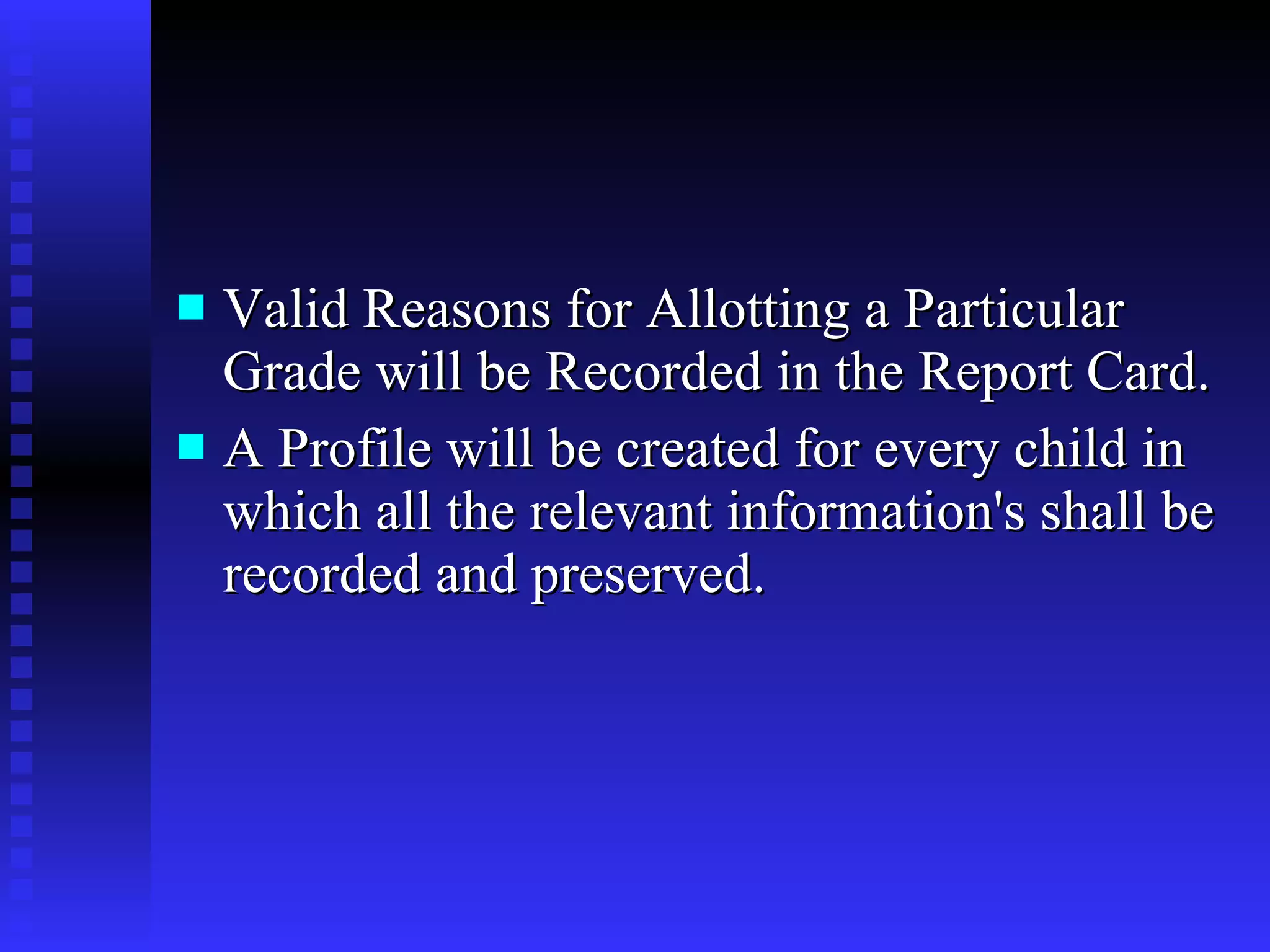
Valid Reasons for Allotting a Particular Grade will be Recorded in the Report Card. A Profile will be created for every child in which all the relevant information's shall be recorded and preserved.
ASSESSMENT FOR  STD IX 2009-2010(On-going session)
CLASS IX Academic year will have 2 terms - FIRST TERM : April to September 2009 SECOND TERM: October to March 2010
CCE will be for Second Term only and will continue in Std X. Report Card to be issued by the school  Model Report Card (Optional) view. Report Card to reflect -Formative assessment -Summative assessment In both Scholastic & Co-scholastic areas Starting with the 2009 Batch (if the school is Senior Secondary – upto Std. XII)  NO BOARD EXAM in Std. X
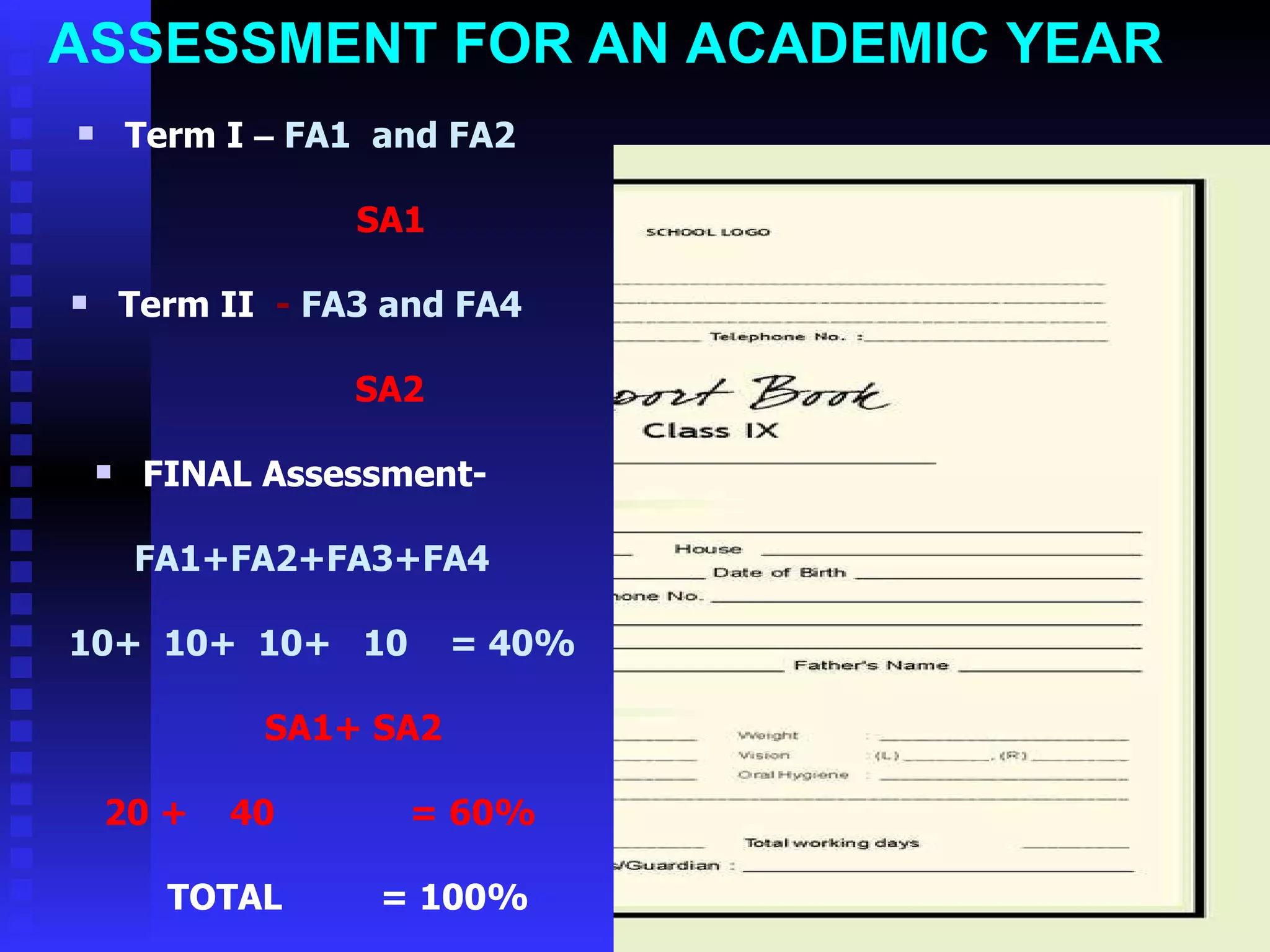
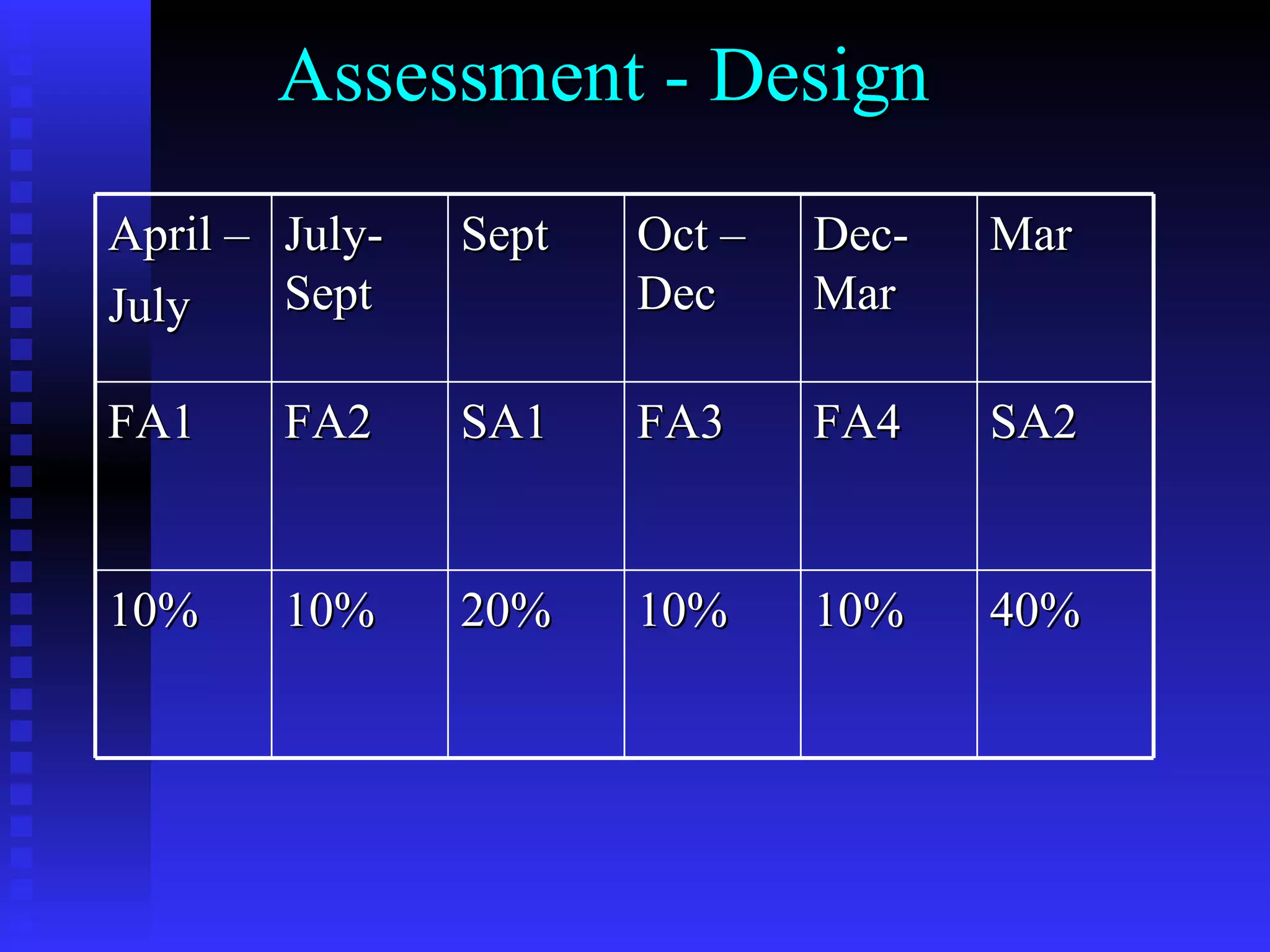
ASSESSMENT FOR AN ACADEMIC YEAR  Term I  –   FA1  and FA2   SA1 Term II   -  FA3 and FA4 SA2 FINAL Assessment-  FA1+FA2+FA3+FA4 10+  10+  10+  10  = 40% SA1+ SA2 20 +  40  = 60% TOTAL    = 100%
Assessment - Design April –  July July- Sept Sept  Oct –Dec  Dec- Mar  Mar FA1 FA2 SA1 FA3 FA4 SA2 10% 10% 20% 10% 10% 40%
 
 
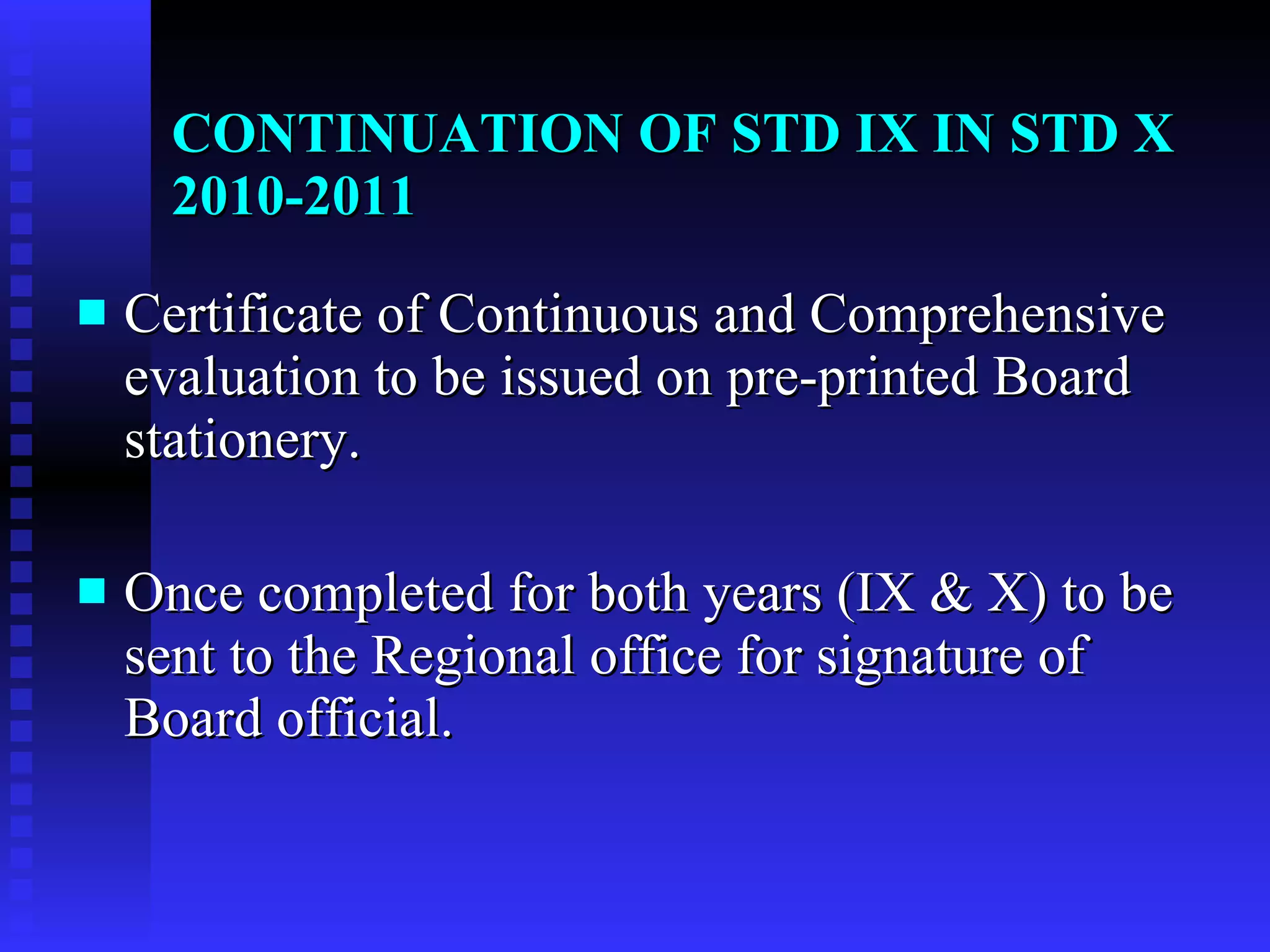
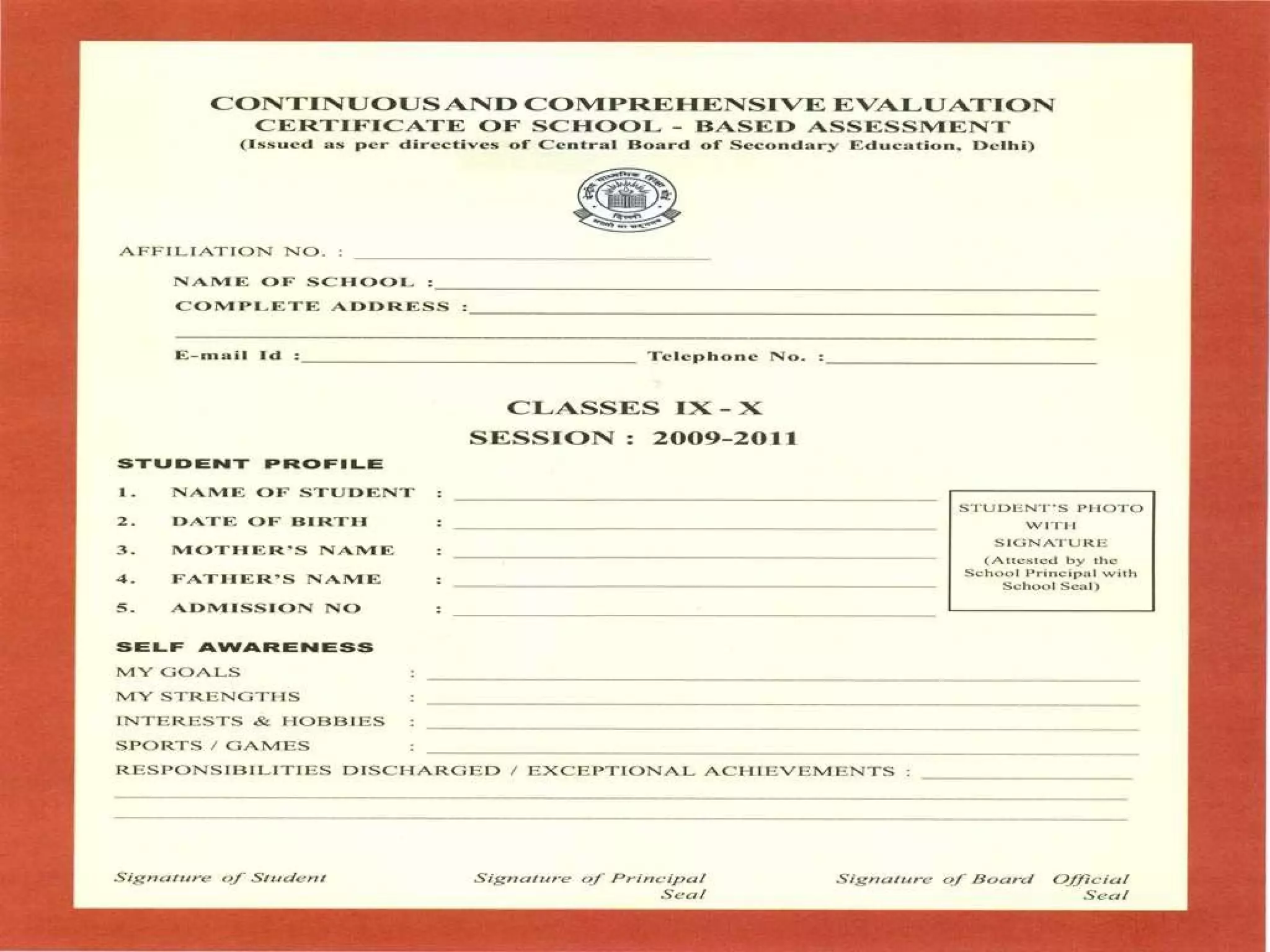
CONTINUATION OF STD IX IN STD X 2010-2011 Certificate of Continuous and Comprehensive evaluation to be issued on pre-printed Board stationery. Once completed for both years (IX & X) to be sent to the Regional office for signature of Board official.


Getting OLDER is MANDATORY BUT GROWTH is OPTIONAL
Thanks

CCE

  • 1.
    Modern School, DungarpurParents Seminar  Topic: Continuous & Comprehensive Evaluation By Santosh V. Varghese
  • 2.
    CHANGE: A Global Phenomena
  • 3.
    I Am aBattle Ship
  • 4.
    I Am aLight House
  • 5.
    Who Has toChange Ultimately???? The Battle Ship
  • 6.
    Change is HappeningEverywhere Communication Letter  Telephone  Mobile  3 G  …. Travel On Foot  Bullock Cart  Cycles  Motor Cycles  Car  Train  Air planes  …. Entertainment And So On…..
  • 7.
    We NEED TOCHANGE IN…. Our PERSPECTIVES Our MINDSET Our LIFE STYLE … .
  • 8.
    Why is thisCHANGE HAPPENING ????
  • 9.
    Shift in SocietyThe Society of which we are a PART is CHANGING….
  • 10.
    Agricultural Society HumanLife Span : Thousands of Years
  • 11.
    Industrial Society Machine Life Span : Few Decades of Years
  • 12.
    Information Society Computers& Internet Life Span: Few Years
  • 13.
    Knowledge Society MindConstant Change
  • 14.
    What is atthe End of a 15 year TUNNEL OF LEARNING?? A Question to be Posed
  • 15.
    Major Perspectives WeNeed to Prepare a child FOR His/Her LIFE TIME. True Education is what REMAINS after what we have LEARNT is FORGOTTEN .
  • 16.
    Traditional System MajorFocus ON Content…Memory Testing
  • 17.
    Now the MajorFocus is on THINKING DATA GATHERING EXPERIMENTING ANALYSING IMAGINATION WHATS NEW & ORIGINAL
  • 18.
    WHY CONTINUOUS COMPREHENSIVE EVALUATION
  • 19.
    External Examinations arelargely inappropriate for the knowledge society of the 21st century and its need for innovative problem solvers‘
  • 20.
    Evaluation of Scholasticlearning only on marks. Ability of child not evaluated. Limited Techniques of Evaluation do not identify learner’s level of attainment. Resulting in Pass/Fail. Causing frustration and humiliation .
  • 21.
    WHAT IS CONTINUOUS COMPREHENSIVE EVALUATION
  • 22.
    Continuous and Comprehensiveevaluation refers to a system of school based assessment that covers all aspects of student’s development . It emphasizes two fold objectives. Continuity in evaluation and assessment of broad based learning. Behavioral out come.
  • 23.
    FEATURES OF CCEContinuous Continual—from the beginning and during the instructional process Periodicity—frequency /term
  • 24.
    Comprehensive Scholastic - Subject specific areas. Co-Scholastic - Life skills, attitudes & values and other co curricular activities Includes a variety of tools and techniques for assessment of the learners.
  • 25.
    Scholastic Academic Workexperience Physical and Health Education Art Education Co Scholastic Life Skills Attitudes and Values Outdoor Activities
  • 26.
    PLACE OF ASSESSMENTIN THE CURRICULUM EFFECTIVENESS REMEDIATION ENHANCEMENT DIAGNOSIS ASSESSMENT
  • 27.
    SELF EVALUATION FEEDBACKRETESTING CORRECTIVE MEASURES DIAGNOSIS REGULARITY CCE CONTINUOUS COMPREHENSIVE GROWTH DEVELOPMENT SCHOLASTIC CO-SCHOLASTIC
  • 28.
    WHAT SHOULD BEASSESSED? SKILL BEHAVIOUR MOTIVATION APPLICATION RETENTION SUBJECT AREAS SOCIAL – ENVIRONMENT ISSUES INTERESTS ATTITUDES RESPONSE SCHOOL INTELLECTUAL PHYSICAL SOCIO-EMOTIONAL HEALTH LIFE SKILLS VALUES CREATIVITY AESTHETICS CLUBS YOGA FIRST AID
  • 29.
    TEACHER PERIODICITY CONTINUOUSDIAGNOSTIC ADDRESSES LEARNING STYLES REMEDIAL TEACHING REVIEW WHAT IS ASSESSMENT? FORMATIVE SUMMATIVE NO OPEN COMPARISION STUDENT SELF ESTEEM SELF EVALUATION UNDERSTANDING OF EVALUATION IMPROVEMENT PEER SUPPORT
  • 30.
    ASSESSMENT CONSISTS OFFORMATIVE SUMMATIVE ASSESSMENT AREAS SCHOLASTIC CO-SCHOLASTIC
  • 31.
    Assessment which iscarried throughout the year by the teacher formally and informally It is diagnostic and remedial Scholastic Evaluation Formative Assessment : End of term or end of the year exams Feedback on learning (assessment of learning) to teacher and parents Summative Assessment:
  • 32.
    FORMATIVE ASSESSMENT (FA) Will comprise of : Class work Homework Oral questions Quizzes Projects Assignments/Tests
  • 33.
    SUMMATIVE ASSESSMENT(SA) Will be Term End Examination: Curriculum and syllabus as circulated by the board Question papers to be prepared by schools as per the CBSE format and have to be only from the Question Bank to be sent by CBSE. Exam to be conducted by schools Evaluation of Answer scripts will be done within the school.
  • 34.
    Science Mathematics ScholasticAreas Social Sciences Language II Language I ACADEMICS (9 POINT SCALE) CO-CURRICULAR (5 POINT SCALE) Work Experience Art Education Physical and Health Education / Games Addl. Optional Information Technology Home Science
  • 35.
    Science Mathematics ScholasticAreas Social Sciences Language II Language I ACADEMICS (9 POINT SCALE) CO-CURRICULAR (5 POINT SCALE) Work Experience Art Education Physical and Health Education / Games Addl. Optional Information Technology Home Science
  • 36.
    School Programmes SchoolProperty Co-Scholastic Areas Environment Students/Peers Towards Teachers Attitudes and Values (3 POINT SCALE) Emotional Skills Social Skills Participation & Achievements (3 POINT SCALE) Scientific Life Skills (5 POINT SCALE ) Thinking Skills Creative Aesthetic Health & Physical Education (3 POINT SCALE) NCC / NSS First Aid Clubs
  • 37.
    Tools & TechniquesOral Questions Assignments Research Work (group) Quizzes Conversation Skills Assessment Projects Questions Observation Checklist Portfolio Narrative records Photographs/ Videos Paintings/ Artistic Endeavour Observation Essays Self Assessment Peer Assessment Rating Scales Narrative Reports
  • 38.
  • 39.
    What is FormativeAssessment What does it mean? How does it help the teacher and the student?
  • 40.
    Formative Assessment Informsteacher where the need/problem lies. Focus on problem area. Helps teacher give specific feedback Provide relevant support Plan the next step For the Teacher For the Student Helps student identify the problem areas Provides feedback and support. Helps to improve performance Provides opportunity to improve performance Remedial Diagnostic
  • 41.
    Summative Assessment Endof term or end of the year exams. Feedback on learning to teacher and parents
  • 42.
    SCHOLASTIC -A SUBJECTS SKILLS SUMMATIVE Hindi English Social Science Science Mathematics Add. Subject Analysis Problem Solving Use of I.T. Correlation to real life Comprehension Expression Creativity Data Handling Oral Listening, Writing Questions Examination Short Answer Very Short Answer Essay MCQ Data Interpretation Observation Conversation Project Essay Elocution Question Test FORMATIVE TOOLS & TECHNIQUES ADDITIONAL SUBJECTS Information Tech. Home Science Painting Music Others
  • 43.
    Type ofQuestions for Formative & Summative assessment Matching Type Multiple Choice Type Alternative Response Type True/False Yes / No Right/Wrong Question Form Incomplete Statement Fill in the blank Matrix Type of Questions for Formative & Summative assessment Single Double Key/Check List
  • 44.
    Scholastic Assessment Formativeand Summative Assessment – [FA1+FA2+FA3+FA4] Subjec t LANGUAGE Skills Oral & Listening Writing Comprehension Mode of Assessment Dialogue Conversations Speeches (Debating recitation) Quiz, Essays Research Projects Group work Assignments Research Projects Question papers Teacher’s Role Diagnostic / remediation Portfolio / Received maintained month / term / academic year. Identify areas in which students need additional practice Checklist maintained Observation Schedules – Anecdotal records : Example of Formative Assessment- Debating on a topic which could be connected to the Curriculum / Social Environment. – SKILLLS -Oral and listening
  • 45.
    Scholastic Assessment Formative Assessment & Summative Assessment Subjec t MATHEMATICS Skills Analysis Problem Solving Critical Thinking Decision making Data Handling Use of IT Mode of Assessment Home Assignment Worksheets Seminar Symposium Group Discussion / Activity Project Survey Math lab activities Math events Written Assignment Written Test Assignment Teacher’s Role Diagnostic / remediation Portfolio / Received maintained month / term / academic year. Identify areas in which students need additional practice Checklist maintained Observation Schedules – Anecdotal records Facilitate peer assessment & self assessment (Diagnostic) Example of Formative Assessment: Topic for class IX- “ Climate change-temperature and rainfall patterns in Delhi for the last 5 years” SKILLS-Data handling, analysis, use of IT. -
  • 46.
    Scholastic Assessment Formative Assessment & Summative Assessment Subjec t Science Skills Observation & Investigation Exploration Deductive and analytical Correlation to real life environment Analysis Use of IT Concept understanding Mode of Assessment Projects Survey Model & Charts Group Work Research Worksheets Seminar Group Discussion / Activity Symposium Science lab activities Written Test Assignment Teacher’s Role Diagnostic / remediation Portfolio / Received maintained month / term / academic year. Identify areas in which students need additional practice Checklist maintained Observation Schedules – Anecdotal records Facilitate peer assessment & self assessment (Diagnostic) Example : Assigning a project to Class IX on “ Water Conservation – Through a survey collect information regarding wastage and shortage of water in your locality and providing the action plan for the same ”. Skills : Investigative and analysis, Concept Understanding , Correlation to real life environment, Use of IT and etc.
  • 47.
    Scholastic Assessment Formative Assessment & Summative Assessment Subjec t Social Science Skills Investigation Deductive and analytical Correlation to real life environment Analysis Use of IT Concept understanding Mode of Assessment Commentaries Project Model & Charts Group Work Research Worksheets Seminar Group Discussion / Activity Survey Written Test Assignments Teacher’s Role Diagnostic / remediation Portfolio / Received maintained month / term / academic year. Identify areas in which students need additional practice Checklist maintained Observation Schedules – Anecdotal records Facilitate peer assessment & self assessment (Diagnostic)
  • 48.
  • 49.
    SCHEME OF GRADING SCHOLASTIC & CO- SCHOLASTIC The Board has already in A phased manner introduced the grading system based on absolute marks up to class VIII. CBSE has decided to introduce the following GRADING SYSTEM .
  • 50.
    GRADING SYSTEMfor SCHOLASTIC -A MARKS GRADE GRADE POINT 91—100 A1 10 81—90 A2 9 71—80 B1 8 61—70 B2 7 51—60 C1 6 41—50 C2 5 33—40 D 4 21—32 E1 ---- 20 & below E2 ----
  • 51.
    Operational Modalities 1 Grades on a 9 point scale will be awarded. Performance will be assessed using conventional numerical marking and same will be converted into grades. The CBSE will issue a statement of Subject wise performance i.e. Grade Sheet (NO MARKS) for class X students studying in secondary schools In case a student leaves the CBSE system after having completed the Final Formative and Summative Assessments in the school he / she will be allowed to appear for the Boards (pen paper / online) EXTERNAL EXAMINATION. Further, for those students who wish to assess themselves, after having given the final Summative Assessment in the school, an ON DEMAND PROFICIENCY TEST is available online which is different from the EXTERNAL EXAMINATION conducted by the board.
  • 52.
    The CCE cardwill apply throughout the CBSE schools in the country for admission to class XI. In addition, schools can have their own criteria. Students will only be promoted on the basis of both Formative and Summative Assessments both of which are mandatory. Percentile Rank will be given on demand by the CBSE for the students who appear in the external examination conducted by the Board Operational Modalities 2
  • 53.
    What is PercentileRanking ? NO. OF STUDENTS IN A CLASS= 40 SCORE OF STUDENT ‘A’ = 80% NO. OF STUDENTS BELOW HIM= 22 PERCENTILE RANKING OF STUDENT A NO. OF STUDENTS BELOW ( A ) TOTAL NUMBER OF STUDENTS X 100 22 40 X 100 = 55 PERCENTILE RANK Percentile – A percentile rank is the percentage of scores that fall below a given score. To find the percentile rank of a score x, out of a set of n scores, where x is not included, use. LETS TAKE AN EXAMPLE …
  • 54.
    GRADING SYSTEM Minimize misclassification of students on the basis of marks. Eliminate unhealthy cut throat competition among high achievers. Reduce societal pressure and provide the learner with more flexibility. Lead to a better learning environment. ADVANTAGES
  • 55.
    GRADES Work Experience Art Education Physical Education Life skills GRADE A+ A B+ B C *Indicators are given in the Teachers’ Manual on CCE
  • 56.
    GRADES Attitudes & Values Participation & Achievement Health & Physical Education GRADE A+ A B *Indicators are given in the Teachers’ Manual on CCE
  • 57.
    GRADING SCALE FORSCHOOL ASSESSMENT Assessment areas: Part 1 A : Scholastic 9 Part 1 B : Scholastic 5 Part 2 : Co-Scholastic Part 2 A : Life Skills 5 Part 2 B : Attitudes & Values 3 Part 3 : Co-Scholastic Part 3 A: Co-curricular Activities 3 Part 3 B :Health & Physical Education 3 GRADING SCALE (Point)
  • 58.
  • 59.
    Valid Reasons forAllotting a Particular Grade will be Recorded in the Report Card. A Profile will be created for every child in which all the relevant information's shall be recorded and preserved.
  • 60.
    ASSESSMENT FOR STD IX 2009-2010(On-going session)
  • 61.
    CLASS IX Academicyear will have 2 terms - FIRST TERM : April to September 2009 SECOND TERM: October to March 2010
  • 62.
    CCE will befor Second Term only and will continue in Std X. Report Card to be issued by the school Model Report Card (Optional) view. Report Card to reflect -Formative assessment -Summative assessment In both Scholastic & Co-scholastic areas Starting with the 2009 Batch (if the school is Senior Secondary – upto Std. XII) NO BOARD EXAM in Std. X
  • 63.
    ASSESSMENT FOR ANACADEMIC YEAR Term I – FA1 and FA2 SA1 Term II - FA3 and FA4 SA2 FINAL Assessment- FA1+FA2+FA3+FA4 10+ 10+ 10+ 10 = 40% SA1+ SA2 20 + 40 = 60% TOTAL = 100%
  • 64.
    Assessment - DesignApril – July July- Sept Sept Oct –Dec Dec- Mar Mar FA1 FA2 SA1 FA3 FA4 SA2 10% 10% 20% 10% 10% 40%
  • 65.
  • 66.
  • 67.
    CONTINUATION OF STDIX IN STD X 2010-2011 Certificate of Continuous and Comprehensive evaluation to be issued on pre-printed Board stationery. Once completed for both years (IX & X) to be sent to the Regional office for signature of Board official.
  • 68.
  • 69.
  • 70.
  • 71.
  • 72.
  • 73.
  • 74.
    Getting OLDER isMANDATORY BUT GROWTH is OPTIONAL
  • 75.

Editor's Notes

  • #45 Portfolio- Collection of evidences of students’ work over a period of time-month/term/academic year. Comprehensive Record of all assignments in each subject. helps in identifying the area in which the student needs additional practice. Allocating some weightage to it in the formative assessment. Checklist- An excellent tool for finding recording Specific behavior /action/ processes / outcomes / approaches / problem. Helps to focus attention on particular aspects of evaluation.
  • #46 Key note: Variety of Tools to be used so that all students of different abilities and learning styles can exhibit their understanding
  • #47 Key note: Variety of Tools to be used so that all students of different abilities and learning styles can exhibit their understanding
  • #48 Key note: Variety of Tools to be used so that all students of different abilities and learning styles can exhibit their understanding