Dr. Shweta Agarwal,
Assistant Professor,
Faculty of Education,
Dayalbagh Educational Institute, Agra
KNOWLEDGE
Meaning, Definition, Nature,
Steps & Importance of
Knowledge
KNOWLEDGE
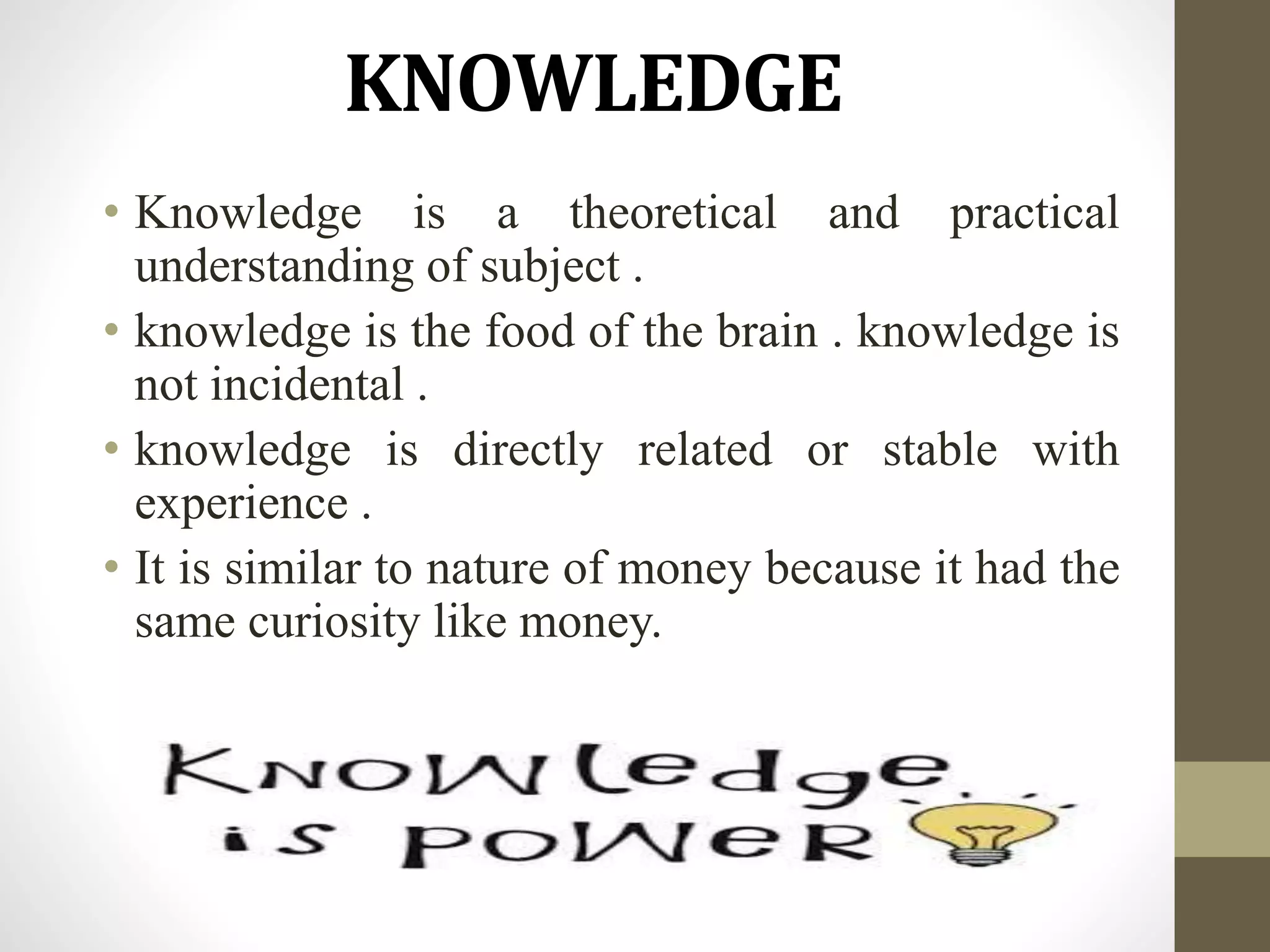
• Knowledge is a theoretical and practical
understanding of subject .
• knowledge is the food of the brain . knowledge is
not incidental .
• knowledge is directly related or stable with
experience .
• It is similar to nature of money because it had the
same curiosity like money.
DEFINITION OF KNOWLEDGE
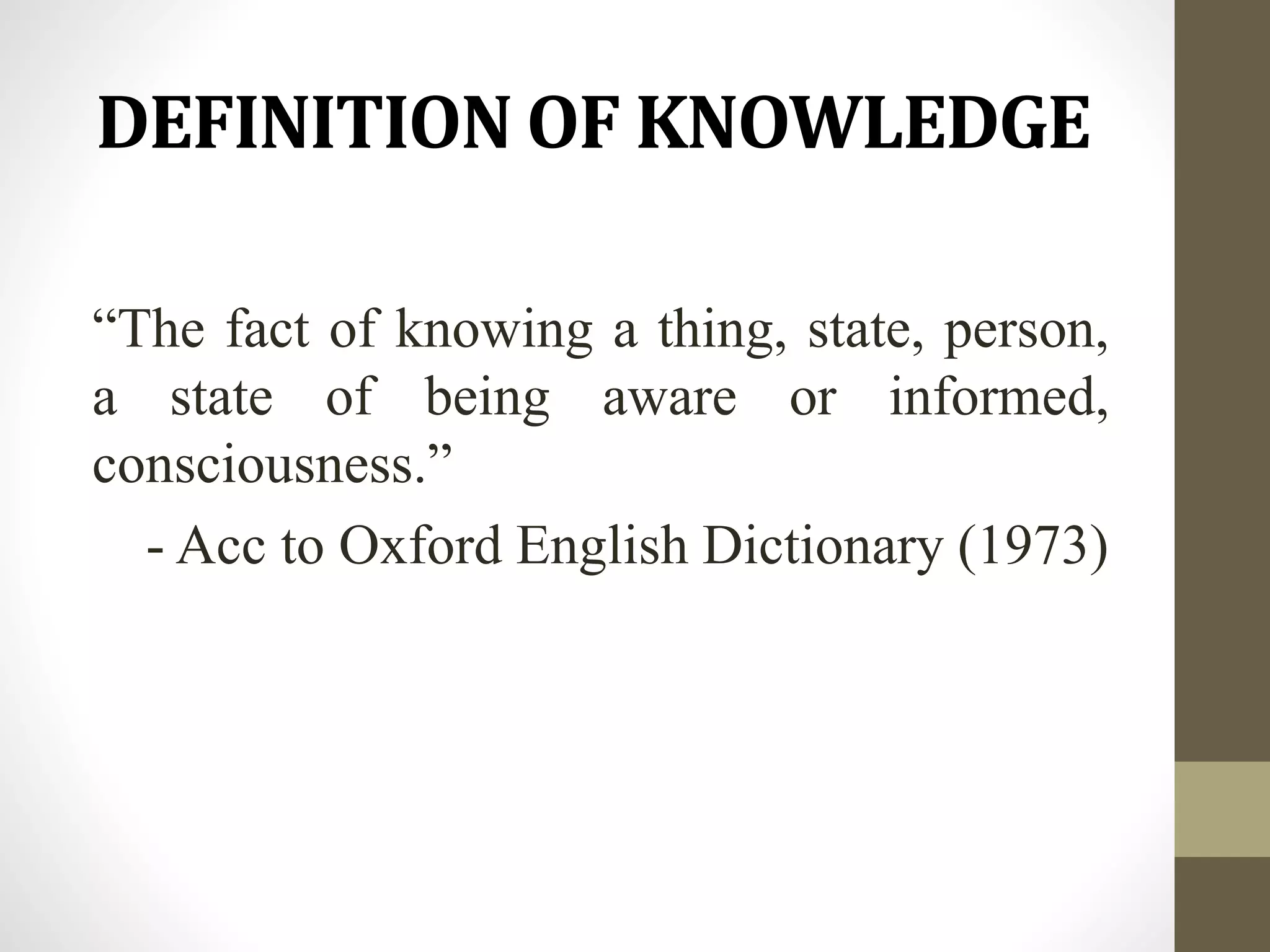
“The fact of knowing a thing, state, person,
a state of being aware or informed,
consciousness.”
- Acc to Oxford English Dictionary (1973)
Definitions of Knowledge
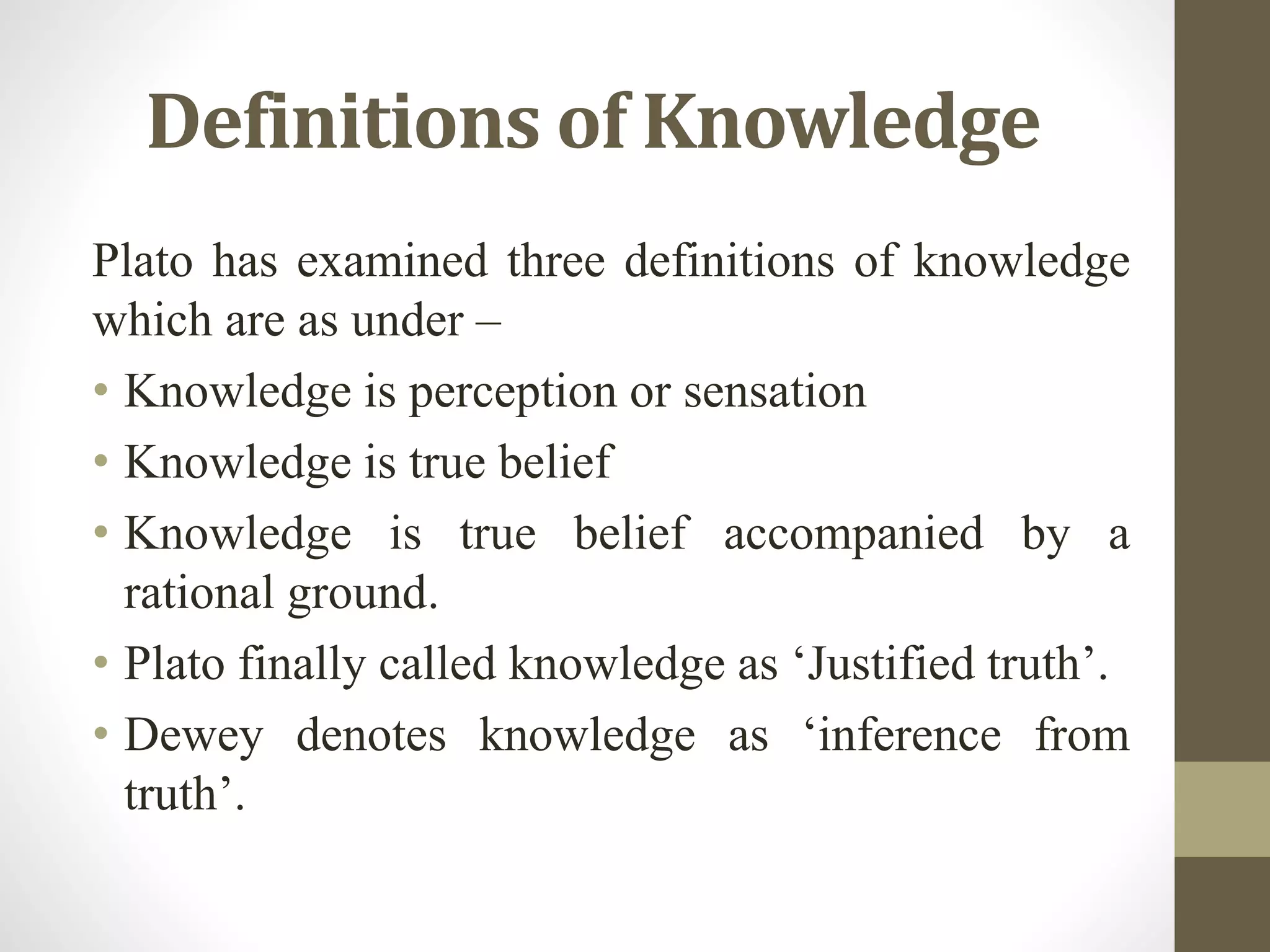
Plato has examined three definitions of knowledge
which are as under –
• Knowledge is perception or sensation
• Knowledge is true belief
• Knowledge is true belief accompanied by a
rational ground.
• Plato finally called knowledge as ‘Justified truth’.
• Dewey denotes knowledge as ‘inference from
truth’.
Meaning of Knowledge
knowledge is a meaningful structure of facts into
some relationships. We can define knowledge as
• The fact of knowing
• Information or what is already known
• The whole of what can be learned or found out.
Meaning of Knowledge
Terms knowledge, information and wisdom are
interrelated to each other. We can further define
knowledge as
• Assured belief
• Information
• Enlightenment
• Practical skill and acquaintance.
Meaning of Knowledge
As used by teachers and educators the term ‘concept of
knowledge’ refers to
• The information that teacher teach and students are
expected to learn in given subject or content area.
• Knowledge is related to the facts, concepts, theories,
and principles that are taught. It is not related to the
skills such as reading, writing or researching that
students learn in academic courses.
CHARACTERISTICS/ NATURE OF
KNOWLEDGE
• Information is the source of knowledge
• Knowledge is the conceptual framework of content
• Knowledge can be learned
• Selective in nature
• Powerfulness
• Stable in nature
• Dynamic process
• Based on information
• Based on facts and values
• Continuous process
• Valid and reliable
• Related with experiences
• Two way process
• No relation with discrimination
• Related to values/spirituality
• Knowledge is food of brain
• Knowledge never decays
• Knowledge is changeable.
• It is sequential activity
• It is the third eye of human
• Gained by efforts
• Organized information
• No boundaries
Cont..
Cont..
• Useful in all situations
• Not incidental
• Directly related with experiences
• Motivation activity to character development
• It is investigation of truth
• It is necessary for problem solving
• It is actual money
• Tool of self and social welfare
Steps For Acquiring
Knowledge
Information
Thinking/
understanding
Curiosity/
application
Analysis
Synthesis
Logic
Evaluation
Formation of
New
Knowledge
Importance of Knowledge
• Knowledge is a powerful and important part of life.
• Knowledge gives power to human and improve their
strength.
• Knowledge has prompted the progress of our
civilization.
• Important for Mental Development
• Essential for adjustment
• Increase success of the people
• Advancement of people
THANK YOU

Knowledge - Concept, Nature, Steps & Importance of Knowledge

  • 1.
    Dr. Shweta Agarwal, AssistantProfessor, Faculty of Education, Dayalbagh Educational Institute, Agra KNOWLEDGE Meaning, Definition, Nature, Steps & Importance of Knowledge
  • 2.
    KNOWLEDGE • Knowledge isa theoretical and practical understanding of subject . • knowledge is the food of the brain . knowledge is not incidental . • knowledge is directly related or stable with experience . • It is similar to nature of money because it had the same curiosity like money.
  • 3.
    DEFINITION OF KNOWLEDGE “Thefact of knowing a thing, state, person, a state of being aware or informed, consciousness.” - Acc to Oxford English Dictionary (1973)
  • 4.
    Definitions of Knowledge Platohas examined three definitions of knowledge which are as under – • Knowledge is perception or sensation • Knowledge is true belief • Knowledge is true belief accompanied by a rational ground. • Plato finally called knowledge as ‘Justified truth’. • Dewey denotes knowledge as ‘inference from truth’.
  • 5.
    Meaning of Knowledge knowledgeis a meaningful structure of facts into some relationships. We can define knowledge as • The fact of knowing • Information or what is already known • The whole of what can be learned or found out.
  • 6.
    Meaning of Knowledge Termsknowledge, information and wisdom are interrelated to each other. We can further define knowledge as • Assured belief • Information • Enlightenment • Practical skill and acquaintance.
  • 7.
    Meaning of Knowledge Asused by teachers and educators the term ‘concept of knowledge’ refers to • The information that teacher teach and students are expected to learn in given subject or content area. • Knowledge is related to the facts, concepts, theories, and principles that are taught. It is not related to the skills such as reading, writing or researching that students learn in academic courses.
  • 8.
    CHARACTERISTICS/ NATURE OF KNOWLEDGE •Information is the source of knowledge • Knowledge is the conceptual framework of content • Knowledge can be learned • Selective in nature • Powerfulness • Stable in nature • Dynamic process • Based on information • Based on facts and values • Continuous process • Valid and reliable
  • 9.
    • Related withexperiences • Two way process • No relation with discrimination • Related to values/spirituality • Knowledge is food of brain • Knowledge never decays • Knowledge is changeable. • It is sequential activity • It is the third eye of human • Gained by efforts • Organized information • No boundaries Cont..
  • 10.
    Cont.. • Useful inall situations • Not incidental • Directly related with experiences • Motivation activity to character development • It is investigation of truth • It is necessary for problem solving • It is actual money • Tool of self and social welfare
  • 11.
  • 12.
    Importance of Knowledge •Knowledge is a powerful and important part of life. • Knowledge gives power to human and improve their strength. • Knowledge has prompted the progress of our civilization. • Important for Mental Development • Essential for adjustment • Increase success of the people • Advancement of people
  • 13.