Continuous & comprehensive evaluation(CCE)
• B.Ed. 2nd Sem.
• Course- VII- (a- 1.2.7a), Unit- V
Biswajit Biswas
Asst. Professor
Pragati College of Education,
Siliguri, Dist. Darjeeling
West Bengal
Continuous & comprehensive evaluation(CCE)
 What is CCE?
• CCE refers to a system of school based assessment that covers all aspects of
students growth and development.
• The main aim is to find out how far the curricular goals were achieved. It
emphasizes two fold objectives.
• Continuity in evaluation and assessment of broad based learning.
• Behavioral outcomes.
CCE comprises three areas
a) Continuous.
Assessment is regular and periodical. Evaluation of students growth and
development is continuous process rather than an event, built into the total
teaching learning process and spread over the entire span of academic session.
b) Comprehensive.
Comprehensive It is a holistic approach, covers both scholastic and co- scholastic
areas. It provides sufficient opportunity for the child to grow in all areas.
c) Evaluation.
Evaluation is assessment of child in all aspects. The emphasis shifted to testing
of holistic learning.
Objectives of CCE
1) To make evaluation an integral part of teaching-learning process.
2) To use evaluation for improvement of students achievement through
diagnosis and remediation.
3)To make sound judgement and take timely decisions for learner’s growth,
learning process, learning pace and learning environment.
4) To maintain desired standard of attainment.
5)To provide scope for self-evaluation.
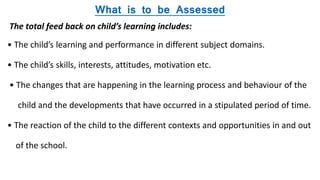
What is to be Assessed
The total feed back on child’s learning includes:
• The child’s learning and performance in different subject domains.
• The child’s skills, interests, attitudes, motivation etc.
• The changes that are happening in the learning process and behaviour of the
child and the developments that have occurred in a stipulated period of time.
• The reaction of the child to the different contexts and opportunities in and out
of the school.
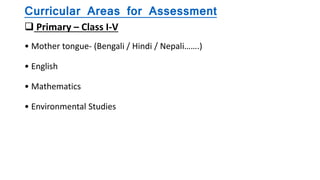
Curricular Areas for Assessment
 Primary – Class I-V
• Mother tongue- (Bengali / Hindi / Nepali…….)
• English
• Mathematics
• Environmental Studies
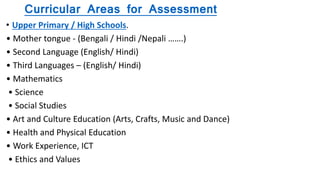
Curricular Areas for Assessment
• Upper Primary / High Schools.
• Mother tongue - (Bengali / Hindi /Nepali …….)
• Second Language (English/ Hindi)
• Third Languages – (English/ Hindi)
• Mathematics
• Science
• Social Studies
• Art and Culture Education (Arts, Crafts, Music and Dance)
• Health and Physical Education
• Work Experience, ICT
• Ethics and Values
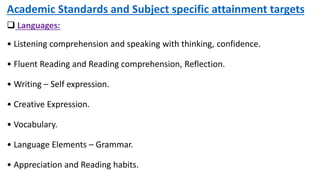
Academic Standards and Subject specific attainment targets
 Languages:
• Listening comprehension and speaking with thinking, confidence.
• Fluent Reading and Reading comprehension, Reflection.
• Writing – Self expression.
• Creative Expression.
• Vocabulary.
• Language Elements – Grammar.
• Appreciation and Reading habits.
Academic Standards and Subject specific attainment targets
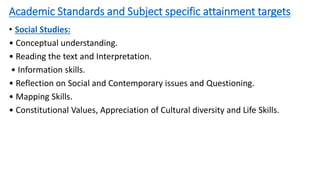
• Social Studies:
• Conceptual understanding.
• Reading the text and Interpretation.
• Information skills.
• Reflection on Social and Contemporary issues and Questioning.
• Mapping Skills.
• Constitutional Values, Appreciation of Cultural diversity and Life Skills.
Academic Standards and Subject specific attainment targets
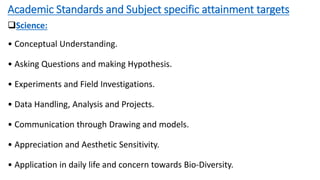
Science:
• Conceptual Understanding.
• Asking Questions and making Hypothesis.
• Experiments and Field Investigations.
• Data Handling, Analysis and Projects.
• Communication through Drawing and models.
• Appreciation and Aesthetic Sensitivity.
• Application in daily life and concern towards Bio-Diversity.
Academic Standards and Subject specific attainment targets
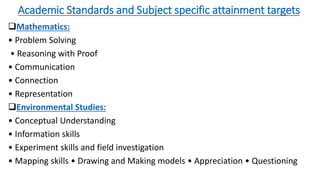
Mathematics:
• Problem Solving
• Reasoning with Proof
• Communication
• Connection
• Representation
Environmental Studies:
• Conceptual Understanding
• Information skills
• Experiment skills and field investigation
• Mapping skills • Drawing and Making models • Appreciation • Questioning
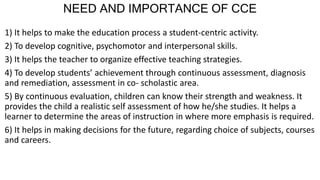
NEED AND IMPORTANCE OF CCE
1) It helps to make the education process a student-centric activity.
2) To develop cognitive, psychomotor and interpersonal skills.
3) It helps the teacher to organize effective teaching strategies.
4) To develop students’ achievement through continuous assessment, diagnosis
and remediation, assessment in co- scholastic area.
5) By continuous evaluation, children can know their strength and weakness. It
provides the child a realistic self assessment of how he/she studies. It helps a
learner to determine the areas of instruction in where more emphasis is required.
6) It helps in making decisions for the future, regarding choice of subjects, courses
and careers.
Thanks for watching

CCE in Social Science.pptx

  • 1.
    Continuous & comprehensiveevaluation(CCE) • B.Ed. 2nd Sem. • Course- VII- (a- 1.2.7a), Unit- V Biswajit Biswas Asst. Professor Pragati College of Education, Siliguri, Dist. Darjeeling West Bengal
  • 2.
    Continuous & comprehensiveevaluation(CCE)  What is CCE? • CCE refers to a system of school based assessment that covers all aspects of students growth and development. • The main aim is to find out how far the curricular goals were achieved. It emphasizes two fold objectives. • Continuity in evaluation and assessment of broad based learning. • Behavioral outcomes.
  • 3.
    CCE comprises threeareas a) Continuous. Assessment is regular and periodical. Evaluation of students growth and development is continuous process rather than an event, built into the total teaching learning process and spread over the entire span of academic session. b) Comprehensive. Comprehensive It is a holistic approach, covers both scholastic and co- scholastic areas. It provides sufficient opportunity for the child to grow in all areas. c) Evaluation. Evaluation is assessment of child in all aspects. The emphasis shifted to testing of holistic learning.
  • 4.
    Objectives of CCE 1)To make evaluation an integral part of teaching-learning process. 2) To use evaluation for improvement of students achievement through diagnosis and remediation. 3)To make sound judgement and take timely decisions for learner’s growth, learning process, learning pace and learning environment. 4) To maintain desired standard of attainment. 5)To provide scope for self-evaluation.
  • 5.
    What is tobe Assessed The total feed back on child’s learning includes: • The child’s learning and performance in different subject domains. • The child’s skills, interests, attitudes, motivation etc. • The changes that are happening in the learning process and behaviour of the child and the developments that have occurred in a stipulated period of time. • The reaction of the child to the different contexts and opportunities in and out of the school.
  • 6.
    Curricular Areas forAssessment  Primary – Class I-V • Mother tongue- (Bengali / Hindi / Nepali…….) • English • Mathematics • Environmental Studies
  • 7.
    Curricular Areas forAssessment • Upper Primary / High Schools. • Mother tongue - (Bengali / Hindi /Nepali …….) • Second Language (English/ Hindi) • Third Languages – (English/ Hindi) • Mathematics • Science • Social Studies • Art and Culture Education (Arts, Crafts, Music and Dance) • Health and Physical Education • Work Experience, ICT • Ethics and Values
  • 8.
    Academic Standards andSubject specific attainment targets  Languages: • Listening comprehension and speaking with thinking, confidence. • Fluent Reading and Reading comprehension, Reflection. • Writing – Self expression. • Creative Expression. • Vocabulary. • Language Elements – Grammar. • Appreciation and Reading habits.
  • 9.
    Academic Standards andSubject specific attainment targets • Social Studies: • Conceptual understanding. • Reading the text and Interpretation. • Information skills. • Reflection on Social and Contemporary issues and Questioning. • Mapping Skills. • Constitutional Values, Appreciation of Cultural diversity and Life Skills.
  • 10.
    Academic Standards andSubject specific attainment targets Science: • Conceptual Understanding. • Asking Questions and making Hypothesis. • Experiments and Field Investigations. • Data Handling, Analysis and Projects. • Communication through Drawing and models. • Appreciation and Aesthetic Sensitivity. • Application in daily life and concern towards Bio-Diversity.
  • 11.
    Academic Standards andSubject specific attainment targets Mathematics: • Problem Solving • Reasoning with Proof • Communication • Connection • Representation Environmental Studies: • Conceptual Understanding • Information skills • Experiment skills and field investigation • Mapping skills • Drawing and Making models • Appreciation • Questioning
  • 12.
    NEED AND IMPORTANCEOF CCE 1) It helps to make the education process a student-centric activity. 2) To develop cognitive, psychomotor and interpersonal skills. 3) It helps the teacher to organize effective teaching strategies. 4) To develop students’ achievement through continuous assessment, diagnosis and remediation, assessment in co- scholastic area. 5) By continuous evaluation, children can know their strength and weakness. It provides the child a realistic self assessment of how he/she studies. It helps a learner to determine the areas of instruction in where more emphasis is required. 6) It helps in making decisions for the future, regarding choice of subjects, courses and careers.
  • 13.