LEARNING OBJECTIVES
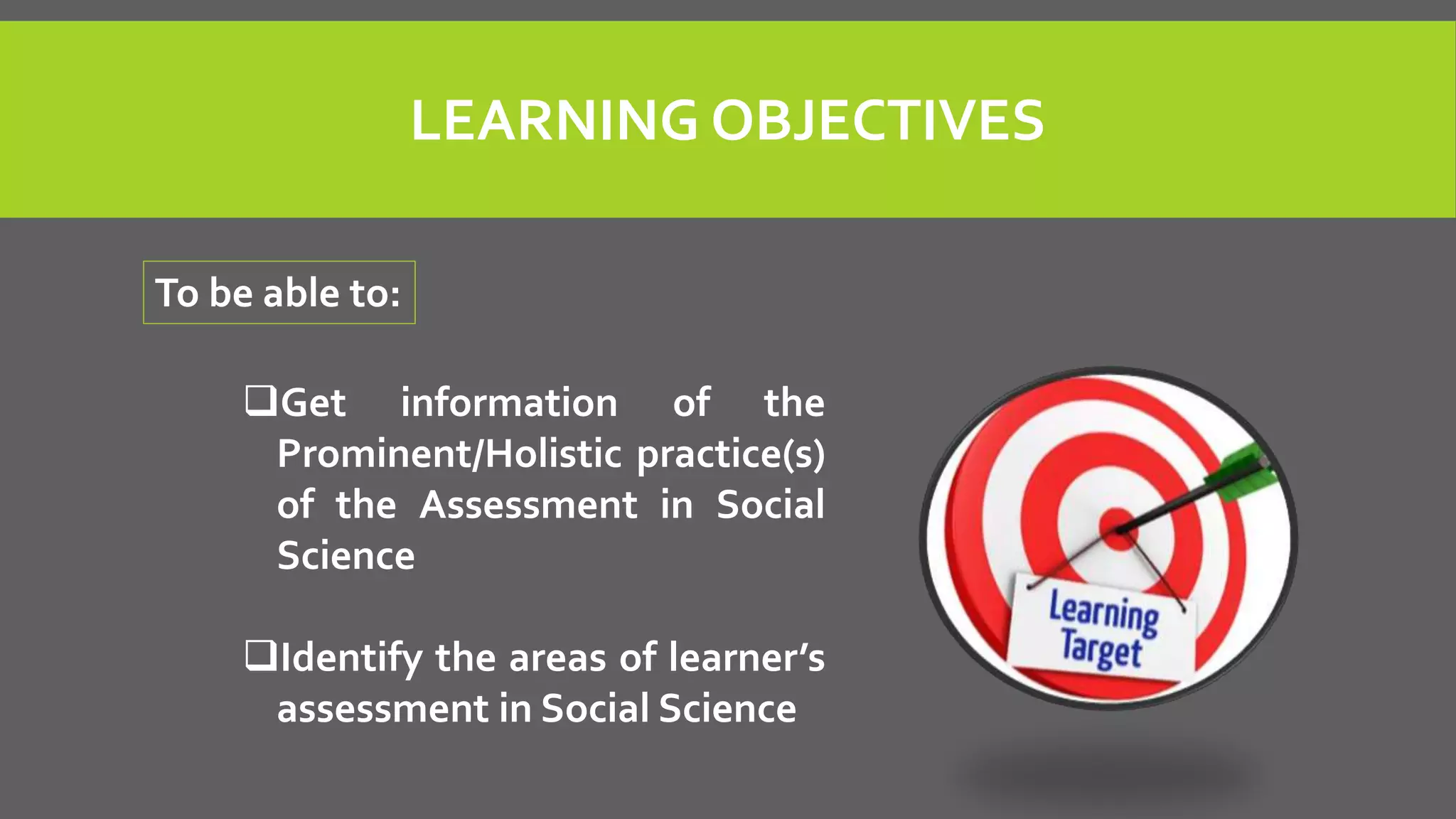
Get information of the
Prominent/Holistic practice(s)
of the Assessment in Social
Science
Identify the areas of learner’s
assessment in Social Science
To be able to:
WHAT IS ASSESSMENT?
 Assessment refers to the wide variety of methods or tools
that educators use to evaluate, measure, and document the
academic readiness, learning progress, skill acquisition, or
educational needs of students.
 Educational Assessment is the systematic process of
documenting and using empirical data on the knowledge,
skill, attitudes, and beliefs refine programs and improve
student learning.
Assessment plays a major role in how
students learn, their motivation to learn,
and how teachers teach.
The Role of Assessment in Learning
THE ROLE OF ASSESSMENT IN LEARNING
Assessment for learning:
Where assessment helps teachers gain
insight into what students understand in
order to plan and guide instruction, and
provide helpful feedback to students.
THE ROLE OF ASSESSMENT IN LEARNING
Where students develop an awareness of
how they learn and use that awareness
to adjust and advance their learning,
taking an increased responsibility for
their learning.
Assessment as learning:
Where assessment informs students,
teachers and parents, as well as the broader
educational community, of achievement at
a certain point in time in order to celebrate
success, plan interventions and support
continued progress.
Assessment of learning:
The Role of Assessment in Learning
LEARNERS ASSESSMENT
Question are:
 Why should children be assessed?
What should be assessed?
When should assessment be done?
How should assessment be done?
How can assessment information be used?
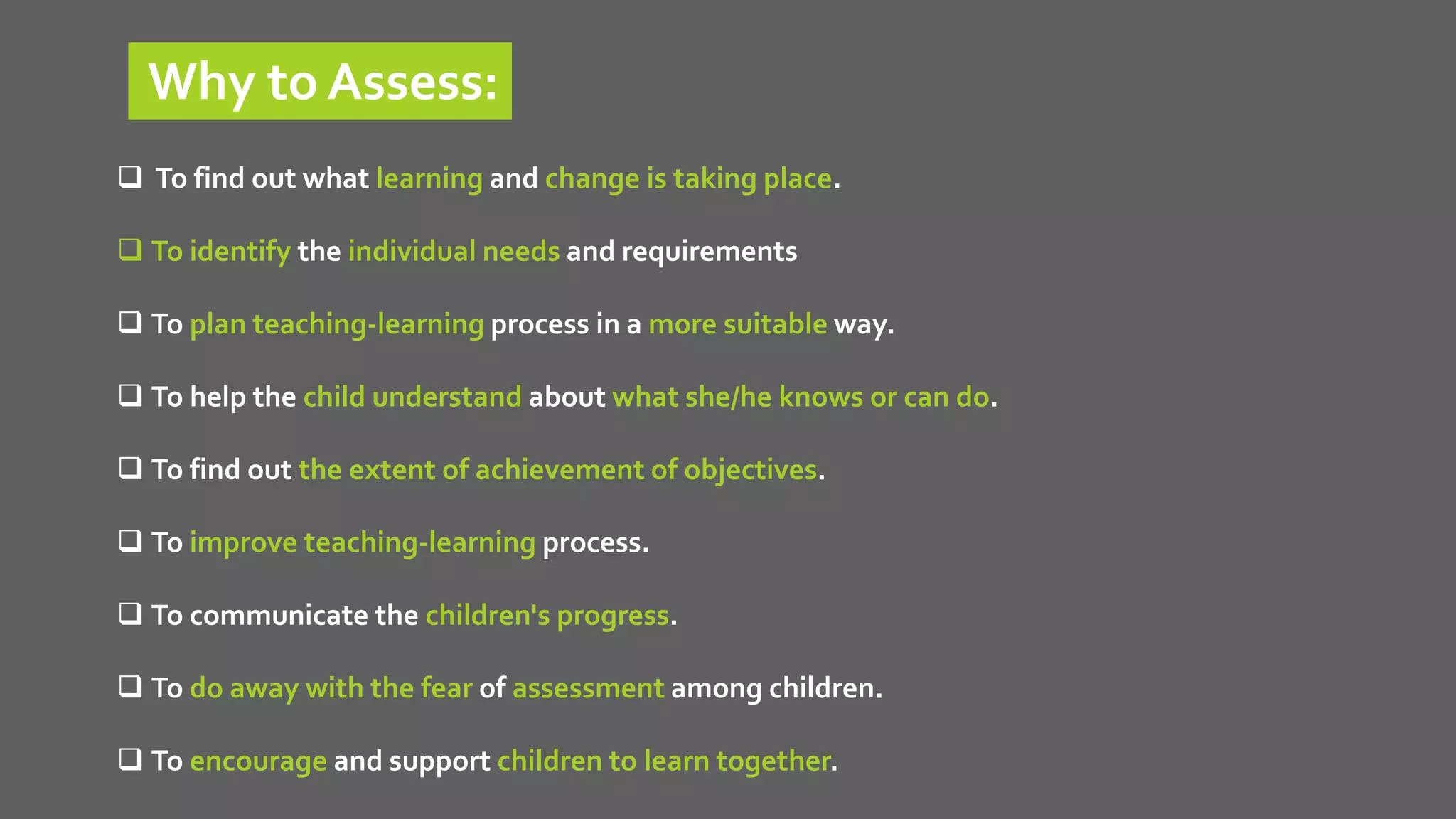
Why to Assess:
 To find out what learning and change is taking place.
 To identify the individual needs and requirements
 To plan teaching-learning process in a more suitable way.
 To help the child understand about what she/he knows or can do.
 To find out the extent of achievement of objectives.
 To improve teaching-learning process.
 To communicate the children's progress.
 To do away with the fear of assessment among children.
 To encourage and support children to learn together.
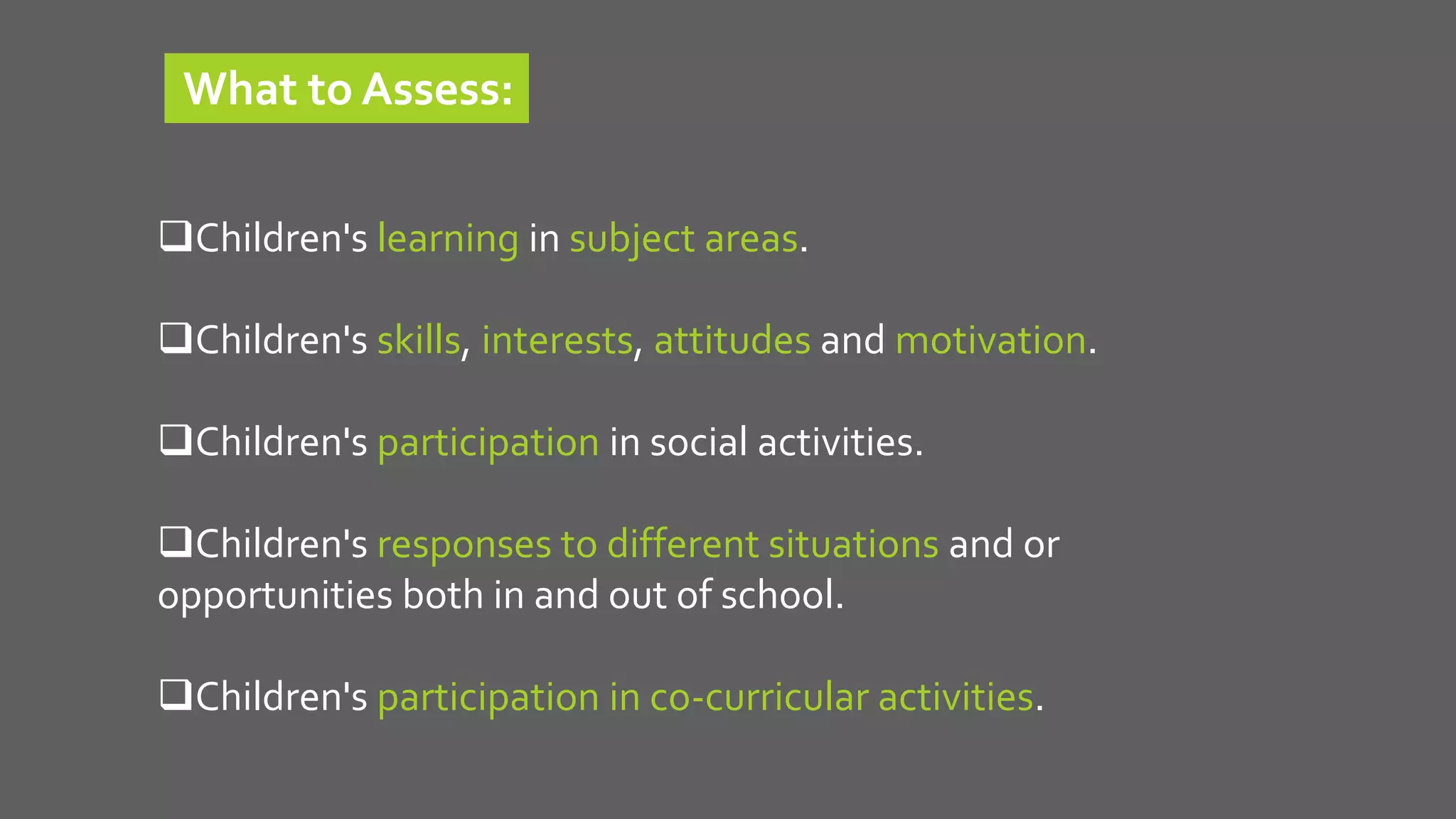
Children's learning in subject areas.
Children's skills, interests, attitudes and motivation.
Children's participation in social activities.
Children's responses to different situations and or
opportunities both in and out of school.
Children's participation in co-curricular activities.
What to Assess:
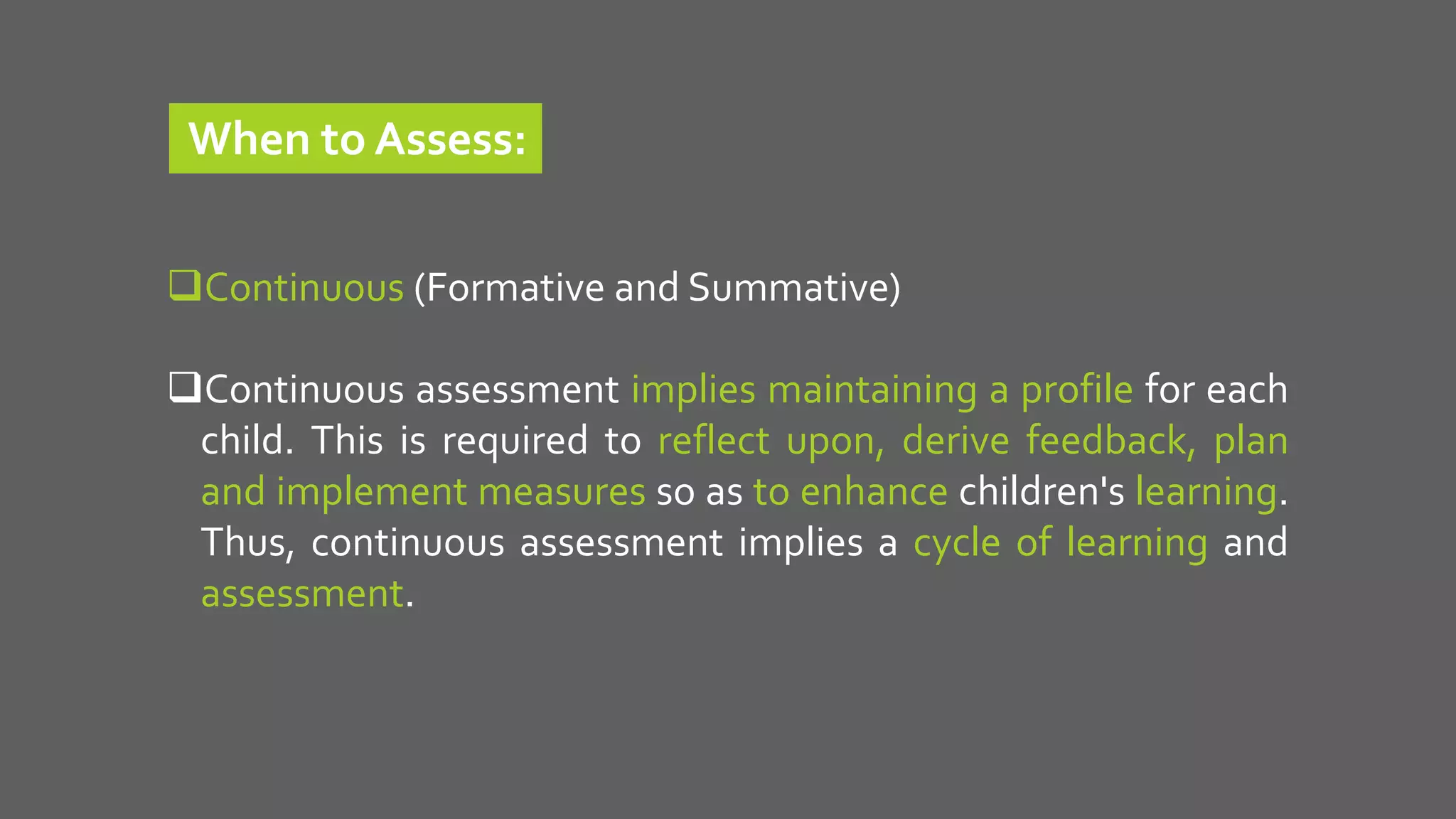
Continuous (Formative and Summative)
Continuous assessment implies maintaining a profile for each
child. This is required to reflect upon, derive feedback, plan
and implement measures so as to enhance children's learning.
Thus, continuous assessment implies a cycle of learning and
assessment.
When to Assess:
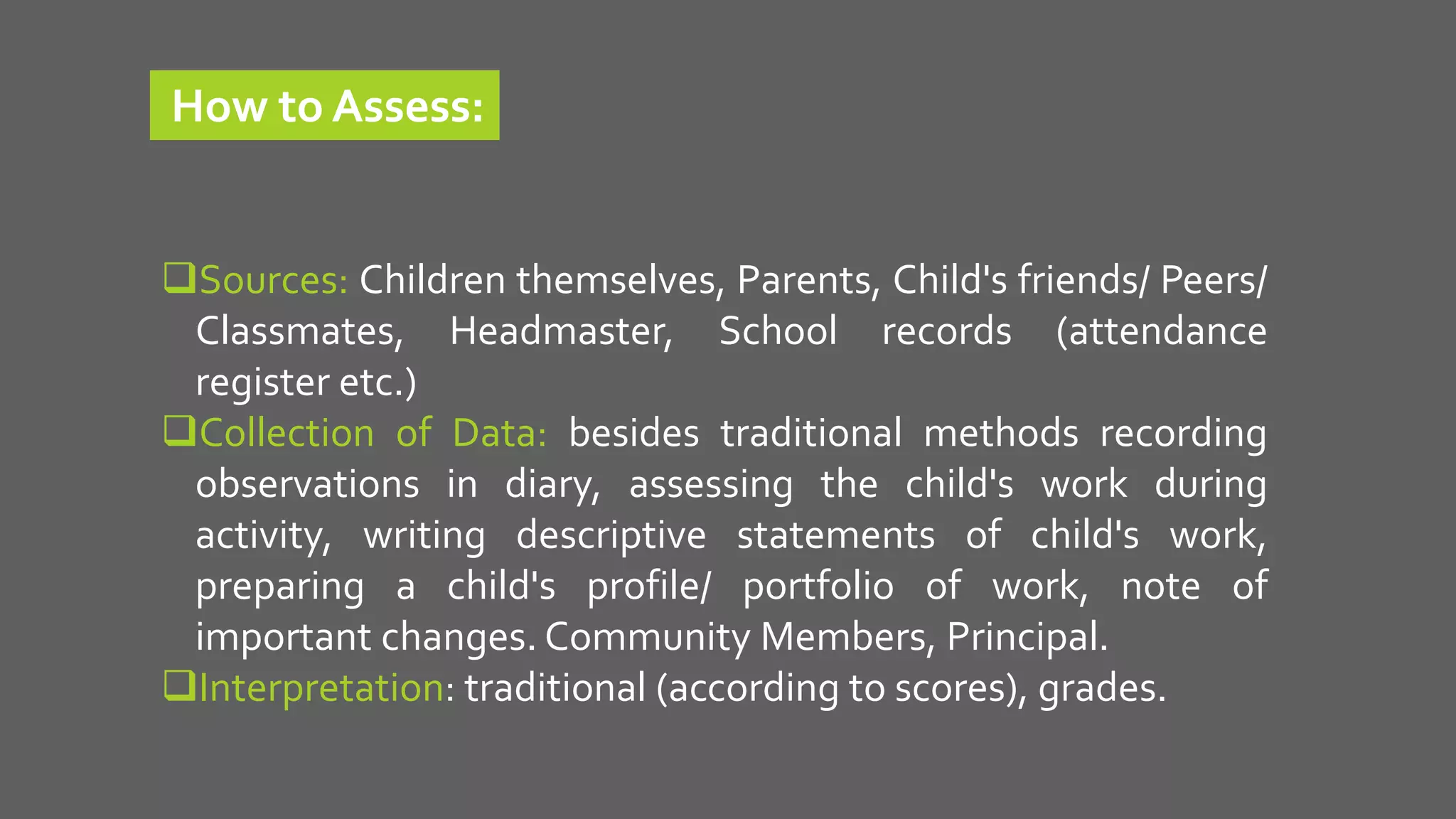
Sources: Children themselves, Parents, Child's friends/ Peers/
Classmates, Headmaster, School records (attendance
register etc.)
Collection of Data: besides traditional methods recording
observations in diary, assessing the child's work during
activity, writing descriptive statements of child's work,
preparing a child's profile/ portfolio of work, note of
important changes. Community Members, Principal.
Interpretation: traditional (according to scores), grades.
How to Assess:
Continuous Comprehensive Evaluation (CCE):
Acknowledges individual differences and insists on child to grow to
his/her ability.
Aims at evaluating all round development of the student.
Continuous: refers to watching children's learning and progress
regularly at short intervals as frequently as possible, to identify
their current standing. strengths, requirement for further
interventions to further expand their boundaries of learning,
development and progress
Innovative ways to Assess
Continuous Comprehensive Evaluation (CCE);
 Comprehensive: means evaluation has to cover curricular
subjects, curricular activities, socio-personal qualities,
and work and art education etc. It involves both
quantitative and qualitative information gathered from
various sources such as school records, peers, parents,
teachers and self through then use of varieties of tools
and techniques.
 Evaluation: recording of evidences indicating change in
different aspects of his/her performance.
Innovative ways to Assess
Purpose of Assessment
purpose of assessments should be to reflect on the learning
and / or progress, hence assessments not to be in the form of
written test/exam but through variety of tools- oral test,
projects, assignments, class tasks, preparation of models and
reports etc.
Besides periodic assessments, daily basis assessment while
teaching-learning process goes on in a classroom or outside.
This is "on teaching or while-learning" assessments. For this
purpose, oral tests, individual/ group work/ task and
observation can be used by the teachers.
Selection of multiple activities under each category provision of
opportunities for participation as per interest and choice.
performance to be assessed through observation & award of
grades.
regularly record of observation on student's performance be
maintained to facilitate identification of child character.
definite descriptors for grading of student' participation and
performance.
Purpose of Assessment
Role of teaching in assessment.

Role of teaching in assessment.

  • 2.
    LEARNING OBJECTIVES Get informationof the Prominent/Holistic practice(s) of the Assessment in Social Science Identify the areas of learner’s assessment in Social Science To be able to:
  • 3.
    WHAT IS ASSESSMENT? Assessment refers to the wide variety of methods or tools that educators use to evaluate, measure, and document the academic readiness, learning progress, skill acquisition, or educational needs of students.  Educational Assessment is the systematic process of documenting and using empirical data on the knowledge, skill, attitudes, and beliefs refine programs and improve student learning.
  • 4.
    Assessment plays amajor role in how students learn, their motivation to learn, and how teachers teach. The Role of Assessment in Learning
  • 5.
    THE ROLE OFASSESSMENT IN LEARNING Assessment for learning: Where assessment helps teachers gain insight into what students understand in order to plan and guide instruction, and provide helpful feedback to students.
  • 6.
    THE ROLE OFASSESSMENT IN LEARNING Where students develop an awareness of how they learn and use that awareness to adjust and advance their learning, taking an increased responsibility for their learning. Assessment as learning:
  • 7.
    Where assessment informsstudents, teachers and parents, as well as the broader educational community, of achievement at a certain point in time in order to celebrate success, plan interventions and support continued progress. Assessment of learning: The Role of Assessment in Learning
  • 8.
    LEARNERS ASSESSMENT Question are: Why should children be assessed? What should be assessed? When should assessment be done? How should assessment be done? How can assessment information be used?
  • 9.
    Why to Assess: To find out what learning and change is taking place.  To identify the individual needs and requirements  To plan teaching-learning process in a more suitable way.  To help the child understand about what she/he knows or can do.  To find out the extent of achievement of objectives.  To improve teaching-learning process.  To communicate the children's progress.  To do away with the fear of assessment among children.  To encourage and support children to learn together.
  • 10.
    Children's learning insubject areas. Children's skills, interests, attitudes and motivation. Children's participation in social activities. Children's responses to different situations and or opportunities both in and out of school. Children's participation in co-curricular activities. What to Assess:
  • 11.
    Continuous (Formative andSummative) Continuous assessment implies maintaining a profile for each child. This is required to reflect upon, derive feedback, plan and implement measures so as to enhance children's learning. Thus, continuous assessment implies a cycle of learning and assessment. When to Assess:
  • 12.
    Sources: Children themselves,Parents, Child's friends/ Peers/ Classmates, Headmaster, School records (attendance register etc.) Collection of Data: besides traditional methods recording observations in diary, assessing the child's work during activity, writing descriptive statements of child's work, preparing a child's profile/ portfolio of work, note of important changes. Community Members, Principal. Interpretation: traditional (according to scores), grades. How to Assess:
  • 13.
    Continuous Comprehensive Evaluation(CCE): Acknowledges individual differences and insists on child to grow to his/her ability. Aims at evaluating all round development of the student. Continuous: refers to watching children's learning and progress regularly at short intervals as frequently as possible, to identify their current standing. strengths, requirement for further interventions to further expand their boundaries of learning, development and progress Innovative ways to Assess
  • 14.
    Continuous Comprehensive Evaluation(CCE);  Comprehensive: means evaluation has to cover curricular subjects, curricular activities, socio-personal qualities, and work and art education etc. It involves both quantitative and qualitative information gathered from various sources such as school records, peers, parents, teachers and self through then use of varieties of tools and techniques.  Evaluation: recording of evidences indicating change in different aspects of his/her performance. Innovative ways to Assess
  • 15.
    Purpose of Assessment purposeof assessments should be to reflect on the learning and / or progress, hence assessments not to be in the form of written test/exam but through variety of tools- oral test, projects, assignments, class tasks, preparation of models and reports etc. Besides periodic assessments, daily basis assessment while teaching-learning process goes on in a classroom or outside. This is "on teaching or while-learning" assessments. For this purpose, oral tests, individual/ group work/ task and observation can be used by the teachers.
  • 16.
    Selection of multipleactivities under each category provision of opportunities for participation as per interest and choice. performance to be assessed through observation & award of grades. regularly record of observation on student's performance be maintained to facilitate identification of child character. definite descriptors for grading of student' participation and performance. Purpose of Assessment

Editor's Notes

  • #2 These can be changed to reflect your school’s specific rules.
  • #7 *Change this verbiage to the language your school uses.