Comprehensive and Continuous Assessment in Schools Sanjaya Mishra
What is Teaching and Learning? Think for yourself – what according to you teaching and learning is all about?
What is Teaching and Learning? Empowering citizens?
What is Teaching and Learning? Empowering citizens? Transmission of information/knowledge and evaluating students?
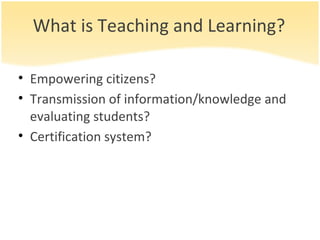
What is Teaching and Learning? Empowering citizens? Transmission of information/knowledge and evaluating students? Certification system?
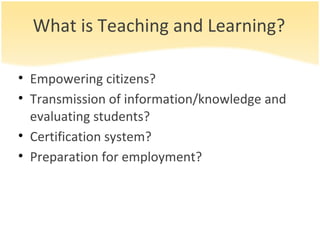
What is Teaching and Learning? Empowering citizens? Transmission of information/knowledge and evaluating students? Certification system? Preparation for employment?
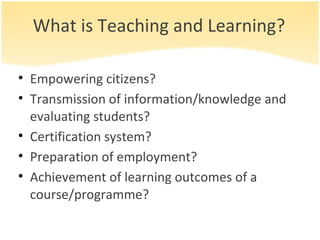
What is Teaching and Learning? Empowering citizens? Transmission of information/knowledge and evaluating students? Certification system? Preparation of employment? Achievement of learning outcomes of a course/programme?
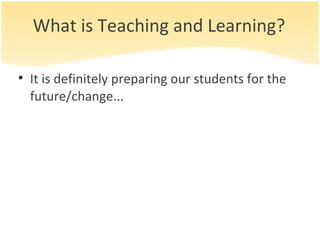
What is Teaching and Learning? It is definitely preparing our students for the future/change...
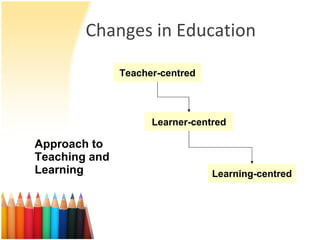
Changes in Education Teacher-centred Learner-centred Learning-centred Approach to Teaching and Learning
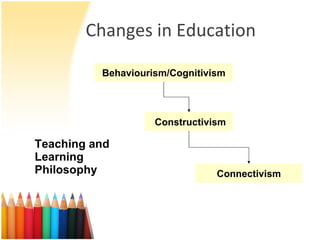
Changes in Education Behaviourism/Cognitivism Constructivism Connectivism Teaching and Learning Philosophy
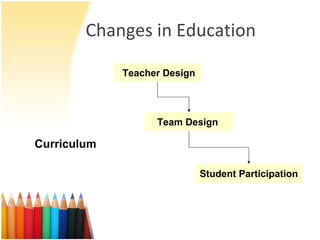
Changes in Education Teacher Design Team Design  Student Participation Curriculum
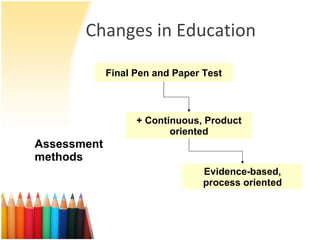
Changes in Education Final Pen and Paper Test + Continuous, Product oriented Evidence-based, process oriented Assessment methods
What is Assessment? Meaning?
What is Assessment? Meaning? Purposes?
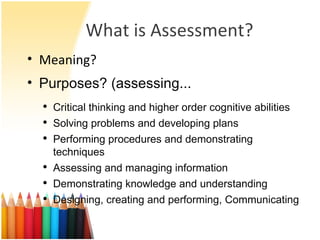
What is Assessment? Meaning? Purposes? (assessing... Critical thinking and higher order cognitive abilities Solving problems and developing plans Performing procedures and demonstrating techniques Assessing and managing information Demonstrating knowledge and understanding Designing, creating and performing, Communicating
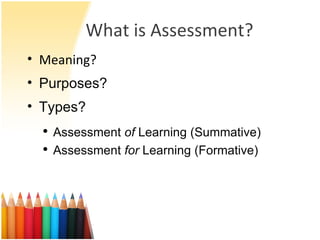
What is Assessment? Meaning? Purposes?  Types? Assessment  of  Learning (Summative) Assessment  for  Learning (Formative)
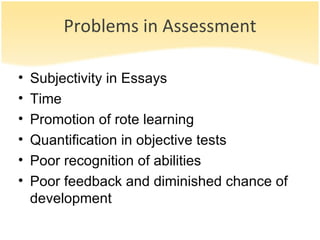
Problems in Assessment Subjectivity in Essays Time  Promotion of rote learning Quantification in objective tests Poor recognition of abilities Poor feedback and diminished chance of development
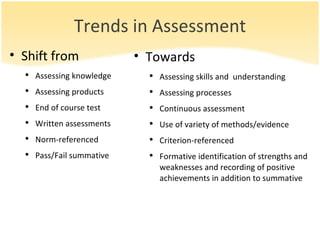
Trends in Assessment Shift from Assessing knowledge Assessing products End of course test Written assessments Norm-referenced Pass/Fail summative Towards Assessing skills and  understanding Assessing processes Continuous assessment Use of variety of methods/evidence Criterion-referenced Formative identification of strengths and weaknesses and recording of positive achievements in addition to summative
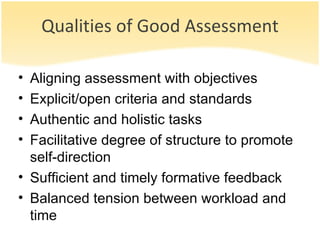
Qualities of Good Assessment Aligning assessment with objectives Explicit/open criteria and standards  Authentic and holistic tasks Facilitative degree of structure to promote self-direction Sufficient and timely formative feedback Balanced tension between workload and time
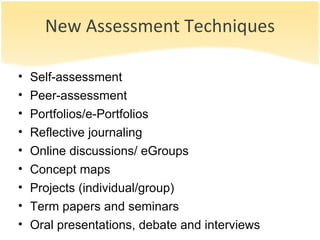
New Assessment Techniques Self-assessment Peer-assessment Portfolios/e-Portfolios Reflective journaling Online discussions/ eGroups Concept maps Projects (individual/group) Term papers and seminars Oral presentations, debate and interviews
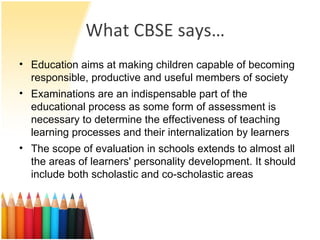
What CBSE says… Education aims at making children capable of becoming responsible, productive and useful members of society Examinations are an indispensable part of the educational process as some form of assessment is necessary to determine the effectiveness of teaching learning processes and their internalization by learners The scope of evaluation in schools extends to almost all the areas of learners' personality development. It should include both scholastic and co-scholastic areas
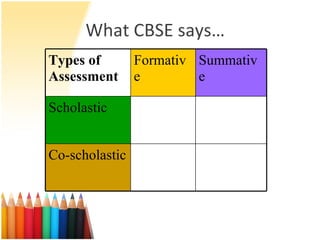
What CBSE says… Types of Assessment Formative Summative Scholastic Co-scholastic
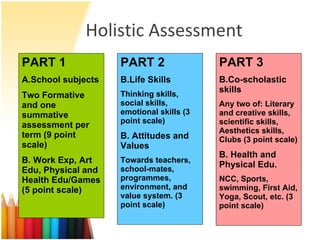
Holistic Assessment PART 1 A.School subjects Two Formative  and one summative assessment per term (9 point scale) B. Work Exp, Art Edu, Physical and Health Edu/Games (5 point scale) PART 3 Co-scholastic skills Any two of: Literary and creative skills, scientific skills, Aesthetics skills, Clubs (3 point scale) B. Health and Physical Edu. NCC, Sports, swimming, First Aid, Yoga, Scout, etc. (3 point scale) PART 2 Life Skills  Thinking skills, social skills, emotional skills (3 point scale) B. Attitudes and Values Towards teachers, school-mates, programmes, environment, and value system. (3 point scale)
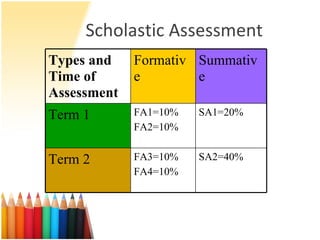
Scholastic Assessment  Types and Time of Assessment Formative Summative Term 1 FA1=10% FA2=10% SA1=20% Term 2 FA3=10% FA4=10% SA2=40%
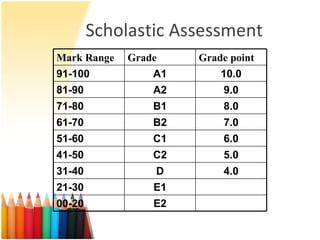
Scholastic Assessment  Mark Range Grade Grade point 91-100 A1 10.0 81-90 A2 9.0 71-80 B1 8.0 61-70 B2 7.0 51-60 C1 6.0 41-50 C2 5.0 31-40 D 4.0 21-30 E1 00-20 E2
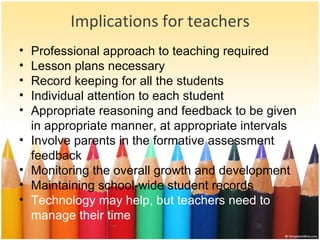
Implications for teachers Professional approach to teaching required Lesson plans necessary Record keeping for all the students Individual attention to each student Appropriate reasoning and feedback to be given in appropriate manner, at appropriate intervals Involve parents in the formative assessment feedback Monitoring the overall growth and development Maintaining school-wide student records Technology may help, but teachers need to manage their time
Thank you very much. -- Sanjaya Mishra

Continuous and Comprehensive Assessment in Schools

  • 1.
    Comprehensive and ContinuousAssessment in Schools Sanjaya Mishra
  • 2.
    What is Teachingand Learning? Think for yourself – what according to you teaching and learning is all about?
  • 3.
    What is Teachingand Learning? Empowering citizens?
  • 4.
    What is Teachingand Learning? Empowering citizens? Transmission of information/knowledge and evaluating students?
  • 5.
    What is Teachingand Learning? Empowering citizens? Transmission of information/knowledge and evaluating students? Certification system?
  • 6.
    What is Teachingand Learning? Empowering citizens? Transmission of information/knowledge and evaluating students? Certification system? Preparation for employment?
  • 7.
    What is Teachingand Learning? Empowering citizens? Transmission of information/knowledge and evaluating students? Certification system? Preparation of employment? Achievement of learning outcomes of a course/programme?
  • 8.
    What is Teachingand Learning? It is definitely preparing our students for the future/change...
  • 9.
    Changes in EducationTeacher-centred Learner-centred Learning-centred Approach to Teaching and Learning
  • 10.
    Changes in EducationBehaviourism/Cognitivism Constructivism Connectivism Teaching and Learning Philosophy
  • 11.
    Changes in EducationTeacher Design Team Design Student Participation Curriculum
  • 12.
    Changes in EducationFinal Pen and Paper Test + Continuous, Product oriented Evidence-based, process oriented Assessment methods
  • 13.
  • 14.
    What is Assessment?Meaning? Purposes?
  • 15.
    What is Assessment?Meaning? Purposes? (assessing... Critical thinking and higher order cognitive abilities Solving problems and developing plans Performing procedures and demonstrating techniques Assessing and managing information Demonstrating knowledge and understanding Designing, creating and performing, Communicating
  • 16.
    What is Assessment?Meaning? Purposes? Types? Assessment of Learning (Summative) Assessment for Learning (Formative)
  • 17.
    Problems in AssessmentSubjectivity in Essays Time Promotion of rote learning Quantification in objective tests Poor recognition of abilities Poor feedback and diminished chance of development
  • 18.
    Trends in AssessmentShift from Assessing knowledge Assessing products End of course test Written assessments Norm-referenced Pass/Fail summative Towards Assessing skills and understanding Assessing processes Continuous assessment Use of variety of methods/evidence Criterion-referenced Formative identification of strengths and weaknesses and recording of positive achievements in addition to summative
  • 19.
    Qualities of GoodAssessment Aligning assessment with objectives Explicit/open criteria and standards Authentic and holistic tasks Facilitative degree of structure to promote self-direction Sufficient and timely formative feedback Balanced tension between workload and time
  • 20.
    New Assessment TechniquesSelf-assessment Peer-assessment Portfolios/e-Portfolios Reflective journaling Online discussions/ eGroups Concept maps Projects (individual/group) Term papers and seminars Oral presentations, debate and interviews
  • 21.
    What CBSE says…Education aims at making children capable of becoming responsible, productive and useful members of society Examinations are an indispensable part of the educational process as some form of assessment is necessary to determine the effectiveness of teaching learning processes and their internalization by learners The scope of evaluation in schools extends to almost all the areas of learners' personality development. It should include both scholastic and co-scholastic areas
  • 22.
    What CBSE says…Types of Assessment Formative Summative Scholastic Co-scholastic
  • 23.
    Holistic Assessment PART1 A.School subjects Two Formative and one summative assessment per term (9 point scale) B. Work Exp, Art Edu, Physical and Health Edu/Games (5 point scale) PART 3 Co-scholastic skills Any two of: Literary and creative skills, scientific skills, Aesthetics skills, Clubs (3 point scale) B. Health and Physical Edu. NCC, Sports, swimming, First Aid, Yoga, Scout, etc. (3 point scale) PART 2 Life Skills Thinking skills, social skills, emotional skills (3 point scale) B. Attitudes and Values Towards teachers, school-mates, programmes, environment, and value system. (3 point scale)
  • 24.
    Scholastic Assessment Types and Time of Assessment Formative Summative Term 1 FA1=10% FA2=10% SA1=20% Term 2 FA3=10% FA4=10% SA2=40%
  • 25.
    Scholastic Assessment Mark Range Grade Grade point 91-100 A1 10.0 81-90 A2 9.0 71-80 B1 8.0 61-70 B2 7.0 51-60 C1 6.0 41-50 C2 5.0 31-40 D 4.0 21-30 E1 00-20 E2
  • 26.
    Implications for teachersProfessional approach to teaching required Lesson plans necessary Record keeping for all the students Individual attention to each student Appropriate reasoning and feedback to be given in appropriate manner, at appropriate intervals Involve parents in the formative assessment feedback Monitoring the overall growth and development Maintaining school-wide student records Technology may help, but teachers need to manage their time
  • 27.
    Thank you verymuch. -- Sanjaya Mishra