DIAGNOSTIC TESTING &
REMEDIAL TEACHING IN
MATHEMATICS
   In general, af ter completing a par ticular unit/topic you conduct
    a test to assess the achievements of learners. Af ter evaluation
    you draw some conclusions and you find that some of the
    students have fared ver y well and a par ticular group of
    students have achieved below your expectations. Now you will
    have to find out the causes for this low achievement or slow
    learning. There would be cer tain reasons for this low
    achievement. Now it is ver y essential to find out the par ticular
    area where the dif ficulty lies or the par ticular concept where
    the learner commits errors. To locate and identify the areas of
    learning dif ficulties leads to Diagnostic Testing.

   Af ter identifying the areas where the error lies, you have to
    find out the reasons due to which the par ticular child/group of
    students have not responded well. At this stage you have to
    play the role of a doctor. If a patient visits the doctor’s clinic
    he suggests dif ferent tests relevant to the symptoms obser ved
    by him. Af ter getting repor ts he is in a position to identify and
    diagnose the disease and then prescribe the medicine for it.

   Likewise, as a teacher, you have to first identify and locate the
    area where the error lies. The process adopted for this purpose
    in educational situations is known as Diagnostic Testing.
i)Who are the pupils who need help?

ii) Where are the errors located ?

iii) Why did the error occur ?
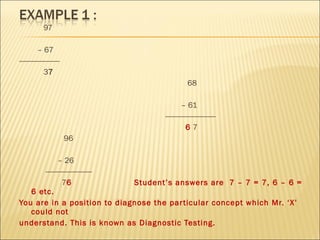
97

         – 67
--------------------
            37
                                               68

                                            – 61
                                    -------------------------
                                              67
                       96

            – 26
      -----------------------
              76              Student’s answers are 7 – 7 = 7, 6 – 6 =
   6 etc.
You are in a position to diagnose the par ticular concept which Mr. ‘X’
   could not
understand. This is known as Diagnostic Testing.
182
   – 90
----------
       90                    883
                         – 570
                      --------------
                            310
Student’s answers are 2 - 0 = 0, 3 – 0
 = 0 etc.
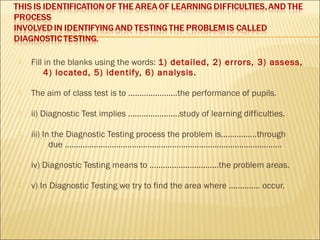
   Fill in the blanks using the words: 1) detailed, 2) errors, 3) assess,
         4) located, 5) identify, 6) analysis.

   The aim of class test is to ......................the performance of pupils.

   ii) Diagnostic Test implies .......................study of learning difficulties.

   iii) In the Diagnostic Testing process the problem is................through
           due .................................................................................................

   iv) Diagnostic Testing means to ...............................the problem areas.

   v) In Diagnostic Testing we try to find the area where .............. occur.
   If we consider arithmetical attainments from
    both a qualitative and quantitative standpoints,
    we can distinguish four main points (i)
    accuracy (ii) speed of writing
    (iii) methods of work and (iv) extent of
    the arithmetic process mastered.


* ANSWERS TO CHECK YOUR PROGRESS -
  i)assess ii) detailed iii) located, analysis iv) identify v)errors
   i) Identifying the students who are having
    trouble or need help.

   ii) Locating the errors or learning difficulties.

   iii) Discovering the causal factors of slow
    learning.
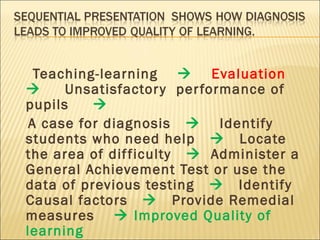
Teaching-learning  Evaluation
     Unsatisfactor y per formance of
pupils    
 A case for diagnosis  Identify
students who need help  Locate
the area of dif ficulty  Administer a
General Achievement Test or use the
data of previous testing  Identify
Causal factors  Provide Remedial
measures  Improved Quality of
learning
   The program that coincides most closely with
    the experience of successful teachers and
    with a sound psychology of learning calls for
    the following steps in the order indicated
    (1) teach,
    (2) review,
    (3) test for weaknesses wherever they
    appear,
    (4) follow with remedial drill units on
    the specific weaknesses revealed by
    the tests.
While diagnosis is the process of investigating the learners’ difficulties and the reasons for this, its
    follow up leads to actions that may help children make up their deficiencies. This step is generally
    termed Remedial Teaching. So you have to be skilled in preparing or arranging for such materials which
    may be used to undertake corrective instruction and thus enhancing the quality of learning.

      Selection of Materials : The following points should be kept in mind while selecting appropriate
    instructional material

   1) The corrective material should be designed to correct the students’
    individual dif ficulties.

   ii) You have to analyze the work of slow learners by means of
    obser vation, inter view and Diagnostic Testing. A careful consideration
    of the three may help decide what kind of corrective material is to be
    designed and whether material will be adequate to correct the specific
    dif ficulties of learners.

   iii) The corrective material should be graded, self-directive and should
    permit students to work independently. Written directions, which
    accompany the material, should be easily readable and comprehensible
    by the students.

   iv) The corrective material must permit individuals to progress
    according to their pace.

   v) The material should encourage systematic recording of evidence of
    pupils’ progress.
   If remedial work is to be effective, drills of established
    validity must be provided for each specific skill which
    conditions achievement in the subject. The validity of drill
    material depends to a large degree upon the accuracy and
    completeness with which the analysis of skills is made.
    Difficulties in subject units which can be identified in only a
    vague manner cannot be remedied except by chance. Drills
    must closely parallel the skills they are supposed to remedy.
   For instance, if mastery of a certain minimal
    vocabulary is essential to effective silent reading
    'comprehension, then drill on those particular words that
    constitute special weakness should lake precedence over
    other drills.
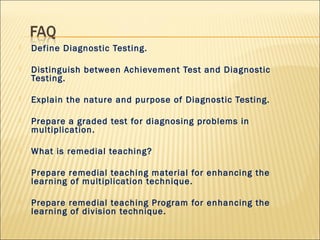
   Define Diagnostic Testing.

   Distinguish between Achievement Test and Diagnostic
    Testing.

   Explain the nature and purpose of Diagnostic Testing.

   Prepare a graded test for diagnosing problems in
    multiplication.

   What is remedial teaching?

   Prepare remedial teaching material for enhancing the
    learning of multiplication technique.

   Prepare remedial teaching Program for enhancing the
    learning of division technique.

Diagnostic testing & remedial teaching

  • 1.
    DIAGNOSTIC TESTING & REMEDIALTEACHING IN MATHEMATICS
  • 2.
    In general, af ter completing a par ticular unit/topic you conduct a test to assess the achievements of learners. Af ter evaluation you draw some conclusions and you find that some of the students have fared ver y well and a par ticular group of students have achieved below your expectations. Now you will have to find out the causes for this low achievement or slow learning. There would be cer tain reasons for this low achievement. Now it is ver y essential to find out the par ticular area where the dif ficulty lies or the par ticular concept where the learner commits errors. To locate and identify the areas of learning dif ficulties leads to Diagnostic Testing.  Af ter identifying the areas where the error lies, you have to find out the reasons due to which the par ticular child/group of students have not responded well. At this stage you have to play the role of a doctor. If a patient visits the doctor’s clinic he suggests dif ferent tests relevant to the symptoms obser ved by him. Af ter getting repor ts he is in a position to identify and diagnose the disease and then prescribe the medicine for it.  Likewise, as a teacher, you have to first identify and locate the area where the error lies. The process adopted for this purpose in educational situations is known as Diagnostic Testing.
  • 3.
    i)Who are thepupils who need help? ii) Where are the errors located ? iii) Why did the error occur ?
  • 4.
    97 – 67 -------------------- 37 68 – 61 ------------------------- 67 96 – 26 ----------------------- 76 Student’s answers are 7 – 7 = 7, 6 – 6 = 6 etc. You are in a position to diagnose the par ticular concept which Mr. ‘X’ could not understand. This is known as Diagnostic Testing.
  • 5.
    182 – 90 ---------- 90 883 – 570 -------------- 310 Student’s answers are 2 - 0 = 0, 3 – 0 = 0 etc.
  • 6.
    Fill in the blanks using the words: 1) detailed, 2) errors, 3) assess, 4) located, 5) identify, 6) analysis.  The aim of class test is to ......................the performance of pupils.  ii) Diagnostic Test implies .......................study of learning difficulties.  iii) In the Diagnostic Testing process the problem is................through due .................................................................................................  iv) Diagnostic Testing means to ...............................the problem areas.  v) In Diagnostic Testing we try to find the area where .............. occur.
  • 7.
    If we consider arithmetical attainments from both a qualitative and quantitative standpoints, we can distinguish four main points (i) accuracy (ii) speed of writing (iii) methods of work and (iv) extent of the arithmetic process mastered. * ANSWERS TO CHECK YOUR PROGRESS - i)assess ii) detailed iii) located, analysis iv) identify v)errors
  • 8.
    i) Identifying the students who are having trouble or need help.  ii) Locating the errors or learning difficulties.  iii) Discovering the causal factors of slow learning.
  • 9.
    Teaching-learning  Evaluation  Unsatisfactor y per formance of pupils  A case for diagnosis  Identify students who need help  Locate the area of dif ficulty  Administer a General Achievement Test or use the data of previous testing  Identify Causal factors  Provide Remedial measures  Improved Quality of learning
  • 10.
    The program that coincides most closely with the experience of successful teachers and with a sound psychology of learning calls for the following steps in the order indicated   (1) teach,  (2) review,   (3) test for weaknesses wherever they appear,   (4) follow with remedial drill units on the specific weaknesses revealed by the tests.
  • 11.
    While diagnosis isthe process of investigating the learners’ difficulties and the reasons for this, its follow up leads to actions that may help children make up their deficiencies. This step is generally termed Remedial Teaching. So you have to be skilled in preparing or arranging for such materials which may be used to undertake corrective instruction and thus enhancing the quality of learning. Selection of Materials : The following points should be kept in mind while selecting appropriate instructional material  1) The corrective material should be designed to correct the students’ individual dif ficulties.  ii) You have to analyze the work of slow learners by means of obser vation, inter view and Diagnostic Testing. A careful consideration of the three may help decide what kind of corrective material is to be designed and whether material will be adequate to correct the specific dif ficulties of learners.  iii) The corrective material should be graded, self-directive and should permit students to work independently. Written directions, which accompany the material, should be easily readable and comprehensible by the students.  iv) The corrective material must permit individuals to progress according to their pace.  v) The material should encourage systematic recording of evidence of pupils’ progress.
  • 12.
    If remedial work is to be effective, drills of established validity must be provided for each specific skill which conditions achievement in the subject. The validity of drill material depends to a large degree upon the accuracy and completeness with which the analysis of skills is made. Difficulties in subject units which can be identified in only a vague manner cannot be remedied except by chance. Drills must closely parallel the skills they are supposed to remedy.  For instance, if mastery of a certain minimal vocabulary is essential to effective silent reading 'comprehension, then drill on those particular words that constitute special weakness should lake precedence over other drills.
  • 13.
    Define Diagnostic Testing.  Distinguish between Achievement Test and Diagnostic Testing.  Explain the nature and purpose of Diagnostic Testing.  Prepare a graded test for diagnosing problems in multiplication.  What is remedial teaching?  Prepare remedial teaching material for enhancing the learning of multiplication technique.  Prepare remedial teaching Program for enhancing the learning of division technique.