GENERAL TECHNIQUES OF
ASSESSMENT
PRESENTED BY,
ANCY A.R
Natural Science
Christ Nagar College of Education
• Techniques of assessment monitor student
learning during the learning process.
• It helps to identify the areas where students
are struggling, so that the instructors can
adjust their teaching methods.
• Teachers and parents use these techniques to
understand a student’s academic strengths
and weakness.
• There are informal techniques such as surveys,
wrappers, etc and formal techniques such as
quizzes, modules, etc
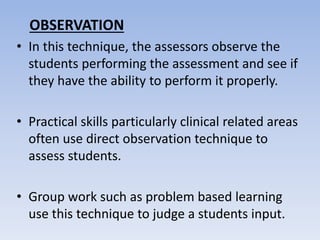
OBSERVATION
• In this technique, the assessors observe the
students performing the assessment and see if
they have the ability to perform it properly.
• Practical skills particularly clinical related areas
often use direct observation technique to
assess students.
• Group work such as problem based learning
use this technique to judge a students input.
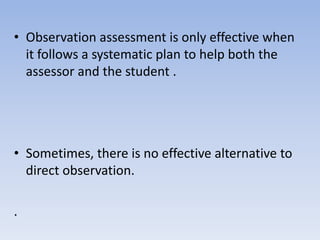
• Observation assessment is only effective when
it follows a systematic plan to help both the
assessor and the student .
• Sometimes, there is no effective alternative to
direct observation.
.
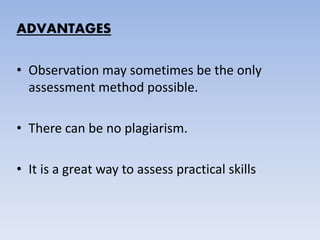
ADVANTAGES
• Observation may sometimes be the only
assessment method possible.
• There can be no plagiarism.
• It is a great way to assess practical skills
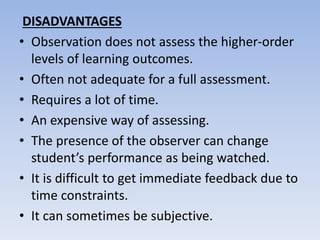
DISADVANTAGES
• Observation does not assess the higher-order
levels of learning outcomes.
• Often not adequate for a full assessment.
• Requires a lot of time.
• An expensive way of assessing.
• The presence of the observer can change
student’s performance as being watched.
• It is difficult to get immediate feedback due to
time constraints.
• It can sometimes be subjective.
PROJECTS
• Projects are of extensive value to the students overall
learning process with the addition of project -based
learning to the curriculum.
• Projects help to make concepts relatable for students.
• Project-based assessments are an opportunity to utilize and
measure the higher order thinking skills of students.
• This can be a singular project at the end of a grading period
or it can be done at designated intervals throughout the
marking period.
• The main intention of a project is to understand what has
been learned and what can be applied by the student.
• Project method is based on the following
principles:
Principle of utility
Principle of readiness
Principle of doing
 Socialization
Inter-disciplinary approach
ADVANTAGES
• Helps in developing social norms and social values among the
learners.
• Provides invaluable opportunities for correlation of subject
matter and transfer of learning.
• Helps in growing knowledge very effectively.
DISADVANTAGES
• Project method cannot be planned for all subjects.
• Whole subject matter cannot be taught by this strategy.
• It is not economical from the point of view of time and cost.
• It is very difficult for a teacher to plan or execute the projects
to the learners.
ASSIGNMENTS
• Assignments are tasks requiring student
engagement and it’s a final product that enables
you to assess what the students know and don’t
know.
• The number and type of assignments depends
upon your course design and learning outcomes .
• Assignments helps to develop student’s higher-
order thinking skills, writing skills, presentation
skills , collaborative and interpersonal skills.
TYPES OF ASSIGNMENTS
• ESSAYS
• WRITING / RESEARCH PAPERS
• ORAL PRESENTATIONS
• CASE STUDIES
• LABS
• GROUP ASSIGNMENTS
MERITS
• Easier and less time-consuming.
• Promotes higher-order thinking.
• Transfer and generalization more likely than for
exams.
DEMERITS
• May require additional resources.
• May require class time.
• Typically more time consuming to grade than exams.
• May be less effective for introductory level content.
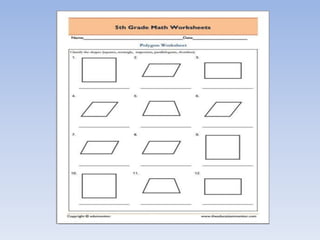
WORKSHEETS
• Worksheets have a widespread use in classrooms at
all levels of assessment.
• It may also refer to a single array of data in
spreadsheet software or an informal piece of paper
that an accountant uses to record information.
• They offer teachers and students several kinds of
unique benefits.
• Teachers use them primarily to keep budgets and
gradebooks and to help teach mathematical topics.
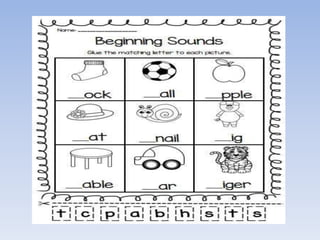
• Worksheet refers to a sheet of paper with questions
for students to record answers.
MERITS
• Saves time.
• Organize displays of information.
• Support asking “what if” questions.
• Increase motivation to work with mathematics.
DEMERITS
• Susceptible to trivial human errors.
• Difficult to test.
• Not designed for collaborative work.
• Hard to consolidate.
• Incapable of supporting quick decision making.
General Techniques Of Assessment

General Techniques Of Assessment

  • 1.
    GENERAL TECHNIQUES OF ASSESSMENT PRESENTEDBY, ANCY A.R Natural Science Christ Nagar College of Education
  • 2.
    • Techniques ofassessment monitor student learning during the learning process. • It helps to identify the areas where students are struggling, so that the instructors can adjust their teaching methods.
  • 3.
    • Teachers andparents use these techniques to understand a student’s academic strengths and weakness. • There are informal techniques such as surveys, wrappers, etc and formal techniques such as quizzes, modules, etc
  • 4.
    OBSERVATION • In thistechnique, the assessors observe the students performing the assessment and see if they have the ability to perform it properly. • Practical skills particularly clinical related areas often use direct observation technique to assess students. • Group work such as problem based learning use this technique to judge a students input.
  • 5.
    • Observation assessmentis only effective when it follows a systematic plan to help both the assessor and the student . • Sometimes, there is no effective alternative to direct observation. .
  • 6.
    ADVANTAGES • Observation maysometimes be the only assessment method possible. • There can be no plagiarism. • It is a great way to assess practical skills
  • 7.
    DISADVANTAGES • Observation doesnot assess the higher-order levels of learning outcomes. • Often not adequate for a full assessment. • Requires a lot of time. • An expensive way of assessing. • The presence of the observer can change student’s performance as being watched. • It is difficult to get immediate feedback due to time constraints. • It can sometimes be subjective.
  • 8.
    PROJECTS • Projects areof extensive value to the students overall learning process with the addition of project -based learning to the curriculum. • Projects help to make concepts relatable for students. • Project-based assessments are an opportunity to utilize and measure the higher order thinking skills of students. • This can be a singular project at the end of a grading period or it can be done at designated intervals throughout the marking period. • The main intention of a project is to understand what has been learned and what can be applied by the student.
  • 9.
    • Project methodis based on the following principles: Principle of utility Principle of readiness Principle of doing  Socialization Inter-disciplinary approach
  • 10.
    ADVANTAGES • Helps indeveloping social norms and social values among the learners. • Provides invaluable opportunities for correlation of subject matter and transfer of learning. • Helps in growing knowledge very effectively. DISADVANTAGES • Project method cannot be planned for all subjects. • Whole subject matter cannot be taught by this strategy. • It is not economical from the point of view of time and cost. • It is very difficult for a teacher to plan or execute the projects to the learners.
  • 11.
    ASSIGNMENTS • Assignments aretasks requiring student engagement and it’s a final product that enables you to assess what the students know and don’t know. • The number and type of assignments depends upon your course design and learning outcomes . • Assignments helps to develop student’s higher- order thinking skills, writing skills, presentation skills , collaborative and interpersonal skills.
  • 12.
    TYPES OF ASSIGNMENTS •ESSAYS • WRITING / RESEARCH PAPERS • ORAL PRESENTATIONS • CASE STUDIES • LABS • GROUP ASSIGNMENTS
  • 13.
    MERITS • Easier andless time-consuming. • Promotes higher-order thinking. • Transfer and generalization more likely than for exams. DEMERITS • May require additional resources. • May require class time. • Typically more time consuming to grade than exams. • May be less effective for introductory level content.
  • 14.
    WORKSHEETS • Worksheets havea widespread use in classrooms at all levels of assessment. • It may also refer to a single array of data in spreadsheet software or an informal piece of paper that an accountant uses to record information. • They offer teachers and students several kinds of unique benefits. • Teachers use them primarily to keep budgets and gradebooks and to help teach mathematical topics. • Worksheet refers to a sheet of paper with questions for students to record answers.
  • 17.
    MERITS • Saves time. •Organize displays of information. • Support asking “what if” questions. • Increase motivation to work with mathematics. DEMERITS • Susceptible to trivial human errors. • Difficult to test. • Not designed for collaborative work. • Hard to consolidate. • Incapable of supporting quick decision making.