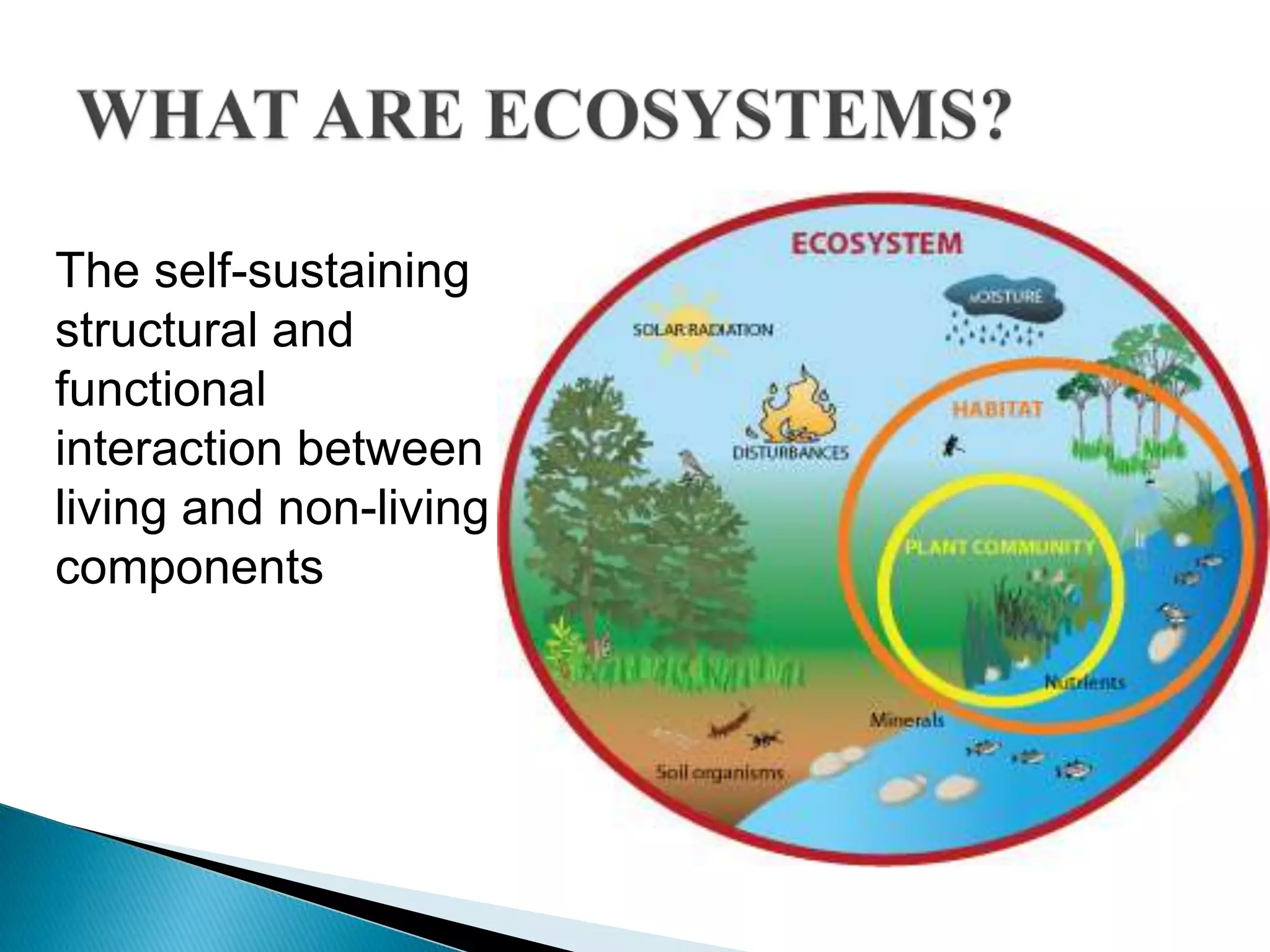
The self-sustaining
structural and
functional
interaction between
living and non-living
components
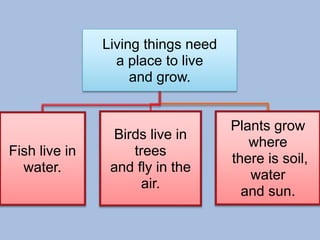
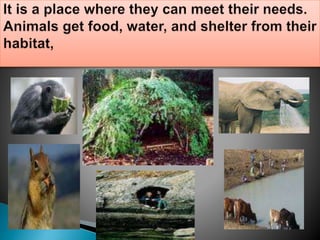
Living things need
a place to live
and grow.
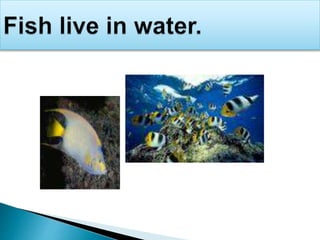
Fish live in
water.
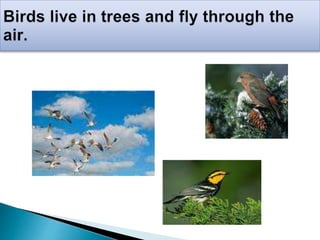
Birds live in
trees
and fly in the
air.
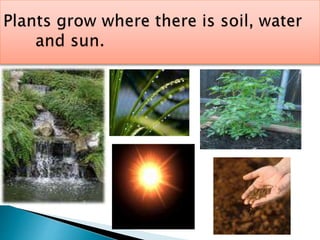
Plants grow
where
there is soil,
water
and sun.
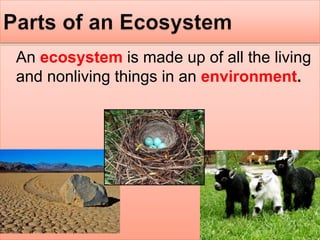
An ecosystem is made up of all the living
and nonliving things in an environment.
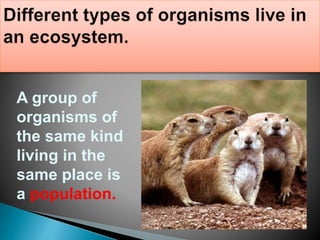
A group of
organisms of
the same kind
living in the
same place is
a population.
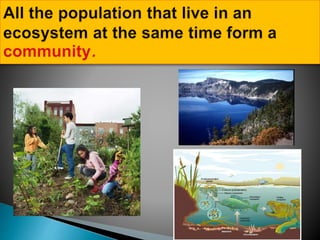
All members of a
community live in the
same ecosystem but they
do not all live in the same
part of the ecosystem.
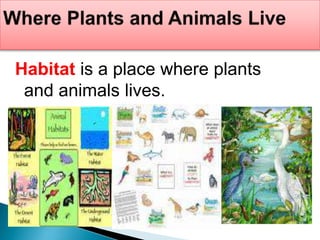
Habitat is a place where plants
and animals lives.
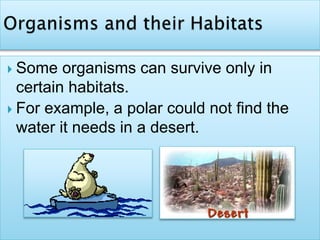
 Some organisms can survive only in
certain habitats.
 For example, a polar could not find the
water it needs in a desert.
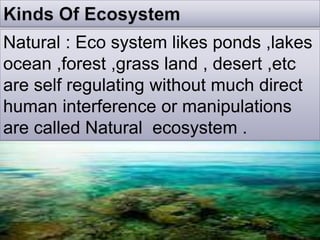
Natural : Eco system likes ponds ,lakes
ocean ,forest ,grass land , desert ,etc
are self regulating without much direct
human interference or manipulations
are called Natural ecosystem .
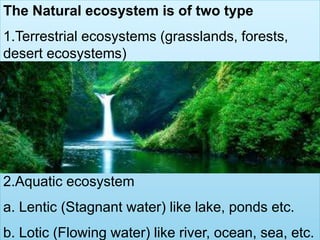
The Natural ecosystem is of two type
1.Terrestrial ecosystems (grasslands, forests,
desert ecosystems)
2.Aquatic ecosystem
a. Lentic (Stagnant water) like lake, ponds etc.
b. Lotic (Flowing water) like river, ocean, sea, etc.
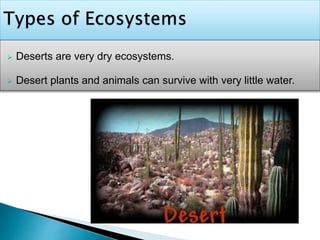
 Deserts are very dry ecosystems.
 Desert plants and animals can survive with very little water.
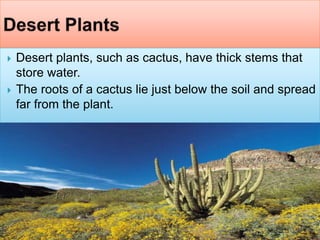
 Desert plants, such as cactus, have thick stems that
store water.
 The roots of a cactus lie just below the soil and spread
far from the plant.
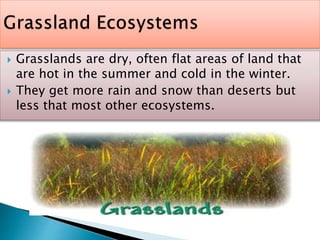
 Grasslands are dry, often flat areas of land that
are hot in the summer and cold in the winter.
 They get more rain and snow than deserts but
less that most other ecosystems.
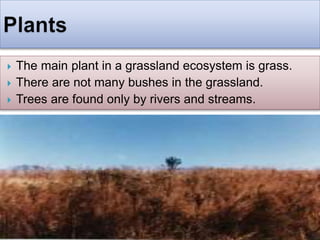
 The main plant in a grassland ecosystem is grass.
 There are not many bushes in the grassland.
 Trees are found only by rivers and streams.
Forest are ecosystems in which
many trees grow.
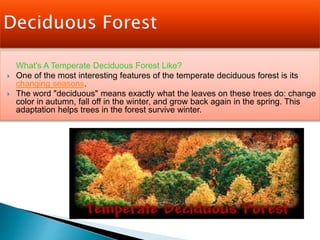
What's A Temperate Deciduous Forest Like?
 One of the most interesting features of the temperate deciduous forest is its
changing seasons.
 The word "deciduous" means exactly what the leaves on these trees do: change
color in autumn, fall off in the winter, and grow back again in the spring. This
adaptation helps trees in the forest survive winter.
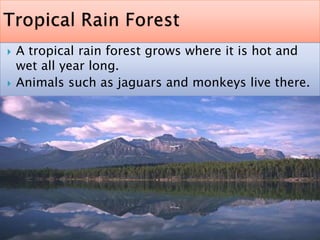
 A tropical rain forest grows where it is hot and
wet all year long.
 Animals such as jaguars and monkeys live there.
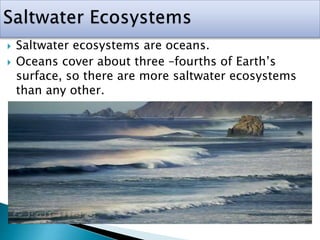
 Saltwater ecosystems are oceans.
 Oceans cover about three –fourths of Earth’s
surface, so there are more saltwater ecosystems
than any other.
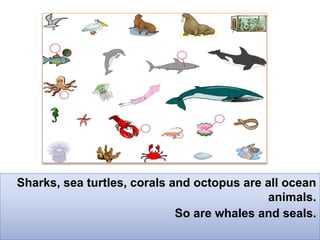
Sharks, sea turtles, corals and octopus are all ocean
animals.
So are whales and seals.
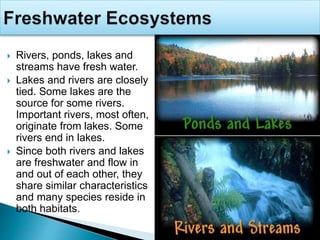
 Rivers, ponds, lakes and
streams have fresh water.
 Lakes and rivers are closely
tied. Some lakes are the
source for some rivers.
Important rivers, most often,
originate from lakes. Some
rivers end in lakes.
 Since both rivers and lakes
are freshwater and flow in
and out of each other, they
share similar characteristics
and many species reside in
both habitats.
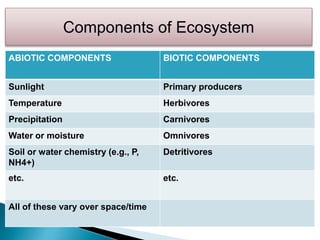
ABIOTIC COMPONENTS BIOTIC COMPONENTS
Sunlight Primary producers
Temperature Herbivores
Precipitation Carnivores
Water or moisture Omnivores
Soil or water chemistry (e.g., P,
NH4+)
Detritivores
etc. etc.
All of these vary over space/time
Components of Ecosystem
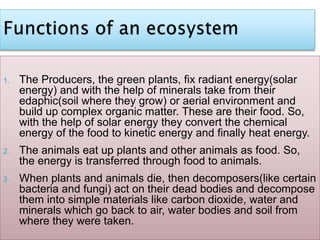
1. The Producers, the green plants, fix radiant energy(solar
energy) and with the help of minerals take from their
edaphic(soil where they grow) or aerial environment and
build up complex organic matter. These are their food. So,
with the help of solar energy they convert the chemical
energy of the food to kinetic energy and finally heat energy.
2. The animals eat up plants and other animals as food. So,
the energy is transferred through food to animals.
3. When plants and animals die, then decomposers(like certain
bacteria and fungi) act on their dead bodies and decompose
them into simple materials like carbon dioxide, water and
minerals which go back to air, water bodies and soil from
where they were taken.
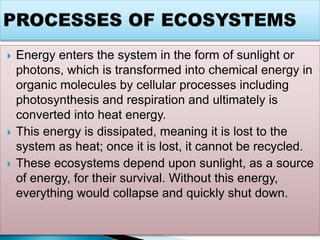
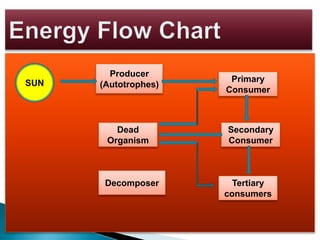
 Energy enters the system in the form of sunlight or
photons, which is transformed into chemical energy in
organic molecules by cellular processes including
photosynthesis and respiration and ultimately is
converted into heat energy.
 This energy is dissipated, meaning it is lost to the
system as heat; once it is lost, it cannot be recycled.
 These ecosystems depend upon sunlight, as a source
of energy, for their survival. Without this energy,
everything would collapse and quickly shut down.
Producer
(Autotrophes)
Dead
Organism
Decomposer Tertiary
consumers
Secondary
Consumer
Primary
Consumer
SUN
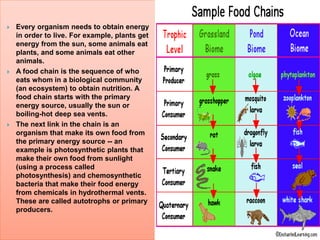
 Every organism needs to obtain energy
in order to live. For example, plants get
energy from the sun, some animals eat
plants, and some animals eat other
animals.
 A food chain is the sequence of who
eats whom in a biological community
(an ecosystem) to obtain nutrition. A
food chain starts with the primary
energy source, usually the sun or
boiling-hot deep sea vents.
 The next link in the chain is an
organism that make its own food from
the primary energy source -- an
example is photosynthetic plants that
make their own food from sunlight
(using a process called
photosynthesis) and chemosynthetic
bacteria that make their food energy
from chemicals in hydrothermal vents.
These are called autotrophs or primary
producers.
 Next come organisms that eat the autotrophs; these organisms
are called herbivores or primary consumers -- an example is
a rabbit that eats grass.
 The next link in the chain is animals that eat herbivores - these
are called secondary consumers -- an example is a snake
that eat rabbits.
 In turn, these animals are eaten by larger predators -- an
example is an owl that eats snakes.
 The tertiary consumers are eaten by quaternary consumers --
an example is a hawk that eats owls. Each food chain end with
a top predator, and animal with no natural enemies (like an
alligator, hawk, or polar bear).
 The arrows in a food chain show the flow of energy, from the
sun or hydrothermal vent to a top predator. As the energy flows
from organism to organism, energy is lost at each step. A
network of many food chains is called a food web
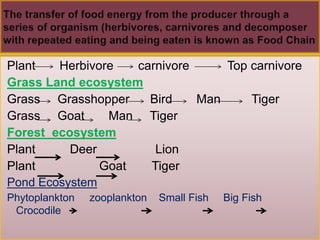
Plant Herbivore carnivore Top carnivore
Grass Land ecosystem
Grass Grasshopper Bird Man Tiger
Grass Goat Man Tiger
Forest ecosystem
Plant Deer Lion
Plant Goat Tiger
Pond Ecosystem
Phytoplankton zooplankton Small Fish Big Fish
Crocodile
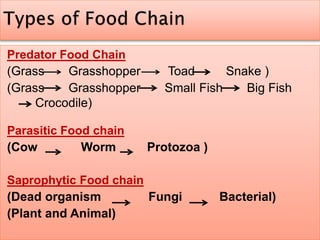
Predator Food Chain
(Grass Grasshopper Toad Snake )
(Grass Grasshopper Small Fish Big Fish
Crocodile)
Parasitic Food chain
(Cow Worm Protozoa )
Saprophytic Food chain
(Dead organism Fungi Bacterial)
(Plant and Animal)
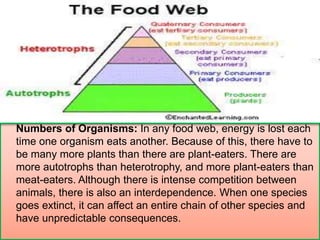
Numbers of Organisms: In any food web, energy is lost each
time one organism eats another. Because of this, there have to
be many more plants than there are plant-eaters. There are
more autotrophs than heterotrophy, and more plant-eaters than
meat-eaters. Although there is intense competition between
animals, there is also an interdependence. When one species
goes extinct, it can affect an entire chain of other species and
have unpredictable consequences.
Equilibrium
As the number of carnivores in a community increases,
they eat more and more of the herbivores, decreasing
the herbivore population.
It then becomes harder and harder for the carnivores to
find herbivores to eat, and the population of carnivores
decreases.
In this way, the carnivores and herbivores stay in a
relatively stable equilibrium, each limiting the other's
population.
A similar equilibrium exists between plants and plant-
eaters.
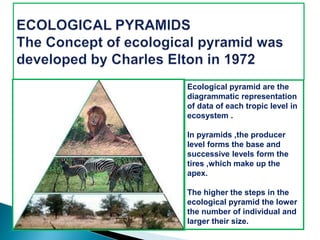
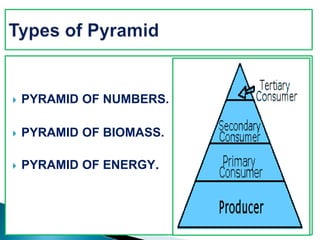
Ecological pyramid are the
diagrammatic representation
of data of each tropic level in
ecosystem .
In pyramids ,the producer
level forms the base and
successive levels form the
tires ,which make up the
apex.
The higher the steps in the
ecological pyramid the lower
the number of individual and
larger their size.
 PYRAMID OF NUMBERS.
 PYRAMID OF BIOMASS.
 PYRAMID OF ENERGY.
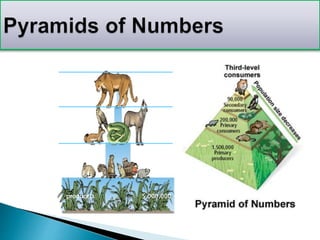
Pyramid of Numbers
It depicts the relationship between the producers and
different orders of consumer at successive trophic level
in terms of their number, the shape of the pyramid varies
from one ecosystem to another.
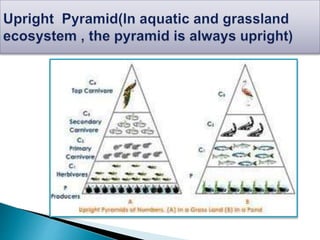
There are two types of Pyramid of Numbers
 Upright Pyramid (In aquatic and grassland ecosystem ,
the pyramid is always upright)
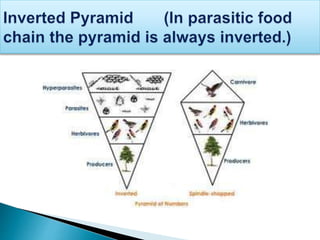
 Inverted Pyramid (In parasitic food chain the pyramid is
always inverted.)
tertiary
consumers
secondary
consumers
primary
consumers
producers
5
5000
500,000
5,000,000
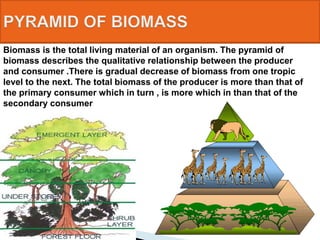
Biomass is the total living material of an organism. The pyramid of
biomass describes the qualitative relationship between the producer
and consumer .There is gradual decrease of biomass from one tropic
level to the next. The total biomass of the producer is more than that of
the primary consumer which in turn , is more which in than that of the
secondary consumer
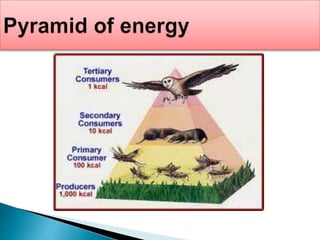
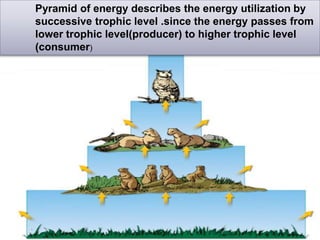
Pyramid of energy describes the energy utilization by
successive trophic level .since the energy passes from
lower trophic level(producer) to higher trophic level
(consumer)
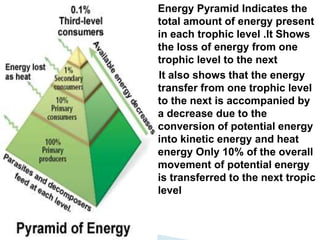
Energy Pyramid Indicates the
total amount of energy present
in each trophic level .It Shows
the loss of energy from one
trophic level to the next
It also shows that the energy
transfer from one trophic level
to the next is accompanied by
a decrease due to the
conversion of potential energy
into kinetic energy and heat
energy Only 10% of the overall
movement of potential energy
is transferred to the next tropic
level
Energy transfer and more importantly energy
loss in an ecosystem.
Why there are more herbivores than carnivores
in an ecosystem.
Why there are more plants than everything else
combined (they support all other populations).
 Industrial Ecology (IE) has been defined as a
"systems-based, multidisciplinary discourse
that seeks to understand emergent behavior
of complex integrated
human/natural systems".
 This field approaches issues of sustainability
by examining problems from multiple
perspectives, usually involving aspects of
sociology.
 The environment, economy and technology. The name
germinates from the idea that we should use the
analogy of natural systems as an aid in understanding
how to design sustainable industrial systems.
 Industrial ecology is the shifting of the industrial process
from linear (open loop) systems, in which resource and
capital investments move through the system to become
waste, to a closed loop system where wastes become
inputs for new processes.
 The main criterion here is to manage wastes and
improve efficiency.
 Recycling involves processing used and unwanted
materials (waste) into new products in order to
prevent wastage of potentially useful materials. It
intends to reduce the consumption of fresh raw
materials; reduce energy usage, air pollution (from
incineration) and water pollution (from land filling) by
reducing the need for 'conventional' waste disposal
and lowering greenhouse gas emissions as compared
to fresh production.
 Recycling is a key component of modern waste
reduction and is the third component of the 'Reduce,
Reuse, Recycle' waste hierarchy.
Recyclable materials include many kinds of glass, paper,
metal, plastic, textiles and electronics.
 These materials have to be managed differently.
Although similar in effect, the composting or other reuse
of biodegradable waste– such as food or garden waste
– is not typically considered recycling.
 Materials to be recycled are brought to a collection
centre or picked up from the curbside, then sorted,
cleaned and reprocessed into new materials bound for
manufacturing.
Environmental management system (EMS) refers to the management
of an organisation's environmental programmes in a comprehensive,
systematic, planned and documented manner. It includes the
organizational structure, planning and resources for developing,
implementing and maintaining policy for environmental protection.
An environmental management system (EMS):
 Serves as a tool to improve environmental performance provides a
systematic way of managing an organisation’s environmental affairs
 EMS is the aspect of the organisation’s overall management structure
that addresses immediate and long-term impacts of its products,
services and processes on the environment
 Gives order and consistency for organizations to address
environmental concerns through the allocation of resources,
assignment of responsibility and ongoing evaluation of practices,
procedures and processes
 Focuses on continual improvement of the system
 An EMS follows a plan-do-check-act cycle or
PDCA.
 It shows the process of first developing an
environmental policy, planning the EMS and then
implementing it.
 Process incorporates checking the system and
acting on it the model is continuous because an
EMS is a process of continual improvement in
which an organization is constantly reviewing and
revising the system.
 EMS is an important tool for managing the
environment effectively and efficiently.
 The ISO 14000 is a standard for environmental
management systems that is applicable to any business,
regardless of size, location or income.
 The aim of the standard is to reduce the environmental
footprint of a business and to decrease pollution and
waste that ensues business processes.
 The most recent version of ISO 14001 was released in
2004 by the International Organization for
Standardization (ISO), which has a representation from
committees all over the world
The major objective of the ISO 14000 series of
norms is "to promote more effective and
efficient environmental management in
organizations and to provide useful and usable
tools- ones that are cost effective, system-
based, flexible and reflect the best
organizations
The best organizational practices available for
gathering, interpreting and communicating
environmentally relevant information".
The intended result is the enhancement of
environmental performance
 All ISO standards are generated through a voluntary,
consensus-based approach.
 ISO has many member countries across the globe. Each
member country develops its position on the standards and
these positions are then negotiated with other member
countries. Draft versions of the standards are sent out for
formal written comment and each country casts an official vote
on the drafts at the appropriate stage of the process. Within
each country, myriad organizations can participate in the
process. Industries, government (federal and state) and
interested parties, like various non-government organizations,
become a part of the system.
 For example, EPA and some states participated in the
development of the ISO 14001 standard and are now
evaluating its usefulness through a variety of pilot projects
1. Environmental policy: Develop a statement of the organization's
commitment to the environment
2. Environmental aspects and impacts: Identify environmental attributes
of products, activities and services and their effects on the
environment
3. Legal and other requirements: Identify and ensure access to relevant
laws and regulations
4. Objectives and targets and environmental management programme :
Set environmental goals for the organization and plan actions to
achieve objectives and targets
5. Structure and responsibility: Establish roles and responsibilities
within the organization
6. Training, awareness and competence: Ensure that employees are
aware and capable of their environmental responsibilities
7. Communication: Develop processes for internal and external
communication on environmental management issues
8 EMS documentation: Maintain information about the EMS and related
documents
9 Document control: Ensure effective management of procedures and
other documents
10 Operational control: Identify, plan and manage the organization's
operations and activities in line with the policy, objectives and targets
and significant aspects
11 Emergency preparedness and response: Develop procedures for
preventing and responding to potential emergencies
12 Monitoring and measuring: Monitor key activities and track
performance including periodic compliance evaluation
13 Evaluation of compliance: Develop procedure to periodically evaluate
compliance with legal and other requirements
14 Non conformance and corrective and preventive action: Identify and
correct problems and prevent recurrences
15 Records: Keep adequate records of EMS performance
16 EMS audit: Periodically verify that the EMS is effective and achieving
objectives and targets
17 Management review: Review the EMS
 ISO 14000 General guidelines on principles of EMS
 ISO 14001 Environmental management systems: Requirements with
guidance for use
 ISO 14004 Environmental management systems: General guidelines on
principles, systems and support techniques
 ISO 14015 Environmental assessment of sites and organizations
 ISO 14020 series (14020 to 14025): Environmental labels and declarations
 ISO 14031 Environmental performance evaluation: Guidelines
 ISO 14040 series (14040 to 14049): Life Cycle Assessment (LCA) discusses
pre-production planning and environment goal setting.
 ISO 14050 Terms and definitions
 ISO 14062 discusses making improvements to environmental impact goals.
 ISO 14063 Environmental communication: Guidelines and examples
 ISO 19011, which specifies one audit protocol for both 14000 and 9000
series standards

Environment management- ECOSYSTEMS

  • 1.
    The self-sustaining structural and functional interactionbetween living and non-living components
  • 2.
    Living things need aplace to live and grow. Fish live in water. Birds live in trees and fly in the air. Plants grow where there is soil, water and sun.
  • 6.
    An ecosystem ismade up of all the living and nonliving things in an environment.
  • 7.
    A group of organismsof the same kind living in the same place is a population.
  • 9.
    All members ofa community live in the same ecosystem but they do not all live in the same part of the ecosystem.
  • 10.
    Habitat is aplace where plants and animals lives.
  • 12.
     Some organismscan survive only in certain habitats.  For example, a polar could not find the water it needs in a desert.
  • 13.
    Natural : Ecosystem likes ponds ,lakes ocean ,forest ,grass land , desert ,etc are self regulating without much direct human interference or manipulations are called Natural ecosystem .
  • 14.
    The Natural ecosystemis of two type 1.Terrestrial ecosystems (grasslands, forests, desert ecosystems) 2.Aquatic ecosystem a. Lentic (Stagnant water) like lake, ponds etc. b. Lotic (Flowing water) like river, ocean, sea, etc.
  • 16.
     Deserts arevery dry ecosystems.  Desert plants and animals can survive with very little water.
  • 17.
     Desert plants,such as cactus, have thick stems that store water.  The roots of a cactus lie just below the soil and spread far from the plant.
  • 18.
     Grasslands aredry, often flat areas of land that are hot in the summer and cold in the winter.  They get more rain and snow than deserts but less that most other ecosystems.
  • 19.
     The mainplant in a grassland ecosystem is grass.  There are not many bushes in the grassland.  Trees are found only by rivers and streams.
  • 20.
    Forest are ecosystemsin which many trees grow.
  • 21.
    What's A TemperateDeciduous Forest Like?  One of the most interesting features of the temperate deciduous forest is its changing seasons.  The word "deciduous" means exactly what the leaves on these trees do: change color in autumn, fall off in the winter, and grow back again in the spring. This adaptation helps trees in the forest survive winter.
  • 22.
     A tropicalrain forest grows where it is hot and wet all year long.  Animals such as jaguars and monkeys live there.
  • 23.
     Saltwater ecosystemsare oceans.  Oceans cover about three –fourths of Earth’s surface, so there are more saltwater ecosystems than any other.
  • 24.
    Sharks, sea turtles,corals and octopus are all ocean animals. So are whales and seals.
  • 25.
     Rivers, ponds,lakes and streams have fresh water.  Lakes and rivers are closely tied. Some lakes are the source for some rivers. Important rivers, most often, originate from lakes. Some rivers end in lakes.  Since both rivers and lakes are freshwater and flow in and out of each other, they share similar characteristics and many species reside in both habitats.
  • 26.
    ABIOTIC COMPONENTS BIOTICCOMPONENTS Sunlight Primary producers Temperature Herbivores Precipitation Carnivores Water or moisture Omnivores Soil or water chemistry (e.g., P, NH4+) Detritivores etc. etc. All of these vary over space/time Components of Ecosystem
  • 27.
    1. The Producers,the green plants, fix radiant energy(solar energy) and with the help of minerals take from their edaphic(soil where they grow) or aerial environment and build up complex organic matter. These are their food. So, with the help of solar energy they convert the chemical energy of the food to kinetic energy and finally heat energy. 2. The animals eat up plants and other animals as food. So, the energy is transferred through food to animals. 3. When plants and animals die, then decomposers(like certain bacteria and fungi) act on their dead bodies and decompose them into simple materials like carbon dioxide, water and minerals which go back to air, water bodies and soil from where they were taken.
  • 28.
     Energy entersthe system in the form of sunlight or photons, which is transformed into chemical energy in organic molecules by cellular processes including photosynthesis and respiration and ultimately is converted into heat energy.  This energy is dissipated, meaning it is lost to the system as heat; once it is lost, it cannot be recycled.  These ecosystems depend upon sunlight, as a source of energy, for their survival. Without this energy, everything would collapse and quickly shut down.
  • 29.
  • 30.
     Every organismneeds to obtain energy in order to live. For example, plants get energy from the sun, some animals eat plants, and some animals eat other animals.  A food chain is the sequence of who eats whom in a biological community (an ecosystem) to obtain nutrition. A food chain starts with the primary energy source, usually the sun or boiling-hot deep sea vents.  The next link in the chain is an organism that make its own food from the primary energy source -- an example is photosynthetic plants that make their own food from sunlight (using a process called photosynthesis) and chemosynthetic bacteria that make their food energy from chemicals in hydrothermal vents. These are called autotrophs or primary producers.
  • 31.
     Next comeorganisms that eat the autotrophs; these organisms are called herbivores or primary consumers -- an example is a rabbit that eats grass.  The next link in the chain is animals that eat herbivores - these are called secondary consumers -- an example is a snake that eat rabbits.  In turn, these animals are eaten by larger predators -- an example is an owl that eats snakes.  The tertiary consumers are eaten by quaternary consumers -- an example is a hawk that eats owls. Each food chain end with a top predator, and animal with no natural enemies (like an alligator, hawk, or polar bear).  The arrows in a food chain show the flow of energy, from the sun or hydrothermal vent to a top predator. As the energy flows from organism to organism, energy is lost at each step. A network of many food chains is called a food web
  • 32.
    Plant Herbivore carnivoreTop carnivore Grass Land ecosystem Grass Grasshopper Bird Man Tiger Grass Goat Man Tiger Forest ecosystem Plant Deer Lion Plant Goat Tiger Pond Ecosystem Phytoplankton zooplankton Small Fish Big Fish Crocodile
  • 33.
    Predator Food Chain (GrassGrasshopper Toad Snake ) (Grass Grasshopper Small Fish Big Fish Crocodile) Parasitic Food chain (Cow Worm Protozoa ) Saprophytic Food chain (Dead organism Fungi Bacterial) (Plant and Animal)
  • 34.
    Numbers of Organisms:In any food web, energy is lost each time one organism eats another. Because of this, there have to be many more plants than there are plant-eaters. There are more autotrophs than heterotrophy, and more plant-eaters than meat-eaters. Although there is intense competition between animals, there is also an interdependence. When one species goes extinct, it can affect an entire chain of other species and have unpredictable consequences.
  • 35.
    Equilibrium As the numberof carnivores in a community increases, they eat more and more of the herbivores, decreasing the herbivore population. It then becomes harder and harder for the carnivores to find herbivores to eat, and the population of carnivores decreases. In this way, the carnivores and herbivores stay in a relatively stable equilibrium, each limiting the other's population. A similar equilibrium exists between plants and plant- eaters.
  • 36.
    Ecological pyramid arethe diagrammatic representation of data of each tropic level in ecosystem . In pyramids ,the producer level forms the base and successive levels form the tires ,which make up the apex. The higher the steps in the ecological pyramid the lower the number of individual and larger their size.
  • 37.
     PYRAMID OFNUMBERS.  PYRAMID OF BIOMASS.  PYRAMID OF ENERGY.
  • 38.
    Pyramid of Numbers Itdepicts the relationship between the producers and different orders of consumer at successive trophic level in terms of their number, the shape of the pyramid varies from one ecosystem to another. There are two types of Pyramid of Numbers  Upright Pyramid (In aquatic and grassland ecosystem , the pyramid is always upright)  Inverted Pyramid (In parasitic food chain the pyramid is always inverted.)
  • 41.
  • 42.
    Biomass is thetotal living material of an organism. The pyramid of biomass describes the qualitative relationship between the producer and consumer .There is gradual decrease of biomass from one tropic level to the next. The total biomass of the producer is more than that of the primary consumer which in turn , is more which in than that of the secondary consumer
  • 44.
    Pyramid of energydescribes the energy utilization by successive trophic level .since the energy passes from lower trophic level(producer) to higher trophic level (consumer)
  • 45.
    Energy Pyramid Indicatesthe total amount of energy present in each trophic level .It Shows the loss of energy from one trophic level to the next It also shows that the energy transfer from one trophic level to the next is accompanied by a decrease due to the conversion of potential energy into kinetic energy and heat energy Only 10% of the overall movement of potential energy is transferred to the next tropic level
  • 46.
    Energy transfer andmore importantly energy loss in an ecosystem. Why there are more herbivores than carnivores in an ecosystem. Why there are more plants than everything else combined (they support all other populations).
  • 47.
     Industrial Ecology(IE) has been defined as a "systems-based, multidisciplinary discourse that seeks to understand emergent behavior of complex integrated human/natural systems".  This field approaches issues of sustainability by examining problems from multiple perspectives, usually involving aspects of sociology.
  • 48.
     The environment,economy and technology. The name germinates from the idea that we should use the analogy of natural systems as an aid in understanding how to design sustainable industrial systems.  Industrial ecology is the shifting of the industrial process from linear (open loop) systems, in which resource and capital investments move through the system to become waste, to a closed loop system where wastes become inputs for new processes.  The main criterion here is to manage wastes and improve efficiency.
  • 49.
     Recycling involvesprocessing used and unwanted materials (waste) into new products in order to prevent wastage of potentially useful materials. It intends to reduce the consumption of fresh raw materials; reduce energy usage, air pollution (from incineration) and water pollution (from land filling) by reducing the need for 'conventional' waste disposal and lowering greenhouse gas emissions as compared to fresh production.  Recycling is a key component of modern waste reduction and is the third component of the 'Reduce, Reuse, Recycle' waste hierarchy.
  • 50.
    Recyclable materials includemany kinds of glass, paper, metal, plastic, textiles and electronics.  These materials have to be managed differently. Although similar in effect, the composting or other reuse of biodegradable waste– such as food or garden waste – is not typically considered recycling.  Materials to be recycled are brought to a collection centre or picked up from the curbside, then sorted, cleaned and reprocessed into new materials bound for manufacturing.
  • 51.
    Environmental management system(EMS) refers to the management of an organisation's environmental programmes in a comprehensive, systematic, planned and documented manner. It includes the organizational structure, planning and resources for developing, implementing and maintaining policy for environmental protection. An environmental management system (EMS):  Serves as a tool to improve environmental performance provides a systematic way of managing an organisation’s environmental affairs  EMS is the aspect of the organisation’s overall management structure that addresses immediate and long-term impacts of its products, services and processes on the environment  Gives order and consistency for organizations to address environmental concerns through the allocation of resources, assignment of responsibility and ongoing evaluation of practices, procedures and processes  Focuses on continual improvement of the system
  • 52.
     An EMSfollows a plan-do-check-act cycle or PDCA.  It shows the process of first developing an environmental policy, planning the EMS and then implementing it.  Process incorporates checking the system and acting on it the model is continuous because an EMS is a process of continual improvement in which an organization is constantly reviewing and revising the system.  EMS is an important tool for managing the environment effectively and efficiently.
  • 53.
     The ISO14000 is a standard for environmental management systems that is applicable to any business, regardless of size, location or income.  The aim of the standard is to reduce the environmental footprint of a business and to decrease pollution and waste that ensues business processes.  The most recent version of ISO 14001 was released in 2004 by the International Organization for Standardization (ISO), which has a representation from committees all over the world
  • 54.
    The major objectiveof the ISO 14000 series of norms is "to promote more effective and efficient environmental management in organizations and to provide useful and usable tools- ones that are cost effective, system- based, flexible and reflect the best organizations The best organizational practices available for gathering, interpreting and communicating environmentally relevant information". The intended result is the enhancement of environmental performance
  • 55.
     All ISOstandards are generated through a voluntary, consensus-based approach.  ISO has many member countries across the globe. Each member country develops its position on the standards and these positions are then negotiated with other member countries. Draft versions of the standards are sent out for formal written comment and each country casts an official vote on the drafts at the appropriate stage of the process. Within each country, myriad organizations can participate in the process. Industries, government (federal and state) and interested parties, like various non-government organizations, become a part of the system.  For example, EPA and some states participated in the development of the ISO 14001 standard and are now evaluating its usefulness through a variety of pilot projects
  • 56.
    1. Environmental policy:Develop a statement of the organization's commitment to the environment 2. Environmental aspects and impacts: Identify environmental attributes of products, activities and services and their effects on the environment 3. Legal and other requirements: Identify and ensure access to relevant laws and regulations 4. Objectives and targets and environmental management programme : Set environmental goals for the organization and plan actions to achieve objectives and targets 5. Structure and responsibility: Establish roles and responsibilities within the organization 6. Training, awareness and competence: Ensure that employees are aware and capable of their environmental responsibilities 7. Communication: Develop processes for internal and external communication on environmental management issues
  • 57.
    8 EMS documentation:Maintain information about the EMS and related documents 9 Document control: Ensure effective management of procedures and other documents 10 Operational control: Identify, plan and manage the organization's operations and activities in line with the policy, objectives and targets and significant aspects 11 Emergency preparedness and response: Develop procedures for preventing and responding to potential emergencies 12 Monitoring and measuring: Monitor key activities and track performance including periodic compliance evaluation 13 Evaluation of compliance: Develop procedure to periodically evaluate compliance with legal and other requirements 14 Non conformance and corrective and preventive action: Identify and correct problems and prevent recurrences 15 Records: Keep adequate records of EMS performance 16 EMS audit: Periodically verify that the EMS is effective and achieving objectives and targets 17 Management review: Review the EMS
  • 58.
     ISO 14000General guidelines on principles of EMS  ISO 14001 Environmental management systems: Requirements with guidance for use  ISO 14004 Environmental management systems: General guidelines on principles, systems and support techniques  ISO 14015 Environmental assessment of sites and organizations  ISO 14020 series (14020 to 14025): Environmental labels and declarations  ISO 14031 Environmental performance evaluation: Guidelines  ISO 14040 series (14040 to 14049): Life Cycle Assessment (LCA) discusses pre-production planning and environment goal setting.  ISO 14050 Terms and definitions  ISO 14062 discusses making improvements to environmental impact goals.  ISO 14063 Environmental communication: Guidelines and examples  ISO 19011, which specifies one audit protocol for both 14000 and 9000 series standards

Editor's Notes