Stephen robbins defines a
group “as two or more
individuals, interacting and
interdependent, who have
come together to achieve
particular objectives.”
DEFINITIONS
TYPES OF GROUPS
Most individuals belong to various types of groups. These
different groups can be broadly classified in two types.
• {1} FORMAL GROUPS: these groups are consciously
created to serve an organizational objective. The crew of
an airline flight is an example of a formal group.
• Formal groups can be further divided into different types.
• [a] Command group: It is a group determine by the
connection between individual who are a formal part of
the organization. For eg, the marketing department
comprising of the general manager and the other
marketing staff.
• [b] Task group: A task group is created by the
management to accomplish certain organizational goals.
It is specifically created to solve the problem or preform a
defined task.
[2]INFORMALGROUPS:Informalgroupsaregroupsthat
developnaturallyamongpeople,withoutanydirectionfrom
theorganizationwithintheyoperate.Theyareformed
spontaneouslyandarebasedonpersonalrelationshipsor
specificinterests.
Thedifferenttypesofinformalgroupsare:
[a]Interestgroups:Interestgroupsconsistofpersonwho
sharecommoninterests.Theymaybejobrelatedinterest,or
suchassports,nationalpoliticsorreligion.
[b]Friendshipgroups:friendshipgroupconsistofindividual
whocometogetherbecausetheyshareoneormorecommon
characteristics.Theyconsistofpeoplewithnaturalaffinitiesfor
oneanother.
STAGES OF GROUP DEVELOPMENT
Everygrouppassesthroughdifferentstagesinitslife
cycle.Accordingtoapopularmodel,everygrouppasses
throughfivedistinctstagesofgroupdevelopment.
(1)Forming:Intheformingstagesthemembersshare
personalinformationandtrytoknowmoreaboutthe
taskstobepreformed.
(2)Storming:thememberscompeteforpositionsofstatus
andcontrol.Thisisaperiodofhighemotionalityand
tensionamonggroupmembers.Thestormingstageis
completedwhentheintragroupconflictsareresolvedand
thegroup’sleadershipisaccepted.
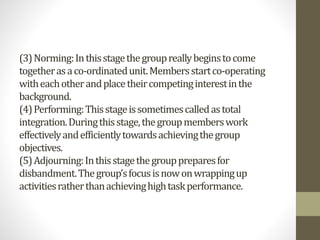
(3)Norming:Inthisstagethegroupreallybeginstocome
togetherasaco-ordinatedunit.Membersstartco-operating
witheachotherandplacetheircompetinginterestinthe
background.
(4)Performing:Thisstageissometimescalledastotal
integration.Duringthisstage,thegroupmemberswork
effectivelyandefficientlytowardsachievingthegroup
objectives.
(5)Adjourning:Inthisstagethegrouppreparesfor
disbandment.Thegroup’sfocusisnowonwrappingup
activitiesratherthanachievinghightaskperformance.
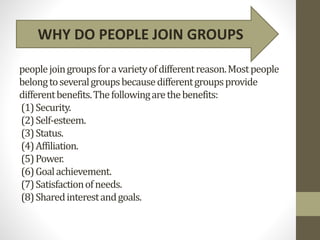
peoplejoingroupsforavarietyofdifferentreason.Mostpeople
belongtoseveralgroupsbecausedifferentgroupsprovide
differentbenefits.Thefollowingarethebenefits:
(1)Security.
(2)Self-esteem.
(3)Status.
(4)Affiliation.
(5)Power.
(6)Goalachievement.
(7)Satisfactionofneeds.
(8)Sharedinterestandgoals.
WHY DO PEOPLE JOIN GROUPS
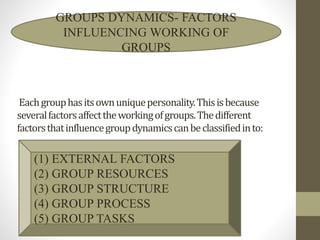
Eachgrouphasitsownuniquepersonality.Thisisbecause
severalfactorsaffecttheworkingofgroups.Thedifferent
factorsthatinfluencegroupdynamicscanbeclassifiedinto:
GROUPS DYNAMICS- FACTORS
INFLUENCING WORKING OF
GROUPS
(1) EXTERNAL FACTORS
(2) GROUP RESOURCES
(3) GROUP STRUCTURE
(4) GROUP PROCESS
(5) GROUP TASKS
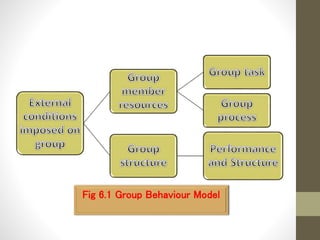
Fig 6.1 Group Behaviour Model
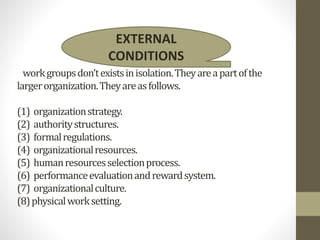
workgroupsdon’texistsinisolation.Theyareapartofthe
largerorganization.Theyareasfollows.
(1) organizationstrategy.
(2) authoritystructures.
(3) formalregulations.
(4) organizationalresources.
(5) humanresourcesselectionprocess.
(6) performanceevaluationandrewardsystem.
(7) organizationalculture.
(8)physicalworksetting.
EXTERNAL
CONDITIONS
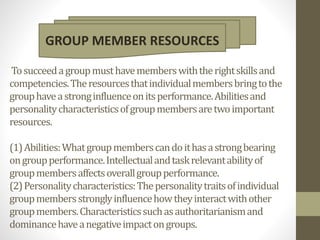
Tosucceedagroupmusthavememberswiththerightskillsand
competencies.Theresourcesthatindividualmembersbringtothe
grouphaveastronginfluenceonitsperformance.Abilitiesand
personalitycharacteristicsofgroupmembersaretwoimportant
resources.
(1)Abilities:Whatgroupmemberscandoithasastrongbearing
ongroupperformance.Intellectualandtaskrelevantabilityof
groupmembersaffectsoverallgroupperformance.
(2)Personalitycharacteristics:Thepersonalitytraitsofindividual
groupmembersstronglyinfluencehowtheyinteractwithother
groupmembers.Characteristicssuchasauthoritarianismand
dominancehaveanegativeimpactongroups.
GROUP MEMBER RESOURCES
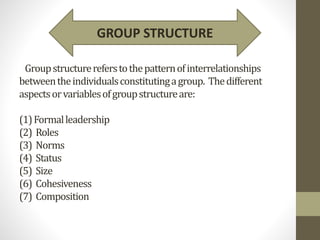
Groupstructurereferstothepatternofinterrelationships
betweentheindividualsconstitutingagroup. Thedifferent
aspectsorvariablesofgroupstructureare:
(1)Formalleadership
(2) Roles
(3) Norms
(4) Status
(5) Size
(6) Cohesiveness
(7) Composition
GROUP STRUCTURE
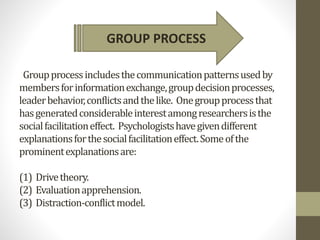
Groupprocessincludesthecommunicationpatternsusedby
membersforinformationexchange,groupdecisionprocesses,
leaderbehavior,conflictsandthelike. Onegroupprocessthat
hasgeneratedconsiderableinterestamongresearchersisthe
socialfacilitationeffect. Psychologistshavegivendifferent
explanationsforthesocialfacilitationeffect.Someofthe
prominentexplanationsare:
(1) Drivetheory.
(2) Evaluationapprehension.
(3) Distraction-conflictmodel.
GROUP PROCESS
Taskmaybesimple,routineandstandardizedortheybe
complex,nonroutine,andnovel.Thenatureofthetask
moderatesthegroupprocessandeffectgroupperformance
andmembersatisfaction.Forcertainkindoftasks,largegroups
aremoresuitablewhilefor sometaskssmallergroupsare
desirable.Greaterinteractionamonggroupmembersis
requiredwhen thereisahighdegreeof interdependence
amongthetasksthatgroupmembersmustperform.
GROUP TASK

Groups In Organisations & Group Dynamics