Budgeting & Budgetary 
Control 
Submitted by: 
(MBA Ist 
SEM.) 
• Chetna prasad 
• Shikha pathak 
• Chitra totwani 
• Shilpi Panchal
Contents 
• Budgeting [characteristics] 
• Budgetary control 
• Difference in budget, budgeting, budgetary control 
• Essentials in budgetary control 
• Requisites for budgetary control system 
• Merits & limitations 
• Zero-based budgeting 
• Difference in Traditional & Zero based budgeting.
Definition & Meaning of Budgeting 
“A budget is a pre-determined statement of 
management policy during a given period 
which provides a standard for comparison 
with the results actually.” 
-Brown & Howard 
“Budgeting is a preparation of comprehensive 
operating and financial plans for specific 
intervals of time” 
-Shilinglaw
Characteristics of good Budgeting 
. 
• Good budgeting should involve persons at different levels while 
preparing the budgets. 
• There should be proper fixation of authority and responsibility. 
. 
• The target of budget should be realistic, if targets are difficult to 
be achieved then they will not enthuse the persons concerned 
• A good accounting system is also essential to make the 
budgeting successful. 
. 
• Budgeting system should have whole hearted support of the top 
management. 
• The employees should be imparted budgeting education.
Definition & meaning of 
Budgetary Control 
“Budgetary control is a system which uses 
budgets as a means of planning and 
controlling all aspects of producing/selling 
commodities or services” 
-J Batty 
“A budget is a means and budgetary control is 
the end result”
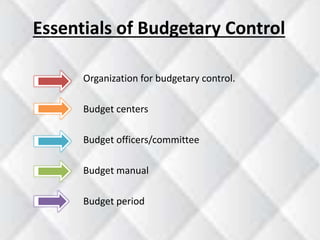
Essentials of Budgetary Control 
Organization for budgetary control. 
Budget centers 
Budget officers/committee 
Budget manual 
Budget period
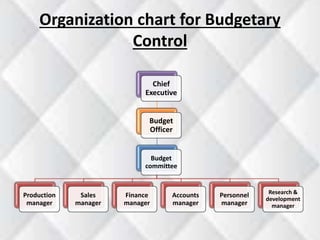
Organization chart for Budgetary 
Control 
Chief 
Executive 
Budget 
Officer 
Budget 
committee 
Production 
manager 
Sales 
manager 
Finance 
manager 
Accounts 
manager 
Personnel 
manager 
Research & 
development 
manager
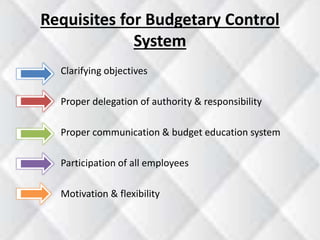
Requisites for Budgetary Control 
System 
Clarifying objectives 
Proper delegation of authority & responsibility 
Proper communication & budget education system 
Participation of all employees 
Motivation & flexibility
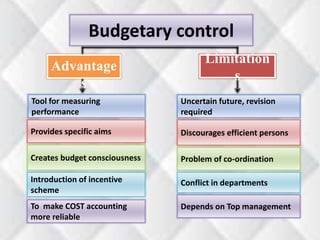
Budgetary control 
Advantage 
s 
Tool for measuring 
performance 
Provides specific aims 
Creates budget consciousness 
Introduction of incentive 
scheme 
Limitation 
s 
Uncertain future, revision 
required 
Discourages efficient persons 
Problem of co-ordination 
Conflict in departments 
To make COST accounting Depends on Top management 
more reliable
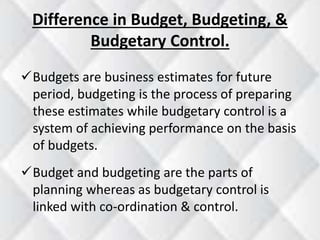
Difference in Budget, Budgeting, & 
Budgetary Control. 
Budgets are business estimates for future 
period, budgeting is the process of preparing 
these estimates while budgetary control is a 
system of achieving performance on the basis 
of budgets. 
Budget and budgeting are the parts of 
planning whereas as budgetary control is 
linked with co-ordination & control.
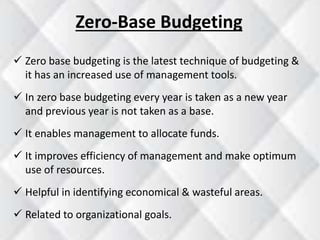
Zero-Base Budgeting 
 Zero base budgeting is the latest technique of budgeting & 
it has an increased use of management tools. 
 In zero base budgeting every year is taken as a new year 
and previous year is not taken as a base. 
 It enables management to allocate funds. 
 It improves efficiency of management and make optimum 
use of resources. 
 Helpful in identifying economical & wasteful areas. 
 Related to organizational goals.
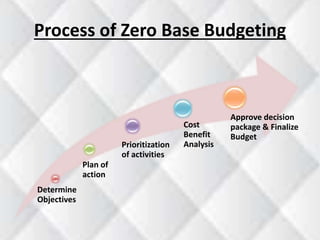
Process of Zero Base Budgeting 
Determine 
Objectives 
Plan of 
action 
Prioritization 
of activities 
Cost 
Benefit 
Analysis 
Approve decision 
package & Finalize 
Budget
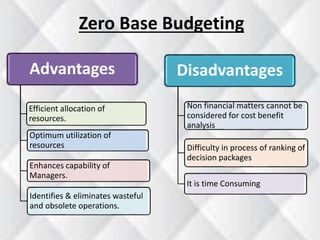
Zero Base Budgeting 
Advantages 
Efficient allocation of 
resources. 
Optimum utilization of 
resources 
Enhances capability of 
Managers. 
Identifies & eliminates wasteful 
and obsolete operations. 
Disadvantages 
Non financial matters cannot be 
considered for cost benefit 
analysis 
Difficulty in process of ranking of 
decision packages 
It is time Consuming
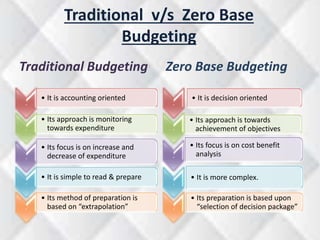
Traditional v/s Zero Base 
Budgeting 
Traditional Budgeting Zero Base Budgeting 
. 
• It is accounting oriented 
. 
• Its approach is monitoring 
towards expenditure 
. 
• Its focus is on increase and 
decrease of expenditure 
. 
• It is simple to read & prepare 
. 
• Its method of preparation is 
based on “extrapolation” 
. 
• It is decision oriented 
. 
• Its approach is towards 
achievement of objectives 
. 
• Its focus is on cost benefit 
analysis 
. 
• It is more complex. 
. 
• Its preparation is based upon 
“selection of decision package”
Budget, Budgeting & budgetary control

Budget, Budgeting & budgetary control

  • 1.
    Budgeting & Budgetary Control Submitted by: (MBA Ist SEM.) • Chetna prasad • Shikha pathak • Chitra totwani • Shilpi Panchal
  • 2.
    Contents • Budgeting[characteristics] • Budgetary control • Difference in budget, budgeting, budgetary control • Essentials in budgetary control • Requisites for budgetary control system • Merits & limitations • Zero-based budgeting • Difference in Traditional & Zero based budgeting.
  • 3.
    Definition & Meaningof Budgeting “A budget is a pre-determined statement of management policy during a given period which provides a standard for comparison with the results actually.” -Brown & Howard “Budgeting is a preparation of comprehensive operating and financial plans for specific intervals of time” -Shilinglaw
  • 4.
    Characteristics of goodBudgeting . • Good budgeting should involve persons at different levels while preparing the budgets. • There should be proper fixation of authority and responsibility. . • The target of budget should be realistic, if targets are difficult to be achieved then they will not enthuse the persons concerned • A good accounting system is also essential to make the budgeting successful. . • Budgeting system should have whole hearted support of the top management. • The employees should be imparted budgeting education.
  • 5.
    Definition & meaningof Budgetary Control “Budgetary control is a system which uses budgets as a means of planning and controlling all aspects of producing/selling commodities or services” -J Batty “A budget is a means and budgetary control is the end result”
  • 6.
    Essentials of BudgetaryControl Organization for budgetary control. Budget centers Budget officers/committee Budget manual Budget period
  • 7.
    Organization chart forBudgetary Control Chief Executive Budget Officer Budget committee Production manager Sales manager Finance manager Accounts manager Personnel manager Research & development manager
  • 8.
    Requisites for BudgetaryControl System Clarifying objectives Proper delegation of authority & responsibility Proper communication & budget education system Participation of all employees Motivation & flexibility
  • 9.
    Budgetary control Advantage s Tool for measuring performance Provides specific aims Creates budget consciousness Introduction of incentive scheme Limitation s Uncertain future, revision required Discourages efficient persons Problem of co-ordination Conflict in departments To make COST accounting Depends on Top management more reliable
  • 10.
    Difference in Budget,Budgeting, & Budgetary Control. Budgets are business estimates for future period, budgeting is the process of preparing these estimates while budgetary control is a system of achieving performance on the basis of budgets. Budget and budgeting are the parts of planning whereas as budgetary control is linked with co-ordination & control.
  • 11.
    Zero-Base Budgeting Zero base budgeting is the latest technique of budgeting & it has an increased use of management tools.  In zero base budgeting every year is taken as a new year and previous year is not taken as a base.  It enables management to allocate funds.  It improves efficiency of management and make optimum use of resources.  Helpful in identifying economical & wasteful areas.  Related to organizational goals.
  • 12.
    Process of ZeroBase Budgeting Determine Objectives Plan of action Prioritization of activities Cost Benefit Analysis Approve decision package & Finalize Budget
  • 13.
    Zero Base Budgeting Advantages Efficient allocation of resources. Optimum utilization of resources Enhances capability of Managers. Identifies & eliminates wasteful and obsolete operations. Disadvantages Non financial matters cannot be considered for cost benefit analysis Difficulty in process of ranking of decision packages It is time Consuming
  • 14.
    Traditional v/s ZeroBase Budgeting Traditional Budgeting Zero Base Budgeting . • It is accounting oriented . • Its approach is monitoring towards expenditure . • Its focus is on increase and decrease of expenditure . • It is simple to read & prepare . • Its method of preparation is based on “extrapolation” . • It is decision oriented . • Its approach is towards achievement of objectives . • Its focus is on cost benefit analysis . • It is more complex. . • Its preparation is based upon “selection of decision package”