


Pioneers
Muhammad yasir
Mohsin mumtaz
Hameed sadiq
Shahzad ahmed
Umer jawad
Muhammad muhayyudin
Organizational behavior
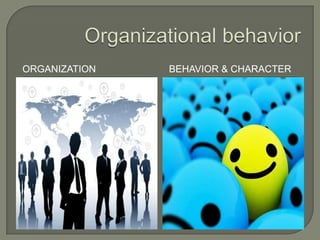
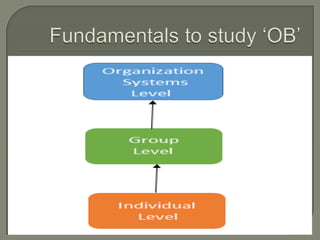
ORGANIZATION BEHAVIOR & CHARACTER
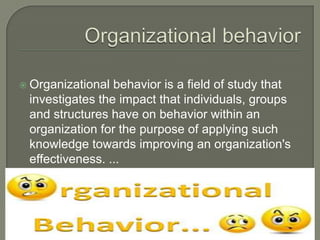
 Organizational behavior is a field of study that
investigates the impact that individuals, groups
and structures have on behavior within an
organization for the purpose of applying such
knowledge towards improving an organization's
effectiveness. ...
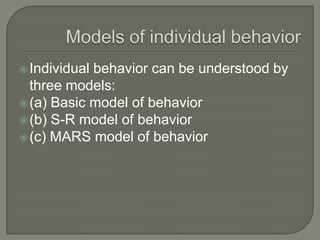
Individual behavior can be understood by
three models:
(a) Basic model of behavior
(b) S-R model of behavior
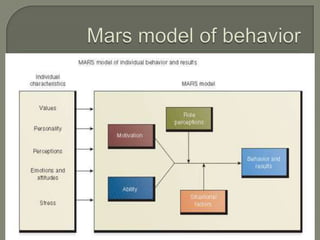
(c) MARS model of behavior
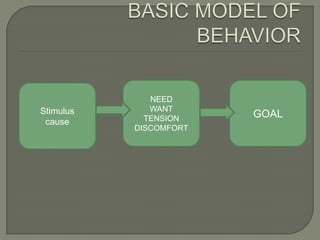
Stimulus
cause
GOAL
NEED
WANT
TENSION
DISCOMFORT
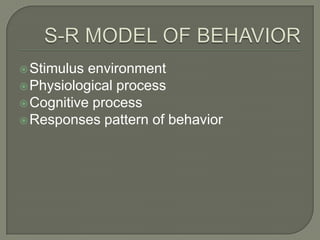
Stimulus environment
Physiological process
Cognitive process
Responses pattern of behavior
Historical evolution of organizational
behavior
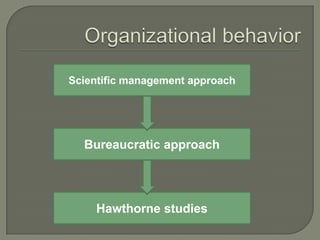
Scientific management approach
Bureaucratic approach
Hawthorne studies
Developed by F.W Taylor at the beginning
of 20th century.
Principles :
1. Replace rule-of-thumb work methods with
scientifically studied
2. Scientifically select, train and develop
each worker
3. Cooperate with the workers
4. Divide work equally between managers
and workers
Replace rule-of-thumb work methods with
scientifically studied
Scientifically select, train and develop each
worker
Cooperate with the workers
Divide work equally between managers
and workers
The approach is presented by max weber.
Focus on how to structure the whole
organization more effectively.
 The Hawthorne studies were conducted in
order to find out the role of human
resource in increasing the production of an
organization.
 Conducted between 1924-1932
 Conducted at WESTERN ELECTRIC
COMPANY, Chicago, USA
 Conducted by,
 Elton Mayo
White Head
Roethlisberger
Provides opportunity to management.
To analyze why and how an individual
behaves.
Organizational behavior integrates factors
to provide simplicity in understanding the
human behavior…
Interpersonal level
Group level
Inter-group level
Controlling and directing behavior
Use of power and sanction
Leadership
Communication
Organizational climate
Organizational adaption
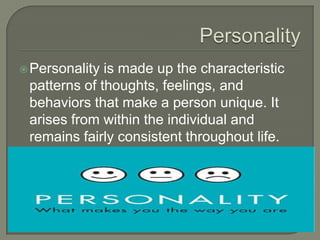
Personality is made up the characteristic
patterns of thoughts, feelings, and
behaviors that make a person unique. It
arises from within the individual and
remains fairly consistent throughout life.
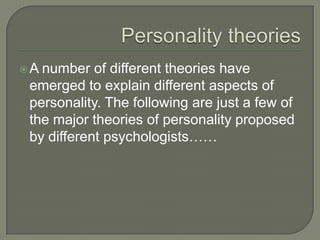
A number of different theories have
emerged to explain different aspects of
personality. The following are just a few of
the major theories of personality proposed
by different psychologists……
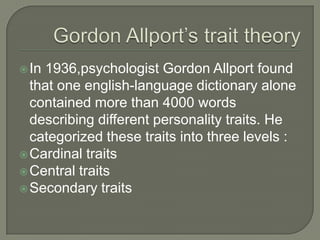
In 1936,psychologist Gordon Allport found
that one english-language dictionary alone
contained more than 4000 words
describing different personality traits. He
categorized these traits into three levels :
Cardinal traits
Central traits
Secondary traits
Trait theorist Raymond Cattell reduced the
number of main personality traits from
allport’s list of over 4000 down to 171.
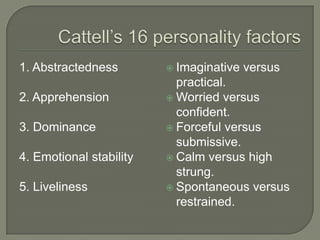
1. Abstractedness
2. Apprehension
3. Dominance
4. Emotional stability
5. Liveliness
 Imaginative versus
practical.
 Worried versus
confident.
 Forceful versus
submissive.
 Calm versus high
strung.
 Spontaneous versus
restrained.
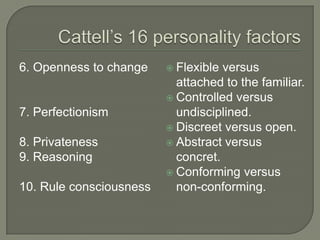
6. Openness to change
7. Perfectionism
8. Privateness
9. Reasoning
10. Rule consciousness
 Flexible versus
attached to the familiar.
 Controlled versus
undisciplined.
 Discreet versus open.
 Abstract versus
concret.
 Conforming versus
non-conforming.
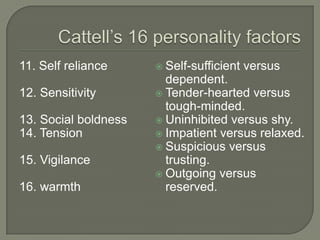
11. Self reliance
12. Sensitivity
13. Social boldness
14. Tension
15. Vigilance
16. warmth
 Self-sufficient versus
dependent.
 Tender-hearted versus
tough-minded.
 Uninhibited versus shy.
 Impatient versus relaxed.
 Suspicious versus
trusting.
 Outgoing versus
reserved.
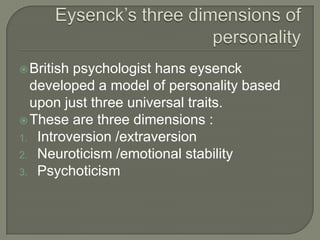
British psychologist hans eysenck
developed a model of personality based
upon just three universal traits.
These are three dimensions :
1. Introversion /extraversion
2. Neuroticism /emotional stability
3. Psychoticism
organizational behavior presentation by mian mohsin

organizational behavior presentation by mian mohsin

  • 2.
  • 3.
    Muhammad yasir Mohsin mumtaz Hameedsadiq Shahzad ahmed Umer jawad Muhammad muhayyudin
  • 4.
  • 5.
  • 6.
     Organizational behavioris a field of study that investigates the impact that individuals, groups and structures have on behavior within an organization for the purpose of applying such knowledge towards improving an organization's effectiveness. ...
  • 8.
    Individual behavior canbe understood by three models: (a) Basic model of behavior (b) S-R model of behavior (c) MARS model of behavior
  • 9.
  • 10.
    Stimulus environment Physiological process Cognitiveprocess Responses pattern of behavior
  • 12.
    Historical evolution oforganizational behavior
  • 13.
  • 14.
    Developed by F.WTaylor at the beginning of 20th century. Principles : 1. Replace rule-of-thumb work methods with scientifically studied 2. Scientifically select, train and develop each worker 3. Cooperate with the workers 4. Divide work equally between managers and workers
  • 15.
    Replace rule-of-thumb workmethods with scientifically studied Scientifically select, train and develop each worker Cooperate with the workers Divide work equally between managers and workers
  • 16.
    The approach ispresented by max weber. Focus on how to structure the whole organization more effectively.
  • 17.
     The Hawthornestudies were conducted in order to find out the role of human resource in increasing the production of an organization.
  • 18.
     Conducted between1924-1932  Conducted at WESTERN ELECTRIC COMPANY, Chicago, USA  Conducted by,  Elton Mayo White Head Roethlisberger
  • 19.
    Provides opportunity tomanagement. To analyze why and how an individual behaves. Organizational behavior integrates factors to provide simplicity in understanding the human behavior…
  • 20.
    Interpersonal level Group level Inter-grouplevel Controlling and directing behavior Use of power and sanction Leadership Communication Organizational climate Organizational adaption
  • 21.
    Personality is madeup the characteristic patterns of thoughts, feelings, and behaviors that make a person unique. It arises from within the individual and remains fairly consistent throughout life.
  • 22.
    A number ofdifferent theories have emerged to explain different aspects of personality. The following are just a few of the major theories of personality proposed by different psychologists……
  • 23.
    In 1936,psychologist GordonAllport found that one english-language dictionary alone contained more than 4000 words describing different personality traits. He categorized these traits into three levels : Cardinal traits Central traits Secondary traits
  • 24.
    Trait theorist RaymondCattell reduced the number of main personality traits from allport’s list of over 4000 down to 171.
  • 25.
    1. Abstractedness 2. Apprehension 3.Dominance 4. Emotional stability 5. Liveliness  Imaginative versus practical.  Worried versus confident.  Forceful versus submissive.  Calm versus high strung.  Spontaneous versus restrained.
  • 26.
    6. Openness tochange 7. Perfectionism 8. Privateness 9. Reasoning 10. Rule consciousness  Flexible versus attached to the familiar.  Controlled versus undisciplined.  Discreet versus open.  Abstract versus concret.  Conforming versus non-conforming.
  • 27.
    11. Self reliance 12.Sensitivity 13. Social boldness 14. Tension 15. Vigilance 16. warmth  Self-sufficient versus dependent.  Tender-hearted versus tough-minded.  Uninhibited versus shy.  Impatient versus relaxed.  Suspicious versus trusting.  Outgoing versus reserved.
  • 28.
    British psychologist hanseysenck developed a model of personality based upon just three universal traits. These are three dimensions : 1. Introversion /extraversion 2. Neuroticism /emotional stability 3. Psychoticism