Conflict -
• A situation in which someone believes that his or her own
needs have been denied.
• Implies disagreement, discord, and friction among
members of a group; where words, emotions, and actions
to produce disruptive effects.
• A state of incompatibility of ideas between two or more
parties or individuals.
What is Conflict?
 Opposition
 A clash of opposing ideas/interest
 Disagreement
 Fight or battle
 Contention
 Hostility
 Be incompatible
 Struggle
Symptoms Of Conflict
 Tensions.
 Work not done properly.
 Disastrous meetings.
 Anger occurs quickly and easily.
 Absenteeism.
 Competition
 Decreased rate of interaction
 Low trust and Suspicion
 Hostility
Symptoms Of Conflict
 Accidents and errors become more frequent.
 Disagreements become more pronounced.
• The employee (or employees) involved display no
desire to communicate.
• Bad tempers are evident.
• Productivity is falling.
• Morale is slipping.
Causes of Conflict
 Opposing viewpoints or opinions
 Emotions
 Selfishness
 Breach of faith and trust
 Miscommunication or misunderstandings
 Assumptions
 Underlying stress and tension
 Ego problems
Levels of Conflict
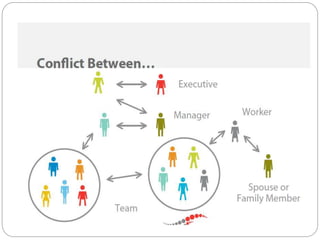
Conflict can occur at three levels namely: Individual level
,Interpersonal level, Group or organizational level.
What About Organization?
Unrealistic
Expectations
Inadequate
Resources
CONFLICTS
Lack of
Cooperatio
n
Reduce
Energy
How do we see conflict
• Traditional view
– Conflict is bad
– Caused by trouble-makers
– Should be avoided
• Human Relation view
– Conflict is natural
– It is inevitable
– Cannot be eliminated
• Interactions view
– Conflict is necessary
– It can be negative or positive
– It effects group performance
Lack of trust
Our complaints
are trivialized
No action
gets taken! They only take
defensive
action
Types of Conflict
INTRAPERSONAL CONFLICT- Conflict within the
individual.
 Approach conflict: an individual must choose
among alternatives, each of which is expected to
have a positive outcome. – Functional Conflict
 Avoidance conflict: an individual must choose
among alternatives, each of which is expected to
have a negative outcome – Dysfunctional Conflict
 INTERGROUP CONFLICT-
An overt expressions of tensions between goals or
concerns of one group or those of another
group. There are opposing interests, group
boundaries or group differences involved.
The conflict is directly or indirectly related to culture
group identities. Sources of this type conflict
includes: Competing Goals; Competition of
Resources; Cultural Differences; Power
Discrepancies; Assimilation vs. Preservation of
micro cultural identity.
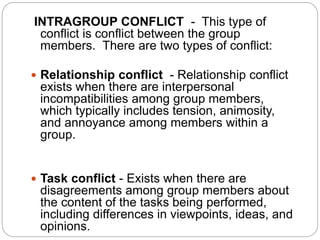
INTRAGROUP CONFLICT - This type of
conflict is conflict between the group
members. There are two types of conflict:
 Relationship conflict - Relationship conflict
exists when there are interpersonal
incompatibilities among group members,
which typically includes tension, animosity,
and annoyance among members within a
group.
 Task conflict - Exists when there are
disagreements among group members about
the content of the tasks being performed,
including differences in viewpoints, ideas, and
opinions.
Conflict Management
Conflict is inevitable, but combat
is optional. -
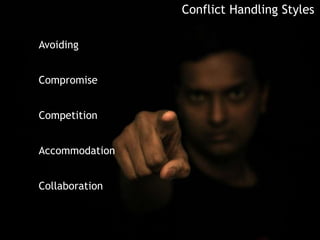
Avoiding
Accommodation
Competition
Compromise
Collaboration
Conflict Handling Styles
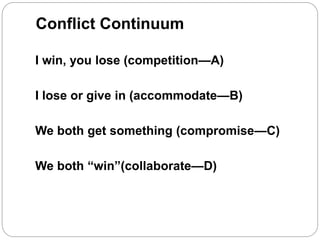
Conflict Continuum
I win, you lose (competition—A)
I lose or give in (accommodate—B)
We both get something (compromise—C)
We both “win”(collaborate—D)
Characteristics
1. Ignoring conflicts and hoping they’ll go away
2. Putting problems under consideration or on
hold
3. Use of secrecy to avoid confrontation
Avoiding
Characteristics
1. Negotiation
2. Looking for deals and trade-offs
3. Finding satisfactory or acceptable
solutions
Compromise
Characteristics
1. Create win-lose
situations
2. Use of power plays
3. Forcing submission
Competition
Characteristics
1. Giving way
2. Submission and fulfillment
Accommodation
Characteristics
• problem-solving carriage
• tackle differences
• sharing ideas and information
• seeing problems and conflicts as
challenges
When to use
• find an integrative solution when
both sets of concerns are
important
• objective is to learn
Collaboration
Is Conflict Good or Bad ?
 Good
Consequences of
Conflict
 Increased Creativity
 It forces people to clarify their views
It can produce
constructive social
change
 It gives people the
opportunity to test
their capacities
 development of group and
organization cohesion
Bad
Consequence
s of Conflict
Violence
Breakdown of Relationship
Polarization of views into static positions
Breakdown of
collaborative ventures
Destruction of
communicatio
n
Diverts
energy
Conclusion
 Conflict is neither good nor bad .It’s inevitable.
 All unresolved conflict weakens relationships
 All unresolved conflict decreases productivity &
lowers performance.
 When managed properly it can be a catalyst for
growth but when managed poorly it can be
disastrous.
 Productivity is GREATEST with a MODERATE
amount of conflict. Productivity is LOWEST when:
 There is no conflict (laissez-faire attitude)
 There is too much conflict (high anxiety, tension)
-

CONFLICT.pptx

  • 1.
    Conflict - • Asituation in which someone believes that his or her own needs have been denied. • Implies disagreement, discord, and friction among members of a group; where words, emotions, and actions to produce disruptive effects. • A state of incompatibility of ideas between two or more parties or individuals.
  • 3.
    What is Conflict? Opposition  A clash of opposing ideas/interest  Disagreement  Fight or battle  Contention  Hostility  Be incompatible  Struggle
  • 4.
    Symptoms Of Conflict Tensions.  Work not done properly.  Disastrous meetings.  Anger occurs quickly and easily.  Absenteeism.  Competition  Decreased rate of interaction  Low trust and Suspicion  Hostility
  • 5.
    Symptoms Of Conflict Accidents and errors become more frequent.  Disagreements become more pronounced. • The employee (or employees) involved display no desire to communicate. • Bad tempers are evident. • Productivity is falling. • Morale is slipping.
  • 6.
    Causes of Conflict Opposing viewpoints or opinions  Emotions  Selfishness  Breach of faith and trust  Miscommunication or misunderstandings  Assumptions  Underlying stress and tension  Ego problems
  • 7.
    Levels of Conflict Conflictcan occur at three levels namely: Individual level ,Interpersonal level, Group or organizational level.
  • 8.
  • 9.
    How do wesee conflict • Traditional view – Conflict is bad – Caused by trouble-makers – Should be avoided • Human Relation view – Conflict is natural – It is inevitable – Cannot be eliminated • Interactions view – Conflict is necessary – It can be negative or positive – It effects group performance
  • 10.
    Lack of trust Ourcomplaints are trivialized No action gets taken! They only take defensive action Types of Conflict
  • 11.
    INTRAPERSONAL CONFLICT- Conflictwithin the individual.  Approach conflict: an individual must choose among alternatives, each of which is expected to have a positive outcome. – Functional Conflict  Avoidance conflict: an individual must choose among alternatives, each of which is expected to have a negative outcome – Dysfunctional Conflict
  • 12.
     INTERGROUP CONFLICT- Anovert expressions of tensions between goals or concerns of one group or those of another group. There are opposing interests, group boundaries or group differences involved. The conflict is directly or indirectly related to culture group identities. Sources of this type conflict includes: Competing Goals; Competition of Resources; Cultural Differences; Power Discrepancies; Assimilation vs. Preservation of micro cultural identity.
  • 13.
    INTRAGROUP CONFLICT -This type of conflict is conflict between the group members. There are two types of conflict:  Relationship conflict - Relationship conflict exists when there are interpersonal incompatibilities among group members, which typically includes tension, animosity, and annoyance among members within a group.  Task conflict - Exists when there are disagreements among group members about the content of the tasks being performed, including differences in viewpoints, ideas, and opinions.
  • 14.
    Conflict Management Conflict isinevitable, but combat is optional. -
  • 16.
  • 17.
    Conflict Continuum I win,you lose (competition—A) I lose or give in (accommodate—B) We both get something (compromise—C) We both “win”(collaborate—D)
  • 18.
    Characteristics 1. Ignoring conflictsand hoping they’ll go away 2. Putting problems under consideration or on hold 3. Use of secrecy to avoid confrontation Avoiding
  • 19.
    Characteristics 1. Negotiation 2. Lookingfor deals and trade-offs 3. Finding satisfactory or acceptable solutions Compromise
  • 20.
    Characteristics 1. Create win-lose situations 2.Use of power plays 3. Forcing submission Competition
  • 21.
    Characteristics 1. Giving way 2.Submission and fulfillment Accommodation
  • 22.
    Characteristics • problem-solving carriage •tackle differences • sharing ideas and information • seeing problems and conflicts as challenges When to use • find an integrative solution when both sets of concerns are important • objective is to learn Collaboration
  • 23.
  • 24.
  • 25.
  • 26.
     It forcespeople to clarify their views
  • 27.
  • 28.
     It givespeople the opportunity to test their capacities
  • 29.
     development ofgroup and organization cohesion
  • 30.
  • 31.
  • 32.
  • 33.
    Polarization of viewsinto static positions
  • 34.
  • 35.
  • 36.
  • 37.
    Conclusion  Conflict isneither good nor bad .It’s inevitable.  All unresolved conflict weakens relationships  All unresolved conflict decreases productivity & lowers performance.  When managed properly it can be a catalyst for growth but when managed poorly it can be disastrous.  Productivity is GREATEST with a MODERATE amount of conflict. Productivity is LOWEST when:  There is no conflict (laissez-faire attitude)  There is too much conflict (high anxiety, tension) -