Electrochemical Methods of analysis
Presented By,
Prof.Vedanshu R.Malviya
M.Pharm (Pharmaceutics)
P. R.Pote Patil College of Pharmacy,
Amravati.
Pharmaceutical Analysis
• It is divided into four types
• Electrochemical method
• Types of electrochemical methods
2
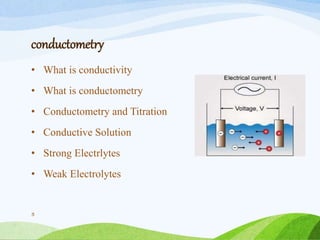
conductometry
• What is conductivity
• What is conductometry
• Conductometry and Titration
• Conductive Solution
• Strong Electrlytes
• Weak Electrolytes
3
Some imp terms
• Ohms Law
• Conductance
• Specific resistance
• Specific conductance
• Equivalent conductivity
• Molecular conductance:
• Effect of dilution
4
Instrumentation
• Conductivity cell
• Conductometer
5
Conductivity cell
• Made of pyrex or quartz and are fitted with two
platinum electrodes.
• Should be placed in vessel containing water to maintain
constant temperature.
• Determination of cell constant
• Types:
• 1. Type-A – Low Conductance Measurement Cell
• 2. Type-B- Conductivity cell for PPT type of cell
• 3. Type-C- Dip Cell type
• Electrodes
• Conductivity Water6
Principal of Conductometric Titration
• Reaction between anions and cations
• It is either increase or decrease
7
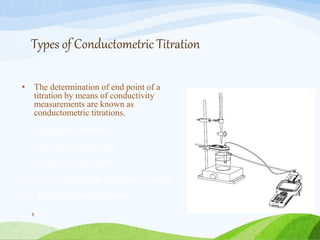
Types of Conductometric Titration
• The determination of end point of a
titration by means of conductivity
measurements are known as
conductometric titrations.
 Acid-base titration
 Precipitation titration
 Replacement titration
 Redox (oxidation-reduction) titration
 Complexometric titration
8
Acid-base titration
• SA Vs SB
• SA Vs WB
• WA Vs SB
• WA Vs WB
9
Precipitation Titration
• [K++Cl-]+[Ag++No3
_]
10
Redox Titration
11
0
50
100
150
200
250
300
350
400
0 10 20 30 40 50 60
6 Fe2++Cr2O7
2-+14H+→6Fe3++2Cr3++7H2O
applications
• Determination of solubility of sparingly soluble material
• Kinetic studies
• Degree of dissociation of weaker electrolytes
• Basicity of organic acids
• Determination of concentration
12
13

Conductometry

  • 1.
    Electrochemical Methods ofanalysis Presented By, Prof.Vedanshu R.Malviya M.Pharm (Pharmaceutics) P. R.Pote Patil College of Pharmacy, Amravati.
  • 2.
    Pharmaceutical Analysis • Itis divided into four types • Electrochemical method • Types of electrochemical methods 2
  • 3.
    conductometry • What isconductivity • What is conductometry • Conductometry and Titration • Conductive Solution • Strong Electrlytes • Weak Electrolytes 3
  • 4.
    Some imp terms •Ohms Law • Conductance • Specific resistance • Specific conductance • Equivalent conductivity • Molecular conductance: • Effect of dilution 4
  • 5.
  • 6.
    Conductivity cell • Madeof pyrex or quartz and are fitted with two platinum electrodes. • Should be placed in vessel containing water to maintain constant temperature. • Determination of cell constant • Types: • 1. Type-A – Low Conductance Measurement Cell • 2. Type-B- Conductivity cell for PPT type of cell • 3. Type-C- Dip Cell type • Electrodes • Conductivity Water6
  • 7.
    Principal of ConductometricTitration • Reaction between anions and cations • It is either increase or decrease 7
  • 8.
    Types of ConductometricTitration • The determination of end point of a titration by means of conductivity measurements are known as conductometric titrations.  Acid-base titration  Precipitation titration  Replacement titration  Redox (oxidation-reduction) titration  Complexometric titration 8
  • 9.
    Acid-base titration • SAVs SB • SA Vs WB • WA Vs SB • WA Vs WB 9
  • 10.
  • 11.
    Redox Titration 11 0 50 100 150 200 250 300 350 400 0 1020 30 40 50 60 6 Fe2++Cr2O7 2-+14H+→6Fe3++2Cr3++7H2O
  • 12.
    applications • Determination ofsolubility of sparingly soluble material • Kinetic studies • Degree of dissociation of weaker electrolytes • Basicity of organic acids • Determination of concentration 12
  • 13.