Conductometric titration is a technique of measuring the conductivity of a solution using a conductivity meter.
FIRST SEMESTER, BPHARM- PHARMACEUTICAL ANALYSIS
CONDUCTOMETRY
Technique ofmeasuring the conductivity of a solution using a
conductivity meter.
Conductivity of a solution occurs due to the mobility of cations
and anions towards respective electrodes.
The conductivity of a solution depends on the size of the ions,
charge of the ions, number of ions(concentration) and
temperature.
Conductivity (C) is inversely proportional to resistance(R) of a
solution
C=1/R
The unit of conductivity is mhos.
3.
All thelaws which are applicable to solid conductor substances can also
be applied to the solution containing ions.
Hence, the resistance of a solution,
R= E/I
R= resistance of the solution (ohms)
E= Potential difference (volts)
I= current which flows through (ampere)
The resistance (R) of a solution depends upon the length (l) and cross
section (a) of the conductor through which conductivity take place.
⍴ = specific resistance
4.
Specific Resistance, ()
⍴
This is the resistance offered by a substance of 1cm length and 1 sq.cm surface area. Its unit is
ohm cm.
Specific Conductivity, (kv)
It is the conductivity offered by a substance of 1cm length and 1 sq. cm surface area. Its unit is
mhos cm-1.
Equivalent conductivity, (λv)
It is the conductivity of a solution containing equivalent weight of the solute, between electrodes
1cm apart and 1 sq.cm surface area. Its unit is mhos cm-1.
Equivalent conductivity = specific conductivity (kv) × volume of solution containing 1g
equivalent wt. of electrolyte.
Molar conductivity,(μv)
This is the conductivity of a solution containing molecular weight of the solute, between
electrodes 1 cm apart and 1 sq. cm surface area.
Molar conductivity = specific conductivity (kv) × volume of solution containing one
molecular weight of the electrolyte.
5.
CONDUCTIVITY CELL
Itis a specially designed vessel for measuring conductivity.
There are different types of conductivity cells.
They are made up of platinum and coated with platinum black.
This increases the effective surface area and reduces the
capacitance of the cell.
This coating reduces on drying, the cell is to be stored with
distilled water in contact with electrodes.
If the electrodes are old, platinization can be done by using 3%
solution of chloroplatinic acid and 0.02- 0.03%of lead acetate to
get uniform coating.
The different electrodes used depends upon the conductivity of the
solution. i.e., whether the conductivity of the solution is high or low.
6.
Type Of ConductivityCells
Low conductance measurement cells
Conductivity cell for precipitating type of reactions
Dip type cell (Electrode type cell)
7.
Low conductance measurementcells
It is usually a wide mouth borosilicate glass bottle duly
fitted with a bark cork which is provided with three holes
in it
Two for enabling the Pt. wires (1 sq. cm) to pass through
them
Third one for allowing the gases to escape from the
corked bottle
8.
Conductivity cell forprecipitating type of
reactions
Two electrodes are fixed in the perspex lid, which is
duly provided with adequate passage for the
mechanical stirrer
The tip of the burette for introducing the titrant into
the reaction cell.
Mechanical stirrer may be replaced with a magnetic
stirrer.
9.
Dip type cell(Electrode type cell)
This consist of wide mouth glass tube of ‘corning Glass’
duly fixed with two copper wires, the tip of which are
adequately provided with two Pt. plates of 1sq. cm each in
dimension, fixed apart at 1cm.
The two cu–terminals are duly taken out for necessary
connection.
The exact position of the wires are fixed adequately in glass
tube by the help of resin.
The two inside faces of the Pt. electrode plates are carefully
coated with Pt black, which help to minimize polarization
effect and thus permits the due absorption of ion on its
surface to promote conductance.
10.
Dip cellis used when the liquid to be tested is in an open
container.
It is merely immersed in the solution to a depth sufficient to
cover the electrodes and the vent holes.
A conductance cell is calibrated by using KCl solution of
known conductivity.
Pipette cells: permit measurements with small volumes.
In small cells where the electrodes are closer together, the cell
constant is in fact not a constant but varies with concentration.
11.
MEASUREMENT OF CONDUCTIVITY
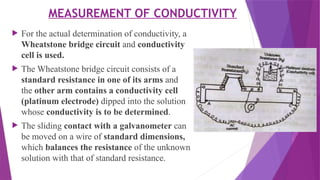
For the actual determination of conductivity, a
Wheatstone bridge circuit and conductivity
cell is used.
The Wheatstone bridge circuit consists of a
standard resistance in one of its arms and
the other arm contains a conductivity cell
(platinum electrode) dipped into the solution
whose conductivity is to be determined.
The sliding contact with a galvanometer can
be moved on a wire of standard dimensions,
which balances the resistance of the unknown
solution with that of standard resistance.
12.
When nulldeflection is obtained, the conductivity of the solution
can be determined by the following equation,
13.
The conductivityof a solution can be determined.
But the observed conductivity is not always the specific
conductivity, because the dimensions of the platinum electrode of
various manufactures are not same.
Hence the value cell constant [X]
l=distance between the electrodes(cm)
a= area of electrode (sq.cm)
14.
CONDUCTOMETRIC TITRATIONS
Thedetermination of end point of a titration by means of
conductivity measurements is known as conductometric
titration.
During the titration, the conductivity of the solution changes,
since there is change in the concentration of conducting ions
and the mobility of ions.
At the endpoint of the titration, there is a sharp change in the
conductivity of a solution shown by the intersection of the lines
in the graph of conductivity Vs volume of titrant added.
Such titrations where conductivity is monitored to detect end
point is called as conductometric titrations.
15.
Advantages
➢ Determination ofspecific conductivity is not required
➢ It is not necessary to use conductivity water
➢ No indicator is necessary
➢ Titrations can be done with colored, dilute solutions or turbid suspensions.
➢ Incompletion at the end point does not affect the results as few measurements
before and after the end point are sufficient.
➢ The principle that conductivity depends upon the mobility of the ions is used
and curves are mostly straight lines. Hence few measurements are sufficient.
➢ As the end point is determined graphically, errors are minimized and accurate
end point can be determined.
➢ The cell constant need not be determined, d the same electrode is used
throughout the experiment.
➢ Temperature need not be known, it is maintained constant throughout the
titration.
16.
Apparatus
• A titrationvessel(beaker)
• A stirrer for mixing
• Automatic/ manual burette to deliver titrant
17.
Procedure
A conductivitymeter with a conductivity cell (platinum
electrode) is used to make the conductivity measurements (milli
mhos or micro mhos).
The titrant is added in small increments like 0.5ml or 1ml, the
solution is mixed properly and the conductivity readings are taken.
Several readings are taken, few before and after the
approximate end point.
A graph of conductivity Vs the volume of titrant is drawn and the
point of intersection of lines is found out.
This corresponds to the end point or volume of titrant required
to neutralize the reactants or sample present in the titration
vessel.
18.
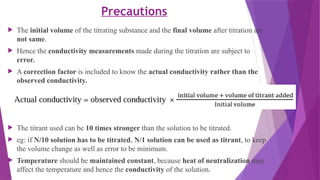
Precautions
The initialvolume of the titrating substance and the final volume after titration are
not same.
Hence the conductivity measurements made during the titration are subject to
error.
A correction factor is included to know the actual conductivity rather than the
observed conductivity.
The titrant used can be 10 times stronger than the solution to be titrated.
eg: if N/10 solution has to be titrated, N/1 solution can be used as titrant, to keep
the volume change as well as error to be minimum.
Temperature should be maintained constant, because heat of neutralization may
affect the temperature and hence the conductivity of the solution.
19.
ACID-BASE TITRATIONS
Strong AcidVs Strong Base
Eg: Hydrochloric Acid Vs Sodium Hydroxide
When HCl is taken in a beaker as titrate, the initial
conductivity is high, because strong acid completely
dissociates into H+ ions and the ionic conductivity of H+
is 350.
When NaOH is added as titrant, the OH- and H+ reacts
to produce water and the no: of H+ decreases and the
conductivity gradually decreases after every addition.
20.
After theend point , when all the H+ has reacted, the addition of
NaOH causes increase in the no of OH- and hence the conductivity
starts to increase(ionic conductivity of OH- is 199).
A plot of conductivity Vs volume of NaOH added shows a V shaped
curve.
The first part of the curve shows steep fall in conductivity because
of decrease in H+ and second part of the curve shows gradual
increase because of increase in OH-.
21.
Strong Acid VsWeak Base
ACID-BASE TITRATIONS
Eg: Hydrochloric Acid Vs Ammonium Hydroxide
When HCl is taken in a beaker as titrate, the initial
conductivity is high, because strong acid completely
dissociates into H+ ions and the ionic conductivity of H+
is 350.
When NH4OH is added as titrant, the OH- and H+
reacts to produce water and the no of H+ decreases and
the conductivity gradually decreases after every
addition.
22.
After theend point, when all the H+ has reacted, the addition of
NH4OH does not causes increase in the no of OH-
since it poorly
dissociates into OH-
ions and hence the conductivity remains
constant.
A plot of conductivity Vs volume of NH4OH added. The first part of
the curve shows steep fall in conductivity because of decrease in H+ and
second part of the curve shows Constant.
23.
Weak acid vsStrong base
Eg: Acetic Acid Vs Sodium Hydroxide
When CH3COOH is taken in beaker as titrate, the initial
conductivity is low, because weak acid does not
dissociate into H+
ions.
When NaOH is added as titrant, formation of
CH3COONa takes place and there is only slight increase
in conductivity till the end point.
After the end point, the addition of NaOH causes increase
in the no. of OH-
and hence the conductivity starts to
increase steeply.
ACID-BASE TITRATIONS
24.
A plotof conductivity Vs volume of NaOH. The first part of
the curve shows a gradual increase and second part of the curve
shows steep increase because of increase in OH-
.
25.
Weak Acid VsWeak Base
Ex: Acetic Acid Vs Ammonium Hydroxide
When CH3COOH is taken in beaker as titrate, the initial
conductivity is low, because weak acid does not dissociate into
H+ ions.
When NH4OH is added as titrant, ammonium acetate salt is
formed which has better conductivity and hence the
conductivity gradually increases after every addition.
ACID-BASE TITRATIONS
26.
After theend point, the addition of NH4OH causes no
increase in the conductivity and hence a constant is
obtained.
A plot of conductivity Vs volume of NH4OH.
The first part of the curve shows gradual increase in
conductivity because of ammonium acetate salt formation
and second part of the curve shows a constant because of
poor dissociation of NH4OH.
27.
PRECIPITATION TITRATIONS
Inthis titration, any one of the product of the titration can be a precipitate and
the other soluble or both products can be in the form of precipitate.
Only one product is a precipitate
Eg: potassium chloride vs silver nitrate
KCl + AgNO3 → AgCl + KNO3
KCl is taken in a beaker and silver nitrate is the titrant.
When silver nitrate is added, the first part of the curve shows no increase in
conductivity as there is only replacement of chloride ions with nitrate ions.
As the silver chloride is precipitated, it does not contribute to conductivity.
The second part of the curve, conductivity increases because of increase in the
concentration of silver as well as nitrate ions.
28.
When both precipitatesare sparingly soluble
Eg: magnesium sulphate and barium hydroxide
MgSO4 + Ba(OH)2 → BaSO4 + Mg(OH)2
When magnesium sulphate is the titrate and barium hydroxide is the titrant,
both the products i.e., magnesium hydroxide and barium sulphate are
sparingly soluble and are precipitated.
These do not contribute to conductivity and the first part of the curve shows
decrease in conductivity because of decrease in the concentration of
conducting ions (MgSO4).
The second part of the curve shows an increase in conductivity due to the
addition of conducting ions.
PRECIPITATION TITRATIONS
29.
DISPLACEMENT TITRATIONS
Theseare titrations in which there is displacement of one ion
by the other.
Salt Of Strong Acid And Weak Base Vs Strong base
Eg: Ammonium chloride Vs Sodium hydroxide
NH4Cl + NaOH → NH4OH + NaCl
In this titration, ammonium chloride is used as titrate and
sodium hydroxide as titrant.
The first part of the titration is a plateau because there is only
displacement of ammonium and chloride ions with sodium
and chloride ions till the end point.
After the end point, the addition of sodium hydroxide causes
a steep increase in the conductivity.
30.
Salt Of StrongBase And Weak Acid Vs Strong Acid
Eg. Sodium acetate Vs Hydrochloric acid
CH3COONa + HCl → CH3COOH + NaCl
In this titration, sodium acetate is used as titrate
and hydrochloric acid is used as titrant.
The first part of the titration is gradual increase in
conductivity because there is displacement of
acetate ions by chloride ion till the end point.
After the end point, the addition of HCl causes a
steep increase in the conductivity.
DISPLACEMENT TITRATIONS
31.
REDOX TITRATIONS
Ex:Titration of Ferrous ion with Dichromate ions
6Fe2+
+ Cr2O7
2-
+16H+
→ 6Fe3+
+ 2Cr3+
+ 7H2O
Redox titrations are usually conducted in acidic medium.
The end point is determined because of decrease in hydrogen
ion concentration and decrease in conductivity at the end
point.
Since the mobility of H+ ions is high, so a sharp decrease in
the conductance is expected during the initial part of the
titration.
However, when the initial concentration of acid is moderately
high, the relative change in H+ ion concentration is very
small.
32.
COMPLEXOMETRIC TITRATIONS
Titrationof mercury nitrate or perchlorate with CN-
ions.
The Hg ions exist as free ions.
One mercuric ion is replaced by two perchlorate ions.
Like redox titrations, the conductivity change that could be
observed or measured near the end point is small.
A plot of conductivity Vs volume, when Kcl is titrated with
mercuric chlorate, produces two inflections.
The two inflections indicate the formation of HgCl4
2-
and
the completion of the reaction respectively.
33.
NON- AQUEOUS TITRATIONS
In aqueous medium, non-aqueous titrations can be carried out
by making conductivity measurements.
Titration of weak acids or weak bases can be done.
eg;
1.Titration of weak organic acids in methanol, pyridine or
dimethyl formamide Vs tetramethyl ammonium hydroxide
in methanol-benzene or pyridine-benzene.
2.Titration of weak bases Vs perchloric acid in dioxan-
formic acid.
34.
APPLICATIONS OF CONDUCTIVITY
SOLUBILITYOF SPARINGLY SOLUBLE SALTS
Many salts like silver chloride, barium sulphate, lead sulphate are sparingly
soluble and their solubilities can be determined by making conductivity
measurements.
A saturated solution of the salt in conductivity water is made and the specific
conductivity at 25°C is determined by using conductivity meter.
IONIC PRODUCT OF WATER(Kw)
It is the product of ionic concentrations of H+
and OH-
expressed in gram
moles per litre at constant temperature.
Specific conductivity of pure water at 25°C is 5.54 x 10⁻⁸
mhos cm-1
35.
BASICITY OF ORGANICACIDS
The basicity (B) of organic acid is the number of carboxylic groups present in the
molecule.
Ex: basicity of citric acid is 3, tartaric acid is 2 and that of oxalic acid is 2.
PURITY OF WATER
Pure water has a specific conductivity of 5 x 10⁻⁸
ohm-1
cm-1
.
If the determined value is more or less, the quality of the water is affected. Thus, the
quality of distilled water and de ionized water can be known.
QUANTITATIVE ANALYSIS
Pure substances like single electrolytes, acid or alkali in solution can be determined
up to a concentration of 10% in which conductivity measurements can be obtained, in
that range.
SALINITY OF SEA WATER
This could be known by conductivity measurements.
EQUILIBRIUM IN IONIC REACTIONS
Since conductance of solution changes during such reactions, the progress of ionic
reactions can be determined.






![ The conductivity of a solution can be determined.
But the observed conductivity is not always the specific
conductivity, because the dimensions of the platinum electrode of
various manufactures are not same.
Hence the value cell constant [X]
l=distance between the electrodes(cm)
a= area of electrode (sq.cm)](https://image.slidesharecdn.com/conductometry-250416160710-defe9b4b/85/CONDUCTOMETRIC-TITRATION-Pharmaceutical-analysis-13-320.jpg)