Download as PDF, PPTX

![▪ It has a standard potential on its own and it’s potential does not change to solution it is
dipped..
▪ Always treated as the anode electrode..
▪ Examples- [a]. Standard hydrogen electrode.
▪ [b]. Saturated calomel electrode.
▪ [c]. Silver-silver chloride electrode.](https://image.slidesharecdn.com/potentiometric-200108161845/85/Potentiometric-Pharmaceutical-Analysis-101T-4-320.jpg)


![▪ Metal electrodes are system that use specific metal electrodes as the electrodes in an
electrochemical measurement..
▪ Ecell = Eind. + Eref + Ej
▪ There are two kinds of metal electrodes..
▪ [a].The electrodes potential responds directly in relationship to the concentration of the
metal ion ..
▪ cu 2+ + 2e- = cu
▪ [b]. Metal analyte ion is equilivrium with the target analyte..
Cu2+ + 2l- = cul2.](https://image.slidesharecdn.com/potentiometric-200108161845/85/Potentiometric-Pharmaceutical-Analysis-101T-9-320.jpg)



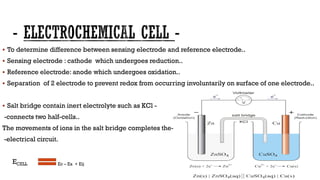
Potentiometric methods of analysis measure the potential of electrochemical cells under conditions of zero current. The potential difference between a sensing electrode and a reference electrode is measured. A salt bridge containing an inert electrolyte connects the two half-cells and allows ionic movement to complete the electrical circuit. Common reference electrodes include the standard hydrogen electrode, saturated calomel electrode, and silver-silver chloride electrode. Potentiometry is used for applications such as determining electrode potentials, measuring pH, and analyzing samples in clinical chemistry, environmental chemistry, agriculture, and food processing.


![PELLETS - BASIC AND COMPOSITION UNIT DOSAGE FORM [Industrial Pharmacy-I].pdf](https://cdn.slidesharecdn.com/ss_thumbnails/pellets-basicandcompositionunitdosageform-241029091949-dd0369dc-thumbnail.jpg?width=640&height=640&fit=bounds)

![Complexation and Protein Binding: Unit IV (i) [BP302T].pptx](https://cdn.slidesharecdn.com/ss_thumbnails/unitivicomplexationandproteinbinding-251207163820-1722f0aa-thumbnail.jpg?width=640&height=640&fit=bounds)
![Complexation and Protein Binding: Unit IV (ii) [BP302T] .pptx](https://cdn.slidesharecdn.com/ss_thumbnails/unitiviicomplexationandproteinbinding-251207164128-8b45a45b-thumbnail.jpg?width=640&height=640&fit=bounds)
![Software Used In Formulation Design Process- Minor Project [Bachelor].pdf](https://cdn.slidesharecdn.com/ss_thumbnails/softwareusedinformulationdesignprocess-minorprojectbachelor-240423141933-4b6eee88-thumbnail.jpg?width=640&height=640&fit=bounds)


![Surface and Interfacial Phenomena: Unit III Physical Pharmaceutics-I [BP302T]...](https://cdn.slidesharecdn.com/ss_thumbnails/unitiiiphysicalpharmaceutics-ibp302t-251207163200-ab3370a1-thumbnail.jpg?width=640&height=640&fit=bounds)


