PHOTOMETRIC
TITRATION
BASIC PRINCIPLE
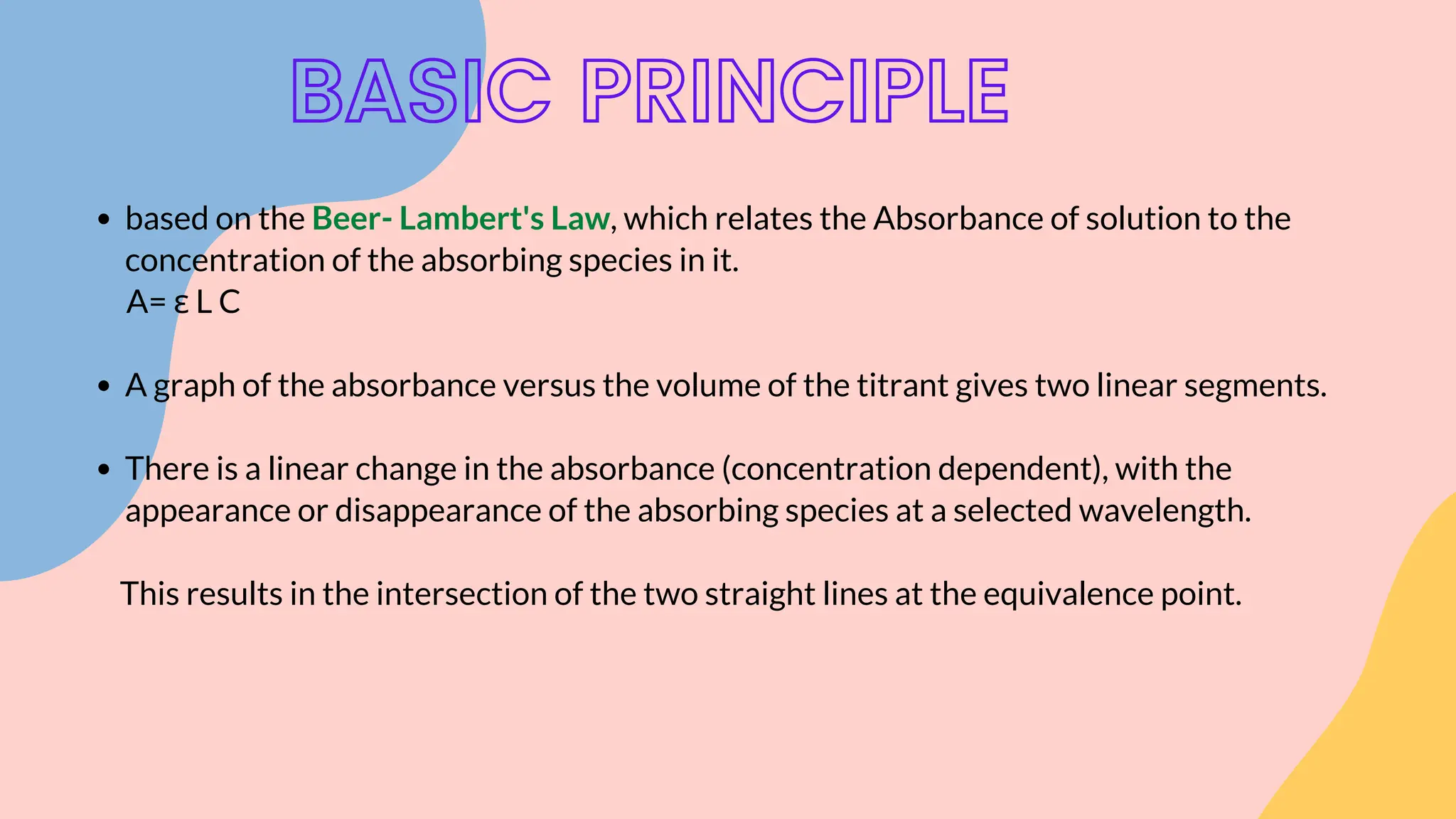
based on the Beer- Lambert's Law, which relates the Absorbance of solution to the
concentration of the absorbing species in it.
A graph of the absorbance versus the volume of the titrant gives two linear segments.
There is a linear change in the absorbance (concentration dependent), with the
appearance or disappearance of the absorbing species at a selected wavelength.
A= ε L C
This results in the intersection of the two straight lines at the equivalence point.
EXPERIMENTAL SETUP AND PROCEDURE
A titration cell with the reactant solution, has two opening in the top, for the micro-burette
and the micro-stirrer.
The burette is used to add the titrant to the solution, thus changing its concentration during
the process.
The titration cell is kept in the path of the light in the spectrophotometer.
The transmittance value and thus the absorbance is calculated.
The graph for the absorbance v/s the volume of the titrant added is drawn and the endpoint
is determined.
Remaining cell is covered with the black paper.
The selection of the wavelength must be done with utmost care, due to the
presence of at least three absorbing species, that is, the analyte, titrant and the
product.
At least one of the species, the titrand, titrant or the product of the reaction should
be able to absorb light.
If the species do not absorb, then a indicator which itself does not absorb light, but
forms a compound with the species which absorbs light.
REQUIREMENTS
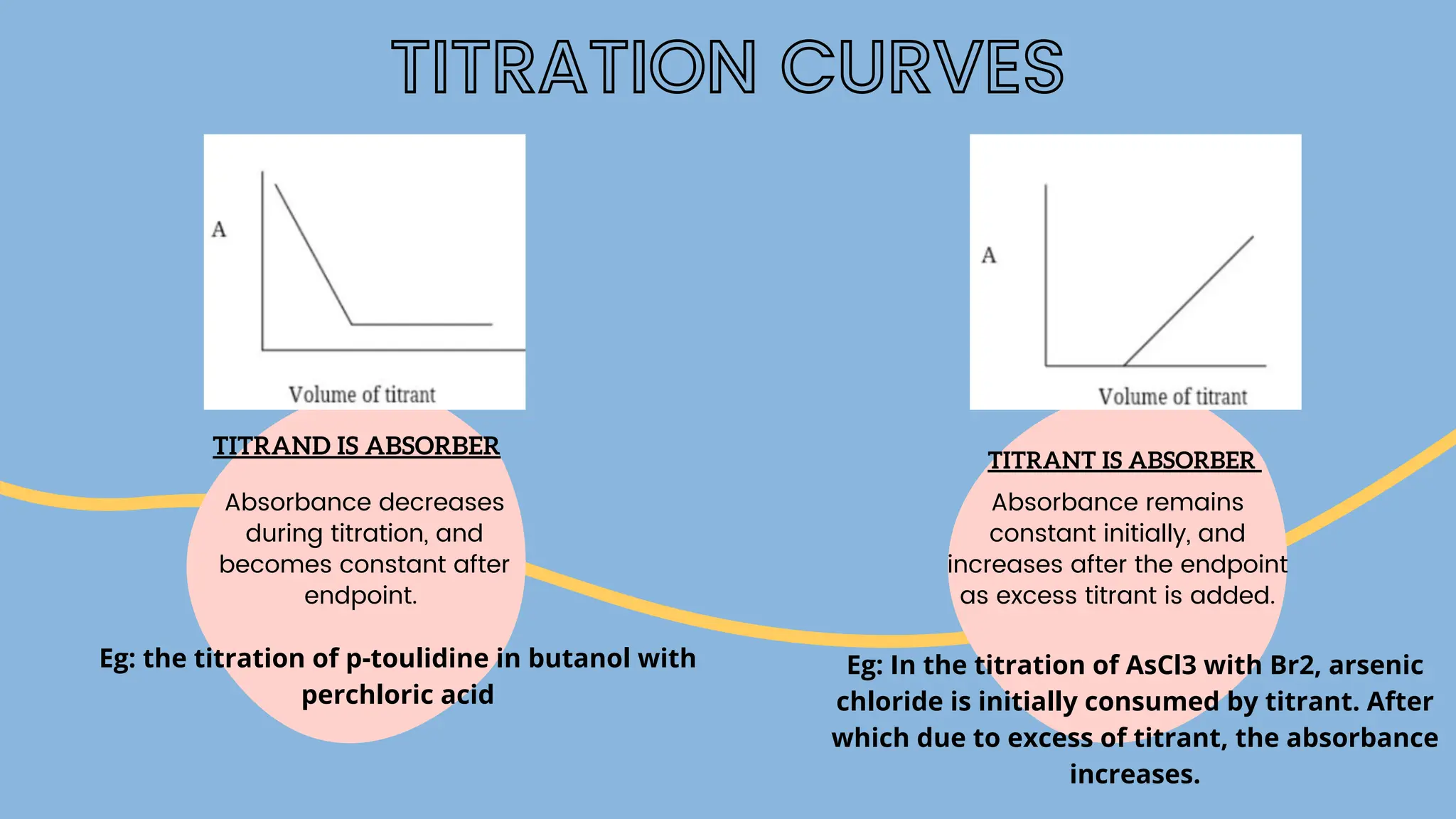
Absorbance decreases
during titration, and
becomes constant after
endpoint.
Absorbance remains
constant initially, and
increases after the endpoint
as excess titrant is added.
TITRATION CURVES
TITRAND IS ABSORBER
TITRANT IS ABSORBER
Eg: the titration of p-toulidine in butanol with
perchloric acid
Eg: In the titration of AsCl3 with Br2, arsenic
chloride is initially consumed by titrant. After
which due to excess of titrant, the absorbance
increases.
Initially A increases, with the
formation of the product, and
remains constant after
equivalence point.
Initially A decreases, but
after equivalence point it
increases due to excess
titrant.
TITRATION CURVES
PRODUCT IS ABSORBER
TITRAND AND TITRANT ARE
ABSORBER
Eg: In the titration of Cu(2+) with EDTA, the
complex formed with EDTA is coloured and
thus increases the absorbance till endpoint.
Eg: Bromination of red dye with liquid
Bromine, the coloured dye becomes
colourless with addition of titrant.
For the detection of the multiple species in the analyte, the use of the difference in the
molar absorptivity coefficient of the various species present in the analyte, at the
selected wavelength will be an effective method.
A higher selectivity and sensitivity of the components of the sample.
The method can be carried out in dilute solutions, with the concentration range 10-6 to
10-2 M.
It can even be used in the colored solutions where the visual indicator cannot be used.
ADVANTAGES
The use of monochromatic beam strictly, during the experiment which
is not absorbed by the solvent.
The experiment cannot be carried at higher concentration range, that
is above 10-2 M, as it is not in accordance to the law.
The titration cannot be carried out if the absorbing species show any
molecular change like association or dissociation.
LIMITATIONS
CONDUCTOMETRIC
TITRATION
It is defined as the electrochemical analysis method used for the
determination of the electrical conductance of an aqueous electrolyte
solution by the use of a Conductometer.
CONDUCTOMETRY
&
CONDUCTOMETRIC
TITRATION
Basic Principle
During the titration, the addition of one electrolyte to another, without appreciable volume
change, will alter the conductance of the solution.
If an ionic reaction takes place, the ions added may replace the ions present, thus
conductance will change, due to the difference in the ionic conductance.
Also, if no ionic reaction take place, the addition of electrolyte will simply increase the
conductance, due to production of more ions in the solution.
Thus, by plotting a graph, a sharp change in conductance as a function of volume of titrant
added, shows the intersection of the two lines and so the equivalence point is located.
Conductance measured is based on the Ohm's law. The factors affecting the conductance
are as follows:
1) Nature of the ions-
As the velocity with which the ions move towards the electrode carrying current is inversely
proportional to its size , molecular weight and hydration and directly to it charge.
2) Temperature-
As with the increase in temperature, the energy increases and the viscosity and hydration
decreases, so the conductance increases.
With every 1 degree increase in temperature, there is 2% increase in conductance. So, we take
the measurement in a constant temperature.
3) Size of electrode
G=k*Area/Length
So the conductance is directly proportional to the surface area of the two electrodes and
inversely proportional to the distance between them.
Factors:
4) Concentration of Ions-
The conductance is the summation of contribution from all the ions present.
As the number of ions increases, the conductance also increases.
It depends on the number of ions per unit volume of solution and its nature.
In dilute solutions, there is a linear relation between the conductance and the
concentration of the ions. Whereas, in concentrated solutions, inter-ionic attraction
forces decrease the conductance.
At infinite dilution, the inter-ionic attraction becomes negligible, and each ions
represents itself independently. As activity (a) equals concentration (c), a/c=1
Therefore, conductometric determination is carried out on dilute solution.
Factors:
Operational Procedure
It is placed in water to maintain a constant temperature.
The electrode are Platinum sheets, each of 1 cm sq. and
fixed at distance of 1 cm, with it surface coated with Pt black
to avoid polarization and increase effective surface area.
Platinization is done by coating a solution of 3% chlorplatinic
acid and lead acetate, to get uniform coating.
Electrodes usage depends on conductivity and
concentration, because if concentration is low then
electrodes should be largely and closely packed.
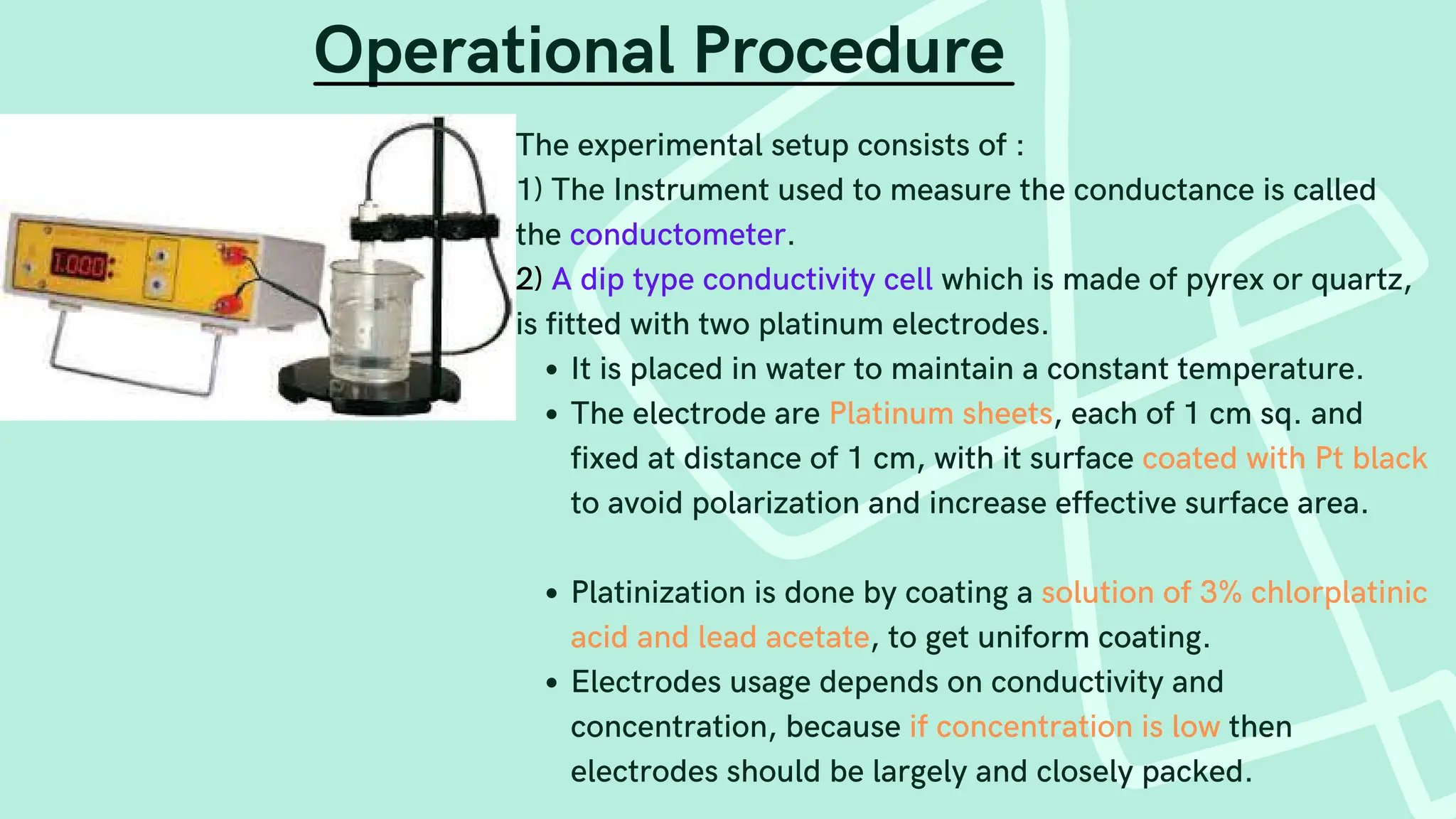
The experimental setup consists of :
1) The Instrument used to measure the conductance is called
the conductometer.
2) A dip type conductivity cell which is made of pyrex or quartz,
is fitted with two platinum electrodes.
Ions accumulate near the electrodes.
Transfer of charge through the interface.
3) An AC source due to which electrical potential applied across electrodes causes two process to
occurs:
4) The solution to be estimated is taken in a beaker through a pipette in a definite volume, and
distilled water is added, so that the conductivity cell is appropriately dipped in it.
5) The titrant is added to the solution through the burette, in small portions of 0.5 mL at a time,
and is stirred everytime.
6) The solution is kept undisturbed for some time and the conductance is measured through the
conductometer, having the cell attached to it.
7) A graph is plotted for the conductance v/s the volume of titrant added, with the continuous
addition of the titrant beyond the equivalence point.
Strong acid with Strong base
HCl+NaOH ----> Na+ + Cl- + H2O
TITRATION CURVES
Acid -Base Titrations
Initially, as the base is added, the conductance decreases due
to the replacement of H+ ions (mobility 350) by Na+ ions
(mobility 43). And H+ ions react with OH- ions to form
undissociated water.
After the equivalence point, the conductance increases due to
the addition of excess NaOH, with the high conductivity of
OH- ions (mobility 198)
This decrease in the conductance continues till the equivalence
point. At the equivalence point, the solution contains only NaCl.
Weak acid with Strong base
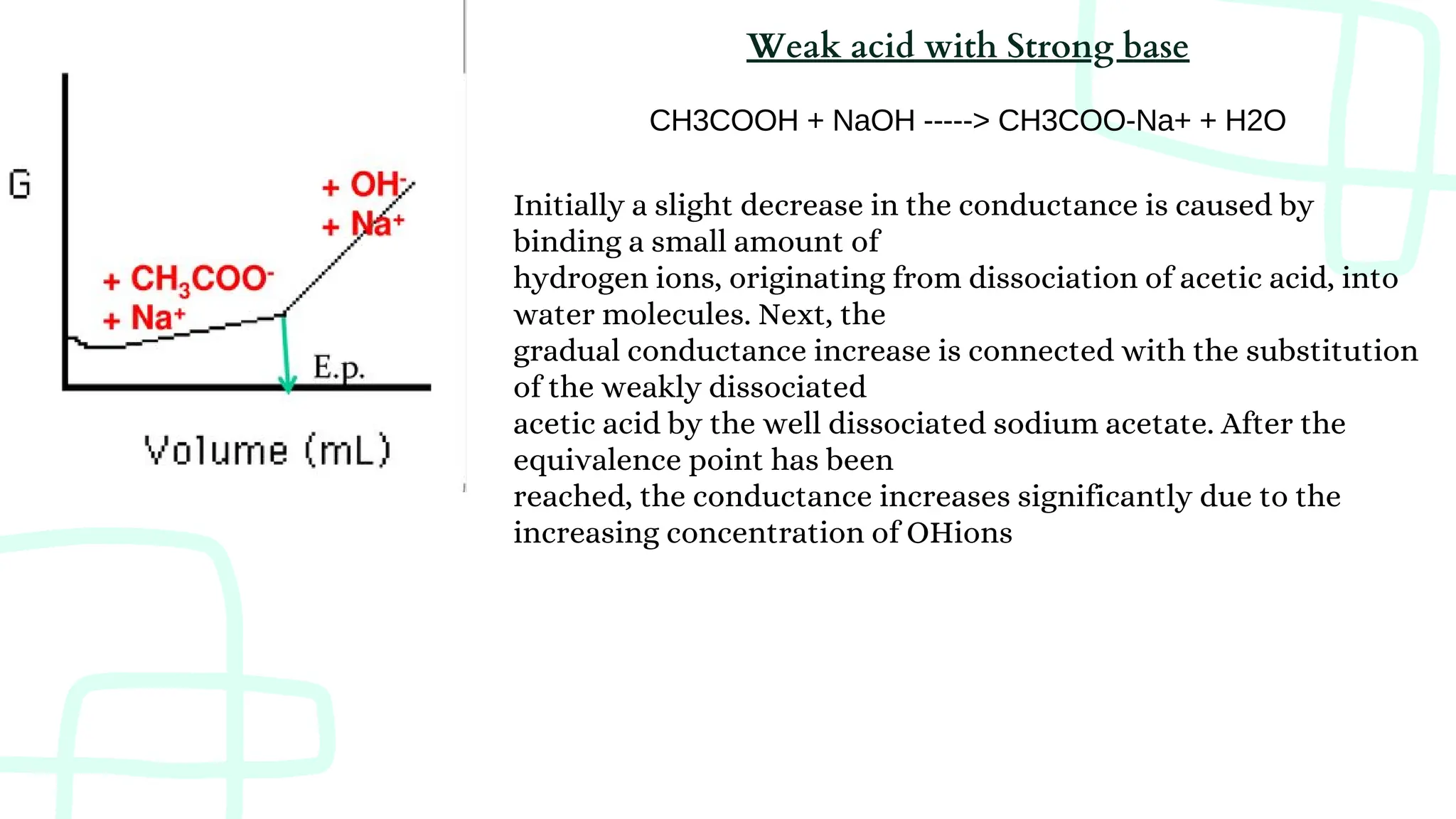
CH3COOH + NaOH -----> CH3COO-Na+ + H2O
Initially a slight decrease in the conductance is caused by
binding a small amount of
hydrogen ions, originating from dissociation of acetic acid, into
water molecules. Next, the
gradual conductance increase is connected with the substitution
of the weakly dissociated
acetic acid by the well dissociated sodium acetate. After the
equivalence point has been
reached, the conductance increases significantly due to the
increasing concentration of OHions
Strong acid with Weak base
H2SO4 + NH4OH ------> (NH4)2SO4 + H2O
Weak acid with Weak base
CH3COOH + NH4OH ------> CH3COONH4 + H2O
TITRATION CURVES
Acid -Base Titrations
Requirements
During titration, the titrant used should have concentration 10 times that of the solution to be
determined. As it minimizes the decrease in the conductance due to dilution effect, becoming
insignificant.
If that is not the case, then the correction factor compensates the dilution. With Vo as the
initial volume of solution and v as the volume of titrant, then Correction Factor = (Vo+v)/Vo
and the Corrected conductance = G' (Vo+v)/Vo
The presence of external ions (like buffer or concentrated acids), that may enter the reaction
should be avoided, as they may change the initial conductance and cannot be measured
accurately.
The method is suitable for precipitation and neutralisation reaction but not redox reaction as
there is no electron transfer in the electrode surface.
Mixture of Strong acid and weak acid with a strong base
HCl + NaOH -------> NaCl + H2O
CH3COOH +NaOH --------> CH3COONa + H2O
HCl + NH4OH -----> NH4Cl +H2O
CH3COOH + NH4OH ------> CH3COONa + H2O
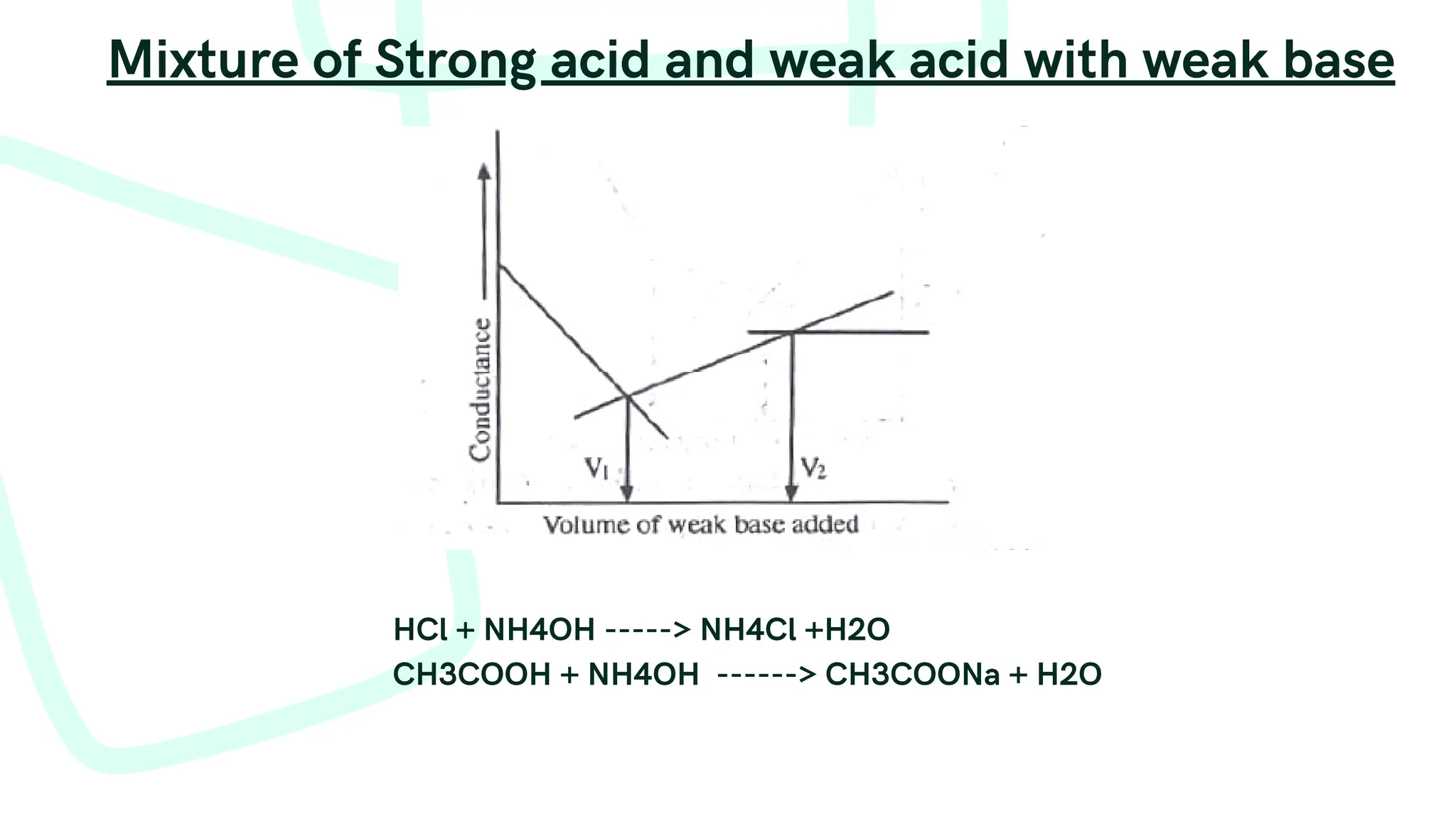
Mixture of Strong acid and weak acid with weak base
NaOH+ HCl -----> NaCl +H2O
NH4OH + HCl ------> NH4Cl + H2O
Mixture of Strong base and weak base with strong acid
NaOH+ CH3COOH-----> CH3COONa +H2O
NH4OH + CH3COOH ------> CH3COONH4 + H2O
Mixture of Strong base and weak base with weak acid
Mixture of Acidic/ Basic Salt against base/acid
Displacement/ Replacement Reaction
NH4Cl +NaOH ----------> NaCl + NH4OH
CH3COONa + HCl ---------> NaCl + CH3COOH
Reaction of Ammonium sulfate with Barium acetate
(NH4)2SO4 + (CH3COO)2Ba ------> BaSO4 +2CH3COONH4
OR
Reaction of AgNO3 with KCl, where both are strong electrolyte and form a precipitate of AgCl .
Precipitation Titration
Volume of Barium acetate
5 Fe2+ + MnO4- + 8 H+ ------> 5 Fe3+ + Mn2+ + 4 H2O
Redox Reaction
Reaction: A solution of Fe(II) in sulfuric acid is titrated with potassium
permanganate
The reactions is carried out in the presence of a excess of acid, which more or
less completely masks the change in conductance due to the redox reaction.
1. Does not require indicators since change in conductance is measured by
conductometer
2. Suitable for coloured solutions
3. Since end point is determined by graphical means accurate results are obtained
with minimum error
4. Used for analysis of turbid suspensions, weak acids, weak bases, mix of weak &
strong acids
Advantages
1. Increased level of salts in solution masks the conductivity changes , in such cases it
does not give accurate results.
2. Application of conductometric titrations to redox systems is limited because, high
concentrations of hydronium ions in the solution tends to mask the changes in
conductance.
Limitations

Photometric and Conductometric Titration.pdf

  • 1.
  • 2.
    BASIC PRINCIPLE based onthe Beer- Lambert's Law, which relates the Absorbance of solution to the concentration of the absorbing species in it. A graph of the absorbance versus the volume of the titrant gives two linear segments. There is a linear change in the absorbance (concentration dependent), with the appearance or disappearance of the absorbing species at a selected wavelength. A= ε L C This results in the intersection of the two straight lines at the equivalence point.
  • 3.
    EXPERIMENTAL SETUP ANDPROCEDURE A titration cell with the reactant solution, has two opening in the top, for the micro-burette and the micro-stirrer. The burette is used to add the titrant to the solution, thus changing its concentration during the process. The titration cell is kept in the path of the light in the spectrophotometer. The transmittance value and thus the absorbance is calculated. The graph for the absorbance v/s the volume of the titrant added is drawn and the endpoint is determined. Remaining cell is covered with the black paper.
  • 4.
    The selection ofthe wavelength must be done with utmost care, due to the presence of at least three absorbing species, that is, the analyte, titrant and the product. At least one of the species, the titrand, titrant or the product of the reaction should be able to absorb light. If the species do not absorb, then a indicator which itself does not absorb light, but forms a compound with the species which absorbs light. REQUIREMENTS
  • 5.
    Absorbance decreases during titration,and becomes constant after endpoint. Absorbance remains constant initially, and increases after the endpoint as excess titrant is added. TITRATION CURVES TITRAND IS ABSORBER TITRANT IS ABSORBER Eg: the titration of p-toulidine in butanol with perchloric acid Eg: In the titration of AsCl3 with Br2, arsenic chloride is initially consumed by titrant. After which due to excess of titrant, the absorbance increases.
  • 6.
    Initially A increases,with the formation of the product, and remains constant after equivalence point. Initially A decreases, but after equivalence point it increases due to excess titrant. TITRATION CURVES PRODUCT IS ABSORBER TITRAND AND TITRANT ARE ABSORBER Eg: In the titration of Cu(2+) with EDTA, the complex formed with EDTA is coloured and thus increases the absorbance till endpoint. Eg: Bromination of red dye with liquid Bromine, the coloured dye becomes colourless with addition of titrant.
  • 8.
    For the detectionof the multiple species in the analyte, the use of the difference in the molar absorptivity coefficient of the various species present in the analyte, at the selected wavelength will be an effective method. A higher selectivity and sensitivity of the components of the sample. The method can be carried out in dilute solutions, with the concentration range 10-6 to 10-2 M. It can even be used in the colored solutions where the visual indicator cannot be used. ADVANTAGES
  • 9.
    The use ofmonochromatic beam strictly, during the experiment which is not absorbed by the solvent. The experiment cannot be carried at higher concentration range, that is above 10-2 M, as it is not in accordance to the law. The titration cannot be carried out if the absorbing species show any molecular change like association or dissociation. LIMITATIONS
  • 10.
  • 11.
    It is definedas the electrochemical analysis method used for the determination of the electrical conductance of an aqueous electrolyte solution by the use of a Conductometer. CONDUCTOMETRY & CONDUCTOMETRIC TITRATION
  • 12.
    Basic Principle During thetitration, the addition of one electrolyte to another, without appreciable volume change, will alter the conductance of the solution. If an ionic reaction takes place, the ions added may replace the ions present, thus conductance will change, due to the difference in the ionic conductance. Also, if no ionic reaction take place, the addition of electrolyte will simply increase the conductance, due to production of more ions in the solution. Thus, by plotting a graph, a sharp change in conductance as a function of volume of titrant added, shows the intersection of the two lines and so the equivalence point is located.
  • 13.
    Conductance measured isbased on the Ohm's law. The factors affecting the conductance are as follows: 1) Nature of the ions- As the velocity with which the ions move towards the electrode carrying current is inversely proportional to its size , molecular weight and hydration and directly to it charge. 2) Temperature- As with the increase in temperature, the energy increases and the viscosity and hydration decreases, so the conductance increases. With every 1 degree increase in temperature, there is 2% increase in conductance. So, we take the measurement in a constant temperature. 3) Size of electrode G=k*Area/Length So the conductance is directly proportional to the surface area of the two electrodes and inversely proportional to the distance between them. Factors:
  • 14.
    4) Concentration ofIons- The conductance is the summation of contribution from all the ions present. As the number of ions increases, the conductance also increases. It depends on the number of ions per unit volume of solution and its nature. In dilute solutions, there is a linear relation between the conductance and the concentration of the ions. Whereas, in concentrated solutions, inter-ionic attraction forces decrease the conductance. At infinite dilution, the inter-ionic attraction becomes negligible, and each ions represents itself independently. As activity (a) equals concentration (c), a/c=1 Therefore, conductometric determination is carried out on dilute solution. Factors:
  • 15.
    Operational Procedure It isplaced in water to maintain a constant temperature. The electrode are Platinum sheets, each of 1 cm sq. and fixed at distance of 1 cm, with it surface coated with Pt black to avoid polarization and increase effective surface area. Platinization is done by coating a solution of 3% chlorplatinic acid and lead acetate, to get uniform coating. Electrodes usage depends on conductivity and concentration, because if concentration is low then electrodes should be largely and closely packed. The experimental setup consists of : 1) The Instrument used to measure the conductance is called the conductometer. 2) A dip type conductivity cell which is made of pyrex or quartz, is fitted with two platinum electrodes.
  • 16.
    Ions accumulate nearthe electrodes. Transfer of charge through the interface. 3) An AC source due to which electrical potential applied across electrodes causes two process to occurs: 4) The solution to be estimated is taken in a beaker through a pipette in a definite volume, and distilled water is added, so that the conductivity cell is appropriately dipped in it. 5) The titrant is added to the solution through the burette, in small portions of 0.5 mL at a time, and is stirred everytime. 6) The solution is kept undisturbed for some time and the conductance is measured through the conductometer, having the cell attached to it. 7) A graph is plotted for the conductance v/s the volume of titrant added, with the continuous addition of the titrant beyond the equivalence point.
  • 17.
    Strong acid withStrong base HCl+NaOH ----> Na+ + Cl- + H2O TITRATION CURVES Acid -Base Titrations Initially, as the base is added, the conductance decreases due to the replacement of H+ ions (mobility 350) by Na+ ions (mobility 43). And H+ ions react with OH- ions to form undissociated water. After the equivalence point, the conductance increases due to the addition of excess NaOH, with the high conductivity of OH- ions (mobility 198) This decrease in the conductance continues till the equivalence point. At the equivalence point, the solution contains only NaCl.
  • 18.
    Weak acid withStrong base CH3COOH + NaOH -----> CH3COO-Na+ + H2O Initially a slight decrease in the conductance is caused by binding a small amount of hydrogen ions, originating from dissociation of acetic acid, into water molecules. Next, the gradual conductance increase is connected with the substitution of the weakly dissociated acetic acid by the well dissociated sodium acetate. After the equivalence point has been reached, the conductance increases significantly due to the increasing concentration of OHions
  • 19.
    Strong acid withWeak base H2SO4 + NH4OH ------> (NH4)2SO4 + H2O Weak acid with Weak base CH3COOH + NH4OH ------> CH3COONH4 + H2O TITRATION CURVES Acid -Base Titrations
  • 20.
    Requirements During titration, thetitrant used should have concentration 10 times that of the solution to be determined. As it minimizes the decrease in the conductance due to dilution effect, becoming insignificant. If that is not the case, then the correction factor compensates the dilution. With Vo as the initial volume of solution and v as the volume of titrant, then Correction Factor = (Vo+v)/Vo and the Corrected conductance = G' (Vo+v)/Vo The presence of external ions (like buffer or concentrated acids), that may enter the reaction should be avoided, as they may change the initial conductance and cannot be measured accurately. The method is suitable for precipitation and neutralisation reaction but not redox reaction as there is no electron transfer in the electrode surface.
  • 21.
    Mixture of Strongacid and weak acid with a strong base HCl + NaOH -------> NaCl + H2O CH3COOH +NaOH --------> CH3COONa + H2O
  • 22.
    HCl + NH4OH-----> NH4Cl +H2O CH3COOH + NH4OH ------> CH3COONa + H2O Mixture of Strong acid and weak acid with weak base
  • 23.
    NaOH+ HCl ----->NaCl +H2O NH4OH + HCl ------> NH4Cl + H2O Mixture of Strong base and weak base with strong acid
  • 24.
    NaOH+ CH3COOH-----> CH3COONa+H2O NH4OH + CH3COOH ------> CH3COONH4 + H2O Mixture of Strong base and weak base with weak acid
  • 25.
    Mixture of Acidic/Basic Salt against base/acid Displacement/ Replacement Reaction NH4Cl +NaOH ----------> NaCl + NH4OH CH3COONa + HCl ---------> NaCl + CH3COOH
  • 26.
    Reaction of Ammoniumsulfate with Barium acetate (NH4)2SO4 + (CH3COO)2Ba ------> BaSO4 +2CH3COONH4 OR Reaction of AgNO3 with KCl, where both are strong electrolyte and form a precipitate of AgCl . Precipitation Titration Volume of Barium acetate
  • 27.
    5 Fe2+ +MnO4- + 8 H+ ------> 5 Fe3+ + Mn2+ + 4 H2O Redox Reaction Reaction: A solution of Fe(II) in sulfuric acid is titrated with potassium permanganate The reactions is carried out in the presence of a excess of acid, which more or less completely masks the change in conductance due to the redox reaction.
  • 28.
    1. Does notrequire indicators since change in conductance is measured by conductometer 2. Suitable for coloured solutions 3. Since end point is determined by graphical means accurate results are obtained with minimum error 4. Used for analysis of turbid suspensions, weak acids, weak bases, mix of weak & strong acids Advantages
  • 29.
    1. Increased levelof salts in solution masks the conductivity changes , in such cases it does not give accurate results. 2. Application of conductometric titrations to redox systems is limited because, high concentrations of hydronium ions in the solution tends to mask the changes in conductance. Limitations