Potentiometry, principle
and Working
Nitin pandey
M.pharm 1st year
Pharmaceutical chemistry
Introduction
• Potentiometry is the method to find the concentration of solute in a given
solution by measuring the potential between two electrodes.
• As the name suggests, potentiometric titration involves the measurement of
the potential of the indicator electrode and reference electrode.
• It gives more accurate and precise results than other titrations in which
different reagents are used as indicators. That’s why potentiometric titration
is preferred over manual titrations.
• 1st potentiometric titration was carried out by Robert Behrend in 1893.
What is potentiometric titration?
• Potentiometric titration is a technique similar to direct titration, but in this,
no indicator reagent is used; instead, an electrode is used as an indicator.
• In potentiometric titrations, a cell is used with a reference electrode, salt
bridge, analyte and an indicator electrode.
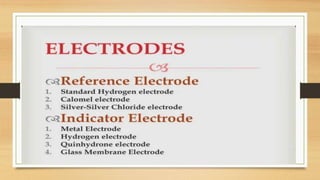
• Generally, the electrolyte solution is used as an analyte. Hydrogen electrodes,
silver chloride electrodes and calomel electrodes are generally used as
reference electrodes.
• Indicator electrode is generally glass electrode and metal ion electrode.
Types of Potentiometric Titration
• Acid-Base Titration: This type of potentiometric titration is used to determine the concentration of a given
acid/base by neutralizing it exactly using a standard solution of base/acid whose concentration is known.
• Redox Titration: This type of potentiometric titration involves an analyte and titrant that undergo a redox
reaction. An example of this type of titration would be the treatment of an iodine solution with a reducing
agent which produces iodide ion (a starch indicator is used to get the endpoint).
• Complexometric Titration: This type of titration can also be referred to as chelatometry. In this method, a
coloured complex is formed, indicating the end point of the titration. This method is used to determine a
mixture of metal ions in a given solution.
• Precipitation Titration: This type of titration involves a reaction between the given analyte and the titrant
wherein an insoluble precipitate is formed. The end-point of this titration is noted when the addition of the
titrant no longer forms a precipitate.
Priniciple of Potentiometry
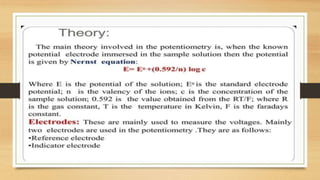
• When the pair of electrodes are placed in the sample solution or analyte, it shows the potential difference
between two electrodes by the addition of the titrant or by the change in the concentration of ions.
• The two electrodes are named reference electrodes and indicator electrodes. The reference electrode is the
electrode that maintains its potential and remains stable when dipped into a sample solution.
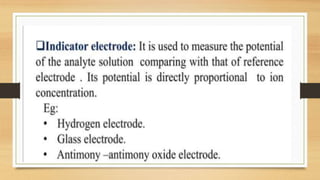
• An indicator electrode is an electrode that responds to variation in the potential of analyte solution. A salt
bridge is used to prevent interference of the analyte with the reference electrode.
• The electromotive force or overall potential difference can be calculated by using the following formula –
Ecell = Eref+Eind+Ej
Where,
• Ecell = electromotive force of the complete cell
• Eind = electromotive force of the indicator electrode
• Eref = electromotive force of the reference electrode
• Ej = electromotive force at the junction across the salt bridge
Working of electrochemical cell.
• At its most basic, a potentiometer consists of two electrodes, whose
reduction potentials differ, inserted in a test solution. The voltmeter is
attached to the electrodes to measure the potential difference between
them.One of the electrodes is a reference electrode, whose electrode
potential is known.
• The other electrode is the test electrode. The test electrode is usually either a
metal immersed in a solution of its own ions, whose concentration you wish
to discover, or a carbon rod electrode sitting a solution which contains the
ions of interest in two different oxidation states.
Reference
• https://byjus.com/chemistry/potentiometric-
titration/#:~:text=Potentiometric%20titration%20is%20a%20laboratory,acr
oss%20the%20substance%20is%20measured.
• https://www.vedantu.com/chemistry/potentiometric-titration
• https://youtu.be/2avYep3bIX8
potentiometric titration ^.pptx

potentiometric titration ^.pptx

  • 1.
    Potentiometry, principle and Working Nitinpandey M.pharm 1st year Pharmaceutical chemistry
  • 2.
    Introduction • Potentiometry isthe method to find the concentration of solute in a given solution by measuring the potential between two electrodes. • As the name suggests, potentiometric titration involves the measurement of the potential of the indicator electrode and reference electrode. • It gives more accurate and precise results than other titrations in which different reagents are used as indicators. That’s why potentiometric titration is preferred over manual titrations. • 1st potentiometric titration was carried out by Robert Behrend in 1893.
  • 3.
    What is potentiometrictitration? • Potentiometric titration is a technique similar to direct titration, but in this, no indicator reagent is used; instead, an electrode is used as an indicator. • In potentiometric titrations, a cell is used with a reference electrode, salt bridge, analyte and an indicator electrode. • Generally, the electrolyte solution is used as an analyte. Hydrogen electrodes, silver chloride electrodes and calomel electrodes are generally used as reference electrodes. • Indicator electrode is generally glass electrode and metal ion electrode.
  • 4.
    Types of PotentiometricTitration • Acid-Base Titration: This type of potentiometric titration is used to determine the concentration of a given acid/base by neutralizing it exactly using a standard solution of base/acid whose concentration is known. • Redox Titration: This type of potentiometric titration involves an analyte and titrant that undergo a redox reaction. An example of this type of titration would be the treatment of an iodine solution with a reducing agent which produces iodide ion (a starch indicator is used to get the endpoint). • Complexometric Titration: This type of titration can also be referred to as chelatometry. In this method, a coloured complex is formed, indicating the end point of the titration. This method is used to determine a mixture of metal ions in a given solution. • Precipitation Titration: This type of titration involves a reaction between the given analyte and the titrant wherein an insoluble precipitate is formed. The end-point of this titration is noted when the addition of the titrant no longer forms a precipitate.
  • 9.
    Priniciple of Potentiometry •When the pair of electrodes are placed in the sample solution or analyte, it shows the potential difference between two electrodes by the addition of the titrant or by the change in the concentration of ions. • The two electrodes are named reference electrodes and indicator electrodes. The reference electrode is the electrode that maintains its potential and remains stable when dipped into a sample solution. • An indicator electrode is an electrode that responds to variation in the potential of analyte solution. A salt bridge is used to prevent interference of the analyte with the reference electrode. • The electromotive force or overall potential difference can be calculated by using the following formula – Ecell = Eref+Eind+Ej Where, • Ecell = electromotive force of the complete cell • Eind = electromotive force of the indicator electrode • Eref = electromotive force of the reference electrode • Ej = electromotive force at the junction across the salt bridge
  • 10.
    Working of electrochemicalcell. • At its most basic, a potentiometer consists of two electrodes, whose reduction potentials differ, inserted in a test solution. The voltmeter is attached to the electrodes to measure the potential difference between them.One of the electrodes is a reference electrode, whose electrode potential is known. • The other electrode is the test electrode. The test electrode is usually either a metal immersed in a solution of its own ions, whose concentration you wish to discover, or a carbon rod electrode sitting a solution which contains the ions of interest in two different oxidation states.
  • 12.