Applications of
Potentiometric Analysis
Presented by: Arun Agarwal
(CSIR-JRF)
ID: 53253
Supervisor: Dr. Wahajuddin
(Principal scientist)
Division: Pharmaceutics and
pharmacokinetics
Potentiometry
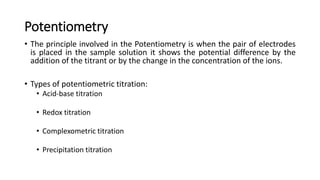
• The principle involved in the Potentiometry is when the pair of electrodes
is placed in the sample solution it shows the potential difference by the
addition of the titrant or by the change in the concentration of the ions.
• Types of potentiometric titration:
• Acid-base titration
• Redox titration
• Complexometric titration
• Precipitation titration
Types of potentiometric titration
• Acid-base titration
• Glass / calomel electrode for determination of pH.
• ex: Titration of HCl with NaOH, titration of CH3COOH with NaOH
• Redox titration
• Platinum electrode.
• ex: reaction of Fe3+/ Fe2+ with Ce4+/Ce3+
• Complexometric titration
• metal and membrane electrodes for determination of many cations.
• ex: mixture of Bi3+, Cd2+ and Ca2+ using EDTA)
• Precipitation titration
• Membrane electrodes for the determination of the halogens using silver
nitrate reagent.
• ex:Titration of mixture of Cl- & Br- & I- with AgNO3
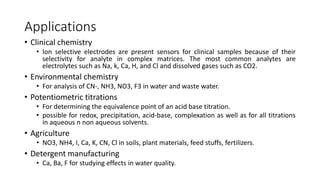
Applications
• Clinical chemistry
• Ion selective electrodes are present sensors for clinical samples because of their
selectivity for analyte in complex matrices. The most common analytes are
electrolytes such as Na, k, Ca, H, and Cl and dissolved gases such as CO2.
• Environmental chemistry
• For analysis of CN-, NH3, NO3, F3 in water and waste water.
• Potentiometric titrations
• For determining the equivalence point of an acid base titration.
• possible for redox, precipitation, acid-base, complexation as well as for all titrations
in aqueous n non aqueous solvents.
• Agriculture
• NO3, NH4, I, Ca, K, CN, Cl in soils, plant materials, feed stuffs, fertilizers.
• Detergent manufacturing
• Ca, Ba, F for studying effects in water quality.
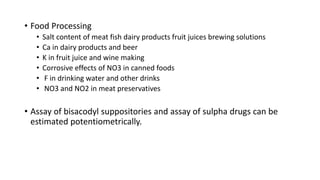
• Food Processing
• Salt content of meat fish dairy products fruit juices brewing solutions
• Ca in dairy products and beer
• K in fruit juice and wine making
• Corrosive effects of NO3 in canned foods
• F in drinking water and other drinks
• NO3 and NO2 in meat preservatives
• Assay of bisacodyl suppositories and assay of sulpha drugs can be
estimated potentiometrically.
References
• Kar, A. (2005). Pharmaceutical drug analysis, New Age International.
Thank you!!

Applications of potentiometric analysis

  • 1.
    Applications of Potentiometric Analysis Presentedby: Arun Agarwal (CSIR-JRF) ID: 53253 Supervisor: Dr. Wahajuddin (Principal scientist) Division: Pharmaceutics and pharmacokinetics
  • 2.
    Potentiometry • The principleinvolved in the Potentiometry is when the pair of electrodes is placed in the sample solution it shows the potential difference by the addition of the titrant or by the change in the concentration of the ions. • Types of potentiometric titration: • Acid-base titration • Redox titration • Complexometric titration • Precipitation titration
  • 3.
    Types of potentiometrictitration • Acid-base titration • Glass / calomel electrode for determination of pH. • ex: Titration of HCl with NaOH, titration of CH3COOH with NaOH • Redox titration • Platinum electrode. • ex: reaction of Fe3+/ Fe2+ with Ce4+/Ce3+ • Complexometric titration • metal and membrane electrodes for determination of many cations. • ex: mixture of Bi3+, Cd2+ and Ca2+ using EDTA) • Precipitation titration • Membrane electrodes for the determination of the halogens using silver nitrate reagent. • ex:Titration of mixture of Cl- & Br- & I- with AgNO3
  • 4.
    Applications • Clinical chemistry •Ion selective electrodes are present sensors for clinical samples because of their selectivity for analyte in complex matrices. The most common analytes are electrolytes such as Na, k, Ca, H, and Cl and dissolved gases such as CO2. • Environmental chemistry • For analysis of CN-, NH3, NO3, F3 in water and waste water. • Potentiometric titrations • For determining the equivalence point of an acid base titration. • possible for redox, precipitation, acid-base, complexation as well as for all titrations in aqueous n non aqueous solvents. • Agriculture • NO3, NH4, I, Ca, K, CN, Cl in soils, plant materials, feed stuffs, fertilizers. • Detergent manufacturing • Ca, Ba, F for studying effects in water quality.
  • 5.
    • Food Processing •Salt content of meat fish dairy products fruit juices brewing solutions • Ca in dairy products and beer • K in fruit juice and wine making • Corrosive effects of NO3 in canned foods • F in drinking water and other drinks • NO3 and NO2 in meat preservatives • Assay of bisacodyl suppositories and assay of sulpha drugs can be estimated potentiometrically.
  • 6.
    References • Kar, A.(2005). Pharmaceutical drug analysis, New Age International.
  • 7.