Fahad Ali
HM Qaseem Achakzai
Iftikhar Ahmed
Javeria Tanveer
Mahzaib Nasir
Maliha Mehr
Luqman Akbar
Subject: Engineering Geology
Civil Engineering
Semester II
Dated: 20th June 2019
SEISMIC Refraction EXPLORATION
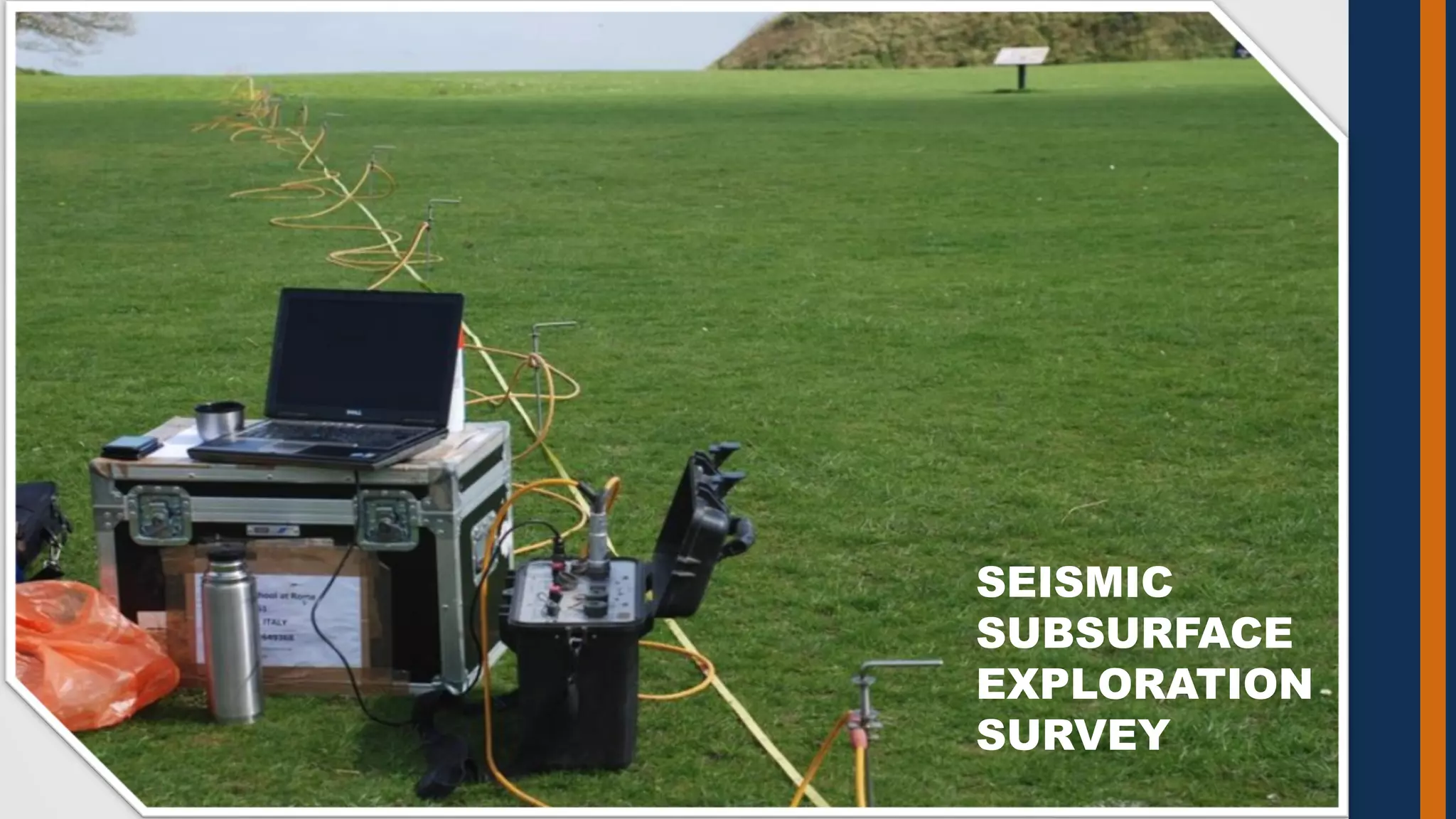
SEISMIC
SUBSURFACE
EXPLORATION
SURVEY
Exploration geophysics is an applied branch of geophysics and engineering
geology.
It uses physical methods at the surface of the Earth to measure the physical
properties of the subsurface
Methods include;
❖ seismic,
❖ gravitational,
❖ magnetic,
❖ electrical and
❖ electromagnetic.
Seismic exploration is a geophysical inverse problem method, used for
investigating subsurface ground conditions by utilizing surface-sourced seismic
elastic waves.
Introduction
Seismic Exploration Methods
In Seismic Exploration, seismic elastic waves are produced in the subsurface by
means of a seismic source. Data acquired on site is computer processed and
interpreted to produce models of the seismic velocity and layer thickness of the
subsurface ground structure.
On the analytical basis of such waves,
seismic exploration is broadly
categorized in two main methods.
They are;
Seismic Refraction Method:
The signal returning to the surface by refraction at subsurface is analyzed.
interfaces and is recorded at distances much greater than depth of investigation.
Seismic Reflection Method:
The seismic signals that are reflected back to the surface at layer interfaces are
considered in this method for investigation.
Principle Of Seismic Refraction Method
❖ Seismic waves are mechanical perturbations that travel in the Earth at a speed
governed by the acoustic impedance of the medium.
❖ When a seismic wave travelling through the Earth encounters an interface between
two materials with different acoustic impedances, some of the wave energy
will reflect off the interface and some will refract through the interface.
❖ Knowing the travel times from the source to various receivers, and the velocity of the
seismic waves, a geophysicist then attempts to reconstruct the pathways of the waves
in order to build up an image of the subsurface.
❖ It is primarily based on Snell’s Law and Critical Refraction.
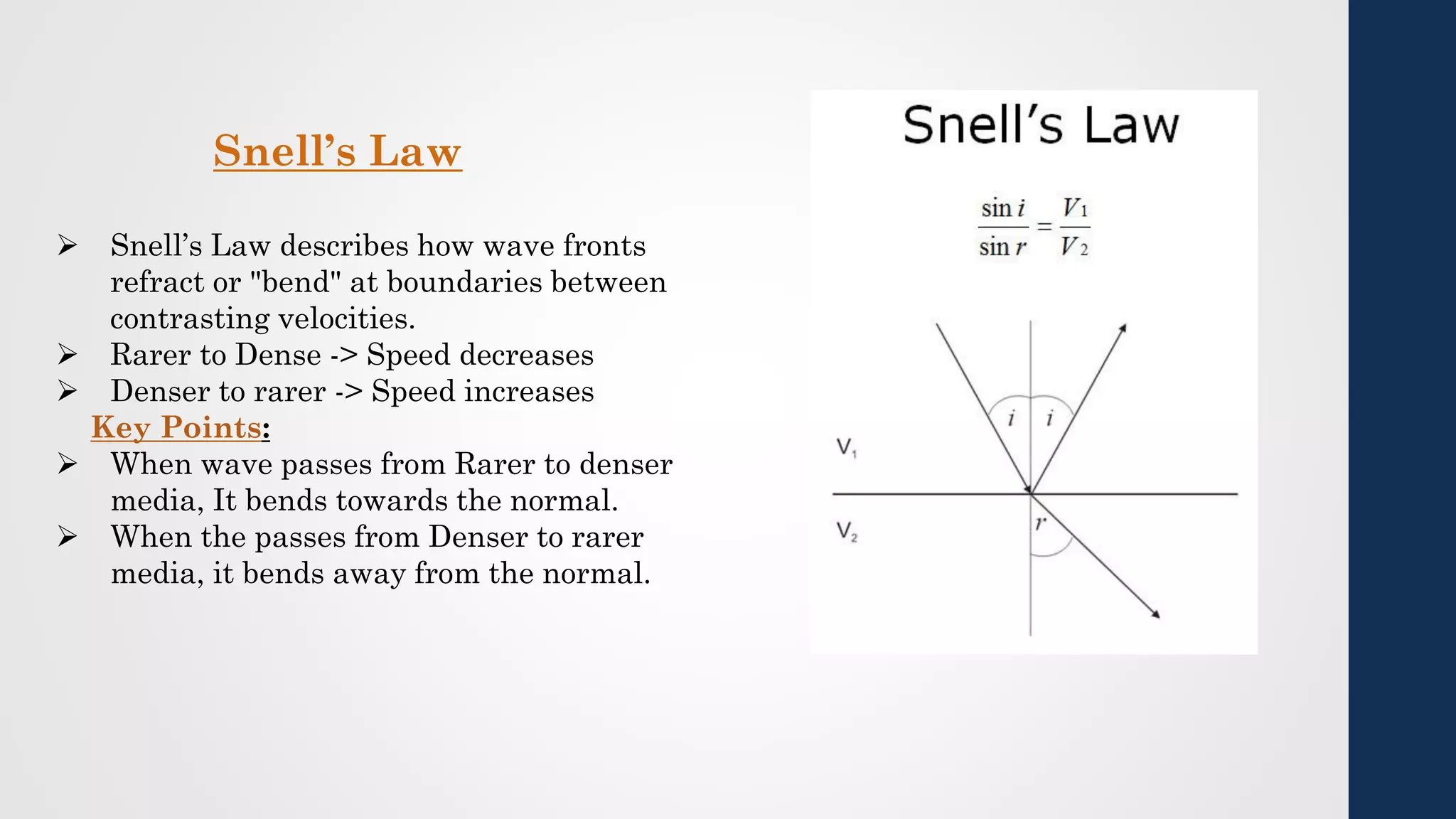
Snell’s Law
➢ Snell’s Law describes how wave fronts
refract or "bend" at boundaries between
contrasting velocities.
➢ Rarer to Dense -> Speed decreases
➢ Denser to rarer -> Speed increases
Key Points:
➢ When wave passes from Rarer to denser
media, It bends towards the normal.
➢ When the passes from Denser to rarer
media, it bends away from the normal.
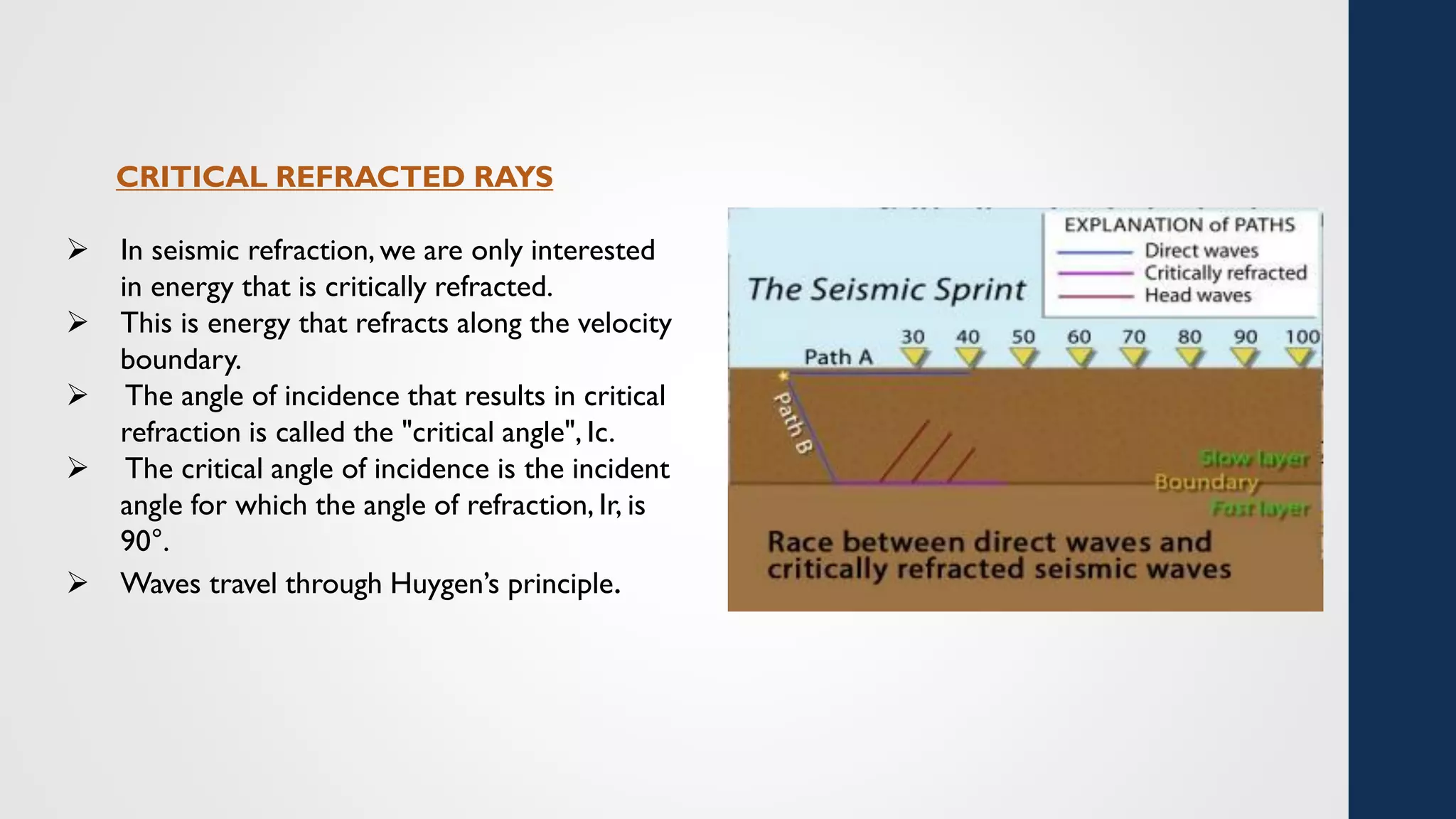
CRITICAL REFRACTED RAYS
➢ In seismic refraction, we are only interested
in energy that is critically refracted.
➢ This is energy that refracts along the velocity
boundary.
➢ The angle of incidence that results in critical
refraction is called the "critical angle", Ic.
➢ The critical angle of incidence is the incident
angle for which the angle of refraction, Ir, is
90°.
➢ Waves travel through Huygen’s principle.
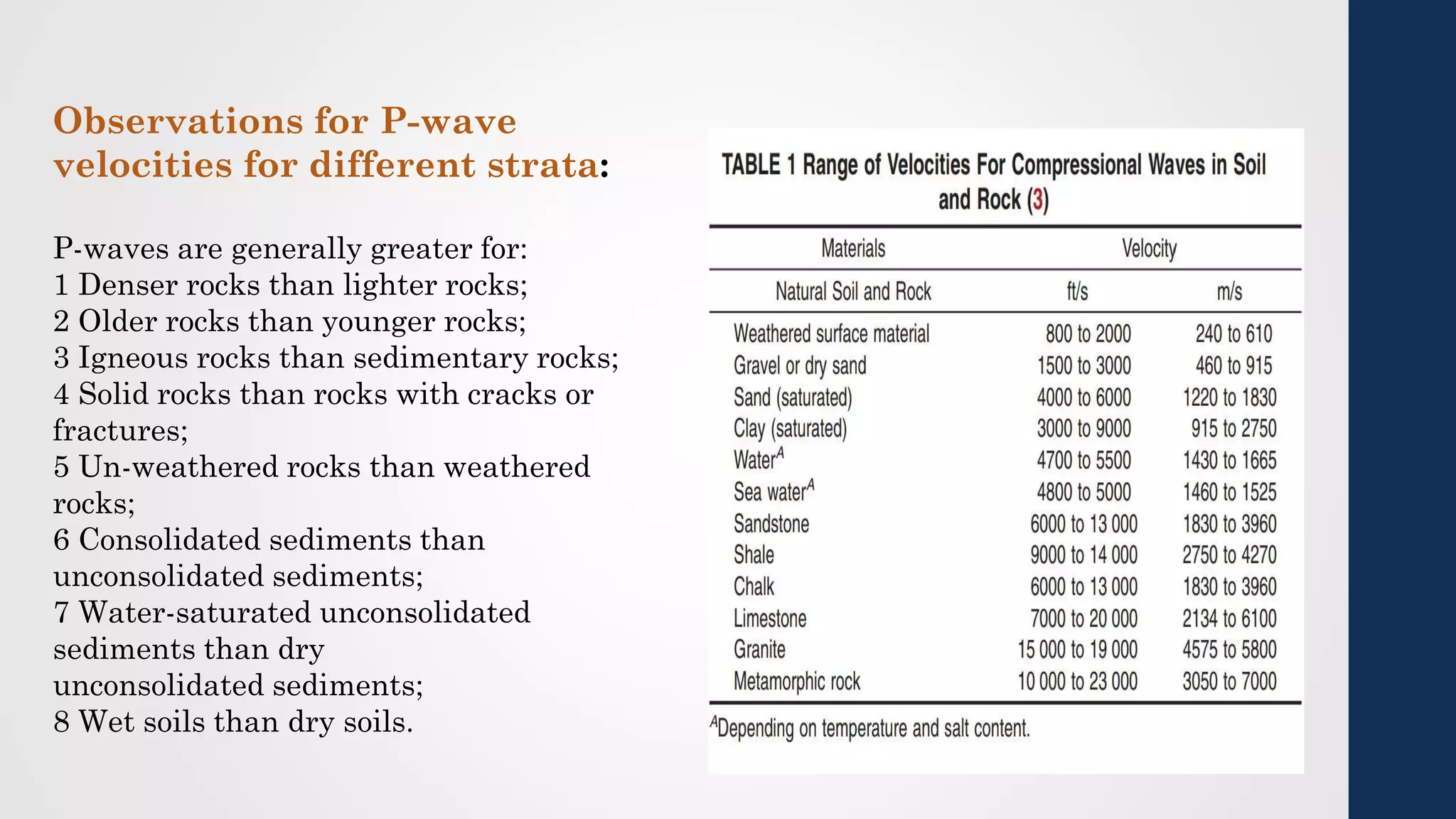
Observations for P-wave
velocities for different strata:
P-waves are generally greater for:
1 Denser rocks than lighter rocks;
2 Older rocks than younger rocks;
3 Igneous rocks than sedimentary rocks;
4 Solid rocks than rocks with cracks or
fractures;
5 Un-weathered rocks than weathered
rocks;
6 Consolidated sediments than
unconsolidated sediments;
7 Water-saturated unconsolidated
sediments than dry
unconsolidated sediments;
8 Wet soils than dry soils.
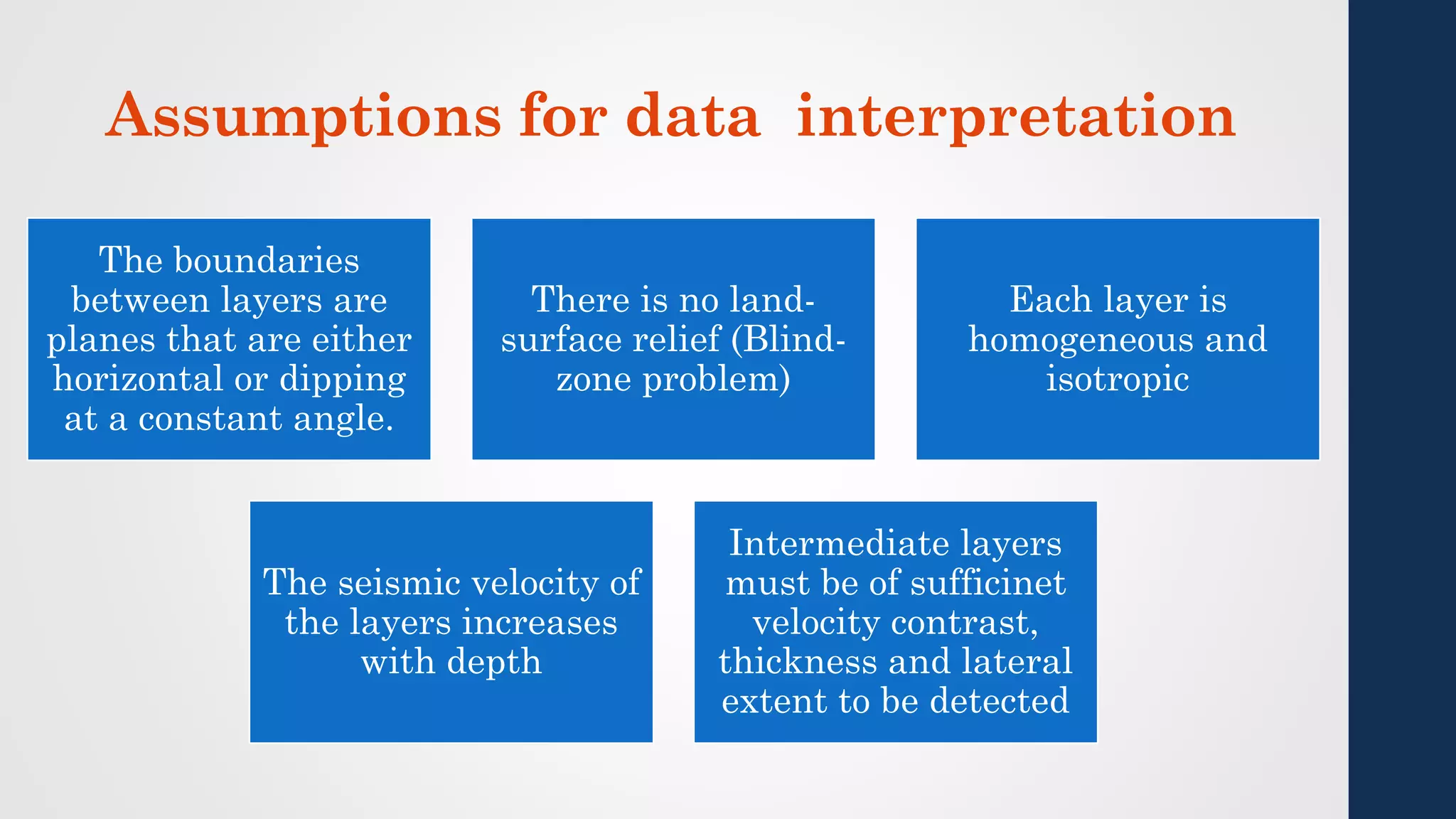
Assumptions for data interpretation
The boundaries
between layers are
planes that are either
horizontal or dipping
at a constant angle.
There is no land-
surface relief (Blind-
zone problem)
Each layer is
homogeneous and
isotropic
The seismic velocity of
the layers increases
with depth
Intermediate layers
must be of sufficinet
velocity contrast,
thickness and lateral
extent to be detected
MEASURES
BEDROCK
DEPTH &
OVERBURDEN
THICKNESS
DETERMINES
SEISMIC
RIPPABILITY
PARAMETERS
INVESTIGATES
PIPELINE
ROUTES
LOCATES
GEOLOGICAL
STRUCTURES
EVALUATES
SAND & GRAVEL
DEPOSITS
MAPPING DEPTH
TO GROUND
WATER
IDENTIFICATION
AND MAPPING
OF FAULTS
MINERAL,
PETROLEUM,
ARCHAEOLOGICAL
AND FOSSIL
EXPLORATION
Application
Apparatus
❖ Energy Source
❖ Geophone
❖ Geophone Cable
❖ Geode
❖ Trigger Cable
❖ Battery (12V)
❖ Computer System
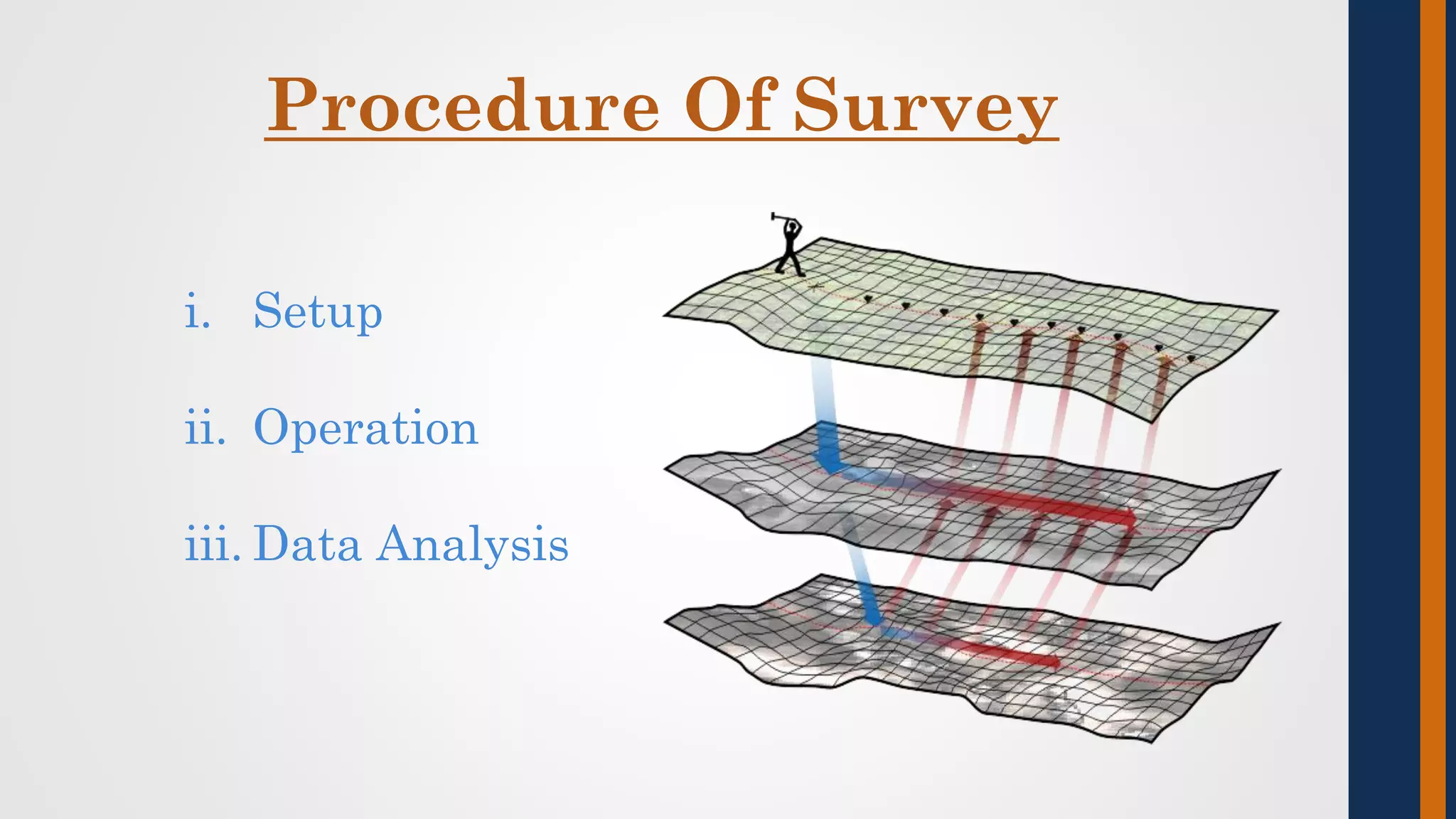
Procedure Of Survey
i. Setup
ii. Operation
iii. Data Analysis
❖ Locating survey site
❖ Marking and clearing the survey line
❖ Choosing Suitable Method
❖ Layout of Geophone network array
❖ Setting up Geode
❖ Setting up Computer system with
Geode
❖ Connecting Geophones with Geode via
geophone cable
❖ Connecting of geode with energy
source vis Sensor switch and trigger
cable
❖ Setting up strike plate or drilling a
bore for explosive source
i. Setup
ii. Operation
❖ Initiating the operation with energy source
for the production of seismic waves
❖ Elastic Acoustic Waves are generated in the
subsurface
❖ Waves are refracted and reflected back on
the site from the refractor at interface
❖ Geophones sense the reflected, refracted and
other unwanted waves, and convert them
into electrical signals
❖ Only trace information from refracted waves
is observed on the system
❖ The operation is repeated along the
geophone array for stacking records
❖ After data acquisition, the apparatus is
rolled back with the geophones reeled in the
end
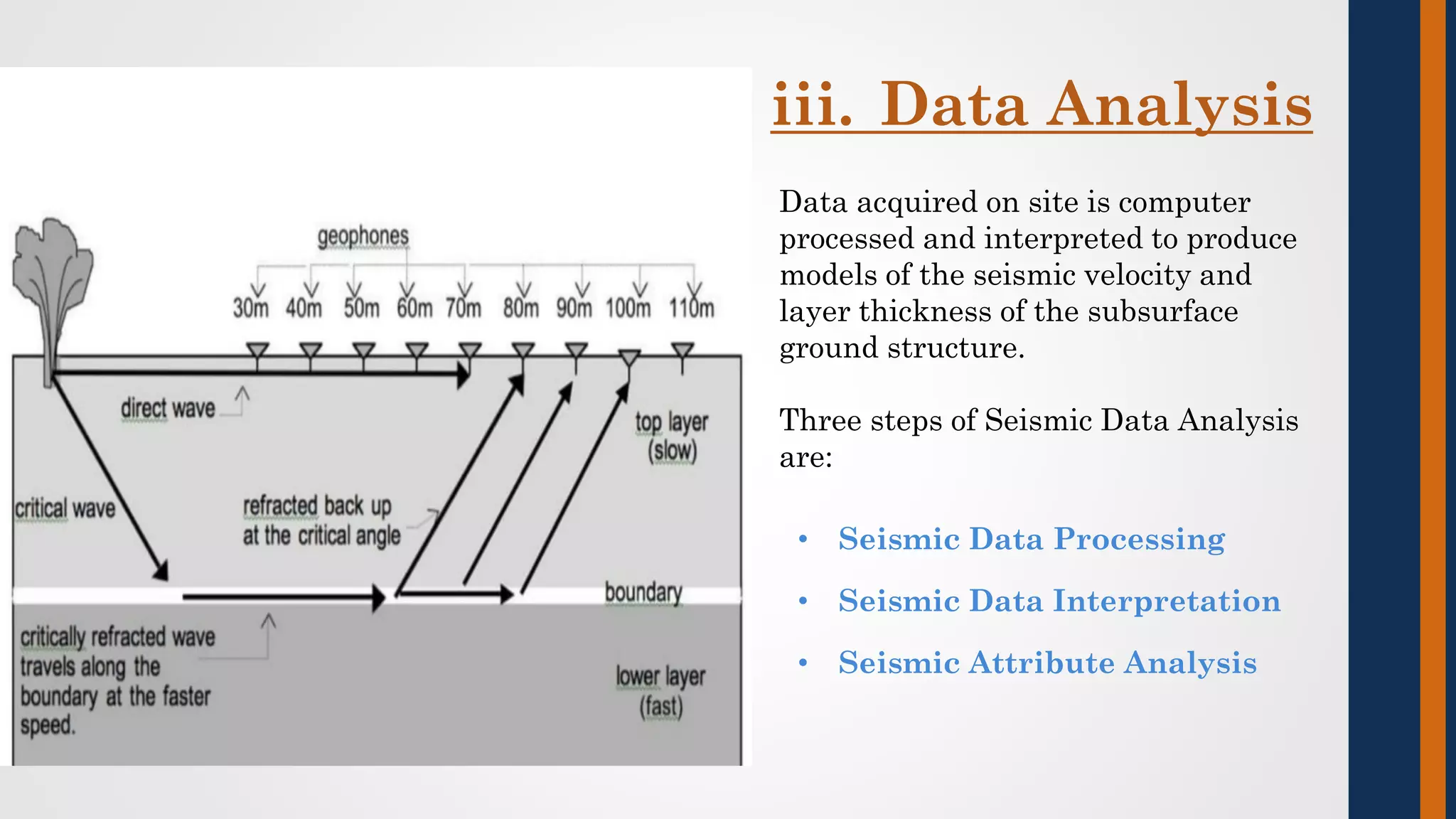
iii. Data Analysis
• Seismic Data Processing
• Seismic Data Interpretation
• Seismic Attribute Analysis
Data acquired on site is computer
processed and interpreted to produce
models of the seismic velocity and
layer thickness of the subsurface
ground structure.
Three steps of Seismic Data Analysis
are:
• Seismic Data Processing
There are three main processes in seismic data processing:
❖ Deconvolution:
It is a process that tries to extract the reflectivity series of the Earth, under the
assumption that a seismic trace is just the reflectivity series of the Earth convolved
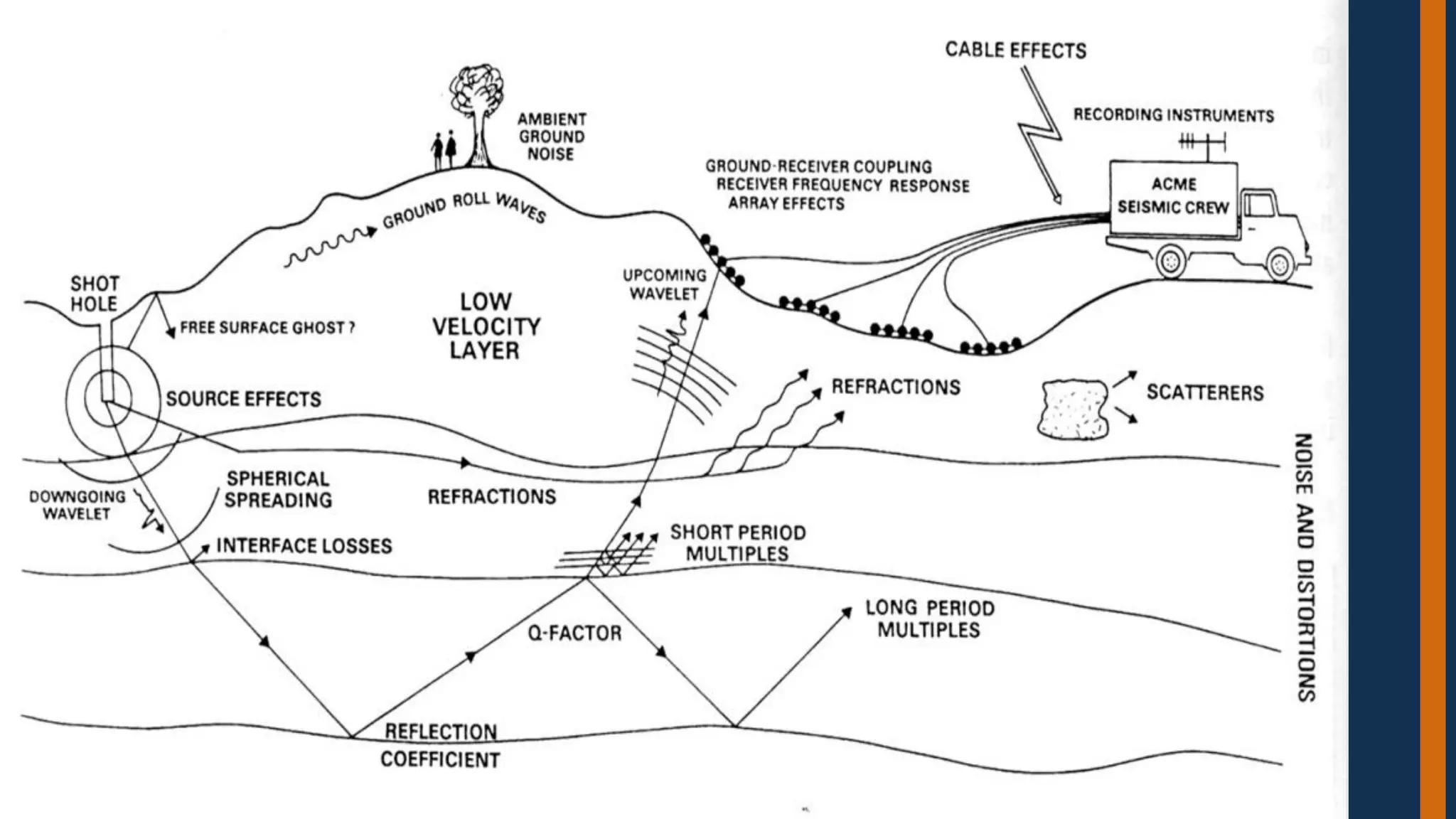
with distorting filters for unwanted waves known as noises such as air waves, multiple
reflections and cultural noises.
❖ Common-midpoint (CMP) stacking and
It is a robust process that uses the fact that a particular location in the subsurface
will have been sampled numerous times and at different offsets.
❖ Migration.
It is the process by which seismic events are geometrically re-located in either
space or time to the location the event occurred in the subsurface rather than the
location that it was recorded at the surface, thereby creating a more accurate image of
the subsurface.
After Seismic Data ProcessingBefore Seismic Data Processing
• Seismic Data Interpretation
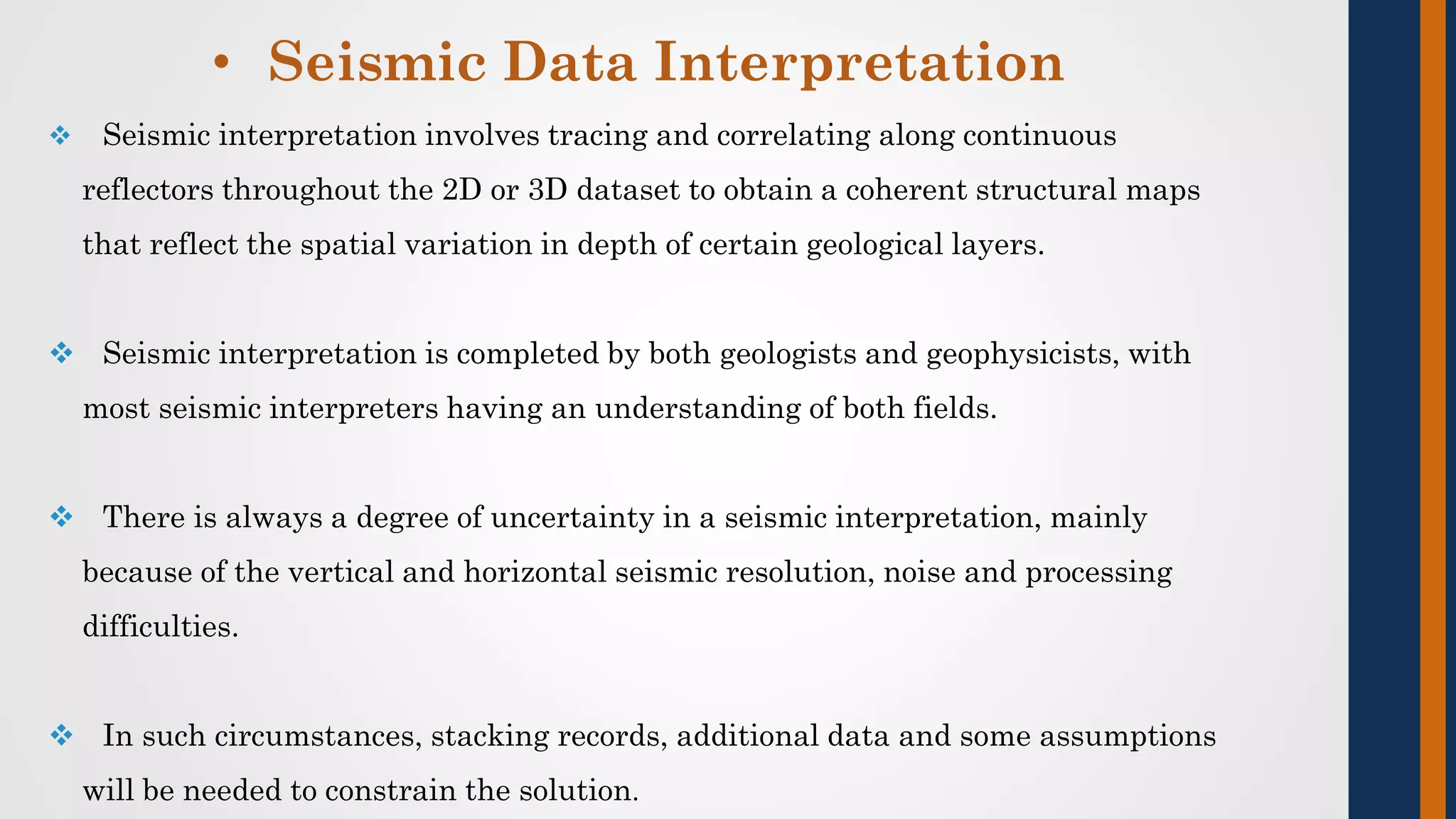
❖ Seismic interpretation involves tracing and correlating along continuous
reflectors throughout the 2D or 3D dataset to obtain a coherent structural maps
that reflect the spatial variation in depth of certain geological layers.
❖ Seismic interpretation is completed by both geologists and geophysicists, with
most seismic interpreters having an understanding of both fields.
❖ There is always a degree of uncertainty in a seismic interpretation, mainly
because of the vertical and horizontal seismic resolution, noise and processing
difficulties.
❖ In such circumstances, stacking records, additional data and some assumptions
will be needed to constrain the solution.
• Seismic attribute analysis
❖ Seismic attribute analysis involves extracting or deriving a quantity
from seismic data that can be analyzed in order to enhance information
that might be more subtle in a traditional seismic image, leading to a
better geological or geophysical interpretation of the data.
❖ Examples of attributes that can be analyzed include mean amplitude,
which can lead to the delineation of bright spots and dim
spots, coherency and amplitude versus offset.
❖ Attributes that can show the presence of hydrocarbons are called direct
hydrocarbon indicators.
Precautions
❖ The survey site should be located such that survey line is relatively plane,
clear and free from Noises.
❖ The seismic refraction method is sensitive to ground vibrations from a
variety of sources such as Geologic Sources and Cultural Sources.
❖ These noises cause variations in signals, thus affecting travel-time graph
which causes negative impacts on experiment.
❖ Geophones and seismic source must be placed in firm contact to ground with
proper connections with Geode.
❖ Geophones should be placed vertically.
❖ Offset and Geophone spacing should be properly calculated.
❖ The Sledgehammer should not bounce back to attain proper coupling and
avoid false triggering.
THE END

Seismic Refraction Test

  • 1.
    Fahad Ali HM QaseemAchakzai Iftikhar Ahmed Javeria Tanveer Mahzaib Nasir Maliha Mehr Luqman Akbar Subject: Engineering Geology Civil Engineering Semester II Dated: 20th June 2019 SEISMIC Refraction EXPLORATION
  • 2.
  • 3.
    Exploration geophysics isan applied branch of geophysics and engineering geology. It uses physical methods at the surface of the Earth to measure the physical properties of the subsurface Methods include; ❖ seismic, ❖ gravitational, ❖ magnetic, ❖ electrical and ❖ electromagnetic. Seismic exploration is a geophysical inverse problem method, used for investigating subsurface ground conditions by utilizing surface-sourced seismic elastic waves. Introduction
  • 4.
    Seismic Exploration Methods InSeismic Exploration, seismic elastic waves are produced in the subsurface by means of a seismic source. Data acquired on site is computer processed and interpreted to produce models of the seismic velocity and layer thickness of the subsurface ground structure. On the analytical basis of such waves, seismic exploration is broadly categorized in two main methods. They are; Seismic Refraction Method: The signal returning to the surface by refraction at subsurface is analyzed. interfaces and is recorded at distances much greater than depth of investigation. Seismic Reflection Method: The seismic signals that are reflected back to the surface at layer interfaces are considered in this method for investigation.
  • 6.
    Principle Of SeismicRefraction Method ❖ Seismic waves are mechanical perturbations that travel in the Earth at a speed governed by the acoustic impedance of the medium. ❖ When a seismic wave travelling through the Earth encounters an interface between two materials with different acoustic impedances, some of the wave energy will reflect off the interface and some will refract through the interface. ❖ Knowing the travel times from the source to various receivers, and the velocity of the seismic waves, a geophysicist then attempts to reconstruct the pathways of the waves in order to build up an image of the subsurface. ❖ It is primarily based on Snell’s Law and Critical Refraction.
  • 7.
    Snell’s Law ➢ Snell’sLaw describes how wave fronts refract or "bend" at boundaries between contrasting velocities. ➢ Rarer to Dense -> Speed decreases ➢ Denser to rarer -> Speed increases Key Points: ➢ When wave passes from Rarer to denser media, It bends towards the normal. ➢ When the passes from Denser to rarer media, it bends away from the normal.
  • 8.
    CRITICAL REFRACTED RAYS ➢In seismic refraction, we are only interested in energy that is critically refracted. ➢ This is energy that refracts along the velocity boundary. ➢ The angle of incidence that results in critical refraction is called the "critical angle", Ic. ➢ The critical angle of incidence is the incident angle for which the angle of refraction, Ir, is 90°. ➢ Waves travel through Huygen’s principle.
  • 10.
    Observations for P-wave velocitiesfor different strata: P-waves are generally greater for: 1 Denser rocks than lighter rocks; 2 Older rocks than younger rocks; 3 Igneous rocks than sedimentary rocks; 4 Solid rocks than rocks with cracks or fractures; 5 Un-weathered rocks than weathered rocks; 6 Consolidated sediments than unconsolidated sediments; 7 Water-saturated unconsolidated sediments than dry unconsolidated sediments; 8 Wet soils than dry soils.
  • 12.
    Assumptions for datainterpretation The boundaries between layers are planes that are either horizontal or dipping at a constant angle. There is no land- surface relief (Blind- zone problem) Each layer is homogeneous and isotropic The seismic velocity of the layers increases with depth Intermediate layers must be of sufficinet velocity contrast, thickness and lateral extent to be detected
  • 13.
    MEASURES BEDROCK DEPTH & OVERBURDEN THICKNESS DETERMINES SEISMIC RIPPABILITY PARAMETERS INVESTIGATES PIPELINE ROUTES LOCATES GEOLOGICAL STRUCTURES EVALUATES SAND &GRAVEL DEPOSITS MAPPING DEPTH TO GROUND WATER IDENTIFICATION AND MAPPING OF FAULTS MINERAL, PETROLEUM, ARCHAEOLOGICAL AND FOSSIL EXPLORATION Application
  • 14.
    Apparatus ❖ Energy Source ❖Geophone ❖ Geophone Cable ❖ Geode ❖ Trigger Cable ❖ Battery (12V) ❖ Computer System
  • 15.
    Procedure Of Survey i.Setup ii. Operation iii. Data Analysis
  • 16.
    ❖ Locating surveysite ❖ Marking and clearing the survey line ❖ Choosing Suitable Method ❖ Layout of Geophone network array ❖ Setting up Geode ❖ Setting up Computer system with Geode ❖ Connecting Geophones with Geode via geophone cable ❖ Connecting of geode with energy source vis Sensor switch and trigger cable ❖ Setting up strike plate or drilling a bore for explosive source i. Setup
  • 17.
    ii. Operation ❖ Initiatingthe operation with energy source for the production of seismic waves ❖ Elastic Acoustic Waves are generated in the subsurface ❖ Waves are refracted and reflected back on the site from the refractor at interface ❖ Geophones sense the reflected, refracted and other unwanted waves, and convert them into electrical signals ❖ Only trace information from refracted waves is observed on the system ❖ The operation is repeated along the geophone array for stacking records ❖ After data acquisition, the apparatus is rolled back with the geophones reeled in the end
  • 19.
    iii. Data Analysis •Seismic Data Processing • Seismic Data Interpretation • Seismic Attribute Analysis Data acquired on site is computer processed and interpreted to produce models of the seismic velocity and layer thickness of the subsurface ground structure. Three steps of Seismic Data Analysis are:
  • 20.
    • Seismic DataProcessing There are three main processes in seismic data processing: ❖ Deconvolution: It is a process that tries to extract the reflectivity series of the Earth, under the assumption that a seismic trace is just the reflectivity series of the Earth convolved with distorting filters for unwanted waves known as noises such as air waves, multiple reflections and cultural noises. ❖ Common-midpoint (CMP) stacking and It is a robust process that uses the fact that a particular location in the subsurface will have been sampled numerous times and at different offsets. ❖ Migration. It is the process by which seismic events are geometrically re-located in either space or time to the location the event occurred in the subsurface rather than the location that it was recorded at the surface, thereby creating a more accurate image of the subsurface.
  • 22.
    After Seismic DataProcessingBefore Seismic Data Processing
  • 23.
    • Seismic DataInterpretation ❖ Seismic interpretation involves tracing and correlating along continuous reflectors throughout the 2D or 3D dataset to obtain a coherent structural maps that reflect the spatial variation in depth of certain geological layers. ❖ Seismic interpretation is completed by both geologists and geophysicists, with most seismic interpreters having an understanding of both fields. ❖ There is always a degree of uncertainty in a seismic interpretation, mainly because of the vertical and horizontal seismic resolution, noise and processing difficulties. ❖ In such circumstances, stacking records, additional data and some assumptions will be needed to constrain the solution.
  • 27.
    • Seismic attributeanalysis ❖ Seismic attribute analysis involves extracting or deriving a quantity from seismic data that can be analyzed in order to enhance information that might be more subtle in a traditional seismic image, leading to a better geological or geophysical interpretation of the data. ❖ Examples of attributes that can be analyzed include mean amplitude, which can lead to the delineation of bright spots and dim spots, coherency and amplitude versus offset. ❖ Attributes that can show the presence of hydrocarbons are called direct hydrocarbon indicators.
  • 29.
    Precautions ❖ The surveysite should be located such that survey line is relatively plane, clear and free from Noises. ❖ The seismic refraction method is sensitive to ground vibrations from a variety of sources such as Geologic Sources and Cultural Sources. ❖ These noises cause variations in signals, thus affecting travel-time graph which causes negative impacts on experiment. ❖ Geophones and seismic source must be placed in firm contact to ground with proper connections with Geode. ❖ Geophones should be placed vertically. ❖ Offset and Geophone spacing should be properly calculated. ❖ The Sledgehammer should not bounce back to attain proper coupling and avoid false triggering.
  • 30.