ْ‫ح‬‫ه‬‫الر‬ ِ ‫ه‬‫اَّلل‬ ِ‫م‬ْ‫س‬ِ‫ب‬‫مم‬ ِ‫ح‬‫ه‬‫الر‬ ِِ‫ن‬‫َم‬
BASIC ELECTRO-MECHANICAL ENGINEERING
PRESENTATION PREAPARED BY : -
FAHAD ALI
MALIHA MEHR
M. LUQMAN AKBAR
MAHZAIB NASIR
HAMMAD AZAM
HEATING , VENTILATION AND AIR
CONDITIONING (HVAC)
A heating system is a mechanism for maintaining temperatures at an acceptable
level, by using thermal energy within a home, office, or other dwelling. Often
part of an HVAC (heating, ventilation, air conditioning) system. A heating system
may be a central heating system or distributed.
COMPONENTS OF HEATING PROCESS : -
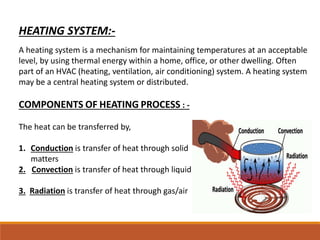
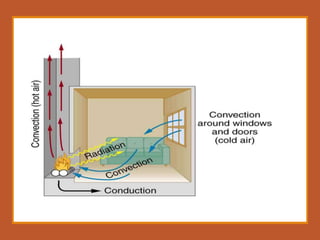
The heat can be transferred by,
1. Conduction is transfer of heat through solid
matters
2. Convection is transfer of heat through liquid
3. Radiation is transfer of heat through gas/air
HEATING SYSTEM:-
A central heating system follows a circular movement which forces
hot water out of the boiler to the heating elements, and water comes
back to it for gathering more heat. This water takes a circular route
and keeps moving, heating an interior space until the system is
switched off or the water is flushed out.
1.CENTRAL HEATING SYSTEM ( for hot water supply
and warm air):-
TYPES OF HEATING SYSTEMS
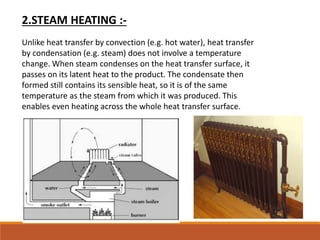
2.STEAM HEATING :-
Unlike heat transfer by convection (e.g. hot water), heat transfer
by condensation (e.g. steam) does not involve a temperature
change. When steam condenses on the heat transfer surface, it
passes on its latent heat to the product. The condensate then
formed still contains its sensible heat, so it is of the same
temperature as the steam from which it was produced. This
enables even heating across the whole heat transfer surface.
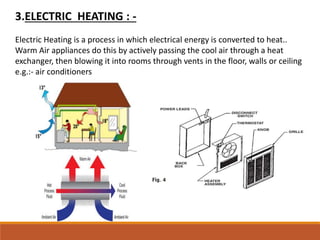
3.ELECTRIC HEATING : -
Electric Heating is a process in which electrical energy is converted to heat..
Warm Air appliances do this by actively passing the cool air through a heat
exchanger, then blowing it into rooms through vents in the floor, walls or ceiling
e.g.:- air conditioners
VENTILATION
Ventilating or ventilation (the V in HVAC) is the process of exchanging or
replacing air in any space to provide high indoor air quality
Ventilation removes unpleasant smells and excessive moisture,
introduces outside air, keeps interior building air circulating, and
prevents stagnation of the interior air.
Ventilation includes both the exchange of air to the outside as well as
circulation of air within the building. It is one of the most important
factors for maintaining acceptable indoor air quality in buildings.
NATURAL
VENTILATION
In natural ventilation, the air change
takes place through doors, windows and
air holes in a natural way without the
intervention of any eternal source
Natural ventilation depends on location
of the building, its orientation, wind
direction, velocity of air, outside
temperature, etc.
KEY POUNTS:
The height of the room should be
sufficient
The size, number, and location of doors
and windows should be effectively
decided
The inlet and exhaust should not be
obstructed in any way
In this system of ventilation, external
systems are installed. These include
exhaust fans, air conditioners, and inlet
fans.
In this process, not only the air
movement but the temperature and
humidity of the air are controlled. It is
Costly.
Examples of this system includes,
Exhaust fans
Inlet fans
Combined exhaust and inlet fans
Air conditioners
MECHANICAL
VENTILATION
LIMTATIONS FOR NATURAL
VENTILATION
When,
The building is too deep to ventilate from the perimeter.
Local air quality is poor, for example, if a building is next to a busy road.
Local noise levels mean that windows cannot be opened.
The local urban structure is very dense and shelters the building from
the wind.
Air cooling or air conditioning systems mean that windows cannot be
opened.
Privacy or security requirements prevent windows being opened.
Internal partitions block air paths.
The creation of draughts adjacent to openings.
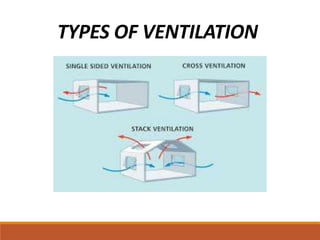
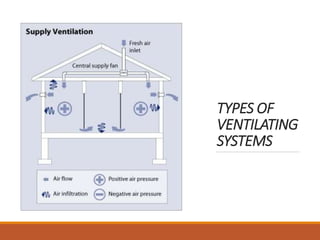
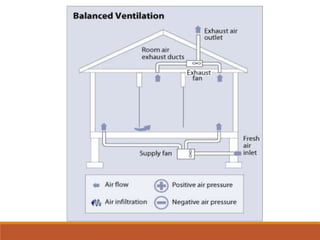
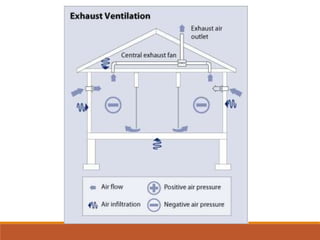
TYPES OF VENTILATION
TYPES OF
VENTILATING
SYSTEMS
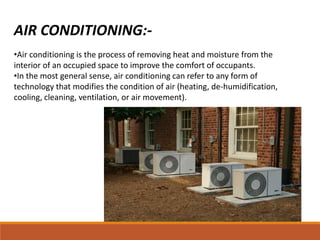
AIR CONDITIONING:-
•Air conditioning is the process of removing heat and moisture from the
interior of an occupied space to improve the comfort of occupants.
•In the most general sense, air conditioning can refer to any form of
technology that modifies the condition of air (heating, de-humidification,
cooling, cleaning, ventilation, or air movement).
AIR CONDITIONING PROCESS
BASIC OPERATIONS:-
An air conditioner is able to cool a building because it removes heat from
the indoor air and transfers it outdoors. A chemical refrigerant in the system
absorbs the unwanted heat and pumps it through a system of piping to the
outside coil. The fan, located in the outside unit, blows outside air over the
hot coil, transferring heat from the refrigerant to the outdoor air.
COMPONENTS:-
Most air conditioning systems have five mechanical components:
• a compressor
• a condenser
• an evaporator coil
• blower
• a chemical refrigerant
GENERAL EFFECTS OF HEATING, VENTILATION,
AND AIR CONDITIONING
Heating ventilation and air conditioning (HVAC) is the technology of
indoor and vehicular environmental comfort. Its goal is to
provide thermal comfort and acceptable indoor air quality.
GENERAL EFFECTS OF HVAC:
In general HVAC consume a lot of energy. Proper heating ventilation
and cooling requires a lot of energy sources. It directly or indirectly
effects the environment by demanding more source of energy. Some
country like Pakistan where there is a shortage of energy, it is not very
successful installing it.
GENERAL EFFECTS OF COOLING
Cooling includes air conditioners, refrigerator, centralized air conditioning,
dehumidification etc.
O As we are aware of the effect of CFC’s (chlorofluorocarbon) used in
refrigerator and refrigeration. It effects the ozone layer badly.
O People become used to air conditioning and the outdoor temperature
affects them more than what it normally should.
O Air conditioning also consume a lot of energy. Increasing shortage of
energy and increasing entropy.
GENERAL EFFECTS OF HEATING
Overall heating includes heaters, centralized heating , boilers, furnace and
heat pumps etc.
O They consume the most amount of energy. Whether they are electric
heaters and boilers or use hydrocarbons such as petrol gas and coal.
O Heat sources are dangerous and they realize harmful gases when burned
(only hydrocarbons). They can cause human loss when fire becomes out of
control.
O They effects environment when burned. Release harmful gases like carbon
monoxide, sulpher, carbon dioxide. Smoke, dust and ash is also released.
GENERAL EFFECTS OF VENTILATION
Ventilation includes exchange of air and circulation of air within the building.
O Whether the ventilation is mechanical or forced both consume some
energy effecting the environment. Generally it is environment friendly.
O It cause little to no harmful effects to human, in return it makes the mind
fresh and houses and buildings fungal and damp free.
O At some places the mechanical ventilators make a lot of noise increasing
noise pollution, such as used in tunnels and underpasses.
HVAC System (Heating, Ventilation and Air Conditioning)

HVAC System (Heating, Ventilation and Air Conditioning)

  • 1.
    ْ‫ح‬‫ه‬‫الر‬ ِ ‫ه‬‫اَّلل‬ِ‫م‬ْ‫س‬ِ‫ب‬‫مم‬ ِ‫ح‬‫ه‬‫الر‬ ِِ‫ن‬‫َم‬
  • 2.
    BASIC ELECTRO-MECHANICAL ENGINEERING PRESENTATIONPREAPARED BY : - FAHAD ALI MALIHA MEHR M. LUQMAN AKBAR MAHZAIB NASIR HAMMAD AZAM HEATING , VENTILATION AND AIR CONDITIONING (HVAC)
  • 3.
    A heating systemis a mechanism for maintaining temperatures at an acceptable level, by using thermal energy within a home, office, or other dwelling. Often part of an HVAC (heating, ventilation, air conditioning) system. A heating system may be a central heating system or distributed. COMPONENTS OF HEATING PROCESS : - The heat can be transferred by, 1. Conduction is transfer of heat through solid matters 2. Convection is transfer of heat through liquid 3. Radiation is transfer of heat through gas/air HEATING SYSTEM:-
  • 5.
    A central heatingsystem follows a circular movement which forces hot water out of the boiler to the heating elements, and water comes back to it for gathering more heat. This water takes a circular route and keeps moving, heating an interior space until the system is switched off or the water is flushed out. 1.CENTRAL HEATING SYSTEM ( for hot water supply and warm air):- TYPES OF HEATING SYSTEMS
  • 6.
    2.STEAM HEATING :- Unlikeheat transfer by convection (e.g. hot water), heat transfer by condensation (e.g. steam) does not involve a temperature change. When steam condenses on the heat transfer surface, it passes on its latent heat to the product. The condensate then formed still contains its sensible heat, so it is of the same temperature as the steam from which it was produced. This enables even heating across the whole heat transfer surface.
  • 7.
    3.ELECTRIC HEATING :- Electric Heating is a process in which electrical energy is converted to heat.. Warm Air appliances do this by actively passing the cool air through a heat exchanger, then blowing it into rooms through vents in the floor, walls or ceiling e.g.:- air conditioners
  • 8.
    VENTILATION Ventilating or ventilation(the V in HVAC) is the process of exchanging or replacing air in any space to provide high indoor air quality Ventilation removes unpleasant smells and excessive moisture, introduces outside air, keeps interior building air circulating, and prevents stagnation of the interior air. Ventilation includes both the exchange of air to the outside as well as circulation of air within the building. It is one of the most important factors for maintaining acceptable indoor air quality in buildings.
  • 9.
    NATURAL VENTILATION In natural ventilation,the air change takes place through doors, windows and air holes in a natural way without the intervention of any eternal source Natural ventilation depends on location of the building, its orientation, wind direction, velocity of air, outside temperature, etc. KEY POUNTS: The height of the room should be sufficient The size, number, and location of doors and windows should be effectively decided The inlet and exhaust should not be obstructed in any way In this system of ventilation, external systems are installed. These include exhaust fans, air conditioners, and inlet fans. In this process, not only the air movement but the temperature and humidity of the air are controlled. It is Costly. Examples of this system includes, Exhaust fans Inlet fans Combined exhaust and inlet fans Air conditioners MECHANICAL VENTILATION
  • 10.
    LIMTATIONS FOR NATURAL VENTILATION When, Thebuilding is too deep to ventilate from the perimeter. Local air quality is poor, for example, if a building is next to a busy road. Local noise levels mean that windows cannot be opened. The local urban structure is very dense and shelters the building from the wind. Air cooling or air conditioning systems mean that windows cannot be opened. Privacy or security requirements prevent windows being opened. Internal partitions block air paths. The creation of draughts adjacent to openings.
  • 11.
  • 12.
  • 15.
    AIR CONDITIONING:- •Air conditioningis the process of removing heat and moisture from the interior of an occupied space to improve the comfort of occupants. •In the most general sense, air conditioning can refer to any form of technology that modifies the condition of air (heating, de-humidification, cooling, cleaning, ventilation, or air movement).
  • 16.
  • 17.
    BASIC OPERATIONS:- An airconditioner is able to cool a building because it removes heat from the indoor air and transfers it outdoors. A chemical refrigerant in the system absorbs the unwanted heat and pumps it through a system of piping to the outside coil. The fan, located in the outside unit, blows outside air over the hot coil, transferring heat from the refrigerant to the outdoor air. COMPONENTS:- Most air conditioning systems have five mechanical components: • a compressor • a condenser • an evaporator coil • blower • a chemical refrigerant
  • 18.
    GENERAL EFFECTS OFHEATING, VENTILATION, AND AIR CONDITIONING Heating ventilation and air conditioning (HVAC) is the technology of indoor and vehicular environmental comfort. Its goal is to provide thermal comfort and acceptable indoor air quality. GENERAL EFFECTS OF HVAC: In general HVAC consume a lot of energy. Proper heating ventilation and cooling requires a lot of energy sources. It directly or indirectly effects the environment by demanding more source of energy. Some country like Pakistan where there is a shortage of energy, it is not very successful installing it.
  • 19.
    GENERAL EFFECTS OFCOOLING Cooling includes air conditioners, refrigerator, centralized air conditioning, dehumidification etc. O As we are aware of the effect of CFC’s (chlorofluorocarbon) used in refrigerator and refrigeration. It effects the ozone layer badly. O People become used to air conditioning and the outdoor temperature affects them more than what it normally should. O Air conditioning also consume a lot of energy. Increasing shortage of energy and increasing entropy.
  • 20.
    GENERAL EFFECTS OFHEATING Overall heating includes heaters, centralized heating , boilers, furnace and heat pumps etc. O They consume the most amount of energy. Whether they are electric heaters and boilers or use hydrocarbons such as petrol gas and coal. O Heat sources are dangerous and they realize harmful gases when burned (only hydrocarbons). They can cause human loss when fire becomes out of control. O They effects environment when burned. Release harmful gases like carbon monoxide, sulpher, carbon dioxide. Smoke, dust and ash is also released.
  • 21.
    GENERAL EFFECTS OFVENTILATION Ventilation includes exchange of air and circulation of air within the building. O Whether the ventilation is mechanical or forced both consume some energy effecting the environment. Generally it is environment friendly. O It cause little to no harmful effects to human, in return it makes the mind fresh and houses and buildings fungal and damp free. O At some places the mechanical ventilators make a lot of noise increasing noise pollution, such as used in tunnels and underpasses.