COMPONENTS OF PLANNING
WITH BLOCK DIAGRAM
Subject : EE653-Power
system Planning and
Reliability
Presented By :
Name :Karansinh Parmar
ID No. : 16EP819
Guided By :
Dr. Akshay A. Pandya
Components of planning
• The first step in developing a strategy is the
identification of the problems and opportunities
that exist.
• A successful utility win have a fertile idea
generating environment. To attain the vision,
perform strengths, weaknesses opportunities and
threats analysis and benchmarking exercises
within the power utility.
• The second step is to set goals (objectives).
• Goal setting is not independent from
identification of opportunities.
Birla Vishvakarma MahaVidyalaya
VVNagar
2
• The third step is to have a procedure for
providing possible solutions. Tactical and
operational planning involves this step.
• The fourth step in strategic planning is to choose
the best solution, given possible solutions and
the objectives.
• The last step is to have some type of review
procedure to check how the best solution has
actually performed.
• The nature of this review function will depend on
the performance and style of management.
• To implement a strategy, develop the specific
action plan.
Birla Vishvakarma MahaVidyalaya
VVNagar
3
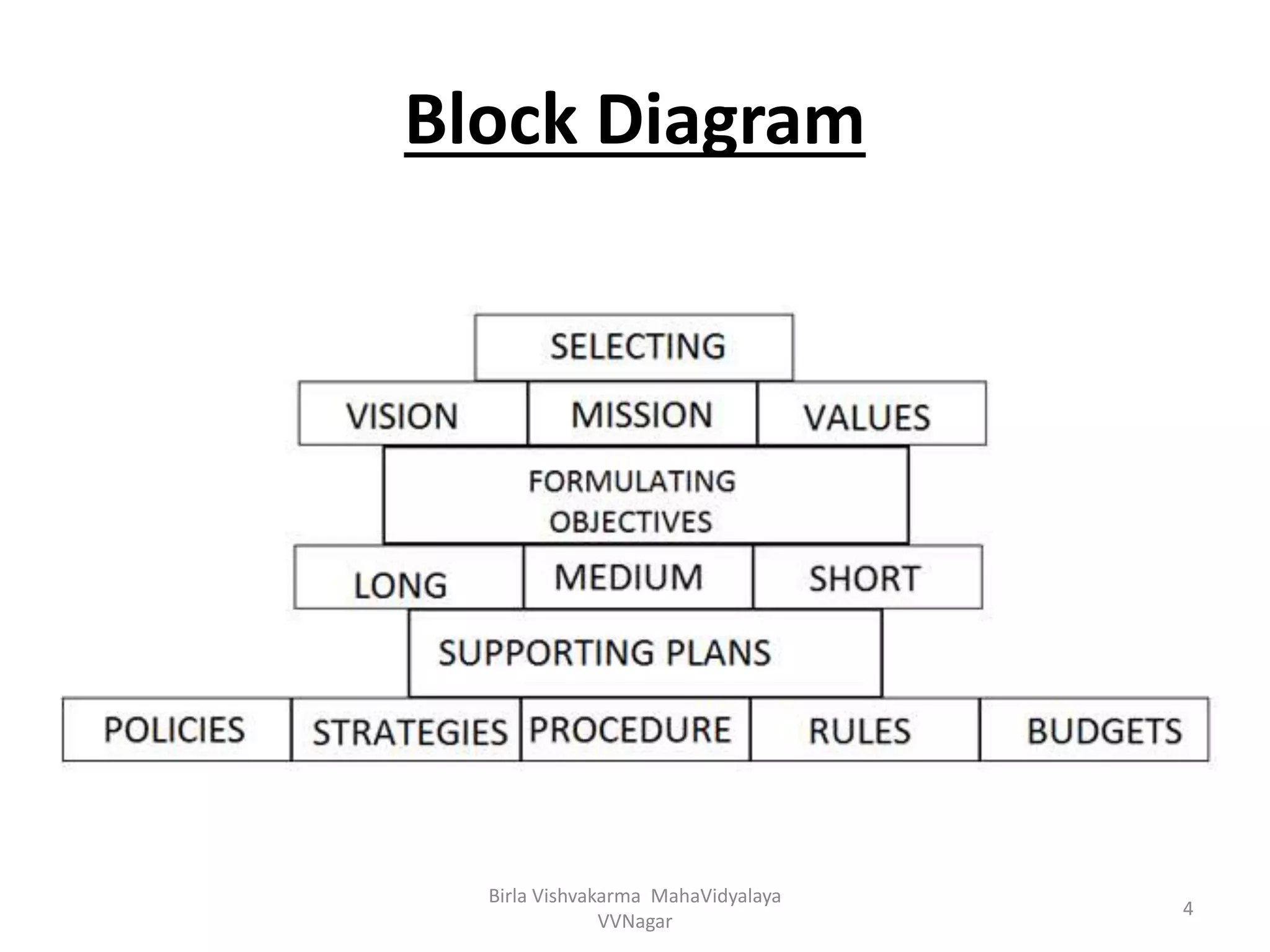
Block Diagram
Birla Vishvakarma MahaVidyalaya
VVNagar
4
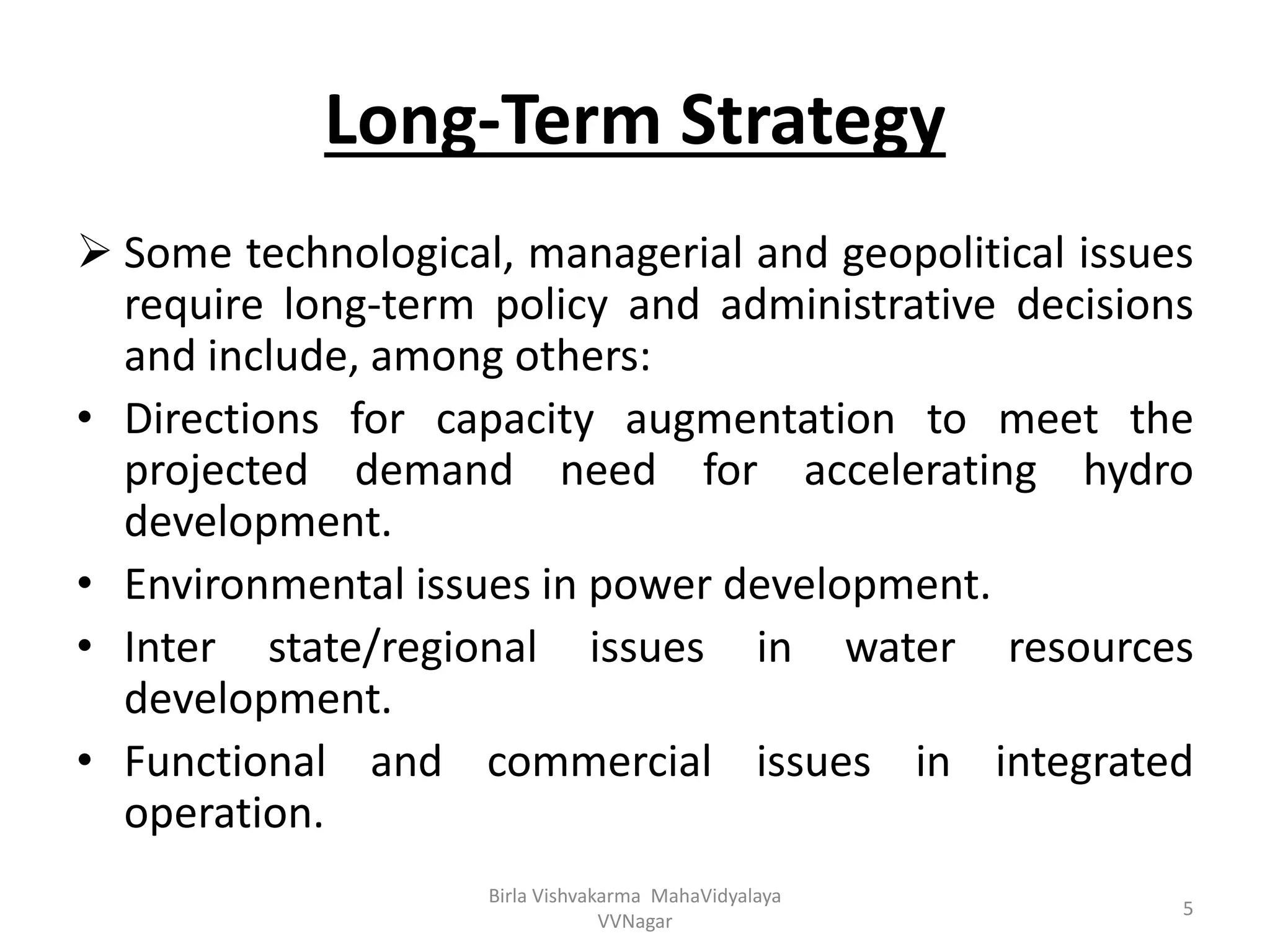
Long-Term Strategy
 Some technological, managerial and geopolitical issues
require long-term policy and administrative decisions
and include, among others:
• Directions for capacity augmentation to meet the
projected demand need for accelerating hydro
development.
• Environmental issues in power development.
• Inter state/regional issues in water resources
development.
• Functional and commercial issues in integrated
operation.
Birla Vishvakarma MahaVidyalaya
VVNagar
5
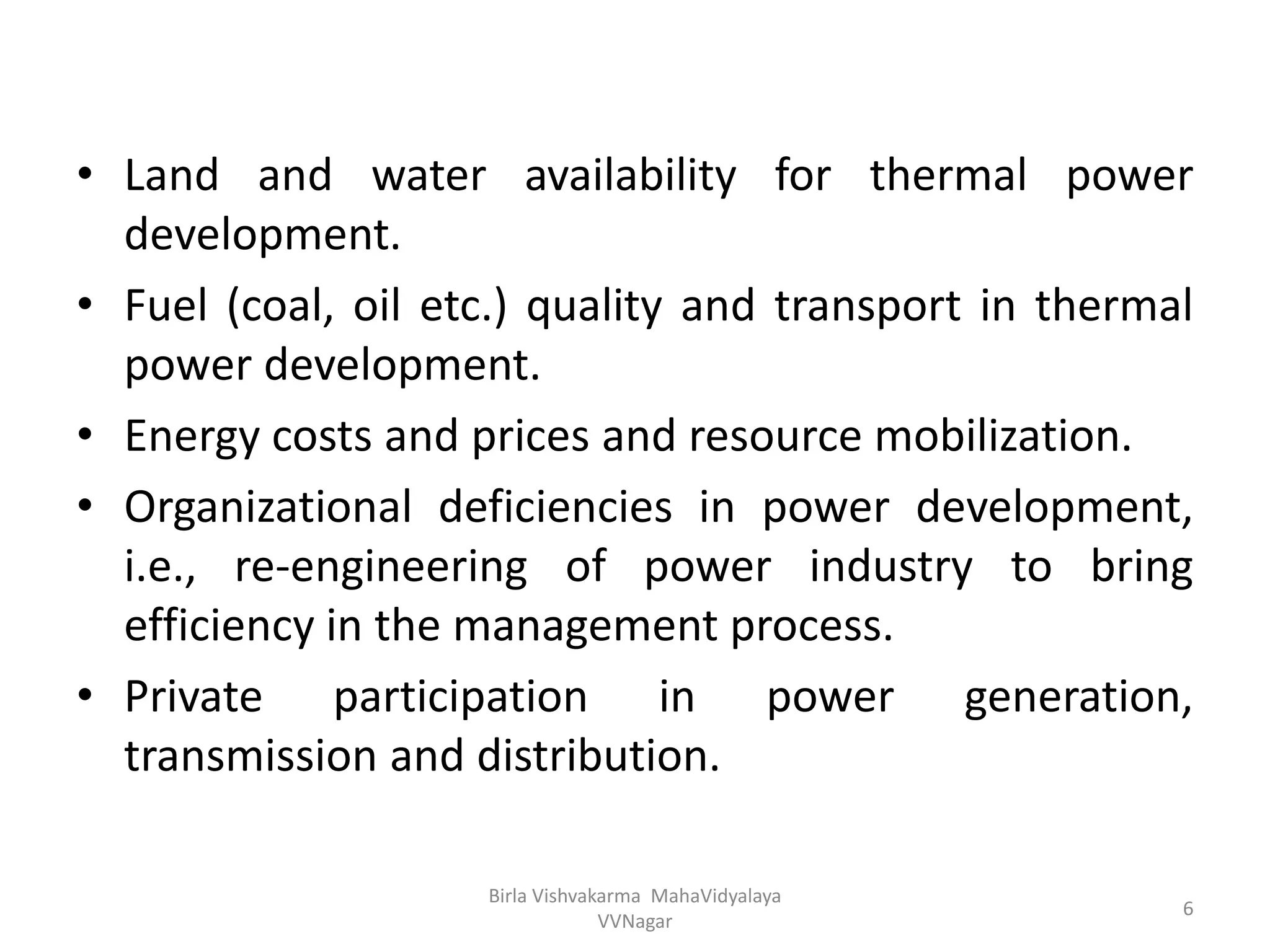
• Land and water availability for thermal power
development.
• Fuel (coal, oil etc.) quality and transport in thermal
power development.
• Energy costs and prices and resource mobilization.
• Organizational deficiencies in power development,
i.e., re-engineering of power industry to bring
efficiency in the management process.
• Private participation in power generation,
transmission and distribution.
Birla Vishvakarma MahaVidyalaya
VVNagar
6
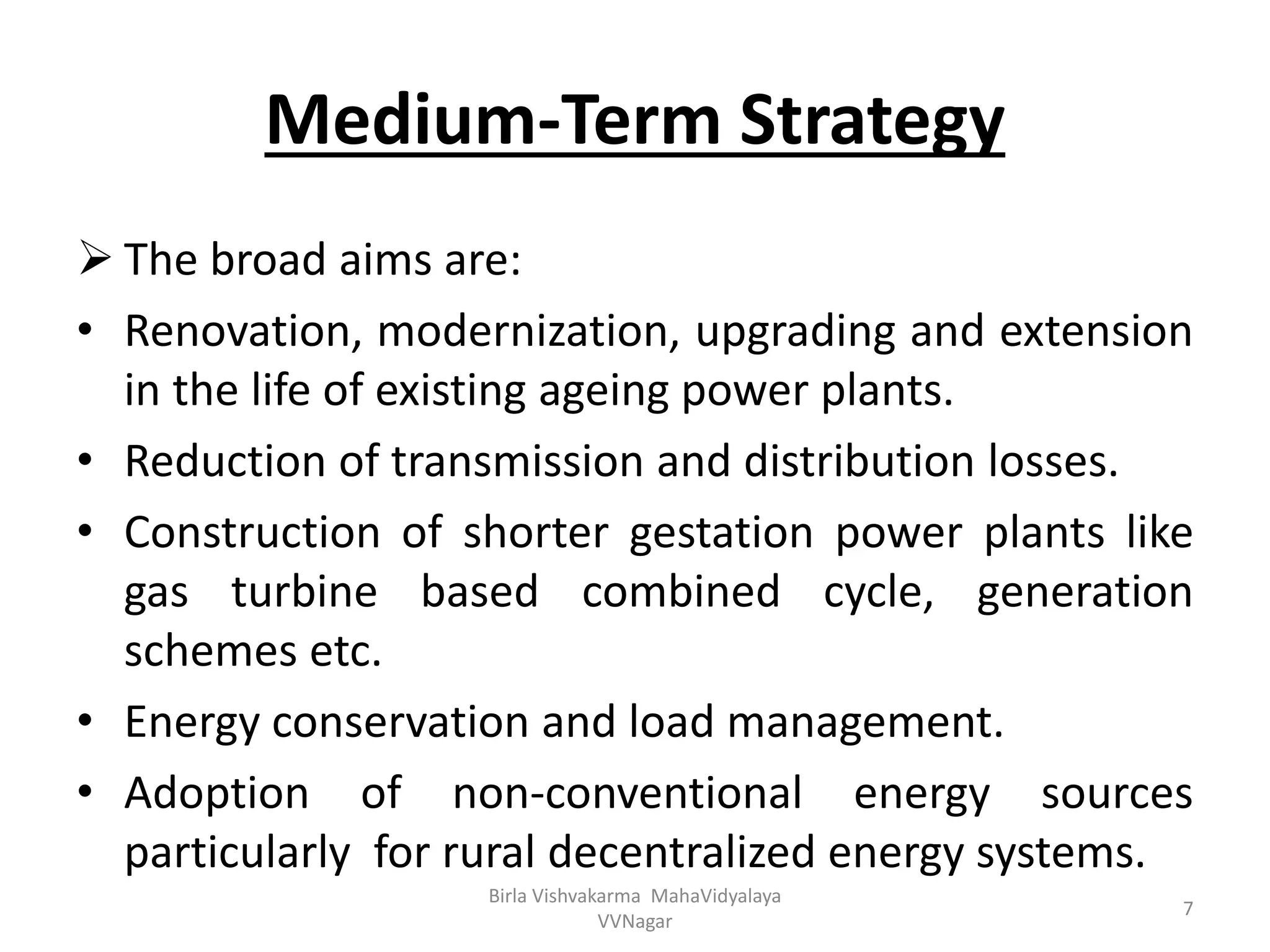
Medium-Term Strategy
 The broad aims are:
• Renovation, modernization, upgrading and extension
in the life of existing ageing power plants.
• Reduction of transmission and distribution losses.
• Construction of shorter gestation power plants like
gas turbine based combined cycle, generation
schemes etc.
• Energy conservation and load management.
• Adoption of non-conventional energy sources
particularly for rural decentralized energy systems.
Birla Vishvakarma MahaVidyalaya
VVNagar
7
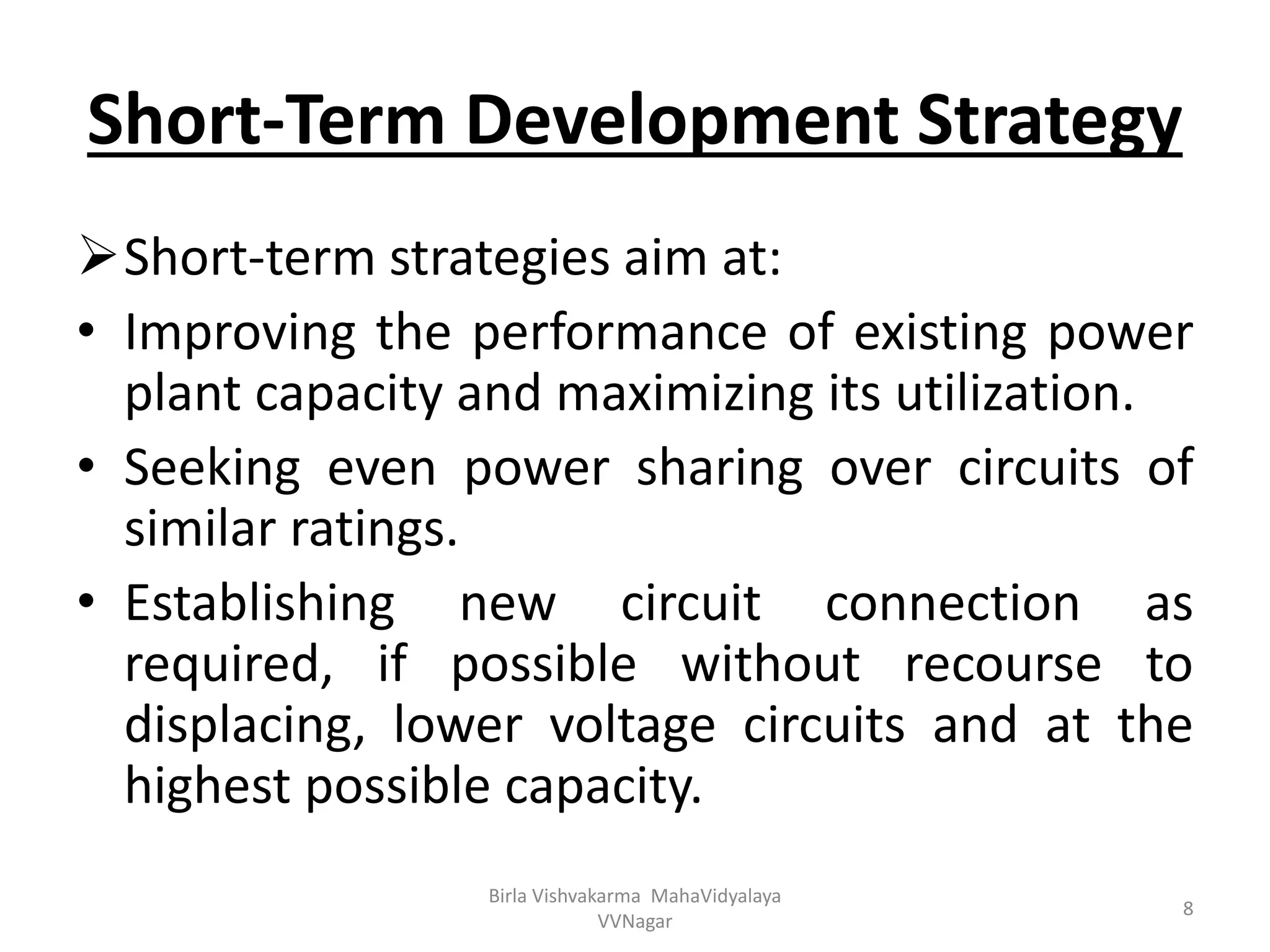
Short-Term Development Strategy
Short-term strategies aim at:
• Improving the performance of existing power
plant capacity and maximizing its utilization.
• Seeking even power sharing over circuits of
similar ratings.
• Establishing new circuit connection as
required, if possible without recourse to
displacing, lower voltage circuits and at the
highest possible capacity.
Birla Vishvakarma MahaVidyalaya
VVNagar
8
• Routing new circuits so that they may readily be
used for connection of future power stations, or
for supply points to regional grids.
• Reducing the number of levels of system voltage
used.
• Maintaining uniformly high, but acceptable fault
levels.
• Installing capacitors at various voltage levels (HT
and LT.)
• Computerizing work management system for
tracking recurring problems, materials movement
and maintenance history and to forecast
maintenance schedule.
Birla Vishvakarma MahaVidyalaya
VVNagar
9
Thank You
Birla Vishvakarma MahaVidyalaya
VVNagar
10

Components of planning with block diagram

  • 1.
    COMPONENTS OF PLANNING WITHBLOCK DIAGRAM Subject : EE653-Power system Planning and Reliability Presented By : Name :Karansinh Parmar ID No. : 16EP819 Guided By : Dr. Akshay A. Pandya
  • 2.
    Components of planning •The first step in developing a strategy is the identification of the problems and opportunities that exist. • A successful utility win have a fertile idea generating environment. To attain the vision, perform strengths, weaknesses opportunities and threats analysis and benchmarking exercises within the power utility. • The second step is to set goals (objectives). • Goal setting is not independent from identification of opportunities. Birla Vishvakarma MahaVidyalaya VVNagar 2
  • 3.
    • The thirdstep is to have a procedure for providing possible solutions. Tactical and operational planning involves this step. • The fourth step in strategic planning is to choose the best solution, given possible solutions and the objectives. • The last step is to have some type of review procedure to check how the best solution has actually performed. • The nature of this review function will depend on the performance and style of management. • To implement a strategy, develop the specific action plan. Birla Vishvakarma MahaVidyalaya VVNagar 3
  • 4.
    Block Diagram Birla VishvakarmaMahaVidyalaya VVNagar 4
  • 5.
    Long-Term Strategy  Sometechnological, managerial and geopolitical issues require long-term policy and administrative decisions and include, among others: • Directions for capacity augmentation to meet the projected demand need for accelerating hydro development. • Environmental issues in power development. • Inter state/regional issues in water resources development. • Functional and commercial issues in integrated operation. Birla Vishvakarma MahaVidyalaya VVNagar 5
  • 6.
    • Land andwater availability for thermal power development. • Fuel (coal, oil etc.) quality and transport in thermal power development. • Energy costs and prices and resource mobilization. • Organizational deficiencies in power development, i.e., re-engineering of power industry to bring efficiency in the management process. • Private participation in power generation, transmission and distribution. Birla Vishvakarma MahaVidyalaya VVNagar 6
  • 7.
    Medium-Term Strategy  Thebroad aims are: • Renovation, modernization, upgrading and extension in the life of existing ageing power plants. • Reduction of transmission and distribution losses. • Construction of shorter gestation power plants like gas turbine based combined cycle, generation schemes etc. • Energy conservation and load management. • Adoption of non-conventional energy sources particularly for rural decentralized energy systems. Birla Vishvakarma MahaVidyalaya VVNagar 7
  • 8.
    Short-Term Development Strategy Short-termstrategies aim at: • Improving the performance of existing power plant capacity and maximizing its utilization. • Seeking even power sharing over circuits of similar ratings. • Establishing new circuit connection as required, if possible without recourse to displacing, lower voltage circuits and at the highest possible capacity. Birla Vishvakarma MahaVidyalaya VVNagar 8
  • 9.
    • Routing newcircuits so that they may readily be used for connection of future power stations, or for supply points to regional grids. • Reducing the number of levels of system voltage used. • Maintaining uniformly high, but acceptable fault levels. • Installing capacitors at various voltage levels (HT and LT.) • Computerizing work management system for tracking recurring problems, materials movement and maintenance history and to forecast maintenance schedule. Birla Vishvakarma MahaVidyalaya VVNagar 9
  • 10.
    Thank You Birla VishvakarmaMahaVidyalaya VVNagar 10