Anish Abraham					17 NehaRane						20SherinMenachery	27 MeenaxiShirke					66 MamtaYadav					73Brain Child of
IntroductionBhel productsVision, Mission & ValuesSector detailsSWOT AnalysisStrategyGlobal imageConclusionFlow of the presentation
INTRODUCTION
Means by which anorganization will achieve its visionIt is a statement of design for creating a desirable future, stated in present termsExpression of strategic intent is to help individuals and organizations share the common intention to survive and continue or extend themselves through time and space.
Incorporated as Heavy Electricals (Pvt.) Limited in August 1956Manufacture electrical equipment required for generation, transmission and utilization of electrical powerHeavy Electricals (India) Limited formally merged with Bharat Heavy Electricals Limited (BHEL) in 1974
BHEL is one of the largest engineering and manufacturing enterprises in India and is one of the leading international companies in the field of powerWork force of 62,500, out of which over 11,000 are highly qualified engineersBHEL has 14 manufacturing unitsThe Company Profile
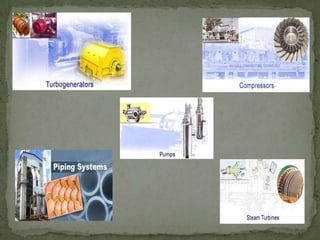
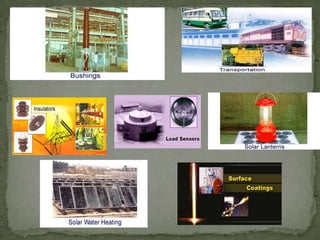
Product Range
Sector DetailsPower transmission sector, high voltage direct current (HVDC) technology. It manufactures a vast range of transformers, instrument transformers, thyristor valves, and associated control equipment.Industrial equipment sector, BHEL supplies a wide variety of electrical, electronic and mechanical equipment to a host of industries, viz. fertilizers, petrochemicals, refineries, coal, steel etc.Oil and Gas, BHEL has designed, manufactured and serviced various types of on-shore deep drilling rigs, super-deep drilling rigs, mobile rigs and desert rigs with matching draw works and hoisting equipment  Telecommunication area BHEL has manufactured electronic private automatic branch exchanges (PABXs) and rural automatic exchanges (RAXs) for IndiaNon-conventional energy, BHEL has contributed by way of manufacturing equipment like solar water heating systems, solar photo-voltaic systems and wind electric generators
Transportation sector, over 66% of the Indian Railways, is equipped with traction equipment by BHEL. Kolkata Metro is equipped with BHEL drives and controls.        Other products in the sector include traction generators/ alternators, transformers, sub-station equipment, vacuum circuit breakers, locomotive bogies, smoothing tractors, exciters, converters, inverters,  
SWOT ANALYSIS
StrengthsThe company has 180 products under 30 major product groups that cater to the needs of the core sector like power, industry, transmission, transportation, defence, telecommunications and oil business
BHEL's ability to acquire modern technology and make it suitable to Indian conditions has been an exceptional strength of the company
Quality
Cost competitiveness
After sales service
R & D
Global presenceWeaknessesThe company offers very stringent credit facilities to the customers and this is a weakness when compared in the face of rising competition.
The company is vertically integrated, which could have been avoided by outsourcing its components for power generation and transmission. This could have reduced the cost. OpportunitiesThe power sector reforms are expected to pick up in the near future in India, which would directly benefit BHEL.Increase in defence budget will increase the topline for the company.The business of modernization and renovations of power plants is expected to grow in India.The disinvestment plans of the government would bring in new     resources and experience into the company.Joint Venture with Siemens in the name of Powerplant Performance Improvement Ltd. (PPIL), is a major strength for the company. This tie-up will be beneficial as there is a lot of scope for business. During FY00 the PPIL received orders worth Rs. 320 crore.
ThreatsThe global trend of consolidation has already resulted in a fall in turnover of the company and this will prove to be a major threat in the years to come as wellUnsatisfactory financial performances
STRATEGIES
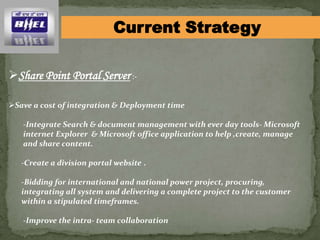
Technological StrategyResearch and Development StrategyWork-Culture and PhilosophyVendor DevelopmentQuality StrategyManufacturing StrategyFlexible Manufacturing TechnologyShare Point Portal Server Other strategies
Technological StrategyBHEL is the leader company to provide a technology to the various products.The 2 ways of adopting technological strategies are: Acquiring technology & making product out of it through licensing.
 Developing its own technology.Upgrading its product engineering and manufacturing technology base by induction of state-of-the-art technologies.
 Upgrading equipment and facilities to maintain quality leadership. BHEL is amongst the highest investors in Research and Development in the country.The R&D efforts have made significant contributions to almost all areas of operation of BHEL; a few among them are:Research and Development Strategy
Atmospheric Bubbling fluidized bed Combustion (FBC) boiler up to 100 tones/hr.Direct Ignition of Pulverized Coal (DIPC).Ceramic liners for abrasion resistance application in thermal power plants.Absorption of know-how from its international collaborators and integrating them with indigenous developments in its R&D facilities.
Work-Culture and PhilosophyIt conducts regular training programs for its employees to develop them into fulfilled individuals and effective managers.Training programs include:     General management       Behavioral science      Functional management
Advantages of training programs:Development of a committed and motivated work force.Encouragement to all employees to participate in all activities.
Vendor DevelopmentGlobal meeting of about 200 vendors was held at Hardwar
Achieve highest international standards of quality at every stage of operationCorporate quality departmentQuality Strategy
Manufacturing StrategyFlexible Manufacturing Systems (FMSs), Automated Guided Vehicles (AGVs), robotics, Automated Storage and Retrieval Systems (ASRSs), Computer Aided Design (CAD), and Computer Aided Manufacturing (CAM)Acquire more and more advanced machines whereby the productivity can be improved, cycle time reduced, cost of production lowered and the rate of stock removal is enhanced
Flexible Manufacturing TechnologyInternational competition, shorter delivery times, targets and commitments and other internal and external factors Ideal Time ReducedReduction in delivery time and levels of inventory and WIPIncrease the productivity with an underlying strategy of maximisingprofits through lowering unit costs
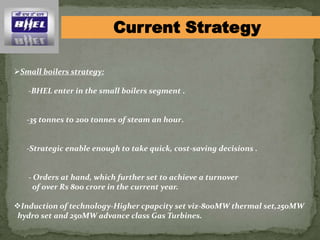
Current StrategySmall boilers strategy:        -BHEL enter in the small boilers segment.       -35 tonnes to 200 tonnes of steam an hour.       -Strategic enable enough to take quick, cost-saving decisions .        - Orders at hand, which further set to achieve a turnover          of over Rs 800 crore in the current year.   Induction of technology-Higher cpapcity set viz-800MW thermal set,250MW  hydro set and 250MW advance class Gas Turbines.
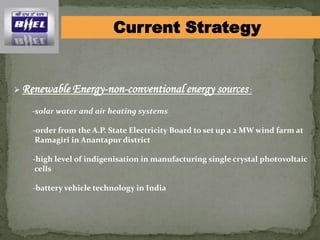
Current StrategyRenewable Energy-non-conventional energy sources :-solar water and air heating systems          -order from the A.P. State Electricity Board to set up a 2 MW wind farm at Ramagiri in Anantapur district           -high level of indigenisation in manufacturing single crystal photovoltaic            cells           -battery vehicle technology in India

Bhel

  • 2.
  • 3.
    IntroductionBhel productsVision, Mission& ValuesSector detailsSWOT AnalysisStrategyGlobal imageConclusionFlow of the presentation
  • 4.
  • 5.
    Means by whichanorganization will achieve its visionIt is a statement of design for creating a desirable future, stated in present termsExpression of strategic intent is to help individuals and organizations share the common intention to survive and continue or extend themselves through time and space.
  • 6.
    Incorporated as HeavyElectricals (Pvt.) Limited in August 1956Manufacture electrical equipment required for generation, transmission and utilization of electrical powerHeavy Electricals (India) Limited formally merged with Bharat Heavy Electricals Limited (BHEL) in 1974
  • 7.
    BHEL is oneof the largest engineering and manufacturing enterprises in India and is one of the leading international companies in the field of powerWork force of 62,500, out of which over 11,000 are highly qualified engineersBHEL has 14 manufacturing unitsThe Company Profile
  • 8.
  • 11.
    Sector DetailsPower transmissionsector, high voltage direct current (HVDC) technology. It manufactures a vast range of transformers, instrument transformers, thyristor valves, and associated control equipment.Industrial equipment sector, BHEL supplies a wide variety of electrical, electronic and mechanical equipment to a host of industries, viz. fertilizers, petrochemicals, refineries, coal, steel etc.Oil and Gas, BHEL has designed, manufactured and serviced various types of on-shore deep drilling rigs, super-deep drilling rigs, mobile rigs and desert rigs with matching draw works and hoisting equipment  Telecommunication area BHEL has manufactured electronic private automatic branch exchanges (PABXs) and rural automatic exchanges (RAXs) for IndiaNon-conventional energy, BHEL has contributed by way of manufacturing equipment like solar water heating systems, solar photo-voltaic systems and wind electric generators
  • 12.
    Transportation sector, over66% of the Indian Railways, is equipped with traction equipment by BHEL. Kolkata Metro is equipped with BHEL drives and controls. Other products in the sector include traction generators/ alternators, transformers, sub-station equipment, vacuum circuit breakers, locomotive bogies, smoothing tractors, exciters, converters, inverters,  
  • 13.
  • 14.
    StrengthsThe company has180 products under 30 major product groups that cater to the needs of the core sector like power, industry, transmission, transportation, defence, telecommunications and oil business
  • 15.
    BHEL's ability toacquire modern technology and make it suitable to Indian conditions has been an exceptional strength of the company
  • 16.
  • 17.
  • 18.
  • 19.
  • 20.
    Global presenceWeaknessesThe companyoffers very stringent credit facilities to the customers and this is a weakness when compared in the face of rising competition.
  • 21.
    The company isvertically integrated, which could have been avoided by outsourcing its components for power generation and transmission. This could have reduced the cost. OpportunitiesThe power sector reforms are expected to pick up in the near future in India, which would directly benefit BHEL.Increase in defence budget will increase the topline for the company.The business of modernization and renovations of power plants is expected to grow in India.The disinvestment plans of the government would bring in new resources and experience into the company.Joint Venture with Siemens in the name of Powerplant Performance Improvement Ltd. (PPIL), is a major strength for the company. This tie-up will be beneficial as there is a lot of scope for business. During FY00 the PPIL received orders worth Rs. 320 crore.
  • 22.
    ThreatsThe global trendof consolidation has already resulted in a fall in turnover of the company and this will prove to be a major threat in the years to come as wellUnsatisfactory financial performances
  • 23.
  • 24.
    Technological StrategyResearch andDevelopment StrategyWork-Culture and PhilosophyVendor DevelopmentQuality StrategyManufacturing StrategyFlexible Manufacturing TechnologyShare Point Portal Server Other strategies
  • 25.
    Technological StrategyBHEL isthe leader company to provide a technology to the various products.The 2 ways of adopting technological strategies are: Acquiring technology & making product out of it through licensing.
  • 26.
    Developing itsown technology.Upgrading its product engineering and manufacturing technology base by induction of state-of-the-art technologies.
  • 27.
    Upgrading equipmentand facilities to maintain quality leadership. BHEL is amongst the highest investors in Research and Development in the country.The R&D efforts have made significant contributions to almost all areas of operation of BHEL; a few among them are:Research and Development Strategy
  • 28.
    Atmospheric Bubbling fluidizedbed Combustion (FBC) boiler up to 100 tones/hr.Direct Ignition of Pulverized Coal (DIPC).Ceramic liners for abrasion resistance application in thermal power plants.Absorption of know-how from its international collaborators and integrating them with indigenous developments in its R&D facilities.
  • 29.
    Work-Culture and PhilosophyItconducts regular training programs for its employees to develop them into fulfilled individuals and effective managers.Training programs include: General management Behavioral science Functional management
  • 30.
    Advantages of trainingprograms:Development of a committed and motivated work force.Encouragement to all employees to participate in all activities.
  • 31.
    Vendor DevelopmentGlobal meetingof about 200 vendors was held at Hardwar
  • 32.
    Achieve highest internationalstandards of quality at every stage of operationCorporate quality departmentQuality Strategy
  • 33.
    Manufacturing StrategyFlexible ManufacturingSystems (FMSs), Automated Guided Vehicles (AGVs), robotics, Automated Storage and Retrieval Systems (ASRSs), Computer Aided Design (CAD), and Computer Aided Manufacturing (CAM)Acquire more and more advanced machines whereby the productivity can be improved, cycle time reduced, cost of production lowered and the rate of stock removal is enhanced
  • 34.
    Flexible Manufacturing TechnologyInternationalcompetition, shorter delivery times, targets and commitments and other internal and external factors Ideal Time ReducedReduction in delivery time and levels of inventory and WIPIncrease the productivity with an underlying strategy of maximisingprofits through lowering unit costs
  • 35.
    Current StrategySmall boilersstrategy: -BHEL enter in the small boilers segment. -35 tonnes to 200 tonnes of steam an hour. -Strategic enable enough to take quick, cost-saving decisions . - Orders at hand, which further set to achieve a turnover of over Rs 800 crore in the current year. Induction of technology-Higher cpapcity set viz-800MW thermal set,250MW hydro set and 250MW advance class Gas Turbines.
  • 36.
    Current StrategyRenewable Energy-non-conventionalenergy sources :-solar water and air heating systems -order from the A.P. State Electricity Board to set up a 2 MW wind farm at Ramagiri in Anantapur district -high level of indigenisation in manufacturing single crystal photovoltaic cells -battery vehicle technology in India