STAFFING
ABHINAND N
STAFFING
 It is concerned with the Human resources of the
enterprise.
 It is concerned with acquiring, developing, utilizing,
and maintaining human resources.
 It is a process of matching jobs with individuals to
ensure right man for the right job.
DEFINITION OF STAFFING
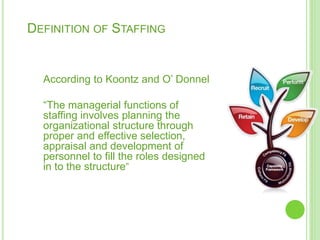
According to Koontz and O’ Donnel
“The managerial functions of
staffing involves planning the
organizational structure through
proper and effective selection,
appraisal and development of
personnel to fill the roles designed
in to the structure”
IMPORTANCE OF STAFFING
 Discovering and obtaining competent
employees for various job.
 Improve the quantity and quality of output by
putting right man for right job.
 Improves job satisfaction of employees
 Reduces cost of personnel by avoiding
wastage of human resource.
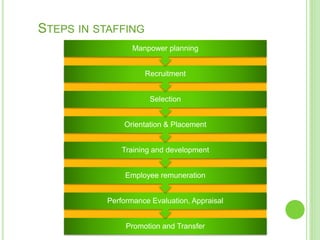
STEPS IN STAFFING
Promotion and Transfer
Performance Evaluation, Appraisal
Employee remuneration
Training and development
Orientation & Placement
Selection
Recruitment
Manpower planning
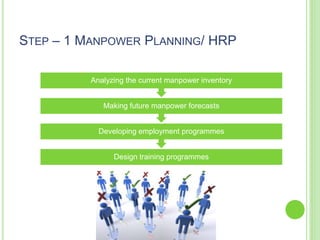
STEP – 1 MANPOWER PLANNING/ HRP
Design training programmes
Developing employment programmes
Making future manpower forecasts
Analyzing the current manpower inventory
ANALYZING THE CURRENT MANPOWER INVENTORY
Before a manager makes forecast of future
manpower, the current manpower status has to be
analyzed.
 Number of departments
 Number and quantity of such departments
 Employees in these work units
Once these factors are registered by a manager, he
goes for the future forecasting.
MANPOWER FORECASTING TECHNIQUES
Expert Forecasts: This includes informal decisions,
formal expert surveys and Delphi technique.
Trend Analysis: Manpower needs can be projected
through extrapolation (projecting past trends),
indexation (using base year as basis), and statistical
analysis (central tendency measure).
Work Load Analysis: It is dependent upon the
nature of work load in a department, in a branch or
in a division.
Work Force Analysis: Whenever production and
time period has to be analysed, due allowances
have to be made for getting net manpower
requirements.
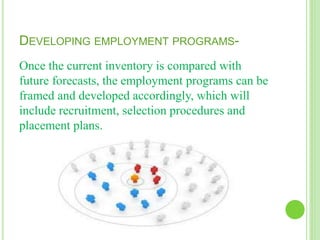
DEVELOPING EMPLOYMENT PROGRAMS-
Once the current inventory is compared with
future forecasts, the employment programs can be
framed and developed accordingly, which will
include recruitment, selection procedures and
placement plans.
DESIGN TRAINING PROGRAMS-
These will be based upon extent of diversification,
expansion plans, development programs etc.
Training programs depend upon the extent of
improvement in technology and advancement to take
place. It is also done to improve upon the skills,
capabilities, knowledge of the workers.
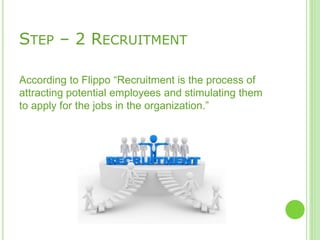
STEP – 2 RECRUITMENT
According to Flippo “Recruitment is the process of
attracting potential employees and stimulating them
to apply for the jobs in the organization.”
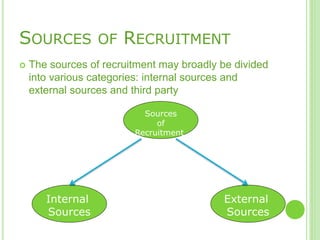
SOURCES OF RECRUITMENT
 The sources of recruitment may broadly be divided
into various categories: internal sources and
external sources and third party
External
Sources
Internal
Sources
Sources
of
Recruitment
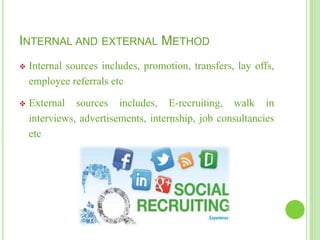
INTERNAL AND EXTERNAL METHOD
 Internal sources includes, promotion, transfers, lay offs,
employee referrals etc
 External sources includes, E-recruiting, walk in
interviews, advertisements, internship, job consultancies
etc
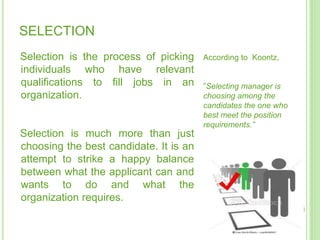
SELECTION
Selection is the process of picking
individuals who have relevant
qualifications to fill jobs in an
organization.
Selection is much more than just
choosing the best candidate. It is an
attempt to strike a happy balance
between what the applicant can and
wants to do and what the
organization requires.
According to Koontz,
”Selecting manager is
choosing among the
candidates the one who
best meet the position
requirements.”
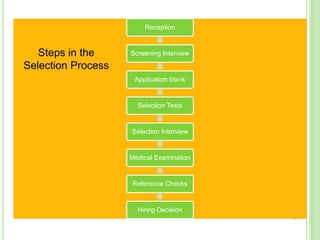
Reception
Screening Interview
Application blank
Selection Tests
Selection Interview
Medical Examination
Reference Checks
Hiring Decision
Steps in the
Selection Process
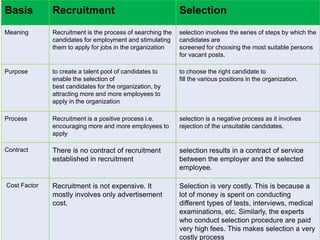
Basis Recruitment Selection
Meaning Recruitment is the process of searching the
candidates for employment and stimulating
them to apply for jobs in the organization
selection involves the series of steps by which the
candidates are
screened for choosing the most suitable persons
for vacant posts.
Purpose to create a talent pool of candidates to
enable the selection of
best candidates for the organization, by
attracting more and more employees to
apply in the organization
to choose the right candidate to
fill the various positions in the organization.
Process Recruitment is a positive process i.e.
encouraging more and more employees to
apply
selection is a negative process as it involves
rejection of the unsuitable candidates.
Contract There is no contract of recruitment
established in recruitment
selection results in a contract of service
between the employer and the selected
employee.
Cost Factor Recruitment is not expensive. It
mostly involves only advertisement
cost.
Selection is very costly. This is because a
lot of money is spent on conducting
different types of tests, interviews, medical
examinations, etc. Similarly, the experts
who conduct selection procedure are paid
very high fees. This makes selection a very
costly process
STEP- 4 ORIENTATION
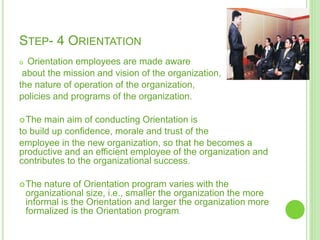
 Orientation employees are made aware
about the mission and vision of the organization,
the nature of operation of the organization,
policies and programs of the organization.
The main aim of conducting Orientation is
to build up confidence, morale and trust of the
employee in the new organization, so that he becomes a
productive and an efficient employee of the organization and
contributes to the organizational success.
The nature of Orientation program varies with the
organizational size, i.e., smaller the organization the more
informal is the Orientation and larger the organization more
formalized is the Orientation program.
STEP -5 TRAINING & DEVELOPMENT
Acc. to Michael Armstrong “the systematic
development of knowledge, skills and
attitudes required by an individual to
perform adequately a given task of job”.
Acc. to Dale S. Beach, “Training is the act
of increasing knowledge and skills of an
employee for doing a particular job.”
DEVELOPMENT
Development relates to the development
and growth of the employees in an
organization through a systematic process.
It helps in the developments of the
intellectual, managerial, and people
management skills of managers.
It trains managers to understand and
analyze different situations, and to arrive at
and implement the correct solutions.
BENEFITS OF TRAINING
Improving Employee Performance
Updating Employee Skills
Avoiding Managerial Obsolescence
Preparing for Promotion and Managerial Succession
Retaining and Motivating Employee
Creating an Efficient and Effective Organization
Improves morale of employees
Less supervision
Fewer accidents
Chances of promotion.
Increased productivity
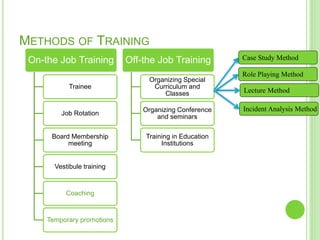
METHODS OF TRAINING
On-the Job Training
Trainee
Job Rotation
Board Membership
meeting
Vestibule training
Coaching
Temporary promotions
Off-the Job Training
Organizing Special
Curriculum and
Classes
Organizing Conference
and seminars
Training in Education
Institutions
Case Study Method
Incident Analysis Method
Lecture Method
Role Playing Method
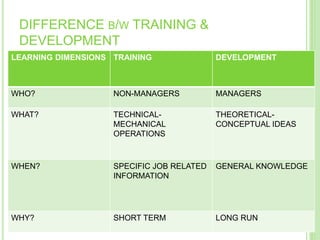
DIFFERENCE B/W TRAINING &
DEVELOPMENT
LEARNING DIMENSIONS TRAINING DEVELOPMENT
WHO? NON-MANAGERS MANAGERS
WHAT? TECHNICAL-
MECHANICAL
OPERATIONS
THEORETICAL-
CONCEPTUAL IDEAS
WHEN? SPECIFIC JOB RELATED
INFORMATION
GENERAL KNOWLEDGE
WHY? SHORT TERM LONG RUN
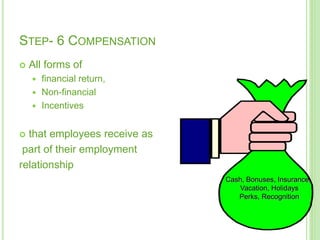
STEP- 6 COMPENSATION
 All forms of
 financial return,
 Non-financial
 Incentives
 that employees receive as
part of their employment
relationship
Cash, Bonuses, Insurance,
Vacation, Holidays
Perks, Recognition
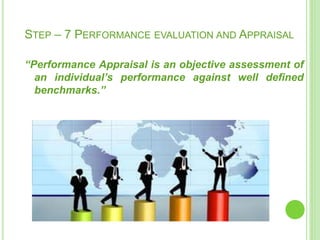
STEP – 7 PERFORMANCE EVALUATION AND APPRAISAL
“Performance Appraisal is an objective assessment of
an individual’s performance against well defined
benchmarks.”
PERFORMANCE APPRAISAL
Key Points
 Evaluation
 Comparison
Actual v/s. Standards
 Results
 Rewards
 Corrective Action
USE OF PERFORMANCE APPRAISALS
1.Promotions
2.Confirmations
3.Training and Development
4.Compensation reviews
5.Competency building
6.Improve communication
7.Evaluation of HR Programs
8.Feedback & Grievances
STAFFING
STAFFING

STAFFING

  • 1.
  • 2.
    STAFFING  It isconcerned with the Human resources of the enterprise.  It is concerned with acquiring, developing, utilizing, and maintaining human resources.  It is a process of matching jobs with individuals to ensure right man for the right job.
  • 3.
    DEFINITION OF STAFFING Accordingto Koontz and O’ Donnel “The managerial functions of staffing involves planning the organizational structure through proper and effective selection, appraisal and development of personnel to fill the roles designed in to the structure”
  • 4.
    IMPORTANCE OF STAFFING Discovering and obtaining competent employees for various job.  Improve the quantity and quality of output by putting right man for right job.  Improves job satisfaction of employees  Reduces cost of personnel by avoiding wastage of human resource.
  • 5.
    STEPS IN STAFFING Promotionand Transfer Performance Evaluation, Appraisal Employee remuneration Training and development Orientation & Placement Selection Recruitment Manpower planning
  • 6.
    STEP – 1MANPOWER PLANNING/ HRP Design training programmes Developing employment programmes Making future manpower forecasts Analyzing the current manpower inventory
  • 7.
    ANALYZING THE CURRENTMANPOWER INVENTORY Before a manager makes forecast of future manpower, the current manpower status has to be analyzed.  Number of departments  Number and quantity of such departments  Employees in these work units Once these factors are registered by a manager, he goes for the future forecasting.
  • 8.
    MANPOWER FORECASTING TECHNIQUES ExpertForecasts: This includes informal decisions, formal expert surveys and Delphi technique. Trend Analysis: Manpower needs can be projected through extrapolation (projecting past trends), indexation (using base year as basis), and statistical analysis (central tendency measure). Work Load Analysis: It is dependent upon the nature of work load in a department, in a branch or in a division. Work Force Analysis: Whenever production and time period has to be analysed, due allowances have to be made for getting net manpower requirements.
  • 9.
    DEVELOPING EMPLOYMENT PROGRAMS- Oncethe current inventory is compared with future forecasts, the employment programs can be framed and developed accordingly, which will include recruitment, selection procedures and placement plans.
  • 10.
    DESIGN TRAINING PROGRAMS- Thesewill be based upon extent of diversification, expansion plans, development programs etc. Training programs depend upon the extent of improvement in technology and advancement to take place. It is also done to improve upon the skills, capabilities, knowledge of the workers.
  • 11.
    STEP – 2RECRUITMENT According to Flippo “Recruitment is the process of attracting potential employees and stimulating them to apply for the jobs in the organization.”
  • 12.
    SOURCES OF RECRUITMENT The sources of recruitment may broadly be divided into various categories: internal sources and external sources and third party External Sources Internal Sources Sources of Recruitment
  • 13.
    INTERNAL AND EXTERNALMETHOD  Internal sources includes, promotion, transfers, lay offs, employee referrals etc  External sources includes, E-recruiting, walk in interviews, advertisements, internship, job consultancies etc
  • 14.
    SELECTION Selection is theprocess of picking individuals who have relevant qualifications to fill jobs in an organization. Selection is much more than just choosing the best candidate. It is an attempt to strike a happy balance between what the applicant can and wants to do and what the organization requires. According to Koontz, ”Selecting manager is choosing among the candidates the one who best meet the position requirements.”
  • 15.
    Reception Screening Interview Application blank SelectionTests Selection Interview Medical Examination Reference Checks Hiring Decision Steps in the Selection Process
  • 16.
    Basis Recruitment Selection MeaningRecruitment is the process of searching the candidates for employment and stimulating them to apply for jobs in the organization selection involves the series of steps by which the candidates are screened for choosing the most suitable persons for vacant posts. Purpose to create a talent pool of candidates to enable the selection of best candidates for the organization, by attracting more and more employees to apply in the organization to choose the right candidate to fill the various positions in the organization. Process Recruitment is a positive process i.e. encouraging more and more employees to apply selection is a negative process as it involves rejection of the unsuitable candidates. Contract There is no contract of recruitment established in recruitment selection results in a contract of service between the employer and the selected employee. Cost Factor Recruitment is not expensive. It mostly involves only advertisement cost. Selection is very costly. This is because a lot of money is spent on conducting different types of tests, interviews, medical examinations, etc. Similarly, the experts who conduct selection procedure are paid very high fees. This makes selection a very costly process
  • 17.
    STEP- 4 ORIENTATION Orientation employees are made aware about the mission and vision of the organization, the nature of operation of the organization, policies and programs of the organization. The main aim of conducting Orientation is to build up confidence, morale and trust of the employee in the new organization, so that he becomes a productive and an efficient employee of the organization and contributes to the organizational success. The nature of Orientation program varies with the organizational size, i.e., smaller the organization the more informal is the Orientation and larger the organization more formalized is the Orientation program.
  • 18.
    STEP -5 TRAINING& DEVELOPMENT Acc. to Michael Armstrong “the systematic development of knowledge, skills and attitudes required by an individual to perform adequately a given task of job”. Acc. to Dale S. Beach, “Training is the act of increasing knowledge and skills of an employee for doing a particular job.”
  • 19.
    DEVELOPMENT Development relates tothe development and growth of the employees in an organization through a systematic process. It helps in the developments of the intellectual, managerial, and people management skills of managers. It trains managers to understand and analyze different situations, and to arrive at and implement the correct solutions.
  • 20.
    BENEFITS OF TRAINING ImprovingEmployee Performance Updating Employee Skills Avoiding Managerial Obsolescence Preparing for Promotion and Managerial Succession Retaining and Motivating Employee Creating an Efficient and Effective Organization Improves morale of employees Less supervision Fewer accidents Chances of promotion. Increased productivity
  • 21.
    METHODS OF TRAINING On-theJob Training Trainee Job Rotation Board Membership meeting Vestibule training Coaching Temporary promotions Off-the Job Training Organizing Special Curriculum and Classes Organizing Conference and seminars Training in Education Institutions Case Study Method Incident Analysis Method Lecture Method Role Playing Method
  • 22.
    DIFFERENCE B/W TRAINING& DEVELOPMENT LEARNING DIMENSIONS TRAINING DEVELOPMENT WHO? NON-MANAGERS MANAGERS WHAT? TECHNICAL- MECHANICAL OPERATIONS THEORETICAL- CONCEPTUAL IDEAS WHEN? SPECIFIC JOB RELATED INFORMATION GENERAL KNOWLEDGE WHY? SHORT TERM LONG RUN
  • 23.
    STEP- 6 COMPENSATION All forms of  financial return,  Non-financial  Incentives  that employees receive as part of their employment relationship Cash, Bonuses, Insurance, Vacation, Holidays Perks, Recognition
  • 24.
    STEP – 7PERFORMANCE EVALUATION AND APPRAISAL “Performance Appraisal is an objective assessment of an individual’s performance against well defined benchmarks.”
  • 25.
    PERFORMANCE APPRAISAL Key Points Evaluation  Comparison Actual v/s. Standards  Results  Rewards  Corrective Action
  • 26.
    USE OF PERFORMANCEAPPRAISALS 1.Promotions 2.Confirmations 3.Training and Development 4.Compensation reviews 5.Competency building 6.Improve communication 7.Evaluation of HR Programs 8.Feedback & Grievances