POWER : DRIVING INDIA BY SUDIPTA SAR
Overview – observing industry Industry structure Sectorial overview Industry Analysis Conclusion AGENDA
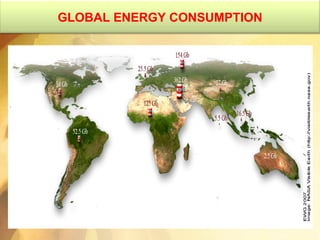
GLOBAL ENERGY CONSUMPTION
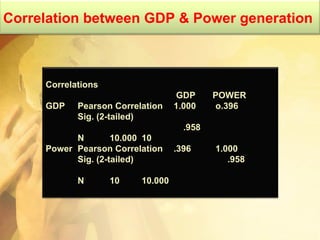
Correlation between GDP & Power generation  Correlations     GDP  POWER GDP Pearson Correlation 1.000   o.396 Sig. (2-tailed)   .958 N 10.000 10 Power Pearson Correlation .396   1.000 Sig. (2-tailed)   .958 N 10 10.000
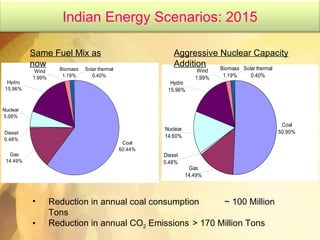
Same Fuel Mix as now Aggressive Nuclear Capacity Addition Reduction in annual coal consumption ~ 100 Million Tons Reduction in annual CO 2  Emissions > 170 Million Tons Indian Energy Scenarios: 2015
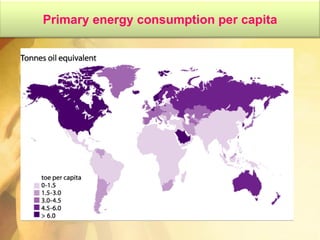
Primary energy consumption per capita
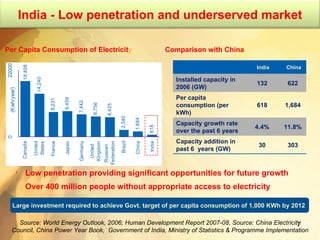
Low penetration providing significant opportunities for future growth  Over 400 million people without appropriate access to electricity   Source: World Energy Outlook, 2006; Human Development Report 2007-08, Source: China Electricity Council, China Power Year Book,  Government of India, Ministry of Statistics & Programme Implementation Per Capita Consumption of Electricit y Large investment required to achieve Govt. target of per capita consumption of 1,000 KWh by 2012  Comparison with China India - Low penetration and underserved market India China Installed capacity in 2006 (GW) 132 622 Per capita consumption (per kWh) 618 1,684 Capacity growth rate over the past 6 years 4.4% 11.8% Capacity addition in past 6  years (GW) 30 303
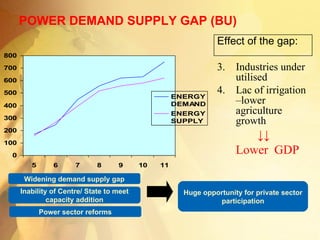
POWER DEMAND SUPPLY GAP (BU) Effect of the gap: Industries under utilised Lac of irrigation –lower agriculture growth ↓↓ Lower  GDP Widening demand supply gap Inability of Centre/ State to meet capacity addition Power sector reforms Huge opportunity for private sector participation \\ \
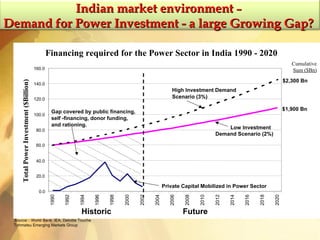
$2,300 Bn  $1,900 Bn High Investment Demand Scenario (3%) Low Investment Demand Scenario (2%) Historic Future Private Capital Mobilized in Power Sector Gap covered by public financing,  self - financing, donor funding,  and rationing. Total Power Investment ($Billion) Cumulative Sum ($Bn) Source:  : World Bank, IEA, Deloitte Touche Tohmatsu Emerging Markets Group Financing required for the Power Sector in India 1990 - 2020 0.0 20.0 40.0 60.0 80.0 100.0 120.0 140.0 160.0 1990 1992 1994 1996 1998 2000 2002 2004 2006 2008 2010 2012 2014 2016 2018 2020 Indian market environment  –  Demand for Power Investment - a large Growing Gap?
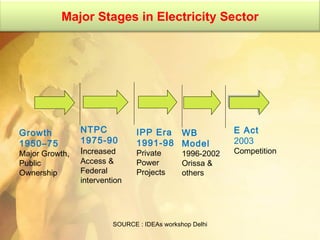
SOURCE : IDEAs workshop Delhi Major Stages in Electricity Sector NTPC 1975-90   I ncreased Access & Federal intervention Growth 1950–75   Major Growth, Public Ownership  IPP Era 1991-98  Private Power Projects E Act  2003  Competition WB Model  1996-2002 Orissa &  others
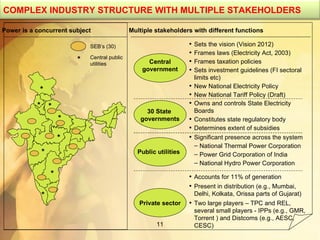
Power is a concurrent subject Multiple stakeholders with different functions  Sets the vision (Vision 2012) Frames laws (Electricity Act, 2003) Frames taxation policies  Sets investment guidelines (FI sectoral limits etc) New National Electricity Policy New National Tariff Policy (Draft) Owns and controls State Electricity Boards Constitutes state regulatory body Determines extent of subsidies Significant presence across the system National Thermal Power Corporation  Power Grid Corporation of India National Hydro Power Corporation SEB’s (30) Central public utilities  * Accounts for 11% of generation Present in distribution (e.g., Mumbai, Delhi, Kolkata, Orissa parts of Gujarat) Two large players – TPC and REL, several small players - IPPs (e.g., GMR, Torrent ) and Distcoms (e.g., AESC, CESC) COMPLEX INDUSTRY STRUCTURE WITH MULTIPLE STAKEHOLDERS Central government 30 State  governments Public utilities  * * * * * * * * Private sector
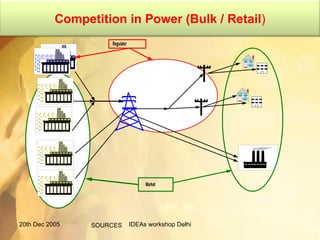
20th Dec 2005 IDEAs workshop Delhi SOURCES Competition in Power (Bulk / Retail )
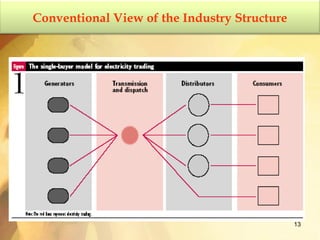
Conventional View of the Industry Structure
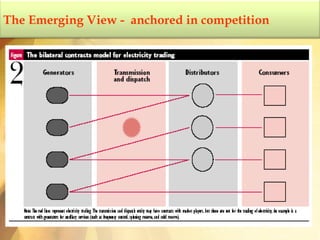
The Emerging View -  anchored in competition
 
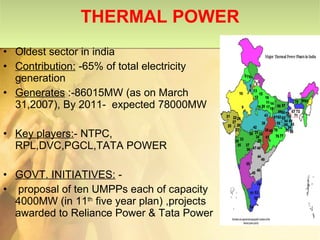
THERMAL POWER Oldest sector in india  Contribution:  -65% of total electricity generation Generates  :-86015MW (as on March 31,2007), By 2011-  expected 78000MW Key players: - NTPC, RPL,DVC,PGCL,TATA POWER GOVT. INITIATIVES:  - proposal of ten UMPPs each of capacity 4000MW (in 11 th  five year plan) ,projects awarded to Reliance Power & Tata Power
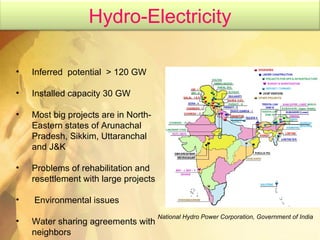
Inferred  potential  > 120 GW Installed capacity 30 GW Most big projects are in North-Eastern states of Arunachal Pradesh, Sikkim, Uttaranchal and J&K Problems of rehabilitation and resettlement with large projects Environmental issues Water sharing agreements with neighbors National Hydro Power Corporation, Government of India Hydro-Electricity
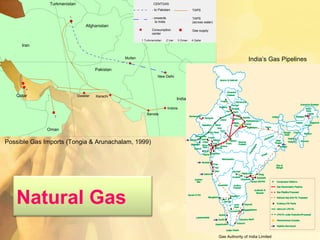
Possible Gas Imports (Tongia & Arunachalam, 1999) Natural Gas Gas Authority of India Limited India’s Gas Pipelines
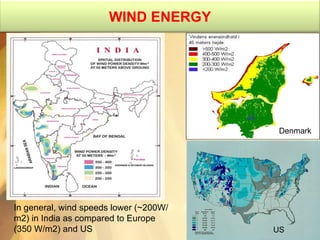
In general, wind speeds lower (~200W/m2) in India as compared to Europe (350 W/m2) and US WIND ENERGY Denmark US
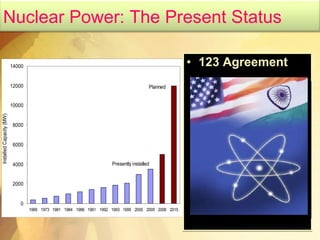
123 Agreement Nuclear Power: The Present Status
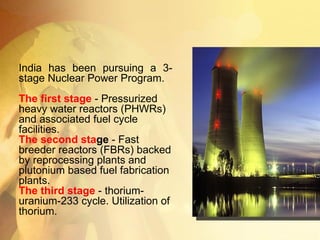
India has been pursuing a 3-stage Nuclear Power Program. The first stage  - Pressurized heavy water reactors (PHWRs) and associated fuel cycle facilities.  The second sta ge  - Fast breeder reactors (FBRs) backed by reprocessing plants and plutonium based fuel fabrication plants.  The third stage   - thorium-uranium-233 cycle. Utilization of thorium.
THANK YOU

Power Ppt

  • 1.
    POWER : DRIVINGINDIA BY SUDIPTA SAR
  • 2.
    Overview – observingindustry Industry structure Sectorial overview Industry Analysis Conclusion AGENDA
  • 3.
  • 4.
    Correlation between GDP& Power generation Correlations GDP POWER GDP Pearson Correlation 1.000 o.396 Sig. (2-tailed) .958 N 10.000 10 Power Pearson Correlation .396 1.000 Sig. (2-tailed) .958 N 10 10.000
  • 5.
    Same Fuel Mixas now Aggressive Nuclear Capacity Addition Reduction in annual coal consumption ~ 100 Million Tons Reduction in annual CO 2 Emissions > 170 Million Tons Indian Energy Scenarios: 2015
  • 6.
  • 7.
    Low penetration providingsignificant opportunities for future growth Over 400 million people without appropriate access to electricity Source: World Energy Outlook, 2006; Human Development Report 2007-08, Source: China Electricity Council, China Power Year Book, Government of India, Ministry of Statistics & Programme Implementation Per Capita Consumption of Electricit y Large investment required to achieve Govt. target of per capita consumption of 1,000 KWh by 2012 Comparison with China India - Low penetration and underserved market India China Installed capacity in 2006 (GW) 132 622 Per capita consumption (per kWh) 618 1,684 Capacity growth rate over the past 6 years 4.4% 11.8% Capacity addition in past 6 years (GW) 30 303
  • 8.
    POWER DEMAND SUPPLYGAP (BU) Effect of the gap: Industries under utilised Lac of irrigation –lower agriculture growth ↓↓ Lower GDP Widening demand supply gap Inability of Centre/ State to meet capacity addition Power sector reforms Huge opportunity for private sector participation \\ \
  • 9.
    $2,300 Bn $1,900 Bn High Investment Demand Scenario (3%) Low Investment Demand Scenario (2%) Historic Future Private Capital Mobilized in Power Sector Gap covered by public financing, self - financing, donor funding, and rationing. Total Power Investment ($Billion) Cumulative Sum ($Bn) Source: : World Bank, IEA, Deloitte Touche Tohmatsu Emerging Markets Group Financing required for the Power Sector in India 1990 - 2020 0.0 20.0 40.0 60.0 80.0 100.0 120.0 140.0 160.0 1990 1992 1994 1996 1998 2000 2002 2004 2006 2008 2010 2012 2014 2016 2018 2020 Indian market environment – Demand for Power Investment - a large Growing Gap?
  • 10.
    SOURCE : IDEAsworkshop Delhi Major Stages in Electricity Sector NTPC 1975-90 I ncreased Access & Federal intervention Growth 1950–75 Major Growth, Public Ownership IPP Era 1991-98 Private Power Projects E Act 2003 Competition WB Model 1996-2002 Orissa & others
  • 11.
    Power is aconcurrent subject Multiple stakeholders with different functions Sets the vision (Vision 2012) Frames laws (Electricity Act, 2003) Frames taxation policies Sets investment guidelines (FI sectoral limits etc) New National Electricity Policy New National Tariff Policy (Draft) Owns and controls State Electricity Boards Constitutes state regulatory body Determines extent of subsidies Significant presence across the system National Thermal Power Corporation Power Grid Corporation of India National Hydro Power Corporation SEB’s (30) Central public utilities * Accounts for 11% of generation Present in distribution (e.g., Mumbai, Delhi, Kolkata, Orissa parts of Gujarat) Two large players – TPC and REL, several small players - IPPs (e.g., GMR, Torrent ) and Distcoms (e.g., AESC, CESC) COMPLEX INDUSTRY STRUCTURE WITH MULTIPLE STAKEHOLDERS Central government 30 State governments Public utilities * * * * * * * * Private sector
  • 12.
    20th Dec 2005IDEAs workshop Delhi SOURCES Competition in Power (Bulk / Retail )
  • 13.
    Conventional View ofthe Industry Structure
  • 14.
    The Emerging View- anchored in competition
  • 15.
  • 16.
    THERMAL POWER Oldestsector in india Contribution: -65% of total electricity generation Generates :-86015MW (as on March 31,2007), By 2011- expected 78000MW Key players: - NTPC, RPL,DVC,PGCL,TATA POWER GOVT. INITIATIVES: - proposal of ten UMPPs each of capacity 4000MW (in 11 th five year plan) ,projects awarded to Reliance Power & Tata Power
  • 17.
    Inferred potential > 120 GW Installed capacity 30 GW Most big projects are in North-Eastern states of Arunachal Pradesh, Sikkim, Uttaranchal and J&K Problems of rehabilitation and resettlement with large projects Environmental issues Water sharing agreements with neighbors National Hydro Power Corporation, Government of India Hydro-Electricity
  • 18.
    Possible Gas Imports(Tongia & Arunachalam, 1999) Natural Gas Gas Authority of India Limited India’s Gas Pipelines
  • 19.
    In general, windspeeds lower (~200W/m2) in India as compared to Europe (350 W/m2) and US WIND ENERGY Denmark US
  • 20.
    123 Agreement NuclearPower: The Present Status
  • 21.
    India has beenpursuing a 3-stage Nuclear Power Program. The first stage - Pressurized heavy water reactors (PHWRs) and associated fuel cycle facilities. The second sta ge - Fast breeder reactors (FBRs) backed by reprocessing plants and plutonium based fuel fabrication plants. The third stage - thorium-uranium-233 cycle. Utilization of thorium.
  • 22.