PRESENTER:
Mandeep Kaur
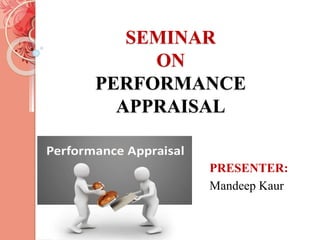
SEMINAR
ON
PERFORMANCE
APPRAISAL
DEFINITION
According to Edwin B Flippo,
“Performance appraisal is a systematic,
periodic and so far as humanly possible, an
impartial rating of an employee’s excellence in
matters pertaining to his present job and to his
potentialities for a better job.”
According to Scott, Clothier and
Spriegal, “Performance appraisal is a
record of progress for apprentices and
regular employees, as a guide in making
promotions, transfer or demotions, as a
guide in making lists for bonus distribution,
for seniority consideration and for rates of
pay, as an instrument for discovering hidden
genius, and as a source of information that
makes conferences with employees
helpful”.
OBJECTIVES OF APPRAISAL
• To determine the effectiveness of employees
on their present jobs so as to decide their
benefits.
• To identify the shortcomings of employees so
as to overcome them through systematic
guidance and training.
• To find out their potential for promotion and
advancement.
PURPOSES OF PERFORMANCE
APPRAISAL
 Performance appraisal helps the management
to take decision about the salary increase of
an employee.
 The continuous evaluation of an employee
helps in improving the quality of an employee
in job performance.
 The Performance appraisal brings out the
facilities available to an employee, when the
management is prepared to provide adequate
facilities for effective performance.
 It minimizes the communication
gap between the employer and
employee.
 Promotion is given to an employee
on the basis of performance
appraisal.
 The training needs of an employee
can be identified through
performance appraisal.
 The decision for discharging an employee.
 Performance appraisal is used to transfer a person.
 The grievances of an employee are eliminated through
performance appraisal.
 The job satisfaction of an employee increases morale.
CONCEPT OF PERFORMANCE
APPRAISAL
Appraisal should be in writing and
carried at least once a year.
The performance appraisal information
should be shared with the employee.
Employee should have the opportunity
to respond in writing to the appraisal.
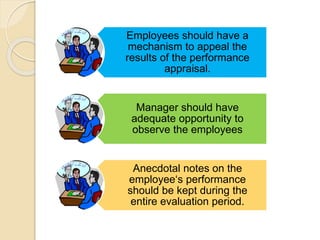
Employees should have a
mechanism to appeal the
results of the performance
appraisal.
Manager should have
adequate opportunity to
observe the employees
Anecdotal notes on the
employee‘s performance
should be kept during the
entire evaluation period.
Evaluator should be
trained to carry out
the performance
appraisal process
Performance appraisal
should focus on employee
behaviour and results
rather than on personal
traits or characteristics.
PRINCIPLES OF PERFORMANCE
APPRAISAL
Single employee is rated by two raters.
Continuous and personal observation of an
employee is essential to make effective
performance appraisal.
The rating should be done by an immediate
superior of any subordinate in an
organization.
A separate department may be created for
effective performance appraisal.
The rating is conveyed to the concerned
employee.
The plus points of an employee should be
recognised. At the same time, the minus points
should not be highlighted too much.
The management should create confidence in the
minds of employees.
The standard for each job should be determined
by the management.
Separate printed forms should be used for
performance appraisal to each job according to
the nature of the job.
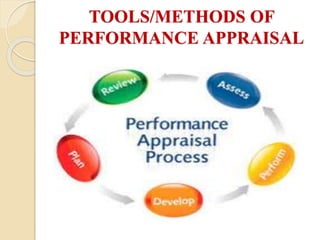
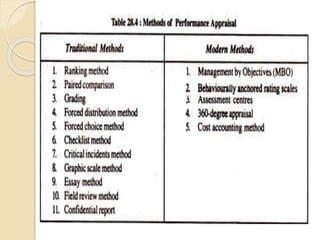
TOOLS/METHODS OF
PERFORMANCE APPRAISAL
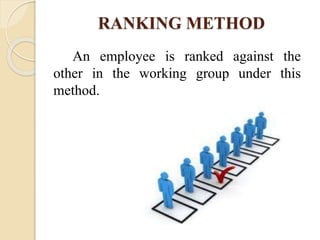
RANKING METHOD
An employee is ranked against the
other in the working group under this
method.
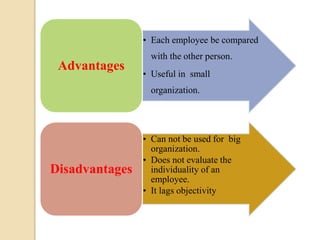
• Each employee be compared
with the other person.
• Useful in small
organization.
Advantages
• Can not be used for big
organization.
• Does not evaluate the
individuality of an
employee.
• It lags objectivity
Disadvantages
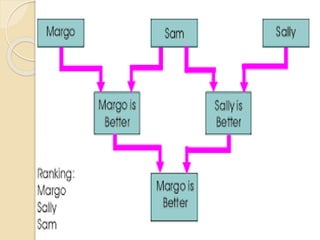
PAIRED COMPARISON METHOD
Paired comparison method has been
developed to be used in a big organization.
Each employee is compared with other
employees taking only one at a time. The
evaluator compares two employees and
puts a tick mark against an employee
whom he considers a better employee.
• This method is suitable
for big organizations.
• Individual traits are
evaluated.
Advantages
• The understanding of
this method is difficult
one.
• It involves considerable
time.
Disadvantages
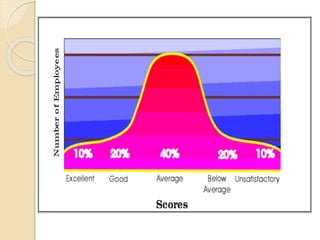
FORCED DISTRIBUTION
METHOD
A method which forces the rater to distribute
the ratings of the overall performance of an
employee is known as forced distribution
method.
Group wise rating is done under this method.
This method is suitable to large organizations,
but the individual traits could not be appraised
under this method.
Example: a group of workers doing the same
job would fall into the same group as superior, at
and above average, below average and poor.
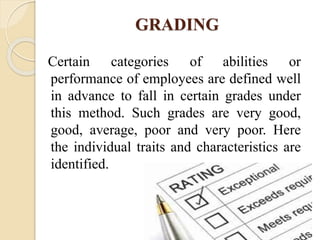
GRADING
Certain categories of abilities or
performance of employees are defined well
in advance to fall in certain grades under
this method. Such grades are very good,
good, average, poor and very poor. Here
the individual traits and characteristics are
identified.
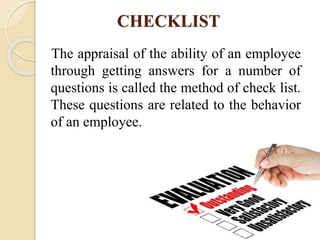
CHECKLIST
The appraisal of the ability of an employee
through getting answers for a number of
questions is called the method of check list.
These questions are related to the behavior
of an employee.
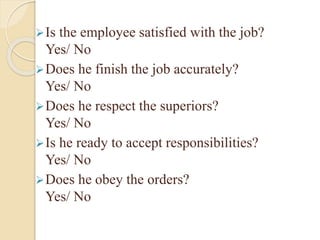
Is the employee satisfied with the job?
Yes/ No
Does he finish the job accurately?
Yes/ No
Does he respect the superiors?
Yes/ No
Is he ready to accept responsibilities?
Yes/ No
Does he obey the orders?
Yes/ No
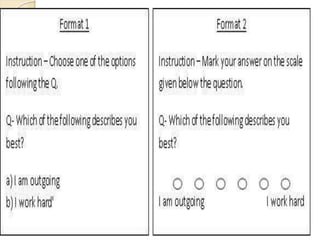
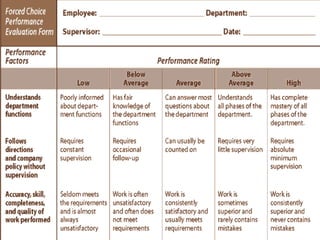
FORCED CHOICE METHOD
A series of groups of statements are
prepared positively or negatively under
this method, both these statements describe
the characteristics of an employee, but the
rater is forced to tick any one of the
statements either out of positive statements
or out of negative statements.
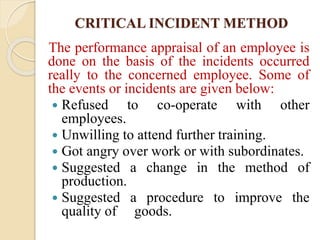
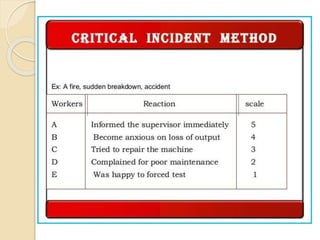
CRITICAL INCIDENT METHOD
The performance appraisal of an employee is
done on the basis of the incidents occurred
really to the concerned employee. Some of
the events or incidents are given below:
 Refused to co-operate with other
employees.
 Unwilling to attend further training.
 Got angry over work or with subordinates.
 Suggested a change in the method of
production.
 Suggested a procedure to improve the
quality of goods.
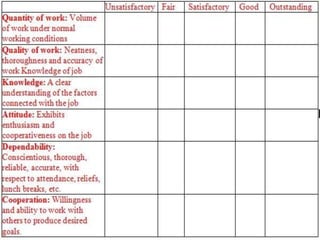
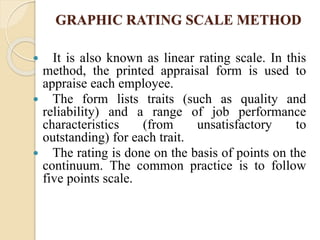
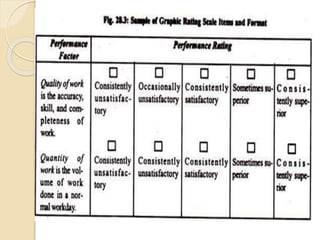
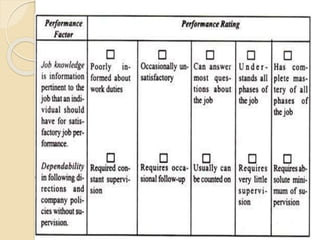
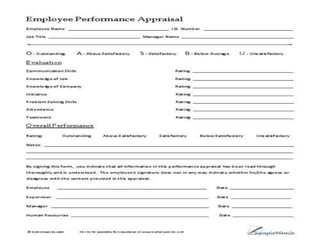
GRAPHIC RATING SCALE METHOD
 It is also known as linear rating scale. In this
method, the printed appraisal form is used to
appraise each employee.
 The form lists traits (such as quality and
reliability) and a range of job performance
characteristics (from unsatisfactory to
outstanding) for each trait.
 The rating is done on the basis of points on the
continuum. The common practice is to follow
five points scale.
FIELD REVIEW METHOD
 An employee’s performance is appraised
through an interview between the rater and the
immediate superior or superior of a concerned
employee.
 The rater asks the superiors questions about
the performance of an employee; the personnel
department prepares a detail report on the basis
of this collected information.
 A copy of this report is placed in the
personnel file of the concerned employee after
getting approval from the superior.
ESSAY EVALUATION
With easy evaluation technique the nurse
manager is required to describe the
employee’s performance over the entire
evaluation period by writing a narrative
detailing the strength and weaknesses of
the appraise.
PEER REVIEW
 The employee selects peers to conduct
the evaluation. Usually two to four
peers are identified through a pre
determined process.
 The employee submits self evaluation
port folio. The port folio might
describe how he or she met objectives
and/or pre-determined standards during
the past evaluation cycle. Supporting
materials are included.
 The peer evaluates the employee. This may
be done individually or in a group.
 Manager and employee meet to discuss the
evaluation.
APPRAISAL INTERVIEW
 Once the manager completes an accurate
evaluation of performance, he/she should
arrange an appraisal interview. The appraisal
interview is the first step in employee
development.
 They provide feedback to an employee which
enables him to improve his performance in
future.
Types of appraisal interview
 Tell and sell interview
 Tell and listen interview
 Problem solving interview
Key behaviors for an appraisal
interview
Put the employee at ease
Clearly state the purpose of the appraisal
interview
Go through the ratings one by one with the
employee.
Draw out the employee reactions to the ratings.
Decide on specific ways in which performance
areas can be strengthened.
Set a follow up date.
Express confidence in the employee.
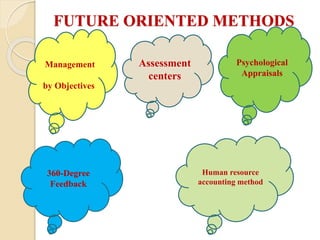
FUTURE ORIENTED METHODS
Management
by Objectives
360-Degree
Feedback
Psychological
Appraisals
Assessment
centers
Human resource
accounting method
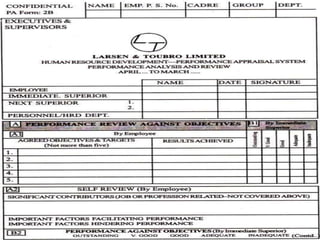
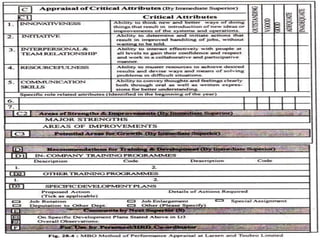
MBO
It means management by objectives and the
performance is rated against the achievement
of objectives stated by the management.
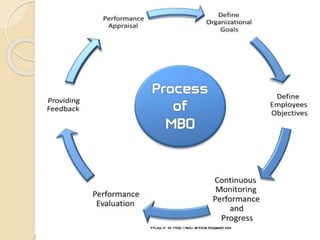
MBO process goes as under.
 Establish goals and desired outcomes for

each subordinate
 Setting performance standards
 Comparison of actual goals with goals
attained by the employee
 Establish new goals and new strategies for
goals not achieved in previous year.
Advantages
It is more useful for managerial positions.
Disadvantages
Not applicable to all jobs, allocation of merit
pay may result in setting short-term goals
rather than important and long-term goals etc.
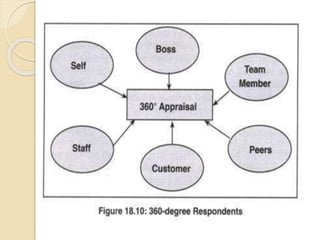
360-DEGREE FEEDBACK
 It is a technique which is systematic collection of performance data
on an individual group, derived from a number of stakeholders like
immediate supervisors, team members, customers, peers and self.
 This technique is highly useful in terms of broader perspective,
greater self-development and multi-source feedback is useful.
 360-degree appraisals are useful to measure inter-personal skills,
customer satisfaction and team building skills.
PSYCHOLOGICALAPPRAISALS
These appraisals are more directed to
assess employee’s potential for future
performance rather than the past one. It is
done in the form of in-depth interviews,
psychological tests, and discussion with
supervisors and review of other
evaluations. It is more focused on
employees emotional, intellectual, and
motivational and other personal
characteristics affecting his performance.
ASSESSMENT CENTERS
 An assessment centre typically involves the
use of methods like social/informal events,
tests and exercises, assignments being given
to a group of employees to assess their
competencies to take higher responsibilities in
the future.
 The trained evaluators observe and evaluate
employees as they perform the assigned jobs
and are evaluated on job related
characteristics.
HUMAN RESOURCE ACCOUNTING
METHOD
 Human resources are valuable assets for every
organization. Human resource accounting method tries
to find the relative worth of these assets in the terms of
money.
 In this method the Performance appraisal of the
employees is judged in terms of cost and contribution of
the employees.
 The cost of employees include all the expenses incurred
on them like their compensation, recruitment and
selection costs, induction and training costs etc whereas
their contribution includes the total value added (in
monetary terms).
 The difference between the cost and the contribution
will be the performance of the employees.
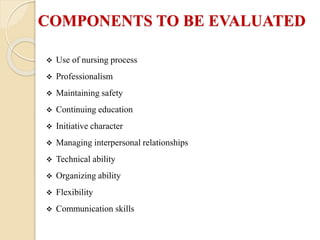
COMPONENTS TO BE EVALUATED
 Use of nursing process
 Professionalism
 Maintaining safety
 Continuing education
 Initiative character
 Managing interpersonal relationships
 Technical ability
 Organizing ability
 Flexibility
 Communication skills
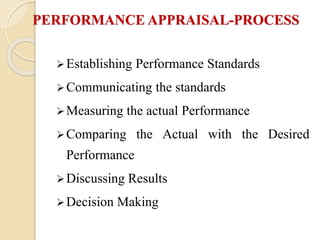
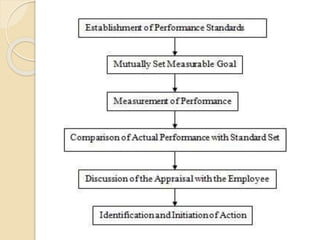
PERFORMANCE APPRAISAL-PROCESS
Establishing Performance Standards
Communicating the standards
Measuring the actual Performance
Comparing the Actual with the Desired
Performance
Discussing Results
Decision Making
LIMITATIONS OF PERFORMANCE APPRAISAL
The performance appraisal methods are unreliable.
If an employee is well known to an employer, the
performance appraisal may not be correct.
The inability of supervision to appraise an employee
does not bring out the accurate performance appraisal.
Some qualities of an employee can not be easily
appraised through any performance appraisal method.
A supervisor may appraise an employee to be good to
avoid incurring his displeasure.
Uniform standards are not followed by the
supervisors in the performance appraisal.
The principal obstacles to effective performance appraisal are:
 Lack of support from top management.
Resistance on the part of evaluators because:
 Performance appraisal demands too much of supervisors efforts in terms
of time, paperwork, and periodic observation of subordinates
performance.
 Supervisors are reluctant to play god by judging others.
 Supervisors do not fully understand the purpose and procedures of
performance appraisal.
 Supervisors lack skills in appraisal techniques.
 Performance appraisal is not perceived as being productive.
 Evaluation biases and rating errors, which result in unreliable and invalid
ratings.
 Lack of clear, objective standards of performance.
 Failure to communicate purposes and results of performance appraisal to
employees.
 Lack of a suitable appraisal tool.
 Failure to police the appraisal procedure effectively.
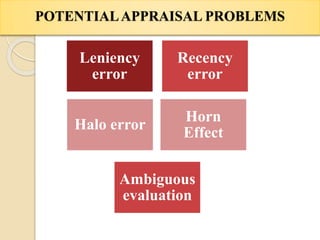
POTENTIALAPPRAISAL PROBLEMS
Leniency
error
Recency
error
Halo error
Horn
Effect
Ambiguous
evaluation
Performance appraisal

Performance appraisal

  • 1.
  • 2.
    DEFINITION According to EdwinB Flippo, “Performance appraisal is a systematic, periodic and so far as humanly possible, an impartial rating of an employee’s excellence in matters pertaining to his present job and to his potentialities for a better job.”
  • 3.
    According to Scott,Clothier and Spriegal, “Performance appraisal is a record of progress for apprentices and regular employees, as a guide in making promotions, transfer or demotions, as a guide in making lists for bonus distribution, for seniority consideration and for rates of pay, as an instrument for discovering hidden genius, and as a source of information that makes conferences with employees helpful”.
  • 4.
    OBJECTIVES OF APPRAISAL •To determine the effectiveness of employees on their present jobs so as to decide their benefits. • To identify the shortcomings of employees so as to overcome them through systematic guidance and training. • To find out their potential for promotion and advancement.
  • 5.
    PURPOSES OF PERFORMANCE APPRAISAL Performance appraisal helps the management to take decision about the salary increase of an employee.  The continuous evaluation of an employee helps in improving the quality of an employee in job performance.  The Performance appraisal brings out the facilities available to an employee, when the management is prepared to provide adequate facilities for effective performance.
  • 6.
     It minimizesthe communication gap between the employer and employee.  Promotion is given to an employee on the basis of performance appraisal.  The training needs of an employee can be identified through performance appraisal.
  • 7.
     The decisionfor discharging an employee.  Performance appraisal is used to transfer a person.  The grievances of an employee are eliminated through performance appraisal.  The job satisfaction of an employee increases morale.
  • 8.
    CONCEPT OF PERFORMANCE APPRAISAL Appraisalshould be in writing and carried at least once a year. The performance appraisal information should be shared with the employee. Employee should have the opportunity to respond in writing to the appraisal.
  • 9.
    Employees should havea mechanism to appeal the results of the performance appraisal. Manager should have adequate opportunity to observe the employees Anecdotal notes on the employee‘s performance should be kept during the entire evaluation period.
  • 10.
    Evaluator should be trainedto carry out the performance appraisal process Performance appraisal should focus on employee behaviour and results rather than on personal traits or characteristics.
  • 11.
    PRINCIPLES OF PERFORMANCE APPRAISAL Singleemployee is rated by two raters. Continuous and personal observation of an employee is essential to make effective performance appraisal. The rating should be done by an immediate superior of any subordinate in an organization. A separate department may be created for effective performance appraisal.
  • 12.
    The rating isconveyed to the concerned employee. The plus points of an employee should be recognised. At the same time, the minus points should not be highlighted too much. The management should create confidence in the minds of employees. The standard for each job should be determined by the management. Separate printed forms should be used for performance appraisal to each job according to the nature of the job.
  • 13.
  • 15.
    RANKING METHOD An employeeis ranked against the other in the working group under this method.
  • 16.
    • Each employeebe compared with the other person. • Useful in small organization. Advantages • Can not be used for big organization. • Does not evaluate the individuality of an employee. • It lags objectivity Disadvantages
  • 17.
    PAIRED COMPARISON METHOD Pairedcomparison method has been developed to be used in a big organization. Each employee is compared with other employees taking only one at a time. The evaluator compares two employees and puts a tick mark against an employee whom he considers a better employee.
  • 19.
    • This methodis suitable for big organizations. • Individual traits are evaluated. Advantages • The understanding of this method is difficult one. • It involves considerable time. Disadvantages
  • 20.
    FORCED DISTRIBUTION METHOD A methodwhich forces the rater to distribute the ratings of the overall performance of an employee is known as forced distribution method. Group wise rating is done under this method. This method is suitable to large organizations, but the individual traits could not be appraised under this method. Example: a group of workers doing the same job would fall into the same group as superior, at and above average, below average and poor.
  • 22.
    GRADING Certain categories ofabilities or performance of employees are defined well in advance to fall in certain grades under this method. Such grades are very good, good, average, poor and very poor. Here the individual traits and characteristics are identified.
  • 24.
    CHECKLIST The appraisal ofthe ability of an employee through getting answers for a number of questions is called the method of check list. These questions are related to the behavior of an employee.
  • 25.
    Is the employeesatisfied with the job? Yes/ No Does he finish the job accurately? Yes/ No Does he respect the superiors? Yes/ No Is he ready to accept responsibilities? Yes/ No Does he obey the orders? Yes/ No
  • 26.
    FORCED CHOICE METHOD Aseries of groups of statements are prepared positively or negatively under this method, both these statements describe the characteristics of an employee, but the rater is forced to tick any one of the statements either out of positive statements or out of negative statements.
  • 29.
    CRITICAL INCIDENT METHOD Theperformance appraisal of an employee is done on the basis of the incidents occurred really to the concerned employee. Some of the events or incidents are given below:  Refused to co-operate with other employees.  Unwilling to attend further training.  Got angry over work or with subordinates.  Suggested a change in the method of production.  Suggested a procedure to improve the quality of goods.
  • 31.
    GRAPHIC RATING SCALEMETHOD  It is also known as linear rating scale. In this method, the printed appraisal form is used to appraise each employee.  The form lists traits (such as quality and reliability) and a range of job performance characteristics (from unsatisfactory to outstanding) for each trait.  The rating is done on the basis of points on the continuum. The common practice is to follow five points scale.
  • 34.
    FIELD REVIEW METHOD An employee’s performance is appraised through an interview between the rater and the immediate superior or superior of a concerned employee.  The rater asks the superiors questions about the performance of an employee; the personnel department prepares a detail report on the basis of this collected information.  A copy of this report is placed in the personnel file of the concerned employee after getting approval from the superior.
  • 35.
    ESSAY EVALUATION With easyevaluation technique the nurse manager is required to describe the employee’s performance over the entire evaluation period by writing a narrative detailing the strength and weaknesses of the appraise.
  • 36.
    PEER REVIEW  Theemployee selects peers to conduct the evaluation. Usually two to four peers are identified through a pre determined process.  The employee submits self evaluation port folio. The port folio might describe how he or she met objectives and/or pre-determined standards during the past evaluation cycle. Supporting materials are included.
  • 37.
     The peerevaluates the employee. This may be done individually or in a group.  Manager and employee meet to discuss the evaluation.
  • 38.
    APPRAISAL INTERVIEW  Oncethe manager completes an accurate evaluation of performance, he/she should arrange an appraisal interview. The appraisal interview is the first step in employee development.  They provide feedback to an employee which enables him to improve his performance in future.
  • 39.
    Types of appraisalinterview  Tell and sell interview  Tell and listen interview  Problem solving interview
  • 40.
    Key behaviors foran appraisal interview Put the employee at ease Clearly state the purpose of the appraisal interview Go through the ratings one by one with the employee. Draw out the employee reactions to the ratings. Decide on specific ways in which performance areas can be strengthened. Set a follow up date. Express confidence in the employee.
  • 41.
    FUTURE ORIENTED METHODS Management byObjectives 360-Degree Feedback Psychological Appraisals Assessment centers Human resource accounting method
  • 42.
    MBO It means managementby objectives and the performance is rated against the achievement of objectives stated by the management. MBO process goes as under.  Establish goals and desired outcomes for each subordinate  Setting performance standards  Comparison of actual goals with goals attained by the employee  Establish new goals and new strategies for goals not achieved in previous year.
  • 46.
    Advantages It is moreuseful for managerial positions. Disadvantages Not applicable to all jobs, allocation of merit pay may result in setting short-term goals rather than important and long-term goals etc.
  • 47.
    360-DEGREE FEEDBACK  Itis a technique which is systematic collection of performance data on an individual group, derived from a number of stakeholders like immediate supervisors, team members, customers, peers and self.  This technique is highly useful in terms of broader perspective, greater self-development and multi-source feedback is useful.  360-degree appraisals are useful to measure inter-personal skills, customer satisfaction and team building skills.
  • 49.
    PSYCHOLOGICALAPPRAISALS These appraisals aremore directed to assess employee’s potential for future performance rather than the past one. It is done in the form of in-depth interviews, psychological tests, and discussion with supervisors and review of other evaluations. It is more focused on employees emotional, intellectual, and motivational and other personal characteristics affecting his performance.
  • 50.
    ASSESSMENT CENTERS  Anassessment centre typically involves the use of methods like social/informal events, tests and exercises, assignments being given to a group of employees to assess their competencies to take higher responsibilities in the future.  The trained evaluators observe and evaluate employees as they perform the assigned jobs and are evaluated on job related characteristics.
  • 51.
    HUMAN RESOURCE ACCOUNTING METHOD Human resources are valuable assets for every organization. Human resource accounting method tries to find the relative worth of these assets in the terms of money.  In this method the Performance appraisal of the employees is judged in terms of cost and contribution of the employees.  The cost of employees include all the expenses incurred on them like their compensation, recruitment and selection costs, induction and training costs etc whereas their contribution includes the total value added (in monetary terms).  The difference between the cost and the contribution will be the performance of the employees.
  • 53.
    COMPONENTS TO BEEVALUATED  Use of nursing process  Professionalism  Maintaining safety  Continuing education  Initiative character  Managing interpersonal relationships  Technical ability  Organizing ability  Flexibility  Communication skills
  • 54.
    PERFORMANCE APPRAISAL-PROCESS Establishing PerformanceStandards Communicating the standards Measuring the actual Performance Comparing the Actual with the Desired Performance Discussing Results Decision Making
  • 56.
    LIMITATIONS OF PERFORMANCEAPPRAISAL The performance appraisal methods are unreliable. If an employee is well known to an employer, the performance appraisal may not be correct. The inability of supervision to appraise an employee does not bring out the accurate performance appraisal. Some qualities of an employee can not be easily appraised through any performance appraisal method. A supervisor may appraise an employee to be good to avoid incurring his displeasure. Uniform standards are not followed by the supervisors in the performance appraisal.
  • 57.
    The principal obstaclesto effective performance appraisal are:  Lack of support from top management. Resistance on the part of evaluators because:  Performance appraisal demands too much of supervisors efforts in terms of time, paperwork, and periodic observation of subordinates performance.  Supervisors are reluctant to play god by judging others.  Supervisors do not fully understand the purpose and procedures of performance appraisal.  Supervisors lack skills in appraisal techniques.  Performance appraisal is not perceived as being productive.  Evaluation biases and rating errors, which result in unreliable and invalid ratings.  Lack of clear, objective standards of performance.  Failure to communicate purposes and results of performance appraisal to employees.  Lack of a suitable appraisal tool.  Failure to police the appraisal procedure effectively.
  • 58.