Energy Audit
Energy Audit
Definition: Energy audit
Types of energy audit,
Understanding energy costs
Bench marking
Energy performance
Fuel and energy substitution
Energy audit instruments
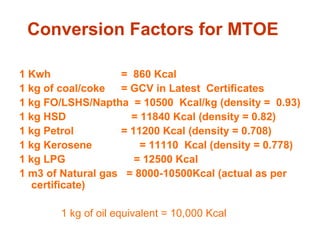
Conversion Factors for MTOE
1 Kwh = 860 Kcal
1 kg of coal/coke = GCV in Latest Certificates
1 kg FO/LSHS/Naptha = 10500 Kcal/kg (density = 0.93)
1 kg HSD = 11840 Kcal (density = 0.82)
1 kg Petrol = 11200 Kcal (density = 0.708)
1 kg Kerosene = 11110 Kcal (density = 0.778)
1 kg LPG = 12500 Kcal
1 m3 of Natural gas = 8000-10500Kcal (actual as per
certificate)
1 kg of oil equivalent = 10,000 Kcal
Energy Conservation Act
Designated consumers : Central Govt. specify
the following criteria for energy Intensive
Industries and other establishments. (As per EC
Act 2001, Section 14(e)
For Industries
Electrical connected load -5000 KW and above
or
Annual energy consumption - 30,000 MTOE
For Commercial Buildings
Connected Load - 500 KW or 600 KVA
ELECTRICITY ACT 2001
MAIN FEATURES
1. Replaced all the previous three Electricity
Laws:
– Indian Electricity Act 1910, Electricity
Supply Act 1948
– Electricity Regulatory Commission Act
1998 as amended from time to time
2. 100% metering is mandatory for 11 KV
feeder
3. 100% Rural Electrification
– Accelerated Rural electrification Program,
AREP)
– PRIs & NGOs can be participated)
– 80,000 villages yet to be electrified
ELECTRICITY ACT 2001(Contd..)
4. Private sector Investments is allowed in
Renewable Energy Sources
(Generation, Distribution, Supply area)
– No license is required for generation and
distribution of power in Rural areas.
5. Participation in power transmission
sector
6. More stringent provision for theft of
electricity
ELECTRICITY ACT 2001(Contd..)
7. Delicensed for Captive power
generation, Thermal power generation,
Hydro power generation
– can be sold directly to other consumers by
wheeling through the grid under open
access
– Banking facility is provided to captive
power plants
8. State Electricity Regulatory
Commission is mandatory for all States
Definition of Energy Audit
As per the Energy Conservation Act, 2001, Energy Audit
is defined as
“the verification, monitoring and analysis of
use of energy including submission of
technical report containing
recommendations for improving energy
efficiency with cost benefit analysis and an
action plan to reduce energy consumption
“
Objective of Energy Management
To achieve and maintain optimum energy
procurement and utilisation, throughout the
organization
To minimise energy costs / waste without affecting
production & quality
To minimise environmental effects.    
TO KNOW TECHNICAL PERFORMANCE OF MAJOR
EQUIPTMENT / SYSTEMS
TO IDENTIFY LOSS AREAS
TO ASSESS TECHNO ECONOMIC FEASIBILITY OF
ENCON OPTIONS.
ENERGY AUDIT…..
It’s a tech.Survey to analyze existing energy
utilisation practice, pinpoint areas of wastage
and to evolve energy saving schemes.
•It is an organised and systematic exercise
with top management support
•Energy audit addresses
•House keeping
•Operational improvement/retrofits
•Capital projects requiring investment
•New technology
•Energy audit helps to achieve “savings through
invisibles”.
Types of Energy Audit
1. Preliminary energy audit
2. Detailed energy audit
Safety Considerations
The audit person or team should be
thoroughly briefed on safety equipment
and procedures
Adequate safety equipment should be
worn at all appropriate times.
Auditors should be extremely careful
making any measurements on electrical
systems/on high temperature devices.
Preliminary Audit Site Survey:
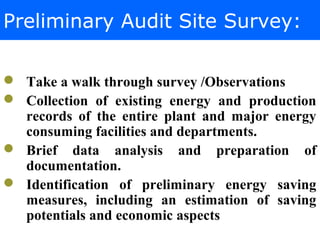
 Take a walk through survey /Observations
 Collection of existing energy and production
records of the entire plant and major energy
consuming facilities and departments.
 Brief data analysis and preparation of
documentation.
 Identification of preliminary energy saving
measures, including an estimation of saving
potentials and economic aspects
INDUSTRIAL ACTIVITIES
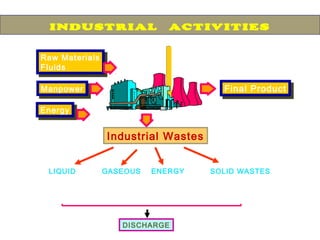
Final ProductFinal Product
Raw Materials
Fluids
Raw Materials
Fluids
ManpowerManpower
EnergyEnergy
Industrial Wastes
LIQUID
toxic, inorganic
and organic
wastewaters
GASEOUS
Emissions
SO2 , NOx,
CO, etc.
SOLID WASTES
wasted raw material
or product, sludge from
ETP
DISCHARGE
ENERGY
heated fluids,
steam, hot
emissions etc.
TYPICAL PLANT UTILITIES
& SCOPE AREAS
 BOILERS/FURNACES
 PUMPS
 FANS
 AIR COMPRESSORS
 A/C PLANTS
 COOLING TOWER
 TRANSFORMERS
 MOTORS
 DG SETS
 LIGHTING
 ELECTRIC
HEATERS
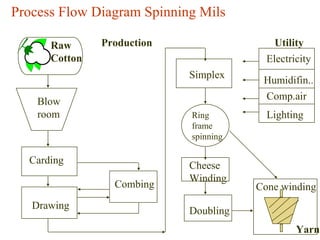
Process Flow Diagram Spinning Mils
Raw
Cotton
Blow
room
Carding
Drawing
Combing
Simplex
Ring
frame
spinning
Cheese
Winding
Doubling
Cone winding
Utility
Electricity
Humidifin..
Comp.air
Lighting
Production
Yarn
Power Consumption Pattern in
Spinning Mills
15%
45%
10%
18%
7%
5%
Pre Spinning
Spinning
Post Spinning
Humidification
Compressor
Lighting
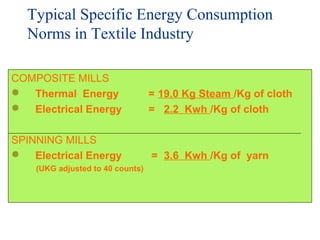
Typical Specific Energy Consumption
Norms in Textile Industry
COMPOSITE MILLS
 Thermal Energy = 19.0 Kg Steam /Kg of cloth
 Electrical Energy = 2.2 Kwh /Kg of cloth
SPINNING MILLS
 Electrical Energy = 3.6 Kwh /Kg of yarn
(UKG adjusted to 40 counts)
Preliminary Energy Audit Methodology
It uses existing and easily obtained data
Establish energy consumption pattern
Establishes base line data
Identify the most likely areas for
attention/savings
Identify immediate(no/low-cost) improvements
Identify areas for more detailed
study/measurement
Helps in planning for Detailed
audit(Team/instrument/Duration required)
Detailed Energy Audit
Evaluates all energy using system,
equipment and include detailed energy
savings and costs
Different phases of Detailed Audit
– Pre-audit Phase (Preliminary audit)
– Audit Phase (Instrumented/Comprehensive)
– Brief presentation,Report Preparation/Vendor details
collection
– Draft Report presentation and Final Presentation
– Post-Audit
PLANT ENERGY AUDIT COVERS
 ENERGY GENERATING EQUIPMENTS
 ENERGY DISTRIBUTION NETWORK
 END USE EQUIPMENTS.
OPERATIONAL FEATURES PLANT.
1. CONTINUOUS PROCESS PLANT
2. ONE/TWO SHIFT OPERATION
3. INTERMITTENT.
?????????????????
What type of energy used
How much energy is used?
How much does it cost?
Where it is used?
How efficiently it is used?
How can it be managed more efficiently
and effectively?
This is identified through carrying out
ENERGY AUDITs
STEPS INVOLVED IN ENERGY AUDIT.
1. Data Collection
2. Efficiency Evaluation
3. Loss Quantification
4. Operational Improvement Measures
5. Techno Economic Evaluation of Projects.
6. Designing Energy Data Report System
7. Instrumentation Requirement
8. Action Plan For ENCON Implementation
SCOPE OF “DEA” TO INDICATE
 CAPABILITIES & EFFICIENCY OF EQUIPMENT
 NEED FOR AUTOMATIC CONTROLS
 ADEQUACY OF MAINTENANCE
 NEED FOR IMPROVED INSTRUMENTATION
SCOPE AREAS FOR ENERGY SAVING
 COST BENEFITS OF SPECIFIC MEASURES IN SHORT /
MEDIUM / LONG TERM
 MECHANISM OF MONITORING
 VENDOR INFORMATION
 INCENTIVE SCHEMES / PROVISIONS
Detailed Energy audit tasks:-
1. Elaboration and discussion of audit
methodology.
2. Selection of plants items to be audited.
3. Collection of more detailed energy and
production data.
4. Comprehensive measurements at
selected plants items.
• Process flow and utility diagram
• Measurement survey/performance trials
1. Data analysis and calculations
2. Elaboration of energy and material
balance for the audited plant items.
7. Investigation of energy saving options
(improved maintenance of equipment,
improved energy management,
modification or rationalization of
process configuration, improved
insulation/ control of refrigeration, etc.)
8. Recommendation of feasible energy
efficiency measures.
9.Financial analysis of recommended
measures, including cost benefit
calculation.
10.Ranking of measures and elaboration of
an energy saving action plant
11.Reporting
12.Presentation to plant management
DATA COLLECTION
How Much Data ?
What Data ?
Data Availability –Plant Records-metering
How To Proceed In Case Of Data Not Available
To Know Source of Information
Experience To Device Data From Secondary
Information
Planning For Field Trials And Observation
Plant data
Present landed cost of all types of energy used in
the plant.
Types of energy used :Electricity, Fuel oil , Coal, Gas
Annual energy consumption and cost for all
purchased and internal fuel .(3 years)
Monthly purchased electricity & self generated.
• Month,kva,kwh,PF,bill amount. (Grid Power)
• Month,kva,kwh,PF,fuel cons.(Captive power plant)
Annual Production for Past 3 Financial Year
To know seasonal variation
to know production and energy trend
Electricity Tariff Structure
What are the elements of Electricity Bill ?
Elements TNEB APSEB KEB Gujarat / Maharashtra
MD Charge Rs.300/KVA RS.117/KVA <1000 kw
Minimum 90% of CMD RS.116/KVA 1000-3000
Rs.115/kva > 3000 Kw
MD Penalty Rs 600/Kva Rs. 225/Kva
Energy 3.5.00 P/Unit Rs.1.8 <400 kwh
charges Rs.1.6 >400 kwh
TOD Tariff 6 - 9 AM/PM 10AM-6PM Oct-Feb
20% more 2 PM-10PM Mar- Sep
20paise /unit more
PF minimum 0.9 0.85
PF Penalty <.9 2P unit for each 1% decrease in
PF below .85
SPECIFICATION OF MAJOR ENERGY CONVERSION
EQUPT.
• BOILERS
• HEATERS
• FURNACES
• THERMIC FLUID HEATER
• POWER GENERATING UNITS
DETAILS OF MAJOR UTILITIES(PUMPS/FANS/COMPRESSORS)
• MAKE
• TYPE
• CAPACITY
• SINGLE STAGE/MULTISTAGE
• FLOW, HEAD
• DESIGN KW – EFFICIENCY
• CAPACITY CONTROL METHOD
• ACTUAL REQUIREMENTS
• ANNUAL OPERATING HOURS
• Operating Schedule(Design and Operating parameters)
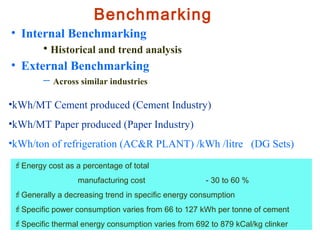
Benchmarking
• Internal Benchmarking
• Historical and trend analysis
• External Benchmarking
− Across similar industries
•kWh/MT Cement produced (Cement Industry)
•kWh/MT Paper produced (Paper Industry)
•kWh/ton of refrigeration (AC&R PLANT) /kWh /litre (DG Sets)
Energy cost as a percentage of total
manufacturing cost - 30 to 60 %
Generally a decreasing trend in specific energy consumption
Specific power consumption varies from 66 to 127 kWh per tonne of cement
Specific thermal energy consumption varies from 692 to 879 kCal/kg clinker
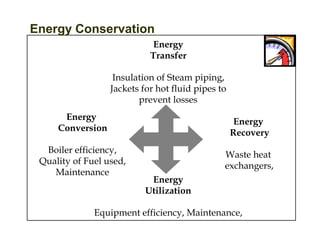
Energy
Conversion
Boiler efficiency,
Quality of Fuel used,
Maintenance
Energy
Transfer
Insulation of Steam piping,
Jackets for hot fluid pipes to
prevent losses
Energy
Utilization
Equipment efficiency, Maintenance,
Energy
Recovery
Waste heat
exchangers,
Energy Conservation
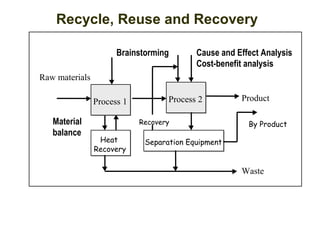
Product
Waste
Raw materials
Separation EquipmentSeparation EquipmentHeat
Recovery
Heat
Recovery
By ProductMaterial
balance
Cause and Effect Analysis
Cost-benefit analysis
Brainstorming
Process 2Process 2Process 1Process 1
Recovery
Recycle, Reuse and Recovery
Fuel and Energy Substitution
Fuel substitution
Replacement of coal by Agro fuels
Replacement of LDO by LSHS
Energy substitution
Electric heaters by steam heaters
Steam based hot water by solar systems
ENERGY AUDIT REPORT
1. ACKNOWLEDGEMENT
2. CONTENTS
3. EXECUTIVE SUMMARY
4. SUMMARY OF SAVINGS
5. INTRODUCTION
6. PLANT ENERGY SYSTEM
7. ENERGY USAGE PATTERN
8. ENERGY INDICATORS
9. ENERGY SAVING
OPTIONS/RECOMMENDATIONS
10.ANNEXURE/PLANT BASE LINE DATA
Filed observation and savings calculations.
List of suppliers .
Action plan for ENCON implementation
Technical and Economic feasibility
Name of Energy Efficiency Measure
1. Investment
• Equipments
• Civil works
• Instrumentatio
n
• Auxiliaries
2. Annual operating
costs
• Cost of capital
• Maintenance
• Manpower
• Energy
• Depreciation
3. Annual savings
• Thermal Energy
• Electrical
Energy
• Raw material
• Waste disposal
Net Savings /Year (Rs./year)
= (Annual savings-annual operating costs)
Payback period in months
= (Investment/net savings/year) x 12
Energy Audit Instruments
Electrical Measuring Instruments:
These are instruments for measuring major
electrical parameters such as kVA, kW, PF,
Hertz, kvar, Amps and Volts. In addition some
of these instruments also measure harmonics.
These instruments are applied on-line i.e on
running motors without any need to stop the
motor. Instant measurements can be taken with
hand-held meters, while more advanced ones
facilitates cumulative readings with print outs at
specified intervals.
POWER ANALYSERS
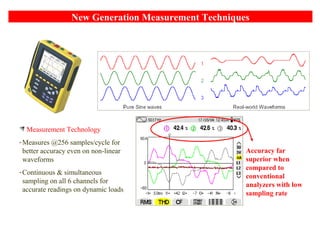
Measurement Technology
-Measures @256 samples/cycle for
better accuracy even on non-linear
waveforms
-Continuous & simultaneous
sampling on all 6 channels for
accurate readings on dynamic loads
Accuracy far
superior when
compared to
conventional
analyzers with low
sampling rate
New Generation Measurement Techniques
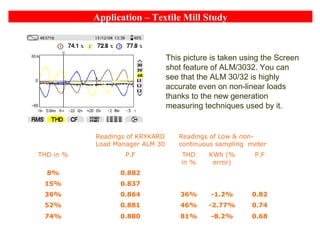
Application – Textile Mill Study
Readings of KRYKARD
Load Manager ALM 30
Readings of Low & non-
continuous sampling meter
THD in % P.F THD
in %
KWh (%
error)
P.F
8% 0.882
15% 0.837
36% 0.864 36% -1.2% 0.82
52% 0.881 46% -2.77% 0.74
74% 0.880 81% -8.2% 0.68
This picture is taken using the Screen
shot feature of ALM/3032. You can
see that the ALM 30/32 is highly
accurate even on non-linear loads
thanks to the new generation
measuring techniques used by it.
FLUE GAS ANALYSERS
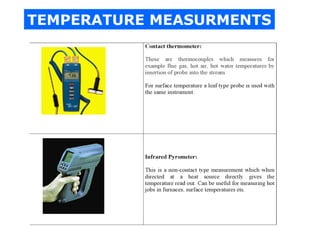
TEMPERATURE MEASURMENTS
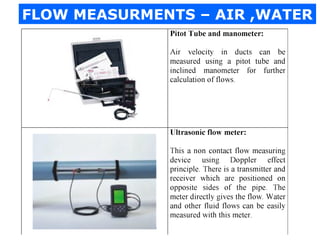
FLOW MEASURMENTS – AIR ,WATER
Portable Instruments Budget
Price (Rs)
1
Three phase Power Analyzer.
(V, A, KW, KVA, KVAR, PF,
HZ and THD)
2,60,000
2 Single Phase Power Analyzer
with THD
90,000
3 Megger & Resistance Meter 50,000
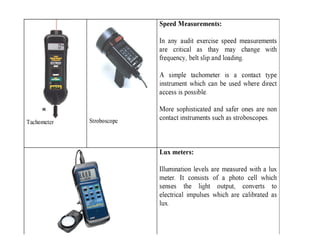
4 Lux Meter (Digital) 7,000
5 Ultrasonic Flow Meter 4,00,000
6 Pitot Tube & Monometer 60,000
7 Digital Animometer 15,000
8 Hot Wire Animometer 7,000
9 Contact & Non-Contact 5,000
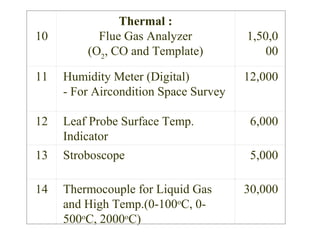
10
Thermal :
Flue Gas Analyzer
(O2
, CO and Template)
1,50,0
00
11 Humidity Meter (Digital)
- For Aircondition Space Survey
12,000
12 Leaf Probe Surface Temp.
Indicator
6,000
13 Stroboscope 5,000
14 Thermocouple for Liquid Gas
and High Temp.(0-100o
C, 0-
500o
C, 2000o
C)
30,000

energy audit

  • 1.
  • 2.
    Energy Audit Definition: Energyaudit Types of energy audit, Understanding energy costs Bench marking Energy performance Fuel and energy substitution Energy audit instruments
  • 3.
    Conversion Factors forMTOE 1 Kwh = 860 Kcal 1 kg of coal/coke = GCV in Latest Certificates 1 kg FO/LSHS/Naptha = 10500 Kcal/kg (density = 0.93) 1 kg HSD = 11840 Kcal (density = 0.82) 1 kg Petrol = 11200 Kcal (density = 0.708) 1 kg Kerosene = 11110 Kcal (density = 0.778) 1 kg LPG = 12500 Kcal 1 m3 of Natural gas = 8000-10500Kcal (actual as per certificate) 1 kg of oil equivalent = 10,000 Kcal
  • 4.
    Energy Conservation Act Designatedconsumers : Central Govt. specify the following criteria for energy Intensive Industries and other establishments. (As per EC Act 2001, Section 14(e) For Industries Electrical connected load -5000 KW and above or Annual energy consumption - 30,000 MTOE For Commercial Buildings Connected Load - 500 KW or 600 KVA
  • 5.
    ELECTRICITY ACT 2001 MAINFEATURES 1. Replaced all the previous three Electricity Laws: – Indian Electricity Act 1910, Electricity Supply Act 1948 – Electricity Regulatory Commission Act 1998 as amended from time to time 2. 100% metering is mandatory for 11 KV feeder 3. 100% Rural Electrification – Accelerated Rural electrification Program, AREP) – PRIs & NGOs can be participated) – 80,000 villages yet to be electrified
  • 6.
    ELECTRICITY ACT 2001(Contd..) 4.Private sector Investments is allowed in Renewable Energy Sources (Generation, Distribution, Supply area) – No license is required for generation and distribution of power in Rural areas. 5. Participation in power transmission sector 6. More stringent provision for theft of electricity
  • 7.
    ELECTRICITY ACT 2001(Contd..) 7.Delicensed for Captive power generation, Thermal power generation, Hydro power generation – can be sold directly to other consumers by wheeling through the grid under open access – Banking facility is provided to captive power plants 8. State Electricity Regulatory Commission is mandatory for all States
  • 8.
    Definition of EnergyAudit As per the Energy Conservation Act, 2001, Energy Audit is defined as “the verification, monitoring and analysis of use of energy including submission of technical report containing recommendations for improving energy efficiency with cost benefit analysis and an action plan to reduce energy consumption “
  • 9.
    Objective of EnergyManagement To achieve and maintain optimum energy procurement and utilisation, throughout the organization To minimise energy costs / waste without affecting production & quality To minimise environmental effects.     TO KNOW TECHNICAL PERFORMANCE OF MAJOR EQUIPTMENT / SYSTEMS TO IDENTIFY LOSS AREAS TO ASSESS TECHNO ECONOMIC FEASIBILITY OF ENCON OPTIONS.
  • 10.
    ENERGY AUDIT….. It’s atech.Survey to analyze existing energy utilisation practice, pinpoint areas of wastage and to evolve energy saving schemes. •It is an organised and systematic exercise with top management support •Energy audit addresses •House keeping •Operational improvement/retrofits •Capital projects requiring investment •New technology •Energy audit helps to achieve “savings through invisibles”.
  • 11.
    Types of EnergyAudit 1. Preliminary energy audit 2. Detailed energy audit
  • 12.
    Safety Considerations The auditperson or team should be thoroughly briefed on safety equipment and procedures Adequate safety equipment should be worn at all appropriate times. Auditors should be extremely careful making any measurements on electrical systems/on high temperature devices.
  • 13.
    Preliminary Audit SiteSurvey:  Take a walk through survey /Observations  Collection of existing energy and production records of the entire plant and major energy consuming facilities and departments.  Brief data analysis and preparation of documentation.  Identification of preliminary energy saving measures, including an estimation of saving potentials and economic aspects
  • 14.
    INDUSTRIAL ACTIVITIES Final ProductFinalProduct Raw Materials Fluids Raw Materials Fluids ManpowerManpower EnergyEnergy Industrial Wastes LIQUID toxic, inorganic and organic wastewaters GASEOUS Emissions SO2 , NOx, CO, etc. SOLID WASTES wasted raw material or product, sludge from ETP DISCHARGE ENERGY heated fluids, steam, hot emissions etc.
  • 15.
    TYPICAL PLANT UTILITIES &SCOPE AREAS  BOILERS/FURNACES  PUMPS  FANS  AIR COMPRESSORS  A/C PLANTS  COOLING TOWER  TRANSFORMERS  MOTORS  DG SETS  LIGHTING  ELECTRIC HEATERS
  • 16.
    Process Flow DiagramSpinning Mils Raw Cotton Blow room Carding Drawing Combing Simplex Ring frame spinning Cheese Winding Doubling Cone winding Utility Electricity Humidifin.. Comp.air Lighting Production Yarn
  • 17.
    Power Consumption Patternin Spinning Mills 15% 45% 10% 18% 7% 5% Pre Spinning Spinning Post Spinning Humidification Compressor Lighting
  • 18.
    Typical Specific EnergyConsumption Norms in Textile Industry COMPOSITE MILLS  Thermal Energy = 19.0 Kg Steam /Kg of cloth  Electrical Energy = 2.2 Kwh /Kg of cloth SPINNING MILLS  Electrical Energy = 3.6 Kwh /Kg of yarn (UKG adjusted to 40 counts)
  • 19.
    Preliminary Energy AuditMethodology It uses existing and easily obtained data Establish energy consumption pattern Establishes base line data Identify the most likely areas for attention/savings Identify immediate(no/low-cost) improvements Identify areas for more detailed study/measurement Helps in planning for Detailed audit(Team/instrument/Duration required)
  • 20.
    Detailed Energy Audit Evaluatesall energy using system, equipment and include detailed energy savings and costs Different phases of Detailed Audit – Pre-audit Phase (Preliminary audit) – Audit Phase (Instrumented/Comprehensive) – Brief presentation,Report Preparation/Vendor details collection – Draft Report presentation and Final Presentation – Post-Audit
  • 21.
    PLANT ENERGY AUDITCOVERS  ENERGY GENERATING EQUIPMENTS  ENERGY DISTRIBUTION NETWORK  END USE EQUIPMENTS. OPERATIONAL FEATURES PLANT. 1. CONTINUOUS PROCESS PLANT 2. ONE/TWO SHIFT OPERATION 3. INTERMITTENT.
  • 22.
    ????????????????? What type ofenergy used How much energy is used? How much does it cost? Where it is used? How efficiently it is used? How can it be managed more efficiently and effectively? This is identified through carrying out ENERGY AUDITs
  • 23.
    STEPS INVOLVED INENERGY AUDIT. 1. Data Collection 2. Efficiency Evaluation 3. Loss Quantification 4. Operational Improvement Measures 5. Techno Economic Evaluation of Projects. 6. Designing Energy Data Report System 7. Instrumentation Requirement 8. Action Plan For ENCON Implementation
  • 24.
    SCOPE OF “DEA”TO INDICATE  CAPABILITIES & EFFICIENCY OF EQUIPMENT  NEED FOR AUTOMATIC CONTROLS  ADEQUACY OF MAINTENANCE  NEED FOR IMPROVED INSTRUMENTATION SCOPE AREAS FOR ENERGY SAVING  COST BENEFITS OF SPECIFIC MEASURES IN SHORT / MEDIUM / LONG TERM  MECHANISM OF MONITORING  VENDOR INFORMATION  INCENTIVE SCHEMES / PROVISIONS
  • 25.
    Detailed Energy audittasks:- 1. Elaboration and discussion of audit methodology. 2. Selection of plants items to be audited. 3. Collection of more detailed energy and production data. 4. Comprehensive measurements at selected plants items. • Process flow and utility diagram • Measurement survey/performance trials 1. Data analysis and calculations 2. Elaboration of energy and material balance for the audited plant items.
  • 26.
    7. Investigation ofenergy saving options (improved maintenance of equipment, improved energy management, modification or rationalization of process configuration, improved insulation/ control of refrigeration, etc.) 8. Recommendation of feasible energy efficiency measures. 9.Financial analysis of recommended measures, including cost benefit calculation. 10.Ranking of measures and elaboration of an energy saving action plant 11.Reporting 12.Presentation to plant management
  • 27.
    DATA COLLECTION How MuchData ? What Data ? Data Availability –Plant Records-metering How To Proceed In Case Of Data Not Available To Know Source of Information Experience To Device Data From Secondary Information Planning For Field Trials And Observation
  • 28.
    Plant data Present landedcost of all types of energy used in the plant. Types of energy used :Electricity, Fuel oil , Coal, Gas Annual energy consumption and cost for all purchased and internal fuel .(3 years) Monthly purchased electricity & self generated. • Month,kva,kwh,PF,bill amount. (Grid Power) • Month,kva,kwh,PF,fuel cons.(Captive power plant) Annual Production for Past 3 Financial Year To know seasonal variation to know production and energy trend
  • 29.
    Electricity Tariff Structure Whatare the elements of Electricity Bill ? Elements TNEB APSEB KEB Gujarat / Maharashtra MD Charge Rs.300/KVA RS.117/KVA <1000 kw Minimum 90% of CMD RS.116/KVA 1000-3000 Rs.115/kva > 3000 Kw MD Penalty Rs 600/Kva Rs. 225/Kva Energy 3.5.00 P/Unit Rs.1.8 <400 kwh charges Rs.1.6 >400 kwh TOD Tariff 6 - 9 AM/PM 10AM-6PM Oct-Feb 20% more 2 PM-10PM Mar- Sep 20paise /unit more PF minimum 0.9 0.85 PF Penalty <.9 2P unit for each 1% decrease in PF below .85
  • 30.
    SPECIFICATION OF MAJORENERGY CONVERSION EQUPT. • BOILERS • HEATERS • FURNACES • THERMIC FLUID HEATER • POWER GENERATING UNITS DETAILS OF MAJOR UTILITIES(PUMPS/FANS/COMPRESSORS) • MAKE • TYPE • CAPACITY • SINGLE STAGE/MULTISTAGE • FLOW, HEAD • DESIGN KW – EFFICIENCY • CAPACITY CONTROL METHOD • ACTUAL REQUIREMENTS • ANNUAL OPERATING HOURS • Operating Schedule(Design and Operating parameters)
  • 32.
    Benchmarking • Internal Benchmarking •Historical and trend analysis • External Benchmarking − Across similar industries •kWh/MT Cement produced (Cement Industry) •kWh/MT Paper produced (Paper Industry) •kWh/ton of refrigeration (AC&R PLANT) /kWh /litre (DG Sets) Energy cost as a percentage of total manufacturing cost - 30 to 60 % Generally a decreasing trend in specific energy consumption Specific power consumption varies from 66 to 127 kWh per tonne of cement Specific thermal energy consumption varies from 692 to 879 kCal/kg clinker
  • 33.
    Energy Conversion Boiler efficiency, Quality ofFuel used, Maintenance Energy Transfer Insulation of Steam piping, Jackets for hot fluid pipes to prevent losses Energy Utilization Equipment efficiency, Maintenance, Energy Recovery Waste heat exchangers, Energy Conservation
  • 34.
    Product Waste Raw materials Separation EquipmentSeparationEquipmentHeat Recovery Heat Recovery By ProductMaterial balance Cause and Effect Analysis Cost-benefit analysis Brainstorming Process 2Process 2Process 1Process 1 Recovery Recycle, Reuse and Recovery
  • 35.
    Fuel and EnergySubstitution Fuel substitution Replacement of coal by Agro fuels Replacement of LDO by LSHS Energy substitution Electric heaters by steam heaters Steam based hot water by solar systems
  • 36.
    ENERGY AUDIT REPORT 1.ACKNOWLEDGEMENT 2. CONTENTS 3. EXECUTIVE SUMMARY 4. SUMMARY OF SAVINGS 5. INTRODUCTION 6. PLANT ENERGY SYSTEM 7. ENERGY USAGE PATTERN 8. ENERGY INDICATORS 9. ENERGY SAVING OPTIONS/RECOMMENDATIONS 10.ANNEXURE/PLANT BASE LINE DATA Filed observation and savings calculations. List of suppliers . Action plan for ENCON implementation
  • 38.
    Technical and Economicfeasibility Name of Energy Efficiency Measure 1. Investment • Equipments • Civil works • Instrumentatio n • Auxiliaries 2. Annual operating costs • Cost of capital • Maintenance • Manpower • Energy • Depreciation 3. Annual savings • Thermal Energy • Electrical Energy • Raw material • Waste disposal Net Savings /Year (Rs./year) = (Annual savings-annual operating costs) Payback period in months = (Investment/net savings/year) x 12
  • 39.
    Energy Audit Instruments ElectricalMeasuring Instruments: These are instruments for measuring major electrical parameters such as kVA, kW, PF, Hertz, kvar, Amps and Volts. In addition some of these instruments also measure harmonics. These instruments are applied on-line i.e on running motors without any need to stop the motor. Instant measurements can be taken with hand-held meters, while more advanced ones facilitates cumulative readings with print outs at specified intervals. POWER ANALYSERS
  • 40.
    Measurement Technology -Measures @256samples/cycle for better accuracy even on non-linear waveforms -Continuous & simultaneous sampling on all 6 channels for accurate readings on dynamic loads Accuracy far superior when compared to conventional analyzers with low sampling rate New Generation Measurement Techniques
  • 41.
    Application – TextileMill Study Readings of KRYKARD Load Manager ALM 30 Readings of Low & non- continuous sampling meter THD in % P.F THD in % KWh (% error) P.F 8% 0.882 15% 0.837 36% 0.864 36% -1.2% 0.82 52% 0.881 46% -2.77% 0.74 74% 0.880 81% -8.2% 0.68 This picture is taken using the Screen shot feature of ALM/3032. You can see that the ALM 30/32 is highly accurate even on non-linear loads thanks to the new generation measuring techniques used by it.
  • 42.
  • 43.
  • 44.
  • 46.
    Portable Instruments Budget Price(Rs) 1 Three phase Power Analyzer. (V, A, KW, KVA, KVAR, PF, HZ and THD) 2,60,000 2 Single Phase Power Analyzer with THD 90,000 3 Megger & Resistance Meter 50,000 4 Lux Meter (Digital) 7,000 5 Ultrasonic Flow Meter 4,00,000 6 Pitot Tube & Monometer 60,000 7 Digital Animometer 15,000 8 Hot Wire Animometer 7,000 9 Contact & Non-Contact 5,000
  • 47.
    10 Thermal : Flue GasAnalyzer (O2 , CO and Template) 1,50,0 00 11 Humidity Meter (Digital) - For Aircondition Space Survey 12,000 12 Leaf Probe Surface Temp. Indicator 6,000 13 Stroboscope 5,000 14 Thermocouple for Liquid Gas and High Temp.(0-100o C, 0- 500o C, 2000o C) 30,000

Editor's Notes

  • #12 Type of Energy Audit   The type of Energy Audit to be performed depends on.   -         the function and type of industry -         the depth to which final audit is needed, and -         the potential and magnitude of cost reduction desired   Thus Energy Audit can be classified into the following two types.   i)        Preliminary Audit ii)       Detailed Audit
  • #13 The auditor should be careful when examining any operating piece of equipment, especially those with open drive shafts, belts or gears, or any form of rotating machinery. The equipment operator or supervisor should be notified that the auditor is going to look at the piece of equipment and might need to get information from some part of the device. If necessary, the auditor may need to come back when the machine or device is idle in order to safely get the data. The auditor should never approach a piece of equipment and inspect it without the operator or supervisor being notified first.
  • #14 Objectives of Energy Audit The objective is to promote and encourage energy efficiency improvement in the industrial sector of Gujarat. The Energy Audit should be directed towards: Identification of areas of energy wastage and estimation of energy saving potential Suggesting cost-effective measures to improve the efficiency of energy use, Estimation of implementation costs and payback periods for each recommended action and Documenting results &amp; vital information generated through these activities
  • #19 The prime energy inputs in textile industry are power and steam.The requirements of power and steam vary with various factors Yarn counts Product Mix( Type of fabric) Extent of wet processing(Dyeing, printing etc)
  • #20   2.      Collect the existing data e.g., a energy bills(volume/cost)      Collect the Production output/records plant layouts using checklists   3. Analyse data:      Find unit cost of energy (Rs./ kWh for all types)      Find fixed and variable energy element      Derive ‘energy Index’: energy cost/unit output ,energy cost/floor area 4.      Formulate plan: Formulate Immediate energy-saving actions: Where? How ? How much?          Areas to investigate further          Resources required for more detailed study   5.      Actions and monitoring   Next steps (e.g. detailed audits), where needed