MANAGEMENT

 PROCESS
Management defined:
“Management is an art of getting things
 done through and with the people in
 formally organized groups. It is an art of
 creating an environment in which people
 can perform and individuals can
 cooperate towards attainment of group
 goals”. Harold Koontz
“Management is an art of knowing what to
 do, when to do and see that it is done in
 the best and cheapest way”. F.W. Taylor
“Management is a distinct process
 consisting of planning, organizing,
 actuating and controlling,
 performed to determine and
 accomplish stated objective by
 the use of human beings and
 other resources”.
                 George R. Terry
Management as a Process
1. Management is a social process -
   concerned with developing relationship among
   people
2. Management is an integrated process -
   undertakes the job of bringing together human
   physical and financial resources so as to
   achieve organizational purpose
3. Management is a continuous process -
   concerned with constantly identifying the
   problem and solving them by taking adequate
   steps
4. Management is an iterative process- All
Management functions
  George Terry, “There are four
  fundamental functions of
  management i.e. planning,
  organizing, actuating and
  controlling”
 Henry Fayol, “To manage is to
  forecast and plan, to organize, to
  command, & to control”
 Koontz and O’Donnel - Planning,
  Organizing, Staffing, Directing and
  Controlling
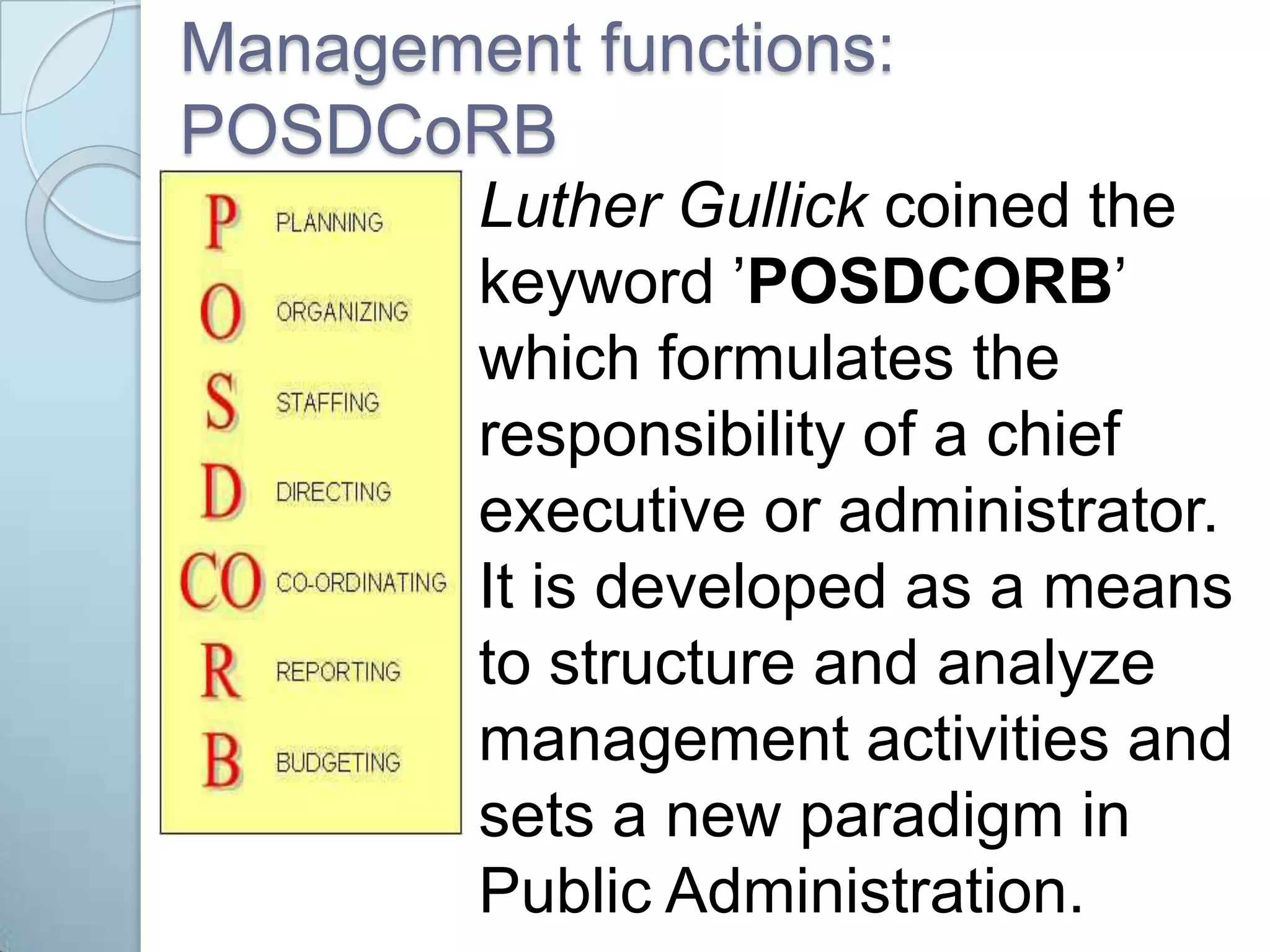
Management functions:
POSDCoRB
        Luther Gullick coined the
        keyword ’POSDCORB’
        which formulates the
        responsibility of a chief
        executive or administrator.
        It is developed as a means
        to structure and analyze
        management activities and
        sets a new paradigm in
        Public Administration.
Management Function:

      Planning
Management Function:
Planning
GULLICK, “Planning is working out in
 broad outline the things that need to
 be done and the methods for doing
 them to accomplish the purpose set
 for the enterprise.”
KOONTZ, “Planning is deciding in
 advance - what to do, when to do &
 how to do. It bridges the gap from
 where we are & where we want to
 be”.
3 basic steps in planning
 Formulating     objectives – states
  precisely what results are to be
  accomplished and when
 Taking action – follows
  predetermined plans of actions
  to fulfill the objective
 Analyzing results – measures
  the results achieved against the
Management Function:

     Organizing
Management Function:
Organizing
Organizing – the establishment of a formal
 structure of authority through which the
 work subdivisions are arranged, defined,
 and coordinated for the defined objective.
 In organizing, structures are created,
 relationships are established and
 resources are allocated for the
 accomplishment of activities.
According to Henry Fayol, “To organize a
 business is to provide it with everything
 useful or its functioning i.e. raw material,
 tools, capital and personnel’s”
Organizing as a process
involves
1. Identification of activities.
2. Classification of grouping of
   activities.
3. Assignment of duties.
4. Delegation of authority and
   creation of responsibility.
5. Coordinating authority and
   responsibility relationships.
Management Function:

      Staffing
Management Function:
Staffing
Staffing – the whole personnel action of
 bringing in and training the staff and
 maintaining favorable conditions of
 work. It is also known as Human
 Resource Management.
Koontz & O’Donell, “Managerial function
 of staffing involves manning the
 organization structure through proper
 and effective selection, appraisal &
 development of personnel to fill the
 roles designed into the structure”.
Staffing involves:
◦ Manpower Planning
◦ Recruitment, selection &
  placement.
◦ Training & development.
◦ Remuneration.
◦ Performance appraisal.
◦ Promotions & transfer.
Management Function:

      Directing
Management Function:
Directing
Directing is a part of managerial
  function which actuates the
  organizational methods to work
  efficiently for achievement of
  organizational purposes.
It is considered life-spark of the
  enterprise which sets in motion the
  action of people because planning,
  organizing and staffing are the mere
  preparations for doing the work.
It involves guiding and motivating
  other people to work for a common
Elements of Directing
Supervision - implies overseeing the
 work of subordinates by their superiors
Motivation - inspiring, stimulating, or
 encouraging the subordinates with zeal
 to work.
Leadership – the process by which
 manager guides and influences the
 work of subordinates in desired
 direction
Communication - process of passing
 information, experience, opinion from
 one person to another

Management process

  • 1.
  • 2.
    Management defined: “Management isan art of getting things done through and with the people in formally organized groups. It is an art of creating an environment in which people can perform and individuals can cooperate towards attainment of group goals”. Harold Koontz “Management is an art of knowing what to do, when to do and see that it is done in the best and cheapest way”. F.W. Taylor
  • 3.
    “Management is adistinct process consisting of planning, organizing, actuating and controlling, performed to determine and accomplish stated objective by the use of human beings and other resources”. George R. Terry
  • 4.
    Management as aProcess 1. Management is a social process - concerned with developing relationship among people 2. Management is an integrated process - undertakes the job of bringing together human physical and financial resources so as to achieve organizational purpose 3. Management is a continuous process - concerned with constantly identifying the problem and solving them by taking adequate steps 4. Management is an iterative process- All
  • 5.
    Management functions  George Terry, “There are four fundamental functions of management i.e. planning, organizing, actuating and controlling”  Henry Fayol, “To manage is to forecast and plan, to organize, to command, & to control”  Koontz and O’Donnel - Planning, Organizing, Staffing, Directing and Controlling
  • 6.
    Management functions: POSDCoRB Luther Gullick coined the keyword ’POSDCORB’ which formulates the responsibility of a chief executive or administrator. It is developed as a means to structure and analyze management activities and sets a new paradigm in Public Administration.
  • 7.
  • 8.
    Management Function: Planning GULLICK, “Planningis working out in broad outline the things that need to be done and the methods for doing them to accomplish the purpose set for the enterprise.” KOONTZ, “Planning is deciding in advance - what to do, when to do & how to do. It bridges the gap from where we are & where we want to be”.
  • 9.
    3 basic stepsin planning  Formulating objectives – states precisely what results are to be accomplished and when  Taking action – follows predetermined plans of actions to fulfill the objective  Analyzing results – measures the results achieved against the
  • 10.
  • 11.
    Management Function: Organizing Organizing –the establishment of a formal structure of authority through which the work subdivisions are arranged, defined, and coordinated for the defined objective. In organizing, structures are created, relationships are established and resources are allocated for the accomplishment of activities. According to Henry Fayol, “To organize a business is to provide it with everything useful or its functioning i.e. raw material, tools, capital and personnel’s”
  • 12.
    Organizing as aprocess involves 1. Identification of activities. 2. Classification of grouping of activities. 3. Assignment of duties. 4. Delegation of authority and creation of responsibility. 5. Coordinating authority and responsibility relationships.
  • 13.
  • 14.
    Management Function: Staffing Staffing –the whole personnel action of bringing in and training the staff and maintaining favorable conditions of work. It is also known as Human Resource Management. Koontz & O’Donell, “Managerial function of staffing involves manning the organization structure through proper and effective selection, appraisal & development of personnel to fill the roles designed into the structure”.
  • 15.
    Staffing involves: ◦ ManpowerPlanning ◦ Recruitment, selection & placement. ◦ Training & development. ◦ Remuneration. ◦ Performance appraisal. ◦ Promotions & transfer.
  • 16.
  • 17.
    Management Function: Directing Directing isa part of managerial function which actuates the organizational methods to work efficiently for achievement of organizational purposes. It is considered life-spark of the enterprise which sets in motion the action of people because planning, organizing and staffing are the mere preparations for doing the work. It involves guiding and motivating other people to work for a common
  • 18.
    Elements of Directing Supervision- implies overseeing the work of subordinates by their superiors Motivation - inspiring, stimulating, or encouraging the subordinates with zeal to work. Leadership – the process by which manager guides and influences the work of subordinates in desired direction Communication - process of passing information, experience, opinion from one person to another