Complement
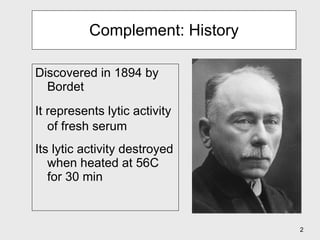
Complement: History Discovered in 1894 by Bordet  It represents lytic activity of fresh serum Its lytic activity destroyed when heated at 56C for 30 min
Complement functions Host benefit: opsonization to enhance phagocytosis phagocyte attraction and activation lysis of bacteria and infected cells regulation of antibody responses clearance of immune complexes clearance of apoptotic cells Host detriment: Inflammation, anaphylaxis
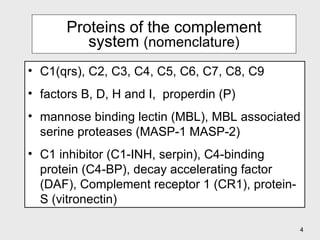
Proteins of the complement system  (nomenclature) C1(qrs), C2, C3, C4, C5, C6, C7, C8, C9 factors B, D, H and I,  properdin (P) mannose binding lectin (MBL), MBL associated serine proteases (MASP-1 MASP-2) C1 inhibitor (C1-INH, serpin), C4-binding protein (C4-BP), decay accelerating factor (DAF), Complement receptor 1 (CR1), protein-S (vitronectin)
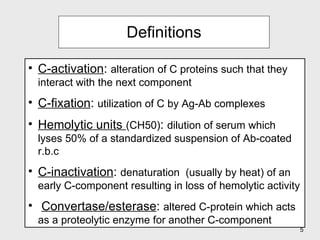
Definitions C-activation :  alteration of C proteins such that they interact with the next component C-fixation :  utilization of C by Ag-Ab complexes Hemolytic units  (CH50) :  dilution of serum which lyses 50% of a standardized suspension of Ab-coated r.b.c C-inactivation :  denaturation  (usually by heat) of an early C-component resulting in loss of hemolytic activity Convertase/esterase :  altered C-protein which acts as a proteolytic enzyme for another C-component
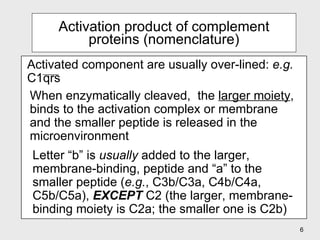
Activation product of complement proteins (nomenclature) When enzymatically cleaved,  the  larger moiety , binds to the activation complex or membrane and the smaller peptide is released in the microenvironment Letter “b” is  usually  added to the larger,   membrane-binding, peptide and “a” to the smaller peptide ( e.g. , C3b/C3a, C4b/C4a, C5b/C5a),  EXCEPT  C2 (the larger, membrane-binding moiety is C2a; the smaller one is C2b) Activated component are usually over-lined:  e.g.  C1qrs
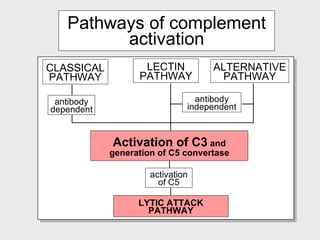
Pathways of complement activation CLASSICAL PATHWAY ALTERNATIVE PATHWAY LECTIN PATHWAY activation of C5 LYTIC ATTACK PATHWAY antibody dependent antibody independent Activation of C3  and generation of C5 convertase
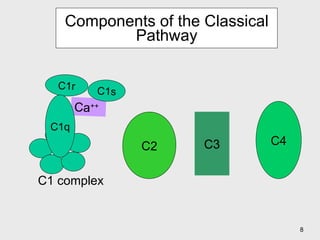
Components of the Classical Pathway C4 C2 C3 C1 complex Ca ++ C1r C1s C1q
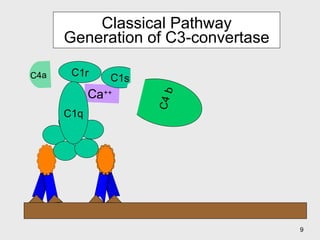
Classical Pathway  Generation of C3-convertase  C4 Ca ++ C1r C1s C1q C4a b
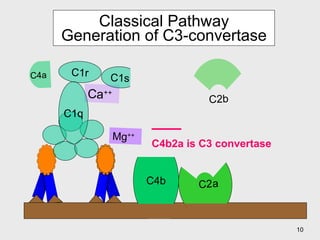
Classical Pathway  Generation of C3-convertase  C4b Mg ++ C4a C2 _____ C4b2a is C3 convertase Ca ++ C1r C1s C1q C2b a  C2 a
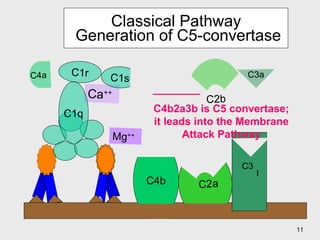
Classical Pathway  Generation of C5-convertase C4b Mg ++ C4a C2b C3   ________ C4b2a3b is C5 convertase; it leads into the Membrane Attack Pathway Ca ++ C1r C1s C1q C2 a C3a b
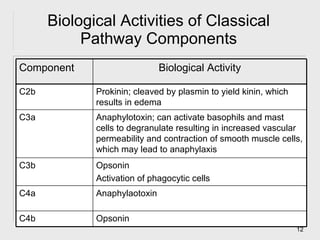
Biological Activities of Classical Pathway Components Opsonin C4b Anaphylaotoxin C4a Opsonin Activation of phagocytic cells C3b Anaphylotoxin; can activate basophils and mast cells to degranulate resulting in increased vascular permeability and contraction of smooth muscle cells, which may lead to anaphylaxis C3a Prokinin; cleaved by plasmin to yield kinin, which results in edema C2b Biological Activity Component
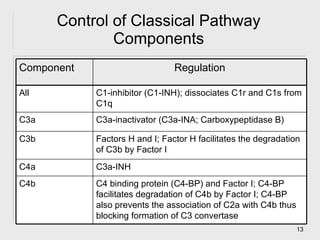
Control of Classical Pathway Components C4 binding protein (C4-BP) and Factor I; C4-BP facilitates degradation of C4b by Factor I; C4-BP also prevents the association of C2a with C4b thus blocking formation of C3 convertase C4b C3a-INH C4a Factors H and I; Factor H facilitates the degradation of C3b by Factor I C3b C3a-inactivator (C3a-INA; Carboxypeptidase B) C3a C1-inhibitor (C1-INH); dissociates C1r and C1s from C1q All Regulation Component
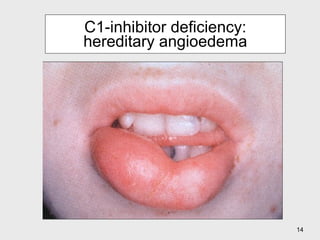
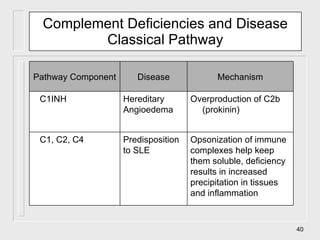
C1-inhibitor deficiency: hereditary angioedema
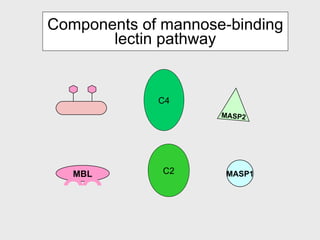
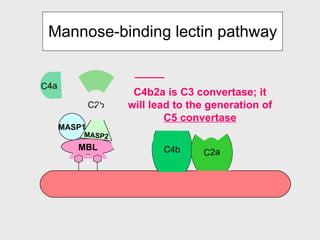
Components of mannose-binding lectin pathway C4 C2 MASP1 MASP2 MBL
Mannose-binding lectin pathway C4 C2 _____ C4b2a is C3 convertase; it will lead to the generation of  C5 convertase MASP1 MASP2 MBL C4b C4a C4b C2b C2a C2a
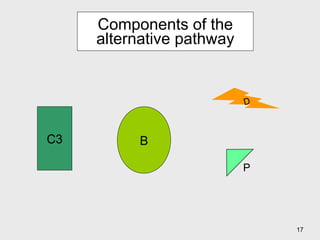
Components of the alternative pathway C3 B D P
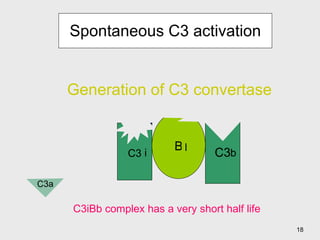
Spontaneous C3 activation C3 H 2 O B D Generation of C3 convertase C3iBb complex has a very short half life C3 i b C3a b
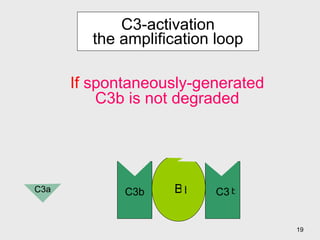
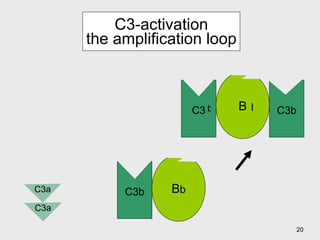
C3-activation the amplification loop B D If  spontaneously-generated C3b is not degraded C3 b C3b C3a b
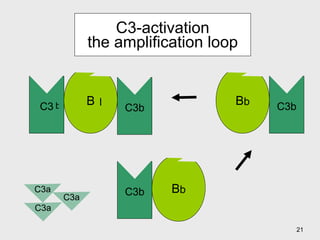
C3-activation the amplification loop C3a B D C3 B b C3b b C3b C3a b
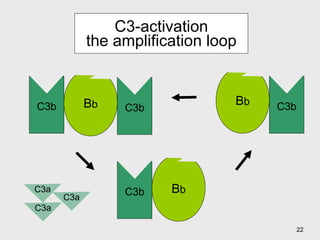
C3-activation the amplification loop C3a C3a C3 B D B b C3b C3b B b b b C3a C3b
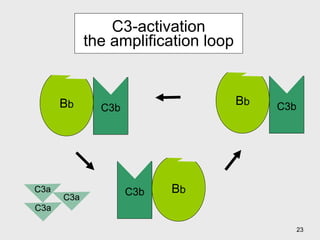
C3-activation the amplification loop C3a C3a C3a B b C3b B b B b C3b C3b C3b
C3-activation the amplification loop C3a C3a C3a B b C3b B b B b C3b C3b
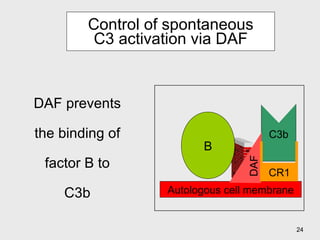
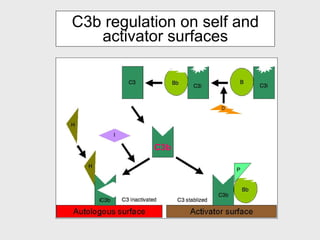
Control of spontaneous C3 activation via DAF DAF prevents the binding of factor B to C3b B C3b Autologous cell membrane DAF CR1
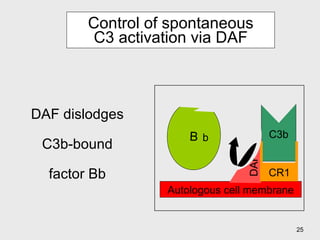
Control of spontaneous C3 activation via DAF DAF dislodges C3b-bound factor Bb B b b C3b Autologous cell membrane DAF CR1 B b
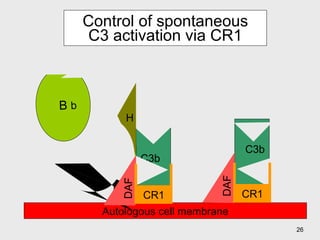
Control of spontaneous C3 activation via CR1 Autologous cell membrane H I I DAF C3b  C3b  B b iC3b B b iC3b CR1 DAF CR1
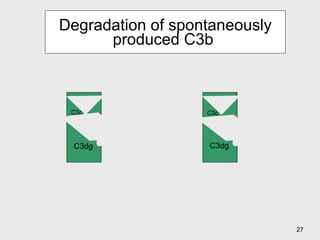
Degradation of spontaneously produced C3b  C3b  C3b  iC3b iC3b I I C3dg C3dg C3c C3c
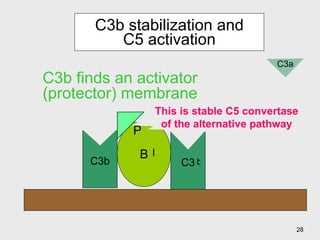
C3b stabilization and C5 activation C3 B D P This is stable C5 convertase of the alternative pathway C3b C3b finds an activator (protector) membrane C3a b b
C3b regulation on self and activator surfaces C3b
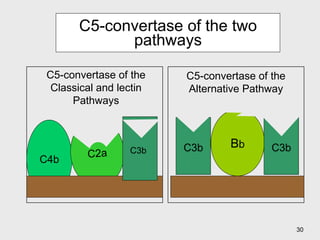
C5-convertase of the two pathways C3b B b C3b C5-convertase of the Alternative Pathway C5-convertase of the Classical and lectin Pathways C4b C2a C3b
Generation of C5 convertase leads to the activation of the Lytic pathway Lytic pathway
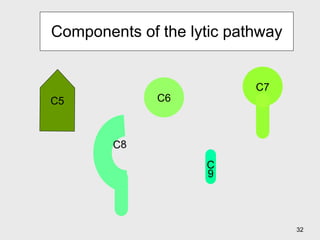
Components of the lytic pathway C6 C 9 C5 C8  C7
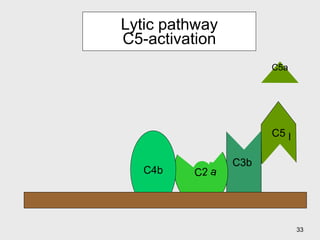
Lytic pathway C5-activation C5 C3b   C2 a C4b b C5a
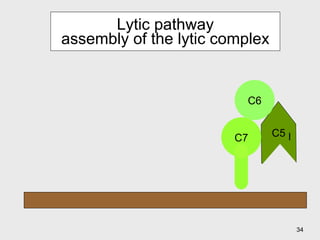
Lytic pathway assembly of the lytic complex C6 C5 b C7
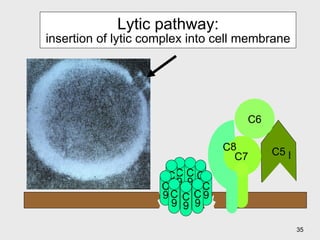
Lytic pathway: insertion of lytic complex into cell membrane C 9 C 9 C 9 C 9 C 9 C 9 C 9 C 9 C 9 C5 b C6 C7 C8
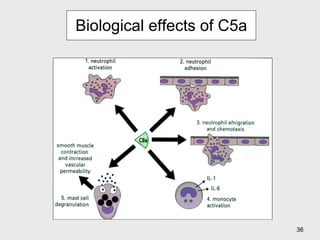
Biological effects of C5a
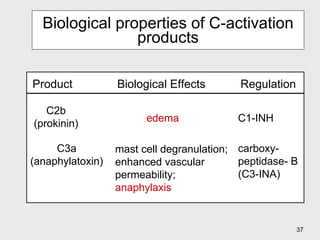
Biological properties of C-activation products Product Biological Effects Regulation C2b (prokinin) edema C1-INH C3a (anaphylatoxin) mast cell degranulation; enhanced vascular permeability;  anaphylaxis carboxy-peptidase- B (C3-INA)
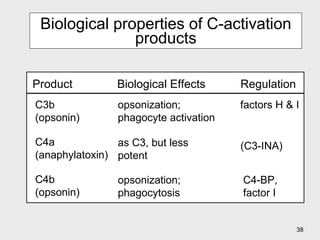
Biological properties of C-activation products Product Biological Effects Regulation as C3, but less potent (C3-INA) C4a (anaphylatoxin) opsonization; phagocytosis C4b (opsonin) C4-BP, factor I C3b (opsonin) opsonization; phagocyte activation factors H & I
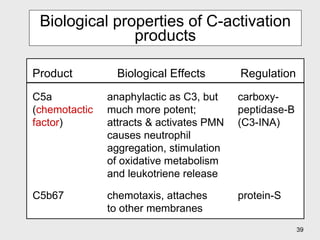
Biological properties of C-activation products Product Biological Effects Regulation anaphylactic as C3, but much more potent; attracts & activates PMN causes neutrophil aggregation, stimulation of oxidative metabolism and leukotriene release C5a ( chemotactic factor ) carboxy-peptidase-B (C3-INA) C5b67 protein-S chemotaxis, attaches to other membranes
Complement Deficiencies and Disease Classical Pathway Opsonization of immune complexes help keep them soluble, deficiency results in increased precipitation in tissues and inflammation Predisposition  to SLE C1, C2, C4  Overproduction of C2b (prokinin) Hereditary Angioedema C1INH Mechanism Disease Pathway Component
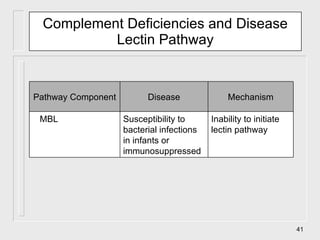
Complement Deficiencies and Disease Lectin Pathway Inability to initiate lectin pathway Susceptibility to bacterial infections in infants or immunosuppressed MBL Mechanism Disease Pathway Component
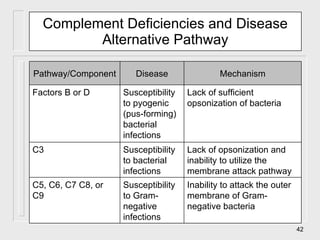
Complement Deficiencies and Disease Alternative Pathway Inability to attack the outer membrane of Gram-negative bacteria Susceptibility to Gram-negative infections C5, C6, C7 C8, or C9 Lack of opsonization and inability to utilize the membrane attack pathway Susceptibility to bacterial infections C3 Lack of sufficient opsonization of bacteria Susceptibility to pyogenic (pus-forming) bacterial infections Factors B or D Mechanism Disease Pathway/Component
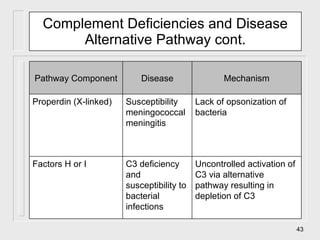
Complement Deficiencies and Disease Alternative Pathway cont. Uncontrolled activation of C3 via alternative pathway resulting in depletion of C3 C3 deficiency and susceptibility to bacterial infections Factors H or I Lack of opsonization of bacteria Susceptibility meningococcal meningitis Properdin (X-linked) Mechanism Disease Pathway Component
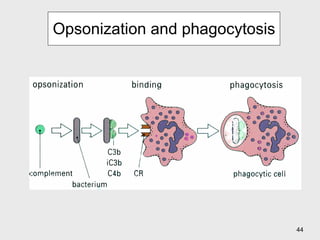
Opsonization and phagocytosis
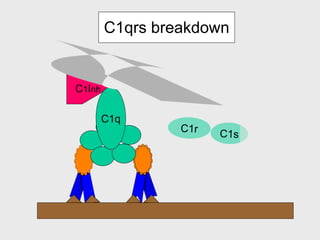
C1qrs breakdown C 1 I nh C1r C1s C1q C1r C1s

Complement06

  • 1.
  • 2.
    Complement: History Discoveredin 1894 by Bordet It represents lytic activity of fresh serum Its lytic activity destroyed when heated at 56C for 30 min
  • 3.
    Complement functions Hostbenefit: opsonization to enhance phagocytosis phagocyte attraction and activation lysis of bacteria and infected cells regulation of antibody responses clearance of immune complexes clearance of apoptotic cells Host detriment: Inflammation, anaphylaxis
  • 4.
    Proteins of thecomplement system (nomenclature) C1(qrs), C2, C3, C4, C5, C6, C7, C8, C9 factors B, D, H and I, properdin (P) mannose binding lectin (MBL), MBL associated serine proteases (MASP-1 MASP-2) C1 inhibitor (C1-INH, serpin), C4-binding protein (C4-BP), decay accelerating factor (DAF), Complement receptor 1 (CR1), protein-S (vitronectin)
  • 5.
    Definitions C-activation : alteration of C proteins such that they interact with the next component C-fixation : utilization of C by Ag-Ab complexes Hemolytic units (CH50) : dilution of serum which lyses 50% of a standardized suspension of Ab-coated r.b.c C-inactivation : denaturation (usually by heat) of an early C-component resulting in loss of hemolytic activity Convertase/esterase : altered C-protein which acts as a proteolytic enzyme for another C-component
  • 6.
    Activation product ofcomplement proteins (nomenclature) When enzymatically cleaved, the larger moiety , binds to the activation complex or membrane and the smaller peptide is released in the microenvironment Letter “b” is usually added to the larger, membrane-binding, peptide and “a” to the smaller peptide ( e.g. , C3b/C3a, C4b/C4a, C5b/C5a), EXCEPT C2 (the larger, membrane-binding moiety is C2a; the smaller one is C2b) Activated component are usually over-lined: e.g. C1qrs
  • 7.
    Pathways of complementactivation CLASSICAL PATHWAY ALTERNATIVE PATHWAY LECTIN PATHWAY activation of C5 LYTIC ATTACK PATHWAY antibody dependent antibody independent Activation of C3 and generation of C5 convertase
  • 8.
    Components of theClassical Pathway C4 C2 C3 C1 complex Ca ++ C1r C1s C1q
  • 9.
    Classical Pathway Generation of C3-convertase C4 Ca ++ C1r C1s C1q C4a b
  • 10.
    Classical Pathway Generation of C3-convertase C4b Mg ++ C4a C2 _____ C4b2a is C3 convertase Ca ++ C1r C1s C1q C2b a C2 a
  • 11.
    Classical Pathway Generation of C5-convertase C4b Mg ++ C4a C2b C3 ________ C4b2a3b is C5 convertase; it leads into the Membrane Attack Pathway Ca ++ C1r C1s C1q C2 a C3a b
  • 12.
    Biological Activities ofClassical Pathway Components Opsonin C4b Anaphylaotoxin C4a Opsonin Activation of phagocytic cells C3b Anaphylotoxin; can activate basophils and mast cells to degranulate resulting in increased vascular permeability and contraction of smooth muscle cells, which may lead to anaphylaxis C3a Prokinin; cleaved by plasmin to yield kinin, which results in edema C2b Biological Activity Component
  • 13.
    Control of ClassicalPathway Components C4 binding protein (C4-BP) and Factor I; C4-BP facilitates degradation of C4b by Factor I; C4-BP also prevents the association of C2a with C4b thus blocking formation of C3 convertase C4b C3a-INH C4a Factors H and I; Factor H facilitates the degradation of C3b by Factor I C3b C3a-inactivator (C3a-INA; Carboxypeptidase B) C3a C1-inhibitor (C1-INH); dissociates C1r and C1s from C1q All Regulation Component
  • 14.
  • 15.
    Components of mannose-bindinglectin pathway C4 C2 MASP1 MASP2 MBL
  • 16.
    Mannose-binding lectin pathwayC4 C2 _____ C4b2a is C3 convertase; it will lead to the generation of C5 convertase MASP1 MASP2 MBL C4b C4a C4b C2b C2a C2a
  • 17.
    Components of thealternative pathway C3 B D P
  • 18.
    Spontaneous C3 activationC3 H 2 O B D Generation of C3 convertase C3iBb complex has a very short half life C3 i b C3a b
  • 19.
    C3-activation the amplificationloop B D If spontaneously-generated C3b is not degraded C3 b C3b C3a b
  • 20.
    C3-activation the amplificationloop C3a B D C3 B b C3b b C3b C3a b
  • 21.
    C3-activation the amplificationloop C3a C3a C3 B D B b C3b C3b B b b b C3a C3b
  • 22.
    C3-activation the amplificationloop C3a C3a C3a B b C3b B b B b C3b C3b C3b
  • 23.
    C3-activation the amplificationloop C3a C3a C3a B b C3b B b B b C3b C3b
  • 24.
    Control of spontaneousC3 activation via DAF DAF prevents the binding of factor B to C3b B C3b Autologous cell membrane DAF CR1
  • 25.
    Control of spontaneousC3 activation via DAF DAF dislodges C3b-bound factor Bb B b b C3b Autologous cell membrane DAF CR1 B b
  • 26.
    Control of spontaneousC3 activation via CR1 Autologous cell membrane H I I DAF C3b C3b B b iC3b B b iC3b CR1 DAF CR1
  • 27.
    Degradation of spontaneouslyproduced C3b C3b C3b iC3b iC3b I I C3dg C3dg C3c C3c
  • 28.
    C3b stabilization andC5 activation C3 B D P This is stable C5 convertase of the alternative pathway C3b C3b finds an activator (protector) membrane C3a b b
  • 29.
    C3b regulation onself and activator surfaces C3b
  • 30.
    C5-convertase of thetwo pathways C3b B b C3b C5-convertase of the Alternative Pathway C5-convertase of the Classical and lectin Pathways C4b C2a C3b
  • 31.
    Generation of C5convertase leads to the activation of the Lytic pathway Lytic pathway
  • 32.
    Components of thelytic pathway C6 C 9 C5 C8 C7
  • 33.
    Lytic pathway C5-activationC5 C3b C2 a C4b b C5a
  • 34.
    Lytic pathway assemblyof the lytic complex C6 C5 b C7
  • 35.
    Lytic pathway: insertionof lytic complex into cell membrane C 9 C 9 C 9 C 9 C 9 C 9 C 9 C 9 C 9 C5 b C6 C7 C8
  • 36.
  • 37.
    Biological properties ofC-activation products Product Biological Effects Regulation C2b (prokinin) edema C1-INH C3a (anaphylatoxin) mast cell degranulation; enhanced vascular permeability; anaphylaxis carboxy-peptidase- B (C3-INA)
  • 38.
    Biological properties ofC-activation products Product Biological Effects Regulation as C3, but less potent (C3-INA) C4a (anaphylatoxin) opsonization; phagocytosis C4b (opsonin) C4-BP, factor I C3b (opsonin) opsonization; phagocyte activation factors H & I
  • 39.
    Biological properties ofC-activation products Product Biological Effects Regulation anaphylactic as C3, but much more potent; attracts & activates PMN causes neutrophil aggregation, stimulation of oxidative metabolism and leukotriene release C5a ( chemotactic factor ) carboxy-peptidase-B (C3-INA) C5b67 protein-S chemotaxis, attaches to other membranes
  • 40.
    Complement Deficiencies andDisease Classical Pathway Opsonization of immune complexes help keep them soluble, deficiency results in increased precipitation in tissues and inflammation Predisposition to SLE C1, C2, C4 Overproduction of C2b (prokinin) Hereditary Angioedema C1INH Mechanism Disease Pathway Component
  • 41.
    Complement Deficiencies andDisease Lectin Pathway Inability to initiate lectin pathway Susceptibility to bacterial infections in infants or immunosuppressed MBL Mechanism Disease Pathway Component
  • 42.
    Complement Deficiencies andDisease Alternative Pathway Inability to attack the outer membrane of Gram-negative bacteria Susceptibility to Gram-negative infections C5, C6, C7 C8, or C9 Lack of opsonization and inability to utilize the membrane attack pathway Susceptibility to bacterial infections C3 Lack of sufficient opsonization of bacteria Susceptibility to pyogenic (pus-forming) bacterial infections Factors B or D Mechanism Disease Pathway/Component
  • 43.
    Complement Deficiencies andDisease Alternative Pathway cont. Uncontrolled activation of C3 via alternative pathway resulting in depletion of C3 C3 deficiency and susceptibility to bacterial infections Factors H or I Lack of opsonization of bacteria Susceptibility meningococcal meningitis Properdin (X-linked) Mechanism Disease Pathway Component
  • 44.
  • 45.
    C1qrs breakdown C1 I nh C1r C1s C1q C1r C1s

Editor's Notes

  • #3 Complement refers, historically, to fresh serum capable of lysing antibody (Ab)-coated cells . This activity is destroyed (inactivated) by heating serum at 56  C for 30 minutes. The lytic activity of complement is decreased in certain diseases, e.g. SLE, serum sickness, chronic infections, complement deficiencies, etc.
  • #9 Chelating agents dismantle the C1 complex and are anti-complementary. Heat destroys the C2 component. Sample for C measurement should be drawn in a green-top vial (no EDTA), must be kept cold and tested as soon as possible.