COMPLEMENT SYSTEMFe A. Bartolome, MD, FPASMAPDepartment of MicrobiologyOur Lady of Fatima University
Consists of approx. 20 proteins that are present in normal human serum  synthesized mainly by liver
Heat-labile  inactivated by heating serum at 560C for 30 minutes
Able to augment the effects of other components of the immune system
Important component of innate host defensesThree main effects:Lysis of cells (bacteria, allografts, tumor cells)Generation of mediators of inflammationOpsonization – enhancement of phagocytosis
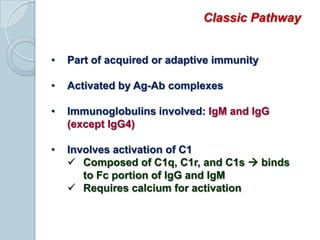
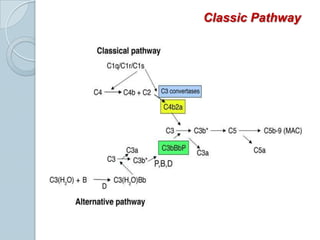
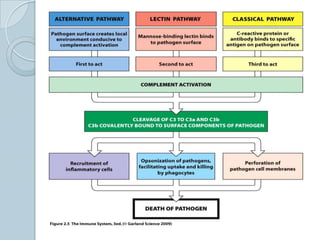
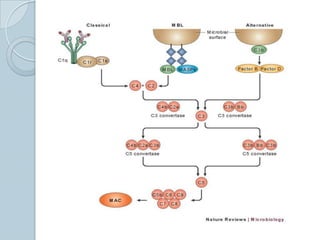
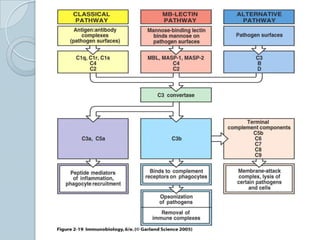
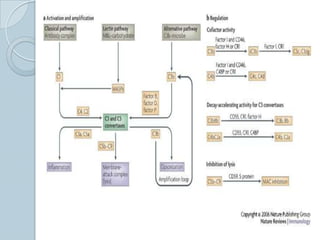
Sequential activation of complement components occurs via one of three pathways:Classic pathwayLectin pathwayAlternative or Properdin pathwayLectin and alternative pathways are more important the first time we are infected by microorganisms because antibody required to activate the classic pathway is not yet presentClassic PathwayPart of acquired or adaptive immunity
Activated by Ag-Ab complexes
Immunoglobulins involved: IgM and IgG (except IgG4)
Involves activation of C1
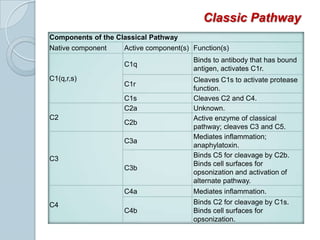
Composed of C1q, C1r, and C1s  binds to Fc portion of IgG and IgM
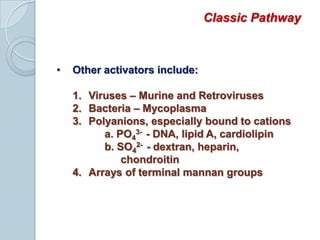
Requires calcium for activationClassic PathwayOther activators include:Viruses – Murine and RetrovirusesBacteria – MycoplasmaPolyanions, especially bound to cationsa. PO43-  - DNA, lipid A, cardiolipinb. SO42-  - dextran, heparin, chondroitinArrays of terminal mannan groups
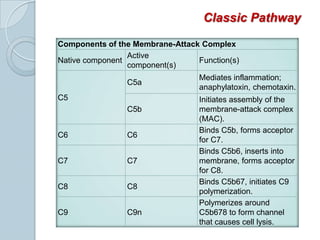
Classic Pathway
Classic Pathway
Classic Pathway
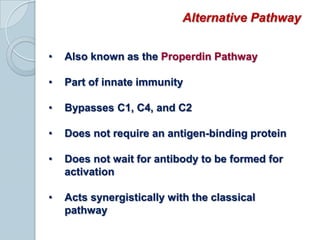
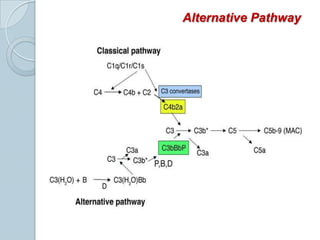
Alternative PathwayAlso known as the Properdin Pathway
Part of innate immunity
Bypasses C1, C4, and C2
Does not require an antigen-binding protein
Does not wait for antibody to be formed for activation
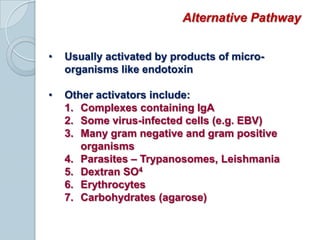
Acts synergistically with the classical pathwayAlternative PathwayUsually activated by products of micro-organisms like endotoxin
Other activators include:Complexes containing IgASome virus-infected cells (e.g. EBV)Many gram negative and gram positive organismsParasites – Trypanosomes, LeishmaniaDextran SO4ErythrocytesCarbohydrates (agarose)
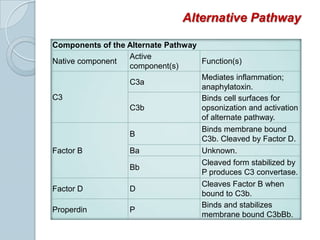
Alternative Pathway
Alternative Pathway
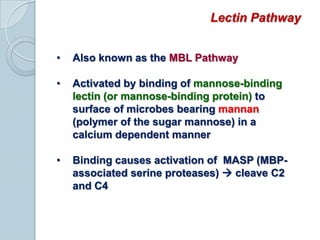
Lectin PathwayAlso known as the MBL Pathway
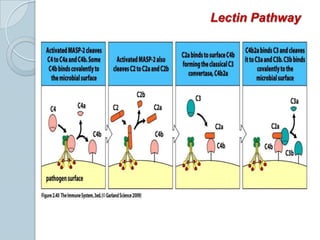
Activated by binding of mannose-binding lectin (or mannose-binding protein) to surface of microbes bearing mannan(polymer of the sugar mannose) in a calcium dependent manner
Binding causes activation of  MASP (MBP- associated serine proteases)  cleave C2 and C4Lectin Pathway
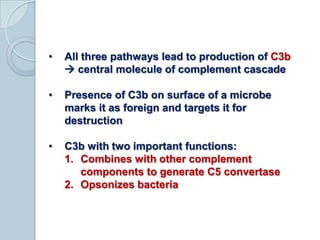
All three pathways lead to production of C3b  central molecule of complement cascade
Presence of C3b on surface of a microbe marks it as foreign and targets it for destruction

Complement System

  • 1.
    COMPLEMENT SYSTEMFe A.Bartolome, MD, FPASMAPDepartment of MicrobiologyOur Lady of Fatima University
  • 2.
    Consists of approx.20 proteins that are present in normal human serum  synthesized mainly by liver
  • 3.
    Heat-labile  inactivatedby heating serum at 560C for 30 minutes
  • 4.
    Able to augmentthe effects of other components of the immune system
  • 5.
    Important component ofinnate host defensesThree main effects:Lysis of cells (bacteria, allografts, tumor cells)Generation of mediators of inflammationOpsonization – enhancement of phagocytosis
  • 6.
    Sequential activation ofcomplement components occurs via one of three pathways:Classic pathwayLectin pathwayAlternative or Properdin pathwayLectin and alternative pathways are more important the first time we are infected by microorganisms because antibody required to activate the classic pathway is not yet presentClassic PathwayPart of acquired or adaptive immunity
  • 7.
  • 8.
    Immunoglobulins involved: IgMand IgG (except IgG4)
  • 9.
  • 10.
    Composed of C1q,C1r, and C1s  binds to Fc portion of IgG and IgM
  • 11.
    Requires calcium foractivationClassic PathwayOther activators include:Viruses – Murine and RetrovirusesBacteria – MycoplasmaPolyanions, especially bound to cationsa. PO43- - DNA, lipid A, cardiolipinb. SO42- - dextran, heparin, chondroitinArrays of terminal mannan groups
  • 12.
  • 13.
  • 14.
  • 15.
    Alternative PathwayAlso knownas the Properdin Pathway
  • 16.
  • 17.
  • 18.
    Does not requirean antigen-binding protein
  • 19.
    Does not waitfor antibody to be formed for activation
  • 20.
    Acts synergistically withthe classical pathwayAlternative PathwayUsually activated by products of micro-organisms like endotoxin
  • 21.
    Other activators include:Complexescontaining IgASome virus-infected cells (e.g. EBV)Many gram negative and gram positive organismsParasites – Trypanosomes, LeishmaniaDextran SO4ErythrocytesCarbohydrates (agarose)
  • 22.
  • 23.
  • 24.
    Lectin PathwayAlso knownas the MBL Pathway
  • 25.
    Activated by bindingof mannose-binding lectin (or mannose-binding protein) to surface of microbes bearing mannan(polymer of the sugar mannose) in a calcium dependent manner
  • 26.
    Binding causes activationof MASP (MBP- associated serine proteases)  cleave C2 and C4Lectin Pathway
  • 27.
    All three pathwayslead to production of C3b  central molecule of complement cascade
  • 28.
    Presence of C3bon surface of a microbe marks it as foreign and targets it for destruction
  • 29.
    C3b with twoimportant functions:Combines with other complement components to generate C5 convertaseOpsonizes bacteria
  • 32.
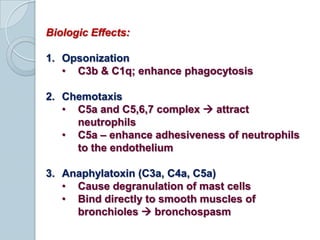
    Biologic Effects:OpsonizationC3b &C1q; enhance phagocytosisChemotaxisC5a and C5,6,7 complex  attract neutrophils
  • 33.
    C5a – enhanceadhesiveness of neutrophils to the endotheliumAnaphylatoxin (C3a, C4a, C5a)Cause degranulation of mast cells
  • 34.
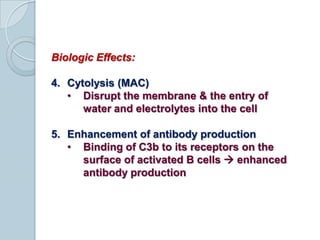
    Bind directly tosmooth muscles of bronchioles  bronchospasmBiologic Effects:Cytolysis (MAC)Disrupt the membrane & the entry of water and electrolytes into the cellEnhancement of antibody productionBinding of C3b to its receptors on the surface of activated B cells  enhanced antibody production
  • 35.
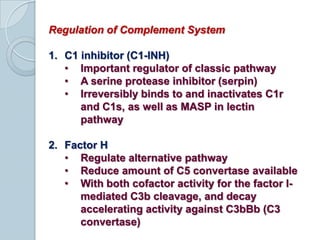
    Regulation of ComplementSystemC1 inhibitor (C1-INH)Important regulator of classic pathway
  • 36.
    A serine proteaseinhibitor (serpin)
  • 37.
    Irreversibly binds toand inactivates C1r and C1s, as well as MASP in lectin pathwayFactor HRegulate alternative pathway
  • 38.
    Reduce amount ofC5 convertase available
  • 39.
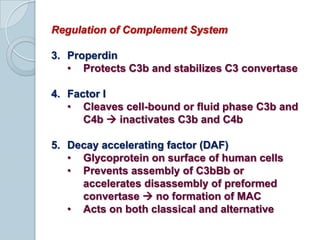
    With both cofactoractivity for the factor I- mediated C3b cleavage, and decay accelerating activity against C3bBb (C3 convertase)Regulation of Complement SystemProperdinProtects C3b and stabilizes C3 convertaseFactor ICleaves cell-bound or fluid phase C3b and C4b  inactivates C3b and C4bDecay accelerating factor (DAF)Glycoprotein on surface of human cells
  • 40.
    Prevents assembly ofC3bBb or accelerates disassembly of preformed convertase  no formation of MAC
  • 41.
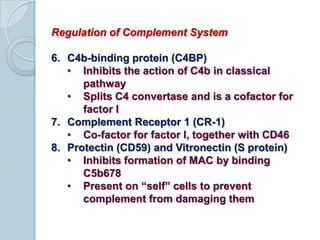
    Acts on bothclassical and alternativeRegulation of Complement SystemC4b-binding protein (C4BP)Inhibits the action of C4b in classical pathway
  • 42.
    Splits C4 convertaseand is a cofactor for factor IComplement Receptor 1 (CR-1)Co-factor for factor I, together with CD46Protectin (CD59) and Vitronectin (S protein)Inhibits formation of MAC by binding C5b678
  • 43.
    Present on “self”cells to prevent complement from damaging them
  • 44.
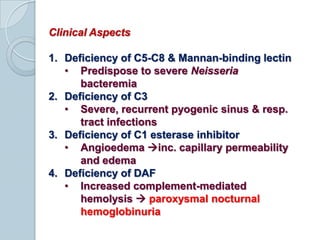
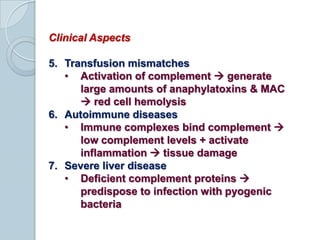
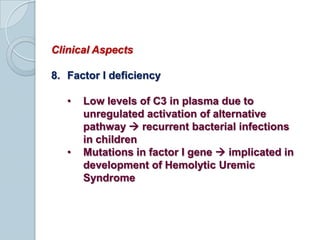
    Clinical AspectsDeficiency ofC5-C8 & Mannan-binding lectinPredispose to severe NeisseriabacteremiaDeficiency of C3Severe, recurrent pyogenic sinus & resp. tract infectionsDeficiency of C1 esterase inhibitorAngioedema inc. capillary permeability and edemaDeficiency of DAFIncreased complement-mediated hemolysis  paroxysmal nocturnal hemoglobinuriaClinical AspectsTransfusion mismatchesActivation of complement  generate large amounts of anaphylatoxins & MAC  red cell hemolysisAutoimmune diseasesImmune complexes bind complement  low complement levels + activate inflammation  tissue damageSevere liver diseaseDeficient complement proteins  predispose to infection with pyogenic bacteriaClinical AspectsFactor I deficiencyLow levels of C3 in plasma due to unregulated activation of alternative pathway  recurrent bacterial infections in children
  • 45.
    Mutations in factorI gene  implicated in development of Hemolytic Uremic Syndrome