
{
ANTI BIOGRAM
U. Monika
I – M.Sc Bio-Chemistry
ABOUT ANTIBIOGRAMS
“ ANTI MICROBIAL SUSCEPTIBILITIES OF
SELECTED PATHOGENS “
DEFINITION :
An Antibiogram is an overall profile of
antimicrobial susceptibility testing results of a specific
microorganism to a battery of antimicrobial drugs
Stable typing method, but lacks
discriminatory power.
 This profile is generated by the laboratory using
aggregate data from a hospital or health care system.
 Data are summarized periodically and presented
showing percentages of organisms tested that are
susceptible to a particular antimicrobial drug.
 Only results of antimicrobial drugs that are routinely
tested and clinically useful should be presented to
clinicians
 An antibiogram is the result of an antibiotic
sensitivity test. It is by definition an in vitro
sensitivity, but the correlation of in vitro to in vivo
sensitivity is often high enough for the test to be
clinically useful.
WHAT DOES ANTI BIOGRAM MEAN
A laboratory procedure in which samples of
bacteria are treated with a variety of antibiotics.
MEDICAL DEFINITION OF ANTIBIOGRAM
A collection of data usually in the form
of table summarizing the percent of individual bacterial
pathogens susceptible to different antimicrobial agents.
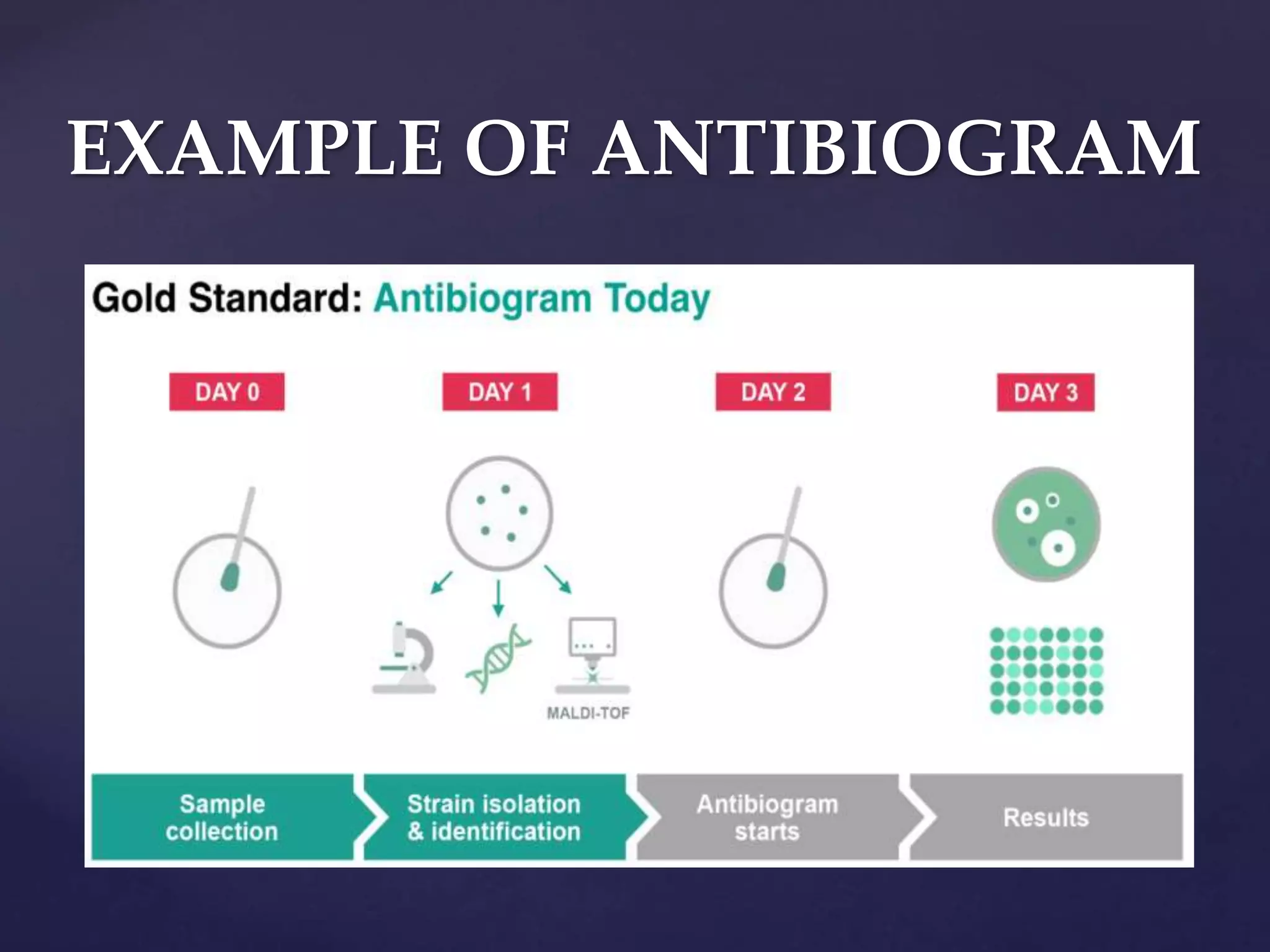
 An antibiogram is generated after bacteria are
isolated and subjected to laboratory testing.
 Local hospitals offer more directed help to their
physicians by creating antibiograms, or tables that
chart the resistance patterns with a specific facility.
ANTIBIOGRAM USES
Antibiogram help to guide the clinician and
pharmacist in selecting the best empiric antimicrobial
treatment in the event of microbiology culture and
susceptibility results.
They are also useful tool for detecting and
monitoring trends in antimicrobial resistance.
When antimicrobial susceptibility testing
data are summarized cumulatively for a hospital,
healthcare system, or other healthcare facility
periodically, trends in resistance can be identified and
investigated.
The present study recorded the results of
antibiogram as follows :
1) SAMPLE CLASSIFICATION
2) ISOLATION AND IDENTIFICATION
OF BACTERIA FROM URINE SAMPLE
3) ANTIBIOTIC RESISTANCE STUDIES
EXAMPLE OF ANTIBIOGRAM
LIMITATIONS OF ANTIBIOGRAM
While the antibiogram is useful it should
not be relied upon as the sole tool for guiding therapy.
 Minimum inhibitory concentrations ( MICs )
are not included; as a result subtle trends below the
resistance threshold (known as “MIC creep”) are
not reflected.
 Can’t distinguish between true infection and
colonization.
 Data are the result of single organism –
antimicrobial combinations, therefore do not show
trends in cross – resistance of an organisms to other
drugs , nor do they reveal synergistic properties of
antimicrobials used in combinations.
 Data may not be generalizable to specific
patient populations or locations of a health care
facility if the antibiogram is compiled using hospital
or healthcare system wide data.
CONCLUSION
The Clinical and Laboratory
Standards Institute ( formerly NCCLS ) recommend
that antibiogram is compiled mainly by
microbiology laboratories technologists , but may be
a collaborative effort involving the lab , pharmacy ,
infection preventionists , and clinicians
Easy to prepare, easy to disseminate
and easy to use.
Microbiology

Microbiology

  • 1.
    { ANTI BIOGRAM U. Monika I– M.Sc Bio-Chemistry
  • 2.
    ABOUT ANTIBIOGRAMS “ ANTIMICROBIAL SUSCEPTIBILITIES OF SELECTED PATHOGENS “ DEFINITION : An Antibiogram is an overall profile of antimicrobial susceptibility testing results of a specific microorganism to a battery of antimicrobial drugs Stable typing method, but lacks discriminatory power.
  • 3.
     This profileis generated by the laboratory using aggregate data from a hospital or health care system.  Data are summarized periodically and presented showing percentages of organisms tested that are susceptible to a particular antimicrobial drug.  Only results of antimicrobial drugs that are routinely tested and clinically useful should be presented to clinicians
  • 4.
     An antibiogramis the result of an antibiotic sensitivity test. It is by definition an in vitro sensitivity, but the correlation of in vitro to in vivo sensitivity is often high enough for the test to be clinically useful. WHAT DOES ANTI BIOGRAM MEAN A laboratory procedure in which samples of bacteria are treated with a variety of antibiotics.
  • 6.
    MEDICAL DEFINITION OFANTIBIOGRAM A collection of data usually in the form of table summarizing the percent of individual bacterial pathogens susceptible to different antimicrobial agents.  An antibiogram is generated after bacteria are isolated and subjected to laboratory testing.  Local hospitals offer more directed help to their physicians by creating antibiograms, or tables that chart the resistance patterns with a specific facility.
  • 7.
    ANTIBIOGRAM USES Antibiogram helpto guide the clinician and pharmacist in selecting the best empiric antimicrobial treatment in the event of microbiology culture and susceptibility results. They are also useful tool for detecting and monitoring trends in antimicrobial resistance. When antimicrobial susceptibility testing data are summarized cumulatively for a hospital, healthcare system, or other healthcare facility periodically, trends in resistance can be identified and investigated.
  • 8.
    The present studyrecorded the results of antibiogram as follows : 1) SAMPLE CLASSIFICATION 2) ISOLATION AND IDENTIFICATION OF BACTERIA FROM URINE SAMPLE 3) ANTIBIOTIC RESISTANCE STUDIES
  • 9.
  • 10.
    LIMITATIONS OF ANTIBIOGRAM Whilethe antibiogram is useful it should not be relied upon as the sole tool for guiding therapy.  Minimum inhibitory concentrations ( MICs ) are not included; as a result subtle trends below the resistance threshold (known as “MIC creep”) are not reflected.  Can’t distinguish between true infection and colonization.
  • 11.
     Data arethe result of single organism – antimicrobial combinations, therefore do not show trends in cross – resistance of an organisms to other drugs , nor do they reveal synergistic properties of antimicrobials used in combinations.  Data may not be generalizable to specific patient populations or locations of a health care facility if the antibiogram is compiled using hospital or healthcare system wide data.
  • 12.
    CONCLUSION The Clinical andLaboratory Standards Institute ( formerly NCCLS ) recommend that antibiogram is compiled mainly by microbiology laboratories technologists , but may be a collaborative effort involving the lab , pharmacy , infection preventionists , and clinicians Easy to prepare, easy to disseminate and easy to use.