Dr. Meenakshi Sharma
Assistant Professor
Department of Microbiology
Mayo Institute of Medical Sciences
 Introduction
 General propertis
 Complement activation
◦ Classical complement pathway
◦ Alternative complement pathway
◦ Lectin complement pathway
 Regulation of complement activation
 Biological effects of complement
 Deficiencies of the complement system
 The term complement refers to a system of
factors that occur in normal serum and is
activated characteristically by Ag-Ab
interaction
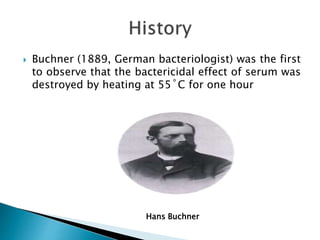
 Buchner (1889, German bacteriologist) was the first
to observe that the bactericidal effect of serum was
destroyed by heating at 55˚C for one hour
Hans Buchner
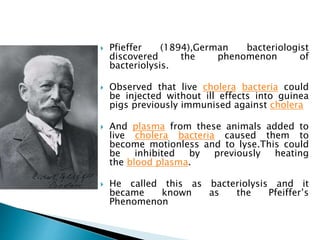
 Pfieffer (1894),German bacteriologist
discovered the phenomenon of
bacteriolysis.
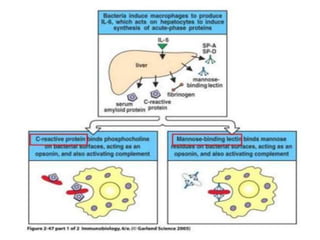
 Observed that live cholera bacteria could
be injected without ill effects into guinea
pigs previously immunised against cholera
 And plasma from these animals added to
live cholera bacteria caused them to
become motionless and to lyse.This could
be inhibited by previously heating
the blood plasma.
 He called this as bacteriolysis and it
became known as the Pfeiffer’s
Phenomenon
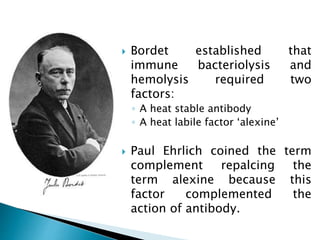
 Bordet established that
immune bacteriolysis and
hemolysis required two
factors:
◦ A heat stable antibody
◦ A heat labile factor ‘alexine’
 Paul Ehrlich coined the term
complement repalcing the
term alexine because this
factor complemented the
action of antibody.
 It is named “complement system” because it was first
identified as a heat-labile component of serum that
“complemented” antibodies in the killing of bacteria.
 Consists of serum and cell surface proteins involved
in defense against pathogens and tissue damage
mediated by antibodies
 The Complement system is the major effector of
humoral branch of immune system.
 Plays major role in both innate and adaptive
immunity.
 Non specific
 5% normal serum protein
 Destroyed in 30 min at 56˚ C (Heat labile)
 Bind only to antibodies that have combined
with their antigens
 Only Ig M, Ig G 3,1,2 fix complement
 Binds to Fc portion of Ig
 30 proteins – C components + Properdin +
Control Proteins
 Nine different fractionsC1 to C9
 Complement is a complex of nine different
fractions C1-C9
 Fraction C1 occurs as Ca⁺ ion dependent
complex, which on chelation with EDTA yields
3 protein subunits C1q,r & s.
 Fractions are named C1-9 in the sequence of
cascading reaction, except C4 comes before
C2.
 When a fraction acquires enzymatic or
biological activity it is indicated by a bar over
the component number Cī
 Inactivated form is indicated by prefix ‘i’ (iC3b)
 They are mainly synthesized by hepatocytes
 Also produced by blood monocytes, tissue
macrophages and epithelial cells of the
gastrointestinal and genitourinary tract.
 Complement proteins: Made as zymogens -
activation by cleavage.
 Example: C4a ---a smaller fragment
C4
C4b--- larger fragment
Exception C2: C2a = large fragment
C2b = small fragment
 Normally present in inactive form in body
 Activity is induced by Ag-Ab combination
 Components react in a specific sequence as a
cascade
 C cascade is a series of reactions in which the
preceding components acts as enzymes for the
succeeding components
 Components are cleaved in dissimilar fragments
 Larger fragments join the cascade and smaller
fragments released in the medium possess
biological functions
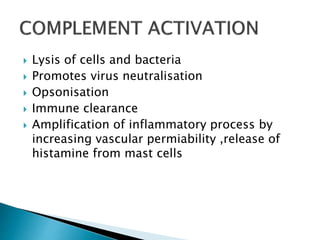
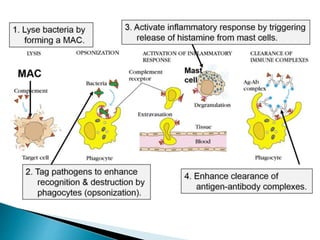
 Lysis of cells and bacteria
 Promotes virus neutralisation
 Opsonisation
 Immune clearance
 Amplification of inflammatory process by
increasing vascular permiability ,release of
histamine from mast cells
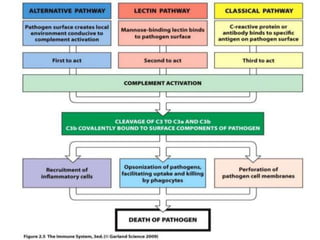
 C cascade is trigged off by three parallel but
independent pathways
 Differ only in initial steps
 Once C3 activation occurs, the subsequent
steps are common
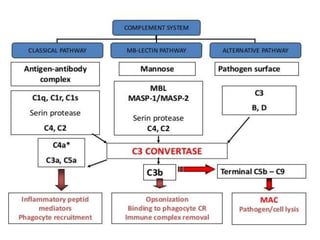
 3 major pathways of complement activation
◦ classical pathway : activated by Ab bound to Ag
◦ alternative pathway: activated on microbial cell
surfaces in the absence of antibody
◦ lectin pathway : activated by plasma lectin that binds
to mannose residues on microbes
 Central event in complement activation is
proteolysis of C3 to generate biologically
active products and subsequent covalent
attachment of C3b to microbial cell surfaces
or to Ab bound to Ag
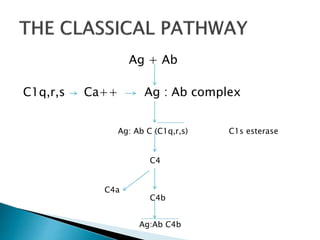
Ag + Ab
C1q,r,s Ca++ Ag : Ab complex
Ag: Ab C (C1q,r,s) C1s esterase
C4
C4a
C4b
Ag:Ab C4b
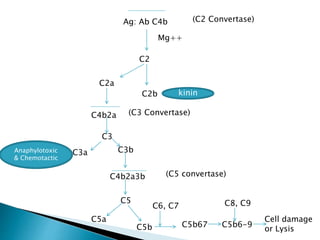
Ag: Ab C4b (C2 Convertase)
Mg++
C2
C2a
C2b kinin
C4b2a (C3 Convertase)
C3
C3a C3bAnaphylotoxic
& Chemotactic
C4b2a3b (C5 convertase)
C5
C5a
C5b
C6, C7
C5b67
C8, C9
C5b6-9
Cell damage
or Lysis
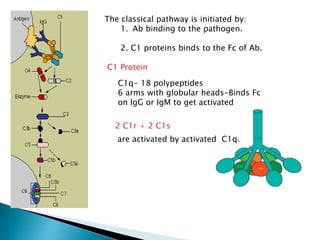
The classical pathway is initiated by:
1. Ab binding to the pathogen.
2. C1 proteins binds to the Fc of Ab.
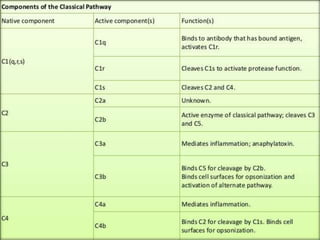
C1 Protein
C1q- 18 polypeptides
6 arms with globular heads-Binds Fc
on IgG or IgM to get activated
2 C1r + 2 C1s
are activated by activated C1q.
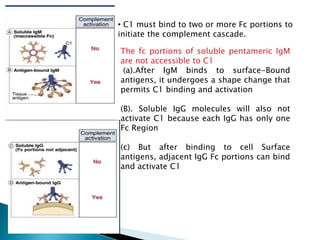
• C1 must bind to two or more Fc portions to
initiate the complement cascade.
The fc portions of soluble pentameric IgM
are not accessible to C1
(a).After IgM binds to surface-Bound
antigens, it undergoes a shape change that
permits C1 binding and activation
(B). Soluble IgG molecules will also not
activate C1 because each IgG has only one
Fc Region
(c) But after binding to cell Surface
antigens, adjacent IgG Fc portions can bind
and activate C1
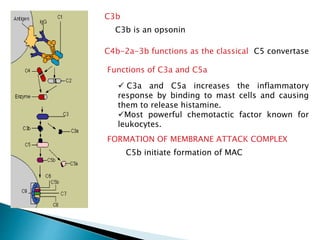
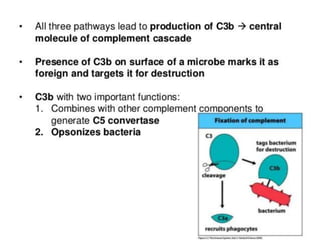
C3b
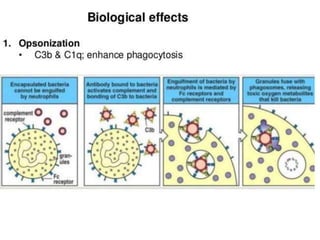
C3b is an opsonin
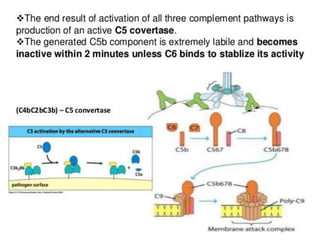
C4b-2a-3b functions as the classical C5 convertase
FORMATION OF MEMBRANE ATTACK COMPLEX
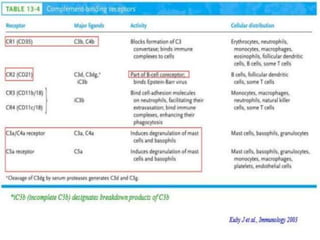
Functions of C3a and C5a
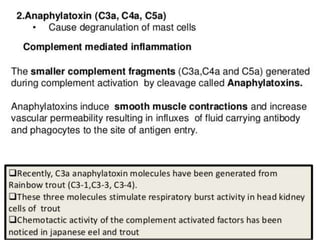
 C3a and C5a increases the inflammatory
response by binding to mast cells and causing
them to release histamine.
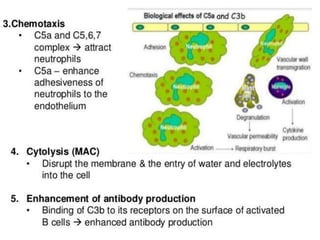
Most powerful chemotactic factor known for
leukocytes.
C5b initiate formation of MAC
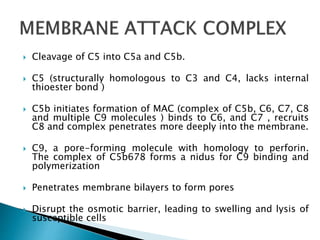
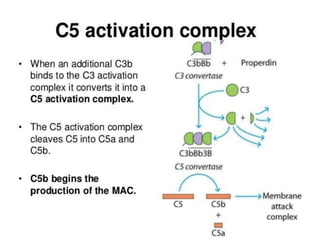
 Cleavage of C5 into C5a and C5b.
 C5 (structurally homologous to C3 and C4, lacks internal
thioester bond )
 C5b initiates formation of MAC (complex of C5b, C6, C7, C8
and multiple C9 molecules ) binds to C6, and C7 , recruits
C8 and complex penetrates more deeply into the membrane.
 C9, a pore-forming molecule with homology to perforin.
The complex of C5b678 forms a nidus for C9 binding and
polymerization
 Penetrates membrane bilayers to form pores
 Disrupt the osmotic barrier, leading to swelling and lysis of
susceptible cells
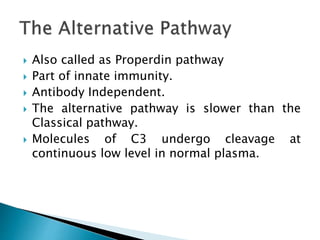
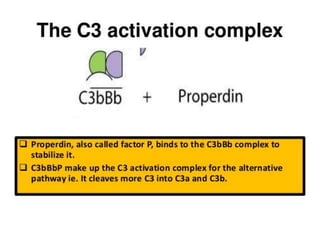
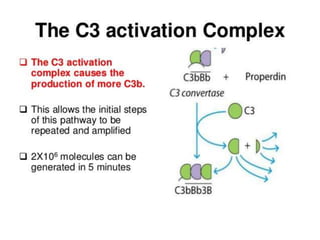
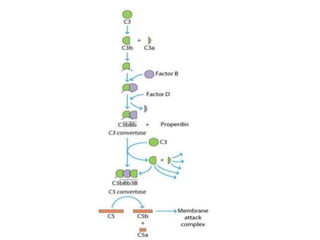
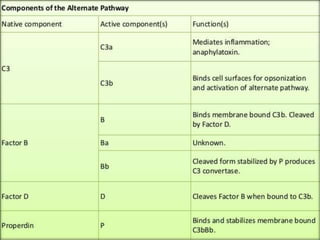
 Also called as Properdin pathway
 Part of innate immunity.
 Antibody Independent.
 The alternative pathway is slower than the
Classical pathway.
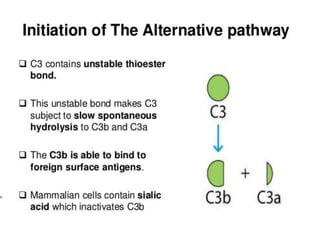
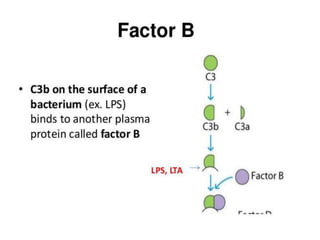
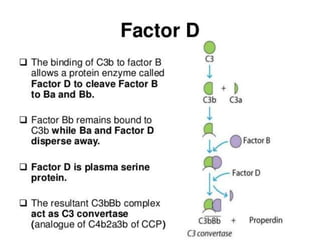
 Molecules of C3 undergo cleavage at
continuous low level in normal plasma.
The complement system

The complement system

  • 1.
    Dr. Meenakshi Sharma AssistantProfessor Department of Microbiology Mayo Institute of Medical Sciences
  • 2.
     Introduction  Generalpropertis  Complement activation ◦ Classical complement pathway ◦ Alternative complement pathway ◦ Lectin complement pathway  Regulation of complement activation  Biological effects of complement  Deficiencies of the complement system
  • 3.
     The termcomplement refers to a system of factors that occur in normal serum and is activated characteristically by Ag-Ab interaction
  • 4.
     Buchner (1889,German bacteriologist) was the first to observe that the bactericidal effect of serum was destroyed by heating at 55˚C for one hour Hans Buchner
  • 5.
     Pfieffer (1894),Germanbacteriologist discovered the phenomenon of bacteriolysis.  Observed that live cholera bacteria could be injected without ill effects into guinea pigs previously immunised against cholera  And plasma from these animals added to live cholera bacteria caused them to become motionless and to lyse.This could be inhibited by previously heating the blood plasma.  He called this as bacteriolysis and it became known as the Pfeiffer’s Phenomenon
  • 6.
     Bordet establishedthat immune bacteriolysis and hemolysis required two factors: ◦ A heat stable antibody ◦ A heat labile factor ‘alexine’  Paul Ehrlich coined the term complement repalcing the term alexine because this factor complemented the action of antibody.
  • 7.
     It isnamed “complement system” because it was first identified as a heat-labile component of serum that “complemented” antibodies in the killing of bacteria.  Consists of serum and cell surface proteins involved in defense against pathogens and tissue damage mediated by antibodies  The Complement system is the major effector of humoral branch of immune system.  Plays major role in both innate and adaptive immunity.
  • 8.
     Non specific 5% normal serum protein  Destroyed in 30 min at 56˚ C (Heat labile)  Bind only to antibodies that have combined with their antigens  Only Ig M, Ig G 3,1,2 fix complement  Binds to Fc portion of Ig  30 proteins – C components + Properdin + Control Proteins  Nine different fractionsC1 to C9
  • 9.
     Complement isa complex of nine different fractions C1-C9  Fraction C1 occurs as Ca⁺ ion dependent complex, which on chelation with EDTA yields 3 protein subunits C1q,r & s.  Fractions are named C1-9 in the sequence of cascading reaction, except C4 comes before C2.  When a fraction acquires enzymatic or biological activity it is indicated by a bar over the component number Cī  Inactivated form is indicated by prefix ‘i’ (iC3b)
  • 10.
     They aremainly synthesized by hepatocytes  Also produced by blood monocytes, tissue macrophages and epithelial cells of the gastrointestinal and genitourinary tract.  Complement proteins: Made as zymogens - activation by cleavage.  Example: C4a ---a smaller fragment C4 C4b--- larger fragment Exception C2: C2a = large fragment C2b = small fragment
  • 11.
     Normally presentin inactive form in body  Activity is induced by Ag-Ab combination  Components react in a specific sequence as a cascade  C cascade is a series of reactions in which the preceding components acts as enzymes for the succeeding components  Components are cleaved in dissimilar fragments  Larger fragments join the cascade and smaller fragments released in the medium possess biological functions
  • 12.
     Lysis ofcells and bacteria  Promotes virus neutralisation  Opsonisation  Immune clearance  Amplification of inflammatory process by increasing vascular permiability ,release of histamine from mast cells
  • 14.
     C cascadeis trigged off by three parallel but independent pathways  Differ only in initial steps  Once C3 activation occurs, the subsequent steps are common
  • 15.
     3 majorpathways of complement activation ◦ classical pathway : activated by Ab bound to Ag ◦ alternative pathway: activated on microbial cell surfaces in the absence of antibody ◦ lectin pathway : activated by plasma lectin that binds to mannose residues on microbes
  • 16.
     Central eventin complement activation is proteolysis of C3 to generate biologically active products and subsequent covalent attachment of C3b to microbial cell surfaces or to Ab bound to Ag
  • 17.
    Ag + Ab C1q,r,sCa++ Ag : Ab complex Ag: Ab C (C1q,r,s) C1s esterase C4 C4a C4b Ag:Ab C4b
  • 18.
    Ag: Ab C4b(C2 Convertase) Mg++ C2 C2a C2b kinin C4b2a (C3 Convertase) C3 C3a C3bAnaphylotoxic & Chemotactic C4b2a3b (C5 convertase) C5 C5a C5b C6, C7 C5b67 C8, C9 C5b6-9 Cell damage or Lysis
  • 19.
    The classical pathwayis initiated by: 1. Ab binding to the pathogen. 2. C1 proteins binds to the Fc of Ab. C1 Protein C1q- 18 polypeptides 6 arms with globular heads-Binds Fc on IgG or IgM to get activated 2 C1r + 2 C1s are activated by activated C1q.
  • 20.
    • C1 mustbind to two or more Fc portions to initiate the complement cascade. The fc portions of soluble pentameric IgM are not accessible to C1 (a).After IgM binds to surface-Bound antigens, it undergoes a shape change that permits C1 binding and activation (B). Soluble IgG molecules will also not activate C1 because each IgG has only one Fc Region (c) But after binding to cell Surface antigens, adjacent IgG Fc portions can bind and activate C1
  • 21.
    C3b C3b is anopsonin C4b-2a-3b functions as the classical C5 convertase FORMATION OF MEMBRANE ATTACK COMPLEX Functions of C3a and C5a  C3a and C5a increases the inflammatory response by binding to mast cells and causing them to release histamine. Most powerful chemotactic factor known for leukocytes. C5b initiate formation of MAC
  • 23.
     Cleavage ofC5 into C5a and C5b.  C5 (structurally homologous to C3 and C4, lacks internal thioester bond )  C5b initiates formation of MAC (complex of C5b, C6, C7, C8 and multiple C9 molecules ) binds to C6, and C7 , recruits C8 and complex penetrates more deeply into the membrane.  C9, a pore-forming molecule with homology to perforin. The complex of C5b678 forms a nidus for C9 binding and polymerization  Penetrates membrane bilayers to form pores  Disrupt the osmotic barrier, leading to swelling and lysis of susceptible cells
  • 24.
     Also calledas Properdin pathway  Part of innate immunity.  Antibody Independent.  The alternative pathway is slower than the Classical pathway.  Molecules of C3 undergo cleavage at continuous low level in normal plasma.