Immunization Abdul Ghaffar Microbiology and Immunology
Milestones in immunization 1500BC Turks introduce variolation 3000BC Evidence of sniffing powdered small pox crust in Egypt 2000BC Sniffing of small pox crust in China 1700AD Introduction of variolation in England and later in the US
The wife of the British Ambassador in  Turkey, in March 1717 wrote, following the variolation of her son, to a friend in England: “The small pox, so fatal, so general  amongst us, is entirely harmless here  by the invention of ingrafting….I am  patriot enough to bring this invention into  fashion in England. Introduction of variolation
Milestones in immunization 1780AD Edward Jenner discovers small pox vaccine
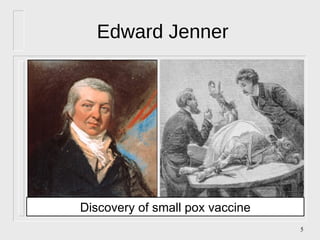
Edward Jenner Discovery of small pox vaccine
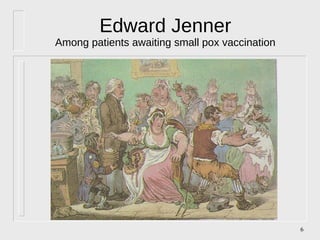
Edward Jenner Among patients awaiting small pox vaccination
Modern era of the vaccine 1920s Diphtheria and Tetanus 1934 Pertussis 1955 Salk polio 1885 Rabies vaccine (Pasteur)
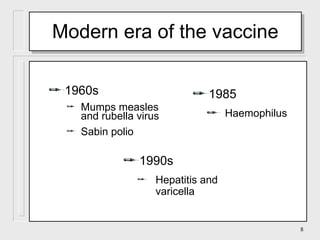
Modern era of the vaccine 1960s Mumps measles and rubella virus Sabin polio 1990s Hepatitis and varicella 1985 Haemophilus
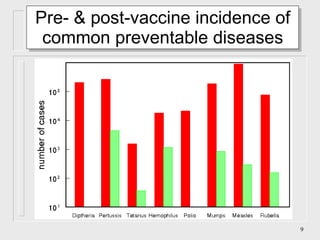
Pre- & post-vaccine incidence of common preventable diseases
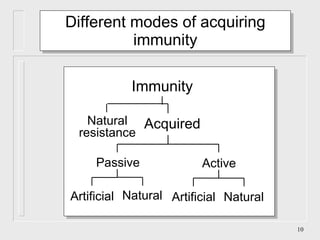
Different modes of acquiring immunity Immunity Natural resistance Artificial Natural Passive Artificial Natural Active Acquired
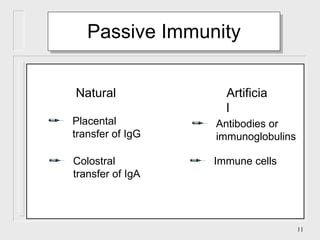
Passive Immunity Colostral transfer of IgA Placental transfer of IgG Antibodies or immunoglobulins Immune cells Natural Artificial
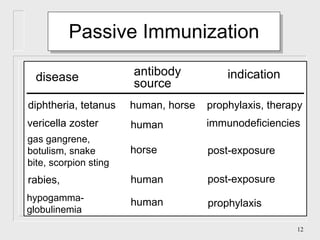
Passive Immunization   disease   indication antibody source human, horse diphtheria, tetanus prophylaxis, therapy vericella zoster human immunodeficiencies gas gangrene, botulism, snake bite, scorpion sting horse post-exposure rabies, human post-exposure hypogamma-globulinemia human prophylaxis
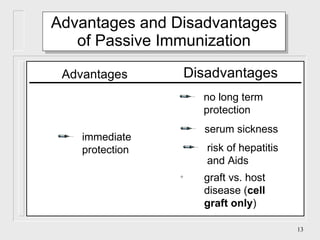
Advantages and Disadvantages of Passive Immunization serum sickness immediate protection no long term protection graft vs. host disease ( cell graft only ) risk of hepatitis and Aids Advantages Disadvantages
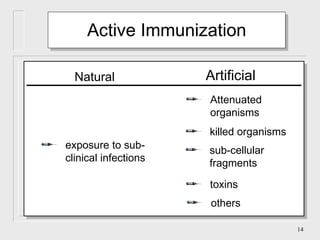
Active Immunization exposure to sub-clinical infections Attenuated organisms killed organisms sub-cellular fragments toxins others Natural Artificial
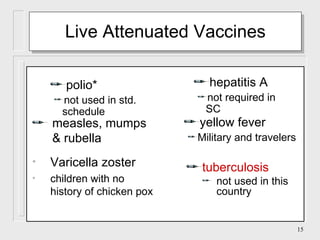
Live Attenuated Vaccines tuberculosis not used in this country polio* not used in std. schedule measles, mumps & rubella yellow fever Military and travelers Varicella zoster children with no history of chicken pox hepatitis A not required in SC
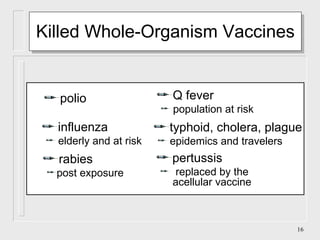
Killed Whole-Organism Vaccines polio influenza elderly and at risk typhoid, cholera, plague epidemics and travelers rabies post exposure pertussis replaced by the acellular vaccine Q fever population at risk
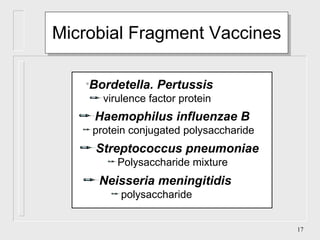
Microbial Fragment Vaccines Bordetella. Pertussis virulence factor protein Haemophilus influenzae B protein conjugated polysaccharide Streptococcus pneumoniae Polysaccharide mixture Neisseria meningitidis polysaccharide
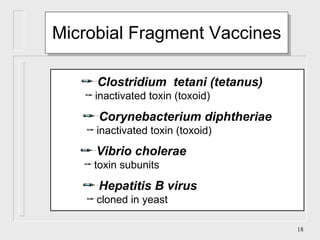
Microbial Fragment Vaccines Clostridium  tetani (tetanus) inactivated toxin (toxoid) Corynebacterium diphtheriae inactivated toxin (toxoid) Vibrio cholerae toxin subunits Hepatitis B virus cloned in yeast
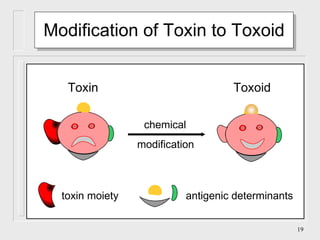
Modification of Toxin to Toxoid Toxin toxin moiety antigenic determinants chemical modification Toxoid
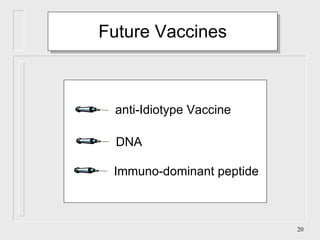
anti-Idiotype Vaccine Future Vaccines Immuno-dominant peptide DNA
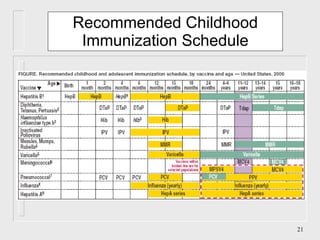
Recommended Childhood Immunization Schedule
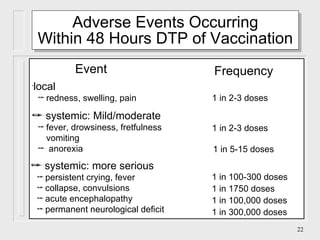
Adverse Events Occurring Within 48 Hours DTP of Vaccination   Event   Frequency local redness, swelling, pain 1 in 2-3 doses systemic: Mild/moderate fever, drowsiness, fretfulness vomiting anorexia 1 in 2-3 doses 1 in 5-15 doses systemic: more serious  persistent crying, fever collapse, convulsions acute encephalopathy permanent neurological deficit 1 in 100-300 doses 1 in 1750 doses 1 in 100,000 doses 1 in 300,000 doses

0616 Immuniz

  • 1.
    Immunization Abdul GhaffarMicrobiology and Immunology
  • 2.
    Milestones in immunization1500BC Turks introduce variolation 3000BC Evidence of sniffing powdered small pox crust in Egypt 2000BC Sniffing of small pox crust in China 1700AD Introduction of variolation in England and later in the US
  • 3.
    The wife ofthe British Ambassador in Turkey, in March 1717 wrote, following the variolation of her son, to a friend in England: “The small pox, so fatal, so general amongst us, is entirely harmless here by the invention of ingrafting….I am patriot enough to bring this invention into fashion in England. Introduction of variolation
  • 4.
    Milestones in immunization1780AD Edward Jenner discovers small pox vaccine
  • 5.
    Edward Jenner Discoveryof small pox vaccine
  • 6.
    Edward Jenner Amongpatients awaiting small pox vaccination
  • 7.
    Modern era ofthe vaccine 1920s Diphtheria and Tetanus 1934 Pertussis 1955 Salk polio 1885 Rabies vaccine (Pasteur)
  • 8.
    Modern era ofthe vaccine 1960s Mumps measles and rubella virus Sabin polio 1990s Hepatitis and varicella 1985 Haemophilus
  • 9.
    Pre- & post-vaccineincidence of common preventable diseases
  • 10.
    Different modes ofacquiring immunity Immunity Natural resistance Artificial Natural Passive Artificial Natural Active Acquired
  • 11.
    Passive Immunity Colostraltransfer of IgA Placental transfer of IgG Antibodies or immunoglobulins Immune cells Natural Artificial
  • 12.
    Passive Immunization  disease   indication antibody source human, horse diphtheria, tetanus prophylaxis, therapy vericella zoster human immunodeficiencies gas gangrene, botulism, snake bite, scorpion sting horse post-exposure rabies, human post-exposure hypogamma-globulinemia human prophylaxis
  • 13.
    Advantages and Disadvantagesof Passive Immunization serum sickness immediate protection no long term protection graft vs. host disease ( cell graft only ) risk of hepatitis and Aids Advantages Disadvantages
  • 14.
    Active Immunization exposureto sub-clinical infections Attenuated organisms killed organisms sub-cellular fragments toxins others Natural Artificial
  • 15.
    Live Attenuated Vaccinestuberculosis not used in this country polio* not used in std. schedule measles, mumps & rubella yellow fever Military and travelers Varicella zoster children with no history of chicken pox hepatitis A not required in SC
  • 16.
    Killed Whole-Organism Vaccinespolio influenza elderly and at risk typhoid, cholera, plague epidemics and travelers rabies post exposure pertussis replaced by the acellular vaccine Q fever population at risk
  • 17.
    Microbial Fragment VaccinesBordetella. Pertussis virulence factor protein Haemophilus influenzae B protein conjugated polysaccharide Streptococcus pneumoniae Polysaccharide mixture Neisseria meningitidis polysaccharide
  • 18.
    Microbial Fragment VaccinesClostridium tetani (tetanus) inactivated toxin (toxoid) Corynebacterium diphtheriae inactivated toxin (toxoid) Vibrio cholerae toxin subunits Hepatitis B virus cloned in yeast
  • 19.
    Modification of Toxinto Toxoid Toxin toxin moiety antigenic determinants chemical modification Toxoid
  • 20.
    anti-Idiotype Vaccine FutureVaccines Immuno-dominant peptide DNA
  • 21.
  • 22.
    Adverse Events OccurringWithin 48 Hours DTP of Vaccination   Event   Frequency local redness, swelling, pain 1 in 2-3 doses systemic: Mild/moderate fever, drowsiness, fretfulness vomiting anorexia 1 in 2-3 doses 1 in 5-15 doses systemic: more serious persistent crying, fever collapse, convulsions acute encephalopathy permanent neurological deficit 1 in 100-300 doses 1 in 1750 doses 1 in 100,000 doses 1 in 300,000 doses

Editor's Notes

  • #4 On August 8, 1721, 7 death row prisoners were subjected to the procedure. They came down with a very mild case of small pox, all recovered and were immune to small pox. They were granted full pardon. In 1776, George Washington ordered inoculation of all his soldiers, and the procedure was a success.
  • #6 In 1798, Jenner introduced 1 st vaccination ( vacca : cow) following his experimentation with isolates of cow pox virus from ‘Blossom’.
  • #7 The mass vaccination against became a standard practice.
  • #10 DPT: 15-59% vaccinated Polio: 55-88% MMR: 80-90%
  • #11 Immunization is the means of providing specific protection against most common and damaging pathogens. Specific immunity can be acquired either by passive or by active immunization and both modes of immunization can occur by natural or artificial means (Figure 1).
  • #13 Artificially acquired passive immunity : Immunity is often artificially transferred by injection with gamma‑globulins from other individuals or gamma‑globulin from an immune animal . Passive transfer of immunity with immune globulins or gamma‑globulins is practiced in numerous acute situations of poisoning (insects, reptiles, botulism), infections (tetanus, measles, rabies, etc.) and as a prophylactic measure hypo-gamma-globulinemia ). In these situations, gamma‑globulins of human origin are preferable although specific antibodies raised in other species are effective and used in some cases (acute poisoning and tetanus and diphtheria infections. Passive transfer of cell mediated immunity can also be accomplished in certain diseases (cancer, immunodeficiency). The donor cells must be histocompatible.
  • #15 This refers to immunity produced by the body in consequence of exposure to antigens. Naturally acquired active immunity : Exposure to different pathogens leads to sub-clinical or clinical infections which result in a protective immune response against these pathogens.
  • #23 Active immunization may cause fever, malaise and discomfort. Some vaccine may also cause joint pains or arthritis (rubella), convulsions, sometimes fatal (pertussis), or neurological disorders (influenza). Allergies to egg may develop as a consequence of viral vaccines produced in egg (measles, mumps, influenza, yellow fever). Live vaccines although innocuous in normal individuals may produce serious infections in immunodeficient individuals and hence should be avoided in such cases . Table 3 summarizes frequencies of undesirable effects of diphtheria‑tetanus‑polio (DTP) vaccine.