1
Combinational logic circuits
Amjad Hassan Khan MK
Lecturer in Electronics
Kristu Jayanti College,
Bangalore
2
overview
 What is combinational logic circuit ?
 Examples of combinational logic
circuits
 Binary-adder
 Binary-subtractor
Multiplexers
3
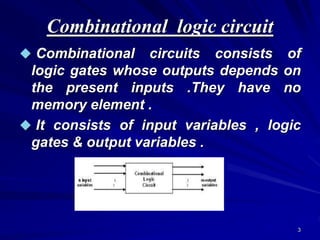
Combinational logic circuit
 Combinational circuits consists of
logic gates whose outputs depends on
the present inputs .They have no
memory element .
 It consists of input variables , logic
gates & output variables .
4
Binary-Adder
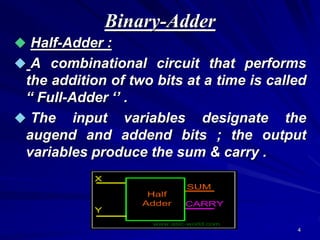
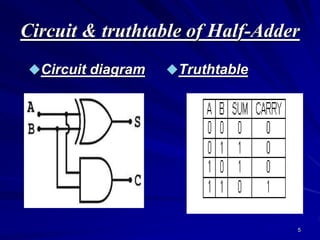
 Half-Adder :
 A combinational circuit that performs
the addition of two bits at a time is called
“ Full-Adder ‘’ .
 The input variables designate the
augend and addend bits ; the output
variables produce the sum & carry .
5
Circuit & truthtable of Half-Adder
Circuit diagram Truthtable
6
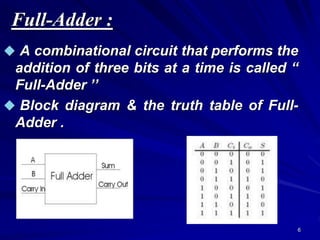
Full-Adder :
 A combinational circuit that performs the
addition of three bits at a time is called “
Full-Adder ’’
 Block diagram & the truth table of Full-
Adder .
7
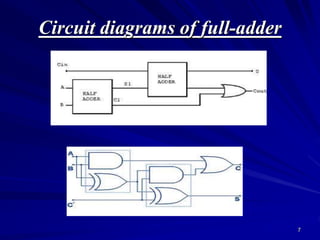
Circuit diagrams of full-adder
8
Binary-Adder
 A Binary-Adder is a digital circuit that
produces the arthimatic sum of two
binary numbers at a time .
 It can also construct by cascading no
of full-adders we get a N-bit binary-
adder circuit .
 An N-bit adder requires n full-adders
with each output carry connected to the
input carry to the next full-adder .
9
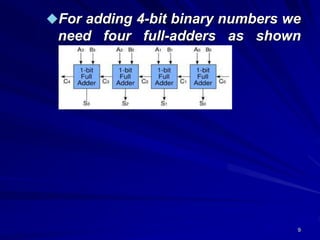
For adding 4-bit binary numbers we
need four full-adders as shown
below :
10
Binary-subtractor
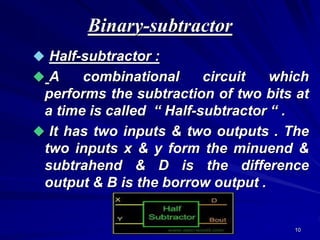
 Half-subtractor :
 A combinational circuit which
performs the subtraction of two bits at
a time is called “ Half-subtractor “ .
 It has two inputs & two outputs . The
two inputs x & y form the minuend &
subtrahend & D is the difference
output & B is the borrow output .
11
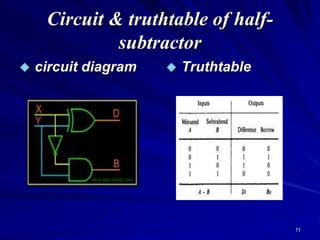
Circuit & truthtable of half-
subtractor
 circuit diagram  Truthtable
12
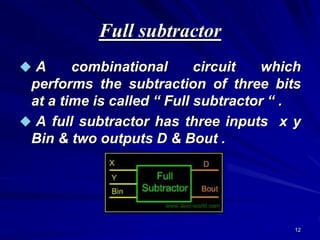
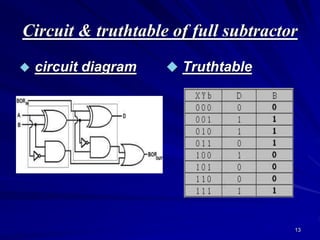
Full subtractor
 A combinational circuit which
performs the subtraction of three bits
at a time is called “ Full subtractor “ .
 A full subtractor has three inputs x y
Bin & two outputs D & Bout .
13
Circuit & truthtable of full subtractor
 circuit diagram  Truthtable
14
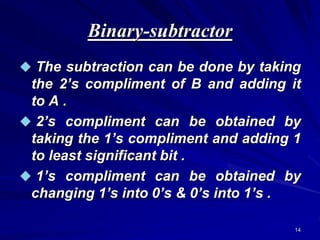
Binary-subtractor
 The subtraction can be done by taking
the 2’s compliment of B and adding it
to A .
 2’s compliment can be obtained by
taking the 1’s compliment and adding 1
to least significant bit .
 1’s compliment can be obtained by
changing 1’s into 0’s & 0’s into 1’s .
15
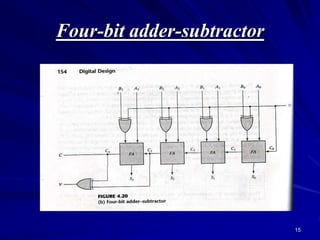
Four-bit adder-subtractor
16
Continues…..
 In this circuit the mode input m
controls the operation . When m=0 , the
circuit is an adder circuit . When m=1,
the circuit becomes a subtractor .
 The c & v are two outputs . C is for
carry & v is for overflow . If v=0 after an
addition or subtraction ,then no
overflow occurred and the n-bit result
is correct . If v=1 , then the result of the
operation contains n+1 bits .
17
Multiplexer
 multiplexer is a combinational circuit
that selects binary information from
one of many input lines and directs it to
a single output line .
 Normally there are 2n input lines and n
selection lines whose bit combinations
determines which input is selected .
 A multiplexer is also called ‘ Data
selector ’
18
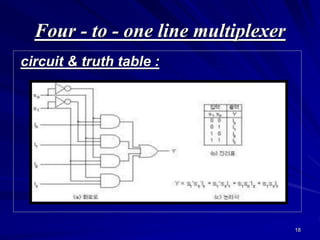
Four - to - one line multiplexer
circuit & truth table :
19
THANK YOU

Combinationalcircuits

  • 1.
    1 Combinational logic circuits AmjadHassan Khan MK Lecturer in Electronics Kristu Jayanti College, Bangalore
  • 2.
    2 overview  What iscombinational logic circuit ?  Examples of combinational logic circuits  Binary-adder  Binary-subtractor Multiplexers
  • 3.
    3 Combinational logic circuit Combinational circuits consists of logic gates whose outputs depends on the present inputs .They have no memory element .  It consists of input variables , logic gates & output variables .
  • 4.
    4 Binary-Adder  Half-Adder : A combinational circuit that performs the addition of two bits at a time is called “ Full-Adder ‘’ .  The input variables designate the augend and addend bits ; the output variables produce the sum & carry .
  • 5.
    5 Circuit & truthtableof Half-Adder Circuit diagram Truthtable
  • 6.
    6 Full-Adder :  Acombinational circuit that performs the addition of three bits at a time is called “ Full-Adder ’’  Block diagram & the truth table of Full- Adder .
  • 7.
  • 8.
    8 Binary-Adder  A Binary-Adderis a digital circuit that produces the arthimatic sum of two binary numbers at a time .  It can also construct by cascading no of full-adders we get a N-bit binary- adder circuit .  An N-bit adder requires n full-adders with each output carry connected to the input carry to the next full-adder .
  • 9.
    9 For adding 4-bitbinary numbers we need four full-adders as shown below :
  • 10.
    10 Binary-subtractor  Half-subtractor : A combinational circuit which performs the subtraction of two bits at a time is called “ Half-subtractor “ .  It has two inputs & two outputs . The two inputs x & y form the minuend & subtrahend & D is the difference output & B is the borrow output .
  • 11.
    11 Circuit & truthtableof half- subtractor  circuit diagram  Truthtable
  • 12.
    12 Full subtractor  Acombinational circuit which performs the subtraction of three bits at a time is called “ Full subtractor “ .  A full subtractor has three inputs x y Bin & two outputs D & Bout .
  • 13.
    13 Circuit & truthtableof full subtractor  circuit diagram  Truthtable
  • 14.
    14 Binary-subtractor  The subtractioncan be done by taking the 2’s compliment of B and adding it to A .  2’s compliment can be obtained by taking the 1’s compliment and adding 1 to least significant bit .  1’s compliment can be obtained by changing 1’s into 0’s & 0’s into 1’s .
  • 15.
  • 16.
    16 Continues…..  In thiscircuit the mode input m controls the operation . When m=0 , the circuit is an adder circuit . When m=1, the circuit becomes a subtractor .  The c & v are two outputs . C is for carry & v is for overflow . If v=0 after an addition or subtraction ,then no overflow occurred and the n-bit result is correct . If v=1 , then the result of the operation contains n+1 bits .
  • 17.
    17 Multiplexer  multiplexer isa combinational circuit that selects binary information from one of many input lines and directs it to a single output line .  Normally there are 2n input lines and n selection lines whose bit combinations determines which input is selected .  A multiplexer is also called ‘ Data selector ’
  • 18.
    18 Four - to- one line multiplexer circuit & truth table :
  • 19.