KL 2164
DIGITAL ELECTRONICS
ADDER / SUBSTRACTER
              Pn. Wan Nurdiana Wan Ibrahim
                      nurdiana@eng.ukm.my
Contents

Half Adder
Full Adder
Subtracter


             2
Adder
The result of adding two binary digits could produce a carry value
Recall that 1 + 1 = 10
in base two

Half adder
A circuit that computes the sum of two bits
and produces the correct carry bit

Full Adder
A circuit that takes the carry-in value into account


                                                                     3
Contents

Half Adder
Full Adder
Subtracter


             4
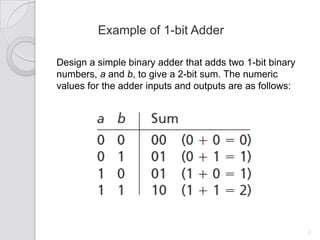
Example of 1-bit Adder

Design a simple binary adder that adds two 1-bit binary
numbers, a and b, to give a 2-bit sum. The numeric
values for the adder inputs and outputs are as follows:


                                                          5
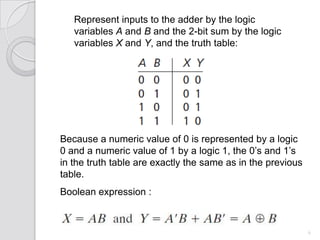
Represent inputs to the adder by the logic
   variables A and B and the 2-bit sum by the logic
   variables X and Y, and the truth table:


Because a numeric value of 0 is represented by a logic
0 and a numeric value of 1 by a logic 1, the 0’s and 1’s
in the truth table are exactly the same as in the previous
table.
Boolean expression :


                                                             6
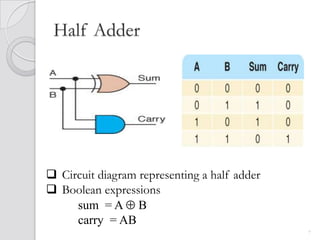
Half Adder


 Circuit diagram representing a half adder
 Boolean expressions
     sum = A B
     carry = AB
                                              7
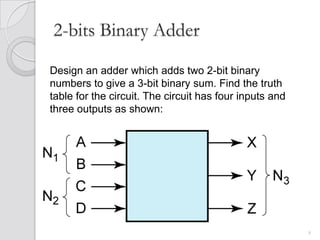
2-bits Binary Adder

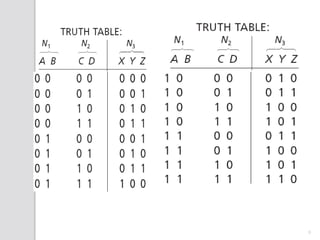
Design an adder which adds two 2-bit binary
numbers to give a 3-bit binary sum. Find the truth
table for the circuit. The circuit has four inputs and
three outputs as shown:


                                                         8
9
Contents

Half Adder
Full Adder
Subtracter


             10
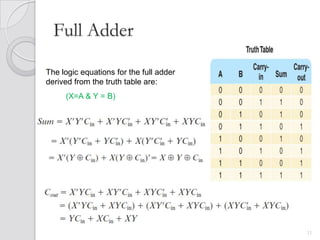
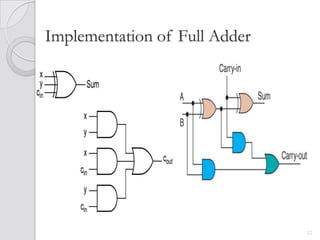
Full Adder

The logic equations for the full adder
derived from the truth table are:
     (X=A & Y = B)


                                         11
Implementation of Full Adder


                               12
Design of Binary Adders and Subtracters


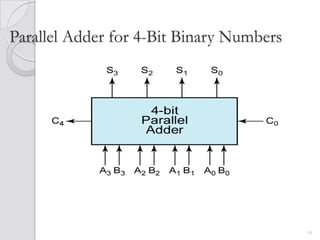
    Design a parallel adder that adds two
    4-bit unsigned binary numbers and a
    carry input to give a 4-bit sum and a
    carry output.


                                            13
Parallel Adder for 4-Bit Binary Numbers


                                          14
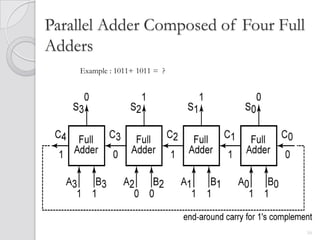
One approach would be to construct a truth
table with nine inputs and five outputs and
then derive and simplify the five output
equations.


A better method is to design a logic module
that adds two bits and a carry, and then
connect four of these modules together to
form a 4-bit adder.


                                              15
Parallel Adder Composed of Four Full
Adders
    Example : 1011+ 1011 = ?


                                       16
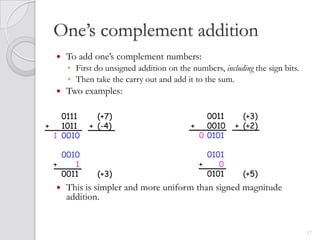
One’s complement addition
     To add one’s complement numbers:
      ◦ First do unsigned addition on the numbers, including the sign bits.
      ◦ Then take the carry out and add it to the sum.
     Two examples:

    0111      (+7)                            0011       (+3)
+   1011    + (-4)                        +   0010     + (+2)
  1 0010                                    0 0101

   0010                                        0101
 +    1                                      +    0
   0011       (+3)                             0101       (+5)
     This is simpler and more uniform than signed magnitude
      addition.


                                                                              17
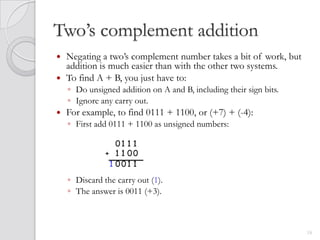
Two’s complement addition
 Negating a two’s complement number takes a bit of work, but
  addition is much easier than with the other two systems.
 To find A + B, you just have to:
    ◦ Do unsigned addition on A and B, including their sign bits.
    ◦ Ignore any carry out.
   For example, to find 0111 + 1100, or (+7) + (-4):
    ◦ First add 0111 + 1100 as unsigned numbers:

                  01 1 1
               + 1 1 00
                1 001 1
    ◦ Discard the carry out (1).
    ◦ The answer is 0011 (+3).


                                                                    18
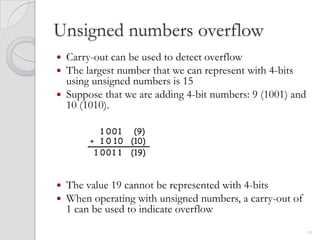
Unsigned numbers overflow
 Carry-out can be used to detect overflow
 The largest number that we can represent with 4-bits
  using unsigned numbers is 15
 Suppose that we are adding 4-bit numbers: 9 (1001) and
  10 (1010).

            1 001    (9)
         + 1 0 10   (10)
          1 001 1   (19)


   The value 19 cannot be represented with 4-bits
   When operating with unsigned numbers, a carry-out of
    1 can be used to indicate overflow
                                                           19
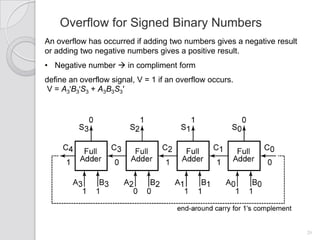
Overflow for Signed Binary Numbers
An overflow has occurred if adding two numbers gives a negative result
or adding two negative numbers gives a positive result.
• Negative number  in compliment form
define an overflow signal, V = 1 if an overflow occurs.
V = A3′B3′S3 + A3B3S3′


                                                                         20
Contents

Half Adder
Full Adder
Subtracter


             21
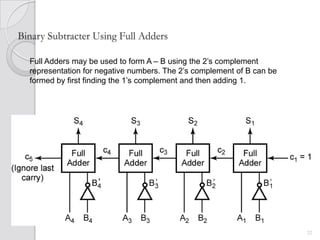
Binary Subtracter Using Full Adders

  Full Adders may be used to form A – B using the 2’s complement
  representation for negative numbers. The 2’s complement of B can be
  formed by first finding the 1’s complement and then adding 1.


                                                                        22
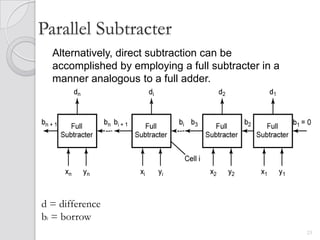
Parallel Subtracter
  Alternatively, direct subtraction can be
  accomplished by employing a full subtracter in a
  manner analogous to a full adder.


d = difference
bi = borrow
                                                     23
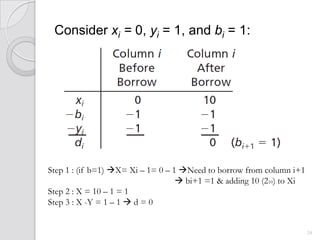
Consider xi = 0, yi = 1, and bi = 1:


Step 1 : (if b=1) X= Xi – 1= 0 – 1 Need to borrow from column i+1
                                    bi+1 =1 & adding 10 (210) to Xi
Step 2 : X = 10 – 1 = 1
Step 3 : X -Y = 1 – 1  d = 0


                                                                       24
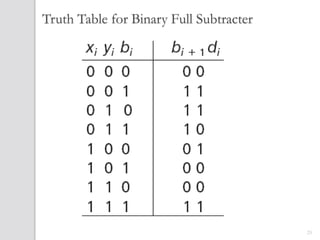
Truth Table for Binary Full Subtracter


                                         25

Adder substracter

  • 1.
    KL 2164 DIGITAL ELECTRONICS ADDER/ SUBSTRACTER Pn. Wan Nurdiana Wan Ibrahim nurdiana@eng.ukm.my
  • 2.
  • 3.
    Adder The result ofadding two binary digits could produce a carry value Recall that 1 + 1 = 10 in base two Half adder A circuit that computes the sum of two bits and produces the correct carry bit Full Adder A circuit that takes the carry-in value into account 3
  • 4.
  • 5.
    Example of 1-bitAdder Design a simple binary adder that adds two 1-bit binary numbers, a and b, to give a 2-bit sum. The numeric values for the adder inputs and outputs are as follows: 5
  • 6.
    Represent inputs tothe adder by the logic variables A and B and the 2-bit sum by the logic variables X and Y, and the truth table: Because a numeric value of 0 is represented by a logic 0 and a numeric value of 1 by a logic 1, the 0’s and 1’s in the truth table are exactly the same as in the previous table. Boolean expression : 6
  • 7.
    Half Adder  Circuitdiagram representing a half adder  Boolean expressions sum = A B carry = AB 7
  • 8.
    2-bits Binary Adder Designan adder which adds two 2-bit binary numbers to give a 3-bit binary sum. Find the truth table for the circuit. The circuit has four inputs and three outputs as shown: 8
  • 9.
  • 10.
  • 11.
    Full Adder The logicequations for the full adder derived from the truth table are: (X=A & Y = B) 11
  • 12.
  • 13.
    Design of BinaryAdders and Subtracters Design a parallel adder that adds two 4-bit unsigned binary numbers and a carry input to give a 4-bit sum and a carry output. 13
  • 14.
    Parallel Adder for4-Bit Binary Numbers 14
  • 15.
    One approach wouldbe to construct a truth table with nine inputs and five outputs and then derive and simplify the five output equations. A better method is to design a logic module that adds two bits and a carry, and then connect four of these modules together to form a 4-bit adder. 15
  • 16.
    Parallel Adder Composedof Four Full Adders Example : 1011+ 1011 = ? 16
  • 17.
    One’s complement addition  To add one’s complement numbers: ◦ First do unsigned addition on the numbers, including the sign bits. ◦ Then take the carry out and add it to the sum.  Two examples: 0111 (+7) 0011 (+3) + 1011 + (-4) + 0010 + (+2) 1 0010 0 0101 0010 0101 + 1 + 0 0011 (+3) 0101 (+5)  This is simpler and more uniform than signed magnitude addition. 17
  • 18.
    Two’s complement addition Negating a two’s complement number takes a bit of work, but addition is much easier than with the other two systems.  To find A + B, you just have to: ◦ Do unsigned addition on A and B, including their sign bits. ◦ Ignore any carry out.  For example, to find 0111 + 1100, or (+7) + (-4): ◦ First add 0111 + 1100 as unsigned numbers: 01 1 1 + 1 1 00 1 001 1 ◦ Discard the carry out (1). ◦ The answer is 0011 (+3). 18
  • 19.
    Unsigned numbers overflow Carry-out can be used to detect overflow  The largest number that we can represent with 4-bits using unsigned numbers is 15  Suppose that we are adding 4-bit numbers: 9 (1001) and 10 (1010). 1 001 (9) + 1 0 10 (10) 1 001 1 (19)  The value 19 cannot be represented with 4-bits  When operating with unsigned numbers, a carry-out of 1 can be used to indicate overflow 19
  • 20.
    Overflow for SignedBinary Numbers An overflow has occurred if adding two numbers gives a negative result or adding two negative numbers gives a positive result. • Negative number  in compliment form define an overflow signal, V = 1 if an overflow occurs. V = A3′B3′S3 + A3B3S3′ 20
  • 21.
  • 22.
    Binary Subtracter UsingFull Adders Full Adders may be used to form A – B using the 2’s complement representation for negative numbers. The 2’s complement of B can be formed by first finding the 1’s complement and then adding 1. 22
  • 23.
    Parallel Subtracter Alternatively, direct subtraction can be accomplished by employing a full subtracter in a manner analogous to a full adder. d = difference bi = borrow 23
  • 24.
    Consider xi =0, yi = 1, and bi = 1: Step 1 : (if b=1) X= Xi – 1= 0 – 1 Need to borrow from column i+1  bi+1 =1 & adding 10 (210) to Xi Step 2 : X = 10 – 1 = 1 Step 3 : X -Y = 1 – 1  d = 0 24
  • 25.
    Truth Table forBinary Full Subtracter 25