Digital Logic Design
1
Decoder & Encoder
Prof. Shehzad Ali
Decoder
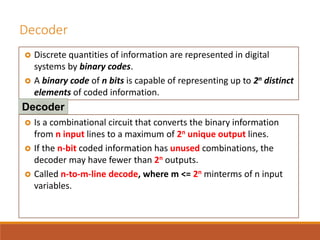
 Discrete quantities of information are represented in digital
systems by binary codes.
 A binary code of n bits is capable of representing up to 2n distinct
elements of coded information.
 Is a combinational circuit that converts the binary information
from n input lines to a maximum of 2n unique output lines.
 If the n-bit coded information has unused combinations, the
decoder may have fewer than 2n outputs.
 Called n-to-m-line decode, where m <= 2n minterms of n input
variables.
Decoder
Decoder
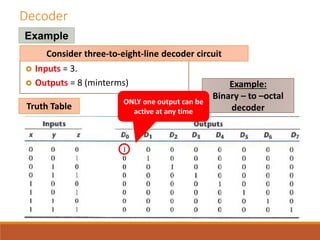
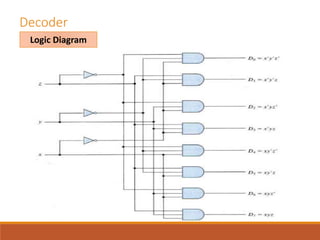
 Inputs = 3.
 Outputs = 8 (minterms)
Example
Consider three-to-eight-line decoder circuit
Truth Table
Example:
Binary – to –octal
decoder
ONLY one output can be
active at any time
Decoder
Logic Diagram
Decoder
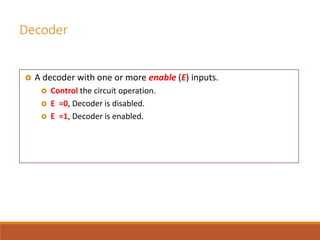
 A decoder with one or more enable (E) inputs.
 Control the circuit operation.
 E =0, Decoder is disabled.
 E =1, Decoder is enabled.
Decoder
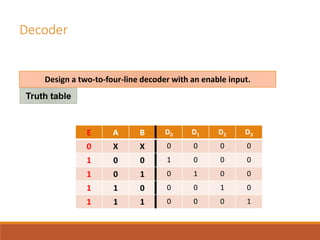
Design a two-to-four-line decoder with an enable input.
Truth table
D3D2D1D0BAE
0000XX0
0001001
0010101
0100011
1000111
Decoder
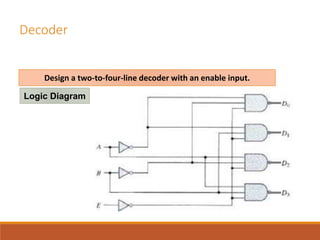
Design a two-to-four-line decoder with an enable input.
Logic Diagram
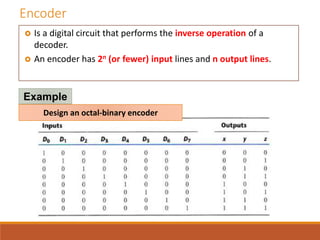
Encoder
 Is a digital circuit that performs the inverse operation of a
decoder.
 An encoder has 2n (or fewer) input lines and n output lines.
Example
Design an octal-binary encoder
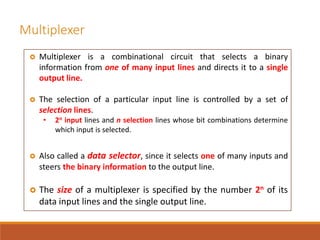
Multiplexer
 Multiplexer is a combinational circuit that selects a binary
information from one of many input lines and directs it to a single
output line.
 The selection of a particular input line is controlled by a set of
selection lines.
• 2n input lines and n selection lines whose bit combinations determine
which input is selected.
 Also called a data selector, since it selects one of many inputs and
steers the binary information to the output line.
 The size of a multiplexer is specified by the number 2n of its
data input lines and the single output line.
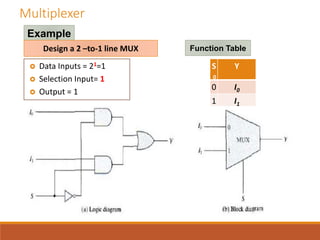
Multiplexer
Example
Design a 2 –to-1 line MUX
 Data Inputs = 21=1
 Selection Input= 1
 Output = 1
YS
0
I00
I11
Function Table
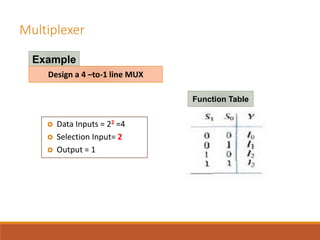
Multiplexer
Example
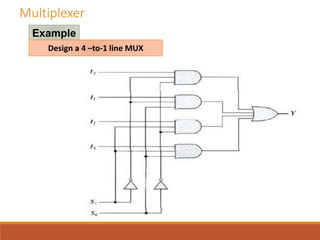
Design a 4 –to-1 line MUX
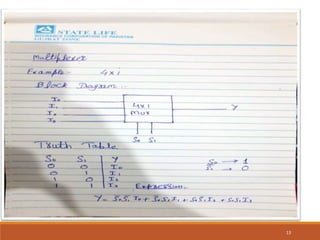
 Data Inputs = 22 =4
 Selection Input= 2
 Output = 1
Function Table
Multiplexer
Example
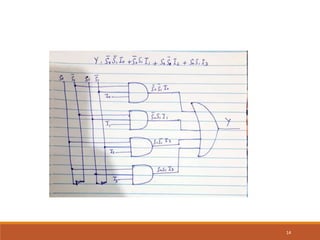
Design a 4 –to-1 line MUX
13
14
Digital Circuits
Magnitude Comparator
A magnitude comparator is a combinational circuit that compares two
numbers, A and B, and determines their relative magnitudes. The
outcome of the comparison is specified by three binary variables that
indicate whether A > B, A = B, or A < B.
The comparison of two numbers
◦ outputs: A>B, A=B, A<B
Design Approaches
◦ the truth table
◦ 2
2n
entries - too complex for large n
15

Decoder encoder

  • 1.
    Digital Logic Design 1 Decoder& Encoder Prof. Shehzad Ali
  • 2.
    Decoder  Discrete quantitiesof information are represented in digital systems by binary codes.  A binary code of n bits is capable of representing up to 2n distinct elements of coded information.  Is a combinational circuit that converts the binary information from n input lines to a maximum of 2n unique output lines.  If the n-bit coded information has unused combinations, the decoder may have fewer than 2n outputs.  Called n-to-m-line decode, where m <= 2n minterms of n input variables. Decoder
  • 3.
    Decoder  Inputs =3.  Outputs = 8 (minterms) Example Consider three-to-eight-line decoder circuit Truth Table Example: Binary – to –octal decoder ONLY one output can be active at any time
  • 4.
  • 5.
    Decoder  A decoderwith one or more enable (E) inputs.  Control the circuit operation.  E =0, Decoder is disabled.  E =1, Decoder is enabled.
  • 6.
    Decoder Design a two-to-four-linedecoder with an enable input. Truth table D3D2D1D0BAE 0000XX0 0001001 0010101 0100011 1000111
  • 7.
    Decoder Design a two-to-four-linedecoder with an enable input. Logic Diagram
  • 8.
    Encoder  Is adigital circuit that performs the inverse operation of a decoder.  An encoder has 2n (or fewer) input lines and n output lines. Example Design an octal-binary encoder
  • 9.
    Multiplexer  Multiplexer isa combinational circuit that selects a binary information from one of many input lines and directs it to a single output line.  The selection of a particular input line is controlled by a set of selection lines. • 2n input lines and n selection lines whose bit combinations determine which input is selected.  Also called a data selector, since it selects one of many inputs and steers the binary information to the output line.  The size of a multiplexer is specified by the number 2n of its data input lines and the single output line.
  • 10.
    Multiplexer Example Design a 2–to-1 line MUX  Data Inputs = 21=1  Selection Input= 1  Output = 1 YS 0 I00 I11 Function Table
  • 11.
    Multiplexer Example Design a 4–to-1 line MUX  Data Inputs = 22 =4  Selection Input= 2  Output = 1 Function Table
  • 12.
  • 13.
  • 14.
  • 15.
    Digital Circuits Magnitude Comparator Amagnitude comparator is a combinational circuit that compares two numbers, A and B, and determines their relative magnitudes. The outcome of the comparison is specified by three binary variables that indicate whether A > B, A = B, or A < B. The comparison of two numbers ◦ outputs: A>B, A=B, A<B Design Approaches ◦ the truth table ◦ 2 2n entries - too complex for large n 15