Column Chromatography
PRESENTED BY
Ramesh N P
B Pharm 7th Semester
Bapuji Pharmacy College, Davanagere.
Content:
• Introduction
• History
• Definition of column chromatography
• Principle
• Classification
• Advantages
• Disadvantages
• Applications
• Reference
Introduction:
Chromatography is physical method of separation in which the components to
be separated are distributed b/w two phases:
 Stationary phase
 Mobile phase
The stationary phase may be solid or liquid supported on a solid or gel
The mobile phase may be a liquid/ solvents/ mixture of solvents or gases.
History:
 The first chromatography column was developed by the Russian botanist
Mikhail Tsvet in 1901.
Who washed an organic solution of plant pigments through a vertical glass
column packed with an adsorptive material.
He discovered that the pigments separated into a series of discrete coloured
bands on the column, divided by regions entirely free of colour.
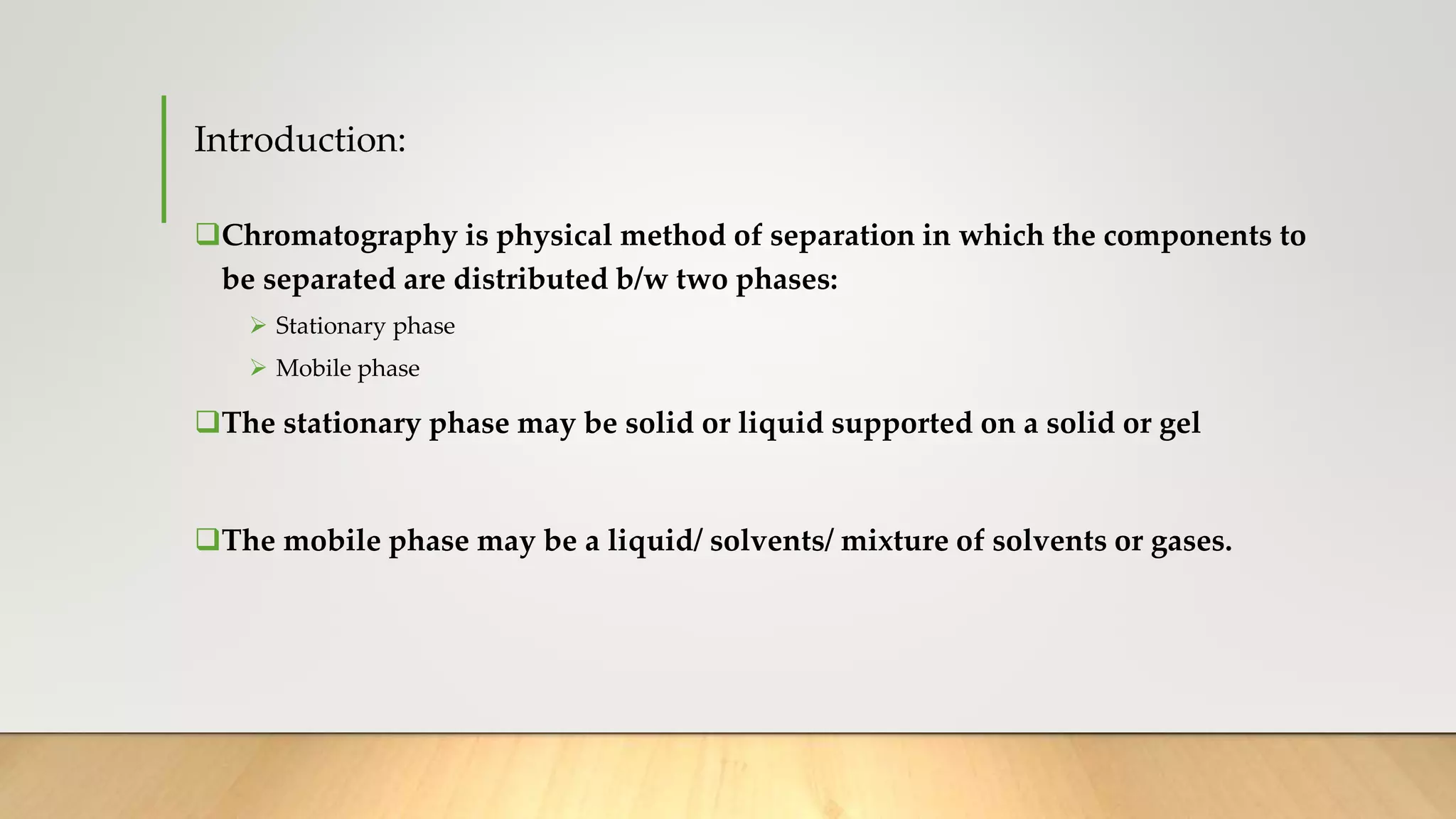
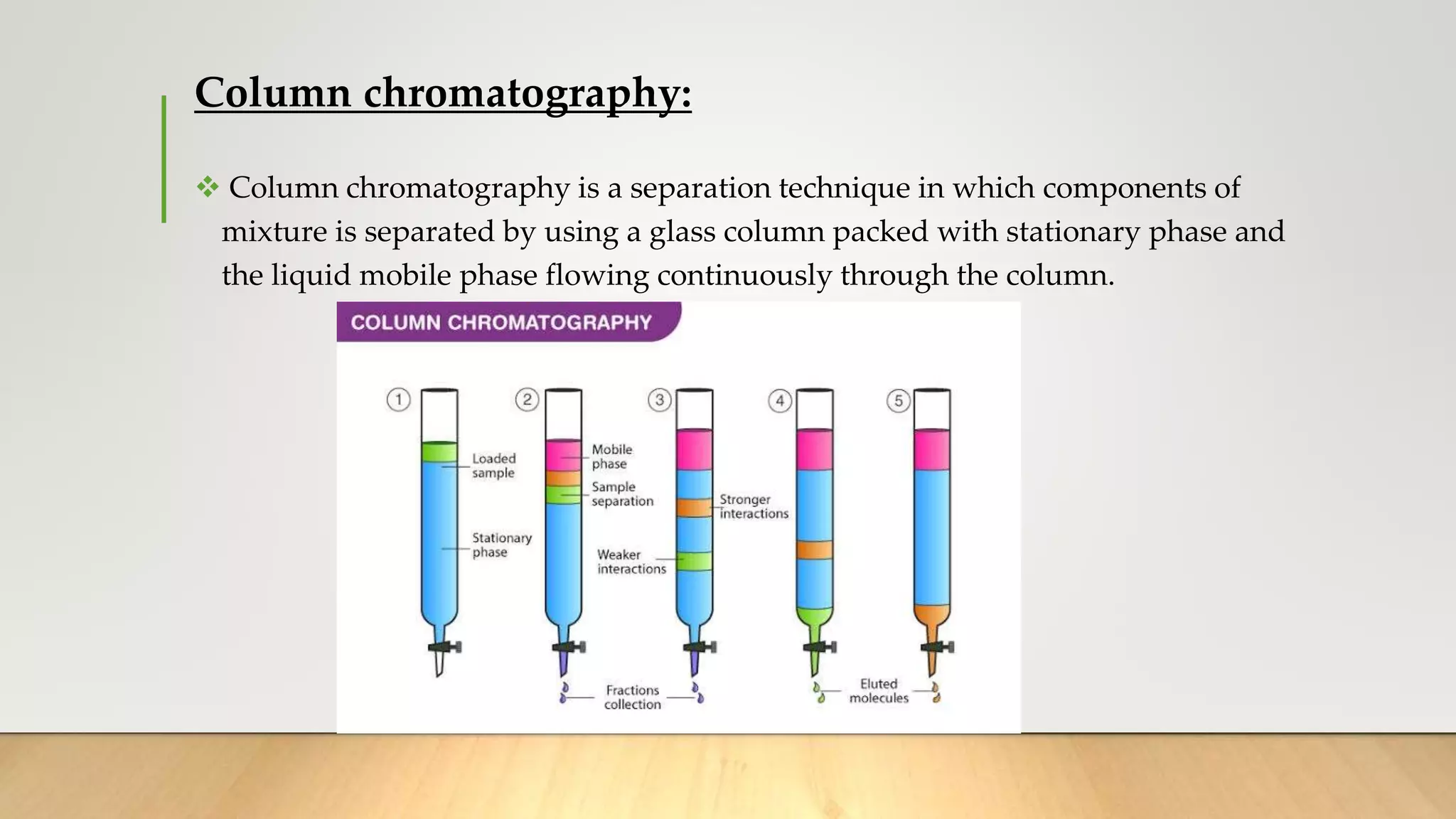
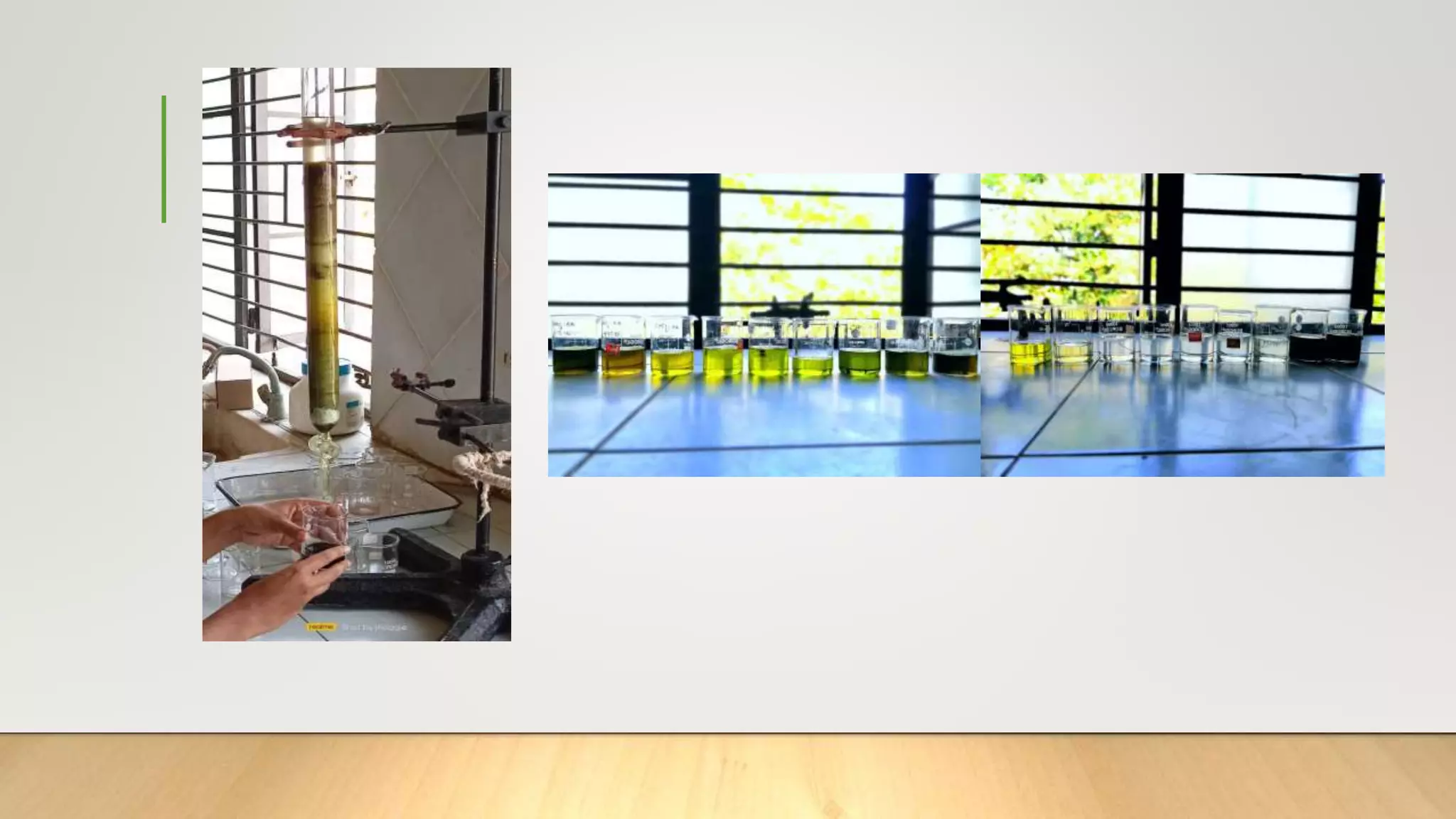
Column chromatography:
 Column chromatography is a separation technique in which components of
mixture is separated by using a glass column packed with stationary phase and
the liquid mobile phase flowing continuously through the column.
Principle:
 A solid stationery phase and a liquid mobile phase is used and the principle of
separation is adsorption.
 When a mixture of components dissolved in the mobile phase is introduced into
a column , the individual component move with different rates depending upon
their relative affinities.
The compound with lesser affinity towards the stationary phase move faster and
hence it is eluted of the column first , the one with greater affinity towards the
stationary phase move slower down the column and hence it is eluted later,
The process is continued. As a result the materials are partially separated and
adsorbed in the various part of the column. The type of interaction b/w the
stationay phase and solute is reversible in nature.
Classification:
Column chromatography is divided into two categories, depending on how the
solvents flow down the column.
o Gravity column chromatography:
o Flash chromatography:
Advantages:
Any type of mixture can be separated by column chromatography.
Any quantity of mixture can also be separated.
Wider choice of mobile phase.
Disadvantages:
Time consuming method.
More amount of solvents are required which are expensive.
More amount of adsorbent (stationary phase) is required.
Drying and bubble presence are possible.
Applications:
Separation of mixture of compound.
Removal of impurities or purification process.
Isolation of active constituents.
Isolation of metabolites and biological fluids.
Estimation of drug in formulation and crud drug extracts.
Reference:
 Dr . S. Ravi Shanker, “pharmaceutical analysis” Rx publications, Fourth edition,
Page no: 13-1 to 13-13,
Column Chromatography

Column Chromatography

  • 1.
    Column Chromatography PRESENTED BY RameshN P B Pharm 7th Semester Bapuji Pharmacy College, Davanagere.
  • 2.
    Content: • Introduction • History •Definition of column chromatography • Principle • Classification • Advantages • Disadvantages • Applications • Reference
  • 3.
    Introduction: Chromatography is physicalmethod of separation in which the components to be separated are distributed b/w two phases:  Stationary phase  Mobile phase The stationary phase may be solid or liquid supported on a solid or gel The mobile phase may be a liquid/ solvents/ mixture of solvents or gases.
  • 4.
    History:  The firstchromatography column was developed by the Russian botanist Mikhail Tsvet in 1901. Who washed an organic solution of plant pigments through a vertical glass column packed with an adsorptive material. He discovered that the pigments separated into a series of discrete coloured bands on the column, divided by regions entirely free of colour.
  • 5.
    Column chromatography:  Columnchromatography is a separation technique in which components of mixture is separated by using a glass column packed with stationary phase and the liquid mobile phase flowing continuously through the column.
  • 6.
    Principle:  A solidstationery phase and a liquid mobile phase is used and the principle of separation is adsorption.  When a mixture of components dissolved in the mobile phase is introduced into a column , the individual component move with different rates depending upon their relative affinities. The compound with lesser affinity towards the stationary phase move faster and hence it is eluted of the column first , the one with greater affinity towards the stationary phase move slower down the column and hence it is eluted later, The process is continued. As a result the materials are partially separated and adsorbed in the various part of the column. The type of interaction b/w the stationay phase and solute is reversible in nature.
  • 8.
    Classification: Column chromatography isdivided into two categories, depending on how the solvents flow down the column. o Gravity column chromatography: o Flash chromatography:
  • 9.
    Advantages: Any type ofmixture can be separated by column chromatography. Any quantity of mixture can also be separated. Wider choice of mobile phase.
  • 10.
    Disadvantages: Time consuming method. Moreamount of solvents are required which are expensive. More amount of adsorbent (stationary phase) is required. Drying and bubble presence are possible.
  • 11.
    Applications: Separation of mixtureof compound. Removal of impurities or purification process. Isolation of active constituents. Isolation of metabolites and biological fluids. Estimation of drug in formulation and crud drug extracts.
  • 12.
    Reference:  Dr .S. Ravi Shanker, “pharmaceutical analysis” Rx publications, Fourth edition, Page no: 13-1 to 13-13,