SURFACE AND INTERFACIAL
TENSION
Presented by,
RD
CONTENTS
 Introduction
 Detergency
 Foaming agents
 Anti Foaming agents
 Spreading coefficient
 Wetting
 References
INTRODUCTION
 Surface tension- The tension in the surface is
the force per unit length that must be applied
parallel to the surface so as to counter balance the
net invert pull.
 This is called surface tension. Unit- N/m
 Interfacial tension- It is the force per unit length
existing at the interface between two immiscible
liquid phases and like surface tension has the unit
N/m.
DETERGENCY
 Surfactants in aqueous solution are used to
remove dirt from the substrate such as
glass, fabric, skin etc.
 The HLB requirement of detergent is from
13-16.
 Some ex. of detergent of ionic type are-
 Cationic – cetrimide
 Anionic – sodium lauryl sulfate
MECHANISM OF DETERGENCY
 The hydrocarbon tails of the detergents
anions dissolve in the grease
 The grease spot gradually breaks up and
becomes pin cutioned by the detergent
anions.
 Small bit of grease are held in colloidal
suspension by the detergent. The anionic
bonds keep the greece from combining
because the particles carries the same
electric charge.
FOAMING AGENTS
 Any solution containing surface active material
produces stable foams when mixed intimately
with air.
 A foam is relatively stable structure consisting of
air packets enclosed with in the films of liquid
i.e. the gas in liquid dispersion being stabilized
by foaming agents.
ANTI FOAMING AGENTS
 Some surfactants can be used to break the foam and
are known as Anti foaming agents.
Ex alcohols, ether, castor oil
SPREADING COEFFICIENT
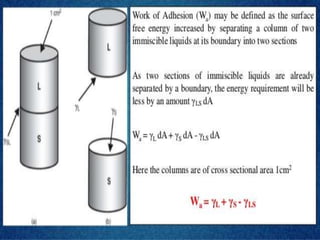
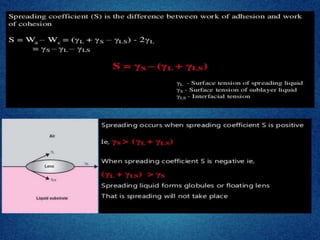
 When a substance such as oleic acid is
placed on the surface of water , it will spread
as the film if the force of adhesion between
the oleic acid molecules is greater than
cohesive force between the oleic acid
molecules itself.
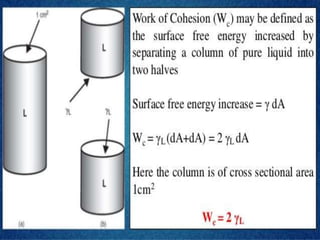
 It is the difference between work of adhesion
and work of cohesion.
 The HLB of the spreading agents is 04-09.
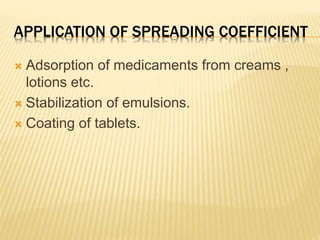
APPLICATION OF SPREADING COEFFICIENT
 Adsorption of medicaments from creams ,
lotions etc.
 Stabilization of emulsions.
 Coating of tablets.
WETTING AGENT
Adsorption at solid liquid interface is involved in the
phenomenon of wetting agents.
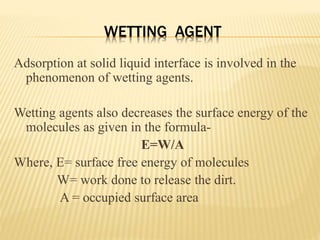
Wetting agents also decreases the surface energy of the
molecules as given in the formula-
E=W/A
Where, E= surface free energy of molecules
W= work done to release the dirt.
A = occupied surface area
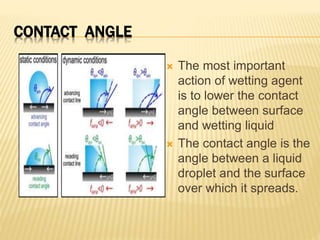
CONTACT ANGLE
 The most important
action of wetting agent
is to lower the contact
angle between surface
and wetting liquid
 The contact angle is the
angle between a liquid
droplet and the surface
over which it spreads.
APPLICATION OF WETTING AGENT
 Intimate contacts of solids or liquid with liquid
is initial step towards the preparation of
suspension and emulsion.
 Film coating required wetting & spreading of
liquid over the tablet surface.
 Dissolution of the tablet or capsules
necessities the penetration of liquid into
pours of dosage forms.
REFERENCES
 Martin Alfred, “Physical pharmacy,” 4th
edition, B.I. Waverly private limited new
Delhi, page no. 145-168.
 Darle D.V. , essentials of Physical pharmacy,
Sai hanuman sagar boddu, 2th edition, new
Delhi, page no. 240-253.
 ppt SURFACE AND INTERFACIAL TENSION

ppt SURFACE AND INTERFACIAL TENSION

  • 1.
  • 2.
    CONTENTS  Introduction  Detergency Foaming agents  Anti Foaming agents  Spreading coefficient  Wetting  References
  • 3.
    INTRODUCTION  Surface tension-The tension in the surface is the force per unit length that must be applied parallel to the surface so as to counter balance the net invert pull.  This is called surface tension. Unit- N/m  Interfacial tension- It is the force per unit length existing at the interface between two immiscible liquid phases and like surface tension has the unit N/m.
  • 4.
    DETERGENCY  Surfactants inaqueous solution are used to remove dirt from the substrate such as glass, fabric, skin etc.  The HLB requirement of detergent is from 13-16.  Some ex. of detergent of ionic type are-  Cationic – cetrimide  Anionic – sodium lauryl sulfate
  • 5.
    MECHANISM OF DETERGENCY The hydrocarbon tails of the detergents anions dissolve in the grease  The grease spot gradually breaks up and becomes pin cutioned by the detergent anions.  Small bit of grease are held in colloidal suspension by the detergent. The anionic bonds keep the greece from combining because the particles carries the same electric charge.
  • 6.
    FOAMING AGENTS  Anysolution containing surface active material produces stable foams when mixed intimately with air.  A foam is relatively stable structure consisting of air packets enclosed with in the films of liquid i.e. the gas in liquid dispersion being stabilized by foaming agents. ANTI FOAMING AGENTS  Some surfactants can be used to break the foam and are known as Anti foaming agents. Ex alcohols, ether, castor oil
  • 7.
    SPREADING COEFFICIENT  Whena substance such as oleic acid is placed on the surface of water , it will spread as the film if the force of adhesion between the oleic acid molecules is greater than cohesive force between the oleic acid molecules itself.  It is the difference between work of adhesion and work of cohesion.  The HLB of the spreading agents is 04-09.
  • 11.
    APPLICATION OF SPREADINGCOEFFICIENT  Adsorption of medicaments from creams , lotions etc.  Stabilization of emulsions.  Coating of tablets.
  • 12.
    WETTING AGENT Adsorption atsolid liquid interface is involved in the phenomenon of wetting agents. Wetting agents also decreases the surface energy of the molecules as given in the formula- E=W/A Where, E= surface free energy of molecules W= work done to release the dirt. A = occupied surface area
  • 13.
    CONTACT ANGLE  Themost important action of wetting agent is to lower the contact angle between surface and wetting liquid  The contact angle is the angle between a liquid droplet and the surface over which it spreads.
  • 14.
    APPLICATION OF WETTINGAGENT  Intimate contacts of solids or liquid with liquid is initial step towards the preparation of suspension and emulsion.  Film coating required wetting & spreading of liquid over the tablet surface.  Dissolution of the tablet or capsules necessities the penetration of liquid into pours of dosage forms.
  • 15.
    REFERENCES  Martin Alfred,“Physical pharmacy,” 4th edition, B.I. Waverly private limited new Delhi, page no. 145-168.  Darle D.V. , essentials of Physical pharmacy, Sai hanuman sagar boddu, 2th edition, new Delhi, page no. 240-253.